
Belleair City Zoning Code
ARTICLE VI
RESOURCE PROTECTION STANDARDS
DIVISION 5. - RESERVED[2]
Editor's note— Ord. No. 513, § 3, adopted May 2, 2017, repealed former div. 5, §§ 74-451—74-455, which pertained to floodplains, and derived from Ord. No. 399, § 1, adopted Nov. 20, 2001; and Ord. No. 435, § 2, adopted July 18, 2006. See ch. 75, floodplain management.
Sec. 74-361. - Purpose of article.
This article establishes resources or areas that must be protected from harmful affects of development. An applicant should apply the provisions of this article to a proposed site before any other development design work is undertaken. Application of the provisions of this article will divide a proposed development site into areas that may be developed and areas that must be generally undeveloped. The proposed development should then be designed to fit within the areas that may be developed.
(Ord. No. 399, § 1, 11-20-01)
Sec. 74-381. - Permit required for removal of protected trees.
On any real property within the limits of the town, it shall be unlawful for any person to remove or cause to be removed any protected tree without first having procured a permit as provided for in this land development code. Where any site is proposed for development on which there are protected trees, a tree survey shall be provided as part of the development permit application.
(Ord. No. 399, § 1, 11-20-01)
Sec. 74-382. - Exemptions from tree protection requirements.
(a)
Nuisance trees. The following types of trees shall be exempt from the tree protection requirements of this land development code:
(1)
Brazilian pepper.
(2)
Malaleuca (punk tree).
(b)
Emergency work. During emergencies caused by a hurricane or other disaster, the town manager may suspend the tree protection regulations.
(Ord. No. 399, § 1, 11-20-01)
Sec. 74-383. - Conditions for removal; replacement.
(a)
Conditions for removal.
(1)
It is the intent of this section to minimize the removal of protected trees and provide that no authorization be granted to remove a tree if the applicant has failed to take reasonable measures to design and locate the proposed improvements so that the number of protected trees to be removed is minimized. In particular, the design must attempt to preserve specimen and historic trees.
(2)
With respect to the issuance of a tree removal permit in conjunction with a development activity, no such tree removal permit shall be issued prior to the issuance of the appropriate building permit and, with respect to a major development as defined in section 66-162(b), until a cash bond equal to the replacement value of all the trees permitted to be replaced has been filed with the town manager guaranteeing the replacement in accordance with subsection (b) of this section. No authorization for the removal of a protected tree shall be granted unless the applicant demonstrates one or more of the following conditions:
a.
A permissible use of the site cannot reasonably be undertaken unless specific trees are removed or relocated.
b.
The tree is located in such proximity to an existing or proposed structure that the safety, utility or structural integrity of the structure is materially impaired.
c.
The tree materially interferes with the location, servicing or functioning of existing utility lines or services.
d.
The tree creates a substantial hazard to motor, bicycle or pedestrian traffic by virtue of physical proximity to traffic or impairment of vision.
e.
The tree is diseased or weakened by infestation by insects, abuse, storm, fire or any other cause or condition whatsoever, and the weakened condition of the tree presents a threat to persons or property, as determined by the town manager or the designee of the town manager.
f.
Any law or town regulation requires the removal.
(b)
Replacement.
(1)
Trees removed pursuant to subsection (a) of this section, except for trees removed pursuant to subsection (a)(2)e., shall either be replaced, as set forth in this subsection, at the expense of the property owner, or a fee in lieu of replacement shall be paid to the town. Replacement shall not be required for trees removed pursuant to subsection (a)(2)e. of this section, nor shall any fee be required in lieu of replacement for trees removed pursuant to subsection (a)(2)e.
(2)
Replacement trees shall, if practicable, be planted on the development site. If it is not practicable to plant replacement trees on the development site, then the owner shall be required to either donate replacement trees to the town, which trees shall be planted on town property, or the owner shall be required to pay a fee in lieu of tree replacement to the town, which fee shall be deposited in the tree replacement fund of the town, and the monies deposited shall be used solely for tree plantings and maintenance of trees. The election to require the owner to provide replacement trees to the town or a fee in lieu thereof shall rest in the sole and absolute discretion of the town manager. If the town manager elects to accept replacement trees instead of a fee in lieu thereof, then the town shall have the sole and absolute discretion to dictate the location and species of the replacement trees to be provided to the town and planted on town property.
(3)
If replacement trees are provided by the owner, regardless of whether the replacement trees are to be planted on the development site or on town property, then the replacement trees shall be in accordance with the town landscaping master plan at the time of planting. For each inch of diameter at breast height of trees removed, an inch of diameter at breast height shall be replaced. With respect to replacement trees which are planted on the development site, the owner shall use his best efforts to ensure that the replacement trees thrive. If any replacement tree, within 90 days of its planting, shows any sign that the tree will not survive, the owner shall replace any such tree with another acceptable replacement tree. With respect to replacement trees which are donated to the town, such replacement trees shall be accompanied by a 90-day guarantee from the nursery which supplied the tree. The replacement trees shall also be state department of agriculture Nursery Grade No. 1. Only the following species of trees shall be acceptable replacement trees:
Large street and median shade trees:
Live oak
Weeping elm
Laurel oak
Sycamore
Red cedar
Pignut hickory
Slash pine
Bald cypress
Southern magnolia
Smaller street and median shade trees:
East Palatka holly
Weeping holly
Weeping bottlebrush
Rigid bottlebrush
Wax myrtle
Crape myrtle
Palms for street and median:
Canary Island date palm
Wild date palm
Cabbage palm
Washingtonian palm
Pinto palm
(4)
If the town requires a fee to be paid by the owner pursuant to subsection (2) of this subsection, the fee shall approximate the cost to purchase and plant equivalent sizes and species of acceptable replacement trees. The fee shall be calculated on a per-inch basis, and the per-inch fee shall be determined by the town commission from time to time.
(5)
If it is practicable to replace a tree on the development site, in lieu of replacing any such tree, a tree removed from one location on a site may be planted at another location on the same development site. If the owner elects to relocate a tree on the development site, the town manager may require the owner or applicant to consult with a horticulturist or other tree professional to prescribe measures to ensure the survival of the tree.
(6)
In the event that a palm is to be removed, it may be replaced with either another palm or a tree as specified in section 74-383(b)(3), except that a palm removed from a protected tree-lined road as specified in section 74-386 must be replaced with a like variety in the same location as the removed palm.
(c)
Historic and specimen trees and historic tree stands.
(1)
Historic trees or historic stands of trees are trees that have been designated by the town commission as trees of notable historical interest and value to the town because of their location or historical association with the community. A public hearing shall be held by the town commission on the designation, with due notice to the tree's owner.
(2)
Specimen trees are trees that have been officially designated by the town commission to be of high value because of their type, size, age or other relevant criteria. A public hearing on the designation shall be held by the town commission, with due notice to the owner of the tree.
(3)
No historic tree or historic stand of trees or specimen tree shall be removed without a finding by the town commission that the tree or stand of trees is a hazard or that it is not economically or practically feasible to develop the parcel without removing the tree or stand of trees. The applicant shall explain in detail why the tree or stand of trees is a hazard or why it is not economically or practically feasible to allow the tree or stand of trees to remain. The town manager shall make a presentation to the commission on the application and make a recommendation as to whether it should be approved or denied. The decision by the commission on the application shall be made within 30 days of the date the application was filed.
(Ord. No. 399, § 1, 11-20-01)
Sec. 74-384. - Protection from injury during development activities.
(a)
Generally.
(1)
To ensure the health and survival of protected trees that are not to be removed, the developer shall avoid the following kinds of tree injuries during all development activities:
a.
Mechanical injuries to roots, trunk and branches;
b.
Injuries by chemical poisoning;
c.
Injuries by grade changes;
d.
Injuries by excavations; and
e.
Injuries by paving.
(2)
At a minimum, the protective measures described in this section shall be taken where appropriate to the development activity. The measures shall be not be construed as limiting the authority of the town commission, upon the advice of the town manager, to impose additional reasonable requirements as may be necessary to preserve the health of protected trees in particular circumstances, including the provision of a cash bond equal to the value of all trees determined to be at risk of injury to ensure replacement of any trees injured or lost during construction. With respect to any major development as defined in section 66-162(b), an arborist shall be consulted to ensure that proper provisions are made to avoid injuries to protected trees during development activities. A copy of the contract with the arborist shall be provided to the town manager upon issuance of a development order.
(b)
Protection from mechanical injuries.
(1)
Prior to any land preparation or other development activities, a protective barrier easily visible to equipment operators shall be placed around all protected trees so as to encompass the entire tree protection zone. (See figure 1 following this section.)
(2)
No attachment, wires (other than supportive wires), signs or permits may be fastened to any protected tree.
(3)
No equipment, construction materials or debris of any kind shall be placed within the protective barrier.
(4)
Landscaping activities within the bounds of the protective barrier, before and after it is removed, shall be accomplished with light machinery or manual labor. Grubbing and similar activities are prohibited.
(5)
In lieu of constructing the barriers required in this subsection, the developer may physically designate large areas containing protected trees where no land preparation or other development activities of any kind will occur. The area shall be designated by placing stakes a maximum of 25 feet apart and tying ribbon, plastic tape, rope, etc., from stake to stake along the outside perimeter of the area. This perimeter line shall be beyond the tree protection zone of any protected trees growing within the area.
(6)
Required protective barriers and perimeter lines shall remain in place until all construction activity, except landscaping within the protected area, is terminated.
(c)
Protection from injuries due to chemical poisoning.
(1)
No fuel, paint, solvent, oil, thinner, asphalt, cement, grout or any other construction chemical, or other material or tools of any kind, shall be stored within or allowed in any manner to enter a required protective barrier or perimeter line.
(2)
No equipment shall be cleaned within a required protective barrier or perimeter line.
(d)
Protection from injuries due to grade changes. Grade changes shall not be made within the tree protection zone unless the protective measures set out in this subsection are taken. When raising the grade, the following measures shall be taken:
(1)
Within the tree protection zone, existing sod, vegetation and leaf litter shall be removed and the soil loosened without injuring the roots.
(2)
The area within the tree protection zone shall be properly fertilized to improve the vigor and growth of the roots.
(3)
Porous four-inch agriculture drain tiles shall be laid over the soil to drain liquids away from the trunk. A drop of at least one-eighth inch per foot shall be provided. The drainfield shall be designed to provide adequate drainage of the existing configuration of the trees.
(4)
The number of drains shall depend upon soil material. Lighter sandy soils and porous gravelly material require fewer drains than heavy nonporous soils.
(5)
Aeration shall be provided by installing vertical tiles along the system. The vertical tiles shall be filled with gravel and capped with a heavy-duty mesh to keep out trash and debris.
(6)
Dry wells shall be large enough to allow for maximum growth of the tree trunk. Most large shade trees require at least a 60-inch diameter well. For slow-growing mature trees, a space of 12 to 18 inches shall be provided between the trunk and the side of the well at every point.
(7)
To prevent material from washing into the well, the dry well casing walls shall be high enough to bring the coping just above the level of the proposed fill.
(8)
Dry well walls shall be constructed of materials that permit passage of air and water. Concrete blocks backed with galvanized screening may be used for the sides of the well.
(9)
Gratings or barriers shall be used around openings that are large enough to present a hazard to pedestrians.
(e)
Prevention of injuries due to excavations.
(1)
Water, sewer and other utility lines should be routed around the tree protection zones of protected trees.
(2)
If a line cannot reasonably be routed around the tree protection zone, the line shall be tunnelled beneath the area within the zone. The tunnel shall be offset to one side of the trunk to prevent damage to the main tap roots.
(f)
Paving within dripline. Porous paving or turf block may be placed within the tree protection zone of a protected tree, if no damage is inflicted to the tree.
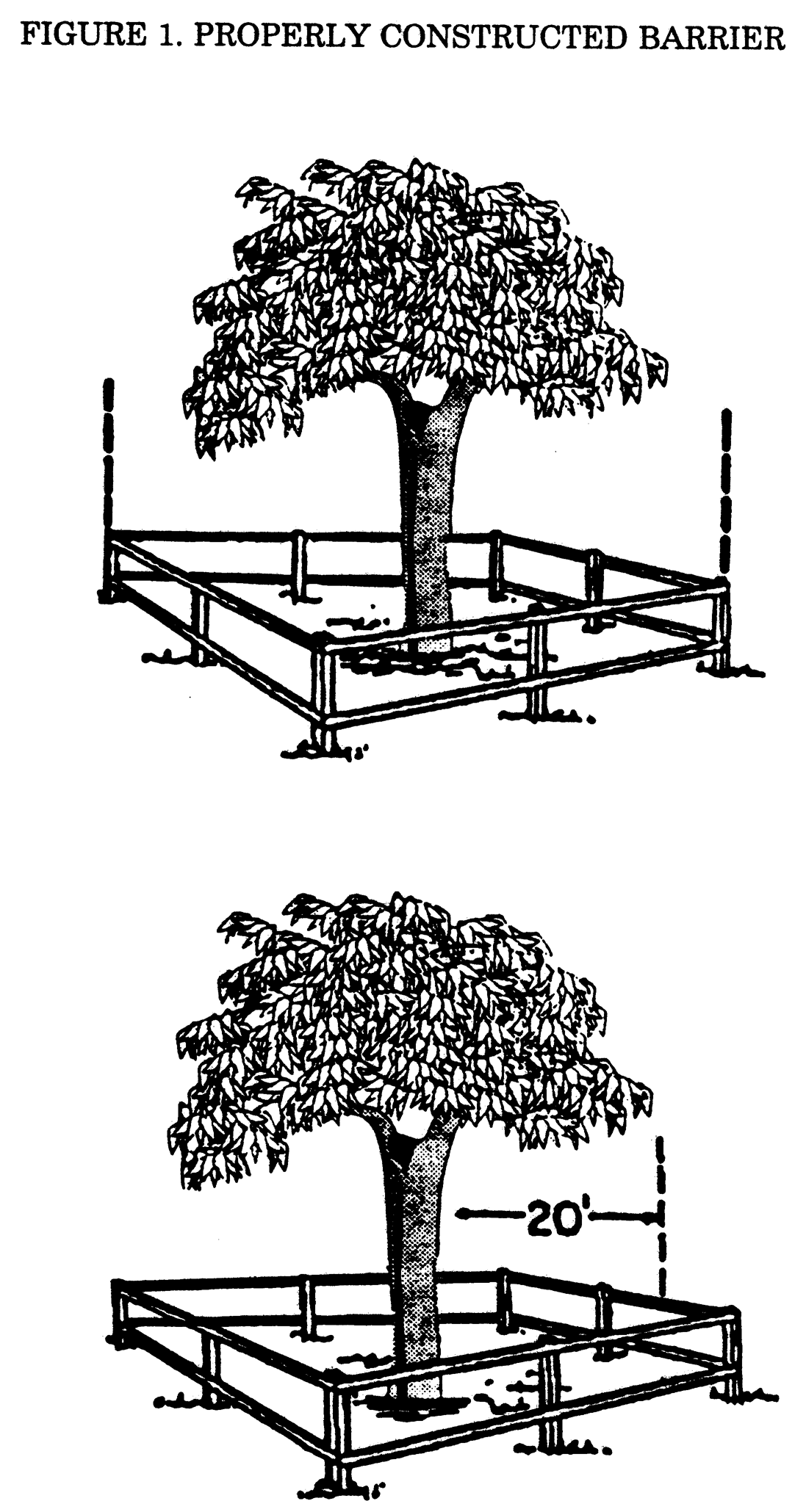
Figure 1—Properly Constructed Barrier
A properly constructed barricade protects the total area within the dripline or a
radius of 20 feet, whichever is less.
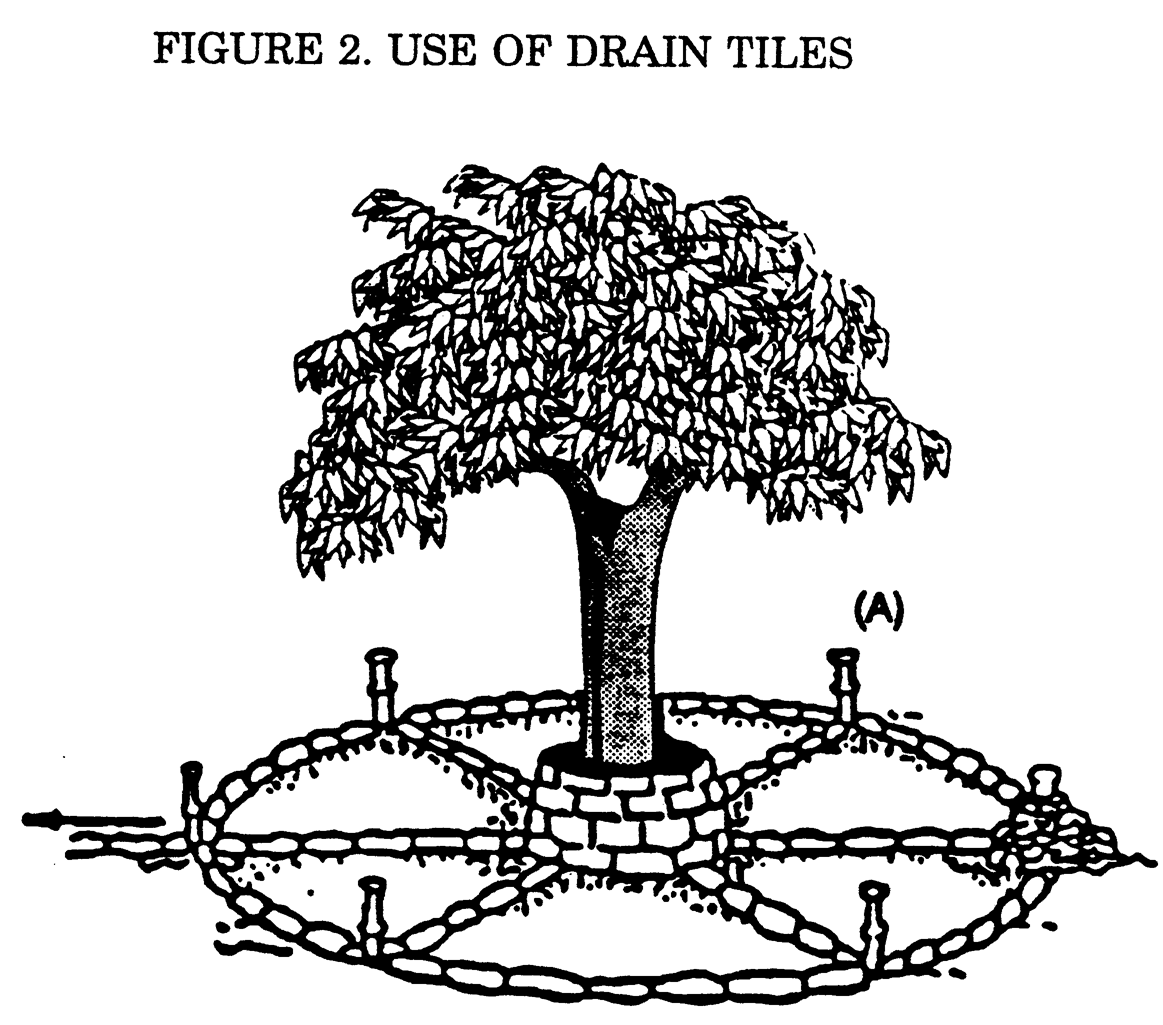
Figure 2—Use of Drain Tiles
Dry well around tree permits air and water circulation. Tiles on ground are sloped
to drain away from the trunk and off roots (see arrow). Vertical bell tiles (A) are
connected with the drain to permit additional air circulation; the one on the extreme
right is held erect by loose stones.
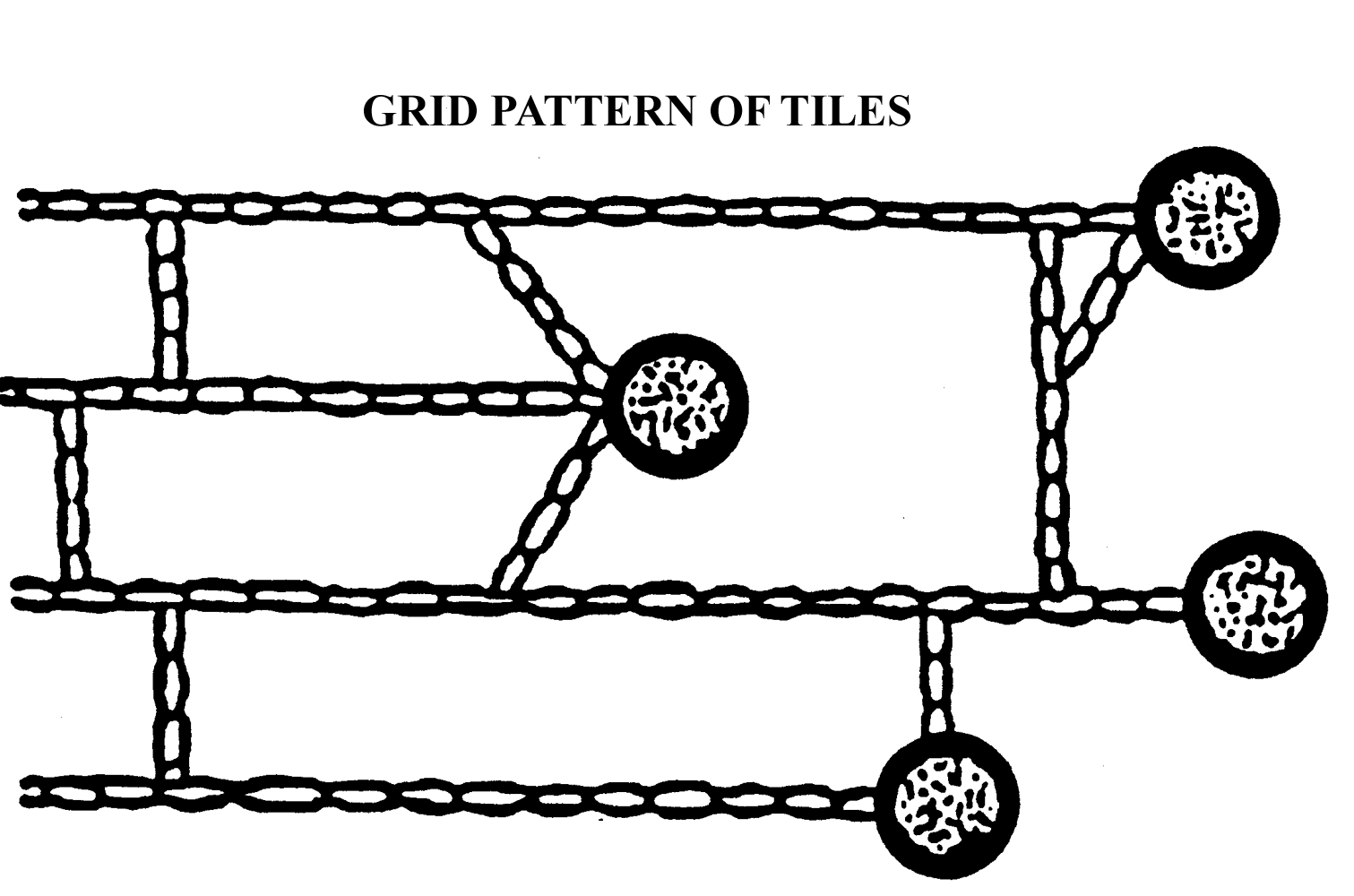
Grid pattern of Tiles
This drawing shows a grid pattern of tiles for draining a stand of trees.
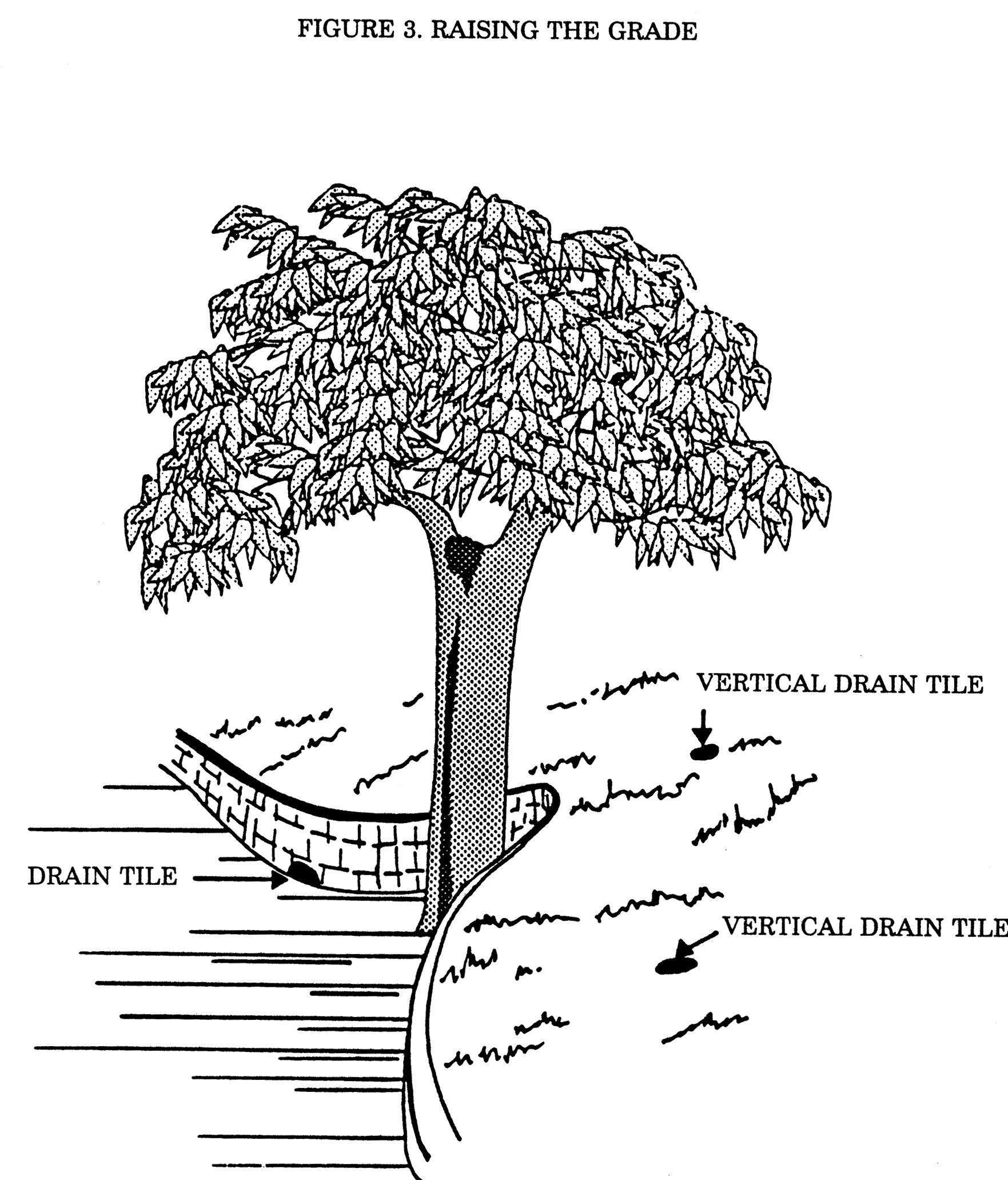
Figure 3—Raising the Grade
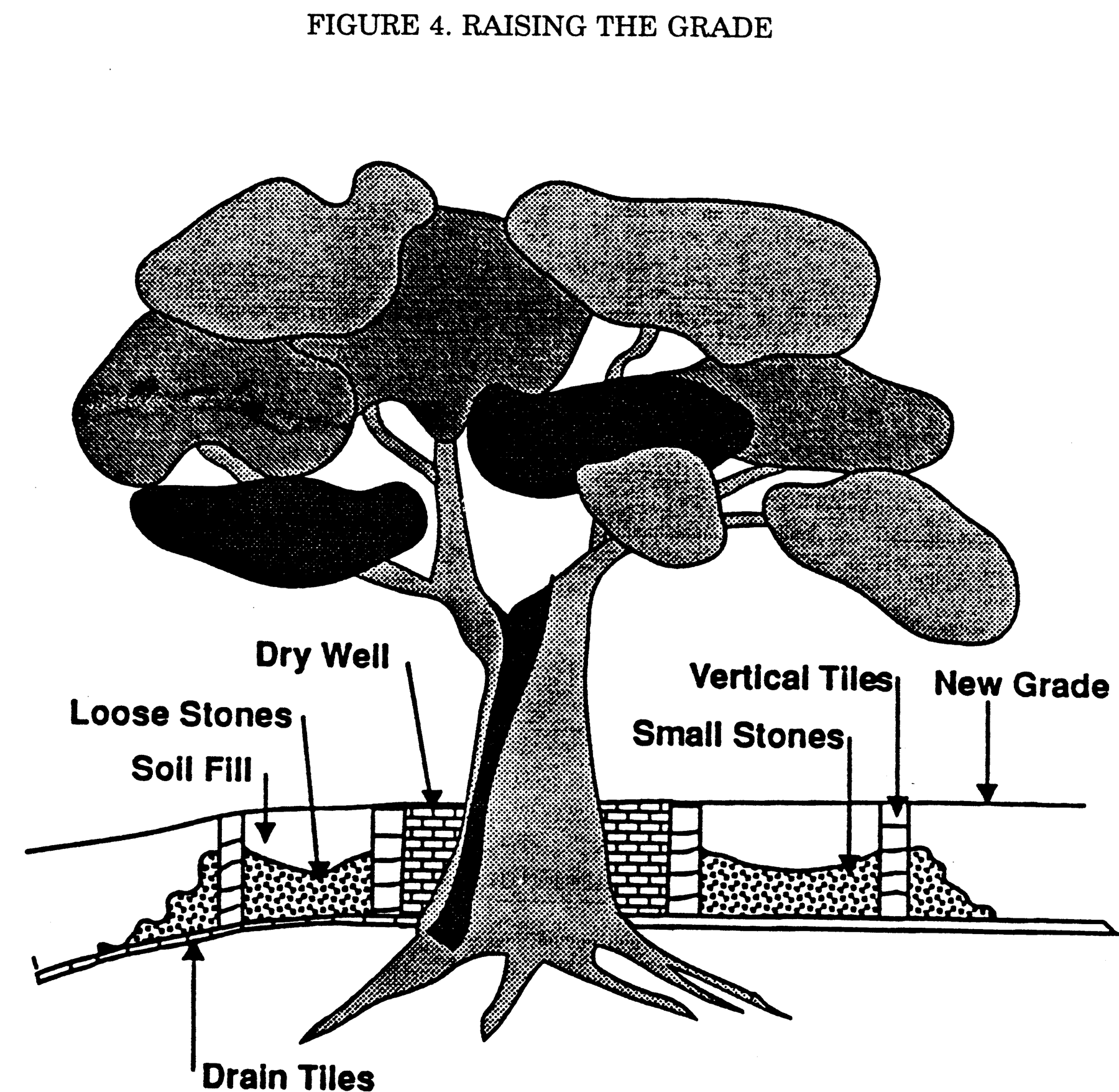
Figure 4—Raising the Grade
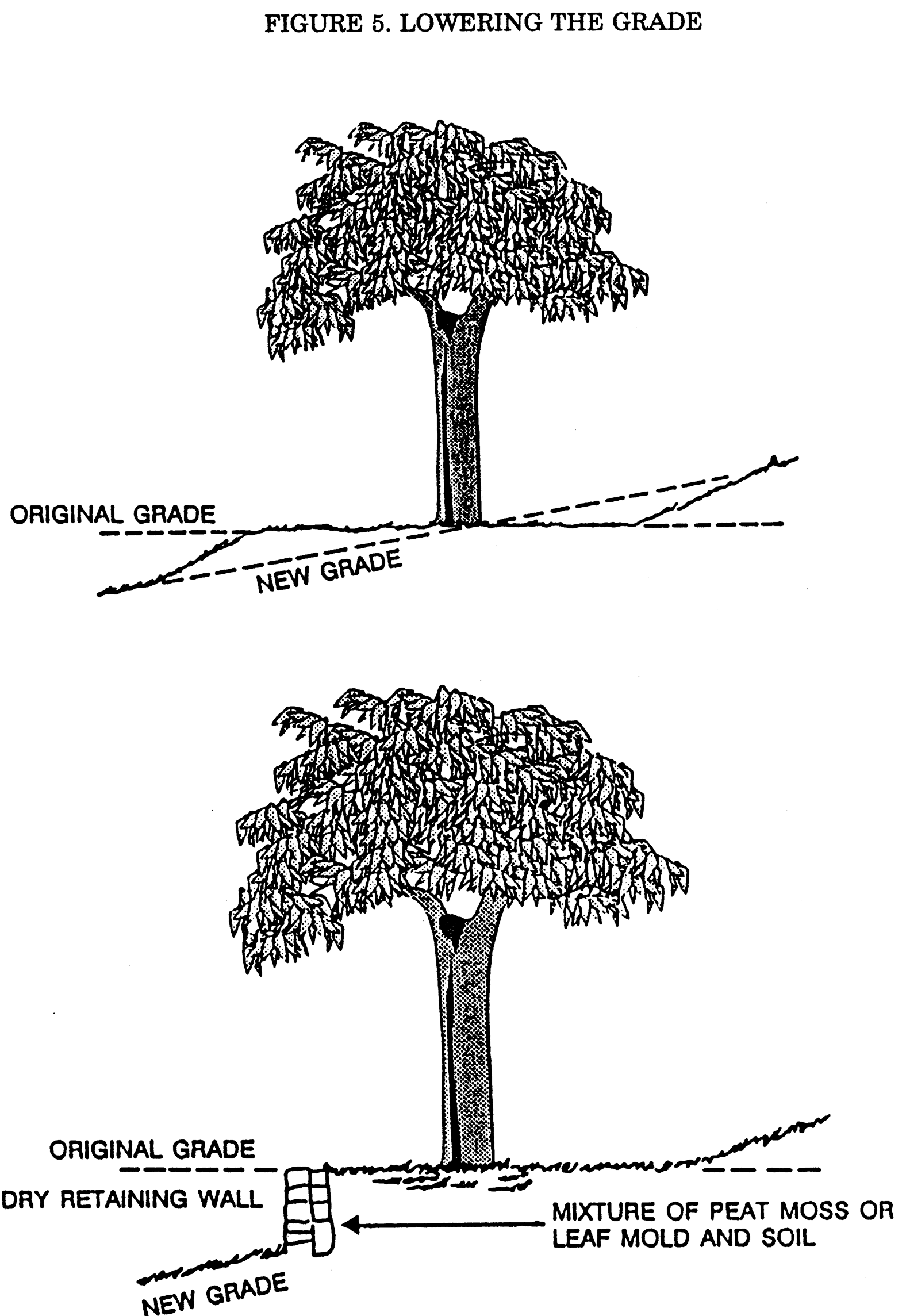
Figure 5—Lowering the Grade
(Ord. No. 399, § 1, 11-20-01)
Sec. 74-385. - Protection of mangroves.
(a)
Generally. In addition to the tree protection requirements otherwise set out in this division, the following special provisions shall apply to the removal or trimming of mangroves (black mangrove, Avicennia germinans; white mangrove, Laguncularia racemosa; and red mangrove, Rhizophora mangle).
(b)
Replacement. Mangroves may not be removed unless there is relocation on the same site of at least an equal number of mangroves, as necessary to revegetate a land area equal to or greater than the land area from which mangroves were removed. The property owner shall provide a plan, to be approved by the town manager or other appropriate professional, to ensure the survival of the replaced or relocated mangroves and to stabilize the shoreline from which mangroves were removed. The approved plan is an express condition of any permit. Failure to carry out any provisions of the plan shall be a violation of this land development code.
(c)
Permit required for alteration (cutting or trimming); alteration standards. The following protective measures apply to all mangroves:
(1)
A permit shall be obtained from the state department of environmental regulation for any alteration of mangroves in jurisdictional waters.
(2)
A permit shall be obtained from the town for any alteration of mangroves which are exempt from department of environmental regulation permit requirements.
(3)
Standards for alteration of mangroves shall be those contained in rule 62-321, Mangrove Protection, of the Florida Administrative Code.
(Ord. No. 399, § 1, 11-20-01)
Sec. 74-386. - Protection of tree-lined and canopy roads.
(a)
Generally. The town commission has determined that certain roadways within the town merit special protection of the trees which line and provide canopies over the roadway. It is the purpose of this section to describe those roadway sections and require additional protection through control of activities that abut these roadways.
(b)
Designation of roadways. The following roads are designated as tree-lined and canopy road protection areas:
(1)
Indian Rocks Road, from Belleview Boulevard south to the town limits.
(2)
Belleview Boulevard, from Druid Road east to Ft. Harrison Road.
(3)
Druid Road, from the Clearwater city limits south to Belleview Boulevard.
(4)
Bayview Drive, from Manatee Road to Indian Rocks Road.
(c)
Restrictions. All protected species within an area extending 50 feet on either side of the roadways designated in this section are protected from removal or destruction by the requirements of this section. No protected species within the area of protection shall be removed without permit. Protected trees which are approved for removal shall be replaced with one and one-half times the number of diameter at breast height inches as the removed trees.
(Ord. No. 399, § 1, 11-20-01)
Sec. 74-387. - Preservation of protected trees as grounds for variance from other requirements.
The preservation of any protected tree may be considered as a factor in rendering a decision upon an application for a variance from the literal application of other requirements of this land development code. See section 66-253 for variance provisions.
(Ord. No. 399, § 1, 11-20-01)
Sec. 74-411. - Generally.
(a)
Compliance with other regulations. In addition to meeting the requirements in this division for protection of environmentally sensitive lands, development plans shall comply with applicable federal, state, water management district and county regulations relating to environmentally sensitive lands. In all cases, the strictest of the applicable standards shall apply.
(b)
Subdivision lots to include suitable building site. Each lot of a proposed subdivision must include a site suitable for building a structure in conformance with the standards of this division for protection of environmentally sensitive lands.
(Ord. No. 399, § 1, 11-20-01)
Sec. 74-412. - Creation of protected zones.
(a)
Wetlands protection zone.
(1)
There is hereby created a wetlands protection zone in which special restrictions on development apply.
(2)
The boundaries of this zone shall be the most landward extent of the following:
a.
Areas within the dredge and fill jurisdiction of the department of environmental regulation as authorized by F.S. ch. 403.
b.
Areas within the jurisdiction of the U.S. Army Corps of Engineers as authorized by section 404 of the Clean Water Act or section 10 of the River and Harbor Act.
c.
Areas within the jurisdiction of the Southwest Florida Water Management District pursuant to section 40D, Florida Administrative Code.
d.
Areas within the Pinellas Aquatic Preserve Management Plan.
(b)
Shoreline protection zone.
(1)
There is hereby created a shoreline protection zone in which special restrictions on development apply.
(2)
The shoreline protection zone extends from the point in waters where no emergent aquatic vegetation can grow, landward to a point 50 feet landward of the water's edge.
(Ord. No. 399, § 1, 11-20-01)
Sec. 74-413. - Development activities within protected zones.
(a)
Generally. Except as expressly provided in this section, no development activity shall be undertaken in a protected environmentally sensitive zone.
(b)
Activities presumed to have insignificant adverse effect.
(1)
Certain activities are presumed to have an insignificant adverse affect on the beneficial functions of protected environmentally sensitive zones. Notwithstanding the prohibition in this section, these activities may be undertaken unless it is shown by competent and substantial evidence that the specific activity would have a significant adverse effect on the protected environmentally sensitive area.
(2)
The following uses and activities are presumed to have an insignificant adverse effect on wetlands protection zones:
a.
Scenic, historic, wildlife or scientific preserves.
b.
Minor maintenance or emergency repair to existing structures or improved areas.
c.
Cleared walking trails having no structural components.
d.
Recreational fishing.
e.
Constructing fences where no fill activity is required and where navigational access will not be impaired by construction of the fence.
f.
Developing an area that no longer functions as a wetland, except a former wetland that has been filled or altered in violation of any rule, regulation or statute or this land development code. The developer must demonstrate that the water regime has been permanently altered, either artificially or naturally, in a manner to preclude the area from maintaining surface water or hydroperiodicity necessary to sustain wetland structure and function. If the water regime has not been permanently altered or if a wetland species remains the dominant vegetation of the area, the town shall determine the feasibility of restoring the altered hydrology. If the wetland may be restored at a cost that is reasonable in relation to benefits to be derived from the restored wetland, the developer shall, as a condition of development, restore the wetland and comply with the requirements of this land development code.
g.
Developing a wetlands stormwater discharge facility or treatment wetland in accordance with state permits received under chapters 17-25 and 17-6, Florida Administrative Code.
(c)
Permitted special uses. Certain uses that provide substantial public benefits may not be viable unless placed within a protected environmentally sensitive zone. The town commission may decide to allow these uses in sensitive areas despite potential damage to the area.
(1)
Water-dependent activities.
a.
Generally. Designated water-dependent activities that are otherwise prohibited may be allowed if the developer shows:
1.
The public benefits of the activity substantially outweigh the adverse environmental effects on a wetland area; and
2.
No practicable alternative to placement in the protected environmentally sensitive zone exists.
b.
Permissible activities. The following are permissible water-dependent activities:
1.
New riprap or similar structures, not including seawalls, bulkheads or the like, not exceeding 50 feet of shoreline.
2.
Installation of buoys, aids to navigation, signs and fences.
3.
Performance of maintenance dredging for ten years from the date of the original permit, and, thereafter, performance of maintenance dredging so long as less than 10,000 cubic yards of material is removed.
4.
Installation of subaqueous transmission and distribution lines for water, wastewater, electricity, communication cables, oil or gas. Lines may be entrenched in bottom waters if dredging does not exceed 10,000 cubic yards, or laid on or embedded in bottom waters.
5.
Replacement or widening of bridges on pilings or trestles where the effects of pollutants discharged into open waters are minimized.
6.
Construction of artificial reefs.
c.
Minimization of impacts. The water-dependent activity shall be designed, constructed, maintained and undertaken in a way that minimizes the adverse impacts on the beneficial functions of the affected environmentally sensitive zone.
(d)
Design standards for special uses.
(1)
Generally. In addition to the standards listed in section 74-411, the standards set out in this subsection apply to special uses allowed in the protected environmentally sensitive zones.
(2)
Special uses in shoreline protection zone.
a.
The development shall be designed to:
1.
Allow the movement of aquatic life requiring shallow water;
2.
Maintain existing flood channel capacity; and
3.
Ensure stable shoreline embankments.
b.
Development that encroaches on the shoreline protection zone shall not be located:
1.
On unstable shorelines where water depths are inadequate to eliminate or minimize the need for offshore or foreshore channel construction dredging, maintenance dredging, spoil disposal, filling or beach feeding, and other river, lake and channel maintenance activities; or
2.
In areas which have been identified as hazardous due to high winds or flooding.
c.
Nondeveloped portions of the shoreline protection zone that are damaged during construction shall be restored or replaced through replanting of vegetation; restocking of fish, shellfish and wildlife; reestablishment of drainage patterns; and similar activities. To the maximum extent possible, the restored areas shall match their prior ecological functioning.
(e)
Mitigation.
(1)
Generally.
a.
Compensatory mitigation, by which environmentally sensitive lands are purchased, created, enhanced or restored to compensate for the loss of such lands, is required whenever a special use is allowed under this section.
b.
The purchased, created, enhanced or restored environmentally sensitive land must be of the same type as that destroyed or degraded.
c.
Compensatory mitigation shall not be the basis for approving a project that could not otherwise be approved.
d.
A developer of a compensatory mitigation plan shall grant a conservation easement under F.S. § 704.06 on the newly purchased, created, enhanced or restored environmentally sensitive lands to protect them from future development.
(2)
Wetlands. Compensatory wetland mitigation shall require that the amount of wetlands purchased, created, enhanced or restored be large enough to ensure that the amount of wetlands destroyed or degraded will be completely and successfully replaced. The ratio of replacement to destroyed wetlands shall be presumed to provide reasonable assurances for mitigation if it is replaced at a ratio of 4:1.
(Ord. No. 399, § 1, 11-20-01)
Sec. 74-414. - Restricted development zones.
(a)
Generally. There is hereby created a restricted development zone adjacent to each protected environmentally sensitive area. This zone shall encompass all land within 500 feet of the boundary of the protected environmentally sensitive zone.
(b)
Development activities.
(1)
All development in a restricted development zone shall be designed, constructed and maintained to avoid significant adverse effects on the adjacent environmentally sensitive zone.
(2)
The acreage within the shoreline protection zone portion of the protected environmentally sensitive area may be used to determine the total allowable units or square footage of development that will be allowed on a site containing all or part of such a zone. This development potential may be transferred from the shoreline protection zone to the restricted development zone or beyond as provided for in the clustering provisions in chapter 66, article V. Allowable development potential may not, however, be transferred from outside the area encompassed by the restricted development zone and protected environmentally sensitive zone to within such area.
(3)
The following special design standards apply within restricted development zones adjacent to wetlands protection zones:
a.
Wherever possible, natural buffers shall be retained between all development and all protected environmentally sensitive zones. If a natural buffer does not exist, an equivalent buffer shall be created. The size of the buffer shall be the minimum necessary to prevent significant adverse effects on the protected environmentally sensitive area. The factual basis of the decision as to the size of the buffer shall be stated as a finding in the written record.
b.
The developer shall completely restore any portion of a protected environmentally sensitive zone damaged during construction. Complete restoration means that the damaged area shall, within five years, be operating as effectively as the natural system did prior to being destroyed.
c.
Other reasonable protective measures necessary to prevent significant adverse effects on a protected environmentally sensitive zone may be required. The factual basis of the decision to require the measure shall be stated as a finding in the written record. Protective measures may include but are not limited to:
1.
Maintaining natural drainage patterns.
2.
Limiting the removal of vegetation to the minimum necessary to carry out the development activity.
3.
Expeditiously replanting denuded areas.
4.
Stabilizing banks and other unvegetated areas by siltation and erosion control measures.
5.
Minimizing the amount of fill used in the development activity.
6.
Designing, locating, constructing and maintaining all development in a manner that minimizes environmental damage.
7.
Prohibiting septic tanks.
8.
Using deed restrictions and other legal mechanisms to require the developer and successors to protect the environmentally sensitive areas and maintain the development in compliance with the protective measures.
(4)
The following special design standards apply within restricted development zones adjacent to shoreline protection zones:
a.
All development shall be set back greater than or equal to 50 feet from the landward boundary of the shoreline protection zone.
b.
Total impervious surface, including but not limited to buildings, houses, parking lots, garages, accessory buildings, driveways, pools and walkways, is limited to 50 percent of the land area of the entire site.
c.
The development shall leave a minimum of 50 percent of the site as trees, shrubs or other natural vegetation, or replace existing trees at a minimum 2:1 ratio.
d.
Point source and nonpoint source discharges are prohibited, except for stormwater, which may be discharged only if it meets the following minimum standard: Stormwater discharges shall include an additional level of treatment equal to 50 percent of the treatment criteria specified in the rules of the Southwest Florida Water Management District, and shall provide off-line retention or off-line detention with filtration of the first one-half inch of runoff of the total amount required to be treated. If the town or any state agency has a stormwater rule which is stricter than this standard, then the stricter rule or combination of rules shall apply.
e.
Siltation and erosion control measures shall be applied to stabilize banks and other nonvegetated areas during and after construction. Sediment settling ponds shall be installed for stormwater runoff prior to the creation of any impervious surfaces. For lots or parcels that are cleared, silt screens shall be placed between the construction-site and the water body to prevent erosion and siltation.
f.
Septic tanks shall not be allowed.
g.
Where wet moorage is offered for boats which have holding facilities for sewage, or where other recreational vehicles are allowed to stay overnight, then pump-out, holding or treatment facilities shall be provided by the developer for sewage and other wastes, including bilge, contained on vessels and vehicles. The facilities shall be conveniently available to all vessels and vehicles.
h.
If no natural vegetation exists, strips of buffer vegetation shall be planted between development activities and the shoreline protection zone. Buffers shall be a landscape standard C and shall be composed of native plant species.
i.
Marinas and other appropriate development shall post the following signs where they are readily visible to all users of the development:
1.
Regulations pertaining to handling and disposal of waste, sewage or toxic materials.
2.
Regulations prohibiting the use of vessel toilets while moored unless these toilets are self-contained or have an approved treatment device.
3.
Regulations prohibiting the disposal of fish or shellfish cleaning wastes, scrap fish, viscera or unused bait in or near the development.
4.
Speed and no wake regulations, and manatee protection warnings.
j.
A marina shall include boat launch facilities unless the applicant can demonstrate that providing such facilities is not feasible or it is determined that the ramp would be excessively damaging to the aquatic environment.
k.
Marinas shall have adequate restroom facilities in compliance with local health board regulations.
l.
Garbage receptacles shall be provided and maintained by the marina operator at several locations convenient to users.
(Ord. No. 399, § 1, 11-20-01)
Sec. 74-415. - Post-development activities.
The following standards apply to post-development activities taking place within any restricted development zone or protected environmentally sensitive zone:
(1)
Point source and nonpoint source discharges. Absent an amendment to the development order, point source and nonpoint source discharges shall continue to meet the standards applicable to the original development.
(2)
Clearing. Absent an amendment to the development order, no person shall clear more vegetation that was permitted for the original development.
(3)
Handling and storage of fuel, hazardous and toxic substances, and wastes.
a.
Developments where fuel or toxic substances will be stored, transferred or sold shall employ the best available facilities and procedures for the prevention, containment, recovery and mitigation of spillage of fuel and toxic substances. Facilities and procedures shall be designed to prevent substances from entering the water or soil, and employ adequate means for prompt and effective cleanup of spills that do occur.
b.
No toxic or hazardous wastes or substances shall be stored in outdoor containers.
c.
Storage or disposal of all types of wastes is prohibited on shorelines.
(4)
Prohibited uses. The longterm storage of equipment or materials and the disposal of wastes shall be prohibited.
(5)
Application of fertilizers, herbicides or pesticides.
a.
Fertilizers, herbicides or pesticides shall not be applied in a protected environmentally sensitive zone except for projects conducted under the authority of F.S. §§ 373.451—373.4595, the Surface Water Improvement and Management Act, and governmentally authorized mosquito control programs.
b.
Fertilizers, pesticides and herbicides used in restricted development zones shall be applied sparingly and at appropriate rates and time intervals.
(6)
Filling of spray vehicles. Vehicles used for mixing or spraying chemicals are prohibited from drawing water directly from waters.
(7)
Pump-out, holding and treatment facilities required for wastes from mobile sources. Sewage, solid waste and petroleum waste generated by vessels or vehicles on the site shall be properly collected and disposed of.
(Ord. No. 399, § 1, 11-20-01)
Sec. 74-431. - Purpose and intent of division.
The purpose of groundwater protection standards in this division is to safeguard the health, safety and welfare of the citizens of the town. This is accomplished through ensuring the protection of the principal source of water for domestic and industrial use. The availability of adequate and dependable supplies of good quality water is of primary importance to the future of the town. Therefore, standards are described in this division with the intent of protecting both the quantity and quality of the groundwater supply. It is further the intent of this division to control development in and adjacent to designated wellheads to protect water supplies from potential contamination.
(Ord. No. 399, § 1, 11-20-01)
Sec. 74-432. - Restrictions on development and land use.
(a)
Zone of exclusion. No development activities shall take place in the zone of exclusion.
(b)
Prohibited uses in wellhead protection area. The following land uses are prohibited within wellhead protection area:
(1)
Landfills.
(2)
Facilities for the bulk storage, handling or processing of materials on the Florida Substance List (Title 62, Florida Administrative Code).
(3)
Activities that require the storage, use, handling, production or transportation of restricted substances such as agricultural chemicals, petroleum products, hazardous or toxic wastes, industrial chemicals, medical wastes, etc.
(c)
Development standards for wellhead protection area. The following special restrictions shall apply to development allowed within the wellhead protection area:
(1)
Stormwater management practices shall not include drainage wells and sinkholes for stormwater disposal where recharge is into potable water aquifers.
(2)
Where development is proposed in areas with unused existing wells, these wells shall be abandoned, including adequate sealing and plugging according to Rule 62C-29.009, Florida Administrative Code.
(d)
Wells for private use. No wells for private use that extract groundwater below the surficial aquifer shall be permitted.
(Ord. No. 399, § 1, 11-20-01; Ord. No. 572, § 1, 4-9-24)
Sec. 74-433. - Well permit; installation and maintenance of wells.
(a)
Definitions. The following words, terms and phrases, when used in this section, shall have the meanings ascribed to them in this subsection, except where the context clearly indicates a different meaning:
(1)
Deep well means any well drilled to a depth deeper than a plane at an elevation which is ten feet below sea level.
(2)
Shallow well means any well drilled to a depth less than or equal to a plane at an elevation which is ten feet below sea level.
(b)
Shallow wells. An installation permit for shallow wells that extract water from the surficial aquifer shall be obtained from the Southwest Florida Management District prior to obtaining an installation permit from the town. No cross connection between the town water system and the irrigation distribution system of a shallow or deep well is permitted.
(Ord. No. 399, § 1, 11-20-01; Ord. No. 572, § 2, 4-9-24)

