
Bennett City Zoning Code
Division 7
Landscape Standards2
Editor's note—Ord. No. 782-24, §1(Exh. A), adopted July 9, 2024, repealed the former Div. 7., §§ 16-2-710—16-2-795, and enacted a new Div. 7, §§ 16-2-700—16-2-795 as set out herein. The former Div. 7 pertained to similar subject matter and derived from Ord. 646-14 §1(Exh. A), 12-9-2014, adopted Dec. 9, 2014; Ord. 679-17, §17, 18, 19, 20, adopted Dec. 12, 2017; Ord. 696-19 §12, 2019, adopted in 2019; Ord. 742-22, §34, adopted June 14, 2022; Ord. 761-22, §1, adopted Nov. 8, 2022.
Sec. 16-2-700. - Purpose and intent.
(a)
The purpose and intent of these regulations is to establish landscape standards that enhance the environmental, economic, aesthetic, and recreational resources of the Town and to promote sustainable management of the Town's water resources. All landscape plans shall be designed for good site accessibility and visibility; safe pedestrian and traffic circulation; compatibility of adjacent land uses; enhancement of outdoor recreational opportunities; protection of endangered and significant ecotypes, soils, and wildlife habitat; climate resilience; and prevention of the spread of invasive species;
(b)
Enhance and promote a unique image for the Town of Bennett.
(c)
Protect the public health, safety and welfare by:
(1)
Minimizing noise, air, water and visual pollution;
(2)
Screening and buffering incompatible land uses;
(3)
Reducing the amount of reflected glare and heat absorbed in and around developments;
(4)
Breaking up large expanses of parking lots;
(5)
Preserving property values and neighborhood characteristics by lessening the impacts of potentially incompatible uses;
(6)
Providing screening from wind and blowing snow;
(7)
Conserving water resources by implementing the use of xeriscaping, drought-tolerant native plantings; and using efficient water-wise landscaping;
(8)
Ensuring landscaping is an integral part of the site design and development process;
(9)
Providing landscape design that is compatible with any adjacent site features including buildings, trails, parking lots, utilities, signs, drainage, etc.; and
(10)
Promoting the use of reclaimed water for use in landscaping where appropriate.
(Ord. No. 782-24, §1(Exh. A), 7-9-2024)
Sec. 16-2-705. - Landscape definitions.
Applicable property means applicable property means commercial, institutional or industrial property; common interest community property; or a street right-of-way, parking lot, median, or transportation corridor. It does not include residential property.
Artificial turf means an installation of synthetic materials developed to resemble natural grass.
Backflow preventer means a mechanical device installed at the beginning of the irrigation system to prevent a reverse water flow and contamination of the potable water supply.
Bioretention facility (also known as rain gardens and porous landscape detention) means an engineered, depressed landscape area designed to capture and filter or infiltrate the water quality capture volume.
Buffer means to lessen or moderate the impact of something or a dissimilar land use. A continuous edge of land provided along the perimeter of a lot where landscaping and or distance is used to transition one use from adjacent uses or public uses.
Caliper (sometimes called (DBH) diameter at breast height) means the diameter (expressed in inches) of a tree trunk measured four and five tenths (4.5) feet above the ground level.
Certified irrigation auditor means a person who has successfully completed formal training, certification, licensing, or other similar qualifications by the Irrigation Association or Qualified Water Efficient Landscaper (QWEL) to perform irrigation audits.
Commercial, institutional or industrial means commercial, institutional, or industrial property; and includes local government, schools, and businesses, among others.
Common elements means in a condominium or cooperative, all portions of the condominium or cooperative other than the units; and in a planned community, any real estate within a planned community owned or leased by the owners' association other than a unit.
Common interest community means real estate described in a declaration with respect to which a person, by virtue of such person's ownership of a unit, is obligated to pay for real estate taxes, insurance premiums, maintenance, or improvement of other real estate described in a declaration. Ownership of a unit does not include holding a leasehold interest in a unit of less than forty (40) years, including renewal options. The period of the leasehold interest, including renewal options, is measured from the date the initial term commences.
Common interest community property means property within a common interest community that is owned and maintained by a unit owners association, such as entry ways, parks, and other common elements as defined in Section 38-33.3-103 (5).
Desirable tree means a tree that is in good health, with good form and minimal to no disease or decay and not an invasive species.
Diameter at breast height (DBH) means the tree diameter (expressed in inches) measured four and five tenths (4.5) feet above the ground level.
Duplex is generally a property with two (2) living units. Those units can be side by side or stacked one on top of the other. There are separate entrances for each unit and sometimes separate garages and yards as well.
Ecotypes means a group of organisms, normally a subdivision of a species, that is adapted to a specific environment. It is sometimes called ecospecies, describing a genetically distinct geographical variety, population or race within species, which is adapted to specific environmental conditions.
Functional turfmeans turf that is located in a recreational use area or other space that is regularly used for civic, community, or recreational purposes, which may include playgrounds; sports fields; picnic grounds; amphitheaters; portions of parks; and the playing areas of golf courses, such as driving ranges, chipping and putting greens, tee boxes, greens, fairways and roughs.
Grass buffer means densely vegetated strips of grass designed to accept sheet flow from up gradient development, enabling infiltration and slowing runoff. Grass buffers provide filtration (straining) of sediment. Buffers differ from swales in that they are designed to accommodate overland sheet flow rather than concentrated or channelized flow.
Grass swale means densely vegetated trapezoidal or triangular channels with low-pitched side slopes designed to convey runoff slowly. Grass swales have low longitudinal slopes and broad cross-sections that convey flow in a slow and shallow manner, thereby facilitating sedimentation and filtering (straining) while limiting erosion.
Ground cover vegetation means any plant that grows over an area of ground. Ground cover provides protection of the topsoil from erosion or drought. In an ecosystem, the ground cover forms the layer of vegetation below the shrub layer known as the herbaceous layer. They are generally wider than tall.
Hardscape means hard landscape materials in the built environment that are incorporated into a landscape. Decorative non-living material including inorganic mulch, rock mulch, decorative or pattern concrete, brick pavers, wood chips, decorative rock, boulders, ornamental features, birdbaths, sculptures, planters, benches, statues, low stone edging, or other similar materials. This can include paved areas such as patios, sports courts, and trails, retaining walls, and any other landscaping made up of hard wearing materials such as wood, stone, and concrete, as opposed to softscape, the horticultural elements of a landscape. A well-balanced landscape design will include an attractive combination of both hardscaping and softscaping elements.
Hydrozone means plants grouped together by soil suitability and water use in distinct hydrozones in an effort to conserve water. Hydrozones are divided into four (4) main categories: High, Moderate, Low and very low water usage zones.
Invasive plant species means plants that are not native to the state and that means are introduced into the state accidentally or intentionally; have no natural competitors or predators in the state because the state is outside of their competitors' or predators' range; and have harmful effects on the state's environment or economy or both.
Irrigation audit means a procedure to collect and present information concerning the uniformity of application, precipitation rate, and general condition of an irrigation system and its components. This procedure, according to the Irrigation Association includes a visual site inspection of the installed irrigation system for performance according to design criteria.
Land reclamation means the combined process by which adverse environmental effects of past disturbances on the land are minimized and returned to a beneficial end use.
Landscape area means the pervious area outside the buildings, structures, drives and parking on a lot or parcel. This surface area shall be treated with organic/inorganic plant materials such as grass, ground cover, trees, shrubs, vines and other horticultural materials. Landscaping may include elements of softscaping and hardscaping or other decorative surfacing such as wood chips, crushed stone or other mulch materials. Not all water quality control measures can be considered landscaped area.
Landscape islands means a landscape area enclosed by raised curbs and located on the end of a row of parking spaces or between two (2) parking spaces in the row.
Landscape median means the strip of landscaping between rows of parking. Usually has a parking Island on either end.
Maximum lot coverage means maximum lot coverage percentage as regulated in Chapter 16 includes all structures, paving, driveways, sidewalks, steps, ramps, walls, patios, and parking.
Mulch means the use of organic ground cover to reduce water loss through evaporation, reduce soil loss, and suppress weeds. Rubber mulch or recycled mulch containing construction or demolition waste is prohibited
Native plant means a plant species that is indigenous to the state of Colorado.
New development project means a new construction project that requires a building or landscaping permit, plan check, or design review.
Nonfunctional turf means any turf that is not functional turf. Nonfunctional turf includes turf located in a street right-of-way, parking lot, median, or transportation corridor. Non-functional turf does not include turf that is designated to be part of a water quality treatment solution required for compliance with federal, state, or local agency water quality permitting requirements that is not irrigated and does not have herbicides applied.
Qualified Water Efficient Landscaper (QWEL) means an individual who has successfully completed the Qualified Water Efficient Landscaper training and certification program. The QWEL program is a comprehensive in- depth training and certification program, emphasizing irrigation, landscape, water management and horticultural best management practices.
Recreation—Active means recreation activities of a more structured nature often requiring equipment and taking place at prescribed places, sites, courses or fields.
Recreation—Passive means recreational activities that do not require prepared facilities like sports fields or pavilions.
Redevelopment project means a construction project that requires a building or landscaping permit, plan check, or design review; and results in a disturbance of more than fifty (50) percent of the aggregate landscape area.
Screening means to hide something, to form protection from an adverse situation or environment. A shield or partition between different land uses. To block the view of something between one property and another.
Shrub means multistemmed perennial woody plants less than fifteen (15) feet tall. Unlike herbaceous plants (i.e. ground cover) shrubs have persistent woody stems above the ground.
Significant specimen tree means a tree that is unique in its size, shape, color, or texture.
Softscape means the living elements like soil, trees, flowers, grass, and shrubs, the horticultural elements of a landscape.
Special district means per CRS 32-1-103 (2) any quasi-municipal corporation and political subdivision organized or acting pursuant to the provisions of Title 32, article 1, CRS.
Streetside landscape strip: Formerly known as a tree lawn, the areas between the street curb and the sidewalk. The term "tree lawn" appears to denote that there would be grass or a lawn in this area, which is now prohibited, thus the change in name. If wide enough, the streetside landscape strip, would contain street trees. Along streets where the sidewalk abuts the street curb, the streets side landscaping strip may be outside the sidewalk and not between the sidewalk and the curb.
Swale means shallow ditches that blend in with surrounding landscape design, facilitate water management, and encourage natural irrigation. Swales take advantage of natural slopes in the land to direct water downward into all the soil as opposed to letting it pool above ground or waterlog a specific region.
Transportation corridor means a transportation system that includes all modes and facilities within a described geographic area, having length and width.
Tree lawn means the area between sidewalk and street which contains landscaping, more recently called streetside landscape strip. It is possible that the landscaping area between the street and sidewalk would not contain trees or lawn thus the change in name to streetside landscaping strip.
Tree protection zone means a defined area above and below grade around each tree where construction activities are limited or restricted to prevent injury to a preserved tree.
Turf means continuous plant coverage consisting of nonnative grasses or grasses that have not been hybridized for arid conditions and which, when regularly mowed, form a dense growth of leaf blades and roots.
Undisturbed areas of quality means areas that have not been disturbed and can be used for water quality and/or storage, wildlife habitat or buffer.
Vegetable garden means a non-commercial garden for the cultivation of fruits, vegetables and herbs, other than marijuana, that are grown for personal or household consumption.
Water budget means a site-specific method of calculating an allowable amount of water to be used by the landscape and then designing the landscape to meet this budget.
Water-wise landscape or water-wise landscaping means a water and plant management practice that is intended to be functional and attractive; emphasizes the use of plants that require lower supplemental water, such as native and drought tolerant plants; and prioritizes the following seven (7) key principles of landscape planning and design;
A.
Planning and design for water conservation, beauty, and utility.
B.
Improving soil.
C.
Applying efficient irrigation.
D.
Limiting turf to high traffic, essential areas.
E.
Selecting plants that have low water demand.
F.
Applying mulch
G.
Maintaining the landscape.
Weed means as defined in section 7-1-10 including but not limited to those plants listed on the Colorado Department of Agriculture Noxious Weed species list. This definition shall not include flower gardens, shrubberies, vegetable gardens, small grain plots, successional grasses utilized for erosion control, and pastures used for feed, fodder, or forage, provided the same are adequately weeded and maintained.
Xeriscape means as defined in CRS section 38-33.3-103 (33), means the combined application of the seven (7) principles of landscape planning and design, soil analysis and improvement, hydro zoning of plants, use of practical turf areas, uses of mulches, irrigation efficiency, and appropriate maintenance under CRS 38-35.7-107 (1) (a) (III) (A).
(Ord. No. 782-24, §1(Exh. A), 7-9-2024)
Sec. 16-2-710. - Landscape plan requirement.
(a)
A landscape plan prepared in conformance with this Division shall be submitted for:
(1)
All residential and nonresidential development proposed within the Town requiring approval of a site plan or final development plan prior to the issuance of a building permit. Landscaping plans for single-family residential developments, subdivisions and planned developments shall be required for common open space areas, common interest community property, street rights-of-way and parks, but not for individual single family or duplex lots.
(2)
Expansions of existing sites or use:
a.
A non-residential project requiring a building permit that cumulatively increases a structure or building's square footage by twenty-five percent (25%) or more.
b.
A non-residential project that has previously increased square footage by less than twenty-five percent (25%) and applying for a new building permit that cumulatively triggers the twenty-five percent (25%) or more threshold.
c.
Expansion of a parking lot by twenty percent (20%) or twenty (20) spaces or more, whichever is less.
d.
A project that requires a grading permit.
e.
Restore or change to existing landscape areas by twenty-five percent (25%) or more. The plan submittal requirement does not apply to existing conforming single family or duplex residential lots.
f.
A redevelopment or construction project that results in a disturbance of more than fifty percent (50%) of the aggregate landscape area.
(b)
A landscaping plan submitted with a site plan or final development plan must comply with the landscaping requirements of this Division, including all commercial, institutional, or industrial property. Landscaping plans for single-family residential developments shall be required for common open space areas, adjacent street rights-of-way and parks, common interest community property, but not for individual lots.
(c)
Landscape plans required by this section shall be prepared by a licensed landscape architect and shall be stamped and signed, unless otherwise waived by the Town Manager, except this requirement does not apply to single-family or two-family lots.
(d)
Unobstructed open space and common open space improvements shall include, but are not limited to, landscaping, patios, plazas, arcades, pedestrian and/or bicycle pathways, fences, retaining walls, benches, fountains, statuary, kiosks, light fixtures, picnic shelters and other site amenities.
(e)
All portions of a site not occupied by structures, water bodies, streets, roads, driveways, sidewalks, parking areas and other vehicle use areas are required to be landscaped in accordance with these standards.
(f)
All landscape plans shall include a water budget. The overall water use shall not exceed twelve (12) gallons per square foot per year of total landscaped area.
(g)
This ordinance does not apply to:
(1)
Ecological restoration projects not requiring a permanent irrigation system.
(2)
Land reclamation projects not requiring a permanent irrigation system.
(h)
Landscape plans shall be submitted in accordance with the Applicant Guide.
(Ord. No. 782-24, §1(Exh. A), 7-9-2024)
Sec. 16-2-720. - Landscape design criteria.
All landscaping plans shall comply with the applicable design standards of this Division.
(1)
Plant materials.
a.
The following ratios apply for commercial/industrial development: Two (2) trees and five (5) shrubs, or an acceptable combination of trees and shrubs, for every one thousand (1,000) square feet of landscaped area.
b.
The following ratios apply for residential development: Two (2) trees and five (5) shrubs or an acceptable combination of trees and shrubs, for every one thousand (1,000) square feet of landscaped area.
c.
Within a required landscaped area, ornamental clump grasses may be exchanged for up to fifty percent (50%) of the required shrubs at a ratio of three (3) ornamental clump grasses for one (1) shrub if one (1) gallon clump grasses are selected.
d.
All development sites, excluding individual single-family and duplex lots, shall feature consistently landscaped areas along the front, sides, and rear property lines.
e.
Trees and shrubs shall be configured in appropriate groups. Grouping of plants shall be distributed throughout the landscaped areas in order to avoid overly dense concentrations of plant materials or obstructing views determined important through the development review process.
f.
Landscaping shall be protected from vehicles by the placement of wheel stops, curbs or other acceptable means.
g.
All installed plants shall be selected from the approved Town of Bennett plant list unless an alternative plant species is approved through the Town review of the proposed design. Alternative plant material must be called out on the plan.
h.
All plants shall meet or exceed the plant quality and species standards of the American Standard for Nursery Stock.
i.
Plants shall be grouped together by soil suitability and water use in distinct hydrozones (very low, low, medium). No combining of hydrozones is permitted except between low and very low. The landscape plan can include various number or sizes of each zone but overall the landscape plan may not exceed the overall water budget.
j.
A minimum of seventy-five percent (75%) of plants shall be native and/or drought-tolerant species selected from the plant list in the low to very low categories.
k.
Plants listed as noxious species by the County Weed Control Board or on the Colorado State Noxious Weed lists are prohibited.
l.
Plants shall be selected and planted appropriately based on their adaptability to the climatic, geologic, and topographical conditions of the project site including solar orientation for plant placement to maximize summer shade and winter solar gain. Trees shall be located to maximize summer shade and minimize winter shade.
m.
Vegetation planned to be within a corner vision clearance triangle and sight line areas shall comply with Section 16-5-615. Height of evergreen and deciduous shrubs at maturity should be taken into account to meet these requirements.
n.
Landscape plans shall be designed to provide a variety of colors, spacing, materials, plant types, mulch and ground cover types to provide a visually appealing and healthy complement to the built environment of the town. Large areas of the same plants, ground cover, mulch or same color stone should be avoided. A well-balanced landscape design will include an attractive combination of both hardscaping and softscaping elements.
(2)
Plant Size and Installation
a.
All plants shall equal or exceed the measurements specified in Table 1. Plant Specifications.
b.
The following minimum sizes apply wherever landscaping is required:
(3)
Groundcover.
a.
All landscaped areas shall consist of one hundred percent (100%) ground coverage in living vegetation, organic mulch, rock mulch, or other approved hardscape non-living material.
b.
A minimum of fifty percent (50%) of the landscape area shall be covered by living plants at maturity. Vegetative cover may consist of ground covers, perennials, shrubs, ornamental grasses, bulbs, and native grass mixes selected from the Town of Bennett plant list. While there is no limit on the amount living plant coverage on a lot there is a limit on the amount of irrigated turf that would be allowed.
c.
Remaining coverage (fifty percent (50%) or less) of the landscape area may be achieved through the application of decorative non-living material or hardscaping including organic mulch, rock mulch, decorative or pattern concrete, brick pavers, wood chips, decorative rock, boulders, ornamental features, birdbath, sculpture, planters, bench, statues, low stone edging, or other similar materials. The fifty percent (50%) maximum coverage of non-living material used in a landscape area also applies to and includes artificial turf.
d.
Rock and stone mulch does not qualify as a hardened surface for meeting parking regulations.
e.
While paved areas such as patios, walks, trails, plazas, or sports courts count as ground cover and hardscaping in a landscape plan, paved features such as those are counted as part of the maximum lot coverage percentage limits found in Chapter 16 Zoning District Standards.
(4)
Turf limitations—Town of Bennett recognizes turf grass has practical benefits but is considered a high-water use plant material. Turf grass shall be limited as follows:
a.
A property owner shall not install, plant, or place, or allow any person to install, plant or place, any nonfunctional turf, artificial turf or invasive plant species as part of a new development project or redevelopment project on any portion of commercial, institutional, or industrial property; common interest community property; or a street right-of-way, parking lot, median, or transportation corridor.
b.
There is no limitation on installation of grass seed or sod that is a native plant or has been hybridized for arid conditions.
c.
Where allowed, turf grass sod or turf grass seed shall be selected from the Town of Bennett approved plant list. High water use turf grasses are prohibited except as approved by the Town as functional turf. Low water use hybrid grasses are encouraged.
d.
Turf grass shall be installed as a unique hydrozone and be irrigated separately.
e.
In public and private parks, turf grass shall be restricted to functional turf in park and open space areas intended for passive or active recreation.
f.
In single-family detached, single-family detached cluster, two-family duplex residential development, irrigated turf grass shall be limited to 25 percent (25%) of the total combined yard area not to exceed a maximum of one thousand five hundred (1500) square feet on a lot.
g.
In multi-family development (e.g. triplex, fourplex, townhome, multi-apartment or condominium) turf grass shall not exceed twenty-five percent (25%) of the required common area and shall be only used in high use or active/passive recreation areas meeting the definition of functional turf.
h.
In commercial, institutional, industrial, business, local government and school development, irrigated turf grass is prohibited except as approved for passive or active recreation areas by meeting the definition of functional turf. There is no prohibition on the use of native grass.
i.
Irrigated turf grass is prohibited in buffers, parking lot islands, street medians, streetside landscape strips, and subdivision entries.
j.
Golf courses shall limit the use of turf grass to the playing areas fairways, greens, driving ranges, chipping and putting greens, tee boxes and roughs. Efforts to further reduce the demand for irrigation are encouraged including the use of native and low to very low water use grasses in out-of-play areas. Use of reclaimed water is required if available or becomes available.
k.
Water quality control measures and stormwater management designs shall comply with vegetation specified in the stormwater management plan. Irrigated turf grass should be minimized if possible.
l.
Nonessential turf is prohibited.
(5)
Plant diversity. To reduce the risk of tree loss due to pests, the following percentages shall be applied. Not more than thirty percent (30%) of trees and shrubs installed on a project shall be of a single genus and not more than twenty percent (20%) of trees and shrubs shall be of a single species. Percentages shall be listed in the planting schedule.
(6)
Soil amendments and mulch.
a.
All landscape areas shall be tilled to a minimum depth of six (6) inches and amended with approved soil amendments with a minimum of four (4) cubic yards per one thousand (1,000) square feet, or three (3) cubic feet per one thousand (1,000) square feet for native seeds areas.
b.
All planting beds, raised beds, and plant containers shall be mulched with a minimum of three-inch depth of rock mulch over a water permeable landscape fabric or four-inch shredded wood mulch over the amended soil.
c.
Rubber mulch or recycled mulch containing construction or demolition waste is prohibited.
d.
Non-organic mulch application around the base of plants is discouraged.
e.
Piling or mounding of mulch around the base of trees shall be avoided.
f.
Existing topsoil shall be stockpiled during construction for use in landscape areas prior to planting.
g.
No topsoil shall be removed from the subject property unless the Town approves the transfer of the soil to a Town-owned park or open space area, or to another approved location.
h.
The use of weed-free seed, gravel, or fill dirt is required.
i.
Site shall be free of rocks, dirt clods, and debris over three-quarter inch (3/4") diameter in size.
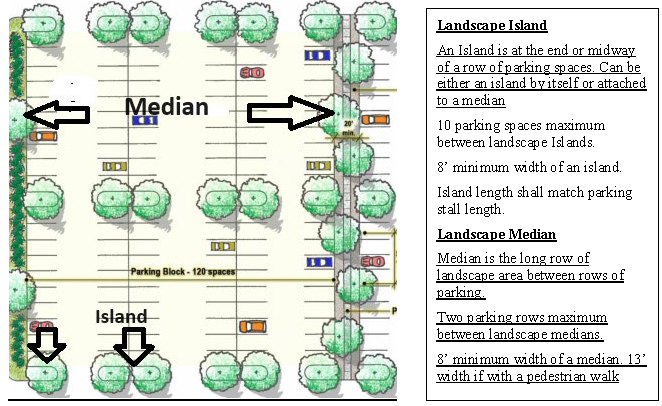
(7)
Parking areas:
a.
Interior coverage means at least five percent (5%) of the interior area of a parking lot shall be landscaped if the lot contains ) twenty (20) or more parking spaces. At least fifty percent (50%) of the required landscaped area shall include living plant material. Nonfunctional turf, irrigated turf grass, artificial turf or invasive plant species are not allowed in parking lots, medians, street right-of-way or transportation corridors.
b.
Parking Lot Islands: Landscaped parking lot islands must be delineated by a clear physical barrier such as concrete curbs or landscaping timbers to protect the plant material from vehicular damage. At least fifty percent (50%) of the island shall be covered in living plant material at maturity. A minimum of twenty percent (20%) of plant material shall be evergreen. Parking lot islands shall meet the following requirements:
1.
Be located at the end of each parking row.
2.
Be located within each parking row so that there are no more than ten (10) spaces without a landscape island separating them.
3.
Be a minimum of eight (8) feet wide, measured from inside of curb to inside of curb, and be the length of the adjacent parking space, with a minimum area of one hundred forty-four (144) square feet. Islands at the end of parking rows will be eighteen (18) feet by eight (8) feet.
4.
Contain at least one tree and four (4) shrubs per single parking row island and two (2) trees and eight (8) shrubs per double parking row island.
5.
Contain mulch cover over the entire island not hardscaped. The edge of planting beds must be designed and installed to contain the mulch from, blowing, rolling, washing or otherwise spilling over onto the parking or driveways.
6.
Landscaping within landscaped islands at the end of parking rows shall meet sight vision triangles so as not to obstruct the visibility of vehicles entering or exiting the parking lot.
7.
Consider if landscape islands are appropriate for curb cuts to allow for stormwater infiltration into the landscape islands.
8.
Other stormwater techniques, such as rain gardens, grass swales, and bioretention may be incorporated into parking lot islands in accordance with stormwater management plans.
c.
Parking lot medians must be delineated by a clear physical barrier such as concrete curbs or landscaping timbers to protect the plant material from vehicular damage. Parking lots with more than three (3) drive aisles require landscape medians between parking stalls and shall meet the following standards:
1.
Rows of parking spaces shall be divided by landscape medians parallel to the parking rows so that there are no more than three (3) drive aisles between landscape medians and a required parking lot buffer or landscape median.
2.
Landscape medians shall be a minimum of eight (8) feet wide. If the landscape median contains a water quality swale, the width needs to accommodate both the swale and landscaping and follow the Storm Management Manual. The median must be a minimum of thirteen (13) feet wide if it contains a sidewalk.
3.
Landscape medians shall have at least one deciduous canopy tree, four (4) shrubs per thirty (30) linear feet along the length of the median. These are in addition to the required trees and shrubs for the parking lot islands.
4.
Plantings with a mature height of six (6) inches or more shall not be planted in the vehicle overhang area (thirty (30) inches from the front of curb into the landscape median).
5.
Other stormwater management techniques, such as rain gardens and grass swales may be incorporated into parking lot medians in accordance with the Town's Stormwater Management plan to reduce runoff or filter pollutants.
d.
Parking lot screening:
1.
Berms, walls, fences, plants, planters or combinations thereof shall be used to screen the parking lot and vehicle headlights from view from surrounding public rights-of-way and from all dissimilar adjacent uses.
2.
All perimeter areas of the parking lot shall be landscaped to provide visual relief to large expanses of paving and to provide ample shading to reduce heat build-up.
3.
Whenever structures such as walls or fences are used to create a screen, plants shall be located on the sides of the structure which is visible from adjacent public rights-of-way.
4.
The top of the landscape screen around the parking area shall be at least three (3) feet higher than the surface of the parking area, except where clear visibility must be maintained as provided in Section 16-2-770 of this Chapter, or due to traffic or pedestrian safety considerations.
e.
Exceptions. If the parking lot cannot meet landscaping requirements due to unique site constraints, grade or conditions, the Zoning Administrator may approve alternative design which meet the intent of these regulations.
(8)
Drive-through.
a.
For drive-through aisles, that are adjacent to public rights-of-way, provide a wall, plantings, or some combination of those or similar solutions to minimize the visual impact of reader board signs, directional signs, headlight glare, and the queued vehicles. The screening must be no less than three (3) feet high and no more than four (4) feet high. Shrubs used for screening shall be evergreen and the screen wall shall match the building on-site.
b.
If the service window, remote teller, menu board, or similar components of a drive-through facility is adjacent to and/or facing a residential use, a 20-foot wide buffer with 6-foot high solid fence or wall must be provided along the entire length of the property line(s) closest to the residential district.
(9)
Public rights-of-way and street trees:
a.
Public rights-of-way: Landscaping shall be provided in the street right-of-way adjacent to the property in the area between the property line and the curb (when there is a detached sidewalk or no sidewalk); or from the back of sidewalk to the property line (when the sidewalk is attached to the curb).
b.
Streetside landscaping : Street trees shall be required unless the Zoning Administrator determines they are unnecessary for the area. The number of street trees and shrubs required for each property shall be one (1) tree and four (4) shrubs for each thirty (30) feet of street frontage. The width of the streetside landscape tree planting strip shall be eight (8) feet unless waived by the Zoning Administrator.
c.
The location of street trees shall be within the streetside landscape strip, behind the sidewalk or the front yard depending on width of street side landscape strip, location of utilities or topography. Dry utilities shall avoid using the street side landscaping strip for installation of utilities and placement of utility easements.
d.
If a utility conflicts with the installation of street trees, applicants shall provide shrub equivalents. If vegetation of any type, other than grass, is prohibited by the easement holder, then the applicant shall be required to provide the required trees elsewhere on site. Relocated street trees shall not be used to satisfy other required landscaping requirements.
e.
Street trees shall be deciduous, thornless, fruitless canopy trees of species that mature to heights of between thirty (30) and sixty (60) feet.
f.
The property owner, HOA or special district adjacent to the public or private street shall maintain any street trees and landscaping.
g.
The sight distance area shall be maintained at all roadway intersections, crossings, and parking areas.
h.
No irrigated turf grass, nonfunctional turf, artificial turf or invasive plant species shall be planted in medians or the streetside landscape strip. Use of irrigated native grasses, grass seed or sod that is a native plant or has been hybridized for arid conditions are allowed.
i.
Landscape elements placed adjacent to existing and proposed roadways (in the right-of-way) shall be designed to minimize conflicts between vehicular and pedestrian traffic while providing an aesthetic landscape environment that is relatively easy to maintain.
(10)
Utility Setbacks. Landscape and utility plans shall be coordinated to avoid conflict with each other. Landscape plans should be developed after the location of utilities and the easements have been identified.
(11)
Existing landscaping:
a.
The owner or developer shall incorporate existing healthy trees and shrubs into the landscape design in their existing location whenever possible. Existing trees and other plants in reasonably healthy condition may be removed only if the owner or developer has satisfactorily demonstrated to the Town that site design restrictions necessitate their removal. Existing trees may be used to satisfy the quantity requirements of landscape standards.
b.
All existing trees and plants that are incorporated into the landscape design must be adequately protected in the tree protection zone by means of temporary fencing and be properly maintained during construction to ensure their survival. Tree protection zone shall be equal to the tree's dripline or 1.5-feet radially from the tree for every 1-inch tree caliber
c.
The landscape design should promote and preserve climate-adapted native species, trees, and natural areas and reduce the amount of irrigation to stay at or below the water budget after the landscaping is established.
d.
Where there are significant existing trees and shrubs on a site, the Town shall require an inventory of plant material and submission of a tree preservation plan. All existing trees within areas proposed to be disturbed by development on and off-site and in the adjacent right-of-way shall be surveyed by a professional forester, arborist, or a registered landscape architect and have location, species, size, and condition or health noted in the tree preservation plan.
e.
No trees shall be removed from a property in the six (6) months preceding a development application pertaining to that property. If evidence is provided that trees were removed within six (6) months of a development application submittal, the property owner and/or applicant will be required to replant an equivalent amount of the of the removed tree caliper.
f.
If feasible, a tree that cannot remain in its existing location shall be spaded and relocated to another location on-site or off-site by a professional tree spade company. All measures shall be taken to ensure the survival and health of the tree. Existing trees and other plants in reasonably healthy condition may be removed only if the owner or developer has satisfactorily demonstrated to the Town that site design restrictions necessitate their removal.
g.
Undeveloped areas with natural vegetation or undisturbed areas of quality may be allowed to count toward the minimum landscape planting requirements, as determined by the Town. The percentage of these areas eligible to partially satisfy the minimum requirement will be determined based upon its effectiveness to function as a buffer and enhance the visual and natural attributes of the site.
h.
Trees that meet one or more of the following removal criteria shall be exempt from the requirements of this subsection:
1.
Dead, dying or naturally fallen trees, or trees determined by the Town to be a threat to public health, safety, or welfare.
2.
Trees that are determined by the Town to substantially obstruct clear visibility at roadways, intersections, alleys and driveways.
3.
Trees included on the Colorado Department of Agriculture noxious weed list, unless the tree is deemed a significant specimen tree by the Town.
i.
If the site design precludes incorporation of some or all existing desirable trees, then replacement shall be made as follows:
1.
For any desirable trees that cannot be incorporated or are lost due to or prior to construction, the applicant shall provide an equivalent amount of the number and caliper of trees lost on-site and in the right-of-way adjacent to the property, in addition to meeting the minimum tree planting requirements.
2.
If the Town or third party consultant determines that on-site or right-of-way replacement is not possible, the required replacement shall be provided on an adjacent site or the nearest public land if feasible as determined by the Town.
(12)
Public and private open space, stormwater detention areas and drainage channels. All public and private open space, stormwater detention areas and drainage channels not designated as natural areas in accordance with Section 16-5-640 of this Chapter must be designed and landscaped in such a manner as to blend properly with the property and adjacent areas while not violating the functional needs of the stormwater facility. Slopes shall not exceed the design standards for detention areas located in open space as specified in the Town of Bennett Storm Drainage Criteria Manual. Wetlands on public and private property shall be maintained in their natural state, and the property owner may receive a credit, in kind, to a portion of the open space, public land dedication or floodplain requirements.
(13)
Seeding. All future development phases within a site that are stripped of vegetation shall be seeded with an appropriate native seed mixture to prevent wind and water erosion during the time the site remains undeveloped, in accordance with an approved grading plan. A financial guarantee may be required for seeding in stormwater detention areas, and future development phases shall not be released until the grass required to comply with these standards has become established in a manner which prevents erosion. See The Development Design Guidelines for approved grasses.
(14)
The landscaping of all parks, right of ways, medians, entrance features, trails and pathway corridors, within a residential development project shall be completed prior to the issuance of building permits for more than fifty percent (50%) of the dwelling units approved in the project unless otherwise approved or restricted by the Town Board.
(Ord. No. 782-24, §1(Exh. A), 7-9-2024)
Sec. 16-2-730. - Screening and buffering of site.
(a)
Screening. Outside trash receptacles, loading docks, open storage areas and utility boxes shall be screened from view from public rights-of-way and from all adjacent uses other than industrial. Screening for such areas shall be provided for by means of walls, solid fences or evergreen plantings. The following are special requirements for utility boxes and trash receptacles:
(1)
Utility boxes means all above-ground utility boxes, which include electric transformers, switch gearboxes, cable television boxes and telephone pedestals and boxes shall be screened on the sides visible from the public rights-of-way that are not used for service access. If live plants are used for screening they must meet the utility setbacks set by the utility company.
(2)
Trash receptacles means trash receptacles and dumpsters shall be entirely screened from view and enclosed by a solid, gated wall or fence (trash enclosure) at least six (6) feet in height. The trash enclosure shall use materials compatible with the building structure and designed to be visually harmonious with the overall building architecture. The trash enclosure shall be sited so the service vehicle can conveniently access the enclosure and maneuver without backing onto a public right-of-way.
(b)
Site buffering—A buffer yard is required between dissimilar uses.
(1)
A buffer yard is a landscape area between two (2) different land uses and is designed to provide a transition between the uses, mitigate or minimize potential nuisances such as noise, light, and glare, protect the character of an area, and protect natural resources from impacts of nearby development.
(2)
General buffer standards.
a.
Buffers may be interrupted for necessary pedestrian and vehicle access.
b.
Buffers may contain a combination of landscaping, berms, walls, grade change, and fences.
c.
Landscaping provided in buffer areas shall be located on the outside of walls or fences to maximize the intent of the screening and buffering.
d.
Buffers in mixed-use districts may include hardscape as part of buffer design.
(3)
Buffer minimum width and where required—See buffer chart in Development Design Guidelines. Buffer yards must be shown on the landscape plan and the specific landscaping features being used to mitigate the dissimilar uses identified.
(4)
In general, if a use is developed adjacent to an existing use that does not have the required buffer yard, the new use may be required to provide the buffer yard entirely on-site.
(Ord. No. 782-24, §1(Exh. A), 7-9-2024)
Sec. 16-2-740. - Alternative compliance.
(a)
If a proposed landscape or irrigation plan can meet the objectives of this Section through alternative or creative methods, or when warranted by new technology or alternative methods for installation and materials.
(1)
An applicant may request approval of such alternative method of compliance by following this process:
(2)
Attend a pre-application meeting to discuss the request with Planning Division staff. The pre-application meeting material shall include a written request explaining the applicant's rationale and a site plan. This meeting must occur prior to the submittal of an application.
(3)
Provide an application that shall include:
a.
A description of site conditions, including topography, soils, existing vegetation, environmental values, and identification of limitations.
b.
An explanation of methods and techniques in the alternative design and how they will achieve the desired objectives and otherwise meet the water efficiency objectives of these regulations.
c.
The alternative landscape and/or irrigation plans.
(4)
There may be variations to these standards in an approved Site Development plan, Development Agreement, HOA or Districts plan.
(Ord. No. 782-24, §1(Exh. A), 7-9-2024)
Sec. 16-2-750. - Plant selection.
Except for designated natural areas and wetlands, landscaping materials shall be placed or planted according to the provisions of this Division. The following criteria are applicable to all landscape plans:
(1)
Only those species which are healthy and compatible with the local climate and the site soil characteristics, drainage and water supply shall be planted.
(2)
Plants prohibited near sidewalks, streets and utility lines:
a.
Plants selected shall not by their growth habits obstruct, restrict or conflict with the safe use or maintenance of any roadway, sidewalk, alley or utilities.
b.
Plants which have thorns or spines shall not be planted upon public rights-of-way or be closer than two (2) feet from walks or other pedestrian areas.
(3)
Recommended plant material. For a list of plant material and species recommended by the Town, please inquire with the Zoning Administrator.
(Ord. No. 782-24, §1(Exh. A), 7-9-2024)
Sec. 16-2-760. - Irrigation.
(a)
Underground automatic irrigation systems are required for all permanent landscaping which cannot survive on natural precipitation. The use of drip, trickle, subterranean and other water-conserving irrigation methods is encouraged, as is the use of organic mulches and other water-conserving design features. The overall irrigation system design should emphasize efficient water use and conservation. The irrigation system shall be designed to prevent water waste, overwatering, overspray, and drainage of water onto any paved or unplanted surface or onto buildings or structures. Where available reclaimed water or purple pipe water shall be considered for use in an irrigation system.
(b)
All irrigation systems shall be contained by the appropriate backflow prevention assembly.
(c)
Irrigation service connections (taps) shall not interconnect downstream of the meter. Irrigation mains shall not intersect with other irrigation mains serviced off another service connection.
(1)
Resilient wedge shut off valve with drain, or stop and waste, is required downstream of the meter.
(2)
Master valves are required.
(3)
'Smart' irrigation controllers are required for all irrigation systems that require a dedicated tap.
(d)
All required landscaped area vegetation shall be served by a functioning automatic irrigation system, a weather-based smart controller and rain sensor to override the irrigation cycle when sufficient rainfall has occurred. Multi-program controllers shall be used when the landscape design contains more than one hydrozone and shall be designed to irrigate hydrozones separately.
(e)
Irrigation systems shall be run consistent with the rules established in [Section] 13-3-410.
(f)
Irrigation zones utilizing spray heads and rotors shall have head to head coverage with no overspray on surrounding hardscapes or structures.
(g)
Dual meter installations are allowed for irrigated areas between two thousand five hundred (2,500) and five thousand (5,000) square feet, not exceeding seven and one half (7.5) feet per second through the service connection, and a demand of less than ten (10) gallons per minute (gpm).
(h)
Irrigated areas greater than five thousand (5,000) square feet require a dedicated irrigation tap. This requirement does not apply to single-family lots.
(i)
Maximum velocity shall not exceed seven and one half (7.5) feet per second through the service connection.
(j)
Irrigation shall be hydrozoned, grouping similar water demands by irrigation zone. Turf shall be designated as its own hydrozone. Turf irrigation zones should be further separated by slope, exposure, and turf-type water needs.
(k)
Only drip and sub-surface irrigation systems will be allowed in areas less than six (6) feet in width or smaller.
(l)
Pop-up spray heads shall be equipped with internal check valves, internal pressure regulator, and matched precipitation rate spray or rotor nozzle.
(m)
Rotors shall be equipped with internal check valves.
(n)
Pop-up height shall be six (6) inch for sod areas and twelve (12) inch for native grass areas.
(o)
Drip emitters and sub-surface drip shall be equipped with internal check valves at each emitter.
(p)
Irrigation charts and hydraulic worksheets are required as part of the landscape plan submittal.
(q)
A passing backflow prevention assembly test is required prior to the issuance of a certificate of occupancy. This shall include a mechanical test of the assembly, validation of protection for degree of the hazard present, and proper installation according to manufacturer's recommendations.
(Ord. No. 782-24, §1(Exh. A), 7-9-2024)
Sec. 16-2-770. - Completion.
(a)
Substitutions. All substitutions of plant material on an approved landscape plan must be approved by Landscape Architect that designed the plan and the Zoning Administrator.
(b)
Inspections. Landscaping shall be installed and completed in compliance with the approved landscape plan.
(c)
The landscape architect of record shall inspect and certify that the landscape area (and irrigation system) has been constructed as depicted on the approved landscape and irrigation plans.
(d)
Prior to the issuance of a certificate of occupancy, the landscape architect of record shall submit a Certification of Landscape Installation to the Town which indicates the installation was done in accord with the approved plans. Any failure to complete the required landscaping by the deadlines specified herein shall result in withholding of Certificates of Occupancy until compliance with the requirement occurs.
(1)
If the developer or owner has not completed all the installation of the landscaping and irrigation due to winter weather and wishes to obtain a certificate of occupancy, a landscape agreement and collateral must be provided to the Town Zoning Administrator.
(2)
Upon installation of the landscaping required by the approved landscape plan and inspection by the landscape architect of record to confirm compliance with said plan, the Town shall inspect and release the collateral provided by the Developer if found to comply.
(e)
All landscaping in development projects is considered an improvement, completion of which is governed by Bennett Municipal Code Section 16-5-540.
(f)
Approved developer agreements, planned development zoned projects, site development plans, HOA requirements and special district plans may have landscaping requirements that vary from these standards. The final approved plans and recorded documents shall be considered to be in conformance of this section of the code for enforcement and regulatory purposes.
(Ord. No. 782-24, §1(Exh. A), 7-9-2024)
Sec. 16-2-780. - Maintenance.
(a)
Maintenance of required landscaping on private property and public rights-of-way. The property owners or a designated homeowners' association shall be responsible for the proper maintenance of the landscaping and the irrigation systems on their property and on that portion of the public right-of-way adjacent to their property up to the curb (or sidewalk where the walk is attached to the curb). The landscaping shall be maintained to meet the following standards, except for those areas designated as natural areas or large tracts of vacant or agricultural land:
(1)
Grass shall be kept free of weeds.
a.
The use of weed-free seed, gravel, or fill dirt is required.
b.
The use of competitive grasses, shrubs, or trees that provide sufficient ground cover may be required where weed problems already occur or may occur in the future.
c.
Plant species that appear on the Colorado State Noxious Weed lists are unacceptable for use in proposed landscaping.
d.
For landscape areas that are presently bare and susceptible to erosion and runoff, the property owner shall be required to revegetate the area.
e.
Weeds as defined in Section 7-1-10.
f.
Notice of Violation and Penalty as per Bennett Municipal Code.
(2)
Rock, mulch or groundcover areas shall be kept free of weeds.
(3)
Trees and shrubs shall not overhang or encroach upon streets, walkways, drives, parking areas, traffic signs or traffic signals to the extent that they interfere with the intended use of those facilities. Tree limbs which overhang the public sidewalk shall be kept trimmed to a height of at least eight (8) feet above the sidewalk level. Tree limbs which overhang the public street shall be kept trimmed to a height of at least thirteen (13) feet above the street level.
(4)
Pruning and trimming. Regular plant maintenance shall be performed to maintain plant health, support plant growth, and achieve design and aesthetic goals.
(5)
Landscaping, including evergreen and deciduous shrubs within sight triangles and sight line areas, shall be maintained to be no taller than allowed per [Section] 16-5-615.
(6)
Keep grass mown to a maximum height of six (6) inches. This does not apply to native or ornamental grasses.
(7)
Irrigation systems and their components shall be maintained to sustain water efficiency consistent with the originally approved design.
(8)
Grounds keeping. All landscaped areas shall be kept clean and free of invasive plant species.
(b)
Replacement of materials: Dead or diseased plant material shall be replaced within one (1) growing season with the same type of plant material and placed in substantially the same location as shown on the approved landscape plan. Substitutions may be allowed as replacement material, provided that the material is approved by the Zoning Administrator.
(c)
Compliance.
(1)
All development or new development to which these landscape standards apply must submit landscape and irrigation plans that demonstrate compliance with the minimum water efficiency and landscape standards set forth in this division.
(2)
Vegetation that is deemed to be a traffic of safety hazard may be removed by the town with costs of the removal or trimming to be billed to the owner.
(3)
Failure to maintain: The provisions of Section 16-1-345 regarding violations shall apply if it is found that adequate maintenance is not being performed according to this Section. Failing to maintain landscaping in accordance with the requirements of this Division shall be declared a public nuisance, and may be abated in the manner provided in Article I of Chapter 7 of this Code. Sections 7-1-210 and 7-1-220 of this Code concerning the non-exclusivity of the nuisance abatement procedure apply with respect to the enforcement of this Division as well.
(Ord. No. 782-24, §1(Exh. A), 7-9-2024)
Sec. 16-2-790. - Fences and walls.
(a)
General. Fences and walls shall comply with the following general requirements:
(1)
A building permit from the Town is required prior to the construction of any fence or wall that is greater than thirty-six (36) inches in height. Fencing intended for decorative purposes only, and which does not include any area to be completely enclosed, may be allowed on any part of a parcel, provided that it does not exceed thirty-six (36) inches in height.
(2)
It shall be the responsibility of the property owner to locate all property lines.
(3)
Height shall be measured at the finished grade on the side of the fence or wall nearest the street, alley or abutting property.
(4)
On corner lots, no obstruction is allowed within the corner vision clearance triangle established for the adjacent intersection.
(5)
Agricultural fences such as hog panels, chicken wire, field fence and snow fence types are not permitted. The Zoning Administrator may allow alterative style fences in special circumstances in annexed areas where containment of animals is required.
(b)
Residential zoning districts. Fences and walls in residential zone districts shall meet the following standards:
(1)
No barbed wire, sharp-pointed or jagged materials along the top of the fence shall be permitted.
(2)
No above ground electrically charged fences shall be permitted, although underground electrical fences may be permitted for the purposes of containing pets within a residential lot.
(3)
Height limits and construction type:
a.
Front yards:
1.
Maximum height: four (4) feet.
2.
Fences shall be constructed of either split rails or pickets. A solid wall or stockade type fence not to exceed thirty-six (36) inches in height shall also be permitted alongside front yard property lines. Chain link fencing is prohibited in front yards except within the following areas:
i.
The RMU Overlay District; and
ii.
Between Bennett Avenue to Colfax Avenue and Birch Street to Custer Street.
3.
Wire fencing is allowed for animal control only when mounted on the inside of an approved fence and not exceeding the height of the fence it is attached to.
b.
Side and rear yards:
1.
Maximum height: six (6) feet.
2.
Construction: may be one hundred percent (100%) solid.
(c)
Nonresidential zoning districts. Fences and walls in agricultural, commercial and industrial zone districts shall meet the following standards:
(1)
Maximum height: eight (8) feet.
(2)
Barbed wire, razor wire or electrical security fences shall be permitted only in industrial and agricultural zone districts and upon written approval of the Zoning Administrator. Security fences may be topped with up to three (3) strands of barbed wire.
(d)
Installation. All fences shall meet the following installation requirements:
(1)
Fences shall be installed so that the finished side faces a public way or public space. All post and structural members, not decorative in nature, shall be on the side facing the fence owner's property.
(2)
Fencing shall be installed vertical to the ground and the top finish of the fence shall be uniform in height. Fences shall follow the contour of the ground as far as practical. Adjustments for grade shall occur at the bottom of the fence to every extent possible.
(3)
Gates adjacent to sidewalks, alleys and public rights-of-way shall open inward to the private property. Opening or movable gates or fences shall be designed and constructed so that no part of the fence or gate extend over the property line when operating.
(4)
An improved driving/parking surface is required prior to the construction of any gate which will serve as vehicular access for long-term parking in the backyard.
(5)
No fencing shall be erected so as to restrict access by emergency equipment to any building.
(e)
Maintenance of fences and walls is covered in Section 7-2-150.
(Ord. No. 782-24, §1(Exh. A), 7-9-2024)
Sec. 16-2-795. - Artificial turf and plants.
(a)
Use of artificial turf. The use of artificial turf as a landscaping material shall only be permitted in residential zone districts and athletic fields of play within the Town when installed in accordance with this Section. Artificial turf may not be used to satisfy living plant material requirements. In no case would artificial turf be allowed on greater than fifty percent (50%) of the open area of the lot, tract or parcel.
(b)
Prohibited use. The use of indoor or outdoor plastic or nylon carpeting or similar material and the use of artificial trees, shrubs, vines, or other plants as landscaping materials are prohibited.
(1)
Artificial turf is only allowed in multi-family residential zone districts for areas designated by the town development review process as high pedestrian traffic areas such as sports fields and courts, sports facilities, picnic eating area, playgrounds on public and private property, outdoor seating, dog potty areas and active recreation areas.
(2)
Artificial turf shall be pervious and installed according to industry specifications and maintained in a manner to mimic a healthy living turf.
(c)
Artificial turf standards. The use of artificial turf shall be subject to the following standards:
(1)
Materials. Artificial turf shall be of a type known as cut pile infill and shall be manufactured from polypropylene, polyethylene, or a blend of polypropylene and polyethylene fibers stitched onto a polypropylene or polyurethane meshed or hole-punched backing with a face weight greater than sixty (60) ounces per square yard. Hole-punched backings shall have holes spaced in a uniform grid pattern with spacing not to exceed four (4) inches by six (6) inches on center. The Zoning Administrator may approve an alternative product if it is of equal or greater quality of product. Biobased products derived from plants and other agriculture, marine and forestry materials and may be certified as USDA Bio-preferred product are preferred.
(2)
Installation. Artificial turf shall be installed pursuant to the manufacturer's specifications over a compacted and porous road base material and shall be anchored at all edges and seams. Seams shall be glued and not sewn. An infill medium consisting of ground rubber, ground coal slag, clean washed sand and ground rubber, or other approved mixture shall be brushed into the fibers to ensure that the fibers remain in an upright position and to provide ballast that will help hold the turf in place and provide a cushioning effect.
(3)
Grading. Artificial turf areas shall be graded to drain water runoff into an area of living landscaping material or to otherwise provide positive drainage of the artificial turf area in accordance with an approved drainage plan. Standing water and areas of ponding water are prohibited, and any area where standing water occurs shall be remedied.
(4)
Slope restrictions. The installation of artificial turf on slopes greater than six percent (6%) shall be approved by the Town Engineer and the Public Works Department who may impose conditions on such installation including but not limited to type of infill required, grading requirements, and the amount of living landscaping material required to ensure sufficient drainage for runoff.
(5)
General appearance.
a.
Artificial turf shall be installed and maintained to effectively simulate the appearance of a well-maintained lawn.
b.
Artificial turf shall have a minimum eight (8) year, no-fade warranty as issued by the manufacturer.
c.
Artificial turf shall be maintained in a green fadeless condition and shall be maintained free of stains, weeds, debris, tears, holes, and impressions. Artificial turf shall be replaced once it is unable to be maintained as required.
d.
The Zoning Administrator may require, for areas considered as high traffic, the utilization of artificial turf with spines in the blades or spirochetes in addition to infill in order to ensure the look of a well-maintained lawn.
(d)
Compliance with other laws, regulations, and standards. In addition to the requirements of this Section, applicants installing artificial turf within the Town shall obtain a building permit and comply with all federal and state laws and regulations and ASTM International standards concerning artificial turf, including but not limited to any limitations on the maximum lead content in artificial turf products.
1.
Artificial turf shall not be installed, planted, placed in any development or redevelopment on any portion of commercial, institutional, industrial, local government, school, business common interest property, street right of way, parking lot, median or transportation corridor. Artificial turf is allowed on athletic fields of play.
(Ord. No. 782-24, §1(Exh. A), 7-9-2024)

