
Beverly Beach City Zoning Code
DIVISION 1
GENERALLY
Sec. 26-751. - Definitions.
The following words, terms and phrases, when used in this article, shall have the meanings ascribed to them in this section, except where the context clearly indicates a different meaning. The term "building" shall include the word "structure." The term "used" shall include "arranged, designed, constructed, altered, converted, rented, leased, or intended to be used." The term "abut" shall include "directly across from." The term "lot" includes the words "plot," "tract" and "parcel."
Accessory building or use. An accessory use is one which is incidental to the main use of the premises. A permitted accessory use or structure (i.e., storage sheds, swimming pools, garages, fences, etc.) must be within the minimum setback of its yard (front, side, and rear) requirements.
Alley means a public right-of-way 30 feet or less in width and which affords only a secondary means of access to abutting property.
Basement means a story having a part but not more than one-half of its height below grade.
Building means any structure built for the support, sheltering or enclosure of any occupancy, and which is permanently affixed to the ground.
Building area means that area within the building lines which contains the principal building and attached accessory uses, including porches, overhangs, decks, supporting columns, stairs, carports, etc.
Building height means the vertical distance from the mean elevation of the unimproved lot per the original survey to the highest point of the coping of a flat roof or to the deck line of a mansard roof, or to the mean height between eaves and ridge for gable, hip and gambrel roofs.
Building line means the line established by yard or setback requirements outside of which no portion of the principal building or structure may be erected or extended.
Building official means the state-certified official designated by the town as the individual responsible for the administration of town building code.
Clinic means a building or portion of a building where patients are not lodged overnight but are admitted for examination and treatment by a group of professionals licensed by the state to practice the healing arts.
Club, private, means a building or portion thereof or premises owned and operated by a corporation, association, or person for a social, educational, recreational or fraternal purpose, but not primarily for profit or to render a service which is customarily carried on as a business.
Day care center or nursery means a building or portion thereof or premises designed for or occupied for the purposes of providing supervised care and/or education for three or more pre-school-age children. However, no overnight sleeping facilities are to be included.
District means a section of the town for which the zoning regulations governing the use of buildings and premises, the height of buildings, the size of yards, and the intensity of use are uniform.
Dock means a structure built on pilings over the water which is designed or used to provide anchorage for and access to one or more boats at anchorage. Necessary services such as water and other utilities are considered a part of a dock. However, no cooking, sleeping or business activity shall be permitted or conducted on a dock.
Dwelling means a building or portion thereof designed or used exclusively for residential occupancy, but not including campers, hotels, motels, motor lodges, boardinghouses and lodginghouses, tents, tourist courts, tourist homes, dormitories, fraternity or sorority houses, hospitals or nursing homes.
Dwelling, mobile home. See Mobile home.
Dwelling, multiple or multifamily, commonly referred to as an apartment building, means a building or portion thereof used or designed as a residence for three or more families living independently of each other within individual dwelling units.
Dwelling, single-family, means a detached building designed for or occupied exclusively by one family.
Dwelling, two-family, means a detached building designed for or occupied exclusively by two families living independently of each other.
Dwelling, townhouse, means a building designed for or occupied exclusively by one family and attached to two or more other buildings of similar design and separated by one or more party walls. The attached townhouses, as defined, constitute a building group.
Dwelling unit (DU) means a room or group of rooms including a kitchen and sanitary facilities designed and used exclusively or occupied as separate living quarters by not more than one family.
Essential services means public utility facilities either underground or overhead and related to the transmission or distribution systems of water, sanitary or storm sewers, telephone, gas, electricity, solid waste disposal, cable or community television and public safety, including poles, wires, mains, hydrants, drains, pipes, conduits, police or fire call boxes, traffic signals and other similar equipment necessary for the furnishing of adequate service, but not including buildings.
Family means an individual, or two or more persons related by blood or marriage, or a group of not more than two persons who need not be related by blood or marriage, living together as a single housekeeping unit in a dwelling.
Fences. Fences are considered structures and must be permitted, approved and built with the same restrictions and regulations as a structure.
Floor means the top surface of an enclosed area in a building (including basement), i.e., top of slab in concrete slab construction or top of wood flooring in a wood frame house.
Frontage means all property that abuts a street or other right-of-way.
Garage, private, means an accessory building designed or used for the storage of motor-driven vehicles owned and used by the occupants of the building to which it is accessory.
Garage, public, means a building, or portion thereof, other than a private garage, designed or used for equipping, servicing, repairing, hiring, selling or storing of motor-driven vehicles, but not including the storage of wrecked or junked vehicles.
Grade means the slope of a road, lot, street, utility, or public way, specified in percent deviation from zero, or in inches per foot.
Group ownership (condominium) means any type of property ownership where common land is held by some other person, association, or corporation other than the dwelling unit owner.
Hotel, motel and motor lodge mean a building in which lodging, or boarding and lodging, are provided and offered to the public for compensation, with or without individual kitchen or cooking facilities, and having or not having one or more dining rooms, restaurants or cafes; provided, however, that if such dining room, restaurant or cafe exists it is conducted in the same building.
Lot means a parcel of land occupied or having the potential for occupancy by a building together with its accessory buildings, including the required open space, or a portion of any tract or parcel of land intended as a unit for transfer of ownership or for development or both. The term "lot" includes the words "plot," "tract," and "parcel." Building lots shall be at least 75 feet by 100 feet.
(1)
Corner lot means a lot abutting upon two or more streets at their intersections.
(2)
Double frontage lot means a lot of the same depth as the width of a block containing two tiers of lots and which is accessible from both of the streets upon which it fronts.
(3)
Single tier lot means a lot which backs upon a limited access highway or a physical barrier such as a waterway, railroad, or nonresidential use, and to which vehicular access from the rear is usually prohibited.
Lot coverage means that percentage of the lot area covered or occupied as described per "building area."
Lot depth. The depth of a lot is the distance measured in the mean direction of the side lines of the lot from the midpoint of the front lot line to the midpoint of the opposite mean rear line of the lot.
Lot, interior, means a lot other than a corner lot having frontage on one street.
Lot lines means the lines bounding a lot as established by ownership. Such lines will be established by a state-certified surveyor, and all such findings will be registered on the deed of record. For certain purposes of this article or other ordinances, it may be necessary to make the actual lot line four inches wide to create a fair and equitable use of the land on certain abutting properties (e.g., fencepost footings, etc.).
Lot of record means a lot which is part of a subdivision, or a parcel of land described by metes and bounds, the plat or description of which has been recorded in the office of the county clerk of the circuit court. If a portion of a lot or parcel has been conveyed on October 4, 2000, the remaining portion of such lot or parcel shall be considered a lot of record.
Lot, through, means an interior lot having frontage on two streets, other than a corner lot. This lot shall be considered to have two front yards.
Minor accessory structure or use means an accessory use which is supplementary to the main use of the premises. A minor accessory use or structure (i.e., air conditioning units and the necessary structural support, walkways used for ingress or egress to the premises, etc.) may be outside of the minimum setback of its yard (front, side, and rear) requirements. Minor accessory structures shall remain within the lot lines of the property.
Mobile home means a structure transportable in one or more sections, designed to be used as a dwelling once connected to the proper utility systems. Mobile homes are built to standards that meet, and in some cases exceed, building standards for site-built conventional housing. The primary use is residential.
Mobile home park means a use of land in which lots or spaces are offered for rent or lease for the placement of mobile homes.
Nonconforming use means a use that does not conform with the regulations of the use district in which it is situated.
Parking lot means an open area or plot of land zoned so that the primary or accessory use permits the parking or storage of currently licensed vehicles. No vehicles are to be equipped, repaired, rented, or sold or may display a "For Sale" sign. A parking lot is not to be construed as a place to abandon vehicles. Items deemed to be abandoned will be disposed of as outlined in chapter 22, article II.
Planning board means the town planning and zoning board as legally constituted for the town.
Public administrative and service facilities means any publicly owned property and structures necessary to provide services to the surrounding area such as fire and police protection or other normal community service.
Service station with major mechanical repairs means a building or lot which may provide the sale of gasoline and normal accessories and provides in an enclosed structure major mechanical and body work, straightening of frames or body parts, steam cleaning, painting, minor welding and storage of automobiles not in operating condition.
Service station without major mechanical repairs means a building or lot that has as its primary purpose the sale of gasoline and normal accessories for passenger vehicles, and which may also provide not more than three work bays for minor repairs and maintenance of automobiles.
Site plan means a dimensional sketch or a to-scale plan signed by the owner or his authorized agent to include, as a minimum, the following: location and legal description; lot dimensions with property line monuments located thereon; shape, size, height, and location of the buildings proposed to be erected, demolished, altered or moved and any buildings already on the lot; yard dimensions and the use of structures, including the number of dwelling units within each structure where appropriate; easements (private and public); and watercourses.
Special exception means a use which may be allowed within a zoning district subject to the provisions of this article and in accordance with the procedures as set forth in this article.
Story means that portion of a building included between the surface of any floor and the surface of the next floor above it, or, if there is no floor above it, then the space between such floor and the ceiling next above it. Garages used exclusively for vehicular parking and building accessibility are excluded from establishing the overall number of stories.
Street means a facility, either public or private, which affords the primary access to abutting property and is intended for general traffic circulation, whether existing in fee simple or by easement.
Street line means the line between the street and abutting property, also referred to as the right-of-way line.
Structural alteration means any change, except repair or replacement, in the supporting members of a building, such as bearing walls, columns, beams or girders, or the rearrangement of any interior partitions affecting more than five percent of the floor area of the building.
Structure means anything constructed or erected which requires a permanent location on the land or is attached to something having permanent location on the land.
Travel trailer and recreational vehicle mean a vehicle less than 40 feet in length and used for temporary or recreational living or sleeping purposes, and standing on wheels, whether self-propelled or requiring a separate vehicle for power.
Vacant land means any lot or parcel of land which is completely open, has no use associated with or upon it and is not utilized as the required yard area for any adjoining uses.
Variance means a modification from the literal interpretation of the provisions of this article, other than those provisions relating to use requirements, subject to the procedures set forth in this article.
Yard means an open space on the same lot with a building, unoccupied or unobstructed from the ground upward except by trees or shrubbery or as otherwise provided in this article. The lot line of the lot which abuts a street is deemed the front lot line. On corner lots, the front lot line shall be the line abutting the street frontage toward which the principal building is oriented. If the principal building on a corner lot is oriented more to the corner than either street, such lot shall be considered to have two front yards.
Yard, front, means an open unoccupied space across the full width of the lot, extending from the front building line, including porches and stairs, to the front line of the lot (25 feet).
Yard, rear, means an open unoccupied space extending across the full width of the lot and measured between the rear line of the lot and the rear building line of the main building (20 feet).
Yard, side, means an open unoccupied space on the same lot with a building between the building line (including all overhanging stairs, balconies, and walkways) and the side line of the lot, extending through from the front building line to the rear yard, or to the rear line of the lot where no rear yard is required (7½ feet).
Zoning commissioner and planning and zoning commissioner mean the planning and zoning official.
(Ord. No. 85-5-2, § 2.24, 6-4-1985; Ord. No. 00-10-1, §§ 5.9, 5.21, 6.1, 10-4-2000)
Cross reference— Definitions generally, § 1-2.
Sec. 26-752. - Illustration of setbacks and lot lines.
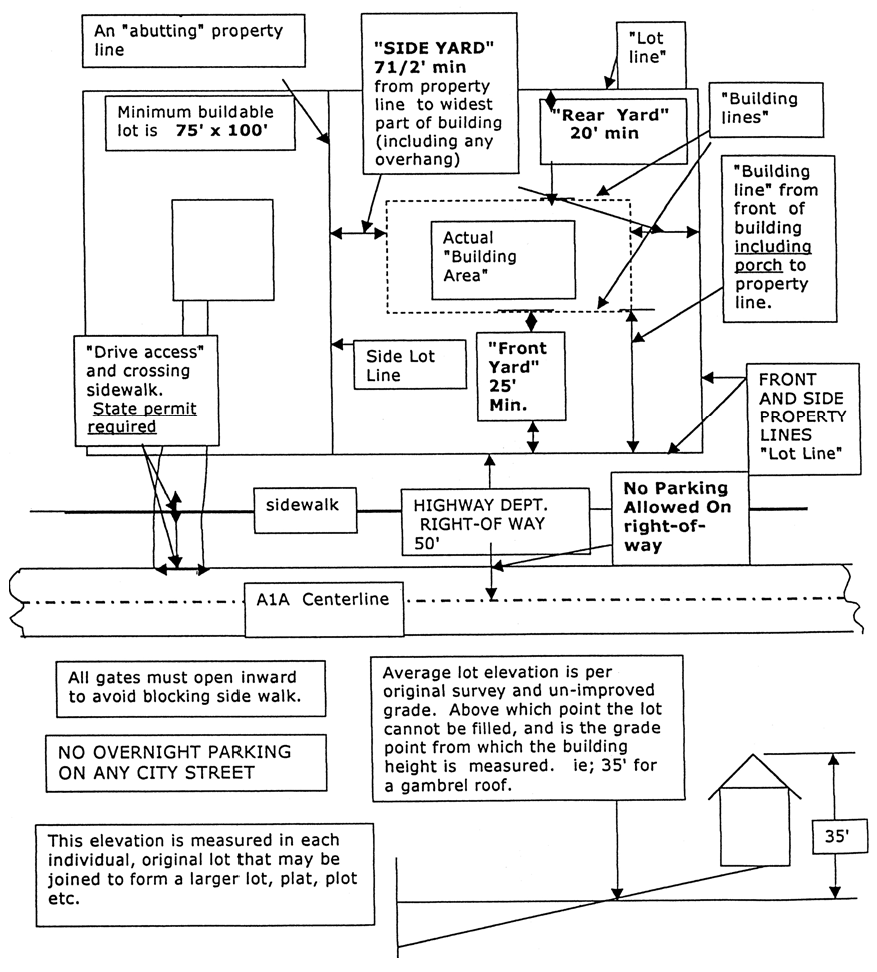
(Ord. No. 00-10-1, § 6.2, 10-4-2000)
Sec. 26-753. - Penalties; additional remedies.
(a)
Any person violating any provision of this article shall, upon conviction, be punished pursuant to section 1-7 and be liable for costs of court for each offense, plus any costs incurred by the town to repair any damage incurred by the violation. Each day such violation continues shall constitute a separate offense.
(b)
In case any building or structure is or is proposed to be erected, constructed, reconstructed, altered, converted, or maintained or any building, structure or land is or is proposed to be used in violation of this article, the zoning inspector, legal officer, or other appropriate authority or any adjacent or neighboring property owner who would be specially damaged by such violation may, in addition to other remedies, institute injunction, mandamus, or other appropriate action or proceeding to prevent such unlawful erection, construction, reconstruction, alteration, conversion, maintenance, or use; or to correct or abate such violation; or to prevent the occupancy of such building, structure, or land.
(c)
Each and every day such unlawful erection, construction, reconstruction, alteration, conversion, maintenance or use continues shall be deemed a separate offense.
(Ord. No. 00-10-1, art. VII, 10-4-2000)
Sec. 26-754. - Purpose.
The purpose of this article is to encourage and promote, in accordance with present and future needs, the public health, safety, order, appearance, convenience, morals and general welfare of the citizens of the town.
(Ord. No. 00-10-1, § 1.2, 10-4-2000)
Sec. 26-755. - Applicability.
Except as provided in this article:
(1)
Use. No building or land shall hereafter be used or occupied and no building or part thereof shall be erected, constructed, moved, or altered except in conformity with the regulations specified in this article for the district in which it is or is to be located.
(2)
Building height. No building shall hereafter be erected, constructed or altered so as to exceed the height limit specified in the regulations in this article for the district in which it is located.
(3)
Lots. No lot, even though it may consist of one or more adjacent lots of record, shall be reduced in size below the requirements of this article, or modified in any manner from the approved plat.
(4)
Yards. No part of a yard or other open space required for any building for the purpose of complying with the provisions of this article shall be included as part of a yard or other open space similarly required for another building.
(Ord. No. 00-10-1, § 3.1, 10-4-2000)
Sec. 26-756. - Conformance with other laws; conflicting regulations.
(a)
Designation of zoning districts shall not preclude the need to comply with all other appropriate rules, regulations, statutes or ordinances affecting land or building use and development.
(b)
Wherever the requirements of this article are at variance with the requirements of any other lawfully adopted statutes, rules, regulations, or ordinances, the most restrictive, or that imposing higher standards, shall govern.
(Ord. No. 00-10-1, § 8.1, 10-4-2000)

