
Bibb County Unincorporated
City Zoning Code
City Zoning Code
CHAPTER 4
GENERAL DEVELOPMENT AND DESIGN STANDARDS1
Editor's note— Res. of December 9, 2024(1), amended the title of Ch. 4 to read as herein set out. The former Ch. 4 was entitled General Provisions.
Section 4.01.- General.
The following provisions relating to the use of land and the construction, alteration, moving and modification of structures and buildings, shall apply in all zoning districts.
(Amended by Res. of December 9, 2024(1))
Section 4.02. - Lot regulations.
[1]
Lot may not be reduced in size below minimum requirements. No parcel of land, even though it may consist of one (1) or more adjacent lots of record, shall be reduced in size so that lot width or depth, front, side, or rear yard, inner or outer courts, lot area per unit, or other requirements of this Resolution are not maintained. This section shall not apply when a portion of a lot is acquired for public use.
[2]
Lot size. All lots shall conform to the area requirements set forth in the zoning districts in which they are located. Residential corner lots shall have adequate width to permit appropriate building setbacks from and orientation to both abutting streets.
[3]
Building lines. A building line, meeting the front, rear and side yard setback requirements of the zoning district in which the parcel of land is located, shall be established on all lots.
[4]
Double frontage lots. Double frontage lots should be avoided, except where essential to provide separation of residential development from traffic arteries or to overcome specific disadvantages of topography and orientation. When allowed, a strip of land at least ten (10) feet in width, and across which there shall be no right of access, shall be provided along the lot or line of lots abutting such traffic artery.
[5]
Lots must abut a public street. No building or structure shall be erected on a lot or portion of a lot which does not abut on a public street for at least thirty (30) feet.
(Amended by Res. of December 9, 2024(1))
Section 4.03. - Height restrictions for buildings and other structures.
[1]
General application. No building or other structure shall hereafter be erected, constructed, or altered so as to exceed the height limits specified in this Resolution and set out for the district in which it is located.
[2]
Permitted exceptions to height regulations. The height restrictions imposed on buildings and other structures by this Resolution for each zoning district shall not apply to the following buildings or other structures, except as imposed by the airport hazard district regulations:
(a)
Churches, schools, hospitals, sanitariums and other public buildings and public utility structures (other than communication towers and antennas, which are subject to Section 23.08.01), provided the setbacks required for the structures in front, side, and rear yards in the district in which such building or other structure is to be located shall be increased an additional one (1) foot for each ten (10) feet that that structure exceeds the maximum height permitted in the district;
(b)
Barns, silos, grain elevators, other farm structures, belfries, cupolas, domes, water towers, windmills, chimneys, smoke stacks, masts, support pols and towers for electrical transmission lines, and structures under seventy (70) feet in total height used for amateur or recreational wireless communication purposes such as a ham radio, a citizens band radio or home television antenna. (Amended October 13, 1997, ZA97-10-01)
(c)
Where located on building roofs, bulkheads, water tanks, scenery lofts, and similar structures, provided that such structures shall not cover more than twenty-five (25) percent of the total roof area of the building.
(Amended May 27, 1986, ZA86-05-01; Amended by Res. of December 9, 2024(1))
Section 4.04. - Yard (building setback distance) regulations.
[1]
General application. No building shall be erected nor shall any existing building be altered, enlarged, moved, or rebuilt, nor shall any open space surrounding any building be encroached upon or reduced in any manner not in conformity with the yard requirement regulations hereinafter established for the district in which such building or open space is located, except as may be specifically provided for in this Resolution. No part of a yard or other open space required for any building for the purpose of complying with the provisions of this Resolution shall be included as part of a yard or other open space similarly required for another building. Every part of a required yard or court shall be open from its lowest point to the sky unobstructed, except for the ordinary projection of sills, cornices, buttresses, ornamental features, chimneys, flues, balconies, and eaves, provided such projections shall not extend more than four (4) feet beyond the yard area requirements.
[2]
Modified requirements. Specified yard requirements established by this Resolution for zoning districts shall be modified as follows:
(a)
On double frontage lots the required building setback distance for the front yard shall be provided on each street;
(b)
An unroofed porch and steps may project into a required front yard for a distance not exceeding ten (10) feet; and
(c)
Moveable awnings may be placed over doors or windows in any required yard, but such awnings shall not project closer than one (1) foot to any property line.
[3]
Front and side yard setback distances for dwellings on corner lots. The setback requirements of this Resolution for side yards on corner lots or front yards shall not apply to any lot where the average setback on adjacent developed lots fronting on the same street is less than the minimum required setback. In such cases, the setback on such lot may be less than the required setback, but not less than the average of the existing setbacks on the adjacent developed lots on the same street.
[4]
Section 32.05 of the Resolution provides for special minimum setbacks for certain streets and highways listed in that section. Additionally, the zoning enforcement officer may require additional minimum front yard setbacks when he finds special circumstances to exist relating to the particular location. Special circumstances include, but are not limited to, topography, utility location, future road widening plans and drainage facilities. Any applicant who disagrees with such a decision of the zoning enforcement officer requiring additional minimum front yard setbacks may appeal the zoning enforcement officer's decisions as set out in Section 27.20 of the Resolution.
(Amended February 10, 1997, ZA97-02-01; Amended July 11, 2022, ZA22-001; Amended by Res. of December 9, 2024(1))
Section 4.05. - Access to public streets.
Access to public streets shall be maintained in accordance with the following requirements:
[1]
All lots shall have a minimum thirty-foot frontage on a public street; and
[2]
Each principal use shall be located on a lot or parcel which provides frontage on a public street having a right-of-way of not less than thirty (30) feet.
(Amended by Res. of December 9, 2024(1))
Section 4.06. - Minimum distance between buildings on same lot or parcel of land.
The following minimum distances between buildings located on the same lot or parcel of land shall be required, unless otherwise specified by this Resolution:
[1]
The minimum distance between main buildings located on the same lot or parcel of land shall be:
(a)
Front to front arrangement: 40 feet.
(b)
Front to rear arrangement: 50 feet.
(c)
Rear to rear arrangement: 30 feet.
(d)
Side to side arrangement: 10 feet.
(e)
All other combinations: 20 feet.
[2]
There shall be a distance of not less than ten (10) feet between a main and accessory building located on the same lot or parcel of land.
[3]
No mobile home unit shall be located within thirty (30) feet of any permanent principal use type building.
(Amended by Res. of December 9, 2024(1))
Section 4.07. - Accessory and temporary buildings.
[1]
Accessory Buildings. Location and uses of accessory buildings in all zoning districts shall be governed by the following conditions:
(a)
Accessory Buildings in Residential and Agricultural Districts:
(i)
Attached to main dwelling. Where an accessory building is attached to the main building, a substantial part of one wall of the accessory building must be an integral part of the main building, and such accessory building must be attached to the main building in a substantial manner by a roof. Such attached accessory building shall comply in all respects with the requirements applicable to the main building.
(ii)
Detached from main dwelling. A detached accessory building shall not be closer than ten (10) feet to the main dwelling or five (5) feet to any interior lot line or alley. The accessory building shall comply with the setback requirements from street rights-of-way for the main dwelling, provided that in no case shall the accessory building be located in the front yard.
(iii)
Height and lot coverage requirements for detached accessory building. A detached accessory building shall not exceed two (2) stories in height and shall not be located in a front yard nor cover more than thirty (30) percent of the side or rear yard.
(b)
Accessory Buildings in All Other Districts: Accessory buildings in all zoning districts except for residential and agricultural districts shall meet the requirements of Section 4.06[2], and the yard requirements for the district in which they are located.
[2]
Temporary Buildings. Temporary buildings may be used only in conjunction with construction work in any zoning district and shall be removed immediately upon the completion of construction. A certificate of zoning compliance must be obtained for use of a temporary building.
[3]
Satellite Dish Antennae. Satellite dishes shall be treated as accessory structures and shall be specifically governed by Section 23.08.03. (Added May 27, 1986, ZA86-05-01)
[4]
Prohibited Accessory and Temporary Buildings or Structures. Manufactured homes, mobile homes, freight trailers, box cars, trailers, or any other structure or vehicle that was not originally fabricated for use as an accessory building shall be prohibited.
(Added June 23, 2008, ZA08-06-01; Amended by Res. of December 9, 2024(1))
Section 4.08. - Buffer areas and screening.
[1]
General buffer and screening standards. The use of buffer areas and screening reduces potential incompatibility between or among different uses of land in proximity to each other. Every development shall provide sufficient, permanent buffer areas or screening, or a combination of both, as may be required by the permitting authority, so that:
(a)
Neighboring properties are reasonably shielded from any adverse external effects of that development; and
(b)
The development is reasonably shielded from the negative impacts of adjacent, incompatible land uses.
[2]
Buffer requirements and standards. Buffer areas, when required, shall be established and permanently maintained under the following provisions:
(a)
Be maintained as a planted area (or landscaped berm), using existing vegetation or, when required, additional plantings as provided below in sections 4.08[3] and 4.08[4] or as otherwise provided by the permitting authority;
(b)
The natural topography of the land shall be preserved and natural growth shall not be disturbed beyond that which is necessary to prevent a nuisance, or to thin this natural growth where too dense for normal growth, or to remove diseased or dangerous and decayed timbers. However, with Commission approval, a sloped area may be cleared and graded where required to prevent soil erosion. This area may cover no more than twenty percent (20%) of the required buffer area, and shall be immediately replanted upon completion of such improvement; and
(c)
The Commission may require the applicant(s), owner(s), and/or agent(s) to execute an agreement which shall constitute a covenant running with the land, binding any transferee, successor, or assignee to the maintenance of the buffer area or screen. Any agreement and covenant executed pursuant hereto shall be in writing, shall contain a complete description of the property, shall be signed by the applicant and owner, and shall be recorded in the deed records in the clerk's office of the superior court of Bibb County.
[3]
Screening requirements and standards.
(a)
The table set forth in section 4.08[4], in conjunction with the explanations in this section [3] concerning the types of screens, establishes screening requirements that, presumptively, satisfy the general standards established in section 4.08[1].
(b)
The table of screening requirements set forth in section 4.08[4] indicates the type of screening that may be required between two land uses. Uses within the Public and Civic Use Classification as established in the Table of Permissible Uses contained in Section 4B of these regulations shall be treated as "commercial areas" for the purposes of establishing the applicable buffer/screening requirements. Except for Agriculture/General and Agriculture/Limited, uses within the Open Use Classification as established in the Table of Permissible Uses contained in Section 4B of these regulations shall be treated as "commercial areas" for the purposes of establishing the applicable buffer/screening requirements. The table lists the site features in a typical development that require screening and bases the screening type required on the location of the site feature on the lot and its distance from the property line. The table provides letter designations that are keyed to the screening types that are described in this section below and gives the minimum width requirements and, in certain cases, the required location for the screening.
(c)
The following three basic types of screens are hereby established and are used as the basis for the table of screening requirements as set forth in section 4.08[4].
(i)
Opaque screen, type A. A screen that is opaque from the ground to a height of at least six (6) feet, with intermittent canopy type trees placed alongside the opaque screen and growing to a height of at least twenty (20) feet, as provided below. An opaque screen is intended to exclude completely all visual contact between uses and to create a strong impression of spacial separation. The opaque screen may be composed of a wall, fence, planted earth berm, planted vegetation, existing vegetation, or any combination thereof. For every linear one hundred (100) feet, or fraction thereof, the screen shall also consist of an average of three or more canopy type trees, each with a minimum caliper of two inches. Said trees in five (5) years shall reach a height of at least twenty (20) feet and shall have an average canopy spread of at least fifteen (15) feet. The opaque portion of the screen must be opaque in all seasons of the year. If shrubbery is used, said shrubbery shall be evergreen plant materials and be spaced to provide a solid screen in two years. If fences or walls are used, said fences or walls shall be masonry, wood, metal or other suitable materials (not to include chain-link fencing) and shall have architectural character and be of substantial materials. A graphic illustration of the sample planting pattern is included in Graphic 4.1 [following this section].
(ii)
Semi-opaque screen, type B. A screen that is opaque from the ground to a height of at least three (3) feet, with intermittent canopy type trees placed alongside the opaque screen and growing to a height of at least twenty (20) feet, as provided below. The semi-opaque screen is intended to partially block visual contact between uses and to create a strong impression of the separation of spaces. The opaque portion of the screen may be composed of a wall, fence, planted earth berm, planted vegetation, existing vegetation, or any combination thereof. For every linear one hundred (100) feet, or fraction thereof, the screen shall consist of an average of two canopy type trees, each with a minimum caliper of two inches. Said trees in five years shall reach a height of at least twenty (20) feet and shall have an average canopy spread of fifteen (15) feet. The opaque portion of the screen must be opaque in all seasons of the year. If shrubbery is used, said shrubbery shall be evergreen plant materials and be spaced to provide a solid screen in two years. If fences or walls are used, said fences or walls shall be masonry, wood, metal, or other suitable materials (not to include chain-link fencing) and shall have architectural character and be of substantial materials. A graphic illustration of a sample planting pattern is included in Graphic 4.1 [following this section].
(iii)
Broken screen, type C. A screen composed of intermittent visual obstructions composed of trees or trees and shrubs, with the trees, with the trees growing to a height of at least twenty (20) feet, as described below. The broken screen is intended to create the impression of a separation of spaces without necessarily eliminating visual contact between the spaces. For every linear one hundred (100) feet, or fraction thereof, the screen may consist of either: (a) a combination of at least two (2) canopy or ornamental type trees, each having a minimum caliper of at least two (2) inches and that in five (5) years shall reach a height of at least twenty (20) feet, and shrubbery at least three (3) feet in height that covers an average of at least 20 percent (20%) of the screen area; or (b) at least five (5) canopy or ornamental type trees, each having a minimum caliper of two (2) inches and that in five (5) years shall reach a height of at least twenty (20) feet. A graphic illustration of a sample planting pattern is included in Graphic 4.1 [following this section].
[4]
Table of screening requirements. There is hereby established a table of screening requirements as follows:
* The letters in each column under the heading "Screen type" in the chart above refer to the type screen required for the site feature to be screened when it is adjacent to either a residential property or a non-residential property, respectively: the letter "A" means an Opaque screen is required, "B" means a Semi-opaque screen is required and "C" means a Broken screen is required. For example, an "A" in the column entitled "Residential Adjacency" means that the site feature to be screened must use an opaque screen when the property containing that feature is adjacent to residential property, and so on.
Notwithstanding the above, a more opaque screen may always be substituted for a less opaque screen as long as other requirements and standards of this section are met.
NOTE: Graphic illustrations of screening placement are provided in Graphic 4.1 [following this section].
[5]
Flexibility in administration required. The Commission recognizes that because of the wide variety of types of developments and the relationships between them, it is neither possible nor prudent to establish inflexible buffering and screening requirements. Therefore, the permit-issuing authority may permit or require deviations from specific buffering and screening requirements of sections 4.08[2], [3] and [4] in particular cases where such requirements either create an unnecessary hardship on the applicant or are deemed insufficient to accomplish the purposes of such buffering or screening as provided in Section 4.08[1].
[6]
Application where regulations set out different requirements. In those instances where these zoning regulations set out a different buffering or screening requirement (e.g., a greater width of landscaped buffer or a different type of buffer) for particular uses or types of uses, the specific provisions of those regulations applicable to the particular use or type of use shall govern.
GRAPHIC 4.1 TYPICAL SCREEN TYPES
OPAQUE SCREEN-TYPE A
REQUIRES APPROXIMATELY 50 SHRUBS @ 4' O.C. 2 ROWS
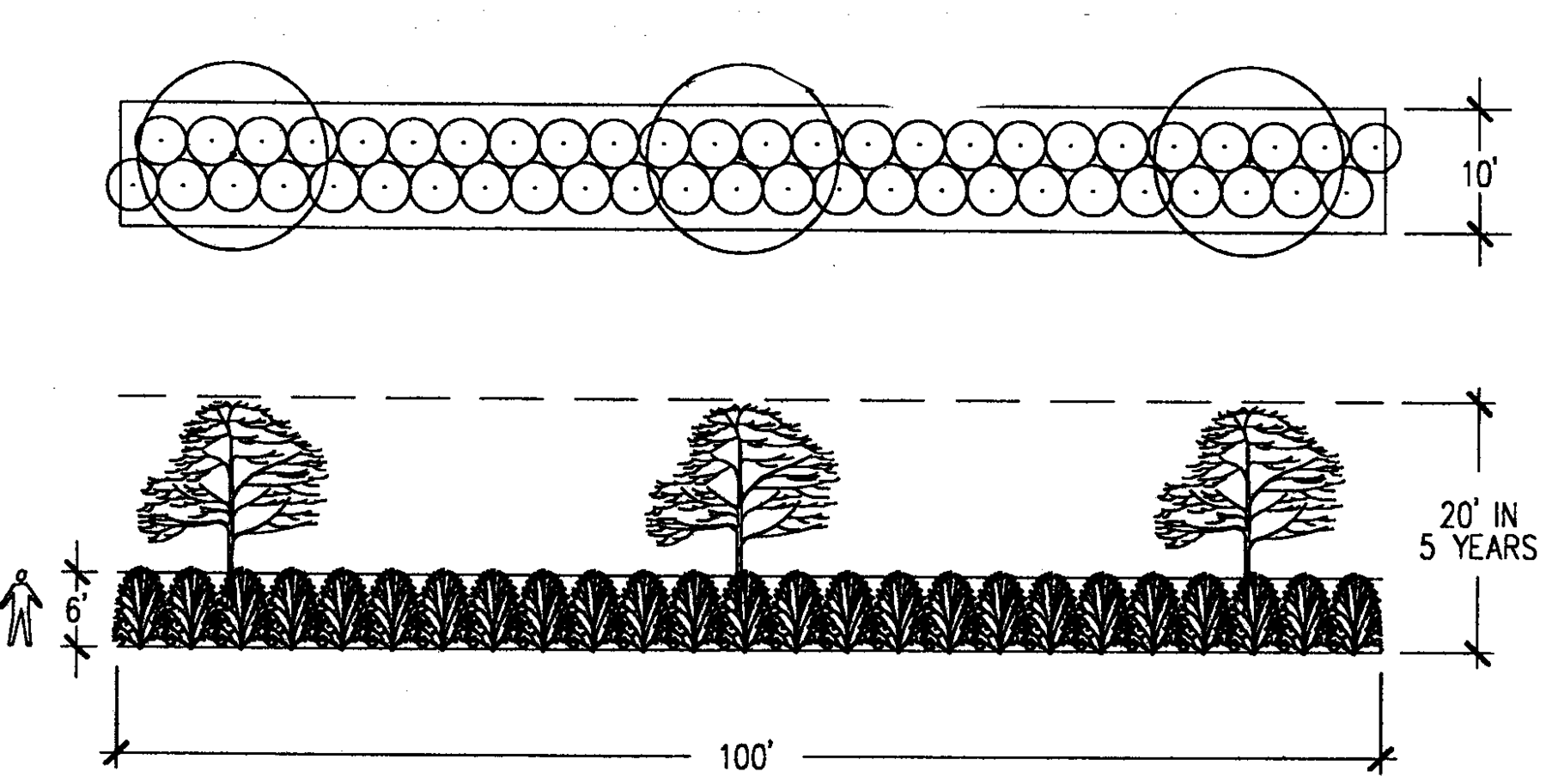
SEMI-OPAQUE SCREEN-TYPE B
REQUIRES APPROXIMATELY 30 SHRUBS 3' O.C. 1 ROW
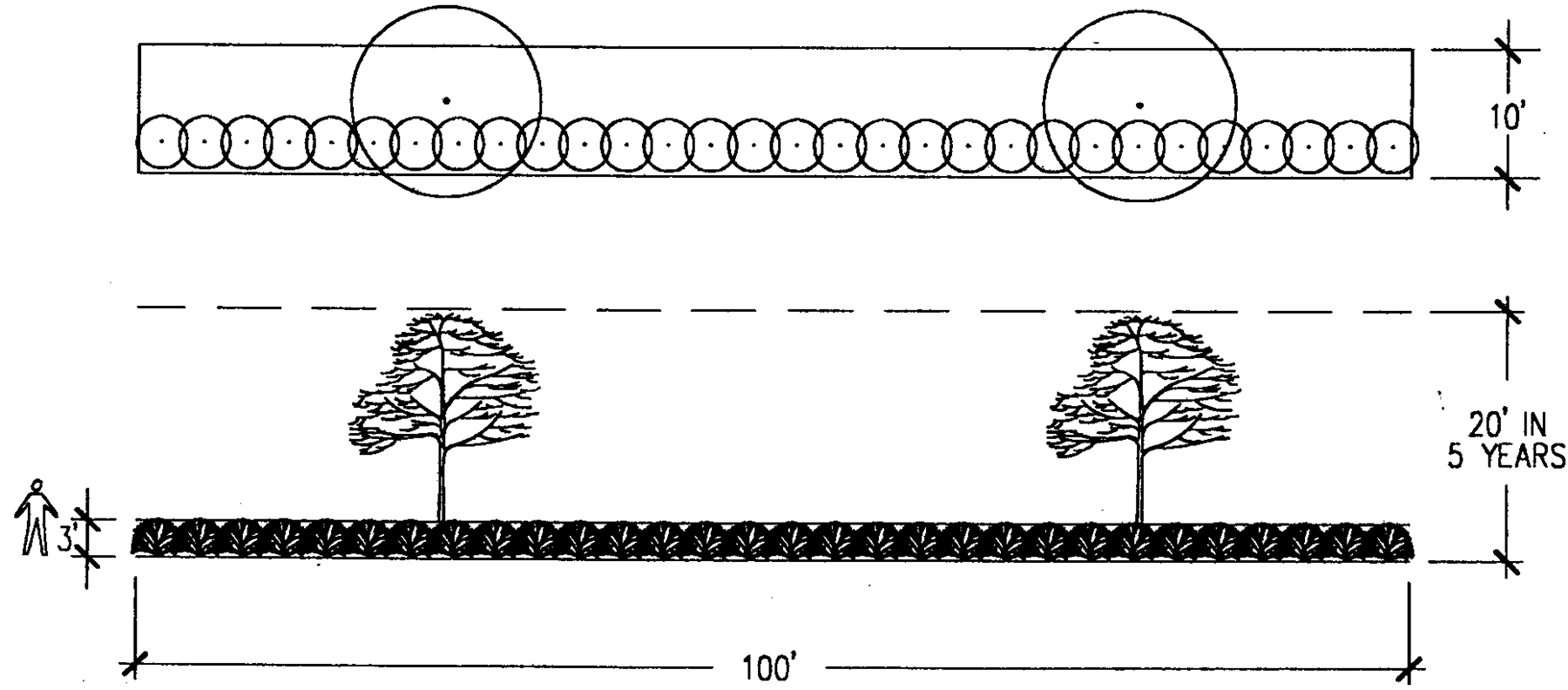
BROKEN SCREEN-TYPE C
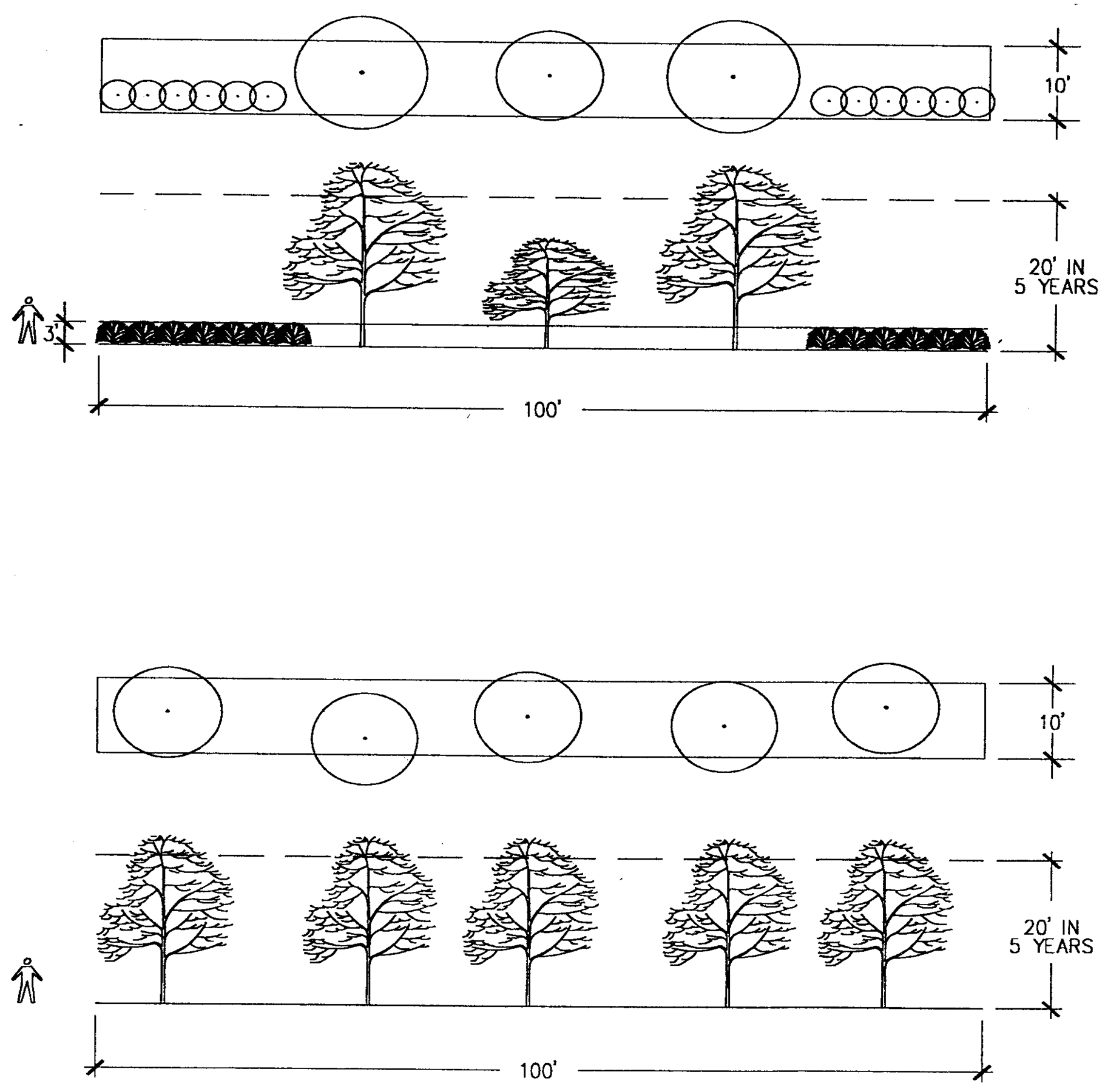
(Amended by Res. of December 9, 2024(1))
Section 4.09. - Lighting.
[1]
General.
(a)
All lighting, regardless of location, shall be designed and installed to prevent direct glare and light spillage onto adjacent properties and shall be so situated as not to reflect into any public right-of-way.
(b)
Except as may be allowed below, all acceptable outdoor luminaries shall employ Illuminating Engineering Society (IES) "semi-cutoff", "cutoff" or "full cutoff" light distribution designations and shall be either partially shielded fixtures or fully shielded fixtures to reduce glare or spillage.
(c)
Any deviation(s) from these standards shall be noted at the time of development plan review along with a statement explaining the purpose of and reason for the deviation(s). The Executive Director shall make a determination whether to accept such deviation(s) as reasonably accomplishing the purposes of this section.
(d)
Flashing or running lights within public view, as well as festoons of lights that outline property lines, sales areas, rooflines, doors, windows, or similar areas, are prohibited, provided that this prohibition does not apply to temporary lighting erected in connection with the observance of holidays.
[2]
Parking areas.
(a)
Where lighting is to be provided for a parking area, it shall be designed to provide safe, convenient and efficient ingress and egress for pedestrians and vehicles. Lighting shall be designed such that light levels and uniformity ratios are in compliance with the minimum standards proscribed by the IES.
(b)
Lighting design shall be consistent and coordinated for the entire site.
[3]
Athletic fields.
(a)
Where lighting is to be provided for athletic fields, it shall be designed to provide the minimum lighting necessary for safe activity on the fields. Lighting shall be designed such that light levels and uniformity ratios are in compliance with the minimum standards proscribed by the IES.
(b)
Mounting heights for exterior luminaries that are located within one hundred (100) feet of the property line shall not exceed the maximum building height allowed within the adjacent zoning district (with the height being measured from the finished grade to the bottom of the luminous opening of the luminary) and shall be aimed to point away from the property line.
(c)
Acceptable outdoor luminaries shall be designed to reduce glare or spillage onto adjacent properties and to the open sky. The unique necessity of lighting athletic fields requires the allowance of fixtures that may not have a "cutoff" designation or be shielded. However, lighting solutions provided for athletic fields shall be required to meet the other standards of this Section.
(d)
Scoreboards or timer clocks that are separately illuminated shall be oriented such that, in the case of externally illuminated boards, the illumination source is pointed away from the closest adjacent property line, or, in the case of internally illuminated boards, the illuminate face is oriented away from the closest adjacent property line.
(Amended by Res. of December 9, 2024(1))
Section 4.10. - Control of curb cuts and vision clearance.
The requirements for controlling curb cuts and maintaining vision clearance shall be as follows:
[1]
No curb cut shall exceed fifty (50) feet in length nor shall curb cuts be closer than twenty (20) feet to other curb cuts or closer than twenty (20) feet to an intersection of two (2) streets measured along the curb lines; and
[2]
Within twenty (20) feet of the intersection of the right-of-way lines of two (2) streets or railroad lines or of a street intersection with a railroad line, there shall be no fence, wall, shrubbery, sign, marquee, or other obstruction to vision permitted to protrude in the space between the heights of two and one-half (2½) feet and ten (10) feet above ground level. This requirement does not apply to (CBD) Central Business Districts.
(Amended by Res. of December 9, 2024(1))
Section 4.11. - Fences and walls.
The following regulations shall apply to the construction of fences.
[1]
Location.
(a)
Fences (walls and decorative fences) shall not be located outside or beyond the property or lot lines of the lot upon which said improvement shall serve.
(b)
Fences shall be placed no closer to the public right-of-way than ten (10) feet except in the design review districts. The appropriate setback for fences in the design review districts shall be determined through the design review process as specified in Chapter 28 of this Resolution. (Amended September 14, 2015, ZA15-002; Amended July 11, 2022, ZA22-001)
(c)
No fence or wall shall constitute an obstruction to the vision for or create a hazard to vehicular traffic.
[2]
Height.
(a)
Fences shall not exceed four feet in height in front yards or eight (8) feet in height in side or rear yards for all residential zoning districts; nor shall fences exceed eight (8) feet in height in any yard in commercial or industrial zoning districts.
(b)
All designated fence heights must exist without the use of additions or extensions (barbed wire, razor wire, etc.) in meeting height requirements. (e.g., a ten-foot fence in a commercial area must be ten (10) feet of fence, not eight (8) feet of fence and two (2) feet of barbed wire).
[3]
Design and type.
(a)
All fences shall be constructed with the finished side exposed, the support posts placed on the inside, and in a manner which serves to enhance the aesthetic appearance of the neighborhood or surrounding area.
(b)
Barbed wire fences or barbed wire assemblies or additions atop fences shall be prohibited in all residential districts. In commercial zoning districts, such fences may be allowed by the Commission as a conditional use.
(c)
Barbed wire fences are permitted in agricultural and industrial districts with the following restrictions:
(i)
Barbed wire assemblies or additions shall be restricted to three horizontal wire strands not to exceed a maximum of eighteen (18) inches;
(ii)
Barbed wire assemblies shall be erected atop fences with a minimum height of six (6) feet;
(iii)
Razor ribbon shall be prohibited.
[4]
Enclosure of swimming pools.
(a)
All swimming pools, whether above or in ground shall be completely enclosed by a fence or wall. The fence regulations and requirements for swimming pools shall be as follows:
(i)
Fences or walls around all swimming pools shall not be less than four (4) feet in height and have both a self-latching and self-closing gate;
(ii)
Fences or rails constructed along the deck of an above ground pool will not qualify as meeting the requirements of this section. A separate fence or wall meeting the requirements of this section will be required.
(iii)
Openings in fences shall not allow the passage of a 4-inch diameter sphere.
(b)
Access gates. All access gates shall open outwards away from the pool and shall be self-closing and have a self-latching device.
(Added November 22, 1999, ZA99-11-01; Amended by Res. of December 9, 2024(1))
Section 4.12. - Transitional area regulations.
Where allowed, the location of industrial and commercial uses adjoining residential districts frequently causes an unfavorable impact upon the character of the adjoining residential district. To control this impact and to minimize the impact of noise, odor, vibrations, dust, light, and other objectionable disturbances, the Commission or the zoning enforcement officer, as applicable, may for any such use, permitted, limited or conditional:
[1]
Prohibit any use which, because of its character, would produce obnoxious odors, glare, noise, vibrations, electrical disturbance, radioactivity, or other conditions detrimental to the character of the adjoining residential district;
[2]
Require landscaped buffers or screening;
[3]
Prohibit signs within twenty-five (25) feet of a residential district;
[4]
Require lighting to be controlled and directed so as not to be objectionable to adjacent residential districts; and
[5]
Prohibit any use which cannot conform to any requirement imposed by this section.
(Amended by Res. of December 9, 2024(1)
Section 4.13. - Additions and alterations to existing structures.
Additions and alterations to existing structures are permitted where such additions or alterations do not cause such structure to be in violation of any provision of this Resolution including, but not limited to, provisions regulating density, yard requirements, height restrictions, or parking requirements, subject to obtaining a permit(s) and/or certificate of appropriateness pursuant to Chapters 27 and/or 28, as applicable.
(Amended July 11, 2022, ZA22-001; Amended by Res. of December 9, 2024(1))
Section 4.14. - Limitation on the occupancy of a dwelling unit.
A dwelling unit may be occupied by not more than one (1) family, and such family may consist of not more than one (1) of the following:
[1]
One (1) person or two (2) or more persons related by blood or marriage, with no more than two (2) roomers or boarders, and with any number of natural children, foster children, stepchildren or adopted children; or
[2]
A group of not more than four (4) persons not necessarily related by blood or marriage.
[3]
A dwelling unit which is utilized as a "maternity supportive housing residence" as governed by the provisions of the Georgia Children and Youth Act [O.C.G.A. § 49-5-3(13.1) and 49-5-25(c)] shall be treated as being occupied by "one family" for purposes of this section and any other provisions of this Resolution.
(Added April 22, 1996, ZA96-03-01; Amended by Res. of December 9, 2024(1))
Section 4.15. - Aboveground storage tanks.
All aboveground tanks for the storage of gasoline, liquified petroleum gas, oil, ethanol or other flammable liquids or gases, shall be located not less than five hundred (500) feet from any residential district. All tanks must meet the standards and specifications established by the Environmental Protection Agency, the Georgia State Fire Marshal and any other applicable regulations.
(Added by Res. of December 9, 2024(1))
Section 4.16. - Minimum dwelling space requirements.
Every residential dwelling unit shall comply with the minimum dwelling space requirements of Section 306 of the Standard Housing Code as adopted by Macon-Bibb County.
(Added April 22, 1996, ZA96-03-01; Amended by Res. of December 9, 2024(1))
Section 4.17. - Reasonable accommodation.
[1]
Pursuant to the federal Fair Housing Act, 42 U.S.C. § 3601 et seq. (hereafter "FHA") and Title II of the Americans With Disabilities Act (hereafter "ADA") (collectively the "fair housing laws") the Commission and its officers and employees shall provide individuals with disabilities (handicapped persons) as defined under such Acts reasonable accommodation in the application, interpretation and enforcement of this Resolution pertaining to housing and development, including partial or complete waiver of, or variance from, any provision of this Resolution, to reasonably ensure equal access by persons with disabilities and to developers of housing for persons with disabilities, as required by such Acts or other state or federal law.
[2]
Requests for reasonable accommodation should be made in writing to the zoning enforcement officer. A request for a reasonable accommodation may be made by any individual with a disability, his or her representative, or a developer or provider of housing for individuals with disabilities, when the application of this Resolution acts as a barrier to fair housing opportunities or would otherwise violate the FHA, ADA or other state or federal law. Either the zoning enforcement officer or the Commission may grant such reasonable accommodation.
(Added by Res. of December 9, 2024(1))

