
Bixby City Zoning Code
CHAPTER 7
- SPECIAL DISTRICT REGULATIONS
11-7A-1: - PURPOSES:
The Agricultural District is designed to:
A.
Encourage and protect agricultural land until an orderly transition to urban development may be accomplished;
B.
Discourage wasteful scattering of development in rural areas;
C.
Obtain economy of public fund expenditures for improvements and services.
(Ord. 272, 4-2-1974)
11-7A-2: - PRINCIPAL USES PERMITTED:
The principal uses permitted in the Agricultural District are designated by use units. The use units are groupings of individual uses and are fully described, including their respective off street parking, loading, screening requirements and other use conditions in chapter 9 of this title. The use units permitted in the Agricultural District are set forth in section 11-13-6 of this title.
(Ord. 408, 8-18-1980; amd. 2006 Code; Ord. 2031, 12-21-2009; Ord. 2265, 11-13-2018)
11-7A-3: - ACCESSORY USES:
A.
Permitted Uses: Accessory uses customarily incident to a principal use permitted in an Agricultural District are permitted in such district. In addition, the uses set forth in table 1 of this section are permitted as accessory uses.
Notes:
1 By special exception requiring board of adjustment approval.
2 By special exception requiring board of adjustment approval subject to the requirements set forth in subsection 11-7B-5B of this chapter.
B.
Accessory Use Conditions:
1.
General Conditions:
a.
An accessory building erected as an integral part of the principal building shall be made structurally a part thereof, shall have a common wall therewith, and shall comply with the requirements applicable to the principal building.
b.
Accessory buildings shall meet the minimum yard or building setback requirements.
2.
Accessory Signs in AG District:
a.
One bulletin board may be erected on each street frontage of an educational, religious, institutional or similar use requiring announcement of its activities. The bulletin board shall not exceed thirty-two (32) square feet in display surface area, nor twenty feet (20') in height, and illumination, if any, shall be by constant light.
b.
One identification sign may be erected on each street frontage of a permitted nonresidential use. The sign shall not exceed two-tenths (2/10) of a square foot of display surface area per linear foot of street frontage; provided, however, that in no event shall the sign be restricted to less than thirty-two (32) square feet nor be permitted to exceed one hundred fifty (150) square feet of display surface area. The sign shall not exceed twenty feet (20') in height, and illumination, if any, shall be by constant light.
c.
A real estate sign advertising the sale, rental or lease of the premises may be erected on each street frontage of the premises. The sign shall not exceed eighty (80) square feet in surface area, nor fifteen feet (15') in height, and illumination, if any, shall be by constant light.
(Ord. 272, 4-2-1974; amd. Ord. 540, 6-10-1986; Ord. 731, 1-22-1996)
11-7A-4: - BULK AND AREA REQUIREMENTS:
Note:
1 See additional height limitation in section 11-8-6 of this title.
(Ord. 272, 4-2-1974; amd. Ord. 288, 2-4-1975; 2006 Code; Ord. 2031, 12-21-2009)
11-7A-5: - SPECIAL EXCEPTION USES; REQUIREMENTS:
A.
Requirements Specified: The special exception uses permitted in the Agricultural District, as designated in section 11-13-6 of this title, are subject to the requirements set out below, and such additional safeguards and conditions as may be imposed by the board of adjustment.
1.
The accessory use provisions of the Agricultural District pertaining to signs are applicable to accessory signs for uses permitted by special exception.
2.
Special exception uses shall conform to the bulk and area requirements of the use district in which located, unless the use unit requirements are more restrictive, in which case the more restrictive shall control.
3.
A nursing home, community group home, convent, monastery and novitiate shall meet the use conditions as set forth in subsection 11-9-8.C of this title.
B.
Wind Energy Conversion Systems (WECS):
1.
The minimum lot area shall be two and one-half (2½) acres.
2.
The minimum height of the lowest part of the WECS, exclusive of the tower, shall be thirty feet (30') above any existing structures, the height of any structures allowed under the district zoning requirement, and any trees within three hundred feet (300') of the WECS. The height of trees shall be their potential height at maturity as determined by "Know It and Grow It: A Guide to the Identification and Use of Landscape Plants in the Southern States", the revised edition by Carl E. Whitcomb, Whitcomb Publications, Stillwater, Oklahoma, 1965.
3.
No part of the WECS, including the tower, anchors and guy wires, shall be located within or over drainage, utility or other established easements; extend within or over any required minimum front, side or rear setbacks; or in a residential district, extend into any established front yard.
4.
All WECS tower structures shall comply with the design and construction techniques in the BOCA Basic Building Code. Compliance shall be certified and sealed in writing by the manufacturer's engineering staff and by an Oklahoma registered professional engineer.
5.
If a WECS is within three hundred feet (300') of a structure or a tree, the lowest moving part shall be a minimum of thirty feet (30') above the highest structure or potential tree height, whichever is higher; however, not to exceed sixty feet (60').
6.
In addition to the above requirements, the following conditions shall apply:
a.
Towers shall have either tower climbing apparatus located not closer than twelve feet (12') from the ground or shall have a locked anticlimb device installed on the tower.
b.
At least one sign shall be posted at the base of the WECS tower and shall contain a warning of high voltage, an emergency phone number and emergency shutdown procedures.
c.
Tamper proof turnbuckles shall be installed on the guy wires for all guyed WECS towers.
d.
A WECS shall be equipped with both manual and automatic controls to limit the rotational speed of the blade below the design limits of the rotor. The conformance of rotor and overspeed control design with good engineering practices shall be certified by the manufacturer's engineering staff and by an Oklahoma registered professional engineer. The compatibility of the tower and the rotor shall also be certified by the manufacturer and by an Oklahoma registered professional engineer.
7.
The restrictions established by this subsection may be modified by the board of adjustment, subject to certification of minimal electrical, mechanical and structural requirements and such additional safeguards and conditions as may be imposed by the board of adjustment.
(Ord. 272, 4-2-1974; amd. Ord. 540, 6-10-1986; Ord. 753, 5-7-1997)
11-7B-1: - PURPOSES:
A.
General Purposes: The residential districts are designed to:
1.
Achieve the residential objectives of the comprehensive plan;
2.
Protect the character of residential areas by excluding inharmonious commercial and industrial activities;
3.
Achieve a suitable environment for family life by permitting in residential areas appropriate neighborhood facilities, such as churches, schools and certain cultural and recreational facilities;
4.
Preserve openness of the living areas and avoid overcrowding by requiring minimum yards, open spaces, lot areas, and by limiting the bulk of structures;
5.
Permit a variety of dwelling types and densities to meet the varying needs of families; and
6.
Control the density of residential development to facilitate the planning for an economical provision of streets, utilities and other public facilities.
B.
RE Residential Estate District: The RE district is designed to permit the development and conservation of single-family detached dwellings in a suitable environment for family life on large parcels of land at a low rate of urban population density. It is the intent of this district to prohibit any other use which would substantially interfere with the stated purposes of this district, and discourage any use that generates traffic and creates congestion on neighborhood streets other than normal traffic serving the residents on those streets.
C.
RS Residential Single-Family Districts: The RS-1, RS-2, RS-2.5, RS-3 and RS-4 inactive districts are designed to permit the development and conservation of single-family detached dwellings in suitable environments in a variety of densities to meet the varying requirements of families.
RS-4 Inactive Residential District: All existing lots and uses in an RS-4 district shall continue as lawfully nonconforming, provided they conformed to the standards of this title when classified as an RS-4 district. On and after May 9, 2016, the RS-4 district classification shall be "inactive" and no new RS-4 zoning reclassifications shall be approved. Development in an inactive residential district shall be subject to all applicable requirements of this title, including use regulations, dimensional requirements and development design standards that are not otherwise governed by the zoning district standards of this inactive district.
D.
RD Residential Duplex District: The RD district is designed to permit a more intense, yet compatible use of tracts in or near single-family residential and other neighborhoods which, because of size, topography or adjacent land use, are not ideally suited for single-family use.
E.
RM Residential Multi-Family District: The RM-1, RM-2 and RM-3 districts are designed to permit the development and conservation of multi-family dwelling types such as garden apartments and townhouses, in suitable environments and in a variety of densities to meet the varying requirements of families.
F.
RT Residential Townhouse District: The RT district is designed to permit the development of attached single-family townhouse dwellings, on separate lots, which are designed expressly for separate ownership, in suitable residential environments at a higher density than conventional detached single-family dwellings.
G.
RMH Residential Manufactured Home Park District: The RMH district is designed to recognize manufactured home living as a residential use necessitating location in residential areas yet requiring regulation to ensure a suitable living environment.
(Ord. 272, 4-2-1974; amd. Ord. 845, 1-28-2002; Ord. 2031, 12-21-2009; Ord. 2187, 5-9-2016)
11-7B-2: - PRINCIPAL USES PERMITTED:
The principal uses permitted in the residential districts are designated by use unit. The use units are groupings of individual uses and are fully described, including their respective off street parking, loading and screening requirements and other use conditions in chapter 9 of this title. The use of an RS, RT or RD district for access to any RM, O, C or I district, or the use of an RM district for access to any O, C or I district is prohibited unless permitted through an approved planned unit development. The use units permitted in residential districts are set forth in section 11-13-6 of this title.
(Ord. 2187, 5-9-2016; amd. Ord. 2265, 11-13-2018)
11-7B-3: - ACCESSORY USES:
A.
Permitted Accessory Uses: Accessory uses customarily incident to a principal use permitted in a residential district are permitted in such district. In addition, the following uses set forth in table 1 of this section are permitted as accessory uses:
Notes:
1 By special exception requiring board of adjustment approval.
2 Carports shall comply with the special exception and other carport regulations set forth in this title.
3 In rear yards only.
4 PUD required.
B.
Accessory Use Conditions:
1.
General Conditions:
a.
An accessory building erected as an integral part of the principal building shall be made structurally a part thereof, and shall comply with the requirements applicable to the principal building.
b.
A detached accessory building shall not be located in the front or side yard.
c.
Within the rear yard, a detached accessory building shall be located at least five feet (5') from any interior lot line.
2.
Accessory Commercial:
a.
Permitted commercial accessory uses are limited to the uses included in use units 12, 13, and 16, designed and located for the convenience of the occupants of a multi-family dwelling.
b.
Except for use unit 16 ministorage, commercial accessory uses shall be located entirely within a multi-family structure and may have an exterior public entrance for each interior lobby entrance.
c.
Commercial accessory uses shall not occupy more than ten percent (10%) of the gross floor area of the building in which located, or in the case of use unit 16 ministorage, not more than ten percent (10%) of the net lot area of the lot or lots on which the multi-family development is located.
d.
No signs or other advertising shall be visible from outside the lot.
3.
Sleeping Rooms: In a dwelling unit occupied as a private residence, one or more rooms may be rented to not exceeding two (2) persons not members of the family occupying said premises, providing no window display or sign board is used to advertise such use.
4.
Signs:
a.
One bulletin board may be erected on each street frontage of any educational, religious, institutional or similar use requiring announcement of its activities. The bulletin board shall not exceed thirty-two (32) square feet in surface area, nor twenty feet (20') in height, and illumination, if any, shall be by constant light.
b.
One identification sign may be erected on each perimeter street frontage of a multi-family development, mobile home park, single-family subdivision or permitted nonresidential use. The sign shall not exceed two-tenths (2/10) of a square foot of display surface area per linear foot of street frontage; provided, however, that in no event shall the sign be restricted to less than thirty-two (32) square feet nor permitted to exceed ten (10) square feet of display surface area. The sign shall not exceed twenty feet (20') in height, and illumination, if any, shall be by constant light.
c.
During the period of construction, but in no event exceeding eighteen (18) months, a sign advertising the construction of improvements on the premises may be erected on each perimeter street frontage of the development; provided, however, said sign shall not exceed one-half (½) of a square foot of display surface area per linear foot of street frontage; provided, further, that in no event shall the sign be restricted to less than thirty-two (32) square feet nor be permitted to exceed four hundred (400) square feet of display surface area. The sign shall not exceed fifteen feet (15') in height, and illumination, if any, shall be by constant light. After the initial eighteen (18) month period of construction of improvements on the premises, a construction sign shall be reduced to not exceed eight feet (8') in height, and eight (8) square feet in display surface area.
d.
A temporary real estate sign advertising the sale, rental or lease of the premises may be erected on each street frontage of a lot. The sign shall not exceed eight (8) square feet in display surface area, nor eight feet (8') in height, and illumination, if any, shall be by constant light.
e.
Signs on accessory equipment or structures, including, but not limited to, satellite dishes, air conditioners and fences, identifying the manufacturer, make and model, shall be limited to fourteen and four-tenths (14.4) square inches of display surface area for each piece of equipment or structure.
5.
Family Daycare Homes:
a.
Family daycare homes must be licensed by the State of Oklahoma Department of Human Services.
b.
Family daycare homes must obtain a zoning clearance permit from the building official if established after the effective date hereof.
c.
A maximum of five (5) children, including those preschool children under five (5) years of age who reside in the residence, may be cared for in the home.
d.
No person shall be employed other than a member of the immediate family residing on the premises or a substitute caregiver as required by the standards for family daycare homes adopted by the Oklahoma Department of Human Services.
e.
No signs advertising the family daycare home shall be permitted on the lot.
f.
No exterior alterations of the dwelling or any customary accessory structure shall be made which would detract from the residential character of the structure.
g.
No family daycare home may be located on a lot within three hundred feet (300') of another lot containing a family daycare home if any boundary of said lots abut the same street. "Street", as used herein, shall mean any named or numbered street along its full length, irrespective any intervening street.
h.
State licensed family daycare homes in existence on the effective date hereof, but which would be prohibited by the spacing requirements herein, may continue as otherwise regulated herein.
(Ord. 272, 4-2-1974; amd. 2006 Code; Ord. 994, 4-14-2008; Ord. 2020, 7-27-2009; Ord. 2053, 1-24-2011)
11-7B-4: - BULK AND AREA REQUIREMENTS:
A.
RE, RS, RD, RT, and RM Districts:
1.
Table 2:
Notes:
** 5 feet on unattached side, 0 feet on attached side only.
*** Maximum 4 units per development width.
2.
Modification and Explanation of Bulk Area Requirements:
a.
"Height of structure" is defined as the distance from front yard finished grade to top roof ridgeline limited to no more than three (3) stories.
b.
Front yard and any yard abutting a street shall be measured from the centerline of abutting street; add to the distance designated in table 2 of this section, one-half (½) the right-of-way width designated on the major street plan, or twenty-five feet (25') if the street is not designated on the major street plan (minimum feet).
c.
All multi-family dwellings and their accessory buildings, except garages, shall be set back at least twenty-five feet (25') from any RE or RS district. A single-story limitation shall apply to multi-family dwellings which are within fifty feet (50') of an RE or RS district.
d.
Livability space within an RT district shall be provided on each townhouse lot or in common areas within the townhouse development as designated on the subdivision plat.
e.
When a lot or portion of a lot abuts a cul-de-sac having a radius greater than twenty-five feet (25'), or when a lot or portion of a lot abuts a nonarterial street right-of-way which exceeds fifty feet (50') in width, the setback distance designated in table 2 of this section shall be measured from the property line.
f.
"Townhouse development unit" shall mean the total of units sharing common walls. "Townhouse dwelling unit" shall mean a single-family unit when combined with other dwelling units to compose a development unit.
B.
RMH District:
Note:
1 "Gross area" shall mean the tract area of the development plus ½ the right-of-way of any abutting street to which the tract has access.
(Ord. 272, 4-2-1974; amd. Ord. 845, 1-28-2002; 2006 Code; Ord. 2031, 12-21-2009; Ord. 2187, 5-9-2016)
11-7B-5: - SPECIAL EXCEPTION USES; REQUIREMENTS:
The special exception uses, permitted in the residential districts, as designated in section 11-13-6 of this title, are subject to the minimum requirements set out below and such additional safeguards and conditions as may be imposed by the board of adjustment.
A.
Accessory Signs: The accessory use provisions of the residential districts pertaining to signs are applicable to accessory signs for principal uses permitted by special exception.
B.
Home Occupations: The standards for home occupations listed below are intended to ensure compatibility of the home occupation with adjacent or surrounding residential land uses.
1.
Home occupations must fully meet and comply with requirements set forth in subsections B.2. through B.12. of this section, and such additional safeguards and conditions as may be imposed by the board of adjustment.
2.
A home occupation may employ any number of family members residing on the premises and may employ up to one additional person who does not reside on the premises.
3.
A home occupation is permitted one nonilluminated wall mounted sign not to exceed three (3) square feet in area to be affixed to the principal or accessory structure in which the home occupation is conducted. Additionally, a maximum of two (2) signs that are affixed to vehicles located on the premises advertising the home occupation shall be allowed; provided, that such signs are nonilluminated and do not exceed two (2) square feet in area per sign.
4.
All business activities associated with a home occupation shall be conducted entirely within an enclosed structure, either within the primary dwelling unit or an accessory building on the same parcel in which the home occupation is conducted. A maximum limit of six hundred (600) square feet of floor area shall be allowed to be utilized for home occupation purposes in the RE and RS residential districts. A maximum limit of one thousand (1,000) square feet of floor area shall be allowed to be utilized for home occupation purposes in the AG agricultural district where the gross land area of the AG parcel in which the home occupation is conducted exceeds a minimum of one acre in physical land area size.
5.
Exterior alterations of the structure in which the home occupation is conducted shall not detract from the residential character of the structure.
6.
No equipment or process shall be used in a home occupation which creates noise, vibration, glare, fumes, odors or electrical interference beyond what normally occurs in the applicable zoning district.
7.
There shall be no outdoor storage or display of materials or items associated with the home occupation on the parcel in which the home occupation is conducted. In addition, the indoor storage of materials or products associated with the home occupation shall not exceed the limitations imposed by any applicable regulations of any authority having jurisdiction including, but not limited to, applicable fire, building and electrical codes.
8.
Vehicles used in conjunction with the home occupation shall be parked off the street, on the lot containing the home occupation, and shall be of a type customarily found within a residential neighborhood.
9.
Approved hours of operation for a home occupation shall be between the hours of eight o'clock (8:00) a.m. and six o'clock (6:00) p.m., unless otherwise approved or specified by the board of adjustment.
10.
A home occupation shall not generate traffic exceeding an average of one vehicle per hour during approved hours of operation, including vehicular traffic associated with pick up and deliveries to the parcel. Additionally, all vehicles utilized in association with a home occupation shall not impede traffic circulation within the neighborhood or surrounding land area.
11.
The sale of merchandise on the premises of the home occupation shall be prohibited.
12.
The primary use of the parcel upon which the home occupation is situated shall clearly be the applicant's private residence.
C.
Duplex Use in RS-3: In the RS-3 district, duplex use shall comply with the height and yard requirements for single-family use and, in addition, shall comply with the following requirements:
1.
Minimum lot area of nine thousand (9,000) square feet;
2.
Minimum land area per dwelling unit of five thousand (5,000) square feet;
3.
Minimum frontage of seventy five feet (75'); and
4.
Minimum livability space per dwelling unit of two thousand five hundred (2,500) square feet.
D.
Nurseries in RE and RS Districts: In the RE and RS districts, children's nurseries shall comply with the lot width, lot area, height and yard requirements for single-family use and, in addition, a maximum floor area ratio of .5 shall apply.
E.
Single-Family Dwelling in RMH District: In the RMH district, a single-family dwelling shall comply with the bulk and area requirements set out in subsection 11-7B-4B3 of this article.
F.
Special Exception Uses: Except as provided in subsections B through E of this section, and sections 11-8-7 and 11-9-2 of this title, special exception uses shall comply with the least restrictive yard and height requirements of the district in which located and, in addition, shall comply with the following requirements:
1.
Maximum floor area ratio of .5;
2.
Minimum lot size of ten thousand (10,000) square feet;
3.
Minimum frontage of one hundred feet (100'); and
4.
A minimum building setback of twenty-five feet (25') from abutting properties located within an R district.
Provided, that if the use unit requirements are greater, the use unit requirements shall control.
G.
Office Use Compliance: Office use in the RM-2 district shall comply with the bulk and area requirements of the OL district. Office use in the RM-3 district shall comply with the bulk and area requirements of OM district.
H.
Parking Lots: Parking lots may be permitted in the RM-2 and RM-3 districts only, provided:
1.
It is not a commercial lot; and
2.
It is not abutting the side lot line of two (2) existing single-family dwellings.
(Ord. 272, 4-2-1974; amd. Ord. 731, 1-22-1996; Ord. 2031, 12-21-2009)
11-7C-1: - PURPOSES:
A.
General Purposes: The office districts are designed to preserve and promote the development of efficient office facilities and to maximize the compatibility with other land uses by:
1.
Establishing bulk and area controls;
2.
Requiring off street parking and loading facilities;
3.
Establishing the several districts necessary to meet the needs of a variety of office types; and
4.
Controlling the number, area, location and types of signs.
B.
OL Office Low Intensity District: The OL district is designed to facilitate the development and preservation of low intensity office development.
C.
OM Office Medium Intensity District: The OM district is designed to provide areas for offices, together with certain community facilities normally compatible with primary office uses. It is designed to preserve existing medium intensity office development and to facilitate the development of new medium intensity office areas.
(Ord. 272, 4-2-1974)
11-7C-2: - PRINCIPAL USES PERMITTED:
The principal uses permitted in the office districts are designated by use units. The use units are groupings of individual uses and are fully described, including their respective off street parking, loading and screening requirements and other use conditions in chapter 9 of this title. The use units permitted in the office districts are set forth in section 11-13-6 of this title.
(Ord. 272, 4-2-1974)
11-7C-3: - ACCESSORY USES:
A.
Permitted Accessory Uses: Accessory uses customarily incident to a principal use permitted in an office district are permitted in such district. In addition, the uses set forth in table 1 of this section are permitted as accessory uses.
Note:
1 By special exception requiring board of adjustment approval, subject to the requirements set forth in section 11-7C-5 of this article.
B.
Accessory Use Conditions:
1.
General Conditions:
a.
Accessory buildings shall meet the minimum building setback lines of the applicable district.
b.
An accessory building erected as an integral part of the principal building shall be made structurally a part thereof, shall have a common wall therewith and shall comply with the requirements applicable to the principal building.
2.
Convenience Goods and Services:
a.
Permitted convenience goods and services in the OM district are limited to the uses included in use unit 13.
b.
Convenience goods and services in the OM district shall be located entirely within the principal building.
c.
Convenience goods and services in the OM district shall not occupy more than fifteen percent (15%) of the gross floor area of the building in which located.
3.
Eating Establishments Other Than Drive-Ins:
a.
Permitted accessory eating establishments are limited to the uses included in use unit 12, designed and located for the convenience of the occupants of the principal building.
b.
The eating establishments shall be located entirely within the principal building.
c.
The eating establishments shall not occupy more than five percent (5%) of the gross floor area of the building in which located.
4.
Signs:
a.
One business sign may be erected on each street frontage of a lot. The sign shall not exceed two-tenths (2/10) of a square foot of display surface area per linear foot of street frontage; provided, however, that in no event shall the sign be restricted to less than thirty-two (32) square feet nor be permitted to exceed one hundred fifty (150) square feet of display surface area. Ground signs in the OL and OM districts shall not exceed the height of the building in which the principal use is located, or twenty feet (20'), whichever is lower. No business sign shall be located within fifty feet (50') of any R district if visible from such district. Illumination, if any, shall be by constant light.
b.
Roof signs are prohibited.
c.
Wall, canopy and projecting signs are subject to the provision of section 11-9-21 of this title.
d.
During the period of construction, a temporary sign advertising the construction of improvements on the premises may be located on each arterial street frontage of the development. The sign shall not exceed one-half (½) square foot for each linear foot of arterial street frontage; provided, however, that in no event shall the sign be restricted to less than thirty-two (32) square feet nor be permitted to exceed four hundred (400) square feet of display surface area. The sign shall not exceed fifteen feet (15') in height, and illumination, if any, shall be by constant light.
e.
A temporary real estate sign advertising the sale, rental or lease of the premises may be erected on each street frontage of a lot. The sign shall not exceed thirty-two (32) square feet in display surface area nor fifteen feet (15') in height, and illumination, if any, shall be by constant light.
5.
Private Clubs; OM Districts:
a.
Within the OM district, the private club shall be located entirely within the principal building and shall not occupy more than five percent (5%) of the gross floor area of the building in which located.
b.
Within the OM district, the principal office structure may include an eating place occupying a maximum of five percent (5%) of the gross floor area, a private club occupying a maximum of five percent (5%) of the gross floor area and facilities for convenience goods and services occupying a maximum of fifteen percent (15%) of the gross floor area with a total of not more than twenty-five percent (25%) of the principal structure being devoted to uses other than offices and studios.
(Ord. 272, 4-2-1974)
11-7C-4: - BULK AND AREA REQUIREMENTS:
Notes:
1 The board of adjustment may allow by special exception a floor area ratio (maximum) of .40.
2 Plus one foot (1') of setback for each one foot (1') of building height exceeding eighteen feet (18'), if the abutting property is within an RE, RS or RD district.
(Ord. 272, 4-2-1974; amd. Ord. 288, 2-4-1975; Ord. 849, 5-28-2002)
11-7C-5: - SPECIAL EXCEPTION USES; REQUIREMENTS:
The special exception uses, permitted in the office districts, as designated in section 11-7C-3, table 1 of this article and section 11-13-6 of this title, are subject to the minimum requirements set out below and such additional safeguards and conditions as may be imposed by the board of adjustment.
A.
Accessory Signs: The accessory use provisions of the office districts pertaining to signs apply to signs which are accessory to uses permitted by special exception; provided, that such sign permitted shall primarily identify the principal building; permitted accessory convenience goods and services shall be secondary.
B.
Multi-Family Use: Multi-family use in the OL district shall comply with the bulk and area requirements of the RM-1 district. Multi-family use in the OM district shall comply with the bulk and area requirements of the RM-2 district.
C.
Convenience Goods and Services in OL District: Convenience goods and services in the OL district shall comply with the following requirements:
1.
No convenience goods and services shall be permitted unless the principal building contains a minimum of twenty-five thousand (25,000) square feet of floor area.
2.
The permitted convenience goods and services listed below shall be located entirely within the principal building and shall have no exterior pedestrian access except through the general building entrances.
3.
Permitted convenience goods and services are limited to the following uses and use groups:
a.
Book, stationery and office supply store;
b.
Gift, novelty and florist shop;
c.
Medical, dental, optical and orthopedic supply (prescription service only); and
d.
Tobacco and candy store.
4.
The permitted convenience goods and services listed above shall not occupy more than ten percent (10%) of the gross floor area of the building in which located, and each goods and services use or use grouping shall be limited to a maximum of two thousand (2,000) square feet of floor area; provided, that if a restaurant and/or private club is requested or existing that the total amount for all accessory uses, including restaurants and private clubs, shall not exceed twelve and one-half percent (12½%) of the gross floor area of the principal building.
D.
Private Club in OL District: Private clubs in the OL district shall comply with the following requirements:
1.
The private club shall be located entirely within the principal building.
2.
The private club shall not occupy more than five percent (5%) of the gross floor area of the building in which located.
3.
Exterior business signs identifying the private club are prohibited.
E.
Minimum Frontage: Except as provided in section 11-8-7 of this title for public protection and utility facilities, a minimum frontage of one hundred feet (100') is a requirement of the special exception uses unless the use unit requirements are more restrictive, in which case the more restrictive shall control.
F.
Barber and Beauty Shops: Barber and beauty shops may be permitted as either accessory or principal uses in the OL and OM districts by special exception.
G.
Special Housing Facilities: Special housing facilities in use unit 5 (community services), use unit 6 (single-family), and use unit 8 (multi-family) shall meet applicable use conditions and off street parking and loading requirements as provided in chapter 9 of this title.
(Ord. 272, 4-2-1974)
11-7D-1: - PURPOSES:
A.
General Purposes: The commercial districts are designed to:
1.
Achieve the commercial objectives of the comprehensive plan;
2.
Meet the needs for commercial services and goods of the trade area;
3.
Preserve and promote the development of efficient, commercial facilities and encourage a compatible relationship between commercial facilities and other land uses and thoroughfares by:
a.
Differentiating the types and purposes of commercial activities;
b.
Establishing bulk and area requirements;
c.
Requiring off street loading and parking facilities;
d.
Controlling the number, area, location and types of signs; and
e.
Protecting the character of commercial districts and their peculiar suitability for commercial uses.
B.
CS Shopping Center District: The CS district is designed to accommodate convenience, neighborhood, subcommunity and regional shopping centers, providing a wide range of retail and personal service uses.
C.
CG General Commercial District: The CG district is designed to:
1.
Accommodate existing development of mixed commercial uses which are well established, while providing a degree of protection to adjacent residential areas; and
2.
Accommodate the grouping of certain commercial and light industrial uses which are compatible with one another.
D.
CH Commercial High Intensity District: The CH district is designed to accommodate high intensity commercial and related uses in areas designated high intensity by the comprehensive plan.
(Ord. 272, 4-2-1974)
11-7D-2: - PRINCIPAL USES PERMITTED:
The principal uses permitted in the commercial districts are designated by use units. The use units are groupings of individual uses and are fully described, including their respective off street parking, loading and screening requirements and other use conditions in chapter 9 of this title. The use units permitted in commercial districts are set forth in section 11-13-6 of this title.
(Ord. 632, 11-27-1989; amd. 2006 Code)
11-7D-3: - ACCESSORY USES:
A.
Permitted Accessory Uses: Accessory uses customarily incident to a principal use permitted in a commercial district are permitted in such district.
B.
Accessory Use Conditions:
1.
Accessory buildings shall meet the minimum building setback lines of the applicable district.
2.
An accessory building erected as an integral part of the principal building shall be made structurally a part thereof, shall have a common wall therewith, and shall comply with the requirements applicable to the principal building.
3.
Signs in the commercial districts, whether accessory or principal uses, are subject to the use conditions of use unit 21.
(Ord. 272, 4-2-1974)
11-7D-4: - BULK AND AREA REQUIREMENTS:
Note:
1 Plus two feet (2') setback for each one foot (1') of building height exceeding fifteen feet (15') if the abutting property is within an RE, RS or RD district.
(Ord. 728, 10-9-1995; amd. Ord. 849, 5-28-2002; 2006 Code)
11-7D-5: - SPECIAL EXCEPTION USES; REQUIREMENTS:
The special exception uses permitted in commercial districts, as designated in section 11-13-6 of this title, are subject to the minimum requirements set out below and such additional safeguards and conditions as may be imposed by the board of adjustment:
A.
Multi-Family Uses: Multi-family use where permitted by special exception shall comply with the bulk and area requirements of the RM-2 district.
B.
Special Exceptions: Except as provided, all special exceptions shall comply with the bulk and area requirements of the use district in which located.
C.
Drive-In Restaurants: Drive-in restaurants, where permitted by special exception, are subject to the following requirements and conditions:
1.
Eating establishments which encourage or permit substantial in car on premises consumption of food shall be permitted within commercial shopping districts only in such locations as will not interfere with or detrimentally affect any adjoining or nearby residential properties.
2.
All lighting shall be directed toward the proposed drive-in facility and away from any neighboring residential districts. Areawide loudspeakers or paging systems will not be allowed.
3.
Traffic circulation shall be reviewed and approved by the city engineer, including the location of ingress and egress points.
4.
The subject tract of land (proposed development site) shall have a minimum of one hundred fifty feet (150') of frontage on a designated major arterial street.
D.
Use Units 15 and 20: Uses included within use unit 15 and 20 where permitted by special exception are subject to the following requirements:
1.
The permitted uses will not interfere with or detrimentally affect any adjoining or nearby residential properties.
2.
Traffic circulation shall be reviewed and approved by the city engineer, including the location of ingress and egress points.
3.
The subject tract of land (proposed development site) shall have either a minimum of one hundred fifty feet (150') of frontage on a designated major arterial street or a minimum of fifty feet (50') of frontage on a nonarterial street.
E.
Special Housing Facilities: Special housing facilities in use unit 8 (multi-family) shall meet applicable use conditions and off street parking and loading requirements as provided in chapter 9 of this title.
(Ord. 272, 4-2-1974)
11-7D-6: - LOCATION OF SEXUALLY ORIENTED BUSINESSES:
A.
Definitions: As used in this section:
SEXUAL CONDUCT: Includes the following:
1.
The fondling or other touching of human genitals, pubic region, buttocks or female breasts;
2.
Ultimate sex acts, normal or perverted, actual or simulated, including intercourse, oral copulation, sodomy;
3.
Masturbation; and
4.
Excretory functions as part of or in connection with any of the activities set forth in provisions 1 through 3 of this definition.
SEXUALLY ORIENTED BUSINESSES: For purposes of this section:
Adult Amusement or Entertainment: Amusement or entertainment which is distinguished or characterized by an emphasis on acts or material depicting, describing or relating to "sexual conduct" or "specified anatomical areas", as defined in this subsection, including, but not limited to, topless or bottomless dancers, exotic dancers, strippers, male or female impersonators or similar entertainment.
Adult Bookstore: An establishment wherein ten percent (10%) or more of its display area consists of books, films, videos, magazines, periodicals, games, novelties or other materials which are distinguished or characterized by an emphasis on depicting or describing sexual conduct or specified anatomical areas (hereinafter referred to as "sexually oriented materials").
"Display area", as used herein, shall be measured as follows:
For bookshelves, magazine racks and similar display devices, display area shall be calculated by multiplying the length times the width of such devices. If sexually oriented materials are mixed with nonsexually oriented materials in or on such devices, the entire device shall be considered as consisting of sexually oriented materials.
For tabletops, counters, display cases and similar display devices, display area shall be calculated by multiplying the length times the width of each surface on which merchandise is displayed. If sexually oriented materials are mixed with nonsexually oriented materials on such surfaces, the entire surface shall be considered as consisting of sexually oriented materials.
For walls, display area shall be the area of the wall enclosed by the smallest imaginary rectangle which contains each item.
The display area of merchandise hanging or suspended from the ceiling shall be calculated by multiplying the item's length or width, whichever is longer, times the item's height.
Adult Mini Motion Picture Theater: An enclosed building with a capacity of less than fifty (50) persons used for presenting material distinguished or characterized by an emphasis on depicting or describing sexual conduct or specified anatomical areas.
Adult Motel: A motel wherein material is presented, as part of the motel services, via closed circuit TV or otherwise, which is distinguished or characterized by an emphasis on depicting or describing sexual conduct or specified anatomical areas.
Adult Motion Picture Arcade: Any place to which the public is permitted or invited wherein coin or slug operated or electronically, electrically or mechanically controlled, still or motion picture machines, projectors, or other image producing devices are maintained to show images to five (5) or fewer persons per machine at any one time, and where the images so displayed are distinguished or characterized by an emphasis on depicting or describing sexual conduct or specified anatomical areas.
Adult Motion Picture Theater: An enclosed building with a capacity of fifty (50) or more persons used for presenting material distinguished or characterized by an emphasis on depicting or describing sexual conduct or specified anatomical areas.
Massage Parlor: Any place where for any form of consideration or gratuity, massage, alcohol rub, administration of fomentations, electric or magnetic treatments, or any other treatment or manipulation of the human body occurs as part of or in connection with sexual conduct or where any person providing such treatment, manipulation or service related thereto exposes specified anatomical areas.
Model Studio: Any place other than university or college art classes where, for any form of consideration or gratuity, figure models who display specific anatomical areas are provided to be observed, sketched, drawn, painted, sculptured, photographed, or similarly depicted by persons paying such consideration or gratuity.
Sexual Encounter Center: Any building or structure which contains, or is used for, commercial entertainment where the patron directly or indirectly is charged a fee to engage in personal contact with or to allow personal contact by, employees, devices or equipment or by personnel provided by the establishment which appeals to the prurient interest of the patron, to include, but not to be limited to, bath houses, massage parlors, and related or similar activities.
SPECIFIED ANATOMICAL AREAS: Includes the following:
1.
Human genitals, pubic region, buttocks and female breasts below point immediately above the top of the areola;
2.
Human male genitals in a discernible turgid state, even if completely and opaquely covered.
B.
Location Restrictions: No person shall exercise supervisory control, manage, operate, cause the establishment or permit the establishment of any of the sexually oriented businesses as defined in subsection A of this section in an area zoned other than CG and CH. In addition, no person shall exercise supervisory control, manage, operate, cause the establishment or permit the establishment of any of the sexually oriented businesses, as defined in subsection A of this section, within:
1.
One thousand feet (1,000') from any other sexually oriented business. The one thousand feet (1,000') shall be measured in a straight line from the nearest point of the wall of the portion of the building in which a sexually oriented business is conducted, to the nearest point of the wall of the portion of the building in which another sexually oriented business is conducted;
2.
One thousand feet (1,000') from a church. "Church", as used herein, shall mean all contiguous property owned or leased by a church upon which is located the principal church building or structure, irrespective of any interior lot lines. The one thousand feet (1,000') shall be measured in a straight line from the nearest point of the wall of the portion of the building in which a sexually oriented business is conducted to the nearest point of the church; provided, however, for a church use located in a building principally used for commercial or office purposes (as in a shopping center), the one thousand feet (1,000') shall be measured to the nearest building wall of the portion of the building used for church purposes;
3.
One thousand feet (1,000') from a school of the type which offers a compulsory education curriculum. "School", as used herein, shall mean an contiguous property owned or leased by a school upon which is located the principal school building(s) irrespective of any interior lot lines. The one thousand feet (1,000') shall be measured in a straight line from the nearest point of the wall of the portion of the building in which a sexually oriented business is conducted to the nearest point of the school;
4.
One thousand feet (1,000') from a public park or private park. The one thousand feet (1,000') shall be measured in a straight line from the nearest point of the wall of the portion of the building in which a sexually oriented business is conducted to the nearest point on the property of the park; and
5.
One thousand feet (1,000') from areas zoned residential. The one thousand feet (1,000') shall be measured in a straight line from the nearest point of the wall of the portion of the building in which a sexually oriented business is conducted, to the nearest point on a residential zoning district boundary line (not including residentially zoned expressway right-of-way); provided, further, that the board of adjustment may permit by special exception "sexually oriented businesses", as defined in subsection A of this section, in an IL, IM or IH district, subject to the distance limitations set forth herein.
The establishment of a sexually oriented business shall include the opening of such business as a new business, the relocation of such business, the enlargement of such business in either scope or area, or the conversion of an existing business location to any of the uses described in subsection A of this section.
C.
Nonconforming Uses:
1.
Any business lawfully existing as of the effective date hereof that is in violation hereof shall be deemed a nonconforming use. Such a nonconforming use will be permitted to continue for a period not to exceed two (2) years, unless sooner terminated for any reason whatsoever, or voluntarily discontinued for a period of thirty (30) days or more. Such nonconforming uses shall not be increased, enlarged, extended or altered, except that the use may be changed to a conforming use. In the event that two (2) or more sexually oriented businesses are within one thousand feet (1,000') of one another and otherwise in a permissible zone, the first such sexually oriented business licensed and continually operating at a particular location shall be the conforming use and the later established business shall be nonconforming.
2.
Nothing in this section is intended to make legal any business or activity that is expressly declared illegal under the provision of this code or under any state or federal laws.
(Ord. 882, 2-2-2004)
11-7E-1: - PURPOSES:
A.
General Purposes: The Science-Technology District is designed to:
1.
Achieve the business and selected industrial objectives of the comprehensive plan;
2.
Meet the needs for science-technology research, development, manufacturing, assembly and/or fabrication of electronic, technological, and scientific equipment and products of the city and trade area;
3.
Develop, preserve and promote the development of efficient, modern scientific and technological research facilities and institutions, and encourage a compatible relationship between science-technology facilities and other land uses and thoroughfares, by:
a.
Differentiating the types and purposes of science-technology activities;
b.
Establishing bulk and area requirements;
c.
Requiring off street loading and parking facilities;
d.
Controlling the number, area, location and types of signs; and
e.
Protecting the character of Science-Technology Districts and their peculiar suitability for science-technology uses.
B.
ST Science-Technology District: The ST district is designed to provide an environment conducive to and areas suitable for the development and conservation of modern, scientific and technological research facilities and institutions and the manufacturing, assembly and/or fabrication of electronic and scientific equipment and products.
(Ord. 779, 8-10-1998)
11-7E-2: - PRINCIPAL USES PERMITTED:
The principal uses permitted in the Science-Technology District are designated by use units. The use units are groupings of individual uses and are fully described, including their respective off street parking, loading and screening requirements and other use conditions in chapter 9 of this title. The use units permitted in the Science-Technology District are set forth in section 11-13-6 of this title.
(Ord. 779, 8-10-1998; amd. Ord. 2265, 11-13-2018)
11-7E-3: - ACCESSORY USES:
A.
Permitted Accessory Uses: Accessory uses customarily incident to a principal use permitted in a Science-Technology District are permitted in such district.
B.
Accessory Use Conditions:
1.
Accessory Building Setback: Accessory buildings shall meet the minimum building setback lines of the district.
2.
Accessory Building; Component: An accessory building erected as an integral part of the principal building shall be structurally a part thereof, shall have a common wall therewith, and shall comply with the requirements applicable to the principal building.
3.
Business Signs:
a.
Business signs in the Science-Technology Districts shall comply with the requirements of this section and, in addition, shall comply with the general use conditions for business signs as provided in subsections 11-9-21.C.2, 11-9-21.C.3.a through C.3.d, 11-9-21.C.3.f through C.3.m, and 11-9-21.C.9 and C.11 of this title. Where the requirements of this section are greater or more restrictive than the above specified requirements in subsection 11-9-21.C of this title, the requirements of this section shall apply.
b.
The sign shall not exceed one-half (½) square foot of display surface area per linear foot of street frontage; provided, however, that in no event shall the sign be permitted to exceed three hundred (300) square feet in display surface area.
c.
Signs if visible from an R district other than street, highway or freeway right-of-way, or if visible from a designated residential development area, shall be set back from such district or area a minimum distance of fifty feet (50').
d.
Ground signs shall not exceed thirty feet (30') in height.
e.
Illumination, if any, shall be by constant light.
f.
Any ground sign shall maintain a minimum separation of one hundred feet (100') from any other ground sign.
g.
The maximum number of ground signs per lot of record shall be one per two hundred feet (200') of street frontage or fraction thereof.
h.
Roof signs and portable signs are prohibited.
4.
Temporary Construction Sign: During the period of construction, a temporary sign advertising the construction of improvements on the premises may be located on each street frontage of the development. The sign shall not exceed one-half (½) square foot for each linear foot of street frontage; provided, however, that in no event shall the sign be restricted to less than thirty-two (32) square feet nor be permitted to exceed four hundred (400) square feet of display surface area, the sign shall not exceed fifteen feet (15') in height, and illumination, if any, shall be by constant light.
5.
Temporary Real Estate Sign: A temporary real estate sign advertising the sale, rental or lease of the premises may be erected on each street frontage of a lot. The sign shall not exceed thirty-two (32) square feet in display surface area, nor fifteen feet (15') in height, and illumination if any, shall be by constant light.
(Ord. 779, 8-10-1998)
11-7E-4: - BULK AND AREA REQUIREMENTS:
(Ord. 779, 8-10-1998)
11-7E-5: - SPECIAL EXCEPTION USES; REQUIREMENTS:
A.
Conformance With Bulk and Area Requirements: Special exception uses shall conform to the bulk and area requirements of the use district.
B.
Included Uses: Special exception uses shall include:
1.
Use unit 5 (community service and similar uses) as follows:
a.
Children's nursery;
b.
College;
c.
Public park;
d.
Public tennis court;
e.
Schools offering a compulsory curriculum, and university or branch thereof.
2.
Use unit 23 (warehousing and wholesaling uses).
Special exception uses shall meet applicable use conditions and off street parking and loading requirements as provided in chapter 9 of this title.
(Ord. 779, 8-10-1998)
11-7F-1: - PURPOSES:
A.
General Purposes: The industrial districts are designed to:
1.
Achieve the industrial objectives of the comprehensive plan;
2.
Meet the needs for industrial services and goods of the city and trade area;
3.
Preserve and promote the development of efficient industrial areas and to minimize the adverse effects of industrial uses on other land uses and thoroughfares by:
a.
Differentiating the types and purposes of industrial activities;
b.
Establishing bulk and area controls;
c.
Requiring off street loading and parking facilities;
d.
Controlling the number, area, location and types of signs; and
e.
Protecting the character of industrial districts and their peculiar suitability for industrial uses.
B.
IR Industrial Research and Development District: The IR district is designed to provide an environment conducive to the development and conservation of modern industrial and scientific research facilities and institutions.
C.
IL Industrial Light District: The IL district is designed to provide areas suitable for manufacturing, wholesaling, warehousing and other industrial activities which have no objectionable environmental influences.
D.
IM Industrial Moderate District: The IM district is designed to group together a wide range of industrial uses, which may produce moderately objectionable environmental influences in their operation and appearance.
E.
IH Industrial Heavy District: The IH district is designed to provide area for manufacturing and other industrial activities which may constitute substantial environmental influences or hazards.
(Ord. 272, 4-2-1974)
11-7F-2: - PRINCIPAL USES PERMITTED:
The principal uses permitted in the industrial districts are designated by use units. The use units are groupings of individual uses and are fully described, including their respective off street parking, loading and screening requirements and other use conditions in chapter 9 of this title. The use units permitted in the industrial districts are set forth in section 11-13-6 of this title.
(Ord. 272, 4-2-1974; amd. Ord. 994, 4-14-2008; Ord. 2031, 12-21-2009; Ord. 2265, 11-13-2018)
11-7F-3: - ACCESSORY USES:
A.
Permitted Accessory Uses: Accessory uses customarily incident to a principal use permitted in an industrial district are permitted in such district. In addition, business signs are permitted as an accessory use in the IR district.
B.
Accessory Use Conditions:
1.
Setback: Accessory buildings shall meet the minimum building setback lines of the applicable district.
2.
Building: An accessory building erected as an integral part of the principal building shall be structurally a part thereof, shall have a common wall therewith, and shall comply with requirements applicable to the principal building.
3.
Storage and Screening: Accessory storage of materials, equipment or products, within two hundred feet (200') of an abutting R district, shall be screened by the erection of a screening wall or fence along the lot line or lines in common with the abutting R district. Any accessory use which abuts residential development and is accessed between the hours of ten o'clock (10:00) p.m. and seven o'clock (7:00) a.m. shall be screened by the erection and maintenance of an eight foot (8') screening wall made of masonry, masonry-like product, stucco, stone, concrete tilt-up panels, or some combination thereof. The property owner may appeal the interpretation of the screening requirement to a specific building project or may request, in writing and with showing of sufficient good cause, that the city council reduce or waive the requirement altogether.
4.
Business Signs in IR District: In the IR district, business signs not exceeding in the aggregate one-half (½) square foot of display surface area for each linear foot of street frontage, may be erected on each street frontage of a lot. Ground signs shall not exceed thirty feet (30') in height. No business sign shall be located within fifty feet (50') of an R district if visible from such district. Illumination, if any, shall be by constant light. Wall, canopy and projecting signs are subject to the provisions of section 11-9-21 of this title.
5.
Accessory Signs: Accessory signs in the IL, IM and IH districts are subject to the use conditions of use unit 21.
(Ord. 272, 4-2-1974; amd. Ord. 2242, 6-11-2018)
11-7F-4: - BULK AND AREA REQUIREMENTS:
(Ord. 272, 4-2-1974; amd. 2006 Code)
11-7F-5: - SPECIAL EXCEPTION USES; REQUIREMENTS:
A.
Conformance to Bulk and Area Requirements: Special exception uses shall conform to the bulk and area requirements of the use district in which located.
B.
Special Housing Facilities: Special housing facilities in use unit 5 (community services and similar uses) shall meet applicable use conditions and off street parking and loading requirements as provided in chapter 9 of this title.
(Ord. 272, 4-2-1974)
11-7G-1: - PURPOSES:
There is hereby created a corridor appearance district along Memorial Drive from 101st to 171st Street South, as hereinafter defined, for the purpose of extending appearance review standards and guidelines to achieve aesthetically pleasing and environmentally sensitive development areas through alternative compliance methods, including landscaping, building material selection, structural design and color scheme provisions, sound reduction methods, improved air quality, and to provide attractive sites for nonresidential, commercial development, and industrial development to the benefit of the city's visitors and residents.
(Ord. 814, 5-8-2000)
11-7G-2: - LOCATION:
The corridor appearance district herein created is defined as follows: An area six hundred feet (600') in width along and parallel to Memorial from 101st to 171st South, 131st at Memorial East to Bixby city limits, an area six hundred feet (600') from center of 131st Street; 151st Street at Memorial West to Bixby city limits, an area six hundred feet (600') from centerline of 151st Street; 171st at Memorial East to Bixby city limits, an area six hundred feet (600') from center of 171st Street any structures which may in whole or part be located herein, except those areas when bounded or falling within the boundaries of the central business district in which case the requirements of those districts shall prevail.
(Ord. 814, 5-8-2000)
11-7G-3: - EXEMPTIONS:
Residential zoning districts; planned unit developments (PUDs); specific use permits; central business district; and other zoning classifications or districts with restrictive covenants and/or development test when determined at the time of zoning approval to meet the corridor appearance district guidelines.
(Ord. 814, 5-8-2000)
11-7G-4: - ISSUANCE OF BUILDING PERMIT:
Prior to the construction or reconstruction of any structure, exterior remodeling, or any proposed construction requiring the issuance of a building permit, other than interior construction or remodeling or a small job permit, a site plan shall be submitted as set forth in subsection 11-9-0.E of this title and shall be subject to the corridor appearance district development minimum standards, as hereinafter set forth.
(Ord. 2107, 1-14-2013)
11-7G-5: - DEVELOPMENT MINIMUM STANDARDS:
A.
All sides of buildings facing public streets shall be full masonry to the first floor top plate, to include brick, stucco, EIFS or similar masonry like product, stone, finished concrete tilt-up panels, or some combination thereof.
B.
The property owner may appeal the interpretation of the masonry standard to a specific building project or may request, in writing and with showing of sufficient good cause, that the city council reduce or waive the requirement altogether.
C.
The city planner may refer a proposed structure to the city council for approval if determined to be of exceptional character, iconic, or potentially offensive.
(Ord. 2107, 1-14-2013)
11-7G-6: - SITE PLAN APPROVAL REQUIRED:
A site plan is hereby required. The site plan shall demonstrate compliance with the corridor appearance district development minimum standards and the requirements of this title. The information required to be included in the site plan shall be as set forth in subsection 11-9-0.E of this title. Maintenance of the site in substantial compliance with the approved site plan shall be a condition of continued occupancy.
(Ord. 2091, 9-10-2012)
11-7H-1: - PURPOSES:
A.
These standards were developed for the purpose of promoting the redevelopment and expansion of existing businesses in the downtown shopping district, to encourage and attract a variety of new retail, service and higher density residential uses, and to create an area to provide residential, commercial, and public attractions of educational, scientific, and cultural significance.
B.
These standards help to foster predictable results and a high-quality public realm by prescribing the physical form of buildings and other elements and addressing the relationship between building facades and the public realm, the form and mass of buildings in relation to one another and the scale and types of streets and blocks.
(Ord. 814, 5-8-2000; amd. Ord. 2302, 12-14-2020)
11-7H-2: - LOCATION:
The Downtown Design District as herein created is defined as follows: The downtown area of Bixby generally south of E 148th Street S to Bixby Creek both west of Memorial and east of E Memorial Drive to N Riverview Drive, as specifically defined by the boundary map in "Section 2.1 Districts Established" of the "Bixby Downtown Overly Design Standards" and shall be known hereafter as the "Downtown Design District."
(Ord. 2091, 9-10-2012; amd. Ord. 2302, 12-14-2020)
11-7H-3: - CONTENTS:
The following table represents the contents found in the Downtown Design District:
1.0 GENERAL PROVISIONS
2.0 DISTRICTS
3.0 BUILDING FORM
4.0 STANDARDS FOR ALL DISTRICTS
a.
Lot Standards
b.
Site Design Standards
c.
Building Form Standards
d.
Signs
5.0 BUILDING TYPE STANDARDS
6.0 ADMINISTRATION
7.0 GLOSSARY OF TERMS
(Ord. 2302, 12-14-2020)
11-7H-4: - APPLICABILITY OF STANDARDS:
A.
New Development. Except as provided in section 1.6.C of the Downtown Design Overlay Standards, upon effective date of the Downtown Design Overlay Standards or any subsequent amendment, any new building, additions, or other structure or any use of land must be constructed or developed in accordance with all applicable provisions of the Downtown Design Overlay Standards.
B.
Facade Rehabilitation. Any facade alteration which involves a change in location or dimension of windows or doors, or the replacement of any facade material. Facade rehabilitation does not include routine repairs or maintenance, or replacement-in-kind of less than twenty-five percent (25%) of any existing facade material in any given year.
C.
Existing Development. Any existing use, lot, building or other structure legally established prior to the effective date of the Downtown District Design Overlay Standards that does not comply with any provisions of these specific regulations is a legal non-conformity.
D.
Previously Issued Permits and Pending Applications. Previously issued permits and pending applications will be processed in accordance with and decided pursuant to the law existing on the date the application was filed.
(Ord. 2302, 12-14-2020)
11-7H-5: - DEVELOPMENT MINIMUM STANDARDS:
A.
Design Standards for all districts are found in Chapter 4 of the Downtown Design Guide Overlay Standards, for details on all projects including but not limited to new construction, remodels, and facades consult the downtown design district projects consult the guide.
B.
Building Materials. Traditional materials such as brick, terra-cotta, natural stone, cast stone or prefabricated brick panels, metal, glass, concrete, cement plaster stucco, and cement board siding are required for new construction and renovations.
(Ord. 2107, 1-14-2013; amd. Ord. 2302, 12-14-2020)
11-7I-1: - DESCRIPTION:
Planned unit development is an alternative to conventional development where the particular tract is under common ownership or control, and a detailed plan (outline development plan) for the development of the tract as a unit is proposed and submitted for public review. The supplemental zoning district PUD must be approved by the city council as a prerequisite to the planned unit development.
(Ord. 272, 4-2-1974)
11-7I-2: - PURPOSES:
The purposes of the planned unit development are to:
A.
Permit innovative land development while maintaining appropriate limitation on the character and intensity of use and assuring compatibility with adjoining and proximate properties;
B.
Permit flexibility within the development to best utilize the unique physical features of the particular site;
C.
Provide and preserve meaningful open space; and
D.
Achieve a continuity of function and design within the development.
(Ord. 272, 4-2-1974)
11-7I-3: - GENERAL PROVISIONS:
Planned unit development is permitted on tracts having the supplemental district designation PUD. In every instance, the PUD is to be reviewed as to the proposed location and character of the uses and the unified treatment of the development of the tract. The regulations of the general zoning district or districts remain applicable except as specifically modified pursuant to the provisions of this article. No modification of use or bulk and area requirements of the applicable general use district or districts shall be permitted unless a subdivision plat incorporating the provisions and requirements of this article is submitted to and approved by the planning commission and the city council and filed of record in the office of the county clerk of the county in which the property is located.
(Ord. 272, 4-2-1974)
11-7I-4: - USES PERMITTED:
A.
Principal Uses: The development may consist of one or more of the uses permitted by right or exception within the general zoning district or districts within which the planned unit development is located; provided, that: 1) if any part of the planned unit development is located within a residential district, the permitted uses may additionally include one or more of the dwelling types contained in use unit 6, single-family dwelling, use unit 7, duplex dwelling, use unit 8, multi-family dwelling; and 2) use unit 9, manufactured home dwelling, is a permitted use only within planned unit developments which are located in whole or in part in an RMH district. The permitted uses may be reallocated within the development irrespective of the general zoning district boundaries.
B.
Accessory Uses: Accessory uses customarily incident to the principal uses within the PUD are permitted.
1.
Accessory Commercial: In addition to accessory uses customarily incidental to a permitted principal residential use, accessory commercial facilities may be included within the residential portion of a PUD in accordance with the following standards:
a.
The accessory commercial uses shall be limited to the following uses:
Bakery, retail only
Barber shop
Beauty shop
Book store
Cafeteria
Candy store
Coffee shop
Dairy store
Delicatessen
Dry cleaning, pick up only
Food specialty shop
Gift, novelty, souvenir shop
Grocery (other than supermarkets)
Health food store
Hobby shop
Ice cream store
Laundry, pick up only
Liquor store
Newsstand
Office (performing services to residential areas)
Pharmacy
Private club
Pro shop
Restaurant (other than drive-in)
Shoe repair shop
Tailor shop
Tobacco store
b.
The aggregate floor area of the accessory commercial facilities shall not exceed fifty (50) square feet per dwelling unit nor a total of thirty thousand feet (30,000');
c.
Each accessory commercial establishment except private clubs or restaurants shall be limited to a maximum of three thousand five hundred (3,500) square feet of floor area;
d.
Accessory commercial signs shall be limited to one nameplate of not more than sixteen (16) square feet for each establishment. Nameplates shall be attached flat against a building wall and shall not be animated, flashing, or have other than indirect illumination. Window signs shall not be permitted; and
e.
The accessory commercial uses shall be internally oriented, designed primarily for the service, convenience and benefit of the residents of the PUD, and shall be designed and located in such a manner as to be compatible with the residential use of the PUD and of adjacent properties. No freestanding commercial structure shall be located within three hundred feet (300') of the perimeter of a planned unit development.
2.
Signs; General Use Conditions: Signs accessory to residential uses or uses permitted by exception in residential districts shall comply with the provisions of the residential districts. Business signs accessory to the principal office, commercial or industrial uses shall not exceed the following limitations, provided the approving authority may impose such additional restrictions as are necessary to maximize compatibility with other neighboring uses.
a.
No roof, projecting, flashing (does not include time and temperature signs), animated or revolving signs are permitted.
b.
No ground sign shall be located within one hundred fifty feet (150') of any residential area, either within or abutting the PUD, unless separated by an arterial street.
c.
Any ground sign shall maintain a minimum separation of one hundred feet (100') from any other ground sign.
d.
Ground signs shall not exceed twenty-five feet (25') in height, measured from the mean curb level of the lot upon which it is erected; except, a sign when located behind the building setback line may exceed twenty-five feet (25'), but shall not exceed forty feet (40') in height.
e.
Only one side of a double face sign shall be included in the computation of display surface area.
f.
The following signs shall not be included in the computation of display surface area:
(1)
Nameplates, attached to the face of the wall and not exceeding two (2) square feet in surface area.
(2)
Temporary real estate and construction signs.
(3)
Signs which are not visible from a public street.
(4)
Signs painted on the glass surface of windows or doors, and pertaining to the business conducted therein.
(5)
Tablets built into the wall of a building or other structure and used for inscriptions or as memorial tablets or for similar purposes.
(6)
Signs of warning, directive or instructional nature erected by a public utility, franchised transportation company or governmental agency.
(7)
Legal notices and street numbers.
(8)
Election campaign signs, if erected not more than forty-five (45) days prior to an election and removed within seven (7) days following an election.
(9)
Signs located within a building.
(10)
Signs, not exceeding three (3) square feet of display surface area, of a warning, directive or instructional nature, including entrance, exit and restroom signs.
(11)
Signs which are attached as labels of a commodity offered for sale.
3.
Designated Nonresidential Development Area; Signs:
a.
The aggregate display surface area for wall or canopy signs shall not exceed two (2) square feet per each linear foot of the building wall to which the sign or signs are affixed.
b.
In addition to the wall or canopy signs permitted in subsection B.3.a of this section, a ground sign may be utilized in accordance with the quantity and display surface area limitations contained in the applicable underlying zoning district; provided, however, that the ground sign may be located in a designated nonresidential development area irrespective of the general zoning district boundaries.
(Ord. 272, 4-2-1974; amd. Ord. 2031, 12-21-2009)
11-7I-5: - BULK AND AREA REQUIREMENTS:
A.
Intensity of Use: It is the intent of this title that the aggregate intensity of use within the planned unit development remain substantially the same as that which would be permitted if the area were developed conventionally, but that within the development, the intensity may be reallocated irrespective of the general zoning district boundaries.
1.
Residential Intensity:
a.
The residential intensity shall not exceed a maximum number of dwelling units computed as follows:
Maximum number of permitted dwelling units equals gross area of property located within a residential district divided by minimum land area per dwelling unit permitted in the applicable use district. (For the purpose of intensity computations, gross area shall mean the lot area plus one-half (½) of the right-of-way of any abutting street to which the lot has access.)
b.
The minimum land area per dwelling unit, for the purpose of the above described computation, shall be the least restrictive minimum land area per dwelling unit permitted in the applicable district as set forth in subsections 11-7B-4.A, 11-7B-4.B and 11-7B-5.C of this chapter. Each six hundred (600) square feet of a quasi-dwelling, such as a care home, shall constitute a dwelling unit. If the PUD is within two (2) or more residential districts, the permitted density shall be the sum of the permitted dwelling units computed separately for the gross area within each district. For a PUD located totally within a residential district or districts, for the purposes of the above described computation, the gross area shall be reduced by the area or areas designated for any principal use other than dwelling, quasi-dwellings, residential open space and recreation areas.
2.
Nonresidential Intensity:
a.
The nonresidential intensity shall not exceed a maximum permitted floor area computed as follows:
Maximum permitted floor area equals gross area of property located within a nonresidential district, multiplied by the floor area ratio permitted either by right or exception within the bulk and area requirements of the applicable use district, except where a floor area ratio is not specified, a floor area ratio of .75 shall apply. (For the purpose of intensity computations, gross area shall mean the lot area plus one-half (½) of the right-of-way of any abutting street to which the lot has access.)
b.
The intensity of use of a PUD located within two (2) or more zoning districts of the following differing general classifications: residential, office, commercial and industrial, shall be separately calculated and allocated within the planned unit development by said general classification.
c.
Notwithstanding the above, the nonresidential intensity, as measured by the allowable floor area ratio (FAR) on the lot, shall be allowed a bonus of up to 0.25 FAR, provided that the increase is accomplished by increasing the number of building stories, and not expanding horizontally. This shall be measured and determined by placing a maximum lot coverage limitation within the development standards of the PUD for each affected development area which restricts the maximum lot coverage to that percentage of the lot equal to the allowable FAR of the zoning district in which located, or blended FAR using the formula as provided in subsection A.2.a of this section. For example, the allowable FAR in the CS district is 0.50, so a maximum lot coverage limitation of fifty percent (50%) would apply, requiring the additional 0.25 FAR to be accomplished by building additional stories.
B.
Lot Width and Lot Area Minimums: Within a PUD, a minimum lot size requirement of eight hundred (800) square feet shall apply to lots utilized for dwelling purposes. A minimum lot width requirement of twenty feet (20') shall apply to lots utilized for dwelling purposes.
C.
Livability Space: Within a PUD, livability space shall be provided in an aggregate amount of not less than the amount of livability space required by the applicable use district (subsection 11-7B-4.A of this chapter) for conventional development of a comparable number of dwelling units. Required livability space shall be provided on the lot containing the dwelling unit or units on which computed, or in common areas. Common livability space shall be designed and located so as to be accessible to the dwelling units it is intended to serve. Provisions for the ownership and maintenance of common livability space as will ensure its continuity and conservation shall be incorporated in the subdivision plat, in compliance with the provisions of subsection 11-7I-8.E of this article.
D.
Building Heights and Yards: Within a PUD, the planning commission shall prescribe building height limitations and minimum yards, which shall be incorporated within the subdivision plat in compliance with the provisions of subsection 11-7I-8.E of this article.
E.
Landscaping Standards and Setbacks: Reductions in setbacks, afforded by the PUD, shall not reduce minimum landscaping standards to less than required by the setbacks of the underlying zoning district.
F.
Minimum Landscaped Areas: Within a PUD, minimum landscaped open space is required for each type of nonresidential development area as follows:
1.
Office use: Fifteen percent (15%) of lot area.
2.
Commercial use: Ten percent (10%) of lot area.
3.
Industrial use: Five percent (5%) of lot area.
(Ord. 272, 4-2-1974; amd. 2006 Code; Ord. 2031, 12-21-2009)
11-7I-6: - PERIMETER REQUIREMENTS:
The planning commission shall prescribe perimeter requirements for screening, landscaping and setbacks as are necessary to assure compatibility with adjoining and proximate properties, which shall be incorporated within the subdivision plat in compliance with the provisions of subsection 11-7I-8.E of this article.
(Ord. 272, 4-2-1974)
11-7I-7: - OFF STREET PARKING AND LOADING:
Off street parking and loading spaces shall be provided as specified in the applicable use units and in conformance with the requirements of chapter 9 of this title. Required spaces may be provided on the lot containing the uses for which it is intended to serve or in common areas. Common parking areas shall be designed and located so as to be accessible to the uses it is intended to serve. Provisions for the ownership and maintenance of common parking spaces as will ensure its continuity and conservation shall be incorporated in the subdivision plat, in compliance with the provisions of subsection 11-7I-8.E of this article.
(Ord. 272, 4-2-1974)
11-7I-8: - ADMINISTRATION OF DEVELOPMENT:
A.
General:
1.
Any person, corporation, partnership, association or combination thereof, owning or possessing a property right or interest in or to a tract of land may make application for the supplemental district designation PUD. Such application shall be accompanied by an outline development plan processed in the manner set forth in subsections B through D of this section.
2.
An application for the supplemental district designation PUD may be processed simultaneously with an application for an amendment to the general zoning district and made contingent upon approval of said application.
B.
Application and Outline Development Plan: An application for a planned unit development shall be filed with the planning commission. The application shall be accompanied by a fee in accordance with the established fee schedule. Such fee shall not include advertising and sign costs which shall be billed to the applicant. The application shall be in such form and content as the planning commission may, by resolution, establish; provided, that three (3) copies of an outline development plan shall accompany the filing of the application. The outline development plan shall consist of maps and text which contains:
1.
A site plan reflecting:
a.
Proposed location of uses, including off street parking, open spaces and public uses;
b.
Development standards for location, height, setback and size of buildings and other structures;
c.
Public and private vehicular and pedestrian circulation;
d.
The approximate intensity of residential uses expressed in number of dwelling units and the approximate intensity of nonresidential uses expressed in floor area, allocated to each identifiable segment of the planned unit development;
e.
Proposed screening and landscaping. Any use which abuts residential development and is accessed between the hours of ten o'clock (10:00) p.m. and seven o'clock (7:00) a.m. shall be screened by the erection and maintenance of an eight foot (8') screening wall made of masonry, masonry-like product, stucco, stone, concrete tilt-up panels, or some combination thereof. The property owner may appeal the interpretation of the screening requirement to a specific building project or may request, in writing and with showing of sufficient good cause, that the city council reduce or waive the requirement altogether;
f.
Proposed location, height and size of any ground sign; and
g.
Sufficient surrounding area to demonstrate the relationship of the PUD to adjoining uses, both existing and proposed.
2.
Existing topographic character of the land including identification of floodplain areas, treed areas, slope analysis and soil analysis.
3.
An explanation of the character of the PUD.
4.
The expected schedule of development.
5.
The planning commission may relate elevations and perspective drawings of the proposed buildings as part of required detailed site plan review. This will not be required for platted single-family lots.
C.
Public Hearing and Planning Commission Action: The planning commission, upon the filing of an application for the supplemental district designation PUD, shall set the matter for public hearing and give twenty (20) days' notice thereof by publication in a newspaper of general circulation, and twenty (20) days' notice of public hearing by mailing written notice to all owners of property within a three hundred foot (300') radius of the exterior of the boundary of the property, and twenty (20) days' notice of public hearing by posting of a sign or signs on the property sought to be rezoned (see subsection 11-5-4.C of this title for contents of notice). Within sixty (60) days after the filing of an application, the planning commission shall conduct the public hearing and shall determine:
1.
Whether the PUD is consistent with the Comprehensive Plan;
2.
Whether the PUD harmonizes with the existing and expected development of surrounding areas;
3.
Whether the PUD is a unified treatment of the development possibilities of the project site; and
4.
Whether the PUD is consistent with the stated purposes and standards of this article.
D.
City Council Action: Upon receipt of the application, outline development plan and planning commission recommendation of approval or denial on appeal, the city council shall hold a hearing, review the outline development plan, and approve, disapprove, modify or return the outline development plan to the planning commission for further consideration. Upon approval, the zoning map shall be amended to reflect the supplemental designation PUD, and the applicant shall be authorized to process a subdivision plat incorporating the provisions of the outline development plan.
E.
Planned Unit Development Subdivision Plat: A planned unit development subdivision plat shall be filed with the planning commission and shall be processed in accordance with the subdivision regulations, and, in addition to the requirements of the subdivision regulations, shall include:
1.
Details as to the location of uses and street arrangement.
2.
Provisions for the ownership and maintenance of the common open space as will reasonably ensure its continuity and conservation. Open space may be dedicated to a private association or to the public; provided, that a dedication to the public shall not be accepted without the approval of the city council.
3.
Such covenants as will reasonably ensure the continued compliance with the approved outline development plan. The planning commission may require covenants which provide for detailed site plan review and approval by said commission prior to the issuance of any building permits within the PUD. In order that the public interest may be protected, the city shall be made beneficiary of covenants pertaining to such matters as location of uses, height of structures, setbacks, screening and access. Such covenants shall provide that the city may enforce compliance therewith, and shall further provide that amendment of such covenants shall require the approval of the planning commission and the filing of record of a written amendment to the covenants, endorsed by the planning commission.
F.
Issuance of Building Permits: After the filing of an approved PUD subdivision plat and notice thereof to the building inspector, no building permits shall be issued on lands within the PUD except in accordance with the approved plat. A building permit for a freestanding or separate commercial structure within a PUD containing no commercial zoning shall not be issued until building permits have been issued for at least one-half (½) of the number of dwelling units on which the authorization of the commercial use is based.
G.
Amendments: Minor changes in the PUD may be authorized by the planning commission, which may direct the processing of an amended subdivision plat, incorporating such changes, so long as a substantial compliance is maintained with the outline development plan and the purposes and standards of the PUD provisions hereof. Changes which would represent a significant departure from the outline development plan shall require compliance with the notice and procedural requirements of an original planned unit development.
When the planning commission is authorized by the city council to approve a PUD detailed site plan, the city council will consider and take action on any appeal from any planning commission action. Upon approval of said plan, the city planner shall have the authority to review and approve minor revisions to the previously approved plan. Such minor revisions may include the placement or locating of individual landscaping trees or parking spaces, incidental realignments of internal drives, or other such minor site details. The city planner shall determine that the same are minor in scope and that such changes are an alternative means for compliance and do not compromise the original intent, purposes, and standards underlying the original or amended approved detailed site plan. An appeal from the city planner's determination that a change is not sufficiently minor in scope shall be made to the city council by the filing of a notice of appeal with the city clerk within ten (10) days from the date of the city planner's decision.
H.
Abandonment: Abandonment of a planned unit development shall require the city council's approval, after recommendation by the planning commission, of an application for amendment to the zoning map repealing the supplemental designation of PUD. Upon final action authorizing the abandonment of the planned unit development, no building permit shall be issued except in accordance with the restrictions and limitations of the general zoning district or districts.
(Ord. 272, 4-2-1974; amd. 2006 Code; Ord. 2091, 9-10-2012; Ord. 2217, 6-12-2017; Ord. 2242, 6-11-2018)
11-71-9: - SUNSET CLAUSE—LAPSE, EXPIRATION, EXTENSION, AND ABANDONMENT:
A.
Commencement of Development: Development within an approved Planned Unit Development (PUD) District shall commence within two (2) years of the final approval by the city council.
Commencement shall be evidenced by one or more of the following actions:
The recordation of a final subdivision plat;
The issuance of a building permit; or
Substantial initiation of physical improvements on the site, as determined by the zoning administrator.
B.
Lapse Due to Nonperformance: If development has not commenced within the initial two-year period:
The city council shall schedule a public hearing to review the status of the PUD.
Notice of the hearing shall be provided by certified mail to the property owner and the applicant of record.
After the hearing, the city council may take one or more of the following actions:
a.
Approve a one-time, two-year (24-month) extension of the PUD approval;
b.
Amend or enforce compliance with the approved phasing and development schedule;
c.
Initiate proceedings to remove the PUD overlay and revert the property to its former zoning classification through legislative action in accordance with section 11-71-8.H of this Code.
C.
Failure to Proceed Following Extension or Amendment: If the property owner or applicant fails to commence development within the granted extension period or in accordance with the amended development schedule:
A second certified mail notice shall be issued to the property owner and applicant;
A public hearing shall be scheduled before the city council;
The city council may initiate abandonment of the PUD in accordance with section 11-7I-8.H and adopt an ordinance amending the zoning map to remove the PUD overlay and rezone the property to its former or otherwise appropriate zoning district.
D.
Extension Request Process: The property owner or applicant may request a one-time, two-year (24-month) extension of the PUD approval.
The extension request must include:
a.
A completed application form as prescribed by the planning department;
b.
Payment of the required application fee in accordance with the adopted fee schedule;
c.
A written explanation of the cause of delay and a revised development schedule;
d.
Documentation that the extension will not conflict with changes in zoning regulations or the Comprehensive Plan.
Upon receipt of a complete request, the zoning administrator shall schedule a public hearing before the city council for consideration of the extension.
E.
Validation Through Platting: The recordation of a final subdivision plat for any portion of the approved PUD shall validate the PUD and exempt that portion from this sunset clause. Unplatted portions shall remain subject to the provisions of this section until developed or platted.
F.
Abandonment Reference: Abandonment of a PUD shall follow the procedures outlined in section 11-7I-8.H of this article. Abandonment requires city council approval following a recommendation by the planning commission and shall be effectuated through legislative action amending the zoning map to remove the PUD overlay designation. No building permits shall be issued following abandonment except in accordance with the zoning regulations applicable to the property after such removal.
(Ord. No. 2517, § 1, 7-14-2025)
11-7J-1: - PURPOSE:
A.
General Purposes of Mixed-Use Districts: Mixed-use districts define the uses of land and the siting and character of the improvements and structures to promote compatibility between residential and nonresidential uses. The districts are intended to encourage redevelopment of underutilized parcels and infill development of vacant parcels.
The mixed-use districts specifically are intended to:
1.
Concentrate higher-density residential development, commercial and office employment efficiently in and around the downtown, major employment centers, and other designated centers of community activity;
2.
Encourage mixed-use and higher-density redevelopment, conversion, and reuse of aging and underutilized areas, and increase the efficient use of available land in the city;
3.
Create compact and pedestrian-oriented environments that encourage pedestrian access; and
4.
Ensure that development in mixed-use areas is of high quality and provides pedestrian scale and interest through use of varied forms, materials, details, and colors, especially at the ground floor and second story.
(Ord. 2324, 1-25-2021)
11-7J-2: - DESCRIPTION:
A.
Mixed Use-A (MU-A): The MU-A district is intended to provide for small, compact commercial centers within or surrounded by residential areas, compatible in scale and character with surrounding residential uses, to serve the convenience needs of the immediately surrounding neighborhood. MU-A centers are forty (40) acres or less. MU-A development can be stacked with ground-floor small-scale retail and upper-story residential and office uses are or horizontally oriented. A small retail shop on the corner with attached townhouse dwellings are also encouraged. Continuous retail frontages, largely uninterrupted by driveways and parking, should be features of MU-A centers.
B.
Mixed Use-B (MU-B): The MU-B district is intended to provide for community-serving mixed-use development at a higher scale than is appropriate for neighborhood locations. The MU-B district is intended for use along the corridor appearance district and at important nodes in the city on sites of forty (40) acres or larger. The MU-B district is intended to include commercial, institutional, recreational, and service facilities needed to support surrounding neighborhoods and the community at-large. Medium to higher-density housing should be incorporated within or located around the district. Development should facilitate pedestrian connections between residential and nonresidential uses.
(Ord. 2324, 1-25-2021)
11-7J-3: - PRINCIPLE USES PERMITTED:
Due to the potential unique configuration of uses in mixed-use development, the proposed uses shall be approved via specific use permit on project-by-project basis. The applicant shall submit a mixed-use site plan for approval by planning commission and city council. The mixed-use site plan shall be included with the specific use permit application and detail the typical site plan design elements. Unique design features that may be needed to buffer dissimilar uses shall also be included with the mixed-use site plan submittal.
(Ord. 2324, 1-25-2021)
11-7J-4: - BULK AND AREA REQUIREMENTS:
A.
Typical mixed-use bulk and area requirements are included in the table below. The mixed-use site plan may deviate from the bulk and area requirements if included and approved via the specific use permit.
Note:
1 Plus two feet (2') setback for each one foot (1') of building height exceeding fifteen feet (15') if the abutting property is within an RE, RS, or RD district.
[B.
Reserved.]
C.
Use Conditions:
1.
If a townhouse component is used as a part of the mixed-use building form, it must include one of the following elements on the front-most façade of each unit.
a.
Projecting porch.
b.
Recessed porch.
c.
Projecting stoop.
2.
Height of the first story element must be equivalent to the height of the first story structure.
3.
Visually connect entrance to street through either street facing entry or entry opens on porch that faces the street.
4.
See section 4.3I of Downtown Overlay, façade variation requirements for articulation options.
5.
See section 4.2I and 4.3J of the Downtown Overlay for additional requirements and options
D.
Off Street Parking and Loading Requirements:
1.
This design standard is intended to minimize the visibility of off-street surface parking from the street in order to promote engaging and attractive streetscape.
a.
Mixed-use-A parking is limited to one drive lane with one row of parking spaces in front of the building with all other surface parking at the rear of the building.
b.
If parking in back is not feasible, surface parking is allowed to the side of the building and must be screened by landscaping or short wall. (See section 4.2I and 4.3J of the Downtown Overlay for parking screening options)
c.
Off street loading areas shall not be located within fifty feet (50') of any abutting property which is within an R district unless it is wholly within an enclosed building or screened on all sides abutting the R district by a screening wall or fence. Any use which abuts residential development and is accessed between the hours of ten o'clock (10:00) p.m. and seven o'clock (7:00) a.m. shall be screened by the erection and maintenance of an eight foot (8') screening wall made of masonry, masonry-like product, stucco, stone, concrete tilt-up panels, or some combination thereof. The property owner may appeal the interpretation of the screening requirement to a specific building project or may request, in writing and with showing of sufficient good cause, that the city council reduce or waive the requirement altogether.
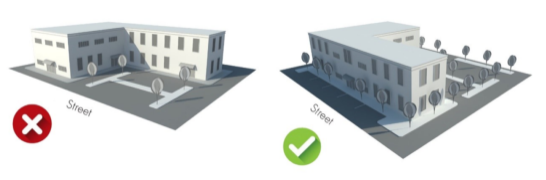
(Ord. 2324, 1-25-2021)

