
Black Hawk City Zoning Code
ARTICLE XII
Off-Street Parking
Sec. 16-261.- Purpose.
(a)
The purpose of this Article is to ensure that all land uses are served by an adequate supply of well planned and designed parking. The off-street parking article provides minimum standards for the development of parking areas in conjunction with the various uses permitted in this Chapter. The purpose of this Section is to require that the owner of a land use provide sufficient quantities of parking for the land use. In the event the owner of a land use cannot or chooses not to provide sufficient quantities of parking on the same site as the land use generating the need for parking, or on other real property owned by the owner of the land use that is located within the Commercial/Business Services or Gaming and Entertaining Districts of the City (the "parking property") which is subject to a Parking Agreement as described in Section 4-113(7) of this Code, the owner of the land use shall provide off-street parking by contribution to a parking fund which will finance the construction of nearby and remote City-owned lots. The construction of nearby and remote City-owned lots will allow for a comprehensive parking and transit shuttle service for the City.
(b)
The intent of these standards is to require attractive, convenient, efficiently developed parking areas which provide sufficient quantities of parking spaces with ample area for fire lanes, maneuvering, snow storage, retention of drainage, landscaping and public safety.
(c)
The standards herein governing the required number of off-street parking spaces are considered to be minimum standards. It is the obligation of the owner of a use which generates the need for parking to provide sufficient quantities of off-street parking for the particular land use.
(d)
Because of the historic nature of the downtown area, the intent to make the best use of the Commercial Gaming District and the desire to emphasize the pedestrian nature of these areas, off-street parking in these areas may not be feasible or desirable. In these districts, provisions will be made for a contribution to a parking fund which will finance construction of nearby and remote City-owned parking areas. Contribution will be calculated based upon the uses by area (square feet) within the given structure. The fees in lieu of off-street parking spaces are addressed in Ordinance No. 91-10, as amended.
(Ord. 94-11 §1, 1994; Ord. 97-26 §1; Ord. 2022-5, §1)
Sec. 16-262. - Application and administration.
(a)
Off-street parking shall be provided as set forth in this Chapter in association with any use generating demand for parking.
(b)
The proposed method of complying with this Article shall be indicated on all plans required to be submitted to the Planning Department as a part of an application and on any site plan submitted for a building permit. No off-street parking shall be used or occupied without first obtaining a certificate of occupancy or use. Any off-street parking that was maintained and operated pursuant to a valid conditional use permit on February 25, 1999, is considered a legal nonconforming use and is not required to obtain a certificate of use.
(c)
When any addition to or enlargement of an existing building or use or a change in use increases the building or the developed area of the use or the parking requirements of the building or structure, the parking requirements of this Chapter must be met. Moreover, if the addition, enlargement or change in use increases the building or the developed area of the use, or the required parking by twenty percent (20%) or more in a nonresidential district or thirty percent (30%) or more in a residential district, then the parking for the entire building shall be brought into conformance with all requirements of this Chapter, including required number of spaces, access, landscaping, lighting, screening and other applicable standards. However, the requirement set forth above shall not apply if the owner in a residential district can demonstrate that his or her property is used exclusively for one (1) single-family dwelling unit. Once the owner of a dwelling in a residential district is granted a conditional or special use permit, he or she must immediately comply with this Chapter.
(d)
Whenever a building permit has been granted and the plans so approved for off-street parking, the subsequent use of such property shall be deemed to be conditional upon the unqualified continuance and availability of the parking provisions contained in such plans.
(e)
Any change in the use of any portion of a building, structure, or lot which increases the off-street parking as required under this Chapter shall be unlawful and a violation of this Chapter until such time as the off-street parking complies with the provisions of this Chapter.
(Ord. 94-11 §1, 1994; Ord. 97-26 §3; Ord. 99-8 §1; Ord. 2022-5, §2)
Sec. 16-263. - Number of parking spaces required.
(a)
All uses shall, at a minimum, provide the number of off-street parking spaces listed below. Buildings with more than one (1) use shall provide parking required for each use.
Note— In Industrial Zone Districts, the applicant may demonstrate to the Board of Aldermen that the required number is too high, in which case, if approved by the Board of Aldermen, the applicant may develop the approved number of spaces but shall provide additional area for expanded parking, and such area shall be landscaped with ground cover.
(Ord. 94-11 § 1; Ord. 95-11 § 1; Ord. 97-26 § 4; Ord. 98-33 § 8; Ord. 2001-15 § 12; Ord. 2018-10 § 5; Ord. 2022-5, § 3; Ord. No. 2023-9, § 3)
Sec. 16-264. - Parking area design.
(a)
Calculation of parking space requirements. Where parking facilities are combined and shared by two (2) or more uses:
(1)
The off-street parking space required for two (2) or more uses having the same or different standards for determining the amount of required off-street parking spaces shall be the sum of the standards of all the various uses.
(2)
Tandem arrangements of parking shall only be allowed in valet parking lots in commercial zoning districts and in residential zoning districts for structures of four (4) units or less, but shall not be considered as meeting the standards of this Chapter for any other use. Only the first tandem spaces shall be counted towards satisfying the required number of parking spaces in other nonresidential uses.
(3)
Measurement of floor area. Floor areas used in calculating the required number of parking spaces shall be gross floor areas of the building calculated from the outside wall without regard to specific inside use. In mixed use facilities:
a.
Calculations shall be based on gross square footage of each identifiable use within the building;
b.
Gaming establishment use shall include the gaming floor, cashiers, restaurants, kitchens, bar areas, storage/warehousing, and all other uses related to the gaming establishment;
c.
Those portions of a hotel building not included in rooms for rent shall be exempt from parking requirements;
d.
Buildings (except hotel) including other interior uses such as bathrooms, mechanical rooms, stairwells, circulation, air shafts, storage areas and elevators shall be included in the gross square footage calculation of the building; and
e.
The total square footage of each identifiable use shall be the same as the gross floor area calculated from outside wall to outside wall.
(4)
New construction projects with access to Highway 119 and Highway 279 or proposed addition or reconstruction projects which will create an increase of twenty percent (20%) or more in traffic demand utilizing an existing access point to Highway 119 or Highway 279 or which meet other criteria specified by the State Department of Transportation shall require an access permit from the State Department of Transportation.
(b)
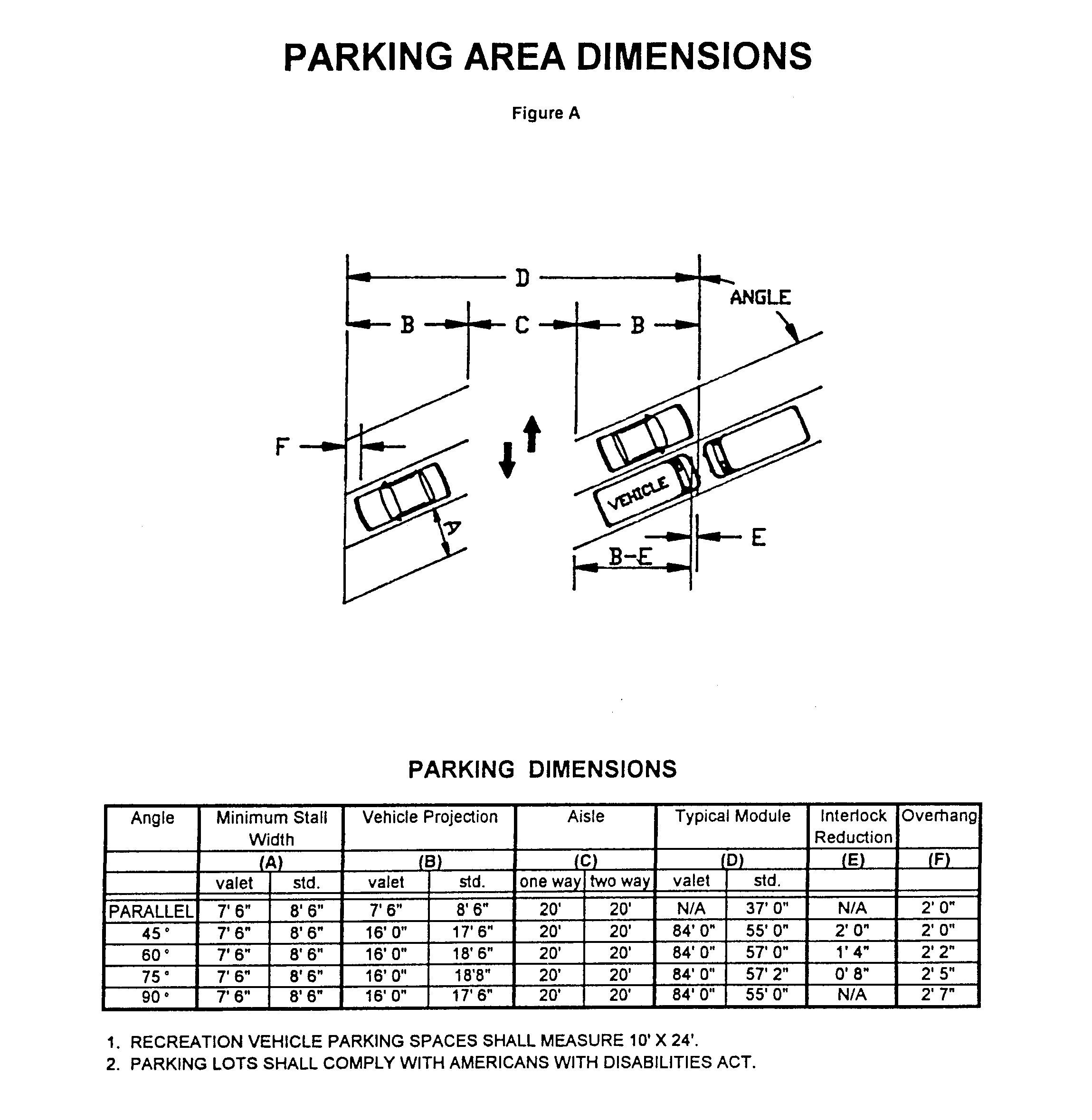
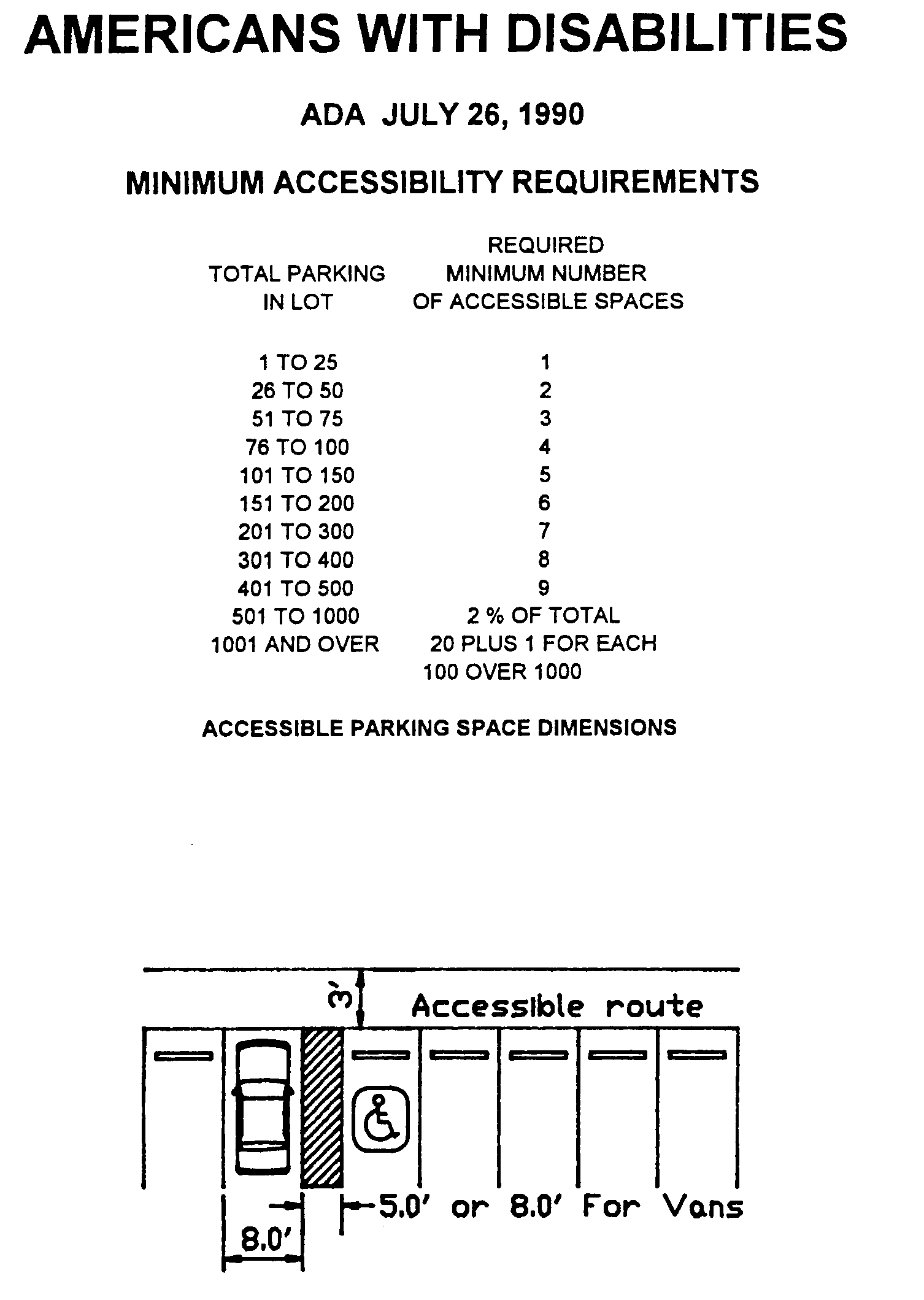
Parking area design standards. All parking areas, driveways and maneuvering areas shall be constructed to the dimensional standards shown in Figure A. The standard parking space shall measure eight (8) feet six (6) inches by eighteen (18) feet. All parallel parking spaces shall measure eight (8) feet six (6) inches by twenty-two (22) feet. Recreational vehicle parking spaces shall measure ten (10) feet by twenty-four (24) feet.
(1)
Dimensional standards:
(The dimensional standards contained within Figure A are located on the next page.)
(2)
Setback for on-site parking adjacent to Highway 119. The Colorado Department of Transportation has not established the width or location of that portion of Highway 119 located between the junction of Highway 119 and Black Hawk Street and Chase Street in the City. The width of Highway 119 apparently varies from twenty-eight (28) feet to one hundred (100) feet in width. The width and location of Highway 119 must be established by the Colorado Department of Transportation in order to determine the setback for on-site parking adjacent to Highway 119.
(3)
All parking areas shall be properly graded for drainage, provide on-site detention of run-off from precipitation and surfaced with concrete or asphaltic concrete or other acceptable surfacing, in conformance with specifications on file with the Public Works Department. They shall be maintained in good condition, free of weeds, dust, trash and debris.
(4)
No more than two (2) driveways will be permitted per parcel. In parcels accommodating twenty (20) or more parking spaces, driveways must be separated by at least two hundred fifty (250) feet. In parcels with less than twenty (20) parking spaces, driveways must be separated by at least one hundred (100) feet.
(5)
All lights used to illuminate parking spaces, driveways or maneuvering areas shall be so designed, arranged and screened so that the source of lighting shall not be visible from any point on adjoining lots or streets. All lighting fixtures, including security lighting facilities, shall be directed away from adjacent residential uses and public streets and shall not be of an intensity which unreasonably disturbs adjacent residential users or users of public streets and shall not be installed above a maximum height of fifteen (15) feet.
(6)
Covered parking areas shall have an interior clear dimension of at least seven (7) feet high and shall comply with design specifications approved by the Building Official through the building permit process.
(7)
Vehicular ingress and egress to public major or minor arterials from off-street parking shall be so combined, limited, located, designed and controlled with flared and/or channelized intersections as to direct traffic to and from such public right-of-way conveniently, safely and in a manner which minimizes traffic friction and promotes free traffic flow on the streets without excessive interruption.
(8)
Parking spaces shall be marked and maintained on the pavement and any other directional markings or signs shall be installed as permitted or required by the City to ensure the approved utilization of space, direction of traffic flow and general safety.
(9)
To ensure the proper maintenance and utilization of these facilities, public parking areas shall be designed so that a parked vehicle does not overhang any public property, walkway, landscaped area or bicycle path and shall be a minimum of four (4) feet from any walkway or bicycle path. A concrete or otherwise permanent curb, bumper, wheel stop or similar device shall be installed which shall be adequate to protect the public right-of-way, public sidewalk or planters from vehicular overhangs and to protect any structure from vehicular damage.
(10)
Landscaping shall be required in accordance with Article XIII of this Chapter.
(11)
Parking areas shall be enclosed around the circumference of the parking spaces by a fence no lower than forty-two (42) inches. Fencing materials shall be consistent with the provisions contained with the design standards for the City and must be approved by the Council.
(12)
The parking lot may include one (1) building for parking lot attendants. The building must comply with all code requirements for any other building within the district, including but not limited to requirements for building materials, utilities, construction and maintenance; and the building must be approved by the Council. Plumbing facilities will not be required on the parking lot so long as nearby facilities are available for attendants at all times that a parking attendant is on duty.
(13)
In the event the use of parking attendants is to be made at any time, there shall be provided, and the plans shall depict on the parking lot for which the application is made, an area for the transfer of the motor vehicle between the parking attendant or valet and the driver of the vehicle. In no event shall such area be in a public street or right-of-way or interfere with vehicular or pedestrian traffic on a public street, sidewalk or other right-of-way.
(Ord. 94-11, § 1, 1994; Ord. 99-8, § 2; Ord. 2001-15, § 13; Ord. 2009-23, § 10; Ord. 2022-5, § 4; Ord. No. 2023-9, § 4)
Sec. 16-265. - Residential parking permits.
(a)
Permits for on-street parking.
(1)
The Planning Director may determine that the parking of motor vehicles in residential areas by patrons of nearby commercial, industrial or institutional uses could:
a.
Cause hazardous traffic conditions in the residential areas;
b.
Produce auto emissions, noise, trash and refuse;
c.
Unreasonably burden residents of the area in gaining access to their residences; or
d.
Damage the character of those areas as residential districts and diminish the value of property in those areas.
Upon such determination, the Planning Director may post signs pursuant to this Section to limit the duration of or prohibit parking in these areas and, upon application, the Planning Director shall issue permits to residents of such areas who own and/or operate a motor vehicle allowing the vehicle to be parked in the block on which the owner of the vehicle resides as if there were no time limitation restrictions on such parking. The permit shall be affixed to the upper left-hand corner of the front window of the vehicle or in a location on the vehicle approved by the Planning Director.
(2)
A resident permit shall be issued for a vehicle when proof of residence in the appropriate block based upon a current motor vehicle registration for the vehicle is provided and other proof of residence as may be reasonably required by the City. Seasonal residents who own or occupy a residence may obtain a permit by providing proof of ownership or occupancy of the residence. No additional permits shall be issued for a residence until the seasonal resident relinquishes all outstanding permits to the City.
(b)
Permits for off-street, off-site parking.
(1)
The Planning Director may determine that the parking of resident motor vehicles in residential areas without designated off-street residential parking for the purpose of accessing those residential areas could:
a.
Cause hazardous traffic conditions in the residential areas; or
b.
Unreasonably burden other residents of the area with off-street parking in gaining access to their residences.
Upon such determination, the Planning Director may post signs pursuant to this Chapter to limit the duration of resident parking and upon application, the Planning Director shall issue permits to residents of such areas who own and/or operate a motor vehicle, but who do not possess off-street parking, allowing the vehicle to be parked in the nearest public parking facility as if there were no time limit restrictions on such parking. The permit shall be affixed to the upper left-hand corner of the front window of the vehicle or in a location on the vehicle approved by the Planning Director.
(2)
The City shall issue two (2) guest permits when proof of residence in the appropriate block is provided. A guest is defined as a temporary visitor to a residence who is invited by a resident to receive hospitality, to socialize or to perform services. The permit will allow guests to park their vehicle on the block where the residence is located as if there were no time limit restrictions on such parking.
a.
It is unlawful for any resident to allow any person other than a guest to use a guest permit. It is unlawful for any person to use a guest permit in a manner not authorized by this Chapter. Guest permits are strictly nontransferable.
b.
In the event that a resident loses a guest permit and requests a replacement, the City shall charge a replacement fee of fifty dollars ($50.00) for each such replacement permit requested.
c.
In the event that a resident desires to hold a social gathering in which greater than two (2) guests shall be in attendance, the resident may obtain special guest permits from the City. Such special guest permits shall state the date and time of the social gathering and the estimated number of guests in attendance. Such special guest permits shall terminate at the conclusion of the social gathering. The number of special guest permits which may be granted shall be based on the number of parking spaces available on the block where the resident resides, as determined by the Chief of Police.
(Ord. 94-11 §1)
Sec. 16-266. - Reserved.
Editor's note— Ord. No. 2023-9, § 5, adopted April 26, 2023, repealed § 16-266, which pertained to parking impact fees and derived from Ord. 94-11, § 1.

