
Blacksburg City Zoning Code
ARTICLE III
- DISTRICT STANDARDS
DIVISION 24. - SPECIAL FLOOD HAZARD AREA OVERLAY[2]
Editor's note—Ord. No. 2085, § 1, adopted May 12, 2026, repealed the former Div. 24, §§ 3240—3249.2, and enacted a new Div. 24 as set out herein. The former Div. 24 pertained to FHO Floodplain Overlay District and derived from Ord. No. 1529, § 1, adopted Aug. 11, 2009; Ord. No. 1908, § 1, adopted Nov. 12, 2019. Additionally, Ord. No. 2085 set out provisions intended for use as Div. 24, §§ 3240—3258. For purposes of classification, and at the editor's discretion, these provisions have been included as §§ 3240—3249.9.
DIVISION 30. - DOWNTOWN NORTHWEST DISTRICT[3]
Editor's note— Formerly, Ord. No. 1206, § 1, adopted Jan. 11, 2000, repealed Div. 30, §§ 3300—3325 in their entirety. Section 3 of said ordinance enacted provisions containing similar subject matter and was codified as Div. 27, §§ 3270—3279. See the Code Comparative Table.
Sec. 3020 - Purpose.
The purpose of the Rural Residential district is to provide for residential development at a scale intended to conserve the rural character of the district. Development within the Rural Residential district is intended to promote the following goals and objectives. Development proposals shall be evaluated for their adherence to these goals:
(1)
Conservation of agricultural and forestal lands, including farm fields and pastures.
(2)
Conservation of natural resources including wetlands, floodplains, natural drainage ways, aquifer recharge areas, existing tree cover, steep slopes, ridge lines, hilltops, wildlife habitats, deer wintering areas, stream valleys, locations comprising scenic views or scenic view corridors, and other outstanding natural topography.
(3)
Conservation of a unified open space area.
(4)
Creation of residential developments on a traditional rural scale, with small villages surrounded by agricultural, forestal, or open space lands.
(5)
Flexibility and creativity in the design of residential subdivisions, with less suburban-style sprawl and less consumption of open land.
These measures will prevent soil erosion by permitting development according to the nature of the terrain, provide larger open areas with greater utility for rest and recreation, and encourage the development of more attractive and economic site design. They will create a convenient, attractive, and harmonious community, and facilitate the provision of parks, forests, playgrounds and other recreational facilities. These goals are intended to preserve existing agricultural, forestal and other lands of significance for the protection of the natural environment.
(Ord. No. 1184, adopted 6-9-98)
Sec. 3021 - Permitted uses.
The following uses and structures are permitted by right subject to all other applicable requirements contained in this Ordinance:
Agricultural and Forestry Use Types:
Agriculture
Farm Employee Housing
Forestry Operations
Kennel, Private
Stable, Private
Stable, Commercial
Wayside Stand
Residential Use Types
Home Occupation
Accessory Apartment as permitted by § 1270 and in compliance with § 4201
Single-family Dwelling, Detached
Single-family Dwelling, Attached
Townhouse
Two-family Dwelling
Civic Use Types
Community Recreation
Open Space
Public Parks and Recreational Areas
Utility Services, Minor
Miscellaneous Use Types
Accessory Structures
Amateur Radio Towers
(Ord. No. 1184, adopted 6-9-98; Ord. No. 1816, § 1, 4-11-17)
Sec. 3022 - Conditional uses.
The following uses may be allowed in the Rural Residential District by Conditional Use Permit:
Civic Use Types
Camps
Cemetery
Day Care Center
Educational Facilities, Primary/Secondary
Educational Facilities, College/University
Family Day Care Home
Home for Adults
Life Care Facility
Nursing Home
Public Maintenance and Service Facility
Public Recreation Assembly
Religious Assembly
Utility Services, Major
Commercial Use Types
Agricultural Services
Antique Shops
Bed and Breakfast
Campgrounds
Commercial Outdoor Sports and Recreation
Garden Center
Golf Course
Kennel, Commercial
Neighborhood Convenience Store
Studio, Fine Arts
Veterinary Hospital/Clinic
Miscellaneous Use Types
Broadcasting or Communication Facility (Ord. No. 1170, adopted 11-11-97)
Industrial Use Types
Custom Manufacturing
(Ord. No. 1215, § 6, 5-11-99; Ord. No. 1258, § 1, 1-9-01; Ord. No. 1308, § 5, 8-13-02; Ord. No. 1339, § 28, 9-9-03; Ord. No. 1513, § 1, 4-14-09)
Editor's note— Ord. No. 1513, § 1, adopted Apr. 14, 2009 amended § 3022 as herein set out. Former § 3022 pertained to conditional uses.
Sec. 3023 - Development standards.
Each residential lot shall be of a size and shape to provide a building site which shall be in harmony with the natural terrain and other features of the land. Residential lots shall be designed in such a way as to promote the purposes of the Zoning Ordinance. The following minimum standards shall apply.
(a)
Density
Maximum density shall be one (1) dwelling unit per acre, excluding acreage within the 100-year floodplain. Accessory apartments shall not be considered in the density calculation.
(b)
Minimum Lot Requirements:
Area: No minimum lot size
Minimum frontage: Twenty (20) feet on a publicly owned and maintained street
(c)
Minimum Setback Requirements:
Front yard:
(1)
For lots adjoining minor streets:
(2)
For lots adjoining collector roads:
(d)
Maximum Floor Area Ratio
Maximum floor area ratio shall be 0.30, except Townhouse maximum floor area ratio shall be 0.50.
(e)
Maximum Height of Structures, except church spires, belfries, cupolas, monuments, water towers, chimneys, flues, flagpoles, television antennae, and radio aerials are exempt: Thirty-five (35) feet. Utility poles may have a maximum height of forty-five (45) feet.
(f)
The maximum dwelling unit occupancy shall be a family plus two (2) persons unrelated to the family; or no more than three (3) unrelated persons. For a detached single-family dwelling with a nonconforming accessory apartment, or accessory apartment as allowed through the accessory apartment permit program, occupancy shall be calculated cumulatively, to include both the single-family dwelling and the accessory apartment, for a total not to exceed three (3) unrelated persons.
(g)
All utility lines, electric, telephone, cable television lines, etc., shall be placed underground.
(Ord. No. 1184, adopted 6-9-98; Ord. No. 1215, § 7, 5-11-99; Ord. No. 1649, § 1, 8-14-2012; Ord. No. 1816, § 1, 4-11-17)
Sec. 3024 - Minimum open space.
A minimum of fifty (50) percent of the total area shall be designated as permanent open space upon the first subdivision of any parcel subsequent to the creation of this district, or upon the approval of a conditional use permit. This requirement shall be in lieu of the requirements of Division 10 of the Blacksburg Subdivision Ordinance.
(Ord. No. 1513, § 1, 4-14-09)
Sec. 3030 - Purpose.
The purpose of the Rural Residential 2 District is to encourage high-quality planned residential development, to preserve agricultural and forestal lands, to maximize the conservation of scenic and recreational open space, and to implement the Comprehensive Plan through the use of open space design and a density bonus system. In reviewing an application for RR2 zoning, the Planning Commission and Town Council should consider, among other things: (Ord. No. 1184, adopted 6-9-98)
(a)
Whether the proposed development will efficiently utilize available land and will protect and preserve to the maximum extent possible natural features of the land such as trees, streams and topographic features;
(b)
Whether the development will be located in an area in which transportation, police and fire protection, other public facilities and public utilities, including sewerage, are existing or planned and funded with available capacity to adequately serve the development;
(c)
The extent to which the proposed development is consistent with the Town's comprehensive plan and other adopted plans and policies of the Town and the overall benefits of the development to the Town.
Rural Residential 2 zoning is a type of planned development residential zoning, tailored to the special needs of the Tom's Creek Basin. As such, the general purposes underlying the planned development residential district, stated in Zoning Ordinance Section 3110 apply equally to the Rural Residential 2 Zoning district.
Sec. 3031 - Permitted uses.
Permitted uses within the Rural Residential 2 District shall be those uses permitted by right or by conditional use permit in the Rural Residential 1 District. Other Use Types which are determined to be appropriate and compatible with the proposed development and surrounding uses may be permitted in the RR2 district where they are specifically proposed in the initial preliminary development plan and approved pursuant to Section 1161. The basic design of the Rural Residential development plan shall be for residential purposes, with all other uses designed to supplement the rural and residential character of the district.
(Ord. No. 1513, § 1, 4-14-09; Ord. No. 1816, § 1, 4-11-17)
Sec. 3032 - Site development regulations.
Each Rural Residential 2 development shall be subject to the following site development standards.
(a)
Minimum district size: Thirty (30) acres.
(b)
Minimum open space: A minimum of fifty (50) percent of the total area shall be designated as permanent open space.
(c)
Maximum gross density: One (1) dwelling unit per acre, excluding acreage within the 100-year floodplain. Accessory apartments shall not be considered in the density calculation.
(d)
The maximum gross density may be increased up to a maximum of two (2) units per acre excluded acreage within the 100-year floodplain. Town Council will consider the suitability of the site for the proposed density as well as the quality and quantity of off-site open space proffered by the applicant. Approximately seventy-five (75) percent of proffered open space may be on the off-site parcel.
(e)
The maximum dwelling unit occupancy shall be a family, plus two (2) persons unrelated to the family; or no more than three (3) unrelated persons. For a detached single-family dwelling with an accessory apartment (as allowed through the accessory apartment permit program), occupancy shall be calculated cumulatively, to include both the single-family dwelling and the accessory apartment, for a total not to exceed three (3) unrelated persons.
(f)
The Site Development Standards applicable to the Rural Residential 1 Zoning District shall apply to Rural Residential 2 developments, except variations which are specifically approved by Council through the Final Master Plan. Proposed deviations from Rural Residential 1 site development standards shall be identified by the applicant in the preliminary development plan.
(g)
All utility lines, electric, telephone, cable television lines, etc., shall be placed underground.
(Ord. No. 1247, § 9, 9-12-00; Ord. No. 1415, § 5, 7-11-06; Ord. No. 1816, § 1, 4-11-17)
Sec. 3034 - Application process.
The application procedure for conditional zoning, Article I, Division 6, shall apply to applications for RR2 zoning.
The preliminary development plan shall include the proposed minimum building separation, maximum floor-to-area ratio, and proposed setbacks.
RR2 zoning constitutes conditional zoning. The proposals in the preliminary development plan shall constitute proffers as outlined in Article I, Division 6 of this chapter [Appendix] and, once accepted by Town Council, the features in the preliminary development plan shall constitute conditions as outlined under those same sections.
(Ord. No. 1530, § 1, 7-14-09)
Sec. 3040 - Purpose.
The R-4 Low Density Residential District is provided in recognition of sections of the Town with low density residential development and land which appears appropriate for such development. Among these sections is land where the established use, character or density of development would be best protected by these regulations. The low density residential district is intended to define and protect residential areas of low density from the intrusion of uses not performing a function appropriate to the residential environment. Attractiveness, order and efficiency is encouraged by the requirement of adequate space for individual homes with adequate light, air and space, and maintaining an appropriate density of residential development. This district is intended to add to the physical variety of the overall residential area while promoting balance and stability.
The Small Lot Development Option advances these goals while permitting the development of homes on smaller parcels. Small Lot Development is governed by revised development standards that are necessary for development on lots smaller than ten thousand square feet. Furthermore, because the Small Lot Development requirements are not designed for infill development, Small Lot Development is only permitted on sites consisting of two or more acres.
(Ord. No. 1883, § 1, 3-12-19; Ord. No. 2053, § 1, 11-12-24)
Sec. 3041 - Permitted uses.
(a)
The following uses are permitted by right in the R-4, Low Density Residential District:
Residential
Single-Family, Detached
Accessory Apartment as permitted by § 1270 and in compliance with § 4201.
Home occupations
Civic
Community Recreation
Open Space
Public Parks and Recreation
Utility Services, Minor
Miscellaneous
Accessory structures
(b)
The following uses are allowed only by Conditional Use Permit in the R-4, Low Density Residential District:
Civic
Administrative Services
Cemetery
Cultural Services
Day Care Center
Educational Facilities, College/University
Educational Facilities, Primary/Secondary
Family Day Care Home
Home for Adults
Life Care Facility
Post Office
Public Recreation Assembly
Religious Assembly
Safety Services
Utility Services, Major
Miscellaneous
Broadcasting or Communication Facility
(c)
See Zoning Ordinance § 3043 (c) for allowed by-right uses in Small Lot Developments.
(Ord. No. 1170, adopted 11-11-97; Ord. No. 1215, § 8, 5-11-99; Ord. No. 1339, § 28, 9-9-03; Ord. No. 1513, § 1, 4-14-09; Ord. No. 1816, § 1, 4-11-17; Ord. No. 2053, § 1, 11-12-24)
Sec. 3042 - Site development regulations.
(a)
Minimum lot requirements:
(1)
Lot area ten thousand (10,000) square feet.
(2)
Lot frontage forty (40) feet.
(b)
Minimum setback requirements:
Front yard thirty (30) feet:
(1)
The front yard setback may be reduced to twenty-five (25) feet for uses with parking in rear that is fully behind the structure.
(2)
For infill lots where more than fifty (50) percent of the lots on a block-face are developed, the front yard setback may be reduced to not less than the average of the front yard setbacks of the existing developed lots on the block-face.
Side yard ten (10) feet, except on corner lots, a side yard facing the street will be twenty (20) feet.
Rear yard twenty-five (25) feet.
(c)
Maximum height of structures, except church spires, belfries, cupolas, monuments, water towers, chimneys, flues, flagpoles, television antennae, and radio aerials are exempt: Thirty (30) feet; or forty (40) feet with an additional one (1) foot setback per foot of additional height. Utility poles may have a maximum height of forty-five (45) feet.
(d)
Maximum coverage:
(1)
Lot coverage forty-five (45) percent.
(2)
Floor area ratio 0.50 FAR. The following definitions will be used for the calculation of Floor Area Ratio within the R-4 zoning district:
i.
Attic, Habitable—Finished or unfinished area, not considered a story, that complies with all of the requirements of the Virginia Uniform Statewide Building Code including, but not limited to, height, size, and conditioning of space, in order for the area to be considered usable occupiable space.
ii.
Basement, Habitable—Finished or unfinished area, not considered a story, that complies with all of the requirements of the Virginia Uniform Statewide Building Code including, but not limited to, height, size, and conditioning of space, in order for the area to be considered usable occupiable space.
iii.
Floor Area, Gross—The sum of the horizontal areas of the several stories of a building, as measured from the exterior faces of exterior walls, or as measured from the face of the sheathing of the exterior wall, and in the case of a common wall separating two (2) buildings, from the centerline of such common wall. Gross floor area will include habitable basements, habitable attics and heated porches with a roof and walls (whether solid or screened). The surface area of tennis courts, swimming pools, driveways, surface parking spaces, decks, patios, and non-enclosed porches is not included in the total gross floor area.
(3)
Paved driveways and off-street parking areas located between the front face of the structure and the property line must have, at any point, a maximum width of eighteen (18) feet if the lot width is less than fifty (50) feet and a maximum width of twenty (20) feet if the lot width is fifty (50) feet or greater. No sidewalk or walkway will be allowed immediately adjacent (parallel) to the driveway that has the effect of widening the driveway in excess of the maximum allowed width. No diagonal parking is allowed in the driveway and no driving of a vehicle outside of the driveway.
(4)
Any such driveways or off-street parking areas existing as of February 12, 2019 that are greater than 20 feet in width may be retained and maintained but may not be expanded in any way.
(e)
The maximum dwelling unit occupancy shall be a family plus two (2) persons unrelated to the family; or no more than three (3) unrelated persons. For a detached single-family dwelling with a nonconforming accessory apartment, or an accessory apartment as allowed through the accessory apartment permit program, occupancy shall be calculated cumulatively including both the single-family dwelling and the accessory apartment for a total not to exceed three (3) unrelated persons.
(f)
All utility lines, electric, telephone, cable television lines, etc., will be placed underground.
(g)
See Section 3043 for Small Lot Development Option site development regulations.
(Ord. No. 1215, § 9, 5-11-99; Ord. No. 1649, § 1, 8-14-2012; Ord. No. 1816, § 1, 4-11-17; Ord. No. 1883, § 1, 3-12-19; Ord. No. 2022, § 1, 5-9-23; Ord. No. 2053, § 1, 11-12-24)
Sec. 3043 - Small lot development option.
The Small Lot Development Option permits alternative uses in the R-4 Low Density Residential District that provide for the development of well-designed homes on relatively small lots within the Town of Blacksburg, with the aim of increasing housing choice, affordability, and sustainability while creating vibrant neighborhoods. The standards of the Small Lot Development Option are intended to ensure that new dwellings can be built at densities not otherwise permitted by this Division, while ensuring high-quality development that is compatible with adjacent neighborhoods.
(a)
Applicability:
Small Lot Development is permitted within the R-4 Low Density Residential District on sites of 2 or more contiguous developable acres held in common ownership.
(b)
Relationship to other zoning and subdivision standards:
The Small Lot Development Option allows for the modification of certain dimensional standards and uses permitted within the R-4 Low Density Residential District. All other zoning and subdivision standards continue to apply, unless specifically modified or excepted by this Section, or Section 3044. Any requests for variances from subdivision-related standards within this Section or Section 3044 will be reviewed according to Subdivision Ordinance Article II, Division 2, Variances.
(c)
Uses allowed:
The following uses, and no others, are permitted by right within a Small Lot Development:
Residential
Single-family, detached
Townhouse (only on lots served by alley access)
Two-family dwelling (only on lots served by alley access)
Home occupations
Civic
Community recreation
Open space
Public parks and recreation
Utility services, minor
Miscellaneous
Accessory structures
(d)
Site Development Standards:
(1)
Small Lot Development in the R-4 District shall require a minimum lot area of 3,000 square feet. No lot within a small lot development shall be larger than 7,499 square feet. Lots shall be subject to site development standards based upon their size as indicated within Table 3043-1 below.
(2)
For townhouse development, where a minimum lot area and minimum lot frontage requirement are included in the table, these requirements are calculated cumulatively on the basis of each townhouse dwelling within the overall townhouse development to determine the minimum lot area and frontage for the overall development. The minimum lot area and minimum frontage do not apply to individual townhouse dwellings.
(3)
Table 3043-1 below establishes standards for the placement and height of buildings on lots within a small lot development, as well as the maximum lot coverage and footprint of principal structures. These standards are intended to ensure the orderly development of residential dwellings on small lots within the Town of Blacksburg in a manner that allows for increased density and encourages the creation of vibrant, livable, sustainable neighborhoods.
Table 3043-1: Site Development Standards for Small Lot Development
These standards apply to all uses unless a different standard is listed for a specific use. If specific uses are listed, such standards apply only to those uses.
1 Setbacks must accommodate location of public utility easements as required by Section 3043(l).
(e)
Accessory Structures:
All accessory structures shall meet the underlying zoning district setback standards in the Small Lot Development Option. Section 4703(b)(2) and 4703(b)(3) shall not apply.
(f)
Dwelling type limitation:
(1)
On sites of less than 5 acres, two-family and townhouse dwelling units shall constitute no more than 50% of the total units within a small lot development.
(2)
On sites of 5 acres or more, two-family and townhouse dwelling units shall constitute no more than 30% of the total units within a small lot development.
(g)
No buffer yard required:
No buffer yard requirements shall apply to small lot developments.
(h)
Dwelling unit occupancy:
The maximum dwelling unit occupancy within a small lot development shall be a family plus one (1) person unrelated to the family; or no more than two (2) unrelated individuals.
(i)
Off-street parking:
(1)
Vehicular parking
To encourage development of new homes on small lots, no off-street vehicular parking shall be required for a small lot development. If off-street vehicular parking is provided, it shall meet the established standards of Article 5, Division 2 of the Town of Blacksburg Zoning Ordinance unless specifically addressed within this Section.
(2)
Bicycle parking
The bicycle parking standards of Section 5213 of the Town of Blacksburg Zoning Ordinance shall apply to small lot development.
(j)
Driveways:
(1)
In general
i.
Sections 5-318(a), 5-318(b), 5-318(c), and 5-318(d) of the Town of Blacksburg Subdivision Ordinance shall not apply to small lot development in the R-4 District.
ii.
Shared driveways are permitted, and are encouraged for adjoining lots.
iii.
Individual driveways shall be located not less than three feet from a side lot line. Where a shared driveway is provided for adjoining lots, this does not apply.
iv.
No diagonal parking is allowed in a driveway and no driving of a vehicle outside of the driveway is permitted.
(2)
Driveways accessed from an alley
i.
Alley access is encouraged. When driveways accessing attached or detached garages and parking pads are taken from an alley to the rear of a lot, such driveways shall be a maximum of 20 feet in width.
ii.
Where provided, a shared driveway accessed from an alley shall be a maximum of 24 feet in width.
(3)
Driveways accessed from a street, not including alleys
i.
A maximum of one driveway entrance from a street, not including alleys, is permitted per lot. The curb cut shall be a maximum of 12 feet in width at the right-of-way line.
ii.
Where provided, a shared driveway accessed from a street, not including alleys, shall be a maximum of 16 feet in width at the right-of-way line.
iii.
Paved driveways and off-street parking areas are limited to a maximum width of 12 feet within the first 10 feet of length for individual driveways, or 16 feet within the first 10 feet of length for shared driveways, measured from the back of sidewalk, back of curb, or edge of pavement. After the first 10 feet of length, driveway width may taper to a maximum of 20 feet.
iv.
Driveways accessing attached or detached garages and parking pads from a street, not including alleys, shall be a minimum of 20 feet in length, measured from the property line.
v.
On local and collector streets, driveways shall be located no closer than 30 feet from an intersection with a public street, measured as indicated within the diagram included in Section 5-318(d) of the Town of Blacksburg Subdivision Ordinance.
vi.
Any sidewalk or walkway running parallel or approximately parallel to a driveway accessed from a street, not including alleys, shall be separated by a minimum of four feet from the edge of the paved driveway area.
(k)
Garages:
(1)
Front-loaded attached garages shall be limited to 40% of the width of the structure at the front facade or 22 feet, whichever is less. Garage width is measured from one edge of the door opening to the opposite edge. In the case of garages with multiple doors, the distance is measured from the outermost edges of the doors.
(2)
Attached garages with front facing garage door openings must be set back from the front facade of the structure by a distance of not less than four feet.
(3)
Detached garages with front facing garage door openings must be set back from the front facade of the structure by a distance of not less than four feet. In no case may a detached garage be located between the front building line of the principal structure and the front lot line.
(l)
Streets and sidewalks:
(1)
Street design:
i.
Section 5-313(3) of the Town of Blacksburg Subdivision Ordinance shall not apply to small lot development in the R-4 District.
ii.
Streets designed to allow for parking on one side, or for no street parking shall be designed and constructed with VDOT standard rolled curb or CG-6 curb and gutter and be a minimum of 24 feet in width measured from face of curb to face of curb.
iii.
Streets designed to allow for parking on both sides shall be designed and constructed with VDOT standard rolled curb or CG-6 curb and gutter and be a minimum of 29 feet in width measured from face of curb to face of curb.
iv.
Greater street widths may be required if no off-street parking is provided, or based upon projected traffic generated by the development, subject to VDOT subdivision street standards.
v.
Street design elements that promote slower traffic speeds are encouraged. Appropriate speeds for new streets serving a small lot development shall be no more than 15 miles per hour, based upon the narrower street widths, greater intensity, and shorter block lengths allowed as part of such development.
(2)
Alley design:
i.
Section 5-325(5) of the Town of Blacksburg Subdivision Ordinance shall not apply to small lot development in the R-4 District.
ii.
Alleys shall be designed to provide access at rear lot lines only. Alleys may not be designed to provide access to lots at front or side lot lines.
iii.
Alleys providing access to individual lots shall be a minimum of 200 feet in length. Alleys longer than 250 feet in length may not dead-end, and must be designed to reconnect to a public street.
iv.
Alleys shall be constructed with an asphalt surface in accordance with Section 5-313 of the Town of Blacksburg Subdivision Ordinance, unless an alternative surface is approved by the Zoning Administrator. Chip and seal surfaces are not permitted.
(3)
Right-of-way widths:
i.
Section 5-309(a) of the Town of Blacksburg Subdivision Ordinance shall not apply to small lot development in the R-4 District.
ii.
The minimum right-of-way width for proposed streets within a small lot development shall be as follows:
a.
Streets 24 feet in width measured from face of curb to face of curb: 40 feet.
b.
Streets greater than 24 feet in width measured from face of curb to face of curb: 50 feet.
(4)
Sidewalks required:
i.
Standards related to the construction of sidewalks found in Section 5-401 of the Town of Blacksburg Subdivision Ordinance shall apply, except that sidewalks shall be required on both sides of the street for small lot development in the R-4 District.
(m)
Public utility easements:
Section 5-901 of the Town of Blacksburg Subdivision Ordinance shall not apply to small lot development in the R-4 District. The subdivider shall convey to the Town common or shared public utility easements that are adequate to accommodate public and private utilities in accordance with the following:
(1)
A public utility easement a minimum of 15 feet in width is required around the entirety of the small lot development.
(2)
Easements internal to the development are also required, of sufficient width to satisfy public and private utilities. Where provided, such easements shall be co-located with alleys, breaks in the internal block structure of the development, or undeveloped open space to the extent practicable.
(3)
Alternative public utility easement provision may be approved or required by the Director of Engineering and GIS.
(n)
Block length:
Section 5-317 of the Town of Blacksburg Subdivision Ordinance shall apply to small lot development in the R-4 District, except that, in general, residential blocks shall be between 300 feet and 600 feet in length. For the purposes of this Section, elements constituting a break in a block shall include streets, greenways, multi-use trails, watercourses, and publicly accessible open space such as parks. Alleys shall not constitute a break in a block.
(o)
Underground utilities:
All new utility lines, electric, telephone, cable television lines, etc., shall be placed underground.
(p)
Open space requirements:
(1)
A minimum of 10% of the development site for a small lot development shall be reserved as open space for public use in accordance with Section 5-1001 of the Town of Blacksburg Subdivision Ordinance. In the case of a small lot development that includes more than 10 two family or townhouse units, calculated cumulatively, a minimum of 15% of the development site shall be reserved as open space for public use.
(2)
Open space shall not include required yards. Use & Design Standard § 4328(a)(5) shall not apply.
(3)
As a portion of the total required open space for public use, small lot developments shall provide a minimum of 5,000 square feet of open space for community recreation, plus an additional 5,000 square feet for every 5 acres of land area above the initial 5 acres. Such community recreation space shall be designed and maintained as follows:
i.
The size, location, shape, slope, and condition of the land shall be suitable for a specific recreational activity.
ii.
Consideration shall be given to the size of the development, number and characteristics of expected residents, proximity to other available recreational facilities, topography, and natural features of the site.
iii.
Safety buffers shall be provided for users of recreational facilities and equipment using recognized engineering and recreation standards.
(Ord. No. 2053, § 1, 11-12-24)
Sec. 3044 - Small lot development design standards.
To ensure high-quality design and the creation of vibrant, walkable neighborhoods, the following design standards apply to dwellings within a small lot development.
(a)
Single-family and two-family dwellings:
(1)
A dwelling must have an open front porch, or be designed with its primary entrance facing the street. The front entry must be a visually dominant feature on the facade, and should be an integral part of the structure using architectural features such as raised steps and stoops, roof overhangs, columns, and decorative railings. When included, porches, steps, and stoops shall be permitted to encroach into a required front setback by no more than 5 feet.
(2)
Windows, entrances, porches, or other architectural features are required on all street facing facades to avoid the appearance of blank walls.
(3)
A minimum transparency of 10% is required on all street-facing facades, calculated as a percentage of the entire area of the facade.
(4)
The use and design standards of Zoning Ordinance § 4241(a)(3), and § 4241(a)(5) shall not apply.
(b)
Townhouses:
(1)
Where townhouse dwellings are included within a small lot development, such structures shall be distributed throughout the development, and not concentrated in any one area or location of the development site. This does not apply to developments containing 18 or fewer townhouse dwellings.
(2)
The principal orientation of all townhouses shall be the street on which the lot has frontage, and all townhouses shall be designed with their primary entrance facing the street. Where a lot has frontage on two intersecting streets, townhouses shall be designed with their primary entrance facing the street abutting the front of the lot. In no case shall the primary entrance of a townhouse face the rear facade of another principal structure on the same lot.
(3)
If off-street parking is provided, it shall be accessed from an alley, and shall be located behind the front building line.
(4)
The front entry must be a visually dominant feature on the facade, and should be an integral part of the structure using architectural features such as raised steps and stoops, roof overhangs, columns, and decorative railings.
(5)
Front entries to all units shall be directly connected to the adjacent street or sidewalk.
(6)
Windows, entrances, porches, or other architectural features are required on all street facing facades to avoid the appearance of blank walls. When included, porches, steps, and stoops shall be permitted to encroach into a required front setback by no more than 5 feet.
(7)
A minimum transparency of 10% is required on all street-facing facades, calculated as a percentage of the entire area of the facade.
(8)
Townhouses shall be designed with consistent building materials and treatments that wrap around all facades facing a public street.
(9)
The maximum number of attached townhouse units in a single structure shall be six. Where a development consists of multiple townhouse structures, there shall be a minimum separation of 15 feet between building end walls.
(10)
The use and design standards within the following sections shall not apply to townhouses constructed as part of a small lot development:
i.
Zoning Ordinance § 4231(b)(1)
ii.
Zoning Ordinance § 4231(b)(3)
iii.
Zoning Ordinance § 4231(b)(6)
iv.
Zoning Ordinance § 4231(b)(7)
v.
Zoning Ordinance § 4231(b)(11)
vi.
Zoning Ordinance § 4231(b)(13)
vii.
Zoning Ordinance § 4231(b)(15)
(Ord. No. 2053, § 1, 11-12-24)
Sec. 3050 - Purpose.
The Transitional Residential District is to provide for a transitional land use between low density residential and higher intensity land uses. This is a predominantly residential district with neighborhood character. Conditional uses which are sensitive to and reinforce the residential neighborhood character are appropriate. These typically will involve the conversion or replication of single-family houses. Properties along arterial and collector roads are particularly suited for such conditional uses. The livability or small-town character of the Transitional Residential District is made up of tree lined streets, open space, and greenways interspersed within a more urban residential pattern.
(Ord. No. 1513, § 1, 4-14-09)
Sec. 3051 - Permitted uses.
(a)
The following uses are permitted by right in the R-5, Transitional Residential District:
Residential
Single-family, Detached
Two-family dwellings
Home occupations
Civic
Community Recreation
Open Space
Public Parks and Recreation
Utility Services, Minor
Miscellaneous
Accessory structures
(b)
The following uses are allowed only by Conditional Use Permit in the R-5, Transitional Residential District:
Residential
Single-family, Attached
Townhouse
Multifamily
Civic
Administrative Services
Club
Cultural Services
Day Care Center
Educational Facilities, College/University
Educational Facilities, Primary/Secondary
Family Day Care Home
Home for Adults
Life Care Facility
Nursing Home
Post Office
Public Recreation Assembly
Religious Assembly
Safety Services
Shelter
Utility Services, Major
Commercial
Bed & Breakfast
Clinic
Neighborhood Convenience
Parking Facility
Personal Services
Studio, Fine Arts
Office
Financial Institution
General Office
Medical Office
Miscellaneous
Broadcasting or Communication Facility
(Ord. No. 1170, adopted 11-11-97; Ord. No. 1215, § 10, 5-11-99; Ord. No. 1339, § 28, 9-9-03; Ord. No. 1350, § 1, 2-10-04; Ord. No. 1513, § 1, 4-14-09)
Sec. 3052 - Site development regulations.
(a)
Minimum lot requirements:
(1)
Lot area: Eight thousand five hundred (8,500) square feet, except that townhouses and two-family dwellings constructed on an eight thousand five hundred (8,500) square foot or larger lot may be divided along the common wall or walls.
(2)
Lot frontage: Forty-five (45) feet, except that a subdivided, two-family dwelling constructed on a lot having forty-five (45) feet or greater lot frontage may divide the lot frontage in half.
(b)
Maximum density: Twenty (20) bedrooms per acre, except single-unit residential.
(c)
Minimum setback requirements:
(1)
Front yard: Thirty-five (35) feet (may be reduced to twenty-five (25) feet for use with parking in the rear or may be reduced to twenty (20) feet for use in the historic overlay district).
(2)
Side yard: Ten (10) feet, except on corner lots, a side yard facing the street shall be twenty (20) feet or more.
(3)
Rear yard: Twenty-five (25) feet.
(d)
Maximum height of structures, except church spires, belfries, cupolas, monuments, water towers, chimneys, flues, flagpoles, television antennae, and radio aerials are exempt: Thirty-five (35) feet; or forty-five (45) feet with an additional one (1) foot setback per foot of additional height. Utility poles may have a maximum height of forty-five (45) feet.
(e)
Maximum coverage:
(1)
Lot coverage: Fifty-five (55) percent.
(2)
Floor area ratio: 0.35 FAR.
(f)
The maximum dwelling unit occupancy shall be a family plus two (2) persons unrelated to the family; or no more than three (3) unrelated persons. For a detached single-family dwelling with a nonconforming accessory apartment, occupancy shall be figured cumulatively including both the single-family dwelling and the accessory apartment for a total not to exceed three (3) unrelated persons.
(g)
All utility lines, electric, telephone, cable television lines, etc., shall be placed underground.
(h)
Additional standards apply in the Historic or Design Review Overlay District for parking related uses. See Section 3289.
(Ord. No. 1184, adopted 6-9-98; Ord. No. 1215, § 11, 5-11-99; Ord. No. 1369, § 3, 10-12-04; Ord. No. 1649, § 1, 8-14-2012; Ord. No. 1924, § 2, 7-14-20)
Sec. 3060 - Purpose.
The Old Town Residential district is created in recognition that those areas adjacent to campus and the Downtown are experiencing pressures for transition to commercial or high density residential use. These areas are the historic heart of the Town and lend much of its small-town character and unique architecture and pattern. The Old Town Residential District is intended to retain and protect that character while allowing broad conditional uses which ease the transition from commercial and campus to residential. The district is designed for a low and medium density residential base, with small scale office, commercial and retail uses in renovated or replicated housing, a dynamic mix of uses linked by a common historic residential character.
(Ord. No. 1513, § 1, 4-14-09)
Sec. 3061 - Permitted uses.
(a)
The following uses are permitted by right in the OTR, Old Town Residential District:
Residential
Single-family Detached
Home Occupations
Civic
Community Recreation
Open Space
Public Parks and Recreation
Utility Services, Minor
Miscellaneous
Accessory Structures
(b)
The following uses are allowed only by conditional use permit in the OTR, Old Town Residential District:
Residential
Boarding House
Multifamily Dwelling
Single-family, Attached
Two-family Dwelling
Townhouse
Civic
Administrative Services
Club
Cultural Services
Day Care Center
Educational Facilities, College/University
Educational Facilities, Primary/Secondary
Family Day Care Home
Home for Adults
Life Care Facility
Post Office
Public Recreation Assembly
Religious Assembly
Safety Services
Shelter
Utility Services, Major
Commercial
Bed and Breakfasts
Clinic
Parking Facility
Restaurant, Small
Specialty Shops
Studio, Fine Arts
Office
General Office
Medical Office
Miscellaneous
Broadcasting or Communication Facility
(Ord. No. 1170, adopted 11-11-97; Ord. No. 1215, § 12, 5-11-99; Ord. No. 1339, § 28, 9-9-03; Ord. No. 1513, § 1, 4-14-09)
Sec. 3062 - Site development regulations.
(a)
Minimum lot requirements:
(1)
Lot area: Seven thousand five hundred (7,500) square feet; except that townhouses and two-family dwellings constructed on a seven thousand five hundred (7,500) square foot or larger lot may be divided along the common wall or walls.
(2)
Lot frontage: Forty (40) feet, except that a subdivided, two-family dwelling constructed on a lot having forty (40) feet or greater lot frontage may divide the lot frontage in half.
(b)
Maximum density: Fifteen (15) bedrooms per acre, except single-unit residential.
(c)
Minimum setback requirements:
(1)
Front yard: Twenty (20) feet.
(2)
Side yard: Seven (7) feet, except on corner lots, a side yard facing the street shall be twenty (20) feet.
(3)
Rear yard: Twenty-five (25) feet.
(d)
Maximum height of structures, except church spires, belfries, cupolas, monuments, water towers, chimneys, flues, flagpoles, television antennae, and radio aerials are exempt: Thirty-five (35) feet; or forty-five (45) feet with an additional one (1) foot setback per foot of additional height. Utility poles may have a maximum height of forty-five (45) feet.
(e)
Maximum coverage:
(1)
Lot coverage: Fifty (50) percent.
(2)
Floor area ratio: 0.30 FAR.
(f)
The maximum dwelling unit occupancy shall be a family plus two (2) persons unrelated to the family; or no more than four (4) unrelated persons. For a detached single-family dwelling with a nonconforming accessory apartment, occupancy shall be figured cumulatively including both the single-family dwelling and the accessory apartment for a total not to exceed four (4) unrelated persons.
(g)
All utility lines, electric, telephone, cable television lines, etc., shall be placed underground.
(h)
Additional standards apply in the Historic or Design Review Overlay District for parking related uses. See Section 3289.
(Ord. No. 1184, adopted 6-9-98; Ord. No. 1215, § 13, 5-11-99; Ord. No. 1369, § 4, 10-12-04; Ord. No. 1649, § 1, 8-14-2012; Ord. No. 1924, § 2, 7-14-20)
Sec. 3080 - Purpose.
The RM-27 Low Density Multiunit residential district is provided in recognition of sections of the Town that are developed with multiunit structures and to allow similar development on land which appears appropriate for such development. Among these sections is land served by public water and sewer adequate to handle higher density residential development for purposes of protecting the health, convenience and safety of the inhabitants, land served by public thoroughfares designed to adequately handle traffic volume, and land served by or provided with suitable developed recreation space adequate to handle higher density residential development. The low density multi-unit residential district is intended to allow multiunit dwellings as a principal use of land. Attractiveness, order, efficiency, convenience and safety shall be encouraged by allowing a density of development appropriate for the use of public water and sewer facilities, public thoroughfares, public recreation areas and other public facilities while maintaining a suitable density for the permitted dwelling types with adequate space for light and air. It is intended that areas for low density multiunit dwellings be located on the edge of residential areas of a lower density, usually along a major traffic artery in a manner to encourage comprehensive development of the whole residential area with sustained livability and without overtaxing essential public services and facilities.
Sec. 3081 - Permitted Uses.
(a)
The following uses are permitted by right in the RM-27, Low Density Multiunit Residential District:
Residential
Boarding House
Home Occupations
Multifamily Dwellings
Single-family, Attached
Single-family, Detached
Townhouse
Two-family Dwellings
Civic
Community Recreation
Cultural Services
Day Care Center
Family Day Care Home
Home for Adults
Life Care Facility
Nursing Home
Open Space
Public Parks and Recreation
Public Recreation Assembly
Religious Assembly
Shelter
Utility Services, Minor
Miscellaneous
Accessory Structures
(b)
The following uses are allowed only by Conditional Use Permit in the RM-27, Low Density Multiunit Residential District:
Civic
Administrative Services
Educational Facilities, College/University
Educational Facilities, Primary/Secondary
Nursing Home
Post Office
Safety Services
Utility Services, major
Commercial
Bed and Breakfast
Clinic
Club
Commercial Outdoor Sports and Recreation
Consumer Repair Services
Funeral Home
Gasoline Station
Neighborhood Convenience Store
Parking Facility
Personal Services
Restaurant, Drive-in
Restaurant, Fast Food
Restaurant, General
Restaurant, Small
Retail Sales
Studio, Fine Art
Office
Financial Institution
General Office
Medical Office
Miscellaneous
Broadcasting or Communication Facility
(Ord. No. 1170, adopted 11-11-97; Ord. No. 1184, adopted 6-9-98; Ord. No. 1215, § 14, 5-11-99; Ord. No. 1308, § 6, 8-13-02; Ord. No. 1339, § 29, 9-9-03; Ord. No. 1513, § 1, 4-14-09)
Sec. 3082 - Site Development Regulations.
(a)
Minimum lot requirements:
(1)
Lot area: Eight thousand five hundred (8,500) square feet, except that Townhouses and two-family dwellings constructed on an eight thousand five hundred (8,500) square foot or larger lot may be divided along the common wall or walls.
(2)
Lot frontage: Sixty (60) feet, except that a subdivided, two-family dwelling constructed on a lot having sixty (60) feet or greater lot frontage may divide the lot frontage in half.
(b)
Maximum density: Twenty-seven (27) bedrooms per acre, except single-unit residential.
(c)
Minimum setback requirements:
(1)
Front yard: Thirty-five (35) feet (may be reduced to twenty-five (25) feet for uses with parking in the rear).
(2)
Side yard: Ten (10) feet, except on corner lots, a side yard facing the street shall be twenty (20) feet.
(3)
Rear yard: Twenty-five (25) feet.
(d)
Maximum height of structures, except church spires, belfries, cupolas, monuments, water towers, chimneys, flues, flagpoles, television antennae, and radio aerials are exempt: Thirty-five (35) feet; or forty-five (45) feet with an additional one (1) foot setback per foot of additional height. Utility poles may have a maximum height of forty-five (45) feet.
(e)
Maximum coverage:
(1)
Lot coverage: Sixty (60) percent.
(2)
Floor area ratio: 0.40 FAR.
(f)
All utility lines, electric, telephone, cable television lines, etc., shall be placed underground.
(g)
Additional standards apply in the Historic or Design Review Overlay District for parking related uses. See Section 3289.
(Ord. No. 1184, adopted 6-9-98; Ord. No. 1215, § 15, 5-11-99; Ord. No. 1369, § 5, 10-12-04; Ord. No. 1924, § 2, 7-14-20)
Sec. 3083 - Maximum residential occupancy.
The maximum dwelling unit occupancy shall be a family, plus two (2) persons unrelated to the family; or no more than four (4) unrelated persons.
Sec. 3090 - Purpose.
The RM-48 Medium Density Multiunit Residential District is provided in recognition that certain land in the Town may be appropriately developed as areas of medium population concentration if developed in accordance with the existing and potential development character of the vicinity and if adequate public services and facilities can be provided. The RM-48 Medium Density Multiunit Residential District is intended to allow multiunit dwellings in association with other residential development types while maintaining a reasonable population density within the total residential area. To this end, the site development and architectural concept of the apartment structure together with the provision of associated facilities shall be an important consideration in achieving an attractive residential environment of sustained desirability with all development in harmony to promote stability, order and efficiency of the residential area.
Sec. 3091 - Permitted Uses.
(a)
The following uses are permitted by right in the RM-48, Medium Density Multiunit Residential District:
Residential
Boarding House
Home Occupations
Multifamily Dwellings
Single-family, Detached
Single-Family, Attached
Townhouse
Two-family Dwellings
Civic*
Community Recreation
Cultural Services
Day Care Center
Family Day Care Home
Home for Adults
Life Care Facility
Open Space
Public Parks and Recreation
Public Recreation Assembly
Religious Assembly
Shelter
Utility Services, Minor
Miscellaneous
Accessory Structures
*Without external speakers only. Any use which incorporates an external speaker may be permitted only with a conditional use permit.
(b)
The following uses are allowed only by Conditional Use Permit in the RM-48, Medium Density Multiunit Residential District:
Civic
Administrative Services
Educational Facilities, College/University
Educational Facilities, Primary/Secondary
Nursing Home
Post Office
Safety Services
Utility Services, major
Commercial
Bed and Breakfast
Clinic
Club
Commercial Outdoor Sports and Recreation
Consumer Repair Services
Funeral Home
Gasoline Station
Hospital
Neighborhood Convenience Store
Parking Facility
Personal Services
Restaurant, Drive-in
Restaurant, Fast Food
Restaurant, General
Restaurant, Small
Retail Sales
Studio, Fine Art
Office
Financial Institution
General Office
Medical Office
Miscellaneous
Broadcasting or Communication Facility
(Ord. No. 1170, adopted 11-11-97; Ord. No. 1184, adopted 6-9-98; Ord. No. 1215, § 16, 5-11-99; Ord. No. 1308, § 7, 8-13-02; Ord. No. 1339, § 29, 9-9-03; Ord. No. 1415, § 6, 7-11-06; Ord. No. 1513, § 1, 4-14-09)
Sec. 3092 - Site development regulations.
(a)
Minimum lot requirements:
(1)
Lot area: Eight thousand (8,000) square feet, except that townhouses and two-family dwellings constructed on an eight thousand (8,000) square foot or larger lot may be divided along the common wall or walls.
(2)
Lot frontage: Sixty (60) feet, except that a subdivided, two-family dwelling constructed on a lot having sixty (60) feet or greater lot frontage may divide the lot frontage in half.
(b)
Maximum density: Forty-eight (48) bedrooms per acre except single-unit residential.
(c)
Minimum setback requirements:
(1)
Front yard: Thirty-five (35) feet (may be reduced to twenty-five (25) feet for uses with parking in the rear).
(2)
Side yard: Ten (10) feet, except on corner lots, a side yard facing the street shall be twenty (20) feet.
(3)
Rear yard: Twenty-five (25) feet.
(d)
Maximum height of structures, except church spires, belfries, cupolas, monuments, water towers, chimneys, flues, flagpoles, television antennae, and radio aerials are exempt: Thirty-five (35) feet; or forty-five (45) feet with an additional one (1) foot setback per foot of additional height. Utility poles may have a maximum height of forty-five (45) feet.
(e)
Maximum coverage:
(1)
Lot coverage: Sixty (60) percent.
(2)
Floor area ratio: 0.40 FAR.
(f)
All utility lines, electric, telephone, cable television lines, etc., shall be placed underground.
(Ord. No. 1215, § 17, 5-11-99; Ord. No. 1184, adopted 6-9-98; Ord. No. 1369, § 6, 10-12-04)
Sec. 3094 - Maximum Residential Occupancy.
The maximum dwelling unit occupancy shall be a family, plus two (2) persons unrelated to the family; or no more than four (4) unrelated persons.
Sec. 3110 - Purpose.
(a)
The purpose of this district is to provide for the development of planned residential communities that incorporate a variety of housing options as well as certain limited commercial and office uses designed to serve the inhabitants of the district. This district is intended to allow greater flexibility than is generally possible under conventional zoning district regulations by encouraging ingenuity, imagination and high quality design to create a superior living environment for the residents of the planned community. The PR district is particularly appropriate for parcels which contain a number of constraints to conventional development. In addition to an improved quality of design, the PR district creates an opportunity to reflect changes in the technology of land development, provide opportunities for new approaches to home ownership, and provide for an efficient use of land which can result in reduced development costs.
Sec. 3111 - Permitted Uses.
(a)
The following uses are permitted in the Planned Residential district. However, no use shall be permitted except in conformity with the uses specifically included in the final master plan approved pursuant to Section 1162, "Planned Zoning Districts."
Residential
Home Occupation
Multi-family Dwelling
Single-family Dwelling, Attached
Single-family Dwelling, Detached
Townhouse
Two-family Dwelling
Accessory Apartments as an allowed use and approved as part of a rezoning to the PR district and as permitted by §1270 and in compliance with §4201.
Civic*
Community Recreation
Day Care Center
Educational Facilities, Primary/Secondary
Family Day Care Home
Life Care Facility
Open Space
Public Parks and Recreational Areas
Public Recreation Assembly
Religious Assembly
Safety Services
Shelter
Utility Services, Minor
Office*
Financial Institutions (without drive-through)
General Office
Medical Office
Commercial*
Gasoline Station
Grocery Store
Neighborhood Convenience Store
Personal Services
Restaurant, Small
Miscellaneous
Accessory Structure
*Without external speakers only. Any use which incorporates an external speaker may be permitted only with a conditional use permit.
(b)
Other Use Types which are not listed above and which are determined to be appropriate and compatible with the proposed development and surrounding uses may be permitted in the PR district where they are specifically proposed in the preliminary master plan and approved pursuant to Section 1162.
(Ord. No. 1339, § 29, 9-9-03; Ord. No. 1513, § 1, 4-14-09; Ord. No. 1632, § 1, 1-10-12; Ord. No. 1724, § 1, 6-10-14; Ord. No. 2022, § 1, 5-9-23)
Sec. 3112 - Conditional uses.
The following uses may be permitted in the Planned Residential Development district by a conditional use permit:
Civic
Utility Services, Major
Office
Financial Institution (with drive-through)
Miscellaneous
Broadcasting or Communication Facility (Ord. No. 1170, 11-11-97)
(Ord. No. 1513, § 1, 4-14-09)
Editor's note— Ord. No. 1513, § 1, adopted Apr. 14, 2009, amended § 3112 to read as herein set out. Former § 3112 pertained to conditional uses. See the Code Comparative Table for complete derivation.
Sec. 3113 - Site Development Regulations.
Each planned residential development shall be subject to the following site development standards.
(a)
Minimum district size: One-half (½) acre of contiguous land.
(b)
Minimum open space criteria.
(1)
Minimum open space:
a.
A minimum of twenty (20) percent of the total district area shall be designated as open space, except as provided in subsection b.
b.
For projects less than two (2) acres in size, the applicant may apply for a reduction or elimination of the open space requirement. The determination of the need for open space for such projects shall be evaluated based on a combination of the following project criteria:
i.
Maximizing developable area;
ii.
Proximity to downtown;
iii.
Walking distance to services and transit;
iv.
Density and intensity of use in relation to neighborhood context;
v.
Demonstrated access to nearby public open space;
vi.
Alternative recreational space (e.g., workout room); and
vii.
Proposed improvements to the adjoining streetscape, which may include construction of additional sidewalks or trails adjoining the street, buffer strips between the sidewalk and the street, or other streetscape amenities or improvements to public space as part of the project.
c.
An applicant may also include a request to modify or eliminate the use and design standards for open space and recreational space contained in Sections 4216(a)(6) for multifamily dwellings 4220(b)(7) for single-family attached dwellings, 4231(b)(11) for townhouses, and 4241(a)(3) for two-family dwellings. Such a request should be made for the purpose of eliminating any conflicts between development standards in the PR district and use and design standards, or as otherwise necessary to achieve the proposed development form in a manner consistent with the purpose of the district.
d.
If phases are proposed for the planned residential development, the percentage of required open space included in each phase shall meet or exceed the percentage of dwelling units included in each phase.
e.
When twenty (20) percent of open space is required, a compact area of at least five thousand (5,000) square feet shall be provided for active or passive recreational activities.
f.
When a site is part of a public master plan adopted by town council, the required open space percentage may include off-site open space and parcels under separate ownership, provided that all the parcels are being developed under the common master plan. Off-site open space cannot be counted as required open space for more than one (1) development. The cumulative total of open space utilization shall be determined as part of each rezoning where open space is required.
(c)
Maximum area for commercial and/or office uses: Ten (10) percent of the gross area of the PR district. In addition, the following standards shall apply:
(1)
Commercial and office uses shall be expressly designed for the service and convenience of the PR district;
(2)
Commercial and office uses shall be designed and located to protect the character of the district and surrounding residential districts. Such facilities shall be screened and landscaped so as to be compatible with adjoining residences;
(3)
Construction of commercial and office uses shall not begin until twenty-five (25) percent of the residential units or two hundred fifty (250) dwelling units, whichever is less, of the total PR district have been completed.
(d)
Minimum setback requirements shall be specifically established during the review and approval of the master plan. The following guidelines shall be used in establishing the building spacing and setbacks, but shall not be construed as constraining creative site design:
(1)
Building spacing shall provide privacy within each dwelling unit;
(2)
Building spacing shall ensure that each room has adequate light and air;
(3)
Areas between buildings used as service yards, storage of trash, or other utilitarian purposes should be designed so as to be compatible with adjoining dwellings;
(4)
Building spacing and design shall provide privacy for outdoor activity areas (patios, decks, etc.) associated with individual dwelling units;
(5)
Yards located at the perimeter of the PR district, not fronting a street, shall conform to the setback requirements of the adjoining zoning district, or to the setback requirements deemed appropriate during the review and approval of the master plan for the PR district;
(6)
For the purpose of determining the depth of yards, any yards located at the perimeter of the PR district that front a street shall be treated as a front yard. The yard may be reduced, as deemed appropriate during the review, and approval of the master plan, through the application of enhanced streetscape features that promote the existing design context of the zoning district on the other side of the street.
(e)
Setbacks in a PDR, Planned Development Residential, district adopted prior to this ordinance shall be as specified in the master plan or, if not specified, a twenty-seven (27) foot front yard, seven (7) foot side yard (except on corner lots, where a side yard facing the street shall be twenty (20) feet) and eighteen (18) foot rear yard.
(f)
Parking in the PR district shall either be as contained in Section 5200 or as approved through:
(1)
A rezoning to the PR district based on demonstrated parking needs, housing types and potential impacts to surrounding neighborhoods; or
(2)
An amendment to a PR district based on demonstrated parking needs, housing types and potential impacts to surrounding neighborhoods.
(g)
Streets in the PR district shall be public in accordance with VDOT and town standards.
(h)
For multifamily dwellings and townhouses, the maximum dwelling unit occupancy shall be a family, plus two (2) persons unrelated to the family; or no more than four (4) unrelated persons. For detached and attached single-family dwellings and two-family dwellings, the maximum dwelling unit occupancy shall be a family, plus two (2) persons unrelated to the family, or no more than three (3) unrelated persons. For a detached single-family dwelling with an accessory apartment (as approved in a PR rezoning and as allowed through the accessory apartment permit program), occupancy shall be calculated cumulatively, to include both the single-family dwelling and the accessory apartment, for a total not to exceed three (3) unrelated persons.
(i)
For Planned Residential developments, two multifamily units may be combined into one (1) multifamily unit provided that the requirements of (1), (2) and (3) below are met. All other units continue to be subject to the occupancy standards listed above.
(1)
The total number of multifamily units combined does not exceed ten (10) percent of the total number of multifamily units within the development;
(2)
The units to be combined are not adjacent to any single-family use; and
(3)
All of the following criteria are met:
a.
Combined units shall meet all building code requirements with appropriate permits and inspections obtained;
b.
The zoning administrator shall be informed in writing of the specific units combined;
c.
Twenty-four (24) hour on-site management is required for the multifamily area in which the combined units are located;
d.
Occupancy in a combined unit shall be one (1) person per bedroom, plus two (2) additional persons (bedrooms include any den converted to a bedroom);
e.
Leases for all combined units shall be available for inspection by the zoning administrator upon request;
f.
Upon receipt of a complaint of over occupancy of combined units, the zoning administrator may inspect such units after providing written notice to the property owner or management; and
g.
The combination of dwelling units does not change the total number of units approved with the master plan. Combined units may at a later date be returned to two (2) separate dwelling units in the original configuration provided:
i.
All building code requirements are met with required permits and inspections obtained; and
ii.
The zoning administrator is informed in writing of the units to be separated and returned to original configuration.
(j)
All utility lines, electric, telephone, cable television lines, etc., shall be placed underground.
(k)
To encourage flexibility and creativity of design, exceptions to the use and design standards contained in Article IV may be requested pursuant to 1112 of the Zoning Ordinance as part of the review and approval of a PR rezoning request. In addition to the evaluation of the request as described in Section 1112, the creativity of the site design, the neighborhood context of the development and the design concept to be achieved will also be considered.
(Ord. No. 1215, § 18, 5-11-99; Ord. No. 1415, § 7, 7-11-06; Ord. No. 1632, § 1, 1-10-12; Ord. No. 1724, § 1, 6-10-14; Ord. No. 2022, § 1, 5-9-23)
Sec. 3114 - Relationship to Existing Development Regulations.
To encourage flexibility and creativity of design, the preliminary and final PR development plans may provide for variations and deviations from the standards of the Subdivision Ordinance; provided no such action shall prejudice or diminish the protection of the health and safety of the citizens offered by the Subdivision Ordinance, as determined by the Town Council, and provided the action generally shall provide meaningful benefits such as reduced erosion, protection of the health and safety of forested areas, or preservation of scenic views. Unless so varied by action of the Town Council, the Subdivision Ordinance shall apply to PR developments.
Sec. 3115 - Conditional Zoning.
Planned Residential Zoning constitutes conditional zoning. The proposals in the preliminary development plan shall constitute proffers as outlined in Article I, Division 6 of the Zoning Ordinance and the features in the final master plan shall constitute conditions of the rezoning.
(Ord. No. 1632, § 1, 1-10-12)
Sec. 3120 - Purpose.
The Planned Manufactured Home Residential District is provided in recognition that certain land in the community may be appropriately developed as an area of moderate population concentration with special consideration for the location and provision of facilities for manufactured homes if properly related to the existing and potential development character of the vicinity and if adequate public services and facilities can be provided. The Planned Manufactured Home Residential District is intended to allow the development of manufactured home parks in association with other residential development type while maintaining a reasonable population density and by providing for the unique requirements for this type of development. To this end, the site development provision of associated facilities shall be an important consideration in achieving an attractive residential environment of sustained desirability with all development in harmony to promote stability, order, and efficiency of the manufactured home park and adjacent areas.
Sec. 3121 - Permitted Uses.
(a)
The following uses are permitted in the Planned Manufactured Home Residential Development district. However, no use shall be permitted except in conformity with the uses specifically included in the Final Master Plan approved pursuant to Section 1162, "Planned Zoning Districts."
Residential
Home Occupation
Manufactured Home
Manufactured Home Park
Civic*
Community Recreation
Day Care Center
Educational Facilities, Primary/Secondary
Open Space
Public Parks and Recreational Areas
Public Recreation Assembly
Religious Assembly
Safety Services
Shelter
Utility Services, Minor
Office*
Financial Institutions
General Office
Medical Office
Commercial*
Neighborhood Convenience Store
Gasoline Station
Grocery Store
Personal Services
Restaurant, Small
Miscellaneous
Accessory Structures
*Without external speakers only. Any use which incorporates an external speaker may be permitted only with a conditional use permit.
(b)
Other Use Types which are not listed above and which are determined to be appropriate and compatible with the proposed development and surrounding uses may be permitted in the PMH district where they are specifically proposed in the preliminary master plan and approved pursuant to Section 1161.
(Ord. No. 1339, § 29, 9-9-03; Ord. No. 1513, § 1, 4-14-09)
Sec. 3122 - Conditional uses.
The following uses may be permitted in the Planned Manufactured Home Residential Development district by conditional use permit:
Civic
Utility Services, Major
Miscellaneous
Broadcasting or Communication Facility (Ord. No. 1170, adopted 11-11-97)
(Ord. No. 1513, § 1, 4-14-09)
Editor's note— Ord. No. 1513, § 1, adopted Apr. 14, 2009, amended § 3122 to read as herein set out. Former § 3122 pertained to conditional uses. See the Code Comparative Table for complete derivation.
Sec. 3123 - Site Development Regulations.
Each planned manufactured home residential development shall be subject to the following site development standards.
(a)
Minimum district size: Four (4) acres of contiguous land.
(b)
Minimum Open Space Criteria:
(1)
A minimum of thirty (30) percent of the total district area shall be designated as permanent open space. Where phases are proposed for the planned manufactured home development, the percentage of open space in each phase shall meet or exceed the percentage of manufactured home lots included in that phase. (Ord. No. 1184, adopted 6-9-98)
(2)
An area for passive or active recreation uses shall be developed. Such area must be of a location, condition, size and shape to be usable for a specific recreational activity. The amount of area devoted to recreation shall be adequate, in the opinion of the Administrator, to serve the population of the development. In making this decision, the Administrator shall use the following standards: size of development, number of expected residents, topography, and natural features on the site. The open space shall be owned in common by the manufactured home park residents, or shall be made available through the use of easements to all residents of the development.
(c)
Maximum area for commercial and/or office uses: Ten (10) percent of the gross area of the PMH. In addition, the following standards shall apply:
(1)
Commercial and office uses shall be expressly designed for the service and convenience of the PRH;
(2)
Commercial and office uses shall be designed and located to protect the character of the district and surrounding residential districts. Such facilities shall be screened and landscaped so as to be compatible with adjoining residences;
(3)
Construction of commercial and office uses shall not begin until twenty-five (25) percent of the residential units or two hundred fifty (250) dwelling units, whichever is less, of the total PMH have been completed.
(d)
Additional design standards.
(1)
Private access drives built to the following specifications shall be permitted:
a.
One (1) way private access drive:
Twelve-foot minimum width with no parking allowed;
Eighteen-foot minimum width with parking allowed on one (1) side.
b.
Two-way private access drive:
Twenty-foot minimum width with no parking allowed.
Twenty-eight-foot minimum width with parking allowed on one (1) side of the private access drive.
c.
Thirty-four-foot minimum width with parking allowed on both sides of the private access drive.
(2)
Public streets. All streets to be dedicated to the Town as a public street shall be built to the standards of the Subdivision Ordinance (Appendix B) of the Town.
(3)
Water and sewer. Each manufactured home site shall be provided with a metered water outlet connection to a public water supply and a connection to a public sewer system or an appropriate private sewer system approved by the Montgomery County Health Department.
(4)
Identification. An identification system shall be made a part of the design of any manufactured home development and consist of a logical sequential pattern of numbering lots. Such numbers shall be displayed on a permanent marker placed on the manufactured home site fronting the street or access way to the site. Such numbers shall be visible from the street or access way.
(5)
Parking. There shall be at least two (2) off-street parking spaces for each manufactured home site which shall be constructed to the same standards as the accompanying street. The parking spaces may be grouped in common parking areas.
(6)
Utilities. All utility lines, electric, telephone, cable television lines, etc., shall be placed underground.
(7)
Area lighting. All manufactured home parks shall provide an adequate area lighting system.
(8)
Underpinning. Underpinning must be accomplished within thirty (30) days of the placement of a manufactured home on a lot, except any manufactured home placed on a lot between December 1 and March 1 shall be underpinned no later than thirty days after March 1.
(e)
Minimum requirements for all home sites:
(1)
Minimum manufactured home lot requirements:
3,800 square feet for each manufactured home of less than 19 feet in width;
4,800 square feet for each manufactured home 19 feet or more in width;
Only one manufactured home shall be permitted on each lot.
(2)
Minimum yard requirements:
a.
For lots where the shortest side fronts on a street:
Front yard: 10 feet (hitch facing street)
Side yard: 15 feet, except on corner lots, a side yard facing the street shall be 20 feet.
Rear yard: 10 feet
b.
For lots where the longest side fronts on a street:
Front yard: 15 feet (hitch facing side yard)
Side yard: 10 feet, except on corner lots, a side yard facing the street shall be 20 feet
Rear yard: 15 feet
(3)
Minimum yard requirements for lots located at the perimeter of the manufactured home park:
Front setback: 30 feet from any street right-of-way which is fifty feet or greater in width or fifty-five (55) feet or more from the center line of any street right-of-way less than fifty feet in width;
Side setback: 20 feet on each side;
Rear setback: 20 feet
(4)
Landing required by the Virginia Uniform Building Code may extend into a required yard, not to exceed the minimum landing requirement.
(f)
The maximum dwelling unit occupancy shall be a family, plus two persons unrelated to the family; or no more than three unrelated persons.
(Ord. No. 1339, § 5, 9-9-03)
Sec. 3124 - Conditional Zoning.
Planned Manufactured Home Zoning constitutes conditional zoning. The proposals in the preliminary development plan shall constitute proffers as outlined in Article I, Division 6 of this chapter [Appendix], and the features in the final master plan shall constitute conditions of the rezoning.
Sec. 3140 - Purpose.
The Downtown Commercial district is the heart of Town culturally, geographically, and historically. It lends the Town its small-town architecture, scale, and feel. It is intended to be a predominantly pedestrian area, catering to bicycle and pedestrian traffic with shops and storefronts close to the road, pedestrian scale, wide walkways, street trees and limited off-street well screened parking. The history of the area is retained with preservation of historic structures and replication of style in additions and expansions. The core of the Downtown exudes the vitality of the interaction of people and activities. Commercial opportunities include a diversity of specialty, retail services, cultural, recreation, entertainment activities, and public functions. The district may also contain residential uses suited to a downtown urban environment. Residential uses are limited to locations in the basement of structures or on upper stories above active street level commercial uses. There may be some circumstances and locations within the district where other urban residential use types that promote year round occupancy and contribute to the fabric of the Blacksburg Historic Overlay District within Downtown may be appropriate.
(Ord. No. 1770, § 1, 10-13-15)
Sec. 3141 - Permitted uses.
(a)
The following uses and structures are permitted by right subject to all other applicable requirements contained in this Ordinance:
Residential
Home Occupation
Multifamily Dwelling (allowed only on the upper floors of a multi-story building or in the basement of a structure) See § 3141 (b) for residential uses allowed by Conditional Use Permit.
Multifamily Dwelling in a mixed-use development allowed on ground floor, subject to the following criteria:
(1)
Located in a mixed-use development of ten (10) acres or greater.
(2)
Located in a mixed-use building with commercial or office uses on the ground floor.
(3)
The location of the residential ground floor dwelling units in the building do not face nor have frontage on a public street.
(4)
There is a common entry point shared by both the residential and the non- residential portions of the ground floor.
Civic
Administrative Services
Community Recreation
Cultural Services
Day Care Center
Home for Adults
Life Care Facility
Nursing Home
Open Space
Post Office
Public Parks and Recreational Areas
Public Recreation Assembly
Religious Assembly
Safety Services
Shelter
Utility Services, Minor
Office*
Financial Institutions (without drive-through)
General Office†
Medical Office†
General Office for Educational Facilities, College/University†
Commercial*
Brewpub
Clinic
Commercial Indoor Entertainment
Commercial Indoor Amusement
Communication Services
Consumer Repair Services
Funeral Home
Neighborhood Convenience Store
Parking Facility♦
Pawn Shop
Personal Improvement Services
Personal Services
Public Farmers Market
Restaurant, Fast Food
Restaurant, General
Restaurant, Small
Retail Sales
Small-Scale Brewery, Cidery, or Seltzery
Small-Scale Distillery
Small-Scale Winery or Meadery
Specialty Shop
Studio, Fine Arts
Veterinary Hospital/Clinic
Miscellaneous
Accessory Structures
*Without external speakers only. Any use which incorporates an external speaker, may be permitted only with a conditional use permit.
†On all floors except the ground floor.
♦Allowed on lots fronting Main Street only when other permitted commercial uses occupy the Main Street frontage.
(b)
The following uses may be allowed with a Conditional Use Permit.
Civic
Club
Educational Facilities, Primary/Secondary
Public Assembly
Utility Services, Major
Commercial
Automobile Repair
Bed and Breakfast
Commercial Indoor Sports and Recreation
Dance Hall
Expansion of Small-scale Brewery, Cidery, Seltzery, Winery, Meadery or Distillery
Gasoline Station
Grocery Store
Hotel/Motel
Itinerant Vendor
Outpatient Substance Abuse Treatment Center
Office
Financial Institution (with drive-through)
General Office‡
Medical Office‡
Industrial
Laboratory
Research and Development
Miscellaneous
Broadcasting and Communication Facility
Residential
Townhouse or a Multi-family dwelling on the ground floor; subject to the following criteria:
(1)
The subject property must be located within the Blacksburg Historic Overlay District;
(2)
Development must occur in conjunction with the retention and rehabilitation of a contributing structure shown on the Blacksburg Historic District Contributing Structures List and in accordance with the District Guidelines;
(3)
For the purpose of this section, the term "rehabilitation" shall mean substantial financial investment and physical improvements to a property or building previously in a substandard or dilapidated condition through repair, alterations, or additions that (i) return a property or building to usable condition or (ii) address improvements needed with a change of use as defined by the building code that result in certificates of occupancy being issued for more intensive uses in the zoning district. The rehabilitation shall preserve those portions or features that convey the historical, cultural, or architectural values of the property or building.
(4)
Residential development may be within the Contributing Structure or new construction adjacent to the Contributing Structure being rehabilitated if there is a common development plan; and
(5)
There must be compliance with Use and Design Standards for the use unless a Special Exception is granted pursuant to § 1112 to the Use and Design Standards along with the Conditional Use Permit.
‡On ground floor. However, temporary offices for the management and support of a campaign for political office by a specific candidate or candidates (as defined by Code of Virginia § 24.2-101) for one (1) specific election cycle are permitted on the ground floor, subject to compliance with the following standards:
1.
Prior to occupancy of the office space, the campaign shall register and obtain a permit from the Administrator, which shall be valid for a period of not more than six (6) calendar months and may not be renewed. Use of ground floor office space in the Downtown Commercial District for more than six (6) months requires a conditional use permit.
2.
Each permit shall specify the location of the temporary office, the dates of occupancy by the campaign and all necessary contact information.
(c)
Additional Height. Additional height up to a maximum of one hundred (100) feet may be requested through the Conditional Use permit process. Evaluation criteria to determine the appropriateness of the height increase requested include the following:
(1)
Whether the parcel has frontage on a Major Arterial roadway;
(2)
The parcel is not located within two hundred fifty (250) feet of any parcel zoned R-4, R-5 or OTR;
(3)
Relationship of building to the street;
(4)
Building mass, scale, architectural features, which should include expression lines or other horizontal building articulation, and step backs for stories above sixty (60) feet in height;
(5)
Building setbacks;
(6)
Width of sidewalk;
(7)
Impact on pedestrian environment; and
(8)
Impact on adjacent land uses.
(Ord. No. 1170, adopted 11-11-97; Ord. No. 1215, § 19, 5-11-99; Ord. No. 1278, § 4, 11-13-01; Ord. No. 1339, § 29, 9-9-03; Ord. No. 1369, § 7, 10-12-04; Ord. No. 1397, § 2, 10-11-05; Ord. No. 1415, § 8, 7-11-06; Ord. No. 1416, § 1, 7-11-06; Ord. No. 1513, § 1, 4-14-09; Ord. No. 1685, § 1, 6-11-13; Ord. No. 1722, § 1, 5-13-14; Ord. No. 1770, § 1, 10-13-15; Am. Ord. No. 1900, § 1, 9-12-19; Ord. No. 2002, § 1, 1-10-23; Ord. No. 1940, § 1, 8-25-20)
Sec. 3142 - Site development standards.
(a)
Each lot must abut a public street.
(b)
Maximum residential density: Forty-eight (48) bedrooms per acre.
(c)
A density bonus, as authorized by Virginia Code §15.2-2286(A)(10)(a), is allowed when the project includes the retention and rehabilitation of a contributing structure in the Historic District as listed on the Blacksburg Historic District Contributing Structures List and in accordance with all of the following requirements:
(1)
The Contributing Structure(s) retained must be the structure(s) recommended for retention by the HDRB and the HDRB decision is upheld by the Town Council;
(2)
For the purpose of this section, the term "rehabilitation" shall mean substantial financial investment and physical improvements to a property or building previously in a substandard or dilapidated condition through repair, alterations, or additions that (i) return a property or building to usable condition or (ii) address improvements needed with a change of use as defined by the building code that result in certificates of occupancy being issued for more intensive uses in the zoning district. The rehabilitation shall preserve those portions or features that convey the historical, cultural, or architectural values of the property or building.
(3)
A one hundred (100) percent density bonus (up to ninety-six (96) bedrooms per acre) is available for parcels up to one-half (½) acre in size. A fifty (50) percent density bonus (up to seventy-two (72) bedrooms per acre) is available for parcels greater than one-half (½) acre and less than one (1) acre in size. A twenty-five (25) percent density bonus (up to sixty (60) bedrooms per acre) is available for parcels one (1) acre or greater in size.
(4)
The density bonus will be calculated on the land area of the common development plan; and
(5)
The common development plan must include the Contributing Structure(s). The common development plan cannot include land area that is not part of the proposed development and which has been included for the purposes of increasing the allowed density. All parcels in the common development plan shall be contiguous. All parcels in the common development plan must be within the DC zoning district.
(d)
Maximum structure height: Sixty (60) feet. Additional height up to a maximum of one hundred (100) feet may be requested pursuant to the criteria in §3141(c) through the conditional use permit process.
(e)
Building facades shall maintain a consistent street edge, with the exception of building articulation variation, passages for pedestrian access and drives to parking areas. The street elevation of principal structures shall have at least one (1) street-oriented entrance, and contain the principal windows of the structure.
(f)
All roof-top equipment shall be enclosed in building materials that match the structure or which are visually compatible with the structure.
(g)
Sidewalk width from back of curb to the building at ground level shall be at least ten (10) feet for Main Street frontage and eight (8) feet for all other street frontage in the district. Transitioning to existing sidewalks of narrower widths shall be allowed when existing structures preclude such sidewalks from meeting minimum widths; provided, however, that no structure shall be placed within a transition area that would preclude extension of the sidewalk in the future to the widths required by this section.
(h)
Automobile entrances to the site shall be minimized and placed in such a way as to maximize safety, maximize efficient traffic circulation, and minimize the impact on the surrounding area. A maximum of two (2) curb cuts shall be allowed per street frontage. Factors including the number of existing curb cuts in the area, the potential for increased traffic hazards and congestion, and the number of travel lanes of the street that serves the site shall be used to determine the number of curb cuts permitted.
(i)
Sidewalk displays of retail merchandise are permitted, provided that:
(1)
at least five (5) feet of clearance is maintained at the store front entrance for adequate and uncluttered pedestrian access;
(2)
the display is located against the building wall and does not extend more than three (3) feet into the sidewalk; and
(3)
the display area does not exceed seventy-five (75) percent of the length of the storefront.
(j)
All utility lines, electric, telephone, cable television lines, etc., shall be placed underground.
(k)
Additional standards apply in the Historic or Design Review Overlay District for parking related uses. See Section 3289.
(Ord. No. 1247, § 10, 9-12-00; Ord. No. 1339, § 6, 9-9-03; Ord. No. 1397, § 2, 10-11-05; Ord. No. 1770, § 1, 10-13-15; Am. Ord. No. 1900, § 1, 9-12-19; Ord. No. 1924, § 2, 7-14-20)
Sec. 3143 - Downtown building design.
(a)
This section applies to all new structures and to additions of four hundred (400) square feet or more to existing structures.
(b)
The use of contemporary interpretations of earlier design styles of surrounding structures in the Downtown Commercial District is encouraged; including characteristics such as scale, massing, roof shape, window size, shape and spacing, and exterior materials. The Historic District Advisory Guidelines should also be used as reference materials.
(c)
The street elevation of principal structures shall have at least one (1) street-oriented entrance, and contain the principal windows of the structure.
(d)
Illustrations submitted for review shall include drawings, renderings, or perspectives of a professional quality which illustrate the scale, massing, roof shape, window size, shape and spacing, and exterior materials of the structure and the context of the structure(s) on the site. Floor plans and samples of building materials shall also be included.
(e)
The Historic or Design Review Board shall review the rezoning, conditional use permit, special exception, site plan or other types of development applications when exterior building changes are proposed and make recommendations to the applicant for amendments to achieve consistency with this section. These recommendations are generally advisory only. It is not mandatory that the applicant comply with the recommendations of this Board except (i) in accordance with Zoning Ordinance §§ 3284 and 3287 regarding demolition or relocation of Contributing Structures in the Blacksburg Historic Overlay District or (ii) to obtain the density bonus permitted by Zoning Ordinance § 3142.
(Ord. No. 1184, adopted 6-30-98; Ord. No. 1215, § 20, 5-11-99; Ord. No. 1770, § 1, 10-13-15)
Sec. 3144 - Maximum residential occupancy.
The maximum dwelling unit occupancy shall be a family, plus two (2) persons unrelated to the family; or no more than four (4) unrelated persons. Other lesser occupancy standards may be applied as conditions for residential uses if approved through the conditional use permit process.
(Ord. No. 1770, § 1, 10-13-15)
Sec. 3150 - Purpose.
The General Commercial district is designed for a variety of commercial uses, both pedestrian and automobile oriented. The intent of the district is to provide for more intense commercial uses than the Downtown Commercial district, but in a manner which is consistent with the Town's character. Modern "strip" commercial development is not in keeping with the small-town character of Blacksburg, and this district is intended to discourage such development. Instead, a vital and lively streetscape, created by commercial buildings with windows and entrances oriented to the street, is an important goal of this district. While residential uses are allowed in the district under some circumstances, such uses should complement the commercial uses that serve as the primary intent in this district.
(Ord. No. 1884, § 1, 2-12-19)
Sec. 3151 - Permitted uses.
(a)
The following uses and structures are permitted by right subject to all other applicable requirements contained in this ordinance:
Residential
Single-family, Detached, existing as of February 12, 2019
Civic*
Administrative Services
Community Recreation
Cultural Services
Day Care Center
Educational Facilities, Primary/Secondary
Educational Facilities, College/University
Home for Adults
Laboratory
Life Care Facility
Nursing Home
Open Space
Post Office
Public Parks and Recreational Areas
Public Recreation Assembly
Religious Assembly
Safety Services
Shelter
Utility Services, Minor
Office*
Financial Institutions
General Office
Medical Office
Commercial*
Adult Entertainment Establishment
Adult Store
Automobile Renting/Leasing
Automobile Parts/Supply, Retail
Bed & Breakfast
Brewpub
Business Support Services
Car Wash
Clinic
Commercial Indoor Establishment
Commercial Indoor Amusement
Commercial Indoor Sports and Recreation
Communication Services
Construction Sales and Services
Consumer Repair Services
Funeral Home
Garden Center
Grocery Store
Hospital
Hotel/Motel
Kennel, Commercial
Neighborhood Convenience Store
Parking Facility
Pawn Shop
Personal Improvement Services
Personal Services
Private Farmers Market
Public Farmers Market
Restaurant, Fast Food
Restaurant, General
Restaurant, Small
Retail Sales
Small-scale Brewery, Cidery, or Seltzery
Small-scale Distillery
Small-scale Winery or Meadery
Specialty Shop
Studio, Fine Arts
Veterinary Hospital/Clinic
Miscellaneous
Accessory Structures
*Without external speakers only. Any use which incorporates an external speaker may be permitted only with a conditional use permit.
(b)
The following uses may be permitted with a conditional use permit:
Residential
Multi-family on the ground floor in accordance with Section 3151(d)
Townhouses on the ground floor in accordance with Section 3151(d)
Civic
Club
Public Assembly
Utility Services, Major
Commercial
Automobile Dealership
Automobile Repair Services
Commercial Outdoor Recreation
Commercial Outdoor Entertainment
Dance Hall
Equipment Sales/Rental
Expansion of Small-scale Brewery, Cidery, Seltzery, Winery, Meadery or Distillery
Gasoline Station
Mini-Warehouse
Restaurant, Drive-in
Retail Sales, Large Format
Industrial
Custom Manufacturing
Research and Development
Transportation Terminal
Miscellaneous
Broadcasting and Communication Facility
Outpatient Substance Abuse Treatment Center
(c)
Residential uses are permitted by right on upper floors of multi-story buildings, and in basements of structures in the General Commercial District:
(1)
Residential Use Types
Two-family Dwelling
Multifamily Dwelling
Home Occupation
(2)
Residential support facilities
i.
All support facilities associated with residential uses must be located (i) on upper floors of multi-story buildings or (ii) in basements, including, but not limited to facilities such as clubhouses, meeting rooms, study areas, tanning salon and fitness centers. A leasing office may be located on the ground floor but must be scaled to the size of a residential project component and be accessory to other ground floor uses.
ii.
When residential uses are included in a development, parking located on the ground floor within the building envelope is not allowed unless the following criteria, as appropriate, are met:
a.
For a lot size of one acre or greater, parking spaces within the building envelope must comprise less than 30% of the square footage of the ground floor and the remaining seventy (70) percent is comprised of non-residential uses;
b.
For a lot size of less than one acre, parking spaces within the building envelope can comprise up to 50% of the square footage of the ground floor and the remaining fifty (50) percent is comprised of non-residential uses;
c.
Lots must be existing as of February 12, 2019 and may not be subdivided for the purpose of creating multiple lots of less than 1 acre; and
d.
Parking spaces must be screened from view from the public street or screened from a driveway that functions as a private street.
iii.
Parking spaces that are entirely below grade (located underneath the main ground floor of the building) is allowed.
(d)
A single or multi-story building with residential uses on all floors, with or without residential parking on the ground floor, may be requested by Conditional Use Permit when the residential building is part of a mixed-use development. The following criteria must be met:
1.
The applicant must demonstrate that the residential development is not the principal use in the mixed-use development project. This can include a comparison of the square footage and acreage of the project components;
2.
The residential and non-residential components of the mixed-use project must be integrated and share common infrastructure which can include, but is not limited to, the following: common access to the public right-of-way, shared parking areas, common utility lines, and joint stormwater management facilities;
3.
The design of the residential development should incorporate principles from the Residential Infill Guidelines in the Comprehensive Plan to promote a walkable and pedestrian scaled urban environment;
4.
The residential development should be oriented to the public street or to the driveway that may be functioning as a private street for access;
5.
Public streets and driveways functioning as a private street must contain sidewalks to connect the residential development to the non-residential portions of the mixed-use development project and must contain street trees; and
6.
Parking must be screened from the public street or driveways functioning as a private street. Parking must be located behind the front building line of the principal building. Town Council may grant a special exception to this requirement as authorized by Section 1112.
(Ord. No. 1170, adopted 11-11-97; Ord. No. 1215, § 21, 5-11-99; Ord. No. 1278, § 5, 11-13-01; Ord. No. 1339, § 29, 9-9-03; Ord. No. 1340, § 2, 8-12-03; Ord. No. 1369, §§ 8, 9, 10-12-04; Ord. No. 1415, § 9, 7-11-06; Ord. No. 1416, § 2, 7-11-06; Ord. No. 1450, § 1, 5-29-07; Ord. No. 1722, § 1, 5-13-14; Ord. No. 1724, § 1, 6-10-14; Ord. No. 1777, § 1, 1-12-16; Ord. No. 1884, § 1, 2-12-19; Ord. No. 2002, § 1, 1-10-23)
Sec. 3152 - Site development standards.
(g)
The street elevation of principal structures shall have at least one (1) street-oriented entrance, and contain the principal windows of the structure, with the exception of structures in a courtyard style.
(h)
All roof-top equipment shall be enclosed in building materials that match the structure or which are visually compatible with the structure.
(i)
Automobile entrances to the site shall be minimized and placed in such a way as to maximize safety, maximize efficient traffic circulation, and minimize the impact on the surrounding area. A maximum of two (2) curb cuts shall be allowed per street frontage. Factors including the number of existing curb cuts in the area, the potential for increased traffic hazards and congestion, and the number of travel lanes of the street that serves the site shall be used to determine the number of curb cuts permitted.
(j)
Except where specifically excepted, outside storage of materials such as but not limited to tools, supplies, materials, or equipment, shall be screened in compliance with the requirements of Article V, Division 3.
(k)
All utility lines, electric, telephone, cable television lines, etc., shall be placed underground.
(Ord. No. 1184, adopted 6-9-98; Ord. No. 1247, § 11, 9-12-00; Ord. No. 1308, § 8, 8-13-02)
Sec. 3154 - Joint and cross access.
(a)
These provisions will provide adequate driveway spacing along commercial corridors and reduce the potential for strip commercial development along the major roads of the Town.
(b)
Adjacent commercial properties that generate one hundred (100) trips or more per day according to the Institute of Transportation Engineer's Trip Generation Manual, shall provide a cross access drive to allow circulation between sites. The Administrator or Town Council, as appropriate, may modify or waive the requirements of this section where the characteristics or layout of abutting properties would make development of a unified or shared access and circulation system impractical.
(c)
A system of joint use driveways and cross access easements shall be established along all streets designated as "collector" or greater and the building site shall incorporate one or more of the following:
(1)
Service drive connections or cross access corridors between sites preferably visible from the street; a design speed of ten (10) mph and sufficient width to accommodate two-way travel aisles designed to accommodate automobiles, service vehicles, and loading vehicles;
(2)
Stub-outs and other design features to show that the abutting properties may be tied in to provide cross-access via a service drive;
(3)
A unified access and circulation system plan that includes coordinated or shared parking areas is required where practicable.
(d)
Applicants for a building permit, site plan shall:
(1)
Record an easement allowing cross access to and from other properties served by the joint use driveways and cross access or service drive; and
(2)
Record an agreement with the Town that remaining access rights along the public road will be dedicated to the Town and pre-existing driveways will be closed and eliminated after completion of the joint-use driveway; and
(3)
Record a joint maintenance agreement defining maintenance responsibility of adjoining property owners.
(e)
The Zoning Administrator or Town Council, as appropriate, may reduce required separation distance of access points where they prove impractical, provided all of the following requirements are met:
(1)
Joint access driveways and cross access easements are provided wherever feasible in accordance with this section.
(2)
The site plan incorporates a unified access and circulation system in accordance with this section.
(3)
The property owner has entered into a recorded agreement with the Town, that pre-existing connections on the site will be closed and eliminated after completion of each side of the joint use driveway.
Sec. 3155 - Maximum residential occupancy.
The maximum dwelling unit occupancy will be a family, plus two persons unrelated to the family; or no more than four unrelated persons.
(Ord. No. 1884, § 1, 2-12-19)
Sec. 3160 - Purpose.
(a)
The purpose of the Planned Commercial District is to provide for the development of planned commercial centers or parks. These areas have all the necessary services and facilities comprehensively provided in accordance with a predetermined development plan. Because these concentrations of retail, service and office establishments are generally stable and offer unified internal arrangement and development, potentially detrimental design effects can be recognized and addressed during the review of the development. For these reasons, the Planned Commercial District standards allow greater development latitude. Districts should be proposed and planned for areas that provide for adequate development and expansion space, landscaped parking areas and service, utilities, and other facilities. Because the development of the planned commercial district takes place in accordance with an approved development plan, adequate separation from adjacent areas of incompatible land use can be achieved.
(b)
Planned commercial districts can be a visual asset to the community. Buildings within the district are to be architecturally similar in style and the tract well landscaped. Parking and loading areas are to be screened and pedestrian-vehicular separation achieved. The relationship among individual establishments is to be harmonious. Since the character of the principal tenants, the size of the land to be developed, the relationship of the development to the community, and prospects for economic success of the project have much to do with the physical character of the development, these factors shall be considered in reviewing a planned commercial district application.
Sec. 3161 - Permitted uses.
(a)
The following uses are permitted in the Planned Commercial district. However, no use shall be permitted except in conformity with the uses specifically included in the Final Master Plan approved pursuant to Section 1162.
Residential
Single-family Dwelling, Detached
Single-family Dwelling, Attached
Two-family Dwelling
Multifamily Dwelling
Home Occupation
Civic*
Administrative Services
Community Recreation
Cultural Services
Day Care Center
Educational Facilities, Primary/Secondary
Home for Adults
Life Care Facility
Nursing Home
Open Space
Post Office
Public Parks and Recreational Areas
Public Recreation Assembly
Religious Assembly
Safety Services
Shelter
Utility Services, Minor
Office*
Clinic
Financial Institution (without drive-through)
General Office
Medical Office
Commercial*
Automobile Dealership
Automobile Repair Services/Minor
Automobile Rental/Leasing
Automobile Parts/Supply
Business Support Services
Car Wash
Commercial Indoor Amusement
Commercial Indoor Entertainment
Commercial Indoor Sports and Recreation
Communications Services
Construction Sales/Services
Consumer Repair Services
Funeral Home
Garden Center
Gasoline Station
Hospital
Hotel/Motel/Motor Lodge
Kennel, Commercial
Laboratory
Neighborhood Convenience Store
Outpatient Substance Abuse Treatment Center
Parking Facility
Pawn Shop
Personal Improvement Services
Personal Services
Restaurant, General
Restaurant, Small
Retail Sales
Small-scale Brewery, Cidery, or Seltzery
Small-scale Distillery
Small-scale Winery or Meadery
Specialty Shop
Studio, Fine Arts
Veterinary Hospital/Clinic
Miscellaneous
Accessory Structures
*Without external speakers only. Any use which incorporates an external speaker may be permitted only with a conditional use permit.
(b)
The following uses are allowed only by conditional use permit in the PC, Planned Commercial District:
Civic
Public Assembly
Utility Service, Major
Commercial
Commercial Outdoor Entertainment
Commercial Outdoor Recreation
Dance Hall
Equipment Sales and Rental
Expansion of Small-scale Brewery, Cidery, Seltzery, Winery, Meadery or Distillery
Manufactured Home Sales
Mini-Warehouse
Restaurant, Drive-in
Industrial
Custom Manufacturing
Transportation Terminal
Miscellaneous Uses
Broadcasting and Communication Facility (Ord. No. 1170, adopted 11-11-97)
Office
Financial Institution (with drive-through window) (Ord. No. 1184, adopted 6-9-98)
(c)
Other use types which are not listed above and which are determined to be appropriate and compatible with the proposed development and surrounding uses may be permitted in the PC district where they are specifically proposed in the preliminary master plan and approved pursuant to Section 3134.
(d)
Residential uses shall be limited to no more than twenty-five (25) percent of the total site area. A minimum of thirty (30) percent of the portion of the site devoted to residential use shall be set aside as open space, pursuant to the standards set forth in Article IV.
(Ord. No. 1215, § 22, 5-11-99; Ord. No. 1278, § 6, 11-13-01; Ord. No. 1339, § 29, 9-9-03; Ord. No. 1415, § 10, 7-11-06; Ord. No. 1513, § 1, 4-14-09; Ord. No. 2002, § 1, 1-10-23)
Sec. 3162 - Site development regulations.
Each planned commercial development shall be subject to the following site development standards.
(a)
Minimum district size: Two (2) acres of contiguous land.
(b)
Minimum frontage: Seventy-five (75) feet measured at the right-of-way of a publicly-maintained street.
(c)
Minimum yard requirements:
(1)
Yards for lots internal to the site will be established through the master plan.
(2)
Yards for lots which abut land zoned Residential, shall have a transitional yard pursuant to Article V.
(3)
For any lot which abuts a collector road, a minimum setback of ten (10) feet from the property line shall be established.
(d)
Minimum open space requirement: Twenty-five (25) percent
(e)
Lot coverage:
(1)
More than one (1) principle structure may be placed on a lot.
(2)
Maximum lot coverage shall be determined through the preliminary development plan process.
(f)
Maximum height of structures, except church spires, belfries, cupolas, monuments, water towers, chimneys, flues, flagpoles, television antennae, and radio aerials are exempt: sixty (60) feet
(g)
Building facades shall maintain a consistent street edge, with the exception of passages for pedestrian access and drives to parking areas. The street elevation of principal structures shall have at least one (1) street-oriented entrance, and contain the principal windows of the structure, with the exception of structures in a courtyard style.
(h)
All roof-top equipment shall be enclosed in building materials that match the structure or which are visually compatible with the structure.
(i)
Parking facilities shall be located behind the front building line. The Administrator or Town Council may grant exceptions if necessary due to the shallow depth of a parcel, the location of existing mature trees, or other similar circumstances.
(j)
Automobile entrances to the site shall be minimized and placed in such a way as to maximize safety, maximize efficient traffic circulation, and minimize the impact on the surrounding area. A maximum of two (2) curb cuts shall be allowed per street frontage. Factors including the number of existing curb cuts in the area, the potential for increased traffic hazards and congestion, and the number of travel lanes of the street that serves the site shall be used to determine the number of curb cuts permitted.
(k)
Except where specifically excepted, outside storage of materials such as but not limited to tools, supplies, materials, or equipment, shall be screened in compliance with the requirements of Article V, Division 3 [of this Appendix].
(l)
All utility lines, electric, telephone, cable television lines, etc., shall be placed underground.
Sec. 3163 - Building design.
(a)
All building design styles within the PC district shall be compatible with each other and shall exhibit consistency in terms of their exterior materials, architectural style, size, shape, scale, and massing.
(b)
The street elevation of principal structures shall have at least one (1) street-oriented entrance, and contain the principal windows of the structure, with the exception of structures in a court-yard style.
(c)
Site plans shall include drawings, renderings, or perspectives of a professional quality which illustrate the scale, massing, roof shape, window size, shape and spacing, and exterior materials of the structure.
Sec. 3164 - Joint and cross access.
(a)
These provisions will provide adequate driveway spacing along commercial corridors and reduce the potential for strip commercial development along the major roads of the Town.
(b)
Adjacent commercial properties that generate one hundred (100) trips or more per day according to the Institute of Transportation Engineer's Trip Generation Manual, shall provide a cross access drive to allow circulation between sites. The Administrator or Town Council, as appropriate, may modify or waive the requirements of this section where the characteristics or layout of abutting properties would make development of a unified or shared access and circulation system impractical.
(c)
A system of joint use driveways and cross access easements shall be established along all streets designated as "collector" or greater and the building site shall incorporate one (1) or more of the following:
(1)
Service drive connections or cross access corridors preferably visible from the street between sites; a design speed of ten (10) mph and sufficient width to accommodate two-way travel aisles designed to accommodate automobiles, service vehicles, and loading vehicles;
(2)
Stub-outs and other design features to show that the abutting properties may be tied in to provide cross-access via a service drive;
(3)
A unified access and circulation system plan that includes coordinated or shared parking areas is required where practicable.
(d)
Applicants for a building permit, site plan shall:
(1)
Record an easement allowing cross access to and from other properties served by the joint use driveways and cross access or service drive; and
(2)
Record an agreement with the Town that remaining access rights along the public road will be dedicated to the Town and pre-existing driveways will be closed and eliminated after completion of the joint-use driveway; and
(3)
Record a joint maintenance agreement defining maintenance responsibility of adjoining property owners.
(e)
The Zoning Administrator or Town Council, as appropriate, may reduce required separation distance of access points where they prove impractical, provided all of the following requirements are met:
(1)
Joint access driveways and cross access easements are provided wherever feasible in accordance with this section.
(2)
The site plan incorporates a unified access and circulation system in accordance with this section.
(3)
The property owner has entered into a recorded agreement with the Town, that pre-existing connections on the site will be closed and eliminated after completion of each side of the joint use driveway.
Sec. 3165 - Conditional zoning.
Planned Commercial Zoning constitutes conditional zoning. The proposals in the preliminary development plan shall constitute proffers as outlined in Article I, Division 6 of this chapter [Appendix] [Appendix], and the features in the final master plan shall constitute conditions of the rezoning.
Sec. 3166 - Maximum residential occupancy.
The maximum dwelling unit occupancy shall be a family, plus two (2) persons unrelated to the family; or no more than four (4) unrelated persons.
Sec. 3180 - Purpose.
The Office district is provided in recognition that certain areas are suitable for low intensity office uses. Such uses when properly designed may generate a minimum of light, noise, and traffic. The Office District provides a transitional zoning district between commercial and less intensive uses. This district is designed to encourage an aesthetically considerate development of the property in a manner that respects the character of adjacent properties. In addition, the district is intended to provide a healthy, balanced environment for people who work in the buildings, where improvements are planned and designed in concern with natural characteristics of the site. Size, scale, mass and siting of improvements in this district should be compatible with surrounding improvements.
Sec. 3181 - Permitted uses.
(a)
The following uses and structures are permitted by right, subject to all other applicable requirements contained in this ordinance:
Residential
Single-family, Attached
Single-family, Detached
Two-family Dwellings
Townhouses
Multifamily Dwelling
Home Occupation
Civic*
Administrative Services
Community Recreation
Cultural Services
Day Care Center
Educational Facilities, College/University
Educational Facilities, Primary/Secondary
Home for Adults
Life Care Facility
Nursing Home
Open Space
Post Office
Public Parks and Recreational Areas
Public Recreation Assembly
Religious Assembly
Safety Services
Utility Service, Minor
Office*
General Office
Medical Office
Commercial*
Business Support Services
Clinic
Communication Services
Funeral Home
Laboratory
Parking Facility
Personal Services
Restaurant, Fast Food†
Restaurant, General†
Restaurant, Small†
Studio, Fine Arts
Veterinary Hospital/Clinic
Miscellaneous
Accessory Structures
*Without external speakers only. Any use which incorporates an external speaker may be permitted only with a conditional use permit.
†Permitted by right only as part of a multi-establishment building; otherwise, by conditional use permit.
(b)
The following uses may be permitted by conditional use permit:
Civic
Utility Services, Major
Commercial
Hospital
Hotel/Motel
Outpatient Substance Abuse Treatment Center
Personal Improvement Services
Industrial
Research and Development
Miscellaneous
Broadcasting and Communication Facility
(Ord. No. 1170, adopted 11-11-97; Ord. No. 1278, § 7, 11-13-01; Ord. No. 1339, §§ 7, 29, 9-9-03; Ord. No. 1415, § 11, 7-11-06; Ord. No. 1416, § 3, 7-11-06; Ord. No. 1513, § 1, 4-14-09; Ord. No. 1777, § 1, 1-12-16)
Sec. 3182 - Site development standards.
(a)
Minimum lot size: Fifteen thousand (15,000) square feet, except that Townhouses and two-family dwellings constructed on a fifteen thousand (15,000) square foot or larger lot may be divided long the common wall or walls.
(b)
Lot frontage: Thirty (30) feet, except that a subdivided, two-family dwelling constructed on a lot having thirty (30) feet or greater lot frontage may divide the lot frontage in half.
(c)
Minimum Yards:
(1)
Front: Fifteen (15) feet.
(2)
Rear: Ten (10) feet.
(3)
Side: Fifteen (15) feet.
(d)
Maximum lot coverage: Sixty (60) percent.
(e)
Maximum floor to area ratio: .40.
(f)
Maximum structure height, except church spires, belfries, cupolas, monuments, water towers, chimneys, flues, flagpoles, television antennae, and radio aerials are exempt: Forty-five (45) feet; sixty (60) feet with additional one (1) foot per each foot of heights, front, side and rear setbacks.
(g)
Maximum percentage of the site which may be devoted exclusively to residential use: Thirty (30) percent of total site.
(h)
Minimum open space: Thirty (30) percent of the total site devoted to residential use.
(i)
Maximum residential density: Twenty-seven (27) bedrooms per acre for acreage of the site devoted to residential use.
(j)
All utility lines, electric, telephone, cable television lines, etc., shall be placed under ground.
(k)
Additional standards apply in the Historic or Design Review Overlay District for parking related uses. See Section 3289.
(Ord. No. 1278, § 8, 11-13-01; Ord. No. 1369, § 10, 10-12-04; Ord. No. 1924, § 2, 7-14-20)
Sec. 3183 - Joint and cross access.
(a)
These provisions will provide adequate driveway spacing along commercial corridors and reduce the potential for strip commercial development along the major roads of the Town.
(b)
Adjacent commercial or office properties that generate one hundred (100) trips or more per day according to the Institute of Transportation Engineer's Trip Generation Manual, shall provide a cross access drive to allow circulation between sites. The Administrator or Town Council, as appropriate, may modify or waive the requirements of this section where the characteristics or layout of abutting properties would make development of a unified or shared access and circulation system impractical.
(c)
A system of joint use driveways and cross access easements shall be established along all streets designated as "collector" or greater and the building site shall incorporate one (1) or more of the following:
(1)
Service drive connections or cross access corridors preferably visible from the street between sites; a design speed of ten (10) mph and sufficient width to accommodate two-way travel aisles designed to accommodate automobiles, service vehicles, and loading vehicles;
(2)
Stub-outs and other design features to show that the abutting properties may be tied in to provide cross-access via a service drive;
(3)
A unified access and circulation system plan that includes coordinated or shared parking areas is required where practicable.
(d)
Applicants for a building permit, site plan shall:
(1)
Record an easement allowing cross access to and from other properties served by the joint use driveways and cross access or service drive; and
(2)
Record an agreement with the Town that remaining access rights along the public road will be dedicated to the Town and pre-existing driveways will be closed and eliminated after completion of the joint-use driveway; and
(3)
Record a joint maintenance agreement defining maintenance responsibility of adjoining property owners.
(e)
The Zoning Administrator or Town Council, as appropriate, may reduce required separation distance of access points where they prove impractical, provided all of the following requirements are met:
(1)
Joint access driveways and cross access easements are provided wherever feasible in accordance with this section.
(2)
The site plan incorporates a unified access and circulation system in accordance with this section.
(3)
The property owner has entered into a recorded agreement with the Town, that pre-existing connections on the site will be closed and eliminated after completion of each side of the joint use driveway.
Sec. 3184 - Maximum residential occupancy.
The maximum dwelling unit occupancy shall be a family, plus two (2) persons unrelated to the family; or no more than four (4) unrelated persons.
Sec. 3190 - Purpose.
The Research and Development district is to provide for light industry and research facilities in an office park environment. These facilities typically generated little outside effect such as noise, odor, dust, or smoke, yet provide a use more intensive and less dependent on visibility and access than general commercial. The intent is to make single establishment or multi-establishment buildings to be located in areas accessible to primary highways and arterials, within an office park environment that includes greenways, space, and light for the benefit of research and development and light industry. Typically, Research and Development districts would be adjacent to University, Industrial, or more intensive commercial uses.
Sec. 3191 - Permitted uses.
(a)
The following uses and structures are permitted by right, subject to all other applicable requirements in this ordinance:
Civic
Administrative Services
Community Recreation
Cultural Services†
Day Care Center†
Educational Facilities/Primary, Secondary†
Open Space
Public Parks and Recreational Areas
Safety Services
Utility Services, Minor
Office*
Financial Institution†
General Office†
Medical Office†
Commercial*
Business Support Services†
Business or Trade Schools†
Communication Services†
Event Center
Hospital
Laboratory
Personal Improvement Services
Restaurant, Fast Food†
Restaurant, General†
Restaurant, Small†
Small-scale Brewery, Cidery, or Seltzery
Small-scale Distillery
Small-scale Winery or Meadery
Industrial
Light Industrial
Research and Development
Miscellaneous*
Aviation Facilities
Accessory Structures
*Without external speakers only. Any use which incorporates an external speaker may be permitted only with a conditional use permit.
†Permitted by right only as part of a multi-establishment building; otherwise by conditional use permit.
(b)
The following uses may be permitted by conditional use permit:
Civic
Educational Facilities, College and University
Nursing Home
Utility Services, Major
Commercial
Commercial Indoor Recreation
Outpatient Substance Abuse Treatment Center
Expansion of Small-scale Brewery, Cidery, Seltzery, Winery, Meadery or Distillery
Miscellaneous
Broadcasting and Communication Facility
(Ord. No. 1170, adopted 11-11-97; Ord. No. 1215, § 23, 5-11-99; Ord. No. 1247, § 12, 9-12-00; Ord. No. 1278, § 9, 11-13-01; Ord. No. 1286, § 1, 11-13-01; Ord. No. 1339, § 8, 9-9-03; Ord. No. 1415, § 12, 7-11-06; Ord. No. 1513, § 1, 4-14-09; Ord. No. 1777, § 1, 1-12-16; Ord. No. 1845, § 1, 12-12-17; Ord. No. 2002, § 1, 1-10-23)
Sec. 3192 - Site development standards.
(a)
Minimum lot size: One (1) acre
(b)
Minimum street frontage: Thirty (30) feet
(c)
Minimum Yards:
(1)
Front: twenty (20) feet
(2)
Rear: Fifteen (15) feet
(3)
Side: Ten (10) feet, except on corner lots, a side yard facing the street shall be twenty (20) feet or more
(d)
Maximum lot coverage: Sixty-five (65) percent
(e)
Maximum structure height: sixty (60) feet
(f)
Minimum District Size: Five (5) acres
(g)
Minimum Open Space: Twenty (20) percent with interconnected pedestrian system
(h)
All utility lines, electric, telephone, cable television lines, etc., shall be placed under ground.
Sec. 3193 - Maximum residential occupancy.
The maximum dwelling unit occupancy shall be a family, plus two (2) persons unrelated to the family; or no more than four (4) unrelated persons.
Sec. 3200 - Purpose.
The Industrial District is provided in recognition of the location and space needs of a broad range of industrial activities diverse in products, operational techniques, and size, but possessing compatible development characteristics and seeking similar locations. These industrial uses are encouraged to group in industrial areas where greater economics can be achieved by sharing necessary services and facilities and where individual plant efficiency can be improved by a larger, more appropriately developed, and stable industrial environment. The Industrial District is intended to define areas suitable to the development of a variety of industrial activities, and to set forth development standards for the mutual protection of these industrial areas and areas for other land use activity in the vicinity. Industry should be protected from the intrusion of other land uses which neither perform a function appropriate to an industrial environment nor provide an essential service to the establishments or the employees of the industrial area. This district is intended to encourage the development and maintenance of an industrial area of limited size. Important in determining the location and size of an industrial area is the accessibility of the location to transportation facilities, the availability of public utilities, and the adequacy of fire and police protection. The topography of the area should be relatively level with no flood hazard. Industrial areas may be in close proximity to other land use areas, but wherever possible, appropriate physical features should be used as boundaries.
Sec. 3201 - Permitted uses.
(a)
The following uses are permitted by right subject to all other applicable requirements contained in this ordinance:
Civic
Administrative Services
Day Care Center†
Open Space
Public Maintenance and Service Facilities
Safety Services
Utility Services, Minor
Office
Financial Institution†
General Office†
Medical Office†
Commercial
Business Support Services†
Business or Trade Schools†
Communications Services†
Consumer Repair Services†
Event Center
Laboratory
Restaurant, Fast Food†
Small-scale Brewery, Cidery, or Seltzery
Small-scale Distillery
Small-scale Winery or Meadery
Industrial
Construction Yards
Custom Manufacturing
Industry, Light
Research and Development
Transportation Terminal
Truck Terminal
Warehousing and Distribution
Miscellaneous
Accessory Structures
†Permitted by right only as part of a multi-establishment building.
(b)
The following uses may be permitted by conditional use permit:
Civic
Utility Services, Major
Commercial
Automobile Repair Services
Commercial Indoor Recreation
Equipment Sales/Rental
Expansion of Small-scale Brewery, Cidery, Seltzery, Winery, Meadery or Distillery
Laundry
Mini-warehouse
Shooting Range, Indoor (Ord. 1184, adopted 6-9-98)
Industrial
Industry, Medium
Miscellaneous
Broadcasting and Communication Facility
(Ord. No. 1170, adopted 11-11-97; Ord. No. 1278, § 10, 11-13-01; Ord. No. 1290, § A, 12-11-01; Ord. No. 1308, § 9, 8-13-02; Ord. No. 1513, § 1, 4-14-09; Ord. No. 1845, § 1, 12-12-17; Ord. No. 2002, § 1, 1-10-23)
Sec. 3202 - Site development standards.
(a)
Minimum lot size: One (1) acre
(b)
Minimum street frontage: Seventy-five (75) feet
(c)
Minimum Yards:
(1)
Front: Twenty (20) feet
(2)
Rear: Fifteen (15) feet
(3)
Side: Ten (10) feet, except on corner lots, a side yard facing the street shall be twenty (20) feet or more
(d)
Maximum lot coverage: Seventy (70) percent
(e)
Maximum structure height: sixty (60) feet
Seventy (70) feet with additional one (1)foot per each foot of height front, side, and rear setbacks
(f)
All utility lines, electric, telephone, cable television lines, etc., shall be placed underground.
Sec. 3203 - Building design.
(a)
This section applies to all new structures and to additions of four hundred (400) square feet or more to existing structures.
(b)
The use of contemporary interpretations of earlier design styles of surrounding structures in the Industrial District is encouraged; including characteristics such as scale, massing, roof shape, window size, shape and spacing, and exterior materials.
(c)
The street elevation of principal structures shall have at least one (1) street-oriented entrance, and contain the principal windows of the structure, with the exception of structures in a court-yard style.
(d)
Site plans shall include drawings, renderings, or perspectives of a professional quality which illustrate the scale, massing, roof shape, window size, shape and spacing, and exterior materials of the structure.
(e)
The Historic or Design Review Committee shall review the site plans and make recommendations to the applicant for amendments to achieve consistency with this section. These recommendations are advisory only. It is not mandatory that the applicant comply with the recommendations of this committee.
(Ord. No. 1215, § 24, 5-11-99)
Sec. 3210 - Purpose.
The Planned Industrial District is provided in recognition that certain industries of a clean, efficient and environmentally non-deleterious nature may wish to locate in an area of like industries, in what is generally known as an industrial park, developed under a complete, comprehensive development plan. Development and performance standards for the mutual protection of uses in the district, adjacent districts and the Town of Blacksburg are provided. High standards are provided for landscaping and open space to encourage high technology industries and to ensure a park-like atmosphere. Important in determining the location and size of an industrial area are the accessibility of the location, the availability of public utilities, fire and police protection and the suitability of the topography for industrial purposes.
Sec. 3211 - Permitted uses.
All of the residential, civic, office, commercial use types listed in Article II of this ordinance, and "Industry, light, Industry, medium, Research and Development, Laboratory and Custom Manufacturing" are permitted in the PID district. All other Industrial and Miscellaneous use types may be permitted by conditional use permit. Residential Use Types shall be limited to no more than fifteen (15) percent of the district area. No use shall be permitted except in conformity with the uses specifically included in the Final Master Plan approved pursuant to Article I.
(Ord. No. 1278, § 11, 11-13-01; Ord. No. 1513, § 1, 4-14-09; Ord. No. 2002, § 1, 1-10-23)
Sec. 3212 - Site development standards.
(a)
Minimum district size: Ten (10) acres
(b)
Minimum frontage: Seventy-five (75) feet measured at the right-of-way of a publicly-maintained street.
(c)
Minimum yard requirements:
(1)
Yards for lots internal to the site will be established through the preliminary master plan.
(2)
For any lot which abuts a collector road, a minimum setback of ten (10) feet from the property line shall be established.
(d)
Minimum lot size: Two (2) acres
(e)
Minimum open space: Twenty (20) percent
(f)
Lot coverage:
(1)
More than one (1) principle structure may be placed on a lot.
(2)
Maximum lot coverage shall be determined through the preliminary development plan process.
(g)
Maximum height of structures, except church spires, belfries, cupolas, monuments, water towers, chimneys, flues, flagpoles, television antennae, and radio aerials are exempt: sixty (60) feet
(h)
All utility lines, electric, telephone, cable television lines, etc., shall be placed under ground.
Sec. 3213 - Maximum residential occupancy.
The maximum dwelling unit occupancy shall be a family, plus two (2) persons unrelated to the family; or no more than four (4) unrelated persons.
Sec. 3214 - Building design.
(a)
This section applies to all PI districts of less than twenty-five (25) acres.
(b)
The use of contemporary interpretations of earlier design styles of surrounding structures in the Planned Industrial district is encouraged; including characteristics such as scale, massing, roof shape, window size, shape and spacing, and exterior materials. The preliminary master plan for a Planned Industrial district shall contain detailed architectural standards for all structures within the district. These standards shall include requirements pertaining to building scale and massing; roof shape; window size, shape and spacing; and exterior building materials.
Sec. 3215 - Conditional zoning.
Planned Industrial Zoning constitutes conditional zoning. The proposals in the preliminary development plan shall constitute proffers as outlined in Article I, Division 6 of this Appendix, and the features in the final master plan shall constitute conditions of the rezoning.
(Ord. No. 1724, § 1, 6-10-14)
Sec. 3220 - Purpose.
The main campus of Virginia Polytechnic Institute and State University is located near the geographical center of the Town, and the presence of the university is central to the Town's character. The purpose of the UNIV, University and College District is to provide for the orderly growth and development of the university campus.
Sec. 3221 - Permitted uses.
The following uses are permitted by right subject to all other applicable requirements contained in this ordinance.
Civic Uses
Educational Facilities, College/University
Sec. 3222 - Site development regulations.
(a)
Maximum height: Seventy-five (75) feet
(b)
All utility lines, electric, telephone, cable television lines, etc., shall be placed underground.
Sec. 3230 - Purpose.
The purpose of the Creek Valley District is to regulate land use and development on lands adjacent to streams in such a manner as to: (1) ensure that development adjacent to creeks will not result in substantial damage to significant environmental resource areas; (2) ensure that creek valley development complements and enhances the protection of natural floodplains provided by the floodplain regulations of this district; (3) control the development that impacts wetlands, steep slopes, and vegetative buffer areas along creeks; (4) ensure that proper planning and design precedes land disturbing activities near creeks; (5) ensure that creek valley drainage and soil conditions are properly identified and incorporated into the planning process for subdivision and site plan review; (6) implement the intent of the Comprehensive Plan; (7) protect and enhance water quality and groundwater recharge processes by protecting the natural capacity of vegetation areas along creeks to filter and purify stormwater runoff; and (8) protect aquatic environments from the warming effects of solar radiation by preserving riparian tree canopy cover.
Sec. 3231 - Creek Valley district established.
The following creek valley areas of the Town of Blacksburg are hereby established as the Creek Valley District. This district is overlaid upon other districts, including the Floodplain Overlay District, meaning that land within the district may be used in a manner permitted in the underlying district only if and to the extent such use is also permitted in the overlay district.
(1)
Tom's Creek and the Tom's Creek 100-year floodplain, Stroubles Creek and the Stroubles Creek floodplain west of West Campus Drive, and Slate Branch and the Slate Branch floodplain west of U.S. 460 Bypass;
(2)
All areas of twenty-five (25) percent or greater slopes adjacent to the floodplain, or if no floodplain is present, twenty-five (25) percent or greater slopes that begin within fifty (50) feet of the creek channel;
(3)
All wetlands contiguous to lands described in numbers (1) and (2), above;
(4)
All the land within a corridor defined by a boundary line which is fifty (50) feet from the center line of the creek, provided this land is not included in the Creek Valley Overlay as a result of number (1), (2), or (3), above. (Ord. No. 1184, adopted 6-9-98)
The boundaries of the district shall be shown on the Creek Valley District Map which is adopted as part of this ordinance. This map may be amended by ordinance. The boundaries shown on the map as constituting the limits of the Creek Valley District create a rebuttable presumption that lands within those boundaries meet the criteria for such designation. Site specific boundaries showing the boundary of the Creek Valley District may be delineated by an applicant through a certified survey of the property. However, where the floodplain has been altered through piping, channelization, dyking, or other similar method, the boundaries of the Creek Valley Overlay shall not be altered.
(Ord. No. 1215, § 25, 5-11-99)
Sec. 3232 - Permitted uses.
The following uses are permitted by right subject to all other applicable requirements contained in this ordinance.
Agricultural
Agriculture; however, no accessory structures may be located within the Creek Valley Overlay
Forestry; Provided, however, that timber harvesting is permitted only in accordance with a Timber Management Plan that has been approved by the Virginia Department of Forestry.
Residential
None, except that a required yard may be located within the Creek Valley District. Provided, however, that no accessory structures may be located within the Creek Valley District.
Civic
Community Recreation. Provided, however, that only water dependent or passive recreation uses are permitted. Such uses include picnic grounds, wildlife and nature preserves, hunting and fishing areas, greenway parks, pedestrian, bicycle, and horseback riding trails.
Open Space
Public Parks and Recreation Areas. Provided, however, that only water dependent or passive recreation uses are permitted. Such uses include picnic grounds, wildlife and nature preserves, hunting and fishing areas, greenway parks, pedestrian, bicycle, and horseback riding trails.
Utility Services, Minor
Sec. 3233 - Conditional uses.
Civic
Utility Services, Major
(Ord. No. 1513, § 1, 4-14-09)
Editor's note— Ord. No. 1513, § 1, adopted Apr. 14, 2009, amended § 3233 to read as herein set out. Former § 3233 pertained to conditional uses. See the Code Comparative Table for complete derivation.
Sec. 3234 - Transfer of residential development potential.
Development density (units per acre) otherwise allowed on land located within the Creek Valley District and outside the 100-year floodplain may be transferred to those portions of the same lot, or to other lots within the same planned development, which are located outside the Creek Valley District.
Sec. 3235 - Disturbance.
No grading or other ground disturbing activities shall be permitted in the Creek Valley Overlay District, unless authorized, in writing, by the Zoning Administrator.
(Ord. No. 1215, § 26, 5-11-99)
Sec. 3236 - Vested rights.
The provisions of this article shall not impair the vested rights of any landowner under existing law.
(Ord. No. 1215, § 26, 5-11-99)
Sec. 3240 - Statutory authorization and purpose.
(a)
Virginia Code § 15.2-2283 provides that the purposes of zoning ordinances are to promote the health, safety, or general welfare of the public, including accomplishing the objectives of Virginia Code § 15.2-2200, which encourages localities to improve the public health, safety, convenience, and welfare of their citizens. To these ends, the provisions of this division are designed to provide for safety from floods, to facilitate the provision of flood protection, and to protect against loss of life, health, or property from floods.
Therefore, these provisions are specifically adopted pursuant to the authority granted to localities by Virginia Code § 15.2-2280.
(b)
The purpose of these Special Flood Hazard Area provisions is to prevent the following hazards:
(1)
The loss of life and property;
(2)
The creation of health and safety hazards;
(3)
The disruption of commerce and governmental services;
(4)
The extraordinary and unnecessary expenditure of public funds for flood protection and relief; and,
(5)
The impairment of the tax base.
(c)
These provisions are designed to accomplish the above purposes through the following:
(1)
Regulating uses, activities, and development that, acting alone or in combination with other existing or future uses, activities, and development, will cause unacceptable increases in flood heights, velocities, and frequencies;
(2)
Restricting or prohibiting certain uses, activities, and development from locating within areas subject to flooding;
(3)
Requiring all those uses, activities, and developments that do occur in flood-prone districts to be protected and/or floodproofed against flooding and flood damage; and,
(4)
Protecting individuals from buying lands and structures which are unsuited for intended purposes because of flood hazards.
(Ord. No. 2085, § 1, 5-12-26)
Sec. 3241 - Applicability.
These provisions apply to all privately and publicly owned lands within the jurisdiction of the Town of Blacksburg that are identified as either areas of special flood hazard identified by the Town or shown in the flood insurance rate map (FIRM) or included in the flood insurance study (FIS) provided to the Town of Blacksburg by the Federal Emergency Management Agency (FEMA).
Special Flood Hazard Areas shall be identified as follows:
(a)
All privately and publicly owned lands inundated by the one percent annual chance flood, as identified in the Flood Insurance Study Report (FIS) or on the flood insurance rate maps (FIRMs) that are provided to Montgomery County, Virginia and Incorporated Areas by FEMA dated 9/25/2009, including all subsequent revisions and amendment to the above-referenced FIRMs and FIS.
(b)
Areas inundated by the one percent annual chance flood of a tributary with a drainage area of one hundred (100) acres or more.
The provisions of this ordinance shall not apply to public infrastructure projects for which a Conditional Letter of Map Revision has been issued by FEMA.
(Ord. No. 2085, § 1, 5-12-26)
Sec. 3242 - Compliance and liability.
(a)
No land shall hereafter be developed, and no structure shall be located, relocated, constructed, reconstructed, enlarged, or structurally altered, except in full compliance with the terms and provisions of this division and any other applicable ordinances and regulations which apply to uses within the jurisdiction of this ordinance.
(b)
The degree of flood protection sought by the provisions of this division is considered reasonable for regulatory purposes and is based on acceptable engineering methods of study, but this does not imply total flood protection. Larger floods may occur on rare occasions. Flood heights may be increased by manmade or natural causes, such as ice jams and bridge, culvert, and/or pipe openings restricted by debris. The adoption of this division does not imply that areas outside the Special Flood Hazard Area or that land uses permitted within such area will be free from flooding or flood damage.
(c)
The provisions of this division shall not create liability on the part of the Town of Blacksburg or any officer or employee thereof for any flood damages that result from reliance on this division or any administrative decision lawfully made thereunder.
(Ord. No. 2085, § 1, 5-12-26)
Sec. 3243 - Records.
Records of actions associated with administering this ordinance shall be kept on file and maintained by or under the direction of the Floodplain Administrator in perpetuity.
(Ord. No. 2085, § 1, 5-12-26)
Sec. 3244 - Abrogation and greater restrictions.
To the extent that these provisions are more restrictive, the terms of this division supersede any ordinance currently in effect in flood-prone districts. To the extent that any other existing law or regulation is more restrictive or does not conflict, that other existing law or regulation shall remain in full force and effect.
These regulations are not intended to repeal or abrogate any existing ordinances including subdivision regulations, zoning ordinances, or building codes. In the event of a conflict between these regulations and any other ordinance, the more restrictive shall govern.
(Ord. No. 2085, § 1, 5-12-26)
Sec. 3245 - Severability.
Every section or provision of this division shall be severable as provided by Zoning Ordinance § 1105, "Severability."
(Ord. No. 2085, § 1, 5-12-26)
Sec. 3246 - Variances.
Variances shall be issued only upon (i) a showing of good and sufficient cause, (ii) after the Board of Zoning Appeals has determined that failure to grant the variance would result in exceptional hardship to the applicant, and (iii) after the Board of Zoning Appeals has determined that the granting of such variance will not result in (a) unacceptable or prohibited increases in flood heights, (b) additional threats to public safety, (c) extraordinary public expense; and will not (d) create nuisances, (e) cause fraud or victimization of the public, or (f) conflict with local laws or ordinances. Furthermore, variances shall be issued only after the Board of Zoning Appeals has determined that the variance will be the minimum required to provide relief.
Variances may be issued for new construction and substantial improvements and for other development necessary for the conduct of a functionally dependent use provided that the criteria of this Section are met, and the structure or other development is protected by methods that minimize flood damages during the base flood and create no additional threats to public safety.
In passing upon applications for variances, the Board of Zoning Appeals shall satisfy all relevant factors and procedures specified in other sections of the zoning ordinance and consider the following additional factors:
(a)
The danger to life and property due to increased flood heights or velocities caused by encroachments. No variance shall be granted for any proposed use, development, or activity within the floodway that will cause any increase in the one percent (1%) chance flood elevation.
(b)
The danger that materials may be swept on to other lands or downstream to the injury of others.
(c)
The proposed water supply and sanitation systems and the ability of these systems to prevent disease, contamination, and unsanitary conditions.
(d)
The susceptibility of the proposed facility and its contents to flood damage and the effect of such damage on the individual owners.
(e)
The importance of the services provided by the proposed facility to the Town.
(f)
The requirements of the facility for a waterfront location.
(g)
The availability of alternative locations not subject to flooding for the proposed use.
(h)
The compatibility of the proposed use with existing development and development anticipated in the foreseeable future.
(i)
The relationship of the proposed use to the comprehensive plan and floodplain management program for the area.
(j)
The safety of access by ordinary and emergency vehicles to the property in time of flood.
(k)
The expected heights, velocity, duration, rate of rise, and sediment transport of the flood waters expected at the site.
(l)
Variances will not be issued for any accessory structure within the Special Flood Hazard Area.
(m)
Such other factors which are relevant to the purposes of this division.
The Board of Zoning Appeals may refer any application and accompanying documentation pertaining to any request for a variance to any engineer or other qualified person or agency for technical assistance in evaluating the proposed project in relation to flood heights and velocities, and the adequacy of the plans for flood protection and other related matters.
The Board of Zoning Appeals shall notify the applicant for a variance, in writing, that the issuance of a variance to construct a structure below the one percent (1%) chance flood elevation (a) increases the risks to life and property and (b) will result in increased premium rates for flood insurance.
A written record shall be maintained in the Department of Engineering and GIS of the above notification as well as all variance actions, including justification for the issuance of the variances. Any variances that are issued shall be noted in the annual or biennial report submitted to the Federal Insurance Administrator.
(Ord. No. 2085, § 1, 5-12-26)
Sec. 3247 - Penalty for violations.
The Virginia Uniform Statewide Building Code addresses building code violations and the associated penalties in §§ 104 and 115. Violations and associated penalties of the Zoning Ordinance of the Town are addressed in § 1210 of the Zoning Ordinance.
In addition to the above penalties, all other actions permitted by law are hereby reserved, including legal actions for the proper enforcement of this article. The imposition of a fine or penalty for any violation of, or noncompliance with, this article shall not excuse the violation or noncompliance or permit it to continue; and all such persons shall be required to correct or remedy such violations within a reasonable time. Any structure constructed, reconstructed, enlarged, altered or relocated in noncompliance with this article may be declared by the Town to be a public nuisance and abatable as such. Flood insurance may be withheld from structures constructed in violation of this article.
(Ord. No. 2085, § 1, 5-12-26)
Sec. 3248 - Designation of the floodplain administrator.
The Director of Engineering and GIS is hereby appointed to administer and implement these regulations and is referred to herein as the Floodplain Administrator. In the absence of a designated Floodplain Administrator, the duties are conducted by the Town Manager or the Manager's designee.
The Floodplain Administrator may delegate duties and responsibilities set forth in these regulations to qualified technical personnel, plan examiners, inspectors, and other employees. The Floodplain Administrator may also enter into a written agreement or written contract with another community or private sector entity to administer specific provisions of these regulations. Administration of any part of these regulations by another entity shall not relieve the Town of its responsibilities pursuant to the participation requirements of the National Flood Insurance Program as set forth in the Code of Federal Regulations at 44 C.F.R. Section 59.22.
(Ord. No. 2085, § 1, 5-12-26)
Sec. 3249 - Duties and responsibilities of the floodplain administrator.
The duties and responsibilities of the Floodplain Administrator shall include, but are not limited to the following:
(a)
Reviewing applications for permits to determine whether proposed activities will be located in Special Flood Hazard Areas.
(b)
Interpreting Special Flood Hazard Area boundaries and provide available base flood elevation and flood hazard information.
(c)
Reviewing applications to determine whether proposed activities will be reasonably safe from flooding and require new construction and substantial improvements to meet the requirements of these regulations.
(d)
Reviewing applications to determine whether all necessary permits have been obtained from the Federal, State, or local agencies from which prior or concurrent approval is required, in specific examples include permits from state agencies for any construction, reconstruction, repair, or alteration of a dam, reservoir, or waterway obstruction (including bridges, culverts, structures), any alteration of a watercourse, or any change of the course, current, or cross section of a stream or body of water, including any change to the one-percent annual chance Special Flood Hazard Areas of free-flowing non-tidal waters of the State.
(e)
Verifying that applicants proposing an alteration of a watercourse have notified adjacent communities, the Department of Conservation and Recreation (Division of Dam Safety and Floodplain Management), and other appropriate agencies (VADEQ, USACE), and have submitted copies of such notifications to FEMA.
(f)
Approving applications and issuing permits to develop in flood hazard areas if the provisions of these regulations have been met or disapprove applications if the provisions of these regulations have not been met.
(g)
Inspecting, or causing to be inspected, buildings, structures, and other development for which permits have been issued to determine compliance with these regulations or to determine if non-compliance has occurred or violations have been committed.
(h)
Reviewing Elevation Certificates and requiring incomplete or deficient certificates to be corrected.
(i)
Submitting to FEMA, or requiring applicants to submit to FEMA, data and information necessary to maintain FIRMs, including hydrologic and hydraulic engineering analyses prepared by or for the Town, within six months after such data and information becomes available if the analyses indicate changes in base flood elevations.
(j)
Maintaining and permanently keeping records that are necessary for the administration of these regulations, including:
(1)
Flood Insurance Studies, Flood Insurance Rate Maps (including historic studies and maps and current effective studies and maps), and Letters of Map Change; and
(2)
Documentation supporting issuance and denial of permits, Elevation Certificates, documentation of the elevation (in relation to the datum on the FIRM) to which structures have been floodproofed, inspection records, other required design certifications, variances, and records of enforcement actions taken to correct violations of these regulations.
(k)
Enforcing the provisions of these regulations, investigating violations, issuing notices of violations or stop work orders, and requiring permit holders to take corrective action.
(l)
Advising the Board of Zoning Appeals regarding the intent of these regulations and, for each application for a variance, prepare a staff report and recommendation.
(m)
Administering the requirements related to proposed work on existing buildings, which may include the following:
(1)
Making determinations as to whether buildings and structures that are located in Special Flood Hazard Areas and that are damaged by any cause have been substantially damaged.
(2)
Making reasonable efforts to notify owners of substantially damaged structures of the need to obtain a permit to repair, rehabilitate, or reconstruct. Prohibit the non-compliant repair of substantially damaged buildings except for temporary emergency protective measures necessary to secure a property or stabilize a building or structure to prevent additional damage.
(n)
Undertaking, as determined appropriate by the Floodplain Administrator due to the circumstances, other actions which may include, but are not limited to the following: issuing press releases, public service announcements, and other public information materials related to permit requests and repair of damaged structures; coordinating with other federal, state, and local agencies to assist with substantial damage determinations; providing owners of damaged structures information related to the proper repair of damaged structures in Special Flood Hazard Areas; and assisting property owners with documentation necessary to file claims for Increased Cost of Compliance coverage under NFIP flood insurance policies.
(o)
Notifying the Federal Emergency Management Agency when the corporate boundaries of the Town of Blacksburg have been modified and taking the following actions:
(1)
Providing a map that clearly delineates the new corporate boundaries or the new area for which the authority to regulate pursuant to these regulations has either been assumed or relinquished through annexation; and
(2)
If the FIRM for any annexed area includes special Flood Hazard Areas that have flood zones that have regulatory requirements that are not set forth in these regulations, preparing amendments to these regulations to adopt the FIRM and appropriate requirements, and submitting the amendments to the governing body for adoption. Adoption shall take place at the same time as or prior to the date of annexation and a copy of the amended regulations shall be provided to Department of Conservation and Recreation (Division of Dam Safety and Floodplain Management) and FEMA.
(p)
Upon the request of FEMA, completing and submitting a report concerning participation in the NFIP, which may request information regarding the number of buildings in the Special Flood Hazard Area, number of permits issued for development in the Special Flood Hazard Area, and number of variances issued for development in the Special Flood Hazard Area.
(q)
It is the duty of the Town's Floodplain Administrator to take into account flood, mudslide and flood-related erosion hazards, to the extent that they are known, in all official actions relating to land management and use throughout the entire jurisdictional area of the Town, whether or not those hazards have been specifically delineated geographically (e.g., via mapping or surveying).
(Ord. No. 2085, § 1, 5-12-26)
Sec. 3249.1 - Description of special flood hazard areas.
(a)
The Special Flood Hazard Areas defined in § 3241 (a) shall include areas subject to inundation by waters of the one percent annual chance flood. The primary basis for the delineation of these areas shall be the Flood Insurance Study Report (FIS) or the flood insurance rate maps (FIRMs) that are provided to Montgomery County, Virginia and Incorporated Areas by FEMA dated 9/25/2009, including all subsequent revisions and amendment to the above-referenced FIRMs and FIS. These areas are more specifically defined as follows:
(1)
The floodway is delineated for purposes of this ordinance, using the criteria that a certain area within the floodplain must be kept free of encroachment so that the one percent annual chance flood can be carried without increasing the water surface elevation of that flood more than one (1) foot at any point. These Floodways are specifically defined in the Flood Insurance Study (FIS) and shown on the accompanying Flood Insurance Rate Map (FIRM) on file with the Department of Engineering and GIS or as found at https://msc.fema.gov/ portal/search.
(2)
The floodplain shall be that area inundated by the one percent annual chance flood. The basis for the outermost boundary of the floodplain shall be the base flood elevations contained in the flood profiles of the above-referenced FIS and as shown on the FIRM accompanying the study.
(3)
The Approximated Floodplain (Zone A) shall be that floodplain area for which no detailed flood profiles or elevations are provided by FEMA, but where a one percent annual chance floodplain boundary has been approximated. Such areas may be shown on the FIRM. For these areas, the base flood elevations and floodway information from federal, state, and other acceptable sources shall be used, when available, to establish the floodplain base flood elevation, flow rate, and area of inundation, and floodway boundaries.
Where the specific one percent annual chance flood elevation cannot be determined for this area using other sources of data, such as the U.S. Army Corps of Engineers Floodplain Information Reports, U.S. Geological Survey Flood Prone Quadrangles, etc., then the applicant for the proposed use, development and/or activity shall determine this elevation in accordance with hydrologic and hydraulic engineering techniques. The latest NOAA rainfall data shall be used in the hydrologic model. Hydrologic and hydraulic analyses shall be completed by professional engineers licensed in the Commonwealth of Virginia, who shall certify that the technical methods used correctly reflect currently accepted technical concepts. Studies, analyses, computations, etc., shall be submitted in sufficient detail to allow a thorough review by the Department of Engineering and GIS.
(b)
The Special Flood Hazard Area defined in § 3241 (b) shall include areas inundated by the one percent annual chance flood. The primary basis for delineation of these areas shall be submitted by the applicant, as established by a professional engineer licensed in the Commonwealth of Virginia, using acceptable methods of study. If a previous study exists establishing the Special Flood Hazard Area that is no older than one (1) year from its date of recordation with the Town, or the conditions of the special flood hazard have remained unchanged since the study was filed with the Town, as determined by the Floodplain Administrator, the applicant may use this special flood hazard information for the delineation.
The applicant shall determine this elevation in accordance with hydrologic and hydraulic engineering techniques. The latest NOAA rainfall data shall be used in the hydrologic model. Hydrologic and hydraulic analyses shall be completed by a professional engineer licensed in the Commonwealth of Virginia, who shall certify that the technical methods used correctly reflect currently accepted technical concepts. Studies, analyses, computations, etc., shall be submitted in sufficient detail to allow a thorough review by the Department of Engineering and GIS.
(Ord. No. 2085, § 1, 5-12-26)
Sec. 3249.2 - Creation of overlay district.
(a)
The Special Flood Hazard Areas described in § 3241 (a) are an overlay to the existing underlying zoning districts as shown on the Flood Insurance Rate Map (FIRM) and as such, the provision for the Special Flood Hazard Areas shall serve as a supplement to the underlying zoning district provisions.
(b)
The Special Flood Hazard Areas described in § 3241 (b) are an overlay to existing underlying zoning districts as shown on a recorded plat or plan on file in the Department of Engineering and GIS.
(c)
In case of conflict between the provisions or requirements of this district and the underlying district, the more restrictive provisions shall apply.
(Ord. No. 2085, § 1, 5-12-26)
Sec. 3249.3 - Official zoning map.
(a)
The boundaries of the Special Flood Hazard Areas described in § 3241 (a) are established as shown on the Flood Insurance Rate Map (FIRM), which is declared to be a part of this ordinance, and which shall be kept on file at the Department of Engineering and GIS.
(b)
The boundaries of the Special Flood Hazard Areas described in § 3241 (b) are established as shown on recorded plats, plans and approved flood studies filed with the Department of Engineering and GIS.
(Ord. No. 2085, § 1, 5-12-26)
Sec. 3249.4 - Special flood hazard area boundary changes and interpretation.
(a)
The delineation of any Special Flood Hazard Areas described in § 3241 may be revised by town council where natural or manmade changes have occurred and/or where more detailed studies conducted or undertaken by the U.S. Army Corps of Engineers or other qualified agency, or an individual documents the need for such change. However, prior to any such change of Special Flood Hazard Areas described in § 3241(a), approval must be obtained from FEMA via the Conditional Letter of Map Revision (CLOMR) and Letter of Map Revision (LOMR) process.
(b)
Initial interpretations of the boundaries of the Special Flood Hazard Area described in § 3241(a) shall be made by the Floodplain Administrator. Should a dispute arise concerning the boundaries of any of the Special Flood Hazard Areas, the Board of Zoning Appeals shall make the necessary determination. The person questioning or contesting the location of the Special Flood Hazard Areas boundary shall be given an opportunity to present a case to the Board of Zoning Appeals and to submit technical evidence. Procedures for such appeals shall be as outlined in § 1243 of the Zoning Ordinance.
(c)
Where Special Flood Hazard Areas described in § 3241 (b) exist, initial interpretations of the boundary of the Special Flood Hazard Areas shall be made by the Floodplain Administrator, or designee. If the boundary has been recorded for more than one (1) year, or if changes have occurred, the Floodplain Administrator may require the applicant to conduct a special flood plain hazard study.
(d)
The Town's Special Flood Hazard Area boundary maps shall reflect changes made by Final Letters of Map Revision issued by FEMA that are accompanied by "as-built" documentation.
(e)
Where field surveyed topography indicates that adjacent ground elevations differ from the base flood elevations, the following shall occur:
(1)
When areas are below the base flood elevation, even in areas not delineated as a Special Flood Hazard Area pursuant to § 3241, the area shall be considered as Special Flood Hazard Area and subject to the requirements of these regulations; or
(2)
When areas are above the base flood elevation and the area is labeled as an Special Flood Hazard Area on the FIRM, the area shall be regulated as special Flood Hazard Area unless the applicant obtains a Letter of Map Change that removes the area from the Special Flood Hazard Area.
(f)
In FEMA-identified Special Flood Hazard Areas where base flood elevation and floodway data have not been identified and in areas where FEMA has not identified Special Flood Hazard Areas, any other flood hazard data available from a Federal, State, or other source shall be reviewed and reasonably used.
(g)
Base flood elevations and designated floodway boundaries on FIRMs and in FISs shall take precedence over base flood elevations and floodway boundaries by any other sources if such sources show reduced floodway widths and/or lower base flood elevations.
(h)
Other sources of data shall be reasonably used if such sources show increased base flood elevations and/or larger floodway areas than are shown on FIRMs and in FISs.
(i)
If a Preliminary Flood Insurance Rate Map and/or a Preliminary Flood Insurance Study has been provided by FEMA, the following shall occur:
(1)
Upon the issuance of a Letter of Final Determination by FEMA, the preliminary flood hazard data shall be used and shall replace the flood hazard data previously provided from FEMA for the purposes of administering these regulations.
(2)
Prior to the issuance of a Letter of Final Determination by FEMA, the use of preliminary flood hazard data shall be deemed the best available data and used where no base flood elevations and/or floodway areas are provided on the effective FIRM.
(3)
Prior to issuance of a Letter of Final Determination by FEMA, the use of preliminary flood hazard data is permitted where the preliminary base flood elevations or floodway areas exceed the base flood elevations and/or designated floodway widths in existing flood hazard data provided by FEMA. Such preliminary data may be subject to change and/or appeal to FEMA.
(Ord. No. 2085, § 1, 5-12-26)
Sec. 3249.5 - Submitting model backed technical data.
The Town’s base flood elevations may increase or decrease resulting from physical changes affecting flooding conditions. As soon as practicable, but not later than six months after the date such information becomes available, the Town shall notify the Federal Emergency Management Agency of the changes by submitting technical or scientific data. The Town may submit data via a Letter of Map Revision (“LOMR”). Such a submission is necessary so that, upon confirmation of those physical changes affecting flooding conditions, risk premium rates and floodplain management requirements will be based upon current data.
(Ord. No. 2085, § 1, 5-12-26)
Sec. 3249.6 - Letters of map revision.
When development in the Special Flood Hazard Areas, as defined in § 3241 (a), will cause or causes a change in the base flood elevation, the applicant, including state agencies, must notify FEMA by applying for a Conditional Letter of Map Revision and then a Letter of Map Revision.
(Ord. No. 2085, § 1, 5-12-26)
Sec. 3249.7 - Special flood hazard area provisions, generally.
(a)
All uses, activities, and development occurring within any Special Flood Hazard Area shall be undertaken only upon the issuance of a floodplain permit. Such development shall be undertaken only in strict compliance with the provisions of this Section and with all other applicable codes and ordinances such as the Virginia Uniform Statewide Building Code and the Town of Blacksburg Subdivision Ordinance. Prior to the issuance of any such permit, the Administrator shall require all applications to include compliance with all applicable state and federal laws.
(b)
Under no circumstances shall any use, activity, and/or development adversely affect the capacity of the channels or floodways or any watercourse, drainage ditch, or any other drainage facility or system.
(c)
Prior to any proposed alteration or relocation of any channels or of any watercourse, stream, etc., within this district, a permit shall be obtained from the U.S. Corps of Engineers, the Virginia Department of Environmental Quality, and the Virginia Marine Resources Commission. (A joint permit application is available from any of these organizations.) Furthermore, notification of the proposal shall be given by the applicant to all affected adjacent jurisdictions, the Division of Dam Safety and Floodplain Management (Department of Conservation and Recreation), and the Federal Insurance Administration.
(d)
All applications for development within any Floodplain Overlay District and all building permits issued for the Special Flood Hazard Area shall incorporate the following information:
(1)
The elevation of the base flood at the site;
(2)
The elevation of the lowest floor (including basement);
(3)
For structures to be flood proofed (nonresidential only), the elevation to which the structure will be flood proofed; and
(4)
Topographic information showing existing and proposed ground elevations.
(e)
A recreational vehicle may be within a Special Flood Hazard Area for fewer than 180 consecutive days if it is fully licensed by a state department of motor vehicles. The vehicle must be ready for highway use and has no permanently attached additions.
(f)
For areas described in § 3241 (a) and for floodplain areas described in § 3241 (b), no encroachments, including fill, new construction, substantial improvements, or other development shall be permitted unless it has been demonstrated that the proposed encroachment would not result in any increase in the base flood elevation and velocity in adjacent parcels through hydrologic and hydraulic analyses prepared only by professional engineers or others of demonstrated qualifications, who shall certify that the technical methods are used correctly and reflect currently accepted technical concepts. Studies, analyses, computations, etc., shall be submitted in sufficient detail to allow a thorough review by the Floodplain Administrator. Within the subject parcel, any increases of the base flood elevation must be less than one foot.
(g)
For all new developments which adjoin or include Special Flood Hazard Areas as identified in § 3241, the following shall apply:
(1)
The base flood elevation shall be shown on the final record plat.
(2)
The reviewer of subdivision proposals and other proposed new development, will determine whether such proposals will be reasonably safe from flooding. Any such proposals shall be reviewed to assure that,
(i)
All such proposals are consistent with the need to minimize flood damage within the flood-prone area,
(ii)
All public utilities and facilities, such as sewer, gas, electrical, and water systems are located and constructed to minimize or eliminate flood damage, and
(iii)
Adequate drainage is provided to reduce exposure to flood hazards.
(h)
The following provisions shall apply to all permits:
(1)
New construction and substantial improvements shall be built according to this ordinance and the Virginia Uniform Statewide Building Code, and anchored to prevent flotation, collapse or lateral movement of the structure.
(2)
New construction and substantial improvements shall be constructed with materials and utility equipment resistant to flood damage.
(3)
New construction and substantial improvements shall be constructed by methods and practices that minimize flood damage.
(4)
Electrical, heating, ventilation, plumbing, air conditioning equipment and other service facilities, including duct-work, shall be designed and/or located so as to prevent water from entering or accumulating within the components during conditions of flooding.
(5)
New and replacement water supply systems shall be designed to minimize or eliminate infiltration of floodwaters into the system.
(6)
New and replacement sanitary sewage systems shall be designed to minimize or eliminate infiltration of floodwaters into the systems and discharges from the systems into floodwaters.
(7)
On-site waste disposal systems shall be located and constructed to avoid impairment or contamination from them during flooding.
(8)
The flood carrying capacity within an altered or relocated portion of any watercourse shall be maintained.
(Ord. No. 2085, § 1, 5-12-26)
Sec. 3249.8 - Special flood hazard area development regulations.
(a)
In the Special Flood Hazard Areas, no development shall be permitted except where the effect of such development on flood elevations, area of inundation, and velocities is fully offset by accompanying improvements which have been approved by all appropriate authorities as required above.
(b)
The base flood elevation, area of inundation, and velocity of the Special Flood Hazard Area must be equal to or less than existing conditions adjacent to the development area.
(c)
In the Special Flood Hazard Areas, the following provisions shall apply:
(1)
Residential Construction
(i)
New construction or substantial improvement of any residential structure shall have the lowest floor, including basement, elevated to or above the base flood level plus eighteen (18) inches.
(ii)
An Elevation Certificate must be provided for new or substantial improvement of any residential structure adjacent to or within a Special Flood Hazard Area.
(2)
Non-Residential Construction
(i)
New construction or substantial improvement of any commercial, industrial, or non-residential building shall have the lowest floor, including basement, elevated to or above the base flood level plus eighteen (18) inches.
(ii)
Non-residential buildings may be floodproofed in lieu of being elevated provided that all areas of the building components below the elevation corresponding to the BFE plus two feet are water-tight with walls substantially impermeable to the passage of water, and use structural components having the capability of resisting hydrostatic and hydrodynamic loads and the effect of buoyancy. A registered professional engineer or architect shall certify that the standards of this subsection are satisfied. Such certification, including the specific elevation (in relation to mean sea level) to which such structures are floodproofed, shall be maintained by the Floodplain Administrator.
(iii)
An Elevation Certificate must be provided for new or substantial improvement of any non-residential structure adjacent to or within a Special Flood Hazard Area.
(3)
Space Below the Lowest Floor. In Special Flood Hazard Areas, fully enclosed areas, of new construction or substantially improved structures, which are below the regulatory flood protection elevation shall have the following characteristics:
(i)
Not be designed or used for human habitation, but shall be used solely for parking vehicles, building access, or limited storage of maintenance equipment used in connection with the premises. Access to the enclosed area shall be the minimum necessary to allow for parking of vehicles (garage door) or limited storage of maintenance equipment (standard exterior door), or entry to the living area (stairway or elevator). In no case shall the ponding of water in these areas exceed one (1) foot during the one percent annual chance storm event.
(ii)
Be constructed entirely of flood resistant materials below the regulatory flood protection elevation;
(iii)
Include measures to automatically equalize hydrostatic flood forces on walls by allowing for the entry and exit of floodwaters. To meet this requirement, the openings must either be certified by a professional engineer or architect, or meet the following minimum design criteria:
(a)
Provide a minimum of two openings on different sides of each enclosed area subject to flooding.
(b)
The total net area of all openings must be at least one (1) square inch for each square foot of enclosed area subject to flooding.
(c)
If a building has more than one enclosed area, each area must have openings to allow floodwaters to automatically enter and exit.
(d)
The bottom of all required openings shall be no higher than one (1) foot above the adjacent grade.
(e)
Openings may be equipped with screens, louvers, or other opening coverings or devices, provided they permit the automatic flow of floodwaters in both directions.
(f)
Foundation enclosures made of flexible skirting are not considered enclosures for regulatory purposes, and, therefore, do not require openings. Masonry or wood underpinning, regardless of structural status, is considered an enclosure and requires openings as outlined above.
(4)
Accessory Structures. Accessory structures in the Special Flood Hazard Area shall comply with this section, or if not elevated or dry floodproofed, shall be subject to the following conditions:
(i)
Not be used for human habitation;
(ii)
Be limited to no more than 600 square feet in total floor area;
(iii)
Be usable only for parking of vehicles or limited storage;
(iv)
Be constructed with flood damage-resistant materials below the base flood elevation;
(v)
Be constructed and placed to offer the minimum resistance to the flow of floodwaters;
(vi)
Be anchored to prevent flotation;
(vii)
Have electrical service and mechanical equipment elevated to or above the base flood elevation;
(viii)
Be provided with flood openings that shall meet the following criteria:
(a)
There shall be a minimum of two flood openings on different sides of each enclosed area; if a building has more than one enclosure below the lowest floor, each such enclosure shall have flood openings on exterior walls.
(b)
The total net area of all flood openings shall be at least 1 square inch for each square foot of enclosed area (non-engineered flood openings), or the flood openings shall be engineered flood openings that are designed and certified by a licensed professional engineer to automatically allow entry and exit of floodwaters; the certification requirement may be satisfied by an individual certification or an Evaluation Report issued by the ICC Evaluation Service, Inc.
(c)
The bottom of each flood opening shall be 1 foot or less above the higher of the interior floor or grade, or the exterior grade, immediately below the opening.
(d)
Any louvers, screens or other covers for the flood openings shall allow the automatic flow of floodwaters into and out of the enclosed area.
(5)
Existing structures
(i)
A structure or use of a structure or premises that lawfully existed before the enactment of these provisions, but that is not in conformity with these provisions, shall be considered a "nonconforming" use or structure governed by the provisions of Article I, Division 13 of the Zoning Ordinance.
(ii)
Any modification, alteration, repair, reconstruction, or improvement of any kind to a structure or use located in any Special Flood Hazard Areas to an extent or amount of less than percent (50%) of its market value shall conform to the Virginia Uniform Statewide Building Code.
(iii)
The modification, alteration, repair, reconstruction, or improvement of any kind to a structure and/or use, regardless of its location in a Special Flood Hazard Area to an extent or amount of percent (50%) or more of its market value shall be undertaken only in full compliance with this division and shall require the entire structure to conform to the Virginia Uniform Statewide Building Code, except as noted below in "Contributing or historic structures."
(iv)
All the modification, alteration, repair, reconstruction, or improvement of any kind made during a rolling 5-year period totaling percent (50%) of the structure's market value will require compliance with this division, unless the changes are required to comply with a citation for a health or safety violation.
(6)
Contributing or historic structures
(i)
"Historic structures" are those listed in the Department of the Interior (DOI) National Register of Historic Places, a DOI-certified State Inventory of Historic Places, or defined as a contributing structure within the Town of Blacksburg Historic or Design Review Overlay District.
(ii)
Improvements to contributing or historic structures are exempt from the provisions of this ordinance if (i) the contributing structure is located within a Special Flood Hazard Area as defined in § 3241(b) and (ii) the proposed improvement will not preclude the structure's continued designation as a historic structure.
(iii)
If contributing or historic structures are located with a Special Flood Hazard Area as defined in § 3241(a), the following provisions apply.
i.
Variances may be issued for the repair or rehabilitation of historic structures upon a determination that (i) the proposed repair or rehabilitation will not preclude the structure's continued designation as a historic structure and (ii) the variance is the minimum necessary to preserve the historic character and design of the structure.
ii.
Floodproofing must be implemented to or above the base flood elevation and utilities must be raised to or above the base flood elevation as practicable. Refer to National Flood Insurance Program Floodplain Management Bulletin Historic Structures(FEMA P-467-2) dated May 2008, or latest version, and other FEMA related documents for additional guidance.
(d)
The placement of any manufactured home within the Special Flood Hazard Areas is specifically prohibited. No manufactured home park within a flood hazard district may be expanded beyond the present capacity at the adoption date of this section.
(e)
The following uses and activities may be permitted by conditional use pursuant to Article I, Division 8 of the Zoning Ordinance provided that they are in compliance with the provisions of the underlying Zoning District and are not prohibited by this or any other ordinance:
(1)
Certain above-ground utilities and public facilities and improvements such as pipe lines, water and sewage treatment plants, and other similar or related uses.
(Ord. No. 2085, § 1, 5-12-26)
Sec. 3249.9 - Supplemental definitions (special flood hazard areas overlay district only).
For the purposes of this division, certain terms and words used herein shall be interpreted as follows:
APPURTENANT or ACCESSORY STRUCTURE—A non-residential structure that is on the same parcel of property as the principal structure and the use of which is incidental to the use of the principal structure. Accessory structures are not to exceed 600 square feet.
BASE FLOOD—The flood having a one percent chance of being equaled or exceeded in any given year.
BASE FLOOD ELEVATION—The water surface elevations of the base flood, that is, the flood level that has a one percent or greater chance of occurrence in any given year. The water surface elevation of the base flood in relation to the datum specified on the Montgomery County, Virginia Flood Insurance Rate Map. For the purpose of this ordinance, the base flood is the elevation of the one percent annual chance flood.
BASEMENT—For the purposes of the flood insurance program, any area of the building having its floor sub-grade (below ground level) on all sides.
DEVELOPMENT—Any man-made change to improved or unimproved real estate, including, but not limited to, buildings or other structures, temporary structures, mining, dredging, filling, grading, paving, excavation, drilling or other land-disturbing activities or permanent or temporary storage of equipment or materials.
ELEVATED BUILDING—A non-basement building built to have the lowest floor elevated above the ground level by means of fill, solid foundation perimeter walls, pilings, or columns (posts and piers).
ENCROACHMENT—The advance or infringement of uses, plant growth, fill, excavation, buildings, permanent structures or development into a Special Flood Hazard Area, which may impede or alter the flow capacity of a watercourse.
EXISTING CONSTRUCTION—For the purposes of the insurance program, structure for which the "start of construction" commenced before the effective date of the FIRM on or before May 14, 1980 for FIRMs effective before that date. "Existing construction" may also be referred to as "existing structures" and "pre-FIRM."
EXISTING MANUFACTURED HOME PARK OR SUBDIVISION—A manufactured home park or subdivision for which the construction of facilities for servicing the lots on which the manufactured homes are to be affixed (including, at a minimum, the installation of utilities, the construction of streets, and either final site grading or the pouring of concrete pads) was completed before the effective date of the floodplain regulations adopted by the Town.
EXPANSION TO AN EXISTING MANUFACTURED HOME PARK OR SUBDIVISION—The preparation of additional sites by the construction of facilities for servicing the lots on which the manufactured homes are to be affixed (including the installation of utilities, the construction of streets, and either final site grading or the pouring of concrete pads).
FLOOD OR FLOODING:
(1)
A general or temporary condition of partial or complete inundation of normally dry land areas from (a) the overflow of inland or tidal water, or (b) the unusual and rapid accumulation or runoff of surface waters from any source; or (c) mudflows which are proximately caused by flooding as defined in paragraph 1(b) of this definition and are akin to a river of liquid and flowing mud on the surfaces of normally dry land areas, as when earth is carried by a current of water and deposited along the path of the current.
(2)
The collapse or subsistence of land along the shore of a lake or other body of water as a result of erosion or undermining caused by waves or currents of water exceeding anticipated cyclical levels or suddenly caused by an unusually high water level in a natural body of water, accompanied by a severe storm, or by an unanticipated force of nature such as flash flood or an abnormal tidal surge, or by some similarly unusual and unforeseeable event which results in flooding as defined in [paragraph] (1)(a) of this definition;
FLOOD INSURANCE RATE MAP (FIRM)—An official map of Montgomery County, Virginia, on which the Federal Emergency Management Agency has delineated both the Special Flood Hazard Areas and the risk premium zones applicable to the community. A FIRM that has been made available digitally is called a Digital Flood Insurance Rate Map (DFIRM).
FLOOD INSURANCE STUDY (FIS)—A report by FEMA that examines, evaluates and determines flood hazards and, if appropriate, corresponding water surface elevations, or an examination, evaluation and determination of mudflow and/or flood-related erosion hazards.
FLOODPLAIN—The Special Flood Hazard Area inundated by the one percent annual chance flood.
FLOOD-PRONE AREA—Any land area susceptible to being inundated by water from any source.
FLOODPROOFING—Any combination of structural and non-structural additions, changes, or adjustments to structures that reduce or eliminate flood damage to real estate or improved real property, water and sanitary facilities, structure and their contents.
FLOODWAY—The channel of a river or other watercourse and the adjacent land areas that must be reserved in order to discharge the base flood without cumulatively increasing the water surface elevation more than one foot at any point within the community.
FREEBOARD—A factor of safety usually expressed in feet above a flood level for purposes of Special Flood Hazard Area management. "Freeboard" tends to compensate for the many unknown factors that could contribute to flood heights greater than the height calculated for a selected size flood and floodway conditions, such as wave action, bridge openings, and the hydrological effect of urbanization in the watershed.
FUNCTIONALLY DEPENDENT USE—A use that cannot perform its intended purpose unless it is located or carried out in close proximity to water. This term includes only docking facilities, port facilities that are necessary for the loading and unloading of cargo or passengers, and shipbuilding and ship repair facilities, but does not include long-term storage or related manufacturing facilities.
HIGHEST ADJACENT GRADE—The highest natural elevation of the ground surface prior to construction next to the proposed walls of a structure.
HISTORIC STRUCTURE—Any structure meeting the following criteria:
(1)
Listed individually in the National Register of Historic Places (a listing maintained by the Department of Interior) or preliminarily determined by the Secretary of the Interior as meeting the requirements for individual listing on the National Register;
(2)
Certified or preliminarily determined by the Secretary of the Interior as contributing to the historical significance of a registered historic district or a district preliminarily determined by the Secretary to qualify as a registered historic district;
(3)
Individually listed on a state inventory of historic places in states with historic preservation programs which have been approved by the Secretary of the Interior; or,
(4)
Individually listed on a local inventory of contributing (historic) structures in communities with historic preservation programs that have been certified either:
(i)
By an approved, or previously approved, state program as determined by the Secretary of the Interior; or
(ii)
Directly by the Secretary of the Interior in states without approved programs.
HYDROLOGIC AND HYDRAULIC ENGINEERING ANALYSIS—Analyses performed by a licensed professional engineer in accordance with standard engineering practices that are accepted by the Virginia Department of Conservation and Recreation and FEMA (or otherwise acceptable to the Town) that are used to determine the base flood, other frequency floods, flood elevations, floodway information and boundaries, and flood profiles.
LETTERS OF MAP CHANGE (LOMC)—A Letter of Map Change is an official FEMA determination, by letter, that amends or revises an effective Flood Insurance Rate Map or Flood Insurance Study. Letters of Map Change include:
(1)
LETTER OF MAP AMENDMENT (LOMA)—An amendment based on technical data showing that a property was incorrectly included in a designated Special Flood Hazard Area. A LOMA amends the current effective Flood Insurance Rate Map and establishes that a land as defined by meets and bounds or structure is not located in a Special Flood Hazard Area.
(2)
LETTER OF MAP REVISION (LOMR)—A revision based on technical data that may show changes to flood zones, flood elevations, floodplain and floodway delineations, and planimetric features. A Letter of Map Revision Based on Fill (LOMR-F), is a determination that a structure or parcel of land has been elevated by fill above the base flood elevation and is, therefore, no longer exposed to flooding associated with the base flood. In order to qualify for this determination, the fill must have been permitted and placed in accordance with the Town's Special Flood Hazard Areas management regulations.
(3)
CONDITIONAL LETTER OF MAP REVISION (CLOMR)—A formal review and comment as to whether a proposed flood protection project or other project complies with the minimum NFIP requirements for such projects with respect to delineation of Special Flood Hazard Areas. A CLOMR does not revise the effective Flood Insurance Rate Map or Flood Insurance Study.
LOWEST ADJACENT GRADE—the lowest natural elevation of the ground surface next to the walls of a structure.
LOWEST FLOOR—The lowest floor of the lowest enclosed area (including basement). An unfinished or flood-resistant enclosure, usable solely for parking of vehicles, building access or storage in an area other than a basement area is not considered a building's lowest floor; provided, that such enclosure is not built so as to render the structure in violation of the applicable non-elevation design requirements of Federal Code 44 CFR §60.3.
MANUFACTURED HOME—A structure, transportable in one (1) or more sections, that is built on a permanent chassis and is designed for use with or without a permanent foundation when connected to the required utilities. The term "manufactured home" also includes park trailers, travel trailers, and other similar vehicles placed on a site for greater than one hundred eighty (180) consecutive days.
MANUFACTURED HOME PARK OR SUBDIVISION—A parcel (or contiguous parcels) of land divided into two (2) or more manufactured home lots for rent or sale.
MEAN SEA LEVEL—For purposes of the National Flood Insurance Program, the National Geodetic Vertical Datum (NGVD) of 1929 or the North American Vertical Datum (NAVD) of 1988 to which base flood elevations shown on a County's FIRM are referenced.
NEW CONSTRUCTION—Structures for which the "start of construction" commenced on or after the effective date of an initial Flood Insurance Rate Map on or after May 15, 1980 whichever is later, and includes any subsequent improvements to such structures. For Special Flood Hazard Areas management purposes, new construction means structures for which start of construction commenced on or after the effective date of a Special Flood Hazard Areas management regulation adopted the Town and includes any subsequent improvements to such structures.
POST-FIRM STRUCTURES—A structure for which construction or substantial improvement occurred on or after May 15, 1980.
PRE-FIRM STRUCTURES—A structure for which construction or substantial improvement occurred before May 15, 1980.
PUBLIC INFRASTRUCURE PROJECTS—For the purposes of this division means a road, sidewalks/trails, water, wastewater, and/or stormwater management/drainage improvements planned or funded by a federal, state, or local government entity.
RECREATIONAL VEHICLE—A vehicle which is fully licensed by a state department of motor vehicles and ready for highway use. A recreational vehicle is ready for highway use if it is on its wheels or jacking system, is attached to the site only by quick disconnect type utilities and security devices, and has no permanently attached additions.
REPETITIVE LOSS STRUCTURE—A building covered by a contract for flood insurance that has incurred flood-related damages on two occasions in a 10-year period, in which period the cost of the repair, on the average, equaled or exceeded 25 percent of the market value of the structure at the time of each such flood event; and at the time of the second incidence of flood-related damage, the contract for flood insurance contains increased cost of compliance coverage.
SEVERE REPETITIVE LOSS STRUCTURE—A structure that (a) is covered under a contract for flood insurance made available under the NFIP; and (b) has incurred flood related damage - (i) for which 4 or more separate claims payments have been made under flood insurance coverage with the amount of each such claim exceeding $5,000, and with the cumulative amount of such claims payments exceeding $20,000; or (ii) for which at least 2 separate claims payments have been made under such coverage, with the cumulative amount of such claims exceeding the market value of the insured structure.
SHALLOW FLOODING AREA—A Special Flood Hazard Area with base flood depths from one (1) to three (3) feet where a clearly defined channel does not exist, where the path of flooding is unpredictable and indeterminate, and where velocity flow may be evident. Such flooding is characterized by ponding or sheet flow.
SPECIAL FLOOD HAZARD AREA—Land subject to a one (1%) percent or greater chance of being flooded in any given year as determined in § 3241 of this ordinance.
START OF CONSTRUCTION—The date the building permit was issued, provided the actual start of construction, repair, reconstruction, rehabilitation, addition, placement, substantial improvement or other improvement was within one hundred eighty (180) days of the permit date. The actual start means either (i) the first placement of permanent construction of a structure on a site, such as the pouring of slab or footings, the installation of piles, the construction of columns, or any work beyond the stage of excavation or (ii) the placement of a manufactured home on a foundation. Permanent construction does not include land preparation, such as clearing, grading and filling nor does it include the installation on the property of accessory building, such as garages or sheds not occupied as dwelling units or not part of the main structure. For a substantial improvement, the actual start of the construction means the first alteration of any wall, ceiling, floor, or other structural part of a building, whether or not that alteration affects the external dimensions of the building.
STRUCTURE—For Special Flood Hazard Areas management purposes, a walled building, including a gas or liquid storage tank, that is principally above ground, as well as a manufactured home.
SUBSTANTIAL DAMAGE—Damage of any origin sustained by a structure whereby the cost of restoring the structure to its original condition before damaged condition would equal or exceed 50 percent of the market value of the structure before the damage occurred.
SUBSTANTIAL IMPROVEMENT—Any reconstruction, rehabilitation, addition, or other improvement of a structure, the cost of which equals or exceeds 50 percent (50%) of the market value of the structure before the start of construction of the improvement. This term includes structures that have incurred "substantial damage," regardless of the actual repair work performed The term does not, however, include any project for improvement of a structure to correct existing violations of state or local health, sanitary, or safety code specifications that have been identified by the local code enforcement official and that are the minimum necessary to assure safe living conditions.
VIOLATION—The failure of a structure or other development to be fully compliant with the Town's Special Flood Hazard Area management regulations. A structure or other development without the elevation certificate, other certifications, or other evidence of compliance required in this ordinance is presumed to be in violation until such time as that documentation is provided.
WATERCOURSE—A lake, river, creek, stream, wash, channel or other topographic feature on or over which water flows at least periodically. Watercourse includes specifically designated areas in which substantial flood damage may occur.
(Ord. No. 2085, § 1, 5-12-26)
Sec. 3250 - Purpose.
The Special Housing Overlay District is established to designate areas of Town which are suitable for housing for student organizations including Greek organizations and service clubs, or other chartered groups bound by a common purpose or national organization. Ideally, special housing would be among the most attractive and well-maintained housing in a college community. Special housing use also may serve to preserve older residences and contributing historical structures within the Town, preserving the residential character of a neighborhood as well.
Special housing poses significant challenges to the harmony of a neighborhood. These challenges stem from the number of people living together within the residence, the number of nonresident members of the organization that visit the house for organization business, and the number of people who attend social and entertainment events sponsored by the organization. In addition, through hard use, special housing can fall into disrepair.
Through the conditional use permit requirements contained in this Overlay District, the Town seeks to permit special housing, and to address the unique challenges that this type of housing entails. In this way, the Town seeks to facilitate the creation of a convenient, attractive, and harmonious community.
(Ord. No. 1513, § 1, 4-14-09)
Sec. 3251 - Applicability.
The following areas of the Town of Blacksburg are hereby established as the Special Housing Overlay District:
Turner Street between South Main Street and Gilbert Street;
The Special Housing Overlay District may be extended to additional areas of Town, by the Town Council. However, the District is not intended for single-lot application. The standards of this overlay district are in addition to the district standards of the underlying zoning district.
(Ord. No. 1339, § 15, 9-9-03)
Sec. 3252 - Permitted uses.
In addition to those uses permitted by right or by conditional use permit in the underlying zoning district, the following use is permitted by conditional use permit in the Special Housing Overlay District:
Residential
Special Housing
The standards to be applied in considering any application for Special Housing are found in Article IV, Use and Design Standards, of this ordinance.
(Ord. No. 1513, § 1, 4-14-09)
Sec. 3253 - Term, renewal, and revocation of conditional use permit.
(a)
Any conditional use permit issued pursuant to these provisions shall be effective for a term of five (5) years, unless a greater or lesser term is specified by Town Council in granting the permit.
(b)
Any conditional use permit issued pursuant to these provisions may be renewed, upon application of the holder, for such term as specified by Town Council. The application for renewal should document the applicant's adherence to the Site Occupancy Standards, contained in Article IV. The application should also document any change in circumstances related to the Site Development Standards, contained in Article IV. The Town Council shall renew the conditional use permit if it finds that the applicant is in compliance with the Site Occupancy and Site Development Standards.
(c)
Any conditional use permit issued pursuant to these provisions may be revoked by the Town Council, upon recommendation by the Zoning Administrator following notice of the grounds for the proposed revocation, and a public hearing, at which the holder shall have an opportunity to be heard. Failure to meet the Site Development Standards or the Site Occupancy Standards of Article IV, "Use and Design Standards," or violation of any other term of the conditional use permit shall constitute grounds for its revocation. Town Council's power to revoke the conditional use permit is in addition to, and not in lieu of, any other enforcement power the Administrator possesses.
(Ord. No. 1513, § 1, 4-14-09)
Editor's note— Ord. No. 1513, § 1, adopted Apr. 14, 2009, amended § 3253 to read as herein set out. Former § 3253 pertained to term, renewal, and revocation of conditional use permit. See the Code Comparative Table for complete derivation.
Sec. 3260 - Purpose.
The purpose of the Open Space Design Overlay District is to encourage open space residential design within residential zoning districts. Open space residential design is an alternative method of designing a residential subdivision, at the density prescribed by the underlying zoning district, while preserving thirty percent (30%) or more of the site as open space. Open space design results in the more efficient use of land, lower development infrastructure costs, the conservation of land for recreation or aesthetic and environmental enrichment, and an attractive and pleasing living environment. This district is intended to foster high quality site design, significant landscaping and innovative, efficient construction techniques, and promote the establishment of the Town-wide greenway network. Through the use of this overlay district, open space design is permitted in residential zoning districts, without an application for planned residential development zoning.
Sec. 3261 - Overlay district.
The Open Space Design Overlay District is overlaid upon the following residential zoning districts within the Town of Blacksburg:
The effect of the Open Space Design Overlay District is to permit within these residential zoning districts open space subdivisions which comply with the provisions of the overlay district, as an alternative to the subdivision permitted by the underlying zoning district.
Sec. 3262 - Permitted uses.
Those uses permitted by right or by conditional use permit in the underlying zoning district shall be permitted by right or by conditional use permit in the Open Space Design Overlay District.
(Ord. No. 1513, § 1, 4-14-09)
Sec. 3263 - Site development standards.
(a)
Minimum lot size: Seventy (70) percent of the minimum lot size of the underlying district.
(b)
Minimum setbacks:
Front yard: Twenty (20) feet.
Side yards: Five (5) feet.
Rear yard: Fifteen (15) feet.
(c)
Lots abutting existing public streets or conventionally developed subdivisions shall have the same side and front yard setbacks as provided for in the underlying zoning district.
(d)
Open space:
(1)
A minimum of thirty (30) percent of the total district area shall be designated as open space.
(2)
At least twenty-five (25) percent of the minimum required open space shall be designated for active recreation purposes, and no more than fifty (50) percent shall be so utilized, in order to preserve a reasonable proportion of natural areas on the site. The purposes for which open space areas are proposed shall be documented by the applicant.
(3)
This requirement shall be in lieu of the requirements of sections 5-1000, 5-1001, 5-1002 and 5-1003 of the Blacksburg Subdivision Ordinance.
(e)
Open Space Design Overlay Districts shall provide a type B buffer where the developed area of the district abuts RR1, RR2, R-4, R-5, OTR or PR districts.
(Ord. No. 1184, adopted 6-9-98; Ord. No. 1369, § 11, 10-12-04; Ord. No. 1415, § 13, 7-11-06)
Sec. 3264 - Application process.
Whenever an open space design subdivision is proposed, the procedures and standards of Article IV, "Approval of Plats" of the Town of Blacksburg Subdivision Ordinance shall apply.
Sec. 3300 - Purpose.
The purposes of the Mixed Use Development (MXD) District are as follows:
(a)
Providing a flexible tool for developing a mix of land uses that are consistent with the Town's Comprehensive Plan, while protecting adjacent residentially zoned property from adverse impacts.
(b)
Facilitating and promoting mixed-use developments that are transit-oriented as well as pedestrian friendly.
(c)
Promoting investment — consistent with the Comprehensive Plan and compatible with the character and quality of adjacent parcels — in locations where investment is otherwise impeded due to small lot sizes, inefficient shape of the property, the shallow depth of the property on the primary street frontage, existing underutilized development, or development that exhibits functional obsolescence.
(d)
Facilitating a diversity of housing types.
(e)
Creating vibrant public spaces through the use of pedestrian-oriented design principles and enhanced aesthetic design of buildings and structures.
(Ord. No. 1439, 4-10-07)
Sec. 3301 - Permitted uses.
(a)
The following uses and structures are permitted by right, subject to all other applicable requirements contained in the Zoning Ordinance:
Residential
Multifamily Dwelling
Single-family, Attached
Townhouse
Two-family Dwelling
Home Occupation
Civic*
Administrative Services
Community Recreation
Cultural Services
Day Care Center
Home for Adults
Life Care Facility
Nursing Home
Open Space
Post Office
Public Parks and Recreational Areas
Public Recreation Assembly
Religious Assembly
Safety Services
Shelter
Utility Services, Minor
Office *
Financial Institutions (without drive-through)
General Office
Medical Office
Commercial*
Automobile Renting/Leasing
Automobile Parts/Supply
Brewpub
Clinic
Commercial Indoor Entertainment
Communication Services
Consumer Repair Services
Hotel/Motel
Neighborhood Convenience Store
Outdoor Display (pursuant to Section 3302)
Parking Facility
Personal Improvement Services
Personal Services
Restaurant, Fast Food
Restaurant, General
Restaurant, Small
Retail Sales
Small-scale Brewery, Cidery, or Seltzery
Small-scale Distillery
Small-scale Winery or Meadery
Specialty Shop
Studio, Fine Arts
Veterinary Hospital/Clinic
Miscellaneous
Accessory Structures
*Without external speakers only. Any use that incorporates an external speaker may be permitted only with a conditional use permit.
(b)
The following uses may be allowed with a conditional use permit:
Residential
Single-family, detached
Civic
Club
Educational Facilities, Primary/Secondary
Educational Facilities, College/University
Lighting, public park and recreation area field
Public Assembly
Utility Services, Major
Office
Outpatient Substance Abuse Treatment Center
Financial Institutions (with drive-through)
Commercial
Automobile Repair
Bed & Breakfast
Business Support Services
Car Wash
Commercial Indoor Sports and Recreation
Expansion of Small-scale Brewery, Cidery, Seltzery, Winery, Meadery or Distillery
Funeral Home
Gasoline Station
Grocery Store
Pawn Shop
Restaurant, Drive-in
Retail Sales, Large Format
Miscellaneous
Broadcasting and Communication Facility
Laboratory
Research & Development
(Ord. No. 1439, 4-10-07; Ord. No. 1513, § 1, 4-14-09; Ord. No. 1777, § 1, 1-12-16; Ord. No. 2002, § 1, 1-10-23)
Sec. 3302 - Site development standards.
(a)
Minimum lot size: None.
(b)
Minimum street frontage: Thirty (30) feet.
(c)
No setbacks are required for structures with elevations facing inward to another use or common area within the same MXD Development. Setbacks for structures with elevations facing an abutting public road (excluding alleys) shall be as follows:
(1)
Existing or Designated Local Street
a.
Front: None
b.
Side: None
c.
Rear: None
(2)
Existing or Designated Collector Street
a.
Front: Ten (10) feet
b.
Side: None; provided that with corner lots, a side yard facing the street shall be five (5) feet
c.
Rear: None
(3)
Existing or Designated Arterial Street
a.
Front: Ten (10) feet
b.
Side: None; provided that with corner lots, a side yard facing the street shall be five (5) feet
c.
Rear: None
(d)
Maximum Residential Density: Forty-eight (48) bedrooms per acre in the MXD Development. This density shall be calculated by multiplying the total MXD Development area (encompassed by the project boundaries exclusive of any public rights-of-way existing at the time the site development plan is submitted) by the number of bedrooms permitted per acre.
(e)
Maximum Lot Coverage: None.
(f)
Maximum MXD Development Coverage: Eighty-five (85) percent of the total MXD Development area.
(g)
Maximum Structure Height: Sixty (60) feet; provided that when a building abuts a RR1, RR2, R-4, R-5, OTR, RM-27, RM-48 or a PR zoning district boundary, its height shall not exceed the base maximum height permitted in the abutted zoning district by more than ten (10) feet for any part of a structure within one hundred (100) feet of the abutted district. When a public right-of-way abuts a MXD Development area, one half of the width of this right-of-way shall be included in the one hundred (100) foot dimension when calculating maximum building height for the area abutting the right-of-way.
(h)
Automobile/vehicle entrances shall be minimized and placed in such a way as to maximize safety, maximize efficient traffic circulation, and minimize the impact on the surrounding area. A maximum of two (2) curb cuts shall be allowed per street frontage of any lot. Factors including the number of existing curb cuts in the area, the potential for increased traffic hazards and congestion, and the number of travel lanes of the street that serves the site shall be used to determine the number of curb cuts permitted.
(i)
All utility lines (electric, telephone, cable television lines, etc.) shall be placed underground.
(j)
The gross residential floor area in any MXD Development shall be no less than a minimum of ten (10) percent and no greater than a maximum of seventy-five (75) percent of gross floor area within the MXD Development.
(k)
The maximum dwelling unit occupancy shall be a family, plus two (2) persons unrelated to the family; or no more than four (4) unrelated persons.
(l)
If the MXD Development is to be implemented in phases, each phase shall have adequate provision for access, parking, storm water management, utilities, and other public improvements to serve that phase of development. Each phase shall be provided with temporary and/or permanent transitional features, buffers, or protective areas to prevent adverse impact on completed phases, future phases, and adjoining property. Open space areas shall be reasonably proportioned in each phase of the project. Provision of recreational area and construction of any recreation facilities shall be required to meet the residential component of each phase. Each site plan or subdivision phase shall incorporate a statistical record of requirements of the overall MXD Development, as provided in prior approved phases, and provided within the subject phase. Such statistical information shall address the following:
(1)
Open space;
(2)
Parking;
(3)
Recreation space;
(4)
Landscaping; and
(5)
Lot coverage
(Ord. No. 1439, 4-10-07)
Sec. 3303. - Additional site development standards.
(a)
A minimum of ten (10) percent of the MXD Development gross land area shall be reserved as open space. Land devoted to extensions/connections to greenways and pocket parks or pedestrian plazas that are at least three hundred (300) sq. ft. in area shall count towards open space.
(b)
A specific recreational activity area or areas shall be developed and maintained for the residents of the MXD Development that may be part of the required open space, site facility or interior to buildings. This recreational activity area shall be a minimum of five (5) percent of the residential gross floor area in the MXD Development. Such recreational area shall be provided within one thousand (1,000) feet of the residences served. This distance shall be measured from the closest point of the building housing the residential dwelling units to the recreational activity area via the shortest, straight-line distance. The recreational area shall be developed and maintained as follows:
(1)
The location, shape, slope, and condition of land shall be suitable for a specific recreational activity;
(2)
The amount of land devoted to recreation shall be a function of the population to be served. Consideration shall be given to the size of the development, number and characteristics of expected residents, proximity to other available recreational facilities, topography, and natural features on the site; and
(3)
An indoor recreational area may be used as a specific recreational activity area, but shall not be considered as part of the open space required.
(c)
Street Connectivity and Circulation. In MXD Developments, street connectivity and circulation shall be provided as follows:
(1)
Adjacent commercial uses that generate one hundred (100) trips or more per day according to the Institute of Transportation Engineer's Trip Generation Manual shall provide a cross access drive(s) to allow circulation within the Mixed Use Development and between the Mixed Use Development and adjacent nonresidential or Mixed Use Development sites. The Administrator may modify or waive the requirements of this subsection where the characteristics or layout of abutting properties would make development of a unified or shared access and circulation system impractical.
(2)
A system of joint use driveways and cross access easements shall be established along all streets designated as "collector" or greater and the building site shall incorporate one or more of the following:
a.
Service drive connections or cross access corridors between Mixed Use Developments and adjacent sites preferably visible from the street; a design speed of ten (10) mph and sufficient width to accommodate two-way travel aisles designed to accommodate automobiles, service vehicles, and loading vehicles;
b.
Stub-outs and other design features to show that the abutting properties may be tied in to provide cross-access via a service drive; and
c.
A unified access and circulation system plan that includes coordinated or shared parking areas is required where practicable.
(3)
To implement this subsection, applicants for a building permit or site plan shall do the following:
a.
Record an easement allowing cross access between properties served by the joint use driveways and cross access or service drive; and
b.
Pedestrian paths and sidewalks shall be connected with all building entrances, with each other and with public rights-of-way in a manner that is direct and convenient for the pedestrian. Pedestrian and bike paths for a MXD Development shall allow for residents of surrounding residential neighborhoods to access the Development without requiring travel along a major thoroughfare.
(d)
Pedestrian Amenities and Transit Facilities.
(1)
General Pedestrian Amenities. Each new structure and every expansion to an existing building shall provide pedestrian amenities located to serve the subject structure, as specified herein. The number of general pedestrian amenities provided shall comply with the following schedule:
Acceptable pedestrian amenities include the following:
a.
A public outdoor seating plaza adjacent to or visible and accessible from the street (minimum useable area of three hundred (300) square feet);
b.
Installation of street trees that exceed the minimum caliper requirement or minimum height requirement by twenty-five (25) percent;
c.
Public art including but not limited to sculptures, fountains, or clocks with a value equal to or greater than one percent of construction value of the structure;
d.
Pocket parks with a minimum usable area of three hundred (300) square feet;
e.
Transit facilities; or
f.
Similar pedestrian amenities as determined by the Administrator in considering the characteristics of the proposed development.
(2)
Transit Facilities. In addition to general pedestrian amenities, any MXD Development with gross floor area in excess of seventy-five thousand (75,000) square feet shall provide a transit shelter immediately served by either a publicly dedicated bus pull-in lane in the adjacent right-of-way or an internal road with a turn-around area meeting the minimum dimensional requirements of section 5-309 of the Subdivision Ordinance. At least one such transit facility shall be located so that no occupiable structure's main entrance is more than one thousand two hundred fifty (1,250) feet away as measured along an improved walking path. If transit shelters already exist in conformity with these requirements at the time of site plan approval, new shelters shall not be required. If transit stops already exist in conformity with these requirements but no shelter exists, a shelter shall be provided at the existing stop.
(Ord. No. 1439, 4-10-07)
Sec. 3304. - Outdoor display.
The outdoor display of merchandise for sale shall comply with the following requirements:
(a)
Outdoor display of merchandise for sale shall be accessory and limited to products that are customarily associated with the operation of the principal business located on the premises and conducted by employees of such principal business. There shall be no outdoor display of merchandise for sale by any person or entity operating or conducting a business that is different or distinct from the principal business;
(b)
The outdoor display area shall not be located in areas intended for traffic and pedestrian circulation or parking as identified on the approved site development plan; and,
(c)
Any proposed outdoor display area(s) shall be approved by the Administrator as part of a Site Development Plan Review.
(Ord. No. 1439, 4-10-07)
Sec. 3305. - Building design standards.
In addition to the other regulations set forth in this Division, the building design standards set forth in this Section shall apply to the exterior appearance and design of all new construction and exterior building renovations in the MXD District.
(a)
To the extent possible, new buildings in a MXD Development should be oriented toward both adjacent and internal streets in a manner that addresses both streets and pedestrian areas along those streets.
(b)
Each principal structure shall have at least one street or major access oriented entrance which serves as a major entrance for the structure. For the purposes of this section, loading docks, service entries and similar entries shall not be considered to be major entries.
(1)
If any public road-facing elevation of a principal structure does not contain a major entrance as described above, a minimum twenty (20) foot perimeter landscaping bed shall be provided immediately adjacent to the public road.
(2)
Specifications for the perimeter landscaping bed are as follows:
a.
Plantings within this area shall include trees located no more than eighteen (18) feet on center and vegetative ground cover.
b.
Berms may be used in addition to, but not instead of plantings.
c.
If the structure is one hundred (100) feet or less from the public street, the planting bed shall be at least as long as and centered (as much as practical) on an orthographic projection of the structure perpendicular to the subject right-of-way.
d.
If the structure is more than one hundred (100) feet from the public street, the planting bed shall be at least twice as long as and centered (as much as practical) on an orthographic projection of the structure perpendicular to the subject right-of-way.
e.
Drives serving the Mixed Use Development may be placed through the planting bed only when impractical to avoid the planting bed.
(c)
It is the intent of this section to avoid MXD Developments with long or tall monotonous facade designs including, but not limited to, those characterized by unrelieved repetition of shape or form or by unbroken extension of line. Each facade, other than that area regulated by subsections below, shall have no more than thirty (30) feet of contiguous horizontal wall length devoid of transparent windows on any floor, unless that length of wall includes architectural features such as piers, columns, defined bays, or other planer change of the building, so that scale, rhythm, and visual interest are created. However, compliance with this requirement is not required for walls that meet the following criteria:
(1)
Two (2) walls face one another, are separated by not more than thirty (30) feet and the space between the two (2) walls is used for servicing the buildings; or,
(2)
The wall faces an area devoted solely to loading and delivery and is screened from view from all public rights-of-way, parking areas and abutting residential areas.
(d)
Building entrances, not including service entrances, shall be clearly defined by a building projection or recess, or accented by a sheltering element such as an awning, overhang, arcade, or portico.
(e)
All roof-top equipment shall be screened in building materials that match the structure or which are visually compatible with the structure.
(Ord. No. 1439, 4-10-07)
Sec. 3400 - Purpose.
The purpose of the Live/Work/Sell Arts Overlay District, hereinafter referred to as the "Arts Overlay District" is to provide an optional set of development standards in a targeted sub-area of the Town's Arts and Cultural District that includes residential areas around the downtown. The creation of an optional Arts Overlay District, as permitted by Code of Virginia § 15.2-1129.1, allows zoning regulations to be more responsive to the needs of artists in the community, encourages more owner-occupied dwellings in this geographic area and expands the economic opportunities for home owners, property owners and artists.
(Ord. No. 1655, § 1, 12-11-12)
Sec. 3401 - Applicability.
(a)
The following area of the town is hereby established as the Live/Work/Sell Arts Overlay District:
Land in and around the downtown area generally located from Clay Street to Giles Road and around Progress Street as depicted on the map entitled "Boundaries of the Live/Work/Sell Arts Overlay District" prepared by the Engineering and GIS Department and dated April 11, 2016 which is filed in the planning and building department and incorporated herein by reference. The boundaries of the Arts Overlay District as depicted are hereby adopted.
(b)
The provisions of the Arts Overlay District shall be available for use only on parcels containing a detached single-family dwelling unit. Parcels with a two-family dwelling unit shall be eligible for the provisions of the Arts Overlay District only if both dwelling units are owned by the same person or entity and a conditional use permit is granted. Parcels with two-family dwelling units that do not meet the provisions above, multifamily dwelling units or single-family dwelling units with an accessory dwelling unit are not eligible for the Arts Overlay District, unless the existing structures are converted to one (1) single-family dwelling unit.
(c)
Using the Arts Overlay District can benefit a property owner by allowing greater intensity and variety of uses than would otherwise be allowed in the base Zoning District.
(d)
The use of the Arts Overlay District is optional. However, if the owner or artist opts to use the Arts Overlay District, the provisions and requirements of the Arts Overlay District must be used in their entirety. An owner or artist may not select only specific elements from the Arts Overlay District regulations.
(e)
Not all types of arts uses will be appropriate for the residential areas eligible for the optional Arts Overlay District. The addition of arts uses can be very compatible and add to the character of a neighborhood, but some more intensive uses with negative impacts such as noise, fumes, or dust will not be suitable for location in the Arts Overlay District.
(f)
All applicable standards and reviews must be met for properties located within the Historic or Design Review Overlay District.
(g)
To the extent that the Arts Overlay District does not address a specific development requirement, the regulations contained in the base zoning district and in the entirety of the Zoning Ordinance shall apply.
(Ord. No. 1655, § 1, 12-11-12; Ord. No. 1794, § 1, 6-14-16)
Sec. 3402 - Definition of terms and use types.
For purposes of the Arts Overlay District, the words and phrases listed below shall have the following meanings:
ARTS RELATED PERSONAL IMPROVEMENT SERVICES: Establishments primarily engaged in providing instruction in (i) the visual arts, including, but not limited to, painting, sculpting, photography and folk arts, or (ii) the performing arts including, but not limited to, music, dance, and theatre. This does not include any instruction related to tattooing or body piercing.
ARTIST STUDIO, SINGLE-ARTIST (or "Single-Artist Studio"): A building, or portion thereof, used as a place of work by a single artist engaged in (i) the visual arts, including, but not limited to, painting, sculpting, photography and folk arts, or (ii) the performing arts, including, but not limited to, music, dance, and theatre. A single-artist studio includes the creation of work and the accessory sale of work produced only by the artist in his or her own studio. Works from other artists may not be offered for sale. This does not include a studio for tattooing or body piercing.
ARTIST STUDIO, MULTIPLE-ARTISTS (or "Multiple-Artists Studio"): A building, or portion thereof, used as a place of work by multiple artists engaged in (i) the visual arts, including, but not limited to, painting, sculpting, photography and folk arts, or (ii) the performing arts, including, but not limited to, music, dance, and theatre. A multiple-artists studio includes the creation of work and the accessory sale of work produced by multiple artists using or sharing the studio(s). Works from other artists may not be offered for sale. This does not include a studio for tattooing or body piercing.
GALLERY: A building or portion thereof, used as a place to exhibit and offer for sale the works of visual artists, including, but not limited to, painting, sculpting, photography and folk arts.
(Ord. No. 1655, § 1, 12-11-12)
Sec. 3403 - Permitted uses.
(a)
The permitted and conditional uses shall be as allowed in the underlying base residential zoning districts except as modified herein.
(b)
The following use(s) are permitted by right in the Arts Overlay District:
−
Single-Artist Studio in a single-family dwelling unit.
−
Multiple-Artists Studio in a single-family dwelling unit and meeting the criteria in subsection 3404(e)(3).
(c)
The following uses, which due to potential scale, intensity or other possible negative impacts to the residential neighborhood, are allowed only by conditional use permit, so that each request may be considered on a case-by-case basis:
−
Arts-related personal improvement service.
−
Art restoration.
−
Framing and presentation of other artists' work.
−
Gallery.
−
Multiple-Artists Studio not meeting the standards in [subsection] (b) above.
−
Parking in front of the building line for Single-Artist Studio.
−
Repair of musical instruments.
−
Single-Artist Studio in a two-family dwelling unit.
(d)
The following uses are permitted as accessory uses in the Arts Overlay District:
−
Framing and presentation of the artist's own works associated with a Single-Artist Studio.
−
Instruction of a maximum of two (2) students at any one (1) time associated with a Single-Artist Studio.
(Ord. No. 1655, § 1, 12-11-12)
Sec. 3404 - Site development standards.
(a)
The standards of this Arts Overlay District for qualifying uses are the district standards of the underlying residential zoning district, except as modified herein.
(b)
Setbacks:
Front: Twenty (20) feet or the existing building line, whichever is less.
Side: Seven (7) feet.
Rear: Ten (10) feet.
Other: Additions to existing structures are allowed to continue the building line of the existing structure. When a new freestanding structure is constructed on a corner lot, the structure shall meet the front yard setback for the street frontage determined to be the front yard, and shall meet a ten-foot setback on the second street frontage. The size of additions or new structures is not limited, provided that the requirements for lot coverage and floor area ratio are met.
(c)
Lot coverage: Fifty-five (55) percent.
(d)
Floor area ratio: Thirty-five one-hundredths (.35).
(e)
Residential density and occupancy:
(1)
Dwelling units in the Arts Overlay District may be owner occupied or rented.
(2)
For a Single-Artist Studio in a single family dwelling unit the artist must be a resident in the dwelling unit. For a Single-Artist Studio in a two-family dwelling, the artist must be a resident in one (1) of the dwelling units.
(3)
For a Multiple-Artists Studio as a permitted use, the maximum number of artists allowed shall be two (2) and both artists must be full time residents in the dwelling unit.
(4)
In all cases, maximum dwelling unit occupancy shall be a family plus one (1) individual unrelated to the family.
(5)
No additional dwelling units shall be created and no accessory structures shall be used for living purposes.
(f)
Outdoor storage: Outdoor storage is not allowed. All materials and work products must be stored in a completely enclosed building.
(g)
Outdoor impacts:
(1)
Any creation of art that generates excessive noise, or is not compliant with Section [Chapter] 13 of the Town Code or otherwise not in keeping with noise levels appropriate to a residential zoning district, is prohibited. Noise generating activities must be located in a completely enclosed building that attenuates the noise.
(2)
Excessive lights, dust, fumes, odors, and vibrations are prohibited unless the impacts are mitigated and the activity is located in a completely enclosed building that attenuates the lights, dust, fumes, odors and vibrations. Excessive lights, dust, fumes, odors and vibrations are those that due to intensity, frequency, or duration disrupt the ability of the neighbors to enjoy and use their property.
(h)
Solid waste disposal: All solid waste shall be disposed of in individual residential pick-up containers. No dumpsters are allowed.
(i)
Parking:
(1)
Parking shall be determined pursuant to Schedule B of Section 5220(a) or by the terms of a conditional use permit.
(2)
No additional parking is required for a Single-Artist Studio. If additional parking is added, it shall be located behind the front building line unless approved through a conditional use permit.
(j)
Signage:
(1)
One (1) sign to identify the arts use shall be allowed. The sign may be either an attached sign or a freestanding sign, and shall not exceed four (4) square feet in area.
(2)
One (1) arts affiliation sign is allowed. An arts affiliation sign may be single- or double-sided and may not exceed one and one-half (1½) square feet in area. Arts affiliation signs shall be issued by the member arts organization.
(3)
One (1) directional sign is allowed, not to exceed four (4) feet in height and three (3) square feet in area.
(4)
No other signage is allowed for the arts or the residential use except for address purposes with address numbers not to exceed twelve (12) inches in height and except as in compliance with the provisions below.
(5)
An attached sign may be attached as follows:
a.
Attached to the façade of the main building.
b.
Attached to a structure containing an arts studio.
c.
Attached to a fence on the property, provided it does not impede pedestrians or impact sight distances.
(6)
A projecting or suspended sign is allowed in lieu of an attached sign. The projecting sign may be hung from a porch or other portion of the main structure or studio. No portion of any sign is allowed above the first floor.
(7)
A freestanding sign shall be a maximum of five (5) feet in height. Such freestanding sign may be placed within five (5) feet of the property line provided that the sign does not impede pedestrians or impact sight distances. A freestanding sign may be a pole sign, but may not be a monument sign.
(8)
Signs may be double-sided.
(9)
Changeable copy is not allowed.
(10)
The sign may only be illuminated externally. No internal illumination, either of a sign box or individual channel letters, shall be allowed. Illumination is allowed only after dusk and only when the arts use is open for business. No light source shall create an unduly distracting or hazardous condition to a motorist, pedestrian or the general public. Lighted signs shall be placed, shielded or deflected so as not to shine into residential dwelling units or structures, or impair the road vision of the driver of any vehicle. Light sources for a sign shall be directed and shielded to limit direct illumination of any object other than the sign.
(11)
Neon signage is not allowed.
(12)
Strip lighting is not allowed.
(13)
Alterations to the sign regulations contained in the Arts Overlay District may be requested as part of a conditional use permit. This can include a greater number or size of signs, location of signs or the use of artistic sign embellishments.
(Ord. No. 1655, § 1, 12-11-12)
Sec. 3405 - Use and design standards.
(a)
The use and design standards of this Arts Overlay District are the use and design standards of the underlying residential zoning district, except as modified herein.
(b)
Artist studio, single-artist:
(1)
The use of alternative pavements, such as brick pavers or porous pavement, is encouraged.
(2)
Exterior lighting shall be compatible with the surrounding neighborhood.
(3)
Hours of operation when open to the public shall be compatible with the surrounding neighborhood and are limited to 10:00 a.m. to 8:00 p.m., Sunday through Thursday, and 10:00 a.m. to 9:00 p.m. on Friday and Saturday.
(4)
No employees are allowed except for occasional paid labor for special events.
(5)
New driveway entrances shall meet residential construction standards.
(6)
For new construction and additions, the scale, massing, and building design should be compatible with the surrounding neighborhood and residential in character. The principal structure shall be street-oriented with pedestrian entrances from the street.
(7)
The architecture and historic character of existing structures shall be retained.
(8)
For existing structures, no exterior changes may be made that are nonresidential in character.
(9)
New parking areas shall be located behind the front line of the principal building and screening is required between the parking and adjacent properties and streets. Any modification to this standard regarding the location of parking requires the processing of a conditional use permit.
(c)
Artist studio, multiple-artists:
(1)
Applicants must clearly demonstrate that the use adds value to the neighborhood based on the nature, condition, and neighborhood impact of adjacent uses.
(2)
The architecture and historic character of existing structures shall be retained. The retention and use of existing structures that contribute to the character of the neighborhood shall be a consideration in the granting of a conditional use permit.
(3)
For new construction and additions, the scale, massing, and building design should be compatible with the surrounding neighborhood and residential in character. The principal structure shall be street-oriented with pedestrian entrances from the street.
(4)
For existing structures, no exterior changes may be made that are nonresidential in character.
(5)
Hours of operation when open to the public are limited to 10:00 a.m. to 8:00 p.m., Sunday through Thursday, and 10:00 a.m. to 9:00 p.m. on Friday and Saturday, unless modified through the conditions of the conditional use permit.
(6)
The number and duration of special events and the number of employees shall be set forth in the conditional use permit application and will be regulated through conditions of the conditional use permit based on neighborhood compatibility.
(7)
Exterior lighting shall be compatible with the surrounding neighborhood.
(8)
The use of alternative pavements, such as brick pavers or porous pavement, is encouraged.
(9)
New entrances to the site should be minimized and placed in such a way as to maximize safety, maximize efficient traffic circulation, and minimize the impact on the surrounding residential neighborhood. New driveways shall meet residential construction standards.
(10)
All proposed parking shall be located behind the front line of the principal building. An exception may be granted as part of the conditional use permit based on the parcel configuration, the location of existing structures, existing parking and mature trees, or other similar circumstances. Parking shall be screened from adjacent properties and streets with the intent of blocking car headlights.
(d)
Arts related personal improvement services:
(1)
Applicants must clearly demonstrate that the use adds value to the neighborhood based on the nature, condition, and neighborhood impact of adjacent uses.
(2)
The architecture and historic character of existing structures shall be retained. The retention and use of existing structures that contribute to the character of the neighborhood shall be a consideration in the granting of a conditional use permit.
(3)
For new construction and additions, the scale, massing, and building design should be compatible with the surrounding neighborhood and residential in character. The principal structure shall be street-oriented with pedestrian entrances from the street.
(4)
For existing structures, no exterior changes may be made that are nonresidential in character.
(5)
Hours of operation when open to the public are limited to 10:00 a.m. to 8:00 p.m., Sunday through Thursday, and 10:00 a.m. to 9:00 p.m. on Friday and Saturday, unless modified through the conditions of the conditional use permit.
(6)
The number and duration of special events and the number of employees shall be set forth in the conditional use permit application and will be regulated through conditions of the conditional use permit based on neighborhood compatibility.
(7)
Exterior lighting shall be compatible with the surrounding neighborhood.
(8)
The use of alternative pavements, such as brick pavers or porous pavement, is encouraged.
(9)
New entrances to the site should be minimized and placed in such a way as to maximize safety, maximize efficient traffic circulation, and minimize the impact on any surrounding residential neighborhood. New driveways shall meet residential construction standards.
(10)
All proposed parking shall be located behind the front line of the principal building. An exception may be granted as part of the conditional use permit based on the parcel configuration, the location of existing structures, existing parking and mature trees, or other similar circumstances. Parking shall be screened from adjacent properties and streets with the intent of blocking car headlights.
(e)
Gallery:
(1)
Applicants must clearly demonstrate that the use adds value to the neighborhood based on the nature, condition, and neighborhood impact of adjacent uses.
(2)
The architecture and historic character of existing structures shall be retained. The retention and use of existing structures that contribute to the character of the neighborhood shall be a consideration in the granting of a conditional use permit.
(3)
For new construction and additions, the scale, massing, and building design should be compatible with the surrounding neighborhood and residential in character. The principal structure shall be street-oriented with pedestrian entrances from the street.
(4)
For existing structures no exterior changes may be made that are nonresidential in character.
(5)
Hours of operation when open to the public are limited to 10:00 a.m. to 8:00 p.m., Sunday through Thursday, and 10:00 a.m. to 9:00 p.m. on Friday and Saturday, unless modified through the conditions of the conditional use permit.
(6)
The number and duration of special events and the number of employees shall be set forth in the conditional use permit application and will be regulated through conditions of the conditional use permit based on neighborhood compatibility.
(7)
Exterior lighting shall be compatible with the surrounding neighborhood.
(8)
The use of alternative pavements, such as brick pavers or porous pavement, is encouraged.
(9)
New entrances to the site should be minimized and placed in such a way as to maximize safety, maximize efficient traffic circulation, and minimize the impact on any surrounding residential neighborhood.
(10)
All proposed parking shall be located behind the front line of the principal building. An exception may be granted as part of the conditional use permit based on the parcel configuration, the location of existing structures, existing parking and mature trees, or other similar circumstances. Parking shall be screened from adjacent properties and streets with the intent of blocking car headlights.
(Ord. No. 1655, § 1, 12-11-12)
Sec. 3406 - Application and administration process.
(a)
The Planning and Building Department shall maintain a registry of all users of the Arts Overlay District.
(b)
Use of the Arts Overlay District provisions requires registration with the Planning and Building Department prior to the commencement of any use allowed herein and prior to any building or site improvements.
(c)
The artist (any person actually engaging in the arts activities described in this division) shall be the applicant for the registration. If the artist is not the owner of the property, consent from the owner to apply for the Arts Overlay District must be included in the application.
(d)
A pre-application meeting is required for Arts Overlay District registration. This meeting will serve as the pre-application meeting for the filing of a site plan or conditional use permit if required.
(e)
Upon successful demonstration of compliance with the requirements of the Arts Overlay District, the applicant shall be given a letter of registration confirmation from the Planning and Building Department.
(f)
The registration must be renewed on a yearly basis and staff shall be allowed to inspect the property to determine continued compliance with the requirements contained herein.
(g)
The registration approval shall not transfer to subsequent owners. Potential purchasers may apply and receive pre-purchase approval of registration with an inspection for compliance within thirty (30) days of purchase. If the arts studio installation is not complete to the extent necessary for an inspection within the thirty (30) days, the applicant may request in writing one (1) sixty (60) day extension from the Planning and Building Department.
(Ord. No. 1655, § 1, 12-11-12)
Sec. 3500 - Purpose.
The Downtown Northwest District (DTNW) is a floating zone within the Downtown Commercial District that is established to provide an optional set of standards to facilitate the creation of a dense, urban, well-connected, mixed-use development pattern within the triangle formed by North Main Street, Prices Fork Road, and Turner Street, commonly referred to as "Downtown Northwest," as identified in the 2019 Downtown Strategic Plan. The DTNW District supports the creation of a vibrant, accessible, and connected urban environment through standards that address the use, scale, building placement, form, and design of development occurring within this area. District standards, applied as a whole, provide flexibility for new development to leverage density, height, and a mixture of permitted uses in exchange for high-quality design, pedestrian scale and orientation, bicycle friendliness, and sensitivity to the established character of the adjacent North Main Street corridor as well as the historic St. Luke and Odd Fellows Hall.
(Ord. No. 2001, § 1, 12-9-25)
Sec. 3501 - Applicability.
(a)
The Downtown Northwest District may be applied to properties in the geographic area bounded by Turner Street NW, North Main Street, and Prices Fork Road as shown in the "Downtown Northwest District Applicability Area" graphic set forth below.
DOWNTOWN NORTHWEST DISTRICT APPLICABILITY AREA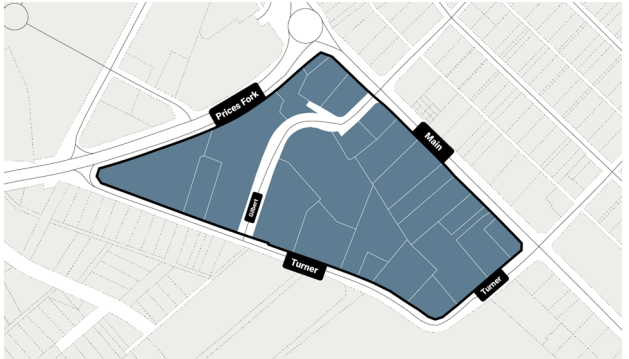
(b)
Accomplishing the stated goals of the DTNW district will require a unified redevelopment of the land contained in the Downtown Northwest District Applicability Area. Therefore, any application for a rezoning to the DTNW district must comprise a minimum of 3.5 acres in area, with the Council's stated preference being for applications that redevelop more of the Downtown Northwest District Applicability area. Applications for a DTNW district rezoning must also have at least 300 feet of contiguous frontage upon at least one public street.
(c)
In its evaluation of DTNW rezoning applications, beyond considering an application's compliance with design requirements contained in this division, the Council will consider how an application meets the goals contained in Section 3500, and the 2019 Downtown Strategic Plan, including, but not limited to the following:
(i)
Whether the proposed development will create a walkable and connected urban environment;
(ii)
Whether the proposal will result in a true vertical mixed use development (instead of residential buildings with token first floor commercial):
(iii)
Whether, beyond meeting the standards required in this division, the proposed buildings are attractively designed and feature high quality materials;
(iv)
Whether the proposed development will feature meaningful public space; and
(v)
Whether the proposed development is suitably integrated into Main Street on the east and provides an appropriate transition to Virginia Tech on the west.
(Ord. No. 2001, § 1, 12-9-25)
Sec. 3502 - Definitions.
For the purposes of administering the DTNW District standards, the following definitions are established. In the case of a conflict, the definitions established in this section shall control within the DTNW District.
Bicycle Parking, Long Term. Bicycle parking spaces where bicycles can be stored within a safe and weatherproof storage area for long periods of time.
Blank Wall Area. The horizontal linear dimension of contiguous building wall that does not contain windows, doors, or decorative elements such as banding, medallions, artwork such as murals and mosaics, change in wall plane of at least three inches, or other architectural or material embellishment. Any wall less than five feet in height shall not be considered a blank wall.
BLANK WALL AREA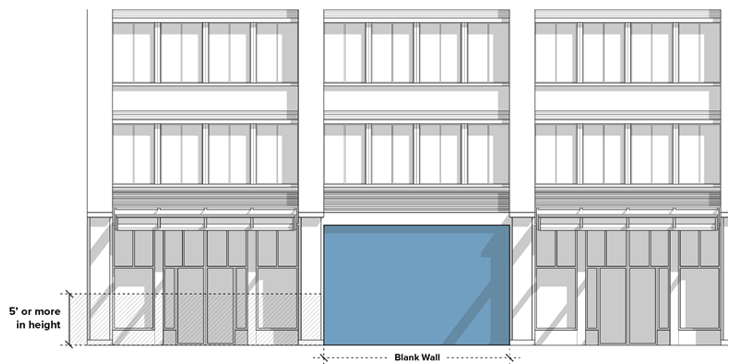
Build-Out Percentage. Build-out percentage specifies the minimum length, established as a percentage of total lot width, that shall be occupied by a building, within or beyond the build-to zone.
BUILD-OUT PERCENTAGE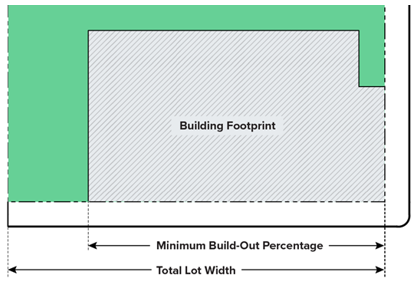
Build-To Percentage. Build-to percentage specifies the percentage of the total building width that shall be located within the required build-to zone.
BUILD-TO PERCENTAGE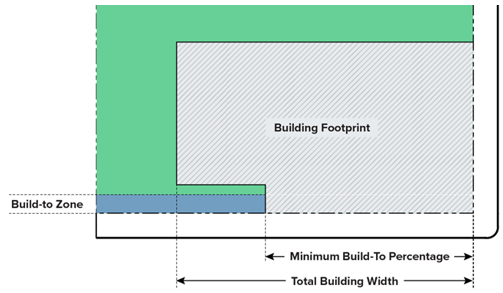
Build-To Line. A build-to line is a line on a lot establishing the required location of the front building line.
BUILD-TO LINE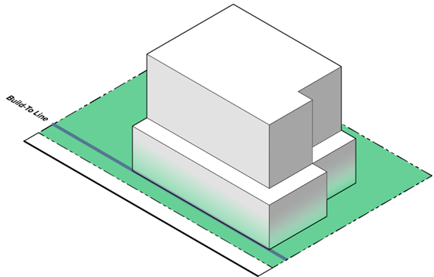
Build-To Zone. A build-to zone is the area on a lot, measured perpendicular to the front lot line and containing a minimum and maximum dimension, within which the front building line shall be located.
BUILD-TO ZONE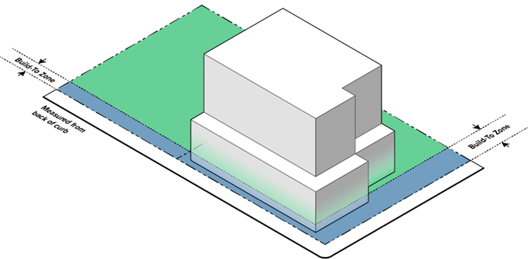
Building Line. A building line is the horizontal line indicating the primary edge of a building closest to the front, side, and rear property lines and extending from the physical edge of the building to the boundaries of the property.
BUILDING LINE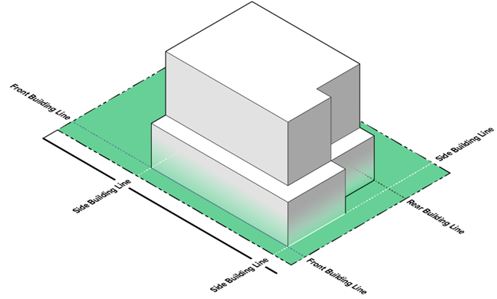
Expression Lines. Expression lines are those vertical and horizontal elements of a building facade that convey or express its structure, including but not limited to cornices, brick courses, banding, fenestration, columns, and bays.
EXPRESSION LINES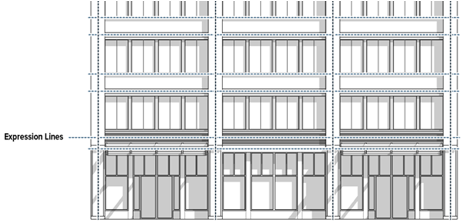
Stepback. Stepback is the additional distance that upper stories shall be recessed or set back from the facade of the stories below.
STEPBACK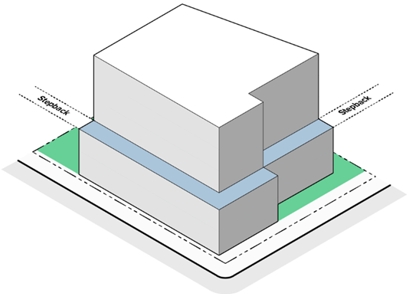
Transparency. The required amount of fenestration as a percentage of the specified facade area. Doors are included in ground floor transparency when such doors are designed with glass or other transparent materials. Garage entrances shall not be included in ground floor transparency.
(a)
The following do not meet the ground floor or upper floor transparency requirements and do not count in meeting the standard;
(1)
Windows with shadowboxes on the interior;
(2)
Glass block;
(3)
Printed window film, signs, or posters affixed to the inside or outside of windows, regardless of whether such elements allow views into or out of the building; or
(4)
Mirrored glass on the ground floor.
(Ord. No. 2001, § 1, 12-9-25)
Sec. 3503 - Permitted uses.
(a)
"Table 3503-1: Downtown Northwest District Uses" sets out the uses and structures permitted within the DTNW District, subject to all other applicable requirements contained in this division.
(1)
Where a use is permitted by right, it is indicated as "P" within the table.
(2)
Where a use is permitted with the approval of a Conditional Use Permit, it is indicated as "CUP" within the table. Uses permitted with a Conditional Use Permit are subject to the standards and procedures of Article 1, Division 8 of the Zoning Ordinance. Approval of a conditional use within the DTNW District is also subject to evaluation against the purpose and intent of the DTNW District in relation to scale, orientation, context, and design quality.
(b)
Use standards for each of the uses allowed in the DTNW District are detailed in the column titled "DTNW District Use Standards."
(c)
The use and design standards of Article 4 of this Ordinance do not apply to uses within the DTNW District unless specifically indicated otherwise. In the case of a conflict where the standards of Article 4 apply to a use in the DTNW District, the stricter standard shall control.
(Ord. No. 2001, § 1, 12-9-25)
Sec. 3504 - Dimensional standards.
(A)
Building Siting. The following standards regulate the placement of buildings on lots within the DTNW District. Building siting standards are intended to ensure the creation of an urban development character and a walkable, pedestrian orientation in alignment with the intent of the district, while maintaining compatibility with existing downtown development.
BUILDING SITING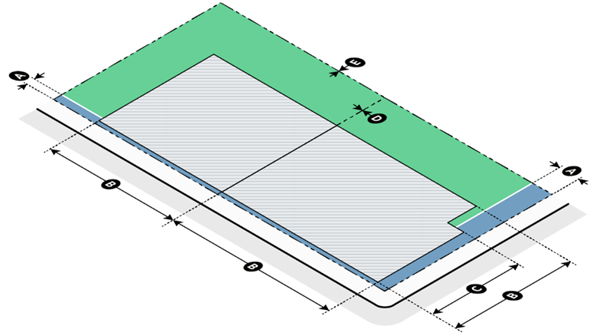
(B)
Building Height. Building height standards regulate the minimum and maximum heights of buildings within the DTNW District. The intent of these standards is to provide flexibility for the creation of a dense, urban development pattern in the district, while ensuring appropriate transitions and sensitivity to existing downtown development.
BUILDING HEIGHT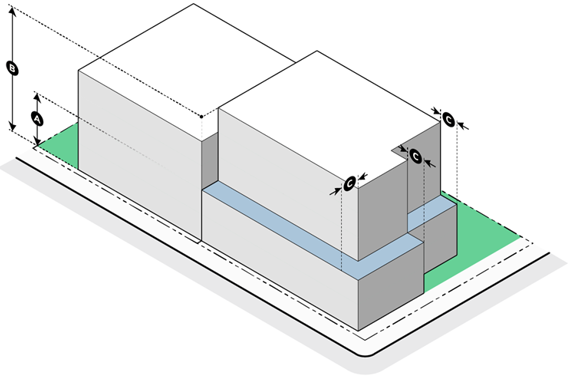
(C)
Building Articulation. Building articulation standards regulate the dimensions of building facades to provide a consistent, comfortable pedestrian experience at ground level. Standards are intended to enhance the pedestrian scale and orientation of the urban environment within the DTNW District by addressing building massing, length, and connectivity.
BUILDING ARTICULATION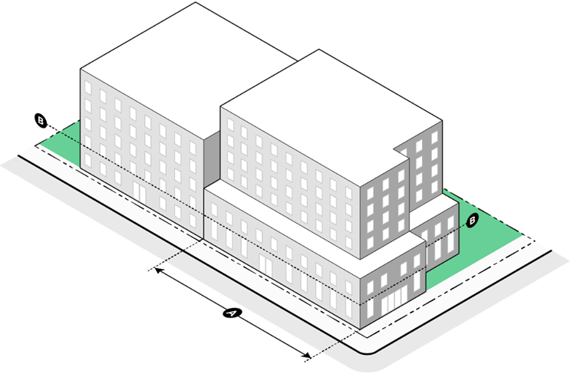
(1)
Maximum Building Length with Additional Design Features. Maximum building length may be increased to 400 feet with the inclusion of additional design features as follows:
i.
Where a building abuts two parallel streets, or one street and a parking lot, public park, or other public open space on the side of the building opposite the street, a pedestrian passage may be used to achieve additional building length, up to a maximum of 400 feet. Such passage shall meet the following criteria:
a.
Passages must be designed to accommodate pedestrians. Vehicular access and circulation is not allowed as a component of a passage.
b.
Passages shall be a minimum of 30 feet in width and 14 feet in height and shall be located within the middle third of the building, measured parallel to the street.
c.
Passages are to be designed to maintain views from one end through to the other. Such views shall not be obstructed by lighting or other design features.
d.
Inclusion of decorative elements, such as lighting installations or public art within passages, is encouraged.
e.
Passages shall align with the street grid or other points of access to sidewalks, public paths, parking lots, public parks, or other publicly owned open space where feasible.
f.
For the purposes of any build-to zone requirement, a building passage is considered part of the building facade that meets such requirement.
PASSAGE DESIGN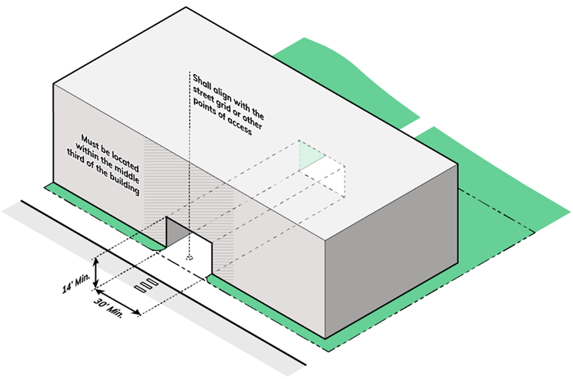
(Ord. No. 2001, § 1, 12-9-25)
Sec. 3505 - Building design and performance standards.
The design and performance standards within this Section apply to all new construction and additions of 400 square feet or more to existing structures. In the case of an addition, only those standards that relate to the specific addition apply.
(a)
"Table 3505-1: Downtown Northwest District Design Standards" establishes the design standards applicable to frontages that abut North Main Street or the southeastern-facing frontage of Turner Street NW (450 ft. from the intersection of Turner Street NW and North Main Street), and frontages abutting any other street within the District. Where a "✓" is present in the table, it indicates that such standard is applicable. A blank, gray cell indicates that the standard does not apply.
| Table 3505-1: Downtown Northwest District Design Standards | ||
|---|---|---|
| Building Facade Design | North Main Street and southeastern-facing frontage of Turner Street NW | All Other Streets |
| Building facade design standards regulate various components of a building facade to reinforce the DTNW District's focus on pedestrian experience and high-quality design through the creation of visual interest and a human scale at ground level. | ||
| Building facades shall not contain blank wall areas that exceed 25 linear ft. | ✓ | |
| Building facades shall not contain blank wall areas that exceed 50 linear ft. | ✓ | |
| Building facades of 100 ft. in length or greater shall include architectural variation incorporating a minimum of two of the following elements: color change, texture change, material change, a wall articulation change (such as a reveal, recess, offset, or pilaster), or building recesses or projections. This includes patterns made by structural components visible through glass curtain walls. Such variation shall occur at intervals to minimize the perceived mass of the building facade. | ✓ | ✓ |
| Facades shall express the structural bays and framing of the building using both horizontal and vertical expression lines, to provide interest and detail to the facade. Expression lines may consist of window patterns, change of materials, cornice treatments, or other architectural elements. | ✓ | ✓ |
| Horizontal expression lines shall reference adjacent development to ensure a consistent, ordered appearance and visual continuity along the face of a block. This includes patterns made by structural components visible through glass curtain walls. | ✓ | ✓ |
| A bulkhead or knee-height wall (minimum of 18 inches in height) is required along any street-facing facade to provide visual weight to required ground floor glazing except where designed with a glass curtain wall. This standard does not apply where residential dwelling units are located on the ground floor. | ✓ | ✓ |
| For buildings over three stories in height, facades shall express a visual distinction between the ground floor and upper stories through horizontal expression lines and architectural features including cornices, recesses, brick courses, or other detailing. | ✓ | ✓ |
| Building materials and visual elements used on the street-facing facade shall be consistently applied to all building facades visible from a street. | ✓ | ✓ |
| Arcades, galleries, colonnades, outdoor plazas, outdoor dining areas, and similar pedestrian-oriented features are encouraged to be incorporated into facades. When provided, such features shall be considered to meet any required build-to percentage. | ✓ | ✓ |
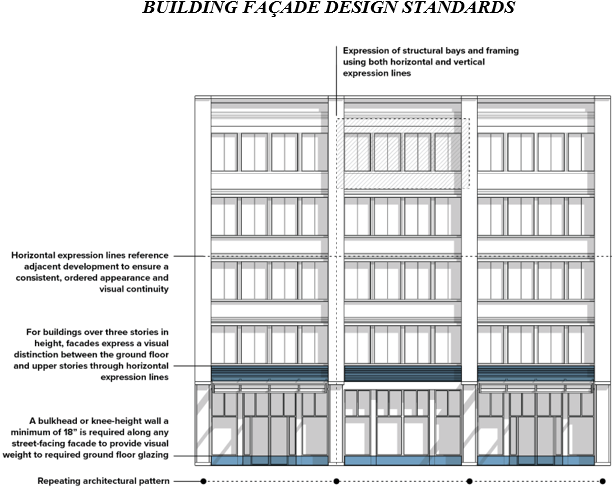 | ||
| Building Orientation and Entry Design | North Main Street and southeastern-facing frontage of Turner Street NW | All Other Streets |
|---|---|---|
| Building orientation and entry design standards require that buildings within the DTNW District are oriented toward the pedestrian realm, and provide legible, predictable points of access along their frontages. | ||
| The primary elevation of a building shall be oriented to face a street. In the case of a building with frontage on Main Street and any other street, the primary elevation shall be oriented toward Main Street. | ✓ | ✓ |
| All buildings shall have a public entrance from the sidewalk along all street-facing frontages. Where a building contains multiple tenant spaces on a ground floor street-facing frontage, each tenant space shall have a public entrance from the sidewalk. This standard does not apply where residential dwelling units are located on the ground floor. The Zoning Administrator may modify or waive this standard if it is determined that, due to site constraints, it is not possible to provide such entrances. | ✓ | ✓ |
| Where a building contains frontage on a public plaza, public entrances may be provided from the plaza. Such entrances are considered to meet the requirement for a public entrance from the sidewalk. | ✓ | ✓ |
| Public entrances shall be visually distinctive from the remainder of the facade on which they are located. Entrances shall contain architectural features that provide weather protection and add visual interest to the structure. All public entrances must be operable. | ✓ | ✓ |
| For buildings 200 feet in length or greater, the maximum spacing between public entrances is limited to 75 ft. | ✓ | |
| Where entrances to individual residential dwelling units are located on the ground floor, all such entrances shall be a minimum of eighteen inches above the grade of the adjacent sidewalk to provide a sense of privacy. This requirement may be adjusted or waived by the Zoning Administrator in the case of unique topographical conditions that preclude such designs and in the case required for entrances to accessible units. | ✓ | |
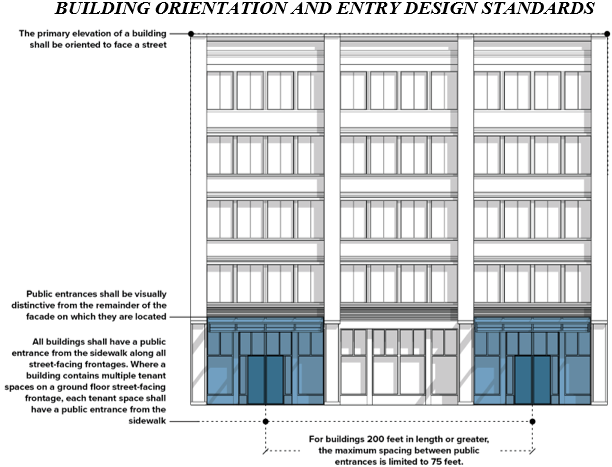 | ||
| Window and Door Design | North Main Street and southeastern-facing frontage of Turner Street NW | All Other Streets |
|---|---|---|
| Window and door design standards promote a pedestrian-oriented interface between buildings and the public realm by requiring elements of transparency that allow for visibility both into and out of buildings at the ground floor and above. | ||
| Multifamily Development Transparency: The ground floor of a facade shall maintain a minimum transparency of 70%, measured between two and eight feet in height. | ✓ | |
| Multifamily Development Transparency: When the ground floor is occupied by dwelling units, a minimum transparency of 20% of the wall area of the story shall be maintained. When the ground floor contains a lobby or common areas associated with the dwelling, a minimum transparency of 50% shall be maintained, measured between two and eight feet in height. | ✓ | |
| Nonresidential and Mixed-Use Development Transparency: The ground floor of a facade shall maintain a minimum transparency of 70%, measured between two and eight feet in height. | ✓ | |
| Nonresidential and Mixed-Use Development Transparency: The ground floor of a facade shall maintain a minimum transparency of 50%, measured between two and eight feet in height. | ✓ | |
| Multifamily, Nonresidential and Mixed-Use Development Transparency: The upper floors of a facade shall maintain a minimum transparency of 20% of the wall area of each story | ✓ | ✓ |
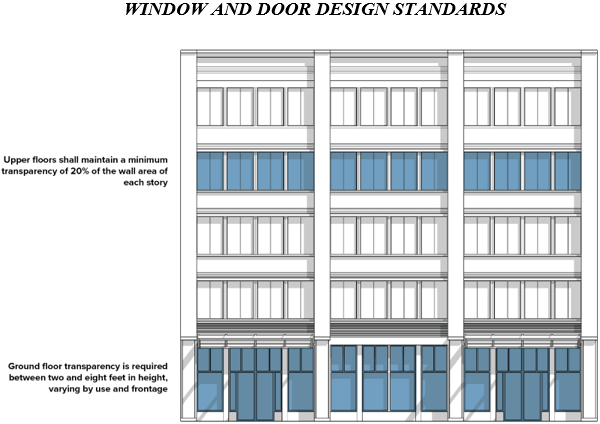 | ||
(b)
Ground floor active use design.
(1)
All ground floor space designed for nonresidential uses shall meet a minimum dimension of 30 feet in depth and 20 feet in width, and shall be furnished with water, sewer, and electrical service, or such services shall be stubbed into each individual space to facilitate future connection. A minimum of one ground floor frontage space per structure shall be designed with exhaust and ventilation systems suitable to support a restaurant use.
(c)
Restricted Building Materials.
(1)
The following building materials are prohibited on any facade visible from a public or private street (excluding alleys); however, such materials may be used as a component of construction when not a surface finish material:
i.
Plain concrete block;
ii.
Wood structural panel sheathing (e.g., plywood, OSB, particleboard, etc.);
iii.
Plastic;
iv.
Vinyl.
(2)
The building materials set forth below may be used only as decorative or detail elements, limited to a maximum of 25% of the area of each facade visible from a public or private street (excluding alleys). This maximum area may not be combined to achieve more than 25% coverage on any facade. However, such materials may be used as a component of construction when not a surface finish material.
i.
Mirrored glass installed on the ground floor or below any required ground floor demarcation line.
ii.
Mirrored glass installed above the ground floor or any required ground floor demarcation line, unless the mirrored glass is designed to be bird safe. Bird-safe glass is specially designed to make glass a visible obstacle to birds and includes approaches such as fritting, silk-screening, or ultraviolet coating. Patterns must break up the reflectivity of the glass and be spaced two inches apart horizontally and four inches apart vertically.
iii.
Metal panels; however, such panels (flat, textured, corrugated, batten, box rib, etc.) whether standalone, composite, or part of a layered or insulated panel, are permitted if they are part of a complete, manufacturer warrantied cladding system, including integral anchorage to structural supports. Steel panels shall be minimum US Standard 26 gauge.
(3)
Exterior insulating finish systems (EIFS) installed on the ground floor or below any ground floor demarcation line is prohibited on all building facades, including those not visible from a public or private street. When located above the ground floor, EIFS may be used only as a decorative or detail element, limited to a maximum of 25% of the area of any facade.
(d)
Building Performance. New development in the DTNW District shall be designed to prioritize energy efficiency in building construction and performance. All new construction and additions of 400 square feet or more within the DTNW District shall be designed to meet one or more of the following:
(1)
A Home Energy Rating System (HERS) Index rating equivalent to a 30% or greater improvement over the minimum current applicable Code at the time of construction.
(2)
An Energy Use Intensity (EUI) rating of 40 kBtu/square foot or lower.
(3)
An alternative sustainability and/or energy efficiency rating system may be used, subject to approval by the Town Council.
An evaluation from a third party that demonstrates compliance with one or more of these standards is required.
(Ord. No. 2001, § 1, 12-9-25)
Sec. 3506 - Site development standards.
(a)
Off-Street Vehicle Parking.
(1)
There is no minimum number of parking spaces required for allowed uses in the DTNW District.
(2)
When parking is provided within the DTNW District, it shall be subject to the parking maximums established in Section 5220 of this Ordinance. Parking maximums for nonresidential uses are included in Section 5220(b), and may only be exceeded if meeting the requirements of Section 5220(d).
(3)
Multifamily dwellings in the DTNW District are not subject to parking maximums.
(b)
Location and Design of Off-Street Vehicle Parking.
(1)
No surface parking, and no drive aisles parallel or roughly parallel to a street may be located between the principal building and any lot line abutting a street.
(2)
Vehicular and loading access shall be taken from rear alleyways. This includes access to structured parking facilities. Where alleys do not exist, vehicular and loading access may be taken from a street. In such cases, the following standards apply:
i.
Vehicular and loading accessways shall be clearly marked, and shall accommodate a five foot by five foot clear sight triangle to either side of the accessway. Alternatively, exiting detectors may be used in place of a vehicular clear sight triangle if detectors provide signals to both pedestrians and vehicles exiting a structure.
ii.
Where vehicular and loading accessways cross a sidewalk, such sidewalk shall remain level, with no change in cross-slope. The appearance of the sidewalk, such as scoring pattern or any special paving, shall be maintained across the accessway to indicate that, although a vehicle may cross, the area remains part of the pedestrian way.
VEHICULAR CLEAR SIGHT TRIANGLE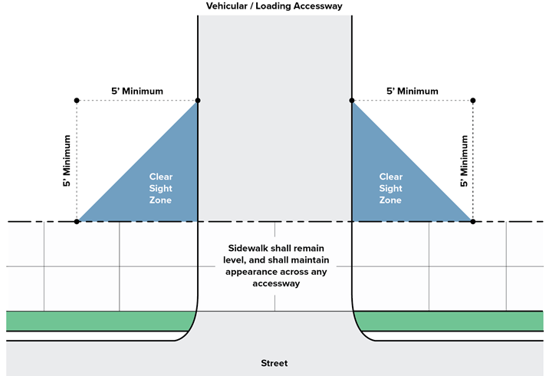
(3)
Surface parking lots are discouraged within the DTNW District. Where visible from a street, surface parking lots shall be screened to provide a comfortable pedestrian environment by softening the visual impact of parked vehicles, providing a buffer against glare from headlights, and establishing a landscaped edge at the back of sidewalk. Screening shall be provided as follows:
i.
The standards of Sec. 5427 apply to surface parking lots within the DTNW District unless modified by this section. In the case of a conflict, the stricter standard shall control.
ii.
Surface parking lots shall be screened by a landscaped area a minimum of 10 feet in width meeting the following standards:
a.
Shrubs shall be at least two feet in height at time of planting with an average height of three to four feet expected as normal growth within four years. However, such shrubs shall not exceed four feet in height at maturity. Shrubs shall be planted and spaced sufficiently to form a continuous linear hedgerow at maturity. A minimum of 75 percent of the shrubs planted shall be evergreen species to ensure effective year-round screening.
b.
Alternatively, a mix of shrubs, perennials, native grasses, forbs, or other planting types that provide effective year-round screening may be used. Such plantings shall provide effective screening to a height of two feet at time of planting, and shall attain an average height of three to four feet expected as normal growth within four years. Such planting shall not exceed four feet in height at maturity.
c.
A minimum of one shade tree shall be planted for every 30 linear feet of landscape area. Trees may be spaced in a linear fashion on-center, or may be grouped to complement a design concept. Species shall be selected from the Town's list of recommended tree species (Zoning Ordinance Section 5429), and shall meet the standards of Zoning Ordinance Section 5420 and 5429, unless modifications to specific tree species are requested in writing to and approved by the Zoning Administrator.
iii.
Alternatively, surface parking lots may be screened by a structural element such as a wall or fence that is architecturally and materially consistent with the principal structure. Such structural screen shall be a minimum of four feet in height, and no more than six feet in height, and shall be subject to the provisions of Blacksburg Town Code Section 21-304 governing sight triangles.
SURFACE PARKING LOT SCREENING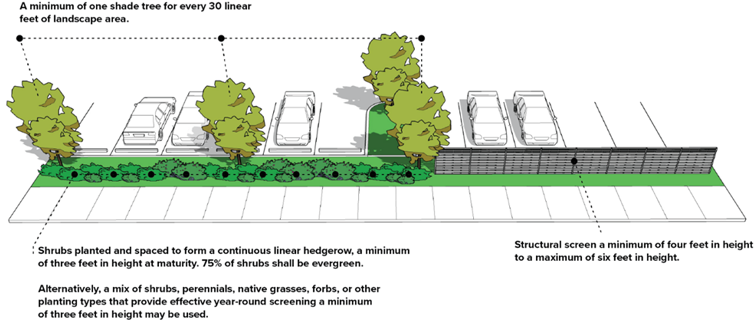
iv.
The Zoning Administrator may modify these screening standards in the following circumstances:
a.
Innovative landscaping or architectural design is employed on the building site to achieve an equivalent screening or buffering effect.
b.
The required screening would be ineffective due to the proposed topography of the site and/or the location of improvements on the site.
(4)
Structured parking is not permitted on the ground floor of any building frontage abutting North Main Street, or any building frontage abutting Turner Street NW within 150 feet of the intersection of North Main Street and Turner Street NW. All structured parking located on the ground floor of these frontages shall be screened behind usable interior space measuring a minimum of 30 feet in depth and 20 feet in width. Individual spaces shall be furnished with water, sewer, and electrical service, or such services shall be stubbed into each individual space to facilitate future connection. A minimum of one ground floor frontage space per structure shall be designed with exhaust and ventilation systems suitable to support a restaurant use.
(5)
Structured parking visible from a street shall be screened as follows:
i.
On the ground floor of a building facade, where indoor usable space, ingress/egress points, and/or mechanical equipment are not present, pedestrian-scale interest and activity must be created using at least three design or architectural elements such as awnings, overhangs, decorative screens, grilles, louvers, green walls, public art installations, or similar features.
ii.
Parking structures should be designed to ensure that vehicles parked on all levels of the structure, as well as all interior lighting, are effectively screened by a wall or panel measuring a minimum of four feet in height measured from the finished surface of the parking level.
iii.
Facades must incorporate vertical and horizontal expressions that resemble the patterns and architecture of other buildings within a multi-building development, including use of similar materials and a similar pattern of fenestration openings. Any openings are to be screened using decorative elements such as grilles, louvers, green walls, public art installations, or similar features that occupy a minimum of 25% of the area of the opening. This standard also applies to freestanding parking structures that are not within a multi-building development, in which case the facade will incorporate the patterns and architecture of adjacent or surrounding buildings.
iv.
For parking structures that include rooftop open-air parking, a parapet wall a minimum of four feet in height measured from the surface of the roof is required.
STRUCTURED PARKING SCREENING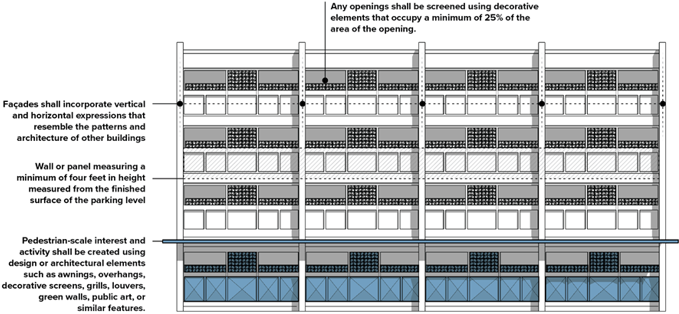
(c)
Bicycle Parking. Bicycle parking is a fundamental required element of the DTNW District, and shall be given appropriate consideration from the initial stages of project development. Bicycle parking is required for uses within the DTNW District as follows:
(1)
Bicycle parking is required Zoning Ordinance Section 5213.
(2)
A percentage of the required bicycle parking required per Section 5213 must be designed as long-term bicycle parking. All long-term bicycle parking spaces must be located indoors or beneath a full permanent cover such as an overhang, covered walkway, or outdoor bicycle locker. Where long-term bicycle parking is not located within a building or a locker, any cover used to meet this standard must be of permanent construction and able to withstand rainfall, snow, or other inclement weather conditions. Any covered area must maintain a minimum vertical clearance of seven feet from grade to the bottom of the cover.
(3)
Long-term bicycle parking spaces are required in accordance with the following:
i.
Residential units: 60% of bicycle parking spaces required by Section 5213 must be long-term spaces.
ii.
Commercial retail: No long-term spaces are required.
iii.
Civic, office or any other use not listed above: No long-term spaces are required.
(4)
The Zoning Administrator may approve alternative compliance with the requirements for long-term bicycle parking spaces upon finding that a modification would be consistent with the purpose and intent of this Section, and the purpose and intent of the Town's Comprehensive Plan. Alternative compliance with these requirements must be approved at the time of rezoning to the Downtown Northwest District.
(d)
Drive-through Facility Location and Design. Drive-through facilities are allowed within a limited area of the DTNW District, and are subject to Zoning Ordinance Section 5230, as well as the following standards.
(1)
Drive-through facilities are permitted only on lots fronting Turner Street NW within 350 feet of the intersection of North Main Street, measured parallel to the curb line. When located within the first 200 feet of the intersection of North Main Street, drive-through facilities are only permitted for uses indicated in table 3503-1 when located on the ground floor of a multi-story mixed-use building.
(2)
Drive-through facilities, including any required stacking spaces and drive-through lanes, shall not be located between the principal building and any lot line abutting a street.
(3)
Drive-through lanes, any required stacking spaces, order boards and signage shall be visually integrated into the overall design of the structure, sharing common architectural features and design elements. Building facades adjacent to any drive-through lane shall be articulated to ensure visual interest through variation in depth, direction, and design elements. Such facades shall include architectural elements and materials consistent with the overall design of the structure, and should use landscape elements, green screens, art installations, and similar features to soften the appearance of blank walls.
(4)
Any drive-through facility adjacent to a street, including stacking spaces and drive-through lanes, shall be screened in accordance with the standards set forth above for the screening of off-street parking lots.
(5)
Drive-through facilities are to be designed to prioritize safe pedestrian circulation to the principal building and across any access points from a street or parking lot. Pedestrian walkways that intersect any drive-through aisle shall have clear visibility, and shall be raised or otherwise emphasized through the use of enhanced paving or markings.
(e)
On-Site Open Space. On-site open space is required within the Downtown Northwest District. Such open space is intended to provide opportunities for gathering and enjoyment while maintaining the district's unique urban character, and may be designed as public open space, common open space, or private open space as established in item (1) below.
(1)
On-Site Open Space Required
i.
New development within the DTNW District is required to provide on-site open space, except for development on sites of one-half acre or less in size.
ii.
Driveways, parking areas, bicycle parking areas, above ground utility areas, mailboxes, and required screening or buffer areas will not be counted toward on-site open space requirements.
iii.
Development must provide a minimum amount of on-site open space as follows:
(2)
Design of On-Site Open Space.
i.
On-site open space is classified into three categories within this section:
1.
Common Open Space: Open space maintained for the shared use of residents and/or tenants of a development.
2.
Private Open Space: Open space reserved for the sole use of the occupant of the associated dwelling unit or tenant space.
3.
Public Open Space: Open space maintained for the use of the public. Public open space may include plazas, parks, and public seating areas.
ii.
Required open space shall meet the design requirements of Table 3506-1: "Design of On-Site Open Space." Where a "✓" is present in the table, it indicates that such standard is applicable to the indicated type of open space. A blank, gray cell indicates that the standard does not apply.
(3)
Exemptions from Required On-Site Open Space.
i.
The following uses are not required to provide on-site open space: public parks and recreational areas, minor utility services, and safety services.
ii.
The Zoning Administrator may waive the requirement for public open space, or may waive the requirement for all on-site open space if they determine it is incompatible with the nature of the use.
(Ord. No. 2001, § 1, 12-9-25)
Sec. 3507 - Signs.
The character of the Downtown Northwest District - a dense, urban, well-connected, mixed-use area that encourages variety in architectural forms - requires special consideration to ensure that signs within the district reinforce and complement its unique orientation. Signs within the district may require additional flexibility to meet the needs of this type of development, anticipated to include a mix of sign types such as individual tenant signs in multi-tenant buildings, building-mounted signs, monument signs, and others. To ensure that signs in the DTNW District complement the intent and character of the district, the following must occur:
(a)
The creation of a special signage district is required, in accordance with Zoning Ordinance Section 5540; and
(b)
An application for a special signage district, in accordance with Section 5540 (d), must be reviewed and approved concurrently with a rezoning to the Downtown Northwest District.
(Ord. No. 2001, § 1, 12-9-25)
Sec. 3270 - Purpose.
A Historic or Design Review Overlay District is provided in recognition that certain buildings or structures within the Town have important historic, architectural, archaeological or cultural interest. In addition, certain areas of Town have special public value because of notable architectural, archaeological or other features relating to the cultural or artistic heritage of the community, of such significance as to warrant conservation and preservation. The historic overlay provides a vehicle for regulating building design, construction, reconstruction, alteration, restoration, and demolition in these areas.
The purpose of any such District is to provide for protection against destruction of or encroachment upon historic areas, buildings, monuments or other features, or buildings and structures of recognized architectural significance which contribute or will contribute to the cultural, social, economic, political, artistic, or architectural heritage of the Town of Blacksburg and the Commonwealth of Virginia.
This District is also intended to encourage compatible development in areas of the Town having historic or unique architectural value. Specifically, the district is intended to encourage new buildings which are compatible with the existing scale and character of the surrounding neighborhood, encourage the protection of existing neighborhoods and their physical characteristics, and encourage revitalization of the area.
The Historic or Design Review Board is intended to be used to implement architectural proffers for conditional or planned zoning districts, in addition to implementing the appropriate standards for any Historic or Design Review District. Any person who proffers architectural controls for a planned district should consider proffering the Historic or Design Review Board as the body which will implement those standards.
(Ord. No. 1206, § 3, 5-11-99; Ord. No. 1604, § 2, 3-8-11)
State Law reference— Va. Code § 15.2-2306.
Sec. 3271 - Historic or Design Review Board.
(a)
The Historic or Design Review Board, or "Board," shall have a membership of at least seven (7) and at most nine (9) members who are residents of the Town. All members shall be appointed by the Town Council, and shall have a demonstrated interest, competence, or knowledge in historic preservation. The membership must include a member of the Planning Commission, a licensed architect or architectural historian, and should include, to the extent feasible, an owner of commercial property within the District and two (2) owners of property within the District who also reside within the District. At least two (2) of the members must have professional training or equivalent experience in any of the following disciplines: architecture, history, architectural history, planning, building or development. The remaining members should be persons interested in the District or historic preservation, or additional residents and business owners in the District. The members shall serve staggered terms of four (4) years, and each member shall serve until that member's replacement is appointed. The Town Council may appoint members whose property ownership, residence in the district or training or experience satisfies more than one (1) of the requirements of this section; however, in no case shall there be less than one (1) property owner on the Board.
(b)
The Board shall review applications for development within an historic overlay district as directed by the ordinance establishing the district. The Board shall also hear appeals from decisions of the zoning administrator to deny a certificate of appropriateness.
(c)
Where the application of design criteria is mandatory, the Board shall issue or deny a certificate of appropriateness based upon the design criteria for the particular Historic or Design Review Overlay District in which the development is proposed to occur.
(d)
Any decision to deny a certificate of appropriateness shall be set forth in writing, stating the reasons therefore.
(e)
The Board may ask the Town Council to initiate a study of a proposed historic overlay district. The Board shall comment on studies and rezoning proposals as requested by the Planning Commission or Town Council.
(f)
The Board shall implement and enforce proffered conditions of conditional or planned zoning districts, if it is so designated in the ordinance creating the district.
(g)
The Board shall undertake such other tasks as the Town Council may direct.
(Ord. No. 1206, § 3, 5-11-99; Ord. No. 1604, § 2, 3-8-11; Ord. No. 1924, § 2, 7-14-20)
Sec. 3272 - Designation of a Historic or Design Review Overlay District; process; overview.
There shall be a two-step process for designating any area as a Historic or Design Review Overlay District. The first step in the process shall be a study of the proposed district. The second step of the process shall consist of a zoning amendment, which shall be initiated or not pursuant to the provisions of Article I, Division 5 of the Zoning Ordinance.
(Ord. No. 1206, § 3, 5-11-99; Ord. No. 1924, § 2, 7-14-20)
Sec. 3273 - Same—Initiation of study.
(a)
The study of an area for possible Historic or Design Review Overlay designation may originate in one (1) of the following ways:
(1)
By petition signed by at least fifty-one (51) percent of the owners of real property within the proposed district;
(2)
By motion of the Planning Commission;
(3)
By request of the Board;
(4)
By resolution of Town Council.
(b)
Only Town Council has the authority to order the study of any proposed historic or design review district.
(c)
A petition signed by fifty-one (51) percent of the owners of real property within the proposed district may be submitted to the zoning administrator, who shall refer it to the Planning Commission, which shall hold a public hearing and make a recommendation to Town Council. Town Council shall hold a public hearing on the petition, after which it may order the study as requested, deny the petition, or order a study with some modifications to the petition's request.
(d)
The Planning Commission may make a recommendation to initiate a study on its own motion after a public hearing. The Town Council shall act to initiate a study only after a public hearing.
(e)
Public hearings conducted by the Planning Commission and Town Council under this section shall be conducted after notice and publication as provided in Zoning Ordinance section 1153, and Virginia Code § 15.2-2204.
(f)
The area to be studied shall have logical boundaries based upon existing streets, alleys, blocks, and established neighborhoods. A single lot may be designated for study.
(g)
Any proposed Historic or Design Review Overlay District, for which a study meeting the requirements of section 3271 and section 3273 has been completed prior to the original effective date of this section, shall be exempt from compliance with this section.
(Ord. No. 1206, § 3, 5-11-99; Ord. No. 1604, § 2, 3-8-11)
Sec. 3274 - Same—Study of proposed area.
A study of an area proposed for Historic or Design Review Overlay District designation shall address the following issues, among such other issues as may be identified by Town Council:
(1)
Does the study area contain one (1) or more buildings or structures, or other features with important historic, architectural, archaeological or cultural interest?
(2)
Does the study area have special public value because of notable architectural, archaeological or other features relating to the cultural or artistic heritage of the community, of such significance as to warrant conservation and preservation?
(3)
What design criteria are related to the study area's significance or character?
(4)
What types of development should be subject to an administrative review or board review?
(5)
What types of development, if any, should be exempt from administrative or board review?
(6)
Should the application of the design criteria be advisory or binding?
In addressing questions numbers (4) and (5), above, the purpose of the study shall be to recommend review procedures which will be relatively simple with minimum delay for those actions which will have little if any permanent effect on the character of the district or on a significant structure, but to require a more thorough review for actions which may have a substantial effect on the character of the district or on a significant structure. When the study is completed, it shall be submitted to the zoning administrator, who shall refer the study to the Planning Commission for review.
(Ord. No. 1206, § 3, 5-11-99; Ord. No. 1604, § 2, 3-8-11)
Sec. 3275 - Same—ReZoning Ordinance.
Any ordinance rezoning an area to a Historic or Design Review Overlay District shall contain the following provisions, among such others as Town Council may deem appropriate:
(1)
A finding that:
(a)
The district includes buildings or structures or other features with important historic, architectural, archaeological or cultural interest, or
(b)
The district has special public value because of notable architectural, archaeological or other features relating to the cultural or artistic heritage of the community, of such significance as to warrant conservation and preservation.
(2)
Design review criteria which shall apply to development in the district. Design review criteria may be incorporated by reference to a separate document. The design criteria may include provisions for building materials; building orientation; building massing, volume, and scale; architecture; continuity of building facades; or other criteria necessary to preserve the features which qualify the district for historic or design review overlay designation.
(3)
The types of development which shall be subject to the design criteria, including a designation of an administrative or board review for different types of development.
(4)
The types of development, if any, which shall be exempt from the design criteria.
(5)
Whether the application of the design criteria is advisory or binding.
(Ord. No. 1206, § 3, 5-11-99; Ord. No. 1604, § 2, 3-8-11)
Sec. 3276 - Effect of designation.
(a)
Upon the designation of any area as a Historic or Design Review Overlay District, no building or structure, including signs, shall be erected, constructed, reconstructed, altered, restored, relocated, or demolished within any such district unless reviewed and where required approved by the zoning administrator or Board or, on appeal, by the Town Council, unless the development is declared exempt from the design criteria in the ordinance designating the district.
(b)
Any designated Historic or Design Review Overlay District shall be an overlay to the existing underlying zoning districts as shown on the Official Zoning Map and, as such, the provisions for the overlay district shall serve as a supplement to the underlying zoning district provisions. In case of conflict between the provisions or requirements of this district and the underlying district, the provisions of this district shall apply.
(Ord. No. 1206, § 3, 5-11-99; Ord. No. 1604, § 2, 3-8-11)
Sec. 3277 - Administrative review.
(a)
The zoning administrator shall review applications for development within a historic overlay district as provided by ordinance. Where the application of the design criteria is mandatory, the Board shall issue or deny a certificate of appropriateness based upon the design criteria for a District in which the development is proposed to occur. Any decision to deny a certificate of appropriateness shall be set forth in writing, stating the reasons therefore.
(b)
The applicant or any person aggrieved by a decision of the Board to grant or deny a certificate of appropriateness may appeal the decision to the Town Council. The appeal shall be initiated by submitting a written notice of appeal to the zoning administrator, setting forth the grounds of the appeal, within thirty (30) days of the Board's decision.
(Ord. No. 1206, § 3, 5-11-99; Ord. No. 1604, § 2, 3-8-11)
Sec. 3278 - Appeal to Town Council.
The applicant or any person aggrieved by a binding decision of the Historic or Design Review Board may appeal the decision to Town Council, by submitting a written notice of appeal to the Zoning Administrator, setting forth the grounds for the appeal, within thirty days of the Historic or Design Review Board's decision. Town Council shall schedule a public hearing, and shall hear and decide the appeal within sixty days of receipt by the Zoning Administrator. Failure of the Town Council to decide the appeal within this time shall constitute denial of the appeal. The Town Council may uphold, reverse, or modify the Historic or Design Review Board's decision.
(Ord. No. 1206, § 3, 5-11-99)
Sec. 3279 - Appeal to circuit court.
The applicant or any person aggrieved by a final decision of the Town Council may appeal to the Circuit Court for Montgomery County by filing a petition at law, setting forth the alleged illegality of Town Council's action, within thirty days after the final decision is rendered by the Town Council. The filing of the petition shall stay the decision of the Town Council pending the outcome of the appeal to the court, except the filing of the petition shall not stay the decision of the Town Council if the decision denies the right to raze or demolish a historic landmark, building or structure. The court may reverse or modify the decision of the Town Council, in whole or in part, if it finds upon review that the decision is contrary to law or that its decision is arbitrary and constitutes an abuse of discretion, or it may affirm the decision of the Town Council.
(Ord. No. 1206, § 3, 5-11-99)
Sec. 3280 - Definitions applicable in Historic or Design Review Overlay Districts.
For the purposes of administering Historic or Design Review Overlay Districts, certain terms are defined as follows:
"Alteration" means any change or rearrangement in the supporting members of an existing building, affecting the exterior of a building or structure, or any enlargement or reduction of a building or structure, whether horizontally or vertically, or the relocating of a building or a structure from one (1) location to another. This term includes any change of, including removal of, any architectural details, or any addition to a part or the entire exterior of any structure. Depending upon the extent or nature of an alteration, it may constitute "demolition" and be subject to the provisions of this Article governing demolition.
"Certificate of Appropriateness" means a permit issued by the Historic or Design Review Board granting an applicant approval for the alteration, change, demolition, relocation, excavation, or new construction of a contributing site, contributing structure, landmark, noncontributing structure, or noncontributing site in an historic district.
"Contributing structure or property" means any building, structure, or site which contributes to the overall historic and architectural significance of the district and architectural integrity with little or no diminishment in value reflecting the character of that time or is capable of yielding important information about the historically significant period. Qualities of the building, structure or site which contribute to the overall historic and architectural significance of the district include, but are not limited to, setback, massing, height, materials, architectural features and/or fenestration. As approved by the Town Council and on file in the Town Clerk's Office, all contributing structures within the district(s) are set forth in the document entitled "Blacksburg Historic District Contributing Structures List" or "List"(maintained by the Department of Planning and Building) dated July 14, 2020. Contributing structures include accessory structures whether individually identified in the List or identified as contributing secondary resources in the supporting survey information on file with the Town and with the Virginia Department of Historic Resources.
"Demolish" or "demolition" means the razing or destruction, whether entirely or in significant part, of a building, structure, site or object. Demolition includes the removal of a building, structure, or object from its site or the removal or destruction of the facade or exterior surface, or exterior changes that destroy the historical significance of the building, structure or object.
"Development" means any manmade change to improved or unimproved real estate including but not limited to buildings or other structures, mining, dredging, filling, grading, paving, excavation, or storage of equipment or materials. The term "development" includes construction, reconstruction, alteration, restoration, and demolition of a structure. It also includes the erection of a new sign.
"Reconstruction" means the act or process of reproducing by new construction the form and detail of a vanished site, structure, landmark, or a part thereof, as it once appeared.
"Restoration" means the act or process of returning a building, structure, site or landmark to its former condition and/or appearance, such as a house museum to the time period of a famous resident.
(Ord. No. 1604, § 2, 3-8-11; Ord. No. 1924, § 2, 7-14-20)
Sec. 3281 - Establishment of Blacksburg Historic Overlay District.
(a)
The Blacksburg Historic Overlay District, or "District," originally established by Ordinance 1222 in 1999, is hereby re-enacted. The boundaries of the District are shown on the "Blacksburg Historic District Boundary & Contributing Structures Map" dated November 29, 2010, and subsequently amended October 13, 2015 and July 14, 2020, as approved by the Town Council.
The District was established for the purpose of promoting the general welfare, education, and recreational benefit of the public through the recognition of this area of the Town as having historic, architectural, and cultural significance. Regulations of the District are intended to protect, restore, and preserve the architectural integrity of existing structures, to create an atmosphere for compatible growth for the future and to ensure that new structures and uses will be in keeping with the character of the District.
(b)
In re-enacting the District, the Town Council expressly re-affirms its earlier findings that it includes buildings or structures or other features with important historic, architectural, archaeological or cultural interest, including but not limited to the original Town plat, established in 1798, known as the "Sixteen Squares," which is a defining feature of the Town; the Croy-Dawson House of 1839; "Five Chimneys," built in 1840; the Andy Camper House, circa 1850; the Price House, built in 1853; the Thomas-Conner House, built in 1878; and the additional historic contributing buildings identified on the "Blacksburg Historic District Boundary & Contributing Structures Map" and the document entitled "Blacksburg Historic District Contributing Structures List," as last amended on July 14, 2020 and approved by the Town Council.
(Ord. No. 1604, § 2, 3-8-11; Ord. No. 1770, § 1, 10-13-15; Ord. No. 1924, § 2, 7-14-20)
Sec. 3282 - Design criteria.
(a)
Town Council adopts the design criteria contained in the pamphlets entitled "Blacksburg Historic District Design Guidelines, Overview, Exterior Alterations, New Construction, and Relocation and Demolition" prepared by Landmark Preservation Associates and Dunay + Albright Architects, as amended, dated November 5, 1999, and "Blacksburg Historic District Sign Guidelines," prepared by Hill Studio dated June 2016 as guidelines for development within this District. No building or structure, including signs, shall be erected, reconstructed, altered, or restored within this District until reviewed for conformance with these design criteria by the zoning administrator or the Board as appropriate. This review shall be an advisory review, except as set forth in the following paragraph.
(b)
Notwithstanding the advisory nature of the guidelines as applied to the foregoing types of development, no contributing structure within this District shall be razed, demolished, or relocated until the razing, demolition, or relocating thereof is approved by the Board, or, on appeal, by the Town Council after consultation with the Board. Furthermore, no new building or structure shall be constructed or erected on the site of a razed, demolished or relocated contributing structure until a redevelopment plan for the site is approved and a certificate of appropriateness issued by the Board, or on appeal by the Town Council.
(Ord. No. 1604, § 2, 3-8-11; Ord. No. 1924, § 2, 7-14-20)
Sec. 3283 - Applicability of design guidelines.
All non-exempt types of development described below require completion of the historic review application and cannot proceed until approval is granted.
(a)
For contributing and non-contributing structures in the District, the following types of development shall be exempt from the design guidelines:
(1)
Repainting, except painting of masonry that has been unpainted;
(2)
Interior alterations that have no visible effect upon the exterior of the structure;
(3)
Minor repairs that maintain the integrity of existing walls, roofs, doors, fences, and other property features where no change in design or material is proposed;
(4)
Planting grass, trees, and shrubs;
(5)
Windows are not exempt and are addressed in subsection (b).
(b)
For contributing and non-contributing structures in the District, the following types of development shall require an advisory administrative staff review for conformance to the design guidelines:
(1)
Any construction or alterations not visible from a public right-of-way;
(2)
Construction or replacement of fences in rear or side yards; however, fences in the front yard are subject to subsection (d);
(3)
Development of decks in rear yards; however, decks in the front or side yard are subject to subsection (d);
(4)
Replacement of side or rear stairs, stoops or porches; however, stairs, stoops, or porches in the front yard are subject to subsection (d);
(5)
Repair or replacement of windows where no change in design or material is proposed; however, changes in materials or sizing, or redesign of windows visible from the street are subject to subsection (d);
(6)
Replacement of, doors and shutters where different material is proposed;
(7)
Removal of trees or landscaping plants.
(c)
For non-contributing structures in the District, the following types of development shall require an advisory administrative staff review for conformance to the design guidelines:
(1)
Demolition of accessory structures;
(2)
Exterior alterations. Proposed additions are subject to subsection (d);
(3)
New signage or changes to existing signage. Signage changes for contributing structures are subject to subsection (d).
(d)
For contributing and non-contributing structures in the District, any other type of development, change, or alteration not covered by subsections (a), (b), or (c) above shall require the advisory review of the Board. Examples include additions to non-contributing structures, replacement of siding or roofing for contributing structures, and signage changes for contributing structures. Site elements that are not attached to the structure, including but not limited to, walls, utilities, telecommunication facilities, driveways, and parking areas shall require the advisory review of the Board.
(e)
For non-contributing structures in the District, the razing, demolition or relocation of a structure shall be subject to an advisory review by the Board.
(f)
For contributing structures in the District, the razing, demolition or relocation of a structure including accessory structures shall be subject to the mandatory review and approval of the Board. A mandatory review and approval of a plan shall be required by the Board for the redevelopment of a site that contains a contributing structure or previously contained a contributing structure that was razed, demolished or relocated.
(Ord. No. 1604, § 2, 3-8-11; Ord. No. 1924, § 2, 7-14-20)
Sec. 3284 - Mandatory review by Historic or Design Review Board.
(a)
No contributing structure within this District shall be razed, demolished or relocated until the razing, demolition or relocating thereof is approved by the Board, or, on appeal, by the Town Council after consultation with the Board. If the razing, demolition or relocation of a contributing structure is (i) approved by the Board or the Town Council or (ii) permitted by Zoning Ordinance section 3286, no new building or structure shall be constructed or erected on the site of the razed, demolished or relocated contributing structure until a redevelopment plan for the site is approved by the Board, or, on appeal, by the Town Council. Once the redevelopment plan is approved, a certificate of appropriateness for the new construction shall be issued.
(b)
In determining the appropriateness of any application for the razing, demolition, or removal, the Board, or the Town Council on appeal, shall consider the criteria set forth in the "Relocation and Demolition" guidelines approved by Town Council. Where a development plan for a new use of the site is proposed and submitted, the Board shall review the proposed development pursuant to the regulations and intent of the district. The demolition application and redevelopment plan are not required to be submitted at the same time for review by the Board. Consideration shall be given to the benefits of the proposed redevelopment and the trade-offs for demolition of the building or structure.
(c)
Appeals of the decision of the Board regarding redevelopment plans shall be processed in the manner provided by Zoning Ordinance section 3285.
(Ord. No. 1604, § 2, 3-8-11)
Sec. 3285 - Appeals to Town Council.
(a)
The owner of a contributing structure who is denied approval to raze, demolish, develop or relocate by the Board may appeal the denial to Town Council as provided by Zoning Ordinance section 3278. The applicant or any person aggrieved by a final decision of Town Council to grant or deny a permit to raze, demolish, develop or relocate an historic landmark, building or structure may appeal Town Council's decision to the Montgomery County Circuit Court in accordance with Zoning Ordinance section 3279.
(b)
An owner of property subject to the requirement of a redevelopment plan and certificate of appropriateness for construction or erection of a new building or structure on the property who is denied approval by the Board may appeal the denial to Town Council. The applicant or any person aggrieved by a final decision of Town Council to grant or deny a certificate of appropriateness may appeal Town Council's decision to the Montgomery County Circuit Court in the manner provided by Zoning Ordinance section 3279.
(Ord. No. 1604, § 2, 3-8-11)
Sec. 3286 - Demolition as matter of right.
(a)
In addition to the right of appeal to Town Council, the owner of a contributing structure shall, as a matter of right, be entitled to raze or demolish the contributing structure provided that:
(1)
The owner has appealed the Board's decision to the Town Council;
(2)
The owner has for the period of time set forth in the same schedule hereinafter contained and at a price no more than its fair market value, made a bona fide offer to sell the contributing structure, and the land pertaining thereto, to the Town or to any person, firm, corporation, government or agency thereof, which gives reasonable assurance that it is willing to preserve and restore the contributing structure and the land pertaining thereto; and
(3)
No bona fide contract, binding upon all parties thereto, shall have been executed for the sale of any such contributing structure, and the land pertaining thereto, prior to the expiration of the applicable time period as set forth in the time schedule contained below in subsection (b).
(b)
As required by Virginia Code § 15.2-2306, the time schedule for offers to sell shall be as follows:
(1)
Three (3) months when the offering price is less than twenty-five thousand dollars ($25,000.00);
(2)
Four (4) months when the offering price is twenty-five thousand dollars ($25,000.00) or more but less than forty thousand dollars ($40,000.00);
(3)
Five (5) months when the offering price is forty thousand dollars ($40,000.00) or more but less than fifty-five thousand dollars ($55,000.00);
(4)
Six (6) months when the offering price is $55,000 or more but less than seventy-five thousand dollars ($75,000.00);
(5)
Seven (7) months when the offering price is seventy-five thousand dollars ($75,000.00) or more but less than ninety thousand dollars ($90,000.00);
(6)
Twelve (12) months when the offering price is ninety thousand dollars ($90,000.00) or more.
(c)
When a property owner has met the requirements in preceding subsection (a) to demolish or raze a contributing structure as a matter of right, the zoning administrator shall, upon request by the property owner, certify this fact in writing.
(d)
Any appeal to the Montgomery County Circuit Court from the decision of the Town Council, whether instituted by the owner or by any other aggrieved party, shall not affect the right of the owner to make a bona fide offer to sell the property per the terms of this section.
(e)
The time schedule in preceding subsection (b) shall commence when the owner has filed (i) the required appeal to Town Council and (ii) a statement documenting the bona fide offer to sell the property. If the property is not for sale at the time of the final action of Town Council the applicant shall proceed in a timely manner to offer the property for sale. In no case shall the offer to sell the property be made more than one year after the final action of Town Council. Upon the expiration of the applicable time schedule contained in subsection (b), the owner, or subsequent owner, shall have the right to relocate, raze or demolish the structures on the property.
(f)
Before making a bona fide offer to sell, an owner shall first file a statement with the director of the Planning and Building Department identifying the property, stating the offering price, the basis for the offering price, the date the offer of sale is to begin and the name of the real estate agent, if any. No time period as set forth in the schedule above shall begin to run until such statement has been filed. Within fourteen (14) days of receipt of a statement, the director of the Planning and Building Department shall distribute copies to the Board and to Town Council and the town manager.
(g)
When relocating, razing or demolition is authorized by this section, the director of the Planning and Building Department shall inform the property owner in writing of the requirements for a redevelopment plan and a certificate of appropriateness for any new building or structure to be constructed on the site of the relocated, razed, demolished or relocated historic landmark, building or structure.
(h)
Any appraisals required by this section to determine the fair market value shall be obtained and paid for by the Town. However, the property owner may submit an independent appraisal.
(Ord. No. 1604, § 2, 3-8-11)
Sec. 3287 - Redevelopment plan criteria.
(a)
Within three (3) months prior to the submission of a redevelopment plan, the property owner or the owner's agent shall schedule a pre-application meeting with the director of Planning and Building. The property owner or the owner's agent shall attend the pre-application meeting, which shall consist of a discussion of the proposed redevelopment and the requirements of this ordinance. The chair of the Board may assign two (2) members of the Board to attend the pre-application meeting.
(b)
The following is the redevelopment plan submittal criteria for sites where a contributing structure has been razed, demolished, or relocated. The Board reserves the right to request applicants return with additional specifications and any other relevant materials reasonably necessary for its review. In consideration of a redevelopment plan, the following are required for submittal:
(1)
Statement of proposed use, site design concept showing structure(s) and supporting infrastructure, and conceptual building design(s).
(2)
Description of how the proposed project meets the design elements outlined in the Blacksburg Historic District Design Guidelines, "New Construction," specifically:
(a)
Building type and design considerations;
(b)
Strengthening street and continuous landscape;
(c)
Balancing pedestrian areas and parking; and
(d)
Material and craftsmanship.
(3)
Proposed building materials, including their composition, texture, finish, quality, color, and appearance, which may include product brochures, specifications, and samples. Design and material details of doors and windows, ornamentation, including any product specifications;
(4)
Designs for exterior signage, lighting and graphics, to include description of materials, colors, placement and means of physical support, lettering style and size.
(5)
Statement of estimated construction time;
(6)
Description of how the proposed project is consistent with the Comprehensive Plan and the Zoning District in which it is located.
(7)
A written statement concerning construction methods to be employed and information on construction staging and sequencing.
(c)
Any material change to a binding redevelopment plan requires approval by the Board.
(d)
No redevelopment plan shall be deemed complete until the zoning administrator has determined that the use of the proposed building or structure is permitted under the current zoning for such property or the property owner indicates with the historic review application intent to apply and request an appropriate zoning designation.
(e)
A certificate of appropriateness shall become null and void if no significant improvement or alteration is made in accordance with the approved redevelopment plan within two (2) years from the date of approval. On written request from an applicant, the Board may grant a single extension for a period of up to two (2) years, if, based upon submissions from the applicant, the Board finds that conditions on the site and in the area of the proposed project are essentially the same as when approval originally was granted.
(f)
Prior to the issuance of a certificate of occupancy permit by the building official, the applicant shall obtain a certificate of compliance from the zoning administrator indicating the compliance of the final building or structure with the terms and conditions of the approved redevelopment plan. The zoning administrator shall base the certificate of compliance on the certificate of appropriateness from the Board. The zoning administrator shall notify the chair of the Board when any certificate of compliance has been requested and provide the Board with copies of all correspondence related to the approval or denial of a certificate of compliance. The zoning administrator shall issue all certificates of compliance, whether the Board approved the redevelopment plan or whether the governing body approved it upon appeal. An applicant may appeal the denial of a certificate of compliance to the Board. The owner may appeal the decision of the Board on the certificate of compliance to Town Council in the manner provided by Zoning Ordinance section 3285.
(Ord. No. 1604, § 2, 3-8-11; Ord. No. 1924, § 2, 7-14-20)
Sec. 3288 - Right to repair or rebuild.
If any contributing structure in the District is damaged or destroyed by a natural disaster, act of God or accidental fire, the property owner may repair or rebuild the contributing structure to restore it to its structural configuration immediately preceding the damage or destruction without the requirement of a redevelopment plan as described in the preceding paragraph. Prior to any building permit being issued for such repairs or rebuilding, the Board shall review the proposed measures for repair or rebuilding to confirm that the measures will restore the contributing structure to its structural configuration immediately preceding the damage or destruction. In all other cases a redevelopment plan shall be required.
(Ord. No. 1604, § 2, 3-8-11)
Sec. 3289. - Vehicular parking regulations in the historic or design review overlay district.
Parking can have a significant impact on the character of an historic district. Much of Blacksburg's historic district was constructed before the dominance of the automobile. The development pattern reflects this with buildings set closer to the street, the majority of off-street parking existing to the side and rear of the buildings typically accessed by an alley or narrow driveway, and limited on-street parking. The following criteria exist to ensure parking expansions or installation of new parking areas do not negatively affect the fabric and character of the Historic District.
All parking related uses, including but not limited to driveways, parking areas, structured parking, parking facilities, on- and off-site parking, within the District shall be required to adhere to the following standards and constructed only upon the issuance of a zoning permit and other permits as may be required:
(1)
For parking serving non-residential uses, any new surface parking lots, structured parking, or addition of parking spaces, whether classified as a parking facility, off-site parking, or on-site parking, requires a conditional use permit pursuant to the criteria in Section 3290.
(2)
For parking serving residential uses, the addition of off-site parking spaces require a conditional use permit pursuant to the criteria in Section 3290.
(3)
For parking serving residential uses, the addition of on-site parking spaces must meet the following standards:
(a)
Driveways shall be limited to a single lane (maximum 12' in width) where visible from the street and shall only widen behind the primary structure or when screened with landscaping or other approved materials.
(b)
Parking shall be located fully behind the primary structure.
(c)
For corner lots, parking areas shall be located behind the primary structure and set back as far as possible from the side street, but no less than 10 feet in commercial zoning districts and no less than 20 feet in residential zoning districts.
(4)
Any parking that cannot meet the above standards requires a conditional use permit pursuant to the criteria in Section 3290.
(Ord. No. 1924, § 2, 7-14-20)
Sec. 3290. - Criteria for conditional use permit for parking related uses.
Parking may be requested through the Conditional Use permit process within the Historic or Design Review Overlay District as referenced above. Evaluation criteria to determine the appropriateness of the parking related use requested include, but are not limited to, the following:
(1)
Location and visibility of proposed parking;
(2)
Proposed driveway width;
(3)
Size of proposed parking area;
(4)
Impact on the relationship of the building to the street;
(5)
Landscaping, buffering, and screening to mitigate visual impacts;
(6)
Unusual shape or topography of a lot;
(7)
Location of existing structures;
(8)
Preservation of mature trees;
(9)
Consistency with existing development pattern in the Historic District;
(10)
Impact on adjacent properties;
(11)
Availability of public parking; and
(12)
Consideration of parking in keeping with the Historic District and the Guidelines including:
(a)
Use of materials such as brick, concrete, or other textured surfaces.
(b)
Employing two parallel narrow strips of concrete or other material with grass in between, known as a ribbon driveway.
(c)
Use of permeable parking surfaces.
(Ord. No. 1924, § 2, 7-14-20)

