
Bonita Springs City Zoning Code
ARTICLE VI
- SUPPLEMENTARY DISTRICT REGULATIONS
DIVISION 18. - HOME-BASED BUSINESSES[8]
Editor's note—Ord. No. 22-09, § 2(Exh. A), adopted September 21. 2022, amended the title of Division 18 to read as herein set out. The former Division 18 title pertained to Home Occupations.
DIVISION 20.5.- LARGE-SCALE RETAIL ESTABLISHMENTS[9]
Editor's note— Ord. No. 14-18, § 2, adopted July 2, 2014, amended the Land Development Code by adding provisions designated as Div. 21, §§ 4-1560—4-1563. Inasmuch as there were already provisions so designated, and to keep alphabetical order, the new provisions have been redesignated as Div. 20.5, §§ 4-1560—4-1563, at the editor's discretion.
Sec. 4-901.- Purpose and applicability of article.
The purpose of this article is to provide rules and regulations which supplement, modify or further explain rules and regulations found elsewhere in this chapter, and, unless specifically noted to the contrary, the provisions of this article apply to all zoning districts.
(Ord. No. 11-02, § 3(4-1169), 1-19-2011)
Sec. 4-902. - Purpose of supplemental regulations.
(a)
Regulations over and above those imposed by other sections of this chapter are necessary for certain uses which, because of their uniqueness or potential for substantial impact on surrounding land uses, warrant minimum standards which cannot properly be addressed in general provisions or property development regulations set forth in specific districts. The purpose of the supplemental regulations set forth in this article is to set forth the detailed regulations, including but not limited to the bulk, layout, yard size and lot area, that apply to these uses.
(b)
Some of the uses provided for in this article will exceed the minimum thresholds for developments of city impact (see section 4-195) and will be required to apply for approval through the planned development procedure. The city council may modify any of the requirements of this article in accordance with the procedures for a planned development application approval.
(c)
The supplemental regulations set out in this article apply to the specified use regardless of whether it is a use permitted by right, special exception, development of city impact or temporary use permit, as specified in the district use regulations.
(Ord. No. 11-02, § 3(4-1170), 1-19-2011)
Sec. 4-923.- Applicability of division.
This division provides minimum regulations for those accessory uses, buildings and structures customarily incidental and subordinate to the principal use or building, which are not specifically regulated elsewhere in this chapter.
(Ord. No. 11-02, § 3(4-1171), 1-19-2011)
Sec. 4-924. - Definitions.
For purposes of this division only, certain words or terms shall mean the following:
Open-mesh screen means meshed wire or cloth fabric to prevent insects from entering the facility, including the structural members framing the screening material.
Roofed means any structure or building with a roof which is intended to be impervious to weather.
(Ord. No. 11-02, § 3(4-1172), 1-19-2011)
Sec. 4-925. - Development regulations.
(a)
Permitted structures and uses. Accessory uses, buildings and structures are permitted by right in conjunction with a permitted principal use, approved special exception or approved special permit subject to the building code, this chapter and all other applicable regulations.
(b)
Time of construction.
(1)
Except as provided in subsection (b)(2) of this section, no accessory use, building or structure shall be commenced, erected, placed or moved onto a lot or parcel prior to the principal use, building or structure.
(2)
Exceptions are as follows:
a.
Agricultural accessory structures in the AG district.
b.
Fences or walls when in compliance with division 17 of this article.
c.
Seawalls or retaining walls (see section 4-1588).
d.
Docks, personal (see section 4-1588).
(3)
Accessory buildings or structures may be built concurrently with a principal building or structure.
(c)
Attachment to principal building. Authorized accessory buildings or structures may be erected as part of the principal building or may be connected to it by a roofed porch, patio or breezeway, or similar structure, or they may be completely detached, provided that:
(1)
Any accessory building or structure which is structurally a part of the principal building shall comply in all respects with the regulations for a principal building.
(2)
Any accessory building or structure not structurally made a part of the principal building shall comply with the location requirements set forth in section 4-926.
(Ord. No. 11-02, § 3(4-1173), 1-19-2011)
Sec. 4-926. - Location and setbacks generally.
(a)
Permitted locations. Except as may be provided elsewhere in this chapter, all accessory uses, buildings and structures must be located on the same premises and must have the same zoning classification as the principal use. For purposes of this section, the zoning classification must consist of the following groups of zoning districts:
(1)
Districts described in article V, division 2, of this chapter (agricultural districts);
(2)
Districts described in article V, division 3, of this chapter (residential districts);
(3)
Districts described in article V, division 4, of this chapter (recreational vehicle park districts);
(4)
Districts described in article V, division 5, of this chapter (community facilities districts);
(5)
Districts described in article V, division 6, of this chapter (commercial districts);
(6)
Districts described in article V, division 7, of this chapter (marine-oriented districts);
(7)
Districts described in article V, division 8, of this chapter (industrial districts).
(b)
Setback from streets. No accessory use, building or structure may be located closer to a street right-of-way line or street easement than the principal building, except as provided for in division 30, subdivision III, of this article, or as set forth in this subsection.
(1)
Accessory uses, buildings or structures in the RSA, RS, RM, TFC, TF and AG zoning districts may be closer to the street than the principal building as long as a minimum setback of 100 feet is maintained.
(2)
Accessory uses, buildings and structures may be located on through lots as follows. For purposes of this subsection only, the term "secondary street" is defined as the street opposite the street which provides principal vehicular access as determined by the prior development pattern of that block.
a.
On through lots with no dedicated buffer easement or residential project fence or wall, accessory uses, buildings and structures may be placed closer to the secondary street than the principal building as long as the minimum setbacks for streets as set forth in division 30, subdivision III, of this article are maintained.
b.
On through lots with a dedicated buffer easement of ten feet or more (located on the property) and immediately adjacent to the secondary street, accessory uses, buildings and structures shall not encroach into the easement.
c.
On through lots with an abutting residential project fence or wall accessory use, buildings and structures shall be set back a minimum of five feet from the property line.
(3)
In the following cases, accessory uses, buildings and structures may be closer to the street than the principal building, but may not be closer than the minimum setbacks for streets as set forth in division 30, subdivision III, of this article.
a.
Any lot in which the rear lot line abuts a body of water.
b.
Swimming pools, tennis courts, shuffleboard courts and other similar recreational facilities accessory to a multiple-family or townhouse development, a hotel/motel, or a mobile home or recreational vehicle development, provided that:
1.
They are part of a planned development or a site plan approved in accordance with chapter 3; and
2.
They are aesthetically landscaped with berming or buffering which is adequate to screen the use from the street so as to prevent it from being a traffic distraction.
c.
Garages or carports for residential, commercial or industrial uses.
d.
Outdoor display of merchandise, where permitted, subject to the provisions of division 36 of this article, and chapter 6, pertaining to signs.
(c)
Setback from bodies of water. No building or structure (except docks and seawalls, which are subject to the setback requirements as set forth in chapter 7, article XII) may be located closer to a bay, canal or other body of water than the minimum setback required in section 4-1984.
(d)
Setbacks from side and rear property lines. Unless the side or rear property line abuts a body of water (see section 4-1984), the following setbacks shall apply:
(1)
Agricultural accessory buildings and structures. Except for those structures specified in division 6 of this article, pertaining to animals, all accessory agricultural buildings and structures shall be set back a minimum of five feet from any rear property line and shall be no closer to a side property line than the minimum required side setback for the district in which the property is located, or ten feet, whichever is less.
(2)
Residential accessory buildings and structures. Except as provided in sections 4-927 and 4-928, all accessory residential buildings and structures shall be set back a minimum of five feet from any rear property line and shall be no closer to a side property line than the minimum required side setback for the district in which the property is located, or ten feet, whichever is less.
(3)
Commercial and industrial accessory buildings and structures. All accessory buildings and structures for a principal commercial or industrial use shall be set back:
a.
A minimum of ten feet from rear and side lot lines when abutting a commercial or industrial zoning district; and
b.
In accordance with the setback requirements for the district in which located or the minimum buffering requirements as set forth in chapter 3, whichever is greater, when abutting any district other than commercial or industrial.
(e)
Prohibited locations. Nothing contained in this chapter shall be construed as permitting placement of any accessory building or structure within a utility or other easement prohibiting such building or structure, or closer to adjacent property than permitted by the minimum buffer requirements set forth in chapter 3, or closer to any other building than permitted by the building code.
(f)
Signs. Signs are subject only to the setback requirements as set forth in chapter 6.
(Ord. No. 11-02, § 3(4-1174), 1-19-2011)
Sec. 4-927. - Satellite dishes and amateur radio antenna/towers.
(a)
Purpose. The purpose of this section is to:
(1)
Further the health, safety, and aesthetic objectives of this chapter;
(2)
Protect the aesthetic character of residential zoning districts;
(3)
Balance the legitimate aesthetic and land use compatibility concerns of the city with the needs and interests of operators of amateur radio services;
(4)
Reasonably accommodate amateur radio services;
(5)
Ensure access to satellite services; and
(6)
Promote fair and effective competition among competing communications service providers.
(b)
Applicability. The provisions of this section will apply only to:
(1)
Satellite earth stations greater than two meters (78.74 inches) in diameter that are within commercial or industrial zoning districts, or the commercial or industrial areas of a planned development;
(2)
Satellite earth stations greater than one meter (39.97 inches) in diameter that are within any district not specified in subsection (b)(1) of this section; and
(3)
Amateur radio antennas.
(c)
Definitions. For purposes of this section only, certain terms are defined as follows:
Amateur radio antenna means an antenna, including any mounting device, tower, or antenna-supporting structure, designed and constructed for amateur radio services.
Amateur radio services means a radio communication service for the purpose of self-training, intercommunication and technical investigations carried out by duly authorized persons interested in radio technique solely with a personal aim and without pecuniary interest.
Satellite earth stations means any device or antenna, including associated mounting devices or antenna-supporting structures, used to transmit or receive signals from an orbiting satellite, including television broadcast signals, direct broadcast satellite services, multi-channel multipoint distribution services, fixed wireless communications signals, and any designated operations indicated in the FCC Table of Allocations for satellite services.
(d)
Property development regulations.
(1)
Satellite earth stations.
a.
Setbacks. Satellite earth stations must meet the minimum setback requirements for the zoning district in which proposed, as well as those setback requirements in section 4-1892 et seq. In no case may satellite earth stations be placed closer to a right-of-way or street easement than the principal building.
b.
Allowable size. No satellite earth station may exceed ten feet in diameter except when in conjunction with a cable television or broadcast facility and approved in accordance with the variance requirements of section 4-1225.
c.
Location and placement. Except as provided below, no satellite earth station may be mounted on a roof or a building surface. Exception. Satellite earth stations may be mounted on buildings that exceed 35 feet in height (as measured at ground level), provided the satellite earth station is not visible at ground level from any abutting right-of-way, street easement or any property under separate ownership and zoned or used for residential purposes.
d.
Signage. Signs are prohibited on satellite earth stations.
e.
Height. Ground-mounted satellite earth stations may not exceed ten feet in height, except when in conjunction with a cable television or broadcast facility and approved in accordance with the variance requirements of section 4-1225.
f.
Landscaping. Ground-mounted satellite earth stations exceeding two meters (78.74 inches) in diameter must include a landscaped buffer of at least three feet in width between the facility and any right-of-way or ingress/egress or access easement. The buffer must be at least four feet in height at installation and be maintained at a minimum of five feet in height within one year after time of planting.
g.
Structural requirements. Satellite earth stations must be constructed or mounted so as to withstand sustained winds in accordance with the state building code. In the event of structural failure, the satellite earth station must be designed to collapse completely within the boundaries of the lot on which it is located.
h.
Limited waiver of requirements. The director may waive the requirements of section 4-927(d)(1) where an applicant for a satellite earth station demonstrates in writing that compliance with these provisions will materially limit transmission or reception by the proposed satellite earth station. The director may not waive any requirement to a greater extent than is required to ensure that transmission or reception is not materially limited. The decision of the director is discretionary and may not be appealed.
(2)
Amateur radio antennas.
a.
Location and placement. Amateur radio antennas must be set back from all adjacent property lines by at least five feet, and in no case may they be placed closer to the right-of-way or street easement than the principal building. Amateur radio antennas may not be located within any easement.
b.
Signage. Signs are prohibited on amateur radio antennas.
c.
Height. New amateur radio antennas proposed at heights greater than 50 feet, but not higher than 75, will be subject to administrative review in accordance with section 4-1219. New amateur radio antennas proposed at heights greater than 75 feet will subject to the variance provisions of section 4-1225.
d.
Structural requirements. Amateur radio antennas must be constructed or mounted to withstand sustained winds in accordance with the state building code. In the event of structural failure, it must be designed to collapse completely within the boundaries of the lot on which it is located. Amateur radio antenna may be monopole, lattice or guyed type of construction.
e.
Restriction on antenna type. Personal wireless services antenna may not be placed on an amateur radio antenna.
f.
Limited waiver of requirements. The director may waive the requirements of section 4-927(d)(2) where an applicant for an amateur radio antenna demonstrates that compliance with these provisions will preclude amateur radio services. The director may not waive any requirement to a greater extent than is required to ensure such services. The decision of the director is discretionary and may not be appealed.
(Ord. No. 03-15; Ord. No. 11-02, § 3(4-1175), 1-19-2011)
Sec. 4-928. - Swimming pools, tennis courts, porches, decks and similar recreational facilities.
(a)
Applicability. The regulations set out in this section apply to all swimming pools, tennis courts, shuffleboard courts, porches, decks and other similar recreational facilities which are accessory to a permitted use, and which are not specifically regulated elsewhere in this chapter.
(b)
Location and setbacks.
(1)
Personal, private and limited facilities.
a.
Nonroofed facilities. All swimming pools, tennis courts, decks and other similar nonroofed accessory facilities shall comply with the following setback requirements:
1.
Street setbacks as set forth in sections 4-926 and 4-1983.
2.
Water setbacks as set forth in section 4-1985.
3.
Rear lot line setback as set forth in section 4-926(d).
4.
Side lot line setbacks as set forth in section 4-926(d).
b.
Open-mesh screen enclosures. Swimming pools, patios, decks and other similar recreational facilities may be enclosed with an open-mesh screen enclosure provided that the enclosure complies with the setback requirements set forth in section 4-926, and provided further that:
1.
At least three sides of the enclosure are open-mesh screening from a height of 3½ feet above grade to the top of the enclosure.
2.
Enclosures with any two or more sides enclosed by opaque material shall be required to comply with all setbacks required for a principal building. It shall be the responsibility of the applicant to increase all required setbacks sufficient to provide maintenance access around the pool whenever the pool is proposed to be enclosed with open-mesh screening or fencing. A minimum increase in setbacks of three feet is recommended.
c.
Roofed open-mesh enclosures. Open-mesh screen enclosures may be covered by a solid roof (impervious to weather) provided that:
1.
If structurally part of the principal building, the enclosure shall comply with all setback requirements for the principal building.
2.
Except when in compliance with the setback requirements for principal buildings, a solid roof over a screen enclosure shall be constructed as a flat roof with the pitch no greater than the minimum required for rain runoff.
(2)
Commercial and public facilities. All pools, tennis courts and other similar recreational facilities owned or operated as a commercial or public establishment shall comply with the setback regulations for the zoning district in which located.
(c)
Fencing.
(1)
In-ground swimming pools, hot tubs and spas. Every swimming pool, hot tub, spa or similar facility shall be enclosed by a fence, wall, screen enclosure or other structure, not less than four feet in height, constructed or installed so as to prevent unauthorized access to the pool by persons not residing on the property. For purposes of this subsection, the height of the structure shall be measured from the ground level outside of the area so enclosed. The enclosure may be permitted to contain gates, provided they are self-closing and self-latching.
(2)
Aboveground swimming pools, hot tubs and spas. Aboveground pools, hot tubs, spas and similar facilities shall fulfill either the enclosure requirements for inground pools or shall be so constructed that the lowest entry point (other than a ladder or ramp) is a minimum of four feet above ground level. A ladder or ramp providing access shall be constructed or installed so as to prevent unauthorized use.
(3)
Exception. A spa, hot tub or other similar facility which has a solid cover (not a floating blanket) which prevents access to the facility when not in use shall be permitted in lieu of fencing or enclosure requirements.
(4)
Tennis courts. Fences used to enclose tennis courts shall not exceed 12 feet in height above the playing surface.
(d)
Lighting. Lighting used to illuminate a swimming pool, tennis court or other recreational facility shall be directed away from adjacent properties and streets, and shall shine only on the subject site.
(e)
Commercial use. No swimming pool, tennis court or other recreational facility permitted as a residential accessory use shall be operated as a business.
(Ord. No. 11-02, § 3(4-1176), 1-19-2011)
Sec. 4-929. - Accessory apartments.
(a)
Purpose. The purpose of this section is to facilitate the provision of affordable housing or to strengthen the family unit or to provide increased opportunities for housing the elderly and persons with special needs.
(b)
Applicability. This section sets forth the requirements for accessory apartments, when subordinate to a single-family detached dwelling unit. The requirements of this section apply to accessory apartments whether they are listed as a permitted use or a use by special exception.
(c)
Definition. For purposes of this section, the term "accessory apartment" means a living unit, with or without cooking facilities, constructed subordinate to a single-family dwelling unit and available for rent or lease.
(d)
Off-street parking. In addition to the requirements of section 4-1732(1)a, one additional space shall be required for the accessory apartment, and all required parking must be provided on the site.
(e)
Maximum floor area.
(1)
Attached apartments. If the accessory apartment is constructed as part of the principal building, the maximum floor area of the accessory apartment shall not exceed 50 percent of the floor area of the main dwelling unit.
(2)
Detached apartments. If the accessory apartment is not constructed as part of the main dwelling unit, the maximum floor area shall be 500 square feet or 50 percent of the floor area of the main dwelling unit, whichever is less. In no event shall the maximum lot coverage permitted for the zoning district in which the property is located be exceeded. The accessory apartment shall be limited to one family, as defined in this chapter.
(f)
Minimum lot size. An accessory apartment may be permitted on a lawfully existing lot of record which conforms to the minimum lot size of the district in which it is located. However, in no case shall the lot area be less than 6,000 square feet.
(g)
Garage conversions.
(1)
Attached garages. An attached garage may be converted to an accessory apartment.
(2)
Detached garages. A detached garage may be converted to an accessory apartment provided that the garage is not closer to the street right-of-way or easement than the principal dwelling unit. In no instance shall the conversion be permitted where the garage encroaches in the front setback. The minimum number of parking spaces shall be maintained after the conversion of an attached or detached garage.
(h)
Appearance. The entrance to the accessory apartment, when constructed as part of the principal residence, should be designed in such a manner as to retain the appearance of a single-family residence.
(i)
Density.
(1)
An accessory apartment, for the purposes of density, is termed a dwelling unit in accordance with the Bonita Plan.
(2)
For the purposes of establishing eligibility for bonus densities, an accessory apartment shall be considered an affordable unit.
(Ord. No. 11-02, § 3(4-1177), 1-19-2011)
Sec. 4-930. - Additional dwelling unit on lot in agricultural districts.
(a)
Applicability. This section provides the minimum regulations to permit development of an additional conventional single-family residence on the same parcel if the parcel has been zoned in an AG district and the parcel is developed in accordance with the density requirements of the applicable land use classification.
(b)
Standards.
(1)
Minimum lot area must be twice the required lot area for the zoning district, but in no event less than two acres including easements.
(2)
Minimum lot width must be twice the required lot width for the zoning district.
(3)
The units must be separated by a minimum of twice the required side yard setback for the zoning district.
(4)
No more than two living units constructed as two freestanding conventional single-family residences are permitted.
(5)
Property owners who have already established or plan to establish a caretaker's residence may not avail themselves of this provision.
(6)
Each unit must be located on the parcel in such a manner that the units could be separated into individual lots and still meet the property development regulations for the zoning district as well as the density requirements for the applicable land use category without first creating a new street easement or right-of-way.
(Ord. No. 11-02, § 3(4-1180), 1-19-2011)
Sec. 4-931. - Trucks and commercial vehicles in residentially zoned districts.
(a)
Except for daytime deliveries or service calls, the following types of trucks or commercial vehicles may not be parked or stored on any lot zoned AG, RS, RSA, TFC, TF, RM, MH, RV, PUD, RPD, RVPD, MHPD, or the residential portion of a MPD:
(1)
A tractor-trailer or semi-trailer truck;
(2)
A truck with two or more rear axles;
(3)
A truck with a Gross Vehicle Weight Rating (GVWR) in excess of 12,000 pounds; or
(4)
Any truck or trailer combination resulting in a combined Gross Vehicle Weight Rating (GVWR) in excess of 12,000 pounds.
(b)
For the purpose of this section, a truck does not include any recreational vehicle, mobile home, or any truck stored in a permitted enclosure or screen that meets setbacks, so as not to be visible by view from the street or from any adjoining residences.
(c)
This section does not apply on property zoned AG that exceeds one acre in size and is occupied by the person who drives the truck.
(Ord. No. 01-15; Ord. No. 11-02, § 3(4-1181), 1-19-2011)
Sec. 4-951.- Applicability of division.
This division applies to all sexually oriented businesses as defined in the Sexually Oriented Business Ordinance codified in chapter 12, article V, of the Code of Ordinances.
(Ord. No. 11-02, § 3(4-1201), 1-19-2011)
Sec. 4-952. - Definitions.
Sexually oriented business means a sexually oriented business as defined in the Sexually Oriented Business Ordinance codified in chapter 12, article V, of the Code of Ordinances.
(Ord. No. 11-02, § 3(4-1202), 1-19-2011)
Sec. 4-953. - Purpose of division.
The purpose of this division is to provide reasonable regulations to alleviate the adverse effect of sexually oriented businesses on adjacent and nearby uses of land.
(Ord. No. 11-02, § 3(4-1203), 1-19-2011)
Sec. 4-954. - Prohibited locations.
No use of land for purposes governed by this division may be located closer than 1,000 feet, measured on a straight line, from:
(1)
The closest wall of any building containing a similar use;
(2)
Any district which allows residential uses; or
(3)
Any hotel, motel, restaurant, school (noncommercial), day care center (child), park, playground, place of worship, religious facility, public recreation facility, cultural center, roominghouse, boardinghouse or hospital.
(Ord. No. 11-02, § 3(4-1204), 1-19-2011)
Sec. 4-982.- Intent of division.
Existing landing strips, heliports or helistops. In a residential subdivision platted in conjunction with an aircraft landing strip or heliport, no hangars may be constructed on the individual residential lots prior to construction of the principal residence on the lot.
(Ord. No. 11-02, § 3(4-1231), 1-19-2011)
Sec. 4-983. - State permit.
If a proposed aircraft landing facility fails to obtain or is denied a permit from the state within one year from the approval of the special exception, the permit will automatically expire and become null and void.
(Ord. No. 11-02, § 3(4-1232), 1-19-2011)
Sec. 4-984. - Land area and site.
The area proposed for an aircraft landing facility use must be sufficient and the site otherwise adequate to meet the standards of the Federal Aviation Administration and the state department of transportation, division of aeronautics, for the class of airport proposed, in accordance with the published rules and regulations of each agency.
(Ord. No. 11-02, § 3(4-1233), 1-19-2011)
Sec. 4-985. - Building setbacks.
Any building, hangar or other structure within a planned development subject to this division must be set back a minimum of 100 feet from any public street right-of-way or other property line. Privately owned hangars on individual lots adjacent to existing aircraft landing strips must comply with the setback regulations for accessory structures set forth in division 2 of this article, unless safety requirements require a larger setback.
(Ord. No. 11-02, § 3(4-1234), 1-19-2011)
Sec. 4-986. - Setbacks for approach zones.
(a)
Every new or expanded aircraft landing strip must be set back from the property line a sufficient distance to ensure that the approach zone requirements and minimum effective landing strip length, as required by F.S. § 333.065 and this division, do not interfere with the maximum permissible building heights on adjacent property. Maximum permissible building height is defined as the maximum building height allowable for the zoning district applicable to the adjacent property on the date the request for planned development zoning or a special exception is made.
(b)
Every new or expanded heliport or helistop must be set back from the property line a sufficient distance to ensure that the two approach/departure corridors required by F.S. § 333.065 do not interfere with the maximum permissible building heights on adjacent property as defined in this section.
(Ord. No. 11-02, § 3(4-1235), 1-19-2011)
Sec. 4-987. - Compliance with height restrictions.
Any proposed runway or landing strip must be situated so that any structures, power lines, towers, chimneys and natural obstructions within the approach zones will comply with regulations for height restrictions in airport and heliport or helistop approach zones of the Federal Aviation Administration and the state department of transportation, division of aeronautics, or other airport authority qualified by law to establish airport hazard zoning regulations.
(Ord. No. 11-02, § 3(4-1236), 1-19-2011)
Sec. 4-988. - Repair of aircraft and machinery.
All major repair of aircraft and machinery must be conducted within a completely enclosed structure.
(Ord. No. 11-02, § 3(4-1237), 1-19-2011)
Sec. 4-1020.- Definitions.
For purposes of this division and when referred to elsewhere in this chapter, certain terms or phrases shall have the following meaning:
Alcoholic beverage means distilled spirits and all beverages, other than medicine, intended for human consumption and containing one-half of one percent or more alcohol by volume.
Beer, wine and liquor have the same meanings as provided in F.S. chs. 563, 564 and 565, respectively.
Bottle club means a commercial establishment, operated for a profit, whether or not a profit is actually made, wherein patrons consume alcoholic beverages which are brought onto the premises and not sold or supplied to the patrons by the establishment, whether the patrons bring in and maintain custody of their own alcoholic beverages or surrender custody to the establishment for dispensing on the premises, and which is located in a building or other enclosed permanent structure. This definition does not apply to sporting facilities where events sanctioned by nationally recognized regulatory athletic or sports associations are held, bona fide restaurants licensed by the division of hotels and restaurants of the department of business and professional regulation whose primary business is the service of full course meals, or hotels and motels licensed by the division of hotels and restaurants of the department of business and professional regulation.
Full course meals means items on a menu at a restaurant which include soups and salads, main dishes with side orders, and desserts.
Kitchen, commercial, means a facility used for the preparation of food which is sold to the public and that is subject to state and local health department inspections.
Liquor license means a license issued by the state for the retail sale, service and consumption of liquor.
Noise means sounds or vibrations which are defined as either noise or noise disturbance in the noise control ordinance.
Package sales means alcoholic beverages that are sold only in containers sealed by the manufacturer and which are sold for consumption off the licensed premises of the business establishment.
Park, only when used in this division, means a park facility which is owned, leased or operated by a governmental agency. It does not include beach access strips.
Sale of, only when used in this division, includes the term or service.
(Ord. No. 11-02, § 3(4-1261), 1-19-2011)
State Law reference— Definitions, F.S. §§ 561.01, 563.01. 564.01, 565.01.
Sec. 4-1021. - Compliance with applicable regulations.
No structure, building, establishment or premises shall be occupied, used or maintained for the purpose of the retail sale, service or consumption of alcoholic beverages, except in conformity with all applicable city regulations, including this chapter, and with the applicable state regulations.
(Ord. No. 11-02, § 3(4-1262), 1-19-2011)
Sec. 4-1022. - Sale for off-premises consumption.
(a)
Package stores which have only a 1APS state liquor license are exempt from this section, except for subsection (c) of this section.
(b)
The sale of alcoholic beverages for consumption off the premises shall be allowed as a permitted use as follows; provided that the regulations set forth in subsection (c) of this section are met:
(1)
In any zoning district wherein package stores are listed as a permitted use, only when the establishment is licensed only as a package store; and
(2)
In any retail sales establishment wherein the sale of alcoholic beverages for consumption offsite is clearly incidental to other retail sales commodities, such as in a grocery store, supermarket or drugstore, and limited to PS series liquor licenses.
(c)
Only alcoholic beverages in original factory-sealed containers shall be permitted to be sold.
(d)
In addition to the requirements of subsections (a) through (c) of this section, any establishment primarily engaged in the sale of alcoholic beverages for consumption offsite shall also be required to comply with all applicable state liquor laws and Code of Ordinances section 4-76 et seq.
(e)
No package store or other establishment primarily engaged in the retail sale of liquor for consumption offsite shall be permitted closer than 500 feet to any religious facility, school (noncommercial), day care center (child), park or dwelling unit, or 500 feet from any other establishment primarily engaged in the sale of alcoholic beverages.
(1)
For purposes of this subsection, the distance shall be measured in a straight line from any public entrance or exit of the establishment to the nearest property line of the religious facility, school (noncommercial), day care center (child), park or dwelling unit, or any public entrance or exit of any other establishment primarily engaged in the sale of alcoholic beverages.
(2)
Where an establishment for the sale of alcoholic beverages is located in conformity with the provisions of this subsection, and a religious facility, school (noncommercial), day care center (child), park or dwelling unit is subsequently established in the proximity of such existing establishment, then the separation requirements shall not apply.
(3)
Notwithstanding subsection (e)(1) of this section, where a package store is located in a shopping center which is 25,000 square feet or greater in size, the separation requirements from any dwelling unit shall not apply.
(4)
In any PD, planned development, where the applicant is contemplating the sale of alcoholic beverages for consumption off the premises in an establishment which cannot meet the distance requirements set forth in this subsection (e), the applicant shall request a deviation from the requirements of this subsection (e).
(Ord. No. 11-02, § 3(4-1263), 1-19-2011)
Sec. 4-1023. - Sale or service for on-premises consumption.
(a)
Approval required. The sale or service of alcoholic beverages for consumption on the premises is not permitted until the location has been approved by the city as follows:
(1)
Administrative approval. The director of the department of community development may administratively approve the sale or service of alcoholic beverages for consumption on the premises when in conjunction with the following uses, if the proposed use satisfies the requirements set forth in this division. When circumstances so warrant, the director may determine administrative approval is not the appropriate action and that the applicant must instead apply for approval as a special exception. Such circumstances may include the previous denial by the director or by a hearing board of a similar use at that location, the record of public opposition to a similar use at that location, and similar circumstances. When the director has approved a request for consumption on the premises at a location where the actual building has not been constructed, the director may not approve another request for consumption on the premises within one year's time, which could potentially violate the distance requirements. If the first building is completed within less than one year, and it can be shown the second use would not violate the prescribed distance requirements, the director may approve the second location subject to all other requirements contained in this division.
a.
Bars, cocktail lounges, or night clubs located in commercial and industrial zoning districts that permit bars, cocktail lounges or night clubs; provided the standards set forth in subsections (b)(1) and (3) of this section are met;
b.
Bowling alleys; provided the standards set forth in subsections (b)(2)a and (b)(3) of this section are met;
c.
Clubs and fraternal or membership organizations located in commercial and industrial zoning districts, where permitted; provided the standards set forth in subsections (b)(2)f and (b)(3) of this section are met;
d.
Cocktail lounges in golf course, tennis clubs or indoor racquetball clubs; provided the standards set forth in subsections (b)(2)d and e and (b)(3) of this section are met;
e.
Hotels/motels; provided the standards set forth in subsections (b)(2)c and (b)(3) of this section are met;
f.
Restaurants Groups II, III and IV, and restaurants with brew pub license requirements; provided the standards set forth in subsections (b)(2)b and (b)(3) of this section are met; and
g.
Charter, party fishing boat or cruise ship; provided the standards of section (b)(3) are met. The COP approval is specific to the charter, party fishing boat or cruise ship operating from a specific location and does not run with the land nor is it transferrable.
(2)
Special exception.
a.
A special exception for consumption on the premises is required for:
1.
Any establishment not covered by subsection (a)(1) of this section; or
2.
Any establishment which provides outdoor seating areas for its patrons consuming alcoholic beverages; except a Group II, III or IV restaurant may have outdoor seating approved administratively; provided the outdoor seating area is not within 500 feet of a religious facility, school (noncommercial), day care center (child), park or dwelling unit under separate ownership.
b.
The burden of proof that the grant of the special exception will not have an adverse affect on surrounding properties lies with the applicant.
c.
A single special exception for consumption on the premises for a shopping center in a conventional zoning district is sufficient to permit consumption on the premises in every restaurant that exists or may be established within the center.
(3)
Planned developments and planned unit developments.
a.
No administrative approval is necessary where an individual establishment or other facility proposing consumption on the premises is explicitly designated on the master concept plan and is included on the schedule of uses.
b.
If consumption on the premises is shown as a permitted use on the approved schedule of uses for a shopping center, no administrative approval for consumption on the premises is required for restaurants within the center.
c.
Consumption on the premises for other uses within planned developments and planned unit developments require administrative approval or a special exception.
(4)
Downtown District. The sale or service of alcoholic beverages for consumption on the premises in the Downtown District is regulated as follows:
a.
Administrative approval is necessary for indoor consumption on premises associated with a bed and breakfast. A special exception is required for consumption on premises in associated outdoor seating areas for these establishments. These establishments are not subject to the location standards set forth in subsection (b)(2) and (b)(3).
b.
Administrative approval is required for consumption on premises in indoor and outdoor seating areas associated with restaurants, Groups II—IV; breweries, taverns, bars and cocktail lounges within the T5-Core, T5, SD-DID, and SD-IRD Transects. These establishments are not subject to the location standards set forth in subsection (b)(2).
c.
All other uses and establishments not explicitly listed above that propose consumption on premises within the Downtown District's Regulating Plan are subject to applicable approval process as set forth in this section.
(b)
Location and parking.
(1)
Prohibited locations.
a.
Except as may be exempted in subsections (a)(1) or (b)(2) of this section, no establishment for the sale or service of alcoholic beverages for consumption on the premises may be located within 500 feet of:
1.
A religious facility, school (noncommercial), day care center (child) or park;
2.
A dwelling unit under separate ownership, except when approved as part of a planned development; or
3.
Another establishment primarily engaged in the sale of alcoholic beverages for consumption on the premises, excluding those uses listed under subsection (b)(2) of this section. Distance must be measured from any public entrance or exit of the establishment in a straight line to the nearest property line of the religious facility, school (noncommercial), day care center (child), dwelling unit or park, or to the closest public entrance or exit of any other establishment primarily engaged in the sale of alcoholic beverages.
b.
Where an establishment for the sale of alcoholic beverages is located in conformity with the provisions of this subsection, and a religious facility, school (noncommercial), day care center (child), park or dwelling unit is subsequently established in the proximity of the existing establishment, then the separation requirements will not apply.
(2)
Exceptions to location standards. Exceptions to location standards are as follows:
a.
Bowling alleys, provided that:
1.
There are no signs, or other indication visible from the outside of the structure concerned, that beer or wine or other malt and vinous beverages are served;
2.
The bowling alley is in a fully air conditioned building with at least 10,000 square feet of floor space under one roof and where both uses are owned by the same entity;
3.
The building contains at least 12 alleys available for bowling. The facilities for the service of food and beverages must be in an area separate from the alleys. The facility for the service of food and beverages must contain at least 2,000 square feet of usable floor space and must accommodate at least 60 patrons at tables; and
4.
The building is at least 500 feet, measured as provided in this subsection, from the uses described in subsections (b)(1)a.1 and (2) of this section.
b.
Restaurants Groups II, III and IV; provided:
1.
The restaurant is in full compliance with state requirements;
2.
The restaurant serves cooked, full-course meals, prepared daily on the premises; and
3.
Only a service bar is used and the sale or service of alcoholic beverages is only to patrons ordering meals, or, if the restaurant contains a cocktail lounge for patrons waiting to be seated at dining tables, the lounge must be located so that there is no indication from the outside of the structure that the cocktail lounge is within the building.
c.
Hotels/motels; provided that:
1.
The hotel/motel contains at least 100 guest rooms under the same roof and that nightclubs, cocktail lounges or bars are located within the hotel or motel and under the same roof; and
2.
The exterior of the building must not have storefronts or give the appearance of commercial or mercantile activity visible from the highways.
If the use contains windows visible from the highway, the windows must be of fixed, obscure glass. Access to the nightclub, cabaret, cocktail lounge, or bar must be through the lobby. Additional entrances are not permitted unless the additional entrance or door opens into an enclosed courtyard or patio. The additional entrance may not be visible from the street. A fire door or exit is permitted so long as the door or exit is equipped with panic type hardware and is maintained in a locked position, except in an emergency.
d.
Golf course clubhouses; provided that:
1.
The golf course consists of at least nine holes, a clubhouse, locker rooms and attendant golf facilities, and comprises in all at least 35 acres of land.
2.
Failure of the club to maintain the golf course, clubhouse and golf facilities will automatically terminate the privilege of the cocktail lounge and sale of beer from the refreshment stands.
e.
Tennis clubs and indoor racquetball clubs; provided that the club is chartered or incorporated or owns or leases and maintains a bona fide tennis club or four-wall indoor racquetball club consisting of not less than:
1.
Ten regulation-size tennis courts;
2.
Ten regulation-size four-wall indoor racquetball courts;
3.
A combination of tennis courts and four-wall indoor racquetball courts numbering ten; or
4.
Clubhouse facilities, pro shop, locker rooms and attendant tennis or racquetball facilities, all located on an abutting tract of land owned or leased by the club.
There may be no signs or other indications visible from the exterior of the clubhouse, building or structure that alcoholic beverages are served.
f.
Clubs and fraternal or membership organizations provided:
1.
The club or organization conforms to all the requirements of F.S. ch. 561 and other applicable state laws; and
2.
There are no signs or other indications visible from the exterior of the clubhouse, building or structure that alcoholic beverages are served.
(3)
Parking. Restaurants providing alcoholic beverages for consumption on the premises must comply with the parking requirements set forth in section 4-1732(2)1. Any bar or cocktail lounge must provide parking in accordance with section 4-1732(2)e. All other uses must meet the parking requirements of the principal use. Parking for consumption on the premises in the Downtown District is subject to the provisions of LDC Section 4-870.
(c)
Procedure for approval.
(1)
Administrative approval.
a.
Application. An applicant for a consumption on the premises permit must submit the following information on the form provided by the city:
1.
The name, address and telephone number of the applicant.
2.
The name, address and telephone number of the owner of the premises, if not the applicant.
3.
A notarized authorization from the property owner to apply for the permit.
4.
Location by STRAP and street address.
5.
Type of state liquor license being requested.
6.
A site plan, drawn to scale, showing:
(i)
The property in question, including all buildings on the property and adjacent property.
(ii)
Entrances to and exits from the building to be used by the public.
(iii)
A parking plan, including entrances and exits.
(iv)
The floor area of the building and proposed seating capacity. If a restaurant is proposing a bar or lounge for patrons waiting to be seated in the restaurant, the floor area and seating area of the lounge must be shown in addition to the restaurant seating area.
7.
A city map marked to indicate all property within 500 feet of the building to be used for consumption on the premises.
8.
A notarized affidavit executed by the applicant indicating that no religious facilities, day care centers (child), noncommercial schools, dwelling units or parks are located within 500 feet of the building.
b.
Findings by director. Prior to permit approval, the director must conclude all applicable standards have been met. In addition, the director must make the following findings of fact:
1.
There will be no apparent deleterious effect upon surrounding properties and the immediate neighborhood as represented by property owners within 500 feet of the premises.
2.
The premises are suitable in regard to their location, site characteristics and intended purpose. Lighting must be shuttered and shielded from surrounding properties.
(2)
Special exception.
a.
Applications for special exception must be submitted on forms supplied by the city and must contain the same information required for administrative approval.
b.
Advertisements and public hearings must be conducted in accordance with the requirements set forth in article II of this chapter.
(d)
Temporary one-day permit.
(1)
Intent; applicability.
a.
It is the intent of this subsection to require nonprofit and for-profit organizations and establishments to obtain a one-day temporary alcoholic beverage permit for the sale of alcoholic beverages at the specific location where an event is held. This subsection pertains to, but is not necessarily limited to, the following uses:
1.
Grand openings or open houses at residential, commercial or industrial developments;
2.
Special outdoor holiday or celebration events at bars and restaurants;
3.
Weddings and other special occasions at clubhouses;
4.
Political rallies or events;
5.
Block parties; and
6.
Carnivals.
b.
Only 12 temporary alcoholic beverage permits may be issued per year to a specific location. If more than 12 permits are sought per year for a specific location, then the location must obtain a permanent alcoholic beverage special exception. If the event for which the temporary alcoholic beverage permit is sought continues for longer than one day, the applicant may petition the director for an extended permit. A temporary alcoholic beverage permit may not be issued for more than three days.
(2)
Procedure for approval.
a.
Any owner, lessee or tenant seeking approval for consumption on the premises for a temporary alcoholic beverage permit, must submit a written request to the department of community development. The written request must include:
1.
The name and address of the applicant;
2.
A general description of the exact site where alcoholic beverages are to be sold and consumed;
3.
The type of alcoholic beverages to be sold and consumed; and
4.
A fee in accordance with the adopted fee schedule.
b.
The director will render a final decision within ten working days. The decision will be in the form of approval, approval with conditions or denial. The director may forward the request to other appropriate agencies for comment.
c.
The city council will review all requests for temporary alcoholic beverage permits where an event will run longer than three days. Under no circumstances will a temporary alcoholic beverage permit be issued for more than ten days.
(e)
Expiration of approval. After the following time periods, the administrative or special exception approval of a location for the sale and consumption of alcoholic beverages on the premises granted in accordance with this section will expire and become null and void:
(1)
In the case of an existing structure, the approval will expire six months from the date of approval, unless, within that period of time, operation of the alcoholic beverage establishment has commenced. For purposes of this subsection, the term "operation" is defined as the sale of alcoholic beverages in the normal course of business.
(2)
In the case of a new structure, the approval will expire one year from the date of approval unless, within that period of time, operation of the alcoholic beverage establishment has commenced. The director may grant one extension of up to six months, if construction is substantially complete.
(f)
Transfer of permit. Alcoholic beverage permits, excluding permits for bottle clubs and as noted in section 4-1023(a)(1)i, issued by virtue of this section is a privilege running with the land. Sale of the real property will automatically vest the purchaser with all rights and obligations originally granted to or imposed on the applicant. The privilege may not be separated from the fee simple interest in the realty.
(g)
Expansion of area designated for permit. The area designated for an alcoholic beverage permit may not be expanded without filing a new application for an alcoholic beverage permit in accordance with the requirements contained in this chapter. The new application must cover both the existing designated area as well as the proposed expanded area. All areas approved must be under the same alcoholic beverage permit and subject to uniform rules and regulations.
(h)
Nonconforming establishments.
(1)
Expansion. A legally existing establishment engaged in the sale or service of alcoholic beverages made nonconforming by reason of the regulations contained in this section may not be expanded without a special exception. The term "expansion," as used in this subsection, includes the enlargement of space for the use and uses incidental thereto, the expansion of a beer and wine bar to include intoxicating liquor, as that term is defined by the Florida Statutes, and the expansion of a bar use to a nightclub use. Nothing in this subsection may be construed as an attempt to modify any prohibition or diminish any requirement of state law.
(2)
Abandonment. Any uses, created and established in a legal manner, which thereafter become nonconforming, may continue until there is an abandonment of the permitted location for a continuous six-month period. For purposes of this subsection, the term "abandonment" means failure to use the location for consumption on the premises purposes as authorized by the special exception, administrative approval, or other approval. Once a nonconforming use is abandoned, it cannot be reestablished, unless it conforms to the requirements of this chapter, and new permits are issued.
(i)
Revocation of permit or approval.
(1)
City council has the authority to revoke an alcoholic beverage special exception, administrative approval, or other approval upon any of the following grounds:
a.
A determination that an application for special exception or administrative approval contains knowingly false or misleading information.
b.
Violation by the permit holder of any provision of this chapter, or violation of any state statute which results in the revocation of the permit holder's state alcoholic beverage license by the state alcoholic beverage license board or any successor regulatory authority.
c.
Repeated violation of any city ordinance at the location within the 12-month period preceding the revocation hearing.
d.
Failure to renew a state liquor license, or written declaration of abandonment by the tenant and owner of the premises if under lease, or by the owner himself if not under lease.
e.
Abandonment of the premises. An establishment which continually maintains (renews) its state liquor license, even though it has suspended active business with the public, will not be deemed to have been abandoned for purposes of this subsection.
f.
Violation by the permit holder of any condition imposed upon the issuance of the special exception or administrative approval.
g.
Violation of any of the minimum standards of the special exception.
(2)
Prior to revoking an administrative approval, special exception, or other approval for alcoholic beverages, the city council must conduct a public hearing at which the permit holder may appear and present evidence and testimony concerning the proposed revocation. At the hearing, the city council may revoke the permit if a violation described in this subsection is established by a preponderance of the evidence. The permit holder must be notified of the grounds upon which revocation is sought prior to any hearing, and must be given notice of the time and place of the hearing in the same manner as set forth in article II of this chapter.
(3)
When an alcoholic beverage permit is revoked in accordance with the terms of this subsection, the city may not consider a petition requesting an alcoholic beverage permit on the property for a period of 12 months from the date of final action on the revocation.
(4)
Upon written demand of the city council, any owner or operator of an establishment with a COP license must make, under oath, a statement itemizing the percentage of his gross receipts from the sale of alcoholic beverages. Failure to comply with the demand within 60 days of the demand date is grounds for revocation of the special exception, administrative approval, or other approval.
(j)
Appeals. All appeals of decisions by the director must be in accordance with the procedures set forth in article II or article III of this chapter for appeals of administrative decisions.
(k)
Bottle clubs.
(1)
All bottle clubs operating under a valid special permit are deemed nonconforming on the effective date of the ordinance from which this section is derived.
(2)
All nonconforming bottle clubs must discontinue their use no later than 12 months from the effective date of the ordinance from which this section is derived.
(3)
No new bottle clubs will be allowed in any zoning district. This subsection supersedes and repeals any existing city regulations in conflict herewith.
(Ord. No. 11-02, § 3(4-1264), 1-19-2011; Ord. No. 16-19, § 1, 12-7-2016; Ord. No. 21-02, § 2(Exh. A), 5-19-2021)
Sec. 4-1045.- Applicability of division.
The keeping, raising or breeding of horses and other livestock, including poultry of all kinds usually and customarily considered as farm animals, and the keeping, raising or breeding of reptiles, marine life or animals not indigenous to the state, may be permitted only as set forth in this division. This will not be interpreted as applying to pet stores or hobbyists keeping aquariums or domestic tropical birds in their own homes.
(Ord. No. 11-02, § 3(4-1291), 1-19-2011)
Sec. 4-1046. - Horses and other equines.
The keeping, raising or breeding of horses or other equines is a permitted use or special exception in the AG and RS-4 districts and in the RPD, MHPD, and MPD districts when approved as part of the master concept plan, as follows:
(1)
Lot size. The minimum lot area required for a stable or other roofed structure for horses or other equines is as follows:
a.
Private stables: 40,000 square feet.
b.
Boarding stables: Five acres.
c.
Commercial stables: Ten acres.
(2)
Setback. Except as provided in section 4-1050(b), any stable or other roofed structure for the keeping, raising or breeding of horses or other equines must be set back the following minimum distances from any property zoned RS (excluding RS-4), TFC, TF, RM, MH, RV, RPD, MHPD and MPD (except for those areas of RPDs, MHPDs and MPDs approved for stables), and any CFPD or CF districts approved for residential, health care or social service living facilities:
a.
Private stables: 35 feet.
b.
Boarding stable: 100 feet.
c.
Commercial stables: 20 feet.
(3)
Commercial stables. Commercial stables are permitted by special exception, as specified in zoning district regulations; provided that there is compliance with this division. Commercial stables may allow horse shows and exhibitions, which may include riding exhibitions, riding lessons, dressage, roping and cutting, as ancillary uses subject to the following:
a.
A site plan must be submitted with the application for the special exception, showing all existing and proposed facilities; providing sufficient capacity for the size of the operation and sufficient off-street parking for entrants and guests.
b.
In no instance may more than 15 horses (outside entrants) participate at any one horse show or exhibition, except in conformance with section 4-2128.
c.
Activities may not begin prior to 7:00 a.m. nor continue later than 12:00 a.m.
d.
Artificial lighting used to illuminate the facilities must be directed away from adjacent properties and streets.
e.
Music and noise audible at the property line must be measured and restricted as provided in the noise control ordinance, as amended.
f.
A refreshment stand may be permitted as an accessory use to a horse show or exhibition.
g.
Maximum length of time may not exceed three days.
(Ord. No. 11-02, § 3(4-1292), 1-19-2011)
Sec. 4-1047. - Goats, sheep and swine.
(a)
Except as provided in section 4-1050(b), the keeping, raising and breeding of goats, sheep or swine may be permitted in any AG district as follows:
(1)
Goats, sheep and swine may not be kept or allowed to run within 100 feet of any dwelling unit under separate ownership, unless the property on which the dwelling unit is located is being used for bona fide agricultural purposes.
(2)
Buildings or other roofed structures for the keeping of goats, sheep or swine must be set back a minimum of 300 feet from any dwelling unit under separate ownership unless the property on which the dwelling unit is located is being used for bona fide agricultural purposes.
(b)
The keeping and raising of Vietnamese potbellied pigs (sus scrofa bittatus) as a household pet is allowed in all residential districts. Vietnamese potbellied pigs are limited to no more than four pigs per dwelling unit. No other species of pig or hog may be kept or maintained in residential districts within the city.
(Ord. No. 11-02, § 3(4-1293), 1-19-2011)
Sec. 4-1048. - Noncommercial poultry raising.
Except as provided in section 4-1050(b), the keeping, raising and breeding of chickens or other poultry is permitted in any AG district; provided that no coop or other structure for housing chickens or poultry is located closer than 100 feet to any dwelling unit under separate ownership unless the property on which the dwelling unit is located is being used for bona fide agricultural purposes.
(Ord. No. 11-02, § 3(4-1294), 1-19-2011)
Sec. 4-1049. - Dairy barns; commercial poultry raising.
Except as provided in section 4-1050(b), dairy barns and commercial poultry raising buildings must be set back a minimum of 300 feet from any dwelling unit under separate ownership, unless the property on which the dwelling unit is located is being used for bona fide agricultural purposes.
(Ord. No. 11-02, § 3(4-1295), 1-19-2011)
Sec. 4-1050. - Other setbacks; exceptions to setback requirements.
(a)
When a specific setback for an accessory building or structure is not provided in this division, the setbacks will be the same as for other accessory buildings or structures (see division 2 of this article).
(b)
The minimum setbacks set forth in sections 4-1046, 4-1047, 4-10448 and 4-1049 will not be applicable to those facilities legally in existence and operation prior to residential zoning being approved closer than the required setbacks.
(Ord. No. 11-02, § 3(4-1296), 1-19-2011)
Sec. 4-1051. - Activities requiring special exceptions.
(a)
Due to possible adverse effects on the natural environment, or the potential hazard to surrounding property or the general public, the following activities are authorized only by special exception in certain zoning districts:
(1)
The keeping, raising or breeding of:
a.
American alligators or venomous reptiles;
b.
Marine life which requires the storage of brackish or saline water in manmade ponds;
c.
Domestic tropical birds for commercial purposes; and
d.
Class I and II animals (df).
(2)
All special exceptions authorizing the keeping, raising or breeding of American alligators, venomous reptiles, Class I or II animals must specify the number and type of animals permitted thereby. A special exception is required where the keeping, raising or breeding of American alligators or venomous reptiles is proposed as a commercial use, even where cultural facilities (df) are permitted by right.
(b)
Class I animals maintained on a lot in accordance with state permits issued pursuant to F.S. ch. 372 prior to September 9, 1994, but which were not permitted by right or by special exception in the zoning district in which the lot is located, are considered nonconforming uses. No new, additional, or replacement Class I animals will be permitted on such lots so long as the possession of these animals is not otherwise permitted by the operation of these zoning regulations.
(c)
The provisions of this section do not apply to the possession of ostrich, cassowary, rhea or emu for the production of meat, skins or hides, feathers, or progeny thereof as part of a bona fide agricultural operation in an agricultural district.
(Ord. No. 11-02, § 3(4-1297), 1-19-2011; Ord. No. 12-13, § 1(4-1297), 8-15-2012)
Sec. 4-1052. - Backyard hens.
(a)
Purpose. The City of Bonita Springs allows permits for "backyard hens" that are kept in the backyards of single-family or duplex residential units under certain conditions.
(b)
Letter of determination for backyard hens. The city manager or designee will review and approve applicants utilizing the letter of determination process at a fee of $25.00, where applicants are selected based on meeting specific criteria contained in the backyard hens permit approved by this section.
(1)
Residents must apply for a letter of determination to allow hens in backyard coops.
(2)
Community development will issue a letter of determination, subject to subsection (c) of this section.
(c)
Permit requirements.
(1)
Applicants of single-family or duplex dwellings within the City of Bonita Springs may apply for a letter of determination by submitting an application, a site plan indicating proposed coop location, and preliminary plans for the covered coop to the community development department. Community development has the final authority to approve or deny permit a permit. A staff representative will review the application and perform a site visit prior to final permit approval.
(2)
Up to four hens are allowed at a single-family or duplex residence.
(3)
No sale of eggs or chicken products. Eggs should be consumed by household.
(4)
Roosters are prohibited.
(5)
Townhome, multi-family and similar units are prohibited from keeping hens.
(6)
Hens must be contained within a covered chicken coop and fenced pen area. The coop and fenced pen area must be located in the rear half of the residential lot behind the principal structure. It shall be unlawful for any person to allow hens to run at large upon the streets, alleys, or other public places of the city, or upon the property of any other person.
(7)
The coop and fenced pen area shall meet or exceed the zoning district's setbacks for accessory structures for the subject property and must be set back a minimum of 20 feet from any adjacent residential principal structure or accessory structure that contains a residential unit which is off the subject property (unless the adjacent neighbor agrees in writing to a lesser setback or a waiver of these requirements).
(8)
The coop and pen area must be kept in a clean sanitary manner, free of insects and rodents, offensive odors (odor must be undetectable at property line), excessive noise, or any other condition which could potentially cause a nuisance (i.e., the coop should be cleaned frequently). The coop shall be visually screened from view by the adjoining parcel (e.g., plants, fencing, or placed so it is out of sight). Stored feed must be secured in metal containers to prevent mice and other pests.
(9)
No slaughtering of the hens is allowed on the subject site.
(10)
As long as the coop is movable or prefabricated and is 12 square feet or less, no building permit is required. Stationary or affixed coops larger than 12 square feet will require an accessory structure building permit, a condition of which may be required to be removed upon ceasing to keep an active permit for over six months.
(11)
If a resident decides not to continue with their permit, if the permit is revoked pursuant to section (4), or this section is repealed, the resident is responsible for finding appropriate homes for the hens.
(12)
If this section is repealed, the city will mail notices to each active permit holder advising that they will need to relocate their hens, providing them at least 60 days' notice from the adoption of any ordinance repealing the backyard hens permit.
(d)
Revocation and transfer of permits.
(1)
Revocation. A permit may be revoked by the city for the following reasons:
a.
Inactivity. If a permit holder fails to obtain hens within six months of obtaining the permit.
b.
Inactivity. If a permit holder discontinues maintaining hens for a six-month period.
c.
If, after notice and reasonable time in which the grounds for revocation may be corrected, the resident fails to comply with any of the standards in this section, any condition of approval, or the diagram or plans.
d.
Revocation may also occur if there are more than three separate complaints occurring in a 90-day period arising from the backyard hens, such as loud noise at night, offensive smells, or roaming at large.
e.
If revoked, neither the resident nor anyone else on the same premises may reapply for a period for 12 months from the date of revocation. All hens must be removed from the property during any time the permit is revoked.
(2)
Transfer. A permit issued pursuant to this section shall not be transferred to a subsequent property owner. Any subsequent property owner will be required to reapply for a permit pursuant to this section if the subsequent property owner wants backyard hens.
(3)
Property owner withdrawal of consent. The property owner may withdraw its consent to the permit at any time by submitting a letter instructing the city to cancel the permit. The letter must include evidence that the permit holder received notice of this withdrawal and the cancel date for the permit. The property owner may reinstate consent within 30 days from the cancel date, otherwise, a new permit application must be submitted to accommodate backyard hens.
(e)
Enforcement. Violations will be referred to the city's neighborhood services (code enforcement) department when a person maintains hens on their property without a permit or violates the provisions of this section. Any person who violates any section of this section or fails to comply with any of its requirements may be prosecuted through the city's code enforcement process. The code enforcement officers may, in addition, or alternatively, to pursuing criminal penalties or seeking injunctive relief, bring violations before the code enforcement hearing examiner, in accordance with all of the provisions of, and pursuant to, the enforcement procedures established under section 2-107 et seq. Each separate occurrence of a violation of this section shall constitute a separate violation and shall be punishable as such.
(Ord. No. 15-06, §§ 1—5, 3-18-2015; Ord. No. 23-07, § 2(Exh. A), 6-21-2023)
Cross reference— Chapter 8, Animals.
Sec. 4-1071.- Permitted activities.
Kennels, animal clinics and boarding facilities are limited to the raising, breeding, treating, boarding, training, grooming and sale of domestic animals.
(Ord. No. 11-02, § 3(4-1321), 1-19-2011)
Sec. 4-1072. - Enclosure of facilities.
(a)
Enclosure. Except as specifically provided in this division, all animal clinics, animal kennels, and boarding facilities, and pet day cares shall be completely enclosed within an air conditioned, soundproof building and shall have no outdoor cages, pens, runs or exercise facilities.
(b)
Completely enclosed facilities. Any animal clinic, kennel or boarding facility permitted by right or by special exception, as specified in the zoning district regulations, shall be required to meet the minimum lot size and setback requirements for the zoning district in which located.
(c)
Facilities not completely enclosed. Any animal clinic, kennel or boarding facility which contains outdoor pens, cages, runs or exercise facilities shall be required to meet the following minimum requirements in addition to the regulations in the applicable zoning district:
(1)
Lot size. Minimum lot size is five acres.
(2)
Setbacks. No portion of any pen, cage, run or other outdoor exercise facility shall be located closer than 200 feet to any abutting lot or parcel under separate ownership, or from any street right-of-way line or easement.
(3)
Pet day cares. Animal clinics and facilities which contain outdoor pens, cages, runs or exercise facilities and do not provide overnight boarding of animals shall be required to meet the following minimum requirements in addition to the regulations in the applicable zoning district:
a.
Lot size. Minimum lot size is one acre.
b.
Setbacks. No portion of any pen, cage, run or other outdoor exercise facility shall be located closer than 50 feet to any abutting lot or parcel under separate ownership, or from any street right-of-way line or easement. Where the facility is adjacent to residentially zoned property, no portion of any pen, cage, run or other outdoor exercise facility shall be located closer than 200 feet to the abutting residential property line.
c.
Hours of operation. Facilities governed by this subsection shall be limited to 7:00 a.m. to 7:00 p.m.
(Ord. No. 11-02, § 3(4-1322), 1-19-2011; Ord. No. 12-17, § 1(4-1322), 12-19-2012)
Sec. 4-1153.- Purpose of division.
The purpose of this division is to set forth standards and criteria for the safe and efficient development of bus stations/depots and bus terminals whereby they may be permitted by right or special exception.
(Ord. No. 11-02, § 3(4-1381), 1-19-2011)
Sec. 4-1154. - Site plan.
All applications for a special exception or change of use for a bus station/depot or bus terminal shall include a site plan, drawn to scale, indicating, but not limited to, the following:
(1)
The location of the bus stalls.
(2)
Commuter parking.
(3)
Taxi waiting stalls.
(4)
Circulation pattern of the buses within and through the parking lot.
(5)
Bus ingress and egress points to or from the parking lot.
(6)
The location of the building housing the bus station/depot or bus terminal and the area designated for a waiting area, to include the storage and handling of luggage and parcels.
(Ord. No. 11-02, § 3(4-1382), 1-19-2011)
Sec. 4-1155. - Access.
(a)
The site plan shall be designed so that the location of ingress and egress points are adequate and the turning radii for buses are in accordance with the design standards as depicted in the latest edition of the publication of the American Association of State Highway and Transportation Officials (AASHTO), A Policy on Geometric Design of Highways and Streets, in order to provide safe and efficient maneuverability.
(b)
All buses exiting a parking lot must enter the street right-of-way in a forward motion.
(c)
The site plan shall ensure safe and adequate access to collector or arterial streets.
(Ord. No. 11-02, § 3(4-1383), 1-19-2011)
Sec. 4-1156. - Parking generally.
(a)
Off-street parking. The parking for a bus station/depot or bus terminal where the loading and unloading of passengers, luggage or parcels may occur shall meet the following minimum requirements:
(1)
One parking space, excluding parking space for buses, shall be required per 100 square feet of total floor area dedicated to passenger waiting area, and one space shall be required per 1,000 square feet of total floor area dedicated to ticket sales or baggage or parcel handling areas.
(2)
Parking spaces shall be required for all buses using the site. A minimum of one bus parking space shall be required for each bus carrier using the facility. If arrival and departure times run concurrently, then additional parking must be provided to ensure that each bus has a separate parking space.
(3)
The parking spaces for each bus stall shall be designated by signage and pavement markings.
(4)
Each bus parking stall shall be a minimum of 12 feet by 50 feet in size for parallel or diagonal parking.
(5)
All required parking shall have a paved, dustfree, all-weather surface.
(6)
For every 12 daily scheduled bus arrivals and departures, or a portion thereof, at locations where passengers may disembark, one parking space for taxicabs and one parking space for commuters shall be required.
(b)
On-street parking. In some instances, it may be appropriate for a bus station/depot to have the buses parked within an adjacent road right-of-way. In all such instances, the location of the bus turnout, proximity to the bus station/depot and how the bus will enter and exit the turnout must be shown on the site plan.
(Ord. No. 11-02, § 3(4-1384), 1-19-2011)
Sec. 4-1157. - Parking for bus terminals.
(a)
In addition to the requirements of section 4-1156(a), where bus terminals are permitted by right or special exception, the following parking requirements shall apply:
(1)
One space for each 2,000 square feet of total floor area, with a minimum of five parking spaces, shall be required for buildings or structures dedicated to the housing of buses;
(2)
Adequate parking shall be provided for the outdoor storage of buses, if such storage is required; and
(3)
Where a bus terminal is used solely for the transient housing or parking of buses, the parking requirements of section 4-1156(a) shall not apply.
(b)
On-street parking as described in section 4-1156(b) shall not be approved in conjunction with bus terminals.
(Ord. No. 11-02, § 3(4-1385), 1-19-2011)
Sec. 4-1158. - Modification of parking requirements.
The city council has the authority, where a bus station/depot is permitted by special exception, to alter the requirements of section 4-1156(a)(1) and (6) where the size of the station/depot, frequency of use and destination of passengers may warrant a lesser or greater number of parking spaces.
(Ord. No. 11-02, § 3(4-1386), 1-19-2011)
Sec. 4-1159. - Expansion of existing bus station/depot.
Where a bus station/depot has been approved by special exception, any additions, renovations or other expansions or increase in intensity, beyond that which was originally approved, will require a special exception.
(Ord. No. 11-02, § 3(4-1387), 1-19-2011)
Sec. 4-1182.- Assisted living facilities.
(a)
Location. Assisted living facilities (ALFs), having 49 beds or less, may be located in zoning districts by right or by special exception, as specified in the district use regulations, but they are subject to the density ranges for the land use category applicable to the subject property. Density must be calculated in accordance with sections 4-1280 through 4-1309. Facilities with 50 or more beds are permissible in RPD, CFPD, CPD, and MPD districts when approved as part of the master concept plan.
(b)
Design. An assisted living facility must be designed so as to appear as, and be compatible with, adjacent residential buildings.
(c)
Lot dimensions and setbacks. Assisted living facilities are subject to the property development regulations applicable to the zoning district within which they are located.
(d)
Parking. Refer to section 4-1723 et seq.
(Ord. No. 11-02, § 3(4-1411), 1-19-2011)
Sec. 4-1183. - Continuing care facilities.
(a)
Generally. Continuing care facilities (CCFs) may only be located in a RPD, CFPD, and MPD districts, as enumerated on the master concept plan; provided that:
(1)
Continuing care facilities are subject to the density ranges for the land use category applicable to the subject property. Density will be calculated in accordance with subsection (c) of this section.
(2)
A continuing care facility must contain one or more health care facilities Group I or II, for onsite patient care.
(b)
Design; required facilities.
(1)
A continuing care facility must provide housing for older persons pursuant to Title VII USC.
(2)
A continuing care facility must provide full common dining facilities on the site. Individual units may be equipped with kitchens, but an average of at least one meal a day must be provided by the continuing care facility for all residents.
(3)
A continuing care facility must incorporate one or more resident services on the site, such as banking facilities, barbershops or beauty shops, pharmacies, and laundry or dry cleaning.
(4)
A continuing care facility must provide a shuttle bus service or similar transportation service for residents.
(c)
Density. Density equivalents for a continuing care facility will be calculated for any assisted living facility units and nursing beds pursuant to division 12, subdivision II, of this article, and for independent living units on the basis of two independent living units equal to one residential dwelling unit.
(d)
Lot dimensions and setbacks. Continuing care facilities are subject to the property development regulations applicable in the CFPD district.
(e)
Parking. Refer to section 4-1723 et seq.
(Ord. No. 11-02, § 3(4-1414), 1-19-2011)
Sec. 4-1215.- Purpose and intent.
The purpose and intent of this division is to:
(1)
Promote the health, safety and general welfare of the public by regulating the siting of wireless communications facilities;
(2)
Minimize the impacts of wireless communications facilities on surrounding areas by establishing standards for location, structural integrity, and compatibility;
(3)
Accommodate the growing need and demand for wireless communications services;
(4)
Provide for the location (and collocation) of wireless communications equipment on buildings so as to minimize visual, aesthetic, and public safety impacts, and adverse effects upon the natural environment and wildlife, including without limitation, avian flyways;
(5)
Provide for the collocation of wireless communications equipment on existing antenna-supporting structures, especially where it will reduce the need for additional antenna-supporting structures;
(6)
Encourage coordination between providers of wireless communications services in the city;
(7)
Protect the character, scale, stability, and aesthetic quality of the residential districts of the city by imposing certain reasonable restrictions on the placement of amateur radio antennas that are over 50 feet in height;
(8)
Respond to the policies embodied in the Telecommunications Act of 1996 in such a manner as not to unreasonably discriminate between providers of functionally equivalent personal wireless service or to prohibit or have the effect of prohibiting personal wireless service in the city;
(9)
Establish predictable and balanced regulations governing the construction and location of wireless communications facilities, within the confines of permissible local regulation;
(10)
Establish review procedures to ensure that applications for wireless communications facilities are reviewed and acted upon within a reasonable period of time;
(11)
Require the timely removal of antennas and antenna-supporting structures, the use of which has been discontinued.
(Ord. No. 03-15; Ord. No. 11-02, § 3(4-1441), 1-19-2011)
Sec. 4-1216. - Definitions.
The following words, terms and phrases, when used in this division, shall have the meanings ascribed to them in this section, except where the context clearly indicates a different meaning:
Amateur radio antenna will have the meaning set forth in section 4-927.
Ancillary appurtenances means equipment associated with a wireless communications facility including, but not limited to, antennas, attaching devices, transmission lines, and other equipment associated with a wireless communications facility. Ancillary appurtenances do not include equipment enclosures.
Antenna means any apparatus, or group of apparatus, designed for the transmitting and receiving of electromagnetic waves that includes, but is not limited to, telephonic, radio, or television communications. Antennas include omni-directional (whip) antennas, sectorized (panel) antennas, microwave dish antennas, multi or single bay (FM & TV), yaggie, or parabolic (dish) antennas, but do not include satellite earth stations.
Antenna, dish, means a parabolic, spherical, or elliptical antenna intended to receive wireless communications.
Antenna, flush-mounted, means a dual-polarization antenna that is attached flush to an antenna-supporting structure, without the use of sidearms or other extension devices.
Antenna, panel, means a directional antenna, with more than one panel per sector, designed to transmit and/or receive signals in a directional pattern that is less than 360 degrees.
Antenna, roof-mounted, means an antenna mounted on the roof of a building, that extends above the roofline by 20 feet or less. An antenna, mounted on the roof of a building, that extends more than 20 feet above the roofline is an antenna-supporting structure.
Antenna, surface-mounted, means an antenna that is attached to the surface or facade of a building or structure other than an antenna-supporting structure including, without limitation, billboards, utility poles and water towers.
Antenna, whip, means a cylindrical, omni-directional antenna designed to transmit and/or receive signals in a 360 degree pattern.
Antenna-supporting structure means a vertically projecting structure, including any foundation, designed and primarily used to support one or more antennas or which constitutes an antenna itself. Antenna-supporting structures do not include stealth wireless communications facilities, but do include roof-mounted antennas that extend above a roofline by more than 20 feet. For purposes of this division, a utility pole not exceeding 40 feet in height will not be construed to be an antenna-supporting structure.
Antenna-supporting structure, broadcast, means an antenna-supporting structure, including replacements, which contains antennas that transmit signals for broadcast radio and television communications.
Antenna-supporting structure, camouflage, means an antenna-supporting structure that is disguised to visually blend into the surrounding area or infrastructure, such as a tree or an architectural building feature.
Antenna-supporting structure, guyed, means a style of antenna-supporting structure supported by a series of guy wires that are connected to anchors placed in the ground or on a building.
Antenna-supporting structure, lattice, means a style of a stand-alone antenna-supporting structure, not supported by guy wires, which consists of vertical and horizontal supports with multiple legs and cross-bracing.
Antenna-supporting structure, monopole, means a style of a stand-alone antenna-supporting structure that is composed of a single shaft attached to a foundation. This type of antenna-supporting structure is designed to support itself without the use of guy wires or other stabilization devices.
Antenna-supporting structure, replacement, means an antenna-supporting structure intended to replace an antenna-supporting structure in existence at the time of application.
Available space means the space on an antenna-supporting structure or other structure to which antennas are both structurally and electromagnetically able to be attached.
Balloon test means an event in which the applicant arranges to fly, or raise upon a temporary mast, for one day, consistent with section 4-1220(d), a brightly colored balloon not less than three feet in diameter, at the maximum height and at the location of the proposed antenna-supporting structure.
Base station means a structure or equipment at a fixed location that enables wireless communications between user equipment and a communications network, but does not a tower as defined in this subpart or any equipment associated with a tower, as further defined in § 6409 of the Spectrum Act (codified at 47 U.S.C. 1455), as further defined in Subpart CC of FCC Rule 1.40001.
Broadcast facility means a wireless communications facility used for the transmission and reception of commercial radio or television signals.
Collocation means the mounting or installation of transmission equipment on an eligible support structure for the purpose of transmitting and/or receiving radio frequency signals for communications purposes.
Combined antenna means an antenna designed and utilized to provide services by more than one provider.
Equipment enclosure means an enclosed structure, cabinet, or shelter used to contain radio or other equipment necessary for the transmission or reception of wireless communications signals and support of a wireless communications facility, but not used primarily to store unrelated equipment or used as habitable space.
Exempt communication facility means a collocated facility that does not increase the overall height of the existing structure on which the equipment is placed, and their ancillary appurtenances and equipment enclosures. Such collocations shall comply, however, with all applicable building code and permit requirements and with all applicable conditions or restrictions placed on the first antennas or ancillary equipment approved for the building or structure or on the antenna-supporting structure, as applicable.
FAA means the Federal Aviation Administration.
FCC means the Federal Communications Commission.
Geographic search area means the area in which an antenna is proposed to be located in order to provide the designed coverage or capacity. The geographic search area must be based on radio frequency engineering considerations, including grids, frequency coordination, propagation analyses, and levels of service consistent with accepted engineering standards and practices.
Land use, for the purpose of this section, means the existing use of the property or land use designation as set forth in the Bonita Springs Comprehensive Plan. When there is a conflict between the existing and future land use, the conflict shall be resolved as treating the property as a residential use.
Letters of coordination means documentation provided by the applicant that the following notice was mailed, via certified mail, to all providers or, where applicable, owners of existing antenna-supporting structures, and that the applicant was unable to secure a lease agreement to allow the placement of the proposed antennas on an existing structure or building within the geographic search area.
The department will maintain a list of known service providers and owners. Letters of coordination must be mailed at least 15 days prior to the preapplication conference required by this division and must request a response from the recipient within ten days of receipt.
Overall height means the height of a wireless communications facility measured as set forth in section 4-1870, but without any adjustment for minimum required flood elevation. Overall height includes all antennas and other ancillary appurtenances.
Personal wireless service means commercial mobile services (which include cellular, personal communication services, specialized mobile radio, enhanced specialized mobile radio, and paging), unlicensed wireless services, and common carrier wireless exchange access services, as defined in the Telecommunications Act of 1996.
Provider means a wireless provider as defined in F.S. § 365.172.
Radio frequency (RF) emissions means any electromagnetic radiation or other communications signal emitted from an antenna or antenna-related equipment on the ground, an antenna-supporting structure, building, or other vertical projection.
Repeater means a small receiver or relay transmitter of low power output relative to a base station output, designed to provide service to areas that are not able to receive adequate coverage directly from a base station.
Roofline means the uppermost line of the roof or parapet.
Satellite earth station will have the meaning set forth in section 4-927.
Shared use plan means a plan that includes the following:
(1)
A signed statement from the antenna-supporting structure owner agreeing to allow multiple providers to collocate on the structure, where reasonable and structurally feasible; and
(2)
A written evaluation of the feasibility of accommodating future collocations. Such evaluation must address the structural capacity of the proposed antenna-supporting structure.
Sight lines means a graphic representation consisting of the U.S.G.S. Quadrangle map, at a scale of one to 25,000 as a base map, with eight view lines, shown beginning at True North and continuing clockwise at 45 degree intervals in a two-mile radius from the site or as agreed upon with staff.
Stealth wireless communications facility means a wireless communications facility, ancillary appurtenance, or equipment enclosure, designed in a manner not readily identifiable as such, and that is aesthetically compatible with nearby uses. A stealth facility must have, or appear to have, a concealing or separate function including, but not limited to, the following: church steeple, bell tower, spire, clock tower, cupola, light standard, flagpole with a flag, etc. A stealth facility may be an approved secondary use of other structures concealing the stealth facility.
Utility pole means a vertical structure used primarily by publicly regulated utilities or for street lighting and located within a street right-of-way, road easement or public utility easement.
Utility pole, replacement, means a vertical structure used primarily by publicly regulated utilities or for street lighting and located within a street right-of-way, road easement or public utility easement limited to 40 feet in height to accommodate wireless communication facilities.
Wireless communications means any personal wireless service, radio and television broadcast services, and any other radio frequency signals, including amateur radio.
Wireless communications facility means any facility used for the transmission and reception of wireless communications, usually consisting of an antenna or group of antennas, base station, transmission lines, ancillary appurtenances, equipment enclosures, or repeaters, and may include an antenna-supporting structure. Any of the following will be considered a wireless communications facility: antennas, antenna-supporting structures (including replacement and broadcast), base stations, equipment enclosure, roof-mounted antennas, surface-mounted antennas, repeaters, stealth wireless communications facilities, and amateur radio facilities.
Wireless communications facility site means a property, or any part thereof, owned or leased by one or more providers and upon which one or more wireless communications facilities and required landscaping are located.
(Ord. No. 03-15; Ord. No. 11-02, § 3(4-1442), 1-19-2011; Ord. No. 15-07, § 1, 3-18-2015)
Sec. 4-1217. - Applicability and exemptions.
(a)
Except as provided in subsection (b) of this section, this division applies to the installation, construction, or modification of wireless communications facilities.
(b)
The following items are exempt from the provisions of this division:
(1)
Amateur radio antenna with an overall height of 50 feet or less. Any such structures may be developed only in accordance with the provisions of section 4-927.
(2)
Satellite earth stations, other than broadcast, may only be developed in accordance with section 4-927.
(3)
Maintenance of existing wireless communications facilities that does not include the placement or replacement of an antenna-supporting structure. Any replacement antennas must be of the same design, or narrower profile, and the same size, or smaller, as the antennas being replaced, or meet the exemptions pursuant to Subpart CC—State and Local Review of Applications for Wireless Service Facility Modification in § 1.40001 Wireless Facility Modifications.
(4)
Wireless communications facilities erected as a temporary use, that receives a temporary use permit pursuant to the provisions of section 4-2124.
(5)
Wireless communications facilities erected upon the declaration of a state of emergency by a federal, state, or local government. However, no wireless communications facility will be exempt pursuant to this paragraph, unless the director of public safety makes a determination of public necessity for the facility. The written determination must be submitted to the director. No wireless communications facility will be exempt from the provisions of this division beyond the duration of the state of emergency, and such facility must be removed within 90 days of the termination of the state of emergency.
(6)
Collocations that comply with the Section 6409(a) of the Spectrum Act and 47 C.F.R. Part 1 and Part 17, as set forth in FCC Order 14-153 or do not increase the overall height of the existing structure on which placed, and their ancillary appurtenances and equipment enclosures. Such collocations shall comply, however, with all applicable building code and permit requirements and with all applicable conditions or restrictions placed on the first antennas or ancillary equipment approved for the building or structure or on the antenna-supporting structure, as applicable. Applicant will have the burden of proof to show consistency with the federal law, at which point the applicant (for applicable antennas and existing towers) will go straight to permitting.
(Ord. No. 03-15; Ord. No. 11-02, § 3(4-1443), 1-19-2011; Ord. No. 15-07, § 1, 3-18-2015)
Sec. 4-1218. - Permissible wireless facility locations.
Wireless communications facility may be permitted only as indicated below and in accordance with the provisions of this chapter. Regardless of the process required, the applicant must comply with all applicable submittal, procedural and substantive provisions of this chapter. Variances or deviations from the requirements of this division may be granted only in accordance with the requirements of section 4-1225 for a variance.
(1)
Antenna supporting structures shall only be approved in the locations and through the process indicated in Table 4-1221.
(2)
Broadcast antenna-supporting structures in excess of 25 feet will only be allowed within an agricultural zoning district by special exception and must address the requirements of section 4-1225. Broadcast studios are not allowed in the agricultural zoning district and must comply with all other applicable zoning and development regulations.
(3)
All antennas proposed to be mounted on existing buildings or structures as the first wireless communications antenna placement on the building or structure and their ancillary appurtenances and equipment enclosures, require administrative review as set forth in section 4-1219(c).
(4)
Wireless communications facilities are prohibited in wetlands.
(5)
Wireless communications facilities are prohibited in the density reduction groundwater resource (DRGR) future land use areas, environmentally critical zoning districts and the Downtown District, except for:
a.
Stealth wireless communication facilities;
b.
Surface-mounted and flush-mounted antennas on existing buildings or structures;
c.
Collocations on existing facilities.
The design of any facility proposed in these areas must be reviewed in accordance with the provisions of sections 4-1219 and 4-1221.
(6)
Stealth wireless communications facilities must apply for administrative review as set forth in section 4-1219(c).
(7)
Collocations on an antenna-supporting structure that increases the overall height of the existing structure, but do not increase the height above the applicable height allowed by Table 4-1221, must apply for a special exception review. Collocations that increases the overall height of the existing building or non-antenna-supporting structure or, for collocations on an existing antenna-supporting structure, increase the overall height above the applicable height allowed by Table 4-1221 must apply for a variance review in accordance with the requirements of section 4-1225. The variance shall be to review only the increase in height, not the antenna placement itself, the ancillary appurtenances that do not increase the height or the equipment enclosures.
(Ord. No. 03-15; Ord. No. 11-02, § 3(4-1444), 1-19-2011; Ord. No. 15-07, § 1, 3-18-2015; Ord. No. 21-02, § 2(Exh. A), 5-19-2021)
Sec. 4-1219. - Development review process.
(a)
Preapplication conference.
(1)
Prior to submitting an application for a wireless communication facility, the applicant may file a request for a preapplication conference with the director. The purpose of the preapplication conference is to acquaint the participants with the applicable requirements of this chapter and with preliminary concerns of the department.
(2)
The applicants written request for a preapplication conference should include the following information with regard to the proposed facility:
a.
Location and existing conditions;
b.
Overall height;
c.
Number of antennas proposed (including those of other providers);
d.
Types of wireless communications to be provided; and
e.
Proof that the letters of coordination were mailed.
(3)
Among the matters to be addressed at the preapplication meeting are:
a.
The ability of the proposed wireless communication facility to accommodate future collocations;
b.
Alternative locations or facility configurations that may result in reduced impacts on adjacent properties and the surrounding community;
c.
Compatible colors for the proposed facility;
d.
The vantage points from which required photo-simulated post-construction renderings must be oriented;
e.
The need for special exceptions, variances or deviations from the provisions of this chapter; and
f.
The expected date of application and a preliminary schedule for development review.
g.
It is at this time that it is suggested that applicants provide the basis for any exemptions that they are exempt from any zoning requirements pursuant to state or federal law.
(b)
Expedited review.
(1)
Sufficiency of application. Upon receipt of an application for a wireless communication facility regulated by this division, the city shall notify the applicant in writing within 20 business days after the date the application is submitted, whether the application, for administrative purposes only, is properly completed and has been properly submitted. Such determination shall not be deemed as an approval of the application. Such notification shall indicate with specificity any deficiencies which, if cured, shall make the application properly completed. Failure to find the application properly completed or to provide the applicant a written notification specifying any deficiencies within the timeframe specified herein shall be deemed an automatic finding that the application is properly complete.
(2)
Placement of antennas and ancillary equipment.
a.
Administrative review. Upon submission of a properly completed application for the first placement of antennas on an approved structure and the related ancillary appurtenances and equipment enclosures, the city shall conduct an administrative review and shall grant or deny a properly completed application within 45 business days after the date the properly completed application is initially submitted. Failure to grant or deny such application within the timeframe specified herein shall be deemed an automatic approval of the application.
b.
Public hearing review. Upon submission of a properly completed application for the collocation of a wireless communications facility on an antenna-supporting structure that increases the overall height of the existing structure, but does not increase the height above the applicable height allowed by Table 4-1221, the city shall process the application as a special exception and shall grant or deny a properly completed application within 45 business days after the date the properly completed application is initially submitted. Failure to grant or deny such application within the timeframe specified herein shall be deemed an automatic approval of the application.
c.
Variance review. Upon submission of a properly completed application for the collocation of a wireless communications facility on an existing structure that increases the overall height of the existing building or, for collocations on an existing antenna-supporting structure, increase the overall height above the applicable height allowed by Table 4-1221, the city shall process the application as a variance, in accordance with section 4-124.
d.
Exemption. Any collocation of an antenna on an existing structure that does not increase the overall height of the existing structure, and its ancillary appurtenances and equipment enclosures, or otherwise meets the exemptions pursuant to Subpart CC—State and Local Review of Applications for Wireless Service Facility Modification in § 1.40001 Wireless Facility Modifications, shall be exempt from the provisions herein and subject only to applicable local building, state and federal regulations and any applicable condition or requirement placed on the first antenna placement on the structure or on the antenna-supporting structure.
(3)
Applications for a new antenna-supporting structure or stealth wireless communication facility.
a.
Administrative review. Upon submission of a properly completed application for a new antenna-supporting structure that requires an administrative review or for a stealth wireless communication facility, the city shall conduct an administrative review and shall grant or deny a properly completed application within 90 business days after the date the properly completed application is initially submitted. Failure to grant or deny such application within the timeframe specified herein shall be deemed an automatic approval of the application.
b.
Special exception review. Upon submission of a properly completed application for a new antenna-supporting structure that requires a special exception review, the city shall schedule the application for public hearing within 45 days before the zoning board. The city shall grant or deny a properly completed application within 90 business days after the date the properly completed application is initially submitted. Failure to grant or deny such application within the timeframe specified herein shall be deemed an automatic approval of the application.
(4)
Waiver. To be effective, a waiver of the timeframes set forth in subsections (b)(1) through (3) of this section must be voluntarily agreed to by the applicant and the city. The city may request, but not require, a one-time waiver of the time frames set forth herein in the case of a declared local, state, or federal emergency that directly affects the administration of all permitting activities of the city.
(c)
Zoning.
(1)
Administrative review. Where provided by this division, an application will be reviewed by the director for compliance with this chapter. The director may attach conditions to any facility approved administratively if such conditions are reasonably necessary to effectuate the intent and purpose of this Code and other applicable regulations.
(2)
Special exception. Where, pursuant to Table 4-1221, a special exception is required, the application must be reviewed pursuant to the provisions of section 4-145(c) and this division. The city council decision constitutes final agency action.
(3)
Final decision.
a.
Approval. For administrative approvals and in addition to the findings required by section 4-124 for special exceptions and variances, the city must make all of the following findings (or conclude that a finding is not applicable) before granting approval of an application:
1.
The applicant is not already providing adequate coverage or adequate capacity in the geographic search area;
2.
The applicant is not able to use existing wireless communications facility sites either with or without repeaters to provide adequate coverage or adequate capacity in the geographic search area;
3.
The applicant has agreed to rent or lease available space on the antenna-supporting structure, under the terms of a fair-market lease, without discrimination to other wireless communications service providers;
4.
The proposed wireless communications facility or antenna- supporting structure will not be injurious to historical resources, obstruct scenic views, diminish residential property values, or reduce the quality and function of natural or manmade resources;
5.
The applicant has agreed to implement all reasonable measures to mitigate the potential adverse impacts of the structures and facilities; and
6.
The proposal will comply with FCC Reg 96-326 regarding emissions of electromagnetic radiation.
b.
Denial. Decisions by the city to deny an application for a proposed wireless communications facilities must be in writing and supported by substantial competent evidence contained in a written record.
c.
Building permits and development orders. Building permits and development orders are required for all nonexempt wireless communication facilities in accordance with this chapter and chapters 3 and 6.
(Ord. No. 03-15; Ord. No. 11-02, § 3(4-1445), 1-19-2011; Ord. No. 15-07, § 1, 3-18-2015)
Sec. 4-1220. - Application submittal requirements.
(a)
Minimum required information for all wireless communication facilities applications. Unless an applicant can demonstrate to staff that the proposed change is nonsubstantial by meeting the exemptions pursuant to Subpart CC—State and Local Review of Applications for Wireless Service Facility Modification in § 1.40001 Wireless Facility Modifications, applications for wireless communication facilities must include the information specified below. However, upon written request, on a form prepared by the city, the director may modify the submittal requirements contained in this section where it can be clearly demonstrated that the submission will have no bearing on the review and processing of the application. The request for a waiver or modification must be submitted to the director prior to submitting the application. A copy of the request and the director's written response must accompany the application and will become a part of the permanent file.
(1)
First antennas on existing or new structures (and the ancillary appurtenances and equipment enclosures).
a.
Documentation of authority and acceptance of responsibility for compliance with these regulations, executed by the property owner, the applicant, and if different, the provider who will be placing antennas.
b.
The name, address, and telephone contact information for the owners of proposed wireless communication facility.
c.
An affidavit that such information will be updated annually or upon a change of ownership after the application is approved.
d.
A license issued by the FCC or authorization to transmit radio signals in the city.
e.
A letter or letters:
(i)
Demonstrating consent from the Lee County Port Authority if the wireless communications facilities is to be located within the county airspace notification limits of sections 34-1008 and 34-1010 of the Lee County Land Development Code and if the structure is over 125 feet, regardless of location, proof that a tall structures permit was issued by the Lee County Port Authority;
(ii)
Confirming review and recommendation from the county mosquito control district, the county sheriffs department and the director of public safety or their respective designee, for any first roof-top wireless communication facility exceeding 35 feet above the height of the existing structure;
(iii)
Indicating that the antenna-supporting structure and appurtenances are in compliance with all applicable federal rules and regulations, if required by the United States Fish and Wildlife Service; and
(iv)
Confirming FAA compliance with Subpart C of the Federal Aviation Regulations Part 77, Objects Affecting Navigable Airspace.
f.
A survey of the proposed wireless communications facility site completed by a registered land surveyor which shows all existing conditions. This requirement does not apply to roof-mounted and surface-mounted antennas.
g.
Floor plans, elevations, and cross sections at a scale no smaller than ¼ = 1 (1:48) of any proposed accessory structure.
h.
To-scale elevation drawings, indicating the roof, facades, doors, and other exterior appearance and materials of the proposed wireless communication facility, signed and sealed by a professional engineer.
(2)
Stealth or camouflaged wireless communication facilities.
a.
Documentation of authority and acceptance of responsibility for compliance with these regulations, executed by the property owner, the applicant, and, if different, the provider who will be placing antennas.
b.
The name, address, and telephone contact information for the owners of the proposed stealth wireless communication facility; and an affidavit that such information will be updated annually or upon a change of ownership after the application is approved.
c.
A license (and for broadcast structures, a construction permit) issued by the FCC to transmit radio signals in the city.
d.
A letter or letters:
1.
Demonstrating consent from the Lee County Port Authority if the wireless communications facilities is to be located within the county airspace notification limits of sections 34-1008 and 34-1010 of the Lee County Land Development Code and if the structure is over 125 feet, regardless of location, proof that a tall structures permit was issued by the Lee County Port Authority;
2.
Confirming review and recommendation from the county mosquito control district, the county sheriffs department and the director of public safety or their respective designee, for any stealth wireless communication facility exceeding 35 feet; and
3.
Confirming FAA compliance with Subpart C of the Federal Aviation Regulations Part 77, Objects Affecting Navigable Airspace.
e.
A survey of the subject property completed by a registered land surveyor which shows all existing conditions within a radius the height of the proposed stealth wireless communication facility.
f.
Floor plans, elevations, and cross sections at a scale no smaller than ¼ = 1 (1:48) of any proposed accessory structure.
g.
To scale elevation drawings, indicating the roof, facades, doors, and other exterior appearance and materials of the proposed wireless communication facility, signed and sealed by a professional engineer.
(3)
New antenna-supporting structures.
a.
Documentation of authority and acceptance of responsibility for compliance with these regulations, executed by the property owner, the applicant, and, if different, the provider who will be placing antennas on the proposed antenna-supporting structure.
b.
The name, address, and telephone contact information for the owners of the proposed antenna-supporting structure; and an affidavit that such information will be updated annually or upon a change of ownership after the application is approved.
c.
A license (and for broadcast structures, a construction permit) issued by the FCC to transmit radio signals in the city.
d.
To determine the availability of existing structures that could be used as an alternative to constructing a new antenna-supporting structure:
1.
A graphical representation and an accompanying statement of the site coverage area, design radius planned for the cell, and the geographic search area used to locate the proposed facility.
2.
A radio frequency plot indicating the coverage of the provider's existing wireless communications sites adjacent to the proposed site.
3.
A statement of the power levels of the facility.
4.
A statement confirming the overall height of the facility and all other facilities on the subject property, in terms of grade and sea-level.
5.
A list and map identifying all existing wireless communications facilities to which the proposed facility will be a handoff candidate, including latitude, longitude, and power levels of each.
e.
A letter or letters:
1.
Demonstrating consent from the Lee County Port Authority if the wireless communications facilities is to be located within the county airspace notification limits of sections 34-1008 and 34-1010 of the Lee County Land Development Code and if the structure is over 125 feet, regardless of location, proof that a tall structures permit was issued by the Lee County Port Authority;
2.
Confirming review and recommendation from the county mosquito control district, the county sheriffs department and the director of public safety or their respective designee, for any antenna-supporting structure exceeding 35 feet; and
3.
Confirming FAA compliance with Subpart C of the Federal Aviation Regulations Part 77, Objects Affecting Navigable Airspace.
4.
Letters of no objection from affected easement holders, not older than six months from the time of the application submittal.
5.
Letters of coordination, as defined in section 4-1216, with text of the required notice as follows:
"Pursuant to the requirements of the Bonita Springs Land Development Code, (name of applicant) is hereby providing you with notice of our intent to meet with the Bonita Springs Department of Community Development in a preapplication conference to discuss the location of a free-standing wireless communications facility that would be located at (location). We plan to construct an antenna-supporting structure of (number of) feet in height for the purpose of providing (type of wireless service). Please inform the city and us if either of the following applies:
a.
You intend to place additional wireless communications facilities within two (2) miles of our proposed facility; or
b.
You know of an existing building or structure that might accommodate the antennas associated with our proposed facility.
Please provide us with this information within ten (10) days following the receipt of this letter.
Sincerely, (applicant, wireless provider)"
f.
A survey of the subject property completed by a registered land surveyor which shows all existing conditions.
g.
Photo-simulated post-construction renderings of the proposed antenna-supporting structure, equipment enclosures, and ancillary appurtenances as they would look after construction from areas where the proposed antenna-supporting structure will be visible according to the balloon test and sight lines.
h.
Shared use plan or copy of an executed shared use plan for the existing facility.
i.
Floor plans, elevations, and cross sections at a scale no smaller than ¼ = 1 (1:48) of any proposed accessory structure.
j.
To scale elevation drawings, indicating the roof, facades, doors, and other exterior appearance and materials of the proposed wireless communication facility, signed and sealed by a professional engineer.
(b)
Additional required information for wireless communication facilitiesrequiring a public hearing. In addition to the submittals required by sections 4-194 and 4-195, and the requirements of subsection (a) of this section, the following information must be provided:
(1)
Lease required. If the property owner is not a provider, the application must include a copy of an executed lease agreement or memorandum of lease between the applicant or property owner and a provider. Where no lease agreement has been executed, the applicant must include an affidavit signed by a provider attesting to the providers intent to make application for development order approval to place antennas on the wireless communications facility if the zoning application is approved.
(2)
Graphic results of the balloon test conducted by the applicant pursuant to the requirements set forth in subsection (d) of this section.
(c)
Information for wireless communication facilities required at time of application for a development order or building permit. In addition to the submittals required by subsection (a) or (b) of this section, as applicable, the following information must be provided along with the application for a development order or building permit:
(1)
A certificate of insurance as required by section 4-1222.
(2)
Proof the wireless communications facility has been designed to withstand sustained winds in accordance with the state building code.
(3)
For new antenna-supporting structures, proof the antenna-supporting structure has been designed so that, in the event of structural failure, it will collapse within the boundaries of the leased area of the lot on which it is located.
(4)
A stamped or sealed structural analysis of the wireless communication facility prepared by a professional engineer indicating the proposed and future loading capacity of the facility and specifying the design structural failure modes of the proposed facility; or, where the wireless communication facility is to be mounted on an existing building or structure, a stamped or sealed structural analysis prepared by a professional engineer showing the ability of the building or structure to carry the load of the wireless communication facility.
(5)
For new antenna-supporting structures and first antennas on antenna-supporting structures, a landscape plan prepared by and bearing the seal of a landscape architect, including a narrative and calculations to ensure that the proposed landscaping will be in compliance with this Code.
(6)
Surety for removal. For new antenna-supporting structures, a financial surety or other form of financial guarantee, payable to the city, to ensure timely removal of the structure in the event of abandonment, non-use or cessation of use. The surety must conform with the following requirements:
a.
Approval required. The surety must be posted prior to issuance of a building permit or development order to guarantee the removal of the antenna-supporting structure. The amount of the surety must be acceptable to the director. Additionally, before any surety instrument is accepted by the director as to compliance with this section, the surety instrument must be reviewed and approved by the city attorney's office. Once approved and funded, the surety instrument must be filed with the city clerk.
b.
Types of surety.
1.
Cash performance bond.
2.
Other types of security. The city clerk may accept letters of credit or escrow account agreements or other forms of security provided the reasons for not obtaining the bond are stated and the city attorney approves the document.
c.
Certified cost estimate required. The amount of the surety will be based upon a professional engineer's certified cost estimate of all costs associated with removing the antenna-supporting structure from the site and properly disposing of the dismantled antenna-supporting structure. A revised certified cost estimate for removal and disposal must be submitted to the director every 36 months beginning from the date of the original certification and continuing until the structure is removed from the site and is properly disposed of.
d.
Initial amount of surety. The required surety must be posted with the city clerk and made payable to the city in an amount equal to 110 percent of the full cost of removal and disposal of the antenna-supporting structure as set forth in the professional engineer's certified cost estimate.
e.
Surety to remain in effect. The amount of the surety must be kept in full force and effect at all times. The approved surety, including any additional amounts required by the revised cost certification, must remain funded at 110 percent of the cost of removal and disposal until the antenna-supporting structure is removed from the site and properly disposed of.
f.
City's use of surety funds. The city may use the posted surety funds to remove or secure a wireless communication facility upon a determination of abandonment, non-use or cessation of use as set forth in section 4-1223. The city may use surety funds to pay for any and all costs associated with the removal and disposal of the structures. Contemplated costs may include, but are not limited to, costs incurred by any agency necessary to facilitate the safe removal and proper disposal of the structure, including traffic control, transportation of those at risk during the tower removal, temporary sheltering costs for evacuees, emergency services and utility disconnection, etc. In the event the posted amount of surety funds is insufficient to cover the full cost of removal, the city may file a lien on the site property for the amount of unpaid costs, including legal fees.
g.
Exemption from surety requirement. The director may, with approval from the city attorney's office, exempt the city or a governmental entity from the surety requirement.
(d)
Balloon test. A balloon test must be submitted prior to any application for an antenna supporting structure being deemed sufficient. The applicant must conduct the balloon test in accordance with the following regulations:
(1)
Seven to 14 calendar days in advance of the first test date, the applicant must advertise, in a newspaper of general circulation in the city the dates (including a second date, in case of poor visibility on the initial date), times, and location of this balloon test. A copy of the ad and proof of publication must be provided to the director as part of the application.
(2)
At least 14 calendar days in advance of this balloon test, the applicant must inform the director, in writing, of the dates and times of the test.
(3)
The balloon must be flown for at least eight hours between 7:00 a.m. and 7:00 p.m. on the dates chosen.
(4)
The applicant must provide photographs of the balloon taken from each sight line. The photographs must identify the sight lines and distances from the proposed antenna-supporting structure.
(5)
The test is to be performed not more than six months prior to an application submittal.
(Ord. No. 03-15; Ord. No. 04-17; Ord. No. 11-02, § 3(4-1446), 1-19-2011; Ord. No. 15-07, § 1, 3-18-2015)
Sec. 4-1221. - Development regulations.
(a)
The development regulations set forth herein apply to all wireless communications facilities as indicated.
(1)
Where permissible, antenna-supporting structures.
TABLE 4-1221. PERMISSIBLE TOWER HEIGHTS, TYPES, LOCATIONS AND APPLICABLE REVIEW PROCESS
Notes:
1.
Antenna supporting structures over 35 feet may be approved administratively in accordance with the above table only when located at least 500 feet, as measured from the property line, from any residentially-zoned property or property having a residential land use.
2.
Additional regulations may apply (See section 4-1221(d)(2) regarding height).
3.
See Land Use definition provided in section 4-1216.
4.
Roof-mounted, flush-mounted and surface-mounted antennas on existing buildings or structures can be administratively approved, up to the maximum height allowed in the land use category or the height previously permitted for the building, provided that the antennas and any associated equipment is stealth or camouflaged in design, and architecturally and aesthetically compatible with the existing building or structure housing the antennas and equipment.
(b)
District impacts minimized.
(1)
Generally. Antenna-supporting structures must be located in a manner that is consistent with the city's interest in land use compatibility, within and between zoning districts, as set forth in section 4-399 et seq.
(2)
Siting priorities. In order to justify the construction of an antenna-supporting structure, the applicant must demonstrate that higher ranking alternatives in the following hierarchy, do not constitute reasonable, compatible or feasible alternatives. Such demonstration must include a statement of position, qualifications, and experience by a qualified radio frequency engineer.
a.
Surface-mounted antennas on existing facilities.
b.
Roof-mounted antennas on existing facilities.
c.
Stealth wireless communication facility, or antennas collocated or combined with a stealth facility.
d.
Collocated or combined antennas.
e.
Antenna-supporting structure, monopole.
(3)
Proliferation minimized for nonexempt wireless facilities.
a.
Generally. No antenna-supporting structure will be permitted, unless the applicant demonstrates that the proposed antenna cannot be accommodated on an existing building or structure or by construction of a stealth facility.
b.
Additional documentation. Additional documentation may also be submitted to demonstrate compliance with this section:
1.
That no existing buildings or structures within the geographic search area meets the applicant's radio frequency engineering requirements;
2.
That no building or structure within the geographic search area has sufficient structural strength to support the applicant's radio frequency engineering requirements; or
3.
That there are other radio frequency engineering factors that render stealth, surface-mounted, roof-mounted or collocated wireless communication facilities unfeasible.
(4)
Land use priorities. In order to justify locating a proposed antenna-supporting structure within a land use lower in the hierarchy below, the applicant must adequately demonstrate that siting alternatives within higher ranked districts, beginning with subsection (2)a. of this section, are not reasonable or feasible. This demonstration must include the submission of a statement of position, qualifications, and experience by a qualified radio frequency engineer.
a.
Commercial.
b.
Industrial.
c.
Mixed use/planned development.
d.
Residential.
e.
Density reduction groundwater resource, resource protection, public/semi-public and the Downtown District.
(c)
Visual impacts minimized.
(1)
Generally. Antennas must be configured in a manner that is consistent with the character of the surrounding community and must be of a color that blends with the structure to which it is attached, so that adverse visual impacts on adjacent properties are minimized.
(2)
Antenna type priorities. In order to justify the use of an antenna type lower in the hierarchy below, the applicant must adequately demonstrate that higher-ranked alternatives in the following hierarchy, beginning with subsection (2)a. of this section, are not reasonable or feasible.
a.
Flush-mounted.
b.
Panel.
c.
Whip.
d.
Dish.
(3)
Stealth facilities.
a.
No stealth facility may have antennas or ancillary equipment that are readily identifiable as wireless communications equipment.
b.
Stealth facilities must be designed so they are reasonably consistent with the surrounding built or natural environment. In order to determine compliance with this requirement, the city will consider the following criteria:
1.
Overall height;
2.
The compatibility of the proposed facility with surrounding built and natural features;
3.
Scale;
4.
Color;
5.
Extent to which the proposed facility blends with the surrounding environment;
6.
Extent to which the proposed facility has been designed to reasonably replicate a non-wireless facility; and
7.
Extent to which the proposed facility is not readily identifiable as a wireless communications facility.
(4)
Camouflage, screening, and placement.
a.
Color. Antenna-supporting structures and ancillary appurtenances, including transmission lines, must maintain a galvanized gray finish or other contextual or compatible color as determined by the city, except as otherwise required by the FAA or FCC.
b.
Fencing. The developer of a wireless communication facility must install a fence or wall not less than eight feet and not more than ten feet in height from finished grade to enclose the base of the antenna-supporting structure and equipment enclosures associated with any wireless communication facility. Access to the antenna-supporting structure must be controlled by a locked gate. The fence must be constructed in accordance with section 4-1465. Not more than three strands of barbed wire, spaced six inches apart, may be allowed above the fence.
c.
Landscaping.
1.
A landscaped buffer of at least ten feet in width must be planted along the entire exterior perimeter of the fence or wall required by subsection (c)(4)b of this section. Where the proposed antenna-supporting structure will be located adjacent to a residential or public recreational use, or a lot within a residential zoning district, the landscaped buffer must be at least 15 feet in width.
2.
A buffer required by this section must contain sabal palms planted one feet on center, and a double hedge row of native shrubs. Section 3-422, planting standards, must be met. The hedge must be maintained at a minimum height equivalent to the fence height.
3.
Where these regulations would require existing facilities to meet current landscaping requirements, the director may reduce or eliminate such requirements if the director determines that the requirements would be unreasonable, unfeasible or otherwise inequitable under the circumstances. The director's decision is discretionary and may not be appealed. Applicants may apply for a variance from the landscaping requirements herein.
(5)
Other facilities.
a.
Roof-mounted facilities must be camouflaged by a parapet or other device, or otherwise situated so as to screen its visual impact along each sight line.
b.
Transmission lines placed on the exterior of a building must be camouflaged or otherwise shielded within an appropriate material that is the same color as, or a color consistent with, the building to which they are attached, as determined by the city.
c.
Surface-mounted antennas must be placed no less than 15 feet from the ground and may not exceed the height of the building or structure to which they are attached. When proposed for placement on a building, antennas must be camouflaged or otherwise shielded within an appropriate material that is the same color as, or a color consistent with, the building to which they are attached, as determined by the city.
(d)
General property development regulations.
(1)
Setbacks.
a.
New facilities. All new antenna-supporting structures must meet the setback requirements for the zoning district in which they are proposed or a distance equal to their overall height from all lot lines of the fee property on which they are proposed, whichever is greater; unless a greater distance is required as a condition of the approval. A deviation may be requested when the applicant can sufficiently demonstrate that the greater setback is not needed.
b.
Replacement facilities. In accordance with the development review process set forth in section 4-1219 and consistent with F.S. § 365.172, setback requirements for replacement wireless communication facilities may be reduced by up to 50 percent. No replacement facility may be placed closer to a lot line than the wireless communication facility it is replacing.
c.
Stealth wireless communications facilities, ancillary appurtenances, and equipment enclosures. Stealth wireless communications facilities, ancillary appurtenances, and equipment enclosures must meet the minimum setback requirements for the zoning district in which they are proposed. Setback requirements for stealth facilities may be reduced if necessary to reduce the visual impact or enhance the compatibility of the proposed facility on adjacent properties and the surrounding community.
(2)
Height.
a.
All antenna-supporting structures must comply with the requirements of sections 34-1008 and 34-1010 of the Lee County Land Development Code.
b.
Antenna-supporting structures on the barrier islands or within the outer islands future land use areas may not exceed 35 feet, or the special height limits set forth in section 4-1874, whichever is less.
c.
Roof-mounted antennas, attachment devices, equipment enclosures or ancillary appurtenances may be placed on commercial, institutional, industrial, common element and multifamily buildings at least 35 feet in height and may not extend more than 20 feet above the roofline of the building on which it is attached. Antennas exceeding the height of the existing building or structure must be either stealth or camouflage in design.
d.
Collocations may not increase the existing overall height of an antenna-supporting structure.
e.
In all other cases, the overall height of an antenna-supporting structure approved in accordance with section 4-1219 may not exceed 149 feet, except as provided below:
1.
FCC approved AM broadcast antenna-supporting structures may not exceed 250 feet in overall height.
2.
All other FCC approved broadcast antenna-supporting structures may not exceed 500 feet.
3.
Stealth facilities must be consistent with the scale and aesthetic qualities of the proposed facility, and consistent with the character of the surrounding community.
f.
In no event may the provisions set forth in section 4-1873 apply to wireless communication facilities, except for stealth.
g.
The overall height of ground-mounted equipment or equipment enclosures may not exceed 12 feet.
h.
Private aircraft and helicopter landing facilities. Antenna-supporting structures proposed within a designated notification height boundary of a private aircraft or helicopter landing facility, as specified on the Airspace Notification Map, will be limited to the height specified by that boundary, according to the proposed facility's distance from the runway or landing facility.
(e)
Construction.
(1)
Type of construction. Broadcast facilities may utilize lattice or guyed antenna-supporting structures. All other wireless facilities must construct its towers in accordance with Table 4-1221.
(2)
Accommodation of future collocations.
a.
Antenna-supporting structures should be designed to accommodate future collocations.
b.
The applicant must submit a shared use plan that commits the owner of the proposed antenna-supporting structure to accommodating future collocations where reasonable and feasible in light of the criteria set forth in this section.
(3)
Lighting.
a.
Except for security lighting and site lighting, other types of lights, signals or illumination will only be permitted on an antenna-supporting structure or ancillary appurtenances where lighting is required by the FAA, FCC, the city, or the county mosquito control district.
b.
Security lighting. Security lighting and site lighting may be placed in association with an approved equipment enclosure. Site lighting must remain unlit, except when authorized personnel are present at the facility. Security lighting and site lighting must be shielded to prevent light trespass.
c.
Required lighting.
1.
All antenna-supporting structures 150 feet or greater in height aboveground level must be artificially lighted and maintained pursuant to the technical requirements of the Federal Aviation Administration's current Advisory Circular 70/7460-1K, Obstruction Marking and Lighting, as amended, or other appropriate aviation authority, unless pre-empted by FAA or FCC regulations. All lighting must be approved in conjunction with the development order for the facility.
2.
If the height of a structure under construction equals or exceeds the height at which permanent obstruction lights are required by the FAA, FCC or the division of development services, temporary high or medium intensity flashing lights must be installed at that level in accordance with Advisory Circular 70/7460-1K, Obstruction Marking and Lighting, as amended.
(4)
Notice of commencement of construction. Forty-eight hours before commencing construction of an antenna-supporting structure, and within 48 hours after the antenna-supporting structure construction reaches its maximum height, the county port authority, sheriff's office, emergency medical services, the local fire district and the county mosquito control district must be notified by the entity constructing the antenna-supporting structure. Notice must include the location of the antenna-supporting structure tied to the state plane coordinate system for the Florida West Zone (North American Datum of 1983/1990 Adjustment).
(5)
Floor area. Floor area will be calculated based on the total impervious surface associated with an equipment enclosure. Floor area may not exceed 400 square feet per antenna array, not to exceed 2,500 square feet total area, without approval by special exception provided that the floor area meets all applicable setbacks and lot coverage requirements.
(f)
Signage.
(1)
Signs on antenna-supporting structures, ancillary appurtenances, equipment enclosures, or on any fence or wall are prohibited, unless permitted in accordance with this subsection.
(2)
If high voltage is necessary for the operation of proposed wireless communications facilities, "High Voltage-Danger" and "No Trespass" warning signs not greater than one square foot in area must be permanently attached to the fence or wall at intervals of not less than 40 feet and upon the access gate, or as otherwise required by the FAA or FCC.
(3)
A sign not greater than one square foot in area must be attached to the access gate that includes the following information:
a.
Federal registration number, if applicable;
b.
Name of property owner, facility owner, providers, and contact person; and
c.
An emergency contact number for the contact person.
(Ord. No. 03-15; Ord. No. 11-02, § 3(4-1447), 1-19-2011; Ord. No. 15-07, § 1, 3-18-2015; Ord. No. 21-02, § 2(Exh. A), 5-19-2021)
Sec. 4-1222. - Fees and insurance.
(a)
Antenna-supporting structures and wireless communications facilities must be insured by the owners against damage to persons and against damage to property. The owners must provide a certificate of insurance to the director annually.
(b)
Fees for antenna-supporting structures and wireless communications facilities permitting and renewal, monitoring of emissions and inspection of structures, and other fees will be established by city council by resolution.
(Ord. No. 03-15; Ord. No. 11-02, § 3(4-1450), 1-19-2011)
Sec. 4-1223. - Discontinued use.
(a)
Notice of discontinued use. The owner of an antenna-supporting structure 75 feet or greater in height, the use of which has been discontinued for a period of one year, on an annual basis must provide the director with an affidavit of an intention to continue the use, including a description of the owners efforts to keep the facility in use. If the affidavit is not provided the director may make a preliminary determination of discontinued use. For any other antenna-supporting structure, the use of which is discontinued for a period of 180 days, the director may make a preliminary determination of discontinued use. In making such a determination, the director may request documentation and affidavits from the property owners regarding the structure's usage, including evidence that use of the structure is imminent. The failure of a property owners to provide updated contact information on the owner of the antenna-supporting structure for two consecutive years will be presumptive evidence of discontinued use. If the director determines that the use of an antenna-supporting structure or antenna has been discontinued, the director will provide the property owner with a written notice of discontinued use by certified mail.
(b)
Declaration of discontinued use. If the property owner fails to respond to the notice of discontinued use or to adequately demonstrate that the use of the antenna or antenna-supporting structure is not discontinued within 90 days, such failure will be evidence of discontinued use. Based on the foregoing, or on any other relevant evidence before the director, the director may make a final determination of discontinued use, whereupon a declaration of discontinued use will be issued to the property owner by certified mail.
(c)
Removal of facility.
(1)
Within 120 days of a declaration of discontinued use, the property owner must either:
a.
Reactivate the use of the antennas or antenna-supporting structure as a wireless communications facility or transfer ownership of the antennas or antenna-supporting structure to another owner who will make use of the facility; or
b.
Dismantle and remove the facility.
(2)
If transfer of ownership occurs, the new owner must supply the director with an affidavit attesting that the antennas or antenna-supporting structure will be in use within 120 days of the transfer in accordance with subsection (c)(1) of this section. If the facility remains discontinued upon the expiration of 120 days, the city may enter upon the property and remove the facility, with all costs to be borne by the property owner. The city may use the funds posted in the surety for this purpose.
(Ord. No. 03-15; Ord. No. 11-02, § 3(4-1451), 1-19-2011)
Sec. 4-1224. - Nonconforming antenna-supporting structures.
(a)
The addition or replacement of antennas and any ancillary appurtenances on or around any type of nonconforming structure will not be treated as an increase in the nonconformity of the structure.
(b)
Antenna-supporting structures made nonconforming as to height by implementation of this division that have not received a variance, as indicated in subsection (f) of this section , will be reviewed by city council no sooner than 30 years from the date of adoption of the ordinance from which this division is derived to evaluate whether the use of the portion of the antenna-supporting structure in excess of the height limitations to support active wireless communication antennas has been discontinued, as described in section 4-1223, and the portion is creating significant visual impacts. The owner of the antenna-supporting structure and each known occupant of the nonconforming structure will receive written notice from the city of the undertaking of this review and shall be allowed to provide information to be used in the review.
(c)
If the use of the portion of the antenna-supporting structure in excess of the height limitations to support active wireless communication antennas has been discontinued and the portion is creating significant visual impacts, the city council may, at its discretion, require that the nonconforming portion be removed or otherwise made to conform.
(d)
If the portions of the antenna-supporting structure in excess of the height limitations is in use supporting active wireless communication antennas and is creating significant visual impacts, city council will evaluate whether those antennas can reasonably be lowered to a conforming height and the height nonconforming portion be removed, or if the antennas can be reasonably replaced with flush-mounted antennas to reduce the visual impacts; provided that any such modification does not significantly:
(1)
Decrease the network service provided; or
(2)
Create the need for additional wireless communication facilities elsewhere.
(e)
If the portion of the antenna-supporting structure in excess of the height limitations is not creating significant visual impacts, no modification of the structure will be required.
(f)
No sooner than 25 years from the date of the adoption of the ordinance from which this division is derived, the antenna-supporting structure owner, with consent from the underlying property owner, may apply for a special exception in accordance with section 4-1225, to exempt the antenna-supporting structure from the review.
(Ord. No. 03-15; Ord. No. 11-02, § 3(4-1452), 1-19-2011; Ord. No. 15-07, § 1, 3-18-2015)
Sec. 4-1225. - Special exception criteria; broadcast antenna supporting structure.
In order to grant a special exception for a wireless communication facility, the city council must make at least one of the following findings of fact:
(1)
Failure to grant the special exception would prohibit or have the effect of prohibiting the provision of personal wireless services;
(2)
The special exception is necessary to ensure adequate public safety and emergency management communications;
(3)
The special exception or any required variance or deviation is the minimum necessary in order for the applicant to provide broadcast services pursuant to an FCC-issued license or construction permit (existence of an FCC license requiring a broadcast antenna at a given height will constitute a presumption that this requirement has been met);
(4)
Failure to grant the special exception would prohibit or have the effect of prohibiting the provision of amateur radio services; or the special exception will obviate the need for additional antenna-supporting structures in the geographic search area.
(Ord. No. 15-07, § 1, 3-18-2015)
Editor's note— Ord. No. 15-07, § 1, adopted March 18, 2015, amended § 4-1225 in its entirety to read as set out herein. Former § 4-1225 pertained to variance criteria and derived from Ord. No. 03-15; and Ord. No. 11-02, § 3(4-1453), adopted January 19, 2011.
Subdivision III. - Bonus Density Provisions[7]
Editor's note— Ord. No. 16-01, § 1, adopted Jan. 20, 2016, amended Subdiv. III in its entirety to read as set out herein. Former Subdiv. III, §§ 4-1310—4-1319, pertained to affordable housing bonus density provisions and derived from Ord. No. 06-15; Ord. No. 11-02, § 3(4-1511—4-1517), adopted Jan. 19, 2011; Ord. No. 15-22, § 1, adopted Oct. 21, 2015.
Sec. 4-1337.- Purpose of division; areas of concern.
(a)
Several of the goals, objectives and policies set forth in the Bonita Plan address development as it relates to the preservation, protection, enhancement and restoration of the coastal and inland natural resources.
(b)
The coastal zone is of special concern. The coastal zone includes, but is not limited to, the following natural systems:
(1)
Marine: Gulf of Mexico.
(2)
Estuarine: Coastal bays, coastal lagoons, coastal tributaries, forested saltwater wetlands, nonforested saltwater wetlands and sea grass beds.
(3)
Terrestrial: Beaches, dunes, coastal ridge, overwash plain and zones of archaeological sensitivity (see chapter 7).
(c)
Other areas of concern which may require special regulations are:
(1)
Wetlands as defined in section 7-190.
(2)
Areas which provide critical habitat of rare and endangered plant and animal species listed in the publication Official Lists of Endangered and Potentially Endangered Fauna and Flora in Florida, of the state game and fresh water fish commission, as periodically updated.
(3)
Areas which have significant impact upon the quality of groundwater and receiving waters.
(4)
Significant areas of rare and unique upland habitats (RU) indicated in the county coastal study, including, but not limited to, the following:
a.
Sand scrub (320).
b.
Coastal scrub (322).
c.
Pine flatwoods (411) categorized as mature due to the absence of severe impacts caused by logging, drainage and exotic infestation.
d.
Slash pine/midstory oak (412).
e.
Tropical hardwood (426).
f.
Live oak hammock (427).
g.
Cabbage palm hammock (428).
The numbered references are to the Florida Land Use Cover and Forms Classification System (FLUCCS), level III (FDOT, 1985).
(Ord. No. 11-02, § 3(4-1571), 1-19-2011)
Sec. 4-1338. - Applicability of division.
All areas proposed for development or rezoning which are designated as resource protection on the land use plan map, or which come under the criteria set forth in section 4-1337, shall be subject to the general as well as the specific regulations set forth in this division.
(Ord. No. 11-02, § 3(4-1572), 1-19-2011)
Sec. 4-1339. - Environmental assessment report.
When environmentally sensitive ecosystems occur, as identified by the city, the U.S. Army Corps of Engineers, the state department of environmental protection, the South Florida Water Management District or other applicable regulatory agency, the developer or applicant shall prepare an environmental assessment that examines the existing conditions, addresses the environmental impacts and proposes means and mechanisms to protect, conserve or preserve the environmental and natural resources of these ecosystems.
(Ord. No. 11-02, § 3(4-1573), 1-19-2011)
Sec. 4-1340. - Compliance with applicable regulations; new roads or expansion of existing facilities.
(a)
Any use permitted or permissible in environmentally sensitive areas shall be subject to all applicable state and federal regulations as well as applicable city regulations.
(b)
Except in instances of overriding public interest, new roads or the expansion of existing facilities within resource protection and transitional zones shall be prohibited.
(Ord. No. 11-02, § 3(4-1574), 1-19-2011)
Sec. 4-1341. - Coastal zones.
(a)
Development, other than minor structures, shall not be allowed seaward of the coastal construction control line as established by the state department of environmental protection, as such line existed in 1988.
(b)
Development within the coastal zone must be compatible with protection of natural systems and in accordance with applicable coastal construction codes.
(c)
No vehicular or foot traffic from developments or access strips to crossovers will be allowed to cross over directly on dune ridges or beach escarpments. Access to the beach must be via elevated dune walkovers.
(d)
No development will be permitted which:
(1)
Could restrict, impede, impound or otherwise interfere with tidal flow or drainage in coastal zone waters; or
(2)
Alters the dune system, except for excavations for the installation of pilings necessary for the construction of elevated structures as permitted by the state department of environmental protection.
(Ord. No. 11-02, § 3(4-1575), 1-19-2011)
Sec. 4-1342. - Islands.
Development on islands shall be subject to the following:
(1)
New or expanded mobile home or recreational vehicle developments shall not be permitted on barrier islands or in coastal high-hazard areas which include V zones as designated in the adopted flood insurance rate maps (FIRM) for the city and areas seaward of the coastal construction control line as it existed in 1988.
(2)
No new causeways which require filling of submerged lands or wetlands shall be permitted to any island.
(3)
Paving of roads on and the development of commercial marinas on undeveloped barrier islands shall be prohibited.
(Ord. No. 11-02, § 3(4-1576), 1-19-2011)
Sec. 4-1343. - Wetlands.
(a)
Any development in or around wetlands shall be designed to protect the values and functions of the wetlands as set forth in chapter 7, article VII.
(b)
No wetland shall be drained, filled or excavated, unless and except as part of an approved restoration or mitigation program.
(Ord. No. 11-02, § 3(4-1577), 1-19-2011)
Sec. 4-1344. - Floodplains.
(a)
Future development in floodprone areas shall be in compliance with section 24-1 et seq.
(b)
The degree of flood protection required by this section is reasonable for regulatory purposes and is based on scientific and engineering considerations. This section does not imply that areas outside of flood hazard areas or land uses permitted within such areas will be free from flooding or flood damage.
(Ord. No. 11-02, § 3(4-1578), 1-19-2011)
Sec. 4-1362.- Purpose of division.
The purpose of this division is to set forth the development regulations for uses defined as essential services or classified as essential service facilities Group I (section 4-408(c)(13)).
(Ord. No. 11-02, § 3(4-1611), 1-19-2011)
Sec. 4-1363. - Permitted uses.
All buildings or structures defined as essential services or classified as essential service facilities Group I (section 4-408(c)(13)) are permitted by right in all zoning districts when necessary for the day-to-day operation of the service, subject to the requirements set forth in this division.
(Ord. No. 11-02, § 3(4-1612), 1-19-2011)
Sec. 4-1364. - Setbacks.
(a)
Structures regulated by this division that are three feet or less in height and which individually or collectively on the same parcel are 80 cubic feet or less in volume are exempt from all setback requirements.
(b)
Buildings or structures that are over three feet but less than six feet in height, and which individually or collectively on the same parcel are 300 cubic feet or less in volume, must be set back a minimum of five feet from any street right-of-way or street easement and must comply with the visibility requirements set forth in section 4-1365.
(c)
Buildings or structures that exceed six feet in height and which individually or collectively on the same parcel exceed 300 cubic feet in volume but are less than 600 cubic feet in volume may not be located closer than 30 feet to any street right-of-way or street easement, or closer than 25 feet to any body of water.
(d)
Buildings or structures that are individually or collectively on the same parcel exceed 600 cubic feet in volume must comply with all setback requirements for the district in which located.
(Ord. No. 11-02, § 3(4-1613), 1-19-2011)
Sec. 4-1365. - Height of structures in visibility triangle.
No building or structure regulated by this division that exceeds three feet in height may be permitted within the visibility triangle set forth in section 4-2251, pertaining to vehicle visibility.
(Ord. No. 11-02, § 3(4-1614), 1-19-2011)
Sec. 4-1366. - Maximum number of structures per residential block.
Not more than one structure or group of structures which collectively exceed 150 cubic feet in volume may be permitted on the same side of a street within any residential block, unless a minimum separation of four lot widths is observed between the structures.
(Ord. No. 11-02, § 3(4-1615), 1-19-2011)
Sec. 4-1367. - Screening and buffering.
(a)
Structures or equipment (excluding transmission poles) exceeding three feet in height or which individually or collectively on the same parcel exceed 27 cubic feet in volume must be of neutral, non-glare color or finish so as to make them as visually unobtrusive as possible.
(b)
Structures or equipment (excluding transmission poles) exceeding three feet in height, or which individually or collectively on the same parcel exceed 80 cubic feet in volume, must be of neutral, non-glare color or finish, and shielded on all sides by shrubs at least 36 inches high at time of planting, consistent with the requirements of section 3-422.
(Ord. No. 11-02, § 3(4-1616), 1-19-2011)
Sec. 4-1368. - Exemptions from property development regulations.
Facilities defined as essential services or classified as essential service facilities group I are exempt from the property development regulations that set forth minimum lot size, area and dimensions.
(Ord. No. 11-02, § 3(4-1617), 1-19-2011)
Sec. 4-1429.- Applicability of division.
The requirements of this division shall apply to all produce stands, U-pick operations, farmer's markets, community gardens and other roadside stands.
(Ord. No. 11-02, § 3(4-1711), 1-19-2011; Ord. No. 12-13, § 1(4-1711), 8-15-2012)
Sec. 4-1430. - Definitions.
The following words, terms and phrases, when used in this division, shall have the meanings ascribed to them in this section, except where the context clearly indicates a different meaning:
Community garden means an area of land managed and maintained by a community, neighborhood, or subdivision, or organization to grow and harvest food crops and non-food, ornamental crops, such as flowers. Community gardens may be divided into separate plots for cultivation. Community gardens may be farmed collectively by members of a group, and may include common areas maintained and used by group members.
Greenhouse means a building made of glass, plastic, or fiberglass, etc., where plants are cultivated.
Hoophouse means a structure made of PVC piping or other material covered with translucent plastic, constructed in a "half-round" or "hoop" shape.
Private farmer's market means an occasional or periodic sales activity held in an outdoor open area, possibly under tents, where groups of individual sellers offer fresh produce, and other related goods for sale to the public, not to include private garage sales or similar activities held by a house of worship or other nonprofit organizations.
Produce stand means any structure, vehicle, trailer or other contrivance which is erected, emplaced or parked and which is used or intended to be used for the display or sale of agricultural products grown or produced on the same premises, or agricultural products grown or produced on other farms if the farms are located within the city and are under the control of the operator of the produce stand. Nonagricultural products shall not be displayed or sold from produce stands.
Roadside stand means any structure, vehicle, trailer or other contrivance which is erected, emplaced or parked and which is used or intended to be used for the display or sale of products, whether grown or produced on or off of the same premises, or other commodities produced elsewhere.
(Ord. No. 11-02, § 3(4-1712), 1-19-2011; Ord. No. 12-13, § 1(4-1712), 8-15-2012)
Sec. 4-1431. - Produce stands.
(a)
Permanent structures. Permanent structures for produce stands may be permitted in the AG zoning districts as specified in the district use regulations subject to the following regulations:
(1)
All permanent structures shall be built in compliance with all applicable building codes and shall be located in accordance with all setback requirements for the district in which located.
(2)
Only produce grown on the premises or on other farms located within the city and under the control of the owner of the premises shall be sold.
(3)
Off-street parking shall be provided in accordance with division 26 of this article. Parking areas shall have a surface type specified in section 4-1729(b).
(b)
Temporary stands. Temporary produce stands are permitted in the AG zoning districts subject to the following regulations:
(1)
No permanent structures shall be erected;
(2)
Temporary stands shall comply with the setback requirements of the district in which located;
(3)
Off-street parking for a minimum of three cars shall be provided;
(4)
Temporary stands shall be removed whenever the stand is not in use, except for short periods of 48 hours or less; and
(5)
Only produce grown on the same premises shall be sold from a temporary produce stand.
(Ord. No. 11-02, § 3(4-1713), 1-19-2011; Ord. No. 12-13, § 1(4-1713), 8-15-2012)
Sec. 4-1432. - Roadside stands.
Roadside stands may be permitted upon issuance of a temporary use permit in any commercial or industrial district subject to the following regulations:
(1)
Applicants for a permit for a roadside stand shall submit a letter from the property owner authorizing the temporary use of the premises;
(2)
Roadside stands may be permitted for periods of up to two weeks by the director;
(3)
Off-street parking with a surface type specified in section 4-1729(b) shall be provided. If the temporary use will be on premises with existing parking facilities, no additional parking facilities shall be required; and
(4)
All roadside stands shall be removed upon termination of the temporary use permit.
(Ord. No. 11-02, § 3(4-1714), 1-19-2011; Ord. No. 12-13, § 1(4-1714), 8-15-2012)
Sec. 4-1433. - U-pick operations.
U-pick operations are permitted or permissible uses as specified in the district use regulations, subject to the following regulations:
(1)
All U-pick operations shall provide an area on the premises for off-street parking of all customers, and the parking surface shall be as required by section 4-1729(b); and
(2)
Unless an existing driveway is used, a temporary driveway permit shall be requested from the department of transportation and engineering services.
(Ord. No. 11-02, § 3(4-1715), 1-19-2011; Ord. No. 12-13, § 1(4-1715), 8-15-2012)
Sec. 4-1434. - Farmers' market.
(a)
Private farmers' markets shall be permitted to operate upon approval of a special event permit in all commercial and industrial zoning districts. Additionally, farmer's markets are permitted in a CPD, MPD and RPD (with the approval of the master and/or local homeowners' association). These permits may be applied for seasonally or annually as determined by city council.
(b)
A maximum of two private farmers' markets may be permitted to operate at the same time.
(c)
No person shall vend fresh fruits, vegetables, or other produce or operate a farmer's market without a valid food establishment permit issued by the state department of agriculture and consumer services.
(d)
The owner or operator of the farmers' market shall obtain a notarized letter from the property or business owner stating that the market has permission to operate a farmer's market on the property. Proof of liability insurance will be required.
(e)
Fresh fruits, vegetables or other consumables shall be confined to the tables that are at least six inches above the ground.
(f)
Conveniently located toilet facilities, including a hand wash lavatory with hot and cold water, and parking shall be available for market vendors and patrons. Location of such facilities shall be determined on a case-by-case basis, including review by the city's planning and zoning, public works and building departments.
(g)
Vendors may arrive one hour prior for set-up and may remain one hour after for break-down. All vendors participating must be permitted through the farmers' market operator. The owner or operator of the market is responsible for maintaining current license verification for all vendors.
(h)
All trash, refuse and garbage must be removed from the site at the end of each day. The premises occupied by the farmer's market shall be kept clean and free of accumulated trash, refuse or garbage during and after the hours of operation. All discarded fresh fruits, vegetables or other produce will be removed by the vendor.
(i)
Local fruit, vegetable, flowers, seedlings and plants may be sold at the farmers' market. The following items may also be sold; provided that the product is produced, processed or manufactured in an establishment license by the department of agriculture and/or the department of business and professional regulation. Vendors must provide proof of their current licenses.
(1)
Honey, jams, jellies, pickles, relishes, syrups, sauces, packaged herbs or herb blends and pesto.
(2)
Fresh meat and meat products, fresh seafood and seafood products and fresh poultry and poultry products; provided that they are stored at or below 40 degrees Fahrenheit during transport and display.
(3)
Cheese; provided that it is stored at or below 40 degrees Fahrenheit during transport and display.
(4)
Baked goods; provided that they are individually or collectively wrapped while displayed and sold.
(5)
Raw or spun fiber.
(j)
Vendors agree to protect market organizers from any legal or financial liability in case of accidents or incidents at the market.
(k)
Crafts, souvenirs and antiques are just a few of the items that cannot be sold at the farmers' market.
(l)
The sale of the following items are prohibited: live animals, alcoholic beverages and/or any food processed packed or prepared at a home or other source not approved by federal, state or municipal health authorities or inspected by federal, state or municipal health authorities.
(Ord. No. 12-13, § 1(4-1716), 8-15-2012)
Sec. 4-1435. - Standards for community gardens.
(a)
To create a network of community gardens throughout the city to provide members of the community a safe place to grow their own food. The city wants to encourage the use of community gardens to increase community food security, decrease/reduce food deserts, and improve access to healthy food; protect and improve the quality of our open space resources; beautify the city with environmentally-appropriate plantings; and strengthen community involvement and build community.
(b)
Community gardens may be permitted by right in certain zoning districts subject to the following regulations. Community gardens are not subject to local development order review under chapter 3, but will be subject to design standards set forth in this chapter.
(1)
Size limitation. A community garden must be smaller than a lot of record in the neighborhood or may not be greater than one acre in size. A community garden may not be subdivided into separate tracts for sale.
(2)
Noise. The use or operation of power tools or portable mechanical equipment used outdoors in residential areas zoned RS, TFC, RM, MH, RV, CPD, RPD, MHPD, RVPD, and MPD is prohibited before 7:00 a.m. and after 7:00 p.m. so as to avoid noise disturbance in the community, unless the residential neighborhood area requires more restrictive conditions. The use of hand tools and domestic gardening tools is encouraged.
(3)
Chemical application. Organic gardening is strongly encouraged. The use of fertilizer, pesticide, insecticide, herbicide or agricultural use chemicals must be consistent with label instructions and must be in compliance with the Bonita Springs Fertilizer Ordinance 08-23, as amended.
(4)
Sale of produce and plants.
a.
The sale of flowers, vegetables or other crops grown on the property may be sold only as approved by a temporary use permit issued prior to the sale within residential areas in the following zoning districts AG, RS, TFC, RM, MH, RV, CPD, RPD, MHPD, RVPD, and MPD.
b.
Temporary use permit. A maximum of 12 events may be scheduled each year via the temporary use permit process for a single property allowing the sale of flowers, vegetables or other crops grown on the property each year. Each event may not exceed two days. The property owner may obtain a single temporary use permit covering all events scheduled for the year. Proof of sanitary facilities may be required by the city with a temporary use permit. If a portable toilet is required, it must be removed at the end of any temporary use permit event.
(5)
Permitted structures. All structures must be clearly incidental and are to be supportive to the community garden use. Only the following structures will be permitted in a community garden:
a.
Greenhouses, hoophouses, storage sheds, shade pavilions, and planting preparation houses.
1.
Location. Buildings must be set back from property lines consistent with the minimum principal building setback of the underlying zoning district.
2.
Height. No building or other structure may be greater than 12 feet in height.
3.
Building coverage. The combined area of all storage sheds, shade pavilions, and plant preparation houses may only use a combined space not to exceed ten percent lot coverage. Greenhouses and hoophouses may not exceed 35 percent lot coverage. The combined area of all structures may not exceed 2,000 square feet or the lot coverage listed above, whichever is most restrictive.
4.
Floor. Each building must provide an impervious floor to catch chemical runoff.
5.
Design. The design of all accessory buildings shall be complimentary in design with the character of the neighborhood, to the maximum extent possible.
b.
Fences. Fencing will be subject to the regulations in section 4-1465.
c.
Benches, picnic tables and garden art.
d.
Planting beds raised three feet or more above grade, compost bins and rain barrel systems must set back from property lines consistent with the minimum principal building setback of the underlying zoning district.
e.
Walkways. Walkways must be unpaved and covered with mulch, shell or gravel. except as necessary to meet the needs of individuals with disabilities.
f.
Signage. Each community garden must have one sign indicating the name of the community garden and the contact information of the principal operator, including the name and current telephone number. The sign may not exceed six square feet in area per side and may not exceed four feet in height.
g.
Trash receptacles must be provided on site and screened from view through appropriate screening and/or buffering. Refuse shall be removed from the site at least once a week.
(6)
Parking.
a.
Off-street parking is not required for gardens on property less than 20,000 square feet in lot area.
b.
A low turnover parking area must be provided for gardens over 20,000 square feet in lot area consistent with section 4-1686 et seq.
c.
Notwithstanding section 4-1729(c), parking areas must be maintained as a grass area or in a dust free manner.
d.
Handicapped parking is not required.
(7)
Drainage. The applicant must provide lot grading plan for the property in accordance with section 4-2224 to demonstrate no adverse impacts to adjacent uses.
(8)
Maintenance. The community garden must adequately maintain the grounds (includes planter boxes) and all accessory structures so as not to create a nuisance to the neighborhood. The property must comply with the property maintenance code.
(9)
Composting. Composting may be performed onsite and may only include those materials generated onsite. Composting areas shall be located as close as practicable to the center of the property.
(10)
Prohibited activities. The following activities are prohibited within the community garden:
a.
Storage of large farming equipment or any farm machinery, fertilizers, or pesticides (other than what is needed for the community garden).
b.
Storage of composted organic material (other than what is produced or used by the community garden).
c.
Farm animals.
d.
Littering, dumping, and illegal activities.
e.
Amplified sound.
f.
Recreational sports.
g.
Garage sales.
h.
Sale of items not produced on site or from another community garden.
(11)
Application. An application for administrative approval must be submitted to the department of community development along with the following documentation:
a.
Notarized letter signed by the property owner or controlling association giving permission for use of property as a community garden.
b.
Letters of no objection from adjoining property owners when the proposed community garden abuts property zoned or used for residential purposes.
c.
Site plan (or aerial) showing the property size with dimensions.
d.
The site plan must show the location of all existing structures on the property as well as on adjacent properties within 100 feet of the perimeter boundary of the site.
e.
The site plan must reflect existing streets, easements or land reservations within the site.
f.
The site plan must include proposed fencing, screening, or additional tents, if any.
g.
The site plan must identify the source of water that will be used for irrigation purposes.
h.
The site plan must show the location of parking for community garden farmers and for temporary events.
i.
Applications that receive letters of objection will be processed through the special exception process pursuant to section 4-193.
(12)
Not bona fide agriculture. Community gardens are not bona fide agriculture under F.S. § 823.14, Florida Right to Farm Act.
(Ord. No. 12-13, § 1(4-1717), 8-15-2012)
Sec. 4-1436. - Mobile, vessel, roadside, and temporary food vendors.
(a)
Mobile and roadside food vendors are required to obtain a certificate of zoning compliance, prior to the issuance of a county health department permit. Mobile, vessel and roadside food vendors must affiliate with a county health department approved commissary as their base of operations. Operating a mobile or food commissary business from a private residence is prohibited.
(b)
Temporary permits may be issued to allow a vendor to sell foods at a public gathering which is sponsored by an organization or the community. Temporary permits shall be valid only for the specific gathering for which it is issued and shall not exceed 18 days.
(Ord. No. 00-07, § 1(County Ord. No. 88-24, § 12), 7-5-2000)
Sec. 4-1464.- Applicability of division.
This division applies to all fences, walls, gatehouses and entrance gates that are not specifically exempted in this division. This division does not apply to seawalls (see section 4-1588 for regulations on seawalls) or to city-initiated walls related to capital improvement projects.
(Ord. No. 11-02, § 3(4-1741), 1-19-2011; Ord. No. 12-13, § 1(4-1741), 8-15-2012)
Sec. 4-1465. - Construction of fences.
(a)
Except for fences used for bona fide agricultural uses that are exempt under F.S. § 604.50, all fences and walls that are over 25 inches in height must comply with established building permit procedures.
(b)
All fences and fence walls on each property must be of uniform materials, design and color. Fences reviewed at time of local development order and deemed to be provided architecturally consistent by the city architect may waive this requirement.
(1)
An exception exists for:
a.
fences at or within the waterbody setback area may use an additional material to meet section 4-1467(b)(2)a.
b.
Fences within the agricultural overlay as well as within the San Carlos Estates Water Control District are permitted up to two materials. One uniform material shall be used within the street setbacks.
(c)
All fences and fence walls must be constructed and maintained in a manner that will not detract from the neighborhood or community. Fences must not contain missing materials or components of which it was built and must remain substantially vertical so that it serves the function or aesthetic purpose for which it was built and has not been compromised to the point that the fence would present a danger of flight or destruction during severe weather.
(d)
Fences and fence walls must be constructed of conventional and traditional building materials including, but not limited to, concrete block, brick, wood, decorative aluminum, iron or steel, vinyl, chain link or composite products manufactured specifically for fences and walls. Non-traditional materials, including, but not limited to, tires, mufflers, hubcaps, etc., are prohibited. Fabric sheets or nets, or plastic, metal or vinyl sheets or slats may not be used as part of the fence or attached to a fence for the purpose of effecting privacy or required screening.
(e)
Fences and walls must be constructed to present the finished side of the fence or wall to the adjoining lot or any abutting right-of-way. Where there is an existing fence, wall or continuous landscape hedge on the adjoining parcel, this provision may be administratively waived upon written request.
(f)
Barbed wire, spire tips, sharp objects, hog wire, game fence, horse wire or other similar materials or electrically charged fences are prohibited in all zoning districts, except as provided below and unless exempted under F.S. § 604.50 for agricultural uses and permitted in accordance with section 4-1471.
(1)
Fence material such as, hog wire, game fence, horse wire or other similar materials may be erected but cannot be the primary material when the property is within 100 feet of any residential area or residential zoning district under separate ownership.
(2)
Bona fide agricultural uses may use barbed wire or electrically charged fences to control livestock when located in districts permitting the raising, keeping or breeding of livestock.
(3)
The use of barbed wire for temporary security fences around construction materials or equipment in conjunction with an active construction project may be permitted when approved by the director.
(4)
The use of chainlink fence with three strands of barbed wire on top of the fence with six-inch spacing between the strands of barbed wire may be required or approved by the director around structures or equipment of potential hazard to residents or passersby not otherwise protected.
(g)
Electrical fences must comply with National Electrical Safety Code requirements.
(Ord. No. 11-02, § 3(4-1743), 1-19-2011; Ord. No. 12-13, § 1(4-1742), 8-15-2012; Ord. No. 15-27, § 2, 12-2-2015; Ord. No. 24-02, § 2(Exh. A), 3-6-2024)
Sec. 4-1466. - Residential project walls.
(a)
For purposes of this section, a residential project fence means a wall or fence erected around a residential subdivision (but not individual lots) or development of ten or more dwelling units.
(b)
A residential project fence or wall:
(1)
May be a maximum height of eight feet around the perimeter of the project upon a finding by development services that the fence does not interfere with vehicle visibility requirements (see section 4-2251) at traffic access points.
(2)
May include architectural features such as columns, cupolas, fountains, parapets, etc., at a height not to exceed half the fence or wall height (up to four additional feet); provided they are compatible with the project and abutting properties.
(3)
Required or optional residential project walls must be landscaped on the exterior side (between the wall and the abutting property or street right-of-way) with a minimum of five trees per 100 lineal feet and shrub hedges, within a minimum plantable width of 7½ feet located on the exterior side of the wall or fence.
a.
Hedges must be planted and maintained so as to form a 36-inch-high continuous visual screen within one year after time of planting.
b.
Trees adjacent to a right-of-way must be appropriately sized in mature form so that conflicts with overhead utilities, lighting and signs are avoided. The clustering of trees and use of palms adjacent to the right-of-way will add design flexibility and reduce conflicts.
(4)
Must be constructed to ensure that historic water flow patterns are accommodated and all stormwater from the site is directed to on-site detention/retention areas in accordance with the SFWMD (South Florida Water Management District requirements.
(5)
May not be permitted until proper documents have been recorded providing for the maintenance of the project fence and landscaping.
(Ord. No. 12-13, § 1(4-1743), 8-15-2012)
Sec. 4-1467. - Location and height of fences and walls other than residential project fences.
(a)
Setbacks. Except as may be specifically permitted or required by other sections of this chapter or chapter 3, no fence or wall, excluding seawalls, may be erected, placed or maintained:
(1)
Within any street right-of-way or street easement.
(2)
Closer to the Gulf of Mexico than permitted by chapter 5, article III.
(3)
Closer than five feet to the mean high-water line along natural water bodies, including canals created from sovereign lands, except that, where the canal is seawalled, the fence may be built landward of the seawall.
a.
An exception exists for pool barriers, which allow for fence wings to extend 18″ seaward beyond a seawall or rip rap.
(b)
Fence or wall height.
(1)
Determination of height. Except as set forth in section 3-418 for required buffers, fence or wall height will be measured from the existing elevation of the abutting property. In rear and side yards, the building official has the discretion to allow a deviation of up to four inches in height where required to compensate for variations in grade, drainage, or weed maintenance; provided that the length of the structural materials for the fence do not exceed the permitted height.
(2)
Except as provided for in section 4-1465(b)(1), the maximum permitted height for fences and walls is as follows:
a.
Residential areas.
1.
A fence or wall located between a street right-of-way or easement and the minimum required street setback line may not exceed three feet in height, except that fences may be a maximum height of four feet so long as the fence is of open mesh screening* and does not interfere with vehicle visibility requirements (see section 4-2251) at traffic access points.
* For purposes of this section only, open mesh screening may include vertical picket-type fencing; provided that the minimum space between vertical members must be a minimum of 1½ times the width and thickness of the vertical members or bars. i.e., if the vertical members are 2¼ inches wide and three-quarters of an inch thick (total three inches), then the minimum space between them must be 4½ inches (1.5 × 3.0 = 4.5). In no case may the space between vertical members or bars be less than four inches.
2.
A fence or wall located between a side or rear lot line and the minimum required setback line for accessory buildings is limited to a maximum height of six feet. For purposes of this section, the side yard will be considered that portion of the lot extending from the minimum required street setback line to the rear lot line.
3.
A fence located within 25 feet of a body of water must be open mesh screening above a height of 3½ feet.
b.
Commercial and industrial areas. A commercial fence or wall may be a maximum height of six feet around the perimeter of the commercial development upon a finding by development services that the fence does not interfere with vehicle visibility requirements at traffic access points. A commercial fence or wall up to eight feet is permitted when adjacent to residential. See also section 4-2251 and chapter 3, appendix C.
1.
Chain link fences, barbed wire, and unpainted or unfinished block fences or walls are prohibited, except:
a.
Chain link fence material is permitted subject to:
1.
A green or black powder coated chain link fence is proposed; and
2.
A continuous visual screen is installed along the exterior of the fence to match the height of the proposed fence within one year after time of planting.
2.
All walls or block fences visible from a public right-of-way or an adjacent parcel shall be architecturally finished (i.e., brick, stucco, or textured concrete masonry units) and consistent with and complimentary to the architectural character of the principal structure(s).
3.
Fences and walls may not exceed six feet in height and must not prohibit pedestrian access to the development.
An industrial fence may be a maximum height of eight feet around the perimeter of the project upon a finding by development services that the fence does not interfere with vehicle visibility requirements (see section 4-2251) at traffic access points.
c.
Walls and fences along limited access or controlled access streets. A wall or fence may be placed or maintained along any property line abutting a limited access or controlled access street; provided it complies with the same regulations as are set forth for residential project fences in section 4-1465.
d.
Agricultural fences. An open mesh or wire fence for bona fide agricultural uses may be a maximum height of eight feet along any property line in an agricultural district; provided that the fence does not interfere with vehicle visibility requirements (see section 4-2251) at traffic access points, unless exempted under F.S. § 604.50.
e.
Community garden fences. Fences for community gardens located in residential zoning districts AG, RS, TFC, RM, MH, RV, CFPD, CPD, RPD, MHPD, RVPD, and MPD may be a maximum height of six feet high along any property line; provided the fence does not interfere with vehicle visibility requirements at traffic access points (see section 4-2251). The design of the fence must be in compliance with this division. Barbed wire, spire tips, sharp objects or electrically charged fences are prohibited.
(Ord. No. 11-02, § 3(4-1744), 1-19-2011; Ord. No. 12-13, § 1(4-1744), 8-15-2012; Ord. No. 15-27, § 2, 12-2-2015; Ord. No. 24-02, § 2(Exh. A), 3-6-2024)
Sec. 4-1468. - Buffer for commercial and industrial uses.
All commercial and industrial uses shall provide a buffer as required in chapter 3.
(Ord. No. 11-02, § 3(4-1741), 1-19-2011)
Sec. 4-1469. - Visibility at entrances and exits.
Any residential project fence or wall, or any fence or wall in a commercial or industrial area, which is over three feet in height between the minimum required street setback line and the street right-of-way line or easement shall be designed so as to provide unobstructed visibility for vehicles entering or exiting the property.
(Ord. No. 11-02, § 3(4-1746), 1-19-2011)
Sec. 4-1470. - Construction in easements.
Nothing in this division shall be construed so as to permit the construction or placing of any construction within a public or private easement which prohibits such construction or placement.
(Ord. No. 11-02, § 3(4-1747), 1-19-2011)
Sec. 4-1471. - Enclosure of high-voltage transformers and other utility equipment.
(a)
All substation high-voltage transformers and any other utility structures or equipment of potential hazard to residents or passersby not otherwise protected shall be completely enclosed by a chainlink fence not less than eight feet in height. On top of the fence shall be three strands of barbed wire with a six-inch spacing in between each strand. Alternative methods may be considered in compliance with the National Electric Safety Code provided a continuous visual screen is provided to shield the equipment.
(b)
Distribution transformers shall comply with National Electrical Safety Code requirements.
(Ord. No. 11-02, § 3(4-1748), 1-19-2011; Ord. No. 24-02, § 2(Exh. A), 3-6-2024)
Sec. 4-1472. - Entrance gates and gatehouses.
(1)
The following regulations apply to entrance gates or gatehouses that control access to three or more dwelling units or recreational vehicles, or any commercial, industrial or recreational facility:
An entrance gate or gatehouse is permitted; provided that:
a.
Appropriate evidence of consent is submitted from all property owners who have the right to use the subject road or from a property owner's association with sufficient authority with the responsibility to maintain;
b.
If it is to be located within a planned development, it is an approved use in the schedule of uses;
c.
The gate or gatehouse is located:
1.
A minimum of 100 feet back from the existing or planned intersecting street right-of-way or easement or
2.
The gate or gatehouse is designed in such a manner that a minimum of five vehicles or one vehicle per dwelling unit, whichever is less, can pull safely off the intersecting public or private street while waiting to enter or
3.
Where, in the opinion of the director of community development, traffic volumes on the intersecting street are so low that interference with through traffic will be practically nonexistent, the director may waive or modify the locational requirements set forth in this section. If the intersecting street is city-maintained, then the director of public works must concur. If the intersecting street is county-maintained, then the county department of transportation must concur. The decision to waive or to modify the locational requirements is discretionary and may be appealed via a public hearing variance request.
d.
It is located in a manner that does not impede or interfere with the normal operation and use of individual driveways or access points.
(2)
Access for emergency vehicles must be provided.
a.
Any security gate or similar device that is not manned 24 hours per day must be equipped with an override mechanism acceptable to the local emergency services agencies or an override switch installed in a glass-covered box for the use of emergency vehicles.
b.
If an emergency necessitates the breaking of an entrance gate, the cost of repairing the gate and the emergency vehicle if applicable, will be the responsibility of the owner or operator of the gate.
(3)
Extension of fences or walls to an entrance gate or gatehouse. A fence or wall may be extended into the required setback where it abuts an entrance gate or gatehouse, provided vehicle visibility requirements (see section 4-2251) are met.
(4)
Entrance gates that are installed solely for security purposes for nonresidential uses, and that will remain open during normal working hours, are not subject to the location requirements set forth in subsection (1)c of this section.
(5)
Turn-arounds. A paved turn-around, having a turning radius sufficient to accommodate a U-turn for a single unit truck (SU) vehicle as specified in the AASHTO Green Book, current edition, must be provided on the ingress side of the gate or gatehouse.
(Ord. No. 00-13, § 1, 11-1-2000; Ord. No. 11-02, § 3(4-1749), 1-19-2011; Ord. No. 15-27, § 2, 12-2-2015)
Sec. 4-1473. - Walls and fences along limited access or controlled access streets.
A wall or fence may be placed or maintained along any property line abutting a limited access or controlled access street; provided:
(1)
The height of the fence or wall does not exceed eight feet for industrial developments, and six feet for commercial developments except where additional fence/wall height is permitted adjacent to residential in accordance with section 4-1467; and
(2)
Vehicle visibility requirements (see section 4-2251) are met.
(Ord. No. 11-02, § 3(4-1750), 1-19-2011; Ord. No. 15-27, § 2, 12-2-2015; Ord. No. 24-02, § 2(Exh. A), 3-6-2024)
Sec. 4-1474. - Hedges.
Except where otherwise required or specified, where hedge(s) are proposed along a right-of-way, they shall be maintained a minimum of six feet from the paved edge of the right-of-way and shall not overhang the right-of-way. At all times, hedges shall meet site visibility requirements.
(Ord. No. 24-02, § 2(Exh. A), 3-6-2024)
Sec. 4-1495.- Intent of division.
It is the intent of this division to allow the operation of home-based businesses by right in all districts permitting dwelling units, but to regulate them so that the average neighbor, under normal circumstances, will not be disturbed or inconvenienced by them, except as pre-empted by Florida Statute 559.955, as may be amended. For purposes of this section, a business is considered a home-based business if it operates, in whole or in part, from a residential property.
(Ord. No. 11-02, § 3(4-1771), 1-19-2011; Ord. No. 22-09, § 2(Exh. A), 9-21-2022)
Sec. 4-1496. - Permitted uses; operation.
(a)
Any use of a residence for a home occupation must be clearly incidental and subordinate to its use for residential purposes by the occupants.
(b)
As viewed from the street, the use of the residential property shall be consistent with the uses of the residential areas that surround the property. External modifications made to a residential dwelling to accommodate a home-based business must conform to the residential character and architectural aesthetics of the neighborhood. The home-based business may not conduct retail transactions at a structure other than the residential dwelling; however, incidental business uses and activities may be conducted at the residential property.
(c)
The employees of the business who work at the residential dwelling must also reside in the residential dwelling, except that up to two employees or independent contractors who do not reside at the residential dwelling, may work at the business. The business may have additional remote employees that do not work at the residential dwelling.
(d)
There may be no exterior indication that the dwelling is used for any purpose other than a residence, except that one non-illuminated nameplate, not exceeding one square foot (144 square inches) in area, may be attached to the building on or next to the entrance.
(e)
Parking related to the business activities of the home-based business must comply with applicable zoning requirements, and the need for parking generated by the business may not be greater in volume than would normally be expected at a similar residence where no business is conducted.
(f)
No equipment or process may be used which creates noise, vibration, glare, fumes, odors or electrical interference objectionable to the normal senses. No equipment or process may be used which creates visual or audible interference in any radio or television receiver off the premises or causes fluctuations in line voltage off the premises.
(Ord. No. 11-02, § 3(4-1772), 1-19-2011; Ord. No. 22-09, § 2(Exh. A), 9-21-2022)
Sec. 4-1497. - Reserved.
Editor's note— Ord. No. 22-09, § 2(Exh. A), adopted September 21, 2022, repealed § 4-1497, which pertained to home occupation with outside help and derived from Ord. No. 12-17, § 1(4-1773), December 19, 2012.
Sec. 4-1528.- Definition; registration with department of revenue.
(a)
For the purposes of this division, the term "hotel/motel" is defined as a building, or group of buildings on the same premises and under single control, consisting of ten or more sleeping rooms kept, used, maintained or advertised as, or held out to the public to be, a place where sleeping accommodations are supplied for pay to transient guests or tenants.
(b)
Hotels/motels must be registered with the department of revenue as a bona fide hotel/motel operation and are required to pay the levied tourist development tax promulgated by the county.
(c)
Hotels/motels that are not registered with the department of revenue or do not pay the tourist tax will be subject to the density limitations and property development regulations for multiple family buildings.
(Ord. No. 11-02, § 3(4-1801), 1-19-2011)
Sec. 4-1529. - Property development regulations.
Property development regulations for uses subject to this division are as follows:
(1)
Minimum lot dimensions.
a.
Area: 20,000 square feet.
b.
Lot width: 100 feet.
c.
Lot depth: 100 feet.
(2)
Setbacks.
a.
Street: In accordance with section 4-1893.
b.
Water body: In accordance with section 4-1894.
c.
Side and rear yards 20 feet for buildings up to 35 feet in height, plus one-half foot for every one foot in excess of 35 feet.
(3)
Parking.
a.
Spaces per rental unit: 1.2.
b.
Ancillary uses located in separate buildings and available to non-guests must meet the requirements of division 26 of this article.
(4)
Rental units permitted.
a.
Minimum floor area per unit is 120 square feet.
b.
For developments within conventional zoning districts located within the Bonita Plan future land use map categories that have maximum standard density limits, rental unit density equivalents are:
1.
Three rental units with 425 square feet or less of total floor area per unit equal one dwelling unit.
2.
Two rental units with a total floor area of 426 to 725 square feet per unit equal one dwelling unit.
3.
Each rental unit with a total floor area exceeding 725 square feet equals one dwelling unit.
4.
Where lock-off accommodations (df) are provided, each keyed room will be calculated as a separate rental unit.
A proposed hotel/motel with more than 200 rental units or that exceed the equivalency factors above when divided by the Bonita Plan maximum standard density for the property in question will be permitted only as a planned development.
c.
In categories without density limits, the number of permitted hotel/motel rental units will be determined by design and compliance with all applicable property development regulations including, open space, setbacks, and height restrictions, except as provided in subsection (4)d of this section.
d.
Hotels/motels approved as planned developments are not subject to rental unit size or density requirements set forth in this section, provided all other aspects of the development (height, traffic, intensity of use, etc.) are found to be compatible with the surrounding area and otherwise consistent with the Bonita Plan. However, any increase in the number or the floor size of the rental units approved in a planned development will require an amendment to the master concept plan.
(Ord. No. 11-02, § 3(4-1802), 1-19-2011)
Sec. 4-1530. - Existing hotels/motels.
(a)
A nonconforming hotel/motel destroyed by fire or natural forces may be rebuilt in accordance with the provisions set forth in section 4-2373(b)(2)b.
(b)
A nonconforming hotel/motel destroyed other than by fire or natural forces, may only be rebuilt in compliance with the density equivalents set forth in section 4-1529 and all applicable property development regulations for the zoning district in which the property is located.
(c)
The following rules will apply to hotel/motels permitted as existing only or as a permitted use that are voluntarily demolished or destroyed other than by fire or natural forces:
(1)
No increase in the total number of rental units or expansion in the floor size of existing rental units will be permitted if the hotel/motel does not conform to the density equivalents set forth in section 4-1529.
(2)
A hotel/motel that complies with the density equivalents set forth in section 4-1529 but does not comply with height, setbacks, area, or lot coverage requirements may increase rental units or expand floor size subject to section 4-2322.
(3)
A hotel/motel that complies with the density equivalents set forth in section 4-1529, but does not comply with parking requirements, may not increase the number of rental units unless the property is brought into compliance with all applicable regulations. The rules set forth in a through c above do not apply in a planned development zoning district.
(d)
If the hotel/motel is in compliance with the density equivalents set forth in section 4-1529 as well as with height, setbacks, parking, open space and buffering requirements, the number of rental units and floor size may be expanded provided all applicable regulations are met.
(e)
No hotel/motel approved by special exception may increase the number or floor size of rental units without approval of a new special exception.
(Ord. No. 11-02, § 3(4-1803), 1-19-2011)
Sec. 4-1531. - Subordinate uses.
For regulations pertaining to subordinate uses, refer to section 4-2095.
(Ord. No. 11-02, § 3(4-1804), 1-19-2011)
Sec. 4-1551.- Planned development approval required; exception.
(a)
Except as provided in subsection (b) of this section, it shall be unlawful for any person to develop a new junk, scrap or salvage yard, auto wrecking or wrecking yard, refuse or trash dump, or any landfill operation, or to expand in land area any lawfully existing operation, within the unincorporated area of the city, without first having obtained a planned development approval from the city council.
(b)
Shredding and composting of vegetative matter, such as grass clippings, shrubs and brush, generated from a location other than the same premises may be permitted by special exception in the AG-1 district only.
(Ord. No. 11-02, § 3(4-1831), 1-19-2011)
Sec. 4-1552. - Compliance with applicable regulations.
All facilities subject to this division shall comply with all applicable federal, state and local rules and regulations.
(Ord. No. 11-02, § 3(4-1832), 1-19-2011)
Sec. 4-1553. - Site plan.
Any application for approval of facilities subject to this division shall include a detailed site plan showing the location of all buildings and the location of all storage areas designed or used for automobiles and other vehicles, parts, lubricants, fuel, other storage, or filling.
(Ord. No. 11-02, § 3(4-1833), 1-19-2011)
Sec. 4-1554. - Review of applications by utilities.
All applications for approval of facilities subject to this division shall be submitted to Bonita Springs Utilities, division of solid waste, for review and comment prior to any action by the city council.
(Ord. No. 11-02, § 3(4-1834), 1-19-2011)
Sec. 4-1555. - Fencing.
Unless specifically waived by the city council, all outdoor storage areas used in connection with operations subject to this division shall be completely enclosed with a fence eight feet in height so constructed as to provide a 100 percent visual barrier. No junk, scrap or salvage materials shall be stored so as to be visible above the fence when viewed from ground level.
(Ord. No. 11-02, § 3(4-1835), 1-19-2011)
Sec. 4-1556. - Access.
An access road constructed in accordance with chapter 3 shall be provided to the entrance of the facility. Access shall be restricted to specific entrances with gates which can be locked.
(Ord. No. 11-02, § 3(4-1836), 1-19-2011)
Sec. 4-1560.- Purpose and applicability.
The purpose of this division is to provide regulations for large-scale retail establishments, as defined herein. These regulations recognize that it is in the public interest to provide design standards and review processes to address the unique needs of these uses in relation to traffic circulation, community character, architectural scale, and compatibility with the adjoining neighborhoods.
This division provides minimum regulations for large-scale retail establishments, which are not regulated elsewhere in this chapter.
Provisions of this division shall apply to the following:
(1)
New construction of a large-scale retail establishment.
(2)
Change of use to a large-scale retail establishment.
(3)
Building expansion, redevelopment, and/or the addition of structures to an existing development which results in the development of a large-scale retail establishment as defined herein.
(4)
Building renovation or improvements performed over a period of five years that exceed 25 percent of the assessed value of an existing large-scale retail establishment building.
Compliance with these provisions will be required in order to obtain development order approval.
(Ord. No. 14-18, § 2, 7-2-2014; Ord. No. 14-025, § 2, 10-15-2014)
Sec. 4-1561. - Definitions.
Anchor building means a major department or chain store located within a shopping center or mall, which generally occupies the greatest amount of retail square footage on a per-tenant basis, or occupies the largest structure within the center. Shopping centers and malls may have more than one anchor building in the development.
Large-scale retail establishment means a shopping center, mall, or freestanding building whose primary use is, or was, a retail sales facility with at least one tenant or occupant located in a 40,000 square foot or larger building or structure, or where the total development exceeds 100,000 square feet. These establishments are commonly known as "big box stores".
Liner building means a building/structure oriented parallel to the adjacent street frontage in order to screen parking areas from direct view and provide activity at the pedestrian level. Liner buildings may be attached by a common wall or covered walkway, or detached from other principal structures, and may be used by a separate tenant or may be integrated into the large-scale retail establishment.
Patron space means commonly owned areas within a development that are strategically designed and sited exterior from the retail units to serve as a place where the public can commingle or spend time outdoors during their time shopping or visiting the large retail space and surrounding stores. It is not the intent by the inclusion of some patron space in this Land Development Code to be a requirement for patron space to be a semi-public forum, and any developer and successor has the right to have private restrictions on such use. Patron space is not limited to pervious surfaces and may contain structures and paved areas. Patron space may include but is not limited to courtyards, plazas, playgrounds, active and passive parks, and water features accompanied by outdoor seating. See 3-427.
Water feature means a design feature internal to the site, within and/or adjacent to a body of water, that includes fountains, waterfalls, gazebos, piers, boardwalks and decorative rocks to make the patron space enjoyable.
(Ord. No. 14-18, § 2, 7-2-2014)
Sec. 4-1562. - Procedure for approval.
(a)
Approval required. Large-scale retail establishments are permitted as part of an approved planned development or as specified in the zoning district regulations, provided there is compliance with this division.
(b)
Existing PDs. Existing PDs may voluntarily bring a master concept plan into compliance with the regulations contained in this division administratively. Large-scale retail establishments that are approved as part of an existing PD based upon the schedule of uses and approved intensity and that are not subject to local development order approval must comply with this division.
(c)
Deviations. The community development director may administratively approve deviations from the requirements of this division. Administrative deviations may be granted only where the director finds that the following criteria have been met:
(1)
The alternative proposed to the standards contained herein is based on sound engineering practices.
(2)
The alternative is no less consistent with the health, safety and welfare of abutting landowners and the general public than the standard from which the deviation is being requested;
(3)
The granting of the deviation is not inconsistent with any specific policy directive of the city council, any other ordinance or any comprehensive plan provision.
(4)
The alternative will enhance the achievement of the objectives of this division.
(d)
Appeal of director's decision. Decisions by the director pursuant to this section are discretionary and may not be appealed in accordance with section 4-83. If a request for an administrative deviation is denied, or the applicant disapproves of the conditions imposed, the applicant may seek a variance through the normal public hearing process provided under section 4-83.
(Ord. No. 14-18, § 2, 7-2-2014)
Sec. 4-1563. - Development regulations.
(a)
Access. Establishments regulated herein must be located adjacent to, and have primary and full access to a street designated as a major arterial roadway. Secondary access from local and collector roadways that serve adjacent development is permitted provided that it does not substantially negatively impact residential neighborhoods through a reduction of level of service. If full access is removed or altered by FDOT or LDOT subsequent to development of the large-scale retail establishment, the use will not be deemed non-conforming use of land.
(b)
Setbacks. Principal structures must be setback a minimum of 40 feet from the rear and side yards, except where side yards function as secondary street frontages.
(c)
Outdoor display, storage and service areas.
(1)
Areas for outdoor storage, commercial truck parking, trash collection or compaction, loading, or similar uses shall not be visible from public or private streets, or residentially zoned property.
(2)
No service areas for outdoor storage, trash collection or compaction, loading or similar uses shall be located within 20 feet of any public or private street, public sidewalk, or internal pedestrian way.
(3)
Service function areas, as defined in LDC § 3-608 shall be incorporated into the overall design of the building and the landscaping so that the visual and acoustic impacts of these functions are fully contained and out of view from adjacent properties and the public streets. Screening material shall be consistent with the principal material of the building and landscape.
(4)
Mechanical or HVAC equipment shall not be installed at ground level.
(5)
Non-enclosed areas for the storage and sale of seasonal inventory shall be permanently defined and screened with walls and/or opaque fences. Screening materials shall be consistent with the principal materials of the building. If non-enclosed areas are to be covered or roofed, materials shall be used that are consistent with those used on the building.
(6)
No exterior loudspeaker system is permitted. Applicant will modify its equipment, such as forklifts, so that its reversal warning is the lowest permitted to be OSHA compliant.
(7)
Deliveries must comply with the Noise Ordinance No. 06-04.
(8)
Applicant will comply with the Carts, Cases, Baskets and Containers Act, F.S. §§ 506.501—506.519, and will enforce prosecution of any removal of carts by posting signs to discourage removal of shopping carts from the premises or parking area (to keep the carts within the planned development perimeter boundary). Applicants are encouraged to require their retail establishments to equip their shopping carts with a wheel locking or stopping mechanism that is used in conjunction with an electronic magnetic barrier along the perimeter of the retail establishment. The wheel locking or stopping mechanism must activate when the shopping cart crosses the electronic or magnetic barrier. Alternative methods of containment will also be considered so as to prevent the nuisance of carts leaving the premises.
(d)
Building placement. Developments subject to this division shall meet one of the following development options, or any combination thereof, that meets the minimum requirements of this section. Please note figures 1 through 3 are conceptual depictions of the development options and are not intended as scaled site plans.
(1)
Outparcels. Outparcels shall be provided to screen the large-scale retail establishment in accordance with the maximum street setbacks defined herein. Outparcels must be oriented to frame the entrance to the development. The arrangement of building into small courtyards is required to reduce the scale perception of big box buildings and make parking proximate to front doors of multiple tenants. Buildings located on outparcels must be complimentary to the architectural character and style of the large-scale retail establishment, or "anchor" building. Where this development option is utilized, outparcel building frontages shall screen at least 60 percent of the primary street frontage and 35 percent of the secondary street frontage(s), where applicable. See figures 1 and 2.
Figure 1. - Outparcel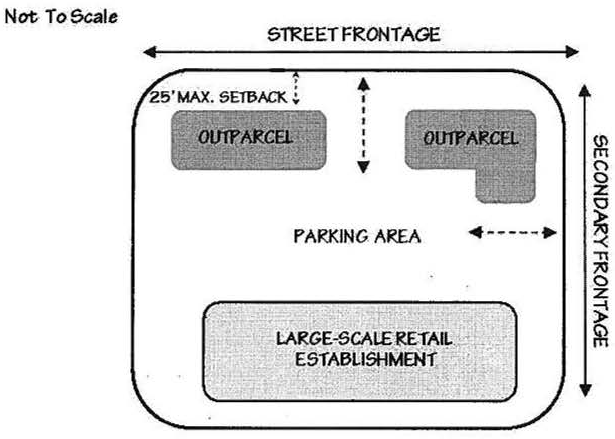
Figure 2. - Outparcel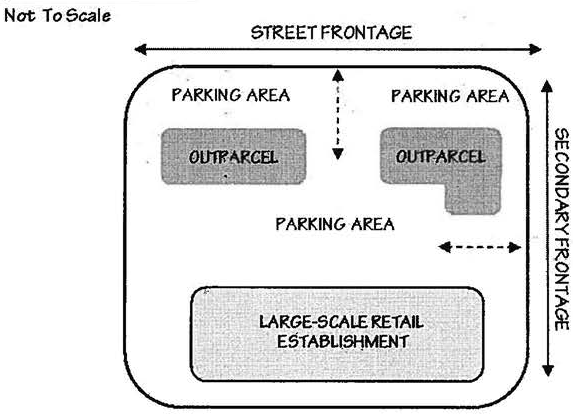
(2)
Liner buildings. Detached or attached liner buildings shall be provided along primary and secondary street frontages to screen parking areas in accordance with the maximum street setbacks defined herein. Liner buildings must be complimentary to the architectural character and style of the large-scale retail establishment or "anchor" building. The roof height of the liner building must be a minimum of five feet higher or lower than the principal structure, unless the liner building is attached by a covered walkway. Where this development option is utilized, liner building frontages shall screen at least 70 percent of the primary street frontage and 35 percent of the secondary street frontage(s), where applicable. See figure 3.
Figure 3. - Liner Buildings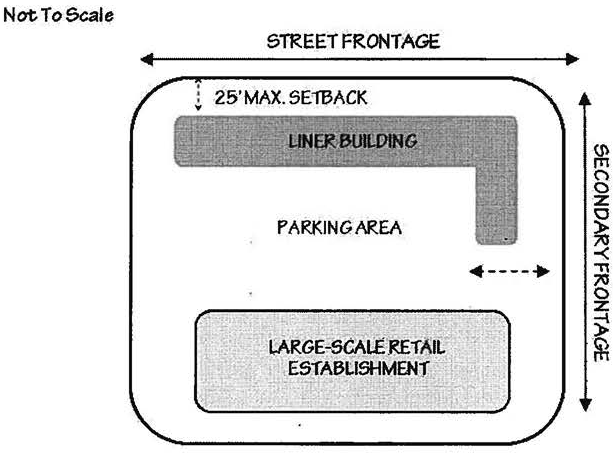
(e)
Alternative right-of-way buffer. Developments may provide an enhanced buffer along all adjacent rights-of-way where outparcels and/or liner buildings are not provided, or where outparcels and/or liner buildings do not meet the minimum screening requirements outlined above. The enhanced buffer is only required along portions of the frontage(s) that are not screened by outparcels and/or liner buildings. The minimum buffer requirements are as follows:
(1)
The landscape buffer shall be a minimum of 30 feet in width with six trees per 100 lineal feet.
(2)
An undulating berm shall be constructed along the entire length of the landscape buffer. The maximum slope will be determined based upon the berm materials utilized, and shall not exceed a 3:1 slope when planted with materials requiring mowing. The berm shall be constructed and maintained at a minimum average height of four feet as measured from adjacent roadway grade. The berm shall be planted with grasses (other than turf grass), shrubs or other types of ground cover.
(3)
The required trees and palms shall be clustered in double rows with a minimum of three trees per cluster. Canopy trees shall be planted a minimum of 30 feet on center within a cluster. Palms shall be planted in staggered heights, a minimum of three palms per cluster, spaced at a maximum of eight feet on center, with a minimum of three feet in difference in height between each tree. The maximum spacing between canopy trees and/or palm clusters is 50 feet.
(4)
All trees must be a minimum of 14 feet in height at the time of installation, and, when utilized, shrubs must be a minimum of three feet in height at time of installation.
(Ord. No. 14-18, § 2, 7-2-2014; Ord. No. 14-025, § 2, 10-15-2014)
Sec. 4-1586.- Boats, floating structures, floating equipment and live-aboards.
(a)
No boat, floating structure or other floating equipment shall be moored to mangroves, except for emergency purposes.
(b)
No person shall discharge or permit or control or command to discharge any raw sewage, garbage, trash or other waste materials into the waters of the city.
(c)
No boats, floating structures or other floating equipment designed to accommodate one or more living units, or designed or used for retail sales, shall be permitted to anchor, moor, tie up or otherwise be attached to any wharf, pier or other structure emanating from real property or to real property itself within the city, except in conformity with the regulations contained in this chapter and all other applicable city ordinances.
(d)
Except as provided in this subsection, no person shall live aboard any vessel under his command or control, which is moored to real property or to any dock, pier, seawall or other structure attached to real property in the city, except at a marina (see section 4-1587) which is properly zoned for such use under the provisions of this chapter. The provisions of this subsection shall not apply to:
(1)
Live-aboard vessels equipped with an approved discharge device and occupied by a licensed captain and his immediate family;
(2)
Commercial vessels, such as commercial fishing boats, tugs, barges, salvage vessels, passenger vessels or cargo vessels, when used in commerce and navigation; or
(3)
The mooring of any vessel necessitated by an emergency.
(e)
The exceptions granted by subsections (d)(1) and (2) of this section are not intended to apply to personal fishing boats used for recreation or to fishermen with marine products licenses.
(Ord. No. 11-02, § 3(4-1861), 1-19-2011)
Sec. 4-1587. - Marinas, fish houses and docking facilities.
(a)
Water-dependent overlay zones. Water-dependent overlay zones have been designated for shoreline areas where priority will be granted to water-dependent land uses. Policies regulating water-dependent uses in the city are mapped in the appendix of the Bonita Plan.
(b)
Marina siting criteria. The marina siting criteria set forth in the Bonita Plan must be considered in evaluating new or substantially expanded marinas, other wet slip facilities and boatramps.
(c)
Marina design criteria. The marina design criteria of the Bonita Plan must be utilized in evaluating the design of new marinas, or expansion of wet slip facilities at existing marinas.
(Ord. No. 11-02, § 3(4-1862), 1-19-2011)
Sec. 4-1588. - Construction and maintenance of docks, seawalls and other structures designed for use on or adjacent to waterways.
Construction, placement, erection and maintenance of docks, mooring piles, seawalls, watercraft landing facilities and other structures designed for use on or adjacent to waterways must be in compliance with established building permit procedures and with chapter 7, article XII. See section 4-923 et seq.
(Ord. No. 11-02, § 3(4-1863), 1-19-2011)
Sec. 4-1637.- Move-on permit.
No mobile home shall be relocated or moved onto any property without first obtaining a move-on permit from the department of community development.
(Ord. No. 11-02, § 3(4-1921), 1-19-2011)
Sec. 4-1638. - Tiedowns.
All mobile homes shall be tied down in accordance with state and insurance regulations.
(Ord. No. 11-02, § 3(4-1922), 1-19-2011)
Sec. 4-1639. - Skirting.
(a)
All mobile homes shall have removable skirting around the entire perimeter.
(b)
Skirting shall be of a durable material such as decorative block, concrete block, fiberglass, aluminum or vegetation. Junk doors or other scrap material is prohibited.
(c)
Skirting shall be maintained at all times by the resident.
(Ord. No. 11-02, § 3(4-1923), 1-19-2011)
Sec. 4-1662.- Applicability of division.
The provisions of this division apply to dwelling units, mobile homes or recreational vehicles erected or emplaced on a lot for purposes of promoting sales of units.
(Ord. No. 11-02, § 3(4-1951), 1-19-2011)
Sec. 4-1663. - Definitions.
The following words, terms and phrases, when used in this division, will have the meanings ascribed to them in this section, except where the context clearly indicates a different meaning:
Model display center means three or more single-family detached homes, mobile homes or recreational vehicles, or four or more duplex or two-family units (not buildings), erected on a single, undivided property for purposes of promoting sales of units for construction or emplacement elsewhere.
Model home means a single-family, two-family or duplex building, or a mobile home or recreational vehicle, used solely for demonstration purposes or sales promotion, not occupied as a dwelling unit, and open to the public for inspection, but the model home itself as located on the lot is not available for sale for occupancy (see Speculative home).
Model unit means a dwelling unit within a multiple-family or townhouse building, used solely for demonstration purposes or sales promotion, not occupied as a dwelling unit, and open to the public for inspection.
Speculative home means a dwelling unit, mobile home or recreational vehicle erected or emplaced on a lot for sales promotion and open to the public for inspection and which is available for sale and occupancy on the lot upon which it is located.
(Ord. No. 11-02, § 3(4-1952), 1-19-2011)
Sec. 4-1664. - Speculative homes.
Speculative homes may be permitted in any zoning district which permits construction, erection or emplacement of that type of unit; provided the unit is constructed, erected or emplaced in compliance with the property development regulations for the zoning district in which located. No advertising signs or model, "open house" or "open for inspection" signs, as defined in chapter 6, will be permitted, except a "for sale" sign.
(Ord. No. 11-02, § 3(4-1953), 1-19-2011)
Sec. 4-1665. - Model homes and model units.
(a)
Generally. Model homes and model units may be permitted by right, by special exception, or by administrative approval as specified in zoning district use regulations and as follows:
(1)
Administrative approval. The director may administratively approve the location of individual model homes and model units in any new development; provided the property remains under unified control and the provisions of this division are met.
(2)
Special exception. The city council, after public hearing, may approve the location of individual model homes and model units in existing developments; provided the provisions of this division are met.
(b)
Location; connection of utilities and certificate of occupancy.
(1)
Each model home must be located on a single lot and in accordance with the development order, if the development includes multiple structures on a single parcel. Model units are permitted in any townhouse or multiple-family building.
(2)
Model homes must be connected to water, sewer and electricity and must receive a certificate of occupancy as a model home only, prior to use as a model.
(3)
Model homes may be approved only in areas where they will not adversely affect existing residents.
(c)
Prohibited uses.
(1)
No model home or model unit may be used for living purposes either temporarily or permanently while used as a model home or model unit.
(2)
No real estate sales, except those incidental to the sale of model homes, model units or lots within the development may be conducted in a model home or model unit.
(d)
Time limitations.
(1)
Model homes. Approval for a model home will be valid for a period of time not exceeding three years from the date of issuance of a certificate of occupancy for a model home, unless the director or city council (as applicable) grants an additional specified time limit. Upon expiration of the approval, the owner may:
a.
Apply for an extension of the approval;
b.
Apply for a change of use permit to convert the model to a living unit; or
c.
Remove the model from the property.
(2)
Model units. The use of a model unit within a townhouse or multiple-family building may not extend beyond the initial sale period for that phase.
(e)
Change of use. No model home or model unit may be converted to a living unit prior to application and approval of a change of use permit.
(f)
Parking. Parking for the model home or model unit must be on the same premises and must be in compliance with parking requirements of this chapter for the type of dwelling unit or recreational vehicle being displayed.
(Ord. No. 11-02, § 3(4-1954), 1-19-2011)
Sec. 4-1666. - Model display centers.
(a)
Model display centers may be approved in commercially zoned districts that permit model display centers, as indicated in the use regulations for commercial districts. Model display centers may be approved by administrative approval in new RPD, MHPD, RVPD or MPD developments, provided the property is zoned for the type of model home, model unit or recreational vehicle displayed, but require a planned development amendment in existing RPD, MHPD, RVPD or MPD districts.
(b)
Units within a model display center may be connected to electricity, but may not be connected to water or sewer.
(c)
Units may not be used for permanent occupancy, nor may they be used to provide office space. All sales must be conducted in a main sales office on or off the premises.
(d)
Parking must be provided adjacent to the sales office in accordance with the parking regulations for offices and developed in accordance with chapter 3.
(e)
This section does not prohibit the designation of various units within a multiple-family building or complex as model units during the sale of units within the building or complex.
(Ord. No. 11-02, § 3(4-1955), 1-19-2011)
Sec. 4-1686.- Applicability of division.
The off-street loading requirements of this division shall apply to commercial, industrial and other nonresidential uses.
(Ord. No. 11-02, § 3(4-1981), 1-19-2011)
Sec. 4-1687. - Access.
(a)
Street access to off-street loading areas shall observe the same provisions as set forth for off-street parking in section 4-1725.
(b)
Except as provided in section 4-1692, off-street loading areas shall be spatially or physically separated from off-street parking areas and pedestrian walkways.
(c)
Service roads shall be a minimum of 12 feet wide for one-way usage and 24 feet for two-way operations.
(Ord. No. 11-02, § 3(4-1982), 1-19-2011)
Sec. 4-1688. - Lighting, maintenance and drainage.
Site lighting, maintenance and drainage required for off-street loading areas shall comply with the provision of sections 4-1727 and 4-1729.
(Ord. No. 11-02, § 3(4-1983), 1-19-2011)
Sec. 4-1689. - Other use of loading areas.
Except as provided in section 4-1731, off-street loading areas shall not be utilized for the sale, repair, dismantling or servicing of any vehicles or equipment, except on an emergency or temporary basis.
(Ord. No. 11-02, § 3(4-1984), 1-19-2011)
Sec. 4-1690. - Screening.
When any off-street loading area is located adjacent to a residential use or zoning district, and is not otherwise entirely visually screened from it at ground level, there shall be provided a continuous visual screen along the lot line abutting the residential use in accordance with division 17 of this article or chapter 3, whichever is the most restrictive.
(Ord. No. 11-02, § 3(4-1985), 1-19-2011)
Sec. 4-1691. - Loading area required; loading plan; location of loading area.
(a)
All commercial, industrial and other nonresidential uses shall be provided with an off-street loading area for receiving and shipment of commodities.
(b)
A plan for off-street loading areas shall be provided as part of the site plan submitted in accordance with the regulations and procedures set forth in chapter 3, or, if the development is exempt from chapter 3, then a plan shall be submitted at time of application for a building permit and be reviewed by the zoning and development review division for consistency with this division and this chapter.
(c)
The location of all off-street loading areas shall embody the following provisions:
(1)
The required loading area shall be provided on the same lot or parcel it serves.
(2)
The surfaced portions of all loading areas, excluding driveways, shall observe a 20-foot setback from all right-of-way lines and a ten-foot setback from all property under separate ownership or control.
(3)
Loading spaces shall be so located as not to obstruct or otherwise hinder or endanger the movement of vehicles and pedestrians.
(Ord. No. 11-02, § 3(4-1986), 1-19-2011)
Sec. 4-1692. - Number of spaces.
(a)
Establishments which normally receive or ship commodities via small panel trucks or vans shall not be required to provide off-street loading areas and may utilize the parking area; provided:
(1)
Deliveries normally are received before or after normal hours open to the public.
(2)
No delivery truck remains in the parking lot for more than four hours.
(3)
Deliveries do not interfere with normal pedestrian or vehicle movements.
(b)
Establishments which receive or ship goods via large semitrailer or full trailer trucks shall provide a minimum of one loading space for the first 10,000 square feet of floor area, plus one space for each additional 20,000 square feet of floor area or major fraction thereof.
(Ord. No. 11-02, § 3(4-1987), 1-19-2011)
Sec. 4-1723.- Applicability of division.
(a)
New developments. All residential and nonresidential uses are required to provide off-street and on-street parking spaces in accordance with the regulations specified in this division.
(b)
Existing developments.
(1)
Existing buildings and uses with existing off-street parking spaces may be modernized, altered or repaired without providing additional parking spaces; provided there is no increase in total floor area or capacity. Modernization of parking spaces for compliance with the Americans with Disabilities Act (ADA) of 1990 that result in a reduction of required parking may be reviewed and approved as part of the local development order review based section 4-1735. Buildings damaged in excess of 50 percent must comply with all applicable regulations.
(2)
Existing buildings or uses enlarged in terms of floor area must provide additional parking spaces for the total floor area in accordance with this division.
(3)
When the use of a building is changed to a different use that is required to have more parking than exists, the additional parking must be provided.
(c)
On-street parking. The director may approve parking to back out into rights-of-way subject to the following limitations:
(1)
Residential developments.
a.
The street must be a privately owned and maintained, low-volume, local street.
b.
All parking spaces must be for amenities to the development such as parks and recreational facilities and not for dwelling units or commercial uses.
c.
Parking spaces may be perpendicular or at a 30 or 45 degree angle to the roadway, and must comply with the parking space dimensions set forth in section 4-1728(1); The director may require surfacing to comply with section 4-1729(a) or (b), depending on the type of amenity being serve.
d.
The director's decision is final and may not be appealed.
(2)
Downtown district.
a.
Parking spaces may be perpendicular, at a 30 or 45 degree angle to the roadway, or parallel, and must comply with the parking space dimensions set forth in section 4-1728(1);
b.
Requests are subject to review by the city engineer/public works manager in accordance with section 3-303.
c.
Parking shall comply with the locational standards set forth for each transect in the downtown district.
(d)
Developments on islands without vehicular access to mainland. Developments located on islands where direct vehicular access to the mainland by bridge, causeway or street system is not attainable are not required to comply with this division.
(Ord. No. 11-02, § 3(4-2011), 1-19-2011; Ord. No. 21-10, § 2(Exh. A), 6-16-2021)
Sec. 4-1724. - Definitions.
The following words, terms and phrases, when used in this article, shall have the meanings ascribed to them in this section, except where the context clearly indicates a different meaning:
Drive-up. The terms "drive-up" and "drive-through" are synonymous.
Electric vehicle means any motor vehicle register to operate on public roadways that operates either partially or exclusively on electric energy. Electric vehicles include battery-powered electric vehicles, plug-in hybrid electric vehicles, electric motorcycles, and fuel cell vehicles
Electric vehicle charging level means the standardized indicator of electrical force or voltage at which the battery of an electric vehicle is recharged.
Electric vehicle charging station means battery charging equipment that has as its primary purpose the transfer of electric energy (by conductive or inductive means) to a battery or other energy storage device in an electric vehicle.
Electric vehicle parking space means an off-street parking space that is equipped with an electric vehicle charging station.
Employees means the regular working staff, paid, volunteer or otherwise, at maximum strength and in full-time equivalent numbers, necessary to operate, maintain or service a given facility or use under normal levels of service.
High turnover applies to parking lots wherein vehicles are parked for relatively short periods of time, ranging from a few minutes to several hours. Customer parking for retail establishments, offices, or similar establishments is considered to be high turnover.
Low turnover applies to parking wherein vehicles are parked for relatively long periods of time, such as employee parking during the day, or uses such as marina parking, cruise ship parking, sports arena parking, etc., wherein customers leave their cars for periods of four or more hours while attending special events, or overnight parking in residential developments.
Parking aisle means an accessway within a parking lot that provides direct access to individual parking spaces.
Parking lot means an area of land designed, used or intended for parking five or more vehicles.
Parking lot entrance means the accessway that provides ingress or egress from a street right-of-way or easement to a parking lot.
Parking space means an area of land designed or intended for parking one vehicle. Parking spaces are designated as handicapped spaces or standard spaces, depending on the purpose of the space.
(Ord. No. 11-02, § 3(4-2012), 1-19-2011; Ord. No. 21-10, § 2(Exh. A), 6-16-2021)
Sec. 4-1725. - Access.
(a)
Parking lots must be designed to permit vehicles exiting the parking lot to enter the street right-of-way or easement in a forward motion.
(b)
Each parking lot must have a distinct parking lot entrance.
(1)
The entrance must meet the requirements of chapter 3, as well as the following:
1.
Minimum width at property line for one-way entrances is 15 feet.
2.
Minimum width at property line for two-way entrances is 25 feet.
3.
Maximum width at property line is 35 feet.
(2)
The community development director may determine that high traffic volumes or other special circumstances warrant other requirements.
(c)
Parking lot entrances may not exceed a six percent grade for 20 feet into any lot or parcel, nor may a parking lot entrance enter a street right-of-way or easement at an angle of less than 90 degrees, unless a lesser angle is approved by the community development director.
(Ord. No. 11-02, § 3(4-2013), 1-19-2011)
Sec. 4-1726. - Parking plan.
A parking plan is required for all uses, except single-family residence, duplex, two-family attached and single-family mobile home dwelling units, and must be submitted for review and approval in accordance with chapter 3. Developments which are not required to be reviewed and approved in accordance with chapter 3 must submit plans to community development prior to issuance of a building permit. The plan must accurately designate the required parking spaces, parking aisles and parking lot entrance, as well as the relation of the off-street and on-street parking facilities to the uses or structures such facilities are designed to serve.
(Ord. No. 11-02, § 3(4-2014), 1-19-2011; Ord. No. 21-10, § 2(Exh. A), 6-16-2021)
Sec. 4-1727. - Location and design generally.
The location and design of all parking lots must embody the following provisions:
(1)
Location. All required parking spaces must be provided on the same premises and within the same or similar type zoning district as the use they serve.
(2)
Design.
a.
All parking lots must be designed in accordance with the setback, buffer, landscaping and drainage requirements set forth in chapter 3.
b.
If the parking lot will be used at night, adequate lighting must be provided for the driveways, ingress and egress points, and parking areas of all nonresidential uses. Such lighting must be so arranged and directed to eliminate glare on any other use as set forth in chapter 3.
c.
All individual parking spaces must be accessible from a parking aisle intended to provide access to the space. Stacking of vehicles (one behind the other) will be permitted only for single-family, duplex, two-family, and townhouses where each dwelling unit has a specific garage or driveway appurtenant to it and in valet parking facilities wherein parking is performed only by employees of the facility.
d.
All parking lot spaces must be provided with sufficient maneuvering room to allow an exiting vehicle to leave the parking lot in a forward motion. Parking lots utilizing 90-degree parking with dead-end aisles must provide a turning bay for those spaces at the end of the aisle.
e.
In any parking lot where more than one tier of parking spaces will be developed, a pedestrian system must be provided which accommodates safe and convenient pedestrian movement.
f.
In parking areas containing 20 or more parking spaces, up to ten percent of the parking spaces may contain compact spaces of the total parking requirement. Compact spaces shall be grouped together and each shall be identified as a "compact space" through pavement markings. Compact spaces shall not be located in high turnover areas which are in close proximity to main building entrances.
g.
In parking areas containing 20 or more parking spaces, up to five percent of the parking spaces may contain motorcycle/scooter spaces of the total parking requirement. These spaces shall be grouped together and shall be identified as a "motorcycle/scooter" through pavement markings.
h.
Electric vehicle charging stations. Charging stations and the provision of electronic vehicle parking are strongly encouraged. See section 4-1728 of the division.
(3)
Interconnectivity. To the extent practicable, adjoining parking and loading areas serving nonresidential buildings shall be interconnected.
(Ord. No. 11-02, § 3(4-2015), 1-19-2011; Ord. No. 21-10, § 2(Exh. A), 6-16-2021)
Sec. 4-1728. - Dimensional requirements; delineation of parking spaces.
In addition to satisfying all other provisions of this division, the arrangement and spacing of off-street parking lots and on-street must conform to the following requirements:
(1)
Parking space dimensions. Individual parking space dimensions are as follows:
a.
Accessible parking spaces (all): Shall be a minimum of 12 feet in width by 18 feet in depth. Accessible parking space access aisles must be no less than five feet wide and must be part of an accessible route to the building or facility entrance. In multi-tenant shopping centers, the disabled parking spaces shall be distributed throughout the site. Further compliance shall be in accordance with the Florida Accessibility Code for Building Construction [FACBC].
b.
High and low turnover parking lots:
1.
90-degree parking: Nine feet by 18 feet.
2.
30-, 45- or 60-degree parking: 8½ feet by 18 feet.
3.
Parallel parking: Eight feet by 22 feet.
4.
Compact parking: Sixteen feet by eight feet.
5.
Motorcycle/Scooter spaces: Nine feet by six feet.
(2)
Delineation of spaces.
a.
Paved parking lots.
1.
Parking spaces must be delineated by all-weather painted lines, or thermoplastic striping, not less than four inches in width, centered on the dividing line between spaces. Accessible parking spaces must be prominently outlined with blue paint, and must be repainted when necessary to be clearly distinguishable as an accessible parking space. Accessible parking space signage erected after October 1, 1996, must indicate the penalty for illegal use of the space.
2.
Parking spaces which abut landscaped areas, sidewalks, structures, property lines, or are designed as disabled parking shall be designed with wheel stops or contiguous curbing.
b.
Unpaved parking lots.
1.
Parking spaces in unpaved parking lots must be delineated by placing a parking block two feet from the end of the parking space and centered between the sides of the space.
2.
If the space abuts a structure, the space may be indicated on the structure, in which case parking blocks are not required.
c.
Temporary parking lots. (See section 4-1734) Individual spaces in temporary parking lots do not need to be delineated provided the end of each space and all aisles are clearly delineated with temporary posts and ropes.
(3)
Minimum drive aisle widths. Minimum drive aisle widths are as follows:
(4)
Parking angle. Parking must be developed throughout the site utilizing the same degree of angle. The mixture of one-way and two-way parking aisles, or different degrees of angled parking within any parking area is prohibited except:
a.
A single bay of parking provided along the perimeter of the site may vary in design in order to maximize the number of spaces provided on-site.
b.
Parking design may vary between individual parking areas provided that the parking areas are physically separated from one another by buildings or a continuous landscape buffer a minimum of five feet in width. The director may approve a minimum number of vehicle access points to pass through the landscaped buffer.
(5)
Electric vehicle parking and charging stations. If specifically designed and identified with appropriate markings and/or signage as outlined in this section, the following design standards, in addition to all other design standards set forth in this section shall apply.
a.
Electric vehicle parking spaces shall be painted green, or shall be marked by green painted lines and curbs and/or wheel stops.
b.
Each electric vehicle parking space shall be marked by a sign designating the parking space as an electric vehicle parking space, in accordance with the Manual on Uniform Traffic Control Devised (MUTCD) of the Federal Highway Administration.
c.
Each electric vehicle charging station shall be subject to the architectural provisions of chapter 3.
d.
Each electric vehicle charging station shall be equipped with a sign that includes the following information:
1.
Voltage and amperage levels;
2.
Any applicable usage fees;
3.
Safety information; and
4.
Contact information for the owner of the charging station to allow a consumer to report issues relating to the charging station.
e.
Electric vehicle charging stations shall contain a retraction device, coiled cord, or a fixture to hang cords and connectors above the ground surface.
f.
Electric vehicle charging stations shall be screened from view from any abutting rights-of-way, with the exception of alleys.
g.
Electric vehicle charging stations shall be maintained in good condition, appearance and repair.
(Ord. No. 11-02, § 3(4-2016), 1-19-2011; Ord. No. 21-10, § 2(Exh. A), 6-16-2021; Ord. No. 22-03, § 2(Exh. A), 6-15-2022)
Sec. 4-1729. - Parking lot surface.
(a)
High turnover parking lots.
(1)
Parking aisles. Except as provided in subsection (d) of this section, all high turnover parking lot aisles must be provided with a paved, dustfree, all-weather surface.
(2)
Parking spaces. All parking spaces, except those seaward of the coastal construction control line, must have a paved, dustfree, all-weather surface from the aisle to the parking block or curb. All handicapped parking spaces, including handicapped parking spaces seaward of the coastal construction control must be paved with asphalt or concrete to provide a smooth surface without gaps or holes which create a danger to the user. For all other parking spaces, the term "paved" will be interpreted to mean and include asphalt, concrete, paving block and other similar types of treatment. Parking spaces, excluding handicapped parking spaces, located seaward of the coastal construction control line must be stabilized with treatments approved by the community development director.
(b)
Low turnover parking lots.
(1)
Alternative surfaces may be permitted; provided the areas are adequately drained and continuously maintained in a dustfree manner. Alternative surfaces may include gravel, crushed shell or other similar materials. Parking on grass or other unimproved surfaces such as sand or dirt is prohibited.
(2)
Handicapped spaces must be paved with asphalt or concrete to provide a smooth surface without gaps or holes which would create a danger to the user.
(3)
Use of alternative surfaces may be approved through the local development order review process as outlined in chapter 3 and may be allowed under the following conditions:
a.
The parking area meets all of the dimensional requirements of this section and the parking spaces are delineated by parking block, curb, or in an alternate fashion;
b.
The unpaved area is contained by an approved barrier curb of sufficient size to prohibit erosion of surface material into the storm sewer or paved area; and
c.
The owner shall provide and adhere to a maintenance plan that addresses how the parking will be maintained in a neat, graded, dust-free condition, useable for parking.
The city retains the ability to require the paving of any parking or circulation element subsequent to a finding that the lot is not being properly maintained or it no longer functions in a safe and convenient manner in its unpaved condition.
(c)
Temporary parking lots. Temporary parking lots do not need to be surfaced, and may be maintained as a grass area or in a dustfree manner.
(d)
Reservation of spaces for future use.
(1)
When a use or activity is required by this chapter to provide more than ten high turnover parking spaces, the community development director may approve leaving up to 25 percent of the required spaces as landscaped areas reserved for future use; provided:
a.
The applicant clearly shows the reserved parking spaces on the site plan;
b.
The reserved parking areas are not counted towards the minimum open space or landscaping or buffering requirements of this chapter or chapter 3;
c.
All drainage facilities must be calculated and built as though the reserved parking areas were impervious surfaces; and
d.
The reserved parking areas may not be used for any purpose other than landscaped open space or temporary overflow parking during special holiday seasons or sales.
(2)
If the property owner decides to pave the reserved area for parking, he must submit the original site plan or development order approval to the community development director, who is authorized to approve the paving; provided paving does not include new entrances onto a public street. If the parking areas does involve new entrances, then a limited review development order is required.
(e)
Director discretion.
(1)
The community development director is authorized to permit high turnover parking lots, including parking lot aisles, to meet the surfacing standards for low turnover parking lots (section 4-1729(b)) under the following circumstances:
a.
The proposed parking lot will contain no more than 25 spaces;
b.
The proposed alternative surface will be adequately drained; and
c.
The proposed alternative surface is consistent with the uses and the parking lot surfaces in the surrounding neighborhood.
(2)
This subsection may not be construed inconsistently with the Americans with Disability Act (ADA) of 1990.
(3)
The director's decision is discretionary in nature and may not be appealed pursuant to section 4-124(a).
(Ord. No. 11-02, § 3(4-2017), 1-19-2011; Ord. No. 21-10, § 2(Exh. A), 6-16-2021)
Sec. 4-1730. - Joint use of parking lots.
(a)
Administrative approval. Except where specifically approved as part of a planned development district, joint use of parking lots will be permitted only after approval by the community development director. An applicant for joint use of parking lots must submit the following information on the form provided by the city.
(1)
A notarized statement identifying all property owners involved; indicating the use of each property; the extent of the activities on each parcel and the demand for parking; and the times these parking demands will occur.
(2)
A draft joint use parking agreement specifically identifying the designated spaces that are subject to the agreement, including a statement indicating that the parties understand that these designated spaces cannot be counted to support any use other than that identified in the agreement. This agreement must also identify the current property uses, property owners, and the entity responsible for maintenance of the parking space area.
(3)
Written agreements, covenants, contracts and the like acceptable to the city attorney's office, that ensure that the parking area is to be used jointly and establish the responsibility for maintenance. Upon approval of the agreement by the city attorney's office, the written joint use parking agreement must be recorded in the county public records at the applicant's expense.
(4)
A backup plan to provide sufficient parking if the joint agreement is violated by either party.
(5)
Violation of the agreement for joint use of off-street parking is sufficient grounds for revocation of the administrative approval.
(b)
Shared parking lots must be within 300 feet of each use. Shared parking lots may not be separated from the use by a street right-of-way or easement designated as an arterial or a collector roadway. Shared parking lots that are separated by an accessway or local road, two lanes or less, must include marked, safe pedestrian access connecting the two parking lots.
(c)
No part of a parking lot used, designed or intended to satisfy required parking for any use may be used to offset the parking requirements for another use, unless the peak parking demands of the uses clearly occur at different times.
Ord. No. 11-02, § 3(4-2018), 1-19-2011; Ord. No. 12-17, § 1(4-2018), 12-19-2012; Ord. No. 21-10, § 2(Exh. A), 6-16-2021)
Sec. 4-1731. - Other use of parking lots.
Except as provided in this section and in section 4-2131, required off-street parking areas may not be utilized for the sale, display or storage of merchandise, or for repair, dismantling or servicing of vehicles or equipment.
(1)
This must not be interpreted to prohibit a residential property owner from the occasional servicing of his own noncommercial vehicle or conducting normal residential accessory uses.
(2)
The following structures and uses may be approved by the director provided that a site plan is submitted showing that the structure will not reduce the parking spaces required for the principal use, create a traffic or pedestrian hazard, and all other requirements of this division and this LDC are met:
a.
Aluminum can or other similar receiving machines or facilities.
b.
Automatic teller machines (ATMs).
c.
Reserved.
d.
Other similar uses which do not interfere with the use of the parking lot.
(Ord. No. 11-02, § 3(4-2019), 1-19-2011; Ord. No. 12-17, § 1(4-2019), 12-19-2012; Ord. No. 21-10, § 2(Exh. A), 6-16-2021)
Sec. 4-1732. - Required spaces.
All uses permitted under this chapter are subject to the minimum requirements below. For uses not listed, the director shall consider the requirements for similar uses or through a parking needs analysis.
(1)
Dwelling, housing and living units. For all common parking lots, in addition to the spaces required in this subsection, additional parking spaces equal to ten percent of the total required must be provided to accommodate guest parking.
a.
Single-family, duplex, two-family attached and mobile home units. The minimum requirement is two spaces for each dwelling unit. Stacking of vehicles in the driveway is permitted.
b.
Townhouses. Minimum requirements are as follows:
1.
For townhouses with individual parking driveways on each lot, two spaces per dwelling unit. Stacking of vehicles in the driveway is permitted.
2.
For townhouses sharing a common parking lot, two spaces per dwelling unit. Stacking of vehicles in the driveway is not permitted.
c.
Multiple-family buildings. Stacking of vehicles is not permitted. Minimum requirements are as follows:
1.
Studio or efficiency: 1.25 spaces per unit.
2.
One bedroom 1.5: spaces per unit.
3.
Two bedrooms: 1.75 spaces per unit.
4.
Three or more bedrooms: two spaces per unit.
d.
Assisted living facilities (section 4-1182), continuing care facilities (section 4-1183), health care facilities, Groups I and II (section 4-408(c)(19), social services, Groups III and IV (section 4-408(c)(4) and other similar uses).
1.
Any living unit designed as a dwelling unit and intended primarily as a self-care facility will be treated as a dwelling unit and will be required to provide parking spaces as set forth in section 4-1732(1)a through c for similar type dwelling units. For purposes of this section, a microwave oven or other cooking facilities such as a toaster or a hot plate using 115-120 volt electrical service do not constitute customary cooking facilities. Where the living units are maintained under unified control and the residents are not capable or permitted to bring or operate private vehicles on the same premises, community development may authorize up to a 75 percent reduction in required parking spaces; provided sufficient parking is provided for employees and visitors.
2.
Living units which do not contain customary cooking facilities within the individual units but instead have a central kitchen for food preparation and where meals are served in a central dining area or individual rooms must calculate parking requirements as follows: one parking space per four residents or four beds (whichever is greater), plus ten percent. Where the living units are maintained under unified control and the residents are not capable or permitted to own or operate private vehicles on the same premises, community development may authorize up to a 75 percent reduction in required parking spaces; provided sufficient parking is provided for employees and visitors.
e.
Group quarters, excluding living units subject to section 4-1732(1)d. The minimum requirement is one parking space per bedroom or one space per two beds, whichever is greater.
f.
Hotels and motels. See division 19 of this article.
(2)
Commercial uses.
a.
Animal clinics. The minimum requirement is five spaces per veterinarian plus one space per employee.
b.
Animal kennels. The minimum requirement is five spaces.
c.
Automotive repair and service (excluding "drive-in oil change establishments"); automotive service stations. The minimum requirement is four spaces per service bay plus one space per employee. Drive-in oil change establishments must provide 1.5 parking spaces per service bay. In addition to the parking spaces, there must be two stacking spaces per service bay or five stacking spaces per site, whichever is greater. Each service bay may count as one stacking space.
d.
Banks and financial establishments. The minimum requirement is one space per 500 square feet of total floor area. See also subsection (2)h of this section pertaining to drive-up facilities.
e.
Bars and cocktail lounges, nightclubs. The minimum requirement is 21 spaces per 1,000 square feet of total floor area. See also subsection (2)m of this section, pertaining to restaurants, and subsection (5) of this section.
f.
Barbershops, beauty shops, massage establishments, massage parlors, etc. The minimum requirement is three spaces per operator (chair) or one space per 100 square feet of gross floor area, whichever is greater, with a minimum of five spaces.
g.
Car washes. The minimum requirement is 1.5 spaces per car wash stall or space, plus drive-up facilities (see subsection (2)h of this section). Each individual car wash stall or space may count as one of the required two parking spaces per stall.
h.
Drive-up facilities. Any commercial establishment providing drive-up service windows or stalls must provide separate vehicle stacking for those uses. For the purpose of this section, a stacking unit is defined as 18 feet in length and nine feet in width. The total number of stacking units required will be based on the type of business, as follows:
1.
Banks and financial establishments: Stacking lanes to accommodate five cars per window.
2.
Car wash: Stacking to accommodate one car per service stall or five cars, whichever is greater.
3.
Restaurants: Stacking lanes to accommodate ten cars per service lane, with a minimum of five spaces preceding the menu board.
4.
Other:
(i)
Photo drop-off, laundry drop-off or other similar type drop-off facilities: Stacking for three cars.
(ii)
All other: Stacking to accommodate five cars per service lane.
i.
Funeral homes. There must be at least one parking space per four seats, or four spaces per 250 square feet of chapel area, whichever is greater. (See subsection (7) of this section.)
j.
Offices, excluding medical. This category includes offices of all types not specifically listed elsewhere, including, but not limited to, business services Group I, contractors and builders, insurance companies, personal services, Group IV, social services, Group I, and other similar offices. The minimum requirement is one space per 300 square feet of total floor area.
k.
Offices, medical and health care facilities, Group III. The minimum requirement is 4.5 spaces per 1,000 square feet of total floor area.
l.
Mobile food vendors. The minimum requirement is three spaces per vendor.
m.
Restaurants/bakeries.
1.
Restaurants/bakeries. When a store such as a bakery provides seating for customers to eat the bakery products made on the premises, the store must provide a minimum of one parking space per table or 50 square feet of seating area (whichever is greater) in addition to one space per employee.
2.
When a restaurant is located within the same building as the principal use, and is clearly provided primarily for the employees and customers of the principal use, no additional parking spaces are required. In all other cases, parking will be as follows: The minimum requirement is 14 spaces per 1,000 square feet of total floor area, with outdoor seating calculated at the same rate.
3.
Restaurants, fast food. The minimum requirement is 13 spaces per 1,000 square feet of total floor area plus one space per four outdoor seats, except as provided for in section 4-1733. See also subsection (2)h of this section pertaining to drive-up facilities.
4.
Restaurant, carry out. The minimum requirement for restaurants that do not provide a seating area or on-premise consumption of food is three spaces per 1,000 square feet of total floor area.
n.
Retail or business establishments, freestanding. This subsection applies to individual retail or business establishments on separate parcels. The minimum number of parking spaces required will be as specified in this subsection, but in no case may be less than five spaces. Retail establishments proposing drive-up facilities must also meet the requirements of subsection (2)h of this section.
1.
Building materials and sales (retail). The minimum requirement is one space per 300 square feet of indoor sales and office area, plus one space per employee.
2.
Convenience food and beverage stores. The minimum requirement is one space per 200 square feet of total floor area. If more than 20 percent of the total floor area or 600 square feet, whichever is less, is used for the preparation and/or sale of food or beverages in a ready-to-consume state, parking for this area will be calculated the same as a fast-food restaurant. One parking space per four pumps will be credited against the required parking, where applicable.
3.
Small products or commodities. This category includes stores specializing primarily in small (hand held) products, and is intended to include clothing stores; department stores; drugstores; food stores; hardware stores hobby, toy and game shops; package stores; personal services, Groups I and II, excluding barbershops, beauty shops, massage establishments massage parlors, and health clubs and spas which are listed separately, specialty retail shops Groups I, II and III, used merchandise stores, Group I; variety stores; and other similar type stores. The minimum parking requirement is one space per 250 square feet of total floor area, excluding required parking for areas within the principal building used only for dead storage and not available to the public.
4.
Large products or commodities. This category includes stores specializing in large products, and is intended to include auto or boat parts; household/office furnishings, Groups I and II; paint, glass and wallpaper; specialty retail stores, Group IV; used merchandise stores, Groups II and III; vehicle and equipment dealers, Group II; and other similar type establishments. The minimum parking requirement is 2.5 spaces for each 1,000 square feet of total floor area. Required parking for areas within the principal building used only for dead storage and not available to the public will be computed at the rate of one space per 1,000 square feet of dead storage.
5.
Very large products or commodities. This category includes establishments specializing in very large products, and is intended to include household/office furnishings, Group III; mobile home dealers; used merchandise stores, Group IV; vehicle and equipment dealers, Groups I, III, IV and V; and other similar very large products. The minimum parking requirement is one space per 700 square feet of total floor area, plus one space per 1,500 square feet of outdoor area used for sales or display.
o.
Schools and studios, commercial.
1.
Schools, commercial. The minimum requirement is two spaces per 100 square feet of classroom floor area.
2.
Studios. The minimum requirement is one space per 300 square feet of total floor area.
(3)
Commercial/industrial uses.
a.
Manufacturing. The minimum requirement is one space per employee, based upon the largest shift. If there is more than one shift, 1.5 spaces per employee must be provided based upon the largest shift. Five additional spaces must be provided for customers.
b.
Processing and warehousing. The parking requirement is the same as required for manufacturing.
c.
Services not listed elsewhere. This category is intended for those service-oriented businesses which do not normally generate customer traffic but often maintain a fleet of company vehicles. Uses include business services, Group II; cleaning and maintenance services; contractors and builders; essential service facilities service centers; non-store retailers, and repair shops, Groups II, III and IV. The minimum parking requirement is three spaces, plus parking for company vehicles and employee parking.
d.
Terminal, freight. The minimum requirement is one space per 2,000 square feet of total floor area, with a minimum of five spaces
e.
Warehousing, private. The minimum requirement is one space per 2,000 square feet of total floor area, with a minimum of five spaces.
f.
Warehousing, public. The minimum requirement is one space per 1,000 square feet of total floor area, with a minimum of five spaces.
g.
Warehousing, mini-warehouses. The minimum requirement is one space per ten storage cubicles, with a minimum of five spaces.
h.
Wholesale establishments. The minimum requirement is 1.25 spaces per 1,500 square feet of total floor area.
(4)
Miscellaneous uses.
a.
Airports, landing strips and heliports. The required minimum number of parking spaces for these facilities will be determined by the director.
b.
Bowling alleys. The minimum requirement is six spaces for each lane, plus additional spaces for ancillary uses (see subsection (5) of this section).
c.
Clubs;fraternal or membership organizations. See Meeting halls.
d.
Day care centers. The minimum requirement is two spaces per employee in addition to adequate and safe provisions for loading and unloading of clients.
e.
Educational institutions,including public, private and parochial.
1.
Public schools. Parking must be provided in compliance with state law.
2.
Private or parochial schools.
(i)
Elementary and middle schools. The minimum requirement is one space per employee plus one space for every 40 students.
(ii)
High schools. The minimum requirement is one space per employee plus one space for every ten students.
(iii)
Colleges, universities and trade and vocational institutions. The minimum requirement is one space per employee plus sufficient space for student parking as the director deems necessary.
Where public use of an auditorium or other place of assembly within a school is likely, an additional one space for every six seats must be provided.
f.
Essential service facilities. The minimum requirement is one space per employee on the largest shift.
g.
Golf courses. Six spaces per hole (see subsection (5) of this section). However, where restaurants are made an integral part of the golf course facility, additional parking for the restaurant will be required in accordance with subsection (2)m.1 of this section to the extent that the parking requirement for the restaurant exceeds the parking requirement for the golf course.
h.
Hospitals (health care facilities, Group IV). The minimum requirement is one space per bed, excluding bassinets and gurneys, plus one space per employee on the largest shift.
i.
Marinas and other water-oriented uses.
1.
Boat slips: Two spaces per three slips.
2.
Boat ramps: For each boat ramp, ten parking spaces with dimensions of ten feet wide by 40 feet long to accommodate a vehicle and boat trailer.
3.
Dry storage: One space per four unit stalls.
4.
Charter or party fishing boat services: One space per three people based on maximum passenger capacity of the boats using the dock or loading facility.
5.
Local cruise ships: One space per two people based on the maximum passenger and crew capacity of the ship. Local cruise ships are ships that usually leave port and return in less than 24 hours and that usually provide at least one meal, gambling or other entertainment for customers.
6.
Other uses: Other uses including accessory or ancillary marina uses such as restaurants, bars or lounges, boat sales, etc., must be calculated separately in compliance with this division.
j.
Meeting halls and other places for group assembly not otherwise listed. The minimum requirement is one space per 100 square feet of floor area (for facilities with fixed seats, refer to Recreation facilities, indoor).
k.
Miniature golf. The minimum requirement is two spaces per hole for the first nine holes, plus one space per hole for each hole in excess of nine holes.
l.
Museums, art galleries, libraries and other similar uses not covered elsewhere. The minimum requirement is three parking spaces per 1,000 square feet of total floor area.
m.
Places of worship and religious facilities. Refer to division 27 of this article
n.
Recreation facilities, indoor.
1.
Gymnasiums, health clubs and similar type recreational establishments wherein large floor areas are required to accommodate equipment for individual users. Four parking spaces per 1,000 square feet of total floor area.
2.
All other indoor recreational facilities not specifically listed: One parking space per 100 square feet of total floor area.
o.
Recreation facilities, outdoor, commercial. To be determined by the director if the use is not listed in this section.
p.
Tennis courts, commercial. The minimum requirement is two spaces per court plus one space per three spectator seats. (See subsection (7) of this section).
q.
Theaters, auditoriums, skating rinks, stadiums, arenas and other similar places of public assembly not covered elsewhere. The minimum requirement is one parking space per three seats plus one space per employee. (See subsection (7) of this section). If the facility also contains uses such as restaurants (excluding concession stands), bars or lounges, or other retail facilities, parking for these uses must be calculated separately.
r.
Flea markets.
1.
Indoor: The minimum requirement is one space per 100 square feet of total floor area.
2.
Other: The minimum requirement is five spaces per rental space or booth.
s.
Carnivals, fairs and amusement attractions and devices.
1.
The minimum requirement is ten parking spaces provided for each amusement device.
2.
If the uses are located in an existing parking lot, the parking lot must have enough spaces to comply with the minimum requirements for both the principal use and the carnival, fair or amusement attraction or device. Prior to obtaining a temporary use permit (see division 37 of this article) for the temporary use of a parking lot for a carnival, fair or amusement attraction or device, the applicant must submit a site plan showing there will be no net loss or reduction in the number of parking spaces required for any existing principal use that relies on the parking lot.
3.
The uses may not be located in an existing parking lot that is already nonconforming as to the number of spaces needed for the existing uses.
t.
Community gardens. Off-street parking is not required for gardens on property less than 20,000 square feet in lot area. A low turn-over parking area must be provided for gardens over 20,000 square feet in lot area. Parking areas must be maintained as a grass area or in a dustfree manner.
(5)
Combined uses. The number of parking spaces required for combined uses is the total of the spaces required for each separate use established by this schedule, except as provided in section 4-1730 and as follows:
a.
Multiple-occupancy complexes. This subsection applies to shopping centers and other complexes where two or more different uses are located and which all share a common parking area. Specifically excluded from this subsection are:
1.
Theaters located outside of shopping centers or in shopping centers smaller than 100,000 square feet;
2.
Bowling alleys; and
3.
Bars and cocktail lounges and restaurants located outside of shopping centers or in shopping centers smaller than 50,000 square feet.
b.
Minimum requirements are as follows:
1.
Total floor area of 25,000 square feet or less: Four spaces per 1,000 square feet (or major fraction thereof) of total floor area.
2.
Total floor area of 25,000 square feet but less than 600,000 square feet: 4.5 spaces per 1,000 square feet (or major fraction thereof) of total floor area.
3.
Total floor area of 600,000 square feet or more: Five spaces per 1,000 square feet (or major fraction thereof) of total floor area.
(6)
Uses not specifically listed. Parking for uses not specifically mentioned in this chapter must be the same as uses most similar to the one sought, it being the intent to require all uses to provide off-street parking.
(7)
Bench and pew seating. In stadiums, sports arenas, churches and other places of public, 24 inches of seating facilities will be counted as one seat for the purpose of computing off-street parking requirements. See division 27 of this article.
(Ord. No. 11-02, § 3(4-2020), 1-19-2011; Ord. No. 12-13, § 1(4-2020), 8-15-2012; Ord. No. 12-17, § 1(4-2020), 12-19-2012; Ord. No. 21-10, § 2(Exh. A), 6-16-2021)
Sec. 4-1733. - Exception for fast order food establishments located in multiple use complex.
A fast order food establishment, which is part of the principal building, located within a multiple use complex exceeding 600,000 square feet of total floor area and with no drive-up facilities, will not be required to provide additional parking spaces.
(Ord. No. 11-02, § 3(4-2021), 1-19-2011)
Sec. 4-1734. - Temporary parking lots.
Temporary use permits may be issued for temporary parking lots subject to the following:
(1)
Temporary parking lots shall be allowed, in conjunction with an approved temporary use permit, commencing on December 15 and continuing until May 31. For the purposes of this subsection, temporary permits for temporary parking lots may be issued for all or part of such time period and shall not be limited to 30 days as set forth section 4-2124(d).
(2)
A temporary parking lot shall only be permitted on vacant commercial or industrial zoned property or commercial or industrial zoned property with structures; provided that, on properties with structures, the structures are vacant and remain vacant.
(3)
Temporary parking lots shall only be permitted when adjacent to a collector or arterial road or within 660 feet of a collector or arterial road. However, in no instance shall ingress and egress to the lot be through a residential neighborhood or residentially zoned district.
(4)
The applicant must submit to the director a parking plan, drawn to scale, indicating, but not limited to, the following: the location of access points, ropes and posts, and the circulation pattern within the parking lot.
(5)
The delineation of spaces for temporary parking lots shall be in accordance with section 4-1728(2)c.
(6)
The temporary parking lot surface shall be maintained in accordance with section 4-1729(c).
(7)
The temporary parking lot shall be designed so as to permit vehicles exiting the lot to enter the street right-of-way in a forward motion. The temporary parking lot, where applicable, shall utilize an existing entrance or exit, except that no additional traffic shall be directed onto residential streets. Where no access exists, the parking lot plan shall be reviewed by public works.
(8)
If the temporary parking lot is to be used at night, adequate lighting shall be provided for the driveway's ingress and egress points. The lighting shall be directed to eliminate glare on any other use.
(9)
The temporary parking lot shall be secured in a manner which will not permit ingress and egress, except during the designated hours of operation.
(10)
The temporary parking lot shall not adjoin or be less than ten feet from residential uses or residentially zoned property.
(11)
A parking attendant shall be required during the hours of operation of the temporary parking lot.
(12)
The temporary parking lot shall only be used for the parking of operable motor vehicles, with no overnight parking or camping. No other temporary or permanent use of the property shall be allowed during the life of the temporary use permit for parking.
(13)
Section 4-2131, pertaining to ancillary uses permitted in off-street parking lots, shall not apply to this section.
(14)
The hours of operation shall be from 7:00 a.m. until 10:00 p.m., unless extended by the director in writing.
(15)
The parking spaces created through the approval of temporary parking lots shall not be used for calculating off-street parking requirements as set out in section 4-1732.
(16)
Where approval for a temporary parking lot will extend beyond 30 days, the requirements of subsection (b)(17) of this section shall apply.
(17)
Where a temporary parking lot abuts residentially zoned or used property, that portion of the parking lot shall be buffered by a continuous visual screen with a minimum opacity of 75 percent and a minimum height of four feet. The visual screen may be located up to one foot from the right-of-way or street easement line. At intersections of parking lot entrances or exits with a street right-of-way or easement, no obstruction shall be planted or erected which materially obstructs the driver's view of approaching traffic or pedestrians.
(Ord. No. 11-02, § 3(4-2022), 1-19-2011)
Sec. 4-1735. - [Reduction of required parking.]
Opportunities for reduction of parking requirements shall be reviewed through a parking needs analysis. A developer may request a parking needs analysis parking during the local development order and/or building permit process by using the following method:
(1)
Submittal requirements.
a.
Preapplication meeting. A property or business owner who wishes to have a parking needs analysis approved must schedule a preapplication meeting to determine specific application requirements and an acceptable methodology.
b.
Contents. A parking needs analysis shall include one or more of the following:
1.
If the Institute of Transportation Engineers (ITE) Reference Manual entitled Parking Generation allows a lesser number of parking spaces for the proposed use or a use of similar characteristics, then the number of parking spaces required for a development may be reduced.
2.
Estimates of parking requirements based on recommendations in studies such as those from the Urban Land Institute (ULI), the Institute of Traffic Engineers (ITE), or the Traffic Institute, or industry standards based on data collected from geographic areas and uses or combinations of uses which are the same or comparable to the proposed area and use.
3.
An operational procedure which indicates that the full parking requirement is not needed, and a guarantee of continuity of such procedure.
4.
Actual parking counts for the building or site which indicate that the full number of parking spaces are not required due to parking peak demands occurring at different times. Such counts must be taken during the peak hours of the peak season.
c.
Statement of remedies. Any parking needs analysis shall include a statement of the remedies which will be available if it is determined that the full number of parking spaces as required by this section is needed. The remedy shall demonstrate that it can be implemented within a 60-day period.
d.
Preparation. If for any reason a traffic impact statement is required, the parking needs analysis shall be prepared by the registered professional engineer who prepared the traffic impact statement. If a traffic impact statement is not required, the parking needs analysis may be prepared by the owner or petitioner. The parking needs analysis shall be conducted according to the methodology agreed upon at the preapplication meeting and shall include all documentation agreed upon at the preapplication meeting.
(2)
If the number of spaces approved by the parking needs analysis is found to be insufficient, the city manager or designee shall notify the property owner by certified mail that remedies must be implemented within 60 days. The city manager or designee shall make a determination of insufficient parking by one of the following methods:
a.
Monitoring of the parking;
b.
Increased parking in the right-of-way caused by insufficient parking on site for that property; or
c.
Verified complaints of parking on neighboring properties.
(Ord. No. 21-10, § 2(Exh. A), 6-16-2021)
Sec. 4-1762.- Property development regulations.
(a)
Noncommercial or nonindustrial districts. All religious facilities and all places of worship located in noncommercial or nonindustrial districts shall be subject to the following property development regulations:
(1)
Minimum lot area and dimensions.
a.
Minimum lot area is two acres.
b.
Minimum lot width is 100 feet.
c.
Minimum lot depth is 100 feet.
(2)
Maximum building height. The building height shall be governed by the zoning district within which the use is located; provided, however, that in no zoning district shall any height limitation apply to a church spire or any single-story portion of a structure.
(3)
Maximum lot coverage. Maximum lot coverage is 40 percent in all districts, unless a zone is less restrictive.
(4)
Setbacks.
a.
Minimum front setback is 25 feet.
b.
Minimum side setback is ten percent of the lot width, with a minimum of 20 feet and a maximum of 40 feet. If a structure exceeds 35 feet in height, the required side setback shall be increased on each side by an additional one-half foot for every foot of height over 35 feet. It is the intent of this subsection that flexibility of site design should be achieved by permitting the portion of a particular side setback in excess of 30 feet to be provided for by increasing the opposite side setback in the amount of such excess.
c.
Minimum rear setback is 20 feet.
d.
Minimum water body setback is 25 feet.
(b)
Commercial and industrial districts. All places of worship and all religious facilities located in a zone permitting both residential and commercial uses as principal uses shall adhere to the commercial property development regulations of that district.
(Ord. No. 11-02, § 3(4-2051), 1-19-2011)
Sec. 4-1763. - Parking.
(a)
Places of worship. Parking for places of worship shall be provided at the ratio of one parking space per three seats within the sanctuary or main assembly hall, whichever is greater. See section 4-1732(7) for computation of parking requirements for pew seats.
(b)
Religious facilities. Parking for religious facilities shall be the same as for places of worship, with additional parking for ancillary facilities as required in division 26 of this article; provided that, where the ancillary facilities will not be used at the same time, parking shall be based upon the peak anticipated attendance at any one time, for all facilities.
(c)
Parking on grass. Up to 50 percent of the parking spaces required for the sanctuary or main assembly hall of a place of worship may be provided as parking on grass; provided the regulations set forth in the following sections of division 26 of this article, pertaining to off-street parking requirements, are met:
(1)
Section 4-1725, concerning parking lot access.
(2)
Section 4-1726, concerning parking plans.
(3)
Section 4-1727(1), concerning location.
(4)
Section 4-1727(2), concerning design, subsections a, c and d.
(5)
Section 4-1728(1)b, concerning dimensional requirements.
(6)
Section 4-1728(3), concerning aisle widths.
(Ord. No. 11-02, § 3(4-2052), 1-19-2011)
Sec. 4-1764. - Expansion of existing place of worship.
Expansion of existing places of worship, lawfully existing as of August 1, 1986, by right or by special exception, is hereby declared a legal use. Additions, renovations or other expansion of the main place of assembly may be permitted upon application for and approval of a building permit in accordance with all applicable city regulations, without the requirement of special exception approval. Any expansion which would constitute a religious facility will require a special exception, except in those zoning districts where permitted by right.
(Ord. No. 11-02, § 3(4-2053), 1-19-2011)
Sec. 4-1792.- Nurseries.
Where the zoning district use regulations permit plant nurseries, the following provisions apply:
(1)
The area so used shall be set back at least 25 feet from all street rights-of-way or easements; and
(2)
Fertilizer, compost, etc., shall be limited to quantities for immediate use, and kept at least 100 feet from any residential use.
(Ord. No. 11-02, § 3(4-2081), 1-19-2011)
Sec. 4-1818.- Applicability of district use regulations.
The limited enumeration of a private, fraternal or membership organization club use is not meant to limit or abridge the rights of assembly in any way. Such organizations are not prohibited from meeting in various traditional and appropriate places. For example, a service club's weekly meeting at a restaurant in a district not otherwise allowing fraternal, membership organization or private clubs shall not constitute a zoning violation. However, where such an organization is the principal user of real property for meetings, entertainment, and food and beverage service, such a meeting place, hall or clubhouse shall be permitted only where this use is explicitly enumerated.
(Ord. No. 11-02, § 3(4-2111), 1-19-2011)
Sec. 4-1943.- Use as permanent residence.
The use of a recreational vehicle type unit by a permanent resident as a permanent residence, as the terms are defined in F.S. ch. 196, is expressly prohibited as of September 16, 1985. Persons who have established permanent residency within a recreational vehicle park as of September 16, 1985, are exempt from the residency provisions of this section, provided that the proof of residency was established by an affidavit filed with the county prior to October 31, 1985.
(Ord. No. 11-02, § 3(4-2351), 1-19-2011)
Sec. 4-1970.- Noncommercial schools.
(a)
Permitted districts. All noncommercial schools constructed by the district school board on land owned by the district school board are permitted by right in any zoning district. All other noncommercial schools are permitted by right or are required to obtain special exception approval prior to any new construction or expansion of an existing facility, in accordance with the district use regulations.
(b)
Access. Access requirements for new schools are as follows:
(1)
Whenever possible, elementary schools will have access to local or collector streets; and
(2)
Secondary schools must have access to a collector or arterial street.
(c)
Location. No school site will be approved which, in the opinion of the city council, is exposed to physical constraints, hazards or nuisances which are detrimental to the health and safety of students and to the general operation of the school.
(Ord. No. 11-02, § 3(4-2381), 1-19-2011)
Sec. 4-1994.- Location and construction.
All on-site and off-site signs shall be located, erected and constructed in accordance with chapter 6.
(Ord. No. 11-02, § 3(4-2411), 1-19-2011)
Sec. 4-2012.- Intent of division.
It is the intent of this division to set forth minimum setback requirements for certain types of uses not specifically regulated elsewhere in this chapter. Where a use is not specifically regulated, the setback requirements of the zoning district in which the use is located will govern. Where this division specifies a different setback, the most restrictive will prevail.
(Ord. No. 11-02, § 3(4-2441), 1-19-2011)
Sec. 4-2013. - Definitions.
The following words, terms and phrases, when used in this division, shall have the meanings ascribed to them in this section, except where the context clearly indicates a different meaning:
Residentially zoned property means any property zoned RS, TFC, TF, RM, RV, RVPD, MH, RPD or MHPD, and those portions of property zoned CPD indicating residential use.
(Ord. No. 11-02, § 3(4-2442), 1-19-2011)
Sec. 4-2014. - Minimum required setbacks.
(a)
The following uses must be set back a minimum of 660 feet from any residentially zoned property under separate ownership. The setback applies to all buildings and structures, and all areas used for parking of trucks or equipment, shipping, receiving, or storage.
(1)
Dumps, refuse and trash.
(2)
Essential service facilities, Group III (section 4-408(c)(13)).
(3)
Junkyard (df) or salvage yard.
(4)
Landfills, sanitary.
(5)
Manufacturing of:
a.
Chemicals and allied products, (section 4-408(c)(6)). All except drugs, perfumes, toilet articles, etc.).
b.
Fabricated metal products, Group I (section 4-408(c)(14)).
c.
Lumber and wood products, Group III (section 4-408(c)(24)).
d.
Machinery, Groups II and III (section 4-408(c)(25)).
e.
Paper and allied products, Group II (section 4-408(c)(29)).
f.
Petroleum (section 4-408(c)(32)).
g.
Stone, clay, glass and concrete products, Groups II and IV (section 4-408(c)(45)).
h.
Textile mill products, Group III (section 4-408(c)(47)).
i.
Tobacco (section 4-408(c)(48)).
j.
Transportation equipment, Groups I, III, and IV (section 4-408(c)(49)).
(6)
Research and development laboratories, Group III (section 4-408(c)(38)).
(7)
Lumber and wood products, Group I (section 4-408(c)(24) excluding woodchopping operations).
(8)
Stockyards.
(9)
Wrecking yard—auto and other.
(b)
The following uses must be set back a minimum of 330 feet from any residentially zoned property under separate ownership. The setback applies to all buildings and structures, and all areas used for parking of trucks or equipment, shipping, receiving, or storage.
(1)
Hatcheries, poultry.
(2)
Manufacturing of:
a.
Food and kindred products, Group III (section 4-408(c)(15)).
b.
Leather products, Group II (section 4-408(c)(23)).
c.
Lumber and wood products, Group I (section 4-408(c)(24)) excluding sawmills and planing mills.
(3)
Research and development laboratories, Group I (section 4-408(c)(38)).
(4)
Wholesale establishments, Groups I and II (section 4-408(c)(53)).
(c)
The following uses must be set back a minimum of 300 feet from any property under separate ownership zoned other than AG or IG. The setback applies to all buildings and structures, and all areas used for parking of trucks or equipment, shipping, receiving, or storage.
(1)
Feedlots.
(2)
Milk processing plants.
(3)
Fertilizer mixing.
(4)
Bulk chemical storage for crop dusting.
(d)
The following uses must be set back a minimum of 100 feet from any residentially zoned property under separate ownership. The setback applies to all buildings and structures, and all areas used for parking of trucks or equipment, shipping, receiving, or storage.
(1)
Blacksmith shop.
(2)
Freight and cargo handling establishments (section 4-408(c)(17)).
(3)
Manufacturing of:
a.
Boats.
b.
Chemicals and allied products, (section 4-408(c)(6)) - Limited to cosmetics, perfumes, etc.).
c.
Fabricated metal products, Group II (section 4-408(c)(14)).
d.
Food and kindred products, Group II (section 4-408(c)(15)).
e.
Furniture and fixtures (section 4-408(c)(18)).
f.
Leather products, Group I (section 4-408(c)(23)).
g.
Lumber and wood products, Group II (section 4-408(c)(24)).
h.
Machinery, Group I (section 4-408(c)(25)).
i.
Paper and allied products, Group I (section 4-408(c)(29)).
j.
Stone, clay, glass and concrete products, Groups I and III (section 4-408(c)(45)).
k.
Textile mill products (section 4-408(c)(47)).
l.
Transportation equipment, Group II (section 4-408(c)(49)).
(4)
Motion picture studio.
(5)
Photofinishing laboratory (df).
(6)
Rental or leasing establishment, Group IV (section 4-408(c)(36)).
(7)
Repair shops, Group V (section 4-408(c)(37)).
(8)
Social services, Group II (section 4-408(c)(43)).
(e)
Except when located in the C-2 district, the following uses must be setback a minimum of 100 feet from any residentially zoned property under separate ownership. If located in the C-2 district, the setback must be as required for other uses in the same district.
(1)
Manufacturing of:
a.
Apparel (section 4-408(c)(1)).
b.
Electrical machinery and equipment (section 4-408(c)(11)).
c.
Fabricated metal products, Group III (section 4-408(c)(14)).
d.
Food and kindred products, Group I (section 4-408(c)(15)).
e.
Lumber and wood products, Group I (section 4-408(c)(24)).
f.
Measuring, analyzing, and controlling instruments (section 4-408(c)(26)).
g.
Novelties, jewelry, toys, signs, Groups I, and II (section 4-408(c)(27)).
h.
Rubber, plastics, and fiberglass products, Group II (section 4-408(c)(41)).
(f)
The minimum setbacks set forth in subsections (a), (b), (d), and (e) of this section are not applicable to those facilities legally in existence and operation, or to an industrial subdivision legally in existence, prior to a residential zoning or use being approved closer than the required setbacks.
(Ord. No. 11-02, § 3(4-2443), 1-19-2011; Ord. No. 17-03, § 1, 2-1-2017)
Sec. 4-2037.- Applicability of division.
The regulations set forth in this division for specific sports/amusement parks and facilities are in addition to any other applicable regulations. In the case of conflict, the most restrictive regulations shall apply.
(Ord. No. 11-02, § 3(4-2471), 1-19-2011)
Sec. 4-2038. - Required approvals.
(a)
New sports/amusement parks and recreational facilities. The following types of sports/amusement parks and recreational facilities, regardless of land area involved, shall only be permitted when approved as a planned development district:
(1)
Arenas, stadiums, racetracks and other similar facilities, private or commercial.
(2)
Drive-in theaters.
(3)
Any commercial sports/amusement park and recreational facility exceeding ten acres in land area.
(b)
Existing recreational facilities and parks.
(1)
Planned developments. Recreation halls and other sports/amusement parks and recreational facilities within an approved PUD or PD shall be subject to the provisions of the approving resolution or ordinance.
(2)
Other developments. Recreation halls and other sports/amusement parks and recreational facilities lawfully existing as of the effective date of the ordinance from which this section is derived shall be permitted to remain, provided that any expansion of land area, buildings or structures shall comply with the provisions of this section.
(Ord. No. 11-02, § 3(4-2472), 1-19-2011; Ord. No. 12-17, § 1(4-2472), 12-19-2012)
Sec. 4-2039. - Minimum lot area.
All sports/amusement parks and facilities, whether a principal use or accessory use, shall be located on property meeting the minimum lot size and dimensions of the zoning district in which located as well as any additional area, width or depth required to permit full compliance with all setbacks, ground cover, open space, buffering, drainage and parking requirements as set forth in this chapter or chapter 3, whichever is most applicable.
(Ord. No. 11-02, § 3(4-2473), 1-19-2011)
Sec. 4-2040. - Setbacks.
(a)
Minimum setbacks. Minimum setbacks for uses subject to this division are as follows:
(1)
Street setbacks shall be as set forth in section 4-1893.
(2)
Water body setbacks shall be as set forth in section 4-1895.
(3)
Side and rear setbacks shall be as set forth in the property development regulations of the zoning district in which located, except as provided in this division.
(b)
Setback requirements for specific uses. Setback requirements for specific uses are as follows:
(1)
Commercial outdoor sports/amusement parks, amusement devices and water slides. Amusement devices, water slides, miniature golf and other commercial outdoor sports/amusement parks and facilities not specifically regulated shall be located not less than 500 feet or a distance equal to the height of the structure or device, whichever is greater, from any property under separate ownership, provided further that such setback shall be 100 feet from any adjacent property zoned RS, TF, TFC, RM, MH or RPD, or any existing residential use.
(2)
Arenas, stadiums and racetracks. No commercial or private arenas, stadium facilities, racetracks or other similar commercial or private facilities, other than parking, shall be permitted within 500 feet from any property line abutting property zoned RS, TF, TFC, RM, MH or RPD, or any existing residential use, provided that the 500 foot setback shall only apply to property outside of the planned development project.
(3)
Bleachers and other seating facilities. All outdoor seating facilities, including, but not limited to, bleachers and other outdoor seating areas, shall be located not less than 25 feet from any property under separate ownership.
(4)
Drive-in theaters. All outdoor movie screens shall be located a minimum of 100 feet from any lot line, with the screen so oriented that the picture is not visible from any existing or proposed arterial or collector street.
(5)
Golf driving range not part of an approved golf course. The playing area and hitting field for a golf driving range not part of an approved golf course shall be set back sufficiently to prevent golf balls from being hit onto property under separate ownership.
(6)
Recreation halls and private clubs. Recreation halls and ancillary facilities and private clubs shall be located at least 40 feet from any residential dwelling and situated in a manner so as to encourage pedestrian and bicycle traffic.
(7)
Other facilities. The following facilities are specifically regulated elsewhere in this chapter:
a.
Marinas, section 4-1587.
b.
Stables, boarding and commercial, division 6 of this article.
c.
Swimming pools and tennis courts, division 2 of this article.
(Ord. No. 11-02, § 3(4-2474), 1-19-2011; Ord. No. 12-17, § 1(4-2474), 12-19-2012)
Sec. 4-2041. - Access.
Arenas, drive-in theaters, racetracks, stadiums and other similar types of sports/amusement facilities shall provide vehicular access from an arterial or collector street. Such access points shall be located so as to minimize vehicular traffic to and through local streets in nearby residential neighborhoods.
(Ord. No. 11-02, § 3(4-2475), 1-19-2011)
Sec. 4-2042. - Accessory uses.
(a)
Accessory uses, buildings or structures for sports/amusement parks and recreational facilities which are customarily incidental to the principal use may be permitted. Such uses include, but are not limited to, restroom facilities, maintenance sheds, refreshment stands (with no alcoholic beverages unless approved in accordance with division 5 of this article), pro shops (where applicable), and administrative offices.
(b)
During daylight hours, drive-in theater parking areas may be used for a flea market, provided no buildings are erected in connection with such use. Drive-in theaters may also be used to provide offsite parking for arenas, stadiums, etc., in accordance with section 4-2044, if approved by the city council.
(c)
Food and beverage service, limited, is permitted in any recreation hall; provided, however, no alcoholic beverages shall be distributed or consumed on the premises except in compliance with division 5 of this article.
(Ord. No. 11-02, § 3(4-2476), 1-19-2011)
Sec. 4-2043. - Lighting.
Artificial lighting used to illuminate the premises of sports/amusement parks and recreational facilities shall be directed away from adjacent properties and streets.
(Ord. No. 11-02, § 3(4-2477), 1-19-2011)
Sec. 4-2044. - Parking.
(a)
Parking facilities for sports/amusement parks and recreational facilities shall be provided in accordance with division 26 of this article.
(b)
For occasional use facilities such as arenas and stadiums, the city council may allow up to 50 percent of the parking requirement to be met off the site, provided that:
(1)
The developer owns or otherwise controls the offsite parking facility or has a binding letter from the owner of the property granting use of the property or parking facility during the life of the arena or stadium;
(2)
The developer provides adequate transportation from the parking facility to the stadium or arena; and
(3)
The developer provides additional security and traffic control personnel for any event wherein the offsite parking facilities will be required, satisfactory to the city council.
(c)
Parking facilities for occasional use sports/amusement parks and recreational facilities that are lawfully existing and received a certificate of occupancy or certificate of completion prior to January 1, 1995, will be provided as follows:
(1)
For occasional use facilities such as arenas and stadiums, the director of the department of community development may allow up to 80 percent of the parking requirement to be met off the site, provided:
a.
The developer owns or controls the off-site parking facility or has a binding letter from the owner of the property granting use of the property or parking facility during the life of the temporary use permit, (see subsection (c)(2) of this section);
b.
The developer provides adequate transportation from the parking facility to the stadium or arena; and
c.
The developer provides additional security and traffic control personnel satisfactory to the city manager or his designee for any event which requires the off-site parking facilities.
(2)
Parking facilities for occasional use sports/amusement parks and recreational facilities must be provided in accordance with section 4-2022, except as modified herein.
a.
Temporary parking lots may be allowed, in conjunction with an approved temporary use permit, yearround. For the purposes of this subsection, temporary permits for temporary parking lots are not limited to 30 days as set forth in section 4-2124(d).
b.
A temporary parking lot may only be permitted on:
1.
Vacant agricultural, commercial, community facilities, or industrial zoned property; or
2.
Commercial or industrial zoned property with structures provided the structures are vacant and remain vacant for the duration of the temporary use permit.
(Ord. No. 11-02, § 3(4-2478), 1-19-2011)
Sec. 4-2045. - Sound systems.
Sound systems for sports/amusement parks and recreational facilities shall meet the requirements of the noise control ordinance.
(Ord. No. 11-02, § 3(4-2479), 1-19-2011)
Sec. 4-2069.- Applicability of division.
(a)
Except as provided in this section, the regulations set forth in this division shall apply to all outdoor display of merchandise which is offered for sale or rent, and to all storage facilities as defined in this division.
(b)
The provisions of the division do not apply to the display, sale or rental of motor vehicles, boats, recreational vehicles, trailers, mobile homes, construction or farm equipment (see section 4-1099); or to junk, scrap or salvage yards (see division 20 of this article); or to refuse, trash dumps and sanitary landfills (see division 20 of this article); or to garage or yard sales by residents of dwelling units on their own property (see section 4-408(c)(41)); or to the mooring or docking of aircraft or watercraft.
(Ord. No. 11-02, § 3(4-3001), 1-19-2011)
Sec. 4-2070. - General setback requirements.
(a)
All buildings and structures for uses subject to this division shall comply with the setback requirements for the zoning district in which the use is located.
(b)
Some zoning districts have specific setback requirements which may apply to storage areas.
(Ord. No. 11-02, § 3(4-3002), 1-19-2011)
Sec. 4-2071. - Lighting.
Artificial lighting used to illuminate premises subject to this division shall be directed away from adjacent properties and streets, shining only on the subject site.
(Ord. No. 11-02, § 3(4-3003), 1-19-2011)
Sec. 4-2072. - Outdoor display of merchandise for sale or rent.
(a)
Display setbacks. No merchandise displayed out of doors shall be located within ten feet of any property line, or within 25 feet of any street right-of-way or street easement. Where chapter 3 or chapter 4, division 11 requires different setbacks, the regulation which requires the greatest setback shall control.
(b)
Display area.
(1)
No required parking space or aisle, or required loading space, shall be used for display purposes.
(2)
Areas used for display purposes do not need to be paved; provided, however, that the area is maintained in a sightly, dustfree manner.
(c)
Outdoor display of trucks in conjunction with self-storage facilities. Truck rentals, including vans or other motor vehicles, must be parked where they are not visible from public or private roadways, or from residentially zoned properties.
(Ord. No. 11-02, § 3(4-3004), 1-19-2011; Ord. No. 15-27, § 2, 12-2-2015; Ord. No. 17-02, § 1, 2-1-2017)
Sec. 4-2073. - Storage facilities.
(a)
Indoor storage.
(1)
Permitted districts. Except for warehouses and mini-warehouses, indoor storage is permitted within any zoning district when accessory to the permitted principal use of the property. Warehouses and mini-warehouses are permitted only in zoning districts for which it is specifically stated that such uses are permitted.
(2)
Setbacks. All buildings used for indoor storage which are located on the same lot as the principal building shall comply with the setback requirements for accessory buildings. Buildings used for indoor storage which are not on the same lot as the principal building, but are on the same premises, shall meet the setbacks set forth in the district regulations for principal buildings.
(b)
Open storage.
(1)
Fencing and screening. All commercial or industrial outdoor storage must be shielded behind a continuous visual screening at least eight feet in height when visible from a residential use or residential zoning district, and six feet in height when visible from any street right-of-way or street easement.
(2)
Storage area. Storage areas do not need to be paved. Grass or other ground cover may be used provided it is kept in a sightly and dustfree manner.
(c)
Bulk storage of flammable liquids.
(1)
Firewalls or dikes required. Whenever aboveground tanks for storage of gasoline, gas, oil or other flammable liquids are located on any land where such use is permitted, such tanks shall be surrounded by an unpierced firewall or dike of such height and dimensions as to contain the maximum capacity of the tanks. All storage tanks and adjacent structures shall meet the requirements of the board of fire underwriters.
(2)
Exceptions. Storage tanks containing liquefied petroleum, commonly known as bottled gas, are specifically excluded from the provisions of this subsection.
(Ord. No. 11-02, § 3(4-3005), 1-19-2011)
Sec. 4-2074. - Self-storage facilities.
(a)
Enhanced buffer requirements. Self-storage facilities must provide enhanced buffers where the project abuts or is visible from public or private roadways, and residentially-zoned properties as follows:
(1)
Right-of-way buffer. Where self-storage facilities abut a public right-of-way, the following buffer requirements shall apply:
a.
The landscape buffer shall be a minimum of 30 feet in width with six trees per 100 lineal feet.
b.
An undulating berm shall be constructed along the entire length of the landscape buffer. The maximum slope will be determined based upon the berm materials utilized and shall not exceed a 3:1 slope when planted with materials requiring mowing. The berm shall be constructed and maintained at a minimum average height of four feet as measured from adjacent roadway grade. The berm shall be planted with grasses (other than turf grass), shrubs or other types of groundcover.
c.
The required trees and palms shall be clustered in double rows with a minimum of three trees per cluster. Canopy trees shall be planted a minimum of 30 feet on center within a cluster. Palms shall be planted in staggered heights, a minimum of three palms per cluster, spaced at a maximum of eight feet on center, with a minimum of three feet in difference in height between each tree. The maximum spacing between canopy trees and/or palm clusters is 50 feet.
d.
All trees must be a minimum of 14 feet in height at the time of installation, and, when utilized, shrubs must be a minimum of three feet in height at time of installation.
(2)
Buffers adjacent to residentially zoned property.
a.
Where self-storage facilities abut residentially zoned properties, a type "F" buffer must be provided in accordance with section 3-418.
b.
Where self-storage facilities do not directly abut but are visible from residentially zoned properties (including upper stories of multi-story facilities) the property line closest to the residentially zoned property must be planted with a type "D" buffer in accordance with section 3-418.
(3)
Where internal drive aisles and accessways are located along the perimeter of the development, a 15-foot-wide buffer must be provided, and include six trees per 100 linear feet, and a double-staggered hedgerow, maintained at 60 inches and planted at 48 inches in height, to provide a continuous visual screen within one year after time of planting.
(4)
All other perimeter buffers must comply with the requirements set forth in section 3-418(d)(4)
(b)
Outdoor storage. All outdoor storage, including, but not limited to, the parking of RVs, boats, commercial trucks, and personal vehicles must be covered with a structure that is architecturally consistent with the principal structures, and screened by a decorative masonry wall, or wall/berm combination, not less than eight feet in height, and located a minimum of 25 feet from the property line. The exterior side of the wall must be planted with a double-staggered hedgerow no less than 48 inches at the time of planting and maintained at 60 inches within two years of planting, in addition to five trees per 100 linear feet.
(c)
Setbacks. All buildings and structures must comply with the following setbacks. In no case shall multi-story self-storage facilities be located closer to the property line than one half the building height:
(1)
Street setback: In accordance with LDC section 4-1893.
(2)
Side yard setback: 20 feet.
(3)
Rear yard setback: 20 feet.
(Ord. No. 17-02, § 1, 2-1-2017)
Subdivision II. - Temporary Uses[10]
Editor's note— Ord. No. 19-06, § 1, adopted July 17, 2019, repealed the former subdivision II, §§ 4-2124—4-2132, and enacted a new subdivision II to read as set out herein. The former subdivision II pertained to similar subject matter and derived from Ord. No. 11-02, § 3(4-3041)—(4-3049), Jan. 19, 2011; Ord. No. 12-13, § 1(4-3041), Aug. 15, 2012; Ord. No. 13-02, § 1(4-3041), (4-3046)—(4-3049), Feb. 20, 2013.
Sec. 4-2190.- Applicability of division.
(a)
This division provides minimum regulations for social services, Groups III through V, which are not regulated elsewhere in this chapter.
(b)
The provisions of this division do not apply to community residential homes, as defined under section 4-2192 and the Local Land Use and Fair Housing Act. The city acknowledges that 42 USC 3604(f) prohibits a public entity from discriminating against disabled persons by denying such persons the ability to live in a dwelling, including recovering individuals where they are the individuals who would be residing in a substance abuse treatment facility. To the extent there is a conflict and the ability to provide a reasonable accommodation for the disability has been exhausted, the city will not require any provision herein that is prohibited by any state or federal Fair Housing Acts, the Americans with Disabilities Act, the Rehabilitation Act, or other state and federal laws. The city will enforce any provision of this section that does not conflict with these laws.
(c)
This division does not apply to a temporary social service uses established immediately after a natural disaster which results in a local disaster proclamation by the city council.
(d)
This division does not apply to domestic violence abuse centers.
(e)
Any schedule of uses in an approved zoning prior to January 1, 2013, that contained social services, Groups I through IV, will be treated as having social services, all groups. Group V is subject to the regulations as specified within this division.
(Ord. No. 13-05, § 4-3071, 4-3-2013)
Sec. 4-2191. - Purpose.
The purpose of this division is to provide regulations for social service, Groups III through V, as outlined in section 4-408(c)(43). These regulations recognize that it is in the public interest to provide diverse and accessible social services to people who would otherwise not receive it, and to ensure that standards of public health and safety are maintained. The regulations are intended to reduce conflicts between these and other uses in recognition of the potential land use impacts.
(Ord. No. 13-05, § 4-3072, 4-3-2013; Ord. No. 17-03, § 1, 2-1-2017)
Sec. 4-2192. - Definitions.
The definitions in this section are for defining social services. The definition of an use described below excludes the use as a homeless shelter unless the definition specifically states that it is for a homeless shelter.
Community residential home. See F.S. ch. 419.
Community residential home resident means any of the following: a frail elder as defined in F.S. § 429.65; a person who has a handicap as defined in F.S. § 760.22(7)(a); a person who has a developmental disability as defined in F.S. § 393.063; a non-dangerous person who has a mental illness as defined in F.S. § 394.455; or a child who is found to be dependent as defined in F.S. § 39.01 or 984.03, or a child in need of services as defined in F.S. § 984.03 or F.S. § 985.03.
Day shelter means a facility open to the public providing a temporary location for activities of daily living typically performed in one's home to persons who may have been displaced from their habitual residences as a result of domestic violence, condemnation, court ordered eviction, or other urgent or chronic needs. The term "day shelter" excludes shelters providing overnight lodging, soup kitchens, facilities that are licensed by the state (such as day care centers), and temporary shelters or housing created in response to natural disasters.
Developmental disability center means a state-owned and state-operated facility providing for the care, habilitation, and rehabilitation of clients with developmental disabilities.
Domestic violence abuse centers means any facility primarily engaged in providing temporary housing, counseling, and related social services for victims of domestic violence, including dependents of the victim.
Halfway homes for delinquents and offenders means a rehabilitation facility primarily engaged in providing temporary living facilities and other social services for delinquents and offenders that have been released from a physically secure correctional institution, and need an intermediate degree of care before returning to independent community living.
Halfway or self-help group homes for persons with social or personal problems means a rehabilitation facility primarily engaged in providing temporary living facilities and other social services for individuals undergoing treatment for mental illness or addiction disorders, including, but not limited to, drug and alcohol abuse, who do not require in-patient hospitalization or institutionalization, but need an intermediate degree of care before returning to independent community living.
Homeless shelter means any facility where the primary purpose is to provide temporary shelter for the homeless. The facility provides overnight sleeping accommodations with or without charge and may provide meals and ancillary social, educational or health services. The facility is staffed.
Juvenile means any unmarried person under the age of 18 who has not been emancipated by order of the court and who has been found or alleged to be dependent, in need of services, or from a family in need of services; or any married or unmarried person who is charged with a violation of law occurring prior to the time that person reached the age of 18 years.
Juvenile correctional homes means a physically secure residential commitment program with a designated length of stay from 18 months to 36 months, primarily serving children 13 years of age to 19 years of age or until the jurisdiction of the court expires. Each child committed to this level must meet one of the criteria outlined in F.S. § 985.465.
Offender rehabilitation agencies means any facility primarily engaged in the provision of rehabilitation services and support programs for offenders on probation or parole, in order to facilitate a successful transition from incarceration to independent community living. These facilities do not provide temporary or long-term resident facilities.
Outpatient substance abuse and addiction treatment facilities means any facility primarily engaged in providing treatment, recovery or rehabilitation services with or without medication, which do not provide resident facilities.
Rehabilitation center means any facility primarily engaged in providing treatment, recovery or rehabilitation services with or without medication, which provides temporary living facilities.
Settlement house means a facility primarily engaged in providing one or more of a wide variety of individual and family social, counseling, welfare, or referral services, including refugee, disaster, and temporary relief services. This use includes offices of specialists providing counseling, referral, and other social services. These facilities do not provide overnight lodging for persons other than the owner/occupant of the residence and their immediate family.
Social service center means uses of a public, nonprofit, or charitable nature generally providing a local service. The facilities provide the service on-site and have employees at the site on a regular basis. The service is ongoing, not just for special events. These facilities may provide accessory uses such as counseling, education, training, and recreation. These facilities are not considered schools (e.g., training schools, business schools, etc.) and do not include residential living facilities.
Soup kitchen means any facility or portion thereof used to prepare and/or serve food on a regular basis, and generally of a nonprofit or charitable nature. Soup kitchens shall not be considered restaurants.
Training school for delinquents a correctional educational institution for the custody and reeducation of juvenile delinquents.
(Ord. No. 13-05, § 4-3073, 4-3-2013)
Sec. 4-2193. - Procedure for approval.
(a)
Approval required. Social services Groups III through V are permitted as part of an approved planned development, special exception, or as specified in the zoning district regulations, provided there is compliance with this division and applicable operational and maintenance standards, as adopted by Ordinance 13-04, as it may be amended from time to time.
(b)
New facilities. Applications filed after May 1, 2013, for facilities containing 16 or more residents for temporary or long-term purposes require PD zoning.
(c)
Existing facilities. Any expansion of an existing facility which will bring the number of residents to 16 or more requires PD zoning or a special exception (in CF zoning).
(d)
Approved PDs. Approved PDs that included social services, Groups III through V in the schedule of uses prior to May 1, 2013, will need to demonstrate compliance with this division, unless the approved MCP specified location and capacity of the facility.
(Ord. No. 13-05, § 4-3074, 4-3-2013)
Sec. 4-2194. - Development standards.
(a)
Groups III and IV. All activities associated with the use or facility must occur within an enclosed building or be adequately screened from adjacent properties and rights-of-ways.
(b)
Transit facilities for Groups III and IV. All uses regulated by this division shall be located within one-quarter mile of an existing public transit stop. This requirement may be waived if the facility provides transportation services and/or a ride-sharing program for its clients.
(c)
Homeless shelters must be sited in compliance with this division and applicable operational and maintenance standards, as adopted by Ordinance 13-04, as it may be amended from time to time.
(d)
Group V, community residential homes, must be sited in accordance with F.S. ch. 419.
(Ord. No. 13-05, § 4-3075, 4-3-2013)
Sec. 4-2195. - Social service uses providing temporary shelter.
(a)
The minimum lot size for homeless shelters, day shelters, halfway homes, or any other social service facility providing temporary living facilities is one acre.
(b)
Special exception. In addition to the application form and required exhibits, applicants requesting social services uses that provide for temporary and/or overnight shelter shall submit the following information:
(1)
Floor plan. A dimensioned layout of the proposed use shall be prepared, identifying the following:
a.
Location of uses/activities within and adjacent to the building, with square footage of each use;
b.
Description of permitted and accessory uses/services provided; and
c.
Projected and maximum capacity served.
(2)
Management and security plan as described in the operational and maintenance standards, as adopted by Ordinance 13-04, as it may be amended from time to time.
(3)
Landscaping plan. Required landscaping shall include a Type C/F perimeter buffer in accordance with section 3-418 to screen adjacent uses.
(c)
Subordinate uses. The following uses shall be permitted when clearly subordinate to the principal use, and for the sole use of clients of the facility:
(1)
Personal services, Group I only.
(2)
Chapel.
(3)
Recreational facilities, on-site, private.
(4)
Social services, Groups I and II.
(5)
Transportation services.
(Ord. No. 13-05, § 4-3076, 4-3-2013)
Sec. 4-2196. - Nonconforming establishment.
(a)
A legally existing use governed by this division made nonconforming by reason of the regulations contained in this section may not be expanded without a planned development amendment or special exception (in CF zoning districts only). The term "expansion," as used in this subsection, includes the enlargement of space of the use and the addition of any uses incidental thereto.
(b)
Any uses, created and established in a legal manner, which thereafter become nonconforming, may continue unless the use is discontinued under section 4-2196.
(Ord. No. 13-05, § 4-3077, 4-3-2013)
Sec. 4-2221.- Compliance with applicable regulations.
No building, structure, land or water shall hereafter be used or occupied, and no building, structure or part thereof shall hereafter be erected, constructed, reconstructed, located, moved or structurally altered, except in conformity with the regulations specified in this chapter for the district in which it is located, the Bonita Plan and all other applicable city ordinances.
(Ord. No. 11-02, § 3(4-3101), 1-19-2011)
Sec. 4-2222. - Number of principal buildings on lot.
(a)
Except as provided in this section for the AG, RM-2 and CS-2 districts, no more than one principal building or structure may be erected on a single- or two-family residential lot.
(b)
In the AG districts, a single parcel may be developed with two conventional single-family residences provided that the parcel is developed consistent with the supplemental regulations set forth in section 4-930. In the RM-2 district, a single parcel developed under unified control may have more than one principal building on the lot provided that the property is developed as a condominium or a cooperative, or is retained under single ownership.
(c)
The number or principal buildings permitted and the minimum lot sizes required in all other RM districts are governed by article V, division 3, of this chapter.
(d)
In the CS-2 district, two principal structures may be permitted in accordance with note (5) in section 4-661.
(Ord. No. 11-02, § 3(4-3102), 1-19-2011)
Sec. 4-2223. - Permit for moving building.
No building or part of any building shall be relocated or moved through or across any sidewalk, street, alley or highway within the city unless a permit has first been obtained in accordance with the procedures and application requirements for building relocation as set forth in section 4-1892, as well as a structure moving permit from the department of transportation and engineering services in accordance with the structures moving ordinance if so adopted. Buildings or structures that have been designated as historic resources pursuant to chapter 5 shall also obtain a certificate of appropriateness as provided in section 5-86.
(Ord. No. 11-02, § 3(4-3103), 1-19-2011)
Sec. 4-2224. - Clearing, grading or filling of land.
(a)
The purpose of this subsection is to manage stormwater runoff and establish site grading and water management standards for single-family, two-family attached, and duplex residential lots in order to prevent detrimental impacts on site or to adjacent properties and/or waterbodies.
(b)
No land may be cleared, graded, excavated or filled, or otherwise altered, except in conformity with the regulations contained in this chapter and all other applicable ordinances.
(c)
Applicability. A stormwater drainage plan shall be required at time of building permit for all new residential structures, additions, pools, accessory structures, and decks on single-family, two-family attached, and duplex residential lots.
i.
Any other clearing, grading, or site alteration activity that alters drainage flow is required to submit a stormwater drainage plan in accordance with this section. If these activities are not associated with a building permit, a limited review development order is required in accordance with LDC Section 3-159.
ii.
Below are the following exceptions:
(1)
Open wooden decks, nonroofed, 500 square feet or less.
(2)
Structural additions 500 square feet or less, and more than ten feet from property line.
(3)
New or additions to accessory structures 200 square feet or less, and more than ten feet from property line.
(4)
Any other impervious area 200 square feet or less. For the purposes of this section, the term impervious area shall include those surfaces which do not absorb water, structures, driveways, sidewalks, other areas of concrete, and asphalt.
(5)
Replacement mobile homes.
iii.
Waiver of requirement. The city manager or designee may find that cost to prepare the drainage plan is excessively disproportionate to the need based on the size and scope of the improvement. In these cases, the city manager or designee must also find that the improvement is not contrary to the public health, safety, and welfare.
(d)
Stormwater drainage plan criteria.
(1)
Drainage plan required for all new residential structures, additions, pools, accessory structures, decks, and site grading activities.
i.
A drainage plan prepared by a professional engineer, architect or land surveyor shall be submitted as part of an application for building permit for a single family, two family attached and duplex dwelling. Said drainage plan shall include the following:
1.
Method of erosion control, such as, but not limited to, silt fences, turbidity barriers, and filter fabric as outlined in the Florida Stormwater Sedimentation Control Inspector's Manual or a similar quality guidance manual.
2.
Gutters and downspouts shall be required when roof overhang is less than 10′ from the property line. Said gutters and downspouts, shall be properly sized and direct stormwater away from adjacent properties and into swales or retention/detention areas. When the set back to the roof overhang is greater than 10′, gutters and downspouts will be required when needed to prevent or mitigate increased drainage impacts onto adjacent properties.
3.
Dimensions and details of all existing and proposed drainage solutions including but not limited to:
a.
Swales and berms. Show location and elevation.
b.
Gutters and downspouts.
c.
Yard drain/bubblers.
d.
Stem walls.
e.
Rain gardens.
f.
Inlets. If inlets are proposed, provide details showing grate and pipe elevations.
g.
Retaining walls. Retaining walls shall not be placed closer than one foot from the property line and per LDC Section 7-385 for waterbody setbacks. For height restrictions reference LDC Section 4-1467(b).
h.
French drains. The stone in french drains shall provide a minimum void ratio of 40 percent.
4.
Cross-sections of the development from the area of construction to the property line in all directions (north, south, east and west), matching the existing elevations.
a.
Show the location and elevation of all existing and proposed drainage solutions mentioned in 4-2224(d)(1)i.3.
b.
Graded slopes shall not be any steeper than 5:1, unless otherwise approved by the city during the drainage review process.
5.
Existing and proposed elevations
a.
A minimum of a 50 foot by 50 foot grid.
b.
A minimum of five feet on to the adjacent property.
c.
Existing elevation of crown of roadway.
d.
Elevations to establish the transition to existing grades at adjacent property lines and/or any waterbody.
6.
Sidewalks. Label and provide the dimensions, elevations, and cross-sections of all sidewalks, if applicable pursuant to LDC Section 4-870(2).
7.
Pools. Show the location of overflow; a french drain may be required at this location.
8.
Closed drainage may be required along the property frontage adjacent to all city owned rights-of-way pursuant to LDC Sections 3-302 and 3-303.
9.
Drainage arrows clearly delineating the direction of flow.
10.
All materials used for ground cover, such as, but not limited to, sod, mulch, rock, artificial turf grass, and shell.
11.
Drainage plan requirements may be modified if an acceptable alternate plan is provided. Drainage plan requirements for permits within developments that have received local development order approval may be modified based on the lot grading drainage plan and overall stormwater management design.
ii.
During the review of the drainage plan, the city reserves the right to require water quantity calculations by a professional engineer for lots that exceed 30 inches above the grade of existing adjacent lots. Calculations must demonstrate the ability to accommodate the runoff from a 5-year 1-day storm.
(2)
Site grading during construction activities. The building site must be graded and maintained during construction to:
i.
Prevent erosion of soil onto adjacent and abutting properties, street rights-of-way/easements, waterbodies or improved drainage conveyances:
ii.
Ensure erosion control devices are being maintained as outlined in the Florida Stormwater Sedimentation Control Inspector's Manual or a similar quality guidance manual.
iii.
Control surface water runoff to ensure that no surface water in excess of the preconstruction discharge flows onto developed adjacent or abutting properties and waterbodies; and
iv.
Maintain the flow capacity and function of existing drainage conveyances on or abutting the site including adjacent street rights-of-way/easements or improved drainage conveyances.
(3)
Final site grading.
i.
An "as-built" of the constructed drainage plan prepared and certified by a professional engineer, architect or land surveyor may be required as part of the permit approval. If required, it shall be submitted prior to final inspection, certificate of completion or certificate of occupancy of the structure. This "as-built" shall be reviewed to determine if the work completed is in substantial compliance with approved plan.
ii.
Items not in compliance with the approved drainage plan will be noted by the city and brought to the attention of the property owner or his representative for correction. Any revisions to an approved drainage plan must be submitted for review and approved prior to certificate of occupancy or certificate of completion.
iii.
The city reserves the right to inspect the site during construction and/or prior to issuance of a certificate of occupancy or certificate of completion to ensure consistency with the approved drainage plan pursuant to LDC Section 4-2224(d)1.
iv.
Final grading of a lot must:
1.
Control and direct surface water runoff to ensure that surface water discharge is directed into an existing surface water management system or other offsite drainage conveyance; and
2.
Preserve or relocate existing drainage conveyances necessary to maintain preconstruction flow capacity and function.
3.
Final site grading plan features must be maintained in perpetuity by the property owner. A property owner may not alter or modify the lot grading in a manner that will prevent continued drainage of the site in accordance with the storm water drainage plan in effect at the time the certificate of occupancy or certificate of completion was issued.
(e
)Modifications that alter the drainage flow and which may cause flooding of other properties, public or private, are a violation and are hereby declared a public nuisance and are prohibited. Violations will be referred to the neighborhood services department. Corrective action requires submission of a drainage plan in accordance with this section that demonstrate no detrimental impacts on site or to adjacent properties and/or waterbodies.
(Ord. No. 07-20, 12-5-2007; Ord. No. 11-02, § 3(4-3104), 1-19-2011; Ord. No. 19-12, § 1(Exh. A), 12-4-2019; Ord. No. 21-05, § 2(Exh. A), 9-1-2021; Ord. No. 22-03, § 2(Exh. A), 6-15-2022)
Sec. 4-2225. - Use of metal buildings in residential districts.
The construction or use of buildings with an exterior surface of corrugated or galvanized steel or similar materials (excluding aluminum lap or clapboard-style siding), exceeding 240 square feet in total floor area or 12 feet in height above finished floor, for storage of merchandise, produce, or commodities, or for the parking of vehicles (garages) is prohibited, unless approved as a special exception, in the following residential districts: RS, TFC, TF, RM, RPD and the residential portions of an MPD.
(Ord. No. 12-13, § 1(4-3105), 8-15-2012)
Sec. 4-2226. - Use permits.
A use permit is declared to be necessary for administrative processing of business license receipts. The city's use permit is a prerequisite to any county or state permitting or business license receipt, as amended. A use permit verifies the use in accordance with the LDC, and is required prior to occupancy or a change in occupancy of commercial or industrial zoned property. A use permit can be obtained concurrently with other commercial development permits for construction (certificate of completion or certificate of occupancy).
(Ord. No. 12-17, § 1(4-3105), 12-19-2012)
Sec. 4-2251.- Vehicle visibility at intersections.
(a)
Corner lots. On a corner lot, no obstruction shall be planted or erected which materially obstructs traffic visibility within the triangular space bounded by the two intersecting right-of-way lines and a straight line connecting the two points on the street right-of-way lines 25 feet from their intersection. No structural and planting masses shall be permitted between three feet and ten feet above the average grade of each street.
(b)
Driveways and parking lot entrances. At intersections of driveways or parking lot entrances with a street right-of-way or easement, no obstruction shall be planted or erected which materially obstructs the driver's view of approaching traffic or pedestrians.
(Ord. No. 11-02, § 3(4-3131), 1-19-2011)
Sec. 4-2271.- Water-oriented rental establishments; outdoors.
(a)
Applicability. This section is to provide specific standards for those outdoor rental activities that occur on commercially zoned property adjacent to the Gulf of Mexico and are not located in a building.
(b)
Permitted districts. These activities are permitted only in commercial zoning districts that permit boat rentals and leasing or rental establishments, Group I.
(c)
Location. The activities must be located on development properties, landward of the water body setback line for the Gulf of Mexico, unless approved by special exception and must be situated so that they are not readily visible from any public street right-of-way or easement. There may not be any indication from any street that this activity is occurring.
(d)
Setbacks. The activity may be located no closer than ten feet to the side property lines and may not be permitted seaward of the minimum waterbody setback for the Gulf of Mexico as set forth in section 4-1894 without a special exception.
(e)
Time limitations. The rental activity may not occur after sunset or before sunrise. Artificial lighting is prohibited.
(f)
Storage. The equipment not being displayed for rent must be stored in an enclosed structure or removed from the property when not in use.
(g)
Signage. Signage visible from any street right-of-way or street easement is prohibited. Only one onsite identification sign will be permitted. The sign must be located on the beach side of the building, facing the beach and may not exceed 25 square feet.
(h)
Parking. A minimum of five parking spaces will be provided for the outdoor water-oriented rental establishments. Any other use of the property must comply with the off-street parking requirements set forth in division 26 of this article.
(Ord. No. 11-02, § 3(4-3151), 1-19-2011)
Sec. 4-2296.- Applicability of division.
This division will apply to all businesses, clubs, recreational facilities, and residential developments wherein the wearing of clothes by members, visitors, residents, or guests is optional.
(Ord. No. 11-02, § 3(4-3171), 1-19-2011)
Sec. 4-2297. - Definitions.
The following words, terms and phrases, when used in this division, shall have the meanings ascribed to them in this section, except where the context clearly indicates a different meaning:
Clothing optional development means any business, club, residential development, or recreational facility, not otherwise defined as a sexually oriented business in accordance with Ordinance No. 9518, wherein the wearing of clothes by members, visitors, residents, tenants, or guests is optional or prohibited as well as any residential development which permits members, visitors, tenants, guests, or residents to appear in a state of nudity in any common area.
Nudity means the showing of the human male or female genitals, pubic area, or buttocks with less than a fully opaque covering; the showing of the female breast with less than a fully opaque covering of any portion thereof below the top of the nipple; or the depiction of covered male genitals in a discernibly turgid state.
(Ord. No. 11-02, § 3(4-3172), 1-19-2011)
Sec. 4-2298. - Special exception required.
Any clothing optional development must obtain a special exception and is subject to the following minimum regulations:
(1)
Clothing optional developments which are not contained totally within an enclosed building, must be completely enclosed by a fence or wall not less than eight feet in height, which provides 100 percent opacity.
(2)
Clothing optional developments may not be located closer than 1,000 feet, measured on a straight line from property line to property line, from any school (noncommercial), day care center (child), park, playground, place of worship, religious facility, or public recreation facility.
(3)
Clothing optional developments may not be located closer than 500 feet, measured on a straight line from property line to property line, from any existing residence under separate ownership.
(Ord. No. 11-02, § 3(4-3173), 1-19-2011)
Sec. 4-2310.- Intent
(a)
The purpose of these regulations are to allow for the orderly redevelopment of golf courses, to ensure the quality of life in the community, and mitigate negative impacts to the surrounding neighborhoods. Redevelopment of golf courses shall achieve one or more of the following development objectives:
(1)
Maintain and enhance the quality of life in the community by developing compatible height and density standards, controls on access management, and preventing negative visual impacts.
(2)
Recognize the opportunities available to repurpose golf courses and revitalize the surrounding subdivisions with similar uses on a limited scale. These may include the inclusion of alternative recreational amenities.
(3)
Encourage the retention of viable golf courses by allowing reconfiguring of fairways and redevelopment of existing facilities such as clubhouses and storm water management facilities.
(Ord. No. 19-07, § 3, 7-17-2019)
Sec. 4-2311. - General provision.
(a)
All development shall be in accordance with the requirements of the City of Bonita Springs Land Development Code. Should a conflict arise between requirements contained in the aforementioned ordinances, the most restrictive requirements shall prevail.
(Ord. No. 19-07, § 3, 7-17-2019)
Sec. 4-2312. - Development approval and standards.
(a)
Definition. For the purposes of these regulations, redevelopment is defined as a change of use from an operating, defunct, or vacant portion of a golf course to another use.
(b)
Redevelopment approval process. Golf courses may only be redeveloped through the planned development process, as outlined in LDC 4-295, et seq. The uses and development standards within the proposal shall be limited to the uses listed within this section. The uses and zoning development standards selected by the applicant shall be listed in the rezoning ordinance without reference to any particular zoning district.
(c)
For purposes of this section, when the proposed redevelopment is within the boundary of a planned development, the application will be processed as an amendment to a built planned development, as defined in LDC 4-295.
(1)
Allowable uses: Redevelopment shall be limited to the following uses:
a.
Residential accessory uses, buildings, and structures.
b.
Dwelling units.
i.
Single-family detached.
ii.
Townhouses.
iii.
Multifamily.
iv.
Two-family attached.
c.
Residential accessory uses.
d.
Community garden.
(d)
Minimum design standards. The following shall be submitted with any application for golf course redevelopment:
(1)
[Criteria.] A master concept plan that addresses and depicts the criteria listed herein.
(2)
Compatibility analysis. An assessment and design study demonstrating how the proposed development is compatible with the surrounding existing development density, massing, and development pattern. The study must contain the following:
a.
A statement summarizing the proposal to redevelop the golf course or open space with a compatible use.
b.
A narrative indicating how open space is retained and available for passive recreation and whether a view of the open space is provided that mitigates the impacts to real property for the property owners that surround the golf course.
c.
A statement summarizing how the applicant's proposal will mitigate any potential impacts of the proposed land uses on schools, traffic, parks, emergency services, and utility infrastructure.
d.
A statement summarizing the pertinent portions of any covenants, conditions, and restrictions for the development area and the applicant's intentions regarding compliance therewith.
(3)
Maintenance plan. A plan to ensure maintenance is performed monthly to all portions of the property, within the planned development or planned development amendment application.
a.
The plan is to address the health, safety, and general welfare of occupants of properties surrounding the subject site, to protect the neighborhood against nuisances, blight and deterioration that results from the discontinuance of golf course operations or the withdrawal from use of an open space.
b.
The plan shall establish minimum requirements for the maintenance of the subject site, including but not limited to: redevelopment, recreational areas, and open space areas.
c.
The plan shall be approved by the city manager or their designee and recorded against the property at the property owner's expense.
d.
If applicable, a statement summarizing any negotiations or arrangements with the city or surrounding development(s) in regards to a new or amended development agreement for the area.
e.
The plan shall identify the entity responsible for the maintenance and the method of funding same.
f.
The plan shall be incorporated into the any association documents, adopted for the subject property.
(4)
Storm water management study. A pre versus post development storm water runoff analysis is required. Said analysis shall address existing storm water capacity necessary to maintain or facilitate proper drainage in surrounding developments shall be maintained at an equivalent or improved level of service. When an environmental resource permit has been issued to the golf course and surrounding property, redevelopment must be approved through an amendment to that permit. In addition to meeting all storm water requirements established by the Land Development Code, alterations to the elevation of property located on or along the project perimeter, will not be permitted within 30 feet of the project (golf course) boundary.
(5)
Project access. No gates or walls shall be permitted along a project boundary. Roads and other access ways shall be shown at the time of planned development or planned development amendment. Proposed roadways shall be designed to extend the existing roadway network and extend or expand the existing roadway patterns.
(6)
Parking. Parking must meet the requirements of LDC Ch. 4 for on-site parking.
(7)
Buffers. There shall be a minimum 50 foot wide buffer between the existing surrounding neighborhoods and any redevelopment. The buffer shall be measured from the property line. This buffer shall include screening a minimum of six feet in height. The buffer shall be vegetative in nature. Areas of the golf course that remain a golf course after redevelopment is complete are exempt from the buffer requirement.
(8)
Vegetated screen. A vegetated screen may be used to buffer any new development from existing development around the property boundaries. Existing vegetation already located within the buffer area may be counted toward the required screen. In addition to LDC chapter 3, the screening is to be placed in the buffer areas as provided in section 4-2312(d)(7). A vegetated screen shall meet the requirements in chapter 3 for plantings within the screen and adhere to the requirements for installation, maintenance, and irrigation of the required landscaping. In addition to those requirements above, the developer will install understory shrubs so as to provide a vegetated screen six feet in height with an opacity of at least 80 percent within two years.
(9)
Tree lined trail. A redevelopment proposal may propose trails or pathways within the property. If a the developer proposes to reduce the required buffer under section 4-2312(d)(7), a minimum 12-foot wide paved trail with canopy trees planted at 50 feet on-center shall be provided. The trail may include recreational amenities such as exercise equipment and benches. The paved trail shall be for the use by the general public, and dedicated to and maintained by a master association established by the developer.
(10)
Maximum height: 35 feet. The city council may grant a deviation to the 35 feet height limit, provided that the city council finds that the increased height shown on the master plan results in the mass of the proposed structure being reasonably proportional to surrounding structures. In no instance shall a building height exceed 50 feet.
(11)
Minimum open space: 40 percent open space. The nature of golf course redevelopment poses concerns and opportunities that do not exist in the development or redevelopment of other property. One special area of concern is the provision of open space. The provision of open space a golf course provides can have multiple relationships with the surrounding property and a larger development's required open space. Open space must be maintained for an existing project with or without golf course redevelopment. Where repurposing will result in the elimination or reduction in size of a contiguous golf course or open space, the developer shall consider providing other facilities or amenities or resources that might help offset or mitigate the impact of the elimination or reduction. Open space, park and recreational areas should be spread throughout a development and connected with multiuse pathways. For golf courses that were included as part of a planned development that includes surrounding uses, any potential redevelopment must be approved as an amendment to a built out planned development. For golf courses that were not approved as a planned development, or with adjacent properties, any redevelopment must be approved through a planned development request that includes the entire golf course property. Fifty percent of all required open space shall be green or landscape areas.
(12)
Minimum road width. To ensure appropriate buffering, the minimum width of any portion of golf course property considered for redevelopment upon which a roadway will traverse must meet the following standards for width:
a.
One hundred ten feet where there is no existing development on either side of the proposed roadway.
b.
Two hundred ten feet where there existing development on one side of the proposed roadway.
c.
Three hundred ten feet where there is existing development on both sides of the proposed roadway.
(13)
Deviations. The city council may grant a deviation to the above standards through the planned development process, provided the deviation, singularly or in combination with other deviations allowed in this subsection will not adversely affect the public health, safety, and welfare, and does not undermine the integrity of any adjacent residential zoning district uses or the purposes of the section. Any deviations requested shall require the owner of real property to demonstrate a bona fide need for the deviation and agree to provide significant enhancements to the subject property in exchange for the deviation.
(Ord. No. 19-07, § 3, 7-17-2019)
Sec. 4-1098. - Automotive repair and service.
(a)
All services performed by an automotive repair and service establishment, including repair, painting and body work activities, shall be performed within a completely enclosed building.
(b)
Automotive service bays. The entrance and exit to all service bays for automotive repair and service businesses, including car washes, must be located on the side or rear of the structure(s), and must be screened from view of any adjacent public street. In no case shall the service bays be visible from the right-of-way. See also section 3-491(b).
(c)
Whenever an automotive repair and service establishment is within 75 feet of a residential use, all refuse and vehicle parts shall be stored within a completely enclosed area.
(Ord. No. 11-02, § 3(4-1351), 1-19-2011; Ord. No. 12-17, § 1(4-1351), 12-19-2012; Ord. No. 15-27, § 2, 12-2-2015)
Sec. 4-1099. - Display, sale, rental or storage facilities for motor vehicles, boats, recreational vehicles, trailers, mobile homes or equipment.
(a)
Applicability. This section applies to all establishments engaged in the outdoor display, sale, rental or storage of motor vehicles, boats, recreational vehicles, trailers, mobile homes, construction or farm equipment, or other similar items, except water-oriented rental establishments outdoors, regulated by section 4-2271.
(b)
Prohibited uses.
(1)
Except as provided in this section, no units shall be used as sales offices or storage space. Any sales office or storage space, other than for the units, shall be in a conventional building.
(2)
A mobile home may be used as an office for sales of mobile home lots or units which are located within the mobile home development only.
(c)
Setbacks.
(1)
All buildings and structures must comply with the following setbacks:
a.
Street setback: 40 feet.
b.
Side yard setback: 30 feet.
c.
Rear yard setback: 30 feet.
(2)
All items covered by this section which are displayed or offered for sale or rent shall be set back a minimum of 20 feet from any property line, unless chapter 3 sets forth a different setback, in which case the greater setback will apply.
(d)
Display and parking areas.
(1)
No parking space or loading zone required by the parking regulations set forth in this chapter may be used for the display of merchandise or parking of rental vehicles.
(2)
Areas used for display may be grass or other surface; provided it is maintained in a sightly, dustfree manner.
(e)
Storage areas. Areas used for the commercial storage of motor vehicles, boats, trailers, recreational vehicles, mobile homes and construction or farm equipment which is not being displayed for sale or rent shall be enclosed (see division 36 of this article).
(f)
Lighting. Artificial lighting used to illuminate the premises shall be directed away from adjacent properties and streets, shining only on the subject site.
(g)
Landscaping. The following landscape requirements are in addition to the requirements of section 3-418. Required landscaping adjacent to property boundaries:
(1)
Right-of-way buffer landscaping.
a.
Landscaping adjacent to rights-of-way external to the development project must be located within a landscape buffer easement that is a minimum of 25 feet in width.
b.
The required number of trees is five canopy trees per 100 linear feet. Three sabal palm trees may be clustered to meet one canopy tree requirement. Palms are limited to a maximum of 50 percent of the right-of-way tree requirement. Palms must be clustered and planted in staggered heights, a minimum of three palms per cluster, spaced at a maximum of four feet on center, with a minimum of a four-foot difference in height between each tree.
c.
All of the trees must be a minimum of 14 feet in height at the time of installation. Trees must have a minimum of a 3½-inch caliper at 12 inches above the ground and a six-foot spread. At installation, shrubs must be a minimum of three gallons, 24 inches in height at time of planting and maintained at a minimum of 36 inches in height within one year of planting. The shrubs must be planted three feet on center.
(2)
Landscaping adjacent to all other property lines. Side and rear property boundaries (other than those adjacent to road rights-of-way) must be planted with a single hedge row. The hedge must be a minimum of 24 inches in height at planting, planted at three feet on center and must be maintained at a height of 36 inches within 12 months of planting.
(h)
Outdoor speakers. The use of public address or loudspeaker systems that broadcast outdoors is prohibited.
(Ord. No. 11-02, § 3(4-1352), 1-19-2011; Ord. No. 12-17, § 1(4-1352), 12-19-2012)
Sec. 4-1122. - Purpose; applicability; separation; canopies; accent banding; primary facades.
(a)
Purpose and intent. The purpose and intent of this section is to ensure that establishments such as convenience food and beverage stores with or without gas pumps, automobile service stations with or without gas pumps, fast food restaurants, and car washes, accessory or stand alone, do not adversely impact adjacent land uses. The hours of operation, high levels of traffic, noise, glare and intensity associated with these uses may be incompatible with surrounding uses, specifically residential uses. In the interest of protecting the health, safety and welfare of the public, the following regulations apply to the location, design, operation, landscaping and related activities.
(b)
Applicability. This section applies to all stand-alone or accessory convenience food and beverage stores, automobile service stations, fast food restaurants and car washes.
(c)
Separation. Uses must be separated from adjacent residentially zoned or developed properties by:
(1)
An eight-foot-high opaque wall or fence, or a combination berm and opaque wall or fence, a minimum of 25 feet from the property line and landscaped with a minimum of five trees and 18 shrubs per 100 lineal feet; or
(2)
A 30-foot-wide Type F buffer with the hedge planted a minimum of 20 feet from the abutting property. Landscaping must be planted between the wall or fence and the abutting property.
(d)
Canopies. Canopy lighting must comply with section 3-269.
(e)
Accent banding. Color accent banding on all structures, including canopies, is prohibited.
(f)
Primary facades. All sides of a building facing adjacent rights-of-way external to the development project must be designed with primary facade features in compliance with section 3-489.
(g)
Drive-through facilities. Drive-through facilities and queuing lanes must be designed in accordance with section 3-491(d). Where the site cannot accommodate the drive-through window and queuing lanes on the side and rear of the building, the buffering requirements set forth in section 4-1122(h) shall apply.
(h)
Right-of-way buffer landscaping. The following landscape buffer is required where automobile service stations and car washes abut rights-of-way external to the development, or where drive-through facilities do not meet the standards in subsection (g) above. These requirements are in addition to the requirements set forth in section 3-418. Convenience food and beverage stores not associated with an automobile service station are not subject to these requirements.
(1)
Landscaping adjacent to rights-of-way external to the development project must be located within a landscape buffer easement that is a minimum of 25 feet in width.
(2)
The buffer must include an undulating berm with a maximum slope of 3:1 constructed along the entire length of the landscape buffer. The berm must be constructed and maintained at a minimum average height of two feet. The berm must be planted with ground cover (other than grass), shrubs, hedges, trees and palms.
(3)
The required plantings include five canopy trees per 100 linear feet and a double hedgerow. Three sabal palm trees may be clustered to meet one canopy tree requirement. Palms are limited to a maximum of 50 percent of the right-of-way tree requirement. Palms must be clustered and planted in staggered heights, a minimum of three palms per cluster, spaced at a maximum of four feet on center, with a minimum of a four-foot difference in height between each tree.
(4)
All of the trees must be a minimum of 14 feet in height at the time of installation. Trees must have a minimum of a three-and-one-half-inch caliper at 12 inches above the ground and a six-foot spread. At installation, shrubs must be a minimum of three gallons, 24 inches in height at time of planting and maintained at a minimum of 36 inches in height within one year of planting. The shrubs must be planted three feet on center.
(Ord. No. 12-17, § 1(4-1353), 12-19-2012; Ord. No. 15-27, § 2, 12-2-2015)
Sec. 4-1280. - Applicability of subdivision.
The provisions set forth in this subdivision apply to any proposed or existing residential development. For purposes of this subdivision, the term "residential" does not include hotel/motel density calculations (see division 19 of this article).
(Ord. No. 11-02, § 3(4-1491), 1-19-2011)
Sec. 4-1281. - Definitions.
The following words, terms and phrases, when used in this subdivision, have the meanings ascribed to them in this section, except where the context clearly indicates a different meaning:
Gross residential acres means the total land area of a residential development as follows:
(1)
Land areas to be included are as follows:
a.
The area of existing and proposed artificial water bodies within the parcel boundaries;
b.
Parks, noncommercial recreational facilities and open space;
c.
Schools (noncommercial);
d.
Police, fire and emergency services;
e.
Sewage, water and drainage facilities;
f.
Land proposed to be used for street rights-of-way or street easements;
g.
Land proposed to be used for utility rights-of-way or easements; and
h.
Land used for residential buildings and normal residential accessory uses.
(2)
Existing open natural bodies of water may not be included in calculating gross residential acres.
(3)
In mixed use developments, any existing or proposed street right-of-way or street easement, and any utility right-of-way or easement, must be prorated between the residential and the nonresidential uses.
Gross residential density means the ratio of housing units per gross residential acre.
Total land area means the total area of land, expressed in acres or fractions thereof, contained within the boundary lines of a development.
(Ord. No. 11-02, § 3(4-1492), 1-19-2011)
Sec. 4-1282. - Calculation of total permissible housing units.
(a)
Procedure for determining density. The Bonita Plan establishes a standard and maximum residential density range permissible for each residential land use category. The procedure set forth in this section must be used to determine the standard residential density as well as the total number of housing units which may be permitted within a development.
(b)
Proposed developments.
(1)
Determination of land area. The applicant must provide the calculations used in determining the following:
1.
Total land area of the proposed development.
2.
Total gross residential acres.
3.
Gross residential acres less any area classified as wetlands.
4.
Acres of any area classified as freshwater wetlands.
5.
Acres of any other areas classified as wetlands (if applicable for density calculations).
(2)
Estimation of total permissible housing units. The number of permissible housing units is addressed in the comprehensive plan.
(c)
Existing developments and lots. Due to the problems of computing gross density in the same manner as set forth for new developments, the following procedures must be followed:
(1)
Single-family structures. Any lawfully existing lot of record zoned for residential use will be permitted one single-family residence so long as the lot complies with either the property development regulations for the zoning district in which located, or the owner receives a favorable single-family residence determination in accordance with section 4-2399.
(2)
Two-family or duplex structures. If two or more abutting properties have each qualified for the right to construct a single-family residence, and if the lots or parcels are located in a zoning district which permits duplex or two-family dwellings, the property owner may combine the lots to build a single duplex or two-family building in lieu of constructing two single-family residences.
(3)
Townhouse or multiple-family structures. Any legally existing lot of record which is zoned for townhouse or multiple-family development will be permitted dwelling units as follows:
a.
Developments which are not planned developments or PUDs. When reviewing a request for a building permit for a townhouse or multiple-family building which is not part of a PUD or planned development, the maximum permitted dwelling units will be determined by the property development regulations set forth for the zoning district in which located for the particular type of building proposed; provided that:
1.
The maximum number of dwelling units permitted will not exceed the density for the land use category in which located; and
2.
The parcel area must be calculated as the area of the lot in question plus one-half of any abutting right-of-way or easement.
b.
Planned developments and PUDs. Maximum density will be as set forth in the approving zoning ordinance.
(Ord. No. 11-02, § 3(4-1493), 1-19-2011)
Sec. 4-1283. - Density equivalents.
(a)
Applicability. The density equivalents set forth in this subsection will be used in situations where it is necessary to convert permissible uses to residential dwelling unit equivalents. When permitted by the use regulations in a zoning district that permits dwelling units, the permissible density equivalents may not exceed the density limitations set forth in the zoning district or land use category (whichever is less) in which the property is located.
(b)
Equivalency factors.
(1)
Where health care, social service, adult living facilities (ALF), continuing care facilities (CCF), or other group quarters (df) are provided in dwelling units, wherein each unit has its own cooking facilities, density equivalents will be calculated on a 1:1 ratio.
(2)
Except as may be specifically set forth elsewhere in this chapter, where health care, social service, adult living facilities (ALF), continuing care facilities (CCF), or other group quarters (df) are provided in dwelling units or other facilities wherein each unit does not have individual cooking facilities and where meals are served at a central dining facility or are brought to the occupants from a central kitchen, density equivalents will be calculated at the ratio of four people equals one dwelling unit. A planned development, for which the master concept plan states the number of persons that may occupy an approved adult living facility (ALF) or continuing care facility (CCF), may request an amendment to the approved master concept plan to reflect the increased number of occupants based upon the equivalency factor set forth in this section (if applicable). Such amendment will be considered a minor administrative amendment that will be deemed to not increase density and may be approved pursuant to section 4-302(b) as long as existing floor space is not increased to accommodate the increased number of occupants. If increased floor space is required, then a public hearing will be required.
(3)
Notwithstanding subsection (b)(2) of this section, no density equivalency calculation is required for a bed and breakfast (df) in an owner-occupied conventional single-family residence (df) accommodating four or less lodgers. If the bed and breakfast will accommodate more than four lodgers, then the equivalency will be calculated as four lodgers equals one dwelling unit.
(4)
Notwithstanding subsection (b)(2) of this section, no density calculation is required for hospital, prison, jail, boot camp, detention center, or other similar type facility owned or operated by a county, state or federal agency.
(c)
Determination of permitted density. The maximum permitted density shall be determined by multiplying the number of dwelling units permitted (see subsection (a) of this section) by the appropriate equivalency factor.
(Ord. No. 11-02, § 3(4-1494), 1-19-2011)
Sec. 4-1310. - Applicability of subdivision.
This subdivision applies to any developer seeking to have bonus density under the Bonita Plan.
(Ord. No. 16-01, § 1, 1-20-2016)
Sec. 4-1311. - Definitions.
The following words, terms and phrases, when used in this subdivision, will have the meanings ascribed to them in this section, except where the context clearly indicates a different meaning:
Actual bonus density means the number of additional dwelling units permitted per acre in excess of standard density pursuant to the density bonus program. The actual bonus density per acre is not necessarily the maximum bonus density for the area.
Bonus density owner-occupied unit means a dwelling unit built in excess of the standard density and sold or reserved for sale to eligible households under the provisions of site-specific bonus option 1 of the density bonus program.
Bonus density program means the program created by this subdivision to permit qualifying developers, by their participation in the program, to exceed the standard density limits otherwise imposed by law.
Bonus density rental unit means a dwelling unit built in excess of the standard density and occupied or reserved for occupancy by eligible households in exchange for the payment of rent to the owner of the unit under the provisions of site-specific bonus option 1 of the density bonus program.
Eligible household means a household that qualifies as low income or very low income as defined herein.
Household.
(1)
For purposes of this subdivision only, the term "household" means:
a.
A disabled person as defined in 24 CFR 812.2(f);
b.
A handicapped person as defined in 24 CFR 812.2(e);
c.
An elderly person who lives alone or is the head of a household and is at least 62 years of age;
d.
A single person living alone;
e.
Two or more persons sharing residency whose combined income and resources are available to meet the combined needs of such persons and who are related by blood, marriage or operation of law; or
f.
Two unrelated persons who have a biological child of record and who can establish that they have maintained a household unit for at least three years. Evidence of this must be represented, which can be two or more of the following:
1.
Birth certificate of the child;
2.
Joint tax return;
3.
Prior lease (held jointly);
4.
Joint bank accounts;
5.
Insurance policies or equivalent documentation.
(2)
In addition, a person deemed to be essential to the care or well-being of an elderly, disabled or handicapped person may reside in a dwelling unit with an eligible person who otherwise would meet the definition of a household without disqualifying that person from meeting the definition. However, the need must be documented by a letter from a medical doctor or the state department of health and rehabilitative services or an equivalent federal or state agency. In these cases, the caretaker's income will be counted toward the income tests for eligible households only if the caretaker's income is available to meet the needs of the eligible persons.
Fund means the Affordable Housing Trust Fund established by section 4-1319(a).
Low income means a person or household whose annual (gross) income does not exceed 80 percent of the area median income, as determined by HUD.
Maximum bonus density means the maximum number of dwelling units per acre allowed above the density within each land use category under the bonus program.
Moderate income means a person or household whose annual (gross) income does not exceed 120 percent of the area median income as determined by HUD.
Standard density means the number of dwelling units permitted per acre in a particular land use category pursuant to all applicable policies and objectives of the Bonita Plan, without the application of the bonus density program.
Standard density range means the possible number of dwelling units per acre permitted within a land use category designated by the Bonita Plan without application of the bonus density program.
Very low income means a person or household whose annual (gross) income does not exceed 50 percent of the area median income, as determined by HUD.
Work force income means a person or household whose annual (gross) income does not exceed 140 percent of area median income as determined by HUD.
(Ord. No. 16-01, § 1, 1-20-2016)
Sec. 4-1312. - Conflicting provisions.
Whenever the requirements or provisions of this subdivision are in conflict with the requirements or provisions of another lawfully adopted ordinance, the most restrictive requirements will apply.
(Ord. No. 16-01, § 1, 1-20-2016)
Sec. 4-1313. - Administration and enforcement of subdivision; verification of income.
(a)
The city manager or designee will be responsible for maintaining public records of:
(1)
All dwelling units constructed pursuant to the bonus density program;
(2)
All such dwelling units that are occupied by eligible households, where applicable;
(3)
Complaints of violations of the bonus density program that are alleged to have occurred and the disposition of all those complaints;
(4)
A list of all eligible households who have participated in the bonus density program, where applicable;
(5)
All such improvements, both on and off site, which are constructed pursuant to the bonus density program; and
(6)
Such other records as the city manager or designee believes may be necessary or desirable to monitor the success of the program and the degree of compliance therewith.
(b)
The developer or the subsequent owner of dwelling units obtained via the density bonus program using the affordable housing site-specific density bonus (option 1) set forth in section 4-1317 must submit the following eligible household income verification reports to the planning director so that they may monitor the program for compliance.
(1)
Verification of the incomes of the households occupying units must be:
a.
On a form provided by the city;
b.
Notarized; and
c.
Submitted annually for ten years from the date that the certificate of occupancy is issued for the unit in question.
(2)
For owner-occupied units, the income verification forms must be submitted once prior to the issuance of a certificate of occupancy and each time thereafter that the unit is sold during the following ten-year period.
(3)
For a renter-occupied unit, the income verification forms must be submitted once prior to the issuance of the certificate of occupancy for the unit in question and annually for the next ten years.
(c)
The city manager or designee is hereby delegated the responsibility and authority for enforcing the provisions of this subdivision in cooperation with such other agencies of the city as the city manager or designee may request.
(d)
The planning director will maintain a list, open to the public, of units available to eligible households by the bonus density program. Developers must inform the planning director when units are occupied by eligible households so that these units may be removed from the list.
(Ord. No. 16-01, § 1, 1-20-2016; Ord. No. 21-02, § 2(Exh. A), 5-19-2021)
Sec. 4-1314. - Prohibited acts; notice of violation.
(a)
It is a violation of this subdivision to rent or sell, or attempt to rent or sell, a bonus density rental unit or a bonus density owner-occupied unit which are permitted and constructed in accordance with site-specific option 1, except as specifically permitted by the terms of this subdivision, or to knowingly give false or misleading information with respect to the information requested by the city manager or designee pursuant to the authority delegated to him by this subdivision.
(b)
If the city manager or designee determines there is a violation of this subdivision, a notice of violation will be issued and sent, by whatever reasonable method seems most likely to ensure that the notice is received, to the person committing the violation. The notice of violation issued must:
(1)
Be in writing.
(2)
Be dated and signed by the director.
(3)
Specify the violation.
(4)
State that the violation must be corrected within ten days of the date of the notice of violation.
(5)
State that the city may pursue civil criminal proceedings if the violation is not corrected by the specified date.
(Ord. No. 16-01, § 1, 1-20-2016)
Sec. 4-1315. - Eligibility for program.
(a)
A developer may be eligible to exceed the standard density range for a particular land use category if:
(1)
The additional dwelling units that are achieved through the bonus density program are available only to eligible households in a site specific manner as described in section 4-1317; or
(2)
The developer makes a cash contribution to the Affordable Housing Trust Fund as described in section 4-1318; or
(b)
The maximum bonus density a given area of land may be eligible for is set forth in the Bonita Plan.
(c)
All requests for participation in the program must comply with and be consistent with the Bonita Plan and all other applicable federal, state and regional laws and regulations and must be designed so that:
(1)
The resulting development does not have substantially increased intensities of land uses along its perimeter, unless adjacent to existing or approved development of a similar intensity;
(2)
Existing and committed public facilities are not so overwhelmed that a density increase would be contrary to the overall public interest;
(3)
There will be no decrease in required open space, buffering, landscaping and preservation areas or cause adverse impacts on surrounding land uses; and
(4)
Storm shelters or other appropriate mitigation is provided if the development is located within the Coastal High Hazard area, which is defined as the area below the elevation of the category 1 storm surge line as established by a Sea, Lake, and Overland Surges from Hurricanes (SLOSH) computerized storm surge model.
(5)
All dwelling units constructed as a bonus density are mandated green, as outlined in the green building program ordinance.
(d)
Parcels of land of one-half acre or less. Where the total actual bonus density will consist of only one dwelling unit and the developer agrees to participate in the program, a copy of the agreement required by section 4-1317(b)(1) and the bond required by section 4-1317(b)(2) may be waived upon written request by the community development director prior to approval of the bonus density.
(e)
Assisted living facilities whose annual rental rates, including all services, do not exceed the levels established for eligible households will be eligible for bonus density consistent with the applicable land use category. Where the cash contribution density bonus option is used, the cash contribution must be applied for each dwelling unit or its equivalent unit built above the standard density.
(Ord. No. 16-01, § 1, 1-20-2016; Ord. No. 21-02, § 2(Exh. A), 5-19-2021)
Sec. 4-1316. - Approval of density increases.
(a)
Administrative approval of density increases in conventional zoning districts. The department city manager or designee may administratively approve the use of housing bonus density to increase the density of a proposed development in a conventional zoning district provided that:
(1)
The request does not exceed the maximum total density allowed by the Bonita Plan for the applicable land use category; and
(2)
The city manager's or designee's written findings conclude that the proposed development:
a.
Is in compliance with the Bonita Plan;
b.
Is zoned for the type of dwelling units to be constructed;
c.
Is designed so that the resulting development does not have substantially increased intensities of land uses along its perimeter, unless adjacent to existing or approved development of a similar intensity;
d.
Is in a location outside of the Coastal Management Area (except within the Downtown District, as permitted in the Bonita Plan, and as approved by city council) or that the developer has provided sufficient storm shelter or other appropriate mitigation;
e.
Is in a location where existing and committed public facilities are not so overwhelmed that a density increase would be contrary to the overall public interest; and
f.
Will not decrease any required open space, buffering, landscaping and preservation areas or cause adverse impacts on surrounding land uses.
(3)
The city manager or designee's written approval may contain reasonable conditions to mitigate any adverse impacts that could otherwise be created by the density increase. The city manager's or designee's decision may be appealed according to the provisions for appeals of administrative decisions.
(b)
Planned development zoning districts. An application for a planned development rezoning district may request bonus density concurrently with the rezoning application where the master concept plan clearly shows the location of the additional density and the conditions for approval set forth appropriate commitments to ensure compliance with this division. An existing planned development's approved density may be increased using the bonus density program by amending the planned development approval pursuant to section 4-302. The applicant must submit, as part of the submittal documents, a revised master concept plan that clearly shows the location of the proposed additional density, and must also provide additional information as is needed to describe the changes in impact that the increased density will have over that which was contained in the application for the original approval.
(c)
Rezoning. If a property owner or developer applying for rezoning intends to use the bonus density program to increase densities above the Bonita Plan standard density range, the application for the rezoning, and the contract required by sections 4-1317(b)(1) and 4-1318(c), where applicable for options 1 and 2, may be submitted at the same time for concurrent review. The maximum density may not exceed the maximum total density for the land use category in which the property is located. The application process, including the use of bonus density, will follow the same procedures applicable to any other rezoning case.
(d)
If the use of bonus density has been approved, a developer may choose one of the two options set forth in sections 4-1317 and 4-1318 for the provision of affordable housing site-specific density bonus (option 1) or cash contribution density bonus (option 2).
(Ord. No. 16-01, § 1, 1-20-2016; Ord. No. 21-02, § 2(Exh. A), 5-19-2021)
Sec. 4-1317. - Affordable housing site-specific density bonus (option 1).
(a)
A developer may apply for bonus density if he agrees to build and make the bonus density units available for eligible households.
(b)
Prior to receiving a final development order or building permit, the developer must:
(1)
Execute a contract with the city council, in a form approved by the city attorneys office that will bind the developer and his successor:
a.
In the case of rental units, to rent the unit exclusively to eligible households for a period of ten years or more from the date when the certificate of occupancy for the unit is received. If the dwelling unit is rented initially to an eligible household whose income increases above the levels established for eligible households, the developer must designate another unit for eligible household use in order to maintain the required level of eligible household units;
b.
In the case of owner-occupied units, to sell the unit to an eligible household, by conveyance that must include a recorded deed restriction prohibiting the transfer, either through rental or sale of the unit, for a period of ten years, to any other person except another eligible household who has never owned a bonus density rental unit or owner-occupied unit;
c.
To adhere to the limitation on monthly payments set forth in subsection (e) of this section;
d.
To acknowledge and waive objections to the remedies reserved to the city in subsection (d) of this section;
e.
To agree to rent or sell only to eligible households as defined in section 4-1311; and
f.
To agree to comply with all federal, state and local fair housing laws, rules, regulations or orders applicable to the development.
(2)
Deliver a bond or equivalent performance guarantee acceptable to the city attorney, in an amount equal to 110 percent of the contribution required by section 4-1318 (option 2). The bond or equivalent performance guarantee must guarantee the developer's performance under this option, notwithstanding any subsequent events, including, but not limited to, bankruptcy, change of ownership or death. Such bond or equivalent performance guarantee must provide that the surety will pay to the city an amount equal to 110 percent of the contribution rate set forth in section 4-1318(b)(2) for each bonus density rental unit or owner-occupied unit rented or sold by the principal of the bond in violation of the requirements of subsection (b)(1)a or b or subsection (e) or (f) of this section, plus costs of litigation, including attorney's fees and interest incurred by the city, directly or indirectly, to enforce the requirements of this subdivision.
(c)
The city council may waive any requirement of this section if the developer is a Florida not-for-profit corporation exempt from federal income taxation as a charitable organization under the provisions of section 501(c)(3) of the Internal Revenue Code of 1954, or of any corresponding section of a subsequently enacted federal revenue act, or if the development is a nonprofit housing project financed, in whole or part, by a mortgage made by or through any agency of the government of the United States of America that is subject to tenant income limitations established by that agency as a condition of the mortgage.
(d)
In addition to any action necessary to enforce payment of the secured amounts described in subsection (b)(2) of this section, the city may bring an action for legal and equitable relief be necessary to invalidate attempted transfers of legal or equitable real property ownership or possessory rights that would violate the restrictions of subsection (b)(1)a or b of this section.
(e)
The rental rate of bonus density rental units and the selling price of bonus density owner-occupied units may be determined by the developer; provided, however, that the monthly rent (exclusive of utility charges) or mortgage payments may not exceed 35 percent of the gross monthly income of the lessees or buyers. In the case of assisted living facilities, the rental payment, including all services, may not exceed 80 percent of the household's income.
(f)
Lessors and sellers may rent or sell bonus density rental units and owner-occupied units only to eligible households.
(Ord. No. 16-01, § 1, 1-20-2016)
Sec. 4-1318. - Cash-contribution density bonus (option 2).
(a)
A developer may elect to pay the cash contribution set forth in subsection (b)(3) of this section and satisfy the other requirements of this section. The degree to which density may be increased pursuant to this option above the standard density limitations otherwise imposed by law represents a bonus to the developer of the land and is offered as a means of encouraging the developer to contribute to the city's Affordable Housing Trust Fund, thereby assisting the city in its efforts to provide adequate housing for eligible households.
(b)
The bonus density for which a given area of land may qualify depends upon the amount the developer of the land contributes to the city's Affordable Housing Trust Fund.
(1)
Contributions will be based on the number of dwelling units by which the developer desires to exceed the standard density range.
(2)
The contribution per-unit rate will be established by the administrative code, based on the current fair market value of the land by evidence of a bona fide sales contract or a current property appraisal prepared by a qualified professional that appraises the entire development of a planned development as to the value per unit increased. Once the current fair market value of the land is ascertained, the contribution per-unit rate will be specified in the schedule contained in the administrative code, as may be amended from time to time.
(3)
For every unit for which a contribution is paid, the developer will be entitled to exceed, by an equal number of units applied to the development as a whole, the standard density cap which otherwise may be imposed on the development in question. However, the development will not be permitted to exceed the applicable maximum bonus density set forth in section 4-1316(b).
(4)
Final zoning approval, final development order, or building permit if a development order is not required, whichever occurs at the earliest date, will not be issued until the required contribution is paid in full. Except when the density requested in a zoning case is denied, contributions will not be refunded once made, even if the development in question fails to occur for any reason. Density bonuses for which contributions are made will run with the specific development plan submitted and approved by the city concurrent with the request for bonus density units.
(c)
The developer must execute a contract with the city council, in a form approved by the city attorney's office that binds the developer to the standard contribution per-unit rate and conditions set forth in subsections (b)(2) and (b)(3) of this section.
(d)
Development made in excess of the standard density which otherwise would be imposed by law but for the provisions of this subdivision must comply with all other legal requirements which may be imposed by current or future federal, state, regional or local laws and regulations.
(Ord. No. 16-01, § 1, 1-20-2016)
Sec. 4-1319. - Affordable Housing Trust Fund.
(a)
All contributions received from developers pursuant to this subdivision will be placed in a fund entitled the Affordable Housing Trust Fund.
(b)
The fund will be used to assist the city in its efforts to provide needed housing for eligible households. The assistance may include rental assistance, mortgage assistance for eligible households to become potential homeowners, housing rehabilitation, demolition of dilapidated housing, and relocation of residents to safe, sanitary and decent housing, and other purposes the city council may approve by resolution. The major purpose, however, will be to obtain home ownership for eligible households. In any given fiscal year, at least 75 percent of the fund must be used to assist eligible households.
(Ord. No. 16-01, § 1, 1-20-2016)
Sec. 4-1320. - Reserved.
Editor's note— Ord. No. 21-02, § 2(Exh. A), adopted May 19, 2021, repealed § 4-1320, which pertained to regulations and processes for bonus densities within the Old U.S. 41 Redevelopment Overlay District (option 3) and derived from Ord. No. 16-01, § 1, January 20, 2016.
Sec. 4-1380. - Required approvals.
(a)
Excavation for mining purposes.
(1)
No stripping, grading, excavating or removal by any process of natural deposits of solid minerals from their natural location or state for use off of the premises may be commenced prior to applying for and receiving approval as a special exception in the AG districts or as a permissible use in a planned development district as set forth in Tables 4-436 and 4-740. A certificate to dig must be obtained prior to granting approval to excavate properties located within Level 1 or Level 2 zones of archaeological sensitivity pursuant to chapter 5.
(2)
Excavations for construction of roads, drainageways, buildings or similar activities that have received a development order or building permit where no material is removed from the premises, except surplus not required for backfill or grading are excluded from the requirements of this subsection.
(b)
Excavations for purpose of water retention. No manmade water detention or retention body may be commenced prior to receiving approval in accordance with the provisions of chapter 3. A certificate to dig must be obtained prior to approval to excavate properties located within Level 1 or Level 2 zones of archaeological sensitivity pursuant to chapter 5.
(c)
Excavations for purpose of oil or gas exploration.
(1)
No oil or gas exploration wells or test wells may be commenced prior to application for and approval of a special exception in accordance with the procedures set forth in article II of this chapter. A certificate to dig must be obtained prior to granting approval to excavate properties located within Level 1 or Level 2 zones of archaeological sensitivity pursuant to chapter 5.
(2)
No oil or gas exploration wells may be used for or converted to production wells prior to application for and approval of another special exception in accordance with the procedures set forth in article II of this chapter.
(3)
No person or entity may engage in any oil and gas exploration or production that utilizes well stimulation within the corporate boundaries of the City of Bonita Springs or, consistent with F.S. § 377.24(6), within the tidal waters of the state abutting or immediately adjacent to the corporate limits of the municipality, or within three miles of the city's corporate limits extending from the line of the mean high tide. As used in this section, the term "well stimulation" shall mean a well intervention, exploration, operation, or maintenance procedure performed by injecting any fluid into a rock formation in order to increase production at an oil or gas well by improving the flow of hydrocarbons from the formation into the wellbore. Well stimulation does not include routine well cleaning that does not affect the integrity of the well or the formation.
(Ord. No. 11-02, § 3(4-1651), 1-19-2011; Ord. No. 15-17, § 1, 7-15-2015)
Sec. 4-1400. - Purpose of subdivision.
The purpose of this subdivision is to set forth the procedures, requirements and regulations pertaining to application for and approval of any excavation/mining activities.
(Ord. No. 11-02, § 3(4-1671), 1-19-2011)
Sec. 4-1401. - Definitions.
The following words, terms and phrases, when used in this subdivision, shall have the meanings ascribed to them in this section, except where the context clearly indicates a different meaning:
Excavation/mining operation permit means an approval, issued by the director after staff review, that all conditions of the zoning approval have been complied with, and that excavation operations may commence or continue in accordance with all applicable regulations.
General excavation permit means the approval, granted by the city council, indicating that a proposed phase of an excavation/mining development has received all necessary zoning approval.
(Ord. No. 11-02, § 3(4-1672), 1-19-2011)
Sec. 4-1402. - Applicability.
(a)
The requirements of this subdivision apply to the excavation, stripping, grading or removal by any process of natural materials or deposits from their natural state and location, for use off of the premises from which extracted. These natural materials and deposits include, but are not limited to, peat, sand, rock, shell, soil, fill dirt or other extractive materials.
(b)
The provisions of this subdivision are not applicable to any of the following activities:
(1)
Excavation, removal or storage of rock, sand, dirt, gravel, clay or other material for the purpose of constructing the foundation of a structure.
(2)
The removal or moving of materials for construction of roads, sewer lines, storm sewers, water mains or other utilities.
(3)
The removal or moving of materials for purposes of surface water drainage or conservation purposes (see chapter 3).
(4)
The temporary removal of topsoil from a lot for landscaping purposes.
(Ord. No. 11-02, § 3(4-1673), 1-19-2011)
Sec. 4-1403. - Permit required.
It is unlawful for any person to engage in excavation for mining, quarries or borrow pits within the city, or for an owner to permit such excavation on his property, without first obtaining a general excavation permit and an excavation/mining operation permit. All permits required by this section must be posted by the applicant at the excavation site.
(Ord. No. 11-02, § 3(4-1674), 1-19-2011)
Sec. 4-1404. - General policies for approval and operation.
The Bonita Plan does not permit new mining. However, for existing mining, the following policies must be adhered to in applying for and conducting excavation/mining activities:
(1)
Applications for general excavation permits for new or expanding areas must include an environmental assessment. The assessment must include, but not be limited to, consideration of air emissions, impact on environmental, historical and natural resources, a protected species survey as required by chapter 3, article III, division 8, effect on nearby land uses, degradation of water quality, depletion of water quantity, drainage, fire and safety, noise, odor, visual impacts, transportation, including access roads, sewage disposal and solid waste disposal.
(2)
Applications for general excavation permits for new or expanding sites must include a reclamation plan which provides assurance of implementation (see section 4-1405(c)(2)b). Reclamation plans in or near important groundwater resource areas must be designed to minimize the possibility of contamination of the groundwater during mining and after completion of the reclamation.
(3)
Mineral extraction operations intending to withdraw groundwater for any purpose must provide a monitoring system to measure groundwater impacts.
(4)
Excavation/mining operations must meet or exceed local, state and federal standards for noise, air and water quality, and vibration.
(5)
Excavation/mining must be located and designed so as to minimize adverse environmental impacts.
(6)
Excavation/mining activities, and industrial uses ancillary to mineral extraction, may be permitted in areas indicated on the future land use map as rural and density reduction/groundwater resource; provided they have adequate fire protection, transportation facilities, wastewater treatment and water supply; and provided further that they have no significant adverse effects such as dust and noise on surrounding land uses and natural resources. In order to reduce transport costs and minimize wear on the roadways, extraction and transport of fill material may also be permitted as an interim use in future urban areas; provided the requirements of this subsection are met. However, special restrictions, to be determined during the rezoning process, may also be applied to protect other land uses.
(Ord. No. 11-02, § 3(4-1676), 1-19-2011)
Sec. 4-1405. - Application for permit; issuance of permit.
(a)
General procedure.
(1)
A general excavation permit may be issued as part of a planned development or special exception zoning resolution following:
a.
Submission of the required information; and
b.
Approval, after public hearings before the city council in accordance with article II of this chapter, as a planned development or special exception.
(2)
General excavation permits may be issued with or without conditions if necessary to protect the public health, safety and welfare or to ensure compliance with the plan or other applicable regulations. An excavation/mining operations permit is also required prior to any activity on the site (see subsection (c) of this section).
(b)
Application for public hearing. All applications for a planned development or special exception and general excavation permits must follow the procedures set forth in articles II and III of this chapter. In addition to the information required in articles II and III of this chapter, the following additional information must be submitted:
(1)
Applicant information. The application must include:
a.
The names, addresses and telephone numbers of the owner of the property and its agents located in the city upon which service of any papers under this chapter may be made.
b.
The names, addresses and telephone numbers of the applicant or operator, if other than the owner, and its agent residing in the county upon which service of any papers under this chapter may be made. The application must state the applicant's legal interest in the lands comprising the project tract.
c.
The name, address and telephone number of the state registered professional engineer of record for the project, who has prepared and signed all engineering documents submitted to the city.
(2)
Historical and archaeological data. The applicant must indicate whether the property is located within a Level 1 or Level 2 zone of archaeological sensitivity pursuant to the survey titled An Archaeological Site Inventory and Zone Management Plan for Lee County, Florida, or contains an archaeological site that is listed on the Florida Master Site File. If either is the case, a certificate to dig, pursuant to chapter 5, will be required prior to approval.
(3)
Environmental assessment report. An environmental assessment report must be submitted, including consideration of air emissions, impact on environmental, historical and natural resources, a protected species survey as required by chapter 3, article III, division 8, effect on nearby land uses, degradation or depletion of water quality and quantity, drainage, fire and safety, noise, odor, visual impacts, sewage disposal and solid waste disposal. In lieu of the traffic impact statement required by section 4-295(a)(7), the following information must be submitted:
a.
Projected yearly volume of excavated material to be removed from the site.
b.
Projected number of peak hour and annual average daily truck trips.
c.
Ownership, condition and maintenance plans for access routes from the actual excavation to the nearest city-maintained road.
d.
Projected distribution of truck trips on the city and state road network.
(4)
Test boring data. Test borings must be conducted on each proposed excavation site at intervals determined by the division of natural resources. The description must specify the locations of the test borings, the nature and depth of overburden, the likely yield of extractive material, and the complete chemical characteristics of water in each water-bearing strata to be penetrated. After evaluation by the division of natural resources, the test borings must be plugged from bottom to top with cement under the supervision of that division.
(5)
Site map. A registered engineer or surveyor must prepare and certify a site map showing the date maps were prepared, a north directional arrow and the names and locations of all streams, water bodies, percolation ponds and drainfields, roads, railroads, utility lines, buildings, cemeteries and easements within 375 feet of the property line. The certification of the maps shall read:
"I, the undersigned, hereby certify that this map is correct, and shows to the best of my knowledge and belief all information required by the requirements of this Land Development Code."
(6)
Proposed mining plan. The applicant must submit a plan, drawn to scale, showing:
a.
The proposed area to be excavated, as follows:
1.
Projects anticipated to be completed within ten years must show areas to be excavated in two-year increments; and
2.
Long duration projects (ten or more years) with projected annual production in excess of 500,000 cubic yards must show areas to be excavated in ten-year increments.
b.
A proposed profile plan showing depth of excavation and slope of banks during excavation operations and after reclamation.
c.
A description of the excavation operation, including a description of methods to be employed in removing extractive materials from the ground and from the premises.
d.
General location and description of all physical plant facilities or other facilities for the operation.
e.
Location and description of all existing and proposed monitoring wells.
f.
Location and description of all vehicle access routes, to the nearest government-maintained road.
(7)
Rehabilitation and reclamation plan. Plans and other appropriate documents must be submitted that accurately depict the plan of reclamation for each increment of the mining plan as outlined in the proposed mining plan submitted pursuant to subsection (b)(6)a of this section.
a.
The plans must include a typical section indicating the steepness of side slopes and depth of excavation.
b.
The plans must indicate the type of reclamation to take place along the perimeter of the excavation.
c.
A statement must be submitted that reclamation will begin within six months after completion in any area that will not be disturbed by future operations, and will be completed within 12 months or whenever the operations have been abandoned or the general excavation permit expires, whichever comes first.
d.
The applicant must submit an estimated cost for the reclamation program for each increment of the mining plan, including breakdowns for the cost of revegetation, resloping of lake banks and any other required site work.
(8)
Other permits. The applicant must provide copies of all local, state and federal permits issued for the project, or any applications for any such pending permits. The applicant must also file a summary listing of all required project permits by agency, identification number, date of issuance and date of expiration.
(c)
Application for excavation/mining operation permit.
(1)
Upon approval of the general excavation permit, the applicant must proceed to file for an excavation/mining operation permit. The zoning and development services staff will issue the excavation/mining operation permit after reviewing the application for compliance with the conditions placed on the general excavation permit.
(2)
In addition to the submittal requirements of chapter 3, the applicant must submit the following information:
a.
A list of the conditions placed on the operation by the city council for the approved phase, as well as specific proposals to comply with the conditions.
b.
A performance bond, cash in escrow or letter of credit in an amount to be determined by the director but not less than 110 percent of the amount calculated pursuant to subsection (b)(7)d of this section, or other agreement acceptable to the city attorney to ensure the applicant's compliance in all respects with the conditions of the general excavation permit for the phase or portion thereof covered by the excavation/mining operation permit.
c.
An engineer must submit a certified survey of the area and depth of the excavation site to the division of zoning and development services as part of each renewal application for an excavation/mining operation permit.
(Ord. No. 11-02, § 3(4-1677), 1-19-2011)
Sec. 4-1406. - Duration of permit.
(a)
Excavation/mining operation permits for the area or phase approved in the general excavation permit will be valid for two years from the date of issuance, unless a lesser period of time has been stipulated by the city council. Applications for renewal must be made at least 90 days prior to expiration.
(b)
Long-duration projects, which qualify under section 4-1405(b)(6)a.2, will be valid for five years from the date of issuance, unless a lesser time has been stipulated by the city council.
(c)
The city council has the authority to issue a general excavation permit for all increments of large projects as defined in section 4-1405(b)(6)a.2 after the public hearings required by article II of this chapter.
(Ord. No. 11-02, § 3(4-1678), 1-19-2011)
Sec. 4-1407. - Renewal of permit.
(a)
Application for an excavation/mining operation permit renewal must contain the same information required in section 4-1405(c), updated to reflect actual current conditions. Other information, sufficient to demonstrate compliance with all conditions of the original approval, must be submitted upon request by the department.
(b)
Renewal of excavation/mining operation permits may be issued by the director after a determination of compliance with the provisions of the original permit approval, including any conditions placed on the operation by the city council, compliance with the provisions of the reclamation plan, and analysis of any supplemental relevant information. Renewal permits will be valid for two years or until the expiration date of the general excavation permit, whichever occurs first. Renewal permits for long-duration projects, which qualify under section 4-1405(b)(6)a.2, will be valid for five years or until the expiration date of the general excavation permit, whichever occurs first.
(c)
Permits may be modified by making application to the director stating the reason for the modification and by providing a necessary documentation for the change.
(Ord. No. 11-02, § 3(4-1679), 1-19-2011)
Sec. 4-1408. - Additional phase approvals.
If a project subject to this subdivision has not received a general excavation permit for each increment shown in accordance with section 4-1405(b)(6)a.2, the developer must submit a detailed mining plan and reclamation plan in accordance with the procedures for a minor planned development (if the project was approved as a planned development) or for a special exception (if the project was approved as a special exception) prior to obtaining the general excavation permit for the next increment.
(Ord. No. 11-02, § 3(4-1680), 1-19-2011)
Sec. 4-1409. - Inspections.
The city's designated representatives have the right to enter excavation sites at all reasonable hours, whenever entry is necessary for the proper discharge of their duties under this subdivision.
(Ord. No. 11-02, § 3(4-1681), 1-19-2011)
Sec. 4-1410. - Site requirements.
All excavation/mining activities will be subject to the following standards. The city council, as may be provided for in this subdivision, may modify these standards as a condition of approval when they deem it necessary and in the public interest, or where they deem a particular requirement unnecessary due to some unusual circumstance.
(1)
Minimum land area. All uses permitted under this subdivision must have a minimum lot size of five acres.
(2)
Setbacks for excavation site.
a.
No excavation may be allowed within:
1.
One hundred fifty feet of an existing street right-of-way line or easement;
2.
One hundred feet of any private property line under separate ownership.
In all cases, the most restrictive setback will apply.
b.
The city council may allow lesser setbacks in a planned development approval; provided:
1.
The reclamation plan indicates how access will be made to future development;
2.
The reclamation plan indicates that the setback area will not be developed after restoration; or
3.
A closer setback will not be injurious to other property owners and the applicant agrees to fence the excavation site nearest private property under separate ownership if deemed necessary by the city council.
(3)
Setbacks for accessory buildings or structures. All setbacks for accessory buildings or structures must be shown on the site plan required as part of the application for a general excavation permit and an excavation/mining operation permit. No crusher, mixing plant, bin, tank or structure directly involved in the production process may be located less than 600 feet from any residentially zoned area or district, or 250 feet from all other nonresidential areas or zoning districts. To allow flexibility, the general area of any accessory buildings, structures and processing facilities must be shown on the site plan with the appropriate setbacks as noted in this subsection, listed as criteria for the final placement of these buildings, structures or facilities.
(4)
Security. All entrances to excavation and removal areas must be restricted from public access during working hours and locked at all other times.
(5)
Observation wells.
a.
Where dewatering is proposed and permitted by the city council, shallow observation wells must be installed at regular intervals along the periphery of the proposed site, as prescribed by the division of natural resources.
b.
The division of natural resources will monitor observation wells monthly to determine the effect on the water table in adjacent areas. The applicant must pay a fee, the amount of which is on file in the city clerk's office, to cover costs of the monitoring. In lieu of monitoring by the division of natural resources, monitoring may be performed by private consultants retained by the operator, provided the results are forwarded to the division. The division may also perform its own monitoring at random.
(6)
Maximum depth. City council will establish maximum excavation depths after reviewing any findings and recommendations of the South Florida Water Management District and the division of environmental services. The permitted controlled water depth may not exceed the depth permitted by the South Florida Water Management District and may not penetrate through any impervious soil or other confining layer which presently prohibits intermingling of two or more aquifers.
(7)
Bank slope.
a.
After excavation is complete and upon reclamation of the site, the banks of the excavations must be sloped at a ratio not greater than six horizontal to one vertical from the top of the finished grade to a water depth of four feet below the dry season depth. The excavation banks must also have a revegetated linear edge of at least 150 feet along the perimeter when abutting a residentially zoned area or district; or
b.
The bank may be sloped a minimum of four horizontal to one vertical to four feet below the dry season water table if planted with suitable native wetland vegetation according to a plan approved by the city council. Requests for four to one slopes must be included in the schedule of deviations (see section 4-326).
(Ord. No. 11-02, § 3(4-1682), 1-19-2011)
Sec. 4-1840. - Applicability of division.
Unless otherwise provided, the regulations set forth in this division qualify or supplement, as the case may be, the district regulations appearing elsewhere in this chapter.
(Ord. No. 11-02, § 3(4-2141), 1-19-2011)
Sec. 4-1841. - Exception for essential service facilities, Group I.
Essential service facilities, Group I shall not be required to meet the minimum required lot area and dimensions for the district wherein located; provided that access, buffering, drainage, retention, parking and other provisions of this chapter and chapter 3 are satisfied.
(Ord. No. 11-02, § 3(4-2142), 1-19-2011)
Sec. 4-1871. - Measurement.
(a)
Except as provided in this subdivision, the height of a building or structure is measured as the vertical distance from grade to the highest point of the roof surface of a flat or Bermuda roof, to the deck line of a mansard roof, and to the mean height level between eaves and ridge of gable, hip and gambrel roofs, and to the highest point of any other structure, excluding fences and walls. For purposes of this subdivision, the term "grade" is the average elevation of the street or streets abutting the property measured along the centerline of the streets, at the points of intersection of the streets with the side lot lines (as extended) and the midpoint of the lot frontage.
(b)
In areas within the coastal building zone and other floodprone areas (as defined in chapter 5, articles III and IV), height of a building is the vertical distance from the minimum required flood elevation to the highest point of the roof surface of a flat or Bermuda roof, to the deck line of a mansard roof, to the mean height level between eaves and ridge of gable, hip and gambrel roofs.
(c)
Fences, walls, and buffers are measured in accordance with sections 4-1467 and 3-418.
(d)
This section does not apply to the height limitations for special areas for Bonita Beach and Little Hickory Island.
(Ord. No. 08-05; Ord. No. 11-02, § 3(4-2171), 1-19-2011)
Sec. 4-1872. - Exception to height limitations for certain structural elements.
(a)
The following structural appurtenances may exceed the height limitations stipulated in the applicable districts for authorized uses, without increasing setbacks as required in section 4-1873:
(1)
Purely ornamental structural appurtenances such as church spires, belfries, cupolas, domes, ornamental towers, flagpoles or monuments.
(2)
Appurtenances necessary to mechanical or structural functions such as chimneys and smokestacks, water tanks, elevator and stairwell enclosures, ventilators, and bulkheads; AM and FM radio and television masts, aerials, and antennas; fire and hose towers, utility transmission and distribution structures, cooling towers, aircraft control towers or navigation aids, forest fire observation towers, and barns, silos, windmills or other farm structures when located on farms.
(3)
For satellite earth stations and amateur radio antennas, refer to section 4-927.
(4)
For wireless communication facilities, refer to section 4-1225 et seq.
(b)
The permitted exceptions to the height limitations may be authorized only when the following conditions can be satisfied:
(1)
The portion of the building or structure permitted as an exception to a height limitation may not be used for human occupancy or for commercial purposes.
(2)
Structural exceptions to height limitations may only be erected to the minimum height necessary to accomplish the purpose it is intended to serve, and no higher.
(3)
If the roof area of the structural elements permitted to exceed the height limitations equals 20 percent or more of the total roof area, they will be considered as integral parts of the whole structure, and therefore not eligible to exceed the height limitations.
(c)
This section does not apply to the height limitations for special areas for Bonita Beach and Little Hickory Island.
(Ord. No. 03-15; Ord. No. 08-05; Ord. No. 11-02, § 3(4-2173), 1-19-2011)
Sec. 4-1873. - Additional permitted height when increased setbacks provided.
(a)
Subject to conditions set forth in section 4-1874, any building or structure may be permitted to exceed the height limitations specified by the zoning district regulations in which the property is located; provided every required street, side, and rear setback is increased by one-half foot for every one foot by which the building or structure exceeds the specified height limitation.
(b)
In zoning districts that do not specify a maximum height limitation, the increase to setbacks stated in this section will apply to all buildings or structures exceeding 35 feet in height.
(c)
This section does not apply to the height limitations for special areas for Bonita Beach and Little Hickory Island.
(Ord. No. 08-05; Ord. No. 11-02, § 3(4-2174), 1-19-2011)
Sec. 4-1874. - Height limitations for special areas.
The following areas have special maximum height limitations applicable to all conventional and planned development districts:
(1)
Bonita Beach and Little Hickory Island.
a.
The height of a structure may not exceed 35 feet above grade (base flood elevation or the lowest floor permitted to build under the required coastal elevation, whichever is applicable). The provisions of sections 4-1871, 4-1873 and 4-1874 do not apply to Bonita Beach and Little Hickory Island. No part of any building, including ornamental, mechanical or structural elements, may exceed 40 feet above the minimum required flood elevation and no variance or deviation from this height restriction may be granted.
b.
For purposes of this subsection (1) only, the 35 feet height of the building is measured from the vertical distance from the minimum flood elevation to the highest point of the roof surface of a flat or Bermuda roof, to the deck line of a mansard roof, to the mean height level between eaves and the ridge of gable, hip or gambrel roofs, however under no circumstances may the total building height exceed 40 feet above the minimum required flood elevation, including the remainder of the gable, hip or gambrel roofs, or the ornamental, mechanical or structural elements.
(2)
Bonita Beach Road Corridor west of U.S. 41.
a.
No building or structure may exceed 45 feet in height unless all required setbacks are increased 12 inches for each 12 inches by which the height exceeds 45 feet. In no event, may the height exceed 55 feet unless a variance or deviation is approved by the city council as part of a mixed use planned development.
b.
For purposes of this subsection (2) only, height is measured to the eave line of the roof.
(3)
Bonita Beach Road Corridor east of U.S. 41.
a.
No building or structure may exceed 55 feet in height unless all required setbacks are increased 12 inches for each 12 inches by which the height exceeds 55 feet. In no event may the height exceed 65 feet unless a variance or deviation is approved by the city council as part of a mixed use planned development.
b.
For purposes of this subsection (3) only, height is measured to the eave line of the roof.
(Ord. No. 08-05, 3-5-2008; Ord. No. 11-02, § 3(4-2175), 1-19-2011)
Sec. 4-1892. - Measurement; permitted encroachments.
All setbacks shall be measured to the nearest point of a building or structure. Notwithstanding this section, none of these encroachments may be placed if the structure will violate the state building code or the state fire prevention code. Encroachment into the setback shall be permitted as follows:
(1)
Wing walls.
a.
A wing wall which is part of a building may be permitted to encroach into a side or rear setback, provided that such encroachment is no higher than would be permitted for a fence or wall.
b.
When measuring the setback for a wing wall, the setback shall be measured from the property line to the nearest point of the wing wall which meets the maximum height permitted for a fence or wall within the side or rear setback.
(2)
Overhangs. An overhang which is part of a building may be permitted to encroach into any setback as long as the overhang does not extend more than three feet into the setback and does not permit any balcony, porch or living space located above the overhang to extend into the setback.
(3)
Shutters. A shutter which is attached to a building may be permitted to encroach one foot into the setbacks.
(4)
Awnings and canopies.
a.
Awnings and canopies which are attached to a building may be permitted to encroach three feet into the setbacks, as long as their location does not interfere with traffic, ingress and egress, or life safety equipment.
b.
For purposes of this section, awnings and canopies may be attached to a nonconforming building and shall not be considered an extension or enlargement of a nonconformity, as long as the building is properly zoned for its use and the conditions as set forth in this section are met.
(5)
Open deck. Elevated decks that are not enclosed may be permitted closer to the minimum rear setback as follows:
a.
Minimum rear setback shall be 19 feet from the rear property line;
b.
Side yard setbacks shall comply with property development regulations for the zoning district;
c.
Decks must have a minimum eight foot clearance from grade to the lowest horizontal member (where uncertainty exists in determining grade, measurement shall be obtained from the centerline of the road fronting the subject property);
d.
Base of the deck may not be higher than the door exiting the principal structure;
e.
Stairs and landings which are above 3½ feet must satisfy the 19-rear-foot setback;
f.
Railings may not exceed four feet from the top of the deck;
g.
No roofed structure may be placed above the deck;
h.
No opaque material, including walls, may be placed below the deck, except for six-inch by six-inch maximum supporting columns.
(6)
Stairways/steps. Stairways or steps, including associated railings and landing area, which are attached to a building and provide for pedestrian/occupant access may be permitted to encroach a maximum of three linear feet into setbacks, provided that the setback is greater than 7½ feet.
(7)
Mechanical equipment. Mechanical equipment that is placed on an exterior concrete pad may be permitted to encroach a maximum of 3½ linear feet into the rear or side yard setbacks provided that the setback is greater than 7½ feet. For purposes of this section, mechanical equipment includes heating, ventilating and air-conditioning (HVAC) units, swimming pool equipment and back-up electrical generators. It does not include chimneys or oven exhaust systems.
a.
Encroachments are allowed for legally approved PUD's and PD's or specific portions thereof that require a side setback of less than 7½ feet as outlined in the development standards and conditions outlined below. This specifically prohibits property approved as part of a zero lot line pattern of development.
b.
Any new mechanical equipment must be offset and not directly aligned with other mechanical equipment on adjacent property. The offset measurement shall be no less than three feet between equipment. The measurement must be indicated on the site plan and drainage exhibits provided to the City of Bonita Springs during the permitting process, as required in this subsection. This encroachment only applies to mechanical pads to be constructed at finished grade, or within 18″ of finished grade. This does not permit the creation of cantilevered pads over 18″ above finished grade.
c.
Generators:
i.
In addition to the above, every effort shall be made to site generators at the furthest possible distance from the abutting single-family dwelling unit's windows and/or doors; and
ii.
All generators shall have user preselected exercise times limited between the hours of 10:00 a.m.—4:00 p.m.; and
d.
At time of building permit, applicants shall submit a narrative and drainage exhibit showing how the installation of the mechanical equipment does not impede flow of drainage.
i.
The drainage exhibit shall show the following:
1.
The location of the proposed mechanical equipment on the property and adjacent properties with full measurements.
2.
Existing elevations; and
3.
Drainage arrows; and
4.
Existing landscaping; and
5.
Existing gutters; and
6.
A detailed cross section through the proposed mechanical pad, from the existing single-family building to the adjacent single-family building; and
7.
Any other elements that are located between homes.
8.
These requirements may be modified if an acceptable alternate plan is provided
e.
In addition to the submittal requirements of section 4-1892(7)(d), when mechanical equipment is proposed to be located less than 5′ from the property line, the following are required:
i.
An elevated, open-style platform for the mechanical equipment to ensure drainage is not obstructed, as required. The elevated platform must provide a minimum of 1′ of clearance area under the pad so drainage may pass. The area under the platform must be maintained at all times.
ii.
Show the end or sidewall of the neighboring house or building adjacent to the applicant's home.
iii.
Show all existing window and door openings on both the applicant's end wall and the adjacent properties end wall to scale.
iv.
Show all existing equipment in plan view only and all existing exterior equipment, as well as the proposed mechanical pad location. Both existing and proposed mechanical pads must be to scale and be dimensioned as to distance from closest part of equipment to nearest window or door opening. In addition, dimension how close the equipment is to the rear corner and front corner of the home.
v.
Gutters and downspouts on the side of the homes to reroute drainage to the front and back of the home, as required.
vi.
Install yard drain(s) and piping, as required.
vii.
Landscaping alterations to ensure proper drainage flow.
viii.
Property line survey.
ix.
A final grading/engineering inspection prior to certificate of completion of building permit.
x.
Items i—ix may be modified if an acceptable alternate plan is provided.
(Ord. No. 11-02, § 3(4-2191), 1-19-2011; Ord. No. 12-13, § 1(4-2191), 8-15-2012; Ord. No. 12-17, § 1(4-2091), 12-19-2012; Ord. No. 20-13, § 2, 11-4-2020; Ord. No. 20-14, § 2, 11-4-2020)
Sec. 4-1893. - Street setbacks.
(a)
Required setback. Except as provided for in subsection (b) of this section, or unless a modification is granted as a variance or deviation, all buildings and structures must be set back from the adjacent street easement or right-of-way according to the functional classification of the adjoining street as set forth on the official trafficways map. Any street not shown on the trafficways map as a collector or arterial street will be presumed to be a local street or a private street for the purposes of this section.
SETBACKS FROM STREETS
* Note: Applies only where the frontage street is located within 40 feet of the right-of-way; does not apply where the frontage street is or will be located within the right-of-way
** Note: Utility service and/or fire access provided from the alley may require additional setbacks.
(b)
Exceptions.
(1)
Exception for certain structures. Certain structures are exempt from the street setback requirements as follows:
a.
Mail and newspaper delivery boxes. Mail and newspaper delivery boxes may be placed in accordance with U.S. Postal Service regulations.
b.
Bus shelters, bus stop benches and bicycle racks. Bus shelters and bicycle racks may be located in any district, provided the location of the structure is approved by public works.
c.
Telephone booths. Telephone booths may be located in any district, provided that the location shall be approved by public works.
d.
Utility equipment. Accessory utility equipment such as pad-mounted transformers, service pedestals and telephone terminal or switching devices are exempt from certain setback requirements, provided that they comply with the provisions set forth in division 14 of this article.
(2)
Exception for certain existing lots and structures.
a.
The setbacks set forth in subsection (a) of this section shall not apply to residential structures or public schools erected prior to August 1, 1986, or which received a development order or building permit which is still valid on August 1, 1986.
b.
Street setbacks for corner lots recorded prior to January 28, 1983, which have a lot width of less than 100 feet shall be modified as follows:
1.
If the corner lot abuts two local streets, the setback for the street opposite the interior side yard may be reduced to 15 feet.
2.
If the corner lot abuts a local street and a street of higher classification, the street setback for the local street may be reduced to 15 feet.
(c)
Modifications. Upon determination that the setbacks set forth in subsection (a) of this section are not needed, the setbacks may be modified by a variance approved pursuant to section 4-195(e), or by a deviation as part of a planned development. Right-of-way modifications may not be granted through this provision.
(Ord. No. 11-02, § 3(4-2192), 1-19-2011; Ord. No. 21-12, § 2(Exh. A), 12-15-2021)
Sec. 4-1894. - Setbacks from bodies of water.
(a)
Gulf of Mexico. Except as provided in this section or elsewhere in this chapter, buildings and structures may not be placed closer to the Gulf of Mexico than set forth in chapter 5, article III, pertaining to coastal zone protection, or 50 feet from mean high water, whichever is the most restrictive.
(b)
Other bodies of water. Except as provided in this section or elsewhere in this chapter, buildings and structures may not be placed closer than 25 feet to a canal or to a bay or other water body or the distance required by the provisions of chapter 5, article IV, pertaining to flood hazard reduction, whichever is greater.
(c)
Exceptions.
(1)
Planned developments. In a planned development zoning district, the city council shall have the authority to grant less stringent setbacks than required in this section for the following situations:
a.
Artificial bodies of water such as retention ponds or reflection ponds, when development surrounding the entire body of water is under unified control.
b.
Natural bodies of water which are totally contained on a parcel of land proposed for development under unified control, provided all applicable state or local permits are obtained.
c.
Those portions of natural or artificial bodies of water which may be defined as navigable and accessible to the public but which do not provide for through navigation, including, but not limited to, lakes, ponds or pockets which have only one means of navigable ingress and egress, provided that:
1.
All necessary state and local permits are obtained; and
2.
The entire circumference of the body of water, except the navigable point of ingress and egress, is under unified control.
(2)
Docks, seawalls and other watercraft landing facilities. See section 4-1588.
(3)
Other accessory structures. Certain accessory buildings and structures which are not structurally part of the principal structure may be permitted closer to a body of water as follows:
a.
Fences and walls. See division 17 of this article.
b.
Nonroofed structures.
1.
Swimming pools, tennis courts, patios, and other nonroofed accessory structures or facilities which are not enclosed, except by fence, or which are enclosed on at least three sides with open mesh screening from a height of 3½ feet above grade to the top of the enclosure, shall be permitted up to but not closer than:
(i)
Five feet from a seawalled canal or seawalled natural body of water;
(ii)
Ten feet from a non-sea walled artificial body of water; or
(iii)
Twenty-five feet from a non-seawalled natural body of water, whichever is greater.
2.
Enclosures with any two or more sides enclosed by opaque material shall be required to comply with the setbacks set forth in subsections (a) and (b) of this section.
c.
Roofed structures.
1.
Accessory structures with roofs intended to be impervious to weather and which are structurally built as part of the principal structure shall be required to comply with the setbacks set forth in subsections (a) and (b) of this section.
2.
Accessory structures with roofs intended to be impervious to weather and which are not structurally built as part of the principal structure may be permitted up to but not closer than 25 feet to a natural body of water, and ten feet to an artificial body of water.
d.
Open deck. Elevated decks that are not enclosed may be permitted closer to a body of water as follows:
1.
Minimum water body setback shall be 19 feet from the seaward side of the seawall, most landward side or rip-rap or mean high water line (MHWL);
2.
Decks must have a minimum eight foot clearance from grade to the lowest horizontal member (where uncertainty exists in determining grade, measurement shall be obtained from the centerline of the road fronting the subject property);
3.
Base of the deck may not be higher than the door exiting the principal structure;
4.
Stairs and landings which are above 3½ feet must satisfy the 19-foot setback;
5.
Railings may not exceed four feet from the top of the deck;
6.
No roofed structure may be placed above the deck; and
7.
No opaque material, including walls, may be placed below the deck, except for six inch by six inch maximum supporting columns.
(Ord. No. 11-02, § 3(4-2194), 1-19-2011; Ord. No. 12-13, § 1(4-2194), 8-15-2012)
Sec. 4-1895. - Setbacks from lot lines abutting railroad right-of-way.
Any nonresidential use which utilizes the facilities of the railroad may be permitted to construct and maintain loading and unloading dock facilities adjacent to the railroad right-of-way without requiring a variance from setback requirements.
(Ord. No. 11-02, § 3(4-2195), 1-19-2011)
Sec. 4-1896. - Uses employing solar energy or wind-driven electrical generators.
Any use proposing to use solar or wind energy for water heating, climate control or electricity may request a special exception to modify the property development regulations so as to maximize use of solar or wind energy, provided that:
(1)
The modifications from this chapter are the minimum required to provide such access;
(2)
The modifications do not decrease either total lot area or total usable yard area;
(3)
The principal use, absent its solar or wind aspects, is a permitted use in the zone for which it is proposed; and
(4)
The proposed plans for solar or wind access best serve to protect the degree and location of that access and do not, or will not, require the restriction of development on adjoining properties with respect to their existing zoning classification.
(Ord. No. 11-02, § 3(4-2196), 1-19-2011)
Sec. 4-1921. - Minimum dimensions generally.
Unless specifically approved otherwise as part of a planned development district approval or as set forth in article VII of this chapter:
(1)
All specified lot area, width and depth dimensions are mandatory minimums.
a.
Exception. The director of community development may approve the subdivision of the following projects notwithstanding the noncompliance of the individual lots with property development regulations in this chapter and chapter 3; provided the overall development complies with all other applicable zoning requirements. The projects which may be approved in this matter are as follows:
1.
The subdivision of existing commercial and industrial developments;
2.
Commercial or industrial developments which have received a development order;
3.
A final development order for a commercial or industrial development which is still effective; or
4.
A new final development order application for a commercial or industrial development.
b.
Applicants seeking such relief shall submit the following:
1.
A detailed site plan of the overall development which indicates existing and proposed lot lines, buildings and uses, streets and accessways, off-street parking, water management facilities, buffering and open space.
2.
A detailed listing of the section numbers and the specific regulations of this chapter, chapter 3 and/or chapter 6, if applicable, from which relief is sought. This information shall also be shown on the site plan.
3.
Pertinent calculations which demonstrate that the overall development complies with zoning and development standards ordinance standards, which shall include the following, if applicable:
(i)
In the event that the individual lots will not have direct access to a public street, the applicant shall demonstrate how access to such lots will be accomplished via common areas.
(ii)
In the event individual lots will not comply with minimum open space requirements, the applicant shall demonstrate how the required open space requirement for the overall development will be satisfied via common areas.
4.
Documents, satisfactory to the city, assuring that all common elements of the overall development are subject to unified control and will be perpetually maintained through a property owners association. The common elements shall include, but are not limited to, streets and accessways, off-street parking, water management facilities, buffering and open space.
Upon completion of the review of documents submitted, the director may approve the request with or without conditions to ensure that the overall development complies with the development standards.
c.
Exemptions do not provide relief. Exemptions granted under the provisions of this section shall not be construed as providing relief from any development regulations not specifically listed and approved. Compliance with chapter 3, and other land development ordinances shall be based on the overall development as though the lots created under this exemption did not exist. For example, developments subdivided under the provisions of this section shall be considered as multiple-occupancy complexes or as developments created under unified control for the purpose of determining identification signs, directory signs, and total sign area; and the ground-mounted identification sign and directory signs permitted for the overall development shall not be construed as off-site advertising for businesses located on the subdivided lots.
(2)
Except as set forth in this section for the RM-2 district, no part of a required yard or other required open space, or required off-street parking or off-street loading space, provided in connection with a building, structure or use shall be used to meet the requirements for any other building, structure or use, except in compliance with specified provisions made in this chapter. In the RM-2 district, when a single parcel is developed as a condominium or cooperative, or is retained under single ownership (see section 4-2222), nothing in this section shall be construed to require that each individual dwelling unit type be constructed on a parcel which meets the minimum lot dimensions of the RM-2 district, but rather that only the total parcel so developed shall be required to meet the minimum lot areas, width, depth, setbacks and open space.
(3)
No lot or yard existing on August 1, 1986, shall be reduced in size, dimension or area below the minimum requirements set out in this chapter for the zoning district in which the property is located. Lots or yards created after August 1, 1986, shall meet at least the minimum requirements established in this chapter for the zoning district in which located. Where a lot or yard is reduced below the minimum requirements as a result of dedication, condemnation, purchase or other acquisition for a public use, the resultant nonconforming lot or yard may be required to obtain a variance in accordance with article II of this chapter.
(4)
The following shall apply to lot width (see also the definition of lot measurement in section 4-2):
a.
On straight streets where lot lines are perpendicular to the street right-of-way line, the terms "lot width" and "street frontage" are synonymous.
b.
On curvilinear streets where lots may not have parallel side lot lines, a lesser street frontage may be permitted provided that the required lot width is met at the midpoints of the side lot lines.
c.
On cul-de-sacs where irregularly shaped lots with nonparallel side lot lines occur, the street frontage may be less than the minimum required width provided that the side lot lines are radial to the center point of the cul-de-sac with a minimum angle of 45 degrees.
d.
On lots lawfully created prior to August 1, 1986, where side lot lines are not perpendicular to the street right-of-way line and form a parallelogram or similar type lot in which the street frontage is greater than the true lot width, a permit may be issued provided all applicable setbacks are met.
e.
On lots created after August 1, 1986, where side lot lines are not perpendicular to the street right-of-way line and form a parallelogram or similar type lot in which the street frontage is greater than the true lot width, lot width shall be measured perpendicular to the side lot line, at the required street setback line.
(Ord. No. 11-02, § 3(4-2221), 1-19-2011)
Sec. 4-1922. - Lots created after January 28, 1983.
Lots created after January 28, 1983, unless specifically approved otherwise as part of a planned development district approval, shall be subject to the following requirements:
(1)
Corner lots. All corner lots created after January 28, 1983, shall be required to increase the minimum specified lot width by 15 feet in all zoning districts which have a minimum required lot width of 100 feet or less.
(2)
Lots abutting collector or arterial streets. All lots which abut a collector or arterial street shall have a minimum depth of 125 feet.
(Ord. No. 11-02, § 3(4-2222), 1-19-2011)
Sec. 4-2095. - Subordinate uses.
(a)
Purpose. The purpose of this section is to provide for certain commercial uses; provided such uses are clearly subordinate to a permitted principal use and are in compliance with the regulations set forth in this section.
(b)
Subordinate commercial uses for mobile home or recreational vehicle developments.
(1)
The following uses, lawfully existing, are permitted uses provided they are in compliance with the regulations set forth in this section. Uses established subsequent to August 1, 1986, may be permitted only by special exception except when approved as part of an MHPD or RVPD.
a.
Food store Group I (section 4-408(c)(16)).
b.
Laundromat.
c.
Personal services Group I (section 4-408(c)(31)).
d.
Specialty retail store Groups I and II (section 4-408(c)(44)).
e.
Real estate office for sale or rental of units within the development only.
f.
Parts and supplies for mobile homes or recreational vehicles.
(2)
All uses, except the real estate office, must be located within a permanent building which complies with the state building code. The total land area for the uses listed in this subsection may not exceed ten percent of the total land area of the development.
(c)
Other subordinate commercial uses.
(1)
The subsection applies to subordinate commercial uses for hotels/motels, multiple-family buildings, social services Groups III and IV (section 4-408(c)(43)), health care facilities Groups II, III and V (section 4-408(c)(19)), cultural facilities (section 4-408(c)(10)), and office complexes containing 50,000 square feet or more of floor area on the same premises. The uses listed in subsection (c)(2) of this section will be permitted when clearly subordinate to the principal use, subject to the following requirements:
a.
The retail use must be totally within the building housing the principal use;
b.
The retail use may not occupy more than ten percent of the total floor area of the principal use; and
c.
Public access to the commercial uses must not be evident from any abutting street.
(2)
Uses permitted are:
a.
Personal services Groups I and II (section 4-408(c)(31)).
b.
Pharmacy.
c.
Specialty retail store Groups I and II (section 4-408(c)(44)).
d.
Restaurant Group II (section 4-408(c)(40)).
e.
Rental or leasing establishment Group I (section 4-408(c)(36)).
(Ord. No. 11-02, § 3(4-3021), 1-19-2011; Ord. No. 17-03, § 1, 2-1-2017)
Sec. 4-2124. - Temporary uses.
(a)
General. Certain uses are temporary in character. They vary in type and degree, as well as the length of time involved. The purpose of this section is to specify regulations applicable to certain temporary uses which, because of their impact on public infrastructure, services, and surrounding land uses, require a temporary use permit. Unless otherwise specified in these zoning regulations, the following regulations shall govern temporary uses. No temporary use identified herein shall be exempt from the permit requirement except in accordance with this section.
(1)
Unless approved by the community development director, a temporary use cannot occupy on-site parking required by these land development regulations to accommodate the ordinary parking requirements of the existing structures and uses on the property. Only surplus or otherwise unused parking may be occupied for the temporary use and such use must itself have sufficient parking for the anticipated traffic it generates.
(2)
For the purposes of this section the following terms shall have the associated meanings:
Footprint shall mean the area impacted by the temporary use as measured from the outside line of all the area devoted to the use, or the drip line of a tent or cover under which the use is conducted, whichever is greater.
Sale(s) shall be considered to include any form of commercial transaction, including fund raising activities by charitable and nonprofit organizations or school groups.
(3)
Temporary use permits shall only be issued within the zoning districts for which the use is allowed by right or for those uses which have been permitted by special exception. For example, temporary use permits for commercial, sales, or services uses shall not be issued in residential districts. Notwithstanding the forgoing, commercial temporary uses are prohibited on Little Hickory Island due to the predominant residential character, existing lot and transportation constraints.
(4)
Temporary use permits are restricted to those activities and locations listed on the application and all temporary uses shall be confined to the dates and times specified in the permit. A separate temporary use permit is required for each temporary use. Hours of operation of temporary uses subject to this section shall be limited to 8:00 a.m. to 9:00 p.m., Sunday through Thursday, and 8:00 a.m. to 11:00 p.m. on Friday and Saturday unless more restrictive hours are appropriate as determined by the community development director based on compatibility with adjacent uses.
(5)
No permanent or temporary lighting may be installed without an electrical permit and inspection. Temporary lighting used to illuminate the outdoor event after dusk shall be designed and arranged to reflect away from adjacent properties.
(6)
Any temporary structures or exhibits to be constructed must be permitted in conjunction with the temporary use permit and subject to all other permit and inspection requirements of applicable city codes and state law.
(7)
No activity, temporary tent, mechanical device, temporary sanitary facility, or animal associated with any outdoor temporary use shall be closer than 100 feet from any residentially zoned property.
(8)
One temporary sign advertising the event may be erected on the property in compliance with Chapter 6 of the Bonita Springs Land Development Code.
(9)
Traffic control may be required by the City of Bonita Springs Public Works, Lee County DOT or law enforcement and must be arranged and paid for by the applicant.
(10)
The applicant may be required to obtain approval from the Bonita Springs Fire and Rescue District and/or Lee County Emergency Medical Services (Fire/EMS) and employ, at the applicant's cost, any mitigation measures required.
(11)
Before any temporary use permit is issued for motor vehicle or recreational vehicle sales, the applicant must furnish the city with a copy of a current motor vehicle dealer or recreational dealer's license as required by F.S. ch. 320.
(12)
Any Type 1 or Type 2 temporary use that will, in the determination of the community development director, require more parking spaces than allotted on the subject property, will be required to obtain a special exception.
(13)
The site of the temporary use must be cleared of all debris at the end of the use, and all temporary structures must be removed no later than 48 hours after the termination of the use. A signed contract with the county's garbage collection franchisee, or a notarized letter that the property owner/applicant is responsible for the clean-up of the site, may be required as part of the application for the temporary use permit.
(14)
Issuance of a temporary use permit shall not dismiss any requirements to obtain other required permits including, but not limited to, special event permits and temporary fireworks sales.
(b)
Applicability. Any person or entity that desires to conduct any temporary use described in this section or determined by the community development director to be similar in nature to those described herein, unless specifically exempted herein, shall be required to submit an application for a permit, and obtain the permit before conducting the use. A permit issued to a corporation, organization, or entity shall suffice for the persons engaging in the use on the site on behalf of the corporation, organization, or entity. The owner(s) of the property upon which the temporary use is to be conducted shall be bound by the terms of the permit, and shall signify consent to the permit by signing the permit application before it is issued.
(1)
Examples of temporary uses regulated by this section may include, but are not limited to, the following:
a.
Outdoor sales, parking lot sales or tent sales of merchandise, products, services or other commercial activities.
b.
Event uses, such as fairs, carnivals, circuses, and expositions or fair associations chartered in accordance with F.S. ch. 616.
c.
Fund raising events conducted offsite by charitable organizations, nonprofit corporations, or school groups, as well as promotions, sales and other activities by charitable organizations, nonprofit corporations, or school groups.
d.
Seasonal and holiday related promotions and sales, including Christmas tree sales, pumpkin sales, fireworks sales, and the like.
e.
Temporary religious or revival activities.
f.
Neighborhood and community-wide yard sales and garage sales.
g.
Any other temporary use similar in nature to the ones listed above, as determined by the zoning official.
(2)
Exemptions: The permit requirement of this section shall not apply to the following types of uses, provided that such uses shall be required to meet all other requirements of law, including but not limited to obtaining building or sign permits for temporary structures or signage:
a.
Yard or garage sales conducted on residential parcels; provided that the use does not exceed any of the requirements of a Type 1 permit nor exceed two calendar days in length.
b.
Grand opening sales by resident merchants connected with the grand opening of a permanent use at the premises, including outside food and beverage vending; provided such use does not exceed three consecutive calendar days.
c.
Temporary outdoor storage in residential districts, incidental to and exclusively in association with the construction of a principal structure and only while a valid building permit is in effect.
d.
Such temporary uses which are extensions of a principal permitted use on-site and which are to be conducted on the premises but outside the principal structure in which those uses are permitted to occur; provided such use does not exceed five consecutive calendar days. Examples of which include, but are not limited to:
1.
Religious or revival activities conducted on-site but outside the structures of the place of worship.
2.
Sidewalk sales, clearance, or tent sales conducted on-site by a resident merchant but outside the principal permitted structures for such use.
3.
School events conducted on-site but outside the principal permitted structures for such use.
(c)
Type 1 permit.
(1)
A Type 1 permit shall be required for any temporary use occupying a footprint up to 1,500 square feet.
(2)
No property shall have, or be a site of, more than six Type 1 temporary uses in a calendar year. No Type 1 temporary use shall continue for more than five consecutive calendar days; however, such uses may run concurrently (i.e. up to 30 days) without incurring additional permit fees.
(3)
Notice shall be provided to all area property owners pursuant to Section 4-229(b) prior to at least 15 days prior to beginning of Type 1 use.
(d)
Type 2 permits.
(1)
A Type 2 permit shall be required for any temporary use occupying a footprint greater than 1,500 square feet.
(2)
No property shall have, or be a site of, more than three Type 2 temporary uses in a calendar year.
(3)
No Type 2 temporary use shall continue for more than ten consecutive calendar days; however, such uses may run concurrently (i.e. up to 20 days) without incurring additional permit fees.
(4)
The final ten day permits shall not run concurrently and must be spaced at least five months apart.
(e)
Security required. In addition to applicable permit fees, any Type 2 temporary use permit shall require the applicant to provide security in the amount of $50,000.00, in the form of a surety bond, issued by a surety authorized to do business in the State of Florida, or an irrevocable letter of credit issued by a Florida financial institution, or in the form of a cash security. The security shall be in favor of the city, and benefit any person who shall suffer any loss that is provided for and recoverable under this subsection. The security shall be released 90 calendar days following the conclusion of the temporary use upon the submittal of an affidavit from the applicant to the city, and the acceptance of said affidavit by the city, that all conditions of the security have been met. The conditions of such security shall be that:
(1)
The applicant shall comply fully with all provisions of the Bonita Springs Code and all other applicable county, state, or federal laws regarding the temporary use sought; and
(2)
The applicant has, to the city's satisfaction, mitigated any damages or impacts caused or created by the temporary use.
(f)
Application procedure and review. All applications for a temporary use permit shall be submitted to the community development director a minimum of 15 working days prior to the proposed use. The community development director shall grant or deny a temporary use permit or may grant a temporary use permit subject to suitable conditions, safeguards, and stipulations within seven working days. If denied, the community development director shall state the reasons in writing to the applicant.
(g)
Application process and fees.
(1)
Application. The applicant shall ensure that the application is accurate and complete. Any intentional misrepresentations on the application by the applicant shall be grounds for denying the permit. The application shall be made on a form acceptable to the community development director and shall include the following:
a.
The name, address and telephone number of the applicant; and
b.
The address and legal description of the property where the temporary use will be held. If the property is not owned by the applicant, the name, address and telephone number of the owner(s) of the property and notarized authorization of all property owner(s) of record or their authorized agents, for use of the property; and
c.
The date(s) of the event and hours of operation; and
d.
The nature of the existing uses on the property along with the proposed temporary use; and
e.
Calculation required parking for existing use(s) as well as anticipated parking needs, including overflow; and
f.
The business tax receipt (BTR) of the applicant, if applicable; and
g.
A site plan, drawn to scale, indicating the following:
1.
Vehicular and pedestrian access onto the property; and
2.
Location and use of any existing structures on the property; and
3.
Location of any existing and proposed sanitary facilities; and
4.
Location and amount of current and anticipated parking areas, including overflow.
h.
For all Type 2 permits, the following additional application requirements shall be provided:
1.
A letter from the Lee County Sheriff setting forth the Sheriffs determination whether any additional security or police service is necessary and the arrangement that has been made to accommodate that need; and
2.
A letter from the Bonita Springs Fire and Rescue District setting forth a determination on whether any additional fire or rescue service is necessary and whether an arrangement has been made to accommodate that need; and
3.
A letter from the Bonita Springs Public Works Department or Lee County Department of Transportation setting forth a determination on whether any additional roadway plans are necessary and whether an arrangement has been made to accommodate that need;
a.
If a road closure is less than 24-hour period, the roadway level-of-service impact on the roadway cannot be quantified due to these special events. However, the event coordinator should submit the proposed maintenance of traffic plan at least 30 days prior to the event so that public works staff can visit the subject location and make suggestions before issuing the public works department approval. Once public works department issues the approval, it is responsibility of the event coordinator to work with the fire/EMS and sheriffs office on the needed support from those departments to safely execute the special event.
b.
If the special event needs a road closure for more than 24-hours (other than for an emergency event), applicant needs to attach a maintenance of traffic (MOT) plan (must be signed by a licensed engineer in the State of Florida) with the permit application for the review by the public works department at least 45 days prior to the event. This will allow the public works department to properly review the application, work closely with the appropriate agencies and issue a public service announcement (PSA) about the road closure.
(2)
In reviewing an application the community development director shall take the following factors into account:
a.
Ensure that the proposed temporary use complies with all the requirements of this section; and
b.
Review the compatibility of any proposed use with surrounding uses, ensuring that any anticipated nuisances or incompatible features involved are suitably separated from adjacent uses; and
c.
Ensure that the proposed temporary use will not create any vehicular parking or circulation problems, or will result in excessive vehicular traffic being generated or diverted onto residential streets.
(h)
Temporary contractor's office and equipment storage shed.
(1)
Contractor's office or construction equipment shed may be permitted in any district where use is incidental to an ongoing construction project with an active building permit or development order. Such office or shed shall not contain sleeping or cooking accommodations. The contractor's office and construction shed shall be removed within 30 days of the date of final inspection for the project.
(i)
Horse shows and exhibitions.
(1)
A horse show or exhibition may be permitted at a boarding or commercial stable for special occasions, including, but not limited to, dressage shows, exhibitions and contests.
(2)
A temporary use permit shall be required for those horse shows and exhibitions, at commercial stables, where more than 15 horses (outside entrants) participate at any one time.
(3)
The maximum length of time for such use shall not exceed 15 days.
(j)
Temporary use of mobile home.
(1)
Rehabilitation or construction of residence following disaster.
a.
If fire or other emergency as defined in F.S. § 252.34 renders a single-family residence unfit for human habitation, the temporary use of a mobile home, travel trailer or park-trailer located on the single-family lot during rehabilitation of the original residence or construction of a new residence may be permitted subject to the regulations set out in this section.
b.
The maximum duration of the use is 18 months or 540 days after the date the President of the United States issues a disaster declaration. If no disaster declaration is issued, then the maximum duration of the use is six months. The director may extend the permit once for a period not to exceed 60 days in the event of circumstances beyond the owner's control. Application for an extension must be made prior to expiration of the original permit. Additional extensions may be granted only by the city council approval.
(2)
Rehabilitation or construction of a damaged business, commercial or industrial uses following disaster.
a.
Business, commercial or industrial uses, damaged by a major or catastrophic disaster necessary for the public health and safety or that will aid in restoring the community's economic base, may be permitted to use a mobile home or similar type structure to carry out their activities until the damaged structure is rebuilt or replaced according to applicable development or redevelopment regulations.
b.
The maximum duration of the temporary use is 270 days after the date the President of the United States issues a disaster declaration. If no disaster declaration is issued, then the maximum duration of the use is 180 days. Reasonable extensions beyond such periods may be granted only by city council.
(3)
Construction of residence in AG district.
a.
A temporary mobile home may be permitted to be emplaced on a lot during construction of a conventional single-family dwelling in the agricultural district.
b.
The mobile home must be removed from the property within ten days of the issuance of the certificate of occupancy, or expiration of the building permit for the conventional dwelling, whichever occurs first.
(4)
Conditions for use.
a.
Required water and sanitary facilities must be provided.
b.
The mobile home, travel trailer or park trailer must be removed from the property within ten days after the certificate of occupancy is issued for the new or rehabilitated residence, business, commercial or industrial use or upon expiration of the temporary use permit, whichever occurs first.
c.
Placement or setting of the mobile home, travel trailer or park trailer must comply with chapter 6, article IV, pertaining to floodplain management.
(k)
Temporary telephone distribution equipment. Telephone distribution equipment may be granted a temporary permit during planning and construction of permanent facilities, provided that:
(1)
The equipment is less than six feet in height and 300 cubic feet in volume; and
(2)
The maximum length of the use shall be six months, but the director may extend the permit for a period not to exceed six additional months in the event of circumstances beyond the control of the telephone company. Application for an extension shall be made at least 15 days prior to expiration of the original permit.
(l)
Temporary parking lots. Temporary parking lots may be permitted in commercial and industrial zoning districts, provided that they are in compliance with section 4-1732.
(Ord. No. 19-06, § 1, 7-17-2019)
Sec. 4-2153. - Applicability, purpose and intent.
(a)
Applicability. The City of Bonita Springs recognizes that this use is temporary and mobile in nature. These regulations are intended to define the locations and development standards for a site to be permitted for mobile food vendors. The standards established in these regulations are intended to allow mobile food vendors to operate while mitigating impacts to the site in which they operate and adjacent properties and rights-of-way. These regulations do not address mobile food carts, or mobile vendors that visit sites to temporarily vend for a period of minutes and not days or hours (i.e. ice cream trucks, construction or work site vendors). These vehicles are permitted by other agencies and cannot operate in the same manner as a mobile food vendor.
Permit required. No mobile food vendor location is permitted without an approved permit. Such a permit may only address the location. Food vendors are required to provide evidence of all applicable inspections and permits with the city and not permitted or registered through this subdivision.
(b)
Property owners that have a fixed (stationery) mobile food vendor permitted before January 1, 2013, and have made substantial improvements to the property (obtained development orders and expended at least $10,000.00 in site improvements) may continue to have a mobile food vendor on that site for eight years from adoption of the ordinance from which this subdivision is derived, subject to loss of nonconforming status per section 4-2320 et seq. The community development director may grant a two year extension to the property owner. Property owner may replace the mobile food vendor, who may remain as originally permitted. Any new mobile food vendor located at the site must comply with section 4-2156 except for the duration and physical movement of the vendor.
(Ord. No. 13-02, § 1(4-3061), 2-20-2013; Ord. No. 20-05, § 2, 10-7-2020; Ord. No. 22-09, § 2(Exh. A), 9-21-2022)
Sec. 4-2154. - Definitions.
The following words, terms and phrases, when used in this subdivision, shall have the meanings ascribed to them in this section, except where the context clearly indicates a different meaning:
Commissary means an approved facility that provides support services for specific required functions of a mobile food vendor, including, but not limited to, mobile food vehicles and mobile food carts. Any food establishment permitted or licensed by a regulatory agency, such as a catering operation, restaurant, grocery store or similar establishment or any otherwise approved facility by FDACS in which food, containers, or supplies are kept, handled, prepared, packaged or stored can be considered for approval as a commissary. When not required at the mobile food establishment, commissaries may provide a three compartment sink for washing, rinsing and sanitization of equipment/utensils in addition to hand wash and rest room facilities. Services required of the commissary will be based on the food sold and the mobile food establishment type and capabilities. A private residence may not be used as a commissary (See Chapter 500, Florida Statutes).
Food stand means a temporary, non-motorized food unit with limited infrastructure, which serves food and/or beverage intended for immediate consumption and does not provide indoor seating.
Mobile food cart means any non-motorized mobile food unit with limited infrastructure, which serves food and/or beverages intended for immediate consumption. Mobile food carts may not exceed six feet in length, three feet in width (exclusive of wheels), or four feet in height (exclusive of wheels and umbrellas).
Mobile food vehicle means a motorized mobile food unit, which may be self-sufficient in terms of potable water, sanitary sewer and electric utilities, and generally consists of an enclosed truck, trailer or similar vehicle, where food may be stored, prepared, cooked, and/or served. An open bed truck, van or converted automobile is not considered a mobile food vehicle and is not eligible for a mobile food vending permit pursuant to this division.
Mobile food vendor means any person or business selling foods other than fresh fruits or vegetables from a mobile food vehicle, mobile food cart or food stand.
Mobile food vendor park means a site approved through a special exception to allow for permanent location for three or more mobile food vehicles. Such sites must include required infrastructure and generally include public seating for all vehicles serving in the park.
(Ord. No. 13-02, § 1(4-3062), 2-20-2013; Ord. No. 20-05, § 2, 10-7-2020)
Sec. 4-2155. - Permit required.
No mobile food vendor shall be permitted to operate within the city unless a permit has been obtained for the proposed location upon which the vendor will operate.
Permit submittal requirements:
(1)
Completed application.
(2)
Signed authorization from the property owner or authorized representative.
(3)
Proof of insurance for the property, issued by an insurance company that is licensed to do business in the state.
(4)
Site plan based on a valid survey, approved development order, or master concept plan with dimensions and infrastructure identified, including the proposed location of the mobile food vendors. For large or phased projects, the plan submitted must provide enough detail to determine pedestrian and vehicular access to a public right-of-way.
(5)
All sidewalks, driveways, rights-of-way, parking areas, outdoor seating areas, buildings with entry locations.
(6)
A statement declaring if biodegradable packaging will be utilized, and if not, why.
(7)
If required parking spaces are to be utilized, the times businesses use those spaces and the proposed time they would be used for mobile food vending.
Non-compliance with permit:(1)
If a permit holder is found to operating inconsistent with the standards of the permit, as documented by a violation notice or conviction from the Bonita Springs Hearing Examiner, the permit may be suspended or revoked by the city council after hearing evidence of the violation in a public hearing. The burden to maintain the permit will be with the permit holder.
(Ord. No. 13-02, § 1(4-3063), 2-20-2013; Ord. No. 20-05, § 2, 10-7-2020; Ord. No. 22-09, § 2(Exh. A), 9-21-2022)
Sec. 4-2156. - General standards.
(1)
Locations must not interfere with vehicular, multi-modal, pedestrian access and access ways.
(2)
Cannot be located in a required parking space or driveway, unless it is specifically demonstrated the parking or driveway is not used during the time and/or days the mobile food vendor location is permitted.
(3)
A mobile food vendor cannot install or create features, signs, or other identification not utilized while driving, that extend more than three feet from the vending vehicle in any direction.
(4)
Must be located on property or within a development with completed infrastructure improvements.
(6)
All mobile food vendors shall be located in areas and in a manner that they do not create an adverse view or vista. More specifically, the food truck or anything associated with its operation shall block the view of signs or vehicular or multi-modal access ways.
(7)
No more than two mobile food vendors can be requested on a single site. For purposes of this specific requirement, a site includes an entire commercial development even if that development consists of more than one parcel.
(8)
A mobile food vehicle cannot be permitted within 250 feet of another permitted location, or mobile food vendor park. This separation requirement will not reduce or amend locational standards for particular overlay districts.
(9)
Permitted sites will have the mobile food vendor removed at the end of permitted operating hours.
(11)
Cannot be located on the site of an active, or abandoned gas station or convenience store.
(12)
Alcohol shall not be sold or consumed from a mobile food vendor.
(13)
Advertising signs may be permitted upon the mobile food vendor, but there will not be additional signage installed in any other location.
(14)
Notification will only be provided by courtesy mailing for property owners within 1,000 feet and be the responsibility of the applicant. The mailing list and copy of notification will be provided to the city.
(15)
Property owner responsibilities will include; and
(a)
Provision of sanitary facilities consistent with the standards of the Florida Building Code while considering aesthetics of the site; portable sanitary facilities are prohibited; and
(b)
The responsibility to ensure vendors meet all applicable federal, state, and local statues, regulations, laws, ordinances, rules and codes; and
(c)
Acknowledgement that the regulations governing mobile food vendors hold the vendor and property owner responsible for violations of code.
(d)
Ensure that the property (both the subject site, and other properties that may be directly impacted by mobile food vending) be kept in a continuously neat, clean, and orderly manner.
(Ord. No. 13-02, § 1(4-3064), 2-20-2013; Ord. No. 20-05, § 2, 10-7-2020; Ord. No. 22-09, § 2(Exh. A), 9-21-2022)
Sec. 4-2157. - Prohibited locations.
(a)
Mobile food vending is prohibited on all parcels within a residential zoning district or parcels with existing residential uses, except as authorized under this Code pursuant to the special event or temporary use permit. Notwithstanding, mobile food vending may also be authorized at clubhouse or other portion of a residential community separate from the residences with the authorization of the homeowners association.
(b)
Mobile food vending is prohibited on Little Hickory Island, except as authorized under this Code pursuant to the special event or temporary use permit.
(c)
Mobile food vending is prohibited within the Downtown District on the future land use map except as authorized in LDC Section 4-868 and under this Code pursuant to a special event or temporary use permit.
(Ord. No. 13-02, § 1(4-3065), 2-20-2013; Ord. No. 20-05, § 2, 10-7-2020; Ord. No. 21-02, § 2(Exh. A), 5-19-2021; Ord. No. 22-09, § 2(Exh. A), 9-21-2022)
Sec. 4-2158. - Temporary event/use permit.
(a)
Intent; applicability. It is the intent of this section to require mobile food vendors to obtain a temporary use permit for vending at the specific location where an event is held. This section pertains to, but is not limited to the following events:
(1)
Grand openings or open houses at residential, commercial or industrial developments;
(2)
Special outdoor holiday or celebration events;
(3)
Political rallies or events;
(4)
Block parties; and
(5)
Carnivals.
(b)
Limitations. If the event for which the temporary permit is sought continues for longer than three days, the applicant may petition the director for an extended permit. A temporary use permit may not be issued for more than ten days.
(c)
Procedure for approval. The following is the procedure for requesting approval of mobile food vendor temporary use permit.
(1)
Any mobile food vendor seeking approval of a temporary use permit must submit a written request to the department of community development. The written request must include:
a.
The name and address of the applicant;
b.
A general description of the event and exact site where food and/or beverages are to be sold and consumed;
c.
The type of food and beverages to be sold and consumed;
d.
Proposed hours of operation; and
e.
A fee in accordance with the adopted fee schedule.
(2)
The director will render a final decision within ten working days. The decision will be in the form of approval, approval with conditions or denial. The director may forward the request to other appropriate agencies for comment.
(Ord. No. 13-02, § 1(4-3066), 2-20-2013)
Sec. 4-2159. - Mobile food vendor park.
Applicability. This applies to any location that intends to provide permanent locations for mobile food vendors either through dedicated parking within an existing facility, or the creation of parking for such purpose. It is the permanent nature and not the number of mobile food vendors that distinguishes a mobile food vendor park from temporary mobile food vendor locations.
General standards:
(1)
Must provide stabilized surface for the parking of the intended number of mobile food vendors
(2)
Central water and sewer must be provided for all mobile food vendors and the general public.
(3)
A mobile food vendor park can only co-locate on a site with existing uses if the tenants of those legal uses sign a no objection form
(4)
Any accessory structures, seating areas, pedestrian access must be specifically approved as part of the submitted plan.
(5)
There shall be no more than one mobile food vending park within 250 feet of another permitted park or mobile food vending location. This separation requirement will not reduce or amend locational standards for particular overlay districts.
(6)
Parking will be provided at three spaces per mobile food vendor, plus one additional parking space per 15 seats.
(7)
Restroom facilities will be required based on the standards of the Florida Building Code.
(8)
Cannot be located on the site of an active, or abandoned gas station or convenience store.
(9)
A food truck site will not be permitted on Little Hickory Island or within the downtown district on the future land use map as provided by section 4-2157.
(10)
Neighborhood meetings are required consistent with Bonita Springs LDC 4-28.
(11)
Public notice will include courtesy mailed notices for property owners within 2,000 feet for both zoning board and city council hearings.
(12)
Mobile food vendors may have advertising on their vehicles, however, signage for a mobile food vending park must be consistent with the standards of Bonita Springs Land Development Code Chapter 6.
Permit submittal requirements:
(1)
Mobile food vendor parks may only be approved through a special exception permit.
(2)
All required submittal requirements for a special exception, and
(3)
For open air central seating areas, an analysis for off-site impacts.
(4)
Analysis for off-site impacts of glare, dust, vibration, and odor on the adjacent and surrounding community.
(5)
For applications with outdoor entertainment, analysis for off-site impacts for noise.
Mobile food vendors:
(1)
For mobile food vendors to locate at an approved location (both an approved site or approved mobile food vendor park), they must provide evidence that all required permits, inspections, licensure, or other approvals as needed by either county, state, or federal agencies prior to operating within the city.
(2)
Documentation will be submitted to the city through copies or accepted electronic forms.
(3)
Submittal of these documents will not produce a permit and other than maintain evidence of documents for public records, it will not produce a registry or registration.
(Ord. No. 20-05, § 2, 10-7-2020)

