
Brillion City Zoning Code
ARTICLE XVI
DEFINITIONS
Sec. 106-384.- General definitions.
For the purpose of this chapter, certain words or phrases shall have meanings that either vary somewhat from their customary dictionary meanings or are intended to be interpreted to have a specific meaning. Words used in the present tense in this chapter include the future. The word "person" includes a firm, association, partnership, trust, company or corporation, as well as an individual. The word "he" includes the word "she." The word "shall" is mandatory, the word "should" is advisory, and the word "may" is permissive. Any words not defined in this section shall be presumed to have their customary dictionary definitions.
(Ord. No. OR98-24, § I(106.1601), 10-26-1998)
Sec. 106-385. - Specific words and phrases.
The following words, terms and phrases, when used in this chapter, shall have the meanings ascribed to them in this section, except where the context clearly indicates a different meaning:
Accessory building means a use or detached structure subordinate to the principal use of a structure, land or water and located on the same lot or parcel, and serving a purpose customarily incidental to the principal use or the principal structure. (See also minor structure.)
Alley means a special public right-of-way affording only secondary access to abutting properties.
Art studio means an establishment engaged in the sale or exhibit of artworks such as paintings, sculpture, macrame, knitted goods, stitchery or pottery. Art studios are also engaged in the creations of such artworks and often offer instruction in their creation. Within the context of this chapter, art studio does not include nude modeling and other pornographic exhibits.
Assembly means, when used in describing an industrial operation, the fitting or joining of parts of a mechanism by means of fasteners, nuts and bolts, screws, glue, welding or other similar technique. Assembly shall not include the construction, stamping or reshaping of any of the component parts.
Babysitting means the act of providing care and supervision for fewer than four children. This definition does not apply when the babysitter is related to the child or when more than four children in one household are related.
Basement means that portion of any structure which is below grade or which is partly below and partly above grade but so located that the vertical distance from the grade to the floor is greater than the vertical distance from the grade to the ceiling.
Bed and breakfast means a place of lodging licensed under Wisconsin Administrative Codes HFS 197 that provides eight or fewer rooms for rent to no more than 20 tourists or transients; provides no meals other than breakfast and provides breakfast only to renters of the place; is the owner's personal residence; is occupied by the owner at the time of rental.
Boardinghouse means a building other than a hotel or restaurant where meals or lodging are regularly furnished by prearrangement for compensation for not more than 12 persons not members of the family who are the principal occupants of the building. Boardinghouses are not open to transient customers such as those who would seek lodging at a motel or hotel.
Bond. See surety.
Building means any structure having a roof supported by columns or walls used or intended to be used for the shelter or enclosure of persons, animals, equipment, machinery or materials.
Building height means the vertical distance measured from the mean elevation of the finished lot grade along the street yard face of the structure to the highest point of the roof.
Channel means those floodlands normally occupied by a stream, lakebed or other body of water under average annual high-water flow conditions while confined within generally well-established banks.
Clothing stores means retail stores where clothing is sold, such as department stores, dry goods and shoe stores, and dress, hosiery and millinery shops.
Community living arrangement means the following facilities licensed and operated or permitted under the authority of the state statutes: child welfare agencies under Wis. Stats. § 48.60, group foster homes for children under Wis. Stats. § 48.02(7m), and community-based residential facilities under Wis. Stats. § 50.01; but does not include day care centers, nursing homes, general hospitals, special hospitals, prisons or jails. The establishment of community living arrangements is governed by Wis. Stats. §§ 46.03(22), 59.97(15), 60.63 and 62.23(7)(i).
Conditional uses means uses of a special nature as to make impractical their predetermination as a permitted use in a district.
Condominium means a building or group of buildings, in which units are owned individually, and the structure, common areas and facilities are owned by all owners on a proportional, undivided basis. It is a legal form of ownership of real estate and not a specific building type or style. Each individual unit constitutes one dwelling unit.
Construction site control measure means a control measure used to meet the requirements of article XII of this chapter.
Control measure means a practice or combination of practices to control erosion and attendant pollution.
Control plan means a written description of the number, locations, sizes and other pertinent information of control measures designed to meet the requirements of the site construction erosion control provisions of this chapter submitted by the applicant for review and approval by the city.
Day care center means an establishment providing care and supervision for four or more persons under the age of seven and licensed by the state pursuant to Wis. Stats. § 48.65.
Development means any manmade change to improved or unimproved real estate, including, but not limited to, construction of or addition or substantial improvements to buildings, other structures or accessory uses, mining, dredging, filling, grading, paving, excavating or drilling operations, or disposing of materials.
District, basic means a part of the city for which the regulations of this chapter governing the use and location of land and buildings are uniform (such as the residential, commercial and industrial district classifications).
District, overlay means districts providing for the possibility of superimposing certain additional requirements upon a basic zoning district without disturbing the requirements of the basic district. In the instance of conflicting requirements, the stricter of the conflicting requirements shall apply.
Drive-in restaurant means an establishment used for the sale, dispensing or serving of food, refreshments or beverages in or on disposable plates and cups; including those establishments where customers may serve themselves and may eat and drink the food, refreshments and beverages on or off the premises.
Dry land access means a vehicular access route which is above the regional flood elevation and which connects land located in the floodplain to land which is outside the floodplain, such as a road with its surface above the regional flood elevation and wide enough to accommodate wheeled vehicles.
Dwelling means a detached building, also called a duplex, designed or used exclusively as a residence or sleeping place, but does not include boardinghouses or lodginghouses, motels, hotels, tents, cabins or mobile homes.
Dwelling, bi-level means a two-level dwelling with one level above grade, and the other level half above grade and half below grade. The lowest level may or may not have exterior access. For the purpose of measuring living area, the building inspector will determine functional areas as set forth in the definition of "living area" and the first floor area will be considered to be the first level that is entirely above grade.
Dwelling, multiple-family means a residential building designed for or occupied by three or more families, with the number of families in residence not to exceed the number of dwelling units provided.
Dwelling, single-family means a detached building designed for or occupied exclusively by one family.
Dwelling, tri-level means a three-level dwelling with two levels above grade, and a third level half above grade and half below grade. The lowest level may or may not have exterior access.
Dwelling, two-family means a detached building containing two separate dwelling (or living) units, designed for occupancy by not more than two families.
Election campaign period means, in the case of an election for office, the period beginning on the first day for circulation of nomination papers by candidates or the first day that candidates would circulate papers were papers to be required, and ending the day of the election. In the case of a referendum, the period beginning on the day on which the question to be voted upon is submitted to the electorate and ending on the day on which the referendum is held.
Encroachment means any fill, structure, building, use or development in the floodway.
Environmental control facility means any facility, temporary or permanent, which is reasonably expected to abate, reduce or aid in the prevention, measurement, control or monitoring of noise, air or water pollutants, solid waste or thermal pollution, radiation or other pollutants, including facilities installed principally to supplement or to replace existing property or equipment not meeting or allegedly not meeting acceptable pollution control standards or which are to be supplemented or replaced by other pollution control facilities.
Erosion means the detachment and movement of soil, sediment or rock fragments by water, wind, ice or gravity.
Essential services means services provided by public and private utilities necessary for the exercise of the principal use or service of the principal structure. These services include underground, surface or overhead gas, electrical, steam, water, sanitary sewerage, stormwater drainage, and communication systems and accessories thereto, such as poles, towers, wires, mains, drains, vaults, culverts, laterals, sewers, pipes, catchbasins, water storage tanks, conduits, cables, fire alarm boxes, police call boxes, traffic signals, pumps, lift stations and hydrants, but not including buildings.
Family means the body of persons related by blood, marriage or adoption or not more than four unrelated persons who live together in one dwelling unit as a single housekeeping entity.
Family day care home means a dwelling licensed as a day care center by the state pursuant to Wis. Stats. § 48.65, where care is provided for not more than eight children.
Farmers market means the temporary sale of farm products at a site other than where they were grown. The sale of farm produce grown on the premises or the sale of not more than five bushels per day of farm produce grown off the premises is not considered a farmers market.
Flea market means any premises where the principal use is the sale of new or used household goods, personal effects, tools, artwork, small household appliances, and similar merchandise, equipment or objects, in small quantities, in broken lots or parcels.
Flood means a temporary rise in stream flow or stage in lake level that results in water overtopping the banks and inundating areas adjacent to the stream channel or lake bed.
Flood insurance study means an examination, evaluation and determination of flood hazards and, if appropriate, corresponding water surface elevations; or an examination, evaluation and determination of mudslide or mud flow, and/or flood-related erosion hazards. Such studies shall result in the publication of a flood insurance rate map showing the intensity of flood hazards in either numbered or unnumbered A zones.
Flood profile means a graph showing the relationship of the floodwater surface elevation of a flood event of a specified recurrence interval to the stream bed and other significant natural and manmade features along a stream.
Flood protection elevation means a point two feet above the surface elevation of the 100-year recurrence interval flood. This safety factor, also called "freeboard," is intended to compensate for the many unknown factors that contribute to flood heights greater than those computed. Such unknown factors may include ice jams, debris accumulation, wave action and obstructions of bridge openings.
Flood stage means the elevation of the floodwater surface above the officially established datum plane, which is mean sea level, 1929 adjustment, on the supplementary floodland zoning map.
Floodlands means all lands contained in the regional flood or 100-year recurrence interval flood. For the purpose of zoning regulation, the floodlands are divided into the floodway overlay district and the floodplain fringe overlay district.
Floodplain fringe means those floodlands, outside the floodway, subject to inundation by the 100-year recurrence interval flood. For the purpose of this chapter, the floodplain fringe is included in the floodplain fringe overlay district.
Floodproofing means measures designed to prevent and reduce flood damage for those uses which cannot be removed from or which, of necessity, must be erected in the floodplain, ranging from structural modifications through installation of special equipment or materials to operations and management safeguards, such as the following: reinforcing of basement walls; underpinning of floors; permanent sealing of all exterior openings; use of masonry construction; erection of permanent watertight bulkheads, shutters and doors; treatment of exposed timbers; elevation of flood vulnerable utilities; use of waterproof cement; adequate fuse protection; sealing of basement walls; installation of sump pumps; placement of automatic swing check valves; installation of sealtight windows and doors; installation of wire reinforced glass; relocation and elevation of valuable items; waterproofing, disconnecting, elevation or removal of all electrical equipment; avoidance of the use of flood vulnerable areas; temporary removal or waterproofing of merchandise; operation of emergency pump equipment; closing of backwater sewer valves; placement of plugs and flood drainpipes; placement of moveable watertight bulkheads; erection of sandbag levees; and the shoring of weak walls or structures. Floodproofing of structures shall be extended at least two feet above the elevation of the regional flood. Any structure that is located entirely or partially below the flood protection elevation shall be anchored to protect it from larger floods.
Floodway means a designated portion of the 100-year flood that will safely convey the regulatory flood discharge with small, acceptable upstream and downstream increases, limited in the state to 0.01 foot unless special legal measures are provided. The floodway, which includes the channel, is that portion of the floodplain not suited for human habitation. All fill, structures and other development that would impair floodwater conveyance by adversely increasing flood stages or velocities, or would itself be subject to flood damage, should be prohibited in the floodway.
Foster family home means the primary domicile of a foster parent which is for four or fewer foster children and which is licensed pursuant to Wis. Stats. § 48.62.
Frontage means the smallest dimension of a lot abutting a public street measured along the street right-of-way line. For lots abutting a lake or stream, the smallest dimension measured along the shoreline.
Garage, private means a structure primarily intended for and used for the enclosed storage or shelter of the private motor vehicles of the families resident upon the premises.
Garage, public or commercial means any garage other than a private garage.
Garage sale. See rummage sale.
Gift stores means retail stores where items such as art, antiques, jewelry, books and notions are sold.
Group assembly means a company of persons gathered together for any purpose for a period of two or more hours.
Group foster home means any facility operated by a person required to be licensed by the state pursuant to Wis. Stats. § 48.62 for the care and maintenance of five to eight foster children.
Hardware stores means retail stores where items such as plumbing supplies, heating supplies, electrical supplies, sporting goods and paints are sold.
Home industry means a home occupation that is carried out in a structure separate from the principal structure; or the manufacture or assembly of a product, often on a contract basis, in a residence; or an occupation of a more intense nature than is normally defined as a home occupation.
Home occupation means any occupation for financial gain or support conducted within a property's buildings by resident or resident's hires, which does not change the residential character thereof or, does not have any exterior evidence of such use and does not infringe upon the right of neighboring residents to enjoy peaceful occupancy of their homes for which purpose the residential zone was created and primarily intended.
Housing for the elderly means a dwelling unit designed and constructed to be occupied by elderly persons. An elderly person is a person who is 62 years of age or older on the date such person intends to occupy the premises or a family, the head of which or his spouse, is an elderly person.
Junkyard or salvage yard means an area consisting of buildings, structures or premises where junk waste and discarded or salvage materials are bought, sold, exchanged, stored, baled, packed, disassembled or handled, including automobile wrecking yards and house wrecking and structural steel materials and equipment yards, but not including the purchase or storage of used furniture and household equipment or used cars in operable condition. Junkyards are not permitted in the city.
Land developing activity means the construction of buildings, roads, parking lots, paved storage area and similar facilities.
Land disturbing activity means any manmade change of the land surface including removing vegetative cover, excavating, filling and grading, but not including agricultural activities such as planting, growing, cultivating and harvesting of crops; growing and tending of gardens; harvesting of trees; and landscape modifications.
Land user means any person operating, leasing, renting or having made other arrangements with the landowner by which the landowner authorizes use of his land.
Landowner means any person holding title to or having an interest in land.
Letter of map amendment (LOMA) means official notification from the Federal Emergency Management Agency (FEMA) that a flood hazard boundary map or flood insurance rate map has been amended.
Living area means the total area bounded by the exterior walls of a building at the floor levels, but not including basement, utility rooms, garages, porches, breezeways and unfinished attics.
Loading area means a completely off-street space or berth on the same lot as the principal use it serves for the loading or unloading of freight carriers, having adequate ingress and egress to a public street or alley.
Lot means a parcel of land on which a principal building and its accessory building are placed, together with the required open spaces, provided that no such parcel shall be bisected by a public street and should not be included in any portion of a public right-of-way. No lands dedicated to the public or reserved for roadway purposes should be included in the computation of lot size.
Lot, corner means a lot abutting two or more streets at their intersection, provided that the corner of such intersection shall have an angle of 135 degrees or less, measured on the lot side. (See illustration no. 106.1.)
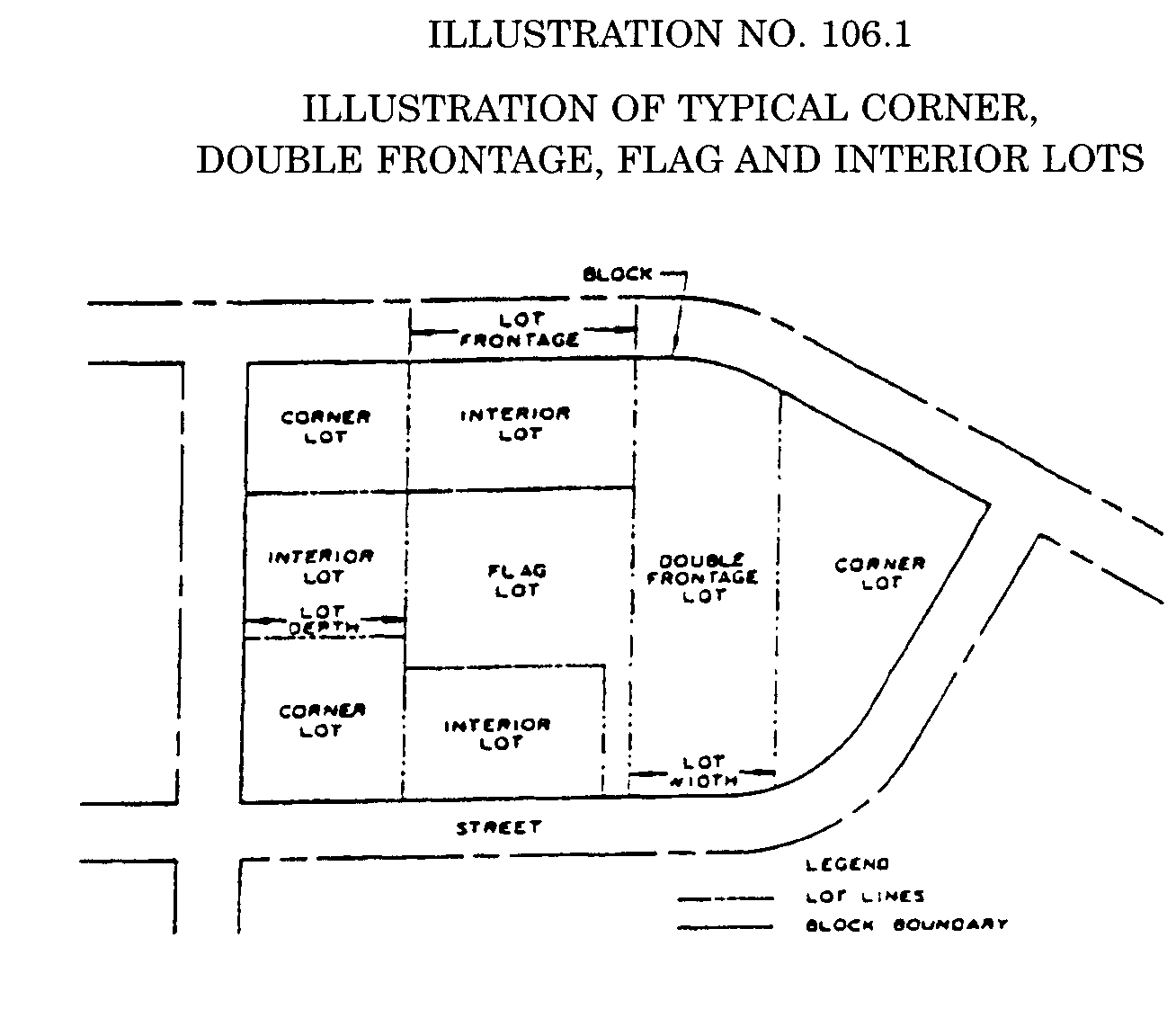
Lot, double frontage means a parcel of land, other than a corner lot, with frontage on more than one street or with frontage on a street and a navigable body of water. (See illustration no. 106.1)
Lot width means the width of a parcel of land measured at the setback line.
Machine shops means shops where lathes, presses, grinders, shapers and other wood and metal working machines are used such as blacksmith, tinsmith, welding and sheet metal shops; plumbing, heating and electrical repair shops; and overhaul shops.
Manufacturing means, when used in describing an industrial operation, the making or processing of a product with machinery.
Minor structures means any small, movable accessory erection or construction such as birdhouses, tool houses, pet houses, play equipment, arbors, and walls and fences.
Motel means a series of attached, semiattached or detached sleeping units for the accommodation of transient guests.
Navigable water means Lake Superior, Lake Michigan, all natural inland lakes within the state, and all rivers, streams, ponds, sloughs, flowages and other waters within the territorial limits of this state, including the state portion of boundary waters, which are navigable under the laws of this state. The state supreme court has declared navigable all bodies of water with a bed differentiated from adjacent uplands and with levels of flow sufficient to support navigation by a recreational craft of the shallowest draft on an annually recurring basis. (Muench v. Public Service Commission, 261 Wis. 492 (1952), and DeGaynor and Co., Inc. v. Department of Natural Resources, 70 Wis. 2d 936 (1975).) For the purpose of this chapter, rivers and streams will be presumed to be navigable if they are designated as either continuous or intermittent waterways on the United States Geological Survey quadrangle maps until such time that the state department of natural resources has made a determination that the waterway is not, in fact, navigable.
Nonconforming uses or structures means any structure, land or water lawfully used, occupied or erected at the time of the effective date of the ordinance from which this chapter is derived or amendments thereto which does not conform to the regulations of this chapter or amendment thereto. Any such structure conforming in respect to use but not in respect to frontage, width, height, area, yard, parking, loading or distance requirements is considered a nonconforming structure and not a nonconforming use.
Ornamental fence means a fence intended to decorate, accent or frame a feature of the landscape. Ornamental fences are often used to identify a lot corner or lot line or frame a driveway, walkway or planting bed. Ornamental fences are those with more than 50 percent of their surface area open for free passage of light and air. Ornamental fences are often of the picket, rail or wrought iron type.
Parking lot means a structure or premises containing ten or more parking spaces open to the public. Such spaces may be for rent for a fee.
Parties in interest means all abutting property owners, all property owners within 500 feet, and all property owners of opposite frontages.
Premises means a lot, parcel, tract or plot of land, together with the buildings and structures thereon.
Processing means, when used in describing an industrial operation, the series of continuous actions that changes one or more raw materials into a finished product. The process may be chemical as in the processing of photographic materials; it may be a special method such as processing butter or cheese; or it may be a mechanical process such as packaging a base product.
Professional home offices means residences of clergymen, architects, landscape architects, professional engineers, registered land surveyors, lawyers, real estate agents, artists, teachers, authors, musicians or persons in other recognized professions used to conduct their professions where the office use is incidental to the residential use of the premises.
Professional office means the office of a doctor, dentist, minister, architect, landscape architect, engineer, surveyor, lawyer, author, artist, musician, tattooist, body piercer, barbering, beauty shop or other recognized licensed profession.
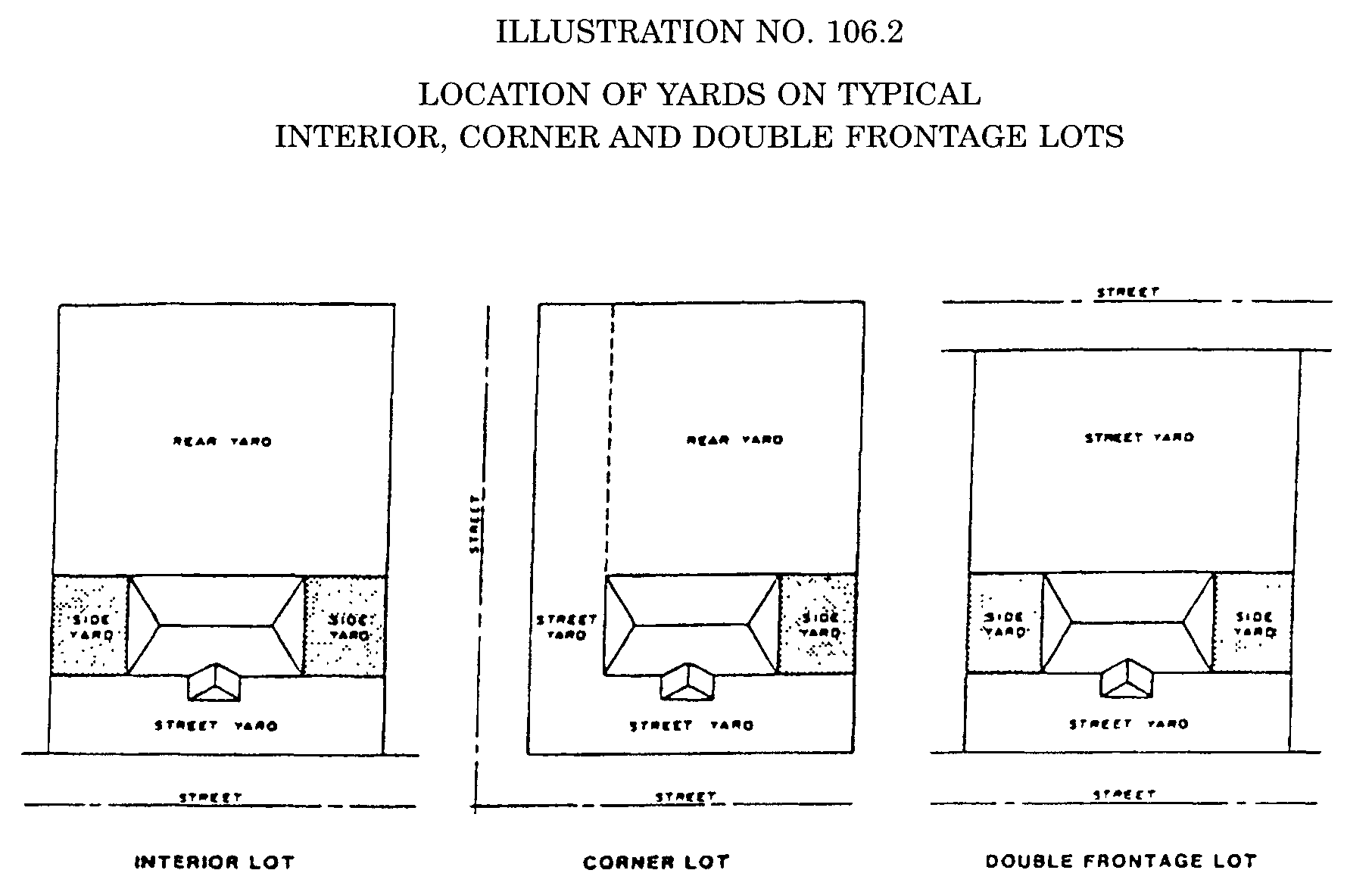
Rear yard means a yard extending across the full width of the lot, the depth of which shall be the minimum horizontal distance between the rear lot line and a line parallel thereto through the nearest point of the principal structure. This yard is opposite the street yard or one of the street yards on a corner lot. (See illustration no. 106.2.)
Regional flood means the flood determined to be representative of large floods known to have generally occurred in the state and which may be expected to occur on a particular stream because of like physical characteristics. The flood frequency of the regional flood is once in every 100 years. This means that in any given year, there is a one percent chance that the regional flood may occur or be exceeded. During a typical 30-year mortgage period, the regional flood has a 26 percent chance of occurrence.
Rummage sale means the occasional sale of personal property at a residence conducted by one or more families in a neighborhood. Rummage sales do not exceed four consecutive days in length and are not conducted more often than three times per year. Rummage sales do not involve the resale of merchandise acquired for that purpose. Rummage sales are also known as garage sales. Flea markets are not rummage sales.
Runoff means the rainfall, snow melt or irrigation water flowing over the ground surface.
Seat means furniture upon which to sit having a linear measurement not less than 24 inches across the surface used for sitting.
Setback or street yard means a yard extending across the full width of the lot, the depth of which shall be the minimum horizontal distance between the existing or proposed street or highway line and a line parallel thereto through the nearest point of the principal structure. Corner lots and double frontage lots have two such yards. (See illustration no. 106.2.)
Set of one-year design storms means the rain intensities and rain volumes or corresponding values specific to the community for the storm durations of 0.5, 1.0, 2.0, 3.0, 6.0, 12.0 and 24 hours that occur approximately once each year. The following are typical characteristics of these one-year storms in most of the state:
Shipping container means a container with strength suitable to withstand shipment, storage and handling and is designed to be moved from one mode of transport to another without loading or unloading. It is a reusable transport and storage unit for moving products and raw materials between locations or countries which are repurposed for other uses. (A shipping container is considered a structure.)
Shorelands means those lands lying within the following distances from the ordinary high water mark of navigable waters 1,000 feet from a lake, pond or flowage; and 300 feet from a river or stream; or to the landward side of the floodplain, whichever distance is greater. Shorelands shall not include those lands adjacent to farm drainage ditches where:
(1)
Such lands are not adjacent to a navigable stream or river;
(2)
Those parts of such drainage ditches adjacent to such lands were nonnavigable streams before ditching or had no previous stream history; and
(3)
Such lands are maintained in nonstructural agricultural use.
Side yard means a yard extending from the street yard to the rear yard of the lot, the width of which shall be the minimum horizontal distance between the side lot line and a line parallel thereto through the nearest point of the principal structure. (See illustration no. 106.2.)
Sign means any medium, including its structure, words, letters, figures, numerals, phrases, sentences, emblems, devices, designs, trade names or trademarks by which anything is made known and which are used to advertise or promote an individual, firm, association, corporation, profession, business, commodity or product and which is visible from any public street or highway.
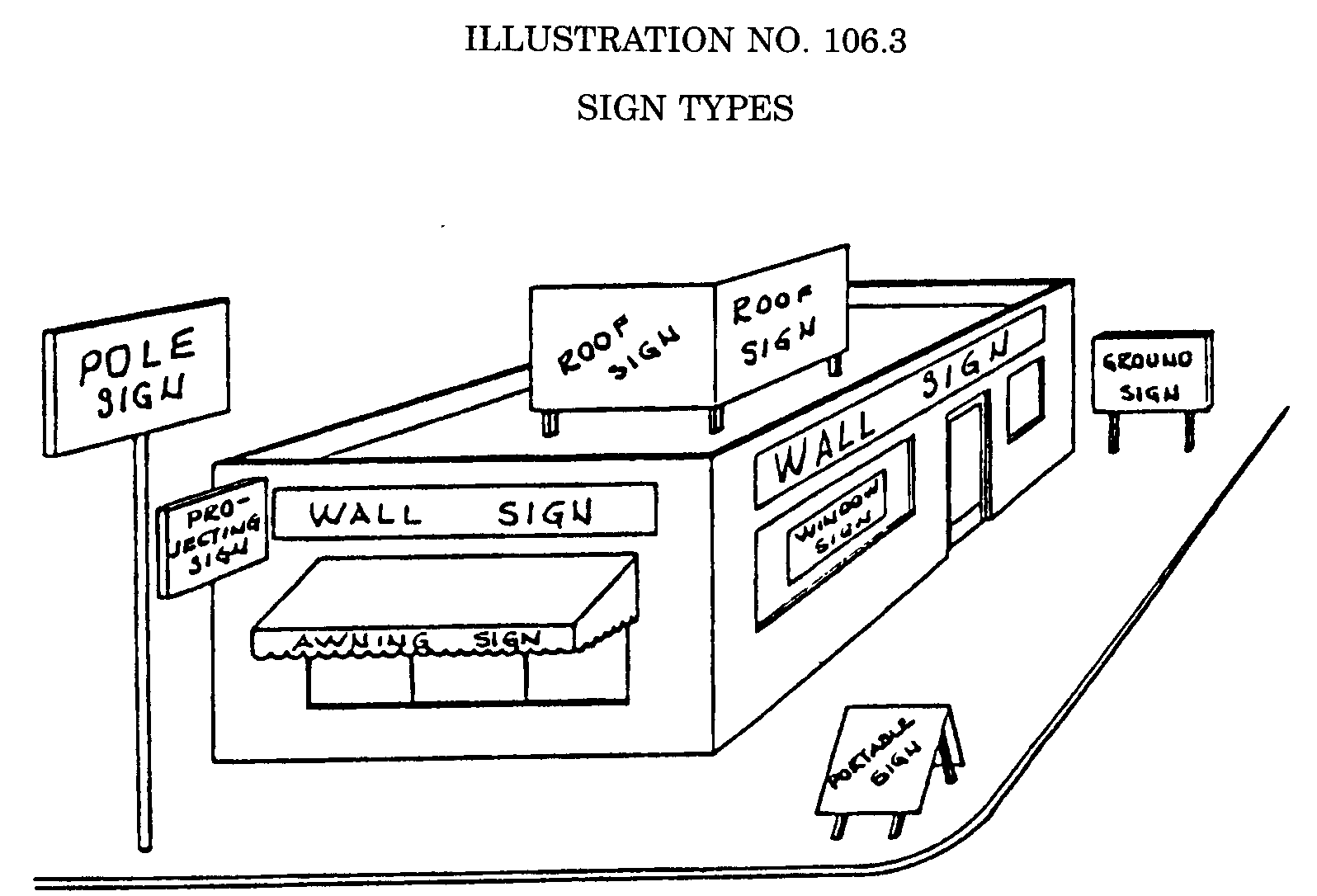
Sign, awning means a sign that is mounted or painted on, or attached to, an awning, canopy or marquee. (See illustration no. 106.3.)
Sign, billboard means a large sign (in excess of 300 square feet) that identifies and communicates a commercial or noncommercial message. Billboards are typically located along major highways and the message typically relates to an activity conducted, a service rendered or a commodity sold at a location other than where the sign is located.
Sign, ground means any sign placed upon or supported by the ground independent of any other structure. (See illustration no. 106.3.)
Sign, off-premises means a sign which directs attention to a business, industry or enterprise conducted at a location other than the premises on which the sign is located.
Sign, pole means a sign that is mounted on a freestanding pole or other support so that the bottom edge of the sign face is ten feet or more above grade. (See illustration no. 106.3.)
Sign, portable means a sign that is not permanent, affixed to a building, structure or to the ground. Such sign is sometimes mounted on wheels to make it transportable. (See illustration no. 106.3.)
Sign, projecting means a sign that is wholly or partly dependent upon a building for support and which projects more than 12 inches from such building. (See illustration no. 106.3.)
Sign, roof means a sign that is mounted on the roof of a building or which is wholly dependent upon a building for support and which projects above the point of a building with a flat roof, the eaves line of a building with a gambrel, gable or hip roof, or the deck line of a building with a mansard roof. (See illustration no. 106.3.) Roof signs are not permitted in the city.
Sign, wall means a sign fastened to or painted on the wall of a building or structure in such a manner that the wall becomes the supporting structure for, or forms the background surface of, the sign and which does not project more than 12 inches from such building or structure. (See illustration no. 106.3.)
Sign, window means a sign that is applied or attached to the exterior or interior of a window or located in such manner within the building that it can readily be seen from the exterior of the building through a window. (See illustration no. 106.3.)
Sign copy means the message or advertisement, and any other symbols on the face of a sign.
Sign face means the area or display surface used for the message.
Street means a public right-of-way not less than 50 feet wide providing primary access to abutting properties.
Structure means any erection or construction, such as buildings, prefabricated or prebuilt buildings, towers, masts, poles, booms, signs, decorations, carports, machinery and equipment.
Structural alterations means any change in the supporting members of a structure, such as foundations, bearing walls, columns, beams or girders.
Substantial improvement means any repair, reconstruction or improvement of a structure, the cost of which equals or exceeds 50 percent of the present equalized assessed value of the structure either before the improvement or repair is started, or, if the structure has been damaged and is being restored, before the damage occurred. The term does not, however, include either:
(1)
Any project for improvement of a structure to comply with existing state or local health, sanitary or safety code specifications which are solely necessary to ensure safe living conditions; or
(2)
Any alteration of a structure or site documented as deserving preservation by the state historical society or listed on the National Register of Historic Places. Ordinary maintenance repairs are not considered structural repairs, modifications or additions. Such ordinary maintenance repairs include internal and external painting, decorating, paneling and the replacement of doors, windows and other nonstructural components.
Surety. Whenever the terms "surety," "surety bond" or "bond" are used in this chapter, such term shall describe only an irrevocable letter of credit or a cash bond as approved by the city attorney.
Sustained yield forestry means management of forested lands to provide annual or periodic crops of forest products.
Temporary structure means a structure which is built of such materials and in such a way that would commonly be expected to have a relatively short useful life, or is built for a purpose that would commonly be expected to be relatively short term and not to be habitable. This includes canvas or polymer covered structures and moving containers.
Tourist rooming house means all lodging places and tourist cabins and cottages, other than hotels and motels, in which sleeping accommodations are offered for pay to tourists or transients. It does not include private boarding or rooming houses not accommodating tourists or transients, or bed and breakfast establishments regulated under ch. ATCP 72.
Townhouses means a group of single-family dwellings, also called row houses, having an unpierced common wall between each adjacent section and the end units having side yards.
Turning lane means an existing or proposed connecting roadway between two arterial streets or between an arterial street and any other street. Turning lanes include grade separated interchange ramps.
Utilities means public and private facilities such as water wells, water and sewage pumping stations, water storage tanks, power and communication transmission lines, electrical power substations, static transformer stations, telephone and telegraph exchanges, microwave radio relays and gas regulation stations, but not including sewage disposal plants, municipal incinerators, warehouses, shops and storage yards.
Wetland means an area where water is at, near or above the land surface long enough to be capable of supporting aquatic or hydrophytic vegetation and which has soils indicative of wet conditions.
Yard means an open space on the same lot with a structure, unoccupied and unobstructed from the ground upward, except for vegetation. The street and rear yards extend the full width of the lot. (See illustration no. 106.2.)
(Ord. No. OR98-24, § I(106.1602), 10-26-1998; Ord. No. OR06-09, § I, 6-26-2006; Ord. No. OR12-13, § 1, 9-24-2012; Ord. No. OR18-05, § 1, 6-25-2018; Ord. No. OR20-12, § I, 9-28-2020)

