
Brooklyn Green County
City Zoning Code
City Zoning Code
ARTICLE V
- ZONING DISTRICTS AND LAND USE
Sec. 117-780. - Zoning districts designated.
For the purpose of this chapter, the village is hereby divided into the following zoning districts:
(1)
R-SL, Single-family residential low-density district.
(2)
R-SM, Single-family residential medium-density district.
(3)
R-SH, Single-family residential high-density district.
(4)
R-T, Two-family residential district.
(5)
R-M, Multifamily residential district.
(6)
B-G, General business district.
(7)
B-N, Neighborhood business district.
(8)
B-P, Business park district.
(9)
I, Industrial district.
(10)
Special purpose district.
a.
Adult entertainment district.
b.
AG agricultural district.
c.
Conservancy district.
d.
P-G, Public grounds district.
e.
P-R, Public recreation district.
f.
WPO, Wellhead protection overlay district.
(Ord. of 12-17-2012, § 48-500)
Sec. 117-811. - Use restrictions.
The following use restrictions and regulations shall apply:
(1)
Principal uses. Only those principal uses specified for a district, their essential services and the following shall be permitted in that district:
a.
Unclassified or unspecified uses. Unclassified or unspecified uses may be permitted by the village board after the plan commission has made a review and recommendation, provided that such uses are similar in character to the principal uses permitted in the district.
(2)
Performance standards. Performance standards listed in sections 117-1100 through 117-1108 shall be complied with by all uses in all districts.
(3)
Conditional uses.
a.
Classes of conditional uses. Conditional uses may be either denominated "regular" or "limited."
b.
General conditional use provisions. Provisions applicable to conditional uses generally:
1.
Conditional uses and their accessory uses are considered as special uses requiring, for their authorization, review, public hearing, and approval by the plan commission and village board in accordance with sections 117-350 through 117-359 excepting those existent at time of adoption of the zoning code.
2.
Those existing uses which are classified as "conditional uses" for the district in which they are located at the time of adoption of the ordinance from which this zoning code is derived require no action by the plan commission to continue as valid conditional uses, and the same shall be deemed to be "regular" conditional uses.
3.
Proposed change from permitted use in a district to conditional use shall require review, public hearing and approval by the plan commission and village board in accordance with sections 117-350 through 117-359.
4.
Conditional uses, when replaced by permitted uses, shall terminate. In such cases, the reestablishment of any previous conditional use, or establishment of new conditional uses shall require review, public hearing and approval by the plan commission in accordance with sections 117-350 through 117-359.
5.
Provisions in this chapter relating generally to conditional uses shall, except when in conflict with specific provisions relating to either regular or limited conditional uses (which specific provision would then control), be deemed to be applicable to both regular and limited conditional uses.
c.
Specific regular conditional use provisions. Provisions applicable specifically to regular conditional uses:
1.
Regular conditional uses, either allowed by action of the plan commission or existent at time of adoption of the ordinance from which this zoning code is derived, shall be subject to substitution with other conditional uses of same or similar type shall require procedures and approval in accordance with sections 117-350 through 117-359.
2.
See subsection (3)b.2 of this section as to conditional uses existent at time of adoption of the ordinance from which this zoning code is derived being deemed to be the regular conditional uses.
d.
Specific limited conditional use provisions. Provisions applicable specifically to limited conditional uses:
1.
Limited conditional uses authorized by the plan commission resolution shall be established for a period of time to a time certain or until a future happening or event at which the same shall terminate.
2.
Limited conditional uses authorized by the plan commission shall not be subject to substitution with other conditional uses, either regular or limited, whether similar type or not, without commission approval and the procedures required in sections 117-350 through 117-359.
(4)
Uses not specified in chapter.
a.
Uses not specified in this chapter which are found by the plan commission to be sufficiently similar to specified permitted uses for a district shall be allowed.
b.
Uses not specified in this chapter and which are found sufficiently similar to specified conditional uses permitted for a district may be permitted by the plan commission, public hearing and approval in accordance with sections 117-350 through 117-359.
(Ord. of 12-17-2012, § 48-501)
Sec. 117-812. - Reduction or joint use.
No lot, yard, parking area, building area or other space shall be reduced in area or dimension so as not to meet the provisions of this chapter. No part of any lot, yard, parking area or other space required for a structure or use shall be used for any other structure or use.
(Ord. of 12-17-2012, § 48-502)
Sec. 117-813. - Site regulations.
(a)
Site suitability. No land shall be used or structure erected where the land is held unsuitable for such use or structure by the village board by reason of flooding, concentrated run-off, inadequate drainage, adverse soil or rock formation, unfavorable topography, low percolation rate or bearing strength, erosion susceptibility, or any other feature likely to be harmful to the health, safety, prosperity, aesthetics, and general welfare of this community. The plan commission in applying the provisions of the section shall in writing recite the particular facts upon which it bases its conclusion that the land is not suitable for certain uses. The applicant shall have an opportunity to present evidence contesting such unsuitability if he so desires. Thereafter, the plan commission may affirm, modify, or withdraw its determination of unsuitability when making its recommendation to the village board.
(b)
Street frontage. All lots shall abut upon a public street or other officially approved means of access, and each lot shall have a minimum frontage of 33 feet; however, to be buildable, the lot shall comply with the frontage requirements of the zoning district in which it is located.
(c)
Principal structures. All principal structures shall be located on a lot. Only one principal structure shall be located, erected or moved onto a lot. The village board may permit as a conditional use more than one principal structure per lot in any district where more than one such structure is needed for the orderly development of the parcel. Where additional structures are permitted, the village board, after referral to the plan commission for its consideration and recommendation, may impose additional yard requirements, landscaping requirements or parking requirements, or require a minimum separation distance between principal structures.
(d)
Dedicated street. No zoning permit shall be issued for a lot which abuts a public street dedicated to only a portion of its proposed width and located on that side thereof from which the required dedication has not been secured.
(e)
Lots abutting more restrictive districts. Lots abutting more restrictive district boundaries shall provide side and rear yards not less than those required in the more restrictive abutting district. This does not apply to adjacent residential districts. The street yard setbacks in the less restrictive district shall be modified for a distance of not less than 60 feet from the more restrictive district boundary line so such street yard setbacks shall be no less than the average of the street yards required in both districts.
(f)
Preservation of topography. In order to protect the property owner from possible damage due to change in the existing grade of adjoining lands, and to aid in preserving and protecting the natural beauty and character of the landscape, no change in the existing topography of any land shall be made which would result in increasing any portion of the slope to a ratio greater than 1½ horizontal to one vertical, within a distance of 20 feet from the property line, except with the written consent of the owner of the abutting property and with the approval of the plan commission; or which would alter the existing drainage or topography in any way as to adversely affect the adjoining property. Additional requirements are located in the village grading ordinance codified in chapter 107, article III.
(g)
Decks. For purposes of this chapter, decks shall be considered a part of a building or structure.
(h)
Lots abutting two streets. Where a lot abuts on two or more streets or alleys having different average established grades, the higher of such grades shall control only for a depth of 120 feet from the line of the higher average established grade.
(i)
Double-frontage lots. Buildings on through lots and extending from street to street may have waived the requirements for a rear yard by furnishing an equivalent open space on the same lot in lieu of the required rear yard, provided that the setback requirements on both streets be complied with. (See "through lots" in Figure 4, section 117-1143.)
(j)
Preexisting lots. Where a vacant lot has an area less than the minimum number of square feet per family required for the district in which it is located and was of record as such at the time of the passage of the ordinance from which this Code is derived, such lot may be occupied by one family.
(Ord. of 12-17-2012, § 48-503)
Sec. 117-814. - Height regulations.
(a)
Maximum height. In any district, no buildings or structures shall be erected or structurally altered to a height in excess of that specified by the regulations for that district.
(b)
Exceptions. The following shall be excepted from regulation of height in all districts, with the provision that the total height of any structure or tower shall not exceed its distance from the nearest lot line:
(1)
Architectural projections. Architectural projections such as spires, belfries, parapet walls, cupolas, domes, flues and chimneys are exempt from the height limitations of this chapter.
(2)
Essential services height limitations. Essential services, utilities, water towers, and electric power and communication transmission lines are subject to conditional use permit.
(3)
Communications structures height restrictions. Communications structures such as radio and television transmission and relay towers, aerial and observation towers shall not exceed in height their distance from the nearest lot line.
(4)
Agricultural structures height restrictions. Structures used exclusively for agricultural purposes such as barns, silos and water windmills shall not exceed in height twice their distance from the nearest lot line.
(5)
Public facilities height restrictions. Public or semi-public facilities such as schools, churches, hospitals, monuments, sanitariums, libraries, governmental offices and stations may be erected to a height of 60 feet, provided all required yards are increased not less than one foot for each foot the structure exceeds the district's maximum height requirement.
(c)
Increase permitted. Subject to the approval of the plan commission, the maximum height of the following structures/uses may be allowed height exemption: cooling towers, elevators, bulkheads, fire towers, monuments, penthouses, stacks, scenery lofts, tanks, water towers, grain elevators, manufacturing equipment, ornamental towers, spires wireless or broadcasting towers, masts, aerials, wind-powered generating units, substations, smokestacks and necessary mechanical appurtenances. Also, buildings meeting specific fire district stipulations may be allowed height exemptions pursuant to adequate study and determination by the village and fire district.
(Ord. of 12-17-2012, § 48-504)
Sec. 117-815. - Lot, yard and building requirements.
(a)
Setbacks from shorelands and wetlands. All buildings and structures shall conform to the requirements of chapter 113, the village shoreland-wetland zoning ordinance, unless greater requirements in favor of the village are otherwise specified by the Dane County floodplain regulations or the Dane County shoreland, shoreland-wetland and inland-wetland regulations.
(b)
Principal building. No principal building shall be erected, altered, or placed so that any portion encroaches into the front, side, or rear yards as specified in the yard requirements for the district in which such building is located.
(c)
Accessory building or structure.
(1)
No detached accessory building or structure shall be erected, placed or structurally altered so that any portion encroaches into the front, side, or rear yards as specified in the yard requirements for the district in which such building is located.
(2)
Any accessory building or structure which is attached to a principal building or structure shall comply with setbacks established by the direct regulations for principal buildings and structures.
(d)
Temporary building or structure.
(1)
No temporary building or structure shall be erected, placed or structurally altered so that any portion encroaches into the front, side, or rear yards as specified in the yard requirements for the district in which such building is located.
(2)
Any temporary building or structure which is attached to a principal building or structure shall comply with setbacks established by the direct regulations for principal buildings and structures.
(e)
Uncovered stair restrictions. Uncovered stairs, landings and fire escapes may project into any yard, but not to exceed six feet and not closer than three feet to any lot line, and must be eight feet or more above ground.
(f)
Architectural projection restrictions. Architectural projections such as chimneys, flues, sills, eaves, belt courses and ornaments may project into any required yard (setback requirements), but such projection shall not exceed two feet.
(g)
Cul-de-sac and curve restrictions. Residential lot frontage on culs-de-sac and curves may be less than 80 feet provided the width at the building setback line is at least 80 feet and the street frontage is not less than 45 feet.
(h)
Residential fence restrictions. Residential fences are permitted in residential districts subject to section 117-1015.
(i)
Essential services exemptions. Essential services, utilities, electric power and communication transmission lines are exempt from the yard and distance requirements of this chapter.
(j)
Street yard restrictions. The required street yards may be decreased in any residential or business district to the average of the existing street yards of the abutting structures on each side, but in no case less than 15 feet in any residential district and five feet in any business district.
(k)
Detached garage. Detached garages are permitted in the rear yard and side yard only.
(l)
Setbacks from access easements. The setback from private easements serving more than one residence or parcel shall be 30 feet from the described easement in case of an easement that does not have a legal description, 30 feet from the nearest point on the edge of the traveled way.
(m)
Corner lots. Corner lots shall have two front yards and a rear yard shall be provided opposite the front yard of the street from which the building or structure obtains its primary access.
(Ord. of 12-17-2012, § 48-505)
Sec. 117-816. - Area regulations.
(a)
Maximum ground coverage permitted. The maximum total ground coverage of the principal building and all accessory buildings and structures shall not exceed that specified by the regulations for the district in which such buildings are located.
(b)
Minimum dwelling size. The minimum livable floor area of any dwelling unit shall include only livable floor space, as measured from outside of wall to outside to wall, and may also include minimum structure widths, as provided for in individual districts, or as provided for in section 117-34.
(c)
Lot.
(1)
No building shall be erected on a lot of less areas or lot width than as specified by the regulations of the district in which such building is located.
(2)
No lot area shall be reduced so as to create a lot of less than the required size or so that the existing setbacks, open space, or lot area would be reduced below that required by the regulations for the district in which such lot is located.
(Ord. of 12-17-2012, § 48-506)
Sec. 117-817. - Temporary buildings.
In any district, temporary buildings and the temporary storage of materials and equipment incidental to the construction of buildings on the premises shall be allowed for a period not to exceed one year.
(Ord. of 12-17-2012, § 48-507)
Sec. 117-818. - Erosion control and stormwater management.
All construction and land disturbing activities shall conform to chapter 107, article II. Depending on the nature of the construction or land disturbing activities, the village may require exempt sites to meet some or all standards listed in chapter 107, article II.
(Ord. of 12-17-2012, § 48-508)
Sec. 117-819. - Noises exempted.
Sirens, whistles and bells which are maintained and utilized solely to serve a public purpose are exempt from the sound level standards of this chapter.
(Ord. of 12-17-2012, § 48-509)
Sec. 117-850. - Zoning map.
The boundaries of the districts enumerated in section 117-780 are hereby established as shown on a map entitled "Zoning Map, Village of Brooklyn, Wisconsin," which is adopted by reference and made part hereof. The map shall bear upon its face the attestation of the village president and the village clerk and shall be available to the public in the office of the village clerk.
(Ord. of 12-17-2012, § 48-520)
Sec. 117-851. - Boundary lines.
The boundaries shall be construed to follow corporate limits; U.S. Public Land Survey lines; lot or property lines; centerlines, highways, alleys, easements and railroad rights-of-way; or such lines extended unless otherwise noted on the zoning map.
(1)
Vacation. Vacation of public streets and alleys shall cause the land vacated to be automatically placed in the same district as the abutting side on which the vacated land reverts.
(2)
Annexations and consolidations. Annexations to or consolidations with the village subsequent to the effective date of the ordinance from which this chapter is derived shall be placed in the R-D rural development district unless the annexation ordinance temporarily placed the land in another district. Within one year, the plan commission shall evaluate and recommend a permanent district classification to the village board.
(Ord. of 12-17-2012, § 48-521)
Sec. 117-852. - Amendments to zoning map.
Amendments to the zoning map will occur and the amendment official zoning map shall replace the current official zoning map following the regulations for code amendment outlined earlier in this chapter.
(Ord. of 12-17-2012, § 48-522)
Sec. 117-890. - R-SL single-family residence low-density district.
(a)
Purpose. The R-SL district is intended to provide a quiet, pleasant and relatively spacious living area protected from traffic hazards and the intrusion of incompatible land uses.
(b)
Permitted uses. The following uses of land are permitted in the R-SL district:
(1)
Single-family dwelling.
(2)
One private detached garage with an existing single-family dwelling meeting the requirements of section 117-1010.
(3)
Accessory uses and buildings as follows:
a.
Accessory building(s) pursuant to section 117-1010 incidental to the residential use.
b.
Off-street parking in accordance with section 117-1052.
c.
Ancillary accessory structures in accordance with section 117-1010.
d.
Signs as permitted by village ordinances.
(4)
Community living arrangements and/or group homes which have a capacity for eight or fewer unrelated persons per household and care is provided by a licensed individual pursuant to Wis. Code DHS 83.05.
(5)
Foster homes with care provided by a person holding the required license pursuant to Wis. Stats. 48.62.
(6)
Home occupations/professions meeting the requirements of section 117-1011.
(7)
Roof-mounted solar facilities in accordance with section 117-1020 (sample provided).
(c)
Conditional uses. The following are permitted as conditional uses within the R-SL district:
(1)
Bed and breakfast establishments.
(2)
Licensed community living arrangements and/or group homes which have a capacity for nine or more persons.
(3)
Utilities.
a.
Private or quasi-public utility facility: Facilities such as power generating plants, electrical power substations, static transformer stations, telephone hubs or exchange stations, cable TV hubs, microwave radio relays, gas regulation stations, fiber optic hubs or exchange stations, cell phone related structures, wireless communications structures and wind power generation facilities. Storage yards and parking areas for utility facilities are specifically excluded from this definition.
b.
Public utility facilities as defined in section 117-4 are exempt.
c.
Utility structure: A building or structure that is non-commercial in nature and has an infrastructure-based purpose to provide or continue transmission of utilities to serve the general village population.
(4)
Institutional and quasi-public facilities such as churches places of worship, schools, parks, playgrounds, and recreational facilities.
(5)
Child care centers.
(6)
Privately-owned community or market garden.
(7)
Keeping of chickens (may need a more-defined standard).
(8)
Portable storage units.
(9)
Ground and wall mounted solar energy systems greater than 100 square feet in size.
(10)
Wind energy system.
(11)
Yard sales.
(d)
Lot, yard and building requirements.
Lot frontage .....Minimum 90 feet
Lot area .....Minimum 12,150 square feet
Principal building:
Front yard .....Minimum 30 feet*
Side yards .....Minimum 12 feet*
Rear yard .....Minimum 30 feet*
Corner side yard .....Minimum 20 feet
Building height .....Maximum 35 feet
Accessory building:
Side yards: Must comply with any existing easements or five feet, whichever is greater*
Rear yard: Must comply with any existing easements or five feet, whichever is greater*
Alley .....Minimum 15 feet*
Standard Accessory Structure Building height .....Maximum 18 feet**
Dwelling total livable floor area:
Single story .....Minimum 1,200 square feet
Two-story .....Minimum 1,700 square feet
*Minimum side and/or rear yard requirement for a lot immediately adjacent to a different zoning district shall be the greater of the two district requirements.
**See section 117-1010 for alternative accessory structure height limitations.
(Ord. of 12-17-2012, § 48-530; Ord. of 4-11-2022(2))
Sec. 117-891. - R-SM single-family medium-density residential district.
(a)
Purpose. This district is intended to provide for moderate to medium density residential development with emphasis on single-family residential uses. This district is also intended to provide for alternative development types and for infilling opportunities for parcels which for various reasons have been bypassed by development. Nonresidential uses are limited to those which are compatible with the medium density character of the district.
(b)
Permitted uses.
(1)
Same as the R-SL district.
(c)
Conditional uses.
(1)
Same as the R-SL district.
(2)
Conversion of single-family dwellings to two-family or multifamily dwellings, with a minimum of 800 square feet per dwelling unit, no exterior changes and a restrictive covenant requiring one unit to be owner occupied.
(d)
Lot, yard and building requirement.
Lot frontage .....Minimum 80 feet
Lot area .....Minimum 9,600 square feet
Principal building:
Front yard .....Minimum 30 feet*
Side yards .....Minimum 10 feet*
Rear yard .....Minimum 25 feet*
Corner side yard .....Minimum 20 feet*
Building height .....Maximum 35 feet
Accessory building:
Front yard .....Minimum 30 feet*
Side yards: Must comply with any existing easements or five feet, whichever is greater*
Rear yard: Must comply with any existing easements or five feet, whichever is greater*
Alley .....Minimum 15 feet*
Standard accessory structure building height .....Maximum 18 feet**
Dwelling total livable floor area:
Single story .....Minimum 1,100 square feet
Two-story .....Minimum 1,600 square feet
*Minimum side and/or rear yard requirement for a lot immediately adjacent to a different zoning district shall be the greater of the two district requirements.
**See section 117-1010 for alternative accessory structure height limitations.
(Ord. of 12-17-2012, § 48-531; Ord. of 4-11-2022(2))
Sec. 117-892. - R-SH single-family high-density residential district.
(a)
Purpose. The R-SH district is intended to accommodate those residential uses and lot sizes typical of the older residential neighborhoods within the village. Narrower lots and reduced setbacks are characteristic of this district.
(b)
Permitted use.
(1)
Same as the R-SL district.
(c)
Conditional uses.
(1)
Same as the R-SM district.
(d)
Lot, yard and building requirements.
Lot frontage .....Minimum 70 feet
Lot area .....Minimum 8,400 square feet
Principal building:
Front yard .....Minimum 20 feet*
Side yards .....Minimum 8 feet*
Rear yard .....Minimum 20 feet*
Corner side yard .....Minimum 20 feet*
Maximum setback .....35 feet*
Building height .....Maximum 35 feet
Accessory building:
Front yard .....Minimum 25 feet*
Side yards: Must comply with any existing easements or five feet, whichever is greater*
Rear yard: Must comply with any existing easements or five feet, whichever is greater*
Alley .....Minimum 15 feet*
Standard accessory structure building height .....Maximum 18 feet**
Dwelling total livable floor area:
Single story .....Minimum 1,000 square feet
Two-story .....Minimum 1,500 square feet
*Minimum side and/or rear yard requirement for a lot immediately adjacent to a different zoning district shall be the greater of the two district requirements.
**See section 117-1010 for alternative accessory structure height limitations.
(Ord. of 12-17-2012, § 48-532; Ord. of 4-11-2022(2))
Sec. 117-893. - R-T two-family residential district.
(a)
Purpose. The R-T district is intended to provide a quiet, pleasant and relatively spacious living area protected from traffic hazards and the intrusion of incompatible land uses.
(b)
Permitted uses.
(1)
Two-family dwellings, including zero lot line structures.
(2)
Permitted uses as identified in R-SL district
(c)
Conditional uses. The following are permitted as conditional uses within the R-T district:
(1)
Conditional uses as identified in the R-SL district.
(d)
Lot, yard and building requirements.
Lot frontage .....Minimum 90 feet
Zero lot line structure .....Minimum 45 feet
Lot area .....Minimum 10,800 square feet
Zero lot line structure .....Minimum 5,400 square feet
Principal building:
Front yard .....Minimum 30 feet*
Side yards .....Minimum 12 feet*
Zero lot line structure: No side yard for adjoining walls and ten feet for other side yard*
Rear yard .....Minimum 25 feet*
Corner side yard .....Minimum 20 feet*
Building height .....Maximum 35 feet
Accessory building:
Front yard .....Minimum 30 feet*
Side yards: Must comply with any existing easements or five feet, whichever is greater*
Rear yard: Must comply with any existing easements or five feet, whichever is greater*
Alley .....Minimum 15 feet*
Standard Accessory Structure Building height .....Maximum 18 feet**
Dwelling total livable floor area:
Single story .....Minimum 800 square feet per dwelling
Two-story .....Minimum 1,200 square feet per dwelling
*Minimum side and/or rear yard requirement for a lot immediately adjacent to a different zoning district shall be the greater of the two district requirements.
**See section 117-1010 for alternative accessory structure height limitations.
(Ord. of 12-17-2012, § 48-533; Ord. of 4-11-2022(2))
Sec. 117-894. - R-M multiple-family residential district.
(a)
Purpose. The R-M district is intended to provide a living area that is pleasant but not so spacious as the R-S and R-T districts, in order to accommodate multiple-family residences.
(b)
Permitted uses. The following uses of land are permitted in this district:
(1)
Multiple-family residential buildings for up to four units.
(2)
Rooming houses and boardinghouses for up to four guests.
(3)
Charitable institutions, rest homes, convalescent homes, nursing homes, for the care of children, homes for the care of the aged, homes for the care of the indigent, and similar institutions (CDRF).
(4)
Accessory uses and buildings as follows:
a.
Accessory building not to exceed 200 square feet.
b.
Parking stalls incident to the above uses. See subsection 117-1052(a)(5),
(5)
Home occupation/profession. (See section 117-1011.)
(c)
Conditional uses. The following are permitted as conditional uses within the R-M district:
(1)
Single-family and two-family dwellings.
(2)
Churches or places of worship and their affiliated uses, grade schools and libraries.
(3)
Accessory buildings up to ten percent of total square footage of primary structure
(4)
Anything over four units.
(d)
Lot, yard and building requirement.
Lot frontage .....Minimum 90 feet
Lot area .....Minimum 10,800 square feet
Principal building:
Front yard .....Minimum 30 feet/Maximum 35 feet*
Side yards .....Minimum 15 feet*
Rear yard .....Minimum 10 feet*
Corner side yard .....Minimum 20 feet*
Building height .....Maximum 35 feet*
Accessory building:
Front yards .....Minimum 30 feet*
Side yards .....Minimum 10 feet*
Rear yard .....Minimum 10 feet*
Garage incidental to multifamily residences:
Front yards .....Minimum 30 feet*
Side yards .....Minimum 10 feet*
Rear yard .....Minimum 10 feet*
Alley .....Minimum 15 feet
Standard accessory structure building height .....Maximum 18 feet**
Dwelling total livable floor area:
Efficiency and one bedroom .....Minimum 600 square feet per dwelling
Two bedroom or larger .....Minimum 700 square feet per dwelling
*Minimum side and/or rear yard requirement for a lot immediately adjacent to a different zoning district shall be the greater of the two district requirements.
**See section 117-1010 for alternative accessory structure height limitations.
(e)
Other requirements.
(1)
The floor area ratio, defined as the maximum square footage of total floor area permitted for each square foot of land area, is not more than 0.500.
(Ord. of 12-17-2012, § 48-534; Ord. of 4-11-2022(2))
Sec. 117-895. - B-G general business district.
(a)
Purpose. The B-G district is intended to provide an area for the business and commercial needs of the community, especially those which can be most suitably located in a compact and centrally located business district.
(b)
Permitted uses. The following uses of land are permitted in the B-G district:
(1)
On-site retail and outlet stores.
a.
Paint, glass and wallpaper stores.
b.
Hardware stores.
c.
Department stores, variety stores, general merchandise stores.
d.
Clothing and shoe stores.
e.
Furniture, home furnishings, and floor covering stores.
f.
Drug stores and pharmacies.
g.
Antique stores and secondhand stores.
h.
Sporting goods stores and bicycle shops.
i.
Bookstores, not including adult books.
j.
Stationery stores.
k.
Jewelry and clock stores.
l.
Watch, clock and jewelry repair services.
m.
Camera and photographic supply stores.
n.
Gift, novelty and souvenir shops.
o.
Florist shops.
p.
Tobacco and smokers' supplies stores.
q.
Miscellaneous retail stores.
r.
Wholesale merchandise establishments only for retail and outlet items listed above.
s.
Indoor storage of material, equipment or products incidental to a retail establishment.
(2)
Food, beverages and health related.
a.
General grocery stores, supermarkets, fruit and vegetable stores, meat and fish stores, and discount food stores.
b.
Candy, nut or confectionery stores.
c.
Dairy products stores, including ice cream stores.
d.
Retail bakeries, including those which produce some or all of the products sold on the premises, but not including establishments which manufacture bakery products primarily for sale through outlets located elsewhere or through home service delivery.
e.
Liquor stores.
f.
Catering services.
g.
Pharmacies.
h.
Indoor sports/fitness facilities including sports/fitness training facilities.
i.
Health or veterinary clinics.
k.
Dance studios/training facilities.
(3)
Restaurants and taverns.
a.
Restaurants, lunchrooms and other eating places, except drive-in type establishments.
b.
Taverns, bars, and other drinking places with required license.
(4)
Professional services.
a.
Offices of insurance companies, agents, brokers and service representatives.
b.
Offices of real estate agents, brokers, managers and title companies.
c.
Advertising agencies, consumer credit reporting, news agencies, employment agencies.
d.
Offices of physicians and surgeons, dentists and dental surgeons, osteopathic physicians, optometrists and chiropractors, but not veterinarian's offices. This includes clinics for listed health related services.
e.
Professional, scientific, or educational firms, agencies, offices, or services, but not research laboratories or manufacturing operations.
f.
Law offices.
g.
Engineering and architectural firms or consultants.
h.
Accounting, auditing, and bookkeeping firms or services.
i.
Funeral services.
j.
The sale, service, repair, testing, demonstration or other use of indoor electrical equipment such as radios, televisions, sound equipment, related accessories, and musical instruments.
(5)
Customer, news and entertainment services.
a.
Banks and other financial institutions.
b.
Retail laundry and dry cleaning outlets, including coin-operated laundries and dry cleaning establishments, commonly called laundromats and launderettes. Tailor shops, dressmakers' shops, and garment repair shops.
c.
Photographic studios and commercial photography establishments.
d.
Barbershops, beauty shops, and hairdressers.
e.
Shoe repair shops and shoe shine parlors.
f.
Computer services.
g.
Motion picture theaters, not including drive-in theaters.
h.
Duplicating, blueprinting, photocopying, addressing, mailing, mailing list, and stenographic services. Excludes the publishing and printing of newspapers, periodicals or books.
(6)
Transportation.
a.
Parking lots and/or commercial parking for existing or proposed business uses permitted in the district (see section 117-1052 parking).
b.
Public transportation passenger stations, taxicab company offices, taxicab stands, but not vehicle storage lots or garages.
c.
Bus and rail transit terminals.
(7)
Government and utility.
a.
The offices, meeting places, and premises of professional membership associations; civic, social, and fraternal associations; business associations, labor unions and similar labor organizations; political organizations; religious organizations; charitable organizations; or other nonprofit membership organizations.
b.
The offices of governmental agencies and post offices.
c.
Public, quasi-public services and utilities.
d.
Telephone offices (excludes wireless communications and towers)
(8)
Lodging.
a.
Hotels, motels and bed and breakfast establishments.
b.
Roominghouses and boardinghouses.
c.
Community living arrangements.
d.
Existing dwelling units (on upper floor levels)
(c)
Conditional uses. The following are permitted as conditional uses in the B-G district; provided that no nuisance shall be afforded to the public through noise, the discharge of exhaust gases from motor-driven equipment, unpleasant odors, smoke, steam, harmful vapors, obnoxious materials, unsightly conditions, obstruction of passage on the public street or sidewalk, or other conditions generally regarded as nuisances; and provided that where operations necessary or incident to the proper performance of these services or occupations would tend to afford such nuisances, areas, facilities, barriers, or other devices shall be provided in such a manner that the public is effectively protected from any and all such nuisances. These uses shall be subject to the consideration of the plan commission and the village board with regard to such matters:
(1)
The sale, service, repair, testing, demonstration or other use of piston-type engines or motors, or any type of device, vehicle, appliance or equipment operated by such engines or motors. This includes sales and/or service of the following:
a.
Small engines.
b.
ATV or UTVs.
c.
Car/truck/vans.
d.
Electric vehicles excluding e-bikes.
e.
Motorcycles and trikes.
f.
Recreational vehicle, motor home, travel trailers.
All outdoor storage of any kind, including the number of unenclosed vehicles awaiting sale or repair, shall be established by the plan commission. Enclosed vehicles shall be stored within a building whenever possible. All exterior storage not for sales/display to the public shall be required to meet strict screening requirements including a complete vision-barrier fence a minimum of six feet in height. Alternatives may be approved by the plan commission. The standards included within sections 117-1051 through 117-1058 are hereby incorporated as standards for conditional uses in this district. Maintenance of all screening mechanisms shall be included in the condition of approval.
(4)
Establishments engaged in the sale, servicing, repairing, testing, demonstration, or other use of electrical household appliances, such as washing machines, vacuum cleaners, dishwashers, irons, toasters, or similar household appliances. Establishments engaged in the sale, servicing, repairing, testing, demonstration, or other use of household electrical refrigerators, freezers, air conditioners, other self-contained refrigeration units, or other similar appliances or equipment; provided further, specifically, that areas and facilities for operating, repairing, loading, unloading and storage of such appliances or equipment shall be provided in a manner which affords no nuisance or obstruction, or of the discharge of unpleasant or harmful vapors or liquids, or of unsightly conditions to the public.
(5)
Contractor or construction offices and shops and display rooms, such as building, cement, electrical, heating, ventilating and air conditioning, masonry, painting, plumbing, refrigeration and roofing, solar, provided that all parking (other than automobiles), loading, display of merchandise and parking or storage of equipment and supplies shall be conducted within completely enclosed buildings. Outdoor display for product/service identification shall be specifically included in conditions of approval.
(6)
Repair shops and related services not specifically listed as permitted uses.
(7)
Garment handling/service establishments.
(8)
Establishments engaged in the publishing and printing of newspapers, periodicals or books.
(9)
Dwelling units, provided that no dwelling shall be permitted below the second floor and business uses are not permitted on any floor above the ground floor, except in those buildings or structures where dwelling units are not established.
(10)
Day care centers.
(11)
Gasoline service stations.
(12)
Mobile home dealers.
(13)
Warehousing or distribution operations, not including predominantly retail sales to customers on site.
(14)
Wireless communication systems.
(15)
Brewery, distillery and winery.
(16)
Skilled trade services.
(17)
Landscaping and lawn care.
(18)
Vehicle towing services
(19)
Exterior sports related facilities where sales of merchandise or sales of tickets are sold.
(20)
Pet grooming services
(21)
Off-site parking for bonified business uses meeting the requirements of section 117-1052.
(d)
Lot, yard and building requirements. The maximum height, side, front and rear yards, minimum lot width and parking for new or converted buildings shall correspond with typical existing development layout of the district provided the plan commission determines such development is in keeping with the purposes, design and character of the general business district and is architecturally compatible with the area.
(e)
No automobile parking lot, waste or salvage pile, equipment storage or other accumulation of materials or equipment classified as exterior on a zoning lot shall be stored or placed within any setback area.
(Ord. of 12-17-2012, § 48-535; Ord. of 4-11-2022(2))
Sec. 117-896. - B-N neighborhood business district.
(a)
Purpose. The B-N district is intended to provide an area for the business and commercial needs of the neighborhood, especially those which can be suitably located next to a residential area.
(b)
Permitted uses.
(1)
General grocery stores.
(2)
Gasoline service stations.
(3)
Miscellaneous retail.
a.
Drug stores.
b.
Liquor stores.
c.
Jewelry stores.
d.
Camera and photographic supply stores.
e.
Catalog and mail order houses.
f.
Florists.
(4)
Offices of finance, insurance and real estate.
(5)
Personal services.
a.
Laundries and dry cleaners.
b.
Photographic studios.
c.
Beauty shops.
d.
Barbershops.
e.
Funeral service.
f.
Tax return preparation service.
(6)
Movie rental.
(7)
Offices and clinics of doctors, dentists, etc.
(8)
Legal services.
(9)
Child day care services.
(10)
Community living arrangements.
(11)
Public services and utilities.
(12)
Engineering, accounting services.
(c)
Conditional uses.
(1)
Dwelling units.
(2)
Drive-in facilities.
(3)
Restaurants.
(4)
Indoor sports/fitness facilities.
(5)
General merchandise.
(6)
Health or veterinary clinics.
(d)
Lot, yard and building requirements.
Lot frontage ..... Minimum 100 feet
Lot area ..... Minimum 15,000 square feet
Front yard ..... Minimum 30 feet*
Side yard ..... Minimum 20 feet*
Rear yard ..... Minimum 20 feet*
Corner side ..... Minimum 30 feet*
Building height ..... Maximum 30 feet
*Minimum side and/or rear yard requirement for a lot immediately adjacent to a different zoning district shall be the greater of the two district requirements.
(Ord. of 12-17-2012, § 48-536)
Sec. 117-897. - B-P business park district.
(a)
Purpose. The B-P district is established to provide an aesthetically attractive working environment exclusively for and conducive to the development and protection of offices, assembly operations and research and development institutions. The essential purpose of this district is to achieve development, which is an asset to the owners, neighbors and the village, and to promote and maintain desirable economic development in a park-like setting.
(b)
Permitted uses. The following uses of land are permitted in the B-P district:
(1)
Automotive repair, service and storage of automobile accessories, except the wrecking of motor vehicles.
(2)
Blacksmithing, tinsmithing and sheet metal work.
(3)
Bottling plants.
(4)
Knitting mills and the manufacture of products from finished fabrics.
(5)
Manufacture, fabrication, packing and packaging and assembly of products from furs, glass, leather (but not tanning of hides or manufacture of leather), metals, paper (but not the manufacture of paper or pulp), plaster, plastic (but not the manufacture of plastic), textiles and wood (but not the manufacture of paper or pulp).
(6)
Manufacture, fabrication, processing, packaging and packing of confections, cosmetics, electrical appliances, electronic devices and food (except meat and meat products).
(7)
Manufacture of furniture, home supplies and appliances, instruments, jewelry, office supplies, pharmaceuticals, sporting goods, tobacco products and toiletries.
(8)
Welding shops.
(9)
Warehousing or distribution operations, not including predominantly retail sales to customers on site.
(10)
Offices of construction firms, shops, display rooms and enclosed storage.
(11)
Laboratories, research, development and testing, and manufacturing and fabrication in conjunction with such research and development and operations.
(12)
Service uses, including computer and data processing services, miscellaneous business services, offices (business and professional) and communication services.
(13)
Telecommunications facilities.
(14)
Tattoo and body-piercing establishments.
(15)
Printing, publishing, bookbinding, blueprinting, and duplicating.
(16)
Postal services.
(17)
Public works operation offices, shops, and storage areas.
(c)
Conditional uses. The following are permitted as conditional uses within the B-P district:
(1)
Non-governmental public utilities and non-governmental public services.
(2)
Conference centers and hotel facilities.
(3)
Retail sales and service operations that are ancillary to a permitted use.
(4)
Cultivation of unimproved land, with "cultivation" defined in definitions section of code as "the on-site outdoor raising of crops/plants" and "vacant land" defined as stated previously as "land with no assessed improvement value."
(d)
Lot, yard and building requirements.
Lot frontage .....Minimum 100 feet
Lot area .....Minimum 21,780 square feet
Front yard .....Minimum 25 feet
Side yard:
Principal building .....Minimum 15 feet
Accessory building .....Minimum 5 feet
Rear yard .....Minimum 30 feet
Corner side yard .....Minimum 25 feet
Building height .....Maximum 35 feet
Minimum side and/or rear yard requirement for a lot immediately adjacent to a different zoning district shall be the greater of the two district requirements.
Double frontage, corner lots and/or reversed frontage lots may be allowed, at the discretion of the village, to have reduced setbacks on street side yard depending on the planned building configuration (See figure 4, lot types).
(e)
Other requirements. Uses permitted and conditional in the B-P district are subject to the following requirements:
(1)
No building or improvement shall be erected, placed or altered on any lands in the B-P district until the plans for such building or improvement including site, lighting, landscaping and building plan and specifications, have been approved by the plan commission. Said commission shall review and approve, approve conditionally or disapprove such plans with respect to conformity with restrictive covenants placed on the land in the B-P district. The restrictive covenants must be approved by the village board, after recommendation of the plan commission. The approved restrictive covenants must be recorded on the land prior to rezoning to the B-P district.
(2)
All business, servicing or processing, except off-street parking and loading and outside storage areas regulated by restrictive covenants, shall be conducted within completely enclosed buildings.
(3)
All zoning lots abutting residentially zoned districts shall be screened subject to section 117-1015.
(4)
All lighting shall be downward (dark sky compliant) lighting meeting the requirements of section 117-1057 (lighting). All zoning lots abutting residentially zoned districts shall provide lighting that reduces or eliminates glare into adjoining properties.
(f)
Business park covenants.
(1)
Purpose. The declared purpose of these restrictions is to ensure proper use and development of each parcel in the business park; to protect the environment; to guard against the erection of improper, unsuitable structures and uses; to maintain property values; to ensure protection from incompatibility and unsightliness; to protect the health and safety of residents in the area. These covenants are in addition to regulations contained in other sections of this zoning chapter. Should there be any conflicts between the covenants and ordinance, the most restrictive regulation shall prevail.
(2)
Subject property. These conditions, protective covenants and restrictions shall apply to and restrict the use of lands comprising the park, which consists of the following described real property in the Village of Brooklyn, Dane County, Wisconsin:
a.
A parcel of land in the NE¼ of the SW¼, NW¼ of the SE¼, SW¼ of the NE¼ and SE¼ of the NW¼ of Section 31, Town 5 North, Range 10 East, Town of Rutland, Dane County, Wisconsin, described as follows:
Commencing at the Southwest Corner of Section 31, T5N, R10E;
Thence N 88°57'E, 1,627.56 feet to the southeast corner of Outlot 40 of the assessor's plat of the Village of Brooklyn;
Thence N03°34'W, 1,680 feet more or less to a point which is 198 feet southerly of the southeast corner the Stiklestad Addition and the point of beginning.
Thence continuing N03°34'W, 970 feet more or less to a point on the centerline of State Trunk Highway 92;
Thence N86°42'35"E, 281.64 feet along said centerline; thence N75°58'46"E, 151.11 feet along said centerline;
Thence N08°23'32"W, 55.88 feet more or less to the northerly right-of-way line of State Trunk Highway 92 as established by state right-of-way project 5606-00-23.
Thence N69°37'46"E, 352.24 feet along said northerly right-of-way line; thence N87°26'31"E, 179.47 feet along said northerly right-of-way line; thence N82°19'21"E, 251.81 feet along said northerly right-of-way line;
Thence N64°58'06"E, 174.16 feet along said northerly right-of-way line to the westerly right-of-way line of King Lake Road;
Thence N88°13'13"E, 49.72 feet to the easterly right-of-way line of King Lake Road;
Thence S71°57'00"E, 206.20 feet along the northerly right-of-way line of State Trunk Highway 92; thence N87°03'40"E, 250.04 feet along said northerly right-of-way line;
Thence N89°27'51"E, 227.74 feet along said northerly right-of-way line to the easterly line of Tax Parcel ID: 0510-311-92101 also known as the Wiedel property;
Thence S12°04'09"E, 55 feet more or less along said easterly line of Wiedel property to the centerline of State Trunk Highway 92;
Thence S88°12'23"W 100 feet more or less to the northwest corner of Certified Survey Map 5336 recorded in Volume 24 of CSM's, Page 183 in the Dane County Register of Deeds;
Thence S02°22'55"E, 388.03 along the westerly line of said Certified Survey Map; thence continuing S02°22'55"E, 634 feet more or less to a point;
Thence at right angles S87°37'05"W, 1,987 feet more or less to the point of beginning. Containing 50 acres more or less.
b.
A parcel of land in part of the SE¼ of the SW¼, NE¼ of the SW¼ and part of the NW¼ of the SE¼ of section 31, T.5N., R.10E., of the 4th P.M., Town of Rutland, Dane County, Wisconsin, described as follows:
Commencing at the SW Corner of said section; thence
N88°44'48"E along the South Line of the SW¼ of said section, 1,627.56 feet to the east line of Outlot 40 of the assessor's plat of the Village of Brooklyn, and being at the place of beginning for the land to be herein described, (also being an existing village limits line);
Thence N3 °52 '46"W along said east line, 1,675.61 feet to an existing village limits line;
Thence N86°12' l8"E along said village limit line, 1,988.69 feet to the east line of the west½ of the west½ of the SE¼ of said section; thence S3°47'42"E along said east line, 250.17 feet to the NE corner of CSM No. 9837; thence S84°42'57"W along the north line of said CSM, 302.23 feet;
Thence S89°34'35"W continuing along said north line, 464.29 feet to the NW Corner of said CSM; thence S7°21 '57"E along the west line of said CSM, 213.96 feet;
Thence S81 °59'02"E continuing along said west line, 98.51 feet; thence S2°11 '06"E continuing along said west line, 201.54 feet;
Thence S3°47'41"E continuing along said west line, 1,068.52 to the south¼ corner of said section;
Thence S88°44 '48"W along said south line of the SW¼ of said section, 1,325.98 feet to the place of beginning.
Containing 55.225 acres more or less.
(3)
Title and easements.
a.
Title. Title to village-owned parcels shall be transferred from the village to purchasers upon receipt of approval of all required site plan, landscape plan and architectural review approvals and appropriate sales transactions.
1.
Infrastructure easements. In conveying parcels, the village shall retain all necessary permanent easements for all drainageways, detention ponds and open space areas, which have been designed and constructed to serve as infrastructure for the business park. These areas will be delineated on the approved final plans and specifications for the business park and will be shown on the plat and/or certified survey map creating the various parcels within the business park as "open space easements" and "open space drainage easements."
2.
Utility easements and utility locations.
A.
Title to parcels shall be transferred subject to utility easements as shown on the plat or certified survey map of the business park as "utility easement" or "a sanitary sewer and/or water main easement." Easements may be necessary to enhance service and operations of utilities to include but limited to electric, natural gas, telecommunications, municipal sewer and water services.
B.
Placement of utilities. All utilities within the business park shall be installed underground, except for essential components of such utilities terminating above ground such as the hydrants, manholes, transformers, telephone pedestals and other similar components of utility systems. All utilities shall be installed in the utility easements where provided.
b.
Use of utility easements. The utility easements are for the benefit of the entire business park, first and foremost; however, such easements may be used by parcel owners for the installation of underground utility services such as electric power, natural gas, cable television, and telecommunications services to benefit the owner's parcel, subject to prior review and approval by the village.
c.
Use of open space and open space drainage easements. The open space easements and open space drainage easements are created for the benefit of all parcel owners in the business park and are reserved for providing: screening from neighboring uses; passive, open space recreation area; and common drainage handling through a series of detention ponds. Development or construction on such easements is strictly prohibited. These easements are strictly private in nature. Nothing in these protective covenants and restrictions shall be construed to create any right to the general public to use these easements in any way.
d.
Maintenance of easements. Each parcel owner shall be responsible for routine, ordinary and customary landscape maintenance of easements located on their property, such as, but not limited to, trimming and fertilization of ground cover, grass, shrubbery and trees and the suppression of weeds and/or nuisance growth on the easements. Damage to such easement areas caused by a third party shall be repaired by such party.
(4)
Required investment criteria. All construction within the park shall meet or exceed the following minimum investment criteria (initial construction value of improvements, not including land) as a condition of site purchase and development.
General business .....$200,000.00/acre
General business, Highway 92 entrance .....$250,000.00/acre
Manufacturing .....$150,000.00/acre
Manufacturing, Highway 92 entrance .....$200,000.00/acre
(5)
Site plan review. Prior to the construction or alteration of any buildings, additions, enclosures, fences, parking facilities, signs, storage yards, or any other structures or permanent improvements on the site, the plans for such building or improvement, including landscaping, shall be submitted for review. This includes amendments or alterations to sites to the features as described above. Village staff and plan commission shall review the structure and site plans to ensure compatibility with these restrictions and with other buildings in the area. In addition to this section pertaining to the business park district, sections 117-400 through 117-405 pertaining to site plan review, and sections 117-1051 through 117-1058, shall apply.
(6)
Architectural and design controls. The street facade, exclusive of windows and doors, shall be at a minimum of 15 percent covered with a masonry-like decorative material such as stucco, decorative concrete block (fluted, split-face, or other-common or standard concrete block is not acceptable), brick, or other architectural materials. Other materials in combination with decorative masonry may be considered. Metal siding is acceptable for non-street facing facades. Lots located along Highway 92 will be held to a higher standard.
(7)
Off-street parking lots. Paving and striping of parking lots are required. All parking areas shall be paved with either asphalt or concrete surfacing. Paving shall be completed within six months of granting an occupancy permit or, six months after completion of business park street, or with extension approved by the village board. Parking setback from the front yard is ten feet from the street right-of-way.
(8)
All loading areas shall be entirely contained on-site and within the property setback lines. The preference is for loading areas facing the side or rear of the building.
(9)
Amount of parking. Each parcel owner shall provide a sufficient number of off-street parking spaces on the owner's parcel to accommodate the maximum number of vehicles operated by employees, customers, suppliers, vendors and visitors expected on each parcel during peak hours (including shift overlaps).
(10)
Operational considerations. Zoning lots facing STH 92 shall provide and maintain adequate screening where significant deliveries, operations, storage or traffic uses are oriented toward or face viewpoints from STH 92. This shall be documented in the form of a landscaping plan.
(11)
Outdoor storage.
a.
Refuse and storage placement. All refuse and storage areas shall be to the side or rear of the building and not within the side and rear yard setback areas. No waste material or refuse may be dumped or permitted to remain on any part of the property outside of the building. No storage of inoperative or wrecked vehicles shall be allowed.
b.
Storage area design and construction standards. All outdoor storage areas shall be visually screened from all streets with a six-foot high opaque fence, vegetation, berm, or combination thereof. Vegetative screens or berms, or combinations thereof, shall be at least four feet high at the time of installation and capable of providing a solid screen within three years of installation. Screening shall be attractive in appearance and keeping with the architectural quality of the main structure. Refuse and storage areas shall be paved and maintained in an orderly and dust-free condition.
(12)
Building height. The heights of all structures are subject to the village zoning ordinance codified in this section.
(13)
Lot drainage. A drainage plan for the lot shall meet storm water management and erosion control regulations for the site during construction and after construction (post-development).
(14)
Signage.
a.
No signs, other than product or company identification signs and directional signs, shall be permitted on parcels or buildings within the park. Pole-mounted billboards or signs are prohibited.
b.
One corporate identity sign may be placed on a building façade or on a ground-mounted panel. No roof-mounted signs are permitted. All lettering on the sign shall be smaller in height than ten percent of the wall height and all of the combined graphics shall be no longer than 25 percent of the wall length. In the case of double frontage lots with building facades on two streets (but not including corner lots), two such signs shall be permitted (one per frontage) consistent with these requirements.
c.
In addition to the above, the requirements found in chapter 115, the village sign code, shall apply.
(15)
Waste incineration. No waste materials shall be incinerated in the business park except in an incinerator specifically designed and constructed for such purpose and approved or permitted by every governmental unit with jurisdiction, including village fire ordinance codified in chapter 12. Any such incinerator shall be contained within the principal building on the owner's parcel.
(16)
General maintenance responsibilities. Each parcel owner shall keep said parcel and all contiguous street right-of-way areas to the edge of the pavement and easement areas in a well maintained, safe, clean and attractive condition at all times. Such maintenance includes, but is not limited to, the following:
a.
The removal of all litter, trash, refuse and waste.
b.
The maintenance of exterior lighting, signs and mechanical facilities. All such facilities shall be in working order.
c.
The keeping of all exterior building surfaces in a clean, well-maintained condition.
d.
The removal of unlicensed, inoperable or abandoned vehicles.
e.
All property shall be planted, paved, or otherwise improved and kept in a well-groomed fashion. Any dead trees, shrubs, or groundcover shall be promptly removed and replaced with plantings that comply with the current approved landscaping plan. All grass shall be mowed regularly, with the exception of the drainage swales and/or privacy berm which abuts against the residential properties. This natural area will have slow growing, no mowing grass or other low maintenance vegetation for ground cover.
f.
The owner of any undeveloped parcel must maintain said lands free of rubbish, noxious weeds, and mosquito breeding conditions.
(17)
Maintenance during construction.
a.
It is the responsibility of the parcel owner during construction to ensure that the site is kept free of unsightly accumulations of rubbish and scrap materials and that construction material, trailers, and the like are kept in a neat and orderly manner. Burning of excess or scrap construction materials is prohibited. Construction site erosion control practices shall be implemented to prevent erosion, sedimentation and pollution of water, soil and air during construction. Please refer to this zoning chapter and the stormwater and erosion control ordinance codified in chapter 107, article II, for specific regulations.
b.
Nuisances. No portion of the property shall be used in such a manner as to create a nuisance to adjacent sites or adjoining residential areas such as, but not limited to noise, vibrations, electromechanical and electromagnetic disturbances and radiation, air and water contaminants and radiation, dust, smoke, odor, toxic or obnoxious emissions, radio-active liquids or solid waste, glare, intrusive lighting, and heat and fire hazards.
(18)
Enforcement. Violation and breach of any restrictions herein contained shall give to any and every owner of property, and the village, the right to prosecute a proceeding at law or in equity against person or persons who have violated or attempted to violate any of these restrictions to enjoin or prevent them from doing so, and to cause said violation to be removed or remedied and to recover damages for said violation, including the attorney's fees of the prevailing party or parties, and such amount as may be fixed by the court in such proceedings.
(19)
Repurchase rights.
a.
The owner agrees to substantially complete the approved project within 12 months from the date of purchase. In the event the owner of land purchased from the village does not commence construction of the approved project within 12 months after the date of purchase, the village shall have the right to re-purchase the land from the owner. In the event the village desires to re-purchase the land, it shall serve the owner with a notice of such intent and thereafter owner shall have 45 days to prepare necessary closing documents. The price paid to repurchase the land shall be the sum of the original purchase price and all special assessments which may have been paid by the buyer or levied against the property after the date of purchase minus the sum of any unpaid property taxes, proration of the current year's property taxes to date of closing, title insurance policy premium or cost of warranty abstract and any liens and encumbrances on the property of a definite or ascertainable amount. Conveyance shall be by warranty deed.
b.
In the event the owner of land purchased from the village elects to sell any portion thereof which is vacant, the property shall first be offered, in writing, to the village. The village shall have 60 days from the date of receipt of such offer to accept or reject, unless an extension of time may be mutually agreed upon and set forth in writing. The purchase price shall be computed as indicated above. Conveyance shall be by warranty deed.
(20)
Number of years restrictions to run with the land. Each lot or property shall be conveyed subject to the above restrictions, all of which are to run with the land and shall be binding for a period to 25 years from the date these restrictions are adopted, after which time said restrictions shall be automatically extended for successive periods of ten years each, unless an instrument signed by a majority of the then owners of the acreage to which these restrictions apply together is submitted to the village board and adopted by the village board by resolution.
(21)
Severability. The invalidation of any of the restrictions set forth in this section, or the failure to enforce any of these at the time of the violations, shall in no way affect any of the other restrictions, nor be deemed a waiver of the right to enforce the same thereafter.
(Ord. of 12-17-2012, § 48-537; Ord. of 7-8-2013(2), § 48-537; Ord. of 4-11-2022(3); Ord. of 2-24-2025(3))
Sec. 117-898. - I—Industrial district.
(a)
Purpose. This district is intended to provide an area for manufacturing and industrial activities. It is also intended to provide an area for a variety of uses which require relatively large installations, facilities or land areas, or which would create or tend to create conditions of public or private nuisance, hazard, or other undesirable conditions, or which for these or other reasons including spatial distance, in or to reduce, eliminate, or shield the public from such conditions.
(b)
Permitted uses. No uses are permitted as a matter of right with the I district.
(c)
Conditional uses. The following are permitted as conditional uses within the I district. Such use shall be subject to the consideration of the plan commission and village board with regard to such matters as the creation of nuisance conditions for the public or for the users of nearby areas, the creation of traffic hazards, the creation of health hazards, or other factors.
(1)
Manufacturing establishments, usually described as factories, mills or plants, in which raw materials are transformed into finished products, and establishments engaged in assembling component parts or manufactured products.
(2)
Other industrial or commercial activities which possess the special problem characteristics described above relating to the creation of hazards or nuisance conditions.
(3)
The outdoor storage of industrial products, machinery, equipment, or other materials, provided that such storage be enclosed by a suitable fence or other manner of screening.
(4)
Railroads, including rights-of-way, railroad yards, and structures normally incident to the operation of railroads, including station houses, platforms, and signal towers, but not including warehouses owned by companies other than railroad companies or road terminal companies.
(5)
Veterinary clinics provided that kennels are within an enclosed building.
(6)
Uses customarily incident to, or similar to, the above uses.
(7)
Wireless communication systems.
(8)
Tattoo and body-piercing establishments.
(d)
Lot, yard, and building requirements.
Lot frontage ..... Minimum 90 feet
Lot area ..... Minimum one-half acre
Front yard ..... Minimum 20 feet
Side yards ..... Minimum 10 feet*
Rear yard ..... Minimum 20 feet*
Corner side yard ..... Minimum 25 feet
Building height ..... Maximum 45 feet
*Required buffer strips in industrial districts. Where an industrial district abuts a residential district, there shall be provided along any rear, side or front line, coincidental with any industrial-residential boundary, a buffer strip not less than 40 feet in width as measured at right angles to said lot line. Plant materials at least six feet in height of such variety and growth habits as to provide a yearround, effective visual screen when viewed from the residential district shall be planted in the exterior 25 feet abutting the residential district. If the required planting screen is set back from the industrial-residential boundary, the portion of the buffer strip facing the residential shall be attractively maintained. Fencing may be used in lieu of planting materials to provide said screening. The fencing shall be not less than five nor more than eight feet in height, and shall be of such materials as to effectively screen the industrial area. The exterior 25 feet of the buffer strip shall not be devoted to the parking of vehicles or storage of any material or accessory uses. The interior 15 feet may be devoted to parking of vehicles.
(Ord. of 12-17-2012, § 48-538)
Sec. 117-899. - Special purpose districts.
(a)
AE Adult entertainment district.
(1)
Purpose. This district is intended to provide a regulatory framework for adult entertainment establishments in the village.
(2)
Permitted uses.
a.
Any use permitted in the AG Agriculture district.
b.
Any use as defined in section 8-26 is a permitted use in the AE adult entertainment district as long as that use fully complies with all provisions of section 8-25 et seq.
(3)
Conditional uses. There are no conditional uses in the adult entertainment district.
(4)
Distance separation. No adult entertainment establishment shall be located within 1,000 feet of any school, church, park, or day care center; 500 feet of any residence. No adult entertainment establishment shall be located within 5,000 feet of another adult entertainment establishment.
(5)
Specifications. All provisions of section 8-25 et seq. are applicable requirements in the adult entertainment district.
(b)
AG Agriculture district.
(1)
Purpose. The purposes of the AG agriculture district are to: preserve productive agricultural land for food and fiber production; preserve productive farms by preventing land use conflicts between incompatible uses and controlling public service costs; maintain a viable agricultural base to support agricultural processing and service industries; prevent conflicts between incompatible uses; reduce costs for providing services to scattered non-farm uses; pace and shape urban growth; implement the provisions of the county agricultural plan; and comply with the provisions of the farmland preservation law to permit eligible landowners to receive tax credits under Wis. Stats. § 71.09(11).
(2)
Permitted uses.
a.
Agricultural uses.
b.
Residences to be occupied by a person or a family at least one member of which earns a substantial part of his or her livelihood from sales of products produced on the farm. Subject to the provisions of chapter 111, Land Division Regulations.
c.
Nurseries.
d.
Roadside stands.
e.
Structures and improvements which are consistent with agricultural uses.
f.
Home occupations. (See section 117-1011.)
(3)
Conditional uses.
a.
Single-family dwellings or mobile homes occupied by parents or children of the farm operator.
b.
Schools and churches.
c.
Utility and governmental facilities.
d.
Separation of farm dwellings and related structures which existed prior to the effective date of the ordinance from which this chapter is derived and which remain after farm consolidation.
(4)
Standards applicable to conditional uses in the AG district. The department of agriculture, trade and consumer protection shall be notified of the approval of any conditional use permit. In considering applications for conditional use permits, the commission shall consider the following relevant factors:
a.
The statement of purposes of the zoning ordinance and the AG district.
b.
The potential for conflict with agricultural use.
c.
The need of the proposed use for a location in an agricultural area.
d.
The availability of alternative locations.
e.
Compatibility with existing or permitted use on adjacent lands.
f.
The productivity of the lands involved.
g.
The location of the proposed use so as to reduce to a minimum the amount of productive agricultural land converted.
h.
The need for public services created by the proposed use.
i.
The availability of adequate public services and the ability of affected local units of government to provide them without an unreasonable burden.
j.
The effect of the proposed use on water or air pollution, soil erosion and rare or irreplaceable natural resources.
(5)
Lot, yard and building requirements.
Lot frontage ..... Minimum 150 feet
Lot area ..... Minimum 35 acres
Principal building:
Front yard ..... Minimum 35 feet
Side yards ..... Minimum 10 feet
Rear yard ..... Minimum 50 feet
Accessory building:
Front yard ..... Minimum 35 feet
Side yards ..... Minimum 100 feet
Rear yard ..... Minimum 45 feet
Building height ..... Maximum 35 feet
(c)
C—Conservancy district.
(1)
Purpose. This district is intended to preserve the natural state of scenic areas in the village and to prevent the uncontrolled, uneconomical spread of residential or other development, and to help discourage intensive development of marginal lands so as to prevent hazards to public and private property.
(2)
Permitted uses. The following uses of land are permitted in the conservancy district, except as may be prohibited within a federal floodplain area:
a.
Harvesting of wild crops, such as wild rice, marsh hay, ferns, moss, berries, tree fruits and tree seeds.
b.
Forestry and the management of forests.
c.
Wildlife preserves.
d.
The management of wildlife, including waterfowl, fish and other similar lowland animals, and nonresidential buildings used solely in conjunction with such activities.
e.
Fishing.
f.
Public and private parks, picnic areas and similar uses.
g.
Hiking trails and bridle paths.
h.
Preservation of areas of scenic, historic or scientific value.
i.
Uses similar and customarily incident to any of the above uses.
(3)
Conditional uses. The following are permitted as conditional uses in the conservancy district:
a.
Dams, flowages, ponds, and water storage and water pumping facilities.
b.
Power plants deriving their power from the flow of water and transmission lines and other facilities accessory thereto.
c.
Utilities such as but not restricted to telephone, telegraph, power or other transmission lines.
d.
Piers, docks and boathouses.
e.
Relocation of any watercourse.
f.
Filling, drainage or dredging of wetlands, provided that this shall conform to any shorelands zoning ordinance enacted pursuant to Wis. Stats. § 59.692.
g.
Removal of topsoil or peat.
h.
Cranberry bogs.
i.
Camping grounds open to the public.
j.
Golf courses open to the public.
k.
Agricultural and animal husbandry.
(4)
Specifications. There are no setbacks, lot size, or other dimensional standards applicable in the conservancy district.
(d)
P-G Public grounds district.
(1)
Purpose. The P-G district is limited to those areas owned and/or exclusively by governmental instrumentalities or agencies and/or exclusively for public purposes.
(2)
Permitted uses.
a.
Government offices.
b.
Greenways.
c.
Libraries.
d.
Open spaces.
e.
Playgrounds.
f.
Schools.
g.
Swimming pools.
h.
Sewage treatment plants.
i.
Utility lines and pumping stations.
j.
Government garage and storage facilities.
k.
Cemetery.
l.
Lease by the village of space in the P-G district or on any building or structure.
m.
Water towers and wells.
n.
Fire/EMS buildings.
(3)
Conditional uses.
a.
Parking areas.
(4)
Lot, yard, and building requirements.
Lot frontage ..... None
Lot area ..... None
Front yard ..... None
Side yard ..... None*
Rear yard ..... None*
Building height ..... None
*Must meet requirements of abutting districts.
(e)
P-R Public recreation district.
(1)
Purpose. The P-R district is limited to those areas which have been dedicated to the village for purposes of use as public parks, or which are otherwise owned by the village and used specifically as a park or recreation area or appropriate areas for commercially operated recreational uses of land within the village, including uses consistent with those of a recreational nature.
(2)
Permitted uses.
a.
Greenways.
b.
Open spaces.
c.
Playgrounds and parks.
d.
Swimming pools.
(3)
Conditional uses.
a.
Campgrounds.
b.
Parking areas.
c.
Golf courses.
d.
Shooting ranges.
e.
Stables.
f.
Travel trailer parks.
g.
Boat/bike/ski rental.
h.
Utility lines and pumping stations.
(4)
Lot, yard and building requirements.
Lot frontage ..... None
Lot area ..... Minimum 8,400 square feet
Front yard ..... None
Side yard ..... None*
Rear yard ..... None*
Building height ..... None
*Must meet requirements of abutting districts.
(f)
WPO Wellhead protection overlay district.
(1)
Purpose and intent. This district is intended to protect from contamination the groundwater recharge zone of existing and planned municipal groundwater wells, which wells supply the potable water to many residential, businesses, institutional and other utility customers. This district is necessary because the water utility by geological necessity must draw its water from the ground levels lying closest to the surface, which grounds contain soil types which rapidly transmit pollutants, thereby threatening the entire groundwater supply being drawn upon by the municipal wellhead.
a.
Supremacy of this district. The regulations of this district shall supersede the regulations of all other such districts occupying the same geographic area.
b.
Uses prohibited. The uses prohibited by this district have been identified in geologic surveys as risks for groundwater contamination. This method of regulation by complete prohibition is employed to provide the greatest assurance that inadvertent discharge of pollutants into the groundwater supply will not occur, since groundwater cleanup is often cost prohibitive, and liability for such cleanup is often hard or impossible to establish. Municipal wellheads will not be permitted less than 1,250 feet from the following:
1.
Animal waste storage areas and facilities.
2.
Asphalt ingredients storage or processing plants.
3.
Automobile or truck laundries.
4.
Automobile or truck fuel sales or service stations.
5.
Building materials and products storage yards.
6.
Cartage facilities, truck terminals.
7.
Cemeteries.
8.
Chemical storage, sale processing or manufacturing plants.
9.
Dry cleaning establishments.
10.
Electronic circuit manufacture or assembly plants.
11.
Electroplating operations.
12.
Exterminating supply, storage, or application shops.
13.
Fertilizer manufacturing or storage operations.
14.
Foundries and forge plants.
15.
Garages for repair and servicing of motor vehicles, including body repair, painting, or engine rebuilding.
16.
Highway salt storage areas.
17.
Industrial liquid waste storage areas.
18.
Junk-recycling yards, motor vehicle salvage yards.
19.
Landfills, areas for dumping or disposal of garbage, refuse, trash, or demolition material.
20.
Metal reduction and refinement plants.
21.
Mining operations.
22.
Motor and machinery service and assembly shops.
23.
Motor freight terminals.
24.
On-site soil absorption sewage treatment systems on new lots under 40,000 square feet.
25.
Paint products manufacturing.
26.
Petroleum products storage or processing.
27.
Photography studios, involving the developing of film or pictures.
28.
Plastics manufacturing.
29.
Printing and publishing establishment.
30.
Pulp and paper manufacturing.
31.
Septage and municipal sewage sludge disposal sites.
32.
Storage, manufacturing or disposal of toxic or hazardous materials.
33.
Underground petroleum products storage tanks for industrial, commercial, residential or other uses. (See also subsection (f)(1)b of this section.)
34.
Woodworking and wood products manufacturing.
c.
Use list not exhaustive. The uses prohibited by this district represent the state of present knowledge and most common description of said uses. As other polluting uses are discovered, or other terms of description become necessary, it is the intention to add them to the list of uses prohibited by this district. To screen for such other uses of terms for uses, no use shall be permitted in this district without first submitting its building, site and operational plans for review and approval by the plan commission.
d.
Changing technology. The uses prohibited by this district are prohibited based upon the combined pollution experience of many individual uses, and the technology generally employed by the class of uses, which technology causes the uses as a class to be groundwater pollution risks. As the technology of identified uses classes change to non-risk materials or methods, upon petition from such a use, and after conferring with expert geological and other opinion, it is the intention to delete from the prohibited list, or allow conditional uses which demonstrate convincingly that they no longer pose pollution hazard.
e.
Substitution of hazards prohibited. In dealing with uses or classes of uses which attempt to become permissible, under the terms of this district, by continuing to utilize pollutant materials but altering their methods of storage or handling, for example transferring materials storage from leak prone but explosion resistant underground tanks, to leak resistant but explosion vulnerable above ground vessels, it is not the intention to accept such alternate hazards as the basis for making a use permissible. It is the intention to continue the ban on such uses until the technology of the class of uses removes reliance upon the pollutant materials or processes.
(2)
Permitted uses.
a.
All uses permitted by underlying basic or other overlay zones are permitted, subject to review of the building, site and operational plans of such uses by the plan commission whether required or not by the underlying and other overlay districts, except the uses in subsection (f)(1)b of this section, which are specifically prohibited by this district.
b.
Permitted accessory uses. All accessory uses permitted by the underlying basic or other overlay zones are permitted, subject to review of the building, site and operational plans of such uses by the plan commission whether required or not by the underlying and other overlay districts, except those uses prohibited in subsection (f)(1)b of this section, which are hereby prohibited whether judged to be principal or accessory uses.
(3)
Conditional uses.
a.
Any class of uses prohibited by this district may become a use permitted by right, or an individual use within a class potentially may be permitting by conditional grant pursuant to subsection (f)(1)d of this section, changing technology.
b.
However, the plan commission shall not favorably recommend to the village board a petition to remove a use from the prohibited list of this district, nor favorable process a petition for conditional use status without being sure beyond a reasonable doubt, that the action will not materially violate the intent of this district, resulting in exposure of the public water supply to pollution.
(4)
Nonconforming uses. Land uses existing at the time of adoption of the ordinance from which this chapter is derived and which do not meet the requirements of the wellhead protection overlay district shall be subject to the following requirements as appropriate:
a.
The owner/operator of such facility shall provide to the city copies of all current, revised, or new federal, state, and local facility operation approvals, permits, or certificates; operational safety plans; and on-going environmental monitoring results.
b.
The owner/operator of such facility shall prepare, file, and maintain with the city, a current contingency plan, to the satisfaction of the city, which details how they intend to respond to any emergency which may cause or threaten to cause environmental pollution that occurs at their facility, including notification of municipal, county, and state officials.
c.
Such facilities cannot change the quantity or type of regulated substances handled, used, or stored by the facility at the time of enactment of a district unless a conditional use permit is granted for such change in quantity or type.
(Ord. of 12-17-2012, § 48-539)
Sec. 117-900. - LC light commercial district.
(a)
Purpose. The LC district is an area intended to provide for light commercial and business use with minimal off-site impact.
(b)
Permitted uses. The following uses of land are permitted in the LC district:
(1)
Light industrial use incidental to indoor sales.
(2)
Service business; business that provides service to the general public including, but not limited to, the following:
a.
The sale, service, repair, testing, demonstration of radios, television, sound equipment, electronics, musical instruments or other such devices.
b.
The sale, service, repair, testing, demonstration of motor-driven bicycles, commonly called motorbikes (not motorcycles); scooters, and/or nonmotor bicycles.
c.
Contractor's businesses, workshop and yard; including outdoor storage of equipment and machinery.
d.
Auto repair shop (the number of unenclosed vehicles awaiting sale or repair shall be established by the plan commission):
1.
General vehicle repair.
2.
Engine rebuilding or reconditioning.
3.
Motor vehicle reconditioning and minor collision repair.
4.
Vehicle restoration services.
e.
Building maintenance and janitorial services.
f.
Publishing and printing, on a small scale, of newspapers, periodicals or books.
g.
On a small scale, wireless communication systems.
h.
Artisan brewery, distillery and winery.
i.
Skilled trades services.
j.
Locksmith.
k.
Upholstery and furniture repair.
l.
Small engine service and repair.
m.
Shoe repair.
n.
Lawn maintenance.
o.
Craft/artisan studios, including but not limited to light fabrication or processing with indoor sales permitted.
(3)
Storage facility.
a.
Indoor storage.
1.
Storage space leased to individuals, organizations or businesses.
2.
Storage or personal or business property.
b.
Outdoor storage.
1.
Outdoor storage of contractor equipment/machinery, where a bona fide business under principal ownership or lease is present and is a necessary part of the business operation.
2.
Licensed and operable commercial vehicles such as buses, trucks, trailers, RV's, boats, semi-tractor-trailers or other commercial vehicles as defined by the state department of motor vehicles (over 26,000 pounds GVWR), not to exceed one vehicle and one trailer.
(4)
Wholesale establishment. A small scale establishment providing storage, distribution and sale of merchandise and bulk goods, including mail order and catalog goods, importing, or wholesale of bulk goods.
(c)
Conditional uses.
(1)
Light, small scale manufacturing.
a.
Indoor manufacturing, assembly, fabrication, packaging or other industrial processing of finished parts or products primarily from previously prepared materials.
b.
Fabrication or packaging of food, beverages, textile, leather, wood, paper, chemical, plastic or metal products but does not include basic industrial processing from raw materials.
(2)
General temporary outdoor sales.
(3)
Outdoor assembly.
(4)
Restaurant.
(5)
Bed and breakfast establishment.
(6)
Licensed and operable commercial vehicles such as buses, trucks, trailers, RV's, boats, semi-tractor-trailers or other commercial vehicles as defined by the state department of motor vehicles (over 26,000 pounds GVWR), exceeding one vehicle and one trailer.
(Ord. of 4-13-2015; Ord. of 5-24-2021(1))
Sec. 117-929. - Definitions.
For the purpose of this division:
Fixture is defined as personal property that is attached to a structure or to land in such a way as to be considered a part of it.
Premises is defined as a parcel of land including its structures and fixture, including but not limited to water features.
(Ord. of 12-9-2019(5))
Sec. 117-930. - Public nuisance.
A nonconforming use, regardless of its duration, may be prohibited or restricted if it also constitutes a public nuisance or is harmful to the public health, safety or welfare.
(Ord. of 12-17-2012, § 48-550; Ord. of 12-9-2019(5))
Sec. 117-931. - Ordinary maintenance and remodeling.
Nothing in this division shall be deemed to prevent the strengthening or restoring to a safe condition of any structure or part thereof, ordinary repair and maintenance or remodeling, provided that the work conforms to the provisions in this chapter.
(Ord. of 12-17-2012, § 48-551; Ord. of 12-9-2019(5))
Sec. 117-932. - Existing nonconforming uses.
Except as otherwise specially provided in this chapter, the continued lawful nonconforming use of a building, premises, structure, or fixture existing at the time of the adoption or amendment of this chapter is not prohibited although the use does not conform to the provisions of this chapter, provided however:
(1)
Only that portion of the premises in actual use may be so continued and the use may not be extended, enlarged, reconstructed, substituted or moved except as required by law or order to comply with the provisions of this chapter.
(2)
A change in the method or quantity of production and the incorporation of new technology into the nonconforming use may permitted provided the original character of the use remains the same.
(3)
If the nonconforming use is discontinued for a period of at least 12 months, or is changed to a conforming use, any future use of the premises shall conform to the provisions of this chapter.
(4)
The total structural repairs or alterations in such a nonconforming building, premises, structure, or fixture shall not during its lifetime exceed 50 percent of the assessed value of the building, premises structure or fixture unless permanently changes to a conforming use. (Sec. 62.23(7)(h), Wis. Stats.)
(5)
No new accessory structures are permitted on premises with a nonconforming use.
(Ord. of 12-17-2012, § 48-552; Ord. of 12-9-2019(5))
Sec. 117-933. - Existing nonconforming structures.
Any lawful structures existing at the time of adoption or amendment of this chapter may be continued, although its size or location does not conform to the dimensional provisions of this chapter, but shall comply with the following provisions: "For the purpose of this chapter, 'nonconforming structure' shall mean a dwelling or other building that existed lawfully before the current zoning ordinance was enacted or amended, but that does not conform with one or more of the development regulations in the current zoning ordinance. 'Development regulation' shall mean the part of a zoning ordinance that applies to elements including setback, height, lot coverage, and side yard."
(1)
Subject to the building code and other applicable requirements, nothing in the chapter prohibits the repair, maintenance, renovation, rebuilding, or remodeling of a nonconforming structure, regardless of the cost of such repair, maintenance, renovation, or remodeling.
(2)
A nonconforming structure destroyed by violent wind, vandalism, fire, flood, ice, snow, mold, infestation, or other calamity may be rebuilt, restored, or replaced in the same size, location, and use that existed immediately prior to the damage or destruction, provided, however, that the structure may be made larger than the size it was immediately prior to the damage or destruction if necessary for the structure to comply with state or federal requirements.
(3)
New accessory structures may be approved by CUP.
(4)
Additions and enlargements to existing nonconforming structures which have a conforming use are permitted and shall conform to the established dimensional provisions of this chapter. Structures which encroach upon required yard setbacks may be structurally altered provided they will not create a greater degree of encroachment.
(Ord. of 12-17-2012, § 48-553; Ord. of 12-9-2019(5))
Sec. 117-934. - Existing nonconforming lots.
In any residential district, structures may be erected on any legal lot of record that existed prior to the effective date of the adoption or amendment of this chapter provided the preexisting lot has never been developed with one or more of its structures placed partly upon an adjacent lot and the proposed structures comply with all other applicable provisions of this chapter. Also see subsection 117-813(j).
(Ord. of 12-17-2012, § 48-554; Ord. of 12-9-2019(5))
Sec. 117-935. - Changes and substitutions.
(a)
Once a nonconforming use, structure or lot has been changed to conform, it shall not revert to a nonconforming use, structure or lot.
(b)
Once the plan commission has permitted the substitution of a more restrictive nonconforming use, the prior existing use shall lose its status as a legal nonconforming use. The more restrictive nonconforming use shall be subject to all the conditions required by the plan commission.
(c)
Casual, occasional, accessory or incidental use after the primary nonconforming use has terminated, shall not be deemed to perpetuate a nonconforming use.
(d)
See also section 117-440 for changing nonconforming uses.
(Ord. of 12-17-2012, § 48-555; Ord. of 12-9-2019(5))
Sec. 117-936. - Known nonconforming properties.
A current file of all nonconforming uses and structures shall be maintained by the village, listing the following:
(1)
Owner's name and address;
(2)
Use of building, premises, structures, or fixture;
(3)
Assessed value at the time of it becoming a nonconforming use;
(4)
Date and status of prior permits, if any, along with the name of the permittee; and
(5)
Extent of nonconformity (size, height, setback, etc.).
(Ord. of 12-17-2012, § 48-556; Ord. of 12-9-2019(5))
Sec. 117-970. - Preamble; purpose; intent.
Condominiums are regulated by the village to:
(1)
Protect residents and nonresidents and their use, values and enjoyment of property.
(2)
Protect public health, safety, comfort and general welfare.
(3)
Minimize traffic congestion through proper ingress and egress.
(Ord. of 12-17-2012, § 48-560)
Sec. 117-971. - Definitions.
The following words, terms and phrases, when used in this division, shall have the meanings ascribed to them in this section, except where the context clearly indicates a different meaning:
Common elements means all of a condominium except its units.
Condominium means a property subject to a condominium declaration under this division.
Condominium instruments means the declaration, bylaws, plats and plans of a condominium together with any attached exhibits or schedules and any subsequent amendments of any such instruments.
Conversion condominium means a structure, or structures, which, before the recording of a condominium declaration, was wholly or partially occupied by persons other than those who have contracted for the purchase of condominium units and those who occupy with the consent of the purchasers.
County. The term "county" shall refer to the county wherein the condominium is located, which is either Green County or Dane County.
Declaration means the instrument by which a property becomes subject to this division and the declaration as amended from time to time.
Unit means a part of a condominium intended for any type of independent use.
(Ord. of 12-17-2012, § 48-561)
Sec. 117-972. - Requirements.
(a)
Condominium creation. A condominium may be created within the village pursuant to the procedures set forth in Wis. Stats. ch. 703 and provided that the condominium has preliminary approval of the village board. The condominium must also comply with all relevant sections of the this zoning chapter.
(b)
Condominium approval. Condominium instruments shall be submitted to and approved by the village board, upon recommendation of its planning/zoning committee, prior to recording with the county register of deeds.
(Ord. of 12-17-2012, § 48-562)
Sec. 117-973. - New construction.
Newly constructed units are subject to the requirements of this chapter in addition to this division.
(Ord. of 12-17-2012, § 48-563)
Sec. 117-974. - Expansion requirements.
All expandable condominiums must indicate the final total number and the approximate placement of the condominium units anticipated for the parcel.
(Ord. of 12-17-2012, § 48-564)
Sec. 117-975. - Conversion condominiums; rental and nonrental resort buildings.
This section pertains to the disposition and sale of existing cabins in resorts. Rental and nonrental resort buildings may be converted to condominium units provided that:
(1)
Proof of the fact of the existing resort can be shown.
(2)
The existing number of bedrooms conforms to the number on the resort license and the number on the license plus the number within the nonrental home will not be increased.
(3)
The means of ingress and egress are adequate for the converted usage and meet the minimum standards of the village driveway ordinance.
(Ord. of 12-17-2012, § 48-565)
Sec. 117-1010. - Accessory uses and structures (see also section 117-815(k)).
(a)
Accessory buildings or structures are defined as per 117-34.
(b)
Principal use to be present. An accessory use or structure in any zoning district shall not be established prior to the principal use or structure being present or under construction.
(c)
Placement restrictions. An accessory use or structure in a residential district may be established subject to the following regulations:
(1)
Accessory building number limits. In any residential district, in addition to the principal building, a detached garage or attached garage (pursuant to subsections a., b., and c., below) and ancillary accessory structures not totaling 250 square feet in lot coverage area may be placed on a lot.
a.
Houses with no attached or detached garages are allowed a separate detached garage up to a total of 900 square feet, provided the rear yard lot coverage requirement does not exceed 30 percent. Ancillary accessory structures are allowed in rear and side yards with total combined square foot coverage not to exceed 250 square feet.
b.
Houses with a one- or two-car attached garage are allowed a separate detached garage, provided the rear yard lot coverage requirement does not exceed 30 percent, or the total cumulative garage area of 900 square feet. Ancillary accessory structures are allowed in rear and side yards with total combined coverage not to exceed 250 square feet.
c.
Houses with a three-car attached garage are not allowed a separate detached garage on the subject parcel. Ancillary accessory structures shall not exceed 250 square feet or 30 percent of the required rear yard.
d.
Parcels greater than or equal to 0.75 acres in total lot area may be allowed a three-car garage or less and an additional detached garage not exceeding 600 square feet.
(2)
Accessory building height limits. No detached accessory building or structure shall exceed the following height limits:
Single-story accessory structure: 18 feet
Two-story accessory structure (requires CUP): 27 feet
One and one-half story or similar non-traditional level/height accessory structure (requires CUP): 22 feet
(3)
Attached accessory buildings, generally. All accessory buildings that are attached to the principal building are regulated as part of the principal building.
(4)
Accessory buildings, location. No accessory building shall occupy any portion of the required front yard (see figure 3). An accessory building shall not be nearer than ten feet to the principal structure unless the applicable building code regulations are complied with. In no event can accessory uses or structures be forward of the front line of the principal structure. Accessory buildings shall not be located within five feet of any other accessory building or lot line.
(5)
No single accessory building, or total combined accessory structure area, shall exceed 40 percent of the applicable side/rear yard (see figure 3) or exceed the total square footage of the principal structure. The dimensions of any swimming pool, ancillary accessory structure, patio, detached garage, and other detached accessory buildings/structures shall be included in the determination of applicable side/rear coverage ratio for accessory structures.
(6)
Accessory building yard requirements. Accessory building yard requirements shall be as prescribed for each zoning district.
(7)
Setbacks from access easements. The setback from private access easements serving more than one parcel shall be as described in the access easement or shared driveway agreement. If none exists, the accessory building shall not block or be located upon an existing private access easement.
(8)
Setbacks from easements. Accessory buildings/structures shall not be located upon underground or overhead easements, and such buildings/structures are recommended to be setback an appropriate distance relative to the purpose of the easement.
(d)
Use restrictions in residential district. Accessory uses or structures in residential districts shall not involve the conduct of any business, trade, or industry except for home occupations as defined herein, and shall not be occupied as a dwelling unit.
(e)
Reversed corner lots. When an accessory structure is located on the rear of a reversed corner lot, it shall not be located beyond the front yard required on the adjacent interior lot to the rear, nor nearer than five feet to the sideline of the adjacent structure. (See figure 4 in section 117-1143.)
(f)
Landscaping and decorative uses. Accessory structures and vegetation used for landscaping and decorating may be placed in any required yard area. Permitted structures and vegetation include flagpoles, ornamental light standards, lawn furniture, sundials, birdbaths, trees, shrub and flowers and gardens. Any vegetation that is desired to be planted shall be planted a minimum of half the declared maturation width from the lot line. Any growth from any planting that grows over the lot line is subject to pruning/removal of that part of the planting by the property owner to which the encroachment occurs. In no case shall any planting over three feet in height be allowed within the front/corner yard as to infringe on a vision triangle.
(g)
Temporary uses. Temporary accessory uses such as real estate sales field offices or shelters for materials and equipment being used in the construction of a permanent structure, may be permitted by the plan commission and shall be removed within 30 days of occupancy of project.
(h)
Preservation of topography and drainage.
(1)
No accessory building/structure shall restrict drainage or otherwise alter existing drainage to/from offsite properties. Whenever possible, lot owners shall provide for self-containment of additional runoff generated from accessory buildings/structures (raingardens, biofilters, etc.), so as to not create runoff impacts to adjoining properties.
(2)
The provisions of section 117-1059 are hereby incorporated into these regulations.
(Ord. of 12-17-2012, § 48-570; Ord. of 4-12-2021(2))
Sec. 117-1011. - Home occupation/home business.
A home occupation/professional home office is any home occupation/profession carried on by a member of the immediate family residing on the premises, which meets all of the following conditions:
(1)
The home occupation/profession shall be conducted within the enclosed area of the dwelling unit and not in an accessory building, unless authorized by the plan commission as a conditional use. This excludes sales of home-grown produce grown onsite. A site plan of the property, accompanied by a floor plan/sketch, shall be submitted as part of a CUP application.
(2)
There shall not be any evidence of any kind visible from the exterior of the residential site that indicates it is being used in part for any purpose other than that of a dwelling or allowed accessory use except for those signs permitted in such residential district.
(3)
No products shall be kept or commodities sold, other than those made on the premises, unless authorized by the plan commission as a conditional use. A site plan of the property, accompanied by a floor plan/sketch, shall be submitted as part of a CUP application.
(4)
No storage or display of materials, goods, supplies or equipment related to the operation of the home occupation/profession shall be visible outside the dwelling or accessory building located on the premises.
(5)
The home occupation/profession must not create environmental, public safety or health hazards such as smoke, odor, glare, noise, dust, vibrations, fire hazards, electrical interference, admissions or any other nuisance not normally associated with the residential use of the district.
(6)
The use shall not involve the use of non-customer commercial vehicles for more than occasional delivery of materials to or from the premises, and traffic generated by the home occupation may not exceed that which is customary to residential occupancies in the neighborhood.
(7)
A home occupation shall not occupy more than 25 percent of the floor area of the story of the dwelling that is devoted to such home occupation/profession. In this provision, garage or accessory building space is not included within the total floor calculation.
(8)
Persons employed by home occupation/profession shall be limited to resident family members and not more than one nonresident employee, unless authorized by the plan commission as a conditional use. Applicants may be required to supply documentation on the business plan, employees, services and other pertinent information commensurate with the type of occupation.
(9)
Under no circumstances shall a vehicle repair or vehicle body work business qualify as a home occupation/profession.
(10)
The home occupation/profession must be clearly secondary and incidental to the residential use of the property.
(11)
The home occupation/profession must not interfere with residential occupancy of other parcels in the district.
(12)
Signage by the home occupation will be governed by chapter 115, pertaining to signs. One sign shall be permitted, which sign shall be attached to the building or the accessory building, and shall not exceed four square feet and shall not be lighted at night.
(13)
Garage sales as a type of home occupation are allowable in all residential districts provided that not more than two are held on a single premises per year and that each such sale shall not exceed four days in duration.
(14)
Day care is allowable as a home occupation/profession in a residential district where such use falls within the definition "family day care home" as defined in Sec. 66.304(1), Wis. Stats., and any amendment or revision thereof.
(15)
No on-site production shall be permitted which is typically only permitted in the industrial zoning districts.
(16)
No mechanical or electrical equipment shall be installed or maintained other than as is customarily incidental to residential use.
(17)
Customer traffic generated by the home occupation/profession may not exceed that which is customary to residential occupancies in the district. For the purpose of administrating a standard, no more than one customer per day is allowed in a home occupation without a conditional use from the plan commission.
(18)
For uses involving regular customer traffic, hours of operation shall be limited from 7:00 a.m. to 6:00 p.m.
(19)
A home occupation of an individual with a disability, who is incapable of employment outside the home by reason of significant physical or mental disability, as verified by a signed physician statement verifying the disability, is exempt from the requirements of subsections (4), (8), (9) and (17) with authorization from the plan commission as a conditional use.
(Ord. of 12-17-2012, § 48-571; Ord. of 4-11-2022(1))
Sec. 117-1012. - Mobile homes.
(a)
Regulations of trailers and mobile homes outside of parks. It shall be unlawful for any person to park or occupy any trailer or mobile home on any street, alley or highway, or other public place, or on any tract of land owned by any person within the village. Mobile homes shall not be permitted on a premises except for within a mobile home park or as permitted by subsection 117-892(c)(2).
(b)
Emergency or temporary stopping or parking is permitted on any street, alley or highway for no longer than 30 minutes subject to any other and further prohibitions, regulations, or limitations imposed by the traffic and parking regulations or ordinances for that street, alley or highway.
(c)
Penalties. The penalty for violation of any provision hereof shall be a forfeiture as defined in the schedule of fees. A separate offense shall be deemed committed on each day on which a violation of any provision of this chapter occurs or continues.
(Ord. of 12-17-2012, § 48-572; Ord. of 3-25-2024)
Sec. 117-1013. - Temporary structures.
(a)
No habitation in any temporary structures, including but not limited to tents, yurts, teepees, etc., shall be allowed on any lot, except as being used for leisure activities and located on the same parcel as a principal dwelling unit for no longer than seven days per month unless approved by the village board.
(b)
No habitation in a motor vehicle, including but not limited to a passenger car, SUV, pickup truck, or semi tractor, shall be allowed on any lot.
(c)
Use of tents for purposes of public assembly is permitted, provided they comply at all times with the following requirements:
(1)
A permit has been authorized by the village board.
(2)
The tent must be located within all zoning setback requirements.
(3)
The village board may require placement of the tent to take advantage of all natural and/or man-made screening to minimize the exposure of the tent to the public.
(4)
A tent permit fee has been paid pursuant to the schedule of fees in appendix C.
(5)
The tent must at all times comply with the village noise and lighting ordinances and all other applicable village ordinances.
(6)
Prior to occupancy, the tent must be inspected by the Brooklyn Fire Chief or their designee.
(d)
Tents for any purpose other than for public assembly as set forth in subsection (c) above, including but not limited to storage purposes, garages, and animal housing, are strictly prohibited.
(e)
Penalties. A separate offense shall be deemed committed on each day on which a violation of any provision of this chapter occurs or continues. First and second violations of any provision of this section will result in escalating citations as defined in our schedule of fees in appendix C. Subsequent violations of any provision of this section shall result in the village causing removal of the item at the owner's expense.
(Ord. of 4-14-2025(2))
Editor's note— Ord. of 3-25-2024, adopted March 25, 2024, repealed § 117-1013, which pertained to recreational vehicles and trailers and derived from Ord. of 12-17-2012, § 48-573, adopted December 17, 2012. Subsequently, Ord. of 4-14-2025(2), adopted April 14, 2025, enacted a new § 117-1013 as set out herein.
Sec. 117-1014. - Outside firewood storage.
(a)
No person shall store firewood in the front yard on residentially zoned property, except that firewood may be temporarily stored in the front yard for a period of 30 days from the date of its delivery.
(b)
Firewood shall be neatly stacked and may not be stacked closer than two feet to any lot line and not higher than six feet from grade, except adjacent to a fence where firewood can be stacked against the fence as high as the fence. Fences as used in this section shall not include hedges and other vegetation.
(c)
All brush, debris, and refuse from processing of firewood shall be promptly and properly disposed of and shall not be allowed to remain on the premises.
(d)
Woodpiles that contain diseased wood that is capable of transmitting disease to healthy trees and woodpiles that harbor or are infested or inhabited by rats or other vermin are public nuisances and may be abated pursuant to the provisions of this chapter.
(e)
Not more than 15 percent of the side and rear yard may be used for storage of firewood at any one time.
(Ord. of 12-17-2012, § 48-574)
Sec. 117-1015. - Fences and hedges.
(a)
Fences defined. For the purpose of this section:
Architectural or aesthetic fence means a fence constructed to enhance the appearance of the structure or the landscape.
Boundary fence means a fence placed six inches from the property lines of adjacent properties.
Fence means an enclosed barrier consisting of vegetation, wood, stone or metal intended to prevent ingress or egress. No fence shall be constructed of unsightly materials or materials that would constitute a nuisance. For the purpose of this section, the term "fence" shall include plantings, such as hedges and shrubbery.
Hedge means a row of bushes or small trees planted close together that may form a barrier, enclosure or boundary.
Picket fence means a fence having a pointed post, stake, pale or peg laced vertically with the point or sharp part pointing upward to form a part of the fence.
Protective fence means a fence constructed to enclose a hazard to the public health, safety and welfare.
(b)
Height of fences regulated.
(1)
Except as provided in section 117-1050, which is in regards to traffic vision clearance, a fence, wall, hedge, or shrubbery may be erected, placed, maintained or grown along a lot line (or adjacent thereto) on residentially zoned property to a height not exceeding eight feet above the ground level.
(2)
On a corner lot, the front yard which is recognized as the address of the property shall not contain a fence, wall hedge or shrubbery that exceeds a height of four feet.
(3)
Where such lot line is adjacent to nonresidentially zoned property, there shall be a ten-foot limit on the height of a fence, wall, hedge or shrubbery along or adjacent to such lot line.
(4)
Fences, walls, hedges or shrubbery shall be erected, placed, maintained, or grown along a lot line on any business or industrially zoned property, adjacent to residentially zoned property, to a height not less than eight feet.
(5)
In any residence district, no fence, wall, hedge or shrubbery shall be erected, constructed, maintained, or grown to a height exceeding 2½ feet above the street grade nearest thereto, within 25 feet of the intersection of any street lines or of street lines projected.
(c)
Setback for residential fences. Fences in or adjacent to a residential property shall have a minimum six-inch side and rear yard setback unless the adjacent property owner consents, in writing, to the entrance upon such owners land for the purpose of maintaining said fence. Maintenance includes cutting the grass.
(d)
Security fences. Security fences are permitted on the property lines in all districts except residential districts, but shall not exceed ten feet in height and shall be of open type similar to woven wire or wrought iron fencing.
(e)
Fences to be repaired. All fences shall be maintained and kept safe and in a state of good repair, and the finished side or decorative side of a fence shall face adjoining property.
(f)
Temporary fences. Fences erected for the protection of planting, or to warn of construction hazards, or for similar purposes, shall be clearly visible or marked with colored streamers or other such warning devices at four-foot intervals. Such fences shall comply with the setback requirements set forth in this section. The issuance of a permit shall not be necessary for temporary fences as described herein, but said fences shall not be erected for more than 45 days.
(g)
Nonconforming fences and hedges. Any fence or hedge existing on the effective date of the ordinance adopting this zoning code and not in conformity with this section may be maintained, but no alteration, modification or improvement of said fence shall comply with this section.
(Ord. of 12-17-2012, § 48-575; Ord. of 7-13-2015(2), § 48-575)
Sec. 117-1016. - Swimming pools.
(a)
Definition. A private or residential swimming pool is an outdoor structure containing a body of water in a receptacle or other container located above or below the surface of ground elevation, used or intended to be used solely by the owner, operator or lessee thereof and his family and by friends invited to use it, and includes all structural facilities, appliances and appurtenances, equipment and other items used and intended to be used for the operation and maintenance of a private or residential swimming pool.
(b)
Pools exempt from permit and fence requirements. Swimming or wading pools that are so constructed that they are disassembled for storage and reassembled to their original integrity, are exempt from the provisions of this section.
(c)
Pools exempt from this section. Storable children's swimming or wading pools that are so constructed that they are disassembled for storage and reassembled to their original integrity, are exempt from the provisions of this section.
(d)
Permit required. Before work is commenced on the construction or erection of an in-ground private or residential swimming pool or on any alterations, additions, remodeling or other improvements, an application for a swimming pool building permit to construct, erect, alter, remodel or add must be submitted in writing to the building inspector. Plans and specifications and pertinent explanatory data should be submitted to the building inspector at the time of application. No work or any part of the work shall be commenced until a written permit for such work is obtained by the applicant. A current fee shall accompany such application.
(e)
Construction requirements. In addition to such other requirements as may be reasonably imposed by the building inspector, the building inspector shall not issue a permit for construction as provided for in subsection (d) of this section, unless the following construction requirements are observed:
(1)
All materials and methods of construction in the construction, alteration, addition, remodeling or other improvements and pool installation shall be in accord with all state regulations and codes and with any and all ordinances of the village now in effect or hereafter enacted.
(2)
All plumbing work shall be in accordance with all applicable ordinances of the village and all state codes. Every private or residential swimming pool shall be provided with a suitable draining method, and in no case shall waters from any pool be drained into the sanitary sewer system, nor onto lands or other properties adjacent to that on which the pool is located or in the general vicinity.
(3)
All electrical installations, including lighting and heating but not limited thereto, which are provided for, installed, and used in conjunction with a private swimming pool, shall be in conformity with the state laws and village ordinances regulating electrical installations.
(f)
Setbacks and other requirements.
(1)
Private swimming pools shall be erected or constructed on rear or side lots only. No swimming pool shall be erected or constructed on an otherwise vacant lot. A lot shall not be considered vacant if the owner owns the contiguous lot and said lot is occupied by a principal building.
(2)
No swimming pool shall be located, constructed or maintained closer to any side or rear lot line than is permitted in the zoning code for an accessory building, and in no case shall the water line of any pool be less than six feet from any lot line.
(g)
Fence.
(1)
Pools within the scope of this section that are not enclosed with a permanent building shall be completely enclosed by a fence of sufficient strength to prevent access to the pool. Such fence or wall shall not be less than five feet in height and so constructed as not to have voids, holes, or openings larger than four inches in one dimension. Gates or doors shall be kept locked while the pool is not in actual use.
(2)
The pool enclosure may be omitted where portable pools are installed above ground and have a raised deck around the entire pool perimeter with an attached enclosed railing with a lockable gate a minimum of 36 inches high on the top.
(h)
Compliance. All swimming pools existing at the time of passage of the ordinance from which this section is derived, not satisfactorily fenced, shall comply with the fencing requirements of this section. All pools in compliance with codes at the time of passage of the ordinance from which this section is derived shall be deemed satisfactorily fenced.
(Ord. of 12-17-2012, § 48-576)
Sec. 117-1017. - Telecommunication regulations.
(a)
Satellite earth stations.
(1)
Permit required. No person or entity shall, within the village, build, construct, use or place any type of satellite earth station until a permit shall have first been obtained from the building inspector and/or clerk-treasurer.
(2)
Definitions.
a.
For purposes of this section, the term "satellite television dish" or "earth station" is defined as an apparatus capable of receiving communications from a transmitter or a transmitter relay located in planetary orbit. They are also commonly referred to as disks, satellite communications systems or home earth stations.
b.
The term "owner" means the holder of record of an estate in possession in fee simple, or for life, in land or real property, or a vendee of record under a land contract for the sale of an estate in possession in fee simple or for life but does not include the vendor under a land contract. A tenant in common or joint tenant shall be considered such owner to the extent of his interest. The personal representative of at least one owner shall be considered an owner.
(3)
Application. Application for a satellite earth station permit shall be made in writing to the building inspector or clerk-treasurer. With such application there shall be submitted a current fee and a complete set of plans and specifications, including a plot plan showing the location of the proposed satellite earth station with respect to adjoining alleys, lot lines, and buildings. If such application meets all requirements of this section, the application shall be approved.
(4)
Installation restrictions. Satellite earth stations installed in any zoning district within the village shall comply with the following provisions:
a.
Number of units. Not more than one satellite earth station may be allowed per individual recorded lot except additional stations may be permitted upon application for a variance in nonresidential zones.
b.
Location and setbacks.
1.
Any satellite dish mounting post shall only be located in the rear yard of a residential lot and at least 15 feet from any property line. Placement of a satellite dish in a business or industrial district shall not be allowed unless approved by the plan commission.
2.
If the dish cannot receive a usable satellite signal in the rear yard of any residential lot, but can receive such a signal while located in a side yard, it may be located only in a side yard after receiving approval from the plan commission. For corner lots, a side yard is only a yard that does not face a street.
3.
No dish shall be placed in the front yard or on the roof of any residential, business or industrial lot in the village unless approved by the plan commission.
4.
The plan commission or its designee shall determine whether a signal constitutes a usable satellite signal, based on evidence provided by the person seeking a permit to erect or construct the dish.
c.
Mounting. Satellite earth stations located in agricultural or residential districts shall be ground-mounted only unless otherwise approved by the plan commission. Satellite earth stations may be wall- or roof-mounted in business or industrial districts only. Satellite earth stations attached to the wall or roof of any principal or accessory structure shall be subject to the structure being constructed to carry all imposed loading. The building inspector may require engineering calculations.
d.
Diameter. The diameter of the satellite television dish shall not exceed ten feet for the ground-mounted dish and six feet for the roof-mounted dish, except for stations used to provide community antenna television services.
e.
Height.
1.
A ground-mounted satellite dish may not exceed ten feet in height, as measured from the ground to the highest point of the dish.
2.
A roof-mounted satellite dish may not exceed eight feet in height above the surrounding roofline as measured from the lowest point of the existing roofline.
f.
Wind pressure. All satellite earth stations shall be permanently mounted in accordance with the manufacturer's specifications for installation. All such installations shall meet a minimum wind load design velocity of 80 miles per hour.
g.
Electrical installations. Electrical installations in connection with earth satellite receiving stations, including grounding of the system, shall be in accordance with the National Electrical Safety Code, Wisconsin State Electrical Code and the instructions of the manufacturer; in cases of conflict the stricter requirements shall govern. All cable used to conduct current or signals from the satellite earth station to the receivers shall be installed underground unless installation site conditions preclude underground. If a satellite earth station is to be used by two or more residential property owners, all interconnecting electrical connections, cables and conduits shall be shown on the application for permit. All satellite earth stations shall be grounded against direct lightning strikes.
h.
Temporary placement. No portable or trailer-mounted satellite earth station shall be allowed, except for temporary installation for on-site testing and demonstration purposes for periods not exceeding five days. However, such trial placement shall be in accordance with all provisions of this section. Failure to comply shall result in a citation being issued for violation of this section. Any person making such temporary placement shall give written notice to the building inspector of the date when such placement shall begin and end.
i.
Advertising. No form of advertising or identification, sign or mural is allowed on the dish or framework other than the customary manufacturer's identification plates.
j.
Interference with broadcasting. Satellite earth stations shall be filtered and/or shielded so as to prevent the emission or reflection of an electromagnetic radiation that would cause any harmful interference with the radio and/or television broadcasting or reception on adjacent properties. In the event that harmful interference is caused subsequent to its installation, the owner of the satellite earth station shall promptly take steps to eliminate the harmful interference in accordance with Federal Communications Commission regulations.
k.
Compliance with federal regulations. The installation and use of every satellite earth station shall be in conformity with the Federal Cable Communications Policy Act of 1994 and any amendments thereto.
l.
Color. The color of any satellite dish shall be such that it blends into its surroundings and shall be approved by the plan commission as part of the application.
(5)
Variances. Requests for variances from the standards established by this section may be made to the board of appeals pursuant to section 117-625.
(6)
Enforcement.
a.
It shall be unlawful to construct, use, build or locate any satellite television dish in violation of any provisions of this section. In the event of any violation, the village board, plan commission, building inspector, zoning administrator or any property owner who would be specifically damaged by such violation may institute appropriate action or proceedings to enjoin a violation of this section.
b.
Any person, firm or corporation who fails to comply with the provisions of this section shall, upon conviction, be subject to the general penalty.
(b)
Television and radio antennas.
(1)
Permit required. No person or entity shall, within the village, build, construct, use or place any type of television or radio antenna tower until a permit shall have first been obtained from the building inspector and/or clerk-treasurer.
(2)
Application. Application for permit shall be made to the building inspector or the village clerk-treasurer. With such application there shall be submitted the application fee and a sufficient set of installation plans and specifications, including a general plot plan, showing the location of the proposed antenna with respect to streets, lot lines and buildings. If such application meets all requirements of this section, the application shall be approved.
(3)
Setbacks. No radio or television antenna tower shall be erected or installed within the front or side yard. The rear setback and the side setback in rear yards shall be that for the principal structure within the respective zoning district and shall preserve access to rear property areas by firefighting apparatus and emergency personnel.
(4)
Height. The maximum height of the antenna tower, from grade, shall equal but not exceed the distance to the nearest property line. To exceed this height, a conditional use permit is required from the plan commission.
(5)
Installation. Radio or television antenna towers shall be erected and installed in accordance with the Wisconsin State Electrical Code, National Electrical Safety Code, Federal Communications Commission, Wisconsin Department of Transportation Bureau of Aeronautics, Wisconsin building codes, and manufacturers' instructions to ensure personal and public safety.
(6)
Inspections. Upon completion of the construction or installation of any antenna tower, the building inspector shall be notified.
(7)
Maximum number of antenna towers in residential districts. No more than one antenna support structure for licensed amateur communications shall be allowed per lot of record in a residential district.
(8)
Maintenance. Antennas and antenna support structures that have, due to damage, lack of repair, or other circumstances, become unstable, lean significantly out-of-plumb, or pose a danger of collapse shall be removed or brought into repair within 90 days following notice given by the building inspector; or immediate action may be ordered if there is imminent threat to public safety or property.
(9)
License requirements. If an antenna tower is for ham radio operation, only licensed amateur radio operators shall be permitted to install, or have installed, and operate licensed amateur communication facilities under the provisions of this section. Proof of license shall be required at the time application is made for a building permit.
(c)
Wireless communication system.
(1)
Definition. For the purpose of this section, the term "wireless communication system" means a system capable of receiving communication from a transmitter or transmitter relay located in different locations.
(2)
Application. Application for a permit shall be made in writing to the building inspector or clerk-treasurer. With such application there shall be submitted a current fee and a complete set of plans and specifications, including a plot plan showing the height and location of the tower, with respect to adjoining alleys, lot lines, and buildings. If such application meets all requirements of this section, the application shall be sent to the plan commission for review.
(3)
Installation restrictions. Wireless communication systems may only be installed in any B-G, B-P, or I zoning district within the village and shall comply with the following provisions:
a.
Number of units. Not more than one wireless communication system may be allowed in a zoning district.
b.
Location and setbacks. Placement and location of a wireless communication system shall be subject to the approval of the plan commission.
c.
Mounting. Wireless communication systems shall be wall- or roof-mounted. Wireless communication systems attached to the wall or roof of any structure shall be subject to the structure being constructed to carry all imposed loading. The building inspector may require engineering calculations to verify the structural sufficiency of the proposed system and the structure upon which it is to be installed.
d.
Height. The height of the wireless communication system shall be determined by topographic location and be subject to review by the FAA (Federal Aviation Administration) and the village may require applicant to apply for an FAA aeronautical study. All costs of such review and study shall be the applicant's responsibility. Subject to FAA approval, the plan commission shall have the final authority to determine the permitted height of any such tower.
e.
Diameter. The diameter of the wireless communication dish shall not exceed four feet.
f.
Wind pressure. All wireless communication systems shall be permanently mounted in accordance with the manufacturer's specifications for installation. All such installations shall meet a minimum wind load design velocity of 80 miles per hour.
g.
Electrical installations. Electrical installations in connection with wireless communication systems, including grounding of the system shall be in accordance with all applicable codes including but not limited to, Wisconsin State Electrical Code and the instructions of the manufacturer; in case of conflicts, the stricter requirements shall govern. All cable used to conduct current or signals from the wireless communication system to the receivers shall be installed underground unless installation site conditions preclude underground. All wireless communication systems shall be grounded against direct lightning strikes.
h.
Advertising. No form of advertising or identification, sign or mural is allowed on the dish or tower other than the customary manufacturer identification plates, which shall not exceed ten inches by ten inches in size.
i.
Interference with broadcasting. Wireless communication systems shall be filtered and/or shielded so as to prevent the emissions or reflection of an electromagnetic radiation or other emissions that would cause any harmful interference with the telephone, radio and/or television broadcasting or reception. In the event any such interference is caused subsequent to its installation, the owner of the wireless communication system shall promptly eliminate the interference.
j.
Compliance with regulations. The installation and use of every wireless communication system shall be in conformity with all applicable governmental regulations and rules, including but not limited to, Federal Communication Commission rules and regulations.
k.
Color. The color of the tower and dish shall be such that it blends into its surroundings and shall be subject to approval of the plan commission.
l.
Maintenance. The applicant shall maintain the system in good condition at all times.
(4)
Enforcement. It shall be unlawful to construct, use, build or locate any wireless communication system in violation of any provisions of this section, or any other applicable laws. In the event of any violation of this section, the village board, plan commission, building inspector may issue an order to the applicant, current owner and/or the occupant of the property upon which the wireless communication system is located, to promptly correct such violation, specifying the violation and the date by which the violation is to be corrected. Failure of such persons and/or entities to timely correct such violation shall result in the imposition of a forfeiture against such persons and/or entities for each violation executed after the date of such order. See schedule of fees.
(d)
Wireless telecommunications facilities in the right-of-way.
(1)
Definition. For the purpose of this section, the following definitions apply:
Application means a formal request, including all required and requested documentation and information, submitted by an applicant to the village for a wireless permit under this section.
Applicant means a person filing an application for placement or modification of a wireless telecommunications facility in the right-of-way.
Base station means the same as in 47 C.F.R. § 1.6100(b)(1), which defines the term to mean a structure or wireless telecommunications equipment at a fixed location that enables FCC-licensed or authorized wireless communications between user equipment and communications network. This definition does not include towers.
Eligible facilities request means the same as in 47 C.F.R. § 1.6100(b)(3), which defines the term to mean any request for modification of an existing tower or base station that does not substantially change the physical dimensions of such tower or base station, involving: (i) collocation of new transmission equipment; (ii) removal of transmission equipment; or (iii) replacement of transmission equipment.
FCC means then Federal Communications Commission.
Right-of-way means the surface and space above and below the entire width of an improved or unimproved public roadway, highway, street, bicycle lane, terrace, shoulders, side slopes, and public sidewalk in which the village has an interest, including any other dedicated rights-of-way for travel purposes.
Small wireless facility, consistent with 47 C.F.R. § 1.6002(l), means a facility that meets each of the following conditions:
a.
The structure on which antenna facilities are mounted is 50 feet or less in height, or is no more than ten percent taller than other adjacent structures, or is not extended to a height more than 50 feet or by more than ten percent above its preexisting height, whichever is greater, as a result of the collocation of new antenna facilities.
b.
Each antenna (excluding associated antenna equipment) is no more than three cubic feet in volume;
c.
All other wireless equipment associated with the structure, including the wireless equipment associated with the antenna and any pre-existing associated equipment on the structure, is cumulatively no more than 28 cubic feet in volume;
d.
The facility does not require antenna structure registration;
e.
The facility is not located on tribal lands; and
f.
The facility does not result in human exposure to radiofrequency radiation in excess of the applicable safety standards specified by federal law.
Support structure means any structure capable of supporting wireless telecommunications equipment.
Tower means the same as in 47 C.F.R. § 1.6100(b)(9), which defines the term as any structure built for the sole or primary purpose of supporting any Federal Communication Commission (FCC) licensed or authorized antennas and their associated facilities, including, but not limited to, private, broadcast, and public safety services, as well as unlicensed wireless services and fixed wireless services such as microwave backhaul, and the associated site. This definition does not include utility poles.
Underground areas means those areas where there are no electrical facilities or facilities of the incumbent local exchange carrier in the right-of-way; or where the wires associated with the same are or are required to be located undergrounds; or where the same are scheduled to be converted from overhead to underground. Electrical facilities are distribution facilities owned by an electric utility and do not include transmission facilities used or intended to be used to transmit electricity at nominal voltages more than 35,000 volts.
Utility pole means a structure in the right-of-way designed to support electric, telephone, and similar utility distribution lines and associated equipment. A tower is not a utility pole.
Wireless infrastructure provider means a person that owns, controls, operates, or manages a wireless telecommunications facility or portion thereof within the right-of-way.
Wireless permit or permit means a permit issued pursuant to this section and authorizing the placement or modification of a wireless telecommunications facility of a design specified in the permit at a particular location within the right-of-way, and the modification of any existing support structure to which the wireless telecommunications facility is proposed to be attached.
Wireless regulations means those regulations adopted pursuant to subsection (d)(5)b.1. to implement the provisions of this section.
Wireless service provider means an entity that provides wireless services to end users.
Wireless telecommunications equipment means equipment at a fixed location that enables FCC-licensed or authorized wireless communications between user equipment and a communications network.
Definitions in this section may contain quotations or citations to 47 C.F.R. § 1.6100 and 1.6002. In the event that any referenced section is amended, creating a conflict between the definition as set forth in this section and the amended language of the referenced section, the definition in the referenced section, as amended, shall control.
(2)
Purpose. In the exercise of its police powers, the village has priority over all other uses of the right-of-way. The purpose of this section is to provide the village with a process for managing, and uniform standards for action upon, requests for the placement of wireless telecommunications facilities within the right-of-way consistent with the village's obligation to promote the public health, safety, and welfare; to manage the right-of-way; and to ensure that the public's use is not obstructed or incommoded by the use of the right-of-way for the placement of wireless telecommunications facilities. The village recognized the importance of wireless telecommunications facilities to provide high-quality communications and internet access services to residents and businesses within the village. The village also recognizes its obligation to comply with applicable federal and state laws regarding the placement of wireless telecommunications facilities in the right-of-way including, without limitations, the Telecommunications Act of 1996 (47 U.S.C 151 et seq), Section 6409(a) of the Middle Class Tax Relief and Job Creation Act of 2012, Secs. 182.017 and 196.58, Wis. Stats., and this section shall be interpreted consistent with those provisions.
(3)
Scope.
a.
Applicability. Unless exempted by subsection (d)(3)b., below, every person who wishes to place a wireless telecommunications facility in the right-of-way or modify an existing wireless telecommunications facility in the right-of-way must obtain a wireless permit under this section.
b.
Exempt facilities. The provisions of section (other than subsections (d)(10) to (d)(14)) shall not be applied to applications for the following:
1.
Installation of a small wireless facility on the strand between two utility poles, provided that the cumulative volume of all wireless facilities on the strand shall not exceed one cubic foot, and provided further that the installation does not require replacement of the strand, or excavation, modification, or replacement of either of the utility poles.
2.
Installation of a mobile cell facility for a temporary period in connection with an emergency or event, but no longer than required for the emergency or event, provided that installation does not involve excavation, movement, or removal of existing facilities.
3.
Placement or modification of a wireless telecommunications facility on structures owned by or under the control of the village. See subsection (d)(13) of this section.
4.
Placement or modification of a wireless telecommunications facility by village staff or any person performing work under contract with the village.
5.
Modification of an existing wireless telecommunications facility that makes no material change to the footprint of a facility or to the surface or subsurface of a public street if the activity does not disrupt or impede traffic in the traveled portion of the street and if the work does not change the visual or audible characteristics of the wireless telecommunications facility.
(4)
Nondiscrimination. In establishing the rights, obligations, and conditions set forth in this section, it is the intent of the village to treat each applicant and right-of-way user in a competitively neutral and nondiscriminatory manner, to the extent required by law, while taking into account the unique technologies, situation, and legal status of each applicant or request for use of the right-if-way.
(5)
Administration.
a.
The building inspector or the clerk-treasurer is responsible for administering this section.
b.
Powers. As part of the administration of this section, the building inspector or the clerk-treasurer may:
1.
Adopt wireless regulations governing the placement and modification of wireless telecommunications facilities in addition to but consistent with the requirements of this section, including regulations governing collocation, the resolution of conflicting applications for placement of wireless telecommunications facilities, and aesthetic standards.
2.
Interpret the provisions of the section and the wireless regulations.
3.
Develop forms and procedures for submission of applications for wireless permits consistent with this section.
4.
Collect any fee required by this section.
5.
Require, as a condition of completeness of any application, notice to members of the public that may be affected by the placement or modification of the wireless telecommunication facility that is the subject of the wireless permit application.
6.
Establish deadlines for submission of information related to an application and extend or shorten deadlines where appropriate and consistent with federal laws and regulations.
7.
Issue notices of incompleteness or requests for information in connection with any wireless permit applications.
8.
Select and retain an independent consultant or attorney with expertise in telecommunications to review any issue that involves specialized or expert knowledge in connection with any permit application.
9.
Coordinate and consult with other village staff, committees, and governing bodies to ensure timely action on all other required permits under subsection (d)(6)b.8. below.
10.
Subject to appeal as provided in subsection (d)(8)d. below, determine whether to grant, grant subject to conditions, or deny an application.
11.
Take such other steps as may be required to timely act upon wireless permit applications, including issuing written decisions and entering into agreements to mutually extend the time for action on an application.
(6)
Application.
a.
Format. Unless the wireless regulations provide otherwise, the applicant must submit both a paper copy and an electronic copy (in a searchable format) of any application as well as any amendments or supplements to the application or responses to request for information regarding an application, to the clerk-treasurer. An application is not complete until both the paper and electronic copies are received by the clerk-treasurer.
b.
Content. In order to be considered complete, an application must contain:
1.
All information required pursuant to the wireless regulations.
2.
A completed application cover sheet signed by an authorized representative of the applicant, listing all standard permit conditions.
3.
The name of the applicant (including any corporate or trade name), and the name, address, email address, and telephone number of a local representative. If the applicant is a wireless infrastructure provider, the name and contact information for the wireless service providers(s) that will be using the wireless telecommunications facility must also be provided.
4.
A statement of which shot clock or shot clocks apply to the application and the reasons the chosen shot clocks apply.
5.
A separate and complete description of each proposed wireless telecommunications facility and the work that will be required to install and modify it, including but not limited to detail regarding proposed excavations, if any; detailed site plans showing the location of the facility and technical specification for each element of the facility, clearly describing the site and all structures and facilities at the site before and after installation or modification and identifying the owners of such preexisting structures and facilities; and describing the distance to the nearest residential dwelling unit. Before and after 360-degree photo simulations must be provided for each facility.
6.
Proof that the applicant has mailed to the owners of all property within 300 feet of the proposed wireless telecommunications facility a notice that the applicant is submitting an application to the village for placement or modification of a wireless telecommunications facility in the right-of-way, which notice must include (i) the proposed location of the facility, (ii) a description and scale image of the proposed facility, and (iii) an email address and phone number for a representative of the applicant who will be available to answer questions from members of the public about the proposed project.
7.
A copy of the FCC license for the facility or a sworn written statement from the applicant attesting that the facility will comply with current FCC regulations.
8.
To the extent that filing of the wireless permit application established a deadline for action on any other permit that may be required in connection with the wireless telecommunications facility, the application must include complete copies of applications for every required permit (including without limitation electrical permits, building permits, traffic control permits, and excavation permits), with all engineering completed and with all fees associated with each permit.
9.
A certification by a registered and qualified engineer that the installation can be supported by and does not exceed the tolerances of the structure on which it will be mounted and that all elements of the wireless telecommunications facility comply with applicable safety standards.
10.
Payment of all required fees.
11.
If an applicant contends that denial of the application would prohibit or effectively prohibit the provisions of service in violation of federal law, or otherwise violate applicable law, the application must provide all evidence on which the applicant relies in support of that claim. Applicants are not permitted to supplement this evidence if doing so would prevent the village from complying with any deadline for action on an application.
12.
If the application is an eligible facilities request, the application must contain information sufficient to show that the application qualifies as an eligible facilities request under 47 C.F.R. § 1.6100(b)(3), including evidence that the application related to an existing tower or base station that has been approved by the village. Before and after 360-degree photo simulations must be provided with detailed specification demonstrating that the modification does not substantially change the physical dimensions of the existing approved tower or base station.
c.
Waivers. Request for waivers from any requirement of this subsection (d)(6) shall be made in writing to the administrator. The administrator may grant a request for waiver if it is demonstrated that, notwithstanding this issuance of the waiver, the village will be provided with all information necessary to understand the nature of the construction or other activity to be conducted pursuant to the wireless permit sought.
d.
Fees. Applicant must provide an application fee and shall be required to pay all costs reasonably incurred in reviewing the application, including costs incurred in retaining outside consultants. Fees shall be reviewed periodically and raised or lowered based on the costs the village expects to incur, with a review commencing by the first anniversary of the effective date of the ordinance from which this section is derived.
e.
Public records. Applications are public records that may be made publicly available pursuant to state and federal public records law, Notwithstanding the foregoing, the applicant may designate portions of the application materials that it reasonably believes contain proprietary or confidential information by clearly marking each portion of such materials accordingly, and the village shall endeavor to treat the information as proprietary and confidential, subject to applicable state and federal public records law and the administrator's determination that the applicant's request for confidential or proprietary treatment of the application materials is reasonable. The village shall not be required to incur any costs to protect the application from disclosure.
(7)
General standards.
a.
Generally. Wireless telecommunications facilities shall meet the minimum requirements set forth in this section and the wireless regulations, in addition to the requirements of any other applicable law or regulation.
b.
Regulations. The wireless regulations and decisions on wireless permits shall, at a minimum, ensure that the requirements of this section are satisfied, unless it is determined that the applicant has established that denial of an application would, within the meaning of federal law, prohibit or effectively prohibit the provision of a telecommunications or personal wireless service, or otherwise violate applicable laws or regulations. If that determination is made, the requirements of this section and the wireless regulations may be waived, but only to the extent required to avoid the prohibition.
c.
Standards.
1.
Wireless telecommunications facilities shall be installed and modified in a manner that:
A.
Minimizes risks to public safety;
B.
Ensures that placement of facilities on existing structures is within the tolerance of those structures;
C.
Avoids placement of aboveground facilities in underground areas, installation of new support structures or equipment cabinets in the public right-of-way, or placement in residential areas when commercial areas are reasonably available;
D.
Maintains the integrity and character of the neighborhoods and corridors in which the facilities are located;
E.
Ensures that installations are subject to periodic review to minimize the intrusion on the right-of-way;
F.
Ensures that the village bears no risk or liability as a result of the installations; and
G.
Ensures that applicant's use does not inconvenience the public, interfere with the primary uses of the right-of-way, or hinder the ability of the village or other government entities to improve, modify, relocate, abandon, or vacate the right-of-way or any portion thereof, or to cause the improvement, modification, relocation, vacation, or abandonment of facilities in the right-of-way.
2.
No wireless permit shall be issued unless (i) the wireless service provider applicant has immediate plans to use the proposed facility or (ii) the wireless infrastructure applicant has a contract with a wireless service provider that has immediate plans to use the proposed facility.
3.
In no event may ground-mounted equipment interfere with pedestrian or vehicular traffic and at all times must comply with the requirements of the Americans with Disabilities Act of 1990.
d.
Standard permit conditions. All wireless permits under this section are issued subject to the following minimum conditions:
1.
Compliance. The permit holder shall at all times maintain compliance with all applicable federal, state, and local laws, regulations, and other rules.
2.
Term. A wireless permit issued pursuant to an eligible facilities request shall expire at the same time the permit for the underlying existing wireless telecommunications facility expires. All other wireless permits shall be valid for a period of five years from the date issuance unless revoked pursuant to subsection (d)(9)b. of this section.
3.
Contact information. The permit holder shall at all times maintain with the village accurate contact information for the permit holder and all wireless service providers making use of the facility, which shall include a phone number, mailing address, and email address for a least one natural person.
4.
Emergencies. The village shall have the right to support, repair, disable, or remove any elements of the facility in emergencies or when the facility threatens imminent harm to persons or property.
5.
Indemnities. The permit holder, by accepting a permit under this section, agrees to indemnify, defend, and hold harmless the village, its elected and appointed officials, officers, employees, agents, representatives, and volunteers (collectively, the "indemnified parties") from and against any and all suits, actions, legal or administrative proceedings, claims, demands, damages, liabilities, interest, attorneys' fees, costs, and expenses of whatsoever kind or nature in any manner caused in whole or in part, or claimed to be caused in whole or in part, by reason of any act, omission, fault, or negligence, whether active or passive, of the permit holder or anyone acting under its direction or control or on its behalf, even if liability is also sought to be imposed on one or more of the indemnified parties. The obligation to indemnify, defend, and hold harmless the indemnified parties shall be applicable even if the liability results from an act or failure to act on the part of one or more of the indemnified parties. However, the obligation does not apply if the liability results from the willful misconduct of the indemnified party.
6.
Adverse impacts on adjacent properties. The permit holder shall undertake all reasonable efforts to avoid undue adverse impacts to adjacent properties and/or uses that may arise from the construction, operation, maintenance, modification, or removal of the facility.
7.
General maintenance. The wireless communications facility and any associated structures shall be maintained in a neat and clean manner and in accordance with all approved plans and conditions of approval.
8.
Graffiti removal. All graffiti on facilities shall be removed at the sole expense of the permit holder within 48 hours after notification from the village.
9.
Relocation. At the request of the village pursuant to subsection (d)(10), below, the permit holder shall promptly and at its own expense permanently remove and relocate any wireless telecommunications facility in the right-of-way.
10.
Abandonment. The permit holder shall promptly notify the village whenever a facility has not been in use for a continuous period of 60 days or longer and must comply with subsection (d)(11), below.
11.
Restoration. A permit holder who removes or relocates a facility from the right-of-way must restore the right-of-way in accordance with subsection (d)(12), below.
12.
Record retention. The permit holder shall retain full and complete copies of all permits and other regulatory approvals issued in connection with the facility, which includes without limitations all conditions of approval, approved plans, resolutions, and other documentation associated with the permit or regulatory approval. In the event the village cannot locate any such full and complete permits or other regulatory approvals in its official records, and the permit holder fails to retain full and complete records in the permit holder's files, any ambiguities or uncertainties that would be resolved through an examination of the missing documents will be conclusively resolved against the permit holder.
13.
Radio frequency emissions. Every wireless facility shall at all times comply with applicable FCC regulations governing radio frequency emission, and failure to comply with such regulations shall be treated as a material violation of the terms of the permit.
14.
Certificate of insurance. A certificate of insurance sufficient to demonstrate to the satisfaction of the administrator that the applicant has the capability to cover any liability that might arise out of the presence of the facility in the right-of-way.
(8)
Application processing and appeal.
a.
Rejection for incompleteness. Notices of incompleteness shall be provided in conformity with state, local and federal law, including 47 C.F.R. § 1.6003(d), as amended.
b.
Processing timeline. Wireless permit applications (including applications for other permits under subsection (d)(6)b.8., below, necessary to place or modify the facility) and appeals will be processed in conformity with the shot clocks set forth in state, local, and federal law, as amended.
c.
Written decision. In the event that an application is denied (or approved with conditions beyond the standard permit conditions set forth in subsection (d)(7)d.), the administrator shall issue a written decision with the reasons therefor, supported by substantial evidence contained in a written record.
d.
Appeal to village board. Any person adversely affected by the decision of the administrator may appeal that decision to the village board, which may decide the issues de novo, and whose written decision will be the final decision of the village. An appeal by the wireless infrastructure provider must be taken jointly with the wireless service provider that intends to use the wireless telecommunications facility.
e.
Deadline to appeal.
1.
Appeals that involve eligible facilities request must be filed within three business days of the written decision of the administrator.
2.
All other appeals not governed by subsection (8)e.1., above, must be filed within ten business days of the written decision of the administrator, unless the administrator extends the time therefor. An extension may not be granted where extension would result in approval of the application by operation of law.
f.
Decision deadline. All appeals shall be conducted so that a timely written decision may be issued in accordance with the applicable shot clock.
(9)
Expiration and revocation.
a.
Expiration. A wireless permit issued pursuant to an eligible facilities request shall expire at the same time the permit for the underlying existing wireless telecommunications facility expires. All other wireless permits shall be valid for a period of five years from the date of issuance. Upon expiration of the wireless permit, the permit holder must either:
1.
Remove the wireless telecommunications facility; or,
2.
Submit an application to renew the permit at least 90 days prior to its expiration. The facility must remain in place until the renewal application is acted on by the village and any appeals from the village's decision are exhausted.
b.
Revocation for breach. A wireless permit may be revoked for failure to comply with the conditions of the permit or applicable federal, state, or local laws, rules, or regulations. Upon revocation, the wireless telecommunications facility must be removed within 30 days of receipt of written notice from the village. All cost incurred by the village in connection with the revocation, removal, and right-of-way restoration shall be paid by the permit holder.
c.
Failure to obtain permit. Unless exempt from permitting by subsection (d)(3)b. of this section, a wireless telecommunications facility installed without a wireless permit must be removed within 30 days of receipt of written notice from the village. All costs incurred by the village in connection with the notice, removal, and right-of-way restoration shall be paid by entities who own or control any part of the wireless telecommunications facility.
(10)
Relocation. Except as otherwise prohibited by state or federal law, a permit holder must promptly and at its own expense, with due regard for seasonal working conditions, permanently remove and relocate any of its wireless telecommunications facilities in the right-of-way whenever the village requests such removal and relocation. The village may make such a request to prevent the facility from interfering with a present or future village use of the right-of-way; a public improvement undertaken by the village; an economic development project in which the village has an interest or investment; when the public health, safety and convenience of ordinary travel over the right-of-way. Notwithstanding the foregoing, a permit holder shall not be required to remove or relocate its facilities from any right-of-way that has been vacated in favor of a non-governmental entity unless and until that entity pays the reasonable costs of removal or relocation to the permit holder.
(11)
Abandonment.
a.
Cessation of use. In the event that a permitted facility within the right-of-way is not in use for a continuous period of 60 days or longer, the permit holder must promptly notify the village and do one of the following:
1.
Provide information satisfactory to the administrator that the permit holder's obligations for its facilities under this section have been lawfully assumed by another permit holder.
2.
Submit to the administrator a proposal and instruments for dedication of the facilities to the village. If a permit holder proceeds under this subsection (d)(11)a.2., the village may, at its option:
A.
Accept the dedication for all or a portion of the facilities;
B.
Require the permit holder, at its own expense, to remove the facilities and perform the required restoration under subsection (d)(12); or
C.
Require the permit holder to post a bond or provide payment sufficient to reimburse the village for reasonably anticipated costs to be incurred in removing the facilities and undertaking restoration under subsection (d)(12).
3.
Remove its facilities from the right-of-way within one year and perform the required restoration under subsection (d)(12), unless the administrator waives this requirement or provides a later deadline.
b.
Abandoned facilities. Facilities of a permit holder who fails to comply with subsection (d)(11)a. and which, for one year, remain unused shall be deemed to be abandoned. Abandoned facilities are deemed to be a nuisance. In addition to any remedies or rights it has at law or equity, the village may, at its option:
1.
Abate the nuisance and recover the cost from the permit holder or the permit holder's successor in interest;
2.
Take possession of the facilities; and/or
3.
Require removal of the facilities by the permit holder or the permit holder's successor in interest.
(12)
Restoration. In the event that a permit holder removes or is required to remove a wireless telecommunications facility from the right-of-way under this section (or relocate it pursuant to subsection (d)(10), the permit holder must restore the right-of-way to its prior condition in accordance with village specifications. However, a support structure owned by another entity authorized to maintain that support structure in the right-of-way need not be removed but must instead be restored to its prior condition. If the permit holder fails to make the restoration required by this subsection (d)(12), the village at its option may do such work. In that event, the permit holder shall pay to the village, within 30 days of billing therefor, the cost of restoring the right-of-way.
(13)
Placement on village-owned or village-controlled structures. The village may negotiate agreements for placement of wireless telecommunications facilities on village-owned or village-controlled structures in the right-of-way. The agreement shall specify the compensation to the village for use of the structures. The person or entity seeking the agreement shall reimburse the village for all the costs the village incurs in connection with the review of and action upon the request for an agreement.
(14)
Severability. If any section, subsection, clause, phrase, or portion of this section is for any reason held to be illegal or otherwise invalid by any court or administrative agency of competent jurisdiction, such illegal or invalid portion shall be severable and shall not affect or impair any remaining portion of this section, which shall remain in full force and effect.
(Ord. of 12-17-2012, § 48-577; Ord. of 4-11-2022(4))
Sec. 117-1018. - Parking of trucks as accessory use.
The parking of trucks as an accessory use, when used in the conduct of an approved home occupation, shall be limited to vehicles having a licensed gross weight of no greater than 16,000 pounds when located within a residential district or 150 feet from a residential district boundary line.
(Ord. of 12-17-2012, § 48-578)
Sec. 117-1019. - Supplemental setback regulations.
(a)
Permitted setback encroachments.
(1)
The following structures or features are allowed encroachments in setback areas. For those encroachments with siting limitations, the maximum distance in feet that the encroachment shall extend into the setback is provided. No subterranean encroachments are allowed except as noted in table 117-1019-1.
Table 117-1019-1
(b)
Other encroachment requirements.
(1)
On zoning lots in existence prior to October 1, 2021, uncovered entrance platforms necessary to comply with current ingress and egress regulations shall be no wider than six feet. Steps from the platform may extend into the setback area for the distance needed to meet minimum building code requirements for risers and treads. Replacement steps for porches may be as wide as the steps being replaced and may extend into the setback area for the distance needed to meet minimum building code requirements for risers and treads.
(2)
Accessibility accommodations as follows:
a.
Wheelchair ramps when the maximum size of the ramp is not greater than the minimum requirements for ramps under Wis. Admin. Code § SPS 321.045. All ramps that are in front or side yard setbacks and are more than three feet from the level of the adjoining ground shall have skirting covering the opening under the ramp and a landscape buffer shall be provided along the base of the ramp.
b.
Off-street parking and loading spaces only if any vehicle parked in the space displays a current parking identification card or license plate for persons with disabilities, issued to a resident at the address; the space has access from a public street, and all other applicable off-street parking requirements are met. If a person requiring a parking space for people with disabilities no longer resides in the dwelling unit, the off-street parking and loading space shall be made to conform to the zoning code either by removal or being rendered incapable of use as an off-street parking or loading space.
(3)
The lowest point of the top edge of any egress well projecting into the side yard setback area shall be at least six inches above the adjoining grade.
(4)
For zoning lots on plats approved after October 1, 2021, no egress well may project into the side yard setback area.
(Ord. of 4-11-2022(5))
Sec. 117-1020. - Solar regulations.
(a)
Background and purpose. The Village of Brooklyn finds that solar energy is an abundant, renewable and non-polluting energy resource and that its conversion to electricity or heat will reduce dependence on non-renewable energy resources and decrease air and water pollution that results from the use of the currently prevalent non-renewable energy resources. The Village of Brooklyn encourages the use of solar energy. It is important, however, that installation of solar energy facilities is accomplished in a safe, clean and orderly manner and with sensitivity to the small town, semi-urban character of the Village of Brooklyn, by minimizing potential biological, visual, and other environmental impacts. Pursuant to the authority granted by Sec. 66.0401, Wis. Stats., this section is enacted to provide for village review of proposed solar energy facilities and to ensure such facilities are properly installed and are sited in a manner that will protect the natural beauty of the village without significantly increasing the cost or efficiency of the proposed system or which permits an alternate system of comparable cost or efficiency.
(b)
General procedures. Zoning permits and conditional use permits shall be applied for and reviewed under the procedures established following Village of Brooklyn Zoning Ordinances as well as standards required for building permit issuance.
(c)
Permit required. In addition to a building permit, a separate permit is required for a solar energy installation. No person shall install or erect any solar energy facility with total solar panel surface area, including framing, as follows:
(1)
Roof systems meeting the requirements of subsection (f)(2) shall be administratively reviewed/permitted by the building inspector in accordance with the current fee schedule approved by the village board.
(2)
Any ground or wall-mounted solar installation under ten square feet, meeting the requirements of subsection (f)(3) shall be administratively reviewed/permitted by the building inspector in accordance with the current fee schedule approved by the village board.
(3)
Any ground or wall-mounted solar installation over 10.1 square feet or above, meeting the requirements of subsection (f)(3), shall be reviewed/approved by the zoning administrator.
(4)
The requirement for a permit may not be avoided by successive installations each of which are smaller than the thresholds established herein. If a successive installation is presented (two or more installations within a three-year period), such applications will require plan commission review/approval.
(5)
Ground or wall-mounted solar installations from 10.1 square feet to 99 square feet require plan commission review/approval as a conditional use.
(6)
Ground or wall-mounted solar installations greater than 100 square feet require conditional use permit approval from the plan commission.
(d)
Exempt installations.
(1)
No permit shall be required where solar panels and any accompanying equipment are mounted upon the roof of a principal structure or accessory structure where the accessory structure is erected primarily for purposes other than for the mounting of solar energy equipment
(2)
Small panel solar installations less than one panel (ten square feet or less per panel hereinafter "small panels"), not to exceed three separate small panels on a given parcel.
(3)
Installations oriented for public purposes, such as small panel installations for signage and lighting and related equipment within the right-of-way. Installations greater than 10.1 sf within the right-of-way require a permit.
(4)
Installations for public buildings or facilities, such as wastewater treatment plants, water treatment plants, water well houses, lift stations, municipal buildings, fire and emergency management facilities, and water towers. Installations for quasi-public facilities, institutions, or utilities require a permit as identified herein.
(e)
Application. An application for a permit under this section shall be submitted to the village clerk, in accordance with the village's current policy and procedures, and shall contain the following information:
(1)
A description of the solar energy facility including size, method of installation, amount of power to be generated and whether the facility is for private residential or business use or for commercial energy production. The description shall also include all technical specifications and supporting calculations necessary to demonstrate the structural integrity of the installation including, but not limited to the ability to withstand wind.
(2)
Site plan.
a.
Existing conditions.
1.
Existing property lines and property lines extending 100 feet from the exterior boundaries, including the names of the adjacent property owners and current use of those properties.
2.
Existing public and private roads, showing widths of the roads and any associated easements.
3.
Location and size of any abandoned facilities if known.
4.
Existing buildings and any impervious surface.
5.
Existing vegetation (list type and percent of coverage; i.e., grassland, plowed field, wooded areas, etc.).
6.
Waterways, watercourses, lakes and public water wetlands.
7.
Delineated wetland boundaries and floodplains, if applicable.
8.
Surface water drainage patterns.
b.
Proposed conditions.
1.
Location and spacing of solar collectors.
2.
Location of access roads (for ground-mounted installations greater than 300 square feet).
3.
Planned location of underground or overhead electric lines connecting the system to the building, substation, or other electric load.
4.
New electrical equipment other than at the existing building or substation that is the connection point for the system.
5.
Proposed erosion and sediment control measures, as required in chapter 107, article II.
6.
Proposed stormwater management measures as required in chapter 107, article II.
7.
Sketch or schematic elevation of the premises accurately depicting the proposed solar energy system and its relationship to any buildings or structures on adjacent lots.
(3)
Manufacturer's specifications and recommended installation methods for all major equipment, including solar collectors, mounting systems, and foundations for poles or racks.
(4)
The number of collectors to be installed.
(5)
A description of the method of connecting the system to a building or substation.
(6)
A signed copy of the interconnection agreement with the local electric utility or a written explanation outlining why an interconnection agreement is not necessary.
(7)
Maintenance plan for grounds surrounding the systems.
(8)
A plan outlining the use, storage, and disposal of chemicals used in the cleaning of the collectors and/or reflectors.
(9)
The name, address, and telephone number of the owner of the property upon which the facility is to be installed. If the applicant is different than the property owner, such information shall be provided for the applicant as well. The property owner is responsible for all costs of village review/administration as part of a permit review, plan commission meeting/approval or CUP.
(10)
A description and drawing of any screening or landscaping proposed, refer to section 117-1058.
(11)
A detailed description of the factors considered in siting the facility as proposed including where other sites are available that are less visible from public rights-of-way or other public property, why the less visible site is not proposed.
(f)
Solar system regulations.
(1)
General standards. The following standards shall be applicable to all solar energy systems:
a.
Systems shall be designed and operated in a manner that protects public safety.
b.
Systems shall be in compliance with any applicable local, state and federal regulatory standards, including, but not limited to, the State of Wisconsin Uniform Building Code, as amended, and the National Electric Code, as amended.
c.
At the discretion of the building inspector, systems proposed for attachment to a building or structure shall include a structural certification prepared by a registered professional engineer licensed in the State of Wisconsin.
d.
Systems that result in the creation of one or more acres of impervious surface must provide plans that comply with the WDNR NR 216 and NR 151 Construction Stormwater Permit Requirements prior to final stormwater and erosion control permitting at the village.
e.
Systems shall not be used to display advertising, including signage, streamers, pennants, spinners, reflectors, ribbons, tinsel, balloons, flags, banners or similar materials. The manufacturers and equipment information, warning, or indication of ownership shall be allowed on any equipment of the solar energy system provided they comply with the prevailing sign regulations.
f.
Tree removal shall be minimized and mitigated in accordance with proper site design.
g.
Screening and/or sound reducing mechanisms are required for all large scale solar installations, and any installation where noise producing infrastructure is located outdoors.
h.
The applicant shall submit a decommissioning plan, per the standards of this section, with the permit application.
i.
System shall be designed to integrate into the architecture of the building or site, to the extent such provisions do not diminish solar production or increase energy costs.
j.
Systems shall be designed and operated to prevent the misdirection of reflected solar radiation onto adjacent or nearby property, public roads, or other areas open to the public.
k.
Systems shall be designed and operated to minimize both day and night sound level and cumulative noise levels, particularly where residential properties are concerned. For each installation, all noise generated from the solar installation shall be limited to no more than 75 dB at any time. This noise level shall be measured within five feet of the subject property line where noise screening is in question, but only applied to residential adjoining parcels or uses. The village staff or plan commission may require a professional sound study prepared by an experienced qualified solar consultant, qualified third party consultant, or other recognized professional at the expense of the applicant or permittee, if an installation is proposed that includes unabated transformer or inverter noise levels or nuisance sound levels as identified herein.
l.
Two or more written complaints regarding noise nuisances on an existing solar installation within a 12-month period, or failure to upkeep/maintain necessary screening for same, constitutes a violation of the zoning ordinance pursuant to sections 117-740 through 117-748.
(2)
Roof-mounted solar energy systems. The following standards shall apply to roof-mounted solar energy systems:
a.
Roof-mounted solar energy systems shall not exceed by more than four feet the existing maximum roofline at the point of installation.
b.
In addition to the structure setback, the collector surface and mounting devices for roof-mounted solar systems shall not extend beyond the exterior perimeter of the structure on which the system is mounted or built, except for when such an extension is designed as an awning pursuant to the requirements of section 117-1019.
c.
The collector and racking for roof-mounted systems that have a greater pitch than the roof surface shall be set back from all roof edges by at least two feet.
d.
Exterior piping for roof-mounted solar hot water systems may extend beyond the perimeter of the structure on side and rear yard exposures.
e.
Roof-mounted solar systems, excluding building-integrated systems, shall not cover more than 80 percent of the surface upon which the collectors are mounted.
(3)
Ground-mounted and pole-mounted solar energy systems. The following standards shall apply to ground and pole-mounted solar energy systems:
a.
Ground and pole-mounted systems shall not exceed ten feet in height when oriented at maximum design tilt.
b.
Ground and pole-mounted systems shall not extend into the side-yard, rear, or road right-of-way setback when oriented at minimum design tilt.
c.
Ground and pole-mounted systems shall have natural ground cover under and between the collectors and surrounding the system's foundations or mounting device(s).
d.
The total collector surface area of pole or ground mount systems shall not exceed 50 percent of the building footprint of the principal structure in all residential and commercial zoning districts.
(4)
Wall-mounted solar energy systems. The following standard shall apply to wall-mounted solar energy systems:
a.
In residential zoning districts, wall-mounted solar energy systems shall cover no more than 25 percent of any exterior wall facing a front yard.
(5)
Accessory-mounted solar energy systems. The following standards shall apply to accessory solar energy systems:
a.
Accessory solar energy systems must meet all setback requirements pertinent to accessory structures for the zoning district.
b.
Accessory solar energy systems shall not be located nearer the front lot line than the principal building on the lot.
(6)
Large solar energy system. The following standards shall apply to large solar energy systems, to be reviewed and subject to approval by the plan commission under conditional use review:
a.
All elements of the system shall meet or exceed all district regulations based on the applicable zoning district.
b.
The area utilized for a large solar energy system shall not interfere with normal development trends anticipated by current development, road extension or other aspect of orderly and efficiently planned development.
c.
Systems that result in the creation of one or more acres of impervious surface, must provide plans that comply with the WDNR NR 216 and NR 151 Construction Stormwater Permit Requirements prior to final stormwater and erosion control permitting at the village.
d.
The manufacturer's engineer or another qualified engineer shall certify that the soils/foundation and design of the solar energy system is within accepted professional standards licensed in the State of Wisconsin.
e.
Power and communication lines running between banks of solar collectors and to electric substations or interconnections with buildings shall be buried underground. Exemptions may be granted in instances where shallow bedrock, water courses, or other elements of the natural landscape interfere with the ability to bury lines.
f.
Vegetative screening of the system may be required as a part of site plan review and/or the conditions of approval. It shall be based on the proximity of the system to residential buildings and to abutting public rights-of-way. The vegetation shall consist of canopy and conifer trees pursuant to Ch. 461, Wis. Stats., at a minimum.
g.
The large scale solar energy system shall document existing sound and vibration by measurement, following the Wisconsin Department of Natural Resources Measurement Protocol for Sound and Vibration Assessment of Proposed and Existing Electric Power Plants (2008, or current version).
h.
The proposed plan outlining the use, storage, and disposal of chemicals used in the cleaning of the collectors and/or reflectors shall be provided.
i.
The proposed plan for safety and security shall be submitted.
j.
The large scale solar energy system shall develop a proposed sound and vibration level study, following the Wisconsin Department of Natural Resources Measurement Protocol for Sound and Vibration Assessment of Proposed and Existing Electric Power Plants (2008, or current version).
k.
A decommissioning plan shall be completed and shall outline the anticipated means and cost of removing the system at the end of its serviceable life or upon its becoming a discontinued use. The plan shall also identify the financial resources to be set aside to pay for the decommissioning and removal of the system.
l.
Confirmation of the site's health, safety, retention or avoidance of endangered species and environmental sustainability.
m.
The village recognizes that for solar energy systems larger than 100 megawatts, certain regulatory authority has been given to the public service commission (PSC). This section only seeks to impose regulations that are, by law, within the authority of the village.
(7)
Miscellaneous.
a.
The manufacturer's specifications and recommended installation methods for all major equipment, mounting systems, and foundations for poles or racks.
b.
A signed copy of the interconnection agreement with the local electric utility or a written explanation outlining why an interconnection agreement is not necessary.
c.
The name, address, and telephone number of the owner of the property upon which the facility is to be installed. If the applicant is different than the property owner, then applicant's information shall be provided for the applicant as well. Also, the name and address of the party responsible for maintaining the system.
d.
An explanation of the factors considered in siting the facility at its proposed location.
(g)
Decommissioning. A decommissioning plan shall be submitted with all applications for a solar energy system.
(1)
Decommissioning plans shall outline the anticipated means and cost of removing the system at the end of its serviceable life or upon its becoming a discontinued use. The cost estimates shall be made by a competent party, such as a professional engineer, a contractor capable of decommissioning or a person with suitable expertise or experience with decommissioning. The plan shall also identify the financial resources that will be available to pay for the decommissioning and removal of the system.
(2)
Decommissioning of the system must occur within 60 days from either of the following:
a.
The end of the system's serviceable life; or
b.
The system becomes a discontinued use.
(3)
A system shall be considered a discontinued use after one year without energy production, unless a plan is developed and submitted to the zoning authority and the Village of Brooklyn outlining the steps and schedule for returning the system to service.
(4)
Decommissioning shall consist of the following:
a.
The removal of the system's foundation. An exemption from this requirement may be granted by the conditional use permit granting authority if it is determined that the removal of the foundation will significantly increase erosion and/or significantly disrupt vegetation on the site.
b.
Disposal of all solid and hazardous waste in accordance with local, state, and federal waste disposal regulations.
c.
The stabilization of soils and/or re-vegetation of the site as necessary to minimize erosion. The conditional use permit granting authority may allow the owner to leave landscaping or designated below-grade foundations in order to minimize erosion and disruption to vegetation.
(5)
The village may require the posting of a bond, letter of credit, or the establishment of an escrow account to ensure proper decommissioning.
(h)
Review. The plan commission shall review all applications under this section within 45 days of submittal and make its recommendation to the village board. If the plan commission determines more information is necessary to evaluate the application, it may postpone its recommendation for an additional 30 days, but no further postponements shall occur without the consent of the applicant. The plan commission may recommend approval, approval effective upon the satisfaction of conditions, or denial. Conditions may include, but are not limited to, the inclusion of aesthetic screening, berming, landscaping or sound mitigation measures. The plan commission's recommendation shall be made to further the purpose of this section. The plan commission may not recommend any condition or deny a permit unless it finds such recommendation satisfies one of the following conditions:
(1)
Is necessary to preserve or protect the public health or safety.
(2)
Does not significantly increase the cost of the system or significantly decrease its efficiency.
(3)
Allows for an alternative system of comparable cost and efficiency.
(4)
Adequately addresses all potential impacts to adjoining residential properties, including sound level and screening impacts.
The Village of Brooklyn Village Board shall review the application and plan commission's recommendation at its next regular meeting after receipt of the plan commission's recommendation. The village board may accept, reject or modify the plan commission's recommendation under the same criteria as applied for the plan commission's review.
(i)
Fees.
(1)
An application under this section shall be accompanied by a fee in accordance with the village's fee schedule and escrow procedures. No action may be taken on the application until such fee is paid and the escrow is maintained current with a positive balance.
(2)
If the application is for a solar energy facility with a primary purpose of commercial electricity generation, the application shall be accompanied by an agreement signed by the applicant, and the property owner if different from the applicant, to reimburse the Village of Brooklyn for all actual costs incurred reviewing the application, including but not limited to consultants fees for attorneys, engineers, planners or other relevant specialists. Final approval may not be effective until all such costs are reimbursed according to the agreement. If such costs are not paid within 60 days of final invoice, such costs may be placed on the tax roll for the subject property as a special charge pursuant to Sec. 66.0627, Wis. Stats. Placement on the tax roll, however, shall not constitute payment for purposes of permit issuance.
(j)
Definitions. For the purpose of this section, the following terms shall have the meaning given to them in this section. To the extent a term used in this section is not defined in this section, the term shall have the meaning given in the Village of Brooklyn Zoning Ordinance.
Awning. A sheet of material stretched on a frame and used to keep the sun or rain off a storefront, window, doorway, patio, or deck.
Decibel. A unit of measure of sound pressure.
dB(A), A-weighted sound level. A measure of over-all sound pressure level in decibels, designed to reflect the response of the human ear.
Generator nameplate capacity. The maximum rated output of electrical power production of a generator under specific conditions designated by the manufacturer with a nameplate physically attached to the generator.
Maximum design tilt (solar energy system). Maximum tilt, or angle, is vertical, or 90 degrees for a solar energy system designed to track daily or seasonal sun position or capable of manual adjustment on a fixed rack.
Minimum design tilt (solar energy system). Minimum tilt, or angle, is horizontal, or zero degrees for a solar energy system designed to track daily or seasonal sun position or capable of manual adjustment on a fixed rack.
Nameplate capacity. The total maximum rated output of a solar energy system.
Panel. A solar collector of approximately 20 nominal square feet or three—four feet in width by four—six feet in height.
Power line. An overhead or underground conductor and associated facilities used for the transmission or distribution of electricity.
Power purchase agreement. A legally enforceable agreement between two or more persons where one or more of the signatories agrees to provide electrical power and one or more of the signatories agrees to purchase the power.
Qualified independent acoustical consultant. A person with full membership in the Institute of Noise Control Engineers (INCE), or other demonstrated acoustical engineering certification. The Independent qualified acoustical consultant can have no financial or other connection to an applicant.
Receptor. Structures intended for human habitation, whether inhabited or not, including but not limited to churches, schools, hospitals, public parks, state and federal wildlife areas, the manicured areas of recreational establishments designed for public use, including but not limited to golf courses, and campgrounds.
Renewable energy. Energy from sources that are not easily depleted such as moving water (hydro, tidal and wave power), biomass, geothermal energy, solar energy, wind energy, and energy from solid waste treatment plants.
Roof pitch. The final exterior slope of a building roof calculated by the rise over the run, typically but not exclusively expressed in twelfths, such as 3/12, 9/12, or 12/12.
Solar collector. A device, structure, or part of a device or structure for which the primary purpose is to transform solar radiant energy into thermal, mechanical, chemical, or electrical energy.
Solar daylighting. A device specifically designed to capture and redirect the visible portion of the solar spectrum, while controlling the infrared portion, for use in illuminating interior building spaces in lieu of artificial lighting.
Solar energy. Radiant energy received from the sun that can be collected in the form of heat or light by a solar collector.
Solar energy device. A system or series of mechanisms designed primarily to provide heating, cooling, electrical power, mechanical power, solar daylighting or to provide any combination of the foregoing by means of collecting and transferring solar generated energy into such uses either by active or passive means. Said systems may also have the capacity to store energy for future utilization. Passive solar energy systems shall clearly be designed as a solar energy device, such as a Trombe wall, and not merely part of a normal structure, such as a window.
Solar energy system. A set of devices that the primary purpose is to collect solar energy and convert and store it for useful purposes including heating and cooling buildings or other energy-using processes, or to produce generated power by means of any combination of collecting, transferring, or converting solar energy. This definition also includes structural design features, the purpose of which is to provide daylight for interior lighting.
Solar energy system, accessory use. A solar energy system that is secondary to the primary use of the parcel on which it is located and which is directly connected to or designed to serve the energy needs of the primary use. Excess power may be sold to a power company.
Solar energy system, active. A solar energy system whose primary purpose is to harvest energy by transforming solar energy into another form of energy or transferring heat from a collector to another medium using mechanical, electrical, or chemical means.
Solar energy system, building integrated. An active solar energy system that is an integral part of a principal or accessory building, rather than a separate mechanical device, replacing or substituting for an architectural or structural component of the building. Such systems include, but are not limited to, solar energy systems that function as roofing materials, windows, skylights, and awnings.
Solar energy system, grid-intertie. A photovoltaic solar energy system that is connected to an electric circuit served by an electric utility company.
Solar energy system, ground-mounted. A solar collector, or collectors, located on the surface of the ground. The collector or collectors may or may not be physically affixed or attached to the ground. Ground-mounted systems include pole-mounted systems.
Solar energy system, large (large scale). A solar energy system with a nameplate capacity of five kilowatts or more.
Solar energy system, off-grid. A photovoltaic solar energy system in which the circuits energized by the solar energy system are not electrically connected in any way to electric circuits that are served by an electric utility company.
Solar energy system, passive. A solar energy system that captures solar light or heat without transforming it to another form of energy or transferring the heat via a heat exchanger.
Solar energy system, photovoltaic. An active solar energy system that converts solar energy directly into electricity.
Solar energy system, primary use. A solar energy system which is the primary land use for the parcel on which it is located and which generates power for sale to a power company or other off-premise consumer.
Solar energy system, reflecting. A solar energy system that employs one or more devices designed to reflect solar radiation onto a solar collector. This definition includes systems of mirrors that track and focus sunlight onto collectors located at a focal point. The collectors may be thermal or photovoltaic.
Solar energy system, roof-mounted. A solar collector, or collectors, located on the roof of a building or structure. The collector or collectors may or may not be physically affixed, or attached to the roof.
Solar energy system, small. A solar energy system with a nameplate capacity of less than five kilowatts.
Solar heat exchanger. A component of a solar energy device that is used to transfer heat from one substance to another, either liquid or gas.
Solar hot air system. Also referred to as solar air heat; or a solar furnace. An active solar energy system that includes a solar collector to provide direct supplemental space heating by heating and re-circulating conditioned building air. The most efficient performance typically means vertically mounted on a south-facing wall.
Solar hot water system. Also referred to as a solar thermal. A system that includes a solar collector and heat exchanger that heats or preheats water for building heating systems or other hot water needs, including domestic hot water and hot water for commercial or industrial purposes.
Solar mounting devices. Devices that allow the mounting of a solar collector onto a roof surface, wall, or the ground.
Substation. Any electrical facility containing power conversion equipment designed for interconnection with power lines.
Transmission line. See power line.
Total name plate capacity. The total of the maximum rated output of the electrical power production equipment for a combined solar project.
(Ord. of 4-11-2022(6))
Sec. 117-1050. - Traffic visibility.
(a)
On a corner lot in all zoning districts, no fence, wall, hedge, planting or structure shall be erected, placed, planted or allowed to grow in such a manner as to obstruct vision between a height of 2½ feet and ten feet above the centerline grades of the intersecting streets in the area bounded by the street lines of such corner lots and a line joining the points along said street lines 25 feet from the point of intersection. (See Figure 5 in section 117-1144.)
(b)
In the case of arterial streets intersecting with other arterial streets or railways, the corner cutoff distances establishing the triangular vision clearance space shall be increased to 50 feet.
(Ord. of 12-17-2012, § 48-580)
Sec. 117-1051. - Loading requirements.
(a)
Loading space requirements. On every lot on which a business, trade or industrial use is hereafter established, space with access to a public street or alley shall be provided. All loading areas shall be entirely contained on-site and within the property setback lines. The preference is for loading areas facing the side or rear of the building, but the plan commission recognizes that each site's design is unique and loading standards will change with each proposed use.
(b)
Location. Required off-street loading spaces shall be located on the same lot with the principal use requiring such space. No loading space shall be located within 30 feet of the nearest point of intersection of two streets or require any vehicle to back into a public street.
(c)
Design standards. Each off-street loading space shall have a width of at least 12 feet, a length of at least 40 feet, and a vertical clearance of at least 15 feet. Dimensions for loading spaces in connection with funeral homes shall be reduced to ten feet in width, 25 feet in length, and eight feet in vertical clearance.
(d)
All loading berths shall be completely screened from residential properties by building walls or a uniformly painted solid fence, wall, or door, or any combination thereof, not less than five feet in height. A landscaped buffer area may be utilized for screening purposes, meeting the requirements of subsection 117-1052(j) and section 117-1058.
(e)
Surfacing. All open off-street loading berths shall be improved with a dustless surface and non-tracking (typically paved or concrete) with a carrying capacity equal to or exceeding the load rating of desired loading/unloading vehicle. Alternate materials may be approved by the plan commission where appropriate.
(f)
Lighting. Loading areas shall be provided with adequate lighting in accordance with section 117-1057.
(g)
Identification. Loading areas shall be clearly identified unique from ordinary site parking. This includes required directional or identification signage, as appropriate.
(h)
Repair and service. No motor vehicle repair work or service of any kind shall be permitted in conjunction with loading facilities provided in any residence district.
(i)
Utilization. Space allocated to any off-street loading berth shall not, while so allocated, be used to satisfy the space requirements for any off-street parking facilities or portions thereof.
(j)
Central loading. Central loading facilities may be substituted for loading berths on the individual zoning lots provided the following conditions are fulfilled:
(1)
Each zoning lot served shall have direct access to the central loading area without crossing streets or alleys at grade.
(2)
Total berths provided shall meet the requirements based on the sum of the several types of uses served. (Areas of types of uses may be totaled before computing number of loading berths.)
(3)
No zoning lot served shall be more than 300 feet removed from the central loading area.
(4)
The tunnel or ramp connecting the central loading area with the zoning lot served shall be not less than seven feet in width and have a clearance of not less than seven feet.
(Ord. of 12-17-2012, § 48-581; Ord. of 4-12-2021(3))
Sec. 117-1052. - Parking requirements.
(a)
All new parking lots and all alterations of existing lots shall be subject to the approval of the village board, after recommendation from the plan commission. Request for said parking lots shall be accompanied with detailed plans on landscaping, parking layout, drainage provisions, and driveway locations.
(b)
The plan commission may accept less than the required number of parking stalls after it has been proven to the satisfactions of the plan commission and village board that the proposed number of parking stalls will prove to be adequate for all future needs for the use, or that it is impractical, or undesirable, to install the required number of parking stalls. This waiver shall be performed on a case-by-case basis.
(c)
In all districts, there shall be provided at the time any use or building is erected, enlarged, extended, or increased, off street parking stalls for all vehicles in accordance with the following:
(1)
Access. Adequate access to a public street shall be provided for each parking space.
(2)
Design standards—off-street parking.
a.
Each required off-street parking space shall have a stall width of at least nine feet and a stall length of at least 18 feet.
b.
Such space shall have a vertical clearance of at least six and one-half feet.
c.
Accessible parking shall be provided pursuant to ADA Standards for Accessible Design, Section 208 and Section 502, in addition to the appropriate accessible route requirements of Section 206.
d.
Accessible spaces shall be located as close as possible to an entrance which allows a physically disabled person to enter and leave the principal building or use area.
e.
Minimum width of the aisles providing access to stalls for one-way traffic shall be as follows: Aisles shall be not less than 24 feet wide for 90-degree parking, 18 feet wide for 60-degree parking, 15 feet wide for 45-degree parking (angle shall be measured between centerline of parking space and centerline of aisle), and 12 feet wide for parallel parking.
f.
Design standards—parallel parking. For parallel parking the minimum length of the parking space shall be increased to 23 feet. No parking area of more than two spaces shall be designed as to require any vehicle to back into a public street. Those parking areas for five or more vehicles if adjoining a residential use shall be screened from such use by a solid wall, fence, evergreen planting of equivalent visual density or other effective means, built and maintained at a minimum height of five feet. Large expanses of unchanneled parking areas shall be avoided by interior landscaping and safety islands.
g.
Location.
1.
Location is to be on the same lot as the principal use, except uses within the General Business District.
2.
The following parking configurations shall require a waiver from the Plan Commission:
A.
Parking proposed more than 400 feet from a principal use, whether on the same parcel or not.
B.
Parking proposed in downtown areas that utilize existing public parking within an adjoining right-of-way or municipal parking lot.
C.
Shared or reciprocal parking arrangements (see subsection (l)).
3.
Off-street parking in the single-family residence and multi-family residence districts is permitted in the front yard in the driveway, even though closer than five feet to a side lot line, providing the driveway conforms to the requirements in section 117-1053. Parking stalls for single- and two-family residences may be placed one behind the other.
A.
Off-street parking is permitted in all yards of all districts except in the front yards of single-family and multi-family residence districts, but shall not be closer than five feet to a side lot line, right-of-way line, or rear lot line.
B.
Temporary off-street parking or display of private (non-commercial) items less than five consecutive days per month or 30 total non-consecutive days per year is permitted in all yards of residential districts.
(d)
Parking stalls required. Required parking shall be based on IBC (International Building Code current version) Use and Occupancy Classification, Chapter 3, for existing and proposed uses, with the following prescribed guidelines:
(1)
Assembly, group A, uses shall have minimum one space for each employee at the largest work shift plus one-half of the total occupant load in parking spaces.
(2)
Business, group B, uses shall have minimum one space for each employee at the largest work shift plus one-quarter of the total occupant load in parking spaces
(3)
Educational, group E, uses shall have one stall for each employee plus one stall per permitted student auto plus visitor parking in an amount based on the largest event required to be served by the use.
(4)
Factory, industrial and high hazard, group F and H, uses shall have minimum one space for each employee in the largest work shift plus visitor parking in an amount based on the largest event required to be served by the use.
(5)
Institutional, group I, uses shall have minimum one stall per every five beds plus one stall for each employee on the largest work shift.
(6)
Mercantile, group M, uses shall have minimum one stall per every 300 square feet in floor area, with the practical minimum of one stall per every employee on the largest work shift plus one visitor.
(7)
Residential, group R, uses shall have from one to two and one-half stalls per dwelling unit based on the density and efficiency of the proposed use, with the practical minimum of one stall per dwelling unit for transient residential uses, such as hotels or bed and breakfasts.
(8)
Storage, group S, uses shall have a minimum of one space for each storage unit. All drive aisle space is considered parking space eligible to meet this requirement, provided it does not interfere with regular or emergency services access at any time.
(9)
Utility and miscellaneous, group U, uses are considered group S uses for the purposes of administering this section.
Mixed uses, and uses not shown in subsection (d), shall have the required number of stalls set by the village. Existing or proposed uses in the general business zoning district are exempt from the literal requirements of minimum parking regulations, but shall also have the minimum required number of stalls as set forth by the village.
(e)
Surfacing. All driveway and parking surfaces shall be hard-surface, dust-free and non-tracking. The plan commission prefers hard surfaces that can be clearly striped, but where appropriate may approve the use of alternate materials.
(f)
Marking. Any parking area for more than five vehicles shall have the aisles and spaces clearly marked whether existing or proposed.
(g)
Lighting. Lighting shall meet the requirements of section 117-1057.
(h)
Loading. Uses requiring loading shall meet the requirements of section 117-1051.
(i)
Drainage. Parking lots will achieve stormwater runoff standards as set in the erosion, sediment and water runoff control ordinance codified in chapter 107, article II, and may require a stormwater management plan to be submitted for village approval.
(j)
Landscaping requirements. Landscaping for uses that require five or more spaces is required pursuant to section 117-1058.
(k)
Bicycle parking. All business uses shall include basic provisions for off-street bicycle parking such as bike stands or racks.
(l)
Shared parking.
(1)
Parking may be shared by one or more uses if approved by the plan commission via the site plan approval process or land division process. Shared parking is not allowed in residential zoning districts except by conditional use approved by the plan commission.
(2)
The applicant shall demonstrate that there is no substantial conflict in the demand for parking during the principal operating hours of the two of more uses for which the shared parking facility is proposed to serve.
(3)
Shared parking facilities, or joint parking uses, shall provide a total number of parking spaces which shall not be less than the sum total of the separate parking needs for each use during any peak hour parking period when said joint parking facility is utilized concurrently. This aggregate requirement may be reduced or expanded by the plan commission by specific motion.
(4)
Each parking space designed to serve as joint parking shall not be located farther than 400 feet, except as permitted by a conditional use permit, from the principal structures it is designated to serve.
(5)
A shared parking agreement, or other legally binding instrument, shall be executed by any and all parties to be served by a shared parking facility. This instrument shall be recorded with the county register of deeds and filed with the village clerk.
(Ord. of 12-17-2012, § 48-582; Ord. of 4-12-2021(4))
Sec. 117-1053. - Driveways.
All driveways installed, altered, changed, replaced or extended after the effective date of the ordinance from which this section is derived shall meet the following requirements:
(1)
Islands. Islands between driveway openings in business and industrial areas shall be provided with a minimum of ten feet between all driveways and five feet at all lot lines.
(2)
Ingress and egress openings. Openings for vehicular ingress and egress (at the sidewalk) shall not exceed the lesser of 44 feet or 45 percent of lot frontage for commercial or business parcels and 36 feet or 40 percent for single-family and 44 feet or 45 percent for two-family (R-T) residential parcels. If the street has curb and gutter, a two foot taper/transitional section on each side shall be poured integral to the adjoining curb or sawcut as per the detail provided in appendix A, figure 6.
(3)
a.
Construction standards, residential. Reference appendix A, figure 6A. All driveways shall have an asphalt or uncolored concrete surface with minimum base as provided in the construction detail. Alternate materials must be approved by the village plan commission.
b.
Construction standards, commercial. Reference appendix A, figure 6B. All new driveways shall have an asphalt or uncolored concrete surface with minimum base as provided in the construction detail. Alternate materials must be approved by the village plan commission, including construction details.
(4)
AG driveways. Agricultural driveways require special consideration, based on their proposed use, and therefore require plan commission approval.
(5)
Entrances and exits. Vehicular entrances and exits may be permitted by the plan commission by site plan approval for drive-in theaters, banks and restaurants; motels; funeral homes; vehicular sales, service, washing and repair stations; garages; or exits to a school, college, university, church, hospital, park, playground, library, public emergency shelter, lumber yard, gas station, or convenience store, fire stations, emergency services building, community building or any place of public assembly.
(6)
Setback. Driveways shall not be closer than five feet to a side lot line, right-of-way line, or rear lot line in any district unless otherwise specified in the underlying zoning district regulations consistent with principal and accessory building regulations. Driveways that are currently within the setback are considered non-conforming driveways and may be replaced only in their current footprint. Driveways currently non-conforming may be improved by permit but shall not expand in non-conformity. No driveway setbacks are required for shared driveways unless by separate agreement between the parties.
(7)
Shared access. Shared access may be allowed in any district provided the shared access does not create safety concerns with visibility or traffic flow including pedestrian traffic and subject to the following requirements:
a.
Shared driveways shall conform to the terms of this section unless granted exception by the plan commission.
b.
The plan commission may require specific engineering and design based on the land use(s) that are served by the access and based on the existing/proposed topography of the site.
c.
Shared driveways shall be accompanied by a shared access easement agreement to confirm terms of construction, ownership and maintenance of the shared driveway facilities (and use), including drainage, in perpetuity. This document shall be subject to village approval and be recorded with the deed for each served property.
(8)
Number of accesses. Unless granted exception by the plan commission, a residential parcel shall not have more than one access. Unless granted exceptions by the plan commission, commercial, multi-family, public/quasi-public, institutional and industrial properties may have more than one access if the proposed use/facility requires more than 15 parking spaces. Each driveway shall meet the provisions of this section.
(9)
Drainage. New driveways, or driveway modifications, that alter existing drainage conditions, will result in concentrated runoff to adjoining properties, or otherwise impact village infrastructure shall require a drainage plan and plan commission approval. "Drainage plan" means a schematic plan identifying runoff sources, paths of travel, and discharge points but does not mean an engineering study unless specifically required by the village pursuant to applicable ordinance(s).
(10)
Alternate materials. Driveways constructed of alternate materials, such as turf stone, brick, porous pavement or gravel, are not allowed within the right-of-way. All alternate materials must be approved by the village plan commission.
(11)
Costs. Cost incurred by the village for any/all driveway permitting shall be borne by the applicant.
(12)
Permits. A driveway permit is required for all new and expanded driveways, conversions of driveway use (shared, connected, change of use), and all driveway work that is to occur within the right-of-way. WisDOT permits are required where a driveway is located on a roadway with WisDOT jurisdiction. Issuance of a driveway permit does not necessarily permit other non-conforming buildings, uses or activities.
(13)
Exemptions. Driveway modifications not in the right-of-way that do not require a permit are as follows:
a.
Asphalt to asphalt resurfacings that do not expand the driveway.
b.
Concrete to concrete resurfacings that do not expand the driveway.
c.
Adding gravel to an existing gravel driveway.
d.
Widenings of any driveway less than one foot net.
(14)
a.
Non-standard street provisions, residential. Where a driveway exists on a street that has no curb and/or sidewalk, existing driveways may be improved but may not be made to conform to the "standard" drive provisions of this section and appendix figure 6A.
b.
Non-standard street provisions, commercial. Where a commercial or business driveway exists on a street that has no curb and/or sidewalk, existing driveways may be improved but may not be made to conform to the "standard" drive provisions of this section and appendix figure 6B. However, all construction requirements shall be confirmed by the plan commission based on traffic, serviceability and future street planning as part of the site plan review/approval process.
(Ord. of 12-17-2012, § 48-583; Ord. of 4-12-2021(5); Ord. of 4-11-2022(7); Ord. of 2-24-2025(3))
Sec. 117-1054. - Highway access.
(a)
Private access restricted. No direct private access shall be permitted to the existing or proposed rights of way of expressways nor to any controlled access arterial street without permission of the highway agency that has access control jurisdiction.
(b)
Public or private access prohibited. No direct public or private access shall be permitted to the existing or proposed rights of way of the following:
(1)
Freeways, interstate highways and their interchanges or turning lanes, nor to intersection of interchanging streets within 1,500 feet of the most remote end of the taper of the turning lanes.
(2)
Arterial street intersecting another arterial street within 100 feet of the intersection of the right-of-way lines.
(3)
Streets intersecting an arterial street within 50 feet of the intersection of the right-of-way lines.
(c)
Public access barriers. Access barriers such as curbing, fencing, ditching, landscaping or other topographic barriers shall be erected to prevent unauthorized vehicular ingress or egress to the above specified streets or highways.
(d)
Temporary access. Temporary access to the above rights-of-way may be granted by the village board after review and recommendation by the highway agencies having jurisdiction. Such access permits shall be temporary and revocable and subject to any conditions required, and shall be issued for a period not to exceed 12 months.
(Ord. of 12-17-2012, § 48-584)
Sec. 117-1055. - Storage and parking of recreational vehicles.
(a)
Definitions—recreational vehicles. For purpose of this section, the following definitions shall apply:
Boat means every description of watercraft used or capable of being used as a means of transportation on water.
Recreational vehicle means any of the following:
Boat or snowmobile trailer means a vehicle on which a boat or snowmobile may be transported and is towable by a motor vehicle. When removed from the trailer, a boat or snowmobile, for purposes of this article, is termed an unmounted boat or snowmobile.
Camping trailer means a canvas or folding structure mounted on wheels and designed for travel, recreation, vacation or other uses.
Chassis mounts and mini-motor homes means recreational structures constructed integrally with a truck or motor-van chassis and incapable of being separated therefrom.
Converted and chopped van means recreational structures which are created by altering or changing an existing auto van to make it a recreational vehicle.
Motor home means a portable, temporary dwelling to be used for travel, recreation, vacation, or other uses, constructed as an integral part of a self-propelled vehicle.
Pick-up coach means a structure designed to be mounted on a truck chassis for use as a temporary dwelling for travel, recreation, vacation or other uses.
Travel trailer means a vehicular, portable structure built on a chassis and on wheels; that is, between ten and 36 feet long, including the hitch, and eight feet or less in width designated to be used as a temporary dwelling for travel, recreation, vacation or other uses and towed by a car, station wagon or truck. It includes so-called "fifth-wheel" units.
Yard, front, means that part of a lot between the front lot line and front of the principal building on the lot, and extended to both side lot lines.
Yard, rear, means that part of a lot between the rear lot line and the back of the principal building on the lot, and extended to both side lot lines.
Yard, side, means that part of a lot not surrounded by building and not in the front or rear yard.
(b)
Permitted parking or storage of recreational vehicles. In all residential and commercial districts provided for in this zoning code, it is permissible to park or store a recreational vehicle or boat and boat trailer on private property in the following manner:
(1)
Parking is permitted inside any enclosed structure, which structure otherwise conforms to the zoning requirements of the particular zoning district where located.
(2)
Parking is permitted outside in the side yard or rear yard provided it is not nearer than five feet to the lot line.
(3)
Parking is permitted outside on a hard-surfaced or well-drained gravel driveway, provided:
a.
Space is not available in the rear yard or side yard, or there is no reasonable access to either the side yard or rear yard.
b.
A corner lot is always deemed to have reasonable access to the rear yard.
c.
A fence is not necessarily deemed to prevent reasonable access.
d.
Inside parking is not possible.
e.
The unit is parked perpendicular to the front curb.
(4)
The body of the recreational vehicle or boat must be at least 15 feet from the face of any curb.
(5)
No part of the unit may extend over the public sidewalk or public right-of-way.
(6)
Parking is permitted only for storage purposes. Recreational vehicles or boats shall not be:
a.
Used for dwelling purposes, except for overnight sleeping for a maximum of three consecutive days, not to exceed 12 days in any one calendar year. Cooking is not permitted at any time.
b.
Permanently connected to sewer lines, water lines, or electricity. The recreational vehicle may be connected to electricity temporarily for charging batteries and other purposes.
c.
Used for storage of goods, materials, or equipment other than those items considered to be part of the unit or essential for its immediate use.
(7)
Notwithstanding the above, a unit may be parked anywhere on the premises during active loading or unloading, and the use of electricity or propane fuel is permitted when necessary to prepare a recreational vehicle for use.
(8)
The recreational vehicle or boat shall be owned by the resident on whose property the unit is parked for storage.
(9)
Penalties. The penalty for violation of any provision hereof shall be a forfeiture as defined in the schedule of fees. A separate offense shall be deemed committed on each day on which a violation of any provision of this chapter occurs or continues.
(Ord. of 12-17-2012, § 48-585; Ord. of 3-25-2024)
Sec. 117-1056. - Storage of semi-tractors, semi-trailers, dump trucks and road machinery.
No person, firm or corporation shall park, keep or maintain on properties zoned as residential or multiple residential dwellings, the following types of vehicles: semi-tractors, semi-trailers, dump trucks, auto wreckers and road machinery. Said vehicles may not be kept or parked on said premises whether or not they are in enclosed buildings, except for the purposes of unloading or servicing the premises.
(Ord. of 12-17-2012, § 48-586)
Sec. 117-1057. - Lighting.
(a)
Lighting required. Parking lots in business, institutional, and multi-family residential districts require onsite lighting.
(b)
Lighting plan required.
(1)
A lighting plan, showing photometric and illumination levels on a grid pattern, is required as a part of the site plan submittal. Lighting plans shall be to scale and shall be of sufficient detail to show existing and proposed building/site elements, landscaping, screening and fencing (if applicable), existing lighting (if applicable) and adjoining property uses.
(2)
All fixtures proposed for site lighting shall be clearly specified as follows:
a.
Wattage.
b.
Height.
c.
Type (LED, incandescent, etc.).
d.
Model and identification.
e.
Provide a picture of each lighting fixture along with a fixture schedule/table.
(3)
Lighting levels at the property line shall be minimized to the extent practical, but shall adhere to the following standards:
a.
Three footcandles at the street frontage or right-of-way where access is proposed.
b.
Zero to one footcandles at the side and rear lot lines where access is not proposed.
c.
Cut-offs or other attachments shall be provided for all fixtures to minimize or eliminate glare to adjoining properties.
d.
All fixtures shall be dark-sky compliant.
e.
Signage shall be included in light plan illumination design where signage is proposed.
f.
Temporary emergency lighting for the purpose of public safety is exempt from the standards of this section.
g.
Flagpole illumination is exempt from the standards of this section.
(Ord. of 4-12-2021(6))
Sec. 117-1058. - Landscaping standards.
(a)
Purpose. The purpose of this subsection is to provide and maintain vegetation in a manner that promotes the village's natural resource protection, aesthetic, and public health goals in addition to the preservation of its small-town semi-urban character. Where required under this subsection or elsewhere in the zoning ordinance, landscape plans shall be designed and implemented to present an attractive street and community appearance (particularly in highly visible and traveled areas), complement existing uses and site development on nearby lands, and buffer lower density and/or residential uses nearby.
(b)
Landscaping applicability. Any use for which site plan approval is required, subsequent to the adoption of this section, under section 117-400 shall provide landscaping in accordance with the regulations of this section. For expansion, renovation, or redevelopment of an existing building or site where the plan commission determines that full compliance will be impractical, the commission may approve modifications to the regulations of this section as part of its site plan approval. The following zoning districts are hereby exempted from the landscaping requirements outlined in this subsection:
(1)
R-SL, single-family low-density district.
(2)
R-SM, single-family medium-density district.
(3)
R-SH, single-family high-density district.
(4)
R-T, two-family residential district.
(5)
AG, agriculture district.
(c)
Landscape plan. All proposed landscape plantings to be located on each subject property shall be depicted on a landscape plan as to their location, type, and size at time of planting and maturity. Such plan shall be subject to plan commission review/approval as a part of the site plan review process. Landscaping shall be provided or retained in different parts of each subject property based on the following requirements:
(1)
Landscape plan requirements. When an application is submitted for a building or zoning permit on any site where these landscape regulations are applicable, the application shall be accompanied by a landscape plan. The plan commission or village official shall review the landscape plan to determine compliance with these landscape regulations. The landscape plan shall include sufficient information to determine compliance with this section, and shall as a minimum contain the following information:
a.
The date, scale, north arrow, title, and name of owner.
b.
All existing and proposed buildings and other structures, paved areas, planted areas, power poles, underground and overhead utilities, light standards, fire hydrants, signs, fences, sidewalks, and other permanent features to be added and/or retained on the site.
c.
The location and height of all trees to be preserved or retained.
d.
The location of all plants and landscaping material to be used including paving, benches, screens, fountains, statues, or other landscape features.
e.
A delineation of the designated landscaped area.
f.
A list of the species of all plant material to be used.
g.
A list of the size and height of all plant material to be used.
h.
The spacing of plant material where appropriate.
i.
Notes on any existing or proposed irrigation system, including controls.
j.
Installation details of trees, shrubs, grasses or other decorative features including berms, unless otherwise covered in other engineering drawings.
k.
If screening utilizes fencing, the type, height, material, positioning and installation details.
l.
Retaining walls or engineered slopes shall be depicted along with details on installation, type/materials, finished appearance, drainage and setbacks, unless otherwise covered in other engineering drawings.
m.
Easements and rights-of-way.
n.
Provisions for snow storage and removal from paved areas.
o.
The name, address, and telephone number of the person or firm responsible for the preparation of the landscape plan.
(2)
Minimum planting requirements. Except where approved by the plan commission, minimum sizes at time of planting are as follows:
a.
Deciduous tree, one and one-half-inch diameter at chest height.
b.
Evergreen tree, four feet tall.
c.
Shrub, one to two feet in height or minimum one-gallon pot.
(3)
Street frontages. Where site conditions do not allow adequate landscaping within site boundaries, street trees may be planted to meet the requirements of this section if determined appropriate by the plan commission. Street trees or shrubs located in or upon any public street, parkway, terrace or other public land within the village requires a permit from the village forester pursuant to section 107-106. Acceptable street tree species and locations are subject to approval by village staff.
(4)
Paved areas. Landscaping shall be planted in and or around each paved or other hard-surfaced area including gravel parking lots where approved by the plan commission. Paved area landscaping concepts are encouraged to include the following (see figures for schematic examples):
a.
Paved area perimeter concepts with small, medium or large deciduous trees, large deciduous or evergreen shrubs, decorative stone, pavers, or wood mulch, decorative fences or timber concepts, and accent plantings such as tall grasses.
b.
Tree island concepts with small, medium or large deciduous trees, large deciduous or evergreen shrubs, decorative stone, pavers, or wood mulch, stones or layered rock accents, and accent plantings such as tall grasses.
c.
Combinations of the above concepts, together with building perimeter landscaping, waste area screening or other building/site elements, are encouraged for comprehensive site design and to lessen the overuse of any one particular landscaping element.
d.
Paved area perimeter landscaping shall include provisions for snow storage and removal.
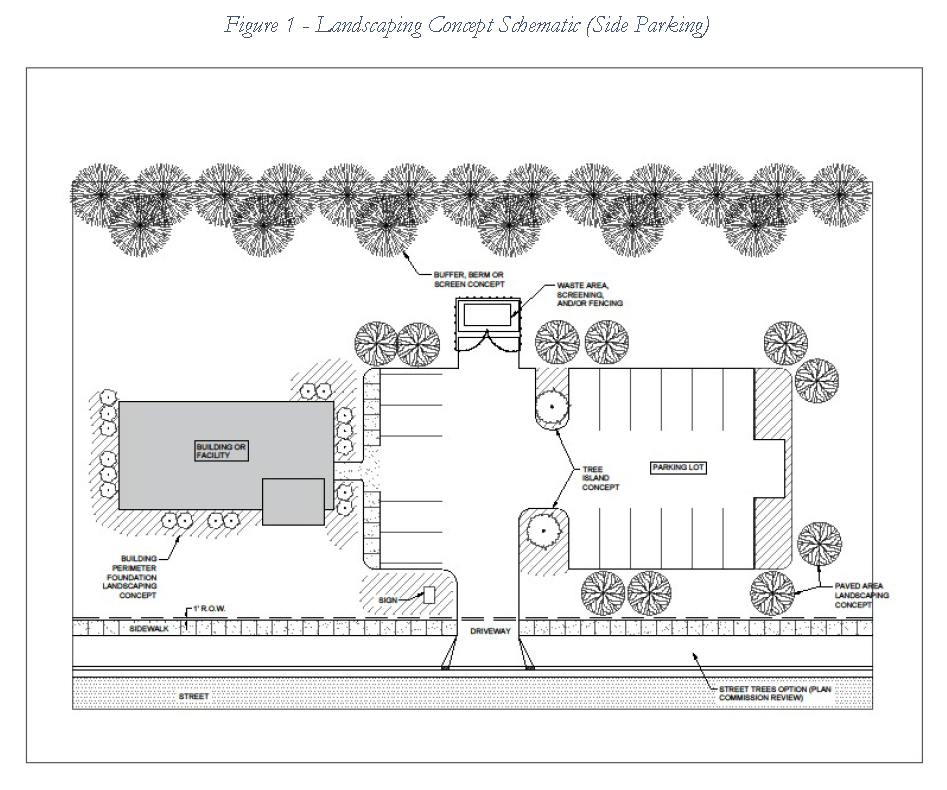
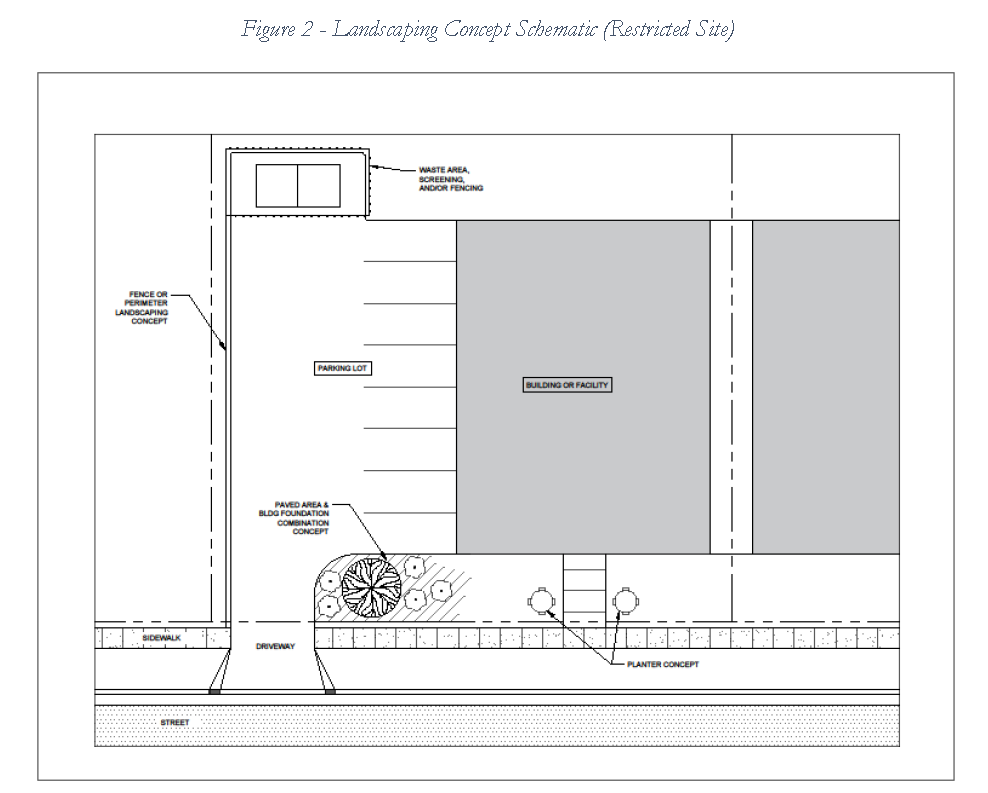
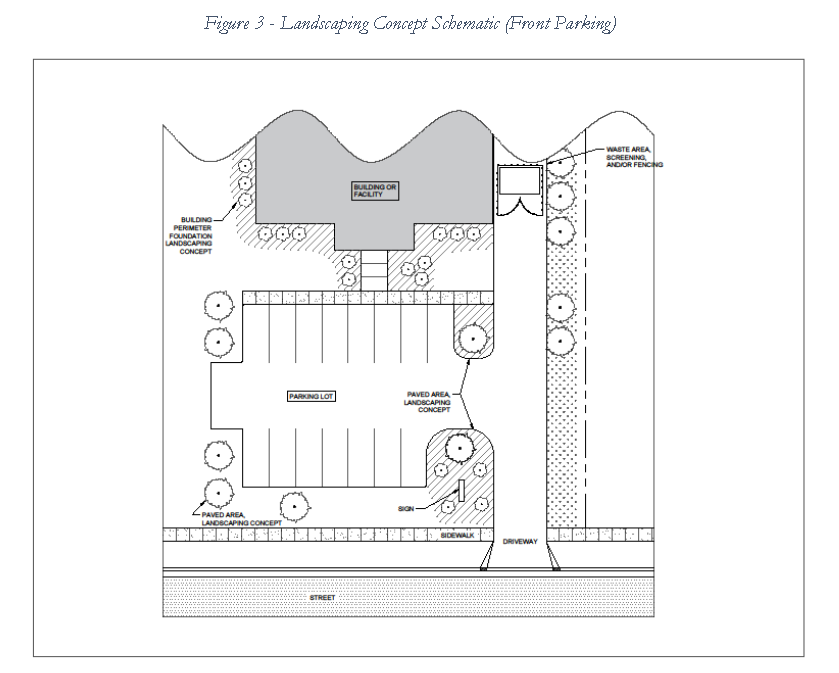
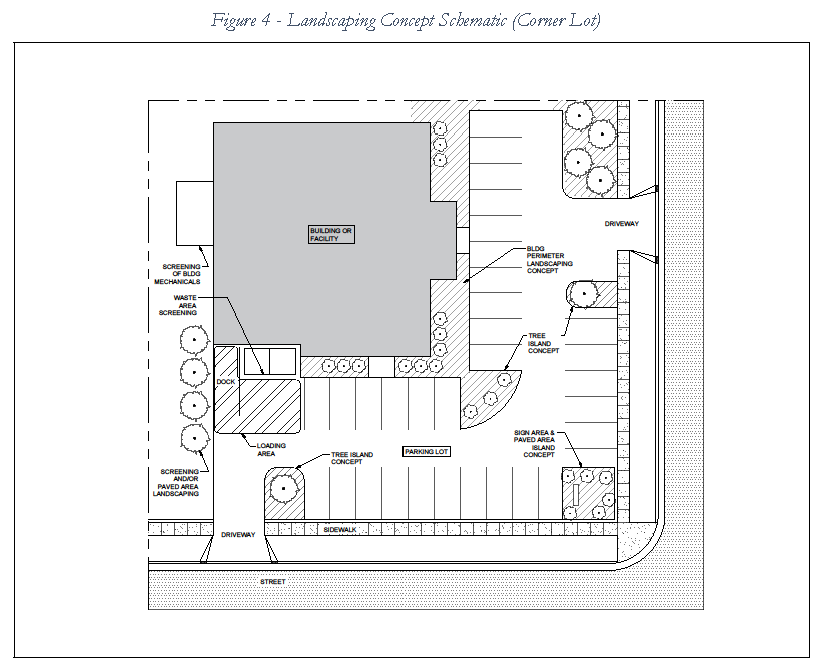
(5)
Building foundations. Landscaping shall be planted around exterior building walls, except for those not visible to the public, but shall not include large deciduous shade trees. Building perimeter concepts are encouraged to include the following (see figures for schematic examples):
a.
Deciduous or evergreen shrubs, small decorative trees, decorative stone, pavers, or wood mulch, stones or layered rock accents, and accent plantings such as tall grasses.
b.
Use of building features or ornamental elements tied to the facility appearance, use or product is encouraged.
c.
Screening of mechanical elements such as condensers, vents, utility meters, and other building attachments is encouraged where in direct view and not able to be addressed via site/building orientation.
(6)
Buffer yards. A buffer yard, as defined via the standards identified herein, shall be provided if required for a particular adjoining land use listed in subsection (b), and where otherwise required by the plan commission as part of its approval of a site plan under section 117-400 or a land division under sections 111-52 and 111-54. Where required, buffer yards shall comply with the following.
a.
Buffer yards may be required by the plan commission in the side or rear yards, that adjoin less intensive uses, for new development in the following districts:
1.
Business park district, B-P.
2.
Multiple-family residential district, R-M.
3.
General business district, B-G.
4.
Neighborhood business district, B-N.
5.
Industrial district, I.
6.
Light commercial, LC.
7.
Special purpose districts, such as adult entertainment (AE) and public grounds (P-G).
b.
The minimum width of a buffer yard shall be 25 feet, unless reduced by the plan commission if it determines that a lesser width is both adequate to separate incompatible uses/activities and necessary owing to site constraints beyond the control of the owner.
c.
No building, vehicle accommodation area other than a bike/pedestrian way, trash storage area, light fixture, sign, or outdoor storage area or structure shall be permitted in a required buffer yard.
d.
Landscaping within buffer yards shall be selected, positioned, and planted in sufficient quantities to provide an all-season screen within five years of planting.
e.
The use of a decorative opaque fence or wall, and/or a berm, in lieu of or in addition to the landscaping may be approved by the plan commission, provided that the slope of any berm is less than four:one and the berm, fence or wall does not interfere with access, utilities, or stormwater management.
(7)
Waste area screening. Waste and recycling containment areas shall be screened from view from all adjoining streets and properties. Screening shall consist of:
a.
Building materials and integral gating concepts
b.
Opaque fencing and gating such as wood material, pvc inserts, vinyl inserts or other material approved by the plan commission
c.
Medium evergreen trees spaced adequately for coverage and for survivability of the tree species.
(8)
Other green space areas. Green space areas not used for landscape plantings, other than natural resource protection areas shall be graded and sodded or seeded with a maintainable seed mix. Organic or natural mulch of plantings or planting beds is acceptable, but shall be installed so it does not erode, fall, be plowed, or otherwise transported into walks, drives, streets, or other hard-surfaced portions of the site.
(9)
Rain garden and biofilter areas. Onsite non-municipal stormwater management areas, such as rain gardens, attenuation ponds, and biofilters, shall be considered landscaping amenities and shall be maintained for engineering performance as well as aesthetic appearance.
(10)
Installation requirements.
a.
Visibility. All landscape plantings must comply with the vision clearance requirements of section 117-1144 in a full-growth state. Furthermore, in the preparation and approval of landscape plans, adjacent sites zoned for non-residential use shall not be unreasonably screened from view from public streets.
b.
Prohibited and discouraged species. The following species are prohibited for use as landscaping plants in all locations:
1.
Honeysuckle: Lonicerax-bella, Lonicera marrawi, Lonicera tatarica.
2.
Box Elder (acer negundo).
3.
Buckthorn (common or glossy): Rhamnus cathartica, Rhamnus frangula (tall hedge).
4.
Black Locust (robinia pseudacelia).
5.
Mulberry Tree (morus).
6.
Poplar (genus populus, all varieties, including Cottonwood).
7.
Ash (all varieties, until threat of emerald ash borer is eliminated).
8.
American Elm (almus american) and any other species of elm not resistant to Dutch Elm Disease.
c.
The use of the following tree species shall be strongly discouraged:
1.
Ailanthus (Tree of Heaven).
2.
Catalpa.
3.
European White Birch.
4.
Fruit-bearing Trees (excluding Crabapples).
5.
Russian Olive.
6.
Siberian Elm.
7.
Silver Maple.
8.
Walnut.
9.
Willow (except along water edges).
10.
Pine.
11.
Other weak-wooded tree species or species that deposit a significant number of twigs, seed pods, fruits, nuts, and/or other debris.
d.
Installation. All landscaping required under this section shall be installed consistent with village standard specifications and industry accepted standards and shall be guaranteed by the applicant or the applicant's contractor for two years. All landscaping shall be installed according to the approved plan on file with the village, which plan is to be prepared and approved prior to building permit authorization. Installation of approved landscaping improvements shall occur prior to occupancy or commencement of operations, unless doing so would result in unsatisfactory plant survival. In this case, landscaping shall be installed within six months of occupancy or commencement of operations, or other timeframe as specifically agreed with the plan commission. Phased landscaping installations may be approved by specific agreement with the plan commission.
e.
Maintenance. Landscaping required by this section is intended to be a permanent site improvement. As such, all landscaping shall be continually maintained in a live, healthy, safe, and aesthetically pleasing state. Recognizing that over time plants may mature and die or otherwise expire because of natural or unnatural causes; maintenance shall include the removal and replacement of dead or dying plants. Such replacement shall occur within the same year in which a plant dies or in the spring planting season of the following year.
f.
Stabilization measures. Landscaping shall be provided with adequate stabilizing mechanisms designed for wind, erosion and varying weathering conditions such as tie-downs, matting and tree staking. Installations shall consider site erosion control provisions.
g.
Location in utility easements. Planting in utility easements is at the risk of the property owner. Any plants that must be removed because of utility work within such easements shall be replaced by the property owner at his or her cost.
h.
Landscaping in public rights-of-way or public lands. Tree or shrub planting in any public right-of-way or on any public land in the village shall be in accordance with the provisions section 107-106.
(11)
Lawn care and alternative groundcover. Lawn care, including gardens, shall comply with the requirements of section 24-24.
(Ord. of 4-12-2021(7))
Sec. 117-1059. - Preservation of topography and drainage.
(a)
Purpose. The purpose of this section is to protect property owners from possible damage resulting from modifications to the existing grade of adjoining lands and to aid in preserving and protecting the natural beauty and character of the landscape.
(b)
General applicability. The following provisions shall apply to all property:
(1)
With development of any land, effort shall be maintained to preserve pre-existing topography to the extent practical and consistent with safe, efficient, and attractive land development.
(2)
No structure shall be built that would alter the existing drainage or topography in any way as to adversely affect the adjoining property(ies).
(3)
In no case shall any slope exceed the normal angle of slippage of the material involved.
(c)
Applicability to residential zoning districts. The following provisions shall apply to all property within the village, except lands currently within the AG (agricultural) district:
(1)
No change in existing topography shall be made that would result in increasing the slope of any land within a distance of six feet from a property line to a ratio greater than three horizontal to one vertical (maximum three:one slope).
(2)
Except upon written approval of the owner of all abutting property, no individual parcel shall alter grading in a way that results in a change of drainage upon adjoining properties, as determined by village staff.
(3)
Surface yard work and landscaping efforts. Surface yard work and minor landscaping activities are hereby defined as activities that will:
a.
Not change drainage (existing overland or underground directional flow of water runoff) of the subject lot or adjoining parcel
b.
Not disturb subsoil (below topsoil layer) of a subject lot, or increase fill that would affect drainage to/from surrounding properties of a subject lot
c.
Retaining walls less than one foot in finished grade height
d.
Change in finished surface from turf, such as rock mulch, wood mulch, patio pavers and other hardscape that is not classified as driveways, parking or sidewalks.
e.
Installation of individual landscaping amenities such as trees, shrubs or other plantings.
(4)
Individual lot activities of a more substantial nature require village review and approval pursuant to the following permitting:
a.
Section 107-61, grading.
b.
Section 111-144, erosion control.
c.
Section 117-400, site plan review.
d.
Plan commission review/approval may be required for activities requiring permitting as described above.
(Ord. of 4-12-2021(8))
Sec. 117-1100. - Purpose.
This division permits specific uses in specific districts and these performance standards are designed to limit, restrict and prohibit the effects of those uses outside their premises or district. No structure, land or water shall hereafter be used except in compliance with the district regulations and with the following performance standards. In all cases, the more restrictive regulations between this division and state and federal requirements will be required.
(Ord. of 12-17-2012, § 48-590)
Sec. 117-1101. - Air pollution.
No activity or operation shall be established or maintained which by reason of its nature causes emission of any fly ash, dust, fumes, vapors, mists or gases in such quantities as to cause soiling or danger to the health of persons, animals, vegetation or property. In no case shall any activity emit any liquid or solid particles in concentrations exceeding 0.3 grains per cubic foot of the conveying gas, nor any color visible smoke equal to or darker than No. 2 on the Ringlemann Chart described in the United States Bureau of Mines' Information Circular 7718 in any industrial district.
(Ord. of 12-17-2012, § 48-591)
Sec. 117-1102. - Fire and explosive hazards.
All activities involving the manufacturing, utilization, processing or storage of flammable and explosive material shall be provided with adequate safety devices against the hazard of fire and explosion, and with adequate firefighting and fire-suppression equipment and devices that are standard in the industry. All materials that range from active to intense burning shall be manufactured, utilized, processed and stored only in completely enclosed buildings which have incombustible exterior walls and an automatic fire extinguishing system.
(Ord. of 12-17-2012, § 48-592)
Sec. 117-1103. - Glare and heat.
No unsanctioned activity shall emit glare or heat this is visible or measurable outside its premises, except activities in the industrial district which may emit direct or sky-reflected glare which shall not be visible outside their district. All operations producing intense glare or heat shall be conducted within a completely enclosed building. Exposed sources of light shall be shielded so as not to be visible outside their premises.
(Ord. of 12-17-2012, § 48-593)
Sec. 117-1104. - Liquid or solid wastes.
No activity shall result in a discharge at any point onto any land or into any water or public sewer any materials of such nature, quantity, noxiousness, toxicity or temperature which can contaminate, pollute or harm the quantity or quality of any water supply; can cause the emission of dangerous or offensive elements; can overload the existing municipal utilities; or can injure or damage persons or property.
(Ord. of 12-17-2012, § 48-594)
Sec. 117-1105. - Noise and vibration.
No activity or operation shall be established or maintained which by reason of its nature or manner of operation will cause the emission of noise in such levels as to be detrimental to or endanger the public health and safety or cause injury to property or business. In no case shall any activity emit noise or vibration over 75 decibels, emanating from any activities, beyond the boundaries of the immediate site.
(Ord. of 12-17-2012, § 48-595)
Sec. 117-1106. - Odors.
No activity shall emit any odorous matter of such nature or quantity as to be offensive, obnoxious or unhealthful outside their premises.
(Ord. of 12-17-2012, § 48-596)
Sec. 117-1107. - Radioactivity and electrical disturbances.
No activity shall emit radioactivity or electrical disturbances outside its premises that are dangerous or adversely affect the use of neighboring premises.
(Ord. of 12-17-2012, § 48-597)
Sec. 117-1108. - Refuse.
All waste material, debris, refuse or garbage which cannot be properly disposed of through the public sanitary sewerage system shall be kept in an enclosed building or properly contained in a closed container designed for such purposes. The owner of vacant land shall be responsible for keeping such land free of refuse.
(Ord. of 12-17-2012, § 48-598)

