
Brooksville City Zoning Code
ARTICLE III
SPECIAL DISTRICTS AND DEVELOPMENT OPTIONS
Sec. 3-0.1. - Generally.
(a)
Intent. It is the intent of this Land Development Code to permit creation of special districts and options in accordance with the procedures of Article VIII in the following circumstances:
(1)
In general, areas officially designated as having special and substantial public interest in protection of existing or proposed character, or of principal views of, from, or through the areas;
(2)
Surrounding individual buildings or sites where there are special and substantial public interest in protecting such buildings and their visual environment; or
(3)
In other cases where special and substantial public interests require modification of otherwise applicable zoning and other regulations, or repeal and replacement of such regulations, for the accomplishment of the special public purposes for which the special district is established.
(b)
Relationship to comprehensive plan. It is further intended that such districts and the regulations adopted for them shall be in accord with and promote the purposes set out in the comprehensive plan and other officially adopted plans of the City, and shall encourage land use and development in substantial accord with the physical design objectives set out therein.
Sec. 3-1.1. - Generally.
(a)
Purpose. The purpose of this Part is to provide regulatory guidance for the historic central business/residential overlay district (HCBRD) and design standards. The zoning overlay district and design standards implement the vision, principles and strategies of the City of Brooksville Comprehensive Plan's Community Redevelopment Plan.
(b)
Intent. The intent of the historic central business/residential overlay district is to revitalize Brooksville's downtown commercial core and residential periphery, enhance the appearance of Brooksville's historic business district, and promote a mixed-use, walkable and pedestrian-friendly environment.
Sec. 3-1.2. - Applicability.
These standards shall apply to all new development and redevelopment within the area identified in the historic central business/residential overlay district (Map 3-1). However, these provisions shall not apply to properties designated as historic landmarks, previously approved planned development projects, previously approved subdivisions, and projects with unexpired building permits, unexpired preliminary site development approval or unexpired construction plan approval at the time of adoption of this Article. Existing lawful uses, lots, structures, characteristics of land and densities shall not be required to be removed or otherwise modified as a result of the standards or requirements set forth in this Part.
In addition to the standards provided herein, development within the HCBRD overlay district shall be required to meet all other applicable Sections of the Land Development Code. Where any provision of the HCBRD overlay district regulations is in conflict with any other standards or regulations of the Land Development Code, the HCBRD overlay regulations shall prevail.
Sec. 3-1.3. - Permitted Uses.
The uses permitted within the HCBRD overlay district shall be those of a property's underlying zoning district and those of the HCBRD overlay district. The Permitted Uses, Conditional Uses, Special Uses and Special Exception Uses are presented in Table 2-2 of Article II.
Sec. 3-1.4. - Standards for Single-Family Residential Development.
(a)
Existing development. Renovations and additions shall adhere to the architectural style of and utilize materials similar to the existing structure and shall comply with all applicable regulations of the property's underlying zoning district and other regulations of this Code.
(b)
New development. New development shall be subject to the requirements of the property's underlying zoning district and the following:
(1)
Each principal dwelling shall have a front porch. The porch shall be a minimum of eight feet in width and six feet in depth. The porch shall be covered with a solid roof but shall not be screened or otherwise enclosed. Railings, if provided, shall be consistent with the architectural style of the structure.
(2)
A garage is required for each dwelling unit. Garages designed to hold three or more cars shall have at least two separate doors. The entry face of a garage accessed through a front yard, including a front yard functioning as a side yard, shall be set back at least five feet further from the street than the front plane of the principal building, excluding covered porch. Except as otherwise regulated by this Part, setbacks for detached garages shall comply with the accessory structure requirements of this Code. Carports, other than drive-through porte cocheres, shall be prohibited.
(3)
Drive-through porte cocheres shall meet principal structure setbacks and shall extend no closer to the street than the front plane of the principal building, excluding covered porch.
Sec. 3-1.5. - Standards for Non-Residential, Multi-Family and Mixed Use Development.
(a)
Existing structures. Renovations and additions shall adhere to the architectural style of and utilize materials similar to the existing structure and shall comply with all other applicable regulations of this Part.
(b)
New construction
(1)
Building location.
a.
Setbacks: Front yard setbacks shall be a maximum of three feet. However, up to 90 percent of the building frontage may be developed with a paved courtyard, arcade or gallery devoted to public/patron use and meeting the maximum setback. In such cases, the building façade containing enclosed floor space shall be no more than 20 feet from the right-of-way line and the façade shall comply with the design requirements of this Part. Rear yard setbacks shall be a minimum of ten feet, and no side yard setback shall be required. Notwithstanding the above, if a non-residentially-zoned property is adjacent to a single-family zoning district, the minimum rear and side yard setbacks shall be 20 feet.
b.
Maximum height shall be 50 feet.
c.
Maximum floor area ratio (FAR) shall be 2.0.
(2)
Building design.
a.
Building façade. Blank walls shall not occupy over 50 percent of a street-facing frontage and shall not exceed 20 linear feet without being interrupted by a window or entry. No more than 20 feet of horizontal distance of wall shall be provided without architectural relief for building walls and frontage walls facing the street. Buildings shall provide a foundation or base that extends from the ground to the bottom of the lower windowsills that is distinguished from the building face by a change in volume or material. Building façade must be architecturally finished to grade. A clear visual division shall be maintained between the ground level floor and upper floors, which may include changes in volume or materials or other architectural detailing such as a belt course or cornice. The top of any building shall contain a distinctive finish consisting of a cornice or other architectural termination. Ground floor commercial and office uses that are located in non-residential or mixed use structures and that are located on a corner parcel and have two street frontages shall contain storefront display windows covering a minimum of 40 percent and a maximum 80 percent of a storefront's linear frontage.
b.
Transparency. All street-facing non-residential and mixed-use structures shall have windows covering a minimum of 40 percent and a maximum 80 percent of the ground floor of each storefront's linear frontage. Mirrored glass, obscured glass and glass block cannot be used in meeting this requirement. Display windows may be used to meet this requirement, but must be transparent and shall not be painted or obscured by opaque panels.
c.
Shelter. Buildings may incorporate arcades, alcoves, porticos or awnings.
(3)
Parking, access and site design. Except as otherwise provided by this Section, parking requirements for all uses shall be in accordance with the parking standards of Article IV. Landscaping requirements for off-street vehicular use areas shall be in accordance with the landscaping and buffering requirements of this Code.
a.
Required off-street parking.
i.
The Chief Administrative Officer or his designee may reduce or waive parking requirements for existing structures/uses. Said decision shall be based on an evaluation of property design, intensity of use and availability of public parking. For new development, the spaces required shall be as identified in Article IV of this Code. Required parking provided through surface parking lots shall be on the development site or within 500 feet of the development site that the parking is required to serve.
ii.
The minimum parking requirements in Article IV of this Code for non-residential uses is the maximum allowed. Additionally, the non-residential parking requirements may be reduced by up to 50 percent by the Chief Administrative Officer or his designee. Said reduction shall be based on an evaluation of property design, intensity of use, availability of public parking and/or shared parking agreements.
b.
On-street parking credit. On-street parking spaces shall be deducted from the required number of off-street parking spaces for the adjacent use. When an extended parcel line splits an on-street parking space, that space shall be deducted from the parking requirements of the parcel that fronts the majority of the on-street parking space.
c.
Off-street parking (surface parking lots) location.
i.
Off-street surface parking lots shall be located behind the front building façade.
ii.
Notwithstanding the above, surface parking lots may be located adjacent to one street in projects with frontage along two streets. Additionally, on corner lots, surface parking may be located adjacent to two streets.
d.
Parking garages. Except for vehicle entrances, the ground floor shall be developed with enclosed commercial, office or public use floor space to a minimum building depth of 30 feet along the entire length of the structure on each adjacent street, unless separated from the street by another building, parking lot and/or landscaped open space with a minimum depth of 30 feet.
e.
Screening of trash and recycling receptacles, loading docks, service areas, and other similar areas.
i.
Trash, recycling receptacles, loading docks, service areas, and other similar areas must be located in parking areas or in a location that is not visible from street frontages, and must be screened to minimize sound and visibility from residences and to preclude visibility from adjacent streets. Service areas shall be screened by a masonry wall and landscape buffer. The wall shall be a minimum of six feet in height using architectural design, materials and colors that are consistent with those of the primary structure. The landscape buffer shall be a minimum of five feet in width and contain evergreen plants a minimum of three feet in height spaced not more than four feet apart.
ii.
Mechanical equipment shall be placed on the parking lot side of the building away from view from adjacent street frontage and shall be screened from view of any street by fencing, vegetations, or by being incorporated into a building.
f.
All rooftop mechanical equipment shall be integrated into the overall mass of a building by screening it behind parapets or by recessing it into roof structure.
g.
Fences and walls shall be constructed of masonry, wood, vinyl or cast iron/metal. The location of all fences and walls shall be in accordance with Article IV of this Code.
h.
A building's primary orientation shall be toward the street rather than the parking areas. The primary building entrances shall be visible and directly accessible from a public street.
i.
Buildings that are open to the public shall have an entrance for pedestrians from the street to the building interior. This entrance shall be a distinctive and prominent element of the architectural design, and shall be open to the public during business hours. Buildings shall incorporate lighting and changes in mass, surface or finish to emphasize the entrance(s).
(2)
Sign standards. Signs shall conform to the limitations and provisions of Article VII of this Code. Additionally, the following limitations and provisions shall apply to signage for all uses excluding emergency public services/uses.
a.
Signage shall be constructed utilizing materials similar to those of the buildings served. Acceptable materials may include wood and painted metal. Plastic and similar synthetic materials are permitted if designed to replicate the appearance of wood and painted metal signs.
b.
Pole signs shall be prohibited.
c.
The maximum height of monument (ground) signs shall be eight feet above the ground plane. Monument signs shall be set back a minimum of ten feet from the public right-of-way, 30 feet from the intersection of right-of-way lines and shall meet any additional setback required in Article VII of this Code.
d.
The maximum width of an awning sign shall not exceed the width of the canopy, awning or marquee.
e.
Permanent window sign displays shall be limited to no more than 20 percent of the window area.
f. Projecting signs.
i.
Projecting signs shall be located above ground-floor level doors and windows but below the roofline or second-floor level to promote a pedestrian environment.
ii.
Signs are limited to no more than one projecting sign per business.
iii.
Signs shall not project beyond the back of curb or, if no curb exists, beyond the edge of pavement.
g.
Sign lighting.
i.
Ground-mounted up-lights shall not exceed 150 watts per sign face and shall shield light from aiming toward motorists and neighboring properties. Fixtures shall be hidden from view by sign landscaping.
ii.
Internally lighted signs attached to buildings shall only illuminate lettering and not the entire sign face.
Map 3-1
CITY OF BROOKSVILLE
HISTORIC CENTRAL BUSINESS/RESIDENTIAL DISTRICT OVERLAY AREA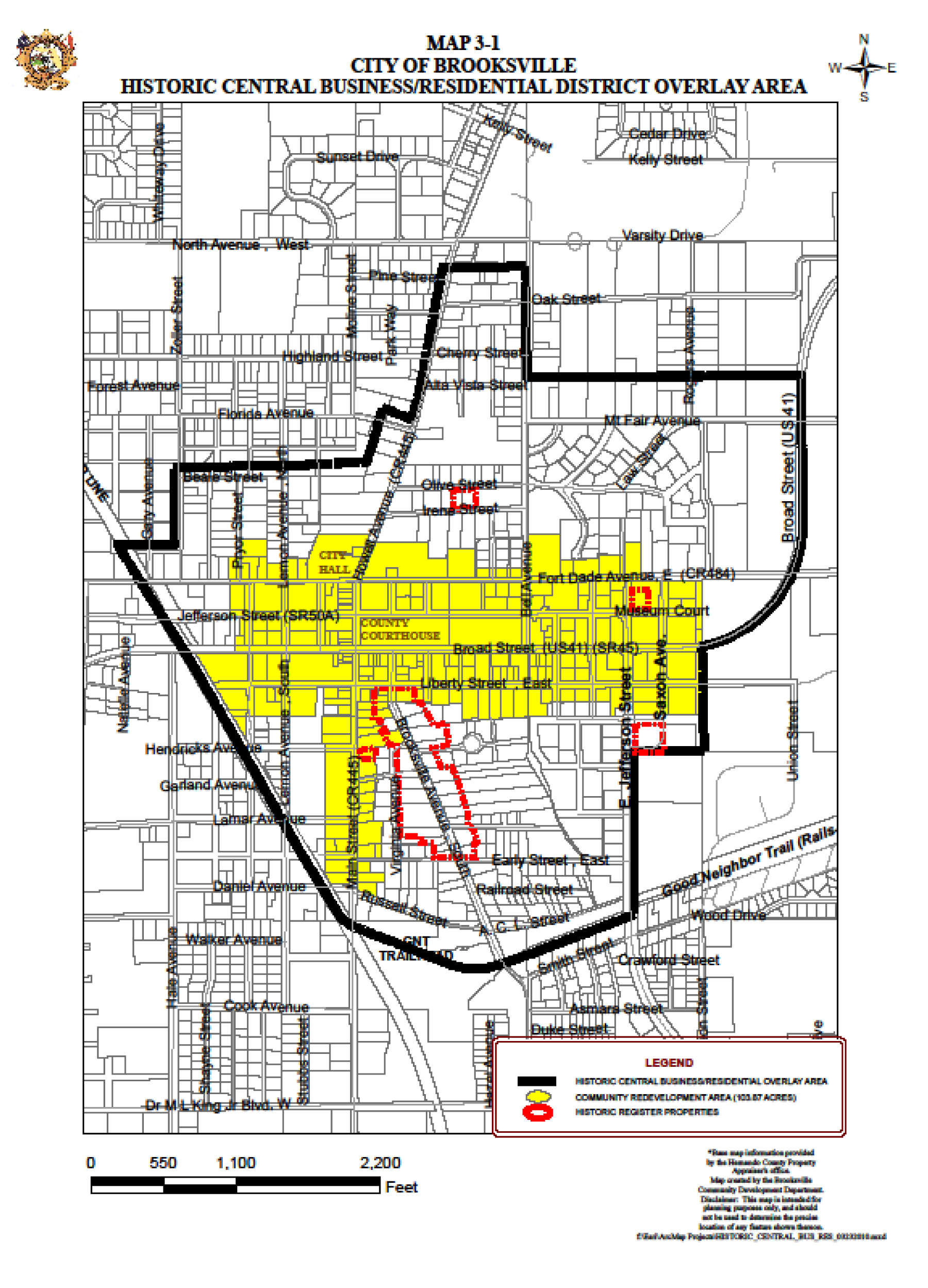
Sec. 3-2.1. - Generally.
The architectural, cultural, archaeological, and historic artifacts of the City of Brooksville are important community resources which enrich the lives of citizens and visitors alike, provide expanded economic opportunity, and present opportunities to stabilize and enhance property values. Therefore, it is declared that structures, buildings, and sites important to the understanding of the history of the City of Brooksville possess special public interests and should be conserved and protected by designating them and their environs as historic and cultural conservation districts.
Within zoning districts now existing or hereafter created, it is intended to permit creation of historic and cultural conservation (HCC) overlay districts, in general areas having concentrations of structures of substantial historic, architectural or cultural significance, or for individual structures and premises designated as having such significance.
Sec. 3-2.2. - Purpose and Intent.
(a)
Purpose. The purpose of the City of Brooksville historic preservation regulations is to establish procedures, as set forth in the Florida Certified Local Government Program, for the protection of the Historic and Archaeological Resources of the City of Brooksville. The regulations are to be read in accordance with the Florida Certified Local Governmental Guidelines. It is the express intention that these regulations implement the Florida Certified Local Governmental Guidelines. These procedures shall provide for the establishment of an historic preservation review commission to be known as the historic preservation review board (HPRB); the designation of landmarked historic and archaeological resources, landmark sites, and historic districts; the maintenance of the historic resources inventory; and the regulation of designated properties. These procedures shall comply with the Florida Certified Local Government Guidelines.
The architectural, archaeological, cultural, and historic artifacts of the City of Brooksville are important community resources which enrich the lives of residents and visitors alike, provide expanded economic opportunity, and present opportunities to stabilize and enhance property values. The structures, interiors, buildings, and archaeological resources important to the understanding of the history and archaeological history and prehistory of Brooksville possess special public interest and should be conserved and protected by designating them and their environs as landmarked historic and archaeological resources, landmark sites, and historic districts, hereafter referred to collectively as "landmarks." These regulations, the purpose of which is to preserve, promote, and improve the landmarks of the City of Brooksville, benefit the educational, cultural, economic, and general welfare of the public.
The City of Brooksville has played an important role in the development of Florida, and this history is shown today through its historic and archaeological resources. These landmarks represent the historical and archaeological activities of the community.
These regulations accomplish historic preservation through a three-step process. First, the regulations establish an HPRB made up of persons of knowledge, experience, judgment and background, and have personal or professional interest or experience in historic restoration and preservation. Second, the regulations provide for a process whereby the City Council will designate the historic and archaeological resources of the City as landmarks using the recommendations of the HPRB. Third, the regulations establish guidelines for the treatment of landmarks, especially involving exterior alterations and demolition of buildings and structures and the subsurface disturbance of archaeological resources. The HPRB may issue certificates of appropriateness (COAs) for changes to landmarks.
(b)
Intent. Regulations relating to HCC districts are intended:
(1)
To protect against destruction of such areas, structures, or features or encroachment of structures, uses, or features likely to have adverse effects on their historic, architectural, or cultural character;
(2)
To encourage uses such as a bed and breakfast establishments, antique shops, book stores, cafes and other establishments in residential structures which will lead to their continuance, conservation, and improvement in a manner appropriate to the preservation of the cultural, architectural, and historical heritage of the City;
(3)
To prevent developments in the visual environs of such areas or structures which would detract from their character;
(4)
To ensure that new or altered structures and uses within such districts and their environs will preserve and enhance the special character of the districts; and
(5)
To discourage unnecessary destruction of buildings, structures, and sites of special cultural, architectural, and historic importance.
(6)
Foster such planning as to encourage the continued use and preservation of historic property.
Sec. 3-2.3. - Regulatory Framework.
There is hereby created a Historic Preservation Review Board (HPRB) of the City of Brooksville.
(a)
Composition.
(1)
The HPRB will consist of seven members who are residents of the City, residents of the county or individuals who own real estate within the incorporated City boundaries. A minimum of four members shall be residents of the City or own real estate within the incorporated City. Membership of the board shall include, to the extent available, three persons who are educated or who practice in the following disciplines: architecture; history; architectural history; planning; archaeology; or related disciplines.
(2)
Members of the HPRB will be persons of knowledge, experience, judgment and background relative to the history of the City of Brooksville and Hernando County, and have personal or professional interest or experience in historic restoration and preservation. HPRB members will have the ability and desire to act in the public interest and represent, insofar as possible, the various special personal and professional interests required to make informed and equitable decisions concerning the preservation, conservation and protection of historic districts and structures.
(b)
Term of office.
(1)
HPRB members shall be appointed by City Council. The initial terms of four of the members appointed by City Council shall expire December 31, 2013 while the initial terms of the remaining three members shall expire January 1, 2014. Thereafter, the terms of all members will be two years.
(2)
The term of a board member will be automatically terminated in the event a member fails to attend any three regularly scheduled meetings in any calendar year during the member's term of office. This provision does not include excused absences and special or emergency meetings. An HPRB member must notify the Community Development Department of expected nonattendance for an absence to be considered excused.
(3)
Any member may be removed with or without cause by a majority vote of the City Council. Appointments to replace any member due to death, resignation or removal will be made by the City Council and will last for the unexpired term.
(c)
Organization.
(1)
The HPRB shall elect a chairman and a vice-chairman from its membership, and each will serve terms of one year. The board may elect the chairman and the vice-chairman for additional terms. The chairman will preside over the HPRB and will have the right to vote. In the absence or disability of the chairman, the vice-chairman will perform the duties of the chairman. The Chief Administrative Officer's designee shall act as the City historic preservation officer and will serve as staff of the HPRB.
(2)
A majority of the board (four) will constitute a quorum.
(3)
The board shall adopt rules and regulations providing for the transaction of its business and consideration of applications, for the time and place of regular meetings, and for the calling of special or emergency meetings. All meetings of the board shall be open to the public and a public record will be kept of the board's resolutions, proceedings, and actions as required by Florida law.
(4)
The HPRB will hold regular meetings to consider nominations for designation of historic status, review applications for certificates of appropriateness, and conduct other such duties and business with which the board is charged under this ordinance.
(d)
Historic and archaeological resource and landmark inventory.
(1)
The City shall develop and maintain a listing of its landmarks and historic and archaeological resources considered eligible for landmark designation. This list, referred to as the historic resources inventory, shall be periodically updated and shall contain, but not be limited to, all City of Brooksville designated landmarks. The HPRB shall notify the owner(s) of the subject property of its intent to add historic and archaeological resources to the historic resources inventory.
(2)
When applications for development permits, development orders or other development approvals affect properties listed in or properties abutting those listed in the historic resources inventory the City Department receiving the application shall provide the HPRB written notification within 15 working days after the deadline for filing of application for permits which require a public hearing. The Chief Administrative Officer or his designee shall request, obtain, and consider testimony from the HPRB. The HPRB shall give consideration to the views, if any, of interested persons.
(3)
The HPRB shall review each application at its next regularly scheduled meeting provided that the HPRB receives notification of the application at least ten days prior to that meeting. If the HPRB does not receive notification of the application at least ten days prior to the next regularly scheduled meeting, the HPRB will review the application at the following month's regularly scheduled meeting. Should the HPRB fail to act on an application within the above referenced time frame, it shall be deemed that the HPRB has no comment regarding the application. The applicant, or its representative, may attend the meeting at which the application shall be reviewed.
(4)
The HPRB shall prepare a list of routine alterations, including minor work, which may receive administrative review from Community Development Department staff, provided that the alteration complies with the guidelines of the HPRB. In reviewing projects which may affect properties listed in or properties abutting those listed in the historic resources inventory, the HPRB shall apply the following criteria to determine whether or not the project will have either no effect or an adverse effect on the landmark and/or historic and archaeological resources:
a.
A project has no effect on a landmark and/or historic or archaeological resource when the project proposes to preserve and protect those characteristics of the property that qualified, or may qualify the property for Landmark designation. For the purpose of determining effect, alteration of features of the property's location, setting, or use may be relevant depending on a property's significant characteristics and should be considered.
b.
A project is considered to have an adverse effect when the effect on a landmark and/or historic or archaeological resource may diminish the integrity of the property's location, design, setting, materials, workmanship or associated historic use. Adverse effects on historic or prehistoric cultural and archaeological properties and resources include, but are not limited to:
• Physical destruction, damage, or alteration of all or part of the property;
• Isolation of the property from or alteration of the character of the property's setting when that character contributes to the property's qualification for the landmark designation;
• Introduction of visual, audible, or atmospheric elements that are out of character with the property or alter its setting.
Interior modifications that do not affect the exterior historical characteristics shall not be considered to have an adverse effect.
Sec. 3-2.4. - Landmark Designation.
(a)
Initiation.
(1)
The HPRB and the Community Development Department shall identify and receive recommendations for potential landmarks from property owners.
(2)
The HPRB shall review each potential landmark, in light of the criteria for landmark designations contained below, and determine whether or not to initiate the designation process.
(3)
The HPRB shall, upon its decision to initiate the designation process, direct Community Development Department staff to prepare a written report and analysis of the proposed landmark under the criteria contained herein and any other standards the HPRB may deem necessary. The report shall also include a legal description of the property to be designated and a description of the contributing resources to be designated.
(b)
Review and recommendation by the HPRB.
(1)
The HPRB shall hold a public hearing on each proposed landmark designation within 60 days of the date to the HPRB's decision to initiate the designation process. Notice shall be given pursuant to the notice requirements contained in Section 3-2.4(f) below, including notification to the property owner.
(2)
The HPRB shall review each potential landmark in light of the criteria for landmark designations contained in Section 3-2.4(d), public testimony and evidence presented at the public hearing and make a recommendation to the City Council to approve, disapprove, or modify the proposed landmark designation.
(3)
The HPRB shall prepare a written landmark designation report for each landmark designation. The report shall include the testimony given at the public hearing, an architectural or archaeological description, a statement of significance including a brief history, and the criteria by which the landmark is considered worthy of designation. A site plan and photographs shall be included in the report. When available, floor plans of the building should be included. The report shall contain sufficient specific information about the property to serve as a guide for the evaluation of any future proposed changes to the property.
(4)
The HPRB shall forward its recommendation and the landmark designation report to the City of Brooksville Community Development Department for review of the proposed landmark designation as it relates to the comprehensive plan. The Community Development Department shall forward its comments to the HPRB and City Council within 30 days.
(5)
The HPRB shall forward their recommendation to the City Council within 30 days of the close of the HPRB public hearing.
(c)
Review and determination by the City Council.
(1)
The City Council shall hold a public meeting on the proposed designation within 60 days of receipt of the HPRB recommendation. Notice shall be given pursuant to the requirements of Section 3-2.4(f), including notification to the property owner. The City Council shall review the proposed landmark designation in light of the criteria contained in Section 3-2.4(d), the HPRB recommendation and the Community Development Department comments, and shall approve, modify or disapprove of the proposed landmark designation at the public meeting.
(2)
The City shall notify the property owner of the designation of the landmark.
(3)
The landmark designation shall be noted on the official zoning map of the City of Brooksville.
(4)
Landmark designation by the City Council shall be subject to the procedures and regulations of the HPRB in addition to the other provisions of the Land Development Code and other regulations of the City of Brooksville.
(5)
Within ten days of the oral decision by the City Council to designate a landmark, the property owner may appeal the City Council decision to the circuit court of Hernando County. The nature of the appeal shall be by writ of certiorari.
(d)
Criteria for landmark designation. A landmark shall have achieved significance within the time period established by the National Register of Historic Places, which is 50 years old or older (An exception to the 50 year rule may be made if the resource is of exceptional importance or if it contributes to a district that is eligible for listing in the National Register of Historic Places) and shall qualify for designation when it meets one or more of the following criteria:
(1)
It is associated in a significant way with the life of a person important in the past.
(2)
It is the site of an historic event with significant effect upon the community, state, or nation.
(3)
It exemplifies the historical, cultural, political, economic, or social trends of the community, state or nation.
(4)
It embodies those distinguishing characteristics of an architectural style, period or method of construction.
(5)
It is the work of an architect or builder whose work has influenced the development of the community, state or nation.
(6)
It contains elements of design, detail, materials or craftsmanship of outstanding quality or represents a significant innovation or adaptation to the Florida environment or constructed of materials not now used.
(7)
It has value as a building that is recognized for the quality of its architecture and that retains sufficient features showing its architectural significance.
(8)
It has yielded, or is likely to yield, archaeological information important in prehistory or history.
(9)
It is a geographically definable area or neighborhood united by culture, architectural styles or physical development, which has historic or cultural significance in the community.
(10)
It is an easily identifiable visual feature of the community and contributes to the distinctive quality or identity of the community because of its prominence or spatial location, contrasts of siting, age or scale.
(11)
It is where veterans of America's wars are buried and where public tribute may be paid in their memory.
Each designation of a building, structure, district, object, archaeological resource, or parcel of land as a landmark shall be accompanied by the designation of a landmark site.
(e)
Effects of designation as a landmark.
(1)
Upon designation of a landmark by the City Council, that property becomes eligible for the historic and cultural conservation (HCC) zoning overlay should the owner so desire.
(2)
Upon designation of a landmark by the City Council, that property may become eligible for consideration for economic incentives.
(3)
Upon designation of a landmark by the City Council, the HPRB, with the owner, may prepare a plan for the long-term preservation of the landmark.
(4)
Upon designation of a landmark by the City Council, that property shall be subject to regulation by the HPRB. A COA issued by the HPRB shall be required prior to any exterior alteration of the landmark, if it is a building or structure, and prior to any subsurface excavation, trenching, or digging in cases of landmarked archaeological resource.
(5)
Upon designation of a landmark by the City Council, the City of Brooksville and all public utility entities shall be required to obtain a COA prior to initiating any changes in the character of sidewalks, trees, utility installations, lighting, walls, interior partitions or walls, fences, structures and buildings on property, easements or streets, included within or adjacent to the designated landmark.
(f)
Notice. Upon establishment of a public hearing date, notice of the public hearing shall be given:
(1)
By the Chief Administrative Officer or his designee posting a sign(s) no later than 15 calendar days prior to the public hearing date in a conspicuous place upon the property which is the subject of the application; and
(2)
By the Chief Administrative Officer or his designee causing the publication of a notice one time at least 15 calendar days prior to the public hearing date in a newspaper of general circulation in the City of Brooksville; and
(3)
By proof of mailing receipt to all owners of property within 150 feet of the subject property, as reflected on the current year's tax roll, and to all condominium owners' associations with property within 150 feet of the subject parcel. Said notice by mail is the responsibility of the City and shall be mailed no later than 15 calendar days prior to the public hearing date.
(4)
By U.S. Postal Service standard mail delivery to all property owners located in excess of 150 feet but not farther than 300 feet of the subject property, as reflected on the current year's tax roll, and to all condominium owners' associations with property located in excess of 150 feet but not farther than 300 feet of the subject parcel.
Sec. 3-2.5. - Certificate of Appropriateness.
(a)
General requirements.
(1)
A certificate of appropriateness (COA) from the HPRB shall be required before a person may undertake the following work on, or alteration to, a Landmark, whether or not a building permit is required for such work:
a.
Exterior alteration, including murals.
b.
Alteration of an archaeological resource.
c.
Relocation.
d.
New construction.
e.
Demolition.
(2)
A COA shall not be required for the painting of historic materials such as brick or stone which were originally painted. A COA shall be required when an applicant proposes to paint an historic material which has not previously been painted and for color selection for a new structure on a landmark site or an addition to a landmark. In this case, the color selection for a new structure on a landmark site or an addition to a landmark should be compatible with that of the historic structure of the landmark.
(3)
A COA may contain the HPRB's recommendations for work on, or alteration to, a landmark. Recommended work or alteration shall be clearly designated as "recommended." Performance of recommended work or alteration is not required as a condition of the issuance of the COA.
(b)
Initiation of certificates of appropriateness review procedures.
(1)
The Chief Administrative Officer or his designee or other applicable City Departments shall refer to the HPRB any person applying for a permit or development order for exterior modifications which will affect a designated landmark. Application shall be made directly to the HPRB for a COA.
(2)
To be placed on the HPRB's current month's agenda, application must be filed no less than ten calendar days before the regularly scheduled HPRB meeting. If the application is not filed at least ten days prior to the next regularly scheduled meeting, the HPRB will review the application at the following month's regularly scheduled meeting.
(c)
Administrative review and determination for minor work. The HPRB shall prepare a list of routine alterations which may receive administrative approval from the Director of the Community Development Department without a public meeting, provided that the alteration complies with the guidelines of the HPRB. Such approvals shall include but not be limited to:
(1)
Minor work by replacement of damaged or deteriorated materials in like kind including:
a.
Roofing.
b.
Siding.
c.
Windows.
d.
Railings.
(2)
Restoration by replacing non-historic elements with reproduction elements matching or approximating the original materials.
(3)
Emergency repair or replacement of water, sewer, or necessary underground utilities on, or in the immediate vicinity of a landmarked archaeological resource.
(d)
HPRB review.
(1)
Prior to formal COA application, a tentative COA proposal may be brought before the HPRB for comments.
(2)
For new construction, conceptual plans shall be reviewed and approved prior to the preparation of construction drawings, which shall also be reviewed and approved before a COA is issued.
(3)
An application for a COA for archaeological disturbance shall be accompanied by full plans and specifications indicating areas of work that might affect the surface and subsurface of the archaeological site.
(4)
The Chief Administrative Officer's designee shall post a notice on the property at a location visible to the public seven calendar days prior to the meeting.
(5)
The applicant, or its representative, shall attend the meeting at which the application shall be reviewed. Failure to attend shall invalidate the application.
(e)
HPRB determination.
(1)
The HPRB shall take action at a public meeting on each application for a COA.
(2)
COAs approved by the Community Development Department shall be reviewed and formally approved by the HPRB.
(3)
For COAs which do not meet the criteria for Community Development Department approval, the following action shall occur:
a.
The HPRB shall make a decision on each application at its next regularly scheduled meeting provided the application has been made at least ten days prior to that meeting and seven-day proper public notice has been posted by the Chief Administrative Officer's designee.
b.
The HPRB may:
• Approve the COA application as presented;
• Approve the COA application with conditions (the HPRB shall provide the applicant with a list of the conditions); or
• Deny the COA application and providing reasons for the denial.
c.
For demolition, relocation or new construction, the HPRB may extend the decision for an additional 30 days, or with the mutual consent of the HPRB and the applicant, for an additional specified period of time.
d.
The HPRB decision shall be an oral vote, recorded in the minutes of the meeting and confirmed in writing to the applicant by the HPRB staff. Reasons for the decision shall be given. The HPRB may suggest modifications with review by the Community Development Department.
e.
Should the HPRB fail to act on an application within the above referenced time frame, the application shall be deemed approved.
f.
Applicants shall be given notice of the public meeting at which their application will be heard.
(4)
The issuance of a COA shall not relieve the applicant from obtaining other development permits, orders, and approvals required by the City of Brooksville. A building permit or other development permit, order, or approval shall be invalid if it is obtained without the COA required for the proposed work.
(f)
Limitations on new application. If the HPRB determines that a COA shall not be issued for a proposed alteration, relocation or new construction, a new application affecting the same property may be submitted during the 12 months after the disapproval only if a substantial change, as determined by HPRB staff, is made in the plans for the proposed work. The new application shall address the issues discussed by the HPRB as its reasons for rejecting the application.
(g)
Appeals. An appeal from a decision of the HPRB on a COA may be appealed to the Brooksville City Council.
(1)
Standing to appeal. The following shall have standing to appeal or to intervene in an appeal of a decision of the HPRB that is specifically related to a particular parcel of real property or project:
a.
An applicant who is adversely affected by the HPRB's decision, or
b.
A property owner whose property is the subject of the decision and is adversely affected by the HPRB's decision, or
c.
Any owner of real property as reflected on the current year's tax roll, lying within 150 feet in every direction of the property or project that is the subject of the decision and any condominium and/or owners' association with common property lying within 150 feet in every direction of the property or project that is the subject of the decision, or
d.
Any resident, landowner or any person having a contractual interest in land in the City of Brooksville who demonstrates a direct adverse impact as a result of the decision that exceeds in degree the general interest in community good shared by all persons. The City Council shall make the determination if there has been a demonstration of a direct adverse impact sufficient to grant appellant or intervener status, however any information considered in making such a determination shall not be considered a part of the record on appeal except as provided in Section 3-2.5(c) of this Part.
(h)
Notice of appeal.
(1)
A notice of appeal of an HPRB decision shall be filed within 30 calendar days of the date on which the decision was rendered.
(2)
The notice of appeal shall be filed with the Chief Administrative Officer and shall set forth a detailed basis for the appeal.
(3)
If a notice of appeal is filed, the appellant, if not the owner of the property or project in question, shall mail notice, by proof of mailing receipt, within ten calendar days of the filing of the appeal to all owners of real property that is the subject of the HPRB decision.
(4)
Within 20 calendar days of the filing of a notice of appeal pursuant to this Section, any person with standing pursuant to Section 3-2.5(g)(1) may intervene and become a party to the appeal by filing a request for intervention in the same manner as filing an appeal of an HPRB decision as described herein.
(5)
The Chief Administrative Officer or his designee shall set the matter for City Council hearing within 30 days of the date of the notice of appeal. This period may be extended by agreement of the Chief Administrative Officer or his designee or the party appealing the decision and any intervener.
(i)
Conduct of hearing.
(1)
In general, the hearing shall be limited to the record on appeal, and shall consist of oral argument by the Chief Administrative Officer or his designee, the HPRB, the party appealing the decision and any intervener, each of whom may be represented by legal counsel.
(2)
The record on appeal shall consist of the following:
a.
The application and any other information submitted by the appellant to and relied upon by the HPRB.
b.
The written decision of the HPRB and any documents attached thereto.
(3)
In addition to the record on appeal, the Chief Administrative Officer or his designee, HPRB representative, the appellant and any intervener may freely refer to the following in presenting their cases to the City Council:
a.
Applicable portions of the City of Brooksville Comprehensive Plan, the City of Brooksville Land Development Code and any other duly adopted City of Brooksville ordinance, rule or resolution.
b.
Any state or federal statute, rule or decision.
(4)
If the Chief Administrative Officer or his designee, the HPRB, the appellant or any intervener believes that, in order to fully present his case, evidence other than that listed in Sections 3-2.5(i)(2) and 3-2.5(i)(3) must be presented to the City Council, the nature of the additional evidence must be disclosed to the other Parties and the City Council not less than five days before the hearing. At the beginning of the hearing the City Council shall rule on whether such additional evidence may be presented. The City Council shall freely allow the presentation of additional evidence pursuant to this subsection where such is relevant to the issue on appeal.
(j)
Finality of City Council decision. The decision of the City of Brooksville City Council is final. The City Council's decision may be challenged by any person with standing under State law, via writ of certiorari to the circuit court.
Sec. 3-2.6. - Review Criteria for Certificates of Appropriateness: Alteration and New Construction.
(a)
Generally. In making a decision on an application for a COA involving a designated landmark, the HPRB shall use the guidelines it has adopted, The secretary of the interior's standards, and consider the following:
(1)
The effect of the proposed work on the landmark property.
(2)
The relationship between the proposed work and other buildings, structures or objects on the landmark site or other related landmark sites.
(3)
The historic and architectural significance, architectural style, design, arrangement, texture, materials.
(4)
Through the use of the guidelines, a successful rehabilitation might involve repair or replacement of original materials or the introduction of new elements. The work should relate properly to the original components of the building and surroundings.
(5)
The effect of the proposed work on the historical integrity and ancient appearance of the landmark property.
(b)
Interiors. The HPRB shall not have review authority over alterations to the interiors of a building or structure, but may study such plans as they relate to the exterior.
(c)
New construction. When an applicant wishes to undertake new construction on a landmark site, the HPRB shall consider the compatibility of the new construction with the existing character of the landmark or landmark site. New construction shall be compatible in:
(1)
Scale: Height and width (The Land Development Code shall be the final determinant of appropriate height and width should a conflict arise between this provision and other provisions of this Code).
(2)
Setback.
(3)
Orientation and site coverage.
(4)
Alignment, rhythm and spacing of structures.
(5)
Form and detail.
(6)
Materials.
(7)
Façade proportions and window patterns.
(8)
Entrances and porch projections.
(9)
Roof forms.
(10)
Horizontal, vertical or non-directional emphasis.
(11)
Paint and stain colors.
(12)
Impact on established historic landscape.
(d)
Archaeological resources. When making a decision on an archaeological resource, the HPRB shall consider methods to avoid, reduce or mitigate adverse effects on the archaeological features, while taking into account the current needs of the owner.
Sec. 3-2.7. - Review Criteria for Certificates of Appropriateness: Demolition of Landmarks or Buildings and Structures on Landmark Sites.
(a)
Evidence on the need for demolition. When an applicant wishes to demolish a landmark, the applicant shall have the responsibility of proving that the demolition is necessary and shall present adequate evidence on the need for the demolition. The HPRB shall take into account the situation and resources of the applicant in terms of the requirements for information provided by the applicant and in the case of economic hardship of an owner-occupied residential building, will provide assistance in compiling the necessary data, should the owner so desire. Nothing shall preclude an applicant from presenting more information as he sees fit to make his case.
(b)
Alternatives to demolition.
(1)
The applicant shall explore alternatives to demolition (such as relocation or renovation) and shall demonstrate said explorations to the HPRB. These shall include alternative approaches to the land use, relocation of the landmark, and incorporation of the landmark into the proposed redevelopment.
(2)
The HPRB may negotiate with the applicant to see if an alternative to demolition can be found.
(3)
The HPRB may ask interested individuals and organizations for assistance in seeking an alternative to demolition.
(c)
Reasonable beneficial use.
(1)
The HPRB shall study the question of economic hardship for the applicant and shall determine whether the landmark can be put to reasonable beneficial use without the approval of the demolition application. These determinations shall be in addition to the other factors examined by the HPRB in the demolition request.
(2)
In the case of an income producing property, the HPRB shall also determine whether the applicant can obtain a reasonable return from the existing property.
(3)
If economic hardship or the lack of a reasonable return is not proved, the HPRB shall deny the demolition application.
(d)
Information provided by the applicant. In order to make an informed decision about a demolition, the HPRB must be provided the following information by the applicant. In the case where economic hardship or reasonable economic use is not at issue, the financial documentation is not required.
(1)
A written cost estimate of the proposed demolition including removal and all associated costs to meet site condition requirements of this Code.
(2)
A written report from a licensed engineer or architect experienced in rehabilitation as to structural soundness and the suitability for rehabilitation. In the case of an owner occupied single-family residential structure, an inspection report from the City Building Official may be substituted for the engineer's or architect's report, should the owner wish.
(3)
Assessed value of the property according to the two most recent assessments.
(4)
An estimate from a real estate professional experienced in rehabilitation as to the economic feasibility of rehabilitation or reuse of the structure on the property.
(5)
The amount paid for the property, date of purchase or acquisition, the party from whom it was acquired, description of relationship between the owner/applicant and the person from whom the property was acquired, and any terms of financing between buyer and seller.
(6)
If the property is income producing, the annual gross income from the property for the previous two years; and depreciation deduction, and cash flow before and after debt service, if any, during the same period.
(7)
Remaining balance on any mortgage or other financing secured by the property and annual debt service, if any, for the previous two years.
(8)
All appraisals obtained within the previous two years by the owner or applicant in connection with the purchase, financing or ownership of the property.
(9)
Any listing of the property for sale or rent, price asked and offers received, if any, within the previous two years.
(10)
For income producing properties, maintenance and operating expenses for the previous two years.
(11)
Real estate taxes for the previous two years.
(12)
Form of ownership or operation of the property, i.e. sole proprietorship, for-profit or not-for-profit corporation, limited partnership, joint venture or other method.
(13)
Any other information which would assist the HPRB in making a determination as to whether the property does yield or may yield a reasonable return to the owners, e.g., pro forma financial analysis.
(e)
Information provided by the HPRB.
(1)
The HPRB shall determine whether the building or structure contributes to the landmark and whether the building or structure continues to have its landmark significance. The HPRB may decide that a building or structure on a landmark site may be demolished because it does not contribute to the historic district or landmark. Such a decision shall be based on its evaluation of the architectural and historical importance of the structure as described in Section 3-2.5(d).
(2)
The HPRB may also make its own study of the points requested by the applicant in order to obtain additional information for its decision.
(3)
The HPRB staff shall determine whether the application is complete based on these points and the rules adopted by the HPRB.
(4)
Any designated landmark slated for demolition and having gone through the review process shall be offered for donation first to a private non-profit or governmental body, then to any private party for relocation on a new site. Only if no new owner or site is available, should a designated landmark be demolished. A landmark relocated within the City of Brooksville shall retain its landmark designation status.
Sec. 3-2.8. - Adoption of Guidelines.
(a)
Landmarks. The HPRB shall adopt illustrated guidelines to assist the HPRB in its assessment of the suitability of work involving landmarks. These guidelines shall include the secretary of interior's standards for rehabilitation and guidelines for rehabilitating historic buildings.
(b)
Archaeological resources. The HPRB shall adopt procedures that it will recommend to owners outlining steps to be taken for the protection of archaeological resources listed in the historic resources inventory and for when archaeological resources are discovered during the development of a site. The HPRB shall also adopt procedures for the permanent protection of archaeological resources.
(c)
Notification of property owners. The HPRB shall notify affected property owners of its intent to adopt guidelines for their building or area and shall request comments from owners and interested persons. The HPRB shall hold a public hearing to hear comments on the proposed guidelines. The HPRB shall periodically review at a public meeting, the guidelines it has adopted and shall give notice to the owners affected. This review shall be held at intervals no greater than five years.
Sec. 3-2.9. - Maintenance and Repair of Designated Properties.
(a)
Generally.
(1)
The owner and the tenant of a landmark shall keep in good repair:
a.
All the exterior portions of such buildings and structures.
b.
All interior portions thereof which, if not so maintained, may cause deterioration, damage or lead to a state of disrepair of the landmark.
(2)
The purpose of this requirement is to prevent a person from instigating the demolition of his building or structure through neglect and permitting damage to it by weather or vandalism.
(3)
No provision of this Section shall be interpreted to require an owner or tenant to undertake an alteration or to restore his building to its original appearance.
(4)
In the case of designated archaeological resources, the owners and tenants shall be responsible for the protection and preservation of the archaeological remains on the property. At the time of designation the HPRB shall work with the property owner to establish a plan for the protection of the archaeological resource which meets the needs of the resource and the property owner.
(5)
The HPRB may meet with owners of landmarks which are in poor repair to discuss ways to improve the condition of the property.
(6)
The HPRB may meet with owners of designated archaeological resources when there is an action or effect which threatens the remains in order to develop an effective plan to protect said remains. The HPRB may request code enforcement to take action to require correction of defects threatening the preservation of the site or artifacts.
(b)
Emergency conditions. When the Community Development Department determines that there are emergency conditions affecting a landmark which are dangerous to life, health or adjacent property, the Department may order the correction of these conditions without the approval of the HPRB. The Department shall notify the HPRB prior to the action being taken. When the emergency conditions do not require demolition, the Department shall make every effort to carry out the intent of this division and to use the guidelines of the HPRB when remedying the emergency conditions.
Sec. 3-2.10. - Historic and Cultural Conservation Districts (HCC).
The architectural, cultural, archaeological, and historic artifacts of the City of Brooksville are important community resources which enrich the lives of citizens and visitors alike, provide expanded economic opportunity, and present opportunities to stabilize and enhance property values. Therefore, it is declared that structures, buildings, and sites important to the understanding of the history of the City of Brooksville possess special public interests and should be conserved and protected by designating them and their environs as special public interest historic and cultural conservation overlay districts.
Within zoning districts now existing or hereafter created, it is intended to permit creation of historic and cultural conservation overlay districts on properties containing a structure or structured of substantial historic, architectural or cultural significance. Said overlay districts shall be created through the same process as the rezoning of a property as described in Article VIII of this Code. Development standards for properties zoned HCC overlay shall be those of the zoning district at the time the request for HCC designation is submitted. Prior to acquiring an HCC overlay zoning, the subject site shall have been designated a landmark through the landmark designation process as described in this Part.
Sec. 3-3.1. - Purpose and Intent.
The public facilities and services district (PFS) is a special purpose overlay district primarily, but not exclusively, intended for locations at which facilities are provided to serve public, semi-public, and private purposes. Such purposes include governmental, religious, educational, health care, social service, and special facilities.
Sec. 3-3.2. - Procedures.
Requests for PFS overlay zoning shall be subject to the procedures and requirements for zoning map amendments (rezoning) as provided in Article VIII.
Sec. 3-3.3. - Regulations.
(a)
Except as provided herein, development standards for properties designated with a PFS overlay shall be those of the property's underlying zoning district and all applicable regulations specified in Article IV.
(b)
Permitted Uses. The uses permitted shall be those of the property's underlying zoning district and those of the PFS overlay district as found in Article II.
(c)
Special regulations. No building, structure or use within a public service facility overlay district shall be located closer than 50 feet to the property line of an adjoining parcel containing a residence or the property line of a residentially-zoned parcel.
Sec. 3-4.1. - Generally.
Planned development project (PDP) districts are used for customized purposes in cases where standard district regulations are inadequate to protect surrounding property or where design flexibility is sought. The intent of these districts is to encourage creative, innovative, and/or mixed-use development, and to ensure and promote land use compatibility and harmony for land that is to be planned and developed as a whole in a single development operation or a programmed series of development phases.
Planned Development Overlay Districts (PD):
Provide for the orderly development of land while permitting flexibility in the design, construction and processing of residential, commercial and/or industrial developments of a quality which could not be achieved by traditional lot by lot development under conventional zoning concepts.
Such districts also implement the policies of the Comprehensive Plan to:
• Co-locate jobs and housing;
• Provide for mixed use centers;
• Provide neighborhood retail within communities,
PDs typically incorporate innovative design standards. While the conventional zoning districts and the requirements of those districts set forth in the Land Development Code are reasonable, there may be circumstances in which it is in the community's best interests to allow unique and/or creative designs and techniques that:
• Promote the most appropriate use of a parcel;
• Allow diversification of use;
• Facilitate the adequate and economical provision of streets, parks, open space, storm drainage and sewer and water utilities;
• Preserve and utilize open space;
• Offer recreational opportunities close to residential uses;
• Enhance the neighborhood's appearance;
• Counteract adverse effects of urbanization; and
• Provide for the unified control of land development.
(Ord. No. 969, § 1, Exh. B, 9-18-2023)
Sec. 3-4.2. - General Requirements.
(a)
The application shall be submitted in accordance with the requirements listed in Article VIII of this Code.
(b)
General site plan information. The general site plan for PDP districts shall include sufficient information in accordance with the site plan submittal requirements referenced in Article VIII of this Code.
(c)
District Uses and Standards.
(1)
A PD district may consist of two or more base zoning districts as permitted by the Land Development Code. Alternatively, the applicant may elect to create a unique set of development regulations and permitted uses.
(2)
The uses permitted in the PD district shall be governed as approved by the city council.
(3)
The PD district approval process may also provide design information required to meet the requirements of the Residential Design Guidelines.
(d)
Review procedures. In addition to the review procedure for PDPs contained in Article VIII, a pre-submittal conference shall be held with Community Development Department staff. The petitioner shall provide a sketch plan for review at the conference which is intended to address the following:
(1)
The relationship between the anticipated project and surrounding uses and the consistency of the proposed development with the city's comprehensive plan and/or stated planning and development principles of the Land Development Code.
(2)
The nature, design and appropriateness of the proposed land use arrangement for the size and configuration of the property involved.
(e)
Actions by the city council.
(1)
Actions by the city council shall be as provided for amendments generally. It may grant the application in accord with PDP and other applicable regulations, approve with modifications and/or conditions, or may deny the application.
(2)
If the amendment is granted, the city council shall, in its amending action, approve the general development plan or indicate required modifications or conditions. Such approved plans, with any required modifications or conditions, shall be binding in determinations concerning consistency of applicable subdivision and site development plans. If modifications are required, a general development plan containing the modifications shall be submitted to the Community Development Department within 60 days of rezoning approval by city council.
(3)
If the amendment is granted, the development shall be required to be in accord with applicable subdivision and site development plans meeting the requirements of these and other regulations, as supplemented or modified by the city council in the particular case as part of the amending action, and shall conform to any time limitations established by the city council on beginning and completion of the development as a whole or in specified stages.
(4)
Before development may proceed, any required agreements, contracts, sureties, and other instruments involved must be executed and found to be in compliance with the city council's conditions by the appropriate Departments and agencies.
(f)
Applicability of subdivision and/or site development plan regulations. After a PDP district has been established, no building permit shall be issued therein unless and until the applicable subdivision construction plans or site development construction plans have been approved in accordance with the provisions contained in this Code. Such subdivision and site development plans shall be consistent with the approved general development plan, all commitments made and any restrictions placed on the approved general development plan, and any documents, graphic, map, or other such information provided as part of the official record for the approval of the PDP district.
(Ord. No. 969, § 2, Exh. B, 9-18-2023)
Sec. 3-4.3. - Changes to Approved PDP Districts.
The Chief Administrative Officer or his designee is authorized to approve the administrative modifications specifically listed in this section. Changes not listed below shall require approval of the city council and shall be handled in the same manner as the original approval. The Chief Administrative Officer or his designee is authorized to approve the following modifications to approved planned development project districts:
(a)
Any relocation of approved density or intensity farther than 500 feet from the zoning lot boundaries or farther than 200 feet from any part of the planned district which has been constructed or sold to an owner or owners different from the applicant requesting the change.
(b)
A change from multi-family to single family, if it does not increase external impacts such as, but not limited to, transportation, schools, parks, or utilities and is consistent in lot size, coverage, and yards with other single-family portions of the development.
(Ord. No. 969, § 1, Exh. A, 9-18-2023)
Sec. 3-5.1. - Generally.
The intent of the restrictive zoning district is to allow for the amending of standard zoning districts at the request or concurrence of the applicant. The Chief Administrative Officer or his designee may recommend, and the City Council may approve such amendment with conditions applicable only to the property involved in the change, provided that such conditions confer upon the applicant or subject property no privilege otherwise denied by these Articles to other lands, structures or buildings in the same district.
Sec. 3-5.2. - Applicability.
Rezonings to the districts as they appear in Section 2-2.2. of Article II in this Code may be approved with conditions as provided by this Part.
Sec. 3-5.3. - Restrictions.
Conditions amending the standards of the zoning districts identified in this Part or the general development requirements of this Code may include one or more of the following, but in no case shall the conditions allow a less restrictive standard or impose a lesser requirement:
(a)
Use restrictions greater than those otherwise specified for the particular district.
(b)
Density restrictions greater than those otherwise specified for the particular district.
(c)
Setbacks greater than those otherwise specified for the particular district, including setbacks from lakes and major arterial roadways.
(d)
Height limits more restrictive than otherwise permitted in the particular district.
(e)
Minimum lot areas or minimum widths greater than otherwise specified for the particular district.
(f)
Maximum floor area less than otherwise specified for structures in the particular district.
(g)
Open space requirements greater than otherwise required for property in the particular district.
(h)
Parking, loading, driveway or traffic requirements more restrictive than otherwise required for the particular district.
(i)
Fencing or screening requirements greater than otherwise required for the particular district.
(j)
Signs, and their height, type and size.
(k)
Hours of operation.
All restrictive conditions shall run with the land, without regard to transfer of ownership or other interests, and may be removed or modified only upon amendment to the district by the City Council. Once approved by City Council, any changes to the restriction(s) shall require approval of the City Council and shall be handled in the same manner as the original approval.
Sec. 3-6.1. - Generally.
Mobile home and recreational vehicle parks shall be permitted only as planned development project districts and shall be approved in accordance with the provisions of Article VIII. In addition to all applicable requirements found elsewhere in this Code, all mobile home and recreational vehicle parks shall, at minimum, be developed in accordance with the regulations of this Part.
Sec. 3-6.2. - Mobile Home Parks.
(a)
Site plan. A site plan shall be submitted with the application for each mobile home park planned development project district and shall contain, in addition to the requirements of Article VIII, the dimensions and locations of all mobile home lots and setback lines. Each mobile home lot shall be numbered. The plan shall also include the depiction of one typical mobile home lot indicating the mobile home location, automobile parking space location and open space.
(b)
Standards.
(1)
All mobile home park planned development projects shall include lots for at least 25 mobile homes.
(2)
Each mobile home shall have a lot area of at least 5,000 square feet.
(3)
The overall density of a mobile home park planned development project shall not exceed six mobile homes or mobile home lots per gross acre.
(4)
One automobile parking space shall be provided on every mobile home lot. In addition, one automobile parking space shall be provided in visitor common parking areas for every three mobile home lots provided in the mobile home park planned development project. Off-street parking space for buildings and uses specifically permitted as Conditional Uses, Special Exception Uses and Special Uses shall be provided as required in Article IV.
(5)
All mobile homes shall be located at least 35 feet from all project property lines and at least 50 feet, or half the width of the right-of-way, whichever is larger, from the right-of-way line of any street serving the mobile home park planned development project.
(6)
Except as provided herein, minimum front yard setback for mobile homes and screen room additions shall be ten feet and minimum side yard and rear yard setbacks shall be 12 feet. No accessory structure or carport shall be located closer than five feet to any mobile home lot line.
a.
The side of an existing screen room shall be located no closer than ten feet from the side of an adjacent mobile home or screen room. The end of an existing screen room shall be no closer than six feet from the end of an adjacent mobile home or screen room and the end of an existing screen room shall be no closer than eight feet from the side of an adjacent mobile home or screen room.
b.
Existing carports shall be located a minimum of ten feet from an adjacent mobile home, screen room, car port or accessory structure.
(7)
An access road shall provide direct access to each mobile home lot. The area occupied by the access road shall not fulfill any part of the area requirements for any lot. All dead-end roads within the project shall be designed to enable mobile homes to reverse direction without having to back more than one mobile home length.
(8)
No mobile home shall be connected to electric, gas, telephone, water, sewer or any other utility or service in, through, or at another structure. All such utility and service connections shall be made directly to the mobile home from regular utility service lines.
(9)
All mobile home park planned development projects shall conform with all appropriate regulatory agency regulations which prescribe standards for water supply, sewage disposal and other facilities.
(10)
One unlighted freestanding sign, not over six square feet in area identifying the mobile home park planned development project plus one attached unlighted sign not over two square feet in area identifying each building on the premises shall be permitted. The City Council may, however, permit additional unlighted detached signs not over six square feet identifying the project on the premises when such signs are deemed necessary due to the size, location or nature of the mobile home park planned development project.
(c)
Construction permit. The Chief Administrative Officer or his designee shall not issue a zoning permit for an approved mobile home park planned development project until the applicant presents construction plans bearing appropriate regulatory agency approval serial numbers as required.
(d)
Operator's permit. The Chief Administrative Officer or his designee shall not issue a certificate of use for an approved mobile home park planned development project until the applicant presents a valid operator's permit from the appropriate regulatory agency, as required.
Sec. 3-6.3. - Recreational Vehicle Parks.
(a)
Site plan. A site plan shall be submitted with the application for each recreational vehicle park planned development project district and shall contain, in addition to the requirements of Article VIII, the dimensions and locations of all recreational vehicle lots and setback lines. Each mobile home lot shall be numbered. The plan shall also include the depiction of one typical recreational vehicle lot indicating the recreational vehicle location, automobile parking space location and open space.
(b)
Standards. The following standards are provided as guidelines for development. Alternative standards may be considered and utilized in any recreational vehicle park planned development project district.
(1)
All recreational vehicle parks shall include lots for at least 35 recreational vehicles.
(2)
Each recreational vehicle lot shall be a minimum of 2,500 square feet in size.
(3)
The overall density of a recreational vehicle park shall not exceed 14 recreational vehicles or recreational vehicle lots per gross acre.
(4)
One automobile parking space shall be provided on every recreational vehicle lot. In addition, one automobile parking space shall be provided in visitor common parking areas for every ten recreational vehicle lots provided in the recreational vehicle park.
(5)
All recreational vehicle parks shall front on a street for at least 300 feet.
(6)
All recreational vehicle park access points on a street shall be located at least 200 feet from the intersection of any street right-of-way lines. The commission shall require wider spacing between access points and intersection street rights-of-way when the recreational vehicle park has more than the minimum required frontage on a street.
(7)
All recreational vehicles shall be located at least 75 feet from all property lines and from the right-of-way line of any street serving the recreational vehicle park.
(8)
No recreational vehicle or attachment thereto shall be located closer than 25 feet to another recreational vehicle.
(9)
An access road shall provide direct access to each recreational vehicle lot. No recreational vehicle shall be located any closer than ten feet to the edge of this access road. The area occupied by the access road shall not fulfill any part of the area requirements for any lot. All dead-end roads within the recreational vehicle park shall be designed to enable recreational vehicles to reverse direction without having to back more than one recreational vehicle length.
(10)
A landscaped separation strip, at least 35 feet in width, shall be provided along all project property lines and streets serving the recreational vehicle park.
(11)
No recreational vehicle shall be connected to electric, gas, telephone, water, sewer or any other utility or service in, through or at another structure. All such utility and service connections shall be made directly to the recreational vehicle from regular utility service lines in the same manner that connections are provided to other structures within the area.
(12)
All recreational vehicle parks shall conform with all appropriate regulatory agency regulations which prescribe standards for water supply, sewage disposal and other facilities.
(13)
One freestanding sign, not over 12 square feet in area, identifying the recreational vehicle park plus one attached sign not over four square feet in area identifying each building on the premises, shall be permitted. The City Council may, however, permit additional unlighted freestanding signs not over 12 square feet in area identifying the recreational vehicle park on the premises when such signs are deemed necessary due to the size, location or nature of the recreational vehicle park.
(c)
Construction permit. The Chief Administrative Officer or his designee shall not issue a building permit for an approved recreational vehicle park until the applicant presents construction plans bearing state health Department approval serial numbers as required.
(d)
Operator's permit. The Chief Administrative Officer or his designee shall not issue a certificate of occupancy for an approved recreational vehicle park until the applicant presents a valid operator's permit from the State Health Department as required.
(e)
Off-site recreational vehicle parking.
(1)
No person shall park any recreational vehicle on any street, alley, highway or other public place, or on any tract of land owned by any person, occupied or unoccupied, within the City except as provided in this Part.
(2)
Emergency or temporary stopping or parking of recreational vehicles is permitted on any street, alley or highway for not longer than one hour, subject to any other and further prohibitions, regulations or limitations imposed by the traffic and parking regulations for that street, alley or highway.
(3)
No person shall park or occupy a recreational vehicle on the premises of a property containing a dwelling or on any lot which is situated outside an approved recreational vehicle park, except that the parking of one unoccupied recreational vehicle in an accessory private garage building or in a rear yard in any zoning district is permitted; provided, that no living quarters shall be maintained or any business practiced in such recreational vehicle while it is so parked or stored.
Sec. 3-7.1. - Applicability.
No development activity or development permits in a development of regional impact (DRI) as defined by state statutes shall commence prior to its approval by the City Council, except for development authorized by an approved preliminary development agreement pursuant to state statutes.
Sec. 3-7.2. - Fees.
The applicant shall pay a fee, as established by the City Council, to cover the costs associated with the review of the development of regional impact.
Sec. 3-7.3. - Public Notice Requirement.
When required by state statute the City Council shall hold a public hearing to consider (i) an application for development approval of a development of regional impact and (ii) a notice of proposed change to a development of regional impact. The notice for the public hearing on an application for development approval of a development of regional impact or a notice of proposed change to a development of regional impact shall meet the same notice requirements as established herein for parcel rezonings as well as any public hearing and notice requirements prescribed by state statutes.
Sec. 3-7.4. - Review.
(a)
The Chief Administrative Officer or his designee shall administer the review of the development of regional impact and shall formulate a recommendation to the City Council in accordance with the requirements of state statutes.
(b)
Where possible, application for a rezoning may be submitted concurrently with the DRI application or notice of the proposed change or amendment to the DRI.
Sec. 3-8.1. - General Provisions.
(a)
Purpose. It is the intent of this Section to set forth the procedures and requirements necessary for the City of Brooksville to consider and approve community development districts (CDDs). It is the further intent of this division to encourage a strong commitment to capital facilities planning, management and financing to ensure the provision of adequate capital infrastructure to service projected growth without overburdening the general taxpayer.
(b)
Governing laws and policies. The laws and policies governing development specifically approved in a community development district shall be as set forth in F.S. ch. 190.
(c)
Enforcement. Enforcement of the terms of a community development district shall be as set forth in F.S. ch. 190, and as otherwise provided in this Code.
(d)
Definitions. The definitions set forth in F.S. ch. 190, shall apply to this Section.
(e)
Requirements of a community development district application, notice and hearings, and operating requirements. The requirements of the community development district application, notice and hearings and operating requirements shall be as set forth in F.S. ch. 190.
Sec. 3-8.2. - Filing Procedures.
(a)
Counseling phase. An applicant shall submit a draft petition to the Community Development Department for a preliminary determination of the sufficiency of the proposal prior to formally filing a petition.
(b)
Formal filing phase. For the purpose of providing the information required below, the term "CDD Applicant" includes the petitioner as defined under F.S. ch. 190, and any individual, corporation, partner or partnership having an ownership in, or other rights or obligations with respect to, the proposed community development district. Applications for the establishment of community development districts shall contain the following:
(1)
A detailed description of the plan of finance, including:
a.
A detailed discussion of the capital structure of the project financing, including: equity; subordinated, convertible and senior debt; leases, etc.
b.
With respect to tax-exempt bonds to be issued by the CDD, a description of the purpose of the bond issue and statement of the sources and uses of bond proceeds, including a detailed breakdown of the following: construction and development costs; costs incurred and to be reimbursed to the CDD applicant; bond issuance costs, management/developer fees and underwriter's gross spread.
c.
A description of bonds to be refunded, if any.
d.
A projected debt service schedule. Names, addresses and phone numbers of the following Parties to the financing (as applicable):
i.
Bond counsel, disclosure counsel, financial advisor, managing and co-managing underwriters, underwriter's counsel, feasibility consultant, bond insurer, trustee, letter-of-credit banks.
ii.
Regarding outstanding bonds/debt of the CDD or debt to be assumed by the CDD, if any, supply the following:
1.
Rating agency credit reports, if rated.
2.
Written advice from the trustee/lender stating that there has been no default; or, if there has been a default, the nature of the default and the status.
(2)
Detailed projections of project bond/cash flows showing CDD project revenues, unit sales/buildout assumptions, operating and capital expenditures, management and administrative fees, debt service and debt service coverage; the projection period should be through the maturity of the bonds or 15 years, whichever period is shorter.
(3)
Complete assumptions to the cash flow projections, and/or a feasibility study prepared by a qualified financial consultant.
(4)
A description of the target market for the sale of units in the proposed CDD, competition and position in the marketplace.
(5)
A description of the ownership/legal structure of CDD applicant:
a.
Corporate applicant. Name and address of applicant, and the corporate officers and board of directors of each; also, list any parent, affiliated or subsidiary corporations which are in any way involved in the financing, construction or guarantee of the debt of the CDD and describe their interests.
b.
Partnership applicant. Names and addresses of the general and limited partners of the partnership; partnership interests of each partner; if a partner is a corporation, then also provide information listed above.
c.
Provide banking references.
(6)
For each corporate or partnership entity which is described in the response to subsection (5) above, the CDD applicant which guarantees or is responsible for the repayment of debt service on bonds issued by the CDD:
a.
Provide copies of five years of audited financial statements (or, unaudited if audited statements are not available; or, federal tax returns if financial statements are not available). Include an interim financial statement for the most current fiscal year through the most recently completed quarter.
b.
For publicly-held corporations, provide copies of five years of form 10K and the most recent form 10Q as required to be filed with the securities and exchange commission.
(7)
Management of the CDD applicant.
a.
Description and strengths of key management; experience in the industry and with the CDD applicant.
b.
Complete a sworn statement under F.S. § 287.133(3)(a), on public entity crimes.
(8)
Litigation.
a.
Description of past, pending or threatened litigation to which the CDD applicant is a party and which relates to the business, goods or services which the CDD applicant will provide in connection with the establishment and operation of the CDD.
b.
Indicate whether the CDD applicant has ever filed for bankruptcy and describe the circumstances.
c.
Indicate whether the CDD applicant or any principals thereof have in the past been, or currently are, principals in a CDD anywhere in the United States, and whether there have been any defaults on bonds issued by those CDD's. Describe the circumstances and status of such defaults.
Sec. 3-8.3. - Review Procedures.
(a)
The City Council shall fix the schedule of fees and charges imposed for the filing and processing of each application, except where set by the State.
(b)
Only a qualified applicant may file an application to establish a community development district. A qualified applicant is a person who has legal or equitable interest in the real property which is the subject of the community development district. If there is a question as to the sufficiency of the applicant's interest in the subject real property with respect to entering into the agreement, the City staff may request and rely upon an opinion of the City attorney's office.
(c)
Staff shall schedule a public hearing with the City Council within 45 days of the formal filing of the petition.
(d)
The City shall publish the notice of public hearing for the community development district once a week for four successive weeks prior to the City Council public hearing date.
(e)
Staff review phase.
(1)
The Chief Administrative Officer or his designee shall prepare and file with the City Clerk a staff report and recommendation 14 days prior to the scheduled public hearing.
(2)
Staff shall evaluate the petition for consistency with the State and local comprehensive plans.
(3)
The Chief Administrative Officer or his designee shall transmit copies of the petition to the various Departments or agencies for review and comment.
(4)
Reviewers shall identify the general and specific issues that fall within the purview of the individual Department.
(5)
The staff report shall address the issues and concerns identified in the individual reviews conducted by the various Departments.

