
Brooksville City Zoning Code
ARTICLE IV
GENERAL REQUIREMENTS AND SUPPLEMENTAL REGULATIONS
PART 4-5.- LANDSCAPING, TREE PROTECTION, TREE PRESERVATION AND BUFFERS[1]
Editor's note— Ord. No. 969, § 1, Exh. A, adopted September 18, 2023, repealed the former Part 4-5, §§ 4-5.1—4-5.9, and enacted a new Part 4-5 as set out herein. The former Part 4-5 pertained to similar subject matter.
Sec. 4-1.1.- Contents.
This Article contains the general design standards and improvement requirements that apply to all development in the City of Brooksville. In some instances, however, the standards or requirements in this Article may be superseded by more specific standards or requirements associated with specific development scenarios addressed in other Articles of this Code.
Sec. 4-2.1.- Lots—Measurement and Types.
(a)
Lot width. The width of a lot shall be measured across the rear of the required front yard. The width of lots fronting on curves or culs-de-sac shall be measured as a straight line tangent to the midpoint of the arc of the curve formed by the building line. This building line may be equal to or greater than the required front yard of the zoning district. The building envelope for the smallest irregular shaped lot shall be shown on the preliminary plat. In addition, when a lot fronts on a culs-de-sac or curve, the lot width along the street frontage shall be measured as a straight line tangent of the midpoint of the arc of the curve along the street frontage and shall be a minimum of 20 feet.
(b)
Lot types. Figure 4.1 illustrates terminology used herein with reference to corner, interior, and through lots.
A - Through lots
B - Corner lots
C - Interior lots
Figure 4.1 Lot Types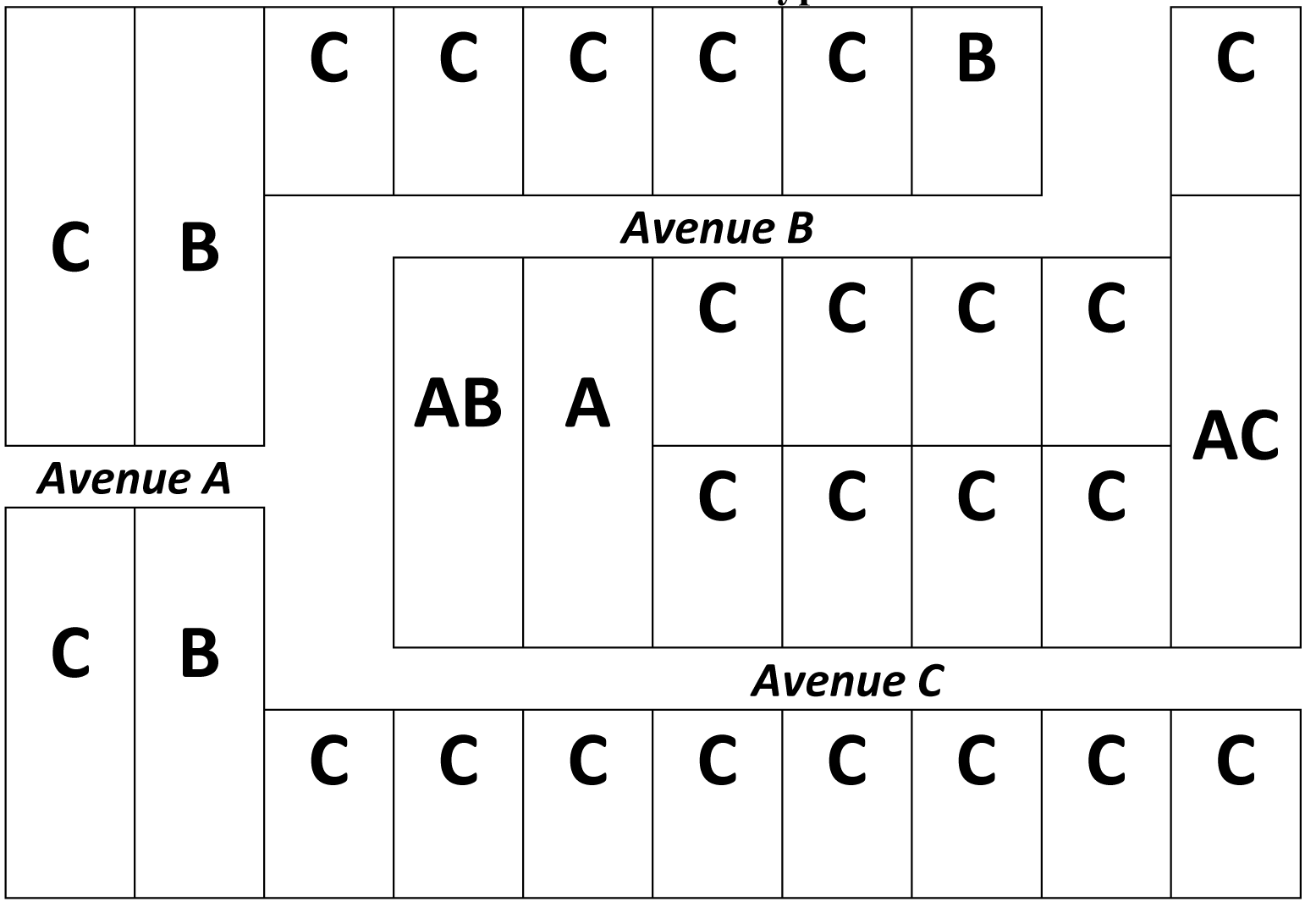
(c)
Lot frontage.
(1)
On interior lots, the front of a lot shall be construed as the portion nearest the street.
(2)
On corner lots, the frontage of a lot shall be construed as the shortest boundary to a street. If the lot has equal frontage on two or more streets, frontage shall be determined by the Chief Administrative Officer or his designee in accordance with the prevailing building pattern, or the prevailing lotting pattern, if a building pattern has not been established.
(3)
On through lots, all portions adjacent to streets shall be considered as frontage for regulatory purposes. If the Chief Administrative Officer or his designee finds that the pattern of lots or the pattern of required yards, on lots adjacent to portions of the through lot, is such as to justify the elimination of the requirement that more than one frontage be provided on the lot, such additional frontage shall not be required.
(d)
One dwelling unit per lot. For any district in which single-family residential uses are allowed, only one single family dwelling unit shall be permitted per lot unless otherwise allowed by this Code.
(e)
Lot yards—Methods of measurement. The following rules shall apply with regard to determinations on yards on lots:
(1)
Required yards adjacent to streets shall be of a depth as prescribed in district regulations with the depth measured as perpendicular to the street line or corridor reservation line, and the rear line of the required yard parallel to the street line or corridor reservation line.
(2)
Front yards on interior lots shall be construed as extending between side lot lines across the frontage of the lot.
(3)
Front yards on corner lots shall be construed as extending across the lot from each interior side lot line to the opposite street line. Corner lots are considered to have two front yards.
(4)
Interior side yards shall be construed as running from the rear line of the required front yard to the front line of the rear yard, if required or, if no rear yard is required, to the opposite lot line. The width of a required side yard shall be measured perpendicular to the side lot line and the inner line of the required yard shall be parallel to such outer line, at the minimum distance therefrom prescribed in district regulations.
(5)
Interior side yards on through lots with more than one front yard shall be construed as running to the rear lines of the front yards involved, and measurements and requirements shall be as for paragraph (4) above.
(6)
On corner lots, the side yard is the yard along any interior lot line which intersects with a street lot line. When a corner lot has four sides, the two sides not adjacent to the streets are both side yards and the lot has no rear yard. If the corner lot has more than four sides, the yards along interior lot lines which do not intersect with a street lot line shall be considered rear yards and must meet the district regulations for such yards. In all cases the restrictions on maximum lot coverage and maximum impervious area must be met.
(7)
Rear yards shall be construed as extending across the full width of the lot at its rear, except as stated in paragraph (6) above. Required depth of rear yards shall be determined in the same manner as required width of interior side yards.
(8)
On through lots providing two front yards, and on corner lots (except as stated in paragraph (6) above), there will be no required rear yard, and yards other than those adjacent to streets shall be construed as side yards, as provided in paragraph (6) above.
(9)
If an error is discovered in the location of a building or structure relative to the minimum yard requirements, or the lot is of a configuration atypical to the lots in the project as a whole, or the proposed building activity is to replace or repair structures destroyed or damaged during a declared natural disaster, as defined in this Code, the property owner, or their authorized representative, may file a request for an administrative review. The review of the request and the final decision shall be made by the Chief Administrative Officer or his designee and shall be made in conformance with the following criteria:
a.
The waiver shall not exceed more than ten percent of the required yard.
b.
In the case of an error in yard measurements, the corresponding opposite yard must be larger than requested by the same distance as the waiver request (to insure that the waiver is not just an attempt to place a larger building on the lot) or the waiver request is an intrusion of only a small corner of the building (such as a house too close to the front of a culs-de-sac lot such that it violates the side yard requirements at the front corner but nowhere else).
c.
In the case of an atypical lot configuration, the lot shall be a corner lot, culs-de-sac lot, lot with an unusual number of sides or some other configuration which makes it impossible to place a house or structure on the site which would be typically found in the development or the area.
d.
In the case of replacement or repair of structures destroyed or damaged during a declared natural disaster, there shall be a physical impediment on the property, such as existing trees, which precludes compliance with the yard requirements. Additionally, the building activity shall commence within one year of the date of the disaster declaration.
e.
Any waiver request which does not meet paragraphs a. and b., c. or d. above will be denied an administrative waiver and must comply with the yard requirements or seek a variance pursuant to Article VIII.
(f)
Special yards. A special yard, for purposes of these regulations, shall be construed as a yard other than adjacent to a street, required to perform the same functions as a side or rear yard, but adjacent to a lot line so placed or oriented that neither the term "side yard" nor the term "rear yard," as generally determined, defined, or applied with respect to regular lots, fits the circumstances of the case. In such instances, the special yard shall be considered a rear yard unless the Chief Administrative Officer or his designee determines that side yard requirements for the district shall apply because of the relationship of the portion of the lot or lots, with due regard to the orientation of structures and buildable areas thereon.
(g)
Permitted projections into required yards.
(1)
Certain architectural features, such as cornices, eaves and gutters, may project no more than three feet into the required front yard, five feet into the required rear yard, and three feet or no more than 50 percent of the required side yard, whichever is the most restrictive.
(2)
Other architectural features, such as bay windows, fire places and stairways, which may occupy a portion of a building footprint or extend from the building below the roof eaves, may project not more than three feet into required front and rear yards, three feet into side yards which measure a minimum of eight feet in width, and two and one-half feet into side yards measuring seven and one-half feet in width. No such intrusion is permitted into side yards less than seven and one-half feet in width.
(3)
Mechanical equipment, such as air conditioning units, pumps, heating equipment, solar panels, and similar installations, may not project into the required front yard(s), but may project five feet into the required rear yard(s), and three feet or no more than 50 percent of the required yard, whichever is the most restrictive, into the required side yard(s).
(4)
Covered patios, as defined by this Code, may intrude no more than 13 feet into the required rear yard and shall not intrude into the required side or front yards except as listed below. In no case shall the permitted intrusion of the covered patio reduce the yard provided to less than ten feet.
(5)
For through lots, a covered patio may intrude 13 feet into the required front yard which functions as a rear yard and has no access to a street. In no case shall the permitted intrusion of the covered patio reduce the yard provided to less than ten feet.
(6)
Patios enclosed by a screen-meshed structure without a solid roof that is attached to the primary building may intrude into required rear and side yards provided a minimum setback of three feet is provided. Such patios shall not intrude into required front yards except where a front yard functions as a rear yard and has no access to a street. In such cases, a minimum setback of three feet shall be required.
(7)
In all residential districts, front porches, inclusive of architectural features such as cornices, eaves, and gutters, may project into the required front yard no more than ten feet or 50 percent of the required front yard setback whichever is less provided the following conditions are met:
a.
The porch is open on all sides except where it is attached to the principal structure. The porch shall not be screened or otherwise enclosed. Railings if provided shall be consistent with the architectural style of the structure.
b.
Any porch projecting into a required front yard shall have a minimum depth, as measured from the face of the building to the porch edge, of six feet and a minimum width of eight feet.
c.
Second story porches may project into the required front yard consistent with the requirements above provided there is a first story porch located directly below the second story porch.
(h)
Minimum lot area. Minimum lot area is the minimum square footage required for a lot by this Code. The minimum area shall not include submerged or environmentally sensitive areas. Roadways or rights-of-way provided by the owner or developer of the lot may be included with the zoning lot for the purposes of calculating density or floor area ratio and the minimum lot area for individual lots. If a zoning lot includes different zoning districts, the minimum lot area requirements for each district shall be met.
Sec. 4-3.1.- Submittal Requirements.
(a)
Preliminary subdivision plat. All preliminary subdivision plats and required supplementary materials shall cover the entire parcel proposed for development and shall be submitted in accordance with this Part. Preliminary subdivision plats shall contain at least the following data. All plans shall be prepared by a registered professional engineer licensed in the State of Florida.
(1)
Preliminary layout. The project engineer shall prepare a complete layout of the streets and lot configurations including all parcels of land which the developer reasonably expects to include in the project. The layout shall be made on a topographic map drawn to a scale of one inch equals four hundred (or less) feet (1″ = 400′), with a contour interval of two feet. The layout shall include at least the following:
a.
Easements and drainage rights-of-way.
b.
North arrow and scale.
c.
Location of proposed improvement facilities.
d.
Site data including number of lots by category, typical residential lot sizes, and minimum areas on Special Use lots. (Multifamily, commercial, community facilities, etc.) The number and size of parks with total of park area.
e.
The layout shall indicate all adjacent parcels and the surrounding transportation grid.
(2)
Draft of protective covenants.
(3)
Preliminary engineering report. The project engineer shall prepare and submit a report indicating the results of his preliminary analysis of the lands to be developed. Particular attention should be given to the soil conditions which will influence drainage design assumptions, pavement design considerations, potable water and sewage disposal method determinations.
(4)
List of planned improvements.
(5)
Statement of developer's intent with respect to construction of improvements prior to recording of subdivision plat or bonding improvements.
(6)
Proposed development schedule. If the development is of such size that the developer desires to develop in units or phases, a map shall be submitted which indicates the sequence of development.
(7)
Adequate access analysis. The project engineer shall submit an analysis of the existing and proposed vicinity transportation network indicating the collector street system which will adequately service the pedestrian and vehicular traffic generated by the proposed development. The Planning and Zoning Commission will consider the analysis and, with recommendations from the Community Development Department, define any specific improvements which the developer must accomplish as a condition of the application.
(8)
Development of regional impact statement if required by the provisions set forth in F.S. ch. 380.
(9)
Water supply and sewage disposal plans. The developer or project engineer shall obtain from the county health Department a written opinion indicating that the developer's planned methods of water supply and sewage disposal are satisfactory.
(10)
Exceptions. Any applicant may request that required information described in paragraphs (2) through (9) of this Section be omitted from the proposed preliminary subdivision plat, provided however, that such request shall be subject to the following requirements:
a.
The request shall be in written form and shall be submitted with the plat.
b.
The request shall identify the information, item or data that is proposed to be omitted from the plat and shall fully explain the reasons that such information, item or data does not apply to such plan.
(b)
Construction and design (improvement) plan requirements. All improvement plans and required supplementary material shall cover the entire parcel covered by a preliminary subdivision plat approved in accordance with Section 4-3.1(a). All improvement plans shall contain at least the following data and information:
(1)
General improvement plan requirements. In general, improvement plans shall be suitable for contracting and construction purposes. The improvement plan shall show those subdivision improvements which are required; and which are assured by bond or improvement agreement; and which must be satisfactorily completed before the bond or escrow is released.
(2)
Improvement plan sheet data, size and scale. Improvement plans shall be drawn at a scale of one inch to 50 feet or larger. Sheet size for improvement plans shall be 24 inches by 36 inches or 36 inches by 48 inches. Multiple sheets may be used provided each sheet is numbered and the total number of sheets is indicated on each sheet. Cross referencing between sheets shall be required. Necessary notes and symbol legends shall be included. Abbreviations should be avoided but if used they shall be defined in the notes. Six copies shall be provided.
a.
The identification "Improvement Plan", the date, scale, revision date (if any), development name, and other such information shall be shown in a convenient grouping in the lower right hand corner of every sheet, preferably in a conventional title block.
b.
Each copy of an improvement plan required to be submitted to the administrative official shall bear the original signature of a professional engineer licensed by the State of Florida and authorized by the applicant who shall also certify that the drawing was prepared at his instruction and that the information shown is correct.
(3)
Required improvements to subdivided land. It is required that the applicant submit construction drawings of all improvements to be added in the proposed subdivision. The drawings shall be of a detailed nature, prepared by a registered professional engineer licensed in the State of Florida.
(c)
Final subdivision plat requirements.
(1)
Scope. The final plat will have incorporated therein all changes or modifications required by the Planning and Zoning Commission, otherwise it shall conform to the preliminary plat, and it may constitute only that portion of the approved preliminary plat which the subdivider proposes to record and develop at the time, provided that such portion conforms with all the requirements of this Code.
Preparation. The final plat shall be prepared by a registered professional engineer licensed in the State of Florida. Final plat shall be drawn on sheets 22 inches wide by 36 inches long and shall be at a scale of 100 feet to one inch, or larger. Where necessary, the plat may be on several sheets accompanied by an index sheet showing the entire subdivision. For a large subdivision the final plat may be submitted for approval progressively in contiguous Sections satisfactory to the City Council. A three inch margin shall be provided on the left side of each sheet for binding and a one inch margin shall be provided on all other sides of each sheet. Original sheets shall be of a durable reproducible mylar or linen material. Drafting shall be with black, permanent india ink. North orientation shall be toward the top of each sheet. Lettering shall read from the bottom of the sheet or the right side of the sheet. No letter or number shall be less than one-eighth of an inch in height and stroke for letters shall be bold enough so as to be clearly legible.
(2)
Plat information. The following information shall be shown on the final plat:
a.
Primary control points or descriptions and "ties" to such control points, to which all dimensions, angles, bearings, and similar data on the plat shall be referred.
b.
Tract boundary lines and all Sectional data, right-of-way lines of streets, easements and other rights-of-way, and property lines of residential lots and other sites; with accurate dimensions, bearings or deflection angles, and radii, arcs and central angles of all curves.
c.
Name and right-of-way width of each street or other right-of-way.
d.
Location, dimensions and purpose of any easements.
e.
Number to identify each lot or site, and block.
f.
Purpose for which sites, other than residential lots, are dedicated or reserved.
g.
Minimum building setback line and buffers on all lots and other sites.
h.
Location and description of monuments.
i.
Names of record owners of adjoining unplatted land.
j.
Reference to recorded subdivision plats of adjoining platted land by record name, plat book page and number, with adjacent street and lot dotted in.
k.
Title, scale, north arrow and date.
l.
Legal description.
m.
Vicinity map.
(3)
A certificate of construction by the public works director certifying that all improvements have been installed in accord with the requirements of this chapter and with the action of the Planning and Zoning Commission giving conditional approval of the preliminary plat, or a bond or certified check, or such other collateral security, has been posted, which is available to the City and in sufficient amount to ensure such completion of all required improvements.
(4)
Protective covenants in form for recording.
(5)
Other data. Such other certificates, affidavits, endorsements or deductions as may be required by the Planning and Zoning Commission in the enforcement of this Article.
(6)
Title page. The title page of all subdivision plats shall contain the following information and documents:
a.
Dedications.
b.
Surveyor's certificate.
c.
City surveyor's certificate.
d.
Abstractor's certificate.
e.
Resolution.
f.
Clerk's certificate.
g.
Joinder and consent to dedication.
h.
Certificate of approval from:
i.
Planning and zoning commission.
ii.
City Attorney.
iii.
Mayor.
iv.
Public works director.
(d)
Requirements for record plat title page.
(1)
Dedication. Each plat must contain a dedication executed and acknowledged by the owner in the manner prescribed by law for the execution of deeds. Such dedication shall dedicate to the public all streets, easements, canals, parks and other public places shown on the plat, warrant that the dedicators are the owners of the lands platted, and authorize the recording of such plat. Dedications and acknowledgements in substantially the following form shall be deemed a sufficient compliance with this Section:
a.
By individual:
DEDICATION
___________, the owners of the lands herein platted, as dedicators, do hereby dedicate to the public and the purchasers of any lands shown on this plat all streets, easements, canals, parks, and other public places shown on this plat and hereby request that this plat be recorded in the Public Records of Hernando County, Florida.
WITNESS our hands and seals as dedicators this _____ day of _______, 20___.
Signed and sealed in the presence of:
_____ _____ (SEAL)
_____ _____ (SEAL)
STATE OF _______
COUNTY OF _______
Before me the undersigned, an officer duly authorized and acting personally appeared _______ and _______, to me known to be the individuals described in and who executed the foregoing Dedication and they being duly sworn, acknowledged the same.
WITNESS my hand and official seal this _____ day of _______, 20___.
My Commission Expires: _____
b.
By corporation:
DEDICATION
___________, a Corporation under the laws of the State of _______, the Owner of the lands herein platted, as Dedicator, does hereby dedicate to the public and the purchasers of any lands shown on this plat, all streets, easements, drainage facilities, utilities, canals, and other public places shown on this plat and hereby requests that this plat be recorded in the public records of Hernando County, Florida.
IN WITNESS WHEREOF, the said Dedicator has caused its name and Corporate seal to be affixed hereto by its President, attested by its Secretary heretofore duly authorized by its Board of Directors, on this _____ day of _______, 20___.
(CORPORATE SEAL)
ATTEST: _____ By: _____
STATE OF _______
COUNTY OF _______
Before the undersigned, an officer duly authorized and acting, personally appeared _______ and _______, to me known to be the individuals who executed the foregoing dedication as President and Secretary, respectively, of _______, a Corporation, under the laws of the State of _______, and being duly sworn, acknowledge then and there before me that they executed the same as such officers of such Corporation heretofore duly authorized by the Board of Directors of such Corporation as the act and deed of such Corporation.
WITNESS my hand and official seal this _____ day of _______, 20___.
My Commission Expires: _____
(2)
Surveyor certificate. Each plat must contain a certificate signed by a registered land surveyor that such plat was prepared by such surveyor and is a correct representation of the land platted; that permanent reference monuments have been placed thereon and said plats meet all requirements of F.S. ch. 177, and with all of the plat requirements adopted by the City Council of the City of Brooksville, Florida. The certificate of the registered land surveyor preparing said plat to be recorded in the public records of Hernando County shall be in substantially the following form:
SURVEYOR CERTIFICATE
I, ___________, hereby certify that I prepared this plat and that it is correct representation of the lands platted; that this plat complies with all provisions of F.S. ch. 177, and with all of the plat requirements adopted by the City Council of the City of Brooksville, Florida.
(3)
City surveyor certificate. Each plat shall be reviewed for conformity to F.S. ch. 177, by a professional surveyor and mapper either employed by or under contract to the City of Brooksville, the costs of which shall be borne by the legal entity offering the plat for recordation, and evidence of such review must be placed on such plat.
CITY SURVEYOR CERTIFICATE
I, ___________, hereby certify that I reviewed this plat and that it is correct representation of the lands platted; that this plat complies with all provisions of F.S. ch. 177, and with all of the plat requirements adopted by the City Council of the City of Brooksville, Florida.
(4)
Abstractor's certificate. Each plat must contain a certificate by an abstractor or abstract company licensed to do business in Hernando County, Florida, that the dedicators are the apparent record owners of the lands platted and that there are no delinquent taxes of the lands platted and further, that record title to all access roads shown or indicated on such plat is held by the City of Brooksville, Hernando County or the State of Florida, which said certificate shall be in substantially the following form:
ABSTRACTOR'S CERTIFICATE
I hereby certify that _______ is/are the apparent record owners of the lands hereby platted; that there are no delinquent taxes on such lands and that record title to all access roads is held by the City of Brooksville, Hernando County or the State of Florida.
(5)
Resolution. Each plat submitted to the City Council of Brooksville, Florida, for approval for record shall contain a form of appropriate resolution for adoption by the City Council, approving such plat for record and accepting the dedication of all streets and other places shown thereon, which said resolution shall be in substantially the following form:
RESOLUTION
Whereas, this plat was on the _____ day of _______, 19___, submitted to the City Council, Brooksville, Hernando County, Florida, for approval for record and has been approved by said council; now therefore, be it resolved by the City Council, Brooksville, Hernando County, Florida, that said plat is hereby approved and said plat shall be recorded in the public records of this County, and that the dedication of all streets, easements, canals, drainage facilities, utilities, parks, and other public places shown thereon is hereby accepted by said council for the City of Brooksville, and the public generally, and shall be binding on all persons hereafter.
(6)
Clerk's certificate. The clerk's certificate required by F.S. ch. 177, on each plat shall be in substantially the following form:
CLERK'S CERTIFICATE
I, ___________, Clerk of the Circuit Court of Hernando County, Florida, hereby certify that I have examined this plat, that it complies in form with all of the provisions of F.S. ch. 177, that it was filed for record on the _____ day of _______, 19___, File No. _____, and recorded in Plat Book _______, Page _____.
(7)
Certificates of approval. Each plat submitted to the City Council of the City of Brooksville, Florida for approval for record shall contain the following four certificates of approval:
a.
Certificate of approval by the Planning and Zoning Commission shall be in substantially the following form:
CERTIFICATE OF APPROVAL
BY BROOKSVILLE PLANNING
AND ZONING COMMISSION
THIS IS TO CERTIFY, that on _______, the Brooksville Planning and Zoning Commission approved the above plat or plan.
b.
Certificate of the City Attorney shall be in substantially the following form:
CERTIFICATE OF APPROVAL
BY ATTORNEY FOR THE
CITY OF BROOKSVILLE
Examined and approved: ;sigr;\City Attorney ;sigr;\Date
c.
Certificate of the mayor shall be in substantially the following form:
CERTIFICATE OF APPROVAL
BY MAYOR OF THE
CITY OF BROOKSVILLE
Examined and approved: ;sigr;\Mayor ;sigr;\Date
d.
Certificate of the public works director shall be in substantially the following form:
CERTIFICATE OF APPROVAL
BY CITY OF BROOKSVILLE
PUBLIC WORKS DIRECTOR
Examined and approved: ;sigr;\Public Works Director ;sigr;\Date
(8)
Joinder and consent to dedication. Each plat submitted to the City of Brooksville City Council for approval for record, shall where applicable, contain a joinder and consent to dedication which shall be in substantially the following form:
JOINDER AND CONSENT TO DEDICATION
The undersigned hereby certifies that it is the holder of a mortgage, lien, or other encumbrance upon the above described property, and that the undersigned hereby joins in and consents to the dedication of the lands described above by the Owner thereof, and agrees that its mortgage, lien, or other encumbrance, which is recorded in Official Record Book _____, Page _____, of the Public Records of Hernando County, Florida shall be subordinated to the above dedication.
Signed, sealed and delivered in the presence of: _____ _____ (SEAL) _____ _____ (SEAL)
STATE OF _______
COUNTY OF _______
This is to certify, that on _______ before me, an officer duly authorized to take acknowledgements in the State and County aforesaid, personally appeared _______, to be known to be the person described in and who executed the foregoing Joinder and Consent to Dedication and severally acknowledged the execution thereof to be _______ free act and deed for the uses and purposes therein expressed.
WITNESS my hand and official seal this _____ day of _______, 20___.
My Commission Expires: _____
Sec. 4-4.1.- Generally.
All new development, subdivisions, streets, parking, lots, tracts and related improvements shall be developed and improved in accordance with the minimum standards and requirements set forth in this Code. The plans and specifications shall completely define the scope of all work to be accomplished in the construction of improvements and shall provide for a standard of quality which equals or exceeds the minimum requirements cited in the Hernando County Facility Design Guidelines, as issued by the Hernando County Engineering Department, the Manual of Uniform Minimum Standards for Design, Construction, and Maintenance for Streets and Highways, State of Florida and the Hernando County Utilities Water and Wastewater Construction Specifications Manual.
Sec. 4-4.2. - Development Regulations.
(a)
Blocks.
(1)
The lengths, widths and shapes of blocks shall be determined with due regard to:
a.
Provision of adequate building sites suitable to type of use proposed.
b.
Zoning requirements.
c.
Requirements for safe convenient vehicular and pedestrian circulation.
d.
Topography.
(2)
Block lengths shall not exceed 600 feet or be less than 330 feet unless specifically approved by City Council.
(3)
Pedestrian crosswalks, designed to Florida Department of Transportation (F.D.O.T.) standards, shall be required where deemed essential to provide circulation or access to schools, playgrounds, shopping centers, transportation and other community facilities.
(4)
Street rights-of-way shall be provided to all undeveloped areas surrounding the subdivision at points not to exceed 1,320 feet or such as the Planning and Zoning Commission may direct. Such rights-of-way may be left unimproved if desired by the subdivider and approved by City Council.
(b)
Access.
(1)
Every site developed under these site development regulations shall have access to a publicly-owned and maintained street or roadway. Access may be by a privately-owned and maintained street or roadway.
(2)
All uses shall be provided with paved access to the nearest paved street or frontage road, as applicable.
(3)
All uses shall be provided with paved driveways which extend from the edge of street pavement or frontage road to the property line.
(4)
When access can be provided to a development by a collector facility, direct access to arterial roadways shall be restricted.
(5)
All non-residentially zoned properties located adjacent to arterial highways shall provide a minimum 75-foot building setback from the arterial highway. The administrative official may reduce the 75-foot requirement and allow the minimum front yard setback of the property's zoning district in the following circumstances:
a.
A hardship exists in the redevelopment of an existing developed parcel due to the inadequate depth of the property or the continued use of an existing structure. In such instances, cross-access driveways to adjacent parcels shall be provided when and where feasible.
b.
The developer has provided for a reverse frontage road along the rear portion of the property. Any such exception may be subject to additional conditions.
(6)
Access to residential property. Direct access from residential property adjacent to arterial streets shall be prohibited when access can be provided via a collector roadway, unless it can be demonstrated by the applicant that access to the arterial roadway will provide a greater public benefit.
(7)
Primary access to non-residential property. With the exception of sites containing retail gasoline sales, there shall be only one vehicular access point, not to exceed 40 feet in width at the property line, or two vehicular access points at the property line, not to exceed 24 feet in width each, located on any one street or frontage road to serve the development. All vehicular access points shall be located at least 150 feet, or two-thirds the distance of the lot frontage, whichever is less, from the intersection of any right-of-way lines of streets or a street and a railroad and at least 15 feet from all side or rear property lines.
No more than two vehicular access points, not to exceed 36 feet in width each shall be allowed for sites containing retail gasoline sales. All vehicular access points shall be located at least 75 feet from the intersection of any right-of-way lines of streets or a street and a railroad and at least 25 feet from all side or rear property lines.
As provided in paragraph (6) above, adjoining projects may share a common driveway, provided that appropriate access easements are granted between or among property owners. If non-residential property is located such that access can be provided to either an arterial or collector facility, primary access shall be via the collector facility, unless it can be demonstrated by the applicant that primary access to the arterial roadway will provide a greater public benefit.
(8)
Shared access. Shared access facilities onto arterial and collector streets are encouraged when two or more contiguous sites are planned for compatible uses. Shared access is desirable where the trip generation from the anticipated land uses will not be large enough to warrant a traffic signal.
(9)
Prohibition of use of residentially-zoned private property for access to uses not permitted in residential districts. No private land which is agriculturally or residentially-zoned shall be used for motor vehicle access to land or structures in other districts used for any purpose not permitted in agricultural or residential districts.
(10)
Off-site street parking. Except for single family residential units or other types of residential units approved by the City, off-site street parking shall be designed to ensure that all vehicles leaving or entering the public street right-of-way shall be traveling in a forward motion.
(11)
Private roads designed to provide vehicular access to non-residential buildings and uses located in non-residential zoning districts shall not be permitted to be located in residential zoning districts.
(c)
Streets.
(1)
All new streets in the City of Brooksville shall utilize urban-type design features which reflect a "closed" drainage system including gutters, inlets and miami or raised curbs. Rural-type street design features which reflect an "open" drainage system including open swales shall not be permitted except to provide access to lots of one acre or greater. Design features and selection of drainage system type shall be approved by the Public Works Department Director.
(2)
Access to adjoining property. Where street access to adjoining property is appropriate to accommodate traffic circulation objectives of the City, a street right-of-way shall be extended to the boundary of such property and such right-of-way shall be dedicated to the public as an unopened street. Upon formal determination that such unopened street is required for access to property, the developer of the property for which access is required shall be responsible for opening and improving the unopened street.
(3)
Additional right-of-way. A proposed use or subdivision that abuts an existing street that does not conform to the minimum right-of-way requirements set forth in this Code shall provide for the dedication of additional right-of-way so that the minimum right-of-way required by these regulations can be established. The additional right-of-way shall be dedicated upon formal plan or subdivision approval, and shall be dedicated to the appropriate public entity.
(4)
Street/access drive alignment. Street/access driveways shall be required to provide centerline alignment with existing centerline on the opposite side of the right-of-way.
(5)
Horizontal and vertical curves. Horizontal and vertical curves shall be in conformance with Hernando County and/or FDOT standards.
(6)
Improvements. Prior to granting of final approval, the subdivider/developer shall have installed or shall have furnished adequate bond for the ultimate installation of the following:
a.
All streets shall be surfaced in accordance with applicable standard specifications referenced herein.
b.
Curbs, gutters, drainage and drainage structures shall be provided in accordance with standard specifications referenced herein.
c.
Permanent reference monuments (PRM) shall be placed at all block corners, angle points, points of curves in streets and at intermediate points as required. PRM shall be consistent with F.S. ch. 177 and as approved by the Chief Administrative Officer or his designee.
d.
Sidewalks shall be constructed along both sides of all local, collector and arterial streets. Required sidewalks shall be constructed prior to the issuance of a certificate of occupancy.
e.
Street lights shall be installed.
f.
Every effort to ensure the preservation of the historical brick streets of the City of Brooksville shall be taken. Any bricks removed from a street shall be saved and utilized for restoration efforts. Extensive care of these brick, in removing, storing, and replacing shall be taken at all times.
(7)
Interconnected neighborhoods. Street layout shall be accomplished in a manner that connects development of the adjacent neighboring areas. Proposed streets shall provide satisfactory alignment for continuation of all existing planned or platted streets with which they are to connect. The street arrangements shall not cause hardship to owners of adjoining property in platting their own land and providing convenient access thereto.
(8)
Cross-access criteria and requirements. The purpose of requiring cross-access in certain situations is to reduce the necessity to use the public street system in order to move between adjacent and complementary land uses where such interchange of vehicular or pedestrian trips are likely to occur. The provisions below shall not apply to developments required to provide frontage roads.
a.
When each of the following conditions exist, provisions for vehicular and pedestrian cross-access must be provided:
i.
The site has frontage on a public road.
ii.
The site has a commercial land use or commercial or office zoning designation, and is adjacent to a parcel which also has a commercial land use designation or commercial or office zoning and which has access on the same roadway.
b.
When each of the following conditions exists, provisions for pedestrian cross-access must be provided.
i.
The site has frontage on at least one roadway.
ii.
The site has a commercial land use or commercial or office zoning designation and is adjacent to a parcel having frontage on the same roadway which has a land use or zoning designation allowing 12 dwelling units per acre or more, or
iii.
The site has a residential land use or zoning designation allowing 12 dwelling units or more per acre and is adjacent to a parcel having a land use or zoning designation of 12 dwelling units or more per acre or a commercial land use or commercial or office zoning designation and which has access on the same roadway.
As used herein, "provisions for cross-access" shall mean that the developer of the property shall design his site in such a manner as to make cross-access possible as provided in this division.
c.
When the criteria in paragraph i. or ii. above are met, provisions for cross-access must be provided as established below:
i.
If the adjacent site is developed and, in the opinion of the Chief Administrative Officer or his designee, cross-access is feasible, the developer shall design and build the appropriate cross-access to the property line of the adjacent parcel.
ii.
If the adjacent site is developed but, in the opinion of the Chief Administrative Officer or his designee, cross-access is not feasible at this time, the developer shall design and designate on the site plan the location of future cross access, but will not be required to construct the cross-access at the time of initial site development. The owner shall commit, in writing, to construct and allow cross-access at such time as the Chief Administrative Officer or his designee determines that cross-access is feasible and desirable.
iii.
If the adjacent site is undeveloped, the developer shall design and build the cross-access to the property line of the adjacent parcel in anticipation of future connection when that site is developed.
iv.
The minimum width of a vehicular cross-access shall be 24 feet. The minimum width of a pedestrian cross-access shall be five feet.
(9)
Intersections. The intersection of more than two streets at one point shall be avoided. Streets shall intersect one another at an angle as near to the right angle as possible, and no intersections of streets at angles less than 70 degrees shall be approved. Street intersections shall be rounded with a radius of 20 feet measured at the back of curbs when such intersection occurs at right angles. Intersections with an angle other than a right angle shall be rounded with a curve of a radius acceptable by best engineering principles.
(10)
Street right-of-way pavement widths and design speeds shall be no less than as follows:
(11)
Street grades shall conform to the Manual of Uniform Minimum Standards for Design, Construction, and Maintenance for Streets and Highways, State of Florida on sight distance wherever feasible and shall not exceed the following, with due allowance for reasonable vertical curves:
a.
Arterial streets shall not exceed a six percent grade.
b.
Collector streets shall not exceed an eight percent grade.
c.
Local streets shall not exceed a ten percent grade.
d.
Marginal access streets shall not exceed a ten percent grade.
(12)
Intersections with arterial and collector streets. New street entrances, including frontage road ingress/egress locations, on roads designated or classified as arterial or collector shall be not less than 440/245 feet apart.
(13)
Marginal access. Where a subdivision abuts or contains an existing or proposed arterial street, City Council may require marginal access streets, reverse frontage with screen planting contained in a non-access reservation along the rear property line, deep lots with rear service alley, or such other treatment as may be necessary for adequate protection of residential properties and to afford separation of through and local traffic.
(14)
Names and numbers. Address numbers shall be assigned in accordance with the addressing system in effect. Names of new streets shall not duplicate existing or platted street names within the City or county unless a new street is a continuation of or in alignment with the existing or platted street. Street names shall be subject to the approval of City Council. Street name markers which meet City specifications shall be installed by the developer at all street intersections. All new streets shall be named in the following manner:
a.
Avenues shall run east and west.
b.
Streets shall run north and south.
(15)
Natural contours. Proposed streets shall be adjusted to the contour of the land so as to produce usable lots and streets; appropriate slope and gradient shall be utilized to eliminate potential erosion problems.
(16)
Private streets. Private streets shall be discouraged, but may be permitted only when the use is limited to a single parcel or project and serves a general public need or purpose.
(17)
Proposed extensions. Where feasible, proposed streets shall be extended to the boundary lines of the property included in a subdivision submitted for approval.
(18)
Railroad on or abutting subdivision. Where a subdivision borders on or contains a railroad right-of-way or limited access highway right-of-way, City Council may require a street approximately parallel to and on each side of such right-of-way, at a distance suitable for the appropriate use of the intervening land, as for park purposes in residential districts, or for commercial or industrial purposes in appropriate districts. Such distances shall also be determined with due regard for the requirements of approach grades and future grade separations.
(19)
Dead-end streets. Permanent dead-end streets shall be permitted only when provided with a culs-de-sac at the closed end with a turnaround having an outside roadway radius of not less than 40 feet, and an outside right-of-way radius of not less than 60 feet. Such dead-end streets shall not exceed 600 feet from the furthest point of culs-de-sac radius to the centerline of the closest intersecting street. Temporary dead-end streets shall be provided with a temporary turnaround area which shall meet the requirements above.
(d)
Frontage roads and reverse frontage roads.
(1)
Developers of properties adjacent to the major arterial highway grid must provide at the developer's expense a frontage road or reverse frontage road from property line to property line approximately parallel to the arterial highway upon demonstration of need and demand by the City. If the City does not determine need within ten years from the date the certificate of occupancy is issued for the current use, the developer may be exempted from this requirement by the City Council until such time as the impact from additional development, redevelopment or change of use on the site occurs. For purposes of this Section, the following roads in the City are classified for their entire length as arterial highways and are subject to the terms and provisions of this Section:
• US 98;
• US 41;
• SR 50; and
• SR 50A.
(2)
The frontage road requirement may also be applied to collector roads for a distance of up to 600 feet from their intersection with an arterial highway, which will provide for greater safety by effectively looping frontage road traffic away from the intersection of the collector road and the arterial highway system.
(3)
The frontage road is to be designed to City specifications established by the director of public works. The developer shall construct the frontage road segment at the time of site development, or, prior to issuance of a building permit, furnish to the City sufficient funds based on current cost estimates for the engineering and construction of the frontage road across the property when the City determines that sufficient length is available to construct a link in the frontage road system.
(4)
All driveway cuts issued to developers of properties adjacent to arterial highways shall be considered temporary and subject to removal when the frontage road link is constructed across the property.
(5)
Owners of property adjacent to arterial highways shall be required to obtain a City permit for driveway cuts to the property prior to and in addition to any state or federal permits. Application shall be made to the City agency established by the City Council for the enforcement of the terms and provisions of this Section. This City permit shall be sent to the state or federal agency as a recommendation from the City.
(6)
All frontage roads created under the provisions of this Section shall be maintained by the property owner, upon whose property the road is constructed, in a passable condition to City standards established by the Public Works Department Director. The property owner may contract with the City to provide for the maintenance of the roadway, or dedicate the roadway and right-of-way to the City for inclusion into the City roadway maintenance system. If the dedication is accepted by the City Council, the property owner will no longer have the obligation to maintain the roadway.
(e)
Stormwater management regulations.
(1)
The drainage system for a new development, including subdivisions, shall be designed in accordance with sound engineering principles and procedures such that all useable parcels in the development are positively drained. The drainage system shall be designed to accommodate drainage from adjacent lands which naturally drain to or through the lands being developed. The drainage system shall be designed to not significantly affect the natural drainage onto adjacent lands unless appropriate agreements are obtained by the developer from the owner of such adjacent lands concurring in the proposed drainage design. Evidence of such concurrence shall be submitted to the City of Brooksville along with the development plans and specifications.
(2)
All new commercial and office developments shall implement on-site stormwater management through low impact development techniques, such as grass swales, bio-retention areas, detention ponds, permeable pavers, rain barrels and cisterns. Design strategies shall be those of the U.S. Environmental Protection Agency, Office of Water's Low Impact Development Design Strategies: An Integrated Design Approach.
(3)
Drainage facilities that are designed to handle flowing water (e.g., culverts, weirs, etc.) shall be hydraulically designed to function when subjected to the maximum flow rate that can be expected to occur no more often than once in ten years.
(4)
Drainage facilities that are designed to handle water accumulations (e.g., retention ponds with no overflow provisions) shall be designed in accordance with Southwest Florida Water Management District (SWFWMD) rules and regulations. Necessary drainage facilities including, but not limited to, culverts, rights-of-way and easements shall be dedicated to the City, at no expense to the City, and at the option of the City. The dedication shall include adequate rights-of-way or easements to permit proper maintenance operations. Areas required for maintenance shall be cleared of all trees and underbrush which would interfere with maintenance of the facility.
(5)
Open drainage retention facilities with slopes of greater than four to one (4:1) shall be fenced. The fence shall be clad in green or black vinyl and shall be a minimum of six feet in height. Open drainage facilities with slopes of greater than four to one (4:1) and located in front of the principal structure shall be clad in green or black vinyl and shall be a minimum of six feet in height. Additionally, the fence shall be landscaped with evergreen vines, such as Confederate Jasmine, Coral Honeysuckle or Beach Elder. The vines shall be planted along the entire length of the fence, excluding gates, no more than six feet apart on centers. The vines shall be in three gallon containers, at a minimum, at the time of planting and shall have a minimum opacity of 75 percent within two years of planting. Fencing of permanent dry detention facilities shall not be required.
(f)
Potable water system. A potable water distribution system shall be provided in all new subdivisions. The system shall be designed in accordance with federal, state and local standards. The public water systems shall be designed to provide fire flow and fire hydrants shall be placed in accordance with all applicable regulations and standards. New water lines shall not be located at the rear of platted lots unless otherwise allowed by the City's public works director. Connections to existing water lines shall be as directed by the City's public works director.
(g)
Wastewater system. A wastewater system shall be provided in all new subdivisions. The system shall be designed in accordance with all applicable federal, state and local standards. New sanitary sewer lines shall not be located at the rear of platted lots unless otherwise allowed by the City's public works director. Connections to existing sanitary sewer lines shall be as directed by the City's public works director.
(h)
Fire protection. Fire protection shall be provided in accordance with Florida Fire Prevention Code, latest edition.
(i)
Underground utility service. All electrical power, telephone, cable and any other utility lines shall be installed in easements provided for along the appropriate property lines. Utility lines shall be installed underground. The pad mounted transformers for electric service shall not be located within the street right-of-way, unless authorized by the Chief Administrative Officer or his designee.
(j)
Easements.
(1)
Easements across lots or centered on rear or side lot lines shall be provided for utilities where necessary and shall be at least seven and one-half feet wide, each lot, or total 15 feet.
(2)
Where a subdivision is traversed by a watercourse, drainage way, channel or stream, there shall be provided a stormwater easement or drainage right-of-way conforming with the lines of such watercourse, with an additional 15-foot easement on each side for maintenance purposes.
(3)
Easements shall not be established, conveyed, dedicated or otherwise utilized for the purpose of providing access to lots, tracts or parcels established after the effective date of this Code. However, the Chief Administrative Officer or his designee shall have the authority to require the developer to provide access easements to a lot or tract of record when such an access easement is necessary to provide legal access to such lot or tract.
(k)
Green building technology. All new commercial and office developments shall be designed to incorporate green building and development technologies. The technologies include, but are not limited to, the following:
(1)
Use of renewable construction materials.
(2)
Use of high performance mechanical and distribution equipment.
(3)
Use of low or non-volatile organic compounds (VOC) emission building products.
(l)
Parking and loading. All off-street parking and loading and related facilities shall be provided in accordance with the requirements and standards of this Section.
(1)
Off-street parking required. In all districts, in connection with every industrial, commercial, institutional, residential or any other use, there shall be provided, at the time any new structure is erected, any use of a structure or land is enlarged or increased in density or intensity or any other use or change of use established, off-street parking spaces for automobiles in accordance with requirements contained in this Section. Conformance with the parking requirements herein shall be for the new use or portion of enlarged use or structures only and not the existing use or structure.
(2)
Joint use facilities and shared parking. Nothing in this Section shall be construed to prevent the joint use of off-street parking or off-street loading space for two or more structures or uses.
a.
An agreement for such joint use, in the form of a reciprocal easement shall be filed with the Chief Administrative Officer or his designee and recorded with the Clerk of the Circuit Court for Hernando County.
b.
No part of an off-street parking area or off-street loading area required for any structure or use for the purpose of complying with the provisions of this Code, shall be included as a part of an off-street parking area or off-street loading area similarly required for another building or use, unless the Chief Administrative Officer or his designee determines that the periods of peak usage of such buildings or uses will not be simultaneous with each other.
c.
All development orders or permits covering such approval shall include the requirements that the order or permit is valid only so long as the conditions described in the application for order or the permit exist.
(3)
Compliance with regulations. The requirements for off-street parking space and off-street loading space applicable to newly erected or substantially altered structures shall be a continuing obligation of the owner of the real estate upon which any such structure is located, so long as the structure is in existence and its use requiring parking or loading, or both, continues. It shall be unlawful for an owner of any structures affected by this Code to discontinue, change or dispense with, or cause the discontinuance or change of the required vehicle parking or loading space apart from the discontinuance of such structure, without establishing alternative parking and loading space which meets the requirements of and is in compliance with this Code.
(4)
Methods of providing required parking and loading. All required parking shall be located on the same zoning lot as the principal use(s) it serves, except as provided below.
In lieu of actual construction of required on-site parking spaces, all or any portion of the off-street parking required for a use on a zoning lot may be located on another zoning lot, either by itself or combined as joint use or shared parking for other uses, subject to certification by the Chief Administrative Officer or his designee that the following requirements have been met:
a.
The use being served by the off-site parking shall be a permitted principle use as established in Article II, in the zoning districts within which the zoning lot containing such parking is located;
b.
The off-site parking spaces shall be located within 500 feet walking distance of a public entrance to the structure or land area containing the use for which such spaces are required. A safe, direct, attractive, lighted and convenient pedestrian route shall exist or be provided between the off-site parking and the use being served;
c.
The continued availability of off-site parking spaces, necessary to meet the requirements of this Section, shall be ensured by an appropriate reciprocal easement, satisfactory to the City Attorney and recorded with the Clerk of the Circuit Court of Hernando County;
d.
The provision of off-site required off-street parking shall only occur in industrial, commercial and office districts; and
e.
Except in the HCBRD Overlay district, off-site required off-street parking shall not be separated from the use it serves by arterial or collector streets, or other similar physical barriers to convenient access between the parking and the use.
(5)
Number of required off-street parking spaces. The number of required off-street parking spaces is set forth in schedule A below.
SCHEDULE A
MINIMUM OFF-STREET PARKING SPACE REQUIREMENTS
(6)
Calculation of certain parking requirements. Where parking requirements relate to number of seats, and seating is in the form of undivided pews, benches, or the like, 20 lineal inches shall be construed to be equal to one seat. Where parking requirements relate to movable seating in auditoriums and other assembly rooms, ten square feet of net floor area shall be construed to be equal to one seat, except where otherwise specified. Net floor area shall be the actual area occupied by seating and related aisles, and shall not include accessory unoccupied areas.
(7)
Determination for unlisted uses or alternative parking. The Chief Administrative Officer or his designee shall make a determination, in the cases of uses not listed in Schedule A above of the minimum required off-street parking spaces. In reaching the determination, the Chief Administrative Officer or his designee shall be guided by the requirements for similar uses, the number and kind of vehicles likely to be attracted to the proposed use and studies of the parking requirements of such uses in other jurisdictions. The Chief Administrative Officer or his designee may approve alternative parking standards in situations where an applicant can sufficiently demonstrate that a particular situation is unusual, unique, or poses practical difficulty, and upon submission of adequate technical justification such as independent parking analyses, ULI or ITE parking standards, or similar justification.
(8)
Dimensions for off-street parking. Each off-street parking space shall be designed in accordance with the requirements specified in the Hernando County Facility Design Guidelines.
(9)
Disabled parking. Parking for the disabled shall be provided as shown in Schedule B.
SCHEDULE B
MINIMUM DISABLED PARKING SPACE
REQUIREMENTS
(10)
Required paving.
a.
Except for single and two family dwellings, every off-street parking area shall be surfaced with asphaltic or portland cement binder pavement or an equivalent improvement, so as to provide a durable and dustless surface. In making a determination as to the suitability of an equivalent improvement, the administrator shall find that such improvement:
i.
Provides a safe and permanent surface, suitable for the quantity and quality of traffic expected to use it;
ii.
Provides a surface which will accept permanent delineation of parking spaces, aisles, accessways and maneuvering areas; and
iii.
Provides a surface that will not contribute to erosion or sedimentation, either on-site or off-site.
b.
Stabilized pervious parking surfaces may be permitted in lieu of the paving requirements above for seasonal uses or uses not active on a daily basis. The surfaces must contain permanently delineated spaces if determined necessary by the Community Development Department.
(11)
Off-street loading space. Every use requiring the receipt or distribution, by vehicles, of materials and merchandise shall have one or more loading berths or other space for standing, loading and unloading on the same or adjoining premises in accordance with the requirements of Schedule C. Loading space shall be sufficient to allow normal loading and unloading operations of a kind and magnitude appropriate to the property served. Loading spaces shall not be used for the storage of vehicles or materials, or to meet off-street parking requirements, or in conducting the use. The requirements in the table below shall apply to new structures or additions to structures, and shall not be considered to make any existing structure non-conforming for lack of such off-street loading.
For any land use which is not listed in the table below, the Chief Administrative Officer or his designee, upon review of the proposed use, shall specify the required number of loading spaces to be provided, using generally accepted traffic engineering practices and standards.
SCHEDULE C
OFF-STREET LOADING REQUIREMENTS
(12)
Off-street loading space standards. All off-street loading spaces shall meet the following standards:
a.
Off-street loading spaces shall meet, be located and arranged so that a semi-trailer truck (WB 50 class) shall be able to gain access to and use such spaces by means of one continuous parking maneuver.
b.
Loading space shall observe the minimum street and interior setback established for structures.
c.
All loading space and maneuvering space shall be surfaced with an all-weather material which shall be maintained in a safe, sanitary, and neat condition.
d.
No loading space shall be located so that a vehicle using such space intrudes on or hinders the use of travel lanes, walkways, public or private streets, or adjacent properties.
e.
Each required off-street loading space shall have a minimum width of 12 feet and a minimum vertical clearance of 16 feet above finished grade of the space. The length shall be a minimum 30 feet for local delivery and 60 feet for semitrailers. A maximum of two-thirds of the required loading spaces can be used for local delivery vehicles.
(13)
Bicycle parking. For non-residential uses having an off-site parking requirement of 20 spaces or more, a number of off-street bicycle parking spaces shall be provided equal to five percent of the automobile parking space requirement. All bicycle racks must be the "Inverted U" type. Each inverted U provided will count as two bicycle parking spaces.
(14)
Recreational vehicle parking. In residential districts, all recreational vehicles, boats, personal watercraft and trailers shall be parked within an accessory private garage building or, in the rear or side yard or, in the case of a corner lot, behind the front building line facing each street or right-of-way on a stabilized surface.
(15)
Off-street parking area buffering and screening.
a.
Landscaping within buffers required herein include existing vegetation, berms in combination with plant materials, evergreen plants, or any combination of the above. The landscaping shall be, within two years of installation, a minimum of three feet in height and 75 percent opaque. An inspection of the landscaping shall be performed at the conclusion of the two year period to ensure compliance.
b.
Off-street parking areas not entirely screened from an abutting right-of-way by an intervening building or other structure, a landscaped buffer a minimum of five feet in width shall be provided between the parking area and the right-of-way, unless the requirements of Section 4-4.3., if applicable, of this Article are more stringent, in which case the more stringent requirements shall apply. Driveways into off-street parking areas shall be bordered by a landscaped buffer a minimum of five feet width.
c.
A landscaped buffer a minimum of five feet in width shall be provided between off-street parking areas and any property boundary not fronted by a right-of-way, unless the buffering and screening requirements of Section 4-5.7. of this Article are more stringent, in which case the more stringent shall apply.
d.
A landscaped buffer a minimum of five feet in width shall be provided between the off-street parking area and another use on the property, including but not limited to buildings, stormwater facilities and open space.
(m)
Exterior parking lot lighting. In all non-residential and multi-family parking areas, parking lot lighting shall be subject to the following requirements:
(1)
Applicability.
a.
Regular maintenance to existing exterior lighting shall not require compliance with the requirements of this subsection. For the purposes of this subsection, regular maintenance shall be considered to include cleaning and changing lamps, ballasts, starters, housing, lenses, replacing damaged poles, and other similar components.
b.
When 50 percent or more of the existing lighting fixtures of an exterior lighting system are upgraded, changed, or replaced, as measured cumulatively from the effective date of this subsection, the entire exterior lighting system shall be brought into compliance with the requirements contained herein. This requirement shall not apply to regular maintenance of an existing lighting system.
c.
Parking areas of outdoor recreational facilities (public or private), such as, but not limited to stadiums, football fields, soccer fields, baseball fields, softball fields, tennis courts, auto race-tracks, horse race-tracks or show arenas shall be subject to the provisions of this subsection. Fields, courts, tracks and arenas are excluded from these requirements.
(2)
Exemptions. Exterior lighting meeting the applicability criteria of subsection (m)(1) above is exempt from the requirements of this subsection in the following instances:
a.
Projects with unexpired construction plan approval at the time of the effective date of this subsection.
b.
Correctional facilities with lock down capability.
c.
Temporary lighting needed for the performance of emergency safety repairs or natural disaster recovery.
d.
Lighting for building construction provided that the fixtures used are directionally shielded and aimed so that the light is confined to the area to be illuminated.
e.
All lighting required by Federal, State or local regulatory agencies.
(3)
Fixture types.
a.
Except as provided herein, all parking lot light fixtures shall be full cut-off type.
b.
The use of floodlighting is allowed for illuminating equipment and material storage areas, truck loading bays (docks) and outdoor work, manufacturing, or assembly areas associated with industrial facilities, non-electric utility facilities, municipal material yards, areas used for parking or loading large trucks or buses, and other areas where necessary for safety reasons. Floodlights may also be used to externally illuminate a sign provided they are aimed to illuminate only the face of the sign. All floodlights shall be fitted with internal or external shielding and/or louvers. Floodlights shall be aimed so that the area illuminated is confined within the project boundaries.
c.
At canopied areas, such as those found at drive-through facilities at banks, service stations, convenience centers, and car-washes, lighting under the canopy, awning, porte-cochere, or similar structure shall be either recessed or full cut-off fixtures.
(Ord. No. 831, § 2, 8-6-2012)
Sec. 4-4.3. - Commercial Development Design Standards.
The design principles contained in this section are applicable to all commercial and office development within the city limits regardless of location except as excluded in this section. Large corporate franchises will not receive exceptions or exemptions to these design standards. In the case of redevelopment of existing commercial developments, the standards shall apply if:
(a)
The building floor area is being increased by more than 30 percent; or
(b)
More than 50 percent of the building floor area is being replaced; and/or
(c)
The existing building is being redeveloped and the cost of redevelopment is greater than 50 percent of the assessed value of the existing building; or
(d)
Where building facade materials are being fully or in part replaced, they shall be subject to the building material requirements of this section unless otherwise approved by the Chief Administrative Officer.
The Purpose and Intent of these design standards are:
• To promote architectural and site design treatments which enhance the visual appearance of non-residential development within the city.
• To ensure compatibility and appropriate visual and physical screening in association with commercial and office uses.
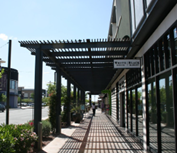
• To maintain and enhance the attractiveness of the streetscape within the community as shown in the example pictures in this section.
• To create and maintain a strong community image and identity by providing architectural and landscaping treatments that enhance the visual impact and contribution of commercial and office development in Brooksville.
• To require articulation that reduces the mass, scale and/or potentially uniform monolithic appearance of large commercial, office and industrial buildings, and ensure that such projects incorporate architectural and landscaping features that provide visual interest while allowing design flexibility.
• To require all Primary and Secondary Facades on the same building to be designed with a similar level of treatment, detail and visual interest.
• To be compatible with the historic heritage design elements in the historic commercial core and close relationship with the nearby residential communities by incorporating design elements that eliminate the plain box design so prevalent by constructing facades with a regional design basis, articulation in building exterior (projections and recesses) covered walkways, tower elements, or roof elements.
(a)
Small-scale commercial design standards.
(1)
Applicability. Because of the distinct nature of a commercial development, it was necessary to establish standards that are applicable based upon the size of the development.
a.
Provisions of this section are applicable to all retail commercial development whose total gross building area is less than 25,000 square feet, all non-retail commercial development regardless of size, and all office development regardless of size. The design standards apply to the commercial and office projects specified above located within the C-1, C-2, C-4, PR and P-1 zoning districts. The provisions of this section do not apply to projects in the CIS-1, I-1 and I-2 zoning districts nor to areas within the Historic Overlay which are governed by those standards.
b.
If a single use, single lot development comprised of multiple buildings is being phased by the developer and a phase of the development has been constructed or received a development permit at the time of adoption of this ordinance, subsequent development must either meet the minimum standards provided for herein or continue with the same architectural design and concept as the existing development.
c.
Provisions of this section are applicable to new development and additions to or modifications of an existing building that increases gross floor area by more than 30 percent.
d.
Compliance with the standards set forth in this section shall be demonstrated by submittal of drawings and a site development plan meeting the requirements of Article VIII, Section 8-2.3. of this Code.
(2)
Building orientation and primary facade standards. Primary facades must meet the primary facade standards outlined in this section. For purposes of this section, the term street includes driveways and accessways, and other ways used by the public for vehicular travel, whether or not dedicated to or owned or maintained by a governmental entity; except that alleys are excluded.
a.
Commercial buildings located mid-block shall be oriented to face the street, unless it can be shown that there are compelling site conditions that necessitate that the building not face the street, then the building is considered to have two primary facades; the facade that faces the street and the facade that incorporates the customer service entrance.
b.
Commercial buildings on corner lots shall be oriented to face a street, unless it can be shown that there are compelling site conditions that necessitate a different orientation. If site conditions necessitate that the primary entrance does not face the street, then the building is considered to have three primary facades; the two facades that face the street and the facade that incorporates the customer service entrance.
c.
All primary facades of a building shall be designed with consistent architectural style, detail, trim features, and roof treatments. Building materials used on a primary facade should continue for a distance of no less than two feet on the adjoining side or rear elevation. Building faces not visible from a public right-of-way may utilize materials other than those used on the primary facade. However, the material selection and overall design should be durable and maintain a unified appearance with the primary facade.
(3)
Primary facade standards.
a.
Primary facades shall provide at least three of the following in addition to item xi:
i.
Arcades or colonnades a minimum of five feet wide, mansard roofs with a minimum five foot overhang, or other roof treatments that provide shade and a break in the vertical plane, along at least 50 percent of the horizontal length of the primary facade.
ii.
Display windows a minimum of four feet high, along at least 50 percent of the horizontal length of the primary facade.
iii.
Awnings, associated with windows and/or doors, in increments of ten feet or less in length, along at least 50 percent of the horizontal length of the primary facade.
iv.
Windows, covering at least 40 percent of the length of the primary facade.
v.
Arched, gabled, stepped or decorative parapet over primary customer entrance, integrated with the building's massing and style.
vi.
Canopies or porticos, integrated with the building's massing and style.
vii.
Peaked roof forms.
viii.
Overhangs, a minimum of 18 inches wide.
ix.
Arches, or arched or curvilinear forms.
x.
Ornamental and structural details that are integrated into the building structure.
xi.
Recesses and/or projections at least every 20 feet.
xii.
Any other treatment or the combination of a number of separate treatments which together exceed the minimum as specified for primary facades that, in the determination of the Chief Administrative Officer or his designee, meets the intent of the commercial design standards.
b.
Exterior building materials shall be regulated as follows:
i.
Corrugated or ribbed metal wall panels, used as a finish material, shall be prohibited on the primary and secondary facades.
ii.
Smooth-faced concrete or smooth faced masonry units on a primary facade shall have stucco, decorative cementacious finish, or other decorative finish. The use of painted, struck block 8 x 8 x 16 will not be allowed as a finish material.
c.
Roof treatments shall be regulated as follows:
i.
Both single and multiple-tenant buildings and projects are required to have variations in the roof lines, and roof features that are consistent with the building's mass and scale. In addition, roofs shall meet at least two of the following requirements:
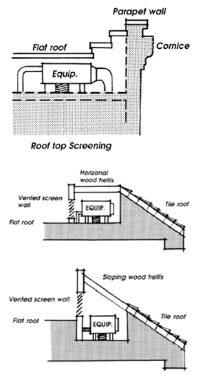
1)
Decorative parapets that are a minimum of three feet in height above the finished roof or that are high enough to block the view of any mechanical equipment.
2)
A three-dimensional cornice treatment, a minimum of 12 inches high, having a minimum of three vertical (not diagonal) changes in plane (no two on the same plane), and a variety of thickness in relief ranging from the greatest at the top to the least at the bottom.
3)
Overhanging eaves that extend at least two feet beyond the supporting walls, with a minimum fascia of six inches deep.
4)
Two or more roof planes per primary facade.
5)
A sloping roof with an average pitch of 4:12 or greater.
6)
Any other treatment that, in the determination of the Chief Administrative Officer or his designee, meets the intent of the commercial design standards.
ii.
Rooftop equipment and fixtures shall be concealed from eye-level view from any public right-of-way and from the ground level of any adjacent properties.
d.
Exterior lighting shall be subject to subsection 4-4.2(m) above.
(b)
Large-scale commercial design standards.
(1)
Applicability. Provisions of this section are applicable to all retail commercial development whose total gross building area is 25,000 square feet or greater.
(2)
Development standards. The following additional standards shall be required for all large-scale retail commercial projects:
a.
Facades. No uninterrupted and/or unadorned length of any portion of the facade shall exceed 100 linear feet. Interruptions of such continuous lengths of the facade shall include wall plane projections and/or recesses of not less than five feet in off-set, and 20 feet in length, and two or more of the following: architectural features such as pilasters, columns, canopies/porticos, arcades, colonnades, and/or parapets. These requirements shall not apply to sides that incorporate loading and/or service areas unless said side(s) face an adjoining public right-of-way or residentially zoned property or are otherwise visible to the public.
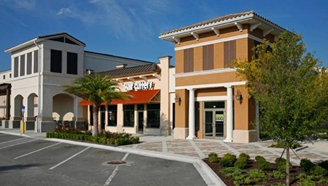
b.
Multiple stores within a single building. Where a large retail project contains individual stores that are less than 25,000 square feet of gross floor area each and contain separate, exterior customer entrances, the street level facade of each store shall provide windows between the height of a minimum of three feet and eight feet above the walkway grade, for no less than 60 percent of the horizontal length of the building facade of each store.
c.
Detail features. All facades shall include patterns at intervals of no more than 30 feet either horizontally or vertically. Such patterns shall include windows, color changes, texture changes or material module changes, and/or surface modeling changes such as offsets, reveals, or ribs of no less than 12 inches in width.
d.
Materials. Predominant exterior building material shall include architectural or split face block, brick, glass, wood, stucco, artificial stucco, stone, or concrete with architectural finish. The use of painted, struck block 8 x 8 x 16 will not be allowed as a finish material.
e.
Entryways. All facades shall include at least one customer entrance, or be screened from public view with no less than a ten foot wide buffer with foundation landscaping in planters or planting beds which extend a minimum of three feet inches from the building along the entire length of the ten foot buffer with a minimum of one overstory tree every 30 feet. Customer entrances shall be clearly defined and include at least two of the following features: canopies/porticos, overhangs, recesses/projections, arcades, raised above-the-doorway cornice parapets, peaked roof forms, arches, outdoor patios, display windows, integrated architectural details such as tile work, moldings, planters or wing walls, and/or landscaped sitting areas.
f.
Service and loading areas. Service and loading dock areas shall be screened by an architecturally finished masonry wall, PVC fence or combination architecturally finished masonry wall/vinyl fence eight feet in height and extending the entire length of the service and loading dock areas. A buffer area 6 feet in width containing evergreen plants a minimum of six feet in height and spaced no more than six feet apart shall be provided along the exterior of the wall. These provisions shall not apply to facades that face adjoining property zoned for an equal or greater intensity and that incorporate service and loading dock areas, provided that the adjoining property's building facade(s) facing the proposed development incorporate service and loading dock areas.
g.
Roofs. Flat roof lengths, longer than 100 feet in length shall be concealed or addressed utilizing at least one of the following:
i.
Parapet. The parapet design shall be a minimum of three feet in height and shall incorporate a three-dimensional cornice treatment. Alternative designs such as varying the parapet height for a minimum linear distance of 100 feet, and a minimum vertical height of two feet shall be subject to approval by the Chief Administrative Officer or his designee.
ii.
Two or more sloping roof planes that extend a minimum of three feet above the eave.
h.
Pedestrian circulation. Large retail projects shall encourage pedestrian-oriented ingress and egress through design features that enhance pedestrian safety, efficiency, and connectivity with a clear definition between vehicular areas and pedestrian walkways.
i.
Sidewalks.
i.
Pedestrian connectivity between the building facade and each grouping of parking spaces, public sidewalks, out parcel buildings, and transit stops shall be clearly indicated through the use of landscaped areas and sidewalks. Along each facade with customer entrances there shall be a sidewalk along the full length of the facade. For multiple store developments all facades with multiple customer entrances shall include a covered sidewalk connecting all entryways. For single store developments, a covered canopy shall be provided from the entryways to the edge of the sidewalks connecting to the remote parking area.
ii.
Sidewalks remote from the building shall be a minimum of five feet in width and provide a minimum of three feet of green/landscaped area between the edge of sidewalk and the vehicle use area.
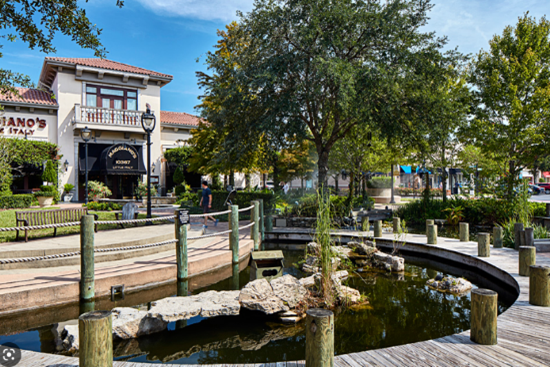
j.
Pedestrian amenity area. Large-scale retail projects shall include pedestrian amenity areas that include landscaped sitting areas with design components such as covered seating elements and/or other amenities in shaded areas. One pedestrian amenity area shall be required for each retail establishment with a building area between 25,000 and 100,000 square feet. For each retail establishment with a building area greater than 100,000 square feet, an amenity area shall be provided for each customer entrance. The amenity areas should be placed in areas which have the highest pedestrian traffic.
k.
Parking areas. Parking lots and access aisle-ways shall be designed as follows:
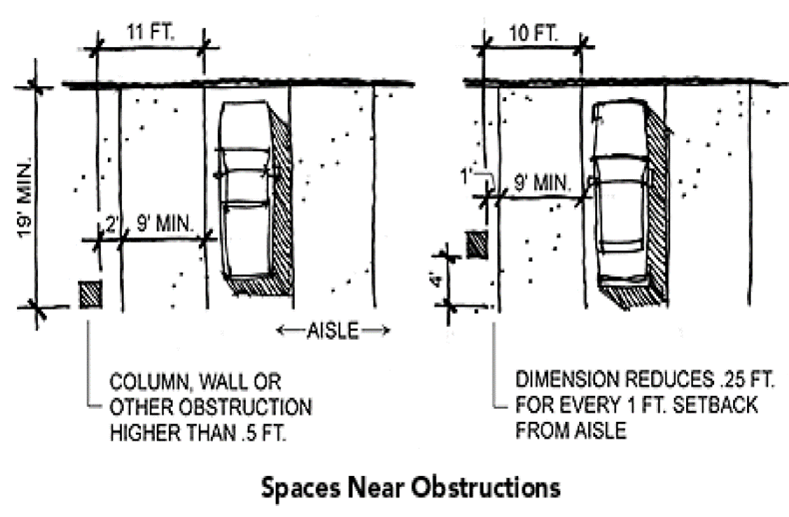
i.
Parking areas shall be designed so that no more than 100 spaces are part of a clearly defined grouping of spaces. Such groups shall be broken into individual areas and/or clearly separated by landscaped or weather-protected pedestrian walkways, significant landscape or geographic [GRAPHIC]features and/or by design components of the proposed building(s). The design of these separators shall consider pedestrian movements, conflict points with vehicles, site distance and angles, security site lighting and safety within the parking lot area. Separations shall be no less than eight feet in width at any point. A pedestrian access way shall be provided to every customer entrance. The parking lot shall be designed with traffic calming features along the fire lanes fronting the building facades. Parking lots shall be Use of a bioswale for drainage. Designed to reduce vehicle movement along the fire lane. Design features may include cross driveways, 90-degree parking space design, and consideration of site access points. At least 20 percent of the required parking spaces shall be placed in the rear or side areas of the proposed development. Alternative designs that incorporate existing natural resources are encouraged and are subject to approval by the Chief Administrative Officer or his designee.
ii.
Each parking space in excess of the minimum required by this Code shall provide an additional landscaped area of ten square feet to be placed within the internal parking area, and/or right-of-way buffer. Pervious parking areas, including turf block or grass shall be used for at least five percent but no more than 20 percent of the total constructed parking spaces, subject to approval by the Chief Administrative Officer or his designee. If grass parking is proposed, the parking shall be designed and constructed with a structural support (i.e. go-grid, go-block, etc.). The area designated for pervious parking shall be located at the perimeter of the parking lot. Pervious parking areas shall not be credited towards landscaping requirements.
l.
Signage. Signage shall be designed as part of a complete development system. The location(s) and design shall be reviewed and approved as part of the overall site plan. The predominant sign material shall include architectural or split faced block, brick, glass, wood, stucco, artificial stucco, or stone and be compatible with the principal building design. This subsection does not apply to site directional signage, traffic control signage, or building signage. Building signage shall comply with the requirements of Article VII.
m.
Outdoor display and sales. Any permanent display areas not within the building which face an adjoining public right-of-way, parking area or residential zoning district shall be shielded from view by a wall made from architectural or split face block, brick, glass block, wood, stucco, artificial stucco, stone, concrete with an architectural finish or a combination of the foregoing materials. The wall shall be incorporated into the overall design of the building and extend a minimum of four feet in height and may contain openings up to six feet in width at intervals of no less than 30 feet. As an alternative, a landscaped buffer area six feet in width containing evergreen plants a minimum of six feet in height and spaced no more than six feet apart may be provided along the exterior of the wall.
n.
Lighting. Exterior lighting shall be subject to subsection 4-4.2(m) above.
(3)
Compliance. In addition to the application requirements of this Code, a colored facade rendering shall be submitted at time of site plan/building permit application submission to ensure that the development standards required herein are met.
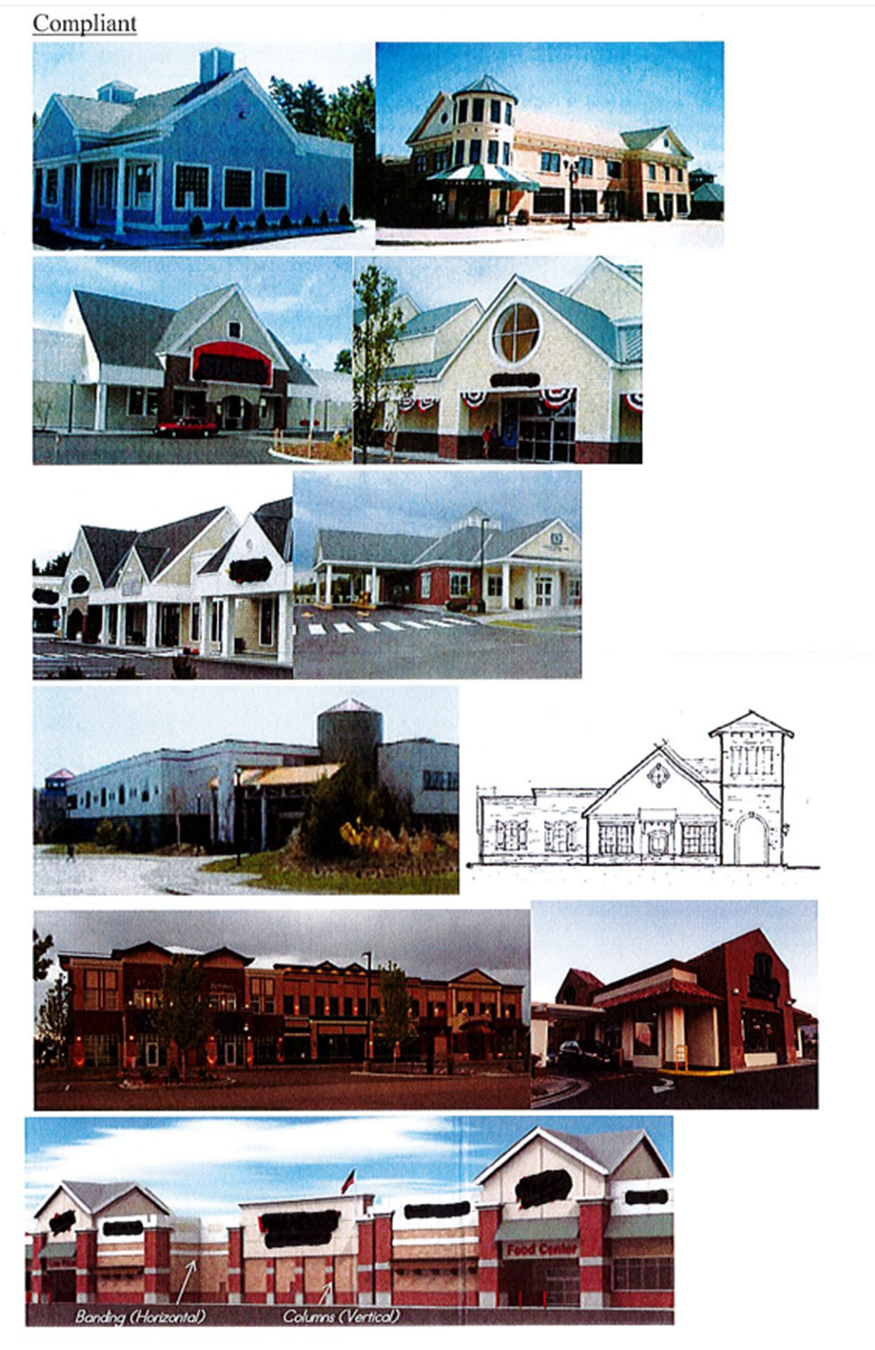
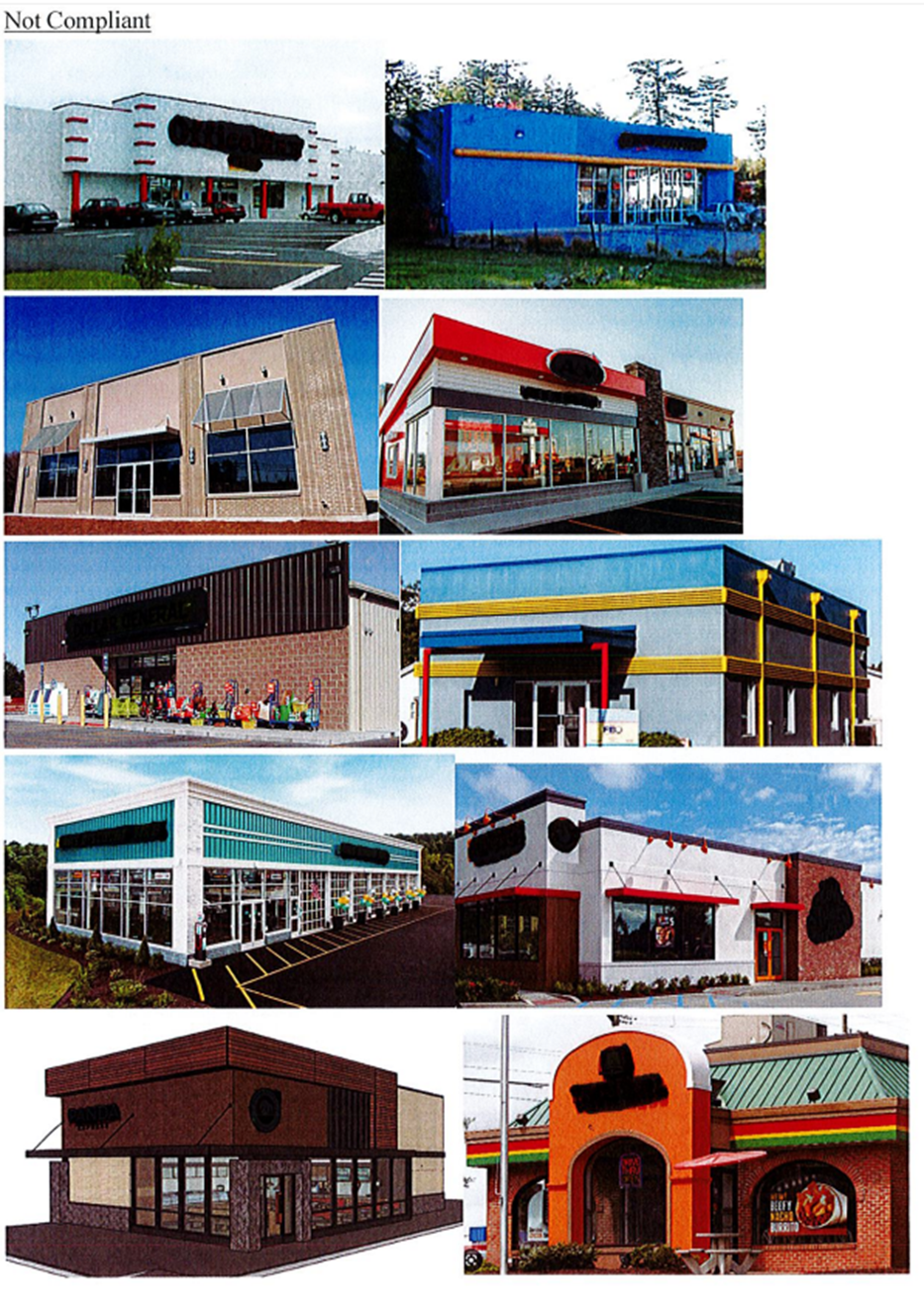
(Ord. No. 969, § 1, Exh. C, 9-18-2023)
Sec. 4-4.4 - Multifamily Development Design Standards.
(a)
Applicability. Provisions of this section are applicable to all new development and additions to or modifications of an existing multifamily building that increases density of the project. Compliance with the standards set forth in this section shall be demonstrated by submittal of architectural drawings and a site development plan meeting the requirements of this Code.
(b)
Purpose.
• Promote and maintain property values within the higher density residential neighborhoods.
• Promote a stronger and more positive image of Brooksville's higher density neighborhoods.
• Promote well-designed and visually pleasing residential structures.
• Promote the continued desirability of Brooksville as a place to live.
• Provide quality housing for households of all economic levels within the city.
• Provide for the health and well-being of residents with a meaningful residential environment.
(c)
Massing. The following design criteria have been established for building mass.
(1)
Minimize the bulk and massive appearance of large structures through the use of sloping varied rooflines, consisting of varying roof heights using variations in the height, directions and shapes of the roofline to visually break up a large structure. Incorporate varied building heights on the streetscape. Avoid massive straight rooflines with flat appearances.
(2)
Provide variations in exterior vertical walls in depth and direction for larger structures. The larger the structure, the greater the need to provide a variety of building wall setbacks that visually reduce the impact of building mass on adjacent streets and properties. Use building pop-outs, arches, and second story balconies to break-up massing.
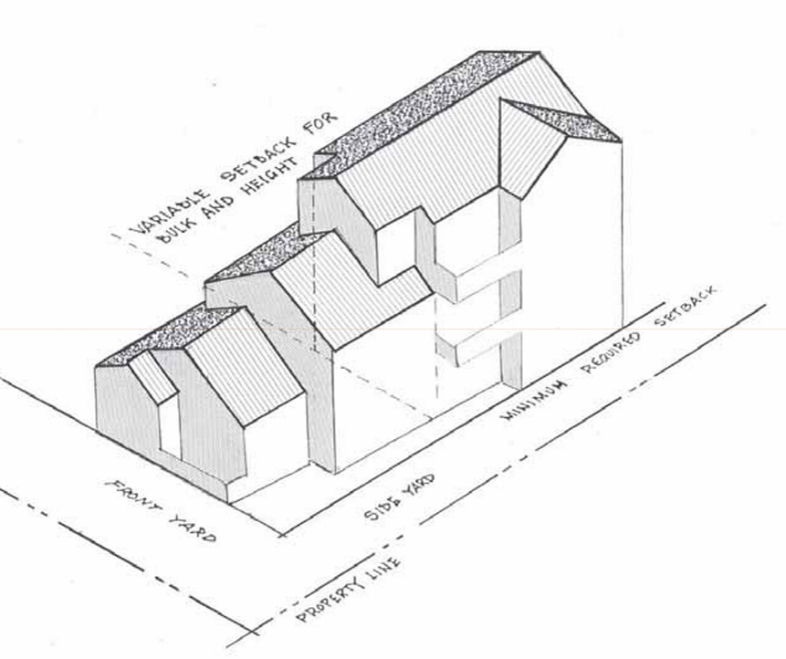
(3)
Building setbacks must increase with the height of the building, or the height of the building must step up and back from the street and adjacent properties. Incorporate a tiered design with one or two stories in the front and increasing to three-stories. This standard applies to the front, rear and side lines based upon building orientation.
(4)
Building setbacks must vary for design purposes to create interest and visual relief. A greater setback for the second and third stories of structures shall be provided. The use of projecting private balconies, building wall recesses, building pop-outs, varied wall planes, arched dormers, mansard roof, decorative window treatment, brick or stone veneers, color changes, and other architectural elements shall be incorporated so as to provide visual interest to residential structures.
(d)
Building orientation.
Not Compliant
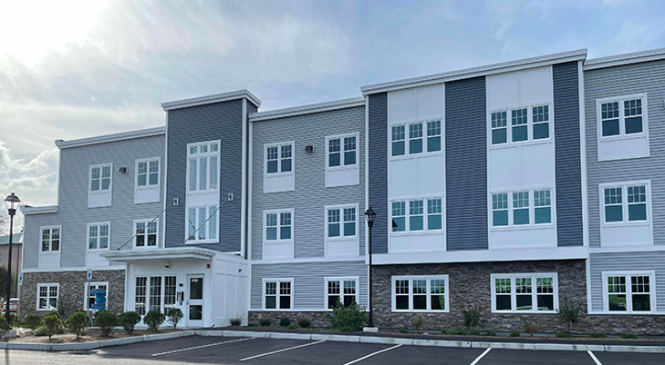
Compliant
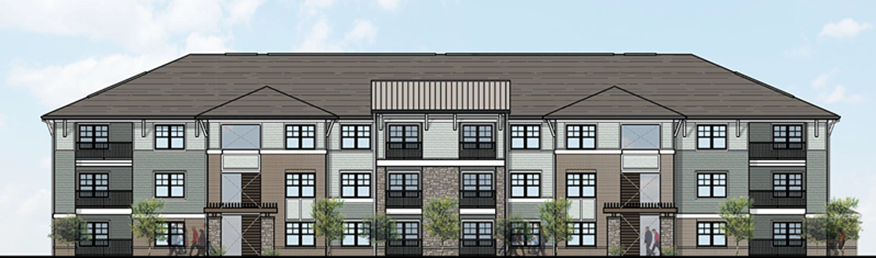
(1)
All primary facades of a building shall be visually interesting and designed with consistent architectural style, detail, trim features, and roof treatments. Horizontal projections (base, belt courses, frieze panels, cornices) and other linear elements shall continue visually from one adjoining building to another.
(2)
Building elements shall visually relate to each other and to the whole building in simple and organized ways. Avoid incongruent arrangements, such as when upper floors bear little compositional relationship to the ground floor, or when multiple roof forms do not relate to how the building is organized.
(3)
Primary facade must meet the primary facade standards outlined in this section. For purposes of this section, the term street includes driveways and accessways, and other ways used by the public for vehicular travel, whether or not dedicated to or owned or maintained by a governmental entity. The Developer shall provide an attractive pedestrian scale development.
(4)
Include elements such as bays, trellises, horizontal banding, and ornamentation to provide a sense of human scale.
(5)
Principal entrances shall be visibly emphasized, architecturally embellished, and the size of openings should generally reflect the size and importance of the associated interior space.
(6)
Entrances that cannot face a public street and sidewalk shall face an internal pedestrian path that connects directly to a street or parking area and sidewalk.
(7)
Visually prominent exterior corridors that provide access to multiple units on upper floors shall be avoided.
(8)
Porches and balconies should be used to serve as a transition between public and private spaces.
(9)
On larger developments, selected small plazas and open spaces may be provided for gathering areas, and pedestrian connectivity.
(10)
The placement of buildings should create view corridors into the development.
(11)
Buildings should be generally oriented along the drive aisles while taking into consideration pedestrian, accessibility, and amenities.
(12)
The placement of buildings at odd or irregular angles to rights-of-way is discouraged. Where building orientation is placed at an odd or irregular angle to the right-of-way, appropriate pedestrian-scale landscape and hardscape features shall be incorporated to create and maintain a walkable and pedestrian-friendly environment.
(e)
Facade standards.
(1)
Long building facade shall use projections or recesses, compose windows, space chimneys, and/or use other devices to set a rhythm at smaller intervals.
(2)
Cornices, and other architectural projections are encouraged.
(3)
All buildings shall clearly express a base, middle, and cap as described below.
a.
Base: The base grounds the structure at the bottom of the building with accent lines and/or materials/colors that contrast with the building middle.
b.
Middle: This element establishes the vertical proportion and is constructed of the primary building material.
c.
Cap: This is the roof or parapet of the building. Cornice or fascia trim shall be incorporated along the roofline.
(4)
Provide facade designs that allow the base to visually anchor the building to the ground. The design of the base should convey its load bearing function through the use of materials such as brick or stone, darker colors, or deep joints in masonry or stucco. The expressed height of the base shall be proportional to the overall height of the building. The vertical extent of the base lets the pedestrian understand the relative heights of the buildings along the street (public right-of-way or private). Provide facade treatments with the greatest amount of detail and refinement at the base level.
(5)
The top creates a prominent visual termination for the building, and can add interest through carefully considered roof forms, cornices, eaves, and parapets. Roof pitch, and its materials, size, and orientation are all distinct features that contribute to the character of a roof. Roofs shall be hip or gable. Flat roofs are prohibited.
(6)
Not less than 12 percent off the total areas of any primary facade shall consist of windows and doors.
(7)
Uninterrupted exterior surfaces exceeding 50 percent of the total length of any building facade are prohibited. Blank walls devoid of fenestrations or architectural design elements are prohibited.
(8)
Railings, balustrades, posts, and columns should be similar in form and color throughout the development. Posts and columns should have a substantial architectural appearance.
(9)
Primary facades shall provide at least three of the following:
a.
Peaked roof forms, recesses or projections, roof eave overhangs of 18 inches wide.
b.
Arches, or arched or curvilinear forms.
c.
Ornamental and structural details that are integrated into the building structure.
d.
Canopies or porticos over actual pedestrian entryways.
e.
Any other treatment or the combination of several separate treatments which together exceed the minimum as specified for primary facades that, in the determination of the Chief Administrative Officer or his designee, meets the intent of the Multifamily design standards.
(f)
Materials.
(1)
High-quality, durable materials that age well shall be used. Materials and applications that will discolor should be avoided.
(2)
Exterior finishes shall be wood, brick, stucco, architectural pre-cast stone, masonry, natural stone on the base course and cement board (e.g., Hardy-plank), or high-quality vinyl at least .040" thick with different colors used to identify the building elements on all building elevations.
(3)
Select base colors that blend with the predominant colors and features of surrounding buildings.
(4)
Bolder colors shall be reserved as accents for building details, ornamentation, or special features to reduce the perceived bulk of structures.
(5)
Consider articulating or emphasizing building corners with quoins, medallions, brick, or stonework.
(6)
Double-hung, awning, or casement type windows are preferred. Window frames should be wood, vinyl, fiberglass, or colored clad metal.
(7)
Corrugated or ribbed metal wall panels, used as a finish material, shall be prohibited on the facades.
(g)
Roof treatments.
(1)
Both single and multiple-tenant buildings and projects are required to have variations in the roof lines, and roof features that are consistent with the building's mass and scale.
(2)
Rooflines shall have parapets and be articulated to provide interest especially at building entry.
(3)
Roof materials shall consist of a minimum of 30 year architectural shingles or equivalent. Spanish Colonial/Mediterranean styling (tile roofs) or standing seam or exposed fastener metal roofs are permitted.
(4)
In addition to the above, roofs shall meet at least two of the following requirements:
a.
A three-dimensional cornice treatment, a minimum of 12 inches high, having a minimum of three vertical (not diagonal) changes in plane (no two on the same plane), and a variety of thickness in relief ranging from the greatest at the top to the least at the bottom.
b.
Overhanging eaves that extend at least two feet beyond the supporting walls, with a minimum fascia of six inches deep.
c.
Two or more roof planes per primary facade.
d.
A sloping roof with an average pitch of 5:12 or greater.
e.
Any other treatment that, in the determination of the Chief Administrative Officer or designee, meets the intent of the Multifamily design standards.
(h)
Ground mounted HVAC Equipment. All Ground mounted HVAC equipment shall be screened by fencing, architectural elements, or hedges.
(i)
Service and loading areas. Service and loading dock areas shall be screened by an architecturally finished masonry wall, PVC fence or combination architecturally finished masonry wall/PVC fence 8 feet in height and extending the entire length of the service and loading dock areas. A buffer area six feet in width containing evergreen plants a minimum of six feet in height and spaced no more than six feet apart shall be provided along the exterior of the wall. These provisions shall not apply to facades that face adjoining property zoned for an equal or greater intensity and that incorporate service and loading dock areas, provided that the adjoining property's building facade(s) facing the proposed development incorporate service and loading dock areas.
(j)
Sidewalks.
(1)
Pedestrian connectivity between the building facade and each grouping of parking spaces, public sidewalks, out parcel buildings, and transit stops shall be clearly indicated through the use of landscaped areas and sidewalks. Along each facade with pedestrian entrances there shall be a sidewalk along the full length of the facade.
(2)
Sidewalks remote from the building shall be a minimum of five feet in width.
(3)
Projects with more than 200 units shall include pedestrian amenity areas that include landscaped sitting areas with design components such as covered seating elements and/or other amenities in shaded areas.
(k)
Parking lots and access aisle-ways.
(1)
Parking areas shall be designed so that no more than 100 spaces are part of a clearly defined grouping of spaces. Such groups shall be broken into individual areas and/or clearly separated by landscaped or weather-protected pedestrian walkways, significant landscape or geographic features and/or by design components of the proposed building(s). The design of these separators shall consider pedestrian movements, conflict points with vehicles, site distance and angles, security site lighting and safety within the parking lot area. Separations shall be no less than eight feet in width at any point. The parking lot shall be designed with traffic calming features along with the fire lanes fronting the building facades where required by the Fire Chief.
(2)
Each parking space in excess of the minimum required by this Code shall provide an additional landscaped area of ten square feet to be placed within the internal parking area. Pervious parking areas, including turf block or grass may be used for five percent but no more than 20 percent of the total constructed parking spaces, subject to approval by the Chief Administrative Officer or his designee. If grass parking is proposed, the parking shall be designed and constructed with a structural support (i.e. go-grid, go-block, etc.). The area designated for pervious parking shall be located at the perimeter of the parking lot. Pervious parking areas shall not be credited towards landscaping requirements.
(l)
Signage. Signage shall be designed as part of a complete development. The location(s) and design shall be reviewed and approved as part of the overall site plan. The predominant sign material shall include architectural or split faced block, brick, glass, wood, stucco, artificial stucco, or stone and be compatible with the principal building design. This subsection does not apply to site directional signage, traffic control signage, or building signage. Building signage shall comply with the requirements of Article VII.
(m)
Compliance. A colored facade rendering shall be submitted at time of building permit application submission to ensure that the development standards required herein are met and approval shall be subject to approval by the design review board and processes per Section 8-1.6.
(Ord. No. 969, § 1, Exh. D, 9-18-2023)
Sec. 4-4.5 - Residential Design Guidelines.
(a)
Introduction.
The physical character of our developed neighborhoods cannot be separated from the values they respect. Sooner or later, these values manifest themselves in how our development decisions are made and how those decisions shape our future neighborhoods. Where our values and actions are synchronized, our neighborhoods prosper; where they are in conflict, so are the neighborhoods.
The guidelines in this section seek to provide property owners, project designers, and developers with a clear understanding of the city's expectations for new single-family and two-family residential developments. Many of these guidelines are aspirational and not mandatory; whereas, others are required. The required guidelines are set apart by the word "shall" which indicates that the guidelines are requirements. The remainder of the guidelines are aspirational but may be taken into consideration by the reviewing board/council when considering the formulation of guidelines as to particular requested planned developments.
The Comprehensive Plan is designed to ensure that the matrix of housing types and densities that retains its core identity by guiding future growth that respects the diversity of the city, shapes and configures development in relation to the land it occupies and ensures that its various parts relate to its whole. This unity of form also promotes and accommodates a balance of housing, employment, and service opportunities for the citizenry.
The intent of these guidelines is to convey and express the desire that single-family and two-family residential developments are architecturally diverse and appear to be neighborhoods that have evolved naturally over time. Variation in home sizes, floor plans, elevations, and lot sizes contribute to such diversity. Historic architecture styles found in the existing neighborhoods of Brooksville include styles such as such as Colonial - Greek Revival, Bungalow, Craftsman, Spanish Colonial Revival, Spanish Revival, and Victorian. These styles serve as the basis for design of new neighborhoods so that they incorporate into the existing fabric of the city. The typical characteristics of these styles are explained below.
The City of Brooksville historically has experienced significant periods of slow to moderate residential development. However, it has been the rapid growth period during the recent years and those properties that have obtained entitlement densities that has made the city acutely aware of a growing trend toward "sameness" of most new residential production development, irrespective of the particular homebuilder. Small lots, narrow side yards, and rigid street patterns within subdivisions, together with a limited range of exterior building materials (stucco walls, tile roofs), colors, building orientations, and architecture (prominent garages), have all combined to produce a monotony in new home construction City-wide, together with the visual impression of building mass and closeness that has characterized the city's low density single family residential development. There now exists an inventory of approved residential lots that exceeds the entire number of lots that have been developed in the history of the city since its inception. Therefore, there exists the true potential that the historic regional architectural heritage of the city will be lost.
Applications for new residential development, submitted during this period, have typically sought relief under the Planned Development (PD) zoning designation from certain minimum standards otherwise required by the Land Development Code. However, such requests have not demonstrated any real design innovation or other merit justifying the departure from conventional standards, as otherwise required by the city for a PD designation. Hence, the purpose of the Residential Design Guidelines is to preserve the historic diversity within new residential developments and to ensure that departures from conventional zoning standards are truly warranted by virtue of creativity, amenity, and diversity.
(b)
Strategies.
To successfully shape the city's future, piecemeal regulations must be replaced by overall strategies, standards that maintain base values. Design strategies include:
• Recognizing each community in the city as an identifiable and unique place.
• Planning and designing new neighborhoods in ways that make them visually distinctive / identifiable and pleasing to the visual sense.
• Ensure housing design is based on a consistent, compatible, and aesthetic architecture.
• Ensure that new housing reflects a strong residential character for the neighborhood and community.
• Ensure that new houses are constructed in neighborhoods that are interesting and varied in appearance.
• Maintain the scale, context and texture of existing neighborhoods.
• Encourage creative designs for sites and buildings, while respecting the area's architectural heritage.
• Allow for infill development that is sensitive to the character and history of the surrounding neighborhoods.
• Utilizing building materials and enhanced landscaping to promote a look of quality, both at the time of initial occupancy, as well as in future years
(c)
Purpose and Applicability.
(1)
The preservation and encouragement of a City of varied architectural styles, reflects the distinct phases of its history. The purpose of this section is to create and maintain a positive community image and identity by identifying architectural treatments that enhance the visual appearance and character of the city.
(2)
This Section applies to all residential zoning and planned development districts within the city that permits single and two family residential and accessory dwelling units. New residential development should demonstrate compliance with the design standards included in this section before a building permit can be approved and issued by the city.
(d)
Brooksville Architecture.
To understand and recognize "architectural style" for the purpose of these standards, architectural styles classify architecture in terms such as form, techniques, materials, time period and the region. Brooksville was incorporated in 1880 and soon thereafter had a plat recorded for the area of the downtown and surrounding residential blocks. The form of the subdivision was a strict grid pattern. Over time a variety of housing styles developed which emulated housing styles elsewhere across the country. There is no one true style of a Brooksville house but rather it is the mixture of housing styles that blended together make the city's architectural heritage.
The Brooksville home design from the 1800's through the early twentieth century was all about trends and popular tastes. Well-known styles were often "all the rage" for several decades until another style replaced it; rarely did more than one or two styles dominate home design at the same time. When a certain style was in vogue, several new homes were built in that style.
In analyzing any particular house style, the floor plans and interior features of the house should also be considered. The more a style is researched, the better the form is understood and can then be applied as the basis for developing plans. The results can be a beautifully emulated house design that goes well beyond the scope of design standards.
These features or characteristics are the component parts that, when put together, make up a style:
• Roof type.
• Symmetry and shape.
• Frame.
• Articulation.
• Massing.
• Fenestration - Windows and doors.
• Building materials and colors.
• Decorative trim.
• Porches, eaves and columns.
(e)
Guide to Brooksville Architectural Styles.
The following architectural styles are found in the city of Brooksville and would complement the city's various residential neighborhoods. The range of styles described here will support a diversity of character within the community while ensuring that all residential development complements the architectural character of the region, City and neighborhood.
This Section provides general identifying features of the listed architectural style to guide design when that particular style is chosen by the applicant. The style elements described for each architectural style provide a general summary of each style's formal elements.
Where an existing structure exhibits a particular style, additions to the structure should be designed in the same style. If a building element is reflective of a particular style, all building elements should be reflective of that same style.
Queen Anne
Queen Anne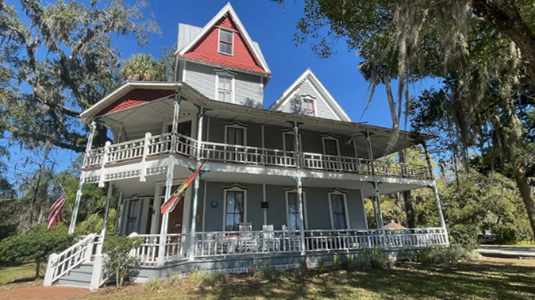
Popular around the turn of the Century, Queen Anne homes typically feature:
• Elaborate ornamentation and texture.
• Steep roof pitch.
• Irregular plan and massing.
• Patterned shingles to create texture.
• Towers common.
• Asymmetrical facade.
• Fretwork/ gingerbread.
• Multipaned, tall double hung windows common.
• Bay or bow windows common.
Folk Victorian
Popular around the same time as Queen Anne homes, Folk Victorian homes have simpler floor plans and massing than Queen Anne style homes, but often just as elaborate ornamentation. Many Folk Victorian homes are earlier homes that had ornamentation added when it became fashionable. They differ from Queen Anne in that they are simple, often symmetrical, shaped homes.
Folk Victorian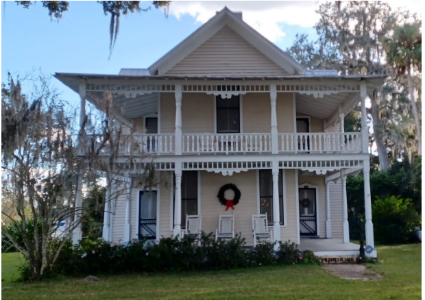
• Ornamentation may have been applied to simpler house forms.
• Symmetrical facades common.
• Decoration primarily on porches.
• Windows can be simple or multipaned, typically double hung and with tall proportions.
• Can be either wood framed or masonry structures, but wood framed is more common.
Colonial Revival
Colonial Revival is a continuously popular style starting in the 1880s (after the US centennial) through to today with a variety of iterations over the years. Often simple in form, the homes.
Colonial Revival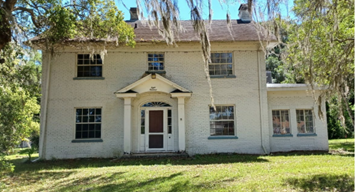
• Typically have an accented front door with colonial pediment and classical style columns.
• Accented front door, usually centered in facade.
• Fanlights & sidelights.
• Symmetrical primary facade.
• Multi-pane double hung windows.
Dutch Colonial Revival
A subset of Colonial Revival style, Dutch Colonial Revival style homes feature a gambrel roof.
Dutch Colonial Revival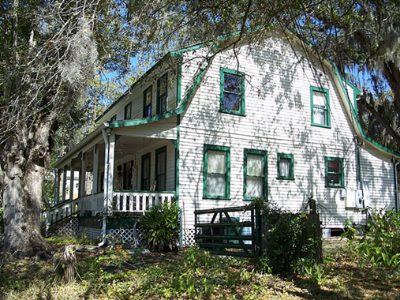
NeoClassical
Popular from 1895 to today, the NeoClassical style is a very stately house style designed to convey status of the owner. The style's most prominent feature is full two-story height columns on the primary facade coupled with a classical front gable pediment, although 1 story examples also exist.
NeoClassical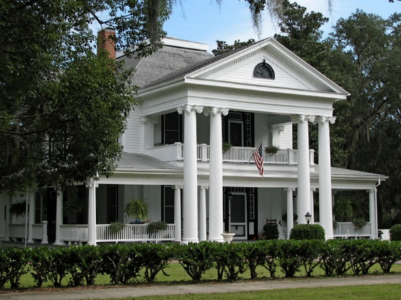
• Full height classical columns - often Ionic or Corinthian.
• Gable pediments common.
• Greek or Roman temple precedent.
• Double hung multi-paned windows.
Mission
Mission style homes were very popular during the Florida Land Boom era of the 1920s throughout the state but found more commonly on the East Coast. Reflective of early colonial architecture from Spanish settled areas of the US, the style is characterized by:
Mission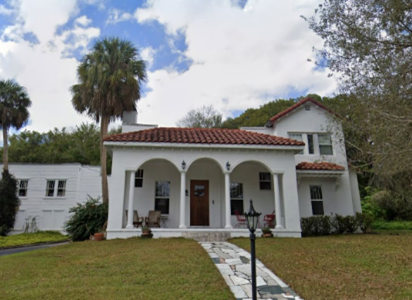
• Stucco exterior - typically textured.
• Clay tile roof for sloped roof versions and for pent roofs.
• Shaped parapets for flat roofed versions.
• Arches.
• Multipaned over one double hung windows common.
• Structure under stucco can be wood framed or masonry.
• Detached garages common.
Craftsman
Another style popular during Florida Land Boom years, entire neighborhoods of Craftsman style homes can be found in Tampa and St. Peterburg. In Brooksville, there are isolated but very fine examples of the style. Pseudo-Craftsman style homes are making a comeback today throughout the US.
Craftsman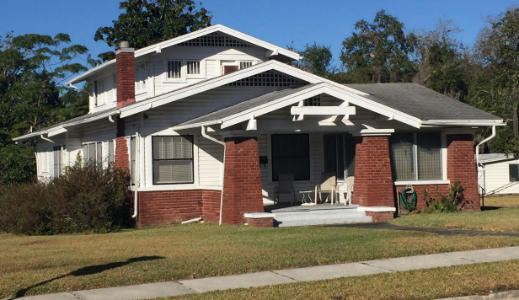
• Low pitched roof.
• Exposed rafters, bracketed eave supports or outriggers.
• Always has a porch, often w/ tapered columns.
• Double hung windows, often in 3/1 or 4/1 configurations, sometimes in pairs or triple sets.
• Detached garages common.
• Most examples are one-story.
Minimal Traditional
Minimal Traditional style homes are small, simple homes with little to no roof overhang that were commonly built to meet post-WWII housing needs.
Minimal Traditional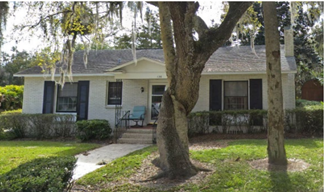
• Little to no eaves.
• Compact footprint.
• Little ornament.
• May have an attached garage.
Frame/Masonry Vernacular
These are narrow rectangular one and one- and one-half story houses.
Frame/Masonry Vernacular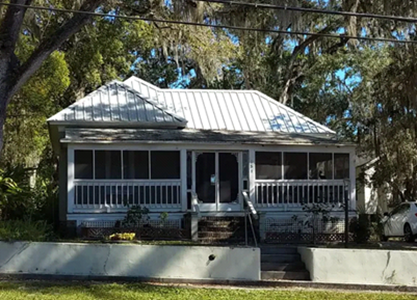
• Low pitched roofs.
• Porch roofs over entry.
Ranch
Ranch style homes are long and low, designed for larger, more suburban lots. They often have attached garages.
Ranch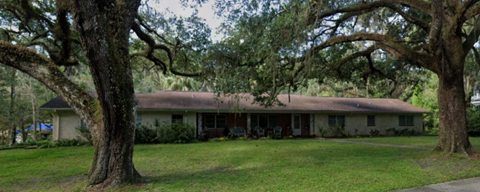
Contemporary/Mid-Century Modern
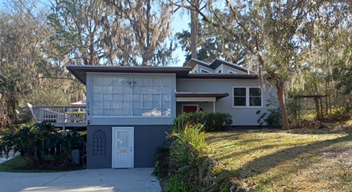
• Low roof slopes with wide eaves.
• Exposed beams.
• Fixed windows of non-rectangular shape.
(f)
Design-New Developments.
1.
Intent. To maintain the residential scale and design variety in the character of neighborhoods that is a keynote of how Brooksville developed and to avoid neighborhoods of sameness the following standards should be incorporated.
(a)
Variation in plans and elevations.
Within residential developments, an identical house elevation should only repeat every five lots when fronting the same right-of-way.
(1)
Adding or deleting false shutters, or similar types of minimal elevation changes do not suffice as distinct elevation change.
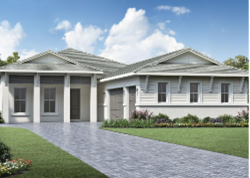
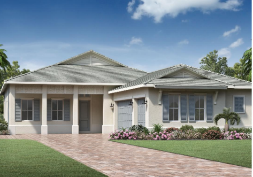
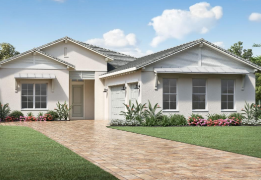
Examples of homes featuring different facade elevations.
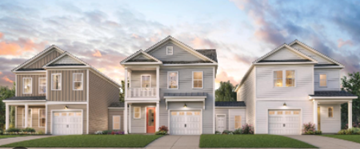
(b)
Covered Entry. All houses should provide a covered entry with a minimum dimension of four feet by six feet. Porches up to 200 square feet may project into the required front yard by up to five feet. The minimum front yard setback should not be less than 15 feet. See Figure 4-4.5.3 for example.
Porches subject to compatibility with the architectural style are found on most historic styles within the city and at a minimum include:
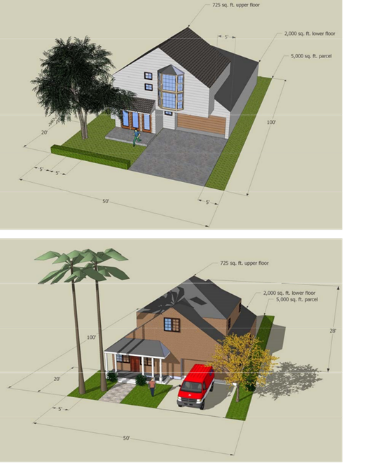
1.
A minimum covered size 4'x 6'.
2.
The porch roof supported by columns.
3.
Roofing material matches or is compatible with primary roof material.
4.
Porches are not screened or enclosed.
(c)
Massing requirement. Building massing should implement techniques that reduce the appearance of a high building density or bulk. To reduce the perceived mass and bulk of a two-story house on a smaller modern size lot the second floor should be set back from the side yard property line.
(d)
Articulation.
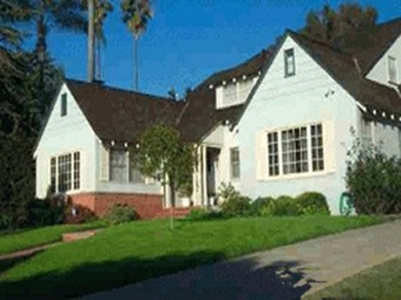
i.
360 Degree Architecture.
Architectural design treatments such as building offsets, recessed windows, trellises, overhangs, or other features. These design elements are also included on the rear facades and sides of homes which are adjacent to or visible from streets or open spaces.
ii.
Facade articulation adds interest to a building. Long unarticulated building facades should be avoided by incorporating varying setbacks of the building footprint in a varied fashion along the residential street. Projecting architectural features such as bowed or bay windows, columns, offset roof planes, and similar features extending beyond the facade should be used to create both vertical and horizontal articulation on the building elevations.
The following features are traditional techniques of exterior articulation:
(A)
A base course or plinth course; banding, moldings, or stringcourses; quoins; oriels; cornices; arches; balconies; brackets; shutters; keystones; dormers; louvers as part of the exterior wall construction. Quoins and banding should wrap around the corners of the structure for at least two feet. Banding placed around the windows and doors visible from the right-of-way, golf course, or other similar highly visible areas. Window shutters substitute for banding. Horizontal banding continues the length of the wall that faces a street, golf course, or other similar highly visible areas.
(e)
Fenestration.
(1)
Windowless exterior walls, excluding garage doors, that face a public right-of-way, golf course, lakes, or other similar highly visible areas should be avoided.
(2)
Windows should be in harmony with and proportionate to the rest of the structure.
(3)
The use of reflective glass on residential structures has not been used historically within the city. Reflective glass is defined as having a visible light reflectance rating of 15 percent or greater.
Transparent windows and/or doors facing the street are an historic feature of all style periods in the city.
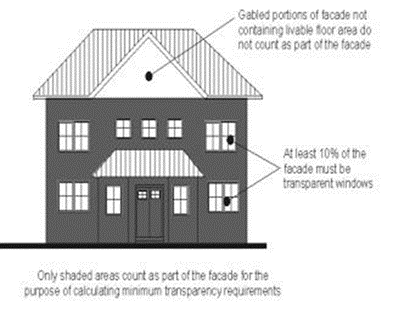
Building materials compatible with the architectural style and existing window styles in the city include:
A.
Double-hung.
B.
Awning.
C.
Casement.
D.
Materials wood, vinyl fiberglass of colored clad metal.
(4)
Shutters. Functional shutters act as an accent to windows as well as weather protection. Accent shutters are designed as a visual detail for windows.
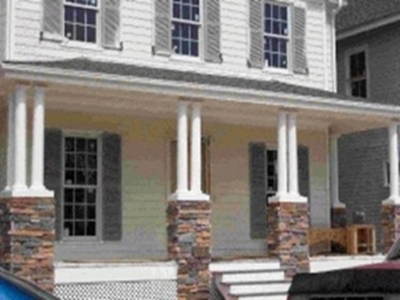
(1)
Accent shutters should be a contrasting color to the wall color.
(2)
Shutters should match the height and width of the window.
Shutter styles that have been used in the city include:
1.
Traditional horizontal slat shutters.
2.
Traditional panel type shutters.
(5)
Awnings. Awnings where used have been used to complement the architectural style and colors of the residence. Awnings have been placed above windows and doors.
Historically appropriate building materials subject to compatibility with the architectural style include:
1.
Canvas.
2.
Matte finish vinyl.
3.
Copper or coated metal roofing.
(6)
Roof Design. Provide pitched or articulated roof line, or other roof element such as eyebrow roof forms or dormers that emphasize building form and help it to fit in with neighboring structures with prominent roofs. Pitched roofs should utilize a minimum slope of 5:12 or steeper based upon the architectural style of the house. For the porch roof pitch to have the desired look, a minimum of 3:12 pitch should be used.
Materials found within the streetscape subject to compatibility with the architectural style include:
1.
30-year Asphalt fiberglass shingles.
2.
Concrete or tiles.
3.
Standing seam metal (coated if not copper).
4.
Coated metal roof with exposed fasteners.
(g)
Reserved.
(h)
Design-Accessory Dwellings.
(1)
Accessory Dwelling Units shall be compatible with the architectural style of the primary structure.
(a)
Except as otherwise specifically permitted by this section, accessory dwelling units shall be located on the same building site as the associated principal use.
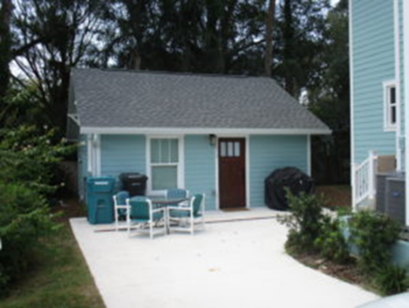
(2)
Except as otherwise specifically permitted by this section, no accessory use or structure shall be in the required front and side yard setbacks; and in the front half of the lot or between any portion of the principal facade of the principal building and the street.
(3)
Setbacks When Attached by a Breezeway.
i.
An accessory structure that meets the accessory structure setbacks may be connected to the principal structure by a breezeway when all of the following conditions are met:
A.
The breezeway is open-air, with no screened in or enclosed space; and
B.
The breezeway is located on the ground floor, not an upper floor; and
C.
The breezeway is a maximum of 12 feet high and six feet wide.
ii.
An accessory structure must meet the principal building setbacks if any of the following conditions apply:
A.
The breezeway is screened in, enclosed, or air-conditioned; or
B.
The breezeway is located on an upper floor; or
C.
The breezeway is taller than 12 feet or wider than six feet.
(b)
Distance Between Buildings. Distance separation shall be measured from building wall to building wall. Eaves may extend past the building wall provided that the distance between eaves (as measured parallel to the ground) is at least three feet.
(1)
A detached accessory dwelling up to 12 feet in height shall be located at least five feet from any other building.
(2)
A detached accessory dwelling greater than 12 feet in height shall be located at least ten feet from any other building.
(i)
Design-Garages.
(1)
There is a concern within monolithic contemporary subdivisions that the streetscape would be dominated by garage doors which has not been the history of development within the city, The visual impact of garages can reduced by the use of additional setback from the curb face where garage doors must face the street or by the use of side-facing where possible.
(2)
Standards.
(a)
Residential plans that feature attached garage designs whose entries are from the side ("side-loaded garages") are desirable.
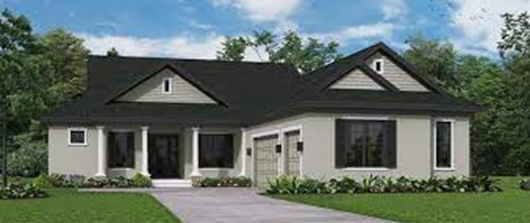
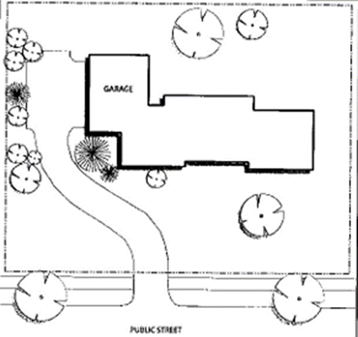
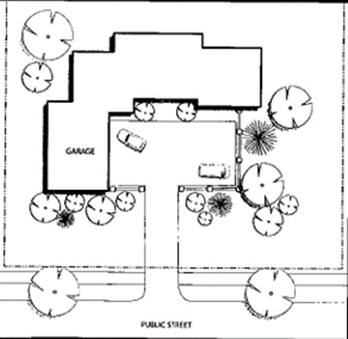
(b)
The garage face has not historically occupied no more than 50 percent of the ground-level facade facing the street.
(c)
Where more than two garage doors (a double width door counts as two doors) facing the street, the third garage door should have an increased setback or offset of a minimum of two feet to break up the visual impact.
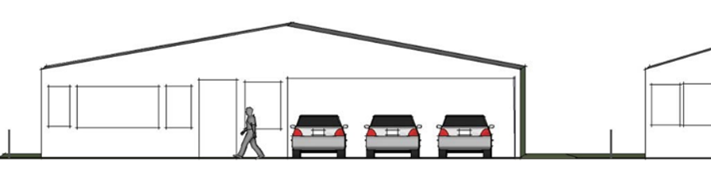
Three car garage does not meet separation.
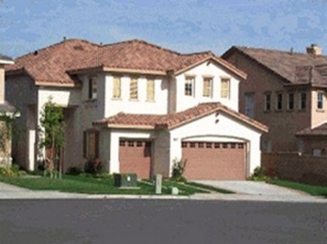
Three car garages that do meet separation guidelines.
(d)
Garages that are detached from the principal structure should be designed and constructed so that the roof and exterior walls of the garage are of similar architecture, materials, and colors as the exterior of the principal structure.
(e)
Garages or carports should be set back at least five feet behind the front wall of the house or front edge of an unenclosed porch. On corner lots, this standard not apply to the front yard that functions as a side yard.
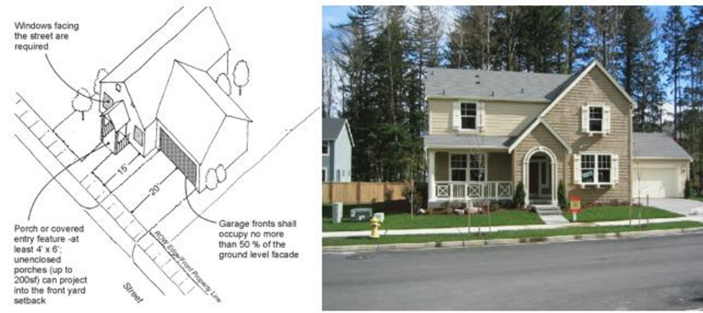
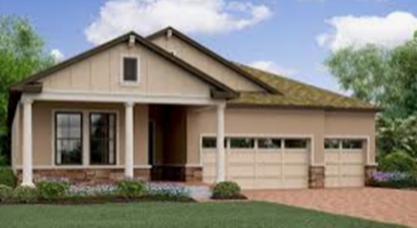
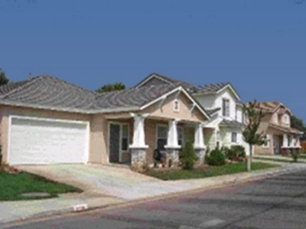
Meets guidelines.
Does not meet guidelines.
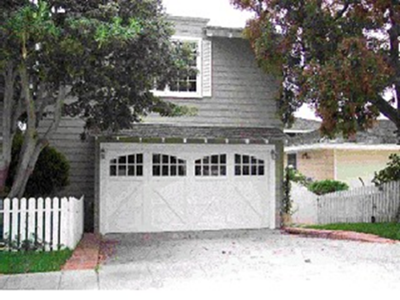
Aspirational Standards.
1.
No more than 50 percent of the front facade should be garage.
2.
Three car garages (double width garage doors count as two doors) should have one door offset from the others.
3.
Garages or carports should be set back at least five feet behind the front wall of the house or front edge of an unenclosed porch.
4.
At least 20 percent of the garage doors should be windows.
(Ord. No. 969, § Exh. E, 9-18-2023)
Sec. 4-5.1.- Applicability.
This Part shall be applicable to all land lying in the incorporated area of the city of Brooksville, Florida. If provisions of this Part conflict with other land development regulations, the more restrictive provisions shall apply.
(a)
All new development must meet the requirements of this Part.
(b)
Existing landscapes that do not comply with the provisions of this Part must be brought into conformity when:
(1)
The vehicular use area is altered or expanded in any manner other than re-striping or re-marking or;
(2)
The building square footage is increased by more than 50 percent; and/or;
(3)
There has been a discontinuance of use for a period of 365 days or more.
(Ord. No. 969, § 1, Exh. F, 9-18-2023)
Sec. 4-5.2. - Purpose and Intent.
(a)
Purpose. The purpose of this Part is to establish uniform protective and management regulations for trees and land clearing within the city.
(b)
Intent. The intent of this Part is to encourage the protection of the maximum number of trees within the city and to enhance the city's tree canopy. It is further the intent of this Part to:
• Encourage the protection of the maximum number of trees and maximum number of large specimen trees.
• Encourage the protection of native trees of the area.
• Ensure healthy growth, healthy condition, and survival of trees through good cultural practices.
• Encourage the correct selection of trees, location of trees and maintenance of trees to maximize public benefits and minimize hazard, nuisance, hardscape damage, and maintenance costs.
• Encourage proper removal of exotic, pest trees.
(c)
Trees help to:
• Better control problems of flooding, promote soil conservation, moderate the climate, improve air and water quality, pollution and reduce noise and glare; and
• Make the city a healthier, more attractive, and safer place in which to live.
• To this end, it shall be unlawful to cut down, damage, poison, or in any other manner destroy or cause to be destroyed any regulated tree or other vegetation or engage in unapproved land clearing as covered by the provisions of this ordinance except in accordance with the provisions set forth herein. Notwithstanding, in case of emergencies involving natural disasters such as, but not limited to, flood, freeze or other natural disasters, the requirements of this ordinance may be waived by the Chief Administrative Official or his designee.
(Ord. No. 969, § 1, Exh. F, 9-18-2023)
Sec. 4-5.3. - Approval Required for Removal, Exemptions, and Exemptions from Replacement Requirements.
(a)
No person directly or indirectly, shall cut down, destroy, remove, relocate, or effectively destroy through damaging any regulated tree situated on any real property or clear any lot or acreage located within the city without first obtaining approval, as provided in this Part. Where approval is issued for removal of a tree, a tree replacement determination must be made in accordance with Section 4.5.8, tree replacement requirements, and in accordance with the exemptions provided in this Part.
(b)
Exemptions to obtaining approval for tree removal and replacement requirements.
(1)
Existing single family and two-family dwellings provided that "documentation" defined under F.S. § 163.045 includes providing the city with the following:
a.
A completed report with pictures of the trees to be removed on an International Society of Arboriculture (ISA) Basic Tree Risk Assessment Form, as may be amended from time to time, with a risk rating completed by an ISA-certified arborist or a Florida licensed landscape architect. The name, contact information, affiliation, credentials, registration numbers, and qualifications of the certified arborist or landscape architect must be included with the report.
(2)
Nurseries. All trees and plants within a licensed plant or tree nursery shall be exempt from the terms and provisions of this Part, only if trees are planted and growing on the premises of the licensee and are for sale or intended sale in ordinary course of the licensee's business.
(3)
Undesirable trees, as specified in the Florida Exotic Pest Plant Council (FEPPC) Invasive Plant List.
(4)
Trees less than ten inches caliper, at DBH unless newly planted as part of an approved landscape plan.
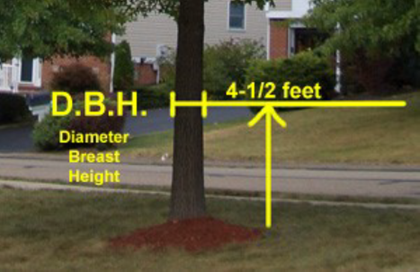
(5)
Trees (except specimen trees) that are so located as to prevent construction of an approved building or structure, where the city has determined that the applicant has demonstrated reasonable consideration in attempting to avoid the loss of trees in planning the precise location of proposed structures.
(6)
Trees on vacant residential property intended for new residential construction or redevelopment require tree removal approval. Trees on residential or non-residential property that pose an immediate danger to persons or property are not included in the exemption provided in F.S. § 163.045, but do not require approval to remove them.
(Ord. No. 969, § 1, Exh. F, 9-18-2023)
Sec. 4-5.4. - Tree Preservation and Protection Requirements.
(a)
Tree Preservation.
Notwithstanding any other provision of this Article, regulated trees over ten inches in caliper shall not be removed except for extraordinary circumstances and hardships and only by conforming to the requirements of this Article and only after the applicant has provided such documentation, as may be required by the city, demonstrating that the applicant has engaged in good faith in the following sequence of actions, in the order shown below, to attempt to preserve, modify, and relocate the regulated trees:
(1)
Preserve the existing trees on site. The applicant shall make reasonable efforts to design proposed or existing improvements, including but not limited to the drainage areas, structure, driveway, and utilities to accommodate the natural growth of the trees. The applicant may be required to submit multiple alternate development plans, demonstrating that reasonable efforts to preserve the trees have been made, prior to removal of the tree(s) being approved.
(2)
Modify the existing tree. The applicant shall make reasonable efforts to design proposed or existing improvements, including but not limited to, the structure, driveway, and utilities, to accommodate the existing rated trees with modifications by root pruning or tree pruning that would not cause significant harm to the tree, as determined by an arborist certified by the International Society of Arboriculture, and preserve its well-being. The applicant shall be required to submit an opinion of a certified arborist and/or multiple alternate development plans, demonstrating that reasonable efforts to modify the rated trees have been made, prior to removal of the tree(s) being approved. The City may require root barriers as a mitigation measure to address future potential root damage concerns.
(3)
Alternative Design and Removal. Before removal of the regulated tree(s) may be approved, the applicant shall provide documentation that actions (1)and (2) have been reasonably explored and are not feasible to preserve, modify, or relocate the existing rated tree(s). Feasibility shall be determined after evaluating the prepared alternate development plans and the opinion of the certified arborist that the regulated tree(s) cannot reasonably be preserved, modified, or relocated. The alternative development plans shall depict site constraints and design limitations due to the rated tree(s). The alternate development plans shall also depict possible adjustments of building orientations and other proposed improvements and approved variances to accommodate the rated tree(s); reduction of developable area; and such other design alternatives for the site. The applicant bears the burden of proving it has exhausted feasible development plans to preserve existing regulated tree(s) to justify the removal of any existing rated tree.
(4)
Extraordinary Circumstances and Hardships. The applicant bears the burden of demonstrating during the site plan/subdivision review process that an extraordinary circumstance and hardship exists to justify the removal of a specimen tree is necessary and cannot be preserved in its current location.
(b)
Tree protection zones.
The city council has determined that certain roadways within the city merit special protection of the trees that line or provide canopies over the roadways. It is the purpose of this subsection to describe those roadway sections and require additional protection through control of activities on lands abutting these roadways.
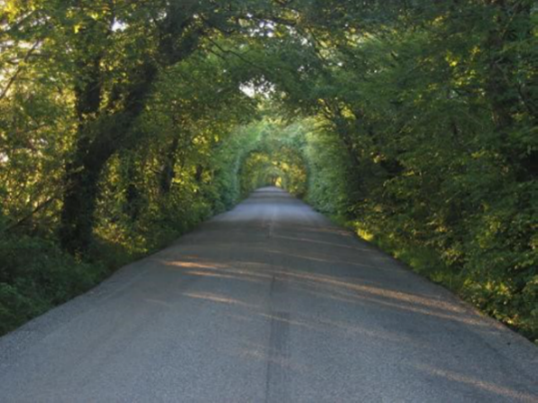
SCHEDULE B
TREE PROTECTION ZONES
(1)
All lands within 50 feet of the centerline of the roads listed in Schedule B of this section are declared to be tree protection zones (TPZ).
(2)
Minor neighborhood access streets of less than two-tenths of a mile in length shall not be considered for inclusion as TPZs.
(3)
No tree shall be removed for the purpose of access to adjacent properties, and no improvements shall be carried out nor made in the TPZ other than routine maintenance of existing roadways, utilities and existing drainage facilities without the express, approval of the city council.
(4)
Nothing in this section shall be construed to prevent routine maintenance or the trimming of trees by individuals or public utilities or their authorized agents where such trimming or maintenance is required for the establishment or continuation of the service provided by such utility.
(Ord. No. 969, § 1, Exh. F, 9-18-2023)
Sec. 4-5.5. - Tree Protection and Survival.
(a)
The burden of tree protection lies on the property owner. It shall be the responsibility of the property owner, developer, or applicant to ensure that any tree shown on the tree inventory for which a tree removal permit has not been obtained, be protected. The property owner shall guarantee survival of retained or replacement trees except as may be deemed a result of force majeure. Trees which die shall be replaced on a caliper per caliper inch basis.
(b)
Restrictions during construction. It shall be unlawful for any person, during the construction of any structures or other improvements, to place any material (such as oil, solvent, concrete) which may be harmful to the tree, machinery, or temporary soil deposits within the dripline of any tree for which a tree removal permit is required but has not been obtained. This provision includes soil that is placed in the dripline permanently for the purpose of a grade change, unless the grade is changed according to the guidelines described in the Florida Division of Forestry, Department of Agriculture and Consumer Services Publication, Tree Protection Manual for Builders and Developers.
(c)
Protection during construction. During demolition and/or development or construction, including installation of irrigation systems or any other underground installations, protective barriers shall be placed around all trees to be preserved and shall remain in place throughout the period of construction and/or demolition in order to prevent the destruction or damaging of roots, stems or crowns of such trees. The protective barrier shall be clearly visible and be made of a minimum of one-inch-wide stakes spaced a minimum five feet to eight feet and three feet above ground and linked together with brightly orange PVC protective fencing or other similar material. The protective barrier shall be placed at the dripline of the protected tree unless the structure has been permitted to be erected within the dripline of a tree with a wide canopy. Each section of the barrier shall be clearly visible - See Figure 4-5.1 for protective barrier detail. A ten foot accessway may be permitted if the placement of the tree protection barriers severely limits access to the property. Any proposed accessway must be clearly shown on the site plan in relation to the affected trees and associated drip line limits.
Figure 4-5.1 Protective Barrier Detail
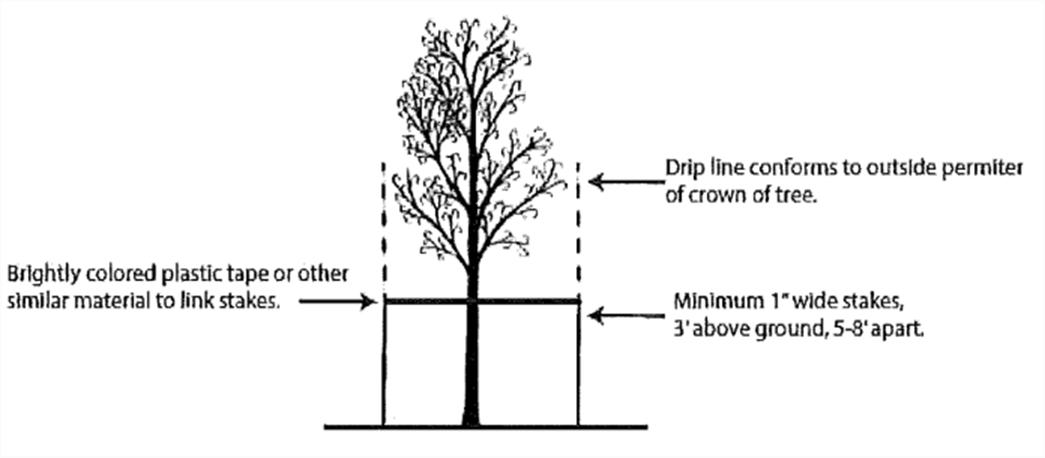
Nothing is to be stored and no parking is allowed within the protective area. The barriers shall remain in place and intact throughout construction; however, barriers may be removed temporarily to accommodate construction needs, provided that the manner and purpose for such temporary removal will not harm the trees.
(d)
Irrigation. Trees shall be properly irrigated throughout the building process.
(e)
Cut and fill guidelines. It shall be unlawful to add or remove any material or ground within the dripline of a protected tree which is necessary for the growth of the subject tree. When raising the existing grade of a site, it shall be unlawful to modify the grade within the dripline of trees without incorporating retaining walls to preserve the tree's root system. If a tree well is to be used, construct it no closer to the tree than the dripline and grade the soil outside of the well to prevent runoff water from draining into the well.
(f)
Structure and pavement location. It shall be unlawful to place any structure or impervious paving within a six-foot radius of any regulated or required tree trunk which has the potential of reaching a caliper of six inches or more.
(g)
Attachments. It shall be unlawful to attach anything to a tree trunk having a diameter of six inches or more, other than protective wires, braces or other similar non-injurious materials.
(h)
Trees damaged or destroyed during construction shall be subject to the provisions of Section. 4.5.17, Violations, waivers and appeals.
(Ord. No. 969, § 1, Exh. F, 9-18-2023)
Sec. 4-5.6. - Specimen Trees.
Any Live Oak tree over 18 inches in caliper shall be determined to be a "Specimen Tree". These trees have additional mitigation requirements when requested to be removed and when removed illegally. A specimen tree shall not be removed except for extraordinary circumstances and only by final approval of the city council.
(Ord. No. 969, § 1, Exh. F, 9-18-2023)
Sec. 4.5.7. - Tree Removal and Replacement.
(a)
Approval. Proposed tree removal shall be shown on a site plan/subdivision construction plan and landscape plan, in conjunction with development or redevelopment activities. The trees required to be shown are any regulated (excludes Pine Trees, Palms and trees on the invasive list as a part of this Article) tree with a diameter breast height (DBH) ten inches or greater. Specimen trees are trees with a diameter breast height (DBH) 18 inches or greater. These two classes of trees are hereinafter referred to as regulated trees. The area required for this information for site plans for commercial, office, industrial of multifamily use shall be the entire site proposed for development. Within a subdivision the area shall be all street rights of way, stormwater detention/retention areas and common areas. Regulated trees shall be replaced or mitigated at 100 percent of the diameter of the tree(s) to be removed. Mitigation amounts shall be as adopted by city council.
The submitted plans shall demonstrate that the site:
(1)
Complies with trees required by applicable landscaping and buffering requirements. All areas of the site can be used for tree mitigation. If the tree to be removed from the site was not part of the approved landscape plan approval a tree replacement will not be required; and
(2)
Shows replacement trees totaling 100 percent of the diameter of the regulated tree(s) to be removed;
(3)
Or if replacement is not possible the amount of caliper inches required to be mitigated by payment into the Tree Mitigation fund to equal the 100 percent of the diameter of the tree(s) to be removed.
Approval by the Chief Administrative Officer or his designee will be issued to remove trees less than 17.9 inch caliper if the remaining trees on the site are sufficient to comply with the applicable minimum landscaping and buffering requirements or if replanting meets the required 100 percent of the diameter of the tree(s) to be removed or payment into the Tree Mitigation Fund is chosen by the developer. Specimen trees removal, replanting and/or mitigation approval is by the city council. Until approval is obtained, it shall be illegal to cut down, destroy, remove or move, poison or destroy through damaging, or authorize the same, to any living regulated tree or specimen tree.
(b)
Application requirements. Trees on the site shall be shown on a preliminary plan, site/grading and landscape plan showing the following:
(1)
Regulated trees which are a minimum 10 inches DBH shall be identified by location on the site, common name, and botanical name, DBH, and quantity.
(2)
A plan legend which shall denote the following for regulated trees:
a.
Trees to be removed and caliper inches.
b.
Trees to be retained and caliper inches.
c.
Trees to be relocated.
d.
Replacement species from a list of three to five proposed tree species to be planted and the proposed caliper inches.
e.
The location of existing and proposed improvements, if any, including structures, paving and utility easements.
f.
The location of any existing or proposed overhead or underground utility lines.
g.
Location and dimension of property lines, building and structure setbacks, and buffers as required.
h.
Proposed changes, if any, in elevation or grade.
i.
The name, address, telephone number and signature of the property owner.
j.
The legal description of the property.
k.
North arrow, scale and identification of nearest streets.
l.
Name of landscape designer/consultant, if any.
(c)
Criteria for issuance of approvals. The approval of tree removal as required by this Part shall be based on the following criteria:
(1)
Topography of the land and the effect of tree removal on erosion, soil retention and the diversion or increased flow of surface water.
(2)
Necessity to remove trees in order to construct proposed improvements to allow economic enjoyment of the property, including:
a.
Need for access around the proposed structure for construction equipment (maximum of ten feet).
b.
Need for locating street or road right-of-way; utilities; drainage ways; as well as the need to provide reasonable use and property access.
(d)
Filing application. If not associated with a site plan, the applicant shall file a request with the city supplying the required information prior to initiating any tree removal.
(1)
An application is not required when involved in a subdivision application process; however, the applicant shall be required to provide a list of all trees to be removed and show this on a construction plan prior to the beginning of the development process.
(2)
The City may provide verbal authorization to an applicant where a tree poses a safety hazard to people or property. Written approval will be required after the fact.
(e)
Exempting portion of the tree survey. Upon request, the Chief Administrative Officer or his designee may permit an applicant to omit certain portions of the tree inventory where compliance with the requirements set forth herein would be unnecessarily burdensome and the exempted portions are not needed to evaluate the application.
(f)
With one exception, the following restricted tree species do not require an approval to remove and cannot be used to comply with the required tree caliper retained and shall not be replanted:
(1)
Silk Oak Grevillarobusta).
(2)
Jacaranda (Jacaranda acutifolia).
(3)
Pine (all species). (No approval required for removal but may be replanted)
(4)
Eucalyptus (all Eucalyptus species).
(5)
Ear Tree (Enterolobium cyclocarpum).
(6)
Paper Mulberry (Broussonetia papyifera).
(7)
Chinaberry (Melina azedarach).
(8)
Cajeput/Punk Tree (Melaleuca quinquenervia).
(9)
Citrus trees (all types).
(10)
Florida Holly/Brazilian Pepper (Schinus terebinthifolia).
(11)
Chinese Tallow Tree (Triadica sebifera).
(12)
Mimosa (Albizia julibrissin).
(13)
Camphor (Cinnamomum camphora).
(14)
Australian Pine (Casuarina equisetifolia).
(15)
Prohibited trees. All species listed in the Florida Exotic Pest Plant Council's Invasive Plant Species List, as amended, shall not be planted within the incorporated City.
(g)
Approval conditions and restrictions.
(1)
The tree removal approval, when issued, shall specifically identify which trees shall be permitted to be removed. The removal merely authorizes the removal of the trees specified therein. Nothing in this Part shall be construed to require the removal of such trees by the permittee unless the existence of the tree is creating health, safety or welfare issues.
(2)
Trees not removed during the life of the approval which terminates at the issuance of the Certificate of Occupancy may not be removed without the issuance of a new approval or site plan.
(Ord. No. 969, § 1, Exh. F, 9-18-2023)
Sec. 4-5.8. - Tree Replacement Requirements.
(a)
Tree replacement. All regulated trees, except those listed as restricted list in Section 4.5.7 shall be replaced caliper inch per caliper inch.
(b)
Transplanting and maintenance requirements. All trees transplanted pursuant to this ordinance shall be maintained in a healthy, living condition. Any such trees which die or become diseased or damaged shall be replaced by the applicant. The City shall retain perpetual jurisdiction to ensure compliance with this section.
(c)
Replacement cost. The cost of replacing the trees shall be incurred by the property owner.
(d)
The specifications for the replacement trees are provided in the following categories:
(1)
Developed property with an approved landscape plan.
a.
All sites with an approved landscape plan shall replace trees according to the original permitted landscape plan approval.
b.
An alternative species from the approved list of replacement trees may be used where the replacement tree will be of similar characteristics to the regulated tree removed.
c.
The applicant will be required to show that replacement trees have been planted as part of the site plan.
(2)
Property without an approved landscape plan. Tree replacement for sites which do not have an approved landscape plan shall be determined as follows:
a.
The site shall be reviewed to assess whether it meets the required site tree standards:
b.
Not fewer than three three inch caliper trees per 6,000 square feet.
c.
Replacement trees used to meet site requirements must be above six inches caliper, be certified by a tree expert to be in a healthy condition.
(e)
Fees. The city council may set reasonable fees and charges for the implementation of this Part. Such fees shall be set by Resolution of the city council and payment of fees shall be made before tree removal approval or certificates of occupancy will be issued. Mitigation fees shall be required if the applicant is unable to maintain/replant the required caliper of trees on the site and the fees will be established by resolution of the city council.
(f)
Mitigation fund. As an alternative to the onsite restoration of trees or other vegetation which have been removed from a site, the developer may select to contribute the adopted mitigation amount equivalent to the tree mitigation fund.
(1)
The Mitigation Fund alternative may only be utilized as a last resort after all other design alternatives to provide required landscaping and to preserve and/or replace existing trees have been considered. Property owners must submit a written request and a site plan for consideration.
(2)
The applicant must demonstrate that there is insufficient room on the site for required trees due to:
a.
Existing/proposed trees.
b.
A site plan demonstrates that there is no room on the site to allow for the mature development of a tree.
(3)
The Chief Administrative Officer or his designee has the option to accept a cash payment to the Tree Mitigation Fund in lieu of tree replacement when it is determined the applicant has demonstrated that all design alternatives have been exhausted.
(4)
The payment amount into the Mitigation Fund shall be determined by the Chief Administrative Officer or his designee based upon the fee structure adopted by city council. The mitigation amount shall be reviewed annually and shall be the approximate calculated value by dividing the total of the replacement inches that will not be accommodated on-site by three inches (which is the minimum planting caliper) and then multiplying the result by the current wholesale value plus installation costs to the city of a three inch caliper live oak tree (Quercus virginiana).
(5)
The Tree Mitigation fund is a part of the general fund but is reserved exclusively to pay for the installation of trees on public property or rights-of-way.
(Ord. No. 969, § 1, Exh. F, 9-18-2023)
Sec. 4-5.9. - Site Landscaping.
(a)
Landscape plan. Where a development permit is sought, the applicant shall submit a landscape plan with the site plan. The total minimum landscaped/open space of the developed area shall be as follows:
(1)
Twelve percent for sites less than 25,000 square feet.
(2)
Fifteen percent for sites 25,000 square feet up to one acre.
(3)
Twenty percent for sites one acre or larger.
(b)
A reduction in required open space may granted subject preservation of existing healthy regulated trees indigenous to the area will be encouraged through implementation of bonuses as follows:
(1)
One percent reduction in the required open space equal to one percent of the developed area shall be allowed for each specimen tree.
(2)
An additional half percent reduction in the required open space shall be allowed for each regulated tree beyond the first specimen tree.
(3)
Maximum reduction to required open space shall not exceed ten percent.
(c)
Retention ponds shall count as open space up to 70 percent of their area if all three of the conditions below are met. If only one condition is met, the retention pond area receives ten percent open space credit: If two conditions are met, the retention pond area receives 20 percent open space credit:
(1)
An accessible walkway round the facility with overlooks and seating is incorporated into the design.
(2)
The retention area is incorporated into the overall design as an integrated feature.
(3)
Has variable side slopes and incorporates an aquatic bench.
(Ord. No. 969, § 1, Exh. F, 9-18-2023)
Sec. 4-5.10. - Residential Landscaping.
(a)
Single-family residential and duplex units shall be required to obtain a tree removal approval prior to any action to cut down, destroy, remove or move, poison or destroy through damaging, or authorizing the same, any living tree with a diameter of ten inches or greater if the tree was a required tree to be planted.
(b)
All tree and plant material required in this section must meet the grading standards of the Florida #1 grade or better. Use of drought-tolerant (Xeriscape) landscaping (as defined by the Southwest Florida Water Management District's "A Guide to Florida-Friendly Landscaping") is recommended in landscape design and construction. Groundcovers (one gallon containers) may be incorporated and substituted into the design at a rate of five groundcover plants for each three gallon plant not to exceed five percent of the required shrub planting and not in a location where screening is required not exceeding
(c)
Two trees, with a minimum three inch caliper, for each 5,000 square feet, or portion thereof, of lot area shall be required for all single-family residential or duplex land uses. Trees planted in the verge on either public or private streets do not count towards the required trees.
(d)
Street trees as required in Section 4-5.14 shall be planted on all streets within the subdivision.
(e)
The minimum landscape requirements for single family detached residential lots are as follows:
(1)
Back-to-back interior lot lines.
A minimum of a five foot wide Type A landscape buffer per Sec. 4.5.16 along the rear lot line, with not less than 50 percent of the required shrubs being evergreen.
(2)
Corner lots -all lot sizes.
All corner lots shall have two additional canopy trees three inch caliper) planted in the streetside side yard. This is in addition to (d) above, and a continuous planting of mixed or uniform three gallon plants along house structure on streetside side yard elevation.
(3)
Neotraditional design with alley loaded lots.
a.
The buffer requirement for back-to-back lots in (e) i. above is waived.
ii.
One canopy tree with a minimum two inch caliper shall be planted in the rear yard.
iii
The driveway shall be screened from the street as per (e)(1) above.
(4)
Requirements for 40'—49.99' lots.
a.
Two canopy trees a minimum of three inch caliper and not less than 30 three gallon plants serving as foundation plantings of at least three different types of shrubs and ornamental grasses incorporating 45 gallon accent plants or a three caliper multi trunk small tree.
b.
On houses requiring 360-degree architecture per the Architectural Design Standards, the number of shrubs shall be increased by 50 percent.
(5)
Requirements for 50'—59.99' lots.
a.
Two canopy trees a minimum of three inch caliper and not less than 35 three gallon plants serving as foundation plantings of at least three different types of shrubs and ornamental grasses incorporating 45 gallon accent plants or a three inch caliper multi trunk small tree.
b.
On houses requiring 360-degree architecture per the Architectural Design Standards, the number of shrubs shall be increased by 50 percent.
(6)
Requirements for 60'—69.99' lots.
a.
Two canopy trees a minimum of three inch caliper and not less than 40 three gallon plants serving as foundation plantings of at least three different types of shrubs and ornamental grasses incorporating two 45 gallon accent plants or a three caliper multi trunk small tree.
b.
On houses requiring 360-degree architecture per the Architectural Design Standards, the number of shrubs shall be increased by 50 percent.
(7)
Requirements for 70'—79.99' lots.
a.
Two canopy trees a minimum of three inch caliper and not less than 45 three gallon plants serving as foundation plantings of at least three different types of shrubs and ornamental grasses incorporating 45 gallon accent plants or a three caliper multi trunk small tree.
b.
On houses requiring 360-degree architecture per the Architectural Design Standards, the number of shrubs shall be increased by 50 percent.
(8)
Requirements for lots 80' and larger.
a.
Three canopy trees a minimum of three inch caliper and not less than 60 three gallon plants serving as foundation plantings of at least four different types of shrubs and ornamental grasses incorporating two 45 gallon accent plants or a three caliper multi trunk small tree.
b.
On houses requiring 360-degree architecture per the Architectural Design Standards, the number of shrubs shall be increased by 50 percent.
(9)
Requirements for Townhouse lots.
a.
Street trees as required in Section 4-5.14 shall be planted on all streets within the subdivision.
b.
Corner lots on public and private streets shall have two additional canopy trees three inch caliper planted in the streetside side yard. This is in addition to (i) above, and a continuous planting of mixed or uniform three gallon plants along the house structure on streetside side yard elevation.
c.
A staggered double row of three gallon plants with one plant for each three feet of building frontage not occupied by the driveway and sidewalk.
(10)
No additional landscaping other than required street trees is allowed between the sidewalk and back of curb without a right of way permit from the Public Works Department. Any planting shall not block the visibility at an intersection or driveway.
(Ord. No. 969, § 1, Exh. F, 9-18-2023)
Sec. 4-5.11. - Multifamily Landscaping.
The following landscaping standards shall be incorporated into the design of all projects:
(a)
Foundation landscaping consisting of small trees, shrubs, ornamental grasses and groundcovers shall be required for at least 75 percent of all sides of the facade length. A landscaped area not less than five feet wide, consisting primarily of shrubs and ground cover, shall be provided along the sides of the building which abut a parking area. Plant a minimum of one three gallon plant for each three feet of building frontage.
(b)
Parking areas shall be landscaped as required by this Code.
(c)
A perimeter buffer shall be provided as required by this Code and comprised of retained natural vegetation or planted with native plant species.
(Ord. No. 969, § 1, Exh. F, 9-18-2023)
Sec. 4-5.12. - Commercial Landscaping.
(a)
For all parcels of one-half acre or less, building perimeter landscaping on the primary facade side shall be planted adjacent to, or between the building and the drive aisle or parking area and shall include three-gallon shrubs and one gallon ground cover. The minimum landscaped area shall be determined by the following formula: five feet times the length of each primary facade times fifty percent. The area of building perimeter landscaping can be used to meet the maximum percent required landscaping for the parcel. Landscaping shall where feasible, use native and drought tolerant plant materials.
(b)
For all parcels of one-half acre or larger, foundation landscaping shall be required for at least 50 percent of the facade length. The foundation landscaping shall include three gallon shrubs and one gallon ground cover and shall be located between the drive aisle and the first vertical wall of the building facade. A minimum of 25 percent of the required foundation landscaping shall be placed between the required sidewalk and the first vertical wall of the building facade. The foundation landscaping shall be in planters or planting beds that extend a minimum of 36 inches from the building.
(Ord. No. 969, § 1, Exh. F, 9-18-2023)
Sec. 4-5.13. - Landscape Material.
(a)
Drought-tolerant landscaping. Whenever and wherever possible, use of drought-tolerant (Xeriscape) landscaping (as defined by the Southwest Florida Water Management District's "A Guide to Florida-Friendly Landscaping") is recommended in landscape design and construction.
(b)
Tree and shrub stock. Species acceptable for replacement or replanting purposes are those native (indigenous) to the city environs and Central Florida. Any substitution must be approved by the Chief Administrative Officer or his designee.
(c)
Survival. Maintenance of all landscaped areas shall be the responsibility of the property owner. All landscaping shall be maintained in a good condition, having an orderly and healthy appearance, free of refuse and debris. In the event that trees or landscape plantings expire during any time after completion of development, the property owner shall be responsible for replacement. Failure to maintain landscape areas and plants shall be considered a violation of this Part and subject to enforcement and penalties as provided herein.
(d)
Other acceptable ground cover. Where it is not possible to retain existing natural ground cover, landscaped areas shall be seeded or sodded, or provided with other acceptable ground cover as approved by the Chief Administrative Officer or his designee.
(e)
Planting and installation. The following shall govern planting and installation of all required trees and other landscaping:
(1)
Trees and landscape shall be planted in accordance with accepted commercial/ horticultural planting procedures.
(2)
All plants, including grass sod, shall be sound, healthy, vigorous, free from mutilation, diseases, fungus, insect pests and their eggs, and shall have healthy root systems. Plants shall be nursery grown stock in containers or freshly dug, balled and burlapped. Nursery stock shall be in accordance with minimum requirements of the American Standards for Nursery Stock, published by the "American Association of Nurserymen."
(3)
Trees shall be a minimum of three inches DBH and ten feet in height, installed and will either be the same species as those removed or a native species of similar mature height placed in an appropriate growing environment, and be within the same tree category. No single species will make up more than 40 percent of the plantings unless there is a proven ecological benefit defined by a qualified individual. Trees planted adjacent to utility lines and other potential hazards will be of a species of an appropriate type and mature height. Trees will be of Florida Grade #1 nursery stock or better, as defined by the Grades and Standards for Nursery Plants (GSNP) of Florida Department of Agriculture and Consumer Services or its successor agency, and a minimum size of three inches caliper. Caliper for nursery trees is defined as six inches above grade. Trees planted to meet replanting requirements will be maintained in a healthy condition for a minimum of one year or until they are fully established.
(4)
Shrubs, when installed, shall be a minimum of 12 inches to 18 inches high for all internal landscaped areas; a minimum of 24 inches high for landscaped strips lying between parking areas, a minimum of 30 inches for landscaped areas along private roads and public rights-of-way, and a minimum of 36 inches high where a continuous hedge is required along major or minor arterial roadway rights-of-way.
(5)
Vines may be used in a buffer in conjunction with walls and fences.
(6)
Turf areas may be seeded, sodded, plugged or sprigged. For slopes at or greater than 4:1 (25 percent), sod and/or ground cover shall be required. Other soil stabilization methods may be utilized or required, subject to the Chief Administrative Officer or his designee's determination.
(7)
Maintenance/irrigation system. A proper and efficient maintenance/irrigation system shall be provided in all landscaped areas.
(8)
Bracing. Wherever new trees are installed they shall be braced, to provide sufficient time for their root systems to become firmly established; after which any above ground bracing shall be removed.
(9)
In addition to the Restricted Trees listed in Section 4-5.7 the following shrubs are deemed invasive and shall not be planted within the city limits:
a.
Castor Bean (Ricinus communis).
b.
Rice Paper Plant (Tetrapanax papyrifer).
c.
Running bamboo species.
(f)
Landscape and screening for all commercial dumpsters. All trash receptacles shall comply with adopted Public Works Department standards and be of sufficient size to accommodate the trash generated. The receptacles shall be screened from public view. Screening on three sides shall be no less than six feet in height and shall be composed of any one or a combination of the following elements: solid masonry wall, wooden stockade or vinyl fencing or chain link fencing with neutral metal or wood slatting. A gate not less than five feet in height shall be used to screen the fourth side. Landscaping shall be incorporated around each screened receptacle and may include berms, vines, shrubbery, and trees.
(g)
Open storage. Open storage which constitutes the principal use of a site shall, for the purpose of buffering and screening, be considered an industrial use and the entire site shall be subject to the requirements applicable to industrial development. Open storage areas which are accessory to a principal use shall be screened from view of any street and from residentially zoned property as follows:
(1)
Where an open storage area is in view from a street, the method of screening shall consist of a solid masonry wall, solid PVC or wood fence or other material as may be approved by the Chief Administrative Officer or his designee. The screening shall be a minimum of six feet in height and, if the wall is constructed of cement block, the side facing the abutting use or right-of-way shall be faced with stucco or another similar decorative finish.
(2)
Where an open storage area is in view from a residentially zoned property located within 200 feet of the open storage area, the method of screening shall consist of a solid masonry wall, solid vinyl or wood fence or other material as may be approved by the Chief Administrative Officer or his designee. The screening shall be a minimum of six feet in height and, if the wall is constructed of cement block, the exterior of the wall shall be faced with stucco or another similar decorative finish. Said screening shall be installed along all boundaries of the storage area, including internal boundaries that are in view from the residentially zoned property.
(Ord. No. 969, § 1, Exh. F, 9-18-2023)
Sec. 4.5.14. - Streetscape Landscaping.
(a)
Landscape adjacent to streets and parcels. A landscape strip shall be provided along all parcel lines and abutting all street right-of-way lines. Landscape strips shall be considered to be required landscaped area (RLAs) and may be included as fulfilling the buffer requirements for the premises. However, no part of a landscaped strip required for any use shall be included as fulfilling the landscape or buffer requirements for another use unless specifically provided for in this Part. Landscaped strips shall be provided in the following manner:
(1)
Street rights-of-way. A five foot wide landscaped strip shall be required along all parcel lines abutting a street right-of-way, except within the central business district and other parcels where an allowance or variance has been granted for zero lot lines and except when parking lot is adjacent to the street then the Section 4-5.15 shall govern. The landscape design shall meet the requirements of the clear visibility triangle (CVT) at street and driveway intersections, as applicable. Trees and shrubs shall be provided within the required landscaped strip as follows:
a.
Trees. One tree with a minimum three in caliper DBH shall be provided for every 40 linear feet. Trees indigenous to the area (of appropriate species) are to be used and shall be spaced in a manner that will avoid the possibility of damage to underground or overhead utilities.
b.
Required landscape and buffer. When both buffer and landscape strip requirements apply, required trees (as described in Section 4-5.15) shall be provided. In addition, when a landscape strip is included to meet the buffer requirements, the more stringent requirements shall apply.
c.
Joint accessways. Where 2 parcels share a common access way from a frontage road or roadway along the common property line, the buffer and landscape requirements shall be waived for that area along the parcel line and right-of-way.
d.
Intersection visibility. When any type of accessway or street, public or private, intersects a public right-of-way, all landscaping, including trees, shall be positioned so as to not impede cross-visibility at a level between two and ten feet within the CVT. Trees shall be trimmed so that no limbs or foliage extend into the CVT.
(Ord. No. 969, § 1, Exh. F, 9-18-2023)
Sec. 4-5.15. - Parking lot landscaping.
Off-street parking and vehicular circulation areas. The following provisions and requirements shall apply to all off-street parking areas for automobiles and vehicle circulation areas:
(a)
Required landscaped area (RLA). Minimum RLA for parking areas shall be ten square feet for every parking space plus one square foot for every 50 square feet of parking and vehicle circulation area exceeding 5,000 square feet. Vehicles may not encroach into any landscaped area. Curbs and wheel stops shall be utilized in all parking and drive areas.
(b)
Minimum required land area for RLAs. Each RLA shall contain a minimum of 50 square feet.
(c)
RLA for rows of parking spaces. A landscaped area shall be provided at each end of all rows of parking. In parking areas, every ten spaces shall be designed with a minimum 400 square feet of landscaping to be placed in medians or islands and shall include at least one overstory tree, one understory tree and ten three gallon shrubs.
(d)
Required trees. At least one tree shall be provided in each landscaped area as required by this Part; provided, however, that two trees shall be provided for each required landscaped area that is in excess of 150 square feet, and one additional tree shall be required for each additional 150 square feet or portion thereof of such RLA, unless the landscape area preserves a rated tree(s). The Chief Administrative Officer or his designee shall grant flexibility in the location of the required landscape areas to preserve regulated trees so long as the required area is provided.
(e)
Required shrubs. Each RLA shall be planted with shrubs a minimum of 24 inches high in landscaped strips lying between parking areas at a ratio of one shrub per 20 square feet.
(f)
Parking space reduction to protect existing trees. The Chief Administrative Officer or his designee shall have the authority to reduce the required number of off-street parking spaces when such reduction would result in the preservation of existing trees. Only trees which are a minimum of ten inches in diameter when measured at the DBH shall be applicable for such reduction. In addition, such reduction provided may be allowed only when the number of required parking spaces shall result in a decrease of no more than five percent of the total number of off-street parking spaces required for the proposed land use.
(g)
Parking area landscaping adjacent to streets. A landscaped strip of land not less than ten feet in width shall be located between the parking area and the abutting street. The landscaping provided within the landscaped strip shall include: one tree for every 20 linear feet of required landscape strip planted singly or in clusters, not to be more than 50 feet apart when utilizing clustering techniques, located between the property line and the parking area; and hedge, wall, berm or other durable landscape barrier of not less than 24 inches or three gallon containers 30 inches tall at installation placed along the outside perimeter of the landscaped strip. Shrubs intended to form a hedge in the landscaped strip at shall be planted at 24 to 30 inches on-center; and not less than 25 percent of the strip shall be ground cover or shrubs. A perimeter landscape strip shall be required along the full length of all streets serving a retail development with greater than 25,00 gross floor area. The buffer shall be a minimum of 35 feet in width and comprised of retained natural vegetation or planted with native plant species.
(h)
Interior landscaping shall be located around the periphery of structures. A landscaped area not less than five feet wide, consisting primarily of shrubs and ground cover, shall be provided along the sides of the building which abut a parking area. A landscaped area not less than three feet in width shall be provided along the sides and rear of a building where abutting an on-site service or access driveway. The landscaping located along the sides and rear of buildings, which abut a parking area or driveway(s), shall include a hedge, one tree for every 20 linear feet, and ground cover.
(i)
Visibility triangles. All landscaping within a visibility triangle shall provide unobstructed cross-visibility at a level between 2½ feet and six feet. It shall comply with the most current edition of the Florida Department of Transportation Roadway and Traffic Design Standards, Index 546, regarding visibility triangles. The City shall require that trees have limbs and foliage trimmed so no limbs or foliage extends into the cross-visibility area provided the location does not itself create a traffic hazard. The owner shall not locate landscaping, except grass, ground cover or low-growing shrubs closer than three feet from the edge of any driveway pavement.
(Ord. No. 969, § 1, Exh. F, 9-18-2023)
Sec. 4-5.16. - Buffers.
(a)
Buffering and screening requirements shall apply along all property lines as required by the provisions of this Part. Unless otherwise provided in this Part, the buffer and screening shall be located within the required zoning setback area and the required vegetative landscape screening shall be located within the buffer. A buffer may also contain a barrier, such as a fence, wall, hedge, or berm.
(b)
Buffering shall comply with the following requirements.
(1)
Required buffering and screening. Buffering and screening shall be required for all new development and redevelopment as shown in Schedule C. Schedule C shall be utilized in determining the requirements based on the proposed land use and the land uses of adjacent properties. Buffer width requirements shall be determined on an individual project basis as required by this Part and approved by the Chief Administrative Officer or his designee.
SCHEDULE C
BUFFER REQUIREMENTS
Footnotes:
1. Applies to multi-family developments and manufactured/mobile home developments. Single-family and two-family developments adjacent to single-family and two-family developments are not required to provide a buffer.
2. Except as provided in Section 4-5.16(b)(2).
(2)
Location. Required buffers shall be provided along all property lines and abutting all street right-of-way lines and shall not be located on any portion of an existing, dedicated, or proposed right-of-way, easement or private street. The depth of the required buffer shall be measured and provided parallel to the property line or abutting street right-of-way. No part of a buffer required for any use shall be included as fulfilling the buffer requirements for another use unless specifically provided for in this Part. Buffers shall not be required between various constituent parts of a proposed planned development project containing mixed uses, except that any non-residential use shall be separated from residential use by at least the minimum required buffer.
(c)
Buffer types. The following descriptions define the requirements for a natural preserved or planted buffer type as required per Schedule B:
(1)
Type "A" buffer. A minimum 15 foot wide buffer which includes the required planting of 25 shrubs per 100 linear feet of property, plus, one tree per every 40 linear feet of property, or portion thereof. Any buffer shrub planting required to fill gaps shall not adversely impact tree root zones shall be three feet high and 50 percent opaque at planting and be capable of attaining full height and opacity within three years. Earthen berms may be used in conjunction with required landscaping. Such berms shall utilize a slope of 4:1 or less and shall include such landscaping as necessary to ensure soil stabilization.
(2)
Type "B" buffer. A minimum 20 foot wide buffer which includes a continuous hedge of dense shrubbery, plus, one tree per every 40 linear feet of property, or portion thereof. At the time of planting, the required hedge shall not be less than four feet in height, and not exceed a maximum of two feet between shrubs.
(3)
Type "C" buffer. A minimum 30 foot wide buffer which, shall include a continuous, opaque wall a minimum of six feet in height constructed of masonry, wood or other material as may be approved by the Chief Administrative Officer or his designee. If the wall is constructed of cement block, the side facing the abutting use shall be faced with stucco or another similar decorative finish. In addition, one tree shall be planted along the wall every 25 feet, or portion thereof and evergreen shrub planting which shall not adversely impact existing tree root zones. Plants shall be four feet high and 50 percent opaque at planting and be capable of attaining not less than eight feet in height and opacity within three years.
(4)
Type "D" buffer. A minimum five-foot wide buffer which includes the required planting of 25 shrubs per 100 linear feet of property, plus, one tree per every 40 linear feet of property, or portion thereof. Any buffer shrub planting required to fill gaps shall not adversely impact tree root zones shall be three feet high and 50 percent opaque at planting and be capable of attaining full height and opacity within three years. Earthen berms may be used in conjunction with required landscaping. Such berms shall utilize a slope of 4:1 or less and shall include such landscaping as necessary to ensure soil stabilization.
(d)
Permitted Uses within buffers. The following uses shall be allowed within required buffer areas:
(1)
Vehicular ingress/egress to off-street parking, loading, unloading, service area space and vehicular circulation areas.
(2)
Permitted public service/utility structures.
(3)
Pedestrian ways with improved surfaces.
(4)
Required project improvements upon approval of the Chief Administrative Officer or his designee.
(5)
Permitted signs upon approval of the required site plan by the Chief Administrative Officer or his designee.
(e)
Restricted uses within buffers. The following uses shall not be allowed within required buffer areas:
(1)
Off-street parking, loading, unloading service areas or vehicle circulation areas. In addition, all off-street parking spaces shall be provided with appropriate stops, curbs or other vehicle bumper guards designed to prevent any encroachment of vehicles upon the required buffer.
(2)
Barbed wire, electric fence or other potentially harmful objects or articles.
(3)
Mining considerations. For any mining application, landscape and buffer requirements shall be set by the city council. The basis for determining required landscape and buffering shall at a minimum take into consideration site and ecologic conditions, extraction procedures, and the processing, storage, and distribution systems to be used in resource extraction. In addition, conformance with the provisions of F.S. Ch. 378 and F.A.C. Ch. 16C-17 shall apply in determining landscape and buffer requirements.
(4)
Stormwater retention or detention areas.
(Ord. No. 969, § 1, Exh. F, 9-18-2023)
Sec. 4-5.17. - Violations, Waivers and Appeals.
(a)
Violation. Any person who removes a rated tree without the required approval shall be in violation of this Part and subject to the penalty provided in this section. Additionally, trees so removed shall be replaced by the violator with the same species and number of trees necessary to provide a total replacement diameter equal to the two times the total diameter of the trees removed; provided, that no individual replacement tree shall have a diameter of less than six inches at DBH, a height of not less than 15 feet and a crown spread of not less than 10 feet, or contribute to the Mitigation Fund the required double the caliper mitigation rate. Maintenance of replacement trees shall be the responsibility of the property owner for a period of one year. Any tree that dies within the one-year period shall be replaced again and maintained for an entire year to ensure its long-term survival. In addition, no development permits or certificates of occupancy shall be issued on lands where violations exist, until such time as appropriate corrective action is taken by the developer and approved by the city.
(b)
Remedial action. Where violations of this Article have occurred, the property owner shall be notified by the city that remedial action is required. Upon such notification, the property owner shall submit to the city a certified check to be held in escrow. The amount of money to be held in escrow by the city shall be equal to the restoration cost of the property as specified above to the condition it existed prior to the Code violation. The property owner shall also pay ten percent of the cost of the installed trees administration fee. The property owner shall provide documentation to the city regarding the associated value to restore the property.
(1)
Upon the city's acceptance of the funds held in escrow, the property owner shall submit a restoration plan. The restoration plan may require tree replacement and/or may include payment into the City's Tree Mitigation Fund. The restoration plan may also include irrigation if required. The City shall review the restoration plan and determine whether it adequately restores the property to its state prior to the violation of this Part. The applicant presenting the restoration plan has the burden to demonstrate that the property will be restored to meet the purpose and intent of this Part. The restoration plan shall include a deadline by which the plan must be completed.
(2)
In addition to the procedure noted above, the city may also utilize the Code Enforcement Provisions within the city Code regarding violations to the Article.
(c)
Waivers. The city council may grant a waiver to this Part where the applicant demonstrates:
(1)
That the literal interpretation of the section will deny the applicant reasonable use of property and
(2)
Where such waiver can be demonstrated to be consistent with the purpose and intent of the tree regulations as stated in Section 4-5.2. The particular use made of the property by the applicant shall not be a legitimate basis for granting a waiver. The city council may approve, or grant said waiver only if it determines that said waivers are not contrary to the intent of this Part and that a literal enforcement of the standards of this Part would be impracticable and would result in an unreasonable and unnecessary hardship.
(d)
Dead trees on undeveloped commercial properties (excluding trees that have been intentionally damaged). To encourage the use of undeveloped commercial properties a waiver may be requested to exclude diseased, distressed, or dead trees from replacement requirements. The waiver request shall include a detailed analysis by a registered landscape architect or certified arborist itemizing the tree(s), including the species, caliper, condition, and location, and explaining the reason for the proposed exclusion. The waiver may be granted by staff upon review of a tree removal application. Such trees may receive a full, partial, or pro-rated waiver based upon the condition of the tree. No waivers based upon tree quality shall be considered for trees which have been illegally damaged or removed without a tree removal approval.
(e)
Appeals. Any person adversely affected by the enforcement or interpretation of this Part as provided for by statue.
(Ord. No. 969, § 1, Exh. F, 9-18-2023)
Sec. 4-5.18. - Recommended Species.
The following list of trees and shrubs are recommended for use however the lists should not be considered as exclusionary. Note palm trees do not count for required trees in the requirements above but may be planted onsite.
Recommended Trees
American Elm (Ulmus americana)
American Holly (Ilex opaca)
American Hornbeam aka Hophornbeam (Ostrya virginiana)
Bald Cypress (Taxodium distichum)
Bluejack Oak (Quercus incana)
Bluff Oak (Quercus austrina)
Cedar Elm (Ulmus crassifolia)
Chickasaw Plum (Prunus angus tifolia)
Crape Myrtle (Lagerstroemia indica)
Dahoon Holly (Ilex cassine and cvs.)
Eagleston Holly (Ilex × attenuata and cvs.)
East Palatka Holly (**Ilex × attenuate and cvs.)
Eastern Redbud (Cercis canadensis)
Florida Maple aka Southern Sugar Maple (Acer barbatum)
Green Ash (Fraxinus pennsylvanica)
Laurel Oak (Quercus laurifolia)
Live Oak (Quercus virginiana)
Loblobby Bay (Gordonia lasianthus)
Loquat (Eriobotrya japonica)
Longleaf Pine (Pinus Palustris)
Nellie R Stevens Holly (Ilex X'Nellie R Stevens)
Overcup Oak (Quercus lyrate)
Pignut Hickory (Carya glabra)
Pindo Palm (Butia capitata)
Pond Cypress (Taxodium ascendens)
Pop Ash aka Carolina Ash aka Water Ash (Fraxinus caroliniana)
Red Cedar (Juniperus virginiana)
Red Maple (Acer rubrum)
River Birch (Betula nigra)
Round Holly aka Round Leaf Holly aka Rotund Holly (Ilex rotunda)
Sabal aka Cabbage Palm (Sabal palmetto)
Sand Pine (Pinus clausa)
Savannah Holly (Ilex × attenuate and cvs.)
Sawtooth Oak (Quercus acutissima)
Shumard Oak (Quercus shumardii)
Southern Magnolia (Magnolia grandiflora)
Southern Red Cedar (Juniperus silicicola)
Southern Red Maple (Acer rubrum)
Spruce Pine (Pinus glabra)
Sweetbay (Magnolia virginiana)
Sweetgum (Liquidambar styraciflua)
Sycamore (Plantanus occidentalis)
Tulip Poplar (Liriodendron tulipifera)
Tupelo, Black Gum (Nyssa sylvatica)
Turkey Oak (Quercus laevis)
Water oak (Quercus nigra)
White Ash (Fraxinus americana)
White Oak (Quercus alba)
Wild Olive (Osmanthus americanus)
Winged Elm (Ulmus alata)
Recommended Shrubs
cvs = cultivars
African Bush Daisy (Gamolepis chrysanthemoides)
Awabuki Viburnum (Viburnum odoratissimum, var awabuki)
Azalea (Rhododendron cvs)
Beautyberry (Callicarpa americana)
Bottlebrush (Callistemon spp.)
Butterfly Bush (Cassia bicapsularis)
Buttonbush (Cephalanthus occidentalis)
Camellia (Camellia japonica)
Chaste Tree (Vitex agnus-castus)
Cherokee Bean aka Coralbean (Erythrina herbacea)
Chinese Fringe Bush (Loropetalum chinense and cvs.)
Chinese Holly (Ilex cornuta and cvs)
Chinese Juniper, Japanese Juniper (Juniperus chinensis and cvs.)
Cleyera (Ternstroemia gymnanthera)
Dwarf Palmetto, Blue-stem Palmetto (Sabal minor)
Eastern Sweetshrub aka Carolina Allspice (Calycanthus floridus)
Firebush aka Scarletbush (Hamelia patens)
Firecracker Plant (Russelia sarmentosa)
Firecracker Plant aka Coral Plant (Russelia equisetiformis)
Firethorn (Pyracantha coccinea)
Florida Privet (Forestiera segregate)
Gardenia aka Cape Jasmine (Gardenia jasminoides)
Gardenia aka Creeping Gardenia (Gardenia radicans)
Glossy Abelia (Abelia grandiflora)
Golden Dewdrop aka Skyflower (Duranta erecta)
Hibiscus (Native), Mallow (Hibiscus spp.)
Japanese Plum Yew (Cephalotaxus harringtonia)
King's Mantle (Thunbergia erecta)
Leather Fern (Acrostichum danaeifolium
Marlberry aka Marbleberry (Ardisia escallonioides)
Mary Nell Holly (Ilex X 'Mary Nell')
Natal Plum (Carissa macrocarpa)
Oakleaf Hydrangea (Hydrangea quercifolia)
Orange Jessamine (Cestrum aurantiacum)
Oregon Hollygrape aka Leatherleaf Mahonia (Mahonia bealei)
Pineland Lantana aka Weeping Lantana (Lantana depressa)
Pittosporum (Pittosporum tobira)
Podocarpus (Podocarpus macrophyllus and cvs.)
Red Powderpuff (Calliandra haematocephala)
Reeve's Spirea aka Bridal Wreath (Spiraea contoniensis)
Rose (Rosa spp.)
Rosemary (Rosmarinus spp.)
Sasanqua Camellia (Camellia sasanqua)
Simpson's Stopper aka Twinberry (Myrcianthes fragrans)
Southern Blackhaw aka Rusty Blackhaw (Viburnum rufidulum)
Sparkleberry (Vaccinium arboretum)
Star Anise (Illicium spp.)
Star Jasmine aka Shining Jasmine (Jasminum nitidum)
Sweet Almond Bush (Aloysia virgata)
Sweet Pepperbush (Clethra alnifolia)
Sweet Viburnum (Viburnum odoratissimum)
Tea Olive aka Fragrant Olive (Osmanthus fragrans)
Virginia Willow aka Virginia Sweetspire (Itea virginica)
Walter's Viburnum (Viburnum obovatum & cvs)
Wax Myrtle (Myrica cerifera and cvs.)
Weeping Yaupon Holly (Ilex vomitoria 'Pendula')
Wild Olive aka Devilwood (Osmanthus americanus)
Yaupon Holly (Ilex vomitoria and cvs.)
Yucca (Yucca spp.)
(Ord. No. 969, § 1, Exh. F, 9-18-2023)
Sec. 4-6.1.- Generally.
(a)
Purpose. The purpose of these provisions is to prescribe standards for fences and walls for the conservation and protection of property, the assurance of safety and security, the enhancement of privacy and the improvement of the visual environment including the provision of a neat appearance in keeping with neighborhood character.
(b)
Permit required prior to construction. Prior to construction, all fences and walls shall receive a permit in accordance with this Part and the permitting requirements in effect at that time. Applications for a permit shall be accompanied by a fee as set by the City Council. The City shall not inspect or approve the location of a fence or wall in regard to property boundary issues and is not liable for the legal location of the fence or wall.
Sec. 4-6.2. - Regulations.
(a)
Conformity to construction codes. All construction shall conform to Article X of this Code.
(b)
General regulations for fences.
(1)
Height shall be determined from the lowest point of average grade of the lots on either side of and immediately contiguous to the fence, to the average top elevation of said fence. Berms, when used in conjunction with fences, shall be included in height determinations.
(2)
No fence exceeding two feet shall be constructed within the visibility triangle at roadway intersections.
(3)
No fence shall impede or divert the flow of water through any drainage way unless by adequate investigation and approval from the City's Public Works Department Director, it is shown that the fence will not adversely impact any surrounding property owner and will contribute to an improvement in the overall drainage pattern.
(4)
Fences shall be constructed in a workmanlike manner and shall be of sound and sturdy construction. Privacy fences shall be installed with the rails to the enclosed areas. The finished (smooth) side shall face rights-of-way or adjoining properties. All posts and support beams shall be placed on the unfinished side of the fence. This does not preclude the installation of post columns with spanning members of metal, wood, or other materials; in which case, the posts are equal in presentation to both sides of the fence.
(c)
Regulations for required fences and walls. Required fences and walls shall be provided for buffering and screening purposes as provided in Section 4-5.7. Required fences and walls may be permitted up to six feet in height (or eight feet as permitted in (d)(1)g., h., and i. below) in front yards at the outer boundaries of the development or at the boundaries of distinct portions of the project (such as where multi-family adjoins single-family or commercial adjoins residential development) provided that:
(1)
No drive or street pierces the wall except at development entrance/exit streets; and
(2)
The fence or wall is approved by City Council as part of a planned development project district project or subdivision final plat.
(d)
Regulations for fences and walls.
(1)
Residential districts.
a.
Fences and walls over four feet in height shall not be allowed within the required front yards, except as indicated in b., g., h. and i. below.
b.
For corner lots, fences and walls up to six feet in height shall be allowed within a front yard which functions as a side yard, provided the fence or wall is located no more than ten feet into the required front yard, as measured from the required minimum front yard setback line.
c.
For through lots, fences and walls up to six feet in height shall be allowed within one front yard which functions as the rear yard of the lot when the yard is adjacent to an arterial or collector road.
d.
In general, the design of fences and walls shall be in keeping with neighborhood appearance. Fences may be constructed of commonly used materials such as chain link, masonry, wood or vinyl.
Below are examples of common fence materials:
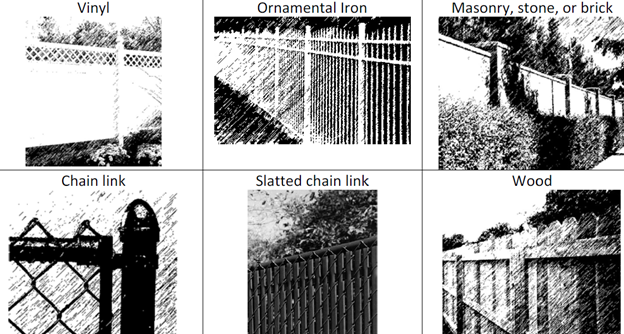
f.
The following materials shall be prohibited in the construction of fences and walls: rope, string, wire products including but not limited to chicken wire, hog wire, wire fabric, and similar welded or woven wire fabrics, chain, live bamboo, netting, cut or broken glass, paper, unapproved corrugated metal panels, galvanized sheet metal, plywood, or fiberglass panels in any fence or any other material that are not manufactured specifically as fencing materials. In addition, fences and walls in any residential district shall not contain any substance such as broken glass, spikes, barbs, nails, electronically charged wiring or similar materials designed to inflict pain or injury to any person or animal. The Chief Administrative Officer or his designee may require the applicant to provide the manufacturer's standards to establish the intended use of a proposed fencing material. These restrictions shall not be varied.
(2)
Agricultural districts. Fence and wall regulations shall be the same as for residential districts except as provided below. Additionally, on parcels with stables or bona fide agricultural operations, fences and walls up to eight feet in height shall be allowed in any yard, although fences and walls in required front yards shall not be more than 60 percent opaque above the height of four feet. Barbed wire fences and electrically charged fences may be allowed in agricultural districts subject to the requirements of applicable local, state and federal laws and regulations.
(3)
Commercial and office districts. In commercial and office districts, fence and wall regulations shall be the same as for residential districts, except fences in the C-2 or CIS-1 districts. In these districts, fences and walls shall conform to the requirements for fences and walls in residential districts except that six-foot chain link security fences (with 30 percent or less opacity) shall be allowed within any yard.
(4)
Industrial districts.
a.
The maximum height of fences and walls shall be eight feet.
b.
Within front yards, solid fences and walls (i.e., fences or walls with greater than 30 percent opacity) shall be restricted to a height of four feet.
c.
Barbed wire and electrically charged fences may be used if all requirements of all applicable local, federal and state laws and regulations are met.
(Ord. No. 969, § 1, Exh. G, 9-18-2023)
Sec. 4-7.1.- Generally.
Manufacturing, processing and assembly operations shall observe the following performance standards. Proof shall be provided that all required permits for particular discharges can be met. Since zoning compliance does not substitute for requirements of other agencies, all necessary environmental permits shall be obtained.
(a)
Lighting. Lighting shall be in accordance with subsection 4-4.2(m) of this Code.
(b)
Sound.
(1)
Receiving use: Residential. Sound levels shall not exceed the following standards if the receiving use is residential:
• 60 dBA between 7:00 a.m. and 10:00 p.m.
• 55 dBA between 10:00 p.m. and 7:00 a.m.
(2)
Receiving use: Commercial. Sound levels shall not exceed the following standards if the receiving use is commercial:
• 65 dBA between 7:00 a.m. and 10:00 p.m.
• 60 dBA between 10:00 p.m. and 7:00 a.m.
(3)
Receiving use: Industrial. Sound levels shall not exceed 75 dBA at any time if the receiving use is industrial.
(c)
Vibration. Vibration levels shall not exceed the following standards:
Maximum Peak Particle Velocity
Steady state 0.02 inches/second
Impact 0.04 inches/second
Note: The maximum particle velocity shall be the maximum displacement vector sums of three mutually perpendicular components, recorded simultaneously, multiplied by the frequency in cycles per second. For purposes of this Code, steady-state vibrations are vibrations which are continuous, or vibrating in discrete impulses more frequent than 60 per minute. Discrete impulses which do not exceed 60 per minute, shall be considered impact vibrations.
(d)
Airborne discharges. Airborne discharges shall be minimized so as to not cause or contribute to an objectionable odor off the operator's property. For the purpose of this Code, objectionable odor shall be defined as the property of a substance which materially offends the sense of smell of a considerable number of persons of the public.
(e)
Dust. Dust discharges from the operator's property shall be minimized by taking reasonable precautions to include but not limited to: paving and maintenance of roads, parking areas and yards; periodic application of water or chemicals to unpaved roadways and open stock piles; landscaping of yards; use of hoods, fans, filters, and other similar equipment to capture the dust; and use of wet abrasive blasting equipment (when possible) where abrasive blasting is necessary.
(f)
Measurement provisions. All measurements to determine compliance shall be made at the nearest boundary of the zoning district to the use being evaluated.
Sec. 4-8.1.- Generally.
(a)
Conditional Uses contained in this Part have been determined to require additional design standards to ensure compatibility with adjacent uses and the surrounding neighborhood. The standards described for each use below shall supplement and be in addition to the standards and criteria otherwise required within this Code. Unless otherwise required herein, compliance with these supplemental standards shall be determined during development review and shall not require any additional procedural steps or review processes.
(b)
Special Exception Uses contained in this Part shall be considered and approved, approved with conditions, or denied in accordance with the requirements of Article VIII for the issuance of development orders. Changes to previously approved Special Exception Uses contained in this Part shall also be considered and approved, approved with conditions or denied in accordance with the requirements of Article VIII for the issuance of development orders. The Special Exception Uses contained in this Part may only be permitted upon demonstration of compliance with all of the requirements of this Part.
(c)
Special Uses contained in this Part shall be considered and approved, approved with conditions, or denied in accordance with the requirements of Article VIII for the issuance of development orders. Changes to previously approved Special Exception Uses contained in this Part shall also be considered and approved, approved with conditions or denied in accordance with the requirements of Article VIII for the issuance of development orders. The Special Exception Uses contained in this Part may only be permitted upon demonstration of compliance with all of the requirements of this Part.
(d)
To determine if a use contained in this Part is a Conditional, Special Exception or Special Use, refer to Table 2-2.
Sec. 4-8.2. - Accessory Dwelling Standards.
(a)
The accessory dwelling shall be located on a conforming residential lot. Unless otherwise expressly permitted in a planned development project, a minimum lot area of 7,000 square feet shall be required.
(b)
The residential lot shall be occupied by a principal detached single-family dwelling that is owner occupied.
(c)
Living space in the accessory dwelling shall be limited to a maximum of 900 square feet. For purposes of this regulation, living space shall include all areas within the dwellings utilized for living, sleeping, eating, cooking, bathing, washing, sanitation, laundry and storage purposes. Notwithstanding the above, living space shall not include motor vehicle garages and attics, provided such areas are not conditioned and are utilized solely for parking and storage purposes, and covered patios as defined by this Code. Living space shall be measured from the outside faces of the exterior walls.
(d)
The accessory dwelling may be a detached structure or attached to the principal single-family dwelling on the lot. Detached accessory dwelling units shall, at minimum meet accessory structure setbacks rather than principal structure setbacks. Total building coverage on the lot shall not exceed district standards.
(e)
The accessory dwelling shall be located on the same lot as the principal dwelling. No more than one accessory dwelling unit shall be permitted on the lot. These requirements shall not be varied.
(f)
Any detached structure, or any portion of a structure or dwelling that cannot be accessed internally from within the structure or dwelling, which does not meet the requirements for an accessory dwelling as described in this Code shall not be utilized for living or sleeping purposes, including guest visits, at any time.
Sec. 4-8.3. - Accessory Retail.
(a)
All accessory uses shall be located wholly within a structure containing a Permitted Use.
(b)
Not more than one exterior public entrance shall be permitted to serve the accessory use.
(c)
Accessory uses shall not individually occupy more than 20 percent of the floor area of the total Permitted Use and all accessory uses in the structure shall not collectively account for more than 20 percent of the total floor area.
(d)
Parking shall be calculated as if the entire site were developed for the principal use.
Sec. 4-8.4. - Accessory Structures.
(a)
Generally. Accessory structures shall conform to the following regulations, except as may otherwise be provided in this Code. Accessory structures do not include accessory dwellings as regulated by this Code. Accessory structures shall not be utilized for living or sleeping purposes, including guest visits, at any time.
(b)
Height. Accessory structures shall not exceed 15 feet in height, except 1) where the accessory structure meets the primary structure setback of the district, in which case the maximum height of the accessory structure may be that of the district, or 2) accessory agricultural structures such as barns and silos (See subsection (d) below).
(c)
Location.
(1)
Accessory structures shall not be erected in any required front yard except as outlined in subsections (4), (5) and (6) below. Accessory structures shall be permitted in front yards at twice the depth of the required front yard, or 50 feet, whichever is less. Such structures shall not occupy required side yards.
(2)
Accessory structures may occupy required side yards provided that such structures are more distant from the street than any part of the principal building on the same lot and any lot abutting said required side yard; provided, however, that such accessory structures are not closer than three feet from any side lot line, including architectural features such as cornices, eaves and gutters.
(3)
Accessory structures may occupy required rear yards provided that such structures do not occupy more than 20 percent of the required rear yard, excepting swimming pools and swimming pool screened structures, and are not closer than three feet to any rear lot line.
(4)
On any corner lot no part of any accessory structure shall be located in the required front yards except where one front yard functions as a side yard. On these lots, accessory structures shall be permitted to intrude up to ten feet into the required front yard functioning as a side yard. In zoning districts which require side yards greater than ten feet, the permitted intrusion shall be increased up to a distance equal to said required side yard. The intrusion is measured from the required yard line, toward the street.
(5)
On corner lots which do not have a required rear yard, accessory structures may be located in the functional rear yard (the area behind what is designed to be the rear of the house) provided the accessory structures meets all other requirements.
(6)
Through lots may have accessory structures located in the front yard that functions as a rear yard provided that any accessory use or structure of a height greater than two feet shall be set back a minimum of ten feet from the front yard which functions as a rear yard.
(d)
Agricultural structures. Accessory agricultural structures shall not be limited to a maximum height, but shall be set back from the zoning lot line as follows:
(1)
An agricultural accessory structure 15 feet or less in height shall be located a minimum of three feet away from the side and rear zoning lot line and shall not be located in a required front yard.
(2)
An agricultural accessory structure over 15 feet up to 51 feet in height shall be set back a minimum of one additional foot from the side and rear zoning lot line (in addition to the requirements of paragraph (1) immediately above) for every three feet of increased height up to 51 feet. Therefore an agricultural accessory structure 45 feet in height shall be located a minimum of 13 feet from the zoning lot line. Said agricultural accessory structure shall not be located in a required front yard.
Sec. 4-8.5. - Adult Care Facility.
(a)
Adult care facilities shall be permitted without regard to subsequent standards set forth in this Section if such uses are accessory to the following Permitted Uses: churches, social service agencies, health care facilities, community centers, or elderly housing developments. Said adult care facility uses may be on a lot with the aforementioned Permitted Uses, or on an adjoining lot, may be a part of the principal structure, or may be housed in a second structure on such lots.
(b)
The location and extent of the facility shall not adversely affect the character of the existing neighborhood. The adult care facilities not governed by Section 4-8.5(a) shall be located in a building that is in scale with the buildings located within 200 feet of said building. Said adult care facility buildings shall not deviate by more than 30 percent from the median scale of neighboring buildings as determined by site volume ratio and total building volume.
(c)
No overnight lodging shall be permitted for any type of adult care facility.
(d)
Adult care facilities with a capacity of ten or less individual may be requested in any zoning district. Those with a capacity for accommodating 11 to 25 individuals may be located in residential districts no more than two lots distant from the boundary of a non-residential zoning district. Those adult care facilities with a capacity of more than 25 individuals shall be located contiguous to at least a collector roadway.
Sec. 4-8.6. - Adult and Sexually Oriented Businesses.
(a)
Purpose and findings.
(1)
Purpose. It is the purpose of this Article to regulate sexually oriented businesses and related activities to promote the health, safety, morals, and general welfare of the citizens of the City. The provisions of this Article have neither the purpose nor effect of imposing a limitation or restriction on the content of any communicative materials, including sexually oriented materials. Similarly, it is not the intent or effect of this Article to restrict or deny access by adults to sexually oriented materials protected by the First Amendment, or to deny access by the distributors and exhibitors of sexually oriented entertainment to their intended market. Neither is it the intent or effect of this Article to condone or legitimize the distribution of obscene materials.
(2)
Findings. Based on evidence concerning the adverse secondary effects of adult uses on the community presented in hearings and in reports made available to the City Council, and on findings incorporated in the cases of City of Renton v. Playtime Theatres, Inc., 475 U.S. 41 (1986); Young v. American Mini Theatres, 426 U.S. 50 (1976); and Barnes v. Glen Theatre, Inc., 501 U.S. 560 (1991); Arcara v. Cloud Books, Inc., 478 U.S. 697, (1986); California v. LaRue, 409 U.S. 109 (1972); Iacobucci v. City of Newport, Ky, 479 U.S. 92 (1986); United States v. O'Brien, 391 U.S. 367 (1968); DLS, Inc. v. City of Chattanooga, 107 F.3d 403 (6th Cir. 1997); Kev, Inc. v. Kitsap City, 793 F.2d 1053 (9th Cir. 1986); Hang On, Inc. v. City of Arlington, 65 F.3d 1248 (5th Cir. 1995); ILQ, Inv. Inc. v. City of Rochester, 25 F.3d 1413 (8th Cir. 1994); Z.J. Gifts, L.L.C. v. City of Aurora, 136 F.3d 683 (10th Cir. 1998); and South Florida Free Beaches, Inc. v. City of Miami, 734 F.2d 608 (11th Cir. 1984), as well as studies conducted by other local governments, including, but not limited to, Phoenix, Arizona; Minneapolis, Minnesota; St. Paul, Minnesota; Houston, Texas; Indianapolis, Indiana; Amarillo, Texas; Garden Grove, California; Los Angeles, California; Whittier, California; Austin, Texas; Seattle, Washington; Oklahoma City, Oklahoma; Cleveland, Ohio; Beaumont, Texas; Manatee County, Florida; and findings reported in the Final Report of the Attorney General's Commission on Pornography (1986), the Report of the Attorney General's Working Group On the Regulation of Sexually Oriented Businesses (June 6, 1989, State of Minnesota), and statistics obtained from the U.S. Department of Health and Human Services, Centers for Disease Control and Prevention, the City Council finds that:
a.
Sexually oriented businesses lend themselves to ancillary unlawful and unhealthy activities that are often not effectively controlled by the operators of the establishments. Further, there is presently no adequate mechanism to make owners of these establishments responsible for the activities that occur on their premises.
b.
Crime statistics show that all types of crimes, especially sex-related crimes, occur with more frequency in neighborhoods where sexually oriented businesses are located. See, e.g., Studies of the cities of Phoenix, Arizona; Indianapolis, Indiana; and Austin, Texas.
c.
Sexual acts, including masturbation, and oral and anal sex, occur at sexually oriented businesses, especially those which provide private or semi-private booths or cubicles for viewing films, videos, or live sex shows. See, e.g., California v. LaRue, 409 U.S. 109, 111 (1972); see also Final Report of the Attorney General's Commission on Pornography (1986) at 377.
d.
Offering and providing such booths or cubicles encourages such activities, which creates unhealthy conditions. See, e.g., Final Report of the Attorney General's Commission on Pornography (1986) at 376-77.
e.
Persons frequent certain adult theaters, adult arcades, and other sexually oriented businesses for the purpose of engaging in sex within the premises of such sexually oriented businesses. See, e.g., Arcara v. Cloud Books, Inc., 478 U.S. 697, 698 (1986); see also Final Report of the Attorney General's Commission on Pornography (1986) at 376-77.
f.
At least 50 communicable diseases may be spread by activities occurring in sexually oriented businesses including, but not limited to, syphilis, gonorrhea, human immunodeficiency virus infection (HIV-AIDS), genital herpes, hepatitis B, Non A, Non B amebiasis, salmonella infections, and shigella infections. See, e.g., Study of Fort Myers, Florida.
g.
For the period 1985 through 1995, the total number of reported cases of AIDS in the United States caused by the immunodeficiency virus (HIV) was 523,056. See, e.g., Statistics of the U.S. Department of Health and Human Services, Centers for Disease Control and Prevention.
h.
Since 1981 and to the present, there has been an increasing cumulative number of persons testing positive for HIV antibody test in Florida.
i.
The total number of cases of early (less than one year) syphilis in the United States reported during the ten-year period 1985—1995 was 367,796. See, e.g., Statistics of the U.S. Department of Health and Human Services, Centers for Disease Control and Prevention.
j.
The number of cases of gonorrhea in the United States reported annually remains at a high level, with a total of 1,250,581 cases reported during the period 1993—1995. See, e.g., Statistics of the U.S. Department of Health and Human Services, Centers for Disease Control and Prevention.
k.
The surgeon general of the United States in his report of October 22, 1986, advised the American public that AIDS and HIV infection may be transmitted through sexual contact, intravenous drug use, exposure to infected blood and blood components, and from an infected mother to her newborn.
l.
According to the best scientific evidence available, AIDS and HIV infection, as well as syphilis and gonorrhea, are principally transmitted by sexual acts. See, e.g., Findings of the U.S. Department of Health and Human Services, Centers for Disease Control and Prevention.
m.
Sanitary conditions in some sexually oriented businesses are unhealthy, in part, because the activities conducted there are unhealthy, and, in part, because of the unregulated nature of the activities and the failure of the owners and the operators of the facilities to self-regulate those activities and maintain those facilities. See, e.g., Final Report of the Attorney General's Commission on Pornography (1986) at 377.
n.
Numerous studies and reports have determined that bodily fluids, including semen and urine, are found in the areas of sexually oriented businesses where persons view "adult" oriented films. See, e.g., Final Report of the Attorney General's Commission on Pornography (1986) at 377.
o.
Nude dancing in adult establishments encourages prostitution, increases sexual assaults, and attracts other criminal activity. See, e.g., Barnes v. Glen Theatre, 501 U.S. 560, 583 (1991).
p.
Nude dancing in adult establishments increases the likelihood of drug-dealing and drug use. See, e.g., Kev, Inc. v. Kitsap City, 793 F.2d 1053, 1056 (9th Cir. 1986).
q.
Location of sexually oriented businesses proximate to residentially zoned property has an adverse effect on property values and leads to deterioration of neighborhoods and community blight. See the St. Paul, Minnesota, and Indianapolis, Indiana, studies in particular and the findings approved in ILQ, Inv. Inc. v. City of Rochester, 25 F.3d 1413 (8th Cir. 1994); and Z.J. Gifts, L.L.C. v. City of Aurora, 136 F.3d 683 (10th Cir. 1998), for example. Location of such businesses proximate to religious establishments, schools, parks, licensed day care centers, and other areas or establishments frequented by families and children pose particular issues of safety and concern in view of the previous findings herein.
r.
The findings noted in subsections (a)(2)a. through (a)(2)q. of this Section raise substantial governmental concerns.
s.
Sexually oriented businesses have operational characteristics which should be reasonably regulated in order to protect those substantial governmental concerns.
t.
A reasonable licensing procedure is an appropriate mechanism to place the burden of that reasonable regulation on the owners and the operators of the sexually oriented businesses. Further, such a licensing procedure will place a heretofore nonexistent incentive on the operators to see that the sexually oriented business is run in a manner consistent with the health, safety, and welfare of its patrons and employees, as well as the citizens of the City. It is appropriate to require reasonable assurances that the licensee is the actual operator of the sexually oriented business, fully in possession and control of the premises and activities occurring therein.
u.
Removal of doors on adult booths and requiring sufficient lighting on the premises with adult booths advances a substantial governmental interest in curbing the unlawful and unsanitary sexual activity occurring in adult establishments.
v.
The disclosure of certain information by those persons ultimately responsible for the day-to-day operation and maintenance of the sexually oriented business, where such information is substantially related to the significant governmental interest in the operation of such uses, will aid in preventing the spread of sexually transmitted diseases and criminal activity.
w.
It is desirable in the prevention of the spread of communicable diseases to obtain a limited amount of information regarding certain employees who may engage in the conduct this Article is designed to prevent or who are likely to be witnesses to such activity.
x.
The fact that an applicant for a sexually oriented business license has been convicted of a sex-related crime leads to the rational assumption that the applicant may engage in that conduct in contravention to this Article.
y.
The barring of such individuals from operation or employment in sexually oriented businesses for a period of ten years for a previous felony conviction serves as a deterrent to and prevents conduct which leads to the transmission of sexually transmitted diseases.
z.
The general welfare, health, morals, and safety of the citizens of the City will be promoted by the enactment of this Article.
aa.
Substantial case law from the U.S. Circuit Court of Appeals for the 11th Circuit, as applicable to Federal Court jurisdiction in Florida, supports the validity of a licensing ordinance with provisions similar to those contained herein based on findings of the type cited in this Section.
(3)
Conclusions.
a.
It is the finding of the City Council that public nudity (either partial or total) under certain circumstances, particularly circumstances related to the sale or consumption of alcoholic beverages in establishments offering live nude entertainment or "adult entertainment," (whether such alcoholic beverages are sold on the premises or not) begets criminal behavior and tends to create undesirable community conditions. In the same manner, other adult businesses have the same deleterious effects on the community.
b.
Among the acts of criminal behavior found to be associated with the commercial combination of live nudity and alcohol, commercial nudity in general, and other adult businesses are disorderly conduct, prostitution, public solicitation, public indecency, drug use and drug trafficking. Among the undesirable community conditions identified with the commercial combination of live nudity and alcohol, commercial nudity in general, and other adult businesses are depression of property values and acceleration of community blight in the surrounding neighborhood, increased allocation of and expenditure for law enforcement personnel to preserve law and order, and increased burden on the judicial system as a consequence of the criminal behavior herein above described. The City Council finds it is reasonable to believe that some or all of these undesirable community conditions would result in the City as well.
c.
The City Council therefore concludes that it is in the best interests of the health, welfare, safety and morals of the community and the preservation of its businesses, neighborhoods, churches, schools, residential areas, public parks and playgrounds to prevent or reduce the adverse impacts of adult business establishments. Therefore, the City Council finds that licensing and regulations are necessary for any adult business establishment. The City Council finds that these regulations promote the public welfare by furthering legitimate public and governmental interests, including but not limited to, reducing criminal activity and protecting against or eliminating undesirable community conditions, and further finds that such regulations will not infringe upon the protected constitutional rights of freedom of speech or expression.
(b)
Classification. Sexually oriented businesses are classified as follows:
(1)
Adult arcades;
(2)
Adult bookstores, adult video stores or other adult store;
(3)
Adult cabarets or adult performance establishments;
(4)
Adult motels;
(5)
Adult motion picture theaters;
(6)
Adult theaters;
(7)
Escort agencies;
(8)
Nude model studios; and
(9)
Sexual encounter centers.
(c)
License required.
(1)
It shall be unlawful:
a.
For any person to operate a sexually oriented business without a valid sexually oriented business license issued by the City Manager pursuant to this Article.
b.
For any person who operates a sexually oriented business to employ a person to work and/or perform services on the premises of the sexually oriented business, if such employee is not in possession of a valid sexually oriented business employee license issued to such employee by the City Manager pursuant to this Article.
c.
For any person to obtain employment with a sexually oriented business if such person is not in possession of a valid sexually oriented business employee license issued to such person by the City Manager pursuant to this Article.
d.
It shall be a defense to subsections (1)b. and (1)c. of this Section if the employment is of limited duration and for the sole purpose of repair or maintenance of machinery, equipment, or the premises.
(2)
An application for a sexually oriented business license must be made on a form provided by the City. The application must be accompanied by a site plan drawn to appropriate scale of the proposed establishment, including but not limited to: (i) exterior elements including all property lines, rights-of-way and the location of buildings, parking areas and spaces, curb cuts and driveways; (ii) interior elements including all windows, doors, entrances and exits, fixed structural features, walls, stages, partitions, projection booths, admission booths, adult booths, concession booths, stands, counters and other similar structures; and (iii) all proposed improvements or enlargements to be made, which shall be indicated in calculated terms of percentage increase in floor size. Prior to issuance of a license, the premises must be inspected by the Health Department, Fire Department, Building Division, and Community Development Department.
(3)
An application for a sexually oriented business employee license must be made on a form provided by the City.
(4)
All applicants for a license must be qualified according to the provisions of this Article. The application may request, and the applicant shall provide, such information (including fingerprints) as to enable the City to determine whether the applicant meets the qualifications established under this chapter. The applicant has an affirmative duty to supplement an application with new information received subsequent to the date the application was deemed completed.
(5)
If a person who wishes to own or operate a sexually oriented business is an individual, he must sign the application for a business license as applicant. If a person who wishes to operate a sexually oriented business is other than an individual, each individual who has a ten percent or greater interest in the business must sign the application for a business license as applicant. If a corporation is listed as owner of a sexually oriented business or as the entity that wishes to operate such a business, each individual having a ten percent or greater interest in the corporation must sign the application for a business license as applicant.
(6)
Applications for a business license, whether an original or a renewal, must be made to the City Manager by the intended operator of the enterprise. Applications must be submitted to the office of the City Manager or the City Manager's designee during regular working hours. Application forms shall be supplied by the City Manager. The following information shall be provided on the application form:
a.
The name, street address (and mailing address if different) and telephone number of the applicant;
b.
A recent photograph of the applicant;
c.
The applicant's driver's license number, social security number, and state or federally issued tax identification number;
d.
The name under which the establishment is to be operated and a general description of the services to be provided, including, if the applicant intends to operate the sexually oriented business under a name other than that of the applicant, the sexually oriented business's fictitious name and a copy of the required fictitious name registration documents;
e.
Whether the applicant, or a person residing with the applicant, has been convicted, or is awaiting trial on pending charges, of "specified criminal activity" as defined by this Code, and, if so, the "specified criminal activity" involved, the date, place and jurisdiction of each;
f.
Whether the applicant, or a person residing with the applicant, has had a previous license under this chapter or other similar sexually oriented business ordinance from another City or any county denied, suspended or revoked, including the name and location of the sexually oriented business for which the business license was denied, suspended or revoked, as well as the date of the denial, suspension or revocation, and whether the applicant or a person residing with the applicant is or has been a partner in a partnership or an officer, City Manager or principal stockholder of a corporation that is or was licensed under a sexually oriented business ordinance whose business license has previously been denied, suspended or revoked, including the name and location of the sexually oriented business for which the business license was denied, suspended or revoked as well as the date of denial, suspension or revocation;
g.
Whether the applicant or a person residing with the applicant holds any other licenses under this Article
or other similar sexually oriented business ordinance from another City or any county and, if so, the names and locations of such other licensed businesses;
h.
The single classification of license, as found in subsection (b), for which the applicant is filing;
i.
The telephone number of the establishment;
j.
The address and legal description of the tract of land on which the establishment is to be located;
k.
If the establishment is in operation, the date on which the owner acquired the establishment for which the business license is sought, and the date on which the establishment began operations as a sexually oriented business at the location for which the business license is sought;
l.
If the establishment is not in operation, the expected startup date (which shall be expressed in number of days from the date of issuance of the business license). If the expected startup date is to be more than ten days following the date of issuance of the business license, then a detailed explanation of the construction, repair or remodeling work or other cause of the expected delay and a statement of the owner's time schedule and plan for accomplishing the same;
m.
If an applicant wishes to operate a sexually oriented business, other than an adult motel, which shall exhibit on the premises, in a viewing room or booth of less than 150 square feet of floor space, films, video cassettes, other video reproductions, or live entertainment which depict specified sexual activities or specified anatomical areas, then the applicant shall comply with the application requirements set forth in subsection (p).
(7)
Each application for a business license shall be accompanied by the following:
a.
Payment of the application fee in full;
b.
If the establishment is a Florida corporation, a certified copy of the Articles of incorporation, together with all amendments thereto;
c.
If the establishment is a foreign corporation, a certified copy of the certificate of authority to transact business in this state, together with all amendments thereto;
d.
If the establishment is a limited partnership formed under the laws of Florida, a certified copy of the certificate of limited partnership, together with all amendments thereto;
e.
If the establishment is a foreign limited partnership, a certified copy of the certificate of limited partnership and the qualification documents, together with all amendments thereto;
f.
Proof of the current fee ownership of the tract of land on which the establishment is to be situated in the form of a copy of the recorded deed;
g.
If the persons identified as the fee owner of the tract of land pursuant to subsection (7)f. of this Section, are not also the owners of the establishment, then the lease, purchase contract, purchase option contract, lease option contract or other document evidencing the legally enforceable right of the owners or proposed owners of the establishment to have or obtain the use and possession of the tract or portion thereof that is to be used for the establishment for the purpose of the operation of the establishment;
h.
The information and documentation required by subsections (7)b. through (7)g. of this Section, shall not be required for a renewal application if the applicant certifies by notarized affidavit that the documents previously furnished the City Manager with the original application or previous renewals thereof remain correct and current.
(8)
Applications for an employee license to work or perform services in a sexually oriented business, whether original or renewal, must be made to the City Manager by the person to whom the employee license is requested to be issued. Each application for an employee license shall be accompanied by payment of the application fee in full. Application forms shall be supplied by the City Manager. Applications must be submitted to the office of the City Manager or the City Manager's designee during regular working hours. Each applicant shall be required to give the following information on the application form:
a.
The applicant's given name and any other names by which the applicant is or has been known, including "stage" names or aliases;
b.
Age, and date and place of birth;
c.
Height, weight, hair color, and eye color;
d.
Present residence address and telephone number;
e.
Present business address and telephone number;
f.
Date, issuing state, and number of photo driver's license, or other state issued identification card information;
g.
Social security number; and
h.
Proof that the individual is at least 18 years old.
(9)
Attached to the application form for a license shall be the following:
a.
A color photograph of the applicant clearly showing the applicant's face, and the applicant's fingerprints on an appropriate completed fingerprint card.
b.
A statement detailing the license history of the applicant for the five years immediately preceding the date of the filing of the application, including whether such applicant, in this or any other City, state, or country, has ever had any license, permit, or authorization to do business denied, revoked, or suspended, or had any professional or vocational license or permit denied, revoked, or suspended. In the event of any such denial, revocation, or suspension, state the name under which the license was sought or issued, the name of the issuing or denying jurisdiction, and describe in full the reason for the denial, revocation, or suspension. A copy of any order of denial, revocation, or suspension shall be attached to the application.
c.
A statement whether the applicant has been convicted, or is awaiting trial on pending charges, of a "specified criminal activity" as defined by this Code, and, if so, the "specified criminal activity" involved, the date, place and jurisdiction of each.
(10)
Every application for a license shall contain a statement under oath that:
a.
The applicant has personal knowledge of the information contained in the application, and that the information contained therein and furnished therewith is true and correct; and
b.
The applicant has read the provisions of this Article.
(11)
A separate application and business license shall be required for each sexually oriented business classification as set forth in Section (b).
(12)
The fact that a person possesses other types of state or City or county permits or licenses does not exempt such person from the requirement of obtaining a sexually oriented business or employee license.
(13)
Violation of any provision within this Section shall constitute a misdemeanor, and may be subject to any other remedy for enforcement, as provided by subsection (z).
(d)
Issuance of license.
(1)
Generally. Upon the filing of an application for a sexually oriented business employee license the application shall be referred to the appropriate City Departments for investigation to be made on the information contained in the application. The application process shall be completed within 30 days from the date of the completed application. After the investigation, the City Manager shall issue an employee license, unless it is determined by a preponderance of the evidence that one or more of the following findings is true:
a.
The applicant has failed to provide the information reasonably necessary for issuance of the license or has falsely answered a question or request for information on the application form;
b.
The applicant is under the age of 18 years;
c.
The applicant has been convicted of a "specified criminal activity" as defined by this Code;
d.
The sexually oriented business employee license is to be used for employment in a business prohibited by local or state law, statute, rule, or regulation, or prohibited by a particular provision of this chapter; or
e.
The applicant has had a sexually oriented business employee license revoked by the City within two years of the date of the current application.
(2)
Denial of license. Denial, suspension, or revocation of a license issued pursuant to this Section shall be subject to appeal as set forth in subsection (10) of this Section.
(3)
Contents of individual license; inspection. A license issued pursuant to subsection (1) of this Section shall state on its face the name of the person to whom it is granted, the expiration date, and the address of the sexually oriented business. The employee shall keep the license on his person at all times while engaged in employment or performing services on the sexually oriented business premises so that said license may be available for inspection upon lawful request.
(4)
Renewal of Individual license issued pursuant to subsection (1) of this Section. A license issued pursuant to subsection (1) of this Section shall be subject to annual renewal upon the written application of the applicant and a finding by the City Manager that the applicant has not been convicted of any "specified criminal activity" as defined in this Article, or committed any act during the existence of the previous license which would be grounds to deny the initial license application. The decision whether to renew a license shall be made within 30 days of the completed application. The renewal of a license shall be subject to the fee as set forth in Section (e). Nonrenewal of a license shall be subject to appeal as set forth in subsection (10) of this Section.
(5)
Issuance when City Manager fails to approve or deny business license. If application is made for a sexually oriented business license, the City Manager shall approve or deny issuance of the license within 45 days of receipt of the completed application. In the event that the City Manager fails to approve or deny issuance of the license within 45 days of receipt, then the sexually oriented business license applied for shall be deemed to have been issued. The City Manager shall issue a license to an applicant unless it is determined by a preponderance of the evidence that one or more of the following findings is true:
a.
An applicant has failed to provide the information reasonably necessary for issuance of the license or has falsely answered a question or request for information on the application form;
b.
An applicant is under the age of 18 years;
c.
An applicant or a person with whom the applicant is residing has been denied a license by the City to operate a sexually oriented business within the preceding 12 months, or whose license to operate a sexually oriented business has been revoked within the preceding 12 months;
d.
An applicant or a person with whom the applicant is residing is overdue in payment to the City in taxes, fees, fines, or penalties assessed against or imposed upon him in relation to any business;
e.
An applicant or a person with whom the applicant is residing has been convicted of a "specified criminal activity" as defined by this Code;
f.
The premises to be used for the sexually oriented business have not been approved by the Health Department, Fire Department, the Building Division and the Community Development Department as being in compliance with applicable laws and ordinances;
g.
The license fee required under this Article has not been paid;
h.
An applicant of the proposed establishment is in violation of or is not in compliance with one or more of the provisions of this Article.
(6)
Information on business license; posting. A license issued pursuant to subsection (5). of this Section shall state on its face the name of the person to whom it is granted, the expiration date, the address of the sexually oriented business, and the classification, as identified in Section (b), for which the license is issued. The license shall be posted in a conspicuous place at or near the entrance to the sexually oriented business so that it may be easily read at any time.
(7)
Certification of premises by City Departments. The Fire Department, Law Enforcement Agency, Building Division and Zoning Division shall complete their certification that the premises are in compliance or not in compliance within 20 days of receipt of the completed application by the city manager. The certification shall be promptly presented to the city manager.
(8)
Business license issued for one classification. A sexually oriented business license shall be issued for only one classification, as set forth in Section (b).
(9)
Notice of denial. In the event that the City Manager determines that an applicant is not eligible for a sexually oriented business license, the applicant shall be given notice in writing of the reasons for the denial within 45 days of the receipt of the completed application by the City Manager, provided that the applicant may request, in writing at any time before the notice is issued, that such period be extended for an additional period of not more than ten days in order to make modifications necessary to comply with this Article.
(10)
Appeals. An applicant may appeal the decision of the City Manager regarding a denial to the City Council by filing a written notice of appeal with the City Manager within 15 days after service of notice upon the applicant of the City Manager's decision. The notice of appeal shall be accompanied by a memorandum or other writing setting out fully the grounds for such appeal and all arguments in support thereof. The City Manager may, within 15 days of service upon him of the applicant's memorandum, submit a memorandum in response to the memorandum filed by the applicant on appeal to the City Council. After reviewing such memoranda, as well as the City Manager's written decision, if any, and exhibits submitted to the City Manager, the City Council shall hold a quasi-judicial hearing and, upon the memoranda and such additional competent and substantial evidence, vote to uphold, modify or overrule the City Manager's decision. Such vote shall be taken within 21 calendar days after the date on which the City Manager receives the notice of appeal. However, all parties shall be required to comply with the City Manager's decision during the pendency of the appeal. Judicial review of quasi-judicial action by the City Council may be sought pursuant to Section (j).
(11)
Renewal of business license issued under subsection (5) of this Section. A license issued pursuant to subsection (5) of this Section shall be subject to annual renewal upon the written application of the applicant and a finding by the City Manager that the applicant has not been convicted of any "specified criminal activity" as defined in this Article, or committed any act during the existence of the previous license which would be grounds to deny the initial license application. The decision whether to renew a license shall be made within 45 days of the completed application. The renewal of a license shall be subject to the fee as set forth in Section (e).
(e)
Fees. The annual non-refundable fee for a sexually oriented business license, whether new or renewal, is $500.00. The annual fee for a sexually oriented business employee license, whether new or renewal, is $50.00. The annual license fees collected under this chapter are declared to be regulatory fees that are collected to pay for the cost of the administration and enforcement of this Article. Fees may be amended by resolution of the City Council.
(f)
Inspection.
(1)
Authority. The city manager and other City Departments or offices with jurisdiction, including but not limited to the Law Enforcement Agency, building and code enforcement divisions, shall periodically inspect all premises licensed hereunder as shall be necessary to determine compliance with the provisions of this Article and all other applicable laws and ordinances.
(2)
Licensee cooperation. A licensee shall permit authorized persons hereunder to inspect the licensed premises for the purpose of determining compliance with the provisions of this Article and all other applicable laws and ordinances at any time during which the licensed premises is occupied or open for business.
(3)
Interference or refusal unlawful. It shall be unlawful for the licensee, any employee of the licensed premises, or any other person to prohibit, interfere with, or refuse to allow, any lawful inspection conducted pursuant to this Article or any other authority.
(4)
Suspension or revocation. Any such prohibition, interference, or refusal shall be grounds for suspension or revocation of the sexually oriented business license pursuant to Sections (h) and (i).
(g)
Expiration of license.
(1)
Each license shall expire one year from the date of issuance and may be renewed only by making application as provided in Section (c). Application for renewal should be made at least 30 days before the expiration date; when made less than 45 days before the expiration date, the expiration of the license will not be affected.
(2)
When the City Manager denies renewal of a license, the applicant shall not be issued a license for one year from the date of denial.
(h)
Suspension. The City Manager shall suspend a license for a period not to exceed 30 days if he determines that licensee or an employee of licensee has:
(1)
Violated or is not in compliance with any provision of this Article;
(2)
Operated or performed services in a sexually oriented business while intoxicated by the use of alcoholic beverages or controlled substances;
(3)
Refused to allow prompt inspection of the sexually oriented business premises as authorized by this Article; or
(4)
With knowledge, permitted gambling by any person on the sexually oriented business premises.
(i)
Revocation.
(1)
The City Manager shall revoke a license if a cause of suspension in Section (h) occurs and the license has been suspended within the preceding 12 months.
(2)
The City Manager shall revoke a license if he determines that:
a.
A licensee gave false or misleading information in the material submitted during the application process;
b.
A licensee, or a person with whom the licensee is residing, was convicted of "specified criminal activity" on a charge that was pending prior to the issuance of the license;
c.
A licensee has, with knowledge, permitted the possession, use, or sale of controlled substances on the premises;
d.
A licensee has, with knowledge, permitted the sale, use, or consumption of alcoholic beverages on the premises;
e.
A licensee has, with knowledge, permitted prostitution on the premises;
f.
A licensee has, with knowledge, operated the sexually oriented business during a period of time when the licensee's license was suspended;
g.
A licensee is delinquent in payment to the City or state for any taxes or fees;
h.
A licensee has, with knowledge, permitted a person under 18 years of age to enter the establishment;
i.
A licensee has attempted to sell his business license, or has sold, assigned, or transferred ownership or control of the sexually oriented business to a non-licensee;
j.
A licensee has, with knowledge, permitted a person to engage in specified sexual activities on the premises of the sexually oriented business;
k.
A licensee, any employee of the licensed premises, or any other person has prohibited, interfered with, or refused to allow, any lawful inspection conducted pursuant to this Article or any other authority; or
l.
A licensee, any employee of the licensed premises, or any other person has violated a requirement set forth in Sections (l) through (t), with either knowledge or constructive notice of such violation, regardless of whether or not such violation is prosecuted as a misdemeanor.
(3)
When the City Manager revokes a license, the revocation shall continue for one year, and the licensee shall not be issued a sexually oriented license for one year from the date revocation became effective.
(j)
Judicial review. After denial or modification, as applicable, of an initial or renewal application, or after suspension or revocation of a license, by the City Manager as affirmed or modified in a quasi-judicial hearing by the City Council, the applicant or licensee may seek prompt judicial review of such action in any court of competent jurisdiction. To the extent consistent with court rules and procedures, the action of the City Council shall be promptly reviewed by the court.
(k)
No transfer of license. A licensee shall not transfer his license to another, nor shall a licensee operate a sexually oriented business under the authority of a license at any place other than the address designated in the application.
(l)
Additional regulations for adult motels.
(1)
Evidence that a sleeping room in a hotel, motel, or a similar commercial enterprise has been rented and vacated two or more times in a period of time that is less than ten hours creates a rebuttable presumption that the enterprise is an adult motel as that term is defined in this Code.
(2)
It is unlawful if a person, as the person in control of a sleeping room in a hotel, motel, or similar commercial enterprise that does not have a sexually oriented business license, rents or subrents a sleeping room to a person and, within ten hours from the time the room is rented, he rents or subrents the same sleeping room again.
(3)
For purposes of subsection (2) of this Section, the terms "rent" or "subrent" mean the act of permitting a room to be occupied for any form of consideration.
(4)
Violation of subsection (2) of this Section shall constitute a misdemeanor, and may be subject to any other remedy for enforcement, as provided by Section (z).
(m)
Additional regulations for escort agencies.
(1)
An escort agency shall not employ any person under the age of 18 years.
(2)
A person commits an offense if the person acts as an escort or agrees to act as an escort for any person under the age of 18 years.
(3)
Violation of this Section shall constitute a misdemeanor, and may be subject to any other remedy for enforcement, as provided by Section (z).
(n)
Additional regulations for nude model studios.
(1)
A nude model studio shall not employ any person under the age of 18 years.
(2)
A person under the age of 18 years commits a misdemeanor if the person appears semi-nude or in a state of nudity in or on the premises of a nude model studio. It is a defense to prosecution under this Section if the person under 18 years was in a restroom not open to the public view or visible by any other person.
(3)
A person commits a misdemeanor if the person appears in a state of nudity, or with knowledge, allows another to appear in a state of nudity in an area of a nude model studio premises which can be viewed from the public right-of-way.
(4)
A nude model studio shall not place or permit a bed, sofa, or mattress in any room on the premises, except that a sofa may be placed in a reception room open to the public.
(o)
Additional regulations concerning public nudity. The following regulations are additional and supplemental to, and not in derogation or modification of, any other provisions of this Code regulating public nudity, including but not limited to Chapter 58, Article II, of the Brooksville Code of Ordinances.
(1)
It shall be a misdemeanor for a person who, with knowledge and intent, appears in person in a nude or semi-nude condition in a sexually oriented business, unless the person is an employee who, while semi-nude, is at least ten feet from any patron or customer, on a stage at least two feet from the floor, and is not in violation of any other ordinances regulating public nudity.
(2)
It shall be a misdemeanor for an employee, while nude or semi-nude in a sexually oriented business, to solicit any pay or gratuity from any patron or customer, or for any patron or customer to pay or give any gratuity to any employee, while said employee is nude or semi-nude in the sexually oriented business.
(3)
It shall be a misdemeanor for an employee, while nude or semi-nude, to touch a patron or the clothing of a patron, or for a patron to touch a nude or semi-nude employee or the clothing of a nude or semi-nude employee.
(4)
Nothing herein shall operate to preclude any other lawful remedy for enforcement of this Article as provided in Section (z).
(p)
Regulations pertaining to exhibition of sexually explicit films and videos.
(1)
A person who operates or causes to be operated a sexually oriented business, other than an adult motel, which exhibits on the premises in a viewing room of less than 150 square feet of floor space, a film, video cassette, or other video reproduction, that depicts specified sexual activities or specified anatomical areas, shall comply with the following requirements:
a.
Upon application for a sexually oriented business license, the application shall be accompanied by a diagram of the premises showing a plan thereof specifying the location of one or more manager's stations and the location of all overhead lighting fixtures and designating any portion of the premises in which patrons will not be permitted. A manager's station may not exceed 32 square feet of floor area. The diagram shall also designate the place at which the business license will be conspicuously posted, if granted. A professionally prepared diagram in the nature of an engineer's or architect's blueprint is required. Each diagram should be oriented to the north or to some designated street or object and should be drawn to a designated scale or with marked dimensions sufficient to show the various internal dimensions of all areas of the interior of the premises to an accuracy of plus or minus six inches. The City Manager may waive the foregoing diagram for renewal applications if the applicant adopts a diagram that was previously submitted and certifies that the configuration of the premises has not been altered since it was prepared.
b.
The application shall be sworn to be true and correct by the applicant.
c.
No alteration in the configuration or location of a manager's station may be made without the prior approval of the City Manager or his designee.
d.
It is the duty of the owners and operators of the premises to ensure that at least one employee is on duty and situated in each manager's station at all times that any patron is present inside the premises.
e.
The interior of the premises shall be configured in such a manner that there is an unobstructed view from a manager's station of the entire area of the premises to which any patron is permitted access for any purpose, excluding restrooms. Restrooms may not contain video reproduction equipment. If the premises has two or more manager's stations designated, then the interior of the premises shall be configured in such a manner that there is an unobstructed view of the entire area of the premises to which any patron is permitted access for any purpose from at least one of the manager's stations. The view required in this subsection must be by direct line of sight from the manager's station.
f.
It shall be the duty of the operator, and it shall also be the duty of any agents and employees present in the premises, to ensure that the view area specified in subsection (1)e. of this Section remains unobstructed by any doors, walls, merchandise, display racks or other materials at all times and to ensure that no patron is permitted access to any area of the premises that has been designated as an area in which patrons will not be permitted, as designated in the application filed pursuant to subsection (1)a. of this Section.
g.
No viewing room may be occupied by more than one person at any time.
h.
The premises shall be equipped with overhead lighting fixtures of sufficient intensity to illuminate every place to which patrons are permitted access at an illumination of not less than five footcandles as measured at the floor level.
i.
It shall be the duty of the operator, and it shall also be the duty of any agents and employees present in the premises, to ensure that the illumination described above is maintained at all times that any patron is present in the premises.
j.
No licensee shall allow an opening of any kind to exist between viewing rooms or booths.
k.
No person shall make any attempt to make an opening of any kind between the viewing booths or rooms.
l.
The operator of the sexually oriented business shall, during each business day, inspect the walls between the viewing booths to determine if any openings or holes exist.
m.
The operator of the sexually oriented business shall cause all floor coverings in viewing booths to be nonporous, easily cleanable surfaces, with no rugs or carpeting.
n.
The operator of the sexually oriented business shall cause all wall surfaces and ceiling surfaces in viewing booths to be constructed of, or permanently covered by, nonporous, easily cleanable material. No wood, plywood, composition board or other porous material shall be used within 48 inches of the floor.
(2)
A person having a duty under subsections (1)a. through (1)n. of this Section commits a misdemeanor if he, with knowledge, fails to fulfill that duty, and may be subject to any other remedy for enforcement, as provided by Section (z).
(q)
Sale, use or consumption of alcoholic beverages prohibited.
(1)
The sale, use, or consumption of alcoholic beverages on the premises of a sexually oriented business is prohibited.
(2)
Any violation of this Section shall constitute a misdemeanor, and may be subject to any other remedy for enforcement, as provided by Section (z).
(r)
Persons younger than 18 years of age prohibited from entry; attendant required.
(1)
It shall be unlawful to allow a person who is younger than 18 years of age to enter or be on the premises of a sexually oriented business at any time the sexually oriented business is open for business.
(2)
It shall be the duty of the operator of each sexually oriented business to ensure that an attendant is stationed at each public entrance to the sexually oriented business at all times during such sexually oriented businesses' regular business hours. It shall be the duty of the attendant to prohibit any person under the age of 18 years from entering the sexually oriented business. It shall be presumed that an attendant knew a person was under the age of 18 years unless such attendant asked for and was furnished:
a.
A valid operator's, commercial operator's, or chauffeur's driver's license; or
b.
A valid personal identification certificate issued by the State of Florida reflecting that such person is 18 years of age or older.
(3)
Violation of this Section shall constitute a misdemeanor, and may be subject to any other remedy for enforcement, as provided by Section (z).
(s)
Massages or baths. It shall be unlawful for any sexually oriented business, regardless of whether in a public or private facility, to operate as a massage salon, massage parlor or any similar type business. Violation of this Section shall constitute a misdemeanor, and may be subject to any other remedy for enforcement, as provided by Section (z).
(t)
Hours of operation. No sexually oriented business, except for an adult motel, may remain open at any time between the hours of 1:00 a.m. and 8:00 a.m. on weekdays and Saturdays, and 1:00 a.m. and 12:00 p.m. on Sundays.
(u)
Notices.
(1)
Any notice required or permitted to be given by the City Manager or any other City office, division, Department or other agency under this Article to any applicant, operator or owner of a sexually oriented business may be given either by personal delivery or by certified United States mail, postage prepaid, return receipt requested, addressed to the most recent address as specified in the application for the license, or any notice of address change that has been received by the City Manager. Notices mailed as above shall be deemed given upon their deposit in the United States mail. In the event that any notice given by mail is returned by the postal service, the City Manager or his designee shall cause it to be posted at the principal entrance to the establishment.
(2)
Any notice required or permitted to be given to the City Manager by any person under this Article shall not be deemed given until and unless it is received in the office of the City Manager.
(3)
It shall be the duty of each owner who is designated on the license application and each operator to furnish notice to the City Manager in writing of any change of residence or mailing address.
(v)
Location restrictions. Sexually oriented businesses shall be permitted in those commercial districts designated as C-1 or C-2, as set forth in Article II, provided that:
(1)
The specific retail or service activities of a sexually oriented business, such as sale or rental of products or services, would be a Permitted Use without regard to the sexually oriented nature of the business; and
(2)
Without regard to whether or not such other establishment or facility is in the same zoning district or classification, and without regard to whether there are any intervening municipal, City or other jurisdictional boundaries between the sexually oriented business and such other establishment or facility, the sexually oriented business may not be operated within:
a.
1,500 feet of a religious establishment;
b.
2,500 feet of a public or private primary or secondary school, or public community college campus;
c.
500 feet of a boundary of any residential district;
d.
1,500 feet of a state, county or City park or similar facility;
e.
1,500 feet of a licensed day care center; or
f.
1,500 feet of another sexually oriented business.
(3)
A sexually oriented business may not be operated in the same building, structure, or portion thereof, containing another sexually oriented business classified pursuant to this Code.
(4)
For purposes of this Article, measurement shall be made in a straight line, without regard to intervening structures or objects, from the nearest portion of the building or structure used as a part of the premises where a sexually oriented business is conducted, to the nearest property line of premises on which is located a religious establishment, or on which is located another sexually oriented business, or on which is located a public or private elementary or secondary school or public community college, or on which is located a licensed day care center, or to the nearest boundary of an affected state, county or City public park, residential district.
(w)
Nonconforming uses; amortization.
(1)
Any business lawfully operating on the effective date of the ordinance from which this Article is derived that is in violation of the locational or structural configuration requirements of this Article shall be deemed a nonconforming use. The nonconforming use will be permitted to continue
for a period not to exceed five years, unless sooner terminated for any reason or voluntarily discontinued for a period of 30 days or more. Such nonconforming uses shall not be increased, enlarged, extended or altered except that the use may be changed to a conforming use. If two or more sexually oriented businesses are within 1,000 feet of one another and otherwise in a permissible location, the sexually oriented business that was first established and continually operated at a particular location is the conforming use and the later-established business is nonconforming.
(2)
A sexually oriented business lawfully operating as a conforming use is not rendered a nonconforming use by the location, subsequent to the grant or renewal of the sexually oriented business license, of a religious establishment, licensed day care center, or public park within 1,500 feet of the sexually oriented business, or a public or private elementary or secondary school within 2,500 feet of the sexually oriented business, or by the subsequent rezoning of an area within 500 feet of the sexually oriented business to a residential district. This provision applies only to the renewal of a valid business license, and does not apply when an application for a business license is submitted after a business license has expired or has been revoked.
(x)
Exterior portions of sexually oriented businesses.
(1)
It shall be unlawful for an owner or operator of a sexually oriented business to allow the merchandise or activities of the establishment to be visible from a point outside the establishment.
(2)
It shall be unlawful for the owner or operator of a sexually oriented business to allow the exterior portion of the sexually oriented business to have flashing lights, or any words, lettering, photographs, silhouettes, drawings, or pictorial representations of any manner except to the extent permitted by the provisions of this Article.
(3)
It shall be unlawful for the owner or operator of a sexually oriented business to allow exterior portions of the establishment to be painted any color other than a single achromatic color. This provision shall not apply to a sexually oriented business if the following conditions are met:
a.
The establishment is a part of a commercial multi-unit center; and
b.
The exterior portions of each individual unit in the commercial multi-unit center, including the exterior portions of the business, are painted the same color as one another or are painted in such a way so as to be a component of the overall architectural style or pattern of the commercial multi-unit center.
(4)
Nothing in this Article shall be construed to require the painting of an otherwise unpainted exterior portion of a sexually oriented business.
(5)
A violation of any provision of this Section shall constitute a misdemeanor, and may be subject to any other remedy for enforcement, as provided by Section (z).
(y)
Signage.
(1)
Notwithstanding any other ordinance, code, or regulation to the contrary, it shall be unlawful for the operator of any sexually oriented business or any other person to erect, construct, or maintain any sign for the sexually oriented business other than the one primary sign and one secondary sign, as provided in this Section.
(2)
Primary signs shall have no more than two display surfaces. Each such display surface shall:
a.
Not contain any flashing lights;
b.
Be a flat plane, rectangular in shape;
c.
Not exceed the maximum size permitted under the applicable land development regulations, or 75 square feet in area, whichever is lesser; and
d.
Not exceed ten feet in height or ten feet in length.
(3)
Primary signs shall contain no photographs, silhouettes, drawings or pictorial representations in any manner, and may contain only the name of the enterprise.
(4)
Each letter forming a word on a primary sign shall be of solid color, and each such letter shall be the same print-type, size and color. The background behind such lettering on the display surface of a primary sign shall be of a uniform and solid color.
(5)
Secondary signs shall have only one display surface. Such display surface shall:
a.
Be a flat plane, rectangular in shape;
b.
Not exceed 20 square feet in area;
c.
Not exceed five feet in height and four feet in width; and;
d.
Be affixed or attached to any wall or door of the enterprise.
(6)
The provisions of subsection (2)a. of this Section and subsections (3) and (4) of this Section shall also apply to secondary signs.
(7)
Violation of any provision of this Section shall constitute a misdemeanor, and may be subject to any other remedy for enforcement, as provided by Section (z).
(z)
Injunction; other enforcement. A person who operates or causes to be operated a sexually oriented business without a valid business license issued under this Article or otherwise commits any act in violation of this Article is subject to a suit for injunction as well as prosecution or other enforcement action for criminal or noncriminal violations, in a judicial, quasi-judicial or administrative forum, as applicable. Each day a person operates an unlicensed sexually oriented business or commits any act in violation of this Article shall constitute a separate offense or violation. Nothing herein relating to remedies or penalties for violation of this Article shall preclude enforcement of each and every provision of this Article by any other lawful means, including but not limited to code enforcement or license revocation proceedings.
(Ord. No. 944, § 2a, 5-16-2022; Ord. No. 964, § 2, 4-3-2023)
Sec. 4-8.7. - Agricultural Equipment Storage.
(a)
Agricultural equipment storage is an accessory use and shall be located only on a lot with a permitted principal use.
(b)
Equipment storage shall be located a minimum of 200 feet from the zoning lot boundaries.
(c)
Agricultural equipment shall not include junk or inoperable equipment.
(d)
Agricultural equipment storage shall not include equipment sales.
Sec. 4-8.8. - Agricultural Stands.
(a)
Agricultural stands shall be permitted on agriculturally zoned parcels, commercially zoned parcels, and on all parcels with a current agricultural classification for property tax purposes as determined by the Hernando County Property Appraiser, irrespective of zoning category.
(b)
Permit review standards.
(1)
When applicable, proof of current agricultural classification for the subject parcel shall be submitted prior to approval of the agricultural stand permit.
(2)
Only one agricultural stand shall be permitted on a parcel at any time.
(3)
The agricultural stand permit shall be valid for a maximum of one year from date of issue. Renewal of the permit shall require submission of a complete application.
(4)
Building permits shall be obtained for all structures utilized by agricultural stands in accordance with the requirements of the Florida Building Code, unless otherwise exempted by state statute.
(5)
All structures, tents and displays shall conform with minimum building setbacks required by the zoning of the parcel.
(6)
A site plan shall be submitted with the agricultural stand permit application clearly showing the location of existing buildings and other uses on the parcel; proposed location of the agricultural stand and setbacks from parcel boundaries; proposed and/or existing access points; and proposed parking areas. Final location of the agricultural stand on the parcel shall be subject to approval by the City of Brooksville to ensure public safety and welfare.
(7)
Restroom facilities shall be available for use by employees and patrons.
(c)
Operational requirements.
(1)
Sales shall be restricted to legumes in the shell (parched, roasted or boiled), fresh fruits and vegetables, unprocessed agricultural products, plants, flowers and trees. Additionally, the sale of processed or prepared foods other than legumes as previously described, shall be allowed subject to permitting requirements of the Florida Department of Agriculture.
(2)
All employees and patron vehicles shall be parked on the permitted parcel. Parking in road rights-of-way shall be prohibited and there shall be no interference with safe traffic movement on adjacent streets.
(3)
Sales shall be limited to the hours between 7:00 a.m. and 10:00 p.m.
(4)
Permits shall be obtained by a licensed contractor for all electric connections.
(5)
A copy of the approved agricultural stand permit and site plan shall be kept at the agricultural stand location at all times and shall be made available upon demand for inspection by the City of Brooksville.
(6)
All signs utilized by the agricultural stand shall comply with the City of Brooksville's sign regulations and permit requirements.
(d)
Failure to comply with any of the above standards or requirements shall result in revocation of the agricultural stand permit. Additionally, should it be determined by the Chief Administrative Officer or his designee that the activity or associated traffic is adversely affecting public safety and welfare, or constitutes a public nuisance, the permit shall be revoked.
Sec. 4-8.9. - Alcoholic Beverage Use Permits.
(a)
General objectives.
(1)
It is the intent of this Section to provide uniform regulations pursuant to the authority granted by F.S. § 562.45(2), for all establishments in the City of Brooksville in which the sale of alcoholic beverages or the public consumption of alcoholic beverages is to occur. The granting of an alcoholic beverage use permit is a prerequisite for allowing alcoholic beverage uses to be established in the City of Brooksville. It is the intent of this Code to generally permit such uses only in certain commercial, industrial, and mixed use districts with the exception of the 11-C, 11-CX, 4-COP-SGX and GC Alcoholic Beverage Use Classifications which will be allowed in all zoning districts. Notwithstanding the above, in office, residential and agricultural zoning districts where an 11-C or 4-COP-SGX permit is inapplicable, other permit classifications may be approved for restrictive uses such as a private dining hall in a community residential home. In such cases the permit shall be subject to approval by resolution of the City Council and the permit shall be conditioned to limit the sales and/or consumption of alcoholic beverages to the specifically proposed use.
(2)
The regulations presented herein are to protect the health, safety, and welfare of the residents of the City of Brooksville as stated in the purpose and intent provisions of Article I of this Code. It is intended that the City requirements herein be no less restrictive than those permitted by the state alcoholic beverage licenses.
(3)
The procedures for applicants who desire to receive an alcoholic beverage use permit for the establishment and maintenance of a specific alcoholic beverage land use designation are described herein.
(b)
Consumption and use of alcoholic beverages in public places and on private property.
(1)
It shall be unlawful for any person to consume or possess any alcoholic beverage in an open container in a publicly-owned park or recreation area or on any public school property or on any public street, thoroughfare, sidewalk, alley or on any publicly owned parking facility within the City; provided, however, this subsection shall not apply when the alcoholic beverages are possessed or are being consumed thereon with the consent of the person, group or organization lawfully in charge of the premises and in compliance with any applicable laws.
(2)
It shall be unlawful for any person to consume or possess any alcoholic beverage in an open container on any private property, unless such person is a lawful guest and has the consent of the owner or person placed in charge of the private property by the owner.
(3)
No person shall consume any alcoholic beverages on any property which is only licensed to sell alcoholic beverages in sealed containers for off-premises consumption.
(4)
It shall be unlawful for any person to consume or possess any alcoholic beverages in any open container while occupying a vehicle in any of the places identified in this subsection.
(c)
Application for permitting of land use for sale or public consumption of alcoholic beverages.
(1)
Review process. Any owner, lessee, or tenant who desires to have any lot, plot, or tract of land permitted for the sale or public consumption of alcoholic beverages on the licensed premises or on and off the licensed premises shall be presented to City Council and considered for approval by resolution. Applications for the sale of alcoholic beverages for consumption off the licensed premises only shall be reviewed and approved or denied administratively. Applications for alcoholic beverage temporary event permits shall also be reviewed and approved or denied administratively. Denial of an alcoholic beverage use permit shall be based on the applicable criteria for revocation as identified in Section 4-8.9(h). Alcoholic beverage wholesale distributors that do not directly sell to the general public and only store sealed alcoholic beverage containers shall not be required to obtain an alcoholic beverage Special Use permit.
(2)
Application requirements. Applications for alcoholic beverage use permits shall contain the following information and shall be signed by the applicant and notarized.
a.
Name and address of the applicant;
b.
Legal description of the property for which the permit is sought;
c.
Name and address of the property owner if not owned by the applicant;
d.
Written consent of the property owner if the property is not owned by the applicant;
e.
Street address of the property for which the permit is requested;
f.
Classification of alcoholic beverage use permit requested;
g.
Whether the applicant has been convicted of any felony under Florida law or the laws of the United States;
h.
Whether the applicant has been convicted of any misdemeanor relating to prostitution, obscenity, nuisance, indecent exposure, disorderly conduct, or gambling; and
i.
Whether the applicant has previously had a license for the sale of alcoholic beverages revoked by Florida's Department of Business and Professional Regulation, Division of Alcoholic Beverages and Tobacco.
(d)
Alcoholic beverage use permit classifications.
(1)
The alcoholic beverage use classification desired for the lot, plot, or tract of land on which the sale or public consumption of alcoholic beverages is to be permitted shall be one of the following:
a.
1-APS. Beer to be sold in sealed containers only for consumption off the licensed premises (package sales). Notwithstanding the provisions of general law, vendors holding malt beverage off-premises sales licenses under State beverage laws shall be subject to alcoholic beverage regulations of the City of Brooksville, Florida (Ch. 81-385, Section 1, Laws of Florida).
b.
2-APS. Beer and wine to be sold in sealed containers only for consumption off the licensed premises (package sales).
c.
3-PS. Beer, wine, and liquor to be sold in sealed containers only for consumption off the licensed premises (package sales).
d.
2-COP. Beer and wine for sale and consumption on and off the licensed premises.
e.
2-COP-X. Beer and wine for sale and consumption on the licensed premises only.
f.
2-COP-R. Beer and wine for sale and consumption on and off the licensed premises (package sales) in connection with a restaurant. To be considered a restaurant for the purposes of alcoholic beverage sales, the restaurant shall have a seating capacity of no less than 100 seats and gross floor area of 4,000 square feet or greater (F.S. Ch. 70-718).
g.
2-COP-RX. Beer and wine for sale and consumption on the licensed premises only in connection with a restaurant, see paragraph f. above.
h.
4-COP. Beer, wine, and liquor for sale and consumption on and off the licensed premises (package sales).
i.
4-COP-X. Beer, wine, and liquor for sale and consumption on the licensed premises.
j.
4-COP-RX. Beer, wine, and liquor for sale and consumption on the licensed premises only in connection with a restaurant, see paragraph f. above.
k.
4-COP-SX. Beer, wine, and liquor for sale and consumption on the licensed premises only when in connection with a hotel/motel. The sale and/or consumption of alcoholic beverages is limited to the main building structure and specific outdoor areas.
l.
4-COP-SBX. Beer, wine, and liquor for sale and consumption on the licensed premises only when in connection with a bowling establishment with 12 or more lanes.
m.
11-C
i.
Social club. Beer, wine, and liquor for sale and consumption on the licensed premises only to members and their guests. The establishment shall be a chartered club.
ii.
Golf club. Beer, wine, and liquor for sale and consumption on the licensed premises to club members and their guests only. The club shall be chartered and located on a bona fide golf course owned or leased by the club consisting of at least nine holes, clubhouse, locker rooms, and attendant golf facilities comprising at least 35 acres of land. Under the 11-C classification, alcoholic beverages are to be sold only in Alcoholic Beverage Use permitted areas at the golf club. Consumption may occur on the remainder of the golf club property. For the sale of alcoholic beverages on the golf course see paragraph n. below (11-CX).
iii.
Tennis and/or racquetball club. Beer, wine, and liquor for sale and consumption on the licensed premises for club members and their guests only. The club shall be chartered and have bona fide tennis and/or racquetball facilities owned or leased by the club consisting of either:
1.
Ten regulation size tennis courts, or
2.
Ten regulation sized four-walled indoor racquetball courts, or
3.
A combination of courts totaling at least ten regulation size courts. The club shall include clubhouse facilities, pro shop, locker rooms, and attendant tennis or racquetball facilities.
iv.
Wedding and special occasion reception halls. Beer, wine, and liquor for sale and consumption on premises only when the premises are leased for special events which serve alcoholic beverages and which occur more than six times per year at that specific location.
n.
11-CX. Portable temporary bar for licensed golf clubs only. Beer, wine, and liquor for sale and consumption from portable or temporary bars on a golf course which is part of a golf club which has an 11-C permit.
o.
4-COP-SGX. Beer, wine and liquor for sale or consumption on the permitted premises for patrons of a public (non-chartered) golf club. The club shall be located on a bona fide golf course owned or leased by the club that has at least nine holes and comprises a minimum of 35 acres of land. Alcoholic beverages shall be sold only within the permitted areas of the club, although consumption may occur on the remainder of the club property. For the sale of alcoholic beverages from mobile carts and temporary bars on the golf course, see paragraph p. below.
p.
GC. Beer, wine and liquor for sale or consumption from mobile carts and temporary bars on a golf course that is part of a public golf club which has a 4-COP-SGX alcoholic beverage permit.
(e)
Procedures for consideration of alcoholic beverage application. Applications for alcoholic beverage use permit shall be filed with the Community Development Department.
(f)
Restaurant classification guidelines. The owner or operator of a restaurant from which alcoholic beverages sales and/or consumption are made pursuant to an "R" category permit (2-COP-R, 2-COP-RX, 4-COP-R, and 4-COP-RX) shall maintain records to verify that total biannual sales at the restaurant are derived primarily from the sale of food and nonalcoholic beverages, as required by the permit category. The records shall distinguish the gross sales of alcoholic beverages and the gross sales of food and nonalcoholic beverages for each half of a calendar year, or portion thereof, the restaurant is in operation. The records shall be preserved for a minimum of three years, beginning January 1, 2010. Within 14 days of a request by the City of Brooksville, the restaurant owner or operator shall provide a summary sales report for review verifying the restaurant's sales for the period of time requested by the City of Brooksville. The report shall separately identify the gross sales of alcoholic beverages and the gross sales of food and nonalcoholic beverages during that period, or portion thereof, the restaurant has been in operation. The report shall include a signed affidavit from the restaurant owner or operator, or the accountant or bookkeeper who prepared the report, attesting to its accuracy. If the City of Brooksville determines the report needs further verification, an independent certified audit shall be provided by the owner or operator of the restaurant at his expense in a timely manner. Failure to provide the sales report and/or independent certified audit when requested, or failure of the owner or operator to adequately demonstrate the restaurant has had at least 51 percent of total sales derived from the sales of food and nonalcoholic beverages on a biannual basis, shall constitute grounds for the City Council to revoke the "R" category alcoholic beverage use permit of the property on which the restaurant operates.
(g)
Expansion of alcoholic beverage use permits. The expansion of an alcoholic beverage use permit shall require a new application in accordance with this Section.
(h)
Revocation of alcoholic beverage use permits. Any alcoholic beverage use permit may be reviewed for revocation by the City Council. The violation of any of the provisions stated in subsection (1), below, shall be grounds for the revocation of an alcoholic beverage use permit. At least 60 days prior to the setting of a date for a revocation hearing, notice of the alleged violation(s) shall be sent to the property owner at the property owner's address and the address of the alleged violations via certified mail (return receipt requested) by the party petitioning the City Council to revoke the alcoholic beverage use permit. The City Council shall hold a public hearing, pursuant to subsection (2), below, before any alcoholic beverage use permit may be revoked.
(1)
The City Council shall hold a public hearing to consider the revocation of any alcoholic beverage use permit if it is alleged that the owner of the property, his or her agents, lessees, or employees, while on the subject property, has violated any of the conditions listed below. For the purposes of this provision, "employees" means any person who performs a service on the premises of an establishment dealing in alcoholic beverages on a full time, part time, or contract basis, regardless of whether the person is denominated as an employee, independent contractor, agent, or otherwise. Employee does not include a person exclusively on the premises for repair or maintenance of the premises or for the delivery of goods to the premises.
a.
Conviction of any felony under Florida law or the laws of the United States; or
b.
Conviction of any misdemeanor relating to prostitution, obscenity, nuisance, indecent exposure, disorderly conduct, or gambling; or
c.
Operating the subject establishment in a manner other than that expressly permitted herein, under which the alcoholic beverage use permit was granted or any other manner prohibited by law; or
d.
Failing to comply with any Florida law, the City of Brooksville Code of Ordinances, or the City of Brooksville Land Development Code provision which relates to alcoholic beverages, including selling, giving, serving, or permitting alcoholic beverages to be served to persons under 21 years of age, or permitting a person under 21 years of age to consume alcoholic beverages on the subject property; or
e.
Revocation of a license for sale of alcoholic beverages by Florida's Department of Business & Professional Regulation, Division of Alcoholic Beverages and Tobacco; or
f.
Allowing the sale of alcoholic beverages at or from the subject establishment while the license for the sale or alcoholic beverages is suspended by Florida's Department of Business & Professional Regulation, Division of Alcoholic Beverages and Tobacco; or
g.
The inclusion of material, false information in any application or petition filed under any Section of this Land Development Code relating to an alcoholic beverage use permit.
(2)
Any hearing wherein the City Council is to consider the revocation of an alcoholic beverage use permit shall be held under the following criteria:
a.
Notice. Notice of the hearing shall be sent by the petitioner to the property owner at the property owner's address and the address of the alleged violations via certified mail (return receipt requested). Notice shall be sent at least 30 days prior to the date of the hearing. The notice provided shall specifically state:
i.
The date, time, and place of the hearing;
ii.
The purpose of the hearing;
iii.
The alleged violations for which the alcoholic beverage use permit's revocation is sought;
iv.
That the property owner will be afforded the opportunity to present evidence as to why the alcoholic beverage use permit should not be revoked, to introduce supporting testimony, and to cross-examine opposing witnesses.
Additionally, upon establishment of a hearing date, notice of the hearing shall be given by the Chief Administrative Official, causing the publication of a notice one time at least 15 calendar days prior to the public hearing date in a newspaper of general circulation in the City of Brooksville.
b.
Continuances. The public hearing may be continued by the petitioner or the respondent to a date certain if the continuance request is filed with the Chief Administrative Official no less than 14 calendar days before the public hearing date. The party requesting the continuance shall send notice of said continuance to all previously noticed parties via certified mail (return receipt requested) no less than 11 calendar days before the public hearing.
c.
Participants. The participants in the alcoholic beverage use permit revocation hearing shall be the petitioner, the respondent property owner, City staff, City agencies, and witnesses with relevant testimony.
d.
Nature of hearing. The hearing shall be informal to the maximum extent practicable. Council members may ask questions during the presentations of the petitioner and the respondent, respectively. Following direct testimony, the petitioner and respondent may cross-examine each other's witnesses.
e.
Evidence. Irrelevant, immaterial, or unduly repetitious evidence shall be excluded. Any part of the evidence may be received in written form, and all testimony shall be under oath.
f.
Record of hearing. Any person who decides to appeal the decision of the City Council will need a record of the proceedings, and for such purposes may need to insure that a verbatim record of the proceedings is made, including the testimony and evidence upon which the appeal is based.
g.
City Council decision. The City Council shall take one of the following actions upon the conclusion of the hearing:
i.
Maintain the alcoholic beverage use permit.
ii.
Maintain the alcoholic beverage use permit, subject to additional conditions that are deemed reasonable and necessary by the City Council in order to ensure compliance with Florida law, the City of Brooksville Code of Ordinances and the City of Brooksville Land Development Code.
iii.
Revoke the alcoholic beverage use permit.
h.
Appeals. The final decision of the City Council may be appealed in any manner provided by law.
(3)
In those instances where an alcoholic beverage use permit is revoked pursuant to the terms of this Section, no petition requesting an alcoholic beverage use permit shall be considered by the administrative official for said property for a period of 12 months from the date of final action on the revocation.
(4)
The City Council may revoke an alcoholic beverage use permit if the sale of alcoholic beverages has been discontinued for a continuous period of at least six months. Said review of revocation shall occur in the same manner as referenced above.
(i)
Hours of sale. All places within the City of Brooksville licensed to sell alcoholic beverages may be open for business and sell and serve such alcoholic beverages, from Monday through Sunday of each week: between 6:00 a.m. and 2:00 a.m. of the following day. No alcoholic beverages may be sold, served or consumed at alcoholic beverage permitted establishments at any other times than those specified above.
(Ord. No. 831, § 2, 8-6-2012)
Sec. 4-8.10. - Amusement and Theme Parks.
(a)
An amusement or theme park shall be enclosed with a masonry wall of at least eight feet or more in height so as to discourage entrance from areas other than the designated entrances to said facilities; or enclosed by an earthen berm of at least eight feet in height or higher and a chain-link fence, fully screened from view by vegetation so as to discourage entrance from areas other than the designated entrances to said facilities.
(b)
If the property abuts a residential zoning district, then a buffer with a minimum width of 100 feet comprised of an earthen berm equal to the height of the top of the roofs shall be constructed with a slope of no greater than two to one (2:1) and landscaping installed to provide 100 percent canopy cover over said buffer area.
(c)
If the amusement park property abuts or is within 300 feet of a residential zoning district, the following restrictions on lighting and loudspeakers shall apply.
(1)
The total cutoff of light shall be at an angle of less than 90 degrees and shall be located so that the bare light bulb, lamp, or light source is completely shielded from the direct view of an observer five feet above the ground at the point where the cutoff angle intersects the ground and so that no light can be viewed from said residential districts.
(2)
Loudspeaker and announcement systems shall be so located with respect to the zoning district boundaries that the level of sound, as measured in decibels, at the property line shall not exceed 40 db during the hours of 9:00 a.m. to 6:00 p.m. or 35 db during the time period from 6:00 p.m. to 10:00 p.m. when any amusement park so located shall close.
Sec. 4-8.11. - Animal Hospital, Veterinary Clinic, General and Small.
(a)
All activities, with the exception of animal exercise yards, shall be conducted within an enclosed building.
(b)
If completely enclosed with four solid walls, buildings housing animal hospitals or veterinary clinics shall be located no closer than 50 feet from any adjacent residentially zoned property. Buildings housing animal hospitals or veterinary clinics, which are not fully enclosed, shall be located no closer than 150 feet from any adjacent residentially zoned district.
(c)
Exercise areas shall be not less than 100 feet from any dwelling unit on adjacent property and 75 feet from any residentially zoned property with the exception of farm animal grazing areas containing a density of less than three farm animals per acre. Such grazing areas may be located anywhere on the lot. The operator of the animal hospital/veterinary clinic shall be responsible for using good management practices to discourage undesirable odors, insects, and excessive noise.
Sec. 4-8.12. - Animals.
(a)
Prohibitions. Except for animals and fowl for sale in licensed pet stores and animals trained and prescribed as service animals for the disabled, and except as otherwise specifically permitted herein, no person shall raise or keep any exotic/wild animal, livestock animal or livestock fowl on property within the Brooksville City Limits.
(b)
Exceptions for livestock animals and livestock fowl.
(1)
Except as provided in Section 4-8.12(b)(3) below, a minimum lot size of ten acres shall be required to raise or keep livestock animals and livestock fowl on residentially-zoned property. No minimum lot size shall be required for properties zoned agricultural.
(2)
A maximum of four livestock animals and ten livestock fowl shall be permitted on residentially-zoned properties.
(3)
Individuals with bonafide event projects for organizations such as the 4-H Council, the Hernando County Fair Association or the Hernando County School District, may raise and keep livestock animals and/or livestock fowl on property less than ten acres in size. Approval of such proposals shall be subject to appropriate conditions and considerations, which may include but not be limited to setback and buffer requirements from adjacent properties, time limits, and noise and odor reduction criteria. Permits issued pursuant to this Section may be revoked if it is determined that the use adversely impacts surrounding residential uses.
(4)
Properties annexed into the City but not yet designated with a City zoning category shall be permitted to continue agricultural operations, including the raising and keeping of livestock, in accordance the rules and regulations of the properties' Hernando County zoning district designation.
(c)
Confinement.
(1)
Livestock animals shall be confined in areas enclosed by fencing constructed and located in accordance with the fencing requirements of this Code. No livestock animal confinement area shall be located in front of the front façade of the property's principal structure, unless said principal structure is a barn or similar structure.
(2)
Livestock fowl shall be confined in coops, pens or cages. Such confinement structures shall be located a minimum of 50 feet from adjacent properties and shall not be located in the required front or side yards.
Sec. 4-8.13. - Apartment/Commercial.
To further the provision of affordable housing and to recognize existing residential uses in commercial zoning districts, the opportunity for the development of commercial apartments is herein provided. Commercial apartment units shall be subject to the following criteria:
(a)
Except as provided in (b) below, this dwelling unit type shall be located on the ground level, second or third story or level, of a building containing a commercial or office use. Commercial apartments shall be regulated on the basis of floor space rather than units per acre. Floor space devoted to commercial apartments shall contribute to site FAR (floor area ratio) calculations as follows. In cases where the commercial apartment space does not exceed 6,000 square feet or the amount of non-residential floor space within the building, whichever is less, the commercial apartment space shall be excluded from site FAR calculations. In cases where the floor space devoted to commercial apartments exceeds 6,000 square feet or the amount of non-residential floor space within the building, whichever is less, the amount of commercial apartment space in excess of the lesser figure shall be included in site FAR calculations. In all cases the non-residential floor space in the building shall fully contribute to site FAR calculations.
(b)
In lieu of the provision of commercial apartments within the same building of a commercial use, not more than one single-family detached dwelling unit may be constructed on the same zoning lot as a commercial use. Such a unit shall be placed to the rear of the building containing the commercial use, relative to the functional front yard of said commercial use. Notwithstanding the above, single-family detached or mobile/manufactured homes not meeting this locational standard but built in compliance with zoning regulations applicable at the time of construction, shall be recognized as conforming uses as per this Code.
(c)
On-site parking for the residential component of the apartment/commercial use shall not be required.
(d)
Development proposed on parcels abutting commercial apartments shall comply with buffering and screening standards as if no commercial apartment exists.
Sec. 4-8.14. - Bed and Breakfast Establishments.
A bed and breakfast establishment shall comply with the regulations of this Code for a single-family dwelling unit in the zoning district in which it is located and the following:
(a)
The bed and breakfast establishment, for the purposes of calculating density, shall constitute one dwelling unit.
(b)
Parking in excess of that required for a single-family dwelling shall be located along the side or rear yard, behind the primary structure and shall not be required to be paved.
(c)
Bed and breakfast establishments in residential zoning districts shall be allowed no more than five lodging units.
(d)
Signage shall be limited to a maximum of four square feet, and non-illuminated.
(e)
Activities which are customary and incidental to the function of the bed and breakfast establishment may be permitted.
(f)
Bed and breakfast establishments must be owner occupied and operated and maintain an affiliation with a bed and breakfast industry registry.
Sec. 4-8.15. - Boarding House.
(a)
In each boarding house, for the purposes of calculating density, every 2.5 residents shall constitute one dwelling unit. Therefore the facility must be located on a lot large enough to meet the density requirements of the comprehensive plan for the equivalent number of dwelling units or the minimum requirements of the zoning district in which it is located, whichever is more restrictive.
(b)
All boarding houses containing more than 15 residents shall have direct access to a collector or arterial street.
(c)
Where boarding houses shall be located within two lots, or 100 feet, from the boundary of a single-family residential zoning district of lesser density than permitted in the zoning district in which said boarding house is located, then said boarding house shall be in scale with the building located within 200 feet of said boarding house. Said boarding house shall not deviate by more than 30 percent from the median scale of such neighboring buildings as determined by site volume ratio and total building volume.
Sec. 4-8.16. - Bus Terminal.
(a)
Such use shall not adjoin a residential zoning district of less than six dwelling units per acre.
(b)
Such uses shall be separated from any residentially zoned property by a minimum 30-foot buffer.
Sec. 4-8.17. - Camps.
(a)
In camps, for purposes of calculating density, every ten campers shall constitute one dwelling unit, based on maximum camp capacity. Therefore, the facility must be located on a lot large enough to meet the density requirements of the comprehensive plan for the equivalent number of dwelling units or the minimum requirements of the zoning district in which it is located, whichever is more restrictive.
(b)
The length of stay for campers is limited to a maximum of 180 days.
Sec. 4-8.18. - Canopies and Gasoline Pump Islands as Accessory Uses.
The canopies provided over the pump islands at gas stations, service stations and convenience stores, and the pump islands themselves shall meet the yard requirements of a principal structure. However, if the following requirements are met, the canopy and pump islands may intrude a limited amount into a front yard:
(a)
The outside edge of the canopy may intrude up to ten feet into the required front yard as measured from the rear of the required front yard.
(b)
Pump islands, their surrounding structures and the canopy support structures may encroach up to ten feet into the required front yard provided that traffic movements between the pump island and the street right-of-way are restricted to one-way.
(c)
Neither the canopy nor the pump islands shall block visibility at intersections of rights-of-way or drives.
Sec. 4-8.19. - Cemeteries, Human.
(a)
A minimum lot size for the entire cemetery site shall be 85,000 square feet.
(b)
There shall be adequate space within the site for the parking and maneuvering of funeral corteges.
(c)
No interment shall take place within 30 feet of any adjoining lot line.
(d)
All structures shall be set back a minimum of 25 feet from any boundary line of the cemetery property.
(e)
All structures over 25 feet in height must be set back from any boundary line of the cemetery a minimum of 25 feet plus two feet for each one foot of height over 25 feet to the maximum height permitted by the zoning district in which it is located or 50 feet, whichever is more restrictive.
Sec. 4-8.20. - Cemeteries, Pet.
(a)
A minimum lot size of one acre is provided for the entire cemetery property.
(b)
No interment shall take place within 30 feet of any adjoining lot line.
(c)
All structures shall be set back a minimum of 25 feet from any boundary line of the cemetery property.
(d)
All structures over 25 feet in height must be set back a minimum of 25 feet plus two feet for each one foot of height over 25 feet to the maximum height permitted by the zoning district in which it is located or 50 feet whichever is more restrictive.
Sec. 4-8.21. - Child Care Center.
(a)
Required patron parking shall be adjacent to the facility and clearly designated by raised directional signage and pavement or wheel stop markings. Each parking space shall be fronted with wheel stops set two feet from a continuous five foot wide sidewalk leading to the building entrance, or a raised curb and a continuous seven-foot wide sidewalk leading to the building entrance.
(b)
If a circular driveway is provided for pick-up/drop-off of children, the following shall be required in addition to paragraph (a) above; a paved circular driveway, 12 feet in width with a minimum inside turning radius of 20 feet, and an area a minimum of 15 feet from the designated discharge point where the children are picked up or dropped off, into which cars shall not park or back. If fire regulations require the designation of a fire lane, then the width of the circular driveway shall be at least 20 feet.
(c)
Employee and van parking shall be designated by raised directional signage and pavement or wheel stop markings.
(d)
A fenced outdoor play area for the children shall be provided. The use of the play yard shall be limited to between 8:00 a.m. and 6:00 p.m. if the fenced play area is within 100 feet of a residential zoning district unless otherwise specifically approved by the Planning and Zoning Commission.
(e)
The location and extent of the facility shall not adversely affect the character of the existing neighborhood.
(f)
The child care center shall be of a design, intensity and scale to serve the surrounding neighborhood and to be compatible with the surrounding land uses and zoning.
(g)
These regulations shall not apply to family child care homes as defined in this Code. Family child care homes are permitted as an accessory residential use without special zoning approval or review, subject to child care licensing requirements.
Sec. 4-8.22. - Churches/Synagogues.
(a)
In all residential zoning districts, the sanctuary or main place of worship (excluding all classrooms, administrative offices, and fellowship halls) may exceed 30 feet in height provided that the structure is set back an additional one foot for every one foot of structure height over 30 feet at all boundaries (added to yards or buffer areas required elsewhere.)
(b)
A minimum lot size of 20,000 square feet shall be provided.
(c)
If the church or synagogue has a seating capacity of more than 300 persons, the site shall have direct access to an arterial or collector street.
(d)
Family support services, as defined by this Code, shall be permitted accessory uses, regardless of the property's zoning and provided said services are offered by a non-profit organization.
Sec. 4-8.23. - Circus.
(a)
The duration of the use shall not exceed ten calendar days.
(b)
Where said circus use is adjoining a residential district, there shall be a minimum setback of 100 feet between parking areas and any circus equipment or vehicles and a minimum of 300 feet from the circus itself.
Sec. 4-8.24. - College/Community Colleges/University.
(a)
The site shall have a minimum area of ten acres.
(b)
The use shall qualify for accreditation by the Southern Associates of Colleges and Schools.
Sec. 4-8.25. - Community Residential Home.
The following specific standards shall be used in deciding an application for approval of these uses:
(a)
Community residential homes housing six or fewer residents shall be deemed a single-family unit and non-commercial residential use for the purposes of this land development code. Such homes shall not be located within a radius of 1,000 feet of another such existing home with six or fewer residents. The measurement of the 1,000-foot separation shall be from the boundary of the zoning lot containing the facility to the boundary of the zoning lot containing the other facility measured in a straight line. Community residential homes type "B" and "C" shall not be located so as to result in a concentration of such community residential homes in an area. No community residential home type "B" or "C" shall be located within a radius of 500 feet of an area of single-family zoning. The 500-foot distance shall be measured from the nearest point of the existing home or area of single-family zoning to the nearest point of the proposed home.
(b)
The requirements and standards of the Florida Agency for Health Care Administration shall be met.
(c)
In all community residential homes type "A", each home shall be considered a dwelling unit for the purposes of calculating density. In all other community residential homes, for the purposes of calculating density, each "placed" resident in the facility shall equal one-fifth of a dwelling unit.
(d)
Each facility shall provide adequate parking spaces as required elsewhere in this Code.
(e)
The specific requirements for the type of congregate living facility proposed shall be as follows:
(1)
Community residential home B. Each facility shall be designed and built to appear as similar to a residential structure as possible.
(2)
Community residential home C.
a.
Each facility shall provide a buffer and screening area as required elsewhere in this Code.
b.
Each facility shall be designed and built to appear as similar to a residential structure as possible.
c.
Each facility shall be located with direct access to a roadway.
Sec. 4-8.26. - Communication Facilities, Wireless.
(a)
Purpose and intent. The purpose and intent of this chapter is to regulate the establishment of wireless communication support facilities in recognition of the Telecommunications Act of 1996 and the public need and demand for advanced telecommunication and information technologies and services. These regulations:
(1)
Provide for the appropriate location and development criteria for wireless communication support facilities and wireless communication antennas within the City.
(2)
Encourage the location of wireless communication support facilities in areas having the least impact on residential uses.
(3)
Seek to minimize the visual impact of such facilities through careful design, siting and screening criteria.
(4)
Seek to maximize the use of existing and future wireless communication support facilities and the locations already set aside for utility infrastructure, telecommunications and public use.
(5)
Seek to minimize the visual impact on the archeological, architectural and historical character of neighborhoods and designated historic districts and landmarks.
(6)
Seek to minimize negative impacts on the habitat and water quality of designated conservation lands.
(b)
Applicability. Wireless communication support facilities (WCSF) and antennas installed and maintained in accordance with this Article are exempt from the height limitations for buildings and structures set forth elsewhere in this Code.
(c)
Location.
(1)
A WCSF shall be permitted in all industrial, commercial industrial storage and agricultural zoning districts and those properties identified for utility use.
(2)
A WCSF may be permitted as a Special Use in all commercial, professional office, commercial planned development project and non-residential portions of planned development project zoning districts.
(3)
A camouflaged WCSF tower may be permitted as a Special Use in all residential, residential planned development project and non-residential portions of planned development project zoning districts, and designated historic and conservation areas.
(d)
Existing nonconforming WCSFs. Any lawfully existing nonconforming WCSF shall be subject to the following requirements:
(1)
A nonconforming WCSF may be utilized for collocation.
(2)
A nonconforming WCSF may not be increased in height.
(3)
If a nonconforming WCSF ceases to be utilized and is determined by the City Manager to be abandoned, then the WCSF shall be removed at the owner's expense within 180 days of written notification.
(e)
Development criteria for new WCSFs. All WCSFs shall be subject to the following regulations, except where otherwise provided for in this Article:
(1)
Color. Communication towers, except camouflaged towers, shall have a galvanized finish or shall be painted with a gray or blue-gray finish, unless required by the Federal Aviation Administration (FAA) or the Federal Communications Commission (FCC) to be painted in another color scheme.
(2)
Illumination. Communication towers shall not be lighted except to ensure human safety or as required by the FAA or FCC.
(3)
Fencing. A chain link fence or wall eight feet in height shall be installed by the owner/operator of the communication tower. The fence shall be erected around the base of the communication tower and all accessory structures. All anchor points of the guide wires of a guide tower shall be fenced in a similar manner.
(4)
Signage. Except for warning signs such as "No Trespassing" and signs that state ownership and emergency telephone numbers, no signage will be permitted on the communication tower. No WCSF shall have more than five signs and at no time shall a single sign be greater than two square feet. Signs shall be spaced to provide maximum warning to the public.
(5)
Landscaping. The following landscaping and buffering shall be required around the perimeter of communication tower sites, except that the standards may be waived by the designated official for those sides of the proposed tower that are located adjacent to undevelopable lands or lands not in public view. Landscaping shall be installed on the outside of fences. Further, existing vegetation shall be preserved to the maximum extent practicable and may be used as a substitute for or in supplement towards meeting the landscaping requirements.
a.
A row of shade trees a minimum of eight feet in height at the time of planting and spaced a maximum of 30 feet apart shall be planted around the perimeter of the fence.
b.
A continuous hedge at least 30 inches in height at planting and capable of growing to at least 36 inches in height within 18 months shall be planted on the outside of the perimeter fence and tree line referenced above.
c.
All landscaping shall be of the evergreen variety.
d.
All landscaping shall be drought tolerant and properly maintained to ensure good health and viability.
(6)
Structural design. All communication towers shall be constructed in accordance with the most current standards of the electronic industries association, all City construction and building codes, all applicable land development regulations and federal and state laws.
(7)
Collocation.
a.
All new or replacement communication towers, greater than 100 feet in height, erected within the City shall be structurally designed to support no less than two antenna arrays.
b.
A single communication tower and antenna array that does not add more than 60 feet to the height of any existing or new structure that carries an electric line of 69 kv or greater shall be a Permitted Use in any non-residential zoning district for the purpose of collocation.
c.
A single communication tower and antenna array that does not add more than 20 feet to the height of any existing or new 35-foot or taller structure shall be a Permitted Use in any non-residential zoning district for the purpose of collocation.
d.
Any existing communication tower, within any zoning district, may allow for collocation as a Permitted Use.
e.
Antennas that are mounted directly on a structure with brackets or a similar type of device shall not be subject to the single communication tower and antenna array requirement.
f.
Communication towers and antenna arrays that are collocated on existing structures and are camouflaged shall not be subject to the single communication tower and antenna array requirement.
(8)
Setbacks. Communications towers and accessory structures shall meet the following setbacks:
a.
The minimum setback shall be 125 percent of the fall radius of the tower or 150 percent of the length of the longest component of a breakaway tower, as stated in a signed, certified statement from a professional engineer, or the setback of the zoning district in which the communication tower is located, whichever is greater.
b.
Communication towers shall not be located within 175 percent of its height to any residentially zoned property.
c.
Setbacks for communication towers shall be measured from the base of the tower.
d.
Anchors for guide wires shall meet the required setbacks of the zoning district.
(9)
Replacement of communication towers. All communication towers, whether conforming or nonconforming, shall be subject to the following replacement requirements, as applicable:
a.
A communication tower may be replaced with the same type of tower construction or a monopole.
b.
A communication tower may be replaced with a tower of equal or lesser height.
c.
Any replacement communication tower must be located within 30 feet of the communication tower it will be replacing, or a new permit will be required.
d.
A replacement tower must meet all the requirements of this Article for color, illumination, fencing, signage, structural design, collocation and setbacks.
(10)
Abandonment.
a.
In the event that the use of any communication tower has been found to be discontinued, as determined by the City Manager, for a period of 180 consecutive days, the communication tower shall be deemed to have been abandoned.
b.
Once a communication tower has been found by the City Manager to be abandoned, a certified letter shall be sent to the owner/operator. Within 90 days of the date of mailing the certified letter, the owner/operator shall either:
i.
Reactivate the use of the communication tower or transfer the tower to another owner/operator who must make use of the tower site within 90 days; or
ii.
Dismantle and remove the tower.
c.
Towers abandoned for a period of 180 days must be brought into conformity for reuse.
(11)
Height restrictions.
a.
Monopole towers 150 feet or less in height are Permitted Uses in industrial, commercial industrial and agricultural zoning districts and those properties identified for utility use.
b.
A single communication tower and antenna array that does not add more than 20 feet to the height of any existing structure; or antennas that are mounted directly on a structure with brackets or a similar type of device, are Permitted Uses in all commercial zoning districts.
(12)
Special regulations. The following criteria must be met prior to the approval of a WCSF:
a.
Have a setback of no less than the fall radius as stated in a signed, certified statement from a professional engineer or the setback of the zoning district, whichever is greater.
b.
All other requirements of this Article.
c.
As part of the procedure when applying for a WCSF location, an applicant must submit search rings to the City showing all structures that are available for collocation and all existing WCSF sites within the search rings that have already been approved for a communication tower.
d.
Be compatible with the surrounding land uses:
i.
Shall not have a negative material impact on surrounding land uses;
ii.
Shall not have a negative material impact on infrastructure; or
iii.
Shall not have negative material environmental impacts as allowed to be reviewed by applicable laws.
(f)
Inspection fees. The City Council shall have the power to adopt, by resolution, fees and regulations concerning the planning, zoning and permitting services related to wireless communication support facilities siting and construction.
Sec. 4-8.27. - Convenience Store.
(a)
The use shall have direct access to an existing roadway, except where it is part of a non-residential development where access is provided by a parallel access road or reverse frontage road where non-residential uses will be on both sides of the street.
(b)
Where the use abuts residentially zoned property, a minimum 20-foot buffer shall be provided. Said buffer shall include a wood or PVC fence six feet in height or a masonry wall six feet in height and architecturally finished on both sides, and a row of evergreen trees, excluding exempted trees, which are not less than six feet high at the time of planting and are spaced not more than 40 feet apart. No more than ten feet of the width of said 20-foot buffer shall be utilized as a retention area.
(c)
All convenience stores abutting residentially zoned property shall use the same architectural materials (excluding windows) on all sides of the building.
(d)
The canopies provided over the pump islands at convenience stores which dispense gasoline shall meet the yard requirements of a principal structure. However, if the following requirements can be met, the canopy may intrude a limited amount into a front yard.
(1)
The outside edge of the canopy may intrude up to ten feet into the required front yard as measured from the rear of the required front yard.
(2)
Pump islands, their surrounding structures and the canopy support structures may encroach up to ten feet into the required front yard provided that traffic movements between the pump island and the street right-of-way are restricted to one-way.
(3)
Neither the canopy nor the pump islands shall block visibility at intersections of rights-of-way or drives.
Sec. 4-8.28. - Correctional Facility.
(a)
General standards.
(1)
All correctional facilities shall have direct frontage onto a roadway.
(2)
At the time of the request for approval, the operator of the correctional facility shall provide information on, and if approved, shall utilize adequate measures to prevent the unauthorized exit of the inmates. The more dangerous the inmates are to the public, the more elaborate and secure the security measures shall be.
(3)
Buffers and screening shall be as required as specified in the buffering and screening requirements provided elsewhere in this Code.
(4)
The facility shall comply with all applicable Federal, State and local requirements.
(b)
Major correctional facilities.
(1)
The minimum lot size shall be five acres with minimum frontage of 200 feet.
(2)
The structures occupied by the facility residents shall be located a minimum of 2,640 feet from any residential development or zoning district developed to or permitting a density of two units per acre or greater; 500 feet from any existing dwelling unit developed at a density of less than two units per acre and a minimum of 200 feet from any zoning lot boundary.
(c)
Community correctional facilities.
(1)
The minimum lot size shall be one acre with a minimum frontage on a public street of 150 feet.
(2)
All structures occupied by the facility residents shall be located a minimum of 200 feet from any existing adjacent dwelling unit or residential or agricultural zoning districts. All such structures shall be located a minimum of 30 feet from any zoning lot boundary if adjacent to a zoning district other than residential or agricultural zoning districts.
Sec. 4-8.29. - Eating Establishment, Drive-Through.
(a)
Drive-through service. Eating establishments providing drive-through service wherein a patron is served through a window or other device while remaining in a motor vehicle shall meet the following criteria:
(1)
No order box used in the ordering of food or beverages from a drive-through window shall be located within 200 feet of any property zoned residential.
(2)
Where the use abuts residentially zoned property, a minimum 20-foot buffer shall be provided. Said buffer shall include a PVC fence six feet in height or a masonry wall six feet in height and architecturally finished on both sides, and a row of evergreen trees, excluding exempted trees, which are not less than six feet high at the time of planting and are spaced not more than 40 feet apart. No more than ten feet of the width of said 20-foot buffer shall be utilized as a retention area.
(3)
Adequate automobile stacking space will be provided from the order box to ensure that any public right-of-way or common vehicular use area will not be blocked by or utilized for vehicular stacking.
Sec. 4-8.30. - Firing Range, Small Arms, Indoor.
(a)
The use shall not constitute a nuisance or be a hazard to life or property as determined by the City of Brooksville.
(b)
The hours of operation shall be between 9:00 a.m. and 7:00 p.m.
(c)
The design and safety standards of The National Rifle Association shall be met.
Sec. 4-8.31. - Firing Range, Small Arms, Outdoor.
(a)
The minimum size of the site shall be 20 acres.
(b)
The maximum caliber for rifled barrels used on the range shall be .45 and for non-rifled barrel shall be 12 gauge.
(c)
A projectile-proof backstop, consisting of concrete, steel, earth or a combination thereof, at least 15 feet high shall be erected and maintained behind all target areas.
(d)
The use shall not constitute a nuisance or be a hazard to life or property as determined by the City of Brooksville.
(e)
The hours of operation shall be between 9:00 a.m. and 7:00 p.m.
(f)
The design and safety standards of The National Rifle Association, The National Skeet Shooting Association, and The Amateur Trap Shooting Association shall be met.
(g)
This use shall be permitted only where no more than 15 percent of the adjoining residentially zoned land located within 1,000 feet is developed into lots.
Sec. 4-8.32. - Flea Market.
Flea markets shall not be permitted abutting a residential zoning district.
Sec. 4-8.33. - Garage and Yard Sales.
Garage, yard, tag, patio and apartment sales are specifically permitted, as an accessory use, in all residential districts. Such sales shall be limited to two during each six-month period for a duration not to exceed three days.
Sec. 4-8.34. - Gas Station.
(a)
The use shall have direct access to an existing arterial or collector roadway at the time of the application, except where it is part of a non-residential development where access is provided by a parallel access road or reverse frontage road where non-residential uses will be on both sides of the street.
(b)
Where the use abuts residentially zoned property, a minimum 20-foot buffer shall be provided. Said buffer shall include a PVC fence or masonry wall, six feet in height and architecturally finished on both sides, and a row of evergreen trees, excluding exempted trees, which are not less than six feet high at the time of planting and are spaced not more than 40 feet apart. No more than ten feet of the width of said 20-foot buffer shall be utilized as a retention area.
(c)
All gasoline stations abutting residentially zoned property shall use the same architectural materials (excluding windows) on all sides of the building.
(d)
The canopies provided over the pump islands at gas stations and service stations shall meet the yard requirements of a principal structure. However, if the following requirements can be met, the canopy may intrude a limited amount into a front yard:
(1)
The outside edge of the canopy may intrude up to ten feet into the required front yard as measured from the rear of the required front yard.
(2)
Pump islands, their surrounding structures and the canopy support structures may encroach up to ten feet into the required front yard provided that traffic movements between the pump island and the street right-of-way are restricted to one-way.
(3)
Neither the canopy nor the pump islands shall block visibility at intersections of rights-of-way or drives.
(e)
All repair services shall be performed within a completely enclosed building.
(f)
No more than three vehicle parking spaces per service bay plus one space per employee shall be permitted.
(g)
All storage of vehicles awaiting needed parts shall be within the building or completely screened from off-site view in a yard.
(h)
All damaged or non-operable parts shall be stored indoors until removed from the premises.
(i)
A gas station shall store all vehicle parts within a completely enclosed building.
Sec. 4-8.35. - Golf Driving Range.
(a)
Unless netting is used, the site shall be of such configuration so as to permit a minimum driving distance of 300 yards from each proposed tee area.
(b)
A site plan of the facility shall be submitted showing the layout of the property with all hitting areas, landing areas, greens, structures, off-street parking areas, fencing and proposed plant materials and location.
(c)
Lighting used at the site shall be designed, located and constructed so as to prevent glare and minimize reflection onto neighboring property.
(d)
Minimum required yards on all sides of a golf driving range shall be 50 feet.
(e)
Baseball hitting cages, miniature golf and putting greens shall be permitted accessory uses.
Sec. 4-8.36. - Green Roof.
The following requirements shall apply to green roofs which are seeking open space credit.
(a)
The green roof may not utilize potable water for irrigation; if irrigated, the water source shall be reclaimed water or captured rain water.
(b)
Prior to construction site plan approval, the applicant shall demonstrate that an adequate soil depth will be provided for plants.
(c)
Prior to building permit issuance, the applicant shall demonstrate that the roof can support the additional load of plants, soil, and retained water.
(d)
The roof area must contain sufficient space for future installations (e.g. mechanical equipment) that will prevent adverse impacts (e.g. removal or damage to plants or reduction in area) to the green roof.
(e)
Vegetation on the green roof must be maintained for the life of the building.
(f)
The area taken up by the portion of a roof which is comprised of a green roof shall constitute open space for a maximum credit of 50 percent for extensive green roofs and a maximum credit of 75 percent for intensive green roofs towards the open space required on site.
Sec. 4-8.37. - Home-Based Business.
(a)
No person shall be employed other than members of the immediate family residing on the premises.
(b)
The use of the dwelling unit for the home-based business shall be clearly incidental and secondary to its use for residential purposes. Not more than 25 percent of the floor area of the dwelling unit shall be used in the conduct of the home-based business; and no outside display, storage, or use of land is permitted.
(c)
There shall be no change in the outside appearance of the building or premises as a result of such business, with the exception of an unlighted sign or nameplate, not more than one square foot in area, attached to and not projecting from the building.
(d)
No home-based business shall be conducted in any accessory building.
(e)
No mechanical equipment shall be used on the premises, except such that is normally used for purely domestic or household purposes, nor shall it create levels of noise, vibration, glare, fumes, odors or electrical interference detectable to the normal senses outside the dwelling unit in excess of that normally associated with household use. In the case of electrical interference, no equipment or process shall be used which creates visual or audible interference in any radio or television sets off the premises, or causes fluctuations in line voltage in excess of that normally associated with household use.
(f)
No commodity or good not produced on the premises shall be sold on the premises nor displayed or warehoused on the premises for sale elsewhere. This does not preclude taking orders for sales or provision of services off site.
(g)
A home-based business shall include, but not be limited to the following: domestic crafts such as beauty salon (limited to one chair), seamstress, sewing, tailoring, weaving, washing and ironing, private tutoring and instruction (limited to three pupils at any one time), food preparation where the food product is sold and delivered, and professional services.
(h)
A home-based business shall be not be interpreted to include activities such as but not restricted to auto repair and tune-up, clinics, physician's, dentist's and offices of the like, welding shops, animal hospital or kennels.
(i)
A home-based business shall not be transferred to another owner or lessee of the property unless the identical conditions exist as to the specific occupation, number of persons operating the business, and all site conditions remain the same.
Sec. 4-8.38. - Home Swimming Instruction.
(a)
No persons shall be employed other than members of the immediate family residing on the premise.
(b)
There shall be no change in the outside appearance of the pool or house as a result of these instructions, with the exception of an unlighted sign or name plate not more than one square foot in area, attached to and not projecting from the house or screening around the pool.
(c)
Swimming instructions shall be limited to three students per instruction period.
(d)
Swimming instructions shall be permitted from 9:00 a.m. to one-half hour after sunset.
(e)
Private residential swimming pool enclosures and barriers are governed by Section 424 of the Florida Building Code.
(f)
A permit to engage in swimming instruction shall be reviewed pursuant to the procedures for issuance of development permits and shall not be transferred to another owner or lessee of the property unless the identical conditions exist as to the number of students taught and the time of instructions, and all site conditions remain the same.
Sec. 4-8.39. - Kennel.
(a)
The disposal of all feces and other solid waste generated by the kennel operation shall be reviewed and approved by the Florida Department of Health.
(b)
All runs and kennel areas shall be fenced with chain link, PVC, solid wood fencing or a masonry wall. The masonry wall shall be, six feet in height and architecturally finished on both sides. The PVC or wooden fence shall be six feet in height.
(c)
Any training of animals shall not include the use of loud noises or produce smoke or odor.
(d)
Humane Society of the United States (HSUS) Guidelines shall be used, at a minimum, for the flooring, walls between kennels, drainage, heating and cooling, cage sizes and runs.
(e)
The kennel facility shall not generate adverse off-site noise or odor impacts.
(f)
All outdoor runs shall be a minimum of 150 feet from any residential zoning district and all exercise areas shall be a minimum of 50 feet from any residential zoning district.
(g)
The grooming of animals in the kennel and, on a limited basis, the grooming of pets not kept at the kennel shall be considered a permitted accessory use. The sale of accessories and equipment for pets such as pet food, collars, toys, carriers and other such items shall not be permitted, except when the kennel is located in a commercial zoning district and such sales are incidental to the primary kennel activity.
Sec. 4-8.40. - Life Care Treatment Facility.
(a)
In a life care treatment facility, for the purposes of calculating density, every two and one-half residents shall be considered to equate to one dwelling unit. Number of residents shall be based on the maximum capacity of the facility. Each room or group of rooms containing a separate and individual kitchen shall equal one unit. If an accessory nursing home is provided on the same lot, the density conversion rate for a nursing, convalescent and extended care facility must be met for that portion of the development. (See nursing, convalescent and extended care facility). Therefore, the facility must be located on a lot large enough to meet the density requirements of the comprehensive plan for the number of dwelling units proposed.
(b)
Front, rear and side setbacks shall be a minimum of 50 feet.
(c)
Each life care treatment facility located in a non-residential zoning district shall not exceed a floor area ratio of 0.25.
Sec. 4-8.41. - Mental Health Care Facility.
(a)
The minimum lot size shall be five acres with a minimum frontage on a public street of 200 feet.
(b)
The structures shall be located a minimum of 1,200 feet from any residential development or zoning district developed to or permitting a density of two units per acre or greater; 500 feet from any existing dwelling unit developed at a density of less than two units per acre and a minimum of 200 feet from any zoning lot boundary.
(c)
At the time of development review, the operator of a mental institution shall provide information on, and if approved, shall utilize adequate measures to prevent the unauthorized exit of the patients. The more dangerous the patients are to the public, the more elaborate and secure the security measures shall be.
Sec. 4-8.42. - Membership Organization.
(a)
The use shall be located so as to discourage traffic through residential areas.
(b)
Required yards adjacent to residential uses or zoning shall be a minimum of 30 feet.
Sec. 4-8.43. - Mini Warehouse/Self-Storage Facility.
(a)
Such facilities shall be used only for dead storage of materials or Articles and shall not be used for assembly, fabrication, processing, or repair.
(b)
No services or sales shall be conducted from any storage unit. Garage sales and/or flea market-type activities are prohibited.
(c)
Facilities shall not be used for practice rooms, meeting rooms, or residences.
(d)
Except as provided herein, no exterior storage of material or Articles shall be permitted.
(e)
Facilities may provide for the outdoor storage of recreational vehicles, watercraft and moving trucks provided:
(1)
All recreational vehicles, watercraft and moving trucks stored on the property shall be in operable condition.
(2)
All recreational vehicles, watercraft and moving trucks shall be stored in a designated outdoor storage area which does not interfere with traffic circulation.
(3)
The total square footage of the designated outdoor storage area shall not exceed 20 percent of the developed square footage for the enclosed portions of the facility.
(4)
The designated outdoor storage area shall be internal to the project itself and screened by buildings, so that no portion of any recreational vehicle, watercraft or moving truck is visible from off-site.
(5)
The maintenance, washing or repair of recreational vehicles, watercraft and moving trucks shall not be permitted at the facility.
(f)
Storage of explosive or highly flammable material shall be prohibited.
Sec. 4-8.44. - Minor Industry.
(a)
All activity except storage as provided in subsection (c) below shall be conducted in a building. Overhead doors are permitted.
(b)
The activity shall meet the industrial performance standards of this Code.
(c)
Accessory open storage shall be permitted provided that it meets the screening requirements for open storage as specified in this Code.
(d)
In the C-2 zoning district, the building involved in the minor industry shall be a maximum of 30,000 square feet.
Sec. 4-8.45. - Model Dwelling Unit and Pre-Construction Sales Office.
(a)
In any residential district, the developers, builders or their agents may operate one model dwelling unit as a sales office for the specific project under construction, subject to the following restrictions:
(b)
The model dwelling unit shall meet all district requirements for lot and yard dimensions.
(c)
Signs shall not be illuminated after 9:00 p.m.
(d)
The model dwelling unit shall not be used for any business activity after than 9:00 p.m.
(e)
One off-street parking space shall be provided for each employee plus one per model dwelling unit. In addition, one space shall be provided for handicapped parking. These spaces shall be provided on the same lot as the model dwelling unit or on a contiguous lot within the specific project.
(f)
The model dwelling unit shall be discontinued when the specific residential project is sold out and shall comply with regulations generally applicable within the district.
(g)
Model dwelling units may be erected or displayed in districts which exclude residential uses, provided that such models shall not be used for residential purposes, but only for display as a means to sell homes in districts in which they are permitted and provided that all other requirements of the district in which the model dwelling unit is erected shall be met.
(h)
In those zoning districts where multi-family dwelling uses are permitted, a temporary structure may be used as a preconstruction sale office for the purpose of displaying a typical dwelling unit arrangement, subject to the following restrictions:
(1)
The structure shall be limited to two stories in height.
(2)
Adequate off-street parking facilities (a minimum of five spaces) and access driveways shall be developed within those locations approved for such facilities in conjunction with the permanent multi-family structure, and no additional parking areas or access driveways shall be permitted.
(3)
The structure shall be completely and totally removed within six months from the date of the issuance of a building permit for or upon the completion of the permanent residential dwelling structure whichever date is later.
(4)
In the event that the structure should not be removed or demolished by the owner or other parties in interest within the terms of this Section, the City, to the extent permitted by law, acting through its administrative official, is authorized to vacate, demolish or remove, either with forces or by independent contractor submitting the lowest and best bid, any such building or structure. The City shall assess the entire costs of such vacation, demolition or removal against the owner or other parties in interest.
Sec. 4-8.46. - Neighborhood/Community Fair.
(a)
Publicly-sponsored neighborhood/community fairs. Any outdoor non-residential temporary use or structure used in an event sponsored or authorized by a governmental agency or held on publicly-owned property, i.e., parks, county fairgrounds, school sites, etc., shall be exempt from the requirements of this Section, provided such temporary use or structure associated with the use does not exceed 30 days.
(b)
Privately-sponsored neighborhood/community fairs. All privately-sponsored neighborhood/community fairs shall comply with the following regulations:
(1)
All necessary state and local permits shall be obtained.
(2)
The duration of the use shall not exceed 14 calendar days, except as specified in paragraph (5) below.
(3)
There shall be a minimum of 30 feet from the parking area to the property boundary and a minimum of 30 feet from the fair itself to the property boundary, except as specified in paragraph (5) below.
(4)
Parking areas shall be designed to prohibit vehicles from backing onto collector or arterial roadways.
(5)
If the applicant wishes to extend the duration of the neighborhood/community fair to more than 14 calendar days, or to reduce the setbacks specified in paragraph (3) above, the noticed appearance before the Planning and Zoning Commission option associated with the Special Exception procedure shall be mandatory. The Planning and Zoning Commission's decision to extend the duration of the fair or to reduce the setbacks shall be based on a finding of no significant adverse effect on adjoining properties.
(6)
Outdoor lighting shall not shine directly onto adjacent properties.
(7)
Permits for neighborhood/community fairs shall be valid for five separate fairs, provided no changes to site conditions are proposed. No less than seven days prior to each fair, notification shall be provided to the City with certification that there are no changes to site conditions.
(Ord. No. 831, § 2, 8-6-2012)
Sec. 4-8.47. - Nursing, Convalescent and Extended Care Facility.
(a)
Minimum lot size shall be one acre with a minimum frontage on a public street of 150 feet.
(b)
Front, rear and side setbacks shall be a minimum of 50 feet.
(c)
Each nursing, convalescent, or extended care facility shall not exceed a floor area ratio of 0.25.
Sec. 4-8.48. - Pain Management Clinic.
The following conditions, limitations and regulations shall apply to pain management clinics located or operating in the City of Brooksville:
(a)
Permit required.
(1)
No pain management clinic shall be located or operate in the City of Brooksville by any means without having been issued a Conditional Use permit by the Community Development Department. A separate application and Conditional Use permit is required for each pain management clinic location. The Conditional Use permit shall be prominently displayed in the common public area of the pain management clinic.
(2)
A Conditional Use permit for a pain management clinic is non-transferrable and non-assignable. Whenever the ownership or management of a pain management clinic changes, a new application must be filed for a new Conditional Use permit at the location and all applicable fees must be paid. For the purposes of this ordinance, the transfer of stock or member-interest by one owning more than 20 percent of the interest in a non-natural entity shall be deemed a change in ownership. For purposes of this ordinance, the termination, addition, or replacement of the designated physician or the person who signed the application for permit shall be deemed a change of management.
(3)
This subsection does not preclude the requirement for existing lawfully permitted pain management clinics to have a permit as required by this Section.
(4)
The Community Development Department shall have the responsibility to monitor and issue Conditional Use permits for pain management clinics pursuant to this Section.
(b)
Location separation requirements.
(1)
There shall be a one-half mile separation between each pain management clinic regardless of the municipal boundaries of the City of Brooksville.
(2)
There shall be a one-half mile separation for a pain management clinic from a pharmacy regardless of the municipal boundaries of the City of Brooksville.
(3)
The applicant shall furnish a certified survey from a land surveyor registered in the State of Florida, indicating the distance in linear feet between the pain management clinic and the above uses measured from the nearest point of one establishment to the nearest point of the other establishment in a straight line.
(c)
Application required. Any pain management clinic operating in the City of Brooksville shall file a sworn application with the City. Applications for a Conditional Use permit shall be submitted to the Community Development Department on a form created by the City which shall contain the following information:
(1)
A copy of the applicant's State application form, including all attachments and information required for the Florida Department of Health registration;
(2)
Provide an accurate legal description of the property on which the pain management clinic is located including street address and a certified survey from a land surveyor registered in the State of Florida, as provided for in Section(b)(3) above;
(3)
Proof that the applicant has registered with the State Department of Health as of the effective date of this ordinance as required by F.S. § 458.309 or F.S. § 459.005 (2009), or any successor state law, or proof that the applicant is exempt from registration with the state;
(4)
Designation of the physician who shall be responsible for complying with all requirements related to registration and operation of the clinic and the physician's DEA number. The designated physician must have a full, active, and unencumbered license under F.S. ch. 456 or F.S. ch. 459 and shall practice at the clinic location for which the physician has assumed responsibility. Within ten days after termination or absence of a designated physician, the clinic must notify the Community Development Department of the identity of another designated physician for the clinic or forfeit the clinic's permit;
(5)
Provide an affidavit by the medical director, as defined by F.S. § 458.3265(1)(c), attesting to the fact that no employees, full-time, part-time, contract, independent or volunteers have been convicted of or who has pled guilty or nolo contendere at any time to an offense constituting a felony in this state or in any other state involving the prescribing, dispensing, supplying, selling or possession of any controlled substance prior to the adoption date of this Section and that the business shall not employ any such persons thereafter.
(6)
A list of all persons associated with the management or operation of the clinic, whether paid or unpaid, part-time or full time, including all contract labor and independent contractors. This list will include, but is not limited to, all owners, operators, employees and volunteers. For persons listed, the following additional information must be provided:
a.
The person's name and title,
b.
A current home address, telephone number and date of birth,
c.
A list of all criminal convictions whether misdemeanor or felony,
d.
A copy of a current Florida driver's license or a government issued photo ID, and
e.
A set of fingerprints.
This list shall be required to be updated within ten days of any new person becoming associated with the pain management clinic.
(7)
The property owner's name, address, telephone number, and a copy of a Florida driver's license or a government issued photo ID, if the property owner is different than the manager or operator;
(8)
Provide a disclosure of interest affidavit to identify the natural persons having the ultimate ownership interest in the business. The disclosure of interest affidavit shall provide in detail as applicable all principal stockholders and percent of stock owned by each, or a list of the trust beneficiaries and the percent of interest held by each, or a list of the principals including general and limited partners. Where principal officers, stockholders, beneficiaries or partners consist of other corporations, trusts, partnerships or other similar entities, further disclosure shall be made to identify the natural persons having the ultimate ownership interests.
(9)
An indication of whether the pain management clinic dispenses controlled substances on the pain management clinic site.
(10)
Any other information the City deems necessary.
(11)
A sworn and notarized statement from the designated physician attesting to the veracity and accuracy of the information provided in the application.
(12)
The application for a permit shall be notarized, typewritten, signed and sworn to by a person who seeks to operate a pain management clinic and the person who is the property owner for property on which the pain management clinic is located and shall include the post office address of the applicant(s) and the property owner. At least one applicant shall be the medical director of the pain management clinic. The application shall not be signed by an authorized agent.
(d)
Application processing.
(1)
Application fee. Each application for a Conditional Use permit for a pain management clinic shall be accompanied by a nonrefundable application and permit fee of $250.00, or such other fee as may be set by resolution of the City Council. Calculation of the appropriate fee shall be based on the cost to the City for implementing and enforcing the provisions of this ordinance. Fees for applications received after May 31 but before September 30 of any year may be prorated.
(2)
Incomplete applications. The applicant(s) shall be fully responsible for compliance with this Section and each applicant shall be considered a permittee upon the grant of a permit pursuant to this Section. It is the applicant's sole responsibility to provide accurate contact information when submitting the application to the Community Development Department. If the application for a Conditional Use permit is not fully complete, in the sole discretion of the Community Development Department, the Community Development Department shall notify the contact person listed in the application. The applicant will have 15 business days after receipt of the deficiency notice from the Community Development Department to provide the information necessary to complete an application. Failure to provide the necessary information within 15 business days after the mailing of the notification shall result in a denial of the application and a new application must then be submitted, accompanied by a full non-refundable application fee.
(e)
Permit issuance, renewal, denial or revocation; appeals.
(1)
Time period for granting or denying permit. The Community Development Department shall grant, renew, or deny a Conditional Use permit for a pain management clinic within 20 business days from the date of filing of a fully completed application.
(2)
Granting of permit. If there is no basis for denial of a Conditional Use permit pursuant to the criteria set forth herein, the Community Development Department shall grant the permit, notify the applicant and issue the permit to the applicant. Upon issuance of a permit, a permit holder is required to provide written notice to the Community Development Department within ten business days of any change to the information submitted in the application, including but not limited to: change in physicians, change in officers of a corporation, revocation or suspension of a state permit, change in service person or address, etc.
(3)
Renewal of permit. Conditional Use permits for pain management clinics shall expire annually on the 30 th day of September. At least 30 days prior to expiration of a permit, a renewal application, must be submitted, along with a non-refundable renewal application fee of $150.00, or such other fee as may be set by resolution of the City Council. Provided the pain management clinic named in the renewal application and all information on the application are in compliance with this ordinance, a renewal permit shall be issued by the Department, after payment of the renewal application fee. Renewal permits shall only be issued to businesses that were previously permitted and who timely file a renewal application.
(4)
Denial or revocation of permit. The Community Development Department shall deny or revoke a pain management clinic permit on the basis of any one of the following grounds:
a.
An application for a Conditional Use permit contains material false or missing information;
b.
An applicant is not registered pursuant to F.S. § 458.309 or F.S. § 459.005 (2009), or any successor state law, or has not proven it is entitled to an exemption from state registration;
c.
An applicant has had a registration issued under either F.S. § 458.309 or F.S. § 459.005 (2009), or any successor state law, suspended or revoked;
d.
A permit holder has refused to allow entry and/or inspection of the premises by a law enforcement officer, code enforcement officer, or any other person authorized to enforce ordinance violations in the City at any time someone is present on the premises;
e.
A permit holder fails, within ten business days, to provide written notice to the Department of any change to the information submitted in the application;
f.
Failure to abide by any provision of this ordinance;
g.
Allowing any person to work or volunteer at the clinic, whether paid or unpaid, who has been convicted of or plead guilty or nolo contendere to, (even if sealed or expunged) an offense that constitutes a felony for receipt of illicit and diverted drugs, including any controlled substance listed in Schedule I, Schedule II, Schedule III, Schedule IV, or Schedule V of F.S. § 893.03, or any other state, or the United States;
h.
The facility is owned by or has any contractual or employment relationship with a physician:
1.
Whose drug enforcement administration number has ever been revoked, or
2.
Whose application for a license to prescribe, dispense, or administer controlled substance has been denied by any jurisdiction, or
3.
Who has been convicted of or plead guilty or nolo contendere to, (even if sealed or expunged) an offense that constitutes a felony for receipt of illicit and/or diverted drugs, including any controlled substance listed in Schedule I, Schedule II, Schedule III, Schedule IV, or Schedule V of F.S. § 893.03, or any other state, of the United States.
The Community Development Department may grant an exception to sub-Sections vii and viii above, in its sole discretion, if more than ten years have elapsed since the adjudication date.
i.
If the payment for the application fee, permit fee, or renewal fee is invalid or uncollectible for any reason.
j.
If the registration of a pain management clinic is revoked or suspended by the Florida Department of Health, the Conditional Use permit shall be revoked automatically.
k.
A Conditional Use permit may be revoked or denied if the facility restricts itself to a "cash-only" form of payment.
l.
A Conditional Use permit may be revoked or denied if the facility dispenses controlled substances on the same premises as stated on the permit.
(5)
Appeals. Appeals of any denial or non-renewal of a Conditional Use permit for a pain management clinic may be pursued in accordance with Article VIII of this Code.
(6)
Exemptions. This Section shall not apply to the following types of clinics, medical offices, or facilities:
a.
Clinics that are licensed as a facility pursuant to F.S. ch. 395;
b.
The majority of the physicians who provide services in the clinic primarily provide surgical services;
c.
The clinic is owned by a publicly held corporation whose shares are traded on a national exchange or on the over-the-counter market and whose total assets at the end of the corporation's most recent fiscal quarter exceeded $50,000,000.00;
d.
The clinic is affiliated with an accredited medical school at which training is provided for medical students, residents, or fellows;
e.
The clinic does not prescribe and dispense controlled substances for the treatment of pain; or
f.
The clinic is owned by a corporate entity exempt from federal taxation under 26 U.S.C. s. 501(c)(3).
(7)
Other compliance requirements.
a.
The pain management clinic shall be required to update the disclosure of interest affidavit information prior to October 1 of each year or at any time that there is a change of ownership or natural persons as defined in subsection (c). in this Section.
b.
The pain management clinic must be registered with the Florida Department of Health pursuant to F.S. § 458.3265 as, amended from time to time.
c.
The pain management clinic shall be fully owned by a physician or a group of physicians each of whom are Florida licensed physicians in good standing; or must be a licensed clinic under F.S. ch. 400, Pt. X as, amended.
d.
The pain management clinic shall not have employees, full-time, part-time, contract, independent or volunteers who have been convicted of or who has pled guilty or nolo contendere at any time to an offense constituting a felony in this state or in any other state involving the prescribing, dispensing, supplying, selling or possession of any controlled substance prior to the adoption date of this Section and that the business shall not employ any such persons thereafter.
e.
The pain management clinic is prohibited from having any outdoor seating areas, queues or customer waiting areas. All activities of the pain management clinic, including sale, display, preparation and storage shall be conducted entirely within a completely enclosed building.
f.
The pain management clinic is prohibited from having an on-site prescription drug dispensary for controlled substances listed in F.S. § 893.03, Schd. II.
g.
Within 30 days of the removal of a pain management clinic from a building, site or parcel of land for any reason, the property owner shall be responsible for removing all signs, symbols and vehicles identifying the premises as a pain management clinic.
h.
The pain management clinic shall be in compliance with all federal, state, county and municipal laws and ordinances, as amended.
i.
All pain management clinics shall allow representatives of the City of Brooksville to enter and inspect their places of business during business hours or at any time the business is occupied for the purpose of verifying compliance with the permit requirements of this Section and with the Code of Ordinances of the City of Brooksville. No person who operates a pain management clinic shall refuse to permit a lawful inspection of the premises by a representative of the City of Brooksville during business hours or at any time the business is occupied.
j.
The designated physician shall secure all prescription pads so that only authorized persons may access them. Every prescription written on a prescription pad shall contain the facility's name and Conditional Use permit number.
(f)
Applicability of this Section to existing pain management clinics issued certificates of occupancy or change of use permits prior to the adoption of this Section.
(1)
All pain management clinics shall comply with the regulations contained herein within 60 days following the adoption of this Section unless otherwise provided for in this subsection.
(2)
All pain management clinics shall immediately comply with subsection (e)(7) of this Section.
(g)
Violations and penalty. A person who operates or causes to be operated a pain management clinic without a valid Conditional Use permit issued under this Section or otherwise commits any act in violation of this Section is subject to a suit for injunction as well as prosecution or other enforcement action for criminal or noncriminal violations, in a judicial, quasi-judicial or administrative forum, as applicable. Each day a person operates a pain management clinic without a permit or commits any act in violation of this Section shall constitute a separate offense or violation.
(1)
The requirements of this ordinance may be enforced as follows:
a.
By citation for civil penalties pursuant to the authority granted by F.S. § 166.0415, F.S. ch. 162, Part I, and/or as otherwise provided for in the City of Brooksville Code.
b.
By revocation or temporary suspension of necessary permits and/or certificates of occupancy and/or licenses;
c.
By an action for injunctive relief, civil penalties, or both, through a court of competent jurisdiction.
d.
By initiating an action to recover any and all damages that may result from a violation of or refusal to comply with any part of this ordinance; and
e.
By any other action or enforcement method permitted at law or equity. Nothing herein relating to remedies or penalties for violation of this Section shall preclude enforcement of each and every provision of this Article by any other lawful means including but not limited to code enforcement, permit revocation proceedings, disconnection of utilities serving the premises, or fines.
(2)
Persons responsible for violations include:
a.
Any person who owns, operates, or manages a pain management clinic;
b.
Any physician who prescribes or dispenses controlled substance medications for the treatment of chronic nonmalignant pain for patients of a pain management clinic;
c.
The owner of the premises occupied by a pain management clinic;
d.
Any person in physical control of the activities which may occur on the premises;
e.
If a responsible person is an non-natural entity, the officers, directors, members, managers or other principals of the entity are jointly and severally responsible for violations by the entity; and
f.
Any other person causing or contributing to a violation.
Sec. 4-8.49. - Places of Assembly.
(a)
The use shall be located so as to discourage traffic through residential areas.
(b)
The site plan shall be so designed to facilitate the easy access of emergency vehicles including both fire and rescue vehicles.
(c)
The location and size of setback for places of assembly shall meet the following criteria:
(1)
The actual structure or seating areas for places of assembly shall be set back from residential areas as follows, based on the capacity of the place of assembly:
(2)
All places of assembly located within 1,000 feet of a residential district accommodating more than 2,000 people shall submit a noise study prepared by an acoustical engineer demonstrating that the design of the place of assembly either directs the noise away from the residential area or has taken steps to minimize the noise level at the property boundary.
Sec. 4-8.50. - Portable Temporary Storage Units.
(a)
Portable temporary storage units shall be allowed on properties without prior City review or permit, subject to the following requirements:
(1)
Each portable temporary storage unit (PTSU) shall not exceed nine feet in width, 16 feet in length and ten feet in height.
(2)
A sticker shall be affixed by the portable storage unit's owner to all portable storage units indicating the most recent delivery date on which the portable storage unit was delivered to a property;
(3)
The PTSU shall remain on the lot no longer than seven days per stay, including the days of delivery and removal. Multiple units may be utilized per stay, provided all of the units are delivered and removed simultaneously. No more than six PTSU stays shall occur on a lot per calendar year, and a minimum of 15 days shall elapse between stays.
(4)
The PTSU shall be placed in an existing driveway serving the house or business, a side yard or rear yard. The PTSU shall not occupy a front yard, or a front yard functioning as a side yard, unless placed on an existing driveway. No minimum setbacks are required, but in no case shall the PTSU block or encroach upon sidewalks, public or private rights-of-way or other properties, or obstruct motorist visibility.
(b)
Portable temporary storage units shall be allowed an extended stay of more than seven days on properties in connection with permitted construction activity. In such cases the PTSU may be placed anywhere on the lot, subject to prior approval by the City of Brooksville to minimize impacts on neighboring homes. In no case shall the PTSU block or encroach upon sidewalks, public or private rights-of-way or other properties, or obstruct motorist visibility. The PTSU may remain on the lot for the duration of the permitted construction activity, but shall be removed prior to the issuance of certificate of occupancy or if the construction activity ceases. The placement of the PTSU shall be determined during construction permit review.
Sec. 4-8.51. - Power Generation Facility.
(a)
Front, rear, and side yards shall be a minimum of 50 feet. When adjacent to residentially zoned property, yards shall be a minimum of 1,000 feet.
(b)
The performance standards required in this Code for industrial uses shall be observed with the point of measurement being the boundaries of the zoning lot.
(c)
Proof of the ability to meet all applicable local, state, and federal environmental standards shall be provided.
Sec. 4-8.52. - Professional Residential Facility.
(a)
No such use shall be established within 1,200 feet of another such use or a community residential home type "B" or "C".
(b)
No signage identifying the facility shall be permitted beyond the name of the facility on the mailbox.
(c)
In all professional residential facilities, for the purposes of calculating density, each "placed" resident in the facility shall equal one-fifth of a dwelling unit.
(d)
Each facility shall provide a buffer and screening area as required by this Code. However, if the applicant can provide alternatives providing equivalent protection of adjacent properties from undesirable views, lighting, noise or other external impacts through such techniques as alternative forms of landscaping, berming, building relocations, modifications of mechanical equipment, changes in circulation patterns, provision of open space or modifications of operational characteristics, the required screening may be reduced or eliminated.
(e)
A recovery home A or B shall be designed and built to appear as similar to a residential structure as is possible.
Sec. 4-8.53. - Public Service Facility.
(a)
The uses shall be restricted to water pumping stations, water treatment plants, telephone exchanges, electric substations, and similar uses required to serve the needs of the surrounding residential, office and commercial districts.
(b)
Noise abatement measures or increased setbacks shall be used to insure that noise levels produced by the facility do not exceed ambient noise levels of the surrounding area as measured at the zoning lot boundary.
(c)
The facility shall be adequately screened and buffered from adjoining land uses which may be of a lower intensity. Buffers and screening shall be as required by this Code for new facilities. Expansions to existing facilities shall be screened and/or buffered so that the expanded facility does not have any greater impact on the adjacent properties than prior to the expansion.
(d)
In addition to the requirements above, new electric substations and existing electric substations which are expanded beyond their present design capacity in all zoning districts other than industrial districts shall be screened in their entirety from rights-of-way and, where screening is not otherwise required by this Code, from all adjacent properties by an eight-foot-high chain link fence, solid PVC fence or solid masonry wall. If a chain link fence is utilized, the fence shall be clad in green, brown or black vinyl and evergreen vines, such as Confederate Jasmine, Coral Honeysuckle or Beach Elder, shall be planted along the entire length of the fence, excluding gates, no more than six feet apart on centers. The vines shall be in three-gallon containers, at a minimum, at the time of planting and shall vegetate the fence to provide a minimum opacity of 75 percent of total fence area within two years of planting. If a masonry wall is utilized, the wall shall be architecturally finished and painted on all exterior sides. In all cases the screening shall remain clear of required motorist visibility zones.
(e)
Where the above provisions conflict with the screening, buffering and/or landscaping provisions of zoning overlay districts, community design regulations, or other standards of this Code, the provision imposing the greater requirement shall prevail.
Sec. 4-8.54. - Public Use Facility.
(a)
The facility shall be reviewed by the Chief Administrative Officer or his designee to ensure that the facility will not adversely increase traffic or negatively impact existing residential development.
(b)
Buffers and screening shall be as required by this Code for new facilities. Expansions to existing facilities shall be screened and/or buffered so that the expanded facility does not have any greater impact on the adjacent properties than prior to the expansion. The proposed screening and/or buffering shall be approved by the Chief Administrative Officer or his designee.
(c)
Whenever possible, such facilities shall be designed and constructed as to have the same height and bulk as adjacent structures.
Sec. 4-8.55. - Radio and Television Transmitting and Receiving Facility.
Radio and television transmitting and receiving facilities shall be subject to the provisions of Section 4-8.26. of this Article.
Sec. 4-8.56. - Recreation Services, Neighborhood Level.
(a)
Where membership is not limited to residents of adjacent residential areas, the site shall have direct access to an arterial or collector street.
(b)
All courts, pools and playing fields shall meet the principal structure yard requirements of the district in which they are located.
(c)
All outdoor lighting shall be directional and shall not directly shine onto adjacent properties.
(d)
When located within or adjacent to a residential zoning district, hours of operation shall be limited from 7:00 a.m. to 10:00 p.m.
Sec. 4-8.57. - Recyclable Household Goods Collection Facility.
(a)
The truck trailer shall not be permanently anchored, but shall be removable to transport the recyclable goods to the recycling center.
(b)
The truck trailer shall be located behind the yard requirements for a principal structure in the district.
(c)
The truck trailer shall not interfere with traffic circulation, both on and off-site, shall not be located in any right-of-way or access easement, and shall not occupy any parking spaces required to serve any surrounding development.
Sec. 4-8.58. - Repairs, Vehicle.
(a)
In the C-1 and C-4 districts, neighborhood-serving motorized vehicle repair only shall be permitted and shall only be conducted inside an enclosed building.
(b)
In the C-1 and C-4 districts, car washes shall be self-service and the structure shall have a roof and two sides.
(c)
The repair and/or maintenance of domestic vehicles, private pleasure craft (watercraft), recreational vehicles and hobby vehicles shall be a permitted accessory use of residentially-developed properties subject to the following restrictions:
(1)
Repairs and maintenance performed outdoors or in partially enclosed structures shall be limited to the changing and replenishment of fluid levels, such as hydraulic fluid, windshield washer fluid, and lubricating oil; the replacement of sparkplugs; repairs to minor electrical components; the rotation of tires and checking of adequate pressure; and the replacement of accessory external drive belts and hydraulic lines.
(2)
All other types of repairs and maintenance, excluding body work and the painting of vehicles, shall be permitted only within totally enclosed structures.
(3)
Body work and/or the painting of vehicles shall be prohibited.
(4)
All repairs and maintenance shall be limited to vehicles and craft registered to or owned by the resident of the property on which the services are performed. Repair and/or maintenance of other vehicles shall be prohibited.
Sec. 4-8.59. - Resource Recovery Facility.
(a)
Front, rear, and side yards shall be a minimum of 50 feet. When adjacent to residentially zoned property, yards shall be a minimum of 1,000 feet.
(b)
The performance standards for industrial uses contained in this Code shall be observed with the point of measurement being the boundaries of the zoning lot.
(c)
Proof of the ability to meet all applicable local, state, and federal environmental standards shall be provided.
(d)
Buffers and screening shall be as required by this Code for new facilities. Expansions to existing facilities shall be screened and/or buffered so that the expanded facility does not have any greater impact on the adjacent properties than prior to the expansion.
Sec. 4-8.60. - School.
(a)
With the exception of elementary schools, the site shall have direct access to an arterial or a collector.
(b)
The location, arrangement and lighting of play fields and playgrounds will be such as to avoid interference with the use of adjacent residential property.
Sec. 4-8.61. - Service Station.
(a)
Location of canopies and gasoline pump islands. The canopies provided over the pump islands at gas stations and service stations shall meet the yard requirements of a principal structure. However, if the following requirements can be met, the canopy may intrude a limited amount into a front yard:
(1)
The outside edge of the canopy may intrude up to ten feet into the required front yard as measured from the rear of the required front yard.
(2)
Pump islands, their surrounding structures and the canopy support structures may encroach up to ten feet into the required front yard provided that traffic movements between the pump island and the street right-of-way are restricted to one-way.
(3)
Neither the canopy nor the pump islands shall block visibility at intersections of rights-of-way or drives.
(b)
All repair services shall be performed within a completely enclosed building.
(c)
No more than three vehicle parking spaces per service bay plus one space per employee shall be permitted.
(d)
All storage of vehicles awaiting needed parts shall be within the building or completely screened from off-site view in a yard.
(e)
All damaged or non-operable parts shall be stored indoors until removed from the premises.
(f)
A service station shall store all vehicle parts within a completely enclosed building.
(g)
Where the use abuts residentially zoned property, a minimum 20 foot buffer shall be provided. Said buffer shall include a masonry wall, six feet in height and architecturally finished on both sides, and a row of evergreen trees, excluding exempted trees, which are not less than six feet high at the time of planting and are spaced not more than 40 feet apart. No more than ten feet of the width of said 20-foot buffer shall be utilized as a retention area.
(h)
All service stations abutting residentially zoned property shall use the same architectural materials (excluding windows) on all sides of the building.
Sec. 4-8.62. - Slaughterhouse.
(a)
All slaughtering, butchering and related operations shall be conducted within enclosed buildings.
(b)
All offal shall be stored in water tight and odor tight containers.
(c)
The operation shall meet all federal and State of Florida requirements and qualify for all federal, state and local health permits.
(d)
All animal holding areas shall be located a minimum of 1,320 feet from any residential development or zoning district developed to or permitting a density of two units per acre or greater; a minimum of 500 feet from any dwelling unit existing on adjacent property developed at less than two units per acre at the time of the development or expansion of the use; and a minimum of 200 feet from any property line.
Sec. 4-8.63. - Swimming Club.
(a)
Where membership is not limited to residents of adjacent residential areas, the site shall have direct access to a road.
(b)
A minimum lot size of 20,000 square feet shall be provided.
(c)
All pools and pool decks shall meet the principal structure yard requirements of the district in which they are located.
Sec. 4-8.64. - Swimming Pool.
(a)
Fencing.
(1)
Private non-residential swimming pools shall be enclosed with a fence not less than four feet in height and may be of approved chain metal fencing which shall include equipping the fence with slats. Such fencing shall be equipped with self-closing and self-latching gate(s) and shall be designed so as to make the swimming pool inaccessible to children. Private residential swimming pool enclosures and barriers are governed by Section 424 of the Florida Building Code.
(2)
Public swimming pools shall be enclosed with a fence not less than six feet in height and shall be of approved chain metal fencing.
(3)
The above regulations shall apply to both in-ground and above-ground pools. Above-ground pools can exercise the option of not being fenced if they are four or more feet above ground, any stairs into the pool are retractable, and pool-operational apparatus such as pool pumps or heaters, cannot be conveniently used as makeshift stairs into the pool.
(4)
Fencing shall not be required for waterfront yards.
(b)
Required placement for pools with screen enclosures.
(1)
Swimming pools enclosed by a screen mesh with no solid roof shall be considered a structure and shall be set back a minimum of three feet from side and rear lot lines.
(2)
Swimming pools enclosed by a screen mesh with a solid roof shall be considered a building. These can be either detached or attached to the main building. If attached, they may intrude a maximum of 13 feet into the required rear yard, provided a minimum setback of ten feet is maintained in all cases, and they shall not intrude into the required side or front yards except as permitted below. If unattached, they must meet accessory structure requirements.
(3)
On through lots, swimming pools enclosed by a screen mesh with a solid roof that is attached to the main building may intrude a maximum of 13 feet into the required front yard which functions as a rear yard, provided it has no direct access to a street and a minimum setback of ten feet is maintained in all cases.
(c)
Required placement for pools with no enclosures.
(1)
A private pool may occupy required interior side and rear yards, but shall not occupy required front yards, except as described in subsection (2) below.
(2)
For corner lots, pools, surrounding decking and below-ground mechanical equipment shall be permitted within one front yard, which functions as a side yard, provided they are located no more than ten feet into the required front yard, as measured from the rear line of the front yard. In districts requiring side yards greater than ten feet, this permitted intrusion shall be increased up to a distance equal to said required side yard. In all cases, however, a minimum setback of ten feet shall be required.
(3)
For through lots, pools and their surrounding decking shall be permitted within the front yard which functions as a rear yard, provided that the pool is screened from the rear street by a fence, wall or hedge.
(d)
Residential swimming pool barrier requirements. The owner must ensure compliance with the Florida Building Code, Section 424.2.17., as amended. This provision regulates direct access from the residence to the pool.
Sec. 4-8.65. - Tennis Club.
(a)
Where membership is not limited to residents of adjacent residential areas, the site shall have direct access to an existing arterial or collector roadway.
(b)
A minimum lot size of 20,000 square feet shall be provided.
(c)
All courts shall meet the principal structure yard requirements of the district in which they are located.
Sec. 4-8.66. - Vehicle Parts Sales (Used).
Except where a part of a vehicle recycling operation, used vehicle parts shall be sold from a completely enclosed building.
Sec. 4-8.67. - Vehicle Recycling.
(a)
Operations which have open storage and are over two acres in size or have permanent on-site open recycling of salvage metal shall be permitted in the industrial 1 (I-1) zoning district.
(b)
Operations which have open storage and are less than two acres and do not have permanent on-site open recycling of salvage metal shall be permitted in the industrial 1 and commercial 2 (C-2) zoning districts.
(c)
Open storage of stacked vehicles shall not exceed 20 feet in height on properties zoned I-1 and 8 feet in height on properties zoned C-2.
Sec. 4-8.68. - Vendors, Mobile.
No commercial activity shall be permitted to be conducted in a public right-of-way. Said prohibition includes but is not limited to the sale of immediately consumable prepared food products, such as ice cream and non-alcoholic beverages.
Sec. 4-8.69. - Vendors, Temporary.
Temporary vendors located on private property shall conform with the following requirements.
(a)
Event types.
(1)
Seasonal outdoor sales events. Seasonal outdoor sales of pumpkins, Christmas trees, and fireworks are permitted on any improved or unimproved property in any non-residential zoning district in accordance with the following conditions, requirements and limitations:
a.
Pumpkins may be sold only from October 1 through November 30;
b.
Christmas trees, from November 15 through January 1; and
c.
Fireworks, from December 15 through January 1 and from June 1 through July 10.
(2)
Temporary on-site sales. Temporary on-site sales by any business permanently located on a location on the same lot as the temporary sale or display are permitted on any improved property in any non-residential zoning district. No outdoor on-site sale shall last for more than ten consecutive days, and sales by any one business may not exceed 30 days in any consecutive period of six months.
(3)
Temporary offsite sales. Temporary offsite sales (temporary outdoor displays or sales by any person or organization that does not maintain a permanent business location on the same lot as the temporary display or sale) are permitted on any improved property in any non-residential zoning district. No offsite sale shall last for more than seven consecutive days. Sales by any one offsite business may not exceed 15 days in any consecutive period of six months.
(b)
Site requirements.
(1)
Except as noted below, temporary vendors shall be permitted only on parcels zoned for non-residential uses. Temporary vendors sponsored by non-profit organizations shall also be permitted on parcels owned by the organization in all zoning districts.
(2)
Multiple vendors shall be allowed to occupy a parcel concurrently.
(3)
If located on a developed parcel, the vendor shall not obstruct vehicle driveways.
(4)
Restroom facilities shall be available for use by vendor employees and patrons. Alternatively, portable toilets may be utilized on the host parcel.
(5)
All elements of the temporary vendor use, including but not limited to merchandise, vehicles and structures, shall maintain a ten-foot setback from all property lines.
(6)
Building permits shall be obtained for all structures in accordance with the requirements of the Florida Building Code.
(c)
Operational requirements.
(1)
All employee and patron vehicles shall be parked on the host parcel. Parking in road rights-of-way shall be prohibited. The vendor activity shall not interfere with safe traffic movement on adjacent streets.
(2)
One recreational vehicle per vendor shall be permitted on the parcel for sales and security purposes.
(3)
Sales shall be limited to the hours between 7:00 a.m. and 12:00 midnight.
(4)
All trash and debris shall be removed nightly.
(5)
Permits shall be obtained by a licensed contractor for all electric connections.
(6)
Temporary signs shall only be permitted for the same duration of time and at the same location as have been approved for the associated outdoor temporary use or structure. Any temporary sign in conjunction with an outdoor temporary use or structure shall be limited to banners or affixed signs; provided, the total area of signage does not exceed 32 square feet, or one freestanding two-sided sign not to exceed 24 square feet on each side and not to exceed six feet in height. The signage must be securely and safely affixed or installed.
(7)
Inflated figures, balloons and similar devices are prohibited, unless expressly approved by the Chief Administrative Officer or his designee in conjunction with a publicly-sponsored event.
(8)
The vendor shall possess a food permit from the Florida Department of Agriculture if selling any food other than legumes in the shell (parched, roasted or boiled) and fresh fruits and vegetables. The permit shall be kept on site during business hour.
(9)
The vendor shall posses a valid lease from the property owner. The lease shall be kept on site during business hours.
(d)
Permit requirements. No outdoor non-residential temporary use shall be conducted within the City except in accordance with a permit to be obtained therefor, issued pursuant to the following procedure:
(1)
Permit application. Application for an outdoor temporary vendor permit shall be made on such form as shall be required by the Community Development Department, along with a permit fee as shall be established by the City Council by resolution. The application form shall include or be accompanied by the following and shall be received no later than 14 business days prior to such event:
a.
A plan, drawn to scale, showing the lot or parcel dimensions; adjoining streets and points of access; the location of all activities and outdoor temporary structures including signage and setbacks from lot lines and driveways; the location and use of any permanent buildings and uses on the lot or parcel; the location and amount of existing parking areas on the lot or parcel and any temporary additional offstreet parking areas proposed to be used in conjunction with the outdoor temporary use.
b.
The name and address of the applicant; a general description of the outdoor temporary use; and the proposed date and hours of operation of the outdoor temporary use.
c.
The notarized written consent of all persons whose consent to the outdoor temporary use is required.
(2)
Permit issuance. After a completed outdoor temporary vendor permit application has been filed, the Chief Administrative Officer or his designee shall, within ten business days thereafter, either approve the temporary vendor permit, deny the temporary vendor permit for not being in compliance with the requirements of this Section or approve the temporary vendor permit with such conditions as may be reasonably necessary to ensure adequate parking of vehicles, safe traffic flow, the reasonable protection, use and enjoyment of nearby properties, and the protection of the public health, safety and welfare.
(e)
Enforcement and revocation.
(1)
It shall be a violation of this Section to operate or conduct any outdoor temporary use or erect any temporary structure within the City without a permit therefor as required in this Section; to fail to comply with the conditions and requirements of this Section and the approved permit in the operation or conduct of any outdoor temporary use; and to continue to operate or conduct any outdoor temporary use after a permit therefor has been revoked.
(2)
Upon such reasonable notice to the permit holder and such reasonable opportunity for a hearing as may be consistent with the public health, safety and welfare, the Chief Administrative Officer or his designee may revoke any temporary vendor permit issued under this Section for failure to comply with the requirements, conditions and limitations of this Section and the temporary vendor permit. If necessary to protect the public from imminent harm, a temporary vendor permit may be revoked without notice and hearing, provided notice of revocation and an opportunity to be heard are provided to the permit holder as soon as may reasonably be possible.
Sec. 4-8.70. - Wastewater Treatment Plant and Facilities.
(a)
The wastewater treatment plant and facilities shall be secured from public access. A solid fence, a minimum of six feet in height, and berms and/or landscaping shall be required around the wastewater treatment plant. A fence, a minimum of six feet in height, shall be required around ponds. Pump/lift stations shall be secured either by a fence six feet in height, by enclosing equipment in lockable buildings or enclosures, or by the use of other vandal proof construction measures which will provide protection against entry or damages. These requirements may be waived by the administrative official upon demonstration that protection to an equal or greater extent is provided.
(b)
For all wastewater treatment plants and facilities, the engineer of record shall certify that the design plans for the plant and pump/lift stations include nuisance control (odor and noise control) mitigation measures approved by the City of Brooksville Public Works Department and Community Development Department and shall ensure that such measures are installed. The mitigation measures shall be designed relative to the facility's size, design, and intensity and may include, in part, landscaping measures. The mitigation measures shall also meet the industrial performance standards set forth in this Code.
(c)
Prior to placement of any wastewater plant and facility on-site, the developer shall provide evidence of approval from the applicable permitting agencies.
(d)
Distance requirements for wastewater treatment plants shall be as follows:
(1)
Wastewater treatment plant type 1. For type 1 plants there shall be a distance requirement of 150 feet from the plant to any off-site residentially zoned or used land or to any onsite platted lot or dwelling unit.
(2)
Wastewater treatment plant type 2. For type 2 plants there shall be a distance of 250 feet from the plant to any off-site residentially zoned or used land or to any on-site platted lot or dwelling unit.
(3)
Wastewater treatment plant type 3. For type 3 plants there shall be a distance requirement of 500 feet from the plant to the project boundary. There shall be no platted lots or dwelling units within this distance requirement.
(4)
Neighborhood pump/lift stations serving less than 3,000 equivalent dwelling units (e.d.u.) shall require no minimum distance separation.
(5)
Master pump/lift stations serving 3,000 e.r.u.s or greater shall provide a minimum of 20 feet from the master pump/lift station to the edge of the lot. Only non-residential or agricultural structures and parking may be located within the specified distance. There shall be a distance requirement of 50 feet from the pump/lift station to any surrounding residential structures or building envelopes.
(6)
A variance to the distance requirements for wastewater treatment plants and facilities may be approved by the Planning and Zoning Commission in cases involving practical difficulties, unnecessary hardship, or superior alternatives. These difficulties, hardships, and alternatives, may include but not be limited to adjacency to environmentally sensitive land, major rights-of-way or retention areas.
(7)
In instances where the distance requirements are modified, additional conditions of approval may be required.
Sec. 4-8.71. - Yard Waste Composting Facility.
(a)
Front, rear and side yards shall be a minimum of 50 feet except when the use is adjacent to residentially zoned property. In such instances, yards adjacent to the residentially zoned property shall be a minimum of 100 feet for non-office type buildings and uses.
(b)
The site shall be fenced by a six foot-high fence.
Sec. 4-8.72. - Yard Waste Transfer Facility.
(a)
Front, rear and side yards shall be a minimum of 50 feet.
(b)
The site surrounded be fenced by a six-foot high fence.

