
Bryan City Zoning Code
ARTICLE II
- ZONING DISTRICTS
Sec. 130-8. - Zoning districts established.
(a)
The city is hereby divided into the following zoning districts. The use, height, and area regulations as set out herein apply to each district. The districts established herein shall be known as:
(b)
Definitions and terms. Certain words and terms used throughout this chapter are defined in section 130-3.
(c)
The following zoning districts shall be retired as of December 9 2025:
(Ord. No. 2110, § 3, 8-25-2015; Ord. No. 2338, § 9, 4-9-2019; Ord. No. 2501, § 10, 8-10-2021; Ord. No. 2586, § 3, 10-11-2022; Ord. No. 2765, § 3, 12-9-2025)
Sec. 130-9. - A-O, agricultural-open district.
(a)
General purpose and description. This district is intended to provide a location for principally undeveloped or vacant land situated on the fringe of an urban area and used primarily for agricultural purposes, but may become an urban area in the future. Generally, the A-O, agricultural-open district, will be near development, therefore the agricultural activities conducted in the district, should not be detrimental to urban land uses. The types of uses, area, and intensity of uses permitted in this district encourage and protect agricultural uses until urbanization is warranted and the appropriate change in district classification is made. The A-O district is also intended to protect areas that may be unsuitable for development because of physical problems, lack of infrastructure, space constraints, or potential health or safety hazards such as flooding, as well as providing for preservation of natural open space areas.
(b)
Permitted uses.
•
Accessory structures (See section 130-34(a));
•
Accessory dwelling unit (See section 130-34(b));
•
Cemetery;
•
City of Bryan Fire Department Training Tower;
•
City of Bryan Police Department Firing Range;
•
Country club (private);
•
Essential municipal uses;
•
Farm, gardening, ranch, and agricultural operations, including field crops, orchards, horticulture, animal husbandry, but not including feed lots and poultry farms;
•
Golf course;
•
Government (federal or state) owned structures, facilities, and uses;
•
Group homes;
•
Home occupations;
•
Kennel, commercial;
•
Landscape service (with general outdoor storage);
•
Nursery (greenhouse);
•
Personal care homes;
•
Place of worship;
•
Private utilities (no general outdoor storage yards);
•
Real estate sales offices during the development of residential subdivisions, but not to exceed three years;
•
Recreational areas (operated by public, charitable or religious organizations)/community center;
•
Sanitary landfill;
•
Schools;
•
Servant's quarters and quarters used by bona fide farm workers, or other accessory buildings such as barns, sheds, and other structures necessary for farming operations may be permitted, provided however, that no such accessory building or quarters to be used by servants or farm workers shall be occupied as a place of abode or dwelling by anyone other than a bona fide servant or farm worker actually regularly employed on the premises by the landowner or occupant of the main building;
•
Single-family detached dwellings
•
Stables—Commercial (subject to the rules and regulations of the state health department);
•
Stables—Private (subject to the rules and regulations of the state health department);
•
Temporary structures for uses incidental to construction work on the premises, which said buildings shall be removed upon the completion or abandonment of construction work;
•
Veterinary services with outdoor pens and runs.
(c)
Conditional uses.
•
Airport (public or private);
•
Bed and breakfast;
•
Charitable uses college or university;
•
Commercial amusement (outdoor);
•
Commercial landfill;
•
Farm equipment sales and service;
•
Feed store;
•
Flea market;
•
Fraternal and service organizations;
•
Fraternity and sorority houses;
•
Heliport or helistop;
•
Hospital;
•
Manufactured housing land lease community, three acres minimum park size;
•
Manufactured homes on individual lots of one acre or more;
•
Municipal services support facilities;
•
General outdoor storage;
•
Outdoor theater or amphitheater;
•
Police station;
•
Private utility company with general outdoor storage;
•
Produce stand (seasonal);
•
Racing track, public arena, or stadium;
•
Recycling centers;
•
Rodeo grounds;
•
Recreational vehicle (RV) park;
•
Soil, crushed rock, and gravel, general outdoor storage or sales.
(d)
Lot area, height, and setback requirements. See building setbacks and lot standards in article IV of chapter 62.
(e)
Parking regulations. See access and off-street parking in article VI of chapter 62.
(f)
Other regulations.
(1)
As established by all other applicable sections and/or ordinances.
(2)
Where activity has ceased for one or more years on a property where the most recent land use is a permitted use in this district, a site plan shall be filed in accordance with the provisions of nonresidential and multifamily development, in article III of chapter 62, before activity on the property may resume. Single-family dwellings, patio homes, townhouses, and duplexes are exempt from this provision.
(3)
Wireless telecommunication facilities shall be allowed only as provided for in section 130-35.
(Ord. No. 2110, § 3, 8-25-2015; Ord. No. 2111, § 8, 8-25-2015)
Sec. 130-10. - RD-7, residential district—7000.
(a)
General purpose and description. The residential district-7000, is intended to be composed of detached dwelling units on lots of not less than 7,000 square feet. Detached dwelling units are designed primarily for residential use and do not easily lend themselves to other types of nonresidential uses. Other uses may be permitted in this district which are compatible to residential uses and occupy structures designed for their intended use and do not infringe upon the residential uses.
(b)
Permitted uses.
•
Accessory structures (See section 130-34(a));
•
Detached dwelling units with no more than 4 unrelated persons;
•
Essential municipal uses;
•
Group home/community home;
•
Government (federal or state) owned structures, facilities, and uses;
•
Home occupations;
•
Personal care homes;
•
Place of worship;
•
Private utilities (no general outdoor storage yards);
•
Real estate sales offices during the development of residential subdivisions, but not to exceed three years;
•
Schools;
•
Temporary structures for uses incidental to construction work on the premises, which said buildings shall be removed upon the completion or abandonment of construction work;
(c)
Conditional uses.
•
Accessory dwelling unit (See section 130-34(b));
•
Accessory structure if greater than the standards set forth in section 130-34(a);
•
Bed and breakfast;
•
Boarding (lodging) house;
•
Child care—Class B;
•
Country club or golf course;
•
Detached shared housing (See section 130-34(q));
•
Duplex;
•
Funeral home/mortuary;
•
Neighborhood services;
•
Nursing home (retirement home);
•
Patio home (zero lot line dwelling);
•
Police station;
•
Professional offices (In the eastside historic district, the building must also be used as a primary dwelling by the owner, managing partner or majority shareholder of the business occupying the building);
•
Community center/recreation center;
•
Townhouses;
•
Twin homes.
(d)
Lot area, height, and setback requirements. See building setbacks and lot standards in article IV of chapter 62.
(e)
Parking regulations. See access and off-street parking in article VI of chapter 62.
(f)
Other regulations.
(1)
As established by all other applicable sections and/or ordinances.
(2)
Wireless telecommunication facilities shall be allowed only as provided for in section 130-35.
(g)
Special requirements.
(1)
No temporary structures, such as recreational vehicles, travel trailers, construction trailers, or mobile homes may be used for on-site dwelling purposes.
(2)
Where activity has ceased for one or more years on a property where the most recent land use is a permitted use in this district, a site plan shall be filed in accordance with the provisions of the nonresidential and multifamily development in article III of chapter 62, before activity on the property may resume. Detached dwellings, patio homes, townhouses, and duplexes are exempt from this provision.
(3)
Patio home, townhouse and duplex dwellings permitted conditionally in this district are subject to the supplemental regulations of section 62-167, section 62-168 and section 62-169, respectively.
(4)
Professional offices, permitted conditionally in this district shall have one driveway. The minimum dimensions shall be 37 feet long by 18 feet wide so as to accommodate four vehicles on the site.
(5)
Professional offices, conditionally permitted in this district shall have a minimum of eight percent of the site landscaped.
(Ord. No. 2110, § 3, 8-25-2015; Ord. No. 2111, § 9, 8-25-2015; Ord. No. 2259, § 6, 2-13-2018; Ord. No. 2295, § 5, 9-11-2018)
Sec. 130-11. - RD-5, residential district—5000.
(a)
General purpose and description. The residential district - 5000, is intended to provide for development of detached dwelling units on lots of not less than 5,000 square feet. Other uses, such as religious and educational facilities, and open spaces are provided to maintain a balanced, orderly, convenient, and attractive residential area. Certain uses, such as duplexes, may be permitted if used in a compatible manner with areas.
(b)
Permitted uses. Any use permitted in RD-7 district.
(c)
Conditional uses. Any conditional use allowed in the RD-7 district with the addition of:
•
Halfway house.
(d)
Lot area, height, and setback requirements. See building setbacks and lot standards in article IV of chapter 62.
(e)
Parking regulations. See access and off-street parking in Article VI of Chapter 62.
(f)
Other regulations.
(1)
As established by all other applicable sections and/or ordinances.
(2)
Wireless telecommunication facilities shall be allowed only as provided for in section 130-35.
(g)
Special requirements.
(1)
No temporary structures, such as recreational vehicles, travel trailers, construction trailers, or mobile homes may be used for on-site dwelling purposes.
(2)
Patio homes shall be permitted only on lots specified for such a use in an approved plat (see section 62-167 for criteria). Townhouse and duplex dwellings permitted conditionally in this district are subject to the supplemental regulations of section 62-168 and section 62-169, respectively.
(3)
Where activity has ceased for one or more years on a property where the most recent land use is a permitted use in this district, a site plan shall be filed in accordance with the provisions of nonresidential and multifamily development in article III of chapter 62 before activity on the property may resume. Detached dwellings, patio homes, townhouses, and duplexes are exempt from this provision.
(Ord. No. 2110, § 3, 8-25-2015; Ord. No. 2111, § 10, 8-25-2015)
Sec. 130-12. - MF, multiple-family residential district.
(a)
General purpose and description. The MF, multiple-family residential district, is a residential district intended to provide the highest residential density of a maximum of 25 dwelling units per acre. The principal permitted land uses will include low-rise multifamily dwellings, garden apartments, condominiums, duplexes, and townhouses. Recreational, religious, health and educational uses normally located to service residential areas are also permitted in this district. This district should be located adjacent to an arterial or collector, as shown on the major thoroughfare plan, and serve as a buffer between retail/commercial development or heavy automobile traffic, and medium or low density residential development.
(b)
Permitted uses. Any use permitted in the RD-5 district with the addition of:
•
Accessory structures (See section 130-34(a));
•
Boardinghouse (lodging house);
•
Child care—Class B;
•
Common open space, community center, recreational building, and other facilities or amenities, provided they are intended for use by the residents of the multifamily development;
•
Detached shared housing;
•
Duplex;
•
Essential municipal uses;
•
Group home/community home;
•
Government (federal or state) owned structures, facilities, and uses;
•
Home occupations;
•
Laundromats (self-service washateria);
•
Multifamily dwelling (apartment building, triplex, four-plex), greater than two dwelling units per structure;
•
Nursing home (retirement home);
•
Personal Care Homes;
•
Place of worship;
•
Private utilities (no general outdoor storage yards);
•
Real estate sales offices during the development of residential subdivisions, but not to exceed three years;
•
Schools;
•
Temporary structures for uses incidental to construction work on the premises, which said buildings shall be removed upon the completion or abandonment of construction work;
•
Townhouses.
(c)
Conditional uses. Any conditional use allowed in the RD-5 district with the addition of:
•
Accessory dwelling unit;
•
Accessory structure in excess of 725 square feet;
•
Bed and breakfast;
•
Child care—Class C;
•
Detached dwelling units with no more than four unrelated persons;
•
Dormitory;
•
Fraternity/sorority houses;
•
Funeral home/mortuary;
•
Manufactured housing land lease communities;
•
Municipal services support facilities;
•
Neighborhood services;
•
Nonpaid parking for nonresidential uses;
•
Patio home (zero lot line dwelling - minimum of three lots);
•
Professional offices;
•
Police station.
(d)
Height regulations. See building setbacks and lot standards in article IV of chapter 62.
(e)
Lot area and setback requirements. See building setbacks and lot standards in article IV of chapter 62.
(f)
Parking regulations. See access and off-street parking in article VI of chapter 62.
(g)
Other regulations.
(1)
As established by all other applicable sections and/or ordinances.
(2)
Wireless telecommunication facilities shall be allowed only as provided for in section 130-35.
(h)
Special district requirements.
(1)
Single-family units constructed in this district shall conform to RD-5 district standards.
(2)
No temporary structures, such as travel trailers, recreational vehicles, construction trailers, or mobile homes may be used for on-site dwelling purposes.
(3)
A paved walkway shall connect the front door of each ground floor unit in a multifamily development to a parking area.
(4)
See section 62-167, section 62-168 and section 62-169 for patio home, townhouse, and duplex development criteria.
(5)
Where activity has ceased for one or more years on a property where the most recent land use is a permitted use in this district, a site plan shall be filed in accordance with the provisions of nonresidential and multifamily development in article III of chapter 62 before activity on the property may resume. Single-family dwellings, patio homes, townhouses, and duplexes are exempt from this provision.
(Ord. No. 2110, § 3, 8-25-2015; Ord. No. 2111, § 11, 8-25-2015; Ord. No. 2259, § 8, 2-13-2018)
Sec. 130-13. - R-NC, residential neighborhood conservation district.
(a)
General purpose and description. The R-NC, residential-neighborhood conservation district, is intended to be composed of detached dwelling units on lots of not less than 5,000 square feet. Dwellings are designed primarily for residential use and do not easily lend themselves to other types of nonresidential uses or rental property. Other uses may be permitted in this district which are compatible to residential uses and occupy structures designed for their intended use and do not infringe upon the residential uses.
(b)
Permitted uses.
•
Accessory structures;
•
Detached dwelling units with no more than two unrelated persons;
•
Essential municipal uses;
•
Group home/community home;
•
Government (federal or state) owned structures, facilities, and uses;
•
Home occupations;
•
Place of worship;
•
Private utilities (no storage yards);
•
Real estate sales offices during the development of residential subdivisions, but not to exceed three years;
•
Schools;
•
Temporary structures for uses incidental to construction work on the premises, which said buildings shall be removed upon the completion or abandonment of construction work.
(c)
Conditional uses.
•
Accessory dwelling unit;
•
Accessory structure if greater than the standards set forth in section 130-34(a);
•
Bed and breakfast;
•
Boarding (lodging) house;
•
Child care—Class B;
•
Community center/recreation center;
•
Country club or golf course;
•
Detached dwelling units with no more than four unrelated people;
•
Duplex;
•
Funeral home/mortuary;
•
Municipal services support facilities;
•
Neighborhood services;
•
Nursing home (retirement home);
•
Patio home (zero lot line dwelling);
•
Police station;
•
Professional offices (In the Eastside Historic District, the building must also be used as a primary dwelling by the owner, managing partner or majority shareholder of the business occupying the building);
•
Townhouses;
•
Twin homes.
(d)
Lot area, height, and setback requirements. See building setbacks and lot standards in article IV of chapter 62.
(e)
Parking regulations. See access and off-street parking in article VI of chapter 62.
(f)
Other regulations.
(1)
As established by all other applicable sections and/or ordinances.
(2)
Wireless telecommunication facilities shall be allowed only as provided for in section 130-35.
(3)
Foster children residing in licensed foster care homes shall not be included in the calculation of the number of unrelated individuals living together in a single dwelling unit. Licensed foster care homes shall comply with any state mandated restrictions on the number of children permitted to reside in the dwelling unit.
(4)
Any dwelling unit permitted in this zoning district may have a second family according to this chapter residing therein on a temporary basis for a period not exceeding six months in any consecutive 12-month period.
(5)
Personal care homes are prohibited.
(g)
Special requirements.
(1)
No temporary structures, such as recreational vehicles, travel trailers, construction trailers, or mobile homes may be used for on-site dwelling purposes
(2)
Where activity has ceased for one or more years on a property where the most recent land use is a permitted use in this district, a site plan shall be filed in accordance with the provisions of the nonresidential and multifamily development in article III of chapter 62 Bryan City Code, before activity on the property may resume. Detached dwellings, patio homes, townhouses, and duplexes are exempt from this provision.
(3)
Patio home townhouse and duplex dwellings permitted conditionally in this district are subject to the supplemental regulations of section 62-167, section 62-168 and section 62-169, respectively.
(4)
Professional offices, permitted conditionally in this district shall have one driveway. The minimum dimensions shall be 37 feet long by 18 feet wide so as to accommodate four vehicles on the site.
(5)
Professional offices, conditionally permitted in this district shall have a minimum of eight percent of the site landscaped.
(Ord. No. 2585, § 2, 10-11-2022)
Editor's note— Ord. No. 2585, § 2, adopted Oct. 11, 2022, repealed the former § 130-13 and enacted a new section as set out herein. The former § 130-13 pertained to C-1, office district, and derived from Ord. No. 2110, § 3, adopted Aug. 25, 2015; and Ord. No. 2111, § 12, adopted Aug. 25, 2015.
Sec. 130-14. - C-1, office district.
(a)
General purpose and description. The C-1, office district is established to create a flexible district for low intensity office and professional uses generally in smaller buildings. Some light intensity retail uses are also permitted. Permitted uses should be compatible with adjacent residential areas by limiting heights to two stories and utilizing buffers and landscape materials. Adaptive reuse of existing structures is encouraged. Sites zoned office may be built over two stories, subject to certain restrictions, if located such that they will not adversely impact any properties zoned or used for a single-family use. Buildings and structures in this district should strive for architectural compatibility.
(b)
Permitted uses.
•
Accessory or incidental uses to the main use (snack or food bars, automatic teller machines, etc.);
•
Accessory structure (See section 130-34(a));
•
Assisted living facilities;
•
Banks, savings and loans or credit union offices;
•
Charitable uses
•
Child care—Class B;
•
Child care—Class C;
•
Essential municipal uses;
•
Recreational/community center;
•
Fraternal/service organization;
•
General office use (professional, administrative);
•
Government (federal or state) owned structures, facilities, or uses;
•
Hospital;
•
Kiosk;
•
Laboratory (scientific, research, medical, optical);
•
Medical facilities or clinics;
•
Museum/art gallery;
•
Personal service shop or custom personal services;
•
Pharmacies;
•
Photography studio;
•
Place of worship;
•
Police station;
•
Private utility office (no repair or outdoor storage);
•
Radio or television broadcasting studio (without tower);
•
Nursing home (retirement home);
•
Schools;
•
Temporary structures for uses incidental to construction work on the premises, which said buildings shall be removed upon the completion or abandonment of construction work;
•
Veterinary services (no outdoor pens or runs).
(c)
Conditional uses.
•
College or university;
•
Duplex;
•
Fitness center;
•
Funeral home/mortuary;
•
Heliport or helistop;
•
Micro-assembly;
•
Multifamily dwelling;
•
Municipal services support facilities;
•
Oil and gas well operations;
•
Patio home (zero lot line dwelling);
•
Personal care homes;
•
Restaurant or cafeteria;
•
Reception hall;
•
Single-family detached dwelling;
•
Studios;
•
Theater—Indoor;
•
Townhouse.
(d)
Height regulations. See building setbacks and lot standards in article IV of chapter 62.
(e)
Lot area and setback requirements. See building setbacks and lot standards in article IV of chapter 62.
(f)
Parking regulations. See access and off-street parking in article VI of chapter 62.
(g)
Other regulations.
(1)
As established by all other applicable sections and/or ordinances.
(2)
Establishments selling alcoholic beverages shall not be located within 300 feet of a public school, church, or a public hospital. The distance shall be measured as specified in the City Code.
(3)
Single-family detached dwellings permitted in this district shall conform to standards as specified in the RD-5 district.
(4)
Where activity has ceased for one or more years on a property where the most recent land use is a permitted use in this district, a site plan shall be filed in accordance with the provisions of nonresidential and multifamily development in article III of chapter 62 before activity on the property may resume. Single-family dwellings, patio homes, townhouses, and duplexes are exempt from this provision.
(5)
No temporary structures, such as recreational vehicles, travel trailers, construction trailers, or mobile homes may be used for on-site dwelling purposes.
(6)
Patio home, townhouse, and duplex dwellings permitted conditionally in this district are subject to the supplemental regulations of section 62-167, section 62-168 and section 62-169, respectively.
(7)
Wireless telecommunication facilities shall be allowed only as provided for in section 130-35.
(Ord. No. 2585, § 3, 10-11-2022)
Editor's note— Ord. No. 2585, § 3, adopted Oct. 11, 2022, repealed the former § 130-14 and enacted a new section as set out herein. The former § 130-14 pertained to C-2, retail district, and derived from Ord. No. 2110, § 3, adopted Aug. 25, 2015; and Ord. No. 2111, § 13, adopted Aug. 25, 2015.
Sec. 130-15. - C-2, retail district.
(a)
General purpose and description. The C-2, retail district is established to provide locations for various types of general retail trade, business and service uses. The district allows shopping areas or uses which are generally compatible near or adjacent to, but not usually directly in, residential neighborhoods. These shopping areas should utilize established landscape and buffering requirements and generally be limited to two stories in height. The C-2 district should be located along or at the intersection of major collectors or arterials to accommodate higher traffic volumes. Under certain conditions, high-rise offices may be permitted if proper buffering and transition treatment is provided from residential districts.
(b)
Permitted uses. Any permitted use in the C-1 district with the addition of:
•
Bed and breakfast;
•
Boardinghouse (lodging house);
•
Business or trade school;
•
Commercial amusement (indoor);
•
Dance studio;
•
Fitness center;
•
Funeral home/mortuary;
•
Gaming establishments;
•
Indoor archery and shooting range;
•
Laundromats (self-service washateria);
•
Micro-assembly;
•
Motel or hotel;
•
Nursery (greenhouse);
•
Package liquor store;
•
Parking lots or garages, commercial;
•
Pawnshop that has been licensed to transact business by the state consumer credit commissioner under V.T.C.A., Finance Code ch. 371;
•
Reception hall;
•
Retail services (including incidental uses);
•
Restaurant;
•
Studio;
•
Tattoo/piercing studio (see section 130-34(n));
•
Theater—Indoor.
(c)
Conditional uses. Any conditional use allowed in the C-1 district with the addition of:
•
Automobile repair/sales/rental;
•
Automobile service station;
•
Boat repair/sales/rental;
•
Commercial amusement (outdoor);
•
Credit access business (see section 130-34(o));
•
Heating or air conditioning sales or service;
•
Heliport or helistop;
•
Ice company sales—Wholesale;
•
Motor fuel retail;
•
Motorcycle sales/rental/service;
•
Moving company;
•
Night club or tavern(≤ 5,000 square feet);
•
Office—Showroom/warehouse;
•
Printing company;
•
Recycling collection point;
•
Self-storage (indoor);
•
Self-storage (outdoor);
•
Theater—Outdoor;
•
Trailer rental;
•
Truck rental.
(d)
Height regulations. See building setbacks and lot standards in article IV of chapter 62.
(e)
Lot area and setback requirements. See building setbacks and lot standards in article IV of chapter 62.
(f)
Parking regulations. See access and off-street parking in article VI of chapter 62.
(g)
Other regulations.
(1)
As established by all other applicable sections and/or ordinances.
(2)
Establishments selling alcoholic beverages shall not be located within 300 feet of a public school, church, or a public hospital. The distance shall be measured as specified in the City Code.
(3)
Single-family detached dwelling permitted in this district shall conform to standards as specified in the RD-5 district. Patio home, townhouse, and duplex dwellings permitted conditionally in this district are subject to the supplemental regulations of section 62-167, section 62-168 and section 62-169, respectively.
(4)
Where activity has ceased for one or more years on a property where the most recent land use is a permitted use in this district, a site plan shall be filed in accordance with the provisions of nonresidential and multifamily development in article III of chapter 62 before activity on the property may resume. Single-family dwellings, patio homes, townhouses, and duplexes are exempt from this provision.
(5)
No temporary structures, such as recreational vehicles, travel trailers, construction trailers, or mobile homes may be used for on-site dwelling purposes.
(6)
The following regulations are to control contamination of the air, water, or the environment and to safeguard the health, safety, and general welfare of the public. No machine, process or procedure shall be employed on any property in the city, in which:
a.
Emission of smoke, dust, noxious, toxic, or lethal gasses are detectable beyond the perimeter of the property.
b.
Vibration is discernible beyond the property line.
c.
Noise above the average intensity of street traffic is discernible beyond the property line.
d.
Materials are stored or accumulated in such a way that they may be carried by rainwater in natural drainage channels beyond the limits of the property, which are noxious, toxic, radioactive, or contain oil or grease.
(7)
Wireless telecommunications facilities shall be allowed only as provided for in section 130-35.
(Ord. No. 2585, § 4, 10-11-2022; Ord. No. 2654, § 3, 11-14-2023; Ord. No. 2739, § 2, 4-8-2025)
Editor's note— Ord. No. 2585, § 4, adopted Oct. 11, 2022, repealed the former § 130-15 and enacted a new section as set out herein. The former § 130-15 pertained to C-3, commercial district, and derived from Ord. No. 2110, § 3, adopted Aug. 25, 2015; and Ord. No. 2111, § 14, adopted Aug. 25, 2015.
Sec. 130-16. - C-3, commercial district.
(a)
General purpose and description. The C-3, commercial district is intended predominantly for heavy retail and commercial uses of a service nature which typically have operating characteristics or traffic service requirements generally compatible with typical retail or shopping, but generally not with residential environments. Operating characteristics which may be typical of uses permitted in the C-3 district include service oriented, may sell used goods, require warehouse storage and delivery areas, and have a greater service radius than retail stores.
(b)
Permitted uses. Any permitted use allowed in the C-2 district with the addition of:
•
Amusement arcade (video arcade);
•
Automobile repair;
•
Automobile sales/rental/service;
•
Boat sales/rental/service;
•
Bus terminal/station;
•
Commercial amusement, (indoor);
•
Commercial amusement, (outdoor);
•
Commercial bakery;
•
Farm equipment sales and service;
•
Feed store;
•
Fraternity/sorority house;
•
Gaming establishments;
•
Ice company (sales);
•
Ice company (wholesale);
•
Indoor archery and shooting range;
•
Landscape service;
•
Laundries, commercial;
•
Lumberyard;
•
Manufactured home display and sales;
•
Micro-assembly;
•
Motorcycle sales/rental/service;
•
Nightclub or tavern;
•
Office—Showroom/warehouse;
•
Overnight delivery company;
•
Paper/chemical suppliers;
•
Parking lots (nonpaid for nonresidential use);
•
Plumbing service;
•
Portable/small commercial structures—Permanent;
•
Portable/small commercial structures—Seasonal;
•
Printing company;
•
Private utility company (with general outdoor storage);
•
Recycling collection point;
•
Self-storage (indoor);
•
Self-storage (outdoor);
•
Theater—Outdoor (amphitheater);
•
Tool and machinery rental;
•
Truck repair;
•
Veterinary services (no outdoor runs or pens).
(c)
Conditional uses. Any conditional use allowed in the C-2 district with the exception of credit access business, and the addition of:
•
Cabinet shop;
•
Cemetery;
•
College or university;
•
Flea market;
•
Golf course or country club;
•
Heliport or helistop;
•
Manufacturing;
•
Machine shop;
•
Moving company;
•
Multifamily dwelling;
•
Recovery facility;
•
Recreational vehicle (RV) park;
•
Refuse systems;
•
Rodeo grounds;
•
Stable—Commercial.
(d)
Height regulations. See building setbacks and lot standards in article IV of chapter 62.
(e)
Lot area and setback requirements. See building setbacks and lot standards in article IV of chapter 62.
(f)
Parking regulations. See access and off-street parking in article VI of chapter 62.
(g)
Other regulations.
(1)
As established in all other applicable sections and/or ordinances.
(2)
Establishments selling alcoholic beverages shall not be located within 300 feet of a public school, church, or a public hospital. The distance shall be measured as specified in the City Code.
(3)
Single-family detached dwelling permitted in this district shall conform to standards as specified in the RD-5 district. Patio home, townhouse, and duplex dwellings permitted conditionally in this district are subject to the supplemental regulations of section 62-167, section 62-168 and section 62-169, respectively.
(4)
Where activity has ceased for one or more years on a property where the most recent land use is a permitted use in this district, a site plan shall be filed in accordance with the provisions of nonresidential and multifamily development in article III of chapter 62 before activity on the property may resume. Single-family dwellings, patio homes, townhouses, and duplexes are exempt from this provision.
(5)
No temporary structures, such as recreational vehicles, travel trailers, construction trailers, or mobile homes may be used for on-site dwelling purposes.
(6)
The following regulations are to control contamination of the air, water, or the environment and to safeguard the health, safety, and general welfare of the public. No machine, process or procedure shall be employed on any property in the city, in which:
a.
Emission of smoke, dust, noxious, toxic, or lethal gasses are detectable beyond the perimeter of the property.
b.
Vibration is discernible beyond the property line.
c.
Noise above the average intensity of street traffic is discernible beyond the property line.
d.
Materials are stored or accumulated in such a way that they may be carried by rainwater in natural drainage channels beyond the limits of the property, which are noxious, toxic, radioactive, or contain oil or grease.
(7)
Wireless telecommunication facilities shall be allowed only as provided for in section 130-35.
(8)
The following regulations pertain to portable/small commercial structures-permanent which are permitted in this district.
a.
See building setbacks and lot standards in article IV of chapter 62.
b.
All fire code requirements must be met.
c.
A written agreement with the property owner for trash pickup must be provided.
d.
All parking requirements must be met.
e.
No portable/small commercial structures shall be allowed in parking lots that do not meet current construction standards or do not presently have an excess of parking for the existing structures utilizing the lot.
f.
The site development review committee must approve vehicle circulation.
g.
The structure must be properly anchored, either to the surface of the lot or it must be on a permanent foundation.
h.
Landscaping must front a minimum of ten percent of the building's facade. Acceptable landscaping of portable/small commercial structures includes the following: raised planter boxes and at grade planting beds.
i.
Restroom facilities for the employer and employees must be provided either inside the structure or via an agreement with the owner of the main structure on the site.
(9)
The following regulations pertain to portable/small commercial structures-seasonal which are permitted in this district. Certificate of occupancies for portable/small commercial structures-seasonal shall be granted for a maximum of 60 days, after which time the structure must be removed from the site. An additional certificate of occupancy shall not be granted for the same business for a minimum of six months.
(Ord. No. 2585, § 5, 10-11-2022; Ord. No. 2654, § 4, 11-14-2023; Ord. No. 2655, § 2, 11-14-2023; Ord. No. 2739, § 2, 4-8-2025)
Editor's note— Ord. No. 2585, § 5, adopted Oct. 11, 2022, repealed the former § 130-16 and enacted a new section as set out herein. The former § 130-16 pertained to DT, downtown districts, and derived from Ord. No. 2110, § 3, adopted Aug. 25, 2015.
Sec. 130-17. - DT-N, downtown—north district.
(a)
General purpose and description. The downtown districts are established to accommodate existing development and to promote future development in the central area of the city, and to protect the character of the downtown area. They recognize the unique characteristics of each section of downtown and its space limitations. The Downtown Bryan Master Plan, adopted in October 2001, recommends that the downtown district be extended from its current boundaries to create a cohesive urban fabric.
The DT-N, downtown-north district is established to accommodate existing developments and to promote new development in an area which provides for various types of residential uses as well as general retail, office, business and service uses. The district encourages high density residential development and retail uses to support a residential community.
(b)
Permitted uses.
•
Apartment building;
•
Assisted living facilities;
•
Banks, savings and loans or credit unions;
•
Child care—Class B;
•
Child care—Class C;
•
Condominiums;
•
Dance studio;
•
Department store (discount/variety);
•
Essential municipal uses;
•
Fitness center;
•
General office use (professional, administrative, etc.);
•
Government (federal or state) owned structures, facilities, and uses;
•
Kiosk;
•
Laundromats (self-service washateria);
•
Loft apartments;
•
Motel/hotel;
•
Museum/art gallery;
•
Neighborhood services (as defined in section 130-34(j));
•
Nightclub or tavern (5,000 square feet or less);
•
Nursing home (retirement home);
•
Package liquor store;
•
Parking lot or garage, commercial or nonpaid for nonresidential use;
•
Personal service shop or custom personal services;
•
Pharmacies;
•
Photography studio;
•
Place of worship;
•
Radio or television broadcasting studio (without tower);
•
Restaurant, cafeteria;
•
Retail—General;
•
Schools;
•
Studio;
•
Temporary structures for uses incidental to construction work on the premises, which said buildings shall be removed upon the completion or abandonment of construction work;
•
Townhouses;
•
Veterinary services (no outside runs or pens).
(c)
Conditional uses.
•
Municipal services support facilities;
•
Nightclub or tavern (greater than 5,000 square feet);
•
Police station;
•
Theater (indoor).
(d)
Lot area, height, and setback requirements. See building setbacks and lot standards in article IV of chapter 62.
(e)
Parking regulations. See access and off-street parking regulations in article VI of chapter 62.
(f)
Architectural regulations. Building permits within the DT-N district will not be issued prior to the review and approval of the city planner or his or her designee to assure that new construction and/or additions to existing structures are in keeping with the significant architectural, historic, or cultural elements of the district. Regulations affecting the exterior of the building will be in accordance with the city's design guidelines for the downtown historic district and other local commercial historic resources, and the Downtown Bryan Master Plan.
(g)
Other regulations.
(1)
Establishments selling alcoholic beverages within the DT-N district shall be exempt from any regulations regarding their proximity to a public school, church, or a public hospital.
(2)
Where activity has ceased for one or more years on a property where the most recent land use is a permitted use in this district, a site plan shall be filed in accordance with the provisions of chapter 62, before activity on the property may resume. Single-family dwellings, patio homes, townhouses, and duplexes are exempt from this provision.
(3)
Temporary structures including, but not limited to recreational vehicles, travel trailers, manufactured homes, or mobile homes will not be permitted in the DT-N district.
(4)
The following regulations are to control contamination of the air, water, or the environment and to safeguard the health, safety, and general welfare of the public. No machine, process or procedure shall be employed on any property in the city, in which:
a.
Emission of smoke, dust, noxious, toxic, or lethal gasses are detectable beyond the perimeter of the property.
b.
Vibration is discernible beyond the property line.
c.
Materials are stored or accumulated in such a way that they may be carried by rainwater in natural drainage channels beyond the limits of the property, which are noxious, toxic, radioactive, or contain oil or grease.
(5)
Wireless telecommunication facilities shall be allowed only as provided for in section 130-35.
(6)
Special use licenses within the DT-N district shall be allowed only as provided for in section 62-251.
(Ord. No. 2110, § 3, 8-25-2015; Ord. No. 2111, § 15, 8-25-2015; Ord. No. 2585, § 6, 10-11-2022)
Sec. 130-18. - DT-S, downtown—south district.
(a)
General purpose and description. The downtown districts are established to accommodate existing development and to promote future development in the central area of the city, and to protect the character of the downtown area. They recognize the unique characteristics of each section of downtown and its space limitations. The Downtown Bryan Master Plan, adopted in October 2001, recommends that the downtown district be extended from its current boundaries to create a cohesive urban fabric.
The DT-S, downtown-south district is established to accommodate existing developments and to promote new development in an area which traditionally provided for various types of general retail, office, business and service uses while encouraging secondary residential uses on the upper floors of buildings.
(b)
Permitted uses.
•
Assisted living facilities;
•
Banks, savings and loans or credit unions;
•
Child care—Class B;
•
Child care—Class C;
•
Commercial amusement (indoor);
•
Condominiums;
•
Dance studio;
•
Department store (discount/variety);
•
Essential municipal uses;
•
Fitness center;
•
General office use (professional, administrative, etc.);
•
Government (federal or state) owned structures, facilities, and uses;
•
Hospital;
•
Kiosk;
•
Laundromats (self-service washateria);
•
Loft apartments;
•
Medical clinics;
•
Motel/hotel;
•
Museum/art gallery;
•
Nightclub or tavern (5,000 square feet or less);
•
Outdoor theater (amphitheater);
•
Package liquor store;
•
Personal service shop or custom personal services;
•
Photography studio;
•
Place of worship;
•
Radio or television broadcasting studio (without tower);
•
Restaurant, cafeteria;
•
Retail—General;
•
Schools;
•
Studio;
•
Temporary structures for uses incidental to construction work on the premises, which said buildings shall be removed upon the completion or abandonment of construction work;
•
Theater (indoor);
•
Veterinary services (no outside runs or pens).
(c)
Conditional uses.
•
College or university;
•
Municipal services support facilities;
•
Nightclub or tavern (greater than 5,000 square feet);
•
Police station;
•
Roof-top heliport or helistop;
•
Tattoo studio (see section 130-34(n)).
(d)
Lot area, height, and setback requirements. See building setbacks and lot standards in article IV of chapter 62.
(e)
Parking regulations. See access and off-street parking regulations in article VI of chapter 62.
(f)
Architectural regulations. Building permits within the DT-S district will not be issued prior to the review and approval of the city planner or his or her designee to assure that new construction and/or additions to existing structures are in keeping with the significant architectural, historic, or cultural elements of the district. Regulations affecting the exterior of the building will be in accordance with the city's design guidelines for the downtown historic district and other local commercial historic resources, and the Downtown Bryan Master Plan.
(g)
Other regulations.
(1)
Establishments selling alcoholic beverages within the DT-S district shall be exempt from any regulations regarding their proximity to a public school, church, or a public hospital.
(2)
Where activity has ceased for one or more years on a property where the most recent land use is a permitted use in this district, a site plan shall be filed in accordance with the provisions of chapter 62, before activity on the property may resume. Single-family dwellings, patio homes, townhouses, and duplexes are exempt from this provision.
(3)
Temporary structures including, but not limited to recreational vehicles, travel trailers, manufactured homes, or mobile homes will not be permitted in the DT-S district.
(4)
The following regulations are to control contamination of the air, water, or the environment and to safeguard the health, safety, and general welfare of the public. No machine, process or procedure shall be employed on any property in the city, in which:
a.
Emission of smoke, dust, noxious, toxic, or lethal gasses are detectable beyond the perimeter of the property.
b.
Vibration is discernible beyond the property line.
c.
Materials are stored or accumulated in such a way that they may be carried by rainwater in natural drainage channels beyond the limits of the property, which are noxious, toxic, radioactive, or contain oil or grease.
(5)
Wireless telecommunication facilities shall be allowed only as provided for in section 130-35.
(6)
Special use licenses within the DT-S district shall be allowed only as provided for in section 62-251.
(Ord. No. 2110, § 3, 8-25-2015; Ord. No. 2111, § 16, 8-25-2015; Ord. No. 2585, § 7, 10-11-2022)
Sec. 130-19. - DT-C, downtown-civic district.
(a)
General purpose and description. The downtown districts are established to accommodate existing development and to promote future development in the central area of the city, and to protect the character of the downtown area. They recognize the unique characteristics of each section of downtown and its space limitations. The Downtown Bryan Master Plan, adopted in October 2001, recommends that the downtown district be extended from its current boundaries to create a cohesive urban fabric.
The DT-C, downtown-civic district is established to accommodate existing developments and to promote new development in an area which provides for various types of civic uses as well as general retail, office, business and service uses.
(b)
Permitted uses.
•
Assisted Living Facility;
•
Banks, savings and loans or credit unions;
•
Bus terminal/station;
•
Business or trade school;
•
Charitable uses;
•
Child care—Class B;
•
Child care—Class C;
•
Community/recreational center;
•
Courthouse (municipal, state or federal);
•
Essential municipal uses;
•
Fitness center;
•
Fraternal/service organizations;
•
General office use (professional, administrative, etc.);
•
Government (federal or state) owned structures, facilities, and uses;
•
Hospital;
•
Kiosk;
•
Medical clinics, health care services;
•
Museum/art gallery;
•
Parking lot or garage, commercial or nonpaid for nonresidential use;
•
Place of worship;
•
Police station;
•
Private utility office (no repair or outdoor storage);
•
Radio or television broadcasting studio (without tower);
•
Restaurant, cafeteria;
•
Retail—General;
•
Schools;
•
Temporary structures for uses incidental to construction work on the premises, which said buildings shall be removed upon the completion or abandonment of construction work.
(c)
Conditional uses.
•
College or university;
•
Loft apartments;
•
Municipal services support facilities;
•
Personal care homes;
•
Roof-top heliport or helistop;
•
Single-family detached dwelling units;
•
Townhouses.
(d)
Lot area, height, and setback requirements. See building setbacks and lot standards in article IV of chapter 62.
(e)
Parking regulations. See access and off-street parking regulations in article VI of chapter 62.
(f)
Architectural regulations. Building permits within the DT-C district will not be issued prior to the review and approval of the city planner or his or her designee to assure that new construction and/or additions to existing structures are in keeping with the significant architectural, historic, or cultural elements of the district. Regulations affecting the exterior of the building will be in accordance with the city's design guidelines for the downtown historic district and other local commercial historic resources, and the Downtown Bryan Master Plan.
(g)
Other regulations.
(1)
Establishments selling alcoholic beverages within the DT-C district shall be exempt from any regulations regarding their proximity to a public school, church, or a public hospital.
(2)
Where activity has ceased for one or more years on a property where the most recent land use is a permitted use in this district, a site plan shall be filed in accordance with the provisions of chapter 62, before activity on the property may resume. Single-family dwellings, patio homes, townhouses, and duplexes are exempt from this provision.
(3)
Temporary structures including, but not limited to recreational vehicles, travel trailers, manufactured homes, or mobile homes will not be permitted in the DT-C district.
(4)
The following regulations are to control contamination of the air, water, or the environment and to safeguard the health, safety, and general welfare of the public. No machine, process or procedure shall be employed on any property in the city, in which:
a.
Emission of smoke, dust, noxious, toxic, or lethal gasses are detectable beyond the perimeter of the property.
b.
Vibration is discernible beyond the property line.
c.
Materials are stored or accumulated in such a way that they may be carried by rainwater in natural drainage channels beyond the limits of the property, which are noxious, toxic, radioactive, or contain oil or grease.
(5)
Wireless telecommunication facilities shall be allowed only as provided for in section 130-35.
(6)
Special use licenses within the DT-C district shall be allowed only as provided for in section 62-251.
(Ord. No. 2110, § 3, 8-25-2015; Ord. No. 2111, § 17, 8-25-2015; Ord. No. 2585, § 8, 10-11-2022)
Sec. 130-20. - MU-2, mixed use district.
(a)
General purpose and description. The MU-2, mixed use district is a mixed land use area which was primarily a residential area at one time but has evolved into an area which has numerous nonresidential uses. The district is intended as an interim zoning classification to aid in transition of certain areas of the city to a permanent zoning district classification in the future. Many of the nonresidential uses which now exist are in structures which were at one time used for residential purposes. It is the intent of this district to allow certain uses which are compatible with existing land uses.
(b)
Permitted uses.
•
Accessory buildings;
•
Bed and breakfast;
•
Beer and wine sales;
•
Boardinghouse (lodginghouse);
•
Child care—Class B;
•
Convenience store;
•
Community center or recreational center;
•
Department store;
•
Duplex;
•
Essential municipal uses;
•
Fitness center;
•
Fraternity and sorority houses;
•
General office use (professional, administrative);
•
Government (federal or state) owned structures, facilities, and uses;
•
Hardware store;
•
Home occupations;
•
Hospital;
•
Landscape service;
•
Laundromats (self-service washateria);
•
Motorcycle sales;
•
Moving company;
•
Multifamily dwellings;
•
Nursery (greenhouse);
•
Paper and chemical suppliers;
•
Patio home (zero lot line dwelling);
•
Pawnshop that has been licensed to transact business by the state consumer credit commissioner under V.T.C.A., Finance Code ch. 371;
•
Personal care homes;
•
Place of worship;
•
Printing company;
•
Research labs;
•
Roofing and siding company;
•
Schools;
•
Servant's quarters;
•
Single-family detached dwelling;
•
Sporting goods;
•
Stadium;
•
Tool rental;
•
Townhouses;
•
Trade or business school;
•
Welding shop;
•
Wholesale distributor.
(c)
Conditional uses.
•
Amusement arcade (video arcade);
•
Auto repair/rental/sales;
•
Bank and savings and loan;
•
Building materials and hardware;
•
Bus terminal/station;
•
Cabinet shop;
•
Cemetery;
•
College or university;
•
Country club;
•
Feed store;
•
Golf course;
•
Greenhouse, commercial;
•
Hotel or motel;
•
Machine shop;
•
Medical laboratory;
•
Manufactured housing land lease community;
•
Municipal services support facilities;
•
Police station;
•
Produce sales;
•
Restaurant;
•
Shopping center.
(d)
Lot area, height, and setback requirements. See building setbacks and lot standards in article IV of chapter 62.
(e)
Parking regulations. See access and off-street parking in article VI of chapter 62.
(f)
Other regulations.
(1)
As established by all other applicable sections and/or ordinances.
(2)
Establishments selling alcoholic beverages shall not be located within 300 feet of a public school, church, or a public hospital. The distance shall be measured as specified in the City Code.
(3)
Where activity has ceased for one or more years on a property where the most recent land use is a permitted use in this district, a site plan shall be filed in accordance with the provisions of nonresidential and multifamily development in article III of chapter 62 before activity on the property may resume. Single-family dwellings, patio homes, townhouses, and duplexes are exempt from this provision.
(4)
Single-family units constructed in this district shall conform to RD-5 district standards.
(5)
Patio home townhouse and duplex dwellings permitted in this district are subject to the supplemental regulations of section 62-167, section 62-168 and section 62-169, respectively.
(6)
Wireless telecommunication facilities shall be allowed only as provided for in section 130-35.
(g)
Special requirements.
(1)
No temporary structures, such as recreational vehicles, travel trailers, construction trailers, or mobile homes, may be used for on-site dwelling purposes.
(Ord. No. 2585, § 9, 10-11-2022)
Editor's note— Ord. No. 2585, § 9, adopted Oct. 11, 2022, repealed the former § 130-20 and enacted a new section as set out herein. The former § 130-20 pertained to MT, midowntown districts, and derived from Ord. No. 2501, § 11, adopted Aug. 10, 2021.
Sec. 130-21. - MT-C, midtown-corridor district.
(a)
General purpose and description. The midtown districts are established to implement the recommendations of the midtown area plan, adopted by the Bryan City Council on May 12, 2020. This plan sets goals and guidelines for development of all types within the midtown area. Not all parts of the midtown study area are included in the midtown districts described below. Each district serves a different purpose towards the plan's envisioned goals in midtown, but both encourage walkability and diversity of business and housing types.
The midtown-corridor district (MT-C) is established to align with the midtown area plan, adopted May 12, 2020. The intent of the midtown-corridor district is to allow new development and redevelopment to occur within certain design and development expectations established by the adoption of the midtown area plan. The goal of the midtown area plan and the resulting midtown-corridor district is to provide flexibility for mixed-use development to occur seamlessly and to set predictable design and development standards along major corridors within the midtown-corridor district.
(b)
Use table.
Permitted use (P): Designates a land use permitted by right in the midtown-corridor district.
Non-permitted use (NP): Designates a non-permitted land use in the midtown-corridor district. Please note that land uses that do not appear in this table are considered to not be permitted.
Permitted with criteria (P/C): Designates a land use permitted only when mandatory supplemental criteria are met. Please see use table for specific criteria.
(c)
Other regulations.
(1)
Establishments selling alcoholic beverages within the MT-C District shall be exempt from any regulations regarding their proximity to a public school, church, or a public hospital.
(2)
Where activity has ceased for one or more years on a property where the most recent land use is a permitted use in this district, a site plan shall be filed in accordance with the provisions of chapter 62, before activity on the property may resume. Lots with detached residential use only on the lot are exempt from this provision.
(3)
No temporary structures, such as recreational vehicles, travel trailers, construction trailers, or mobile homes may be used for on-site dwelling purposes.
(4)
The following regulations are to control contamination of the air, water, or the environment and to safeguard the health, safety, and general welfare of the public. No machine, process or procedure shall be employed on any property in the city, in which:
a.
Emission of smoke, smell, dust, noxious, toxic, or lethal gasses are detectable beyond the perimeter of the property.
b.
Vibration is discernible beyond the property line.
c.
Noise above the average intensity of street traffic is discernible beyond the property line.
d.
Materials are stored or accumulated in such a way that they may be carried by rainwater in natural drainage channels beyond the limits of the property, which are noxious, toxic, radioactive, or contain oil or grease.
e.
General lighting standards.
1.
No flickering or flashing lights shall be permitted. No lighting, illuminated displays or signage that simulates movement or moving images shall be permitted.
f.
Outdoor lighting levels. Outdoor lighting shall not exceed the following levels.
1.
0.50 lumens at the property line if the subject property abuts a residential district or a lot containing a residential use; or
2.
1.00 lumens at the property line if the subject property abuts a nonresidential district or lot containing a nonresidential use or at the right-of-way line.
g.
Heights of outdoor lighting. Outdoor lighting shall not exceed the following heights.
1.
Light fixtures in parking lots shall not exceed a maximum height of 24 feet;
2.
Pedestrian walkway fixtures shall not exceed a maximum height of 12 feet.
(5)
Wireless telecommunications facilities shall be allowed only as provided for in section 130-35.
(Ord. No. 2501, § 12, 8-10-2021; Ord. No. 2585, § 10, 10-11-2022)
Editor's note— Ord. No. 2501, § 12, adopted Aug. 10, 2021, repealed the former § 130-21, and enacted a new § 130-21 as set out herein. The former § 130-21 pertained to SC-B, south college—business district and derived from Ord. No. 2110, § 3, adopted Aug. 25, 2015.
Sec. 130-22. - MT-HD, midtown-high density district.
(a)
General purpose and description. The midtown districts are established to implement the recommendations of the midtown area plan, adopted by the Bryan City Council on May 12, 2020. This plan sets goals and guidelines for development of all types within the midtown area. Not all parts of the midtown study area are included in the midtown districts described below. Each district serves a different purpose towards the plan's envisioned goals in midtown, but both encourage walkability and diversity of business and housing types.
The midtown-high density district (MT-HD) is established to create an area where increased residential and retail development density are encouraged. The demands and opportunities of this area identified in the midtown area plan, adopted by the Bryan City Council on May 12, 2020, show retail and residential growth and their interconnections. The intent of the midtown-high density district is to mandate a more intense pattern of development than is currently present in this area. Creative solutions will be utilized to offer the flexibility necessary for the desired types of development.
(b)
Use table.
Permitted use (P): Designates a use permitted by right in the midtown-high density district.
Non-permitted use (NP): Designates a non-permitted use in the midtown-high density district.
Please note that uses left out of this table are considered non-permitted uses.
Permitted with criteria (P/C): Designates a use permitted only when the mandatory supplemental criteria are met. Please see use table for specific criteria.
(c)
Other regulations.
(1)
Establishments selling alcoholic beverages within the MT-HD District shall be exempt from any regulations regarding their proximity to a public school, church, or a public hospital.
(2)
Where activity has ceased for one or more years on a property where the most recent land use is a permitted use in this district, a site plan shall be filed in accordance with the provisions of chapter 62, before activity on the property may resume. Lots with detached residential use only on the lot are exempt from this provision.
(3)
No temporary structures, such as recreational vehicles, travel trailers, construction trailers, or mobile homes may be used for on-site dwelling purposes.
(4)
The following regulations are to control contamination of the air, water, or the environment and to safeguard the health, safety, and general welfare of the public. No machine, process or procedure shall be employed on any property in the city, in which:
a.
Emission of smoke, smell, dust, noxious, toxic, or lethal gasses are detectable beyond the perimeter of the property.
b.
Vibration is discernible beyond the property line.
c.
Noise above the average intensity of street traffic is discernible beyond the property line.
d.
Materials are stored or accumulated in such a way that they may be carried by rainwater in natural drainage channels beyond the limits of the property, which are noxious, toxic, radioactive, or contain oil or grease.
e.
General lighting standards.
1.
No flickering or flashing lights shall be permitted. No lighting, illuminated displays or signage that simulates movement or moving images shall be permitted.
f.
Outdoor lighting levels. Outdoor lighting shall not exceed the following levels.
1.
0.50 lumens at the property line if the subject property abuts a residential district or a lot containing a residential use; or
2.
1.00 lumens at the property line if the subject property abuts a nonresidential district or lot containing a nonresidential use or at the right-of-way line.
g.
Heights of outdoor lighting. Outdoor lighting shall not exceed the following heights.
1.
Light fixtures in parking lots shall not exceed a maximum height of 24 feet;
2.
Pedestrian walkway fixtures shall not exceed a maximum height of 12 feet.
(Ord. No. 2501, § 13, 8-10-2021; Ord. No. 2585, § 11, 10-11-2022)
Editor's note— Ord. No. 2501, § 13, adopted Aug. 10, 2021, repealed the former § 130-22, and enacted a new § 130-22 as set out herein. The former § 130-22 pertained to SC-R, south college—residential district and derived from Ord. No. 2110, § 3, adopted Aug. 25, 2015; Ord. No. 2111, § 18, adopted Aug. 25, 2015; Ord. No. 2252, § 2, adopted Dec. 12, 2017; and Ord. No. 2259, § 7, adopted Feb. 13, 2018.
Sec. 130-23. - I, industrial district.
(a)
General purpose and description. The I, industrial district is intended primarily for the conduct of manufacturing, assembling and fabrication, and for warehousing, wholesaling and service operations which may depend upon frequent customer or client visits. Such uses do require accessibility to major highways, rail lines or other means of transportation requiring the distribution of goods.
(b)
Permitted uses.
•
Accessory/incidental uses to the main use;
•
Airport/airfield (public or private);
•
Antenna, commercial;
•
Automobile repair;
•
Auto sales/rental/service;
•
Boat sales/rental/service;
•
Building materials/hardware;
•
Bus terminal/station;
•
Cabinet shop;
•
Cemetery;
•
City of Bryan Fire Department Training Tower;
•
Commercial amusement (indoor);
•
Commercial bakery;
•
Commercial laundries;
•
Concrete or asphalt batching plant;
•
Essential municipal uses;
•
Fabrication;
•
Farm equipment sales and service;
•
Feed store;
•
Flea market;
•
Gaming establishments;
•
Government (federal or state) owned structures, facilities, and uses;
•
Heating and air conditioning sales and service;
•
Ice company—Sales;
•
Ice company—Wholesale;
•
Incidental living quarters;
•
Indoor archery or shooting range;
•
Industrial outdoor storage of materials and goods;
•
Landscape service;
•
Lumberyard;
•
Machine shop;
•
Manufacturing;
•
Motorcycle sales/rental/service;
•
Moving company;
•
Nightclub/tavern;
•
Office—Showroom/warehouse;
•
Oil and gas well operations;
•
Oil field equipment industrial outdoor storage yard;
•
Overnight delivery company;
•
Paper/chemical suppliers;
•
Place of worship;
•
Plumbing shop;
•
Power plants;
•
Printing company;
•
Public utility company with industrial outdoor storage;
•
Recycling centers;
•
Recycling collection point;
•
Recreational/community center;
•
Refuse systems;
•
Restaurant;
•
Roofing and siding company;
•
Self-storage (indoor);
•
Self-storage (outdoor);
•
Service facilities owned and operated by other municipalities;
•
Service operations;
•
Soil, crushed rock, gravel sales and industrial outdoor storage;
•
Tattoo/piercing studio (see section 130-34(n));
•
Temporary structures for uses incidental to construction work on the premises, which said buildings shall be removed upon the completion or abandonment of construction work;
•
Tool and machinery rental;
•
Trailer rental;
•
Truck rental;
•
Truck repair/truck stop;
•
Trucking company;
•
Veterinary services with outdoor pens and runs;
•
Warehousing;
•
Well service operations;
•
Wholesale operations;
•
Wrecking yards (junkyards).
(c)
Conditional uses.
•
Adult entertainment;
•
Battery energy storage systems (BESS);
•
Commercial amusement (outdoor);
•
Heliport/helistop;
•
Municipal services support facilities;
•
Recovery facility
(d)
Maximum height. None, unless adjacent to a residential district, then an additional two feet setback for every one foot in height shall be observed adjacent to any residential property line. See building setbacks and lot standards in article IV of chapter 62.
(e)
Lot area and setback requirements. See building setbacks and lot standards in article IV of chapter 62.
(f)
Parking regulations. See access off-street parking in article VI of chapter 62.
(g)
Other regulations.
(1)
As established by all other applicable sections and/or ordinances.
(2)
Incidental living quarters for employees required by job duties to remain on the site for limited periods are permitted. Such quarters shall be provided in permanent structures that are an integral part of the use associated permitted in this district.
(3)
Adult entertainment uses permitted in this district shall not be located within 1,000 feet of a public school, public hospital, church, or residential district. The distance shall be measured from the front (main) door of the adult entertainment establishment to the front (main) door of a school, hospital, or church, or to a residential district boundary. Adult entertainment uses shall not be located within 1,000 feet of another adult entertainment use. The distance shall be measured from the front (main) door of the adult entertainment establishment to the front (main) door of another adult entertainment establishment.
(4)
Establishments selling alcoholic beverages shall not be located within 300 feet of a public school, church, or a public hospital. The distance shall be measured as specified in the City Code.
(5)
Where activity has ceased for one or more years on a property where the most recent land use is a permitted use in this district, a site plan shall be filed in accordance with the provisions of nonresidential and multifamily development in article III of chapter 62 before activity on the property may resume. Single-family dwellings, patio homes, townhouses, and duplexes are exempt from this provision.
(6)
No temporary structures, such as recreational vehicles, travel trailers, construction trailers, or mobile homes may be used for on-site dwelling purposes.
(7)
Wireless telecommunication facilities shall be allowed only as provided for in section 130-35.
(h)
Performance standards. The following regulations are to control contamination of the air, water, or the environment and to safeguard the health, safety, and general welfare of the public. No machine, process or procedure shall be employed on any property in the city, in which:
(1)
Emission of smoke, dust, noxious, toxic, or lethal gasses are detectable beyond the perimeter of the property.
(2)
Vibration is discernible beyond the property line.
(3)
Noise above the average intensity of street traffic is discernible beyond the property line.
(4)
Materials are stored or accumulated in such a way that they may be carried by rainwater in natural drainage channels beyond the limits of the property, which are noxious, toxic, radioactive, or contain oil or grease.
(Ord. No. 2110, § 3, 8-25-2015; Ord. No. 2506, §§ 2, 3, 9-14-2021; Ord. No. 2699, § 2, 7-9-2024; Ord. No. 2739, § 2, 4-8-2025)
Sec. 130-24. - IC-RD, innovation corridor-research and development district.
(a)
General purpose and description. The innovation corridor districts are established to implement the recommendations of the Southwest Bryan Highest and Best Use Study and the West Area Plan adopted by Bryan City Council in 2009 and 2016, respectively. Each district serves a different purpose towards the city's envisioned goals along the Riverside Parkway corridor, but all contain standards intended to produce elevated density and design concepts and create opportunities for synergistic developments.
The IC-RD, innovation corridor - research and development district is intended to be composed of offices and research buildings that support the RELLIS and health and sciences campus environments. Within the innovation corridor, these two innovative, collaborative, mixed-use campuses have been established and will continue to attract new commercial activity and enhance the city's image as a desirable place to live, work and shop within the State Highway 21 and 47 corridors. RELLIS Campus builds upon, complements and supports the strengths of the A&M System and is on its way to becoming one of the nation's leading "smart" collaborative innovation and research clusters. Buildings and structures in this district should strive for architectural compatibility with this existing private development while providing urban amenities and a connected transportation network.
(b)
Permitted uses.
•
Accessory or incidental uses to the main use;
•
College or university support and auxiliary uses;
•
Conference center;
•
Detached dwelling unit with no more than four unrelated persons constructed prior to October 11, 2022;
•
Eating and drinking places (less than 5,000 sq. ft. gfa);
•
Essential municipal uses;
•
Finance, insurance, and real estate establishments including banks, credit unions, real estate, and property management services;
•
Food stores;
•
Government (federal or state) owned structures, facilities, and uses;
•
Hotel (accessory to conference center);
•
Laboratories (scientific, medical, optical) and research facilities;
•
Medical facilities or clinics;
•
Museums and art galleries;
•
Offices for business, professional, and technical uses such as accountants, architects, lawyers, doctors, etc.;
•
Parking, structured;
•
Place of worship;
•
Printing and publishing, book binding;
•
Schools, libraries, and community halls; and
•
Temporary structures for uses incidental to construction work on the premises, which said buildings shall be removed upon the completion or abandonment of construction work.
(c)
Conditional uses.
•
Attached residential dwelling (townhome);
•
Childcare - Class C;
•
Heliport or helistop;
•
Hotel (not accessory to conference center); and
•
Multifamily dwelling.
(d)
Lot area, height, and setback requirements. See building setbacks and lot standards in article IV and article VIII of chapter 62.
(e)
Parking regulations. See access and off-street parking in article VI of chapter 62.
(f)
Other regulations.
(1)
Establishments selling alcoholic beverages within the IC-RD district shall be exempt from any regulations regarding their proximity to a public school, church, or a public hospital.
(2)
As established by all other applicable sections and/or ordinances.
(3)
Wireless telecommunication facilities shall be allowed only as provided for in section 130-35.
(4)
The following regulations are to control contamination of the air, water, or the environment and to safeguard the health, safety, and general welfare of the public. No machine, process or procedure shall be employed on any property in the city, in which:
a.
Emission of smoke, dust, noxious, toxic, or lethal gasses are detectable beyond the perimeter of the property.
b.
Vibration is discernible beyond the property line.
c.
Noise above the average intensity of street traffic is discernable beyond the property line.
d.
Materials are stored or accumulated in such a way that they may be carried by rainwater in natural drainage channels beyond the limits of the property, which are noxious, toxic, radioactive, or contain oil or grease.
e.
General lighting standards.
1.
No flickering or flashing lights shall be permitted. No lighting, illuminated displays or signage that simulates movement or moving images shall be permitted.
(5)
Detached dwelling unit.
a.
Detached residential dwellings constructed prior to October 11, 2022, are permitted to be rebuilt by right with the approval of a City of Bryan building permit.
b.
Detached residential dwellings permitted in this district shall conform to standards as specified in the RD-5 district.
(6)
Special requirements.
a.
No temporary structures, such as recreational vehicles, travel trailers, construction trailers, or mobile homes may be used for on-site dwelling purposes
b.
Where activity has ceased for one or more years on a property where the most recent land use is a permitted use in this district, a site plan shall be filed in accordance with the provisions of the nonresidential and multifamily development in article III of chapter 62 Bryan City Code, before activity on the property may resume. Detached dwellings, patio homes, townhouses, and duplexes are exempt from this provision.
(Ord. No. 2586, § 4, 10-11-2022)
Sec. 130-25. - IC-RS, innovation corridor-retail services district.
(a)
General purpose and description. The innovation corridor districts are established to implement the recommendations of the Southwest Bryan Highest and Best Use Study and the West Area Plan adopted by Bryan City Council in 2009 and 2016, respectively. Each district serves a different purpose towards the city's envisioned goals along the Riverside Parkway corridor, but all contain standards intended to produce elevated density and design concepts and create opportunities for synergistic developments.
The IC-RS, innovation corridor - retail and services district is established to provide locations for various types of general retail trade, business and service uses, but is not intended to be equated with the regional retail policies outlined by the Future Land Use Plan. The district allows shopping areas or uses which are generally compatible near or adjacent to, but not usually directly in, campus environments. Per the West Area Plan, the Riverside Corridor could become the new connecting link between Texas A&M University's RELLIS campus, Health Science Center and the main Texas A&M University campus. In response, the corridor's overall design concept should be elevated to the importance it holds in providing and enhancing the potential physical, social and aesthetic connections to TAMU campus sites and the City of Bryan. Industrial uses, for example, storage of raw materials, lumberyard or asphalt batching plant shall be prohibited.
(b)
Permitted uses.
•
Accessory or incidental uses to the main use;
•
Apparel and accessory stores;
•
Child care - Class B;
•
Child care - Class C;
•
College or university support and auxiliary uses;
•
Commercial amusement (indoor);
•
Conference center;
•
Convenience store (less than 76,000 sq. ft. gfa)(not including motor fuel retail);
•
Detached dwelling unit with no more than four unrelated persons constructed prior to October 11, 2022;
•
Eating and drinking places (less than 5,000 sq. ft. gfa);
•
Essential municipal uses;
•
Finance, insurance, and real estate establishments including banks, credit unions, real estate, and property management services;
•
Fitness center;
•
Food stores (less than 100,000 gfa);
•
Government (federal or state) owned structures, facilities, and uses;
•
Home furniture and furnishings and equipment stores;
•
Hotel;
•
Medical facilities or clinics;
•
Miscellaneous shopping goods stores;
•
Museums and art galleries;
•
Offices for business, professional, and technical uses such as accountants, architects, lawyers, doctors, etc.;
•
Packaged liquor stores;
•
Parking, structured;
•
Personal service shop or custom personal services;
•
Place of worship;
•
Printing and publishing, book binding;
•
Retail or service, incidental;
•
Schools, libraries, and community halls;
•
Temporary structures for uses incidental to construction work on the premises, which said buildings shall be removed upon the completion or abandonment of construction work; and
•
Veterinary services (no outdoor runs or pens).
(c)
Conditional uses.
•
Attached residential dwelling (townhome);
•
Automobile rental;
•
Convenience store (greater than 76,000 sq. ft. gfa);
•
Food stores (greater than 100,000 sq. ft. gfa);
•
Heliport or helistop;
•
Motor fuel retail (not accessory to a main use); and
•
Multifamily dwelling.
(d)
Lot area, height, and setback requirements. See building setbacks and lot standards in article IV and article VIII of chapter 62.
(e)
Parking regulations. See access and off-street parking in article VI of chapter 62.
(f)
Other regulations.
(1)
Establishments selling alcoholic beverages within the IC-RS district shall be exempt from any regulations regarding their proximity to a public school, church, or a public hospital.
(2)
As established by all other applicable sections and/or ordinances.
(3)
Wireless telecommunication facilities shall be allowed only as provided for in section 130-35.
(4)
The following regulations are to control contamination of the air, water, or the environment and to safeguard the health, safety, and general welfare of the public. No machine, process or procedure shall be employed on any property in the city, in which:
a.
Emission of smoke, dust, noxious, toxic, or lethal gasses are detectable beyond the perimeter of the property.
b.
Vibration is discernible beyond the property line.
c.
Noise above the average intensity of street traffic is discernable beyond the property line.
d.
Materials are stored or accumulated in such a way that they may be carried by rainwater in natural drainage channels beyond the limits of the property, which are noxious, toxic, radioactive, or contain oil or grease.
e.
General lighting standards.
1.
No flickering or flashing lights shall be permitted. No lighting, illuminated displays or signage that simulates movement or moving images shall be permitted.
(5)
Detached dwelling unit.
a.
Detached residential dwellings constructed prior to October 11, 2022 are permitted to be rebuilt by right with the approval of a City of Bryan building permit.
b.
Detached residential dwellings permitted in this district shall conform to standards as specified in the RD-5 district.
(6)
Special requirements.
a.
No temporary structures, such as recreational vehicles, travel trailers, construction trailers, or mobile homes may be used for on-site dwelling purposes
b.
Where activity has ceased for one or more years on a property where the most recent land use is a permitted use in this district, a site plan shall be filed in accordance with the provisions of the nonresidential and multifamily development in article III of chapter 62 Bryan City Code, before activity on the property may resume. Detached dwellings, patio homes, townhouses, and duplexes are exempt from this provision.
(Ord. No. 2586, § 5, 10-11-2022)
Sec. 130-26. - IC-HDR, innovation corridor-high-density residential district.
(a)
General purpose and description. The innovation corridor districts are established to implement the recommendations of the Southwest Bryan Highest and Best Use Study and the West Area Plan adopted by Bryan City Council in 2009 and 2016, respectively. Each district serves a different purpose towards the city's envisioned goals along the Riverside Parkway corridor, but all contain standards intended to produce elevated density and design concepts and create opportunities for synergistic developments.
The IC-HDR, innovation corridor - high-density residential district encourages high-density residential development and retail uses to support a residential community and preserve the established characteristic of the corridor. The district is intended to be composed of multi-story multifamily dwellings, condominiums, and townhouses. Per the Southwest Bryan Highest and Best Use Study, high-density residential developments shall contain at least 15 dwelling units per acre and shall provide flexibility for mixed-use development to occur seamlessly with surrounding retail and office development. Recreational, religious, health and educational uses normally located to service residential areas are also permitted in this district. A diverse range of housing products and density is necessary to support future mixed-use development along the corridor, consequently single detached dwelling units are discouraged on the corridor frontage.
(b)
Permitted uses.
•
Attached residential dwelling unit (townhome);
•
Detached dwelling unit with no more than four unrelated persons constructed prior to October 11, 2022;
•
Essential municipal uses;
•
First-floor neighborhood services, subject to other regulations detailed in subsection (f) below;
•
Government owned structures, facilities, and uses;
•
Live/work units;
•
Multi-family dwelling unit and/or condominiums;
•
Parking, structured (accessory to primary residential use only);
•
Place of worship;
•
Schools, libraries, and community halls; and
•
Temporary structures for uses incidental to construction work on the premises, which said buildings shall be removed upon the completion or abandonment of construction work.
(c)
Conditional uses.
•
Pied-à-terre.
(d)
Lot area, height, and setback requirements. See building setbacks and lot standards in article IV and article VIII of chapter 62.
(e)
Parking regulations. See access and off-street parking in article VI of chapter 62.
(f)
Other regulations.
(1)
Establishments selling alcoholic beverages within the IC-HDR district shall be exempt from any regulations regarding their proximity to a public school, church, or a public hospital.
(2)
As established by all other applicable sections and/or ordinances.
(3)
Wireless telecommunication facilities shall be allowed only as provided for in section 130-35.
(4)
First-floor neighborhood services shall be connected to a residential use located on the same lot or parcel. Such establishments shall be limited in gross floor area to 2,000 square feet (business only), and shall be limited to the following uses:
a.
Grocery store;
b.
Eating or drinking place;
c.
Dry-cleaning drop-off (no onsite dry-cleaning);
d.
Laundromat;
e.
Salon/beauty shop or barbershop; or
f.
Automated teller machine (ATM).
(5)
The following regulations are to control contamination of the air, water, or the environment and to safeguard the health, safety, and general welfare of the public. No machine, process or procedure shall be employed on any property in the city, in which:
a.
Emission of smoke, dust, noxious, toxic, or lethal gasses are detectable beyond the perimeter of the property.
b.
Vibration is discernible beyond the property line.
c.
Noise above the average intensity of street traffic is discernable beyond the property line.
d.
Materials are stored or accumulated in such a way that they may be carried by rainwater in natural drainage channels beyond the limits of the property, which are noxious, toxic, radioactive, or contain oil or grease.
e.
General lighting standards.
1.
No flickering or flashing lights shall be permitted. No lighting, illuminated displays or signage that simulates movement or moving images shall be permitted.
(6)
Detached residences.
a.
This subsection is intended to supersede City of Bryan Ordinances related to legal nonconforming uses and structures specifically for detached residential development within the IC-HDR zoning district.
1.
Detached residential dwellings constructed prior to October 11, 2022 are permitted to be rebuilt by right with the approval of a City of Bryan building permit.
b.
Detached residential dwellings permitted in this district shall conform to standards as specified in the RD-5 district.
(7)
Special requirements.
a.
No temporary structures, such as recreational vehicles, travel trailers, construction trailers, or mobile homes may be used for on-site dwelling purposes
b.
Where activity has ceased for one or more years on a property where the most recent land use is a permitted use in this district, a site plan shall be filed in accordance with the provisions of the nonresidential and multifamily development in article III of chapter 62 Bryan City Code, before activity on the property may resume. Detached dwellings, patio homes, townhouses, and duplexes are exempt from this provision.
(Ord. No. 2586, § 6, 10-11-2022)
Sec. 130-27. - Innovation corridor overlay district.
(a)
General purpose and description. This district is limited to specified areas encompassing land that has already been assigned conventional zoning district classifications. It supplements the standards of the underlying conventional districts with new or different standards, which may be more restrictive. These high-quality standards prioritize the preservation of the natural landscape while encouraging the development of high-quality urban amenities and a connected transportation network in order to ensure high-functioning growth and development along two major growth corridors (John Sharp Parkway (State Highway 47) and State Highway 21) in Bryan.
(b)
District boundaries. The corridor overlay standards apply to the future development and use of all land within 1,500 feet of the John Sharp Parkway (State Highway 47) and West State Highway 21 rights-of-way, between the Brazos River and North Harvey Mitchell Parkway (FM 2818) and within the city limits. The overlay standards shall apply to the entirety of a property when the overlay boundary falls within the property line.
(1)
These corridor overlay standards shall not apply to detached dwelling units or any properties located within a Planned Development District.
(2)
Properties that request to be annexed into city limits and that fall within this Overlay District boundary shall be assigned Innovation Corridor District zoning.
(c)
Building setbacks and lot standards. Building setbacks and lot standards shall be determined by the underlying zoning district.
(d)
Signs. See article VIII of chapter 98, signs.
(e)
General appearance standards. The following regulations are intended to set minimum standards for the exterior design and appearance of properties within the innovation corridor, which are recognized as enhancing property values and are in the interest of the general welfare of the city.
(1)
One hundred percent of any exterior wall shall be covered by masonry, vinyl/wood siding, glass, or other nonmetallic material.
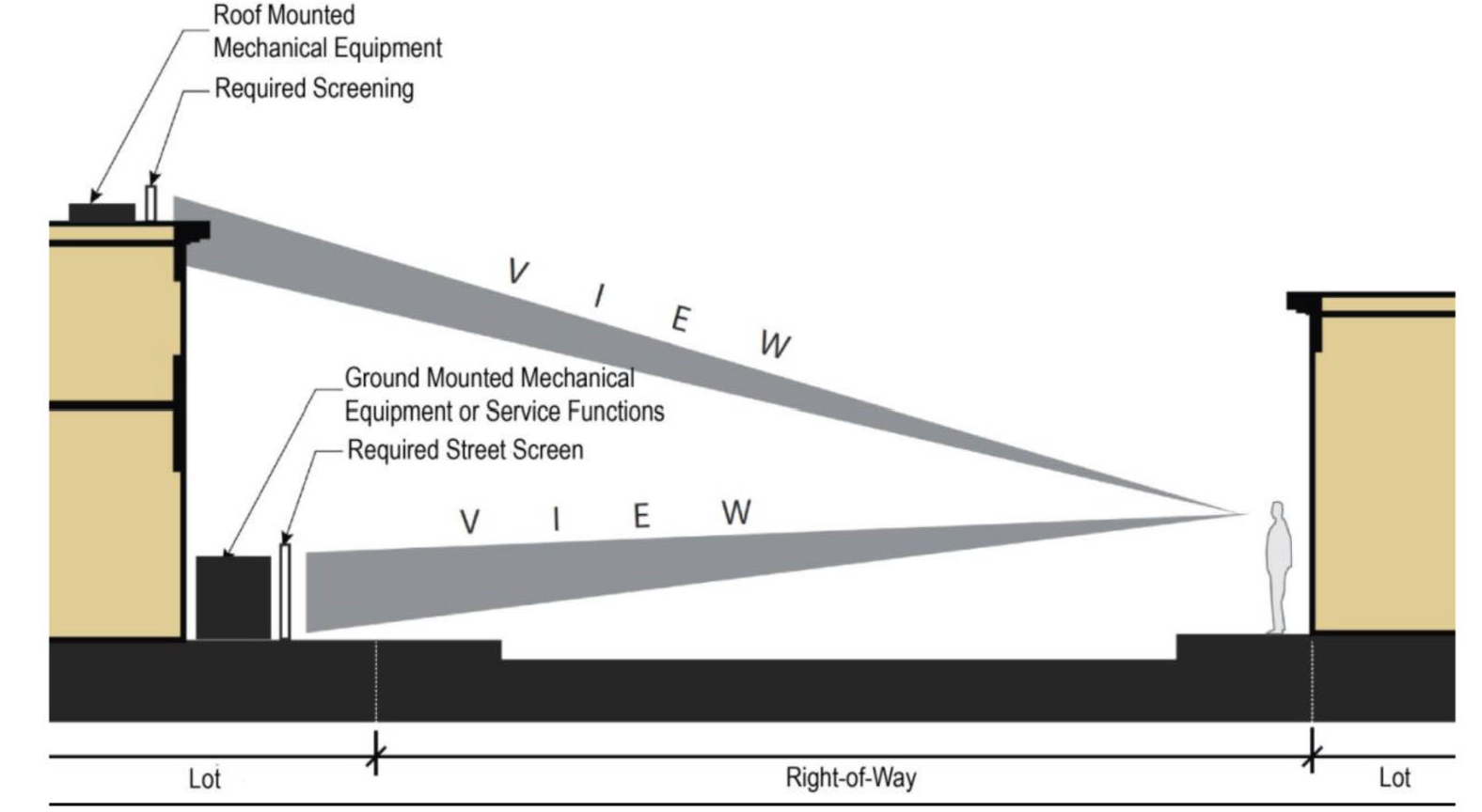
(2)
All buildings shall be designed such that no mechanical equipment (HVAC, etc.), except vents or stacks, is visible from a public right-of-way, whether the equipment is located on the ground, exterior walls, or a roof.
(3)
Solid waste containers that are subject to current screening requirements shall be located such that the enclosure blocks the view of the container from any street abutting the property. Any solid waste enclosure directly visible from the right-of-way shall be constructed of masonry. All other enclosures may be constructed of solid wood fencing six feet in height.
(4)
All electric, telephone, and cable TV wires shall be buried underground from the property line to all structures being served on private or public property.
(5)
All screening fences shall be 100 percent masonry.
(6)
Where fencing is to be located along the boundary of a subdivision abutting the corridor overlay district, the style and materials used for all portions of the fence facing the corridor or any street within the boundaries of the corridor, shall be of uniform construction across all lots so situated in the same subdivision.
(Ord. No. 2586, § 7, 10-11-2022; Ord. No. 2701, § 3, 8-13-2024)
Editor's note— Ord. No. 2586, § 7, adopted Oct. 11, 2022, repealed the former § 130-27 and enacted a new section as set out herein. The former § 130-27 pertained to Riverside Parkway/SH 47, corridor overlay district and derived from Ord. No. 2110, § 3, adopted Aug. 25, 2015; and Ord. No. 2266, § 2, adopted March 27, 2018.
Sec. 130-28. - West Villa Maria, FM 2818, and FM 158 corridor overlay districts.
(a)
General purpose and description. This district is limited to specified areas encompassing land that has already been assigned conventional zoning district classifications. It supplements the standards of the underlying conventional districts with new or different standards, which may be more restrictive. The intent is to exercise greater control over the aesthetic and functional characteristics of development along major thoroughfares, which serve as major entrances to the community where higher development standards can effectively enhance the city's image as a desirable place to live, work, and shop.
(b)
District boundaries. The corridor overlay standards apply to the future development and use of all land within 200 feet or the depth of the abutting lot, whichever is less, on either side of the street right-of-way along the following specified thoroughfare segments.
(1)
West Villa Maria Road from Finfeather Road to SH 47.
(2)
FM 2818 (southwest side only) from Villa Maria Road southeastward to the city limits.
(3)
FM 158 from 200 feet west of the intersection of Villa Maria Road to the city limits at Cole Lane.
Note: The depth of the corridor is 200 feet or the depth of the abutting lot, whichever is less.
(c)
Screening and general appearance standards.
(1)
Building materials. At least 75 percent of any exterior wall shall be covered by masonry, vinyl/wood siding, glass, or other nonmetallic material, as prescribed by the table below.
(2)
Utility equipment. All heating, ventilation, air-conditioning, and utility equipment located outside of buildings shall be effectively screened from view from any street abutting the property with dense shrubbery having year-round foliage, decorative wall, fence, or architectural element of the building.
(3)
Vehicle loading. Vehicle loading and unloading areas shall be screened from view from any street abutting the property by a fence, wall, or architectural element of the building at least six feet in height above the surface of the loading area or dock, as prescribed by the table below.
(4)
Solid waste. Solid waste containers that are subject to current screening requirements shall be located such that the enclosure blocks the view of the container from any street abutting the property.
(5)
Screening. A decorative wall or landscaped earth berm at least three feet in height, or dense shrubbery having year-round foliage at least four feet in height, is required as a visual buffer along street frontages in the following circumstances.
a.
Where outdoor parking areas are located within 50 feet of a certain distance from any street right-of-way, except for driveway openings providing access from the street to the parking area.
b.
Where fuel pumps are located in any parking area, driveway, or maneuvering area between the principal building and any street.
c.
Where a vehicle drive-up window faces a street.
(6)
Underground utilities. All electric, telephone, and cable TV wires shall be buried underground from the property line to all structures being served on private or public property.
(7)
Screening fences. All screening fences, whether required or not, that are visible from a street shall be constructed of brick, stone, concrete panels, or a combination of these materials and solid wood (not including plywood or particleboard), with the wood section of fence not exceed 20 feet in length. Chainlink fences and corrugated metal or fiberglass panels are prohibited in all locations.
(8)
Perimeter fence materials. Where fencing is to be located along the boundary of a subdivision abutting the corridor overlay district, the style and materials used for all portions of the fence facing the corridor or any street within the boundaries of the corridor, shall be of uniform construction across all lots so situated in the same subdivision.
(Ord. No. 2585, § 13, 10-11-2022)
Sec. 130-29. - Midtown Pattern Overlay District (MP).
(a)
General description and purpose. The MP, Midtown Pattern Overlay Districts are a novel technique intended to radically lower barriers to executing high-quality, incremental infill projects. At its core, the Midtown Pattern Overlay District is a technique for convenient-yet-contextual densification of existing urban landscapes. Midtown Pattern Overlay District is intended to provide a clear framework for high-quality incremental infill development within neighborhoods in the midtown area. The goal of the Midtown Pattern Overlay District is to raise housing quality without adding to the burdens of small developers and property owners trying to meet real and growing housing needs. Midtown pattern buildings were developed in response to the harmful effects of unregulated residential development in midtown. The city council found that a lack of targeted regulation was creating safety concerns and threatening neighborhood integrity. The midtown pattern buildings were designed based on a visual preference survey conducted at the beginning of the midtown study process. Variability requirements and elevated site design standards will help pattern buildings to blend into the community they were designed for. All pattern building development is optional and voluntary and stands beside the conventional permitting process, which is still available to all applicants. Supplemental site development guidelines are stricter than the underlying code and help to ensure high-quality projects that enhance the function and appearance of neighborhood streets. No uses which are permitted by the underlying zoning district are removed by this overlay district. All uses within this overlay district are optional and are to be considered in addition to the existing permitted uses.
(b)
Permitted uses.
(1)
Midtown Pattern—Cottage and Flex House (MP-CF). Any permitted use in the underlying zoning district or designated overlay district with the addition of:
•
Midtown cottage;
•
Midtown flex house;
•
Midtown accessory dwelling units.
(2)
Midtown Pattern—Apartment House (MP-A). Any permitted use in the underlying zoning district or designated overlay district with the addition of:
•
Midtown apartment house.
(3)
Midtown Pattern—Walkup two-story (MP-W2). Any permitted use in the underlying zoning district or designated overlay district with the addition of:
•
Two-story midtown walkup.
(4)
Midtown Pattern—Walkup three-story (MP-W3). Any permitted use in the underlying zoning district or designated overlay district with the addition of:
•
Two-story midtown walkup;
•
Three-story midtown walkup.
(c)
Conditional uses. Any conditional uses within the underlying zoning district.
(d)
Pattern building development. When development of a pattern building occurs, the property shall be subject to the development standards found below:
(1)
General purpose and description. Pattern building development projects are an optional alternative to conventional development that may be pre-approved for development under specific circumstances and in specific areas of midtown and are regulated by the unique, high-efficiency development standards. Pre-approved development projects must comply with these conditions to qualify for expedited site development and building permitting. A primary purpose of pattern building development is to facilitate faster design and review. A site plan with annotations showing how each of these conditions are being met shall be submitted by the development applicant to be eligible for expedited permitting. The site plan shall use as its basis a boundary survey prepared by a registered public surveyor licensed by the state certifying that the drawing is true and correct and was prepared from an actual survey of the property.
(2)
Variability.
a.
Multiple architectural options required for larger projects. Any contiguous set of three or more parcels with pattern buildings shall include at least two variants of the pattern buildings.
(3)
Parking.
a.
Minimum parking. One parking space per bedroom.
b.
Parking lot location. Parking lots shall not be constructed between a building and a public right-of-way.
c.
Driveway width. Maximum driveway width is 12 feet, except when the driveway serves more than four units or commercial uses. For more than four units, the maximum width is 20 feet. Maximum curb return radius shall be ten feet.
d.
Cross-access required. Notwithstanding ownership, when three or more contiguous parcels are proposed for development with pre-approved buildings, a reciprocal cross access easement in the rear shall be required to establish a shared parking and driveway scheme. The cross-access easement shall meet minimum dimensions for two-way vehicular travel.
e.
Revised parking lot landscaping requirements. End islands may be required where a parking area serves four or more patterns and for midtown walkup development. End islands shall be installed at the end of each parking row. The island shall have raised curbing not less than six inches in height and encompass an area of not less than 180 square feet for single parking row end islands or 360 square feet for double-row end islands.
f.
On-street parking counted. New or existing on-street parking, where allowed in the public right-of-way and built to the following standards, may be counted towards the total parking requirement.
1.
Parking shall be prohibited in the following places as described by the Texas Transportation Code:
(i)
In front of a public or private driveway;
(ii)
Within 15 feet of a fire hydrant;
(iii)
Within 20 feet of a crosswalk at an intersection;
(iv)
Within 30 feet on the approach to a flashing signal, stop sign, yield sign, or traffic-control signal located at the side of a roadway;
(v)
Within 50 feet of a railroad crossing;
(vi)
Where an official sign prohibits parking.
2.
On-street parking shall be prohibited on a street with a functional classification of major collector or above.
3.
Parking area design shall comply with the minimum standards set forth in the parking area design section for commercial parking and circulation regulations found in the land and site development chapter of this Code, except that 90 degree parking is prohibited and the remaining minimum two-way travel width shall be 20 feet. Parking area design shall be consistent within a block and should be consistent between adjacent blocks.
4.
Pavement markings shall be required and shall comply with the striping and marking requirements found in the parking and circulation section of the land and site development chapter of this Code.
5.
Where a bike lane exists or is designated, a bike lane next to parking spaces shall be at least six feet wide, unless there is a marked 18-inch buffer between them.
6.
Only parking spaces located entirely in front of the subject property, not extending in front of adjacent property, may be claimed towards the parking count.
(4)
Pedestrian facilities.
a.
Sidewalk required. Where no sidewalk exists on the same side of the street, a new sidewalk shall be constructed in accordance with city standards. Payment into the sidewalk fund will not be accepted in lieu of installation of sidewalks.
b.
Sidewalk and driveway interface. Sidewalks may have changes in slope which meet ADA standards.
c.
Pedestrian-oriented entry. Each principal building shall have a clear and dedicated route from the right-of-way to its primary entrance, and its primary entrance shall face the street.
(5)
Street trees.
a.
Street trees required. One street tree per 30 feet of lot width is required, round up normally.
b.
Street tree location. Trees shall be no closer than four feet and no further than ten feet off the sidewalk to provide shade and reduce future maintenance costs.
c.
Existing trees counted. Existing trees within ten feet of the sidewalk may be counted towards this requirement if they are protected during construction.
(6)
Lot dimensions and setbacks.
a.
Side and rear setbacks. Side and rear setbacks shall be 5 feet, except when adjacent to a street or alley, in which case, the street-side setback shall be established by the underlying zoning district.
b.
Build-to-zone. The primary façade shall be placed in a zone starting 15 feet from the front property line and ending 25 feet from the front property line. The front build-to zone may be varied by staff when necessary to preserve enough space for parking in the rear yard
c.
Minimum parcel dimensions. The minimum lot area is application-specific to each pattern as described and guided by the standards recommended in the Midtown Pattern Book.
(7)
Trash and recycling.
a.
Container location. Trash and recycling containers shall be stored in a designated area screened from view from the public right-of-way. Buildings with four units or less shall not be serviced by dumpsters, unless service is aggregated among multiple parcels.
(8)
Variances.
a.
Only the zoning board of adjustment may grant a variance from a requirement of the zoning ordinance, if it makes written findings that:
1.
The requirement does not allow for a reasonable use of the property;
2.
The hardship for which the variance is requested is owing to a special condition inherent in the property itself, such as restricted area, shape, topography or physical features;
3.
The special condition is unique to this property and is not generally characteristic of other parcels of land in the area; and
4.
Development under the variance does not:
(i)
Alter the character of the area adjacent to the property;
(ii)
Impair the use of adjacent property that is developed in compliance with the city requirements; or
(iii)
Impair the purposes of the regulations of the zoning district in which the property is located.
b.
A variance may not be granted to relieve a self-created or personal hardship, nor for financial reasons only, nor may a variance be granted to permit any person a privilege in developing a parcel of land not permitted by this chapter to other parcels of land in districts with the same zoning classification.
c.
The applicant bears the burden of proof in establishing the facts justifying a variance.
(9)
Flood-prone areas.
a.
Flood regulations apply. Pattern zone does not eliminate floodplain or floodway regulations. Parcels with area designated as floodplain shall undergo a standard floodplain review and demonstrate regulatory compliance before a combined site development and building permit is issued.
(10)
Uses.
a.
Commercial uses limited by zoning. Pattern buildings, which include a commercial format, such as the walkup, cannot be used for commercial purposes unless permitted by the underlying zoning district.
b.
Residential uses allowed with associated map. Pattern buildings, which contain only a residential use may be constructed where indicated on the pre-approval maps.
(e)
Other regulations.
(1)
Applicability of midtown accessory dwelling units in MP-CF District. Midtown accessory dwelling units are permitted on all parcels with a primary structure which has two or fewer attached residential units, including nonresidential structures. ADUs may also be permitted in new construction when associated with a permit for a new primary structure.
(2)
Zoning district map. All MT districts approved in accordance with the provisions of this chapter in its original form, or by subsequent amendments thereto, shall be referenced on the zoning district map.
(Ord. No. 2451, § 3, 9-8-2020)
Sec. 130-30. - HP, historic preservation overlay district.
(a)
General purpose and description. The City Council of Bryan, Texas hereby declares that as a matter of public policy the preservation, protection, enhancement, and perpetuation of properties of historic and cultural importance and significance are necessary to promote the economic, cultural, educational, and general welfare of the public. It is recognized that the City of Bryan represents the unique confluence of time and place that shaped the identity of generations of citizens, collectively and individually, and produced significant historic, architectural, and cultural resources that constitute their heritage. This section is intended to:
(1)
Preserve, protect and enhance the properties which represent distinctive elements of Bryan's historic, architectural, and cultural heritage;
(2)
Foster civic pride in the accomplishments of the past;
(3)
Preserve, protect and enhance Bryan's attractiveness to visitors and the support and stimulus to the economy thereby provided;
(4)
Insure the harmonious, orderly, and efficient growth and development of the city;
(5)
Promote economic prosperity and welfare of the community;
(6)
Encourage stabilization, restoration, and improvements of such properties and their values.
(b)
Criteria for designation of historic preservation overlay district. A historic preservation overlay district may be designated if it meets any of the following criteria:
(1)
Possesses significance in history, architecture, archeology, or culture.
(2)
Embodies the distinctive characteristics of a type, period, or method of construction.
(3)
Represents the work of a master designer, builder, or craftsman.
(4)
Represents an established and familiar visual feature of the city.
(5)
Meets the criteria established by the National Register of Historic Places.
(6)
Exemplification of the cultural, economic, social, ethnic or historical heritage of the city, state or nation;
(7)
Location as the site of a significant historical event; and
(8)
Identification with a person or persons who significantly contributed to the culture and development of the city, state or nation.
(c)
Designation of historic preservation overlay district.
(1)
These provisions pertain to the designation of historic property/properties by creating the historic preservation overlay district, a part of this zoning ordinance.
(2)
Eligible applicants are:
a.
Property owner or 60 percent of property owners in a proposed district consisting of more than one property (one vote per property);
b.
Historic landmark commission, planning and zoning commission, or city council.
c.
Historic preservation officer.
(3)
Applications to increase, decrease or establish boundaries of a historic preservation overlay district must include:
a.
A legal description of the boundaries of the district;
b.
A photograph or photographs of each contributing building, structure, site, area or land.
c.
A description of all buildings, structure, site, area or land showing the condition, color, and architectural style of each and:
1.
Date of construction, if known;
2.
Builder or architect, if known;
3.
Chain of uses and ownership;
4.
Building materials;
5.
Construction technique;
6.
Summary of recognition of state or national government including reason designated, if applicable.
d.
A statement of reasons for recommending designation or changes to the district, including a list of contributing buildings, structures, sites, areas or lands of importance and a description of the particular importance of each contributing building, structure, site, area or land.
e.
Findings supporting establishment of or change to the district according to the criteria in this section and indicating the particular importance or value of the district;
f.
Signature of applicant. Eligible applicants are: property owner [or 60 percent of owners (one vote per property) in a proposed district of more than one property]; historic landmark commission (as established in chapter 2); or historic preservation officer.
(4)
The historic landmark commission shall conduct a public hearing on the proposed historic preservation overlay district. At the historic landmark commission's public hearing, owners, interested parties, and technical experts may present testimony or documentary evidence which will become part of a record regarding the historic, architectural, or cultural importance of the proposed historic preservation overlay district. The historic landmark commission shall prepare a recommendation on the proposed change stating its findings, and evaluation within 45 days subsequent to the hearing on the proposed designation.
(5)
Upon recommendation of the historic landmark commission, the proposed historic preservation overlay district shall be submitted to the planning and zoning commission within 45 days from the date of the historic landmark commission's recommendation. After a recommendation by the historic landmark commission, all proposed historic preservation overlay districts shall follow procedures set forth in section 130-42.
(6)
Upon designation of a historic preservation overlay district, the city council shall cause the designation to be recorded in the official zoning maps of the City of Bryan.
(d)
Certificate of appropriateness affecting historic preservation overlay districts. Construction, reconstruction, alteration, restoration, rehabilitation, relocation, demolition, or any change visible from a public right-of-way of any historic property within a historic preservation overlay district shall not occur without prior approval of a certificate of appropriateness from the historic landmark commission. The building official, historic preservation officer, or his/her designee shall not issue a building permit without a certificate of appropriateness having been granted.
(e)
Criteria for approval of a certificate of appropriateness. In considering an application for a certificate of appropriateness, the historic landmark commission shall be guided by any adopted design guidelines, and where applicable, the following from the Secretary of the Interior's Standards for Rehabilitation of Historic Buildings. Any adopted design guidelines and Secretary of the Interior's Standards shall be on file within the planning and development services department and made available to the public.
(1)
Every reasonable effort shall be made to adapt the property in a manner which requires minimal alteration of the building, structure, object, or site and its environment.
(2)
The distinguishing original qualities or character of a building, structure, object, or site and its environment shall not be destroyed. The removal or alteration of any historic material or distinctive architectural features should be avoided when possible.
(3)
All buildings, structures, objects, and sites shall be recognized as products of their own time. Alterations that have no historical basis and which seek to create an earlier appearance shall be discouraged.
(4)
Changes which may have taken place in the course of time are evidence of the history and development of a building, structure, object, or site and its environment. These changes may have acquired significance in their own right, and this significance shall be recognized and respected.
(5)
Distinctive stylistic features or examples of skilled craftsmanship which characterize a building, structure, object, or site shall be kept when possible.
(6)
Deteriorated architectural features shall be repaired rather than replaced, wherever possible. In the event replacement is necessary, the new material should reflect the material being replaced in composition, design, color, texture, and other visual qualities. Repair or replacement of missing architectural features should be based on accurate duplications of features, substantiated by historical, physical, or pictorial evidence rather than on conjectural designs or the availability of different architectural elements from other buildings or structures.
(7)
The surface cleaning of structures shall be undertaken with the gentlest means possible. Sandblasting and other cleaning methods that will damage historic building materials shall not be undertaken.
(8)
Every reasonable effort shall be made to protect and preserve archeological resources affected by, or adjacent to, any project.
(9)
Contemporary design for alterations and additions to existing properties shall not be discouraged when such alterations and additions do not destroy significant historical, architectural, or cultural material, and such design is compatible with the size, scale, color, material, and character of the property, neighborhood, or environment.
(10)
Whenever possible, new additions or alterations to buildings, structures, objects, or sites shall be done in such a manner that if such additions or alterations were to be removed in the future, the essential form and integrity of the building, structure, object, or site would be unimpaired.
(11)
Any design guidelines adopted by the historic landmark commission or city council.
(f)
Certificate of appropriateness application procedure.
(1)
Prior to the commencement of any work in the historic preservation overlay district requiring a certificate of appropriateness the owner shall file an application for such a certificate with the historic landmark commission. The application shall contain:
a.
Name, address, telephone number of applicant.
b.
Detailed description of proposed work.
c.
Location and photograph of the property, including historic photographs, if available.
d.
Elevation drawings of the proposed changes, if applicable.
e.
Samples of materials to be used.
f.
If the proposal includes signs or lettering, a scale drawing showing the type of lettering to be used, all dimensions and colors, a description of materials to be used, method of illumination (if any), and a plan showing the sign's location on the property.
(2)
Building permits shall not be issued for such proposed work until a certificate of appropriateness has first been issued by the historic landmark commission. The certificate of appropriateness required by this act shall be in addition to and not in lieu of any building permit that may be required by any other ordinance of the City of Bryan.
(3)
The historic landmark commission shall review the application during a public meeting within 45 days from the date the application is received. The historic landmark commission shall act upon the certificate of appropriateness within 45 days after the meeting. In the event the historic landmark commission does not act within 90 days of the receipt of the application, a certificate of appropriateness shall be deemed granted. The historic landmark commission's decision is limited to approve, approve with modifications; suspension of action for a specified time or deny.
(4)
All decisions of the historic landmark commission shall be in writing and shall state its findings pertaining to the application. A copy shall be sent to the applicant. Additional copies shall be filed as part of the public record on the subject property.
(5)
An applicant for a certificate of appropriateness may appeal the decision of the historic landmark commission to the city council within 15 calendar days after such action. Following the filing of an appeal, the city council shall, within 60 calendar days, conduct a review of the decision of the historic landmark commission. The appeal is automatically upheld if the city council does not act on it before the 60th calendar day after the date the appeal is filed.
(6)
Certificate of appropriateness' are valid for a period of one year. Any work not completed within a one year period shall require a new certificate of appropriateness to be issued by the historic landmark commission.
(g)
Economic hardship application procedure.
(1)
After receiving written notification from the historic landmark commission of the denial of certificate of appropriateness, an applicant may commence the hardship process to obtain necessary building or demolition permits. No building permit or demolition permit shall be issued unless the historic landmark commission makes a finding that hardship exists. When a claim of economic hardship is made due to the effect of this chapter, the owner must demonstrate to the historic landmark commission that:
a.
The property is incapable of earning a reasonable return, regardless of whether that return represents the most profitable return possible;
b.
The property cannot be adapted for any other use, whether by the current owner or by a purchaser, which would result in a reasonable return; and
c.
Efforts to find a purchaser interested in acquiring the property and preserving it have failed.
(2)
The applicant shall consult with the historic landmark commission, local preservation groups and interested parties in a diligent effort to seek an alternative that will result in preservation of the property. Such efforts must be shown to the historic landmark commission.
(3)
The historic landmark commission shall hold a public hearing on the application within 60 days from the date the application is received by the building official, historic preservation officer, or his/her designee. Following the hearing, the commission has 30 days in which to prepare a written recommendation to the building official, historic preservation officer, or his/her designee. In the event that the historic landmark commission does not act within 90 days of the receipt of the application, a permit may be granted.
(4)
All decisions of the historic landmark commission shall be in writing. A copy shall be sent to the applicant by mail and a copy filed with the city for public inspection. The historic landmark commission's decision shall state the reasons for granting or denying the hardship application.
(5)
Hardships shall not be granted if they are a result of the owner's actions.
(h)
Ordinary maintenance in a historic preservation overlay district. Nothing in this ordinance shall be construed to prevent the ordinary maintenance, in-kind replacement, and repair of any exterior architectural feature of a property within a historic preservation overlay district which does not involve a change in design, material, or outward appearance. When the building official, historic preservation officer, or his/her designee determines work has progressed beyond ordinary maintenance, the commission shall review a request for a certificate of appropriateness.
(i)
Demolition by neglect. Owners or persons with an interest in real property included within a historic preservation overlay district shall not permit the property to fall into a serious state of disrepair so as to result in the deterioration of any exterior feature which would produce a detrimental effect upon the character of the historic preservation overlay district as a whole or the life and character of the property itself. Examples of such deterioration may include, but shall not be limited to:
(1)
Deterioration of exterior walls or other vertical supports.
(2)
Deterioration of roof or other horizontal members.
(3)
Deterioration of exterior chimneys.
(4)
Deterioration or crumbling of exterior stucco or mortar.
(5)
Ineffective waterproofing of exterior walls, roof, or foundations, including broken windows or doors.
(6)
Deterioration of exterior architectural features.
(7)
Deterioration of any feature so as to create a hazardous condition which could lead to the claim that demolition is necessary for the public safety.
(j)
Sign regulations. See chapter 98.
(Ord. No. 2585, § 14, 10-11-2022; Ord. No. 2740, § 6, 4-8-2025)
Editor's note— Ord. No. 2585, § 14, adopted Oct. 11, 2022, repealed the former § 130-30 and enacted a new section as set out herein. The former § 130-30 pertained to MU-2, mixed-use district, and derived from Ord. No. 2110, § 3, adopted Aug. 25, 2015; Ord. No. 2111, § 20, adopted Aug. 25, 2015; and Ord. No. 2258, § 2, adopted Feb. 13, 2018.
Sec. 130-31. - PD, planned development district.
(a)
Purpose. The purposes of a planned development district (PD) include, but are not limited to the following:
(1)
To promote and encourage innovative development that is sensitive to surrounding land uses and the natural environment.
(2)
To allow diversification of uses, structures, and open spaces and to promote flexibility of design in a manner compatible with existing and allowed uses of land on adjacent properties.
(3)
To preserve the natural amenities and environmental assets of the land by encouraging the preservation and improvement of open space.
(4)
To provide an appropriate balance between the intensity of development and the ability to provide adequate supporting public facilities and services.
(5)
To promote the efficient use of land to facilitate a more economic arrangement of buildings, uses of land and utilities.
(6)
To promote the development of vacant property within the presently developed urban area.
(b)
Permitted uses.
(1)
Any use or combination of uses otherwise authorized by these zoning regulations is permitted in a planned development (PD) district, if such use or uses is consistent with, and meets the standards for, the concept plan, and PD district approved by the city council. Allowable uses shall be listed in a use schedule in the specific ordinance establishing each PD district.
(2)
It is intended that PD districts conform as closely as possible to established zoning and subdivision regulations while still allowing maximum flexibility of design to make planned developments as desirable as possible.
(3)
Each PD district ordinance is incorporated by reference into this zoning ordinance. Every individual PD district approved under the provisions of this zoning ordinance shall be considered as a zoning amendment applicable to the property involved. Conditions specified for the development of a PD district shall be construed as conditions precedent to the granting of a certificate of occupancy by the chief building official and compliance as required by the City of Bryan.
(c)
Review of planned developments.
(1)
A PD district request or proposal shall be reviewed in accordance with the procedures stated in section 130-42, unless otherwise specified in this section.
(2)
A development plan for a proposed planned development shall be required. Said plan must show the location of the planned development and the relationship of proposed land uses.
(3)
A PD district development plan must include a statement as to the purpose and intent of the planned district.
(4)
A PD district development plan establishes specific site development standards for all land uses. Items to consider in the development plan include, but are not limited to, the following: landscaping, screening, buffer area requirements, minimum or maximum building setback, buildings, signage, off-street parking, density, lot area, lot width, lot depth, building height, building elevations, lot coverage, floor area ratio, access, lighting, project phasing or scheduling, owner and/or management associations, and other requirements as the city council may deem appropriate.
(5)
PD district development plans shall be reviewed by the city's site development review committee (SDRC) in accordance with established deadlines, before scheduling for planning and zoning commission and city council consideration.
(6)
The preparation of preliminary plans and final plats for a PD district shall be in accordance with the provisions of Bryan Code of Ordinances chapter 110, subdivisions, and with any modifications approved by the city council with the PD district development plan.
(d)
Development standards. The following site development standards are intended to serve as guidelines and are considered minimum standards unless modified by the approved PD district development plan:
(1)
Unless otherwise specified in the approved development plan, the minimum requirements for each PD district shall be those stated in Bryan Code of Ordinances and the requirements of the most restrictive standard zoning district in which the designated land uses are permitted.
(2)
Setback, landscaping, signage, and off-street parking standards which are as restrictive as those established for the particular zoning districts in which the use would ordinarily be allowed.
(3)
Drainage, utility, and street standards as established in the city's subdivision ordinance (Bryan Code of Ordinances chapter 110).
(4)
All private park areas shall have grounds and equipment maintained in an attractive manner. The dedication of such areas to open space uses and the maintenance costs associated with such areas shall be assured by appropriate covenants and restrictions.
(5)
There shall be no maximum building height restrictions in PD district, except on land adjoining residential district. When adjacent to land in residential districts, all buildings on land in a PD district adjacent to said district in excess of 35 feet in height must be set back one-half additional foot from all property lines for each one foot of height over 35 feet.
(6)
The maximum housing density permitted in any PD district shall be 50 dwelling units per acre.
(7)
For master-planned residential subdivisions on land of ten acres or more, the following standards would apply:
a.
Lots other than HOA-maintained common areas may have a minimum lot area of 7,000 square feet.
b.
Minimum lot width of 70 feet.
c.
Minimum floor area for detached dwellings of 2,200 square feet of heated space, excluding porches, garages, patios, and the like.
d.
At least two canopy trees are to be planted in the front yard, between the front property line and the front façade, of all lots developed with a detached dwelling.
e.
At time of certificate of occupancy issuance for the detached dwelling on the same lot, the trees must be alive and measure at least two inches in caliper when measured at four and one-half feet above the soil.
f.
Detached dwellings shall be of recognized standards construction quality, and all exteriors (exclusive of doors, windows, and similar openings) shall be constructed of at least 75 percent masonry. The remaining exterior areas (exclusive of door, windows, and similar openings) shall be constructed of James Hardie board, cemplank, fiber cement (allura) siding, and/or smart board siding (engineered wood siding).
g.
Detached dwellings shall have a 6/12 roof pitch. The surface of all roofs of dwellings can include shakes, tile, or other quality composition shingle, or standing-seam metal.
h.
Detached dwellings include at least one attached two-car garage.
i.
All lots and HOA-maintained common areas have automatic irrigation systems that are kept in working condition.
j.
On all lots and HOA-maintained common areas, including, but not limited to, streetscaping and buffer area common areas, lawns, shrubs, trees, grass, and plantings must be kept cultivated, pruned, neatly trimmed, mowed and/or edged, as applicable, to complement the overall aesthetics of the development. Trees, shrubs, vines, and plants that die will be promptly removed or replaced, if required.
k.
Fencing not exceed six feet in height.
l.
Allowed fencing materials may include wood, wrought iron, and brick.
m.
Wood fencing to be constructed with planks no less than six inches in width.
n.
Wood fencing to be constructed so that the stringers are not visible from public rights-of-way.
o.
All wood materials are to be decay resistant, such as redwood, cedar, or composite fencing material with the appearance of natural wood and a minimum 25-year warranty.
p.
Except for fencing made entirely of brick, all fencing will have 24-inch by 24-inch wide masonry fence columns positioned at a maximum distance of 25 feet on center.
q.
Buildings, including accessory structures, with metal exteriors shall be prohibited.
r.
Detached accessory structures and accessory dwellings, when permitted, will conform to the applicable standards specified in the City of Bryan's Code of Ordinances. The following additional standards for detached accessory structures and accessory dwellings shall apply:
1.
Only one accessory dwelling shall be allowed on a single property.
2.
The gross floor area of an accessory dwelling shall be at least 400 square feet but not exceed 30 percent of the gross floor area of the main structure.
3.
Where an accessory dwelling is permitted on a lot, no other detached accessory structures shall be located on that same lot.
(8)
Master-planned residential subdivisions may have the following features:
a.
A ten-foot wide concrete hike and bike trail with five-foot wide fall away zones accessible to the general public. Hike and bike trail access points connecting to the adjacent street network will be a minimum of 20 feet in width.
b.
Within the hike and bike trail network there may be the following amenities: landscaping (canopy and noncanopy tree mixture), wayfinding signage, trash receptacles, benches, pedestrian lighting, and pet waste stations.
c.
Prior to any subdivision plat approval by the city, a site plan showing the location of hike and bike trail amenities including, but not limited to, a landscape analysis and details for each proposed amenity, shall be submitted to the city for approval.
(e)
Zoning district map. All PD districts approved in accordance with the provisions of this chapter in its original form, or by subsequent amendments thereto, shall be referenced on the official zoning district map.
(f)
Retired planned development districts.
(1)
Retired planned development districts include the following districts existing prior to December 9, 2025:
a.
Planned development-housing district (PD-H). Any use permitted in the RD-7, RD-5, and MF districts are permitted in a PD-H development.
b.
Planned development-business district (PD-B). Any use permitted in the C-1, C-2, and C-3 districts are permitted in a PD-B development, excluding residential uses.
c.
Planned development-industrial district (PD-I). Any use permitted in the I district is permitted in a PD-I development, excluding adult entertainment.
d.
Planned development-mixed use district (PD-M). Any use permitted in the RD-7, RD-5, MF, C-1, C-2, C-3, and I districts is permitted in a PD-M development, excluding adult entertainment.
(2)
Existing districts shall continue to remain in effect, but these districts are not available for any new zoning district map amendment proposals.
(3)
The general description and purpose of these districts accommodated planned associations of uses developed as integral land use units such as industrial districts, offices, commercial or service centers, shopping centers, residential developments of multifamily or mixed housing including attached single-family dwellings or any appropriate combination of uses which may be planned, developed or operated as integral land use units either by a single owner or a combination of owners. These districts were used to permit new or innovative concepts in land utilization not permitted by other zoning districts in this chapter. While greater flexibility was given to allow special conditions or restrictions which would not otherwise allow the development to occur, increased flexibility was not to be misused.
(4)
Any use or combination of uses is permitted in an existing, retired PD district if the use is consistent with the following categories:
a.
Planned development-housing (PD-H). Any use permitted in the RD-7, RD-5, and MF districts are permitted in a PD-H development.
b.
Planned development-business (PD-B). Any use permitted in the C-1, C-2, and C-3 districts are permitted in a PD-B development, excluding residential uses.
c.
Planned development-industrial (PD-I). Any use permitted in the I district is permitted in a PD-I development, excluding adult entertainment.
d.
Planned development-mixed use (PD-M). Any use permitted in the RD-7, RD-5, MF, C-1, C-2, C-3, and I districts is permitted in a PD-M development, excluding adult entertainment.
(5)
Development criteria.
a.
Where structures within the planned development that exceed 35 feet in height are proposed to be erected on lots adjacent to RD-7, RD-5, or A-O districts, such structures shall be located one foot from the boundary of the open space buffer described in section 130-25(c)(4)a for each two feet of height over 35 feet.
b.
Planned developments designated as PD-B, PD-I, or PD-M shall have frontage along and access to a major arterial street on at least one side of the proposed development. Access through a residential area to a PD-B, PD-I, or PD-M via a local street is prohibited.
(Ord. No. 2585, § 15, 10-11-2022; Ord. No. 2765, § 2, 12-9-2025)
Editor's note— Ord. No. 2585, § 15, adopted Oct. 11, 2022, repealed the former § 130-31 and enacted a new section as set out herein. The former § 130-31 pertained to R-NC, residential-neighborhood conservation, and derived from Ord. No. 2110, § 3, adopted Aug. 25, 2015; Ord. No. 2111, § 21, adopted Aug. 25, 2015; Ord. No. 2167, §§ 2, 3, adopted Sep. 13, 2016; and Ord. No. 2295, § 6, adopted Sep. 11, 2018.

