
Bryan City Zoning Code
ARTICLE III
- OTHER REGULATIONS
Sec. 130-32. - Buffer area requirements.
(a)
When it is determined that a zoning district abuts a noncompatible zoning district along a mutual side or rear property line or where separated only by an alley, setbacks shall be greater than the minimum requirements set forth in chapter 62. The purpose of the additional setback is to establish a buffer area to help mitigate noise, lighting, and other possible adverse impacts. No development shall be authorized within the buffer area except for required or permitted landscaping and screening, stormwater detention facilities, and pedestrian walkways. The increased setbacks, which are measured from the property line, shall be required on the property in the higher intensity zoning district, and shall be observed at the time of construction. These buffer requirements are in addition to the screening standards set forth in section 130-37.
(b)
The depth of the side and rear buffer setbacks shall be in accordance with the following:
(1)
One hundred feet in the I, industrial district and for municipal services support facilities when siding or backing on to C-2, retail, C-1, office, MU-2, mixed use district and all residential districts.
(2)
Seventy-five feet in the C-3, commercial district and for essential municipal uses when siding or backing on to C-1, office and all residential districts.
(3)
Fifty feet in the C-2, retail district when siding or backing on to all residential districts.
(4)
Twenty-five feet in C-1, office district when siding or backing on to all residential districts.
(5)
Twenty-five feet in MF, multiple-family district when siding or backing on to all other residential districts.
(6)
Twenty-five feet in all nonresidential districts when adjacent to a single-family residence located within an A-O, district and no farther than 100 feet from the nonresidential district boundary.
(c)
The depth of the buffer area may be reduced by the equivalent area of landscaping provided within the buffer area. No reductions in the setback area will be allowed where no landscaping is provided parallel to the property lines. In no event shall the reductions eliminate the standard setbacks provided in Chapter 62. Landscaping used in place of screening, allowed in section 130-37, shall not be used to reduce the buffer area. Square feet of coverage shall be based on the standards provided in all other applicable sections and/or ordinances. The request for reducing the buffer shall be submitted with a landscape plan. The minimum depth of the reduced buffer shall be:
(1)
Sixty feet in the I, industrial district and municipal services support facilities when siding or backing on to C-2, retail, C-1, office, MU-2, mixed use, and all residential districts.
(2)
Forty-five feet in the C-3, commercial district and for essential municipal uses when siding or backing on to C-1, office and all residential districts.
(3)
Thirty feet in the C-2, retail district when siding or backing on to all residential districts.
(4)
Fifteen feet in the C-1, office district when siding or backing on to all residential districts.
(5)
Fifteen feet in the MF, multiple-family district when siding or backing on to all other residential districts.
(d)
The depth of the side and rear buffer setbacks, with landscaping, for the Highway 47 corridor overlay shall be in accordance with the following:
(1)
Sixty feet in the I, industrial district when siding or backing on to C-2, retail, C-1, office, MU-2, mixed use, and all residential districts.
(2)
Fifty feet in the C-3, commercial district when siding or backing on to C-1, office and all residential districts.
(3)
Fifty feet in the C-2, retail district when siding or backing on to all residential districts.
(4)
Fifty feet in the C-1, office district when siding or backing on to all residential districts.
(5)
Fifty feet in the MF, multiple-family district when siding or backing on to all other residential districts.
(6)
One hundred feet in the I, industrial district and/or municipal services support facilities when siding or backing on to C-2, retail, C-1, office, MU-2, mixed use district and all residential districts.
(Ord. No. 2110, § 3, 8-25-2015)
Sec. 130-33. - Conditional use permits.
(a)
Purpose. The purpose of the conditional use permit process is to identify those uses which might be appropriate within a zoning district but, due to either their location, function, or operation, could have a potentially harmful impact on adjacent properties or the surrounding area; and to provide for a procedure whereby such uses might be permitted by further restricting or conditioning them so as to mitigate or eliminate such adverse impacts.
(b)
Authority. The planning and zoning commission may approve a conditional use permit for a use in any district in which such use is authorized under the conditional use list following proper application, and after notice to landowners within 200 feet of the subject property ten days before the date of the public hearing and in accordance with the procedures and criteria herein established.
(c)
Application and site plan required. No building permit for a use authorized only as a conditional use within a zoning district shall be issued unless the applicant obtains a conditional use permit from the planning and zoning commission. The application for a conditional use permit shall be accompanied by a site plan as required for nonresidential and multifamily development in article III of chapter 62. The planning and zoning commission may require additional information or plans as necessary for review.
(d)
Review and evaluation criteria.
(1)
The planning and zoning commission shall not approve a plan for development of a conditional use if it finds the proposed development:
a.
Does not conform with applicable regulations and standards established by this chapter;
b.
Is not compatible with existing or permitted uses on abutting sites, in terms of use, building height, bulk and scale, setbacks and open spaces, landscaping, drainage, or access and circulation features;
c.
Potentially creates greater unfavorable effects or impacts on other existing or permitted uses on abutting sites than those which reasonably may result from the use of the site by a permitted use;
d.
Adversely affects the safety and convenience of vehicular and pedestrian circulation in the vicinity, including traffic reasonably expected to be generated by the proposed use and other uses reasonably anticipated in the area considering existing zoning and land uses in the area;
e.
Fails to reasonably protect persons and property from erosion, flood or water damage, fire, noise, glare, and similar hazards or impacts;
f.
Adversely affects traffic control or adjacent properties by inappropriate location, lighting, or types of signs;
g.
Fails to provide adequate and convenient off-street parking and loading facilities;
h.
Fails to conform with the objectives and the purpose of the zoning district in which the development is located;
i.
Will be detrimental to the public health, safety, or welfare, or materially injurious to properties or improvements in the vicinity, for reasons specifically articulated by the commission; or
j.
The premises or structures are not suitable for the proposed use.
(2)
Conditional use site plans considered by the planning and zoning commission shall be approved only after the planning and zoning commission finds that the proposed development, if completed as proposed, will comply with all applicable provisions of this chapter and all conditions deemed necessary by the planning and zoning commission.
(3)
The planning and zoning commission may establish such conditions of approval as are necessary to assure that the use meets the criteria set forth in section 130-33(d)(1), which may include without limitation requirements for special yards, lot sizes, open spaces, buffers, fences, walls or screening; requirements for installation and maintenance of landscaping or erosion control measures; requirements for street improvements and dedications, regulation of vehicular ingress and egress, and traffic circulation; regulation of signs; regulation of hours or other characteristics of operation; establishment of development schedules or time limits for performance or completion; and such other conditions as the planning and zoning commission may deem necessary to ensure compatibility with surrounding uses and to preserve the public health, safety, and welfare. In imposing such conditions, the planning and zoning commission may act upon variance requests, subject to the same standards governing variances under section 130-41.
(e)
Compliance.
(1)
In granting a conditional use permit, the planning and zoning commission may impose conditions which shall be complied with by the owner or grantee before a certificate of occupancy may be issued by the chief building official for use of the building on such property pursuant to such conditional use permit and such conditions precedent to the granting of the certificate of occupancy. Any special conditions shall be set forth in writing by the planning and zoning commission in conjunction with approval of the conditional use permit.
(2)
No conditional use permit shall be granted unless the applicant, owner or grantee of the conditional use permit is willing to accept and agree to be bound by and comply with the written requirements of the conditional use permit, as attached to the site plan drawing (or drawings) and as approved by the planning and zoning commission. A conditional use permit shall remain valid until such time as one of the following actions is taken:
a.
The property is rezoned and the site is no longer listed as a conditional use;
b.
Another conditional use permit is approved for the site;
c.
The use of the premises changes; or
d.
Access and construction-related permits necessary for completion of any site development plan have not been issued within 12 months of the site development review committee's approval (see nonresidential and multifamily development in article III of chapter 62).
(3)
No building, premises, or land used under a conditional use permit may be substantially changed unless a separate conditional use permit is granted for the change. In the event a change is not considered substantial, the chair of the site development review committee may approve the change or forward to the site development review committee if the change affects the health, safety, or welfare of the public.
(4)
Failure to implement and maintain the conditions as specified by the planning and zoning commission in granting a conditional use permit is punishable by the provisions of section 130-45.
(f)
Appeal to city council. Approval or denial of an application for a conditional use permit, may be appealed to the city council by the applicant for the permit or any owner of property located within 200 feet of the subject property. Written notice of appeal specifying the grounds for the appeal must be delivered to the development services director within 15 calendar days after the date of the planning and zoning commission's decision. The appeal is automatically upheld if the city council does not act on it before the 60th calendar day after the date the notice of appeal is filed.
(g)
Additional regulations for certain uses. The following additional conditions and procedures shall apply to the uses listed below:
(1)
Manufactured housing land lease communities: The proposed use shall comply with the standards set forth in the manufactured housing land lease communities section 130-36.
(2)
Historic preservation overlay districts: Any conditional use permit concerning property within a historic preservation overlay district shall receive a recommendation to the planning and zoning commission from the historic landmark commission during a public hearing, following the standards of a certificate of appropriateness procedure set forth in section 130-24.
(Ord. No. 2110, § 3, 8-25-2015; Ord. No. 2740, § 6, 4-8-2025)
Sec. 130-34. - Special and supplementary regulations.
(a)
Accessory structures.
(1)
In a residential district or on property occupied by a residential use, an accessory structure or use is a subordinate or incidental structure, attached to or detached from the main structure without separate kitchen facilities, not used for commercial purposes and not rented. Accessory uses permitted in residential districts or on property occupied by a residential use include:
a.
Storage or work sheds and gazebos;
b.
Detached garages;
c.
One antenna (amateur radio, CB radio, or TV reception) and/or one satellite dish located in the rear yard only or on the roof (only one satellite dish per residential lot) including any tower or other supporting structure;
d.
Private open space or other recreational amenities operated by a homeowners association.
(2)
In other districts, an accessory structure is a subordinate structure, the use of which is incidental and is permitted when used only in conjunction with the main structure.
(3)
Accessory uses prohibited in public rights-of-way of all zoning districts are as follows:
a.
Fences.
b.
Basketballs goals including those of which are portable.
c.
All other objects with the exception of infrastructure or facilities owned by a utility company, governmental signs or utilities, mailboxes, and projecting signs within the DT-N, DT-S, and DT-C districts, and in all other zoning districts where attached to a legally nonconforming building, lawfully constructed on the property line immediately adjacent to the public right-of-way, and provided the projecting sign satisfies all of the special use license requirements of section 62-251 of the land and site development ordinance. For the use of this chapter, projecting signs shall be defined as the following: a sign, other than a flat wall sign, which is attached to and projects from a building wall or other structure not specifically designed to support the sign. Any accessory use, including projecting signs, within a Texas Department of Transportation (TxDOT) right-of-way must also obtain permission from that authority.
(4)
The combined square footage for accessory structures on a single property shall be limited in size providing the following:
a.
Seven hundred twenty-five square feet maximum when placed on a lot less than 7,001 square feet.
b.
One thousand twenty-five square feet maximum when placed on a lot between 7,001 square feet and one acre.
c.
One thousand five hundred square feet maximum when placed on a lot greater than one acre.
d.
One thousand five hundred one square feet and greater will require a conditional use permit.
(5)
Accessory structures must be designed and constructed so that they are in keeping with the general architecture of the main structure, and may not exceed the height of the main structure.
(b)
Accessory dwelling units.
(1)
Accessory dwelling units may be allowed by conditional use permit as an incidental residential use of a structure on the same lot as the main dwelling unit and used by the same person or persons of the immediate family, or servants employed on the premises, and meet the following standards:
a.
Accessory dwelling units must be designed and constructed so that they are in keeping with the general architecture and building material of the main structure.
b.
Manufactured homes are not permitted as accessory dwellings.
c.
The accessory dwelling unit must be constructed to the rear of the main dwelling, separate from that upon which the main dwelling is constructed.
d.
The accessory dwelling unit may be constructed only with the issuance of a building permit.
e.
The accessory dwelling unit may not be sold separately from sale of the entire property, including the main dwelling unit, and shall not be rented or leased and may not be issued utility meters separate from the main structure.
f.
The square footage of the accessory dwelling unit cannot exceed 1,000 square feet, nor be less than 400 square feet.
g.
A minimum of one additional parking space shall be provided for each accessory dwelling unit located on the premises.
(2)
Within the Midtown Pattern Overlay District—Cottage and Flex House (MP-CF), midtown accessory dwelling units do not require prior approval of a conditional use permit.
a.
Intent and purpose.
1.
Midtown accessory dwelling units are allowed in the Midtown Pattern Overlay District—Cottage and Flex House (MP-CF) to create new housing units while respecting the pattern and form of existing neighborhoods. This is intended to make neighborhoods more resilient against changing market forces, allow more efficient use of existing infrastructure, and provide a means for property owners to realize additional income while residents remain in place.
b.
Development standards.
1.
Maximum number of accessory dwelling units per lot and maximum size of accessory dwelling unit(s). A maximum of one accessory dwelling unit provided the square footage does not exceed 1,200 square feet.
2.
Parking. For accessory dwelling unit(s) with individual or combined habitable space greater than 800 square feet, one parking space shall be provided on-site. Required parking for the accessory dwelling unit is in addition to the required parking for the principal dwelling unit.
3.
Utilities. Accessory dwelling units may be constructed with or without independent utility connections.
4.
Height. Total building height of the accessory dwelling units shall not be taller than two stories as defined in the adopted applicable building code or the height limit of the parcel's zoning designation, whichever is less.
5.
Building separation. There must be a minimum of ten feet of separation from buildings located on the same lot.
(c)
Adult entertainment.
(1)
Adult entertainment definitions. It is the purpose of this definition of "adult entertainment" and the related definitions contained under the definition of "adult entertainment" to regulate the use of property under the general zoning powers of a home rule city and under applicable Texas statutory law which authorizes home rule cities to divide cities into districts and regulate the use of property within the districts for the purpose of promotion of the health, safety and morals of the public, and for the protection of the general welfare of the community. They have been made with reasonable consideration, among other things, for the character of the district, and its suitability and compatibility for the particular uses specified; and with a view to conserving the value of buildings and neighborhoods, and encouraging the most appropriate use of land throughout the city. The provisions of this chapter are designed and intended to minimize the negative or adverse secondary effects of adult entertainment uses on the community. The provisions of this chapter have neither the purpose nor the effect of imposing a limitation or restriction on the content of any communicative materials, including sexually oriented materials. Similarly, it is not the intent or the effect of this chapter to restrict or deny access by adults to sexually oriented materials protected by the First Amendment, or to deny access by the distributors and exhibitors of sexually oriented entertainment to their intended market. Neither is it the intent nor effect of this Ordinance to condone or legitimize any activity that may be illegal under other applicable law.
(2)
Locational regulations. It is the intent of the city council that the locational regulations of this chapter are promulgated pursuant to V.T.C.A., Local Government Code § 243.001 et seq., as it applies to nude model studios and sexual encounter centers only. It is the intent of the city council that all other provisions of this chapter are promulgated pursuant to the City Charter and V.T.C.A., Local Government Code § 211 et seq. and other applicable law regarding zoning.
(3)
Legislative findings concerning adult uses. Based on evidence concerning the adverse secondary effects of adult uses on the community presented in hearings and in reports made available to the city council, and including findings incorporated in the cases of Young v. American Mini Theatres, 427 U.S. 50 (1976), City of Renton v. Playtime Theaters, 475 U.S. 41 (1986); FW/PBS, Inc. v. City of Dallas, 493 U.S. 215 (1990); Barnes v. Glen Theatre, Inc. 501 U.S. 560 (1991); City of Erie v. Pap's A.M., 529 U.S. 277 (2000); H and A Land Properties v. City of Kennedale, 480 F.3d 336 (5th Cir. 2007), including the studies referenced in these cases, such as in H and A Land Properties v. City of Kennedale, 480 F.3d 336 (5th Cir. 2007) which contains and references studies in other communities, the city council finds that:
a.
Legislative finding number 1: The city council finds that V.T.C.A., Local Government Code § 211, et seq., authorized home rule cities to divide cities into districts and regulate the use of property within the districts for the purpose of promotion of the health, safety and morals of the public, and for the protection of the general welfare of the community.
b.
Legislative finding number 2: The city council finds that V.T.C.A., Local Government Code § 211, et seq., authorized home rule cities to promulgate and enforce all ordinances necessary to protect health, life and property of the public, and to preserve the good government, order and security of such cities and their inhabitants.
c.
Legislative finding number 3: The city council finds that V.T.C.A., Local Government Code §243, et seq., where the Texas legislature found that the unrestricted operation of certain sexually oriented businesses may be detrimental to the public health, safety, and welfare by contributing to the decline of residential and business neighborhoods and the growth of criminal activity, and provided that does not diminish the authority of a local government to regulate sexually oriented businesses with regard to any matters, recognizes the negative secondary effects of such businesses.
d.
Legislative finding number 4: V.T.C.A., Local Government Code, § 215.004 authorized home rule cities to enforce all ordinances necessary to protect health, life, and property, and to preserve the good government, order and security of such cities and their inhabitants.
e.
Legislative finding number 5: The city council finds that studies conducted in other cities and states throughout the country have shown a decline in neighborhoods and neighborhood-oriented commercial, religious, and institutional facilities when exposed to sexually oriented or adult entertainment businesses as a negative secondary effect, and the result would not differ in the City of Bryan.
f.
Legislative finding number 6: The city council finds that the Supreme Court of the United States and the Fifth Circuit for the United States Court of Appeals have upheld the validity of such controls that locate these kinds of activities within zoning districts that are less sensitive to their blighting influences and other negative secondary influences.
g.
Legislative finding number 7: The city council finds, based upon the experiences of the cities in Texas and elsewhere in the country, that adult entertainment establishments are frequently used for unlawful sexual activities, including prostitution and sexual liaisons of a casual nature
h.
Legislative finding number 8: The city council further finds, based upon the experiences of the cities in Texas and elsewhere in the country, that police departments of various communities have made a substantial number of arrests for sexually related crimes in adult entertainment establishments.
i.
Legislative finding number 9: The city council finds that "adult entertainment" businesses, due to their very nature, have serious objectionable operational characteristics, thereby contributing to urban blight and downgrading the quality of life in adjacent areas.
j.
Legislative finding number 10: The city council finds that there is convincing documentary and legislative evidence that sexually oriented businesses or "adult entertainment" as to be defined under the Bryan Code, because of their very nature, have deleterious, negative secondary effects on both the existing businesses around them and the surrounding residential areas adjacent to them, causing increased crime and the consequent downgrading of property values. Numerous studies, reports, and findings concerning the harmful effect of adult entertainment uses on surrounding land uses and neighborhoods have been produce before the Bryan city council. One such example that has been presented to and considered by the city council is the opinion of the Fifth Circuit for the United States Court of Appeals in H and A Land Properties v. City of Kennedale, 480 F.3d 336 (5th Cir. 2007), and the 2 studies approved by the Fifth Circuit as being evidence regarding the negative secondary effects of the sale of materials for off-site use, (1) "Adult Entertainment Business in Indianapolis" by Department of Metropolitan Development on Indianapolis (1984) and (2) the "Adult Entertainment Business in City of Oklahoma City," by the Community Development Department of Oklahoma City, in 1986, which have been also presented to and considered by the City Council, as well as various documentary evidence including studies from other cities and other evidence presented to the City Council at the hearings on this ordinance, including studies filed in the lower court in the City of Kennedale case, in Cause Number Civil Action No. 4:05-CV-166-A, in the Northern District of Texas, Fort Worth Division, including the opinions, reports and affidavits of (i) Connie B. Cooper, FAICP, Expert Report; (ii) Expert Report of Richard McClearly PhD.; (iii) the summary of the study performed by April Virnig, dated July 3, 2003, for the City of Kennedale, which reference and describe certain studies such as:
1.
Those studies noted and approved in H and A Land Properties v. City of Kennedale, 480 F.3d 336 (5th Cir. 2007), including 2 studies for sale of materials for off-site use (1) "Adult Entertainment Business in Indianapolis" by Department of Metropolitan Development on Indianapolis (1984) and (2) The City of Oklahoma City, by the Community Development Department in 1986. The Indianapolis survey, conducted by the City of Indianapolis in conjunction with Indiana University School of Business, Division of Research, polled 20 percent of the national membership of the American Institute of Real Estate Appraisers. Eighty percent of the respondents predicted that an adult bookstore would negatively impact residential property values, and 72 percent believed commercial property value would also be negatively impacted. The Oklahoma City study, which surveyed 100 Oklahoma City real estate appraisers, produced similar results: 74 percent predicted a negative impact on real estate value in the surrounding area.
2.
Amarillo, Texas. In 1977, the Amarillo Planning Department prepared a report entitled, "A Report on Entertainment Uses in Amarillo." The report concluded that adult entertainment uses have adverse impacts on surrounding land uses, and that those impacts can be distinguished from those of other businesses. The study found that street crime rates were considerably above the city's average in those areas immediately surrounding the adult-only businesses, and that late at night, during their primary operating hours, those businesses create unique problems of noise, glare, and traffic.
3.
Indianapolis, Indiana. In 1984, Indianapolis surveyed real estate experts on the impact that adult entertainment uses had on surrounding property values. A random sample (20 percent) of the national membership of the American Institute of Real Estate appraisers was used. The opinion survey found that an adult bookstore located in the hypothetical neighborhood described would have a negative impact on residential property values of premises located within one block of the site.
4.
"Report of the Attorney General Working Group for the Regulation of Sexually Oriented Business," June, 1989, that references and analyzes a number of studies on communities across the country. For example, in 1987, the planning department of St. Paul, Minnesota completed a study entitled "Effect of Surrounding Area of Adult Entertainment Businesses." The study concluded that:
(i)
There was a statistically significant correlation between neighborhood deterioration as reflected in housing values and crime rates and the location of adult entertainment businesses;
(ii)
The statistical relationship was still significant after taking into account certain marketing factors; and
(iii)
There was a stronger correlation with neighborhood deterioration after establishment of an adult entertainment business than before.
5.
Austin, Texas. In May, 1986, the Austin Planning Department published a report on adult businesses in Austin. An analysis of crime rates in Austin was conducted by comparing areas with adult businesses to areas without adult businesses. Four study areas were chosen that did not contain adult businesses. Two study areas were chosen containing only one adult business each, and two study areas were chosen containing two adult businesses each. Within those study areas containing adult businesses, sex crimes were found to be from two to nearly five times the city-wide average. Also, sex-related crime rates were found to be 66 percent higher in study areas containing 2 adult businesses as compared to study areas containing only one adult business. Austin also conducted a survey of 120 real estate appraisers and lending institutions. Eighty-eight percent of those responding indicated a belief that an adult bookstore would decrease residential property values within one block, and 59 percent felt that residential property values would decrease within three blocks. A survey of three adult businesses in Austin revealed that only three customers had addresses within one mile of an adult business and 44 percent of all customers visiting the three adult businesses had addresses outside the City of Austin.
k.
Legislative finding number 11: The city council is relying on the findings and studies listed above and is attempting to benefit the public welfare by proposing, examining and adopting zoning rules, definitions and provisions related to adult entertainment.
1.
It is the express intent of the city council to ensure that the adverse effects created by "adult entertainment" are minimized and controlled so as not to cause or contribute to crime, increased blighting, or downgrading of adjacent property and the surrounding neighborhood.
2.
The regulations established herein are intended to protect and preserve the quality, property values, integrity and character of the city's neighborhoods and commercial districts, deter the spread of urban blights, and protect the citizens of the city from the objectionable effects of sexually oriented businesses.
l.
Legislative finding number 12: The city council finds, from the studies that have been presented, that, because of their very nature, adult entertainment uses can and should be relegated to nonresidential and non-retail zoning districts.
m.
Legislative finding number 13:
1.
The city council finds, based on the purposes and legislative findings set out in this ordinance and from the studies noted in legislative finding number 5, that adult entertainment uses should be an allowed use in the I, industrial district (section 130-23). The city council finds that there will be adequate locations for "adult entertainment" within the city in the area zoned industrial for those uses already permitted in that district, and will not unreasonably limit alternative avenues of communication, while minimizing the adverse secondary effects of adult entertainment and providing the other purposes noted herein. There will be a sufficient number of sites provided by placing dispersed sites for "adult entertainment" in the industrial district. The industrial district composes approximately 33 percent of the area in the City of Bryan that is not zoned for residential types or agricultural types of uses. The areas inside those designated as industrial district, are already served by Bryan infrastructure with respect to utilities, streets and other services, or such infrastructure is readily available.
2.
Further, the city council finds, based on the purposes and legislative findings set out in section 130-23 and from the studies noted in legislative finding number 5, that there will be a sufficient number of sites provided by requiring dispersed sites for "adult entertainment" under section 130-23(g)(3), so as to allow for sufficient dispersal of such sites to prevent concentrations, thereby minimizing the adverse secondary effects, while not unreasonably limiting alternative avenues of communication, and providing the other purposes noted herein.
(d)
Special height limitations. The height limitations specified by this chapter and in building setbacks and lot standards (article IV of chapter 62) do not apply to cooling towers, chimneys, vent stacks, water stand pipes and tanks, steeples, spires, belfries, cupolas, or other appurtenances usually required to be placed above the roof level and not intended for human occupancy.
(e)
Modular buildings. Modular buildings are allowed in any zoning district providing the following requirements are met:
(1)
The building meets or exceeds all building code requirements that apply to other buildings concerning on-site construction.
(2)
The building conforms to all applicable zoning standards for the respective zoning district.
(3)
The building is affixed to a permanent concrete slab or grade beam foundation.
(4)
The building is skirted with matching weatherized material if any space is exposed between the structure and the slab or ground.
(5)
The chief building official is so notified in writing for the purpose of establishing procedures for the inspection, issuing of building permits and the compliance with the Texas Industrialized Housing and Buildings Act (V.T.C.A., Occupations Code ch. 1202).
(6)
Modular and industrialized housing. Per Texas Occupations Code, Section 1202.253, Municipal Regulation of Single Family and Duplex Industrialized Housing, detached industrialized homes shall:
a.
Have a value equal to or greater than the median taxable value for each detached residential dwelling located within 500 feet of the lot, measured in a straight line, on which the industrialized housing is proposed to be located, as determined by the most recent certified tax appraisal roll for Brazos Central Appraisal District.
(f)
Visibility at intersections in all districts. In any district, nothing shall be erected, placed, planted, or allowed to grow in such a manner to impair a vehicle driver's vision at intersections (streets, alleys, and driveways), within a triangle defined by the requirements of the American Association of State Highway and Transportation Officials.
(g)
Patio home requirements. See land and site development ordinance section 62-167.
(h)
Townhouse requirements. See land and site development ordinance section 62-168.
(i)
Duplex requirements. See land and site development ordinance section 62-169. Duplex units shall conform to the requirements for single-family residential development as specified in each district unless otherwise specified in chapter 62.
(j)
Neighborhood services.
(1)
It is the intent of this chapter to preserve existing establishments that serve a small neighborhood area and to protect the surrounding residential land use from the adverse impacts of a nonresidential land use. Neighborhood service establishments requesting a conditional use permit shall provide a site plan in accordance with the full site review provisions of the nonresidential and multifamily development in article III of chapter 62. Neighborhood services shall be limited to the following uses:
a.
Grocery store;
b.
Laundromat (self-service laundry, washateria);
c.
Dry-cleaning drop-off (no onsite dry-cleaning);
d.
Beauty shop or barbershop; or
e.
Automated teller machine.
(2)
Neighborhood services may be connected to or separate from a residential use located on the same lot or parcel. Such establishments shall:
a.
Be limited in gross floor area to 5,000 square feet (business only);
b.
Not include fuel sales or other fuel dispensing or storage operations;
c.
Have no liquor sales; and
d.
Be permitted beer and wine sales for off-premises consumption only.
(k)
Construction standards.
(1)
Buildings with metal exteriors are prohibited within all residential districts, with the exception of accessory structures, federal or state government owned structures, facilities and uses; manufactured housing when permitted; and temporary structures for uses incidental to construction work on the premises, which said buildings shall be removed upon the completion or abandonment of construction work.
(2)
All buildings within the C-1, office and C-2, retail districts must have at least 50 percent of facades covered by masonry/brick construction or vinyl/wood siding or other nonmetallic material. Exceptions include federal or state government owned structures, facilities and uses; and temporary structures for uses incidental to construction work on the premises, which said buildings shall be removed upon the completion or abandonment of construction work.
(3)
Structures, with foundations constructed after the February 12, 1990 (effective date of zoning ordinance), that allow areas for crawl space are required to have skirting or permanent enclosures. Skirting when installed shall be of material suitable for exterior exposure and contact with the ground. Permanent perimeter enclosures shall be constructed of materials as required by the city building code for regular foundation construction. Skirting will be constructed of fire resistant material. Skirting shall be installed in accordance with the skirting manufacturer's installation instructions. Skirting shall be adequately secured to assure stability, to minimize vibration and susceptibility to wind damage and to compensate for possible frost heave. Skirting shall follow all FEMA regulations regarding materials and construction in special flood hazard areas.
(l)
Group home and personal care home requirements.
(1)
Personal care homes are required to contact the local office of area agency on aging (or successor agency) and provide their contact information
(2)
Ten business days prior to opening, group homes and personal care homes must register with the city. Proof of notification to the area agency on aging (or successor agency) is required for registration of personal care homes. There is no fee associated with the registration.
(3)
Additional requirements for group homes and personal care homes located in residential districts:
a.
Residents of group homes and personal care homes may not keep for the use of the residents of the home, either on the premises of the home or on the public right-of-way adjacent to the home, motor vehicles in numbers that exceed the number of bedrooms in the home.
b.
Group homes and personal care homes are allowed one sign, not exceeding one square foot in area, non-illuminated, and mounted flat against the wall of the principal building.
(m)
Outdoor display and storage requirements.
(1)
Purpose. To encourage the most appropriate use of land and conserve and protect the privacy and value of adjacent permitted uses. Regulations are prescribed for the location and type of outdoor display and storage to be permitted in the various zoning districts in accordance with the following standards.
(2)
Sidewalk display shall meet the following standards:
a.
Sidewalk display shall be permitted adjacent to a principal building wall and extending a distance no greater than five feet from the wall.
b.
Sidewalk display shall not block entrances, exits or required travel paths, and shall not impair emergency services access to any buildings.
c.
Sidewalk display shall comply with all applicable standards established by the Americans with Disabilities Act and shall not obstruct the use of any crosswalk or wheelchair ramp.
d.
Sidewalk display shall not be permitted to block any public pedestrian right of way.
e.
Sidewalk display shall occur only during the business hours of the applicable business establishment.
(3)
Outdoor display shall meet the following standards:
a.
May include packaged merchandise, motor vehicles, RVs, trailers, farm equipment, construction equipment, accessory buildings for sale, rent or lease and other large items typically found on display outside in a retail environment.
b.
Sample merchandise on display outdoors only during the business hours of the applicable business establishment need not be packaged.
c.
Materials in bulk shall not be permitted in outdoor display.
d.
Display of items that would normally be utilized outside, is not limited to sample items.
e.
Except for items that would normally be stored and utilized outside, outdoor display shall be allowed only during the business hours of the applicable business establishment.
f.
Outdoor display areas shall be located only on an improved surface.
g.
Items stacked for outdoor display shall have an aggregate height no greater than 12 feet.
h.
With the exception of motor vehicles, outdoor display shall not be located within minimum required building setback areas.
i.
Outdoor display may be located in defined off-street parking areas to the extent that remaining available on-site parking is not reduced below the minimum amount required for the site by city development standards.
j.
Outdoor display shall not be located in minimum required landscaped areas.
k.
Outdoor display shall not block entrances, exits or required travel paths, and shall not impair emergency services access to any buildings.
l.
Outdoor display shall comply with all applicable standards established by the Americans with Disabilities Act and shall not obstruct vehicular traffic, off-street parking, or the use of any crosswalk or wheelchair ramp.
m.
Outdoor display shall not be located in any public right-of-way, including sidewalks and alleys.
n.
When located in defined off-street parking areas, outdoor display areas shall be separated from active drive aisles and parking areas by a physical barrier providing clear delineation of such storage area to shoppers and motorists.
(4)
Limited outdoor storage shall require approval of a site plan by the city's site development review committee (SDRC) in accordance with requirements for site plan approval for nonresidential and multifamily developments of chapter 62. The site plan must show dimensions and location of the proposed limited outdoor storage area. Limited outdoor storage shall meet all the following standards:
a.
Limited outdoor storage shall not be more than 12 feet in height and shall be completely screened from view from any public right-of-way, public parking areas, or adjacent residential development by a 100 percent opaque visual barrier or screen.
b.
In lieu of screening required by section 130-34(m)(4)a, limited outdoor storage may be allowed without screening, if located a minimum of 150 feet from an adjacent street right-of-way.
c.
Limited outdoor storage shall be located at least 15 feet from any public right-of-way and /or any abutting residential use.
d.
Limited outdoor storage shall be located behind the primary front façade of the principle building on a site.
e.
Limited outdoor storage may be located to the side of a building so long as it is not located within a minimum required side building setback area.
(5)
General outdoor storage shall require approval of a site plan by the city's site development review committee (SDRC) in accordance with requirements for site plan approval for nonresidential and multifamily developments of chapter 62. The site plan must show dimensions and location of the proposed limited outdoor storage area. General outdoor storage shall meet all the following standards.
a.
General outdoor storage shall not be more than 12 feet in height and shall be completely screened from view from any public right-of-way, public parking areas, or adjacent residential development by a 100 percent opaque visual barrier or screen. Complete screening shall mean that no portion of the material stored is visible from outside the screening device.
b.
General outdoor storage shall be located behind the primary front façade of the principle building on a site.
c.
General outdoor storage shall be located at least 150 feet from the front property line and not closer than 150 feet from an existing residential use on an abutting property.
d.
General outdoor storage shall not be located in minimum required side building setback areas and must be located at least 15 feet from any side property line.
(6)
Industrial outdoor storage shall meet the following standards:
a.
All material shall be screened when closer than 150 feet from a public right of way.
b.
Uniform metal panel and/or chain-link with slat material shall be permitted as screening in the industrial district.
(7)
Outdoor display or storage shall be permitted in zoning districts as shown below:
x = not permitted
✓ = permitted by right
s = permitted upon approval by the site development review committee
(n)
Tattoo studio requirements.
(1)
All structures housing a tattoo studio use shall be located at least 5,280 feet from another structure housing a tattoo studio use.
(2)
All structures housing a tattoo studio use shall have a minimum of 3,000 square feet of floor area and a maximum of 5,000 square feet of floor area.
(3)
Consumption of alcoholic beverages shall be prohibited in the tattoo studio (in accordance with 25 Texas Administrative Code, Chapter 229, Subchapter V, "Minimum Standards for Licensure of Tattoo and Certain Body Piercing Studios," Rule 229.404(h) as may be amended from time to time).
(o)
Credit access business.
(1)
A structure containing a credit access business shall be located at least 1,000 feet from another structure containing another credit access business, as measured in a straight line between the nearest points of one structure to the other structure.
(2)
A lot containing a credit access business shall be located at least 200 feet from any lot zoned or used for residential purposes, as measured in a straight line between the nearest points of one lot to the residential lot.
(3)
A lot containing a credit access business shall not be located on property fronting a street classified as a major arterial or greater, as designated by the Bryan Thoroughfare Plan.
(4)
No credit access business shall be permitted on a lot wholly or partially located within the West Villa Maria corridor overlay district, the FM 2818 corridor overlay district, the FM 158 corridor overlay district, or the innovation corridor overlay district.
(5)
A credit access business shall be situated only within a freestanding structure and shall not be collocated in the same structure as other uses.
(p)
Prima facie proof of occupancy of a detached dwelling unit. Prima facie proof of occupancy of a detached dwelling unit by a given number of unrelated persons is established in any prosecution for violation of sections 130-10(b) and 130-11(b) (Permitted uses. Detached dwelling units with no more than four unrelated persons) and 130-31(b) (Permitted uses. Detached dwelling units with no more than two unrelated persons) if it is shown that the given number plus one or more vehicles with registrations to persons having different surnames and addresses were parked overnight at the dwelling unit, either on the premises of the home or on public rights-of-way adjacent to the home, a majority of nights in any 21 day period. This establishment of a prima facie level of proof in this subsection does not preclude a showing of "occupancy" of a dwelling unit by a person in any other manner.
(q)
Detached shared housing standards. In zoning districts where detached shared housing is permitted with prior approval of a conditional use permit, the following standards shall apply:
(1)
Parking and access.
a.
Off-street parking shall be provided at a ratio of one parking space per bedroom.
b.
Each required off-street parking space shall be independently accessible, generally in conformance with design standards in section 62-297, parking and circulation.
c.
Access to any public right-of-way shall be limited to one driveway for each lot and shall be no more than 16 feet in width.
(2)
Site standards.
a.
Two canopy trees of not less than three inches in caliper shall be required on the lot with a minimum of one canopy tree located between the structure and any portion of public right-of-way. Replacement of dead landscaping required by this subsection shall follow the standards of chapter 62 for replacement of dead landscaping.
b.
On all portions of the lot located between the front façade of the structure and the public right-of-way, there shall be a maximum of no more than 50 percent impervious coverage.
(r)
Continuation of certain land use in areas formerly designated Mixed Use Residential (MU-1). Notwithstanding any other provision of law, the city may not prohibit a person from installing a manufactured home which otherwise complies with city requirements on land if:
(1)
The land was zoned Mixed Use Residential (MU-1) on January 1, 2019;
(2)
The person was the owner of record of the land on or before January 1, 2019;
(3)
The person claimed a homestead exemption with the Brazos Central Appraisal District on or before July 9, 2019;
(4)
The land is unimproved; and
(5)
A completed application for any license, certificate, permit, approval or other authorization by a governmental entity required by law for the installation of that manufactured home within the city was filed with the governmental entity before July 9, 2019.
The right to install a manufactured home under this provision shall expire if no progress has been made toward the installation of that manufactured home within one year of the application for installation of the manufactured home.
(s)
Used manufactured home standards.
(1)
Definition:
a.
Used manufactured home means a manufactured home which has been occupied for any use or for which a statement of ownership has been issued. The term does not include:
1.
A manufactured home that was used as a sales model at a licensed retail location; or
2.
A manufactured home that:
i.
Was sold as a new manufactured home and installed but never occupied;
ii.
Had a statement of ownership; and
iii.
Was taken back from the consumer or transferee because of a first payment default or agreement to rescind or unwind the transaction.
(2)
Used manufactured homes may be located, installed, and repaired in approved areas within the city limits under the following conditions:
a.
The installation of a manufactured home shall conform to minimum building setback standards mandated by the applicable city ordinance or on an approved park plan.
b.
No used manufactured home shall be allowed to be installed without first being approved for installation after an inspection by the chief building official, or his/her designee who shall determine whether through misuse, neglect or other actions, the manufactured home has fallen below the standards for habitability as set forth by the Texas Manufactured Housing Standards Act. The cost of any such inspection is to be borne by the applicant. The chief building official's inspection of the manufactured home shall occur prior to it entering the city limits of Bryan, or, if already within the city limits, shall occur prior to placement on the proposed new site.
c.
Dealers, retailers or other individuals duly licensed by the State of Texas to sell, install, or repair manufactured homes may only perform such repairs intended to render a manufactured home habitable or marketable on parcels of land properly zoned for the sale, storage, or display of such merchandise. Any or all repairs required to render a manufactured home habitable or marketable shall be complete prior to installation.
d.
A manufactured home approved to be installed shall conform to the following requirements:
1.
The manufactured home must have the HUD certification or state seal of approval meeting current HUD specifications.
2.
No used manufactured home that was manufactured more than five years earlier than the date on which the home is proposed to be installed, located, or occupied within the city shall be installed, located or occupied within the city.
(t)
Motor fuel retail.
(1)
Purpose and key objectives. The purpose of these special and supplementary regulations is to guide development of motor fuel retail establishments. These regulations mandate augmented construction and appearance standards and enhanced on-site traffic circulation design to help mitigate inherent dangers that come from the high levels of engagement between pedestrian and vehicle traffic on properties in such use. These criteria are intended to increase the quality, adaptability, and sustainability of Bryan's building stock.
a.
Key objectives. In zoning districts where motor fuel retail establishments, commonly known as gas stations, are potentially permitted with prior approval of a conditional use permit, the planning and zoning commission should consider to the following key objectives and standards:
1.
Mitigate inherent dangers that come from high levels of engagement between pedestrian and vehicle traffic.
2.
Strengthen the pedestrian environment and provide options for safe pedestrian access.
3.
Create a high level of expectation in the quality of motor fuel retail architecture.
4.
Minimize the negative impacts to adjacent uses resulting from on-site activities.
5.
Provide needed flexibility to respond to unique conditions.
6.
Reduce the density in which motor fuel retail occurs.
7.
Reduce sign clutter and the distractions and confusion that may be contributing factors in traffic congestion and accidents, and maintain a safe and orderly pedestrian and vehicular environment.
(2)
Location and separation distance.
a.
A new motor fuel retail establishment that intendeds to operate as a truck stop should be located on rights-of-way designated as major arterial or above on the city's thoroughfare plan.
(3)
Prohibited activities. The following shall be considered prohibited when related to, or located on, the same property as a motor fuel retail establishment. In addition, all activities except those associated with fuel pumping must be conducted within an enclosed building:
a.
Sale or rental of vehicles;
b.
Auto repair; and
c.
Outside storage or display of merchandise or vehicles.
(4)
Design standards.
a.
Canopy supports should be improved with a decorative cladding of brick or stone. This decorative cladding shall extend the entirety of the support.
b.
All sides of a building visible from the right-of-way should express consistent architectural detail and character. All site walls, screen walls and pump island canopies and other outdoor covered areas should be architecturally integrated with the building by using similar material, color and detailing.
c.
The form, pitch, and materials used for the roof of a canopy covering a drive-through service facility should be designed to appear as an extension of the roof covering the principal structure.
d.
All exterior walls of the main structure visible from the right-of-way should be, at minimum, 60 percent natural stone or brick.
(5)
Site standards.
a.
Storage tanks shall be located below grade.
b.
Sites should not be permitted more than two driveways.
c.
A minimum of one continuous five-foot wide internal pedestrian walkway should be provided from the perimeter public sidewalk of each abutting street to the nearest entrance to the primary structure of a standalone motor fuel retail establishment.
d.
Internal pedestrian walkways should be distinguished from driving surfaces through the use of special pavers, bricks, or scored/stamped concrete.
e.
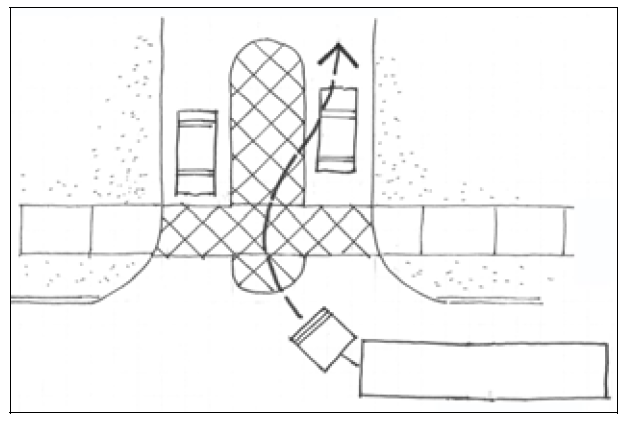
Entrances should have defined narrower car entrance, while allowing for tanker truck turning. See the diagram below:
f.
Landscaping required in accordance with Bryan Code of Ordinances, chapter 62, land and site development, should be installed between any structures and adjoining street right-of-way.
(6)
Signs.
a.
Notwithstanding the requirements of Bryan Code of Ordinances, chapter 98, signs, the following standards should apply:
1.
When multiple tenants share one site, signs should be integrated as one unit to create shared identity for the property to the extent permitted by the ordinance or be located and/or designed as a package where signs do not visually compete with each other.
2.
Advertising located outside and on windows shall count towards the total allowed signage on site.
3.
One freestanding monument sign is permitted for corporate identification with a maximum sign area of 40 square feet and an eight feet height limit. Pricing signs should be incorporated into such monument sign, the area of which shall not count against the maximum allowable freestanding sign area. Motor fuel retail establishments located on a corner parcel shall locate the monument sign at the intersection for visibility from both abutting street rights-of-way. Freestanding monument sign shall be constructed with the same brick or masonry that is located on the principal structure.
(7)
Lighting.
a.
The fascia of the canopy should extend below the lens of the fixture at a minimum of ten inches to block the direct view of the light sources and lenses from the property line.
b.
Lights should not be mounted on the top or fascia of the canopy.
c.
All light fixtures shall be a full cut-off design, recessed, shielded or aimed downward and away from the property line so that the light source is not directly visible from the property line.
(u)
Recreational vehicle (RV) park.
(1)
Purpose and key objectives.
a.
The purpose of these special and supplementary regulations for RV park establishments is to mandate a higher level of design, increase the quality of RV parks in Bryan, and ensure safety of the general public.
(2)
Location.
a.
RV parks shall be located on a lot with a minimum area of ten acres.
(3)
Restrictions.
a.
RV parks shall allow for the temporary occupancy of vehicles that are built on a single chassis that are designed to be self-propelled or permanently towable by an automobile or light duty truck and are primarily for use as temporary living quarters for recreational, travel, or seasonal use.
b.
No person shall operate an RV park unless they hold valid permits and licenses as required by the State of Texas and the Brazos County Health Department.
c.
RV parks shall permit only placement and habitation of recreational vehicles. No recreational vehicle shall remain in an RV park or RV parks located within Bryan for more than a total of 90 days in any 12-month period.
(4)
Site standards.
a.
There shall be a 25-foot wide no development buffer from all property lines.
b.
A minimum of six-foot tall screening fence shall be provided for adjacent properties. A minimum three-foot tall screening device, either being landscaping or masonry wall, shall be provided along lot lines adjacent to public right-of-way.
c.
All RV parks shall designate specific pad site locations for recreational vehicles.
1.
Each pad site location shall have a minimum area of 1,500 square feet with provisions for wastewater disposal, public water hook-up and electrical supply.
2.
All pad sites shall be sequentially numbered. Reflective site numbers shall be a minimum of four inches in height and placed on a separate post on the site. A map of the site layout with site numbers shall be placed at the entrance to the park in such a manner as to be clearly visible to entrants.
3.
Recreational vehicle pads shall be separated from each other by a minimum of ten feet.
4.
Recreational vehicle pads shall be separated from the recreation area in the park by a minimum of 15 feet
5.
RV pad sites shall be setback a minimum of ten feet from any internal drives in the park.
6.
All recreational vehicle pad sites shall be setback a minimum of 50 feet from the right-of-way line of all adjacent public roads and any RV park boundaries.
7.
A minimum of one and one half parking spaces independent of the space provided for the RV itself shall be provided per recreational vehicle pad site. One space shall be located on the RV site, the remainder may be located in an approved parking area.
e.
A recreation area shall be provided and centrally located on site. Recreation areas shall constitute a minimum of 15 percent of the gross RV park site. Recreational areas shall also contain benches and landscaping. The area shall be adequately lighted to ensure safety of users.
f.
Internal drives shall have a minimum paved width of 12 feet for one-way traffic and 24 feet for two-way traffic. All internal drives shall be built to city pavement standards and shall be privately maintained.
g.
Each RV park shall have restroom, shower, and laundry facilities. All facilities used by the patrons of the park must be well lit inside and out during all hours.
(v)
Battery energy storage systems (BESS). The purpose of these special and supplementary regulations is to guide the development of BESS facilities by ensuring the proper precautions are considered in order to maintain the safety and welfare of the public. The following factors shall be considered when determining whether to grant a conditional use permit for BESS:
(1)
Lot size requirements. BESS shall be located on a lot with a minimum area of one acre.
(2)
Additional setback requirements. For any property that is occupied by a BESS, all front, side, and rear setbacks shall be a minimum of 50 feet.
(3)
Perimeter fencing required. All BESS shall be enclosed by a minimum six-foot tall security fence, and must be equipped with an appropriate anticlimbing device.
(4)
Landscape and screening. BESS facilities shall be landscaped with plant materials that effectively screen the developed site from view of the public right-of-way. Screening shall consist of a landscaped strip at least four feet wide outside the perimeter of the facility. It is the responsibility of the BESS owner to maintain any required landscaping.
(5)
Separation requirements.
a.
A BESS shall not be located on a property that is within 500 feet from any other property in which a BESS is located.
b.
A BESS shall not be located on a property that is within 1,000 feet from any residential zoning district or detached residential dwelling.
(6)
Decommissioning plan. Any application for a BESS shall be required to include a decommissioning plan to describe the procedure for dismantling and removing the BESS from service. The decommissioning plan shall include:
a.
The anticipated life of the BESS;
b.
A description of procedures that will be taken to remove all equipment, components, and structures of the BESS, including a plan for disposal of all solid and hazardous waste, and a description of how the site will be restored to its original condition;
c.
A decommissioning cost assessment describing the estimated total cost of decommission and all required expenses; and
d.
A projected timeline for decommissioning the BESS.
(7)
Penalty. In addition to the penalties and other relief provided in this Code, any violation of this article, and any failure to comply with the decommissioning plan upon the closing of the facility or the cessation of consistent operation for more than one year, is an offense and is hereby declared to be a nuisance and may be abated as provided in chapter 50, article IV of this Code.
(w)
Self-Storage (indoor and outdoor).
(1)
Lighting. The following standards shall apply to all outdoor lighting for both indoor and outdoor self-storage uses, except public streetlights to assure public safety, utility and security of private and public property.
a.
Outdoor lighting shall not exceed the following levels:
1.
0.50 lumens at the property line if the subject property abuts a residential district or a lot containing a residential use; or
2.
1.0 lumens at the property line if the subject property abuts a nonresidential district or lot containing a nonresidential use or at the right-of-way line.
b.
Outdoor lighting shall not exceed the following heights:
1.
Light fixtures in parking lots shall not exceed a maximum height of 24 feet; and
2.
All outdoor lighting shall be shielded and provided with cutoff fixtures that are designed to have a cutoff angle of no more than 90 degrees.
(2)
Self-storage (indoor) regulations. The following standards and regulations shall apply to any indoor self-storage facility development.
a.
Design standards.
1.
The exterior walls of any structure that are visible from the right-of-way should be, at minimum, 60 percent natural stone or brick. Doors, windows, and signage are not included in this calculation.
2.
Glass shall not be allowed for more than 25 percent of any exterior wall.
b.
Each facade shall have a maximum of one loading dock.
(3)
Self-storage (outdoor) regulations. The following standards and regulations shall apply to any outdoor self-storage facility development.
a.
No facility shall be constructed to where the primary entrance of any individual unit directly faces a public right-of-way.
b.
Throat Depth. For any facility with gated access, the throat depth for the gated entryway shall be a minimum of 60 feet. Additional maneuvering space must be provided to allow motorists who are denied access to turn around, as vehicles will not be allowed to back directly onto the street.
1.
The Planning and Zoning Commission may authorize a variance from this regulation when, in its opinion, undue hardship will result from requiring strict compliance. The commission may only grant a variance if it makes written findings that:
i.
The requirement does not allow for reasonable use of the property;
ii.
The hardship for which the variance is requested is owing to a special condition inherent in the property itself, such as a restricted area, shape, topography, or physical features;
iii.
The special condition is unique to this property and is not generally characteristic of other parcels of land in the area; and
iv.
Development under the variance does not impair the use or character of the surrounding properties, and does not impair the purposes of the regulations of the zoning ordinance.
c.
Fencing. A minimum six-foot tall fence shall be required along any shared lot line with abutting properties.
d.
Roofs. All structures that are used or intended for use as a self-storage (outdoor) unit must be constructed with a roof that meets the following criteria:
1.
Each roof must be designed to closely match or complement the primary building in form, pitch, and materials, ensuring a cohesive and consistent aesthetic across the facility.
2.
The roof must be designed and maintained to prevent water infiltration, ensuring that no water enters the interior of the structure. Roofs may be equipped with water management systems to effectively drain precipitation.
3.
Each roof must have a minimum roof pitch of 1:12 to ensure adequate water runoff and aesthetic consistency.
(Ord. No. 2110, § 3, 8-25-2015; Ord. No. 2167, § 4, 9-13-2016; Ord. No. 2259, § 4, 2-13-2018; Ord. No. 2266, § 3, 3-27-2018; Ord. No. 2338, §§ 12, 15, 4-9-2019; Ord. No. 2343, § 2, 4-9-2019; Ord. No. 2451, § 4, 9-8-2020; Ord. No. 2463, § 2, 12-8-2020; Ord. No. 2501, § 15, 8-10-2021; Ord. No. 2586, §§ 8, 9, 10-11-2022; Ord. No. 2654, § 5, 11-14-2023; Ord. No. 2655, § 3, 11-14-2023; Ord. No. 2699, § 2, 7-9-2024; Ord. No. 2739, § 2, 4-8-2025)
Sec. 130-35. - Wireless telecommunication facilities.
(a)
Definitions. In interpreting and administering the wireless telecommunication facility regulations of this zoning ordinance and the land and site development ordinance (chapter 62), the following words, terms and phrases, shall have the meanings ascribed to them in this section, except where the context clearly indicates a different meaning:
Alteration shall mean any modification, replacement, or reconstruction that materially increases the height or any other dimension of a WTF.
Antenna shall mean any system of poles, panels, rods, reflecting discs or similar devices used for the transmission or reception of radio frequency signals:
Omni-directional antenna (also known as a "whip" antenna) transmits and receives radio frequency signals in a 360 degree radial pattern.
Directional antenna (also known as a "panel" antenna) transmits and receives radio frequency signals in a specific directional pattern of less than 360 degrees.
Parabolic antenna (also known as a "dish" antenna or satellite dish) is a bowl-shaped device for the reception and/or transmission of radio frequency signals in a specific directional pattern.
Attached wireless telecommunication facility shall mean a wireless telecommunication facility that is affixed to an existing structure that is not primarily used for the support or attachment of a wireless telecommunication facility and is not a normal component of such a facility.
Collocation shall mean when more than one wireless telecommunications provider shares a wireless telecommunications support structure.
Compound shall mean the fenced WTF area which may be a portion of a parcel or site, or the entire parcel or site.
Direct-to-home services shall mean the distribution or broadcasting or programming or services by satellite directly to the subscriber's premises without use of ground receiving or distribution equipment, except at the subscriber's premises or in the uplink process to the satellite; examples are direct broadcast satellites (DBS), multichannel multipoint distribution system (MMDS), and television broadcast stations (TVBS).
Existing support structure shall mean any structure existing prior to the adoption of the ordinance from which this section is derived that currently supports or can support a wireless telecommunication facility.
FAA shall mean Federal Aviation Administration.
FCC shall mean Federal Communications Commission.
Height shall mean the distance measured from ground level at the base of a wireless telecommunication facility to the highest point on the facility including any antenna or related equipment.
Historic resource shall mean any district, structure or site designated as historically significant by any lawfully authorized local, state or federal historic preservation entity or governmental entity, including the city.
Intermediate facility see section 130-35(b)(1)b.
Major facility see section 130-35(b)(1)c.
Minor facility see section 130-35(b)(1)a.
Related equipment shall mean all equipment or structures ancillary to the transmission and reception of voice and data via radio frequencies; such equipment or structures may include, but are not limited to, cable, conduit and connectors, cabinets, and fencing.
Service provider shall mean any company, corporation, alliance, individual or other legal entity that provides a wireless telecommunication service directly to the public for a fee or to such classes of users as to be effectively available directly to the public regardless of the facilities used; services include, but are not limited to portable phones, car phones, pagers, digital data transmission, or radio or television communications.
Stealth technology or stealth facility means any wireless telecommunications facility that is integrated as an architectural feature of an existing building to which it will be affixed; or any wireless telecommunications facility that is camouflaged or concealed; so that (1) the presence of the base station and tower (if any) is virtually invisible to the casual observer; or (2) the wireless telecommunications facility is camouflaged, through stealth design, so as to blend in with its surroundings to such an extent that it is not identifiable by the casual observer as a wireless telecommunications facility. Examples of stealth facilities include wireless telecommunications facilities which are disguised to resemble public art or markers such as: flagpoles, indigenous trees, rocks, signage, street lights, information kiosks, or bus stop shelters. To qualify as "stealth" design, the item in question must match the type of item that it is mimicking in size, scale, shape, dimensions, color, materials, function and other attributes as closely as possible, and be placed in a manner and at a location appropriate to the item that it is mimicking. The elements that make a facility a stealth facility are concealment elements.
Support structure shall mean any structure that supports a wireless telecommunication facility; support structure types include, but are not limited to, any existing or newly constructed structure such as buildings, water towers, light poles, stanchions, monopoles, lattice towers, wood poles or guyed towers.
Transmission tower shall mean a wireless telecommunications support structure designed primarily for the support and attachment of a wireless telecommunications facility. Transmission towers include:
Monopole tower. A self-supporting structure composed of a single spire used to support telecommunications antenna and/or related equipment.
Lattice tower. A self-supporting three- or four-sided, open, steel frame structure used to support telecommunications antenna and/or related equipment.
Guyed tower. An open, steel frame that requires wires and anchor bolts for support.
Wireless telecommunications facility (WTF) shall mean an unstaffed facility operating for the transmission and reception of low-power radio signals consisting of an equipment shelter or cabinet, a support structure, antennas (e.g., omni-directional, panel/directional, or parabolic) and related equipment.
(b)
Zoning for WTFs.
(1)
WTF use categories. Wireless telecommunication facilities are allowed and encouraged to locate in the city. In order to expedite the siting process for WTFs and to accommodate the various regulations for handling these facilities according to the FCC, the planning and development services department has determined three general use categories for WTFs. The use categories are minor facility, intermediate facility, and major facility as follows:
a.
Minor facility.
1.
A new transmission tower 35 feet (or 10.5 meters) or less in height;
2.
Parabolic antenna one meter or less;
3.
Parabolic antenna over one meter and less than or equal to two meters;
4.
Omni-directional antenna (whip antenna) six inches in diameter or less and not extending over 12 inches above support structure;
5.
Directional antenna one meter or less measured across the longest dimension and not extending over 12 inches above support structure;
6.
Direct-to-home service antenna and citizen's radio band antenna;
7.
Stealth facility 35 feet (or 10.5 meters) or less in height.
b.
Intermediate facility.
1.
A new transmission tower greater than 35 feet (10.5 meters) and less than or equal to 110 feet (33 meters) in height;
2.
Parabolic antenna over two meters;
3.
Omni-directional antenna (whip antenna) greater than six inches in diameter and/or extending 12 inches above the support structure;
4.
Directional antenna over one meter measured across the longest dimension and extending over 12 inches above support structure;
5.
Stealth facility greater than 35 feet (10.5 meters) and less than or equal to 110 feet (33 meters) in height.
c.
Major facility.
1.
A new transmission tower greater than 110 feet (33 meters) in height;
2.
Stealth facility greater than 110 feet (33 meters) in height.
(2)
Wireless telecommunications facilities siting matrix. Wireless telecommunication facilities are allowed, as indicated in the following table:
CO = Villa Maria corridor;
HP/D = Downtown historic district;
HP/E = Eastside historic district;
MT-C = Midtown - corridor district;
MT-HD = Midtown - high density district; and
IC = Innovation corridor.
(3)
Height and site development regulations. See article IX of chapter 62 for additional regulations that apply to wireless telecommunications facilities.
(c)
Conditional use permits. Some minor transmission towers and all intermediate and major transmission towers require a conditional use permit (CUP) from the planning and zoning commission. The Planning and zoning commission may place additional conditions on the site where it deems necessary to do so to protect the health, safety and general welfare of the public. The criteria in section 130-33 will govern the issuance of conditional use permits for WTFs. In addition to the standard criteria the following additional factors shall be considered when determining whether to grant a conditional use permit for WTFs:
(1)
Height of the proposed tower, surrounding topography and surrounding tree coverage and foliage as they relate to:
a.
Skyline impact, examining whether the proportions of the structure appear to "loom" over or blend in with the surrounding environment; and
b.
Shadow impact, whether or not the proposed tower will cast shadows that would prevent the reasonable use or enjoyment of surrounding properties.
(2)
Design of the tower, with particular reference to design characteristics that have the effect of reducing or eliminating visual obtrusiveness.
(3)
Proximity of the tower to residential structures and residential district/boundaries.
(4)
Economic impact on adjacent and nearby properties.
(5)
Proposed ingress and egress.
(6)
Availability of suitable alternative, existing support structures.
(Ord. No. 2110, § 3, 8-25-2015; Ord. No. 2338, § 13, 4-9-2019; Ord. No. 2380, § 3, 10-8-2019; Ord. No. 2501, § 16, 8-10-2021; Ord. No. 2586, § 10, 10-11-2022)
Sec. 130-36. - Manufactured housing land lease communities.
(a)
Permits for new manufactured housing land lease communities. Manufactured housing land lease communities created on or after January 1, 2000, shall be required to be licensed in accordance with the standards in this chapter. It shall be unlawful for any person to connect utilities to or to occupy a manufactured home in a new manufactured home in a new manufactured housing land lease community within the city limits unless the community is duly licensed under the terms of this chapter. Licenses shall be issued and renewed annually by the city building services department. Application for a license shall be made in writing, signed by the applicant, and accompanied by an affidavit of the applicant as to the truth of the application. Applications shall include the name and address of the applicant, the location and legal description of the community, and a master plan of the community. Additionally, a deposit fee, based on the proposed number of lease lots within the community, will be required at time of application. The chief building official or his or her agent shall renew licenses annually following a satisfactory inspection of the property for compliance with this chapter. Whenever, upon inspection of the property, the chief building official finds conditions or practices which are in violation of this chapter, written notice shall be given to the license holder. The notification shall state that such conditions or practices must be corrected within a specified period of time, based on the nature and severity of the violation. At the end of the specified time, the chief building official shall re-inspect the property for compliance. Failure to correct the conditions or practices within the specified time shall result in a suspension of the license. The license holder will be issued written notice of the suspension. Upon receipt of the notice of suspension, such person shall cease operation of the manufactured housing land lease community. A manufactured housing land lease community, which does not conform to the regulations of the zoning district in which it is located, shall be deemed a nonconforming use and subject to section 130-40. A lapse of a current license shall be considered as an abandonment of the nonconforming status.
(b)
Inspections of manufactured housing land lease communities. The chief building official or his or her agent is hereby authorized to make such inspections as are necessary to determine satisfactory compliance with this chapter. The chief building official or his or her agent shall have the authority to enter upon any private or public property for the purpose of inspecting and investigating conditions relating to the enforcement of this chapter. It shall be the duty of the land lease community management to give access to the inspector to all lots during normal business hours.
(c)
Zoning for manufactured housing land lease communities. New development of a manufactured housing land lease community shall require a conditional use permit (CUP) from the planning and zoning commission. The planning and zoning commission may place additional conditions on the site where it deems necessary to do so to protect the health, safety and general welfare of the public and where such conditions will promote and uphold the city comprehensive plan. The planning and zoning commission may also take into consideration the proposed location of the manufactured housing land lease community in relation to present and anticipated future land use. The regulations of section 130-33 govern the issuance of conditional use permits in the following zoning districts:
(1)
A-O, agricultural-open district; and
(2)
MF, multiple-family district.
(d)
Development standards for manufactured housing land lease communities.
(1)
Housing type standards. To ensure the protection of the health, safety, and general welfare of the public, only HUD Code manufactured homes, as defined by this chapter, shall be permitted to locate within manufactured housing land lease communities. Mobile homes and recreational vehicles, as defined by this chapter, shall not be permitted within a manufactured housing land lease community.
(2)
Skirting requirements. To ensure the protection of the health, safety, and general welfare of the public, all manufactured homes shall have skirting permanently installed and extending to the ground. Skirting material to be a durable, exterior material consistent with the exterior cladding of the home. All tow bars, wheels and axles shall be removed when the manufactured home is installed.
(3)
Foundation requirements. To ensure the protection of the health, safety, and general welfare of the public, all manufactured homes within manufactured housing land lease communities shall be installed on a "properly engineered foundation system" which meets the manufacturer's installation requirements and the Texas Manufactured Housing Standards Act (V.T.C.A., Occupations Code ch. 1201).
(4)
Maximum density standards. To provide adequate privacy and to ensure the protection of the health, safety, and general welfare of the public, the density of any manufactured housing land lease community shall be no greater than 8 units per acre.
(5)
Front setback requirements. A setback area facing and abutting a street and/or sidewalk and extending across the front of a lot between the side lot lines and having a minimum horizontal depth of ten feet. The setback shall be measured from the inside edge of the adjacent pavement, to the face of the manufactured home.
(6)
Rear setback requirements. A setback area located on a lot extending across the rear of the lot between the side lot lines and having a minimum horizontal depth of ten feet. The setback is measured from the rear lot line to the face of the manufactured home.
(7)
Building separation requirements. To provide adequate privacy and to ensure the protection of the health, safety, and general welfare of the public, separation between manufactured homes shall be a minimum of 20 feet. Separation between manufactured homes shall be measured from the face of each structure. Separation between manufactured homes and accessory structures or between accessory structures (i.e., storage buildings, detached carports or garages) shall be a minimum of ten feet, and shall be measured from the structure's eaves.
(8)
Parkland requirements. All residential subdivisions in the city limits of the city shall be required to provide for the parkland needs of future residents in accordance with section 110-60 of the subdivision ordinance.
(9)
Common open area requirements. To provide adequate recreational area for the residents of a manufactured housing land lease community, the following standards shall apply:
a.
For communities with fewer than 20 lease lots, no minimum open recreational area will be required.
b.
For communities with greater than 20 lease lots, a minimum of 250 square feet per lease lot will be required to be dedicated, improved and maintained for the recreational use of the residents of the community. The area dedicated for common open areas shall not include the yard space of individual lease lots, street rights-of-way, required buffer areas or parking areas. The common open areas required shall be disbursed throughout the community to provide safe and easy access to all residents. No common open area shall be further than 500 feet from any dwelling unit within the community.
(10)
Screening requirements. To conserve and protect the privacy and value of adjacent properties, a screening fence is required for all manufactured housing land lease communities. Screening fences must comply with the regulations of section 130-37.
(11)
Buffer area requirements. To conserve and protect the privacy and value of adjacent properties, buffer areas shall be required for all manufactured housing land lease communities. The regulations of section 130-32 govern the depth of side and rear buffer setbacks. In addition, a minimum 50-foot landscaped buffer area shall be provided along main entrances to the community from public rights-of-way. These buffer areas shall be landscaped in accordance with all other applicable sections and/or ordinances.
(12)
Landscaping requirements. Landscaping requirements for entry areas, common recreational areas, and buffer areas shall be the same as required for commercial developments in the city. The criteria set forth in all other applicable sections and/or ordinances will govern the standards for landscaping. In addition to these requirements, the land lease community shall be required to provide and maintain a minimum of one canopy tree (at minimum two-inch caliper size), either existing or new, for each individual lease lot.
(13)
Public street requirements. Public streets within manufactured housing land lease communities shall be designed and constructed in accordance with the subdivision ordinance (chapter 110).
(14)
Private street requirements. Private streets within a manufactured housing land lease community shall have a minimum width of 20 feet, and constructed of concrete or asphalt. Design of private streets shall be reviewed and approved by engineering services. Block length between intersections of through streets shall not exceed 1,200 feet. Private streets shall be named and numbered in accordance with city addressing standards for emergency vehicle access.
(15)
Public walkway requirements. Public walkways shall be installed by the developer to provide access from each lease lot to all public amenities within the manufactured housing land lease communities, including but not limited to, visitor parking, community buildings, common open areas, etc. Public walkways shall be constructed of all-weather materials, and meet all applicable handicap accessibility guidelines. Public walkways must be physically separated from streets.
(16)
Parking requirements. The following standards apply to parking required for individual lease lots as well as separate spaces designated for visitor parking. No on-street parking shall be allowed within manufactured housing land lease communities.
a.
Residential parking. To provide adequate residential parking, each lease lot shall accommodate the following:
1.
Single wide lots. A minimum of two vehicles on a paved surface by providing one of the following options:
(i)
A two car carport or garage;
(ii)
A driveway measuring 12 feet wide by 37 feet deep; or
(iii)
A driveway measuring 18 feet wide by 18 feet, 6 inches deep. Driveway dimensions shall be measured from the interior edge of paving or sidewalk.
2.
Double wide lots. A minimum of 3 vehicles on a paved surface by providing one of the following options:
(i)
A three-car carport or garage,
(ii)
A driveway measuring 12 feet wide by 55 feet, six inches deep, or
(iii)
A driveway measuring 27 feet wide by 18 feet, six inches deep. Driveway dimensions shall be measured from the interior edge of paving or sidewalk.
b.
Visitor parking requirements. To provide adequate visitor parking, a minimum of one parking space per four lease lots shall be provided in common parking areas. The parking and circulation regulations of 63-28 govern the design and standards for common parking areas.
(17)
Storage requirements. To provide adequate and safe storage of personal items, a storage building providing a minimum of 80 square feet of storage shall be provided on each lease lot. Storage buildings shall be of uniform and consistent design among all lease lots, and are to be placed on the lot in such a manner to assure adequate separation between structures. No storage is to be permitted underneath the manufactured home.
(18)
Floodplain requirements. To provide adequate protection against flooding, all manufactured land lease communities shall be in compliance with Chapter 46.
(19)
Fire protection. The manufactured housing land lease communities shall be subject to the rules and ordinances of the city fire prevention authority and codes.
(20)
Water supply. Individual water riser pipes shall be so located on each lease lot so that the water connection to the manufactured home will approximate a vertical position. Water connections shall include a cut-off valve before the line enters the home.
(21)
Sanitary sewer requirements. All sewer lines shall be located in trenches of sufficient depth to be free of breakage and be separated from the water supply system by a safe distance in accordance with the city plumbing code. Sewers shall be at a grade that will ensure a velocity of two feet per second when flowing full. All sewer lines shall be constructed of materials in accordance with the city plumbing code, have watertight joints, and shall be adequately vented. Each manufactured home shall be provided with at least a four-inch diameter sewer riser pipe. The sewer riser pipe shall be so located on each lease lot so that the sewer connection to the manufactured home drain outlet will approximate a vertical position. The sewer connection shall have a nominal inside diameter of at least 3 inches, and the slope of any portion thereof shall be at least one-quarter inch per foot. The sewer connections shall consist of one pipeline only without any branch fittings. All materials used for sewer connections shall be semi-rigid, corrosive resistant, nonabsorbent and durable. Provisions shall be made for plugging the sewer riser pipe when a manufactured home does not occupy the lease lot. Surface drainage shall be diverted away from riser. The rim of the riser pipe shall extend at least two inches above the ground elevation.
(22)
Electrical requirements. The power supply to a manufactured housing land lease community shall be installed and maintained in accordance with the city electrical code and BTU service entrance requirements. All manufactured housing land lease communities and every manufactured home within shall contain an electrical wiring system consisting of wiring, fixtures, equipment, and appurtenances which shall be installed and maintained in accordance with the current edition of the national electrical code governing such systems. The city electrical inspector shall make inspection of the service connections to the manufactured home.
(Ord. No. 2110, § 3, 8-25-2015; Ord. No. 2338, § 14, 4-9-2019)
Sec. 130-37. - Screening fence standards.
(a)
Purpose. To encourage the most appropriate use of land and conserve and protect the privacy and value of adjacent permitted uses. Regulations are prescribed for the location and type of various screening devices to be used when required in the various zoning districts or in this section in accordance with the following standards. Screening regulations are required only when a full site plan review is required (see nonresidential and multifamily development in article III of chapter 62).
(b)
Location of required screening.
(1)
When it is determined that a zoning district sides or backs upon a noncompatible zoning district, a solid screening wall or fence shall be erected along the property line, and within the property with the higher intensity zoning district. The screening requirements shall be observed at the time of rezoning and/or construction, or upon a change in use of the property where the screening shall be imposed. The purpose for the screening is to provide a visual barrier between the properties. The owner of such property shall be responsible for and shall build the required wall or fence. All wall or fence openings shall be equipped with gates equal in height and screening characteristics to the wall or fence. Screening standards shall be in accordance with the following:
a.
Screening required in the I, industrial district when siding or backing on to C-2, retail, C-1, office, MU-2, mixed use and all residential districts;
b.
Screening required in the C-3, commercial district when siding or backing on to C-1, office district and all residential districts;
c.
Screening required in the C-2, retail and C-1, office districts when siding or backing on to all residential districts;
d.
Screening required in the MF, multiple-family district when siding or backing on to all other residential districts;
e.
Screening required in all nonresidential districts when adjacent to a single-family residence located within an A-O, agricultural-open district and no farther than 100 feet from the nonresidential district boundary;
f.
Screening required in all nonresidential developed tracts of land within or adjacent to an existing single-family residential development.
(2)
In any district where loading areas are visible from a public street, screening shall be provided adjacent to the loading area along the street, allowing for required landscaping. These standards shall be imposed except where such use was in existence at the date of the original adoption of the zoning ordinance (December 11, 1989).
(3)
Where permitted, outdoor storage must be screened when visible from any public right-of-way, allowing for required landscaping. An outdoor storage permit may be granted by the site development review committee for any exceptions to screening and/or landscaping requirements. A person who violates any section of this chapter is guilty of a misdemeanor and upon conviction is punishable by a fine not exceeding $2,000.00 per occurrence in accordance with general penalty provisions of City Code section 1-14.
(4)
Dumpsters, not including containers 300 gallons or smaller, shall be placed on concrete dumpster pads six inches in thickness, 15 feet in width and 12 feet in depth. The pad shall be screened with a six-foot fence on three sides with the fourth side remaining open for access or being fitted with a gate matching the screening on the other three sides.
(5)
Where screening is required, the following standards shall be observed:
a.
Materials approved for use in screening fences are solid wood (not including plywood, particleboard, or similar composite), masonry (brick or stone), or a combination solid wood and masonry. Corrugated metal or fiberglass panels shall not be used as fence materials. Screening shall be provided that completely blocks the view of materials, commodities, or equipment stored. All screening materials shall be finished on the sides facing public rights-of-way. Other types of screening devices may be approved by the planning and zoning commission.
b.
Landscaping may be used for screening if the plant materials used are a minimum of four feet tall at the time they are planted. Any plant materials used for screening purposes shall be of an evergreen nature and shall be of sufficient height and type to completely block the view of materials, commodities or equipment stored from adjacent public rights-of-way or property. Any time that plant materials are used for screening purposes, the developer shall post a cash bond to be held in escrow by the city to cover replacement of plant materials. The amount of such bond shall be determined by the city planner or his or her designee. The bond shall be effective for two growing seasons from the time of the initial planting; any excess funds remaining from such bond shall be returned at the end of such period to the developer.
c.
When screening is required to separate all other residential districts from either the MF, multiple-family or a nonresidential district, or when screening is required to separate nonresidential development from single-family residential development, any fence or wall shall be not less than six feet or exceed eight feet in height above the grade of the adjacent property.
d.
Along the property line between nonresidential districts, or on property adjacent to loading areas, outdoor storage and refuse areas, where screening is required, a minimum six-foot high uniform screening shall be provided.
(6)
In any residential district, the maximum height of any fence or wall in a required front setback of a single-family, townhouse, duplex, or patio home lot, shall be as provided:
a.
Fencing, screening walls or the combination of berms and fences or screening walls shall not exceed 36 inches in height when placed a distance of 25 feet or less from the adjacent paved street surface.
b.
Fencing, screening walls or the combination of berms and fences or screening walls shall not exceed six feet in height when placed a distance of more than 25 feet from the adjacent paved street surface.
(7)
Where a fence is erected to the rear of the minimum required front setback line, the fence shall not exceed eight feet in height above the grade of the adjacent property.
(8)
A wall or fence, not less than 54 inches in height, with a self-latching gate at all entrances, shall enclose a swimming pool area or surrounding yard area.
(c)
Maintenance of screening fences. Any screening fence erected under the provisions of section 130-37 shall be maintained by replacing or repairing any dead, loose, damaged, or missing fencing materials within 30 days after notification by the zoning official.
(Ord. No. 2110, § 3, 8-25-2015)
Sec. 130-38. - Platting property not permanently zoned.
(a)
The planning and zoning commission of the city shall not approve any plat of any subdivision within the city limits of the city until the area covered by the proposed plat shall have been permanently zoned by the city council of the city. A plat may be approved on land with the agricultural-open district designation if the proposed use of the property is determined to be the permanent use of the property.
(b)
The planning and zoning commission of the city shall not approve any plat or any subdivision within any area where a petition or ordinance for annexation or a recommendation for annexation to the city is pending before the city council unless and until such annexation shall have been approved by ordinance by the city council.
(c)
In the event the city council cannot schedule a public hearing on a proposed annexation, the planning and zoning commission, at its discretion, may hold a public hearing on the permanent zoning that is to be given to the area or tract to be annexed. The planning and zoning commission may make a recommendation on both the annexation and zoning to the city council so that the city council can, if it desires, act on the annexation with input from the planning and zoning commission regarding appropriate zoning. Zoning may not be placed on any property until the annexation ordinance has officially been adopted.
(d)
See chapter 110 for platting requirements within the city's ETJ.
(Ord. No. 2110, § 3, 8-25-2015)
Sec. 130-39. - Classification of new and unlisted uses.
It is recognized that new types of land use will develop and forms of land use not presently anticipated may seek to locate in the city. These may not be specified as a permitted use in any zoning district. In order to provide for such changes and contingencies, a determination as to the appropriate classification of any new or unlisted form of land use shall be made as follows:
(1)
The planning and development services department shall refer the question concerning any new or unlisted use to the planning and zoning commission requesting an interpretation as to the zoning classification into which such use should be placed. The referral of the use interpretation question shall be accompanied by a statement of facts listing the nature of the use and whether it involves dwelling activity, sales, processing, type of product, storage, anticipated employment, and transportation requirements likely to be generated and the general requirements for public utilities such as water and sanitary sewer.
(2)
The planning and zoning commission shall consider the nature and described performance of the proposed use and its compatibility with the uses permitted in the various districts and determine the zoning district or districts within which such use is most similar and should be permitted.
(3)
The planning and zoning commission shall forward its findings and recommendations to the city council as to the classification proposed for any new or unlisted use. The city council shall by resolution approve the recommendation of the planning and zoning commission or make such determination concerning the classification of such use as is determined appropriate based upon its findings. After such resolution, if a zoning change is required, the process specified in section 130-42 shall be followed.
(4)
Standards for new and unlisted uses may be interpreted as those of a similar use. When determination of the minimum requirements cannot be readily ascertained, the same process outlined in section 130-39(a), section 130-39(b) and section 130-39(c) shall be followed for determination of the new standards.
(Ord. No. 2110, § 3, 8-25-2015)
Sec. 130-40. - Nonconforming uses and structures.
(a)
Intent of provisions.
(1)
Within the districts established by this chapter or amendments thereto, there exist lots, structures, uses of land and structures, and characteristics of use which were lawful before this chapter was enacted, amended or otherwise made applicable to such lots, structures or uses, but which do not now conform to the regulations of the district in which it is located. It is the intent of this chapter to permit such nonconforming uses and structures to continue, under regulations herein contained, until the same are removed.
(2)
It is further the intent of this chapter that nonconforming uses shall not be enlarged upon, expanded or extended, and not be used as grounds for adding other structures or uses prohibited elsewhere in the same district except for any existing or approved municipal services support facilities.
(3)
Nonconforming uses are hereby declared to be incompatible with the permitted uses in the districts involved.
(b)
Nonconforming status. Any use or structure which does not conform with the regulations of the zoning district in which it is located shall be deemed a nonconforming use or structure when:
(1)
Such use or structure was in existence and lawfully operating at the time of the passage of the ordinance on February 12, 1990, and has since been in regular and continuous use;
(2)
Such use or structure is a lawful use at the time of the adoption of any amendment to this chapter but by such amendment is placed in a district wherein such use is not otherwise permitted and has since been in regular and continuous use; or
(3)
Such use or structure was in existence at the time of annexation to the city and has since been in regular and continuous use.
(c)
Continuing lawful use of property and existence of structures.
(1)
The lawful use of land or lawful existence of structures at the time of the passage of this chapter, although such do not conform to the provisions hereof, may be continued; but if said nonconforming use or structure is discontinued or abandoned, any future use of said premises shall be in conformity with the provisions of this chapter unless conformity is not in the public interest as determined by the zoning board of adjustment.
(2)
A nonconforming use, when such nonconforming use of land or structure ceases to be used in such manner for a period of 12 months, shall not be resumed and proof of such event constitutes prima facie evidence of discontinuance or abandonment. Any nonconforming uses which do not involve a permanent type of structure or operation, including manufactured housing, and which are moved from the premises shall be considered to have been abandoned. Nonconforming uses which do involve a permanent type of structure or operation shall not be considered abandoned if one or more of the following conditions are met:
a.
The property has been advertised for sale or lease and actively marketed;
b.
The premises has been advertised for sale or lease and actively marketed;
c.
All licenses, permits, or certifications required for operation have been kept current since the effective date of the ordinance from which this chapter is derived.
(3)
No nonconforming use or structure may be expanded or increased beyond the lot or tract upon which such nonconforming use is located as of the effective date of the ordinance from which this chapter is derived except as provided in section 130-40. These provisions apply to any owner or subsequent owner of a nonconforming use as authorized herein.
(4)
Except as the result of a fire or natural disaster, in zoning districts where mobile homes or manufactured homes on individually platted lots outside of a manufactured home park are considered nonconforming structures or uses, the owner of such a home shall be allowed to remove the structure from its location and install a manufactured home on the same property in accordance with the following standards:
a.
The replacement home
1.
is not a mobile home but a manufactured home; and
2.
is newer than the home that is being replaced; and
3.
is at least as large in living space as the home that is being replaced; and
4.
meets applicable minimum building setback standards; and is proposed to be installed on a lot where no mobile or manufactured home was replaced previously.
b.
The owner of the mobile or manufactured home that is proposed to be replaced must provide sufficient proof so as to determine the requirements of Subsection 130-40(c)(4)a).
c.
Only one such replacement shall be allowed on an individually platted lot. No future home replacements shall be allowed.
d.
No more than 12 months shall lapse between the time of removal of an existing mobile or manufactured home and the date of the installation of a replacement home.
(5)
A mobile or manufactured home destroyed by fire or natural disaster may be replaced with a newer manufactured home that is at least as large in living space as the prior home.
(d)
Changing nonconforming uses.
(1)
Any nonconforming use may be changed to a conforming use, and once such change is made, the use shall not thereafter be changed back to a nonconforming use.
(2)
Where a conforming use is located in a nonconforming structure, the use may be changed to another conforming use by securing a certificate of occupancy from the chief building official.
(3)
A nonconforming use may be changed to another nonconforming use provided that adverse impacts (such as more traffic, noise, vibration, etc.) are not increased.
(e)
Extension of nonconforming uses. A nonconforming use may be expanded by the zoning board of adjustment in accordance with the following:
(1)
A nonconforming use located within a structure may be extended throughout the structure.
(2)
No structural alteration may be made on or in the building except those required by law to preserve such building in a structurally sound condition.
(3)
The number of dwelling units or rooms in a nonconforming residential use shall not be increased so as to exceed the number of dwelling units or rooms existing at the time said use became a nonconforming use.
(4)
No nonconforming use within a structure may be extended to occupy any land outside the structure.
(5)
No nonconforming use of land or structure shall be enlarged, increased, or extended to occupy a greater area of land than was occupied at the time the land became a nonconforming use, except to provide off-street loading or off-street parking space.
(f)
Restoration of nonconforming structure.
(1)
If a structure occupied by a nonconforming use is destroyed by fire, the elements, or other cause, it may not be rebuilt except to conform to the provisions of this chapter. In the case of partial destruction of a nonconforming use structure not exceeding 60 percent of its total appraised value as determined by the Brazos County Central Appraisal District, reconstruction will be permitted, but the existing square footage or function of the nonconforming use cannot be expanded.
(2)
If a structure is nonconforming but the use is conforming to the respective zoning district and the structure is completely destroyed, the structure shall be rebuilt to conform to the provisions of the zoning district wherein it is located.
(3)
A structure housing a nonconforming use may be remodeled as long as the size (square footage) of the structure is not increased.
(g)
Completion of structures. Nothing herein contained shall require any change in the plans, construction, or designated use of:
(1)
A building or structure for which a building permit has been issued or a site plan approved prior to the effective date of these zoning regulations; or
(2)
A building or structure for which a substantially complete application for a building permit was accepted by the chief building official on or before the effective date of these regulations;
(3)
provided, however that such building permit shall comply with all applicable ordinances of the city in effect on the date such application was filed and the building permit is issued within 120 days of the effective date of these regulations.
(h)
Licensed mobile home parks. Mobile home parks licensed according to chapter 74, prior to the adoption of the ordinance from which this chapter is derived shall be allowed to continue as long as the site area and number of units approved in said license is not exceeded. Lapse of said license shall be considered as abandonment of the nonconforming use.
(Ord. No. 2110, § 3, 8-25-2015; Ord. No. 2324, § 2, 2-12-2019)
Sec. 130-41. - Zoning board of adjustment.
(a)
Creation. There is created a board known as the zoning board of adjustment (ZBA) of the city.
(b)
Members and terms of office. The zoning board of adjustment shall consist of 5 regular members and 2 alternate members who shall be appointed by the city council in accordance with V.T.C.A., Local Government Code §§ 211.008—211.011, as amended, to serve for 2 years staggered terms or until their successors are duly appointed.
(c)
Appointment of members. The city council shall appoint members to the zoning board of adjustment as specified by the city council adopted policy on the board and commission appointments.
(d)
Authority. The zoning board of adjustment shall have the authority, subject to the standards established in V.T.C.A., Local Government Code §§ 211.001—211.011, and those established herein, to exercise the following powers and perform the following duties:
(1)
To hear and decide appeals where it is alleged there is error in any order, requirement, decision or determination made by an administrative official in the enforcement of this chapter.
(2)
To permit the reconstruction, extension, or enlargement of a building occupied by a nonconforming use or building, on the lot or tract occupied by such a building, in accordance with the standards in section 130-40, provided such activity does not prevent the return of such property to a conforming use.
(3)
To authorize in specific cases a variance from the requirements of the zoning ordinance, subject to limitation set forth in the ordinance, if the variance is not contrary to the public interest and, due to special conditions, a literal enforcement of the ordinance would result in unnecessary hardship, and so that the spirit of the ordinance is observed and substantial justice is done.
(e)
Limitations on authority of zoning board of adjustment.
(1)
The zoning board of adjustment may not grant a variance authorizing a use other than those permitted in the district for which the variance is sought.
(2)
The zoning board of adjustment shall have no power to grant or modify conditional use permits authorized under section 130-33.
(3)
The zoning board of adjustment shall have no power to grant a zoning amendment. In the event that a request for a zoning amendment is pending before the planning and zoning commission or the city council, the zoning board of adjustment shall neither hear nor grant any variances with respect to the subject property until final disposition of the zoning amendment.
(4)
The zoning board of adjustment shall not grant a request for any variance to any parcel of property or portion thereof upon which a site plan, preliminary plat, or final plat, where required, has not been finally acted upon by both the planning and zoning commission and, where required, by the city council.
(f)
Variances.
(1)
The zoning board of adjustment may grant a variance from a requirement of the zoning ordinance, if it makes written findings that:
a.
The requirement does not allow for a reasonable use of the property;
b.
The hardship for which the variance is requested is owing to a special condition inherent in the property itself, such as restricted area, shape, topography or physical features;
c.
The special condition is unique to this property and is not generally characteristic of other parcels of land in the area; and
d.
Development under the variance does not:
1.
Alter the character of the area adjacent to the property;
2.
Impair the use of adjacent property that is developed in compliance with the city requirements; or
3.
Impair the purposes of the regulations of the zoning district in which the property is located.
(2)
A variance may not be granted to relieve a self-created or personal hardship, nor for financial reasons only, nor may a variance be granted to permit any person a privilege in developing a parcel of land not permitted by this chapter to other parcels of land in districts with the same zoning classification.
(3)
The applicant bears the burden of proof in establishing the facts justifying a variance.
(g)
Procedures.
(1)
Application and fee. An application for action, by the zoning board of adjustment, other than an appeal, shall be in writing using forms provided by the city and shall be accompanied by a fee established by the city to cover administrative processing costs.
(2)
Notice and hearing. The zoning board of adjustment shall hold a public hearing on each application for action or appeal. This public hearing shall be held no later than the second scheduled meeting after the application is filed in accordance with the rules adopted by the zoning board of adjustment and the provisions of this chapter. Notice of a public hearing shall be provided to all property owners within 200 feet of the affected property ten days prior to the public hearing.
(3)
Appeals.
a.
An appeal may be taken from the decision of an administrative zoning official by an applicant for the permit on which the decision is rendered, by any person or persons aggrieved by the decision or by any officer, department, zoning board of adjustment or bureau of the municipality affected by the decision.
b.
The appellant must file with the zoning board of adjustment and the official from whom the appeal is taken a written notice of appeal specifying the grounds for the appeal within 15 days after the decision has been rendered as determined by the rules of the zoning board of adjustment. The officer from whom the appeal is taken shall forthwith transmit to the zoning board of adjustment all papers constituting the record of the action that is appealed.
c.
An appeal stays all proceedings in furtherance of the action that is appealed unless the official from whom the appeal is taken certifies in writing to the zoning board of adjustment facts supporting the official's opinion that a stay would cause imminent peril to life or property. In that case, the proceedings may be stayed only by a restraining order granted by the zoning board of adjustment or a court of record on application, after notice to the official, if due cause is shown.
d.
The appellant party may appear at the appeal hearing in person or by agent or attorney.
e.
The zoning board of adjustment shall decide the appeal within a reasonable time. The zoning board of adjustment may reverse or affirm, in whole or in part, or modify the administrative official's order, requirement, decision or determination from which an appeal is taken, and make the correct order, requirement, decision, or determination and for such purpose the zoning board of adjustment has the same authority as the official.
(4)
Vote required for zoning board of adjustment decisions. The concurring vote of four members of the zoning board of adjustment shall be necessary to reverse any order, requirement, decision, or determination of an administrative official, or to decide in favor of the applicant on any matter upon which it is required to pass under these zoning regulations, or to effect any variance to the zoning regulations granted by the zoning board of adjustment.
(5)
Judicial review. Any person or persons, jointly or severally, aggrieved by a decision of the zoning board of adjustment, or any taxpayer, or any officer, department, zoning board of adjustment, or bureau of the city may present to a district court, county court, or county court at law a petition, duly verified, setting forth that such decision is illegal, in whole or in part, specifying the grounds of the illegality. Such petition must be presented within ten days after the date the decision is filed in the zoning board of adjustment's office.
(Ord. No. 2110, § 3, 8-25-2015)
Sec. 130-42. - Changes and amendments to zoning ordinance, districts and administrative procedures.
(a)
Declaration of policy. The city declares the enactment of these regulations governing the use and development of land, buildings, and structures as a measure necessary to the orderly development of the community. Therefore, no change shall be made in these regulations or in the boundaries of the zoning districts except:
(1)
To correct any error in the regulations or map;
(2)
To recognize changed or changing conditions or circumstances in a particular locality or area;
(3)
To recognize changes in technology, the style of living, or manner of conducting business.
(b)
Authority to amend the zoning ordinance. The city council may from time-to-time, after receiving a final report thereon by the planning and zoning commission and after public hearings required by law, amend, supplement, or change the regulations herein provided or the boundaries of the zoning districts. Any ordinance may be ordered for consideration by the city council, be initiated by the planning and zoning commission, or be requested by the owner of real property, or the authorized representative of an owner of real property. In no case shall the city council act upon any zoning request prior to action by the planning and zoning commission. Consideration for a change in any district boundary line or specific zoning regulation may be initiated only with written consent of the property owner, or by the planning and zoning commission or the city council on its own motion when it finds that public benefit will be derived from consideration of such matter. In the event the ownership stated on an application and that shown on the city records are different, the applicant shall submit proof of ownership.
(c)
Residential neighborhood conservation district rezoning.
(1)
Property owners may make application to the city council for a city initiated rezoning of an entire platted residential subdivision or a single phase/section of a platted residential subdivision or a historic preservation overlay district (HP) presently zoned residential district—7000 (RD-7) or residential district—5000 (RD-5) to residential—neighborhood conservation district (R-NC).
(2)
An application for a city initiated rezoning of an entire platted residential subdivision or a single phase/section of a platted residential subdivision or a historic preservation overlay district (HP) from residential district—7000 (RD-7000) or residential district—5000 (RD-5000) to a residential—neighborhood conservation district (R-NC) must include the residential—neighborhood conservation district rezoning petition verification response form.
(3)
At least 51 percent of the land area in the proposed residential - neighborhood conservation district must be presently improved as identified by the Brazos County Appraisal District (BCAD), and an affirmative vote of the owners of at least 58 percent of the lots of record within the platted subdivision or within a single phase/section of a platted subdivision or a historic preservation overlay district (HP) shall be required for the planning and zoning commission to take up consideration of the proposed rezoning.
(4)
The completed rezoning application and petition verification response forms shall be submitted to the city secretary. The city secretary shall examine the rezoning application and ascertain whether it is sufficient under section 130-42(c)(2) and section 130-42(c)(3) and shall attach to the petition verification response forms the city secretary's certificate showing the result of the examination. If the certificate shows the rezoning application is insufficient, the rezoning application may be amended within ten days from the date of the certificate, after which time the city secretary shall examine the amended rezoning application. If the city secretary's certificate shows the amended rezoning application to be insufficient, it shall be returned to the person filing and a new petition for the same subdivision or phase/section shall not be submitted for a period of 180 days. If the rezoning application is found to be sufficient, the city secretary shall submit the rezoning application to planning and zoning commission without delay.
(5)
If rezoned to a residential - neighborhood conservation district, the permitted uses of the property shall be determined and controlled by the use regulations set forth for in section 130-31.
(d)
Application for zoning or amendment. Each application for zoning or for an amendment or change to the existing provisions of this chapter shall be made in writing on a form suitable to the planning and development services department and shall be filed with the city and shall be accompanied by payment of the appropriate fee to be charged by the city for administering the zoning application.
(e)
Public hearing prior to making report. Prior to making its report to the city council regarding a proposed amendment to the text of the zoning ordinance, zoning district boundary, and administrative procedure, the planning and zoning commission shall hold at least one public hearing.
(1)
Notice required for zoning district boundary changes. Notice of required public hearings on changes to zoning district boundaries shall be sent by mail to all owners of real property, or to the person rendering the same for city taxes, located within at least 200 feet of the lot lines of the land that is subject of the application. Owners of real property shall be identified by reference to the most recent property tax records. Mailed notices shall provide at least the following information:
a.
The general location of the land that is the subject of the application;
b.
A summary of the subject property's legal description or a street address or other identifiable information;
c.
The substance of the application;
d.
The time, date and location of the public hearing;
e.
A contact person for the city and their telephone number and email address; and
f.
A statement that interested parties may appear at the public hearing and be heard with respect to the application.
(2)
Notice required for changes to conforming use status. Mailed notice of required public hearings on the proposed adoption of, or change to, a zoning regulation or zoning district boundary under which a current conforming use of a property is a nonconforming use if the regulation or zoning district boundary is adopted or changed shall be provided to each owner of real or business personal property where the proposed nonconforming use is located as indicated by the most recently approved municipal tax roll and each occupant of the property. In addition to the notice requirements of section 130-42(e)(1), mailed notices required under this subsection must also include the following text in bold 14-point type or larger:
"THE CITY OF BRYAN IS HOLDING A HEARING THAT WILL DETERMINE WHETHER YOU MAY LOSE THE RIGHT TO CONTINUE USING YOUR PROPERTY FOR ITS CURRENT USE. PLEASE READ THIS NOTICE CAREFULLY."
(3)
Notice mailing. All mailed notices of required public hearings shall be deposited with the United States Postal Service before the 10 th day before the public hearing by the planning and zoning commission.
(4)
Notice not required for amendments to the text of the zoning ordinance and administrative procedures. The planning and zoning commission shall hold at least one public hearing to consider amendments to the text of this chapter which do not change zoning district boundaries. Mailed or published notice to individual property owners shall not be required prior to such hearing.
(5)
Continuation of public hearings. A public hearing for which proper notice was given may be continued to a later date without complying with the notice provisions above, provided that the continuance is set for a date and time certain announced at the public hearing.
(6)
Postponement of public hearing/withdrawal of application and rehearing.
a.
Once a public hearing has been scheduled in accordance with this section, the applicant may request postponement or withdrawal of the application by notifying the development services department in writing by 12:00 noon on the business day preceding the initially scheduled hearing. If the development services department does not receive such notification, the case will be heard as scheduled. The planning and zoning commission is then authorized to take action on the case, after the scheduled hearing.
b.
An applicant will be allowed no more than one such postponement of a public hearing. If review of an application is postponed at the request of the applicant and set for hearing on a later date, such application will be reviewed at that time, without recourse to additional requests for postponement by the applicant. The planning and zoning commission shall then be authorized to take action on the case after the scheduled hearing.
c.
After public hearing on any matter within the scope of this chapter, the planning and zoning commission may defer action on it, for a period of time necessary to gather additional information.
d.
If an applicant withdraws an application for a change in zoning district boundary, such application shall not be heard within one year following the final decision on any previous such request unless:
1.
The planning and zoning commission is specifically directed by majority vote of the city council, to hear the subsequent request; or
2.
The subsequent request is for more restrictive zoning; or
3.
The zoning classification of other nearby properties in the immediate vicinity has changed.
(f)
Failure to appear. Failure of the applicant or his or her representative to appear before the planning and zoning commission or the city council for more than one hearing without an approved delay shall constitute sufficient grounds for the planning and zoning commission or the city council to terminate or deny the application.
(g)
Commission consideration and report. The planning and zoning commission, after a public hearing is held to receive input from interested parties and closed, shall prepare its report and recommendations on the proposed change stating its findings, and evaluation. The planning and zoning commission may defer its report for not more than 90 days from the time it is posted on the agenda until it has had opportunity to consider any other proposed changes which may have a direct bearing thereon. In making its determination, the planning and zoning commission shall consider the following factors:
(1)
Whether the uses permitted by the proposed change will be appropriate in the immediate area concerned and their relationship to the general area and the city as a whole.
(2)
Whether there is availability of water, wastewater, storm water, and transportation facilities generally suitable and adequate for the proposed use.
(3)
The amount of vacant land currently classified for similar development in the vicinity and elsewhere in the city, and any special circumstances which may make a substantial part of such vacant land unavailable for development.
(4)
The recent rate at which land is being developed in the same zoning classification as the request, particularly in the vicinity of the proposed change.
(5)
How other areas designated for similar development will be, or are unlikely to be, affected if the proposed amendment is approved, and whether such designation for other areas should be modified also.
(6)
Any other factors which will substantially affect the health, safety, morals, or general welfare.
(h)
Reasons for denial. If the planning and zoning commission or the city council deny a zoning request, it shall offer reasons to the applicant for the denial. The city council shall not hold a public hearing until it receives a final report and action from the planning and zoning commission unless a joint public hearing is held.
(i)
City council consideration.
(1)
Proposal recommended for approval by the commission. Every proposal which is recommended for approval by the planning and zoning commission shall be automatically forwarded to the city council for setting and holding of public hearing thereon. No change, however, shall become effective until after the adoption of an ordinance for same and its publication as required by law.
(2)
Proposal recommended for denial by the commission. Planning and zoning commission determines that a proposal should be denied, it shall so report and recommend to the city council and notify the applicant. If the commission recommends denial, the request shall not be forwarded to the city council unless the applicant so requests or the request is sent for review by the commission by simple majority vote. A request which has received a recommendation for denial from the planning and zoning commission or has been denied by the city council may be resubmitted at any time for reconsideration by the city (a new filing fee must accompany the request). The city council may deny any request with prejudice. If a request has been denied with prejudice, the same or similar request may not be resubmitted to the city for six months from the original date of denial.
(3)
City council hearing and notice. Notice of the city council hearing shall be given in the official newspaper of the city, stating the time and place of such hearing, at least 15 days prior to the date of public hearing.
(4)
Three-fourths vote. In the event a protest to a proposed change to a zoning regulation or district boundary is filed with the city secretary, duly signed and acknowledged, by the owners of either:
a.
Twenty percent or more of the area of the lots or land covered by the proposed change; or
b.
By 20 percent or more of the area of the lots or land immediately adjoining the area covered by the proposed change and extending 200 feet from such area, such amendments shall not become effective except by affirmative vote of three-fourths of the city council.
Note: In computing the percentage of land area under this subsection, the area of streets and alleys shall be included. In measuring the distance under section 130-42(i)(4)b, for lots opposite the subject property, the distance shall run from the street frontage of such opposite lots.
(j)
Final approval and ordinance adoption. Upon approval of the zoning request by the city council, the applicant shall submit a metes and bounds description of each zoning district to the city within 30 days for the preparation of the amending ordinance. The amending ordinance shall be approved within six months. If the amending ordinance is not approved within six months, the zoning request, at the option of the city council may be recalled for a new public hearing. The zoning change shall not be effective and official until the amending ordinance is signed by the mayor and the city secretary under authority of the city council.
(Ord. No. 2110, § 3, 8-25-2015; Ord. No. 2224, § 2, 8-8-2017; Ord. No. 2268, § 2, 4-10-2018; Ord. No. 2501, § 17, 8-10-2021; Ord. No. 2700, § 2, 7-9-2024)
Sec. 130-43. - Certificates of occupancy and compliance.
(a)
Certificates of occupancy shall be required for any of the following:
(1)
Occupancy and use of a building hereafter erected or structurally altered;
(2)
Change in use of an existing building to a use of a different classification;
(3)
Occupancy and use of vacant land, except agricultural use;
(4)
Change in the use of land to a use of a different classification;
(5)
Any change in the use of a nonconforming use.
(6)
No such use, or change of use, shall take place until a certificate of occupancy has been issued by the chief building official and approved by the planning and development services department.
(b)
Procedure for new or altered buildings. Written application for a certificate of occupancy for a new building or for an existing building which is to be altered shall be made at the same time as the application for the building permit for such building. The certificate of occupancy shall be issued within ten days after a written request for the same has been made to the chief building official or his or her agent after the erection or alteration of such building or part thereof has been completed in conformity with the provisions of this chapter.
(c)
Procedure for vacant land or a change in building use. Written application for a certificate of occupancy for the use of vacant land, or for a change in the use of land or a building, or for a change in a nonconforming use to a conforming use, as herein provided, application for certificate of occupancy shall be made to the chief building official for review on forms available in the chief building inspector's office. If the proposed use is in conformity with the provisions of this chapter, the certificate of occupancy shall be issued within ten days after the application for same has been made.
(d)
Contents. Every certificate of occupancy shall state that the building or the proposed use of a building or land complies with all provision of the building and fire laws and ordinances. A record of all certificates of occupancy shall be kept on file in the office of the chief building official or his or her agent and copies shall be furnished upon request to any person having proprietary or tenancy interest in the building or land affected.
(e)
Temporary certificate. Pending the issuance of a regular certificate, a temporary certificate of occupancy may be issued by the chief building official for a period not exceeding six months, during the completion of alterations or during partial occupancy of a building pending its completion. Such temporary certificates shall not be construed as in any way altering the respective rights, duties, or obligations of the owners or of the city relating to the use or occupancy of the premises or any other matter covered by this chapter.
(f)
Nonconforming uses. A record shall be required for all nonconforming uses of land or buildings created by adoption of the ordinance from which this chapter is derived. All known nonconforming uses created by this chapter shall be identified on a city map and filed in the planning and development services department. No certificate of occupancy shall be granted for any property designated on this map until such use is reviewed and approved in accordance with section 130-40.
(Ord. No. 2110, § 3, 8-25-2015)
Sec. 130-44. - Preserving rights in pending litigation and violations under other existing ordinances.
By the passage of this chapter, no presently illegal use shall be deemed to have been legalized unless specifically such use falls within a use district where the actual use is a conforming use. Otherwise, such uses shall remain nonconforming uses where recognized. It is further the intent and declared purpose of this chapter that no offense committed, and no liability, penalty, or forfeiture, either civil or criminal, incurred prior to the time this zoning ordinance was enacted and adopted, shall be discharged or affected by such repeal; but prosecutions and suits for such offenses, liabilities, penalties, or forfeitures may be instituted or causes presently pending proceeded with in all respects as if such prior ordinance had not been repealed.
(Ord. No. 2110, § 3, 8-25-2015)
Sec. 130-45. - Penalty for violations.
Any person or corporation violating any of the provisions of this chapter shall, upon conviction, be fined any sum not exceeding $1,000.00 for each and every day that the provisions of this chapter are violated and each violation shall constitute a separate and distinct offense. In addition to the said penalty provided for, the right is hereby conferred and extended upon any property owner owning property in any district, where such property owner may be affected or invaded, by a violation of the terms of the ordinance, to bring suit in such court or courts having jurisdiction thereof and obtain such remedies as may be available by law and equity in the protection of the rights of such property owners.
(Ord. No. 2110, § 3, 8-25-2015)
Sec. 130-46. - Validity.
If any section, paragraph, subdivision, clause, phrase, or provision of this chapter shall be adjudged invalid or held unconstitutional, the same shall not affect the validity of this chapter as a whole or any part or provision thereof other than the part so decided to be invalid or unconstitutional.
(Ord. No. 2110, § 3, 8-25-2015)

