
Buena Vista City Zoning Code
ARTICLE 6
- USES IN DISTRICTS
Sec. 601.00.- Conservation District C-1.
601.01
Intent of the Conservation District C-1. This district covers portions of the city which are occupied by various open uses such as agriculture, national forests and parks, state-owned forest and park lands and local government owned lands. This district is established for the specific purpose of providing recreation and open space uses, conservation of water and other natural resources reducing soil erosion, protecting watersheds, and reducing hazards from flood and fire.
601.02
Permitted uses. Within the Conservation District C-1 the following uses are permitted:
601.02-1
Wildlife areas or game refuges;
601.02-2
Flood control and watershed structures;
601.02-3
Parks, playgrounds and outdoor recreation areas;
601.02-4
Public utilities;
601.02-5
Public service or storage buildings;
601.02-6
Nursery or tree farms;
601.02-7
Fish hatcheries;
601.02-8
Cemeteries;
601.02-9
Timber production, forests;
601.02-10
Agriculture;
601.02-11
Public water and sewage systems.
601.03
Conditional uses. When, after review of an application and hearing thereon, in accordance with article 8 herein, the Buena Vista city council finds as a fact that the proposed use is compatible with the surroundings use, is consistent with the intent of this ordinance and of the comprehensive plan, is in the public interest, and will comply with all other provisions of law and ordinances of Buena Vista, the following uses may be permitted with appropriate conditions:
601.03-1
Commercial radio, television, and communication towers along with related buildings and equipment provided the requirements of section 713.00 are met.
601.03-2
Single manufactured homes on individual lots
601.04
Accessory uses. Where a lot is devoted to a permitted principal use, customary accessory uses and structures are authorized. The following rules are applicable:
601.04-1
Existing structures to include towers, power towers, water tanks, telephone poles, commercial buildings and rooftops, may be used to affix commercial radio, television, and communication antennas provided the requirements of article 13 are met.
(Ord. of 6-8-2008; Ord. of 2-2-2023, Exh. A)
Sec. 602.00. - Low Density Residential District R-1.
602.01
Intent of the Low Density Residential District R-1. This district is composed of certain quiet, low-density residential areas plus certain open areas where similar residential development appears likely to occur. The regulations for this district are designed to stabilize and protect the essential characteristics of the district, to promote and encourage a suitable environment for family life. To these ends, development is limited to relatively low concentration and permitted uses are limited basically to single unit dwellings providing homes for the residents plus, certain additional uses such as schools, parks, churches, and certain public facilities that serve the residents of the district.
602.02
Permitted uses. Within Low Density Residential District R-1 the following uses are permitted:
602.02-1
Single-family dwellings;
602.02-2
Schools;
602.02-3
Churches and other places of worship with attendant educational and recreational facilities. No recreational facility shall be located closer than 100 feet from any residential lot;
602.02-4
Public parks, playgrounds, recreational buildings and grounds, tennis courts, swimming pools and outdoor recreational activities, all of a noncommercial nature. No public swimming pool or structure shall be located closer than 100 feet from any residential lot;
602.02-5
Bed and breakfast homestay in accordance with article 14.
602.03
Conditional uses. When, after review of an application and hearing thereon, in accordance with article 8 herein, the Buena Vista City Council finds as a fact that the proposed use is compatible with the surroundings use, is consistent with the intent of this ordinance and of the comprehensive plan, is in the public interest, and will comply with all other provisions of law and ordinances of Buena Vista, the following uses may be permitted with appropriate conditions:
602.03-1
Child care centers and family day care homes. The main structure shall not be located closer than 50 feet from any residential lot;
602.03-2
Public utilities;
602.03-3
Public water and sewage facilities;
602.03-4
Public service or storage buildings;
602.03-5
Commercial radio, television, and communication towers along with related buildings and equipment provided the requirements of article 13 are met;
602.03-6
Bed and breakfast inns in accordance with article 14;
602.03-7
Single-family homes used as rental property in accordance with section 711 of the Buena Vista Land Development Regulations.
602.04
Accessory uses. Where a lot is devoted to a permitted principal use, customary accessory uses and structures are authorized. The following rules are applicable:
602.04-1
Home occupations provided the requirements of article 7, section 705 are met;
602.04-2
Living quarters in main building of persons employed on the premises;
602.04-3
Travel trailers, which may be stored within the minimum yard requirements and shall be prohibited from occupancy;
602.04-4
Temporary office or storage building for use during construction, which shall be removed upon completion or abandonment of the construction work;
602.04-5
Signs as provided for in article 7;
602.04-6
Parking as provided for in article 7.
602.04-7
Existing structures to include towers, power towers, water tanks, telephone poles, commercial buildings and rooftops, may be used to affix commercial radio, television, and communication antennas provided the requirements of article 13 are met.
602.04-8
Carports, which must meet the front setback for primary buildings and other setback requirements for accessory buildings.
(Ord. of 11-13-1997; Ord. of 7-12-2001; Ord. of 2-19-2009; Ord. No. 18-18, Exh. B, 11-15-2018; Ord. No. 21-01, Exh. A, 3-3-2021)
Sec. 603.00. - Residential District R-2.
603.01
Intent of Residential District. The R-2 district is established to encourage and protect neighborhoods of single-family detached homes on individual lots. It also accommodates limited educational, religious, recreational, and utility uses that support those neighborhoods.
603.02
[Permitted uses.] Within Residential District R-2 the following uses are permitted:
603.02-1
Single-family dwellings;
603.02-2
Repealed.
603.02-3
Schools;
603.02-4
Churches and other places of worship with attendant, educational, and recreational facilities. No recreational facility shall be located closer than 100 feet from any residential lot;
603.02-5
Public parks, playgrounds recreational buildings, and grounds, tennis courts, swimming pools and outdoor recreational activities, all of a noncommercial nature. No public swimming pool or structure shall be located closer than 100 feet from any residential lot;
603.02-6
Bed and breakfast homestay in accordance with article 14.
603.03
Conditional uses. When, after review of an application and hearing hereon, in accordance with article 8 herein, the Buena Vista City Council finds as a fact that the proposed use is compatible with surrounding uses, is consistent with the intent of this ordinance and of the comprehensive plan, is in the public interest, and will comply with all other provisions of law and ordinances of Buena Vista, the following uses may be permitted with appropriate conditions:
603.03-1
Public utilities;
603.03-2
Public water and sewage facilities;
603.03-3
Child care centers and family day care homes. The main structure shall not be located closer than 50 feet from any residential lot;
603.03-4
Homes for adults;
603.03-5
Public service or storage buildings;
603.03-6
Commercial television receiving towers;
603.03-7
Commercial radio, television, and communication towers along with related buildings and equipment provided the requirements of article 13 are met;
603.03-8
Bed and breakfast inns in accordance with article 14;
603.03-9
Single-family homes used as rental property in accordance with section 711 of the Buena Vista Land Development Regulations;
603.03-10
Two-family dwellings.
603.04
Accessory Uses. Where a lot is devoted to a permitted principal use, customary accessory uses and structures are authorized. The following uses are also applicable:
603.04-1
Home occupations provided that the requirements of article 7, section 705 are met;
603.04-2
Living quarters in the main structure of persons employed on the premises;
603.04-3
Travel trailers, which shall be stored within the minimum yard requirements and shall be prohibited from occupancy;
603.04-4
Temporary office or storage building for use during construction, which shall be removed upon completion or abandonment of the construction work;
603.04-5
Signs as provided for in article 7;
603.04-6
Parking as provided for in article 7.
603.04-7
Existing structures to include towers, power towers, water tanks, telephone poles, commercial buildings and rooftops, may be used to affix commercial radio, television, and communication antennas provided the requirements of article 13 are met.
603.04-8
Carports, which must meet the front setback for primary buildings and other setback requirements for accessory buildings.
(Ord. of 11-13-1997; Ord. of 7-12-2001; Ord. of 2-19-2009; Ord. No. 18-18, Exh. C, 11-15-2018; Ord. No. 21-01, Exh. A, 3-3-2021)
Sec. 604.00. - Residential Limited District R-3.
604.01
Intent of Residential Limited District R-3. The R-3 district is established to encourage and protect neighborhoods that are a mix of single-family detached homes and two-family dwellings. It also accommodates limited educational, religious, recreational, and utility uses that support those neighborhoods.
604.02
Permitted uses. Within the Residential Limited District R-3 the following uses are permitted:
604.02-1
Single-family dwellings;
604.02-2
Repealed.
604.02-3
Schools;
604.02-4
Churches and other places of worship with attendant educational and recreational facilities. No recreational facility shall be located closer than 100 feet from any residential lot;
604.02-5
Public parks, playgrounds, recreational buildings and grounds, tennis courts, swimming pools and outdoor recreational activities, all of a noncommercial nature. No public swimming pool or structure shall be located closer than 100 feet from any residential lot;
604.02-6
Bed and breakfast homestay in accordance with article 14.
604.03
Conditional uses. When, after review of an application and hearing thereon, in accordance with article 8 herein, the Buena Vista City Council finds as a fact that the proposed use is compatible with the surrounding uses, is consistent with the intent of this ordinance and of the comprehensive plan, is in the public interest, and will comply with all other provisions of law and ordinances of Buena Vista, the following uses may be permitted with appropriate conditions:
604.03-1
Child care centers and family day care homes. The main structure shall not be located closer than 50 feet from any residential lot;
604.03-2
Public utilities;
604.03-3
Public water and sewage facilities;
604.03-4
Public service or storage buildings;
604.03-5
Commercial radio, television, and communication towers along with related buildings and equipment provided the requirements of article 13 are met;
604.03-6
Bed and breakfast inns in accordance with article 14;
604.03-7
Single-family homes used as rental property in accordance with section 711 of the Buena Vista Land Development Regulations.
603.03-8
Two-family dwellings.
604.04
Accessory uses. Where a lot is devoted to a permitted principal use, customary accessory uses and structures are authorized. The following rules are applicable:
604.04-1
Home occupations provided that the requirements of article 7, section 705 are met;
604.04-2
Living quarters in the main structure of persons employed on the premises;
604.04-3
Travel trailers, which may be stored within the minimum yard requirements and shall be prohibited from occupancy;
604.04-4
Temporary office or storage building for use during construction, which shall be removed upon completion or abandonment of the construction work;
604.04-5
Signs as provided for in article 7;
604.04-6
Parking as provided for in article 7;
604.04-7
Existing structures to include towers, power towers, water tanks, telephone poles, commercial buildings and rooftops, may be used to affix commercial radio, television, and communication antennas provided the requirements of article 13 are met;
604.04-8
Carports, which must meet the front setback for primary buildings and other setback requirements for accessory buildings.
(Ord. of 11-13-1997; Ord. of 7-12-2001; Ord. of 2-19-2009; Ord. No. 18-18, Exh. D, 11-15-2018; Ord. No. 21-01, Exh. A, 3-3-2021)
Sec. 605.00. - Medium Density Residential District R-4.
605.01
Intent of Medium Density Residential District R-4. The R-4 District is established to accommodate a range of residential densities including multifamily buildings, as well as limited institutional, office, and commercial uses that support such residential development. R4 is primarily residential and is intended for lower intensity of pedestrian and vehicular use than the Mixed Use or Mixed Business districts.
605.02
Permitted uses. Within Medium Density Residential District R-4 the following uses are permitted:
605.02-1
Single-family dwellings;
605.02-2
Two-family dwellings;
605.02-3
Multifamily dwellings, apartments, townhouses, (as regulated in section 709 of this ordinance) and condominiums;
605.02-4
Schools;
605.02-5
Churches and other places of worship with attendant educational recreational facilities. No recreational facility shall be located closer than 100 feet from any residential lot;
605.02-6
Public parks, playgrounds, recreational buildings and grounds, tennis courts, swimming pools and outdoor recreational activities, all of a noncommercial nature. No public swimming pool or structure shall be located closer than 100 feet from any residential lot;
605.02-7
Professional offices in structures similar in character with surrounding neighborhoods;
605.02-8
Tourist homes;
605.02-9
Public water and sewage facilities;
605.02-10
Public service or storage buildings;
605.02-11
Bed and breakfast homestay in accordance with article 14;
605.02-12
Repealed.
605.03
Conditional uses. When after review of an application and hearing hereon, in accordance with article 8 herein, the Buena Vista City Council finds as a fact that the proposed use is compatible with surrounding uses, is consistent with the intent of this ordinance and of the comprehensive plan, is in the public interest, and will comply with all other provisions of law and ordinances of Buena Vista, the following uses may be permitted with appropriate conditions:
605.03-1
General hospitals;
605.03-2
Public utilities;
603.03-3
Commercial operations which will:
(1)
Not adversely affect the health or safety of persons residing in the neighborhood of the proposed use;
(2)
Not be detrimental to the public welfare or injurious to property or improvements;
(3)
Not be in conflict with the intent of this district; and
(4)
Comply with all other provisions regulating such uses;
605.03-4
Boardinghouses;
605.03-5
Family care homes, foster homes or group homes serving the mentally, retarded, developmentally disabled or others, rest homes, homes for adults, or nursing homes, provided that licensing requirements are met;
605.03-6
Clubs, fraternities, lodges and meeting places of other organizations, provided that the buildings in which such meetings are housed shall be located at least 50 feet from any other lot;
605.03-7
Commercial radio, television, and communication towers along with related buildings and equipment provided the requirements of article 13 are met;
605.03-8
[Bed and] breakfast inns in accordance with article 14;
605.03-9
Single-family homes used as rental property in accordance with section 711 of the Buena Vista Land Development Regulations;
605.03-10
Single-family manufactured homes in individual lots.
605.04
Accessory uses. Where a lot is devoted to a permitted principal use, customary accessory uses and structures are authorized. The following uses are also applicable:
605.04-1
Home occupations provided that the requirements of article 7, section 705 are met;
605.04-2
Living quarters in main building of persons employed on the premises;
605.04-3
Travel trailers which may be stored within the minimum yard requirements, and occupancy therein shall be prohibited;
605.04-4
Temporary office or storage building for use during construction, which shall be removed upon completion or abandonment of the construction work;
605.04-5
Signs as provided for in article 7;
605.04-6
Parking as provided for in article 7;
605.04-7
Existing structures to include towers, power towers, water tanks, telephone poles, commercial buildings and rooftops, may be used to affix commercial radio, television, and communication antennas provided the requirements of article 13 are met;
605.04-8
Carports, which must meet the front setback for primary buildings and other setback requirements for accessory buildings.
(Ord. of 11-13-1997; Ord. of 7-12-2001; Ord. of 6-10-2004; Ord. of 2-19-2009; Ord. No. 18-18, Exh. E, 11-15-2018; Ord. No. 21-01, Exh. A, 3-3-2021)
Sec. 606.00. - Residential District R-5.
606.01
Intent of the Residential District R-5. The intent of the Residential District R-5 is to allow development of manufactured home parks and subdivisions. Manufactured home developments can provide affordable, detached single-family housing at a density greater than traditional site-built neighborhoods. Developments are encouraged to cluster homes and make creative use of lot arrangement and open space for attractive, efficient, cost-effective, and environmentally sensitive design. Developments must integrate harmoniously with surrounding development patterns.
606.02
Permitted uses. Within Residential District R-5 the following uses are permitted:
606.02-1
Manufactured home parks in accordance with article 7.
606.02-2
Single manufactured homes on individual lots.
606.02-3
Bed and breakfast homestays in accordance with section 714.
606.02-4
Child care centers and family day care homes. The main structure shall not be located closer than 50 feet from any residential lot.
606.02-5
Places of religious assembly.
606.02-6
Professional offices for management of specific manufactured home developments.
606.02-7
Indoor and outdoor recreation facilities primarily for use by residents of specific manufactured home developments.
606.03
Conditional uses. When after review of an application and hearing thereon, in accordance with article 8 herein, the Buena Vista City Council find as a fact that the proposed use is compatible with surrounding uses, is consistent with the intent of this ordinance and of the comprehensive plan, is in the public interest, and will comply with all other provisions of law and ordinances of Buena Vista, the following uses may be permitted with appropriate conditions:
606.03-1
Neighborhood commercial uses provided they are designed and intended to meet the service needs of persons residing in the park or subdivision and its immediate neighborhood;
606.03-2
Commercial radio, television, and communication towers along with related buildings and equipment provided the requirements of article 13 are met;
606.03-3
Bed and breakfast inns in accordance with article 14.
606.04
Accessory uses. Where a lot is devoted to a permitted principal use, customary accessory uses and structures are authorized. The following rules are applicable:
606.04-1
Living quarters in main structure of persons employed on the premises;
606.04-2
Temporary office or storage building for use during construction, which shall be removed upon completion or abandonment of the construction work;
606.04-3
Signs as provided for in article 7;
606.04-4
Parking as provided for in article 7;
606.04-5
Existing structures to include towers, power towers, water tanks, telephone poles, commercial buildings and rooftops, may be used to affix commercial radio, television, and communication antennas provided the requirements of article 13 are met.
606.05
Development standards.
606.05-1
New manufactured home subdivision must adhere to article 9, except where required improvements conflict with provisions of this zone.
(Ord. of 11-13-1997; Ord. No. 21-01, Exh. A, 3-3-2021; Ord. of 2-2-2023, Exh. A)
Sec. 607.00. - Residential Planned Unit Development District R-6.
607.01
Intent. The R6 residential planned unit development zone is intended to provide opportunities for the development of planned residential communities offering a mix of large and small-lot single-family detached and attached dwellings and open spaces, together with certain governmental, educational, religious, recreational and support uses. Innovative residential building types and creative subdivision design solutions are encouraged to promote neighborhood cohesiveness, walkability, connected transportation systems, community green spaces and protection of environmental resources. Communities shall be developed and redeveloped in accordance with a master development plan adopted at the time of rezoning or a subsequent approved amendment thereof. In order to carry out the intent of this article, planned communities developed under these district regulations and the approved master development plan shall achieve the following design objectives:
607.01-1
A mix of residential lot and dwelling unit sizes and configurations is provided so as to offer a variety of housing opportunities, yet create a cohesive neighborhood that enhances social interaction.
607.01-2
Housing is clustered to preserve valuable environmental resources and provide usable recreational open space.
607.01-3
The open space system is designed to offer usable parks, connected green spaces, and village greens and civic spaces visible from roadways and spatially defined by abutting building facades and/or landscape elements.
607.01-4
Vehicular, pedestrian and bicycle transportation is facilitated through a connected system of roads, sidewalks and/or trails so as to provide choices with regard to mode and route, and this system is connected and integrated to the greatest extent possible with the city's existing transportation network.
607.01-5
Principal buildings address the street, presenting front facades on the publicly visible side of the building.
607.01-6
The visual impact of vehicular off-street parking and garages on public streetscape views is minimized through innovative site planning and building design, including parking areas located to the rear of buildings, using architectural design elements such as massing, form, materials and fenestration to make garages visually compatible with inhabited buildings, and parking areas screened with landscape elements.
607.01-7
Neighborhood support uses, such as neighborhood commercial areas, daycare facilities, community centers, churches and schools, are designed so as to be visually compatible with the residential character of the neighborhood and accessible by all transportation modes.
607.02
Terminology. Except as otherwise noted:
607.02-1
The term "planned unit development" or "planned development" shall mean a tract of land developed as a unit under single ownership or unified control, which includes one or more principal buildings or uses and is processed under the planned unit development provisions of this ordinance. Also, a parcel of land planned as a single unit, rather than as an aggregate of individual lots, with design flexibility from traditional siting regulations (such as side yards, setbacks, and height limitations) or land-use restrictions (such as prohibitions against mixing land uses within a development).
607.02-2
The term "master plan of development" or "plan of development" shall mean the site plan and related documents submitted and approved by city council in accordance with the provisions of this ordinance which governs the construction and use of a planned unit development.
607.03
Procedure.
607.03-1
Plan required. A master plan of development is required for any use within the zone, excluding legal pre-existing non-conforming uses and structures pursuant to section 708.
607.03-2
Conditional zoning. Approval of a master plan of development constitutes conditional zoning under Code of Virginia, § 15.2-2296. As such, this approval process is governed by section 802.03 Application procedures for conditional uses of the City of Buena Vista Land Development Regulations. Should provisions of section 802.03 conflict with provisions of this article, this article shall prevail.
607.03-3
Coordination with subdivision approval. It is the intent of this section that review and approval of a master plan of development under the provisions of this section shall be coordinated with preliminary subdivision review and approval pursuant to article 9Subdivision Regulations of the Buena Vista Land Development Regulations. Approval of a master plan of development does not constitute preliminary or final subdivision plat approval. A master plan of development must be approved prior to approval and recordation of a final subdivision plat. Provisions within the subdivision regulations pertaining to site design, lot and block configuration, development standards to include streets and roads, reservation of land for public purposes, utility requirements, and similar development requirements do not apply to planned unit developments to the extent that those facets of development are addressed in the approved master plan of development.
607.03-4
Contents of application. Applications shall consist of an application form provided by the city; scale-appropriate site plans, surveys, and maps prepared by a registered design professional; and written documents to provide the following:
607.03-4.01
Project narrative which accomplishes the following items:
607.03-4.01-1
Addresses the objectives outlined in section 607.01.
607.03-4.01-2
Provides a basis for evaluation of project design.
607.03-4.01-3
States intent regarding future selling or leasing of land areas, dwelling units, commercial area, etc.
607.03-4.01-4
Proposes phases of development.
607.03-4.02
Legal plat providing project boundaries, subdivision lot lines, utility rights-of-way and easements.
607.03-4.03
General layout of roads, housing areas, open space, parks, pedestrian and bicycle trails.
607.03-4.04
General location and number of community building, school, day care, church and other public use sites proposed.
607.03-4.05
Description of building types, lot configurations to be used with lot areas, minimum widths and depths, minimum yards defined, and other dimensional regulations.
607.03-4.06
General location of housing types/lot configurations proposed.
607.03-4.07
A comprehensive set of design guidelines that demonstrate the project will be appropriate within the context of the surrounding properties and the larger community. These design guidelines shall address site and building design and shall further the overall objectives found in the intent statement of this ordinance. Such guidelines shall govern ultimate buildout of the project, and shall be adopted in conjunction with and as part of the approval of a master plan of development.
607.03-4.08
Environmentally sensitive areas: slopes exceeding fifteen (15) percent, streams and 100-year floodplains.
607.03-4.09
Land uses.
607.03-4.10
Common space and open space, to include active recreation areas and recreation facilities.
607.03-4.11
General landscape plan (landscape areas, plant materials and general specifications).
607.03-4.12
Agreements, provisions, or covenants which govern the use, maintenance, and continued protection of property to be held in common ownership.
607.03-4.13
Additional information as deemed necessary by the zoning administrator in order to facilitate a thorough review of the potential impacts of the proposed PUD that is the subject of the application. If any application fails to demonstrate within their application materials that a proposed PUD meets the requirements specified in this ordinance, the application may be rejected as incomplete.
607.03-5
Application. Application meeting the requirements of this ordinance shall be filed with the zoning administrator. The zoning administrator shall forward the application and data to the planning commission for their review and recommendation. The planning commission shall consider the general plan for the community, the location, arrangement and size of lots, parks, school sites and other reservations of open space; the location, width and grade of streets; the location and arrangement of parking spaces; the location, arrangement and height of buildings; the location, arrangement and design of neighborhood business areas and accessory parking spaces; the gross densities proposed for the area; and such other features as will contribute to the orderly and harmonious development of the area, with due regard to the type and the character of adjoining neighborhoods and the peculiar suitability of the proposed uses;
607.03-6
Processing fee. At the time of filing the preliminary plan application, the applicant shall be responsible for payment of a fee as listed on the current Planning and Zoning Fee Schedule.
607.03-7
Approval. Approval of the rezoning application establishes the maximum density/intensity, height and other dimensional requirements, the general location of each use and locations for streets and utilities shown on the development plan. Together with any approved proffers, the approved development plan shall establish the zoning requirements applicable to the PUD. Approval of a master plan of development does not relieve the applicant from its obligation to comply with all local, state, and federal laws and regulations.
607.03-7.01
Following approval of a PUD development plan, preliminary and final subdivision and site plan approvals shall be required. All such plans shall conform to the approved PUD development plan. No building or structure shall be erected, no building permit(s) issued, and no final subdivision plat(s) recorded, unless:
607.03-7.01-1
Any required dedications, reservations or required improvements have been made in accordance with the final site plan and PUD phasing schedule; and
607.03-7.01-2
Sufficient financial guarantees for completion of required improvements have been received by the city.
607.03-7.01-3
Where phased development has been approved, applications for subdivision and site plan approvals may, at the developer's option, be submitted for each individual phase.
607.03-8
Amendment. Following approval of a plan of development for a planned unit development, the owner of the development may amend the plan of development only as follows:
607.03-8.01
The owner of a PUD may submit a written request for a proposed minor change to the approved plan of development to the zoning administrator. The request shall be supported by graphic, statistical and other information necessary in order for the zoning administrator to evaluate the request. The zoning administrator may approve the request upon a determination that it involves only a minor deviation from the layout or design contemplated within the approved plan of development. For the purpose of this section the terms "minor change" and "minor deviation" mean and refer to changes of location and design of buildings, structures, streets, parking, recreational facilities, open space, landscaping, utilities, or similar details which do not materially alter the character or concept of the approved plan of development and which do not increase or decrease the cubic volume of any building or structure by more than ten percent.
607.03-8.02
All other changes in use and rearrangement of lots, blocks, and buildings tracts, any changes in the provisions of common open spaces, and all other changes in the approved master plan by the developer or any succeeding owner, or agent must be made under the amendment procedure authorized by this ordinance.
607.03-9
Failure to begin development and expiration of plan. If no construction has begun or no use established in the planned development within two years from the approval of the final development plan, the final development plan shall expire and be of no further effect. In its discretion, and for good cause, the planning commission may, upon receipt of written application, extend for one additional year the period for the beginning of construction or the establishment of a use.
607.04
Permitted uses. Only those uses shown and described in an approved master development plan are permitted.
607.04-1
Bed and breakfast homestays.
607.04-2
Community buildings such as clubhouses operated by a homeowners association.
607.04-3
Multifamily dwellings.
607.04-4
Parking lots and parking garages.
607.04-5
Parks and common open space.
607.04-6
Single-family dwellings.
607.04-7
Townhouses.
607.05
Conditional uses. Only those uses shown and described in an approved master development plan are permitted. All non-residential uses shall be integrated into the residential community so as to not adversely affect local traffic patterns and levels and views from surrounding residential areas and public streets. Such integration shall be achieved through effective site planning, compatible architectural design, and landscaping and screening of parking lots, utilities, mechanical/electrical/telecommunications equipment and service/refuse functions. Buildings shall be residential in design and scale.
607.05-1
Bed and breakfast inns.
607.05-2
Child care centers and family day care homes.
607.05-3
Educational facilities including public and private preschool, primary, and secondary schools.
607.05-4
Government offices.
607.05-5
Places of religious assembly.
607.05-6
Professional offices.
607.05-7
Public utilities limited to public service structures such as power plants or substations, water lines or pumping stations, or such similar operations publicly or privately owned furnishing electricity, gas, rail transport, communications or related services to the general public.
607.05-8
Retail stores, convenience shops, personal service establishments, restaurants (excluding drive-through facilities, unless permitted by special use permit), food and drug stores.
607.06
Accessory uses. Where a lot or building is devoted to a permitted principal use, accessory uses and structures are permitted.
607.06-1
Home occupations.
607.06-2
Temporary office or storage building for use during construction, which shall be removed upon completion or abandonment of the construction work.
607.06-3
Travel trailers, which may be stored within the minimum yard requirements and shall be prohibited from occupancy.
607.07
Site design and development requirements. The development authorized within this district is regulated by a comprehensive development and management plan proposed by the developer and where conventional zoning lot restrictions are waived in favor of the detailed site plan and dedication of common open space. The following provisions apply:
607.07-1
Minimum district size: Two (2) contiguous acres, which may include properties located directly across public or private street or alley rights-of-way from one another.
607.07-2
Minimum common open space or park: Thirty (30) percent of gross project area. Common open space is land within a private development set aside, dedicated and designed to protect natural environmental resources, to serve as a visual amenity, and/or to provide recreational opportunities that is owned by a property owners association and is designed and intended for the common use or enjoyment of the residents of the development. Such land shall be primarily naturally vegetated or landscaped, but may include limited paved areas, such as sidewalks, pedestrian plazas, trails, and recreational courts. Such land shall not include streets, street rights-of-way, driveways, parking areas, structures, above ground public utilities, including stormwater management facilities, or other improvements, except as may be approved for recreational or historic preservation purposes in a development plan or site plan.
607.07-3
Lot area, lot width, lot depth and yards for all uses shall be set forth by the approved master development plan.
607.07-4
Maximum building height: 35 feet.
607.07-5
Residential density. The maximum gross density of residential units is 10.5 units per acre.
607.07-6
Streets. Developers are encouraged, but not required, to consult or incorporate street design standards found in Appendix C of the Buena Vista Design Guidelines. The street system within the project area shall be designed and constructed:
607.07-6.01
According to functional street purposes and projected traffic flow;
607.07-6.02
To assure safe and convenient sight distances;
607.07-6.03
To complement the natural topography;
607.07-6.04
To provide maximum connectivity to existing and proposed streets;
607.07-6.05
To be dust proof and passable year round. Gravel and similar unconsolidated surfaces are not permitted; all streets must be paved;
607.07-6.06
To provide for safe use of bicycles within and through the development;
607.07-6.07
In conformance with street geometric design standards and construction techniques found in the latest edition of either the Virginia Department of Transportation's Road Design Manual or the American Association of State Highway and Transportation Officials (AASHTO)'s A Policy on Geometric Design of Highways and Streets. Applicants must provide engineering justification for the choice of street design, addressing volume, speed, multimodal capacity, and other relevant factors.
607.07-7
Street names and signs. The name of proposed streets shall not duplicate existing street names irrespective of the use of the suffix street, avenue, boulevard, driveway, place, lane or court. Proposed streets, which are obviously in alignment with other already existing and named streets, shall bear the names of the existing streets. Street names shall be indicated on the preliminary plan and final subdivision plat. Street signs shall be provided at all intersections.
607.07-8
Pedestrian circulation. Sidewalks or other pedestrian pathways are required. Residents, visitors, and patrons must be able to walk safely and conveniently between the various functional areas of the project and adjacent circulation systems.
607.07-9
Parking. Off-street parking shall be provided in adequate amounts and in convenient locations. Wherever feasible, parking areas should be designed to preserve natural amenities and should avoid excessive concentrations of pavement by landscaping and tree planting. The minimum off-street parking requirements found in section 703 of this ordinance are a guide but are not binding on a master planned development.
607.07-10
Water and sewer. All planned residential districts shall be served by collective water and sewer systems as follows:
607.07-10.01
Wherever feasible the project area water and sewer lines shall be connected to existing public systems.
607.07-10.02
Where connections to existing public water or sewer systems are not feasible, the developer shall provide community water or sewer systems.
607.07-11
Fire hydrants. Fire hydrants shall be provided throughout the project area in such locations to provide adequate fire protection.
607.07-12
Easements. Easements through the project area shall be provided for water, sewer, gas, telephone, power and other utilities as required by the respective utility departments, agencies or companies.
607.07-13
The Buena Vista Design Guidelines found in Appendices A through E of the Land Development Regulations are not binding on planned unit developments.
(Ord. No. 19-08, Exh. C, 8-15-2019; Ord. No. 21-01, Exh. A, 3-3-2021)
Sec. 608.00. - General Business District B-1.
608.01
Intent of the General Business District B-1. Generally, this district covers that portion of the city intended for the conduct of general business to which the public requires direct and frequent access, but which is not characterized either by constant heavy trucking other than stocking and delivery of light retail goods, or by any nuisance factors other than occasioned by incidental light and noise of congregation of people and passenger vehicles. This includes such uses as retail stores, banks, theaters, business, offices, newspaper offices, printing presses, restaurants and taverns, and garages and service stations.
608.02
Permitted uses. Within the General Business District B-1 the following uses are permitted:
608.02-1
Department stores, variety stores, specialty shops, discount shops, and appliance stores;
608.02-2
Bakeries;
608.02-3
Laundries, dry cleaning shops and clothes dyeing establishments;
608.02-4
One- or two-family dwellings; existing on the effective date of this section and dwelling units (apartments and efficiencies) in a building the first floor of which building is used for another permitted nonresidential use;
608.02-5
Retail stores and shops;
608.02-6
Theaters, assembly halls, playhouses and dinner theaters;
608.02-7
Hotels;
608.02-8
Banks and loan and finance offices, including drive-in types;
608.02-9
Churches and other places of worship, and church school buildings;
608.02-10
Libraries;
608.02-11
Hospitals as defined in 302.82;
608.02-12
Funeral home and/or mortuary;
608.02-13
Automobile service stations and public garages (with major repair under cover);
608.02-14
Clubs and lodges;
608.02-15
Automobile sales;
608.02-16
Lumber and building supply (with storage under cover);
608.02-17
Plumbing and electrical supply (with storage under cover);
608.02-18
Carpenter, electrical, plumbing, heating, appliance, bicycle, watch and shoe repair, painting, publishing, lithographing, upholstering, gunsmith or similar shops provided that any use shall be conducted within a completely enclosed building and provided that no part of a building for such use shall have any opening other than stationary windows or required fire exits within 100 feet of any residential district;
608.02-19
Public utilities;
608.02-20
Public service and storage buildings;
608.02-21
Restaurants including dairy product stores and soda fountains, and drive-in restaurants;
608.02-22
Newspaper offices and printing shops;
608.02-23
Business and professional offices;
608.02-24
Greenhouses;
608.02-25
Police, fire and rescue squad stations;
608.02-26
Post offices;
608.02-27
Bus stations and taxi stands;
608.02-28
Radio and television broadcasting studios;
608.02-29
Public buildings and properties of a cultural, administrative, or service type;
608.02-30
Individual residential uses associated with a permitted use such as the residence of an entrepreneur, but not including subdivisions and multifamily complexes;
608.02-31
Parking garages and parking lots;
608.02-32
Business and vocational schools;
608.02-33
Off-street parking as required by this ordinance;
608.02-34
Signs as provided in article 7;
608.02-35
Museums;
608.02-36
Picture frame manufacturing and assembling;
608.02-37
Bed and breakfast Homestays and Inns in accordance with article 14;
608.02-37
Karate, aerobic, dance, weight training, etc.;
608.02-39
Child care centers and family day care homes.
608.03
Conditional uses. When after review of an application and hearing thereon, in accordance with article 8 herein, the Buena Vista city council finds as a fact that the proposed use is compatible with surrounding uses, is consistent with the intent of this ordinance and of the comprehensive plan, is in the public interest, and will comply with all other provisions of law and ordinances of Buena Vista., the following uses may be permitted with appropriate conditions:
608.03-1
Wholesale and processing not objectionable because of dust, noise, or odors;
608.03-2
Public billiard parlors and pool rooms, bowling alleys, dance balls, and similar forms of public amusement only after a public hearing shall have been held by the governing body on an application submitted to the body for such use. The governing body may request that the commission submit a recommendation to them concerning such use applications;
608.03-3
Commercial radio, television, and communication towers along with related buildings and equipment provided the requirements of article 13 are met;
608.03-4
Athletic fields, stadiums, and arenas;
608.03-5
Beverage manufacturing, bottling or distribution stations and food processing, packaging, or distribution stations;
608.03-6
Circuses, carnivals, fairs, and sideshows;
608.03-7
Drive-in theaters provided all parts of such drive-in shall be distant at least two hundred (200) feet from any residential district and provided that the screen shall be located as not to be visible from adjacent streets or highways and it shall be set back not less than two hundred (200) feet from the established right-of-way of said street or highway;
608.03-8
Livestock market and sales pavilions;
608.03-9
Overnight recreational vehicle park;
608.03-10
Shooting range or gallery;
608.03-11
Wholesale business, storage or warehouse provided that any such use shall be distant at least 50 feet from any residential district;
608.03-12
Apartments in existing structures;
608.03-13
Kennels and animal hospitals provided that any structure or premises used for such purposes shall be located at least two 7 hundred (200) feet from any residential lot;
608.03-14
Swimming pools, skating rinks, golf driving ranges, miniature golf courses, or similar recreational use or facility if located at least two hundred (200) feet from any residential lot.
608.04
Requirements for permitted uses in General Business District B-1.
608.04-1
Final grading and site finishing are required on the parcel where uses are permitted in this district. The execution of this requirement must take into consideration traffic hazards. Landscaping will be restricted to a height of three feet within 50 feet of the intersection of two roads.
608.05
Accessory uses. Where a lot is devoted to a permitted principal use, customary accessory uses and structures are authorized. The following rules are applicable:
608.05-1
Living quarters in the main building of persons employed on the premises;
608.05-2
Private parking garage;
608.05-3
Temporary office or storage building for use during construction, which shall be removed upon completion or abandonment of the construction work;
608.05-4
Signs as provided for in article 7;
608.05-5
Parking as provided for in article 7;
608.05-6
Existing structures to include towers, power towers, water tanks, telephone poles, commercial buildings and rooftops, may be used to affix commercial radio, television and communication antennas provided the requirements of article 13 are met.
608.05-7
Manufacture of goods to be sold as retail on site.
(Ord. of 11-13-1997; Ord. of 6-13-1991; Ord. No. 21-01, Exh. A, 3-3-2021)
Sec. 609.00. - Planned Business District B-2.
609.01
Intent of the Planned Business District B-2. The B-2 Planned Business Zone is intended to permit the developments of neighborhood business areas; under one ownership or control in those areas of the city where there are areas of sufficient size in heavily populated sections and where sanitary sewers, street access, and public water supply are adequately provided. Within this district the location of buildings, design of buildings, parking areas and other open spaces shall be controlled in such a manner that it will not be a detriment to the adjoining residential property or to the neighborhood in general.
609.02
Permitted uses. Within the Planned Business Zone, no buildings structure, or premises shall be used and no building or structure shall be erected or altered until and unless the same has been approved by the planning commission and by city council in accordance with the provisions contained in article 8, section 802.00 and until and unless the following conditions have been complied with:
(A)
Uses permitted will be the same as those permitted in the B-1 Zone.
(B)
There shall have been filed with the planning commission a written application for approval of a contemplated use within said district, which application shall be accompanied with the following information:
a.
A plot plan indicating the location of present and proposed buildings, driveways, parking lots, landscaping, screening, and other necessary uses;
b.
Preliminary architectural plans for the proposed building or buildings;
c.
A description of the business operations proposed in sufficient detail to indicate the effects of those operations in producing excessive auto or traffic congestion or problems of noise, glare, odor, fire, or safety hazards, or other factors detrimental to the health, safety, and welfare of the area;
d.
Engineering or architectural plans for the handling of any of the problems of the type outlined in-Item C above, including the handling of stormwater and sewers and necessary plans for the controlling of smoke or other nuisances such as those enumerated under Item C above;
e.
Any other information the planning commission or city council may need to adequately consider the effect that the proposed uses may have upon the area, and/or the cost of providing municipal services to the area.
609.03
Area regulations. In this district the area regulations, maximum lot coverage, height regulations, and off-street parking shall comply with the requirements of the B-1 District.
609.03-1
There shall be a twenty five (25) foot setback from all streets and all adjoining residential property. This setback shall act as a buffer between the business and residential uses. It shall be fully landscaped and maintained with grass and with trees or shrubbery of sufficient height and density to serve as a screen between the business zone and the residential zone. The buffer zone shall not constitute a site-distance obstruction at street intersections. The buffer zone shall be considered as part of the lot area but shall not be used for any business purpose such as buildings, parking lots, signs, or any accessory use. The buffer zone, upon completion of development of the project shall be at or near the same grade or plane which existed prior to the development of the planned business district property, unless otherwise expressly reviewed and approved by the planning commission and by City Council;
609.03-2
These restrictions shall not apply to that portion of the lot fronting on the major business thoroughfare or thoroughfares. Entrances to the property will be allowed from the arterial streets only.
609.04
Signs.
609.04-1
For each shopping center, one ground sign having a maximum area of 100 square feet, maximum overall height of 30 feet, minimum distance from street line of ten feet indicating the name of the shopping center. In lieu of the shopping center name, the one sign may designate a business use or a combination of business uses within the center;
609.04-2
For each individual business; signage attached to the building having a maximum area of one square foot for each linear foot of building frontage occupied by a single permitted use;
609.04-3
For each individual business: if the setback of the business is greater than 300 feet, the maximum area may be increased by 0.5 square feet per linear foot of building frontage; (added 10-1997)
609.04-4
All other regulations of article 7, section 706.00 shall apply.
Sec. 610.00. - Light Manufacturing District (LM).
610.01
Intent of Light Manufacturing District (LM). The intent of the (LM) Light Manufacturing District is to establish and preserve areas within the city that are suitable for business and light manufacturing uses that provide desirable employment consistent with the goal of maintaining environmental quality. The LM district is designed to permit a wide variety of manufacturing, business, industrial and warehouse uses and activities that occur primarily within enclosed structures, with minimal or no environmental impacts associated with smoke, odor and noise.
610.02
Permitted uses. Within the Light Manufacturing District (LM) the following uses are permitted:
610.02-1
Establishments engaged in the processing, manufacturing, compounding, assembly, packaging, treatment or fabrication of materials and products, from processed or previously manufactured materials. These establishments are capable of operation in such a manner as to control the external effects of the assembly of manufacturing process, such as smoke, noise, soot, dirt, vibration, odor, etc. A machine shop is included in this category. Also included is the manufacturing of apparel, electrical appliances, electronic instruments and devices, radios, and phonographs. Also the manufacture of small parts, such as coils, condensers, transformers, and crystal holders, equipment, camera and photographic equipment, ceramic products, cosmetics and toiletries, business machines, food, paper products (but not the manufacture of paper from pulpwood), musical instruments, medical appliances, tools or hardware, plastic products (but not the processing of raw materials) pharmaceuticals, or optical goods, bicycles, and any other product of a similar nature or requiring similar production characteristics.
610.02-2
Automobile painting, upholstering, repairing, rebuilding, reconditioning, body and fender work, truck repairing or overhauling, tire retreading or recapping;
610.02-3
Laboratories-pharmaceutical and/or medical;
610.02-4
Manufacture, compounding, processing, packaging or treatment of such products as bakery goods, candy, dairy products and food products;
610.02-5
Cabinets, furniture and upholstery shops
610.02-6
Monumental stone works;
610.02-7
Public service or storage buildings;
610.02-8
Public utilities;
610.02-9
Public water and sewage systems;
610.02-10
Animal hospital, kennels;
610.02-11
Wholesale business, storage warehouses;
610.02-12
Equipment sales and rental;
610.02-13
Laundries, dry cleaning and clothes dying establishments;
610.02-14
Newspaper offices;
610.02-15
Printing shops, including gravure, lithographic, flexographic, screen, digital, and other similar forms of printing;
610.02-16
Business and professional office;
610.02-17
Radio and television broadcasting studios;
610.02-18
Call centers; data centers;
610.02-19
Parking garages and lots;
610.02-20
Picture frame manufacturing and assembling;
610.02-21
Self-storage facility. Also referred to as a mini-storage facility A facility consisting of individual storage spaces available for rent to the general public.
610.03
Conditional uses. When after review of an application and hearing thereon, in accordance with article 8 herein, the Buena Vista City Council finds as a fact that the proposed use is compatible with surrounding uses, is consistent with the intent of this ordinance and of the comprehensive plan, is in the public interest, and will comply with all other provisions of law and ordinances of Buena Vista, the following uses may be permitted with appropriate conditions:
610.03-1
Building material sales yards, plumbing supplies storage;
610.03-2
Coal and wood yards, lumber yards, feed and seed stores;
610.03-3
Contractor's equipment storage yards or plants, or rental of equipment commonly used by contractors,
610.03-4
Commercial radio, television, and communication towers along with related buildings and equipment provided the requirements of article 13 are met;
610.03-5
Retail stores and shops;
610.03-6
Public buildings and properties of a cultural, administrative, or service type;
610.03-7
Museums;
610.03-8
Art galleries;
610.03-9
Recycling centers;
610.03-10
Other uses of the same general character and compatible with the foregoing permitted and conditional uses.
610.04.
Accessory uses. Where a lot is devoted to a permitted principal use, customary accessory uses and structures are authorized. The following rules are applicable:
610.04-1
Temporary office or storage building for use during construction, which shall be removed upon completion or abandonment of the construction work;
610.04-2
Signs as provided for in article 7;
610.04-3
Existing structures to include towers, power towers, water tanks, telephone poles, commercial buildings and rooftops, may be used to affix commercial radio, television, and communication antennas provided the requirements of article 13 are met.
610.05
Requirements for permitted uses.
610.05-1
Before a building permit shall be issued or construction commenced on any permitted use in this district, or a permit issued for a new use, the plans, in sufficient detail to show the operations and processes, shall be submitted to the zoning administrator for study. The administrator may refer these plans to the planning commission for recommendation. Modifications of the plans may be required.
610.05-2
All permitted and conditional uses are subject to the lighting regulations contained in appendix F.
610.05-3
All permitted and conditional uses are subject to the size restrictions set forth in section 506.00 of the city's land development regulations.
610.05-4
Sufficient area shall be provided to:
(a)
Adequately screen permitted uses from adjacent business and residential districts; and
(b)
Off-street parking of vehicles incidental to the industry, its employees, and clients;
610.05-5
Automobile graveyards and junkyards in existence at the time of the adoption of this ordinance are to be considered as nonconforming uses. They shall be allowed up to three years after adoption of this ordinance in which to be completely screened, on any side open to view from a public road, the operation of use;
610.05-6
The administrator shall act on any application received within 30 days after receiving the application. If formal notice in writing is given to the applicant, the time for action may be extended for a 30 day period. Failure on the part of the administrator to act on the application within the established time limit shall be deemed to constitute approval of the application.
(Ord. of 11-13-1997; Ord. of 1-13-2008; Ord. No. 21-01, Exh. A, 3-3-2021)
Sec. 611.00. - General Manufacturing District (GM).
611.01
Intent of the General Manufacturing District (GM). The primary purpose of this district is to establish and preserve areas within the city that are suitable for business and industrial operations, which may create some nuisance, and which are not properly associated with, nor particularly compatible with residential, institutional, and commercial service establishments. This district allows a variety of industrial and warehouse uses. Manufacturing activities and uses within this district occur primarily with the enclosed structures, but uses have significant storage needs.
611.02
Permitted uses. Within the General Manufacturing District (GM) the following uses are permitted:
611.02-1
All uses permitted in the Light Manufacturing District (LM) except, Animal hospitals, kennels, laundries, dry cleaning and clothes dying establishments; newspaper offices; business and professional offices; radio and television broadcasting studios; parking garages and lots;
611.02-2
Enterprises in which goods are generally mass produced from raw material on a larger scale through use of an assembly line or similar process, usually for sale to wholesalers or other industrial or manufacturing uses. Included in this use type are industries involved in processing and/or refining raw materials such as rubber, wood or wood pulp, forging, casting, melting, refining, extruding, rolling, drawing, and/or alloying ferrous metals, and the production of large durable goods such as automobiles and manufactured homes;
611.02-3
Automobile assembling;
611.02-4
Building materials sales yards, plumbing supplies storage;
611.02-5
Coal and wood yards, lumber yards, feed and seed stores;
611.02-6
Contractors' equipment storage yards and plants or rental of equipment commonly used by contractors;
611.02-7
Boat building;
611.02-8
Sawmills and planning mills;
611.02-9
Brick manufacturing;
611.02-10
Off-street parking as required by this ordinance;
611.02-11
Signs as provided in article 7;
611.02-12
Self-storage facility. Also referred to as a mini-storage facility. A facility consisting of individual storage spaces available for rent to the general public.
611.02-13
Adult businesses. In addition to all other requirements, any adult business shall conform to the following requirements:
(a)
The business shall be located at least 500 feet away from any residential or agricultural-forestall zoning district, and at least 500 feet from the property line of any land used for any of the following:
I.
A dwelling;
II.
A nursing home, assisted living facility, or similar institution;
III.
An adult day care center;
IV.
A child day care center;
V.
A public or private educational facility, school, college or university;
VI.
A public park;
VII.
A public or private library, museum or cultural center;
VIII.
A church or other place of worship;
IX.
A hotel, motel or boardinghouse;
X.
An entertainment business which is oriented primarily towards children or family entertainment;
XI.
A licensed premises, licensed pursuant to the alcoholic beverage control regulations of the state; and
XII.
Any other adult business.
(b)
Adult merchandise shall not be visible from any point outside the establishment.
(c)
Signs or attention-getting devices for the business shall not contain any words or graphics depicting, describing or relating to specified sexual activities or specified anatomical areas, as defined in Buena Vista Land Development Regulations under section 712.00.
(d)
The business shall not begin service to the public or any outside activity before 7:00 a.m. local time. Hours of operation for any adult movie theater, adult nightclub or other business providing adult entertainment shall not extend after 1:00 a.m. local time. Hours of operation for any adult bookstore, adult video store, adult model studio, adult store or any other adult business except an adult motel shall not extend after 12:00 midnight local time.
(e)
In any adult business other than an adult motel or adult movie theater, there shall be no viewing of videotapes, computer disks, CD-ROMs, DVD-ROMs, virtual reality devices, internet sites or files transmitted over the internet, or similar media characterized by an emphasis on matter depicting, describing or relating to specified sexual activities or specified anatomical areas, as defined in Buena Vista Land Development Regulations under section 712.00, while on the premises.
(f)
Adult merchandise shall be located in a conspicuously marked separate room or other area inaccessible to persons under 18 years of age, with the room configured to that is remains open to plain view at all times.
(g)
The interior of the enclosed premises shall be equipped with overhead lighting fixtures that at all times illuminate every place patrons are permitted access, with an illumination of not less than two-foot candles measured at floor level.
(g1)
A foot candle is how bright the light is one foot away from the source.
(h)
Wide angle mirrors must be used to provide the manager with continuous monitoring of all areas of the establishment.
(i)
All owners, operators, managers, employees, associates, and entertainers shall be at least 18 years of age.
(j)
The owner or operator shall operate and maintain a security camera and videotape or digital file system designed and installed by a private security service business licensed by the Commonwealth of Virginia. Surveillance cameras shall continuously monitor and record images of all entrances, exits, parking areas, and all areas of the establishment where the adult business is conducted, except for the sleeping rooms of an adult motel. Such cameras shall provide clear imagery of the establishment's premises, patrons and their vehicles and of any vehicles otherwise entering onto the premises. Videotapes or digital files systems recording activities in the areas under surveillance shall be preserved for a period of not less than four months. Authorized representatives of the Buena Vista Police or the Buena Vista Planning Department shall have prompt access to recovery of such videotapes or digital files upon request.
(k)
The owner or operator shall provide adequate lighting for all entrances, exits and off street parking areas serving the adult business, and all areas of the establishment where the adult business is conducted, except for private rooms of an adult motel or the movie viewing areas in an adult movie theater. "Adequate lighting" means sufficient lighting for clear visual and security camera surveillance and recording of all images on the premises at all times one hour before dusk and one hour after dawn.
611.03
Conditional uses. When after review of an application and hearing thereon, in accordance with article 8 herein, the following uses may be:
611.03-1
Manufacture or production of aluminum;
611.03-2
Airports;
611.03-3
Truck terminals;
611.03-4
Sand and gravel operations;
611.03-5
Mining operations;
611.03-6
Petroleum storage;
611.03-7
Junk yards and automobile graveyards in accordance with the provisions in Article 7;
611.03-8
Manufacture, production, or processing of asphalt;
611.03-9
Commercial radio, television, and communication towers along with related buildings and equipment provided the requirements of article 13 are met; (Added by council 11-13-1997)
611.03-10
Other uses of the same general character and compatible with the foregoing permitted and conditional uses.
611.04
Requirements for permitted uses.
611.04-1
Before a building permit shall be issued or construction commenced on any permitted use in this district, or a permit issued for a new use, the plans, in sufficient detail to show the operations and processes, shall be submitted to the zoning administrator for study. The administrator may refer these plans to the planning commission for recommendation. Modifications of the plans may be required.
611.04-2
Final grading and site finishing are required on parcels where uses are permitted in this district. The execution of this requirement must take into consideration traffic hazards.
611.04-3
All permitted and conditional uses are subject to the lighting regulations contained in appendix F.
611.04-4
All permitted and conditional uses are subject to the size restrictions set forth in section 506 of the city's Land Development Regulations.
611.04-5
The administrator shall act on any application received within thirty (30) days after receiving the application. If formal notice in writing is given to the applicant, the time for action may be extended for a thirty (30) day period. Failure on the part of the Administrator to act on the application within the established time limit shall be deemed to constitute approval of the application.
611.05
Accessory uses. Where a lot is devoted to a permitted principal use, customary accessory uses and structures are authorized. The following rules are applicable:
611.05-1
Existing structures to include towers, power towers, water tanks, telephone poles, commercial buildings and rooftops, may be used to affix commercial radio, television, and communication antennas provided the requirements of article 13 are met.
(Ord. of 11-13-1997; Ord. of 4-13-2008, § 611)
Sec. 612.00. - Flood Hazard District FH-1.
612.01
Purpose of Flood Hazard District [FH-1]. The purpose of these provisions is to prevent the loss of life and property, the creation of health and safety hazards, the disruption of commerce and governmental services, the extraordinary and unnecessary expenditure of public funds for flood protection and relief, and the impairment of the tax base by:
(a)
Regulating uses, activities, and development which, acting alone or in combination with other existing or future uses, activities, and development, will cause unacceptable increases in flood heights, velocities and frequencies;
(b)
Restricting or prohibiting certain uses, activities, and development from locating within areas subject to flooding;
(c)
Requiring all those uses, activities, and developments that do occur in floodprone areas to be protected and/or flood-proofed against flooding and flood damage; and
(d)
Protecting individuals from buying lands and structures which are unsuited for intended purposes because of flood hazards.
612.02
Applicability. These provisions shall apply to all lands within the jurisdiction of the City of Buena Vista and identified as being floodprone as stipulated in this ordinance.
612.03
Compliance. No land shall hereafter be developed and no structure shall be located, relocated, constructed, reconstructed, enlarged, or structurally altered except in full compliance with the terms and provision of this ordinance and any other applicable ordinances and regulations which apply to uses within the jurisdiction of this ordinance.
612.04
Abrogation and greater restrictions. This ordinance supersedes any ordinance currently in effect in flood prone areas. However, any underlying ordinance shall remain in full force and effect to the extent that those provisions are more restrictive.
612.05
Description of districts.
612.05-1
Basis of districts. The various floodplain districts shall include areas subject to inundation by waters of the 100-year flood. The basis for the delineation of these districts shall be the food insurance study (FIS) for Rockbridge County and Incorporated Areas, including the City of Buena Vista, prepared by the Federal Emergency Management Agency, Federal Insurance Administration, dated April 6, 2000, as amended.
A.
The floodway district is delineated for purposes of this ordinance, using the criteria that a certain area within the floodplain must be capable of carrying the waters of the 100-year flood without increasing the water surface elevation of that flood more than one foot at any point. These areas included in this district are specifically defined in table 3 of the above referenced flood insurance study and shown on the accompanying flood insurance rate maps;
B.
The flood-fringe district shall be that area of the 100-year floodplain not included in the floodway district. The basis for the outermost boundary of this district shall. be the 100-year flood elevations contained in the flood profiles of the above referenced flood insurance study, and as shown on the accompanying flood insurance rate maps;
C.
The approximated floodplain district shall be that floodplain area for which no detailed flood profiles of elevations are provided, but where a 100-year floodplain boundary has been approximated. Such areas are shown as zone A on the flood insurance rate maps accompanying the flood insurance study. In determining the necessary elevations for the purpose of this ordinance, other sources of data may be used such as:
(a)
Corps of Engineers, floodplain information reports;
(b)
U.S. Geological Survey, floodprone quadrangles;
(c)
USDA, Soil Conservation Service, flood hazard analyses;
(d)
Known high-water marks from past floods;
(e)
Tennessee Valley Authority Flood Reports; and
(f)
Other sources. Where the specific 100-year flood elevations cannot be determined for this area using other sources of data, then the applicant for the proposed use, development, and/or activity shall determine this elevation in accordance with hydrologic and hydraulic engineering techniques. Hydrologic and hydraulic analyses shall be undertaken only by professional engineers or others of demonstrated qualifications, who shall certify that the technical methods used correctly reflect currently-accepted technical concepts. Studies, analyses, computations, etc., shall be submitted in sufficient detail to allow a thorough review by the City of Buena Vista.
612.05-2
Overlay concept.
(a)
The floodplain districts described above shall be overlays to the existing underlying districts as shown on the official zoning ordinance map, and as such, the provisions for the floodplain districts shall serve as a supplement to the underlying district provisions;
(b)
Where there happens to be any conflict between the provisions or requirements of any of the floodplain districts, and those of any underlying districts, the more restrictive provisions and/or those pertaining to the floodplain districts shall apply;
(c)
In the event any provision concerning a floodplain district is declared inapplicable as a result of any legislative or administrative actions or judicial discretion, the basic underlying district provisions shall remain applicable.
612.06
Official zoning map. The boundaries of the floodplain districts are established as shown on the flood boundary and floodway map which is declared to be a part of this ordinance and which shall be kept on file at the city manager's office.
612.07
District boundary changes. The delineation of any of the floodplain districts may be revised by the council where natural or man-made changes have occurred, and/or more detailed studies conducted or undertaken by the U.S. Army Corps of Engineers of other qualified agency or individual documents the need or possibility for such change. However, prior to any such change, approval must be obtained from the Federal Insurance Administration.
612.08
Interpretation of district boundaries. Initial interpretations of the boundaries of the floodplain districts shall be made by the zoning administrator. Should a dispute arise concerning the boundaries of any of the districts, the board of zoning appeals shall make the necessary determination. The person questioning or contesting the location of the district boundary shall be given a reasonable opportunity to present his case to the board and to submit his own technical evidence if he so desires.
612.09
District provisions. All uses, activities, and development occurring within any floodplain district shall be undertaken only upon the issuance of a zoning permit. Such development shall be undertaken only in strict compliance with the provisions of this ordinance and with all other applicable codes and ordinances such as the Virginia Uniform Statewide Code and the Buena Vista Subdivision Regulations. Prior to the issuance of any such permit, the zoning administrator shall require all applications to include compliance with all applicable state and federal laws. Under no circumstances shall any use, activity, and/or development adversely affect the capacity of the channels or floodways of any watercourse, drainage ditch, or any other drainage facility of system. Prior to any proposed alteration or relocation of any channels or floodways of any watercourse, stream, etc., within a municipality, approval shall be obtained from the U.S. Army Corps of Engineers, the Virginia Department of Environmental Quality, and the Virginia Marine Resources Commission (a joint permit application is available from any of these organizations). Further, notification of the proposal shall be given to all affected adjacent municipalities. Copies of such notifications shall be forwarded to both the Virginia Department of Conservation and Recreation (Division of Soil and Water Conservation), and the Federal Insurance Administration.
612.10
Floodway district. In the floodway district, no encroachments, including fill, new construction, substantial improvements, or other development shall be permitted unless it has been demonstrated through hydrologic and hydraulic analyses performed in accordance with standard engineering practice that the proposed encroachment would not result in any increase in the 100-year flood elevation.
612.10-1
Permitted uses. In the floodway district the following uses and activities are permitted provided that they are in compliance with the provisions of the underlying district and are not prohibited by any other ordinance, and provided that they do not require structures, fill, or storage of materials and equipment:
(a)
Agricultural uses such as general farming, pasture, grazing, outdoor plant nurseries, horticulture, truck farming, forestry, sod farming, and wild crop harvesting;
(b)
Public and private recreational uses and activities such as parks, day camps, picnic grounds, golf courses, boat launching and swimming areas, hiking, and horseback riding trails, wildlife and nature preserves, game farms, fish hatcheries, trap and skeet game ranges, and hunting and fishing areas;
(c)
Accessory residential uses such as yard areas, gardens, play areas, and pervious loading areas;
(d)
Accessory industrial and commercial uses such as yard areas, previous parking and loading areas, airport land strips, etc.
612.10-2
Uses permitted by special exception. The following uses and activities may be permitted by special exception provided that they are in compliance with the provisions of the underlying district and are not prohibited by this or any other ordinance:
(a)
Structures except for mobile homes accessory to the use and activities in [sub]section [612.10-1](a) above;
(b)
Utilities and public facilities and improvements such as railroads, streets, bridges, transmission lines, pipelines, water and sewage treatment planes, and other similar or related uses;
(c)
Water-related uses and activities such as marinas, docks, wharfs, piers, etc.;
(d)
Extraction of sand, gravel, and other materials (where no increase in level of flooding or velocity is caused thereby);
(e)
Temporary uses such as circuses, carnivals, and similar activities;
(f)
Storage of materials and equipment provided that they are not buoyant, flammable or explosive, and are not subject to major damage by flooding, or provided that such material and equipment is firmly anchored to prevent flotation or movement, and/or, can be readily removed from the area within the time available after flood warning;
(g)
Other similar uses and activities provided they cause no increase, in flood heights and/or velocities. All uses, activities, and structural development shall be undertaken in strict compliance with the flood-proofing provisions contained in all other applicable codes and ordinances.
612.11
Flood-fringe and approximated floodplain districts. In the flood-fringe and approximated floodplain districts, the development, and/or uses of land shall be permitted in accordance with the regulations of the underlying district provided that all such uses, activities, and/or development shall be undertaken in strict compliance with the floodproofing and related provisions contained in the Virginia Uniform Statewide Building Code and all other applicable codes and ordinances. Within the Approximated floodplain district, all new subdivision proposals and other proposed developments (including proposals for manufactured home parks and subdivisions) greater the 50 lots or five acres, whichever is the lesser; include within such proposals base flood elevation data. The applicant shall also delineate a floodway area based on the requirement that all existing and future development not increase the 100-year flood elevation more than one foot at any point. The engineering principal, equal reduction of conveyance, shale be used to make the determination of increased flood heights. Within the floodway area delineated by the applicant, the provision of section 612.10 shall apply.
612.12
Special exceptions and variances additional factors to be satisfied. In passing upon applications for special exceptions and variances, the board of zoning appeals shall satisfy all relevant factors and procedures specified in other sections of the zoning ordinance and the following factors:
612.12-1
The danger to life and property due to increased flood heights or velocities caused by encroachments. No special exception or variance shall be granted for any proposed use, development, or activity within the floodway district that will cause any increase in flood levels during the 100-year flood;
612.12-2
The danger that materials may be swept on to other lands or downstream to the injury of others;
612.12-3
The proposed water supply and sanitation system and the ability of these systems to prevent disease, contamination, and unsanitary conditions;
612.12-4
The susceptibility of the proposed facility and its contents to flood damage and the effect of such damage on the individual owners;
612.12-5
The importance of the services provided by the proposed facility to the community;
612.12-6
The requirements of the facility for a water front location;
612.12-7
The availability of alternative locations not subject to flooding for the proposed use;
612.12-8
The compatibility of the, proposed use with existing development and development anticipated in the foreseeable future;
612.12-9
The relationship of the proposed use to the comprehensive plan and floodplain management program for the area;
612.12-10
The safety of access to the property in time of flood of ordinary and emergency vehicles;
612.12-11
The expected heights, velocity, duration, rate of rise, and sediment transport of the flood waters expected at the site;
612.12-12
Such other factors which are relevant to the purposes of this ordinance: the board of zoning appeals may refer any application and accompanying documentation pertaining to any request for a special exception or variance, to any engineer or other qualified person or agency for technical assistance in evaluating the proposed project in relation to flood heights and velocities, and the adequacy of the plans for protection and other related matters. Special exceptions and/or variances shall only be issued after the board of zoning appeals has determined that the granting of such will not result in:
(a)
Unacceptable or prohibited increases in flood heights;
(b)
Additional threats to public safety;
(c)
Extraordinary public expense;
(d)
Create nuisances;
(e)
Cause fraud or victimization of the public; or
(f)
Conflict with local laws or ordinances.
Special exceptions and/or variances shall only be issued after the board of zoning appeals has determined that the special exception and/or variance will be the minimum relief to any hardship. The board of zoning appeals shall notify the applicant for a special exception and/or variance, in writing, that the issuance of a special exception and/or variance to construct a structure below the 100-year flood elevation:
(a)
Increases the risks to life and property; and
(b)
Will result in increased premium rates for flood insurance.
A record of the above notification, as well as all variance actions, including justification for their issuance, shall be maintained and any variances which are issued shall be noted in the annual report submitted to the Federal Insurance Administrator.
612.13
Existing structures in floodplain districts. A structure, or use of a structure or premises which lawfully existed before the enactment of these provisions, but which is not in conformity with these provisions, may be continued subject to the following conditions:
612.13-1
Existing structures and/or uses located in the floodway district, shall not be expanded or enlarged (unless the effect of the proposed expansion or enlargement on flood heights is fully offset by accompanying improvements);
612.13-2
Any modification, alteration, repair, reconstruction, or improvement of any kind to a structure and/or use, located in any floodplain district to an extent or amount of less than 50 percent of its market value, shall be elevated and/or flood-proofed to the greatest extent possible, and/or reasonable;
612.13-3
The modification, alteration, repair, reconstruction, or improvement of any kind to a structure and/or use, regardless of its location in a floodplain district to an extent or amount of 50 percent of more of its market value, shall be undertaken only in full compliance with the provisions of the Virginia Uniform Statewide Building Code;
612.13-4
Uses of adjuncts thereof which are, or become, nuisances shall not be permitted to continue.
612.14
Flood hazard mitigation. Within the floodplain district as delineated, the following additional provisions shall be met:
612.14-1
All electric water heaters, electric furnaces, and other critical electrical installations shall be permitted only at elevations at or above the level of the 100-year flood;
612.14-2
Water supply systems, sanitary sewage systems, and gas and oil supply systems shall be designed to preclude infiltration of floodwaters;
612.14-3
Adequate drainage shall be provided to minimize exposure to flood heights;
612.14-4
The preliminary plat requirements shall include a map showing the location of the proposed subdivision and/or land development with respect to any designated floodplain district, including information, but not limited to, the 100-year flood elevations, boundaries of the floodplain districts, proposed lots and sites, fills flood or erosion protective facilities, and areas subject to special deed restrictions.
612.15
Severability. In any section, subsection, paragraph, sentence, clause, or phrase of this ordinance shall be declared invalid for any reason whatever, such decision shall not affect the remaining portions of this ordinance which shall remain in full force and effect, and for this purpose the provisions of this ordinance are hereby declared to be severable.
612.16
Municipal liability. The degree of flood protection, sought by the provisions of this ordinance, is considered reasonable for regulatory purposes and is based on acceptable engineering methods of study. Larger floods may occur on rare occasions. Flood heights may be increased by man-made or natural causes, such as ice jams and bridge openings restricted by debris. This ordinance does not imply that areas outside the floodplain districts, or that land uses permitted within such districts, will be free from flooding or flood damages. This ordinance shall not create liability on the part of the City of Buena Vista, or any officer or employee thereof for any flood damages that result from reliance on this ordinance or any administrative decision lawfully made thereunder.
612.16-1
The repair or rehabilitation of historic structures upon a determination that the proposed repair or rehabilitation will not preclude the structure's continued designation as a historic structure and the special exception is the minimum necessary to preserve the historic character and design of the structure.
Sec. 613.00. - Recreational District (REC).
613.01
Intent of the Recreational District (REC). This district covers portions of the City which are occupied by various open uses such as agriculture, National Forests and Parks, state owned forest and park lands and local government owned lands. This district is established for the specific purpose of providing recreation and open space uses, conservation of water and other natural resources reducing soil erosion, protecting watersheds, and reducing hazards from flood and fire.
613.02
Permitted uses. Within the Recreational District (REC) the following uses are permitted:
613.02-1
Wildlife areas or game refuges;
613.02-2
Flood control and watershed structures;
613.02-3
Parks, playgrounds and outdoor recreation areas;
613.02-4
Public utilities;
613.02-5
Public service or storage buildings;
613.02-6
Public water and sewage systems.
613.03
Conditional uses. When, after review of an application and hearing thereon, in accordance with article 8 Herein, the Buena Vista City Council finds as a fact that the proposed use is compatible with the surroundings use, is consistent with the intent of this ordinance and of the comprehensive plan, is in the public interest, and will comply with all other provisions of law and ordinances of Buena Vista, the following uses may be permitted with appropriate conditions:
613.03-1
Commercial radio, television, and communication towers along with related buildings and equipment provided the requirements of article 13 are met;
613.03-2
Reserved;
613.03-3
Nursery or tree farms;
613.03-4
Fish hatcheries;
613.03-5
Cemeteries;
613.03-6
Timber production, forests.
613.04
Accessory uses. Where a lot is devoted to a permitted principal use, customary accessory uses and structures are authorized. The following rules are applicable:
613.04-1
Existing structures to include towers, power towers, water tanks, telephone poles, commercial buildings and rooftops, may be used to affix commercial radio, television, and communication antennas provided the requirements of article 13 are met.
613.04-2
Single-family dwellings accessory to an outdoor recreation primary use. Accessory dwellings in the Recreational District may be on a separate lot from the primary use.
613.04-3
Two-family dwellings accessory to an outdoor recreation primary use. Accessory dwellings in the Recreational District may be on a separate lot from the primary use.
(Ord. of 11-13-1997; Ord. of 6-8-2008; Ord. No. 22-05, Exh. A, 2-25-2022)
Sec. 614.00. - Mixed Use District (MU).
614.01
Mixed Use District.
614.01-1
The Mixed Use District is primarily a business and residential district that incorporates and promotes a wide variety and intensity of uses. This district is designed to have a high level of human and business activity and vibrancy where business people can live and work in the same building, where residents and visitors can freely gather for shopping, entertainment and recreation.
614.01-2
Insofar as allowed by the building codes, single structures may have multiple principal by-right uses.
614.02
Purpose. The Mixed Use District is established for the purpose of encouraging appropriate uses to occur within an area of the community where the predominant character has been and will continue to be historical, municipal, cultural, residential, and commercial. It is intended that the types of land use activities that would be allowed within the district would not have a severe detrimental impact on existing historical, residential uses, or traditional commercial, or cultural uses which continue to be maintained in the district in order to promote this purpose:
614.02-1
To attract environmentally acceptable commercial, recreational, institutional, and residential uses to the district;
614.02-2
To encourage diversity in the community tax base through appropriate flexibility in land use and land use development;
614.02-3
To optimize financial return on public infrastructure investments and expenditures, including municipal sewer, municipal water supply;
614.02-4
To minimize adverse traffic impacts on and surrounding local streets and roadways; and
614.02-5
To preserve valuable historical, cultural, and natural features within the district and to minimize adverse environmental impacts such as water, air, light.
614.03
Uses permitted by right.
614.03-1
All retail uses shall store tools, parts, goods, repairs, services, equipment and/or supplies in a permanent enclosed structure and if not in a permanent enclosed structure shall be required to apply for and receive an approved conditional use permit. For the definition of an enclosed structure; a permanent structure that is enclosed by all sides and has an enclosed roof, the structure may have doors, windows and other openings that can be closed to public view from the street, avenue or alley.
614.03-1.1
Recreational uses:
614.03-1.1-1
Athletic/recreational facilities;
614.03-1.1-2
Public, nonprofit or institutional athletic facilities that offer a variety of programs such as karate, aerobic, dance, weight training, gymnasiums, etc., public parks, playgrounds, recreational buildings and grounds, tennis courts, swimming pools, and outdoor recreational activities.
614.03-1.2
Commercial uses:
614.03-1.2-1
Air conditioning contracting and supplies with tools, goods, repairs, equipment, and/or supplies in a permanent enclosed structure;
614.03-1.2-2
Archery stores;
614.03-1.2-3
Art display stores;
614.03-1.2-4
Art supply stores;
614.03-1.2-5
Automobile service stations and public garages, (with tools, parts, goods, repairs, equipment and/or supplies in a permanent enclosed structure and major repair under cover) (no more than five vehicles without current state tags and current license allowed on each lot);
614.03-1.2-6
Automobile sales and/or parts with tools, goods, repairs, equipment and/or supplies in a permanent enclosed structure;
614.03-1.2-7
Banks and loan and finance offices;
614.03-1.2-8
Barber shops;
614.03-1.2-9
Beauty parlors;
614.03-1.2-10
Boat rental;
614.03-1.2-11
Boot and shoe repair;
614.03-1.2-12
Book lending;
614.03-1.2-13
Bowling alley;
614.03-1.2-14
Bridal shops;
614.03-1.2-15
Business schools;
614.03-1.2-16
Business office;
614.03-1.2-17
Building supply with tools, goods, equipment and/or supplies in a permanent enclosed structure;
614.03-1.2-18
Bus depots and/or office for the sale of travel accommodations;
614.03-1.2-19
Bicycles and their accessories with tools, goods, repair, equipment and/or supplies in a permanent enclosed structure;
614.03-1.2-20
Cameras and photographic supplies;
614.03-1.2-21
Cable companies and the like;
614.03-1.2-22
Candy and confections;
614.03-1.2-23
Car washes;
614.03-1.2-24
Circuses, carnivals, fairs, and sideshows;
614.03-1.2-25
Carpenter contactor with tools, goods, equipment and/or supplies in a permanent enclosed structure;
614.03-1.2-26
Carpet shops with tools, goods, equipment and/or supplies in a permanent enclosed structure;
614.03-1.2-27
Catering;
[614.03-1.2-27.1]
Cement finishing contracting with tools, goods, equipment and/or supplies in a permanent enclosed structure;
614.03-1.2-28
Chiropractic offices;
614.03-1.2-29
Cigars, cigarettes, tobacco and smoking supplies;
614.03-1.2-30
Clothing and wearing apparel;
614.03-1.2-31
Coffee shops;
614.03-1.2-32
Coins and collectible stores;
614.03-1.2-33
Computer stores/sales and service;
614.03-1.2-34
Construction yards with tools, goods, equipment and/or supplies in a permanent enclosed structure;
614.03-1.2-35
Convenience stores;
614.03-1.2-36
Courier offices;
614.03-1.2-37
Credit unions;
614.03-1.2-38
Crematories;
614.03-1.2-39
Dairy products;
614.03-1.2-40
Dental offices;
614.03-1.2-41
Department stores with tools, goods, equipment and/or supplies in a permanent enclosed structure;
614.03-1.2-42
Discount shops with tools, goods, equipment and/or supplies in a permanent enclosed structure;
614.03-1.2-43
Drive thru businesses;
614.03-1.2.44
Dry cleaning shops;
614.03-1.2-45
Dry goods;
614.03-1.2-46
Dyeing shops;
614.03-1.2-47
Electrical supply and contracting with tools, goods, equipment and/or supplies in a permanent enclosed structure;
614.03-1.2-48
Electronic audio/visual devices and their accessories;
614.03-1.2-49
Express mail;
614.03-1.2-50
Fast food establishments;
614.03-1.2.51
Feed, grain and seeds with tools, goods, equipment and/or supplies in a permanent enclosed structure;
614.03-1.2-52
Fire stations;
614.03-1.2.53
Flowers and plants shops;
614.03-1.2-54
Food products;
614.03-1.2-55
Fruit and vegetables stands as long as the product is grown by the seller;
614.03-1.2-56
Furniture and household furnishings stores;
614.03-1.2-57
Funeral homes;
614.03-1.2-58
Gas stations with tools, goods, repairs, equipment and/or supplies in a permanent enclosed structure;
614.03-1.2-59
Glass blowing shop with tools, goods, equipment and/or supplies in a permanent enclosed structure;
614.03-1.2-60
Greenhouses;
614.03-1.2-61
Grocery stores;
614.03-1.2-62
Gunsmith;
614.03-1.2-63
Hardware stores with tools, goods, equipment and/or supplies in a permanent enclosed structure;
614.03-1.2-64
Hat cleaning, tailoring, dressmaking;
614.03-1.2-65
Healthcare facilities;
614.03-1.2-66
Heating supplies and/or contractor with tools, goods, equipment and/or supplies in a permanent enclosed structure;
614.03-1.2-67
Home occupation (approved application required);
614.03-1.2-67.1
Any single dwelling unit, whether as part of a multiunit residential structure or as a single-family residence, within this district in which both residential use and nonresidential use exists, shall be governed as a home occupation use with tools, goods, repairs, services, equipment and/or supplies in a permanent enclosed structure);
614.03-1.2-68
Horse and tack stores with tools, goods, equipment and/or supplies in a permanent enclosed structure;
614.03-1.2-69
Hospitals;
614.03-1.2-70
Hotels;
614.03-1.2-71
Hunting supply stores;
614.03-1.2-72
Inns;
614.03-1.2-73
Insurance offices;
614.03-1.2-74
Ice cream and soft drinks;
614.03-1.2-75
Jewelry, watches and clocks;
614.03-1.2-76
Kitchenware and crockery;
614.03-1.2-77
Lawn moving [mowing] equipment repair with tools, goods, repairs, equipment and/or supplies in a permanent enclosed structure;
614.03-1.2-78
Laundries and dry cleaning shops, and clothes dyeing establishments;
614.03-1.2-79
Leather, leather goods and luggage;
614.03-1.2-80
Libraries;
614.03-1.2-81
Lithographing;
614.03-1.2-82
Lumber and building supply with tools, goods, equipment and/or supplies in a permanent enclosed structure;
614.03-1.2-83
Masonry contracting with tools, goods, equipment and/or supplies in a permanent enclosed structure;
614.03-1.2-84
Meat and fish stores;
614.03-1.2-85
Medical offices;
614.03-1.2-86
Movie theatres (indoor);
614.03-1.2-87
Mortuaries;
614.03-1.2-88
Motels;
614.03-1.2-89
Moving company offices;
614.03-1.2-90
Museum;
614.03-1.2-91
Music and musical instruments;
614.03-1.2-92
Newspaper and magazine offices;
614.03-1.2-93
Novelties and variety goods;
614.03-1.2-94
Nursing homes;
614.03-1.2-95
Optical goods;
614.03-1.2-96
Paint, wallpaper and painter's and decorator's supplies with tools, goods, equipment and/or supplies in a permanent enclosed structure;
614.03-1.2-97
Pet stores, such as dogs, cats and birds and pet supplies with tools, goods, animals, equipment and/or supplies in a permanent enclosed structure;
614.03-1.2-98
Picture frame manufacturing, supplies and assembling with tools, goods, equipment and/or supplies in a permanent enclosed structure;
614.03-1.2-99
Pharmaceutical supplies including drugs and medicines;
614.03-1.2-100
Plumbing contractors with tools, goods, equipment and/or supplies in a permanent enclosed structure;
614.03-1.2-101
Police stations;
614.03-1.2-102
Post offices;
614.03-1.2-103
Printing shops;
614.03-1.2-104
Professional offices;
614.03-1.2-105
Public garages;
614.03-1.2-106
Publishing, printing and lithographing;
614.03-1.2-107
Public or private educational services;
614.03-1.2-108
Public parks;
614.03-1.2-109
Public playgrounds;
614.03-1.2-109[.1]
Public and private field and recreational facilities;
614.03-1.2-110
Public service organizations;
614.03-1.2-111
Real estate offices and other professional services;
614.03-1.2-112
Rescue squad stations;
614.03-1.2-113
Retail shops with tools, goods, repairs, equipment and/or supplies in a permanent enclosed structure;
614.03-1.2-114
Rental shops with tools, goods, repairs, equipment and/or supplies in a permanent enclosed structure;
614.03-1.2-115
Shoe stores;
614.03-1.2-116
Small engine repair with tools, goods, repairs, equipment and/or supplies in a permanent enclosed structure;
614.03-1.2-117
Specialty shops with tools, goods, repairs, services, equipment and/or supplies in a permanent enclosed structure;
614.03-1.2-118
Special care homes;
614.03-1.2-119
Specialty schools;
614.03-1.2-120
Sporting goods;
614.03-1.2-121
Stationary and greeting cards;
614.03-1.2-122
Tattoo parlors, shall follow all state regulations;
614.03-1.2-123
Theaters of the performing arts;
614.03-1.2-124
Therapeutic offices (therapy, psychology, mental health, etc.);
614.03-1.2-125
Towing;
614.03-1.2-126
Trailer rental stores;
614.03-1.2-127
Upholstering shops with tools, goods, repairs, services, equipment and/or supplies in a permanent enclosed structure;
614.03-1.2-128
Variety stores;
614.03-1.2-129
Veterans organizations;
614.03-1.2-130
Watch repair;
614.03-1.2-131
Wine shops.
614.03-1.3
Offices for the handling of:
614.03-1.3-1
Administrative functions;
614.03-1.3-2
Software development;
614.03-1.3-3
Computer sales and service;
614.03-1.3-4
Internet commerce and services.
614.03-1.4
Professional services:
614.03-1.4-1
Civic/institutional;
614.03-1.4-2
Activity halls;
614.03-1.4-3
Assembly halls;
614.03-1.4-4
Repealed.
614.03-1.4-5
Business, private, public and vocational schools and classrooms, academic facilities, administrative offices and associated support structures;
614.03-1.4-6
Business and professional offices, including, but not limited to, tax preparation, engineers, and architects;
614.03-1.4-7
Child care;
614.03-1.4-8
Child day care (group) (preschool);
614.03-1.4-9
Churches and other places of worship and church school buildings;
614.03-1.4-10
Clubs and lodges, fraternities, and meeting places of other organizations. Any residential or transient occupancy use related to such club, lodge, fraternity, or other organization shall be governed by provisions for residential or transient occupancy uses, respectively;
614.03-1.4-11
Community center;
614.03-1.4-12
Cultural buildings;
614.03-1.4-13
Curbs;
614.03-1.4-14
Dancehall or auditorium used primarily for entertainment or recreation;
614.03-1.4-15
Day care facility (adult);
614.03-1.4-16
Dinner theatre;
614.03-1.4-17
Gutters;
614.03-1.4-18
Hospitals;
614.03-1.4-19
Family day care;
614.03-1.4-20
Fraternal organization (private);
614.03-1.4-21
Funeral home and/or mortuary;
614.03-1.4-22
Gym, dance, karate, art, pottery or similar schools or studios;
614.03-1.4-23
Gutters;
614.03-1.4-24
Libraries;
614.03-1.4-25
Lodges;
614.03-1.4-26
Manholes;
614.03-1.4-27
Municipal building;
614.03-1.4-28
Museums;
614.03-1.4-29
Newspaper offices and printing shops;
614.03-1.4-30
Parking lots;
614.03-1.4-31
Playhouses;
614.03-1.4-32
Police, fire, and rescue squad stations;
614.03-1.4-33
Post offices;
614.03-1.4-34
Professional services;
614.03-1.4-35
Public buildings and properties of a cultural, administrative, or service type;
614.03-1.4-36
Public service and storage buildings;
614.03-1.4-37
Public utilities (water facilities, sewer facilities, pumping station facilities, cable facilities, communication cables and facilities, wastewater inlets, etc.);
614.03-1.4-38
Radio and television broadcasting studios exclusive of transmitter facilities (upper levels only);
614.03-1.4-39
Social organizations (private);
614.03-1.4-40
Trade schools.
614.03-1.5
Residential/lodging:
614.03-1.5-1
Bed and breakfast home stays and inns in accordance with article 14;
614.03-1.5-2
Boarding houses;
614.03-1.5-3
Child care centers and family day care homes;
614.03-1.5-4
Family care homes, foster homes or group homes serving the mentally retarded developmentally disabled or others, rest homes, homes for adults, or nursing homes, provided that licensing requirements are met;
614.03-1.5-5
Hotels/motels;
614.03-1.5-6
Single-family detached dwellings;
614.03-1.5-7
Townhouses;
614.03-1.5-8
Tourist homes;
614.03-1.5.9
Multifamily homes, apartments, or efficiencies located on a story of a mixed-use building other than the story closest to street level.
614.03-1.6
Restaurant/food/entertainment:
614.03-1.6-1
Bakeries;
614.03-1.6-2
Restaurants, cafes, cafeterias, dairy product stores, lunch rooms, soda fountains, drive-in and retail sale of any goods normally associated with such establishments.
614.03-1.7
Miscellaneous:
614.03-1.7-1
Bus/railroad stations and taxi stands;
614.03-1.7-2
Parking garages and parking lots;
614.03-1.7-3
Off-street parking as required by this ordinance;
614.03-1.7-4
Repealed;
614.03-1.7-5
Repealed;
614.03-1.7-6
Repealed;
614.03-1.7-7
Repealed;
614.03-1.7-8
Repealed;
614.03-1.7-9
Repealed;
614.03-1.7-10
Commercial indoor recreation facilities;
614.03-1.7-11
Repealed;
614.03-1.7-12
Repealed;
614.03-1.7-13
Indoor and outdoor concert facilities;
614.03-1.7-14
Repealed;
614.03-1.7-15
Repealed;
614.03-1.7-16
Repealed;
614.03-1.7-17
Repealed;
614.03-1.7-18
Any public uses or use by a semi-public agency whose activities are primarily nonprofit in nature;
614.03-1.7-19
Makerspaces.
614.04
Conditional uses. When after review of an application and hearing hereon, in accordance with Article 8 herein, the Buena Vista City Council finds as a fact that the proposed use is compatible with surrounding uses, is consistent with the intent of this ordinance and of the comprehensive plan, is in the public interest, and will comply with all other provisions of law and ordinances of Buena Vista, the following uses may be permitted with appropriate conditions:
614.04-1
Athletic fields, stadiums, and arenas;
614.04-2
Beverage or food processing plants;
614.04-3
Commercial radio, television, and communication towers along with related buildings and equipment provided the requirements of article 13 are met;
614.04-4
Drive-in theaters provided all parts of such drive-in shall be distant at least 200 feet from any residential district and provided that the screen shall be located as not to be visible from adjacent streets or highways and it shall be set back not less than 200 feet from the established right-of-way of said street or highway;
614.04-5
Dormitories;
614.04-6
Kennels and animal hospitals provided that any structure or premises used for such purposes shall be located at least 200 feet from any residential lot with tools, goods, animals, services, equipment and/or supplies in a permanent enclosed structure (animal enclosures shall be soundproof);
614.04-7
Repealed;
614.04-8
Multifamily homes, apartments, or efficiencies located on the story of a building closest to the street level, when the building is mixed-use; or located in a single-use building;
614.04-9
Repealed;
614.04-10
Repealed;
614.04-11
Repealed;
614.04-12
Public billiard parlors and pool rooms, bowling alleys, dance balls [halls], and similar forms of public amusement;
614.04-13
Public utilities limited to public service structures such as power plants or substations or such similar operations publicly or privately owned furnishing electricity, gas, rail transport, communications, or related services to the general public;
614.04-14
Radio and television broadcasting studios;
614.04-15
Swimming pools, skating rinks, miniature golf courses, or similar recreational use or facility if located at least 100 feet from any residential lot;
614.04-16
Wholesale business, storage or warehouse provided that any such use shall be distant at least 50 feet from any residential district;
614.04-17
Small-scale production establishments, with tools, goods, repairs, services, equipment, and supplies in a permanent enclosed structure.
614.05
Accessory uses. Where a lot is devoted to a permitted principal use, customary accessory uses and structures are authorized. The following rules are applicable:
614.05-1
Accessory buildings and facilities such as garage, carport, tool shed, noncommercial greenhouse, workshop (private), tennis court, shed and portable structure;
614.05-2
Repealed;
614.05-3
Existing structures to include towers, power towers, water tanks, telephone poles, commercial buildings and rooftops, may be used to affix commercial radio, television, and communication antennas provided the requirements of article 13 are met;
614.05-4
Small-scale production establishments producing goods primarily for sale or consumption on premises through a permitted retail or restaurant operation. No less than 50 percent of the square footage of the first floor shall be dedicated to retail sale or food or beverage service of goods produced on premises. Tools, goods, repairs, services, equipment, and supplies shall be within a permanent enclosed structure;
614.05-5
Parking as provided for in article 7;
614.05-6
Private parking garage;
614.05-7
Signs as provided for in article 7;
614.05-8
Temporary office or storage building for use during construction, which shall be removed upon completion or abandonment of the construction work;
614.05-9
Travel trailers, which may be stored within the minimum yard requirements and shall be prohibited from occupancy.
614.05-10
Small-scale alcohol production establishment, provided that production is accessory to another permitted primary use and that the majority of production is sold or consumed on premises; and that tools, goods, services, equipment, and supplies are within a permanent enclosed structure.
614.06
Repealed.
614.07
Repealed.
614.08
Repealed.
614.09
Repealed.
614.10
Repealed.
614.11
Building height.
614.11-1
Buildings shall be limited to three stories in height or one story greater than contiguous buildings, up to a maximum height of 40 feet, unless a conditional use for additional height is granted.
614.12
Repealed.
614.13
Prohibited uses.
614.13-1
Any use of land, building, structure, or equipment which would be injurious noxious or offensive by way of the creation of adverse traffic impacts or conditions, odors, fumes, smoke, dust, vibration, noise or other objectionable features, or hazardous to the community on account of fire or explosion or any other cause shall be prohibited in this district.
614.13-2
Other land use activities which are specifically prohibited within this district include, but are not necessarily limited to, the following:
614.13-2.1
Adult businesses;
614.13-2.2
Repealed.
614.13-2.3
Manufactured housing.
614.14
Design guidelines.
614.14-1
Land uses, buildings, and structures shall follow the Buena Vista Design Guidelines found in Appendices A through F of the Land Development Regulations.
614.14-2
Land uses, buildings, and structures required to receive a conditional use permit in the Mixed Use district may deviate from the Buena Vista Design Guidelines at the discretion of the planning commission and city council by means of the conditional use permit process, provided that the intent of the guidelines is maintained.
(Ord. No. 13-04, Att. B, 4-4-2013; Ord. No. 14-01, Exh. A, 3-6-2014; Ord. No. 18-17, Exh. A, 8-2-2018; Ord. No. 20-01, Exh. A, 1-16-2020; Ord. No. 20-01, Exh. A, 1-16-2020; Ord. No. 21-01, Exh. A, 3-3-2021)
Sec. 615.00. - Seminary Hill District.[1]
615.01
Overlay district established. The Buena Vista City Council, having found that buildings and landmarks within the Seminary Hill Neighborhood include buildings listed on the National Register of Historic Places; that the neighborhood forms a key entry to the city's historic downtown as well as the primary entrance to a college campus and surrounding neighborhoods; and that the protection of this neighborhood through the adoption of appropriate design standards is essential to the continuing vitality of the neighborhood and the city; hereby establishes the Seminary Hill District pursuant to Code of Virginia § 15.2-2306 so as to provide that buildings and structures shall be erected, reconstructed, altered or restored only after appropriate review and approval for compatibility with the landmarks, buildings, or structures within the district.
615.02
Background. The Seminary Hill Neighborhood is dominated by a large ridge that rises abruptly from the surrounding lowlands. Located on the western edge of the ridge is Southern Virginia University (SVU), presently occupying six blocks north of, and overlooking the Central Business District of Buena Vista, and containing a core of historically significant buildings listed on the National Register of Historic Places. To the west and southwest of Southern Virginia University is a commercial district composed of several original buildings and newer strip development. To the south of the university is a mixture of residences, churches, and small businesses. To the east of the university is a well-established residential neighborhood and beyond that the large wooded track of the "Dinky." Finally, to the north is a somewhat newer residential neighborhood composed of modest homes and limited commercial business uses adjacent to Route 60. Seminary Hill has historically been a diverse neighborhood with a mix of uses, structures, and physical environment. Current uses have continued that trend. The area now includes a college campus, single and multifamily homes, modern automobile oriented and historic pedestrian commercial structures, public spaces, government facilities, libraries, and athletic facilities. The overriding characteristic of this mixed residential neighborhood is the interrelation and interconnected nature of its design, architecture and physical layout. Especially noteworthy are the tree lined streets laid out in a grid pattern which make it a particularly pedestrian friendly neighborhood. This neighborhood is a key entrance point to the city's historic downtown, its industrial district, as well as the primary entrance to a college campus and surrounding residential neighborhoods. Because the perception of the entire city is profoundly influenced by this neighborhood the manner in which this neighborhood continues to develop is of prime concern. In order to assure the orderly and harmonious development of the neighborhood and the city, the Seminary Hill District regulations have been developed.
615.03
Purpose. The Seminary Hill District regulations have been developed to facilitate the efficient production and delivery of public services and to sustain and enhance this economically viable and livable neighborhood within Buena Vista. These regulations are designed to:
615.03-1
Protect and enhance the historic nature of the district;
615.03-2
Continue to encourage mixed use within the neighborhood and within structures;
615.03-3
Establish strong design standards to maintain the unique nature of the neighborhood and provide a measure of protection to current and future residents and property owners;
615.03-4
To create balance between the natural environment and the neighborhood.
615.04
General district regulations.
615.04-1
Site plans required. Construction of any building except single- and two-family homes requires the submission of a site plan that must be reviewed by the planning commission. Site plans must be submitted in accordance with the provisions of article 15 of the Buena Vista Land Development Regulations. The construction of single- and two-family homes requires the submission of a site sketch.
615.04-2
Parking. Parking space requirements for any use may be provided for off-site. All parking lots and structures shall conform to section 703 and appendix E of the Buena Vista Land Development Regulations, except; all lots fronting on the west side of Beech Avenue from the intersection of Beech Avenue and 25th Street to the intersection of Beech Avenue and Ivy Avenue shall conform to 703.03 of the Buena Vista Land Development Regulations.
615.04-3
Signs. Signs shall conform to section 706 of the Buena Vista Land Development Regulations.
615.04-4
Building height and design. New buildings must comply with appendix B of the Buena Vista Land Development Regulations. Additionally, in the mixed business district new buildings may not be taller than one story greater than the adjacent structures, with a maximum of three stories allowed. In the institutional district new buildings located to the east of Beech Avenue to the West side of Chestnut Avenue and to the North Side of Park and 25th Streets to the south side of 28th Street buildings may be not greater in height than six stories if the base of the building is located at the foot of the ridge and the height of the building does not exceed 1,000 feet above mean sea level (48 feet above the base elevation of Main Hall) without a conditional use permit granted by the city council. In no event shall any building or structure be built that would materially obstruct the view of Main Hall from the south looking northward. Buildings and structures built in the area lying to the south of 29th Street and to the east of Birch Avenue in the area designated as "the Dinky" also known as "Mineral Ridge" on the "Buena Vista Quadrangle" of the USGS topographic map may be no taller than three stories in height. New buildings should be designed to blend in with the character of the neighborhood. No building, structure or facility will be built that will obstruct the view of Main Hall as viewed from the south. Building Design must conform to the Buena Vista building design standards.
615.04-5
Lot size. The minimum area for new construction in the mixed business district is 6,250 square feet. There is no minimum lot size in the institutional district.
615.04-6
Landscaping. All new construction except single- and two-family homes are required to submit a landscaping plan.
615.04-7
Roads, streets and sidewalks. All new streets or roads must be built according to appendices C and D of the Buena Vista Land Development Regulations and the Buena Vista Street Construction Policy.
615.04-8
Lighting. Outside lighting appendix F of the Buena Vista Land Development Regulations.
615.04-9
Drive-through facilities. Drive-through facilities shall be considered an accessory use and shall require a conditional use permit.
615.05
Boundaries of overlay district. The limits of the Seminary Hill District are as depicted on the map adopted by the city council herewith.
615.06
Purpose and intent. The purpose of the design district regulations is to protect the Seminary Hill Neighborhood to preserve the unique historical, architectural, cultural and archaeological resources in this portion of the city and their settings, in order to protect the quality of life of the city's residents, to strengthen the city's economy by promoting and enhancing business and tourism, and to protect property values.
615.07
Certificate of appropriateness required for certain construction. In order to promote the general welfare through the preservation and protection of properties within the overlay district, except as provided herein, no architectural features of any buildings or structures within the district which are subject to public view from a public street shall be altered, nor shall any building or structure, including signs, hereafter be erected, reconstructed, altered, relocated or restored within such district, unless and until an application for a certificate of appropriateness shall have been approved by the historic district review committee, or, on appeal, by the city council.
615.08
Application procedure for certificate of appropriateness.
615.08-1
Optional preapplication review procedure. Prior to the preparation of working drawings and specifications or calling for proposals or bids from contractors, prospective property developers, owners or agents are encouraged to prepare preliminary scale drawings and outline specifications, for review and informal discussion with the zoning administrator. The purpose of this review shall be to acquaint the developer, owner or agent with standards of appropriateness of design that are required of the proposed development and to determine the review process applicable to the application.
615.08-2
Application for a certificate of appropriateness shall be made to the zoning administrator by the owner of the building, structure, or land. Such application shall indicate the proposed use of the building, structure, or land and shall be accompanied by one-quarter inch minimum scale plans and specifications (herein "plans") as may be required by the committee. The plans shall depict the part or parts of the building, structure or land that are, or will be, subject to view from a public street, public way, or other public place. The plans shall show the proposed exterior architectural and features of such building, structure or land, which shall include, but shall not necessarily be limited to, the general design, arrangement, texture, and materials proposed to be used in the project, and the type of windows, exterior appurtenances and accessory structures which will be subject to public view from a public street, public way or other public place.
615.08-3
The administrator shall place the matter on the agenda for consideration at the next regularly scheduled committee meeting after receipt of the application, provided that it is a complete application and was filed with the administrator at least seven days prior to the meeting date. Otherwise, the application shall be placed on the agenda for consideration at the next following regularly scheduled committee meeting.
615.08-4
The committee shall either approve a certificate of appropriateness, with or without conditions, or with such modifications of the plans as the committee deems necessary to achieve the intent of this ordinance, or the committee shall disapprove the certificate after consideration of the criteria set forth in 615.10. Failure of the committee to approve or disapprove a certificate within 30 days from the date of the committee meeting at which an application was first considered shall be deemed approval of the application as submitted.
615.08-5
The time for decision on a certificate of appropriateness may be extended by mutual agreement between the applicant and town.
615.08-6
If the committee disapproves the erection, reconstruction, alteration, restoration, demolition, razing or moving of a building or structure, the committee shall state its reasons in writing and may make recommendations to the applicant about the appropriateness of design, arrangement, texture, materials, color, and location of the building or structure involved. In the case of disapproval with recommendations, the applicant may file an amended application for a certificate of appropriateness with the committee within 90 days.
615.08-7
No application which has been denied shall be heard by the committee for one year except in cases where the applicant amends the application within 90 days as provided in 615.08-6.
615.09
Demolition, razing or moving of buildings or structures.
615.09-1
Certificate of appropriateness required. In order to promote the general welfare through the preservation and protection of properties within the overlay district, except as provided herein, no building or structure may be demolished in whole or in part, or moved from one location to another, unless and until an application for a certificate of appropriateness shall have been approved by the historic district review committee, or, on appeal, by the city council.
615.09-2
Public hearing. The committee shall hold a public hearing within 30 days or such shorter time as council may direct after notification by the administrator of the filing of an application for a permit to raze, demolish or move any building in whole or in part. At least seven days notice of the time and place of the hearing shall be given by the administrator in writing to the applicant; in writing to adjacent property owners; and by publication in the form of an advertisement in a newspaper of general circulation within the city.
615.09-3
Additional requirements regarding proposed demolition, etc. Applications involving any building or structure which is to be demolished, razed or moved under the provisions of this ordinance shall be subject to the provisions of Code of Virginia, § 15.2-2306, 1950, as amended.
615.09-4
The committee may consult with civic groups, public agencies and interested citizens, recommend the acquisition of the property by public or private bodies or agencies, and explore the possibility of moving one or more structures or other features to preserve the buildings or structures concerned in accordance with the purposes of this ordinance during the demolition delay period set forth in the applicable provisions of Code of Virginia, § 15.2-2306, as amended.
615.10
Matters to be considered in acting on application. In reviewing applications, the committee shall base its decision on whether the proposals therein are compatible with the existing building or structure, if any, and with the surrounding design district. Interior arrangement or features not subject to any public view shall not be considered. The following shall be considered by the committee in acting on the appropriateness of the proposed erection, reconstruction, alteration, restoration, or demolition of buildings or structures:
615.10-1
Exterior architectural features, which are subject to public view from a public street, way or place.
615.10-2
Design, arrangement and relative size or mass.
615.10-3
The relation of the proposed construction to buildings and structures in the immediate surroundings.
615.10-4
The extent to which the building or structure would be harmonious with or obviously incongruous to the historic aspect of the surroundings.
615.10-5
In the case of a building to be razed or moved, a primary consideration shall be the extent to which its continued existence would tend to protect irreplaceable historic places and preserve the general historic atmosphere of the city.
615.10-6
The extent to which the proposed construction or demolition will promote the general welfare by maintaining and increasing real estate values, generating business, creating new positions, attracting tourists, and making the city a more attractive and desirable place in which to live.
615.10-7
The extent to which the proposal adheres to the design district guidelines for the City of Buena Vista adopted by the city council and incorporated herein by reference.
615.11
Time limit. A certificate of appropriateness shall be valid for one year from the date of issuance. If the demolition, erection, reconstruction, alteration, relocation or restoration for which the certificate was issued is not commenced within one year and thereafter diligently pursued, a new certificate shall be obtained prior thereto.
615.12
Exclusions.
615.12-1
Ordinary maintenance excluded. Nothing in this ordinance shall be construed to prevent the ordinary maintenance or repair of any exterior elements of any building or structure within the overlay district.
615.12-2
Minor construction excluded. Minor construction or reconstruction projects shall be excluded from the provisions of this part four [three of this Code]. Projects shall be deemed minor unless they shall result in:
615.12-2.1
New construction greater than 25 percent of the square footage of the existing structure or 250 square feet, whichever is less;
615.12-2.2
The addition of one or more stories to a building or a resulting height increase of ten or more feet, whichever is less;
615.12-2.3
Construction of a new principal structure; or
615.12-2.4
Demolition of an existing principal structure.
615.12-3
Public safety exclusion. Nothing in this article shall be construed to prevent the construction, reconstruction, alteration or demolition of a structure or the exterior elements of any structure which the authorized municipal officers shall certify as required by public safety; provided, however, that in appropriate cases measures required protect the public safety may be approved for a period not to exceed 12 months.
615.13
Appeals.
615.13-1
Appeals to the city council. Appeals to the council from any final decision of the committee may be made by any person by filing a petition with the clerk of council, setting forth the basis for the appeal, within one week of the committee's decision. The appeal shall be placed on the next regularly scheduled council meeting following receipt of the appeal. The filing of the appeal shall stay the decision of the committee pending the outcome of the appeal to the council, except that the filing of such petition shall not stay the committee's decision if such decision denies the right to raze or demolish historic structure or building. The council may reverse, modify or affirm the decision of the committee.
615.13-2
Judicial review. The owner of any building, structure or land within the district that is the subject of a final decision of the council may appeal such decision within 30 days of the date the final decision is rendered by the council by filing a petition at law with the circuit court of the City of Buena Vista setting forth the alleged illegality of the action of the council. The filing of a petition for review shall stay the decision of the council pending the outcome of the appeal to the circuit court of the City of Buena Vista, except that the filing of a petition shall not stay the decision of the council if such decision denies the right to raze or demolish a building or structure.
615.14
Appointment of historic district review committee. The Buena Vista City Council hereby designates the members of the city's planning commission to serve as the historic district review committee.
(Ord. No. 18-10, § 1, 5-17-2018; Ord. No. 22-03, Exh. A, 1-24-2022; Ord. No. 22-11, Exh. A, 7-7-2022)
Editor's note— Ord. No. 18-10, § 1, adopted May 17, 2018, transferred and renumbered Art. 16 as section 615.00. Former Art. 16 derived from Ord. of 2-10-2008. Subsequently, Exh. A of Ord. No. 22-03, adopted Jan. 24, 2022, changed the title of section 615.00 from "Seminary Hill Historic District Overlay district established" to read as herein set out.
Sec. 616.00. - Mixed business district.[2]
616.00
The mixed business district is primarily a business district that incorporates and promotes a wide variety and intensity of uses. This district is designed to have a high level of human and business activity and vibrancy where business people can live and work in the same building, where residents and visitors can freely gather for shopping, entertainment and recreation.
616.01
Insofar as allowed by the building codes, single structures may have multiple principal by right uses.
616.02
Uses permitted by right.
616.03
Recreational uses.
616.03-1
Athletic/recreational facilities.
616.03-2
Public, nonprofit or institutional athletic facilities that offer a variety of programs such as karate, aerobic, dance, weight training, gymnasiums, etc. Public parks, playgrounds, recreational buildings and grounds, tennis courts, swimming pools and outdoor recreational activities.
616.04
Commercial uses.
616.04-1
Retail shops, department stores, variety stores, specialty shops, discount shops, and appliance stores.
616.04-2
Banks and loan and finance offices, excluding drive through types.
616.04-3
Automobile service stations and public garages, (with major repair under cover).
616.04-4
Automobile sales.
616.04-5
Department stores, variety stores, specialty shops, discount shops and appliance stores.
616.04-6
Carpentry shops.
616.04-7
Electrical, plumbing, heating, appliance, bicycle, watch and shoe repair.
616.04-8
Gunsmith or similar shops.
616.04-9
Laundries and dry cleaning shops, and clothes dyeing establishments.
616.04-10
Lumber and building supply (with storage under cover).
616.04-11
Picture frame manufacturing and assembling.
616.04-12
Plumbing and electrical supply (with storage under cover).
616.04-13
Publishing, printing and lithographing.
616.04-14
Upholstering shops provided that the first 100 square feet of space in the building facing a street that is the primary entrance to the building must be devoted exclusively to retail operations.
616.05
Civic/institutional.
616.05-1
Business, private, public and vocational schools and classrooms, academic facilities, administrative offices and associated support structures.
616.05-2
Churches and other places of worship, and church school buildings.
616.05-3
Clubs and lodges, fraternities, and meeting places of other organizations.
616.05-4
Hospitals as defined in 302.82.
616.05-5
Funeral home and/or mortuary.
616.05-6
Libraries.
616.05-7
Museums.
616.05-8
Newspaper offices and printing shops.
616.05-9
Police, fire, and rescue squad stations.
616.05-10
Post offices.
616.05-11
Public buildings and properties of a cultural, administrative or service type.
616.05-12
Public service and storage buildings.
616.06
Professional services.
616.06-1
Business and professional offices; including but not limited to medical offices, tax preparation real estate, engineers, architects.
616.07
Residential/lodging.
616.07-1
Bed and breakfast homestays and inns in accordance with article 14.
616.07-2
Boardinghouses.
616.07-3
Child care centers and family day care homes.
616.07-4
Dormitories.
616.07-5
Family care homes, foster homes or group homes serving the mentally retarded, developmentally disabled or others, rest homes, homes for adults or nursing homes, provided that licensing requirements are met.
616.07-6
Hotels/motels.
616.07-7
Multifamily homes/apartments.
616.07-8
Single-family dwellings.
616.07-9
Townhouses.
616.07-10
Tourist homes.
616.07-11
Two-family homes.
616.08
Restaurant/food/entertainment.
616.08-1
Bakeries.
616.08-2
Restaurants including dairy product stores and soda fountains, and drive-in restaurants.
616.08-3
Theaters, assembly halls, playhouses and dinner theaters.
616.09
Miscellaneous.
616.09-1
Bus stations and taxistands.
616.09-2
Greenhouses.
616.09-3
Parking garages and parking lots.
616.09-4
Off-street parking as required by this ordinance.
616.09-5
Signs as provided in article 7.
616.10
Conditional uses. When after review of an application and hearing hereon, in accordance with article 8 herein, the Buena Vista City Council finds as a fact that the proposed use is compatible with surrounding uses, is consistent with the intent of this ordinance and of the comprehensive plan, is in the public interest, and will comply with all other provisions of law and ordinances of Buena Vista, the following uses may be permitted with appropriate conditions:
616.10-1
Athletic fields, stadiums and arenas.
616.10-2
Commercial radio, television and communication towers along with related buildings and equipment provided the requirements of article 13 are met.
616.10-3
Kennels and animal hospitals.
616.10-4
Public billiard parlors and pool rooms, bowling alleys, dance halls and similar forms of public amusement.
616.10-5
Public or commercial swimming pools, skating rinks, golf driving ranges, miniature golf courses, or similar recreational use or facility.
616.10-6
Public utilities limited to public service structures such as power plants or substations, water lines or pumping stations, or such similar operations publicly or privately owned furnishing electricity, gas, rail transport, communications or related services to the general public.
616.10-7
Radio and television broadcasting studios.
616.10-8
Wholesale business.
616.11.
Accessory uses. Where a lot is devoted to a permitted principal use, customary accessory uses and structures are authorized. The following rules are applicable:
616.11-1
Existing structures to include towers, power towers, water tanks, telephone poles, commercial buildings and rooftops, may be used to affix commercial radio, television, and communication antennas provided the requirements of article 13 are met.
616.11-2
Home occupations provided the requirements of article 7, section 705 are met.
616.11-3
Manufacture of goods to be sold as retail on site.
616.11-4
Private parking garage.
616.11-5
Temporary office or storage building for use during construction, which shall be removed upon completion or abandonment of the construction work;
616.11-6
Travel trailers, which may be stored within the minimum yard requirements and shall be prohibited from occupancy.
616.11-7
Accessory uses and garages must be located behind the main building on a lot.
616.12.
Setbacks.
616.12-1
Repealed.
616.13.
Maximum lot coverage.
616.13-1
Buildings may at a maximum take up 80 percent of lot area. Except for buildings located on Beech Avenue that may take up the entire lot area.
616.14.
Multiple buildings on a single lot.
616.14-1
A lot may have multiple buildings on a single lot as long as the aggregate of the areas of the buildings do not exceed 80 percent of the lot area. Except for buildings located on Beech Avenue where there is no area limitation.
616.15.
Building height.
616.15-1
Buildings shall be limited to three stories in height or one story greater than contiguous buildings, up to a maximum height of 40 feet, unless a conditional use for additional height is granted.
616.16.
Yards.
616.16-1
Reserved.
616.17.
Residential use yard requirements.
(a)
Side yards. Minimum of five feet. However, driveways may extend to the property line.
(b)
Rear yard. Minimum of ten feet. However, parking lots may extend to the property line.
(Ord. No. 18-10, § 2, 5-17-2018; Ord. No. 21-01, Exh. A, 3-3-2021; Ord. No. 21-02, Exh. A, 3-3-2021)
Editor's note— Ord. No. 18-10, § 2, adopted May 17, 2018, transferred and renumbered Art. 17 as section 616.00. Former Art. 17 derived from Ord. of 1-13-2008.
Sec. 617.00. - Institutional district.[3]
Uses in the institutional district are oriented to or supportive of one or more institutions. The regulations are designed to provide for a high level of human interaction with relatively compact, cohesive development of public and private space.
617.01.
Multiple principal by-right uses. Insofar as allowed by the building codes, single structures may have multiple uses by right.
617.02.
Permitted by right.
617.02-1
Commercial uses.
617.02-1.1
Retail stores and shops directly affiliated with an institution.
617.02-1.2
Publishing, printing and lithographing, for institutional private uses such as student newspapers, institutional promotions, institutional printing etc.
617.02-2
Civic/institutional.
617.02-2.1
Assembly halls.
617.02-2.2
Business, private, public and vocational schools and classrooms, academic facilities, administrative offices and associated support structures.
617.02-2.3
Churches and other places of worship, and church school buildings.
617.02-2.4
Clubs and lodges, fraternities, and meeting places of other organizations.
617.02-2.5
Dining halls, restaurants, cafes, and other eating establishments directly affiliated with an institution.
617.02-2.6
Hospitals.
617.02-2.7
Laboratories and research facilities
617.02-2.8
Libraries.
617.02-2.9
Museums.
617.02-2.10
Police, fire and rescue squad stations.
617.02-2.11
Post offices.
617.02-2.12
Public and institutional buildings and properties of a cultural, administrative, or service type.
617.02-2.13
Public service and storage buildings.
617.02-2.14
Public utilities.
617.02-2.15
Repair facilities for institutional equipment and property only.
617.02-2.16
Indoor theaters.
617.02-2.17
Small-scale production establishments directly affiliated with an institution.
617.02-2.18
Radio and television broadcasting studios.
617.02-2.19
Parks and playgrounds.
617.02-3
Residential/lodging.
617.02-3.1
Childcare centers and family day care homes.
617.02-3.2
Dormitories.
617.02-3.3
Two-family homes.
617.02-3.4
Family care homes, foster homes or group homes serving the mentally, retarded, developmentally disabled or others, rest homes, homes for adults, or nursing homes, provided that licensing requirements are met.
617.02-3.5
Multifamily homes/apartments.
617.02-3.6
Single-family dwellings.
617.02-3.7
Townhouses.
617.02-4
Miscellaneous.
617.02-4.1
Greenhouses.
617.02-4.2
Parking garages and parking lots.
617.02-4.3
Off-street parking as required by this ordinance.
617.02-4.4
Agriculture.
617.02-4.5
Athletic playing fields, golf courses, driving ranges, and similar outdoor recreation uses which are primarily for daytime use and which do not have artificial lighting directed onto the area of play or recreation.
617.02-4.6
Indoor athletic facilities, to include gyms, indoor pools, dance studios, and similar uses.
617.02-4.7
Indoor firing ranges, subject to any other applicable regulations.
617.02-4.8
Bus and taxi stands.
617.03.
Conditional uses. When after review of an application and hearing hereon, in accordance with article 8 herein, the Buena Vista City Council finds as a fact that the proposed use is compatible with surrounding uses, is consistent with the intent of this ordinance and of the comprehensive plan, is in the public interest, and will comply with all other provisions of law and ordinances of Buena Vista, the following uses may be permitted with appropriate conditions:
617.03-1
Bakeries.
617.03-2
Business and professional offices not affiliated with an institution, including, but not limited to, medical offices, tax preparation, real estate, engineers, architects.
617.03-3
Campgrounds or recreational vehicle parks.
617.03-4
Restaurants, cafes, and other eating establishments not affiliated with an institution.
617.03-5
Commercial radio, television, and communication towers along with related buildings and equipment provided the requirements of article 13 are met.
617.03-6
Existing structures to include towers, power towers, water tanks, telephone poles, commercial buildings and rooftops, may be used to affix commercial radio, television, and communication antennas provided the requirements of article 13 are met.
617.03-7
Laundries, dry cleaning shops, and clothes dyeing establishments.
617.03-8
Athletic playing fields, golf courses, driving ranges, outdoor theaters, or similar outdoor recreation or performance uses which have artificial lighting directed onto the area of play or recreation.
617.04.
Accessory uses.
617.04-1
Home occupations provided the requirements of article 7, section 705 are met.
617.04-2
Private parking garage.
617.04-3
Temporary office or storage building for use during construction, which shall be removed upon completion or abandonment of the construction work;
617.04-4
Storage of unoccupied travel trailers.
617.05
Dimensional regulations.
617.05-1
Lot coverage. Buildings may occupy no more than 80 percent of the lot area, unless a conditional use permit for additional area is granted.
617.05-2
Height. Buildings may be no more than three stories tall, up to a maximum height of 40 feet, unless a conditional use permit for additional height is granted.
617.06
Lighting requirements for site and building exteriors.
617.06-1
Outdoor lighting shall be designed to limit light trespass or light pollution to the greatest extent feasible. Fixtures shall be full cutoff type or otherwise limit the amount of light escaping upward. Photosensor or motion sensor lighting should be used where possible. Light poles shall not exceed 24 feet in height.
617.06-2
Outdoor lighting shall be shown on any submitted site plans and shall be considered by the planning commission when reviewed.
617.07.
Yards.
617.07-1
No yard requirement.
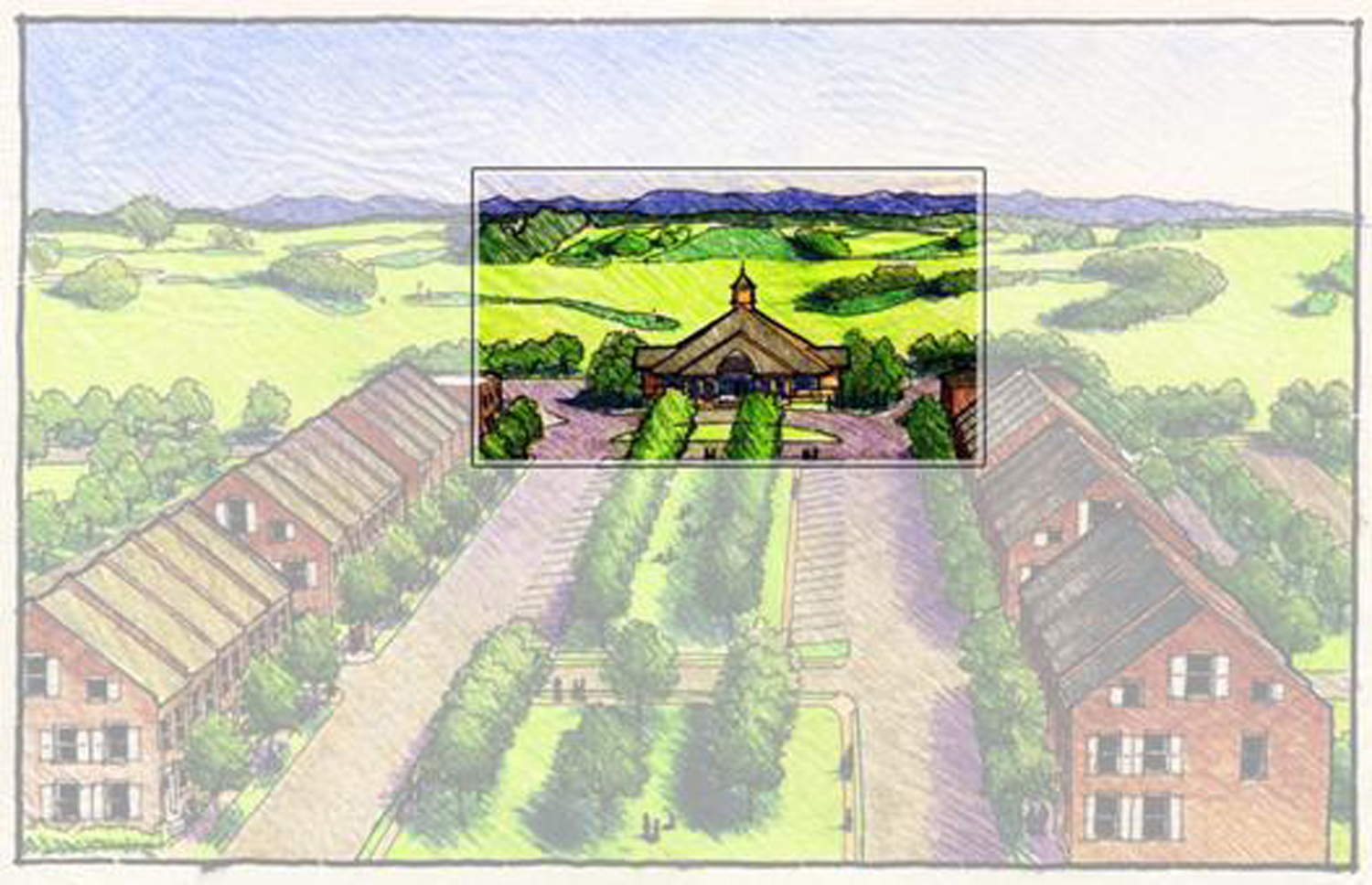
(Ord. No. 18-10, § 3, 5-17-2018; Ord. No. 21-01, Exh. A, 3-3-2021; Ord. of 9-7-23, Exh. A)
Editor's note— Ord. No. 18-10, § 3, adopted May 17, 2018, transferred and renumbered Art. 19 as section 617.00. Former Art. 19 derived from Ord. of 4-10-2003.
Sec. 618.00. - [Hill Top Glen Maury Park Districts] Purpose and intent.[4]
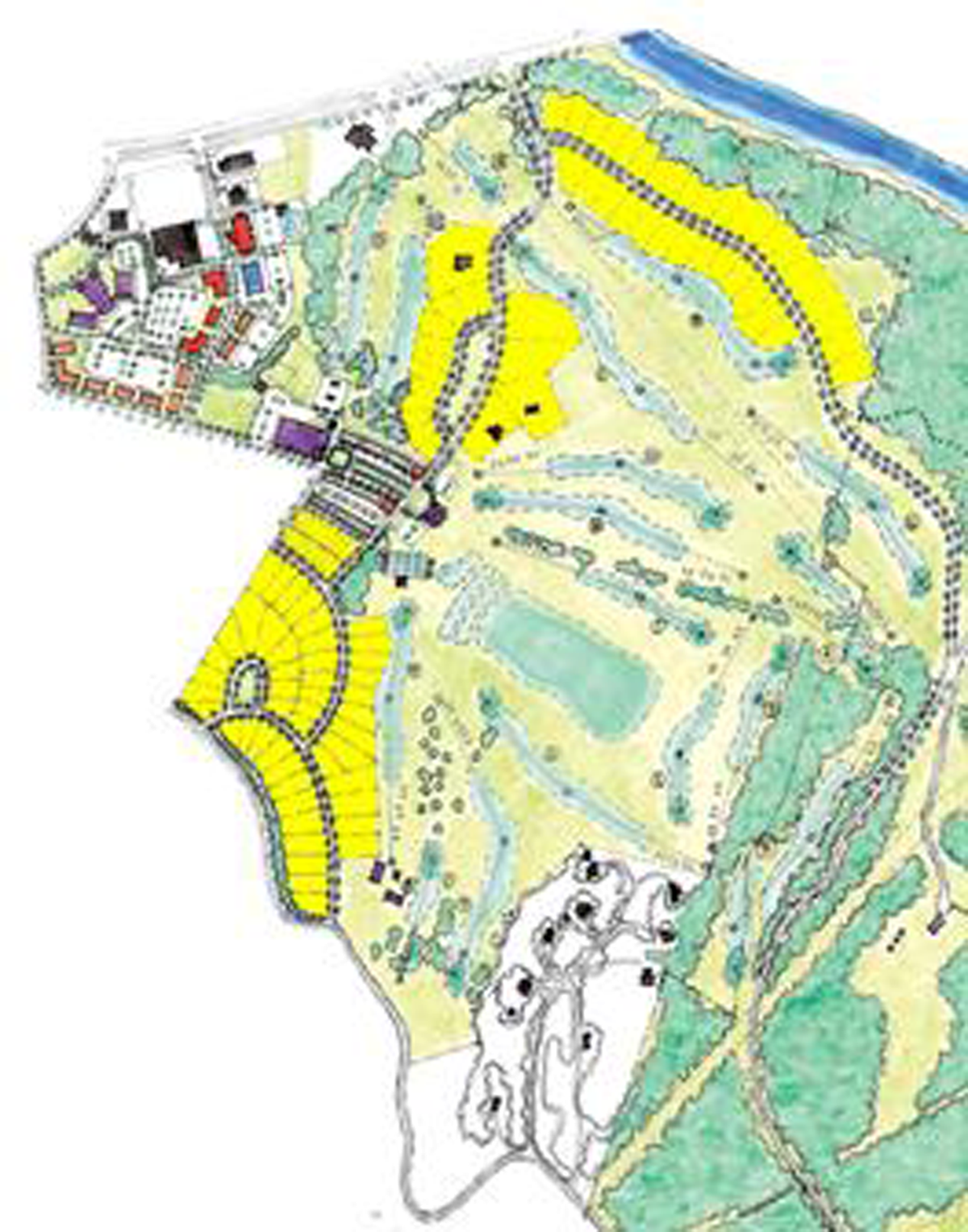
The purpose of this district is to enact regulations that implement the vision and goals of the Hill Top-Glen Maury Park Master Plan as incorporated into the City of Buena Vista Comprehensive Plan on January 9, 2003.
These regulations are intended to create a pedestrian-scaled neighborhood that promotes the health, safety or general welfare of the public and fulfills one or more of the goals as enumerated in Virginia Code, § 15.2-2283.
The regulations in this article are intended to attach the same or greater level of importance to the overall building design as is placed on the use contained within to facilitate the creation of a convenient, attractive and harmonious community as well as to reduce or prevent congestion in the public streets through the construction of a safe and interesting pedestrian realm.
Buildings are expected to be added to the City of Buena Vista as long-term additions to the architectural vibrancy of the community for the purpose of encouraging economic development activities that provide desirable employment and enlarge the tax base.
Because these Land Development Regulations encourage the placement of buildings closer to each other as well as closer to the street where pedestrian activity is expected to occur, it is necessary to mitigate against any negative effects with a minimum set of standards beyond typical setback and buffer requirements. This written set of standards also avoids the need for proffered conditions through a conditional use process.
618.01.
Applicability. All development located within the Hill Top District shall be subject to the provisions of this article. Where requirements found elsewhere in this ordinance conflict, the provisions of this article shall apply. Exceptions to the provisions of this article (except for permitted uses and accessory uses) may be approved as a conditional use permit in accordance with article 8 herein. In granting a conditional use permit as an exception to these provisions, the city council shall first determine that:
a.
No practical design alternatives exist; and
b.
The variations/exceptions requested are generally consistent with the purpose and intent of this district as well as section 618.55 general building design guidelines; and
c.
The proposed development is consistent with the Hill Top-Glen Maury Park Master Plan as incorporated into the City of Buena Vista comprehensive plan on January 9, 2003.
618.02.
Subdistricts established. The subdistricts are hereby established in the sections of this article.
618.03.
Planned Unit Development-Residential-Hill Top (PUD-RES-HT).
618.03-1
The primary land uses in this subdistrict are residential in scale and character, though some low intensity commercial are permitted.
618.03-2
The area in the Planned Unit Development-Residential-Hill Top District for development shall utilize design characteristics to fully benefit the location of lots for the maximum picturesque views of the area and to preserve the natural amenities. These regulations are intended to create a pedestrian oriented neighborhood that promotes the health, safety and welfare of the public.
618.04.
Permitted uses. The following uses are permitted in the PUD-RES-HT:
618.04-1
Single-family dwellings;
618.04-2
Two-family dwellings;
618.04-3
Multifamily dwellings;
618.04-4
Townhouses. See special regulations for townhouses in the land development regulations;
618.04-5
Civic/institutional facilities;
618.04-6
Recreation facilities;
618.04-7
Private schools and studios (including, but not limited to, the teaching of music, art, dance, theater, and educational tutoring);
618.04-8
Public utilities;
618.04-9
Municipal service or storage buildings;
618.04-10
Streets, curb and gutter, sidewalks (Americans With Disabilities Act requirements), stormwater facilities, walking/bike paths, street lighting, utilities;
618.04-11
Restaurants;
618.04-12
Hotel/motel and their accessory uses.
618.05.
Accessory uses. Where a lot is devoted to a permitted principal use, customary accessory uses and structures are authorized. The following uses are also applicable:
618.05-1
Home occupations. See land development regulations under home occupations;
618.05-2
Temporary office or storage building for use during construction, which shall be removed upon completion or abandonment of the construction work;
618.05-3
Garages, attached or detached, carports shall not be allowed.
618.06.
Lot restrictions.
618.06-1
The development authorized within this district is regulated by a comprehensive development and management plan proposed by the developer and where conventional zoning lot restrictions are waived in favor of the detailed site plan.
618.07.
Qualifying requirements.
618.07-1
The project area shall be located where public water and sewer systems are available or where a community water and sewer system can be developed as part of the project.
618.08.
Lot design.
618.08-1
The lot design, arrangement, and shape shall be such that lots will provide satisfactory and desirable sites for building, and be properly related to topography, and provide convenient and safe access.
618.09.
Street design.
618.09-1
The street system within the project area shall be designed according to functional street purposes and traffic flow:
618.09-1.1
To discourage through traffic;
618.09-1.2
To assure safe and convenient sight distance;
618.09-1.3
To complement the natural topography;
618.09-1.4
In coordination with existing streets; and
618.09-1.5
All roads to be built to VDOT specifications with a minimum two inches surface treated finish, the surface treated finish shall only be applied six months after the final trenched ditch compaction has been compacted at 95 percent;
618.09-1.6
Road shall have a minimum of 50-foot right-of-way;
618.09-1.7
Road shall have a minimum pavement width of 20 feet;
618.09-1.8
All additional right-of-way may be used for utilities, walking paths, sidewalks, bike paths, golf cart paths if proper markings for walkways, sidewalks and bike and/or golf cart paths meet VDOT specifications and the American Disabilities Act;
618.09-1.9
Provisions shall be made for sidewalks and/or pedestrian walkways, bike and golf cart paths, which will enable residents, visitors and/or patrons to walk or bike ride safely and conveniently between the various functional areas of the project and adjacent circulation systems;
618.09-1.10
Curb and gutter shall meet and be built to VDOT specifications and can be environmentally friendly.
618.09-1.11
All entrance permits shall meet and be built to VDOT specifications.
618.10.
Erosion and sediment control.
618.10-1
Any land disturbance of more than 10,000 square feet shall require an engineered erosions and sediment control plan submitted to the plan approving authority of Buena Vista for their approval and the issuance of a permit.
618.10-2
No land disturbance shall happen until all permits and approvals are obtained.
618.11.
Street names and signs.
618.11-1
The name of proposed streets shall not duplicate existing street names irrespective of the use of the suffix street, avenue, boulevard, driveway, place, lane or court. Proposed streets, which are obviously in alignment with other already existing and named streets, shall bear the names of the existing streets. Street names shall be indicated on the preliminary plan and final subdivision plat. Street signs shall be provided at all intersections and meet VDOT specifications.
618.12.
Street lighting.
618.12-1
Street lighting shall be provided on all streets in the development and meet public works specifications.
618.13.
Parking.
618.13-1
For each use, please reference article 7, section 703.03, parking space requirements for all districts. All natural amenities should be preserved and soften the effects of parking by avoiding excessive pavement with scattered landscaping and tree planting.
618.14.
Water and sewer.
618.14-1
All lots shall be served by water and sewer and whenever possible all water and sewer lines shall be connected to existing public facilities.
618.15.
Fire hydrants. Fire hydrants shall be placed according to the specifications of the fire marshal.
618.16.
Drainage.
618.16-1
All drainage shall meet and be built to VDOT specifications and can be environmentally friendly.
618.16-2
The site development plan shall include a plan for adequate drainage. The street and lot plan shall be designed to avoid drainage problems. Where storm drains or drainage ditches are required, or where an existing waterway or drainage way traverses the project area, an easement or right-of-way shall be provided with adequate improvements to contain the drainage flows from the tributary area upstream of the watershed.
618.17.
Floodways.
618.17-1
Land subject to flooding and land deemed to be topographically unsuitable shall not be platted for residential occupancy, nor for such other uses as may increase the danger of health, life, or property, or aggravate erosion or flood hazard. Such land within the project area shall be used as common open space or other uses which would not be endangered by periodic or occasional inundation or shall not produce conditions contrary to public welfare.
618.18.
Waterways.
618.18-1
All waterways shall be preserved in their natural state unless such waterway(s) can be moved without disturbing the balance of nature through an engineered study of the area affected by the waterway and obtaining all necessary federal, state and local permits. It shall be the responsibility of the owner to obtain all necessary permits.
618.19.
Easements.
618.19-1
If necessary, easements shall be provided by the owner though out the project area and shall be proved for water, sewer, gas, telephone, power and other utilities as required by the respective utility departments, agencies or companies.
618.20.
Grading.
618.20-1
The site development plan shall be designed to minimize the amount of grading required for the development. To the extent feasible, the natural lay of the land shall be maintained except where grading is required for public health or safety.
618.21.
Natural amenities.
618.21-1
The developer shall make every reasonable effort to protect and preserve the natural amenities of the site such as tree cover, waterways, scenic overlooks, etc. The site development plan shall be designed to maximize the use and enjoyment of natural amenities by project residents.
618.22.
Landscaping and screening.
618.22-1
Landscaping and screening may be provided to improve the project appearance or to provide a buffer between potentially conflicting uses. Site distances at all intersections shall follow VDOT specifications.
618.23.
Data to accompany application.
618.23-1
With the planned unit district there shall be submitted tentative, overall development plans which shall include:
618.23-1.1
Scale accurate proposed development plan mapping of the project to include:
618.23-1.1-1
Proposed land uses including dimensions and including residential types, commercial types, recreation and any other proposed use;
618.23-1.1-2
Proposed street system including public and private right-of-way and their dimensions;
618.23-1.1-3
Proposed parking areas and parking space delineations including handicap and their dimensions;
618.23-1.1-4
Proposed plat showing subdivision lot lines and their dimensions;
618.23-1.1-5
Proposed utility rights-of-way or easements including water, sewer, gas, power, and telephone and their dimensions;
618.23-1.1-6
Proposed drainage plan;
618.23-1.1-7
Proposed location of buildings, structures, and improvements and setback dimensions;
618.23-1.1-8
Property lines of proposed common property;
618.23-1.1-9
Proposed pedestrian circulation system;
618.23-1.1-10
Proposed landscaping plan;
618.23-1.1-11
Proposed treatment of the project perimeter such as screening or landscaping;
618.23-1.1-12
Relationships and tie-ins to adjacent property.
618.24.
Supporting documentation. A copy of supporting documentation to include the following minimum data:
618.24-1
A legal description of the project boundaries including tax map numbers of all properties present and proposed;
618.24-2
A statement of existing and proposed property owners;
618.24-3
Names and addresses of all adjacent property owners;
618.24-4
A statement of project development objectives and character to be achieved;
618.24-5
An approximate development schedule including dates of proposed construction beginning and completion and staging plan, if appropriate;
618.24-6
A statement of intent regarding future selling or leasing of land areas, dwelling units, commercial area, etc.;
618.24-7
Quantitative data including the number and type of dwelling units; parcel sizes, gross and net residential densities, total amount and percentage of open space, residential, commercial, and other land use types;
618.24-8
Proposed building types including architectural style, height, and floor area;
618.24-9
Approvals from the Virginia Department of Highways and the county health officer, if necessary;
618.24-10
Proposed agreements, provisions, or covenants which govern the use, maintenance, and continued protection of property to be held in common ownership;
618.24-11
A statement of proposed temporary and permanent erosion and sedimentation control measures to be taken;
618.24-12
All covenants, restrictions and other regulations governing the structures.
618.25.
Preapplication meeting.
618.25-1
To avoid unnecessary costs, the developer/owner shall meet with the zoning office and ask for a tentative date for a preconstruction meeting to discuss all phases of the development process.
618.25-2
The developer/owner shall submit a minimum of three copies of a conceptual plan to the zoning office previous to the preconstruction meeting for review by various departments (minimum of one week for department review), if the zoning office sees need for more conceptual copies, the zoning office shall notify the developer/owner of the need for additional copies of the conceptual plan.
618.26.
Application.
618.26-1
Application for a planned unit development, the foregoing requirements shall be filed with the zoning administrator. Ten copies of the original application and preliminary plans are required to be filed with the zoning administrator. The zoning administrator shall forward the application and preliminary plan to the department officials and the planning commission for their review and recommendation. The planning commission shall consider the general plan for the community, the location, arrangement and size of lots, parks, school sites and other reservations of open space; the location, width and grade of streets; the location and arrangement of parking spaces; the location, arrangement and height of buildings; the location, arrangement and design of neighborhood business areas and accessory parking spaces; the gross densities proposed for the area; and such other features as will contribute to the orderly and harmonious development of the area, with due regard to the type and the character of adjoining neighborhoods and the peculiar suitability of the proposed uses.
618.27.
Processing fee.
618.27-1
At the time of filing the preliminary plan application, the applicant shall deposit with the zoning administrator a check payable to the treasurer in the amount of $100.00, plus $1.00 for each dwelling unit proposed on the development plan.
618.28.
Appearance of developer.
618.28-1
The planning commission and/or the city council may require the developer to appear to discuss the planned development.
618.29.
Preliminary plan approval.
618.29-1
Within 60 days after the filing of the preliminary plan, the planning commission shall report to city council one of the following:
618.29-1.1
Recommend approval of the preliminary plan as presented,
618.29-1.2
Recommend approval of the preliminary plan as revised by concurrence of the planning commission and the developer, or
618.29-1.3
Recommend disapproval;
618.29-2
The city council shall give notice under Code of Virginia, § 15.2-2204 of a public hearing to be held not more than 30 days after the receipt of the planning commission's report. After the hearing, the city council disapproves or approves the preliminary plan, or approves the preliminary plan with modifications;
618.29-3
If the preliminary plan is approved, or approved with modifications by the city council, the zoning map shall be amended to show the Planned Unit Development-Residential-Hill Top. If the preliminary plan is approved with modifications, the city council shall not amend the zoning map until the applicant has filed with the zoning administrator written consent to the plan as modified.
618.30.
Status of approval.
618.30-1
No building permits shall be issued within the project area until the final development plan has been approved by the city under the procedures in the following sections.
618.31.
Provisions for variations or exceptions.
618.31-1
Provisions for variations in or exceptions to the general regulations of the subdivision ordinance in cases of unusual situations or when strict adherence to the general regulations would result in substantial injustice or hardship shall be approved by the city council.
618.32.
Final plan application.
618.32-1
Within six months following the approval of the preliminary plan, the applicant shall file with the zoning administrator ten copies of a final development plan containing in final form, the information required in the preliminary plan, including but not limited to, the final maps and documents specified above. In its discretion and for good cause, the city council may, upon receipt of a written application, extend for six months the period for filing of the final development plan;
618.33.
Phasing plan.
618.33-1
If the project area is to be developed in stages, a phasing plan shall be submitted with the final development plan. The phasing plan shall delineate the areas to be developed in each phase and the approximate development schedule of each phase.
618.34.
Compliance with preliminary plan.
618.34-1
The final development plan shall be in substantial compliance with the preliminary development plan. The final development plan shall be deemed in substantial compliance providing modification does not involve any of the following and provided further that such modification does not exceed the limitations of this district's regulations:
618.34-1.1
Variation of the proposed residential density or intensity of use by more than ten percent;
618.34-1.2
Reduction of more than ten percent of the area reserved for common open space;
618.34-1.3
Increase of the floor area proposed for nonresidential use by more than ten percent; and
618.34-1.4
Increase of the total ground area covered by buildings by more than five percent.
618.35.
Final plan approval.
618.35-1
The city council shall review the final development plan, and shall approve the final development plan if it is in substantial compliance with the preliminary development plan. The clerk of the court in whose office deeds are conveyed will record the final development plan in the manner provided for recording plats or subdivisions.
618.36.
Subdivision plat requirements.
618.36-1
Final subdivision plats shall be submitted and recorded before the granting of building permits or before the sale of any lots. Subdivision plats may be submitted for portions of the project area in accordance with the phasing plan. Subdivision plats shall be drawn according to the following specifications:
618.36-1.1
Subdivision plats shall be clearly and legibly drawn in ink upon Mylar at a suitable scale. A blank oblong space 3 inches × 5 inches shall be reserved on the cover sheet and a 1 inches × 5 inches space shall be reserved on subsequent sheets for use of the approving authority;
618.36-1.2
Subdivision plats shall show the accurate location and dimensions by bearing said distances with all curve data on all lots and street lines and centerlines of streets; boundaries of all proposed or existing easements, parks, school sites or other public areas; the number and area of all buildings sites; all existing public and private streets, their names, numbers and widths; existing and proposed easements for water, sewer, gas, power, telephone and other utilities; watercourses and their names; names of owners and their property lines, both within the boundary of the subdivision and adjoining said boundaries;
618.36-1.3
Distances and bearings must balance and close with an accuracy of not less than one in ten thousand;
618.36-1.4
The data of all curves along the street frontages shall be shown in detail at the curve or in a curve data table containing the following: delta, radius, arc, tangent, chord and chord bearings.
618.37.
Surveyor's certificate.
618.37-1
Every subdivision plat shall be prepared by a surveyor duly licensed by the State of Virginia, who shall endorse upon each plat a certificate signed by him setting forth the source of the title of the land subdivided, and the place of record of the last instrument in the chain of title. When the plat is of land acquired from more than one source of title, the outlines of the several tracts shall be indicated upon such tract, within an insert block or by means of a dotted boundary line upon the plat.
618.38.
Owner's statement.
618.38-1
Every such plat, or the deed of dedication to which plat is attached, shall contain a statement to the effect that "the above and foregoing subdivision of (here insert the correct description of the land subdivided) as appears in this plat is with the free consent and in accordance with the desire of the undersigned owners, proprietors, and trustees, if any," which shall be signed by the owners, proprietors, and trustees, if any, and shall be duly acknowledged before some officer authorized to take acknowledgements of deeds, and when thus executed and approved as herein specified shall be filed and recorded in the office of the clerk of the appropriate court, and indexed under the names of the landowners signing such statement and under the name of the subdivision.
618.39.
Recording of plat.
618.39-1
The subdivider shall record the approved plat in the office of the clerk within 60 days after final approval; otherwise the agent shall mark the plat "void" and return the same to the subdivider. No lot shall be sold and the building permit shall not be issued until the plat has been approved and properly recorded.
618.40.
Required improvements.
618.40-1
All improvements shown on the final development plan shall be installed by the developer at his cost. In cases where specifications have been established by state departments or local ordinances, such specifications shall be followed. The developer's performance bond shall not be released until construction has been inspected and approved by the appropriate official.
618.41.
Monuments.
618.41-1
Monuments shall be provided to permanently identify lot and right-of-way lines. The monuments shall be installed as follows:
618.41-1.1
Concrete monuments four inches in diameter or square two feet long, with a flat top, shall be put at all street corners, at all points where the street lines intersect the exterior boundaries of the project area, and at right angle points, and points of a curve in each street. The top of the monument shall have an indented cross to identify property the location and shall be set flush with the finished grade;
618.41-1.2
All other lot and parcel corners shall be marked with concrete monuments as above.
618.42.
Plans and specifications.
618.42-1
Two blue or black line prints of the plans and specifications of all required physical improvements installed shall be prepared by a licensed engineer as certified by the State of Virginia and shall be submitted to the agent for review. Once approved, one copy bearing certification of such approval shall be returned to the developer. If disapproved, all papers shall be returned to the developer with the reason for disapproval stated in writing.
618.43.
Maintenance of common property.
618.43-1
The developer shall create a property owners group to be responsible for maintaining all common property. The cost of maintaining common property shall be paid by property owner assessments and such assessments shall constitute a lien upon the individual properties.
618.44.
Advertising and sale.
618.44-1
The developer shall not advertise for sale or sell any tract or lot within the project area until an approved plat has been properly recorded. Prospective property owners shall be informed of the homeowner's responsibility, the entire project area development plan by the developer/agent/owner.
618.45.
Changes in final development.
618.45-1
Changes may be made in the approved final plan during the construction of the planned development except upon application to the appropriate agency provided below:
618.45-1.1
Minor changes in the location, setting, and character of buildings and structures may be authorized by the planning commission if required by engineering or other circumstances not foreseen at the time the final plan was approved. No changes authorized by this section may increase the cubic volume of any building or structure by more than ten percent;
618.45-1.2
All other changes in use and rearrangement of lots, blocks, and buildings tracts, any changes in the provisions of common open spaces, and all other changes in the approved final plan by the developer or any succeeding owner, or agent shall be made under the procedure authorized by this ordinance. No amendments may be made in the approved final plans unless they are shown to be required by changes in conditions that have occurred since the final plan was approved or by changes in the development policy of the community.
618.46.
Development schedule and review.
618.46-1
The construction and provision of all facilities and improvements on common property, which are shown on the final development plan, must proceed at the same rate as the construction of dwelling units. At least once every six months following the approval of the final development plan the zoning administrator shall review all of the building permits issued for the planned development and examine the construction which has taken place on the site.
618.46-2
If he shall find that the rate at which facilities and improvements on common property have been constructed and provided, is not in accordance with the original development schedule, he shall forward this information to the building official who shall not issue any additional building permits until the scheduled facilities and improvements on common property have been provided.
618.47.
Failure to begin development.
618.47-1
If no construction has begun or no use established in the planned development within one year from the approval of the final development plan, the final development plan shall lapse and be of no further effect. In its discretion, and for good cause, the city council may, upon receipt of written application, extend for one additional year the period for the beginning of construction or the establishment of a use. If a final development plan lapses under the provisions of this section, the clerk shall file a notice of revocation with the recorded subdivision plat. The zoning regulations applicable before the final development plan was approved shall then be in effect.
618.48.
Effectual clauses.
618.48-1
Authority. This ordinance has been enacted under the authority granted under chapter 22 of the Code of Virginia, § 15.2-2280 et seq., as amended.
618.49.
Validity.
618.49-1
Should any article, section, subsection, or provision of this ordinance be declared by a court of competent jurisdiction to be invalid or unconstitutional, such decision shall not affect the validity or constitutionality of this ordinance as a whole or any part thereof other than the part so declared to be invalid or unconstitutional.
618.50.
Private covenants.
618.50-1
This ordinance bears no relation to any private easement, covenant, agreement, or, restriction, nor is the responsibility of enforcing such private easement, covenant, agreement or restriction implied herein to any public official. When this ordinance calls for more restrictive standards than are required by private contract, the provisions of this ordinance shall control.
618.51.
Penalties.
618.51-1
Any developer who violates any provision of this ordinance shall be guilty of a misdemeanor, punishable by a fine of not more than one hundred ($100.00) for each dwelling unit proposed in the final development plan.
618.52.
Performance guarantees.
618.52-1
Before the acceptance of dedication for public use of any right-of-way located within any subdivision which has been constructed or proposed to be constructed within the subdivision, any street, curb, gutter, sidewalk, bicycle trail, drainage or sewerage system, waterline as part of a public system, or other improvement financed or to be financed in whole or in part by private funds the owner or developer must:
618.52-1.1
Certify to the governing body that the construction costs have been paid to the person constructing such facilities; or
618.52-1.2
Furnish to the governing body a certified check, letter of credit, cash escrow, or contract for construction in the amount of the estimated costs of construction or a personal, corporate or property bond, with surety satisfactory to the governing body, in an amount sufficient for and conditioned upon the construction of such facilities.
618.52-2
The applicant shall furnish two estimates of the public improvement costs for the project on the letterheads of the contractors and these estimates shall include all labor and materials needed to finish the project according to the approved plans and these estimates shall be furnished to the zoning office.
618.53.
Provisions for periodic partial and final release of certain performance guarantees.
618.53-1
A subdivision ordinance shall provide for the periodic partial and final complete release of any bond, escrow, letter of credit, or other performance guarantee required by the governing body under this article within 30 days after receipt of written notice by the subdivider or developer of completion of part or all of any public facilities required to be constructed hereunder unless the governing body or its designated administrative agency notifies the subdivider or developer in writing of nonreceipt of approval by an applicable state agency, or of any specified defects or deficiencies in construction and suggested corrective measures prior to the expiration of the 30-day period. Any inspection of such public facilities shall be based solely upon conformance with the terms and conditions of the performance agreement and the approved design plan and specifications for the facilities for which the performance guarantee is applicable, and shall not include the approval of any person other than an employee of the governing body, its administrative agency, the Virginia Department of Transportation or other political subdivision or a person who has contracted with the governing body, its administrative agency, the Virginia Department of Transportation or other political subdivision.
618.53-2
If no such action is taken by the governing body or administrative agency within the time specified above, the request shall be deemed approved, and a partial release granted to the subdivider or developer. No final release shall be granted until after expiration of such 30-day period and there is an additional request in writing sent by certified mail return receipt to the chief administrative officer of such governing body. The governing body or its designated administrative agency shall act within ten working days of receipt of the request; then if no action is taken the request shall be deemed approved and final release granted to the subdivider or developer.
618.53-3
After receipt of the written notices required above, if the governing body or administrative agency takes no action within the times specified above and the subdivider or developer files suit in the local circuit court to obtain partial or final release of a bond, escrow, letter of credit, or other performance guarantee, as the case may be, the circuit court, upon finding the governing body or its administrative agency was without good cause in failing to act, shall award such subdivider or developer his reasonable costs and attorneys' fees.
618.53-4
No governing body or administrative agency shall refuse to make a periodic partial or final release of a bond, escrow, letter of credit, or other performance guarantee for any reason not directly related to the specified defects or deficiencies in construction of the public facilities covered by said bond, escrow, letter of credit or other performance guarantee.
618.53-5
Upon written request by the subdivider or developer, the governing body or its designated administrative agency shall be required to make periodic partial releases of such bond, escrow, letter of credit, or other performance guarantee in a cumulative amount equal to no less than ninety percent of the original amount for which the bond, escrow, letter of credit, or other performance guarantee was taken, and may make partial releases to such lower amounts as may be authorized by the governing body or its designated administrative agency based upon the percentage of public facilities completed and approved by the governing body, local administrative agency, or state agency having jurisdiction. Periodic partial releases may not occur before the completion of at least 30 percent of the public facilities covered by any bond, escrow, letter of credit, or other performance guarantee. The governing body or administrative agency shall not be required to execute more than three periodic partial releases in any twelve-month period. Upon final completion and acceptance of the public facilities, the governing body or administrative agency shall release any remaining bond, escrow, letter of credit, or other performance guarantee to the subdivider or developer. For the purpose of final release, the term "acceptance" means: when the public facility is accepted by and taken over for operation and maintenance by the state agency, local government department or agency, or other public authority which is responsible for maintaining and operating such public facility upon acceptance.
618.53-6
For the purposes of this section, a certificate of partial or final completion of such public facilities from either a duly licensed professional engineer or land surveyor, as defined in and limited to § 54.1-400, or from a department or agency designated by the locality may be accepted without requiring further inspection of such public facilities.
State Law reference— Similar provisions, Code of Virginia, § 15.2-2245.
618.54.
Mixed Use Business (MXB-HT). The primary land uses in this subdistrict are commercial in scale and character, including many auto-oriented uses that typically found along high-volume thoroughfares including retail, restaurant and office uses.
618.54.01.
Permitted uses. The following uses are permitted:
618.54.01-1
Single-family dwellings;
618.54.01-2
Two-family dwellings provided that each living unit shall contain a minimum of 1,200 square feet;
618.54.01-3
Multifamily dwellings;
618.54.01-4
Townhouse (as regulated in section 709 of this ordinance)
618.54.01-5
Civic/institutional facilities;
618.54.01-6
Recreation facilities;
618.54.01-7
Bed and breakfast inns in accordance with article 14;
618.54.01-8
Live-work units;
618.54.01-9
Private schools and studios (including but not limited to the teaching of music, art, dance theater, and educational tutoring);
618.54.01-10
Public utilities;
618.54.01-11
Municipal service or storage buildings;
618.54.01-12
Public water and sewage facilities;
618.54.01-13
Retail shops and stores;
618.54.01-14
Business offices;
618.54.01-15
Department stores, variety stores, specialty shops, discount shops and appliance stores;
618.54.01-16
Bakeries;
618.54.01-17
Laundries, dry cleaning shops and clothes dyeing establishments;
618.54.01-18
Theaters, assembly halls, playhouses and dinner theaters;
618.54.01-19
Hotels;
618.54.01-20
Banks and loan and finance offices, including drive-in types;
618.54.01-21
Funeral home and/or mortuary;
618.54.01-22
Automobile service stations and public garages (with major repair under cover);
618.54.01-23
Restaurants;
618.54.01-24
Drive-through facilities with frontage along Highway 60.
618.54.02
Conditional uses. When, after review of an application and hearing hereon, in accordance with article 8 herein, the Buena Vista City Council finds as a fact that the proposed use is compatible with surrounding uses, is consistent with the intent of this ordinance and of the comprehensive plan, is in the public interest, and will comply with all other provisions of law and ordinances of Buena Vista, the following uses may be permitted with appropriate conditions:
a.
Kennels and animal hospitals provided that any structure or premises used for such purposes shall be located at least 200 feet from any residential lot;
b.
Public billiard parlors and pool rooms, bowling alleys, dance halls, and similar forms of public amusement only after a public hearing shall have been held by the governing body on an application submitted to the body for such use;
c.
Circuses, carnivals, fairs, and sideshows;
d.
Wholesale business, storage or warehouse provided that any such use shall be distant at least 50 feet from any residential district;
e.
Light manufacturing.
618.54.03
Accessory uses. Where a lot is devoted to a permitted principal use, customary accessory uses and structures are authorized. The following uses are also applicable:
a.
Home occupations provided that the requirements of article 7, section 705 are met;
b.
Living quarters in the main structure of persons employed on the premises;
c.
Temporary office or storage building for use during construction, which shall be removed upon completion or abandonment of the construction work;
d.
Existing structures to include towers, power towers, water tanks, telephone poles, commercial buildings and rooftops, may be used to affix commercial radio, television, and communication antennas provided the requirements of section 713.00 are met;
e.
Manufacture of goods to be sold as retail on site;
f.
Garage/workshops;
g.
Rental cottages.
618.54.04
Permitted building types. The following building types detailed in section 2004 are hereby permitted:
a.
Detached house;
b.
Townhouse;
c.
Civic building;
d.
Commercial.
618.55.
General building design requirements. The rich, architectural vocabulary of the City of Buena Vista presents a wide variety of development opportunities using traditional forms while avoiding any perception of monotony. Buildings that are stylized in an attempt to use the building itself as advertising shall be discouraged, particularly where the proposed architecture is the result of a corporate or franchise style. Unless otherwise noted, all buildings shall meet the following:
1.
All buildings shall share a frontage line with a street or public open space.
2.
All buildings, except accessory structures, shall have a main, useable entrance opening onto a street or square from the front facade. On a corner lot, the principal entrance in both design and function should be from the primary pedestrian street. (Exception: Commercial buildings may be accessed from entries located in the front half of the building.)
3.
Important street vistas should terminate in a focal point, such as a building or other architectural or natural feature. Buildings at corner locations should provide adequate architectural treatment to create a sense of place and ensure pedestrian-friendly design.
4.
Important mountain vistas should be protected and accentuated.
5.
Adjacent buildings should relate in similarity of scale, height, architectural style, and configuration. Transitions to dissimilar building types (i.e. detached house to commercial buildings) should generally occur at the rear lane/alley, rear property line, or in the next block.
6.
Architectural elements like openings, sill details, bulkheads, posts, and other architectural features shall be used to establish human scale at the street level.
7.
Buildings shall avoid long, monotonous, uninterrupted walls or roof planes on their visible facades. Building wall offsets, including projections, recesses, and changes in floor level shall be used in order to: add architectural interest and variety; relieve the visual effect of a single, long wall; and subdivide the wall into human size proportions. Similarly, roofline offsets shall be provided to lend architectural interest and variety to the massing of a building and to relieve the effect of a single, long roof. For larger scale developments, the building facade shall create repetitive bays, or the facades shall be divided into a balanced, yet asymmetrical, composition.
8.
Windows, doors, columns, eaves, parapets, and other building components shall be proportional to the overall scale of the building. Windows shall be vertically proportioned wherever possible. Also, to the extent possible, upper story windows shall be vertically aligned with the location of windows and doors on the ground level, including storefront or display windows.
9.
Exposed metal buildings are prohibited.
10.
All rooftop equipment shall be screened from view.
618.55.01
Detached house.
Description. The detached house is the predominant building type in the City of Buena Vista. It is flexible in use (where permitted), accommodating single family uses, multifamily uses up to four units, home occupations, professional offices, and limited retail uses. When other building types are integrated with detached houses, the scale of the detached house shall control (exception: civic buildings). The use permitted within the building is determined by the base zoning district in which it is located.
618.55.01-1
Lot requirements.
618.55.01-1.1
Type A: Lot requirements for alley lot. The alley lot is a lot with an average width less than 50 feet. Primary vehicular access is provided using a rear lane or alley only. No curb cuts or driveways are permitted along the frontage except on previously platted lots.
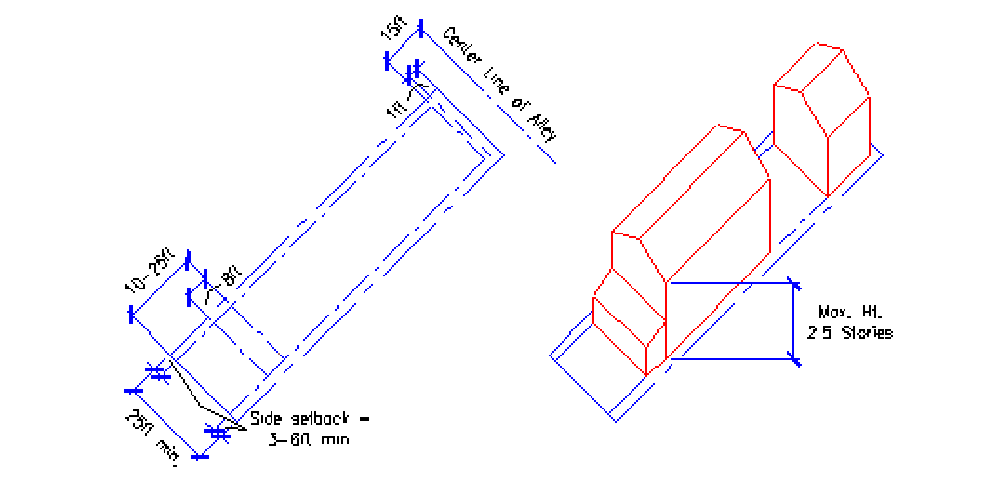
a.
Setbacks:
1.
Front build-to line: 10—25 feet.
2.
Side: six feet each side, however the total of both side yards may be allocated to one side in new development.
3.
Rear: 15 feet from centerline of alley.
b.
Minimum lot width: 25 feet.
c.
Maximum height: 2½ stories.
d.
Accessory structure side/rear setback: one foot.
e.
Encroachments: Balconies, stoops, stairs, chimneys, open porches, bay windows and raised doorways are permitted to encroach into the front setback a maximum of eight feet.
f.
Vehicular access to lot: For lots less than 50 feet wide, alley access is required. For all others the use of an alley is permitted.
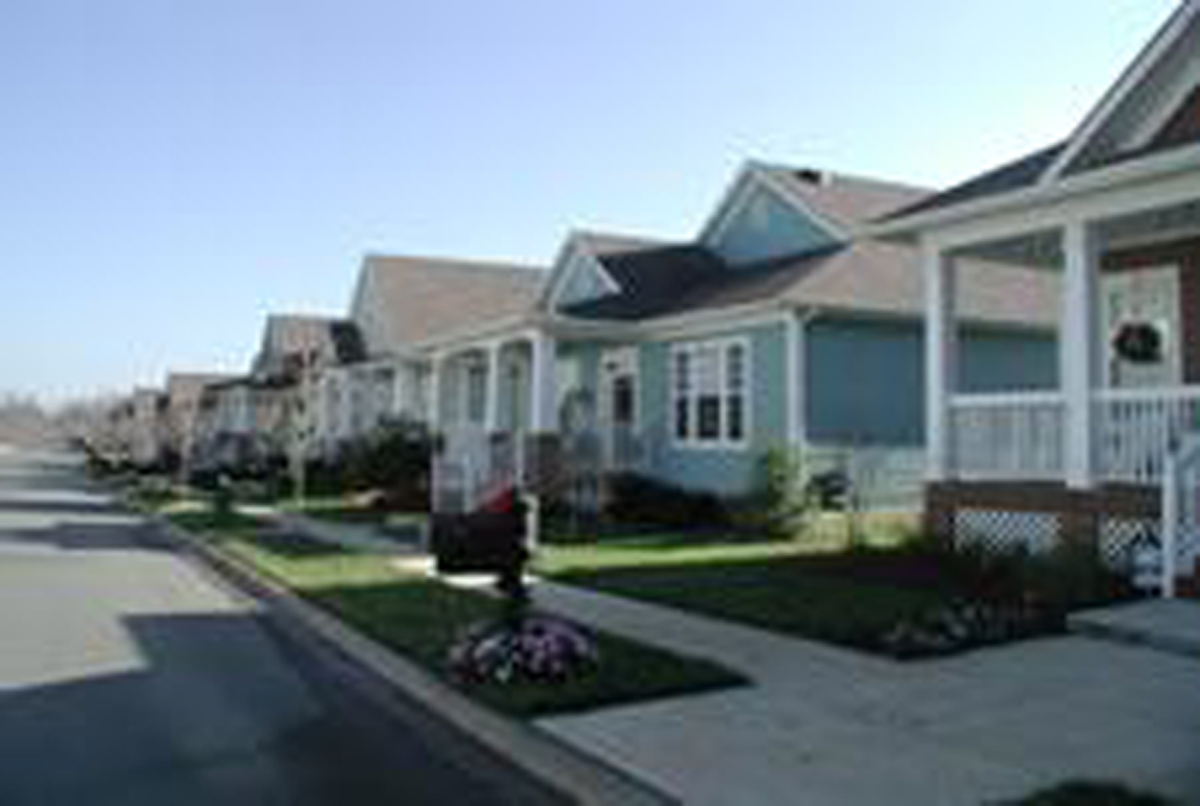
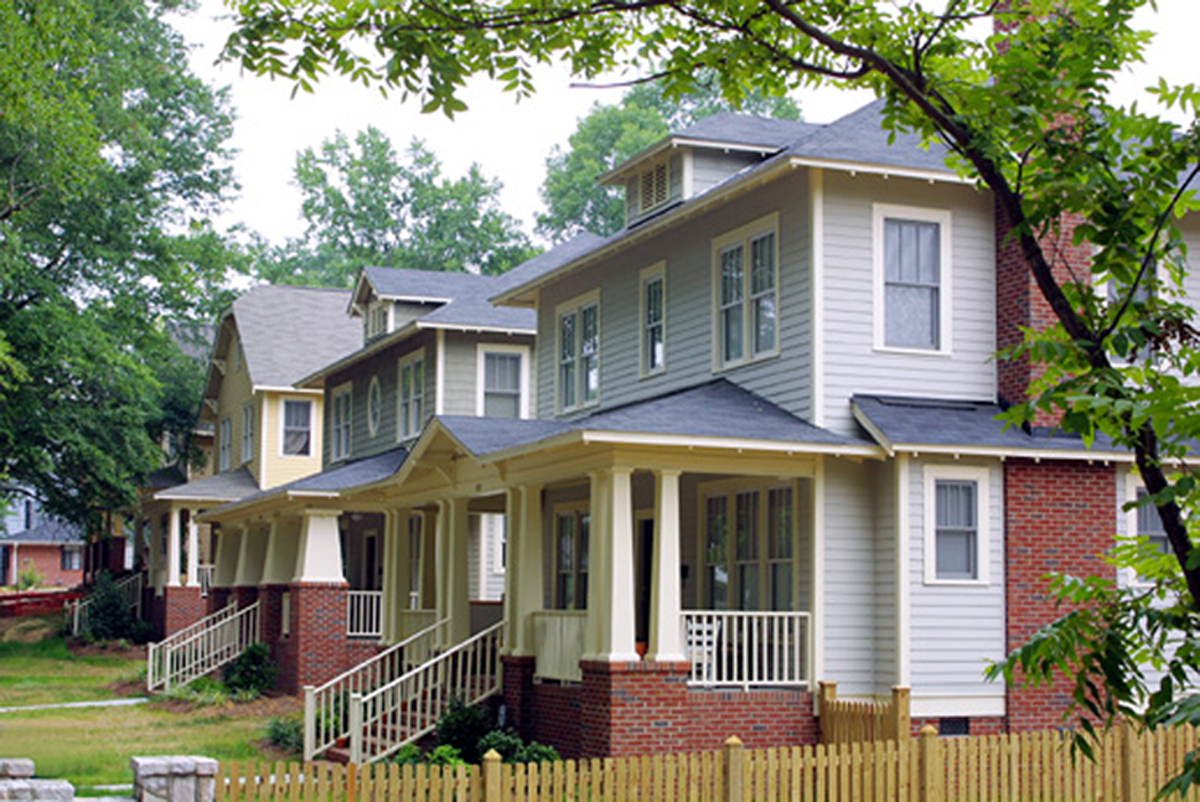
618.55.01-2
Type B: street lot. The street lot is a medium or large sized lot (50 feet or greater in width) that provides primary vehicular access from the street.
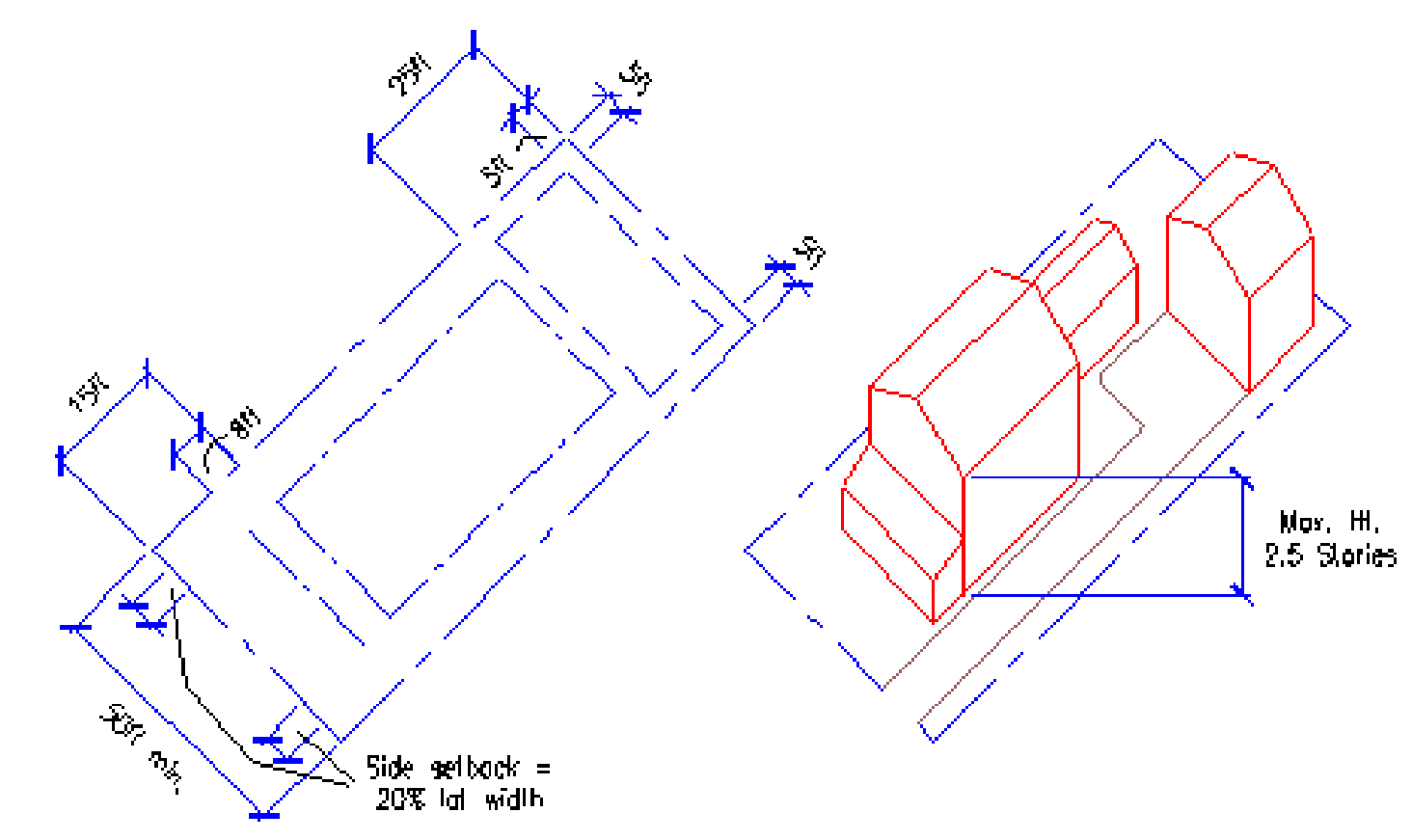
a.
Setbacks:
1.
Front: 15 feet.
2.
Sides: 20 percent of the lot width (in new developments, the entire setback may be allocated to one side).
3.
Rear: 25 feet.
b.
Minimum lot width: 50 feet.
c.
Maximum height: 2½ stories.
d.
Accessory structure side/rear setback: five feet.
e.
Encroachments: balconies, stoops, stairs, chimneys, open porches, bay windows and raised doorways are permitted to encroach into the front setback a maximum of eight feet.
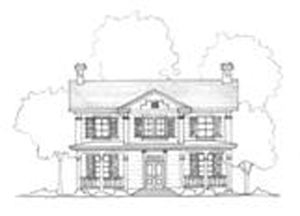
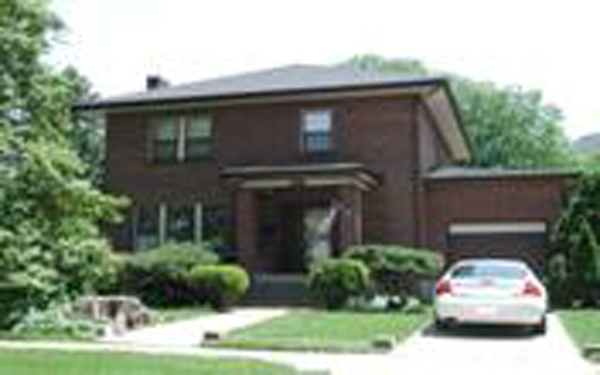
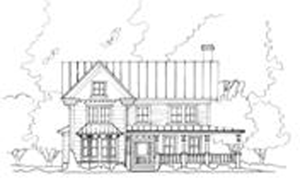
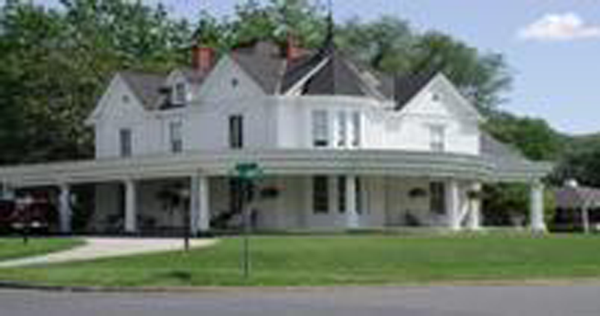
618.55.01-3
Architectural requirements.
1.
Useable porches and stoops should form a predominate motif of the building design and be located on the front and/or side of the building. Useable front porches are at least six feet deep and extend more than 50 percent of the facade.
2.
Garage doors are not permitted on the front elevation of any townhouse building.
3.
Rear yard fences or walls (as measured from back wall of primary building) shall be no greater than eight feet in height. Other fences shall be no greater than four feet in height and walls no greater than three feet in height in the front yard setback.
4.
All building elevations visible from the street shall provide doors, porches, balconies, and/or windows. A minimum of 60 percent of front elevations, and a minimum of 30 percent of side and rear building elevations, as applicable, shall meet this standard. Percent of elevation is measured as the horizontal plane (lineal feet) containing doors, porches, balconies, terraces and/or windows. This standard applies to each full and partial building story.
5.
To provide privacy, all front entrances shall be raised from the curb grade a minimum of 1½ feet.
6.
All townhouse buildings shall provide detailed design along all elevations. Detailed design shall be provided by using at least three of the following architectural features on all elevations as appropriate for the proposed building type and style (may vary features on rear/side/front elevations):
a.
Dormers.
b.
Gables.
c.
Recessed entries.
d.
Covered porch entries.
e.
Cupolas or towers.
f.
Pillars or posts.
g.
Eaves (minimum six-inch projection).
h.
Offsets in building face or roof (minimum 16 inches) window trim (minimum four inches wide).
i.
Bay windows.
j.
Balconies.
k.
Decorative patterns on exterior finish (e.g., scales/shingles, wainscoting, ornamentation and similar features).
l.
Decorative cornices and roof lines (for flat roofs).
618.55.01-4
Materials.
1.
Residential building walls shall be wood clapboard, wood shingle, wood drop siding, wood board and batten, cementitious fiber board, brick, stone, stucco, vinyl siding or materials similar in appearance and durability. Accessory buildings with a floor area greater than 150 square feet shall be clad in materials similar in appearance to the principal structure.
2.
Garden walls may be of brick, stone or stucco matching the principal building. Front yard fences shall be wood picket, wrought iron or materials similar in appearance and durability. Side and rear yard fences may be wood, wrought iron, or similar material. All side and rear yard fences over four feet in height shall be wood or similar material.
3.
Residential roofs shall be clad in wood shingles, standing seam metal, terne, slate, dimensional asphalt shingles or similar material.
618.55.01-5
Configurations.
1.
Main roofs on residential buildings shall be symmetrical gables or hips with a pitch no less than 5:12. Monopitch (shed) roofs are allowed only if they are attached to the wall of the main building. No monopitch roof shall be less then 5:12.
2.
Two wall materials may be combined horizontally on one facade. The heavier material should be below.
3.
The crawlspace of buildings shall be enclosed.
618.55.01-6
Techniques.
1.
Overhanging eaves may expose rafters.
2.
Flush eaves shall be finished by profiled molding or gutters.

618.55.02
Townhouse.
Description. The townhouse is a building with two or more residential units that are located side-by-side. When an entrance is provided at-grade, the townhouse may be used as a live-work unit. The use permitted within the building is determined by the base zoning district in which it is located.
618.55.02-1
Lot requirements.
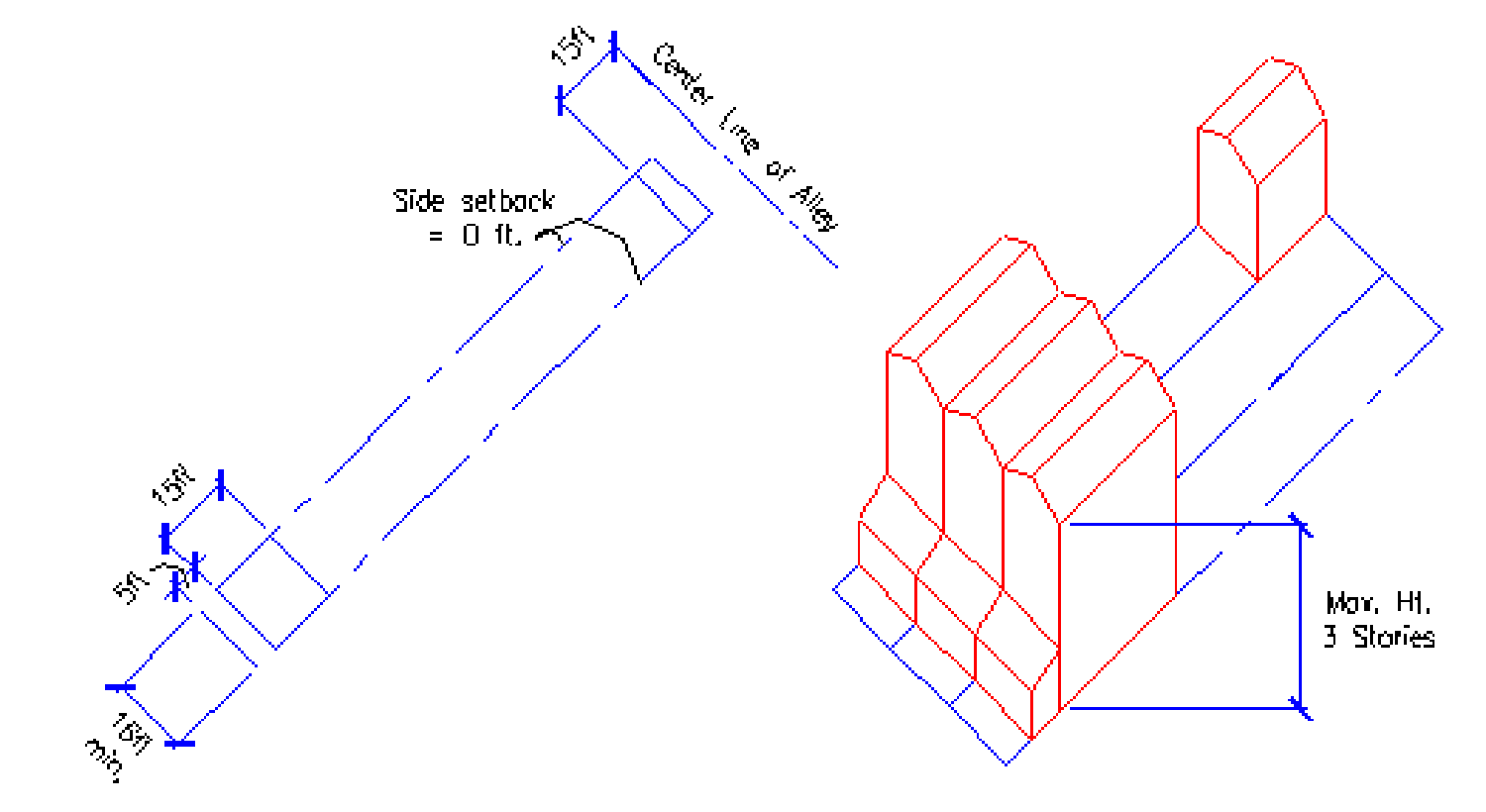
a.
Setbacks:
1.
Front (maximum): 0-15 feet.
2.
Sides: zero feet (corner—6 feet).
3.
Rear: 15 feet from centerline of alley.
b.
Parking and vehicular access: Primary vehicular access is provided using a rear lane or alley only. Off-street parking shall be located in the rear yard only. No curb cuts or driveways are permitted along the frontage.
c.
Minimum lot width: 16 feet.
d.
Maximum height. three stories (42 feet).
e.
Encroachments. Balconies, stoops, stairs, chimneys, open porches, bay windows, and raised doorways are permitted to encroach into the front setback. Upper story balconies may encroach into the right-of-way up to five feet with permission from the city council.
618.55.02-2
Accessory structures:
1.
Side/rear setback: zero feet.
2.
Maximum footprint: 650 square feet.
3.
Maximum number of structures: zero.
18-ft wide townhomes
24-ft wide townhomes
Live-work units
618.55.02-3
Architectural requirements.
1.
Useable porches and stoops should form a predominate motif of the building design and be located on the front and/or side of the building. Useable front porches are at least six feet deep and extend more than 50 percent of the facade.
2.
Garage doors are not permitted on the front elevation of any townhouse building.
3.
Rear yard fences or walls (as measured from back wall of primary building) shall be no greater than eight feet in height. Other fences shall be no greater than four feet in height and walls no greater than three feet in height in the front yard setback.
4.
All building elevations visible from the street shall provide doors, porches, balconies, and/or windows. A minimum of 60 percent of front elevations, and a minimum of 30 percent of side and rear building elevations, as applicable, shall meet this standard. Percent of elevation is measured as the horizontal plane (lineal feet) containing doors, porches, balconies, terraces and/or windows. This standard applies to each full and partial building story. To provide privacy, all front entrances shall be raised from the curb grade a minimum of 1½ feet. All townhouse buildings shall provide detailed design along all elevations. Detailed design shall be provided by using at least three of the following architectural features on all elevations as appropriate for the proposed building type and style (may vary features on rear/side/front elevations):
a.
Dormers.
b.
Gables.
c.
Recessed entries.
d.
Covered porch entries.
e.
Cupolas or towers.
f.
Pillars or posts.
g.
Eaves (minimum six-inch projection).
h.
Off-sets in building face or roof (minimum 16 inches) Window trim (minimum four inches wide).
i.
Bay windows.
j.
Balconies.
k.
Wainscoting, ornamentation, and similar features).
l.
Decorative cornices and roof lines (for flat roofs).
1.
Decorative patterns on exterior finish (e.g., scales/shingles).
618.55.02-4
Materials.
1.
Residential building walls shall be wood clapboard, wood shingle, wood drop siding, wood board and batten, cementitious fiber board, brick, stone, stucco, vinyl siding, or materials similar in appearance and durability. Accessory buildings with a floor area greater than 150 square feet shall be clad in materials similar in appearance to the principal structure.
2.
Garden walls may be of brick, stone or stucco matching the principal building. Front yard fences shall be.
3.
wood picket, wrought iron or materials similar in appearance and durability. Side and rear yard fences may be wood, wrought iron, or similar material. All side and rear yard fences over 4 ft in height shall be wood or similar material.
4.
Residential roofs shall be clad in wood shingles, standing seam metal, terne, slate, dimensional asphalt shingles or similar material.
618.55.02-5
Configurations.
1.
Main roofs on residential buildings shall be symmetrical gables or hips with a pitch no less than 5:12. Monopitch (shed) roofs are allowed only if they are attached to the wall of the main building. No monopitch roof shall be less then 5:12.
a.
Two wall materials may be combined horizontally on one facade. The heavier material should be below.
b.
The crawlspace of buildings shall be enclosed.
618.55.02-6
Techniques.
1.
Overhanging eaves may expose rafters.
2.
Flush eaves shall be finished by profiled molding or gutters.
618.55.03
Commercial building.
Description. A structure which can accommodate a variety of uses mixed either horizontally (shopping center) or vertically (apartment over a store). Office buildings, hotels and inns can be placed in commercial buildings. The use permitted within the building is determined by the base zoning district in which it is located.
618.55.03-1
Lot requirements.
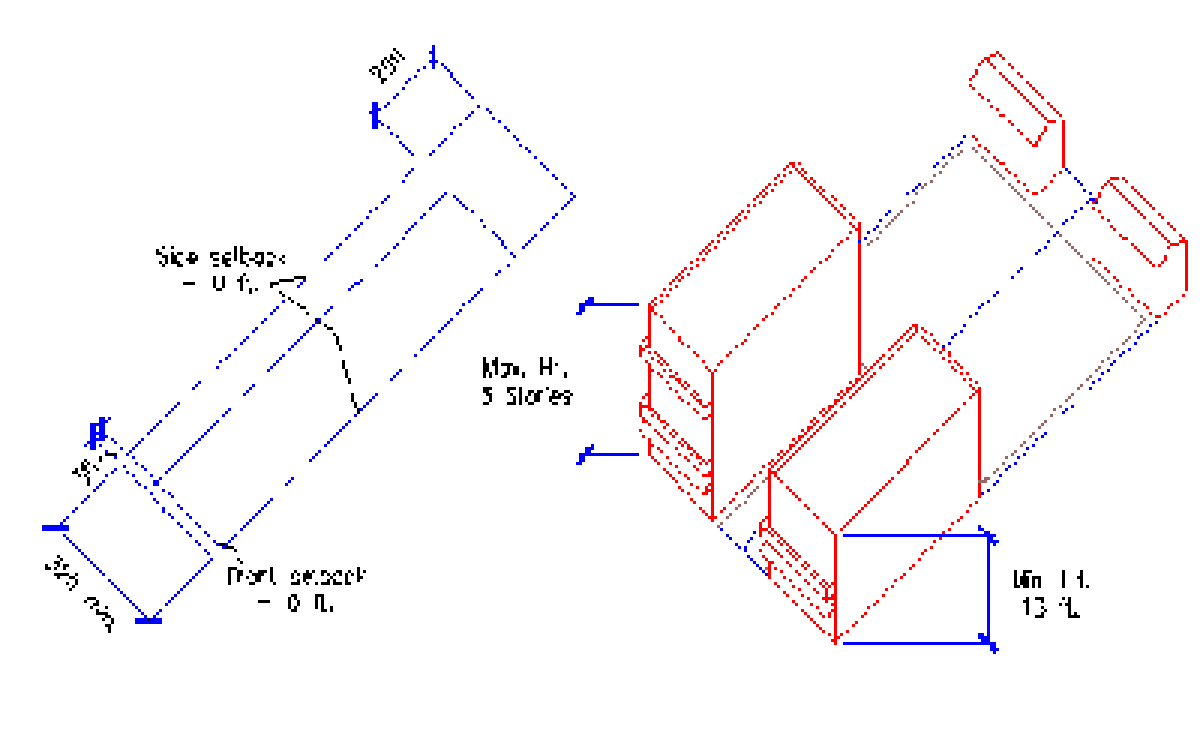
1.
Minimum height: 16 feet.
2.
Maximum height: three stories (42 feet).
3.
Setbacks:
a.
Front: zero feet.
b.
Sides: zero feet.
c.
Rear: 20 feet.
4.
Parking and vehicular access: Primary vehicular access is provided using a rear lane or alley only. Off-street parking shall be located in the rear yard only.
5.
Minimum lot width: 32 feet.
6.
Encroachments: Upper story balconies may encroach into the right-of-way up to three feet with permission from the city.
618.55.03-2
Accessory structures: side/rear setback: zero feet.
618.55.04
Commercial building.
618.55.04-1
Architectural requirements.
618.55.04-1.1
General requirements.
Mixed Use
Retail
1.
At least 50 percent of the width of street level frontages shall be in windows or doorways. Street level windows shall be visually permeable. Mirrorized glass is not permitted in any location. Faux or display casements are not permitted in lieu of exterior window treatments for the frontage elevation.
2.
No frontage wall shall remain unpierced by a window or functional general access doorway for more than 16 feet.
3.
The principal, functional doorway for public or direct-entry access into a building shall be from the fronting street. Corner entrances shall be provided on corner lot buildings.
4.
Decorative cornices shall be provided for buildings with a flat roof. Alternatively, eaves shall be provided with a pitched roof.
5.
A building canopy, awning, or similar weather protection may be provided and should project three to five feet from the facade.
618.55.04-2
Materials.
1.
Commercial building walls shall be brick, stucco, stone, marble, or other materials similar in appearance and durability. Regular concrete block may be used on building walls not visible from a public street. Decorative concrete block, siding, EIFS, and other minority elements may be used as an accent material only. All accessory buildings shall be clad in materials similar in appearance to the principal structure.
2.
Pitched roofs shall be clad in wood shingles, standing seam metal, corrugated metal, slate, dimensional asphalt shingles or similar material.
3.
Signs on the inside of glazed openings may be neon.
618.55.04-3
Configurations.
1.
All visibly exposed facades shall have a recognizable base course, which shall align with the sill level of the first story consisting of, but not limited to: thicker walls, ledges or sills; integrally textured materials such as stone or other masonry; integrally colored and patterned materials such as smooth finished stone or tile; lighter or darker colored materials, mullions, or panels; and/or planters.
2.
All visibly exposed facades shall have a recognizable top consisting of, but not limited to: cornice treatments, other than just colored stripes or bands, with integrally textured materials such as stone or other masonry or differently colored materials; sloping roof with overhangs and brackets; stepped parapets; and/or a cornice which shall terminate or cap the top of a building wall.
Two wall materials may be combined horizontally on one facade. The heavier material should be below.
3.
Skylights shall be flat (nonbubble).
618.55.04-4
Techniques.
1.
Stucco shall be float finish.
2.
Windows shall be set to the inside of the building face wall.
3.
All rooftop equipment shall be screened from view.
Mixed use
Mixed use
Grocery store
618.55.05
Civic building.
Description. Specialized public or semipublic buildings intended to serve as public gathering places. Such uses include governmental offices, churches or other places of worship, schools, hospitals, post offices and nonprofit or charitable clubs and organizations.
618.55.05-1
Lot requirements.
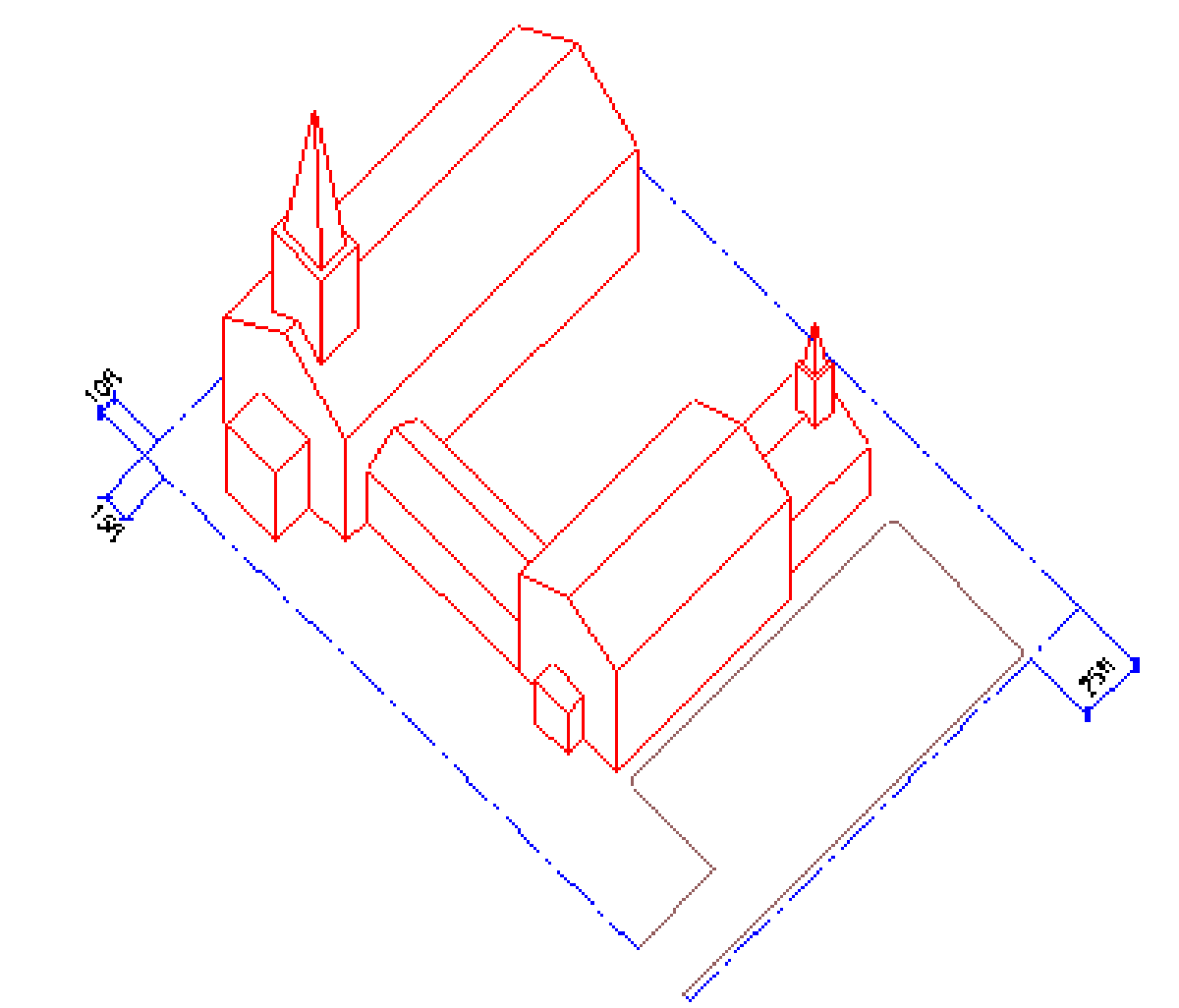
a.
Setbacks (minimum):
1.
Front: ten feet.
2.
Sides: 15 feet.
3.
Rear: 25 feet.
b.
Accessory structure side/rear setback: five feet.
c.
Minimum lot width: 70 feet.
d.
Minimum lot size: none.
e.
Maximum height: 42 feet (church spires, belfries, cupolas and other nonoccupied appurtenances are exempt up to a height of 60 feet).
f.
Encroachments: Balconies, stoops, stairs, open porches, bay windows, and raised doorways are permitted to encroach into the front setback a maximum of ten feet.
Governmental building
Church
School
618.55.05-2
Architectural requirements.
a.
General requirements.
1.
Schools, churches, and government buildings should be built so that they terminate a street vista whenever possible, and shall be of sufficient design to create visual anchors for the community.
2.
Off-street parking shall be provided in the side or rear yards only unless shared parking is utilized.
3.
Building(s) incidental to the principal structure shall be behind a line a minimum of 20 feet from the front facade of the structure, and if more than one, shall be arranged to create secondary gathering spaces within the lot.
4.
Parking shall be located towards the interior of the lot. On-street parking may be used to fulfill parking requirements. Parking may not occur within a front setback or corner side setback though a driveway may be provided across the frontage for circulation and pick-up/drop-off only.
5.
Front setbacks may be altered to preserve views or significant trees.
618.55.05-3
Materials.
1.
Civic building walls shall be clad in clapboard, stone, stucco, brick or marble. Decorative cast concrete and wood or vinyl siding may be used as a minority element on facades facing public streets.
2.
Civic roofs shall be clad in slate, sheet metal, corrugated metal, or dimensional asphalt shingles, or other material similar in appearance and durability.
3.
Gutters and down spouts shall be made of copper or galvanized painted metal. or other material similar in appearance and durability.
4.
The orders, if provided, shall be made of wood or cast concrete.
5.
Stained glass or other decorative window treatments are encouraged.
618.55.05-4
Configurations.
1.
Two wall materials may be combined horizontally on one facade. The heavier material should be below.
2.
Flat roofs are allowed, but principal civic buildings adjacent to residential structures are encouraged to have pitched roofs or similar architectural features to ensure compatibility.
618.55.05-5
Techniques.
1.
Windows shall be set to the inside of the building face wall.
2.
All rooftop equipment shall be screened from view
618.56.
Street types and standards.
618.56.01
Design standards. Street designs shall permit the comfortable use of the street by cars, bicyclists, and pedestrians. Pavement widths, design speeds, and the number of vehicle lanes should be minimized without compromising safety. The specific design of any given street must consider the building types which front on the street and the relationship of the street to the city's street network. New development with frontages on existing publicly maintained streets shall be required to upgrade all their frontages to meet the standards of this section. This Code encourages the development of a network of interconnecting streets that work to disperse traffic while connecting and integrating neighborhoods with the existing urban fabric of the city. Equally as important, the Code encourages the development of a network of sidewalks and bicycle lanes that provide an attractive and safe mode of travel for pedestrians and cyclists. Minor variations and exceptions to street cross sections may be permitted with approval of the planning director and the county engineer. Such exceptions include variations to the pavement width, size and location of on-street parking, tree planting areas, street grade, and centerline radii in accordance with principles below. Right-of-way widths should be preserved for continuity. All new streets shall be classified in accordance with the street hierarchy detailed in this chapter.
1.
Streets shall interconnect within a development and with adjoining development. Cul-de-sacs are permitted only where topographic conditions and/or exterior lot line configurations offer no practical alternatives for connection or through traffic. Street stubs should be provided with development adjacent to open land to provide for future connections. Streets shall be planned with due regard to the designated corridors shown on the comprehensive plan.
2.
Streets shall be designed as the main public space of the city and shall be scaled to the pedestrian.
3.
Streets shall be bordered by sidewalks on both sides.
4.
Streets shall be designed with street trees planted in a manner appropriate to their function. Commercial streets shall have trees which compliment the face of the buildings and which shade the sidewalk. Residential streets shall provide for an appropriate canopy, which shades both the street and sidewalk, and serves as a visual buffer between the street and the home.
5.
Wherever possible, street locations should account for difficult topographical conditions, paralleling excessive contours to avoid excessive cuts and fills and the destruction of significant trees and vegetation outside of street-rights-of way on adjacent lands. All streets shall be constructed in accordance with the design and construction standards in this code and shall permit public access whether by easement or by public dedication. Closed or gated streets are strictly prohibited.
6.
All on-street parking provided shall be parallel. Curb or angle parking is permitted when the fronting buildings are more than 26 feet in height to ensure a safe and usable pedestrian realm and where traffic speeds are very low (20 mph or less).
7.
The use of traffic calming devices such as raised intersections, landscaping bulb-outs and traffic circles are encouraged as alternatives to conventional traffic control measures.
618.56.02
Design standards. The following specifications shall apply to street design and may vary from the standards set forth in section 904.09 of this ordinance:
1.
Sidewalks. Sidewalks shall be constructed along both sides of all streets except alleys and lanes. Cul-de-sacs and closes shall be reviewed on a site-by-site basis for this requirement. Residential sidewalks shall be a minimum of five feet in width. Sidewalks serving mixed use and commercial areas shall be a minimum of eight feet in width (ten—12 feet is preferable in front of commercial buildings). All sidewalks shall be constructed in brick pavers, concrete, or a similar material. Concrete sidewalks shall be a minimum of four inches in depth.
2.
Street trees and planting strips. Canopy trees a minimum of 2½-inch-caliper shall be planted in the planting strip or in tree wells spaced a minimum of 40 feet on-center. The minimum width of all planting strips, if required, shall be six feet. For large canopy trees such as willow oaks and red maples a minimum of eight-foot planting strip is required.
3.
Cul-de-sacs. Where practical, a close should be used in place of a cul-de-sac. Cul-de-sacs, if permitted, shall not exceed 250 feet in length from the nearest intersection with a street providing through access (not a cul-de-sac). Cul-de-sacs shall be offset from the street centerline.
4.
Curb return radii. Curb radii shall be designed to reduce pedestrian crossing times along all streets requiring sidewalks. In general, curb radii should not exceed 20 feet.
5.
Utility location. Underground utilities (except water and sewer) should be located in alleys and lanes. If no alley or lane is provided, then a five-foot (minimum) utility easement shall be provided behind the sidewalk located within either the right-of-way or a public utility easement.
6.
Curbs and drainage. Curbs shall be constructed in accordance with VDOT standards. Vertical face curbing is required along all streets with on-street parking and around all required landscaping areas and parking lots. Mountable curbing is permitted around center medians, roundabouts, and other features in order to facilitate the infrequent use by vehicles with larger turning radii. Valley curbing is permitted along streets which serve homes with front-loaded off-street parking or that have infrequent on-street parking. Streets with a grade exceeding two percent shall use standard curbs. Drainage shall be provided using curb and gutter piped systems along all streets except along parkways that may use open swales upon approval of the city engineer. All drainage grates must be safe for bicyclists.
7.
Centerline radius. Centerline radii may be varied for low-speed streets in accordance with the following table (see also Institute for Transportation Engineers-Traditional Neighborhood Development Standards, p. 26):
8.
Types of streets.
a.
Commercial main streets. The main street serves as a small-scale, low-speed connector. main streets provide frontage for high-density buildings such as offices, shops, apartment buildings, urban mansions, and rowhouses. A main street is urban in character, with raised curbs, closed drainage, wide sidewalks, parallel parking, trees n individual planting areas and buildings aligned on short setbacks.
1.
Right-of-way: 60—70 feet.
2.
Design speed: 25 mph.
3.
On-street parking: Marked.
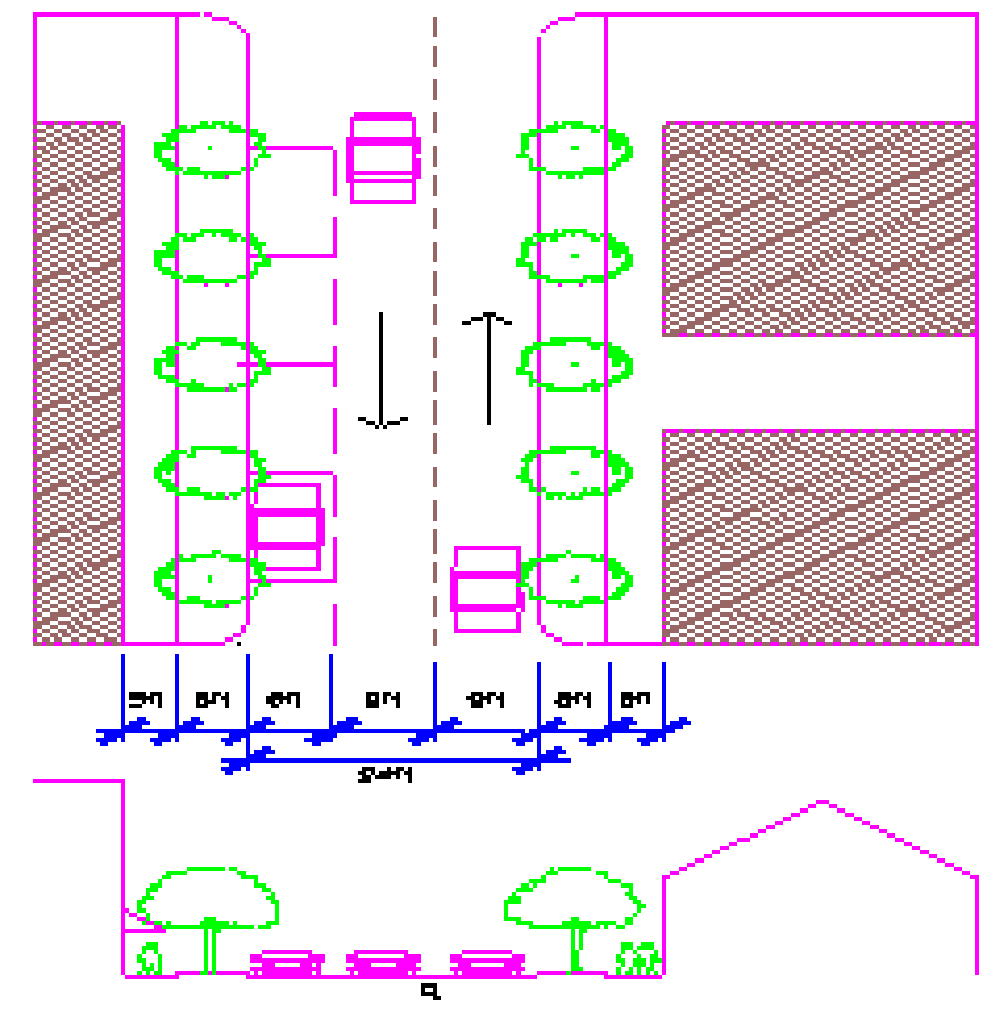
Commercial main street Residential street
b.
Residential streets. The street serves as a small-scale, low-speed connector. Local streets provide frontage for medium-to-low-density residential buildings such as detached homes and duplexes. A street is urban in character, with raised or rolled curbs, closed drainage, sidewalks, occasional parallel parking on one side, trees in continuous planting areas, and buildings aligned on medium setbacks.
1.
Right-of-way: 50 feet.
2.
Design speed: 15—25 mph.
3.
On-street parking: Marked.
c.
Minor street. The minor street is a small-scale, low-speed connector. It serves low-density residential buildings that accommodate all parking on-site. A minor street tends to be more rural in character with rolled curbs, open or closed drainage, narrow sidewalks, continuous plantings, and buildings set way back. On-street parking is not permitted except when the minor street is designed for one-way traffic.
1.
Right-of-way: 40—50 feet.
2.
Design speed: 20 mph.
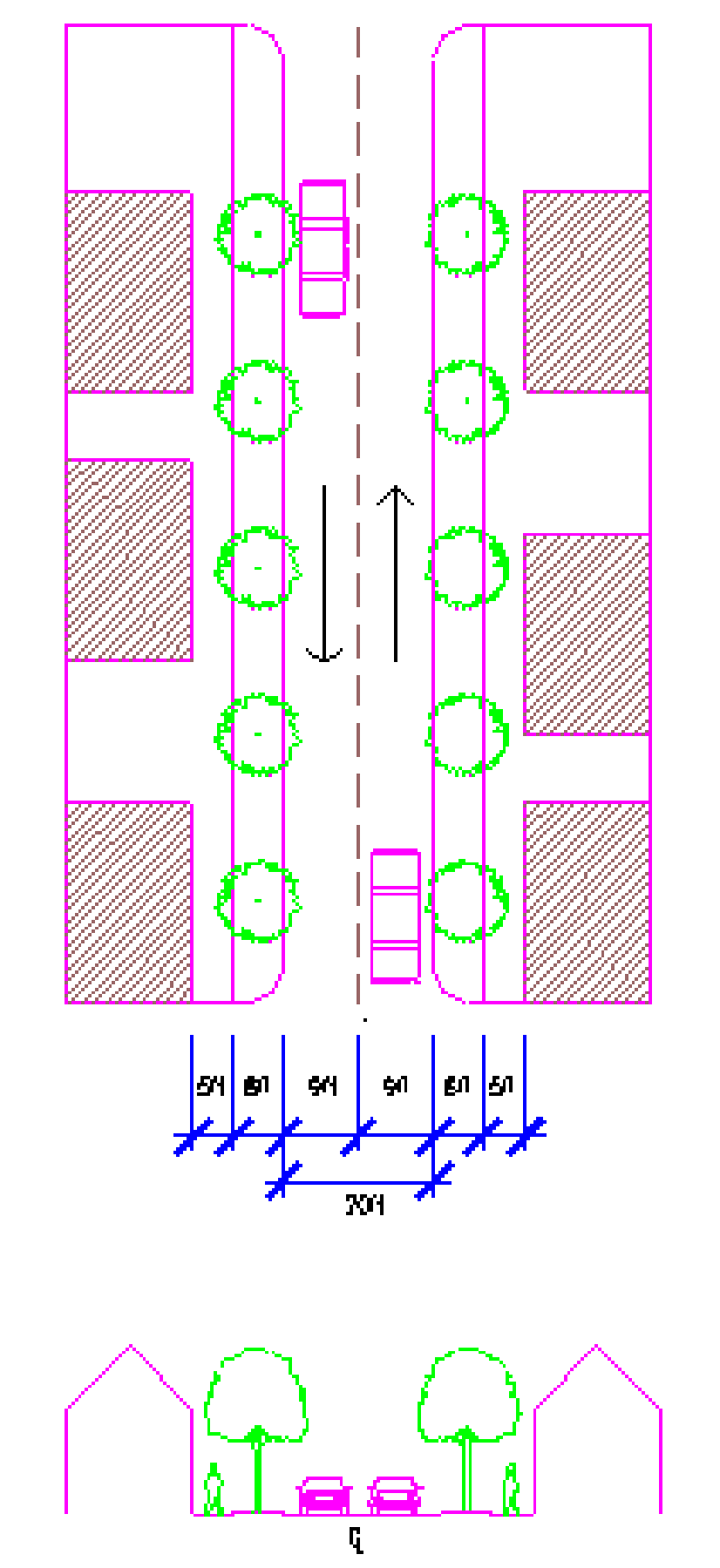
Minor street Rear alley
d.
Rear alley. The rear alley is a narrow access route behind neighborhood streets. Rear alleys generally have a narrow strip of paving in the center, concrete edging, and serve as areas for underground utilities.
1.
Right-of-way: 24 feet.
618.57.
Parking standards.
618.57.01
General principles.
618.57.01-1
Parking lots should not dominate the frontage of pedestrian-oriented streets, interrupt pedestrian routes, or negatively impact surrounding neighborhoods. Lots should be located behind buildings or in the interior of a block whenever possible.
618.57.01-2
Parking areas shall not abut pedestrian-oriented street intersections or civic buildings, be adjacent to squares or parks, or occupy lots which terminate a vista.
618.57.01-3
No off-street parking area shall be located within any front yard except for single-family residential uses not serviced by a rear alley. All off-street parking spaces for multifamily buildings shall be in the rear yard only.
618.57.01-4.1
Parking lots shall not occupy more than ⅓ of the frontage of the adjacent building or no more than 75 feet, whichever is less.
618.57.01-5.1
All parking areas visible from the right-of-way shall be screened from view. Parking structures shall be wrapped by buildings along the primary facade.
618.57.01-6
Off-street parking areas shall be designed to facilitate adequate movement and access by sanitation, emergency, and other public service vehicles without posing a danger to pedestrians or impeding the function of the parking area.
618.57.01-7
Off-street parking areas shall be designed so that parked vehicles do not encroach upon or extend onto public rights-of-way, sidewalks or strike against or damage any wall, vegetation, utility, or other structure.
618.57.01-8
Large surface parking lots should be visually and functionally segmented into several smaller lots. Alternative parking area designs incorporating planting islands and trees (such as a continuously planted 12-foot planting strip) shall create separate and distinct outdoor areas for no more than 36 cars per area. The size of any single surface parking lot shall be limited to three acres, unless divided by a street or building.
618.57.01-9
All parking areas shall be curbed using a standard curb with a minimum width of one foot six inches. Landscape islands shall be similarly curbed.
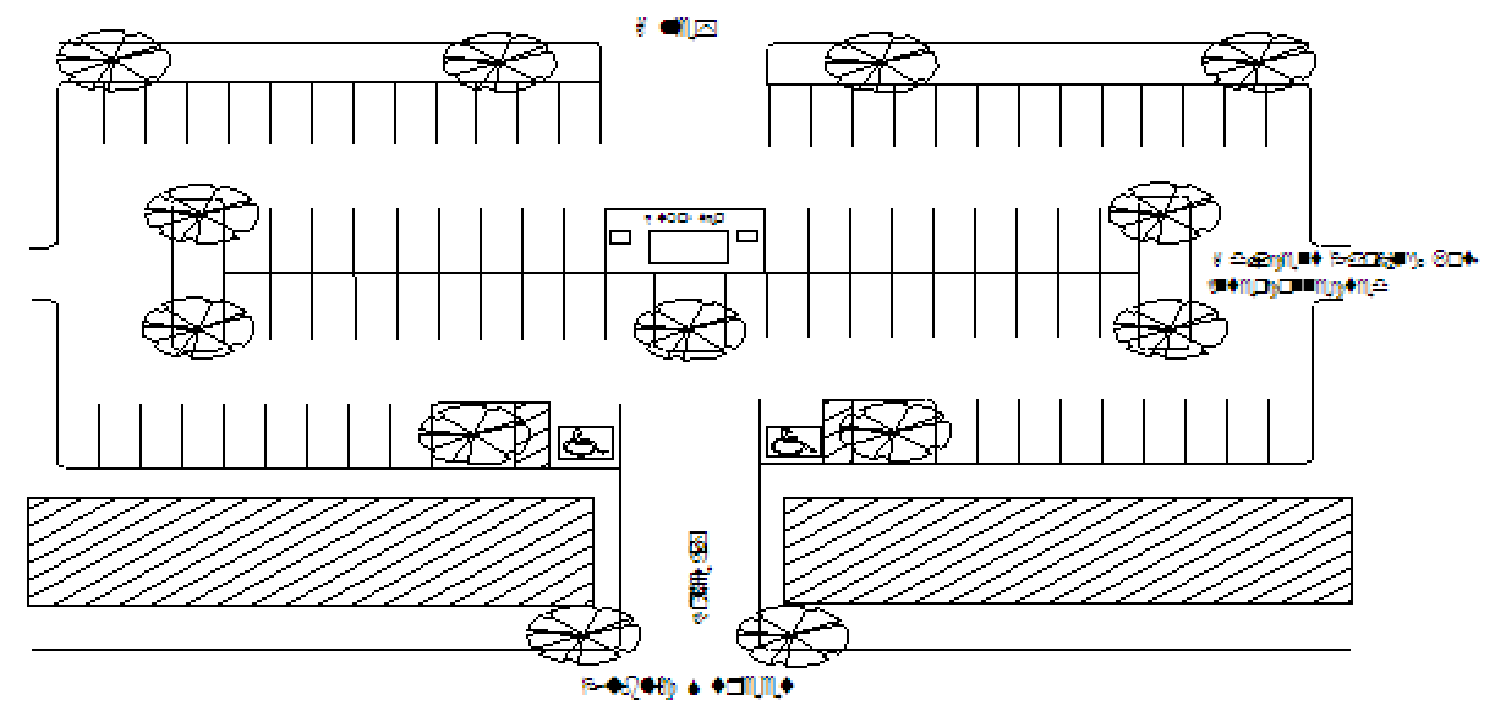
618.57.02
Parking space dimensions.
1.
Parking space dimensions (other than those designed for the disabled) shall be a minimum of 18 feet long and nine feet wide. Parking spaces shall be dimensioned in relation to curbs or aisles, so long as their configuration, area, and dimensions satisfy the requirements of this section.
2.
Parallel parking space dimensions shall be a minimum of 20 feet by eight feet. Parallel parking spaces along higher traffic streets should be at least 22 feet long.
a.
Aisle widths and angle space dimensions shall be in accordance with the Manual of Architectural Graphic Standards, 10th edition.
618.57.03
Minimum parking ratios. All square footage is in leasable square feet. Parking requirements may be satisfied using on-street parking in front of buildings or public lots within 300 feet of primary building entrances.
618.57.04
Shared parking standards. The joint use of shared off-street parking between two uses may be made by contract between two or more adjacent property owners. Adjacent lots shall be interconnected where practical. Developments that operate at different times may jointly use or share the same parking spaces with a maximum of one-half of the parking spaces credited to both uses if one use is a church, theater, assembly hall or other use whose peak hours of attendance will be at night or on Sundays, and the other use or uses are ones that will be closed at night or on Sundays or upon the normal hours of operation.
618.58.
Landscaping. The three types of landscaping are defined as follows, and shall meet the following performance requirements. All new development, changes in principal use, and building expansions shall comply with these provisions. The responsibility for the installation shall rest solely with the proposed development and shall be located on the development's site or in a landscaping easement granted by an adjacent landowner.
618.58.01
Types of landscaping.
A.
Type A (opaque screen/buffer). Location and required usage:
1.
Rear and/or side transition yards between residential and nonresidential lots (minimum width: ten feet).
2.
This type functions as an opaque screen from the ground to a height of at least eight feet. This type excludes visual contact between uses and creates a strong impression of spatial separation. Composition of the type A landscaping may include a wall, landscaped earthen berm, planted vegetation, existing vegetation, or any appropriate combination of these elements. Intermittent planting of deciduous and evergreen trees shall obtain a height at maturity of no less than 20 feet and have no unobstructed openings wider than ten feet between tree canopies upon maturity. Shrub plantings shall have a minimum height of three feet at installation and have no unobstructed openings wider than four feet. At least 50 percent of the required trees, and at least 75 percent of the required shrubs, shall be evergreen species locally adapted to the area. The use of existing vegetation to satisfy this requirement is encouraged. Supplemental planting may be required in addition to native materials.
B.
Type B (semi-opaque screen). Location and required usage:
1.
Perimeter yard of all multifamily, mixed-use, and nonresidential parking areas visible from the street (minimum width: ten feet).
2.
This type functions as a semi-opaque screen from the ground to at least a height of four feet for screening of car lights and glare. Composition of the type B landscaping may include a wall, fence, planted vegetation, existing vegetation, or any appropriate combination of the elements. Intermittent planting of deciduous and evergreen trees shall obtain a height at maturity of no less than 20 feet and have no unobstructed openings wider than 20 feet between canopies upon maturity. Shrub plantings shall have no unobstructed openings wider than four feet. At least 75 percent of the required shrubs shall be evergreen species locally adapted to the area.
3.
All side yard parking areas shall be screened from the sidewalk by low walls, fences or constructed as a continuation of the building wall a minimum of three feet in height. Landscaping may be used in combination with walls or fences but shall not exceed 50 percent of the total required width. The use of existing vegetation to satisfy this requirement is encouraged. Supplemental plantings may be required in addition to native materials. The minimum height upon installation for effectively screening storage areas is six feet. This type of planting should be opaque to screen the off-site view of parking areas from neighboring properties and streets.
C.
Type C (interior plantings). Location and required usage:
1.
Interiors of all parking areas with more than 16 parking spaces (not applicable to structured parking facilities).
2.
This type functions as a tree ceiling over a parking area providing shelter from sun and rain. Large maturing canopy trees shall be planted in a manner that provides shade for the entire parking area at maturity. To this end, no parking space shall be less than 60 feet from the base of a canopy tree. The use of differing species around the parking area is encouraged to promote diversity in the overall urban tree canopy. The use of existing vegetation to satisfy this requirement is encouraged. Supplemental plantings may be required in addition to native materials.
618.59.
Open space requirements.
1.
All residential development except garage apartments and residential units in mixed-use buildings shall be subject to these provisions.
2.
Common open space is defined as all areas not covered by building or parking lots, dry detention structures, streets, and required setbacks. The intent of these requirements is to allow for the usage of centrally located unencumbered land as neighborhood open spaces and not to permit the use of leftover or otherwise unusable land to fulfill the requirements of this section.
3.
Residential development shall provide common open space at a rate of 500 square feet per bedroom unit. For the purposes of this calculation, developers shall make a good faith estimate at the time of preliminary plat submission. In general, single-family homes are calculated at a rate of three bedrooms per unit, unless otherwise specified. Greenways are credited towards this requirement at a rate equal to the length of the path times 16 feet in width.
4.
Common open space shall be planned and improved, accessible and usable by persons living nearby. Improved shall mean cleared of underbrush and debris and shall contain one or more of the following improvements: landscaping, walls, fences, walks, statues, fountains, ball fields, and/or playground equipment.
5.
Significant stands of trees, streambed areas, and other valuable topographic features shall be preserved within the required open space areas where practical. Areas noted on the comprehensive plan as open space should be preserved and dedicated where practical and feasible and may be left unimproved in accordance with the plan.
6.
Playground equipment, statues, and fountains should be located toward the interior of squares and parks.
7.
Common open space should be fronted by streets and buildings to encourage their use and patrol their safety.
8.
Required common open space shall be separately deeded to either a homeowners' association, a nonprofit land trust or conservancy, the City of Buena Vista, or otherwise permanently protected through deed restriction.
618.60.
Signs.
618.60.01
General provisions.
1.
Monument signs are permitted only for commercial buildings setback further than 25 feet from the right-of-way and civic buildings.
2.
Home occupations located in business districts located in detached houses are permitted to use arm signs.
3.
Signs should not obscure architectural features and should be integrated with the design of the building.
4.
Buildings should provide signage that is pedestrian-oriented.
5.
All buildings may provide wall-mounted incidental signage such as tenant directories, historical makers, or bulletin boards on any wall face provided they do not exceed six square feet in area.
6.
Sandwich board signs may placed on sidewalks with a minimum clear zone on the sidewalk of five feet per Americans With Disabilities Act requirements.
7.
Canopy signs may be combined with a wall sign.
8.
Only monument signs may be internally illuminated.
618.60.02
Freestanding sign standards.
A.
Monument sign.
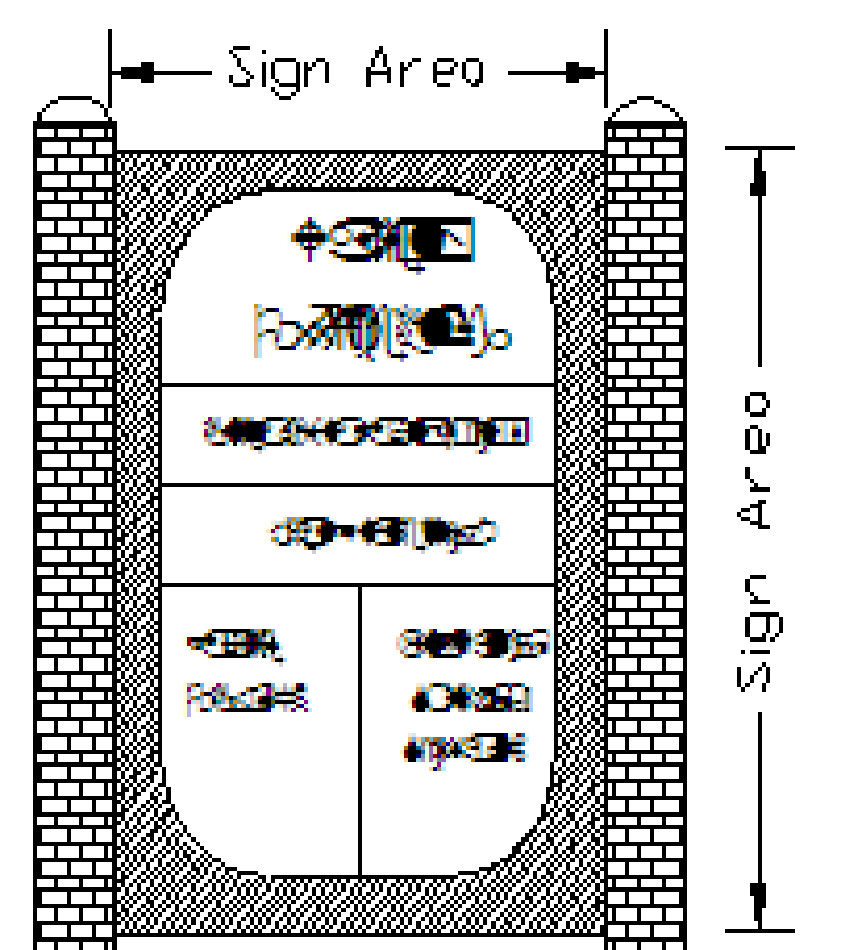
1.
Maximum height: six feet.
2.
Maximum area: 36 square feet.
B.
Arm sign.
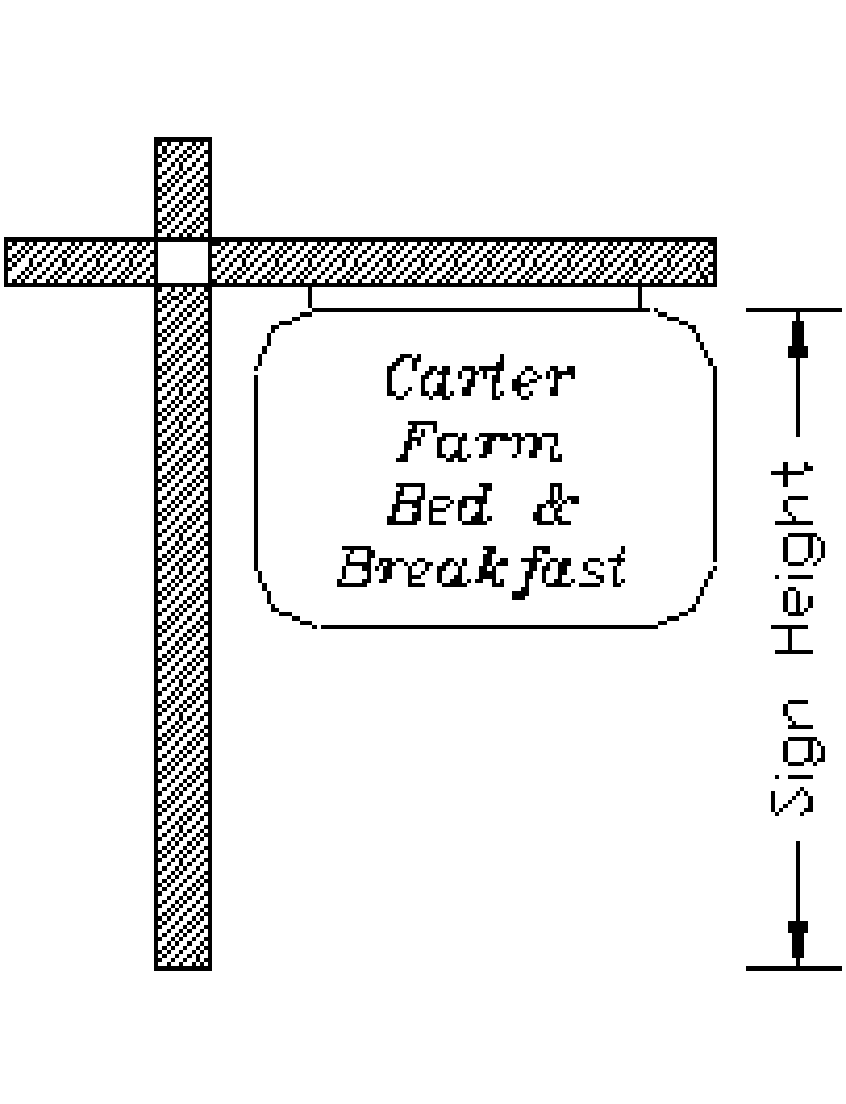
1.
Maximum height: six feet.
2.
Maximum area: six square feet.
618.60.03
Commercial building sign standards.
A.
Canopy sign standards.
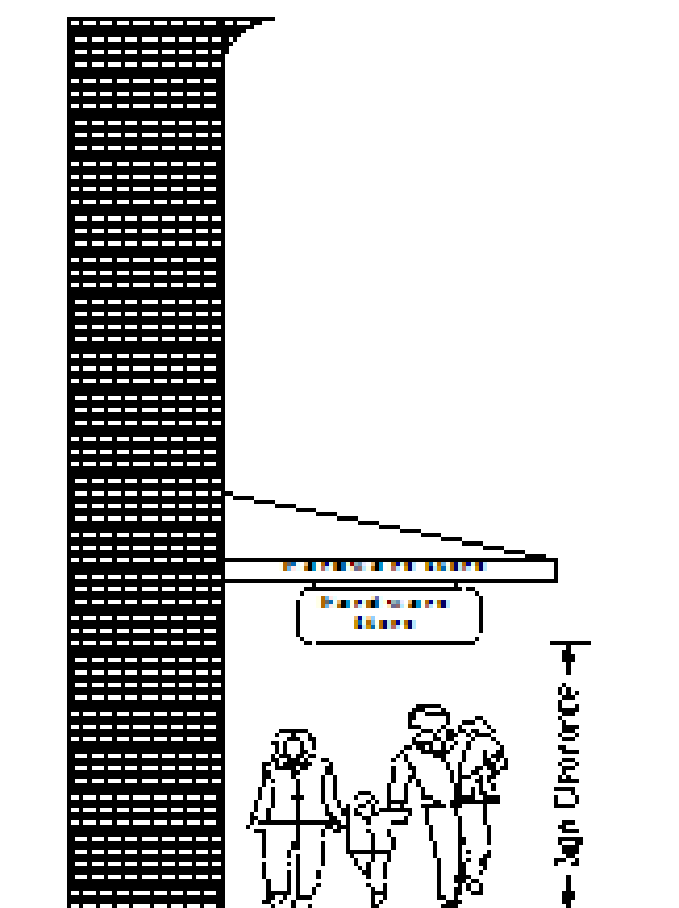
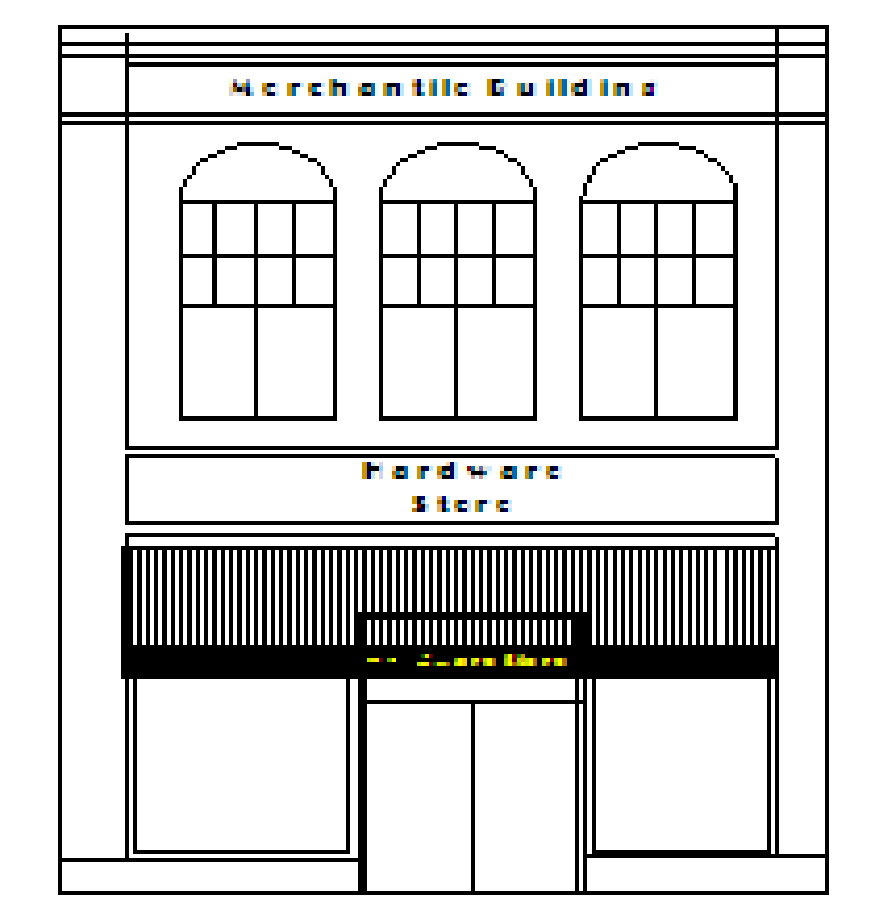
1.
Maximum area: 50 percent of canopy area.
2.
Drip flap area shall be unlimited.
B.
Under-canopy sign standards. Maximum dimensions:
1.
Height: 16 inches.
2.
Width: 36 inches.
3.
Sign clearance: 7½ feet.
C.
Wall sign standards.
1.
Maximum area: Two square feet for each lineal foot of wall facing a public street.
2.
Location: Between first floor and window sill of second floor, or on sign frieze area of building if original to building. (Exception): Building identification which is an integral part of the building design and architectural character shall not be considered a sign for the purposes of this standard.)
3.
Maximum area: (Walls not fronting on a public street): Five percent of wall area.
4.
Windows: signs may be placed on or behind windows but at no such time shall exceed 20 percent of the window area.
5.
Murals or wall art: Murals or similar art located on secondary building walls (not primary footages) are permitted, provided the total area of commercial copy does not exceed five percent of the total wall area.
618.61.
Definitions.
618.61.01
Accessory building means a structure subordinate or incidental to the principal structure on a lot in square footage and primary use. Accessory structures and uses include detached garages (with or without rental cottages), storage buildings, pool houses, and material storage areas. See also Garage/workshop.
618.61.02
Garage/workshop means an accessory building used for the storage of vehicles, materials, or similar items incidental to the function and use of the principal structure. Such structures may also be used for the manufacturing and/or fabrication of goods such as carpentry, provided such use is otherwise compliant with all home occupation requirements and does not constitute a nuisance through the excessive noise or vibration.
618.61.03
Live-work unit means small commercial enterprises with the ground floor occupied by commercial uses and a residential unit above. Commercial space may be a home-based business or may be leased independently.
618.61.04
Manufacturing, heavy, means the assembly, fabrication, production or processing of goods and materials using processes that ordinarily have greater than average impacts on the environment, or that ordinarily have significant impacts on the use and enjoyment of other properties in terms of noise, smoke, fumes, odors, glare, or health or safety hazards, or that otherwise do not constitute "light manufacturing," or any use where the area occupied by outdoor storage of goods and materials used in the assembly, fabrication, production or processing exceeds 25 percent of the floor area of all buildings on the lot. [The term] "heavy manufacturing" shall include, but not be limited to, the following: enameling, lacquering, or the plating or galvanizing of metals; foundries or mills producing iron and steel products; industrial chemical manufacture; meat packing plants; mixing plants for concrete or paving materials, and manufacture of concrete products; oxygen manufacture and/or storage; pottery, porcelain, and vitreous china manufacture; poultry dressing for wholesale; pressure treating of wood; stonecutting; tire recapping and retreading; tobacco products manufacture; tobacco stemming and re-drying plants. This shall include resource extraction and recycling and salvage operations.
618.61.05
Manufacturing, light, means the assembly, fabrication, production or processing of goods and materials using processes that ordinarily do not create noise, smoke, fumes, odors, glare, or health or safety hazards outside of the building or lot where such assembly, fabrication, production or processing takes place, where such processes are housed entirely within a building, or where the area occupied by outdoor storage of goods and materials used in the assembly, fabrication, production or processing does not exceed 25 percent of the floor area of all buildings on the lot. This shall not include uses that constitute heavy manufacturing, resource extraction, or recycling and salvage operations.
618.61.06
Rental cottage means an apartment located in an accessory building, secondary in size to the principal building, sharing ownership, site and utilities. The principal building shall be owner-occupied.
618.61.07
Sandwich board sign means a portable a-frame sign constructed with two faces that rest at an angle less than 45 degrees to each other. Neither face shall exceed three feet in width or 12 square feet in area.
618.61.08
Story means that part of a building or structure above ground level between a floor and the floor or roof next above. A mezzanine shall be considered a story if it exceeds one-third of the area of the floor immediately below. A penthouse shall be considered a story if it exceeds one-third of the area of the roof. The under roof area with dormers does not count as a story.
618.61.09
Wall sign means any sign directly attached to an exterior wall of a building or dependent upon a building for its support with its exposed face parallel or approximately parallel to the plane of the building or structure on which it is placed. Signs directly painted on walls shall be considered wall signs.
(Ord. No. 18-10, § 4, 5-17-2018; Ord. No. 21-01, Exh. A, 3-3-2021)
Editor's note— Ord. No. 18-10, § 4, adopted May 17, 2018, transferred and renumbered Art. 20 as section 618.00. Former Art. 20 derived from Ord. of 4-10-2003; Ord. of 9-6-2009, §§ 2003.01—2003.51; Ord. No. 13-02, Att. A, 2-22-2013.
Sec. 619.00. - Mixed Use Corridor (MUC).
619.01
Intent. The mixed use corridor (MUC) zone is designed for a range of commercial and residential uses appropriate to a major arterial corridor. It also encourages mixed-use planned developments that create walkable neighborhoods and expand the urban development pattern of the city.
619.02
Permitted uses.
619.02-1
Residential uses.
619.02-1.01
Assisted living and nursing home facilities.
619.02-1.02
Bed and breakfast homestays and inns.
619.02-1.03
Dormitories.
619.02-1.04
Family care homes, foster homes or group homes serving the mentally retarded, developmentally disabled or others, rest homes, homes for adults or nursing homes, provided that licensing requirements are met.
619.02-1.05
Hotels and motels.
619.02-1.06
Multifamily dwellings, including efficiency apartments.
619.02-2
Civic, institutional, and recreational uses.
619.02-2.01
Athletic playing fields, golf courses, driving ranges, and similar uses.
619.02-2.02
Cemeteries and mausoleums.
619.02-2.03
Child care centers and family day care homes.
619.02-2.04
Civic clubs or community centers.
619.02-2.05
Clubs and lodges, fraternities, and meeting places of other organizations.
619.02-2.06
Educational institutions, including public and private preschool, primary, secondary, post-secondary, and technical schools.
619.02-2.07
Laboratories and research facilities.
619.02-2.08
Libraries or museums.
619.02-2.09
Government offices.
619.02-2.10
Indoor athletic facilities, to include gyms, indoor pools, dance studios, and similar uses.
619.02-2.11
Indoor firing ranges.
619.02-2.12
Places of religious assembly.
619.02-2.13
Post offices.
619.02-2.14
Public and private parks, playgrounds, and open space.
619.02-2.15
Public safety facilities.
619.02-2.16
Riding academy or boarding stable.
619.02-2.17
Theaters, auditoriums, and assembly halls.
619.02-3
Commercial uses.
619.02-3.01
Art studio or gallery.
619.02-3.02
Automobile service station.
619.02-3.03
Banks or financial institutions.
619.02-3.04
Bars and nightclubs.
619.02-3.05
Body art studios.
619.02-3.06
Bowling alleys.
619.02-3.07
Business support services.
619.02-3.08
Food service establishments.
619.02-3.09
Greenhouse or nursery with retail sales.
619.02-3.10
Headstone, monument or vault sales.
619.02-3.11
Hospitals, including special care hospitals.
619.02-3.12
Medical or dental clinics, including veterinary.
619.02-3.13
Mortuaries or funeral homes.
619.02-3.14
Pool halls and similar indoor amusements.
619.02-3.15
Prefabricated building sales and demonstration.
619.02-3.16
Professional offices.
619.03-3.17
Retail stores and shops, with all goods and services within a permanent enclosed structure.
619.03-3.18
Vehicle sales, rental, or leasing facilities.
619.02-4
Industrial uses.
619.02-4.01
Agriculture, to include growth and harvesting of plant materials, but to exclude the keeping of livestock or other animals at a commercial scale; and to exclude industrial greenhouse operations of which on-site retail sales is not a substantial component.
619.02-4.02
Electric substations.
619.02-4.03
Public utilities limited to public service structures such as power plants or substations, water lines or pumping stations, or such similar operations publicly or privately owned furnishing electricity, gas, rail transport, communications or related services to the general public.
619.03
Conditional uses. When after review of an application and hearing hereon, in accordance with article 8 herein, the Buena Vista City Council finds as a fact that the proposed use is compatible with surrounding uses, is consistent with the intent of this ordinance and of the comprehensive plan, is in the public interest, and will comply with all other provisions of law and ordinances of Buena Vista, the following uses may be permitted with appropriate conditions:
619.03-1
Arenas or stadiums.
619.03-2
Commercial or industrial warehouses.
619.03-3
Commercial radio, television and communication towers along with related buildings and equipment provided the requirements of article 13 are met.
619.03-4
Kennels.
619.03-5
Manufacture or assembly of equipment, instruments (including musical instruments), appliances, precision items, and other electrical items, provided the manufacturing operation does not generate noise, odors, byproducts, or delivery traffic that constitutes a nuisance.
619.03-6
Open-air market such as flea market, farmers market.
619.03-7
Private and public parking lots and garages.
619.03-8
Radio or television studio.
619.03-9
Retail stores and shops, with significant inventory stored outside a permanent enclosed structure.
619.03-10
Self-storage facilities and commercial or retail warehouses.
619.03-11
Telecommunications towers and facilities.
619.04
Accessory uses. Where a lot or building is devoted to a permitted principal use, accessory uses and structures are permitted.
619.04-1
Drive-through facilities.
619.04-2
Manufacture of goods to be sold on site through a permitted retail operation, provided the manufacturing operation does not generate noise, odors, byproducts, or delivery traffic that constitutes a nuisance to other uses within the same building or other proximate uses.
619.04-3
Private and public parking lots and garages.
619.04-4
Signs.
619.04-5
Temporary office or storage building for use during construction, which shall be removed upon completion or abandonment of the construction work.
619.04-6
Travel trailers, which may be stored within the minimum yard requirements and shall be prohibited from occupancy.
619.05
Dimensional regulations.
619.05-1
Lot size. The minimum lot size is 6,250 square feet.
619.05-2
Lot coverage. Buildings may occupy no more than 80% of the lot area.
619.05-3
Setbacks.
619.05-3.01
Front setback 30 feet.
619.05-3.02
Side setback 10 feet on each side.
619.05-3.03
Rear setback 20 feet.
619.05-4
Height. Buildings may be no more than three (3) stories tall, unless a conditional use permit is obtained. The maximum distance between the floor and finished ceiling of any story of any building shall be 20 feet.
619.05-5
Residential area buffer. Any building which contains non-residential uses must be setback at least 50 feet away from the zoning boundary line of land that is zoned R1, R2, R3, R4, R5, or R6. Such buffer area may include sidewalks, other pedestrian walkways, and related outdoor recreation facilities; but may not include parking spaces or permanent structures. Such buffer must be landscaped and vegetated to provide adequate screening from residential uses.
619.05-6
Arterial road buffer. All buildings and parking lots must be separated from the public right-of-way boundary of South Magnolia Avenue, also known as Route 501, by a landscaped buffer of at least 20 feet. Such buffer may include sidewalks, other pedestrian walkways, and parking lot driveways; but may not include parking spaces or permanent structures.
619.05-7
Residential density. The maximum gross density of residential units is 15 units per acre.
619.06
Design guidelines.
619.06-1
Land uses, buildings, and structures shall follow the Buena Vista Design Guidelines found in Appendices A through F of the Land Development Regulations.
619.06-2
Land uses, buildings, and structures required to receive a conditional use permit in the mixed use corridor zone may deviate from the Buena Vista Design Guidelines at the discretion of the planning commission and city council by means of the conditional use permit process, provided that the intent of the guidelines is maintained.
619.07
Planned developments.
619.07-1
Intent. Comprehensive planned developments incorporating multiple buildings and uses are encouraged in the mixed use corridor zone. Planned developments can allow more flexibility in providing access, light, open space, and development amenities; more choice in providing a mix of land uses in the same development, including a mix of housing types, lot sizes, and densities; and more ability to take advantage of special site characteristics and thereby promote quality development and environmentally sensitive development.
This district is intended to provide opportunities for the development of planned mixed use communities offering an integrated and compatible mix of residential, commercial and employment uses and open spaces, together with certain governmental, educational, religious, recreational and support uses. Innovative building types and creative subdivision design solutions are encouraged to promote neighborhood cohesiveness, walkability, connected transportation systems, community green spaces and protection of environmental resources. Communities shall be developed and redeveloped in accordance with a master development plan adopted at the time of rezoning or a subsequent approved amendment thereof. In order to carry out the intent of this article, planned communities developed under these district regulations and the approved master development plan shall achieve the following design objectives:
619.07-1.01
A mix of uses is provided so that residents can live, work, shop, and carry out many of life's other activities within the neighborhood.
619.07-1.02
Uses are well-integrated rather than widely separated and buffered. Compatibility between different uses is achieved through effective site planning and orientation of site and building access and entry, compatible architectural design, and landscaping and screening of parking lots, utilities, mechanical/electrical/telecommunications equipment and service/refuse functions.
619.07-1.03
The open space system is designed to offer usable parks, connected green spaces, and village greens and civic spaces visible from roadways and spatially defined by abutting building facades and/or landscape elements.
619.07-1.04
Vehicular, pedestrian and bicycle transportation is facilitated through a connected system of roads, sidewalks and/or trails so as to provide choices with regard to mode and route, and this system is connected and integrated to the greatest extent possible with the city's existing transportation network.
619.07-1.05
Principal buildings address the street, presenting front facades on the publicly visible side of the building.
619.07-1.06
The visual impact of vehicular off-street parking and garages on public streetscape views is minimized through innovative site planning and building design, including parking areas located to the rear of buildings, using architectural design elements such as massing, form, materials and fenestration to make garages visually compatible with inhabited buildings, and parking areas screened with landscape elements.
619.07-2
Definition. Except as otherwise noted:
619.07-2.01
The term "planned unit development" or "planned development" shall mean a tract of land developed as a unit under single ownership or unified control, which includes one or more principal buildings or uses and is processed under the planned unit development provisions of this ordinance. Also, a parcel of land planned as a single unit, rather than as an aggregate of individual lots, with design flexibility from traditional siting regulations (such as side yards, setbacks, and height limitations) or land-use restrictions (such as prohibitions against mixing land uses within a development).
619.07-2.02
The term "master plan of development" or "plan of development" shall mean the site plan and related documents submitted and approved by city council in accordance with the provisions of this ordinance which governs the construction and use of a planned unit development.
619.07-3
Residential planned developments. Planned developments permitted within the R6 residential planned unit development zone are also permitted within the MUC zone, in compliance with the development standards and approval requirements promulgated in the R6 residential planned unit development zone regulations.
619.07-4
Procedure.
619.07-4.01
Plan required. A master plan of development is required for any use within the zone, excluding legal pre-existing non-conforming uses and structures pursuant to section 708.
619.07-4.02
Conditional zoning. Approval of a master plan of development constitutes conditional zoning under Code of Virginia, § 15.2-2296. As such, this approval process is governed by section 802.03 Application procedures for conditional uses of the City of Buena Vista Land Development Regulations. Should provisions of section 802.03 conflict with provisions of this article, this article shall prevail.
619.07-4.03
Coordination with subdivision approval. It is the intent of this section that review and approval of a master plan of development under the provisions of this section shall be coordinated with preliminary subdivision review and approval pursuant to article 9Subdivision Regulations of the Buena Vista Land Development Regulations. Approval of a master plan of development does not constitute preliminary or final subdivision plat approval. A master plan of development must be approved prior to approval and recordation of a final subdivision plat. Provisions within the subdivision regulations pertaining to site design, lot and block configuration, development standards to include streets and roads, reservation of land for public purposes, utility requirements, and similar development requirements do not apply to planned unit developments to the extent that those facets of development are addressed in the approved master plan of development.
619.07-4.04
Contents of application. Applications shall consist of an application form provided by the city; scale-appropriate site plans, surveys, and maps prepared by a registered design professional; and written documents to provide the following:
619.07-4.04-1
Project narrative which accomplishes the following items:
619.07-4.04-1.01
Addresses the objectives outlined in section 619.07-1.
619.07-4.04-1.02
Provides a basis for evaluation of project design.
619.07-4.04-1.03
States intent regarding future selling or leasing of land areas, dwelling units, commercial area, etc.
619.07-4.04-1.04
Proposes phases of development.
619.07-4.04-2
Legal plat providing project boundaries, subdivision lot lines, utility rights-of-way and easements.
619.07-4.04-3
General layout and location of buildings, roads, open space, parks, pedestrian and bicycle trails.
619.07-4.04-4
Description of building types, lot configurations to be used with lot areas, minimum widths and depths, minimum yards defined, and other dimensional regulations.
619.07-4.04-5
A comprehensive set of design guidelines that demonstrate the project will be appropriate within the context of the surrounding properties and the larger community. These design guidelines shall address site and building design and shall further the overall objectives found in the intent statement of this ordinance. Such guidelines shall govern ultimate buildout of the project, and shall be adopted in conjunction with and as part of the approval of a master plan of development.
619.07-4.04-6
Environmentally sensitive areas: slopes exceeding fifteen (15) percent, streams and 100-year floodplains.
619.07-4.04-7
Land uses.
619.07-4.04-8
Common space and open space, to include active recreation areas and recreation facilities.
619.07-4.04-9
General landscape plan (landscape areas, plant materials and general specifications).
619.07-4.04-10
Agreements, provisions, or covenants which govern the use, maintenance, and continued protection of property to be held in common ownership.
619.07-4.04-11
Additional information as deemed necessary by the zoning administrator in order to facilitate a thorough review of the potential impacts of the proposed PUD that is the subject of the application. If any application fails to demonstrate within their application materials that a proposed PUD meets the requirements specified in this ordinance, the application may be rejected as incomplete.
619.07-4.05
Application. Application meeting the requirements of this ordinance shall be filed with the zoning administrator. The zoning administrator shall forward the application and data to the planning commission for their review and recommendation.
619.07-4.06
Processing fee. At the time of filing the preliminary plan application, the applicant shall be responsible for payment of a fee as listed on the current planning and zoning fee schedule.
619.07-4.07
Approval. Approval of the rezoning application establishes the maximum density/intensity, height and other dimensional requirements, the general location of each use and locations for streets and utilities shown on the development plan. Together with any approved proffers, the approved development plan shall establish the zoning requirements applicable to the PUD. Approval of a master plan of development does not relieve the applicant from its obligation to comply with all local, state, and federal laws and regulations.
619.07-4.07-1
Following approval of a PUD development plan, preliminary and final subdivision and site plan approvals shall be required. All such plans shall conform to the approved PUD development plan. No building or structure shall be erected, no building permit(s) issued, and no final subdivision plat(s) recorded, unless:
619.07-4.07-1.01
Any required dedications, reservations or required improvements have been made in accordance with the final site plan and PUD phasing schedule; and
619.07-4.07-1.02
Sufficient financial guarantees for completion of required improvements have been received by the city.
619.07-4.07-1.03
Where phased development has been approved, applications for subdivision and site plan approvals may, at the developer's option, be submitted for each individual phase.
619.07-4.08
Amendment. Following approval of a plan of development for a planned unit development, the owner of the development may amend the plan of development only as follows:
619.07-4.08-1
The owner of a PUD may submit a written request for a proposed minor change to the approved plan of development to the zoning administrator. The request shall be supported by graphic, statistical and other information necessary in order for the zoning administrator to evaluate the request. The zoning administrator may approve the request upon a determination that it involves only a minor deviation from the layout or design contemplated within the approved plan of development. For the purpose of this section the terms "minor change" and "minor deviation" mean and refer to changes of location and design of buildings, structures, streets, parking, recreational facilities, open space, landscaping, utilities, or similar details which do not materially alter the character or concept of the approved plan of development and which do not increase or decrease the cubic volume of any building or structure by more than ten percent.
619.07-4.08-2
All other changes in use and rearrangement of lots, blocks, and buildings tracts, any changes in the provisions of common open spaces, and all other changes in the approved master plan by the developer or any succeeding owner, or agent must be made under the amendment procedure authorized by this ordinance.
619.07-4.09
Failure to begin development and expiration of plan. If no construction has begun or no use established in the planned development within two years from the approval of the final development plan, the final development plan shall expire and be of no further effect. In its discretion, and for good cause, the planning commission may, upon receipt of written application, extend for one additional year the period for the beginning of construction or the establishment of a use.
619.07-5
Use regulations for planned unit developments. Planned developments may incorporate any permitted, conditional, or accessory use within the MUC zone. The following uses not otherwise permitted within the MUC zone are permitted only as part of a planned development.
619.07-5.1
Single-family detached dwellings, when ten (10) or more single-family dwellings are part of the planned development;
619.07-5.2
Two-family dwellings, when ten (10) or more dwelling units configured as single-family detached, two-family, or townhouse are part of the planned development;
619.07-5.3
Townhouse, when ten (10) or more townhouses are part of the planned development.
619.07-6
Site design and development requirements. The development authorized within this district is regulated by a comprehensive development and management plan proposed by the developer and where conventional zoning lot restrictions are waived in favor of the detailed site plan and dedication of common open space. The following provisions apply:
619.07-6.01
Minimum district size: Two (2) contiguous acres, which may include properties located directly across public or private street or alley rights-of-way from one another.
619.07-6.02
Minimum common open space or park: Thirty (30) percent of gross project area. Common open space is land within a private development set aside, dedicated and designed to protect natural environmental resources, to serve as a visual amenity, and/or to provide recreational opportunities that is owned by a property owners association and is designed and intended for the common use or enjoyment of the residents of the development. Such land shall be primarily naturally vegetated or landscaped, but may include limited paved areas, such as sidewalks, pedestrian plazas, trails, and recreational courts. Such land shall not include streets, street rights-of-way, driveways, parking areas, structures, above ground public utilities, including stormwater management facilities, or other improvements, except as may be approved for recreational or historic preservation purposes in a development plan or site plan.
619.07-6.03
Lot area, lot width, lot depth and yards for all uses shall be set forth by the approved master development plan.
619.07-6.04
Maximum building height: City council shall review the proposed height of any structure for its compatibility with surrounding structures and uses and its impact on viewsheds. The maximum distance between the floor and finished ceiling of any story of any building shall be 20 feet.
619.07-6.05
Residential density. The maximum gross density of residential units is 30 units per acre.
619.07-6.06
Street design. Developers are encouraged, but not required, to consult or incorporate street design standards found in Appendix C of the Buena Vista Design Guidelines. The street system within the project area shall be designed:
619.07-6.06-1
According to functional street purposes and projected traffic flow;
619.07-6.06-2
To assure safe and convenient sight distances;
619.07-6.06-3
To complement the natural topography;
619.07-6.06-4
To provide maximum connectivity to existing and proposed streets;
619.07-6.06-5
To be dust proof and passable year round. Gravel and similar unconsolidated surfaces are not permitted; roads must be paved.
619.07-6.06-6
To provide for safe use of bicycles within and through the development;
619.07-6.06-7
In conformance with street geometric design standards and construction techniques found in the latest edition of either the Virginia Department of Transportation's Road Design Manual or the American Association of State Highway and Transportation Officials (AASHTO)'s A Policy on Geometric Design of Highways and Streets. Applicants must provide engineering justification for the choice of street design, addressing volume, speed, multimodal capacity, and other relevant factors.
619.07-6.07
Street names and signs. The name of proposed streets shall not duplicate existing street names irrespective of the use of the suffix street, avenue, boulevard, driveway, place, lane or court. Proposed streets, which are obviously in alignment with other already existing and named streets, shall bear the names of the existing streets. Street names shall be indicated on the preliminary plan and final subdivision plat. Street signs shall be provided at all intersections.
619.07-6.08
Pedestrian circulation. Sidewalks or other pedestrian pathways are required. Residents, visitors, and patrons must be able to walk safely and conveniently between the various functional areas of the project and adjacent circulation systems.
619.07-6.09
Parking. Off-street parking shall be provided in adequate amounts and in convenient locations. Wherever feasible, parking areas should be designed to preserve natural amenities and should avoid excessive concentrations of pavement by landscaping and tree planting. The minimum off-street parking requirements found in section 703 of this ordinance are a guide but are not binding on a master planned development.
619.07-6.10
Water and sewer. All planned residential districts shall be served by collective water and sewer systems as follows:
619.07-6.10-1
Wherever feasible the project area water and sewer lines shall be connected to existing public systems.
619.07-6.10-2
Where connections to existing public water or sewer systems are not feasible, the developer shall provide community water or sewer systems.
619.07-6.11
Fire hydrants. Fire hydrants shall be provided throughout the project area in such locations to provide adequate fire protection;
619.07-6.12
Easements. Easements through the project area shall be provided for water, sewer, gas, telephone, power and other utilities as required by the respective utility departments, agencies or companies.
619.07-6.13
The Buena Vista Design Guidelines found in Appendices A through E of the Land Development Regulations are not binding on planned unit developments.
(Ord. No. 19-06, 8-15-2019; Ord. No. 21-01, Exh. A, 3-3-2021)
Sec. 630.00. - Dimensional regulations.[5]
630.01
Applicability.
630.01-1
The dimensional regulations found in the table herein shall apply to the specified zoning districts listed in this table.
630.01-2
For zoning districts not listed in this table, the text of the respective zoning district shall control dimensional regulations. In cases where the text of the respective zoning district conflicts with the table herein, the text of the zoning district shall control.
630.01-3
All dimensional regulations listed in the table herein may be modified by a conditional use permit. Dimensional regulations not listed in this table may not be modified by conditional use permit, unless otherwise specified. Planning commission shall consider the following factors when making a recommendation on granting a conditional use permit to modify dimensional regulations:
630.01-3.1
Impact of the development on the health and safety of the subject and surrounding properties.
630.01-3.2
Adequate pedestrian and vehicular circulation, and provision of parking if required.
630.01-3.3
Density and intensity in reference to infrastructure, pedestrian and vehicular access, provision of emergency services, and other factors.
630.01-3.4
The intent of the given zoning district.
630.01-3.5
The impact of the development on surrounding property uses and surrounding property values, and on economic impact to the city as a whole.
630.01-3.6
Well ordered and harmonious urban design.
630.02
Additional regulations for height of structures.
630.02-1
The height limit for residential structures may be increased up to 45 feet and by up to three stories provided each side yard is 20 feet, plus one foot or more of side yard for each additional foot of building height over 35 feet.
630.02-2
A public or semi-public building such as a school, church, or library may be erected to a height of 60 feet from grade provided that required front, side, and rear yards shall be increased one foot for each foot in height over 35 feet.
630.02-3
Church spires, belfries, cupolas, municipal water towers, chimneys, flues, flagpoles, television antenna and radio aerials are exempt. Parapet walls may be up to four feet above height of the building on which the walls rest.
630.02-4
Accessory buildings over one story in height shall be at least ten feet from any lot line, and no accessory buildings shall not exceed the main building in height, unless either of these provisions is modified by a conditional use permit pursuant to section 630.01-3.
630.03
Additional regulations for lot area and setbacks.
630.03-1
Minimum dwelling unit area shall be considered the heated living area, excluding garages, cellars, patios, porches, etc.
630.03-2
Minimum setback requirements of this ordinance, for yards facing streets, shall not apply to any lot where the average setback on developed lots within the same block and zoning district and fronting on the same street is less than the minimum. In such cases, the setback on such lot may be less than the required setback, but not less than the average of the existing setbacks on the existing developed lots.
630.03-3
For permitted uses utilizing individual sewage disposal systems, the required area for any such use shall be approved by the health official. The administrator shall require greater area as considered necessary by the health official.
630.03-4
On lots with frontage on two or more streets, the minimum setback on any side with street frontage is ten feet for all primary and accessory buildings. This shall not apply to master planned developments in B2 planned business, MUC mixed use corridor, and R6 residential planned unit development.
(Ord. of 2-1-2024, Exh. A)
Editor's note— An ordinance adopted Feb. 1, 2024, Exh. A, repealed the former § 630 and enacted a new § 630 as set out herein. The former § 630 pertained to table of setbacks, and derived from Ord. No. 18-10, § 5, adopted May 17, 2018; Ord. No. 22-02, Exh. A, adopted Jan. 24, 2022; and an ordinance adopted Feb. 2, 2023, Exh. A.

