
Buena Vista City Zoning Code
ARTICLE 7
- USE REGULATIONS
Sec. 701.00.- Reserved.
Editor's note— Exh. A of Ord. No. 22-02, adopted Jan. 24, 2022, repealed § 701.00, which pertained to area regulations.
Sec. 702.00. - Reserved.
Editor's note— Ord. No. 18-01, adopted Jan. 18, 2018, repealed § 702.00, which pertained to additional buildings on a single lot.
Sec. 703.00. - Off-street parking.
Off-street automobile storage or parking space shall be provided on every lot on which any permitted or conditional use established in accordance with this ordinance.
703.01
General requirements. For the purpose of this ordinance, the following general requirements are specified:
703.01-1
Parking spaces for all uses shall be located on the same lot with the main buildings to be served;
703.01-2
If an off-street parking space cannot be reasonably provided on the same lot on which the main use is conducted, such space may be provided on other off-street property, provided such space lies within 600 feet of such main use;
703.01-2.1
By conditional use permit, the City Council may permit provision of required off-street parking more than 600 feet of such main use. This permit may be granted upon determination that practical difficulties prevent location of required parking on the same lot as the main use, or where the public safety or the public convenience would be better served by a location other than on the same lot.
703.01-2.2
For uses located in the Institutional zoning district, required off-street parking may be provided at any location within the Institutional district regardless of proximity to the associated use. Location of off-street parking for uses located in the Institutional zoning district shall not require a conditional use permit. Off-site parking located in a zoning district other than Institutional, for a use located within the Institutional district, must be within 600 feet of the district or receive a conditional use permit as provided in 703.01-2.1.
703.01-2.3
An off-site parking facility shall be in the ownership of the same property owner as the main use, or participating property owners shall have a duly-recorded legal agreement providing access and use of the required parking spaces. Should the legal agreement terminate, the use for which off-site parking was provided shall be considered nonconforming and any and all approvals, including conditional use permits, shall be subject to revocation. Continuation or expansion of the use shall be prohibited unless the use is brought into compliance with the parking regulations of this section.
703.01-3
The required number of parking spaces for any number of separate uses may be combined in one parking facility, but the required space assigned to one use may not be assigned to another use at the same time;
703.01-3.1
A common or cooperative parking facility shall be in the ownership of the same property owner as the main use, or participating property owners shall have a duly-recorded legal agreement providing access and use of the required parking spaces. Should the legal agreement terminate, the use for which off-site parking was provided shall be considered nonconforming and any and all approvals, including conditional use permits, shall be subject to revocation. Continuation or expansion of the use shall be prohibited unless the use is brought into compliance with the parking regulations of this section.
703.01-4
Area reserved for off-street parking in accordance with the requirements of this ordinance shall not be reduced in the area, encroached upon or changed to any other use unless the use which it serves is discontinued or modified;
703.01-5
Off-street parking existing it the effective date of this ordinance in connection with the operation of an existing building or use shall not be reduced to an amount less than hereinafter required for a similar new building or use. Existing off-street parking which is provided in an amount less than the requirements stated hereinafter shall not be further reduced.
703.02
Site requirements. All off-street parking shall be laid out, constructed, and maintained in accordance with the following requirements:
703.02-1
All such parking areas, except those serving one- and two-family dwellings, shall be maintained in a dust-proof condition;
703.02-2
Lighting facilities shall be so arranged that light is reflected away from adjacent properties;
703.02-3
The parking lot shall be adequately drained.
703.03
Parking space requirements for all districts. In all districts, except the core business district which begins at the intersection of Beech Avenue, and 29th Street, thence with Beech Avenue to its intersection with Sycamore Avenue, thence with Sycamore Avenue to its intersection with 15th Street, thence with 15th Street to its intersection with Magnolia Avenue, thence with Magnolia to its intersection with Park Avenue, thence; with Park Avenue to its intersection with 26th Street, thence with 26th Street to its intersection with Beech Avenue, there shall be provided off-street automobile storage or parking space with vehicular access to a street or alley, and shall be equal in area to at least the minimum requirement for the specific land use set forth.
703.03-6
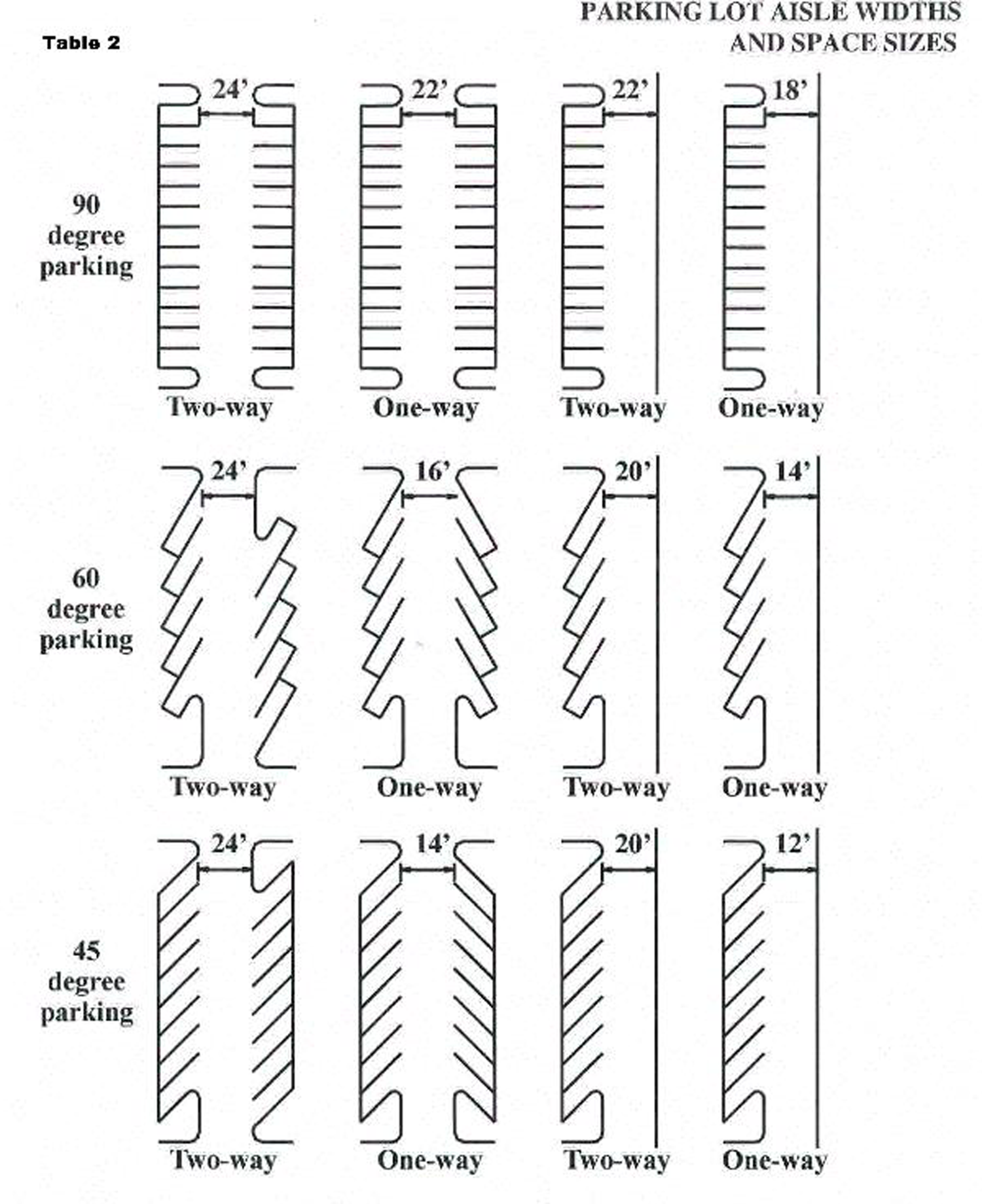
Design and improvement of parking. Please reference tables H-1 and table 2 at the rear of this section (703.00).
703.03-6.1
Parking space design. Except as provided below, all parking spaces shall be standard spaces, designed to accommodate full-sized passenger vehicles.
703.03-6.1-1
Parking space sizes. Standard spaces shall be a minimum of 9 feet by 18 feet; and parallel parking spaces shall be a minimum of 8 feet wide by 20 feet long.
703.03-6.2
Handicap spaces. When a business, state, or local government, or other entity re-stripes or creates a new parking lot, it shall provided accessible parking spaces as required by the ADA Standards for Accessible Design. Failure to do so would violate the American Disability Act.
703.03-6.2-1
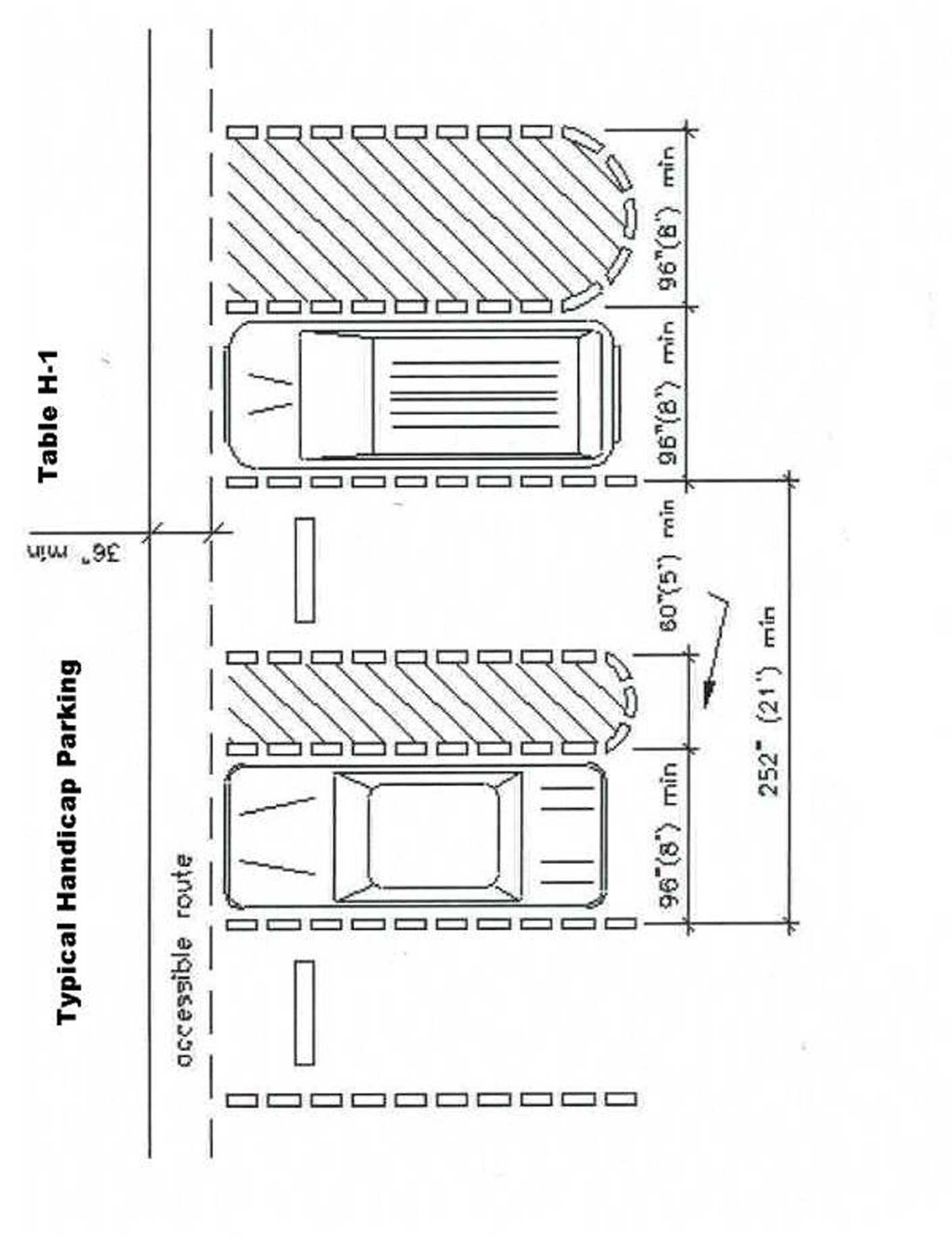
Handicap spaces. See table H-1 at rear of this section (703.00)
703.03-6.2-2
Vertical clearance of at least 114 inches to accommodate van height at the van parking spaces(s), the adjacent access aisle, and on the vehicular route to and from the van accessible space.
703.03-6.2-3
An additional sign that identifies the parking space(s) as van accessible.
703.03-6.2-4
Specifically designated parking spaces for the physically handicapped shall be located on level ground as the parking spaces closest to the designated accessible primary entrance(s). Where possible, spaces shall be located so that handicapped persons do not have to cross roadways.
703.03-6.2-5
Handicapped parking spaces shall be identified and reserved by an appropriately marked sign erected on a post or building at each space. Sign shall be mounted high enough so it can be seen while a vehicle is parked in the space.
703.03-6.2-6
If the accessible route is located in front of the space, install wheelstops to keep vehicles from reducing width below 36 inches.
703.03-6.2-7
Access aisle of at least 60 inches width must be level (1:50 maximum slope in all directions). Be the same length as the adjacent parking space(s) it serves and must connect to an accessible route to the building, Ramps must not extend into the access aisle. Where buildings have multiple accessible entrances with adjacent parking, the accessible parking spaces shall be dispersed and located closest to the accessible entrances.
703.03-6.2-8
Boundary of the access aisle must be marked. The end may be squared or curved shape.
703.03-6.2-9
When accessible parking spaces are added to an existing parking lot, locate the spaces in the most level ground close to the accessible entrance. An accessible route shall always be provided from the accessible parking to the accessible entrance. An accessible route never has curbs or stairs, shall be at least 3 feet wide and has a firm, stable, slip resistant surface. The slope along the accessible route should not be greater than 1:2 in the direction of travel
703.03-6.2-10
Two parking spaces may share an access aisle.
703.03-6.2-11
Total Handicapped Parking Spaces required:
703.03-6.3
Parking lot design. The design and layout of parking lots shall conform to the following standards:
703.03-6.3-1
Circulation aisle width. See table 1 at the [end] rear of this section (703.00).
703.03-6.4
All maneuvering, except parallel parking, shall be designed so that a vehicle may enter an off-street parking space in one forward motion and may exit in one reverse motion and one motion forward.
703.03-6.5
Circulation within a parking area shall be designed so that a car entering
703.03-6.6
Circulation aisle for emergency access. The minimum width of a drive aisle needed for an emergency response vehicle shall be 20 feet.
703.03-6.7
Vehicle overhang. Vehicular overhang is permitted, provided no vehicle shall overhang into a sidewalk which would reduce the encumbered width of a sidewalk to less than four feet. A vehicle is permitted to overhang onto a landscaped area by two feet.
703.03-6.8
All unused right-of-way between the public street and the parking lot shall be landscaped and maintained by the landowner.
703.03-6.9
A permanent curb, bumper, or wheel stop or similar device at least six inches in height shall be installed adjacent to sidewalks, planters and other landscape areas, parking lot fixtures and buildings and walls to protect these improvements from vehicular damage and the stopping edge of such protected bumper shall be placed no closer than two feet from the above noted improvements.
703.03-6.10
All parking spaces shall be delineated and separated by a painted divider (stripe) and shall be maintained in a clear and visible manner. Measurements for parking spaces shall be taken from the center of the painted divider to the center of the painted divider.
703.03-6.11
Controlled access required. All parking spaces, (including garage spaces) required for any land use other than single family or two family dwellings shall be designed and located to provide for vehicle maneuvering on the site so that vehicles will enter any adjacent right-of-way or private road in a forward direction.
703.03-6.12
Surfacing of parking areas. Required parking and circulation areas shall be surfaced with asphalt concrete or Portland cement concrete, or other approved all-weather, hard, noneroding surface. It shall be the responsibility of the property owner to insure that the surface is maintained free from significant cracks or holes.
703.03-6.13
Drive through facilities. The following requirements apply to any use with drive-through facilities:
703.03-6.13-1
Separation and marking of lanes. Drive-through aisles shall be a minimum of 12 feet wide and shall be separated from other circulation aisles for ingress and egress, or aisles providing access to any parking space. Each aisle shall be striped, marked or otherwise distinctly delineated.
703.03-6.14
Loading requirements. Loading shall be provided as identified below:
703.03-6.14-1
No maneuvering within public rights-of-way. All site designs shall be designed so as to prevent truck back up maneuvering within the right-of-way.
703.03-6.14-2
Design. The location, number, size and access of the loading area hall be determined pursuant to design review.
703.03-6.15
Reserved.
703.03-6-16
Required Parking spaces for single family and duplex dwellings located in the front yard shall not be used for, or obstructed by, storage of material, equipment or inoperable vehicles.
703.03-6-17
Bicycle racks. When bicycle spaces are provided, a bicycle rack shall be installed. The bicycle rack shall be designed to allow a bicycle to be secured to the rack. The location of the bicycle rack shall not encroach into the sidewalk which would reduce the unencumbered width of the sidewalk to less than four feet or interfere with any handicap access.
703.03-7
Fire lane requirements, markings and signs.
703.03-7.1
The Virginia Statewide Fire Prevention Code, as amended, the fire official is authorized to require and designate public or private fire lanes as deemed necessary and shall be consulted. This is to prevent parking in front of or adjacent to fire hydrants and/or to provide access for fire fighting equipment and apparatus. Markings and signs are to be provided and maintained by the owner or agent of the owner of the property involved. All enforceable fire lanes shall be marked as follows:
703.03-7.2
Curb and pavement markings.
703.03-7.2-1
The curb shall be painted hot traffic yellow.
703.03-7.2-2
In areas without curbs, a six inch hot traffic yellow border shall be applied parallel to the roadway, at the edge of the pavement.
703.03-7.2-3
Approved signs.
703.03-7.2-4
A sign shall be positioned at the beginning and end of the fire lane an at 100 foot intervals throughout the fire lane or as designated by the fire official.
703.03-7.2-5
here fire lanes are less than 50 feet in length, a single sign positioned in the center is permissible with arrows pointing in both directions.
703.03-7.2-6
Signs shall be mounted on posts and must not exceed a setback of 6 feet from the curb or edge of the roadway.
703.03-7.2-7
The sign shall be positioned where clearly visible to traffic.
703.03-7.2-8
The sign is to be mounted not less than 7 feet from the ground to the bottom of the sign, unless otherwise directed.
703.03-7.2-9
Signs shall not be obscured from view by bushes, shrubs, etc.
703.03-7.4
Sign lettering and construction.
703.03-7.4-1
Lettering on sign. "NO PARKING FIRE LANE TOWING ENFORCED" arrows to point to and indicate the area designated as fire lane.
703.03-7.4-2
Red letters on white background with⅜" red stripe around the entire outer edge of the sign.
703.03-7.4-3
Lettering size:
(a)
NO PARKING = two inches;
(b)
FIRE LANE = two inches;
(c)
TOWING ENFORCED = one inch;
(d)
ARROW = one inch;
(e)
Metal construction sign approximately 12 inches by 18 inches.
(Ord. of 1-18-2008; Ord. No. 18-12, 5-17-2018)
Sec. 704.00. - Junk storage and automobile graveyards.
704.01
Criteria for the location of junkyards or automobile graveyards. (See Code of Virginia, § 33.1-348.) No junkyard or automobile graveyard shall be established, any portion of which is within one thousand feet of the nearest edge of the right-of-way of an interstate or primary highway or within five hundred feet of the nearest edge of the right-of-way of any other highway, except junkyards or automobile graveyards which are:
704.01-1
Screened by natural objects, plantings, fences, or other appropriate means so as not to be visible from the main-traveled way of the highway, or otherwise removed from sight;
704.01-2
Located in areas which are zoned for industrial use;
704.01-3
Not visible from the main-traveled way of the highway.
704.03
Licensed automobile graveyards or junkyards in existence at the time of adoption. Licensed automobile graveyards or junkyards in existence at the time of the adoption of this ordinance, as amended, are considered as nonconforming uses (see section 708.03).
Sec. 705.00. - Home occupations.
This ordinance uses a permit approach to the control of home occupations. The use of permits is to ensure compatibility of home occupations with surrounding residential uses. Custom or traditions are not to be considered as criteria for the evaluation of home occupations. The administrator may request advice from the planning commission as appropriate.
705.01
Special requirements. Home occupation, where permitted, must meet the following special requirements:
705.01-1
The applicant must be the owner of the property on which the home occupation is to be located, or must have written approval of the owner of the property if the applicant is a tenant;
705.01-2
The home occupation shall be operated only by the members of the family residing on the premises and no article or service shall be sold or offered for sale except as may be produced by members of the family residing on the premises;
705.01-3
The home occupation when restricted to the main building shall not occupy more than 50 percent of the floor area within said building;
705.01-4
The home occupation shall not generate excessive traffic or produce obnoxious odors, glare, noise, vibration, electrical disturbance, radioactivity, or other conditions detrimental to the character of the surrounding area, and in general, shall give no evidence of nonresidential character of use other than through the use of a sign meeting requirements for professional name plates, as spelled out in section 706.03-3;
705.01-5
The building in which the home occupation is to be located must be an existing structure ready for occupancy and not a proposed structure.
705.02
Expiration and revocation. A zoning permit for home occupations shall expire or be revoked under the following conditions:
705. 02-1
Whenever the applicant ceases to occupy the premises for which the home occupation permit was issued. No subsequent occupant of such premises shall engage in any home occupation until he shall have been issued a new permit after proper application;
705.02-2
Whenever the holder of such a permit fails to exercise the same for any period of six consecutive months.
705.02-3
Whenever the city council finds that the holder of the permit has violated the conditions of the permit for one or more of the special requirements in section 705.00.
Sec. 706.00. - Signs.
706.1
Findings, purpose and intent; interpretation.
706.00-1
Signs obstruct views, distract motorists, displace alternative uses for land, and pose other problems that legitimately call for regulation. The purpose of this article is to regulate the size, color, illumination, movement, materials, location, height and condition of all signs placed on private and public property for exterior observation, thus ensuring the protection of property values, the character of the various neighborhoods, the creation of a convenient, attractive and harmonious community, protection against destruction of or encroachment upon historic areas, and the safety and welfare of pedestrians and wheeled traffic, while providing convenience to citizens and encouraging economic development. This article allows adequate communication through signage while encouraging aesthetic quality in the design, location, size and purpose of all signs. This article shall be interpreted in a manner consistent with the First Amendment guarantee of free speech. If any provision of this article is found by a court of competent jurisdiction to be invalid, such finding shall not affect the validity of other provisions of this article which can be given effect without the invalid provision.
706.00-2
Signs not expressly permitted as being allowed by right or by conditional use permit under this article, by specific requirements in another portion of this chapter, or otherwise expressly allowed by city council are forbidden.
706.00-3
A sign placed on land or on a building for the purpose of identification, protection or directing persons to a use conducted therein shall be deemed to be an integral but accessory and subordinate part of the principal use of land or building. Therefore, the intent of this article is to establish limitations on signs in order to ensure they are appropriate to the land, building or use to which they are appurtenant and are adequate for their intended purpose while balancing the individual and community interests identified in subsection (a) of this section.
706.00-4
These regulations are intended to promote signs that are compatible with the use of the property to which they are appurtenant, landscape and architecture of surrounding buildings, are legible and appropriate to the activity to which they pertain, are not distracting to motorists, and are constructed and maintained in a structurally sound and attractive condition.
706.00-5
These regulations do not regulate every form and instance of visual speech that may be displayed anywhere within the jurisdictional limits of the city. Rather, they are intended to regulate those forms and instances that are most likely to meaningfully affect one or more of the purposes set forth above.
706.00-6
These regulations do not entirely eliminate all of the harms that may be created by the installation and display of signs. Rather, they strike an appropriate balance that preserves ample channels of communication by means of visual display while still reducing and mitigating the extent of the harms caused by signs.
706.01
Definitions. For the purposes of this section, and when applicable other sections of the land development regulations, the following words are defined.
706.01-1
A-frame sign means a two-faced sign with supports that are connected at the top and separated at the base, forming an "A" shape not more than four feet high. These are also referred to as "sandwich board" signs. An A-frame sign may be permanent or temporary.
706.01-2
Advertising means any words, symbol, color or design used to call attention to a commercial product, service, or activity.
706.01-3
Awning sign means a sign placed on the surface of an awning. Awning signs shall be considered wall signs for the purpose of regulation.
706.01-4
Banner means a temporary sign of flexible material affixed to a framework or flat surface.
706.01-5
Bulletin board means a wall or freestanding sign or sign structure designed for posting multiple smaller signs or notices, usually intended to be seen by pedestrians. Items posted on a permanent bulletin board are considered changeable sign copy.
706.01-6
Business sign means a sign which directs attention to a commercial product, service or activity.
706.01-7
Changeable copy sign means a sign or part of a sign that is designed so that characters, letters or illustrations can be changed or rearranged without altering the face or surface of the sign. This includes chalk boards, white boards, and similar surfaces used as signs, but does not include electronic message boards.
706.01-8
Comprehensive sign plan means a coordinated written plan for the design and siting of multiple signs, typically across multiple proximate buildings or properties such as a campus or subdivision.
706.01-9
Electronic message board sign is an electronically controlled internally illuminated sign which displays text or images.
706.01-10
Feather sign is a lightweight, portable sign mounted along one edge on a single, vertical, flexible pole the physical structure of which at may resemble a sail, bow, or teardrop.
706.01-11
Flag means a piece of cloth or similar material, attachable by one edge to a pole or rope and used as a symbol or decoration; this includes pennants.
706.01-12
Freestanding sign means any non-portable sign supported by a fence, retaining wall, or by upright structural members or braces on or in the ground and not attached to a building. This includes ground and monument signs.
706.01-13
Height means the maximum vertical distance from the base of the sign at normal grade to the top of the highest attached component of the sign. Normal grade shall be construed to be the lower of:
706.01-13.1
Existing grade prior to construction; or
706.01-13.2
The newly established grade after construction, exclusive of any filling, berming, mounding or excavating primarily for the purpose of mounting or elevating the sign.
706.01-14
Illegal sign means any sign erected without a required permit or which otherwise does not comply with any provisions of this article.
706.01-15
Illuminated sign means a sign that is backlit, internally lighted, or indirectly lighted, but does not include a neon sign.
706.01-16
Inflatable sign means a sign consisting of balloons and/or inflatables made of firm or soft materials used for the purpose of attracting attention.
706.01-17
Marquee means a permanent structure projecting beyond a building wall at an entrance to a building or extending along and projecting beyond the building's wall and generally designed and constructed to provide protection against the weather.
706.01-18
Marquee sign means a sign attached to and made a part of a marquee or any similar projections from a building, with changeable, fixed or both types of lettering in use.
706.01-19
Minor sign means a wall or freestanding sign not exceeding two (2) square feet in area, not exceeding four feet in height, and not illuminated.
706.01-20
Nonconforming sign is any sign which was lawfully erected in compliance with applicable regulations of the city/county/town and maintained prior to the effective date of this chapter of the zoning ordinance and which fails to conform to current standards and restrictions of the zoning ordinance.
706.01-21
Off-premises sign means a sign that directs attention to a business, product, service or activity at a location other than the premises on which the sign is erected.
706.01-22
Projecting sign means any sign, other than a wall, awning or marquee sign, affixed to a building and supported only by the wall on which it is mounted.
706.01-23
Public area means any public place, public right-of-way, any parking area or right-of-way open to use by the general public, or any navigable body of water.
706.01-24
Public art means items expressing creative skill or imagination in a visual form, such as painting or sculpture, which are intended to beautify or provide aesthetic influences for public areas or areas which are visible from the public realm.
706.01-25
Roof sign means a sign erected or constructed, in whole or in part, upon or above the highest point of a building with a flat roof, or the lowest portion of a roof for any building with a pitched roof.
706.01-26
Sculptural sign means a spherical, freeform, or other nonplanar sign. Such sign may be a freestanding sign, projecting sign, or roof sign.
706.01-27
Sign means any object, device, display, structure, or part thereof, visible from the public right-of-way or area open to use by the general public which is designed and used to attract attention to an institution, organization, business, product, service, event, or location by any means involving words, letters, figures, designs, symbols, fixtures, logos, colors, illumination, or projected images. The term does not include public art, architectural elements incorporated into the style or function of a building, or flags of any nation, state, or other geopolitical entity not related to a commercial business, product or service. The term "sign" also does not include the display of merchandise for sale on the site of the display.
706.01-28
Sign face means the portion of a sign structure bearing the message.
706.01-29
Sign structure means any structure bearing a sign face; or any portion of a sign, including the area devoted to message or display, and all poles, posts, supports, uprights, bracing, framework, border, background and structural trim.
706.01-30
Temporary sign means a sign that can be is displayed for no more than 30 consecutive days at one time; for a maximum of two (2) 30-day periods, separated by no less than one week, during a calendar year.
706.01-31
Vehicle or trailer sign means any sign attached to or displayed on a vehicle or trailer, if the vehicle or trailer is used for the primary purpose of advertising a business establishment, product, service or activity. Any such vehicle or trailer shall, without limitation, be considered to be used for the primary purpose of advertising if it fails to display current license plates, inspection sticker, or municipal decal, if the vehicle is inoperable, if evidence of paid-to-date local taxes cannot be made available, or if the sign alters the standard design of such vehicle or trailer.
706.01-32
Wall sign means any sign attached to a wall or painted on or against a flat surface of a structure, including the surface of a roof. Wall signs shall include murals.
706.01-33
Window means a transparent or translucent element of the building envelope, bounded by a frame of another material, allowing transmission of light into a building. A single window is a visually-identifiable discrete architectural unit, but may be comprised of multiple sashes or panes of glass.
706.01-34
Window sign means any sign visible outside a window and attached to or within 18 inches in front of or behind the surface of a window.
706.02
Permit required. A sign permit is required prior to the display and erection of any sign except as provided in subsection 706.03.
706.02-1
Application for permit; signs permitted by right.
706.02-2
An application for a sign permit shall be filed with the city on forms furnished by the city. The applicant shall provide sufficient information to determine if the proposed sign is permitted under the zoning ordinance and other applicable laws, regulations, and ordinances. An application for a temporary sign shall state the dates intended for the erection and removal of the sign.
706.02-2.1
The zoning administrator or designee shall promptly process the sign permit application and approve the application, reject the application, or notify the applicant of deficiencies in the application within 20 business days after receipt. Any application that complies with all provisions of this zoning ordinance, the building code, and other applicable laws, regulations, and ordinances shall be approved.
706.02-2.2
If the application is rejected, the city shall provide a list of the reasons for the rejection in writing. An application shall be rejected for non-compliance with the terms of the zoning ordinance, building code, or other applicable law, regulation, or ordinance.
706.02-3
Permit fee. A nonrefundable fee as set forth in the fee schedule adopted by the city council shall accompany all sign permit applications.
706.02-4
Duration and revocation of permit. If a sign is not installed within six months following the issuance of a sign permit (or within 30 days in the case of a temporary sign permit), the permit shall be void. The permit for a temporary sign shall state its duration, not to exceed 30 days unless another time is provided in the zoning ordinance. The city may revoke a sign permit under any of the following circumstances:
706.02-4.1
The city determines that information in the application was materially false or misleading;
706.02-4.2
The sign as installed does not conform to the sign permit application; or
706.02-4.3
The sign violates the zoning ordinance, building code, or other applicable law, regulation, or ordinance.
706.02-5
Application for permit; special exceptions.
706.02-5.1
Comprehensive sign plans may be approved by special use permit in districts for uses allowed by special use permit. Signage included in an approved comprehensive sign plan may deviate from regulations within this ordinance; provided that the intent of this ordinance is maintained.
706.03
Permit not required.
706.03-1
Signs erected by a governmental body or required by law.
706.03-2
Flags up to 16 square feet in size not containing any commercial advertising; provided, that no freestanding pole shall be erected in the public right-of-way nor be within five (5) feet of a service drive, travel lane or adjoining street.
706.03-3
The changing of messages on signs with movable lettering, or the changing of flyers on bulletin boards
706.03-4
The repair and maintenance of an existing permitted sign.
706.03-5
One or more temporary signs with an aggregate area of twelve (12) square feet.
706.03-6
Not more than two minor signs per parcel.
706.03-7
Movable A-frame signs which are erected for a duration of less than 24 hours at a time and which have a sign face of no more than six (6) square feet per side.
706.03-8
Pavement markings. Any sign applied directly and entirely to and flush with an asphalt, concrete, or similar paved surface.
706.03-9
One or more permanent window signs which do not exceed 25% of the area of a single window, where the aggregate area of window signs on the same elevation does not exceed 25% of the gross window area of the same elevation. Signs exceeding 25% of the area of a single window require a permit.
706.03-10
One or more bulletin boards with an aggregate area of twelve (12) square feet.
706.04
Prohibited signs. In addition to signs prohibited elsewhere in this Code or by applicable state or federal law, the following signs are prohibited:
706.04-1
General prohibitions.
706.04-1.1
Signs that violate any law of the commonwealth relating to outdoor advertising.
706.04-1.2
Signs attached to natural vegetation.
706.04-1.3
Signs simulating, or which are likely to be confused with, a traffic control sign or any other sign displayed by a public authority. Any such sign is subject to immediate removal and disposal by an authorized city official as a nuisance.
706.04-1.4
Freestanding signs more than 25 feet in height.
706.04-1.5
Any sign displayed without complying with all applicable regulations of this chapter.
706.04-2
Prohibitions based on materials.
706.04-2.1
Inflatable signs.
706.04-2.2
Signs that emit smoke, flame, scent, mist, aerosol, liquid, or gas.
706.04-2.3
Signs that emit sound.
706.04-3
Prohibitions based on location.
706.04-3.1
Permanent off-premises business signs, unless specifically permitted by this chapter.
706.04-3.2
Signs erected on public land other than those approved by an authorized city official in writing. Any sign not so authorized is subject to immediate removal and disposal by any authorized official.
706.04-3.3
Signs extending above the roofline of a building or its parapet wall.
706.04-3.4
A sign that obstructs free or clear vision, or otherwise causes a safety hazard for vehicular, bicycle, or pedestrian traffic due to its location.
706.04-3.5
Sign constructed or attached so as to obstruct the use of any window, door, stairway or other opening for ingress, egress, ventilation, or light as required by the Virginia Uniform Statewide Building Code or any other applicable regulations.
706.05
Measurements of sign area and height.
706.05-1
Supports, uprights or structure on which any sign is supported shall not be included in determining the sign area unless such supports, uprights or structure are designed in such a way as to form an integral background of the display; except, however, when a sign is placed on a fence, wall, planter, or other similar structure that is designed to serve a separate purpose other than to support the sign, the entire area of such structure shall not be computed. In such cases, the sign area shall be computed in accordance with the preceding provisions.
706.05-2
In instances where there are multiple tenants or users on a property or in a building, allowable sign area for all parties shall not exceed the maximum sign area computed as if there were a single tenant or user.
706.05-3
Sign area.
706.05-3.1
Sign area is calculated under the following principles:
706.05-3.1-1
With signs that are regular polygons or circles, the area can be calculated by the mathematical formula for that polygon or circle. With signs that are not regular polygons or circles, the sign area is calculated using all that area within a maximum of three abutting or overlapping rectangles that enclose the sign face.
706.05-3.1-2
The permitted area of a double-faced sign shall be considered to be the area on one side only. If one face contains a larger sign area than the other, the larger face shall be used in calculating the sign area. A double-faced sign must have an internal angle between its two faces of no more than 45 degrees.
706.05-3.1-3
For projecting signs with a thickness of four inches or more, the sign area also includes the area of the visible sides of the sign, calculated as a rectangle enclosing each entire side view.
706.05-3.1-4
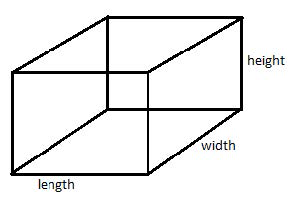
For sculptural signs with varying dimensions and shapes, sign area is calculated by enclosing an imaginary rectangular prism around the shape of the sign. See below.
706.05-3.2
The supports, uprights or structure on which any sign is supported shall not be included in determining the sign area unless such supports, uprights or structure area are designed in such a manner as to form an integral background of the display.
706.05-4
Maximum height. The maximum height for any sign shall be 25 feet unless otherwise specified within this chapter
706.05-5
Window area. The gross window area of each elevation of a building shall be considered to be sum of the area of transparent or translucent window surfaces on the given building elevation.
706.06
Maintenance and removal.
706.06-1
All signs shall be constructed and mounted in compliance with the Virginia Uniform Statewide Building Code.
706.06-2
All signs and components thereof shall be maintained in good repair and in a safe, neat and clean condition.
706.06-3
The building official may cause to have removed or repaired immediately without written notice any sign which, in his opinion, has become insecure, in danger of falling, or otherwise unsafe, and, as such, presents an immediate threat to the safety of the public. If such action is necessary to render a sign safe, the cost of such emergency removal or repair shall be at the expense of the owner or lessee thereof as provided in chapter 14 of this Code.
706.06-4
The zoning official may cause to have removed immediately any temporary sign which is in violation of the provisions of this ordinance. The zoning official shall notify as soon as practicable the property owner, and party which appears responsible for the sign if different, in writing of the nature of the violation and removal of the sign.
706.06-5
The owner of any advertising sign, other than a permitted off-premises sign, located on commercial property where the use or business has ceased operating shall, within 60 days of the cessation of use or business operation, replace the sign face with a blank face until such time as a use or business has resumed operating on the property.
706.06-6
Any sign which constitutes a nuisance may be enforced and abated by the city under the provisions of chapter 8 or chapter 14 of the Code of the City of Buena Vista or Virginia Code §§ 15.2-900, 15.2-906, and/or 15.2-1115.
706.07
Illumination. All permitted signs may be backlit, internally lighted, or indirectly lighted, unless such lighting is specifically prohibited in this article.
706.07-1
In the case of indirect lighting, the source shall be so shielded that it illuminates only the face of the sign. However, shingle signs shall be indirectly illuminated or have shielded direct lighting, unless otherwise prohibited within this chapter. Indirect lighting shall consist of full cut-off or directionally shielded lighting fixtures that are aimed and controlled so that the directed light shall be substantially confined to the sign to minimize glare, sky glow, and light trespass. The beam width shall not be wider than that needed to light the sign.
706.07-2
Illumination shall be situated in a way that does not affect traffic and road safety, nor interfere with residential dwellings or neighboring businesses.
706.07-3
Electronic message boards shall:
706.07-3.1
Not operate at an intensity level of more than 0.3 foot-candles over ambient light as measured at a distance of thirty (30) feet;
706.07-3.2
Automatically dim at night;
706.07-3.3
Be no larger than ten (10) square feet;
706.07-3.4
Conform to other regulations applicable based on sign type such wall, freestanding, marquee.
706.08
Nonconforming signs.
706.08-1
Signs lawfully existing on the effective date of this chapter or prior ordinances, which do not conform to the provisions of this chapter, and signs which are accessory to a nonconforming use shall be deemed to be nonconforming signs and may remain except as qualified below. The burden of establishing nonconforming status of signs and of the physical characteristics/location of such signs shall be that of the owner of the property. Upon notice from the zoning administrator, a property owner shall submit verification that sign(s) were lawfully existing at time of erection. Failure to provide such verification shall be cause for order to remove sign(s) or bring sign(s) into compliance with the current ordinance.
706.08-2
No nonconforming sign shall be enlarged nor shall any feature of a nonconforming sign, such as illumination, be increased.
706.08-3
Nothing in this section shall be deemed to prevent keeping in good repair a nonconforming sign. Nonconforming signs shall not be extended or structurally reconstructed or altered in any manner, except a sign face may be changed so long as the new face is equal to or reduced in height and/or sign area.
706.08-4
No nonconforming sign shall be moved for any distance on the same lot or to any other lot unless such change in location will make the sign conform in all respects to the provisions of this article.
706.08-5
A nonconforming sign that is destroyed or damaged by any casualty to an extent not exceeding fifty (50) percent of its area may be restored within two (2) years after such destruction or damage but shall not be enlarged in any manner. If such sign is so destroyed or damaged to an extent exceeding fifty (50) percent, it shall not be reconstructed but may be replaced with a sign that is in full accordance with the provisions of this article.
706.08-6
A nonconforming sign which is changed to becoming conforming or is replaced by a conforming sign shall no longer be deemed nonconforming, and thereafter such sign shall be in accordance with the provisions of this article.
706.08-7
A nonconforming sign structure shall be subject to the removal provisions of section 708 of the land development regulations. In addition, a nonconforming sign structure shall be removed if the use to which it is accessory has not been in operation for a period of two years or more. Such structure sign shall be removed by the owner or lessee of the property. If the owner or lessee fails to remove the sign structure, the zoning administrator or designee shall give the owner fifteen (15) days' written notice to remove it. Upon failure to comply with this notice, the zoning administrator or designee may enter the property upon which the sign is located and remove any such sign or may initiate such action as may be necessary to gain compliance with this provision. The cost of such removal shall be chargeable to the owner of the property.
706.09
Non-commercial signs; substitution. Wherever this article permits a sign with commercial content, non-commercial content is also permitted subject to the same requirements of size, color, illumination, movement, materials, location, height and construction.
706.10
Dimensional regulations for signage.
706.10-1
City council may approve a conditional use permit granting deviation from the dimensional regulations of this table if it finds that the deviation would be consistent with the intent of the regulations.
(Ord. No. 21-04, Exh. A, 3-18-2021)
Editor's note— Ord. No. 21-04, Exh. A, adopted Mar. 18, 2021, repealed former § 706 and enacted a new section as set out herein. The former section pertained to similar subject matter.
Sec. 707.00. - Manufactured homes.[1]
Any manufactured home placed in the City of Buena Vista after the date of enactment or amendment of this ordinance, shall meet the requirements of this section as applicable.
707.01
Individual manufactured home requirements.
707.01-1
All mobile homes shall meet the plumbing requirements and the electrical wiring and connection, construction, blocking, and anchoring requirements of the Virginia State Building Code and shall display the seal of a testing laboratory approved by the State of Virginia.
707.01-2
All manufactured homes shall be completely skirted; such that no part of the undercarriage shall be visible to a casual observer, in accordance with methods and materials approved by the building official.
707.01-3
All manufactured homes shall be supplied with public water and wastewater disposal where it is available; or such individual service evidenced by permits from the health department.
707.02
Manufactured home park dimensional requirements. All manufactured home parks shall have a minimum area of at least three acres. A minimum of three spaces shall be completed and ready for occupancy before the first occupancy is permitted.
707.03
Manufactured home stand requirements. All manufactured home stands shall meet the following requirements:
707.03-1
The area of any manufactured home stand shall not be less than 3,400 square feet.
707.03-2
Required side setback is 15 feet on both sides combined, with no side less than five feet.
707.03-3
The minimum length of a manufactured home stand shall be 85 feet. The minimum width shall be 40 feet.
707.03-4
The rear yard of each manufactured home stand may be provided with a clothesline which shall be exempt from setback and other requirements of manufactured home accessory structures.
707.04
Manufactured home accessory structures. All manufactured home accessory structures erected or constructed after the date of enactment or amendment of this ordinance must meet the following requirements:
707.04-1
All manufactured home accessory structures must meet the plumbing, electrical connection, wiring, construction, and other applicable requirements of the Building Code.
707.04-2
Except in the case of an awning, ramada, or other shade structure, where a manufactured home accessory structure is attached to the manufactured home unit, a substantial part of one wall of the accessory structure shall be flush with part of the manufactured home unit, or such accessory structure shall be attached to the manufactured home unit in a substantial manner by means of a roof. All manufactured home accessory structures, whether attached or detached, shall be designed and constructed as freestanding structures. No detached manufactured home accessory structure, except ramadas, shall be erected closer than seven and one-half feet to a manufactured home.
707.04-3
Manufactured home accessory structures, except ramadas, shall not exceed the height of the manufactured home.
707.04-4
No manufactured home accessory structure shall be erected or constructed on any manufactured home lot or stand except as an accessory to a manufactured home.
707.05
Manufactured home park application and site plan. Applicants for manufactured home parks shall meet the following special requirements:
707.05-1
Site plans shall be legibly drawn at a scale consistent with its purpose.
707.05-2
The following information shall be required of site plans:
a.
The date of the site plan, the name of the surveyor and the number of sheets comprising the site plan;
b.
The scale and the north designation;
c.
The name and signature of the owner, and the name of the proposed park; said name shall not closely approximate that of any existing manufactured home park or subdivision in the City of Buena Vista;
d.
A vicinity map showing the location and area of the proposed park;
e.
The boundary lines, area, and dimensions of the proposed park, with the locations of property line monuments shown;
f.
The names of all adjoining property owners;
g.
Proposed layout, including interior streets with dimensions and such typical street cross sections and centerline profiles as may be required in evaluating the street layout; water, sewer, drainage, and utility lines, facilities and connections, with dimensions shown; location and type of solid waste collection facilities; interior monuments and lot lines, dimensions, and areas of manufactured home lots, common open space and recreation areas, common parking areas, and other common areas; locations and dimensions of manufactured home stands and parking spaces, managements offices, laundry facilities, recreation buildings, and other permanent structures; location and nature of fire-fighting facilities, including hydrants, fire extinguishers, and other fire fighting equipment; location of fuel storage facilities and structure of high flammability; and location and dimensions of landscaping amenities, including street lights, sidewalks, planted areas, significant natural features to be retained, and fencing and screening.
707.05-3
The site plan shall be accompanied by a narrative statement describing how the standards and requirements set forth herein are to be met; a statement from the health official certifying approval of the proposed site plan; and where appropriate, statements from the highway engineer certifying approval of the street and drainage; water and sewer, or utility system layouts by the owner/operator.
707.06
Manufactured home park design standards.
707.06-1
Streets. An internal street system shall be provided to furnish convenient access to manufactured home stands and other facilities in the park, shall be designed such that connection to existing drainage and utility systems is convenient, and shall meet the following requirements; in addition to such other reasonable standards and requirements as may be established by the city council:
a.
Private streets shall be constructed, at a minimum, using the VDOT GS-4 Geometric Design Standards for Rural Local Road System or VDOT GS-8 Geometric Design Standards for Urban Local Street System. The zoning administrator must approve which standard is used.
b.
Public streets shall be constructed, at a minimum, using the applicable standard from the VDOT Road Design Manual Appendix B(l) Subdivision Street Design Guide or current equivalent. Acceptance of public streets is at the discretion of city council.
c.
All internal streets shall be permanently paved with a durable, dust-proof, hard surface. Gravel, crushed stone, or similar is not permitted.
d.
Dead end streets shall be limited in length to 600 feet, shall be provided with culs-de-sac with turning areas of not less than 40 feet in radius.
e.
Driveway entrances to manufactured home parks from any public street or road shall conform to the current geometric design and construction standards of the department of highways and transportation, unless otherwise approved by the city.
707.06-2
Vehicle parking. Off-street parking shall be provided for the use of occupants at the minimum ratio of two car spaces for each manufactured home. Each off-street parking space shall be paved or graveled and have unobstructed access to either a public or private street. On-street parking is prohibited unless the paved street on which the manufactured home fronts is expanded to accommodate additional parking lanes or parking bays.
707.06-3
Lighting. All streets and walkways within the manufactured home development shall be lighted.
707.06-4
Disposition of garbage and rubbish. It shall be the responsibility of the manufactured home park to collect or cause to be collected and disposed of garbage and rubbish as frequently as may be necessary. Dumpsters may be used with the approval of the health department, but shall be so located as to not be more than 150 feet from any manufactured home.
707.06-5
Installation of storage tanks. Gasoline, liquefied petroleum, gas, or oil storage tanks shall be so installed as to comply with all city, state and federal fire prevention and protection regulations.
707.06-6
Open spaces. Open and green space shall be provided for community and recreational use by residents, protection of natural features and watercourses, and stormwater management. A minimum of ten percent of the gross area of the manufactured home park shall be open space, exclusive of roads.
707.06-7
Pedestrian circulation. Adequate provision for pedestrians is required. All stands must be serviced by a sidewalk, pedestrian path, or roadway designed for safe shared use by vehicles and pedestrians. The park must connect to adjacent external pedestrian infrastructure wherever possible.
707.07
Record of tenants for manufactured home parks. The operator of a manufactured home park shall keep an accurate register of all tenants occupying manufactured homes located in the park. The register shall show the name and permanent residence address of the owner and occupants of any manufactured home located in the park; the make and registration of any manufactured home; the time and date of arrival and departure; and such other information as might be necessary to provide information about the occupants of the manufactured home. These records shall be open to the law enforcement officers and public officials whose duties necessitate acquisition of the information contained in the register. The register record for each occupant registered shall not be destroyed for a period of three years following the date of departure of the registrant from the park.
707.08
Certificate of use and occupancy required. No manufactured home or accessory structure shall be occupied in any manufactured home park until a certificate of occupancy shall have been issued by the city building inspector to the effect that the manufactured home park or the portion thereof for which such certificate is requested is in compliance with all applicable provisions of this chapter and the Uniform Building Code. Such certificate shall not be issued until after the same has been approved by the health department, zoning administrator and other agencies concerned.
(Ord. of 2-2-2023, Exh. A)
Editor's note— An ordinance adopted Feb. 2, 2023, Exh. A, amended the title of § 707.00 to read as herein set out. The former § 707.00 title pertained to mobile homes.
Sec. 708.00. - Nonconforming lots, buildings and uses.
It is the intent of this ordinance to recognize that the elimination of existing lots, buildings, and structures or uses that are not in conformity with the provisions of this ordinance is as much a subject of health, safety, and general welfare as is the prevention of the establishment of new uses that would violate the provisions of this ordinance. It is, therefore, the intent of this ordinance to permit these nonconformities to continue, but not to encourage their survival, permit their expansion, or permit their use as grounds for adding other structures or uses prohibited elsewhere in the same district. Therefore, any structure or use of land existing at the time of the enactment of this ordinance, and amendments thereto, but not in conformity with its regulations and provisions, may be continued subject to the following provisions:
708.01
Lots of record. Where a lot of record at the time of enactment of this ordinance does not contain land of sufficient area or width to permit conformity with the dimensional requirements of this ordinance, the following provisions shall apply:
708.01-1
A single nonconforming lot of record at the time of enactment or amendment of this ordinance may be used as a building site, provided that yard dimensions and requirements other than those applying to area or width of the lot shall conform to the regulation for the district in which such lot is located. Variances of yard requirements may be obtained only through appeal to the board, as outlined in section 807.00 herein.
708.02
Nonconforming structures. Where a lawful structure exists at the time of enactment or amendment of this ordinance that could not be built in the district in which it is located by reason of restrictions on lot coverage, height, yard dimensions, or other requirements, such structure may be continued so long as it remains otherwise lawful, subject to the following provisions:
708.02-1
Any structure or portion thereof declared unsafe by the building official may be restored to a safe condition, provided that the requirements of this section are met, and that the cost of restoration of the structure to a safe condition shall not exceed 75 percent of its replacement cost at the time of the building official declaration;
708.02-2
No nonconforming structure may be enlarged or altered in any way which increases its nonconformity; and any structure or portion thereof may be altered to decrease its nonconformity;
708.02-3
Notwithstanding the provisions of section 708.02-2 above, whenever repairs on or installation of plumbing fixtures in residential structures is required by law or administrative action of the health official or the building official, such alterations shall be permitted, provided that where such alterations require an addition to the structure, such addition shall be no nearer the lot line than permitted by the requirements of this ordinance. Where an existing residential structure exceeds these requirements the said addition shall extend no nearer the lot line than the existing building line;
708.02-4
Should a nonconforming structure be moved, it shall thereafter conform to the yard dimension requirements of the district in which it is located after it is moved;
708.02-5
Should a nonconforming structure or nonconforming portion of a structure be destroyed by any means, it shall not be reconstructed to a greater degree of nonconformity.
708.03
Nonconforming uses of land. Where a lawful use of land exists at the time of enactment or amendment of this ordinance that would not be permitted by the regulations imposed herein and where such is either:
(1)
An accessory use involving the use of no separate accessory structure; or
(2)
A principal use involving no individual structure, such use may be continued as long as it remains otherwise lawful, subject to the following provisions:
708.03-1
No such nonconforming use shall be enlarged or increased nor extended to occupy a greater area of land than was occupied at the time of enactment or amendment of this ordinance;
708.03-2
No such nonconforming use shall be moved in whole or in part to any portion of the lot or parcel other than that occupied by such use at the time of enactment or amendment of this ordinance;
708.03-3
In the event that such use ceases for reason other than destruction for a period of more than one year any subsequent use shall conform to all requirements of this ordinance for the district in which the land is located;
708.03-4
No additional structure not conforming to the requirements of this ordinance shall be constructed in connection with such nonconforming use.
708.04
Nonconforming uses of structure. Where a lawful use involving an individual structure or structures in combination, exists at the time of enactment or amendment of this ordinance, that would not be permitted in the district in which it is located under the requirements of this ordinance, such use may be continued as long as it remains otherwise lawful, subject to the following provisions:
708.04-1
No structure existing at the time of enactment or amendment of this ordinance devoted to a nonconforming use shall be enlarged, extended, moved, or structurally altered, except repairs on or installation of plumbing fixtures required by law or administrative action of the health official or the building official, or the changing of interior partitions or interior remodeling; or in changing the use of the structure to a conforming use;
708.04-2
A nonconforming use of a structure may be extended to include use of the entire structure, but shall not be extended to include either additional structures or land outside the structure;
708.04-3
When a nonconforming use of a structure or structures and premises in combination is discontinued or abandoned for one year, or for 18 months during any three year period, except when government action impedes access to the premises; or when a nonconforming use is superseded by a permitted use; the structure and premises shall not thereafter be used except in conformity with the regulations of the district in which it is located.
Sec. 709.00. - Special regulations for townhouses.
709.01
No more than ten townhouses shall be included in any townhouse grouping.
709.02
Attached dwellings shall be separated by a noncombustible party wall to the roof line, with a fire resistance of not less than two hours duration.
709.03
Each townhouse building shall front on a street dedicated to public use. If access is to be provided by means of privately owned and maintained streets, the streets including curbs, gutters, and sidewalks shall be developed according to standards found in subdivision street requirements by the Virginia Department of Highways and Transportation by authority of section 33.1-12, 33.1-69, and 33.1-229 of the Code of Virginia (1950) as amended.
709.04
Common areas shall be maintained by and be the sole responsibility of the developer-owner of the townhouse development until such time as the developer-owner conveys such common area to homeowners' association whose members shall be all the individual owners of the townhouses in the townhouse development. Said land shall be conveyed to and be held by said homeowners' association solely for recreational and parking purposes of the owners of the individual townhouse lots in the development. In the event of such conveyance by the developer-owner to a homeowners' association, deed restrictions and covenants shall provide, among other things, that any assessments, charges for cost of maintenance of such common areas shall constitute a pro-rata lien upon the individual townhouse lots. Maintenance of townhouse exteriors, lawns, refuse handling, taxes, lighting, and drainage shall be provided in a similar manner so as to discharge any responsibility from the City of Buena Vista.
Sec. 710.00. - Fences.
710.01
No fragile, readily flammable material such as paper, cloth or canvas shall constitute a part of any fence, nor shall any such material be employed as an adjunct or supplement to any fence.
710.02
In the case of corner lots in residential districts, there shall be no planting, fence or obstruction to vision more than three feet high, less than 20 feet from the intersection of two street lines.
710.03
No barbed wire fence shall be erected or maintained within the limits of the City of Buena Vista unless the following conditions are met:
710.03-1
In all cases where a barbed wire fence is requested, a building permit must be obtained.
710.03-2
No barbed wire may be installed in a residential district or on a lot occupied residentially.
710.03-3
Barbed wire is permitted as an integral part of the security fence for nonresidential properties. Not exceeding three strands may be permitted on the top of a fence, providing that the arms do not project over public property. The minimum height of the bottom strand of barbed wire shall not be less than six feet from the finished grade.
710.03-4
A barbed wire fence may be erected or maintained around a tract of land used for agricultural purposes upon the date of enactment of these regulations.
710.04
In no case shall razor wire or equivalent be permitted in any zone within city limits except as used by official governmental agencies.
710.05
No fence shall be maintained with protruding nails, boards, wires or other similar materials that may endanger the public.
710.06
Electric fences. As used in this section, [the term] "electric fence" shall mean a fence designed to conduct electric current along one or more wires thereof so that a person or animal touching any such wire or wires will receive an electric shock.
710.06-1
Except as hereinafter provided, it shall be unlawful for any person to electrify, operate or use any electric fence, or for any person exercising supervision or control over any real property to permit any other person to electrify, operate or use any electric fence, on any property in this city zoned for residential use.
710.06-2
This section shall have no application to any electric fence maintained, operated or used on the premises of any farm five acres in size or larger, regardless of zoning. As used in this section, [the term] "farm" shall mean a parcel of land devoted to production for sale of plants or animals or to the production of plant or animal products useful to man.
(Ord. of 8-14-1999)
Sec. 711.00. - Residential occupancy.[2]
711.5
Findings and intent.
711.5-1
Regulating the occupancy of dwelling units can prevent or mitigate negative impacts of high residential density on individual properties and neighborhoods.
711.00
Property owners are required to obtain a conditional use permit when any dwelling is altered, constructed, or used for residential occupancy by any person or combination of persons other than a family, as herein defined, and any occupant is a lessee of any portion of the same property.
711.00-1
The term lessee means a person or entity that has entered into agreement, written or otherwise, for the use of land, a building, or part of a building for any period of time in exchange for compensation. Such compensation may be monetary or otherwise.
711.00-2
This requirement shall not apply to dwelling units governed by Article 14 Bed and Breakfast Establishments which are properly licensed by the City.
711.00-3
This requirement shall not apply to residential facilities identified in Code of Virginia, § 15.2-2291.
711.01
City council may allow by a conditional use permit the occupancy of a dwelling unit by a combination of persons other than a family, as herein defined.
711.01-1
Exceptions. No conditional use permit shall be required for dwelling units governed by section 714, residential transient occupancy. No conditional use permit shall be required for residential facilities identified in Code of Virginia, § 15.2-2291.
711.02
Dimensional regulations and parking requirements.
711.02-1
In granting such a conditional use permit city council may waive or modify any dimensional regulation of the underlying zoning district.
711.02-2
In granting such a conditional use permit, city council may waive or modify any off-street parking requirement of the underlying zoning district. The following guidelines are recommended for determination of adequate parking:
711.02-2.1
At a minimum, two off-street parking spaces should be provided.
711.02-2.2
One parking space should be provided for each person in excess of the zoning definition of family.
711.02-2.3
Once the minimum of two off-street parking spaces is provided, on-street parking spaces should be considered in the total spaces available to the dwelling unit.
Editor's note— An ordinance adopted Feb. 1, 2024, Exh. A, amended the title of § 711.00 to read as herein set out. The former § 711.00 title pertained to group homes; conditional use permit required.
Sec. 712.00. - Adult oriented businesses.
712.01
Definitions. The following words, terms and phrases, when used in this chapter shall have the meaning ascribed to them in this section, except when the context clearly indicates a different meaning:
712.01-1
Adult bookstore or adult video store means an establishment having as a substantial or significant portion of its stock-in-trade books, magazines, periodicals or other printed matter, photographs, films, videotapes, computer disks, CD-ROMs, DVD-ROMs, virtual reality devices or similar media that are distinguished or characterized by their emphasis on matter depicting describing or relating to "specified sexual activities" or "specified anatomical areas," offered for sale or rental for any form of consideration.
712.01-2
Adult business means any adult bookstore, adult video store, adult model studio, adult motel, adult movie theater, adult nightclub, adult store, or business providing adult entertainment, or any other establishment that regularly exploits an interest in matter relating to specified sexual activities or specified anatomical areas or regularly features live entertainment intended for the sexual stimulation or titillation of patrons.
712.01-3
Adult entertainment means dancing, modeling, or other live entertainment if the entertainment is characterized by an emphasis on specified sexual activities or specified anatomical areas or is intended for the sexual stimulation or titillation of patrons: or the showing of films, motion pictures, videotapes, slides, photographs, CD-ROMs, DVD-ROMs, or other media that are characterized by their emphasis on matter depicting, describing or relating to specified sexual activities or specified anatomical areas.
712.01-4
Adult merchandise means magazines, books, other periodicals, videotapes, films, motion pictures, photographs, slides, CD-ROMs, DVD-ROMs, virtual reality devices, or other similar media that are characterized by their emphasis on matter depicting, describing or relating to specified sexual activities or specified anatomical areas; instruments, devices or paraphernalia either designed as representations of human genital organs or female breasts, or designed or marketed primarily for use to stimulate human genital organs; or, lingerie or leather goods marketed or presented in a context to suggest their use for sadomasochistic practices.
712.01-5
Adult model studio means a commercial establishment, including a lingerie store or novelty store, in which a person performs or simulates specified sexual activities, exposes specified anatomical areas, or engages in other performances intended for the sexual stimulation or titillation of the patrons.
712.01-6
Adult motel means a motel, hotel, or similar commercial establishment that:
(i)
Provides patrons with closed-circuit television transmissions, internet, films, motion pictures, videocassettes, slides, or other photographic reproductions that are characterized by the depiction or description of specified sexual activities or specified anatomical areas and advertises the availability of this sexually-oriented type of material by means of a sign visible from the public right-of-way, or by means of any off-premises advertising, including, but not limited to, newspapers, magazines, pamphlets or leaflets, radio or television; or
(ii)
Offers a sleeping room for rent for a time period of less than ten hours; or
(iii)
Allows a tenant or occupant to sub rent the sleeping room for a time period of less than ten hours.
712.01-7
Adult movie theater means an enclosed building regularly used for presenting material distinguished or characterized by an emphasis on matter depicting, describing or relating to specified sexual activities or specified anatomical areas for observation by patrons, excluding movies that have been rated G, PG, PG-13 or R by the Motion Picture Association of America.
712.01-8
Adult nightclub means a restaurant, bar, club, or similar establishment that regularly features adult entertainment.
712.01-9
Adult store means an establishment having adult merchandise as a substantial or significant portion of its stock-in-trade.
712.01-10
Associate means any entity or person acting in concert with an owner, operator, manager or employee in the management or control of the adult business, whether or not compensated.
712.01-11
Employee means an individual working or performing services for any adult business on a full-time, part-time or contract basis, whether or not the person is denominated an employee, independent contractor, agent or otherwise, who provides services on behalf of any adult business to the patrons of such business, whether or not the individual receives any remuneration, gratuity, tips of any kind, or other compensation, or pays the permittee or manager for the right to perform or entertain in the adult business.
712.01-12
Live entertainment means entertainment provided in person including, but not limited to, musical performances, music played by disc jockeys, public speaking, dramatic performances, dancing, modeling, or comedy performances.
712.01-13
Specified anatomical areas means less than completely and opaquely covered human genitals, pubic region, buttock, or female breast below a point immediately above the top of the areola; or human male genitals in a discernibly turgid state, even if completely and opaquely covered.
712.01-14
Specified sexual activities means human genitals in a state of sexual stimulation or arousal; sexual intercourse or sodomy; or fondling or other erotic touching of human genitals, pubic region, buttock or female breast, including masturbation.
712.02
Permit required from chief of police—Application; issuances; duration; renewal.
712.02-1
Every person either operating or desiring to operate an adult business, in addition to obtaining any required business license from the commissioner of revenue, shall apply to the chief of police, or designee, for a permit to conduct such activity. Each such application shall be accompanied by a fee in the amount of $300.00 and any additional documented costs as incurred by the Buena Visa Police Department or any other department for the City of Buena Vista, Virginia. Such additional costs shall be paid immediately upon receipt of such.
712.02-2
Information required on and with the permit application shall include, but not be limited to, the following:
712.02-2.1
The applicant's full name, any previous or current aliases, age, sex, race, weight, height, hair and eye color, mailing address, residential address, telephone number, date and place of birth, driver's license number, and social security number.
712.02-2.2
If the applicant intends to operate the adult business under a name other than that of the applicant; he or she must state:
1)
The adult business's fictitious name; and
2)
Submit the required registration documents.
712.02-2.3
Names and addresses of at least three references.
712.02-2.4
Whether the applicant, or a person residing with the applicant, has been convicted of any felony or misdemeanor and, if so, the specified criminal activity involved, the date, place, penalty or punishment assessed, and jurisdiction of each.
712.02-2.5
Whether the applicant, or a person residing with the applicant, holds or has held any other licenses under this ordinance or other similar adult business ordinances, in the name of this business or any other, from any other locality within the past five years, and if so, the names and locations of such other permitted businesses.
712.02-2.6
Whether the applicant, or a person residing with the applicant, has had a previous license under this ordinance or other similar adult business ordinance from another city or county denied, suspended or revoked, including the name and location of the adult business for which the permit was denied, suspended or revoked, as well as the date of denial, suspension or revocation.
712.02-2.7
Whether the applicant or a person residing with the applicant has been a partner in a partnership, a member or manager of a limited-liability company (LLC), or an officer, director or principal stockholder of a corporation that is licensed under this ordinance or other similar adult business ordinance from another city or county, whose license has previously been denied, suspended or revoked, including the name and location of the adult business for which the permit was denied, suspended or revoked, as well as the date of denial, suspension or revocation.
712.02-2.8
Photograph and fingerprints of applicant.
712.02-2.9
Location of the proposed adult business, including a legal description of the property, street address and telephone number(s), if any.
712.02-2.10
A criminal records check of the applicant shall be provided by the applicant with the application, along with the applicant's written authorization to investigate whether the information provided by the applicant is true.
712.02-2.11
A description of the intended business activity, including a sketch or diagram, drawn to a designated scale or with marked dimensions of the interior of the premises to an accuracy of plus or minus six inches, showing the configuration of the premises, including a statement of total floor space occupied by the business.
712.02-2.12
If adult entertainment is to be provided, a detailed description of such entertainment.
712.02-2.13
Written declaration, dated and signed by the applicant, in affidavit form that the information contained in the application is true and correct.
712.02-2.14
For a partnership, the partnership shall state its complete name, and names of all partners, whether the partnership is general or limited, and a copy of the partnership agreement.
712.02-2.15
For a corporation, the corporation shall state its complete name, the date of its incorporation, evidence that the corporation is in good standing under the laws of its state of incorporation, the names and capacity of all officers, directors and controlling stockholders, and the name of the registered corporate agent and the address of the registered office for service of process.
712.02-2.16
For a limited-liability company (LLC), the LLC shall state its complete name, the date of its formation, evidence that the LLC is in good standing under the laws of its state of organization, the names, addresses and capacity of all members.
712.02-2.17
For any other legal entity, "applicant" shall include each officer, director, partner, member or other principal of the entity and the managers and other associates of the business.
712.03
Chief of police action on application. The chief of police or designee shall act on the application within 30 days of the filing of an application containing all the information required by this section, unless information requested from other law enforcement agencies is not received within that 30 day period, in which case the chief of police or designee shall have an additional 30 days to act on the application. upon expiration of the applicable time period, unless the applicant requests and is granted a reasonable extension of time, the applicant may, at its option, begin operating the business for which the permit is sought, unless and until the chief of police or designee notified the applicant of a denial of the application and stated the reasons for denial.
712.03.1
The applicant shall be issued a permit unless the city's investigation or the information furnished by the applicant shows any of the following:
712.03.1-1
The applicant has failed to provide information required by this section or has falsely or misleadingly answered a question.
712.03.1-2
The applicant or a person residing with the applicant has been convicted of a felony within the past five years.
712.03.1-3
The applicant or a person residing with the applicant has been convicted of a crime of moral turpitude or a crime involving obscenity laws within the last five years.
712.03.1-4
The applicant or a person residing with the applicant has been denied a permit or has had a permit revoked or suspended within the last 12 months under any statute or ordinance requiring a permit to operate an adult business.
712.03.1-5
Failure of the applicant's business to comply with the city's business license, zoning, building, plumbing, utility, health, electric, or fire prevention codes, or with any other applicable city or state laws or regulations.
712.03.1-6
The application fee has not been paid.
712.03.1-7
The applicant is under the age of 18 years of age.
712.03.1-8
The applicant or a person residing with the applicant is overdue in payment to the City of Buena Vista for taxes, fees, fines or penalties assessed against or imposed upon him/her in relation to any business.
712.03.1-9
The applicant is in violation of or is not in compliance with any of the provisions of this ordinance.
712.04
Application denied. If the application is denied, the chief of police or designee shall notify the applicant of the denial and state the reasons for the denial in writing.
712.05
Validity of permit. The permit shall be valid for 12 months from the date thereof and may be renewed in the same manner as it was initially obtained. The application fee for a renewal permit shall be $300.00 and any additional documented costs as incurred by the Buena Visa Police Department or any other department for the City of Buena Vista, Virginia. Such additional costs shall be paid immediately upon receipt of such. No permits shall be transferable.
712.06
Change of ownership. Any changes in the ownership or principals of the business entity to which the permit is issued or in the managers or other associates of the business will automatically make the permit void. Such changes shall be immediately reported to the chief of police or designee and a new application may be submitted for review.
712.07
Employee license application. Before any application may be issued an adult business employee license, the applicant shall submit on a form to be provided by the City of Buena Vista, the following information:
712.07-1
The applicant's name or any other name (including "stage" names) or aliases used by the individual.
712.07-2
Age, date and place of birth.
712.07-3
Height, weight, hair and eye color.
712.07-4
Present residence address and telephone number.
712.07-5
Present business address and telephone number.
712.07-6
Date, issuing state and driver's license number or other identification card information.
712.07-7
Proof that the individual is at least 18 years of age.
712.07-8
[Contents.] Attached to the application form for an adult business employee license as provided above, shall be the following:
712.07-8.1
A color photograph of the applicant clearly showing the applicant's face, and the applicant's fingerprints on a form provided by the police department. Any fees for the photographs and fingerprints shall be paid by the applicant.
712.07-8.2
A statement detailing the license history of the applicant for the five years immediately preceding the date of filing of the application, including whether such applicant previously operated or is seeking to operate, in this or any other county, city, state or country has ever had a license, permit, or authorization to do business denied, revoked or suspended, or had any professional or vocational license or permit denied, revoked or suspended. In the event of any such denial, revocation or suspension, state the name, the name of the issuing or denying jurisdiction, and describe in full the reason for the denial, revocation or suspension. A copy of any order of denial, revocation, or suspension shall be attached to the application.
712.07-8.3
A statement whether the applicant has been convicted of a felony within the past five years or has been convicted of a crime of moral turpitude or a crime involving obscenity laws within the last five years, and, if so, the specified criminal activity involved, the date, place and jurisdiction of each.
712.08
Grounds for revocation.
712.08-1
The chief of police or designee may revoke any permit issued pursuant to this chapter for the following:
712.08-1.1
Fraud, misrepresentation or any false or misleading statement contained in the application.
712.08-1.2
Conviction of the permittee for any felony, crime involving moral turpitude, or crime involving the obscenity laws after the permit is issued.
712.08-1.3
The permittee or an employee or associate of the permittee has knowingly allowed possession, use or sale of illegal controlled substances in or on the premises.
712.08-1.4
The permittee or an employee or associate of the permittee has knowingly allowed prostitution on the premises.
712.08-1.5
The permittee or an employee or associate has refused to allow an inspection of the adult business premises as authorized by this chapter.
712.08-1.6
On two or more occasions within a 12 month period, employees or associates of the adult business at the time of the offenses committed an offense in or on the permitted premises for which a conviction has been obtained constituting:
712.08-1.6-1
Aiding, abetting or harboring a runaway child.
712.08-1.6-2
Prostitution or promotion of prostitution.
712.08-1.6-3
Exposing minors to harmful materials.
712.08-1.6-4
Dissemination of obscenity.
712.08-1.6-5
Sexual assault.
712.08-1.6-6
The fact that a conviction is being appealed shall have no effect on the revocation of the permit.
712.08-1.6-7
The permittee is convicted of violations regarding any taxes or fees related to the adult business.
712.08-1.6-8
The permittee has failed to operate or manage an adult business in a peaceful and law-abiding manner.
712.08-1.6-9
The permittee or an employee of the permittee, except a permittee or employee of a permittee of an adult motel, has knowingly allowed any act of sexual intercourse, sodomy, oral copulation, masturbation, or other sexual activity to occur in or on the permitted premises.
712.08-1.6-10
The permittee has been operating an adult business not approved under the applicable permit.
712.08-1.6-11
The permittee has failed to comply with the provisions of this chapter.
712.08-1.6-12
The permittee's business fails to comply with other applicable city or state laws or regulations.
712.09
Revocation of license. When the city revokes a license, the revocation shall continue for one year, and the licensee shall not be issued an adult business license for one year from the date the revocation became effective. If, subsequent to revocation, the city finds that the basis for the revocation has been corrected or abated, the applicant may be granted a license if at least 90 days have elapsed since the date the revocation became effective.
712.10
Procedure upon denial of an application or revocation of a permit.
712.10-1
If the chief of police or designee denies an application or revokes a permit, the chief of police shall notify the applicant or permittee in writing of such action, the reasons therefore, and the right to request a hearing. To receive a hearing, the applicant or permittee must make a written hearing request which must be received by the chief of police or designee within ten days of the date of the notice of denial or revocation. If a timely hearing request is not received by the chief of police or designee, the decision of the chief of police or designee shall be final. If a hearing is properly requested, it shall be held within ten days from receipt of the hearing request. The hearing shall be presided over by the chief of police or designee. The applicant or permittee shall have the right to present evidence and argument or to have counsel do so. Within five days of the hearing the chief of police or designee shall render a decision which shall be final. A permittee must discontinue the operation of its business when the decision to revoke the permit becomes final.
712.10-2
When an imminent threat of substantial harm to the public health or safety requires such action, unless the matter is one for which another city official has specific enforcement authority, the chief of police or designee may immediately revoke a permit issued under this chapter by so stating in a written notice to the permittee. When action is taken pursuant to this subsection, the permittee shall immediately discontinue operation of its business, but shall have the right to a hearing as stated in subsection (1) of this section.
712.11
Availability of prompt judicial review and determination. After denial of an initial or renewal application or after revocation of a permit by the chief of police or designee, the applicant or permittee may seek prompt judicial review of such administrative action in the circuit court of the city. Any such request for judicial review shall be filed within 30 days of when the administrative action becomes final. The city will facilitate the applicant's obtaining prompt review and determination.
712.12
Inspection.
712.12-1
In addition to any existing legal authority, an applicant or licensee shall permit representatives of the police department, health department, fire department, zoning department, or other city departments or agencies to inspect an adult business for the purpose of determining compliance with the provisions of this ordinance and all applicable laws, at any time it is occupied or open for business.
712.12-2
The provisions of subsection (1) of this section shall not apply to sleeping rooms of an adult motel which are currently being rented by a customer.
712.13
Regulations pertaining to adult businesses providing adult entertainment.
712.13-1
For the purposes of this section, adult entertainment is defined as dancing, modeling, or other live entertainment if the entertainment is characterized by an emphasis on specified sexual activities or specified anatomical areas or is intended for the sexual stimulation or titillation of patrons.
712.13-2
No person shall provide adult entertainment for patrons of an adult business except upon a stage located in an area open to all patrons of the business. The stage shall be at least 18 inches above the level of the floor and separated by a distance of at lease three feet from the nearest area occupied by patrons. No patron shall be permitted within three feet of the stage while the stage is occupied by an entertainer.
712.13-3
The adult business shall provide separate dressing room facilities for female and male entertainers, which shall not be occupied or used in any way by anyone other than them.
712.13-4
The adult business shall provide entertainers access between the stage and the dressings rooms which is completely separated from the patrons. If separate access is not physically feasible, the establishment shall provide a walk aisle at least four feet wide for entertainers between the dressing room area and the stage with a railing, fence or other barrier separating the patrons and the entertainers which prevents any physical contact between patrons and entertainers.
712.13-5
No entertainer shall have physical contact with any patron and no patron shall have physical contact with any entertainer while in or on the premises of the adult business.
712.13-6
No patron shall directly pay or give any gratuity to any entertainer. A patron who wishes to pay or give a gratuity to an entertainer shall place the gratuity in a container that is at all times located separately from the entertainers for the purpose of preventing any physical contact between a patron and an entertainer. No entertainer shall solicit any gratuity from any patron.
712.13-7
Patrons must be at least 18 years of age.
712.13-8
No operator, or no manager of an adult business shall cause or allow an entertainer to contract to or engage in any entertainment such as a "couch," a "straddle" or "lap" dance with a patron while in or on the premises of an adult business. No entertainer shall contract to or engage in a "couch," a "straddle" or "lap" dance with a patron while in or on the establishment premises. For purposes of this subsection, "couch," "straddle" or "lap" dance is defined as an employee of the establishment intentionally touching any patron while engaged in any specified sexual activity or other activity intended for the sexual stimulation or titillation of patrons, or the exposure of any specified anatomical area.
712.13-9
This section shall not apply to an employee of an establishment who, while acting as a waiter, waitress, host, hostess, or bartender, comes within three feet of a patron. No employee shall engage in any specified sexual activity or other activities intended for the sexual stimulation or titillation of patrons, or expose any specified anatomical area while acting as a waiter, waitress, host, hostess, or bartender.
712.14
Regulations pertaining to adult motels.
712.14-1
Evidence that a sleeping room in a hotel, motel or similar commercial establishment has been rented and vacated two or more times in less than ten hours creates a rebuttable presumption that the establishment is an adult motel as that term is defined in Buena Vista Land Development Regulations 712.01-6.
712.14-2
No person who is in control of a sleeping room in a hotel, motel, or similar commercial establishment that does not have an adult business permit shall rent or sub-rent a sleeping room to a person, and within ten hours from the time the room is rented, rent or sub-rent the same sleeping room again.
712.14-3
For the purpose of subsection [712.14-2] (2) of this section, the term "rent" or "sub-rent" means the act of permitting a room to be occupied for any form of consideration.
712.15
Transfer of permit prohibited.
712.15-1
A permittee shall not operate an adult business at any place other than at the address designated in the approval permit.
712.15-2
A permittee shall not transfer its permit to another person.
712.16
Violations.
712.16-1
Except as permitted in Buena Vista Land Development Regulations 611.02-24, operation of an adult business without a permit is prohibited. Violations of this chapter shall be unlawful and subject to the provisions of Buena Vista Land Development Regulations 1103.00.
712.17
Effective date. This ordinance shall become effective immediately upon adoption, but any adult business currently operating in the city shall have 30 days from the date of the adoption to apply for a permit and 90 days after obtaining the permit to comply with any other applicable new requirements of this ordinance.
(Ord. of 3-13-2008(02), § 712)
Sec. 713.00. - [Standards for Telecommunication Antennas and Towers] Definitions.[3]
When used in this ordinance, the following words and phrases shall have the meaning given in this section:
713.00-1
Alternative tower or telecommunications structure [means] manmade trees, towers, bell steeples, light poles and similar alternative-design mounting structures that camouflage or conceal the presence of antennas or towers.
713.00-2
Antenna [means] any exterior apparatus designed for telephonic, radio, or television communications through sending and/or receiving electromagnetic waves.
713.00-3
FAA means the Federal Aviation Administration.
713.00-4
FCC means the Federal Communications Commission.
713.00-5
Height means, when referring to a tower or other structure, the distance measured from ground level to the highest point on the tower or other structure, including antenna.
713.00-6
Telecommunication facility means any structure used for the purpose of supporting one or more antennas or microwave dishes, including self-supporting towers, guy towers, or monopole towers. The term includes radio and television transmission towers, alternative antenna support structures such as rooftops, and other existing support structures.
713.00-7
Base means the base of a telecommunications tower shall be considered the concrete foundation of the structure.
713.01.
Purpose. The purpose of this ordinance is to establish general guidelines for the siting of towers and antennas. The goals of this ordinance are to:
(1)
Encourage the location of telecommunication facilities in nonresidential areas and minimize the total number of facilities and sites throughout the city;
(2)
Encourage strongly the joint use of new and existing telecommunication facilities;
(3)
Encourage users of towers and antennas to locate them, to the extent possible, in areas where the adverse impact on the community is minimal;
(4)
Encourage users of towers and antennas to configure them in a way that minimizes the adverse visual impact of the towers and antennas; and
(5)
Provide adequate sites for the provision of telecommunication services with the minimal negative impact on the resources of the area.
713.02.
Applicability.
713.02-1
District height limitations. The requirements set forth in this ordinance shall govern the location of towers that exceed, and antennas that are installed at greater than 50 feet in height.
713.02-2
Amateur radio and receive-only antennas. This ordinance shall not govern any tower, or the installation of any antenna, that is:
(1)
Under 50 feet in height and is owned and operated by a federally licensed amateur radio station operator; or
(2)
Used exclusively for receive only antennas.
713.02-3
Existing structures and towers. The placement of an antenna on an existing structure such as a building, sign, light pole, water tank, or other freestanding nonresidential structure or existing municipal, utility or commercially owned tower or pole shall be permitted so long as the addition of said antenna shall not add more than 20 feet in height to said structure or tower; and provided, however, that such permitted use shall include the placement of additional buildings or other supporting equipment used in connection with said antenna so long as such building or equipment is placed within the existing structure or property and is necessary for such use.
713.03.
General guidelines and requirements.
713.03-1
Principal or accessory use. Antennas and towers may be considered either principal or accessory uses when considering area requirements on a given parcel of land. A different existing use or an existing structure on the same lot shall not preclude the installation of an antenna or towers on such lot. For purposes of determining whether the installation of a tower or antenna complies with district development regulations, and other such requirements, the dimensions of the entire lot shall control, even though the antennas or towers may be located on leased parcels within such lots. Towers that are constructed and antennas that are installed, in accordance with the provisions of this ordinance shall not be deemed to constitute the expansion of a nonconforming use or structure.
713.03-2
Inventory of existing structures. Each applicant for an antenna and or tower shall provide to the city an inventory of its existing facilities that are either within the jurisdiction of the governing authority or within five miles of the border thereof, including specific information about the location, height, and design of each tower. The city may share such information with other applicants applying for approvals or special use permits under this ordinance or other organizations seeking to locate antennas within the jurisdiction, provided, however that the city is not, by sharing such information, in any way representing or warranting that such sites are available or suitable.
713.03-3
Aesthetics; lighting. The guidelines set forth in this section shall govern the location of all towers and the installation of all antennas governed by this ordinance; provided, however, that the governing authority may waive any of these requirements if it determines that the goals of this ordinance are better served thereby.
713.03-3.1
Towers shall either maintain a galvanized steel finish or, subject to any applicable standards of the FAA, be painted a neutral color, so as to reduce visual obtrusiveness. Dish antennas will be of a neutral, nonreflective color with no logos.
713.03-3.2
At a facility site, the design of the buildings and related structures shall, to the extent possible, use materials, colors, textures, screening, and landscaping that will blend the tower facilities to the natural setting and the built environment.
713.03-3.3
If an antenna is installed on a structure other than a tower, the antenna and supporting electrical and mechanical equipment must be of a neutral color that is identical to, or closely compatible with, the color of the supporting structure so as to make the antenna and related equipment as visually unobtrusive as possible.
713.03-3.4
Towers shall not be artificially lighted, unless required by the FAA or other applicable authority. If lighting is required, the governing authority may review the available lighting alternatives and approve the design that would cause the least disturbance to the surrounding views.
713.03-3.5
No advertising of any type may be placed on the tower or accompanying facility unless as part of retrofitting an existing sign structure.
713.04.
Federal requirements. All towers must meet or exceed current standards and regulations of the FAA, the FCC, and any other agency of the federal government with the authority to regulate towers and antennas. If such standards and regulations are changed, then the owners of the towers and antennas governed by this ordinance shall bring such towers and antennas into compliance with such revised standards as required. Failure to bring towers and antennas into compliance with such revised standards and regulations shall constitute grounds for the removal of the tower or antenna at the owner's expense.
713.05.
Building codes. To ensure the structural integrity of towers, the owner of a tower shall ensure that it is maintained in compliance with standards contained in applicable federal, state and local building codes and regulations.
713.06.
Information required. Each applicant requesting a special use permit under this ordinance shall submit a scaled site plan and a scaled elevation view and other supporting drawings, calculations, and other documentation, signed and sealed by appropriate licensed professionals, showing the location and dimensions of all improvements, including information concerning topography, radio frequency coverage, tower height requirements, setbacks, drives, parking, fencing, landscaping, adjacent uses, and other information deemed by the governing authority to be necessary to assess compliance with this ordinance. Additionally, applicant shall provide actual photographs of the site from designated relevant views that include a simulated photographic image of the proposed tower. The photograph with the simulated image shall include the foreground, the midground and the background of the site.
713.06-1
An engineering report, certifying that the proposed tower is compatible for collocation with a minimum of three similar users including the primary user, must be submitted by the applicant.
713.06-2
The applicant shall notify adjoining property owners and other nearby residents by certified letter concerning the project prior to public hearings before the planning commission and the city council.
713.06-3
The applicant shall provide copies of their co-location policy.
713.06-4
The applicant shall provide copies of propagation maps demonstrating that antennas and sites for possible co-locator antennas are no higher in elevation than necessary.
713.07.
Factors considered in granting permits. The governing authority shall consider the following factors in determining whether to issue a special use permit, although the governing authority may waive or reduce the burden on the applicant of one or more of these criteria if the governing authority, concludes that the goals of this ordinance are better served thereby.
713.07-1
Height of the proposed tower or pole;
713.07-2
Proximity of the tower or pole to residential structures and residential district boundaries;
713.07-3
Nature of the uses on adjacent and nearby properties;
713.07-4
Surrounding topography;
713.07-5
Surrounding tree coverage and foliage;
713.07-6
Design of the tower or pole, with particular reference to design characteristics that have the effect of reducing or eliminating visual obtrusiveness;
713.07-7
Proposed ingress and egress;
713.07-8
Collocation policy;
713.07-9
Language of the lease agreement;
713.07-10
Consistency with the comprehensive plan and the purposes to be served by zoning; and
713.07-11
Availability of suitable existing towers and other structures as discussed below.
713.08.
Availability of existing towers or structures. No new tower shall be permitted unless the applicant demonstrates to the reasonable satisfaction of the governing authority that no existing tower or structure can accommodate the applicant's proposed antenna. Evidence submitted to demonstrate that no existing tower or structure can accommodate the applicant's proposed antenna may consist of any of the following:
713.08-1
No existing towers or structures are located within the geographic area required to meet applicant's engineering requirements.
713.08-2
Existing towers or structures are not of sufficient height to meet applicant's engineering requirements.
713.08-3
Existing towers or structures do not have sufficient structural strength to support applicant's proposed antenna and related equipment.
713.08-4
The applicant's proposed antenna would cause electromagnetic interference with the antenna on the existing towers or structures, or the antenna on the existing towers or structures would cause interference with the applicant's proposed antenna.
713.08-5
The fees, costs, or contractual provisions required by the owner in order to share an existing tower or structure or to adapt an existing tower or structure for sharing are unreasonable. Costs exceeding new tower development are presumed to be unreasonable.
713.08-6
The applicant demonstrates that there are other limiting factors that render existing towers and structures unsuitable.
713.09.
Setback requirements. The following setback requirements shall apply to all towers and antennas for which a conditional use permit is required; provided, however, that the governing authority may reduce the standard setback requirements if the goals of this ordinance would be better served thereby.
713.09-1
The base of a tower must be set back a distance equal to 200 percent of the height of the tower from any off-site residential structure.
713.09-2
Towers, guys, and accessory facilities must satisfy the minimum zoning district setback requirements for primary structures.
713.10.
Security. Towers shall be enclosed by security fencing not less than six feet in height and shall also be equipped with an appropriate anti-climbing device; provided, however, that the governing authority may waive such requirements, as it deems appropriate.
713.11.
Landscaping. The following requirements shall govern the landscaping surrounding towers for which a special use permit is required; provided, however, that the governing authority may waive such requirements if the goals of this ordinance would be better served thereby.
713.11-1
Tower facilities shall be landscaped with a buffer of plant materials that effectively screens the view of the support buildings from adjacent property. The standard buffer shall consist of a landscaped strip at least four feet wide outside the perimeter of the compound.
713.11-2
In locations where the visual impact of the tower would be minimal, the landscaping requirement may be reduced or waived altogether.
713.11-3
Existing mature tree growth and natural land forms on the site shall be preserved to the maximum extent possible. In some cases, such as towers sited on large, wooded lots, natural growth around the property perimeter may be sufficient buffer.
713.12.
Local government access. Owners of towers shall provide the city collocation opportunities without compensation as a community benefit to improve radio communication for city departments and emergency services provided it does not conflict with the collocation requirement of section 713.08.
713.13.
Abandoned antennas and towers. Any antenna or tower that is not operated for a continuous period of 24 months shall be considered abandoned, and the owner of such antenna or tower shall remove same within 90 days of receipt of notice from the governing authority notifying the owner of such removal requirement. Removal includes the removal of the tower, all tower and fence rooters, underground cables and support buildings. The buildings may remain with owner's approval. If there are two or more users of a single tower, then this provision shall not become effective until all users cease using the tower. If the tower is not removed per this section, the city may require the landowner to have it removed.
713.14.
Review fees. Any costs associated with review by a licensed engineer of any of the above required information shall be billed to the applicant.
(Ord. No. 18-10, § 6, 5-17-2018)
Editor's note— Ord. No. 18-10, § 6, adopted May 17, 2018, transferred and renumbered Art. 13 as section 713.00. Former Art. 13 derived from Ord. of 11-13-1997.
Sec. 714.00. - Residential transient occupancy.
714.01
Purpose. The intent of this section is to regulate the operation of establishments which provide short-term accommodations. The objectives of these regulations are the following:
714.01-1
To ensure the health and safety of guests.
714.01-2
To ensure adequate provision of infrastructure to guest accommodations, including utilities and vehicular access and parking.
714.01-3
To encourage tourism and the visitor experience of Buena Vista.
714.01-4
To maintain and enhance the quality and character of commercial and residential neighborhoods.
714.02
Table of residential transient occupancy use regulations. In this section, acronyms used shall have the following meanings:
RTO shall mean residential transient occupancy
STR shall mean short-term rental
CUP shall mean conditional use permit
VDH shall mean Virginia Department of Health
714.03
Residential transient occupancy uses generally.
714.03-1
Registration. The host shall comply with all registration, filing and taxation requirements with applicable city departments prior to offering guest accommodations.
714.03-2
Authorization to enter premises. By submitting an application for a residential transient occupancy use, an applicant authorizes the administrator or designee to enter the subject property, upon reasonable advance written notice to the applicant, at least one time during the calendar year to verify that the transient occupancy use is being operated in accordance with the regulations set forth within this section.
714.03-3
Building code compliance. Prior to offering guest accommodation, all units with residential transient occupancy uses-shall meet applicable building and property maintenance codes. Property owners shall obtain a rental inspection certificate, and are subject to the requirements and remedies of the rental inspection program.
714.03-4
Fire safety. A fire extinguisher shall be provided and visible in all kitchen and cooking areas; smoke detectors shall be installed in all locations as identified in the Uniform Statewide Building Code; and a carbon monoxide detector must be installed on each floor in every dwelling.
714.03-5
Integration into neighborhood. Residential transient occupancy uses typically occur in single-family homes in existing neighborhoods. No alterations to the house to accommodate the transient occupancy use are permitted which would compromise the residential character of the property.
714.03-6
Limitations of use. Residential transient occupancy establishments are permitted solely to provide lodging and, if applicable, meals. Additional activities including receptions, parties and other events are not permitted unless specifically authorized by a conditional use permit. Authorization for additional activities will be based on the suitability of the house and property for hosting such events. Specific consideration will be given to the floor plan of the house, the proximity of the house to neighboring houses, the size of the lot, provisions to buffer the effects of such activities from adjacent property and the ability to provide parking for such events.
714.03-7
Maximum duration of stay. The maximum stay for a transient guest is 30 days.
714.03-8
Concurrent residential transient occupancy uses. Only one residential transient occupancy use shall be permitted within a single dwelling unit at any given time, regardless of how rooms are advertised or booked.
714.03-9
Occupancy. When a dwelling unit contains a residential transient occupancy use, the maximum occupancy permitted for that residential transient occupancy use shall govern the entire unit, and shall also include any residents of the unit who are not transient.
714.03-10
Parking. Hosts should provide off-street parking spaces if possible. No more than two on-street public parking spaces may count toward the required number of spaces.
714.04
Bed and breakfast homestay additional regulations.
714.04-1
Description. A bed and breakfast homestay is a single-family dwelling unit occupied by the owner which is used and regulated primarily as a private residence, but which provides up to five bedroom accommodations and meals to transients.
714.04-2
Residency. The host of a bed and breakfast homestay shall only be an owner who utilizes and resides at the dwelling as his or her primary residence. The host may be required to submit acceptable proof to the zoning administrator that the dwelling is the host's primary residence. Acceptable proof of permanent residence may include: applicant's driver's license, voter registration card, or United States passport showing the address of the property, or other document(s) which the administrator determines provides proof of permanent residence by the host.
714.04-3
Licensure and taxation. The host shall hold a valid business license from the city and a permit from the Virginia Department of Health, and shall report all registrations to the city for the collection of transient lodging tax. Hosts may utilize a third party to report, collect, and remit some or all transient lodging tax in accordance with Code of Virginia and other applicable laws.
714.04-4
Registration book. A registration log must be maintained for one year and be made available for review by the city upon request.
714.04-5
Landscaping. Landscaping, buffers and/or fences may be required as a permit condition in order to mitigate potentially negative impacts on adjoining properties and to maintain the appearance of the district.
714.04-6
Cooking facilities. Guestrooms in bed and breakfast establishments shall not have cooking facilities.
714.05
Bed and breakfast inn additional regulations.
714.05-1
Description. A bed and breakfast inn is a single-family dwelling unit occupied by the owner which is used and regulated primarily as a private residence, but which provides more than two, but no more than five bedroom accommodations and meals to transients.
714.05-2
Residency. The host of a bed and breakfast inn shall only be an owner who utilizes and resides at the dwelling as his or her primary residence. The host may be required to submit acceptable proof to the zoning administrator that the dwelling is the host's primary residence. Acceptable proof of permanent residence may include: applicant's driver's license, voter registration card, or United States passport showing the address of the property, or other document(s) which the administrator determines provides proof of permanent residence by the host.
714.05-3
Licensure and taxation. The host shall hold a valid business license from the city and a permit from the Virginia Department of Health, and shall report all registrations to the city for the collection of transient lodging tax. Hosts may utilize a third party to report, collect, and remit some or all transient lodging tax in accordance with Code of Virginia and other applicable laws.
714.05-4
Registration book. A registration log must be maintained for one year and be made available for review by the city upon request.
714.05-5
Landscaping. Landscaping, buffers and/or fences may be required as a permit condition in order to mitigate potentially negative impacts on adjoining properties and to maintain the appearance of the district.
714.05-6
Cooking facilities. Guestrooms in bed and breakfast establishments shall not have cooking facilities.
714.06
Type A short term rental additional regulations.
714.06-1
Description. A Type A short term rental is a portion of a single-family dwelling unit where the host is the permanent resident of the dwelling, and the host is present during the short term rental.
714.06-2
Residency. The host of a Type A short term rental shall only be an owner who utilizes and resides at the dwelling as his or her primary residence. The host may be required to submit acceptable proof to the zoning administrator that the dwelling is the host's primary residence. Acceptable proof of permanent residence may include: applicant's driver's license, voter registration card, or United States passport showing the address of the property, or other document(s) which the administrator determines provides proof of permanent residence by the host.
714.06-3
Licensure and taxation. The host shall register with the Department of Community and Economic Development pursuant to Code of Virginia § 15.2-983, and shall report all registrations to the City of Buena Vista for the collection of transient lodging tax. Hosts may utilize a third party to report, collect, and remit some or all transient lodging tax in accordance with Code of Virginia and other applicable laws.
714.06-4
Registration book. A registration log must be maintained for one year and be made available for review by the city upon request.
714.06-5
Meals. No food shall be prepared for or served to guests.
714.07
Type B short term rental additional regulation.
714.07-1
Description. A Type B short term rental is a single-family dwelling unit where the host is not the permanent resident of the dwelling, or where the permanent resident of the dwelling is not present during the guest stay.
714.07-2
Licensure and taxation. The host shall register with the department of community and economic development pursuant to Code of Virginia § 15.2-983, and shall report all registrations to the City of Buena Vista for the collection of transient lodging tax. Hosts may utilize a third party to report, collect, and remit some or all transient lodging tax in accordance with Code of Virginia and other applicable laws.
714.07-3
Meals. No food shall be prepared for or served to guests.
714.07-4
Waste. The dates and information for trash collection shall be posted prominently in the short term rental unit.
714.07-5
Principal guest. During each stay at the short term rental unit, a principal guest at least 18 years of age shall be designated as the contact person for city officials in the event of safety or behavioral issues at the unit. The host shall provide this information upon request to authorized city officials.
714.07-6
Host contact. The name and telephone number of the host or the host's designee shall be conspicuously posted within the short term rental unit. The host shall answer calls 24 hours a day, seven days a week for the duration of each short term rental to address any problems associated with the short term rental unit.
714.08
Conditional use permit.
714.08-1
The following uses are permitted by conditional use permit:
714.08-1.1
Bed and breakfast inns.
714.08-1.2
Type A or Type B short term rental with an occupancy greater than the maximum occupancy listed in the table in 714.02.
714.08-1.3
Uses accessory to a residential transient occupancy, including but not limited to receptions, weddings, meetings, or concerts.
714.08-2
In reviewing an application for a conditional use permit, the planning commission and the governing body may consider the following factors for residential transient occupancy uses:
714.08-2.1
On- and off-street parking available.
714.08-2.2
Suitability of the buildings and grounds for the proposed use.
714.08-2.3
Impact of vehicular and pedestrian traffic.
714.08-2.4
Impact on visual and functional character of the neighborhood.
714.08-2.5
Availability of similar establishments in the neighborhood and the area.
714.09
Enforcement.
714.09-1
A registration may be suspended or cancelled for the following reasons:
714.09-1.1
Failure to collect and/or remit the transient occupancy tax.
714.09-1.2
Three or more substantiated complaints (including, but not limited to, parking on grass, noise, excess trash) within a 12-month period.
714.09-1.3
The failure of any Type A short term rental host to maintain his or her principal place of residence or domicile at the dwelling unit.
714.09-1.4
The violation of any other provision of the zoning code, or of the Nuisance and Public Health and Safety Code found in chapter 14 of the City Code.
714.09-2.
Before any suspension or cancellation can be effective, the zoning administrator shall give written notice to the property owner. The notice of suspension or cancellation issued under the provisions of this chapter shall contain: A description of the violation(s) constituting the basis of the suspension or cancellation; If applicable, a statement of acts necessary to correct the violation; and a statement that if no written response by the host is received by the city within 30 days from the date of the notice, the registration will be suspended or cancelled.
714.09-3.
The notice shall be sent to the address of record by regular mail, and by e-mail or phone to the addresses in the registration form.
714.09-4.
A copy of the notice will be provided to other relevant city departments to advise the registration may be revoked.
714.09-5.
Any determination made by the zoning administrator may be appealed to the board of zoning appeals.
714.09-6.
Penalty. It shall be unlawful to operate a short term rental:
714.09-6.1.
Without obtaining a registration as required by this article,
714.09-6.2.
After a registration has been suspended or cancelled, or
714.09-6.3.
In violation of any other requirement of this article.
714.09-6.4.
The penalty shall be a fine of $500.00 per occurrence in accordance with Code of Virginia, § 15.2-983 for a host required to register who offers for short-term rental a property that is not registered.
714.09-7
Phased effective date. For any residential transient occupancy use which was not in operation at any point in 2021 and which begins operation on or after March 1 2022, this section shall apply immediately. For any residential transient occupancy use which was in operation at any point in 2021 and which continues operation on or after January 1 2022, this section shall apply beginning June 1 2022.
(Ord. No. 22-05, Exh. A, 2-25-2022)

