
Burnet City Zoning Code
ARTICLE III
- SITE DEVELOPMENT PLAN REQUIREMENTS AND SPECIAL PROVISIONS
Sec. 118-61. - Construction plans.
(a)
Purpose, scope, and exceptions.
(1)
Purpose. Construction plans provide detailed graphic information and associated text indicating property boundaries, easements, land use, street access, utilities, drainage, off-street parking, lighting, signage, landscaping, vehicle and pedestrian circulation, open spaces and general conformance with the master plan and ordinances of the city when necessary in accordance with the city building codes.
(2)
Scope. Construction plan approval by the city engineer shall be required for any development or improvement of land subject to this chapter.
(3)
Exceptions. It is an exception to the construction plan approval requirement of this section if the construction plans for the development or improvement of the land was approved by the city engineer under chapter 98 (entitled "Subdivisions").
(b)
Format. Construction plans shall be drawn on 24" × 36" sheets at a generally accepted engineering scale, and sufficient to thoroughly meet the informational requirements herein.
(c)
Content. Construction plans shall include all of the land proposed to be developed or improved, and any offsite improvements required to accommodate the project. Construction plans shall contain, or have attached thereto:
(1)
A cover sheet, showing:
a.
Names, addresses and phone numbers as applicable of the record owner and developer, if any, and all authorized agents including the architect, engineer, landscape architect and surveyor.
b.
The proposed name of the project.
c.
A location map showing the relation of the project to streets and other prominent features in all directions for a radius of at least one mile using a scale of 1" = 2,000'. The latest edition of the USGS 7.5-minute quadrangle map is recommended.
d.
Certification, revision and signature blocks as required by the city.
e.
The total acreage of the property to be developed.
f.
Current zoning district as defined by this chapter.
g.
An existing conditions plan, showing as follows:
1.
Boundary of existing zoning districts, if applicable.
2.
The existing property lines, including bearings and distances, of the land being developed or improved. Property lines shall be drawn sufficiently wide to provide easy identification.
3.
The location of existing structures and improvements, if applicable.
4.
The accurate location, caliper and critical root zone of significant trees 8-inch caliper and larger, in relation to the property boundary and, if applicable, within the limits of the proposed offsite improvements.
5.
Centerline of water courses, creeks, existing drainage structures and other pertinent data shall be shown.
6.
Lines delineating the regulatory 100-year floodplain, if applicable.
7.
Topographic data indicating two-foot contour intervals. The contoured area shall extend outward from the property boundary for a distance equal to 25 percent of the distance across the tract, but not fewer than 50 feet nor more than 200 feet.
8.
The locations, sizes and descriptions of all existing utilities, including but not limited to sewer lines, lift stations, sewer and storm sewer manholes, water lines, water storage tanks, and wells within the property, and/or adjacent thereto. Existing overhead and underground electric utilities shall also be shown.
9.
The location, dimensions, names and descriptions of all existing or recorded streets, alleys, reservations, railroads, easements, building setbacks or other public rights-of-way within the property, intersecting or contiguous with its boundaries or forming such boundaries, as determined from existing deed and plat records. The existing right-of-way width of any boundary street to the property shall also be shown.
10.
Location of city limit lines and/or outer border of the city's extraterritorial jurisdiction, as depicted on the city's most recent base map, if either traverses or is contiguous to the property boundary.
h.
An erosion and sedimentation control plan, showing as follows:
1.
Proposed fill or other structure elevating techniques, levees, channel modifications and detention facilities.
2.
Existing and proposed topographic conditions with vertical intervals not greater than two feet referenced to a United States Geological Survey or Coastal and Geodetic Survey bench mark or monument.
3.
The location, size, and character of all temporary and permanent erosion and sediment controls with specifications detailing all onsite erosion control measures which will be established and maintained during all periods of development and construction.
4.
Contractor staging areas, vehicles access areas, temporary and permanent spoils storage areas.
5.
A plan for restoration and for the mitigation of erosion in all areas disturbed during construction.
i.
A site plan, showing all visible improvements to the land, including the following:
1.
The location, dimensions, square footage, height and intended use of existing and proposed buildings on the site.
2.
Location, number and dimensions of existing and proposed parking spaces, distinguishing between standard, handicap and van handicap spaces and calculation of applicable minimum requirements in accordance with this chapter.
3.
The location, type and dimensions of proposed driveways, signs and traffic control devices.
4.
Compliance with the city's transportation policies provided in the city's subdivision ordinance.
j.
A grading and drainage plan, showing as follows:
k.
A drainage area map delineating areas to be served by proposed drainage improvements.
[1.]
Detailed design of all drainage facilities, including typical channel or paving section, storm sewers, detention ponds and other stormwater control facilities.
[2.]
Proposed in a public utility easement and/or public right-of-way.
[3.]
Existing and proposed topographic conditions with vertical intervals not greater than two feet referenced to a United States Geological Survey or Coastal and Geodetic Survey bench mark or monument.
[4.]
Attendant documents containing design computations and any additional information required to evaluate the proposed drainage improvements.
[5.]
Compliance with the city's drainage policies provided in the city's subdivision ordinance.
l.
A utility plan, showing as follows:
1.
The layout, size and specific location of proposed water mains and other related structures and in accordance with all current city standards, specifications and criteria for construction of water mains.
2.
The location of proposed fire hydrants, valves, meters, pipe fittings and other appurtenances.
3.
Design details showing the connection with the existing city water system.
4.
The layout, size and specific location of the proposed wastewater lines, lift stations and other related structures, and in accordance with all current city standards, specifications and criteria for construction of wastewater systems.
5.
Plan and profile drawings for each line in public right-of-way or public utility easements, showing existing ground level elevation at center line of pipe, pipe size and flow line elevation at all bends, drops, turns, station numbers at 50-foot intervals.
6.
Detailed design for lift stations, special wastewater appurtenances, if applicable.
7.
Utility demand data, and other attendant documents, to evaluate the adequacy of proposed utility improvements, and the demand on existing city utilities.
8.
Compliance with the city's utility policies provided in the city's subdivision ordinance.
m.
A building plan, including floor, building, foundation, roof plans and elevations.
n.
A landscape plan, showing as follows:
1.
Dimensions, types of materials, size and spacing of proposed vegetative materials, planting details and irrigation appurtenances in relation to proposed structures or other significant improvements.
2.
The following maintenance note: The developer and subsequent owners of the landscaped property, or the manager or agent of the owner, shall be responsible for the maintenance of all landscape areas. Said areas shall be maintained so as to present a healthy, neat and orderly appearance at all times and shall be kept free of refuse and debris. All planted areas shall be provided with a readily available water supply and watered as necessary to ensure continuous healthy growth and development. Maintenance shall include the replacement of all dead plant material if that material was used to meet the requirements of the subdivision regulations.
3.
Compliance with the city's landscaping and screening requirements of this chapter. See section 118-61 of this chapter.
o.
Construction details, showing (when applicable) as follows:
1.
Structural retaining walls and/or detention outlet structures.
2.
Storm sewer manhole and covers, typical channel sections, inlets, safety end treatments and headwalls.
3.
Wastewater manholes and covers, cleanouts, grease traps, pipe bedding and backfill.
4.
Water valves, water meters, fire hydrants, thrust blocks, backflow prevention and concrete encasement.
5.
Driveways, curb and gutter, sidewalks, curb ramps, pavement sections and pavement repair.
6.
Silt fence, rock berms, stabilized construction entrance, and inlet protection.
7.
Traffic controls when working in public right-of-way.
8.
Applicable city standard details and specifications.
(d)
Procedure. Construction plans for the development or improvement of land in the city limits, not otherwise governed by the city's subdivision ordinance, shall be submitted to the city for approval prior to the issuance of a building permit.
(1)
Two complete sets of construction plans shall be submitted to city staff for review by the building official or the city engineer at any time prior to the issuance of a building permit, along with the following:
a.
Completed application forms and the payment of all applicable fees.
b.
A letter requesting any variances from the provisions of this chapter.
c.
Any attendant documents needed to supplement the information provided on the construction plans.
(2)
City staff shall review all construction plan submittals for completeness at the time of application. If, in the judgment of city staff, the construction plan submittal substantially fails to meet the minimal informational requirements as outlined above, it will not be accepted for review.
(3)
The building official or city engineer shall review the construction plans to insure compliance with this chapter, and other applicable city ordinances, codes, standards and specifications, and good engineering practices.
(4)
Construction plans may be rejected at any time subsequent to submittal and prior to final approval for failure to meet the minimum informational requirements of this chapter.
(5)
Applicable fees pursuant to city ordinance shall be paid, including, but not limited to, all professional fees, engineer and attorney fees incurred by the city for or with respect to the review, processing and approval of the application for the approval of the building permit.
(e)
Approval. Within 30 days of the date on which all required information has been accepted for review, the building official or the city engineer shall either approve or disapprove the construction plans. If the construction plans are disapproved, the building official or the city engineer shall notify the applicant, in writing, of disapproval and indicate the requirements for bringing the construction plans into compliance. If construction plans are approved, then the building official or the city engineer shall sign the cover sheet of the construction plans, returning one signed copy to the applicant and retaining the other signed copy for city records.
(1)
Specific approvals required from other agencies shall be obtained by the owner.
(2)
All improvements shown in the approved construction plans shall be constructed pursuant to and in compliance with the approved plans, except as otherwise specifically approved.
(3)
It shall be the right of the applicant seeking construction plan approval, to appeal a decision of the building official or the city engineer to the commission and have a final decision rendered by the commission.
(f)
Revision. Where necessary, due to unforeseen circumstances, for corrections to be made to construction plans for which approval has already been obtained, the building official or the city engineer shall have the authority to approve such corrections when, in his/her opinion, such changes are warranted and also in conformance with city requirements. Approval of such changes agreed to between the developer and building official or city engineer shall be noted by initialing and dating by both parties on the two original signed copies of the construction plans.
(g)
Responsibility. Notwithstanding the approval of any construction plans the building official or the city engineer or the commission, the developer and the engineer that prepares and submits such plans and specifications shall be and remain responsible for the adequacy of the design of all such improvements; and nothing in this chapter shall be deemed or construed to relieve or waive the responsibility of the developer and his/her engineer for or with respect to any design, plans and specifications submitted.
(h)
Expiration. Unless a longer time shall be specifically established as a condition of approval, construction plan approval shall expire 12 months following the date on which such approval became effective, unless prior to the expiration, a building permit is issued and construction is commenced and diligently pursued toward completion.
(i)
Extension. Construction plan approval may be extended if the developer submits a written request for extension and continuance of the plan as approved by the city prior to expiration. Approval of any such extension request shall be automatic one time only for a period of 12 months.
(Ord. No. 2012-06, § 3(exh. A), 2-28-12; Ord. No. 2021-17, § 1, 6-8-21)
Sec. 118-62. - Landscaping and screening requirements.
(a)
Purpose. The purpose of this section is, in conjunction with the other requirements of this chapter, to promote and support the orderly, safe, attractive and healthful development of land located within the community, and to promote the general welfare of the community by preserving and enhancing ecological, environmental and aesthetic qualities, through established requirements for the installation and maintenance of landscaping elements and other means of site improvements in developed properties. Landscape plans will not be required for existing lots or short form subdivisions that have adequate utilities and public access as determined by the city engineer. This section shall apply to all new development or construction on vacant or previously developed land, that requires site plan approval; any change of land use that results in redevelopment of a residential use to a nonresidential use; any change, conversion, or addition of commercial land uses that result in the requirement for additional parking to be constructed. In this case, the landscape requirements shall apply to only the newly proposed parking area and other areas of the site being modified by development activities; and detention ponds and water quality ponds that are part of any development including residential subdivisions.
The following are additional factors considered in establishing the requirements of this section:
(1)
Paved surfaces, automobiles, buildings and other improvements produce increases in air temperatures, a problem especially noticeable in this southern region, whereas plants have the opposite effect through transpiration and the creation of shade. Likewise, impervious surfaces created by development generate greater water runoff causing problems from contamination, erosion and flooding. Preserving and improving the natural environment and maintaining a working ecological balance are of increasing concern. The fact that the use of landscape elements can contribute to the processes of air purification, oxygen regeneration, water absorption, water purification, and noise, glare and heat abatement as well as the preservation of the community's aesthetic qualities indicates that the use of landscape elements is of benefit to the health, welfare and general well being of the community and, therefore, it is proper that the use of such elements be required.
(2)
The city experiences frequent droughts and periodic shortages of adequate water supply; therefore, it is the purpose of this section to encourage the use of drought resistant vegetation that does not consume large quantities of water.
(b)
Installation and plan. All landscape materials shall be installed according to American Association of Nurserymen (AAN) standards. An approved landscape plan shall be required for any new development in any zoning district, save and except for A, OS, and single-family zoning districts. No landscaping shall be within ten feet (10') of any fire hydrant, transformer, sectionalizer cabinets, or any primary electric infrastructure. No landscaping shall be within five feet (5') of any electric or water meter, sewer cleanout, or other public utility.
(c)
Maintenance. The owner of the landscaped property shall be responsible for the maintenance of all landscape areas. Said areas shall be maintained so as to present a healthy, neat and orderly appearance at all times and shall be kept free of refuse and debris. All planted areas shall be provided with a readily available water supply and watered as necessary to ensure continuous healthy growth and development. The tree canopy of any trees, planted and existing, shall not be lower than 14 feet (14') above all fire lanes and at no point shall it be allowed to encroach on a fire hydrant or fire lane clear space. Maintenance shall include the replacement of all dead plant material if that material was used to meet the requirements of this section.
(d)
Planting criteria.
(1)
Trees. Trees shall be a minimum of two inches in caliper measured three feet above finished grade immediately after planting. A list of recommended landscape trees may be obtained from the city. If the developer chooses to substitute trees not included on the recommended list, those trees shall have an average mature crown greater than 15 feet in diameter to meet the requirements of this section. Trees having an average mature crown less than 15 feet in diameter may be substituted by grouping trees so as to create at maturity the equivalent of a 15-foot diameter crown if the drip line area is maintained. A minimum area three feet in radius is required around the trunks of all existing and proposed trees. The planting of trees will not be required prior to final approval or acceptance of the final subdivision plat. No more than fifty percent (50%) of the required trees shall be of the same species.
(2)
Shrubs and ground cover. Shrubs, vines and ground cover planted pursuant to this section shall be good, healthy nursery stock. Shrubs must be, at a minimum, a one-gallon container size.
(3)
Lawn grass. It is recommended that grass areas be planted with drought resistant species normally grown as permanent lawns, such as Bermuda, Zoysia, or Buffalo. Grass areas may be sodded, plugged, sprigged or seeded except that solid sod shall be used in areas subject to erosion. With the exception of lawns being sodded, each lawn area shall have sediment fencing installed on the down slope side to prevent erosion. Where seed is utilized, it shall be raked in and watered at sufficient intervals to ensure that it takes root and begins growing. Thinned areas shall be reseeded to ensure complete coverage of the lawn.
(4)
Synthetic plants. Synthetic or artificial lawns or plants shall not be used in lieu of plant requirements in this section.
(5)
Architectural planters. The use of architectural planters may be permitted in fulfillment of landscape requirements.
(6)
Other. Any approved decorative aggregate or pervious brick pavers shall qualify for landscaping credit if contained in planting areas, but no credit shall be given for concrete or other impervious surfaces. Alternative types of landscaping, such as xeriscape or other types of landscaping designed to conserve water shall be reviewed by the planning and development service staff for design and compatibility with the area immediately surrounding the subject property.
(e)
Landscaping requirements. A minimum percentage of the total lot area shall be devoted to landscape development in accordance with the following schedule. For lots over two acres, the minimum percentage shall be calculated based on the portions of the lot that are being disturbed or developed (limits of construction).
* Note. Minimum landscape requirements for each lot on which a single-family, dwelling, or a manufactured home, is constructed or installed after the date of this chapter shall be a minimum of two, two-inch trees and lawn grass from the front property line to the front two corners of the structure. Residential structures on reverse frontage lots shall also be required to screen the rear of the structure from the abutting highway, access road, or other public rights-of-way.
(f)
Exceptions. In cases where a particular site opportunity exists; a creative design has been proposed; or where there is an unusual site encumbrance, an application for an alternative landscape plan which does not strictly comply with the standards of this section may, be submitted for approval to the City Manager or designee. If the City Manager or designee denies the application for the alternative plan, the applicant may, within fifteen (15) business days after receipt of notice of such denial, appeal the decision to the Board of Adjustment (BOA).
An application for alternate compliance must include a letter stating how the plan meets the purpose and intent of the Code and the details of the methods used to meet such intent. In addition, a comparison detailing the landscape elements required to satisfy strict compliance versus the alternative plan must be provided.
In rendering a decision on an alternate compliance plan, the City Manager or designee shall consider appropriate circumstances including, but not limited to:
(1)
Does the plan result in a creative arrangement of new large trees?
(2)
Does the plan maximize water conservation?
(3)
Does the plan minimize the removal of existing trees or alteration of other significant natural features, such as rock outcroppings, floodplain or waterways? and
(4)
Is the site encumbered by easements that prohibit placement of landscaping as required by this section?
(g)
Placement. Landscaping shall be placed upon that portion of a tract or lot that is being developed. Fifty percent of the required landscaped area and required plantings shall be installed between the front property lines and the building being constructed. Landscaping placed within public rights-of-way shall not be credited to the minimum landscape requirements by this section. Trees shall not be planted within utility easements where overhead utilities are located.
(h)
Credit. The preservation of existing oak trees may be used as credit towards the landscaping required by this section. Each preserved healthy oak tree with a diameter of at least four (4) inches but less than eight (8) inches will be counted as a credit towards one required tree or parking lot tree. Each preserved healthy oak tree with a diameter of eight (8) inches to 20 inches preserved will be counted as a credit towards two (2) required trees or parking lot trees. 3. Each healthy protected oak tree with a diameter of more than twenty (20) inches preserved will be counted as a credit towards three (3) required trees or parking lot trees.
(i)
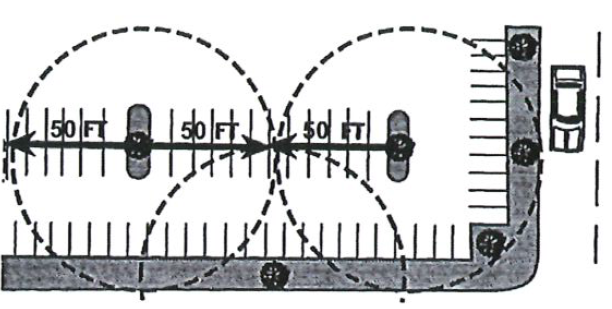
Additional required plantings. For every 600 square feet of landscape area required by this section, two trees and four shrubs shall be planted. To reduce the thermal impact of unshaded parking lots, additional trees shall be planted, if necessary, so that no parking space is more than 50 feet away from the trunk of a tree, unless otherwise approved by the commission. This subsection shall not apply to property in District "A", District "OS", and any of the single-family zoning categories. Those portions of the tract or lot used for a detention and/or water quality pond and/or where utility easements are located with overhead utilities, shall not be included in the calculation used to determine the number of trees and shrubs to be planted.
(j)
Replacement of required trees. Upon the death or removal of a tree planted pursuant to the terms of this section, a replacement tree of equal size and type shall be required to be planted. A smaller tree that will have a mature crown similar to the tree removed may be substituted if the planting area or pervious cover provided for the larger tree in this section is retained.
(k)
Screening. The following requirements shall be in addition to the foregoing landscaping and planting requirements.
(1)
All off-street parking, loading spaces and docks, outside storage areas, satellite dishes larger than 18 inches in diameter, antennas, mechanical equipment, and the rear of structures on reverse frontage lots, must be screened from view from the street or public rights-of-way.
(2)
Approved screening techniques include privacy fences, evergreen vegetative screens, landscape berms, existing vegetation or any combination thereof.
(3)
Privacy fences.
a.
All fences required by this subsection and along a common property boundary shall be six feet in height.
b.
Fences over six feet in height shall be allowed for impeding access to hazardous facilities, including, but not limited to, electrical substations, swimming pools and chemical or equipment storage yards, where the slope of a line drawn perpendicular to the fence line averages 20 percent or more on either side of the fence over a distance no less than 15 feet, or where the fence forms a continuous perimeter around a subdivision and the design of said perimeter fence is approved by the commission.
c.
Fences less than or equal to three feet in height shall be allowed in front yards.
d.
No fence or other structure more than 30 percent solid or more than three feet high shall be located within 25 feet of the intersection of any rights-of-way.
e.
All fences shall be constructed to maintain structural integrity against natural forces such as wind, rain and temperature variations. The fence shall be constructed of stone, masonry or wood products or an approved alternate material (such as composite decking material). Fence materials shall be approved by the planning and development services staff.
f.
The finished side of all fences built to comply with these regulations shall face away from the screened object.
(4)
Screening of incompatible uses: Screening is intended to minimize or eliminate conflicts between potentially incompatible but otherwise permitted land uses on adjoining lots. Screening shall consist of a six-foot opaque privacy fence constructed of wood, masonry, or a combination thereof. As an alternative, screening may also be provided in the form of evergreen vegetative screens installed in accordance with subparagraph (5) below. Screening shall be provided in accordance with the chart below. A box containing the letter "R" indicates that screening is required. A box with "-" indicates that screening is not required between those development types.
(5)
Landscape berms. Landscape berms may be used in combination with shrubs and trees to fulfill the screening requirements of this section if the berm is at least three feet in height and has a maximum side slope of four feet of horizontal run for every one foot in vertical rise.
(6)
Native vegetation. Existing vegetation, demonstrating significant visual screening capabilities and as approved by the commission may fulfill the requirements of this section.
(l)
The landscape requirements must be met prior to new development receiving a certificate of occupancy.
(Ord. No. 2012-06, § 3(exh. A), 2-28-12; Ord. No. 2019-17, § 5, 9-24-19; Ord. No. 2025-24, § 1, 6-10-25)
Sec. 118-63. - Municipal golf course vegetative buffer requirements.
(a)
Purpose. These requirements are imposed to protect and preserve the function and aesthetics of the municipal golf course; and to protect the rights and interest of owners of properties abutting the municipal golf course to unobstructive views of the course from their properties.
(b)
Scope. As illustrated by the green borders in Map 118-63, below, these requirements are applicable to each any every golf course lot, as defined in section 118-5, abutting any part of the municipal golf course property.
Map 118-63—Boundary Agreement Tracts 1, 7, 14, 15, 16, 17, 21, 22, 23, 24, 25, 26
and 27 boarders outlined in green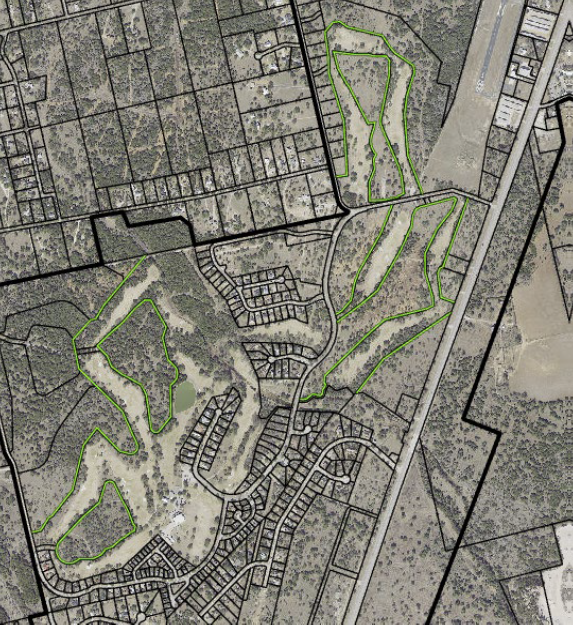
(c)
Established. There is hereby established a municipal golf course vegetative buffer running along the lot line a golf course lot shares with the municipal golf course. The width of the municipal golf course vegetative buffer for golf course lots shall be 25 feet measured from the common property line with the municipal golf course.
(d)
Use limitations. The use of the municipal golf course vegetation buffer shall be restricted to a vegetation buffer and no fence or structure shall be permitted therein. The municipal golf course vegetation buffer may be maintained in its natural state or may be landscaped by the planting of non-native vegetation and decorative stones; provided such stones do not create a wall or other barrier between the buffer and municipal golf course.
(e)
Credits. The golf course vegetation buffer may be included in the calculation of code requirements for: (i) minimum lot size under the code; (ii) minimum setbacks and (iii) impervious cover requirements.
(f)
Reserved.
(g)
Administration. Applications for a permit shall be made on such form as provided by the city manager and shall be accompanied by the default application fee as referenced in article VI of the fee schedule. The city manager shall approve or deny the application within ten business days of receipt. The city manager's failure to timely act on the application shall be deemed a denial.
(h)
Tree protection. No live oak trees may be removed from the municipal golf course vegetative buffer zone, without the issuance of a permit by the city manager authorizing such removal. Issuance of such permit shall be subject to the following:
(1)
Criteria: The city manager shall only issue a permit after making a finding that the live oak to be removed is located within ten feet of the slab of the main structure and is less than 36 caliper inches in diameter.
(Ord. No. 2022-12, § 2, 2-22-22; Ord. No. 2023-08, § 1, 4-25-23)
Sec. 118-64. - Conditional use permits.
(a)
Purpose. Conditional use permits provide a planning mechanism to authorize certain uses, which, because of their unique characteristics or potential impacts on adjacent land uses, are not generally permitted in certain zoning districts as a matter of right; but which may, under the right set of circumstances and conditions be acceptable in certain specific locations. These uses are permitted only through the issuance of conditional use authorization by city council after ensuring that the use can be appropriately accommodated on the specific property, will be in conformance with the comprehensive plan, can be constructed and operated in a manner which is compatible with the surrounding land uses and overall character of the community, and that the public interest and general welfare of the citizens of the city will be protected. No inherent right exists to receive a conditional use authorization; and such authorization shall only be granted by the city council under a specific set of circumstances and conditions, and each application and situation is unique.
(b)
Applicability. Provided the procedures, criteria and conditions prescribed in this section are met, the following listed conditional uses, and those indicated in a specific zoning district as a permitted use with a conditional use permit, and none other, may be authorized as a conditional use:
(1)
A use authorized in section 118-45 in a Light commercial—District "C-1" may be authorized in a Neighborhood commercial—District "NC" with a conditional use permit.
(2)
A use authorized in section 118-46 in a Medium commercial—District "C-2" may be authorized in a Light commercial—District "C-1" with a conditional use permit.
(3)
A use authorized in section 118-47 in a Heavy commercial—District "C-3" may be authorized in Medium commercial—District "C-2" with a conditional use permit.
(4)
A use authorized in section 118-48 in a Light industrial—District "I-1" may be authorized in Heavy commercial—District "C-3" with a conditional use permit.
(5)
A use authorized in section 118-49 in a Heavy industrial—District "I-2" may be authorized in Light industrial—District "I-1" with conditional use permit.
(6)
Uses that may only be authorized by conditional use permit are as follows:
a.
Airport, landing field, landing strip or heliport for aircraft; municipal service facilities and buildings.
b.
Amusement park, but not within 300 feet of any residential district.
c.
Circus, carnival or zoo grounds, but not within 300 feet of any residential district.
d.
Commercial, recreational or amusement development for temporary or seasonal periods.
e.
Hospital, clinic or institution, provided that any hospital or institution permitted in any residential district shall be located on a site of not less than five acres, shall not occupy more than ten percent of the total lot area and shall be set back from all property lines at least two feet for each foot of building height.
f.
Horse race track and riding stables.
g.
Private operated community building or recreation field.
h.
Radio or television broadcasting towers or station.
i.
Cemeteries.
j.
Schools—Public and denominational.
k.
Gasoline sales.
l.
Alcoholic beverages-on premises and alcoholic beverages-mixed drink for those specific uses and in the specific zoning districts as provided by this chapter, including a bar, nightclub, tavern and private club.
m.
Sexually oriented business (See permit requirements subsection [118-67](g)), including other uses as identified in the specific district or definition of the use.
n.
Trailer camp and RV park. This use is only allowed in Heavy commercial—District "C-3" with a conditional use permit issued by city council under this section.
(c)
Conditional uses in newly annexed areas. Residential and industrial uses and/or structures that were in operation prior to the effective date of annexation and may become nonconforming uses as a result of the property being permanently zoned C-1, C-2 or C-3, may request a conditional use permit for the use existing at the time of annexation during the initial permanent zoning process if the property is proposed to be permanently zoned C-1, C-2 or C-3. The existing use shall be specifically identified in the application for a conditional use permit and, if granted, may be continued as set forth in the conditional use permit as a permitted additional use to the C-1, C-2 or C-3 zoning without being deemed nonconforming while continuing in compliance with the conditional use permit.
(d)
Procedure. Before authorization of any of the above conditional uses, public notice shall be given and public hearings shall be held as provided in V.T.C.A., Local Government Code ch. 211; provided that a conditional use permit for a period not to exceed seven calendar days may be given for a use set forth in subsections (b)(3) or (b)(4) above after a public hearing is held by the city council after having received a report and recommendation from the commission concerning the effect of the proposed use on the adjacent and neighboring properties and neighborhoods.
(1)
Permit required. No conditional use shall be established, operated or maintained except as authorized by a conditional use permit issued in accordance with the requirements of this section.
(2)
Conditional use permit issued by city council. A conditional use permit may be issued only for the special uses specified in this section, and only for the district where it is authorized.
(3)
The city council shall determine whether the proposed special use complies with each of the general criteria in subsection (e) of this section and with each of the criteria for the district applicable to the proposed use and shall make separate findings thereon or adopt the findings made by the commission.
(4)
The city council may condition its approval of an application on the applicant's adoption of specified changes, additions, limitations, safeguards or effective time periods designed to assure compliance with the criteria.
(5)
Application. An application for a conditional use permit shall be made in writing in a form prescribed by the city building official and shall be accompanied by such information as may be requested (including a site plan, if required) in order to properly review the proposed use. Such information may include, but is not limited to, site and building plans, drawings and elevations, and operational data.
(e)
General criteria applicable to all conditional uses. A proposed conditional use permit must comply with all the following criteria:
(1)
The appearance, size, density and operating characteristics of the proposed conditional use are compatible with the surrounding neighborhood and uses;
(2)
The proposed use will not have an adverse effect on the value of surrounding properties nor impede their proper development;
(3)
The proposed use will not create a nuisance factor nor otherwise interfere with a neighbor's enjoyment of his property or operation of his business;
(4)
The traffic that the proposed use can reasonably be expected to generate on existing streets will not create nor add significantly to congestion, a safety hazard, or a parking problem in the area, nor will it disturb the peace and quiet of the neighborhood; and
(5)
The proposed use complies with all other applicable ordinances and regulations.
(f)
Approval criteria. City council may impose appropriate conditions and safeguards, including a specified period of time for the permit, to protect the comprehensive plan and to conserve and protect property and property values in the neighborhood.
(Ord. No. 2012-06, § 3(exh. A), 2-28-12; Ord. No. 2020-31, § 2(Exh. A), 1-12-21; Ord. No. 2022-34, § 3, 8-23-22)
Sec. 118-65. - Residential nonconforming uses.
(a)
General policy. The general public, the city council and the commission are directed to take note that nonconformity in the use and development of land and buildings are to be avoided, or eliminated where now existing, whenever and wherever possible, except:
(1)
When necessary to preserve property rights established prior to the date these regulations become effective as to the property in question; and
(2)
When necessary to promote the general welfare and to protect the character of the surrounding property.
(b)
Nonconforming structures. Where a lawful structure exists on the effective date of the adoption or amendment of the zoning ordinance, that could not be built under the terms of the zoning ordinance or amendment thereto by reason of restrictions on permitted use, area, lot coverage, height, years, its locations on the lot, or other requirements concerning the structure, such structure may be continued as long as it remains otherwise lawful, subject to the following provisions:
(1)
Should such nonconforming structure or nonconforming portions of a structure be damaged by any means to an extent of more than 50 percent of its replacement cost at the time of destruction (as determined by the building inspector), it shall not be reconstructed except in conformity with the regulations applicable to new uses or structures in the district.
(2)
Should such structure be moved for any reason for any distance whatsoever, including movement on the same parcel, it shall thereafter conform to the regulations of the district in which it is located after it is moved.
(c)
Nonconforming uses. A nonconforming use may be continued as long as it remains otherwise lawful, subject to the following provisions:
(1)
The use of the structure shall only be changed to a use permitted in the district in which it is located.
(2)
A nonconforming use that has been discontinued may be resumed only if there has been no other use of the premises or structure since the nonconforming use was discontinued. A nonconforming use shall terminate upon the use ceasing for 90 days or if the use is changed to another use.
(3)
Removal or destruction of a structure containing a nonconforming use shall eliminate the nonconforming use status. Destruction for the purpose of this subsection is defined as damage equal to more than 50 percent of the replacement cost (as determined by the building inspector) of the structure.
(d)
Repairs and maintenance. On any nonconforming structure, or nonconforming portion of a structure, containing a nonconforming use, repairs and maintenance shall be performed to maintain the structure in compliance with the electrical, plumbing and building codes; provided that if 50 percent or more of the nonconforming structure, or a structure containing a nonconforming use, becomes physically unsafe or unlawful due to lack of repairs or maintenance, and is declared by a duly authorized official to be unsafe or unlawful by reason of physical condition, it shall not thereafter be restored, repaired or rebuilt except in conformity with the regulations of the district in which it is located.
(Ord. No. 2012-06, § 3(exh. A), 2-28-12)
Sec. 118-66. - Commercial and industrial nonconforming uses.
(a)
General policy. The general public, the city council and the commission are directed to take note that nonconformity in the use and development of land and buildings are to be avoided, or eliminated where now existing, whenever and wherever possible, except:
(1)
When necessary to preserve property rights established prior to the date these regulations become effective as to the property in question; and
(2)
When necessary to promote the general welfare and to protect the character of the surrounding property.
(b)
Nonconforming structures. Where a lawful structure exists on the effective date of the adoption or amendment of the zoning ordinance, that could not be built under the terms of the zoning ordinance or amendment thereto by reason of restrictions on permitted use, area, lot coverage, height, years, its locations on the lot, or other requirements concerning the structure, such structure may be continued as long as it remains otherwise lawful. Structures may be enlarged or added for the nonconforming use provided that commercial structures are more than 50 feet from single family residential and industrial structures are more than 200 feet from single family residential.
(c)
Nonconforming uses. A nonconforming use may be continued as long as it remains otherwise lawful, subject to the following provisions:
(1)
Any legal nonconforming use that is discontinued or abandoned or ceases for a period of 90 days shall terminate, and thereafter shall comply with all applicable zoning regulations.
(2)
Removal or destruction of a structure containing a nonconforming use shall eliminate the nonconforming use status. Destruction for the purpose of this subsection is defined as damage equal to more than 75 percent of the replacement cost of the structure (as determined by the building inspector).
(3)
A nonconforming use shall terminate upon any sale of the property.
(d)
Repairs and maintenance. On any nonconforming structure, or nonconforming portion of a structure, containing a nonconforming use, repairs and maintenance shall be performed to maintain the structure in compliance with the electrical, plumbing and building codes.
(Ord. No. 2012-06, § 3(exh. A), 2-28-12)
Sec. 118-67. - Sexually oriented businesses.
(a)
Purpose and intent. It is the purpose of this section of [this chapter] to regulate sexually oriented businesses to promote the public health, safety, morals and general welfare of the citizens of the city, and to establish reasonable and uni-form regulations to prevent the deleterious location and concentration of sexually oriented businesses within the city. The provisions of this chapter have neither the purpose nor effect of imposing a limitation or restriction on the content of any communicative materials, including sexually oriented materials. Similarly, it is not the intent nor effect of this chapter to restrict or deny access by adults to distributors and exhibitors of sexually oriented entertainment to their intended market. Neither is it the intent nor effect of this chapter to condone or legitimize the distribution of obscene materials.
(b)
Definitions. The following words, terms and phrases, when used in this section, shall have the meanings ascribed to them in this subsection, except where the context clearly indicates a different meaning.
(1)
"Adult arcade" means any place to which the public is permitted or invited wherein coin-operated or slug-operated or electronically, electrically, or mechanically operated still or motion picture machines, projectors, or other image-producing devices are maintained to show images to five or fewer persons per machine at any one time, and where the images so displayed are distinguished or characterized by the depicting or describing of specified sexual activities or specified anatomical areas.
(2)
"Adult bookstore" or "adult video store" means a commercial establishment which, as one of its principal business purposes, offers for sale or rental for any form of consideration any one or more of the following:
a.
Books, magazines, periodicals or other printed matter, or photographs, films, motion pictures, video cassettes or video reproductions, compact disc visual discs, digital visual discs, computer pictures, slides, or other visual representations which depict or describe specified sexual activities or specified anatomical areas; or
b.
Instruments, devices, or paraphernalia which are designed for use in connection with specified sexual activities.
c.
A commercial establishment may have other principal business purposes that do not involve the offering for sale or rental of material depicting or describing "specified sexual activities" or "specified anatomical areas" and still be categorized as an adult bookstore or adult video store. Such other business purposes will not serve to exempt such commercial establishments from being categorized as an adult bookstore or adult video store so long as either:
1.
Two percent or more of its gross revenue is derived from the sale or rental of the specified materials which depict or describe specified sexual activities or specified anatomical areas; or
2.
Two percent or more of its inventory consists of the specified materials which depict or describe specified sexual activities or specified anatomical areas.
(3)
"Adult cabaret" means a nightclub, bar, restaurant or similar commercial establishment that regularly features:
a.
Persons who appear in a state of total nudity or semi-nudity; or
b.
Live performances which are characterized by the exposure of specified anatomical areas or by specified sexual activities; or
c.
Films, motion pictures, video cassettes, compact visual discs, digital visual discs, computer pictures, slides, or other photographic reproductions which are characterized by the depiction or description of specified sexual activities or specified anatomical areas.
(4)
"Adult motel" means a hotel, motel or similar commercial establishment which:
a.
Offers accommodations to the public for any form of consideration; provides patrons with closed-circuit television transmissions, films, motion pictures, video cassettes, compact visual discs, digital visual discs, computer pictures, slides or other photographic reproductions which are characterized by the depiction or description of specified sexual activities or specified anatomical areas; including those that have a sign visible from the public right-of-way which advertises the availability of this adult type of photographic reproductions; or
b.
Offers a sleeping room for rent for a period of time that is less than ten hours or based on an hourly rate; or
c.
Allows a tenant or occupant of a sleeping room to sub-rent the room for a period of time that is less than ten hours or based on an hourly rate.
(5)
"Adult motion picture theater" means commercial establishments where, for any form of consideration, films, motion pictures, video cassettes, compact visual discs, digital visual discs, computer pictures, slides, or similar photographic reproductions are regularly shown which are characterized by the depiction or description of specified sexual activities or specified anatomical areas.
(6)
"Adult theater" means a theater, concert hall, auditorium, or similar commercial establishment which regularly features persons who appear in a state of nudity and/or semi-nudity or live performances which are characterized by the exposure of specified anatomical areas or by specified sexual activities.
(7)
"Escort" means a person who, for consideration, agrees or offers to act as a companion, guide, or date for another person, or who agrees or offers to privately model lingerie or to privately perform a body rub, bathing of the body, or striptease for another person for the sexual arousal.
(8)
"Escort agency" means a person or business association who furnishes, offers to furnish, or advertises to furnish escorts as one of its primary business purposes for a fee, tip or other consideration.
(9)
"Establishment" means and includes any of the following:
a.
The opening or commencement of any sexually oriented business as a new business;
b.
The conversion of an existing business, whether or not a sexually oriented business, to any sexually oriented business;
c.
The addition of any sexually oriented business to any other existing sexually oriented business; or
d.
The relocation of any sexually oriented business.
(10)
"Permittee" means a person in whose name a conditional use permit to operate a sexually oriented business has been issued and the person who owns the building and/or land on which the business is located, as well as the individual listed as an applicant on the application for a permit.
(11)
"Nude model studio" means any place where a person who appears in a state of nudity or displays specified anatomical areas is provided to be observed, sketched, drawn, painted, sculptured, photographed, or similarly depicted by other persons who pay money or any form of consideration.
(12)
"Nudity" or a "state of nudity" means the appearance of a human bare buttock, anus, male genitals, female genitals, or areola of the breast.
(13)
"Person" shall mean and include an individual human, partnership, co-partnership firm, company, limited liability partnership or other partnership or other such company, joint venture, joint stock company, trust, estate, governmental entity, association or corporation or any other legal entity, or their legal representatives, agents or assigns. The masculine gender shall include the feminine, the singular shall include the plural where indicated by the context.
(14)
"Semi-nude" means a state of dress in which clothing covers no more than the genitals, pubic region, and/or areola of the breast, as well as portions of the body covered by supporting straps or devices.
(15)
"Sexual encounter center" means a business or commercial enterprise that, as one of its primary business purposes, offers any of the following for consideration:
a.
Physical contact in the form of wrestling or tumbling between persons of the opposite sex; or
b.
Activities between male and female persons and/or persons of the same sex when one or more of the persons is in a state of nudity or semi-nude.
(16)
"Sexually oriented business" means an adult arcade, adult bookstore or adult video store, adult cabaret, adult motel, adult motion picture theater, adult theater, escort agency, nude model studio, or sexual encounter center.
(17)
"Specified anatomical areas" means the male genitals in a state of sexual arousal and/or the vulva or more internal portion of the female genitals.
(18)
"Specified sexual activities" means and includes any of the following:
a.
The fondling or other erotic touching of human genitals, pubic region, buttocks, anus or female breasts;
b.
Sex acts, normal or perverted, actual or stimulated, including intercourse, oral copulation, or sodomy;
c.
Masturbation, actual or simulated; or
d.
Excretory functions as part of or in connection with any of the activities set forth in a. through c. above.
(19)
"Substantial enlargement" of a sexually oriented business means the increase in floor area occupied by the business by more than 25 percent, as the floor area existed on the effective date of this chapter, or under a certificate of occupancy therefore.
(20)
"Transfer of ownership or control" of a sexually oriented business means and includes any of the following:
a.
The sale, leasing or subleasing of the business;
b.
The transfer of securities which constitute a controlling interest in the business, whether by sale, exchange, or similar means; or
c.
The establishment of a trust, gift or other similar legal device which transfers the ownership or control of the business, except for transfer by bequest or other operation of law upon the death of the person possessing the ownership or control.
(c)
Classification. Sexually oriented businesses are classified as follows:
(1)
Adult arcades;
(2)
Adult bookstores or adult video stores;
(3)
Adult cabarets;
(4)
Adult motels;
(5)
Adult motion picture theaters;
(6)
Adult theaters;
(7)
Escort agencies;
(8)
Nude model studios; and
(9)
Sexual encounter centers.
(d)
Location. This chapter allows the opportunity for consideration of conditional use permits to be issued for sexually oriented businesses in the medium commercial (herein "C-2") zoning districts only.
(1)
The following uses may be permitted within the city by conditional use permit only in the C-2 zoning district.
a.
Adult arcades;
b.
Adult bookstores or adult video stores;
c.
Adult cabarets;
d.
Adult motels;
e.
Adult motion picture theaters;
f.
Adult theaters;
g.
Escort agencies;
h.
Nude model studios; and
i.
Sexual encounter centers.
(2)
No use listed in subsection (d)(1) above shall be established within 1,000 feet of any of the following uses in existence prior to the beginning of such business:
a.
A church, chapel, or other regular place of religious worship;
b.
A public or private day-care, elementary, secondary school or institute of higher learning;
c.
A boundary of any residentially zoned district;
d.
A public park, library, or playground;
e.
The property line of a lot used for residential purposes; or
f.
Within 1,000 feet of another sexually oriented business.
(3)
For the purpose of this section, measurement shall be made in a straight line, without regard to intervening structures or objects, from the nearest portion of the building or structure used as a part of the premises where a sexually oriented business is conducted, to the nearest property line of the premises as described in subsection (d)(2) above; or to the nearest boundary of any residentially zoned district; or from the closest exterior wall of the structure in which a sexually oriented business is proposed to be located to the nearest exterior wall of any other sexually oriented business.
(4)
For the purposes of this section, if sexually oriented businesses can not be located within a minimum of three percent of the existing zoning districts within the city limits, including all nonconforming use sexually oriented businesses, due to limitations as set forth in this section, the city will upon written request from an applicant review the current zoning districts and shall allow zoning alterations as necessary so that a minimum of three percent of the city wide zoning, cumulatively within the city limits, can be occupied by a conditional use permitted sexually oriented business, including all nonconforming use sexually oriented business.
(e)
Sexually explicit films and videos.
(1)
A person who operates or causes to be operated a sexually oriented business, other than an adult motel, which exhibits on the premises in a viewing room of less than 150 square feet of floor space, a film, video cassette, compact visual disc, digital visual disc, computer picture, slide, or other video reproduction which depicts specified sexual activities or specified anatomical areas, shall comply with the following requirements:
a.
The application for a conditional use permit for a sexually oriented business shall be accompanied by a diagram of the premises showing a plan thereof specifying the location of one or more manager's stations and the location of all overhead lighting fixtures and designating any portion of the premises in which patrons will not be permitted. A manager's station may not exceed 32 square feet of floor area. The diagram shall also designate the place at which the permit will be conspicuously posted, if granted. A professionally prepared diagram in the nature of an engineer's or architect's blueprint shall not be required; however, each diagram should be oriented to the north or to some designated street or object and should be drawn to a designated scale or with marked dimensions sufficient to show the various internal dimensions of all areas of the interior of the premises to an accuracy of plus or minus one foot. The building official may waive the foregoing diagram for renewal applications if the applicant adopts a diagram that was previously submitted and certifies that the configuration of the premises is correct and has not been altered since it was prepared.
b.
The application shall be sworn to be true and correct by the applicant.
c.
No alteration in the configuration or location of a manager's station may be made without the prior approval of an amendment to the conditional use permit.
d.
It is the duty of the owners and operator of the premises to ensure that at least one employee is on duty and situated in each manager's station at all times that any patron is present inside the premise.
e.
The interior of the premises shall be configured in such a manner that there is an unobstructed view from a manager's station of every area of the premises to which any patron is permitted access for any purpose excluding restrooms. Restrooms may not contain video reproduction equipment. If the premises has two or more manager's stations designated, then the interior of the premises shall be configured in such a manner that there is an unobstructed view of each area of the premises to which any patron is permitted access for any purpose from at least one of the manager's stations. The view required in this subsection must be by direct line of sight from the manager's station.
f.
It shall be the duty of the owners and operator, and it shall also be the duty of any agents and employees present in the premises to ensure that the view area specified in the above subsection e. remains unobstructed by any doors, walls, merchandise, display racks or other materials at all times and to ensure that no patron is permitted access to any area of the premises which has been designated as an area in which patrons will not be permitted in the application filed pursuant to subsection [(e)(1)a.] of this section.
g.
No viewing room may be occupied by more than one person at any time.
h.
The premise shall be equipped with overhead lighting fixtures of sufficient intensity to illuminate every place to which patrons are permitted access at an illumination of not less than one (1.0) foot-candle as measured at the floor level.
i.
It shall be the duty of the owners and operator and it shall also be the duty of any agents and employees present in the premises to ensure that the illumination described above is maintained at all times that any patron is present in the premises.
(2)
A person having a duty under subsections (e)(1)a—i. above commits a misdemeanor if he or she knowingly fails to fulfill that duty.
(f)
Exemptions. It is a defense to prosecution under this section that a person appearing in a state of nudity did so in a modeling class operated:
(1)
By a proprietary school, licensed by the state; a college, junior college or university supported entirely or partly by taxation;
(2)
By a private college or university which maintains and operates educational programs in which credits are transferable to a college, junior college, or university supported entirely or partly by taxation; or
(3)
In a structure:
a.
Which has no sign visible from the exterior of the structure and no other advertising that indicates a nude person is available for viewing; and
b.
Where, in order to participate in a class a student must enroll at least three days in advance of the class; and
c.
Where no more than one nude model is on the premises at any one time.
(g)
Permits. All sexually oriented businesses located within the city limits must have a conditional use permit or qualify as a nonconforming use and have a permit to operate as provided herein. Each person having ownership interest, control or owning the property upon which the sexually oriented business is to be located must have filled out an application and his or her name must appear on the permit.
(1)
Permits required. A commercial establishment that is a sexually oriented business as herein defined, shall at all times of operation within the city limits have a valid permit.
a.
A person commits an offense if that person conducts business as a sexually oriented business within the city unless a valid conditional use permit has been issued by the city for the conduct of such business.
b.
A person commits an offense if that person conducts business as a sexually oriented business within the city limits unless the person has a valid permit which is posted at or near the principal public entrance to the business in such a manner that it will be conspicuous to patrons who enter the premises, or behind the bar in a conspicuous manner.
c.
Every permittee shall have and maintain exclusive occupancy and control of the entire permitted premises in every phase of the operation of the sexually oriented business on the permitted premises. A permittee commits an offense if the permittee attempts to avoid such responsibility by creating any device, scheme or plan which surrenders control of the employees, premises or business of the permittee to persons other than the permittee.
(2)
Issuance or denial of any permit. A permit, renewal or transfer permit shall be issued unless one or more of the following conditions exists:
a.
The applicant has located the sexually oriented business in violation of this chapter, unless the business is a nonconforming use as defined herein.
b.
The applicant(s) failed to supply all of the information required on the application.
c.
The applicant, or any one applicant, gave fraudulent or untruthful information on the application. This does not apply to clerical errors.
d.
The applicant, or any one applicant, has been convicted of a felony for which not less than ten years have elapsed since the date of conviction or the date of release from confinement imposed for the conviction, whichever is the later date, or a misdemeanor for which less than two years have elapsed since the date of conviction or the date of release from confinement imposed for the conviction, whichever date is the later date, of a crime in any state involving:
1.
Public lewdness, indecent exposure, or indecency with a child as described in the Texas Penal Code;
2.
Prohibited sexual conduct, enticing a child, harboring a runaway child, or sale or purchase of a child as described in the Texas Penal Code;
3.
Prostitution, promotion of prostitution, aggravated promotion of prostitution, compelling prostitution, obscenity, sale, distribution, or display of harmful material to a minor, sexual performance by a child, employment harmful to children, or possession or promotion of child pornography as defined in the Texas Penal Code;
4.
Facilitation, attempt, conspiracy, or solicitation to commit any of the foregoing offenses; or
5.
Any similar offense to those described above under the criminal or penal code of another state.
e.
Any applicant, or any one applicant, refuses to provide a complete and current NCIC and TCIC criminal history of applicant obtained by applicant from the state department of public safety. The criminal history must be completed within 15 days of the date the application is submitted to the building official.
f.
Permit fees are not paid in full.
(3)
Application requirements. Initial permit requests for a conditional use permit require each owner, having ten percent or more interest in the sexually oriented business, to submit a complete application and to update the application as changes in ownership occur (herein the "applicant" or "permittee"). The information required in this subsection must be provided with each application and, as changes occur, updated information within ten days of any change in the information required in the application.
a.
The following information must be provided on the application form:
1.
The name, street address (and mailing address if different) of the applicant and each and every owner with greater than ten percent ownership interest;
2.
Two copies each of recent photographs of the applicant showing full face and each side face profile;
3.
A complete set of fingerprints on forms from the police department;
4.
A complete and current NCIC and TCIC criminal history of applicant obtained by applicant from the state department of public safety. The criminal history must be completed within 15 days of the date the application is submitted to the building official.
5.
The applicant's driver's license number, Social Security number, and, if applicable, his/her state or federally issued tax identification number;
6.
The name under which the establishment is to be operated and a general description of the services to be provided;
7.
If the applicant intends to operate the sexually oriented business under a name other than that of the applicant; he or she must state (i) the sexually oriented business's assumed name; and (ii) submit the required registration documents;
8.
Whether the applicant has ever been convicted, or is awaiting trial on pending charges, of a crime specified in subsection (g)(2)d. of this section and, if so, the nature of the offense(s) and the date, place, and jurisdiction of each offense;
9.
Whether the applicant has had a previous license or conditional use permit under this chapter or other similarly sexually oriented business ordinance from another city or county denied, suspended or revoked, including the name and location of the sexually oriented business for which the license or conditional use permit was denied, suspended or revoked, as well as the date of the denial, suspension or revocation, and whether the applicant is or has been a partner in a partnership or an officer, director or principal stockholder of a corporation that is or was licensed under a sexually oriented business ordinance whose license or conditional use permit has previously been denied, suspended or revoked, including the name and location of the sexually oriented business for which the license or conditional use permit was denied, suspended or revoked, as well as the date of denial, suspension or revocation;
10.
Whether the applicant holds any other license or conditional use permit under this chapter or other similar sexually oriented business ordinance from another city or county and, if so, the names and locations of such other licensed businesses;
11.
The address, and legal description of the tract of land on which the establishment is to be located;
12.
If the establishment is in operation, the date on which the owner(s) acquired the establishment for which the license or conditional use permit is sought, and the date on which the establishment began operations as a sexually oriented business at the location for which the conditional use permit is sought; and
13.
If the establishment is not in operation, the expected startup date (which must be expressed in number of days from the date of issuance of the conditional use permit). If the expected startup date is to be more than ten days following the date of issuance of the conditional use permit, then a detailed explanation of the construction, repair or remodeling work or other cause of the expected delay and a statement of the owner's time schedule and plan for accomplishing the construction, repair or remodeling work.
b.
All applications for a conditional use permit must include the following:
1.
If the establishment is a State of Texas corporation, a certified copy of the articles of incorporation, together with all amendments thereto.
2.
If the establishment is a foreign corporation, a certified copy of the certificate of authority to transact business in this state, together with all amendments thereto.
3.
If the establishment is a limited partnership formed under the laws of the state, a certified copy of the certificate of limited partnership, together with all amendments thereto.
4.
If the establishment is a foreign limited partnership, a certified copy of the certificate of limited partnership and the qualification documents, together with all amendments thereto.
5.
Proof of the current fee ownership of the tract of land on which the establishment is to be situated in the form of a copy of the recorded deed along with the current address(es) and telephone number(s) of the owner(s).
6.
If the person(s) identified as the fee owner(s) of the tract of land are not also the owners of the establishment, then the lease, purchase contract, purchase option contract, lease option contract or other document(s) evidencing the legally enforceable right of the owners or proposed owners of the establishment to have or obtain the use and possession of the tract or portion thereof that is to be used for the purpose of the operation of the establishment together with the correct address and telephone number of each person with an ownership interest in the property.
7.
If the property is owned by an entity other than a natural person, the complete name, address and telephone of each person with an interest in the entity must be included in the application.
8.
A current certificate and straight-line drawing prepared within 30 days prior to application by a registered land surveyor depicting the property lines of any established use listed in subsection [(d)(2)] of this section within 1,000 feet of the property to be certified. For purposes of this section, a use is considered existing or established if it is in existence at the time an application is submitted.
9.
The application must be accompanied by a sketch or diagram showing the configuration of the premises, including a statement of total floor space occupied by the business. The sketch or diagram need not be professionally prepared but must be drawn to a designated scale no smaller than ¼-inch equals one foot and with marked dimensions of the placement of the building on the tract of land, and the interior of the premises to an accuracy of plus or minus six inches. All locational requirements must be approved by the building official within 60 days from the time the application is filed.
10.
Any of items 1 through 9 above will not be required for a renewal application if they were previously presented and the applicant states that the documents previously furnished to the building official with the original application or previous renewals thereof remain correct and current.
c.
Every application for a conditional use permit must contain a statement made under oath that:
1.
The applicant has personal knowledge of the information contained in the application, and that the information contained therein and furnished therewith is true and correct; and,
2.
The applicant has read the provisions of this chapter.
d.
The applicant for a sexually oriented business conditional use permit must be qualified according to the provisions of this chapter.
e.
If the applicant who wishes to operate a sexually oriented business is an individual, that individual must sign the application for a conditional use permit as applicant. If the applicant who wishes to operate a sexually oriented business is other than an individual, each individual who has greater than a ten percent interest in the business must sign and provide all the information required by the application for a conditional use permit as an applicant and will be considered an operator if a conditional use permit is granted.
f.
The fact that a person possesses any other valid license, certificate or permit required by law does not exempt him from the requirement of obtaining a sexually oriented business conditional use permit. A person who operates a sexually oriented business and possesses another business license, certificate or permit must comply with the requirements and provisions of this chapter as well as the requirements and provisions of the law concerning the other license, certificate or permit.
g.
All applications must include a non-refundable application fee of $2,500.00. An application will not be considered to have been filed until all applicable fees are paid and all information required by the application form has been submitted.
h.
The applicant must supplement an application with new information received after the date the application was deemed completed. Permittees must supplement application information within ten days of any change in information provided in the application.
i.
All sexually oriented businesses located within the city and in operation as a lawful use conforming to the zoning ordinance before the effective date of this chapter are granted a one-time waiver of the application fee. Upon satisfactory completion of the application and surrender of the existing business' current certificate of occupancy, a new conditional use permit will be issued.
j.
A copy of all applications and supporting documentation for conditional use permits will be maintained by the building official.
k.
Upon receipt of an application or supplemental information, the building official will review the application to determine if all required and necessary information has been submitted. The building official will issue a letter within a reasonable time after receipt of the application or supplemental information and advise the applicant whether supplemental information must be submitted. The applicant must provide any supplemental information within 30 days or the application will be returned and the filing fee forfeited.
(4)
Public notice of pending application.
a.
After the building official has issued a letter advising the applicant that the application is complete, the building official will cause signs (at least 24 inches by 36 inches in size) to be placed on the property subject to the proposed conditional use permit of occupancy that provide notification by specifically stating, with letters at least three inches wide and six inches tall, "Sexually Oriented Business License Application Pending". All lettering on the signs other than above described, will be at least 1½ inches × 2 inches in size for each letter on the sign. The sign will also include the name, city and state of residence of each applicant, the date on which the application was filed, and the time and place of the hearings. The signs will be placed on the property in sufficient quantities and locations to identify the property as being subject to a proposed sexually oriented conditional use permit of occupancy. One sign will be erected on each lot corner to identify the boundaries of the property in addition to one sign for each 300-foot increment of each public road or highway frontage on the property existing or any part thereof. The signs will be erected within seven days after the building official has issued a letter advising the applicant that the application is complete and will remain erected until the application has been approved or denied by the city council.
b.
The city will give notice of the application and scheduled public hearings by publication in two consecutive issues of the city's official newspaper. The notices will be printed in 10-point boldface type and will:
1.
Include the fact that a sexually oriented business conditional use permit has been applied for;
2.
Include the exact location, including the street address, of the place of business for which the certificate is sought;
3.
Include the names of each owner of the business and, if the business is operated under an assumed name, the trade name together with the names of all owners;
4.
Include, if the applicant is a corporation, the names and titles of all officers, directors and shareholders of ten percent or more of the corporation;
5.
Include the dates and times of the public hearings; and
6.
Be published at least 15 days before each public hearing.
(5)
Renewal of permit. Permits shall be valid for one year from the issuance of the permit. Permits must be renewed annually by all persons having ownership interest or control of the sexually oriented business and all persons owning the property upon which the sexually oriented business is located. Failure to renew the permit voids the permit.
(6)
Permit transfers. A permit is personal to the persons designated in the application. A permit may not be transferred except pursuant to and in compliance with this section. A transfer application must be filed within 30 days of any change of persons designated on the current permit. A transfer application shall allow continuation of business under an existing permit while a new application is being processed. Any transfer application shall require and be treated in all respects as an original permit application. In the event that a transfer application is not timely filed, then the existing permit shall be invalid for any purpose relating to the operation of business. Provided, however, that nothing in this section shall affect the nonconforming use provisions herein.
(7)
Revocation of permit. Any violation of this chapter shall constitute grounds for revocation of a permit. A permit shall be revoked for any of the following violations:
a.
The permittee(s) have located the sexually oriented business in violation of this chapter. Unless the business is a nonconforming use as defined herein.
b.
The permittee(s) failed to supply all of the information required on the application.
c.
The permittee(s) gave fraudulent or untruthful information on the application. This does not apply to clerical errors.
d.
The permittee, or any one permittee, has been convicted of a felony for which not less than ten years have elapsed since the date of conviction or the date of release from confinement imposed for the conviction, whichever is the later date, or a misdemeanor for which less than two years have elapsed since the date of conviction or the date of release from confinement imposed for the conviction, whichever date is the later date, of a crime in any state involving:
1.
Public lewdness, indecent exposure, or indecency with a child as described in the Texas Penal Code;
2.
Prohibited sexual conduct, enticing a child, harboring a runaway child, or sale or purchase of a child as described in the Texas Penal Code;
3.
Prostitution, promotion of prostitution, aggravated promotion of prostitution, compelling prostitution, obscenity, sale, distribution, or display of harmful material to a minor, sexual performance by a child, employment harmful to children, or possession or promotion of child pornography as defined in the Texas Penal Code;
4.
Facilitation, attempt, conspiracy, or solicitation to commit any of the foregoing offenses; or
5.
Any similar offense to those describe above under the criminal or penal code of another state.
e.
More than four criminal offenses are committed on the permitted premises in any consecutive 12-month period which fall in one or more of the following categories:
1.
Public lewdness, indecent exposure, or indecency with a child as described in the Texas Penal Code;
2.
Prohibited sexual conduct, enticing a child, harboring a runaway child, or sale or purchase of a child as described in the Texas Penal Code;
3.
Prostitution, promotion of prostitution, aggravated promotion of prostitution, compelling prostitution, obscenity, sale, distribution, or display of harmful material to a minor, sexual performance by a child, employment harmful to children, or possession or promotion of child pornography as defined in the Texas Penal Code; or
4.
Facilitation, attempt, conspiracy or solicitation to commit any of the foregoing offenses.
f.
Any person under the age of 18, not otherwise permitted by the Laws of Texas to view the material contained on the premises is permitted to enter the premises.
(8)
Appeal. All denials and revocations of permit applications and renewals must be appealed to the city council.
a.
If an application for issuance or renewal of a permit is denied a permit or a permit is revoked, upon notice of the denial or revocation of a permit, the aggrieved applicant or permittee shall have ten days to appeal to the decision to the city council.
b.
The appeal of a revocation of a permit to the city council shall abate the revocation of the permit until such time as the city council may hold a public hearing.
(9)
Permit fee. Each application for a permit, including renewal or transfer, shall be accompanied by a $2,500.00 application fee. In addition to the fees required for an initial license, the applicant at the time of making an initial application shall pay a nonrefundable fee of $750.00 for the city to conduct a survey to ensure the proposed sexually oriented business is in compliance with the location restrictions set forth in [subsection (d)] of this section. Additionally, for each applicant identified thereon, there shall be an additional $25.00 fee.
(h)
Specific violations.
(1)
A person commits a misdemeanor if he or she:
a.
Operates or causes to be operated a sexually oriented business without a conditional use permit. All sexually oriented businesses shall be located within the C-2 zoning district unless such business qualifies as a nonconforming use.
b.
Operates or causes to be operated a sexually oriented business without a permit to operate a sexually oriented business.
c.
Operates or causes to be operated a sexually oriented business within 1,000 feet of any of the following uses in existence prior to the beginning of such business:
1.
A church, chapel, or other regular place of religious worship;
2.
A public or private day-care, elementary, secondary school or institute of higher learning;
3.
A boundary of any residentially zoned district;
4.
A public park, library, or playground; or
5.
The property line of a lot used for residential purposes.
d.
Causes or permits the operation, establishment, substantial enlargement, or transfer of ownership or control of a sexually oriented business within 1,000 feet of another sexually oriented business.
e.
Causes or permits the operation, establishment or maintenance of more than one sexually oriented business, as defined herein, in the same building, structure, or portion thereof, or the increase of floor area of any sexually oriented business in any building, structure or portion thereof containing another sexually oriented business.
(2)
For the purpose of subsection (h)(1)c. of this section, measurement shall be made in a straight line, without regard to intervening structures or objects, from the nearest portion of the building or structure in which any, or any part of any, sexually oriented business is conducted, to the nearest property line of the premises described in subsection (h)(1)c. of this section.
(3)
For purposes of subsection (h)(1)d. of this section, the distance between any two sexually oriented businesses shall be measured in a straight line, without regard to intervening structures or objects, from the closest exterior wall of the structure in which each business is located.
(i)
Nonconforming uses.
(1)
Any sexually oriented business lawfully operating on the effective date of this chapter that is in violation of this section shall be deemed a nonconforming use. The nonconforming use will be permitted to continue for a period not to exceed ten years, unless sooner terminated for any reason or voluntarily discontinued for a period of 30 days or more. Such nonconforming uses shall not be increased, enlarged, extended or altered except that the use may be changed to a conforming use. If two or more sexually oriented businesses are within 1,000 feet of one another and otherwise in a permissible location, the sexually oriented business which was first established and continually operating at a particular location is the conforming use and the later-established business is nonconforming.
(2)
A sexually oriented business lawfully operating as a conforming use is not rendered a nonconforming use by the location, subsequent to the grant of a conditional use permit for a sexually oriented business, of a church, public or private day-care, elementary or secondary school, institute of higher learning, public park, library, or playground, or a residential lot within 1,000 feet of the sexually oriented business. This provision applies only to the renewal of a valid permit, and does not apply when an application for a permit is submitted after a permit and/or license has expired or has been revoked.
(3)
All nonconforming sexually oriented business uses in existence at the time of passage of this chapter within the city limits shall have 60 days to apply for a permit to operate such sexually orient business.
(Ord. No. 2012-06, § 3(exh. A), 2-28-12)
Sec. 118-68. - Overlays.
The city hereby establishes the following overlay districts which shall be governed by all of the uniform use and area requirements of this chapter. Within these overlay districts, additional requirements are imposed on certain properties within one or more underlying general or conditional zoning districts. The overlay districts established by this chapter, including the symbol for each type of district is as follows:
IR- Infill redevelopment overlay
H- Historical overlay
MX- Multi-story mixed use overlay
AH- Airport hazard zoning overlay
STR- Short Term Rental overlay
(a)
IR infill redevelopment overlay. Where there is an existing lot that otherwise conforms to the restrictions of R-1 zoning located in the geographic area of the IR overlay as defined in the city infill ordinance, the city may grant a building permit for a lot that has less than a 20 feet front setback, 15 feet rear setback or is less than 7,600 square feet. The living area may be less than 1,100 square feet upon submission of a house plan and approval from the planning and zoning commission and the city council. The city will grant the building permit only for those lots that are not adjacent to any collector or arterial streets.
(b)
H-Historical overlay. In addition to the requirements of this chapter. The area located in the geographic location of the H overlay will be subject to the city historical district ordinance.
(c)
MX-Multi-story mixed use. Those areas zoned commercial that are located in the MX overlay and have more than one story may allow for residential use except in the story or basement abutting street grade.
(d)
STR-Short-term rental overlay. Unless authorized by STR Overlay, short-term rentals are prohibited in all zoning districts. Those properties with the STR Overlay may allow for short-term rental use in accordance with the City of Burnet short-term rental ordinance.
(Ord. No. 2012-06, § 3(exh. A), 2-28-12; Ord. No. 2024-01, § 3, 1-23-24)

