
Butte City Zoning Code
CHAPTER 17
42 - SIGNS*
Sections:
17.42.010 - Purpose.
The intent of this title shall be to coordinate type, placement and physical dimensions of signs within the different land use zones; to recognize the commercial communication requirements of all sectors of the business community; to encourage the innovative use of design; to promote both renovation and proper maintenance; to mitigate the impacts of commercial signs on Butte's surrounding natural scenic beauty; to allow for special circumstances; and to guarantee equal treatment under the law through accurate recordkeeping and consistent enforcement. These shall be accomplished by regulation of the display, erection, use and maintenance of signs. The use of signs is regulated according to zone. The placement and physical dimensions of signs are regulated primarily by length of street frontage and zoning district. No sign shall be permitted as a main or accessory use except in accordance with the provisions of this title.
(Ord. 447 § 1, 1993: Ord. 281 § 1(A) (part), 1986)
17.42.020 - Scope.
This chapter shall not relate to building design, nor shall the chapter regulate official traffic or government signs; the copy and message of signs; signs not intended to be viewed from a public right-of-way; window displays; product dispensers and point of purchase displays; scoreboards on athletic fields; flags of any nation, government, or noncommercial organization; gravestones; barber poles; religious symbols; commemorative plaques; the display of street numbers; or any display or construction not defined herein as a sign.
Thus, the primary intent of this chapter shall be to regulate signs of a commercial nature intended to be viewed from any vehicular public right-of-way.
(Ord. 281 § 2(A) (part), 1986)
17.42.030 - Definitions.
For the purposes of this section, the following definitions shall be used in the interpretation of this section:
1.
"Abandoned sign" means a sign which no longer identifies or advertises a bona fide business, lessor, service, owner, product, or activity, and/or for which no legal owner can be found.
2.
"Awning" means a temporary shelter supported entirely from the exterior wall of a building.
3.
"Awning sign" means a sign painted on, printed on, or attached to the surface of an awning.
4.
"Banner sign" means a sign made of fabric or any nonrigid material with no enclosing framework.
5.
"Billboard" means a sign larger than two hundred fifty square feet in area which is designed to advertise products, services or businesses not located on the premises on which the sign is located. A sign shall not be considered "billboard" unless the sign is designed with a surface on which temporary poster panels of bulletins are mounted for the purpose of conveying a visual advertising message.
6.
"Changeable copy sign (automatic)" means a sign on which the copy changes automatically on a lampbank or through mechanical means, e.g., electrical or electronic time and temperature units.
7.
"Changeable copy sign (manual)" means a sign on which copy is changed manually in the field, e.g., readerboards with changeable letters.
8.
"Clearance (of a sign)" means the smallest vertical distance between the grade of the adjacent street or street curb and the lowest point of any sign, including framework and embellishments, extending over that grade.
9.
"Construction signs" means a temporary sign identifying an architect, contractor, subcontractor, and/or material supplier participating in construction on the property on which the sign is located.
10.
"Copy" means the wording of a sign surface in either permanent or removable letter form.
11.
"Development complex" means a complex under one ownership and/or management control. A development complex must have three or more different enterprises, institutions, or franchises. These regulations apply to development complexes located in the C-2 and C-3 zones.
12.
"Directional/information sign" means an on-premises sign giving directions, instructions, or facility information and which may contain the name or logo of an establishment but no advertising copy, e.g., parking or exit and entrance signs.
13.
"Double-faced sign" means a sign with two faces.
14.
"Electrical sign" means a sign or sign structure in which electrical wiring, connections, or fixtures are used.
15.
"Facade" means the entire building front including the parapet.
16.
"Face of sign" means the area of a sign on which the copy is placed.
17.
"Festoons" means a string of ribbons, tinsel, small flags, or pinwheels.
18.
"Freestanding sign" means a sign supported upon the ground by poles or braces and not attached to any building.
19.
"Frontage, building" means any side of a building which faces a public right-of-way.
20.
"Frontage, street" means the length of the property line of any premises along any public street on which it has a curb cut.
21.
"Government sign" means any temporary or permanent sign erected and maintained by the city, county, state, or federal government for traffic direction or for designation of or direction of any school, hospital, historical site, or public service, property, or facility.
22.
"Height (of a sign)" means the vertical distance measured from the highest point of the sign, including decorative embellishments, to the grade of the adjacent street or the surface grade beneath the sign, whichever is less (compare "Clearance" in subsection 8 of this section).
23.
"Home occupation sign" means a sign as permitted in the home occupation chapter of this title.
24.
"Incidental sign" means a small sign, emblem, or decal informing the public of goods, facilities, or services available on the premises, e.g., a credit card sign or a sign indicating hours of business.
25.
"Maintenance" means for the purposes of this chapter, the cleaning, painting, repair, or replacement of defective parts of a sign in a manner that does not alter the basic copy, design, or structure of the sign.
26.
"Nonconforming sign" means:
a.
A sign which was erected legally but which does not comply with subsequently enacted sign restrictions and regulations;
b.
A sign which does not conform to the sign code requirements but for which a special permit has been issued.
27.
"Off-premises sign" means a sign structure advertising an establishment, merchandise, service, or entertainment, which is not sold, produced, manufactured, or furnished at the property on which said sign is located, including billboards or outdoor advertising.
28.
"On-premises sign" means a sign which pertains to the use of the premises on which it is located.
29.
"Owner" means a person recorded as such on official records. For the purposes of this chapter, the owner of property on which a sign is located is presumed to be the owner of the sign unless facts to the contrary are officially recorded or otherwise brought to the attention of the zoning enforcement officer, e.g., a sign leased from a sign company.
30.
"Painted wall sign" means any sign which is applied with paint or similar substance on the face of a wall.
31.
"Parapet" means the extension of a false front or wall above a roofline.
32.
"Point of purchase display" means advertising of a retail item accompanying its display, e.g., an advertise- ment on a product dispenser.
33.
"Pole cover" means covers enclosing or decorating poles or structural supports of a sign.
34.
"Political sign" means for the purposes of this title, a temporary sign used in connection with a local, state, or national election or referendum.
35.
"Portable sign" means any sign designed to be moved easily and not permanently affixed to the ground or to a structure or building.
36.
"Premises" means a tract of record in private partnership or corporate ownership.
37.
"Projecting sign" means a sign, other than a flat wall sign, which is attached to and projects from a building wall or other structure not specifically designed to support the sign.
38.
"Restoration" means maintenance or repair, within a forty-eight month period, of a sign which exceeds fifty percent of said sign's appraised replacement cost.
39.
"Roofline" means the top edge of a roof or building parapet, whichever is higher, excluding any cupolas, pylons, chimneys, or minor projections.
40.
"Roof sign" means any sign erected over or on the roof of a building.
41.
"Roof sign, integral" means any sign erected or constructed as an integral or essentially integral part of a normal roof structure of any design, such that no part of the sign extends vertically above the highest portion of the roof and such that no part of the sign is separated from the rest of the roof by a space of more than six inches.
42.
"Sign" means any device, structure, fixture, or placard using graphics, symbols, and/or written copy designed specifically for the purpose of advertising or identifying any establishment, product, goods, or services.
43.
"Sign area" means a sign area as described in Section 17.42.040C.
44.
"Sidewalk sign" means a sign which rests on the ground, and which is not permanently attached to the ground or other structure.
45.
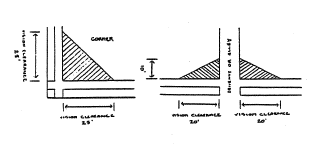
Vision Clearance Triangle (Corner). On any corner lot in which a front yard is required by this title, no sign shall be maintained which will materially impede vision between a height of zero and ten feet above the centerline grades of the intersecting streets within a triangular area formed by the intersecting property lines nearest the streets and a straight line joining said property lines as points which are twenty-five feet distant from the point of intersection measured along said property lines. Pole diameters must not exceed eight inches within this triangle.
46.
Vision Clearance Triangle (Driveways and Alleys). On any driveway or alley upon which access is obtained from a public right-of-way, there shall be a vision clearance triangle maintained in which no sign will materially impede vision between a height of zero and ten feet above the centerline grade of the access and the street. The triangle is measured from the property lines and extends twenty feet parallel to the public right-of-way and ten feet parallel to the driveway or alleyway. Pole diameters may not exceed eight inches within this triangle.
47.
"Wall sign" means a sign attached parallel to and extending not more than twelve inches from the wall of a building. This definition includes painted, individual letter, and cabinet signs.
48.
"Window sign" means a sign installed inside a window and intended to be viewed from the outside.
(Ord. 447 § 2, 1993; Ord. 281 § 1(A) (part), 1986)
17.42.040 - General provisions.
A.
Signs Prohibited.
1.
Abandoned signs unless otherwise allowed by the historical commission;
2.
Signs imitating or resembling official traffic or government signs or signals;
3.
Signs placed on vehicles or trailers which are parked or located for the primary purpose of displaying said sign. This does not apply to allowed portable signs or to signs or lettering on buses, taxis or vehicles operation during the normal course of business;
4.
Any signs above forty feet in height, unless otherwise permitted herein;
5.
Any sign which violates the requirements of vision clearance located in Section 17.42.030;
6.
No signs shall encroach into a public right-of- way unless an encroachment permit is granted by the council of commissioners or highway department, depending on jurisdiction;
7.
Signs which encroach into the conical zone as defined by the Federal Aviation Administration;
8.
Signs that because of location, size, illumination, nature or type constitute or tend to constitute a traffic hazard to safe and efficient operation of vehicles or create a condition which endangers the safety of persons or property;
9.
Signs that create undue glare on residences in residential zones.
B.
Permits Required. Unless otherwise provided by this title, all signs shall require permits as described in Section 17.42.090.
C.
Sign Area Determination.
1.
Projecting and Freestanding Signs. The area of a freestanding, double-faced sign shall have only one face (the largest one) counted in calculating its area.
The largest portion of the sign that can be seen from a direction at any one time shall constitute a sign face. For example, cubed signs shall have two sides counted as one face in calculating area. Pole covers and other embellishments shall not be included in the area of measurement provided that there is not written advertising copy on such embellishments.
2.
Wall Signs and Awning Signs. The area shall be within a single, continuous perimeter composed of any straight line geometric figure which encloses the extreme limits of the advertising message. If the sign is composed of individual letters or symbols using the wall as the background with no added decoration, the total sign area shall be calculated by measuring the area within the perimeter of each symbol or letter. The combined areas of the individual figures shall be considered the total sign area.
D.
Lighting. Unless otherwise specified by this title, all signs may be illuminated, however, no sign regulated by this title may utilize any revolving, stroboscopic or beacon light or any light having the appearance of lighting used for emergency purposes such as police, ambulance, snowplow, fire trucks, etc.
E.
Changeable Copy. Unless otherwise specified by this title, any sign herein allowed may use manual or automatic changeable copy.
(Ord. 281 § 1(A) (part), 1986)
17.42.050 - On-premises signs.
A.
On-premises Signs Permitted in All Zones Which Do Not Require a Permit. The following types of signs are exempt from permit requirements but must be in conformance with all other requirements of this title.
1.
Temporary signs advertising the sale, lease, or rental of the premises upon which the sign is located. Only one sign may be placed per street frontage. The size of such sign shall be a maximum of six square feet for residential property and a maximum of thirty-two square feet for all other properties. Such signs shall be removed within seven days following the leasing or closing date of the sale;
2.
Signs bearing only property numbers, post box numbers, names of occupants of premises or other identification of premises not having commercial connotations;
3.
Flags and insignia of any government except when displayed in connection with commercial promotion;
4.
Legal notices; identification or information signs erected or required by governmental bodies;
5.
Directional/informational signs less than five square feet or less in area;
6.
Political signs are permitted on private property in any zoning district with the expressed consent of the owner or occupant of such property. Such signs may not be posted more than sixty days prior to the election and must be removed by those responsible for the erection of the sign or the property owner within seven days following the election. Such sign shall not exceed sixteen square feet in area and shall not exceed six feet in height. Election signs shall not encroach into the public right-of-way and must meet the requirements of the vision clearance triangle;
7.
Construction Signs. One building construction sign per construction project not exceeding thirty-two square feet in sign area in residential districts or sixty-four square feet in sign area in all other districts, provided that such signs shall be erected no more than five days prior to the beginning of construction for which a valid building permit has been issued, shall be confined to the site of construction, and shall be removed five days after issuance of an occupancy certificate or completion of construction and prior to occupancy;
8.
Holiday or special events decorations;
9.
Window signs;
10.
Incidental signs;
11.
Bulletin boards for churches, schools or other public, religious or educational facilities but must be reviewed by the zoning enforcement officer and issued a no-fee permit;
12.
Point of purchase displays.
B.
On-premises Signs Permitted in Residential Zones.
1.
All signs permitted in subsection 17.42.050A of this title;
2.
Home occupation signs not exceeding one square foot.
C.
On-premises Signs Permitted in Commercial and Industrial Zones.
1.
All signs permitted in subsection 17.42.050A of this title;
2.
Each developed parcel is permitted a maximum of three freestanding signs, provided that no two freestanding signs are less than one hundred fifty frontage feet apart. Freestanding signs must be adjacent to a public street or highway on which the property borders. Freestanding signs are permitted one square foot of sign area for each linear foot of street frontage, but shall not exceed the following regulations. The following provisions regulate the sign area per frontage and/or individual sign and the height of signs:
a.
Individual freestanding signs located in the C-1, C-M, M-1 and M-2 districts shall not exceed one hundred seventy-five square feet in sign area. Where a developed parcel is permitted to have more than one freestanding sign, each frontage is permitted a total of one hundred seventy-five square feet of sign area. Such signs shall not exceed thirty feet in height,
b.
The height of individual freestanding signs located within the C-2 and C-3 districts is determined by the location of the sign within those zones. The total permitted sign area of freestanding signs in the C-2 and C-3 districts is determined by the height and frontage of the property. The following provisions shall regulate freestanding signs within the C-2 and C-3 districts:
i.
Sign signs shall not exceed forty feet in height except per the following provision. Freestanding signs not to exceed sixty feet in height will be permitted within one-half mile of the median of 1-90/15 interstate where it intersects with Harrison Avenue or Montana Street. All other freestanding signs in the C-2 and C-3 zones shall not exceed forty feet in height,
ii.
Signs which are forty feet or less in height shall not exceed three hundred square feet in area. Signs which are between forty-one to sixty feet in height shall not exceed one hundred seventy-five square feet in area,
iii.
Where a developed parcel is permitted to have more than one freestanding sign, each frontage is permitted a total of three hundred square feet of sign area,
iv.
All freestanding signs shall be set back five feet from the property line and shall follow construction, clearance and projection specifications of the Uniform Sign Code;
3.
Each development complex shall be allowed one freestanding sign per frontage. One freestanding sign will be permitted two square feet of sign area for each linear foot of street frontage, but shall not exceed a maximum permitted square footage of three hundred seventy-five square feet. Where a developed parcel is permitted to have more than one freestanding sign, the additional sign cannot exceed one hundred square feet is sign area;
4.
One roof sign not to exceed ten feet above the building roofline;
5.
One awning sign per occupancy providing that the face of said sign is included in the total allowable or wall sign area calculation. All awnings must follow construction and clearance and projection specifications of the Uniform Building Code;
6.
Banner signs are permitted as follows:
a.
Banner signs (public right-of-way) — banner signs may be suspended across a public right-of-way subject to the following conditions:
i.
Letter(s) of permission from property owner(s) whereupon banner signs are secured,
ii.
Banner sign location must be approved by the zoning officer, and
iii.
Messages are limited to public service messages.
b.
Banner signs (private property) — banner signs may be securely attached to a structure, the wall of a building or canopy as follows:
i.
One banner sign per occupancy providing that the face of said sign is included in the total allowable wall sign area calculation,
ii.
Banner signs shall not direct attention to a for-profit business, commodity, service or entertainment not related to the premise at which the sign is located;
7.
One or more wall signs per building frontage which meet the following requirements:
a.
Total wall sign area in the C-1, C-M, M-1, and M-2 zones shall not exceed thirty percent of the building facade to which it is attached, per street frontage. When a business has more than one street frontage, but does not have a main entrance on the additional street frontage, such building frontage may contain a wall sign not exceeding twenty square feet of total sign area,
b.
Total wall sign area in the C-2 and C-3 zones shall not exceed forty percent of the building facade to which it is attached, per street frontage. When a business has more than one frontage, but does not have a main entrance on the additional frontage, such frontage may contain a wall sign not exceeding thirty square feet of total sign area,
c.
Multiple occupancy buildings shall submit a sign plan conforming with this section which will coordinate signage for the entire project. The sign plan shall include the building facade area for each separate occupancy and proposed wall sign area for each occupancy. Each occupancy's allowable wall sign area will be determined by the occupancy's building facade area. Any variation to the approved sign plan must be approved by the zoning administrator;
8.
One projecting per occupancy. All projecting signs must follow construction and clearance and projection specifications of the Uniform Sign Code;
9.
One portable sign per premises subject to the following requirements:
a.
Such signs maintain a five-foot setback from the property line,
b.
Such signs shall be included within the allowable freestanding sign area calculation,
c.
Any portable signs located on the public right-of-way shall be subject to removal by the zoning administrator without notice unless otherwise permitted in this chapter.
D.
On-premises Signs Allowed in C-3 Zones.
1.
Any signs allowed in subsection C of this section;
2.
Sidewalk signs; provided, that such signs will not interrupt or hinder the free use, or will in any manner endanger the safety of persons using such sidewalks or walkways. Sidewalk commercial signs shall be permitted; provided, that:
a.
No such sign may be lighted or use electricity,
b.
No such sign may be larger than five feet in height or three feet in width,
c.
No such sign may hang in a manner which would allow any swing movement,
d.
Signs must be removed during hours which the business is not in operation, and
e.
Persons placing signs must obtain an encroachment permit from the council of commissioners for signs that are placed within the public right-of-way.
E.
On-premises Signs Permitted in Historical Overlay Zone.
1.
Signs permitted in the historical overlay zone shall include those signs permitted in the underlying zone according to this title;
2.
Restoration, maintenance or relocation of any sign which has been deemed historically significant by the historic preservation commission;
3.
Due to the unique nature of the historical overlay zone, change of copy design or alterations to nonconforming signs or new signs which do not meet the aforementioned subdivisions 1 and 2 of this subsection E shall be allowed if designed to contribute to the historical significance of the overlay zone, and reviewed and approved by the historic preservation commission.
(Ord. 447 § 3, 1993; Ord. 281 § 1(A) (part), 1986)
17.42.055 - Freestanding signs—Development complexes.
Each development complex shall be allowed one freestanding sign per frontage. One freestanding sign will be permitted two square feet of sign area for each linear foot of street frontage, but shall not exceed a maximum permitted square footage of three hundred seventy-five square feet. Where a developed parcel is permitted to have more than one freestanding sign, the additional sign cannot exceed one hundred square feet in sign area.
(Ord. 447 § 4, 1993)
17.42.060 - Off-premises signs.
A.
Off-premises signs are prohibited in all residential zoning districts.
B.
Off-premises signs permitted in C-2, C-3, C-M, M-1 and M-2 zones per the following requirements:
1.
Shall not exceed one hundred square feet in area;
2.
Shall not exceed twenty feet in height;
3.
Shall not be illuminated;
4.
Shall comply with Section 17.42.040 of the Butte-Silver Bow zoning ordinance.
C.
Billboards may be permitted adjacent to a federal aid primary highway or interstate highway, per the following regulations:
1.
Located in a C-2, M-1, M-2 or RM-2 zone;
2.
May not be located within five hundred feet of a residence located within a residential zoning district;
3.
May not exceed fifty feet in height;
4.
May not exceed six hundred seventy-five square feet in sign area.
D.
Billboards may be permitted within the urban district boundaries, as defined on the Butte-Silver Bow future land use map, per the following regulations:
1.
Located in a C-2, M-1, M-2 or RM-2 zone;
2.
May not be located within five hundred feet of a residence located within a residential zoning district;
3.
May not exceed forty feet in height;
4.
May not exceed three hundred square feet in sign area.
(Ord. 447 § 5, 1993; Ord. 281 § 1(A) (part), 1986)
17.42.070 - Nonconforming signs.
A.
Determination of Legal Nonconformity. Existing signs which do not conform to the specific provisions of the ordinance codified in this title may be eligible for the designation "legal nonconforming" provided that the sign was covered by a valid permit or variance or complied with all applicable laws on the date of adoption of the ordinance codified in this title.
B.
Loss of Legal Nonconforming Status. A legal nonconforming sign may lose this designation if:
1.
The sign is relocated or replaced;
2.
The structure or size of the sign is altered in any way except towards compliance with this title. This does not refer to change of copy or normal maintenance.
C.
Maintenance and Repair of Nonconforming Signs. The legal nonconforming sign is subject to all requirements of this code regarding safety, maintenance and repair however, if the sign suffers more than fifty percent appraised damage or deterioration, it must be brought into conformance with this code or removed.
(Ord. 281 § 1(A) (part), 1986)
17.42.080 - Construction specifications.
All signs shall be constructed in accordance with the adopted Uniform Sign Code or this title, whichever is the stricter of the two. Said signs must be inspected by the building inspector for compliance with construction specifications.
(Ord. 281 § 1(A) (part), 1986)
17.42.090 - Permit—Application.
Application for a permit for the erection, alteration, or relocation of a sign shall be made to the zoning enforcement officer upon a form provided by the zoning enforcement officer and shall include the following information:
A.
Name and address of the owner of the sign;
B.
Street address or location of the property on which the sign is to be located, along with the name and address of the property owner;
C.
The type of sign or sign structure as defined in this title;
D.
A site plan showing the proposed location of the sign along with the location and square footage areas of all existing signs on the same premises;
E.
Specifications and scale drawings showing the materials, design, dimensions, structural support, and electrical components of the proposed sign.
(Ord. 281 § 1(A) (part), 1986)
17.42.095 - Fees.
Each application for a sign permit shall be accompanied by applicable fees which shall be established by the council of commissioners by resolution.
(Ord. 447 § 6, 1993)
17.42.100 - Removal.
A.
Removal of Unsafe or Unmaintained Signs.
1.
The building inspector shall require the removal of any sign found to be unsafe and unmaintained as required by this chapter. Before bringing such action to require the removal of an unsafe or unmaintained sign, the building inspector shall provide written notice to the owner of the sign or the owner of the premises upon which the sign is located. The notice shall specify that within thirty days the illegal sign shall be removed or brought into compliance with this section. The notice shall state the reasons for removal, specifying the deficiencies and violations; and such notice shall specify what repairs, if any, will make the sign and its support conform to the construction and maintenance requirements of this chapter. Notice shall be made personally on the owner or lessee, or by certified mail.
2.
If the owner or lessee of the sign fails to remove the sign within the allowed time after receiving written notice, the building inspector shall take legal action to have the sign removed at the owner's expense.
B.
Immediate Removal of Dangerous Signs. If the building inspector finds that any sign or sign support is in violation of this section or the Uniform Sign Code, and that by reason of its condition it presents an immediate danger to the public, he shall order immediate repair or immediate removal. The building inspector shall take legal action to such sign if the person(s) responsible cannot be found or refuses to repair or remove the sign within ten days.
C.
Removal of Abandoned Signs. Any person who owns or leases a sign shall remove the sign within one hundred eighty days after it becomes an abandoned sign as defined by this chapter. If the owner or lessee cannot be located, the building inspector shall take legal action to have such sign removed. The cost of removal shall be borne by the owner of the sign. In the event that the sign conforms with this chapter, the zoning officer may approve a sign permit to install a blank insert for the structure.
(Ord. 281 § 1(A) (part), 1986)
17.42.110 - Compliance.
All signs must conform to the adopted Uniform Building Code, adopted Uniform Sign Code, and highway department regulations or this title, whichever is stricter.
(Ord. 281 § 1(A) (part), 1986)

