
Cadillac City Zoning Code
ARTICLE III
- DISTRICT REGULATIONS
DIVISION 6. - MH MOBILE HOME PARK DISTRICTS[3]
State Law reference— Mobile home commission act, MCL 125.2301 et seq.
DIVISION 19. - MIXED USE PLANNED UNIT DEVELOPMENT DISTRICT (M-PUD)[4]
Editor's note— Ord. No. 2015-17, § 1, adopted January 4, 2016, set out provisions intended for use as new division 19, §§ 46-653—26-657. In order to avoid duplication of section numbers, and at the editor's discretion, these provisions have been included as 46-641—46-645.
Sec. 46-134.- Established.
For the purpose of this chapter, the city is hereby divided into the following districts:
(1)
Residential districts.
a.
R-1 One-family residential district.
b.
R-2 One-family residential district.
c.
R-3 One-family residential district.
d.
R-4 One-family residential district.
e.
RT Two-family residential district. (See section 46-218, pertaining to two-family uses.)
f.
RM-1 Multiple-family residential district.
g.
RM-2 Multiple-family residential district.
h.
RMH One-family residential mobile home district.
i.
MH Mobile home park residential district.
j.
R-PUD Residential planned unit development.
(2)
Nonresidential districts.
a.
OS-1 Office service district.
b.
OS-2 Office service district.
c.
B-1 Auxiliary business district.
d.
B-2 Central business district.
e.
B-3 General business district.
f.
TS-1 Tourist service district.
g.
TS-2 Tourist service district.
h.
I-1 Light industrial district.
i.
I-2 General industrial district.
j.
P-1 Vehicular parking district.
k.
POS Parks and open space district.
l.
C-PUD Commercial planned unit development.
(Prior Code, § 5.21; Ord. No. 87-17, 10-9-1987; Ord. No. 90-28, 12-3-1990; Ord. No. 96-19, 1-20-1997)
Sec. 46-135. - Boundaries—Established.
The boundaries of these districts are hereby established as shown on the zoning map, city zoning ordinance, which accompanies Ord. No. 752, as amended by the zoning map attached to the ordinance from which this chapter is derived, and which map with all notations, references, and other information shown thereon shall be as much a part of this chapter and Ord. No. 87-17, as if fully described herein.
(Prior Code, § 5.22; Ord. No. 87-17, 10-9-1987)
Sec. 46-136. - Same—Interpreted.
Where uncertainty exists with respect to the boundaries of the various districts as shown on the zoning map, the following rules shall apply:
(1)
Boundaries indicated as approximately following the centerlines of streets, highways, or alleys, shall be construed to follow such centerlines.
(2)
Boundaries indicated as approximately following platted lot lines shall be construed as following such lot lines.
(3)
Boundaries indicated as approximately following city limits shall be construed as following city limits.
(4)
Boundaries indicated as following railroad lines shall be construed to be the midway between the main tracks.
(5)
Boundaries indicated as following shore lines shall be construed to follow such shore lines, and in the event of change in the shore line, shall be construed as moving with the actual shore line; boundaries indicated as approximately following the centerlines of streams, rivers, canals, lakes, or other bodies of water shall be construed to follow such centerlines.
(6)
Boundaries indicated as parallel to or extensions of features indicated in subsections (1) through (5) of this section shall be so construed. Distances not specifically indicated on the official zoning map shall be determined by the scale of the map.
(7)
Where physical or natural features existing on the ground are at variance with those shown on the official zoning map, or in other circumstances not covered by subsections (1) through (6) of this section, the board of appeals shall interpret the district boundaries.
(8)
Insofar as some or all of the various districts may be indicated on the zoning map by patterns which, for the sake of map clarity, do not cover public rights-of-way, it is intended that such district boundaries do extend to the center of any public rights-of-way.
(Prior Code, § 5.23)
Sec. 46-137. - Zoning—Annexed areas.
Whenever any area is annexed to the city, one of the following conditions will apply:
(1)
Land that is zoned previous to annexation shall be classified as being in whichever district of this chapter most closely conforms with the zoning that existed prior to annexation, such classification to be recommended by the planning commission to the city council and the city council may approve the same by resolution.
(2)
Land not zoned prior to annexation shall be automatically classified as an R-1 district until a zoning map for said area has been adopted by the city council. The planning commission shall recommend the appropriate zoning districts for such area within three months after the matter is referred to it by the city council.
(Prior Code, § 5.24)
Sec. 46-138. - Same—Vacated areas.
Whenever any street, alley or other public way, within the city shall be vacated, such street, alley, or other public way or portion thereof, shall automatically be classified in the same zone district as the property to which it attaches.
(Prior Code, § 5.25)
Sec. 46-139. - District requirements.
All buildings and uses in any district shall be subject to the provisions of article IV of this chapter, pertaining to supplemental regulations and article V of this chapter, pertaining to general exceptions.
(Prior Code, § 5.26)
Sec. 46-162.- Intent.
(a)
The R-1 through R-4 one-family residential districts are designed to be the most protective of the residential districts. The intent is to provide for an environment of predominantly low-density, one-family detached dwellings along with other residentially related facilities, which serve the residents in the district.
(b)
It is also intended that the size, shape and design of structures located within these areas conform with the neighborhood in which they are located so as not to diminish or impair the value of surrounding properties.
(Prior Code, § 5.31)
Sec. 46-163. - Principal uses permitted.
In a one-family residential district, no building or land shall be used and no building shall be erected except for one or more of the following specified uses unless otherwise provided in this chapter:
(1)
One-family detached dwellings.
(2)
State licensed residential facilities as required by MCL 125.3206.
(3)
Farms on those parcels of land separately owned outside the boundaries of either a proprietary or supervisor's plat, having an area of not less than five acres, all subject to the health and sanitation provisions of the city and provided further that no farms shall be operated as piggeries, or for the disposal of garbage, sewage, rubbish, offal or rendering plants, or for the slaughtering of animals, except such animals as have been raised on the premises or have been maintained on the premises for at least a period of one year immediately prior thereto, and for the use and consumption by persons residing on the premises.
(4)
Publicly owned and operated libraries, parks, parkways and recreational facilities.
(5)
Cemeteries which lawfully occupied land at the time of the adoption of this Code.
(6)
Public, parochial and other private elementary schools offering courses in general education and not operated for profit.
(7)
Accessory buildings and uses, customarily incident to any of the uses permitted in subsections (1) through (6) of this section.
(8)
Home occupations in any residential district under the following conditions:
a.
It is understood that many occupations use their home as a base of operations, and many businesses begin as small home occupations which are expanded in the future. It is the intention of the city to allow such uses as long as the uses do not adversely affect the peace and quiet of the residential neighborhood, and to encourage their relocation into a commercially zoned area if the business expands beyond the residential constraints.
b.
In general, a home occupation is an accessory use so located and conducted that the average neighbor, under normal circumstances, would not be aware of its existence.
c.
Instructions in craft, fine art, music, dancing and similar subjects shall be limited to six students at a time.
d.
Day care facilities shall be limited to not more than six children; provided that all requirements set by the state department of human services are complied with.
e.
Only residents of the dwelling may be engaged in the home occupation.
f.
No display of products shall be visible from the street, and there shall be no signs other than those permitted by section 46-664.
g.
The home occupation shall be clearly incidental to the residential use of the dwelling and shall not change the essential residential character of the dwelling. No internal or external alterations inconsistent with the residential use of the building shall be permitted.
h.
Use of the dwelling or accessory building for this purpose shall be limited to an area not greater than ten percent of the occupiable floor space of the principal building.
i.
Outside storage shall not be used in connection with the home occupation.
j.
No such home occupation shall be noxious or offensive by reason of emission of noise, vibration, smoke, dust or other particulate matter, odorous matter, heat, humidity, glare, refuse, interference in radio or television reception, or other objectionable emissions. No unreasonable use of lights shall be permitted.
k.
Only vehicles used primarily as passenger vehicles shall be permitted in connection with the conduct of the home occupation. No traffic shall be generated by a home occupation in greater volumes than would normally be expected in a residential neighborhood (i.e., no more than one additional vehicle at a time) and any need for parking generated by the conduct of a home occupation shall be met off the street.
l.
The following uses and similar such uses shall be prohibited as home occupations, because the nature of the investment or operations have a pronounced tendency, once started, to rapidly increase beyond the limits permitted for home occupations and thereby impair the use and value of residentially zoned areas: auto repair or painting, barbershop, beauty salon, major carpentry work, patient clinic facility of a doctor or dentist, private schools with organized classes with more than six students, appliance repair and upholstering.
m.
The wholesaling of products shall not be permitted at any home occupation site.
n.
Garage and yard type sales with a duration not more than three days a month are exempt from this section.
o.
The city council may void any home occupation for noncompliance with the conditions set forth herein.
p.
Business uses that are beyond the scope of a customary home occupation/business may be eligible for a special use permit according to article VI of this chapter, pertaining to special land use.
Examples of accessory home occupations/businesses: artists, authors, clothes makers, home crafts, office facilities of clergy, salesmen, professionals, the boarding of not more than two boarders.
(Prior Code, § 5.32; Ord. No. 89-20, 11-6-1989)
Sec. 46-164. - Principal uses permitted subject to special conditions.
The following uses shall be permitted, subject to the conditions hereinafter imposed for each use and subject further to the review and approval of the planning commission:
(1)
Churches and other facilities normally incidental thereto, subject to the following conditions:
a.
Buildings of greater than the maximum height allowed in division 18 of this article, the schedule of regulations, may be allowed provided front, side and rear yards increased above the minimum required yards by two feet for each foot of building height that exceeds the maximum height allowed.
b.
All access to the site shall be in accordance with section 46-671.
(2)
Public, parochial and private intermediate and/or secondary schools offering courses in general education, not operated for profit. Access to the site shall be in accordance with section 46-671.
(3)
Utility and public service buildings and uses, without storage yards, when operating requirements necessitate the locating of said building within the district in order to serve the immediate vicinity.
(4)
Nursery schools, day nurseries and child care centers, not including dormitories; provided that for each child so cared for, there shall be provided and maintained a minimum of 150 square feet of outdoor play area. Such play space shall have a total minimum area of not less than 5,000 square feet and shall be fenced and screened from any adjoining lot in any residential district.
(5)
Private noncommercial recreational areas, institutional or community recreation centers, nonprofit swimming pool clubs, all subject to the following conditions:
a.
The proposed site for any of the uses permitted herein which would attract persons from, or are intended to serve, areas beyond the immediate neighborhood shall have at least one property line abutting a major thoroughfare as designated on the major thoroughfare plan, and the site shall be so planned as to provide all access in accordance with section 46-671.
b.
Front, side and rear yards shall be at least 80 feet wide, and shall be landscaped in trees, shrubs, and grass. All such landscaping shall be maintained in a healthy condition. There shall be no parking or structures permitted in these yards, except required entrance drives and those walls used to obscure the use from abutting residential districts.
c.
Off-street parking shall be provided so as to accommodate not less than one-half of the member families and/or individual members. The planning commission may modify the off-street parking requirements in those instances wherein it is specifically determined that the users will originate from the immediately adjacent areas, and will therefor be pedestrian. Prior to the issuance of a building permit or zoning compliance permit, bylaws of the organization shall be provided in order to establish the membership involved for computing the off-street parking requirements. In those cases wherein the proposed use or organization does not have bylaws or formal membership, the off-street parking requirement shall be determined by the planning commission on the basis of usage.
d.
Whenever a swimming pool is constructed under this chapter, said pool area shall be provided with a protective fence, four feet six inches in height, and entry shall be provided by means of a controlled gate.
(6)
Golf courses, which may or may not be operated for profit, subject to the following conditions:
a.
The site shall be so planned as to provide all access in accordance with section 46-671.
b.
The site plan shall be laid out to achieve a relationship between the major thoroughfare and any proposed service roads, entrances, driveways, and parking areas which will encourage pedestrian and vehicular traffic safety.
c.
Development features including the principal and accessory buildings and structures shall be so located and related as to minimize the possibilities of any adverse effects upon adjacent property. This shall mean that all principal or accessory buildings shall not be less than 200 feet from any property line abutting residentially zoned lands; provided that, where topographic conditions are such that buildings would be screened from view, the planning commission may modify this requirement.
d.
Whenever a swimming pool is to be provided, said pool shall be provided with a protective fence six feet in height, and entry shall be by means of a controlled gate.
(7)
Colleges, universities and other such institutions of higher learning, public and private, offering courses in general, technical, or religious education and not operated for profit, all subject to the following conditions:
a.
Any use permitted herein shall be developed only on sites of at least 40 acres in area, and shall not be permitted on any portion of a recorded subdivision plat.
b.
All access to said site shall be in accordance with section 46-671.
c.
No building shall be closer than 80 feet to any property line.
(8)
Private swimming pools shall be permitted as an accessory use within the rear yard only, provided they meet the following requirements:
a.
There shall be a minimum distance of not less than ten feet, between the adjoining property line, or alley right-of-way and the outside of the pool wall. Side yard setbacks shall apply to side yards if greater than ten feet.
b.
There shall be a distance of not less than four feet between the outside pool wall and any building located on the same lot.
c.
No swimming pool shall be located less than 35 feet from any front lot line.
d.
No swimming pool shall be located in an easement.
e.
For the protection of the general public, all yards containing swimming pools shall be completely enclosed by a fence not less than four feet in height. The gates shall be of a self-closing latching-type, with the latch on the inside of the gate not readily available for children to open. Gates shall be capable of being securely locked when the pool is not in use for extended periods; provided, however, that if the entire premises of the residence is enclosed, then this provision may be waived by the Wexford County building inspector.
(9)
Roominghouses and boardinghouses.
(10)
Family shelter, subject to the requirements of article VI—Special Land Uses.
(11)
Accessory buildings and uses customarily incident to any of the above permitted uses.
(Prior Code, § 5.33; Ord. No. 2010-10, § 16, 8-2-2010; Ord. No. 2017-05, § 2, 4-17-2017)
Sec. 46-165. - Area and bulk requirements.
See division 18 of this article, schedule of regulations, limiting the height and bulk of buildings, the minimum size of a lot permitted by land use, the maximum density permitted, and providing minimum yard setback requirements.
(Prior Code, § 5.34)
Sec. 46-184.- Intent.
The RM-1 multiple-family residential district is designed to afford a transition of use in existing housing areas by permitting new construction or conversion of existing structures between adjacent residential and commercial, office, thoroughfares or other uses which would affect residential character. This district also recognizes the existence of older residential areas of the city where larger houses have been or can be converted from single-family to two-family or multiple-family residences in order to extend the economic life of these structures and allow the owners to justify the expenditures for repairs and modernization.
(Prior Code, § 5.41; Ord. No. 96-19, 1-20-1997)
Sec. 46-185. - Principal uses permitted.
In an RM-1 multiple family residential district, no building or land shall be used and no building shall be erected, except for one or more of the following specified uses, unless otherwise provided in this chapter:
(1)
All uses permitted and as regulated in one-family residential districts. The standards of the schedule of regulations applicable to the R-3 one-family residential district, shall apply as minimum standards when one-family detached dwellings are erected.
(2)
Two-family dwellings.
(3)
Multiple-family dwellings. (See section 46-215, pertaining to site plans and conditions for approval.)
(4)
Accessory buildings and uses customarily incident to any of the uses permitted in subsections (1) through (3) of this section.
(Prior Code, § 5.42; Ord. No. 96-19, 1-20-1997)
Sec. 46-186. - Special land uses permitted.
The following uses of land and structures will be allowed, as stipulated in article VI of this chapter, special land uses:
(1)
Recreational activities.
(2)
Offices and/or business in an existing building.
(3)
Office and/or business in a dwelling (mixed use).
(4)
Family shelter.
(5)
Group shelter.
(6)
Combination group/family shelter.
(7)
Bed and breakfast.
(Prior Code, § 5.43; Ord. No. 96-19, 1-20-1997; Ord. No. 2017-05, § 3, 4-17-2017; Ord. No. 2018-14, § 2, 12-17-2018; Ord. No. 2024-13, § 3, 12-16-2024)
Sec. 46-187. - Area and bulk requirements.
See division 18 of this article, schedule of regulations limiting the height and bulk of buildings, the minimum size of a lot permitted by land use, the maximum density permitted, and providing minimum yard setback requirements.
(Prior Code, § 5.44; Ord. No. 96-19, 1-20-1997)
Sec. 46-213.- Intent.
The RM-2 multiple family residential districts are designed to provide sites for multiple-family dwelling structures, and related uses, which will generally serve as zones of transition between the nonresidential districts and lower density single-family districts. The multiple-family district is further provided to serve the limited needs for the apartment type of unit in an otherwise medium density, single-family community.
(Prior Code, § 5.51; Ord. No. 96-19, 1-20-1997)
Sec. 46-214. - Principal uses permitted.
In a multiple-family residential district, no building or land shall be used and no building shall be erected, except for one or more of the following specified uses, unless otherwise provided in this chapter:
(1)
All residential uses permitted and as regulated in the one-family residential districts. The standards of the schedule of regulations applicable to the R-1 one-family residential district, shall apply as minimum standards when one-family detached dwellings are erected.
(2)
Two-family dwellings. The standards of the schedule of regulations applicable to the R-3 one-family residential district shall apply as minimum standards for the setbacks, lot coverage and building heights of the duplexes constructed in the Twin Haven plat approved by the planning commission on January 22, 1996.
(3)
Multiple-family dwellings.
(4)
Accessory buildings and uses customarily incident to any of the permitted uses in subsections (1) through (3) of this section.
(Prior Code, § 5.52; Ord. No. 96-19, 1-20-1997)
Sec. 46-215. - Site plans required; conditions for approval.
(a)
In the case of multiple-dwelling developments, all site plans (see section 46-29) shall be submitted to the planning commission for its review and approval prior to issuance of a building permit.
(b)
Approval shall be contingent upon a finding that:
(1)
The site plan shows that a proper relationship exists between local streets and any proposed service roads, driveways, and parking areas to encourage pedestrian and vehicular traffic safety; and
(2)
All the development features including the principal building or buildings and any accessory buildings, or uses, open spaces, and any service roads, driveways and parking areas are so located and related to minimize the possibility of any adverse effects upon adjacent property, such as, but not limited to: channeling excessive traffic onto local residential streets, lack of adequate screening or buffering of parking or service areas, or building groupings and circulation routes located as to interfere with police or fire equipment access.
(Prior Code, § 5.53)
Sec. 46-216. - Special land uses permitted.
The following uses of land and structures will be allowed, as stipulated in article VI of this chapter, special land uses:
(1)
Recreational facilities.
(2)
Mobile home parks.
(3)
Office and/or business in an existing building.
(4)
Office and/or business in a dwelling (mixed use).
(5)
Family shelter.
(6)
Group shelter.
(7)
Combination group/family shelter.
(8)
Accessory buildings and uses customarily incident to any of the special land uses in subsections (1) through (7) of this section.
(9)
Bed and breakfast.
(Prior Code, § 5.54; Ord. No. 96-19, 1-20-1997; Ord. No. 2017-05, § 4, 4-17-2017; Ord. No. 2018-14, § 3, 12-17-2018; Ord. No. 2024-13, § 4, 12-16-2024)
Editor's note— Ord. No. 2018-14, § 3, adopted December 17, 2018, amended § 46-216 and in so doing changed the title of said section from "Principal uses permitted subject to special conditions" to "Special land uses permitted," as set out herein.
Sec. 46-217. - Area and bulk requirements.
See division 18 of this article, schedule of regulations limiting the height and bulk of buildings, the minimum size of lot permitted by land use, maximum density permitted and providing minimum yard setback requirements.
(Prior Code, § 5.55; Ord. No. 96-19, 1-20-1997)
Sec. 46-218. - Two-family uses (formerly RT district).
The RT two-family residential district requirements have been incorporated into the RM-1 and RM-2 multiple-family district requirements. For those RT districts currently shown on the zoning map, the standards of the schedule of regulations (section 46-629) applicable to the R-3 one-family residential district shall apply as minimum standards for the setbacks of newly constructed duplexes, otherwise, all other standards of the schedule of regulations applicable to RM-2 multiple-family residential district shall apply as minimum standards.
(Prior Code, § 5.56; Ord. No. 96-19, 1-20-1997)
Sec. 46-245.- Intent.
The RMH one-family residential mobile home districts are designed to accommodate the housing of families on individual lots located outside the confines of a mobile home park. These districts recognize the existence of land divisions which are not in general keeping with modern practices of land subdivision and homebuilding.
(Prior Code, § 5.81)
Sec. 46-246. - Principal uses permitted.
In a one-family residential mobile home district, no building or land shall be used and no structure shall be erected except for one or more of the following specified uses unless otherwise provided in this chapter:
(1)
All uses permitted and as regulated in the one-family residential districts. The standards of the schedule of regulations applicable to the R-3 one-family residential district shall apply as minimum standards when one-family detached dwellings are erected.
(2)
Accessory buildings and uses customarily incident to any of the permitted uses in subsection (1) of this section.
(Prior Code, § 5.82)
Sec. 46-247. - Required conditions for approval of plot plan.
In the case of mobile home development, the approval of plot plans submitted to the building inspector for review shall be contingent upon a finding that:
(1)
All development features, including the location of the principal building, any accessory buildings, or uses, open spaces, driveways, parking areas, etc., are so located and related to minimize the possibility of any adverse effects upon adjacent property.
(2)
A concrete pad shall be provided which is at least as large as the mobile home in total width and length, and shall have sufficient tiedowns as specified by the building inspector.
(3)
All water and sewer connections shall be suitably protected from freezing.
(4)
All fuel oil and gasoline tanks located on the lot shall be screened from view. All tanks shall be equipped with vent pipes and fused valves.
(5)
There shall be no storage of any kind under mobile homes.
(6)
All mobile homes shall be properly skirted.
(7)
There shall not be less than 600 square feet of floor space within each mobile home for the first two occupants, and an additional 50 square feet of floor space for each occupant over two. Mobile homes less than 12 feet wide are not permitted within the city. These provisions shall not apply to any mobile home lawfully located in a mobile home park on the effective date of the ordinance from which this chapter is derived.
(Prior Code, § 5.83)
Sec. 46-248. - Area and bulk requirements.
See division 18 of this article, schedule of regulations limiting the height and bulk of buildings, the minimum size of a lot permitted by land use, the maximum density permitted, and providing minimum yard setback requirements.
(Prior Code, § 5.84)
Sec. 46-275.- Intent.
The MH mobile home park districts are designed to provide for mobile home parks and their accessory uses. Mobile home parks possess site characteristics most similar to multiple-family residential development and would provide for transition between nonresidential development and residential districts where such use would not be detrimental to the future expansion of residential development in the area. Because mobile home parks possess unique characteristics which may be detrimental to the development of new residential areas, the maintenance of a high degree of control over their location is essential and each location requires review of all site features and relationships between abutting land uses before approval.
(Prior Code, § 5.61)
Sec. 46-276. - Principal uses permitted.
In mobile home parks, principal uses shall be permitted after review and approval of the site plan by the planning commission and subject further to the following conditions:
(1)
The mobile home park shall have access to two existing streets, one of which shall be paved.
(2)
A mobile home park shall be permitted only on a lot or parcel which has a width of at least 400 feet on an existing street.
(3)
Prior to the public hearing on the proposed mobile home park, notification shall be given by mail of the proposal for said mobile home park and the date, time and place of public hearing to all property owners within 1,000 feet of the proposed mobile home park.
(4)
The mobile home park site shall be enclosed by a 15-foot wide greenbelt adjacent to all abutting properties and public rights-of-way. The greenbelt shall be located within the mobile home park site and shall provide a continuous yearround obscuring screen.
(5)
An open area shall be provided on each mobile home lot to insure adequate natural light and ventilation to each trailer and to provide sufficient area for outdoor uses essential to the occupants of the mobile home. Mobile home lots shall average not less than 4,000 square feet in area exclusive of drives, open space in the mobile home park or other open areas not specifically for mobile home occupancy. The minimum width for mobile home lots shall be not less than:
a.
Forty feet for singlewide mobile homes.
b.
Forty-five feet for expandable mobile homes.
c.
Fifty-five feet for doublewide mobile homes.
(6)
Each mobile home site shall have the minimum yard requirements in MAC R 125.1941.
(7)
Parking spaces shall be as required by MAC R 125.1925 and R 125.1926.
(8)
Mobile home sites shall be provided with a concrete apron of suitable width and length to park and support a mobile home, and shall have tie downs as specified by the building inspector.
(Prior Code, § 5.62)
Sec. 46-277. - Service drives and sidewalks.
Service drives and sidewalks shall be as required by MAC R 125.1920 and 125.1928.
(Prior Code, § 5.63)
Sec. 46-278. - Underground wiring.
(a)
Arrangements shall be made for all local distribution lines for telephone, television or electric services, exclusive of main supply and perimeter feed lines when located on section or quarter section lines, to be placed entirely underground throughout the trailer court area; provided, however, that when a mobile home park overlaps a section or quarter section line, main supply and perimeter feed lines located on such section or quarter section line shall be placed underground. The planning commission may waive or modify this requirement where, in its judgment and upon the advice of the city engineer, circumstances exist which render compliance impractical.
(b)
Conduits or cables should be placed within private easements provided to the service companies by the proprietor and/or developer or within public ways. Those telephone, television and electrical facilities placed in dedicated public ways shall be planned so as not to conflict with other underground utilities. All telephone and electrical facilities shall be constructed in accordance with standards of construction approved by the state public service commission.
(Prior Code, § 5.64)
Sec. 46-279. - Additional requirements.
(a)
There shall not be less than 400 square feet of floor space within each mobile home for the first one occupant, and an additional 100 square feet of floor space for each occupant over one. This provision shall not apply to any mobile home located in a mobile home park on the effective date of Ord. No. 752.
(b)
There shall be provided for each mobile home park a recreation area equal in size to at least 200 square feet per mobile home park site. Said recreation area shall be no longer than 1½ times its width. Such area shall be graded, developed, equipped, sodded and maintained by the management, so as to provide recreation for the residents of the mobile home park.
(c)
The front yard, and any side yard adjacent to a street shall be landscaped within one year after the issuance of a building permit and in any case prior to the certificate of occupancy and the entire mobile home park shall be maintained in a good, clean, presentable condition at all times.
(d)
No business of any kind shall be conducted in any mobile home park except for separate, permanent structures which contain facilities such as the management's office, laundry and dry cleaning facilities or similar uses which are designed to serve only the residents of the mobile home park and provided that no signs or advertising devices shall be visible from adjacent public streets.
(e)
All fuel oil and gas tanks located on each mobile home site shall be placed in a uniform manner and screened from view. All tanks shall be equipped with vent pipes and fused valves.
(f)
There shall be no storage of any kind under mobile homes, and all mobile homes shall be properly skirted.
(g)
All fences, other than the greenbelt surrounding the court, shall be uniform in height, and shall not exceed 30 inches in height, and shall be constructed in such a manner as to provide firemen access to all sides of each mobile home.
(Prior Code, § 5.65)
Sec. 46-280. - Compliance with state law.
All mobile home park development shall further comply with Public Act No. 96 of 1987 (MCL 125.2301 et seq.).
(Prior Code, § 5.66)
Sec. 46-281. - Additional permitted uses.
All uses permitted and as regulated in the one-family residential district are permitted in the MH mobile home park districts. The standards of the schedule of regulations applicable to the R-3 one-family residential district shall apply as minimum standards when one-family detached dwellings are affected.
(Prior Code, § 5.67)
Sec. 46-282. - Area and bulk requirements.
See division 18 of this article, schedule of regulations limiting the height and bulk of buildings, the minimum size of a lot permitted by land use, the maximum density permitted, and providing minimum yard setback requirements.
(Prior Code, § 5.68)
Sec. 46-313.- Requirements.
(a)
Special exception within districts. A R-PUD planned unit development shall be recognized as a special exception use within zoning districts. The requirements listed in this section shall apply in addition to all other applicable requirements of this chapter for the districts in which such uses are located. Control of such R-PUD developments shall be the responsibility of the city planning commission.
(b)
Purpose. The purpose of these regulations is to permit greater flexibility in the development of zoning districts than is generally possible under conventional zoning regulations. It is further intended to promote more efficient use of the land while permitting a harmonious variety of development choices, the integration of necessary services and community facilities and the preservation of open space for park and recreational use. A permit may be issued for construction and occupancy of a R-PUD subject to compliance with the requirements, standards and procedures set forth in this chapter.
(c)
General requirements for residential planned unit developments.
(1)
Minimum area. The minimum area for a R-PUD special exception permit shall not be less than five contiguous acres of land. However, an area bounded on all sides by a public street, railroad, or other external barriers of a similar defining nature shall be considered for a R-PUD, regardless of minimum acreage.
(2)
Ownership. The tract of land for a project must be either in one ownership or the subject of an application filed jointly by the owners of all property involved.
(3)
Location. Residential planned unit developments shall be allowed in any zoning district.
(4)
Utilities. Public water, sanitary sewer and storm drainage facilities shall be provided as part of the site development. All public utility transmission lines shall be placed underground.
(5)
Streets. All streets shall be approved by the city engineer. All sewer and water installations and use shall be approved by the city utilities director.
(d)
Approval. Approval by the city planning commission of a sketch plan and detailed site plan for all planned use development is required.
(Prior Code, § 5.35; Ord. No. 95-17, 7-17-1995)
Sec. 46-314. - Permitted uses.
No structure or part thereof shall be erected, altered, or used, and no land shall be used except for one or more of the following:
(1)
Residential uses permitted:
a.
Single-family detached dwellings;
b.
Two-family dwellings;
c.
Townhouses;
d.
Apartment buildings;
e.
Condominiums;
f.
State licensed residential facilities;
g.
Any combination of the permitted uses in this subsection.
h.
Family shelter, subject to the requirements of article VI—Special Land Uses.
(2)
Nonresidential uses permitted. Nonresidential uses of a religious, educational, commercial, or recreational character to the extent that they are designed and intended for use by the residents of the R-PUD. The burden shall be on the applicant to show that nonresidential uses are intended to serve principally the residents of the R-PUD. Nonresidential permitted uses shall be allowed only to the extent that the planning commission finds them to be designed to serve primarily the residents of the R-PUD, and compatibly and harmoniously incorporated into the unitary design of the R-PUD. Buildings designed and intended to be used, in part or wholly, for nonresidential uses shall be constructed according to the following:
a.
If the R-PUD contains from one to 50 dwelling units, 75 percent of said dwelling units must be physically constructed prior to any nonresidential use construction.
b.
If the R-PUD contains 50 or more dwelling units, 50 percent of said dwelling units shall be physically constructed prior to any nonresidential use construction. In no case shall the number of physically constructed dwelling units under this standard be less than 38 prior to the nonresidential use construction.
c.
The only nonresidential uses permitted within a R-PUD are:
1.
Commissary for the retail sale of books, stationary, foodstuffs typically consumed on a daily basis, nonprescription pharmacy products, and related sundry goods;
2.
Barbershops and beauty shops;
3.
Laundromats;
4.
Schools, public or private;
5.
Churches;
6.
Public parks, forest preserves, and noncommercial recreational areas;
7.
Golf courses;
8.
Real estate office only in conjunction with a new R-PUD, limited to selling or renting units in such development; and
9.
Temporary buildings associated with on-site construction activities for a period not to extend beyond the completion date of such construction. Placement of a temporary building shall only be made after issuance of necessary building permits for the associated construction activity.
(3)
Nonresidential uses review and placement standards. A special use provision to permit nonresidential uses within this district may be granted by the planning commission only after application has been made and reviewed in accordance with procedures established by this chapter. Approval of nonresidential uses shall require demonstration of compliance with the following standards:
a.
The R-PUD is of a scale to reasonably support the proposed nonresidential use.
b.
The need for the use has been adequately demonstrated through applicable marketing studies or other appropriate research.
c.
Nonresidential uses convenient for the users of the R-PUD or the immediate neighborhood and provided that such uses are planned so as to ensure that they shall not materially alter or negatively impact the existing character of adjacent residential neighborhoods, and shall be integrated by design as an accessory element of the R-PUD.
d.
Except as provided in this subsection, all nonresidential uses allowed in the R-PUD, inclusive of those uses stated in subsection (2)c of this section, shall occupy no more than ten percent of the R-PUD net project area, nor shall nonresidential buildings occupy more than ten percent of the total ground floor area of all residential buildings in the project. The exceptions to the restriction stated in this subsection are recreational uses of primarily open space character, such as forest preserves and golf courses, which may occupy a net project area greater than ten percent.
e.
Adequate provision has been made to accommodate the systems and facilities and services identified under section 46-316(e).
f.
Compliance with other applicable requirements of this chapter.
g.
Accessory uses. Uses which are customarily accessory and incidental to permitted principal uses.
(Prior Code, § 5.36; Ord. No. 941, 6-16-1980; Ord. No. 95-17, 7-17-1995; Ord. No. 2017-05, § 5, 4-17-2017)
Sec. 46-315. - Design requirements.
Within the R-PUD, the requirements hereinafter set forth shall apply in lieu of any conflicting regulations set forth in the district in which the development is located:
(1)
Number of units permitted. The maximum number of units permitted within the project shall be determined by dividing the net planned unit development area, as defined in this subsection, by the minimum zoning lot area per unit required by the underlying district in which the project is located. In the event the project lies in more than one zoning district, the number of units shall be computed for each district separately. Net planned unit development area shall be defined as the gross area of the R-PUD site minus the sum of those areas occupied by the structures, uses, wetlands and water bodies stated in this subsection (1):
a.
All areas planned for the placement of nonresidential buildings and associated nonresidential buildings and structures, including parking areas, loading and unloading areas, accessory buildings, dumpster pads, and road and driveway rights-of-way whose only function is to serve traffic movements associated with nonresidential uses. Determination of the extent of these areas shall be based on the footprint of each nonresidential building, structure and use which shall be detailed on the R-PUD sketch site plan;
b.
Seventy-five percent of all areas classified as a regulated wetland under the provisions of part 303 of Public Act No. 451 of 1994 (MCL 324.3031 et seq.), and 75 percent of all area classified as a regulated inland lake or stream under the provisions of part 301 of Public Act No. 451 of 1994 (MCL 324.30101 et seq.). The location and size of these areas shall be indicated on the R-PUD sketch site plan.
(2)
Reduction of lot area requirements. The minimum lot area may be reduced for any permitted use provided; however, said reduction shall not be greater than 33 percent below that required in the district in which the project is located.
(3)
Setbacks, yards and open spaces. The minimum setbacks, yards and open space requirements for buildings and structures may be reduced or increased in the discretion of the planning commission to avoid unnecessary disruption of the environment where reasonably equivalent open space is provided elsewhere upon the site.
(4)
Reduction of minimum lot frontage and width. The minimum lot frontage and width for any lot designated for single-family dwellings may be reduced up to 33 percent below the requirements of the district in which the R-PUD is located.
(5)
Screening. A screening area comprised of landscaping, fencing, increased building setback, or any combination of the same, may be required by the planning commission along the perimeter of the R-PUD or any portion thereof, if deemed necessary to ensure a more compatible relationship between the R-PUD and adjoining property.
(6)
Open space required. Within every R-PUD there shall be planned and set aside permanently as part of the total development an amount of common open space equal to not less than the aggregate accumulation of lot size reduction below the minimum lot area for the development as a whole.
a.
Before accepting the open space as meeting the requirements of this provision, the planning commission must find the land thus designated:
1.
To be sufficient in size, suitably located, with adequate access; and
2.
With evidence given that satisfactory arrangements will be made for the maintenance of such designated land to relieve the municipality of future maintenance thereof.
b.
For the purposes of meeting the open space requirement in this subsection, the planning commission may consider regulated wetlands and regulated water bodies, as defined under subsection (1)b of this section, provided said wetlands and water bodies are integrated into the R-PUD in such a way that R-PUD residents are afforded the opportunity to access and use these natural features for recreational purposes.
(7)
Arrangement of open space. All required open space within the R-PUD shall be arranged so as to provide benefit to the maximum number of dwelling units. Separate tracts of open space shall have adequate pedestrian access from at least one point along a public street or from a right-of-way in common ownership to all R-PUD residents and easily accessible by the same.
(8)
Sign standards. All signs located in the R-PUD shall be subject to the requirements of section 46-664. The underlying zoning district shall be used as a guide.
(9)
Variations. Before April 1, 2026, the planning commission may authorize any variations from the design provisions of this Division, which will not be incompatible with the purposes of the R-PUD or the criteria required in this section, and will not be obstructive of view, light or air, or hazardous or otherwise a nuisance or annoyance to adjacent developments, highway motorists or the general public.
After April 1, 2026, with the exception of increases in permitted housing density and lot sizes, the planning commission may authorize variations from the design provisions of this section, which will not be incompatible with the purposes of the R-PUD or the criteria required in this section, and will not be obstructive of view, light or air, or hazardous or otherwise a nuisance or annoyance to adjacent developments, highway motorists or the general public.
a.
The purpose of these variations is to provide for reasonable flexibility in the regulations as a means of:
1.
Permitting the development of a site upon which buildable areas exist, but upon which the majority of the site area is encompassed by regulated wetlands, regulated water bodies, other unique natural features, or combinations of each; or
2.
Providing opportunity for the development of innovative design concepts which will be of public benefit.
b.
In consideration of a variation, the applicant shall demonstrate:
1.
The property values of parcels contiguous to the R-PUD will not depreciate as a result of the variation;
2.
The existing public infrastructure, or infrastructure proposed for construction as a component of the R-PUD, is capable of supporting the variation; and
3.
The R-PUD could not reasonably be developed without a variation due to practicable difficulties associated with the physical characteristics of the site; or a variation offers an appropriate alternative to compliance with the design requirements of this section.
(Prior Code, § 5.37; Ord. No. 941, 6-16-1980; Ord. No. 95-17, 7-17-1995; Ord. No. 2024-02, § 1, 4-1-2024; Ord. No. 2025-09, § 1, 6-2-2025)
Sec. 46-316. - Application procedure and approval process.
(a)
General. Whenever any R-PUD is proposed, before any building permit is granted, the developer shall apply for and secure approval of a special exception use in accordance with the procedures of this section and obtain approval of a final site plan from the planning commission.
(b)
Application for sketch plan approval. So that the planning commission and the developer can reach an understanding of what is being proposed, and what is required, the developer shall submit a R-PUD application and sketch site plan and related project information to the planning commission. The sketch site plan shall be drawn to scale, fully dimensioned, and shall clearly show the following information:
(1)
Boundaries and size of property;
(2)
Location, size and height of all buildings and building facades;
(3)
Interior roadway system including parking facilities, proposed and existing rights-of-way, loading and unloading areas, curb cuts to public roads, and adjacent streets;
(4)
The interior open space system with details on the size and use of the space, ownership status at R-PUD completion, and method of maintaining same;
(5)
The overall stormwater drainage system;
(6)
Principal ties to the neighborhood and community with respect to transportation, water supply and sewage disposal;
(7)
Delineation of the various residential and nonresidential areas and uses, including size, location and number of housing units and other buildings;
(8)
Construction phases and construction schedule;
(9)
Existing natural features and proposed landscaping;
(10)
Topography, existing and proposed (contour intervals of no greater than five feet);
(11)
Location, size and function of proposed signs.
In addition to the sketch plan, the applicant shall submit copies of other information, which may be required by provisions of the R-PUD regulations.
(c)
Public hearing. The planning commission shall hold at least one public hearing on any application for a R-PUD in accordance with the provisions of this chapter.
(d)
Following the public hearing. The planning commission shall, within 60 days, approve or disapprove the sketch plan or make modification thereto and so notify the applicant of its decision.
(e)
Approval of sketch plan. The sketch plan shall not constitute approval of the detailed site plan, but shall be deemed an expression of approval of the layout as a guide to the preparation of the detailed plan. The planning commission shall find that compliance with the following standards has been met before approving any sketch plan:
(1)
The R-PUD is located in an appropriate underlying zoning district;
(2)
The R-PUD site and proposed uses shall be served by necessary public infrastructure including roadways and utilities and that said infrastructure is appropriately sized and arranged to accommodate the requirements of the R-PUD while avoiding negative impacts on the infrastructure to which it will connect;
(3)
The R-PUD site, proposed uses and related development shall comply with all density and other PUD design standards;
(4)
The R-PUD shall be compatible with the adjacent area;
(5)
That facilities and uses such as parking, loading and unloading areas, dumpster locations, active play areas and other facilities and uses that may pose compatibility problems with adjacent residential development shall either be located internal to the R-PUD site or appropriately buffered through landscaping and fencing;
(6)
That proposed parking and vehicular and pedestrian circulation, including points of ingress and egress, are properly sized and located;
(7)
The R-PUD site features including, but not limited to, walkways, exterior lighting, play areas, common areas, building entry points, garage and storage areas, landscaping and signs have been appropriately designed and arranged to compliment the principle R-PUD buildings and uses;
(8)
The R-PUD is consistent with the city's long range comprehensive plan.
Approval of the sketch plan warrants to the applicant certification that the proposed R-PUD is appropriate for the planned location and consistent with basic R-PUD site development and design standards as required for sketch site plan approval.
(f)
Request for changes in plan. If it becomes apparent that certain elements of the sketch plan, as it has been approved by the planning commission become unfeasible and in need of modification, the applicant shall then resubmit his entire sketch plan, as amended, to the planning commission pursuant to the procedures in this section.
(g)
Application for detailed site plan approval. After receiving approval of a sketch plan from the planning commission, the applicant shall, within six months, prepare his detailed site plan and submit it to the planning commission. The final site plan shall be considered a construction design document and, in addition to the information provided on the sketch plan, contain sufficient design information to determine compliance with applicable city codes and construction requirements including, but not limited to, the following systems:
(1)
Roads/streets and site access, including location and geometrics;
(2)
Public water;
(3)
Public sewers (sanitary and storm);
(4)
Surface water drainage and snow storage;
(5)
Emergency access routes;
(6)
Fire hydrant locations;
(7)
Exterior lighting
(8)
Energy and communication facilities, including type and location;
(9)
Location and size of public and private easements;
(10)
Exterior signs, including size and location;
(11)
Parking, loading and unloading, and vehicular and pedestrian circulation;
(12)
Detailed landscape plan, including all buffers;
(13)
Waste disposal; and
(14)
Other information determined by the planning commission, after consultation with city staff, necessary for determination of compliance with city codes and ordinances.
Within 60 days of receipt of the information in this subsection, the planning commission shall approve, approve with conditions, or deny the final site plan.
(h)
In making a determination of approval, the planning commission shall find that:
(1)
The systems and project elements identified under subsection (e)(5) of this section are properly arranged and adequate to meet the requirements of the R-PUD;
(2)
The systems and project elements identified under subsection (e)(5) of this section are consistent with the design requirements of the city; and
(3)
The final site plan complies with all regulations of this chapter.
(i)
Action on detailed site plan. The planning commission shall render its approval, disapproval, or approval with conditions or modifications and so notify the applicant and the building inspector.
(j)
Revocation. In any case where construction on the R-PUD has not commenced within one year from the date of final planning commission approval, the special exception use permit shall be null and void.
(k)
Effect of approval. After a final site plan has been approved and construction of any part thereof commenced, no other type of development will be permitted on the site without further approval thereof by the planning commission after proceedings conducted as in the original application. This limitation shall apply to successive owners.
(l)
Bond requirement. A performance bond, bank letter of credit or other surety acceptable to the city conditioned upon construction and development in accordance with the approved plans shall be required by the planning commission to be filed with the city treasurer at the time of application of a building permit in such amounts and for such periods as in the discretion of said board appears adequate to ensure compliance with the approved plans.
(m)
Contract. Prior to the commencement of construction on any project permitted under this chapter, the owner shall enter into a contract with the city, which contract shall provide such safeguards and guarantees as may be required by the city. Said contract shall consist of the approved final site plan, conditions which may have been attached to the R-PUD approval, bond requirements, necessary building and other required permits, and payment of all fees.
(Prior Code, § 5.38; Ord. No. 95-17, 7-17-1995)
Sec. 46-336.- Intent.
(a)
The OS-1 district is designed to accommodate uses such as offices, hospitals and personal service establishments.
(b)
The OS-2 district is designed to accommodate the same uses as the OS-1 district but with residential uses either as the principal use or as a mixed-use within the same building. It is intended to serve as transitional area between residential and commercial districts and to provide a transition between major thoroughfares and residential districts.
(Prior Code, § 5.91; Ord. No. 2002-25, 12-16-2002)
Sec. 46-337. - Principal uses permitted in the OS-1 office service district.
In an OS-1 district, no building or land shall be used and no building shall be erected, except for one or more of the following specified uses, unless otherwise provided in this chapter:
(1)
Office buildings for any of the following occupations: executive, administrative and professional, subject to the limitations contained in section 46-340.
(2)
Medical office, including clinics.
(3)
Facilities for human care, such as: hospitals, sanitariums, rest and convalescent homes.
(4)
Personal service establishments such as health salons and massage therapy.
(5)
Off-street parking lots.
(6)
Other uses similar to the uses stated in subsections (1) through (5) of this section.
(7)
Accessory structures and uses customarily incident to the permitted uses.
(Prior Code, § 5.92; Ord. No. 2002-25, 12-16-2002)
Sec. 46-338. - Principal uses permitted in the OS-2 office service district.
In an OS-2 district, no building or land shall be used and no building shall be erected, except for one or more of the following specified uses, unless otherwise provided in this chapter:
(1)
All principal uses permitted in the OS-1 district.
(2)
Single-family residential in a building existing at the time of adoption of the ordinance from which this chapter is derived.
(3)
Office and/or business and residential mix in one dwelling.
(4)
Business and professional offices, banks, credit unions, savings and loan associations and similar uses, without drive-in facilities.
(5)
Personal service establishments including barbershops and beauty shops.
(6)
U.S. post offices.
(7)
Day care, nursery schools and similar childcare facilities.
(8)
Home occupations.
(Prior Code, § 5.93; Ord. No. 2002-25, 12-16-2002)
Sec. 46-339. - Special land uses permitted in the OS-1 and OS-2 service.
The following uses shall be permitted, subject to the conditions hereinafter imposed for each use and subject further to the review and approval of the planning commission:
(1)
An accessory use authorized by this section, such as, but not limited to, a pharmacy or apothecary shop, beauty shops and barbershops where not already a principal use permitted, spas and gyms, stores limited to corrective garments or bandages, or optical service, may be permitted.
(2)
Mortuary establishments, when adequate assembly area is provided off-street for vehicles to be used in funeral procession; provided further that such assembly areas shall be provided in addition to any required off-street parking area. A caretaker's residence may be provided within the main building of mortuary establishments located in an OS-1 district, whereas it is a principal use permitted in an OS-2 district.
(3)
Publicly owned buildings, telephone, exchange building and public utility offices, excluding storage yards.
(4)
Multifamily or two-family residential, either new construction or within an existing building, provided the building is of similar style and construction as buildings on adjacent lots, which lend to the transitional nature of the office service districts and the site meets all other chapter requirements, especially on-site parking.
(5)
Single-family residential, new construction, provided the building is of similar style and construction as buildings on adjacent lots, which lend to the transitional nature of the office service districts and the site meets all other chapter requirements, especially onsite parking.
(6)
Cafe or eatery designed to serve the occupants/users of the principal use and nearby establishments, with a maximum occupant load of 25 persons.
(7)
Office and/or business and residential mix in one dwelling in an OS-1 district.
(8)
Religious and other similar assembly uses.
(9)
Convenience stores.
(10)
Recreational activities.
(11)
Group shelter, but only in the OS-2 district and subject to the requirements of article VI—Special Land Uses.
(Prior Code, § 5.94; Ord. No. 2002-25, 12-16-2002; Ord. No. 2017-05, § 6, 4-17-2017)
Sec. 46-340. - Required conditions.
(a)
No interior display shall be visible from the exterior of the building.
(b)
The outdoor storage of goods or materials, whether for sale or not, shall be prohibited.
(c)
Warehousing or indoor storage of goods or material, beyond that normally incident to the permitted uses in section 46-339, shall be prohibited.
(Prior Code, § 5.95; Ord. No. 2002-25, 12-16-2002)
Sec. 46-341. - Area and bulk requirements.
See division 18 of this article, schedule of regulations limiting the height and bulk of buildings, the minimum size of a lot by permitted land use and providing minimum yard setback requirements.
(Prior Code, § 5.96; Ord. No. 2002-25, 12-16-2002)
Sec. 46-371.- Intent.
The B-1 auxiliary business district is designed to provide sites for business, office and residential uses. It is intended to create an area of less intense use than the B-2 central business district, with less density than either the B-2 or OS-1 office service district. It is intended to be transitional in nature between one or more adjacent zones, and be easily accessible to both pedestrian and vehicular traffic. A special emphasis is placed on developing and retaining green areas and enhancing the enjoyment of established parks and recreational areas.
(Prior Code, § 5.101; Ord. No. 87-17, 10-5-1987)
Sec. 46-372. - Principal uses permitted.
The following principal uses are permitted in the B-1 auxilliary businesses districts:
(1)
Offices of a personal service professional or administrative nature and offices of communication media.
(2)
Restaurants or other establishments serving food or beverage, except those having the character of a drive-in.
(3)
Indoor commercial recreational facilities
(4)
Establishments providing overnight lodging accommodations.
(5)
Assembly establishments which provide entertainment or social activities.
(6)
Public or private educational facilities
(7)
Residential dwelling units, except on the primary floor at grade level
(8)
Short-term rentals.
(9)
Incidental accessory uses customarily related to the principal use.
(Prior Code, § 5.102; Ord. No. 87-17, 10-5-1987; Ord. No. 2021-04, § 1, 3-1-2021; Ord. No. 2023-08, § 4, 12-18-2023)
Sec. 46-373. - Required conditions.
The following conditions must be met for permitted uses in the B-1 auxiliary business districts:
(1)
All business, servicing or processing, except for off-street parking and loading, shall be conducted within a completely enclosed building.
(2)
Food service establishments which are walkup or open air in nature shall be exempt from subsection (1) of this section, but must provide a suitable physical and visual delineation between any seating area and parking lots or public rights-of-way, as approved by the zoning administrator.
(3)
No interior display of goods shall be visible from the exterior of the building.
(4)
The outdoor storage of goods or materials shall be prohibited.
(5)
Warehousing or indoor storage of goods or material, beyond that customarily incident to the permitted uses in section 46-372, shall be prohibited.
(6)
All curb cuts for vehicular access shall be limited to performing the following functions: access to required off-street parking, access to loading or delivery zones.
(7)
Off-street parking in the required front yard is prohibited.
(Prior Code, § 5.103; Ord. No. 87-17, 10-5-1987)
Sec. 46-374. - Special land uses permitted.
The following uses of land and structures will be allowed as stipulated in article VI of this chapter, special land use:
(1)
Marine and boat livery facilities including boat rental sales and service facilities.
(2)
Off-street parking areas or structures, either public or private, to afford necessary parking for nearby concerns.
(Prior Code, § 5.104; Ord. No. 87-17, 10-5-1987; Ord. No. 2017-05, § 7, 4-17-2017; Ord. No. 2021-04, § 1, 3-1-2021)
Sec. 46-375. - Schedule of regulations.
See division 18 of this article, limiting height, area and density within the district.
(Prior Code, § 5.105; Ord. No. 87-17, 10-5-1987)
Sec. 46-394.- Intent.
The B-2 central business district is designed to service a larger consumer population than the auxiliary business district and is characterized by a high density, integrated cluster of comparison retail establishments and supportive office/service establishments, utilizing common parking areas and generating large volumes of vehicular and pedestrian traffic.
(Prior Code, § 5.111; Ord. No. 87-17, 10-5-1987)
Sec. 46-395. - Principal uses permitted.
The following principal uses are permitted in the B-2 auxiliary business districts:
(1)
All principal uses allowed in the B-1, except where further stipulations for said uses are listed in this section.
(2)
Retail establishments where the principal activity is the sale of merchandise in an enclosed building.
(3)
Private assembly establishments, which provide entertainment or social activities, however, not to be located on a floor with grade level access.
(4)
Commercial assembly establishments, which provide entertainment or social activities.
(5)
Incidental accessory uses customarily related to the principal use.
(6)
Sidewalk cafés with and without alcohol service are subject to the following regulations:
a.
Sidewalk cafés shall not unduly obstruct pedestrian movement nor diminish the safety of the general public. Tables, chairs and other facilities shall be compatible with the architectural character of adjacent buildings and shall be located near the building wall. A clear path of not less than 60 inches shall be maintained along the full length of the sidewalk for general pedestrian use. A site plan shall be submitted with a sidewalk café permit application that identifies the proposed location of all sidewalk café furniture and equipment, including any lighting, relative to the public right-of-way.
b.
The immediate area of the café shall be maintained free of litter and debris.
c.
Tables, chairs, portable signs and other equipment used in the operation of the café shall be removed daily at the close of business.
d.
Sidewalk cafés may only be located adjacent to the restaurant or food service business with which they are associated. This requirement may be waived, however, to extend the sidewalk café to an adjacent property if deemed appropriate after city review and agreeable to the adjacent property owner.
e.
Hours of operation of the sidewalk café shall not be later than 11:00 p.m.
f.
Days of operation of the sidewalk café shall not occur before April 1 or after November 30. A sidewalk café permit shall expire after 360 days.
g.
The sidewalk café permit issued in accordance with this article shall be prominently displayed.
h.
A certificate of general liability insurance that names the city and its officers and agents as additional insureds, and provides for a least 15 days notice of cancellation must be submitted prior to issuance of the permit. The minimum amount of coverage required is $1,000,000.00 per occurrence and $2,000,000.00 in aggregate.
i.
The city shall have the right to suspend the operation of a sidewalk café because of anticipated or actual problems or conflicts in the use of the public sidewalk. Such problems may arise from, but are not limited to, festivals and similar events, parades, or repairs to the street, sidewalk or utilities within the public right-of-way. To the extent possible, the café owner will be given prior written notice of any time period during which the operation of the sidewalk café may be suspended.
j.
All permits issued under this section are subject to immediate suspension or revocation by the city manager or his or her designee for failure to comply with any or all provisions of this section. Revocation shall be reserved for third offense repeat violations and violations that present an egregious safety risk to the public.
k.
Persons who have had their permit revoked may request in writing a hearing on that revocation before the city council. Requests for a hearing or an appeal must be made within five business days of the revocation.
(7)
Sidewalk cafés with alcohol are subject to the following additional regulations:
a.
The operator of the sidewalk café shall take whatever steps are necessary to procure the appropriate license from the Michigan Liquor Control Commission if he or she intends to serve alcoholic beverages in the sidewalk café area and shall comply with all other laws and regulations concerning the serving of alcoholic beverages in the State of Michigan.
b.
The sidewalk café area shall be separated from pedestrian traffic by an approved barrier, which can consist of planters, railings and other similar materials. The barrier shall be removed daily at the close of business. All barriers used for sidewalk cafés serving alcoholic beverages shall also conform to Michigan Liquor Control Commission Regulations.
c.
A sign reading "No Food or Beverage Allowed Beyond Railing" shall be posted at a conspicuous location within the sidewalk café.
d.
All alcoholic beverages to be served at sidewalk cafés shall be prepared within the adjacent indoor restaurant or food service business, and alcoholic beverages shall only be served to patrons seated at tables. The drinking of alcoholic beverages by a member of the public while a patron at a sidewalk café within the confines of the sidewalk café area shall not be construed as a violation of any ordinance controlling open containers in a public area.
e.
Notice to the adjacent property owners or occupants on both sides of the applicant's property shall be required before issuing a permit. Proof of this notice shall be provided to the city by the applicant seven days prior to the issuance of a permit.
f.
Sidewalk cafés serving alcohol shall be continuously supervised by employees of the establishment.
g.
To be eligible to apply for a sidewalk café, the adjoining restaurant or food service business from which the sidewalk café extends must provide a full-service menu for the on-site consumption of food.
(Prior Code, § 5.112; Ord. No. 87-17, 10-5-1987; Ord. No. 2005-13, 8-15-2005; Ord. No. 2009-01, 3-2-2009)
Sec. 46-396. - Required conditions.
The following conditions must be met for permitted uses in the B-2 auxiliary business districts:
(1)
All business establishments shall be retail or service establishments. All goods provided on the premises shall be sold at retail on the premises.
(2)
All business, servicing or processing, except for off-street parking, loading and delivery shall be conducted within completely enclosed buildings. Exceptions of a temporary nature may be authorized by the city council (sidewalk sale days, etc.).
(3)
Businesses of a drive-up, drive-through or drive-in character are prohibited and curb cuts shall not be constructed for this purpose or for access to delivery or loading zones.
(Prior Code, § 5.113; Ord. No. 87-17, 10-5-1987)
Sec. 46-397. - Special land uses permitted.
The following uses of land and structure will be permitted as stipulated in article VI of this chapter, special land use:
(1)
Open air businesses such as outdoor vendors. Open air markets, outdoor cafes, outdoor accommodations for patron use, but not including sidewalk cafes as defined by this chapter.
(2)
Off-street parking areas or structures, either public or private, to afford necessary parking for nearby concerns.
(3)
Establishments providing overnight lodging accommodations.
(4)
Drive-through financial institutions or drive-through components of financial institutions.
(5)
Retailers authorized under the Michigan Regulation and Taxation of Marihuana Act, Initiated Law 1 of 2018, subject to section 10-2 of the City Code and section 46-752 of this zoning ordinance, and subject to the following locational requirements:
a.
A retailer in the B-2 district must be located on a parcel that has frontage on Mitchell Street, except that no retailers may be located on the section of Mitchell Street between Bremer Street and South Street unless the following two requirements are met: (1) the retailer must be located on an upper level or subgrade level of the building and not on the ground level (with "grade" and "ground level" measured at Mitchell Street); and (2) the entrance for the retailer must face the alley located behind the building and not Mitchell Street.
b.
The map in Table 1 identifies the areas within the B-2 district in which retailers may be located, subject to the other locational and distance requirements in this zoning ordinance, including section 46-752.
(6)
Provisioning centers authorized under the Michigan Medical Marihuana Facilities Licensing Act, 2016 PA 281, MCL 333.27102 et seq., subject to section 10-3 of the City Code and section 46-753 of this zoning ordinance, and subject to the following locational requirements:
a.
A provisioning center in the B-2 district must be located on a parcel that has frontage on Mitchell Street, except that no provisioning centers may be located on the section of Mitchell Street between Bremer Street and South Street unless the following two requirements are met: (1) the provisioning center must be located on an upper level or subgrade level of the building and not on the ground level (with "grade" and "ground level" measured at Mitchell Street); and (2) the entrance for the provisioning center must face the alley located behind the building and not Mitchell Street.
b.
The map in Table 1 identifies the areas within the B-2 district in which provisioning centers may be located, subject to the other locational and distance requirements in this zoning ordinance, including section 46-753.
(7)
Short-term rentals.
(Prior Code, § 5.114; Ord. No. 87-17, 10-5-1987; Ord. No. 95-26, 10-16-1995; Ord. No. 2005-13, 8-15-2005; Ord. No. 2017-05, § 8, 4-17-2017; Ord. No. 2019-14, § 3, 11-18-2019; Ord. No. 2019-15, § 3, 11-18-2019; Ord. No. 2021-04, § 2, 3-1-2021; Ord. No. 2023-08, § 5, 12-18-2023)
Sec. 46-398. - Schedule of regulations.
See division 18 of this article limiting height, area and density within the district.
(Prior Code, § 5.115; Ord. No. 87-17, 10-5-1987)
Sec. 46-425.- Intent.
The B-3 general business districts are designed to provide sites for more diversified business types which would often be incompatible with the pedestrian movement in the local business district or the community business district.
(Prior Code, § 5.121; Ord. No. 96-11, 8-5-1996)
Sec. 46-426. - Uses permitted.
In a general business district, no building or land shall be used and no building shall be erected except for one or more of the following specified uses unless otherwise provided in this chapter:
(1)
Any retail business or service establishment permitted in OS-1, OS-2, TS, B-1 and B-2 districts as principal uses permitted and uses permitted subject to special conditions.
(2)
Residential dwelling units, except units on the primary floor at grade level if the unit or units are located within the Downtown Development Authority District.
(3)
Auto washes when completely enclosed in a building.
(4)
Bus passenger stations
(5)
New and used car salesroom, showroom or office.
(6)
Other uses similar to the uses in this section.
(7)
Other structures and uses customarily incidental to the permitted uses in this section.
(Prior Code, § 5.122; Ord. No. 96-11, 8-5-1996; Ord. No. 2021-04, § 3, 3-1-2021)
Sec. 46-427. - Principal uses permitted subject to special conditions.
The following uses shall be permitted subject to the conditions hereinafter imposed for each use and subject further to the review and approval of the planning commission:
(1)
Outdoor sales space for exclusive sales of new or secondhand automobiles, house trailers, or rental of trailers and/or automobiles, all subject to the following:
a.
The lot or area shall be provided with a permanent, durable, and dustless surface, and shall be graded and drained as to dispose of all surface water accumulated within the area.
b.
Access to the outdoor sales area shall be at least 60 feet from the intersection of any two streets.
c.
No major repair or major refinishing shall be done on the lot.
d.
All lighting shall be shielded from adjacent residential districts.
(2)
Motels, subject to the following conditions:
a.
Access shall be provided so as not to conflict with the adjacent business uses or adversely affect traffic flow on a major thoroughfare.
b.
Each unit shall contain not less than 250 square feet of floor area.
(3)
Business in the character of a drive-in or open front store, subject to the following conditions:
a.
A setback of at least 60 feet from the right-of-way line of any existing or proposed street must be maintained.
b.
Access points shall be located at least 60 feet from the intersection of any two streets.
c.
All lighting shall be shielded from adjacent residential districts.
d.
A five-foot high completely obscuring wall shall be provided when abutting or adjacent districts are zoned R, OS-1, OS-2, B-1, B-2, B-3 or TS districts. The height of the wall shall be measured from the surface of the ground. Said wall shall further meet the requirements of article IV of this chapter, supplemental regulations.
(4)
Veterinary hospitals or clinics, provided all activities are conducted within a totally enclosed main building; and, provided further, that all buildings are set back at least 200 feet from abutting residential districts on the same side of the street.
(5)
Plant materials nursery for the retail sale of plant materials not grown on the site, and sales of lawn furniture, playground equipment and garden supplies subject to the following conditions:
a.
The storage and/or display of any materials and/or products shall meet all setback requirements of a structure.
b.
All loading and parking shall be provided off-street.
c.
The storage of any soil, fertilizer, or other loose, unpackaged materials shall be contained so as to prevent adverse effects on adjacent uses.
(6)
Warehousing and wholesale establishments, subject to the following conditions:
a.
Access shall be provided so as not to conflict with the adjacent business uses or adversely affect traffic flow on a major thoroughfare.
b.
All lighting shall be shielded from adjacent residential districts.
c.
The storage and/or display of any materials and/or products shall meet all setback requirements of a structure.
d.
All loading and parking shall be provided off-street.
(7)
Automobile service stations for the retail sale of gasoline, oil, groceries or minor accessories, including the minor repair and maintenance and such other activities whose external effects would not adversely extend beyond the property line, not including vehicle body repair, painting, steam cleaning, undercoating or engine rebuilding.
a.
The curb cuts to a service station shall not be permitted at such locations that will tend to create traffic hazards, shall be located a minimum of 25 feet to a street intersection (measured from curbline), or to a residential district.
b.
Gas pumps and maneuvering lanes shall be located to allow a minimum vehicular stacking of three vehicles (20 feet times three equals 60 feet overall) for each pump location.
c.
The minimum lot area shall be 15,000 square feet, except stations having no facilities for repair or servicing may be permitted on lots a minimum of 10,000 square feet in area.
d.
Off-street parking, in addition to those requirements for gas pumps in subsection (7)b of this section, must be provided at a rate of two for each service stall, one for each employee, and one for each 150 square feet of retail area.
e.
Signage must comply with section 46-664.
f.
There shall be provided, on those sides abutting or adjacent to a residential district, a six-foot obscuring wall or fence, measured from the average surface grade of the abutting properties.
g.
All lighting shall be shielded from adjacent residential districts.
h.
Engine and body repair when conducted on the site shall be within a completely enclosed building. The storage of automobiles on the site shall be completely obscured from public view.
i.
Sufficient space shall be provided on site for the maneuvering and parking of delivery vehicles associated with the delivery of fuel and other products.
j.
Canopies are allowed over the fueling stations subject to the conditions in this subsection. The term "canopy" means structures without walls consisting of a roof supported by a minimum number of columns and/or cantilevered from the main building.
1.
Height restrictions:
(i)
The maximum height of canopies is two-thirds of the maximum height allowed in the district.
(ii)
The minimum height is seven feet, as measured from the ground to the lowest projection of the canopy roof.
2.
Since canopies do not obstruct the visual streetscape as do walled structures, they will be allowed to project into the required yard not to exceed four-fifths of the required minimum setback; provided, however, said projection shall maintain a minimum setback of at least five feet.
3.
The maximum depth or thickness of the roof shall not exceed three feet and shall be horizontal and parallel to the ground surface.
4.
The size/width of the columns shall not exceed that necessary for structural requirements.
5.
Advertising on the canopy or columns shall not project beyond the canopy or columns in any direction and the total sign area shall not exceed 15 percent of the surface on which installed.
6.
Canopy lighting shall be internal or placed on the underside such that said lighting is directed in a downward fashion towards the fueling stations.
7.
Canopy material shall be of rigid construction. Vinyl or cloth fabric shall not be permitted.
8.
Canopies shall be maintained in good repair.
(8)
Group shelter, subject to the requirements of Article VI—Special Land Uses.
(9)
Retailers authorized under the Michigan Regulation and Taxation of Marihuana Act, Initiated Law 1 of 2018, MCL 333.27951 et seq., subject to section 10-2 of the City Code and section 46-752 of this zoning ordinance, and subject to the following locational requirements:
a.
A retailer in the B-3 district must be located on a parcel that has frontage on Mitchell Street or Paluster Street, except that no retailers may be located on the section of Mitchell Street between Bremer Street and South Street unless the following two requirements are met: (1) the retailer must be located on an upper level or subgrade level of the building and not on the ground level (with "grade" and "ground level" measured at Mitchell Street); and (2) the entrance for the retailer must face the alley located behind the building and not Mitchell Street.
b.
For purposes of subsection (a), Parcel No. 10-082-00-141-00, 621 S. Mitchell, is not deemed to be between Bremer Street and South Street because a portion of that parcel is located south of South Street.
c.
The map in Table 1 identifies the areas within the B-3 district in which retailers may be located, subject to the other locational and distance requirements in this zoning ordinance, including section 46-752.
(10)
Provisioning centers authorized under the Michigan Medical Marihuana Facilities Licensing Act, 2016 PA 281, MCL 333.27102 et seq., subject to section 10-3 of the City Code and section 46-753 of this zoning ordinance, and subject to the following locational requirements:
a.
A provisioning center in the B-3 district must be located on a parcel that has frontage on Mitchell Street or Paluster Street, except that no provisioning centers may be located on the section of Mitchell Street between Bremer Street and South Street unless the following two requirements are met: (1) the provisioning center must be located on an upper level or subgrade level of the building and not on the ground level (with "grade" and "ground level" measured at Mitchell Street); and (2) the entrance for the provisioning center must face the alley located behind the building and not Mitchell Street.
b.
For purposes of subsection (a), Parcel No. 10-082-00-141-00, 621 S. Mitchell, is not deemed to be between Bremer Street and South Street because a portion of that parcel is located south of South Street.
c.
The map in Table 1 identifies the areas within the B-3 district in which provisioning centers may be located, subject to the other locational and distance requirements in this zoning ordinance, including section 46-753.
(11)
Short-term rentals, subject to the requirements of Article VI—Special Land Uses.
(Prior Code, § 5.123; Ord. No. 87-17, 10-2-1987; Ord. No. 92-22, 12-7-1992; Ord. No. 96-11, 8-5-1996; Ord. No. 2017-05, § 9, 4-17-2017; Ord. No. 2019-14, § 4, 11-18-2019; Ord. No. 2019-15, § 4, 11-18-2019; Ord. No. 2025-13, § 2, 9-15-2025)
Sec. 46-428. - Area and bulk requirements.
See division 18 of this article, schedule of regulations limiting the height and bulk of buildings, the minimum size of a lot by permitted land use, and providing minimum yard setback requirements.
(Prior Code, § 5.124; Ord. No. 96-11, 8-5-1996)
Sec. 46-455.- Intent.
The TS-1 and TS-2 tourist service districts are designed to accommodate those activities necessary to service tourist needs including retail activities, tourist accommodations, parks, recreation and public uses of general interest to the tourist.
(Prior Code, § 5.131; Ord. No. 96-11, 8-5-1996)
Sec. 46-456. - Principal uses permitted in TS-1 tourist service district.
The following principal uses are permitted in the TS-1 tourist service districts:
(1)
Motels and hotels for temporary lodging only.
(2)
Tourist-related offices.
(3)
Public buildings.
(4)
Religious institutions.
(5)
Accessory buildings and uses customarily incident to any of the permitted uses in this section.
(6)
Short-term rentals.
(Prior Code, § 5.132; Ord. No. 96-11, 8-5-1996; Ord. No. 2023-08, § 2, 12-18-2023)
Sec. 46-457. - Special land uses permitted.
The following uses of land and/or structures will be permitted as stipulated in article VI of this chapter, special land uses:
(1)
Private clubs and lodge halls.
(2)
Assembly halls, concert halls or similar places of assembly when conducted completely within enclosed buildings.
(3)
Sitdown restaurants that do not have drive-in, drive-up or drive-through facilities.
(4)
Condominiums subject to parking requirements as set forth in section 46-659, pertaining to residential, multiple-family.
(5)
Other uses similar to the uses in this section, subject to approval by the planning commission.
(Prior Code, § 5.133; Ord. No. 96-11, 8-5-1996; Ord. No. 2001-08, 7-2-2001)
Sec. 46-458. - Principal uses permitted in TS-2 tourist service district.
The following principal uses are permitted in the TS-2 tourist service districts:
(1)
Motels, hotels, tourist cabins and tourist homes for temporary lodging only.
(2)
Gift and souvenir shops.
(3)
Restaurants, taverns and bars.
(4)
Bowling alleys and pool or billiard parlors.
(5)
Marine and boat livery facilities, including boat rental, sales and service facilities.
(6)
Recreation and sporting goods shops.
(7)
Private clubs or lodge halls.
(8)
Theaters, assembly halls, concert halls or similar places of assembly when conducted completely within enclosed buildings.
(9)
Accessory buildings and uses customarily incident to any of the permitted uses in this section.
(10)
Condominiums, subject to parking requirements set forth in section 46-459, pertaining to residential, multiple-family.
(11)
Laundromats and dry cleaning establishments, subject to parking requirements set forth in section 46-459, pertaining to laundromats, coin-operated and dry cleaners.
(12)
Generally recognized retail businesses which supply commodities on the premises, such as, but not limited to: groceries, meats, dairy products, baked goods or other foods, drugs, dry goods, clothing and notions or hardware.
(13)
Business establishments which perform services on the premises, such as, but not limited to: banks, loan companies, insurance offices and real estate offices.
(14)
Personal service establishments including barbershops, beauty shops and health salons.
(15)
Short-term rentals.
(Prior Code, § 5.134; Ord. No. 92-22, 12-7-1992; Ord. No. 96-11, 8-5-1996; Ord. No. 2023-08, § 3, 12-18-2023)
Sec. 46-459. - Special land uses permitted.
The following uses shall be permitted in TS-2 tourist service districts, subject to the conditions herein, and as stipulated in article VI of this chapter, special land uses:
(1)
Businesses which have the character of a drive-in, walkup or takeout restaurant subject to the following:
a.
A building setback of at least 60 feet from the right-of-way line of any existing street must be maintained.
b.
Ingress and egress points shall be located at least 60 feet from the intersection of any two streets.
c.
All lighting shall be shielded from adjacent residential districts.
d.
A four-foot six-inch wall or obscuring fence shall be provided where abutting or adjacent to a residential use or district. The height of the wall shall be measured from the surface of the ground of the abutting residential district or use.
(2)
Commercially used outdoor recreation space for children's amusement parks, carnivals, miniature golf courses, subject to the following:
a.
Children's amusement park must be fenced on all sides with a four-foot six-inch wall or fence.
b.
Adequate parking shall be provided off the road right-of-way and shall be fenced with a four-foot six-inch wall or obscuring fence where adjacent to the recreation facility.
(3)
Automobile service stations for the retail sale of gasoline, oil, groceries or minor accessories, including the minor repair and maintenance and such other activities whose external effects would not adversely extend beyond the property line, not including vehicle body repair, painting, steam cleaning, undercoating or engine rebuilding. See section 46-427(7).
(4)
Retailers authorized under the Michigan Regulation and Taxation of Marihuana Act, Initiated Law 1 of 2018, MCL 333.27951 et seq., subject to section 10-2 of the City Code and section 46-752 of this zoning ordinance, and subject to the following locational requirements:
a.
A retailer in the TS-2 district must be located on a parcel that has frontage on M-115 or M-55, except that no retailers may be located on any parcel with frontage on Lake Cadillac.
b.
The map in Table 1 identifies the areas within the TS-2 district in which retailers may be located, subject to the other locational and distance requirements in this zoning ordinance, including section 46-752.
c.
No retailers are permitted in the TS-1 district.
(5)
Provisioning centers authorized under the Michigan Medical Marihuana Facilities Licensing Act, 2016 PA 281, MCL 333.27102 et seq., subject to section 10-3 of the City Code and section 46-753 of this zoning ordinance, and subject to the following locational requirements:
a.
A provisioning center in the TS-2 district must be located on a parcel that has frontage on M-115 or M-55, except that no provisioning centers may be located on any parcel with frontage on Lake Cadillac.
b.
The map in Table 1 identifies the areas within the TS-2 district in which provisioning centers may be located, subject to the other locational and distance requirements in this zoning ordinance, including section 46-753.
c.
No provisioning centers are permitted in the TS-1 district.
(Prior Code, § 5.135; Ord. No. 96-11, 8-5-1996; Ord. No. 2019-14, § 5, 11-18-2019; Ord. No. 2019-15, § 5, 11-18-2019)
Sec. 46-460. - Area and bulk requirements.
See division 18 of this article, schedule of regulations limiting the height and bulk of buildings, the minimum size of a lot by permitted land use, and providing minimum yard setback requirements.
(Prior Code, § 5.136; Ord. No. 96-11, 8-5-1996)
Sec. 46-489.- Intent.
(a)
The light industrial districts are designed so as to primarily accommodate wholesale activities, warehouses, and industrial operations whose external, physical effects are restricted to the area of the district and in no manner affect in a detrimental way any of the surrounding districts. The I-1 district is so structured as to permit, along with any specified uses, the manufacturing, compounding, processing, packaging, assembly, and/or treatment of finished or semi-finished products from previously prepared material. It is further intended that the processing of raw material for shipment in bulk form, to be used in an industrial operation at another location, not be permitted.
(b)
The general goals of this use district include, among others, the following specific purposes:
(1)
To provide sufficient space, in appropriate locations, to meet the needs of the city's expected future economy for all types of manufacturing and related uses.
(2)
To protect abutting residential districts by separating them from manufacturing activities, and by prohibiting the use of such industrial areas for new residential development.
(3)
To promote manufacturing development which is free from danger of fire, explosions, toxic and noxious matter, radiation, and other hazards, and from offensive noise, vibration, smoke, odor and other objectionable influences.
(4)
To promote the most desirable use of land in accordance with a well considered plan. To protect the character and established pattern of adjacent development, and in each area to conserve the value of land and buildings and other structures, and to protect the city's tax revenue.
(Prior Code, § 5.141)
Sec. 46-490. - Principal uses permitted.
(a)
In a light industrial district, no building or land shall be used and no building shall be erected, except for one or more of the following specified uses, unless otherwise provided in this chapter:
(1)
Any use charged with the principal function of basic research, design, and pilot or experimental product development when conducted within a completely enclosed building.
(2)
Any of the uses stated in this subsection (a)(2), when the manufacturing, compounding, or processing is conducted wholly within a completely enclosed building. That portion of the land used for open storage facilities for materials or equipment used in the manufacturing, compounding, or processing shall be totally obscured by a wall on those sides abutting R-1 through R-3, R-T, RM, RM-1, RM-2, MH, RMH, OS-1, OS-2, B-1, B-2, and B-3 districts, and on any front yard abutting a public thoroughfare except as otherwise provided in section 46-668, pertaining to obscuring walls.
(b)
In I-1 districts, the extent of such a wall may be determined by the planning commission on the basis of usage. Such a wall shall not be less than four feet and six-inches in height and may, depending upon land usage, be required to be eight feet in height, and shall be subject further to the requirements of article IV of this chapter, pertaining to supplemental regulations. A chainlink fence, with intense evergreen shrub plantings, shall be considered an obscuring wall. The height shall be determined in the same manner as the wall height set forth in this subsection.
(1)
Warehousing and wholesale establishments, and trucking facilities.
(2)
The manufacture, compounding, processing, packaging, or treatment of such products as, but not limited to: bakery goods, candy, cosmetics, pharmaceuticals, toiletries, food products, hardware and cutlery, tool, die, gauge and machine shops.
(3)
The manufacture, compounding, assembling, or treatment of articles or merchandise from previously prepared materials: bone, canvas, cellophane, cloth, cork, elastomers, feathers, felt, fiber, fur, glass, hair, horn, leather, paper, plastics, rubber, precious or semiprecious metals or stones, sheet metal, shell textiles, tobacco, wax, wire, wood and yarns.
(4)
The manufacture of pottery and figurines or other similar ceramic products using only previously pulverized clay, and kilns fired only by electricity or gas.
(5)
Manufacture of musical instruments, toys, novelties, and metal or rubber stamps, or other molded rubber products.
(6)
Manufacture or assembly of electrical appliances, electronic instruments and devises, radios and phonographs.
(7)
Laboratories: experimental, film or testing.
(8)
Manufacturing and repair of electric or neon signs, light sheetmetal products, including heating and ventilating equipment, cornices, eaves and the like.
(9)
Central dry cleaning plants or laundries; provided that such plants shall not deal directly with a consumer, at retail.
(10)
All public utilities, including, buildings, necessary structures, storage yards and other related uses.
(c)
Warehouse, storage and transfer and electric and gas service buildings and yards. Public utility buildings, telephone exchange buildings, electrical transformer stations and substations, and gas regulator stations; water supply and sewage disposal plants; water and gas tank holders; railroad transfer and storage tracks; railroad rights-of-way and freight terminals.
(d)
Storage facilities for building materials, sand, gravel, stone, lumber, storage of contractor's equipment and supplies, provided such is enclosed within a building or within an obscuring wall or fence on those sides abutting all residential or business districts, and on any yard abutting a public thoroughfare. In any I-1 district, the extent of such fence or wall may be determined by the planning commission on the basis of usage. Such fence or wall shall not be less than five feet in height, and may, depending on land usage, be required to be eight feet in height. A chainlink type fence, with heavy evergreen shrubbery inside of said fence, shall be considered to be an obscuring fence.
(e)
Municipal uses such as water treatment plants, and reservoirs, sewage treatment plants, and all other municipal buildings and uses, including outdoor storage.
(f)
Greenhouses.
(g)
Trade or industrial schools.
(h)
Freestanding nonaccessory signs.
(i)
Other uses of a similar and no more objectionable character to the uses permitted in this section.
(j)
Accessory buildings and uses customarily incident to any of the permitted uses in this section.
(Prior Code, § 5.142)
Sec. 46-491. - Principal uses permitted subject to special conditions.
The following uses shall be permitted, subject to the conditions hereinafter imposed for each use and subject further to the review and approval of the planning commission:
(1)
Auto engine and body repair, and undercoating shops when completely enclosed.
(2)
Lumber and planing mills when completely enclosed and when located in the interior of the district so that no property line shall form the exterior boundary of the I-1 district.
(3)
Metal plating, buffing and polishing, subject to appropriate measures to control the type of process to prevent noxious results and/or nuisances.
(4)
Retail uses which have an industrial character in terms of either their outdoor storage requirements or activities, such as, but not limited to: lumberyard, building materials outlet, upholsterer, cabinet maker, outdoor boat, house trailer, automobile garage or agricultural implement sales; or serve convenience needs of the industrial district, such as, but not limited to: eating and drinking establishment, bank, savings and loan association, credit union, automobile service station, motel or bowling alley, trade or industrial school or industrial clinic.
(5)
Storage of flammable liquids.
(6)
Other uses of a similar character to the uses in this section.
(7)
Crematoriums and pet crematoriums subject to the conditions set forth in section 46-747(6) of this chapter.
(8)
Marihuana establishments authorized under the Michigan Regulation and Taxation of Marihuana Act, Initiated Law 1 of 2018, MCL 333.27951 et seq., subject to section 10-2 of the City Code and section 46-752 of this zoning ordinance.
(9)
Medical marihuana facilities authorized under the Michigan Medical Marihuana Facilities Licensing Act, 2016 PA 281, MCL 333.27102 et seq., subject to section 10-3 of the City Code and section 46-753 of this zoning ordinance.
(Prior Code, § 5.143; Ord. No. 90-19, 10-1-1990; Ord. No. 2016-13, § 2, 12-19-2016; Ord. No. 2019-14, § 1, 11-18-2019; Ord. No. 2019-15, § 1, 11-18-2019)
Sec. 46-492. - Area and bulk requirements.
See division 18 of this article, schedule of regulations limiting the height and bulk of buildings, the minimum size of a lot by permitted land use and providing minimum yard setback requirements.
(Prior Code, § 5.144)
Sec. 46-523.- Intent.
General industrial districts are designed primarily for manufacturing, assembling, and fabrication activities including large scale or specialized industrial operations, whose external physical effects will be felt to some degree by surrounding districts. The I-2 district is so structured as to permit the manufacturing, processing, and compounding of semifinished or finished products from raw materials as well as from previously prepared material.
(Prior Code, § 5.151)
Sec. 46-524. - Principal uses permitted.
In a general industrial district, no building or land shall be used and no building shall be erected, except for one or more of the following specified uses, unless otherwise provided in this chapter:
(1)
Any principal uses first permitted in an I-1 district.
(2)
Heating and electric power generating plants, and all necessary uses.
(3)
Any of the following; provided that they are located not less than 800 feet distant from any residential district and not less than 300 feet distant from any other district:
a.
Junkyards; provided such are entirely enclosed within a building or within an eight-foot obscuring wall and; provided, further that, one property line abuts a railroad right-of-way.
b.
Incineration of garbage or refuse when conducted within an approved and enclosed incinerator plant.
c.
Blast furnace, steel furnace, blooming or rolling mill.
d.
Manufacture of corrosive acid or alkali, cement, lime, gypsum or plaster of Paris.
e.
Petroleum or other inflammable liquids, production, refining or storage.
f.
Smelting of copper, iron or zinc ore.
(4)
Any other use which shall be determined by the board of appeals, after recommendation from the planning commission, to be of the same general character as the permitted uses in this section. The board of appeals may impose any required setback and/or performance standards so as to insure public health, safety and general welfare.
(5)
Accessory buildings, buildings and uses customarily incident to any of the above permitted uses.
(Prior Code, § 5.152)
Sec. 46-525. - Area and bulk requirements.
See division 18 of this article, schedule of regulations limiting the height and bulk of buildings, the minimum size of a lot by permitted land use, and providing minimum yard setback requirements.
(Prior Code, § 5.153)
Sec. 46-526. - Principal uses permitted subject to special conditions.
The following uses shall be permitted, subject to the conditions hereinafter imposed for each use and subject further to the review and approval of the planning commission:
(1)
Crematoriums and pet crematoriums subject to the conditions set forth in section 46-747(6) of this chapter.
(2)
Marihuana establishments authorized under the Michigan Regulation and Taxation of Marihuana Act, Initiated Law 1 of 2018, MCL 333.27951 et seq., subject to section 10-2 of the City Code and section 46-752 of this zoning ordinance.
(3)
Medical marihuana facilities authorized under the Michigan Medical Marihuana Facilities Licensing Act, 2016 PA 281, MCL 333.27102 et seq., subject to section 10-3 of the City Code and section 46-753 of this zoning ordinance.
(4)
Utility-scale battery energy storage systems subject to the conditions set forth in section 46-754 of this chapter.
(Ord. No. 2016-13, § 3, 12-19-2016; Ord. No. 2019-14, § 2, 11-18-2019; Ord. No. 2019-15, § 2, 11-18-2019; Ord. No. 2024-12, § 4, 10-21-2024)
Sec. 46-544.- Intent.
The P-1 vehicular parking districts are intended to permit the establishment of areas to be used solely for the off-street parking of private passenger vehicles as a use incidental to a principal use. This district will generally be provided by petition or request to serve a use district which has developed without adequate off-street parking facilities.
(Prior Code, § 5.161)
Sec. 46-545. - Principal uses permitted.
Premises in such districts shall be used only for an off-street vehicular parking area and shall be developed and maintained subject to such regulations as are hereinafter provided.
(Prior Code, § 5.162)
Sec. 46-546. - Required conditions.
(a)
The parking area shall be accessory to, and for use in connection with one or more businesses, or industrial establishments, located in adjoining business or industrial districts, or in connection with one or more existing professional or institutional office buildings or institutions.
(b)
Such parking lots shall be contiguous to any RM-1 or nonresidential district. Parking areas may be approved when adjacent to said district, or on the end of a block where such areas front on a street, which is perpendicular to that street servicing the district. There may be a private driveway or public street or public alley between such P-1 district and the above listed districts.
(c)
Parking area shall be used solely for parking of private passenger vehicles, for periods of less than one day, or, 24-hour parking of private commercial and private passenger vehicles when separated by a suitable visual barrier from abutting pedestrian and vehicular throughfares. Parking areas shall not be used as an off-street loading area. A suitable visual barrier shall be determined by the building inspector.
(d)
No commercial repair work or service of any kind, or sale or display thereof, shall be conducted in such parking area.
(e)
No signs of any kind, other than signs designating entrances, exits and conditions of use, shall be maintained on such parking area.
(f)
No building other than those for shelter or attendants shall be erected upon the premises and they shall not exceed 15 feet in height.
(g)
Applications for P-1 district rezoning shall be made by submitting a dimensional layout of the area requested, showing the intended parking plans in accordance with section 46-660.
(Prior Code, § 5.163; Ord. No. 85-17, 12-2-1985)
Sec. 46-547. - Minimum distances and setbacks.
(a)
Side and rear yards. Where the P-1 district is contiguous to the side and/or rear lot lines of premises within a residentially zoned district, the required wall shall be located along said lot line.
(b)
Front yards. Where the P-1 district is contiguous to a residentially zoned district which has a common frontage on the same block with residential structures, or wherein no residential structures have been yet erected, there shall be a setback equal to the required residential setback for said residential district, or a minimum of 25 feet, or whichever is the greater. The required wall shall be located on this minimum setback line unless, under unusual circumstances, the planning commission finds that no good purpose would be served. The land between said setback and street right-of-way line shall be kept free from refuse and debris and shall be planted with shrubs, trees, or lawn and shall be maintained in a healthy, growing condition, neat and orderly in appearance.
(Prior Code, § 5.164)
Sec. 46-548. - Layout and standards.
P-1 vehicular parking districts shall be developed and maintained in accordance with the requirements of division 18 of this article, general provisions.
(Prior Code, § 5.165)
Sec. 46-575.- Intent.
Parks and open space districts are designed to provide the community with developed and undeveloped lands for recreational uses, to provide for and to protect open spaces, and to maintain a desirable environment for the general health, welfare, and enjoyment of the community. These areas are unique in their function and purpose, and the character of individual areas will be determined by the nature of the activities provided on the site. They are furthermore, intended to be widely distributed throughout the community so as to be easily accessible.
(Prior Code, § 5.166; Ord. No. 87-21, 10-19-1987)
Sec. 46-576. - Principal uses subject to planning commission approval.
In a park and open space district, no structure or land shall be used and no structure shall be erected, altered, or in any way operated except for one or more of the following uses:
(1)
Recreational uses which includes, but not limited to, the following: playgrounds, fishing sites, boating facilities, ball fields, parks, parkways, bike trails, docks and piers.
(2)
Wetlands, which provide refuge for and/or preserve wildlife.
(3)
Cemeteries.
(4)
Uses similar or accessory to the principal uses permitted in this section.
(5)
Temporary uses subject to the approval of the planning commission after finding that the proposed temporary uses would be related or connected with the uses permitted in this section.
(Prior Code, § 5.167)
Sec. 46-577. - Area and bulk requirements.
See division 18 of this article, schedule of regulations, limiting the height and bulk of buildings, the minimum size of a lot by permitted land use, and providing minimum yard setback requirements.
(Prior Code, § 5.168)
Sec. 46-603.- General requirements.
(a)
Special exception use in district. The commercial planned unit development shall be recognized as a special exception use in the commercial zoning districts (OS-1, OS-2, B-1, B-2, B-3, TS-1 and TS-2). The following requirements shall apply in addition to all other applicable requirements of this chapter for the districts in which such uses are located. In the event of duplication or similarity between the standards in this section and those found elsewhere in this chapter, the most stringent of the various requirements shall control. Review and approval of commercial planned unit developments shall fall under the jurisdiction of the city planning commission.
(b)
Purpose. The purpose of these regulations is to permit greater flexibility in the placement and design of commercial facilities in commercial districts than is generally possible under conventional zoning regulations upon demonstration that deviation from said standards is necessary to achieve utilization of a site and/or will be of benefit to the surrounding area and the city as a whole.
(c)
Requirements. The general requirements for commercial planned unit development are as follows:
(1)
Minimum area.
a.
B-2, central business district, the minimum area is two acres.
b.
Other commercial districts, the minimum area is five acres.
(2)
Contiguous. All land must be contiguous.
a.
Land separated by a street right-of-way shall not be considered contiguous; provided however, said street right-of-way shall not mean an alley under public ownership.
b.
Land separated by a public alley right-of-way shall be considered contiguous.
(3)
Ownership (filing of application). The application shall be filed by all owners of the parcel under consideration for a C-PUD.
(4)
Location and permitted uses. C-PUDs shall only be placed in underlying commercial districts. A C-PUD may contain multiple uses and buildings. The range of uses permitted within a C-PUD shall be limited to those of the underlying zone district.
(5)
Infrastructure. Public water, sanitary sewer, storm drainage facilities, and streets shall be provided as part of the site development. All public utility transmission lines shall be placed underground. All proposed infrastructure, including utility and other easements shall be indicated on the C-PUD site development plan.
a.
Subject to city approval. All utilities and streets, including design and construction, shall be subject to approval by the city departments having regulatory control over said systems.
b.
Costs borne by applicant. Off-site public infrastructure improvements necessary to serve the C-PUD shall either be in place or shall be constructed with costs borne by the applicant or by agreement acceptable to the city council.
(6)
Approval. Approval by the city planning commission is required for a C-PUD.
(7)
Rezoning and C-PUD. An application for a C-PUD shall not be accepted by the city unless the underlying zone district has a commercial classification and provides for the range of uses proposed for the C-PUD. A C-PUD shall not be submitted concurrent with a request for rezoning.
(8)
Basis for reasonable conditions. The nature of the C-PUD is such that reasonable conditions may be required pursuant to plan approval. Reasonable conditions may be required in order to:
a.
Ensure that public services and facilities affected by the C-PUD will be capable of accommodating increased service and facility loads;
b.
Protect the natural environment and conserve natural resources and energy;
c.
Ensure compatibility with adjacent land uses;
d.
Promote the use of land in a socially and economically desirable manner;
e.
Ensure compliance with the standards of this chapter; and
f.
Promote and protect the public health, safety, and welfare.
(Prior Code, § 5.40; Ord. No. 96-18, 1-6-1997)
Sec. 46-604. - Design requirements.
(a)
Setbacks and yards. Subject to the following standards, the minimum setback, yard, and open space requirements may be reduced or increased at the discretion of the planning commission to avoid unnecessary disruption of adjacent land uses or environmental features and to ensure a high degree of compatibility between the C-PUD and adjacent development:
(1)
A setback reduction not to exceed 25 percent of the underlying zone district requirement may be permitted along a C-PUD lot line, which abuts a commercial district, provided pedestrian linkages are provided.
(2)
A setback increase of no less than two times the required underlying zone district standard shall be required along a C-PUD lot line, which abuts a residential district.
The planning commission may require a greater setback or additional buffering such as landscaping, fencing, or walls if determined necessary to protect the integrity of the adjacent residential district.
(b)
Minimum lot width (street frontage). The minimum lot width is 200 feet; provided however, a rear lot having adequate street frontage for purposes of vehicular and pedestrian access, sign placement, and buffering may be considered.
(c)
Screening. Screening shall be required along any lot line, which abuts a residential district and may be required along other lot lines as determined necessary by the planning commission. Said screening shall be designed and constructed in a manner compatible with adjacent districts. Screening shall consist of decorative fencing, landscape, or combinations of each. See also subsection (d) of this section.
(d)
Fencing. The planning commission may require the erection of an architectural screen or fence between the C-PUD and adjoining property if it is determined a need for such screen or fence is necessary to protect or preserve the value or security of adjoining properties. In the event an architectural screen or fence is required, the applicant shall also incorporate landscape treatment along said screen or fence in order to mitigate the visual impacts of the screen or fence from off-site. Where screening or fencing is required by the planning commission under this section, the standards of this item shall prevail over subsection (c) of this section, screening.
(e)
Sign standards. The C-PUD shall be regulated by the sign standards of section 46-664.
(f)
Parking and circulation. The C-PUD shall be regulated by the parking and loading standards of section 46-658; provided however, as part of the site plan, the applicant must show the location and right-of-way dimensions of all public streets and alleys within 300 feet of the proposed project. The plan shall also show the location, width, and use (i.e., one-way, two-way, truck only, etc.) of all adjoining public or private driveways.
(1)
In the event of multiple C-PUD uses, the parking and circulation plan shall incorporate measures for shared circulation and parking.
(2)
The planning commission, after recommendation from the city traffic engineer, may require:
a.
Acceleration or deceleration lanes or other measures deemed necessary for efficient traffic flow and for public safety and welfare;
b.
The elimination or movement of proposed curb cuts;
c.
That patron, employee and/or delivery traffic entry points be modified and/or relocated;
d.
Off-site transportation improvements deemed necessary as a result of the C-PUD;
e.
The reduction or increase of the number of parking spaces required by section 46-658, as determined necessary to support the range of uses proposed;
f.
Modifications in the location and/or arrangement of loading areas;
g.
A traffic and circulation study to be performed by a qualified traffic engineer; and
h.
Other traffic and circulation improvements necessary to secure the public health, safety, and welfare.
(g)
Pedestrian circulation. The C-PUD shall incorporate a pedestrian circulation system affording the public a safe means of movement throughout the site. A C-PUD located adjacent to other commercial uses or developments shall incorporate a pedestrian circulation system which coordinates the safe flow of pedestrian movement to and from those uses and developments.
(h)
Snow storage. The site shall include provision for the placement of snow which must be stockpiled during winter months. Such placement shall not impact the efficient and safe movement of pedestrian and vehicular circulation. A minimum area equal in size to ten percent of the required parking lot area, including access lanes, must be provided for stockpiling of snow.
(i)
Landscape plan. The applicant shall submit a detailed landscape plan. The plan shall include the type, size, and location of all yard areas and vegetation, areas to be irrigated by underground sprinkling, sidewalks, patio and pedestrian seating areas, and other such features.
(j)
Maintenance of views. Buildings shall be designed and located in a manner which from off-site, at pedestrian level, limits the horizontal blockage of views through the site. Of particular importance is the maintenance of views to Lake Cadillac from downtown commercial sectors.
(k)
Modification to design standards. The planning commission may authorize variations from the design requirements of this section which will not be incompatible with the purposes of the C-PUD and will not be obstructive of view, light, air, or a hazard or nuisance or annoyance to adjacent developments, motorists, or the general public. In making such authorization, the applicant shall demonstrate to the satisfaction of the planning commission that modification of a design standard is necessary for development of the C-PUD, is consistent with the purposes of the C-PUD, and will not be obstructive or a hazard or a nuisance as detailed in this section.
(Prior Code, § 5.40.1; Ord. No. 96-18, 1-6-1997)
Sec. 46-605. - Application procedure and approval process.
The application and approval process for a commercial planned unit development shall follow the application procedure and approval process for residential planned unit developments as provided for under section 46-316. In addition to section 46-316, as a condition of approval, the applicant shall demonstrate to the satisfaction of the planning commission:
(1)
The property uses and infrastructure included in the proposed C-PUD are consistent with the city master plan.
(2)
Property values of parcels contiguous to the C-PUD will not be negatively impacted as a result of the C-PUD.
(3)
That existing public infrastructure is adequate to support the proposed development, or that the applicant will provide the infrastructure improvements necessary to ensure adequacy.
(4)
If requested by the planning commission, the need for the uses proposed by the C-PUD must be demonstrated.
(Prior Code, § 5.40.2; Ord. No. 96-18, 1-6-1997)
Sec. 46-629.- Height, bulk, density and area limitations by zoning district.
*Not applicable if lot of record prior to September 24, 1971. See section 46-710.
**For lots having water frontage, see section 46-715.
(Prior Code, § 5.170; Ord. No. 95-04, 3-6-1995; Ord. No. 96-19, 1-20-1997; Ord. No. 99-02, 4-5-1999; Ord. No. 2001-13, 11-5-2001)
Sec. 46-630. - Notes to schedule of regulations.
(a)
See section 46-631, averaged lot size and section 46-632, subdivision open space plan, regarding flexibility allowances.
(b)
For all uses permitted other than single-family residential, the setback shall equal the height of the main building or the setback required in section 46-164 or 46-629, whichever is greater.
(c)
In all RM-1 and RM-2 multiple-family residential districts, the minimum distance between any two buildings shall be regulated according to the length and height of such buildings, and in no instance shall this distance be less than 30 feet. Parking may be permitted within a required side or rear yard but shall not cover more than 30 percent of the area of any required yard, or any minimum distance between buildings. The formula regulating the required minimum distance between two buildings in all RM-1 districts is as follows:
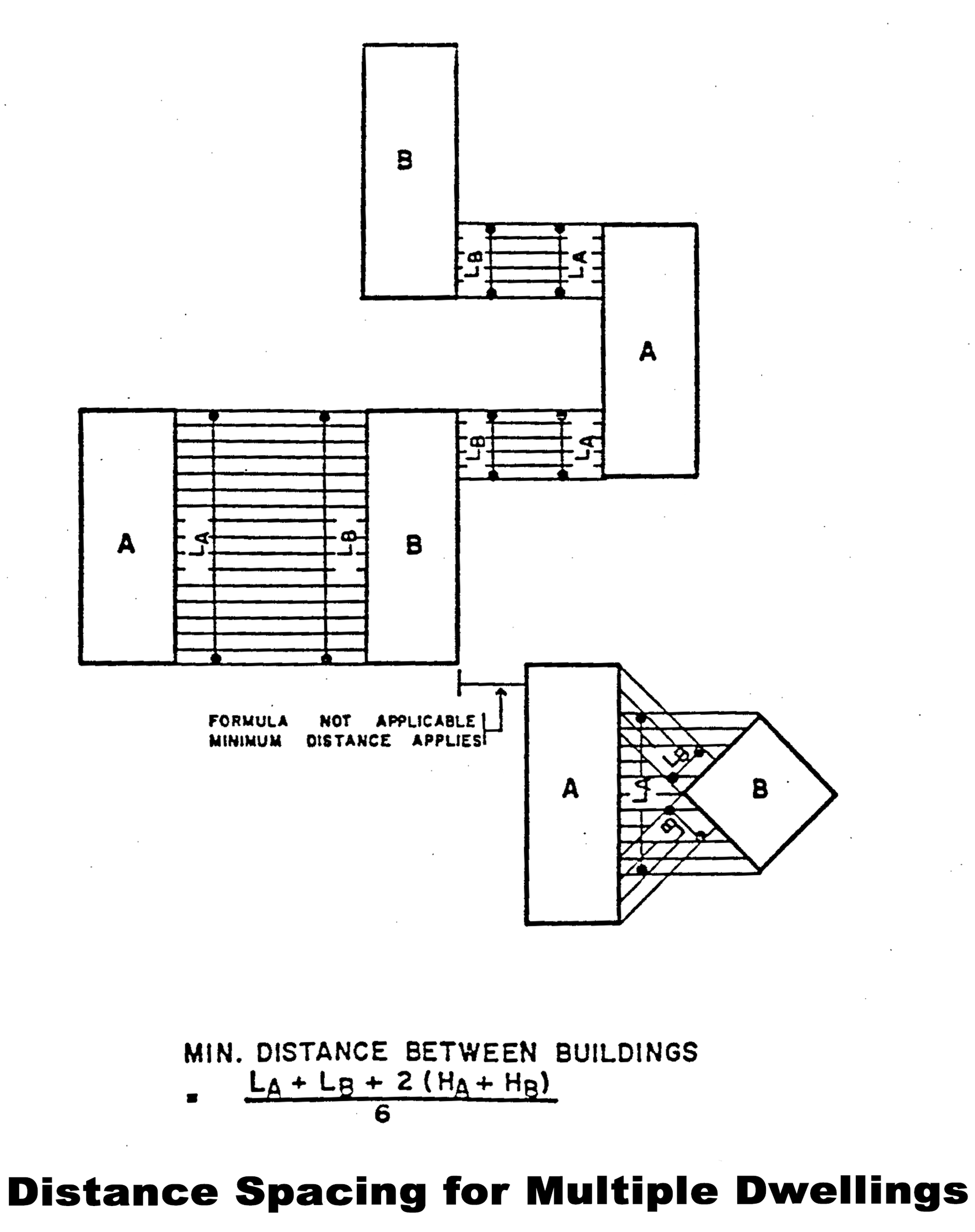
(d)
Off-street parking shall be permitted in a required side yard setback, provided it is screened from any abutting street by a visual barrier as approved by the zoning administrator.
(e)
Off-street parking for visitors, over and above the number of spaces required under section 46-659, may be permitted within the required front yard setback.
(f)
No building shall be located closer than 50 feet to the outer perimeter (property line) of such district when said property line abuts any residential district.
(g)
All outside storage shall be located a minimum of 50 feet from a public street or shall be completely screened with an obscuring wall or fence, not less than four-feet six-inches high, or with a chainlink-type fence and a greenbelt planting so as to obscure all view from any adjacent residential, office or business district or from a public street.
(h)
On corner lots, there shall be provided a setback of not less than 20 feet from the side street lot line.
(i)
Buildings may be situated on a lot so as to abut an adjoining building at the side and/or rear lot line for the purpose of conforming with front yard setbacks and/or providing additional parking in the side yard, subject to all other provisions herein required.
(j)
Minimum facade height of new construction fronting on Mitchell, Harris or Cass Street shall be 20 feet.
(k)
Maximum front and side yard setbacks shall equal minimum required front and side yard setbacks.
(l)
Buildings in the area west of Elk Avenue, between Pine and Chapin Streets, shall have a maximum height of 20 feet.
(m)
The height and bulk, the minimum size of lots by permitted land use and the minimum yard setback regulations shall be to the discretion of the planning commission. Adjacent zoning districts should be used as guidelines.
(n)
A minimum five feet wide greenbelt planting must be maintained between any street right-of-way and buildings or parking lots.
(Prior Code, § 5.171; Ord. No. 80-004, 12-1-1980; Ord. No. 87-21, 10-19-1987; Ord. No. 95-04, 3-6-1995)
Sec. 46-631. - Averaged lot size.
The intent of this section is to permit the subdivider or developer to vary his lot sizes and lot widths so as to average the minimum size of lot per unit as required in section 46-629, schedule of regulations for each one-family residential district. If this option is selected, the following conditions shall be met:
(1)
In meeting the average minimum lot size, the subdivision or site condominium shall be so designed as not to create lots having an area or width greater than ten percent below that area or width required in the schedule of regulations and shall not create an attendant increase in the number of lots.
(2)
All computations showing lot area and the average resulting through this technique shall be indicated on the print of the preliminary plat.
(Prior Code, § 5.172; Ord. No. 95-16, 7-17-1995)
Sec. 46-632. - Subdivision open space plan.
(a)
Intent. The intent of the subdivision and site condominium open space plan is to promote the following objectives:
(1)
Provide a more desirable living environment by preserving the natural character of open fields, stands of trees, brooks, hills and similar natural assets.
(2)
Encourage developers to use a more creative approach in the development of residential areas.
(3)
Encourage a more efficient, aesthetic and desirable use of open area while recognizing a reduction in development costs and by allowing the developer to bypass natural obstacles on the site.
(4)
Encourage the provision of open space within reasonable distance to all lot development of the subdivision or site condominium and to further encourage the development of recreational facilities.
(b)
Conditions. Modifications to the standards as outlined in section 46-629, schedule of regulations may be made in the one-family residential districts when the following conditions are met:
(1)
The lot area in all one-family residential districts, which are served by a public sanitary sewer system, may be reduced up to 20 percent. In the R-1 district, this reduction may be accomplished in part by reducing lot widths up to ten feet. In the R-2, R-3 and R-4 districts, this reduction may be accomplished in part by reducing lot widths up to five feet. These lot area reductions shall be permitted; provided that the dwelling unit density shall be no greater than if the land area to be subdivided or developed as a site condominium were developed in the minimum square foot lot areas as required for each one-family district under section 46-629, schedule of regulations.
(2)
Under the provisions of subsection (b)(1) of this section, for each square foot of land gained within a residential subdivision or site condominium through the reduction of lot size below the minimum requirements as outlined in the schedule of regulations at least equal amounts of land shall be dedicated to the common use of the lot owners of the subdivision or site condominium in a manner approved by the city.
(3)
The land area necessary to meet the minimum requirements of this section shall not include bodies of water, swamp or land with excessive grades making it unsuitable for recreation. All land dedicated shall be so graded and developed as to have natural drainage. The entire area may, however, be located in a floodplain.
(c)
Time limit. The subdivision or site condominium shall be started within 12 months after having received approval, and must be completed in a reasonable time. Failure to start within this period shall void all previous approval.
(Prior Code, § 5.173; Ord. No. 95-16, 7-17-1995)
Sec. 46-641.- Intent.
The M-PUD District is intended to permit flexibility in the regulation of land development, encourage innovation in land use and variety in design, layout, and type of structures constructed, achieve economy and efficiency in the use of land, natural resources, energy, and the provision of public services and utilities, encourage useful open space, and provide better housing, employment, and shopping opportunities particularly suited to the needs of the residents of the city and the general public. More specifically, this zoning district is intended to provide greater flexibility in the placement and design of commercial, office and residential facilities in a single zoning district than is generally possible under conventional zoning regulations. It is further the intent of these regulations to require a unified, integrated planning and construction project using specialized modern zoning techniques, requirements and review procedures to achieve a cohesive development, promote compatibility and walkability between such uses and promote and encourage innovation in land use planning and design to achieve a higher quality of development than might otherwise be possible. While traditional bulk requirements may be set aside in this District in order to achieve particular design objectives, the city intends that any such district use should share responsibility for maintenance of landscaping, sidewalks, and/or other facilities used or held in common, adhere to all applicable health and building codes and clearly demonstrate a commitment to maintaining a balance between residential and non-residential use, between public open space provided and private land set aside, and in accordance with the ability of the remainder of the city to absorb and effectively deal with the attendant growth.
(Ord. No. 2015-17, § 1, 1-4-2016)
Sec. 46-642. - Permissible and prohibited uses in the M-PUD.
Subject to review and approval as provided in this division, the range of uses permissible within an M-PUD shall be limited to any residential, office or commercial uses in the R-1, R-2, R-3, R-4, RM-1, RM-2, OS-1, OS-2, B-1, B-2, B-3, TS-1 and TS-2. No other uses shall be permissible in the M-PUD district, including but not limited to adult businesses and any industrial uses otherwise permitted in the I-1 or I-2 zoning districts.
(Ord. No. 2015-17, § 1, 1-4-2016)
Sec. 46-643. - Minimum design requirements.
(a)
Setbacks and yards. Except as provided in this section, the minimum setback, yard, and open space requirements required shall be as follows:
(1)
A landscaped buffer of at least 40 feet wide measured from the road right-of-way shall be provided on the subject property adjacent to any state trunk highway or United States highway.
(2)
A landscaped buffer of at least ten feet wide measured from the road right-of-way shall be provided on the subject property adjacent to any internal public street.
(3)
A landscaped buffer of at least 50 feet wide shall be provided on the subject property between commercial uses and residential uses located on the subject property and a landscaped buffer of at least 50 feet wide shall be provided between residential uses on the subject property adjacent to any other property zoned or used for residential purposes.
(4)
A landscaped buffer of at least 75 feet shall be provided on the subject property between commercial uses on the subject property adjacent to any other property zoned or used for residential purposes.
(5)
A landscaped buffer of at least 25 feet shall be provided on the subject property between commercial uses on the subject property adjacent to any other property zoned or used for commercial or industrial purposes.
(6)
No building shall be constructed on the subject property closer than 75 feet from the adjacent state trunk highway right-of-way.
(7)
No building shall be constructed on the subject property closer than 25 feet from the adjacent internal public street right-of-way.
(8)
No residential building or development shall be constructed on the subject property closer than 25 feet from any private roadway.
(9)
No residential building or development shall be constructed on the subject property closer than 25 feet from any parking area.
(10)
Except for property adjacent to a state trunk highway as provided by subsection (5), above, no building shall be constructed on the subject property closer than 100 feet to any property line of the subject property.
(11)
No commercial buildings on the subject property shall be located closer than 100 feet from any residential buildings on the subject property.
(12)
Separation between residential buildings on the subject property shall comply with all provisions of this Code.
(13)
Separation between commercial buildings on the subject property shall comply with all provisions of this Code.
(14)
The subject property shall provide for a minimum open space of 35 percent, including the landscaped buffers.
For purposes of this subsection, a "landscaped buffer" shall mean the area in which either existing vegetation is preserved on the subject property or landscaping or decorative fencing is planned and maintained for screening and as part of the overall landscape plan for the subject property. No parking or pavement is permitted in the landscaped buffer, except for pavement for ingress and egress, sidewalks or other pedestrian walkways.
(b)
Setback variation. Notwithstanding, the required setbacks, yard, and open space may be reduced or increased at the discretion of the planning commission or city council to avoid unnecessary disruption of adjacent land uses or environmental features and to ensure a high degree of compatibility between the M-PUD and adjacent development:
(1)
A setback reduction not to exceed 50 percent of the otherwise required distance may be permitted from an M-PUD lot line that abuts a commercial district, provided pedestrian linkages are provided.
(2)
A setback increase or additional buffering such as landscaping, fencing, or walls may be required along an M-PUD lot line that abuts a residential district if the planning commission or city council determines it is necessary to protect the integrity of the adjacent residential district. In no event shall the setback required be more than two times the distance that would otherwise be required by the zoning district in which the land use is permitted.
(c)
Screening. Screening shall be required along any lot line that abuts a residential district and may be required along other lot lines as determined necessary by the planning commission or city council. Screening shall be designed and constructed in a manner compatible with adjacent districts and may consist of decorative fencing, landscape, or a combination of each.
(d)
Fencing. The planning commission or city council may require the erection of an architectural screen or fence between the M-PUD and adjoining property if it is determined a need for such screen or fence is necessary to protect or preserve the value or security of adjoining properties. In the event an architectural screen or fence is required, the applicant shall also incorporate landscape treatment along said screen or fence in order to mitigate the visual impacts of the screen or fence from off-site.
(e)
Sign standards. The M-PUD shall generally be regulated by the sign standards of section 46-664. Notwithstanding, as part of the review and approval of the site plan, the planning commission and city council may vary any sign standards under section 46-664, including without limitation, the size, location, and number and types of permitted signs.
(f)
Parking and circulation. The M-PUD shall be regulated by the parking and loading standards of section 46-658; provided, however, as part of the sketch and final site plan, the applicant must show the location and right-of-way dimensions of all public highways, streets and alleys within 300 feet of the proposed project together with the location, width, and use (i.e., one-way, two-way, truck only, etc.) of all adjoining public or private driveways and internal roadways. The parking and circulation plan shall incorporate measures for shared circulation and parking. The planning commission or the city council may also require:
(1)
Acceleration or deceleration lanes or other measures deemed necessary for efficient traffic flow and for public safety and welfare;
(2)
The elimination or movement of proposed curb cuts;
(3)
That patron, resident, employee and/or delivery traffic entry points be modified and/or relocated;
(4)
Off-site transportation improvements deemed necessary as a result of the M-PUD;
(5)
The reduction or increase of the number of parking spaces required by section 46-658, as determined necessary to support the range of uses proposed;
(6)
Modifications in the location and/or arrangement of loading areas;
(7)
A traffic and circulation study to be performed by a qualified traffic engineer; and
(8)
Other traffic and circulation improvements necessary to secure the public health, safety, and welfare.
(g)
Pedestrian circulation. The M-PUD shall incorporate a pedestrian circulation system affording the public a safe means of movement throughout the site. An M-PUD located adjacent to other commercial or residential uses or developments shall incorporate a pedestrian circulation system which coordinates the safe flow of pedestrian movement to and from those uses and developments.
(h)
Snow storage. The site shall include provision for the placement of snow which must be stockpiled during winter months. Such placement shall not impact the efficient and safe movement of pedestrian and vehicular circulation. A minimum area equal in size to ten percent of the required parking lot area, including access lanes, must be provided for stockpiling of snow.
(i)
Landscape plan. The applicant shall submit a detailed landscape plan. The plan shall include the type, size, and location of all yard areas and vegetation, areas to be irrigated by underground sprinkling, sidewalks, patio and pedestrian seating areas, and other such features.
(j)
Maintenance of views. Buildings shall be designed and located in a manner which from off-site, at pedestrian level, limits the horizontal blockage of views through the site. Of particular importance is the maintenance of views to Lake Cadillac from downtown commercial sectors and corridors to and from the city, including adjacent highways and freeways.
(k)
Modification to design standards. The planning commission or city council may authorize variations from the design requirements of this section that are not incompatible with the purposes of the M-PUD and will not be obstructive of view, light, air, or a hazard or nuisance or annoyance to adjacent developments, motorists, or the general public. In making such request for deviations, the applicant shall demonstrate to the satisfaction of the planning commission or city council that modification of a design standard is necessary for development of the M-PUD, is consistent with the purposes of the M-PUD, and will not have an unreasonable adverse effect on adjacent uses or the public.
(Ord. No. 2015-17, § 1, 1-4-2016)
Sec. 46-644. - Requirements.
(a)
Eligibility. To be eligible for M-PUD zoning approval, the applicant must demonstrate that the following criteria will be met:
(1)
Recognizable benefits. The planned development must result in a recognizable and substantial benefit to the ultimate users of the project and to the community, and result in a higher quality and diverse development than could be achieved under conventional zoning.
(2)
Minimum area. Except as provided by this subsection, the minimum area considered for an M-PUD zoning district shall not be less than 20 contiguous acres of land. Land separated by a public street right-of-way shall not be considered contiguous. Land separated by a public alley right-of-way shall be considered contiguous. Notwithstanding the above, the city council, upon the recommendation of the planning commission, may consider a smaller area if the proposed project has unique characteristics or benefits or the subject property has unusual topography, tree stands, wetlands, poor soil conditions, water courses, unusual shape or proportions, utility easements or any other external barrier of a similar defining nature. If the applicant desires an area of less than 20 acres to be considered, the applicant shall submit a request for a pre-application conference to the planning commission. The request shall request a waiver of the minimum area requirements and explain in detail the proposed project and the basis for requesting a waiver from the minimum size. In particular, the applicant must describe the proposed benefits of the project to the community, the unique characteristics of the site or project and any other reasons for waiving the minimum area provision. The planning commission shall review the request and make a recommendation to the city council. The city council shall make the final decision concerning the waiver.
(b)
Development agreement and ownership. The application shall be filed and jointly signed by all owners of the land proposed for rezoning to an M-PUD. Notwithstanding, the proposed development shall, at the time of approval or execution of the development agreement, be under ownership or control such that all owners of the land proposed for rezoning to an M-PUD shall have responsibility for completing the project, or assuring completion of the project, in conformity with this Code and to ensure a cohesive development. A development agreement, which shall be recorded with the Wexford County Register of Deeds between the city and any owner of land proposed for rezoning, is required by this Code. The development agreement shall include regulations relating to the use of land, including, but not limited to, permitted uses, lot sizes, setbacks, height limits, required facilities, buffers, open space areas, and land use density. The development agreement shall include all conditions of approval of the planned development including, but not limited to, land use restrictions, landscaping and lighting requirements, architectural features and materials, and a requirement that all portions of the development that are not to be maintained or operated at public expense will continue to be operated and maintained by the owner or their successors. The development agreement must bind all successors in title to any commitments made by the initial owner or applicant. Nothing in this subsection shall prohibit a transfer of ownership or control, provided that no such transfer shall occur prior to recording the development agreement with the Wexford County Register of Deeds.
(c)
Utilities and other infrastructure. Public water, sanitary sewer, storm drainage facilities, and streets shall be provided as part of the site development. All public utility transmission lines within the planned development shall be placed underground. All proposed infrastructure, including utility and other easements shall be indicated on the M-PUD sketch plan and final site plan and shall be subject to all of the following:
(1)
All utilities and streets, including design and construction, shall be subject to approval by the city departments having regulatory control over said systems.
(2)
All costs for utilities shall be paid by the applicant. Off-site public infrastructure improvements necessary to serve the planned development shall either be in place or shall be constructed at the sole cost and expense of the applicant or by agreement acceptable to the city council.
(3)
The proposed type and density of use shall not result in an unreasonable increase in the use of public services, facilities and utilities, and shall not place an unreasonable burden upon the subject site, surrounding land, property owners and occupants, or the natural environment.
(d)
Planning, design, development and building materials. The planning, design, development and building materials of any M-PUD shall incorporate best development practices and shall be designed and operated to:
(1)
Complement the design principles and standards reflected in the city's master plan and this Code.
(2)
Maintain a high standard of scenic and visual qualities with due regard to impacts on neighboring properties and motorists, including but not limited to varied roof heights and pitches that add visual interest and obscure roof mounted mechanical equipment.
(3)
Discourage the establishment of uses deemed more appropriate to the city's core downtown. If the subject property is located outside of the city's downtown development authority boundaries, no more than five percent of the total available commercial space planned for the subject property shall consist of uses occupying less than 2,250 square feet for a single use. This limitation shall not apply to ancillary uses, including but not limited to banks, coffee shops, fast food or food court areas, wholly contained within a larger commercial building. The total available commercial space planned for the subject property shall be indicated on the sketch plan pursuant to section 46-657(b)(2).
(4)
Encourage the overall design and development of the area in a cohesive and planned manner taking into account access management controls and vehicular circulation, pedestrian and non-vehicular traffic amenities, public spaces, parking, signage, outdoor lighting, landscaping and screening, loading/unloading areas, utilities and public services, energy efficiency, open space conservation; and the like.
(5)
Ensure that all open areas of any lot not used for parking, driveways or permitted storage be landscaped with an attractive mix of trees, shrubs, berms, flowers, natural mulch, planted ground cover, and other landscaping elements.
(6)
Function in an environmentally sensitive manner with due regard for the management and protection of surface water and the containment of noise, odor, and light pollution.
(7)
Improve pedestrian connectivity by providing a circulation system that is conducive to pedestrian and bicycle travel throughout areas designed for residential purposes as well as provisions for convenient and safe non-motorized movement from residential areas to the office and commercial sectors of the planned development.
(8)
Mitigate views of large off-street parking lots through filtering/screening with appropriate landscaping.
(9)
Coordinate the design of buildings and their sites to create a cohesively planned and visually attractive development.
(10)
Encourage the use of architectural design features such as arches, canopies, awnings, covered walkways or porticos, offsets, reveals, recesses, columns, display windows, tile work and molding, and other similar visually appealing features.
(11)
Incorporate the use of building materials that provide for an aesthetically pleasing and consistent overall development, while recognizing the benefits of diversity. In that regard, the following building materials shall be permitted:
a.
All exterior walls shall be at least 60 percent masonry. Masonry coverage calculation does not include doors, windows, window box-outs, or bay windows that do not extend to the foundation. Masonry shall be defined as:
1.
Stone material. Masonry construction using stone material may consist of granite, marble, limestone, slate, river rock, and other hard and durable naturally occurring all weather stone. Cut stone and dimensioned stone techniques are acceptable.
2.
Brick material. Brick material used for masonry construction shall be hard fired (kiln fired) clay or slate material which meets the latest version of ASTM standard C216, Standard Specification for Facing Brick (Solid Masonry Unit Made of Clay or Shale), and shall be severe weather (SW) grade, and type FBA or FBS or better.
3.
Concrete masonry units. Concrete masonry units used for masonry construction shall meet the latest version of the following applicable specifications; ASTM C90, Standard Specification for Hollow Load Bearing Concrete Masonry Units; ASTM C145, Standard Specification for Solid Load Bearing Masonry Units; ASTM C129, Standard Specification for Hollow and Solid Non-Load-Bearing Units. Concrete masonry units shall have an indented, hammered, split face or other similar architectural finish as approved by the city. Lightweight concrete block or cinder block construction is not acceptable as an exterior finish.
4.
Concrete panel construction. Concrete finish or precast panel (tilt wall) construction shall be painted, fluted, or other approved architectural concrete finish. Smooth or untextured concrete finishes are not acceptable.
5.
Stucco (exterior Portland cement plaster with three coats over metal lath or wire fabric lath).
6.
Cement fiberboard.
7.
Architectural glass block (less than 25 percent reflectance).
(b)
Structures 20,000 square feet or less shall require a minimum of two distinct building materials from the approved masonry list be utilized on all facades to provide architectural detail and interest.
(c)
Structures over 20,000 square feet shall require a minimum of three distinct building materials from the approved masonry list be utilized on all facades to provide architectural detail and interest.
(d)
Secondary materials must cover a minimum of ten percent of the building facade on all sides.
(e)
Architectural accent materials not exceeding 20 percent of the exterior walls, may include metal and wood. Metal accents may include profiled panels, deep-ribbed panels and concealed fastener systems. Exterior finish shall be film laminated or baked on enamel painted to the wall manufacturer's standards. Synthetic stucco, also known as exterior insulation and finish system (EIFS), may be used as architectural accent material when placed more than four feet above grade.
(f)
Roofing materials. Architectural textured 25-year minimum warranty asphalt or synthetic shingles, standing seam metal, or tile roofs are allowed for sloping roofs. Roof materials for flat roofs shall provide the equivalent level of protection.
(g)
Prohibited materials. The following materials are prohibited:
1.
Aluminum siding or cladding.
2.
Corrugated, metal, plastic, or fiberglass panels.
3.
Galvanized, aluminum coated, zinc aluminum coated or unpainted exterior metal except as permitted as architectural accent material.
4.
Wood siding or plastic siding.
5.
Synthetic stucco, exterior insulation and finish system (EIFS), placed less than four feet above grade.
6.
Unfinished concrete block.
7.
Exposed aggregate.
8.
Wood roof shingles.
9.
Reflective glass.
(Ord. No. 2015-17, § 1, 1-4-2016)
Sec. 46-645. - Application procedure and approval process.
(a)
General. Whenever any M-PUD is proposed, the application for an M-PUD shall serve as a petition to rezone the subject property to the M-PUD district. The application for an M-PUD shall include a request for sketch site plan approval and shall be filed with the city planning commission. The petition for rezoning and sketch plan approval shall be considered concurrently and the requirements of the Michigan Zoning Enabling Act, being Public Act 110 of 2006 (MCL 125.3101 et seq.) and this Code for amendment of a zoning ordinance shall be followed, except that the hearing and notice required by MCL 125.3503 shall fulfill the public hearing and notice requirements of MCL 125.3306.
(b)
Application for sketch plan approval. So that the planning commission, city council and the developer may reach an understanding of what is being proposed, and what is required, the developer shall submit a sketch site plan and related project information with an M-PUD application to the planning commission. The sketch site plan shall be drawn to scale, fully dimensioned, and shall clearly show all of the following information:
(1)
Boundaries and size of property;
(2)
Location (including setbacks from property lines), size and height of all buildings and building facades;
(3)
Interior roadway system including parking facilities, proposed and existing rights-of-way, loading and unloading areas, curb cuts to public roads, and adjacent streets;
(4)
The interior open space system with details on the size and use of the space, proposed ownership of any open space at M-PUD completion, and method of maintaining same;
(5)
The overall water supply system, waste water system and stormwater drainage system, including any connections to public facilities;
(6)
Principal ties to the neighborhood and community with respect to transportation, or other public utilities, including gas and electric service;
(7)
Delineation of the various residential and nonresidential areas and uses, including size, location and number of housing units and other buildings;
(8)
Construction phases and construction schedule;
(9)
Existing natural features and proposed landscaping;
(10)
Topography, existing and proposed (contour intervals of no greater than five feet);
(11)
Location, size and function of proposed signs;
(12)
Location, size and function of any on-site lighting, including a photometric plan for the site; and
(13)
Location of all structures within 300 feet of the property line of the subject property.
In addition to the sketch plan, the applicant shall submit copies of any other information reasonably requested by the planning commission or city council.
(c)
Public hearing. The planning commission and city council shall each hold at least one public hearing on any application in accordance with the provisions of this Code and the Michigan Zoning Enabling Act.
(d)
Following the public hearing. The planning commission shall, within a reasonable time of the public hearing, make a recommendation to the city council to deny, approve or approve with conditions the application. The city council shall receive and consider the recommendation of the planning commission and shall deny, approve or approve with conditions the application, including the sketch plan.
(e)
Basis for conditions. Due to the nature of the M-PUD, additional conditions may be required by the planning commission or the city council. Any conditions imposed by the planning commission or city council must be reasonable and intended to do one or more of the following:
(1)
Ensure that public services and facilities affected by the M-PUD will be capable of accommodating increased service and facility loads;
(2)
Protect the natural environment and conserve natural resources and energy;
(3)
Ensure compatibility with adjacent land uses;
(4)
Promote the use of land in a socially and economically desirable manner;
(5)
Ensure compliance with the standards of this division; or
(6)
Promote and protect the public health, safety, and welfare.
(f)
Approval of sketch plan. If the sketch plan is approved by the city council, such approval shall not constitute approval of the detailed site plan, but shall be deemed an expression of approval of the layout as a guide to the preparation of the detailed plan. The city council shall find that compliance with the following standards have been met before approving any sketch plan:
(1)
The M-PUD site and proposed uses shall be served by necessary public infrastructure including roadways and utilities and that said infrastructure is appropriately sized and arranged to accommodate the requirements of the M-PUD while avoiding negative impacts on the infrastructure to which it will connect;
(2)
The M-PUD site, proposed uses and related development shall be consistent with the city's master plan;
(3)
That facilities and uses such as parking, loading and unloading areas, dumpster locations, active play areas and other facilities and uses that are adjacent to residential development shall either be located internal to the M-PUD site or appropriately buffered through landscaping and other screening techniques;
(4)
That proposed parking and vehicular and pedestrian circulation, including points of ingress and egress, are properly sized and located;
(5)
The M-PUD site features including, but not limited to, walkways, exterior lighting, play areas, common areas, building entry points, garage and storage areas, landscaping and signs have been appropriately designed and arranged to compliment the principle M-PUD buildings and uses and avoid adverse impacts on adjacent property or uses;
(g)
Effect of sketch plan approval. Approval of the sketch plan only warrants to the applicant certification that the proposed M-PUD is appropriate for the planned location and consistent with basic M-PUD site development and design standards as required for sketch site plan approval, subject to any additional terms and conditions of the development agreement approved as part of final site plan approval.
(h)
Request for changes in plan. If it becomes apparent that certain elements of the sketch plan, as approved by the city council, become unfeasible and in need of substantial modification, the applicant shall then resubmit the entire sketch plan, as amended, to the planning commission, which shall be reviewed by the planning commission and the city council in the same manner as the original sketch plan. Notwithstanding, if a change to the sketch plan is not substantial, the change may be reviewed and approved administratively by the community development director or his or her designee.
(i)
Application for final site plan approval. After receiving approval of a sketch plan from the city council, the applicant shall, within six months, prepare a final site plan and submit it to the planning commission. The final site plan shall be reviewed by the planning commission in the same manner as the sketch plan, except that no additional public hearings shall be required. Within a reasonable time following submission of a complete final site plan, the planning commission shall make a recommendation on the final site plan to the city council. The final site plan submitted to the planning commission must be a construction design document and, in addition to the information provided on the sketch plan, contain sufficient design information to determine compliance with any applicable city codes and construction requirements including, but not limited to, the following systems:
(1)
Roads/streets and site access, including location and geometrics;
(2)
Public water;
(3)
Public sewers (sanitary and storm);
(4)
Surface water drainage and snow storage;
(5)
Emergency access routes;
(6)
Fire hydrant locations;
(7)
Exterior lighting;
(8)
Energy and communication facilities, including type and location;
(9)
Location and size of public and private easements;
(10)
Exterior signs, including size and location;
(11)
Parking, loading and unloading, and vehicular and pedestrian circulation;
(12)
Detailed landscape plan, including all buffers;
(13)
Solid waste disposal; and
(14)
Other information reasonably requested by the planning commission, after consultation with city staff, necessary for determination of compliance with city codes, resolutions, rules and regulations.
(j)
City council approval of detailed or final site plan. Within a reasonable time following the recommendation from the planning commission, the city council shall review the final site plan and in making a determination of approval, the city council must find that:
(1)
The systems and project elements are in substantial conformance with the sketch plan and properly arranged and adequate to meet the intended uses within the M-PUD;
(2)
The systems and project elements are consistent with the design requirements of the city; and
(3)
The final site plan complies with all regulations of this Code and any other applicable federal, state and local statutes, ordinances, codes, rules and regulations.
(k)
Action on final site plan. The city council shall deny, approve, or approve the final site plan with conditions or modifications and so notify the applicant and the building inspector. Final approval may be granted on each phase of a multi-phased M-PUD if each phase contains the necessary components to insure protection of natural resources and the health, safety, and welfare of the users of the M-PUD and the residents of the surrounding area.
(l)
Expiration. In any case where construction on the M-PUD has not commenced within one year from the date of final approval or construction on any phase fails to conform with the approved phasing schedule, final site plan approval shall expire and shall be null and void. Notwithstanding, the community development director or his or her designee may administratively extend the expiration date of the final site plan for a period not to exceed one additional year.
(m)
Effect of approval. The final site plan, as approved, shall become part of the record of approval, and subsequent actions relating to the activity authorized shall be consistent with the approved site plan. After a final site plan has been approved and construction of any part thereof commenced, no other type of development will be permitted on the site without further approval thereof by the planning commission and city council.
(n)
Bond requirement. A performance bond, bank letter of credit or other surety acceptable to the city shall be required and be filed with the city treasurer at the time of application of a building permit in such amounts and for such periods adequate to ensure compliance with the approved plans.
(o)
Development agreement. Prior to final site plan approval and commencement of construction on any project permitted under this division, the owner shall enter into a development agreement with the city, which agreement shall provide such safeguards and guarantees as may be required by the city. Said agreement shall consist of the approved final site plan, conditions which may have been attached to the M-PUD approval, bond requirements, necessary building and other required permits, and payment of all fees.
(Ord. No. 2015-17, § 1, 1-4-2016)

