
Cadillac City Zoning Code
ARTICLE IV
SUPPLEMENTAL
Regulations
Sec. 46-653.- Conflicting regulations.
Whenever any provision of this chapter imposes more stringent requirements, regulations, restrictions or limitations than are imposed or required by the provisions of any other law or ordinance, then the provisions of this chapter shall govern. Whenever the provisions of any other law or ordinance impose more stringent requirements than are imposed or required by this chapter, then the provisions of such ordinance shall govern.
(Prior Code, § 5.181)
Sec. 46-654. - Scope.
No building or structure, or part thereof, shall hereafter be erected, constructed or altered and maintained, and no new use or change shall be made or maintained of any building, structure or land, or part thereof, except in conformity with the provisions of this chapter.
(Prior Code, § 5.182)
Sec. 46-655. - Nonconforming lots; structures; uses of land; uses of structure.
(a)
Intent. It is the purpose of this section to permit the continuance of a lawful use of any building or land existing at the effective date of the ordinance from which this chapter is derived, although such use of land or structure may not conform with the provisions of this chapter. It is recognized, however, that those nonconformities which adversely affect orderly development and the value of nearby property are not permitted to continue without restriction.
(b)
Encourage appropriate groupings. The zoning regulations established by this chapter are designed to guide the future use of land in the city by encouraging appropriate groupings of compatible and related uses and thus to promote and protect the public health, safety, and general welfare. The continued existence of nonconformities is frequently inconsistent with the purposes for which such regulations are established, and thus their gradual elimination is generally desirable. The regulations of this section permit such nonconformities to continue without specific limitation of time but are generally intended to restrict further investments which would make them more permanent.
(c)
Distinction between major nonconforming uses or structures and minor nonconformities. Different regulations are established for each of these categories in this subsection. The degree of restriction over each category is a function of the degree to which that category of nonconformity is a nuisance or incompatible with the purposes and regulations of this chapter.
(1)
Major nonconforming use or structure.
a.
A major nonconforming use is any use listed in the table below for the district in which it is listed:
b.
A major nonconforming use or structure shall not be changed to any use other than a use permitted in the zoning district in which it is located.
c.
Major nonconforming uses or structures shall not be reestablished in their nonconforming condition in any zoning district after damage or destruction, if the estimated expense of reconstruction exceeds 33 percent of the value, determined as the original cost, indexed to present day replacement cost and discounted for physical depreciation and physical obsolescence, as determined by the city assessor.
d.
If a major nonconforming use ceases for any reason for a period of more than 90 consecutive days, such discontinuance shall be considered conclusive evidence of an intention to abandon the nonconforming use. At the end of this period of abandonment, the nonconforming use shall not be reestablished and any future use shall be in conformity with the provisions of this chapter.
e.
Major nonconforming uses or structures may not be enlarged, increased, extended, altered, expanded, constructed or reconstructed except in accordance with subsection (h) of this section.
(2)
Minor nonconforming use or structure. A minor nonconforming use or structure is any nonconforming use or structure which is not a major nonconforming use or structure.
(d)
Minor nonconforming uses of land or structure. Where, at the effective date of adoption or amendment of the ordinance from which this chapter is derived, a lawful use of land and/or structure exists that is no longer permissible under the terms of this chapter as enacted or amended, such use may be continued, so long as it remains otherwise lawful, subject to the following provisions:
(1)
No such nonconforming use of structure or land shall be enlarged, increased, extended or altered to occupy a greater area of land than was occupied at the effective date of adoption or amendment of the ordinance from which this chapter is derived. An exception to this restriction can be made where an otherwise lawful structure exists that could not be built under the terms of this chapter by reason of restrictions on area, lot coverage, height, yards or other characteristics of the structure or its location on the lot, the zoning board of appeals may approve the reestablishment, expansion, alteration, or extension upon evidence of demonstrable hardship or practical difficulty resulting from conditions which do not exist generally throughout the zone.
(2)
No such nonconforming use of structure or land shall be moved in whole or in part to any other portion of the lot or parcel occupied by such use at the effective date of adoption or amendment of the ordinance from which this chapter is derived.
(3)
Nonconforming uses shall not be changed to another nonconforming use except after approval of the board of zoning appeals. Before granting such approval, the board shall determine, by making findings in the specific case, that such change in use will have a less detrimental effect on neighboring properties than the existing nonconforming use, and is more or equally appropriate in the zone. In permitting such change, the board of appeals may require appropriate conditions in accordance with the purpose and intent of this chapter.
(4)
If such nonconforming use of land or structure ceases for any reason for a period of more than 90 consecutive days, such discontinuance shall be considered conclusive evidence of an intention to abandon the nonconforming use. The time limit of discontinuance may be extended beyond the 90 days, for a period of time not to exceed one year upon proper application to the board of zoning appeals within the 90-day period and upon presentation of evidence that an unnecessary hardship or practical difficulty would exist should the 90-day limitation be strictly enforced. At the end of this period of abandonment, the nonconforming use of structure or land shall not be reestablished and any future use shall be in conformity with the provisions of this chapter.
(5)
Structural alterations or extensions adding to the bulk of a structure which is nonconforming shall be permitted without prior approval of the board of zoning appeals; provided, that such structure alteration or extension shall not increase the extent of nonconformity and shall satisfy all other site development regulations which are applicable.
(6)
Structural alterations which do not add to the bulk of structure or increase the intensity of use of the structure shall not require prior approval of the board of zoning appeals.
(7)
Nonconforming buildings or structures may be structurally altered so as to prolong the life of the building or structure.
(8)
Nonconforming structures may be reestablished in any zoning district after damage or destruction of the nonconforming structure, if such building or structure is nonconforming due only to its being located on a site having a size, width or both, less than prescribed in the applicable sections of this chapter.
(9)
Structures which are nonconforming due to their having an insufficient setback may not be reestablished in their nonconforming condition in any zoning district after damage or destruction, if the estimated expense of reconstruction exceed 50 percent of the value, except with approval of the board of zoning appeals. The value is determined in this subsection as the original cost, indexed to present day replacement cost and discounted for physical depreciation and physical obsolescence, as determined by the city assessor. A variance shall be granted by the board only when the strict application of the requirements of this chapter would pose demonstrable hardship or practical difficulty resulting from conditions which do not exist generally throughout the zone. The terms hardship and practical difficulty shall not be deemed financial hardship or mere inconvenience.
(10)
Any nonconforming use of a structure may be extended throughout any parts of a building which were manifestly arranged or designed for such use, and which existed at the time of adoption or amendment of the ordinance from which this chapter is derived.
(e)
Nonconforming lots. In any district in which single-family dwellings are permitted, notwithstanding limitations imposed by other provisions of this chapter, a single-family dwelling and customary accessory buildings may be erected on any single lot or record at the effective date of adoption or amendment of this chapter. This provision shall apply even though such lot fails to meet the requirements for area or width, or both, that are generally applicable in the district; provided that yard dimensions and other requirements not involving area or width or both, of the lot shall conform to the regulations for the district in which such lot is located. Yard requirement variances may be obtained through approval of the board of appeals.
(f)
Repairs and maintenance. Repairs and maintenance may be performed on any building devoted in whole or in part to a nonconforming use; including ordinary repairs or repair or replacement of nonbearing walls, fixtures, wiring or plumbing, to an extent not exceeding 50 percent of the assessed value (25 percent of true cash value) of the building during any period of 12 consecutive months. However, the cubic content of the building as it existed at the time of passage or amendment of the ordinance from which this chapter is derived shall not be increased, except as otherwise provided for in this section. Nothing in this article shall be deemed to prevent the strengthening or restoring to a safe condition of any building or part thereof declared to be unsafe by any official charged with protecting the public safety, upon order of such official.
(g)
Prior construction approval.
(1)
Nothing in this article shall prohibit the completion of construction and use of a nonconforming building for which a building permit has been issued prior to the effective date of the ordinance from which this chapter is derived; provided that construction is commenced within 90 days after the date of issuance of the permit, that construction is carried on diligently and without interruption for a continuous period in excess of 30 days, and that the entire building shall have been completed according to the plans filed with the permit application within two years after the issuance of the building permit.
(2)
To avoid undue hardship, nothing in this article shall be deemed to require a change in the plans, construction or designated use of any building on which construction was lawfully begun prior to the effective date of adoption or amendment of this article, and upon which actual construction has been diligently carried on. The term "actual construction" is hereby defined to include the placing of construction materials in permanent position and fastened in a permanent manner; except that where demolition or removal of an existing building has been substantially begun preparatory to rebuilding, such demolition or removal shall be deemed to be actual construction; provided that work shall be diligently carried on until completion of the building involved.
(h)
Uses under exception provisions. Any use which was permitted with a special exception as provided in this chapter, shall not be deemed a nonconforming use, but shall, without further action, be deemed a conforming use.
(i)
Change of tenancy or ownership. There may be a change of tenancy, ownership or management of any existing nonconforming uses of land, structures, and premises; provided there is no change in the nature or character of such nonconforming uses.
(j)
Elimination of nonconforming use or structure. The city may acquire by purchase, condemnation or other means, private property or an interest in private property for the removal of any nonconforming use or structure. The cost or expense or a portion thereof may be paid from general funds or assessed to a special district in accordance with applicable statutory provisions.
(Prior Code, § 5.183; Ord. No. 87-01, 1-12-1987)
State Law reference— Nonconforming uses or structures, MCL 125.3208.
Sec. 46-656. - Accessory buildings.
Accessory buildings, except as otherwise permitted in this chapter, shall be subject to the following regulations:
(1)
Where a building accessory to a residential building is structurally attached to a main building, it shall be subject to, and must conform to, all regulations of this chapter applicable to main building.
(2)
Buildings accessory to a residential building shall not be erected in any required yard, except a rear yard.
(3)
Detached buildings accessory to a residential building shall not occupy more than 25 percent of a rear yard; provided that in no instance shall all of the accessory buildings exceed 65 percent of the ground floor area of the main building.
(4)
No detached building accessory to a residential building shall be located closer than ten feet to any main building nor shall it be located closer than three feet to any side or rear lot line.
a.
In those instances where the rear lot line is coterminous with an alley right-of-way, the accessory building shall not be closer than three feet to such rear lot line. In no instance shall an accessory building be located within a dedicated easement right-of-way.
b.
A detached accessory building may be located closer than ten feet to any main building if all walls of the accessory building which face the main building or other permanent structures, are constructed to meet or exceed a one-hour fire rating.
(5)
No detached accessory building in R-1 through R-4, RT, RM-1, RM-2, MH, RMH, OS-1, OS-2, B-1 and P-1 districts shall exceed one story or 20 feet in height. Accessory buildings in all other districts may be constructed to equal the permitted maximum height of structures in said district.
(6)
When buildings accessory to a residential building are located on a corner lot, the side lot line of which is substantially a continuation of the front lot line of the lot to its rear, said building shall not project beyond the front yard setback required on the lot in the rear of such corner lot. In no instance shall an accessory building be located nearer than ten feet to a street right-of-way line.
(7)
Buildings accessory to a nonresidential building must comply with all of the above requirements which apply to residential buildings or apply for and receive a variance from the zoning board of appeals.
(8)
The parking of a mobile home for periods exceeding 24 hours on lands not approved for mobile home parks shall be expressly prohibited. All mobile homes owned by residents of the city and stored on their individual lots shall be stored only within the confines of the rear yard and shall further respect the requirements of this section applicable to accessory buildings, insofar as distances from principal structures, lot lines, and easements are concerned. All mobile homes parked or stored, shall not be connected to sanitary facilities or public utilities and shall not be occupied.
(9)
Ground mounted satellite dishes, antennas, towers, privacy screens and similar structures are considered accessory structures when greater than nine inches in height and 50 square feet in projected silhouette, section 46-4, pertaining to the definition of structure, when not attached to a main building and when not the principal use on the property, and must conform to all regulations in this chapter applicable to accessory buildings and structures, including the obtaining of a building permit. Retaining walls must not extend more than nine inches above the highest grade, or they must comply with the city's fence ordinance. See article III of chapter 8, pertaining to fences. Exceptions are as follows:
a.
Essential services which comply with section 46-707.
b.
Commercial telecommunication towers and antennas which comply with sections 46-662 and 46-673.
(Prior Code, § 5.184; Ord. No. 80-004, 12-1-1980; Ord. No. 85-06, 4-1-1985; Ord. No. 90-15, 8-20-1990; Ord. No. 98-01, 3-2-1998; Ord. No. 98-25, 1-4-1999; Ord. No. 2001-13, 11-5-2001)
Sec. 46-657. - Accessory uses.
(a)
Accessory use examples. An accessory use includes, but is not limited to the following:
(1)
Residential accommodations for up to two servants and/or caretakers.
(2)
Swimming pools for the use of the occupants of a residence, or their guests.
(3)
Domestic or agricultural storage in a barn, shed, tool room, or similar accessory building or other structure.
(4)
A newsstand primarily for the convenience of the occupants of a building, which is located wholly within such building and has no exterior signs or displays.
(5)
Storage of merchandise normally carried in stock in connection with a business or industrial use, unless such storage is excluded in the applicable district regulations.
(6)
Storage of goods used in or produced by industrial uses or related activities, unless such storage is excluded in the applicable district regulations.
(7)
Accessory off-street parking spaces, open or enclosed, subject to the accessory off-street parking regulations for the district in which the zoning lot is located.
(8)
Uses clearly incidental to a main use such as, but not limited to, offices of an industrial or commercial complex located on the site of the commercial or industrial complex.
(9)
Accessory off-street loading, subject to the off-street loading regulations for the district in which the zoning lot is located.
(10)
Accessory signs, subject to the sign regulations for the district in which the zoning lot is located.
(b)
Accessory use locations. In addition to being permitted on the same parcel as a primary use, accessory uses to non-residential uses may be approved on a lot which is separate from the lot on which the primary use is located if such lot is directly contiguous or contiguous across a public street right-of-way and within the same zoning district classification. Such accessory uses shall be accessory to a use permitted by right and which is operating from within an enclosed building. Accessory uses not on the same parcel as the primary use they serve shall also require administrative site plan review by the city's department heads and consulting engineer.
(Prior Code, § 5.6; Ord. No. 98-01, 3-2-1998; Ord. No. 98-23, 11-16-1998; Ord. No. 2019-06, § 1, 5-20-2019)
Sec. 46-658. - Requirements—Off-street parking, pedestrian sidewalk, and motorized and bicycle parking.
There shall be provided in all zoning districts at the time of erection or enlargement of any main building or structure, automobile off-street parking with adequate access to all spaces. However, this shall not apply to the B-2 zone, or commercial uses in any zone which abut off-street public parking located within the B-2 zone, except subsections (4) and (10) shall remain applicable. For select uses, there shall also be provided facilities for the parking of non-motorized bicycles, including uses in the B-2 zone. Bicycle parking requirements are detailed under section 46-674 of this chapter. The number of off-street parking spaces, in conjunction with all land or building uses, shall be provided prior to the issuance of a certificate of occupancy, as hereinafter prescribed.
(1)
Off-street parking spaces may be located within any non-required yard and within the required rear yard setback unless otherwise provided in this chapter.
(2)
Required parking for other than residential use shall be either on the same lot or within 300 feet of the building it is intended to serve, measured from the nearest point of the building to the nearest point of the off-street parking lot. Ownership shall be shown of all lots or parcels intended for use as parking by the applicant.
(3)
Parking for single family residential uses shall consist of a parking strip, bay, driveway, garage or combination thereof and required parking shall be located on the premises to be served, and shall be exempt from other provisions of this section, and section 46-660.
(4)
Any area once designated as required off-street parking shall not be changed to any other use or to an amount less than the required for a similar new building or use, unless and until equal facilities are provided elsewhere.
(5)
Two or more buildings or uses may collectively provide the required parking, in which case the number of spaces shall not be less than the sum of the requirements for the several individual uses computed separately. In the instance of dual function of off-street parking, where operation hours of buildings do not overlap, the board of appeals may grant an exception.
(6)
Off-street parking areas shall be provided with a suitable, visually aesthetic buffer. This buffer may be the required setback, or may be a continuous, visually obscuring, 30-inch high masonry wall that conforms with the city's fence ordinance. Between these extremes, the buffer may consist of berm (section 46-663(4)) landscape foliage, fences, screens, or green areas as approved by the zoning administrator, such that the lesser the distance between the parking area and the property line, the greater the intensity of the buffer. Where a non-residential parking area is developed adjacent to a residential district, it must be provided with a minimum set back of ten feet or an equivalent buffer as described above.
(7)
All lighting used to illuminate any off-street parking area shall be so installed as to be confined within and directed onto the parking area only.
(8)
In all cases where a wall extends to an alley which is a means of access to an off-street parking area, it shall be permissible to end the wall not more than ten feet from such alley line in order to permit a wider means of access to the parking area.
(9)
a.
Access to off-street parking areas shall be provided from a collector street only, or by consent of the planning commission, may be provided from streets other than collectors (but with immediate access to a collector) when the board finds a substantial improvement in traffic safety will be achieved by reducing the number of driveways onto a collector street.
b.
However, at no time shall access proceed through a single family zone or be provided by way of a noncollector street to a collector street when the noncollector street is abutted by single family residential zone(s) between the access and the collector site.
c.
Also, at no time shall a curb cut providing access be nearer than 25 feet from an abutting single family zone on the same side of the street or directly across the street from a single family zone.
(10)
Establishments providing overnight lodging accommodations must provide at least one reserved off-street parking space per bedroom.
(11)
The outside storage or parking (except for loading and unloading) of commercial vehicles or equipment is prohibited on city streets or in the front yards of residentially zoned property. An exception are commercial vehicles with a length of 21 feet overall, or less, and a height of 11 feet, or less.
(12)
Sidewalks for pedestrian circulation and access. All business, services, and multiple family developments possessing four or more dwelling units, in all zone districts, shall provide a private sidewalk system (pedestrian access and circulation feature) for the safe and convenient movement of pedestrians from the principal parking area to the primary access door serving customers, clients, patrons, employees, and/or residents; a public sidewalk along any street right-of-way; and, a private sidewalk system from the primary access door to the public sidewalk system. These requirements shall also apply to industrial uses, provided, however, in cases where no adjoining right-of-way contains an existing public sidewalk, industrial uses shall not be required to provide public sidewalks nor a private sidewalk system from the primary access door to the public sidewalk system.
Private sidewalks shall:
a.
Consist of a hard surface composition such as concrete, brick pavers, or asphalt designed to safely accommodate the movement of pedestrians throughout the year.
b.
Maintain a minimum width of five feet throughout their length.
c.
Insofar as feasible and practicable shall be positioned so as to provide for the convenient and prompt movement of pedestrians traveling from vehicular parking areas to the use served by said parking and to the public sidewalks. Unnecessary lengthy and circuitous routing shall be avoided.
d.
Be designed and located to limit potential conflicts between pedestrians using the sidewalks and nearby motorized traffic.
e.
For purposed of public safety, shall be well-lighted throughout their length.
f.
The overall design and construction of the sidewalk system shall harmonize with the design and construction of the use served. In the event the sidewalk system is positioned in the downtown (B-2 District), the design and construction shall harmonize with the planned character of the downtown.
g.
So as to assure its continued readiness for use and the safe movement of pedestrians, sidewalks shall be reasonably maintained throughout the year including removal of snow, ice, and debris and the repair of breaks and other trip hazards.
h.
Shall meet or exceed the Sidewalk Engineering Design Standards of the City of Cadillac.
i.
Abutting properties may share a private sidewalk system, or portion thereof, pursuant to the required connection to a public sidewalk system provided the design and construction standards of this ordinance are met and that a written agreement between the owners of the abutting properties is executed establishing liability, design and construction, and maintenance responsibilities for the shared sidewalk. The agreement shall be subject to review and approval by the city attorney and shall be recorded with the Wexford County Registrar of Deeds prior to construction of the sidewalk. A copy of the recorded instrument shall be provided to the city at no cost.
(Prior Code, § 5.185; Ord. No. 87-17, 10-9-1987; Ord. No. 90-14, 8-20-1990; Ord. No. 95-26, 10-16-1995; Ord. No. 98-26, 1-4-1999; Ord. No. 2020-11, § 1, 12-7-2020)
Sec. 46-659. - Schedule of off-street parking space requirements.
The minimum number of off-street parking spaces shall be determined in accordance with the schedule in this section. However, uses not specifically mentioned shall be treated as a like use as determined by the planning commission. Whenever the required parking spaces are expressed as a fraction, the requirement shall be rounded to the next whole number.
(Prior Code, § 5.186; Ord. No. 81-10, 8-31-1981)
Sec. 46-660. - Off-street parking; layout; construction; maintenance.
Whenever the off-street parking requirements in sections 46-658 and 46-659 require an off-street parking area, such areas shall be in accordance with the following:
(1)
No parking lot shall be constructed unless and until a permit therefor is issued by the zoning administrator. Applications for a permit shall be accompanied with two sets of site plans for the development and construction of the parking area showing that the provisions herein required will be fully complied with.
(2)
Plans for the layout of off-street parking shall be in accordance with the following minimum requirements:
a.
Parking space width and length for single spaces.
b.
Parking space width with one or two tiers.
(3)
All spaces shall be provided adequate access by means of clearly limited and defined drives and maneuvering lanes. Backing directly onto a street shall be prohibited. All maneuvering lane widths listed in subsection (2)a and b of this section shall permit one-way traffic movement only, except the 90-degree pattern may permit two-way movement.
(4)
All off-street parking, including maneuvering lanes and access drives shall be provided with asphalt, concrete or other hard dust-free surfacing as specified by the engineering department. Surfacing shall be completed within six months of the date the occupancy permit is issued. Off-street parking areas shall be drained so as to dispose of all surface water on the parking area in such a way as to preclude drainage of water onto adjacent property or toward buildings.
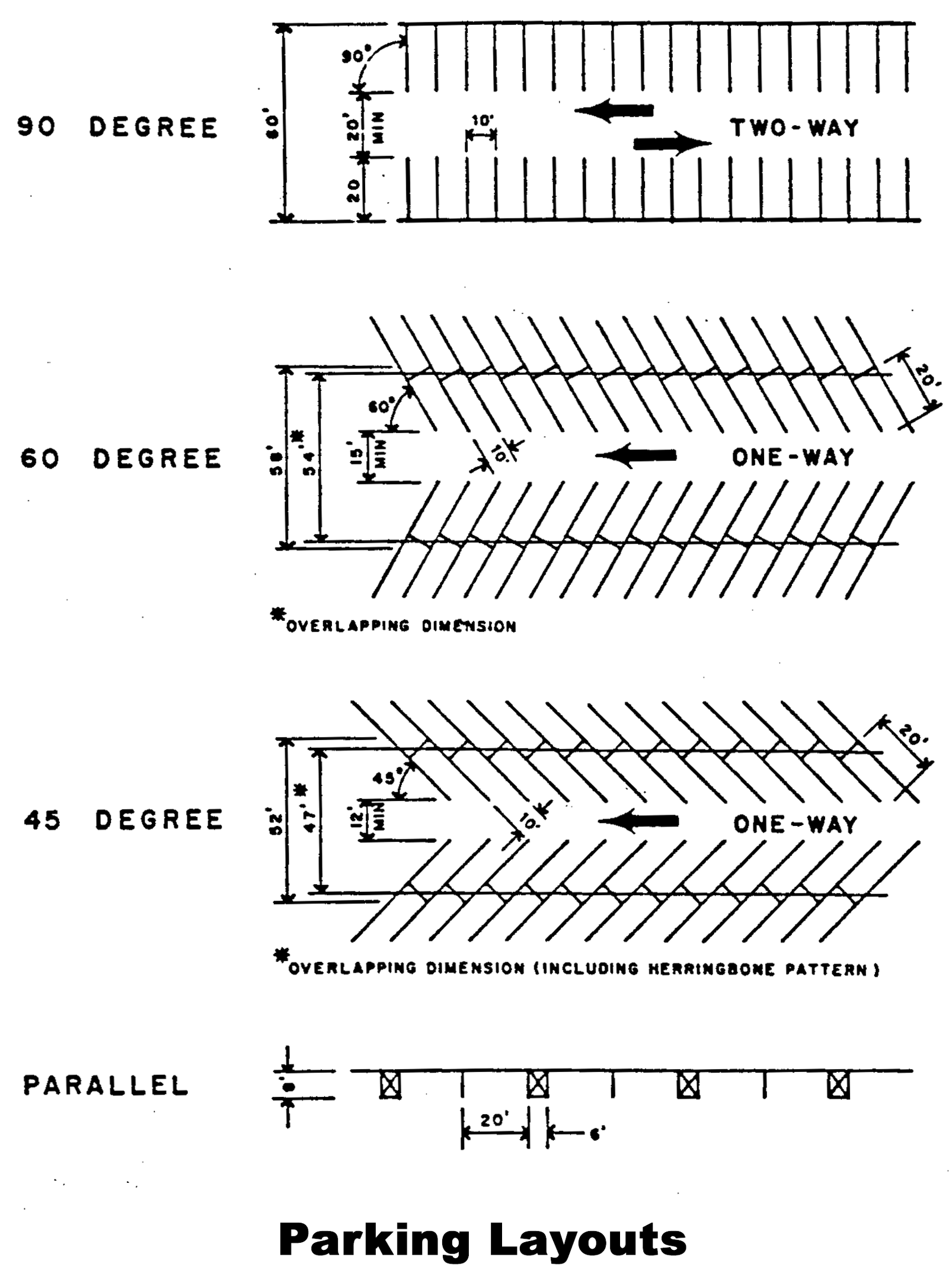
(Prior Code, § 5.187; Ord. No. 87-17, 10-9-1987; Ord. No. 2010-10, § 17, 8-2-2010)
Sec. 46-661. - Off-street loading and unloading.
On the same premises with every building, structure, or part thereof, involving the receipt or distribution of vehicles, materials or merchandise, there shall be provided and maintained on the lot, adequate space for standing, loading and unloading in order to avoid undue interference with public uses of dedicated rights-of-way. Such space shall be provided as follows:
(1)
Loading space shall be provided in the rear yard of all uses located in all commercial districts, except B-2 districts, in the ratio of at least 100 square feet per 1,000 square feet of gross floor area and shall be computed separately from the off-street parking requirements, but in no case shall more than 1,500 square feet of loading area be required.
(2)
In the instance of OS-1 districts, loading space shall be provided in the ratio of 50 percent of the space required for other commercial districts. Where an alley exists at the rear of a building, loading requirements may be computed from the center of said alley.
(Prior Code, § 5.188; Ord. No. 87-17, 10-9-1987)
Sec. 46-662. - Uses not otherwise included within specific districts.
(a)
Because the uses hereinafter referred to possess unique characteristics, making it impractical to include them in a specific use district classification, they may be permitted by the planning commission under the conditions specified. In every case, the uses hereinafter referred to shall be specifically prohibited from any residential districts, unless otherwise specified.
(b)
These uses require special consideration since they service an area larger than the city and require sizable land areas, creating problems of control with reference to abutting use districts. Reference to those uses falling specifically within the intent of this section is as follows:
(1)
Shopping malls, amusement parks, stadiums, outdoor recreation and similar uses that require sites greater than five acres and are designed to accommodate occupancies greater than 200 people.
(2)
Mining, gravel or sand extraction, oil exploration or similar temporary uses.
(3)
Commercial television, radio, public utility and/or microwave transmitting towers and their attendant facilities. See section 46-673.
(Prior Code, § 5.189; Ord. No. 98-01, 3-2-1998)
Sec. 46-663. - Plant materials.
Whenever in this chapter a greenbelt or planting is required, it shall be planted within six months from the date of issuance of a certificate of occupancy and shall thereafter be reasonably maintained with permanent plant materials to provide a screen to abutting properties. Suitable materials equal in characteristics to the plant materials listed with the spacing as required shall be provided.
(1)
Plant material spacing.
a.
Where plant materials are placed in two or more rows, plantings shall be staggered in rows.
b.
Evergreen trees shall be planted not more than 30 feet on centers, and shall not be less than five feet in height.
c.
Narrow evergreens shall be planted not more than six feet on centers, and shall not be less than three feet in height.
d.
Tree-like shrubs shall be planted not more than ten feet on centers, and shall not be less than four feet in height.
e.
Large deciduous shrubs shall be planted not more than four feet on centers, and shall not be less than six feet in height.
f.
Large deciduous trees shall be planted not more than 30 feet on centers, and shall not be less than eight feet in height.
g.
Small shrubs shall be planted not more than four feet on centers, and not less than two feet in height.
(2)
Trees not permitted.
a.
Box Elder.
b.
Elms.
c.
Poplars.
d.
Willows.
e.
Horse Chestnut (nut bearing).
f.
Tree of Heaven.
g.
Catalpa.
h.
Jack Pine.
i.
Scotch Pine.
j.
Silver Maple.
k.
Walnut.
(3)
Shrubs not permitted.
a.
Honeysuckle.
b.
Privet Hedge.
c.
Lilac (native species).
(4)
Berms.
a.
Slopes shall not exceed a ratio of 1:4.
b.
Landscaped berms greater than one foot in height and less than five feet in width shall be provided with a subsurface watering system.
c.
Landscaped berms less than eight feet wide shall not exceed two feet in height.
d.
Landscaped berms greater than eight feet wide shall not exceed three feet in height.
*Recommended for hardiness and maintenance.
(Prior Code, § 5.190; Ord. No. 98-26, 1-4-1999)
Sec. 46-664. - Signs.
(a)
Findings. The city council finds that signs and other visual outdoor advertising are necessary to the commerce, health, safety and general welfare of the residents of the city. Further, it finds that failure to regulate their size, location and construction may lead to poor identification of individual businesses, deterioration of the business and residential areas of the city, intensification of the conflicts between different types of land use, reduction in the effectiveness of traffic control devices, and safety hazards to pedestrians and motorists. Further, it finds that the city's economic base is dependent on preserving property values and a healthy business climate.
(b)
Purpose. The purpose of this section is to regulate signs and outdoor advertising in a manner which will minimize the harmful effects while permitting latitude for creative and effective advertising and identification. To achieve this purpose, this section has the following objectives:
(1)
To prevent the placement of signs in a manner that will conceal or obscure signs or adjacent businesses.
(2)
To keep the number of signs and sign messages at the level reasonably necessary to identify a business and its products.
(3)
To keep signs within a reasonable scale with respect to the buildings to which they relate.
(4)
To prevent off-premises signs from conflicting with business, residential and public land uses.
(5)
To keep an area adjacent to streets clear of signs which might obstruct or distract the view of motorists.
(6)
To reduce the visual and physical obstructions to motorists entering or leaving streets.
(c)
Definitions. The following words, terms and phrases, when used in this section, shall have the meanings ascribed to them in this subsection, except where the context clearly indicates a different meaning:
Awning sign means any sign when located as an integral part of a canopy or awning. If located on a maximum 12-inch wide valance, the sign shall be considered a marquee sign with no maximum square footage. If located on other than a 12-inch or less valance, the sign shall be considered a wall sign for determining maximum square footage. Approval of awning signs shall be by a staff committee composed of the downtown development director, zoning administrator, and city engineer. In the event two or more designated members of the staff committee are unavailable or have a conflict of interest, approval shall revert to the full planning commission. Determination of approval, whether by the staff committee or planning commission, shall be based on awning sign standards approved by the planning commission. Decisions of the staff committee or planning commission may be appealed to the zoning board of appeals.
Billboard. See Off-premises advertising sign.
Business sign means any sign erected for the purpose of advertising a business, product or subject related to the premises on which said sign is located.
Commercial or professional center sign means any sign which gives directions and/or identification to a group of two or more contiguous stores or business spaces whether or not under single management.
Display surface means the entire area within a common geometric figure enclosing the extreme limits of writing, representation, emblem or any figure of similar character, together with any frame or other material or color forming an integral part of the display or used to differentiate the sign from the background against which it is placed, excluding the necessary supports or uprights on which such sign is placed. Where a sign has two or more faces, the area of all faces shall be included in determining the area of the sign, except that where two faces are placed back to back and are at no point more than three feet from one another, the area of the sign shall be taken as the area of one face if the two faces are of equal area, or as the area of the larger face if the two faces are of unequal area.
Encroaching sign means a sign which projects beyond the private property line into and over public property, or any privately owned sign wholly or partially on public property.
Front means and shall be the side of the property facing the thoroughfare that carries the greatest amount of traffic.
Hanging sign. See Marquee sign.
Home occupation sign means any sign used for the purpose of advertising services in conjunction with a lawful home occupation.
Identification sign means a sign that identifies the name of the property, owner, resident or business on said property, with or without the street address.
Institutional sign means a sign containing a surface area upon which is displayed the name of a church, school, library, museum, day care center, cemetery, community center, and similar institutions and the announcement of its services or activities.
Interior signs means those signs located inside of a building. When located in a residential zone district and visible from a street they are to be considered a wall sign.
Marquee sign orhanging sign means a sign which is attached to the underside of a soffit or underside of a marquee, or other covered building structure, projecting from and supported by the building, and not more than 12 feet nor less than seven feet above the adjacent sidewalk or driveway, nor projecting beyond the perimeter of the marquee or soffit.
Monument sign means a freestanding yard sign, considered a pole sign and sometimes referred to as a ground mounted sign.
Nonconforming sign means any sign, which does not conform to the requirements of this section.
Off-premises advertising sign or billboard means any sign erected for the purpose of advertising a business, product, event, person or subject, not relating to the premises on which the sign is located. It has been determined by the city council that a maximum of three such signs could be supported within the city limits. The intent is to allow one sign near each end of Mitchell Street and one in the Cadillac West area in accordance with the following regulations:
(1)
No sign shall have a total area of all faces in excess of 700 square feet or 350 square feet per sign face;
(2)
Maximum height of 25 feet;
(3)
Not closer than one mile to any other off-premises advertising sign;
(4)
Minimum setback from any street right-of-way of 25 feet.
Pole sign means a freestanding sign which is supported by one or more uprights. Pole signs shall be set back from property lines a minimum of one-half the required yard setback in that particular district, or set back a minimum of 50 feet from the traveled paved portion of the abutting street, whichever is less; and in no case closer than the height of the sign to the traveled portion of a public street. This distance shall be measured from the outer-most edge of the sign. Pole signs are prohibited in B-1 and B-2 districts, except when approved by the planning commission as a decorative monument sign which blends with the district.
Portable or temporary sign means any sign designed or constructed to be easily moved from one location to another, including signs mounted upon or designed to be mounted upon a trailer, bench, wheeled carrier or other nonmotorized mobile structure; a portable sign which has its wheels removed shall still be considered a portable sign hereunder. For the purpose of this section, trailer signs and signs on benches are portable/temporary signs.
Projecting sign means a sign projecting from and supported by the wall of a building with the exposed faces of the sign not in a plane parallel to the building wall.
Public sign means a sign intended for the community and its people rather than a private commercial concern.
Required setback means the minimum setback as measured from the street right-of-way to the nearest portion of the sign or its supporting structure.
Roof sign means a sign which is erected, constructed and maintained upon or above the roof of a building, marquee or parapet wall and which is wholly or partially supported by the building, but not projecting more than five feet above a flat roof or above the highest portion of a sloped roof. Roof signs are prohibited in the B-1 and B-2 zoning districts.
Signs means and include every individual announcement, declaration, illustration, insignia, surface or space when erected or maintained in view of the general public on a public way for identification, advertisement or promotion of the interest of any person. This definition does not include small goods or products when displayed indoors, or when approved by the planning commission for outdoor display, or when displayed within three feet of the front of the building (see section 36-41, pertaining to merchandise display), or when displayed in a nonrequired yard.
Trailer sign means a sign supported on a mobile or portable chassis, including a motor vehicle, and is to be considered a temporary sign and installed for a 30-day or less period. Trailer signs shall have the owner's name and address clearly imprinted for identification purposes and must be unilluminated.
Wall sign means a sign which is attached directly to or painted lettering on a wall or mansard roof of a building with the exposed face of the sign in a plane parallel to the building wall, and which projects not more than 18 inches from the building or structure wall and which does not extend above the parapet, eaves or building facade of the building on which it is located. Wall signs located in the central business district, B-2 zoning, must be lower than the second floor window sills or 15 feet, whichever is lower.
Yard sign. See Pole sign.
Note— Definition illustrations. For purposes of clarity, certain definitions found in this subsection are supplemented through illustration. In the event of discrepancies between the sign illustrations and sign text, the sign text shall prevail.
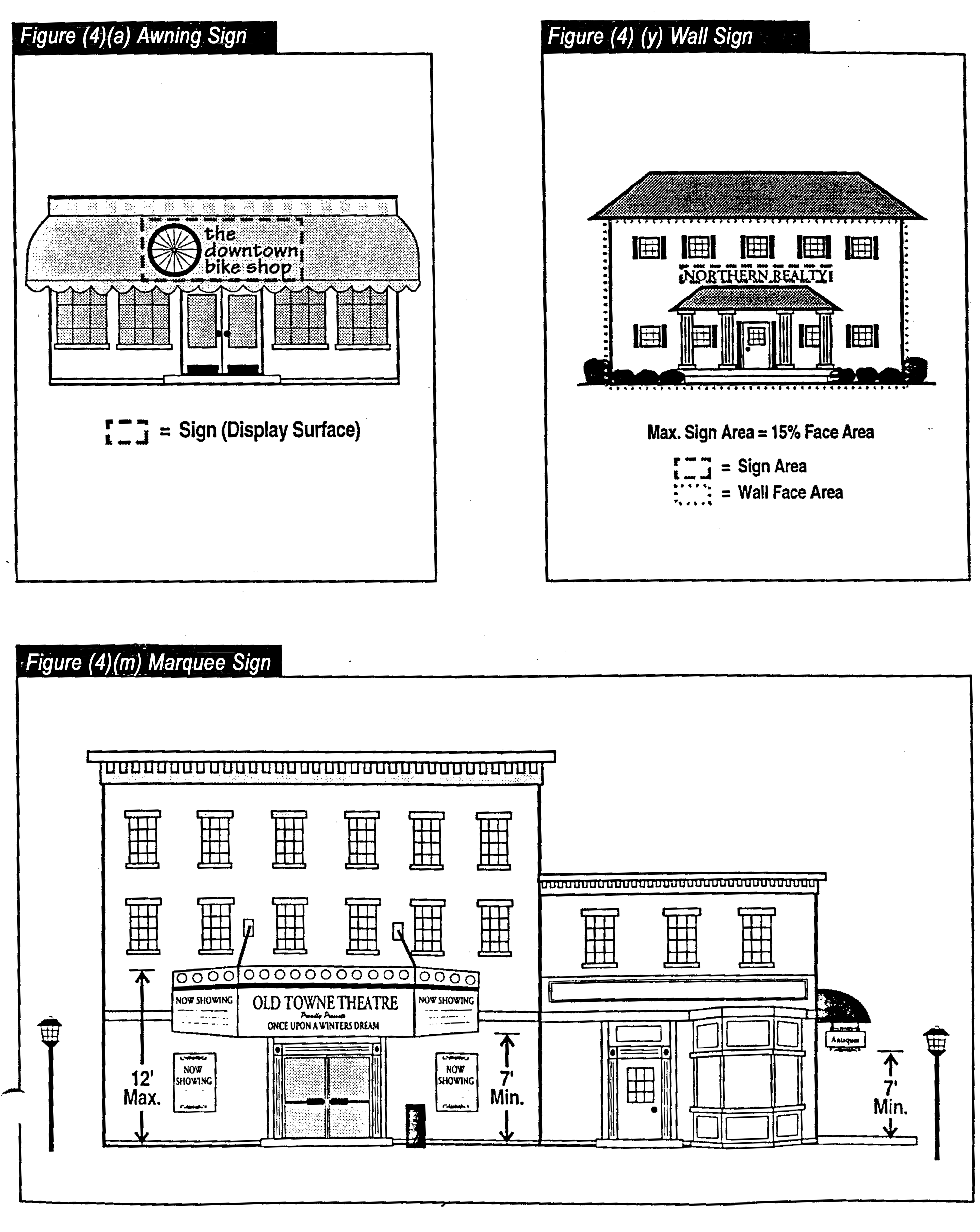
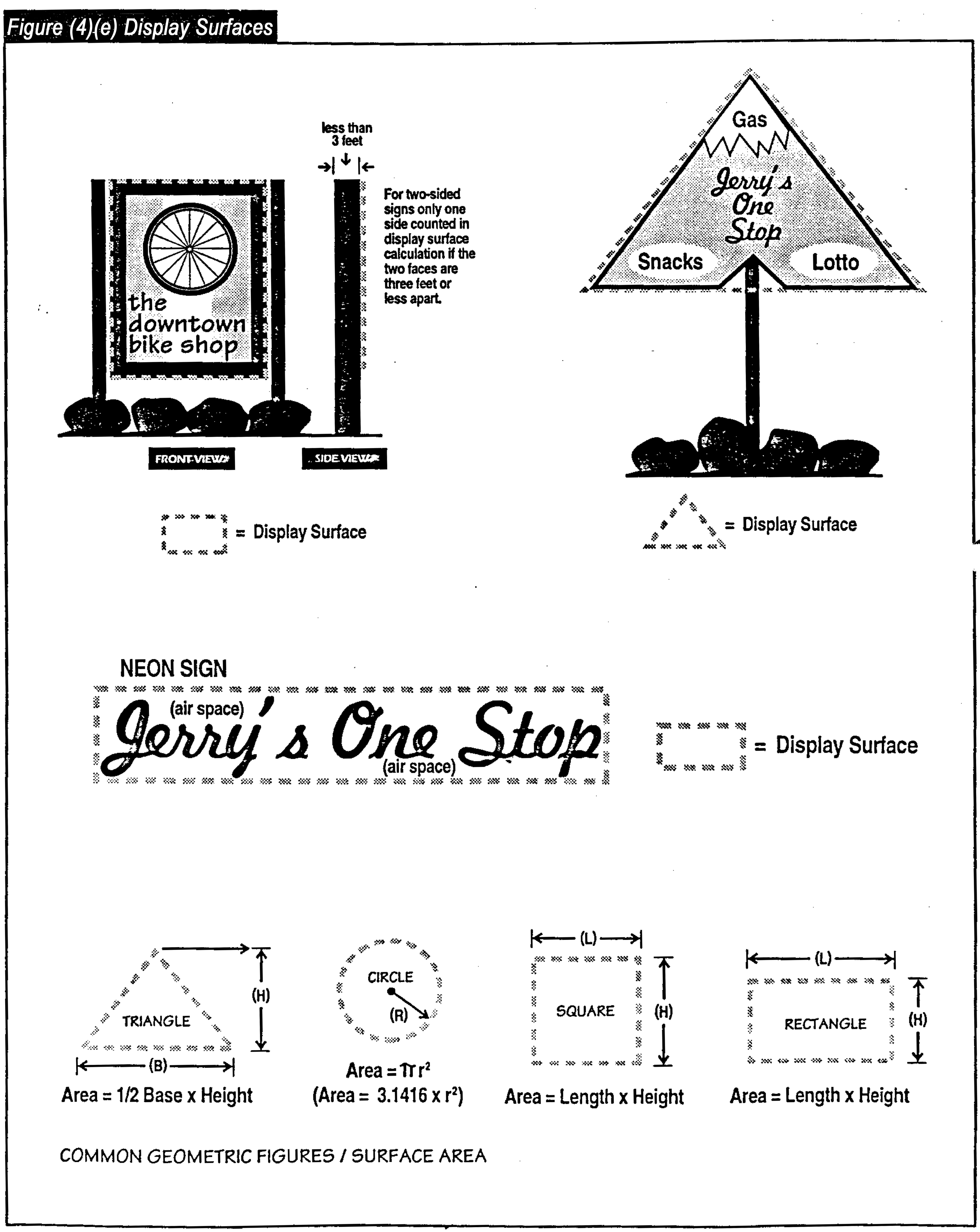
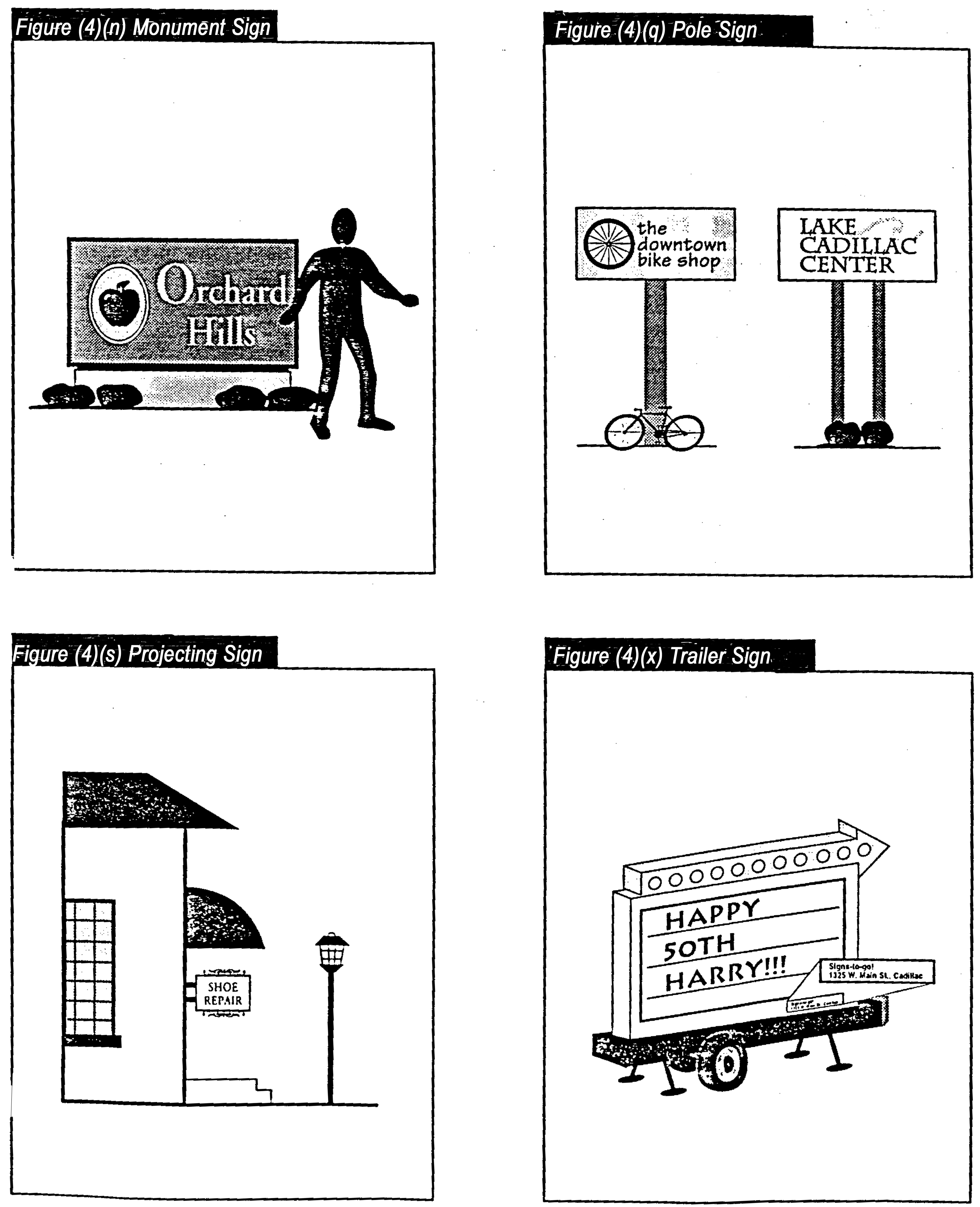
(d)
General provisions.
(1)
Prohibited signs.
a.
Encroaching signs, as defined in subsection (c) of this section, are prohibited, except for signs located in the B-2 zoning district as authorized by this chapter and signs approved by the city council as authorized by this chapter.
b.
Any sign, which is by reason of its size, location, content, coloring or manner of illumination, constitutes a traffic hazard or detriment to traffic safety by obstructing the vision of drivers, or by obstructing or detracting from the visibility of any traffic control device on public streets and roads. Illumination of signs must be directed away or shielded from the roadway (indirect or internally illuminated), and must not be blue, red or amber colored.
c.
Signs which make use of words such as "Stop," "Look," "Danger," or any other words, phrases, symbols or characters, in such a manner as to interfere with, mislead or confuse traffic.
d.
Signs and sign structures that are no longer in use as originally intended or have been abandoned; or are structurally unsafe, constitute a hazard to safety and health, or those not kept in good repair.
e.
Any sign which obstructs free ingress to or ingress from a required door, window, fire escape or other required exit way.
f.
Any sign or other advertising structure containing any obscene, indecent or immoral matter.
g.
Any sign, from the effective date of the ordinance from which this section is derived (November 5, 1986), unlawfully installed, erected or maintained.
h.
Signs having flashing, blinking or running type lights that are visible from the roadway are prohibited unless such flashing, blinking or running-type lighting is used solely for the purpose of electrically changing the copy of the sign, for example, time and temperature signs.
i.
Any sign installed prior to this section without a sign permit, when in fact the prior ordinance required a sign permit.
j.
Signs located on vacant zoning lots, except real estate for sale, rent or lease sign, pertaining to the property on which the sign is located, see subsection (f) of this section, pertaining to temporary use signs.
k.
Signs that obstruct visual clearance by exceeding 30 inches in height or signs not raised above a height of at least ten feet, with no more than one pole not exceeding 12 inches in diameter, shall not be permitted within the triangular area formed at the intersection of the traveled portion of any street, driveway or alley by a straight line drawn between them at a distance 25 feet from their point of intersection.
l.
All signs shall be designed and constructed in conformance with the materials, loads, stresses and fire safety requirements as outlined by the state construction code requirements. Signs not so designed and constructed shall be prohibited.
(2)
Exempted signs. The following signs are exempt from the restrictions of this section:
a.
Reserved.
b.
Interior and exterior window signs on buildings located in nonresidential districts, and interior window signs located in residential districts for purposes of child safety; provided, however, window signs in the B-2 zone district shall comply with the design standards detailed in Schedule B set forth in this section.
c.
Nameplates less than one square foot in area and located on a building.
d.
Memorial signs or tablets with the building name and date, when cut into the masonry or made of bronze or similar material and located on a building.
e.
Private directional, instructional or other noncommercial signs, such as entry, parking, restroom location, and similar functional signs, when horizontally painted on pavement and not to exceed four square feet in area when constructed and erected as pole signs and not to exceed four feet in height. When the height exceeds three feet, the sign must be set back a minimum of 20 feet from the traveled portion of a street, alley or sidewalk. A business identification sign or emblem, not exceeding 50 percent of the sign area, may be incorporated within the permitted private directional sign. Wall signs, not to exceed two square feet in area and not located more than eight feet above grade may also be placed for directional or instructional purposes.
f.
A maximum of two on-premises institutional signs setting forth the name or any simple announcement for public, charitable, educational or religious purposes, not to exceed 18 square feet in area per sign. If ground mounted, the top of the sign shall not be more than six feet above grade level.
g.
"No Trespassing," "No Hunting" and signs of a similar nature.
h.
Address numbers with a numeral height not to exceed 12 inches when located on a building.
i.
Flags bearing the official designation of a noncommercial organization and up to one free waving commercial flag, with a maximum area of 20 square feet, when displayed with an American flag.
j.
Permanent signs affixed to equipment pertaining directly to the equipment or contents therein, i.e., gas pumps, vending machines.
k.
Signs carried by an individual.
l.
Credit card signs shall not exceed 18 inches by 18 inches when added to a conforming sign.
(3)
Nonconforming signs.
a.
Signs installed without a sign permit shall be considered illegal and nonconforming and shall be either removed or made to conform to this section and a legal permit be obtained.
b.
Nonconforming signs shall not be changed, altered or enlarged unless such change, alteration, or enlargement is made to conform to this section. See note at the end of this subsection (d).
c.
Nothing in this section shall prohibit the change of the business or product copy or message thereon.
d.
Any lawful nonconforming sign damaged, worn or destroyed may not be repaired, rebuilt, restored or reinstalled, except in conformance with this Code.
Exceptions: electrical, painting, tuck-pointing, sealing or other incidental repair or maintenance.
e.
Signs for nonconforming uses of land and/or buildings must have approval from the city's zoning board of appeals.
f.
No nonconforming signs shall be reestablished, maintained or resurfaced after the activity, business or usage to which it relates has been discontinued for 30 days or longer. Nonconforming signs of a discontinued activity, business or usage shall be considered a blighting nuisance and must be removed within 40 days of said discontinuation.
g.
If the owner of a sign or the premises on which a sign is located changes the location of a building, property line or sign, or changes the use of a building so that any sign on the premises is rendered nonconforming, such sign must be removed or made to conform with this Code.
Note: Change in copy or sign facing shall not be considered a structural change and shall not require a permit provided that no enlargement is made.
(e)
Permitted signs by zoning districts. Sign regulations by their zoning districts are as follows:
(1)
Residential districts. In all residential districts, the requirements of Schedule A shall govern sign use, area, type, height, and numbers, in addition to requirements elsewhere in this section.
(2)
Commercial and office districts. In all commercial and office zoning districts, the requirements of Schedule B shall govern sign use, area, type, height and numbers, in addition to requirements elsewhere in this section. Pursuant to Schedule B, the sign standards for the B-2 zone district follow the Schedule B, groups 1 through 6, table of sign regulations.
(3)
Industrial districts. In all industrial zoning districts, the requirement of Schedule C shall govern sign use, area, type, height and numbers, in addition to requirements elsewhere in this section, and any protective covenants for the specific industrial parks.
(f)
Temporary use signs. Temporary use signs not otherwise prohibited by this chapter are permitted, provided they comply with all of the requirements of this section and Schedule D.
Schedule B - Commercial and Office Districts
1 Prohibited in B-1 and B-2 zones (except when approved by the planning board). In a TS-2 zone, when located within 25 feet of the abutting street right-of-way, the bottom of the sign must be raised, on poles, and at least seven feet above the ground.
2 In addition to the main sign face of a conforming pole sign, an additional sign face may be added to the pole as a secondary sign. The secondary sign must:
a)
Be located below the main sign face;
b)
Not exceed 18 square feet in display area;
c)
Not be larger in display area than the main sign face; and
3 The area of a pole sign may be increased one square foot per each additional one foot the sign is set back from the front property setback line.
4 Each individual business must be separated with walls constructed in conformance with the building code.
B-2 Central Business District Zone District
In addition to the restrictions in Schedule D, temporary use signs shall comply with the following:
a.
Signs shall not conflict with traffic control signs and devices or pre-existing sings, nor impact the safe and efficient circulation of pedestrians and motorists. Signs shall not be placed in clear vision zones as required by the city or Michigan Department of Transportation.
b.
Signs shall not impact the ability of people to safely and efficiently enter and exit parked vehicles.
c.
Signs shall be designed and located such that they are harmonious with the character of the surrounding area.
d.
Signs shall not result in the rerouting of vehicular traffic such that residential areas traversed by the sign's directional message experience significant increases in vehicular traffic levels, unless the city council determines said rerouting to be in the public interest.
(g)
Special land uses. All signs connected with a special land use or planned unit development as outlined in the zoning ordinance must be reviewed and approved by the planning commission. The board must use the requirements of the underlying zoning district as a guide.
(h)
Administrative and enforcement.
(1)
Administrative. The provisions of this section shall be administered by the zoning administrator or his or her designee, who shall have the authority to issue sign permits. It shall be unlawful to erect or replace any sign, whether freestanding, mounted on, applied to or painted on a building or other structure, without first obtaining a permit, except temporary signs. Painting, repainting, repairing, servicing or cleaning of a sign or the changing of the business or product copy of a message thereon shall not be considered an erection or alteration which requires a sign permit, unless a structural change is made.
(2)
Enforcement. If the zoning administrator or his or her designee shall find any of the provisions of this section are being violated, he shall notify, in writing, the persons responsible for such violation, indicating the nature of the violation and ordering the action necessary to correct it. If compliance is not accomplished within a prescribed 30 days, the city attorney shall be contacted for appropriate enforcement action.
(3)
Penalties. Any violation of the provisions of this section is punishable as a municipal civil infraction. Each day of violation shall constitute a separate offense.
(i)
Sign permits.
(1)
Application for a permit to erect or replace a sign shall be made to the zoning administrator or his or her designee, by submission of the required forms, fees, exhibits and information by the owner of the property on which the sign is to be located, or by his or her agent, or lessee. The applications shall contain the following information:
a.
The property owner's name and address in full.
b.
Applicant's name and address.
c.
Address of property on which sign is to be situated.
d.
Business to which sign belongs or relates.
e.
Total display area in square feet.
f.
Proposed setback from the right-of-way.
g.
Sign type.
h.
Sign purpose.
i.
Sign height.
j.
Height and width of building to be served, if applicable.
k.
Drawing of proposed sign indicating proposed copy.
(2)
Sign permits issued on the basis of plans and applications authorize only the design and construction set forth in such approved plans and applications, and no other design.
(3)
No sign permit for any sign which does not conform to the provisions of this section shall be issued.
(4)
The zoning administrator or his or her designee may require the Wexford County building inspector to certify that all expected loadings are anticipated. If the zoning administrator determines that an electrical permit or building permit may be required, the zoning administrator shall direct the applicant to contact the Wexford County building inspector, and the applicant shall be required to obtain all required permits.
(5)
The city shall maintain a record of all sign permits issued, and the record shall be open for public inspection.
(6)
Permit fees shall be as currently established or as hereafter adopted by ordinance from time to time.
(7)
Illegal signs. For all signs hereafter erected without issuance of a required sign permit, the zoning administrator or his or her designee shall inform, by certified mail, the property owner upon whose property the sign is situated of the alleged violation of this section. Seventy-two hours shall be allowed for compliance with this section, with the permit fee charged at five times the standard permit fee.
If compliance is not accomplished in the prescribed 30-day period, the city attorney shall be contacted for appropriate enforcement action.
(j)
Appeals and variances.
(1)
Appeals. Any person allegedly aggrieved by a decision of a city official relative to the placement, area, height or construction of a sign may appeal such decision to the city zoning board of appeals. Such appeal shall be taken as a normal appeal through the zoning administrator.
(2)
Variances. Whenever the strict application of the requirements of this section may pose demonstrable hardship or practical difficulty with regard to placement, area, height and construction of a sign, a request for variance from such requirements may be filed with the zoning administrator on a form provided for such purpose.
(3)
Standards. The standards for granting variances shall be that all of the following conditions must be met:
a.
Variances may be granted only when it can be clearly demonstrated that hardship or practical difficulty will in fact exist if the variance is not granted.
b.
The mere fact that other larger signs constructed under prior sign ordinances do exist in the area shall not be sufficient reason to declare hardship nor practical difficulty.
c.
In no case shall a variance be granted if it is determined by the board of appeals that the appellant has created the hardship or practical difficulty.
d.
Before a variance is granted, it must be shown that the alleged hardships or particular peculiar difficulties of the person requesting the variance result from conditions which do not exist generally throughout the city.
e.
The applicant for a variance shall be prepared to furnish a site drawing, photographs, and/or any other means of proof to the board of appeals to so indicate that hardship or practical difficulty does in fact exist.
f.
The term "hardship" shall not be deemed financial hardship relating to the cost of the sign or the size of the sign or to the fact that the sign has already been constructed, or the fact that the sign is only available in standardized sizes and/or materials.
Example: franchised business signs.
g.
The alleged hardships and practical difficulties, or both, which will result from a failure to grant the variance must include substantially more than mere inconvenience, or mere inability to attain a higher financial return.
h.
It must be shown that allowing the variance will result in substantial justice being done, considering the public benefits intended to be secured by this section, the individual hardships that will be suffered by a failure of the board to grant a variance, and especially the rights of others whose property would be affected by the allowance of the variance.
i.
The above findings of fact shall be made by the board of appeals, which is not empowered to grant a variance without finding of fact in each of the categories above. Every finding of fact shall be supported in the record of the proceedings of the board.
j.
Nothing contained herein shall be construed to empower the board of appeals to change the terms of this section or to add to the types of signs permitted on any premises.
(4)
Fees. Any person filing for a variance or taking an appeal with the zoning board of appeals shall fill out the necessary appeal variance form provided by the zoning administrator and shall pay a filing fee at the time of filing as currently established or as hereafter adopted by ordinance from time to time. The city clerk shall then place the matter on a regular meeting agenda of the board of appeals within 30 days of filing. Within 90 days of receipt, the board of appeals shall render a final decision in accordance with the provisions of this section.
(Prior Code, § 5.191; Ord. No. 86-16, 10-6-1986; Ord. No. 88-18, 10-17-1988; Ord. No. 91-14, 10-21-1991; Ord. No. 92-16, 10-5-1992; Ord. No. 95-14, 7-17-1995; Ord. No. 95-21, 8-7-1995; Ord. No. 97-12, 8-4-1997; Ord. No. 2007-05, § 1, 6-4-2007; Ord. No. 2009-04 § 1, 5-4-2009; Ord. No. 2010-10, § 18, 8-2-2010; Ord. No. 2013-05, § 2, 6-17-2013; Ord. No. 2021-13, §§ 1, 2, 9-7-2021)
State Law reference— Highway advertising act, MCL 252.301 et seq.
Sec. 46-665. - Exterior lighting.
(a)
All outdoor lighting in all use districts used to light the general area of a specific site shall be shielded to reduce glare and shall be so arranged as to reflect lights away from all adjacent residential districts or adjacent residences.
(b)
All outdoor lighting in all use districts shall be directed toward and confined to the ground areas of lawns or parking lots.
(c)
All lighting in nonresidential districts used for the external illumination of buildings, so as to feature said buildings, shall be placed and shielded so as not to interfere with the vision of persons on adjacent highways or adjacent property.
(d)
Illumination of signs shall be directed or shaded downward so as not to interfere with the vision of persons on the adjacent highways or adjacent property.
(e)
All illumination of signs and any other outdoor feature shall not be of a flashing, moving or intermittent type. Artificial light shall be maintained stationary and constant in intensity and color at all times when in use.
(Prior Code, § 5.192)
Sec. 46-666. - Residential entranceway.
In all residential districts, so called entranceway structures including, but not limited to, walls, columns, and gates marking entrances to single-family subdivisions or multiple housing projects may be permitted and may be located in a required yard, except as provided in section 46-667; provided that such entranceway structures shall comply to all codes of the municipality, and shall be approved by the zoning administrator or his or her designee.
(Prior Code, § 5.193; Ord. No. 2010-10, § 19, 8-2-2010)
Sec. 46-667. - Corner clearance.
(a)
Visual triangle area. No fence, wall, shrubbery, sign or other visual obstruction above a height of 30 inches from the established street grades shall be permitted within the triangular area formed at the intersection of any streets by a straight line drawn between said streets/alleys at a point 25 feet from their point of intersection.
(b)
Exceptions. The following exceptions from the corner clearance restrictions:
(1)
Buildings located in the B-2 zone and complying with the requirements for that zone.
(2)
Signs complying with section 46-664.
(Prior Code, § 5.194; Ord. No. 87-17, 10-9-1987)
Sec. 46-668. - Obscuring walls.
(a)
For those use districts and uses listed below, there shall be provided and maintained on those sides abutting or adjacent to a residential district an obscuring wall as required in this subsection, except as otherwise required in subsection (d) of this section.
(b)
Required walls shall be located on the lot line except where underground utilities interfere and except in instances where this chapter requires conformance with front yard setback lines in abutting residential districts. Upon review of the site plan, the building inspector may approve an alternate location for the wall or may waive the wall requirement if in specific cases it would not serve the purposes of screening the parking area effectively. Required walls may, upon approval of the board of appeals, be located on the opposite side of an alley right-of-way from a nonresidential zone that abuts a residential zone when mutually agreeable to affected property owners. The continuity of the required wall on a given block will be a major consideration of the board of appeals in reviewing such request.
(c)
Such walls and screening barrier shall have no openings for vehicular traffic or other purposes, except as otherwise provided in this chapter and except such openings as may be required by the chief of police and the building inspector. All walls herein required shall be constructed of materials approved by the building inspector to be durable, weather resistant, rust proof and easily maintained; and wood or wood products shall be specifically excluded. Masonry walls may be constructed with openings which do not in any square section (height and width) exceed 20 percent of the surface. Where walls are so pierced, the openings shall be so placed as to maintain the obscuring character required, and shall not reduce the minimum height requirement. The arrangement of the openings shall be reviewed and approved by the building inspector.
(d)
The requirement for an obscuring wall between off-street parking areas, outdoor storage areas, and any abutting residential district shall not be required when such areas are located more than 200 feet distant from such abutting residential district.
(e)
The building inspector may waive or modify the foregoing requirements where cause can be shown that no good purpose would be served; provided that in no instance shall a required wall be permitted to be less than four feet six inches in height, except where section 46-667 applies.
(1)
In consideration of a request to waive wall requirements between nonresidential and residential districts, the building inspector shall refer the request to the planning commission for a determination as to whether or not the residential district is considered to be an area in transition and will become nonresidential in the future.
(2)
In such cases as the planning commission determines the residential district to be a future nonresidential area, the building inspector may temporarily waive wall requirements for an initial period not to exceed 12 months. Granting of subsequent waivers shall be permitted; provided that the planning commission shall make a determination as hereinbefore described, for each subsequent waiver prior to the granting of such waiver by the board.
(Prior Code, § 5.195)
Sec. 46-669. - Planning commission approval.
(a)
In cases where the planning commission is empowered to approve certain uses of land and/or buildings under the provisions of this chapter, and, in cases where planning commission review and recommendation is required prior to city council approval, the applicant shall furnish such surveys, plans, or any other information as may be reasonably required by the planning commission for proper consideration of the matter as set forth in section 46-29(a), site plan.
(b)
The planning commission shall investigate the circumstances of each such case and shall notify such parties, who may, in their opinion, be affected thereby of the time and place of any hearing which may be held relative thereto as required under its rules of procedures.
(c)
The planning commission may impose such conditions or limitations in granting approval as may in its judgment be necessary to fulfill the spirit and purpose of this chapter.
(d)
In cases where planning commission review and recommendation is required prior to city council action, the planning commission may recommend to the city council such conditions or limitations as it deems necessary to fulfill the spirit and purpose of this chapter.
(e)
Any approval given by the planning commission under which the premises are not used or work not started within 12 months or when such work has been abandoned for a period of six months, shall lapse and cease to be in effect.
(Prior Code, § 5.196; Ord. No. 95-16, 7-17-1995)
Sec. 46-670. - Frontage on a public street.
No lot shall be used for any purpose permitted by this chapter unless said lot abuts an improved public street, unless otherwise provided for in this chapter, except a zoning lot may be occupied or developed, if access to the lot is provided from an improved street by a private easement not less than 20 feet in width. Under this provision, no more than one lot may be served by such a private easement. Additional lots, however, may be served by a single private access upon application for and receipt of a special use permit as provided for in article VI of this chapter, pertaining to special land use.
(Prior Code, § 5.197; Ord. No. 95-16, 7-17-1995)
Sec. 46-671. - Access to major thoroughfare or collector street.
For uses making reference to this section, vehicular access shall be provided only to an existing or planned major thoroughfare, freeway service drive, or collector street; provided, however, that access driveways may be permitted to other than a major thoroughfare, freeway service drive, or collector street where such access is provided to a street where the property directly across the street from such driveway and all property abutting such street between the driveway and the major thoroughfare, freeway service drive, or collector street is zoned for multiple-family use or any nonresidential uses, is developed with permanent uses other than single-family residences or is an area which, in the opinion of the planning commission, will be used for other than single-family purposes in the future. This exception shall only apply if the planning commission finds that there are special circumstances which indicate that there will be a substantial improvement in traffic safety by reducing the number of driveways to a thoroughfare.
(Prior Code, § 5.198)
Sec. 46-672. - Airport overlay zone
(a)
Zone intent and resolution of conflict with underlying zoning district standards. The airport overlay zone has been established to reduce the hazards to, and provide additional safety for, the users of the airport and to the people who live, work and use property in its vicinity. It is the intent of the airport overlay zone to reduce said hazards and to enhance the safety through the regulations and standards of this section which shall be in addition to the regulations and standards of the underlying zoning district. In the event of conflict between the regulations and standards of the airport overlay zone and those of the underlying zoning district, the more stringent shall apply.
(b)
Airport overlay zone area limits. The airport overlay zone shall encompass the corporate limits of the city and any lands under the direct control of the city pursuant to the provisions of Public Act No. 425 of 1984 (MCL 124.21 et seq.).
(c)
Plan review prior to issuance of a building permit. A project proposed for construction, including construction associated with modifications to existing structures, shall be reviewed for conformance with the regulations and standards of the airport overlay zone.
(d)
Regulations and standards within the limits of the airport overlay zone. No use or structure shall:
(1)
Create electrical or other interference with radio communication between the airport and aircraft or create interference with navigational aids employed by aircraft.
(2)
Make it difficult for fliers to distinguish between airport lighting or result in glare in the eyes of fliers using the airport.
(3)
Create smoke, mist, fog, smog or air pollution in such amounts as to impair the visibility of fliers using the airport.
(4)
Attract birds or other wildlife so as to constitute a hazard to aircraft.
(5)
Endanger the landing, taking off or maneuvering of aircraft.
(6)
Exceed a height in excess of the limitations prescribed by the provisions of the county airport zoning manual. Said height limitation shall apply to trees and other vegetation and all structures. In the event a specific height is not referenced in the above stated manual, the required height limitation shall be calculated by the building inspector through interpolation of the aerial contours as provided by said manual. In making said interpolation, the city may seek the assistance of the county airport authority.
(e)
Appeals. Appeals of decisions or actions by the building inspector pursuant to enforcement of the provisions of the airport overlay zone shall be made subject to division 2 of article II of this chapter, pertaining to the board of appeals; provided, however, that all applications for appeal shall be submitted to the county airport authority for review and recommendation.
(f)
Conflict with federal regulations. The provisions of the airport overlay zone are not intended to conflict with existing federal approach protection regulations. The Federal Aviation Administration requires that it be given notice of any construction or alterations that:
(1)
Would be more than 200 feet above ground level at its site.
(2)
Would be above an imaginary surface extending outward and upward at a ratio of 100:1 slope, within 20,000 feet of the nearest point of a runway more than 3,200 feet in length.
(3)
Would be above an imaginary surface extending outward and upward at a ratio of 50:1 slope within 10,000 feet of the nearest point of a runway less than 3,200 feet in length.
(Prior Code, § 5.199; Ord. No. 90-26, 11-5-1990)
State Law reference— Aeronautics code, MCL 259.1 et seq.; airport zoning act, MCL 259.431 et seq.
Sec. 46-673. - Commercial wireless telecommunication services (CWTS) and towers.
(a)
The purpose of this section is to permit the siting of communication towers and antennas within the municipal boundaries of the city. The city finds that there is a need for such towers, however, the need to protect the public health, safety and welfare is paramount. The city's intent is to minimize the number of towers in the city, exclude their location in residential districts, and to encourage users of towers and antennas to configure/design them in a way that minimizes their adverse visual impact.
(b)
Towers in excess of 40 feet in height for commercial wireless telecommunication services shall meet the following standards:
(1)
Antennas for commercial wireless telecommunication services shall be required to locate on any existing approved tower or structure within a one-mile radius of the proposed tower, unless one or more of the following conditions exist:
a.
The planned equipment would exceed the structural capacity of the existing or approved tower or building, as documented by a qualified and registered professional engineer, and the existing or approved tower cannot be reinforced, modified or replaced to accommodate planned or equivalent equipment at a reasonable cost. Costs exceeding new tower development are presumed to be unreasonable.
b.
The planned equipment would cause interference materially affecting the usability of other existing or planned equipment at the tower or building as documented by a qualified and registered professional engineer and the interference cannot be prevented at a reasonable cost.
c.
Existing or approved towers and buildings within a one-mile radius cannot accommodate the planned equipment at a height necessary to function reasonably as documented by a qualified and registered professional engineer.
d.
Other unforeseen reasons that make it infeasible to locate the planned equipment upon an existing tower or building.
(2)
Any proposed CWTS tower shall be designed, structurally, electrically and in all other respects, to accommodate both the applicant's equipment and comparable equipment for at least two additional users. Towers must be designed to allow for future rearrangement of equipment upon the tower and to accept equipment mounted at varying heights.
(3)
CWTS towers shall be designed to blend into the surrounding environment through the use of color and architectural treatment, except in instances where color is dictated by other state or federal authorities. Towers shall be of a monopole design unless the planning commission determines that an alternative design would better blend into the surrounding environment.
(4)
Any part of the structure or equipment placed on the ground pertaining to the CWTS towers shall comply with the following setbacks:
a.
Residential districts. CWTS towers are not permitted in residential districts and must be located such that any part is not within 200 feet of any residential district lot line.
b.
Nonresidential districts. Any part of a CWTS tower or associated equipment shall be set back for a distance equal to the setbacks for main buildings for the district in which it is located, except that in no case shall such structures or equipment be located less than 25 feet from any adjacent lot line, nor less than 200 feet from any residential district lot line, nor less than a distance equal to at least 75 percent of the height of the tower from the lot line.
c.
These provisions shall not apply to antennas located on existing buildings, towers or other existing structures.
(5)
The planning commission may require such structures or equipment on the ground to be screened with landscaping, berms, walls or a combination of these elements, to minimize their adverse visual impact.
(6)
Towers and antennas shall not be illuminated unless required by other state or federal authorities. No signs or other advertising not related to safety or hazard warnings shall be permitted on any part of the tower or associated equipment or buildings.
(7)
Towers and antennas shall be designed and constructed so as not to pose a threat to pedestrians or vehicles accessing the land upon which the tower is located.
(8)
Towers and antennas shall meet all applicable state and federal height regulations and clearance zone requirements resulting from the presence of the city airport.
(9)
Towers and antennas which are abandoned or unused shall be removed, along with any associated structures or equipment, within 12 months of the cessation of operations, unless a time extension is granted by the zoning administrator. One three-month extension shall be permitted only if the zoning administrator finds that the owner or former operator of the facility is taking active steps to ensure its removal.
(10)
A building permit must be obtained before the installation of any tower or related building.
(11)
A building permit must be obtained before the installation of any antenna on an existing structure when greater than two feet in diameter or greater than 12 feet in height or which weights more than 40 pounds.
(12)
The maximum height of towers shall be prescribed by the planning commission with section 46-629, the schedule of regulations, used as a guide. Structures taller than the height limitations listed in section 46-629 shall be designed to be aesthetically compatible with the district in which it is located.
(13)
Towers and related buildings shall be enclosed by security fencing not less than six feet and not more than eight feet in height. The fencing must be provided with appropriate anticlimbing devices as required by the planning commission.
(14)
Towers and antennas constructed in conformance with this Code shall not be deemed to constitute an expansion of a nonconforming use or structure.
(15)
The use of city owned properties or rights-of-way by the telecommunication service provider or backhaul network shall be through a franchise or lease agreement.
(Prior Code, § 5.200; Ord. No. 98-01, 3-2-1998)
Sec. 46-674. - Bicycle parking requirements.
(a)
Purpose. The purpose of these regulations is to require secure and adequate parking for bicycles thereby promoting alternative transportation opportunities as desired by the city's residents and guests, reducing motorized vehicular traffic congestion and air pollution, and serving to implement the non-motorized transportation elements of the Cadillac Master Plan and the Cadillac City/Cadillac Area Public Schools Recreation Plan. Bicycle parking shall be provided for new facilities and additions to existing facilities. Bicycle parking as prescribed hereafter shall be provided for land uses occupying buildings, or portions thereof, which are constructed, established, wholly reconstructed, or moved onto a new lot or parcel after the effective date of the bicycle parking requirements, or of a subsequent rezoning or other amendment thereto establishing or increasing bicycle parking for such land uses, except to the extent that existing bicycle parking exceeds such requirements for any existing buildings. The required amount of new bicycle parking shall be based on the cumulative increase in floor area, or other applicable unit of measurement prescribed hereafter, after said effective date.
(b)
Multiple uses on a single lot or parcel. Whenever a single lot or parcel contains different activities with the same bicycle requirement, the overall requirement shall be based on the sum of all such activities, and the minimum size prescribed hereafter for which any bicycle parking is required shall be deemed to be exceeded for all such activities if it is exceeded by their sum. Whenever a single lot or parcel contains activities with different bicycle parking requirements, the overall requirement shall be the sum of the requirements for each activity calculated separately; provided, however, that the minimum size prescribed hereafter for which any bicycle parking is required shall be deemed to be exceeded on said lot or parcel for all activities for which the same or a smaller minimum size, expressed in the same unit of measurement, is prescribed, if said minimum size is exceeded by the sum of all such activities on the lot or parcel.
(c)
Standards for required bicycle parking.
(1)
Bicycle parking. Bicycle parking shall consist of a bicycle rack or racks and is meant to accommodate visitors, customers, messengers, and others using bicycles for transportation purposes.
(2)
Specific use. All bicycle parking facilities shall be dedicated for the exclusive use of bicycle parking.
(3)
Area compatibility. The location and design of required bicycle parking shall be of a quality, character and color that harmonize with adjoining land uses. Required bicycle parking shall be incorporated whenever possible into building design or street furniture.
(4)
Location. Bicycle parking shall be placed within 50 feet of a public entrance to the building or commercial use being served by said parking and should be in a well trafficked location visible from the entrance. Where applicable and possible bicycle parking should be placed within view of storefront windows. When a public entrance fronts a public sidewalk, public alley, or public parking lot on which bicycle parking is proposed for placement, the installer shall obtain an encroachment permit from the city to install the bicycle parking in the public right-of-way. In the event the right-of-way falls under the jurisdiction of the Michigan Department of Transportation (MDOT), the installer shall obtain an encroachment permit from the MDOT to install the bicycle parking in said right-of-way and submit copy to the city.
(5)
Locking device and supports. All required bicycle parking spaces shall be designed to provide a stable position for the bicycle with an ability to easily lock the frame of the bicycle to the rack with either a u-lock or cable lock.
(6)
Anchoring. Bicycle parking facilities shall be securely anchored so they cannot be easily removed and shall be of sufficient strength and design to resist vandalism and theft.
(7)
Parking space size. A bicycle parking space shall be at least two-and-one-half feet in width by six feet in length to allow sufficient space between parked bicycles.
(8)
Vertical obstructions. Racks shall be located with at least 30 inches in all directions from any vertical obstruction, including but not limited to, other racks, walls, light poles, and landscaping.
(9)
Maneuvering space. A minimum four-foot wide aisle of unobstructed space behind all required bicycle parking shall be provided to allow for adequate bicycle maneuvering.
(10)
Circulation impact. Bicycle parking facilities shall not impede pedestrian or vehicular circulation. Bicycle parking racks located on sidewalks shall maintain a minimum of five feet of unobstructed pedestrian right-of-way outside the bicycle parking space.
(11)
Protection from damage by motorized vehicles. Bicycle parking facilities within auto parking facilities shall be protected from damage by cars by a physical barrier such as curbs, wheel stops, poles, bollards, or other similar features capable of preventing automobiles from entering the bicycle facility.
(12)
Lighting. Bicycle parking facilities shall be located in highly visible well-lighted areas.
(d)
Joint parking agreements. Joint bicycle agreements are permitted and encouraged. Bicycle parking falling under a joint parking agreement shall be designed and constructed according to the standards of this chapter. Whenever any required bicycle parking is proposed to be provided on a lot other than the lot containing the activity served, the owners of both lots shall prepare and execute to the satisfaction of the city attorney, and file with the Wexford County Registrar of Deeds, an agreement guaranteeing that such facilities will be maintained and reserved for the activity served, for the duration of said activity.
(e)
Minimum number of required bicycle parking spaces.
(1)
Calculation rules:
a.
Fractional counts. If after calculating the number of required bicycle parking spaces a quotient is obtained containing a fraction of one-half or more, an additional space shall be required; if such fraction is less than one-half, it may be disregarded.
b.
Employees. When the bicycle parking requirement is based on number of employees, the number of spaces shall be based on the average number of working persons on the lot or parcel during the largest shift of the peak season.
c.
Seats/pews. When the bicycle parking requirement is based on the number of seats, as in the case of pews or similar facilities, each 20 inches shall be counted as one seat.
(f)
Required bicycle parking. The following minimum amounts of bicycle parking are required and shall be developed and maintained pursuant to the provisions of this chapter:
(g)
Automobile parking credit. The total number of required off-street automobile parking spaces may be reduced at the ratio of one automobile space for each four bicycle spaces provided. The total number of required off-street automobile parking spaces cannot be reduced by more than five percent.
(h)
Credit for bicycle racks in public locations. The calculation of bicycle parking may include existing racks owned and maintained by the city that are in the public right-of-way and are within 50 feet of the main entrance of the use seeking credit provided the zoning administrator determines that the location and number of racks in the public right-of-way are sufficient to meet the needs of said use without harm to the public in general.
(i)
Zoning administrator determination. In the case of activities for which the zoning administrator is required to prescribe a number of bicycle parking spaces or for which this section is not clear or does not prescribe a number of spaces, the zoning administrator shall base his/her determination on factors such as the proposed use of the lot or parcel, the number of customers or employees, the nature of operation of the site, and the availability of bicycle parking spaces under public ownership. Any such determination shall be subject to appeal pursuant to the administrative appeal procedures of this chapter.
(Ord. No. 2020-11, § 2, 12-7-2020)

