
Calabasas City Zoning Code
ARTICLE VII
- Development Code Definitions
17.90.010 - Purpose.
This chapter provides definitions of terms and phrases used in this development code that are technical or specialized, or that may not reflect common usage. If any of the definitions in this chapter conflict with definitions in other chapters of the Municipal Code, these definitions shall prevail for the purposes of this development code. If a word is not defined in this chapter, or other titles of the Municipal Code, the most common dictionary definition is assumed to be correct.
(Ord. No. 2010-265, § 3, 1-27-2010)
17.90.020 - Definitions of specialized terms and phrases.
A.
Definitions, A. The following definitions are in alphabetical order.
"Accessory retail uses" means the retail sales of various products (including food service) in a store or similar facility that is located within an health care, hotel, office or industrial complex. These uses include pharmacies, gift shops and food service establishments within hospitals; convenience stores and food service establishments within hotel, office and industrial complexes.
"Accessory structure" means a structure that is physically detached from, secondary and incidental to, and commonly associated with the primary structure. See also "Accessory Uses and Structures, Residential.
"Accessory use" means a use customarily incidental to, related and clearly subordinate to a principal use established on the same parcel, or within the same tenant space/business, which does not alter the principal use nor serve property other than the parcel or tenant space/business where the principal use is located.
"Accessory uses and structures, residential" means any use and/or structure that is customarily a part of, and clearly incidental and secondary to, a residence and does not change the primarily residential character of the residential use. These uses include the following detached accessory structures, and other similar structures normally associated with a residential use of property: garages, gazebos, greenhouses, spas and hot tubs, studios, storage sheds, swimming pools, tennis courts, workshops, other on-site sport courts, and other similar residential facilities. This term does not include secondary housing units or accessory dwelling units, which are defined separately. Lawfully operated home occupations, permitted under Section 17.12.100 are also allowed accessory uses. Accessory uses do not include any short-term or transient rental or occupancy of any residential property or a portion thereof located in the city for any purpose, including but not limited to a vacation, for less than thirty (30) days if that rental or occupancy occurs in exchange for any form of compensation or consideration. A bed and breakfast inn requires separate permits under the Calabasas Municipal Code section and is not an accessory use.
"Adult entertainment businesses" means any adult bookstore, adult hotel or motel, adult motion picture arcade, adult motion picture theater, cabaret, sexual encounter center, or any other business or establishment that offers its patrons services or entertainment characterized by an emphasis on matter depicting, describing or relating to specified sexual activities or specified anatomical areas, but not including those uses or activities, the regulation of which is preempted by state law. Does not include therapeutic massage services provided by licensed professionals, which are included under the definition of "Personal services."
"Agent" means a person authorized in writing by the property owner to represent and act for a property owner in contacts with city employees, committees, commissions and the council, regarding matters regulated by this development code.
Agricultural Uses for Fuel Modification. "Agricultural use" means and includes only the area of fuel modification required by the fire department. All agricultural uses shall be designed to avoid significant adverse effects to surrounding area resources including increases in erosion, slope failure or sedimentation on adjacent or downstream watershed properties or the application of pesticides adjacent to existing residences. Agricultural uses are generally limited to slopes not to exceed two to one. Agricultural uses may not involve activities which require the issuance of commercial license by the Department of Alcoholic Beverage Control (ABC) or the Bureau of Alcohol, Tobacco and Firearms (ATF).
"Alley" means a public or private roadway that provides vehicle access to the rear or side of lots having other public street frontage that is not intended for general traffic circulation.
"Allowed use" means a use of land identified by Article II as an "allowed use," shown as an "A" use on the Land Use Table in Chapter 17.11, that may be established with approval of a zoning clearance, or minor use permit and, where applicable, building permit approval, subject to compliance with all applicable provisions of this development code.
"Alter/Alteration" means, with respect to an oak tree, any action that may cause damage, stress, injury, death or disfigurement of an oak tree or scrub oak, including removing, transplanting, detaching, cutting or pruning, poisoning, over-watering, or excavating or paving within the protected zone of the oak tree.
"Alteration" means, with respect to a structure, any construction or physical change in the internal arrangement of rooms or the supporting members of a structure, or a change in the external appearance of any structure, not including painting.
"Alteration" means any exterior change or modification, through public or private action, to the character-defining or significant physical features of properties affected by Chapter 17.36. Such changes may be changes to or modifications of the structure, architectural details or characteristics, rock curbs, the addition of new structures, cutting or removal of trees, and the placement or removal of significant objects such as signs, plaques, light fixtures, street furniture, walls, fences, or steps, affecting the significant, historical qualities of the property.
"Antenna" means a device used in communications which transmits and/or receives radio frequency signals.
"Antenna structure" has the meaning set forth in section 17.12.050(L) of this title.
"Anti-drain valve" or "check valve" means a valve located in a lateral or in or under a sprinkler head to hold water in the system so it minimizes drainage from the lower portions of the system.
"Applicant" means a person who has either (a) a freehold interest in the land which is the subject of an application, (b) a possessory interest in that land which entitles him/her to exclusive possession, or (c) contractual interest which is specifically enforceable and thereby may become a freehold or exclusive possessory interest. "Applicant" includes an authorized agent.
"Application rate" or "precipitation rate" means the depth of water applied to a given area, usually measured in inches per hour.
"Architectural review panel" means the Calabasas architectural review panel established by Chapter 2.40 of the Municipal Code, for the purpose of reviewing proposed development that is subject to design guidelines.
"Arterial street" means streets that predominantly carry through traffic.
Assisted living facility" means individual housing units within a multifamily structure or complex, with social and support services. Limited medical care and supervision may also be provided, where the emphasis of the facility remains residential.
"Average natural grade" means the average of the highest and lowest elevations of the pre-development ground surface of the site, at the edges of a proposed structure.
"Average slope" means the characteristic slope of the ground surface of an area of land, expressed as a percent, based on the most accurate available topographic information. Average slope shall be determined using one of the following methods.
1.
Basic Method. This method can be used where the director determines that slopes are uniform, with little variation. Where line drawn between the highest and lowest points on a parcel is adequate to represent the direction and extent of slope for the entire parcel, the difference in elevation between the high and low points, divided by the distance between the points will determine the average slope.
2.
Contour Measurement Method. Where varied slope conditions or complex topography exist, the most precise measurement of average slope is the following formula.
S = 0.00229 (I × L) A
Where:
S = Average slope of the parcel in percent
A = Total number of acres in the parcel (or section measured)
L = Length of contour lines in scaled feet
I = Vertical distance of contour interval in feet
3.
Sectional Method. Where the parcel contains distinct sections of differing slope, the average slope of each section may be determined through the contour measurement method in subdivision (2) above, and then combined as an average for the entire parcel.
B.
Definitions, B. The following definitions are in alphabetical order.
"Bar/Cocktail Lounge " means a building or tenant space within a building where alcoholic beverages are sold for on-site consumption that are not part of a larger restaurant. Includes bars, taverns, pubs cocktail lounges and similar establishments where any food service is subordinate to the sale of alcoholic beverages. May also include beer brewing as part of a brew pub. Live entertainment and/or dancing is considered a night club, which is separately defined.
"Banquet Hall" means an establishment which is rented by individuals or groups to accommodate private (invitation only) functions including, but not limited to banquets, weddings, anniversaries, and other similar events. Such a use may include kitchen facilities for preparation of food to be consumed on the premises.
"Beauty salon" means a service business operating to provide services related to hair, skin, nail and cosmetology care.
"Bed and breakfast inn" means a commercial facility designed to appear as a single-family dwelling, with one family in permanent residence, where bedrooms without individual cooking facilities are rented for overnight lodging. This definition does not include "hotels and motels," or rooming and boarding houses, which are defined separately; or the rental of an entire residence for one week or longer.
"Bedrock" means the solid undisturbed rock in place either exposed at the ground surface or beneath superficial deposits of loose rock or soil.
"Bench" means a relatively level step excavated into sloping natural ground on which engineered fill or embankment fill is to be placed.
"Best management practice (BMP)" means schedules of activities, prohibitions of practices, general good housekeeping practices, maintenance procedures, education programs, and other management practices to prevent or reduce the discharge of pollutants directly or indirectly to waters of the United States. BMPs also include treatment requirements, operating procedures, and practices to control plant site runoff, spillage or leaks, sludge or waste disposal, and drainage from raw materials storage. The California Storm Water Best Management Practice Handbooks for Municipal, Industrial/Commercial and Construction Activity provide a detailed discussion of BMPs.
"Biotic resources" means populations, individuals, or parts thereof of living organisms, including genetic, taxonomic and ecological scales of organization, and with actual or potential economic, aesthetic, or other value to humanity.
"Block" means a group of lots surrounded by streets or roads.
"Block length" means the longest dimension of a block along a street or road.
"Boutique home furnishing stores" a store under two thousand five hundred (2,500) square feet in size selling a variety of items including but not limited to; home décor ; pillows; decorative books; lamps; linens; fabrics; art; antiques; cutlery; glassware; kitchen utensils; and china. Stores that do not fit the definition of boutique home furnishings store include but are not limited to: single-purpose, high-volume stores that customarily exceed two thousand five hundred (2,500) square feet in gross size such as: carpet and flooring stores; tile stores; building materials stores; lighting stores; mattress stores; and, big-box retail or discount furniture stores.
"Brightness" means, for the purposes of Chapter 17.27, the magnitude of sensation that results when viewing surfaces from which light is reflected to the eye. The sensation is determined by both measurable luminance and the conditions affecting the observer.
Building. See "Structure."
"Building envelope" means the area of a site enclosed by the required setbacks and height limit established by this development code, within which a building may be constructed.
"Building-mounted" means mounted to the top or side of a building or to other structures.
"Building site area" means, for the purposes of Chapter 17.72, an area designated by the applicant, including all or a portion of one or more parcels comprising the development site, where development may occur in compliance with this section. Portions of a site that are subject to flooding (as determined by the building official) shall not be included in the calculated area (square feet) of the building site.
C.
Definitions, C. The following definitions are in alphabetical order.
"Calabasas Road District" means, for the purposes of Chapter 17.30, both sides of Calabasas Road from the east side of Mureau Road to the west side of Parkway Calabasas.
"California Environmental Quality Act (CEQA)" means state law (California Public Resources Code Sections 21000 et seq.) requiring public agencies to document and consider the environmental effects of a proposed action, prior to allowing the action to occur.
"California Public Utilities Commission (CPUC)" means the governmental agency which regulates the terms and conditions of the public utilities in the state of California.
"Canopy cover" means the percentage of a site covered by oak canopy based on the sum of all oak crown canopies within the property boundaries.
"Carpool" means a vehicle carrying two to six persons commuting together to and from work on a regular basis.
"Certificate of appropriateness" means a certificate issued by the historic preservation commission approving such plans, specifications, statements of work, and any other information which are reasonably required by the commission to make a decision on any proposed alteration, restoration, rehabilitation, construction, removal, relocation or demolition, in whole or in part, to a historical resource.
"Certificate of economic hardship" means a certificate issued pursuant to Section 17.36.090 or 17.36.120 of this title.
"Certified landscape professional" means a landscape architect, nursery person, arborist, or landscape contractor, licensed or, where applicable, certified, by the state of California.
"Certified local government (CLG)" means a local government certified under a federal program by the state office of historic preservation for the purpose of more direct participation in federal and state historic preservation programs.
"Child day care center" means a commercial or nonprofit child day care facility other than a family day care home designed and approved to accommodate fifteen (15) or more children for periods less than twenty-four (24) hours a day. Includes infant centers, preschools, sick-child centers and school-age day care facilities. These may be operated in conjunction with a school or church facility, or as an independent land use.
"Children's play structure" means recreational structures intended for outdoor use and enjoyment by children; to include, but not limited to such things as A see-saw, merry-go-round, swing set, slide, jungle gym, chin-up bars, spring rider, monkey bars, overhead ladder, trapeze rings, playhouses, and mazes. A playground structure shall not include (I) sandboxes or other similar structures less than twelve (12) inches in height, and (II) children's play toys which are portable and useable indoors.
"City" means the City of Calabasas, state of California, referred to in this development code as "city."
City council. See "Council"
"City engineer" means the city engineer or any employee of the Calabasas public works department designated by the city engineer to perform any duty assigned to him or her by this development code.
"City-qualified arborist" means an individual having special expertise regarding the preservation of oak trees and scrub oak habitat, including a registered landscape architect or certified arborist, and authorized by city staff to review and provide recommendations with respect to oak trees and scrub oak habitat within the city.
"Civil engineer" means a professional engineer registered as a civil engineer by the state of California.
"Clustered development" means a combination or arrangement of attached or detached dwellings and their accessory structures on contiguous or related building sites where the yards and open spaces are combined into more desirable arrangements of open space and where the individual lots may have less area then the required average for the zoning district but the density of the overall development meets the required standard.
"Co-location" means the locating of wireless communications equipment from more than one provider on the same supporting structure.
"Collector street" means a street that collects and distributes through traffic between the arterial network and local roads.
"Commercial building" means any building or structure, all or part of which contains a commercial or industrial land use, not including any building constructed or reconstructed for the elderly or handicapped.
"Commercial zone or zoning district" means any of the commercial zoning districts established by Section 17.10.010 of this development code.
"Commission," except as otherwise provided by Section 17.12.050(I) of this title, means the planning commission appointed by the city council pursuant to Chapter 2.28 of Title 2 of this Code.
"Common interest development" means and includes a condominium, community apartment project, planned development or stock cooperative, as provided by California Civil Code Section 1351.
"Community apartment project" means a development in which an undivided interest in land is coupled with the right of exclusive occupancy of any apartment located thereon; as defined in Section 11004 of the Business and Professions Code and Section 1351(d) of the Civil Code.
"Community center, neighborhood" means one or more buildings and associated structures and site improvements used for recreational, social, educational, and cultural activities, owned by a mutual benefit non-profit entity, such as a homeowners association, and not a public benefit non-profit entity, located in the same neighborhood as and operated solely for the benefit of the membership of the organization or the residents of the common interest development or neighborhood it serves. A neighborhood community center is accessory to a residential development and cannot be operated as a for-profit commercial business entity. Uses may include kitchen, classrooms, exercise areas, playgrounds, meeting rooms, multi-purpose rooms and swimming pools open to all residents of the common interest development or neighborhood and their guests for recreational uses such as tennis, basketball, soccer, and swimming, community events, and resident-hosted parties and gatherings.
"Community center, regional" means one or more buildings and associated structures and site improvements owned and/or operated by a public entity or non-profit organization and used for recreational, social, educational and cultural activities, which is open to the general public and intended to serve a large region extending beyond the City of Calabasas. Uses may include commercial kitchen, classrooms, exercise areas, playgrounds, gymnasiums, meeting rooms, multi-purpose rooms, spectator sports, swimming pools, events involving social or fraternal gatherings, and areas for public assembly, such as an auditorium, theater and/or stage. A regional community center is different from a neighborhood community center, which is defined separately.
"Community garden" means an area of land privately or publicly owned that is divided into a series of plots or gardens where individuals other than the property owner are authorized to use the area for the purpose of cultivating private gardens.
"Compaction" means the increase in the density of soil or rock fill by mechanical means.
"Conditional use permit" means a discretionary land use permit that may be granted under the provisions of this development code that authorizes a specific use of land on a specific site, subject to compliance with any conditions of approval imposed on the permit. See Section 17.62.060.
"Condominium" means as defined by Civil Code Section 1351(f), a development where undivided interest in common in a portion of real property is coupled with a separate interest in space called a unit, the boundaries of which are described on a recorded final map or parcel map. The area within the boundaries may be filled with air, earth or water, or any combination thereof, and need not be physically attached to any land except by easements for access and, if necessary, support.
"Condominium conversion" means the conversion of real property to a common interest development as defined by Section 1351 of the California Civil Code.
"Congregate care facility" means individual housing units within a multi-family structure or complex, with common areas for group dining and socializing. Limited medical care and supervision may also be provided, where the emphasis of the facility remains residential.
"Contrast" means, for the purposes of Chapter 17.27, the ratio of one surface luminance to a second surface luminance. Contrast values exceeding thirty (30) to one are generally considered uncomfortable; ten (10) to one clearly visible; and less than three to one are not perceptible.
"Construction costs," for the purposes of the art in public places program (Chapter 17.26), means the total value of construction or reconstruction work on a commercial building as determined by the building official at building permit issuance.
"Contributing resource" means any improvement, building, structure, sign, feature, tree, or other object adding to the historical, architectural, or cultural significance of a district.
"Convalescent care" means residential facilities providing nursing and health-related care as a principal use with in-patient beds, such as: skilled nursing facilities (facilities allowing care for physically or mentally disabled persons, where care is less than that provided by an acute care facility); extended care facilities; convalescent and rest homes; board and care homes. Hospices and long-term personal care facilities that do not emphasize medical treatment are classified in "Residential care homes."
"Convenience stores" means retail stores typically of three thousand five hundred (3,500) square feet or less in gross floor area, which carry a range of merchandise oriented to convenience and travelers' shopping needs. These stores may be part of a service station or an independent facility.
"Council" means the City of Calabasas city council, referred to in this development code as "council".
Cut. See "Excavation."
"Cut through traffic" is traffic that would need to pass through a local street to reach a collector or arterial roadway (these street types are identified in Figure VI-1 of the General Plan). For example, a new development that could only gain access to a collector or arterial via an existing local street would generate "though traffic" on that street.
D.
Definitions, D. The following definitions are in alphabetical order:
"Day care - large family" means a state licensed facility located in a single-family residence where an occupant of the residence provides care and supervision for up to fourteen (14) children for periods less than twenty-four (24) hours a day pursuant to Health & Safety § 1597.465. Children under the age of ten (10) years who reside in the home count as children served by the day care facility.
"Day care - small family" means a state licensed facility located in a single-family residence where an occupant of the residence provides care and supervision for up to eight children for periods less than twenty-four (24) hours a day pursuant to Health & Safety Code § 1597.44. Children under the age of ten (10) years who reside in the home count as children served by the day care facility.
"Day Spa" means facilities that offer a combination of non-medical personal services that may include hair, nail and skin care treatment or other services typically found in a beauty shop; also massage therapy and similar treatment of the human body, and may also include spa tubs, therapeutic immersion pools, steam rooms, saunas or other related accessory facilities and uses intended for health and beauty enhancement.
"dB" means decibel; a unit used to express the relative intensity of a sound as it is heard by the human ear.
"dBA" means the "A-weighted" scale for measuring sound in decibels; weighs or reduces the effects of low and high frequencies in order to simulate human hearing. Every increase of ten (10) dBA doubles the perceived loudness though the noise is actually ten (10) times more intense.
"Deadwood" means limbs, branches or a portion of a tree that contains no green leaves during a period of the year when they should be present, and no translocation of nutrients within the cambium layer.
"Deck" means a horizontal unenclosed platform, either freestanding or attached to a building.
"Demolition" means, for purposes of Chapter 17.36 of this title, any act or process that destroys in part or in whole an individual historical resource, or a structure within a historic district.
"Density" means the number of dwellings per net acre, unless otherwise stated, for residential uses.
"Department" means the City of Calabasas community development department, referred to in this development code as "department."
"Design guidelines" means for purposes of Chapter 17.36 (Historic Preservation) of this title, the principles contained in a document which illustrate appropriate and inappropriate methods of rehabilitation and construction. The purpose of using design guidelines is to aid design and decision-making with regard to retaining the integrity of scale, design, intent, materials, feelings, patterns of development, and historical character of a historical resource.
"Designated site" means a parcel or part thereof on which a historical resource is situated, including any abutting parcel or part thereof constituting part of the premises on which the historical resource is situated, which has been designated a historic landmark or district pursuant to Chapter 17.36.
"Detached" means any structure that does not have a wall or roof in common with another structure.
"Development" means any grading or construction activity or alteration of the land, its terrain contour or vegetation, including the addition to, erection, expansion, or alteration of existing structures. New development is that which occurs, after the effective date of this development code.
"Development agreement" means a contract between the city and an applicant for a development project, in compliance with Chapter 17.68 of this development code and Sections 65864 et seq., of the Government Code.
"Development code" means the City of Calabasas Land Use and development code, Title 17 of the Calabasas Municipal Code, referred to as "this development code."
"Development review committee (DRC)" means the development review committee established by Section 17.70.030.
"Diameter," with respect to oak trees, means the average diameter at breast height (DBH) measured at four and one-half feet above grade on the high side of the tree.
"Director" means the City of Calabasas community development director, or any employee of the Calabasas community development department designated by the community development director to perform any duty assigned to him or her by this development code, referred to in this development code as "department."
"Disability glare" means, for the purposes of Chapter 17.27, the effect of stray light in the eye that reduces visibility and visual performance. A direct glare source that produces visual discomfort can also produce disability glare by introducing a measurable amount of stray light into the eye.
"Displayed" means merchandise set out for viewing by the public.
"Distribution uniformity" means uniformity of water application by the irrigation system, as defined by the Irrigation Auditor Handbook.
"Domestic oak" means any oak planted, grown and/or held for sale as a part of a licensed nursery business that does not exceed eight inches in diameter, and is so identified by the city.
"Dripline" means the outermost edge of an oak tree's canopy. When shown on a map, the dripline will appear as an irregular shape that follows the outline of the oak tree branches as viewed from above.
"Drive-in and drive-thru sales" mean facilities or establishments where food or other products may be purchased or received by motorists from their vehicles. Such facilities include as examples fast-food restaurants and drive-through dairies.
"Drive-in and drive-thru services" means facilities or establishments where services may be obtained by motorists from their vehicles. Such facilities include as examples drive-up teller windows in banks. Does not include: automatic teller machines (ATMs), service stations, or car washes.
"Duplex" means a detached, multifamily housing structure under single ownership containing two dwellings.
"Dwelling" or "dwelling unit" means a room or group of internally connected rooms that have sleeping, cooking, eating, and sanitation facilities, but not more than one kitchen, which constitutes an independent housekeeping unit, occupied by or intended for one household on a long-term basis. Types of dwellings include single-family dwellings, duplexes, multifamily dwellings, mobilehomes, condominiums and townhouses.
E.
Definitions, E. The following definitions are in alphabetical order.
"Embankment" means a fill consisting of a deposit of soil, rock or other materials mechanically placed, including the conditions resulting there from.
"Emergency shelter" has the same meaning as defined in subdivision (e) of Section 50801 of the Health and Safety Code.
"Encroach/Encroachment," with respect to an oak tree, means any intrusion of human activity into the protected zone of an oak tree, including alteration, grading, excavating, paving, trenching disposal or use of materials, construction of animal corrals, parking of vehicles, disposal or use of toxic substances, installation of landscaping, any type of temporary or permanent storage, additional irrigation, or the construction of structures or other improvements.
"Engineered fill" means engineered material mixed, processed, water conditioned and compacted to a specified density per a civil engineer recommendations.
"Engineering geologist" means a registered geologist certified as an engineering geologist by the state of California.
"Engineering geology" means the application of geologic knowledge and principles in the investigation and evaluation of naturally occurring rock and soil for use in the design of civil works.
"Environmental impact report (EIR)" means an informational document used to assess the physical characteristics of an area and to determine what effects will result if the area is altered by a proposed action, prepared in compliance with the California Environmental Quality Act (CEQA).
"Ephemeral stream" means a stream where storm water may be found on an infrequent basis and generally occurs only for a short time after extreme storms within poorly defined channels. An ephemeral stream does not include drainage culverts, swales, and other manmade drainage features.
"Equestrian facilities" means commercial horse, donkey and mule facilities including horse ranches, boarding stables, riding schools and academies, horse exhibition facilities (for shows or other competitive events), pack stations, and barns, stables, corrals and paddocks accessory and incidental to these uses. These facilities may include the retail sales of tack and feed supplies as an accessory use.
"Equipment", for the purposes of Chapter 17.11, means radio electronic equipment necessary to operate a wireless telecommunication facility which is often installed on a pole, in a ground-mounted metal cabinet, or an underground vault.
"Erosion" means the wearing away of the ground surface as a result of the movement of wind, water or ice.
"Excavation" means the mechanical removal of earth material.
Existing Grade. See "Grade."
"Exotic animals" means non-domesticated animals that are carnivorous, poisonous or not native to North America, commonly displayed in zoos.
F.
Definitions, F. The following definitions are in alphabetical order:
"Farm animals" means cattle, donkeys, fowl, goats, horses, mules, poultry, sheep, swine and other animals determined by the director to be not commonly regarded as household pets. Does not include cats, dogs and other common household pets, which are separately defined.
"FCC" has the meaning set forth in Section 17.12.050(L) of this title.
"Feasible" means capable of being accomplished in a successful manner within a reasonable period of time, taking into account economic, environmental, social and technological factors.
"Fence" means a linear structure of wood, wrought iron, chain link or other materials (except entirely of concrete or masonry) which provide for separation and/or screening between adjoining sites or areas within a site. Similar structures primarily of concrete or masonry are included under the definition of "Walls."
"Fill" means a deposit of earth material placed by artificial means.
"Final map" means a final map prepared in compliance with Article 2, Chapter 2 of the Subdivision Map Act and approved in compliance with Article 4, Chapter 3 of the Subdivision Map Act.
Finish Grade or Grading. See "Grade."
Flag Lot. See "Lot types."
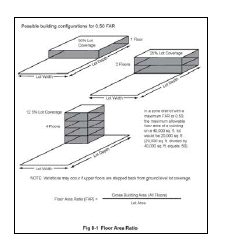
"Floor area ratio (FAR)" is the ratio of floor area to total lot area. FAR restrictions are used to limit the maximum floor area allowed on a site (including all structures on the site). The maximum floor area of all structures (measured from exterior wall to exterior wall) permitted on a site (including residential carports) shall be determined by multiplying the Floor Area Ratio (FAR) by the total net area of the site (FAR x Net Site Area = Maximum Allowable Floor Area). FAR for non-residential projects shall apply to the gross area of all functional and habitable floors of all structures and shall not apply to supporting parking facilities (open parking lots or structures) which provide required off-street parking in accordance with Section 17.28. Carports and private garages shall be included as part of the FAR for projects located in the Old Topanga and Calabasas Highlands Overlay zones.
"Footcandle" means, for the purposes of Chapter 17.27, a unit of measure for illuminance on a surface that is everywhere one foot, from a uniform point of light of one candle and equal to one lumen per square foot.
"Fortunetelling" means and includes the telling of fortunes, forecasting of fortunes or futures, or furnishing of any information not otherwise ordainable by ordinary process of knowledge, by means of occult, psychic power, clairvoyance, clairaudience, cartomancy, phrenology, spirits, tea leaves, or other such reading, telepathy, or other craft, art, science, cards, talisman, charm, potion, magnetism, magnetized ordinance or substance, gypsy cunning or foresight, crystal gazing, oriental mysteries or magic, or other similar means, of any kind or nature for any form of consideration.
Front Property Line. See "Lot line or property line."
"Fuel modification area" means an area where the volume of flammable vegetation has been reduced by thinning and the removal of dead material, on both sides of a driveway or road for a depth of ten (10) feet on each side, to provide for reduced fire intensity and duration.
"Full cut-off" means, for the purposes of Chapter 17.27, a lighting fixture that by design of the housing does not allow any light dispersion or direct glare to shine above a horizontal plane from the base of the fixture. Full cut-off fixtures must be installed in a horizontal position as designed in order to achieve cut-off.
G.
Definitions, G. The following definitions are in alphabetical order.
"Garage or carport" means covered parking space for automobiles or other vehicles, where the size of the parking space complies with the provisions of Section 17.28.070. A garage is a structure with a door, enclosed on four sides; a carport has no door, and is enclosed on two or fewer sides.
"General Plan" means the City of Calabasas General Plan, including all elements thereof and all amendments thereto, as adopted by the Council under the provisions of Sections 65300 et seq. of the Government Code, and referred to in this development code as the "General Plan."
Geotechnical Engineer. See "Soils engineer."
"Glare" means, for the purposes of Chapter 17.27, visual discomfort experienced from high contrast. Glare is categorized into three levels. These levels are based on the contrast ratio as follows:
1.
"High glare sources" means a brightly lighted surface where the contrast ratio exceeds thirty (30) to one.
2.
"Medium glare sources" means brightly lighted surfaces where the contrast ratio exceeds ten (10) to one, but is less than thirty (30) to one.
3.
"Low glare sources" means illuminated surfaces where the contrast ratio exceeds three to one, but is less than ten (10) to one.
"Grade" means the vertical location of the ground surface.
1.
"Existing or natural grade" means the contour of the existing topography excluding any cut and/or fill.
2.
"Finish grade" means the final grade of the site that conforms to an approved grading plan and grading permit.
"Grading" means any excavating or filling or combination thereof.
"Gross floor area" means the total area in square feet of all floors in all buildings on a site, including all area within the exterior surfaces of the exterior walls.
Guesthouse. See "Secondary housing unit."
H.
Definitions, H. The following definitions are in alphabetical order:
Habitat linkage" means large, regional (landscape level) connections between habitat blocks (core areas) meant to facilitate animal movements and essential genetic flows between different sections of the landscape. These linkages are not necessarily currently constricted, but are essential to maintain connectivity function in the ecoregion.
"Hedge". See "shrub/hedge".
"Historic district" means any district designated pursuant to Section 17.36.050(c) or (E).
"Historic landmark" means any landmark designated pursuant to Section 17.36.050(B) or (E).
"Historic landscape" means any landscape district designated pursuant to Section 17.36.050(D).
"Historical resources" means improvements, buildings, structures, signs, features, historic districts, conservation zones, trees, or other objects of cultural, architectural, or historical significance to the citizens of Calabasas and the state of California, the Southern California region, or the nation, which have been determined to be eligible for nomination or designation by the historic preservation commission, or by the council on appeal, pursuant to the provisions of Chapter 17.36.
"Hobby farm" means a parcel of land where farm animals are raised and/or garden crops are grown (fruits, vegetables, flowers and tree nuts) in a manner incidental to a principal residential use of the property.
"Home occupation" means the gainful employment of the occupants of a dwelling, with the business activity being subordinate to the residential use of the property, with no display, or commodity sold on the premises except as provided by Section 17.12.100 and no persons employed other than residents of the dwelling.
"Hotel or motel" means guest rooms or suites, provided with or without meals or kitchen facilities, rented to the general public for overnight or other temporary lodging (less than thirty (30) days). Hotels provide access to most guest rooms from an interior walkway. Motels provide access to most guest rooms from an exterior walkway. Also includes accessory guest facilities such as swimming pools, tennis courts, indoor athletic facilities, accessory retail uses, and other such facilities.
"Household pets" means the raising or keeping of birds, cats, dogs or other common household pets, and other animals determined by the director to have similar space and sanitation requirements, and noise characteristics, accessory to a residential use.
"Hydrozone" means a portion of the landscaped area having plants with similar water needs. It may be irrigated or non-irrigated. When irrigated, a hydrozone is served by a valve or set of valves with the same schedule.
I.
Definitions, I. The following definitions are in alphabetical order:
"Illuminance" means, for the purposes of Chapter 17.27, means a measure of light energy incident at a specific point on a surface over a specified area. The unit for this quantity is the footcandle (fc).
"Improvement" means any street work and utilities to be installed, or agreed to be installed, by the applicant/developer on the land to be used for public or private streets, highways and easements, as are necessary for the general use of site occupants, lot owners in a subdivision and/or local neighborhood traffic and drainage needs as a condition of a land use permit or precedent to the approval and acceptance of a final map. Improvement also refers to any other improvements, the installation of which, either by an applicant, by public agencies, by private utilities, or by any other entity, is necessary to ensure consistency with, or implementation of, the General Plan or any applicable specific plan.
"Improvement" means, for purposes of Chapter 17.36, any building, structure, fence, gate, tree, wall, or other specified object constituting a historical physical feature of real property, or any part of such feature.
"Infinity pool" means a swimming pool which produces a visual effect of water extending to the horizon, vanishing, or extending to "infinity".
"Initial study" means an analytic document used to determine the significance of various environmental effects that may result from a proposed action, prepared in compliance with the California Environmental Quality Act (CEQA). The initial study determines whether an EIR or negative declaration shall be prepared.
"Intermittent stream" means a stream that typically has sustained flows for multiple days only during the wet season.
J.
Definitions, J. No definitions of terms beginning with the letter "J" are used at this time.
K.
Definitions, K. The following definitions are in alphabetical order:
"Kiosk" means a free-standing structure erected on a foundation and designed to provide advertising space for a group of buildings in a shopping center addressing a pedestrian audience.
1.
"Digital kiosk" is a kiosk which, in addition to exhibiting the standard characteristics of a kiosk, incorporates one or more digital display screens to convey information visually to passers-by.
2.
"Nondigital kiosk" shall mean a kiosk without any moving pictures or digital displays.
"Kitchen" means any room or portion of room wherein food is prepared, cooked, served or consumed. A kitchen often contains, but need not contain, installations and appliances (collectively "facilities") for the preparation, cooking and/or serving of food, such as a sink, a refrigerator, a stove, range, grill, oven or microwave, or any combination thereof.
L.
Definitions, L. The following definitions are in alphabetical order:
"Land Use" means the type of activity or purpose for which land or building is occupied, arranged designed or intended, or for which either land or building is or may be occupied or maintained, as approved by the city.
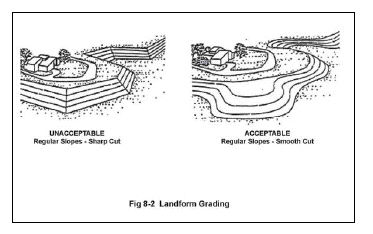
"Landform grading" means a contour grading method which creates artificial slopes with curves and varying slope ratios in the horizontal and vertical planes designed to simulate the appearance of surrounding natural terrain. See Figure 8-2.
"Landscape area" means a planted area in addition to all hardscape elements including, decks, pools, patios, sidewalks, etc., but does not include building structures, parking lots, driveways and streets.
"Land use" means and includes any purpose for which land is dedicated, developed, devoted or improved, and all other activities that occur, are conducted or maintained on unimproved or improved land, or within any structure thereon. "Land Use" includes any type of purpose or activity that is permitted, regulated or prohibited by this development code.
"Land use permit" means any of the entitlements established by Article V, including zoning clearance (Section 17.62.090), site plan review (Section 17.62.020), temporary use permits (Section 17.62.030), minor use permits (Section 17.62.040), conditional use permits (Section 17.62.060), development plans (Section 17.62.070), variances (Section 17.62.080) and oak tree permits (Chapter 17.32).
Large Family Day Care Home. See day care facilities."
"Lawfully built" means a structure that was built in compliance with applicable city, county, state and federal laws and regulations in existence at the time of construction.
"Leq" means the energy equivalent level, defined as the average sound level on the basis of sound energy (or sound pressure squared). The Leq is a "dosage" type measure and is the basis for the descriptors used in such standards as the 24-hour Community Noise equivalent Level (CNEL).
"Light fixture" means for the purposes of Chapter 17.27, an electrical device used to create artificial light or illumination. A light fixture includes the light source or lamp, a mounting bracket or pole socket, a pole on which the light is supported, the reflector or directing the light, an aperture (with or without a lens), the outer shell or housing for lamp alignment and protection, an electrical ballast, if required, and connection to a power source.
"Light pollution" means, for the purposes of Chapter 17.27, any artificial light which causes a detrimental effect to the environment, night sky, undesirable glare, or light trespass.
"Light pole" means, for the purposes of Section 17.12.050, means a single or segmented structure, with a single continuous footing, that is not stabilized by guy wires, and has only a light fixture attached.
"Light trespass" means, for the purposes of Chapter 17.27, artificial light that produces an unnecessary and unwanted illumination of the public right-of-way or adjacent property.
"Liquor store" means a retail use which sells beer, wine, and distilled spirits to a customer for consumption off the premises and which needs a State of California Alcoholic Beverage Control License Type 21 (off-sale general). This definition shall not include a grocery store, drug store or convenience market where fifty (50) percent or less of the sales floor area, are alcoholic beverages.
"Live entertainment" means a use which includes but is not limited to disc jockey, live bands, comedians, theater for the performing arts, and other forms of entertainment which include live performances at a commercial establishment, provided that the following shall not be consider live entertainment for the purposes of Title 17:
1.
Adult use live entertainment establishments which are subject to the requirements of Section 17.12.025; or
2.
Performances by one or two performers with no voice or instrument amplifications.
3.
Recorded music played over a speaker system as background music, and not delivered by a disc jockey.
"Local street" means streets that have no through traffic function and provide property access only.
"Loss" means, with respect to oak trees, tangible or intangible diminished existence of the ecosystem, aesthetics, and view shed, and historical or irreplaceable value.
"Lot" means and includes the following:
1.
A parcel of real property shown on a subdivision or plat map, required by the Subdivision Map Act or this development code to be recorded before the sale of parcels shown on the map or plat, at the time the map was recorded;
2.
A parcel of real property that has been issued a certificate of compliance as provided by Government Code Section 66499.35 and Chapter 17.44 of this development code; or
3.
A parcel of real property not described in subdivision (1) or (2) above, provided the parcel resulted from a separate conveyance or from a decree of a court of competent jurisdiction which was on record before the requirement of the filing of a subdivision map by the Subdivision Map Act or this development code.
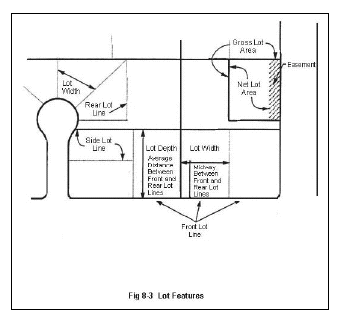
Lot Area. "Gross lot area" is the total area included within the lot lines of a lot, exclusive of adjacent dedicated street rights-of-way. "Net lot area" is exclusive of easements, including those for utilities or flood control channels, which limit the use of the lot.
"Lot line" or "property line" means any recorded boundary of a lot. Types of lot lines are as follows (see Figure 8-3, Lot Features):
1.
"Front lot line," on an interior lot, means the property line separating the parcel from the street. The front lot line on a corner lot is the line with the shortest frontage. (If the lot lines of a corner lot are equal in length, the front lot line shall be determined by the director.) On a through lot, both lot lines adjacent to the street are front lot lines and the lot is considered to have no rear lot line.
2.
"Interior lot line" means any lot line not abutting a street.
3.
"Rear lot line" means a property line that does not intersect the front lot line, which is most distant from and most closely parallel to the front lot line.
Lot Depth, Location of Yards. The measurement of lot depth and the location of required yards are illustrated in Figure 8-3, Lot Features.
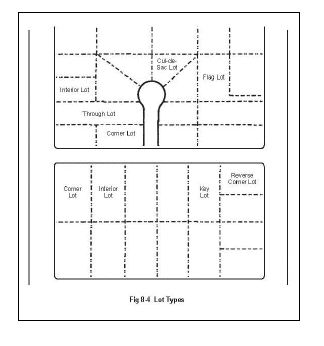
Lot Types. Types of lots include the following. See Figure 8-4.
1.
"Corner lot" means a lot located at the intersection of two or more streets where they intersect at an interior angle of not more than one hundred thirty-five (135) degrees. If the intersection angle is more than one hundred thirty-five (135) degrees, the lot is considered an interior lot.
2.
"Flag lot" means a lot having access to a public street by means of private right-of-way strip that must be owned in fee.
3.
"Interior lot" means a lot abutting only one street.
4.
"Key lot" means an interior lot, the front of which adjoins the side property line of a corner lot.
5.
"Reverse corner lot" means a corner lot, the rear of which abuts a key lot.
6.
"Through lot" means a lot with frontage on two generally parallel streets.
"Lot width" means the horizontal distance between the side lot lines, measured at right angles to the lot depth at a point midway between the front and rear lot lines. See Figure 8-3, Lot Features. The director shall determine lot width for parcels of irregular shape.
"Luminance" means, for the purposes of Chapter 17.27, a measure of light energy reflected from a specific surface in a specific direction over a standard area. The unit for this quantity is the footlambert (fL).
"Luminance ratio" means, for the purposes of Chapter 17.27, the relationship between the maximum and minimum luminance values over an area. Uniform ratios close to one indicate an area with even brightness. Large ratios indicate areas with high glare.
M.
Definitions, M. The following definitions are in alphabetical order.
"Major construction project" means a construction project on a lot within the Old Topanga Overlay Zone, Calabasas Highland Overlay Zone, or the Park Moderne Overlay Zone involving one or more of the following: (i) site grading of fifty (50) cubic yards or more; (ii) construction or installation of an in-ground swimming pool; or (iii) addition of four hundred (400) square feet or more of habitable area. A major construction project does not include: (iv) reconstruction of any structure damaged by a fire, flood, or natural disaster that does not increase the pre-damage habitable area by four hundred (400) square feet or more; (v) construction or other work required to comply with another requirement of this Code; or, (vi) a project conducted by or on behalf of a government agency.
Map Act. See "Subdivision Map Act."
"Medical marijuana dispensary" means a facility where marijuana is made available for medical purposes in accordance with Health & Safety Code Section 11362.5. The word "marijuana" shall have the same meaning as the definition of that word in Health & Safety Code Section 11018.
"Mills Act contract" means a property contract entered into between the city and a property owner that provides for lower property taxes in return for the rehabilitation, restoration, and preservation of a qualified historical property pursuant to California Government Code Section 50280, et seq.
"Mitigated negative declaration" means a written statement issued by the city, describing the reasons that a proposed project will not have a significant adverse effect on the environment, including mitigation measures incorporated into the proposed design and/or operation of the project that will avoid, eliminate, reduce, or minimize environmental impacts identified through the process of project review, and therefore does not require the preparation of an EIR, in compliance with the California Environmental Quality Act (CEQA). See also "Negative declaration."
"Mixed use development" means the development of a site or structure with two or more different land uses, including a combination of residential, office, retail, public, manufacturing or entertainment in a single or physically integrated group of structures.
"Mobilehome park" means any site that is planned and improved to accommodate two or more mobilehomes used for residential purposes, or on which two or more mobilehome lots are rented, leased, or held out for rent or lease, or were formerly held out for rent or lease and later converted to a subdivision, cooperative, condominium or other form of resident ownership, to accommodate mobilehomes used for residential purposes.
"Monopole" means a single or segmented structure, with a single continuous footing, that is not stabilized with guy wires, and has antennas attached.
Motel. See "Hotel or motel."
"Multifamily housing" means and includes a building or a portion of a building used and/or designed as residences for two or more families living independently of each other. Includes: duplexes, triplexes, fourplexes (buildings under one ownership with two, three or four dwelling units, respectively, in the same building); apartments (five or more units under one ownership in a single building); townhouse development (three or more attached single-family dwellings where no unit is located over another unit); senior citizen multifamily housing; and common ownership attached unit projects such as condominiums.
"Multiple trunk" means more than one trunk growing from a tree's root system, with the aggregate diameters totaled, deemed to equal one tree.
"Municipal Code" means the City of Calabasas Municipal Code, as it may be amended from time to time.
N.
Definitions, N. The following definitions are in alphabetical order.
"National Pollutant Discharge Elimination System (NPDES)" means the National Pollutant Discharge Elimination System established by Section 402 of the Clean Water Act, 33 U.S.C. Section 1342, as it may be amended from time to time.
"Native landscaping or plant" means any plant which is a member of a species which was present at a given site prior to European contact.
"Negative declaration" means a written statement issued by the city, describing the reasons that a proposed project will not have a significant adverse effect on the environment, and therefore does not require the preparation of an EIR, in compliance with the California Environmental Quality Act (CEQA). See also "Mitigated negative declaration."
"Night clubs" means any bar, cocktail lounge, discotheque or similar establishment which provides live entertainment n conjunction with alcoholic beverage sales.
"Nonconforming lot" means a lot of record that was legally created, but does not conform to the provisions of this development code because the lot is of a size, shape, or configuration no longer allowed in the zoning district that applies to the site, as a result of amendments to this development code.
"Nonconforming structure" means a structure that was legally constructed, but does not conform to the provisions of this development code because amendments to the development code made the structure nonconforming in its size, type of construction, location on its site, separation from other structures, number of parking spaces provided, or other features.
"Nonconforming use" means a use of land (and/or within a structure) that was legally established, but does not conform with the provisions of this development code because the use is no longer allowed in the zoning district that applies to the site, as a result of amendments to this development code. A use that does not conform to the development standards (e. g. parking, loading, landscaping and sign regulations) of the zoning district in which it is located shall not be deemed a nonconforming use.
"Noncontributing resource" means, for purposes of Chapter 17.36, any improvement, building, structure, sign, feature, tree, or other object that does not add to the historical, architectural, or cultural significance of a district.
O.
Definitions, O. The following definitions are in alphabetical order.
"Oak tree" means any protected oak tree of the genus Quercus, including Valley Oak (Quercus lobata) and California Live Oak (Quercus agrifolia) measuring four inches dbh (diameter at breast height) or greater and Scrub Oak (Quercus dumosa or Quercus berberidifolia), having a diameter greater than one inch when measured twelve (12) inches above grade.
"Oak tree permit" means a permit issued by the city in compliance with Section 17.26.070 of this title.
"Oak Tree Preservation and Protection Guidelines" means the guidelines adopted by council resolution 91-36, as amended, on file with the city clerk, or the most recently adopted council resolution replacing them. This document may be referred to as the "Guidelines."
"Oak Tree Report" means a report prepared by a licensed arborist, landscape architect or other licensed consultant specializing in oak tree preservation and approved by the city that contains specific information on the location, condition, potential impacts of development, recommended actions and mitigation measures regarding one or more scrub oak or oak trees on an individual lot or project site.
"Oak woodlands" means an area of land containing at least ten (10) percent ground coverage of the genera Quercus (i.e.: with single trunk diameters greater than six inches at DBH or if multi-trunked, eight composite inches at DBH with no trunk less than two inches in diameter) and total oak canopy coverage of a minimum of one acre, not surrounded by or heavily influenced by urban development such as structures or roads, and where the understory has not been permanently disturbed by structures or roads.
"Object" means, for purposes of Chapter 17.36, a material thing of historical, cultural, or architectural value.
"Occupancy" means all or a portion of a structure occupied by one tenant.
"Ordinary maintenance and repair" means, for purposes of Chapter 17.36, any work for which a building permit is not required by law, where the purpose and effect of such work is to correct any deterioration of or damage to a structure or any part thereof, and to restore the same to its condition prior to the occurrence of such deterioration or damage.
"Original parcel" means a contiguous area of land under one ownership at the time of division, which is proposed for division under Article IV of this development code.
P.
Definitions, P. The following definitions are in alphabetical order.
"Parcel map" means the map described by Article 3, Chapter 2 of the Subdivision Map Act, which is required by Article IV of this development code to complete a subdivision of four or fewer lots.
Parcel. See "Lot."
"Perennial stream" means a stream that flows for most or all of the year within a well defined channel.
"Permeable paving" means any paving material or paving system that permits water penetration to a soil depth of eighteen (18) inches or more. Paving systems may include combinations of nonporous surface material poured or laid in distinct and separate sections installed in combination with permeable materials (examples include crushed stone, gravel or equivalent) such that at least two-thirds of the total surface area of the system permits water penetration to a soil depth of eighteen (18) inches or more. Permeable paving systems that require drainage to the curb or direct connection to the storm drain system do not qualify as permeable paving. Engineered paving systems under this definition include interlocking concrete pavers installed to comply with the standard from the American Society of Civil Engineers (ASCE) - Standard 68-18 for Permeable Interlocking Concrete Pavement, or an equivalent standard for interlocking concrete pavers may be adopted by Resolution by the city council. Individual paving units must have a minimum surface open area void space of five percent and a minimum in-service infiltration rate of not less than ten (10) inches per hour and complying with ASTM Standard C1781 - Standard Test Method for Surface Infiltration Rate of Permeable Unit Pavement Systems, or an equivalent standard as may be adopted by resolution by the city council. Alternative designs, which meet infiltration testing in accordance with ASTM Standard C1781, or an equivalent standard as may be adopted by resolution by the city council, may be considered subject to review and approval by the director. Any permeable paving system must be certified by a licensed civil engineer, landscape architect, or other qualified, licensed professional, as meeting the requirements of this definition.
"Permitted use" means any use allowed in a zoning district and subject to the restrictions applicable to that zoning district.
"Person" means any individual, firm, co-partnership, corporation, company, association, joint stock association; city, county, state or district; and includes any trustee, receiver, assignee or other similar representative thereof.
"Personal wireless telecommunication facility," "wireless communication facility" or "wireless communication facilities" has the meaning set forth in Section 17.12.050(L) of this title.
"Pervious surface" means those portions of a property or site that allow for water penetration into the soil, to a soil depth of eighteen (18) inches or more, such as landscaped areas, natural areas, and developed hardscape areas where permeable paving has been used or which otherwise includes storm water runoff features consistent with Calabasas Municipal Code Chapter 17.26. Pervious surfaces may not be covered with structures that prevent water penetration into the soil, to a depth of at least eighteen (18) inches.
Planning commission. See "commission."
"Planted area" means the total area of a site containing only plants and natural landscaping and not covered by buildings, parking lots, driveways, patios, plazas, or other structures.
"Pool house" means a building with a toilet, sink, and shower used as a changing and rinsing facility in conjunction with a swimming pool.
"Portable storage container" means portable, weather-resistant receptacle designed and used for the storage or shipment of household goods, wares, building materials or merchandise.
"Preferential parking" means parking spaces designated or assigned, through use of a sign or painted space markings, for carpool and vanpool vehicles carrying commute passengers on a regular basis that are provided in a location more convenient to a place of employment than parking spaces provided for single occupant vehicles.
"Preservation" means, for purposes of Chapter 17.36, the identification, study, protection, restoration, rehabilitation, or acquisition of historical resources.
"Primary structure" means a structure that accommodates the primary use of the site.
"Primary use" means the main purpose for which a site is developed and occupied, including the activities that are conducted on the site a majority of the hours during which activities occur.
"Professional medical office" means the business office operated and occupied by a licensed and practicing medical professional, such as a doctor, psychologist, psychiatrist, ophthalmologist, or dentist, and where the practicing medical professional normally consults with, examines and treats patients, and conducts the everyday operational functions of the business. This use does not include medical clinics, surgical centers, and laboratories.
Property Line. See "Lot line" or "property line."
"Property owner" means the legal owner(s) of a lot.
"Proposed parcel(s)" means each separate parcel shown on a tentative map or lot line adjustment, as proposed by an applicant.
"Protected zone" means a defined area surrounding an oak tree within which work activities are strictly controlled. When shown on a map, the outermost edge of the protected zone will appear as an irregular shaped circle that follows the outline of the drip line of the tree. Using the drip line as a point of reference, the protected zone shall commence at a point five feet outside of the drip line and extend inward to the trunk of the tree. The protected zone shall be no less than fifteen (15) feet from the trunk of an oak tree or fifty (50) feet from the trunk of a heritage oak or five outside of a mass growth of scrub oak.
"Public right-of-way" means a street or highway owned and maintained by the city or the state.
"Public road" means a street or highway owned and maintained by the city, the county, the state, or federal government.
Q.
Definitions, Q. The following definitions are in alphabetical order.
"Queue jump" means a type of roadway geometry typically found in bus rapid transit systems. It consists of an additional travel lane on the approach to a signalized intersection. This lane is often restricted to transit vehicles only, though some variation may permit bicyclists, mopeds, and motorcycles. The intent of the lane is to allow the high-capacity vehicles to cut to the front of the queue, reducing the delay caused by the signal and improving the operational efficiency of the transit system.
R.
Definitions, R. The following definitions are in alphabetical order.
"Radome" means a structural weatherproof enclosure that protects an antenna.
"Reclaimed water" means tertiary treated waste water of a quality suitable for non-potable uses such as landscape irrigation.
"Reconstruction" means, for the purposes of Chapter 17.24, all alterations or repairs made to a commercial building within any twelve-month period which alterations or repairs exceed fifty (50)) percent of the value of an existing commercial building. Reconstruction necessitated by earthquake damage, other natural disasters, or acts of God shall be exempt from this definition.
"Recreational vehicle" means a vehicle or trailer which is capable of human habitation or designed or used for recreational camping or travel use, whether self-propelled or mounted on or drawn by another vehicle, or any structure inspected, approved and designated a recreational vehicle by and bearing the insignia of the state of California or any other state or federal agency having the authority to approve recreational vehicles. For the purposes of this chapter, the following vehicles shall be considered recreational vehicles: (i) Camp trailer, per California Vehicle Code Section 242; (ii) Fifth-wheel travel trailer, per California Vehicle Code Section 324; (iii) House car, per California Vehicle Code Section 362; (iv) Trailer coach, per California Vehicle Code Section 635; (v) Mobilehome, per California Vehicle Code section 396; (vi) Boat, watercraft, and/or boat/watercraft trailer; (vii) Trailers designed for the carrying of persons or property or animals on its own structure and for being drawn by another motor vehicle; and (viii) Recreational vehicle, per California Health and Safety Code section 18010.
Recycling Facilities.
1.
"Collection facility" means a center for the acceptance by donation, redemption or purchase of recyclable materials from the public, which may include the following:
a.
Reverse vending machine(s);
b.
Small collection facilities which occupy an area of five hundred fifty (550) square feet or less and may include:
i.
A mobile unit,
ii.
Bulk reverse vending machines or a grouping of reverse vending machines occupying more than fifty (50) square feet, and
iii.
Kiosk-type units which may include permanent structures;
c.
Large collection facilities which may occupy an area of more than five hundred fifty (550) square feet and may include permanent structures.
2.
"Recycling facility" means a center for the collection and/or processing of recyclable materials. A certified recycling facility or certified processor is certified by the California Department of Conservation as meeting the requirements of state law (California Beverage Container Recycling and Litter Reduction Act of 1986). A recycling facility does not include storage containers located on a residential, commercial or industrial designated parcel used solely for the recycling of material generated on the parcel.
3.
"Recycling or recyclable material" means reusable domestic containers including glass, metals, paper and plastic which are intended for reconstitution, remanufacture or reuse f in an altered form. Recyclable material does not include refuse or hazardous materials.
4.
"Reverse vending machine" means an automated mechanical device which accepts at least one or more types of empty beverage containers including to aluminum cans, glass and plastic bottles, and issues a cash refund or a redeemable credit slip with a value not less than the container's redemption value as determined by state law. A reverse vending machine may sort and process containers mechanically provided that the entire process is enclosed within the machine. In order to accept and temporarily store all container types in a proportion commensurate with their relative redemption rates, and to meet the requirements of certification as a recycling facility, multiple grouping of reverse vending machines may be necessary.
A bulk reverse vending machine is a reverse vending machine that is larger than fifty (50) square feet, is designed to accept more than one container at a time and will pay by weight instead of by container.
"Replacement", for the purposes of Chapter 17.27, means to put something new in place of and shall include any or all of the components that make up a light fixture.
"Residential accessory uses and structures" means and includes any use that is customarily part of, and clearly incidental and secondary to a residence and does not change the primarily residential character of the residential use. These uses include accessory structures (e.g., garages, gazebos, greenhouses, spas and hot tubs, studios, storage sheds, swimming pools, tennis courts, workshops, other on-site sport courts, and other similar residential facilities). This term does not include secondary housing units or accessory dwelling units, which are defined separately. Lawfully operated home occupations, permitted under Section 17.12.100 are also allowed residential accessory uses. Residential accessory uses do not include any short-term or transient rental or occupancy of any residential property or a portion thereof located in the city for any purpose, including but not limited to a vacation, for less than thirty (30) days if that rental or occupancy occurs in exchange for any form of compensation or consideration. A bed and breakfast inn requires separate permits under the Calabasas Municipal Code section and is not a residential accessory use.
"Residential care homes" means facilities providing residential social and personal care for children, the elderly, and people with some limits on their ability for self-care, but where medical care is not a major element. Includes: children's homes; halfway houses; orphanages; rehabilitation centers; self-help group homes and hospices. Convalescent homes, nursing homes and similar facilities providing medical care are included under a separate land use.
Residential Density. See "Density."
"Residential zone" or "zoning district" means any of the residential zoning districts established by Section 17.10.010 of this development code.
Restaurant, Counter Service. "Counter service restaurant" means franchised or independently-operated restaurants where customers are served prepared food from a walk-up ordering counter for either on- or off-premise consumption. A restaurant with drive-up or drive-through service is instead included under the definition of "Drive-in and drive-thru sales."
Restaurant, Table Service. "Table service restaurant" means a retail business selling food and beverages prepared on the site, where most customers are served food at tables for on-premise consumption. These restaurants may also provide food on a take-out basis where take-out is clearly secondary to table service.
"Review authority" means the individual or official city body (the development review committee, community development director, commission or council) identified by this development code as having the responsibility and authority to review, and approve or disapprove the subdivision applications described in Article IV, permits described in Article V, and appeals and amendments described in Article VI.
"Ridgeline" means a line connecting the highest points along a ridge and separating drainage basins or small-scale drainage systems from one another.
"Ridgeline, significant" means those ridgelines depicted on Figure III-4 of the General Plan Open Space Element.
"Riparian" means lands that are comprised of the vegetative and wildlife areas adjacent to perennial and intermittent streams. Riparian areas are delineated by the existence of plant species normally found near freshwater.
"Rooming and boarding houses" means the renting of individual bedrooms within a dwelling to three or more people, whether or not meals are provided; or a single-family dwelling occupied by six or more unrelated people, living together as a single housekeeping unit.
"Routine maintenance" means, with respect to oak trees, actions taken for the continued health of an oak tree such as dead wooding. In special cases fertilization, insect control, limited watering and ground aeration may also be warranted. Routine maintenance shall not include pruning.
"Rural" means an area characterized by a non-urban or agricultural environment at low densities without typical urban services. Urban services and facilities not normally found in rural areas include curbs, gutters, sidewalks, street lighting, landscaping, and commercial centers dependent on large consumer volumes, such as regional shopping centers.
S.
Definitions, S. The following definitions are in alphabetical order.
"Scrub oak habitat" means either of two separate oak species that form a thicket, three or more, of shrubs or small trees, including Quercus dumosa (Coastal Shrub) and Quercus berbberidifolia (Inland Scrub).
"Secondary housing unit" means a second permanent dwelling that is accessory to a primary dwelling on the same site. For the purposes of Title 17, a guess house shall be considered a secondary housing unit. A secondary housing unit provides complete, independent living facilities for one or more persons, including permanent provisions for living, sleeping, eating, cooking and sanitation.
"Secretary of the Interior Standards for the Treatment of Historic Properties" means the most current version of the standards and guidelines prepared by the National Park Service for the preservation, rehabilitation, restoration and reconstruction of historic buildings.
"Senior citizen" means a person fifty-five (55) years of age or older.
"Senior residential projects" means a multifamily housing project providing housing for senior citizens (fifty-five (55) years of age or more) in an independent living environment.
"Service station" means a retail business selling gasoline or other motor vehicle fuels, which may also provide vehicle engine maintenance and repair services incidental to fuel sales.
"Setback" means the distance by which a structure, parking area or other development feature must be separated from a lot line, other structure or development feature, or street centerline. See also "Yard".
"Shielding" means, for the purposes of Chapter 17.27, a technique or method of construction or manufacture that prevents any light dispersion to shine beyond the horizontal plane from the light emitting point of a fixture. The light emitting, reflecting, or refracting components of the light fixture, (i.e., lamp, lens, and reflective surface), shall not extend beyond the shielding of the fixture. Any structural part of the light fixture providing this shielding shall be permanently affixed to the light fixture.
"Shrub/hedge" means a plant or number of plants with a compact growth habit and branches coming from the base of the plant cultivated and maintained in a linear fashion to form a barrier similar to a fence or wall. Mature heights of shrubs/hedges may vary from one foot to fifteen (15) feet depending on their species and landscape application.
"Shopping center" means a group of retail stores and similar complementary commercial establishments on a site, planned and built as a coordinated unit with shared pedestrian and vehicular circulation and off-street parking.
"Sign" means any visual device or representation (written or pictorial) used to convey information, or to identify, announce, or otherwise direct attention to a premise, product, service, person, organization, business or event, and placed on, suspended from, or in any way attached to, any structure, vehicle or landscape feature. The following are definitions related to signs:
1.
"Abandoned sign" means a sign that identifies a business, lessor, owner, product, service, or activity which has been discontinued on the premises for a period of ninety (90) days or more.
2.
"Address sign" means the numeric reference of a structure or use to a street, included as part of a wall or monument sign.
3.
"Animated or moving sign" means any sign which uses movement, lighting or special materials to depict action or create a special effect or scene.
4.
"Awning or canopy sign" means a sign located on a roof-like cover that projects from the wall of a building for the purpose of shielding a doorway or window from the elements.
5.
"Balloon" means an object made of an airtight material, no greater than eighteen (18) inches in diameter at its widest point, filled with air or gas and used as a sign.
6.
"Banner" means a strip of cloth, thin plastic or other flexible material on which a sign is painted, printed, or otherwise displayed.
7.
"Bench sign" means copy painted on any portion of a bus stop bench.
8.
"Billboard or off-site sign" means a sign structure advertising an establishment, merchandise, service, or entertainment, which is not sold, produced, manufactured or furnished at the property on which the sign is located.
9.
"Building-mounted or wall sign" means a sign painted on or fastened to a building wall, and which does not project more than twelve (12) inches from the wall.
10.
"Cabinet sign" or "can sign" means a sign that contains all the text and/or logo symbols within a single enclosed cabinet and may or may not be illuminated.
11.
Canopy sign. See "Awning sign."
12.
"Channel letters" means three-dimensional individually cut letters or figures, illuminated or non-illuminated, affixed to a structure.
13.
"Civic event sign" means a temporary sign, other than a commercial sign, posted to advertise a civic event sponsored by a public agency, school, church, civic-fraternal organization, or similar noncommercial organization.
14.
"Commercial copy or commercial message" means a message displayed on a sign which pertains primarily to the name, location, products or proposed economic transactions of any services or activities carried on for profit or gain.
15.
"Construction sign" means a temporary sign erected on the parcel on which construction is taking place, limited to the duration of the construction, indicating the names of the architects, engineers, landscape architects, contractors or similar artisans, and the owner, financial supporters, sponsors, and similar individuals or firms having a major role or interest with respect to the structure or project.
16.
"Decorative graphics" means any graphic symbol, logo, monogram, words treated as a graphic image or other symbolic device that identifies the specific business, products or services offered on the premises, or which relates to the contents of the building-mounted sign.
17.
"Directional sign" means an on-site sign which is designed and erected solely for the purposes of directing vehicular and/or pedestrian traffic within a project.
18.
"Directory sign" means a sign for listing the tenants or occupants and their suite numbers of a structure or center.
19.
"Double-faced sign" means a single structure monument sign located perpendicular to the street.
20.
"Flag" means the official flag of a government, religious group or other organization.
21.
"Flashing sign" means a sign that contains an intermittent or sequential flashing light source.
22.
"Freestanding sign" means a sign which is erected or mounted on its own self-supporting permanent structure or base detached from any supporting elements of a building.
23.
"Freeway facing sign" means a building mounted sign that is located (a) on a site that directly abuts the 101 Freeway and (b) is located on the one side of the building that is generally parallel to the freeway.
24.
"Gateway sign" means two (2) monument signs flanking a private access driveway located off a public right-of-way and matching in size, design, and sign area.
25.
"Illegal sign" means a sign that was not established or is not being maintained in compliance with the applicable provisions of the Los Angeles County Zoning Code or this chapter that applied to the sign at the time it was installed.
26.
"Illuminated sign" means a sign with an artificial light source incorporated internally or externally for the purpose of illuminating the sign.
27.
"Inflatable sign" means an object made of an airtight material, generally greater than eighteen (18) inches in diameter at its widest point, filled with air or gas to form a three-dimensional shape and used as a sign.
28.
"Institutional sign" means a sign identifying the premises of a church, school, hospital, rest home, or similar institutional facility.
29.
"Kiosk" means a free standing structure erected on a foundation and designed to provide advertising space for a group of buildings in a shopping center addressing a pedestrian audience.
30.
"Logo sign" means an established trademark identifying the use of a structure.
31.
"Marquee sign" means a sign designed to have changeable copy. Marquee signs may be a freestanding sign or a wall sign.
32.
"Menu board" means a permanently mounted sign displaying the bill of fare for a drive-through restaurant.
33.
"Monument sign" means a free-standing sign permanently affixed to the ground by a solid base or by supports so that the sign face, in its entirety, is situated above and between the outermost edges of the supporting base or support structures, and so that the open space, if any, beneath the sign face is not greater than one-fifth the overall sign height.
34.
"Neon sign" means a sign with tubing that is internally illuminated by neon or other electrically charged gas.
35.
"Non-appurtenant sign" means any sign which does not relate to, or which relates only incidentally to, the occupant of the site or the principal business conducted within the structure.
36.
"Noncommercial copy" means a message that does not include commercial copy.
37.
"Nonconforming sign" means an advertising structure or sign which was lawfully erected and maintained prior to the adoption of this Zoning Ordinance, and which has subsequently come under the requirements of this Zoning Ordinance, but does not now completely comply.
38.
"Open/closed sign" means an "open" or "closed" window sign.
39.
"Open house sign" means a temporary sign posted to indicate a salesperson is available to represent the property subject to sale, lease or rent.
40.
"Pedestrian sign" means an identification and/or directional sign designed and located primarily to inform pedestrians. These signs are usually mounted or suspended from the underside of an eave or canopy, perpendicular to an adjacent store front.
41.
"Pennants," "streamers," and "flags" means any cloth, bunting, plastic, paper, or similar non-rigid material used for advertising purposes attached to any structure, staff, pole, line, framing or vehicle, not including noncommercial flags.
42.
"Pole sign" means any free-standing sign that is not a monument sign.
43.
"Political sign" means a temporary sign directly associated with national, state or local elections.
44.
"Price sign" means a sign limited to the name or identification of items or products for sale on the premises, and the price of the items or products.
45.
"Projecting sign" means any sign which is attached to a wall and which projects horizontally from a structure or building face or wall by more than twelve (12) inches.
46.
"Promotional sign" means a temporary sign which serves to promote the sale of new products, new management, new hours of operation, a new service, or to promote a special sale.
47.
"Reader board sign" means a sign that is designed so that message elements or sign copy may be readily changed through the use of individual letters or characters, separate panels, or electrical messages.
48.
"Real estate sign" means a temporary sign that relates to the sale, lease, or rental of property or buildings, or to construction activities on a site.
49.
"Roof sign" means a sign that is mounted on the roof of a building, or which is dependent upon a building for support, and which projects above the highest point of a building with a flat roof, the eave line of a building with a gambrel, gable, or hip roof, or the deck line of a building with a mansard roof.
50.
"Sign area" means the area in square feet determined by drawing a line around the outer perimeter of the writing, representation, emblem, or other display, together with any material or color forming an integral part of the background of the display or used to differentiate the sign from the backdrop or structure against which it is placed.
51.
"Sign copy" means the information content of a sign, including text, illustrations, logos and trademarks.
52.
"Sign face" means the visible portions of a sign including all characters and symbols, but not supporting structures.
53.
"Sign height" means the vertical distance from average curb height to the top of the sign including the support structure and any design elements.
54.
"Sign program" means a coordinated program of one (1) or more signs for an individual building or building complexes.
55.
"Temporary sign" means any sign intended to be displayed for a limited period of time and capable of being viewed from any public right-of-way, parking area or neighboring property. A temporary sign is any sign constructed of cloth, canvas, light fabric, cardboard, wallboard, poster board or other light materials, with or without frames, and mounted in a nonpermanent manner.
56.
"Vehicle-mounted or trailer-mounted sign" means any sign placed or maintained on a stationary automobile, truck, trailer or any other motor-driven vehicle.
57.
Wall sign. See "Building-mounted sign."
58.
"Window sign" means a sign posted, painted, placed or affixed in or on a window exposed to public view. An interior sign that faces a window exposed to public view and is located within three (3) feet of the window is also a window sign.
"Significant feature" means, for purposes of Chapter 17.36, the manmade elements embodying the style or components of an improvement, including the kind and texture of the building materials, and the type and style of windows, doors, lights, signs, and other fixtures appurtenant to such improvement.
"Significant Ecological Area" means an area that possesses one or more of the following features, or classes:
1.
Is the habitat of rare, endangered, or threatened plant or animal species.
2.
Represents biotic communities, vegetative associations, or habitat of plant or animal species that are either one-of-a-kind, or are restricted in distribution on a regional basis.
3.
Represents ecological communities, vegetative associations, or habitat of plant or animal species that are either one-of-a-kind, or are restricted in distribution in Los Angeles County.
4.
Is habitat that at some point in the life cycle of a species or group of species, serves as a concentrated breeding, feeding, resting, or migrating grounds, and is limited in availability
5.
Represents biotic resources that are of scientific interest because they are either an extreme in physical/geographical limitations, or they represent an unusual variation in a population or community.
6.
Is an area important as game species habitat or as fisheries.
7.
Is an area that would provide for the preservation of relatively undisturbed examples of the natural biotic communities in Los Angeles County.
8.
Is a special area, worthy of inclusion, but one which does not fit any of the other seven criteria.
"Single-family housing" means a building containing one dwelling unit located on a single lot. Also includes factory-built housing (modular housing) units, constructed in compliance with Title 15 of this Code.
"Site" means a lot or adjoining lots under single ownership or single control, considered a unit for the purposes of development or other use.
"Site coverage" means the percentage of total site area occupied by structures. Site coverage includes the principal structure, all accessory structures (e.g., carports, garages, patio covers, storage sheds, trash dumpster enclosures, and other such structures) and architectural features (e.g., chimneys, balconies, decks above the first floor, porches, stairs, and other such structures). A trellis with a minimum of fifty (50) percent of the roof open is exempt from site coverage calculations. Building coverage is measured from exterior wall to exterior wall. See Figure 8-5.
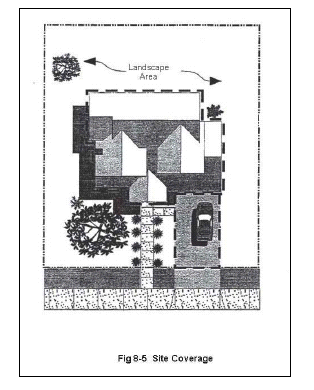
"Slope" means an inclined ground surface, the inclination of which is expressed as a percentage, or as a ratio of horizontal distance to vertical distance.
Small Family Day Care Homes. See "Day care facilities."
"Soil" means naturally occurring superficial deposits overlying bedrock.
"Soils engineer (geotechnical engineer)" means an engineer experienced and knowledgeable in the practice of soils (geotechnical) engineering.
"Soils engineering" means the application of the principles of soils mechanics in the investigation, evaluation and design of civil works involving the use of earth materials and the inspection or testing of the construction thereof.
"Solid waste" shall have the meaning described by Public Resources Code Section 40191, as it may be amended from time to time.
"South Coast Air Quality Management District (SCAQMD)" means the regional authority appointed by the California State Legislature to meet federal standards and otherwise improve air quality in the South Coast Air Basin (the non-desert portions of Los Angeles, Orange, Riverside and San Bernardino Counties).
"Special purpose zone" or "zoning district" means any of the special purpose zoning districts established by Section 17.10.010 of this development code.
"Spill light" means, for the purposes of Chapter 17.27, light that falls outside the area intended to be illuminated.
"State" means the state of California or any official agency of the state.
"State Historic Building Code" means Part 2.7 of the California Health and Safety Code, commencing with Section 18950, and the regulations promulgated there under, as they may be amended from time to time (California Code of Regulations, Title 24, Part 8).
"Stealth facility" has the meaning set forth in Section 17.12.050(L) of this title.
"Stock cooperative" means a development defined by Section 11003.2 of the Business and Professions Code and Section 1351(m) of the Civil Code, where a corporation is formed to hold title to improved real property and the shareholders of the corporation receive a right of exclusive occupancy in a portion of the real property.
"Storage, Outdoor" means the storage of various materials outside of a structure other than fencing, either as an accessory or principal use.
"Storage, mini storage or personal storage facility" means a structure or group of structures containing generally small, individual, compartmentalized stalls or lockers rented as individual storage spaces and characterized by low parking demand.
"Stored" means putting property away for future use.
"Storm water" means as any surface or water flow produced by rain, snow or sleet.
"Structure" means anything constructed or erected that is placed on the ground or that is attached to something located on the ground. For the purposes of this development code, the term "structure" includes "buildings," "fences," and "walls."
"Sub-divider" means a person, firm, corporation, partnership or association, a governmental agency, public entity or public utility, or the grantor to any agency, entity, utility or subsidiary, who proposes a subdivision for themselves or for others, except employees and consultants or other persons or entities acting in this capacity.
Subdivision Improvements. See "Improvements."
"Subdivision Map Act" or "Map Act" means division 2, Title 7 of the California Government Code, commencing with Section 66410 as presently constituted, and any amendments to those provisions.
"Subdivision" means the division, by any subdivider, of any unit or portion of land shown on the latest equalized Los Angeles County assessment roll as a unit or contiguous units, for the purpose of sale, lease or financing, whether immediate or future. Land shall be considered as contiguous units, even if it is separated by roads, streets, utility easement or railroad rights-of-way. Subdivision includes a condominium project, as defined in Section 1350 of the Civil Code, a community apartment project, as defined in Section 11004 of the Business and Professions Code, or the conversion of five or more existing dwelling units to a stock cooperative, as defined in Section 11003.2 of the Business and Professions Code.
"Supportive housing" has the same meaning as defined in subdivision (b) of Section 50675.14 of the Health and Safety Code.
T.
Definitions, T. The following definitions are in alphabetical order.
"Temporary Structure" means a structure without any foundation or footings, and which is removed when the designated time period, activity, or use for which the temporary structure was erected has ceased.
"Temporary Use" means a use of land that is designed, operated and occupies a site for a limited period of time, in compliance with the terms of the applicable temporary use permit.
"Tenant" means the lessee of facility space within a development project.
"Tentative map" means a map made for the purpose of showing the design and improvement of a proposed subdivision and the existing conditions within and around it.
"Traffic safety visibility area" means an area on a corner lot formed by measuring thirty-five (35) feet from the intersection of the front and side property lines, and connecting the two lines across the property. See Section 17.26.060.
"Transitional housing" has the same meaning as defined in subdivision (h) of Section 50675.2 of the Health and Safety Code.
"Transportation demand management (TDM)" means the alteration of travel behavior—usually on the part of commuters—through programs of incentives, services, and policies. TDM addresses alternatives to single-occupant vehicles such as carpooling, and changes in work schedules that move trips out of the peak period or eliminate them altogether (as in the case in telecommuting or compressed work weeks).
"Trellis" means any framework or structure of crossed wood or other suitable building material open on at least three sides and used to cover open space for aesthetic or shading purposes. For the purposes of lot coverage calculations, the roof of the trellis must be at least fifty (50) percent open.
"Trip reduction" means reduction in the number of work-related trips made by single occupant vehicles.
"Turf" means a single blade of grass or sod.
U.
Definitions, U. The following definitions are in alphabetical order.
"Undeveloped" means a parcel devoid of any structure or utility.
"Uniform ratio," as used in Chapter 17.27, means the relationship between the maximum and minimum illuminance values over an area. Uniform ratios close to one indicate an area with even illuminance and low shadow. Large ratios indicate areas with uneven illuminance and high shadow.
"Urban runoff" means any surface water flow produced by non-storm water resulting from residential, commercial and industrial activities involving the use of potable and non-potable water.
"Urban runoff pollution control plan" means a plan which shall be required to be approved in connection with any new development.
"Useful life" means, for the purposes of Section 17.30.090, a period of time during which a sign is expected to be usable for the purpose it was erected. The sign may be kept in good repair and maintained in good structural and electrical order.
"Utility pole" means, for the purposes of Section 17.12.050, a single or segmented structure, with a single continuous footing supporting utility wires.
V.
Definitions, V. The following definitions are in alphabetical order.
"Vacant" means a building that is not currently occupied or used for any purpose.
"Vanpool" means a vehicle carrying seven or more persons commuting together to and from work on a regular basis, usually in a vehicle with a seating arrangement designed to carry seven to fifteen (15) adult passengers, and on a prepaid subscription basis.
"Variance" means a discretionary entitlement that adjusts or relaxes the development standards of this development code, in compliance with Section 17.62.080.
"Vehicle" means any motorized form of transportation, including automobiles, vans, buses and motorcycles.
"Viewshed" means the area within view from a defined observation point.
"Vesting tentative map" means a subdivision map with the words "Vesting tentative map" printed conspicuously on its face, that is filed and processed in the same manner as a tentative map, except as otherwise provided by Article IV or the Subdivision Map Act.
W.
Definitions, W. The following definitions are in alphabetical order:
"Wall" means a linear structure primarily of concrete or masonry which provides for separation and/or screening between adjoining sites or areas within a site. Similar structures primarily of wood, or materials other than concrete or masonry, are included under the definition of "Fence."
"Warehouse retail stores" means retail stores that emphasize the packaging and sale of products in large quantities or volumes, some at discounted prices, where products may be displayed in their original shipping containers. Sites and buildings are usually large and industrial in character. Patrons may or may not be required to pay membership fees.
"Wetlands" means transitional areas between terrestrial and aquatic systems where the water table is usually at or near the surface, or the land is covered by shallow water. When all three wetland indicators (hydrophytic vegetation, hydric soil, and/or hydrology) are present, the presumption of wetland existence is conclusive. Where less than three indicators are present, the demonstrable use of wetland areas by wetland associated fish or wildlife resources, related biological activity, and wetland habitat values shall be the determinate.
"Wildlife corridor" means a portion of habitat, usually linear in nature, which connects two or more habitat patches that would otherwise be fragmented or isolated from one another. Wildlife corridors are usually bounded by developed land areas or other areas unsuitable for wildlife. A corridor generally contains suitable cover, food, and water to support species and facilitate movement while in the corridor.
"Wildlife-friendly fencing" means fencing that can be easily bypassed by all species of wildlife found within the Santa Monica Mountains, including but not limited to deer, coyotes, bobcats, mountain lions, ground rodents, amphibians, reptiles and birds, and shall be subject to the following standards:
1.
Fences shall be split rail with no more than three horizontal rails.
2.
The bottom edge of the bottom horizontal rail shall be no lower than eighteen (18) inches from the ground.
3.
There shall be a minimum two-foot gap between each rail.
4.
The top edge of the topmost rail shall be no higher than forty-eight (48) inches from the ground.
5.
Fence material shall be of wood, wood composite or some other similar material.
6.
Fence posts shall not be hollow at the top or have holes drilled into them near the top.
7.
Fences shall not be barbed.
8.
The top of the fence shall not contain spikes of any manner
"Wireless communication facility" or "wireless communication facilities" mean a structure, antenna, pole, tower, equipment and related improvements established for the purpose of providing wireless transmission of voice data, images or other information, including but not limited to radio, television, cellular phone service, personal communication service and paging services.
X.
Definitions, X. No definitions of terms beginning with the letter "X" are used at this time.
Y.
Definitions, Y. The following definitions are in alphabetical order:
"Yard" means an area between a lot line and a required setback, other than a court, unobstructed and unoccupied from the ground upward, except for projections permitted by this development code. See Section 17.20.180 and Figure 3-7, Setbacks.
1.
"Front yard" means an area extending across the full width of the lot between the front lot line and the required setback.
2.
"Rear yard" means an area extending the full width of the lot between a rear lot line and the required setback.
3.
"Side yard" means an area extending from the front yard to the rear yard between the nearest side lot line and the required setback.
Z.
Definitions, Z. The following definitions are in alphabetical order:
"Zoning district" means a portion of the city within which certain uses of land and structures are defined, and regulations are specified by this development code. The zoning districts established by this development code are described in Section 17.10.010.
(Ord. No. 2010-265, § 3, 1-27-2010; Ord. No. 2010-267, § 2, 2-10-2010; Ord. No. 2012-295, § 3(Exh. B), 6-27-2012; Ord. No. 2014-311, § 4(Exh. A), 2-26-2014; Ord. No. 2015-328, § 4(Exh. A), 10-14-2015; Ord. No. 2015-330, § 2(Exh. B), 1-13-2016; Ord. No. 2018-364, § 5, 4-25-2018; Ord. No. 2018-366, § 3, 6-27-2018; Ord. No. 2021-393, § 4, 11-10-2021; Ord. No. 2025-411, § 7, 2-26-2025)

