
Califon City Zoning Code
CHAPTER 16
28 - IMPROVEMENTS AND DESIGN STANDARDS
Sections:
16.28.010 - Drainage.
All streets shall be provided with manholes, inlets and pipes where the same may be necessary for proper drainage. Where nonstructural means of controlling surface runoff are feasible and adequate, i.e., natural drainage channels, grassy swales, drainage ditches, and other conveyances not requiring the use of impervious cover, such nonstructural means may be utilized if approved by the borough engineer. The requirements of this section shall not be satisfied with the construction of dry wells, except when approved by the board for an individual residential lot where no other alternative is feasible.
A.
The system shall be adequate to carry off the stormwater and natural drainage water which originates not only within the lot or tract boundaries, but also that which originates beyond the lot or tract boundaries in their current state of development. The system shall be extended along the full length of any road improvement. No stormwater runoff or natural drainage water shall be so diverted as to overload existing drainage systems to create flooding or the need for additional drainage structures on other private properties or public lands without proper and approved provisions being made for taking care of these conditions. Over the sidewalk, under the sidewalk and/or through the curb drains for the purpose of disposing of sump pump and/or roof leader runoff are prohibited. These facilities must discharge into an adequate watercourse or drainage system, which may be natural or man-made. Drainage discharges from sump pumps, roof gutters, pools, foundation drains and curtain drains which are extended to discharge within the front yard or are to be extended into the road right-of-way shall be tied to a header system which discharges into the storm sewer system at an inlet or a manhole. Such discharge may be directed into swales, open ditches or a natural watercourse where a drainage discharge header system or storm sewer system does not exist.
B.
Techniques for computing stormwater runoff and for design of controls shall be in accordance with either the rational method or the soil conservation service (SCS) method. Determination of the runoff coefficient "C" shall be as contained in the "Technical Manual for Stream Encroachment," August, 1984, prepared by the New Jersey Bureau of Flood Plain Management, latest edition.
C.
Storm sewers, open channels, bridges and culverts shall be designed as a minimum for flow capacities to convey the twenty-five (25) year storm event. Storm sewers shall be of reinforced concrete pipe. The minimum diameter of any storm sewer shall be fifteen (15) inches. Storm sewers located within fifty (50) feet of a subsurface sewage disposal system shall be designed and constructed in a manner that will prevent infiltration of groundwater into the pipe.
D.
All materials used in the construction of storm sewers, bridges, and other drainage structures shall be in accordance with the specifications of the "Standard Specifications for Road and Bridge Construction of the New Jersey Highway Department," latest edition, and any supplements, addenda and modifications thereto unless otherwise specified by the board. Modifications or changes to these specifications that do not affect performance may be requested by the applicant but may be implemented only with the knowledge and written consent of the borough engineer.
E.
Lots shall be graded to secure proper drainage away from the buildings. Additionally, drainage shall be provided in a manner which will prevent the collection of stormwater in pools or other unauthorized concentrations of flow and, to the greatest extent possible, water shall not flow across adjacent property lines.
F.
A final drainage plan shall accompany the final subdivision or site plan. Such drainage plan shall show the same information as required on the preliminary plan with the addition that the individual lot grading shall be shown as follows:
Final grades shall be shown for each corner, all high and low points and breaks in grade, finished floor elevations of structures, finished grades of septic systems, if applicable, and at the corners of tentative structure locations. If the use of drainage swales is intended, the elevation of these swales shall be shown. The minimum grade of disturbed areas shall be one and one-half percent. Prior to construction of foundation walls, an as-built plan of the horizontal and vertical location of the foundation footing shall be submitted to the zoning officer for review and approval. As a condition precedent to the issuance of a certificate of occupancy for any lot in the development, the developer or building contractor shall submit an as-built lot grading plan to the borough bearing an engineer's certification that the lot grading complies with the approved final lot grading and soil erosion and sediment control plans for the development.
G.
Detention or retention basins will be required to hold stormwater runoff such that discharge from the site will not exceed predevelopment rates. A waiver of this provision may be granted only when the applicant shows that the additional runoff resulting from the proposed development will be negligible. When detention basins are required, the outlet from the detention facility shall, where feasible, provide that ninety (90) percent of the runoff from one and one-quarter inches of rainfall, falling in two hours, be retained so that over ninety (90) percent will be evacuated prior to thirty-six (36) hours. Detention and retention basins for single-family residential, noncluster subdivisions shall be constructed on a separate lot specifically reserved for such purpose which lot shall be dedicated to the borough. Detention and retention basins for cluster and multifamily residential developments shall be located in the common open space to be maintained by the homeowners' association. Detention and retention basins in nonresidential developments shall be owned and maintained by the property owner(s). The following exceptions to these provisions will be acceptable in any case:
1.
Retention will not be required to an extent which would reduce the outlet size to a diameter of less than three inches;
2.
Dry basins serving residential projects may allow evacuation of ninety (90) percent over eighteen (18) hours;
3.
In cases where runoff is from single-family residential and unimproved areas only, and where the runoff enters detention basins after moving by sheet flow over at least thirty (30) feet of lawn or leaf mulch area, outlets shall be designed so that detention storage, when full, will be ninety (90) percent evacuated over twelve (12) hours.
H.
Regional detention or retention basins utilized by several property owners within a drainage basin are encouraged, and the feasibility of such joint facilities must be examined by the applicant and reported upon to the borough engineer.
I.
Approval of drainage structures shall be obtained from all appropriate borough, county, state and federal agencies and offices. Each applicant shall make appropriate application to the NJDEPE, the Hunterdon County planning board, the Hunterdon County soil conservation service, and the borough engineer. Final approval shall not be effective until letters of approval from the proper governmental authorities shall be furnished to the administrative officer with a copy of each letter forwarded to the borough engineer.
J.
When required by the borough, and as indicated on an approved development plan, a drainage right-of-way easement shall be provided to the borough where a tract or lot is traversed by a watercourse, surface or underground drainageway or drainage system, channel or stream.
The drainage right-of-way easement shall conform substantially with the lines of such watercourse and, in any event, shall meet any minimum widths and locations as shown on any adopted official map or master plan. Such easement shall be expressed on the plat as follows: "Drainage easement granted for the purposes provided and expressed in the land development ordinance of Califon Borough."
K.
For all developments requiring site plan, subdivision, conditional use and/or variance approval, the applicant shall provide an analysis of any additional water which will drain from the site as a result of the approval of the proposed site plan, subdivision, conditional use and/or variance, such analysis to specifically document the anticipated impact that the increased water flow will have upon existing drainage structures located between the site and the downstream facilities and structures.
L.
All developments requiring site plan, subdivision, conditional use and/or variance approval shall provide for on-site storage and controlled release of stormwater as provided by this section.
M.
The maximum spacing between inlets shall be four hundred (400) feet, and design flow into inlets shall not exceed five cubic feet per second. The storm sewer system shall be designed to provide a minimum pipe cover of two feet under cartways. The pipe cover shall not exceed fifteen (15) feet.
(Ord. 1993-008 § 701)
16.28.020 - Sight triangles.
A.
Sight triangle easements shall be required at the intersection of a street with another street and at the intersection of a street with a driveway providing ingress and/or egress to a nonresidential or multifamily residential development. The sight triangle easement shall be granted to the borough of Califon.
B.
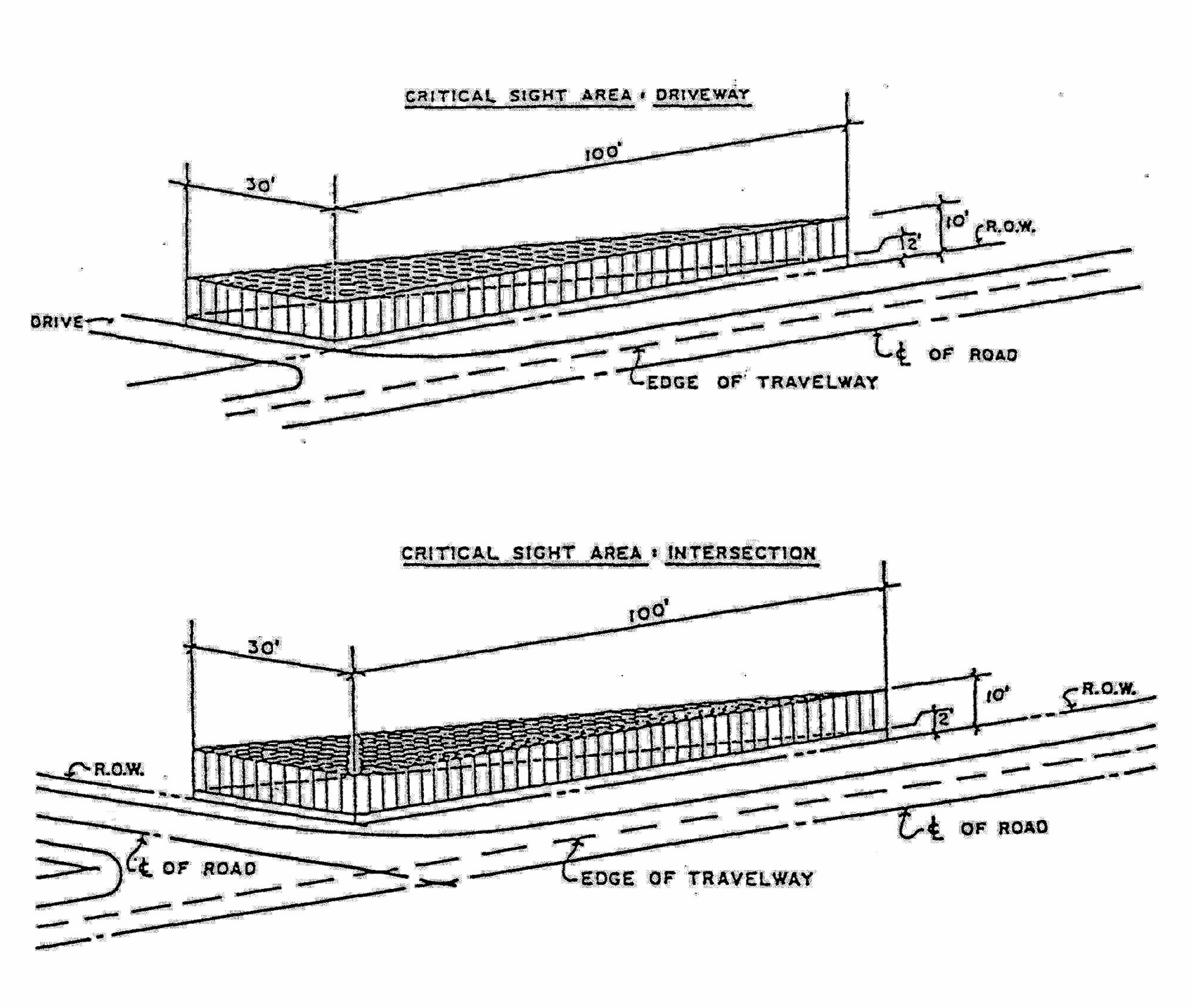
The sight triangle easement shall measure thirty (30) feet along the driveway or lesser street and one hundred (100) feet along the intersecting street or major street. The measurements shall be taken along the curblines or edges of driveways and along the right-of-way lines of streets (see diagrams at the end of this section).
C.
An unobstructed view of the intersecting street shall be maintained throughout the sight triangle within the "critical sight area," which is that area lying between two feet and ten (10) feet above the surface of the thirty (30) foot leg of the sight triangle.
Natural or man-made obstacles shall be removed and shall not be located within the critical sight area if they obstruct the view of oncoming traffic. This provision is not intended to require the removal of all objects within the sight triangle easement. Traffic control devices and other man-made or natural objects may remain if it can be demonstrated that they do not obstruct the view of oncoming traffic. Trees may be located within the sight triangle easement provided they are kept trimmed of branches to a minimum height of six feet above ground or to such additional height as may be necessary to maintain an unobstructed view of oncoming traffic.
D.
Adequate sight distances shall be maintained at all intersections of driveways with streets and streets with streets in conformance with the following table:
Said sight distances shall be measured ten (10) feet back from the cartway of the uncontrolled street, using three and one-half feet off the ground as the height of eye and six inches off the ground as the height of object. The existence of the required sight distance shall be verified by the borough engineer. Additional lands may be required to be included within the sight triangle easement to provide an unobstructed view of oncoming traffic for the entirety of the minimum distances set forth hereinabove.
E.
Where an applicant proposes to intersect a new street at a location where the prescribed sight distance does not exist, the applicant shall be required to clear and/or grade in the vicinity of the proposed intersection and/or to reconstruct portions of the roadway, as necessary, to obtain the required sight distance.
The applicant shall obtain control of the area required for the sight triangle by easement dedicated to the borough of Califon or county of Hunterdon, as applicable, as necessary to secure the sight distance in perpetuity.
F.
In the instance of a driveway intersecting with a street, the sight triangle easement shall be provided to the extent that the area required for it is located on property owned or controlled by the applicant.
G.
In instances where suitable sight distances and/or control of property cannot be obtained or where unusual topography or historic structures limit the applicant's ability to create the standard sight triangle, the applicant may seek a waiver of the requirement by a demonstration of hardship. The board shall rule on the waiver based on the record presented.
H.
The dimensions and purpose of the sight triangle easement shall be shown on the subdivision plat or site plan. Where the dedication will be to the borough of Califon, it shall be expressed as follows: "Sight triangle easement deeded for purposes provided for and expressed in Section 16.28.020 of the land development ordinance of Califon Borough."
I.
The requirement to provide a sight triangle easement does not supersede any other requirement of this title to provide screening of parking lots or loading areas. Where such screening is required, it shall be provided outside of the required sight triangle.
(Ord. 1996-02 § 7: Ord. 1993-008 § 702)
16.28.030 - Lighting.
A.
Street Lighting.
1.
Street lighting shall be provided at all street intersections where at least one of the streets is designated as other than a "minor street" in the traffic circulation plan element of the master plan. Moreover, additional street lighting may be required for specific locations as deemed necessary for safety reasons by the borough engineer, such as locations with limited or hampered sight distance due to existing vegetation; a sharp curve of the street; or an obtuse or sharply angled intersection.
2.
The type of required street lighting to be supplied shall be in accordance with the recommendations of the borough engineer and Jersey Central Power and Light Company standards. The light intensity provided at ground level shall average at least five-tenths footcandles at intersections and three-tenths footcandles for other street lighting. Sodium lighting shall be prohibited on all streets in the borough.
3.
Wherever electric utility installations are required to be underground, the applicant shall provide for underground service for required street lighting.
B.
On-Site Lighting.
1.
All parking areas and walkways thereto and appurtenant passageways and driveways serving commercial, public, office, multiple-family or other uses having common off-street parking and/or loading areas shall be adequately illuminated for security and safety purposes. As much lighting as possible should be automatically turned off during nighttime hours.
2.
The lighting plan in and around the parking areas shall provide for nonglare, recessed lens lights focused downward. The light intensity provided at ground level shall be indicated in footcandles on the submitted plans and shall average at least five-tenths footcandles at intersections and three-tenths footcandles elsewhere in the area to be illuminated. Lighting shall be provided by fixtures with a mounting height of not more than twenty (20) feet or the height of the building, whichever is less, measured from the ground level to the centerline of the light source. Sodium lighting shall be prohibited on all properties in the borough of Califon.
3.
Any outdoor lighting such as building and sidewalk illumination, driveways with no adjacent parking, the lighting of signs, and ornamental lighting, shall be shown on the lighting plan in sufficient detail to allow a determination of the effects upon adjacent properties, traffic safety and overhead skyglow. The objective of these specifications is to minimize undesirable off-premises effects. No light shall shine into windows or onto streets and driveways in such a manner as to interfere with or distract driver vision and no light shall be directed off the premises. To achieve these requirements, the intensity of such light sources, the light shielding and similar characteristics shall be subject to site plan approval.
(Ord. 1993-008 § 703)
16.28.040 - Lot configuration.
A.
Insofar as is practical, side lot lines shall be either at right angles or radial to street lines.
B.
Each lot must front upon an approved street, except that in instances where private streets and/or other accessways are provided and approved as part of a site plan and/or subdivision submission, each lot need not front upon an approved street.
C.
All lots shall be suitable for their intended use(s). Where there is a question as to the suitability of a lot or lots for their intended use(s) due to factors such as poor drainage conditions or flood conditions, percolation tests or test borings indicating the ground conditions to be inadequate for proper sewage disposal for on-lot sewage treatment, or similar circumstances, the board, after adequate investigation and receipt of a written report by the borough board of health, if applicable, may withhold approval of such lots. If approval is withheld, the board shall give reasons and notify the applicant and enter the same in the minutes.
D.
Concrete monuments shall be installed in accordance with the requirements of the New Jersey Map Filing Act. In any case, all corners shall be marked with metal alloy pins.
E.
All lots and/or buildings on lots shall be oriented for solar energy access where possible and desirable.
(Ord. 1993-008 § 704)
16.28.050 - Natural features.
A.
Natural features such as trees, hilltops, and views, natural terrain, open waters, critical areas and natural drainage ridge lines shall be preserved to the maximum extent reasonably possible in designing any development containing such features.
B.
No top soil shall be removed from areas intended for lawns and open space. Top soil moved during the course of construction shall be redistributed on the lot so as to provide at least four inches of cover to all areas, which cover shall be stabilized by seeding and/or planting in accordance with an approved plan.
C.
No soil shall be removed from or be imported to any site in excess of twenty (20) cubic yards per year without the prior approval of the board. For this purpose, a plan shall be submitted showing how the soil is to be distributed and stabilized, including grading contours. If the soil is to be imported, a plan shall be submitted describing methodology and frequency of testing the soil to ensure its safe quality. Finally, the plan shall describe the size and number of vehicles that are proposed for hauling the removed or imported soil together with the hauling route.
D.
An effort shall be made to preserve the existing vegetation on the site. All trees having a caliper of six inches or more, measured four feet off the ground, which are not required to be removed by the proposed construction and which are located twenty-five (25) feet or more from the actual building site or five feet or more from any paved area shall be protected prior to the commencement of and during construction. The limits of disturbance together with the locations and species of the trees to be preserved shall be indicated on the site plan and/or subdivision submission, along with the proposed means of protection.
E.
For the continued protection and enjoyment of natural features, the board may require conservation easements.
F.
See also Section 16.28.070, Landscaping.
(Ord. 1993-008 § 705)
16.28.060 - Design of off-street parking, loading areas and driveways.
A.
Landscaping.
1.
Except for parking for single-family detached dwelling units, a screen planting, berm, fence, wall, or combination thereof, not less than four feet in height, shall be provided between an off-street parking area and any lot line or street line except where a building intervenes or where the distance between such area and the lot line or street line is greater than one hundred fifty (150) feet. The requirement to provide a sight triangle set forth in Section 16.28.020 shall not preclude compliance with this section, and the screen planting shall be provided outside of the required sight triangle.
2.
All loading areas shall be landscaped and screened sufficiently to obscure the view of the parked vehicles and loading platforms from any public streets and adjacent properties throughout the year. Such screening shall be an extension of the building, fence, berm, wall, planting, or combination thereof and shall not be less than four feet in height.
3.
Each off-street parking area shall have a minimum area equivalent to one parking space per every thirty (30) spaces landscaped with approximately one-half said area having shrubs no higher than three feet and the other half having trees with branches no lower than seven feet. Such landscaped areas shall be distributed throughout the parking area in order to break the view of parked cars in a manner not impairing visibility.
4.
See also Section 16.28.070, Landscaping.
B.
Lighting. Lighting used to illuminate off-street parking areas shall be arranged to reflect the light away from residential premises and public streets and shall be in accordance with Section 16.28.030(B) of this chapter.
The lighting of all off-street parking areas, including any deferred parking areas that may be approved by the board as provided in subsection C of this section, shall be shown on the plan.
C.
Paving and Curbing.
1.
All parking and loading areas and access drives shall be paved as provided below, except that the board, at the request of the applicant and in consideration of the specific and documented parking needs of the applicant, may permit a reduction in the paved area devoted to parking provided:
a.
The submitted plan shall include all the parking spaces required by this title and shall include those spaces to be paved and those requested not to be paved;
b.
All parking areas not to be paved shall be suitably landscaped and such landscaping shall be indicated on the submitted plan and be in addition to landscaping otherwise required or necessary;
c.
The drainage system for the site shall be designed to accommodate the surface water runoff from all parking and driveway areas, considering all areas to be paved, whether initially or at a possible future date; and
d.
The applicant shall agree in writing on the submitted plan to pave any or all of the nonpaved parking areas should the paved parking areas prove to be inadequate to accommodate the on-site parking needs of the premises.
2.
All portions of driveways for single-family detached residential lots which are located within the street right-of-way or within twenty-five (25) feet of the centerline of the street, whichever is greater, shall be constructed in accordance with the borough's driveway ordinance of 1988, as amended and supplemented. Moreover, if any portion of a driveway for a single-family detached residential lot exceeds a profile grade of eight percent at any point within the first two hundred (200) feet of the street right-of-way line, measured at the driveway centerline, that portion of the driveway shall be paved with bituminous concrete, macadam or Portland cement concrete.
3.
All other parking and loading areas and access drives shall be paved as outlined below unless otherwise specified by the board and approved as part of the development application approval. All parking areas, regardless of size and location, shall be suitably drained and maintained.
a.
Areas of ingress and egress, parking stalls, loading and unloading areas, major interior driveways or access aisles and other areas likely to experience heavy traffic shall be paved with not less than six inches of compacted base course of plant mixed bituminous, stabilized base course (Mix No. 1-2), constructed in layers of not more than two inches compacted thickness and prepared and constructed in accordance with "New Jersey State Highway Standards and Specifications for Roads and Bridge Construction" (1983) and any amendments thereto. A minimum of two inches compacted wearing surface of bituminous concrete mixture (Mix No. 1-5) shall be constructed thereon in accordance with the aforesaid New Jersey Highway Department specifications and amendments thereto.
b.
Where subgrade conditions of proposed paved areas are wet, yielding or of such a nature that surfacing would be inadvisable without first treating the subgrade, the areas shall be excavated to a suitable depth below the proposed grade and filled with Type 5, Class A quarry process stone or a suitable upgrade material as approved by the borough engineer. Where required by the borough engineer, a system of subsurface drains or an alternate solution approved by the borough engineer shall be constructed beneath the surface of the paved area and connected to a suitable drain. After the subbase material has been properly placed and compacted, the surfacing material, as described heretofore, shall be constructed thereon.
4.
All paved parking and loading areas and access drives shall be curbed, except single-family residential driveways.
5.
All off-street parking lots shall have adequate designations to indicate traffic flow and parking spaces.
6.
All construction shall be in accordance with the "New Jersey State Highway Standards and Specifications for Road and Bridge Construction" (1983) and any amendments thereto, unless otherwise specified by the board with the knowledge and written consent of the planning board engineer.
D.
Access. The centerlines of any separate access points to a single lot shall be spaced at least one hundred twenty-five (125) feet apart, shall handle no more than three lanes of traffic and, on a corner lot, shall be set back at least twenty-five (25) feet or one-half the lot frontage, whichever is greater, from the point of tangency of the existing or proposed curb radius of either of the intersecting streets. Continuous open driveways having a width in excess of sixteen (16) feet at the street line shall be prohibited except that two-way driveways serving nonresidential uses and multiple-family developments shall be at least twenty-four (24) feet wide. In all instances, due consideration to the proposed width, curbing, direction of traffic flow, radii of curves and method of dividing traffic lanes shall be given. Curbing shall be depressed at the driveway or the curbing may be rounded at the corners and the driveway connected with the street in the same manner as another street. All points of access to nonresidential and multifamily residential developments shall be graded and adequate drainage facilities installed to prevent stormwater runoff from entering the public road. All driveways and access drives for all residential and nonresidential uses in the borough of Califon shall comply with the requirements of the borough's driveway ordinance of 1988, as amended and supplemented. No use shall have its access from a driveway originating in a different zone than the zone in which the use itself is located and no driveway shall be constructed or used to give access to a use in a zone other than the zone in which the driveway is located.
E.
Barrier-Free Access. All parking areas shall be designed in conformance with C.5:23-7.1 et seq., the Barrier-Free Subcode.
F.
Location of Parking and Loading. No parking or loading of vehicles shall be permitted in fire lanes, streets, driveways, landscaped areas, aisles, buffer areas, sidewalks, or turning areas. Internal roads, parking access aisles, parking and loading areas, curbs and landscaping shall be designed to reasonably accommodate the turning movements of emergency vehicles regularly and routinely serving Califon Borough without requiring the mounting of curbs or interference with landscaping. Where there is a row of perpendicular or angled parking stalls contiguous to a building, there shall be a gap of at least nine feet in width defined by mountable curbing to allow access by emergency vehicles to the facade of each building facing such parking. Where a parking space abuts a landscaped area or walkway at one end, a wheelstop or bumper shall be placed within the parking space, two feet from the end, to keep vehicles from overhanging the sidewalk or planted area.
G.
Type of Facility.
1.
When parking spaces are provided within a garage or other structure, said structure shall adhere to the required principal or accessory building setbacks, as applicable.
2.
The provision of parking spaces also shall include adequate driveways and necessary turning areas for handling the vehicles for which provision is made. All single-family residential lots having direct driveway access to other than a minor street shall be provided with an on-site turnaround to permit vehicular access to the road in a head-on direction.
3.
Except for the driveway providing access to a garage, all parking areas shall be designed to permit a motor vehicle to proceed to and from a parking space without requiring the moving of any other motor vehicle(s). Aisles providing access to parking areas shall have the following minimum dimensions; where the angle of parking is different on both sides of the aisle, the larger aisle width shall prevail:
4.
Parking spaces shall be dimensioned in accordance with the definition of "parking space" in Section 16.04.040 of this title.
(Ord. 1993-008 § 706)
16.28.070 - Landscaping.
A.
Landscaping shall be provided as part of each overall site plan design and integrated into building arrangements, topography, parking and buffering requirements. Landscaping shall include trees, bushes, shrubs, groundcover, perennials, annuals, plants, sculpture, art and the use of building and paving materials in an imaginative manner.
B.
The existing sense and appearance of the rural village and natural scenic qualities of the borough should be encouraged in site development. Retention of existing vegetation is encouraged.
C.
A detailed landscaping plan shall be submitted with each final site plan application. The plan shall identify existing and proposed trees, shrubs, bushes, plant material and groundcover, and natural features such as boulders and rock outcroppings. It shall show where they are or will be located and the proposed planting details and specifications.
Landscaping plans shall be specific as to the location, size, spacing, quantity, and species (botanical and common name) of all plants, as well as the location, perimeter outline, type and thickness of all mulches. Size, quantity, species and other pertinent information shall also be listed in the form of a schedule on the landscaping plan. Where turf is anticipated, topsoiling, seeding or sodding, fertilizing, liming and watering specifications shall be provided. Planting details (staking, fertilizing, watering, soil mixture, etc.) specific to existing soil conditions and the exposure of the site shall also be provided.
Where existing natural growth is proposed to remain, the applicant shall include in the plans the proposed methods to protect the existing trees and growth from injury during and after construction. These methods shall include fences, berms, curbing, tree wells and similar devices.
D.
The following design principles shall be followed:
1.
Landscaping shall be located to provide for climate control. For example, shade trees planted on the south to shield the hot summer sun, and evergreens planted on the north and northwest for windbreaks.
2.
Landscaping shall be used to accent and complement buildings. For example, groupings of tall trees located to break up long, low buildings and lower trees and shrubs planted around taller buildings.
3.
Landscaping shall be provided in public areas, at recreation sites and adjacent to buildings.
4.
Vines and climbing plants shall be placed along large expanses of walls to reduce heat buildup and for aesthetic purposes.
5.
Trees shall be massed at critical points, except along streets where they shall be planted in a straight line at fifty (50) foot intervals. Types of trees shall vary by neighborhood. At least two types of trees shall be used in each neighborhood for environmental diversity.
6.
Groundcovers shall be used extensively to reduce erosion and are encouraged on slopes.
7.
A variety and mixture of landscaping shall be provided on each site. The mixture shall consider susceptibility to disease, colors, seasonal performance, texture, shapes, blossoms and foliage.
8.
Local soil conditions and water availability shall be considered in the choice of landscaping.
9.
The long-term impact of any proposed landscaping plan shall be considered. Shrubs may grow and eventually block sight distances. Foundation plants may eventually block outbuildings and accessways.
10.
It is preferable to have fewer large specimens than more small ones.
11.
Deciduous trees shall be at least two inches caliper at planting, and evergreens shall be at least four feet tall. Shrubs shall be at least eighteen (18) to twenty-four (24) inches tall at planting. All plantings shall be balled and burlapped unless otherwise approved by the board.
12.
Street trees shall be selected to fit the space provided, with wide-spreading trees planted where there is room, and small or narrow trees in restricted areas.
13.
Entrances to sites deserve special landscaping treatment.
14.
Existing large trees shall be saved by maintaining the grade around each tree, by construction of tree wells and walls, and by erecting protective fences during construction activities. Maximum effort shall be made to save groups of trees rather than individual ones.
15.
Parking lots shall be landscaped as provided in Section 16.28.060(A) and in accordance with the following additional requirements:
a.
Parking lots shall be canopied with trees for shade and to help reduce stormwater runoff.
b.
Landscaping in or near parking areas shall be designed and located to withstand the effects of snowplowing.
c.
All landscaping in or near parking areas and access drives shall be located so as not to obstruct vision. A variety of different types of trees and shrubs shall be grouped to break up views of the mass of cars.
d.
Trees shall be selected that can withstand an urban environment.
16.
Plantings shall be chosen to match the particular microclimate and space restrictions to which they will be exposed. For example, drought-tolerant plants shall be located in areas surrounded by pavement, and maples and other trees shall be located where their roots will not raise sidewalks.
17.
Landscaping to be used in a buffer area or for screening, alone or in combination with other screening devices, shall be a minimum of four feet high at time of planting and shall consist of a majority of evergreen plant materials. An evergreen buffer requires two to three rows of staggered plantings. Plantings shall be spaced in accordance with the types of plantings utilized.
18.
A minimum of six shade trees per acre shall be planted on single-family residential lots, and a minimum of six shade trees per acre of gross tract area shall be planted in open space areas. A minimum of six shade trees per acre of gross tract area shall be planted throughout the tract in the case of nonresidential or multifamily residential development. All newly planted shade trees shall be of nursery stock, shall have a minimum caliper of two inches, measured three feet from the ground, and shall be of a species indigenous to the area.
(Ord. 1993-008 § 707)
16.28.080 - Public utilities.
A.
All public services shall be connected to an approved public utilities system where one exists. The developer shall arrange with the servicing utility for the underground installation of the distribution supply lines and service connections, in accordance with the provisions of the applicable standard terms and conditions incorporated as part of its tariff, as the same are on file with the New Jersey State Board of Public Utility Commissioners; provided, however, that lots not part of a new major subdivision or site plan which abut existing streets where overhead electric, CATV or telephone distribution supply lines and service connections have heretofore been installed may be supplied with electric, CATV and telephone service from these overhead lines but any new service connections from the utilities' overhead lines shall be installed underground. In cases where extension or replacement of service is needed to existing or new buildings in established subdivisions or developments, the present method of service may be continued. In the case of existing overhead utilities, however, should a road widening or an extension of service or such other condition occur as a result of the development and necessitate the replacement or relocation of such utilities, the developer shall cause the replacement or relocation to be underground. All underground utility lines shall be placed in conduits to facilitate access for maintenance purposes.
1.
Upon submission of preliminary plats or plans for approval, the developer shall present a statement of intent, setting forth all public utility companies to serve the tract and a letter from each company stating that service will be available to the development. The preliminary plans shall recite all public utilities that will serve the development. Any deviation from the statement of intent shall make null and void any approval granted by the borough.
2.
Prior to the preconstruction meeting preceding the commencement of construction, the developer shall furnish the administrative officer with a copy of the agreements with the applicable public utility companies certifying the jurisdiction of the public utility company to serve the property; indicating agreement with the proposed utility installation design; and stating who will construct the facility so that service will be available prior to occupancy. The form of such agreement(s) shall be reviewed and approved by the borough attorney prior to the commencement of construction.
3.
The developer shall provide the borough with four copies of a final "as-built" plan showing the installed locations of all utility facilities.
B.
Easements along property lines or elsewhere for utility installations may be required. Such easements shall be at least fifteen (15) feet wide and located in consultation with the utility concerned and, to the fullest extent possible, shall be centered on or adjacent to lot lines. Such easement dedication shall be expressed on the plat or plan as follows: "Utility right-of-way easement granted for the purposes provided for and expressed in the land development ordinance of Califon Borough." Utility easements along street right-of-way lines shall be a minimum of ten (10) feet in width. Where a utility easement is located on or along a side lot line, the affected side yard(s) shall be increased by the width of the easement or portion thereof on the lot(s) but shall not be required to be greater than twenty-five (25) feet in any case.
(Ord. 1993-008 § 708)
16.28.090 - Sanitary sewers and septic systems.
A.
Where a public wastewater treatment plant and collection system is accessible, or where such facilities are to be constructed as a condition of approval of any application for development, the developer shall construct such wastewater treatment facilities and/or sanitary sewer lines and building connections in accordance with the Califon Borough wastewater management plan and NJDEPE permit requirements and in such a manner as to make adequate sewage treatment available to each lot and building within the development.
B.
Where the use of subsurface sewage disposal systems is proposed as a means of sewage disposal, the same may be approved if all requirements of the NJDEPE and borough board of health are met.
C.
In the event of approval of the use of individual subsurface disposal systems, the board additionally may require the installation of sewer lines, which must include connections to each building, for future use when public sewage treatment facilities are provided to serve the realty improvements to be constructed in the development.
D.
The end fitting of all dry sanitary sewer building connection lines shall have a "tamper proof" plug or cap, temporarily sealed with a material that can be removed to utilize the fitting when the system is to be activated. The plumbing subcode official or the plumbing inspector shall affix an adhesive backed disc on the cap or plug bearing a preprinted message and instructions related to tampering and future use that will be sufficient to alert and warn the original and subsequent occupants of the building. The capping and plugging shall be performed by the developer at his or her expense and the message disc shall be provided and attached by borough representatives.
E.
All sanitary sewer lines shall be air and mandrel tested. Additionally, all lines shall be televised and a videotape of the lines shall be provided to the borough engineer immediately prior to the activation of the sewer lines or acceptance of the streets in which the lines are constructed, whichever occurs earlier.
(Ord. 1993-008 § 709)
16.28.100 - Streets, curbs and sidewalks.
A.
Streets.
1.
All developments shall be served by paved streets in accordance with the approved subdivision and/or site plan. The arrangement of such streets not shown on the master plan or official map, as adopted by the borough, shall be such as to provide for the appropriate extension of such streets and conform with the topography of the land as far as practicable. Minor streets shall be planned so as to discourage through-traffic.
2.
When a new development adjoins land susceptible to being subdivided or developed, suitable provisions shall be made for access to adjoining lands.
3.
In subdivisions that abut arterial streets and such other streets or portions of streets as the board may designate on the master plan, the board may require provisions for marginal access roads, reverse frontage lots with buffer strips for planting, or other design methods for the purpose of separating through and local traffic.
4.
The right-of-way width of a street shall be measured from lot line to lot line and shall not be less than fifty (50) feet unless a greater width is shown on the master plan or official map. Cul-de-sacs less than three hundred (300) feet in length, measured from the sideline of the intersecting street to the center of the turnaround, may be approved with right-of-way widths of forty (40) feet and pavement widths of twenty (20) feet.
5.
No subdivision showing reserve strips controlling access to streets shall be approved except where the control and disposal of the land comprising such strip has been placed with the borough council under conditions approved by the board.
6.
Subdivisions that adjoin or include existing streets that do not conform to the widths as shown on the master plan or official map or the street width requirements of this title shall provide for the dedication of additional roadway width along either one or both sides of said road. If the subdivision abuts one side of the road only, one-half of the required extra width shall be conveyed to the borough.
7.
Grades of arterial and collector streets shall not exceed eight percent. Grades on other streets shall not exceed ten (10) percent. No street shall have a minimum grade of less than one percent.
8.
Street intersections shall be as nearly at right angles as is possible, and in no case shall be less than sixty (60) degrees. The block corners at intersections shall be rounded at the curbline and have a radius of not less than twenty-five (25) feet.
9.
Street jogs with centerline offsets of less than one hundred twenty-five (125) feet shall be prohibited.
10.
A tangent at least one hundred (100) feet long shall be introduced between reverse curves on arterial and collector streets.
11.
When connecting street lines deflect from each other at any one point by more than five degrees and not more than forty-five (45) degrees, they shall be connected by a curve with a radius of not less than one hundred (100) feet for minor streets and three hundred (300) feet for arterial and collector streets.
12.
All changes in grade shall be connected by vertical curves and shall provide for a smooth transition and sight distances of three hundred fifty (350) feet on minor streets, five hundred (500) feet on collector streets, and eight hundred (800) feet on arterial streets.
13.
Cul-de-sacs shall have a turnaround or bulb at the closed end and shall not exceed seven hundred fifty (750) feet in length, measured from the future right-of-way line of the intersecting street to the center point of the turnaround. The turnaround shall have a radius of not less than seventy (70) feet to the right-of-way line and shall be tangent whenever possible to the right side of the street. If a dead-end street is of temporary nature, a similar turnaround shall be provided and provisions made for the future extension of the street and reversion of the excess right-of-way to the adjoining properties.
14.
No street shall have a name which will duplicate or so nearly duplicate the name of an existing street that confusion results. The continuation of an existing street shall have the same name. Curvilinear streets shall change their name only at street intersections. The board reserves the right to approve or name streets within a proposed development.
15.
Where a tract is subdivided into larger parcels than ordinary building lots, such parcels shall be arranged so as to allow the opening of future streets and logical subdivisions.
16.
The pavement width of streets and the quality of subsurfacing and base materials shall adhere to the minimum standards set forth by the county or state when said paving concerns roads under their jurisdiction and where such standards exist. Concerning streets under the jurisdiction of the borough, the following standards shall apply:
a.
All construction shall be in accordance with the "New Jersey State Highway Standards and Specifications for Road and Bridge Construction" (1983) and any amendments thereto.
b.
On all public and private streets, the subbase course shall be a minimum of four inches compacted thickness of quarry process stone, Type 5, Class A, applied over the compacted subgrade.
c.
On all local borough streets, the base course shall be four inches of bituminous concrete mixture (Mix No. 1-2), constructed in two layers each of not less than two inches of compacted thickness.
d.
On all collector borough streets, the base course shall be five inches of bituminous concrete mixture (Mix No. 1-2), constructed in two layers each of not less than two and one-half inches of compacted thickness.
e.
On all arterial borough streets, the base course shall be six inches of bituminous concrete mixture (Mix No. 1-2), constructed in two layers each of not less than three inches of compacted thickness.
f.
The surface course for all borough streets shall consist of two inches of bituminous concrete mixture (Mix No. 1-5), applied according to state highway specifications.
g.
Where subgrade conditions are yielding or otherwise unsatisfactory in the opinion of the borough engineer, all unsuitable material shall be removed, and suitable material shall be applied to the satisfaction of the borough engineer.
B.
Curbs. Curbing, either Belgian block, granite or concrete, shall be installed at all street intersections, where stormwater velocities exceed the erosion velocities specified in the "Standards for Soil Erosion and Sedimentation Control in New Jersey" manual, for traffic channelization and control, for public safety reasons, and/or bordering streets or other areas where on-street parking is permitted and/or is likely to occur. Curbing on all borough roads shall be Belgian block. All curbing shall be laid in the manner approved by the borough or other appropriate governmental authority. Depressed curb ramps for the handicapped shall be installed at all radii in accordance with the laws of the state of New Jersey.
C.
Sidewalks and/or Pedestrian-Bikeway Corridors.
1.
Sidewalks (and related aprons) and/or pedestrian-bikeway corridors shall be required by the board and shall be constructed by the developer in accordance with the following criteria:
a.
Existing sidewalks shall be extended throughout all areas of the borough when the roads upon which they are located are extended.
b.
Sidewalk linkages and/or pedestrian-bikeway corridors shall be provided throughout all areas of the borough between existing and/or previously approved sidewalks and/or pedestrian-bikeway corridors, unless specifically waived in specific locations by the board for good cause, such as the existence of or proposal for alternate linkages for pedestrian and bicycle movement and/or a determination that such specific linkages will not be utilized and/or other specific reasons.
2.
Sidewalks may be located in the traditional manner between the proposed edge of pavement and right-of-way line of the street or, in the alternative, the board may require that the sidewalks be set back further from the proposed edge of pavement and be constructed in a meandering pattern. In such instances, the sidewalks ordinarily will be located both within the street right-of-way and an additional five feet of the ten (10) foot strip of land adjacent to the street right-of-way otherwise provided for the location of underground utilities and known as the "utility easement."
When the sidewalks are required to be constructed in a meandering pattern, the underground utilities will be located within the five-foot portion of the ten (10) foot utility easement furthest from the street centerline. The meandering sidewalk will be located within the remainder of the utility easement and the portion of the street right-of-way between the cartway and the utility easement.
3.
Sidewalks, aprons, and sidewalks at aprons shall be concrete, shall be at least four feet wide, and shall be appropriately reinforced. Sidewalks shall be constructed of four thousand (4,000) psi air-entrained concrete four inches to six inches thick on a gravel bed of clean stone at least four inches thick. Expansion joints shall be constructed every twenty (20) feet and shall extend the full depth and width of the concrete. Construction joints shall be located every five feet. Additionally, where subgrade is yielding or otherwise unsatisfactory in the opinion of the borough engineer, all unsuitable material shall be removed and suitable material shall be applied until the subgrade is nonyielding to the satisfaction of the borough engineer.
4.
Where concrete sidewalks are not possible to construct because of environmental constraints, stone pathways may be permitted instead at the discretion of the board based upon testimony by the applicant. Stone pathways shall be at least four feet wide. Additionally, where subgrade is yielding or otherwise unsatisfactory in the opinion of the borough engineer, all unsuitable material shall be removed and suitable material shall be applied until the subgrade is nonyielding to the satisfaction of the borough engineer.
(Ord. 1993-008 § 710)
16.28.110 - Swimming pools.
A.
No private residential swimming pool shall be constructed or installed on any lot unless the lot contains a residential building.
B.
A pool is considered an accessory structure, shall be located in a rear or side yard, and shall meet all requirements of Section 16.12.030, Accessory buildings and structures, of this title, except that: no pool shall be located a distance of less than fifteen (15) feet from any lot line; there shall be no minimum distance requirement between the pool and principal structure; a minimum separation of ten (10) feet shall be maintained between a swimming pool and a septic tank; and a minimum of twenty (20) feet shall be maintained between a swimming pool and a disposal field.
C.
A private residential swimming pool shall be enclosed by a permanent fence sufficient to make the pool inaccessible to small children. The fence, including the gate therein, shall not be less than four feet in height, nor more than six feet in height. All gates shall be self-closing and self-latching with latches placed four feet above the underlying ground and otherwise made inaccessible from the outside to small children. In the case of hot tubs and whirlpools only, a natural barrier, hedge, pool cover or other protective device approved by the construction official shall be an acceptable enclosure so long as the degree of protection afforded by the substituted device or structure is not less than the protection afforded by the fence with self-closing and self-latching gates described above.
D.
All private residential swimming pools shall comply with the borough's swimming pool enclosure ordinance and other applicable regulations and borough ordinances.
E.
No commercial or public or quasi-public swimming pool shall be constructed or installed unless approved by the board as part of a site plan approval. Commercial swimming pools shall be classified into types in accordance with their particular uses and shall meet the appropriate design standards as set forth by the National Swimming Pool Institute or the Swimming Pool Code of New Jersey, latest edition, whichever is more stringent.
(Ord. 1993-008 § 711)
16.28.120 - Water supply.
A.
Where public water is available, water mains shall be constructed in such a manner as to make adequate water service available to each lot or building within the development. The entire system shall be designed in accordance with the requirements and standards of the applicable water utility and all local and/or state agencies having approval authority and shall be subject to their approvals. The system shall also be designed with adequate capacity and sustained pressure and shall be a looped system with no dead-end lines, whenever possible.
B.
Where no public water is available, water shall be furnished on an individual lot basis. If a well is installed on a lot which also contains its own sewage disposal facilities, the well shall be of the drilled type with a minimum fifty (50) feet of casing where possible or, where such minimum footage of casing is not possible, the well shall be drilled at least twenty (20) feet into unweathered rock. Well installation, sealing and testing shall be in accordance with the "New Jersey Standards for Construction of Water Supply Systems in Realty Improvements" (Chapter 199 of the Public Laws of 1954), as amended, and in accordance with all applicable ordinances of the borough of Califon and all regulations of the borough board of health. Prior to the issuance of a certificate of occupancy for any building served by an individual well, the developer shall certify to the borough board of health and planning board that he or she has complied with all applicable state and local regulations.
(Ord. 1993-008 § 712)
16.28.130 - Soil erosion and sediment control.
A.
Purpose. It is the purpose of this section to control soil erosion and sediment damages and related environmental damage by requiring adequate provisions for surface water retention and drainage and for the protection of exposed soil surfaces in order to reduce the danger from stormwater runoff, to retard nonpoint pollution from sediment and to conserve and protect the land, water, air and other environmental resources and to promote the safety, public health, convenience and general welfare of the community.
B.
Regulations.
1.
No land area within the borough shall be disturbed by any person, partnership, corporation, municipal corporation or other public agency within this municipality for any project, as defined in N.J.S.A. 4:24-39 et seq., (the Soil Erosion and Sediment Control Act) unless: the applicant has submitted to the Hunterdon County soil conservation district a plan to provide for soil erosion and sediment control for such land area, in accordance with the standards of N.J.A.C. 2:90-1.1 et seq., promulgated by the State Soil Conservation Committee of the Department of Agriculture pursuant to N.J.S.A. 4:24-42 et seq.; such plan has been certified by the Hunterdon County soil conservation district; and a copy of that certification has been filed with the municipal zoning officer, except as exempted under subsection J of this section.
2.
No approval shall be granted for any application for development or for any project as defined in N.J.S.A. 4:24-39 et seq. (see subsection J of this section) unless the applicant has submitted and obtained certification of a plan for soil erosion and sediment control from the Hunterdon County soil conservation district in the manner provided in subsection (B)(1) of this section.
C.
Data Required and Fees. The applicant shall submit a separate soil erosion and sediment control plan for each noncontiguous site. The plan shall conform to the standards of N.J.A.C. 2:90-1.1 et seq., promulgated by the State Soil Conservation Committee of the Department of Agriculture pursuant to N.J.S.A. 4:24-42. Plan preparation shall be by or under the direction of a professional engineer or architect licensed in the state of New Jersey pursuant to N.J.S.A. 13:27-6.1 et seq. The applicant may consult with the Hunterdon County soil conservation district in selecting appropriate soil erosion and sediment control measures. Such plan shall contain all information required by the Hunterdon County soil conservation district. Fees charged shall be in accordance with the current fee schedule adopted by the Hunterdon County soil conservation district for the certification of plans and for on-site inspections of the execution of certified plans and shall be payable directly to the Hunterdon County soil conservation district.
D.
Revisions of Data. All proposed revisions of data required shall be submitted for approval.
E.
Review and Approval. Soil erosion and sediment control plans shall be submitted to the Hunterdon County soil conservation district for review and certification when determined to be in conformance with the State Soil Conservation Committee standards. The Hunterdon County soil conservation district shall provide the applicant with written notice of the decision regarding the plan within thirty (30) days of the submission of a complete plan unless, by mutual agreement in writing, this period is extended for an additional thirty (30) days. Failure of the Hunterdon County soil conservation district to make a decision within such period or such extension thereof shall constitute certification. Notification shall state that:
1.
The plan was approved;
2.
The plan was approved subject to conditions attached; or
3.
The plan was denied approval with reasons for denial included. A copy of the Hunterdon County soil conservation district's decision, including name of applicant, site location by street address and tax map lot and block number and proposed land use, shall be sent to the municipality. The municipality shall also make available such information as may be required by the Hunterdon County soil conservation district in the performance of its responsibilities under N.J.S.A. 4:24-39 et seq.
F.
General Design Principles. Soil erosion and sediment control measures shall apply to all aspects of the proposed land disturbance and shall be in operation during all stages of the disturbance activity. The principles contained in the standards promulgated by the State Soil Conservation Committee shall apply to the soil erosion and sediment control plan.
G.
Maintenance. All necessary soil erosion and sediment control measures installed under this title shall be monitored by the municipality and shall be adequately maintained by the developer for one year after completion of the execution of the certified soil erosion and sediment control plan or until such measures are permanently stabilized as determined by the Hunterdon County soil conservation district.
H.
Maintenance Bonds. The applicant shall file with the municipality a bond in cash and a certified soil erosion and sediment control plan prior to the issuance of a construction permit. The amount of the bond shall be determined by the borough engineer based upon a review and approval of an estimate of quantities and costs to complete the work prepared by the applicant. In no event shall it be less than one hundred dollars ($100.00). The bond shall be conditioned as follows:
1.
That the applicant shall complete the work required by the plan on or before the date of completion set forth in the application;
2.
That the applicant shall repair any public street, structures or land which may be damaged as a result of the work authorized by the plan;
3.
That the applicant shall maintain the soil erosion and sediment control plan for one year after the completion of a permanent improvement or for the life of a temporary improvement.
I.
Penalties for Violations. If any person violates any of the provisions of this section, any standard of N.J.A.C. 2:90-1.1 et seq., promulgated by the State Soil Conservation Committee pursuant to N.J.S.A. 4:24-42 et seq., or fails to comply with the provisions of a certified soil erosion and sediment control plan, the borough or the Hunterdon County soil conservation district may institute a civil action in superior court for injunctive relief to prohibit and prevent such violation or violations, and said court may proceed in a summary manner. Any person who violates any of the provisions of this section, or violates any standard of N.J.A.C. 2:90-1.1 et seq., promulgated by the State Soil Conservation Committee pursuant to N.J.S.A. 4:24-42 et seq., or fails to comply with the provisions of a certified plan shall be liable to a penalty of not less than twenty-five dollars ($25.00) nor more than three thousand dollars ($3,000.00) to be collected in a summary proceeding pursuant to the Penalty Enforcement Law (N.J.S.A. 2A:58-1 et seq.) in superior court or in municipal court. If the violation is of a continuing nature, each day during which it continues shall constitute an additional separate and distinct offense.
J.
Exemptions. The following activities are specifically exempt from the provisions of this section:
1.
Any disturbance of land which does not constitute a "project," the term "project" being any disturbance of more than five thousand (5,000) square feet of the surface area of land for any of the following purposes:
a.
For the accommodation of construction for which the State Uniform Construction Code would require a construction permit, except that the construction of a single-family dwelling unit shall not be deemed a "project" under this definition, unless such unit is part of a proposed subdivision, site plan, conditional use, zoning variance, planned development or construction permit application involving two or more such single-family dwelling units. Such exemption for a single-family dwelling shall not apply where the unit or the disturbance associated with the construction of the unit is within one hundred (100) feet of a "Blue Line Stream" and/or the slope of the area to be disturbed is ten (10) percent or greater;
b.
For the demolition of one or more structures;
c.
For the construction of a parking lot;
d.
For the construction of a public facility;
e.
For the operation of any mining or quarrying activity;
f.
For the clearing or grading of any land for other than agricultural or horticultural purposes.
2.
Disturbance of land for ordinary gardening and landscaping which is not in conjunction with any project as defined in subsection (J)(1) of this section.
3.
Agricultural use of lands when operated in accordance with a farm conservation plan approved by the Hunterdon County soil conservation district or when it is determined by the Hunterdon County soil conservation district that such use will not cause excessive erosion and sedimentation.
K.
Inspections and Enforcement.
1.
The requirements of this section shall be enforced by the Hunterdon County soil conservation district which shall also inspect the work. If the Hunterdon County soil conservation district finds existing conditions not as stated in the applicant's soil erosion and sediment control plan, the Hunterdon County soil conservation district or the borough may refuse to approve further work and require necessary soil erosion and sediment control measures to be promptly installed and may seek other penalties as provided in subsection I of this section.
2.
The applicant shall be required to have the approved soil erosion and sediment control plan on site during construction. The borough or the Hunterdon County soil conservation district may issue a stop construction order if a project is not being executed in accordance with a certified soil erosion and sediment control plan. No certificate of occupancy for any project shall be issued by the borough unless there has been compliance with the provisions of the certified soil erosion and sediment control plan for permanent measures to control soil erosion and sedimentation. A formal report of such compliance shall be filed by the Hunterdon County soil conservation district with the municipal agent authorized to issue certificates of occupancy.
L.
Appeals.
1.
Appeals from decisions of the Hunterdon County soil conservation district may be made to the State Soil Conservation Committee in writing within ten (10) days from the date of such decision in accordance with N.J.A.C. 2:90-1.6.
2.
Appeals from decisions of the municipality may be made to the borough council in writing within ten (10) days from the date of such decision in accordance with N.J.A.C. 2:90-1.6.
(Ord. 1993-008 § 713)
16.28.140 - Waivers.
All of the design requirements specified in this chapter, except for those also required by federal, state or county law or regulation, may be waived by the board if the deviation or alternative design is found to be reasonable and within the general purpose and intent of this title and its provisions and if the literal enforcement of the specific provision from which a waiver is requested is found to be impracticable or to exact undue hardship upon the developer because of peculiar conditions pertaining to the land in question.
(Ord. 1993-008 § 714)

