
Camarillo City Zoning Code
II
ZONES
Chapter 19.12 - R-E RURAL EXCLUSIVE RESIDENTIAL ZONE[2]
Editor's note— Ord. No. 1178, § 3(Exh. A), adopted April 28, 2021, repealed the former Ch. 19.12, §§ 19.12.010—19.12.080, and enacted a new Ch. 19.12 as set out herein. The former Ch.. 19.12 pertained to R-E rural exclusive zone and derived from prior code § 9402.2, 9402.3 (f), (j), (k), 1976; Ord. 320 (part), 1976; Ord. 444 § 3, 1979; Ord. 474 § 3, 1980; Ord. 482 § 1, 1980; Ord. 512 § 10 (part), 1982; Ord. 560 § 2 (part), 1984; Ord. 590 §§ 5, 6, 1985; Ord. 593 §§ 5, 6, 1985; Ord. 594 § 2, 1985; Ord. 596 § 2, 1985; Ord. 621 § 1, 1986; Ord. 634 § 2, 3, 1987; Ord. 730 § 2, 1990; Ord. 736 §§ 3, 4, 1990; Ord. 767 § 3, 1992; Ord. 773 § 6, 1993; Ord. 858 § 4, 1996; Ord. 858 § 5, 1996; Ord. 962 §§ 2, 6, 8, 2003; Ord. 963 §§ 2, 6, 8, 2003; Ord. 996 § 1, 2006; Ord. 1012 § 3, 2007; Ord. No. 1032, §§ 6, 7, adopted Oct. 8, 2008; Ord. No. 1069, §§ 8, 9, adopted Jan. 11, 2012; Ord. No. 1079, § 4(Exh. B), adopted Sept. 25, 2013; Ord. No. 1119, § 3, adopted Jan. 27, 2016; Ord. No. 1139, § 4, adopted April 26, 2017; Ord. No. 1140, § 4, adopted April 12, 2017; Ord. No. 1171, § 3D, adopted March 25, 2020; Ord. No. 1174, § 4B, adopted June 10, 2020.
Chapter 19.27 - SC SERVICE COMMERCIAL ZONE[4]
Editor's note— Ord. No. 1066, § 1, adopted Sept. 14, 2011, amended Ch. 19.27 in its entirety to read as herein set out. Former Ch. 19.27, §§ 19.27.010—19.27.280, pertained to similar subject matter, and derived from Ord. No. 461, § 1 (part), adopted 1980; Ord. No. 493, § 1 (part), adopted 1981; Ord. No. 563, § 2, adopted 1984; Ord. No. 588, § 4, adopted 1985; Ord. No. 590, § 15, adopted 1985; Ord. No. 593, § 15, adopted 1985; Ord. No. 628, § 6, adopted 1987; Ord. No. 660, § 5, adopted 1988; Ord. No. 763, § 12, adopted 1992; Ord. No. 856, § 11, adopted 1996.
19.10.010 - Intent and purpose.
The A-E agricultural exclusive zone is intended for the promotion and preservation of agricultural activities on lands capable of procuring and supporting such activities and excluding those activities which, by their development and association, would have detrimental effects upon the use of such areas designated for agricultural purposes.
(Ord. 260 § 1 (part), 1974: prior code § 9401.)
19.10.020 - Uses permitted.
The permitted uses are farming in all of its branches and including the cultivation and tillage of soil, production, growing and harvesting of any agricultural or horticultural commodity; and any practice, performance by a farmer or on a farm as an incident to or in conjunction with such farming operation; including preparation for market, delivery to storage or to market, or to carrier for transportation to market. No building, structure or land may be used and no building or structure may hereinafter be used except in accordance with the following provisions, set forth in this chapter. The following uses are illustrative of the types of permitted uses and are not exclusive:
A.
Trees for fruit, nuts or fiber;
B.
Bushes or vines for berries or grapes;
C.
Field vegetable or truck or row crops;
D.
Orchards, vineyards and bushes for fruits or nuts;
E.
Forest land and timber;
F.
Drying of crops: hay, straw and seed;
G.
Storage and wholesaling of crops;
H.
Animal breeding, pasturing and ranching;
I.
The growing and harvesting of flowers, ornamentals and turf;
J.
Apiary; for the purpose of this title, apiary includes one or more hives or boxes occupied by bees (hives or boxes include colonies) and may not be interpreted to include honey houses, extraction houses;
K.
Poultry raising of up to five hundred birds;
L.
Any operation, performance in a permanently fixed structure or establishment on the farm or on a moving packing plant on the farm for the purpose of preparing agricultural, horticultural, egg, poultry, meat, or rabbit or dairy products for market which such operations are done on the premises owned or operated by the same person who produced the products referred to herein and includes all operations incidental thereto;
M.
Park, playground or community center (owned or operated by a governmental agency or a nonprofit farm community organization, or a farm owner for the use of the owner's employees);
N.
Private nonvehicular daytime recreational activities for hiking, riding, fishing and hunting, which do not require structures or improvements such as, but not limited to, fireplaces, paving or swimming pools;
O.
A mobile home used as a temporary dwelling during construction or alteration of the existing residence on the property where inhabitants would be permitted; in which case, such temporary construction may not exceed a time period of six months with the director's approval;
P.
Residence of the owner or owners, or lessees or lessor, of the land upon which the use is conducted, including employee housing accommodations for six or fewer employees;
Q.
Day care, small and large family;
R.
Farmworker housing;
S.
Cottage food operations as set forth in Chapter 19.74;
T.
Agricultural employee housing consisting of no more than thirty-six beds in a group quarters or twelve units or spaces designed for use by a single family or household, or that is approved pursuant to Section 19.10.120, provided the owner of any employee housing qualifies or intends to qualify for a permit to operate pursuant to Division 13, Part 1 of the Health and Safety Code.
(Ord. 773 § 3, 1993; Ord. 512 § 1, 1982; Ord. 260 § 1 (part), 1974: prior code § 9401.1.)
(Ord. No. 1069, § 5, 1-11-2012; Ord. No. 1079, § 4(Exh. B), 9-25-2013; Ord. No. 1171, § 3C, 3-25-2020; Ord. No. 2008, § 4(Exh. A), 4-12-2023)
19.10.030 - Uses permitted by conditional use permit.
The following additional uses may be permitted subject to the approval of a conditional use permit as provided for in Section 8163.3 of the zoning ordinance:
1.
Nurseries, plants, retail;
2.
Feed lots;
3.
Dairies;
4.
Production of eggs, and hatcheries involving more than five hundred laying birds;
5.
Fur farms;
6.
Electrical distribution substations;
7.
Natural resources, development of, including necessary structures and appurtenances. Development of water resources shall be limited to the following.
a.
The drilling and operation of water wells on lots which are principally used for agriculture and are forty acres or larger. The water produced shall be used only for the lot on which the well is located,
b.
The drilling and operation of water wells and distribution of water therefrom by any mutual water company to the persons and properties which it serves;
8.
Soil amendment activities to incorporate certain oil field waste into the soil;
9.
Residence in excess of those permitted in Section 19.10.010;
10.
[Reserved.]
11.
Private nonvehicular daytime recreational activities for hiking, riding, fishing, and hunting which such uses require structures or improvements such as, but not limited to, fireplaces, paving or swimming pools;
12.
Automated radio, television transmitter relay signal distribution facilities and associated equipment;
13.
Temporary agricultural stands in accordance with Chapter 19.62;
14.
Roof-mounted satellite dish antennas greater than one meter and roof-mounted satellite dish antennas which project above the ridgeline of the roof and ground-mounted satellite dish antennas greater than one meter in size located in the required side yard or at heights greater than fifteen feet.
(Ord. 858 § 2, 1996; Ord. 773 § 4, 1993; Ord. 593 § 3, 1985; Ord. 590 § 3, 1985; Ord. 512 § 10 (part), 1982; Ord. 444 § 1 1979; Ord. 260 § 1 (part), 1974; prior code § 9401.2.)
(Ord. No. 1069, § 6, 1-11-2012)
19.10.040 - Development standards.
The development standards set forth in Sections 19.10.050 through 19.10.100 shall apply to all developments within the A-E agricultural exclusive zone and no building or structure hereinafter shall be erected which does not provide these standards.
(Ord. 260- § 1 (part), 1974: prior code § 9401.3 (part).)
19.10.045 - Agricultural performance standards.
All uses within the A-E zone shall operate in accordance with the provisions of the performance standards contained in Chapter 19.54 as it pertains to the management of hazardous materials and hazardous waste.
(Ord. 763 § 7, 1992.)
19.10.050 - Lot area.
The minimum acreage for any A-E zone shall be ten acres. A parcel cannot be divided into parcels of less than ten acres. In the event that a greater required lot area is designated for a particular area in the A-E zone, it shall be indicated by the number expressing the required acres for the lot following the zone symbol, such as A-E (40 acres) and such property shall be hereafter so classified. The planning commission and/or city council can implement this change in accordance with the procedures in Chapter 19.70 of the Camarillo Municipal Code.
(Ord. 260 § 1 (part), 1974: prior code § 9401.3(a).)
19.10.060 - Lot dimensions.
All lots hereinafter created shall comply with the minimum standards set forth in Sections 19.10.070 through 19.10.100 and lots not held under separate ownership or of record shall not be reduced below the ten-acre minimum lot area and the standards set forth in Sections 19.10.070 through 19.10.100.
(Ord. 260 § 1 (part), 1974: prior code § 9401.3(b).)
19.10.070 - Setbacks.
A.
Front Yard. The setback for any building used for human habitation shall be fifty feet from the front property line or the ultimate right-of-way line from the adjoining street, whichever is greater.
B.
Side Yard. Each dwelling or structure or accessory structure used for human habitation shall be required to provide a side yard of not less than fifty feet of usable area which shall be maintained in accordance with provisions set forth in this title.
C.
Rear Yard. Each lot shall have a rear yard of not less than fifty feet of usable area which shall be maintained in accordance with provisions set forth in this title.
(Ord. 260 § 1 (part), 1974: prior code § 9401.3(c).)
19.10.080 - Placement of buildings and structures.
A.
A building or structure shall not occupy any portion of the required yard except as specifically set forth in this title.
B.
The minimum distance between buildings used for human habitation and agricultural purposes shall not be less than fifty feet.
C.
Structures for the keeping of animals shall comply with all provisions of the law. All hives, pens, coops, corrals or other structures for the housing of beast, fowl or animal shall be located not less than one hundred fifty feet or more from the front property line: or ultimate right-of-way, watercourse or not less than one hundred feet from any interior property line.
D.
No portion of any building or accessory building or structure shall project into the front yard area except for architectural features and other items listed in Sections 19.36.050 through 19.36.150.
E.
A ground-mounted satellite dish antenna may extend into a rear yard; provided, that such antenna is not more than fifteen feet in height, and not less than three feet from any side or rear property line. A satellite dish antenna may also be mounted on a pole attached to the eave to the rear of the residence and shall not exceed fifteen feet in height. A satellite dish antenna less than one meter may also be eave mounted to the rear or side of a residence provided no part of such antenna may project above the ridgeline of the roof or be closer than three feet to any property line. In addition, a satellite dish antenna less than one meter in size may be roof-mounted, provided that no part of the dish may project above the ridgeline of the roof nor shall any portion of the dish be less than three feet to any property line boundary. Roof-mounted satellite dish antennas which project above the ridgeline and ground-mounted satellite dish antennas located in a side yard, or at heights greater than fifteen feet, may be permitted upon the granting of a conditional use permit. All satellite dish antennas shall incorporate a flat black, grey, earth-tone, or background color which blends with adjacent structures and land features, in addition to being of a corrosive resistant material. The antenna shall be erected in a secure, wind resistant manner, and shall conform to applicable city building code regulations.
(Ord. 858 § 3, 1996; Ord. 593 § 4, 1985: Ord. 590 § 4, 1985; Ord. 260 § 1 (part), 1974: prior code § 9401.3(d).)
19.10.090 - Off-street parking.
A.
There shall be a minimum of two covered parking spaces provided in a garage for each dwelling used for human habitation. Covered spaces shall be a minimum of twenty feet by twenty feet of interior parking area. The parking for any temporary housing approved under the conditional use permit shall be determined upon review by the planning commission.
B.
Minimum width for access drives shall be twenty feet.
C.
Covered parking spaces shall be paved with a portland cement concrete or other approved noncombustible, nonabsorbent surface.
D.
Additional uses permitted under a conditional use permit shall be subject to the parking standards contained in Section 19.44.010.
(Ord. 260 § 1 (part), 1974: prior code § 9401.3(e).)
19.10.100 - Walls and fences.
A.
No wall or fence shall exceed a height of forty-two inches in the front yard area immediately adjacent to the residential structure, nor exceed a height of six feet in any other given yard or create a visual obstruction that would involve health, safety or general welfare.
B.
No screening, hedge or fence shall be permitted in the front yard in excess of forty-two inches nor at an intersection which would create a visual obstruction that would create a public hazard and establish an unsafe condition.
(Ord. 260 § 1 (part), 1974: prior code § 9401.3(f).)
19.10.110 - Farmworker housing.
A.
Permitted Size. Farmworker housing may consist of no more than thirty-six beds in a group quarters, or twelve units or spaces designed for use by a single family or household.
B.
Off-street Parking. Two off-street parking spaces must be provided for each single family unit and one parking space must be provided for each three beds in the group quarters such as the barracks and bunkhouses. The parking must be have approved access and paving in accordance with Chapter 19.44.
C.
HCD Permit. The owner must obtain a permit with the State Department of Housing and Community Development (HCD), pursuant to the Employee Housing Act and the California Code of Regulations, Title 25, division 1, Chapter 1, sections 800 through 900 to operate the farmworker housing.
D.
Occupancy Review. The property owner must complete and submit to the director of community development a farmworker housing verification form no later than thirty days after receiving a permit to operate from HCD, and annually thereafter, to ensure compliance with state and local regulations on farmworker housing. The verification form must include information regarding the housing type, number of dwelling units or beds, number of occupants, occupants' employment information, and proof that a permit to operate from HCD has been obtained and maintained.
E.
Farmworker Occupancy. The property must be occupied by farmworkers and their families. A declaration of this restriction in a form approved by the city will be recorded by the city and be binding on all future owners. Beginning one year after the issuance of the building permit and annually thereafter, the owner must file an annual report to the department listing the occupants of the farmworker housing and their place of work in order to ensure compliance with this requirement. For the purposes of this section "farmworker" means that the majority of the family income comes from farm work.
(Ord. No. 1069, § 7, 1-11-2012)
19.10.120 - Agricultural employee housing development.
A.
Ministerial Review. A development proponent may submit an application for a development that is subject to a streamlined, ministerial approval process, subject to section, if all of the following requirements are met:
1.
The development is located on land designated as agricultural in the general plan.
2.
The development is not located on a site that is any of the following:
a.
Within the coastal zone, as defined in Division 20 (commencing with Section 30000) of the Public Resources Code.
b.
Wetlands, as defined in the United States Fish and Wildlife Service Manual, Part 660 FW 2 (June 21, 1993).
c.
Within a very high fire hazard severity zone, as determined by the Department of Forestry and Fire Protection pursuant to Section 51178 of the Government Code, or within a high or very high fire hazard severity zone as indicated on maps adopted by the Department of Forestry and Fire Protection pursuant to Section 4202 of the Public Resources Code.
d.
A hazardous waste site that is listed pursuant to Section 65962.5 of the Government Code or a hazardous waste site designated by the Department of Toxic Substances Control pursuant to Section 25356, unless the Department of Toxic Substances Control has cleared the site for residential use or residential mixed-uses.
e.
Within a delineated earthquake fault zone as determined by the State Geologist in any official maps published by the State Geologist, unless the development complies with applicable seismic protection building code standards adopted by the California Building Standards Commission under the California Building Standards Law (Part 2.5 (commencing with Section 18901)), and by any local building department under Chapter 12.2 (commencing with Section 8875) of Division 1 of Title 2 of the Government Code.
f.
Within a flood plain as determined by maps promulgated by the Federal Emergency Management Agency, unless the development has been issued a flood plain development permit pursuant to Part 59 (commencing with Section 59.1) and Part 60 (commencing with Section 60.1) of Subchapter B of Chapter I of Title 44 of the Code of Federal Regulations.
g.
Within a floodway as determined by maps promulgated by the Federal Emergency Management Agency.
h.
Lands identified for conservation in an adopted natural community conservation plan pursuant to the Natural Community Conservation Planning Act (Chapter 10 (commencing with Section 2800) of Division 3 of the Fish and Game Code), habitat conservation plan pursuant to the federal Endangered Species Act of 1973 (16 U.S.C. Sec. 1531 et seq.), or other adopted natural resource protection plan.
i.
Lands under conservation easement. For purposes of this section, "conservation easement" shall not include a contract executed pursuant to the Williamson Act (Chapter 7 (commencing with Section 51200) of Division 1 of Title 5 of the Government Code).
j.
Lands with groundwater levels within five feet of the soil surface and for which the development would be served by an onsite wastewater disposal system serving more than six family housing units.
3.
The development is an eligible agricultural employee housing development that satisfies all of the following:
a.
The agricultural employee housing does not contain dormitory-style housing.
b.
The development consists of no more than thirty-six units or spaces designed for use by a single family or household.
c.
Except as otherwise provided in subparagraph (i), the agricultural employee housing will be maintained and operated by a qualified affordable housing organization that has been certified pursuant to Health and Safety Code § 17030.10. The development proponent must submit proof of issuance of the qualified affordable housing organization's certification by the enforcement agency. The qualified affordable housing organization must provide for onsite management of the development.
(i)
In the case of agricultural employee housing that is maintained and operated by a local public housing agency or a multicounty, state, or multistate agency that has been certified as a qualified affordable housing organization as required by this paragraph, that agency either directly maintains and operates the agricultural employee housing or contracts with another qualified affordable housing organization that has been certified pursuant to Health and Safety Code § 17030.10.
(ii)
The local government ensures an affordability covenant is recorded on the property to ensure the affordability of the proposed agricultural employee housing for agricultural employees for not less than fifty-five years. For purposes of this paragraph, "affordability" means the agricultural housing is made available at an affordable rent, as defined in Health and Safety Code § 50053, to lower-income households, as defined in Health and Safety Code § 50079.5.
B.
Review.
1.
For developments with fifty or fewer housing units, the city will provide the development proponent with written documentation of which requirements the development does not satisfy and an explanation for the reasons the development does not satisfy the requirements within thirty days.
2.
For developments with more than fifty housing units, the city will provide the development proponent with written documentation of which requirements the development does not satisfy and an explanation for the reasons the development does not satisfy the requirements within sixty days.
C.
Objective Development Standards. Agricultural employee housing developments must comply with all of the following written, objective development standards:
1.
The development must have adequate water and wastewater facilities and dry utilities to serve the project
2.
The development must be connected to an existing public water system that has not been identified as failing or being at risk of failing to provide an adequate supply of safe drinking water.
3.
If the development proposes to include ten or more units, the development must connect to an existing municipal sewer system that has adequate capacity to serve the project, unless the city has adopted a management program for onsite wastewater treatment systems. In the event that the city has adopted a management program for onsite wastewater treatment, those requirements apply to the development.
4.
The property on which the development is located must be either:
a.
Within one-half mile of a duly designated collector road with an average daily trips (ADT) of six thousand or greater; or
b.
Adjacent to a duly designated collector road with an ADT of two thousand or greater.
5.
The development must include off-street parking based upon demonstrated need, provided that the standards do not require more parking for eligible agricultural employee housing developments than for other residential uses of similar size within the city.
(Ord. No. 2008, § 4(Exh. A), 4-12-2023)
19.12.010 - Intent and purpose.
The R-E (rural exclusive residential) zone is a large lot residential zone, intended to promote and preserve large lot subdivisions which are capable of producing and supporting certain ancillary agricultural uses and the keeping of certain domestic animals for personal purposes. The development standards are intended to ensure orderly development and compatibility between the uses permitted in this zone.
(Ord. No. 1178, § 3(Exh. A), 4-28-2021)
19.12.020 - Uses permitted.
In the R-E zone, the following uses only are permitted:
A.
Agricultural uses. Land within the R-E zone may be used for the growing of agricultural crops and uses ancillary thereto but no poultry or animals may be raised or kept on the lot or parcel except as otherwise permitted by this title and in accordance with the standards set forth herein;
B.
One-family dwelling of a permanent character placed in a permanent location, including employee housing accommodations for six or fewer employees;
C.
[Reserved];
D.
Day care, small family and large family;
E.
Elementary, junior high and high schools offering a full curriculum as required by state law but excluding boarding schools with private colleges being permitted under a conditional use permit;
F.
Farm animals and fowl subject to the limitations of conditions set forth in Section 19.12.170;
G.
Boarding and care of horses including accommodations and living quarters for groom and caretakers located within the same building when the parcel of land comprises ten acres or more;
H.
Fire stations, public buildings and other facilities of federal, state, county and city agencies, excluding detention facilities;
I.
Horticultural and floricultural of all types including nurseries, hothouses, greenhouses, orchards, flower and vegetable gardens, and accessory structures necessary for such use (excluding retail sales);
J.
Movie sets or locations which may contain structures of a temporary nature to be used for photographic purposes in connection with the production of motion pictures and television programs; provided, however, such sets or locations may not be used as a permanent studio or for other similar types of uses;
K.
Petroleum products storage required for agricultural uses on the premises; storage not to exceed one thousand gallons of petroleum products to be stored in a manner approved by the fire department and the community development department;
L.
Pigeons and small birds provided that:
1.
Such birds consist of pigeons, ornamental or song birds, three months of age or older but not including birds kept for commercial purposes or poultry;
2.
The total number of pigeons may not exceed five pigeons for each one thousand square feet of lot area or ten ornamental or song birds for each one thousand square feet of area;
3.
Accessory buildings or structures incidental to such permitted uses may not be located closer than ten feet from any property line nor twenty-five feet from any residential dwelling used for human habitation other than the residence on the same lot;
4.
Such pigeons and birds must be kept and maintained in a clean and sanitary condition at all times and may not cause or tend to cause detrimental or injurious conditions to the public health, safety, or general welfare of any human being or animals;
M.
Public parks, playgrounds and athletic fields;
N.
Temporary subdivision office; temporary subdivision office for the limited purpose of conducting sale of lots in the subdivision tract. Such use will be subject to approval by the director and any conditions deemed necessary to insure compatibility with the area in which it is proposed to be placed;
O.
Temporary storage in any building project during construction and sixty days thereafter property in such project may be used for storage of materials, excluding batch plants, used in the construction of the individual buildings in the project and for the contractor's temporary office;
P.
Accessory buildings and structures auxiliary to the principal permitted uses;
Q.
Special events as set forth in Chapter 19.63;
R.
Home occupations as set forth in Chapter 19.65;
S.
Accessory dwelling units in accordance with Section 19.12.145;
T.
Cottage food operations as set forth in Chapter 19.74;
U.
Agricultural Employee housing consisting of no more than thirty-six beds in a group quarters or twelve units or spaces designed for use by a single family or household, or that is approved pursuant to Section 19.10.120, provided the owner of any employee housing qualifies or intends to qualify for a permit to operate pursuant to Division 13, Part 1 of the Health and Safety Code.
(Ord. No. 1178, § 3(Exh. A), 4-28-2021; Ord. No. 2008, § 4(Exh. A), 4-12-2023)
19.12.030 - Uses requiring conditional use permits.
The following uses may be permitted in the R-E zone if a conditional use permit is obtained in the manner provided in this section and such use conforms to every term and condition of the permit. A permit for any of these uses may be granted by the planning commission if the applicant produces sufficient evidence that the use will not be injurious nor detrimental to the public health, safety or welfare or to the property in the vicinity of the property on which the use will be situated or that said effects can be modified to insure compatibility through conditions of approval:
A.
Animals, fowl not otherwise permitted in this zone excluding livestock feeding pens;
B.
Boardinghouses and rest homes;
C.
Cemeteries, crematoriums and mausoleums;
D.
Churches;
E.
Commercial stables and riding academies;
F.
Community and publicly owned recreational centers, clubhouses and similarly used buildings and structures open to the public;
G.
Day care facilities for more children than allowed;
H.
[Reserved.]
I.
Animals allowed by this chapter in excess of the number authorized by this chapter; and/or reduction of minimum setback and area requirements for animals authorized by this chapter. However, nothing in this chapter authorizes the keeping of animals for commercial purposes;
J.
Golf courses, tennis clubs, swim clubs, including clubhouse and accessory restaurant, pro shop, either publicly or privately owned but not including miniature golf courses;
K.
Public utility buildings and structures;
L.
Schools, colleges and boarding schools and similar establishments for education and training facilities and housing for the accommodating of faculty, students, trainees and other persons associated with such establishments when located on the same parcel or continuous parcels of land upon which a school or establishment is located;
M.
Natural resources, development of, including necessary structures and appurtenances. Development of water resources is limited to the following:
1.
The drilling and operation of water wells on lots which are principally used for agriculture and are forty acres or larger. The water produced may be used only for the lot on which the well is located.
2.
The drilling and operation of water wells and distribution of water therefrom by any mutual water company to the persons and properties which it serves;
N.
Mobilehome parks and mobilehome subdivisions, in accordance with Chapter 19.18 and state law;
O.
Temporary agricultural stands in accordance with Chapter 19.62;
P.
Parking lots, as accessory uses, within one hundred fifty feet of the building, lot, parcel or site they are intended to serve. Publicly owned parking lots are excluded from the conditional use requirement;
R.
Roof-mounted satellite dish antennas greater than one meter and roof-mounted satellite dish antennas which project above the ridgeline of the roof and ground-mounted satellite dish antennas greater than one meter in size located in the required side yard or at heights greater than fifteen feet;
S.
Buildings containing a height greater than thirty-five feet with a maximum height of seventy-five feet. This provision does not apply to single-family residences;
T.
Guest bungalows in conjunction with a private golf course for the use of guests of members of the country club;
U.
Restaurant within a publicly owned building.
V.
Agricultural plant nurseries, retail in the RE-40 AC Zone, in accordance with the criteria in Chapter 19.62.
W.
Agricultural wineries in the RE-40 AC Zone, in accordance with the criteria in Chapter 19.62.
X.
Bed and breakfast inns in the RE-40 AC Zone, in accordance with the criteria in Chapter 19.62.
(Ord. No. 1178, § 3(Exh. A), 4-28-2021)
19.12.035 - Reserved.
Editor's note— Ord. No. 2019, § 4(Exh. A), adopted April 24, 2024, repealed § 19.12.035, which pertained to plan review and derived Ord. No. 1178, § 3(Exh. A), adopted April 28, 2021.
19.12.040 - Property development and performance standards.
A.
The development standards set forth in Sections 19.12.050 through 19.12.160 applies to all developments within the R-E zone and no building or structure may be erected which does not provide these standards. A zoning clearance is required for the construction of any building or structure, or the reconstruction and/or modification of any building or structure, on any lot in the R-E zone. The proposed colors, textures, materials and architectural design of each proposed building or structure must be internally compatible, and compatible with uses surrounding and adjacent to the subject lot. All requests for zone clearances pursuant to this section must be accompanied by a complete application and site/plot plan. Additional architectural plans and materials as determined by the Director of Community Development, or designee, including, without limitation, floor plans, elevations, and renderings, are required for all proposed construction, reconstruction, or modification of any building or structure.
B.
The Director of Community Development, or designee, will review all zoning clearance applications for consistency with this Title, and must approve or deny all zoning clearance applications accordingly.
(Ord. No. 1178, § 3(Exh. A), 4-28-2021; Ord. No. 2019, § 4(Exh. A), 4-24-2024)
19.12.050 - Lot area and parcel dimensions.
A.
The minimum lot area for the R-E zone must be ten thousand square feet unless a greater area is designated by the subzone suffix.
B.
The subzone suffix for the R-E zone may designate any lot area between ten thousand square feet and any larger area. The subzone indicates the minimum lot area required and would be indicated by the number following the R-E zone symbol. Any R-E designation without a subzone suffix indicates the minimum lot area of ten thousand square feet.
C.
Change of Designation of Subzone. The change of designation of subzones may only be altered or modified in accordance with the procedures set forth for zone changes.
(Ord. No. 1178, § 3(Exh. A), 4-28-2021)
19.12.060 - Lot dimensions.
Each lot in the R-E zone must contain a minimum lot area and lot dimension based upon the following table:
On a cul-de-sac or knuckle, the minimum frontage must be forty feet.
(Ord. No. 1178, § 3(Exh. A), 4-28-2021)
19.12.070 - Depth of lot.
Minimum depth of lots must be one hundred feet.
(Ord. No. 1178, § 3(Exh. A), 4-28-2021)
19.12.080 - Minimum yard requirements.
A.
Front yard must be a minimum of twenty feet from the existing or proposed right-of-way line, whichever is greater, and such yard must be landscaped and maintained.
B.
Side Yards.
1.
A one-story dwelling must provide a side yard equal to or exceeding the sum of:
a.
Fifteen percent of the width of the lot if the lot is wider than seventy feet; or
b.
Ten feet when the width of the lot is seventy feet or less.
2.
Two-story dwellings must provide a side yard equal to or greater than:
a.
Ten feet on each side for dwellings up to twenty-five feet in height; or
b.
Ten feet on each side plus one additional foot on each side for each foot over twenty-five feet in building height as measured to the highest building line.
3.
Corner lots must have a minimum side yard of fifteen feet on the street side.
C.
Rear yards must be a minimum of twenty feet in depth with a grade not to exceed three percent.
(Ord. No. 1178, § 3(Exh. A), 4-28-2021)
19.12.085 - Lighting.
Exterior lighting is permitted subject to the procedures and regulations in Chapter 19.47 of this code.
(Ord. No. 2004, § 3, 1-11-2023)
19.12.090 - Off-street parking.
Parking must be provided as set forth in the parking regulations (Chapter 19.44). All garages must be set back a minimum of twenty feet from a property line where vehicle access is provided.
(Ord. No. 1178, § 3(Exh. A), 4-28-2021)
19.12.100 - Fences and walls.
A.
A fence, wall or hedge, not to exceed six feet in height, may be located or maintained along the side or rear lot lines provided such fence, wall or hedge does not extend into a required front yard or into a side yard along the street side of a reverse corner lot where access to a key lot is adjacent to the rear property line of a reverse corner lot in which case such fence or wall must be limited to three feet in height.
B.
No fence, wall or hedge may exceed three feet in height in any corner cutback area described in this section.
C.
Notwithstanding the provisions of subsection A of this section, the director of planning and community development may approve an increase in the height of a wall or fence of up to eight feet on that side of any parcel in this zone adjoining a primary arterial or eight feet on that side of any parcel in this zone adjoining a secondary arterial; provided, that the director finds that the wall and the landscaping surrounding the wall will be:
1.
Compatible with surrounding land uses;
2.
Consistent with the city's general plan;
3.
In compliance with all city ordinances and policies; and
4.
Consistent with and not detrimental to the public health, safety or welfare.
The director may impose conditions on approval of the increased height in order to meet these criteria, or as otherwise necessary to assure compliance with the intent and purpose of this title.
(Ord. No. 1178, § 3(Exh. A), 4-28-2021)
19.12.110 - Building height.
Buildings must not exceed thirty-five feet in height with the exception of antennas or where permitted by conditional use permit.
(Ord. No. 1178, § 3(Exh. A), 4-28-2021)
19.12.120 - Utilities.
All utilities must be placed underground in accordance with provisions of the Camarillo Municipal Code.
(Ord. No. 1178, § 3(Exh. A), 4-28-2021)
19.12.130 - Signs.
Signs may be erected in the R-E zone in accordance with the sign ordinance codified in Title 17.
(Ord. No. 1178, § 3(Exh. A), 4-28-2021)
19.12.140 - Accessory buildings.
Accessory buildings may project into required yards to the extent and under the conditions and limitations set forth in this section and elsewhere in the Zoning Ordinance.
A.
Detached accessory buildings, including garages, must not occupy more than forty percent of the required rear yard provided that such building or buildings are not more than fifteen feet in height. Accessory buildings placed on the rear one-third of the lot, may not be used for human habitation, (e.g. unconditioned space). Such buildings may be built to within three feet of the interior lot line and the rear lot line and to within six feet from the main building, but on a corner lot the accessory building must comply with the side yard setback required on the street side.
B.
Covered Patios, Side Yard. A covered, unenclosed patio may project out from a house wall to within thirty inches of the interior side property line with the supporting poles also to within thirty inches of the side property line.
C.
Covered Patios, Rear Yard. A covered patio, attached or unattached, which is enclosed on not more than three sides may extend into the required rear yard provided the distance between the rear property line and the nearest point of the patio is not less than ten feet.
D.
A satellite dish antenna may extend into a rear yard; provided, that such antenna is not more than fifteen feet in height, and not less than three feet from the side or rear property line. A satellite dish antenna may also be eave-mounted on a pole attached to the eave to the rear of the residence and must not exceed fifteen feet in height. A satellite dish antenna less than one meter may also be eave mounted to the rear or side of a residence provided no part of such antenna may project above the ridgeline of the roof or be closer than three feet to any property line. In addition, a satellite dish antenna less than one meter in size may be roof-mounted, provided that no part of the dish may project above the ridgeline of the roof nor should any portion of the dish be less than three feet to any property line boundary. Roof-mounted satellite dish antennas which project above the ridgeline and ground mounted satellite dish antennas located in a side yard, or at heights greater than fifteen feet, may be permitted upon the granting of a conditional use permit. All satellite dish antennas must incorporate a flat black, grey, earth-tone or background color which blends with adjacent structures and land features, in addition to being of a corrosive resistant material. The antenna must be erected in a secure, wind resistant manner, and must conform to applicable city building code regulations.
E.
Antennas are subject to the following:
1.
An antenna system, either free-standing or attached, may be erected only in the rear yard or outside the required setback of the interior side yards. No portion of an antenna system may extend into any area in front portion of the lot as defined by all area in front of the residence and all area which would be in front of the residence if the front of the residence were extended to each side lot line. No portion of any antenna system may extend over any property line. Guy wires may not be anchored within the area in front of the residence, extending the full width of the lot. Guy wires may be attached to a building on the property or fence on the side or rear property line.
2.
A setback of at least twenty percent of the height of the antenna support structure, when fully extended if retractable, is required between the property lines and any portion of the support structure for ground mounted antennas.
3.
Antennas must not exceed an overall height of seventy-five feet above grade when fully extended.
4.
A ground-mounted antenna system must be surrounded by a secured barrier contiguous to the support structure or a fence around the yard area sufficient to prevent unauthorized persons from entering the yard area where the antenna support structure is located.
(Ord. No. 1178, § 3(Exh. A), 4-28-2021)
19.12.145 - Accessory dwelling units.
Accessory dwelling units are permitted subject to the procedures and regulations in Chapter 19.56 (Accessory Dwelling Units).
(Ord. No. 1178, § 3(Exh. A), 4-28-2021)
19.12.150 - Swimming pools.
A.
Swimming pool equipment pits must not be located closer than two feet to any property line nor within any public utility easement without the expressed consent of that utility company. Any access opening to the pit must not be closer than five feet to any property line.
B.
Private swimming pools must have its water perimeter not closer than five feet to any property or building line.
(Ord. No. 1178, § 3(Exh. A), 4-28-2021)
19.12.160 - Mechanical equipment.
Mechanical equipment consisting of ventilation, air conditioning equipment or servicing equipment for a swimming pool must not be placed in the side yard area or front yard area of a single-family residential zone.
(Ord. No. 1178, § 3(Exh. A), 4-28-2021)
19.12.170 - Animals.
The keeping of animals as permitted by this section must conform to the following conditions and limitations:
A.
Household pets and domestic animals for personal purpose subject to the following:
1.
Not more than four dogs and four cats over the age of four months. Nothing in this chapter authorizes the breeding of dogs and cats for commercial purposes. For purposes of this section, more than one litter per year per household, will constitute commercial purposes;
2.
Pigeons and small birds: provided that the total number of pigeons must not exceed five for each one thousand five hundred square feet of lot area, or ten small birds for each one thousand five hundred square feet of lot area;
3.
Medium birds: provided that the total number must not exceed five for each one thousand five hundred square feet of lot area with a maximum of twenty per parcel;
4.
Large birds must not exceed four for each parcel. No peafowl are permitted;
5.
That the number of birds authorized in Section 19.12.170 (A)(2), (3) and (4) combined must not exceed the number authorized in Section 19.12.170(A)(2).
B.
Farm animals are permitted according to the following minimum animal unit area standards:
1.
Small farm animals such as chickens, ducks, or rabbits, are permitted on lots ten thousand square feet or greater in size. Up to twenty-four small animals are permitted per ten thousand square feet of lot area;
2.
Medium farm animals such as miniature potbellied pigs, goats, ponies, or sheep are permitted on lots twenty thousand square feet or greater in size. One medium farm animal is permitted per ten thousand square feet of lot area;
3.
Large farm animals such as horses, mules, llamas, bovine, swine or donkeys are permitted on lots twenty thousand square feet or greater in size. One large farm animal is permitted per twenty thousand square feet of lot area;
4.
Lots of twenty thousand square feet or more and less than two acres are permitted a combination of two animal units (small, medium, or large farm animals) for every twenty thousand square feet of lot area;
5.
Lot of two acres or more are permitted farm animals (small, medium and large farm animals) based on the area standards in subsection B1 through 3 of this section.
C.
Minimum Setback Standards. Farm animals must not be housed, stabled, lodged, kept, maintained, pastured or confined within one hundred feet of any window or door of any dwelling or other structure used for human habitation on neighboring properties.
D.
Youth Animal Project. A youth animal project may be allowed when a special event permit is obtained in accordance with the provisions of Chapter 19.63. In addition to the requirements contained in Chapter 19.63, the director of planning and community development must find as a condition of approval that the adjoining property owner(s) and the leader(s) of the recognized youth organization (e.g. 4-H, Future Farmers of America) do not object to the project and that it will not be detrimental to the public health, safety or welfare. Duration of the youth animal project must not exceed six months and not more than one youth animal project per year per parcel. The director may impose conditions on the special event permit to assure compliance with the intent and purpose of Title 19 of the Camarillo Municipal Code.
E.
Maintenance Standards. All areas used for the keeping of animals must be kept in a clean and sanitary condition at all times and must not cause detrimental or injurious conditions to the public health, safety or general welfare of any human being or animal. Farm animals must not be kept within the required front yard of any lot.
F.
Keeping of Wild Birds. Wild birds may be allowed when a special event permit is obtained in accordance with the provision of Chapter 19.63. In addition to the requirements contained in Chapter 19.63, the director of planning and community development must find that all other local, state, and federal requirements have been met and that adjoining property owner(s) do not object to keeping the wild bird(s) and that it will not be detrimental to the public health, safety, or welfare. The director may impose conditions on the special event permit to assure compliance with the intent and purpose of Title 19 of the Camarillo Municipal Code.
(Ord. No. 1178, § 3(Exh. A), 4-28-2021)
19.12.180 - Reserved.
Editor's note— Ord. No. 2019, § 4(Exh. A), adopted April 24, 2024, repealed § 19.12.180, which pertained to plan review process and derived Ord. No. 1178, § 3(Exh. A), adopted April 28, 2021.
19.14.010 - Intent and purpose.
The single-family residential zone is intended to provide single-family homes with not more than one dwelling and customary accessory buildings upon one lot. Except as specifically provided elsewhere in this chapter, any and every new building and premises or land in an R-1 zone shall be used for or occupied, and every building shall be erected, constructed, established, altered, enlarged, maintained within such R-1 zone exclusively and only in accordance with the regulations set out in this chapter.
(Ord. 317 § 1 (part), 1976: prior code § 9403.)
19.14.020 - Uses permitted.
The following uses are permitted in single-family residential zones:
A.
Agricultural uses permitted subject to conditions and limitations; land within the R-1 zone may be used for growing agricultural crops and accessory structures, but no poultry or animals may be raised or kept on said lot or parcel except as are otherwise permitted by this chapter;
B.
One-family dwelling of a permanent character placed on a permanent foundation, including employee housing accommodations for six or fewer employees;
C.
Mobile homes certified under the National Mobile Home Construction and Safety Standards Act of 1974, installed on an approved foundation;
D.
Accessory buildings and structures auxiliary to the principal permitted uses;
E.
The keeping of household pets and domestic animals for personal purpose, subject to the following:
1.
Not more than four dogs and four cats over the age of four months. Nothing herein authorizes the breeding of dogs and cats for commercial purposes. For purposes of this section, more than one litter per year per household constitutes "commercial purposes,"
2.
Pigeons and small birds: provided that the total number of pigeons may not exceed five for each fifteen hundred square feet of lot area, or ten small birds for each fifteen hundred square feet of lot area,
3.
Medium birds: provided that the total number may not exceed five for each fifteen hundred square feet of lot area with a maximum of twenty per parcel,
4.
Large birds: provided that the total number may not exceed four for each parcel; no peafowl are permitted,
5.
That the number of birds authorized in Section 19.14.020(E)(2), (3) and (4) combined may not exceed the number authorized in Section 19.14.020(E)(2);
F.
The keeping of the following farm animals only for personal purposes: not more than five poultry and four adult rabbits over the age of four months on any lot. Nothing herein authorizes the keeping of animals for commercial purposes. No roosters, geese, or ducks may be housed, kept, or maintained in the R-1 zone;
G.
Youth Animal Project. A youth animal project may be allowed when a special event permit is obtained in accordance with the provisions of Chapter 19.63. In addition to the requirements contained in Chapter 19.63, the director must find as a condition of approval that the adjoining property owner(s) and the leader(s) of the recognized youth organization (e.g., 4-H, Future Farmers of America) do not object to the project and that it will not be detrimental to the public health, safety or welfare. Duration of the youth animal project may not exceed six months and not more than one youth animal project per year per parcel. The director may impose conditions on the special event permit to assure compliance with the intent and purpose of Title 19 of this code;
H.
Keeping of Wild Birds. Wild birds may be allowed when a special event permit is obtained in accordance with the provisions of Chapter 19.63. In addition to the requirements contained in Chapter 19.63, the director must find that all other local, state, and federal requirements have been met and that adjoining property owner(s) do not object to keeping the wild bird(s) and that it will not be detrimental to the public health, safety, or welfare. The director may impose conditions on the special event permit to assure compliance with the intent and purpose of Title 19 of this code;
I.
Day care, small family and large family;
J.
Home occupations as set forth in Chapter 19.65;
K.
Lath or greenhouses, private, and horticultural collections for noncommercial purposes;
L.
Public parks, playgrounds and community centers owned by any governmental agency;
M.
Uses customarily accessory or incidental to any of the permitted uses including hobby activities of a noncommercial nature;
N.
Rented rooms in any one-family dwelling for occupancy of not more than two persons in addition to members of the family occupying such dwellings;
O.
Temporary subdivision office; a temporary real estate sales office for the limited purpose of conducting sale of lots in the subdivision tract; such use will be subject to approval by the director and any conditions deemed necessary to insure compatibility with the area in which it is proposed to be placed;
P.
In any building project, during construction and sixty days thereafter, property in the project may be used for the storage of materials used in the construction of the individual buildings in the project and for the contractor's temporary office;
Q.
Special events as set forth in Chapter 19.63;
R.
Second dwelling units in accordance with Section 19.14.135;
S.
Cottage food operations as set forth in Chapter 19.74;
T.
Urban dwelling units as set forth in Section 19.14.170.
U.
Urban lot splits as set forth in Section 19.14.180.
(Ord. 963 § 5, 2003; Ord. 962 § 5, 2003; Ord. 781 § 4, 1993; Ord. 773 § 7, 1993; Ord. 767 § 5, 1992; Ord. 713 § 3, 1990; Ord. 628 § 3, 1987: Ord. 512 § 3, 1982; Ord. 492 § 1 (part), 1981: Ord. 444 § 4, 1979; Ord. 316 § 1 (part), 1976: prior code § 9403.1.)
(Ord. No. 1079, § 4(Exh. B), 9-25-2013; Ord. No. 1171, § 3E, 3-25-2020; Ord. No. 1188, §§ 3C, 3D, 12-8-2021; Ord. No. 2008, § 4(Exh. A), 4-12-2023; Ord. No. 2019, § 4(Exh. A), 4-24-2024)
19.14.030 - Uses requiring conditional use permits.
The following uses may be permitted in the R-1 zone if a conditional use permit is obtained in the manner provided in this chapter and such use conforms to every term and condition of the permit. A permit for any of these uses may be granted by the planning commission if the applicant produces sufficient evidence that the use will not be injurious or detrimental to the public health, safety or welfare or to the property in the vicinity of the property on which the use will be situated or that the effects can be modified to insure compatibility through the conditions of approval:
A.
Animals, birds, and poultry in excess of the number permitted elsewhere in the zone for commercial or private use;
B.
Cemeteries, columbariums, crematories and mausoleums;
C.
Churches;
D.
Day care facilities for more children than allowed;
E.
Elementary, junior high and high schools, boarding, including offering a full curricula as required by state law;
F.
Tennis clubs and swim clubs, golf courses with driving range including pro shop and restaurants but excluding miniature courses and separate driving ranges;
G.
Governmental facilities;
H.
Libraries and museums;
I.
Model experimental dwellings;
J.
Philanthropic and charitable institutions;
K.
Public utility buildings and structures;
L.
Rest, convalescent or nursing homes;
M.
Temporary residence; a mobile home may be used as a temporary residence for such time as the commission may permit during the period of construction of a permanent dwelling on the same lot when the dwelling is not inhabitable, but in no case longer than six months from the date of zone clearances issued for the mobile home;
N.
Water supply, governed by the following:
1.
The drilling and operation of water wells on lots which are principally used for agriculture and are forty acres or larger. The water produced shall be used only for the lot on which the well is located.
2.
The drilling and operation of water wells and distribution of water therefrom by any mutual water company to the persons and properties which it serves;
O.
Parking lots, as accessory uses, within one hundred fifty feet of the building, lot, parcel or site they are intended to serve. Publicly owned parking lots shall be excluded from the conditional use requirement;
P.
Temporary agricultural stands in accordance with Chapter 19.62;
R.
Roof-mounted satellite dish antennas greater than one meter and roof-mounted satellite dish antennas which project above the ridgeline of the roof and ground-mounted satellite dish antennas greater than one meter in size located in the required side yard or at heights greater than fifteen feet;
S.
Buildings containing a height greater than twenty-five feet with maximum height of seventy-five feet. This provision shall not apply to single-family residences;
T.
Animals not otherwise permitted in this zone.
(Ord. 962 § 2, 2003; Ord. 858 § 6, 1996; Ord. 773 § 8, 1993; Ord. 767 § 6, 1992; Ord. 634 § 4, 1987; Ord. 596 § 4, 1985; Ord. 593 § 7, 1985; Ord. 590 § 7, 1985; Ord. 560 § 2 (part), 1984; Ord. 512 § 10 (part), 1982; Ord. 482 § 2, 1980; Ord. 444 § 5, 1979; Ord. 317 § 1 (part), 1976: prior code § 9403.2.)
19.14.040 - Property development and performance standards.
The property development and performance standards set forth in Sections 19.14.050 through 19.14.150 shall apply to all lots and premises in the R-1 zone. Zoning clearance approval shall be required for original installation and any modifications and shall include review and consideration of general siting, roofing materials, exterior siding, and roof overhang, to ensure consistency and compatibility with existing units within the area and the unit or units proposed and assure compliance with applicable standards. The review of applications shall be handled administratively by the director of planning and community development or his designated representative, or may be referred to the planning commission for approval if a question of compatibility exists which cannot be resolved.
(Ord. 492 § 1 (part), 1981: Ord. 317 § 1 (part), 1976: prior code § 9403.3 (part).)
(Ord. No. 2019, § 4(Exh. A), 4-24-2024)
19.14.050 - Lot area and lot width dimensions.
Lot area, per dwelling unit, and lot width requirements in single-family residential zones shall be as follows depending on the subzone designations:
On a cul-de-sac or knuckle the minimum frontage shall be forty feet. All corner lots shall have a minimum width of seventy-five feet.
(Ord. 317 § 1 (part), 1976: prior code § 9403.3(A).)
19.14.060 - Depth of lots.
Minimum depth of lots shall be one hundred feet.
(Ord. 317 § 1 (part), 1976: prior code § 9403.3(B).)
19.14.070 - Minimum yard requirements.
A.
Front yard shall be not less than twenty feet from the existing or proposed right-of-way line if such street is not dedicated to its full width according to city standards.
B.
Side yard.
1.
One-story dwellings shall have a minimum of five feet or more side yard.
2.
Two-story dwellings shall have a minimum side yard of ten feet.
3.
Corner lots shall have a minimum side yard of ten feet on the street side measured from the existing or proposed right-of-way if such is not dedicated to its full width according to city standards.
C.
Rear yards shall be not less than twenty feet in depth with a grade not to exceed three percent except as follows:
1.
Where the total square footage of the rear yard with a grade not greater than three percent with a minimum dimension of ten feet equals or exceeds twenty times the lot width, in which case the building setback shall be measured from the property line.
(Ord. 317 § 1 (part), 1976: prior code § 9403.3(C).)
19.14.080 - Off-street parking.
Off-street parking shall be provided in accordance with the parking provisions. Chapter 19.44. All garages shall be set back a minimum of twenty feet from any property line where vehicle access is provided.
(Ord. 317 § 1 (part), 1976: prior code § 9403.3(D).)
19.14.085 - Lighting.
Exterior lighting is permitted subject to the procedures and regulations in Chapter 19.47 of this code.
(Ord. No. 2004, § 4, 1-11-2023)
19.14.090 - Fences and walls.
A.
A fence, wall or hedge, not to exceed six feet in height, may be located or maintained along the side or rear lot lines provided such fence, wall or hedge does not extend into a required front yard or into a side yard along the street of a reverse corner lot where access to a residential key lot is adjacent to the rear property line of a reverse corner lot in which case such fence or wall shall be limited to three feet in height.
B.
No fence, wall or hedge shall exceed three feet in height in any corner cutback area described in this chapter.
C.
Notwithstanding the provisions of subsection A of this section, director of planning and community development may approve an increase in the height of a wall or fence of up to eight feet on that side of any parcel in this zone adjoining a primary arterial or eight feet on that side of any parcel in this zone adjoining a secondary arterial; provided, that the director finds that the wall and the landscaping surrounding the wall will be:
1.
Compatible with surrounding land uses;
2.
Consistent with the city's general plan;
3.
In compliance with all city ordinances and policies; and
4.
Consistent with and not detrimental to the public health, safety or welfare.
The director may impose conditions on approval of the increased height in order to meet these criteria, or as otherwise necessary to assure compliance with the intent and purpose of this title.
(Ord. 594 § 3, 1985: Ord. 317 § 1 (part), 1976: prior code § 9403.3(E).)
19.14.100 - Building height.
Building height shall not exceed twenty-five feet in height with the exception of antennas or where permitted by conditional use permit.
(Ord. 596 § 5, 1985: Ord. 317 § 1 (part), 1976: prior code § 9403.3(F).)
19.14.110 - Utilities.
All utilities shall be placed underground in accordance with the provisions of the Camarillo Municipal Code.
(Ord. 317 § 1 (part), 1976: prior code § 9403.3(G).)
19.14.120 - Signs.
Signs may be erected in the R-1 zone in accordance with the sign regulations, Title 17.
(Ord. 317 § 1 (part), 1976: prior code § 9403.3(H).)
19.14.130 - Accessory buildings.
Accessory buildings may project into required yards to the extent and under the conditions and limitations set forth herein and elsewhere in the zoning title:
A.
Detached accessory buildings, including garages, shall not occupy more than forty percent of the required rear yard provided that such building or buildings are not more than fifteen feet in height. Accessory buildings placed on the rear one-third of the lot which are not used for human habitation (e.g. unconditioned space), may be built to within three feet of the interior lot line and the rear lot line and to within six feet from the main building where no fire wall is provided, or to within four feet of the main building when a fire wall is provided on one wall surface parallel to one another with there being a minimum separation of one foot between the eaves of the main building and the accessory building; however, an accessory building for a corner lot shall observe the stated side yard setbacks required for the street side.
B.
Covered Patios, Side Yard. A covered, unenclosed patio may project out from the wall to within thirty-six inches of the interior side property line with the supporting poles also to within thirty-six inches of the interior side property line.
C.
Covered Patios, Rear Yard. A covered patio, attached or unattached, which is enclosed on not more than three sides may extend into the required rear yard provided the distance between the rear property line and the nearest point of the patio is not less than ten feet.
D.
A ground-mounted satellite dish antenna may extend into a rear yard; provided, that such antenna is not more than fifteen feet in height, and not less than three feet from any side or rear property line. A satellite dish antenna may also be mounted on a pole attached to the eave to the rear of the residence and shall not exceed fifteen feet in height. A satellite dish antenna less than one meter may also be eave mounted to the rear or side of a residence provided no part of such antenna may project above the ridgeline of the roof or be closer than three feet to any property line. In addition, a satellite dish antenna less than one meter in size may be roof-mounted, provided that no part of the dish may project above the ridgeline of the roof nor shall any portion of the dish be less than three feet to any property line boundary. Roof-mounted satellite dish antennas which project above the ridgeline and ground-mounted satellite dish antennas located in a side yard, or at heights greater than fifteen feet, may be permitted upon the granting of a conditional use permit. All satellite dish antennas shall incorporate a flat black, grey, earth-tone, or background color which blends with adjacent structures and land features, in addition to being of a corrosive resistant material. The antenna shall be erected in a secure, wind resistant manner, and shall conform to applicable city building code regulations.
E.
Antennas are subject to the following:
1.
An antenna system, either free-standing or attached, shall be erected only in the rear yard or outside the required setback of the interior side yards. No portion of an antenna system shall extend into any area in front portion of the lot as defined by all area in front of the residence and all area which would be in front of the residence if the front of the residence were extended to each side lot line. No portion of any antenna system shall extend over any property line. Guy wires may not be anchored within the area in front of the residence, extending the full width of the lot. Guy wires may be attached to a building on the property or fence on the side or rear property line.
2.
A setback of at least twenty percent of the height of the antenna support structure, when fully extended if retractable, is required between the property lines and any portion of the support structure for ground mounted antennas.
3.
Antenna systems shall not exceed an overall height of seventy-five feet above grade when fully extended.
4.
A ground-mounted antenna system shall be surrounded by a secured barrier contiguous to the support structure or a fence around the yard area sufficient to prevent unauthorized persons from entering the yard area where the antenna support structure is located.
(Ord. 963 § 9, 2003; Ord. 962 § 9, 2003; Ord. 858 § 7, 1996; Ord. 821 § 1, 1994; Ord. 730 § 3, 1990; Ord. 634 § 5, 1987; Ord. 593 § 8, 1985; Ord. 490 § 8, 1985; Ord. 547 § 1, 1983: Ord. 317 § 1 (part), 1976: prior code § 9403.3(I).)
19.14.135 - Accessory dwelling units.
Accessory dwelling units are permitted subject to the procedures and regulations in Chapter 19.56 (Accessory Dwelling Units).
(Ord. 963 § 10, 2003: Ord. 962 § 10, 2003.)
(Ord. No. 1119, § 4, 1-27-2016; Ord. No. 1140, § 4, 4-12-2017; Ord. No. 1139, § 4, 4-26-2017)
19.14.140 - Swimming pools.
A.
Swimming pools may be located in the side or rear yard and shall have its water perimeter no closer than three feet to any property line or building line.
B.
Swimming pool equipment shall be located a minimum of three feet from any side or rear property line and outside any public easement unless permission is granted by the appropriate utility. Pool equipment shall be enclosed with a solid wall or fence to reduce the sound level.
(Ord. 375 (part), 1977: Ord. 317 § 1 (part), 1976: prior code § 9403.3(J).)
19.14.150 - Mechanical equipment.
No ventilation nor air conditioning mechanical equipment shall be placed in the front or side yard area.
(Ord. 375 (part), 1977: Ord. 317 § 1 (part), 1976: prior code § 9403.3(K).)
19.14.160 - Reserved.
Editor's note— Ord. No. 2019, § 4(Exh. A), adopted April 24, 2024, repealed § 19.14.160, which pertained to plan review process and derived from Ord. 962 § 11, 2003; Ord. 963 § 11, 2003; Ord. No. 1174, § 4C, 6-10-2020.
19.14.170 - New dwelling unit requirements.
The purpose of this section is to establish procedures for the construction of new dwelling units and for implementing urban dwelling unit requirements set forth in applicable law, including without limitation, Government Code sections 65852.21, et. seq., as may be amended from time to time.
A.
Ministerial Review Process. An application for a new dwelling unit will be reviewed ministerially, without discretionary review or a hearing. An application for development of an urban dwelling unit will be reviewed ministerially, without discretionary review or a hearing, if it meets all the requirements set forth in this section and those set forth under Government Code section 65852.21. The community development director is authorized to develop the forms and procedures for such applications. If any portion of this section conflicts with Government Code section 65852.21, then Government Code section 65852.21 will govern.
B.
Location Requirements. An application for development of an urban dwelling unit must meet all the following location requirements:
1.
The subject parcel must be located in an R-1 zone and be within or partially within the urbanized area, as designated by the US Census Bureau.
2.
The subject parcel must not be located in an area designated in Government Code sections 65913.4(a)(6)(B) through (K). This includes certain farmland, wetlands, very high fire hazard severity zones, hazardous waste sites, earthquake fault zones, special flood hazard areas, regulatory floodways, lands identified for conservation, and habitats for protected species.
3.
The subject parcel must not be located within a historic district or property, as set forth in Government Code section 65852.21(a)(6).
C.
Limitation on Demolition and Alterations. A proposed urban dwelling unit must not involve demolition or alteration of:
1.
Housing that is subject to a recorded covenant, ordinance, or law that restricts rents to levels affordable to persons and families of moderate, low, or very low income.
2.
Housing that is subject to any form of rent or price control through a public entity's valid exercise of its police power.
3.
Housing that has been occupied by a tenant in the last three years.
D.
Limitation on parcels withdrawn from rental market. A proposed urban dwelling unit must not involve property withdrawn from rental market under Government Code section 7060 and following, within fifteen years before the date that the development proponent submits an application.
E.
Two Urban Dwelling Unit Limitation. No more than two urban dwelling units may be developed on an underlying parcel.
F.
Affidavit. The applicant for an urban dwelling unit must sign an affidavit stating that the applicant will occupy one of the housing units as their principal residence for a minimum of three years from the date of the approval of the occupancy of the urban dwelling unit. This does not apply to an applicant that is a "community land trust," as defined in clause (ii) of subparagraph (C) of paragraph (11) of subdivision (a) of Section 402.1 of the Revenue and Taxation Code or is a "qualified nonprofit corporation" as described in Section 214.15 of the Revenue and Taxation Code. This affidavit is required to be recorded in accordance with subsection K.44.a.i.
G.
Residential Use Requirement. Urban dwelling units must be limited to residential uses. This does not apply to an applicant that is a "community land trust," as defined in clause (ii) of subparagraph (C) of paragraph (11) of subdivision (a) of Section 402.1 of the Revenue and Taxation Code or is a "qualified nonprofit corporation" as described in Section 214.15 of the Revenue and Taxation Code.
H.
Short-Term Rental Limitation. Urban dwelling units developed under this section may not be rented for a term shorter than thirty days.
I.
Sales Limitation. Urban dwelling units may not be sold separately apart from the underlying parcels.
J.
Fees.
1.
New dwelling units and urban dwelling units will be subject to applicable development fees as established by resolution. The amount of fees to be paid will be those in effect at the actual time of payment of such fees. Applicant must pay the applicable development fees before the parcel map is approved and ready to be recorded (if part of a lot split), or the grading/encroachment/sewer permit is ready to be issued, whichever occurs first, unless otherwise required by law.
2.
Applicant must pay park impact fee per Chapter 16.52 of this code (if not part of a lot split), to be calculated by, and paid directly to, the Pleasant Valley Recreation and Park District before the issuance of a zone clearance.
3.
Applicant must pay school facilities fees as determined by the school districts and the city prior to building permit issuance in accordance with city and/or state regulations.
K.
Development Standards. A proposed new dwelling unit or urban dwelling unit must comply with the following development standards:
1.
Permits.
a.
Encroachment permits must be obtained from the city for all work within the city right-of-way, as well as any work that would impact the city's right-of-way.
b.
Grading and sewer permits must be obtained from the city for all applicable project work.
c.
All necessary permits must be obtained from Caltrans or Ventura County for all work within the Caltrans, or Ventura County right-of-way, as well as any work that would impact Caltrans' or Ventura County right-of-way. A copy of the Caltrans and/or Ventura County permits must be submitted to the department of public works.
d.
A consent for offsite construction must be obtained from adjacent property owners for any improvements within the adjacent properties.
e.
All other permits as required under Title 16 (Buildings and Construction) of this code.
2.
Improvements.
a.
Buildings must not be located within existing or new easements.
b.
Developer must submit design and calculations and obtain permit and inspection for all development perimeter and retaining walls from building and safety.
c.
Any existing public improvements adjacent to the limits of the project found to be damaged during the construction of the project must be removed and reconstructed.
d.
A Slurry Seal (Type II) over the full width of the street must be applied, if the existing street is in moratorium and the street is cut for project utility installations. Traffic signs and pavement markings on public streets must conform to the California Manual on Uniform Traffic Control Devices (CAMUTCD), latest edition.
e.
Curb, gutters and on-site paving/hardscape must be constructed to meet existing city and Ventura County design standards.
f.
Frontage landscaping must be designed such that it will not obstruct a motorist's line of sight above three feet nor below seven feet within the corner cutoff area of an uncontrolled intersection, or within the sight triangle of a controlled intersection.
3.
New Driveways and Access.
a.
There may be no ingresses or egresses to the parcels except for those shown on the tentative parcel map for the lot split (if applicable).
b.
Any such ingresses or egresses must have a width in accordance with the existing city and Ventura County design standards.
c.
The driveway must be located at least ten feet away from the beginning of the street curb return, if no stop signs exist. However, if there is a stop sign, then the driveway must be located at least fifty feet away from the limit line of the existing stop sign.
d.
Driveway approaches must be constructed or relocated and if an existing driveway approach is removed, the sidewalk, curb and gutter must be constructed.
e.
A single driveway approach width must have a minimum width of ten feet and a maximum width of twenty-seven feet with the total combined width of all driveways not to exceed forty percent of the property frontage.
f.
In addition to the standards set forth in this subsection, driveways must comply with Section 19.44.160.
g.
All entrances must be surfaced and improved as to include necessary pave-out to join existing pavement in accordance with existing city standards.
h.
No new access from an arterial street is permitted in connection with a new dwelling unit or urban dwelling unit if there is an alternative access possible from a non-arterial street.
4.
Grading.
a.
All grading must conform to Chapter 16.04 of this code.
b.
Grading improvement plans and supporting reports and calculations must be prepared and submitted to the public works department for review and approval. Grading improvement plans must be submitted on standard city title block sheets of twenty-four by thirty-six inches to a standard engineering scale representative of sufficient plan clarity.
c.
The site must be raised as needed to provide standard clear cover and standard slopes for sewer, water and storm drains.
5.
Soils.
a.
A soils and geologic study as required by Chapter 16.38 of this code and in accordance with the requirements of Resolution No. 88-57 (and all subsequent amendments) must be prepared and submitted to the public works department for review and approval. The study must include, without limitation, fault trenching, slope stability, liquefaction, hydroconsolidation and seismically-induced settlement testing and analysis (contact the public works department for guidelines). The recommendations of the soils and geologic study must be incorporated into the project.
b.
Any restricted use zones must be shown on the grading plan.
c.
All proposed parcels and building pads must be individually certified as geotechnically suitable for their intended use.
6.
Drainage.
a.
The applicant must prepare and submit a hydrology and hydraulics study for the project to the city engineer for review and approval. The study must include, without limitation, the hydraulic analysis for the sizing of the required storm drain system. Appropriate facilities for proper drainage within the development must be provided and constructed as directed and approved by the city engineer.
i.
All areas must be graded in such a manner that there will be no undrained depressions.
ii.
All storm drain facilities must be designed to convey the Q50 storm runoff.
iii.
Building pads must be protected from the Q100 storm and the overflow path must be shown on the hydrology map.
b.
Provide Water Surface Pressure Gradient (WSPG) calculations using WSPG Program for all pipes eighteen inches or larger.
c.
No storm drain facility may be located in conflict with buildings and structures, which obstruct the storm drain's function and maintenance.
d.
Concrete swales must be constructed behind retaining walls and at slopes.
e.
Flowline and cross fall slopes throughout the development must be designed and constructed in the following manner:
i.
Concrete gutters must have a minimum flowline slope of one-half percent.
ii.
Asphalt areas must have a minimum of one percent cross fall slopes.
iii.
Landscaping must have a minimum flowline slope of one percent and a minimum cross fall slope of two percent.
f.
Each lot must drain to an approved drainage facility. Cross lot drainage must be minimized.
g.
The development must be protected from offsite drainage, and any water concentration and/or increase as a result of the construction of the development must be conveyed by means of adequate facilities to the existing storm drain system designed to convey the development's runoff.
h.
The applicant must provide storm water acceptance deeds on any and all lots subject to runoff water from adjacent lots or properties.
7.
Stormwater Quality.
a.
Development must be undertaken in accordance with the requirements of the Ventura County Municipal Stormwater National Pollutant Discharge Elimination System (NPDES) Permit No. CAS004002; Order No. 2010-0108.
b.
A Stormwater Pollution Control Plan (SWPCP) is required for projects that disturb less than one acre of soil and are not part of a larger common plan of development. Before the city issues a grading permit, the applicant must submit a Stormwater Pollution Control Plan (SWPCP) on the form provided by the city for the stormwater program manager's and city engineer's review.
i.
The SWPCP must be developed and implemented in accordance with requirements of the Ventura County Municipal Stormwater National Pollutant Discharge Elimination System (NPDES) Permit No. CAS004002; Order No. 2010-0108.
ii.
The SWPCP must identify potential pollutant sources that may affect the quality of discharges to stormwater and must include the design and placement of recommended BMPs to effectively prohibit the entry of pollutants from the construction site into the storm drain system during construction. Suggested BMPs can be downloaded from the California Stormwater BMP Handbook for Construction at www.cabmphandbooks.com.
c.
The project construction plans must incorporate best management practices (BMPs) applicable to the development for the review and approval of the city engineer. Suggested construction BMPs are listed in the California Stormwater BMP Handbook for Construction, which can be downloaded at www.cabmphandbooks.com.
d.
No architectural copper should be used that is exposed to stormwater runoff. This area drains to a watershed that has been listed by the state water resources control board as being impaired for copper per Los Angeles Regional Water Quality Control Board Resolution No. 2006-012.
e.
All exterior metal building surfaces, including roofs, must be with rust-inhibitive paint to prevent corrosion and release of metal contaminants into the storm drain system prior to occupancy.
f.
Landscape areas must be designed and maintained with efficient irrigation to reduce runoff and promote surface filtration and minimize the use of fertilizers and pesticides which can contribute to urban runoff pollution.
g.
If applicable, decorative fountains and ponds must be designed with no connection to the storm drain system. The discharge of non-stormwater from fountains and ponds must not be allowed to drain to the storm drain system.
h.
Air-conditioning condensate flows must be segregated to prevent introduction of pollutants and must be directed to pervious areas for percolation where possible.
i.
All property areas must be maintained free of litter/debris.
j.
There must be no pressure washing of driveway or building site.
k.
If applicable, waters from salt-chemistry pools or spas, filter waste and acid-wash or other cleaning waste water are prohibited and illegal to discharge to either the storm drain system or to the sewer system. Water from fresh-water swimming pools may be discharged to the storm drain system as long as the discharge meets the city's municipal stormwater permit requirements. There must not be any swimming pool drains directly connected to the storm drain system.
l.
The applicant is responsible for maintaining and operating all on-site private improvements.
8.
Water and Fire Protection.
a.
The water conservation measures must be complied with per city of Camarillo Municipal Code Chapter 14.12.
b.
Before the city issues the grading permit, and before the city issues a water will serve letter, a lot split and new dwelling unit or urban dwelling units must satisfy the project's water demand offset requirement per City of Camarillo Resolution 2016-90. A water supply study (WSS) must be submitted to the public works department that identifies the amount of water required for the uses approved and entitled by the city, and the sources that will provide one hundred percent of the identified water demand. The WSS must include a description of the entitled project and the estimated water demand for the entitled uses.
c.
Before the city issues any building permits, a WSS update must be submitted to the public works department to demonstrate that the approved water conservation measures (WCMs), which satisfy the water demand offset requirement, are implemented, and before the city issues any certificate of occupancy, a lot split and a new dwelling unit or urban dwelling unit must demonstrated that the approved WCMs, which satisfy the water demand offset requirement, are one hundred percent operational and provide the specified water reductions. The water demand offset requirement must be met and confirmed by the public works department and community development department.
d.
In order to provide for reasonable fire protection during the construction period, passable vehicular access to all buildings must be maintained. Adequate fire hydrants with required fire flow must be installed before structural framing as recommended by the fire department and Camarillo Water Division.
e.
Any water well(s) located on such property must be indicated on the improvement plans. Pumping performance and well history to the city. Such water well(s) must be offered to the city. If the water quality or location of the well(s) is such that the city deems the well(s) unusable, the well(s) must be destroyed according to CMC Chapter 14.08 or, at the city's discretion, a security of an amount equal to the charges of such destruction must be provided to the city to insure proper destruction of the well(s) at a future date.
f.
An easement for water line and access purposes must be prepared, reviewed and recorded for those private water lines that encroach from one parcel into the other parcel.
g.
Water System.
i.
All water system facilities, appurtenances, and water systems must be designed to meet all requirements set forth in the water purveyor's or the city of Camarillo's Water Design Standards, whichever is more restrictive.
ii.
Only one water service lateral with one water meter, between the public water main line and the public right-of-way line, will be permitted for each legal parcel. One new dwelling unit or urban dwelling unit must connect to this water service lateral and water meter. The addition of a water sub-lateral connection for a second dwelling unit must connect to the water lateral on the parcel outside of the public right-of-way.
iii.
A hydraulic analysis of the existing and proposed water system must be provided to the public works department to determine if the facilities are adequate to provide domestic and fire flow service demands.
iv.
The existing public water facilities must be upgraded to meet applicable requirements and water demands of the project.
v.
The separation between water and other utilities (i.e. sewer, storm drain, etc.) must be designed and constructed in accordance with the city of Camarillo's existing water standards.
vi.
An encroachment permit will be required for water service lateral and meter construction within the public street right-of-way. Certificates of insurance and traffic control plans will be required for work within the public street right-of-way.
h.
Water Will-Serve Letter. An unconditional water will-serve letter must be provided to the public works department from the water purveyor indicating that adequate water supply is available to service the project. No pre-grading or grading permits, map recordation or building permits will take place until a water will-serve letter is issued.
9.
Sanitary Sewer.
a.
Backflow prevention control devices must be provided as required by the Ventura County Department of Environmental Health.
b.
An easement for sewer line and access purposes must be prepared, reviewed and recorded for those private sewer lines that encroach from one parcel into the other parcel.
c.
Sewer System.
i.
Private sewerage system design, including connections to the district system, must be submitted to the district for approval.
ii.
The private sewer system must meet the sewer purveyor's or the Camarillo Sanitary District (District) Standards, whichever is more restrictive.
iii.
Only one sewer service lateral, between the public sewer main line and the public right-of-way line, will be permitted for each legal parcel. A new dwelling unit or urban dwelling unit must connect to this sewer lateral. The addition of a sewer sub-lateral connection for a second dwelling unit must connect to the sewer lateral on the parcel outside of the public right-of-way.
iv.
An analysis of the existing and proposed sewer system must be provided to the public works department to determine if the existing facilities are adequate to provide service demands.
v.
The existing public sewer facilities must be upgraded to meet applicable requirements and sewer demands of the project.
vi.
The separation between sewer and other utilities (i.e. water, storm drain, etc.) must be in accordance with the Camarillo Sanitary District Standards.
vii.
Sewer permits will be required for any connections to the district sewer system including connections to the private sewer lateral.
viii.
An encroachment permit will be required for sewer lateral construction within the public street right-of-way. Certificates of insurance and traffic control plans will be required for work within the public street right-of-way.
d.
Sewer Will-Serve Letter. An unconditional sanitary will-serve letter must be provided to the public works department from the sewer purveyor indicating that adequate sewer conveyance and treatment capacity are available to service the project.
10.
Utilities.
a.
Existing Utilities.
i.
The underground utility (in-lieu) fee for the existing overhead utilities adjacent to the project boundary property line must be paid.
ii.
All underground irrigation, water, and other pipes or openings which are encountered during construction of site improvements must be removed.
b.
New utilities must be placed underground in the following manner:
i.
Southern California Edison Company, Frontier Communications (telephone), and Spectrum must be contacted to make a determination of the requirement for the aboveground structures necessary to serve and to be constructed for this project.
ii.
Easements for these structures outside of the public right-of-way must be provided and screening for these structures must be provided.
iii.
All utility lines and stub connections to property lines of each lot must be installed underground before any paving is placed.
c.
All necessary encroachment permits must be obtained before construction of the project begins. This includes, without limitation, city of Camarillo, Southern California Edison Company, Southern California Gas Company, Frontier Communications (telephone), Spectrum, Ventura County, Ventura County Watershed Protection District and Caltrans.
d.
Trenching for conduit and miscellaneous substructures, necessary for the installation of cable television and electronic gear, must be provided.
e.
Any transformers must be installed, such that their locations do not interfere with other improvements. Locations of transformers must be coordinated with Southern California Edison Company, public works department and community development department.
11.
Flood Control.
a.
The applicant must obtain all necessary permits from Ventura County Watershed Protection District (VCWPD) for any connections, alterations or construction that may impact the VCWPD facilities, as well as any work that would affect VCWPD existing storm drain system.
b.
A copy of any applicable VCWPD permit must be submitted to the department of public works.
c.
Those portions of the project, which are located within a "special flood hazard area" (SFHA), must conform to all provisions and requirements of CMC Chapter 16.34 relating to flood damage protection in order to remove the existing and proposed buildings from the SFHA.
i.
Reports must be prepared and a conditional letter of map revision and a letter of map revision submitted to FEMA for review and approval for removal of the buildings from the SFHA.
ii.
The final building pad elevations must be above the surrounding water surface elevations in conformance with CMC Chapter 16.34.
12.
Plans.
a.
Grading improvement plans and erosion control plans for the development must be submitted to the public works department for review and approval. These plans must include proposed site improvements, proposed drainage facilities as required by the development design, sewer system, water supply system, and a plan showing the layout of all underground utilities proposed to be installed.
b.
All grading improvement plans must be on twenty-four inches by thirty-six inches drawing size. Originals must be inked on four mil Mylar. No "cut and paste," "sticky-backs," "zip-a-tone," "kroy lettering," or other tape will be permitted on final originals.
c.
The landscape plan must be coordinated with the grading plans to avoid conflicts of trees with BMP's for stormwater quality, storm drains, water lines and sewer lines.
d.
"As-built" grading improvement plans must be submitted to the public works department.
13.
Pre-Construction Meeting. Before commencing work, the developer must schedule a pre-construction meeting with the city public works inspector, city storm water inspector, Ventura County Watershed Protection District inspector, Caltrans inspector and city landscape supervisor.
14.
Issuance of Approvals. No permanent building construction may be commenced until the public works department approves final grading and improvement plans, the community development department issues a zone clearance, and building and safety issues a building permit.
15.
Site Maintenance. The site must be cleared of trash and deleterious materials.
16.
Materials Disposal Limitation. There will be no burning or burying of materials at any time during the development or agricultural burning before development.
17.
Special District Boundaries. Proceedings must be initiated to adjust any special district boundaries that may traverse the development. The subject property's current title report will reflect any applicable special districts.
18.
Responsibility.
a.
Before commencing work, the owner/applicant must designate in writing an authorized representative with complete authority to represent and act for the owner/applicant. Said authorized representative must be present at the site of the work at all times while work is actually in progress. During periods when work is suspended, arrangements acceptable to the city engineer must be made for any emergency work which may be required.
b.
In the absence of the owner/applicant or authorized representative from the project site, required decisions will be made by the city engineer. If warranted, the city engineer will order completion of work to protect the general public. If such orders are not acted upon immediately by the authorized representative, the city may complete the work or have such work completed at the owner/applicant's expense.
c.
The owner/applicant must be responsible for all actions of his contractors and subcontractors until the improvements have been completed and as-built.
19.
Archaeological Areas of Significance. A certificate stating that this development will not interfere with any areas of archaeological significance must be provided. If archaeological or historical artifacts are uncovered during land modification activities, the site must be preserved until a qualified archaeologist is consulted for proper disposition of site and a concurrence received from the department of public works/engineering and the department of community development.
20.
Maintenance. The applicant must agree to provide maintenance of any common areas, parking area, driveway approaches, private walkways/hardscape, private trees, landscaping, irrigation, private sewer, private water and private storm drain facilities, and private BMP's, at the development.
21.
Legal Lot. Applicant must submit verification that existing property is a legal lot at time of filing application.
22.
Bathroom and Kitchen. New residential units must provide at least one full bathroom that includes a shower, toilet, and sink, and must provide a kitchen that includes the following: A cooking facility with appliances (which must include, at minimum, a sink and a refrigerator); and a food preparation counter and storage cabinets.
23.
Setbacks.
a.
No setback is required for an existing structure or a structure constructed in the same location and to the same dimensions as an existing structure, relative to existing lot lines. Setback to new lot lines created under a lot split must comply with the provisions of this code.
b.
All new urban dwellings and attached garages must comply with all of the following building setbacks requirements:
i.
A minimum of four feet from the side and rear property lines.
ii.
A minimum of twenty feet from the front property line for lots that have primary frontage along a street, provided that driveway parking must accommodate a full car length of twenty feet from the edge of the public right-of-way.
iii.
Any newly created lot that is located behind the lot that has primary frontage on the street must provide a minimum front yard setback of ten feet.
24.
Parking. The size of the garage space must comply with Section 19.44.150 and must comply with the following:
a.
One fully enclosed garage space per new urban dwelling unit must be provided.
b.
Parking for a new dwelling unit must comply with Chapter 19.44.
c.
If the garage is attached to a new dwelling unit or urban dwelling unit, it must be attached to the unit it serves and must provide direct access into the dwelling from the garage.
d.
Garage doors must be automated roll up.
e.
A detached garage must provide minimum rear and side yard setbacks of four feet; minimum front yard setback of twenty feet where the front yard has primary frontage along the street; or a minimum front yard setback of ten feet where the lot is located behind a lot that has primary frontage along the street.
f.
A minimum separation of six feet must be provided between a detached garage and any other detached garage or dwelling.
g.
All new garages that do not directly face the street, or where the garage is located more than fifty feet from the street in which the lot takes access from, must provide a minimum back up space or turnaround space from the entrance into the garage of twenty-six feet.
h.
Any new garage must be designed to comply with at least one of the following criteria:
i.
The garage doors of an attached garage must not extend across more than forty percent of the street facing façade of any new dwelling.
ii.
The garage is attached to a dwelling through a breezeway or other portion of the primary structure, and is located in the rear of the lot.
iii.
The garage is detached from the dwelling and located within the rear of the lot.
iv.
The garage is designed with side-on entry, with a window facing the street.
No additional parking is required for a new urban dwelling unit if the parcel is located within one-half mile walking distance of either a high-quality transit corridor, as defined in subdivision (b) of Section 21155 of the Public Resources Code, or a major transit stop, as defined in Section 21064.3 of the Public Resources Code, or there is a car share vehicle located within one block of the parcel.
25.
Attached Building Standard. An application will not be rejected solely because it proposes adjacent or connected structures provided that the structures meet building code safety standards and are sufficient to allow separate conveyance. However, dwellings on the same lot are prohibited from having separate ownership. The project must conform to all requirements of Title 18 of this code.
26.
Trash, Recycling, and Water Heater Areas.
a.
Trash disposal and recycling storage areas must be placed in a location that does not interfere with circulation, parking or access to the building and must not be visible from the street in accordance with CMC Chapter 9.04.
b.
Trash storage areas and water heaters within the garage must not be located within the minimum dimensions of the garage area, as set forth in CMC Chapter 19.44.
c.
All new dwelling units or urban dwellings must have, as part of the fence design, a gate to the side or rear yard with a minimum width of thirty-six inches to accommodate trash and recycling containers, as well as a minimum thirty-six-inch-wide concrete walk to the street.
27.
Landscaping Requirements.
a.
Every lot must have one street tree installed per street frontage; corner lots must have one tree planted in the front yard and two trees planted in the sideyard for a total of three trees.
b.
That a detailed landscaping, irrigation plan, and specifications prepared by a registered architect or by a registered landscape architect must be submitted prior to issuance of a building permit for all green areas, including required street trees. Installation of the landscaping must be completed prior to occupancy.
c.
Landscaping and irrigation must be in compliance with the city's Landscape and Irrigation Guidelines and Chapter 14.14, Water Efficient Landscapes, of the Camarillo Municipal Code.
d.
The applicant must install landscaping and irrigation in all front yards and parkways, including street trees in accordance with the approved landscape plans prior to occupancy.
e.
Landscape plans must be at a minimum scale of 1" = 20'; except that slope planting plans may be at 1" = 30' minimum scale.
f.
That any tree within five feet of any public sidewalk, or other public improvement, must be provided with a root barrier consistent with existing city standards.
g.
All landscape plan check fees must be paid at the time of submittal of landscape plan.
h.
All trees are to be double-staked per City Standard S-2.
28.
Walls. The final architectural drawings must include a provision for the detail of party walls and include the reference for a test number that assures a minimum fifty STC (Sound Transmission Class).
29.
Lighting. All exterior light fixtures must match the architectural style of the dwelling and be directed from shining onto adjoining properties.
30.
Other R-1 Zoning Standards. New dwelling units and urban dwelling units, must comply with existing R-1 zone standards, provided that the standards do not conflict with state law related to urban dwelling units.
31.
Deed Restriction.
a.
Prior to the issuance of a building permit for any new urban dwelling unit, the applicant must record a deed restriction with the Ventura County Recorder's Office that:
i.
Applicant intends to occupy one of the housing units as their principal residence for a minimum of three years from the date of the approval of the occupancy of the urban dwelling unit.
ii.
A rental of any unit created pursuant to this section be for a term longer than thirty days.
iii.
Urban dwellings must be used for residential purposes only.
iv.
Urban dwellings on the same lot must not be sold separately.
v.
The deed restriction is binding upon any successor in ownership of the property.
32.
Air Quality. The applicant must meet all regulations of the Ventura County Air Pollution Control District and must be in compliance with the Air Quality Management Plan (AQMP) in connection with development of any new dwelling unit or urban dwelling unit.
33.
Construction Activities. Site preparation and construction activities must be limited to between the hours of seven a.m. and seven p.m., and not on Sundays or holidays, in accordance with the city's noise ordinance.
34.
Business License Requirement. All persons doing business in the city in connection with construction must have a current business license tax certificate before commencing construction.
35.
Deposits or Security. Any deposit or security required by any ordinance, resolution or policy must be delivered to the city in a form acceptable to the city. The community development director or the public works director is authorized to review, approve, and release any such deposits or securities in the amounts as set forth under Sections 18.65.110 and following.
L.
Exception for Development Standards Related to Urban Dwelling Units. Any objective zoning standards, objective subdivision standards, and objective design standards that would have the effect of physically precluding the construction of up to two units or that would physically preclude either of the two units from being at least eight hundred square feet in floor area must be set aside. Objective zoning, objective subdivision standards, and objective design standards will be set aside in the following order until the site can contain two, eight hundred square foot urban dwelling units. Objective zoning, objective subdivision standards, and objective design standards will be set aside in the following order until the site can contain two, eight hundred square foot units:
1.
Building setbacks; and
2.
Separation between structures.
M.
Denial Based Upon Adverse Impacts. The city may deny a proposed urban dwelling unit if the building official or its designee makes a written finding, based upon a preponderance of the evidence, that the proposed housing development project would have a specific, adverse impact upon public health and safety for which there is no feasible method to satisfactorily mitigate or avoid the specific, adverse impact.
N.
Final Decision. For the purposes of this section, decisions of the community development director, public works director, building official, or their designee, is final.
O.
Expiration of Approval. If construction has not commenced or is not diligently pursued within twelve months from the date approval, any approval will automatically expire on that date.
(Ord. No. 1188, § 3E, 12-8-2021; Ord. No. 2018, § 4(Exh. A), 2-14-2024; Ord. No. 2030, § 4(Exh. A), 5-14-2025)
19.14.180 - Urban lot split requirements.
The purpose of this section is to establish procedures for implementing urban lot split requirements set forth in Government Code sections 66411.7, et. seq., as may be amended from time to time.
A.
Ministerial Review Process. An urban lot split parcel map application will be reviewed ministerially, without discretionary review or a hearing, if it meets all the requirements set forth in this section and in accordance with the procedures set forth in Chapter 18.26 of this code, all ordinances, policies, resolutions and standards of the city in effect at the time of approval, and Government Code section 66411.7. The community development director or city engineer is authorized to develop the forms and procedures for such applications. If there is any conflict, then Government Code section 66411.7 will govern.
B.
Location Requirements. An urban lot split parcel map application must meet all the following location requirements:
1.
The subject parcel must be located in an R-1 zone and be within or partially within the urbanized area, as designated by the US Census Bureau.
2.
The subject parcel must not be located in an area designated in Government Code sections 65913.4(a)(6)(B) through (K). This includes certain farmland, wetlands, very high fire hazard severity zones, hazardous waste sites, earthquake fault zones, special flood hazard areas, regulatory floodways, lands identified for conservation, and habitats for protected species.
3.
The subject parcel must not be located within a historic district or property, as set forth in Government Code section 65852.21(a)(6).
C.
Limitation on Demolition and Alterations. A proposed urban lot split must not involve demolition or alteration of:
1.
Housing that is subject to a recorded covenant, ordinance, or law that restricts rents to levels affordable to persons and families of moderate, low, or very low income.
2.
Housing that is subject to any form of rent or price control through a public entity's valid exercise of its police power.
3.
Housing that has been occupied by a tenant in the last three years.
D.
Limitation on Parcels Withdrawn From Rental Market. A proposed urban lot split must not involve property withdrawn from rental market under Government Code section 7060 and following, within fifteen years before the date that the development proponent submits an application.
E.
Two Residential Unit Limitation. No more than two residential units may exist or be proposed on each lot created through an urban lot split. Accessory dwelling units and junior accessory dwelling units are counted toward this maximum number of units.
F.
Short-Term Rental Limitation. A residential unit located on an urban lot split approved under this section may not be rented for a term shorter than thirty days.
G.
Compliance with the Subdivision Map Act. Urban lot splits must conform to all applicable objective requirements of the Subdivision Map Act (Division 2 (commencing with Section 66410)) and Title 18 of this code, except as expressly provided in this section.
H.
Dedication and Off-Site Improvements. A dedication of rights-of-way or the construction of offsite improvements for the parcels being created cannot be required as a condition of issuing a parcel map.
I.
Easements and Access to Rights-of-Way. Urban lot splits must meet the following requirements:
1.
Fire Department and Quasi-Public Utility Easements. When a new landlocked parcel is created, a ten-foot-wide easement must be provided over the front parcel to the rear parcel for access to the public right-of-way, providing quasi-public services and facilities, maintenance of utilities, and fire department access.
2.
Private Access Easement. When a new landlocked parcel is created, a ten-foot-wide private access easement must be provided over the front parcel to the rear parcel for access to the public right-of-way.
3.
Sewer Lateral, Water Lateral and Drainage Easements. When a new landlocked parcel is created, ten-foot-wide easements must be provided over one of the parcels being created for private sewer lateral, water lateral and/or drainage that may cross over the shared property line in favor of the other parcel being created.
4.
Existing easements must be shown and called out on the parcel map.
5.
Proposed easements with locations and widths must be shown on the parcel map labeled with a reference to be recorded by separate instrument.
6.
New easements may be in the form of a deed restriction until one of the created parcels is sold at which time an easement document must be recorded.
7.
No new access from an arterial street will be permitted if an alternative access is possible from a non-arterial street.
J.
Owner Occupancy. The applicant for an urban lot split must sign an affidavit stating that the applicant will occupy one of the housing units as their principal residence for a minimum of three years from the date of the approval of the urban lot split. This does not apply to an applicant that is a "community land trust," as defined in clause (ii) of subparagraph (C) of paragraph (11) of subdivision (a) of Section 402.1 of the Revenue and Taxation Code or is a "qualified nonprofit corporation" as described in Section 214.15 of the Revenue and Taxation Code.
K.
Residential Use Requirement. All uses allowed on a site subdivided as an urban lot split must be limited to residential uses. This does not apply to an applicant that is a "community land trust," as defined in clause (ii) of subparagraph (C) of paragraph (11) of subdivision (a) of Section 402.1 of the Revenue and Taxation Code or is a "qualified nonprofit corporation" as described in Section 214.15 of the Revenue and Taxation Code.
L.
Nonconforming Zoning Conditions. Nonconforming zoning conditions are not required to be made conforming before approving an application.
M.
Prior Urban Lot Split.
1.
The parcel being subdivided may not have not been established through prior exercise of an urban lot split. In addition, neither the owner of the parcel being subdivided nor any person acting in concert with the owner has previously subdivided an adjacent parcel may have used the urban lot split process as provided for in this section.
2.
No parcel may be further subdivided into a condominium or airspace subdivision after any such urban lot split.
N.
Lot Size Requirements. The urban lot split must meet all of the following size requirements:
1.
Both newly created parcels must be no smaller than one thousand two hundred square feet; and
2.
Both newly created parcels must be of approximately equal lot area, which for purposes of this paragraph means that one parcel may not be smaller than forty percent of the lot area of the original parcel proposed for subdivision.
O.
Fees.
1.
Urban lot splits will be subject to applicable development fees as established by resolution. The amount of fees to be paid will be those in effect at the actual time of payment of such fees. Applicant must pay the applicable development fees before the parcel map is approved and ready to be recorded, or the grading/encroachment/sewer permit is ready to be issued, whichever occurs first, unless otherwise required by law.
2.
Applicant must pay an in-lieu of park land dedication fee to the Pleasant Valley Recreation and Park District in accordance with Chapter 18.30 of the Camarillo Municipal Code prior to recordation of the final map.
P.
Development Standards. A proposed urban lot split must comply with the following development standards:
1.
Urban Dwelling Unit Requirements. Any proposed urban dwelling unit at a parcel subject to such urban lot split must also comply with all applicable development standards as set forth in Section 19.14.170.K of this code.
2.
Legal Lot. Applicant must submit verification that existing property is a legal lot at time of filing application.
Q.
Exception. There is an exception from the objective zoning, objective subdivision, and objective design standards set forth in subsection (P) if application of such standards would have the effect of physically precluding the construction of up to two units or that would physically preclude either of the two units from being at least eight hundred square feet in floor area, must be set aside. Such standards will be set aside in the following order until the site can contain two, eight hundred square foot units:
1.
Building setbacks; and
2.
Separation between structures.
R.
Denial Based Upon Adverse Impacts. The city may deny a proposed urban lot split if the building official or its designee makes a written finding, based upon a preponderance of the evidence, that the proposed housing development project would have a specific, adverse impact upon public health and safety for which there is no feasible method to satisfactorily mitigate or avoid the specific, adverse impact.
S.
Final Decision. For the purposes of this section, decisions of the community development director, public works director, building official, or their designee, is final.
(Ord. No. 1188, § 3F, 12-8-2021; Ord. No. 2018, § 4(Exh. A), 2-14-2024; Ord. No. 2030, § 4(Exh. A), 5-14-2025)
19.14.190 - Reserved.
Editor's note— Ord. No. 1174, § 4A, adopted June 10, 2020, repealed § 19.14.190, which pertained to city council appeal and derived from Ord. 962 § 14, 2003; Ord. 963 § 14, 2003; Ord. No. 1153, § 4(F), 5-25-2018.
19.16.010 - Intent and purpose.
In order to provide a method whereby land may be designed and developed as a unit for residential use by taking advantage of modern site planning techniques; and, in addition, in order to produce an environment of stable, desirable character which will be in harmony with the existing or potential development of the surrounding neighborhood; and, in order to produce developments which meet standards of open space, light, air, pedestrian and vehicular circulation; the planning commission may approve a permit for four units or less per acre in accordance with established conditions of the R-1 zone. A residential planned development permit may be approved by the planning commission after a public hearing and required findings (Section 19.16.300) have been made for greater densities or for departures from the general standards for a residential development which includes an innovative approach in residential design. The planning commission in considering any development may not exceed the density authorized by the general plan.
(Ord. 364 § 1 (part), 1977: prior code § 9404.)
19.16.020 - Uses permitted.
Uses permitted in the RPD zone are as follows:
A.
Dwellings, one-family conventional detached structure, including employee housing accommodations for six or fewer employees;
B.
Day care, small family and large family;
C.
Lath and greenhouses, private and horticulture collections for noncommercial purposes;
D.
Temporary subdivision office; a temporary real estate subdivision sales office for a limited purpose of conducting sales only of lots in the subdivision or residential tract subject to the approval by the director;
E.
Temporary storage; any building project during construction or sixty days thereafter, the property and the project may be used for the storage of materials used in the construction of the individual buildings in the project and for the contractor's temporary office which may be placed on the adjoining property with the approval of the property owner;
F.
Public schools; elementary, junior high;
G.
Keeping of household pets, domestic animals for personal purposes on a single-family detached residential lot in the RPD-5 or lesser zone must be maintained in accordance with the standards established in the R-1 zone;
H.
Attached residential units or single-family units in the RPD-6U or greater zone may keep household pets and domestic animals for personal purpose, subject to the following:
1.
Not more than two dogs and two cats over the age of four months or combination thereof. Nothing herein authorizes the breeding of dogs and cats for commercial purposes. For the purposes of this section, more than one litter per year per household will constitute "commercial purposes." No farm animals, miniature pot-bellied pigs, or pigeons are permitted,
2.
Small birds. Ten small birds on parcels fifteen hundred square feet or less in area. Lots greater than fifteen hundred square feet in area may have ten small birds for each additional fifteen hundred square feet of lot area. No pigeons are allowed,
3.
Medium birds: provided that the total number may not exceed five for each fifteen hundred square feet of lot area,
4.
Large birds: provided that the total number may not exceed four for each parcel. No peafowl are allowed,
5.
That the number of birds authorized in Section 19.16.020(H)(2), (3) and (4) combined may not exceed the number authorized in Section 19.16.020(H)(2),6.All areas used for the keeping of animals must be kept in a clean and sanitary condition at all times and may not cause detrimental or injurious conditions to the public health, safety, or general welfare of any human being;
I.
Agricultural uses, temporary agricultural uses and stands, subject to the following conditions and limitations:
1.
Growing agricultural crops and accessory structures are permitted uses, but no poultry or animals may be raised or kept except as otherwise permitted by this chapter;
J.
Rented rooms in any single-family detached residence (RPD-5 or lesser zone) for occupancy of not more than two persons in addition to members of the family occupying such dwellings;
K.
Special events as set forth in Chapter 19.63;
L.
Home occupations as set forth in Chapter 19.65;
M.
Keeping of farm animals for personal purposes on a single-family detached residential lot in the RPD-5U or lesser zone must be maintained in accordance with the standards established in the R-1 Zone;
N.
A youth animal project may be allowed in a detached single-family dwelling in the RPD-5U or lesser zone when a special event permit is obtained in accordance with the provisions of Chapter 19.63. In addition to the requirements contained in Chapter 19.63, the director must find as a condition of approval that the adjoining property owner(s) and the leader(s) of the recognized youth organization do not object to the project and that it will not be detrimental to the public health, safety or welfare. Duration of the youth animal project may not exceed six months and not more than one youth animal project per year per parcel. The director may impose conditions on the special event permit to assure compliance with the intent and purpose of Title 19 of this code;
O.
Wild birds may be allowed in a detached single-family dwelling in the RPD-5U or lesser zone when a special event permit is obtained in accordance with the provisions of Chapter 19.63. In addition to the requirements contained in Chapter 19.63, the director must find that all other local, state, and federal requirements have been met and that adjoining property owner(s) do not object to keeping the wild bird(s) and that it will not be detrimental to the public health, safety, or welfare. The director may impose conditions on the special event permit to assure compliance with the intent and purpose of Title 19 of this code.
P.
Second dwelling units in the RPD-5U, or below, zone in accordance with Section 19.16.175;
Q.
Accessory buildings and structures auxiliary to the principal permitted uses;
R.
Cottage food operations as set forth in Chapter 19.74.
S.
Emergency shelter, including other interim interventions such as navigation centers, bridge housing, or respite or recuperative care.
(Ord. 963 § 15, 2003; Ord. 962 § 15, 2003; Ord. 791 § 1, 1993; Ord. 781 § 5, 1993; Ord. 773 § 9, 1993; Ord. 767 §§ 7—9, 1992; Ord. 720 § 1, 1990; Ord. 713 § 4, 1990; Ord. 628 § 4, 1987; Ord. 610 § 1, 1986; Ord. 512 § 4, 1982; Ord. 493 § 1 (part), 1981; Ord. 364 § 1 (part), 1977: prior code § 9404.1.)
(Ord. No. 1059, § 2, 10-13-2010; Ord. No. 1077, § 3, 6-12-2013; Ord. No. 1079, § 4(Exh. B), 9-25-2013; Ord. No. 1171, § 3F, 3-25-2020; Ord. No. 2008, § 4(Exh. A), 4-12-2023)
19.16.025 - Uses subject to conditional use permit.
The following uses may be permitted in the RPD zone if a conditional use permit is obtained in the manner provided by Chapter 19.62:
A.
Water supply, governed by the following provisions:
1.
The drilling and operation of water wells on lots which are principally used for agriculture and are forty acres or larger. The water produced shall be used only for the lot on which the well is located,
2.
The drilling and operation of water wells and distributions of water therefrom by any mutual water company to the persons and properties which it serves;
B.
Parking lots, as accessory uses, within one hundred fifty feet of the building, lot, parcel or site they are intended to serve. Publicly owned parking lot shall be excluded from the conditional use requirement;
C.
Temporary agricultural stands in accordance with Chapter 19.62;
E.
Roof-mounted satellite dish antennas, satellite dish antennas mounted in a side yard or at heights greater than fifteen feet in the RPD-5U or lesser zones with detached residential units. No conditional use permit may be issued for a roof-mounted satellite dish unless it meets the following criteria:
1.
The applicant must demonstrate that ground-mounting of the satellite dish antenna would result in the obstruction of the satellite antenna's reception window, and that such obstruction involves factors beyond his/her control,
2.
The height of the proposed satellite dish antenna shall not exceed the maximum height restriction imposed upon primary uses within the zone,
3.
The proposed satellite dish antenna must be compatible with neighboring uses and improvements and should be located away from public view as much as possible,
4.
The application shall include certification that the proposed installation is in conformance with applicable city building code regulations. Furthermore, the application must contain written documentation of such conformance, including load distributions within the building's support structure;
F.
Day care facilities for more children than allowed.
G.
Single-room occupancy (SRO) facilities subject to the following additional standards:
1.
One SRO facility per lot.
2.
Distance requirement of 500 feet between any other SRO facility.
3.
Minimum unit size: 300 square feet. Maximum unit size: 450 square feet for single occupancy.
4.
Maximum occupancy of two persons per unit (with minimum size of 350 square feet for two persons) and a maximum of 450 square feet.
5.
Must include a kitchen and a bathroom in each unit.
6.
Must include on-site laundry facility adequate for a number of residents.
7.
Must comply with the Community Design Element.
8.
All requirements of the underlying RPD-30U Zone apply, including parking.
9.
An SRO facility must be part of a multifamily residential project; the units must be dispersed throughout the project, and the total number of SRO units may not exceed 50 percent of the total number of residential units in the project.
(Ord. 963 § 2 (part), 2003; Ord. 773 § 10, 1993; Ord. 634 § 6, 1987; Ord. 593 § 9, 1985; Ord. 590 § 9, 1985; Ord. 560 § 2 (part), 1984; Ord. 512 § 10 (part), 1982; Ord. 482 § 3, 1980; Ord. 444 § 6, 1979.)
(Ord. No. 1111, § 5, 11-11-2015)
19.16.030 - Uses permitted by residential planned development permit.
Residential planned development permits may be approved by the planning commission for the following uses and developers are encouraged to include innovative approaches in residential design which may include general departures from standard design principles, still provide adequate open space, separation of units, and allow for mix of unit types. In addition, projects which provide housing to senior citizens or to persons and families of very low or lower income may qualify for a density bonus or other incentive as provided for in Chapter 19.49:
A.
Apartments projects;
B.
Dwellings, two-family;
C.
Dwellings, multifamily, including but not limited to cluster, townhouse, condominium, community apartment or stock cooperative projects (which includes zero side yard residential subdivisions);
D.
Fire stations, public buildings, temporary detached facilities and other facilities of the federal, state, county and city agencies;
E.
Buildings containing a height greater than twenty-five feet;
F.
Churches;
G.
Commercial recreation centers consisting of either/or a combination of tennis, golf, swim clubs and including restaurants, pro shops open to the public or private designed as either a part of or as a separate usage in a residential area;
H.
Philanthropic or charitable institutions;
I.
Public utility buildings and structures;
J.
Rest, convalescent and nursing homes;
K.
Homes for the aged.
(Ord. 773 § 11, 1993; Ord. 770 § 2, 1992; Ord. 654 § 2, 1988; Ord. 491 § 2, 1981; Ord. 364 § 1 (part), 1977: prior code § 9404.2.)
19.16.035 - Modification of projects permitted by residential planned development permit.
Any project for which a residential planned development permit is required by this chapter shall not be changed as to physical characteristics, designated uses or form of ownership without approval by the planning commission, even though no such permit was required to be issued at the time of development. As used in this section, "change in form of ownership" means conversion of all or a portion of an apartment project to condominiums, community apartments, stock cooperatives or similar forms of ownership. Approval of any of the above changes shall be pursuant to provisions applicable to issuance of a residential planned development permit.
(Ord. 491 § 3, 1981.)
19.16.040 - Property development and performance standards.
The property development and performance standards set forth in Sections 19.16.050 through 19.16.240 shall apply to all lots and uses in the RPD zone, except where modified by the RPD permit, and all development of RPD-4 or less which shall be in accordance with the R-1 zone standards.
(Ord. 364 § 1 (part), 1977: prior code § 9404.3 (part).)
19.16.050 - Lot area and site area.
For all development above RPD-4, the actual lot and site area shall be determined by the planning commission under the planned development permit.
(Ord. 364 § 1 (part), 1977: prior code § 9404.3(A).)
19.16.060 - Lot dimensions.
All developments involving greater than RPD-4 density shall be reviewed by the commission and approved under the RPD permit.
(Ord. 364 § 1 (part), 1977: prior code § 9404.3(B).)
19.16.070 - Unit density.
A.
The general density in the RPD zone shall be in accordance with the subzone suffix which shall indicate the maximum number of dwelling units per acre, followed by the letter "U." The subzones for the RPD zone may be any number between RPD-1U and RPD-30U. The RPD without a suffix subzone number may be approved under a planned development permit by the planning commission up to a maximum of thirty units per acre in accordance with the general plan designation.
The planning commission may grant an increase in the maximum residential density otherwise allowable under the provisions of this title to projects which provide housing for senior residents or families of very low or lower income as provided for in Chapter 19.49.
B.
Change of Designation of Subzone. The change of designation of subzone may only be altered or modified in accordance with the procedures set forth for zone changes.
(Ord. 770 § 3, 1992; Ord. 654 § 3, 1988; Ord. 364 § 1 (part), 1977: prior code § 9404.3(C).)
19.16.080 - Minimum yard requirements.
A.
Front Yard. When a unit fronts on a public right-of-way, the minimum setback shall be no less than twenty feet from the existing or proposed right-of-way line except if approved under an RPD permit for an alternate setback which shall provide adequate separation.
B.
Side Yard.
1.
A one-story dwelling shall have a minimum side yard from the street side of ten feet with the interior side yard being not less than five feet unless approved under an RPD permit for an alternate setback which shall be determined to provide adequate separation.
2.
Two-story dwellings shall have a minimum side yard of ten feet, or if included under a cluster project an alternate setback may be approved which shall be determined to provide adequate separation between units.
C.
Rear Yards. The rear yard shall not be less than twenty feet in depth with a grade not to exceed three percent except if included in a project where common open space is provided, the minimum building separation of subsection D of this section shall be met.
D.
Distance between buildings shall be as follows except where modified by the RPD permit:
1.
The minimum distance between adjoining buildings developed or proposed within a cluster project when arranged front-to-front, front-to-rear or rear-to-rear shall not be less than forty feet.
2.
The minimum distance between buildings for side to front or side to rear shall be thirty feet.
3.
Buildings placed side-to-side shall have a minimum separation of twenty feet.
4.
The minimum distance between the accessory building and any other building shall be ten feet unless it is an integral part of the main building.
(Ord. 364 § 1 (part), 1977: prior code § 9404.3(D).)
19.16.090 - Building height.
A maximum of twenty-five feet unless a greater height is approved under an RPD permit.
(Ord. 364 § 1 (part), 1977: prior code § 9404.3(E).)
19.16.100 - Building coverage.
A maximum building coverage for a residential planned development permit for a RPD-4 or less shall be forty percent. All developments greater than RPD-4 shall not exceed fifty percent wherein recreation buildings may be excluded from coverage measurements.
(Ord. 364 § 1 (part), 1977: prior code § 9404.3(F).)
19.16.110 - Common usable open space.
A.
Common usable open space includes areas planned within residential development projects which are to be used for scenic landscaping or recreational purposes by all the residents of the project.
B.
Common usable open space does not include land occupied by streets, driveways, parking areas, service areas, or required front or street side yards; provided, however, that land occupied by recreational structures and facilities may be counted as common usable open space and in accordance with the following standards:
1.
The minimum common usable open space required for each dwelling unit shall be as follows:
a.
One hundred and twenty-five square feet for each efficiency unit;
b.
Two hundred fifty square feet per bedroom for each dwelling unit having two or less bedrooms;
c.
Five hundred square feet for each bedroom for each dwelling unit having three or more bedrooms.
2.
At least fifty percent of the required common usable open space shall be contained in one or not more than three common areas and a rectangle described within it shall be determined by the commission as reasonable and usable. The required common usable open space may be distributed throughout the project and need not be in one large area provided that required common usable open space shall have an area six hundred twenty-five square feet and a rectangle described within it shall have a minimum dimension of not less than twenty-five feet.
3.
All required common usable open space shall be suitably improved for its intended purpose and all lawn and landscaping areas shall be provided with a permanent watering system adequate to maintain such areas. Natural features of the site worthy of preservation as described by the planning commission may be retained in their natural state and need not be formally improved but shall be maintained to the extent that certain improvement features such as irrigation lines and additional plant materials may be added to insure the lasting retention of the natural feature being preserved.
4.
In recognition of the fact that greater densities authorized under the terms of this chapter can be approved for housing developments it is essential that the open space provided in lieu of individual setback yards and the like be in the form of flat usable land rather than in steep unusable slopes. Therefore, depending upon the nature and concept of the project, fifty percent to one hundred percent of the required common usable open space shall be situated on slopes not to exceed five percent. The planning commission may make the determination based upon the individual application and development program.
5.
If individual dwelling units in the development are to be sold, open space may be required on each individual lot in accordance with the planned development permit. If common area is provided, the usable open space shall remain in common ownership and remain available for all units within the project.
(Ord. 364 § 1, (part), 1977: prior code § 9404.3(G).)
19.16.120 - Private usable open space.
Development design of private usable open space to serve individual units where no common area is provided shall have open space for each unit having no dimension less than ten feet on ground level or eight feet above ground level.
(Ord. 364 § 1 (part), 1977: prior code § 9404.3(H).)
19.16.130 - Parking.
Off-street parking shall be as set forth in the parking provisions of this title (Chapter 19.44); however, in no case shall required parking be provided in the front yard setback area, and there shall be adequate space for the parking of recreational vehicles in the side yard area or within the project as approved by the commission.
(Ord. 364 § 1 (part), 1977: prior code § 9404.3(I).)
19.16.140 - Fences and walls.
A.
A fence or wall not to exceed six feet in height may be required to be located and maintained along the side or rear lot lines provided such fence or wall does not extend into the required front yard or into the side yard along the street side of a reverse corner lot, in which case such fence or wall shall be limited to three feet in height.
B.
No fence or hedge shall exceed three feet in height in any required cutoff area described in this chapter.
C.
Notwithstanding the provisions of subsection A of this section, the director of planning and community development may approve an increase in the height of a wall or fence of up to eight feet on that side of any parcel in this zone adjoining a primary arterial or eight feet on that side of any parcel in this zone adjoining a secondary arterial; provided, that the director finds that the wall and the landscaping surrounding the wall will be:
1.
Compatible with surrounding land uses;
2.
Consistent with the city's general plan;
3.
In compliance with all city ordinances and policies; and
4.
Consistent with and not detrimental to the public health, safety or welfare.
The director may impose conditions on approval of the increased height in order to meet these criteria, or as otherwise necessary to assure compliance with the intent and purpose of this title.
(Ord. 594 § 4, 1985: Ord. 364 § 1 (part), 1977: prior code § 9404.3(J).)
19.16.150 - Utilities.
All utilities shall be placed underground in accordance with the provisions of the Camarillo Municipal Code.
(Ord. 364 § 1 (part), 1977: prior code § 9404.3(K).)
19.16.160 - Signs.
A.
Subdivision Sale Sign.
1.
Number. Each subdivision is permitted one subdivision sale sign.
2.
Area. A subdivision sale sign may not exceed 32 square feet in area per face.
3.
Height. A subdivision sale sign may not exceed 12 feet in height.
4.
Lighting. A Subdivision sale sign may not be illuminated.
5.
Time Limits. A subdivision sale sign must be removed after it has been erected for two years or when all of the subdivision residential lots have been sold, whichever occurs first. This time limit may be extended by the Director.
6.
Location. The subdivision sale sign must be immediately adjacent to the residential lots offered for sale. The precise location of the sign must be approved by the Director.
B.
Subdivision Identification Sign.
1.
Number. A subdivision identification sign is permitted at any direct entrance (not to exceed two) from a limited access road that borders the development. The sign may be either a monument sign or a wall sign.
2.
Area. Subdivision identification signs may not exceed twenty-five square feet in area per face.
3.
Height. If a monument sign is used, the height may not exceed eight feet.
4.
Lighting. Subdivision identification signs may not be illuminated, unless the maintenance is assumed by a property owners' association as part of the recorded conditions, covenant and restrictions for the project.
(Ord. 364 § 1 (part), 1977: prior code § 9404.3(L).)
(Ord. No. 1122, § 4, 3-23-2016)
19.16.170 - Accessory buildings and structures.
A.
Accessory buildings and structures placed in the RPD or lesser zones shall comply with the R-1 zone standards.
B.
Patio Covers for Cluster Residential Unit. A covered unenclosed patio may project to within two feet of the side property line with the supporting poles also to within two feet of the side property line unless a common open space is provided in which case a zero setback may be approved.
C.
Covered Patio, Rear Yard. A covered patio attached or unattached which is enclosed on not more than three sides may extend into the required rear yard provided the distance between the rear property line and the nearest point of the patio is not less than ten feet unless a common open space is provided in which case a zero setback may be approved.
D.
Satellite Dish Antenna. A satellite dish antenna placed in the RPD-5U or lesser zones with detached residential units shall be in accordance with the R-1 zone standards. Attached or detached units in the RPD-6 or greater RPD zones may be permitted either a central satellite dish antenna system with an RPD permit or other satellite dish system in accordance with an RPD permit and approval from any applicable homeowners association.
E.
An antenna system placed in the RPD-4U or RPD-5U or lesser zones with detached residential units shall be in accordance with the R-1 zone standards.
(Ord. 963 § 16, 2003; Ord. 962 § 16, 2003; Ord. 858 § 8, 1996; Ord. 730 § 4, 1990; Ord. 593 § 10, 1985; Ord. 590 § 10, 1985; Ord. 364 § 1 (part), 1977: prior code § 9404.3(M).)
19.16.175 - Accessory dwelling units.
Accessory dwelling units are permitted subject to the procedures and regulations in Chapter 19.56 (Accessory Dwelling Units).
(Ord. 963 § 17, 2003: Ord. 962 § 17, 2003)
(Ord. No. 1119, § 5, 1-27-2016; Ord. No. 1140, § 4, 4-12-2017; Ord. No. 1139, § 4, 4-26-2017)
19.16.180 - Mechanical equipment.
No mechanical equipment consisting of ventilation, air conditioning equipment and servicing equipment for swimming pools shall be placed in the side yard or front yard area.
(Ord. 364 § 1 (part), 1977: prior code § 9404.3(O).)
19.16.190 - Landscaping.
Landscaping and other ground space treatment shall be provided on all areas not used for buildings, parking, roadways, pathways or recreational facilities. Existing natural landscaping elements should be retained where possible and integrated into the landscape plan. The landscaping area shall be maintained in an orderly, healthy manner or replaced. Landscaping shall be considered actual planting areas of lawn, trees, planter boxes, shrubs, groundcover or other plant material. Such landscaping shall be provided in accordance with the following standards:
A.
The entire required setback area shall be landscaped with the exception of vehicle accessways and other areas designated for recreational purposes.
B.
Landscaping shall consist of a combination of trees, shrubs, groundcover with careful consideration given to the eventual size and spread, susceptibility to disease and pests, durability and adaptability to disease and pests, durability and adaptability to existing soil and climatic conditions. Fountains, ponds, sculpture and decorative screen walls as an integral part of the landscaping scheme are permitted.
C.
Landscape Plan. A plan at a minimum scale of one inch equals thirty feet shall be submitted and approved by the planning director.
1.
The planning director or the applicant may request the planning commission to review any landscaping plan or fence plan as provided for under Section 19.16.300, even though not required by this section, and in such event the decision of the planning commission replaces that of the planning director.
2.
The approval provided for herein may be conditioned so as to insure compliance with the purpose and provisions of this part with the plan including the following:
a.
The dimension and square footage of each planting area;
b.
The total square footage and percentage of the developed site devoted to landscaping;
c.
The identification of each plant with common and botanical name at the planting area; the number of each and their container size;
d.
Permanent watering system including pipe sizes and type and size of all sprinkler heads as well as water requirements for the system to determine meter size;
e.
Specification sheet indicating soil preparation maintenance program for continual maintenance of the landscaping area and any type of guarantee associated with the installation of the landscaping.
(Ord. 364 § 1 (part), 1977: prior code § 9404.3(P).)
19.16.200 - Refuse and recycling containment.
Refuse and recycling enclosures shall be provided in accordance with the enclosure provisions of Chapter 19.50 and the following standards:
A.
All outdoor refuse and recycling storage areas shall be easily accessible and enclosed on all sides by a minimum six-foot high decorative brick, concrete block or masonry wall. The opening of such storage area shall be screened by a solid gate of durable wood, metal, or comparable material.
B.
The number and general placement of the enclosures shall be contained in the RPD permit and approved by the planning commission.
(Ord. 791 § 2, 1993: Ord. 364 § 1 (part), 1977: prior code § 9404.3(Q).)
19.16.210 - Lighting.
Exterior lighting is permitted subject to the procedures and regulations in Chapter 19.47 of this code.
(Ord. 364 § 1 (part), 1977: prior code § 9404.3(R).)
(Ord. No. 2004, § 5, 1-11-2023)
19.16.220 - Mechanical equipment.
All mechanical equipment or electrical equipment shall be completely screened behind a permanent structure and all rooftop mechanical equipment placed behind a permanent parapet wall or be completely restricted from all view at ground level.
(Ord. 364 § 1 (part), 1977: prior code § 9404.3(S).)
19.16.230 - Private streets.
Private streets and/or driveways provided within the project shall be subject to the approval of the planned development permit and in accordance with the following standards:
For private streets, the minimum street width shall be as follows:
A.
Twenty-six feet curb-to-curb (when parking is provided off street);
B.
Thirty-two feet curb-to-curb (parallel parking on one side);
C.
Thirty-six feet curb-to-curb in single-family developments (parallel parking on both sides);
D.
Forty feet curb-to-curb in multiple residential developments (parallel parking on both sides).
(Ord. 364 § 1 (part), 1977: prior code § 9404.3(T).)
19.16.240 - Ramping and equipment for handicapped.
Adequate ramps and equipment to be provided to accommodate the use of the facilities by the handicapped shall include but not be limited to access ramps, restrooms, drinking fountains, etc.
(Ord. 364 § 1 (part), 1977: prior code § 9404.3(U).)
19.16.250 - Planned development permit—List of property owners required.
The applicant shall submit to the planning commission an application for a residential planned development permit together with a list of all property owners taken from the last equalized rolls within a three hundred-foot radius of the property and other such information shown on the application form. Residential projects which do not require a public hearing need not provide the ownership list of property owners.
(Ord. 364 § 1 (part), 1977: prior code § 9404.4 (A).)
19.16.260 - Planned development permit—Filing—Information required.
Applications for an RPD permit shall be filed with the planning department in the form set forth showing all property lines, computations for open space, number of units in various categories, existing and proposed building locations, elevations, parking areas, vehicular access facilities, outdoor storage areas, recreation areas, open space areas, walls, landscaped areas and planting screens, all adequately dimensioned, must be submitted to the planning commission to determine compliance with the provisions of this zone. General elevations or perspective drawings of all proposed buildings, walls and structures, and samples of colors and materials shall be included. The plot plan shall show the topography of the lot, abutting streets, highways and freeways, topographic features located within one hundred feet of all lot lines and any additional data which may be required by the commission to determine compliance with the provisions of this zone.
(Ord. 364 § 1 (part), 1977: prior code § 9404.4(B).)
19.16.270 - Planned development permit—Submittal of construction sequence.
Each development permit shall include the submittal of a construction sequence for the land covered by the permit showing the order in which particular structures will be constructed and upon approval of the sequence, the applicant shall not deviate without written approval by the planning director. At no time shall there be more than an average of the allowable units per acre constructed or under construction on the portion of the land which has been developed or is under development.
(Ord. 364 § 1 (part), 1977: prior code § 9404.4(C).)
19.16.280 - Planned development permit—Meeting with development advisory committee.
Prior to consideration of the plot plan by the planning commission, a development advisory committee meeting will be held, with notice being given to the applicant wherein the staff recommendation will be reviewed. The applicant will also receive a notice of the planning commission meeting including staff recommendation.
(Ord. 364 § 1 (part), 1977: prior code § 9404.4(D).)
19.16.290 - Planned development permit—Public hearing.
A.
When a completed application for a RPD permit, together with required data, is accepted by the planning department, a public hearing before the planning commission will be set following the development advisory committee meeting and compliance with the California Environmental Quality Act.
B.
Notice of the public hearing will be provided in accordance with Chapter 19.84.
C.
At the public hearing, the planning commission will consider all aspects of the RPD permit requested as provided for under this code. In addition, the planning commission will consider the necessary findings under Section 19.16.300.
(Ord. 364 § 1 (part), 1977: prior code § 9404.4(E).)
(Ord. No. 1153, § 4(G), 5-25-2018)
19.16.300 - Planned development permit—Planning commission consideration.
The planning commission and/or city council in considering a request for a residential planned development permit shall consider and determine that the following can be made or that the project may be conditioned to insure consistency with the required finding prior to approval of the request:
A.
The project will not be injurious or detrimental to the public health, safety and welfare;
B.
The project has been designed to be compatible with the various uses and zones within the area it is proposed to be located;
C.
The developer has demonstrated that his project includes various amenities to meet the general intent of the ordinance by taking advantage of modern site planning techniques;
D.
The project is necessary to make reasonable use of the property;
E.
The permit includes conditions which in the opinion of the commission and/or city council are imposed to insure compatibility and/or to mitigate any adverse conditions involved with the use or intensity of development, both public and private;
F.
The project will provide an environment of stable, desirable character with adequate open space, light, air, pedestrian and vehicular circulation.
(Ord. 364 § 1 (part), 1977: prior code § 9404.4(F).)
19.16.310 - Planned development permit—Planning commission action.
A.
The planning commission in considering an application for a residential planned development may approve, disapprove or conditionally approve an application therefor. The planning commission decision shall be effective as described in subdivision A of Section 19.16.320.
B.
Upon obtaining approval, the applicant has twelve months in which to initiate the construction. During the period of construction, the project must be diligently pursued. If, for some reason, the applicant is unable to proceed with construction during the twelve months following the date of approval by the commission and if an extension is not requested, then the permit shall automatically expire. If there have been no changes in the proposed plot plan or adjacent areas, the planning director may grant additional twelve-month extensions to allow for the initiation of construction. The action by the planning director in approval or denial of a time extension may be appealed to the planning commission.
(Ord. 856 § 2, 1996: Ord. 364 § 1 (part), 1977: prior code § 9404.4 (G).)
19.16.320 - Planning commission decisions—Appeals—Council review.
A.
Effective Date of Planning Commission Decision. Decisions of the planning commission approving, denying or conditionally approving an application for a residential planned development permit shall be final and conclusive on the tenth consecutive calendar day following the date of the planning commission's decision, unless an effective timely and complete appeal is filed or a city council review is ordered as provided in this section.
B.
Form of Appeal. Except as provided in subsection D of this section, an appeal from a decision of the planning commission relating to a planned development permit shall not be valid or effective for any purpose unless it meets all of the following requirements:
1.
Each such appeal shall be in writing on a form provided by the director of planning and community development of the city ("director"), and shall identify the planning commission's action to which the appeal relates; and
2.
Each such appeal shall be filed with the director prior to the planning commission decision to which the appeal relates becoming final, as provided in subsection A of this section; and
3.
Each such appeal shall be accompanied by a processing fee in an amount set by the city council; and
4.
Each such appeal is filed by or on behalf of any of the following:
a.
The owner of any real property located within the city, or
b.
A person who lawfully occupies or is entitled to lawfully occupy any real property which is located within three hundred feet of the lot lines of the lot or lots which are the subject of the planned development permit, or
c.
Any interested person.
C.
Effectiveness of an Appeal. No appeal shall be deemed complete nor effective for any purpose unless it complies with all of the provisions of this section.
D.
Review by City Council. Notwithstanding any other provisions of this section to the contrary, the city council, by majority vote of its total membership and at any time before a planning commission decision becomes final pursuant to subsection A of this section, may issue an order to review, de novo, a planning commission decision relating to a planned development permit ("order of review").
E.
Stay of Proceedings. The timely filing of an effective appeal or the timely adoption by the city council of an order of review shall stay the decision of the planning commission to which the appeal or order of review relates, pending the city council action on the matter.
F.
Action of City Clerk. Upon the timely filing of an effective appeal or the adoption of a timely order of review, the city clerk will:
1.
Set the matter for hearing at the next most convenient meeting of the city council; and
2.
Give written mailed notice of the time and place of the hearing to the appellant, the applicant, and such other persons and entities in accordance with Section 19.84.030 of this code.
G.
Action by the City Council. At the time and place of the hearing on an appeal or an order of review, the city council shall conduct a de novo hearing on the matter, at which time all interested persons shall be allowed to present relevant reliable evidence to the city council. The technical rules of evidence applicable to judicial proceedings need not be observed, provided that the matter is resolved by the city council based upon reliable relevant evidence. The applicant shall have the burden of proof to show the existence of the facts which warrant the granting of the planned development permit.
H.
City Council Decision. The city clerk shall give written notice of the city council's decision to the appellant, the applicant and any other interested person who requests such notice. The city council's determination shall be final and conclusive subject only to judicial review.
(Ord. 856 § 3, 1996: Ord. 364 § 1 (part), 1977: prior code § 9404.4(H).)
(Ord. No. 1153, § 4(H), 5-25-2018)
19.16.330 - Certificates of occupancy.
A.
A certificate of occupancy shall be applied for any use of land or new buildings permitted in Section 19.16.020.
B.
The building department may issue the certificate after planning commission approval and completion of the new buildings.
C.
A change in the use in an existing building may be approved by the planning director.
(Ord. 364 § 1 (part), 1977: prior code § 9404.5.)
19.16.340 - Reserved.
Editor's note— Ord. No. 2019, § 4(Exh. A), adopted April 24, 2024, repealed § 19.16.340, which pertained to plan review process and derived from Ord. 962 § 18, 2003; Ord. 963 § 18, 2003; Ord. No. 1174, § 4D, 6-10-2020.
19.16.350 - Reserved.
Editor's note— Ord. No. 1174, § 4A, adopted June 10, 2020, repealed § considerations, which pertained to X and derived from Ord. 962 § 19, 2003: Ord. 963 § 19, 2003.
19.16.360 - Reserved.
Editor's note— Ord. No. 1174, § 4A, adopted June 10, 2020, repealed § X, which pertained to appeal to planning commission and derived from Ord. 962 § 20, 2003: Ord. 963 § 20, 2003.
19.18.010 - Intent and purpose.
In order to assure a minimum of congestion of persons and property, good traffic flow, appropriate private and public open space and recreation areas, and protect the public safety, health and welfare, it is necessary to set forth specific development standards and conditions under which mobilehome parks and subdivisions may be permitted.
The design of mobilehome parks is to be guided by the standards of this chapter and it is intended to create a variety of unit siting and interesting street patterns. Mobilehomes should be placed utilizing the latest in siting techniques including variable front setbacks, various parking arrangements and unique open space to take advantage of the natural terrain and setting while affording individual privacy.
(Ord. 474 § 4 (part), 1980: Ord. 274 § 1 (part), 1974.)
19.18.020 - Uses permitted.
In the MHPD zone, the following uses are permitted in accordance with the property development and performance standards set forth in Chapter 19.14, R-1 Zone:
A.
Agriculture and accessory uses, but no poultry or animals may be raised or kept except as are otherwise permitted by Chapter 19.14. A dwelling may be used only as a residence for agricultural workers employed on the farm where the dwelling is located;
B.
Dwelling, one-family conventional detached unit per parcel subject to R-1 zone setbacks, including employee housing accommodations for six or fewer employees;
C.
Temporary storage: while any building project is under construction or sixty days thereafter, the property and the project may be used for the storage of materials used in the construction of the individual buildings in the project and for the contractor's temporary office which may be placed on the adjoining property with the approval of the property owner;
D.
Public schools;
E.
Public parks, playgrounds and community centers owned by a public agency;
F.
Governmental facilities, including fire stations, excluding detention facilities;
G.
Cottage food operations as set forth in Chapter 19.74.
(Ord. 512 § 5, 1982; Ord. 474 § 4 (part), 1980: Ord. 274 § 1 (part), 1974.)
(Ord. No. 1079, § 4(Exh. B), 9-25-2013; Ord. No. 2008, § 4(Exh. A), 4-12-2023)
19.18.030 - Uses requiring conditional use permits.
The following uses may be permitted in MHPD zone if a conditional use permit is obtained in the manner provided in Chapter 19.62 and such use conforms to every term and condition of the permit. A permit for any of these uses may be granted if the applicant produces sufficient proof that the use will not be injurious or detrimental to the public health, safety or welfare, or the property in the vicinity or zone in which the use will be situated, or that such effects will be prevented with the imposition of conditions, and that the requirements of Chapter 19.62 are satisfied:
A.
Mobilehome parks with notice pursuant to Health and Safety Code Section 18300.1;
B.
Mobilehome subdivisions;
C.
Natural resources, development of, including necessary structures and appurtenances. Development of water resources shall be limited to the following:
1.
The drilling and operation of water wells on lots which are principally used for agriculture and are forty acres or larger. The water produced shall be used only for the lot on which the well is located,
2.
The drilling and operation of water wells and distribution of water therefrom by any mutual water company to the persons and properties which it serves;
D.
Churches;
E.
Public utility buildings and structures;
F.
Golf courses (excluding miniature), tennis clubs, swim clubs, including clubhouses and accessory restaurants;
G.
Temporary agricultural stands in accordance with Chapter 19.62.
(Ord. 512 § 10 (part), 1982; Ord. 474 § 4 (part), 1980: Ord. 274 § 1 (part), 1974.)
19.18.040 - Mobilehome park standards.
This chapter contains the minimum standards for location and development of mobilehome parks. These standards apply to mobilehome subdivisions, except where a contrary intent is expressed; and, where applicable, to modular homes situated within mobilehome parks and mobilehome subdivisions. They are in addition to the requirements of state law which govern mobilehomes.
(Ord. 474 § 4 (part), 1980: Ord. 274 § 1 (part), 1974.)
19.18.050 - Mobilehome park location.
A.
Consideration shall be given to whether the proposed location of a mobilehome park will be an asset to the city, will contribute to the well-being of the community in general, will lend itself to the overall design of the general area, will comply with applicable governmental regulations and will be consistent with the general plan.
B.
Mobilehome parks may be located adjacent to a primary street but no part of any mobilehome park shall be closer than two hundred feet to any freeway frontage road or any freeway right-of-way line.
C.
Consideration shall be given to proximity to parks, churches, shopping facilities and other residential support facilities.
(Ord. 474 § 4 (part), 1980.)
19.18.060 - Improvement standards.
All improvements placed in the park whether on individual sites or in common areas shall be made and provided in accordance with applicable city standards, specifications, and conditions.
(Ord. 474 § 4 (part), 1980.)
19.18.070 - Mobilehome park area and parcel dimensions.
A mobilehome park shall have a usable area of not less than ten acres and a length and width of not less than one hundred fifty feet. The length and width requirements may be increased or modified by the planning commission in keeping with good planning practices and the natural topography of the area, as deemed appropriate and desirable.
(Ord. 474 § 4 (part), 1980).
19.18.080 - Density.
The maximum density for a mobilehome park shall be seven units per net acre.
(Ord. 474 § 4 (part), 1980.)
19.18.090 - Mobilehome lot size.
The minimum lot size within a mobilehome park shall be four thousand square feet (excluding private streets, guest parking, recreational areas, etc.). The average lot size within a mobilehome park shall be four thousand three hundred square feet.
(Ord. 474 § 4 (part), 1980.)
19.18.100 - Mobilehome lot depth.
Minimum lot depth shall be eighty feet or greater, as established by the planning commission.
(Ord. 474 § 4 (part), 1980.)
19.18.105 - Mobilehome lot design.
A.
Mobilehome pads shall be prepared and mobilehomes sited in one of the following ways:
1.
By excavating and lowering the mobilehome onto the pad so that the height of the mobilehome floor is no greater than one foot above the surrounding finished grade and subsequently skirting it entirely with masonry blocks or concrete; or
2.
By grading the pad so that at least fifty percent of the perimeter of the mobilehome abuts an earthen berm or concrete slab no more than six inches below the finished grade of floor of the mobilehome when installed and the remainder of the perimeter is skirted with masonry block or concrete.
B.
A concrete patio area two hundred square feet minimum or porch structure shall be provided on each individual mobilehome lot adjacent to the entrance to the mobilehome.
(Ord. 474 § 4 (part), 1980.)
19.18.106 - Mobilehome lot access.
A.
Each mobilehome lot shall have access directly to a private or public street.
B.
A concrete walkway extending from the private or public street to the mobilehome entrance shall be provided on each mobilehome lot.
(Ord. 474 § 4 (part), 1980.)
19.18.107 - Mobilehome lot width.
Minimum lot width shall be fifty feet or greater, as established by the planning commission.
(Ord. 474 § 4 (part), 1980.)
19.18.110 - Minimum yard requirements, lot standards, and unit design standards.
A.
There shall be no more than one mobilehome per lot.
B.
No mobilehome shall be located closer than twenty feet to a mobilehome park property line adjacent to a public right-of-way.
C.
No mobilehome shall be located closer than fifteen feet to a mobilehome park property line other than a property line adjacent to a public right-of-way.
D.
No mobilehome shall be located closer than twenty feet to any recreation or community building, or closer than fifteen feet to any laundry, service, or other permanent building.
E.
The maximum lot coverage for individual mobilehome lots shall be seventy-five percent.
F.
No mobilehome, carport, awning or covered patio may be located closer than ten feet to any front or side street. A variable front setback shall be used in park design and shall be shown on the setback site plan to be approved by the planning commission.
G.
No mobilehome, carport, garage, awning, covered patio, cabana or accessory building shall be closer than five feet to a side or rear lot line, nor within ten feet of any other mobilehome.
H.
All exterior metal used on the carports and porches must blend harmoniously with coach. The design shall be consistent with park design standards, color and style. Carports and patios must be coordinated with the coach. Wrought iron railings, wood posts and wood beams are acceptable.
I.
The exterior colors of all mobilehomes shall be in earth tones (browns, beiges, dark greens and grays) and exterior materials shall be wood, masonite, stucco, masonry or aluminum siding which simulates wood, stucco or masonry. Vertical metal skirting shall not be used. Mobilehome roofs and carport and patio roofs shall be wood shingle, composition shingle or sprayed monolithic material of a brown or spanish tile color.
J.
All mobilehomes shall have ridged roofs.
(Ord. 474 § 4 (part), 1980.)
19.18.120 - Off-street parking.
A.
On-site parking spaces for a minimum of two cars shall be provided on each mobilehome lot. Such spaces may be in tandem (ten feet by forty feet) or side by side (twenty feet by twenty feet). They shall be surfaced with concrete. There shall be no utility equipment, posts or trash containers within this area. The use of side by side parking within garages is encouraged (twenty feet by twenty feet interior dimensions).
B.
Off-street parking for guests shall be on the basis of one parking space for each five mobilehome lots or greater number as determined necessary by the planning commission. Such spaces shall be distributed throughout the park. They may be surfaced with concrete or asphaltic concrete.
C.
Off-street parking on the basis of one parking space for each three hundred square feet of gross floorspace in the recreational, all purpose, laundry, or community building shall be provided. Such spaces shall be located adjacent to the facility or within a one-hundred-foot radius of the facility.
D.
Recreation vehicle parking shall be provided on the basis of one space for five lots or greater if a need exists, as determined by the planning commission. Such parking shall be within areas paved with asphaltic concrete enclosed with six-foot high masonry or block walls with solid view obscuring gates and appropriate landscaping or other screening approved by the planning commission.
(Ord. 474 § 4 (part), 1980.)
19.18.130 - Fences and walls.
A.
The mobilehome park shall be surrounded with a six-foot high solid block wall, fence or screening approved by the planning commission. The wall requirement may be waived or modified by the planning commission with consideration given for natural topographical features, open space, golf courses or other factors which make the wall impractical.
B.
There shall be no fence or wall over three feet in height and no other visual obstruction within corner cutback areas of all corner lots.
C.
The wall, fence, or screening adjacent to any public street frontage shall be decorative in nature, of a design approved by the planning commission, and shall be set back a minimum of fifteen feet from the right-of-way lane. The resulting fifteen foot area shall be landscaped.
D.
A maximum three-foot-high fence may be permitted along side and rear lot lines.
E.
No fence or wall shall be permitted within the front yard setback.
F.
Notwithstanding the provisions of subsections A and D of this section, director of planning and community development may approve an increase in the height of a wall or fence of up to eight feet on that side of any parcel in this zone adjoining a primary arterial or eight feet on that side of any parcel in this zone adjoining a secondary arterial; provided, that the director finds that the wall and the landscaping surrounding the wall will be:
1.
Compatible with surrounding land uses;
2.
Consistent with the city's general plan;
3.
In compliance with all city ordinances and policies; and
4.
Consistent with and not detrimental to the public health, safety and welfare.
The director may impose conditions on approval of the increased height in order to meet these criteria, or as otherwise necessary to assure compliance with the intent and purpose of this title.
(Ord. 594 § 5, 1985: Ord. 474 § 4 (part), 1980.)
19.18.140 - Building height.
All buildings shall be limited to a height of twenty-five feet. Greater heights may be permitted as part of the granting of the conditional use permit.
(Ord. 474 § 4 (part), 1980.)
19.18.150 - Utilities.
A.
All utilities within the mobilehome park shall be placed underground in accordance with the Underground Utilities Ordinance, Chapter 13.08.
B.
Water and sanitary sewer utilities and their appurtenances shall be installed in conformance with the current operations and design manuals of the city and the Camarillo sanitary district.
(Ord. 474 § 4 (part), 1980.)
19.18.160 - Signs.
A.
Signs may be erected in accordance with Title 17.
B.
A lighted directory sign and map within the park and visible from the park entrance identifying unit locations shall be installed.
(Ord. 474 § 4 (part), 1980.)
19.18.170 - Accessory buildings.
A.
Recreation, laundry, equipment maintenance buildings shall be located in accordance with the plot plan approved by the planning commission.
B.
There shall be no more than two storage cabinets per lot and they shall be of the same material and color as the mobilehome or of a consistent design theme approved by the planning director. The storage cabinets shall not exceed a total of one hundred square feet and shall not be habitable.
(Ord. 474 § 4 (part), 1980.)
19.18.180 - Carports and garages.
A.
A carport shall be at least fifty percent open on at least two sides or on one side and one end. If a storage cabinet is located at one end of the carport, this counts as fifty percent of the enclosed area. A cabinet shall not be placed so that it will obstruct doors or windows.
B.
Garages may be attached to mobilehomes subject to meeting building, fire and state codes. Garages shall meet all setback requirements.
(Ord. 474 § 4 (part), 1980.)
19.18.190 - Landscaping.
Landscaping treatment shall be provided on all areas not used for buildings, parking, roadways, pathways or recreational facilities. Existing natural landscaping elements should be retained where possible and integrated into the landscape plan. The landscaping area shall be maintained in a orderly, healthy manner or replaced. Landscaping shall be considered actual planting areas of lawn, trees, planter boxes, shrubs, groundcover or other decorative material as approved by the planning director. Landscaping on individual lots may be done and be maintained by the tenant or property owner. Landscaping shall consist of a combination of trees, shrubs, groundcover with careful consideration given to the eventual size and spread, susceptibility to disease and pests, durability and adaptability to disease, pests, existing soil and climatic conditions. Fountains, ponds, sculpture and decorative screen walls as an integral part of the landscaping scheme are permitted. Landscaping requirements are as follows:
A.
The fifteen-foot area between public right-of-way and the perimeter mobilehome park wall shall be landscaped.
B.
A five-foot wide landscape area shall be provided for inside the six-foot high wall adjacent to all mobilehome park property lines.
C.
Trees shall be planted in landscape areas adjacent to exterior mobilehome park property lines so as to provide a pleasant environment through the provision of color and texture and to prevent a bleak appearance of the visual horizon of the park exterior.
D.
As a condition of the granting of a conditional use permit, the mobilehome park owner shall file written permission for the city to enter the premises for the purpose of abating any landscape conditions which the city considers to be blighted. Any costs incurred by the city in correcting such conditions shall be charged to the mobilehome park owner, and, if the city does not receive payment therefor within ten days from the billing date, shall become a lien upon the property, subject to collection on the tax roll.
E.
All required landscape areas shall be equipped with subsurface automatically controlled sprinkler system to insure ease of maintenance.
F.
There shall be at least one street tree planted for each lot.
G.
Detailed landscaping plans shall be submitted in triplicate to the planning department to be approved prior to the issuance of permits of any type. The plans shall be prepared as follows:
1.
The plans shall be at a minimum scale of one inch equals thirty feet;
2.
The identification of each plant with common and botanical name at the planting area; the number of each and their container size;
3.
Permanent watering system including pipe sizes and type and size of all sprinkler heads as well as water requirements for the system;
4.
Specification sheet indicating soil preparation, maintenance program for continual maintenance of the landscaping area and any type of guarantee associated with the installation of the landscaping.
H.
Common areas within the boundaries of the mobilehome park surrounding the recreation facility, and other common areas, shall be landscaped and shall be maintained by the mobilehome park owner or association.
(Ord. 474 § 4 (part), 1980.)
19.18.200 - Refuse and recycling containment.
Refuse and recycling enclosures shall be provided in accordance with the enclosure provisions of Chapter 19.50 and the following standards:
A.
When an outdoor refuse and recycling storage area is provided, it shall be easily accessible and enclosed on all sides by a minimum six-foot high decorative brick, concrete block or masonry wall. The opening of the storage area shall be screened by a solid gate of durable wood, metal, or comparable material.
B.
The number and general placement of the enclosures shall be as set forth in the MHPD permit and approved by the planning commission.
(Ord. 791 § 3, 1993: Ord. 474 § 4 (part), 1980.)
19.18.205 - Pedestrian walkways.
There shall be a connected pedestrian walkway system within the mobilehome park providing access to the units, recreation areas, and open space. The walks shall be a minimum of four feet in width and in concrete material.
(Ord. 474 § 4 (part), 1980.)
19.18.210 - Lighting.
A.
All private streets and walkways within the mobilehome park shall be provided with lighting standards spaced at intervals to insure adequate lighting of the park, type of standards to be approved in conjunction with the conditional use permit.
B.
The city street lighting policy shall apply. The developer shall annex to the proper districts. The developer shall furnish to the city engineer a metes and bounds legal description and an exhibit map of the development boundaries and annexation agreement.
C.
Exterior lighting is permitted subject to the procedures and regulations in Chapter 19.47 of this code.
(Ord. 474 § 4 (part), 1980.)
(Ord. No. 2004, § 6, 1-11-2023)
19.18.220 - Mechanical equipment.
No air conditioning or mechanical equipment shall be placed on roofs. Equipment shall be placed to minimize noise interference with adjoining lots and shall be screened with a solid fence equal to the height of the equipment.
(Ord. 474 § 4 (part), 1980.)
19.18.230 - Streets.
A.
Private streets shall be improved according to specifications of the city engineer. Rolled concrete curbs may be used. Streets shall be graded and constructed to provide adequate drainage facilities. The layout or design of such streets shall provide ample area for movement and turnaround of vehicles, emergency vehicles and mobilehomes. Public streets must meet city standards.
B.
Private streets and/or driveways provided within the project shall be in accordance with the following standards:
1.
Twenty-six feet curb-to-curb (when parking is provided off street);
2.
Thirty-two feet curb-to-curb (parallel parking on both sides);
3.
Forty feet curb-to-curb (parallel parking on both sides).
(Ord. 474 § 4 (part), 1980.)
19.18.240 - Ramping and equipment for handicapped.
Adequate ramps and equipment to be provided to accommodate the use of the facilities by the handicapped shall include but not be limited to access ramps, restrooms, and drinking fountains.
(Ord. 474 § 4 (part), 1980.)
19.18.250 - Recreation facilities.
A minimum of two hundred fifty square feet of area per mobilehome lot shall be devoted to common recreational facilities.
(Ord. 474 § 4 (part), 1980.)
19.18.260 - Clothes drying yards.
If clothes drying yards are to be provided, they shall be completely screened from view from the exterior of the mobilehome park in a manner approved by the planning director.
(Ord. 474 § 4 (part), 1980.)
19.18.270 - Radio and television antennas.
A central radio and television antenna system shall be provided, with underground wiring to individual lots and service building.
(Ord. 474 § 4 (part), 1980.)
19.18.280 - Commercial uses.
A.
Home occupations and commercial uses shall not be permitted in any mobile home park.
B.
Coin-operated devices or appurtenances to provide services to those within the mobilehome park may be provided.
C.
Model home displays and sales offices may be used on a temporary basis during initial sales of units or lots in the park subject to posting of appropriate bonds and agreements and zone clearance approval.
D.
A park manager's or association office may be established within a community recreation building.
(Ord. 474 § 4 part), 1980.)
19.18.290 - Household pets and domestic animals.
Keeping of household pets consisting of small, medium and large birds and small caged rodents for personal purposes is permitted. Not more than two dogs and two cats over the age of four months and ten small birds, four medium birds, and two large birds, with a maximum of ten birds may be kept on any lot. Nothing herein shall authorize the breeding of dogs and cats for commercial purposes. For purposes of this section, more than one litter per year per household shall constitute commercial purposes. No farm animals, peafowl, or pigeons are permitted.
All areas used for the keeping of animals shall be kept in a clean and sanitary condition at all times and shall not cause detrimental or injurious conditions to the public health, safety, or general welfare of any human being.
(Ord. 791 § 4, 1993: Ord. 781 § 6, 1993: Ord. 767 § 10, 1992: Ord. 474 § 4 (part), 1980.)
19.18.300 - Street names and lot numbering.
All street names and lot numbering shall be submitted for approval to the planning department.
(Ord. 474 § 4 (part), 1980.)
19.18.310 - Permits required.
Any structure including but not limited to mobilehomes, awning, carport, garage and cabana shall require a zone clearance issued by the planning department and shall comply with the ordinances and approved site plan of the mobilehome park as well as with applicable laws.
(Ord. 474 § 4 (part), 1980.)
19.18.320 - Site plan.
A detailed site plan or plans shall be approved in conjunction with the conditional use permit, showing landscaping, streets, walkway, common buildings, common area, recreation vehicle storage area, and lot lines and setback lines for each lot. No structure shall be located in conflict with the setbacks. Construction phasing shall also be shown.
(Ord. 474 § 4 (part), 1980.)
19.18.325 - Additions.
All room additions, carports, patios, porches or other additions shall be shown on the site plan or typical lot plans. The design and materials shall be standardized and be a part of the park or subdivision approval.
(Ord. 474 § 4 (part), 1980.)
19.18.330 - Modification of mobilehome park standards.
If the applicant for a mobilehome park or subdivision conditional use permit submits evidence of good cause for modification of the standards for lot frontage, lot depth, lot width and walls which are set forth in this chapter, the planning commission may grant a conditional use permit which includes such modification, so long as the modification is consistent with the intent of the zone, including but not limited to consideration of such factors as aesthetics, design, topography and other natural features, and open space, and so long as the modification does not result in violation of the standards established by state law.
(Ord. 474 § 4 (part), 1980.)
19.18.335 - Transfer of ownership.
Application shall be made to the city prior to transferring ownership of a mobilehome park requesting an approval by the planning commission of the transfer and city approval of a new operating permit.
(Ord. 474 § 4 (part), 1980.)
19.18.340 - Mobilehome subdivision.
A.
All requirements for mobilehome parks shall apply to mobilehome subdivisions, in addition to the requirements listed in this section including but not limited to approval and recordation of a subdivision map.
B.
Mobilehome subdivisions shall be developed in accordance with the standards for mobilehome parks which are set forth in this chapter and in state laws.
C.
Improvements which are not dedicated to and accepted by the city, and all common areas and facilities, may be constructed only upon full and adequate provision for their preservation and future maintenance in a manner acceptable to the city. This requirement may be satisfied by the following documents, as approved by the city attorney: a declaration of covenants, conditions and restrictions for the subdivision; governing instruments for the owners' association, including, where applicable, articles of incorporation or association, bylaws, a management agreement and rules. Such documents shall establish, with respect to such improvements, common areas and facilities, by what persons or entity they are to be owned and maintained, and the method of financing the same.
(Ord. 474 § 4 (part), 1980.)
19.18.360 - Conversion of mobilehome park to mobilehome subdivision.
A.
In order to convert a mobilehome park to a mobilehome subdivision, the subdivider must secure a conditional use permit for that purpose as provided in Chapter 19.62 and planning commission approval of a site plan, as well as complying with Section 19.18.340.
B.
Current design and improvement standards shall be satisfied when warranted and practical. But, if the standards in effect at the time of the original mobilehome park approval are found to be presently satisfied and to be adequate for the proposed subdivision, then the same shall suffice for conversion. In instances when neither of the above is found to be applicable, the planning commission may establish requirements which are consistent with the intent of this chapter.
C.
The following shall constitute minimal conditions of conditional use permit approval: The city shall examine utility services, and those which it determines to be unsatisfactory shall be repaired. Common areas for recreation, open space, landscaping and other purposes shall be placed in a condition satisfactory to the city. The subdivider shall provide community cable television to all mobilehome lots in accordance with Title 16 of this code.
D.
No conditional use permit shall be approved until the subdivider submits evidence of compliance with the requirements of state law regarding such conversion, including but not limited to those set forth in Civil Code Sections 798 et seq. In addition, the following conditions shall be attached to any such permit and documentation of the same shall be submitted to the planning department in order for the permit to become effective:
1.
Tenants in the park shall be given notice of an exclusive right to contract for the purchase of their respective lots upon the same terms and conditions that such lots will be initially offered to the general public or terms more favorable to the tenant. The right shall run for a period of not less than sixty days from the date of issuance of a subdivision public report when one is required by the Business and Professions Code, or, where no subdivision public report is required, for a period of not less then sixty days from the date of approval of a tentative tract or tentative parcel map pursuant to the Government Code, unless the tenant gives prior written notice of an intention not to exercise the right.
2.
No increase in rents may be made from the date of mailing to tenants of the notice of conversion, so long as the intended conversion is not terminated.
3.
Relocation assistance in the amount of one thousand dollars for each mobilehome moved out of the mobilehome park as a consequence of conversion shall be provided by the subdivider to tenants so affected.
(Ord. 474 § 4 (part), 1980.)
19.20.010 - Intent and purpose.
The recreation commercial zone is intended to provide for outdoor recreation and agricultural uses suitable for development without significant impact to the environment of the area. The recreation commercial zone also recognizes incidental and accessory uses such as residences, commercial and public service facilities subject to review, and in some cases conditions to protect natural scenic or recreational value.
(Ord. 321 § 1 (part), 1976: prior code § 9405.1.)
19.20.020 - Uses permitted.
In the recreation commercial zone, only the following uses will be permitted subject to development standards and approval of a development plan further specified in this zone:
1.
Agriculture, floriculture and horticulture; land within the R-C zone may be used for growing agricultural crops and uses accessory thereto, but no farm animals or fowl shall be raised or kept on any lot or parcel except as otherwise permitted in the R-C zone;
2.
Arboretums;
3.
Archery ranges (interior or exterior);
4.
Bicycle rentals;
5.
Bowling alleys;
6.
Building materials, storage of, used in the construction of a building permitted or building project permitted during the construction and thirty days thereafter, including the contractor's temporary office; provided, that any lots or parcel of land so used shall be a part of the building project or on property adjoining the construction site;
7.
Churches, temples or other places used exclusively for religious worship including customary incidental educational and social activities in conjunction therewith;
8.
Dance pavilions;
9.
Elementary, junior high, high schools and colleges offering full curricula as required by state law;
10.
Fire stations and facilities for federal, state and county law enforcement agencies but not including jails, prisons or other places of confinement;
11.
Fishing and casting ponds;
12.
Golf courses and driving ranges;
13.
Gymnasiums, including meeting rooms and office space for conducting business in connection with the operation of the gymnasium and ancillary functions;
14.
Miniature golf course;
15.
Museums;
16.
Publicly owned recreation areas including structures, playgrounds and athletic fields, public parks;
17.
Public building and structures excluding prisons and other places of confinement;
18.
Riding and hiking trails, excluding trails for motor vehicles;
19.
Skating rinks, indoor and outdoor;
21.
Swimming pools or clubs;
22.
Temporary mobile home housing for caretaker or superintendent; upon application, the planning director may authorize the housing of the superintendent or caretaker in mobile homes for a thirty-day period.
a.
At the expiration of the aforesaid thirty-day period, the planning director may authorize the extension of such housing for an additional sixty days provided the applicant has filed for a conditional use permit during the first thirty-day period. If the conditional use permit is denied by the planning commission, the extended authorization by the planning director is rescinded.
b.
Not more than one such authorization per applicant shall be authorized by the planning director within any twelve-month period.
c.
The applicant may, within twenty days after filing an application, appeal the decision of the planning director to the planning commission pursuant to procedure and provisions set forth for public hearing in the zoning ordinance;
23.
Tennis, handball, volleyball, badminton, lawn bowling or similar courts or clubs.
24.
Other uses which in the judgment of the commission are similar to, compatible with and no more objectionable than any of those enumerated therein.
25.
The planning director may authorize a temporary carnival, fair, rodeo, gymkhana and any other similar temporary recreational and amusement type enterprise whenever the duration of the enterprise is for not more than seven days within any sixty-day period of time; at the time of authorization, the planning director may impose conditions regarding hours of operation, access parking, fencing and surface treatment to inhibit dust emanation and bonds to guarantee site maintenance;
26.
Accessory uses customarily incidental to any permitted uses, provided such activities and facilities are located on the same premises on which are located the uses to which these are accessory.
(Ord. 512 § 6, 1982; Ord. 321 § 1 (part), 1976: prior code § 9405.2.)
19.20.030 - Uses subject to conditional use permits.
The following uses may be permitted in the R-C zone if a conditional use permit is obtained from the planning commission in the manner provided in Chapter 19.62. A permit for any of these uses may be granted by the planning commission if the applicant produces sufficient proof that the use will not be injurious or detrimental to the public health, safety or welfare or to the property in the vicinity or zone in which the use will be situated; that said effects can be prevented with the imposition of conditions; and that the permit is necessary for the owner of the property to make reasonable use of the property:
1.
Buildings in excess of forty-five feet in height;
2.
Campgrounds and travel trailer parks;
3.
Commercial amusement center, amusement rides and devices;
4.
Commercial stables and riding academies with the boarding of horses on a lot or parcel of land with an area of not less than two acres including a dwelling for a caretaker and family;
5.
Fairgrounds;
6.
Heliport landing areas;
7.
Movie sets or locations which may contain structures of a temporary nature to be used for photographic and scenic purposes in connection with the production of motion pictures and television programs; such sets or locations shall not be used as a permanent service studio or for other similar type of use;
8.
Outdoor festivals;
9.
Racetracks;
10.
Rifle, pistol, skeet or trap ranges;
11.
Rodeos;
12.
Stadium, sports arena;
13.
Public utility structures and facilities which include electrical substations, power booster or conversion plants, telephone exchange buildings;
14.
Temporary agricultural stands in accordance with Chapter 19.62;
15.
Arcades.
(Ord. 537 § 2, 1982: Ord. 512 § 10 (part), 1982; Ord. 321 § 1 (part), 1976: prior code § 9405.3.)
19.20.040 - Signs.
Signs may be erected in a recreation commercial zone in accordance with the sign regulations, Title 17, for commercial uses.
(Ord. 321 § 1 (part), 1976: prior code § 9405.4.)
19.20.050 - Property development and performance standards.
The property development and performance standards set forth in Section 19.20.060 through 19.20.170 shall apply to all lots and premises in the R-C zone.
(Ord. 321 § 1 (part), 1976: prior code § 9405.5 (part).)
19.20.055 - Commercial/industrial performance standards.
All uses within the R-C recreation commercial zone shall operate in accordance with the performance standards contained in Chapter 19.54 of this code.
(Ord. 763 § 8, 1992.)
19.20.060 - Lot area and width.
A.
Minimum lot area shall be one acre exclusive of any public right-of-way dedicated for road purposes or proposed road purposes.
B.
Minimum width of lot shall be one hundred fifty feet, excepting corner lots which shall be one hundred seventy feet.
C.
Minimum depth of lots measured at right angles to the front property line shall be one hundred feet.
(Ord. 321 § 1 (part), 1976: prior code § 9405.5(1).)
19.20.070 - Building height limit.
All buildings shall be limited to a height of forty-five feet.
(Ord. 321 § 1 (part), 1976: prior code § 9405.5(2).)
19.20.080 - Minimum yard requirements.
A.
Front Yard. All buildings or structures on property adjacent to a public road shall be set back not less than thirty feet from the property line or proposed right-of-way line if future public road dedication is required, which ever is greater. Pedestrian walks, vehicular access drives, meter pits, signs (authorized by the sign ordinance) and utility manholes shall be permitted in any front yard. The rear fifteen feet of the setback area may be used for parking purposes and other uses in accordance with the approved development plan excluding habitable structures.
B.
Side Yards. Side yards on interior property lines shall be equal to the height of the building but in no case less than fifteen feet except that minimum side yards of fifty feet shall be required whenever a lot or parcel in the R-C zone abuts a lot or parcel of land in any R zone. The side yard adjacent to the public road shall meet the front yard setback requirements. A common building wall with a zero setback on common interior side yards may be established by development plan approval by the planning commission who shall require the exchange and recordation of necessary documents to insure adequate access, parking and easements to serve the development.
C.
Rear Yards. A rear yard shall be not less than twenty feet, except that a minimum rear yard of fifty feet shall be required whenever a lot or parcel of land in the R-C zone abuts a lot or parcel in an R zone or abuts any street or alley which separates an R-C zone from any R zone.
D.
General Yard Uses. All operations and uses, except parking, landscaping, recreational and loading uses, shall be conducted in a completely enclosed building.
(Ord. 321 § 1 (part), 1976: prior code § 9405.5(3).)
19.20.090 - Maximum coverage.
The ground floor area of buildings and structures shall not exceed fifty percent of the total area of the premises.
(Ord. 321 § 1 (part), 1976: prior code § 9405.5(4).)
19.20.100 - Required off-street parking.
The parking provisions shall be as set forth in the parking regulations, Chapter 19.44.
(Ord. 321 § 1 (part), 1976: prior code § 9405.5(5).)
19.20.110 - Fences and walls.
A.
The placement and design of walls shall be submitted to, and approved by, the planning commission.
B.
A six-foot solid decorative masonry wall shall be provided and maintained on the boundary of the R-C zone which abuts or lies across a public street or alley from a residential zone; except, on the front or side front portion of the property, the wall shall be placed in a location approved by the planning commission to provide the necessary screening from the public way.
(Ord. 321 § 1 (part), 1976: prior code § 9405.5(6).)
19.20.120 - Lights.
Lighting, including spotlights, floodlights, electrical reflectors, and other means of illumination for signs, and the like, shall be focused, directed and so arranged as to prevent glare or direct illumination on streets or adjoining property.
(Ord. 321 § 1 (part), 1976: prior code § 9405.5(7).)
19.20.130 - Landscaping and environmental area.
A.
The purpose of the landscaping requirements shall be to enhance, conserve and stabilize property values by encouraging pleasant and attractive surroundings. Landscaping also contributes to the relief of heat, noise and glare through the proper placement of plants and trees. The retention of natural and existing landscaping is encouraged.
B.
Landscaping and all other ground space treatment shall be provided upon at least fifteen percent of the net developed site. All landscaping shall be provided with a permanent watering system and be surrounded by a six-inch concrete curb. Landscaping shall be considered actual planting areas of lawn, trees, planter boxes, shrubs, or other plants. Environmental areas shall be considered those spaces related to or integrated with landscaping which provide an interesting complementary design. Courtyards, water ponds, streams, walkways, decks, kiosks and similar items may be permitted at the discretion of the planning director or planning commission. Such landscaping shall be provided in accordance with the following standards:
1.
Maintenance. Required landscaped areas shall be maintained in a neat, clean, orderly and healthy condition. This is meant to include proper pruning, mowing of lawns, weeding, removal of litter, fertilizing, replacement of plants when necessary, and the regular watering of all plantings.
2.
Required landscaped areas shall be provided with a suitable, permanent method of watering or sprinkling of plants. This watering system shall consist of piped water lines terminating in an appropriate number of sprinklers to insure a sufficient amount of water for plants within the landscaped area. Sprinklers shall be so spaced as to assure a complete coverage of the required landscaped area. The use of hose bibs with portable water will not be accepted.
3.
The entire front yard setback shall be landscaped with the exception of that area provided for vehicles or pedestrian access.
4.
No planting area shall be considered as such unless it contains at least twenty-four square feet of area and is a minimum of four feet in width, except raised planting boxes within close proximity to the building.
5.
One tree, fifteen-gallon minimum, of a species approved on the final landscaping plans shall be planted within a minimum thirty-six square foot area, at every ten rows of single row parking stalls, or every twenty rows of double row parking stalls.
6.
Each unused space resulting from the design of parking spaces or accessory structures over twenty-four square feet in area shall be landscaped.
7.
When the recreational-commercial development either rears on or sides on a residential zone, or where the R-C zone abuts an alley or developed property, it shall include a six-foot wide landscaped area to screen the area adjacent to that residential or developed property line. The design of the screening shall consist of a wall and/or evergreen trees or shrubs, closely spaced.
8.
Landscaping Plan. A plan at a minimum scale of one inch equals thirty feet shall be submitted for approval by the planning director and shall contain the following:
a.
The dimensions and square footage of each planting area;
b.
The total square footage and percentage of the net developed site devoted to landscaping;
c.
Identification of each plant, common and botanical name, at the planting area; the number of each and their container size;
d.
The permanent watering system, including all pipe sizes, and type and size of all sprinkler heads;
e.
Specification sheet indicating the soil preparation and maintenance program for continual maintenance of the landscaping area and any type of guarantee associated with the installation of the landscaping.
(Ord. 321 § 1 (part), 1976: prior code § 9405.5(8).)
19.20.140 - Refuse and recycling containment.
Refuse and recycling enclosures shall be provided in accordance with the enclosure provisions of Chapter 19.50 and the following standards:
A.
Each recreational-commercial use established shall provide an outdoor refuse and recycling storage area which shall be easily accessible and enclosed on all sides by a minimum six-foot high brick, concrete block or masonry wall. The opening of the storage area shall be screened by a solid gate of durable wood, metal or comparable material.
B.
In addition, no material or waste shall be deposited in such a form or manner that it may be transferred by natural causes or force, and waste which may cause fumes, dust, or which may constitute a fire hazard or be edible by or otherwise attractive to rodents or insects shall be stored only in closed containers in required enclosures.
C.
The number and general placement of the enclosures shall be contained in the planned development permit and approved by the planning commission.
(Ord. 791 § 5, 1993: Ord. 321 § 1 (part), 1976: prior code § 9405.5(9).)
19.20.150 - Utilities.
All utilities shall be placed underground in accordance with underground utilities ordinance codified in Chapter 13.08.
(Ord. 321 § 1 (part), 1976: prior code § 9405.5(10).)
19.20.160 - Mechanical and electrical equipment and satellite dish antenna.
All mechanical and electrical equipment and satellite dish antennas shall be screened by landscaping or fence or combination with the design approved by the director of planning and community development, and all rooftop equipment shall be placed behind a permanent parapet wall or equipment screen approved by the director of planning and community development or his designated representative and be completely screened from view at ground level.
(Ord. 821 § 2, 1994: Ord. 593 § 11, 1985: Ord. 590 § 11, 1985: Ord. 321 § 1 (part), 1976: prior code § 9405.5(11).)
19.20.170 - Ramping and equipment for handicapped.
Adequate ramps and equipment shall be provided to accommodate the use of the facility by the handicapped, which shall include but not be limited to access ramps, restrooms, drinking fountains, etc.
(Ord. 321 § 1 (part), 1976: prior code § 9405.5(12).)
19.20.180 - Planning commission review for zoning clearance.
No zone clearance shall be issued until the planning commission, at the first available regular meeting, reviews and by resolution approves or denies the issuance of a zone clearance by resolution.
A.
Upon application for a zone clearance, the number of copies determined by the city of the plot plan of the lot to be used, showing all property lines, existing and proposed building locations, elevations, parking areas, vehicular access facilities, outdoor storage areas, signs, walls, landscaped areas and planting screens, all adequately dimensioned, must be submitted to the planning commission to determine compliance with the provisions of this zone. The plot plan shall show the topography of the lot, abutting streets, highways and freeways, topographic features located within one hundred feet of all lot lines and any additional data which may be required by the commission to determine compliance with the provisions of this zone.
B.
The approval of the plot plan by the planning commission shall include a determination and consideration of the work and improvements necessary for the protection of the public peace, health, safety and general welfare.
C.
Prior to consideration of the plot plan by the planning commission, an engineering advisory meeting will be held, with notice being given to the applicant wherein the staff recommendation will be reviewed. The applicant will also receive a notice of the planning commission meeting, including staff recommendation.
D.
The planning commission shall consider evidence of the size, type, location and character of the proposed use and, based thereon, shall make a determination as to the required work and improvements, if necessary. To insure compatibility with adjoining uses and remove any future nuisance, each specific work and improvement requirement shall be based upon a finding by the planning commission that due to size, type, location and character of the use, the public peace, health, safety and general welfare require the work or improvement.
(Ord. 856 § 4, 1996: Ord. 321 § 1 (part), 1976: prior code § 9405.7.)
19.20.185 - Planning commission decisions—Appeals—Council review.
A.
Effective Date of Planning Commission Decision. Decisions of the planning commission approving, denying or conditionally approving an application for a plan shall be final and conclusive on the tenth consecutive calendar day following the date of the planning commission's decision, unless an effective timely and complete appeal is filed or a city council review is ordered as provided in this section.
B.
Form of Appeal. Except as provided in subsection D of this section, an appeal from a decision of the planning commission relating to a plan shall not be valid or effective for any purpose unless it meets all of the following requirements:
1.
Each such appeal shall be in writing on a form provided by the director of planning and community development of the city ("director"), and shall identify the planning commission's action to which the appeal relates; and
2.
Each such appeal shall be filed with the director prior to the planning commission decision to which the appeal relates becoming final, as provided in subsection A of this section; and
3.
Each such appeal shall be accompanied by a processing fee in an amount set by the city council; and
4.
Each such appeal is filed by or on behalf of any of the following:
a.
The owner of any real property located within the city, or
b.
A person who lawfully occupies or is entitled to lawfully occupy any real property which is located within three hundred feet of the lot lines of the lot or lots which are the subject of the zone clearance, or
c.
Any interested person.
C.
Effectiveness of an Appeal. No appeal shall be deemed complete nor effective for any purpose unless it complies with all of the provisions of this section.
D.
Review by City Council. Notwithstanding any of the provisions of this section to the contrary, the city council, by majority vote of its total membership and at any time before a planning commission decision becomes final pursuant to subsection A of this section, may issue an order to review, de novo, a planning commission decision relating to a plan ("order of review").
E.
Stay of Proceedings. The timely filing of an effective appeal or the timely adoption by the city council of an order of review shall stay the decision of the planning commission to which the appeal or order of review relates, pending the city council action on the matter.
F.
Action of City Clerk. Upon the timely filing of an effective appeal or the adoption of a timely order of review, the city clerk will:
1.
Set the matter for hearing at the next most convenient meeting of the city council; and
2.
Give written mailed notice of the time and place of the hearing to the appellant, the applicant, and such other persons and entities in accordance with Section 19.84.030 of this code.
G.
Action by the City Council. At the time and place of the hearing on an appeal or an order of review, the city council shall conduct a de novo hearing on the matter, at which time all interested persons shall be allowed to present relevant reliable evidence to the city council. The technical rules of evidence applicable to judicial proceedings need not be observed, provided that the matter is resolved by the city council based upon reliable relevant evidence. The applicant shall have the burden of proof to show the existence of the facts which warrant the granting of the zone clearance.
H.
City Council Decision. The city clerk shall give written notice of the city council's decision to the appellant, the applicant and any other interested person who requests such notice. The city council's determination shall be final and conclusive subject only to judicial review.
(Ord. 856 § 5, 1996.)
(Ord. No. 1153, § 4(I), 5-25-2018)
19.20.190 - Certificate of occupancy.
A.
A certificate of occupancy shall be applied for any use or expansion of land or buildings permitted in Section 19.28.040. The building department may issue the certificate after planning commission approval of new buildings and uses. A change in use in an existing building may be approved by the planning director.
B.
An application for a certificate of occupancy shall be accompanied by:
1.
A description of the proposed industrial operation in sufficient detail to fully describe the nature and extent of the proposed use;
2.
Plans or reports describing proposed treatment of noise, glare, air pollution, and treatment of any other potentially obnoxious materials;
3.
Plans or reports showing proposed treatment and disposal of sewage;
4.
Additional data which may be required by the public works department to ascertain conformance with the requirements of this zone.
C.
A change or changes in the use permitted by a certificate of occupancy shall occur only after the holder of such certificate has obtained an amendment thereto allowing such change or changes.
D.
A certificate of occupancy for a use of the land in the R-C zone may be revoked by the city council after a public hearing if the city council finds that the holder of the certificate has failed to comply with the approved plans.
(Ord. 321 § 1 (part), 1976: prior code § 9405.8.)
19.20.200 - Uses expressly prohibited.
Uses expressly prohibited in the R-C zone shall be:
A.
Single-family dwellings except as expressly permitted;
B.
Multiple-family dwellings and motels;
C.
Industrial uses.
(Ord. 321 § 1 (part), 1976: prior code § 9405.9).
19.21.010 - Purpose of zone.
This zone establishes regulations for the general placement, design, and intensity of uses for the area identified as the Camarillo Commons Mixed-Use (CCM) Zone. These regulations are intended to identify development standards for the redevelopment of the area. The primary purpose of the CCM Zone is to provide for a combination of commercial, office, upper-story residential uses, and compatible related development to promote pedestrian use and enjoyment of the mixed-use area.
(Ord. 1013 § 2 (part), 2007.)
19.21.020 - Permitted uses.
The following uses are permitted in the CCM Camarillo Commons Mixed-Use (CCM) Zone:
A.
Emergency shelter, including other interim interventions such as navigation centers, bridge housing, or respite or recuperative care.
(Ord. No. 2008, § 4(Exh. A), 4-12-2023)
19.21.025 - Uses authorized under a planned development permit.
The following uses are permitted in the CCM Zone if a planned development permit is granted by the planning commission in accordance with this chapter. All uses must conform to the development standards of this chapter, and be conducted wholly within a building, except enterprises customarily conducted in the open (i.e., outside dining in conjunction with a restaurant):
1.
Antique stores;
2.
Apparel stores;
3.
Appliance, sales and service;
4.
Art studios, galleries;
5.
Arts, crafts, music and photographic supply stores;
6.
Auditoriums, exclusive of tents or temporary structures;
7.
Bakery shops (including outside dining tables);
8.
Banks, credit unions, trust companies and other similar financial institutions;
9.
Barbershops;
10.
Beauty shops and salons;
11.
Bicycle shop;
12.
Bookstores;
13.
Bowling alleys;
14.
Carpet, floor covering, and ceramic tile stores;
15.
Chiropractic offices;
16.
Churches;
17.
Clubs and lodges, private;
18.
Coffee shops (including outside dining tables);
19.
Computer services and sales;
20.
Confectionery stores;
21.
Dance halls and dancing studios;
22.
[Intentionally deleted];
23.
Day spa;
24.
Delicatessens (including outside dining tables);
25.
Dressmaking shops;
26.
Draperies and window coverings, sales;
27.
Drugstores and pharmacies;
28.
Electronics, sales and repairs of televisions, VCR's, stereos, computers, and related equipment;
29.
Fire stations, public buildings, and facilities for federal, state, county and city agencies, not including jails, prisons and other places of confinement;
30.
Florist shops;
31.
Furniture and appliance stores;
32.
Garden supply stores;
33.
Greeting card shops;
34.
Grocery stores;
35.
Gymnasiums;
36.
Hardware stores;
37.
Health clubs;
38.
Ice cream and yogurt shops;
39.
Interior decorating establishments;
40.
Jewelry stores;
41.
Laundry and dry cleaning establishments;
42.
Library;
43.
Live/work units;
44.
Meat markets;
45.
Medical laboratories, excluding research and development;
46.
Movie, music and games, sales or rental;
47.
Museums;
48.
Music conservatories and studios;
49.
Newspaper office (excludes newspaper printing);
50.
Nurseries, plant;
51.
Office, business and professional;
52.
Office, medical and dental;
53.
Office, veterinary, excluding routine overnight boarding;
54.
Off-street parking;
55.
Optician;
56.
Paint stores;
57.
Pet shops, pet grooming;
58.
Pharmacy;
59.
Photography store, sales and repair of photography equipment and photo processing;
60.
Photography studios;
61.
Plumbing shops;
62.
Post Office;
63.
Printing shops (i.e., blueprinting, photocopying, and offset);
64.
Public parks, playgrounds and community centers;
65.
Residential dwelling units above first floor of a mixed-use building, as part of a commercial usage;
66.
Restaurants and cafes (including outside dining);
67.
Retail stores or businesses not involving any kind of manufacturing, processing or treating of products other than that which is clearly incidental to the retail store or business conducted on the premises subject to the following conditions and limitations:
a.
Not more than three persons may be employed in permitted processing or treating of products;
b.
The operations and projects may not unreasonably emit noise, odor, dust, smoke, vibration or other objectionable characteristics;
68.
Shoe stores;
69.
Stationery stores;
70.
Studios—Art, dance, martial arts, music, etc;
71.
Tailor shops;
72.
Tennis clubs and swim clubs;
73.
Theatre, live;
74.
Theaters, movie;
75.
Transportation terminal (i.e., bus, taxi, or train);
76.
Travel agency, ticket office;
77.
Trophy stores, including plaques and related merchandise;
78.
Variety stores;
79.
Video stores, sales and rentals of videos and recorders;
80.
Uses and structures which are incidental or accessory to any of the uses permitted in this zone;
81.
Other uses which in the judgment of the planning commission are similar to, compatible with, and no more objectionable than any of those enumerated in this section in accordance with Chapter 19.60.
(Ord. 1013 § 2 (part), 2007.)
(Ord. No. 1196, § 3A, 9-14-2022; Ord. No. 2008, § 5, 4-12-2023)
19.21.030 - Planned development permit required.
Prior to the issuance of a zoning clearance, a planned development permit is required for the construction, exterior modification or enlargement of any new structure or the use of a lot or premises within the Camarillo Commons Mixed-Use (CCM) Zone in accordance with Section 19.21.200.
(Ord. 1013 § 2 (part), 2007.)
19.21.040 - Uses requiring conditional use permits.
The following uses may be permitted in the Camarillo Commons Mixed-Use (CCM) Zone if a conditional use permit is obtained in the manner provided in Chapter 19.62:
A.
Automobile service stations;
B.
Bed and breakfast inn;
C.
Commercial recreation uses and sports;
D.
[Intentionally deleted];
E.
Hotels and motels;
F.
Liquor stores;
G.
Live/work units;
H.
Residential, not in conjunction with commercial usage;
I.
Schools;
J.
Senior citizen housing including senior hotels;
K.
Taverns, bars, nightclubs;
L.
Alcoholic beverage establishments, off-sale.
M.
Alcoholic beverages, on-sale for theaters.
(Ord. 1029 § 11, 2008; Ord. 1013 § 2 (part), 2007.)
(Ord. No. 1108, § 4, 3-11-2015; Ord. No. 1109, § 4, 3-25-2015; Ord. No. 1171, § 3G, 3-25-2020; Ord. No. 1182, § 3, 8-25-2021)
19.21.045 - Uses requiring conditional use permits that may be approved at the director level.
The following uses may be permitted in the Camarillo Commons Mixed-Use (CCM) Zone if a conditional use permit is approved by the director in the manner provided in Chapter 19.62:
A.
Day care nurseries, short-term, providing care for more than six children subject to the standards of Section 19.62.165.
(Ord. No. 1196, § 3B, 9-14-2022)
19.21.050 - Signs.
Signs may be erected in the Camarillo Commons Mixed-Use (CCM) Zone in accordance with Title 17 and any other guidelines adopted by the City relating to the design and placement of signs.
(Ord. 1013 § 2 (part), 2007.)
19.21.060 - Property development and performance standards.
The property development and performance standards set forth in Sections 19.26.065 through 19.26.180 will apply to all lots and premises in the Camarillo Commons Mixed-Use (CCM) Zone.
(Ord. 1013 § 2 (part), 2007.)
19.21.065 - Commercial/industrial performance standards.
All uses within the Camarillo Commons Mixed-Use (CCM) Zone must operate in accordance with the performance standards contained in Chapter 19.54.
(Ord. 1013 § 2 (part), 2007.)
19.21.070 - Lot area and parcel dimensions.
All lots hereafter created must meet the following minimum standards:
A.
Minimum zone area is forty thousand square feet, which may consist of one or more lots or parcels, exclusive of public right-of-way dedicated for road purposes or proposed road purposes. If more than one parcel exists, however, the design of the development must be integrated and unified by the utilization of architectural and landscaping design to the satisfaction of the planning commission.
B.
Minimum width of lots is one hundred fifty feet.
C.
Minimum depth of lots measured at right angles to the front property line is two hundred feet.
(Ord. 1013 § 2 (part), 2007.)
19.21.080 - Minimum yard requirements.
The planning commission, in their review, must determine the yard requirements based on the height and bulk of the building and adjoining land uses and the intent of the zone, which requirements may not be below the following minimum standards:
A.
Front Yard. Front yards may not be less than fifteen feet nor greater than twenty feet from the edge of the curb. Parking areas may not be located between the building and a public street.
B.
Side Yard. No interior side yards are required. Side yards adjacent to a major street are only permitted to allow for plazas and pedestrian walkways. The side yard adjacent to a residential zone must be a minimum of twenty feet.
C.
Rear Yard. No rear yards are required. The rear yard adjacent to a public street must meet the front yard requirements. Parking areas are not permitted in the rear yard setback between public streets and buildings.
D.
General Yard Uses. Outside dining, parking of automobiles, and landscaping may be conducted on the site; whereas all other operations and display must be conducted in a completely enclosed building.
(Ord. 1013 § 2 (part), 2007.)
19.21.090 - Off-street parking.
Off-street parking must comply with the requirements of Chapter 19.44.
(Ord. 1013 § 2 (part), 2007.)
19.21.095 - Off-street loading area.
Off-street loading must comply with the requirements of Chapter 19.46.
(Ord. 1013 § 2 (part), 2007.)
19.21.100 - Fences and walls.
A.
Whenever the Camarillo Commons Mixed-Use (CCM) Zone abuts on a residential zone, a solid decorative masonry screen wall a minimum of six feet in height must be erected along the property line abutting the residential zone, unless the residential area has been integrated into the project design as considered and approved as part of the planned development permit.
B.
Whenever the parking or circulation area abuts a public street, there must be a low wall or landscaped hedge, not greater than three feet in height (excluding architectural features such as pilasters, as approved as part of the planned development permit), along the property lines adjacent to the parking area adjacent to the street.
C.
The placement and design of walls must be submitted to, and approved by, the director of community development or be part of the approved planned development permit approved by the planning commission.
(Ord. 1013 § 2 (part), 2007.)
19.21.110 - Lights.
Exterior lighting is permitted subject to the procedures and regulations in Chapter 19.47 of this code.
(Ord. 1013 § 2 (part), 2007.)
(Ord. No. 2004, § 7, 1-11-2023)
19.21.120 - Building coverage.
Building coverage must be set forth under the planned development permit or conditional use permit and must comply with all other provisions of this code including the requirement to provide open space for parking, access, plazas and other onsite amenities.
(Ord. 1013 § 2 (part), 2007.)
19.21.130 - Building height.
All buildings must be a minimum of twenty-five feet in height or two stories as approved under the planned development permit. Buildings adjacent to a public street may not exceed forty feet in height, exclusive of architectural features. Buildings not adjacent to a public street are limited to a height of forty-five feet or four stories, exclusive of architectural features. No building may exceed four stories, excluding parking structures.
(Ord. 1013 § 2 (part), 2007.)
19.21.135 - Residential uses.
Residential units within a mixed-use building approved under a planned development permit and freestanding residential units approved under a conditional use permit in the Camarillo Commons Mixed-Use (CCM) Zone are subject to the following standards:
A.
Location. Residential units in a mixed-use building must be located above the ground floor in order to maintain the commercial use of the building on the street level. Only garages and entrances may be located on the first floor access. Residential units must have a secure and separate entry and exit apart from the commercial units.
B.
Parking. Residential parking must comply with the parking requirements of Chapter 19.44.
C.
Lighting. All exterior lighting must be sufficient to establish a sense of well being to the pedestrian. A minimum of one-foot candle must be provided at the ground level for all exterior doorways and vehicular parking areas.
D.
Refuse Storage and Location. An adequate refuse and recycling enclosure must be provided for all residential uses. In mixed-use buildings, a separate trash and recycling enclosure may be required apart from the commercial enclosure, depending upon the size of the development.
E.
Private Usable Outdoor Area. Each unit must include a deck or balcony to provide an exterior area for the unit. The minimum dimension of a deck or balcony is six feet. Reasonable access from the unit must be provided. The minimum area of the exterior space is one hundred square feet exclusive of mechanical equipment.
F.
Recreation Area. In addition to private useable outdoor space, each dwelling unit shall provide common useable open space as follows:
1.
One hundred twenty-five square feet for each studio or efficiency unit;
2.
Two hundred twenty-five square feet for each dwelling unit having two or more bedrooms.
Common recreation areas must be conveniently located and readily accessible from all dwelling units located on the building site. The common recreational/leisure area may be composed of active or passive facilities and may be located either indoors or outdoors or may be a combination of both. Common useable open space may incorporate any required setback areas other than required front or street-side yard setback areas, but may not include or incorporate any driveways, trash pickup areas, storage or utility areas or parking areas other than the rooftop deck of a parking structure. All required common useable open space must be suitably improved for its intended purpose and all lawn and landscape areas must be provided with a permanent irrigation system. Recreation space must be provided for the residential units including recreation facilities for children as approved under the development plans.
(Ord. 1013 § 2 (part), 2007.)
19.21.136 - Day care within residential units.
Small family day care and large family day care uses are permitted within residential units that are in compliance with this chapter.
(Ord. No. 1171, § 3H, 3-25-2020)
19.21.140 - Landscaping and environmental area.
A.
The purpose of the landscaping requirements is to enhance, conserve and stabilize property values by encouraging pleasant and attractive surroundings. Pedestrian paths, paseos and landscaped parkways must be an integral part of the landscape design connecting with plazas and green spaces. Landscaping also contributes to the relief of heat, noise and glare through the proper placement of green plants and trees.
B.
Landscaping and all other ground space treatment must be provided upon the net developed site. Landscaping includes the actual planting areas of lawn, trees, planter boxes, shrubs, or other plants. Landscaping must be surrounded by either a six-inch masonry curb, sidewalk or building. Courtyards, water ponds, streams, walkways, decks, kiosks, and similar items shall be provided. All landscaping must comply with the following standards:
1.
Maintenance. Required landscaped areas must be maintained in a neat, clean, orderly and healthy condition. This includes proper pruning, mowing of lawns, weeding, removal of litter, fertilizing, replacement of plants when necessary, and the regular watering of all plantings.
2.
Required landscaped areas must be provided with a suitable, permanent method of watering of plants. This watering system must consist of piped water lines terminating in an appropriate number of sprinklers or emitters to ensure a sufficient amount of water for plants within the landscaped area. Sprinklers or emitters must be spaced so as to assure a complete coverage of the required landscaped area.
3.
The parking area setback must be landscaped with the exception of the area provided for vehicles or pedestrian access.
4.
No planting area will be considered a landscaped area unless it contains at least twenty-four square feet of area and is a minimum of four feet in width; except raised planting boxes within close proximity to the building.
5.
One tree, twenty-four-inch box minimum, of a species approved on final landscaping plan must be planted within a minimum sixty-inch wide planter area at every ten rows of single-row parking stalls, or at every twenty rows of double-row parking stalls.
6.
Above-grade and semi-subterranean parking structures must include potted or boxed trees and landscaping on all open-air parking decks that are above grade and visible from any public or private right-of-way so as to provide visual relief and shading, subject to the limitations posed by the engineering of the structure with respect to the weight loads generated by such landscaping.
7.
Each unused space resulting from the design of parking spaces or over twenty-four square feet in area must be landscaped.
8.
When the commercial development abuts a residential zone, or where the CCM zone abuts an alley or development property, adjacent to a residential zone, it must include a six-foot-wide landscaped area to screen the commercial development. The design of the screening must consist of trees and shrubs closely spaced.
9.
Landscaping Plan. A landscaping plan at a minimum scale of one inch equals thirty feet must be submitted for approval by the director and must contain the following:
a.
The dimensions and square footage of each planting area;
b.
The total square footage of each planting area;
c.
Identification of each plant, common and botanical names at the planting area, and the number of each and their container size;
d.
The permanent watering system, including all pipe sizes, and type and size of all sprinkler heads or emitters;
e.
Specification sheet indicating the soil preparation and maintenance program for continual maintenance of the landscaping area and any type of guarantee associated with the installation of the landscaping.
(Ord. 1013 § 2 (part), 2007.)
19.21.150 - Refuse and recycling containment.
Refuse and recycling enclosures must be provided in accordance with Chapter 19.50 and the following standards:
A.
Each development established must provide an outdoor refuse and recycling storage area which is easily accessible and enclosed on all sides by a minimum six-foot-high brick, concrete block, or masonry wall in accordance with City approved standard design. The opening of the storage area must be screened by a solid gate of durable wood, metal, or comparable material. The enclosure must be covered by a solid roof.
B.
In addition, no material or waste may be deposited in such a form or manner that allows it to be transferred by natural causes or force. Any waste which may cause fumes, dust, or constitute a fire hazard or be edible by or otherwise attractive to rodents or insects, must be stored only in closed containers in required enclosures.
C.
The number and general placement of the enclosures will be set forth in the planned development permit.
(Ord. 1013 § 2 (part), 2007.)
19.21.160 - Utilities.
All utilities must be placed underground in accordance with Chapter 18.08.
(Ord. 1013 § 2 (part), 2007.)
19.21.170 - Mechanical and electrical equipment and satellite dish antennae.
All mechanical and electrical equipment, and satellite dish antennas (except dishes less than one meter in diameter), must be screened by landscaping or fence screen wall or combination of design, and all rooftop equipment must be placed behind a permanent parapet wall or equipment screen approved by the director and be completely screened from view at ground level.
(Ord. 1013 § 2 (part), 2007.)
19.21.180 - Ramping and equipment for the handicapped.
Adequate ramps and equipment must be provided to accommodate the use of the facility by the handicapped and must include, but not be limited to, access ramps, restrooms, drinking fountains, etc. (Ord. 1013 § 2 (part), 2007.)
19.21.190 - Use of the planned development permit.
No building or improvement or portion thereof may be erected, constructed, converted, established, or enlarged; nor may a lot or premises be used without first obtaining a planned development permit.
(Ord. 1013 § 2 (part), 2007.)
19.21.195 - Planned development permit—Application.
A.
An application for a planned development permit must be filed with the department on a form provided and must include the following:
1.
An accurately-dimensioned plot plan showing existing and proposed topography, all proposed building, parking, landscaping areas, walls and all existing or proposed streets within a one hundred-foot radius of the property.
2.
The dimension of all yards, setbacks, parking area, driveways and square footage of all building landscaping and building coverage.
3.
The elevation of all buildings proposed with a notation of the type of material proposed in addition to a color and material sample.
(Ord. 1013 § 2 (part), 2007.)
19.21.200 - Planned development permit—Notice of planning commission review.
The department must provide notice of the date, time, and place of the planning commission's review of the application and the staffs proposed recommendation to the applicant.
(Ord. 1013 § 2 (part), 2007.)
19.21.210 - Planned development permit—Consideration of proposal.
In considering the approval, denial, or modification of an application for a planned development permit, the planning commission must consider the proposed recommendation of the staff and the following guidelines:
A.
The degree of compatibility of property uses for which this chapter is intended to promote and preserve should be maintained with respect to the particular use on the particular site and consideration given to the existing and potential uses of property within the zone and the general area in which the use is proposed to be located.
B.
Performance standards and conditions must be imposed upon uses which without such condition might become obnoxious, dangerous, offensive or injurious to the public health, safety, or welfare or a portion thereof by reason of the emission of noise, smoke, dust, fumes, vibration, odor or other harmful or annoying substances.
C.
The integrity and character of the neighborhood in which the use will be located should be maintained including the utility and value of property in the neighborhood and in the adjacent zones.
D.
The use must be compatible with public interest, health, safety, convenience and general welfare.
E.
The development is in accordance with any adopted guidelines for the area for properties within a redevelopment area.
(Ord. 1013 § 2 (part), 2007.)
19.21.220 - Planned development permit—Conditions to application.
The planning commission may attach such conditions and make such modifications, changes or alterations in the proposed application as the Commission may determine necessary to carry out the purposes of this zone.
(Ord. 1013 § 2 (part), 2007.)
19.21.230 - Planned development permit—Rejection or modification.
If the proposed planned development would substantially depreciate property values in the vicinity, unreasonably interfere with the use and enjoyment of property in the vicinity by occupants thereof, or would endanger the public peace, health, safety and general welfare, then such proposed planned development must be rejected, modified or conditioned to remove such objections or be denied.
(Ord. 1013 § 2 (part), 2007.)
19.21.240 - Planned development permit—Time extensions.
Unless the construction of the structure is commenced and being diligently pursued not later than twelve months after the date the permit is granted, the permit will automatically expire on that date. However, if there have been no changes in the proposed plot plans or adjacent areas, the planning commission or the director when authorized, may grant additional extensions of time for the commencement of the project.
(Ord. 1013 § 2 (part), 2007.)
19.21.250 - Planned development permit—City council review.
A.
Effective Date of Planning Commission Decision. Decisions of the planning commission approving, denying or conditionally approving an application for a planned development permit will be final and conclusive on the 10th consecutive calendar day following the date of the planning commission's decision, unless timely and complete appeal is filed or a City Council review is ordered as provided in this section.
B.
Form of Appeal. Except as provided in subsection D of this section, an appeal from a decision of the planning commission relating to a permit will not be valid or effective for any purpose, unless it meets all of the following requirements:
1.
The appeal must be in writing on a form provided by the director and must identify the planning commission's action to which the appeal relates.
2.
The appeal must be filed with the director prior to the date on which the planning commission decision, to which the appeal relates, becomes final.
3.
The appeal must be accompanied by a processing fee in the amount set by the City Council.
4.
The appeal must be filed by the applicant or any interested person.
C.
Effectiveness of an Appeal. No appeal will be deemed complete for any purpose, unless it complies with all of the provisions of this section.
D.
Review by City Council. Notwithstanding any of the provisions of this section, the City Council, by majority vote of its total membership and at any time before planning commission decision becomes final, may issue an order to review, de novo, a planning commission decision relating to a planned development permit ("order of review").
E.
Stay of Proceedings. The timely filing of an effective appeal or the timely adoption by the City Council of an order of review will stay the decision of the planning commission to which the appeal or order of review relates, pending the City Council action on the matter.
F.
Action of City Clerk. Upon the timely filing of an effective appeal or the adoption of a timely order of review, the city clerk will:
1.
Set the matter for hearing at the next most convenient meeting of the city council; and
2.
Give written mailed notice of the time and place of the hearing to the appellant, the applicant, and such other persons and entities in accordance with Section 19.84.030 of this code.
G.
Action by the City Council. At the time and place of the hearing on an appeal or an order of review, the City Council must conduct a de novo hearing on the matter, at which time all interested persons will be allowed to present relevant reliable evidence to the City Council. The technical rules of evidence applicable to judicial proceedings need not be observed, provided that the matter is resolved by the City Council based upon reliable relevant evidence. The applicant has the burden of proof to show the existence of facts, which warrant the granting of the planned development permit.
H.
City Council Decision. The City Clerk must give written notice of the City Council's decision to the appellant, the applicant and any other interested person who requests such notice. The City Council's determination will be final and conclusive subject only to judicial review.
(Ord. 1013 § 2 (part), 2007.)
(Ord. No. 1153, § 4(J), 5-25-2018)
19.21.260 - Planned development permit—Revocation.
A.
Any permit granted may be revoked by the Planning Commission or City Council after appropriate proceedings, provided herein, for any of the following causes:
1.
That any term or condition of the permit has not been complied with;
2.
That the property subject to the permit, or any portion thereof, is used or maintained in violation of any statute, ordinance, law or regulation in effect at time of approval or subsequently made applicable;
3.
That the use for which the permit was granted has not been exercised for at least twelve consecutive months or has ceased to exist, or has been abandoned;
4.
That the use for which the permit was granted has been so exercised as to be detrimental to the public health or safety, or as to constitute a nuisance.
B.
After revocation of a permit, the property affected thereby must be subject to the current regulations of the applicable zone classification.
C.
The failure of the planning commission or City Council to revoke a permit whenever due cause exists or occurs does not constitute a waiver of such right with respect to any subsequent cause for revocation.
(Ord. 1013 § 2 (part), 2007.)
19.21.270 - Certificate of occupancy.
A.
A certificate of occupancy is required for any change in use within a planned development permit. A change in use in an existing building may be approved by the director.
B.
An application for a certificate of occupancy must be accompanied by:
1.
A description of the proposed commercial operation in sufficient detail to describe fully the nature and extent of the proposed use.
C.
A certificate of occupancy for a use of the land in the Camarillo Commons Mixed-Use (CCM) Zone may be revoked by the City Council after a public hearing if the City Council finds that the holder of the certificate has failed to comply with the approved application.
(Ord. 1013 § 2 (part), 2007.)
19.21.290 - Uses prohibited.
The uses expressly prohibited in the Camarillo Commons Mixed-Use (CCM) Zone are manufacturing, and drive-thru restaurant uses.
(Ord. 1013 § 2 (part), 2007.)
19.22.010 - Purpose of zone.
In order to provide a method whereby land may be designed and developed as a unit for professional administrative offices, and in order to produce an environment of stable desirable character which will be in harmony with the existing or potential development of the surrounding neighborhoods and which may be located in or adjacent to residential areas, and in order to produce professional administrative office developments which meet modern standards of open space, concentration of buildings, common parking facilities, light, air, pedestrian and vehicular circulation, the professional office P-O zone is established to provide suitable locations for offices and services of a professional, clerical, or administrative nature.
(Ord. 360 § 1 (part), 1977: prior code § 9406.)
19.22.020 - Uses Permitted.
No building or improvements may be erected, constructed, converted, established, altered or enlarged, nor may a lot or premises be used until a development plan has been submitted to, and approved by, the planning commission unless otherwise set forth in this code. All such uses must be within an enclosed building unless stated otherwise in this chapter. However, any use listed as permitted and proposed to be located in an existing structure may be approved by the director after the use has been reviewed and determined to be compatible. All uses shall be subject to the property development standards in Sections 19.22.050 through 19.22.170.
New buildings in the P-O zone shall be made only in conformance with a planned development permit granted by the planning commission in accordance with Section 19.22.200. Such permit shall be obtained by filing an application in the planning department accompanied by a plot plan and elevation drawings of the structures in accordance with the procedures set forth herein.
The planning commission, and/or the city council, shall not grant a permit for any use when it finds the use will be injurious or detrimental to the public health, safety, or welfare, or to the property in the vicinity or zone in which the use will be situated: and secondly, that the imposition of conditions upon the requested use will not prevent such effects. All uses herein authorized shall be conducted totally within a building;
A.
Financial institutions of the following types:
1.
Banks
2.
Commercial loan offices
3.
Credit union offices
4.
Credit services
5.
Mortgage services
6.
Savings and loan associations;
B.
General office, business, administrative service consulting or professional uses of the following types:
1.
Accountants
2.
Advertising agencies
3.
Appraisers
4.
Architect and artist studios
5.
Attorneys
6.
Bookkeepers
7.
Chiropodists
8.
Chiropractors
9.
Collection agencies
10.
Consulting services
11.
Construction services (excluding storage of construction equipment and materials on the property)
12.
Corporation or general offices
13.
Counseling services
14.
Doctors or other similar practitioners of the healing arts for human beings
15.
Employment agencies
16.
Engineers
17.
Escrow services
18.
Hospitals (excluding mental hospitals) and including accessory gift shops, and flower shops without outside signage indicating the presence of such accessory uses
19.
Insurance services
20.
Investment services
21.
Laboratories (medical, dental, and biological)
22.
Libraries
23.
Life science R&D, including vivarium
24.
Medical and dental clinics
25.
Mortuaries
26.
Postal services
27.
Real estate services
28.
Stockbrokers
29.
Surveying services
30.
Telephone answering services;
C.
Any other use determined by the planning commission to conform with the general purpose or intent of an administrative nature excluding general retail uses;
D.
Agricultural uses, temporary agricultural uses and stands, subject to the following conditions and limitations:
1.
Growing agricultural crops and accessory structures are permitted uses, but no poultry or animals shall be raised or kept except as otherwise permitted by this chapter.
(Ord. 512 § 7, 1982; Ord. 493 § 1 (part), 1981; Ord. 360 § 1 (part), 1977: prior code § 9406.1.)
(Ord. No. 2007, § 5B, 4-12-2023)
19.22.030 - Accessory uses permitted in the P-O zone.
Accessory uses of the following types may be permitted provided they are incidental to the permitted uses within the same building:
A.
Off-street parking of private automobiles in connection with any P-O use as provided under the development standards of the zoning title, however, specifically excluding the storage and maintenance of trailers and mobile homes except temporary offices during the period of construction;
B.
Coffee shop, newsstands, pharmacy where pharmacies are limited to the preparation, dispensing and retailing of drugs including the dispensing and retailing of orthopedic and medical appliances; however, specifically excluding retailing and dispensing nonrelated pharmaceutical commodities, products or articles;
C.
There shall be no entrance directly from the street or outside of the development to the business and no signs or other evidence indicating the existence of such business shall be visible from the outside of the building. The building shall be of sufficient size and character so that the patronage of such business may be expected to be furnished substantially or solely by tenants of the office building.
(Ord. 360 § 1 (part), 1977: prior code § 9406.2.)
19.22.040 - Uses subject to a conditional use permit.
The following uses may be permitted in the P-O zone if a conditional use permit is obtained in the manner provided for in the Chapter 19.62, and such use conforms to every term and condition of the permit and the following: The conditional use permit may be granted if the applicant demonstrates that the use will not be injurious or detrimental to the public health, safety and welfare; the application will be compatible with the uses, zone, and property within the area; the conditional use permit may include conditions which, in the opinion of the commission, are imposed to insure compatibility and to mitigate any adverse condition involved with the use; the permit is necessary to make reasonable use of the property:
1.
Churches;
2.
Educational institutions: business, professional schools including dancing academies, art institutes but excluding manual arts, auto body, motor repair, carpentry and public schools;
3.
Charitable and philanthropic institutions;
4.
Publicly owned or operated buildings and uses including libraries, museums and community buildings; but excluding jails, prisons, and other places of confinement, dumps, and sanitary fills;
5.
Sanitariums or convalescent homes; only the expansion of an existing facility or new facilities in close proximity to a hospital where a need can be shown;
6.
Tennis and swim clubs, gymnasiums and handball facilities;
7.
Public utility buildings or structures including radio and television broadcasting studios, but not including transmitters;
8.
Colleges or universities which offer a program of professional preparatory instruction or any combination thereof offering full curricula as required by state law;
9.
Buildings containing a height greater than twenty-five feet;
10.
Temporary agricultural stands in accordance with Chapter 19.62;
11.
[Intentionally deleted];
12.
Indoor theaters, including the on-sale of alcoholic beverages;
13.
Commercial recreation uses and sports complexes;
14.
Hotels and motels with convention and/or recreational facilities.
(Ord. 911 § 3, 1999; Ord. 891 § 1, 1998; Ord. 867 § 1, 1997; Ord. 790 § 1, 1993; Ord. 660 § 2, 1988; Ord. 512 § 10 (part), 1982: Ord. 360 § 1 (part), 1977: prior code § 9406.3 (part).)
(Ord. No. 1108, § 4, 3-11-2015; Ord. No. 1109, § 4, 3-25-2015; Ord. No. 1182, § 4, 8-25-2021; Ord. No. 1196, § 4A, 9-14-2022)
19.22.045 - Uses requiring conditional use permits that may be approved at the director level.
The following uses may be permitted in the Professional Office (P-O) Zone if a conditional use permit is approved by the director in the manner provided in Chapter 19.62:
A.
Day care nurseries, short-term, providing care for more than six children subject to the standards of Section 19.62.165.
(Ord. No. 1196, § 4B, 9-14-2022)
19.22.050 - Property development and performance standards.
The property development and performance standards set forth in Sections 19.22.060 through 19.22.170 shall apply to all lots and premises in the professional office P-O zone.
(Ord. 360 § 1 (part), 1977: prior code § 9406.3 (part).)
19.22.055 - Commercial/industrial performance standards.
All uses within the P-O professional office zone shall operate in accordance with the provisions of the performance standards contained in Chapter 19.54 of this code.
(Ord. 763 § 9, 1992.)
19.22.060 - Lot area and parcel dimensions.
All lots hereafter created shall contain the following minimum standards:
A.
Minimum lot area shall be ten thousand square feet which may consist of one or more lots or parcels excluding the public right-of-way dedicated for public purposes or proposed road purposes. If more than one parcel exists, however, the design of the development shall be integrated and unified by the utilization of common access driveways, parking areas under a conjunctional use agreement approved by the city.
B.
Minimum width of lots shall be one hundred feet.
C.
Minimum depth of lots measured at right angles to the front property line shall be one hundred feet.
(Ord. 360 § 1 (part), 1977: prior code § 9406.3(A).)
19.22.070 - Minimum yard requirements.
The planning commission in their review shall determine the yard requirements based upon the height and bulk of the building and adjoining land uses and the intent of the zone, but in no case shall a yard requirement be below the minimum standards set forth as follows:
A.
Front yard building setback shall not be less than thirty-five feet from the existing or proposed right-of-way line with a minimum landscaping of ten feet. If no parking or vehicular drives are provided in the front yard area, then the front yard area may be reduced to not less than twenty feet.
B.
Side Yards. No interior side yards shall be required except adjacent to a residential zone or abutting any public right-of-way, in which case the front yard setback shall apply.
C.
Rear Yard. A rear yard of not less than ten feet shall be provided for each building hereinafter erected or extended; except, where adjacent to a residential zone, a twenty foot setback shall be provided.
D.
Interior Yards. Interior yards between buildings shall have a width equal to the height of the taller of the two buildings but which yards need not exceed forty feet.
E.
General Yard Uses. The utilization of yard areas shall be limited to landscaping, parking, loading, the placement of trash enclosures to serve the approved uses to be conducted on the premises.
(Ord. 360 § 1 (part), 1977: prior code § 9406.3(B).)
19.22.080 - Off-street parking and loading area.
Off-street parking and loading shall be in accordance with the parking and loading provisions and standards set forth under the parking and loading chapters of this title (Chapters 19.44 and 19.46).
(Ord. 360 § 1 (part), 1977: prior code § 9406.3(C).)
19.22.090 - Fences and walls.
A.
Whenever the P-O zone sides on or rears on a residential zone, there shall be erected along the property line a decorative screen wall six feet in height.
B.
Whenever the parking or circulation area abuts a public street, there shall be provided a screen berm, decorative wall or landscape hedge not greater than three feet in height along the property lines adjacent to the parking areas and adjacent to the street.
C.
The placement and design of the wall screened berms shall be shown on the landscaping plan and submitted to the planning director for approval.
(Ord. 360 § 1 (part), 1977: prior code § 9406.3(D).)
19.22.100 - Site illumination.
Exterior lighting is permitted subject to the procedures and regulations in Chapter 19.47 of this code.
(Ord. 360 § 1 (part), 1977: prior code § 9406.3(E).)
(Ord. No. 2004, § 8, 1-11-2023)
19.22.110 - Building coverage.
Buildings including accessory buildings may cover up to fifty percent of the planned development permit parcel area; except, if covered parking is provided under the principal building, building coverage may be increased by one hundred eighty square feet for every covered parking space, and further provided, that the minimum landscaping is also increased by one percent for every five covered parking spaces provided. However, in no event shall more than ninety percent of the permit area be used for building structures, parking, and vehicular circulation. In no event shall less than ten percent of the planned development permit area be devoted to landscaping.
(Ord. 360 § 1 (part), 1977: prior code § 9406.3(F).).
19.22.120 - Building height.
All buildings shall be limited to a height of thirty-five feet. Greater heights may be permitted subject to the granting of a conditional use permit.
Rooftop HVAC equipment and the parapet or architectural projections used to screen HVAC equipment are excluded from building height calculations.
(Ord. 360 § 1 (part), 1977: prior code § 9406.3(G).)
(Ord. No. 2007, § 5C, 4-12-2023)
19.22.130 - Landscaping and environmental area.
A.
The purpose of the landscaping requirements shall be to enhance, conserve and stabilize property values by encouraging pleasant and attractive surroundings. Landscaping also contributes to the relief of heat, noise, and glare through the proper placement of green plants and trees.
B.
Landscaping and all other ground space treatment shall be provided upon at least ten percent of the net developed site. All landscaping shall be provided with a permanent irrigation system, and shall be surrounded by a six-inch concrete curb. Landscaping shall be considered actual planting areas of lawn, trees, planter boxes, shrubs, or other plants. Environmental areas shall be considered those spaces related to or integrated with landscaping which provide an interesting complementary design. Courtyards, water ponds, streams, walkways, decks, kiosks, and similar items may be permitted. Such landscaping shall be provided in accordance with the following standards:
1.
Maintenance. Required landscaped areas shall be maintained in a neat, clean, orderly and healthy condition. This is meant to include proper pruning, mowing of lawns, weeding, removal of litter, fertilizing, replacement of plants when necessary, and the regular watering of all plantings.
2.
Required landscaped areas shall be provided with a suitable, permanent method of irrigation of plants. This irrigation system shall consist of piped water lines terminating in an appropriate number of sprinklers to insure a sufficient amount of water to plants within the landscaped area. Sprinklers shall be so spaced as to assure a complete coverage of the required landscaped area.
3.
The entire front yard setback shall be landscaped with the exception of that area provided for vehicles or pedestrian access and approved on the development plan.
4.
No planting area shall be considered as such unless it contains at least twenty-four square feet of area and is a minimum of four feet in width except raised planting boxes within close proximity to the building.
5.
One tree, fifteen-gallon minimum, of a species approved on final landscaping plan, shall be planted within a minimum thirty-six square-foot area, at every ten rows of single row parking stalls, or at every twenty rows of double row parking stalls.
6.
Each unused space resulting from the design of parking spaces or over twenty-four square feet in area shall be landscaped.
7.
When the commercial development either rears on or sides on a residential zone, or where the P-O zone abuts an alley or developed property adjacent to a residential zone, it shall include a six-foot wide landscaped area to screen the commercial development. The design of the screening shall consist of evergreen trees and shrubs closely spaced.
8.
Landscaping Plan. A plan at a minimum scale of one inch equals thirty feet shall be submitted for approval by the planning director and shall contain the following:
a.
The dimensions and square footage of each planting area;
b.
Identification of each plant, common and botanical name, at the planting area; the number of each and their container size;
c.
The permanent irrigation system, including all pipe sizes and type and size of all sprinkler heads;
d.
Specification sheet indicating the soil preparation and maintenance program for continual maintenance of the landscaping area and any type of guarantee associated with the installation of the landscaping.
(Ord. 360 § 1 (part), 1977: prior code § 9406.3(H).)
19.22.140 - Refuse and recycling containment.
Refuse and recycling enclosures shall be provided in accordance with the enclosure provisions of Chapter 19.50 and the following standards:
A.
When an outdoor refuse and recycling storage area is provided, it shall be easily accessible and enclosed on all sides by a minimum six-foot high brick, concrete block or masonry wall. The opening of the storage area shall be screened by a solid gate of durable wood, metal, or comparable material.
B.
In addition, no material or waste shall be deposited in such a form or manner that it may be transferred by natural causes or force, and waste which may cause fumes, dust, or which may constitute a fire hazard or be edible by or otherwise attractive to rodents or insects, shall be stored only in closed containers in required enclosures.
C.
The number and general placement of the enclosures shall be set forth in the CPD permit and approved by the planning commission.
(Ord. 791 § 6, 1993: Ord. 360 § 1 (part), 1977: prior code § 9406.3(I).)
19.22.150 - Utilities.
All utilities shall be placed underground in accordance with provisions of Chapter 13.08.
(Ord. 360 § 1 (part), 1977: prior code § 9406.3(J).)
19.22.160 - Mechanical and electrical equipment and satellite dish antenna.
All mechanical and electrical equipment, including standby generators, and satellite dish antennas shall be screened by landscaping or fence or combination with the design approved by the director of planning and community development, and all rooftop equipment shall be placed behind a permanent parapet wall or equipment screen approved by the director of planning and community development or his designated representative and be completely screened from view at ground level.
For life science applications, venting exhaust may protrude from screening up to five feet above the parapet, as long as it's not visible by line of site from centerline of the right of way, and standby generators may be located within the required parking and/or required landscaping areas.
(Ord. 821 § 3, 1994: Ord. 593 § 12, 1985: Ord. 590 § 12, 1985: Ord. 360 § 1 (part), 1977: prior code § 9406.3(K).)
(Ord. No. 2007, § 5D, 4-12-2023)
19.22.170 - Ramping and equipment for handicapped.
Adequate ramps and equipment shall be provided to accommodate the use of the facility by the handicapped and shall include, but not be limited to, access ramps, rest rooms, drinking fountains, etc.
(Ord. 360 § 1 (part), 1977: prior code § 9406.3(L).)
19.22.180 - Use of the planned development permit.
No building or improvement or portion thereof shall be erected, constructed, converted, established, altered or enlarged; nor shall a lot or premises be used without first obtaining a planned development permit, nor shall an existing building be used for a new use without a certificate of occupancy permit first being obtained.
(Ord. 360 § 1 (part), 1977: prior code § 9406.6.)
19.22.190 - Application for planned development permit.
The application and development plan shall be reviewed by the planning department in accordance with the administrative procedure. Upon review by the planning department, the application for a planned development permit shall be scheduled for planning commission review.
(Ord. 856 § 6, 1996: Ord. 360 § 1 (part), 1977: prior code § 9406.7.)
19.22.200 - Planning commission review of planned development permit.
A.
Notice of the time and place of the planning commission review of the application and the staff's proposed recommendation shall be given to the applicant.
1.
In considering the approval, denial or modification of an application for a planned development permit, the planning commission shall consider the proposed recommendation of the staff and the following guidelines:
a.
That the degree of compatibility of property uses for which this section is intended to promote and preserve shall be maintained with respect to the particular use on the particular site and consideration of existing and potential uses of property within the zone and the general area in which the use is proposed to be located;
b.
That performance standards and conditions shall be imposed upon uses which without such condition might become obnoxious, dangerous, offensive or injurious to the public health, safety, or welfare, or a portion thereof by reason of the emission of noise, smoke, dust, fumes, vibration, odor or other harmful or annoying substances;
c.
That there shall be maintained the integrity and character of the neighborhood in which the use will be located and the utility and value of property in the neighborhood and in the adjacent zones;
d.
That the use shall be compatible with public interest, health, safety, convenience and general welfare.
2.
The planning commission may attach such conditions and make such modifications, changes or alterations in the proposed application as the commission may determine necessary to carry out the purposes and intent of this zone.
3.
If the proposed planned development would substantially depreciate property values in the vicinity, unreasonably interfere with the use and enjoyment of property in the vicinity by occupants thereof, or would endanger the public peace, health, safety and general welfare, then such proposed planned development shall be rejected, modified or conditioned to remove such objections.
4.
Unless the use is inaugurated or the construction of the structure is commenced and being diligently pursued not later than twelve months after the date the permit is granted, the permit will automatically expire on that date. However, if there have been no changes in the proposed plot plans or adjacent areas, the planning commission may grant additional extensions of time for use inauguration.
5.
Any permit previously or subsequently granted may be revoked by the planning commission or city council after appropriate proceedings, provided herein, for any of the following causes:
a.
That any term or condition of the permit has not been complied with;
b.
That the property subject to the permit, or any portion thereof, is used or maintained in violation of any statute, ordinance, law or regulation in effect at time of approval;
c.
That the use for which the permit was granted has not been exercised for at least twelve consecutive months, has ceased to exist, or has been abandoned;
d.
That the use for which the permit was granted has been so exercised as to be detrimental to the public health or safety, or constitutes a nuisance.
B.
After revocation of a permit, the property affected thereby shall be subject to the regulations of the applicable zone classification.
C.
The failure of the planning commission or city council to revoke a permit whenever due cause exists or occurs does not constitute a waiver of such tight with respect to any subsequent cause for revocation.
(Ord. 856 § 7, 1996: Ord. 360 § 1 (part), 1977: prior code § 9406.8.)
19.22.205 - Planning commission decisions—Appeals—Council review.
A.
Effective Date of Planning Commission Decision. Decisions of the planning commission approving, denying or conditionally approving an application for a plan shall be final and conclusive on the tenth consecutive calendar day following the date of the planning commission's decision, unless an effective timely and complete appeal is filed or a city council review is ordered as provided in this section.
B.
Form of Appeal. Except as provided in subsection D of this section, an appeal from a decision of the planning commission relating to a plan shall not be valid or effective for any purpose unless it meets all of the following requirements:
1.
Each such appeal shall be in writing on a form provided by the director of planning and community development of the city ("director"), and shall identify the planning commission's action to which the appeal relates; and
2.
Each such appeal shall be filed with the director prior to the planning commission decision to which the appeal relates becoming final, as provided in subsection A of this section; and
3.
Each such appeal shall be accompanied by a processing fee in an amount set by the city council; and
4.
Each such appeal is filed by or on behalf of any of the following:
a.
The owner of any real property located within the city, or
b.
A person who lawfully occupies or is entitled to lawfully occupy any real property which is located within three hundred feet of the lot lines of the lot or lots which are the subject of the planned development permit, or
c.
Any interested person.
C.
Effectiveness of an Appeal. No appeal shall be deemed complete nor effective for any purpose unless it complies with all of the provisions of this section.
D.
Review by City Council. Notwithstanding any of the provisions of this section to the contrary, the city council, by majority vote of its total membership and at any time before a planning commission decision becomes final pursuant to subsection A of this section, may issue an order to review, de novo, a planning commission decision relating to a plan ("order of review").
E.
Stay of Proceedings. The timely filing of an effective appeal or the timely adoption by the city council of an order of review shall stay the decision of the planning commission to which the appeal or order of review relates, pending the city council action on the matter.
F.
Action of City Clerk. Upon the timely filing of an effective appeal or the adoption of a timely order of review, the city clerk will:
1.
Set the matter for hearing at the next most convenient meeting of the city council; and
2.
Give written mailed notice of the time and place of the hearing to the appellant, the applicant, and such other persons and entities in accordance with Section 19.84.030 of this code.
G.
Action by the City Council. At the time and place of the hearing on an appeal or an order of review, the city council shall conduct a de novo hearing on the matter, at which time all interested persons shall be allowed to present relevant reliable evidence to the city council. The technical rules of evidence applicable to judicial proceedings need not be observed, provided that the matter is resolved by the city council based upon reliable relevant evidence. The applicant shall have the burden of proof to show the existence of the facts which warrant the granting of the planned development permit.
H.
City Council Decision. The city clerk shall give written notice of the city council's decision to the appellant, the applicant and any other interested person who requests such notice. The city council's determination shall be final and conclusive subject only to judicial review.
(Ord. 856 § 8, 1996.)
(Ord. No. 1153, § 4(K), 5-25-2018)
19.22.210 - Certificate of occupancy.
A.
A certificate of occupancy shall be required for any change in use within a planned development permit. A change in use in an existing building may be approved by the planning director.
B.
An application for a certificate of occupancy may be obtained from the city and shall be accompanied by a description of the proposed usage in sufficient detail to describe fully the nature and extent of the proposed use.
C.
A certificate of occupancy for a use of the land in the P-O zone may be revoked by the city council after a public hearing if the city council finds that the holder of the certificate has failed to comply with the approved plans or conditions attached to the planned development permit.
(Ord. 360 § 1 (part), 1977: prior code § 9406.9.)
19.22.220 - Uses expressly prohibited.
Uses expressly prohibited in the P-O zone are:
A.
Industrial and manufacturing uses;
B.
Residential uses;
C.
Retail activities except those expressly permitted.
(Ord. 360 § 1 (part), 1977: prior code § 9406.10.)
19.23.010 - Purpose.
This zone establishes and provides regulations for the general placement, design, and intensity of uses for the area identified as the village commercial mixed use (CMU) zone. These regulations are intended to protect and preserve the character of the existing uses and to identify the development standards for new uses and buildings within the city. The primary purpose of the CMU zone is to provide for a combination of commercial, office, upper-story residential uses or horizontal mixed-use on larger parcels and compatible related development to promote pedestrian use and enjoyment of the mixed-use area. At the same time, it provides for development programs to complement the area and the city. Additional design guidelines may be adopted to provide further assistance in implementing this zone.
(Ord. 980 § 2 (part), 2005.)
(Ord. No. 1038, § 4, 6-24-2009)
19.23.020 - Uses authorized under a planned development permit.
The following uses are permitted in the CMU zone, if a planned development permit is granted by the planning commission in accordance with this chapter. All uses must conform to the development standards of this chapter, and be conducted wholly within a building, except enterprises customarily conducted in the open (i.e., automobile sales, plant nurseries, restaurants with outside dining):
A.
Antique stores;
B.
Apparel stores;
C.
Appliance, sales and service;
D.
Art studios, galleries;
E.
Arts, crafts, music and photographic supply stores;
F.
Auditoriums, exclusive of tents or temporary structures;
G.
Auction business, when conducted within a building, but excluding livestock sales;
H.
Bakery shops, including outside dining tables;
I.
Banks, savings and loan, credit unions, trust companies;
J.
Barber shops;
K.
Beauty shops and salons;
L.
Bicycle shop;
M.
Blueprinting, photostating and photo finishing facilities;
N.
Bookstores;
O.
Carpet, floor covering and ceramic tile stores;
P.
Chiropractic offices;
Q.
Churches;
R.
Clubs and lodges, private;
S.
Coffee stores, including outside dining tables;
T.
Computer services and sales;
U.
Confectionery stores;
V.
[Intentionally deleted];
W.
Delicatessens, including outside dining tables;
X.
Dressmaking shops;
Y.
Draperies and window coverings, sales;
Z.
Drugstores;
AA.
Dry goods and notions stores;
BB.
Electronics, sales and repairs of televisions, VCR's, stereos, computers and related equipment;
CC.
Fire stations, public buildings, and facilities for federal, state, county and city agencies, not including jails, prisons and other places of confinement;
DD.
Florist shops;
EE.
Food stores;
FF.
Fruit and vegetable stores;
GG.
Furniture and appliance stores;
HH.
Greeting card shops;
II.
Gymnasiums;
JJ.
Grocery stores (maximum size of fifteen thousand square feet);
KK.
Hardware stores;
LL.
Health clubs;
MM.
Historical museums;
NN.
Hotels and motels and senior hotels;
OO.
Ice cream and yogurt shops;
PP.
Interior decorating establishments;
QQ.
Jewelry stores;
RR.
Library;
SS.
(Intentionally omitted);
TT.
Meat markets;
UU.
Medical laboratories;
VV.
Music conservatories and studios;
WW.
Newspaper office, excludes newspaper printing;
XX.
Nurseries, plant;
YY.
Offices, business and professional;
ZZ.
Office, medical and dental;
AAA. Off-street parking;
BBB. Optician;
CCC. Pet shops, pet grooming;
DDD. Plumbing shops;
EEE. Post office;
FFF. Printing shops (i.e., blueprinting, photocopying and offset);
GGG. Photography store, sales and repair of photography equipment and photo processing;
HHH. Photography studios;
III. Radio and television retail sales and repair stores;
JJJ. Restaurants and cafes, including outside dining;
KKK. Retail stores or businesses not involving any kind of manufacturing, processing or treating of products other than that which is clearly incidental to the retail store or business conducted on the premises subject to the following conditions and limitations:
1.
Not more than three persons may be employed in permitted manufacturing processing or treating of products,
2.
The operations and projects may not unreasonably emit noise, odor, dust, smoke, vibration or other objectionable causes;
LLL. Schools;
MMM. Shoe repair shops;
NNN. Small recycling facilities, which do not occupy any required parking;
OOO. Stationery stores;
PPP. Tailor shops;
QQQ. Telephone exchanges;
RRR. Transportation terminal (i.e., bus, taxi, or train);
SSS. Travel agency, ticket office;
TTT. Trophy stores, including plaques and related merchandise;
UUU. Variety stores;
VVV. Wallpaper and paint stores;
WWW. Uses and structures which are incidental or accessory to any of the uses permitted in this zone;
XXX. Video stores, sales and rentals of videos and recorders;
YYY. Other uses which in the judgment of the planning commission are similar to, compatible with, and no more objectionable than any of those enumerated in this chapter in accordance with Chapter 19.60 of this code.
(Ord. 1029 § 4, 2008; Ord. 980 § 2 (part), 2005.)
(Ord. No. 1196, § 5A, 9-14-2022)
19.23.030 - Planned development permit required.
Prior to the issuance of a zoning clearance, a planned development permit is required for the construction, exterior modification or enlargement of any new structure or the use of a lot or premises within the CMU zone in accordance with Section 19.23.200 of this chapter.
(Ord. 980 § 2 (part), 2005.)
19.23.040 - Uses requiring conditional use permits.
The following uses may be permitted in the CMU zone, if a conditional use permit is obtained in the manner provided in Chapter 19.62 of this code:
A.
Public utility buildings and structures;
B.
Building heights greater than two stories or thirty-five feet;
C.
Arcades;
D.
Recycling facilities, intermediate, not to exceed five hundred square feet in accordance with Chapter 19.62 of this code, which do not occupy any required parking;
E.
Drinking establishments, bars, cocktail lounges, brew pubs, taverns;
F.
Residential dwelling units above the first floor of a mixed-use building, as part of a commercial usage;
G.
Alcoholic beverage establishments, off-sale;
H.
Live/work units;
I.
Residential dwelling units as part of a horizontal mixed-use development, on a site consisting of ten acres or more in size.
(Ord. 1029 § 5, 2008; Ord. 980 § 2 (part), 2005.)
(Ord. No. 1038, § 5, 6-24-2009)
19.23.045 - Uses requiring conditional use permits that may be approved at the director level.
The following uses may be permitted in the Village Commercial Mixed-Use (CMU) Zone if a conditional use permit is approved by the director in the manner provided in Chapter 19.62:
A.
Day care nurseries, short-term, providing care for more than six children subject to the standards of Section 19.62.165.
(Ord. No. 1196, § 5B, 9-14-2022)
19.23.050 - Signs.
Signs may be erected in the CMU zone in accordance with Title 17 of this code and any other guidelines adopted by the city relating to the design and placement of signs.
(Ord. 980 § 2 (part), 2005.)
19.23.060 - Property development and performance standards.
The property development and performance standards set forth in Sections 19.26.065 through 19.26.180 of this code will apply to all lots and premises in the CMU zone.
(Ord. 980 § 2 (part), 2005.)
19.23.065 - Commercial/industrial performance standards.
All uses within the CMU zone must operate in accordance with the performance standards contained in Chapter 19.54 of this code.
(Ord. 980 § 2 (part), 2005.)
19.23.070 - Lot area and parcel dimensions.
All lots hereafter created must meet the following minimum standards:
A.
Minimum zone area is ten thousand square feet, which may consist of one or more lots or parcels, exclusive of public right-of-way dedicated for road purposes or proposed road purposes. If more than one parcel exists, however, the design of the development must be integrated and unified by the utilization of architectural and landscaping design to the satisfaction of the planning commission.
B.
Minimum width of lots is one hundred feet.
C.
Minimum depth of lots measured at right angles to the front property line is one hundred feet.
(Ord. 980 § 2 (part), 2005.)
19.23.080 - Minimum yard requirements.
The planning commission, in their review, must determine the yard requirements based on the height and bulk of the building and adjoining land uses and the intent of the zone, which requirements may not be below the following minimum standards:
A.
Front Yard. Buildings may be constructed up to the front property line or right-of-way, whichever is greater. Parking areas must be set back a minimum of five feet.
B.
Side Yard. No interior side yards are required. The side yard adjacent to a public road must meet the front yard setback requirements.
C.
Rear Yard. Rear yard must be no less than ten feet with consideration given to providing adequate access for service vehicles. If the building height is in excess of twenty-five feet, the setback must be increased by ten feet for each ten feet of building height or portion thereof to a yard area not to exceed fifty feet.
D.
General Yard Uses. Outside dining, parking of automobiles, and landscaping may be conducted on the site; whereas all other operations and display must be conducted in a completely enclosed building.
E.
Architectural Features. Nonstructural architectural features may project into the public right-of-way, up to three feet when approved as part of the planned development permit and encroachment permit.
(Ord. 980 § 2 (part), 2005.)
19.23.090 - Off-street parking.
Off-street parking must comply with the requirements of Chapter 19.44 of this code.
(Ord. 980 § 2 (part), 2005.)
19.23.095 - Off-street loading area.
Off-street loading must comply with the requirements of Chapter 19.46 of this code.
(Ord. 980 § 2 (part), 2005.)
19.23.100 - Fences and walls.
A.
Whenever the CMU zone abuts on a residential zone, a solid decorative masonry screen wall of six feet in height must be erected along the property line abutting the residential zone, unless the residential area has been integrated into the project design as considered and approved as part of the planned development permit.
B.
Whenever the parking or circulation area abuts a public street, there must be a low wall and landscaped hedge, not greater than three feet in height (except architectural features such as pilasters, as approved as part of the planned development permit), along the property lines adjacent to the parking area adjacent to the street.
C.
The placement and design of walls and screen berms must be submitted to and approved by the director of community development or be part of the approved planned development permit approved by the planning commission.
(Ord. 980 § 2 (part), 2005.)
19.23.110 - Lighting.
Exterior lighting is permitted subject to the procedures and regulations in Chapter 19.47 of this code.
(Ord. 980 § 2 (part), 2005.)
(Ord. No. 2004, § 9, 1-11-2023)
19.23.120 - Building coverage.
Buildings and other structures may not occupy more than fifty percent of the area for which the planned development permit is issued, where other sections of the code are met and with which all standards have been complied. The remaining area may be used for landscaping, automobile parking and circulation, and must be completely improved for these purposes.
(Ord. 980 § 2 (part), 2005.)
19.23.130 - Building height.
All buildings are limited to two stories and may not exceed a height of thirty-five feet, exclusive of architectural features, as approved under the planned development permit. Greater building heights or number of stories may be permitted subject to the granting of a conditional use permit.
(Ord. 980 § 2 (part), 2005.)
19.23.135 - Residential uses.
Residential units approved under a conditional use permit in the CMU zone are subject to the following standards:
A.
Location. Where residential units are provided they shall be located above the ground floor in order to maintain the commercial use of the building on the street level, unless where permitted for horizontal mixed-use development. Residential units must have a separate and secured entrance and exit from the commercial areas.
B.
Parking. The base requirement for a mixed-use development shall comply with the residential and commercial parking standards set forth in Chapter 19.44 of this code.
C.
Lighting. All exterior lighting must be sufficient to establish a sense of well being to the pedestrian. A minimum of one-foot candle must be provided at the ground level for all exterior doorways and vehicular parking areas.
D.
Refuse Storage and Location. An adequate refuse storage area must be provided for the residential use. This may be required to be separated from the commercial area depending upon the size of the development.
E.
Usable Outdoor Area. Each unit must include a deck or balcony to provide an exterior area for the unit. The minimum dimension of a deck or balcony is seven feet, six inches. Reasonable access from the unit must be provided. A minimum area of the exterior space is one hundred square feet.
F.
Recreation Area. Recreation space, including recreational facilities for children, shall be provided for the residential units under a conditional use permit.
G.
Pedestrian and Vehicular Connections. Buildings are to be connected by attractive and convenient pedestrian pathways and vehicular circulation systems.
H.
Development shall be designed to promote compatibility between residential uses and surrounding uses to reduce possible conflicts due to noise, vibration, lighting, odor and other nuisances.
I.
Live/work units shall provide an area devoted to the commercial use located on the ground floor of not less than 500 square feet.
J.
Horizontal mixed-use developments. In addition to all other requirements set forth in this section, horizontal mixed-use developments shall comply with the following standards:
1.
Buildings shall be designed to a human scale and be connected by a uniform architectural theme to provide a sense of visual connection.
2.
Shared access and parking areas shall be provided where feasible.
3.
The residential portion of the site shall provide common usable open space in accordance with the RPD Zone requirements.
4.
Landscape plans shall be designed to provide well connected spaces and unify different project elements to enhance the pedestrian environment.
5.
The residential portion of the site shall have a density not to exceed 18 dwelling units per acre.
(Ord. 980 § 2 (part), 2005.)
(Ord. No. 1038, §§ 6, 7, 6-24-2009)
19.23.136 - Day care within residential units.
Small family day care and large family day care uses are permitted within residential units that are in compliance with this chapter.
(Ord. No. 1171, § 3I, 3-25-2020)
19.23.140 - Landscaping and environmental area.
A.
The purpose of the landscaping requirements is to enhance, conserve and stabilize property values by encouraging pleasant and attractive surroundings. Landscaping also contributes to the relief of heat, noise and glare through the proper placement of green plants and trees.
B.
Landscaping and all other ground space treatment must be provided upon the net developed site. Landscaping includes the actual planting areas of lawn, trees, planter boxes, shrubs, or other plants. Landscaping must be surrounded by six-inch masonry curb, walk or building. Courtyards, water ponds, streams, walkways, decks, kiosks and similar items may be permitted. All landscaping must comply with the following standards:
1.
Maintenance. Required landscaped areas must be maintained in a neat, clean, orderly and healthy condition. This includes proper pruning, mowing of lawns, weeding, removal of litter, fertilizing, replacing of plants when necessary and regular watering of all plantings.
2.
Required landscaped areas must be provided with a suitable, permanent method of watering of plants. This watering system must consist of piped water lines terminating in an appropriate number of sprinklers or emitters to ensure a sufficient amount of water for plants within the landscaped area. Sprinklers or emitters must be spaced so as to assure a complete coverage of the required landscaped area.
3.
The parking area setback must be landscaped with the exception of the area provided for vehicles or pedestrian access.
4.
No planting area will be considered a landscaped area, unless it contains at least twenty-four square feet in area and is a minimum of four feet in width, except raised planting boxes within close proximity to the building.
5.
One tree, fifteen gallons minimum, of a species approved on final landscaping plan must be planted within a minimum sixty-inch wide planter area at every ten rows of single-row parking stalls, or at every twenty rows of double-row parking stalls.
6.
Each unused space resulting from the design of parking spaces or over twenty-four square feet in area must be landscaped.
7.
When the commercial development abuts a residential zone, or where the CMU zone abuts an alley or development property, adjacent to a residential zone, it must include a six-foot wide landscaped area to screen the commercial development. The design of the screening must consist of trees and shrubs closely spaced.
8.
Landscaping Plan. A landscaping plan at a minimum scale of one inch equals thirty feet must be submitted for approval by the director of community development and must contain the following:
a.
The dimensions and square footage of each planting area;
b.
The total square footage of each planting area;
c.
Identification of each plant, common and botanical names at the planting area, and the number of each and their container size
d.
The permanent watering system, including all pipe sizes, and type and size of all sprinkler heads or emitters;
e.
Specification sheet indicating the soil preparation and maintenance program for continual maintenance of the landscaping area and any type of guarantee associated with the installation of the landscaping.
(Ord. 980 § 2 (part), 2005.)
19.23.150 - Refuse and recycling containment.
Refuse and recycling enclosures must be provided in accordance with Chapter 19.50 of this code and the following standards:
A.
Each commercial development established must provide an outdoor refuse and recycling storage area, which is easily accessible and enclosed on all sides by a minimum of six-foot high brick, concrete block, or masonry wall in accordance with city approved standard design. The opening of the storage area must be screened by a solid gate of durable wood, metal, or comparable material. The enclosure must be covered by a solid roof.
B.
In addition, no material or waste may be deposited in such a form or manner that allows it to be transferred by natural causes or force. Any waste which may cause fumes, dust, or constitute a fire hazard or be edible by or otherwise attractive to rodents or insects, must be stored only in closed containers in required enclosures.
C.
The number and general placement of the enclosures will be set forth in the planned development permit.
(Ord. 980 § 2 (part), 2005.)
19.23.160 - Utilities.
All utilities must be placed underground in accordance with Chapter 18.08 of this code.
(Ord. 980 § 2 (part), 2005.)
19.23.170 - Mechanical and electrical equipment and satellite dish antenna.
All mechanical and electrical equipment, and satellite dish antenna (except dishes less than one meter in diameter), must be screened by landscaping or fence screen wall or combination of design, and all rooftop equipment must be placed behind a permanent parapet wall or equipment screen approved by the director and be completely screened from view at ground level.
(Ord. 980 § 2 (part), 2005.)
19.23.180 - Ramping and equipment for the handicapped.
Adequate ramps and equipment must be provided to accommodate the use of the facility by the handicapped and must include, but not be limited to, access ramps, restrooms, drinking fountains etc.
(Ord. 980 § 2 (part), 2005.)
19.23.190 - Use of the planned development permit.
No building or improvement or portion thereof shall be erected, constructed, converted, established, or enlarged; nor shall a lot or premises be used without first obtaining a planned development permit.
(Ord. 980 § 2 (part), 2005.)
19.23.195 - Planned development permit—Application.
A.
An application for a planned development permit must be filed with the department on a form provided and must include the following:
1.
An accurately-dimensioned plot plan showing existing and proposed topography, all proposed building, parking, landscaping areas, walls and all existing or proposed streets within one hundred-foot radius of the property.
2.
The dimension of all yards, setbacks, parking area, driveways and square footage of all building landscaping and building coverage.
3.
The elevation of all buildings proposed with a notation of the type of material proposed in addition to a color and material sample.
(Ord. 980 § 2 (part), 2005.)
19.23.200 - Planned development permit—Notice of planning commission review.
The department shall provide notice of the date, time and place of the planning commission's review of the application and the staff's proposed recommendation to the applicant.
(Ord. 980 § 2 (part), 2005.)
19.23.210 - Planned development permit—Consideration of proposal.
In considering the approval, denial, or modification of an application for a planned development permit, the planning commission must consider the proposed recommendation of the staff and the following guidelines:
A.
The degree of compatibility of property uses for which this chapter is intended to promote and preserve should be maintained with respect to the particular use on the particular site and consideration given to the existing and potential uses of property within the zone and the general area in which the use is proposed to be located.
B.
Performance standards and conditions must be imposed upon uses which without such condition might become obnoxious, dangerous, offensive or injurious to the public health, safety, or welfare or a portion thereof by reason of the emission of noise, smoke, dust, fumes, vibration, odor or other harmful or annoying substances.
C.
The integrity and character of the neighborhood in which the use will be located should be maintained, including the utility and value of property in the neighborhood and in the adjacent zones.
D.
The use must be compatible with public interest, health, safety, convenience and general welfare.
E.
The development is in accordance with any adopted guidelines for the area for properties within a redevelopment area.
(Ord. 980 § 2 (part), 2005.)
19.23.220 - Planned development permit—Conditions to application.
The planning commission may attach such conditions and make such modifications, changes or alterations in the proposed application as the commission may determine necessary to carry out the purposes of this zone.
(Ord. 980 § 2 (part), 2005.)
19.23.230 - Planned development permit—Rejection or modification.
If the proposed planned development would substantially depreciate property values in the vicinity, unreasonably interfere with the use and enjoyment of property in the vicinity by occupants thereof, or would endanger the public peace, health, safety and general welfare, then such proposed planned development must be rejected, modified or conditioned to remove such objections or denied.
(Ord. 980 § 2 (part), 2005.)
19.23.240 - Planned development permit—Time extensions.
Unless the construction of the structure is commenced and being diligently pursued not later than twelve months after the date the permit is granted, the permit will automatically expire on that date. However, if there have been no changes in the proposed plot plans or adjacent areas, the planning commission or the director when authorized, may grant additional extensions of time for the commencement of the project.
(Ord. 980 § 2 (part), 2005.)
19.23.250 - Planned development permit—City council review.
A.
Effective Date of Planning Commission's Decision. Decisions of the planning commission in approving, denying or conditionally approving an application for a planned development permit will be final and conclusive on the tenth consecutive calendar day following the date of the planning commission's decision, unless an effective timely and complete appeal is filed or a city council review is ordered as provided in this section.
B.
Form of Appeal. Except as provided in subsection D of this section, an appeal from a decision of the planning commission relating to a permit will not be valid or effective for any purpose, unless it meets all of the following requirements:
1.
The appeal must be in writing on a form provided by the director and must identify the planning commission's action to which the appeal relates.
2.
The appeal must be filed with the director prior to the date on which the planning commission's decision, to which the appeal relates, becomes final.
3.
The appeal must be accompanied by a processing fee in an amount set by the city council.
4.
The appeal must be filed by the applicant or any interested person.
C.
Effectiveness of an Appeal. No appeal may be deemed complete nor effective for any purpose, unless it complies with all of the provisions of this section.
D.
Review by City Council. Notwithstanding any of the provisions of this section, the city council, by majority vote of its total membership and at any time before planning commission's decision becomes final, may issue an order to review, de novo, a planning commission's decision relating to a planned development permit (order of review).
E.
Stay of Proceedings. The timely filing of an effective appeal or the timely adoption by the city council of an order of review will stay the decision of the planning commission to which the appeal or order of review relates, pending the city council's action on the matter.
F.
Action of City Clerk. Upon the timely filing of an effective appeal or the adoption of a timely order of review, the city clerk will:
1.
Set the matter for hearing at the next most convenient meeting of the city council; and
2.
Give written mailed notice of the time and place of the hearing to the appellant, the applicant, and such other persons and entities in accordance with Section 19.84.030 of this code.
G.
Action by the City Council. At the time and place of the hearing on an appeal or an order of review, the city council must conduct a de novo hearing on the matter, at which time all interested persons will be allowed to present relevant reliable evidence to the city council. The technical rules of evidence applicable to judicial proceedings need not be observed; provided, that the matter is resolved by the city council based upon reliable relevant evidence. The applicant has the burden of proof to show the existence of facts, which warrant the granting of the planned development permit.
H.
City Council's Decision. The city clerk must give written notice of the city council's decision to the appellant, the applicant and any other interested person who requests such notice. The city council's determination must be final and conclusive subject only to judicial review.
(Ord. 980 § 2 (part), 2005.)
(Ord. No. 1153, § 4(L), 5-25-2018)
19.23.260 - Planned development permit—Revocation.
A.
Any permit granted may be revoked by the planning commission or city council after appropriate proceedings, provided in this chapter, for any of the following causes:
1.
That any term or condition of the permit has not been complied with.
2.
That the property subject to the permit, or any portion thereof, is used or maintained in violation of any statute, ordinance, law or regulation in effect at time of approval or subsequently made applicable.
3.
That the use for which the permit was granted has not been exercised for at least twelve consecutive months or has ceased to exist, or has been abandoned.
4.
That the use for which the permit was granted has been exercised as to be detrimental to the public health or safety, or as to constitute a nuisance.
B.
After revocation of a permit, the property affected thereby must be subject to the current regulations of the applicable zone classification.
C.
The failure of the planning commission or city council to revoke a permit whenever due cause exists or occurs does not constitute a waiver of such right with respect to any subsequent cause for revocation.
(Ord. 980 § 2 (part), 2005.)
19.23.270 - Certificate of occupancy.
A.
A certificate of occupancy is required for any change in use within a planned development permit. A change in use in an existing building may be approved by the director of community development.
B.
An application for a certificate of occupancy must be accompanied by:
1.
A description of the proposed commercial operation in sufficient detail to describe fully the nature and extent of the proposed use.
C.
A certificate of occupancy for a use of the land in the CMU zone may be revoked by the city council after a public hearing, if the city council finds that the holder of the certificate has failed to comply with approved plans.
(Ord. 980 § 2 (part), 2005.)
19.23.290 - Uses prohibited.
The uses expressly prohibited in the CMU zone are industrial, manufacturing, and drive-thru uses.
(Ord. 980 § 2 (part), 2005.)
19.24.010 - Intent and purpose.
A.
The commercial neighborhood zone is to provide facilities supplying both daily convenience goods and services as well as to provide an environment of a stable, desirable character which will be in harmony with existing and potential development of surrounding neighborhoods and which may be located in or adjacent to residential areas.
B.
In order to produce commercial neighborhood centers which meet modern environment and design standards, each center shall be approved only under a planned development permit.
(Ord. 296 § 1 (part), 1975: prior code § 9407.)
19.24.020 - Uses authorized under a planned development permit.
The following uses are permitted in the C-N zone, if a planned development permit is obtained from the planning commission in the manner provided for in this zone:
A.
Barbershop;
B.
Bank, savings and loan association, trust company;
C.
Beauty parlor;
D.
Church or other place of worship;
E.
Drugstore;
F.
Dry cleaning and laundry pickup station, self-service;
G.
Food store, retail only, including bakery, delicatessen, grocery, meat, seafood, and vegetable;
H.
Garden supply store, including nursery stock;
I.
Library;
J.
Nursery, children's day;
K.
Office, architectural, engineering, legal, or other professional, real estate, insurance;
L.
Office, medical, dental, osteopathic, optician, optometrist and clinics;
M.
Off-street parking (serving permitted uses);
N.
Optical goods, retail sales;
O.
Park, playground, or playfield;
P.
Post office;
Q.
Reading room;
R.
Restaurant (excluding drive-in);
S.
Travel agencies;
T.
Uses and structures which are incidental or accessory to any of the uses permitted in this zone;
U.
Similar uses or related uses to the above may be approved under a planned development permit by the planning commission or city council upon a finding of similarity and compatibility with similar uses and the intent and purpose of the zone;
V.
Agricultural uses, temporary agricultural uses and stands, subject to the following conditions and limitations:
1.
Growing agricultural crops and accessory structures are permitted uses, but no poultry or animals shall be raised or kept except as otherwise permitted by this chapter.
(Ord. 512 § 8, 1982: Ord. 493 § 1 (part), 1981; Ord. 296 § 1 (part), 1975: prior code § 9407.1.)
19.24.025 - Uses subject to a conditional use permit.
The following uses may be permitted in the C-N zone if a conditional use permit is obtained in the manner provided and in accordance with the requirements set forth in Chapter 19.62 and such use conforms to every term and condition of the permit:
A.
Temporary agricultural stands;
B.
Intermediate recycling facilities which are incidental or accessory to any of the uses permitted in this zone;
C.
[Intentionally deleted];
D.
The concurrent use of an off-sale alcoholic beverage establishment with a grocery store or drug store.
(Ord. 1029 § 6, 2008; Ord. 660 § 3, 1988; Ord. 640 § 2, 1987; Ord. 512 § 11 (part), 1982.)
(Ord. No. 1196, § 6A, 9-14-2022)
19.24.026 - Uses requiring conditional use permits that may be approved at the director level.
The following uses may be permitted in the Commercial Neighborhood (C-N) Zone if a conditional use permit is approved by the director in the manner provided in Chapter 19.62:
A.
Day care nurseries, short-term, providing care for more than six children subject to the standards of Section 19.62.165.
(Ord. No. 1196, § 6B, 9-14-2022)
19.24.030 - Property development and performance standards.
The property development and performance standards set forth in Sections 19.24.040 through 19.24.150 shall apply to all lots and premises in the C-N commercial neighborhood zone.
(Ord. 296 § 1 (part), 1975: prior code § 9407.2(part).)
19.24.035 - Commercial/industrial performance standards.
All uses within the C-N commercial neighborhood zone shall operate in accordance with the provisions of the performance standards contained in chapter 19.54 of this code.
(Ord. 763 § 10, 1992.)
19.24.040 - Lot area and parcel dimensions.
All lots hereafter created shall contain the following minimum standards:
A.
Minimum lot area shall be one acre, exclusive of any public right-of-way dedicated for road purposes. Maximum area shall be five acres.
B.
Minimum width of lot shall be one hundred fifty feet, excepting corner lots shall be one hundred seventy feet.
C.
Minimum depth of lots measured at right angles to the front property line shall be two hundred feet.
(Ord. 296 § 1 (part), 1975: prior code § 9407.2(A).)
19.24.050 - Minimum yard requirements.
The planning commission shall determine the yard requirements based on the height, bulk of building and adjoining land uses and the intent of the zone but in no case below the minimum standards set forth as follows:
A.
Front yard shall be not less than fifteen feet from the existing or proposed right-of-way line whichever is greater. The front yard shall be landscaped.
B.
Side yard shall be not less than ten feet with the side yard on a side street being landscaped.
C.
Rear yard shall be not less than ten feet with consideration given to providing adequate access for service vehicles.
D.
General Yard Uses. All operations and uses of yards except parking, landscaping, recreation and loading uses shall be conducted in a completely enclosed building. No outdoor storage shall be permitted except for waste contained in an approved enclosure.
(Ord. 296 § 1 (part), 1975: prior code § 9407.2(B).)
19.24.060 - Off-street parking.
A.
All parking areas shall be improved in accordance with the parking provisions, Chapter 19.44.
B.
The planning commission may add or modify landscaping or other features to insure compatibility with the area in which the use is proposed to be placed.
C.
All loading areas shall be clearly marked with proper access for ingress and egress.
(Ord. 296 § 1 (part), 1975: prior code § 9407.2(C).)
19.24.065 - Off-street loading area.
Off-street loading shall be in accordance with the loading provisions and standards set forth under the loading chapter of this title (Chapter 19.46).
(Ord. 588 § 2, 1985.)
19.24.070 - Fences and walls.
A.
A six-foot solid decorative screen wall shall be provided and maintained on the side and rear yard boundary line of the C-N commercial neighborhood zone and any residential zone.
B.
A low screen berm wall or landscape hedge, not greater than three feet, shall be provided between the parking area and existing or planned public right-of-way. The design and type of screening shall be approved by the planning commission.
(Ord. 296 § 1 (part), 1975: prior code § 9407.2(D).)
19.24.080 - Lights.
Exterior lighting is permitted subject to the procedures and regulations in Chapter 19.47 of this code.
(Ord. 296 § 1 (part), 1975: prior code § 9407.2(E).)
(Ord. No. 2004, § 10, 1-11-2023)
19.24.090 - Building coverage.
Lot area coverage by building shall not exceed thirty percent of the site area and such coverage shall be measured from the exterior wall area of the building proposed.
(Ord. 296 § 1 (part), 1975: prior code § 9407.2(F).)
19.24.100 - Building height.
Buildings shall have a maximum height of twenty-five feet and no more than two stories.
(Ord. 296 § 1 (part), 1975: prior code § 9407.2(G).)
19.24.110 - Landscaping and environmental area.
The purpose of the landscaping requirements shall be to enhance, conserve and stabilize property values by encouraging pleasant attractive surroundings. Landscaping also contributes to the relief of heat, noise and glare through the proper placement of green plants and trees. Landscaping and all other ground space treatment shall be provided upon at least ten percent of the net developed site. All landscaping shall be provided with a permanent watering system, shall be surrounded by a six-inch concrete curb. Landscaping shall be considered actual planting areas of lawn, trees, shrubs, or other plants. Environmental areas shall be considered those spaces related to or integrated with landscaping which provides an interesting complementary design. Courtyards, water ponds, streams, walkways, decks, kiosks and similar items may be permitted. Such landscaping shall be provided in accordance with the following standards:
A.
Maintenance. Required landscaped areas shall be maintained in a neat, clean, orderly and healthy condition. This is meant to include proper pruning, mowing of lawns, weeding, removal of litter, fertilizing, replacement of plants when necessary, and the regular watering of all plantings.
B.
Required landscaped areas shall be provided with a suitable, permanent method of watering of plants. This watering system shall consist of piped water lines terminating in an appropriate number of sprinklers to insure a complete coverage of the landscaped area.
C.
The entire front yard setback shall be landscaped with the exception of that area provided for vehicles or pedestrian access.
D.
No planting area shall be considered as such unless it contains at least twenty-four square feet of area and is a minimum of four feet in width, except raised planting boxes within close proximity to the building.
E.
One tree fifteen-gallon minimum of a species approved on the final landscaping plan shall be planted within a minimum thirty-six square-foot area, at every ten rows of single row parking stalls, or at every twenty rows of double row parking stalls.
F.
Each unused space resulting from the design of parking spaces or accessory structures over twenty-four square feet in area shall be landscaped.
G.
When the commercial development either rears on or sides on a residential zone, or where the C-N zone abuts an alley or developed property, adjacent to a residential zone, it shall include a six-foot wide landscaped area to screen the commercial development. The design of the screening shall consist of evergreen trees or shrubs closely spaced.
H.
Landscaping Plan. A plan at a minimum scale of one inch equals thirty feet shall be submitted for approval by the planning director and shall contain the following:
1.
The dimensions and square footage of each planting area;
2.
The total square footage and percentage of the net developed site devoted to landscaping;
3.
Identification of each plant, common and botanical name, at the planting area; the number of each and their container size;
4.
The permanent watering system, including all pipe sizes, and type and size of all sprinkler heads;
5.
Specification sheet indicating the soil preparation and maintenance program for continual maintenance of the landscaping area and any type of guarantee associated with the installation of the landscaping.
(Ord. 296 § 1 (part), 1975: prior code § 9407.2(H).)
19.24.120 - Refuse and recycling containment.
Refuse and recycling enclosures shall be provided in accordance with the enclosure provisions of Chapter 19.50 and the following standards:
A.
Each commercial development established shall provide an outdoor refuse and recycling storage area which shall be easily accessible and enclosed on all sides by a minimum six-foot high brick, concrete block or masonry wall. The opening of the storage area shall be screened by a solid gate of durable wood, metal, or comparable material.
B.
In addition, no material or waste shall be deposited in such a form or manner that it may be transferred by natural causes or force, and waste which may cause fumes, dust, or which may constitute a fire hazard or be edible by or otherwise attractive to rodents or insects, shall be stored only in closed containers in required enclosures.
C.
The number and general placement of the enclosures shall be set forth in the planned development permit and approved by the planning commission.
(Ord. 791 § 7, 1993: Ord. 296 § 1 (part), 1975: prior code § 9407.2(J).)
19.24.130 - Utilities.
All utilities shall be placed underground in accordance with provisions of Chapter 13.08.
(Ord. 296 § 1 (part), 1975: prior code § 9407.2(1).)
19.24.140 - Mechanical and electrical equipment and satellite dish antennae.
All mechanical and electrical equipment and satellite dish antennas shall be screened by landscaping or fence or combination with the design approved by the director of planning and community development, and all rooftop equipment shall be placed behind a permanent parapet wall or equipment screen approved by the director of planning and community development or his designated representative and be completely screened from view at ground level.
(Ord. 821 § 5, 1994: Ord. 593 § 13, 1985: Ord. 590 § 13, 1985: Ord. 296 § 1 (part), 1975: prior code § 9407.2(J).)
19.24.150 - Ramping and equipment for handicapped.
Adequate ramps and equipment shall be provided to accommodate the use of the facility by the handicapped and shall include, but not be limited to, access ramps, restrooms, drinking fountains, etc.
(Ord. 296 § 1 (part), 1975: prior code § 9407.2(K).)
19.24.160 - Uses of the planned development permit.
No building or improvement or portion thereof shall be erected, constructed, converted, established, altered or enlarged, nor shall a lot or premises be used without first obtaining a planned development permit, nor shall an existing building be used for a new use without an occupancy permit first being obtained.
(Ord. 296 § 1 (part), 1975: prior code § 9407.3.)
19.24.170 - Application for planned development permit.
A.
An application for a planned development permit shall be filed with the planning department in the form set forth herein and shall include a development plan containing the following:
1.
An accurately dimensioned plot plan showing existing and proposed topography, all proposed building, parking, landscaping areas, walls and all existing or proposed streets within a three hundred-foot radius of the property;
2.
The dimension of all yards, setbacks, parking area, driveways and square footage of all building landscaping and building coverage;
3.
The elevation of all buildings proposed with a notation of the type of material proposed in addition to a color board and material sample.
B.
The application and development plan shall be reviewed by the planning department and its proposed recommendations shall be prepared and submitted to the planning commission along with the development plan for their consideration.
(Ord. 296 § 1 (part), 1975: prior code § 9407.4.)
19.24.180 - Planned development permit—Planning commission review.
Notice of the time and place of the planning commission review of the application and the staff's proposed recommendation shall be given to the applicant.
(Ord. 296 § 1 (part), 1975: prior code § 9407.5 (part).)
19.24.190 - Planned development permit—Consideration of proposal.
In considering the approval, denial or modification of an application for a planned development permit, the planning commission shall consider the proposed recommendation of the staff and the following guidelines:
A.
The degree of compatibility of property uses which this chapter is intended to promote and preserve shall be maintained with respect to the particular use on the particular site and consideration of existing and potential uses of property within the zone and the general area in which the use is proposed to be located;
B.
Performance standards and conditions shall be imposed upon uses which without such a condition might become obnoxious, dangerous, offensive or injurious to the public health, safety, or welfare or a portion thereof by reason of the emission of noise, smoke, dust, fumes, vibration, odor, or other harmful or annoying substances;
C.
There shall be maintained the integrity and character of the neighborhood in which the use will be located and the utility and value of property in the neighborhood and in the adjacent zones; and
D.
The use shall be compatible to the public interest, health, safety, convenience and general welfare.
(Ord. 296 § 1 (part), 1975: prior code § 9407.5(A).)
19.24.200 - Planned development permit—Conditions on application.
The planning commission may attach such conditions and make such modifications, changes or alterations in the proposed application as the commission may determine necessary to carry out the purposes and intent of this zone.
(Ord. 296 § 1 (part), 1975: prior code § 9407.5(B).)
19.24.210 - Planned development permit—Rejection or modification.
If the proposed planned development would substantially depreciate property values in the vicinity or would unreasonably interfere with the use or enjoyment of property in the vicinity by the occupants thereof for lawful purposes, or would endanger the public peace, health, safety or general welfare, such proposed planned development shall be rejected or modified, or conditioned so as to remove such objections.
(Ord. 296 § 1 (part), 1975: prior code § 9407.5(C).)
19.24.220 - Planned development permit—Expiration of permit.
Unless the use is inaugurated, or the construction of the structure is commenced and being diligently pursued not later than twelve months after the date the permit is granted, the permit will automatically expire on that date; however, if there have been no changes in the proposed plot plans or adjacent areas, the planning commission may grant additional extensions of time for use inauguration.
(Ord. 296 § 1 (part), 1975: prior code § 9407.5(D).)
19.24.230 - Planning commission decisions—Appeals—Council review.
A.
Effective Date of Planning Commission Decision. Decisions of the planning commission approving, denying or conditionally approving an application for a plan shall be final and conclusive on the tenth consecutive calendar day following the date of the planning commission's decision, unless an effective timely and complete appeal is filed or a city council review is ordered as provided in this section.
B.
Form of Appeal. Except as provided in subsection D of this section, an appeal from a decision of the planning commission relating to a planned development permit shall not be valid or effective for any purpose unless it meets all of the following requirements:
1.
Each such appeal shall be in writing on a form provided by the director of planning and community development of the city ("director"), and shall identify the planning commission's action to which the appeal relates; and
2.
Each such appeal shall be filed with the director prior to the planning commission decision tow which the appeal relates becoming final, as provided in subsection A of this section; and
3.
Each such appeal shall be accompanied by a processing fee in an amount set by the city council; and
4.
Each such appeal is filed by or on behalf of any of the following:
a.
The owner of any real property located within the city, or
b.
A person who lawfully occupies or is entitled to lawfully occupy any real property which is located within three hundred feet of the lot lines of the lot or lots which are the subject of the planned development permit, or
c.
Any interested person.
C.
Effectiveness of an Appeal. No appeal shall be deemed complete nor effective for any purpose unless it complies with all of the provisions of this section.
D.
Review by City Council. Notwithstanding any of the provisions of this section to the contrary, the city council, by majority vote of its total membership and at any time before a planning commission decision becomes final pursuant to subsection A of this section, may issue an order to review, de novo, a planning commission decision relating to a plan ("order of review").
E.
Stay of Proceedings. The timely filing of an effective appeal or the timely adoption by the city council of an order of review shall stay the decision of the planning commission to which the appeal or order of review relates, pending the city council action on the matter.
F.
Action of City Clerk. Upon the timely filing of an effective appeal or the adoption of a timely order of review, the city clerk will:
1.
Set the matter for hearing at the next most convenient meeting of the city council; and
2.
Give written mailed notice of the time and place of the hearing to the appellant, the applicant, and such other persons and entities in accordance with Section 19.84.030 of this code.
G.
Action by the City Council. At the time and place of the hearing on an appeal or an order of review, the city council shall conduct a de novo hearing on the matter, at which time all interested persons shall be allowed to present relevant reliable evidence to the city council. The technical rules of evidence applicable to judicial proceedings need not be observed, provided that the matter is resolved by the city council based upon reliable relevant evidence. The applicant shall have the burden of proof to show the existence of the facts which warrant the granting of the planned development permit.
H.
City Council Decision. The city clerk shall give written notice of the city council's decision to the appellant, the applicant and any other interested person who requests such notice. The city council's determination shall be final and conclusive subject only to judicial review.
(Ord. 856 § 9, 1996: Ord. 296 § 1 (part), 1975: prior code § 9407.5(E).)
(Ord. No. 1153, § 4(M), 5-25-2018)
19.24.240 - Planned development permit—Revocation of permit.
A.
Any permit heretofore or hereafter granted may be revoked by the planning commission or city council after appropriate proceedings as herein provided for any of the following causes:
1.
That any term or condition of the permit has not been complied with;
2.
That the property subject to the permit, or any portion thereof, is used or maintained in violation of any statute, ordinance, law or regulation;
3.
That the use for which the permit was granted has not been exercised for at least twelve consecutive months or has ceased to exist, or has been abandoned;
4.
That the use for which the permit was granted has been so exercised as to be detrimental to the public health or safety, or as to constitute a nuisance.
B.
After revocation of a permit, the property affected thereby shall be subject to the regulations of the applicable zone classification. The failure of the planning commission or city council to revoke a permit whenever cause therefor exists or occurs does not constitute a waiver of such right with respect to any subsequent cause for revocation.
(Ord. 296 § 1 (part), 1975: prior code § 9407.5(F).)
19.24.250 - Certificate of occupancy.
A.
A certificate of occupancy shall be required for any change in use within a planned development permit. A change in use in an existing building may be approved by the planning director.
B.
An application for a certificate of occupancy shall be accompanied by:
1.
A description of the proposed use in sufficient detail to describe fully the nature and extent of the proposed use.
C.
A certificate of occupancy for a use of the land in the C-N zone may be revoked by the city council after a public hearing if the city council finds that the holder of the certificate has failed to comply with the approved plans.
(Ord. 296 § 1 (part), 1975: prior code § 9407.6.)
19.24.260 - Uses expressly prohibited.
Uses expressly prohibited in the C-N zone are:
A.
Single-family dwellings;
B.
Multiple-family dwellings and motels;
C.
Industrial uses and manufacturing.
(Ord. 296 § 1 (part), 1975: prior code § 9407.7.)
19.25.010 - Intent and purpose of zone.
The intent of this zone is to establish and provide regulations for the general placement, design, and intensity of uses for the area identified as the Camarillo Old Town. The establishment of these regulations are intended to protect and preserve the character of the existing uses and to identify the development standards for new uses and buildings within the old town area. The COT (Camarillo old town) Zone recognizes the distinction between this business area, and those established prior to the site planning principles used in later commercial areas. At the same time it provides for development programs to complement the area and the city. Other design guidelines may be adopted to provide further assistance in implementing this zone.
(Ord. 898 § 1 (part), 1998.)
19.25.020 - Permitted uses.
The following uses are permitted in the COT zone when such use and location conform to every term and condition of the planned development permit issued for the development where the use is to be conducted. New developments are required to obtain a planned development permit in accordance with the provisions of this chapter. All uses shall conform with the development standards of this chapter and be conducted wholly within a building, except enterprises customarily conducted in the open (i.e., automobile sales, plant nurseries, restaurants with outside dining):
1.
Antique stores;
2.
Apparel stores;
3.
Appliance, sales and service;
4.
Art studios, galleries;
5.
Auditoriums, exclusive of tents or temporary structures;
6.
Auction business, when conducted within a building, but excluding livestock sales;
7.
Automobile service stations, including the retail sale of motor vehicle fuel and repairs for motor vehicles (including indoor facilities for lubrication, battery and brake service, tire sales, minor adjustments and repair, auto glass sales and repair, but excluding painting, body work, steam cleaning, major repairs), mini-marts and/or the retail sale of beer, wine, or other alcoholic beverages, except as permitted under a conditional use permit;
8.
Automobile sales, new and used, including trailer, truck, recreational vehicle, mobile homes and boat sales yards, and subject to the following conditions: No repair or reconditioning of automobiles, trailers or boats shall be permitted;
9.
Bakery shops (including outside dining tables);
10.
Banks, savings and loan, credit unions, trust companies;
11.
Barber shops;
12.
Beauty shops;
13.
Billiard and pool halls;
14.
Blueprinting, photostating and photo finishing facilities;
15.
Bookstores;
16.
Bowling alleys;
17.
Car washes;
18.
Carpet, floor covering, and ceramic tile stores;
19.
Chiropractic offices;
20.
Churches;
21.
Clubs and lodges, private;
22.
Coffee stores (including outside dining tables);
23.
Confectionery stores;
24.
Dance halls and dancing studios;
25.
[Intentionally deleted];
26.
Delicatessens (including outside dining tables);
27.
Dressmaking shops;
28.
Draperies and window coverings, sales;
29.
Drugstores;
30.
Dry goods and notions stores;
31.
Electronics, sales and repairs of televisions, VCR's, stereos, and related equipment;
32.
Fire stations, public buildings, and facilities for federal, state, county and city agencies, not including jails, prisons and other places of confinement;
33.
Fish sales, display and sales of ornamental fish and related products;
34.
Florist shops;
35.
Food stores;
36.
Fruit and vegetable stores;
37.
Funeral parlors and mortuaries;
38.
Furniture and appliance stores;
39.
Furniture upholstery;
40.
Garden supply stores;
41.
Gymnasiums;
42.
Grocery stores;
43.
Hardware stores;
44.
Health clubs;
45.
Historical museums;
46.
Hotels and motels and senior hotels;
47.
Ice cream and yogurt shops;
48.
Interior decorating establishments;
49.
Jewelry stores;
50.
Laundry and dry cleaning establishments;
51.
Library;
52.
[Intentionally omitted];
53.
Meat markets;
54.
Medical laboratories;
55.
Millinery shops;
56.
Music conservatories and studios;
57.
Newspaper office;
58.
Nurseries, plant;
59.
Offices, business and professional;
60.
Office, medical and dental;
61.
Offices, veterinary (provided that veterinary establishments shall be in a completely enclosed building);
62.
Off-street parking;
63.
Optician;
64.
Pet shops, pet grooming;
65.
Plumbing shops;
66.
Post office;
67.
Printing shops (i.e., blueprinting, photocopying, and offset);
68.
Photography store, sales and repair of photography equipment and photo processing;
69.
Photography studios;
70.
Radio and television retail sales and repair stores;
71.
Restaurants and cafes (including outside dining);
72.
Retail stores or businesses not involving any kind of manufacturing, processing or treating of products other than that which is clearly incidental to the retail store or business conducted on the premises subject to the following conditions and limitations:
a.
Not more than five persons shall be employed in permitted manufacturing processing or treating of products,
b.
The operations and projects shall not unreasonably emit noise, odor, dust, smoke, vibration or other objectionable causes;
73.
Schools;
74.
Shoe repair shops;
75.
Small recycling facilities (which do not occupy any required parking);
76.
Stationery stores;
77.
Tailor shops;
78.
Taxidermists;
79.
Telephone exchanges;
80.
Theaters, indoor;
81.
Transportation terminal (i.e., bus, taxi, or train);
82.
Travel agency, ticket office;
83.
Trophy stores, including plaques and related merchandise;
84.
Variety stores;
85.
Wallpaper and paint stores;
86.
Uses and structures which are incidental or accessory to any of the uses permitted in this zone;
87.
Video stores, sales and rentals of videos and recorders;
88.
Other uses which in the judgment of the planning commission are similar to, compatible with, and no more objectionable than any of those enumerated in this section in accordance with Chapter 19.60 of this code.
(Ord. 1029 § 7, 2008; Ord. 898 § 1 (part), 1998.)
(Ord. No. 1196, § 7A, 9-14-2022)
19.25.030 - Planned development permit required.
Prior to the issuance of a zoning clearance, a planned development permit is required for the construction, exterior modification or enlargement of any new structure or the use of a lot or premises within the COT zone in accordance with Section 19.25.200 of this chapter. Modifications to existing structures, including the renovation of the exterior façade, additions of not more than twenty percent to the floor area and/or alterations to the site may be approved by the director of planning and community development under an administrative approval when the modifications are in accordance with this chapter and any other adopted design guidelines applicable to the COT zone.
(Ord. 898 § 1 (part), 1998.)
19.25.040 - Uses requiring conditional use permits.
The following uses may be permitted in the COT zone, if a conditional use permit is obtained in the manner provided in Chapter 19.62 of this code and such use conforms to every term and condition of the permit. A permit for any of these uses may be granted by the planning commission, if the applicant produces sufficient proof that the use will not be injurious or detrimental to the public health, safety or welfare, or to the property in the vicinity or zone in which the use will be situated; that such effects can be prevented with the imposition of conditions, and that the permit is necessary for the owner of the property to make reasonable use of the property:
A.
Automobile garages for the repair of motor vehicles;
B.
Public utility buildings and structures;
C.
Skating rinks, indoors;
D.
Building heights greater than two stories or thirty-five feet;
E.
Arcades;
F.
Recycling facilities, intermediate, not to exceed five hundred square feet in accordance with Chapter 19.62 of this code (which do not occupy any required parking);
G.
The concurrent retail sale of beer and/or wine with a service station;
H.
The concurrent use of mini-marts with a service station;
I.
Commercial recreation uses and sports complexes;
J.
Drinking establishments, bars, cocktail lounges, brew pubs, taverns;
K.
Residential dwelling units (as part of a commercial usage);
L.
Drive-through facilities in conjunction with a permitted use;
M.
Emergency shelters and transitional housing;
N.
Alcoholic beverage establishments, off-sale.
O.
Alcoholic beverages, on-sale for theaters.
(Ord. 1029 § 8, 2008; Ord. 977 § 5, 2005; Ord. 898 § 1 (part), 1998.)
(Ord. No. 1182, § 5, 8-25-2021)
19.25.045 - Uses requiring conditional use permits that may be approved at the director level.
The following uses may be permitted in the Camarillo Old Town (COT) Zone if a conditional use permit is approved by the director in the manner provided in Chapter 19.62:
A.
Day care nurseries, short-term, providing care for more than six children subject to the standards of Section 19.62.165.
(Ord. No. 1196, § 7B, 9-14-2022)
Editor's note— Ord. No. 1196, § 7B, adopted Sept. 14, 2022, repealed the former § 19.25.045, and enacted a new § 19.25.045 as set out herein. The former § 19.25.045 pertained to day care within residential units and derived from Ord. No. 1171, § 3J, 3-25-2020.
19.25.050 - Signs.
Signs may be erected in the COT zone in accordance with the sign ordinance codified in Title 17 and other guidelines adopted by the city relating to the design and placement of signs.
(Ord. 898 § 1 (part), 1998.)
19.25.060 - Property development and performance standards.
The property development and performance standards set forth in Sections 19.26.065 through 19.26.180 shall apply to all lot and premises in the COT zone.
(Ord. 898 § 1 (part), 1998.)
19.25.065 - Commercial/industrial performance standards.
All uses within the COT zone shall operate in accordance with the provisions of the performance standards contained in Chapter 19.54 of this code.
(Ord. 898 § 1 (part), 1998.)
19.25.070 - Lot area and parcel dimensions.
All lots hereafter created shall contain the following minimum standards:
A.
Minimum zone area shall be ten thousand square feet, which may consist of one or more lots or parcels, exclusive of public right-of-way dedicated for road purposes or proposed road purposes. If more than one parcel exists, however, the design of the development shall be integrated and unified by the utilization of architectural and landscaping design to the satisfaction of the planning commission.
B.
Minimum width of lots shall be one hundred feet.
C.
Minimum depth of lots measured at right angles to the front property line shall be one hundred feet.
(Ord. 898 § 1 (part), 1998.)
19.25.080 - Minimum yard requirements.
The planning commission, in their review, shall determine the yard requirements based on the height and bulk of the building and adjoining land uses and the intent of the zone, but in no case below the minimum standards set forth as follows:
A.
Front Yard. Buildings may be constructed up to the front property line or future right-of-way, whichever is greater. Parking areas shall be set back a minimum of ten feet.
B.
Side Yard. No interior side yards shall be required. The side yard adjacent to the public road shall meet the front yard setback requirements.
C.
Rear Yard. Rear yard shall be no less than ten feet with consideration given to providing adequate access for service vehicles. If the building height is in excess of twenty-five feet, the setback shall be increased by ten feet for each ten feet of building height or portion thereof to a yard area not to exceed fifty feet.
D.
General Yard Uses. Outside dining, open storage and display of materials and equipment shall be permitted for the parking and display of automobiles, recreation vehicles, nursery, plant items or landscaping when such storage has been approved and shown on the plot plan; whereas all other operations and display shall be conducted in a completely enclosed building.
E.
Architectural Features. Nonstructural architectural features may project into the public right-of-way, up to three feet with a minimum of seven feet, six inches of vertical clearance to eliminate elements which interfere with pedestrian circulation, when approved as part of the planned development permit and encroachment permit.
(Ord. 898 § 1 (part), 1998.)
19.25.090 - Off-street parking.
Off-street parking shall be in accordance with the parking provisions of Chapter 19.44 and with the standards set forth therein.
(Ord. 898 § 1 (part), 1998.)
19.25.095 - Off-street loading area.
Off-street loading shall be in accordance with the loading provisions and standards set forth under the loading chapter of this title (Chapter 19.46).
(Ord. 898 § 1 (part), 1998.)
19.25.100 - Fences and walls.
A.
Whenever the COT zone sides on or rears on an R zone, there shall be erected along the property line, abutting the R zone, a solid decorative masonry screen wall, six feet in height. When the COT zone sides or rears on an alley which separates the property from any R zone, the wall requirement may be waived or the wall reduced in height.
B.
Whenever the parking or circulation area abuts a public street, there shall be a low wall or landscaped hedge, not greater than three feet in height (except architectural features such as pilasters, as approved as part of the planned development permit), along the property lines adjacent to the parking area adjacent to the street.
C.
The placement and design of walls and screen berms shall be submitted to, and approved by, the director of planning and community development or as part of a planned development permit approved by the planning commission.
(Ord. 898 § 1 (part), 1998.)
19.25.110 - Lights.
Exterior lighting is permitted subject to the procedures and regulations in Chapter 19.47 of this code.
(Ord. 898 § 1 (part), 1998.)
(Ord. No. 2004, § 11, 1-11-2023)
19.25.120 - Building coverage.
Buildings and other structures shall not occupy more than sixty-five percent of the area for which the planned development permit is issued where other sections of the code are met and all standards have been complied with. The remaining area shall be used for landscaping, automobile parking and circulation, and shall be completely improved, surfaced and marked for these purposes.
(Ord. 898 § 1 (part), 1998.)
19.25.130 - Building height.
All buildings shall be limited to a height of two stories not to exceed thirty-five feet exclusive of architectural features as approved under the planned development permit. Greater building heights or number of stories may be permitted subject to the granting of a conditional use permit.
(Ord. 898 § 1 (part), 1998.)
19.25.140 - Landscaping and environmental area.
A.
The purpose of the landscaping requirements shall be to enhance, conserve and stabilize property values by encouraging pleasant and attractive surroundings. Landscaping also contributes to the relief of heat, noise and glare through the proper placement of green plants and trees.
B.
Landscaping and all other ground space treatment shall be provided upon the net developed site. Landscaping shall be provided with a permanent watering system; and shall be surrounded by a six-inch masonry curb, walk or building. Landscaping shall be considered actual planting areas of lawn, trees, planter boxes, shrubs, or other plants. Environmental areas shall be considered those spaces related to or integrated with landscaping which provide an interesting complementary design. Courtyards, water ponds, streams, walkways, decks, kiosks, and similar items may be permitted. Such landscaping shall be provided in accordance with the following standards:
1.
Maintenance. Required landscaped areas shall be maintained in a neat, clean, orderly and healthy condition. This is meant to include proper pruning, mowing of lawns, weeding, removal of litter, fertilizing, replacement of plants when necessary, and the regular watering of all plantings.
2.
Required landscaped areas shall be provided with a suitable, permanent method of watering of plants. This watering system shall consist of piped water lines terminating in an appropriate number of sprinklers or emitters to ensure a sufficient amount of water for plants within the landscaped area. Sprinklers or emitters shall be so spaced as to assure a complete coverage of the required landscaped area.
3.
The parking area setback shall be landscaped with the exception of that area provided for vehicles or pedestrian access and approved on the development plan.
4.
No planting area shall be considered as such, unless it contains at least twenty-four square feet of area and is a minimum of four feet in width; except raised planting boxes within close proximity to the building.
5.
One tree, fifteen gallon minimum, of a species approved on final landscaping plan shall be planted within a minimum thirty-six square foot area, at every ten (10) rows of single-row parking stalls, or at every twenty rows of double-row parking stalls.
6.
Each unused space resulting from the design of parking spaces or over twenty-four square feet in area shall be landscaped.
7.
When the commercial development either rears on or sides on a residential zone, or where the COT abuts an alley or development property, adjacent to the residential zone, it shall include a six-foot wide landscaped area to screen the commercial development. The design of the screening shall consist of evergreen trees and shrubs closely spaced.
8.
Landscaping Plan. A plan at a minimum scale of one inch equals thirty feet shall be submitted for approval by the director of planning and community development and shall contain the following:
a.
The dimensions and square footage of each planting area;
b.
The total square footage of each planting area;
c.
Identification of each plant, common and botanical names at the planting area, and the number of each and their container size(s);
d.
The permanent watering system, including all pipe sizes, and type and size of all sprinkler heads or emitters;
e.
Specification sheet indicating the soil preparation and maintenance program for continual maintenance of the landscaping area and any type of guarantee associated with the installation of the landscaping.
(Ord. 898 § 1 (part), 1998.)
19.25.150 - Refuse and recycling containment.
Refuse and recycling enclosures shall be provided in accordance with the enclosure provisions of Chapter 19.50 and the following standards:
A.
Each commercial development established shall provide an outdoor refuse and recycling storage area which shall be easily accessible and enclosed on all sides by a minimum six-foot high brick, concrete block or masonry wall in accordance with city approved standard design. The opening of the storage area shall be screened by a solid gate of durable wood, metal, or comparable material.
B.
In addition, no material or waste shall be deposited in such a form or manner that it may be transferred by natural causes or force, and waste which may cause fumes, dust, or constitute a fire hazard or be edible by or otherwise attractive to rodents or insects, shall be stored only in closed containers in required enclosures.
C.
The number and general placement of the enclosures shall be set forth in the planned development permit and approved by the planning commission.
(Ord. 898 § 1 (part), 1998.)
19.25.160 - Utilities.
All utilities shall be placed underground in accordance with provisions of Chapter 18.08.
(Ord. 898 § 1 (part), 1998.)
19.25.170 - Mechanical and electrical equipment and satellite dish antennae.
All mechanical and electrical equipment and satellite dish antennae (except dishes less than one meter in diameter) shall be screened by landscaping or fence screen wall or combination of design, and all rooftop equipment shall be placed behind a permanent parapet wall or equipment screen approved by the director of planning and community development or his designated representative and be completely screened from view at ground level.
(Ord. 898 § 1 (part), 1998.)
19.25.180 - Ramping and equipment for the handicapped.
Adequate ramps and equipment shall be provided to accommodate the use of the facility by the handicapped and shall include, but not be limited to, access ramps, restrooms, drinking fountains, etc.
(Ord. 898 § 1 (part), 1998.)
19.25.190 - Use of the planned development permit.
No building or improvement or portion thereof shall be erected, constructed, converted, established, or enlarged; nor shall a lot or premises be used without first obtaining a planned development permit.
(Ord. 898 § 1 (part), 1998.)
19.25.195 - Planned development permit—Application.
A.
An application for a planned development permit shall be filed with the planning and community development department on a form provided by the department and shall include the following:
1.
An accurately-dimensioned plot plan showing existing and proposed topography, all proposed building, parking, landscaping areas, walls and all existing or proposed streets within one-hundred-foot radius of the property;
2.
The dimension of all yards, setbacks, parking area, driveways and square footage of all building landscaping and building coverage;
3.
The elevation of all buildings proposed with a notation of the type of material proposed in addition to a color and material sample.
B.
The application and development plan shall be reviewed by the department of planning and community development and its proposed recommendations shall be prepared and submitted to the planning commission along with the development plan for their consideration.
(Ord. 898 § 1 (part), 1998.)
19.25.200 - Planned development permit—Planning commission review.
Notice of the date, time and place of the planning commission review of the application and the staff's proposed recommendation shall be given to the applicant.
(Ord. 898 § 1 (part), 1998.)
19.25.210 - Planned development permit—Consideration of proposal.
In considering the approval, denial or modification of an application for a planned development permit, the planning commission shall consider the proposed recommendation of the staff and the following guidelines:
A.
The degree of compatibility of property uses for which this chapter is intended to promote and preserve shall be maintained with respect to the particular use on the particular site and consideration of existing and potential uses of property within the zone and the general area in which use is proposed to be located;
B.
Performance standards and conditions shall be imposed upon uses which without such condition might become obnoxious, dangerous, offensive or injurious to the public health, safety, or welfare or a portion thereof by reason of the emission of noise, smoke, dust, fumes, vibration, odor or other harmful or annoying substances;
C.
The integrity and character of the neighborhood in which the use will be located shall be maintained including the utility and value of property in the neighborhood and in the adjacent zones;
D.
The use shall be compatible with public interest, health, safety, convenience and general welfare;
E.
The development is in accordance with any adopted guidelines for the area for properties within a redevelopment area.
(Ord. 898 § 1 (part), 1998.)
19.25.220 - Planned development permit—Conditions to application.
The planning commission may attach such conditions and make such modifications, changes or alterations in the proposed application as the commission may determine necessary to carry out the purposes and intent of this zone.
(Ord. 898 § 1 (part), 1998.)
19.25.230 - Planned development permit—Rejection or modification.
If the proposed planned development would substantially depreciate property values in the vicinity, unreasonably interfere with the use and enjoyment of property in the vicinity by occupants thereof, or would endanger the public peace, health, safety and general welfare, then such proposed planned development shall be rejected, modified or conditioned to remove such objections or denied.
(Ord. 898 § 1 (part), 1998.)
19.25.240 - Planned development permit—Time extensions.
Unless the use is inaugurated, or the construction of the structure is commenced and being diligently pursued not later than twelve months after the date the permit is granted, the permit shall automatically expire on that date. However, if there have been no changes in the proposed plot plans or adjacent areas, the planning commission or the director of planning and community development or his designated representative, when authorized, may grant additional extensions of time for use inauguration.
(Ord. 898 § 1 (part), 1998.)
19.25.250 - Planned development permit—City council review.
A.
Effective Date of Planning Commission Decision. Decisions of the planning commission approving, denying or conditionally approving an application for a plan shall be final and conclusive on the tenth consecutive calendar day following the date of the planning commission's decision, unless an effective timely and complete appeal is filed or a city council review is ordered as provided in this section.
B.
Form of Appeal. Except as provided in subsection D of this section, an appeal from a decision of the planning commission relating to a plan shall not be valid or effective for any purpose, unless it meets all of the following requirements:
1.
Each such appeal shall be in writing on a form provided by the director of planning and community development of the city ("director"), and shall identify the planning commission's action to which the appeal relates; and
2.
Each such appeal shall be filed with the director prior to the planning commission decision to which the appeal relates becoming final, as provided in subsection A of this section; and
3.
Each such appeal shall be accompanied by a processing fee in an amount set by the city council; and
4.
Each such appeal is filed by or on behalf of any of the following:
a.
The owner of any real property located within the city, or
b.
A person who lawfully occupies or is entitled to lawfully occupy any real property which is located within three hundred feet of the lot lines of the lot or lots which are the subject of the planned development permit, or
c.
Any interested person.
C.
Effectiveness of an Appeal. No appeal shall be deemed complete nor effective for any purpose, unless it complies with all of the provisions of this section.
D.
Review by City Council. Notwithstanding any of the provisions of this section, the city council, by majority vote of its total membership and at any time before a planning commission decision becomes final pursuant to subsection A of this section, may issue an order to review, de novo, a planning commission decision relating to a planned development permit ("order of review").
E.
Stay of Proceedings. The timely filing of an effective appeal of the timely adoption by the city council or an order of review shall stay the decision of the planning commission to which the appeal or order of review relates, pending the city council action on the matter.
F.
Action of City Clerk. Upon the timely filing of an effective appeal or the adoption of a timely order of review, the city clerk will:
1.
Set the matter for hearing at the next most convenient meeting of the city council; and
2.
Give written mailed notice of the time and place of the hearing to the appellant, the applicant, and such other persons and entities in accordance with Section 19.84.030 of this code.
G.
Action by the City Council. At the time and place of the hearing on an appeal or an order of review, the city council shall conduct a de novo hearing on the matter, at which time all interested persons shall be allowed to present relevant reliable evidence to the city council. The technical rules of evidence applicable to judicial proceedings need not be observed, provided that the matter is resolved by the city council based upon reliable relevant evidence. The applicant shall have the burden of proof to show the existence of facts which warrant the granting of the planned development permit.
H.
City Council Decision. The city clerk shall give written notice of the city council's decision to the appellant, the applicant and any other interested person who requests such notice. The city council's determination shall be final and conclusive subject only to judicial review.
(Ord. 898 § 1 (part), 1998.)
(Ord. No. 1153, § 4(N), 5-25-2018)
19.25.260 - Planned development permit—Revocation.
A.
Any permit hereintofore or hereafter granted may be revoked by the planning commission or city council after appropriate proceedings, provided herein, for any of the following causes:
1.
That any term or condition of the permit has not been complied with;
2.
That the property subject to the permit, or any portion thereof, is used or maintained in violation of any statute, ordinance, law or regulation in effect at time of approval;
3.
That the use for which the permit was granted has not been exercised for at least twelve consecutive months or has ceased to exist, or has been abandoned;
4.
That the use for which the permit was granted has been so exercised as to be detrimental to the public health or safety, or as to constitute a nuisance.
B.
After revocation of a permit, the property affected thereby shall be subject to the regulations of the applicable zone classification.
C.
The failure of the planning commission or city council to revoke a permit whenever due cause exists or occurs does not constitute a waiver of such right with respect to any subsequent cause for revocation.
(Ord. 898 § 1 (part), 1998.)
19.25.270 - Certificate of occupancy.
A.
A certificate of occupancy shall be required for any change in use within a planned development permit. A change in use in an existing building may be approved by the director of planning and community development.
B.
An application for a certificate of occupancy shall be accompanied by:
1.
A description of the proposed commercial operation in sufficient detail to describe fully the nature and extent of the proposed use.
C.
A certificate of occupancy for a use of the land in the COT zone may be revoked by the city council after a public hearing if the city council finds that the holder of the certificate has failed to comply with approved plans.
(Ord. 898 § 1 (part), 1998.)
19.25.290 - Uses expressly prohibited.
Uses expressly prohibited in the COT zone are industrial and manufacturing uses.
(Ord. 898 § 1 (part), 1998.)
19.26.010 - Intent and purpose of zone.
The CPD zone is established to provide areas for the development of planned commercial uses. The general placement, design and intensity of uses in this zone should be planned to protect and preserve the character of adjoining properties while increasing efficiency and promoting harmonious relationships.
(Ord. 290 § 1 (part), 1975: prior code § 9408.)
19.26.020 - Uses permitted.
In the CPD zone the following uses only are permitted without any permit and are subject to the general provisions and zone provisions set forth in zone:
A.
Agriculture and uses and accessory thereto, but no poultry or animals shall be raised or kept except as are otherwise permitted by this title; a dwelling may be used only as a residence for agricultural workers employed on the farm where the dwelling is located;
B.
Community centers;
C.
Floriculture and horticulture of all types;
D.
Public parks and playgrounds;
E.
Water supply; no new private wells shall be drilled, equipped or used except for agricultural purposes exclusively;
F.
The planning director may authorize a temporary carnival, fair, rodeo, gymkhana, and any other similar temporary recreational and amusement type enterprise whenever the duration of the enterprise is for not more than seven consecutive days within any sixty-day period of time. At the time of authorization, the planning director may impose conditions regarding hours of operation, access, parking, fencing, and surface treatment to inhibit dust emanation and bonds to guarantee site maintenance;
G.
Special events as set forth in Chapter 19.63.
(Ord. 628 § 5, 1987; Ord. 290 § 1 (part), 1975: prior code § 9408.1.)
19.26.030 - Uses requiring planned development permits.
The uses set forth below are permitted in the CPD zone only if a planned development permit is obtained, as stated in Section 19.26.200 and such use conforms to every term and condition of the permit. All uses shall be conducted wholly within a building, except enterprises customarily conducted in the open such as automobile sales, plant nurseries, restaurants and recycling centers:
1.
Antique stores;
2.
Art studios;
3.
Auditoriums, exclusive of tents or temporary structures;
4.
Auction business, when conducted within a building, but excluding livestock sales;
5.
Automobile service stations including the retail sale of motor vehicle fuel and repairs for motor vehicles including indoor facilities for lubrication, battery and brake service, tire repair, minor adjustments and repair, but excluding painting, body work, steam cleaning, major repairs, mini-marts and/or the retail sale of beer, wine, or other alcoholic beverages except as permitted under a conditional use permit;
6.
Automobile sales, new and used, including trailer, truck, recreational vehicle, mobilehomes and boat sales yards, and subject to the following condition: No repair or reconditioning of automobiles, trailers or boats shall be permitted unless such work is done entirely within an enclosed building;
7.
Automobile diagnostic center;
8.
Appliance, sales and service;
9.
Banks, savings and loan, trust companies;
10.
Barbershops;
11.
Baths, turkish and similar types;
12.
Beauty shops;
13.
Billiard and pool halls;
14.
Blueprinting, photostating and photofinishing facilities;
15.
Bookstores;
16.
Bowling alleys;
17.
Car washes;
18.
Churches;
19.
Clubs and lodges, private;
20.
(Deleted);
21.
Confectionery stores;
22.
Dancehalls and dancing studios;
23.
[Intentionally deleted];
24.
Delicatessens;
25.
Dressmaking shops;
26.
Drugstores;
27.
Drygoods and notions stores;
28.
Fire stations, public buildings, and facilities for federal, state, county and city agencies, not including jails, prisons and other places of confinement;
29.
Floricultural and horticultural structures, for all types of related uses;
30.
Florist shops;
31.
Fruit and vegetable stores;
32.
Funeral parlors and mortuaries;
33.
Furniture and appliance stores;
34.
Garages for the storage and repair of motor vehicles;
35.
Gymnasiums;
36.
Grocery stores;
37.
Hardware stores;
38.
Health studios, reducing salons;
39.
Hospitals and sanitariums, excluding mental;
40.
Hotels and motels and senior hotels;
41.
Ice storage houses of not more than five-ton capacity;
42.
Interior decorating establishments;
43.
Jewelry stores;
44.
Laundry and dry cleaning establishments;
45.
(Intentionally omitted);
46.
Meat markets;
47.
Medical laboratories;
48.
Millinery shops;
49.
Music conservatories and studios;
50.
Newspaper offices and plants;
51.
Nurseries, plant;
52.
Offices, business and professional;
53.
Offices, veterinary (provided that veterinary establishments shall be in a completely enclosed building);
54.
Plumbing shops;
55.
Printing shops (i.e., blueprinting and photocopying and offset);
56.
Photo shops, with drive-up windows;
57.
Radio and television retail sales and repair stores;
58.
Restaurants and cafes, including drive-up types;
59.
Retail stores or businesses not involving any kind of manufacturing, processing or treating of products other than that which is clearly incidental to the retail store or business conducted on the premises subject to the following conditions and limitations:
a.
Not more than five persons shall be employed in permitted manufacturing processing or treating of products,
b.
The operations and products shall not unreasonably emit noise, odor, dust, smoke, vibration or other objectionable causes;
60.
Schools;
61.
Shoe repair shops;
62.
Small recycling facilities (which do not occupy any required parking);
63.
Stationery stores;
64.
Tailor shops;
65.
Taxidermists;
66.
Telephone exchange;
67.
Theaters, indoor;
68.
Transportation terminal (i.e., bus, taxi, or train);
69.
Travel agency, ticket office;
70.
Variety stores;
71.
Wallpaper and paint stores;
72.
Wearing apparel store;
73.
Uses and structures which are incidental or accessory to any of the uses permitted in this zone;
74.
Other uses which in the judgment of the commission are similar to, compatible with and no more objectionable than any of those enumerated herein.
(Ord. 1029 § 9, 2008; Ord. 871 § 3, 1997; Ord. 773 § 12, 1993; Ord. 712 § 3, 1990; Ord. 669 § 1, 1989; Ord. 660 § 4, 1989; Ord. 640 § 3, 1987; Ord. 512 § 9, 1982; Ord. 290 § 1 (part), 1975: prior code § 9408.2.)
(Ord. No. 1196, § 8A, 9-14-2022)
19.26.040 - Uses requiring conditional use permits.
The following uses may be permitted in the CPD Zone, if a conditional use permit is obtained in the manner provided in Chapter 19.62 of this code and such use conforms to every term and condition of the permit. A permit for any of these uses may be granted by the planning commission if the applicant produces sufficient proof that the use will not be injurious or detrimental to the public health, safety or welfare, or to the property in the vicinity or zone in which the use will be situated; that such effects can be prevented with the imposition of conditions, and that the permit is necessary for the owner of the property to make reasonable use of the property:
A.
Amusement parks, golf courses both regular and miniature, golf driving ranges;
B.
Carnivals (permanent);
C.
Crematoriums;
D.
Equipment rental and service with the following limitation:
1.
Service, maintenance and repair limited to permittee's equipment only,
2.
Limited to rental and storage of equipment as follows:
a.
Concrete mixers, limited to one-sack size,
b.
Small tractors, limited to the operation of a five-eighths cubic yard skip loader or a five-foot blade attachment,
c.
Rototillers,
d.
Home improvement or maintenance equipment,
e.
Trailers, limited to one-ton capacity,
f.
Hand tools and garden equipment,
g.
Trucks, not exceeding three-ton capacity.
E.
Golf course clubhouse; in connection with a regular or miniature golf course or golf driving range;
F.
Public utility buildings and structures;
G.
Skating rinks, indoors;
H.
Theaters, outdoor;
I.
Building heights greater than two stories or thirty-five feet;
J.
Temporary agricultural stands in accordance with Chapter 19.62;
K.
Arcades;
L.
Recycling Facilities. Intermediate not to exceed five hundred square feet in accordance with Chapter 19.62 (which do not occupy any required parking;
M.
Reserved
N.
Reserved
O.
Commercial recreation uses and sports complexes;
P.
Drinking establishments, bars, cocktail lounges, brew pubs, taverns;
Q.
Rest, convalescent, senior care, or nursing homes;
R.
Emergency shelters and transitional housing;
S.
Alcohol beverage establishments, off-sale. [3]
T.
Alcoholic beverages, on-sale for theaters.
(Ord. 1029 § 10, 2008; Ord. 977 § 6, 2005; Ord. 881 § 4, 1997; Ord. 871 § 4, 1997; Ord. 867 § 2, 1997; Ord. 712 § 4, 1990; Ord. 640 § 4, 1987; Ord. 550 § 1, 1983; Ord. 537 § 3, 1982; Ord. 512 § 10 (part), 1982; Ord. 290 § 1 (part), 1975; prior code § 9408.3.)
(Ord. No. 1182, § 6, 8-25-2021; Ord. No. 2036, § 2, 1-28-2026)
Note— Off-sale alcohol beverage establishments that are 1,320 linear feet or less from an interchange with the U.S. 101 right-of-way must be operated within a structure that exceeds 7,500 square feet in net building area.
19.26.045 - Uses requiring conditional use permits that may be approved at the director level.
The following uses may be permitted in the Commercial Planned Development (CPD) Zone if a conditional use permit is approved by the director in the manner provided in Chapter 19.62:
A.
Day care nurseries, short-term, providing care for more than six children subject to the standards of Section 19.62.165.
(Ord. No. 1196, § 8B, 9-14-2022)
19.26.050 - Signs.
Signs may be erected in the CPD zone in accordance with the sign ordinance codified in Title 17.
(Ord. 290 § 1 (part), 1975: prior code § 9408.4.)
19.26.060 - Property development and performance standards.
The property development and performance standards set forth in Sections 19.26.070 through 19.26.180 shall apply to all lot and premises in the CPD zone.
(Ord. 290 § 1 (part), 1975: prior code § 9408.5 (part).)
19.26.065 - Commercial/industrial performance standards.
All uses within the CPD commercial planned development zone shall operate in accordance with the provisions of the performance standards contained in Chapter 19.54 of this code.
(Ord. 763 § 11, 1992.)
19.26.070 - Lot area and parcel dimensions.
All lots hereafter created shall contain the following minimum standards:
A.
Minimum zone area shall be ten thousand square feet, which may consist of one or more lots or parcels, exclusive of public right-of-way dedicated for road purposes or proposed road purposes. If more than one parcel exists however, the design of the development shall be integrated and unified by the utilization of architectural and landscaping design to the satisfaction of the planning commission.
B.
Minimum width of lot shall be one hundred feet.
C.
Minimum depth of lots measured at right angles to the front property line shall be one hundred feet.
(Ord. 522 § 1, 1982: Ord. 290 § 1 (part), 1975: prior code § 9408.5(A).)
19.26.080 - Minimum yard requirements.
The planning commission in their review shall determine the yard requirements based on the height and bulk of the building and adjoining land uses and the intent of the zone, but in no case below the minimum standards set forth as follows:
A.
Front Yard. Front yard shall be not less than ten feet nor greater than fifty feet from the existing or proposed right-of-way line.
B.
Side Yard. No interior side yards shall be required, except when adjacent to a residential zone or when abutting any street or alley which separates the CPD zone from a residential zone. In which case, minimum side yards of fifty feet shall be required. The side yard adjacent to the public road shall meet the front yard setback requirements.
C.
Rear Yard. Rear yard shall be no less than ten feet with consideration given to providing adequate access for service vehicles. If the building height is in excess of twenty-five feet, the setback shall be increased by ten feet for each ten feet of building height or portion thereof to a maximum yard area of fifty feet.
D.
General Yard Uses. Open storage and display of materials and equipment shall be permitted for the parking and display of automobiles, recreation vehicles, nursery, plant items or landscaping when such storage has been approved and shown on the plot plan. Whereas all other operations and display shall be conducted in a completely enclosed building.
(Ord. 290 § 1 (part), 1975: prior code § 9408.5(B).)
19.26.090 - Off-street parking.
Off-street parking shall be in accordance with the parking provisions of Chapter 19.44 of this code and with the standards set forth in this section:
A.
Ingress and egress roads leading into a limited access highway should be located at intervals of not less than six hundred feet apart. Ingress and egress roads leading onto any other public road, street or highway should be located at intervals of not less than three hundred feet apart, except that when such road, street or highway is designed as a service road for any adjacent commercial area, then the ingress and egress road shall be located at intervals of not less than one hundred feet apart.
B.
Frontage or interior service roads may be required to serve the CPD area.
(Ord. 290 § 1 (part), 1975: prior code § 9408.5(C).)
19.26.095 - Off-street loading area.
Off-street loading shall be in accordance with the loading provisions and standards set forth under the loading chapter of this title (Chapter 19.46).
(Ord. 588 § 3, 1985.)
19.26.100 - Fences and walls.
A.
Whenever the commercial planned development zone sides on or rears on an R zone, there shall be erected along the property line, abutting the R zone, a solid decorative screen wall six feet in height.
B.
Whenever the parking or circulation area abuts a public street, there shall be provided a low screen berm, wall or landscaped hedge, not greater than three feet in height, along the property lines adjacent to the parking area adjacent to the street.
C.
The placement and design of walls and screen berms shall be submitted to and approved by the planning director.
(Ord. 290 § 1 (part), 1975: prior code § 9408.5(D).)
19.26.110 - Lights.
Exterior lighting is permitted subject to the procedures and regulations in Chapter 19.47 of this code.
(Ord. 290 § 1 (part), 1975: prior code § 9408.5(E).)
(Ord. No. 2004, § 12, 1-11-2023)
19.26.120 - Building coverage.
Buildings and other structures shall not occupy more than thirty percent of the area for which the planned development permit is issued. The remaining area shall be used for landscaping automobile parking and circulation, and shall be completely improved, surfaced and marked for this purpose.
(Ord. 290 § 1 (part), 1975: prior code § 9408.5(F).)
19.26.130 - Building height.
All buildings shall be limited to a height of two stories not to exceed thirty-five feet. Greater building heights or number of stories may be permitted subject to the granting of a conditional use permit.
(Ord. 550 § 2, 1983: Ord. 290 § 1 (part), 1975: prior code § 9408.5(G).)
19.26.140 - Landscaping and environmental area.
A.
The purpose of the landscaping requirements shall be to enhance, conserve and stabilize property values by encouraging pleasant and attractive surroundings. Landscaping also contributes to the relief of heat, noise and glare through the proper placement of green plants and trees.
B.
Landscaping and all other ground space treatment shall be provided upon at least ten percent of the net developed site. All landscaping shall be provided with a permanent watering system; and shall be surrounded by a six-inch concrete curb. Landscaping shall be considered actual planting areas of lawn, trees, planter boxes, shrubs, or other plants. Environmental areas shall be considered those spaces related to or integrated with landscaping which provide an interesting complimentary design. Courtyards, water ponds, streams, walkways, decks, kiosks, and similar items may be permitted. Such landscaping shall be provided in accordance with the following standards:
1.
Maintenance. Required landscaped areas shall be maintained in a neat, clean, orderly and healthy condition. This is meant to include proper pruning, mowing of lawns, weeding, removal of litter, fertilizing, replacement of plants when necessary, and the regular watering of all plantings.
2.
Required landscaped areas shall be provided with a suitable, permanent method of watering of plants. This watering system shall consist of piped water lines terminating in an appropriate number of sprinklers to insure a sufficient amount of water for plants within the landscaped area. Sprinklers shall be so spaced as to assure a complete coverage of the required landscaped area.
3.
The entire front yard setback shall be landscaped with the exception of that area provided for vehicles or pedestrian access and approved on the development plan.
4.
No planting area shall be considered as such unless it contains at least twenty-four square feet of area and is a minimum of four feet in width; except raised planting boxes within close proximity to the building.
5.
One tree, fifteen-gallon minimum, of a species approved on final landscaping plan shall be planted within a minimum thirty-six-square-foot area, at every ten rows of single row parking stalls, or at every twenty rows of double row parking stalls.
6.
Each unused space resulting from the design of parking spaces or over twenty-four square feet in area shall be landscaped.
7.
When the commercial development either rears on or sides on a residential zone, or where the CPD zone abuts an alley or development property, adjacent to a residential zone, it shall include a six-foot wide landscaped area to screen the commercial development. The design of the screening shall consist of evergreen trees and shrubs closely spaced.
8.
Landscaping Plan. A plan at a minimum scale of one inch equals thirty feet shall be submitted for approval by the planning director and shall contain the following:
a.
The dimensions and square footage of each planting area;
b.
The total square footage of each planting area;
c.
Identification of each plant, common and botanical name, at the planting area; the number of each and their container size;
d.
The permanent watering system, including all pipe sizes, and type and size of all sprinkler heads;
e.
Specification sheet indicating the soil preparation and maintenance program for continual maintenance of the landscaping area and any type of guarantee associated with the installation of the landscaping.
(Ord. 290 § 1 (part), 1975: prior code § 9408.5(H).)
19.26.150 - Refuse and recycling containment.
Refuse and recycling enclosures shall be provided in accordance with the enclosure provisions of Chapter 19.50 and the following standards:
A.
Each commercial development established shall provide an outdoor refuse and recycling storage area which shall be easily accessible and enclosed on all sides by a minimum six-foot high brick, concrete block or masonry wall. The opening of the storage area shall be screened by a solid gate of durable wood, metal, or comparable material.
B.
In addition, no material or waste shall be deposited in such a form or manner that it may be transferred by natural causes or force, and waste which may cause fumes, dust, or which may constitute a fire hazard or be edible by or otherwise attractive to rodents or insects, shall be stored only in closed containers in required enclosures.
C.
The number and general placement of the enclosures shall be set forth in the planned development permit and approved by the planning commission.
(Ord. 791 § 8, 1993: Ord. 290 § 1 (part), 1975: prior code § 9408.5(1).)
19.26.160 - Utilities.
All utilities shall be placed underground in accordance with provisions of Chapter 18.08.
(Ord. 290 § 1 (part), 1975: prior code § 9408.5(J).)
19.26.170 - Mechanical and electrical equipment and satellite dish antennae.
All mechanical and electrical equipment and satellite dish antennas shall be screened by landscaping or fence or combination with the design approved by the director of planning and community development, and all rooftop equipment shall be placed behind a permanent parapet wall or equipment screen approved by the director of planning and community development or his designated representative and be completely screened from view at ground level.
(Ord. 821 § 5, 1994: Ord. 593 § 14, 1985: Ord. 590 § 14, 1985: Ord. 290 § 1 (part), 1975: prior code § 9408.5(K).)
19.26.180 - Ramping and equipment for handicapped.
Adequate ramps and equipment shall be provided to accommodate the use of the facility by the handicapped and shall include, but not be limited to, access ramps, restrooms, drinking fountains, etc.
(Ord. 290 § 1 (part), 1975: prior code § 9408.5(L).)
19.26.190 - Use of the planned development permit.
No building or improvement or portion thereof shall be erected, constructed, converted, established, altered or enlarged; nor shall a lot or premises be used without first obtaining a planned development permit, nor shall an existing building be used for a new use without an occupancy permit first being obtained.
(Ord. 290 § 1 (part), 1975: prior code § 9408.6.)
19.26.200 - Planned development permit—Application.
A.
An application for a planned development permit shall be filed with the planning department in the form set forth herein and shall include a development plan containing the following:
1.
An accurately dimensioned plot plan showing existing and proposed topography, all proposed building, parking, landscaping areas, walls and all existing or proposed streets within a three-hundred-foot radius of the property;
2.
The dimension of all yards, setbacks, parking area, driveways and square footage of all building landscaping and building coverage;
3.
The elevation of all buildings proposed with a notation of the type of material proposed in addition to a color and material sample.
B.
The application and development plan shall be reviewed by the planning department and its proposed recommendations shall be prepared and submitted to the planning commission along with the development plan for their consideration.
(Ord. 290 § 1 (part), 1975: prior code § 9408.7.)
19.26.210 - Planned development permit—Planning commission review.
Notice of the time and place of the planning commission review of the application and the staff's proposed recommendation shall be given to the applicant.
(Ord. 290 § 1 (part), 1975: prior code § 9408.8 (part).)
19.26.220 - Planned development permit—Consideration of proposal.
In considering the approval, denial or modification of an application for a planned development permit, the planning commission shall consider the proposed recommendation of the staff and the following guidelines:
A.
That the degree of compatibility of property uses for which this chapter is intended to promote and preserve shall be maintained with respect to the particular use on the particular site and consideration of existing and potential uses of property within the zone and the general area in which use is proposed to be located;
B.
That performance standards and conditions shall be imposed upon uses which without such condition might become obnoxious, dangerous, offensive or injurious to the public health, safety, or welfare or a portion thereof by reason of the emission of noise, smoke, dust, fumes, vibration, odor or other harmful or annoying substances;
C.
That there shall be maintained the integrity and character of the neighborhood in which the use will be located and the utility and value of property in the neighborhood and in the adjacent zones;
D.
That the use shall be compatible with public interest, health, safety, convenience and general welfare.
(Ord. 290 § 1 (part), 1975: prior code § 9408.8(A).)
19.26.230 - Planned development permit—Conditions to application.
The planning commission may attach such conditions and make such modifications, changes or alterations in the proposed application as the commission may determine necessary to carry the purposes and intent of this zone.
(Ord. 290 § 1 (part), 1975: prior code § 9408.8(B).)
19.26.240 - Planned development permit—Rejection or modification.
If the proposed planned development would substantially depreciate property values in the vicinity, unreasonably interfere with the use and enjoyment of property in the vicinity by occupants thereof, or would endanger the public peace, health, safety and general welfare then such proposed planned development shall be rejected, modified or conditioned to remove such objections.
(Ord. 290 § 1 (part), 1975: prior code § 9408.8(C).)
19.26.250 - Planned development permit—Time extensions.
Unless the use is inaugurated, or the construction of the structure is commenced and being diligently pursued not later than twelve months after the date the permit is granted, the permit will automatically expire on that date. However, if there have been no changes in the proposed plot plans or adjacent areas, the planning commission may grant additional extensions of time for use inauguration.
(Ord. 290 § 1 (part), 1975: prior code § 9408.8(D).)
19.26.260 - Planning commission decisions—Appeals—Council review.
A.
Effective Date of Planning Commission Decision. Decisions of the planning commission approving, denying or conditionally approving an application for a plan shall be final and conclusive on the tenth consecutive calendar day following the date of the planning commission's decision, unless an effective timely and complete appeal is filed or a city council review is ordered as provided in this section.
B.
Form of Appeal. Except as provided in subsection D of this section, an appeal from a decision of the planning commission relating to a plan shall not be valid or effective for any purpose unless it meets all of the following requirements:
1.
Each such appeal shall be in writing on a form provided by the director of planning and community development of the city ("director"), and shall identify the planning commission's action to which the appeal relates; and
2.
Each such appeal shall be filed with the director prior to the planning commission decision to which the appeal relates becoming final, as provided in subsection A of this section; and
3.
Each such appeal shall be accompanied by a processing fee in an amount set by the city council; and
4.
Each such appeal is filed by or on behalf of any of the following:
a.
The owner of any real property located within the city, or
b.
A person who lawfully occupies or is entitled to lawfully occupy any real property which is located within three hundred feet of the lot lines of the lot or lots which are the subject of the planned development permit, or
c.
Any interested person.
C.
Effectiveness of an Appeal. No appeal shall be deemed complete nor effective for any purpose unless it complies with all of the provisions of this section.
D.
Review by City Council. Notwithstanding any of the provisions of this section, the city council, by majority vote of its total membership and at any time before a planning commission decision becomes final pursuant to subsection A of this section, may issue an order to review, de novo, a planning commission decision relating to a planned development permit ("order of review").
E.
Stay of Proceedings, The timely filing of an effective appeal or the timely adoption by the city council of an order of review shall stay the decision of the planning commission to which the appeal or order of review relates, pending the city council action on the matter.
F.
Action of City Clerk. Upon the timely filing of an effective appeal or the adoption of a timely order of review, the city clerk will:
1.
Set the matter for hearing at the next most convenient meeting of the city council; and
2.
Give written mailed notice of the time and place of the hearing to the appellant, the applicant, and such other persons and entities in accordance with Section 19.84.030 of this code.
G.
Action by the City Council. At the time and place of the hearing on an appeal or an order of review, the city council shall conduct a de novo hearing on the matter, at which time all interested persons shall be allowed to present relevant reliable evidence to the city council. The technical rules of evidence applicable to judicial proceedings need not be observed, provided that the matter is resolved by the city council based upon reliable relevant evidence. The applicant shall have the burden of proof to show the existence of the facts which warrant the granting of the planned development permit.
H.
City Council Decision. The city clerk shall give written notice of the city council's decision to the appellant, the applicant and any other interested person who requests such notice. The city council's determination shall be final and conclusive subject only to judicial review.
(Ord. 856 § 10, 1996: Ord. 290 § 1 (part), 1975: prior code § 9408.8(E).)
(Ord. No. 1153, § 4(O), 5-25-2018)
19.26.270 - Planned development permit—Revocation.
A.
Any permit hereintofore or hereafter granted may be revoked by the planning commission or city council after appropriate proceedings, provided herein, for any of the following causes:
1.
That any term or condition of the permit has not been complied with;
2.
That the property subject to the permit, or any portion thereof, is used or maintained in violation of any statute, ordinance, law or regulation in effect at time of approval;
3.
That the use for which the permit was granted has not been exercised for at least twelve consecutive months or has ceased to exist, or has been abandoned;
4.
That the use for which the permit was granted has been so exercised as to be detrimental to the public health or safety, or as to constitute a nuisance.
B.
After revocation of a permit, the property affected thereby shall be subject to the regulations of the applicable zone classification.
C.
The failure of the planning commission or city council to revoke a permit whenever due cause exists or occurs does not constitute a waiver of such right with respect to any subsequent cause for revocation.
(Ord. 290 § 1 (part), 1975: prior code § 9408.8(F).)
19.26.280 - Certificate of occupancy.
A.
A certificate of occupancy shall be required for any change in use within a planned development permit. A change in use in an existing building may be approved by the planning director.
B.
An application for a certificate of occupancy shall be accompanied by:
1.
A description of the proposed commercial operation in sufficient detail to describe fully the nature and extent of the proposed use.
C.
A certificate of occupancy for a use of the land in the CPD zone may be revoked by the city council after a public hearing if the city council finds that the holder of the certificate has failed to comply with approved plans.
(Ord. 290 § 1 (part), 1975: prior code § 9408.9.)
19.26.290 - Uses expressly prohibited.
Uses expressly prohibited in the CPD zone are:
A.
Industrial and manufacturing uses;
B.
Residential uses, except as specified.
(Ord. 290 § 1 (part), 1975: prior code § 9408.10.)
19.27.010 - Intent and purpose.
The service commercial zone (SC zone) is established to provide areas of development for service type uses that are normally heavier than general retail and somewhat lighter than the industrial categories while generally providing service, assembly of materials, craft and related or support type uses. The general placement, design and intensity of a use in the zone are required to be planned in order to protect and preserve the character of the adjoining properties.
(Ord. No. 1066, § 1, 9-14-2011)
19.27.020 - Uses permitted under a planned development permit.
A.
The following uses are permitted in the SC zone subject to the approval of a planned development permit:
1.
Appliance service and sale facility.
2.
Art studios/galleries.
3.
Automotive service station and repair garages, transmission, muffler, and automobile upholstery; all storage and repair within an entirely enclosed building.
4.
Automobile and truck sales.
5.
Auto parts stores.
6.
Bakery, retail and wholesale (may include ancillary outside seating).
7.
Bookbinding.
8.
Building materials, retail and wholesale.
9.
Caretaker facilities as an ancillary function to self-storage facilities.
10.
Car washes.
11.
Catering and food services, including food preparation.
12.
Carpet/drapery cleaning.
13.
Carpet/drapery sales.
14.
Coffee roasting (may include ancillary store and seating).
15.
Dry cleaning establishments.
16.
Electronics repair shops including sales of ancillary parts and equipment.
17.
Feed stores (including pet sales).
18.
Florist shops, wholesale/retail.
19.
Ice cream and yogurt shops.
20.
Laundry and linen service.
21.
Locksmith shops.
22.
Medical and dental laboratories.
23.
Meat markets.
24.
Metal laboratory.
25.
Nursery plant sales and garden supply.
26.
Offices (business and professional).
27.
Parking lots, including parking for transit.
28.
Photo processing.
29.
Picture framing.
30.
Pet shops.
31.
Plumbing shops.
32.
Photography studios.
33.
Printing and publishing.
34.
Recycling facilities, small (which do not occupy any required parking).
35.
Rental, party and event.
36.
Self-storage facilities.
37.
Sheet metal shops.
38.
Shoe repair shops.
39.
Sign manufacturing.
40.
Soil and material laboratory.
41.
Taxidermist.
42.
Tire store.
43.
Trade schools.
44.
Upholstery and mattress shops.
45.
Veterinary clinic (all indoors).
46.
Warehousing and wholesaling.
47.
Welding supplies sales and service.
48.
Woodworking and cabinet shops.
Uses and structures that are incidental and accessory to any of the uses permitted in this zone which in the judgment of the planning commission are similar to and compatible with and no more objectionable than any of these listed uses are also permitted.
(Ord. No. 2008, § 4(Exh. A), 4-12-2023; Ord. No. 2013, § 4(Exh. A), 7-26-2023)
19.27.030 - Uses permitted under a planned development permit.
A.
The following uses are permitted in the SC zone subject to the approval of a planned development permit:
1.
Appliance service and sale facility.
2.
Art studios/galleries.
3.
Automotive service station and repair garages, transmission, muffler, and automobile upholstery; all storage and repair within an entirely enclosed building.
4.
Automobile and truck sales.
5.
Auto parts stores.
6.
Bakery, retail and wholesale (may include ancillary outside seating).
7.
Bookbinding.
8.
Building materials, retail and wholesale.
9.
Caretaker facilities as an ancillary function to self-storage facilities.
10.
Car washes.
11.
Catering and food services, including food preparation.
12.
Carpet/drapery cleaning.
13.
Carpet/drapery sales.
14.
Coffee roasting (may include ancillary store and seating).
15.
Dry cleaning establishments.
16.
Electronics repair shops including sales of ancillary parts and equipment.
17.
Feed stores (including pet sales).
18.
Florist shops, wholesale/retail.
19.
Ice cream and yogurt shops.
20.
Laundry and linen service.
21.
Locksmith shops.
22.
Medical and dental laboratories.
23.
Meat markets.
24.
Metal laboratory.
25.
Nursery plant sales and garden supply.
26.
Offices (business and professional).
27.
Parking lots, including parking for transit.
28.
Photo processing.
29.
Picture framing.
30.
Pet shops.
31.
Plumbing shops.
32.
Photography studios.
33.
Printing and publishing.
34.
Recycling facilities, small (which do not occupy any required parking).
35.
Rental, party and event.
36.
Self-storage warehouse.
37.
Sheet metal shops.
38.
Shoe repair shops.
39.
Sign manufacturing.
40.
Soil and material laboratory.
41.
Taxidermist.
42.
Tire store.
43.
Trade schools.
44.
Upholstery and mattress shops.
45.
Veterinary clinic (all indoors).
46.
Warehousing and wholesaling.
47.
Welding supplies sales and service.
48.
Woodworking and cabinet shops.
Uses and structures that are incidental and accessory to any of the uses permitted in this zone which in the judgment of the planning commission are similar to and compatible with and no more objectionable than any of these listed uses are also permitted.
(Ord. No. 1066, § 1, 9-14-2011; Ord. No. 1099, § 4(Exh. A), 12-10-2014; Ord. No. 2008, § 5, 4-12-2023)
19.27.040 - Uses requiring a conditional use permit.
A.
The following uses may be permitted in the SC zone if a conditional use permit is obtained in the manner provided in Chapter 19.62 of this code:
1.
Artists lofts with studio/work space.
2.
Bottling and canning plants.
3.
[Intentionally deleted];
4.
Buildings with a height greater than thirty-five feet.
5.
Commercial recreational uses.
6.
Concurrent use of mini-marts with a service station (without alcohol sales).
7.
Dance studios.
8.
Drinking establishments, bars.
9.
Equipment rental and service.
10.
Gymnasiums and health clubs.
11.
Gymnastics.
12.
Martial arts studios.
13.
Museums.
14.
Residential dwelling units above the first floor of a mixed-use building, as part of a commercial usage.
15.
Restaurants with or without alcohol sales (may include ancillary outside seating).
16.
Skating rinks.
17.
Veterinary clinic with outdoor kennels.
(Ord. No. 1066, § 1, 9-14-2011; Ord. No. 1099, § 4(Exh. A), 12-10-2014; Ord. No. 1196, § 9A, 9-14-2022)
19.27.041 - Uses requiring conditional use permits that may be approved at the director level.
The following uses may be permitted in the SC Service Commercial (SC) Zone if a conditional use permit is approved by the director in the manner provided in Chapter 19.62:
A.
Breweries, wineries, and distilleries, with or without tasting areas, including retail sales of alcoholic beverages manufactured on-site that will be consumed off the premises.
(Ord. No. 1196, § 9B, 9-14-2022)
19.27.045 - Uses expressly prohibited.
A.
The following uses are expressly prohibited in the SC zone:
1.
Drinking establishments.
2.
General retail uses, except as specified in this chapter.
3.
Residential uses, except as authorized under Section 19.27.040.
(Ord. No. 1066, § 1, 9-14-2011; Ord. No. 1099, § 4(Exh. A), 12-10-2014)
19.27.050 - Signs.
Signs for uses in the SC zone are permitted in accordance with the applicable sign regulations in Chapter 17.04 of this code.
(Ord. No. 1066, § 1, 9-14-2011)
19.27.055 - Tasting area standards.
A.
Size. The total space allowed for tasting areas is limited to thirty percent of the gross floor area of the brewery, winery, or distillery to which they are ancillary.
B.
Parking. Off street parking for tasting areas must satisfy the parking requirements of Section 19.44.080(11)(a) of this code.
(Ord. No. 1099, § 3(Exh. A), 12-10-2014)
19.27.060 - Property development performance standards.
The property development performance standards in Section 19.27.070 through Section 19.27.170 apply to all lots and premises within the SC zone.
(Ord. No. 1066, § 1, 9-14-2011)
19.27.065 - Commercial/industrial performance standards.
All uses within the SC zone must operate in accordance with the performance standards in Chapter 19.54 of this code.
(Ord. No. 1066, § 1, 9-14-2011)
19.27.070 - Lot area and parcel dimensions.
All lots must meet the following minimum standards:
A.
The minimum lot area is ten thousand square feet exclusive of public right-of-way dedicated for road purposes or proposed road purposes.
B.
Minimum width of a lot is one hundred feet.
C.
Minimum depth of lot measured at right angles to the front property line is one hundred feet.
(Ord. No. 1066, § 1, 9-14-2011)
19.27.075 - Minimum yard requirements.
A.
The planning commission must determine the yard requirements for a planned development permit based upon the height and bulk of the building and the adjoining land use and the intent of the zone, but in no case below the minimum standards set forth as follows:
1.
Front yard. The front yard may not be less than fifteen feet or greater than fifty feet from the existing or proposed right-of-way line. The front yard must be landscaped.
2.
Side yard. No interior side yard is required except when adjacent to a residential zone or when abutting a street or alley that separates the SC zone from a residential zone in which case a minimum side yard of fifty feet will be required. The side yard must include a six-foot landscaping screen adjacent to a six-foot block wall constructed on the property line, and when adjacent to a public street the front yard setback landscaping requirements must be met.
3.
Rear yard. The rear yard may be no less than ten feet deep with consideration given to providing adequate access for service vehicles. If the building height is in excess of twenty-five feet, the setback will be increased by one foot for each one foot of building height or portion thereof for a maximum area of fifty feet. When the SC zone abuts a residential zone, a minimum rear yard of fifty feet must be provided. A minimum six-foot landscape screen with dense planting must also be provided.
B.
General yard uses: Open storage and display of materials and equipment is prohibited. Permitted uses that normally conduct a portion of the business in the open such as equipment rental and building material storage yards must ensure that all ancillary outside sales areas are paved, have a minimum six foot wide perimeter landscaping buffer and are screened by a minimum six foot high decorative/screen wall.
(Ord. No. 1066, § 1, 9-14-2011)
19.27.080 - Off-street parking.
Off-street parking must satisfy the parking requirements of Chapter 19.44 of this code.
(Ord. No. 1066, § 1, 9-14-2011)
19.27.085 - Off-street loading area.
Off-street loading must satisfy the loading requirements of Chapter 19.46 of this code.
(Ord. No. 1066, § 1, 9-14-2011)
19.27.090 - Fences and walls.
A.
A minimum six foot high solid decorative screen wall must be erected on a property line abutting any residential zone.
B.
All parking areas must be screened from view from the street through the use of earth mounds, landscaping, or a low screen wall with the height of the screening to be three feet as measured from the higher side between the street and parking lot area.
C.
The placement and design of the wall or screen berm must be approved by the director. Permitted uses that normally conduct a portion of their business in the open such as equipment rental and building material storage yards must ensure that all ancillary outside sales areas are screened by a minimum six foot high decorative screen wall.
(Ord. No. 1066, § 1, 9-14-2011)
19.27.100 - Lights.
Exterior lighting is permitted subject to the procedures and regulations in Chapter 19.47 of this code.
(Ord. No. 1066, § 1, 9-14-2011; Ord. No. 2004, § 13, 1-11-2023)
19.27.110 - Building coverage.
Building and other structures may not occupy more than fifty percent of the area for which the planned development permit is issued. The remaining area must be used for landscaping, automobile parking and circulation, and must be completely improved, surfaced and marked for this purpose.
(Ord. No. 1066, § 1, 9-14-2011)
19.27.120 - Building height.
A building is limited to a height of thirty-five feet. Greater height may be permitted if a conditional use permit is granted.
(Ord. No. 1066, § 1, 9-14-2011)
19.27.130 - Landscaping and environmental area.
A.
The purposes of the landscaping requirements are to enhance, conserve and stabilize property values by encouraging pleasant and attractive surroundings. Landscaping also contributes to the relief of heat, noise and glare through the proper placement of green plants and trees.
B.
Landscaping and all other ground space treatment must be provided upon at least ten percent of the net developed site. All landscaping must be provided with a permanent watering system and must be surrounded by a six-inch concrete curb. Landscaping must be considered actual planting areas of lawn, trees, planter boxes, shrubs, or other plants. Environmental areas will be considered those spaces related to or integrated with landscaping which provide an interesting complementary design. Courtyards, water ponds, streams, walkways, decks, kiosks, and similar items may be permitted. Such landscaping must be provided in accordance with the following standards:
1.
Maintenance. Required landscaped areas must be maintained in a neat, clean, orderly and healthy condition. This is meant to include proper pruning, mowing of lawns, weeding, removal of litter, fertilizing, replacement of plants when necessary, and the regular watering of all plantings.
2.
Watering System. Required landscaped areas must be provided with a suitable permanent method of watering of plants. This watering system must consist of piped waterlines terminating in an appropriate number of sprinklers to insure a sufficient amount of water for plants within the landscaped area. Sprinklers must be so spaced as to assure a complete coverage of the required landscaped area.
3.
Front Yards. The entire front yard setback must be landscaped with the exception of that area provided for vehicles or pedestrian access and approved on the development plan.
4.
Planting Areas. A planting area must contain at least twenty-four square feet of area and be a minimum of four feet in width.
5.
Trees. One tree, fifteen-gallon minimum, of a species approved on final landscaping plan must be planted within a minimum thirty-six square foot area, at every ten rows of single row parking stalls, or every twenty rows of double row parking stalls.
6.
Unused Space. Each unused space resulting from the design of parking spaces of over 24 square feet in area must be landscaped.
7.
Screening. When the planned development is either behind or of the side of a residential zone, or where the SC zone abuts an alley or developed property, adjacent to a residential zone, it must include a minimum six-foot wide landscaped area to screen the development. The design of the screening must consist of evergreen trees and shrubs closely spaced. In addition, all parking areas must be screened from view from the street through the use of earth mounds and/or landscaping with a height of the screening to be three feet as measured from the higher side between the street and parking lot area.
8.
Landscaping Plan. A plan must be prepared by a licensed landscape architect and must comply the city's water efficient landscape regulations (Chapter 14.10) and adopted guidelines.
(Ord. No. 1066, § 1, 9-14-2011)
19.27.140 - Refuse containment.
A.
An outdoor trash and refuse storage area, must be provided, be easily accessible and enclosed on all sides by a minimum six-foot high brick or decorative concrete block/masonry wall. In addition to waste, the enclosure must provide adequate room to accommodate recycling and green waste containers. The enclosure must include a solid cover within a decorative trellis design. The opening of the storage area must be screened by a solid gate of durable wood or comparable material.
B.
In addition, all solid waste must be stored in closed containers in the required enclosures.
(Ord. No. 1066, § 1, 9-14-2011)
19.27.150 - Utilities.
All utilities must be placed underground in accordance with applicable provisions of this code.
(Ord. No. 1066, § 1, 9-14-2011)
19.27.160 - Mechanical and electrical equipment and satellite dish antennae.
All ground mounted mechanical and electrical equipment and satellite dish antennas must be screened by landscaping or solid decorative fence or combination with the design approved by the planning director. All rooftop equipment must be placed behind and shall not extend above a permanent parapet wall or roof screen. In addition, attention should be given to screening equipment from adjacent elevated views such as bridges, trains and the freeway.
(Ord. No. 1066, § 1, 9-14-2011)
19.27.170 - Ramping and equipment for handicapped.
Adequate ramps and equipment must be provided to accommodate the use of the facility by the handicapped and must include, but not be limited to, access ramps, restrooms, drinking fountains, etc.
(Ord. No. 1066, § 1, 9-14-2011)
19.27.180 - Use of the planned development permit.
No building or improvement or portion of a building may be erected, constructed, converted, established, altered or enlarged; nor may a lot or premises be used without first obtaining a planned development permit.
(Ord. No. 1066, § 1, 9-14-2011)
19.27.190 - Planned development permit application.
A.
An application for a planned development permit must be filed with the department and must include a development plan containing the following:
1.
An accurately dimensioned plot plan showing existing and proposed topography, all proposed building, parking, landscaping areas, walls and all existing or proposed streets within a three hundred foot radius of the property.
2.
The dimension of all yards, setbacks, parking area, driveways and square footage of all building landscaping and building coverage.
3.
The elevation of all buildings proposed with a notation to the type of material proposed and a color and material sample.
B.
The application and development plan will be reviewed by the department to determine if the application is complete for processing.
Should an application be deemed incomplete, staff will notify the applicant of the outstanding materials required to complete the application. Should the applicant be unable to provide the information necessary to complete the application within six months from the date of the incomplete notice, the application process will be considered abandoned by the applicant and all application materials will be returned.
If the application is deemed complete, it will be processed and staff recommendations will be submitted to the planning commission along with the development plan for consideration.
(Ord. No. 1066, § 1, 9-14-2011)
19.27.200 - Planned development permit—Planning commission review.
Notice of the time and place of the planning commission's consideration of the application and the staff's recommendation will be given to the applicant at least ten days prior to the date of the hearing.
(Ord. No. 1066, § 1, 9-14-2011)
19.27.210 - Planned development permit—Consideration of proposal.
In considering an application for a planned development permit, the planning commission must consider the proposed recommendation of the staff and the following guidelines:
A.
The degree of compatibility of property uses for which this chapter is intended to promote and preserve must be maintained with respect to the particular use on the particular site and consideration of existing and potential uses of property within the zone and the general area in which the use is proposed to be located, as well as consistency with any applicable specific plans or city design guidelines.
B.
Performance standards and conditions must be imposed upon uses which, if not properly conditioned, have the potential to become obnoxious, dangerous, offensive or injurious to the public health, safety, or welfare by reason of the emission of noise, smoke, dust, fumes, vibration, odor or other harmful or annoying substances.
C.
The use may not be detrimental to the public interest, health, safety, or general welfare.
(Ord. No. 1066, § 1, 9-14-2011)
19.27.220 - Planned development permit—Conditions to applications.
The planning commission may attach such conditions and make such modifications to the application as the commission may determine necessary to carry out the purposes and intent of this zone, or maintain consistency with any applicable specific plans or city design guidelines.
(Ord. No. 1066, § 1, 9-14-2011)
19.27.230 - Planned development permit—Rejection or modification.
If the proposed planned development would substantially depreciate property values in the vicinity, unreasonably interfere with the use and enjoyment of property in the vicinity, would endanger the public peace, health, safety and general welfare, or is deemed inconsistent with the general plan or any applicable specific plans or city design guidelines, then such proposed planned development must be rejected, modified or conditioned to remove the objections or inconsistencies.
(Ord. No. 1066, § 1, 9-14-2011)
19.27.240 - Planned development permit—Time extension.
Unless the use is opened, or the construction of the structure is commenced and being diligently pursued not later than twelve months after the date the permit is granted, the permit will automatically expire on that date. However, if there have been no changes in the proposed plot plans or adjacent areas, the planning commission or director, if authorized by the planning commission, may grant extensions of time for the establishment of the use.
(Ord. No. 1066, § 1, 9-14-2011)
19.27.250 - Planning commission decisions—Appeals—City council review.
A.
Effective Date of Planning Commission Decision. Decisions of the planning commission approving, denying or conditionally approving an application for a planned development permit will be final ten days following the date of the planning commission's decision, unless a timely and complete appeal is filed or a city council review is ordered as provided in this section.
B.
Form of Appeal. Except as provided in subsection D of this section, an appeal from a decision of the planning commission relating to a permit must meet all of the following requirements:
1.
The appeal must be in writing on a form provided by the director and must identify the planning commission's action to which the appeal relates.
2.
The appeal must be filed with the director prior to the planning commission decision to which the appeal relates becoming final.
3.
The appeal must be accompanied by a processing fee in an amount set by city council resolution.
C.
Effectiveness of an Appeal. No appeal will be deemed complete or effective for any purpose unless it complies with all of the provisions of subsections A and B.
D.
Review by City Council. The city council, by majority vote of its total membership and at any time before a planning commission decision becomes final pursuant to subsection A of this section, may issue an order to review, de novo, a planning commission decision relating to an application ("order of review").
E.
Stay of Proceedings. The timely filing of an effective appeal or the timely adoption by the city council of an order of review will stay the decision of the planning commission to which the appeal or order of review relates, pending city council action on the matter.
F.
Action of City Clerk. Upon the timely filing of an effective appeal or the adoption of a timely order of review, the city clerk will:
1.
Set the matter for hearing at the next most convenient meeting of the city council; and
2.
Give written mailed notice of the time and place of the hearing to the appellant, the applicant, and such other persons and entities in accordance with Section 19.84.030 of this code.
G.
Action by the City Council. At the time and place of the hearing on an appeal or an order of review, the city council will conduct a de novo hearing on the matter, at which time all interested persons will be allowed to present relevant, reliable evidence to the city council. The technical rules of evidence applicable to judicial proceedings need not be observed, provided that the matter is resolved by the city council based upon reliable, relevant evidence. The applicant will have the burden of proof to show the existence of the facts, which warrant the granting of the planned development permit.
H.
City Council Decision. The city clerk must give written notice of the city council's decision to the appellant, the applicant and any other interested person who requests such notice. The city council's determination will be final subject only to judicial review.
(Ord. No. 1066, § 1, 9-14-2011)
(Ord. No. 1153, § 4(P), 5-25-2018)
19.27.260 - Planned development permit—Revocation.
A.
Any planned development permit may be revoked by the planning commission or city council after notice and hearing is provided to the holder of the permit for any of the following causes:
1.
Any term or condition of the permit has not been complied with.
2.
The property subject to the permit, or any portion thereof is used or maintained in violation of any applicable law or regulation.
3.
The use for which the permit was granted has not been exercised for twelve consecutive months, has ceased to exist, or has been abandoned.
4.
The use for which the permit was granted has been so exercised as to be detrimental to the public health, safety or general welfare, or as to constitute a nuisance.
B.
After revocation of a planned development permit, the affected property will be subject to the current regulations of the applicable zone classification.
C.
The failure of the planning commission or city council to revoke a permit whenever due cause exists does not constitute a waiver of the right of revocation with respect to any subsequent cause or grounds for revocation.
(Ord. No. 1066, § 1, 9-14-2011)
19.27.270 - Certificate of occupancy.
A.
A certificate of occupancy is required for any change in use within a planned development. A change in use in an existing building may be approved administratively by the director.
B.
An application for a certificate of occupancy must be accompanied by a description of the proposed commercial operation in sufficient detail to fully describe the nature and extent of the proposed use.
C.
A certificate of occupancy for a use in the SC zone may be revoked by the city council after a public hearing if the city council finds that the holder of the certificate has failed to comply with the approved plans.
(Ord. No. 1066, § 1, 9-14-2011)
19.28.010 - Established.
There is established and added to the zones heretofore established in this title a zone to be designated L-M limited manufacturing zone.
(Ord. 270 § 1 (part), 1974: prior code § 9410.)
19.28.020 - Intent and purpose.
A.
The limited manufacturing zone is intended to provide for and encourage planned industrial districts, compatible with surrounding or abutting residential zones which would not in any way depreciate the character of the community. Uses are to be confined to those administrative, wholesaling, warehousing and manufacturing activities that can be carried on in an unobtrusive manner and to certain accessory facilities that are necessary to serve employees in the zone. Regulations provide for suitable open space, landscaping, access, parking and loading. A low intensity of development and strict performance standards are required to insure unobtrusive operations.
B.
No industrial use shall be permitted which by its nature of development or operation will in any way adversely affect the environment of the community.
(Ord. 270 § 1 (part), 1974: prior code § 9410.1.)
19.28.030 - Principally permitted uses.
A.
The limited manufacturing zone is intended as limited manufacturing districts for restricted manufacturing uses, administrative or executive offices of business or industrial concerns, scientific research offices and laboratories and certain uses to and compatible with the district. Manufacturing uses are intended to be limited to the fabrication, assembly, compounding, processing or packaging of materials which are in a processed form and which do not in their maintenance, assembly, or manufacture, create smoke, gas, odor, dust, sound, vibration, soot or lighting which might be termed obnoxious or offensive to persons residing or conducting business in either this or any other zone in the city. Except as specifically provided elsewhere in this title, any and every new use and any and every new building and premises or land in an L-M zone shall be used for or occupied, and every building shall be erected, constructed, established, owned, enlarged, maintained, moved into or within such L-M zone exclusively only in accordance with the regulations set out in this chapter.
B.
The description of principally permitted uses is illustrative of the types of uses which shall be permitted in the L-M zone and is not intended to be exclusive. Uses not listed may be permitted by the planning commission if determined to be of a similar nature and compatible with the specifically permitted uses. Uses which shall not reasonably comply with the levels of performance accepted in the L-M zone shall not be permitted to locate therein.
(Ord. 270 § 1 (part), 1974: prior code § 9410.2.)
19.28.040 - Uses permitted.
No building or improvements, or portion thereof, shall be erected, constructed, converted, established, altered or enlarged, nor shall a lot or premises be used until a development plan has been submitted to, and approved by, the planning commission. All such uses shall be within an enclosed building unless so stated otherwise. However, any use listed as permitted and proposed to be located in an existing structure may be approved by the planning director after the use has been reviewed and determined to be compatible. All uses shall be subject to the property development standards in sections 19.28.070 through 19.28.300.
A.
Administrative or executive offices of a business or industrial establishment; such as the following:
1.
Regional insurance offices,
2.
Engineers, architects, planners,
3.
Corporate headquarters,
4.
Escrow and real estate companies,
5.
Advertising agencies,
6.
Governmental facilities,
7.
Employment agencies,
8.
Printing, duplicating and secretarial facilities;
B.
Agricultural purposes and uses accessory thereto, but no poultry or animals shall be raised or kept on said lot or parcel;
C.
Manufacture, processing, blending, and packaging of food and kindred products, such as the following:
1.
Confectionery products,
2.
Cereal breakfast foods,
3.
Bakery products,
4.
Drugs,
5.
Paste products,
6.
Fruits and vegetables,
7.
Beverages (except fermenting and distilling),
8.
Pharmaceuticals,
9.
Perfumes, toiletries,
10.
Prepared food specialties,
11.
Dehydrated and instant foods,
12.
Extracts, spices and dressings and similar products;
D.
Manufacture, processing, assembling and packaging of articles, products, or merchandise from previously prepared natural or synthetic materials, such as the following:
1.
Asbestos,
2.
Bristles,
3.
Bone,
4.
Canvas,
5.
Cellophane and similar synthetics,
6.
Chalk,
7.
Clay (pulverized only, with gas or electric kilns),
8.
Cloth,
9.
Cork,
10.
Feathers,
11.
Felt,
12.
Fibre,
13.
Fur,
14.
Glass (including glass finishing),
15.
Graphite,
16.
Hair,
17.
Horn,
18.
Leather,
19.
Paints (except boiling processes),
20.
Paper,
21.
Paraffin,
22.
Plastics and resins,
23.
Precious or semiprecious metals or stones,
24.
Putty,
25.
Pumice,
26.
Rubber,
27.
Shell,
28.
Textiles,
29.
Tobacco,
30.
Wire,
31.
Wood,
32.
Wool and yarn;
E.
Manufacturing activities, precision machine shops for producing parts, accessories, assemblies, systems, engines, major components, and whole electronic or electrical devices, automobiles, aircraft, missiles, aerospace, or underwater vehicles, or similar products, but specifically excluding explosive fuels and propellants;
F.
Manufacture, processing, assembling and packaging of precision components and products, such as precision machine shops for products such as:
1.
Radio and television equipment,
2.
Business machine equipment,
3.
Home appliances,
4.
Scientific, optical, medical, dental,
5.
Phonograph records and prerecorded audiovisual tape,
6.
Measurement and control devices,
7.
Sound equipment and supplies, personal accessories, and products of similar character;
G.
Warehousing and distribution facilities; and the storage of goods or products, except self-storage facilities, storage of all vehicles, and those goods or products specifically described as permitted to be stored only as conditional uses in M-2 districts shall be prohibited;
H.
Manufacturing, assembly and repairing of products, components, devices, equipment, systems and parts such as, but not limited to, the following examples:
1.
Ceramic products, but not including bricks or building drain or conduit tile,
2.
Communication transmission and reception equipment,
3.
Control equipment and systems,
4.
Data processing equipment and systems,
5.
Electrical appliances,
6.
Electronic instruments, devices and components,
7.
Glass edging, beveling and silvering,
8.
Graphics and art equipment,
9.
Guidance equipment and systems,
10.
Jewelry, including products from precious or semi-precious stones or metals,
11.
Medical or dental equipment,
12.
Metering instruments,
13.
Optical devices, equipment and systems,
14.
Photographic equipment and supplies,
15.
Radar, infrared and ultraviolet equipment and systems,
16.
Radios, phonographs and televisions, including small parts, such as coils, tubes and semiconductors,
17.
Scientific and mechanical instruments or precision machine shop,
18.
Testing equipment;
I.
Similar uses. The city council with the advice of the city planning commission may from time-to-time review and expand the uses permitted if found to be compatible with the intent and purpose and other principally permitted uses set forth in this zone;
J.
Ancillary uses. Uses customarily incidental to any permitted uses, provided such activities and facilities are located on the same premises on which are located the uses to which these are ancillary. Ancillary buildings shall be permitted, provided no ancillary buildings shall be located within the setback areas required by this zone. Such ancillary uses and facilities may be included, but are not limited to the following:
1.
Employee cafeteria or eating establishment,
2.
Employee recreational activities and facilities,
3.
Radio and microwave transmission facilities,
4.
Visitor and employee parking,
5.
Waiting structures for bus and taxi passengers,
6.
One dwelling unit which shall be occupied by the superintendent and his family, or by a caretaker and his family,
7.
Other similar uses which the city council, with the advice of the city planning commission, shall from time to time determine to be ancillary to the permitted uses;
K.
Uses and structures which are incidental or ancillary to any of the uses permitted in this zone including retail sales on premises not exceeding thirty percent of the gross sales per year of products produced, distributed, manufactured or processed on the premises. That portion of the area devoted to retail activity shall provide parking in accordance with the general commercial zone standards. In the case of business operations which are permitted in the L-M zone as distribution facilities, all items which are distributed may be sold for retail as long as such sales do not exceed the limitation set forth herein. However, where the use is permitted in the L-M zone, because the business operation is production, manufacturing or processing, retail sales shall be limited exclusively to those items which are produced, manufactured or processed on the premises, and no other items may be brought in for retail sales as an incidental or ancillary use.
L.
Sexually oriented businesses. Sexually oriented businesses shall be permitted subject to compliance with the property development standards set forth in chapter 19.64 of this code.
(Ord. 851 § 15, 1996; Ord. 692 § 1, 1989; Ord. 530 § 1, 1982; Ord. 270 § 1 (part), 1974: prior code § 9410.3.)
(Ord. No. 2007, § 6A, 4-12-2023; Ord. No. 2013, § 4(Exh. A), 7-26-2023)
19.28.050 - Uses subject to a conditional use permit.
A.
The following uses are permitted with a conditional use permit as set forth in Chapter 19.62:
1.
Bottling and canning plants.
2.
[Intentionally deleted].
3.
Buildings in excess of thirty-five feet in height.
4.
Business park, subject to the uses permitted in the L-M zone on parcels of less than one acre but not less than twenty thousand square feet in conjunction with the development of four or more such contiguous parcels. The business park must incorporate common accessways and be designed with compatible landscaping and architectural features.
5.
Car wash facilities, full-service and/or automated facility (excluding mini-marts and the sale of alcoholic beverages.
6.
Commercial recreation uses and sports complexes.
7.
Electrical substations, power booster or conversion plants.
8.
Factory Outlet Center. The expansion of a manufactured outlet facility which is located on a lot classified in the CPD zone may be permitted on an adjoining lot classified in the LM zone.
9.
Gas measurement stations.
10.
Heliport landing areas.
11.
Private water distribution facilities.
12.
Public utility transmission substation.
13.
Recreational vehicle sales, service and the sale of recreational vehicle equipment and ancillary activities associated with recreational vehicle sales and service in a complex consisting of a minimum combined area of fifteen acres. The complex may be a single-use development or a combination of tenants which would have common circulation, landscaping, parking and other design standards.
14.
Restaurants.
15.
Service stations (excluding mini-marts and the sale of alcoholic beverages).
16.
Telephone exchange buildings.
17.
Water pumping plants, reservoirs or water storage tanks.
(Ord. 867 § 3, 1997; Ord. 830 § 2, 1995; Ord. 792 § 2, 1993; Ord. 727 § 1, 1990; Ord. 703 § 1, 1990; Ord. 270 § 1 (part), 1974: prior code § 9410.4.)
(Ord. No. 1099, § 4(Exh. A), 12-10-2014; Ord. No. 1196, § 10A, 9-14-2022)
19.28.051 - Uses requiring conditional use permits that may be approved at the director level.
The following uses may be permitted in the Limited Manufacturing (L-M) Zone if a conditional use permit is approved by the director in the manner provided in Chapter 19.62:
A.
Breweries, wineries, and distilleries, with or without tasting areas, including retail sales of alcoholic beverages manufactured on-site that will be consumed off the premises.
(Ord. No. 1196, § 10B, 9-14-2022)
19.28.055 - Tasting area standards.
A.
Size. The total space allowed for tasting areas is limited to thirty percent of the gross floor area of the brewery, winery, or distillery to which they are ancillary.
B.
Parking. Off street parking for tasting areas must satisfy the parking requirements of Section 19.44.080(11)(a) of this code.
(Ord. No. 1099, § 3(Exh. A), 12-10-2014)
19.28.060 - Signs.
Signs may be erected in a limited manufacturing zone in accordance with the sign ordinance, codified in Title 17, for industrial uses.
(Ord. 270 § 1 (part), 1974: prior code § 9410.5.)
19.28.070 - Property development and performance standards.
The property development and performance standards set forth in Sections 19.28.080 through 19.28.300 shall apply to all lots and premises in the L-M zone.
(Ord. 270 § 1 (part), 1974: prior code § 9410.6 (part).)
19.28.080 - Lot area and width.
A.
Minimum lot area shall be one acre, exclusive of any public right-of-way dedicated for road purposes or proposed road purposes. When approved under Section 19.28.050(M), the lot area may be reduced to less than one acre but in no case less than twenty thousand square feet exclusive of any area required to be dedicated for public right-of-way purposes.
B.
Minimum width of lot for one acre or larger lots shall be one hundred fifty feet, excepting corner lots which shall be one hundred seventy feet. When approved under Section 19.28.050(M), the lot width may be reduced to one hundred feet for interior lots and one hundred twenty-five feet for corner lots.
C.
Minimum depth of lots measured at right angles to the front property line shall be two hundred fifty feet. When approved under Section 19.28.050(M), the lot depth shall be a minimum of one hundred feet.
(Ord. 792 § 3, 1993: Ord. 270 § 1 (part), 1974: prior code § 9410.6(A).)
19.28.090 - Maximum population density.
No dwelling shall be permitted within an industrial facility in this district other than a single-family residence for a superintendent or a caretaker as indicated in Section 19.28.040(J)(6).
(Ord. 270 § 1 (part), 1974: prior code § 9410.6(B).)
19.28.100 - Building height limit.
All buildings shall be limited to a height of thirty-five feet unless covered by a conditional use permit.
Rooftop HVAC equipment and the parapet or architectural projections used to screen HVAC equipment are excluded from building height calculations.
(Ord. 270 § 1 (part), 1974: prior code § 9410.6(C).)
(Ord. No. 2007, § 6B, 4-12-2023)
19.28.110 - Minimum yard requirements.
A.
Front Yard.
1.
All buildings or structures on property adjacent to a public road shall be set back not less than thirty feet from the property line, or forty feet when adjacent to designated secondary or primary roads, or proposed property line, if future public road dedication is required, whichever is greater.
2.
Pedestrian walks, vehicular access drives, meter pits, signs, and utility manholes shall be permitted in any front yard. The rear ten feet of the setback area may be used for parking purposes in accordance with the approved development plan.
B.
Side Yards.
1.
Side yards on interior property lines shall be not less than the height of the building, except that minimum side yards of fifty feet shall be required whenever a lot or parcel of land in the L-M zone abuts a lot or parcel of land in any R zone or abuts any street or alley which separates an L-M zone from any R zone. The side yard adjacent to the public road shall meet the front yard setback requirements.
2.
A common building wall with a zero setback may be established by development plan approval by the planning commission who shall require the exchange and recordation of necessary documents to insure adequate access, parking, and easements to serve the development. The zero building setback shall be permitted only on one side of the property line where two parcels are joined together.
C.
Rear Yards. A rear yard shall be not less than the height of the building, except that a minimum rear yard of fifty feet shall be required whenever a lot or parcel of land in the L-M zone abuts a lot or parcel in an R zone or abuts any street or alley which separates an L-M zone from any R zone.
D.
General Yard Uses. All operations and uses, except parking, landscaping, recreational and loading uses, shall be conducted in a completely enclosed building. No outdoor storage shall be permitted except for temporary emergency storage for a period of time not to exceed twenty-four hours, or not beyond the next business day. Upon the expiration of the twenty-four-hour emergency storage, the various stored items shall be removed from the site or placed within an enclosed building.
(Ord. 270 § 1 (part), 1974: prior code § 9410.6(D).)
19.28.120 - Maximum coverage.
The ground floor area of buildings and structures shall not exceed fifty percent of the total area of the premises.
(Ord. 270 § 1 (part), 1974: prior code § 9410.6(E).)
19.28.130 - Off-street parking and loading area.
Off-street parking and loading shall be in accordance with the parking and loading provisions and standards set forth under the parking and loading chapters of this title (Chapters 19.44 and 19.46).
(Ord. 588 § 5, 1985: Ord. 270 § 1 (part), 1974: prior code § 9410.6(F).)
19.28.150 - Fences and walls.
A.
The placement and design of walls shall be submitted to, and approved by, the planning commission.
B.
A six-foot solid decorative masonry wall shall be provided and maintained on the boundary of the L-M limited manufacturing zone which abuts or lies across a public street or alley from a residential zone; except, on the front or side front portion of the property, the wall shall be placed in a location approved by the planning commission to provide the necessary screening from the public way.
(Ord. 270 § 1 (part), 1974: prior code § 9410.6(H).)
19.28.160 - Lights.
Exterior lighting is permitted subject to the procedures and regulations in Chapter 19.47 of this code.
(Ord. 287 § 1 (part), 1975; Ord. 270 § 1 (part), 1974: prior code § 9410.6 (I).)
(Ord. No. 2004, § 14, 1-11-2023)
19.28.170 - Performance standards—Prohibition of dangerous or objectionable elements.
No land or building in the L-M zone shall be used or occupied in any manner so as to create any dangerous, injurious, noxious, or otherwise objectionable fire, explosive, or other hazard, noise or vibration, smoke, dust, odor, or other form of pollution; electrical or other disturbance; glare, liquid or solid refuse or wastes; or other substance, condition, or element in such a manner or in such an amount as to adversely affect the surrounding area or adjoining premises. Such substances or conditions shall herein be referred to as "dangerous or objectionable elements."
(Ord. 287 § 1 (part), 1975; Ord. 270 § 1 (part), 1974: prior code § 9410.6(J)(I).)
19.28.260 - Landscaping and environmental area.
A.
The purpose of the landscaping requirements shall be to enhance, conserve and stabilize property values by encouraging pleasant and attractive surroundings. Landscaping also contributes to the relief of heat, noise and glare through the proper placement of green plants and trees.
B.
Landscaping and all other ground space treatment shall be provided upon at least ten percent of the net developed site. All landscaping shall be provided with a permanent watering system; shall be surrounded by a six-inch concrete curb. Landscaping shall be considered actual planting areas of lawn, trees, planter boxes, shrubs, or other plants. Environmental areas shall be considered those spaces related to or integrated with landscaping which provide an interesting complementary design. Courtyards, water ponds, streams, walkways, decks, kiosks and similar items may be permitted at the discretion of the planning director or planning commission. Such landscaping shall be provided in accordance with the following standards:
1.
Maintenance. Required landscaped areas shall be maintained in a neat, clean, orderly and healthy condition. This is meant to include proper pruning, mowing of lawns, weeding, removal of litter, fertilizing, replacement of plants when necessary, and the regular watering of all plantings.
2.
Required landscaped areas shall be provided with a suitable, permanent method of watering or sprinkling of plants. This watering system shall consist of piped water lines terminating in an appropriate number of sprinklers to insure a sufficient amount of water for plants within the landscaped area. Sprinklers shall be so spaced as to assure a complete coverage of the required landscaped area. The use of hose bibs with portable water will not be accepted.
3.
The entire front yard setback shall be landscaped with the exception of that area provided for vehicles or pedestrian access.
4.
No planting area shall be considered as such unless it contains at least twenty-four square feet of area and is a minimum of four feet in width, except raised planting boxes within close proximity to the building.
5.
One tree, fifteen-gallon minimum, of a species approved on the final landscaping plan shall be planted within a minimum thirty-six-square-foot area, at every ten rows of single row parking stalls, or at every twenty rows of double row parking stalls.
6.
Each unused space resulting from the design of parking spaces or accessory structures over twenty-four square feet in area shall be landscaped.
7.
When the industrial development either rears on or sides on a residential zone, or where the L-M zone abuts an alley or developed property, it shall include six-foot wide landscaped area to screen the area adjacent to that residential or developed property line. The design of the screening shall consist of evergreen trees or shrubs, closely spaced.
8.
Landscaping Plan. A plan at a minimum scale of one inch equals thirty feet shall be submitted for approval by the planning director and shall contain the following:
a.
The dimensions and square footage of each planting area;
b.
The total square footage and percentage of the net developed site devoted to landscaping;
c.
Identification of each plant, common and botanical name, at the planting area; the number of each and their container size;
d.
The permanent watering system, including all pipe sizes, and type and size of all sprinkler heads;
e.
Specification sheet indicating the soil preparation and maintenance program for continual maintenance of the landscaping area and any type of guarantee associated with the installation of the landscaping.
(Ord. 287 § 1 (part), 1975; Ord. 270 § 1 (part), 1974: prior code § 9410.6(K).)
19.28.270 - Refuse and recycling containment.
Refuse and recycling enclosures shall be provided in accordance with the enclosure provisions of Chapter 19.50 and the following standards:
A.
Each industrial use established shall provide an outdoor refuse and recycling storage area which shall be easily accessible and enclosed on all sides by a minimum six-foot high brick, concrete block or masonry wall. The opening of the storage area shall be screened by a solid gate of durable wood, metal, or comparable material.
B.
In addition, no material or waste shall be deposited in such a form or manner that it may be transferred by natural causes or force, and waste which may cause fumes, dust, or which may constitute a fire hazard or be edible by or otherwise attractive to rodents or insects shall be stored only in closed containers in required enclosures.
C.
The number and general placement of the enclosures shall be set forth in the planned development permit and approved by the planning commission.
(Ord. 791 § 9, 1993: Ord. 287 § 1 (part), 1975; Ord. 270 § 1 (part), 1974: prior code § 9410.6(L).)
19.28.275 - Commercial/industrial performance standards.
All uses within the L-M limited manufacturing zone shall operate in accordance with the provisions of the performance standards contained in Chapter 19.54 of this code.
(Ord. 763 § 14, 1992.)
19.28.280 - Utilities.
All utilities shall be placed underground in accordance with the underground utilities ordinance codified in Chapter 13.08.
(Ord. 287 § 1 (part), 1975; Ord. 270 § 1 (part), 1974: prior code § 9410.6(M).)
19.28.290 - Mechanical and electrical equipment and satellite dish antenna.
All mechanical and electrical equipment, including standby generators, and satellite dish antennas shall be screened by landscaping or fence or combination with the design approved by the director of planning and community development, and all rooftop equipment shall be placed behind a permanent parapet wall or equipment shall be placed behind a permanent parapet wall or equipment screen approved by the director of planning and community development or his designated representative and be completely screened from view at ground level.
For life science applications, venting exhaust may protrude from screening up to five feet above the parapet, as long as it's not visible by line of site from centerline of the right of way, and standby generators may be located within the required parking and/or required landscaping areas.
(Ord. 821 § 6, 1994; Ord. 593 § 16, 1985; Ord. 590 § 16, 1985; Ord. 287 § 1 (part), 1975; Ord. 270 § 1 (part), 1974: prior code § 9410.6(N).)
(Ord. No. 2007, § 6C, 4-12-2023)
19.28.300 - Ramping and equipment for handicapped.
Adequate ramps and equipment shall be provided to accommodate the use of the facility by the handicapped, which shall include, but not be limited to, access ramps, restrooms, drinking fountains, etc.
(Ord. 287 § 1 (part), 1975; Ord. 270 § 1 (part), 1974: prior code § 9410.6.(O).)
19.28.310 - Planning commission review of zone clearance.
No zone clearance shall be issued until the planning commission, at the first available regular meeting, reviews and approves or denies the issuance of a zone clearance by resolution.
A.
Upon application for a zone clearance, the number of copies determined by the city of the plot plan of the lot to be used, showing all property lines, existing and proposed building locations, elevations, parking areas, vehicular access facilities, outdoor storage areas, signs, walls, landscaped areas and planting screens, all adequately dimensioned, must be submitted to the planning commission to determine compliance with the provisions of this zone. The plot plan shall show the topography of the lot, abutting streets, highways and freeways, topographic features located within one hundred feet of all lot lines and any additional data which may be required by the commission to determine compliance with the provisions of this zone.
B.
The approval of the plot plan by the planning commission shall include a determination and consideration of the work and improvements necessary for the protection of the public peace, health, safety and general welfare.
C.
Prior to consideration of the plot plan by the planning commission, an engineering advisory meeting will be held, with notice being given to the applicant wherein the staff recommendation will be reviewed. The applicant will also receive a notice of the planning commission meeting, including staff recommendation.
D.
The planning commission shall consider evidence of the size, type, location and character of the proposed use and, based thereon, shall make a determination as to the required work and improvements, if necessary. To insure compatibility with adjoining uses and remove any future nuisance, each specific work and improvement requirement shall be based upon a finding by the planning commission that due to size, type, location and character of the use, the public peace, health, safety and general welfare require the work or improvement.
(Ord. 856 § 12, 1996: Ord. 270 § 1 (part), 1974: prior code § 9410.6 (part).)
19.28.315 - Planning commission decisions—Appeals—Council review.
A.
Effective Date of Planning Commission Decision. Decisions of the planning commission approving, denying or conditionally approving an application for a zone clearance shall be final and conclusive on the tenth consecutive calendar day following the date of the planning commission's decision, unless an effective timely and complete appeal is filed or a city council review is ordered as provided in this section.
B.
Form of Appeal. Except as provided in subsection D of this section, an appeal from a decision of the planning commission relating to a zone clearance shall not be valid or effective for any purpose unless it meets all of the following requirements:
1.
Each such appeal shall be in writing on a form provided by the director of planning and community development of the city ("director"), and shall identify the planning commission's action to which the appeal relates; and
2.
Each such appeal shall be filed with the director prior to the planning commission decision to which the appeal relates becoming final, as provided in subsection A of this section; and
3.
Each such appeal shall be accompanied by a processing fee in an amount set by the city council; and
4.
Each such appeal is field by or on behalf of any of the following:
a.
The owner of any real property located within the city, or
b.
A person who lawfully occupies or is entitled to lawfully occupy any real property which is located within three hundred feet of the lot lines of the lot or lots which are the subject of the zone clearance, or
c.
Any interested person.
C.
Effectiveness of an Appeal. No appeal shall be deemed complete nor effective for any purpose unless it complies with all of the provisions of this section.
D.
Review by City Council. Notwithstanding any of the provisions of this section, the city council, by majority vote of its total membership and at any time before a planning commission decision becomes final pursuant to subsection A of this section, may issue an order to review, de novo, a planning commission decision relating to a zone clearance ("order of review").
E.
Stay of Proceedings. The timely filing of an effective appeal or the timely adoption by the city council of an order of review shall stay the decision of the planning commission to which the appeal or order of review relates, pending the city council action on the matter.
F.
Action of City Clerk. Upon the timely filing of an effective appeal or the adoption of a timely order of review, the city clerk will:
1.
Set the matter for hearing at the next most convenient meeting of the city council; and
2.
Give written mailed notice of the time and place of the hearing to the appellant, the applicant, and such other persons and entities in accordance with Section 19.84.030 of this code.
G.
Action by the City Council. At the time and place of the hearing on an appeal or an order of review, the city council shall conduct a de novo hearing on the matter, at which time all interested persons shall be allowed to present relevant reliable evidence to the city council. The technical rules of evidence applicable to judicial proceedings need not be observed, provided that the matter is resolved by the city council based upon reliable relevant evidence. The applicant shall have the burden of proof to show the existence of the facts which warrant the granting of the zone clearance.
H.
City Council Decision. The city clerk shall give written notice of the city council's decision to the appellant, the applicant and any other interested person who requests such notice. The city council's determination shall be final and conclusive subject only to judicial review.
(Ord. 856 § 13, 1996.)
(Ord. No. 1153, § 4(Q), 5-25-2018)
19.28.320 - Certificate of occupancy.
A.
A certificate of occupancy shall be applied for any use or expansion of land or buildings permitted in Section 19.28.040. The building department may issue the certificate after planning commission approval of new buildings and uses. A change in use in an existing building may be approved by the planning director.
B.
An application for a certificate of occupancy shall be accompanied by:
1.
A description of the proposed industrial operation in sufficient detail to describe fully the nature and extent of the proposed use;
2.
Plans or reports describing proposed treatment of noise, glare, air pollution, and treatment and handling of hazardous gases, liquids or other material;
3.
Plans or reports showing proposed treatment and disposal of sewage and industrial wastes;
4.
Description of any fuel proposed to be used, including engineering plans for the control of any smoke which may be generated;
5.
Additional data which may be required by the public works department to ascertain conformance with the requirements of this zone.
C.
Whenever appropriate and reasonable, the public works department may require the installation, maintenance and operation by the applicant of continuous recording instruments to demonstrate the operation of any machines, devices, or instruments used to control noise, glare, air pollution, smoke, hazardous gases, liquids or other material.
D.
A change or changes in the use permitted by a certificate of occupancy shall occur only after the holder of such certificate has obtained an amendment thereto allowing such change or changes.
E.
A certificate of occupancy for a use of the land in the L-M zone may be revoked by the city council after a public hearing, if the city council finds that the holder of the certificate has failed to comply with the approved plans.
(Ord. 270 § 1 (part), 1974: prior code § 9410.7.)
19.28.330 - Uses expressly prohibited.
A.
The following uses are prohibited in the L-M zone:
1.
Drinking establishments.
2.
General commercial retail sales except as set forth under section 19.28.040(K) and as set forth under section 19.28.050 when approved under a conditional use permit.
3.
Motels.
4.
Multiple-family dwellings.
5.
Single-family dwellings.
6.
Self-storage facilities.
(Ord. 727 § 2, 1990: Ord. 270 § 1 (part), 1974: prior code § 9410.8.)
(Ord. No. 1099, § 3(Exh. A), 12-10-2014; Ord. No. 2013, § 4(Exh. A), 7-26-2023)
19.30.010 - Established.
There is established and added to the zones heretofore established in this title a zone to be designated M-1 light manufacturing zone.
(Ord. 277 § 1 (part), 1974: prior code § 9411.)
19.30.020 - Intent and purpose.
The light manufacturing zone is intended to provide facilities which by their nature are of moderate intensity and therefore may emit certain amounts of noise, vibration, heat, light and glare, or similar characteristics but which can still be located within relatively close proximity of commercial, professional or residential land uses. It is intended that the development standards provided herein are for the specific purpose of providing compatibility of diverse land uses and that without such standards the use delineated could oftentimes be considered objectionable and not be allowed.
(Ord. 277 § 1 (part), 1974: prior code § 9411.1.)
19.30.030 - Uses permitted.
A.
No building or improvements may be erected, constructed, converted, established, altered or enlarged, nor may a lot or premises be used until a development plan has been submitted to, and approved by, the planning commission unless otherwise set forth in this code. All such uses must be within an enclosed building unless stated otherwise in this chapter. However, any use listed as permitted and proposed to be located in an existing structure may be approved by the director after the use has been reviewed and determined to be compatible. All uses are subject to the property development standards in sections 19.30.050 through 19.30.230.
B.
The following uses are permitted:
1.
Agricultural uses and uses accessory to an agricultural use. No poultry or animals may be raised or kept on the lot or parcel except as permitted by this chapter. A dwelling may be used only as a residence for agricultural workers employed on the farm where the dwelling is located.
2.
Any kind of manufacturing, processing or treating of products which are not obnoxious or offensive by reason of emission of odor, dust, smoke, gas, noise or other causes.
3.
Appliance and small electrical service center (including ancillary sales).
4.
Auction business conducted within a building but excluding livestock sales.
5.
Automobile service stations and garages.
6.
Bakery plants.
7.
Blueprinting, copying and photofinishing facilities.
8.
Blacksmith shops.
9.
Boat building.
10.
Bottling and canning plants.
11.
Building materials storage and sales yards.
12.
Cabinet and carpenter shops.
13.
Carpet cleaning.
14.
Contractors' storage yards.
15.
Creameries, dairy products manufacture, and distributing plants.
16.
Drayage, freight and trucking terminals.
17.
Dry cleaning and laundry plants.
18.
Dwelling for a caretaker or superintendent whenever the use requires the on-site residence for such person.
19.
Electric and neon signs manufacture.
20.
Emergency shelters.
21.
Equipment rental and repair yards.
22.
Farm equipment storage and repair yards and sales.
23.
Feed storage and fuel yards.
24.
Fire stations and facilities for federal, state, city and county law enforcement agencies, but not including prisons, jails, or other places of imprisonment.
25.
Floriculture and horticulture of all types, including truck gardening and retail nursery.
26.
Furniture warehouses.
27.
Garment manufacture.
28.
Ice and cold storage plants.
29.
Laboratories, experimental and medical.
30.
Lumber and building materials sales yards.
31.
Machine shops.
32.
Motion picture studios.
33.
Newspaper and publishing plants.
34.
Office buildings.
35.
Paint mixing plants, but not including the manufacture of paint ingredients or the use of any boiling process.
36.
Paper and paper products manufacturing, but not including pulp manufacturing.
37.
Planing mills.
38.
Plumbing shops.
39.
Public parking lots.
40.
Public utility buildings and structures.
41.
Sexually Oriented Businesses; subject to compliance with Chapter 19.64 of this code.
42.
Sheet metal shops.
43.
Shoe manufacture.
44.
Stands, temporary; all temporary stands used for the sale of agricultural or horticultural products grown on the premises as permitted by this chapter must conform to the following conditions and limitations:
(a)
The floor area of such stands may not exceed four hundred square feet each,
(b)
Such stands may not be located or maintained within twenty feet of any public road, street or highway.
(c)
The construction must be wood frame or other material suitable for a portable structure exclusively,
(d)
The stand must be removed when not in use for a period of thirty days or more.
45.
Storage yards for transit and transportation equipment.
46.
Textile manufacture.
47.
Temporary uses. Special events as set forth in chapter 19.63.
48.
Trade schools
49.
Tire rebuilding, recapping and retreading.
50.
Upholstering.
51.
Water supply: no new private wells may be drilled, equipped or used except for agricultural purposes exclusively.
52.
Wholesale businesses, warehouses, and distribution facilities.
Other uses which in the judgment of the planning commission are similar to and compatible with any of those enumerated in this section. Should the commission find that such use is similar to and compatible with other uses enumerated in this section, then the use may be approved by resolution of the commission.
C.
Uses and structures which are incidental or ancillary to any of the uses permitted in this zone including retail sales on premises not exceeding thirty percent of the gross sales per year of products produced, distributed, manufactured or processed on the premises are also permitted. The portion of the area devoted to retail activity must provide parking in accordance with the general commercial zone standards. In the case of business operations which are permitted in the M-1 zone as distribution facilities, all items which are distributed may be sold for retail as long as such sales do not exceed the limitation set forth in this chapter. However, where the use is permitted in the M-1 zone, because the business operation is production, manufacturing or processing, retail sales are limited exclusively to those items which are produced, manufactured or processed in the premises, and no other items may be brought in for retail sales as an incidental or ancillary use.
(Ord. 851 § 16, 1996; Ord. 692 § 2, 1989; Ord. 628 § 7, 1987; Ord. 277 § 1 (part), 1974: prior code § 9411.2.)
(Ord. No. 1059, § 3, 10-13-2010; Ord. No. 1099, § 4(Exh. A), 12-10-2014; Ord. No. 2007, § 7A, 4-12-2023; Ord. No. 2013, § 4(Exh. A), 7-26-2023)
19.30.040 - Uses permitted by conditional use permit.
A.
The following uses are permitted in the M-1 zone if a conditional use permit is obtained under Chapter 19.62 of this code:
1.
Amusement parks and batting cage facilities.
2.
Banks and financial institutions.
3.
[Intentionally deleted];
4.
Buildings in excess of forty feet, excluding rooftop mechanical equipment.
5.
Carnivals and circuses.
6.
Churches, temples and other places of worship.
7.
Clubs and lodges, private.
8.
Dairy farms.
9.
Dog kennels.
10.
Gymnasium or gymnastic club or studio, martial arts club and studio.
11.
Home improvement showrooms.
12.
Hospital or clinic for animals; provided, if large animals are to be treated, no treatment rooms or pens for large animals may be maintained closer than two hundred feet to any property line.
13.
Hospital or clinic for small animals, dogs, cats, birds and the like; provided, that such hospital or clinic and any treatment rooms, cages, pens, or kennels must be maintained within a completely enclosed, soundproof building and that such hospital or clinic must be operated in such a way as to produce no objectionable odors or noise outside its walls.
14.
Labor supply camps.
15.
Race tracks.
16.
Radio or television transmitter or stations.
17.
Recycling facility—Large.
18.
Restaurants with or without alcohol sales (may include ancillary outside seating).
19.
Skating rinks, indoor.
20.
Theaters, including open air or drive-in, and the on-sale of alcoholic beverages.
21.
Washing facilities, automobile.
(Ord. 988 § 1, 2006; Ord. 977 § 7, 2005; Ord. 946 § 1, 2002: Ord. 942 § 2, 2001; Ord. 888 § 2, 1997; Ord. 640 § 5, 1987; Ord. 615 § 1, 1986: Ord. 567 § 2, 1984: Ord. 277 § 1 (part), 1974: prior code § 9411.3.)
(Ord. No. 1059, § 4, 10-13-2010; Ord. No. 1099, § 4(Exh. A), 12-10-2014; Ord. No. 1182, § 7, 8-25-2021; Ord. No. 1196, § 11A, 9-14-2022)
19.30.041 - Uses requiring conditional use permits that may be approved at the director level.
The following uses may be permitted in the Light Manufacturing (M-1) Zone if a conditional use permit is approved by the director in the manner provided in Chapter 19.62:
A.
Breweries, wineries, and distilleries, with or without tasting areas, including retail sales of alcoholic beverages manufactured on-site that will be consumed off the premises.
(Ord. No. 1196, § 11B, 9-14-2022)
19.30.045 - Tasting area standards.
A.
Size. The total space allowed for tasting areas is limited to thirty percent of the gross floor area of the brewery, winery, or distillery to which they are ancillary.
B.
Parking. Off street parking for tasting areas must satisfy the parking requirements of Section 19.44.080(11)(a) of this code.
(Ord. No. 1099, § 3(Exh. A), 12-10-2014)
19.30.050 - Property development standards.
The development standards set forth in Sections 19.30.060 through 19.30.230 shall apply to all M-1 light manufacturing uses including land and buildings within the M-1 zone.
(Ord. 277 § 1 (part), 1974: prior code § 9411.4 (part).)
19.30.055 - Commercial/industrial performance standards.
All uses within the M-1 light manufacturing zone shall operate in accordance with the provisions of the performance standards contained in Chapter 19.54 of this code.
(Ord. 763 § 15, 1992.)
19.30.060 - Nonconversion.
No structure originally constructed for single-family residential use shall be converted to any M-1 use.
(Ord. 277 § 1 (part), 1974: prior code § 9411.4(A).)
19.30.070 - Minimum lot area.
Each lot in an M-1 zone shall contain twenty thousand square feet.
(Ord. 277 § 1 (part), 1974: prior code § 9411.4(B).)
19.30.080 - Lot dimension.
Each lot in the M-1 zone shall have a minimum frontage on a public street of not less than one hundred feet and a minimum depth of two hundred feet which shall be measured from the parcel frontage.
(Ord. 277 § 1 (part), 1974: prior code § 9411.4(C).)
19.30.090 - Building height.
All buildings shall be limited to a height of forty feet unless greater height is authorized under a conditional use permit.
Rooftop HVAC equipment and the parapet or architectural projections used to screen HVAC equipment are excluded from building height calculations.
(Ord. 277 § 1 (part), 1974: prior code § 9411.4(D).)
(Ord. No. 2007, § 7B, 4-12-2023)
19.30.100 - Building coverage.
Lot area coverage by building or structures shall not exceed sixty percent of the net area of the parcel. Coverage shall be based upon structures which are roofed.
(Ord. 277 § 1 (part), 1974: prior code § 9411.4(E).)
19.30.110 - Building setbacks.
A.
Front Yard. All buildings or structures on property adjacent to a public road shall have a front yard setback, not less than twenty feet nor greater than fifty feet from the existing or proposed right-of-way line, with the actual setback being determined by the planning commission at time of approval of the planned development permit in accordance with the planned development permit standards set forth in Section 19.30.242 and the purposes and intent of this zone.
B.
Side Yard.
1.
A setback shall be twenty feet for the side yard adjacent to the public road or future public right-of-way, whichever is greater.
2.
No building setback shall be required on one side of the interior parcel's property line with the opposite side providing a setback equal to the height of the building or up to a yard of twenty-five feet unless parking and other uses require a greater setback. In any case, where a parcel abuts a residential zone, a setback equal to one and one-half feet for each vertical foot of the building height shall be provided; but in no case shall the setback exceed fifty feet, and provide a six foot screen wall installed on the property line and maintained.
C.
Rear Yard. No rear yard shall be provided except where adjacent to a public right-of-way in which case a setback of twenty feet shall be maintained, or when adjacent to or across a street from a residential property, a setback equal to one and one-half feet for each vertical foot of building height shall be provided, but in no case shall the setback exceed fifty feet, and a six-foot screen wall be provided and maintained on the property line.
(Ord. 617 § 1, 1986; Ord. 277 § 1 (part), 1974: prior code § 9411.4(F).)
19.30.120 - Sign.
The area for the M-1 zone shall be in accordance with the sign ordinance codified in Title 17.
(Ord. 277 § 1 (part), 1974: prior code § 9411.4(G).)
19.30.130 - Landscaping areas.
Landscaping and all other ground space treatment shall be provided upon ten percent of the net developed site. All landscaping shall be provided with a permanent watering system; landscaping provided adjacent to parking and maneuvering area shall be surrounded by a six-inch concrete curb. The landscaping area shall be maintained in an orderly healthy manner, or replaced. Landscaping shall be considered actual planting areas of lawn, trees, planter boxes, shrubs, or other plants. Such landscaping shall be provided in accordance with the following standards:
A.
The entire required front yard setback shall be landscaped with the exception of vehicle access ways and the rear ten feet of the setback may be used for parking.
B.
When the industrial development either rears on or sides on a residential zone or a lesser zone or developed property, it shall include a six foot wide landscaped, solid screen area adjacent to that residential or lesser zone or developed property line.
C.
Landscaping shall consist of a combination of trees, shrubs and ground cover with careful consideration given to the eventual size and spread, susceptibility to disease and pests, durability and adaptability to disease and pests, durability and adaptability to existing soil and climatic conditions. Foundations, ponds, sculpture and decorative screening walls as an integral part of the landscaping scheme are permitted.
D.
Landscaping Plan. A plan at a minimum scale of one inch equals thirty feet shall be submitted for approval by the planning director.
E.
The planning director or the applicant may request the planning commission to review any landscaping plan or fence plan as provided for under Section 19.30.240 even though not required by this section and in such event, the planning commission shall replace that of the planning director.
The approval provided for herein may be conditioned so as to insure compliance with the purpose and provisions of this part with the plan including the following:
1.
The dimensions and square footage of each planting area;
2.
The total square footage and percentage of the net developed site devoted to landscaping;
3.
Identification of each plant, common and botanical name, at the planting area; the number of each and their container size;
4.
Permanent watering system, including all pipe sizes, and type and size of all sprinkler heads;
5.
Specification sheet indicating the soil preparation and maintenance program for continual maintenance of the landscaping area and any type of guarantee associated with the installation of the landscaping.
(Ord. 277 § 1 (part), 1974: prior code § 9411.4(H).)
19.30.140 - Fences and walls.
The planning director may require a six-foot solid decorative masonry wall be provided and maintained at a location to screen any exterior storage on the boundary of any industrial zone which abuts or lies across a public way from a residential or lesser zone subject to review and approval by the planning commission.
(Ord. 277 § 1 (part), 1974: prior code § 9411.4 (I).)
19.30.150 - Utilities.
All utilities shall be placed underground in accordance with the underground utilities ordinance codified in Chapter 13.08.
(Ord. 277 § 1 (part), 1974: prior code § 9411.4(J).)
19.30.160 - Off-street parking and loading area.
Off-street parking and loading shall be in accordance with the parking and loading provisions and standards set forth under the parking and loading chapters of this title (Chapters 19.44 and 19.46).
(Ord. 588 § 6, 1985: Ord. 277 § 1 (part), 1974: prior code § 9411.4(K).)
19.30.180 - Refuse and recycling containment.
Refuse and recycling enclosures shall be provided in accordance with the enclosure provisions of Chapter 19.50 and the following standards:
A.
Each industrial use established shall provide an outdoor refuse and recycling storage area which shall be easily accessible and enclosed on all sides by a minimum six-foot high brick, concrete block or masonry wall. The opening of the storage area shall be screened by a solid gate of durable wood, metal, or comparable material.
B.
In addition, no material or waste shall be deposited in such a form or manner that it may be transferred by natural causes or force, and waste which may cause fumes, dust, or which may constitute a fire hazard or be edible by or otherwise attractive to rodents or insects shall be stored only in closed containers in required enclosures.
C.
The number and general placement of the enclosures shall be as set forth in the planned development permit and approved by the planning commission.
(Ord. 791 § 10, 1993: Ord. 277 § 1 (part), 1974: prior code § 9411.4(M).)
19.30.190 - Storage.
All storage of wares, merchandise, crates, bottles or similar items shall be completed screened from view from any adjoining public right-of-way. Screening shall be by means of a solid wood, metal or masonry wall, not more than eight feet in height, the design of the wall must be presented to the planning department for approval. The height of the storage area may exceed eight feet if a five-foot setback from the screen wall is provided for each one foot of additional storage height up to a maximum of twelve feet.
(Ord. 277 § 1 (part), 1974: prior code § 9411.4(N).)
19.30.200 - Lighting.
Exterior lighting is permitted subject to the procedures and regulations in Chapter 19.47 of this code.
(Ord. 277 § 1 (part), 1974: prior code § 9411.4(O).)
(Ord. No. 2004, § 15, 1-11-2023)
19.30.210 - Mechanical and electrical equipment and satellite dish antenna.
All mechanical and electrical equipment, including standby generators, and satellite dish antennas shall be screened by landscaping or fence or combination with the design approved by the director of planning and community development, and all rooftop equipment shall be placed behind a permanent parapet wall or equipment screen approved by the director of planning and community development or his designated representative and be completely screened from view at ground level.
For life science applications, venting exhaust may protrude from screening up to five feet above the parapet, as long as it's not visible by line of site from centerline of the right of way, and standby generators may be located within the required parking and/or required landscaping areas.
(Ord. 821 § 7, 1994: Ord. 593 § 17, 1985: Ord. 590 § 17, 1985: Ord. 277 § 1 (part), 1974: prior code § 9411.4(P).)
(Ord. No. 2007, § 7C, 4-12-2023)
19.30.220 - Nuisance control.
A.
The planning director or planning commission, in review of the proposed use, may require the applicant to submit a report from a professional engineer describing the proposed operation to be conducted on the property and the efforts proposed by the intended user to control the nuisance aspects typical of the particular industry, if any, and to justify the adequacy of specific requirements and modifications of the installation, change in process. or ingredients to control the nuisance.
B.
No use or process within the M-I zone shall be permitted which creates an objectionable air pollution, noise, glare, vibration, radioactivity or electrical disturbances.
(Ord. 277 § 1 (part), 1974: prior code § 9411.4(Q).)
19.30.230 - Ramping and equipment for handicapped.
Adequate ramps and equipment shall be provided to accommodate the use of the facility by the handicapped, which shall include, but not be limited to, access ramps, restrooms, drinking fountains, etc.
(Ord. 277 § 1 (part), 1974: prior code § 9411.4(R).)
19.30.232 - Reserved.
Editor's note— Ord. No. 2008, § 4(Exh. A), adopted April 12, 2023, repealed § 19.30.232, which pertained to emergency shelters and derived from Ord. No. 1059, § 5, 10-13-2010.
19.30.240 - Planned development permit—Required—Application process.
A.
No building or improvement or portion thereof shall be erected, constructed, converted, established, altered or enlarged; nor shall a lot or premises be used without first obtaining a planned development permit; nor shall an existing building be used for a new use without an occupancy permit first being obtained.
B.
An application for a planned development permit shall be filed with the planning department in the form set forth herein accompanied by the filing fee and shall include a development plan containing the following:
1.
An accurately dimensioned plot plan showing existing and proposed topography, all proposed buildings, parking, landscaping areas, and walls, and all existing or proposed streets within a one-hundred-foot radius of the property:
2.
The dimension of all yards, setbacks, parking area, driveways and square footage of all buildings, landscaping, and building coverage;
3.
The exterior elevations of all buildings proposed with a notation of the type of material proposed in addition to a color and material sample.
C.
The application and development plan shall be reviewed by the planning department and its proposed recommendations shall be prepared and submitted to the planning commission along with the development plan for their consideration.
D.
Notice of time and place of the planning commission review of the application and staff's proposed recommendation shall be given to the applicant.
(Ord. 617 § 2, 1986: Ord. 277 § 1 (part), 1974: prior code § 9411.5.)
19.30.242 - Planned development permit—Planning commission consideration of proposal.
In considering the approval, denial or modification of an application for a planned development permit, the planning commission shall consider the proposed recommendation of the staff and the following guidelines:
A.
That the degree of compatibility of property uses for which this chapter is intended to promote and preserve shall be maintained with respect to the particular use on the particular site and consideration of existing and potential uses of property within the zone and the general area in which the use is proposed to be located;
B.
That performance standards and conditions shall be imposed upon uses which without such condition might become obnoxious, dangerous, offensive or injurious to the public health, safety, or welfare or a portion thereof by reason of the emission of noise, smoke, dust, fumes, vibration, odor or other harmful or annoying substances;
C.
That there shall be maintained the integrity and character of the neighborhood in which the use will be located and the utility and value of property in the neighborhood and in the adjacent zones;
D.
That the use shall be compatible with public interest, health, safety, convenience and general welfare;
E.
That the review will take into consideration the General Plan and the various elements, including but not limited to land use, circulation, scenic highways, public safety, community design, open space, and housing.
(Ord. 617 § 3 (part), 1986.)
(Ord. No. 2019, § 4(Exh. A), 4-24-2024)
19.30.244 - Planned development permit.
A.
In considering an application for an industrial planned development, the planning commission may approve the request subject to conditions or may approve the application as submitted. The planning commission may also deny the application if appropriate findings cannot be made in support of the request. The planning commission may attach such conditions and make such modifications, changes or alterations in the proposed application as determined necessary to carry out the purpose and intent of this zone and the guidelines of Section 19.30.242.
B.
Upon obtaining approval, the applicant has twelve months in which to initiate the construction. During the period of construction, the project must be diligently pursued. If the applicant is unable to proceed with construction during the twelve months following the date of approval by the planning commission and if an extension is not requested, then the permit will automatically expire. If there have been no changes in the proposed plot plan or adjacent areas, then the planning director may grant additional twelve-month extensions to allow for the initiation of construction. The action by the planning director in approving or denying a time extension may be appealed to the planning commission.
(Ord. 856 § 14, 1996: Ord. 617 § 3 (part), 1986.)
19.30.246 - Planning commission decisions—Appeals—Council review.
A.
Effective Date of Planning Commission Decision. Decisions of the planning commission approving, denying or conditionally approving an application for a plan shall be final and conclusive on the tenth consecutive calendar day following the date of the planning commission's decision, unless an effective timely and complete appeal is filed or a city council review is ordered as provided in this section.
B.
Form of Appeal. Except as provided in subsection D of this section, an appeal from a decision of the planning commission relating to a plan shall not be valid or effective for any purpose unless it meets all of the following requirements:
1.
Each such appeal shall be in writing on a form provided by the director of planning and community development of the city ("director"), and shall identify the planning commission's action to which the appeal relates; and
2.
Each such appeal shall be filed with the director prior to the planning commission decision to which the appeal relates becoming final, as provided in subsection A of this section; and
3.
Each such appeal shall be accompanied by a processing fee in an amount set by the city council; and
4.
Each such appeal is field by or on behalf of any of the following:
a.
The owner of any real property located within the city, or
b.
A person who lawfully occupies or is entitled to lawfully occupy any real property which is located within three hundred feet of the lot lines of the lot or lots which are the subject of the planned development permit, or
c.
Any interested person.
C.
Effectiveness of an Appeal. No appeal shall be deemed complete nor effective for any purpose unless it complies with all of the provisions of this section.
D.
Review by City Council. Notwithstanding any of the provisions of this section to the contrary, the city council, by majority vote of its total membership and at any time before a planning commission decision becomes final pursuant to subsection A of this section, may issue an order to review, de novo, a planning commission decision relating to a planned development permit ("order of review").
E.
Stay of Proceedings. The timely filing of an effective appeal or the timely adoption by the city council of an order of review shall stay the decision of the planning commission to which the appeal or order of review relates, pending the city council action on the matter.
F.
Action of City Clerk. Upon the timely filing of an effective appeal or the adoption of a timely order of review, the city clerk will:
1.
Set the matter for hearing at the next most convenient meeting of the city council; and
2.
Give written mailed notice of the time and place of the hearing to the appellant, the applicant, and such other persons and entities in accordance with Section 19.84.030 of this code.
G.
Action by the City Council. At the time and place of the hearing on an appeal or an order of review, the city council shall conduct a de novo hearing on the matter, at which time all interested persons shall be allowed to present relevant reliable evidence to the city council. The technical rules of evidence applicable to judicial proceedings need not be observed, provided that the matter is resolved by the city council based upon reliable relevant evidence. The applicant shall have the burden of proof to show the existence of the facts which warrant the granting of the planned development permit.
H.
City Council Decision. The city clerk shall give written notice of the city council's decision to the appellant, the applicant and any other interested person who requests such notice. The city council's determination shall be final and conclusive subject only to judicial review.
(Ord. 856 § 15, 1996: Ord. 617 § 3 (part), 1986.)
(Ord. No. 1153, § 4(R), 5-25-2018)
19.30.248 - Planned development permit—Revocation.
A.
Any permit heretofore or hereafter granted may be revoked by the planning commission or city council after appropriate proceedings, provided herein, for any of the following causes:
1.
That any term or condition of the permit has not been complied with;
2.
That the property subject to the permit. or any portion thereof, is used or maintained in violation of any statute, ordinance, law or regulation in effect at time of approval;
3.
That the use for which the permit was granted has not been exercised for at least twelve consecutive months, or has ceased to exist, or has been abandoned;
4.
That the use for which the permit was granted has been so exercised as to be detrimental to the public health or safety, or as to constitute a nuisance.
B.
After revocation of a permit, the property affected thereby shall be subject to the regulations of the applicable zone classification.
C.
The failure of the planning commission or city council to revoke a permit whenever due cause exists or occurs does not constitute a waiver of such right with respect to any subsequent cause for revocation.
(Ord. 617 § 1 (part), 1986.)
19.30.250 - Certificate of occupancy.
A.
A certificate of occupancy shall be applied for any use of land or new buildings permitted in Section 19.30.030. The building department may issue the certificate after the planning commission approval and completion of the new buildings. A change in the use in an existing building may be approved by the planning director.
B.
An application for a certificate of occupancy shall be accompanied by:
1.
A description of the proposed industrial operation in sufficient detail to describe fully the nature and extent of the proposed use;
2.
Plans or reports describing proposed treatment of noise, glare, air pollution and treatment and handling of hazardous gases, liquids or other material;
3.
Plans or reports showing proposed treatment and disposal of sewage, industrial wastes, and hazardous wastes;
4.
Description of any fuel proposed to be used, including engineering plans for the control of any smoke which may be generated;
5.
Plans or reports describing the proposed management of hazardous materials and hazardous waste;
6.
Additional data which may be required by the department of planning and community development to ascertain conformance with the requirement of this zone.
C.
Whenever appropriate and reasonable, and as a continued condition of occupancy, the department of planning and community development may require the installation, maintenance, and operation by the applicant of continuous recording instruments which will ensure that any machines, devices, or instruments used to monitor or control noise, glare, emissions, smoke, hazardous gases, hazardous materials, hazardous waste, liquids, or other material are operating properly and in accordance with all applicable federal, state, and local permits. The acquisition, installation, maintenance, and operation of such recording instruments shall be at the sole expense of the applicant.
D.
A change or changes in the use permitted by a certificate of occupancy shall occur only after the holder of such certificate has obtained an amendment thereto allowing such change or changes.
(Ord. 763 §§ 16—19, 1992; Ord. 277 § 1 (part), 1974: prior code § 9411.6.)
19.30.260 - Uses expressly prohibited.
A.
The following uses are prohibited in the M-1 zone:
1.
Drinking establishments.
2.
General retail sales except as set forth under section 19.30.030 and as set forth under section 19.30.040 when approved under a condition use permit.
3.
Motels.
4.
Multiple-family dwellings.
5.
Self-storage facilities — including storage of all vehicles.
(Ord. 277 § 1 (part), 1974: prior code § 9411.7.)
(Ord. No. 1099, § 4(Exh. A), 12-10-2014; Ord. No. 2013, § 4(Exh. A), 7-26-2023)
19.32.010 - Established.
There is established and added to the zones heretofore established in this title a zone to be designated M-2 general manufacturing zone.
(Ord. 398 § 1 (part), 1978: prior code § 9412.0.)
19.32.020 - Intent and purpose.
The purpose of the M-2 general manufacturing zone is to establish a district for industrial uses whereby desirable manufacturing, warehousing, wholesaling, service industries, and accessory uses may be developed which by their nature may have certain characteristics such as noise, vibration, heat, or glare. The general manufacturing uses shall be situated away from residential, commercial, or other inharmonious land uses while being adjacent to necessary services such as roadways, utilities, and railways. The general manufacturing uses shall be developed with performance standards, development standards, and proper safeguards so as to promote an efficient, orderly, and attractive environment for those uses while protecting the surrounding uses for the welfare of the community.
(Ord. 398 § 1 (part), 1978: prior code § 9412.1.)
19.32.030 - Uses permitted.
The following uses are permitted within the M-2 zone subject to obtaining a planned development permit in accordance sections 19.32.050 through 19.32.310:
A.
Service industries. The following service industries are permitted:
1.
Agricultural supplies and equipment sales and service;
2.
Appliance and small electrical service center;
3.
Automobile repair and equipment repair garages;
4.
Blueprinting, copying and photo finishing facilities;
5.
Bottling and canning plants;
6.
Building materials storage and sales;
7.
Contractor's service yards;
8.
Equipment sales and repair;
9.
Laundries, linen and towel services, cleaning and dyeing;
10.
Office building;
11.
Plumbing, heating, air conditioning, and electronic shops;
12.
Self-storage facilities;
13.
Sign fabrication;
14.
Public facilities and utility service yards and transmission substations and microwave transmission;
15.
Trucking terminals and distribution facilities;
16.
Veterinarian clinic.
(Ord. 851 § 17, 1996; Ord. 692 § 3, 1989; Ord. 628 § 8, 1987; Ord. 398 § 1 (part), 1978: prior code § 9412.2.)
(Ord. No. 1099, § 4(Exh. A), 12-10-2014; Ord. No. 2013, § 4(Exh. A), 7-26-2023)
19.32.040 - Uses permitted by conditional use permit.
A.
The following uses are permitted in the M-2 zone if a conditional use permit is obtained in the manner provided in Chapter 19.62 of this code:
1.
Amusement activities other than arcades, carnivals, circuses, skating rinks, theaters (outdoor) and accessory uses.
2.
Auto salvage yards, junkyards, auto wrecking yards.
3.
[Intentionally deleted];
4.
Brick and terra cotta manufacturing.
5.
Buildings in excess of forty feet, excluding rooftop mechanical equipment.
6.
Dog kennels.
7.
Drop forge manufacture.
8.
Emergency shelters and transitional housing.
9.
Exploration, drilling, production, and storage of oil and natural gas.
10.
Fertilizer manufacture.
11.
Glue manufacture.
12.
Heliports, including site sales, ancillary repair and storage.
13.
Hospital or clinic for animals; provided, that such hospital or clinic and any treatment rooms, cages, pens, or kennels be maintained within a completely enclosed, soundproof building and that such hospital or clinic be operated in such a way as to produce no objectionable odors or noise outside its walls.
14.
Jet propulsion engine testing.
15.
Natural resources: development of, including necessary structures and appurtenances.
16.
Medicinal cannabis retailer (delivery-only).
17.
Race tracks.
18.
Recycling facility—Large.
19.
Rifle or pistol ranges.
20.
Rock crushing plants.
21.
Soda and compound manufacture.
(Ord. 977 § 8, 2005; Ord. 640 § 6, 1987: Ord. 537 § 4, 1983: Ord. 398 § 1 (part), 1978: prior code § 9412.3.)
(Ord. No. 1099, § 4(Exh. A), 12-10-2014; Ord. No. 1196, § 12A, 9-14-2022; Ord. No. 2014, § 5, 11-8-2023)
19.32.045 - Uses requiring conditional use permits that may be approved at the director level.
The following uses may be permitted in the General Manufacturing (M-2) Zone if a conditional use permit is approved by the director in the manner provided in Chapter 19.62:
A.
Breweries, wineries, and distilleries, with or without tasting areas, including retail sales of alcoholic beverages manufactured on-site that will be consumed off the premises.
(Ord. No. 1196, § 12B, 9-14-2022)
19.32.050 - Property development standards.
All uses permitted and land in the M-2 zone shall be developed and maintained in accordance with a planned development permit and the development standards set forth in Sections 19.32.060 through 19.32.230.
(Ord. 398 § 1 (part), 1978: prior code § 9412.4 (part).)
19.32.060 - Minimum parcel area.
A.
Each parcel in an M-2 zone shall contain a minimum of forty thousand square feet in area.
B.
This shall not apply to existing lawfully created parcels having less than forty thousand square feet in area on June 14, 1978. A lawfully created parcel having less than forty thousand square feet may not be further divided but may be combined with other parcels in the M-2 zone in accordance with the subdivision ordinance.
(Ord. 398 § 1 (part), 1978: prior code § 9412.4(A).)
19.32.070 - Parcel dimension.
A.
Width. Each parcel in the M-2 zone shall have a minimum frontage of one hundred feet on a public street.
B.
Depth. Each parcel in the M-2 zone shall have a minimum depth of two hundred feet.
C.
These provisions shall not apply to any lawfully created parcel which exists on June 14, 1978, which has parcel dimensions of less than the required minimum.
(Ord. 398 § 1 (part), 1978: prior code § 9412.4(B).)
19.32.080 - Building height.
All buildings shall be limited to a height of forty feet in height unless greater height is authorized under a conditional use permit (Chapter 19.62).
(Ord. 398 § 1 (part), 1978: prior code § 9412.4(C).)
19.32.090 - Building coverage.
Lot area coverage by buildings or structures shall not exceed sixty percent of the net area of the parcel. Coverage shall be based upon structures which are roofed.
(Ord. 398 § 1 (part), 1978: prior code § 9412.4(D).)
19.32.100 - Building setbacks.
A.
Front Yard.
1.
All buildings or structures on property adjacent to a public road shall be set back not less than twenty feet from the front property line, or the established setback from the proposed right-of-way in the area, whichever is greater.
2.
No front yard area shall be used for storage of materials, wares, or merchandise.
B.
Side Yard.
1.
A setback shall be twenty feet for the side yard adjacent to the public road or future public right-of-way, whichever is greater, which shall be landscaped except the rear feet may be used for parking.
2.
No building setback shall be required on one side of the interior parcel's property line with the opposite side providing a setback equal to the height of the building or up to a yard of twenty-five feet unless parking and other uses require a greater setback. In any case, where a parcel abuts a residential zone, a setback equal to one and one-half feet for each vertical foot of the building height shall be provided, but in no case shall the setback exceed fifty feet, and provide a six-foot screen wall installed on the property line and maintained.
C.
Rear Yard. No rear yard shall be required except where adjacent to a public right-of-way in which case a setback of twenty feet shall be maintained, or when adjacent to or across a street from a residential property, a setback equal to one and one-half feet for each vertical foot of building height shall be provided, but in no case shall the setback exceed fifty feet, and a six-foot screen wall be provided and maintained on the property line.
(Ord. 398 § 1 (part), 1978: prior code § 9412.4(E).)
19.32.110 - Nonconversion.
No structure originally constructed for single-family residential use shall be converted to any M-2 use.
(Ord. 398 § 1 (part), 1978: prior code § 9412.4(F).)
19.32.120 - Sign.
The sign area for the M-2 zone shall be in accordance with Title 17.
(Ord. 398 § 1 (part), 1978: prior code § 9412.4(G).)
19.32.130 - Landscaping areas.
Landscaping and all other ground space treatment shall be provided upon ten percent of the net developed site. All landscaping shall be provided with a permanent watering system; landscaping provided adjacent to parking and maneuvering area shall be surrounded by a six-inch concrete curb. The landscaping area shall be maintained in an orderly, healthy manner, or replaced. Landscaping shall be considered actual planting areas of lawn, trees, planter boxes, shrubs, or other plants. Such landscaping shall be provided in accordance with the following standards:
A.
The entire required front yard setback shall be landscaped with the exception of vehicle accessways and the rear ten feet of the setback may be used for parking.
B.
When the industrial development either rears on or sides on a residential zone or a lesser zone or developed property, it shall include a six-foot wide landscaped, solid screen area adjacent to that residential or lesser zone or developed property line.
C.
Landscaping shall consist of a combination of trees, shrubs and groundcover with careful consideration given to the eventual size and spread, susceptibility to disease and pests, durability and adaptability to disease and pests, durability and adaptability to existing soil and climatic conditions. Fountains, ponds, sculpture and decorative screening walls as an integral part of the landscaping scheme are permitted.
1.
The planning director or the applicant may request the planning commission to review any landscaping plan or fence plan as provided for under Sections 19.32.240 through 19.32.310, even though not required by this section and in such event, the decision of the planning commission shall replace that of the planning director.
2.
The approval provided for in this section may be conditioned so as to ensure compliance with the purpose and provisions of this part with the plan including the following:
a.
The dimensions and square footage of each planting area;
b.
The total square footage and percentage of the net developed site devoted to landscaping;
c.
Identification of each plant, common and botanical name, at the planting area; the number of each and their container size;
d.
Permanent watering system, including all pipe sizes, and type and size of all sprinkler heads;
e.
Specification sheet indicating the soil preparation and maintenance program for continual maintenance of the landscaping area and any type of guarantee associated with the installation of the landscaping.
(Ord. 398 § 1 (part), 1978: prior code § 9412.4(H).)
19.32.140 - Fences and walls.
The planning director may require a six-foot, except as stated under Section 19.32.190, solid decorative masonry wall be provided and maintained to screen any exterior storage when a change of use is requested or when the boundary of any industrial zone abuts or lies across a public way from a residential or lesser zone subject to review and approval by the planning commission.
(Ord. 398 § 1 (part), 1978: prior code § 9412.4(I).)
19.32.150 - Utilities.
All utilities shall be placed underground in accordance with the underground utilities ordinance codified in Chapter 13.08.
(Ord. 398 § l (part), 1978: prior code § 9412.4(J).)
19.32.160 - Off-street parking and loading area.
Off-street parking and loading shall be in accordance with the parking and loading provisions and standards set forth under the parking and loading chapter of this title (Chapters 19.44 and 19.46).
(Ord. 588 § 7, 1985: Ord. 398 § 1 (part), 1978: prior code § 9412.4(K).)
19.32.180 - Refuse and recycling containment.
Refuse and recycling enclosures shall be provided in accordance with the enclosure provisions of Chapter 19.50 and the following standards:
A.
Each industrial use established shall provide an outdoor refuse and recycling storage area which shall be easily accessible and enclosed on all sides by a minimum six-foot high brick, concrete block or masonry wall. The opening of the storage area shall be screened by a solid gate of durable wood, metal, or comparable material.
B.
In addition, no material or waste shall be deposited in such a form or manner that it may be transferred by natural causes or force, and waste which may cause fumes, dust or which may constitute a fire hazard or be edible or otherwise attractive to rodents or insects shall be stored only in closed containers in required enclosures.
C.
The number and general placement of the enclosures shall be as set forth in the planned development permit and approved by the planning commission.
(Ord. 791 § 11, 1993: Ord. 398 § 1 (part), 1978: prior code § 9412.4(M).)
19.32.190 - Exterior storage and uses.
A.
All exterior storage shall be completely screened from view from any adjoining public right-of-way or residential property. Screening shall be by means of a solid wood, metal or masonry wall, not more than eight feet in height, the design of the wall must be presented to the planning department for approval. The height of the storage area may exceed eight feet if a five-foot setback from the screen wall is provided for each one foot of additional storage height up to a maximum of twelve feet.
B.
There shall not be permitted any manufacturing or assembling permitted on the exterior in the M-2 zone except as permitted under a conditional use permit.
(Ord. 398 § 1 (part), 1978: prior code § 9412.4(N).)
19.32.200 - Lighting.
Exterior lighting is permitted subject to the procedures and regulations in Chapter 19.47 of this code.
(Ord. 398 § 1 (part), 1978: prior code § 9412.4(O).)
(Ord. No. 2004, § 16, 1-11-2023)
19.32.210 - Mechanical and electrical equipment and satellite dish antenna.
All mechanical and electrical equipment and satellite dish antennas shall be screened by landscaping or fence or combination with the design approved by the director of planning and community development, and all rooftop equipment shall be placed behind a permanent parapet wall or equipment screen approved by the director of planning and community development or his designated representative and be completely screened from view at ground level.
(Ord. 821 § 8, 1994: Ord. 593 § 18, 1985: Ord. 590 § 18, 1985: Ord. 398 § 1 (part, 1978: prior code § 9412.4(P).)
19.32.220 - Commercial/industrial performance standards.
All uses within the M-2 general manufacturing zone shall operate in accordance with the provisions of the performance standards contained in chapter 19.54.
(Ord. 763 § 20, 1992; Ord. 398 § 1 (part), 1978: prior code § 9412.4(Q).)
19.32.230 - Ramping and equipment for handicapped.
Adequate ramps and equipment shall be provided to accommodate the use of the facility by the handicapped, which shall include but not be limited to access ramps, restrooms, drinking fountains, etc.
(Ord. 398 § 1 (part), 1978: prior code § 9412.4(R).)
19.32.240 - Planned development permit—Application submission.
The applicant shall submit to the planning commission an application for a planned development permit together with a list of all property owners taken from the last equalized rolls within a three hundred foot radius of the property and other such information shown on the application form. Residential projects which do not require a public hearing need not provide the ownership list of property owners.
(Ord. 398 § 1 (part), 1978: prior code § 9412.5(A).)
19.32.250 - Planned development permit—Filing of application.
Applications for a planned development permit shall be filed with the planning departmentwith a legal description of the parcel and authorization of the property owner for the filing of the application and a development plan consisting of the following:
A.
A scaled drawing showing all property lines, computations for open space;
B.
Existing and proposed building locations, parking areas, vehicular access, outdoor storage areas, recreation areas, walls, landscaped areas and planting screens, all adequately dimensioned, to determine compliance with the provisions of this zone;
C.
General elevations or perspective drawings of all proposed buildings, walls and structures, and samples of colors and materials;
D.
The plot plan shall show the topography of the lot, abutting streets, highways and freeways, topographic features located within one hundred feet of all lot lines and any additional data which may be required by the commission to determine compliance with the provisions of this zone.
(Ord. 398 § 1 (part), 1978: prior code § 9412.5(B).)
19.32.260 - Planned development permit—Construction sequence.
Each planned development permit shall include the submittal of a construction sequence for the land covered by the permit showing the order in which particular structures will be constructed, and, upon approval of the sequence, the applicant shall not deviate without written approval by the planning director.
(Ord. 398 § 1 (part), 1978: prior code § 9412.5(C).)
19.32.270 - Planned development permit—Meeting of development advisory committee.
Prior to consideration of the plot plan by the planning commission, a development advisory committee meeting will be held, with notice being given to the applicant wherein the staff recommendation will be reviewed. The applicant will also receive a notice of the planning commission meeting including staff recommendation.
(Ord. 398 § 1 (part), 1978: prior code § 9412.5(D).)
19.32.280 - Planned development permit—Public hearing.
A.
When a completed application for a planned development permit is accepted by the community development department, a public hearing before the planning commission will be set following the development advisory committee meeting and compliance with the California Environmental Quality Act.
B.
Notice of the public hearing will be provided in accordance with Chapter 19.84.
C.
At the public hearing, the planning commission will consider all aspects of the planned development permit requested as provided for under this code. In addition, the planning commission will consider the necessary findings under Section 19.32.290.
(Ord. 398 § 1 (part), 1978: prior code § 9412.5(E).)
(Ord. No. 1153, § 4(S), 5-25-2018)
19.32.290 - Planned development permit—Required findings.
The planning commission consideration, and/or city council in considering a request for a planned development permit, shall consider and determine that the following can be made or that the project may be conditioned to insure consistency with the required finding prior to approval of the request:
A.
The project will not be injurious or detrimental to the public health, safety and welfare;
B.
The project has been designed to be compatible with the various uses and zones within the area it is proposed to be located;
C.
The developer has demonstrated that his project includes various amenities to meet the general intent of the ordinance by taking advantage of modern site planning techniques;
D.
That the project is necessary to make reasonable use of the property;
E.
The permit includes conditions which in the opinion of the commission and/or city council are imposed to insure compatibility and/or to mitigate any adverse conditions involved with the use or intensity of development, both public and private;
F.
That the project will provide an environment of stable, desirable character with adequate open space, light, air, pedestrian and vehicular circulation.
(Ord. 398 § 1 (part), 1978: prior code § 9412.5(F).)
19.32.300 - Planned development permit—Planning commission action.
A.
The planning commission in considering an application for a planned development permit may approve the request subject to conditions or may approve the application as submitted. The commission shall deny the application if appropriate findings cannot be made in support of the request.
B.
Upon obtaining approval, the applicant has twelve months in which to initiate the construction. During the period of construction, the project must be diligently pursued. If for some reason the applicant is unable to proceed with construction during the twelve months following the date of approval by the planning commission and if an extension is not granted, then the permit will automatically expire. If there have been no changes in the proposed plot plan or adjacent areas, the planning director may grant additional twelve-month extensions to allow for the initiation of construction. The action of the planning director in approving or denying a time extension may be appealed to the planning commission.
C.
Any permit hereintofore or hereafter granted may be revoked by the planning commission or city council after appropriate proceedings, provided herein, for any of the following causes:
1.
That any term or condition of the permit has not been complied with;
2.
That the property subject to the permit, or any portion thereof, is used or maintained in violation of any statute, ordinance, law or regulation in effect at time of approval;
3.
That the use for which the permit was granted has not been exercised for at least twelve consecutive months or has ceased to exist, or has been abandoned;
4.
That the use for which the permit was granted has been so exercised as to be detrimental to the public health or safety, or as to constitute a nuisance.
D.
After revocation of a permit, the property affected thereby shall be subject to the regulations of the applicable zone classification.
E.
The failure of the planning commission or city council to revoke a permit whenever due cause exists or occurs does not constitute a waiver of such right with respect to any subsequent cause for revocation.
(Ord. 856 § 16, 1996; Ord. 398 § 1 (part), 1978: prior code § 9412.5(G).)
19.32.310 - Planning commission decisions—Appeals—Council review.
A.
Effective Date of Planning Commission Decision. Decisions of the planning commission approving, denying or conditionally approving an application for a planned development permit shall be final and conclusive on the tenth consecutive calendar day following the date of the planning commission's decision, unless an effective timely and complete appeal is filed or a city council review is ordered as provided in this section.
B.
Form of Appeal. Except as provided in subsection D of this section, an appeal from a decision of the planning commission relating to a plan shall not be valid or effective for any purpose unless it meets all of the following requirements:
1.
Each such appeal shall be in writing on a form provided by the director of planning and community development of the city ("director"), and shall identify the planning commission's action to which the appeal relates; and
2.
Each such appeal shall be filed with the director prior to the planning commission decision to which the appeal relates becoming final, as provided in subsection A of this section; and
3.
Each such appeal shall be accompanied by a processing fee in an amount set by the city council; and
4.
Each such appeal is field by or on behalf of any of the following:
a.
The owner of any real property located within the city, or
b.
A person who lawfully occupies or is entitled to lawfully occupy any real property which is located within three hundred feet of the lot lines of the lot or lots which are the subject of the planned development permit, or
c.
Any interested person.
C.
Effectiveness of an Appeal. No appeal shall be deemed complete nor effective for any purpose unless it complies with all of the provisions of this section.
D.
Review by City Council. Notwithstanding any other provisions of this section to the contrary, the city council, by majority vote of its total membership and at any time before a planning commission decision becomes final pursuant to subsection A of this section, may issue an order to review, de novo, a planning commission decision relating to a planned development permit ("order of review").
E.
Stay of Proceedings. The timely filing of an effective appeal or the timely adoption by the city council of an order of review shall stay the decision of the planning commission to which the appeal or order of review relates, pending the city council action on the matter.
F.
Action of City Clerk. Upon the timely filing of an effective appeal or the adoption of a timely order of review, the city clerk will:
1.
Set the matter for hearing at the next most convenient meeting of the city council; and
2.
Give written mailed notice of the time and place of the hearing to the appellant, the applicant, and such other persons and entities in accordance with Section 19.84.030 of this code.
G.
Action by the City Council. At the time and place of the hearing on an appeal or an order of review, the city council shall conduct a de novo hearing on the matter, at which time all interested persons shall be allowed to present relevant reliable evidence to the city council. The technical rules of evidence applicable to judicial proceedings need not be observed, provided that the matter is resolved by the city council based upon reliable relevant evidence. The applicant shall have the burden of proof to show the existence of the facts which warrant the granting of the planned development permit.
H.
City Council Decision. The city clerk shall give written notice of the city council's decision to the appellant, the applicant and any other interested person who requests such notice. The city council's determination shall be final and conclusive subject only to judicial review.
(Ord. 856 § 17, 1996: Ord. 398 § 1 (part), 1978: prior code § 9412.5(H).)
(Ord. No. 1153, § 4(T), 5-25-2018)
19.32.320 - Certificate of occupancy.
A.
A certificate of occupancy shall be applied for any use of land or new buildings permitted in Section 19.32.030. The building department may issue the certificate after the planning commission approval and completion of the new buildings. A change in the use in an existing building may be approved by the planning director.
B.
An application for a certificate of occupancy shall be accompanied by:
1.
A description of the proposed industrial operation in sufficient detail to describe fully the nature and extent of the proposed use;
2.
Plans or reports describing proposed treatment of noise, glare, air pollution and treatment and handling of hazardous gases, liquids or other material;
3.
Plans or reports showing proposed treatment and disposal of sewage, industrial wastes, and hazardous wastes;
4.
Description of any fuel proposed to be used, including engineering plans for the control of any smoke which may be generated;
5.
Plans or reports describing the proposed storage of hazardous materials and containment of hazardous wastes;
6.
Additional data which may be required by the department of planning and community development to ascertain conformance with the requirement of this zone.
C.
Whenever appropriate and reasonable, and as a continued condition of occupancy, the Department of planning and Community Development may require the installation, maintenance, and operation by the applicant of continuous recording instruments which will ensure that any machines, devices, or instruments used to monitor or control noise, glare, emissions, smoke, hazardous gases, hazardous materials, hazardous waste, liquids, or other material are operating properly and in accordance with all applicable federal, state, and local law and permits. The acquisition, installation, maintenance, and operation of such re-cording instruments shall be at the sole expense of the applicant.
D.
A change or changes in the use permitted by a certificate of occupancy shall occur only after the holder of such certificate has obtained an amendment thereto allowing such change or changes.
(Ord. 763 §§ 21—24, 1992; Ord. 398 § 1 (part), 1978: prior code § 9412.6.)
19.32.325 - Medicinal cannabis retailer (delivery only).
A.
A conditional use permit issued pursuant to Chapter 19.62 for a non-storefront, delivery only medicinal cannabis retailer must include, as conditions of approval, the operational standards set forth in this section. in addition, the conditional use permit must incorporate by reference an operations plan approved by the police chief, that implements not only the operations standards set forth in this section, but such additional conditions that the police chief finds reasonably necessary to implement the purpose of this title when considering the location and size of the proposed non-storefront, delivery only medicinal cannabis retailer.
B.
Operations standards.
1.
To operate, non-storefront, delivery only medicinal cannabis retailer must obtain and maintain both licensure from the California Department of Consumer Affairs and a city business license.
2.
It is unlawful for alcohol or tobacco to be sold.
3.
It is unlawful for cannabis or cannabis products to be publicly visible from the exterior of the property.
4.
Each cannabis dispensary must provide the city manager, or designee, with the name and telephone number of an on-site employee or owner to whom emergency notice can be provided. The telephone number provided must be capable of accepting recorded voice messages in the event the contact person does not answer.
5.
Uniformed security personnel must be employed to monitor all entrances and exits during all hours of operation. Every security guard employed by or provided by the dispensary must be currently licensed by the California Bureau of Security and Investigative Services and in possession of a valid "guard card." The number of such security personnel must be set forth in the operations plan.
6.
Odor control devices and techniques must be incorporated to ensure that odors from cannabis and cannabis products are not detectable outside of the building or in any tenant space or area adjacent to the building.
7.
All law enforcement personnel seeking admission to the premises for the purpose of ascertaining compliance with the standards and regulations of this Code must be given unrestricted access to all areas of the premises at all times during hours of operation. Consent to such unrestricted access must be acknowledged by the permittee and included within the operations plan.
8.
The premises must have a professionally installed, maintained, and monitored alarm system as approved through the operations plan.
9.
All food products, food storage facilities, food-related utensils, equipment and materials must be approved, used, managed and handled in accordance with the provisions of the California Retail Food Code (Health and Safety Code Section 113700, et seq.). All food products must be protected from contamination at all times, and all food handlers must be clean, in good health, and free from communicable diseases. The Ventura County Department of Public Health may inspect the dispensary at any time during business hours to ensure compliance with state and local laws.
10.
No delivery driver may carry more than two hundred dollars in cash while engaged in the service of delivering cannabis or cannabis products.
(Ord. No. 2014, § 6, 11-8-2023)
19.32.330 - Uses expressly prohibited.
A.
The following uses are expressly prohibited in the M-2 zone:
1.
Drinking establishments.
2.
General retail sales except as set forth under Section 19.32.030(E)(4) and Section 19.32.040 when approved under a conditional use permit.
3.
Motels.
4.
Multiple-family dwellings.
5.
Restaurants.
6.
Single-family dwelling except as provided in Section 19.32.030(C) and (E)(3).
(Ord. 398 § 1 (part), 1978: prior code § 9412.7.)
(Ord. No. 1099, § 4(Exh. A), 12-10-2014)
19.34.010 - Intent and purpose.
It is the intent of this chapter to provide for the preservation, maintenance and enhancement of valuable natural, environmental and recreational resources while permitting reasonable and compatible uses of land. In order to properly manage these resources, criteria and regulations must be formulated to guide uses in the following open space capacities as defined in the open space element: productive, protective, structural, recreational and scenic preservation. The purpose and intent of this chapter shall be the advancement of the following objectives:
A.
To assure the continued availability of agricultural land for the production of food and fiber;
B.
To protect and preserve land areas for the managed production of natural resources;
C.
To protect, maintain and enhance watershed management to assure as a continuing supply of safe water;
D.
To protect, maintain and enhance air quality;
E.
To maintain and promote the historical and cultural heritage of the county;
F.
To promote the health, safety, and welfare of all citizens of the county, through the protective management of hazard areas;
G.
To shape and guide urban development through open space management;
H.
To assure the continued availability of open space lands for the enjoyment of outdoor recreation;
I.
To preserve and enhance areas of significant scenic amenity, unique natural features, and areas of educational and scientific research;
J.
To maintain and enhance land areas necessary for the continued survival of valuable wildlife and vegetation;
K.
To implement the conservation and open space elements of the general plan;
L.
To seek coordination of open space lands with the county;
M.
To promote the multiple use of open space lands for the maximum social, economic and ecological benefit to the general public;
N.
To promote a wide range of land use options for future generations.
(Ord. 405 § 1 (part), 1978: prior code § 9413.)
19.34.020 - Scope of land types to be included in the open space zone.
In order to achieve the purposes of this chapter, particular land types are to be incorporated in the open space zone. Such types may include, but are not limited to:
A.
Agricultural lands for the production of food and/or fiber;
B.
Areas of mineral and oil extraction;
C.
Land areas vital to water resources in terms of supply, recharge and/or critical watersheds;
D.
Lands for public and private recreational uses;
E.
Forested areas;
F.
Areas of scenic value and unique natural features;
G.
Floodplains;
H.
Geologic hazard areas including active faults, areas subject to ground shaking, landslides and unstable soils;
I.
Fire hazard areas.
(Ord. 405 § 1 (part), 1978: prior code § 9413.1.)
19.34.030 - Uses permitted.
Uses permitted within the open space zone are as follows:
A.
Agricultural uses as follows; uses may not be within a critical watershed or groundwater recharge area except when located within those areas defined by the general plan open space and conservation element, as adopted:
1.
Trees for fruit, nut or timber;
2.
Bushes or vines for berries and grapes;
3.
Field, vegetable, and truck or row crops;
4.
Orchards, vineyards, and bushes for fruit or nuts;
5.
Forest land;
6.
Drying of crops, hay, straw and seed;
7.
Storage and wholesaling of crops grown on the property;
8.
Animal breeding, pasturing or ranching;
9.
The growing and harvesting of flowers, ornamentals and turf;
B.
Petroleum products, storage of, required for permitted agricultural uses on the premises;
C.
Single-family dwelling upon land not located within a critical watershed or groundwater recharge area, including employee housing accommodations for six or fewer employees;
D.
[Reserved.]
E.
Wells for the production of water on any lot or parcel of land if water from the well is used only upon the lot or parcel upon which the well is located;
F.
Flood control and water conservation facilities;
G.
Designated cultural heritage sites and historical monuments;
H.
The keeping of farm animals and fowl for recreation, agricultural and school projects;
I.
Stand (temporary); one stand on forty or more acres of land is permitted for the sale of agricultural, horticultural, floricultural or farming products, grown or produced on the premises and must conform to the following conditions and limitations:
1.
The floor area per stand may not be more than four hundred square feet;
2.
The stand must be located or maintained not less than twenty feet from any property line, public road, street or highway;
3.
The stand must be removed when not in use for a period of thirty days.
J.
Temporary movie sets or locations in connection with motion pictures, television programs or commercials;
K.
Parks owned by public agencies;
L.
Nurseries and greenhouses without retail sales;
M.
Commercial or private stables and riding academies; boarding and care of horses, including living quarters for grooms and caretakers located within the same building;
N.
The production and dispensing of water together with normal appurtenances accessory thereto on any lot or parcel of land under the ownership of any mutual water company, established water district or other public water supply agency;
O.
Fire stations and facilities for federal, state and county law enforcement, excluding jails, prisons and other places of confinement;
P.
Cottage food operations as set forth in Chapter 19.74.
(Ord. 405 § 1 (part), 1978: prior code § 9413.2.)
(Ord. No. 1069, § 10, 1-11-2012; Ord. No. 1079, § 4(Exh. B), 9-25-2013; Ord. No. 2008, § 4(Exh. A), 4-12-2023)
19.34.040 - Uses subject to a conditional use permit.
The following uses may be permitted if a conditional use permit is obtained in the manner provided in the zoning ordinance and such use conforms to every term and condition of the permit. A permit for any of these uses may be granted by the planning commission if the applicant produces sufficient proof that the use will not be injurious or detrimental to the public health, safety or welfare, or to the property in the vicinity or zone in which the use will be situated; that the effects can be prevented with the imposition of conditions, and that the permit is necessary for the owner of the property to make reasonable use of the property:
A.
Public and privately owned recreational centers, clubhouses and similarly used buildings open to the public including tennis, swimming or similar activities, other than arcades;
B.
Cemeteries, columbariums, crematories and mausoleums;
C.
Buildings, structures and maintenance yards owned by public utilities and all other public entities;
D.
Feed lots for the raising of livestock;
E.
Radio and television towers and related facilities excluding studios;
F.
Rifle, pistol, skeet or trap ranges;
G.
A mobile home used as temporary housing for a caretaker on parcels of forty acres or more, where an employee must be on the property for a substantial portion of each day for vital functions or protection from vandalism;
H.
Oil exploration and extraction;
I.
Golf courses with or without clubhouses and restaurants within the clubhouse;
J.
Campgrounds and recreational vehicle parks;
K.
Any operation performed in a permanently fixed structure or establishment on the farm or on a moving packing plant on the farm for the purposes of preparing agricultural horticultural, egg, poultry, meat, rabbit or dairy products for market where such operations are done on the premises owned and operated by the same person who produce the products referred to herein and includes all operations incidental thereto;
L.
Satellite dish antennas in a side yard or at heights greater than fifteen feet.
(Ord. 593 § 19, 1985: Ord. 590 § 19, 1985; Ord. 537 § 5, 1982: Ord. 405 § 1 (part), 1978: prior code § 9413.3.)
19.34.050 - Development standards.
The following development standards shall apply to all developments within the O-S open space zone and all buildings or structures hereinafter erected shall conform to the following:
A.
Lot Area. Minimum parcel size shall be ten acres unless designated for greater lot area by a suffix after the zone designation.
B.
Lot Dimensions.
1.
Lot width shall be a minimum of three hundred feet.
2.
Lot depth shall be a minimum of four hundred feet.
C.
Setbacks.
1.
Front Yard. All buildings shall be setback a minimum of fifty feet.
2.
Side Yard. All buildings shall be setback a minimum of fifty feet.
3.
Rear Yard. All buildings shall be setback a minimum of fifty feet.
D.
Accessory Buildings and Structures. An accessory building and structure shall not occupy any portion of the front yard. There shall be a minimum of fifty feet between buildings used for human habitation and accessory buildings and structures, except as provided in subsection K of this section.
E.
Parking. Parking shall be provided as set forth in the parking regulations, Chapter 19.44.
F.
Fences and Walls.
1.
A fence, wall or hedge, not to exceed six feet in height, may be located or maintained along the side or rear lot lines provided such fence, wall or hedge does not extend within twenty feet of the front property line or within a corner cutback area in which case such fence or wall shall be limited to three feet in height.
2.
No fence, wall or hedge shall exceed three feet in height in any corner cutback area.
G.
Building Height. Building height shall not exceed twenty-five feet.
H.
Utilities. All utilities shall be placed underground in accordance with provisions of Chapter 13.08.
I.
Signs. Signs may be erected in the O-S zone in accordance with the residential section of the sign ordinance codified in Title 17.
J.
Animals and Fowl Maintenance. The keeping of animals and fowl shall be maintained in accordance with the following:
1.
The area where animals and fowl are maintained shall not create a nuisance in relation to adjoining property and shall be kept in a healthful manner.
2.
The animals and fowl shall be contained in such a manner to restrict their movement onto the public right-of-way or adjoining property.
3.
The area where animals or fowl are maintained shall be a minimum of fifty feet from any building used for human habitation excepting domestic pets such as dogs or cats.
K.
Satellite Dish Antenna, Rear Yard. A satellite dish antenna may extend into a rear yard; provided, that such antenna is not more than fifteen feet in height, and not less than six feet from the main building. A roof-mounted satellite dish antenna is strictly prohibited. The placement of such antenna in a side yard, or at heights greater than fifteen feet, may be permitted upon the granting of a conditional use permit. The antenna shall incorporate an earth-tone or background color which blends with adjacent structures and land features, and corrosive resistant material. The antenna shall be erected in a secure, wind resistant manner, and shall conform to applicable city building code regulations.
(Ord. 593 § 20, 1985; Ord. 590 § 20, 1985; Ord. 405 § 1 (part), 1978: prior code § 9413.4.)
19.35.010 - RPD site (V3).
The city will allow by-right, ministerial approval for residential projects on vacant site number 3 ("V3"), as identified in the city's adopted 2021-2029 Housing Element, that include twenty percent or more of its units affordable to lower-income households as defined in Health & Safety Code § 50079.5, provided it complies with all of the standards identified in this Section.
All by-right residential projects submitted pursuant to this chapter must include an affordable housing agreement with the city, including, among other things, provisions governing continued affordability to lower income households.
A.
Front Yard. When a unit fronts on a public right-of-way, the minimum setback shall be no less than fifteen feet from the existing or proposed right-of-way line.
B.
Two- and three-story dwellings shall have a minimum side yard of ten feet.
C.
Rear Yards. The rear yard shall not be less than ten feet in depth with a grade not to exceed three percent except if included in a project where common open space is provided, the minimum building separation of subsection D of this section shall be met.
D.
Distance between buildings shall be as follows:
1.
The minimum distance between adjoining buildings developed or proposed within a cluster project when arranged front-to-front, front-to-rear or rear-to-rear shall not be less than thirty feet.
2.
The minimum distance between buildings for side to front or side to rear shall be thirty feet.
3.
Buildings placed side-to-side shall have a minimum separation of fifteen feet.
4.
The minimum distance between an accessory building and any other building shall be ten feet.
E.
Height. All buildings are limited to three stories and may not exceed a height of forty feet.
F.
Lighting. Exterior lighting is permitted subject to the procedures and regulations of Chapter 19.47 of this code.
G.
Building Coverage. Developments shall not exceed fifty percent building coverage wherein recreation buildings may be excluded from coverage measurements.
H.
Common Usable Open Space. Common usable open space does not include land occupied by streets, driveways, parking areas, service areas, or required front or street side yards; provided, however, that land occupied by recreational structures and facilities may be counted as common usable open space and in accordance with the following standards:
1.
The minimum common usable open space required for each dwelling unit shall be as follows:
a.
One hundred twenty-five square feet for each studio or efficiency unit;
b.
Two hundred twenty-five square feet for each dwelling unit having one or more bedrooms.
2.
At least fifty percent of the required common usable open space shall be contained in one or not more than three common areas. The required common usable open space may be distributed throughout the project and need not be in one large area provided that required common usable open space shall have an area six hundred twenty-five square feet and a rectangle described within it shall have a minimum dimension of not less than twenty-five feet.
3.
All required common usable open space shall be either landscaped, Barbecue space, or playgrounds and all lawn and landscaping areas shall be provided with a permanent watering system.
4.
Fifty percent of the required common usable open space shall be situated on slopes not to exceed five percent.
I.
Off Street Parking. In no case shall required parking be provided in the front yard setback area. Parking must be provided in accordance with the following standards:
1.
Parking must be provided in accordance with the following table:
2.
The parking spaces must be located on the same lot, parcel, or site as the buildings they serve.
3.
No off-street parking lot, parcel, or site may be located more than three hundred feet from a building lot, parcel, or site it is intended to serve.
4.
No permanent parking is permitted in the required front yard.
5.
Open off-street parking spaces must be a minimum of nine feet wide and twenty feet long.
6.
Enclosed or covered off-street parking spaces must be a minimum of ten feet wide and twenty feet long, interior dimensions.
7.
A handicapped parking space must comply with the requirements of Title 24 of the California Code of Regulations or other applicable regulations
8.
A residential driveway serving four or more units must be a minimum of twenty feet wide.
9.
The gradient of access to and within all parking facilities including parking lots and parking garages may not exceed a maximum of fifteen percent slope.
10.
Paving must be either a portland cement or asphalt surface.
11.
A continuous six-inch concrete curb above parking lot level must be installed and serve as a wheel stop for cars on all periphery areas of the parking lot and as an edging for planting areas and islands and for walls for entrances and exits.
12.
Where parking fronts onto a public street, a wall, hedge, or combination of these must provide screening of the parking lot that is at least thirty-six inches high.
13.
A plot plan of any proposed off-street parking area must be submitted to the Department of Community Development at the time of the submittal.
14.
All open parking must comply with the following exhibits and table:
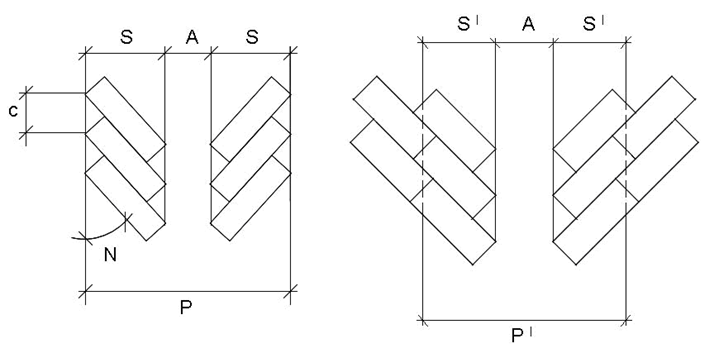
15.
Where two parking spaces adjoin on the inside corner of a 90-degree change in the direction of a drive aisle, the adjacent parking space to the corner area must be widened by one foot or the adjoining area must include an offset of a minimum of one foot in each direction as shown on the following exhibit:
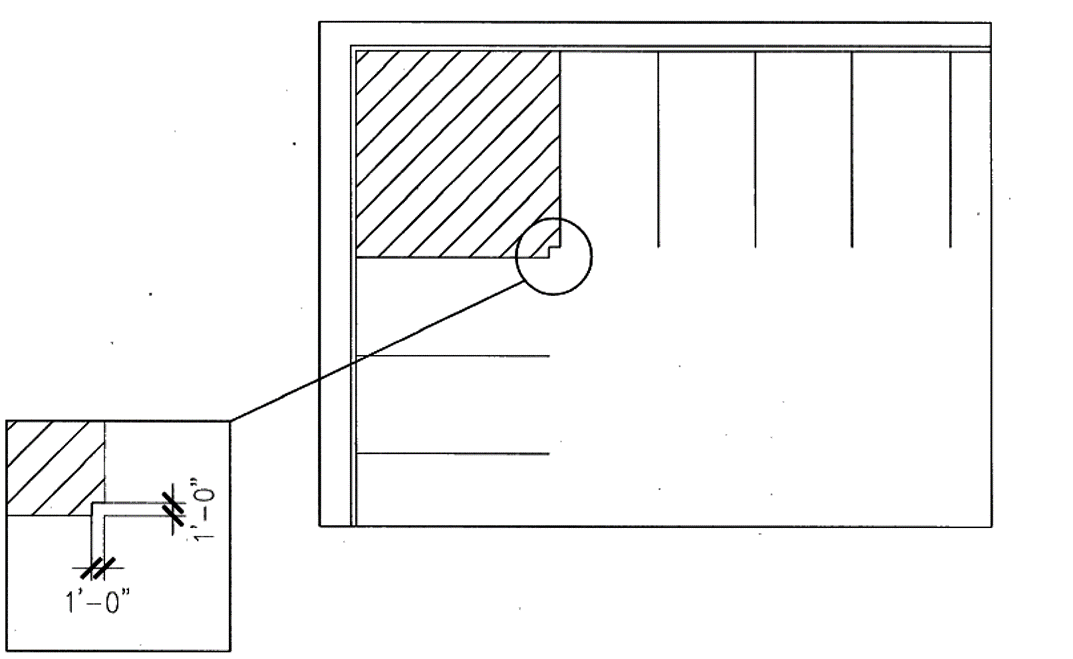
16.
Landscaping of parking must comply with the following regulations:
a.
Peripheral landscaping at least five feet in width, or greater, must be provided along the interior of all property lines and adjacent to all public streets.
b.
One tree, fifteen-gallon minimum must be planted within a minimum five foot wide (as measured from the inside face of the curbing) at no more than every ten parking stalls.
c.
Each unused space resulting from the design of parking spaces or accessory structures over twenty-four square feet in area must be landscaped.
d.
Irrigation System. All landscaping must be provided with a permanent watering system. The design of the irrigation system must be drawn to scale and must include water pressure, pipe size, and type of heads (sprinkler, bubbler, or rainbirds).
e.
Identification of Plant Materials. The common and botanical names of each plant, its container size, the number of each, and the location of the plant within the parking area must be clearly illustrated.
f.
Choice of Plant Materials. Landscaping must consist of a combination of trees, shrubs and groundcover.
g.
Parking Space Overhang. Parking spaces are allowed to overhang into a landscaped area a maximum of two feet.
h.
Parking spaces may overhang two feet into a paved pedestrian area where the pedestrian area has a minimum width of six feet as measured from the face of the curb that serves as a wheel stop.
J.
A fence or wall not to exceed six feet in height is required to be located and maintained along the side or rear lot lines provided such fence or wall does not extend into the required front yard or into the side yard along the street side of a reverse corner lot, in which case such fence or wall shall be limited to three feet in height.
K.
All utilities shall be placed underground in accordance with the provisions of the Camarillo Municipal Code and any other applicable law.
L.
No mechanical equipment consisting of ventilation, air conditioning equipment and servicing equipment for swimming pools shall be placed in the side yard or front yard area.
M.
Landscaping. Landscaping and other ground space treatment shall be provided on all areas not used for buildings, parking, roadways, pathways or recreational facilities. Landscaping shall be considered actual planting areas of lawn, trees, planter boxes, shrubs, groundcover or other plant material. Such landscaping shall be provided in accordance with the following standards:
1.
The entire required setback area shall be landscaped with the exception of vehicle accessways and other areas designated for recreational purposes.
2.
Fountains, ponds, sculpture and decorative screen walls are permitted as part of the landscaping.
3.
Landscape Plan. A plan at a minimum scale of one-inch equals thirty feet shall be submitted to the department of community development.
4.
All landscaping must comply with Chapter 14.14 - Water Efficient Landscapes of this Code of Ordinances
N.
Refuse. All outdoor refuse and recycling storage areas shall be enclosed on all sides by a minimum six-foot high brick, concrete block or masonry wall. The opening of such storage area shall be screened by a solid gate of durable wood or metal. The gate height shall be equal to the height of the enclosure and the gate shall be equipped with a latch or other device to insure that the gate remains closed when not in use. Refuse enclosures must meet the following standards:
1.
The enclosures shall be constructed so that the contents, including containers shall not be visible from a height of six feet above ground level on any street frontage
2.
A six-inch concrete curb around the bottom interior portion of the enclosure walls shall be provided.
O.
All mechanical equipment or electrical equipment shall be completely screened behind a permanent structure and all rooftop mechanical equipment placed behind a permanent parapet wall or be completely restricted from all view at ground level.
P.
Private streets and/or driveways provided within the project shall be subject to the following standards:
For private streets, the minimum street width shall be as follows:
1.
Twenty-six feet curb-to-curb (when parking is provided off street);
2.
Thirty-two feet curb-to-curb (parallel parking on one side);
3.
Thirty-six feet curb-to-curb in single-family developments (parallel parking on both sides);
4.
Forty feet curb-to-curb in multiple residential developments (parallel parking on both sides).
Q.
Design Standards.
1.
Paint. By-Right projects must include two colors; one for the main wall color and another for architectural trim pieces and must be selected from the following colors: white, off white, tan, light brown, or light gray. The paint treatment must be applied along all window surrounds, and on all wall façades of all elevations. Rust-inhibitive paint must be used for all exterior metal building surfaces to prevent corrosion and release of metal contaminants into the storm drain system.
2.
Roof. The roofs on any new building must be pitched covered in clay barrel or concrete roofing tile with a minimum 3:12 pitch. Roof color must be gray, brown, or natural clay. Mansard roofs are not permitted.
3.
Elevation Materials. A minimum of two different materials must be used on all building elevations, consisting of brick, stone, fiber cement siding, or stucco. On a single building, the two minimum building materials must be repeated on each elevation.
4.
Windows. All windows on each side of buildings must provide stucco over foam or wood surrounds a minimum of four inches in width, on all four sides of the windows with a minimum projection of two inches from the face of the structure.
5.
Eaves. All buildings must provide eaves of not less than twelve inches and not greater than thirty-six inches and must not encroach into any required setback area.
6.
Variation. Unbroken wall planes greater than thirty feet in length are prohibited. Wall planes may be broken up by windows or recesses. Recesses are to measure a minimum of twelve inches in depth and length.
7.
Architectural Styles. One of five architectural styles must be chosen for each building. These styles are Traditional, Spanish Colonial Revival, Monterey, Craftsman, and French Country. Within a chosen architectural style, a minimum of five listed architectural elements must be included per building:
8.
Traditional. Additional elements (minimum five required). At least five of the following elements must be incorporated in a by-right project that selects the Traditional Style for a building:
a.
Substantial profiled wood cornices at eaves, and profiled trim at gable ends;
b.
Rectangular (vertical), single- or double- hung windows;
c.
Window shutters;
d.
Brick used as an elevation material;
e.
Windows with divided lites;
f.
Brick chimneys;
g.
Pedimented wood surrounds at front entries.
9.
Spanish Colonial Revival. Additional elements (minimum five required). At least five of the following elements must be incorporated in a by-right project that selects the Spanish Colonial Revival Style for a building:
a.
Molded cornices;
b.
Curvilinear parapets;
c.
Iron balconies and window grilles;
d.
Arcades supported by columns;
e.
Corbels;
f.
Decorative tiles;
g.
Tower elements;
h.
Arched window and entry opening;
i.
Lintel type window opening;
j.
Recessed windows.
10.
Monterey. Additional elements (minimum five required). At least 5 of the following elements must be incorporated in a by-right project that selects the Monterey Style for a building:
a.
Exposed rafter tails or profiled cornice at eaves;
b.
Recessed windows;
c.
Flat, arched, segmental, or half round window heads;
d.
For windows, stone or cast stone trim at accent openings, or at sills of openings;
e.
Walls with cut or cast stone accents;
f.
Window shutters;
g.
Heavy exposed beams;
h.
Wood balconies supported by heavy wood posts and roofed with low-pitched shed roofs;
i.
Arcades and trellises;
j.
Decorative tile insets.
11.
Craftsman. Additional elements (minimum five required). At least five of the following elements must be incorporated in a by-right project that selects the Craftsman Style for a building:
a.
Exposed, profiled rafter tail eaves, and simple wide gable boards with trim;
b.
Vertical and square windows combined into horizontal groupings;
c.
Divided lites in upper sashes of single- or double hung-windows;
d.
Windows surrounded by wide, detailed wood trim;
e.
Use of cobblestone and river rock;
f.
Use of brick at base of wall or porch;
g.
Exposed wood beams and brackets, profiled at the ends;
h.
Tapered wood posts set on rectangular or tapered masonry piers;
i.
Bandsawed and pierced ornamentation in wood railings.
12.
French Country. Additional elements (minimum five required). At least five of the following elements must be incorporated in a by-right project that selects the French Country Style for a building:
a.
Gable forms, linking one- and two-story masses with a single roof plane;
b.
Simple cornices (with outward concaves), at eaves;
c.
Wood plank shutters;
d.
Single round, oval, or hexagonal windows accenting façades;
e.
Smooth cut or cast stone and wood trim;
f.
Circular and segmental arches at main entries;
g.
Wrought iron or wood balconies;
h.
Smooth or sand finish stucco;
i.
Deep set windows on front elevation (four inch minimum).
(Ord. No. 2009, § 4(Exh. A), 4-12-2023)
19.35.020 - CCM sites (NV1-NV14)
The city will allow by-right, ministerial approval for residential projects on non-vacant site numbers 1-14 ("NV1-NV14") identified in the city's adopted 2021-2029 Housing Element that include twenty percent or more of its units affordable to lower-income households as defined in Health & Safety Code § 50079.5, provided it complies with all of the standards identified in this section.
All by-right residential projects submitted pursuant to this chapter must include an affordable housing agreement with the city, including, among other things, provisions governing continued affordability to lower income households.
A.
Front Yard. Front yards may not be less than fifteen feet nor greater than twenty feet from the edge of the curb.
B.
Side Yard. No interior side yards are required. Side yards adjacent to a major street are only permitted to allow for plazas and pedestrian walkways. The side yard adjacent to a residential zone must be a minimum of twenty feet.
C.
Rear Yard. No rear yards are required. The rear yard adjacent to a public street must meet the front yard requirements.
D.
Density. The maximum allowed density under this section is thirty dwelling units per acre.
E.
Whenever the by-right project abuts a residential zone, a solid masonry screen wall a minimum of six feet in height must be erected along the property line abutting the residential zone.
F.
Whenever the parking or circulation area abuts a public street, there must be a low stucco or slump block wall or landscaped hedge, not greater than three feet in height (excluding architectural features such as pilasters), along the property lines adjacent to the parking or circulation area adjacent to the street.
G.
Lighting. Exterior lighting is permitted subject to the procedures and regulations of Chapter 19.47 of this code.
H.
All buildings must be a minimum of twenty-five feet in height or two stories. Buildings adjacent to a public street may not exceed forty feet in height. Buildings not adjacent to a public street are limited to a height of forty-five feet or four stories. No building may exceed four stories.
I.
Location. Residential units must have a separate entry and exit apart from the commercial units.
J.
All mechanical and electrical equipment, and satellite dish antennas (except dishes less than one meter in diameter), must be screened from view by landscaping or fence screen wall or combination of, and all rooftop equipment must be placed behind a permanent parapet wall or equipment screen and be completely screened from view at ground level.
K.
Private Usable Outdoor Area. Each unit must include a deck or balcony to provide an exterior area for the unit. The minimum dimension of a deck or balcony is six feet. The minimum area of the exterior space is one hundred square feet exclusive of mechanical equipment.
L.
Recreation Area. In addition to private useable outdoor space, each dwelling unit shall provide common useable open space as follows:
1.
One hundred twenty-five square feet for each studio, efficiency, or one bedroom unit;
2.
Two hundred twenty-five square feet for each dwelling unit having two or more bedrooms
M.
The common recreational/leisure area may be composed of active or passive facilities and may be located either indoors or outdoors or may be a combination of both. Common useable open space may incorporate any required setback areas other than required front or street-side yard setback areas, but may not include or incorporate any driveways, trash pickup areas, storage or utility areas or parking areas other than the rooftop deck of a parking structure.
N.
Landscaping and all other ground space treatment must be provided upon the net developed site. Landscaping includes the actual planting areas of lawn, trees, planter boxes, shrubs, or other plants. Landscaping must be surrounded by either a six-inch masonry curb, sidewalk or building. All landscaping must comply with the following standards:
1.
The parking area setback must be landscaped with the exception of the area provided for vehicles or pedestrian access.
2.
No planting area will be considered a landscaped area unless it contains at least twenty-four square feet of area and is a minimum of four feet in width; except raised planting boxes within close proximity to the building.
3.
One tree, twenty-four-inch box minimum, must be planted within a minimum sixty-inch-wide planter area at every ten rows of single-row parking stalls, or at every twenty rows of double-row parking stalls.
4.
Above-grade and semi-subterranean parking structures must include potted or boxed trees and landscaping on all open-air parking decks that are above grade and visible from any public or private right-of-way, subject to the limitations posed by the engineering of the structure with respect to the weight loads generated by such landscaping.
5.
Each unused space resulting from the design of parking spaces or over twenty-four square feet in area must be landscaped.
6.
When the commercial development abuts a residential zone, or where the CCM zone abuts an alley or development property, adjacent to a residential zone, it must include a six-foot-wide landscaped area to screen the commercial development. The design of the screening must consist of trees and shrubs.
7.
All landscaping must comply with Chapter 14.14 - Water Efficient Landscapes of this Code of Ordinances.
O.
Landscaping Plan. A landscaping plan at a minimum scale of one inch equals thirty feet must be submitted and must contain the following:
1.
The dimensions and square footage of each planting area;
2.
The total square footage of each planting area;
3.
Identification of each plant, common and botanical names at the planting area, and the number of each and their container size;
4.
The permanent watering system, including all pipe sizes, and type and size of all sprinkler heads or emitters;
5.
Specification sheet indicating the soil preparation and maintenance program for continual maintenance of the landscaping area and any type of guarantee associated with the installation of the landscaping.
P.
Off Street Parking. No minimum parking requirements are required on a residential, commercial, or other development project if the project is located within one-half mile of the Camarillo Metrolink Station. This exemption does not include electric vehicle charging parking spots and parking for person with disabilities. A project shall be considered to be within one-half mile of the Camarillo Metrolink Station if all parcels within the project have no more than twenty-five percent of their area farther than one-half mile from the station and if not more than ten percent of the residential units or one hundred units, whichever is less, in the project are farther than one-half mile from the station. Projects must the following standards:
1.
The floor area calculation will be based on the gross floor area of the building or use except where otherwise provided.
2.
Restrooms, utility rooms, equipment rooms, elevator shafts, duct space, and stair wells will be excluded from the square footage when computing floor area for parking purposes.
3.
The floor area includes exterior walls but excludes exterior areas.
4.
Interior hallways will be included as part of the floor area for determining the gross floor area.
5.
Any fractional spaces over fifty percent will be construed as one full space.
6.
In any place of public assembly utilizing benches, pews, or other non-individualized seating structure, each eighteen-inch section of such structure will be construed as one seat.
7.
A building or portion of a building devoted to off-street parking will have no off-street parking requirements.
8.
In the case of mixed-uses in a building or on a lot, the total requirements for off-street parking facilities will be the sum of the requirements of the various uses computed separately. Off-street parking facilities for one use will not be considered as providing required parking facilities for any other use except as specified in this chapter for common facilities or joint uses.
9.
Residential Parking Table:
10.
Drive-through facilities for food uses must provide the following:
a.
A minimum stack-up space from the pick-up window to the entrance to the drive-through lane that provides for minimum of ten vehicles.
b.
Separate window areas: one for the payment for the food items and a second window to pick up the food items.
c.
The drive-through lane must include an ordering panel a minimum of thirty feet ahead of the payment window, and a preview panel a minimum of twenty-four feet ahead of the ordering panel. If the ordering panel is visible a second order station may be substituted for the preview panel.
d.
No more than one drive-through lane is permitted.
11.
Drive-up kiosks must provide for the following:
a.
A minimum of two stacking spaces at each window clear of the required driving lanes.
b.
A maximum of two drive-through lanes is permitted.
12.
Drive-up banking facilities must provide the following:
a.
A minimum of four stack-up spaces.
b.
A maximum of four drive-up lanes is permitted.
13.
Other types of drive-through uses, including drive-up retail uses, must provide a minimum of four stack-up spaces and no more than two drive-through lanes.
14.
For all residential uses, the parking spaces must be located on the same lot, parcel, or site as the buildings they serve.
15.
No off-street parking lot, parcel, or site may be located more than three hundred feet from a building lot, parcel, or site it is intended to serve.
16.
Open off-street parking spaces must be a minimum of nine feet wide and twenty feet long.
17.
Enclosed or covered off-street parking spaces must be a minimum of ten feet wide and twenty feet long, interior dimensions. Single stall enclosed parking spaces must be a minimum of twelve feet in width. Tandem enclosed or open spaces are prohibited in townhouse, condominium, or other multifamily ownership projects.
18.
A handicapped parking space must comply with the requirements of Title 24 of the California Code of Regulations or other applicable regulations.
19.
Drive-through lanes must be a minimum width of twelve feet with increased widths at turns and proper radii to accommodate the turning of vehicles.
20.
Each stack-up space must be a minimum length of twenty-four feet as measured at the center line of the drive-through lane.
21.
A commercial or industrial driveway must be a minimum of twenty feet wide.
22.
The gradient of access to and within all parking facilities including parking lots and parking garages may not exceed a maximum of fifteen percent slope.
23.
Bicycle racks must be provided to accommodate four bicycles for the first fifty thousand square feet of floor area. One additional bicycle space must be provided for each additional increment of fifty thousand square feet of floor area.
24.
Transit Stops. Transit stop improvements (bus turnouts, bus pads, bus shelters are required for nonresidential development of one hundred thousand square feet or more of floor area and for residential developments of one hundred dwelling units or more.
25.
Transportation Information Centers. All nonresidential developments employing at least fifty individuals are required to provide a bulletin board, display case or kiosk displaying transportation information. The information displayed must include, but is not limited, to the following:
a.
Current maps, routes and schedules for public transit serving the site
26.
Uses required to provide for more than fifty parking spaces must provide a minimum of one motorcycle parking space plus one space for every fifty parking spaces thereafter up to the first two hundred parking spaces. For parking facilities with more than two hundred parking spaces, one motorcycle parking space for every one hundred parking spaces must be provided.
27.
A use will be given credit in lieu of providing motorcycle parking if the parking facility provides a greater amount of parking than otherwise required by this section. In such instance, one additional automobile parking space will count for two required motorcycle parking spaces. Similarly, additional motorcycle parking may be credited for automobile parking spaces (up to a maximum of eight parking spaces) at a ratio of two motorcycle parking spaces for each one automobile parking space.
28.
Motorcycle parking spaces must have a minimum dimension of at least four feet in width and seven feet in length, and must be accessed by a drive aisle of at least eight feet in width.
29.
All open parking must comply with the following exhibits and table:
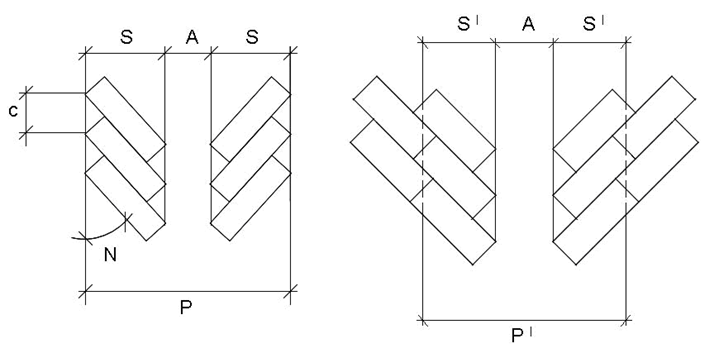
30.
Parking structures. All parking within parking structures must comply with the following exhibits, criteria, and table:
a.
Driveways with grades greater than five percent must provide a vertical transition. No driveway may have a slope greater than twenty percent.
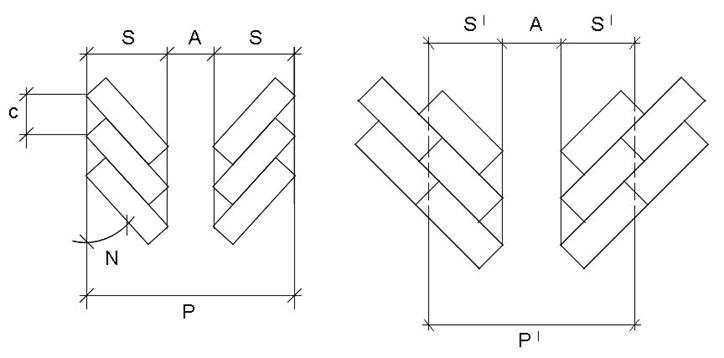
31.
Where two parking spaces adjoin on the inside corner of a 90-degree change in the direction of a drive aisle, the adjacent parking space to the corner area must be widened by one foot or the adjoining area must include an offset of a minimum of one foot in each direction as shown on the following exhibit:
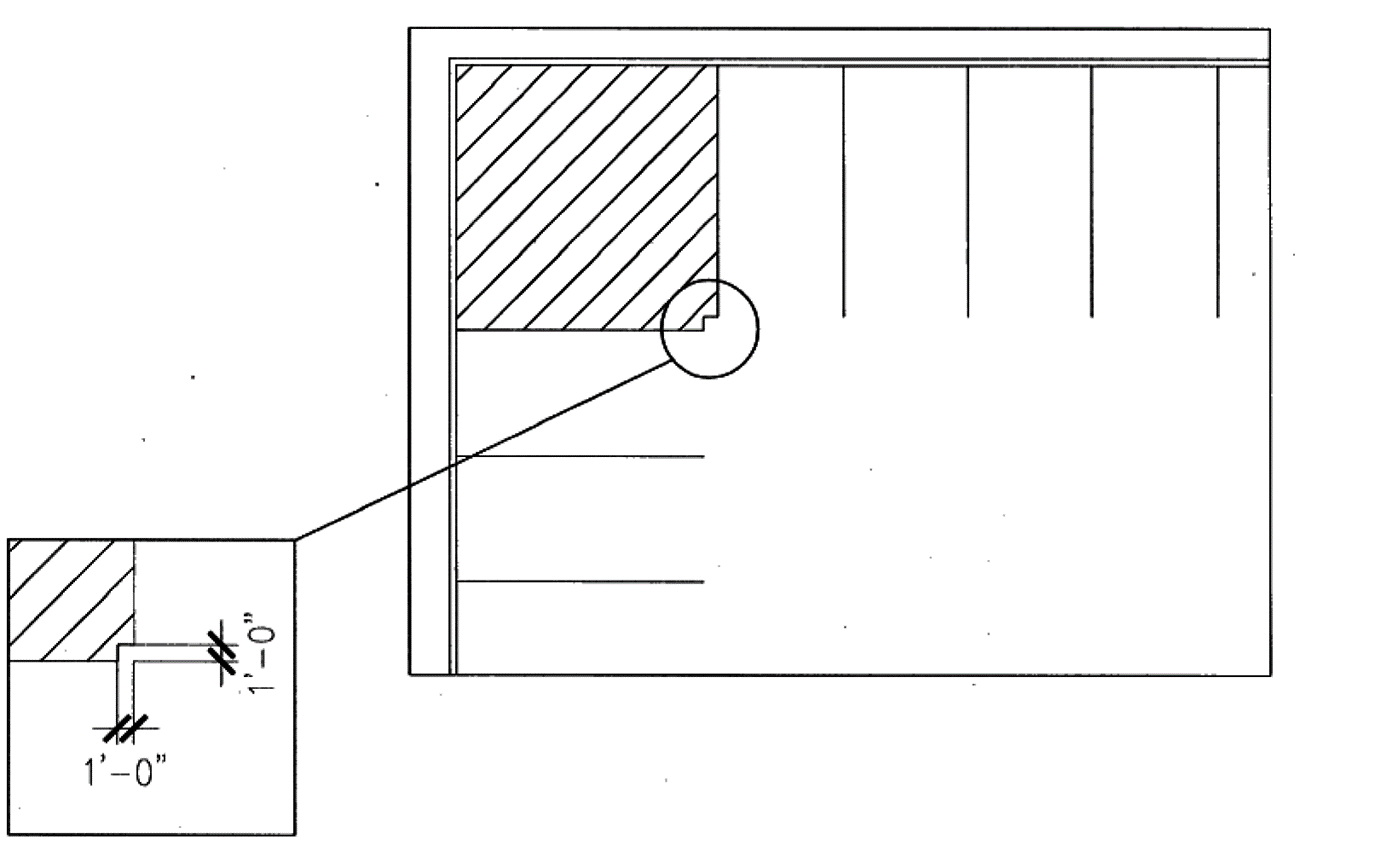
32.
Landscaping of parking areas must comply with the following regulations:
a.
Peripheral landscaping at least five feet in width or greater must be provided along the interior of all property lines and adjacent to all public streets.
b.
One tree, fifteen-gallon minimum must be planted within a minimum five foot wide (as measured from the inside face of the curbing) at no more than every ten parking stalls.
c.
Each unused space resulting from the design of parking spaces or accessory structures over twenty-four square feet in area must be landscaped.
d.
All planting areas must be maintained in a healthy, stable condition or replaced.
e.
Irrigation System. All landscaping must be provided with a permanent watering system. The design of the irrigation system must be drawn to scale and must include water pressure, pipe size, and type of heads (sprinkler, bubbler, or rainbirds).
f.
Identification of Plant Materials. The common and botanical names of each plant, its container size, the number of each, and the location of the plant within the parking area must be clearly illustrated.
g.
Choice of Plant Materials. Landscaping must consist of a combination of trees, shrubs and groundcover.
h.
Parking Space Overhang. Parking spaces are allowed to overhang into a landscaped area a maximum of two feet.
i.
Parking spaces may overhang two feet into a paved pedestrian area where the pedestrian area has a minimum width of six feet as measured from the face of the curb.
33.
All parking areas must be improved as follows:
a.
Paving must be either a portland cement or asphalt surface.
b.
A continuous six-inch concrete curb above parking lot level must be installed and serve as a wheel stop for cars on all periphery areas of the parking lot and as an edging for planting areas and islands and protection for walls for entrances and exits.
c.
Where parking fronts onto a public street, a wall, hedge, berm or combination of these must provide screening of the parking lot that is at least thirty-six inches high.
d.
A plot plan of any proposed off-street parking area must be submitted to the department of community development at the time of the application.
Q.
Refuse. Refuse and recycling enclosures shall be provided in accordance with the following standards:
1.
The enclosures shall be constructed so that the contents, including containers shall not be visible from a height of six feet above ground level on any street frontage.
2.
The enclosure shall be constructed of masonry, block or decorative block.
3.
Wall heights shall be no less than six feet for bins and five feet for cans measured from finished grade at the exterior of the enclosure. Interior dimensions for an enclosure containing two three-cubic yard bins, shall be no less than ten feet by seven feet.
4.
Each refuse and recycling enclosure shall be provided with solid wood or metal gates. The gate height shall be equal to the height of the enclosure and the gate shall be equipped with a latch or other device to insure that the gate remains closed when not in use.
5.
A six-inch concrete curb around the bottom interior portion of the enclosure walls shall be provided.
R.
Loading. Loading Spaces will comply with the following:
1.
When the lot upon which loading spaces are located abuts upon an alley, such loading spaces shall have access from the alley. The length of the loading space may be measured perpendicular to or parallel with the alley. Where such loading area is parallel with the alley and the lot is fifty feet or less in width, the loading area shall extend across the full width of the lot.
2.
No part of an alley or street shall be used for loading excepting areas designated by the city for loading.
3.
No loading space required by the provisions herein shall be eliminated, reduced, or converted in any manner unless equivalent facilities are provided.
4.
Standard loading spaces shall be not less than twelve feet in width extending fifty feet in depth and fourteen feet in height.
5.
For all non-residential building square footage, the following standards shall apply:
S.
All utilities shall be placed underground in accordance with the provisions of the Camarillo Municipal Code.
T.
Except as provided in this section, the development must comply with the Camarillo Commons Strategic Plan.
U.
Building Coverage. Buildings and other structures may not occupy more than fifty percent of the project area.
V.
Design Standards
1.
Paint. By-Right projects must include two colors; one for the main wall color and another for architectural trim pieces and must be selected from the following colors: white, off white, tan, light brown, or light gray. The paint treatment must be applied along all window surrounds, and on all wall façades of all elevations. Rust-inhibitive paint must be used for all exterior metal building surfaces to prevent corrosion and release of metal contaminants into the storm drain system.
2.
Roof. The roofs on any new building must be pitched covered in clay barrel with a minimum 3:12 pitch. Roof color must be brown or natural clay. Mansard roofs are not permitted.
3.
Elevation Materials. A minimum of two different materials must be used on all building elevations, consisting of brick, stone, fiber cement siding, or stucco. On a single building, the two minimum building materials must be repeated on each elevation.
4.
Windows. All windows on each side of buildings must provide stucco over foam or wood surrounds a minimum of four inches in width, on all four sides of the windows with a minimum projection of two inches from the face of the structure.
5.
Eaves. All buildings must provide eaves of not less than twelve inches and not greater than thirty-six inches and must not encroach into any required setback area.
6.
Variation. Unbroken wall planes greater than thirty feet in length are prohibited. Wall planes may be broken up by windows or recesses. Recesses are to measure a minimum of twelve inches in depth and length.
7.
Spanish/Mission Architectural Style Additional Elements (Minimum five Required). At least five of the following elements must be incorporated on all buildings in a by-right project:
a.
Molded cornices;
b.
Curvilinear parapets;
c.
Iron balconies and window grilles;
d.
Arcades supported by columns;
e.
Corbels;
f.
Decorative tiles;
g.
Tower elements;
h.
Arched window and entry opening;
i.
Lintel type window opening;
j.
Recessed windows.
(Ord. No. 2009, § 4(Exh. A), 4-12-2023)
19.35.030 - CMU site (V4 and adjacent lot).
The city will allow by-right, ministerial approval for residential projects on vacant site number 4 ("V4") identified in the city's adopted 2021-2029 Housing Element and the adjacent lot (identified by APNs: 229-0-320-165 and 229-0-320-155), that include twenty percent or more of its units affordable to lower-income households as defined in Health & Safety Code § 50079.5, provided it complies with all of the standards identified in this section.
All by-right residential projects submitted pursuant to this chapter must include an affordable housing agreement with the city, including, among other things, provisions governing continued affordability to lower income households.
A.
Front Yard. Buildings may be constructed up to the front property line or right-of-way, whichever is greater. Parking areas must be set back a minimum of five feet.
B.
Side Yard. No interior side yards are required. The side yard adjacent to a public road must meet the front yard setback requirements.
C.
Rear Yard. Rear yard must be no less than ten feet. If the building height is in excess of twenty-five feet, the setback must be increased by ten feet for each ten feet of building height or portion thereof to a yard area not to exceed fifty feet.
D.
Density. The maximum allowed density under this section is thirty dwelling units per acre.
E.
Off Street Parking. No minimum parking requirements are required on a residential, commercial, or other development project if the project is located within one-half mile of the Camarillo Metrolink Station. This exemption does not include electric vehicle charging parking spots and parking for person with disabilities.
F.
A handicapped parking space must comply with the requirements of Title 24 of the California Code of Regulations or other applicable regulations.
G.
A commercial or industrial driveway must be a minimum of twenty feet wide.
H.
Transit Stops. Transit stop improvements (bus turnouts, bus pads, bus shelters are required for nonresidential development of one hundred thousand square feet or more of floor area and for residential developments of one hundred dwelling units or more.
I.
Bicycle racks must be provided to accommodate four bicycles for the first fifty thousand square feet of floor area. One additional bicycle space must be provided for each additional increment of fifty thousand square feet of floor area.
J.
Transportation Information Centers. All nonresidential developments employing at least fifty individuals are required to provide a bulletin board, display case or kiosk displaying transportation information. The information displayed must include, but is not limited, to the following:
1.
Current maps, routes and schedules for public transit serving the site
K.
All open parking must comply with the following exhibits and table:
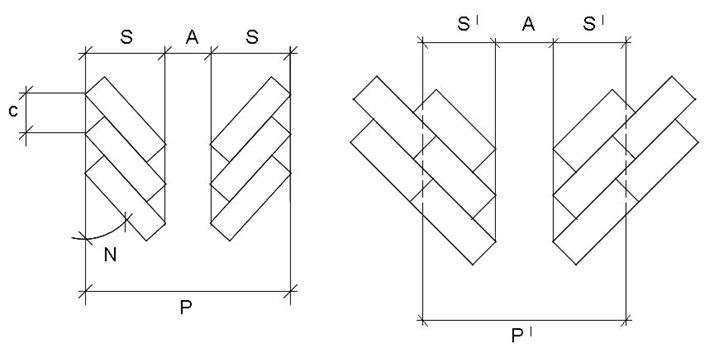
L.
Parking structures. All parking within parking structures must comply with the following exhibits, criteria, and table:
1.
Driveways with grades greater than five percent must provide a vertical transition. No driveway may have a slope greater than twenty percent.
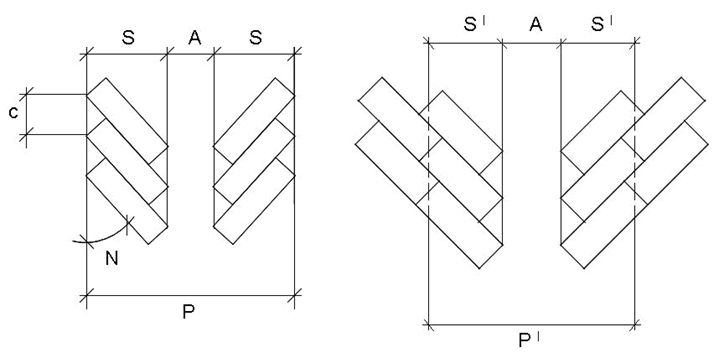
M.
Where two parking spaces adjoin on the inside corner of a 90-degree change in the direction of a drive aisle, the adjacent parking space to the corner area must be widened by one foot or the adjoining area must include an offset of a minimum of one foot in each direction as shown on the following exhibit:
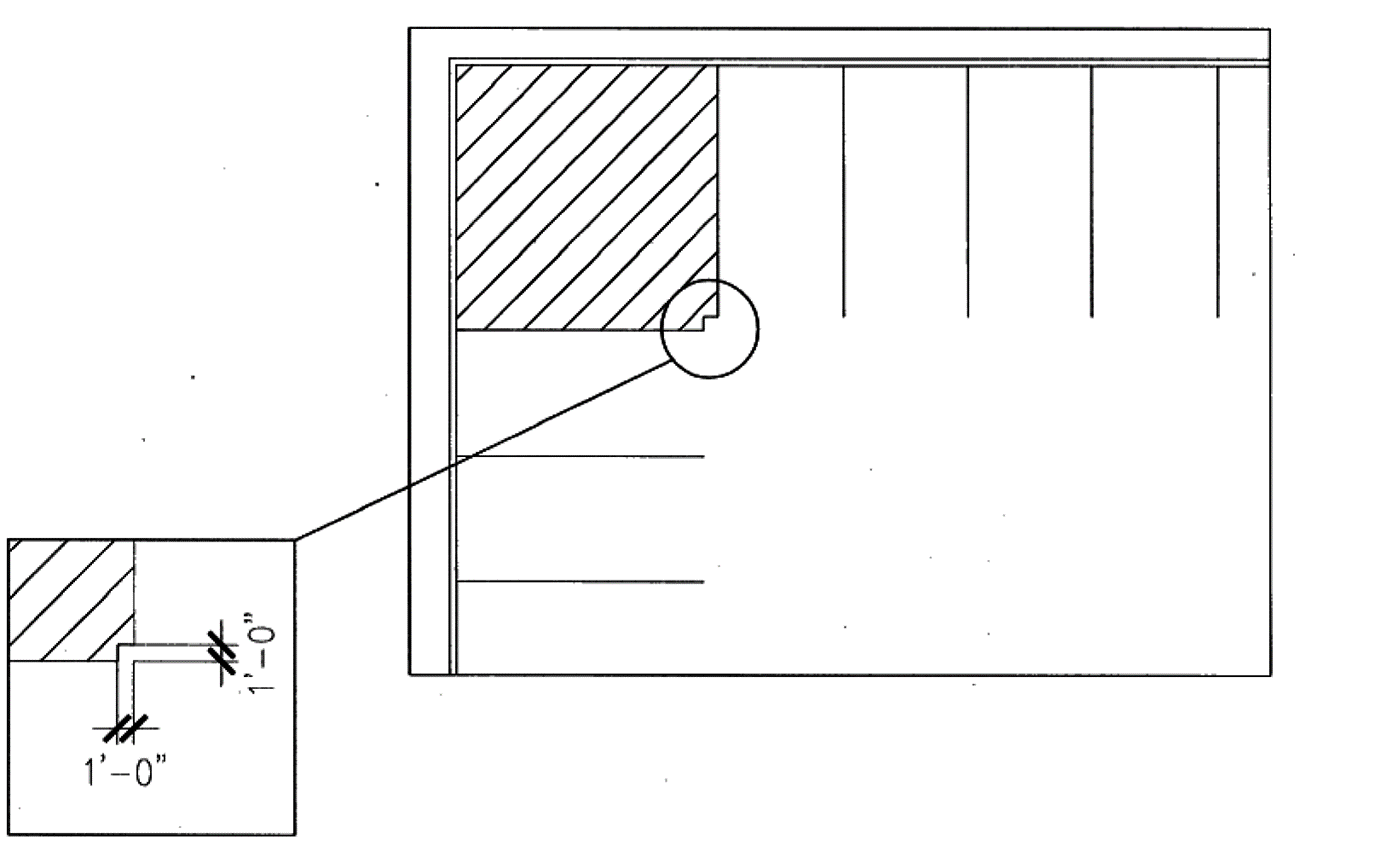
N.
Landscaping of parking areas must comply with the following regulations:
1.
Peripheral landscaping at least five feet in width or greater must be provided along the interior of all property lines and adjacent to all public streets.
2.
One tree, fifteen-gallon minimum must be planted within a minimum five foot wide (as measured from the inside face of the curbing) at no more than every ten parking stalls.
3.
Each unused space resulting from the design of parking spaces or accessory structures over twenty-four square feet in area must be landscaped.
4.
All planting areas must be maintained in a healthy, stable condition or replaced.
5.
Irrigation System. All landscaping must be provided with a permanent watering system. The design of the irrigation system must be drawn to scale and must include water pressure, pipe size, and type of heads (sprinkler, bubbler, or rainbirds).
6.
Identification of Plant Materials. The common and botanical names of each plant, its container size, the number of each, and the location of the plant within the parking area must be clearly illustrated.
7.
Choice of Plant Materials. Landscaping must consist of a combination of trees, shrubs and groundcover.
8.
Parking Space Overhang. Parking spaces are allowed to overhang into a landscaped area a maximum of two feet.
9.
Parking spaces may overhang two feet into a paved pedestrian area where the pedestrian area has a minimum width of six feet as measured from the face of the curb.
O.
All parking areas must be improved as follows:
1.
Paving must be either a portland cement or asphalt surface
2.
A continuous six-inch concrete curb above parking lot level must be installed and serve as a wheel stop for cars on all periphery areas of the parking lot and as an edging for planting areas and islands and protection for walls for entrances and exits.
3.
Where parking fronts onto a public street, a wall, hedge, or combination of these must provide screening of the parking lot that is at least thirty-six inches high.
4.
A plot plan of any proposed off-street parking area must be submitted to the department of community development at the time of the application
P.
Loading. Loading Spaces will comply with the following:
1.
When the lot upon which loading spaces are located abuts upon an alley, such loading spaces shall have access from the alley. The length of the loading space may be measured perpendicular to or parallel with the alley. Where such loading area is parallel with the alley and the lot is fifty feet or less in width, the loading area shall extend across the full width of the lot.
2.
No part of an alley or street shall be used for loading excepting areas designated by the city for loading.
3.
No loading space required by the provisions herein shall be eliminated, reduced, or converted in any manner unless equivalent facilities are provided.
4.
Standard loading spaces shall be not less than twelve feet in width extending fifty feet in depth and fourteen feet in height.
5.
For all non-residential building square footage, the following standards shall apply:
Q.
Whenever the CMU zone abuts on a residential zone, a solid masonry screen wall of six feet in height must be erected along the property line abutting the residential zone.
R.
Whenever the parking or circulation area abuts a public street, there must be a low wall and landscaped hedge, not greater than three feet in height, along the property lines adjacent to the parking area adjacent to the street.
S.
Lighting. Exterior lighting is permitted subject to the procedures and regulations of Chapter 19.47 of this code.
T.
Commercial Space. A project may not have less than ten percent of its total building square footage devoted to commercial space. A project may not have more than fifty percent of its total building square footage devoted to commercial space.
U.
Buildings and other structures may not occupy more than fifty percent of the project area, where other sections of the code are met and with which all standards have been complied. The remaining area may be used for landscaping, automobile parking and circulation, and must be completely improved for these purposes.
V.
All buildings are limited to three stories and may not exceed a height of forty feet.
W.
Building Coverage. Buildings and other structures may not occupy more than fifty percent of the project area.
X.
Residential units are subject to the following standards:
1.
Residential units must have a separate and secured entrance and exit from the commercial areas.
2.
Usable Outdoor Area. Each unit must include a deck or balcony to provide an exterior area for the unit. The minimum dimension of a deck or balcony is seven feet, six inches. A minimum area of the exterior space is one hundred square feet.
3.
Recreation Area. Recreation space, including recreational facilities for children, shall be provided for the residential units.
4.
Pedestrian and Vehicular Connections. Buildings are to be connected by pedestrian pathways and vehicular circulation systems.
5.
Live/work units shall provide an area devoted to the commercial use located on the ground floor of not less than five hundred square feet.
Y.
Horizontal mixed-use developments. In addition to all other requirements set forth in this section, horizontal mixed-use developments shall provide common usable open space. Common usable open space does not include land occupied by streets, driveways, parking areas, service areas, or required front or street side yards; provided, however, that land occupied by recreational structures and facilities may be counted as common usable open space and in accordance with the following standards:
1.
The minimum common usable open space required for each dwelling unit shall be as follows:
a.
One hundred twenty-five square feet for each studio or efficiency unit;
b.
Two hundred twenty-five square feet for each dwelling unit having one or more bedrooms.
2.
At least fifty percent of the required common usable open space shall be contained in one or not more than three common areas. The required common usable open space may be distributed throughout the project and need not be in one large area provided that required common usable open space shall have an area six hundred twenty-five square feet and a rectangle described within it shall have a minimum dimension of not less than twenty-five feet.
3.
All required common usable open space shall be either landscaped, Barbecue space, or playgrounds and all lawn and landscaping areas shall be provided with a permanent watering system.
4.
Fifty percent of the required common usable open space shall be situated on slopes not to exceed five percent.
Z.
Landscaping. Landscaping and all other ground space treatment must be provided upon the net developed site. Landscaping includes the actual planting areas of lawn, trees, planter boxes, shrubs, or other plants. Landscaping must be surrounded by six-inch masonry curb, walk or building. Courtyards, water ponds, streams, walkways, decks, kiosks are permitted. All landscaping must comply with the following standards:
1.
Required landscaped areas must be provided with a permanent method of watering of plants. This watering system must consist of piped water lines terminating in sprinklers or emitters.
2.
No planting area will be considered a landscaped area, unless it contains at least twenty-four square feet in area and is a minimum of four feet in width, except raised planting boxes within four feet of a building.
3.
One tree, fifteen gallons minimum, must be planted within a minimum sixty-inch wide planter area at every ten rows of single-row parking stalls, or at every twenty rows of double-row parking stalls.
4.
Each unused space resulting from the design of parking spaces or over twenty-four square feet in area must be landscaped.
5.
When the commercial development abuts a residential zone, or where the CMU zone abuts an alley or development property, adjacent to a residential zone, it must include a six-foot wide landscaped area. The design of the screening must consist of trees and shrubs.
6.
All landscaping must comply with Chapter 14.14 - Water Efficient Landscapes of this Code of Ordinances.
7.
Landscaping Plan. A landscaping plan at a minimum scale of one-inch equals thirty feet must be submitted to the Department of Community Development and must contain the following
a.
The dimensions and square footage of each planting area;
b.
he total square footage of each planting area;
c.
Identification of each plant, common and botanical names at the planting area, and the number of each and their container size.
d.
The permanent watering system, including all pipe sizes, and type and size of all sprinkler heads or emitters;
e.
Specification sheet indicating the soil preparation and maintenance program for continual maintenance of the landscaping area and any type of guarantee associated with the installation of the landscaping.
AA.
Refuse. Refuse and recycling enclosures shall be provided in accordance with the following standards:
1.
Each development established must provide an outdoor refuse and recycling storage area, enclosed on all sides by a minimum of six-foot high brick, concrete block, or masonry wall. The opening of the storage area must be screened by a solid gate of durable wood or metal. The enclosure must be covered by a solid roof. The gate height shall be equal to the height of the enclosure and the gate shall be equipped with a latch or other device to insure that the gate remains closed when not in use.
2.
The enclosures shall be constructed so that the contents, including containers shall not be visible from a height of six feet above ground level on any street frontage
3.
Interior dimensions for an enclosure containing two three-cubic yard bins, shall be no less than ten feet by seven feet.
4.
A six-inch concrete curb around the bottom interior portion of the enclosure walls shall be provided.
BB.
All utilities shall be placed underground in accordance with the provisions of the Camarillo Municipal Code.
CC.
All mechanical and electrical equipment, and satellite dish antennas (except dishes less than one meter in diameter), must be screened from view by landscaping or fence screen wall or combination of, and all rooftop equipment must be placed behind a permanent parapet wall or equipment screen and be completely screened from view at ground level.
DD.
Design Standards
1.
Paint. By-Right projects must include two colors; one for the main wall color and another for architectural trim pieces and must be selected from the following colors: white, off white, tan, light brown, or light gray. The paint treatment must be applied along all window surrounds, and on all wall façades of all elevations. Rust-inhibitive paint must be used for all exterior metal building surfaces to prevent corrosion and release of metal contaminants into the storm drain system.
2.
Roof. The roofs on any new building must be pitched covered in clay barrel or concrete roofing tile with a minimum 3:12 pitch. Roof color must be gray, brown, or natural clay. Mansard roofs are not permitted.
3.
Elevation Materials. A minimum of two different materials must be used on all building elevations, consisting of brick, stone, fiber cement siding, or stucco. On a single building, the two minimum building materials must be repeated on each elevation.
4.
Windows. All windows on each side of buildings must provide stucco over foam or wood surrounds a minimum of four inches in width, on all four sides of the windows with a minimum projection of two inches from the face of the structure.
5.
Eaves. All buildings must provide eaves of not less than twelve inches and not greater than thirty-six inches and must not encroach into any required setback area.
6.
Variation. Unbroken wall planes greater than thirty feet in length are prohibited. Wall planes may be broken up by windows or recesses. Recesses are to measure a minimum of twelve inches in depth and length.
7.
Architectural Styles. One of the following architectural styles must be chosen for each building. These styles are Monterey or Spanish Colonial Revival. Within a chosen architectural style, a minimum of five listed architectural elements must be included per building:
8.
Monterey. Additional elements (minimum five required). At least five of the following elements must be incorporated in a by-right project that selects the Monterey Style for a building:
a.
Exposed rafter tails or profiled cornice at eaves;
b.
Recessed windows;
c.
Flat, arched, segmental, or half round window heads;
d.
For windows, stone or cast stone trim at accent openings, or at sills of openings;
e.
Walls with cut or cast stone accents;
f.
Window shutters;
g.
Heavy exposed beams;
h.
Wood balconies supported by heavy wood posts and roofed with low-pitched shed roofs;
i.
Arcades and trellises;
j.
Decorative tile insets.
9.
Spanish Colonial Revival. Additional elements (minimum five required). At least five of the following elements must be incorporated in a by-right project that selects the Spanish Colonial Revival Style for a building:
a.
Molded cornices;
b.
Curvilinear parapets;
c.
Iron balconies and window grilles;
d.
Arcades supported by columns;
e.
Corbels;
f.
Decorative tiles;
g.
Tower elements;
h.
Arched window and entry opening;
i.
Lintel type window opening;
j.
Recessed windows.
(Ord. No. 2009, § 4(Exh. A), 4-12-2023)
19.35.040 - General standards.
The following standards are applicable to all developments proposed under this chapter:
A.
The structure walls of any affordable unit may not touch the structure walls of any other affordable unit.
B.
Fees.
1.
By-right developments are subject to applicable development fees as established by resolution. The amount of fees to be paid will be those in effect at the actual time of payment of such fees. Applicant must pay the applicable development fees before the grading/encroachment/sewer permit is ready to be issued, whichever occurs first, unless otherwise required by law.
2.
Applicant must pay park impact fee per Chapter 16.52 of this code to be calculated by, and paid directly to, the Pleasant Valley Recreation and Park District before the issuance of a zone clearance.
3.
Applicant must pay school facilities fees as determined by the school districts and the city prior to building permit issuance in accordance with city and/or state regulations.
C.
Development standards. A proposed by-right development project must comply with the following development standards:
1.
Permits.
a.
Encroachment permits must be obtained from the city for all work within the city right-of-way, as well as any work that would impact the city's right-of-way.
b.
Grading permit and/or sewer permit must be obtained from the city for all applicable project work.
c.
All necessary permits must be obtained from Caltrans for all work within the Caltrans right-of-way, as well as any work that would impact Caltrans' right-of-way. A copy of the Caltrans permits must be submitted to the department of public works.
d.
A Consent for Offsite Construction must be obtained from adjacent property owners for any improvements within the adjacent properties.
e.
All other permits as required under Title 16 (Buildings and Construction) of this code.
2.
Improvements.
a.
Buildings must not be located within existing or new easements.
b.
Design and calculations for all development perimeter and retaining walls must be submitted to building and safety prior to obtaining the required permit and inspection.
c.
Any existing public improvements adjacent to the limits of the project found to be damaged during the construction of the project must be removed and reconstructed.
d.
A pavement treatment over the existing parking lot, including pavement preparation, must be applied.
e.
A pavement treatment over the full width of the street must be applied, if the existing street is in moratorium and the street is cut for project utility installations. Traffic signs and pavement markings on public streets must conform to the California Manual on Uniform Traffic Control Devices (CAMUTCD), latest edition.
f.
Curb, gutters and on-site paving/hardscape must be designed and constructed to meet existing city and Ventura County design standards.
g.
All street or road improvements inside and adjacent to the project boundaries must be designed and constructed to meet current city and Ventura County design standards. Sidewalks must be constructed for pedestrian access.
h.
Frontage landscaping must be designed such that it will not obstruct a motorist's line of sight above three feet nor below seven feet within the corner cutoff area of an uncontrolled intersection, or within the sight triangle of a controlled intersection.
i.
Trees and landscaping:
i.
Private trees must be planted based on an approved landscape plan or at forty-foot intervals along the public street.
ii.
The landscape plan must be coordinated with the grading plans to avoid conflicts of trees with BMP's for stormwater quality and with storm drains.
iii.
The developer must install private landscape/hardscape features, and irrigation systems within the public right-of-way adjacent to the project.
iv.
A license agreement must be finalized with the City of Camarillo for the owners' association to own, operate and maintain the private landscaping, private trees, and private irrigation system within the public right-of-way parkways. All required landscaping, trees and irrigation within the public right-of-way will be private.
j.
Evidence of existing corner lot monumentation must be submitted before project approval and at the completion of the project to ensure that existing corner monumentation and witness markings are not disturbed by construction activities or were reset.
k.
An owners' association or other approved program approved by the city and city attorney must be formed to be recorded to provide maintenance of private improvements.
3.
New driveways and access.
a.
There may be no ingresses or egresses to the project property except for those shown on the improvement plans.
b.
Ingresses or egresses must have a width in accordance with the current city and Ventura County design standards.
c.
Driveways must be located at least ten feet away from the beginning of the street curb return, if no stop signs exist and are not proposed. Driveways must be located at least fifty feet away from the limit line of the existing or proposed stop sign.
d.
Driveway approaches must be constructed or relocated to serve the development. If an existing driveway approach is removed, then curb, gutter, and sidewalk must be constructed in its place.
e.
A single driveway width must have a minimum width of twenty feet and a maximum width of:
i.
Twenty feet for a lot width less than one hundred feet.
ii.
Thirty feet for a lot width of one hundred feet to one hundred and fifty feet.
iii.
Twenty percent of lot frontage but less than sixty feet.
iv.
The total combined width of all driveways must not exceed sixty percent of the property frontage.
f.
In addition to the standards set forth in this subsection, driveways must comply with Section 19.44.160 of this code.
g.
All entrances must be surfaced and improved to include necessary pave-out to join existing pavement in accordance with existing city standards.
h.
Traffic circulation and control on adjacent streets, including all curb openings, control signs for regulation, warning, and guidance of traffic, must be designed to meet existing city standards including traffic study. These shall include, without limitation, stop signs, speed signs, turn prohibition signs, one-way signs, parking signs, together with required pavement striping, raised pavement markers, and road symbols.
i.
Each parking aisle shall connect to another parking aisle or have adequate area for the vehicle parked in the space at the end of the aisle to execute a backing unparking maneuver (e.g., extend the parking aisle ten feet past the end stall).
j.
All traffic control signs must be installed before final occupancy, and before final acceptance, the city may require the developer to add traffic control devices, such as signing and striping, the need for which are not apparent at time of improvement plan approval but which are warranted due to actual field conditions. The developer must install the traffic control devices before final acceptance.
k.
Ramps and other accessible path of travel elements (sidewalk, walk, appurtenances) must be constructed to meet existing city and Ventura County design standards. Accessible facilities shall be constructed and existing facilities reconstructed within the project limits as necessary to comply with California Title 24 accessibility requirements of the California Building Codes and Americans with Disabilities Act (ADA).
l.
Intersection visibility must be designed as set forth in CMC § 19.38.050. The sight distance requirements will also apply to commercial and industrial driveway intersections with public and private streets.
m.
Horizontal and vertical curves at all intersections must be designed to meet existing city standards.
n.
Turn lanes must be designed and constructed to be two hundred feet long with ninety-foot bay tapers.
o.
All two-way drive aisles must have a minimum width of twenty-six feet, including two-way drive aisles that are shared with adjacent developments.
p.
Easements must be obtained from those adjacent properties over areas where shared drive aisles are proposed.
q.
Access roads with turnarounds must be designed and constructed to meet existing city standards.
4.
Grading.
a.
All grading must conform to Chapter 16.04 of this code.
b.
Grading and improvement plans and supporting reports and calculations must be prepared and submitted to the public works department for review and approval. Grading and improvement plans must be submitted on standard city title block sheets of twenty-four by thirty-six inches to a standard engineering scale representative of sufficient plan clarity.
c.
The site must be raised as needed to provide standard clear cover and standard slopes for sewer, water and storm drains.
5.
Soils.
a.
A soils and geologic study as required by Chapter 16.38 of this code and in accordance with the requirements of Resolution No. 88-57 (and all subsequent amendments) must be prepared and submitted to the public works department for review and approval. The study must include, without limitation, fault trenching, slope stability, liquefaction, hydroconsolidation and seismically-induced settlement testing and analysis (contact the public works department for guidelines). The recommendations of the soils and geologic study must be incorporated into the project.
b.
Any restricted use zones must be shown on the grading and improvement plan.
c.
The project property and all proposed building pads must be individually certified as geotechnically suitable for their intended use.
6.
Drainage.
a.
The applicant must prepare and submit a hydrology and hydraulics study for the project to the city engineer for review and approval. The study must include, without limitation, the hydraulic analysis for the sizing of the required storm drain system. Appropriate facilities for proper drainage within the development must be provided and constructed as approved by the city engineer.
i.
All areas must be graded in such a manner that there will be no undrained depressions.
ii.
All storm drain facilities must be designed to convey the Q50 storm runoff.
iii.
Building pads must be protected from the Q100 storm and the overflow path must be shown on the hydrology map.
b.
Water Surface Pressure Gradient (WSPG) calculations using WSPG Program for all pipes eighteen inches or larger must be provided.
c.
No storm drain facility may be located in conflict with buildings and structures.
d.
Concrete swales must be constructed behind retaining walls and at slopes.
e.
Flowline and cross fall slopes throughout the development must be designed and constructed in the following manner:
i.
Concrete gutters must have a minimum flowline slope of one-half percent.
ii.
Asphalt areas must have a minimum of one percent cross fall slopes.
iii.
Landscaping must have a minimum flowline slope of one percent and a minimum cross fall slope of two percent.
f.
Each lot must drain to an approved drainage facility. Cross lot drainage must be minimized.
g.
The development must be protected from offsite drainage, and any water concentration and/or increase as a result of the construction of the development must be conveyed by means of adequate facilities to the existing storm drain system designed to convey the development's runoff.
h.
The applicant must provide storm water acceptance deeds on any and all lots subject to runoff water from adjacent lots or properties.
i.
Cross gutters may be permitted on minor streets only at those points where the traffic would normally be expected to stop.
j.
No grated drain inlet shall be located within the drive aisles and/or middle of the parking areas.
k.
Access and maintenance easements to the City of Camarillo must be provided for those storm drain lines designated as public. The developer must obtain the necessary easements including deed, legal description and sketch for dedication to the City of Camarillo. The developer must coordinate execution of deeds with adjacent property owners.
l.
All storm drain lines within the project boundaries shall be private storm drain lines.
7.
Stormwater Quality.
a.
Development must be undertaken in accordance with conditions and requirements in the Waste Discharge Requirements and National Pollutant Discharge Elimination System (NPDES) Permit for Municipal Separate Storm Sewer System (MS4) Discharges within the Coastal Watersheds of Los Angeles and Ventura Counties, Permit No. CAS004004, Board Order R4-2021-0105.
b.
Applicable new development or redevelopment projects which do not have applications that were deemed complete for processing or an approved tract map prior to October 11, 2011 must be responsible for implementing the planning and land development requirements outlined in the Ventura County Municipal Stormwater Permit; Order No. 2010-0108 and further detailed in the July 13, 2011 Technical Guidance Manual. These requirements include implementation of criteria related to low impact development, hydromodification, and water quality treatment. A Post-Construction Stormwater Management Plan will be required on city-provided form available on the City of Camarillo web site at www.cityofcamarillo.org. A two thousand dollar fee deposit will be required with submittal of the Post-Construction Stormwater Management Plan (PCSMP). Applicable projects include:
i.
All development projects equal to one acre or greater of disturbed area that adds more than ten thousand square feet of impervious surface area.
ii.
Commercial strip malls with ten thousand square feet or more of impervious surface area.
iii.
Restaurants/Cafeterias with five thousand square feet or more of total altered surface area.
iv.
Parking lots with five thousand square feet or more of impervious surface area, or with twenty-five or more parking spaces.
v.
Projects located in, directly adjacent to, or discharging directly to an Environmentally Sensitive Area, where stormwater runoff may impact a sensitive biological species or habitat and creates two thousand five hundred square feet or more of impervious surface area.
vi.
Redevelopment projects that meet redevelopment thresholds identified in Order No. 2010-0108. Redevelopment projects include those identified in i.—v. above and that conduct land-disturbing activities that result in the creation or addition or replacement of five thousand square feet or more of impervious surface area on an already developed site. If a redevelopment project replaces, creates or adds fifty percent or more impervious surface area to the existing impervious surfaces, then stormwater runoff from the entire area (existing and additions) must be conditioned for stormwater quality mitigation. Otherwise, only the additional area of redevelopment project requires mitigation.
vii.
Streets construction of ten thousand square feet or more of impervious surface area must incorporate USEPA guidance regarding Managing Wet Weather with Green Infrastructure: Green Streets to the maximum extent practicable.
d.
A Stormwater Pollution Control Plan (SWPCP) is required for projects that disturb less than one acre of soil and are not part of a larger common plan of development. Before the City issues a grading permit or zone clearance, the applicant must submit a Stormwater Pollution Control Plan (SWPCP) on the form provided by the City for the stormwater program manager's and City engineer's review.
i.
The SWPCP must be developed and implemented in accordance with requirements in the Waste Discharge Requirements and National Pollutant Discharge Elimination System (NPDES) Permit for Municipal Separate Storm Sewer System (MS4) Discharges within the Coastal Watersheds of Los Angeles and Ventura Counties, Permit No. CAS004004, Board Order R4-2021-0105.
ii.
The SWPCP must identify potential pollutant sources that may affect the quality of discharges to stormwater and must include the design and placement of recommended BMPs to effectively prohibit the entry of pollutants from the construction site into the storm drain system during construction. Suggested BMPs can be downloaded from the California Stormwater BMP Handbook for Construction at www.cabmphandbooks.com.
e.
State general construction permit requirement for projects that disturb one acre or more of soil or are part of a larger common plan of development. Before the city issues a grading permit, the developer must submit a copy of the project receipt of the Notice of Intent (NOI) and Waste Discharge Identification (WDID) from the California State Water Resources Control Board (SWRCB), Storm Water Permit Unit, for coverage under the General Construction NPDES Permit (GCP) (Permit No. CAS000002/ Order No. 2009-009-DWQ as amended). The developer must comply with all requirements of the General Permit.
f.
All development subject to the state GCP, must prepare a local Stormwater Pollution Prevention Plan (SWPPP) based on the template available in the California Construction BMP Handbook Portal available at www.casqa.org. The SWPPP must be submitted to the city for review and approval, and once approved; the developer must submit the SWPPP in electronic format to the city.
g.
If a change of ownership takes place for the entire development or portions of the common plan of development where construction activities are still on-going, development must provide City with Proof of a Change of Information form (COI) with the State GCP.
h.
The project construction plans must incorporate best management practices (BMPs) applicable to the development for the review and approval of the city engineer. Suggested construction BMPs are listed in the California Stormwater BMP Handbook for Construction, which can be downloaded at www.cabmphandbooks.com.
i.
All onsite storm drain inlets, whether newly constructed or existing, must be labeled "Don't Dump - Drains to Creek" before occupancy in accordance with City requirements. The labels are to be provided by the city to the developer at cost; this does not include installation of the labels. There will be additional labor charges for installation by the city.
j.
No architectural copper should be used that is exposed to stormwater runoff. This area drains to a watershed that has been listed by the state water resources control board as being impaired for copper per Los Angeles Regional Water Quality Control Board Resolution No. 2006-012.
k.
All exterior metal building surfaces, including roofs, must be with rust-inhibitive paint to prevent corrosion and release of metal contaminants into the storm drain system prior to occupancy.
l.
Certified full capture trash devices must be installed to address the trash total maximum daily load (TMDL) requirements imposed under Los Angeles Regional Water Quality Control Board Resolution No. 2007-007 or the Statewide Trash Amendments adopted April 7, 2015. Contact the city's stormwater program manager for a list of certified devices and more information. Existing storm drain inlets located within this project must be retrofitted to address the above trash policies.
m.
Trash enclosures and/or recycling area(s) must include a lattice structure to cover the enclosure with a solid roof design below to direct stormwater away from entering the enclosure. All litter/waste material must be kept in leak-proof containers. Area(s) must be paved with impermeable material. No other area may drain onto these areas. The trash enclosure and/or recycling area(s) may not drain to the storm drain system or the sanitary sewer and all cleanups must be performed using dry cleanup methods. There must be no slope on the interior floor of the enclosure and the waste handling area must be bermed to prevent run-on of stormwater. Post sign on trash enclosure informing users that hazardous materials are not to be disposed of therein. Enclosures for air compressors must include a roof installation similar to trash enclosures, if feasible, to direct water from entering the enclosure.
n.
Landscape areas must be designed and maintained with efficient irrigation to reduce runoff and promote surface filtration and minimize the use of fertilizers and pesticides which can contribute to urban runoff pollution.
o.
Parking and associated drive areas with five or more spaces must be designed to minimize degradation of stormwater quality. BMPs, such as bioretention, bioswales, oil/water separators, sand filter basins or approved equals, must be installed to intercept and effectively prohibit pollutants from discharging to the storm drain system. The design of the BMP must be submitted to the city engineer for review and approval before the city issues a grading permit.
p.
If applicable, decorative fountains and lakes must be designed with no connection to the storm drain system. Decorative fountains and lakes may be discharged to the storm drain system as long as the discharge meets the city's municipal stormwater permit requirements.
q.
Air-conditioning condensate flows shall not discharge to the storm drain system. If air conditioning condensate is discharged to the storm drain system, then coverage must be obtained under the General NPDES Permit No. CAG994003, Discharges of Nonprocess Wastewater to Surface Water in Coastal Watershed of Los Angeles and Ventura Counties.
r.
All property areas must be maintained free of litter/debris.
s.
All onsite storm drains must be cleaned at least twice a year; once immediately before October 1 (the beginning of the rainy season), and once in January. Additional cleaning may be required by the City Engineer.
t.
Sidewalks and parking lots must be maintained free of litter/debris. Sidewalks and parking lots must be swept at least on a monthly basis, with a minimum of two sweepings occurring during the month of October, prior to the beginning of the rainy season. Such sweepings must be a minimum two weeks apart. When swept or washed, debris must be trapped and collected to prevent entry to the storm drain system. The applicant must provide a program for the compliance with this requirement prior to issuance of zoning clearance.
u.
Trash enclosures, and/or waste handling areas must be dry swept/cleaned at least on a monthly basis, with a minimum of two sweepings occurring during the month of October, prior to the beginning of the rainy season. Such sweepings must be a minimum two weeks apart. When swept, debris must be trapped and collected to prevent entry to the storm drain system. The facility must have a spill prevention, control and cleanup plan.
v.
There must be no pressure washing of roofs, home or building surfaces, parking areas, material and waste storage areas, or building site with discharges to the street, curb/gutter or storm drain, unless the city approves a collection system to keep water from entering the storm drain.
w.
If applicable, waters from salt-chemistry pools or spas, filter waste and acid-wash or other cleaning waste water are prohibited and illegal to discharge to either the storm drain system or to the sewer system. Water from fresh-water swimming pools may be discharged to the storm drain system as long as the discharge meets the city's municipal stormwater permit requirements. There must not be any swimming pool drains directly connected to the storm drain system.
x.
The owner is responsible for maintaining and operating all on-site private improvements. The owner is responsible for submitting a stormwater quality mitigation device maintenance plan and is responsible for providing a stormwater treatment device access and maintenance agreement on the form provided by the city for all post-construction stormwater treatment devices, as required by the National Pollutant Discharge Elimination System (NPDES) Permit for Municipal Separate Storm Sewer System (MS4) Discharges within the Coastal Watersheds of Los Angeles and Ventura Counties, Permit No. CAS004004, Board Order R4-2021-0105. The agreement will be subject to the review and approval of the city engineer and city attorney. Before final acceptance of project improvements, the owner or his/her designated representative must certify that the treatment device was constructed and installed in accordance with the approved plans.
8.
Water and Fire Protection.
a.
The water conservation measures must be complied with per city of Camarillo Municipal Code Chapter 14.12.
b.
Before the city issues a water will serve letter, the by-right development must satisfy the Project's Water Demand Offset Requirement per city of Camarillo Resolution 2016-90. A Water Supply Study (WSS) must be submitted to the public works department that identifies the amount of water required for the project uses, and the sources that will provide one hundred percent of the identified water demand. The WSS must include a description of the entitled project and the estimated water demand for the entitled uses.
c.
Before the city issues any building permits, a WSS update must be submitted to the public works department to demonstrate that the approved water conservation measures (WCMs), which satisfy the water demand offset requirement, are implemented, and before the city issues any certificate of occupancy, the by-right development must demonstrate that the approved WCMs, which satisfy the water demand offset requirement, are one hundred percent operational and provide the specified water reductions. The water demand offset requirement must be met and confirmed by the public works department and community development department.
d.
In order to provide for reasonable fire protection during the construction period, passable vehicular access to all buildings must be maintained. Adequate fire hydrants with required fire flow must be installed before structural framing as recommended by the Fire Department and Camarillo Water Division.
e.
An easement for water line and access purposes must be prepared, reviewed and recorded for those water lines that encroach from one property into another property.
f.
Access and maintenance easements to the City of Camarillo must be provided for those public water lines to be located on other properties. The developer must obtain the necessary offsite easements including deed, legal description and sketch for dedication to the City of Camarillo. The developer must coordinate execution of deeds with adjacent property owners.
g.
Water System.
i.
All water system facilities, appurtenances, and water systems must be designed to meet all requirements set forth in the City of Camarillo's water design standards.
ii.
A minimum of one water service lateral with one water meter, between the public water main line and the public right-of-way line, will be required for residential units and a separate water service lateral with one water meter will be required per commercial unit. By-right developments must connect to this water service lateral and water meter. The addition of water sub-laterals/water meters for the project must connect to the water laterals within the property outside of the public right-of-way.
iii.
A hydraulic analysis of the existing and proposed water system must be provided to the public works department to determine if the facilities are adequate to provide domestic and fire flow service demands.
iv.
The existing public water facilities must be upgraded to meet applicable requirements and water demands of the project.
v.
The separation between water and other utilities (i.e. sewer, storm drain, etc.) must be designed and constructed in accordance with the City of Camarillo's existing water standards.
vi.
An encroachment permit will be required for water main lines, service laterals, and meter construction within the public street right-of-way. Certificates of insurance and traffic control plans will be required for work within the public street right-of-way.
h.
No pre-grading or grading permits, building permits shall take place until a water will-serve letter is issued by the City of Camarillo indicating that adequate water supply is available to service the proposed application.
9.
Sanitary Sewer.
a.
Backflow prevention control devices must be provided as required by the Ventura County Department of Environmental Health.
b.
An easement for sewer line and access purposes must be prepared, reviewed and recorded for those sewer lines that encroach from one property into the other property.
c.
Access and maintenance easements to the Camarillo Sanitary District must be provided for those public sewer lines to be located on other properties. The developer must obtain the necessary offsite easements including deed, legal description and sketch for dedication to the Camarillo Sanitary District. The developer must coordinate execution of deeds with adjacent property owners.
d.
Sewer system.
i.
Sewerage system design, including connections to the district system, must be submitted to the district for approval.
ii.
The sewer system must meet the sewer purveyor's or the Camarillo Sanitary District (District) Standards.
iii.
A minimum six-inch sewer lateral is required to serve two to ten residential units between the public sewer main line and the public right-of-way line.
iv.
A minimum eight-inch sewer lateral is required to serve eleven or more residential units between the public sewer main line and the public right-of-way line.
v.
A minimum six-inch sewer lateral is required to serve commercial or industrial buildings. Each commercial unit requires a separate sewer lateral.
vi.
An analysis of the existing and proposed sewer system must be provided to the public works department to determine if the existing facilities are adequate to provide service demands.
vii.
The existing public sewer facilities must be upgraded to meet applicable requirements and sewer demands of the project.
viii.
For commercial units a sewer monitoring well of a design approved by the Camarillo Sanitary District is required. The wells shall be located in a manner that will provide unrestricted access for district personnel.
ix.
For food service establishments a grease interceptor of a design approved by the Camarillo Sanitary District will be required.
x.
For food service establishments a Fats, Oil, and Grease (FOG) Wastewater Discharge Permit will be required.
xi.
The separation between sewer and other utilities (i.e. water, storm drain, etc.) must be in accordance with the Camarillo Sanitary District Standards.
xii.
Sewer permits will be required for any connections to the District sewer system including connections to the private sewer lateral.
xiii.
An encroachment permit will be required for sewer main lines and lateral construction within the public street right-of-way. Certificates of insurance and traffic control plans will be required for work within the public street right-of-way.
d.
An unconditional sanitary will-serve letter must be provided to the public works department from the Camarillo Sanitary District indicating that adequate sewer conveyance and treatment capacity are available to service the project.
10.
Utilities.
a.
Existing utilities.
i.
All facilities and wires for the supply and distribution of electric energy and service, television, and telephone service shall be placed underground per Chapter 13.08 of this code.
ii.
All underground irrigation, water, and other pipes or openings which are encountered during construction of site improvements must be removed.
b.
New utilities must be placed underground in the following manner:
i.
Southern California Edison Company, Frontier Communications (telephone), and Spectrum must be contacted to make a determination of the requirement for the aboveground structures necessary to serve and to be constructed for this project.
ii.
Easements and screening for the aboveground structures outside of the public right-of-way must be provided.
iii.
All utility lines and stub connections to property lines of each lot must be installed underground before any paving is placed.
c.
All necessary encroachment permits must be obtained before construction of the project begins. This includes, without limitation, City of Camarillo, Southern California Edison Company, Southern California Gas Company, Frontier Communications (telephone), Spectrum, Ventura County, Ventura County Watershed Protection District and Caltrans.
d.
Trenching for conduit and miscellaneous substructures, necessary for the installation of cable television and electronic gear, must be provided.
e.
Any transformers must be installed, such that their locations do not interfere with other improvements. Locations of transformers must be coordinated with Southern California Edison Company, Public Works Department and Community Development Department.
11.
Flood Control.
a.
The applicant must obtain all necessary permits from Ventura County Watershed Protection District (VCWPD) for any connections, alterations or construction that may impact the VCWPD facilities, as well as any work that would affect VCWPD existing storm drain system.
b.
A copy of any applicable VCWPD permit must be submitted to the department of public works.
c.
Those portions of the project, which are located within a "special flood hazard area" (SFHA), must conform to all provisions and requirements of CMC Chapter 16.34 relating to flood damage protection in order to remove the existing and proposed buildings from the SFHA.
i.
Reports must be prepared and a conditional letter of map revision and a letter of map revision submitted to FEMA for review and approval for removal of the buildings from the SFHA.
ii.
The final building pad elevations must be above the surrounding water surface elevations in conformance with CMC Chapter 16.34.
12.
Plans.
a.
Grading and improvement plans and erosion control plans for the development must be submitted to the department of public works for review and approval. These plans must include proposed site and street improvements, proposed drainage facilities as required by the development design, sewer system, and water supply system.
b.
All grading improvement plans must be on twenty-four by thirty-six-inch drawing size. Originals must be inked on four mil Mylar. No "cut and paste," "sticky-backs," "zip-a-tone," "kroy lettering," or other tape will be permitted on final originals.
c.
The landscape plan must be coordinated with the grading plans to avoid conflicts of trees with BMP's for stormwater quality, storm drains, water lines and sewer lines.
d.
"As-built" grading improvement plans must be submitted to the department of public works.
13.
A pre-construction meeting must be scheduled, before commencing any work, with the city public works inspector, city stormwater inspector, and city landscape supervisor.
14.
No permanent building construction may be commenced until the department of public works approves final grading and improvement plans, the community development department issues a zone clearance, and building and safety issues a building permit.
15.
The project site must be maintained properly and be cleared of trash and deleterious materials.
16.
There will be no burning or burying of materials at any time during the development.
17.
Responsibility.
a.
Before commencing work, the owner/applicant must designate in writing an authorized representative with complete authority to represent and act for the owner/applicant. Said authorized representative must be present at the site of the work at all times while work is actually in progress. During periods when work is suspended, arrangements acceptable to the city engineer must be made for any emergency work which may be required.
b.
In the absence of the owner/applicant or authorized representative from the project site, required decisions will be made by the city engineer. If warranted, the city engineer will order completion of work to protect the general public. If such orders are not acted upon immediately by the authorized representative, the city may complete the work or have such work completed at the owner/applicant's expense.
c.
The owner/applicant must be responsible for all actions of his contractors and subcontractors until the improvements have been completed and as-built.
18.
A certificate stating that this development will not interfere with any areas of archaeological significance must be provided. If archaeological or historical artifacts are uncovered during land modification activities, the site must be preserved until a qualified archaeologist is consulted for proper disposition of site.
19.
The applicant must agree to provide maintenance of any common areas, parking area, driveway approaches, private walkways/hardscape, private trees, landscaping, irrigation, private sewer, private water and private storm drain facilities, and private BMP's, at the development.
20.
Legal lot. Applicant must submit verification that existing property is a legal lot at time of filing application.
21.
Attached building standard. An application will not be rejected solely because it proposes adjacent or connected structures provided that the structures meet building code safety standards and are sufficient to allow separate conveyance. The project must conform to all requirements of Title 18 of this code.
22.
Paint. Rust-inhibitive paint must be used for all exterior metal building surfaces to prevent corrosion and release of metal contaminants into the storm drain system.
23.
Landscaping requirements.
a.
That a detailed landscaping, irrigation plan, and specifications prepared by a registered Architect or by a registered landscape architect must be submitted prior to issuance of a building permit for all green areas, including required street trees. Installation of the landscaping must be completed prior to occupancy.
b.
Landscaping and irrigation must be in compliance with the city's Landscape and Irrigation Guidelines and Chapter 14.14 - Water Efficient Landscapes of the Camarillo Municipal Code.
c.
The applicant must install landscaping and irrigation in all parkways, including street trees in accordance with the approved landscape plans prior to occupancy.
d.
Landscape plans must be at a minimum scale of 1" = 20'; except that slope planting plans may be at 1" = 30' minimum scale.
e.
That any tree within five feet of any public sidewalk, or other public improvement, must be provided with a root barrier consistent with existing city standards.
f.
All landscape plan check fees must be paid at the time of submittal of landscape plan.
g.
All trees are to be double-staked per City Standard S-2.
24.
Walls. The final architectural drawings must include a provision for the detail of party walls and include the reference for a test number that assures a minimum fifty STC (Sound Transmission Class).
25.
Air quality. The applicant must meet all regulations of the Ventura County Air Pollution Control District and must be in compliance with the Air Quality Management Plan (AQMP) in connection with development of any by-right development.
26.
Construction activities. Site preparation and construction activities must be limited to between the hours of seven a.m. and seven p.m., and not on Sundays or holidays, in accordance with the city's noise ordinance.
27.
Business license requirement. All persons doing business in the city in connection with the by-right development must have a current business license tax certificate before commencing construction.
28.
Deposits or security. Any deposit or security required by any ordinance, resolution or policy must be delivered to the city in a form acceptable to the city. The community development director or the public works director is authorized to review, approve, and release any such deposits or securities in the amounts as set forth under Sections 18.65.110 and following.
(Ord. No. 2009, § 4(Exh. A), 4-12-2023)

