
Camarillo City Zoning Code
III
GENERAL PROVISIONS
Chapter 19.44 - OFF-STREET PARKING[5]
Editor's note— Ord. No. 1054, § 2, adopted May 12, 2010, repealed the former Ch. 19.44, §§ 19.44.010—19.44.280. Section 3(Att. No. 1) of said ordinance enacted a new Ch. 19.44 as set out herein. The former Ch. 19.44 pertained to similar subject matter and derived from Code §§ 9506—9509; Ord. 288(part), adopted 1975; Ord. 382, § 1, adopted 1978; Ord. 384, §§ 1(part), 2(part), adopted 1978; Ord. 460, §§ 1—4, adopted 1980; Ord. 491, §§ 4, 5, adopted 1981; Ord. 536, § 1, adopted 1982; Ord. 539, § 2, adopted 1982; Ord. 567, § 2, adopted 1984; Ord. 588, § 8, adopted 1985; Ord. 635, §§ 1—4, adopted 1987; Ord. 638, § 1, adopted 1987; Ord. 660, § 6, adopted 1988; Ord. 707, § 1(part), adopted 1990; Ord. 721, § 1, adopted 1990; Ord. 766, §§ 2, 3, adopted 1992; Ord. 773, § 13, adopted 1993; Ord. 804, §§ 1—4, adopted 1994; Ord. 808, § 1, adopted 1994; Ord. 833, § 2, adopted 1995; Ord. 853, § 1, adopted 1996; Ord. 898, § 2, adopted 1998; Ord. 977, § 9, adopted 2005; Ord. 996, § 2, adopted 2006.
Chapter 19.49 - DENSITY BONUS AND OTHER INCENTIVES[6]
The purpose of this chapter is to establish procedures for implementing density bonus requirements set forth in Government Code Section 65915, et. seq., as may be amended from time to time (the "Density Bonus Act").
Editor's note— Ord. No. 2018, § 4(Exh. A), adopted Feb. 14, 2024, amended Ch. 19.49 in its entirety to read as herein set out. Former Ch. 19.49, §§ 19.49.010—19.49.060, pertained to similar subject matter, and derived from Ord. No. 1068, § 2, 9-28-2011; Ord. No. 1141, § 3(Exh. A), 4-26-2017; Ord. No. 1170, § 3(Exh. A), 3-25-2020.
Chapter 19.55 - CANNABIS FACILITIES, CULTIVATION, AND DELIVERIES[7]
Editor's note— Ord. No. 1120, § 3(Exh. A), adopted Jan. 27, 2016, amended Ch. 19.55 in its entirety to read as herein set out. Former Ch. 19.55, §§ 19.55.010—19.55.060, pertained to medical marijuana facilities, and derived from Ord. No. 1052, § 3, 4-14-2010.
Chapter 19.56 - ACCESSORY DWELLING UNITS[8]
Editor's note— Ord. No. 2001, § 3(Exh. A), adopted Oct. 12, 2020, repealed the former Ch. 19.56, §§ 19.56.010—19.56.130, and enacted a new Ch. 56 as set out herein. The former Ch. 19.56 pertained to similar subject matter and derived from Ord. No. 1173, § 3(Exh. A), adopted June 10, 2020; Ord. No. 1178, § 4D, adopted April 28, 2021; Ord. No. 1188, § 3H, adopted Dec. 8, 2021.
19.36.010 - Measurement procedure.
Yards shall be measured perpendicular to the property line or from a future street or highway line as shown on the general plan or setback ordinance.
(Ord. 403 § 1 (part), 1978: prior code § 9501(A).)
19.36.020 - Application to main and accessory structures.
Yard provisions shall apply to both main and accessory structures.
(Ord. 403 § 1 (part), 1978: prior code § 9501(B).)
19.36.030 - Required yard or open space not to apply to other buildings.
No required yard or other open space surrounding existing building or any building hereinafter erected shall be considered as providing a yard or other open space for any other building on an adjoining lot or building site.
(Ord. 403 § 1 (part), 1978: prior code § 9501(C).)
19.36.040 - Projections.
A.
Garage doors shall not project beyond a lot line when open or being opened.
B.
Except as otherwise specified in individual residential zones, no accessory building in excess of fifteen feet in height shall occupy any part of the required rear yard.
C.
In case of reverse frontage, no accessory building shall be erected closer than six feet to the line of the abutting lot to the rear thereof.
D.
Mechanical equipment consisting of ventilation or air conditioning equipment shall not be placed in the front or side yard area, unless an administrative minor modification is approved in accordance with Chapter 19.68.
(Ord. 403 § 1 (part), 1978: prior code § 9501(D).)
19.36.050 - Detached accessory buildings—Generally.
Detached accessory buildings including garages or open parking spaces may occupy not more than forty percent of the required rear yard provided that such building is not more than fifteen feet in height and the walls of such building are located not less than six feet from the nearest wall of a main building on the same lot or a wall on a contiguous lot.
(Ord. 403 § 1 (part), 1978: prior code § 9501(E)(1).)
19.36.060 - Detached accessory buildings—Rear yard.
Detached accessory buildings on the rear one-third of a lot not used for human habitation may be built to within three feet of the interior lot line and the rear lot line but on a corner lot the accessory building shall observe the stated side yard setback requirement on the street side.
(Ord. 403 § 1 (part), 1978: prior code § 9501(E)(2).)
19.36.070 - Breezeways.
Breezeways connecting a main building to an accessory building may be permitted. Such breezeways shall remain open on one side and shall not be considered part of the main building.
(Ord. 403 § 1 (part), 1978: prior code § 9501(E)(3).)
19.36.080 - Covered patios—Rear yard.
A covered patio attached or unattached which is enclosed on not more than three sides may extend into the required rear yard provided the distance between the rear property line and the patio at the nearest point is not less than ten feet.
(Ord. 403 § 1 (part), 1978: prior code § 9501(E)(4).)
19.36.090 - Covered patios—Side yard.
A covered unenclosed patio may project out from a house wall to within thirty-six inches of the interior side property line with the supporting poles also to within thirty-six inches of the interior side property line.
(Ord. 403 § 1 (part), 1978: prior code § 9501(E)(5).)
19.36.100 - Architectural features.
Eaves, cornices, canopies, belt courses, sills, buttresses, and other similar architectural features may project into a required front yard not more than four feet and may extend into the required side or rear yard not more than four inches for each one foot of width of such required side or rear yard.
(Ord. 403 § 1 (part), 1978: prior code § 9501(E)(6).)
19.36.110 - Chimneys and fireplaces.
Chimneys and fireplaces may project into required yards not more than two feet provided that such chimney or fireplace shall not be closer than three feet to any side line on the lot or parcel line. Where more than one building is located on the same lot or parcel, such chimney or fireplace shall not be closer than three feet to a line midway between the main walls of such buildings.
(Ord. 403 § 1 (part), 1978: prior code § 9501(E)(7).)
19.36.120 - Balconies, fire escapes, and stairways.
Open, unenclosed stairways, or balconies not covered by roofs or canopies may extend into required rear yards not more than four feet and into required front yards not more than two and one-half feet.
(Ord. 403 § 1 (part), 1978: prior code § 9501(E)(8).)
19.36.130 - Landings or porches.
Uncovered porches, platforms or landings which do not extend above the level of the first floor of the building may extend into required front and rear yards not more than six feet except that an openwork railing not more than thirty-six inches in height may be installed or constructed on such porch, platform or landing without affecting this provision.
(Ord. 403 § 1 (part), 1978: prior code § 9501(E)(9).)
19.36.140 - Depressed ramps.
Openwork fences, hedges, guard railings or other landscaping or architectural devices for safety or protection around depressed ramps may be located in required yards provided that such devices are not more than three and one-half feet in height.
(Ord. 821 § 9, 1994: Ord. 403 § 1 (part), 1978: prior code § 9501(E)(10).)
19.36.150 - Swimming pools.
A.
Outdoor swimming pools, spas and the equipment for such may be located only in the side or rear yard areas.
B.
All types of outdoor swimming pools, in-ground spas, and the equipment for such must be located at least three feet from any property line or building line.
C.
All outdoor swimming pools, spas and the equipment for such may not be located in any utility easement unless permission is granted by the appropriate utility.
D.
Outdoor pool and spa equipment shall be enclosed with a solid wall or fence to reduce the sound level, the design of which is to be approved by the director of planning and community development or his designee.
(Ord. 784 § 2, 1993: Ord. 403 § 1 (part), 1978: prior code § 9501(E)(11).)
19.36.160 - Maintenance and development standards for yards in residential zones.
A.
Residential Landscaping Required. Notwithstanding any other provision in the city's official zoning ordinance to the contrary, all front yards and all street-side yards visible to the public right-of-way of each developed lot which is classified in the residential zone shall have constructed and installed thereon residential landscaping including an irrigation system as defined by Section 19.04.431 and Section 19.04.432.
B.
Maintenance. Upon the installation of the required residential landscaping and irrigation system serving same, as required by Section 19.36.160A, the owner or other persons entitled to occupancy of the lot upon which such residential landscaping and irrigation system is located shall maintain the residential landscaping in a trimmed, primarily weed-free, and healthy condition with an irrigation system in an operable condition in accordance with the water waste ordinance.
C.
The entire front yard area, including the minimum required front yard setback, shall be properly maintained in a neat and clean manner and kept free and clear of all automotive parts, trash, debris, trash storage receptacles, and inoperable vehicles.
D.
Parking of vehicles shall be allowed only on approved surfaces in accordance with Chapter 19.44.
E.
Side and rear yards which abut a public right-of-way and are visible from the public right-of-way shall be maintained in a neat and clean manner and kept free and clear of all automotive parts, trash, debris and inoperable vehicles.
F.
Exceptions to landscaping and irrigation.
1.
Front Yard Areas. Front yard areas shall be maintained with residential landscaping and an irrigation system therein except for those portions of the required front yard area within which are located improvements expressly permitted pursuant to the city's official zoning ordinance, such as driveways, walkways and fences.
2.
Side Yard Areas. Side yard areas visible from the public right-of-way shall be maintained with residential landscaping and an irrigation system except for those portions of the side yard area within which are located improvements expressly permitted pursuant to the city's official zoning ordinance. These improvements may include paved driveways which serve as access off a public or private street to an off-street parking space located on the lot where the side yard area is located.
3.
Time Period of Installation of On-Site Landscaping and Irrigation. Each lot classified in the residential zone shall install on-site landscaping and irrigation not later than one calendar year following the adoption of this section or one calendar year from the date of occupancy of the residential unit, whichever occurs later. Date of occupancy is established as the date when a permanent utility service is provided to the current occupant.
(Ord. 829 § 2, 1995: Ord. 784 § 3, 1993.)
19.37.010 - Intent and purpose.
The purpose of this chapter is to regulate the development of housing development in commercial zones within the city to the extent permitted by state law. The city recognizes the importance of housing production to address the housing crisis in the state and adopts Government Code sections 65852.24 (Middle Class Housing Act of 2022) and 65912.100, et. seq. (Affordable Housing and High Roads Jobs Act of 2022), as may be amended from time to time. The state legislature has declared housing production in commercial zones as an essential tool in alleviating the housing crisis in the state.
(Ord. No. 2018, § 4(Exh. A), 2-14-2024)
19.38.010 - Purposes.
The purposes of this chapter include to:
A.
Regulate the location and height of walls, fences and landscaping, so as to provide for the beneficial use of private property, while protecting the public safety of persons using sidewalks and streets from visibility impacts.
B.
Protect the public welfare by enhancing the aesthetic appearance of the city through the regulation of landscaping and the use of water for landscape irrigation purposes.
(Ord. 403 § 1 (part), 1978: prior code § 9502 (part).)
(Ord. No. 1090, § 1, 6-11-2014)
19.38.020 - Fence and wall heights.
A.
Wall and fences not exceeding six feet in height shall be permitted along all side and rear yard lot lines. All walls and fences in any front yard may not exceed three feet in height. In the corner cutback area of corner lots, the height of mature landscaping without pruning, walls, fences, or other obstructions may not exceed three feet in height unless visual clearance can be shown due to the open type of landscaping proposed and a determination is made by the director of public works as to the adequacy of visual clearance.
B.
Notwithstanding the above provisions, existing walls and fences shall be permitted to remain unless the wall or fence creates a public nuisance or a public hazard.
C.
Fences enclosing tennis courts located in the rear half of a lot may be over six feet in height and shall be wire mesh or other materials whose vertical surface is not more than forty percent solid.
D.
A fence, wall or hedge may be located or maintained along the side or rear lot lines provided such fence, wall, or hedge does not exceed six feet in height and does not extend into the required front yard or a side yard along the street side of a reverse corner lot. If access is provided to the rear of a reverse corner lot, a fence or wall shall be limited to three feet in height.
E.
When within five feet of the opposite sides of a fence or wall the ground level differs by more than two feet, the wall may be increased in height one foot for each two feet of difference in grade but in no case greater than eight feet. The wall design shall be approved by the department of public works.
(Ord. 403 § 1 (part), 1978: prior code § 9502(A).)
19.38.030 - Hazardous areas.
A fence or wall six feet in height may be required by the director of public works or director of planning and community development along the perimeter of any area considered dangerous when one of the following is determined to be a physical hazard, such as frequent inundation, erosion, excavation, or grade differential.
(Ord. 403 § 1 (part), 1978: prior code § 9502(B).)
19.38.040 - Temporary security fencing.
A.
Security fencing as required by any governmental agency or jurisdiction shall be permitted notwithstanding any other provision of this chapter within the general yard setback area.
B.
Barbed wire and concertina wire may only be used in the commercial industrial zones under a permit from the director of planning and community development.
(Ord. 403 § 1 (part), 1978: prior code § 9502(C).)
19.38.050 - Intersection visibility and corner cutbacks—Streets and alleys.
A.
Intersection Visibility at Uncontrolled Intersections.
1.
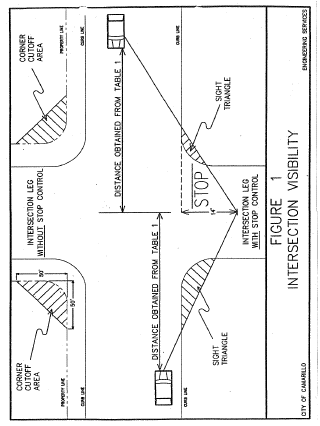
At intersections where traffic is not required to stop on any approach, there shall be no visual obstruction within the corner cutoff area of any corner lot. The corner setback shall be defined by a line on a horizontal plane connecting two points along the front and side street property lines and forming a triangle. These points shall be measured fifty feet back from the intersection or the prolongation of the front and street side property lines. Properties that were approved or developed prior to April 26, 1995 shall be considered exempt and may continue to be subject to the comer setback of thirty feet as measured from the front and side lot line.
2.
Projects which are located in a planned development area with private streets would be considered under a residential planned development permit subject to review and approval by the planning commission. However, intersecting streets from the private project to the public street shall comply with the corner cutback provision or include appropriate traffic control measures approved by the city.
B.
Intersection Visibility at Controlled Intersections. At controlled intersections, the procedure for providing the "sight triangle" which is the area to be clear of obstruction for sight distance at controlled intersections shall be in accordance with Caltrans Design Manual (Figure 1, set out at the end of this section, illustrates the sight triangle). The manual specifies a driver eye height of 3.5 feet, an approaching vehicle height of 4.25 feet, a driver's eye setback of fourteen feet from the flowline (four-foot stop bar setback plus ten-foot eye setback from the stop bar) and the sight distances included in Table 1. Within the sight triangle, all objects shall be below three feet in height and above seven feet in height. In cases where providing intersection sight distance is unreasonable due to site characteristics as determined by the director of engineering services and the director of planning and community development, adjustment can be made as long as a safe stopping sight distance can be provided. Examples of unreasonably costly conditions include areas where a wall or building exists on an adjoining lot or in hillside areas where extreme grading would be necessary.
(Ord. 874, § 1, 1997; Ord. 403, § 1 (part), 1978; prior code § 9502(D).)
19.38.060 - Landscaping and irrigation guidelines.
The city council may by resolution establish guidelines for the regulation of landscaping and irrigation within the city. Residential, commercial, and industrial development projects that include new landscaping modifications to existing landscaping must comply with such guidelines.
(Ord. No. 1090, § 2, 6-11-2014)
19.39.010 - Intent and purpose.
The purpose of this chapter is to regulate ministerial subdivisions and related development within the city to the extent permitted by state law. The city recognizes the importance of housing production to address the housing crisis in the state and adopts Government Code sections 65852.28 and 66499.41, et. seq., as may be amended from time to time.
(Ord. No. 2030, § 4(Exh. A), 5-14-2025)
19.39.020 - Restriction on accessory dwelling units and urban lot splits.
Accessory dwelling units and junior accessory dwelling Units may not be constructed on lots created pursuant to Government Code section 66499.41. An urban lot split may not be used to further divide a lot already subdivided pursuant to Government Code section 66499.41.
(Ord. No. 2030, § 4(Exh. A), 5-14-2025)
19.40.010 - Projections above building height limits.
Roof structures for the housing of elevators and required stairways may be erected above the height limits herein prescribed when approved by the director of planning and community development. No penthouse or roof structure or any other space above the height limit shall be allowed or may be used to provide additional living or floor space areas. The action of the director of planning and community development is appealable to the planning commission.
(Ord. 403 § 1 (part), 1978: prior code § 9503(A).)
19.40.020 - Mechanical and electrical equipment.
All mechanical equipment or electrical equipment shall be completely screened behind a parapet structure or be completely restricted from all view from the ground level.
(Ord. 403 § 1 (part), 1978: prior code § 9503(B).)
19.41.010 - Intent and purpose.
The purpose of this chapter is to establish objective design standards for all new residential structures and structures accessory to residential structures in response to state law limiting the imposition of nonobjective design standards on residential projects. The city recognizes the importance of housing production to address the housing crisis in the state and establishes the following standards to provide greater certainty in residential project development.
(Ord. No. 2030, § 4(Exh. A), 5-14-2025)
19.41.020 - Design
standards for residential structures and accessory structures.
The following standards apply to all new residential structures intended for human habitation and for all structures accessory to new residential structures:
A.
Paint. Residential structures must include two colors; one for the main wall color and another for architectural trim pieces. The paint treatment must be applied along all window surrounds, and on all wall façades of all elevations. Rust-inhibitive paint must be used for all exterior metal building surfaces to prevent corrosion and release of metal contaminants into the storm drain system.
B.
Roof. The roofs on any new structure must be pitched covered in clay barrel or concrete roofing tile with a minimum 3:12 pitch. Roof color must be gray, brown, or natural clay. Mansard roofs are not permitted.
C.
Elevation materials. A minimum of three different materials must be used on all building elevations, consisting of brick, stone, fiber cement siding, or stucco. On a single building, the three minimum building materials must be repeated on each elevation.
D.
Windows. All windows without shutters on each side of a building must provide stucco over foam or wood surrounds a minimum of four inches in width, on all four sides of the windows with a minimum projection of two inches from the face of the structure.
1.
Shutters. Functional and decorative shutters shall be proportionate to the size of the associated window glazing. Shutters shall be half the width of the associated glazing for paired shutters.
E.
Eaves. All buildings must provide eaves of not less than twelve inches and not greater than thirty-six inches.
F.
Variation. Unbroken wall planes greater than 15 feet in length are prohibited. Wall planes may be broken up by windows or recesses. Recesses are to measure a minimum of twelve inches in depth and length.
G.
Architectural styles. One of five architectural styles must be chosen for each building. These styles are Traditional, Spanish Colonial Revival, Monterey, Craftsman, and French Country. Within a chosen architectural style, a minimum of five listed architectural elements must be included per building:
1.
Traditional. Additional elements (minimum five required). At least five of the following elements must be incorporated in a new residential structure that utilizes the Traditional Style:
a.
Substantial profiled wood cornices at eaves, and profiled trim at gable ends;
b.
Rectangular (vertical), single- or double- hung windows;
c.
Window shutters parallel to the full vertical length of the window;
d.
Brick used as an elevation material;
e.
Windows with divided lites;
f.
Brick chimneys;
g.
Pedimented wood surrounds at front entries.
2.
Spanish Colonial Revival. Additional elements (minimum five required). At least five of the following elements must be incorporated in a new residential structure that utilizes the Spanish Colonial Revival Style:
a.
Molded cornices;
b.
Curvilinear parapets;
c.
Iron balconies and window grilles;
d.
Arcades supported by columns;
e.
Corbels;
f.
Decorative tiles;
g.
Tower elements;
h.
Arched window and entry opening;
i.
Lintel type window opening;
j.
Recessed windows.
3.
Monterey. Additional elements (minimum five required). At least five of the following elements must be incorporated in a new residential structure that utilizes the Monterey Style:
a.
Exposed rafter tails or profiled cornice at eaves;
b.
Recessed windows;
c.
Flat, arched, segmental, or half round window heads;
d.
For windows, stone or cast stone trim at accent openings, or at sills of openings;
e.
Walls with cut or cast stone accents;
f.
Window shutters parallel to the full vertical length of the window;
g.
Heavy exposed beams;
h.
Wood balconies supported by heavy wood posts and roofed with low-pitched shed roofs;
i.
Arcades and trellises;
j.
Decorative tile insets.
4.
Craftsman. Additional elements (minimum five required). At least five of the following elements must be incorporated in a new residential structure that utilizes the Craftsman Style:
a.
Exposed, profiled rafter tail eaves, and simple wide gable boards with trim;
b.
Vertical and square windows combined into horizontal groupings;
c.
Divided lites in upper sashes of single- or double hung-windows;
d.
Windows surrounded by wide, detailed wood trim;
e.
Use of cobblestone and river rock;
f.
Use of brick at base of wall or porch;
g.
Exposed wood beams and brackets, profiled at the ends;
h.
Tapered wood posts set on rectangular or tapered masonry piers;
i.
Bandsawed and pierced ornamentation in wood railings.
5.
French Country. Additional elements (minimum five required). At least five of the following elements must be incorporated in a new residential structure that utilizes the French Country Style:
a.
Gable forms, linking one- and two-story masses with a single roof plane;
b.
Simple cornices (with outward concaves), at eaves;
c.
Wood plank shutters parallel to the full vertical length of the window;
d.
Single round, oval, or hexagonal windows accenting façades;
e.
Smooth cut or cast stone and wood trim;
f.
Circular and segmental arches at main entries;
g.
Wrought iron or wood balconies;
h.
Smooth or sand finish stucco;
i.
Deep set windows on front elevation (four inch minimum).
H.
Within five hundred feet of the freeway or one thousand feet of a freeway interchange, new residential structures must select from the Spanish Colonial Revival or Monterey Styles.
I.
In the case where multiple residential structures are proposed on the same lot, the residential structures must utilize the same architectural style.
J.
In the case where there is an existing residential structure on a lot, any newly constructed residential structure must utilize the same architectural style as the existing structure.
K.
Director Review. In cases where a proposed new residential structure or structures do not comply with the standards found in this chapter, an applicant may request, in writing, approval for the noncompliant design from the director of community development or their designee. The director of community development or designee may approve the noncompliant alternative design if the following findings are made:
1.
Design Quality. The proposed alternative design provides an equivalent or superior level of architectural quality and visual interest compared to the objective standard; or the new residential structure is proposed as a result of an existing residential structure's full or partial destruction.
2.
Compatibility. The alternative design is compatible with the surrounding neighborhood and maintains consistency with the community character.
3.
Public Welfare. The exception does not adversely affect public health, safety, or welfare.
(Ord. No. 2030, § 4(Exh. A), 5-14-2025)
19.42.010 - Access required.
Each building or structure or use shall have permanent vehicular access to the approved public or private street or right-of-way on which the lot or building site has frontage unless a secondary means of permanent vehicular access such as an alley or service road have been approved by the planning commission.
(Ord. 403 § 1 (part), 1978: prior code § 9505(A).)
19.42.020 - Access rights.
Each lot or building site shall have at least one vehicular access from the street on which it has frontage unless access rights to the street have been waived and such offer and waiver have been accepted by the city or where such access is limited by architectural design or where common access is provided by a planned development project.
(Ord. 403 § 1 (part), 1978: prior code § 9505(B).)
19.42.030 - Location of accessways, general.
All vehicular accessways shall be located not less than thirty feet from the ultimate curbline of the intersecting streets or right-of-way.
(Ord. 403 § 1 (part), 1978: prior code § 9505(C).)
19.44.010 - Purpose.
The purposes of this chapter include:
A.
To establish parking standards to effectively regulate the design of parking facilities including the requirement of providing the necessary number of parking spaces for various land uses.
B.
To assure that an adequate number of spaces is available to accommodate the anticipated demand and to lessen traffic congestion and adverse impacts on surrounding properties.
C.
To maximize compatibility between adjoining uses.
D.
To promote vehicular and pedestrian safety.
(Ord. No. 1054, § 3(Att. No. 1), 5-12-2010)
19.44.020 - General provisions.
A.
The off-street parking requirements of this chapter apply at the time of the construction, alteration, intensification, change in use or occupant load, or change in form of ownership of a building or use. As used in this chapter, "change in form of ownership" means conversion of all or a portion of a project to condominiums, community apartments, stock cooperatives or other similar forms of ownership.
B.
Off-street parking must be maintained in connection with any existing building or use so long as the building or use remains unless an equivalent substitute number of such spaces are provided and thereafter maintained in conformance to the requirements of this chapter.
C.
Where off-street parking space in connection with a building or use does not conform to the requirements of this chapter, then the building or structure may not be altered, extended, expanded, nor may its form of ownership be changed, unless the current parking requirements of this chapter are satisfied. Any such non-conforming use that is discontinued for one year may not reestablish unless the use complies with the provisions of this chapter.
D.
A parking space is an area for the parking of a motor vehicle plus such additional areas as required to provide for safe ingress to and egress from the space.
E.
The area set aside to meet the parking requirements of this chapter must be usable and must have permanent access.
F.
Where multiple uses are provided, the required parking must satisfy the individual and cumulative needs of that complex and provide the minimum number of parking spaces necessary to serve the various uses except as otherwise provided for mixed-use developments. If the parking area is reserved or restricted to a particular use, such reservation or restriction must be strictly limited to a period of time and not to a particular use. Any such limitation requires the city's prior written approval and must remain in force as long as deemed necessary by the city to meet the requirements of this chapter.
G.
Uses that include service vehicles must provide parking spaces above the minimum number of spaces required by this chapter. This is to ensure that adequate space for the employees and customers will be maintained on-site.
H.
Required off-street parking spaces and parking areas may be used only for parking operable vehicles of residents, employers, employees, customers and visitors as appropriate to the allowed uses of the applicable zone.
I.
All off-street parking spaces and aisles must be kept clear of any temporary or permanent obstructions.
(Ord. No. 1054, § 3(Att. No. 1), 5-12-2010)
19.44.025 - Computation of parking requirements.
A.
The floor area calculation will be based on the gross floor area of the building or use except where otherwise provided.
B.
Corridors, lobbies, conference rooms, stairways, restrooms, elevator and mechanical shafts, and unmanned electrical or mechanical rooms will be excluded from the square footage when computing floor area for parking purposes.
C.
The floor area includes exterior walls but excludes exterior areas.
D.
Employee only kitchens, lunchrooms, exercise rooms, and locker rooms will be excluded from the square footage when computing floor area for parking purposes.
E.
Any fractional spaces over fifty percent will be construed as one full space.
F.
In any place of public assembly utilizing benches, pews, or other non-individualized seating structure, each eighteen-inch section of such structure will be construed as one seat.
G.
A building or portion of a building devoted to off-street parking will have no off-street parking requirements.
H.
In the case of mixed uses in a building or on a lot, the total requirements for off-street parking facilities will be the sum of the requirements of the various uses computed separately. Off-street parking facilities for one use will not be considered as providing required parking facilities for any other use except as specified in this chapter for common facilities or joint uses.
I.
Projects or uses within one-half a mile of the Camarillo Metrolink station are subject to the requirements of California Government Code section 65863.2 as may be amended from time to time.
(Ord. No. 1054, § 3(Att. No. 1), 5-12-2010; Ord. No. 2007, § 8D, 4-12-2023; Ord. No. 2018, § 4(Exh. A), 2-14-2024; Ord. No. 2019, § 4(Exh. A), 4-24-2024)
_____
19.44.030 - Residential uses.
Parking for residential uses must be provided in accordance with Table 19.44.030:
(Ord. No. 1054, § 3(Att. No. 1), 5-12-2010; Ord. No. 1102, § 3, 1-28-2015; Ord. No. 1110, § 3, 6-24-2015; Ord. No. 1119, § 6, 1-27-2016; Ord. No. 1140, § 4, 4-12-2017; Ord. No. 1139, § 4, 4-26-2017; Ord. No. 1158, § 3, 10-24-2018)
_____
19.44.035. - Recreational and oversized vehicles.
A.
Recreational Vehicles. A recreational vehicle, boat or a boat trailer may be parked in a residential zone only as follows:
1.
In a recreational vehicle storage area approved as part of a Residential Planned Development permit or as part of a Conditional Use Permit for a multifamily residential development, or in any enclosed structure that conforms to the zoning requirements of the particular zone where located,
2.
Outside of a structure in the side yard or rear yard area of a residential zoned lot provided that:
a.
The recreational vehicle, boat or boat trailer is parked on a surface of concrete, brick, brick pavers, asphalt, gravel or crushed rock. All such surfaces and the design are subject to the review and approval by the director. The design must provide adequate vehicle support together with dust, weed and erosion control for the drive, parking area and area underneath the recreational vehicle.
b.
The recreational vehicle, boat or boat trailer, except for motorized recreational vehicles customarily used for ordinary transportation purposes may not obstruct the access to parking in the garage or carport area required under Table 19.44.030.
c.
In the event the side or rear yard is not accessible or is insufficient in size to accommodate a recreational vehicle, boat or boat trailer, it may be parked in the front setback area. A corner lot will be determined to have reasonable access to the rear yard unless a grade difference of three feet or more exists. The existence of a fence or wall separating the front yard from the side yard will not be determined to prevent reasonable access.
d.
Parking in a structure is not possible due to size of the recreational vehicle, boat or boat trailer.
3.
The body of the recreational vehicle, boat or boat trailer must be at least thirteen feet from the face of any curb and parked generally perpendicular to the front curb.
4.
No part of the recreational vehicle, boat or boat trailer may extend over the public sidewalk or public right-of-way.
5.
Parking is permitted only for storage purposes and a recreational vehicle, boat or boat trailer may not be:
a.
Used for dwelling purposes except for limited overnight sleeping for a maximum of fourteen days in any twelve-month period;
b.
Permanently connected to sewer lines, water lines or electricity; the recreational vehicle may be connected to electricity temporarily for charging batteries and other purposes;
c.
Used for storage of goods, materials, or equipment other than those items considered to be part of the recreational vehicle, boat or boat trailer or essential for its immediate use.
6.
Notwithstanding the provisions of this section, a recreational vehicle, boat or boat trailer may be parked no more than forty-eight hours on the driveway for loading or unloading purposes provided that it does not overhang the public right-of-way.
7.
A recreational vehicle, boat or boat trailer must be owned or rented by the resident or guest of the resident on whose property the recreational vehicle or boat trailer is parked or stored.
8.
A recreational vehicle, boat or boat trailer that is stored for a period of seventy-two hours or more may not obstruct the line of sight from any adjoining property owner needed to obtain access to a public right-of-way. Upon a determination by the city that a potential safety hazard exists, the recreational vehicle, boat or boat trailer may be required to be relocated or removed from the site.
9.
Where multiple recreational vehicles are stored on the site, each recreational vehicle must conform to the above requirements of this subsection (A).
B.
Oversized Vehicles. No person may stop, stand or park an oversized vehicle on any lot or parcel in a residential zone unless it is necessary to carry out work or service that requires the presence of such a vehicle on the lot or parcel. For the purpose of this section an "oversized vehicle" is defined as a vehicle used for commercial purposes containing three or more axles.
(Ord. No. 1054, § 3(Att. No. 1), 5-12-2010)
_____
19.44.050 - Educational and day care uses.
Parking for educational and day care uses must be provided in accordance with Table 19.44.050:
(Ord. No. 1054, § 3(Att. No. 1), 5-12-2010; Ord. No. 1171, § 3K, 3-25-2020)
19.44.060 - Recreational uses.
Parking for recreational uses must be provided in accordance with Table 19.44.060.
(Ord. No. 1054, § 3(Att. No. 1), 5-12-2010)
19.44.070 - Office uses.
Parking for office uses must be provided in accordance with Table 19.44.070:
(Ord. No. 1054, § 3(Att. No. 1), 5-12-2010; Ord. No. 2007, § 8A, 4-12-2023)
19.44.080 - Commercial uses.
Parking for commercial uses must be provided in accordance with Table 19.44.080:
Notwithstanding the foregoing, the planning commission or city council may increase the number of parking spaces required under this section for commercial uses in order to provide adequate off-street parking if such additional parking is deemed necessary to mitigate potential parking demand.
(Ord. No. 1054, § 3(Att. No. 1), 5-12-2010)
19.44.090 - Industrial uses.
A.
Parking for industrial uses must be provided in accordance with Table 19.44.090:
B.
Industrial parks, light industrial and general industrial may devote up to twenty percent of the floor space for the use as office in support of the primary activity and provide one parking space for every five hundred square feet of gross floor area. Any area above the twenty percent factor used for office purposes must provide one parking space per two hundred fifty square feet of floor area, except if the business meets the criteria of Section 19.44.090 A.10, then parking will be calculated at one parking space for every five hundred square feet for office uses.
All floor area above the first floor (including mezzanines) will be calculated by use.
C.
Ancillary retail uses must provide one parking space for every two hundred fifty square feet of floor area.
D.
Each use must provide adequate off-street parking if their need exceeds the minimum requirements of this chapter.
(Ord. No. 1054, § 3(Att. No. 1), 5-12-2010; Ord. No. 2007, §§ 8B, 8C, 4-12-2023)
19.44.100 - Other uses.
Parking for other uses must be provided in accordance with Table 19.44.100:
(Ord. No. 1054, § 3(Att. No. 1), 5-12-2010; Ord. No. 2008, § 4(Exh. A), 4-12-2023)
_____
19.44.105 - Drive-through facilities.
In addition to providing parking as required under this chapter for the main use, drive-through facilities must comply with the following regulations:
A.
Drive-through facilities for food uses must provide the following:
1.
A minimum stack-up space from the pick-up window to the entrance to the drive-through lane that provides for minimum of ten vehicles.
2.
Separate window areas: one for the payment for the food items and a second window to pick up the food items.
3.
The drive-through lane must include an ordering panel a minimum of thirty feet ahead of the payment window, and a preview panel a minimum of twenty-four feet ahead of the ordering panel. If the ordering panel is visible a second order station may be substituted for the preview panel.
4.
No more than one drive-through lane is permitted.
5.
The pick-up window must have a roof extension from the building to architecturally incorporate the area as part of the use.
6.
A separate area for loading as required under Chapter 19.46 (Off-Street Loading).
B.
Drive-up kiosks must provide for the following:
1.
A minimum of two stacking spaces at each window clear of the required driving lanes.
2.
A maximum of two drive-through lanes is permitted.
C.
Drive-up banking facilities must provide the following:
1.
A minimum of four stack-up spaces.
2.
A maximum of four drive-up lanes is permitted.
D.
Other types of drive-through uses, including drive-up retail uses, must provide a minimum of four stack-up spaces and no more than two drive-through lanes.
(Ord. No. 1054, § 3(Att. No. 1), 5-12-2010)
19.44.110 - Uses not specified.
If a use is not specified in this chapter, the director is authorized to establish appropriate parking requirements for such use based on the similarity of such use to other uses specified in this chapter.
(Ord. No. 1054, § 3(Att. No. 1), 5-12-2010)
19.44.120 - Camarillo Old Town parking requirements.
The following parking requirements apply to the Camarillo Old Town area, which area is bounded on the north by Highway 101, on the east by Lewis Road, on the west 290 feet east of Geneive, and on the south by the existing public alley and Chapel Drive, between Elm Drive and Glenn Drive:
A.
Properties in the COT (Camarillo Old Town) zone may, in lieu of furnishing the parking spaces required by the provisions of this section, satisfy such requirements by the payment of an amount per required parking space to the city's off-street parking fund prior to the issuance of a building permit. The in-lieu payment for each required parking space must be paid in accordance with the amount established by city council resolution. This in lieu fee applies only to existing structures but may be applied to alterations, modifications or additions that require eight or more off-street parking spaces in addition to what was previously provided. An in-lieu payment may be made only once per parcel or development project.
B.
Funds placed in the off-street parking fund, pursuant to subsection (A) of this section, must be used exclusively for the purpose of acquiring and developing off-street parking facilities and to the extent practicable, such facilities must be located in the general vicinity of the premises for which the in-lieu payments were made.
(Ord. No. 1054, § 3(Att. No. 1), 5-12-2010)
19.44.125 - Camarillo Commons parking requirements.
The following parking requirements apply to new development within the Camarillo Commons Strategic Plan area, which is the area bounded by Arneill Road on the east, Ponderosa Drive on the north, Mobil Avenue on the west, and Daily Drive on the south. along with the lots on the west side of Mobil Ave for the first 300 feet north of Daily Drive.
(Ord. No. 1054, § 3(Att. No. 1), 5-12-2010; Ord. No. 1102, § 4, 1-28-2015; Ord. No. 1110, § 4, 6-24-2015)
_____
19.44.140 - Location of required off-street parking area.
A.
For all residential uses, the parking spaces must be located on the same lot, parcel, or site as the buildings they serve.
B.
No off-street parking lot, parcel, or site may be located more than three hundred feet from a building lot, parcel, or site it is intended to serve.
C.
When off-street parking is located on a different lot, parcel, or site than that of the building it is intended to serve, a parking agreement must be approved by the director and recorded against the property providing the parking.
D.
No permanent parking is permitted in the required front yard of any residentially zoned lot, parcel, or site.
E.
Automobile repair garages with service bays may count the service bay towards the parking requirement of such use if the area conforms to this chapter and there is adequate circulation.
(Ord. No. 1054, § 3(Att. No. 1), 5-12-2010)
19.44.150 - Size of parking spaces.
A.
Open off-street parking spaces must be a minimum of nine feet wide and twenty feet long.
B.
Enclosed or covered off-street parking spaces must be a minimum of ten feet wide and twenty feet long, interior dimensions. Tandem spaces or single stall enclosed parking spaces must be a minimum of twelve feet in width. Tandem enclosed or open spaces are prohibited in Townhouse, Condominium, or Other Multifamily Ownership Projects.
C.
Compact car spaces must be a minimum of eight feet six inches in width and seventeen feet in depth. Compact spaces may only be permitted in limited areas where it has been shown that due to the configuration of the parcel the use of compact parking is necessary to achieve an adequate design and that the use of compact parking would not be detrimental to the use of the parking lot.
D.
A recreational vehicle parking space must be a minimum of ten feet in width and twenty-five feet in depth.
E.
A handicapped parking space must comply with the requirements of Title 24 of the California Code of Regulations or other applicable regulations."
(Ord. No. 1054, § 3(Att. No. 1), 5-12-2010; Ord. No. 1110, § 5, 6-24-2015)
19.44.155 - Drive-through standards.
A.
Drive-through lanes must be a minimum width of twelve feet with increased widths at turns and proper radii to accommodate the turning of vehicles.
B.
Each stack-up space must be a minimum length of twenty-four feet as measured at the center line of the drive-through lane.
C.
The drive-through lane must be designed so that the access to the drive-through lane is from on the site and must not interfere with traffic in the public right-of-way. Direct access to a drive-through lane from the public right-of-way is not permitted.
D.
The drive-through lane must be separate from on-site access drives and may not serve parking areas or loading space areas.
E.
The drive-through lane must be designed to avoid interference with on-site pedestrian access.
(Ord. No. 1054, § 3(Att. No. 1), 5-12-2010)
19.44.160 - Access.
A.
The minimum width of a residential driveway may not be less than ten feet and must be of sufficient width to provide direct access to required parking (except that a center strip over which the wheels of a vehicle will not pass in normal use need not be paved).
B.
A residential driveway that is one hundred feet or longer must be a minimum of sixteen feet wide or two ten-foot wide one-way drives must be provided. A residential driveway longer than two hundred fifty feet must provide turn-outs to allow traffic to pass by at intervals subject to the approval of the city's traffic engineer.
C.
A residential driveway serving four or more units must be a minimum of twenty feet wide.
D.
Access may not be unobstructed by any portion of a building.
E.
A commercial or industrial driveway must be a minimum of twenty feet wide.
F.
Off-street parking areas must be designed with an appropriate turnaround so that all vehicles may enter the street by forward motion and avoid a dead-ended condition unless otherwise approved by the planning commission or city council.
G.
The gradient of access to and within all parking facilities including parking lots and parking garages may not exceed a maximum of fifteen percent slope. Driveways and ramps must have appropriate transitional vertical curves so as to allow a passenger vehicle to pass over the access ramping without interference to the vehicle's undercarriage. The design of access ways is subject to review and approval by the city's traffic engineer.
(Ord. No. 1054, § 3(Att. No. 1), 5-12-2010)
19.44.170 - Parking charges.
A fee for parking may be charged for parking within a required parking lot so long as the charge does not significantly exceed the costs necessary to defray the operation of the parking lot and does not otherwise render the required parking spaces not being used. In cases where parking overflows from a parking lot due to the monetary charge for parking, the city may require the owner to submit a parking management plan that addresses the operation of the parking lot including the parking demand, costs, and parking impacts.
(Ord. No. 1054, § 3(Att. No. 1), 5-12-2010)
19.44.180 - Shared parking facilities.
Shared parking facilities may be provided in lieu of the individual requirements contained in this chapter, but such facilities must be approved by the director as to the size, shape, and relationship to the site served. In addition, the total number of such off-street parking spaces may not be less than the amount required for the various uses if computed separately. Such shared parking facility must be attached or adjacent to the building that it is intended to serve and be subject to parking agreement approved by the director.
(Ord. No. 1054, § 3(Att. No. 1), 5-12-2010)
19.44.190 - Transportation demand management facilities.
A.
For all nonresidential development, preferential carpool and vanpool parking spaces must be provided in accordance with the following requirements:
1.
For retail commercial projects, a minimum of one preferential vanpool or carpool parking space must be provided for projects of fifty thousand square feet to one hundred thousand square feet of floor area and two such spaces for projects over one hundred thousand square feet of floor area.
2.
For office and industrial projects, at least two percent of the required parking spaces must be reserved for carpool and vanpool vehicles.
3.
All carpool and vanpool parking spaces must be provided with appropriate signage and striping. The designated spaces must be located as close as practical to employee building entrances and may not displace handicapped or customer parking needs. The designated spaces must be identified on the applicable site plan.
4.
All parking spaces reserved for carpool and vanpool vehicles must be accessible. When located within a parking structure, a minimum vertical interior clearance of seven feet two inches must be provided for such spaces.
5.
The size of vanpool and carpool parking spaces must comply with the requirements of Section 19.44.150 of this chapter.
6.
Upon request of a property owner or other authorized person, the director may authorize parking spaces in existing projects to be designated as carpool and vanpool spaces.
B.
Bicycle Racks. For all nonresidential development, bicycle parking must be provided as follows:
1.
Bicycle parking must be by means of bicycle racks or other secured parking. A fully enclosed space or locker accessible only to the owner or operator of the bicycle will be considered an approved secured bicycle parking facility.
2.
Bicycle racks or other secured bicycle parking must be provided to accommodate four bicycles for the first fifty thousand square feet of floor area. One additional bicycle space must be provided for each additional increment of fifty thousand square feet of floor area.
3.
The location and designation of the type of bicycle parking must be shown on the plans prior to approval of a planned development.
4.
Additional bicycle parking spaces for existing planned development permits may be approved if deemed to be appropriate and in keeping with the approved development permit.
5.
If an existing development does not easily accommodate the placement of bicycle parking on the site, vehicle parking spaces may be altered for the parking of bicycles within an existing development if determined that the bicycle parking will not otherwise adversely affect the parking of vehicles on the lot.
C.
Transit Stops. Transit stop improvements (bus turnouts, bus pads, bus shelters) may be required for nonresidential development of one hundred thousand square feet or more of floor area and for residential developments of one hundred dwelling units or more. If determined to be appropriate, after consultation with the bus service provider, transit needs facilities may be required. Nothing herein prevents the city from imposing transit stop improvement requirements on developments of a lesser size if necessary to mitigate adverse impacts.
D.
Transportation Information Centers. All nonresidential developments employing at least fifty individuals are required to provide a bulletin board, display case or kiosk displaying transportation information as a condition of project approval. The information displayed should include the following:
1.
Current maps, routes and schedules for public transit serving the site;
2.
Telephone numbers for the regional ride sharing agency and local transit operators;
3.
Ridesharing promotional material;
4.
Bicycle route and facility information, including regional/ or local bicycle maps and bicycle safety information; and
5.
A listing of facilities available for carpoolers, vanpoolers, bicycle transit riders and pedestrians at the site.
E.
Pedestrian Access. All development must provide safe, convenient and direct pedestrian and bicycle access from the internal circulation system to adjacent collector and arterial roadways.
F.
Interim Improvements. A planned development permit for industrial buildings, may allow a portion of the required parking to be phased for later improvement subject to a city-approved agreement and performance guarantee. In addition, the applicant must demonstrate that the parking would not be essential during the time period the improvements are delayed and that the use will have an active ridesharing program. The area proposed for future parking area improvements may be used for interim landscaping, recreation, or other similar uses if the phased parking will not cause adverse impacts to the proposed use or adjoining uses.
G.
Modification. The planning commission or city council may require that nonresidential projects provide a greater number of carpool/vanpool parking spaces or bicycle parking facilities than set forth in this section, and may also require the transportation demand management facilities described in this section be applied to projects smaller than the prescribed thresholds if deemed necessary to reduce traffic and air quality impacts.
(Ord. No. 1054, § 3(Att. No. 1), 5-12-2010)
19.44.210 - Waiver of parking provisions for public or semipublic uses.
The planning commission or city council may, by resolution, waive or modify the provisions of this chapter for uses such as electric power generating plants, electrical transformer stations, public utility or corporation storage yards, or other uses of public or semi-public nature employing a limited number of persons.
(Ord. No. 1054, § 3(Att. No. 1), 5-12-2010)
19.44.220 - Storage and/or parking of commercial vehicles in R zones.
No commercial vehicle exceeding a gross weight of ten thousand pounds may be parked or stored on a lot or parcel in any R (residential) zone.
(Ord. No. 1054, § 3(Att. No. 1), 5-12-2010)
19.44.225 - Motorcycle parking.
1.
Uses required to provide for more than fifty parking spaces must provide a minimum of one motorcycle parking space plus one space for every fifty parking spaces thereafter up to the first two hundred parking spaces. For parking facilities with more than two hundred parking spaces, one motorcycle parking space for every one hundred parking spaces must be provided.
2.
A use may be given credit in lieu of providing motorcycle parking if the parking facility provides a greater amount of parking than otherwise required by this chapter. In such instance, one additional automobile parking space will count for two required motorcycle parking spaces. Similarly, additional motorcycle parking may be credited for automobile parking spaces (up to a maximum of eight parking spaces) at a ratio of two motorcycle parking spaces for each one automobile parking space.
3.
Motorcycle parking spaces must have a minimum dimension of at least four feet in width and seven feet in length, and must be accessed by a drive aisle of at least eight feet in width.
(Ord. No. 1054, § 3(Att. No. 1), 5-12-2010)
19.44.230 - Tandem parking.
1.
All required parking spaces must be accessible from a drive aisle or street.
2.
Parking spaces may not be located in tandem, except in a parking garage, mobilehome unit, or where specifically approved by the planning commission or city council. In situations where tandem spaces are provided (other than a mobilehome unit), an attendant must be present at all times that the parking facility is in use.
3.
When tandem parking spaces are permitted for multifamily residential units, the spaces must be a minimum of twelve feet wide and must have access directly to the residential unit for which the parking is designated.
(Ord. No. 1054, § 3(Att. No. 1), 5-12-2010)
19.44.240 - Parking lot dimensions—Open parking.
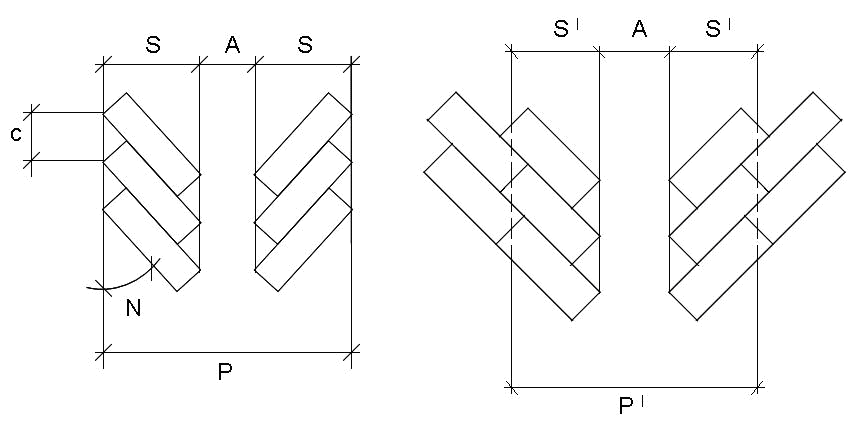
All open parking must comply with the following exhibits. Compact spaces may only be used in the event practical difficulties or a hardship results from the strict enforcement of these standards due to existing permanent buildings, the topography of the site, or an irregularly shaped parcel.
(Ord. No. 1054, § 3(Att. No. 1), 5-12-2010)
19.44.245 - Parking lot dimensions—Parking structures.
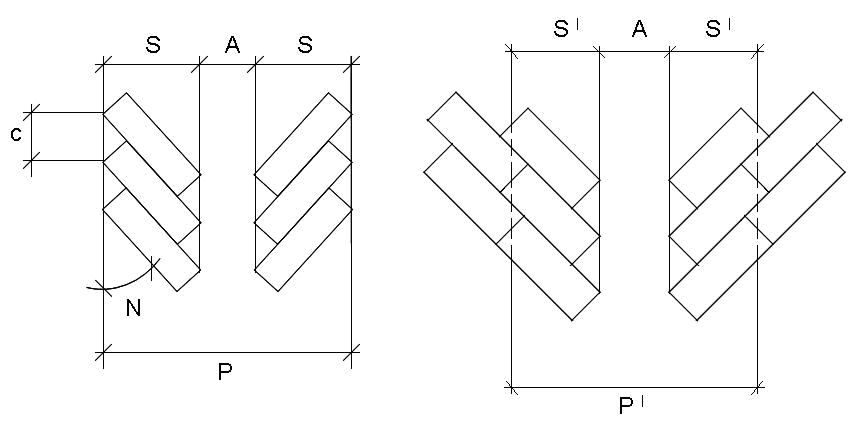
All parking within parking structures must comply with the following exhibits. Compact spaces may be used in the event practical difficulties or a hardship results from the strict enforcement of these standards due to modular design of parking structures or the configuration of the site.
A.
The design of all vertical dimensions is subject to review and approval by the director of public works to ensure that proper vertical transition occurs at driveways, ramps and aisles. Driveways with grades greater than five percent must provide a vertical transition. No driveway may have a slope greater than twenty percent.
B.
Safe and secure pedestrian ways must be provided on each level of parking leading to stairways and elevator to buildings and public sidewalks.
(Ord. No. 1054, § 3(Att. No. 1), 5-12-2010)
19.44.250 - Parking lot lighting.
Exterior lighting is permitted subject to the procedures and regulations in Chapter 19.47 of this code.
(Ord. No. 1054, § 3(Att. No. 1), 5-12-2010; Ord. No. 2004, § 17, 1-11-2023)
19.44.255 - Corner stalls.
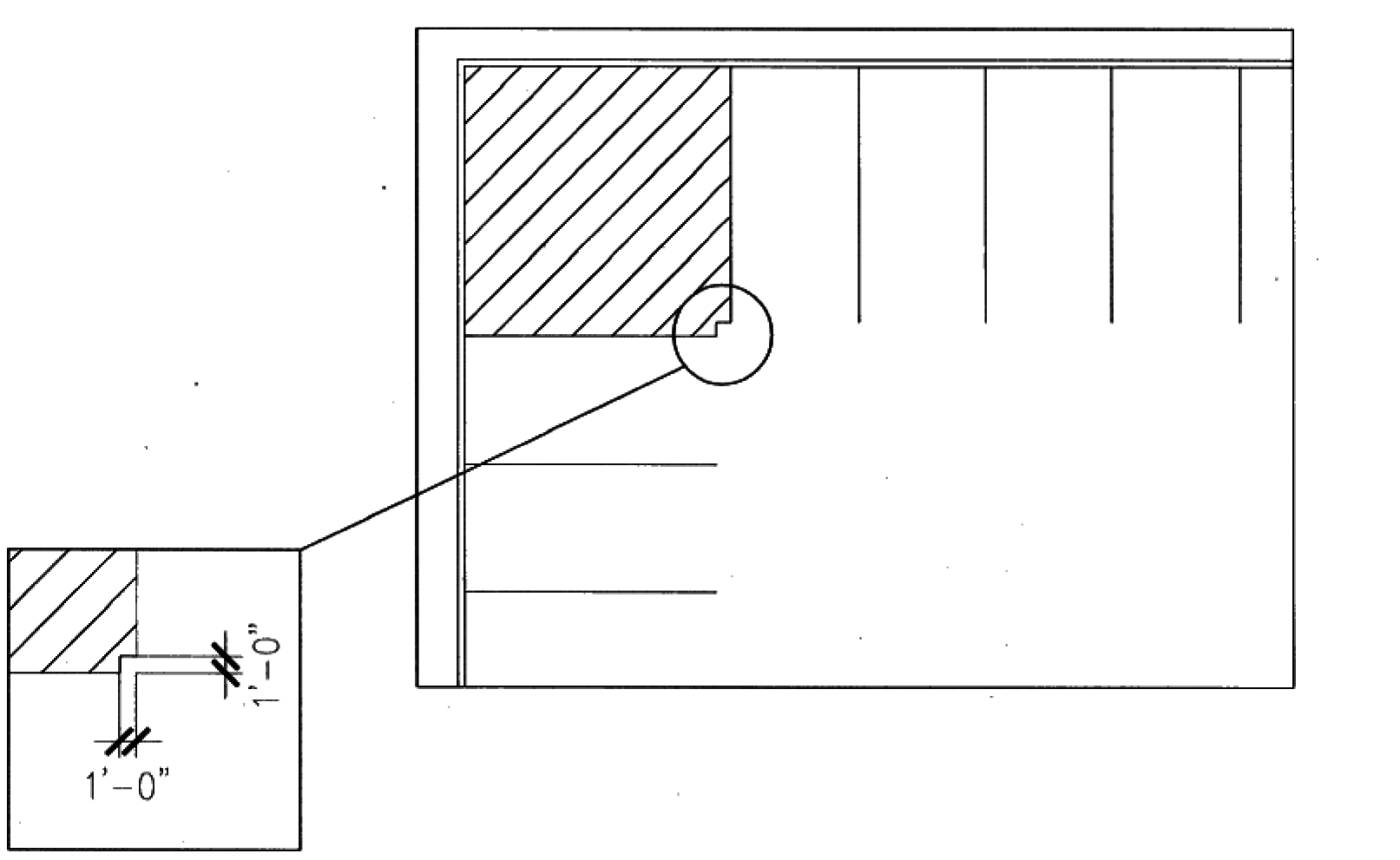
Where two parking spaces adjoin on the inside corner of a 90-degree change in the direction of a drive aisle, the adjacent parking space to the corner area must be widened by one foot or the adjoining area must include an offset of a minimum of one foot in each direction as shown on the following exhibit.
(Ord. No. 1054, § 3(Att. No. 1), 5-12-2010)
19.44.260 - Landscaping of parking areas.
Landscaping of parking areas within the multifamily, professional, commercial, and industrial zones must comply with the following regulations:
A.
Peripheral landscaping at least five feet in width, or greater depending on the zone, must be provided along the interior of all property lines and adjacent to all public streets.
B.
One tree, fifteen-gallon minimum must be planted within a minimum five foot wide (as measured from the inside face of the curbing) at no more than every ten parking stalls.
C.
Each unused space resulting from the design of parking spaces or accessory structures over twenty-four square feet in area must be landscaped.
D.
Maintenance. All planting areas must be maintained in a healthy, stable condition or replaced.
E.
Irrigation System. All landscaping must be provided with a permanent watering system. The design of the irrigation system must be drawn to scale and must include water pressure, pipe size, and type of heads (sprinkler, bubbler, or rainbirds).
F.
Identification of Plant Materials. The common and botanical names of each plant, its container size, the number of each, and the location of the plant within the parking area must be clearly illustrated.
G.
Choice of Plant Materials. Landscaping must consist of a combination of trees, shrubs and groundcover, with careful consideration given to eventual size and spread, susceptibility to disease and pests, durability and adaptability, and adaptability to existing soil and climatic conditions.
H.
Parking Space Overhang. Parking spaces are allowed to overhang into a landscaped area a maximum of two feet; provided, however, that the two foot overhang area is sufficiently level to adequately allow the vehicle overhang and the plant materials, irrigation system or other improvements are compatible with such vehicle overhang.
I.
Parking spaces may overhang two feet into a paved pedestrian area where the pedestrian area has a minimum width of six feet as measured from the face of the curb that serves as a wheel stop.
J.
The landscape plan must include an adequate number and type of trees to achieve a parking lot coverage canopy. The landscape plan must demonstrate that the parking lot canopy coverage will be achieved in reasonable amount of time.
K.
The required landscape plan must be prepared by a landscape architect and comply with all other city landscape guidelines or regulations and is subject to review and approval by the Director of Community Development or designee.
(Ord. No. 1054, § 3(Att. No. 1), 5-12-2010)
19.44.270 - Parking area improvements.
All parking areas must be improved as follows:
A.
Paving must be either a portland cement or asphalt surface and graded to drain adequately with the design to the satisfaction of the city engineer. The use of porous paving is encouraged as a best management practice for water quality practices. Other materials may only be used when determined to comply with this standard or to meet other alternative practices.
B.
All parking stalls must be clearly striped.
C.
A continuous six-inch concrete curb above parking lot level must be installed and serve as a wheel stop for cars on all periphery areas of the parking lot and as an edging for planting areas and islands and protection for walls for entrances and exits.
D.
Where parking abuts a residential zone, a solid masonry wall six feet in height must be installed on the zone boundary line. Such wall may not exceed three feet in height within any corner cutback area or within the front yard area of the abutting residential zone.
E.
Recreational vehicle parking areas for cluster, townhouse, or apartment projects must be enclosed by a decorative block wall at least six feet in height with a solid metal or wood gate. The design of the wall and gate is subject to the approval of the planning director.
F.
Compact car spaces and handicapped parking spaces must be adequately marked with appropriate logos or wording on the paving.
G.
Where parking fronts onto a public street, a wall, hedge, berm or combination of these must provide screening of the parking lot that is at least thirty-six inches high.
(Ord. No. 1054, § 3(Att. No. 1), 5-12-2010)
19.44.280 - Parking lot plot plan.
A.
A plot plan of any proposed off-street parking area must be submitted to the Department of Community Development at the time of the application for a development plan approval.
B.
A zoning clearance and building permit is required for all off-street parking areas or lots which are not otherwise constructed as part of a project requiring a building permit.
C.
Minor changes to the design of a parking lot may be authorized by the director through a zone clearance approval subject to the provisions of this chapter. More substantial changes require the approval of a modification to the approval as specified Title 19 of this code.
(Ord. No. 1054, § 3(Att. No. 1), 5-12-2010)
19.46.010 - General provisions.
Every use hereafter inaugurated, and every building or structure hereafter erected or altered, shall have permanently maintained off-street loading and unloading spaces. All loading or unloading facilities shall be located at such a depth within a lot or parcel, or within a completed enclosed building as set forth herein to reasonably contain and restrict emission of noise, typically attributed to such functions, and the following standards:
A.
When the lot upon which loading spaces are located abuts upon an alley, such loading spaces shall have access from the alley. The length of the loading space may be measured perpendicular to or parallel with the alley. Where such loading area is parallel with the alley and the lot is fifty feet or less in width, the loading area shall extend across the full width of the lot.
B.
Loading spaces shall be so located and designed that trucks shall not back into a public street or alley nor shall a loading area be designed to require the use of a public right-of-way for access to a loading dock.
C.
No part of an alley or street shall be used for loading excepting areas designated by the city for loading.
D.
No loading space required by the provisions herein shall be eliminated, reduced, or converted in any manner unless equivalent facilities are provided.
E.
All loading areas shall be screened from view from the public right-of-way by an architecturally designed masonry wall, or other approved method of screening.
F.
In no case shall a loading area be provided on the front portion of an industrial structure.
G.
Loading areas shown inside buildings must be dock height design with a truck well to insure its usability as a loading space.
(Ord. 588 § 9 (part), 1985.)
19.46.020 - Size and location.
A.
Each loading and unloading space shall be located off the streets.
B.
Standard loading spaces shall be not less than twelve feet in width extending fifty feet in depth and fourteen feet in height. Loading spaces for industrial uses up to ten thousand square feet shall provide a small loading space twelve feet by twenty-four feet.
C.
Each loading space shall be accessible, provide adequate maneuvering area, and not interfere with the normal flow of traffic on the site.
(Ord. 588 § 9 (part), 1985.)
19.46.030 - Number required.
A.
Where the primary uses involve storage, warehousing, manufacturing, assembling, processing or packaging of materials the following standards shall apply:
B.
Where primary uses involve personal, professional and business service offices, the following standards shall apply:
The size of loading spaces (standard or small) for the above uses shall be determined in conjunction with planned development review.
C.
When primary uses involve commercial and retail, the following standards shall apply.
The size of loading spaces for the above uses shall be determined in conjunction with planned development review.
D.
Hotels, motels, restaurants, grocery stores, drugstores, hospitals, theaters, institutions, schools, and similar special uses shall have the number and size of loading spaces determined in conjunction with planned development or conditional use permit review.
(Ord. 588 § 9 (part), 1985.)
19.46.040 - Mixed occupancies.
In the case of mixed uses, the total number of required loading spaces shall be the sum of the requirements for the various uses computed separately. Loading space facilities for one use shall not be considered as providing required loading space facilities for any other use.
(Ord. 588 § 9 (part), 1985.)
19.47.010 - Purpose and intent.
The purpose of this chapter is to provide regulation of exterior lighting systems constructed on properties within the various zones in the city, and the regulations are deemed necessary to protect the public health, safety and general welfare. The city recognizes that lighting has both a practical and aesthetic value and is an integral portion of any development. The city also recognizes that improperly installed lighting, illegal lighting, or improperly maintained lighting, creates impacts within the community, creates conflicts and nuisance impacts upon abutting properties, and is wasteful of energy resources by causing energy to be expended without producing additional useful light. It is the purpose and intent of this chapter to permit lighting consistent with the regulations and in a manner consistent with the city's general plan, including the community design element.
(Ord. No. 2004, § 18(Att. A), 1-11-2023)
19.47.020 - Definitions.
The following terms when used in this chapter have the meaning provided in this section:
"Correlated color temperature" means the temperature, measured in Kelvin (K), to which one would have to heat a "black body" source to produce light of similar spectral characteristics as specified by the lamp or luminaire manufacturer. Low color temperature implies warmer (more yellow/red) light while high color temperature implies a colder (more blue) light.
"Foot-Candle" means the illuminance produced on a surface one foot from a uniform point source of one candela, measured by a light meter.
"Glare" means an effect produced by lighting sufficient to cause annoyance, discomfort, or loss in visual performance and visibility. For the purposes of this chapter, glare occurs when a lamp is directly viewable from a location off the property that it serves.
"Human scale" means the proportional relationship of a particular building, structure, or streetscape element to human form and function.
"Lamp" means the light-producing element or light source of a luminaire. Examples are bulbs and tubes.
"Lighting system" means a luminaire, as installed.
"Light trespass" means light emitted by a lighting system which causes glare, spillover or otherwise shines beyond the boundaries of the property, or property lines on which the lighting system is installed or is found to create a nuisance to abutting residences, adjacent open-space areas or upon the public right-of-way.
"Lumen" means the unit of luminous flux equal to the light emitted in a unit solid angle by a uniform point source of one candle intensity. One Foot-Candle is equal to one Lumen per square foot. One lux is equal to one Lumen per square meter.
"Luminaire" means the complete lighting unit, often referred to as a light fixture. It consists of the lamp, optical reflector and housing, and electrical components for safely starting and operating the lamp.
"Maintained lighting" values refers to the lumens or foot-candles predicted or measured from a lamp or lighting system at the mid-life of the lamp and must account of the expected drop in lumen output from the lamp, as well as normal dust on the lens of the luminaire.
"Residential zones" includes residential zoned properties within the R-E Rural Exclusive Residential Zone (Chapter 19.12), R-1 Single-Family Residential Zone (Chapter 19.14), RPD Residential Planned Development Zone (Chapter 19.16) and MHPD Mobilehome Park Development Zone (Chapter 19.18).
"Spillover" means an occurrence when any amount of light that falls outside the property boundaries, or property lines.
(Ord. No. 2004, § 18(Att. A), 1-11-2023)
19.47.030 - Applicability.
The regulations contained within this chapter apply in all zones and specific plan areas within the city except all light fixtures within the public right of way. These regulations are intended to augment lighting standards, regulations, and design guidelines in adopted specific plans and the community design element of the general plan.
(Ord. No. 2004, § 18(Att. A), 1-11-2023)
19.47.040 - General requirements.
A.
Lighting permitted must be limited to those levels necessary to provide safety and security to the property.
B.
Use of low intensity lighting for aesthetic purposes in order to enhance or accent building features, public art, or landscape architectural features is encouraged. Such lighting must not cause light trespass.
C.
Energy efficient lighting must be used to the extent possible. The use of light emitting diodes (LEDs) as a light source is highly encouraged for all lighting applications for energy efficiency and optical control.
D.
All lighting systems must meet adopted codes and standards of the city as well as current California Green Building Standards Code and California Energy Code requirements.
E.
All lighting system components must be kept in good repair and service. Periodic cleaning, painting and servicing of supports, globes, fixtures and foundations is required. Poor maintenance is considered a public nuisance.
F.
Lighting systems in every zone must, as a performance standard, be directed, oriented and shielded to prevent light trespass and must comply with all requirements set forth in this chapter.
(Ord. No. 2004, § 18(Att. A), 1-11-2023)
19.47.050 - Prohibited lighting.
The following types of lighting are prohibited within the city:
A.
Any outdoor lighting system erected, installed, modified, or reconstructed without proper plans and permit approvals.
B.
Flashing, alternating, blinking, or moving lights, other than traffic or hazard lights or those permitted under the sign regulations contained in Chapter 17.04 Sign Regulations, or those in Sections 19.47.090(h) and (i) Exemptions.
C.
Unshielded pack lighting and area wide flood lighting.
D.
Searchlights or laser lights.
E.
Any lighting that causes glare or spillover as defined by this chapter.
(Ord. No. 2004, § 18(Att. A), 1-11-2023)
19.47.060 - Plans required.
A.
All commercial, industrial, office, mixed-use, multifamily, and all other non-single family residential properties must have plans for the outdoor lighting system approved by the city's community development director or designee prior to issuance of building permits for that planned development.
B.
Each lighting plan must detail the provision of lighting systems for exteriors of all buildings, parking lots, loading areas, walkways, public use areas, public art displays, fountains, or landscape areas.
C.
Lighting plans must be prepared, signed, and certified by a civil or electrical engineer or other person licensed and/or registered within the state of California to prepare and certify lighting system designs/plans. Such plans must comply with minimum light level recommendations per Illuminating Engineering Society (IES).
D.
Lighting plans must, as a minimum, include and exhibit the following:
1.
Style, size, height, and location of any poles used to support Luminaires.
2.
Style, size, height, and location of any foundation systems (i.e., pedestals) upon which light poles may be erected.
3.
Manufacturer information including style, type, location, and quantity of luminaires, whether pole mounted, bollard mounted or building mounted.
4.
Type, wattage, lumens, and correlated color temperature of lamps.
5.
Shields, cut-off mechanisms, or diffusers used with each Luminaire.
E.
All exterior lighting plans must include maintained light level photometric calculations consisting of a point-by-point Foot-Candle layout spaced no greater than ten feet apart at finished grade for paved pedestrian and vehicular areas. Calculation points must extend to twenty feet beyond the property line. All property lines must be clearly delineated on the plan drawing.
F.
Lighting plans must include tabular information declaring the maximum, minimum, average, and ratio illumination readings for at least general site areas, canopy areas, site boundary, pedestrian areas, and building entrance areas.
G.
Lighting plans must be prepared to scale, and must be accompanied by dimensioned detail sheets, materials catalogues, and specifications to aid in the identification and evaluation of proposed lighting system components.
H.
All lighting plans, and/or modifications to an approved lighting plan, must obtain a zone clearance and building permit prior to installation, which are not otherwise approved as part of a project requiring a building permit.
(Ord. No. 2004, § 18(Att. A), 1-11-2023)
19.47.065 - Design standards.
A.
Luminaires must be focused, directed, and arranged to avoid Glare and direct illumination on streets or adjacent properties. All properties, both commercial and residential, next to residential zoned properties must not exceed zero Foot-Candles at the property line.
B.
The correlated color temperature for all exterior lighting must not exceed 4000 degrees Kelvin, with the exception of residential zoned properties, where all exterior lighting must not exceed 3000 degrees Kelvin.
C.
The minimum light level for all parking lots must be at least zero-point-two Foot-Candles with a max to min uniformity ratio of no greater than 20:1. The minimum light level for all pedestrian walkways and plazas must be at least zero-point-two-five Foot-Candles.
D.
Light poles must not exceed twenty feet in height in all commercial, industrial and office zones, unless an increased height is approved as part of a planned development permit on properties over twenty acres in size, but maximum light pole height must not exceed thirty-five feet in height. If a property is within one hundred feet of residential zoned property, the maximum height must not exceed twenty feet within that area.
E.
Light poles in residential zoned properties must not exceed fifteen feet in height except in the RPD and/or mixed-use zones where light poles for multifamily residential planned development projects and/or mixed-use developments must not exceed twenty feet in height if approved as part of a planned development permit and/or a conditional use permit.
F.
All lighting within parking lots must be located in curbed planters, or the center of parking strips so as not to impede traffic, circulation, accessible path of travel or accessible parking space requirements. All pole locations must be coordinated with the landscape plans to avoid conflicts with vegetation.
G.
Concrete pedestals, bases or foundations for the light pole are highly encouraged to be decorative, as treated with paint, stain, stucco, or another form of decorative cover.
H.
The following minimum vertical clearances must be maintained by Luminaires and light pole areas:
1.
Over driveways/aisles: fourteen feet.
2.
Over walkways: eight (8) feet.
I.
All outdoor lighting systems must be designed to include an automatic shutoff control with manual override capability.
(Ord. No. 2004, § 18(Att. A), 1-11-2023)
19.47.070 - Design guidelines.
All lighting within the city must comply with the Lighting Design Guidelines of the City of Camarillo Community Design Element of the General Plan and the following guidelines as determined by the community development director:
A.
Lighting must be consistent among fixtures used throughout the planned development so that single fixtures or small groups of fixtures must not be of unusually high intensity or brightness such that hot spots are created.
B.
All lighting fixtures, including luminaires, poles, and pedestals, are highly encouraged to be decorative and must be compatible with and appropriate in scale, intensity and height to the architecture and use of the building(s) on the site and in the surrounding area. Cut-off lighting is preferred.
C.
The correlated color temperature of the lamps must be compatible with the architecture and use of the building(s) on the site and in the surrounding area.
D.
All walkway lighting, public space lighting, and patio area lighting must be kept to human scale. Bollard style lighting is preferred.
E.
The city council may by resolution establish a lighting fixture guide to guide the public on the style and type of light fixtures that comply with these regulations.
(Ord. No. 2004, § 18(Att. A), 1-11-2023)
19.47.080 - Certification/testing.
A.
Each lighting plan must meet the standards and guidelines of this chapter and title, as well as those applicable structural and electrical codes adopted by the city.
B.
The applicant's engineer must prepare and certify that the plan has been prepared in accordance with this chapter.
C.
Prior to final inspection, or where applicable, issuance of a certificate of occupancy, a field inspection must be completed. The inspection will verify the proper construction and installation of materials within the approved plan and determine the extent of any errant lighting. Deviations and/or violations must be corrected prior to the final clearance for the permit.
(Ord. No. 2004, § 18(Att. A), 1-11-2023)
19.47.090 - Exemptions.
The criteria of this chapter does not apply to any of the following:
A.
Incandescent Lamps totaling one hundred watts or comparable compact fluorescent Lamps used in decorative fixtures at entrances/exits of residences.
B.
Shielded flagpole lights.
C.
Low-intensity lighting used for aesthetic purposes in order to enhance or accent architecture, building features, public art, or landscape architectural features, provided that such lighting does not result in Light Trespass as defined by this chapter and is not part of a planned development for which a lighting plan is required.
D.
String lights used year-round to illuminate decks, porches, patios, and outdoor dining areas, provided that such lighting does not result in Light Trespass as defined by this chapter and is not part of a planned development for which a lighting plan is required. String lights are prohibited from use illuminating or outlining structures.
E.
Athletic field lights within a public park or school campus established pursuant to special plans meeting recognized standards for such facilities constructed in accordance with a photometric plan for these facilities.
F.
Navigation beacons, obstruction marking and lighting as needed for aviation safety, including aircraft warning lighting upon towers or similar structures, runway, taxiway, apron, security, and navigation aid lighting within the Camarillo Airport that are mandated by and subject to Federal Aviation Administration (FAA) regulation, hazard markers, railroad signals and crossing warning devices.
G.
Traffic control devices and light fixtures within the public right of way.
H.
Seasonal lighting displays used in conjunction with special holidays or religious celebrations, so long as the Glare is not sufficient to pose safety hazards to pedestrians and motorists, or cause sufficient attraction to result in creation of a nuisance or hazard to vehicular traffic.
I.
Temporary sale or special event lighting as permitted through the issuance of appropriate permits by the city.
J.
Safety or security lighting within single-family residential neighborhoods recommended by police or special security inspections as part of a neighborhood watch program, provided such lighting does not create a nuisance to abutting properties as a result of light trespass. To the extent that the prescribed lighting is not diminished in effectiveness, all such lighting must incorporate motion detectors, photocells, or similar devices to activate the special light fixtures, but must be provided with a manual switching device to override the fixture when necessary.
K.
Solar powered lights of 300 lumens or less per fixture, used in residential applications or used to illuminate walkways, provided they are not aimed to light areas outside of the subject property.
(Ord. No. 2004, § 18(Att. A), 1-11-2023)
19.47.100 - Violation—Penalties.
A.
It is unlawful for any person to modify or intensify any lighting system upon any commercial, industrial, office, or residential property within the city not in compliance with the provisions of this chapter. In addition, it is unlawful for any person to install, replace, reconstruct, erect, or change any lighting system upon any commercial, industrial, office or residential property within the city without having obtained the proper plans and permit approval(s).
B.
Lighting systems within single-family residential zones found to create a nuisance to abutting residences, adjacent open-space areas, or upon the public right-of-way, must be corrected in such a manner as to remove the nuisance. The community development director or designee may require the property owner to address the nuisance or be required to hire a professional lighting engineer to establish a plan to address the nuisance whereby the fixture is shielded, filtered, redirected, replaced with a less intense light source, removed or a combination thereof to remove glare or light trespass to the satisfaction of the community development director or designee.
C.
Any violation of this chapter is declared to be a public nuisance per se, contrary to the public interest and may be abated pursuant to the provisions in the Camarillo Municipal Code section 9.17.010 et seq. Any person who violates any provision of or fails to comply with the requirements of this chapter may be punished in accordance with Chapter 1.12 of this code.
D.
It is the responsibility of each occupant, property owner, homeowners' association, tenant association, or property management association having jurisdiction over property to ensure compliance with the intent and provisions of this chapter. Covenants and conditions for any property association must contain provisions for the design, review, approval, and continued maintenance of lighting systems within the boundaries of such association.
(Ord. No. 2004, § 18(Att. A), 1-11-2023)
19.47.110 - Nonconforming systems.
A.
All lighting systems existing and legally installed with building permits, prior to the effective date of the Ordinance codified in Chapter 19.47 are deemed nonconforming and are exempt from the requirements of this chapter except that nonconforming lighting systems must not be structurally altered, reconstructed or replaced so as to extend their useful life. Nothing herein prevents a property owner or occupant from carrying out ordinary repairs and maintenance required to maintain said nonconforming lighting systems in a safe manner. In the event that any nonconforming lighting system is structurally altered, reconstructed or replaced, such lighting system must be made to conform to the requirements of this chapter. Should it be determined that a nonconforming lighting system in any zone results in light trespass, the community development director, consistent with Section 19.47.100.B., will require that the light be shielded, redirected, filtered, replaced with a less intense light source, removed or a combination thereof, to eliminate Light Trespass.
B.
Whenever a planned development is the subject of a major modification to the approved development plan as defined by this code, the major modification application must incorporate a revised lighting system plan which brings the property into conformance with this chapter.
(Ord. No. 2004, § 18(Att. A), 1-11-2023)
19.48.010 - Zone clearance required.
It is unlawful to commence any work pertaining to the erection, construction, reconstruction, moving, conversion or alteration of any building, or any addition to any building, until a zone clearance is secured from the department of planning and community development and a building permit from the building department.
(Ord. 403 § 1 (part), 1978: prior code § 9511(A).)
19.48.020 - Certificate of occupancy required.
No building or land shall be occupied or used unless a certificate of occupancy, and a license for such use where required, is first obtained from the department or person vested with the duty or authority to issue same.
(Ord. 403 § 1 (part), 1978: prior code § 9511(B).)
19.48.030 - Application.
Each application for a building permit shall be made on a printed form to be obtained at the building department and shall be accompanied by accurate information and dimensions as to the size and location of the lot; the size and location of the buildings on the lot, the dimensions of all yards and open spaces; and such other information as may be necessary for the enforcement of these regulations. Where complete and accurate information is not readily available from existing records, the department of planning and community development may require the applicant to furnish a survey of the lot prepared by a licensed surveyor or registered civil engineer. The original of such application shall be kept in the office of the department of building and safety.
(Ord. 403 § 1 (part), 1978: prior code § 9511(C).)
19.48.040 - Dedication of streets.
A.
The applicant for a building permit in any zone district shall dedicate street right-of-way as follows:
1.
To provide for sufficient street right-of-way in accordance with the ultimate right-of-way shown in the city's general plan circulation element; and
2.
To provide for sufficient right-of-way not shown on the city's general plan circulation element but in accordance with the street improvement program.
B.
Hillside street improvement shall be in accordance with the general plan and city standards.
C.
Street dedication shall not be required as follows:
1.
When a building permit is issued for the purpose of remodeling, and said remodeling does not involve the front of a building and where it would be possible to conform to required setbacks;
2.
When a building permit is issued for an addition which does not increase the floor area of an existing structure by more than ten percent or when an addition, in the opinion of the director of planning and community development, does not increase the use of the property involved; the decision of the director may be appealed to the planning commission;
3.
When a building permit is issued for the purpose of the demolition of a structure;
4.
When a building permit is issued for the construction of a wall, as long as the wall is not to be constructed within an existing right-of-way or any future right-of-way as indicated on the general plan circulation element.
(Ord. 403 § 1 (part), 1978: prior code § 9511(D).)
19.48.050 - Improvements.
The applicant for a building permit shall provide for the street improvements, landscaping and irrigation to be installed abutting the lots desired to be built upon as determined by the department of public works when the improvements exceed the improvement value by fifty percent or more of the assessment value. Fire hydrants shall be installed by the developer for all construction and in accordance with requirements of the fire department.
(Ord. 403 § 1 (part), 1978: prior code § 9511(E).)
19.48.060 - Issuance of permit prohibited when.
No building permit shall be issued for the erection or use of any structure or part thereof, or for the use of any land which is not in accordance with the provisions of this chapter and in conformity with the approved development plan or conditional use permit, where required by this chapter. Any permit issued contrary to the provisions of this chapter or not in conformity with approved development plan or conditional use permit shall be void and of no effect.
(Ord. 403 § 1 (part), 1978: prior code § 9511(F).)
19.48.070 - Flood hazard.
The director of public works shall refuse the issuance of a building permit or permits to any applicant upon the determination that the applicant's lots are geographically located in such a manner as to constitute a flood hazard either to the proposed structure of the applicant or to structures adjacent to the lot or lots upon which the applicant desires to build. Persons aggrieved by the ruling of the director of public works shall have a right to appeal to the planning commission. The decision of the city council shall be final.
(Ord. 403 § 1 (part), 1978: prior code § 9511(G).)
19.49.005 - Definitions.
For purposes of this chapter, the following definitions apply:
"Affordable housing cost" has the definition set forth in California Health & Safety Code Section 50052.5.
"Common interest development" has the definition set forth in California Civil Code Section 1351.
"Director" means the director of community development or the director's designee.
"Lower income households" has the definition set forth in California Health & Safety Code Section 50079.5.
"Major transit stop" has the definition set forth in California Public Resources Code Section 21155.
"Moderate income households" has the definition for "persons or families of moderate income" set forth in California Health & Safety Code section 50093(b).
"Very low-income households" has the definition set forth in California Health & Safety Code Section 50105.
Undefined terms and phrases used in this chapter have the same meaning as defined by the Density Bonus Act.
(Ord. No. 2018, § 4(Exh. A), 2-14-2024)
19.49.010 - General density bonus provisions.
A.
Application. Any person that desires a density bonus, concession, or waiver under the Density Bonus Act must make an application on a form approved by the director at the time of submitting an entitlement application for the housing development for which a density bonus, concession, or waiver is requested pursuant to the Density Bonus Act.
B.
Continued affordability.
1.
Qualified Households. An applicant must agree that the occupants of the low-, very low-, and moderate-income units that are directly related to the receipt of the density bonus in a housing development or common interest development must be low-, very low-, or moderate-income households, as applicable.
2.
Term.
(a)
An applicant must agree to set rents at affordable rent levels and to the continued affordability of all rental units that qualified the applicant for the award of the density bonus for a period of fifty-five years or a longer period of time if required by any applicable construction or mortgage financing assistance program, mortgage insurance program, or rental subsidy program.
(b)
All for-sale units must initially be sold at an affordable housing cost and will remain subject to a resale affordable housing cost restriction for a period of fifty-five years or a longer period of time if required by any applicable construction or mortgage financing assistance program, mortgage insurance program, or other subsidy program. The applicable resale affordable housing cost restriction period will reset upon each sale of an affordable unit.
3.
Equity Sharing. The city will require an equity-sharing agreement for all for-sale units, unless such an agreement would be in conflict with the requirements of another public funding source or law.
(Ord. No. 2018, § 4(Exh. A), 2-14-2024)
19.49.015 - City's discretion in granting density bonus.
Nothing in this chapter will be construed to prohibit the planning commission or city council from granting a density bonus greater than what is described in this chapter or the Density Bonus Act for a development that meets the requirements of this chapter or the Density Bonus Act, or from granting a proportionately lower density bonus than what is required by this chapter or the Density Bonus Act for developments that do not meet the requirements of this chapter or the Density Bonus Act.
(Ord. No. 2018, § 4(Exh. A), 2-14-2024)
19.49.020 - Commercial developer partnerships provisions.
A.
Eligibility. When an applicant for approval of a commercial development has entered into an agreement for partnered housing to contribute affordable housing through a joint project or two separate projects encompassing affordable housing, the city will grant the commercial developer a development bonus as described in Section 19.49.020(E).
B.
Agreement for partnered housing. The commercial developer must enter into an agreement for partnered housing between a commercial developer and a housing developer that is approved by the city, and identifies how the commercial developer will contribute affordable housing within the city. The commercial developer must partner with a housing developer partner that provides no less than either thirty percent of the total units for low-income households or fifteen percent of the total units for very low-income households.
C.
Contribution of affordable housing. The commercial developer may contribute affordable housing by directly building the affordable housing units, donating property to the affordable housing developer as a site for affordable housing, making a cash payment to the affordable housing developer for use towards the cost of constructing the affordable housing project.
D.
Affordable housing site requirement. Housing must be constructed on the site of the commercial development or on a site that meets all of the following:
1.
Within the boundaries of the city;
2.
Within close proximity to public amenities, including schools and employment centers; and
3.
Within one-half mile of a major transit stop.
E.
Development bonus. The development bonus granted to the commercial developer means incentives, mutually agreed upon by the developer and the city, including any of the following:
1.
Up to a twenty-percent increase in maximum allowable intensity in the General Plan.
2.
Up to a twenty-percent increase in maximum allowable floor area ratio.
3.
Up to a twenty-percent increase in maximum height requirements.
4.
Up to a twenty-percent reduction in minimum parking requirements.
5.
Use of a limited-use/limited-application elevator for upper floor accessibility.
6.
An exception to a zoning ordinance or other land use regulation.
F.
Withholding of certificate of occupancy. If construction of the affordable units do not commence within the timelines specified by the agreement for partnered housing, then the city may withhold certificates of occupancy for the commercial development until the construction of the affordable housing units are complete.
(Ord. No. 2018, § 4(Exh. A), 2-14-2024)
19.50.010 - Requirements.
A.
Refuse and recycling enclosures shall be provided for all uses in each zone, except the R-1, RPD-5U or less, R-E and A-E zones. The enclosures shall be constructed so that the contents, including containers shall not be visible from a height of six feet above ground level on any street frontage. Areas for refuse and recycling enclosures shall be adequate in capacity, number and distribution to serve the development. Wherever feasible, enclosures shall be designed to accommodate containers for both recyclable materials and solid wastes in one enclosure.
B.
No material or waste shall be deposited in such a form or manner that it may be transferred by natural causes or force, and waste which may cause fumes, dust, or which may constitute a fire hazard or be edible by or otherwise attractive to rodents or insects may be stored only in closed containers within required enclosures.
C.
The construction of refuse/recycling enclosures shall conform to the following standards:
1.
The enclosure shall be constructed of masonry, block or decorative block. Texture and color shall blend with the architecture of the building;
2.
The size of the enclosures shall be sufficient to conceal all contents within the enclosure, including the containers. Wall heights shall be no less than six feet for bins and five feet for cans measured from finished grade at the exterior of the enclosure. Interior dimensions for an enclosure containing two three-cubic yard bins, shall be no less than ten feet by seven feet;
3.
Baffled openings or other approved designs which allow individual access to the enclosures may be approved in addition to the main enclosure gates which are intended for use by collection vehicles;
4.
Each refuse and recycling enclosure shall be provided with solid wood or metal gates. The gate height shall be equal to the height of the enclosure and the gate shall be equipped with a latch or other device to insure that the gate remains closed when not in use. The gate shall be of a color and design compatible with that of the enclosure;
5.
A six-inch concrete curb around the bottom interior portion of the enclosure walls shall be provided. A concrete floor designed so that it can be washed out and kept in a sanitary condition shall also be required;
6.
All enclosures shall be oriented on the property so that convenient access is provided for waste disposal service vehicles with the location to be approved by the department of planning and community development;
7.
Driveways or travel aisles shall provide unobstructed access for collection vehicles and personnel and provide at least the minimum clearance required by the collection methods and vehicles utilized by the haulers in the area;
8.
Recycling areas shall be designed to be secured to prevent the theft of recycling materials by unauthorized persons, while allowing authorized persons access for disposal of materials;
9.
Either the recycling areas or the bins and containers placed therein must provide protection against adverse environmental conditions which might render the collected materials unmarketable.
D.
Location of Refuse/Recycling Enclosures. Notwithstanding any other provision of this title, to the contrary, the director shall authorize the location of facilities for the temporary storage of refuse and/or the temporary storage of recyclables on any lot classified in Zones MHPD, RPD-6U through RPD-30U, and all commercial and industrial zones, if the director finds all of the following conditions are to be met:
1.
That as to a principal use, additional facilities for the temporary storage of refuse and/or recyclable materials are required to properly service such use; and
2.
That the location of the refuse facilities and/or recycling facilities will not unreasonably interfere with other principal and/or accessory uses located upon the lot; and
3.
That such additional refuse and/or recycling containers are located on the lot so as to be reasonably accessible to one another and service the uses located upon the lot.
(Ord. 878 § 2, 1997; Ord. 791 § 12, 1993: Ord. 403 § 1 (part), 1978: prior code § 9512(A).)
19.50.020 - Compliance with recycling enclosure requirements.
All existing uses in the RPD-6U or greater zone shall provide recycling bins for the temporary storage of recycled material at each existing enclosure in accordance with municipal code Section 9.06.010. The recycling bins shall be placed within a trash enclosure area in accordance with the provisions of this chapter. Where the enclosure is not of sufficient size to accommodate the recycling bins, the bins shall be placed in close proximity of the enclosure until such time as the trash enclosure has been modified in accordance with the time frame set forth under Section 19.58.113.
(Ord. 905 § 1, 1998: Ord. 403 § 1 (part), 1978: prior code § 9512(B).)
19.51.010 - Intent and purpose.
The purpose of this chapter is to regulate the development of low barrier navigation centers within the city to the extent permitted by state law. The city recognizes the importance of low barrier navigation centers to address the homelessness crisis in the state. The state legislature has declared low barrier navigation centers are essential tools to alleviating the homelessness crisis in the state.
(Ord. No. 2008, § 4(Exh. A), 4-12-2023)
19.51.020 - Definitions.
For purposes of this chapter, the following definitions apply:
"Coordinated entry system" means a centralized or coordinated assessment system developed pursuant to Section 576.400(d) or Section 578.7(a)(8), as applicable, of Title 24 of the Code of Federal Regulations, as those sections read on January 1, 2020, as referenced below, and any related requirements, designed to coordinate program participant intake, assessment, and referrals, as follows:
A.
Centralized or coordinated assessment. Once the continuum of care has developed a centralized assessment system or a coordinated assessment system in accordance with requirements to be established by HUD, each emergency solutions grant (ESG)-funded program or project within the continuum of care's area must use that assessment system. The recipient and subrecipient must work with the continuum of care to ensure the screening, assessment and referral of program participants are consistent with the written standards below. A victim service provider may choose not to use the continuum of care's centralized or coordinated assessment system.
1.
Written standards for providing ESG assistance.
(a)
If the recipient is a metropolitan city, urban county, or territory, the recipient must have written standards for providing Emergency Solutions Grant (ESG) assistance and must consistently apply those standards for all program participants. The recipient must describe these standards in its consolidated plan.
(b)
If the recipient is a state:
(1)
The recipient must establish and consistently apply, or require that its subrecipients establish and consistently apply, written standards for providing ESG assistance. If the written standards are established by the subrecipients, the recipient may require these written standards to be:
(i)
Established for each area covered by a continuum of care or area over which the services are coordinated and followed by each subrecipient providing assistance in that area; or
(ii)
Established by each subrecipient and applied consistently within the subrecipient's program.
(2)
Written standards developed by the state must be included in the state's consolidated plan. If the written standards are developed by its subrecipients, the recipient must describe its requirements for the establishment and implementation of these standards in the state's consolidated plan.
(c)
At a minimum these written standards must include:
(1)
Standard policies and procedures for evaluating individuals' and families' eligibility for assistance under Emergency Solutions Grant (ESG);
(2)
Standards for targeting and providing essential services related to street outreach;
(3)
Policies and procedures for admission, diversion, referral, and discharge by emergency shelters assisted under ESG, including standards regarding length of stay, if any, and safeguards to meet the safety and shelter needs of special populations, e.g., victims of domestic violence, dating violence, sexual assault, and stalking; and individuals and families who have the highest barriers to housing and are likely to be homeless the longest;
(4)
Policies and procedures for assessing, prioritizing, and reassessing individuals' and families' needs for essential services related to emergency shelter;
(5)
Policies and procedures for coordination among emergency shelter providers, essential services providers, homelessness prevention, and rapid re-housing assistance providers; other homeless assistance providers; and mainstream service and housing providers;
(6)
Policies and procedures for determining and prioritizing which eligible families and individuals will receive homelessness prevention assistance and which eligible families and individuals will receive rapid re-housing assistance (these policies must include the emergency transfer priority required under 24 C.F.R.§ 576.409);
(7)
Standards for determining what percentage or amount of rent and utilities costs each program participant must pay while receiving homelessness prevention or rapid re-housing assistance;
(8)
Standards for determining how long a particular program participant will be provided with rental assistance and whether and how the amount of that assistance will be adjusted over time; and
(9)
Standards for determining the type, amount, and duration of housing stabilization and/or relocation services to provide to a program participant, including the limits, if any, on the homelessness prevention or rapid re-housing assistance that each program participant may receive, such as the maximum amount of assistance, maximum number of months the program participant receive assistance; or the maximum number of times the program participant may receive assistance.
B.
In consultation with recipients of Emergency Solutions Grants program funds within the geographic area, establish and operate either a centralized or coordinated assessment system that provides an initial, comprehensive assessment of the needs of individuals and families for housing and services. The continuum must develop a specific policy to guide the operation of the centralized or coordinated assessment system on how its system will address the needs of individuals and families who are fleeing, or attempting to flee, domestic violence, dating violence, sexual assault, or stalking, but who are seeking shelter or services from nonvictim service providers. This system must comply with any requirements established by HUD by notice.
"Homeless management information system" (HMIS) has the same definition as Section 578.3 of Title 24 of the Code of Federal Regulations, as may be amended from time to time, and means the information system designated by the Continuum of Care to comply with the HMIS requirements prescribed by the U.S. Department of Affordable Housing and Urban Development (HUD).
"Use by right" has the same definition as Government Code § 65583.2, as may be amended from time to time, and means that no discretionary review or approval, including a conditional use permit or a planned development, that would constitute a "project" for purposes of Public Resources Code Division 13 (commencing with Section 21000) is required. Notwithstanding, any subdivision of the site is subject to all laws, including, without limitation, the Subdivision Map Act.
(Ord. No. 2008, § 4(Exh. A), 4-12-2023)
19.51.030 - Designated zones and locations.
Subject to ministerial review with a zone clearance and the standards in this chapter, low barrier navigation centers are a use by right in the following zones:
A.
Camarillo Commons Mixed-Use (CCM)
B.
Village Commercial Mixed-Use (CMU)
C.
Camarillo Old Town (COT)
D.
Service Commercial (SC)
E.
Residential Planned Development (RPD)
(Ord. No. 2008, § 4(Exh. A), 4-12-2023)
19.51.040 - Standards.
Applicants seeking to establish a low barrier navigation centers must furnish the city with sufficient documentation demonstrating compliance with all the following:
A.
The low barrier navigation center offers services to connect people to permanent housing through a services plan that identifies services staffing.
B.
The low barrier navigation center is linked to a coordinated entry system, so that staff in the interim facility or staff who colocate in the facility may conduct assessments and provide services to connect people to permanent housing.
C.
The low barrier navigation center must comply with Chapter 6.5 (commencing with Section 8255) of Division 8 of the Welfare and Institutions Code, concerning the administration of state programs.
D.
The low barrier navigation center has a system for entering information regarding client stays, client demographics, client income, and exit destination through the local Homeless Management Information System.
(Ord. No. 2008, § 4(Exh. A), 4-12-2023)
19.51.050 - Procedure.
A.
Within thirty days of receipt of an application for a low barrier navigation center, the local the city will notify a developer whether the developer's application is complete, pursuant to Government Code § 65943.
B.
Within sixty days of receipt of a completed application for a low barrier navigation center development, the city will act upon its review of the application.
(Ord. No. 2008, § 4(Exh. A), 4-12-2023)
19.52.010 - Conditions.
The conditions set forth in this chapter shall apply to all buildings and uses, with the exceptions as indicated in Section 19.48.020.
(Ord. 403 § 1 (part), 1978: prior code § 9514 (part).)
19.52.020 - For use of buildings.
A.
No building hereafter erected, moved, enlarged or altered shall be occupied, used, or changed in use until after a certificate of occupancy shall have been issued by the department of building and safety. Such certificate shall be applied for coincident with the application for a building permit and shall be issued only after such building, enlargement, or alteration has been completed in conformity with the provisions of this code and with an approved development plan and required conditions and when the proposed use conforms to the code and required conditions.
B.
Any use legally occupying an existing building at the time this code became effective may be continued but shall not be changed unless a certificate of occupancy for the new use shall have been issued by the department of building and safety after finding that such use conforms to this code and required conditions.
(Ord. 403 § 1 (part), 1978: prior code § 9513(A).)
19.52.030 - For use of land.
A certificate of occupancy shall be issued before any vacant land is hereafter used or before an existing use of land is changed provided such use is in conformity with the provisions of this code and required conditions. However, no certificate of occupancy shall be required where the land is to be used for tilling the soil and growing thereon farm, garden or orchard products.
(Ord. 403 § 1 part), 1978: prior code § 9513(B).)
19.52.040 - Contents of certificate.
The certificate of occupancy shall state that the building or proposed use of a building or land has complied with all laws and codes, including the provisions of this code, and with an approved site plan and any conditions required by this code relating to the proposed building or use.
(Ord. 403 § 1 (part), 1978: prior code § 9513(C).)
19.52.050 - Record.
A record of all certificates of occupancy shall be kept on file in the office of building and safety, and copies shall be furnished on request to any person having a proprietary or tenancy interest in the subject building, use or land.
(Ord. 403 § 1 (part), 1978: prior code § 9513(D).)
19.53.010 - Objective standards.
Emergency shelters must be provided in accordance with the following standards:
A.
Management Plan. The emergency shelter provider must submit to the director a written management plan, including as applicable, provisions for staff training, neighborhood outreach, security, screening of residents to insure compatibility with services provided at the facility, and training, counseling, and treatment programs for residents.
B.
Waiting area. If the intake of clients occurs on-site there must be an on-site client intake and waiting area in a location not adjacent to the public right-of-way, that is fully screened from public view, and provides consideration for weather events including shade and rain cover. The intake and waiting area must be suitably sized to prevent queuing in the public right-of-way or within any parking lot, but may not exceed four hundred square feet.
C.
Maximum Number of Persons/Beds. The facility may not contain more than forty beds or serve more than forty homeless persons at any one time.
D.
Lighting. Exterior lighting is permitted subject to the procedures and regulations of Chapter 19.47 of this code.
E.
Laundry Facilities. The facility may provide laundry facilities adequate for the number of residents.
F.
Common Facilities. The facility may provide one or more of the following specific common facilities for the exclusive use of the residents.
1.
Central cooking and dining room;
2.
Recreation room.
G.
Security. Parking facilities must be designed to provide security for residents, visitors and employees during all hours that the emergency shelter is in operation.
H.
On-site Parking. On-site parking is subject to the requirements set forth in Chapter 19.44 of this code, provided that the standards do not require more parking for emergency shelters than other residential or commercial uses within the same zone.
I.
Maximum Stay. No person(s) may stay within an emergency shelter for more than thirty days from the date of their acceptance into the emergency shelter.
J.
Concentration of Uses. No more than one facility is permitted within a radius of three hundred feet from another emergency shelter.
(Ord. No. 2008, § 4(Exh. A), 4-12-2023)
19.54.010 - Purpose.
The purpose and intent of the performance standards is to ensure that any development in a commercial or industrial zone will be located in a manner that minimizes any adverse environmental effect upon surrounding properties for the health, safety, and welfare of the community.
(Ord. 763 § 25 (part), 1992: Ord. 403 § 1 (part), 1978: prior code § 9514(A).)
19.54.020 - Application.
A.
The performance standards shall apply to any and all uses in the commercial and industrial zones. The hazardous material and hazardous waste sections shall apply to the A-E agricultural exclusive zone. The requirements contained herein shall apply to uses existing at the time of the adoption of the performance standards.
B.
In the event that a similar, more restrictive federal, state, county, or city regulation be applicable, it shall have precedence over the provisions of these performance standards.
(Ord. 763 § 25 (part), 1992; Ord. 403 § 1 (part), 1978: prior code § 9514(B).)
19.54.030 - Prohibition of dangerous or hazardous elements.
No land or building in the commercial or industrial zones shall be used or occupied in any manner so as to create any dangerous, injurious, noxious, or any other hazardous elements such as fire, explosive, noise or vibration, smoke, dust, odor, or other form of pollution; electrical or other disturbance; glare; liquid or solid refuse or wastes; or other substance, condition, or element in such a manner or in such an amount as to adversely affect the surrounding area or adjoining properties. Such substances or conditions shall here in be referred to as "dangerous elements."
(Ord. 763 § 25 (part), 1992: Ord. 403 § 1 (part), 1978: prior code § 9514(C).)
19.54.040 - Point of measurement.
The location, unless otherwise specified, at which point measurements shall be made to determine compliance with the provisions of these regulations shall be at the parcel line of the use or development.
(Ord. 403 § 1 (part), 1978: prior code 9514(D).)
19.54.050 - Exceptions.
The provisions of these regulations shall not apply during short periods of equipment failure, modification, maintenance, or similar reason affecting the use when it is evident that such cause could not be reasonably preventable. Notification by the operator of the use to the planning director shall be made in writing stating cause, time period, and description of the problem at the earliest possible moment.
(Ord. 403 § 1 (part), 1978: prior code § 9514(E).)
19.54.060 - Criteria—Generally.
The criteria used to determine when any condition, substance or element becomes dangerous or objectionable shall be called performance standards and shall be set forth in the following provisions. Continued compliance with the performance standards shall be required of all uses.
(Ord. 403 § 1 (part), 1978: prior code § 9514(F) (part).)
19.54.070 - Smoke and particulate matter.
Visible emissions of smoke will not be permitted which exceed Ringlemann No. 1 on the Ringlemann Chart of the U.S. Bureau of Mines, other than the exhausts emitted by motor vehicles or other transportation facilities. The requirement shall also be applicable to the disposal of trash and waste materials. Wind borne dust, dirt, fly ash, airborne solids, sprays and mists originating in plants will not be permitted.
(Ord. 403 § 1 (part), 1978: prior code § 9514(F)(1).)
19.54.080 - Toxic or noxious matter.
A.
Toxic Gases, etc. Toxic gases or matter shall not be emitted which can cause any damage to health, to animals or vegetation, or other forms of property, or which can cause any excessive soiling beyond the lot lines of the use.
B.
Odorous Matter. The matter of odors which are detectable at any point beyond the point of measurement of any plant will not be permitted.
(Ord. 403 § 1 (part), 1978: prior code § 9514(F)(2).)
19.54.085 - Hazardous material and hazardous waste management—Siting criteria.
Businesses which use or manage hazardous materials or hazardous waste shall be reviewed by the director prior to occupying or building on a site in Camarillo. The director may call on other agencies for their review and technical expertise. The director's review shall indicate if the proposed business is adequately buffered from residential neighborhoods, schools, hospitals, and other sensitive land uses. The size of the buffer area shall be based upon the hazardous material or hazardous waste managed at the subject site. The director may require the use of expert consultants in the establishment of the buffer area. The cost of such expert consultant shall be borne solely by the applicant.
Each change of land use shall require the submittal to the department of planning and community development of a program which explains and details the users' use and management of hazardous materials and hazardous waste. The program shall include, but not be limited to, a listing of type and quantity of hazardous materials and hazardous waste managed on-site.
Businesses which generate, treat, recycle, store, utilize, dispose of, or otherwise manage hazardous materials or hazardous waste on site shall be reviewed by the Director and developed in accordance with the siting criteria set forth in this section.
A.
In reviewing the business, the director shall take into account the type, quantity, and nature of hazardous material and hazardous waste as compared to the risks to individuals and sensitive land uses with relation to the following factors:
1.
Proximity to existing or proposed schools, hospitals, residential neighborhoods or other sensitive land uses or areas such as parks where large numbers of the public may assemble;
2.
Proximity to wetlands and biologically sensitive areas (i.e., rare and endangered species habitat, wildlife area, etc.);
3.
Stability of geologic characteristics of soil, including type and permeability;
4.
Prevailing wind patterns which may carry smoke or emissions to residential areas;
5.
Proximity to major highways and designated access routes for emergency services. Highways and access routes shall provide safe access with respect to road conditions and level of service;
6.
Other factors which may affect the public health, safety, and welfare.
B.
Businesses which use or manage reportable quantities of hazardous materials or hazardous waste shall locate within areas designated for industrial land uses.
C.
Businesses which use or manage reportable quantities of hazardous materials or hazardous waste shall not locate solely on topographical gradients of more than twenty percent.
D.
Businesses which use or manage reportable quantities of hazardous materials or hazardous waste shall not locate over aquifer recharge areas and existing or potential sources of drinking water.
E.
Businesses which use or manage reportable quantities of hazardous materials or hazardous waste shall not locate overlying or within flood plains, earthquake faults, seiches, or surge areas.
F.
Businesses which use or manage hazardous materials or hazardous waste shall ensure that appropriate runoff control facilities are installed and maintained to control run-off water on site.
G.
Buffer areas shall be established as part of the planned development permit review to separate land uses which manage hazardous materials or hazardous waste from surrounding land uses (i.e., schools, hospitals, residential neighborhoods, etc.). This will apply to new planned development permits or any major modification to an existing permit. The size of the buffer area will be based on a risk assessment conducted by the city or consultant at the sole expense of the applicant.
(Ord. 763 § 26, 1992.)
19.54.090 - Glare or heat.
Any operation producing intense glare or heat shall be performed within an enclosed or screened area in such a manner that the glare or heat emitted will not be discernible from the point of measurement.
(Ord. 403 § 1 (part), 1978: prior code § 9514(F)(3).)
19.54.100 - Noise.
No noise or disturbance or sound shall be permitted beyond the point of measurement which noise, disturbance or sound is in excess of the ambient level at any given time (as such level may be established by a competent authority).
(Ord. 403 § 1 (part), 1978: prior code § 9514(F)(4).)
19.54.110 - Vibrations.
Every use shall be so operated that the ground vibration generated by the use is not harmful or injurious to the use of surrounding properties. No vibration and/or noise shall be permitted which is perceptible without instruments at any point along the point of measurement above .003 of an inch as measured on which the use is located.
(Ord. 403 § 1 (part), 1978: prior code § 9514(F)(5).)
19.54.120 - Electrical and radioactivity.
No activity shall be permitted which causes electrical disturbances affecting the operation of any equipment located beyond the property line of the property. In no event shall radioactivity, when measured at the point of measurement be in excess of 2.7 × 10.11 microcuries per milliliter of air at any moment of time. Radio and television transmitters shall be operated at the regularly assigned wave lengths (or within the authorized tolerances therefor) as assigned thereto by the appropriate governmental agency. Subject to such exception, the operation of domestic household equipment shall be suitably wired, shielded and controlled so that in operation they shall not, beyond the point of measurement emit any electrical impulses or waves which shall adversely affect the operation and control of any other electronic devices and equipment.
(Ord. 403 § 1 (part), 1978: prior code § 9514(F)(6).)
19.54.130 - Liquid and solid wastes.
The community services department shall review any proposed use which has the potential to generate or manage liquid or solid wastes in such quantity of types so as to interfere with normal wastewater treatment operations or sanitary landfill regulations. No operation or use may generate any solid or liquid waste which may pollute any watercourse or groundwater supply or interfere with bacterial progress in sewage treatment without proper treatment prior to discharge.
(Ord. 763 § 27, 1992: Ord. 403 § 1 (part), 1978: prior code § 9514(f)(7).)
19.54.140 - Flammable, combustible, and explosive materials.
Any uses involving the manufacture or storage of flammable, combustible, or explosive materials shall comply with all federal, state, county, and local standards and shall be provided with adequate safety devices as required by the fire marshal for the prevention and suppression of fire and explosive hazards in compliance with the Ventura County fire prevention regulations.
(Ord. 403 § 1 (part), 1978: prior code § 9514(F)(8).)
19.54.150 - Compliance with regulations required.
The director shall be authorized to require that substantial compliance with the performance standards contained herein be achieved for any commercial or industrial land use subject to these regulations and shall conduct an objective evaluation as to compliance with such performance standards within a reasonable period of time. The director shall notify the owner or operator of any land use in writing within a reasonable time as to any violations of such performance standards. The director may require to the extent permitted by state and federal law, modifications to the operation so as to be in conformance with the performance standards. Such modifications may include cessation of the operation if so directed by the director upon a finding by the director that such operation threatens the public health, safety and welfare, or environmental quality. The owner or operator shall be given a reasonable length of time to comply with this chapter as prescribed by the director.
(Ord. 763 § 28, 1992: Ord. 403 § 1 (part), 1978: prior code § 9514(G).)
19.54.160 - Required data.
The director may require that the owner or operator of any commercial or industrial use which is suspected to be in violation of any provision of this chapter to submit any or all of the following within a reasonable time in order to objectively analyze the suspected violation:
A.
Development or construction plans;
B.
Description of machinery, processes, or products;
C.
Specifications of equipment, products;
D.
Measurements of dangerous or objectionable elements;
E.
Description and location of hazardous materials and hazardous waste stored on the property and method of storage.
(Ord. 763 § 29, 1992: Ord. 403 § 1 (part), 1978: prior code § 9514(H).)
19.54.170 - Report by expert consultant.
The director may require that qualified consultants be retained to aid in the analysis of development permit requests and compliance with the siting criteria set forth in this chapter. Such consultants shall be fully qualified and mutually agreeable to the director and operator of the use. The fees involved with the consultants service shall be borne by the owner or operator of the use.
In the event of an emergency, the city or its designated representative shall have the right of entry onto the property to assess any potential violation of any requirement imposed by this chapter.
(Ord. 763 § 30, 1992: Ord. 403 § 1 (part), 1978: prior code § 9514(I).)
19.54.180 - Cancellation of approvals.
If the use is still determined to be in violation with the performance standard as determined by the director of planning and community development or his designated representative at the end of time granted for compliance, any approvals granted for the use shall become void, and the operator shall cease operation until the violation is remedied.
(Ord. 403 § 1 (part), 1978: prior code § 9514(J).)
19.54.190 - Appeals.
Appeals from any decision of the director of planning and community development or his designated representative shall be made in writing and filed with the department of planning and community development within ten days from the date of notice to the applicant of the decision from the director or his designated representative requesting the planning commission review.
(Ord. 403 § 1 (part), 1978: prior code § 9514(K).)
19.55.010 - Definitions.
"Accessory structure" means a completely enclosed and secure structure and, where required by law, must be constructed pursuant to a building permit issued by the city.
"Cannabis" has the meaning set forth in Business and Professions Code section 26001(f) and includes all parts of the plant Cannabis sativa Linnaeus, Cannabis indica, or Cannabis ruderalis, whether growing or not; the seeds thereof; the resin, whether crude or purified, extracted from any part of the plant; and every compound, manufacture, salt, derivative, mixture, or preparation of the plant, its seeds, or resin. "Cannabis" also means the separated resin, whether crude or purified, obtained from cannabis. "Cannabis" does not include the mature stalks of the plant, fiber produced from the stalks, oil or cake made from the seeds of the plant, any other compound, manufacture, salt, derivative, mixture, or preparation of the mature stalks (except the resin extracted therefrom), fiber, oil, or cake, or the sterilized seed of the plant which is incapable of germination. "Cannabis" does not mean "industrial hemp" as defined by Section 11018.5 of the Health and Safety Code.
"Commercial cannabis activity" has the meaning set forth in Business and Professions Code section 26001(k), and includes the cultivation, possession, manufacture, processing, storing, laboratory testing, labeling, transporting, distribution, or sale of cannabis or cannabis products as provided under MAUCRSA.
"Commercial cannabis facility" means any building, facility, use, establishment, property, or location where any person or entity establishes, commences, engages in, conducts, or carries on, or permits another person or entity to establish, commence, engage in, conduct, or carry on, any commercial cannabis activity that requires a state license or nonprofit license under Business and Professions Code sections 26000 and following, including but not limited to cannabis cultivation, cannabis distribution, cannabis transportation, cannabis storage, manufacturing of cannabis products, cannabis processing, the sale of any cannabis or cannabis products, and the operation of a cannabis microbusiness. Commercial cannabis facility also includes any building, facility, use, establishment, property, or location where cannabis and/or cannabis products are sold or distributed in exchange for compensation in any form for medicinal purposes under Health and Safety Code sections 11362.5 and 11362.7 and following.
"Cultivation" has the meaning set forth in Business and Professions Code section 26001(l) and includes any activity involving the planting, growing, harvesting, drying, curing, grading, or trimming of cannabis.
"Medical cannabis" or "medicinal cannabis" is cannabis used for medical purposes where that medical use is deemed appropriate and has been recommended by a physician who has determined that the person's health would benefit from the use of cannabis in the treatment of acquired immune deficiency syndrome ("AIDS"), anorexia, arthritis, cancer, chronic pain, glaucoma, migraine, spasticity, or any other serious medical condition for which cannabis is deemed to provide relief as defined in subsection (h) of Health and Safety Code § 11362.7.
"Primary caregiver" shall have the meaning set forth in Health and Safety Code sections 11362.5(e) and 11362.7(d).
"Private residence" means, as provided in Health and Safety Code § 11362.2(b)(5), a house, an apartment unit, a mobile home, or other similar dwelling.
"Qualified patient" shall have the meaning set forth in Health and Safety Code section 11362.7(f).
(Ord. No. 1120, § 3(Exh. A), 1-27-2016; Ord. No. 1146, § 3(Exh. A), 11-15-2017)
19.55.020 - Purpose and intent.
The purpose and intent of this chapter is to prohibit commercial cannabis facilities and to regulate cannabis cultivation, as defined above, within the city limits. It is recognized that it is a federal violation under the Controlled Substances Act to possess or distribute cannabis even if for medical purposes. Additionally, there is evidence of an increased incidence of crime-related secondary impacts in locations associated with a cannabis facilities, which is contrary to policies that are intended to promote and maintain the public's health, safety, and welfare.
(Ord. No. 1120, § 3(Exh. A), 1-27-2016; Ord. No. 1146, § 3(Exh. A), 11-15-2017)
19.55.030 - Prohibition on commercial cannabis facilities and cannabis deliveries.
A.
Unless otherwise provided by California law, commercial cannabis facilities are prohibited in all zones in the City, except that a delivery-only medicinal cannabis retailer (Type 9 retail license from the State's Department of Cannabis Control with an M-2 designation) may be conditionally permitted in the M-2 zone. Except as otherwise stated in this title, no person or entity may establish or operate a commercial cannabis facility within city limits and a property owner may not allow its property to be used by any person or entity as a commercial cannabis facility.
B.
Unless otherwise provided by California law, the delivery of cannabis to any person within the city limits is prohibited. Where permitted by State law, all businesses delivering cannabis within City limits must obtain a City business license and all deliveries must be conducted through the use unmarked vehicle(s). Except for deliveries of medical cannabis, deliveries are permitted to occur only from the hours of 7:00 am to 8:00 pm and deliveries are permitted only to a private residence.
(Ord. No. 1120, § 3(Exh. A), 1-27-2016; Ord. No. 2014, § 4, 11-8-2023)
19.55.040 - Residential Cannabis Cultivation.
A.
All cannabis cultivation within city limits is prohibited except that a person may cultivate no more than six living cannabis plants inside a private residence, or inside a fully enclosed and secure accessory structure to a private residence located upon the grounds of that private residence. Such cultivation shall only occur in residences and accessory structures that are fully enclosed and secured against unauthorized entry. If the accessory structure has windows, then the windows must be closed during any times that cannabis is being cultivated or located in the accessory structure.
B.
If a private residence is not occupied or inhabited by the owner of the private residence, then no persons living in the residence may cultivate cannabis without written consent signed by the owner expressly allowing cannabis cultivation to occur at the private residence.
C.
Persons cultivating cannabis in a residence shall comply with all applicable Building Code requirements set forth in the Camarillo Municipal Code.
D.
There shall be no use of gas products (CO 2 , butane, propane, natural gas, etc.) on the property for purposes of cannabis cultivation.
E.
All private cultivation under this section shall comply with Health and Safety Code section 11362.2(a)(3).
(Ord. No. 1146, § 3(Exh. A), 11-15-2017)
19.55.050 - Violation—Separate offense.
Any person who violates any provision of this chapter is guilty of a separate offense for each and every day during any portion of which any such person commits, continues, permits, or causes a violation thereof, and may be penalized accordingly.
(Ord. No. 1120, § 3(Exh. A), 1-27-2016); Ord. No. 1146, § 3(Exh. A), 11-15-2017)
19.55.060 - Penalties.
Violation of any provision of this chapter is subject to penalties as set forth in Municipal Code Chapter 1.12.
(Ord. No. 1120, § 3(Exh. A), 1-27-2016; Ord. No. 1146, § 3(Exh. A), 11-15-2017)
19.55.070 - Civil injunction.
Any violation of this chapter is declared to be a public nuisance per se and contrary to the public interest and will at the discretion of the city, be subject to a cause of action for injunctive relief.
(Ord. No. 1120, § 3(Exh. A), 1-27-2016; Ord. No. 1146, § 3(Exh. A), 11-15-2017)
19.56.010 - Intent.
The city recognizes the importance of affordable housing and an attractive, suitable living environment for all residents. The state legislature has declared that accessory dwelling units (ADUs) are a valuable form of housing in California. This chapter adopts applicable law, including, without limitation, Chapter 13 of Division 1 of Title 7 of the California Government Code, except Government Code section 66342, as may be amended from time to time, which impose a state mandate that the city implement regulations governing ADUs and junior accessory dwelling units. It is the intent of this chapter to permit ADUs, in conformance with state law, in designated zones subject to such local standards that will ensure the units contribute to a suitable living environment for people of all ages and economic levels, while preserving the integrity and character of residential neighborhoods in a manner consistent with the city's general plan, including the community design element.
For ADUs or junior accessory dwelling units (JADUs) meeting the requirements of California Government Code section 66323, Section 19.56.090 of this chapter will apply. For ADUs not meeting the requirements of California Government Code section 66323, all other standards of this chapter are applicable.
(Ord. No. 2001, § 3(Exh. A), 10-12-2022; Ord. No. 2018, § 4(Exh. A), 2-14-2024; Ord. No. 2030, § 4(Exh. A), 5-14-2025)
19.56.020 - Definitions.
The following terms when used in this chapter will have the meanings provided in this section:
"Accessory dwelling unit" or "ADU" means a residential dwelling unit that provides complete independent living facilities for one or more persons and is located on a lot with a proposed or existing primary residence that may be either a single-family or multifamily dwelling. An ADU must include permanent provisions for living, sleeping, eating, cooking, and sanitation on the same parcel that the single-family or multifamily dwelling is or will be situated. An accessory dwelling unit also includes: (a) an "efficiency unit" as defined in Health and Safety Code section 17958.1; and (b) a "manufactured home" as defined in Health and Safety Code section 18007.
"Accessory structure" means a structure that is accessory and incidental to a dwelling located on the same lot.
"Attached ADU" means an ADU that:
1.
Shares at least one common wall with the primary dwelling unit at least ten feet in length; and
2.
Is not fully contained within the existing space of the primary dwelling unit.
"Detached ADU" means an ADU that does not share a common wall with the primary dwelling unit and is not an internal ADU.
"Internal ADU" means an ADU that is fully contained within the existing space of the primary dwelling unit or an accessory structure.
"Junior ADU" or "JADU" means an ADU that is no more than five hundred square feet in size and contained entirely within a primary dwelling unit.
"Livable space" means a space in a dwelling intended for human habitation, including living, sleeping, eating, cooking, or sanitation.
"Public transit" means the Camarillo Metrolink station, or a fixed bus route with regular service covering a significant portion of the city that is not a subscription service.
"Two-story attached ADU" means an attached ADU that is configured as either:
1.
Two stories of living space or a structure more than sixteen feet tall attached to the primary dwelling unit; or
2.
Located on the second story above the ground floor of the primary single-family residence.
(Ord. No. 2001, § 3(Exh. A), 10-12-2022; Ord. No. 2018, § 4(Exh. A), 2-14-2024; Ord. No. 2030, § 4(Exh. A), 5-14-2025)
19.56.030 - Permitting process.
A.
When Consistent With Standards.
1.
An ADU that complies with all standards in this chapter will be approved ministerially with an administrative zone clearance. No discretionary review or public hearing is required.
2.
If a single-family or multifamily dwelling exists on the parcel upon which an ADU is proposed, the city will approve or deny an application to create an ADU within sixty days from the date the city receives a completed application. If the applicant requests a delay in writing, the sixty-day time period will be tolled for the period of the delay.
a.
The city has approved or denied the application if it:
1)
Approves the administrative permit for the ADU; or
2)
Provides the applicant a full set of comments in writing with a list of items that are defective or deficient and a description of how the application can be remedied by the applicant.
3.
If the ADU application is submitted with a permit application to create a new single-family or multifamily dwelling on the parcel, the city may delay approving or denying the ADU application until the city approves or denies the permit application for the new single-family or multifamily dwelling.
B.
When Dependent on Separate Construction. When a proposed ADU is dependent on the construction of a new single-family or multifamily dwelling on the same lot which is not a part of the ADU ("separate construction"), the city will either:
1.
Review and approve or deny the ADU application only after approving or denying an application for the proposed separate construction; or
2.
Upon written request from the applicant, review and approve or deny the ADU application together with the separate construction application. In this case, the ADU is subject to ministerial review, but may not be approved until after the approval of the separate construction application and may not be occupied until a certificate of occupancy is issued for the separate construction. In the case of a denial, the city will inform the applicant in writing and articulate the changes to the proposed ADU application that are necessary to comply with this chapter.
C.
Variance from Standards. No variance from any requirement of this chapter may be approved, nor will any application for such a variance be accepted for processing through administrative review of an ADU by the community development department. Should a variance from any requirement of this chapter be requested, review of the application by the planning commission will be required pursuant to Chapter 19.66 of this code.
D.
Unpermitted Accessory Dwelling Units or Unpermitted Junior Accessory Dwelling Units. Applications for a permit for a previously unpermitted ADU or JADU will be processed pursuant to California Government Code section 66332.
(Ord. No. 2001, § 3(Exh. A), 10-12-2022; Ord. No. 2018, § 4(Exh. A), 2-14-2024; Ord. No. 2030, § 4(Exh. A), 5-14-2025)
19.56.040 - Permitted zones and lots.
ADUs are permitted:
A.
In any district where single-family or multifamily dwellings are a permitted use; and
B.
On any legal lot with an existing or proposed single-family or multifamily dwelling.
(Ord. No. 2001, § 3(Exh. A), 10-12-2022; Ord. No. 2018, § 4(Exh. A), 2-14-2024)
19.56.050 - Permitted numbers of ADUs on a legal lot.
A.
Single-Family Parcel.
1.
One internal or attached ADU, or one JADU, is permitted per parcel with a proposed or existing single-family dwelling.
2.
One detached, new construction or conversion of an existing structure, ADU is permitted for a parcel with a proposed or existing single-family dwelling. The detached ADU may be combined only with a JADU as provided in subsection (A)(1) above.
B.
Multifamily Parcel.
1.
At least one internal ADU is permitted within an existing multifamily dwelling structure up to a maximum of twenty-five percent of the existing number of multifamily units within the portions of an existing multifamily dwelling structure that are not used as livable space; and
2.
Not more than two detached ADUs may be located on a parcel that has a proposed multifamily dwelling.
3.
On a lot with an existing multifamily dwelling, not more than eight detached accessory dwelling units. However, the number of detached accessory dwelling units shall not exceed the number of existing units on the lot.
(Ord. No. 2001, § 3(Exh. A), 10-12-2022; Ord. No. 2018, § 4(Exh. A), 2-14-2024; Ord. No. 2030, § 4(Exh. A), 5-14-2025)
19.56.060 - ADU development standards.
The following development standards apply to ADUs:
A.
Maximum Size.
1.
The maximum size of an attached ADU with one bedroom or less may not exceed eight hundred fifty square feet.
2.
The maximum size of an attached ADU with more than one bedroom may not exceed one thousand square feet, or one thousand two hundred square feet if the lot is one or more acres in size.
3.
The maximum size of a detached ADU is as follows:
(a)
Eight hundred fifty square feet if one bedroom or less;
(b)
One thousand square feet if more than one bedroom, or one thousand two hundred square feet if the lot is one or more acres in size; or
(c)
Eight hundred square feet if combined on a lot with a JADU.
B.
Minimum Size. The minimum size of an internal, attached, or detached ADU must be no less than the minimum size necessary for the creation of an efficiency unit.
C.
Maximum Height.
1.
A detached ADU may not exceed sixteen feet in height, as measured from finished grade, on a lot with an existing or proposed single family or multifamily dwelling unit.
2.
A detached ADU may not exceed eighteen feet in height as measured from finished grade on a lot with an existing or proposed single family or multifamily dwelling unit that is within a half-mile walking distance of a major transit stop or a high-quality transit corridor, as those terms are defined in Section 21155 of the California Public Resources Code. Additionally, within a half-mile walking distance of a major transit stop or a high-quality transit corridor an additional two feet in height shall be allowed to accommodate a roof pitch on the accessory dwelling unit that is aligned with the roof pitch of the primary dwelling unit.
3.
A detached ADU may not exceed eighteen feet in height as measured from finished grade for a detached accessory dwelling unit on a lot with an existing or proposed multifamily, multistory dwelling.
4.
No ADU may be more than twenty-five feet in height as measured from finished grade for an ADU that is attached to the primary dwelling. No ADU may exceed two-stories.
D.
Setbacks and Lot Coverage.
1.
An ADU must conform to the development standards for the underlying zone, including, but not limited to, standards for front, rear and side setbacks of at least four feet, and lot coverage. Notwithstanding the prior sentence, no applicable lot coverage, floor area ratio, front setbacks, or private open space standards will prohibit an ADU that does not exceed eight hundred square feet of floor area and has four-foot side and rear yard setbacks, provided the ADU complies with all other applicable standards of this chapter. An ADU that is permitted to encroach into a required front yard setback may not encroach into such setback beyond that required to maintain an 800-square-foot ADU.
2.
No additional setback is required for an existing living area or an accessory structure that is converted into an ADU or a portion of an ADU.
E.
Building and Other Related Codes. An ADU must comply with all applicable building, health and fire codes, except that an ADU is not required to provide fire sprinklers if sprinklers are not required for the primary dwelling unit. Additionally, the construction of an accessory dwelling unit shall not trigger a requirement for fire sprinklers to be installed in an existing multifamily dwelling.
F.
Driveway Access. An ADU must be served by the same driveway access to the street as the existing primary dwelling unit, unless the ADU has access from a public alley contiguous to the lot, or is located on a corner lot for which secondary access is permitted for parking outside the street side setback. No vehicular access via a bridle trail is permitted.
G.
Entrances. An attached or internal ADU must have a separate entrance to the ADU, which must be located on the side or at the rear of the primary dwelling unit and may also be served by a common entrance with the primary dwelling unit. No ADU will be required to provide a new passageway from the ADU to the street.
H.
Expansion of Existing Structure. An internal ADU may include an expansion of not more than one hundred fifty square feet beyond the same physical dimensions as the existing primary dwelling or accessory structure; provided, however, any expansion beyond the physical dimensions of the existing primary dwelling or accessory structure will be limited to accommodating ingress and egress.
I.
Exterior Stairs. Exterior stairs should be located at the side or the rear of the primary dwelling to limit visibility from any public street.
J.
Manufactured Homes and Prefabricated Homes.
1.
A manufactured home is allowed as an ADU provided that it meets the following requirements:
(a)
is built on a permanent chassis;
(b)
is designed for use as a single-family dwelling with or without a foundation when connected to the required utilities; and
(c)
includes plumbing, heating, air conditioning, and electrical systems within the home.
2.
A prefabricated or modular home is allowed as an ADU.
K.
Other Buildings and Structures. Any other building or structure constructed on the lot concurrent with or subsequent to the construction of an ADU under this chapter must comply with all applicable development standards of this title.
L.
Replacing or Converting Existing Structures.
1.
An internal ADU may be constructed within the existing structure regardless of whether such structure conforms to the current zoning requirement for building separation or setbacks.
2.
If an existing structure is demolished and replaced with an ADU, an ADU may be constructed in the same location and to the same dimensions as the demolished structure.
3.
If any portion of an existing structure crosses a property line, the structure may not be converted to or replaced with an ADU. For an existing structure within four feet of a property line, the applicant must submit a survey demonstrating that the structure does not cross the property line.
M.
Utility Services.
1.
All ADUs must be connected to public utilities, including water, electric, and sewer (or on-site septic) services and all such connections are subject to state law and the requirements of the serving utility provider.
2.
Except as provided in subsection (3) below, the city may require the installation of a new or separate utility connection between the ADU and the utility. The connection fee or capacity charge must be proportionate to the burden of the proposed ADU based on either its square feet or the number of drainage fixture unit values as defined in the Uniform Plumbing Code.
3.
No separate connection between an ADU and the utility will be required for an internal ADU within a single-family dwelling, unless the ADU is being constructed in connection with a new single-family dwelling.
N.
Additions to Historic Structures. A building addition to a designated historic resource or potential historic resource, as defined in Chapter 16.42 (Historic Preservation), for an attached ADU must be inset or separated by a connector that is offset at least eighteen inches from the parallel side or rear building wall to distinguish it from the historic structure.
(Ord. No. 2001, § 3(Exh. A), 10-12-2022; Ord. No. 2018, § 4(Exh. A), 2-14-2024)
19.56.070 - ADU design standards.
Design of an attached or detached ADU will be administratively reviewed by the community development department under the following objective standards:
A.
The color, slope, and material of the roof must be the same as the primary dwelling unit.
B.
The color and material of all building walls must be the same as the primary dwelling unit.
(Ord. No. 2001, § 3(Exh. A), 10-12-2022; Ord. No. 2018, § 4(Exh. A), 2-14-2024)
19.56.080 - ADU parking standards.
A.
Number. The parking requirement for an attached or detached ADU is one open or enclosed parking space per unit. No additional parking, or reconfiguration of existing parking on the lot, is required for an internal ADU.
B.
Location. Required parking spaces may be provided as tandem parking on a driveway. Off-street parking is permitted in setback areas in locations determined by the city or through tandem parking, unless specific findings are made that parking in setback areas or tandem parking is not feasible based upon specific site or regional topographical or fire and life safety conditions.
C.
Exemptions. No parking is required for an ADU in any of the following instances:
1.
The ADU is located within one-half mile walking distance of public transit.
2.
The ADU is located within an architecturally and historically significant historic district.
3.
The ADU is part of the proposed or existing primary residence.
4.
The ADU is a conversion of an existing permitted accessory structure.
5.
When there is a car share vehicle located within one block of the ADU.
6.
When on-street parking permits are required but not offered to the occupant of the ADU.
7.
When a permit application for an accessory dwelling unit is submitted with a permit application to create a new single-family dwelling or a new multifamily dwelling on the same lot, provided that the accessory dwelling unit or the parcel satisfies any other exemption criteria listed in this section.
D.
Conversion of Existing Parking Structures. When a garage, carport, covered parking structure, or uncovered parking space is demolished in conjunction with the construction of an ADU or converted to an ADU, replacement parking stalls are not required for the demolished or converted parking structure.
(Ord. No. 2001, § 3(Exh. A), 10-12-2022; Ord. No. 2018, § 4(Exh. A), 2-14-2024; Ord. No. 2030, § 4(Exh. A), 5-14-2025)
19.56.090 - Accessory dwelling units permitted pursuant to California Government Code section 66323.
Notwithstanding all other provisions of this chapter, the city shall ministerially approve an application for a building permit within a residential or mixed-use zone to create any of the following:
A.
One accessory dwelling unit and one junior accessory dwelling unit per lot with a proposed or existing single-family dwelling if all of the following apply:
1.
The accessory dwelling unit or junior accessory dwelling unit is within the proposed space of a single-family dwelling or existing space of a single-family dwelling or accessory structure and may include an expansion of not more than one hundred fifty square feet beyond the same physical dimensions as the existing accessory structure. An expansion beyond the physical dimensions of the existing accessory structure shall be limited to accommodating ingress and egress.
2.
The space has exterior access from the proposed or existing single-family dwelling.
3.
The side and rear setbacks are sufficient for fire and safety.
4.
The junior accessory dwelling unit complies with the requirements of Article 3 (commencing with Section 66333) of Chapter 13 of Division 1 of Title 7 of the California Government Code.
B.
One detached, new construction, accessory dwelling unit that does not exceed four-foot side and rear yard setbacks for a lot with a proposed or existing single-family dwelling. The accessory dwelling unit may be combined with a junior accessory dwelling unit described in paragraph (A). The following conditions apply to an accessory dwelling unit proposed pursuant to this paragraph (B):
1.
A total floor area of not more than eight hundred square feet.
2.
A maximum height as provided in subparagraph (A), (B), or (C) of paragraph (4) of subdivision (b) of California Government Code section 66321, as applicable.
C.
Multiple accessory dwelling units within the portions of existing multifamily dwelling structures that are not used as livable space, including, but not limited to, storage rooms, boiler rooms, passageways, attics, basements, or garages, if each unit complies with state building standards for dwellings. The city shall allow at least one accessory dwelling unit within an existing multifamily dwelling and shall allow up to twenty-five percent of the existing multifamily dwelling units.
D.
Multiple accessory dwelling units, not to exceed the number specified below, as applicable, that are located on a lot that has an existing or proposed multifamily dwelling, but are detached from that multifamily dwelling and are subject to a height limitation in subparagraph (A), (B), or (C) of paragraph (4) of subdivision (b) of California Government Code section 66321, as applicable, and rear yard and side setbacks of no more than four feet.
1.
On a lot with an existing multifamily dwelling, not more than eight detached accessory dwelling units. However, the number of accessory dwelling units allowable pursuant to this clause shall not exceed the number of existing units on the lot.
2.
On a lot with a proposed multifamily dwelling, not more than two detached accessory dwelling units.
3.
If the existing multifamily dwelling has a rear or side setback of less than four feet, the city shall not require any modification of the existing multifamily dwelling as a condition of approving the application to construct an accessory dwelling unit that satisfies the requirements of this section.
E.
The city shall not impose any objective development or design standard that is not authorized by this Section 19.56.090 upon any accessory dwelling unit that meets the requirements of this section.
F.
The city shall not require, as a condition for ministerial approval of a permit application for the creation of an accessory dwelling unit or a junior accessory dwelling unit, the correction of nonconforming zoning conditions.
G.
The installation of fire sprinklers shall not be required in an accessory dwelling unit if sprinklers are not required for the primary residence. The construction of an accessory dwelling unit shall not trigger a requirement for fire sprinklers to be installed in the existing multifamily dwelling.
H.
The rental of any accessory dwelling unit created pursuant to this section must be for a term longer than thirty days.
(Ord. No. 2001, § 3(Exh. A), 10-12-2022; Ord. No. 2018, § 4(Exh. A), 2-14-2024; Ord. No. 2030, § 4(Exh. A), 5-14-2025)
19.56.100 - JADU development standards.
A.
Number. One JADU is permitted per residential lot zoned for single-family dwelling units with an existing or proposed single-family dwelling.
B.
Size. A JADU may have a maximum size of five hundred square feet and must be contained entirely within an existing or proposed single-family dwelling. For purposes of this section, enclosed uses within the residence, such as attached garages, are considered a part of the proposed or existing single-family residence.
C.
Entrance. A JADU must include a separate entrance from the main entrance to the primary residence.
D.
Kitchen. A JADU must include an efficiency kitchen that includes the following:
1.
A cooking facility with appliances (which must include, at minimum, a sink and a refrigerator); and
2.
A food preparation counter and storage cabinets that are of reasonable size in relation to the size of the JADU.
E.
Owner Occupancy. Prior to occupancy of the JADU, the applicant shall record a deed restriction, which shall run with the land, and file such deed restriction with the city. The deed restriction shall: (1) prohibit the sale of the JADU separate from the sale of the single-family residence, (2) restrict the size and attributes of the JADU to that permitted by the city, (3) provide that the property owner will live on site (subject to certain temporary exceptions such as a medical or business necessity), except that the owner-occupancy requirement shall not apply if the JADU includes separate sanitation facilities that are not shared with the single-family dwelling unit, and (4) provide a statement that the deed restriction may be enforced against future purchasers. This section and the owner-occupancy requirement does not apply if the owner is a governmental agency, land trust, or housing organization.
F.
Parking. No additional parking is required for a JADU.
G.
Sanitation. A JADU may, but is not required to, include separate sanitation facilities. If separate sanitation facilities are not provided, the JADU must share sanitation facilities with the single-family dwelling unit and must have direct access to the residence from the interior of the JADU.
H.
State Law. A JADU must comply with the requirements of Article 3 of Chapter 13 of Division 1 of Title 7 of the California Government Code.
I.
Rental. All rentals of JADUs must be for a term longer than thirty days.
(Ord. No. 2001, § 3(Exh. A), 10-12-2022; Ord. No. 2018, § 4(Exh. A), 2-14-2024; Ord. No. 2030, § 4(Exh. A), 5-14-2025; Ord. No. 2039, § 4(Exh. A), 6-10-2026)
19.56.110 - Reserved.
Editor's note— Ord. No. 2030, § 4(Exh. A), adopted May 14, 2025, repealed § 19.56.110, which pertained to deed restrictions and derived from Ord. No. 2001, § 3(Exh. A), 10-12-2022; Ord. No. 2018, § 4(Exh. A), 2-14-2024.
19.56.120 - Conflicting provisions.
Except as expressly provided in this chapter, to the extent that any provisions of this code conflict with any provisions of this chapter, the provisions of this chapter will control. To the extent any provisions of this chapter conflict with state law, the mandatory requirements of state law will control, but only to the extent legally required.
(Ord. No. 2001, § 3(Exh. A), 10-12-2022; Ord. No. 2018, § 4(Exh. A), 2-14-2024)
19.57.010 - Definitions.
"Cultivation" means any activity involving the planting, growing, harvesting, drying, curing, grading, trimming, processing, or manufacturing of industrial hemp.
"Industrial hemp" includes the definition as set forth in Health and Safety Code section 11018.5(a).
(Ord. No. 1168, § 3, 1-29-2020)
19.57.020 - Prohibition on industrial hemp cultivation within the city.
Industrial hemp cultivation is prohibited in all zones within the city. No person nor entity may establish or operate an industrial hemp cultivation facility within city limits. A property owner may not allow its property to be used by any person or entity for industrial hemp cultivation.
(Ord. No. 1168, § 3, 1-29-2020)
19.57.030 - Violation—Separate offense.
Any person who violates any provision of this chapter is guilty of a separate offense for each and every day during any portion of which any such person commits, continues, permits, or causes a violation thereof, and may be penalized accordingly.
(Ord. No. 1168, § 3, 1-29-2020)
19.57.040 - Penalties.
Violation of any provision of this chapter is subject to penalties as set forth in Municipal Code Chapter 1.12.
(Ord. No. 1168, § 3, 1-29-2020)
19.57.050 - Public nuisance.
In addition to the penalties set forth above, any violation of this chapter is declared to be a public nuisance per se and contrary to the public interest and will, at the discretion of the city, be subject to a cause of action for injunctive relief or any other available remedy under the law.
(Ord. No. 1168, § 3, 1-29-2020)
19.57.060 - Effective date.
This prohibition on industrial hemp cultivation applies to industrial hemp planted after the effective date of this chapter. Industrial hemp crops that were legally planted before the effective date of this chapter may be harvested, but no further industrial hemp cultivation is permitted after such harvest.
(Ord. No. 1168, § 3, 1-29-2020)

