
Canal Winchester City Zoning Code
TITLE SEVEN
Supplemental Zoning Regulations
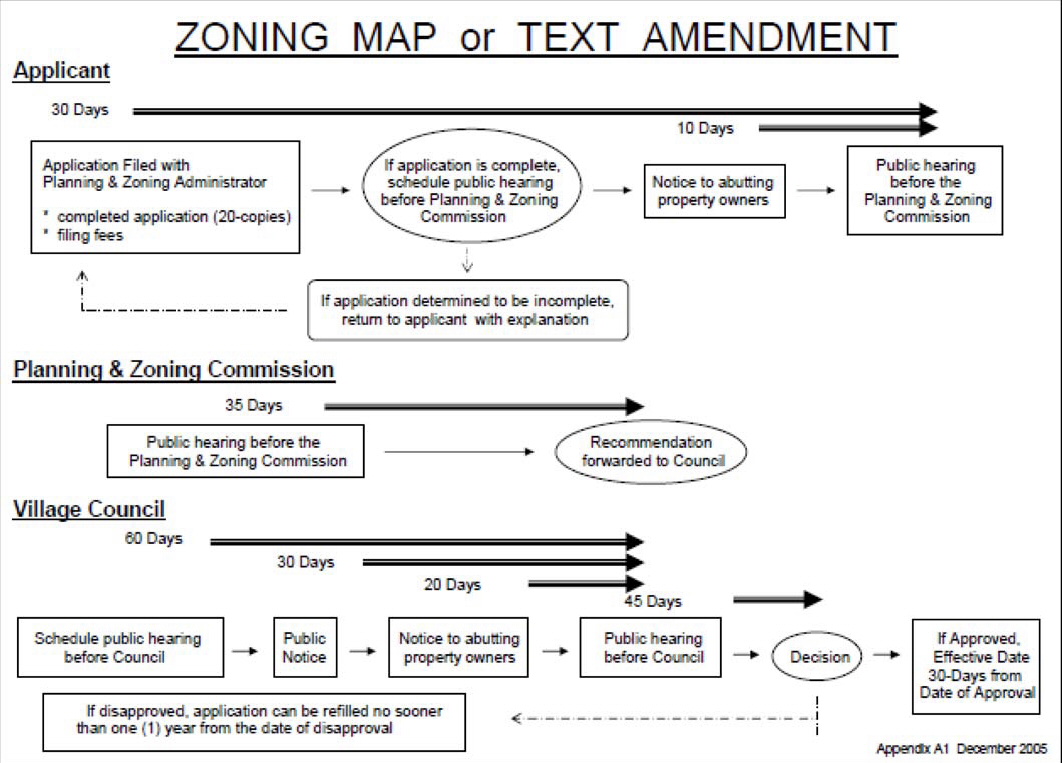
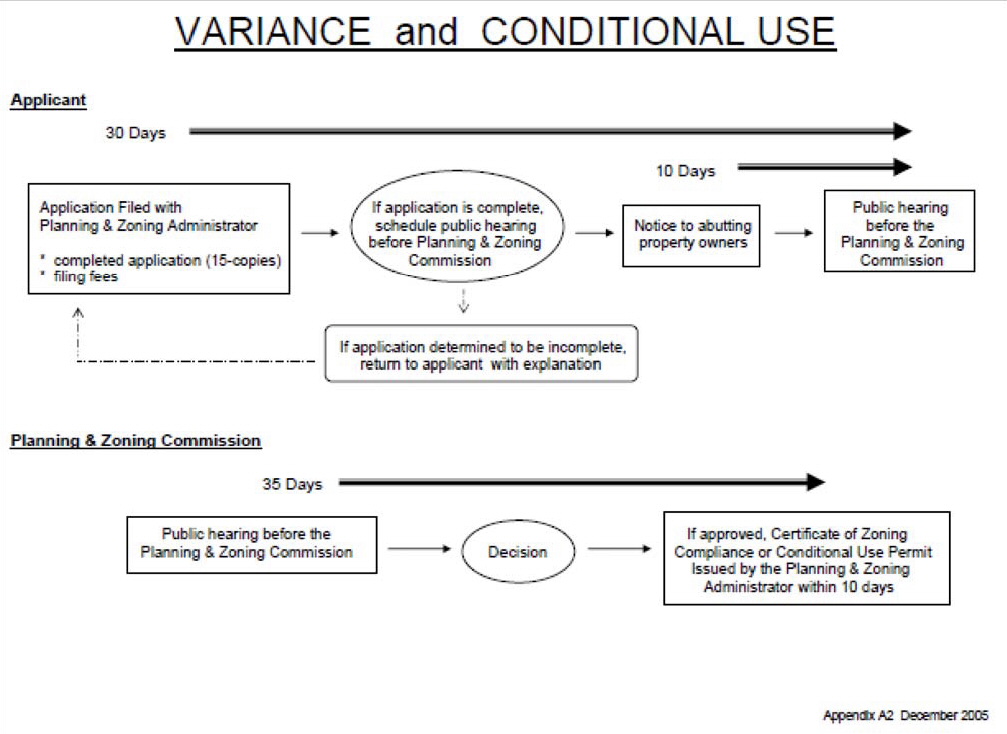
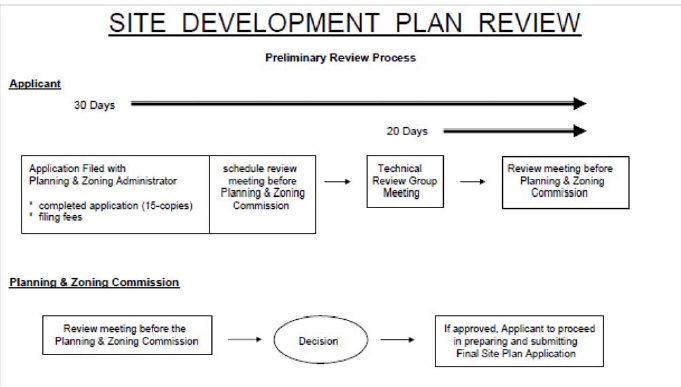
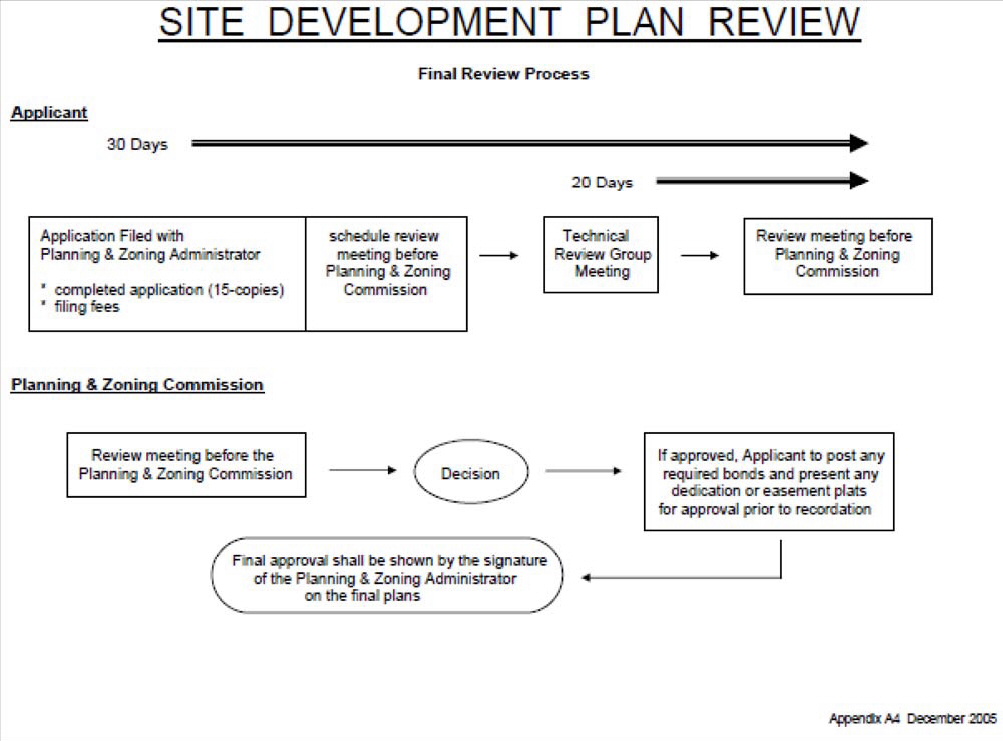
APPENDIX A
 |
 |
 |
 |
APPENDIX B
Zoning Development Standards
R-1 | R-3 | TND | |||
Min. Lot Area | 25,000 sq. ft. | 14,375 sq. ft. | Min. Lot Area | 16 acres | |
Max. Lot Coverage | 30% | 30% | Max. Lot Area | 200 acres | |
Min. Lot Width | 100 ft. | 80 ft. | Density | min. 8 du/ac; max 12 du/ac | |
Lot Width on Curving Street or Cul-De-Sac | 60 ft. at street 100 ft. at bldg. line | 45 ft. at street 80 ft. at bldg. line | Neighborhood Size: | allow residents to walk to neighborhood square in 5 - 10 minutes (1,320 ft.) | |
Front Yard Setback | 60 ft. | 30 ft. | TND District requirements | ||
Side Yard Setback | 15 ft. each side | 10 ft. each side | |||
Rear Yard Setback | 40 ft.; 8 ft. for acc. bldg. | 30 ft.; 8 ft. for acc. bldg. | |||
Max. Building Height | 35 ft. or 2- stories | 35 ft. or 2- stories | |||
Basement Required | over 20 ft. or 1 1/2 stories | over 20 ft. or 1 1/2 stories | |||
Public Open Space | 15% of the net site | 15% of the net site | |||
MF-A and MFC | NC | GC | SO | LM | |
Min. Lot Area | 15,000 sq. ft.; 7,094 sq. ft. per dwelling unit | No Minimum | No Minimum | No Minimum | No Minimum |
Max. Lot Coverage | 35% | No Maximum | No Maximum | No Maximum | No Maximum |
Min. Lot Width | 80 ft. | No Minimum | No Minimum | No Minimum | No Minimum |
Lot Width on Curving Street or Cul-De-Sac | 45 ft. at street 80 ft. at bldg. line | Not Applicable | Not Applicable | Not Applicable | Not Applicable |
Front Yard Setback | 25 ft. | 50 ft. | 50 ft. | 50 ft. | 50 ft. |
Side Yard Setback | 10 ft. | 20 ft. | 20 ft. | 20 ft. | 20 ft. |
Rear Yard Setback | 25 ft.; 8 ft. for acc. bldg. | 25 ft. | 25 ft. | 20 ft. | 20 ft. |
Building Size | max. 5,000 sq. ft. | ||||
Max. Building Height | 35 ft. or 2 1/2 stories | 35 ft. or 2 1/2 stories | 40 ft. or 3 stories | 40 ft. or 3 stories | 40 ft. or 3 stories |
Public Open Space | 20% of the net site | ||||
NOTE: A Conditional Use may require higher development standards.
Non-residential next to residential may require higher development standards.
PRD | PCD | PID | PUD | PCND | |
Min. Lot Area | 5 | None | 10 | 20 | 10 |
Min. Lot Width at building line | 350 | 350 | 500 | 750 | 350 |
Min. Frontage | 250 | 250 | 400 | 600 | 250 |
Max. Coverage | N/A | 45% | 50% | N/A | N/A |
Max. Building Height | 35 | 40 | 40 | 40 | 35 |
Max. Density | 4.0 du/acre | 4.0 du/acre | 4.0 du/acre | ||
Public Open Space | 25% of the net site | 25% of the net site | 50% of the net site | ||
APPENDIX C
Canal Winchester Zoning Code | Table of Permitted Uses and Conditional Uses by Zoning District | ||||||||||||
Use P = Permitted CU = Conditional Use | R-1 | R-3 | MF-A | MFC | SO | NC | GC | LM | PRD | PCD | PID | PUD | PCND |
Residential Dwellings, and Associated & Public Uses | |||||||||||||
Accessory buildings and uses | P | P | P | P | P | P | P | ||||||
Accessory structures used as private kennels | CU | CU | CU | CU | |||||||||
Apartments | P | P | |||||||||||
Bed and Breakfast Inns | CU | CU | |||||||||||
Cluster housing units | P | ||||||||||||
Common wall single-family attached dwelling units | P | ||||||||||||
Condominiums (attached & detached) | P | P | |||||||||||
Family care homes & group care homes | P | ||||||||||||
CU | CU | P | P | P | |||||||||
Residential living quarters as an integral part of and subordinate to a principal permitted use | CU | CU | P | P | P | ||||||||
Residential structures containing between 2 & 4 dwelling units | |||||||||||||
Rest homes, nursing homes | CU | ||||||||||||
Single family detached dwellings | P | P | |||||||||||
Single-family, two-family & multi-family dwellings | P | P | P | ||||||||||
Single-family zero lot line, attached twin singles, townhouses or other innovative forms of residential development | P | ||||||||||||
Canal Winchester Zoning Code | Table of Permitted Uses and Conditional Uses by Zoning District | ||||||||||||
Use P = Permitted CU = Conditional Use | R-1 | R-3 | MF-A | MFC | SO | NC | GC | LM | PRD | PCD | PID | PUD | PCND |
Institution | |||||||||||||
Colleges & universities | P | P | P | ||||||||||
Elementary & secondary schools | P | P | P | ||||||||||
Hospitals | P | P | P | ||||||||||
Museums & art galleries | P | P | P | ||||||||||
Libraries | P | P | P | ||||||||||
Nonprofit educational & scientific research services | CU | P | P | ||||||||||
Professional schools | P | P | P | ||||||||||
Religious organizations | P | P | P | ||||||||||
Research, development & testing laboratories | CU | CU | P | P | P | ||||||||
School & educational services hot elsewhere classified | CU | P | P | ||||||||||
Vocational schools | P | P | P | ||||||||||
Other Uses | |||||||||||||
Agricultural operations, customary | CU | CU | |||||||||||
Athletic fields & paved parking areas | |||||||||||||
Children’s nurseries, day care centers & preschool | CU | CU | CU | P | P | P | P | ||||||
Churches & other similar places of worship | CU | CU | CU | CU | P | P | P | P | |||||
Canal Winchester Zoning Code | Table of Permitted Uses and Conditional Uses by Zoning District | ||||||||||||
Use P = Permitted CU = Conditional Use | R-1 | R-3 | MF-A | MFC | SO | NC | GC | LM | PRD | PCD | PID | PUD | PCND |
Other Uses (Cont.) | ||||||||||||||
Crops, grazing & other agricultural uses | ||||||||||||||
Forest & wildlife preserves | P | |||||||||||||
Management for watershed, fish & wildlife, and fishing | ||||||||||||||
Minor improvements such as picnic tables & park benches | ||||||||||||||
Paved surfacing (i.e., bike paths, drives) | ||||||||||||||
Picnic shelter, playground equipment, seating/viewing stands, restrooms, concession stands, equipment storage buildings | ||||||||||||||
Private kennels | P | P | ||||||||||||
Projects specifically designed for watershed protection, conservation of soil or water or flood control | P | |||||||||||||
Public buildings and/or uses supported in whole or in part by taxes or by special public assessment | P | |||||||||||||
Public & private schools | CU | CU | CU | CU | ||||||||||
Public uses: | Parks | CU | CU | CU | CU | P | P | P | ||||||
Playgrounds | CU | CU | CU | CU | P | P | P | |||||||
Recreational & community center building | CU | CU | CU | CU | P | P | P | |||||||
Golf courses | CU | CU | CU | CU | P | P | P | |||||||
Public swimming pools | CU | CU | CU | CU | P | P | P | |||||||
Tennis courts & similar recreational uses | CU | CU | CU | CU | P | P | P | |||||||
Canal Winchester Zoning Code | Table of Permitted Uses and Conditional Uses by Zoning District | ||||||||||||
Use P = Permitted CU = Conditional Use | R-1 | R-3 | MF-A | MFC | SO | NC | GC | LM | PRD | PCD | PID | PUD | PCND |
Other Uses (Cont.) | |||||||||||||
Recreational uses except publicly-owned and operated parks & recreational facilities | |||||||||||||
Residential lawns | |||||||||||||
Tree & sod farming | |||||||||||||
Unpaved paths & drives | |||||||||||||
Business & Professional Offices | |||||||||||||
Administrative, business and professional offices | P | P | CU | P | P | P | |||||||
Accounting, auditing & bookkeeping services | P | P | P | P | |||||||||
Architects | P | P | CU | P | P | P | |||||||
Chiropractors | P | P | P | P | P | ||||||||
Combination of real estate, insurance, loan & law offices | P | P | P | ||||||||||
Commercial & stock savings banks | P | CU | P | P | P | ||||||||
Credit agencies other than banks | P | P | P | ||||||||||
Dentists & dental surgeons | P | P | P | CU | P | P | P | ||||||
Engineers, engineering | P | P | CU | P | P | P | |||||||
Financial services | P | P | P | ||||||||||
Graphic arts & interior design | P | P | CU | P | P | P | |||||||
Canal Winchester Zoning Code | Table of Permitted Uses and Conditional Uses by Zoning District | ||||||||||||
Use P = Permitted CU = Conditional Use | R-1 | R-3 | MF-A | MFC | SO | NC | GC | LM | PRD | PCD | PID | PUD | PCND |
Business & Professional Offices (Cont.) | |||||||||||||
Health & allied services not elsewhere classified | P | P | P | P | |||||||||
Health care maintenance & emergency services | P | P | P | P | |||||||||
Insurance agents, brokers & service | P | P | P | P | |||||||||
Landscape architects | P | P | CU | P | P | P | |||||||
Legal services | P | P | P | P | P | ||||||||
Medical & allied services | CU | P | |||||||||||
Medical & dental laboratories | P | P | P | P | |||||||||
Osteopathic physicians | P | P | P | ||||||||||
Personal credit institutions | P | CU | P | P | P | ||||||||
Physicians & surgeons | P | P | P | CU | P | P | P | ||||||
Professional services not elsewhere classified | CU | P | P | ||||||||||
Real estate agents, brokers & managers | P | P | P | ||||||||||
Urban planning | P | P | CU | P | P | P | |||||||
Veterinarian offices & animal hospitals | CU | CU | P | P | |||||||||
Canal Winchester Zoning Code | Table of Permitted Uses and Conditional Uses by Zoning District | ||||||||||||
Use P = Permitted CU = Conditional Use | R-1 | R-3 | MF-A | MFC | SO | NC | GC | LM | PRD | PCD | PID | PUD | PCND |
Organizations & Associations | |||||||||||||
Business associations | P | P | P | ||||||||||
Charitable organizations | P | P | P | ||||||||||
Civic, social & fraternal associations | P | P | P | ||||||||||
Labor unions & similar labor organizations | P | P | P | ||||||||||
Nonprofit membership org. not elsewhere classified | CU | P | P | ||||||||||
Political organizations | P | P | P | ||||||||||
Professional membership organizations | P | P | P | ||||||||||
Personal & Consumer Services | |||||||||||||
Beauty shops | CU | P | P | CU | P | P | P | ||||||
Barber shops | CU | P | P | CU | P | P | P | ||||||
Business services not elsewhere classified, except research, development & testing laboratories | CU | P | P | P | |||||||||
Commercial photography studios | CU | P | P | P | |||||||||
Consumer credit reporting agencies | CU | P | P | P | |||||||||
Electrical repair | P | P | P | ||||||||||
Funeral services & crematories | CU | P | P | P | |||||||||
Furniture repair | P | P | P | ||||||||||
Canal Winchester Zoning Code | Table of Permitted Uses and Conditional Uses by Zoning District | ||||||||||||
Use P = Permitted CU = Conditional Use | R-1 | R-3 | MF-A | MFC | SO | NC | GC | LM | PRD | PCD | PID | PUD | PCND |
Personal & Consumer Services (Cont.) | |||||||||||||
Garment repair & alteration | P | P | P | ||||||||||
Laundromats | P | P | P | ||||||||||
Misc. personal service | P | P | P | ||||||||||
Pressing, alteration & garment repair | P | P | CU | P | P | P | |||||||
Recycling centers, not to include manufacturing | CU | P | |||||||||||
Reupholstery repair | P | P | P | ||||||||||
Shoe repair | P | P | CU | P | P | P | |||||||
Watch, clock & jewelry repair | P | P | P | ||||||||||
Retail | |||||||||||||
Accessories & personal furnishing stores | P | P | P | ||||||||||
Advertising stores | P | P | P | ||||||||||
All auto-related uses, such as sales & services | CU | CU | |||||||||||
Antique & secondhand stores | P | P | P | ||||||||||
Automobile car wash | CU | P | P | ||||||||||
Automobile convenience markets | CU | CU | P | P | P | ||||||||
Automobile parking | CU | P | P | ||||||||||
Automobile repair services & garages | CU | CU | P | P | P | ||||||||
Automobile service stations | CU | CU | P | P | P | ||||||||
Canal Winchester Zoning Code | Table of Permitted Uses and Conditional Uses by Zoning District | ||||||||||||
Use P = Permitted CU = Conditional Use | R-1 | R-3 | MF-A | MFC | SO | NC | GC | LM | PRD | PCD | PID | PUD | PCND |
Retail (Cont.) | |||||||||||||
Bicycle shops | P | P | P | ||||||||||
Blueprinting | P | CU | P | P | P | ||||||||
Bowling | CU | P | P | ||||||||||
Camera & photographic supply stores | P | P | P | ||||||||||
Candy, nut & confectionary stores | P | P | P | P | |||||||||
Cigar stores | P | P | P | ||||||||||
Clothing stores | P | P | P | ||||||||||
Commercial kennels | CU | CU | P | P | P | ||||||||
Commercial retail associated with & subordinate to another permitted use & limited to no more than 25% of total gross floor area of all structures on the subject lot(s) | P | P | P | P | |||||||||
Convenience food markets | P | P | P | ||||||||||
Custom tailors | P | P | P | ||||||||||
Dairy products stores | P | P | P | P | |||||||||
Dance halls & studios; dance schools | CU | P | P | ||||||||||
Department stores | P | P | P | ||||||||||
Drive-up window service in association with a principal permitted use | CU | CU | CU | P | P | ||||||||
Drug stores & proprietary stores | P | P | P | P | |||||||||
Canal Winchester Zoning Code | Table of Permitted Uses and Conditional Uses by Zoning District | ||||||||||||
Use P = Permitted CU = Conditional Use | R-1 | R-3 | MF-A | MFC | SO | NC | GC | LM | PRD | PCD | PID | PUD | PCND |
Retail (Cont.) | |||||||||||||
Duplicating | P | P | P | ||||||||||
Eating & drinking establishments with no drive-thru window service | P | P | P | ||||||||||
Eating & drinking places | CU | P | P | P | |||||||||
Electrical supply equipment | P | P | P | ||||||||||
Electronic products | P | P | P | P | |||||||||
Farm equipment | P | P | P | ||||||||||
Florists | P | P | P | P | |||||||||
Fruit stores & vegetable markets | P | P | P | P | |||||||||
Furniture & home furnishings stores | P | P | P | ||||||||||
Furriers & fur shops | P | P | P | ||||||||||
Gasoline service stations | |||||||||||||
General merchandise, miscellaneous | P | P | P | ||||||||||
Gift, novelty & souvenir shops | P | P | P | ||||||||||
Grocery stores | P | P | P | ||||||||||
Hardware stores | P | P | P | P | |||||||||
Heating & plumbing equipment | P | P | P | ||||||||||
Hotels & motels | CU | P | P | ||||||||||
Household appliance stores | P | P | P | ||||||||||
Canal Winchester Zoning Code | Table of Permitted Uses and Conditional Uses by Zoning District | ||||||||||||
Use P = Permitted CU = Conditional Use | R-1 | R-3 | MF-A | MFC | SO | NC | GC | LM | PRD | PCD | PID | PUD | PCND |
Retail (Cont.) | |||||||||||||
Jewelry stores | P | P | P | ||||||||||
Liquor stores | P | P | P | ||||||||||
Lumber & other building materials | P | P | P | ||||||||||
Mail order houses, mailing | P | CU | P | P | P | ||||||||
Meat and fish (seafood) markets | P | P | P | P | |||||||||
Misc. apparel & accessory stores | P | P | P | ||||||||||
Misc. business services not elsewhere classified | P | P | P | ||||||||||
Misc. retail stores not elsewhere classified | P | P | P | ||||||||||
Music stores | P | P | P | ||||||||||
News dealers | P | P | P | ||||||||||
Optical goods stores | P | P | P | ||||||||||
Organizational hotels & lodging houses on a membership basis | CU | P | P | ||||||||||
Photocopying | P | CU | P | P | P | ||||||||
Private employment agencies | CU | P | |||||||||||
Radio stores | P | P | P | ||||||||||
Retail bakeries | P | P | P | P | |||||||||
Shoe stores | P | P | P | ||||||||||
Skating rinks | CU | P | P | ||||||||||
Canal Winchester Zoning Code | Table of Permitted Uses and Conditional Uses by Zoning District | ||||||||||||
Use P = Permitted CU = Conditional Use | R-1 | R-3 | MF-A | MFC | SO | NC | GC | LM | PRD | PCD | PID | PUD | PCND |
Retail (Cont.) | |||||||||||||
Sporting goods stores | P | P | P | ||||||||||
Supermarkets | P | P | P | ||||||||||
Stationary stores | P | P | P | ||||||||||
Stenography | P | CU | P | P | P | ||||||||
Swimming pools | CU | P | P | ||||||||||
Television stores | P | P | P | ||||||||||
Theaters | CU | P | P | ||||||||||
Variety stores | P | P | P | ||||||||||
Video rental stores | P | P | P | P | |||||||||
Manufacturing | |||||||||||||
Amusements | P | P | P | ||||||||||
Automobile accessories & electronic components | P | P | |||||||||||
Beverage industries | P | P | |||||||||||
Bookbinding & related industries | P | P | |||||||||||
Boot & shoe cut stock & findings | P | P | |||||||||||
Bakery products, candy & other confectionary products | P | P | |||||||||||
Books, magazines & other publications | P | P | |||||||||||
Broad & narrow woven fabric mills | P | P | |||||||||||
Canal Winchester Zoning Code | Table of Permitted Uses and Conditional Uses by Zoning District | ||||||||||||
Use P = Permitted CU = Conditional Use | R-1 | R-3 | MF-A | MFC | SO | NC | GC | LM | PRD | PCD | PID | PUD | PCND |
Manufacturing (Cont.) | |||||||||||||
Commercial printing | P | P | |||||||||||
Canning & preserving fruits, vegetables & seafood | P | P | |||||||||||
Communication equipment | P | P | |||||||||||
Costume jewelry | P | P | |||||||||||
Costume novelties, buttons and misc. notions except precious metal | P | P | |||||||||||
Dairy products | P | P | |||||||||||
Dyeing & finishing | P | P | |||||||||||
Electronic components & accessories | P | P | |||||||||||
Electrical lighting & wiring equipment | P | P | |||||||||||
Equipment | P | P | |||||||||||
Floor covering mills | P | P | |||||||||||
Footwear | P | P | |||||||||||
Fur goods | P | P | |||||||||||
Glass products made of purchased glass | P | P | |||||||||||
Gloves & mittens | P | P | |||||||||||
Grain mill products | P | P | |||||||||||
Greeting cards | P | P | |||||||||||
Household appliances | P | P | |||||||||||
Canal Winchester Zoning Code | Table of Permitted Uses and Conditional Uses by Zoning District | ||||||||||||
Use P = Permitted CU = Conditional Use | R-1 | R-3 | MF-A | MFC | SO | NC | GC | LM | PRD | PCD | PID | PUD | PCND |
Manufacturing (Cont.) | |||||||||||||
Household & office furniture | P | P | |||||||||||
Instruments for measuring, controlling & indicating physical characteristics | P | P | |||||||||||
Jewelry, silverware & plated ware | P | P | |||||||||||
Leather goods not elsewhere classified | P | P | |||||||||||
Luggage, handbags & other personal leather goods | P | P | |||||||||||
Manifold business forms | P | P | |||||||||||
Men’s, youth’s & boys’ clothing | P | P | |||||||||||
Misc. apparel & accessories | P | P | |||||||||||
Misc. electrical machinery, equipment & supplies | P | P | |||||||||||
Misc. fabricated textile products | P | P | |||||||||||
Misc. textile goods | P | P | |||||||||||
Musical instruments & parts | P | P | |||||||||||
Nonferrous foundries | P | P | |||||||||||
Ophthalmic goods | P | P | |||||||||||
Optical instruments & lenses | P | P | |||||||||||
Pens, pencils & other office and artists’ materials | P | P | |||||||||||
Pharmaceuticals | P | P | |||||||||||
Canal Winchester Zoning Code | Table of Permitted Uses and Conditional Uses by Zoning District | ||||||||||||
Use P = Permitted CU = Conditional Use | R-1 | R-3 | MF-A | MFC | SO | NC | GC | LM | PRD | PCD | PID | PUD | PCND |
Manufacturing (Cont.) | |||||||||||||
Photographic equipment & supplies | P | P | |||||||||||
Plastic products | P | P | |||||||||||
Publishing & printing of newspapers | P | P | |||||||||||
Sausages & other prepared meat products | P | P | |||||||||||
Service industries for the printing trade | P | P | |||||||||||
Sheet metal work & machine shops, jobbing & repair | P | P | |||||||||||
Sporting & athletic goods | P | P | |||||||||||
Surgical, medical & dental instruments & supplies | P | P | |||||||||||
Toys | P | P | |||||||||||
Watches, clocks, clockwork operated devices & parts | P | P | |||||||||||
Women’s, misses’, children’s & infants clothing | P | P | |||||||||||
Yarn & thread mills | P | P | |||||||||||
Service Industries | |||||||||||||
Carpentering & wood flooring | P | P | |||||||||||
Concrete work | P | P | |||||||||||
Electrical work | P | P | |||||||||||
General construction contractors | P | P | |||||||||||
Masonry, stonework, tile setting & plastering | P | P | |||||||||||
Canal Winchester Zoning Code | Table of Permitted Uses and Conditional Uses by Zoning District | ||||||||||||
Use P = Permitted CU = Conditional Use | R-1 | R-3 | MF-A | MFC | SO | NC | GC | LM | PRD | PCD | PID | PUD | PCND |
Service Industries (Cont.) | |||||||||||||
Misc. special trade contractors | P | P | |||||||||||
Painting, paperhanging & decorating | P | P | |||||||||||
Plumbing, heating & air conditioning | P | P | |||||||||||
Roofing & sheet metal work | P | P | |||||||||||
Water well drilling | P | P | |||||||||||
Wholesaling | |||||||||||||
Beer, wine & distilled alcoholic beverages | P | P | |||||||||||
Dry goods & apparel | P | P | |||||||||||
Electrical goods | P | P | |||||||||||
Furniture & home furnishings | P | P | |||||||||||
Groceries & related products | P | P | |||||||||||
Hardware, plumbing & heating equipment & supplies | P | P | |||||||||||
Machinery equipment & supplies | P | P | |||||||||||
Paper & its products | P | P | |||||||||||
Pharmaceuticals, chemicals & allied products | P | P | |||||||||||
Tobacco & its products | P | P | |||||||||||
Canal Winchester Zoning Code | Table of Permitted Uses and Conditional Uses by Zoning District | ||||||||||||
Use P = Permitted CU = Conditional Use | R-1 | R-3 | MF-A | MFC | SO | NC | GC | LM | PRD | PCD | PID | PUD | PCND |
Wholesaling, Warehousing & Transportation Services | |||||||||||||
Farm products & raw materials | P | P | |||||||||||
Electrical goods | P | P | |||||||||||
Hardware, plumbing & heating equipment & supplies | P | P | |||||||||||
Machinery, equipment & supplies | P | P | |||||||||||
Mini-warehouses | P | P | |||||||||||
Misc. wholesalers except scrap & waste materials | P | P | |||||||||||
Public warehousing & freight forwarding | P | P | |||||||||||
Terminal & joint terminal maintenance facilities for motor freight transportation & misc. services incidental to transportation | P | P | |||||||||||
Trucking - local & long distance | P | P | |||||||||||
CODIFIED ORDINANCES OF CANAL WINCHESTER
1181.01 SWIMMING POOLS.
No private swimming pool, above and below ground, shall be allowed in a residential zoning district except as an accessory use, and unless such private swimming pool has received a Certificate of Zoning Compliance prior to issuance of a Building Permit and provided such pool complies with the following conditions and requirements:
(a) The pool is intended and used primarily for the enjoyment of the occupants of the principal use of the property. (Ord. 41-01. Passed 8-20-01.)
(b) The pool shall be located completely to the rear of the principal structure and may not be located closer to seven (7) feet to any lot line of the property on which it is located. (Ord. 88-05. Passed 11-21-05.)
(c) The pool, or the entire lot on which such pool is located, shall be enclosed by a structure with a minimum height of four (4) feet to prevent uncontrolled access from the street and from adjacent properties.
(d) Any lighting to illuminate the pool area shall be so arranged as to deflect the light away from the adjoining properties.
(e) No person, firm or corporation shall construct or install a swimming pool or make any alteration therein or in the appurtenances thereof without having received an approved Certificate of Zoning Compliance.
(Ord. 41-01. Passed 8-20-01.)
1181.02 OPEN STORAGE AND DISPLAY OF MATERIAL.
The open storage and display of material and equipment incidental to a nonresidential use adjacent to a residential zoning district, Planned Residential District, Planned Unit District, or visible from a public right-of-way shall only be permitted provided the area used for open storage and display shall be effectively screened on adjoining sides and public rights-of-way by means of walls or fences with a one hundred (100) percent opaqueness and is located behind the building line and not in a required yard. Walls or fences shall be a minimum of six (6) feet in height without advertising thereon and shall not include chain-link fences. Walls and fences may be further screened with plantings comprised of evergreen hedges six (6) feet in height.
(Ord. 41-01. Passed 8-20-01.)
1181.03 PUBLIC NUISANCE REGULATIONS.
No land or building in any district shall be used or occupied in any manner creating dangerous, injurious, noxious, or otherwise objectionable conditions which could adversely affect the surrounding areas or adjoining premises, except that any use permitted by this Zoning Code may be undertaken and maintained if acceptable measures or safeguards to reduce dangerous and objectionable conditions to acceptable limits are established by the performance requirements in subsections (a) to (l) hereof.
(a) Fire Hazards. Any activity involving the use or storage of flammable or explosive materials shall be protected by adequate fire fighting and fire prevention equipment and by such safety devices as are normally used in the handling of any such material. Such hazards shall be kept removed from adjacent activities to a distance which is compatible with the potential danger involved.
(b) Radioactivity or Electrical Disturbance. No activity shall emit dangerous radioactivity at any point, or electrical disturbance adversely affecting the operation of any equipment at any point than that of the creator of such disturbance.
(c) Noise and Vibration. Noise or vibration shall be so controlled that at the property line on which such noise or vibration is produced it will not be at a level above that normally perceptible from other development activities in the area or from the usual street traffic observed at the street right-of-way line of the lot, except occasional blast or shock required in normal operation and produced in such manner as not to create a hazard.
(d) Toxic and Hazardous Substances. No toxic substance shall be emitted or otherwise discharged into the atmosphere, ground, surface waters or ground waters. No storage, use or transport of toxic or hazardous substances shall be permitted unless such activity is in full compliance with applicable state and federal environmental protection regulations and the expressed prior written approval of the Fire Chief.
(e) Air Pollution. No pollution of air by fly-ash, dust, vapors, odors, smoke or other substances shall be permitted which are harmful to health, animals, vegetation or other property, or which can cause excessive soiling.
(f) Glare. No direct or reflected glare shall be permitted which is visible from any property or from any public street.
(g) Erosion. No erosion, by either wind or water, shall be permitted which will carry objectionable substances onto neighboring properties.
(h) Water Pollution. Water pollution shall be subject to the requirements and regulations established by the Ohio Environmental Protection Agency.
(i) Trash. The storage of trash and waste materials, including but not limited to discarded household goods, discarded commercial products, industrial by-products, and other similar materials shall not be visible from the property line on which such materials are being stored or otherwise placed. All such materials shall be housed in an appropriate container or enclosure, excepting trash that is properly placed in an appropriate enclosed container at an assigned location for regularly scheduled trash pickup. In all cases, there shall be full compliance with applicable zoning district standards.
(j) Enforcement Provisions. The Planning and Zoning Administrator or Planning and Zoning Commission prior to the issuance of a Certificate of Zoning Compliance may require the submission of statements and plans indicating the manner in which dangerous and objectionable elements involved in processing and in equipment operations are to be eliminated or reduced to acceptable limits and tolerances.
(k) Measurement Procedures. Methods and procedures for the determination of the existence of any dangerous and objectionable elements shall conform to applicable standard measurement procedures published by the American National Standards Institute, United States Bureau of Mines, and Ohio Environmental Protection Agency.
(Ord. 41-01. Passed 8-20-01.)
(l) Turf. Turf shall not be higher than eight (8) inches. Add the following: If the owner, lessee, agent or tenant having charge of the land mentioned fails to comply with a turf violation notice per Chapter 1135
, the municipality may cause such turf to be cut and may employ the necessary labor to perform such task. All expenses incurred shall be documented. The Clerk of Council shall make a written return to the County Auditor of action taken under this section, with a statement of the charges for its services, the amount paid for the performing of such labor, the fees of the officers who made the service of the notice and return, and a proper description of the premises. Such amounts, when allowed, shall be entered upon the tax duplicate, shall be a lien upon such lands from the date of the entry, and shall be collected as other taxes and returned to the municipality with the General Fund. (Ord. 88-05. Passed 11-21-05.)
(m) Abattable Nuisance. Upon determination by the Planning and Zoning Commission or as sustained by appeal of such a decision to Council, subsections (a) to (l) hereof shall be considered abatable nuisances and a violation of the provisions of this Zoning Code.
(Ord. 41-01. Passed 8-20-01.)
1181.04 LAND DEDICATIONS AND IN-LIEU FEES.
(a) Mandatory Land Dedication. Acreage shall be set aside in all residential developments for the provision of public areas in accordance with the municipality's park and recreation master plan. Such public areas shall be used as sites for public parks, open space and recreational areas. The amount of acreage to be set aside is based on the gross developable site and shall comply with the following schedule:
ZONING DISTRICT | LAND SET ASIDE |
R-1 and R-3 | 15% |
MF-A and MF-C | 20% |
PRD and PUD | 25% |
PCND | 50% |
Such lands may be deeded to the municipality and thereby developed and managed by the municipality or held, developed and maintained by a private association, the bylaws and creation of which shall be by approval of Council. Title to dedicated land shall be transferred to the municipality within sixty (60) days of Council's acceptance of the land dedication.
(Ord. 25-09. Passed 5-4-09.)
(b) Review And Approval Process. The mandatory land dedication requirement shall serve as a component of the subdivision review process of Canal Winchester and regulatory review and approval shall be a consistent part of that process. The Planning and Zoning Commission may review and reject the proposed acreage if such site(s) is not appropriate for the intended use given environmental, technical or land use considerations. In such circumstances, the Planning and Zoning Commission shall request an alternative site(s), which may or may not be provided on-site.
(c) Fees In-Lieu of Dedication. The Applicant may request the payment of fees in-lieu of the total or a portion of the mandatory land dedication to the Planning and Zoning Commission which shall make a recommendation to Council relative to such request. The amount of fees to be paid shall be equal to the assessed value of the acreage that would have been dedicated to the Municipality under the land dedication requirement.
(d) Payment, Deposit and Use of Fees. Fees in-lieu of land dedication shall be paid to the Municipality within sixty (60) days following final plat approval. Such fees shall be placed in a special fund the records of which shall be available for public inspection. Such funds shall only be used by the Municipality for the acquisition and development of public parks, recreation facilities, and open space.
(e) Additional Reservation of Public Land. Where adopted planning documents recommend sites for public schools, parks or other public facilities, including open space, such lands shall be set in reserve by the owner. (Ord. 41-01. Passed 8-20-01.)
(f) Park Fee. A park fee as stipulated by ordinance shall be paid to the municipality by the developer or builder prior to issuance of a Certificate of Zoning Compliance. Such fee shall be deposited in a special fund and expended by the Municipality for the improvement and purchase of park land. (Ord. 38-09. Passed 6-15-09.)
(g) Conflict with Subdivision Regulations. This subsection shall supersede conflicting requirements of the Subdivision Regulations.
(Ord. 41-01. Passed 8-20-01.)
1181.05 PORTABLE STRUCTURES.
(a) Portable Residential Structures. No mobile home, trailer or similar portable residential structures in use shall be permitted in any district in the Municipality except for camping and traveling trailers specified in Section 1185.07
.
(b) Portable Non Residential Structures. Portable non residential structures shall not be permitted in the Municipality, except as provided in Section 1181.05
(c) and Section 1135.09
of this Zoning Code. For the purposes of this Zoning Code, a portable non residential structure shall be defined as any building or other structure designed for occupation or sale of goods which is not placed on a permanent foundation.
(c) Portable On Demand Storage (PODS). The use of PODS within the Municipality, or other similar units, shall be permitted in any zoning district only for the purpose of loading or unloading in association with moving in or out of a building. PODS shall be parked on property for a period not to exceed seven (7) consecutive days, shall not be parked on public right-of-way or private streets, and shall be located on an existing driveway or parking area composed of gravel, asphalt ,concrete or other hard surface. The Planning and Zoning Administrator shall issue a Certificate of Zoning Compliance for the location of PODS in the Municipality abiding by the aforementioned conditions.
(Ord. 04-11. Passed 1-18-11.)
1181.06 KEEPING OF AGRICULTURAL ANIMALS IN NON-AGRICULTURAL DISTRICTS.
(a) Keeping of Horses and Goats. Horses and goats may be kept in single family residential districts provided that:
(1) Minimum Acres Required. The minimum acreage on which horses or goats may be kept shall be five (5) acres.
(2) Number Limited Based on Acreage Available. There shall not be more than one (1) horse or four (4) goats per two and one-half (2.5) acres of land.
(3) Only Mares or Geldings. Only mares or geldings may be kept on lots less than ten (10) acres.
(4) Prohibited Animals. Nothing in this Section shall be construed or interpreted to permit the keeping of cattle, sheep, swine, or other agricultural animals, except as otherwise done in conformance with the Zoning Code.
(5) Fencing Required. Such land shall be fenced so as to securely confine said animals. Such fencing shall not be located closer to any public right-of-way or private street than the minimum setback in the district and shall not be located closer than eight (8) feet from any other property line .
(6) No Storage of Manure. No storage of manure or dust producing substances shall be permitted.
(7) Control of Odors Required. No odors may be detectable beyond the property on which such use exists.
(8) Building Setback Requirements. Any building used in connection with the keeping of horses or goats shall be located at least fifty (50) feet from any property line.
(9) Use Permit Required. A use permit shall be issued by the Planning and Zoning Administrator to any applicant meeting the requirements of this section prior to the commencement of the keeping of horses or goats and shall include the following information:
A. Address where the horses or goats will be kept;
B. Name of the owner;
C. Phone number for the owner;
D. Email Address for the owner;
E. A description of the type and number of animals to be kept;
F. A diagram of the property, drawn to scale, showing the proposed location and configuration of the structures housing the horses or goats as well as the relation of these structures to adjacent properties;
G. A diagram of the shelter;
H. A description of the feed storage containers and its location;
I. Written consent from the applicant, valid for the duration of the permit, for a representative of the City, or of the county health department, to enter the applicant's property for purposes of inspecting the premises for compliance with health, sanitation, and zoning laws and ordinances;
J. Such other information as the Planning and Zoning Administrator determines is necessary to evaluate the suitability of the applicant or property.
(b) Keeping of Chickens, Ducks, and Rabbits. Chickens, ducks, or rabbits may be kept in single family residential districts provided that:
(1) Minimum Acres Required. The minimum acreage on which chickens, ducks, and rabbits may be kept shall be one (1) acre.
(2) Number Limited Based on Acreage Available. There shall not be more than six (6) chickens, ducks, or rabbits per one (1) acre of land.
(3) Prohibited Animals. Nothing in this Section shall be construed or interpreted to permit the keeping of roosters, geese, peafowl, or turkeys, except as otherwise done in conformance with the Zoning Code.
A. No Commercial Use: Chickens, ducks, or rabbits shall be kept only for the personal use of persons residing in the principal structure on the lot where the chickens, ducks, or rabbits are kept.
B. This section does not permit the slaughter of chickens, ducks, or rabbits in residential districts of the City.
(4) Fencing Required. Such land shall be fenced so as to securely confine said animals. Such fencing shall not be located closer to any public right-of-way or private street than the minimum setback in the district. Such fence shall be at least six (6) feet tall and opaque such that it screens the sheltering structure and animal area from view of adjacent properties and public right-of-way.
(5) No Storage of Manure. No storage of manure or dust producing substances shall be permitted.
(6) Control of Odors Required. No odors may be detectable beyond the property on which such use exists.
(7) Building Setback Requirements. Any building used in connection with the keeping of chickens, ducks, or rabbits shall be located completely to the rear of the principal structure and shall be located to meet the rear and side yard setback requirements of the applicable residential zoning district. These structures shall not be located within a recorded easement.
(8) Use Permit Required. A use permit shall be issued by the Planning and Zoning Administrator to any applicant meeting the requirements of this section prior to the commencement of the keeping of chickens, ducks, or rabbits and shall include the following information:
A. Address where the chickens, ducks, or rabbits will be kept;
B. Name of the owner;
C. Phone number for the owner;
D. Email Address for the owner;
E. A description of the type and number of animals to be kept;
F. A diagram of the property, drawn to scale, showing the proposed location and configuration of the structures housing the chickens, ducks, or rabbits as well as the relation of these structures to adjacent properties;
G. A diagram of the proposed coop or shelter;
H. A description of the feed storage containers and their locations;
I. A certificate, transcript, or receipt showing that the applicant has completed a class on keeping backyard chickens, ducks, or rabbits from the Ohio State University Extension Office or other source approved by the Planning and Zoning Administrator;
J. If the applicant is a tenant on the property, written permission from the property owner;
K. Written consent from the applicant, valid for the duration of the permit, for a representative of the City, or of the county health department, to enter the applicant's property for purposes of inspecting the premises for compliance with health, sanitation, and zoning laws and ordinances;
L. Such other information as the Planning and Zoning Administrator determines is necessary to evaluate the suitability of the applicant or property.
(c) Keeping of Bees. Bees and associated bee hives may be kept in single family residential districts provided that:
(1) Minimum Acres Required. The minimum acreage on which bees and associated bee hives may be kept shall be one (1) acre.
(2) Number. There shall not be more than two (2) beehives per one (1) acres of land.
(3) Prohibitions. No Africanized bees may be kept on a property under the regulations of this Section.
(4) Fencing and Shrubs. A solid fence or dense hedge, known as a "flyway barrier," at least six (6) feet in height, shall be placed along the side of the beehive that contains the entrance to the hive, and shall be located within five (5) feet of the hive and shall extend at least two (2) feet on either side of the hive. No such flyway barrier shall be required if all beehives are located at least forty (40) feet from all property lines.
(5) Water Supply. A supply of fresh water shall be maintained in a location readily accessible to all bee colonies on the site throughout the day to prevent bees from congregating at neighboring swimming pools or other sources of water on nearby properties.
(6) Building Setback Requirements. No beehive shall be kept closer than twenty five (25) feet to any lot line and ten (10) feet to a dwelling or the permitted placement of a dwelling on another parcel, and no beehive shall be kept in a required front yard or side yard. The front of any beehive shall face away from the property line of the Residential property closest to the beehive.
(7) Use Permit Required. A use permit shall be issued by the Planning and Zoning Administrator to any applicant meeting the requirements of this section prior to the commencement of the keeping of bees and shall include the following Information:
A. Address where the bees will be kept;
B. Name of the owner;
C. Phone number for the owner;
D. Email Address for the owner;
E. A description of the type and number of hives to be kept;
F. A diagram of the property, drawn to scale, showing the proposed location and configuration of the structures housing the bees as well as the relation of these structures to adjacent properties;
G. A diagram of the proposed hive or shelter;
H. A description of the water source and their locations;
I. A certificate, transcript, or receipt showing that the applicant has registered all bee colonies with the Ohio Department of Agriculture. Keeper must maintain valid certification with the Ohio Department of Agriculture.
J. If the applicant is a tenant on the property, written permission from the property owner;
K. Written consent from the applicant, valid for the duration of the permit, for a representative of the City, or of the county health department, to enter the applicant's property for purposes of inspecting the premises for compliance with health, sanitation and zoning laws and ordinances;
L. Such other information as the Planning and Zoning Administrator determines is necessary to evaluate the suitability of the applicant or property. (Ord. 18-003. Passed 3-5-18.)
1181.07 FENCES AND HEDGES.
(a) Electrically Charged Fences Prohibited. Electrically charged fences shall be forbidden in all districts except on sites of more than ten (10) acres used to confine livestock.
(b) Use of Barbed Wire. Barbed wire may be used only to top standard security fences in commercial and industrial districts at a height of six (6) feet or greater, the supports for such barbed wire shall be either vertical or lean inward above the property of the owner of the fence. Lands used for agricultural purposes, meeting the requirements of this Code, shall be exempt from this provision.
(c) Decorative Fences Required. Only decorative fences shall be constructed in front set backs or side set backs abutting streets. Decorative fences shall mean split rail, ornamental iron, vinyl, or other decorative wooden fences as approved by the Planning and Zoning Administrator.
(d) Chain Link Prohibited. Chain link fences shall not be permitted within front set backs or side set backs abutting streets in any district, except by variance granted by the Planning and Zoning Commission.
(e) Guard Rails Prohibited. Guard rails shall not be used as fencing.
(f) Location in Front Setbacks. Fences and hedges in front set backs and/or side set backs abutting streets and alleys in any district shall not exceed three (3) feet in height and shall not obstruct the view of pedestrians or vehicular traffic or be detrimental to the public safety.
(g) Fencing Agricultural Uses. Lands used for agricultural purposes, meeting the requirements of this Code, shall not place any fence used for the confinement of said use closer than fifteen (15) feet from any public right-of-way or private street.
(h) Height Restriction in Rear and Side Yards. Fences in rear set backs and side setbacks not abutting streets and alleys shall not exceed six (6) feet in height in residential districts or twelve (12) feet in height commercial or industrial districts.
(i) Permit Required. No fence shall hereafter be erected, constructed, altered, relocated or rebuilt until an application has been filed with and a permit issued by the Planning and Zoning Administrator.
(j) Exemptions for Temporary Fences. The following temporary fences shall be exempt from the provisions of this section:
(1) Temporary construction fences when such fence is indicated on an approved site plan.
(2) Temporary fences used for Special Events and shown on an approved plot plan for said event.
(3) Temporary snow fence installed by any Government agency.
(4) Temporary fences installed for the protection of the public from any obvious danger.
(Ord. 41-01. Passed 8-20-01.)
1181.08 OUTDOOR FURNACES.
(a) Definition. An outdoor furnace shall be defined as any equipment, device or apparatus, or any part thereof, which is installed, affixed or situated outdoors for the primary purpose of combustion of fuel to produce heat or energy used as a component of a heating system providing heat for any interior space.
(b) Permits. The property owner is required to obtain a Certificate of Zoning Compliance, required Building Permits and other applicable permits prior to the location, construction, installation, or operation of outdoor furnace in the City of Canal Winchester.
(c) Operation. All outdoor furnaces shall be constructed, established, installed, operated and maintained in conformance with the manufacturer's instructions, the requirements of this Zoning Code, and all Federal and State regulations, whichever is more restrictive.
(d) Permitted Fuel. Only firewood, untreated lumber, wood pellets, biomass pellets, or corn are permitted to be burned in any outdoor furnace, per the manufacturer's specifications. Burning of any and all other materials in an outdoor furnace is prohibited.
(e) Permitted Zones. Outdoor furnaces shall be permitted in the R-1 and R-3 zoning districts.
(f) Minimum Property Size. The minimum property size on which outdoor furnaces may be operated shall be two (2) acres.
(g) Setbacks. Outdoor furnaces shall be set back no less than seventy five (75) feet from the nearest lot line or public right of way.
(h) Number. No more than one (1) outdoor furnace shall be permitted on any one (1) lot of record.
(i) Size. Outdoor furnaces shall be no larger than forty (40) square feet in area and be no taller than eight (8) feet in height, not including the chimney or stack.
(j) Chimney or Stack Height. The chimney of an outdoor furnace shall extend at least two (2) feet above the peak of the residence for which it serves.
(k) Appearance. Outdoor furnaces must have a shed appearance enclosing the furnace unit and other associated equipment.
(l) Months of Operation. Outdoor furnaces shall be operated only between September 1 and May 31.
(m) If an existing outdoor furnace is determined to be creating a nuisance, as established in Section 1181.03 of this Zoning Code or the Canal Winchester Property Maintenance Code:
(1) The operation of the unit shall cease and desist until reasonable steps can be taken to ensure that the outdoor wood furnace will not be a nuisance.
(2) The property owner shall work with the Planning and Zoning Administrator to modify the outdoor furnace to eliminate the nuisance by such means as extending the chimney, relocating the outdoor wood furnace, or other appropriate measures.
(3) The outdoor furnace shall be removed from the property if modifying the outdoor furnace, relocating the outdoor furnace, or other appropriate measures do not eliminate the nuisance.
(n) Any person who constructs or operates an outdoor furnace in violation of this section shall be deemed in violation of this Zoning Code and punishable as prescribed in Chapter 1135. (Ord. 32-12. Passed 9-17-12.)
1181.09 ELECTRIC VEHICLE CHARGING STATIONS.
(a) An electric vehicle charging station shall mean a public or private parking space located together with a battery charging station which permits the transfer of electric energy (by conductive or inductive means) to a battery or other storage device in an electric vehicle.
(b) Electric vehicle supply equipment, as defined in the National Electric Code, shall obtain any required Building Permits, Electrical Permits or other applicable permits prior to their location, construction, installation, or operation in the City of Canal Winchester.
(c) Electric Vehicle Charging Stations on Residential Properties. Electric vehicle charging stations shall be permitted in the R-1, R-3, MF-A, MF-C, PRD zoning districts, and areas designated for residential use in PUD, PCND, and TND zoning districts, subject to the following regulations:
(1) Electric vehicle charging stations on residential properties shall not be located within the front, side or rear setbacks of the applicable zoning district.
(2) Residential properties with more than five (5) electric vehicle charging stations in a single parking lot shall provide screening of such charging stations from adjacent properties with landscaping, fencing, or a combination thereof and achieve at least fifty (50) percent opacity at installation.
(3) Electric vehicle charging stations shall only be utilized by the residents of the property such charging stations are located upon.
(4) Only single phase Level 1 and Level 2 electric vehicle supply equipment shall be permitted on residential properties.
(5) A Certificate of Zoning Compliance shall be required for electric vehicle charging stations located on residential properties.
(d) Electric Vehicle Charging Stations on Non-Residential Properties. Electric vehicle charging stations shall be permitted in the GC, NC, SO, PCD, PID, and LM zoning districts, and areas designated for non-residential use in PUD, PCND, and TND zoning districts, subject to the following regulations:
(1) Non-residential properties with five (5) or less electric vehicle charging stations that do not have overhead canopies shall be permitted per to the following:
B. Electric vehicle charging stations shall not be located within the front yard setback of the applicable zoning district and shall be located no less than ten (10) feet from the side or rear property lines. Electric vehicle charging stations shall be located no less than thirty (30) feet from any residential zoning district as stated in Section 1181.08(b).
(2) Non-residential properties with more than five (5) electric vehicle charging stations, or charging stations that include overhead canopies, shall be permitted per the following:
B. Electric vehicle charging stations shall not be located within the front, side, or rear setbacks of the applicable zoning district.
C. Electric vehicle charging stations shall be screened from adjacent residential uses with landscaping, fencing, or a combination thereof and achieve at least fifty (50) percent opacity at installation.
(3) Parking spaces designated for electric vehicular charging stations shall not apply to the required minimum number of parking spaces.
(4) Signage shall only be located on the electronic vehicle charging station and shall not exceed four (4) square feet in area per charging station.
(Ord. 33-12. Passed 9-17-12.)
1183.01 HEIGHT MODIFICATIONS.
The height limitations stipulated elsewhere in this Zoning Code shall not apply to the following:
(a) Farm Buildings, Churches, Architectural Features and Similar Structures. Barns, silos, or other farm buildings or structures on farms; church spires, belfries, cupolas and domes; monuments; chimneys, flagpoles; parapet walls extending not more than four (4) feet above the limiting height of the building.
(b) Elevator Penthouses, Water Tanks, and Similar Structures. Elevator penthouses, water tanks, monitors and scenery lofts, provided the height of any such structure doesn't exceed fifty (50) percent of the corresponding street lot line frontage; monuments, grain elevators, conveyers, derricks, gas holders or other structures and mechanical appurtenances where the manufacturing process requires a greater height and provided no such structure is located in front of the building, and provided that such structure is setback a distance greater than its height from any lot line.
(Ord. 15-28. Passed 7-6-15.)
(Ord. 15-28. Passed 7-6-15.)
1183.02 YARD PROJECTIONS.
The yard space required for a use or structure shall, during its life, remain free of all uses or occupancies except as follows:
(a) Landscaping shall be permitted in any required yard, or along the edge of any yard, provided that no fence or wall, unless decorative, no higher than three (3) feet in height except as required in Chapter 1191, and not located so as to reduce visibility, shall be located between a public right-of-way and a front building line. Such fencing shall not include chain link fencing.
(b) Eaves, cornices, canopies, windowsills, belt courses and any similar architectural feature may project into any required yard a distance not to exceed twenty-four (24) inches.
(c) Bay windows, balconies, uncovered porches and chimneys may project beyond the front building line or into a required rear yard space a distance not to exceed five (5) feet.
(d) Driveways shall be permitted in required yards, but shall be three (3) feet or more from any property line, except where such driveways are developed jointly as a common drive to adjoining lots.
(e) Underfootings shall be permitted to extend to the building setback line.
(f) All above ground utility connections shall be located at the rear of the house.
(g) Unroofed porches, decks and steps may extend from the dwelling into the required front yard a maximum of ten (10) feet.
(h) Open structures such as roofed porches, canopies, balconies, and carports, shall be considered parts of the building to which attached and shall not project into any required yard.
(i) No structure may project into a required side yard except in the case of a single nonconforming lot of record which is of insufficient width to meet the side yard requirements of this Zoning Code.
(Ord. 41-01. Passed 8-20-01.)
1183.03 LOT AREA REQUIREMENTS; PRIVATE SANITARY FACILITIES.
Any other regulations of this Zoning Code notwithstanding or as otherwise determined by the applicable County Board of Health, in any district where public water and sanitary sewer facilities are not immediately accessible, the lot area per single-family dwelling and lot frontage requirements otherwise specified for residential uses shall be increased as follows:
(a) Sewerage and Water Not Available. Where both public sanitary sewerage and public water supply are not accessible:
(1) Minimum lot area - One (1) acre
(2) Minimum lot frontage - One hundred twenty-five (125) feet
(b) Sewerage Not Available. Where public water supply is accessible and private connections will be made, but where public sanitary sewerage is not accessible:
(1) Minimum lot area - One (1) acre
(2) Minimum lot frontage - One hundred twenty-five (125) feet
Residential structures containing two (2) or more dwelling units shall not be rezoned, shall not be issued a Certificate of Zoning Compliance, nor shall be issued a building permit without access to public sanitary sewer and water facilities.
(Ord. 41-01. Passed 8-20-01.)
1183.04 ASSIGNED YARDS FOR ARRANGEMENT OF STRUCTURES.
As an alternative method of determining the minimum requirement of yard space for the arrangement of two (2) or more structures on the same lot or the arrangement of structures on separate lots of the same ownership or with agreement between owners, the following requirements may be used:
(a) Determination of Assigned Yards. The assigned yard (typically diamond-shaped) shall be the area bounded by lines passing through points that are located by the following procedure:
(1) The outline of the structure shall be a quadrangle described by lines established by the projection of the outermost faces of the structure.
(2) If a wing, bay or other section of the structure is twenty-five (25) percent or less of the linear dimension of a projected face or is of ten (10) feet or more difference in height, then a quadrangle and/or height as determined above may be described separately. If a face of the structure is other than straight, then the projection of such a face shall be a line through the outermost point of the face, such line being parallel to the projection of the structure's front face.
(3) The points shall be established on a perpendicular bisector of each side of the quadrangle at a distance from such side equal to the sum of the length of the side and height of the structure divided by two (2).
(b) Relationship of Assigned Yards. The assigned yard of a structure shall not be occupied by any other structure, except accessory structures on the same lot.
(1) Structures adjacent to property of another ownership shall comply with the yard requirements prescribed in relation to the lot line except that if the adjacent property is developed or its proposed structure is determined and with written consent of the adjacent property owner, then assigned yards may be used to establish the arrangement between the structures.
(2) The assigned yard shall not extend into a street right-of-way, except that if a street is abutted by property of the same ownership or with agreement between owners for its full extent between intersections, then the assigned yard may be extended to the centerline of the right-of-way, except that the structure shall not be closer than ten (10) feet to the existing or proposed right-of-way, whichever is greater.
(Ord. 41-01. Passed 8-20-01.)
1185.01 OFF-STREET PARKING GENERALLY.
(a) Surfaced off-street automobile parking shall be provided on any lot on which any of the following uses are hereafter established and are intended for use by the public, whether as customers, employees, or residents of a use or uses. Off-street loading and vehicle storage space shall be provided for the handling of materials and products of commercial and industrial uses. Such off-street parking, loading and vehicle storage spaces shall be provided with vehicular access to a publicly dedicated street or alley.
(b) Such required facilities, additional space provided, and access drives thereto, including required curb-cuts, shall be sloped and constructed to provide adequate drainage of the area, surfaced as required herein, and maintained in such a manner that no dust will be produced by continuous use. The design and construction of all such facilities shall be subject to approval by the Municipal Engineer.
(Ord. 41-01. Passed 8-20-01.)
1185.02 DIMENSIONS.
(a) Parking Spaces. Minimum area and dimensions exclusive of driveways and aisles as follows:
TYPE OF PARKING SPACE | MINIMUM WIDTH (feet) | MINIMUM LENGTH (feet) | MINIMUM AREA (sq feet) |
90-degree parking | 9 | 18 | 162 |
Parallel parking | 9 | 23 | 207 |
60-degree parking | 9 | 18 | 162 |
45-degree parking | 9 | 18 | 162 |
(b) Parking Aisles. Minimum widths as follows:
TYPE OF PARKING | MINIMUM AISLE WIDTH (feet) |
90-degree parking | 22 |
Angle parking | 18 |
Parallel parking on one-way drive | 14 |
(Ord. 41-01. Passed 8-20-01.)
1185.03 SCHEDULE OF PARKING SPACES.
The number of off-street parking spaces required shall be as set forth in the following schedule. For uses not specifically named herein, the requirement shall be the same as required for a listed use similar in nature, as determined by the Planning and Zoning Administrator.
USE | REQUIRED PARKING SPACE |
Automobile service station | 1 for each 2 pumps plus 2 for each service bay |
Automobile repairs; car wash (office area) | 1 for each 200 sq. ft. of gross floor area |
Assembly hall, club room, place of amusement or similar place of assembly without fixed seating | 1 for each 1,000 sq. ft. of gross floor area |
Banks, savings and loans, and other financial businesses | 1 for each 200 sq. ft. of gross floor area |
Bed and breakfast inns | 1 for each guest room |
Bowling alleys, tennis courts or similar place of intensive public activity | 4 for each alley, court or similar activity area |
Business, technical and trade school, college and university | 1 for each 2 students |
Business and Professional Offices not elsewhere specified | 1 for each 200 square feet of office space |
Dance halls and assembly halls without fixed seats, exhibition halls except church assembly rooms in conjunction with auditorium | 1 for each 100 sq. ft. of gross floor area used for assembly or dancing |
Day care centers, children’s nurseries and pre-schools | 2 for each classroom but not less than 6 per center |
Drive-up window service or fast-food restaurants, with seating, | 1 for each 100 sq. ft. of gross floor space |
Drive-up window service or fast-food restaurants, without seating | 1 for each 200 sq. ft. of gross floor area |
Driving range | 1 for each 2 playing locations |
Dwellings other than multi-family | 2 for each dwelling unit |
Eating and drinking establishments with no drive-up window service | 1 for each 100 sq. ft. of gross floor space |
Electronic products store - retail | 1 for each 500 sq. ft. |
Elementary and middle schools | 1 for each teacher and staff member, plus 1 for each student up to five (5) percent of the student body |
Funeral homes, mortuaries | 1 for each 150 sq. ft. of grossfloorarea |
Furniture and appliance stores, household equipment or furniture repair shop | 1 for each 400 sq. ft. of gross floor area |
Golf course | 4 for each hole plus 1 space for each 2 employees on combined work shifts |
Health care maintenance and emergency services | 1.5 for each treatment room plus one for every employee on the largest shift |
High school | 1 for each 2 students |
Hospitals | 1 for each bed |
Indoor swimming pool or natatorium | 1 for each 5-person capacity (1 person/1,000 gallons of pool capacity) plus 1 for each 4 seats or 30 sq. ft. of seating floor area |
Indoor sales exclusively of motor vehicles, aircraft, watercraft, lumber, plants and furniture | 1 for each 1,000 sq. ft. of sales area |
Libraries, museums or art galleries | 1 for each 500 sq. ft. of gross floor area |
Manufacturing, warehousing, wholesaling, or similar establishments | 1 per 1,000 sq. ft. of gross building area |
Medical and dental offices and clinics | 1 for each 200 sq. ft. of gross floor area |
Miniature golf course | 2 spaces for each hole plus 1 for each 2 employees on combined work shifts |
Motels and hotels (not including restaurant facilities) | 1 for each living or sleeping unit plus space for supplementary uses |
Multi-family residential | 2 for each dwelling unit |
Outdoor display and sales | 1 for each 1,000 sq. ft. of display area |
Outdoor swimming pool | 1 for each 5-person capacity (1 person/500 gallons) plus space for supplementary uses |
Personal services such as barber shop or beauty shop | 1 space for every chair |
Personal and Consumer Services not elsewhere specified | 1 for each employee plus one for each 400 square feet of office space |
Recreational uses not elsewhere specified | 1 for each 3 patrons |
Restaurants and bars | 1 for each 100 sq. ft. of gross floor area |
Retail sales or services not elsewhere specified | 3 for first 1,000 sq. ft. plus 1 for each additional 500 sq. ft. of gross floor area |
Sanitariums, convalescent homes, children's homes | 1 for each 2 beds |
Service-related uses such as printing or plumbing shops | 1 for each 2 employees plus 1 for every 2 vehicles used for service or delivery |
Shopping centers including supermarkets | 3 for each 1,000 sq. ft. of gross floor area |
Sports arenas, auditoriums, theaters, assembly halls, churches, or similar place with fixed seating | 1 for each 4 seats |
Video rental store | 1 for each 300 square feet of gross floor area |
(Ord. 41-01. Passed 8-20-01; Ord. 88-05. Passed 11-21-05.)
(a) Where two (2) or more uses are provided on the same lot, including principal and supplementary uses, the total number of spaces required shall equal or exceed the sum of their individual requirements.
(b) The calculation of parking spaces shall be to the next highest whole number where a fractional space results.
(c) Whenever a building or use is constructed or enlarged in gross floor area, by number of employees, by number of dwelling units, by seating capacity or otherwise after the effective date of this Zoning Code such as to create a requirement under this chapter for an increase of ten (10) percent or more in the number of existing parking spaces, such spaces shall be provided on the basis of the enlargement or change.
(Ord. 41-01. Passed 8-20-01.)
1185.04 DEVELOPMENT STANDARDS.
Every parcel of land hereafter used as a public or private off-street parking area, including a commercial parking lot and automobile or trailer sales lot, shall be developed and maintained in accordance with the following requirements:
(a) Minimum Distance. No part of any parking area for more than five (5) vehicles shall be closer than twenty (20) feet to any dwelling unit, school, hospital or other institution for human care located on an abutting or adjoining lot, unless separated by a solid wood privacy fence or other approved constructed screen of between four (4) and six (6) feet in height.
(b) Location Relative to Use. Off-street parking facilities shall be located on the same lot as the structure or use served, except that a parking facility providing the sum of parking space required of several uses may be provided contiguous and in common to the several structures and uses served. Parking spaces may be located on a lot other than that containing the principal use provided it is within three hundred (300) feet of the principal use, with the approval of the Planning and Zoning Commission, and subject to meeting all applicable requirements of this Zoning Code.
(c) Parking Lot Layout. Whenever a parking lot extends to a property line or where the extension of a vehicle beyond the front line of the parking space would interfere with drive or aisle access, wheel blocks or other devices shall be used to restrict such extension.
(d) Surfacing. All off-street parking areas shall be graded for proper drainage and surfaced with concrete, asphalt concrete, premixed asphalt pavement, blacktop, or brick so as to provide a durable and dustless surface. Off-street parking area designs shall be reviewed and approved by the Municipal Engineer prior to issuance of a Certificate of Zoning Compliance.
(e) Illumination. Any parking lot intended to be used during non-daylight hours shall be illuminated. Illumination of parking lots shall be so arranged as to reflect light away from adjacent properties and shall provide not less than two and one-half (2½ ) foot candles at the paved surface.
(f) Vehicular Access. All parking areas shall be provided with direct vehicular access to a street or alley abutting the property upon which the parking area is provided or to an adjacent parking area.
(Ord. 41-01. Passed 8-20-01.)
1185.05 ACCESS DRIVES.
The frequency of access points along thoroughfares in Canal Winchester is to be minimized to reduce vehicle and pedestrian conflict and improve traffic flow. Access drives (driveways) leading to and from a street shall be developed according to the following standards:
(a) Width. An access drive serving a single family residence shall be a minimum of ten (10) feet in width. Access drive entrances at a street shall be a minimum of eighteen (18) feet in width. All access drives shall not exceed twenty-five (25) feet in width, except at curb returns.
(b) Spacing. The following standards shall apply to determining the permitted spacing of access drives. Street classifications are based upon the Municipal Thoroughfare Plan, as amended, and interpretation by the Municipal Engineer relative to street classification.
(1) For all arterials and collectors, the following minimum spacing related to posted speed limit shall be required between adjacent access drives:
POSTED HIGHWAY SPEED(mph) | MINIMUM SPACING (feet) |
25 | 150 |
30 | 150 |
35 | 300 |
40 | 300 |
45 | 600 |
50 | 600 |
(2) For non-residential uses on local streets, the minimum distance between access drives shall be twenty-five (25) feet.
(3) For all arterials, access drives shall be located no closer than three hundred (300) feet to an intersection.
(c) Side Lot Lines. An access drive, exclusive of curb returns, shall be located no less than ten (10) feet from the side lot line, except that an access drive for a residential use may be within three (3) feet of a side lot line. Access drives for any uses utilizing a common drive may be adjacent to and coterminous with a side lot line.
(d) Quantity Permitted. The number of access drives shall be kept to a minimum to promote safe and reasonable access, improve the convenience and ease of movement of travelers, and permit reasonable speeds and economy of travel while maintaining roadway capacity. For lots with less than two hundred (200) feet of frontage on public right(s)-of-way and with less than five (5) acres in total area, no more than two (2) access drives shall be permitted. For lots with more than two hundred (200) feet of road frontage on public right(s)-of-way and greater than five (5) acres in total area, additional access drives may by permitted by the Planning and Zoning Commission. The spacing standards of subsection (b) hereof shall take precedence.
(e) Surfacing. All access driveways shall be graded for proper drainage and surfaced with concrete, asphaltic concrete, premixed asphalt pavement, blacktop, or brick so as to provide a durable and dustless surface. All access driveway aprons shall be graded for proper drainage and surfaced with concrete. Access driveway and apron designs shall be reviewed and approved by the Municipal Engineer prior to construction.
(Ord. 41-01. Passed 8-20-01.)
(f) Location in Easements. An access drive shall not be located in an easement unless said easement is unavoidable in the access drive’s connection with a public street.
(Ord. 88-05. Passed 11-21-05.)
1185.06 OFF-STREET LOADING.
(a) Classification. The loading space shall consist of a rectangular area of one (1) of the following classes:
Class A: | An area at least fourteen (14) feet by fifty-five (55) feet having a vertical clearance of fifteen (15) feet or more, plus adequate area for ingress and egress. |
Class B: | An area at least twelve (12) feet by thirty (30) feet having a vertical distance of fifteen (15) feet or more, plus adequate area for ingress and egress. |
(b) Schedule of Loading Spaces. Loading space shall be provided for retailing, wholesaling, warehousing, processing, hotel, hospital, goods display, and similar uses requiring the receipt or distribution by vehicles of material or merchandise in accordance with the following schedule:
BUILDING AREA (square feet, gross floor area) | REQUIRED CLASS |
Less than 5,000 | None unless otherwise required by the Planning and Zoning Commission |
5,000 to 9,999 | 1 Class A and 1 Class B or 3 Class B |
10,000 to 49,999 | 1 Class A and 1 Class B or 3 Class B, plus 1 Class A for each 10,000 sq. ft. over the first 10,000 sq. ft. of area |
More than 50,000 | 1 Class A for each 10,000 sq. ft. over the first 10,000 sq. ft. of area, plus 1 Class A for each 25,000 sq. ft. over the first 50,000 sq. ft. |
Maximum 7 required Class A, unless otherwise specified by the Planning and Zoning Commission
(c) Surfacing. Areas designated for off-street loading shall be surfaced with asphalt concrete or concrete and shall be graded for proper drainage. Designs shall be reviewed and approved by the Municipal Engineer prior to construction. (Ord. 88-05. Passed 11-21-05.)
1185.07 LIMITATIONS IN RESIDENTIAL DISTRICTS.
The provision of parking space, either open or enclosed, for the parking or storage of vehicles in a residential zoning district or planned district for residential uses shall be subject to the following:
(a) Commercial Vehicles. Not more than one (1) truck limited to being a two-axle, four-tired pickup, panel or light truck and which has operating characteristics similar to those of a passenger car shall be allowed per one (1) dwelling unit. Trucks having dual tires on one (1) or more axles, or having more than two (2) axles, designed for the transportation of cargo and including tractor-trucks, trailers, and semi-trailers, shall not be permitted on a lot or parked on a street or alley in a residential area.
(Ord. 41-01. Passed 8-20-01.)
(b) Parking of Semi-Trailers, Travel Trailers, or Other Trailer or Motor Home. The parking of recreational equipment, including but not limited to travel trailers, motor homes, pickup campers, folding tent trailers, boats or boat trailers, and other similar recreational equipment, semi-trailers, travel trailers, or other trailers or motor homes shall not be permitted on any street within Canal Winchester, other than for the purpose of loading or unloading. When parked on property in a residential district for the purpose of loading or unloading, travel trailers, motor homes, boats or boat trailers, and other similar recreational vehicles shall not exceed a loading or unloading time of 72 consecutive hours. Such recreational equipment shall not be stored in any residential district unless located within an enclosed structure or, if stored outside, unless all of the following requirements are satisfied:
(Ord. 24-09. Passed 5-4-09.)
(1) Such recreational equipment shall be stored behind the building line and shall not be stored within a required side yard or within ten (10) feet of the rear property line.
(2) Not more than one (1) piece of recreational equipment shall be permitted to be stored outside on a parcel containing a single family or two-family dwelling. All recreational vehicles must be registered and licensed (if applicable) to the resident of the property on which the items are parked or stored. For the purposes of this chapter, a boat stored on a boat trailer shall be deemed one (1) piece of recreational equipment. For multi-family uses, an area to accommodate no more that one (1) piece of recreational equipment for each fifteen (15) dwelling units shall be provided and meet the screening requirements herein.
(3) All recreational equipment stored outside shall be screened from view from all contiguous dwellings and public right-of-ways by suitable screening. Screening shall consist of walls, fences, natural vegetation or any combination thereof acceptable to the Planning and Zoning Administrator and with an opacity of no less than seventy-five (75) percent. Screening shall meet the requirements of Section 1181.07. Landscaping provided in lieu of such wall or fence shall consist of dense evergreen bushes. All landscaping material shall be maintained in proper and healthful condition. Property owners shall maintain landscaped areas for a proper, neat, and orderly appearance and free from refuse and debris.
(4) Recreational equipment shall not be occupied or used for living, sleeping, housekeeping, storage or business purposes.
(c) Inoperable Vehicles. Requirements regarding inoperable vehicles are found in the Codified Ordinances of Canal Winchester, Part Three, Traffic Code Section 303.09, as amended.
(d) Garages Required. Garages shall be required in all residential districts subject to the following standards:
(1) For all single-family dwellings of eleven hundred (1,100) square feet or greater and for each unit of all duplexes at least one (1) of the required spaces shall be in a completely enclosed garage.
(2) For multi-family dwellings, at least one (1) space shall be provided in a completely enclosed garage for each dwelling unit provided.
(Ord. 41-01. Passed 8-20-01.)
1185.08 COMMERCIAL PARKING IN RESIDENTIAL AREAS.
(a) Employee/client parking to serve commercial, office or industrial enterprises may be permitted in residential districts with the approval of the Planning and Zoning Commission provided that:
(1) The area to be used for parking shall directly abut the land zoned for commercial, office or industrial uses; and
(2) The residentially zoned land used for such parking shall not contain any dwellings; and
(3) That such parking is for passenger vehicles only. This does not include busses, semi-trucks, or other commercial vehicles.
(b) In granting such approval the Planning and Zoning Commission shall require a site plan of the proposed parking area including required landscaping, buffering and screening, landscaping, or buffering as it deems necessary to minimize the impact on adjoining properties.
(Ord. 41-01. Passed 8-20-01.)
1187.01 PURPOSE.
The purpose of these provisions is to allow where appropriate limited, non-residential activities in residential structures that are compatible with the neighborhoods in which such structures and related home occupation activities are located. The standards provided for herein are intended to ensure compatibility of home occupations with other permitted uses and with the residential character of the neighborhood.
(Ord. 41-01. Passed 8-20-01.)
1187.02 PERMITTED USE.
A home occupation use shall be permitted within a dwelling unit provided the occupation does not occupy more than twenty (20) percent of the gross floor area or two hundred (200) square feet of the dwelling unit, whichever is larger, and provided the following criteria are met.
(a) Requirements. The following requirements shall apply to permitted home occupation uses:
(1) The home occupation shall only be conducted within a principal structure and shall not be conducted within an accessory use or structure.
(Ord. 41-01. Passed 8-20-01.)
(2) The external appearance of the principal structure or property shall not be altered and the home occupation within the residence shall not be conducted in a manner which would cause the premises to differ in any way.
(Ord. 88-05. Passed 11-21-05.)
(3) No more than one (1) non-resident employee shall be engaged in such home occupation.
(4) No equipment or process shall be used in such home occupation which creates noise, vibration, glare, fumes, odors or electrical interference detectable to the normal senses off the lot. In the case of electrical interference, no equipment or process shall be used which creates visual or audible interference in any radio or televisions receivers off the premises, or causes fluctuations in line voltage off the premises.
(5) There shall only be limited sales on the premises of goods produced on the premises.
(6) There shall be no external indication of such home occupation other than one (1) sign, controlled by the sign regulations in this Zoning Code under Chapter 1189.
(7) There shall be no outside storage of any kind related to such home occupation.
(8) Specialized tutoring or instruction shall be limited to one (1) individual in the principal structure during said tutoring or instruction.
(9) No traffic shall be generated by such home occupation in greater volume than would normally be expected in a residential neighborhood, and any need for parking generated by the conduct of such home occupation shall meet the off-street parking requirements as to use as specified under Chapter 1185, and shall not be located in front of the building line.
(Ord. 41-01. Passed 8-20-01.)
1187.03 CONDITIONAL USE.
It is recognized that there may exist certain home occupations that fail to meet the criteria of Section 1187.02, but which may be appropriate for a residential area provided the following additional criteria are met through the Conditional Use procedure of Chapter 1145 including the requirements therein.
(a) Requirements. Home occupation conditional uses shall be limited by the following criteria and/or any other conditions as determined by the Planning and Zoning Commission in order to protect the residential character of the subject area:
(1) There shall be no more than three (3) non-resident employees.
(2) The conduct of the home occupation may be approved within a structure accessory to the principal structure.
(3) Sales of commodities not produced on the premises may be permitted provided such commodities are specified and approved as a part of the application for a Conditional Use, provided the Planning and Zoning Commission determines that such sales will not become a detriment to the existing residential character of the lot or neighborhood through a resulting increase in traffic, noise, vibration, glare, fumes, odors or electrical interference or any other factor resulting in an adverse impact.
(4) Organized instruction may be permitted provided the class size does not exceed six (6) pupils during any one period of instruction, provided the Planning and Zoning Commission determines that such organized instruction will not become a detriment to the existing residential character of the lot or neighborhood through a resulting increase in traffic, on-street parking, or any other factor resulting in an adverse impact.
(5) No outside storage of any kind associated with a home occupation conditional use shall be permitted unless it is totally screened from the adjacent residential lots and the abutting street(s).
(6) The off-street parking requirements of Chapter 1185 apply and such off- street parking area shall not be located in front of the building line.
(b) Validity. For the purposes of this Zoning Code, a Home Occupation Conditional Use ceases to be valid once the premises used for the home occupation is no longer occupied by the holder of the Certificate of Zoning Compliance or upon the conduct of a home occupation in a manner not approved by the Planning and Zoning Commission.
(Ord. 41-01. Passed 8-20-01.)
1189.01 PURPOSE.
The purpose of this chapter is to promote the public safety, health, and general welfare through the regulation of signs. (Ord. 17-015. Passed 5-1-17.)
(a) The provisions of this chapter shall apply to all signs of every nature, whether portable or attached to the realty, except as otherwise provided herein, either specifically or by necessary implication.
(b) Signs located within the Old Town Overlay District and the Violet Pointe Overlay District shall be subject to the sign standards found in Chapter 1175. Applicable sign standards in Chapter 1175 shall supersede similar requirements found in Chapter 1189, with all other standards of Chapter 1189 remaining in full effect.
(Ord. 17-015. Passed 5-1-17.)
1189.03 SIGN PERMIT REQUIRED.
Except as provided in Section 1189.11, no display sign, whether permanent or temporary, shall hereafter be erected, constructed, altered, enlarged, extended or relocated within the limits of the City of Canal Winchester by any person, firm or corporation until a Sign Permit for the same has been issued by the Planning and Zoning Administrator.
(Ord. 17-015. Passed 5-1-17.)
1189.04 SIGN PERMIT APPLICATION PROCEDURE.
(a) Application to be Made. Written application for a Sign Permit shall be made by the property owner(s) or applicant(s) to the Planning and Zoning Administrator.
(b) Application Fee. A fee as stipulated by ordinance shall be paid by the applicant, payable to the General Fund.
(c) Contents of Application. The application for a Sign Permit shall contain at a minimum:
(1) Name, address and phone number of the property owner(s) and applicant(s), if any, and the signature of the property owner or an authorized agent.
(2) Detailed renderings or drawings, drawn to scale, of the proposed sign(s) showing its design, dimensions, height, colors, and materials.
(3) A site plan, drawn to scale, indicating the exact location of the sign(s) in relation to the building, vehicular parking and access, required setbacks, easements, and property lines.
(4) Such other information to be determined by the Planning and Zoning Administrator as may be necessary to determine and provide for the enforcement of this Zoning Code.
(Ord. 17-015. Passed 5-1-17.)
1189.05 SIGN PERMIT REVIEW PROCEDURE, ISSUANCE AND EXPIRATION.
(a) Filing of Application. Two (2) copies of a completed application shall be filed with the Planning and Zoning Administrator.
(b) Action by Planning and Zoning Administrator. Within thirty (30) days after acceptance of an application for a Sign Permit, the Planning and Zoning Administrator shall approve the Sign Permit provided he/she is satisfied that the sign(s) conforms to Section 1189
and all other applicable sections of this Zoning Code. One (1) copy of the plans submitted by the applicant shall be returned upon approval. Denial of an application shall be conveyed to the applicant in writing with a statement of the reasons for such denial.
(c) Appeals. A denial by the Planning and Zoning Administrator of an application for a Sign Permit may be appealed to the Planning and Zoning Commission. A written appeal shall be filed with the Planning and Zoning Administrator within ten (10) days of receipt of notification of denial.
(d) Expiration. All Sign Permits shall be conditioned upon the commencement of work within one (1) year of issuance. If the work has not been completed within one (1) year of issuance, the Sign Permit shall expire and be revoked by the Planning and Zoning Administrator. Written notice shall be provided to the property owners together with notice that further work as described in the canceled Sign Permit shall not proceed unless a new Sign Permit is issued or an extension is granted by the Planning and Zoning Administrator.
(Ord. 17-015. Passed 5-1-17.)
1189.06 GENERAL REQUIREMENTS.
All signs shall be subject to the following general requirements along with other applicable requirements of this Zoning Code:
(a) Signs shall only be utilized for the promotion of a business, product or service available on the premises where the sign is located.
(b) Colors. No more than five (5) colors shall be used on a sign or signs for any one (1) business establishment. Different shades of a color shall be treated as one (1) color, for the purpose of this requirement, black and white shall be considered colors and a business logo shall be exempt from this requirement.
(c) Illumination. Signs in residential districts shall only be externally illuminated by reflected light and shall not be internally illuminated. Externally illuminated signs shall have a source of light that is not directly visible, be arranged as to reflect away from the adjoining properties, and shall not be placed as to cause a hazard to traffic or conflict with traffic control signals or signs. Any external electric supply lines shall be brought to the sign by underground supply.
(d) Display Area. The display area of a sign shall be calculated by multiplying the total width of the subject sign by the total height of the subject sign. The base of a freestanding sign shall not be included in the display area calculation.
(e) Number of Building Sign Types. The total number of building sign types per building is limited to two (2) types of signs, excluding Window Signs. Walls Signs, Projecting Signs, or Awning Signs may be used in any combination as not to exceed two (2) sign types per building.
(f) Freestanding Sign Height. The height of a freestanding sign shall be measured from the lowest grade to the highest point of the freestanding sign.
(Ord. 17-015. Passed 5-1-17.)
1189.07 BUILDING SIGNS.
Signs permanently attached to the structure of a building housing a permitted or conditional non-residential use shall be permitted subject to the following requirements along with other applicable requirements of this Zoning Code:
(a) Wall Signs. Building signs identifying an establishment which are attached flush against an exterior wall, or extending not more than twelve (12) inches from an exterior wall in a parallel manner, shall be subject to the following requirements:
(1) A wall sign shall be mounted on the building which houses the business establishment advertised or identified by said sign and shall not be painted directly upon a building face. A wall sign shall not project above the roof line or the cap of parapets of such building, whichever is higher, or project above the wall to which it is attached.
(2) Wall sign allowances may be split into separate signs on the building, provided the display area of the total wall signage does not exceed total allowed, not including signs allowed without a permit stated in Section 1189.11. Where more than one (l) business shares the same building elevation, there shall be a distance of at least three (3) feet between said signs.
(3) The display area of a wall sign shall not exceed one (1) square foot for every one (1) foot of lineal building frontage on the building elevation, or tenant space, on which the subject sign is located.
(4) A wall sign shall have a width not exceeding eighty (80) percent of the building elevation or tenant space on which the subject wall sign is located.
(5) No part of any wall sign shall be less than eight (8) feet above the sidewalk or ground level. No part of any wall sign shall be closer to either end of the building face, including a wall extension, on which it is erected than two (2) feet.
(6) An internally illuminated wall sign shall not face a property in a residential district in the event such residential district is within one hundred (100) feet of such wall sign.
(b) Window Signs. Building signs identifying an establishment or information about the use or premises which are painted or mounted onto a window, or erected on the inside of the building within two (2) feet of the window and intended to be viewed through the window from the exterior of the premises, shall be subject to the following requirements:
(1) A window sign shall have a display area of no more than twenty five (25) percent of the area of the window which such sign is painted or mounted upon or visible through.
(2) A single business establishment shall have no more than two (2) total window signs, not including signs allowed without a permit stated in Section 1189.11.
(3) Window signs shall not be illuminated, unless it is to identify if a business is opened or closed. Open and Closed signs shall be limited to two (2) sq. ft.
(4) "Window sign" does not include merchandise on display.
(c) Projecting Signs. Building signs identifying an establishment which are attached perpendicular to a building wall and extending laterally more than twelve (12) inches shall be subject to the following requirements:
(1) A projecting sign shall not exceed eight (8) square feet in display area per side and shall not exceed sixteen (16) square feet in total display area.
(2) A single business establishment shall have no more than one (1) projecting sign per building elevation and shall have no more than two (2) total projecting signs.
(3) No part of any projecting sign shall be less than eight (8) feet above the sidewalk or ground level.
(d) Awning Signs. Building signs identifying an establishment which are located on an awning shall be subject to the following requirements:
(1) The total display area of an awning sign shall not exceed eight (8) square feet.
(2) A single business establishment shall have no more than one (1) sign per awning and shall have no more than two (2) total awning signs.
(3) Signs on awnings shall only be placed on the awning valance.
(Ord. 17-015. Passed 5-1-17.)
1189.08 FREESTANDING SIGNS.
Permanent freestanding signs shall be permitted subject to the following requirements along with other applicable requirements of this Zoning Code:
(a) Monument Signs. A property conducting a permitted or conditional non-residential use shall be permitted no more than one (l) monument sign subject to the following requirements:
(1) The display area per sign face of a monument sign shall not exceed thirty-two (32) square feet when the sign is located ten (10) feet from the public right-of-way. For each additional one (l) foot setback from the public right-of-way, an additional two (2) square foot per sign face shall be permitted, up to a maximum of one hundred and forty-two (142) square feet per sign face.
(2) A monument sign shall have no more than two (2) faces.
(3) The height of a monument sign shall not exceed six (6) feet when the sign is located ten (10) feet from the primary frontage street right-of-way line. For each additional three (3) feet setback from the street right-of-way line, an additional one (1) foot in height will be permitted for a monument sign up to a maximum of twelve (12) feet high.
(4) A monument sign shall be located no less than ten (10) feet from any property line or public right-of-way and shall be located no less than thirty (30) feet from a residentially zoned property. Monument signs located on properties in the Old Town Overlay District shall be exempt from this requirement.
(5) A monument sign shall have a base consistent with the primary building material.
(6) The base of a monument sign shall be solid without any gaps and shall be completely flush against the adjacent grade and the supported sign. Monument signs located on properties in the Old Town Overlay District shall be exempt from this requirement.
(7) A monument sign shall have a minimum of fifty (50) square feet of year-round landscaping around all sides of the base of the sign.
(b) Complex Identification Signs. Non-residential developments shall be permitted complex identification signs to identify such development and its current occupants subject to the following requirements:
(1) The display area per face of a complex identification sign shall not exceed fifty (50) square feet when the sign is located ten (10) feet from the public right-of-way. For each additional one (1) foot setback from the public right-of-way, an additional two (2) square foot per sign face shall be permitted, up to a maximum of one hundred and seventy-two (172) square feet per sign face.
(2) A complex identification sign shall have no more than two (2) faces.
(3) The height of a complex identification sign shall not exceed six (6) feet when the sign is located ten (10) feet from the primary frontage street right-of-way line. For each additional two (2) feet setback from the street right-of-way line, an additional one (1) foot in height will be permitted for a complex identification sign up to a maximum of sixteen (16) feet high.
(4) A complex identification sign shall be located no less than ten (10) feet from any property line or public right-of-way and shall be located no less than thirty (30) feet from a residentially zoned property. Complex identification signs located on properties in the Old Town Overlay District shall be exempt from this requirement.
(5) No more than one (1) complex identification sign shall be permitted adjacent to any one (1) right of way. No more than two (2) total complex identification sign shall be permitted.
(6) A complex identification sign shall have a base consistent with the primary building material.
(7) The base of a complex identification sign base shall be solid without any gaps and shall be completely flush against the adjacent grade and the supported sign. Complex identification signs located on properties in the Old Town Overlay District shall be exempt from this requirement.
(8) A complex identification sign shall have a minimum of seventy-five (75) square feet of year-round landscaping around all sides of the base of the sign.
(c) Menu Board Signs. A property conducting a permitted or conditional non-residential use which has one (1) or more drive thru lanes and where the proceeds from serving foods and beverages represent seventy-five (75) percent or more of their gross receipt shall be permitted menu board signs subject to the following requirements:
(1) No more than one (1) menu board sign shall be displayed per drive thru lane. No more than two (2) total menu board signs shall be displayed.
(2) The total display area of a menu board sign shall not exceed thirty-six (36) square feet.
(3) The height of a menu board sign shall not exceed seven (7) feet.
(4) Menu board signs shall be located no less than fifteen ( 15) feet from any property line or the right-of-way.
(5) Menu board signs shall not be visible from any public street.
(6) Menu board signs shall be permitted EMDs or changeable copy signs. Such signs shall only display menu items with no other advertisement and the content of such sign shall only change once in any twenty-four (24) hour period.
A. Intensity of light:
(i) The maximum luminance produced by the sign shall not exceed three-tenths (3/10) foot candles greater than the ambient light level.
(ii) The light level produced by the sign shall be measured using the following equation based on typical sign-to-viewer distance: the square root of the product of the sign area and one-hundred (100). Example using a twelve (12) square foot sign:
( 12 x 100) = 34.6 feet measuring distance
(iii) Automatic dimming capability shall adjust the signs illumination to the ambient light at all times of the day or night.
(d) Fuel Price Signs. A property conducting a permitted or conditional non-residential use which has a business selling fuel as their primary product shall be permitted one (1) freestanding sign displaying the fuel price and is subject to the following requirements:
(1) The display area per sign face shall not exceed twenty four (24) square feet when the sign is located ten (10) feet from the public right-of-way. For each additional one (l) foot setback from the public right-of-way, an additional two (2) square foot per sign face shall be permitted, up to a maximum of one hundred and forty-two (142) square feet per sign face.
(2) A freestanding fuel price sign shall have no more than two (2) faces.
(3) The height of the freestanding fuel price sign shall not exceed six (6) feet when the sign is located ten (10) feet from the primary frontage street right-of-way line. For each additional three (3) feet setback from the street right-of-way line, an additional one (1) foot in height will be permitted for a freestanding fuel price sign up to a maximum of twelve (12) feet high.
(4) A freestanding fuel price sign shall be located no less than ten (10) feet from any property line or public right-of-way and shall be located no less than thirty (30) feet from a residentially zoned property. Freestanding signs located on properties in the Old Town Overlay District shall be exempt from this requirement.
(5) A freestanding fuel price sign shall have a base consistent with the primary building material.
(6) The base of a freestanding fuel price sign shall be solid without any gaps and shall be completely flush against the adjacent grade and the supported sign. Freestanding fuel price signs located on properties in the Old Town Overlay District shall be exempt from this requirement.
(7) A free standing fuel price sign shall have a minimum of fifty (50) square feet of year-round landscaping around all sides of the base of the sign.
(8) Fuel Prices may be displayed with an EMD sign with the maximum display area for the EMD at fifty (50) percent of the total signage. The EMD sign shall only display fuel sale price with no other advertisement and be a static price with no movement or animation.
A. Intensity of light:
(i) The maximum luminance produced by the sign shall not exceed three-tenths (3/10) foot candles greater than the ambient light level.
(ii) The light level produced by the sign shall be measured using the following equation based on typical sign-to-viewer distance: the square root of the product of the sign area and one-hundred (100). Example using a twelve (12) square foot sign:
(2 x 100) = 34.6 feet measuring distance
(iii) Automatic dimming capability shall adjust the signs illumination to the ambient light at all times of the day or night.
(e) Residential Development Signs. Single-family and multi-family residential developments shall be permitted residential development signs subject to the following requirements:
(1) Each entrance to a residential development shall have no more than two (2) residential development signs.
(2) A residential development sign shall have a total display area not exceeding twenty-five (25) square feet and shall have a height not exceeding five (5) feet.
(3) A residential development sign shall not be located less than five (5) feet from any public right-of-way or property line.
(4) A residential development sign shall have a base constructed of brick or stone. A residential development sign base shall be solid without any gaps and shall be completely flush against the adjacent grade and the supported sign.
(5) A residential development sign shall have a minimum of fifty (50) square feet of year-round landscaping around all sides of the base of the sign.
(6) For the purpose of this chapter, single-family and multi-family residential developments shall include single family subdivisions of ten (10) or more properties, multi-family developments with ten (10) or more structures or multi-family development with twenty (20) or more units encompassing common architectural and development standards.
(Ord. 17-015. Passed 5-1-17.)
1189.09 INSTRUCTIONAL SIGNS.
A property conducting a permitted or conditional non-residential use shall be permitted signs for an instructional or way-finding purpose, including, but not limited to, signs indicating entry or exit, the direction of traffic or use of a specific site element, subject to the following requirements:
(a) The total display area of an instructional sign shall not exceed eight (8) square and the display area of any one (1) surface of an instructional sign shall not exceed four (4) square feet.
(b) Instructional signs shall be either attached to a structure or freestanding on the property. The height of a freestanding instructional sign shall not exceed four (4) feet.
(c) A property shall have no more than one (1) instructional sign per vehicle entrance and no more than one (l) instructional sign per vehicle exit. A property shall have no more than five (5) instructional signs on the site in addition to the permitted instructional sign(s) at vehicle entrances and exits.
(d) Instructional signs shall not include any advertising other than the name or logo of the business on the property not to encompass more than twenty-five (25) percent of the total sign area. (Ord. 17-015. Passed 5-1-17.)
1189.10 TEMPORARY SIGNS.
Temporary signs shall be permitted subject to the following requirements along with other applicable requirements of this Zoning Code. Sign Permits for signs shall be valid as indicated in this section.
(a) Banner Signs. Signs that contain text or graphics imprinted on a flexible surface that deforms under light pressure shall be permitted subject to the following requirements:
(1) A banner sign shall have a total display area not to exceed forty ( 40) square feet.
(2) A Sign Permit issued for a banner sign shall expire thirty (30) days after issuance of said Sign Permit. No more than two (2) Sign Permits for a banner sign shall be issued for any one (1) business establishment in a calendar year.
(3) No more than one (1) banner sign shall be displayed for any one (1) business establishment.
(4) All banner signs shall be safely secured to the primary structure on the property or secured to the ground no less than ten (10) feet from any property line or the right-of-way.
(b) Portable Freestanding Signs. Signs which contain text or graphics imprinted on a fixed surface that are not affixed to a structure or permanently embedded in ground and are located on a property conducting a permitted or conditional non-residential use shall be permitted subject to the following requirements:
(1) A portable freestanding sign shall have a total display area not exceeding nine (9) square feet and shall be no more than three (3) feet in height.
(2) A Sign Permit issued for a portable freestanding sign shall expire fourteen (14) days after issuance of said Sign Permit.
(3) No more than two (2) Sign Permits for a portable freestanding sign shall be issued for any one (1) business establishment in a calendar year.
(4) All portable freestanding signs shall be safely secured to the ground and shall be located no less than ten (10) feet from any property line or the right-of-way.
(c) Special Event Signs. Special event signs shall be defined as signs which are used to present knowledge regarding some special event of community importance. Such signs shall be considered as temporary signs, must be authorized by the Planning and Zoning Department before erection, and subject to the following requirements:
(1) No more than two (2) such special event signs shall be placed on a single property and no more than four (4) total special event signs shall be placed in any location regarding the special event.
(2) Special event signs shall have a total display area no more than forty (40) square feet and shall be no more than three (3) feet in height.
(3) Special event signs shall not be illuminated.
(4) Special event signs shall not be displayed for a period more than fourteen (14) days before the special event and shall be removed within forty-eight (48) hours after the event.
(d) Residential Development Real Estate Signs. Signs advertising the sale of undeveloped planed lots in a subdivision or units in a multi-family development, which have not been initially occupied, shall be permitted subject to the following requirements:
(1) A single residential development shall have no more than two (2) total residential development real estate signs. No more than one (1) residential development real estate sign shall be permitted fronting on a street within, or adjacent to, the subject residential development.
(2) A residential development real estate sign shall have a total display area not exceeding forty (40) square feet and a display area of any one (1) surface shall not exceed twenty (20) square feet.
(3) A residential development real estate sign shall have a height not exceeding six (6) feet and shall be located not closer than ten (10) feet from any property line or the public right-of-way.
(4) The approved Sign Permit for a residential development real estate sign shall expire after eighty (80) percent of the platted lots of a residential subdivision, or units in a multifamily development, are initially occupied. After such sign permit expires, the subject residential development real estate sign shall be removed. (Ord. 17-015. Passed 5-1-17.)
1189.11 SIGNS ALLOWED WITHOUT A SIGN PERMIT.
The following signs shall be permitted, per the subsequent requirements, without a Sign Permit with the stipulation that such signs shall not be in conflict with any provisions of this Zoning Code, unless otherwise indicated, and may require a Certificate of Appropriateness per Section 1175.01 (Old Town Overlay District):
(a) Residential Property Identification. A sign bearing the address or the names of residents at a residential property not to exceed one (1) square foot in area per structure.
(b) Business Establishment Identification. A sign bearing the address of a business establishment not to exceed five (5) square feet in area. In addition, a wall sign or window sign may be displayed in the door or window of the business establishment, announcing only the name of proprietor, the nature of the business, contact information, or hours of operation not to exceed two (2) square feet in area. Such sign shall be exempt from the Building Sign regulations of Section 1189.07
and shall not be factored in to the permissible Building Sign area or total number permitted.
(c) Real Estate Signs. Real estate for sale, sold or lease signs meeting the following requirements, as applicable:
(1) For residential properties with a lot size of five (5) acres or less, one (1) real estate for sale, sold, rental or lease sign shall be permitted per lot not exceeding four (4) square feet in area for any one (1) display area, eight (8) square feet in total display area or six (6) feet in height.
(2) For residential properties with a lot size of more than five (5) acres or any commercial property, one (1) real estate for sale, sold, rental or lease sign shall be permitted per lot not exceeding thirty-two (32) square feet in area for any one (1) display area, sixty-four (64) square feet in total display area or ten (10) feet in height.
(3) Sold signs may be posted for a period not to exceed fourteen (14) days.
(d) Flags, pennants or insignia of any nation, state, educational institution, municipality, or other political unit or jurisdiction.
(e) Signs, flags and sources of illumination clearly in the nature of decorations customarily associated with any national, state, local or religious holiday, and containing no advertisement.
(f) Sandwich board signs located within the Old Town Overlay District meeting the following requirements:
(1) No more than one (1) sandwich board sign shall be allowed per business establishment.
(2) Sandwich board signs shall be located within fifteen (15) feet of a business establishment entrance and shall be positioned in such a way as to allow no less than five (5) feet of unobstructed sidewalk to allow for passage.
(3) Sandwich board signs shall be no more than four (4) feet in height and no more than three (3) feet in width.
(4) Sandwich board signs shall be allowable in the public right-of-way and shall only be displayed during business hours.
(5) Damage to sandwich board signs and any liability shall be the responsibility of the owner of such sandwich board sign.
(g) Personal property "For Sale" signs limited to one (1) per residential dwelling not exceeding four ( 4) square feet in area for any one (1) display area, eight (8) square feet in total display area or four (4) feet in height.
(h) Construction and Coming Soon Signs. A construction or coming soon sign announcing the names of contractors, material suppliers, developers and financial institutions participating in the construction of a building or announcing the name and nature of the business or development shall be permitted subject to the following requirements:
(1) No more than one (1) construction or coming soon sign shall be permitted for a single project.
(2) A construction or coming soon sign shall only be permitted during the time of construction and shall be removed within fourteen (14) days after a Certificate of Occupancy has been issued for any structure on the property.
(3) A construction or coming soon sign for a non-residential project shall not exceed thirty-two (32) square feet in total display area or ten (10) feet in height.
(4) A construction or coming soon sign for a residential project shall not exceed twenty (20) square feet in total display area or six (6) feet in height.
(5) A construction or coming soon sign shall be located no closer than ten (10) feet from any property line or the public right-of-way.
(j) Signs displaying information regarding a city sponsored event. Such signs shall be approved by the planning and zoning administrator.
(k) Signs erected by, or erected under the authority, of the City of Canal Winchester. Such signs shall be allowable in the public right-of-way.
(l) Signs posted to indicate special parking locations for the handicapped, imprinted with the international symbol of accessibility.
(m) Signs required by the City of Canal Winchester, the State of Ohio or other authorized government entity regulating traffic, parking, emergency measures, warnings or other applicable matter.
(n) Signs pertaining to political parties, candidates, elections, or ballot issues.
(Ord. 17-015. Passed 5-1-17.)
1189.12 PROHIBITED SIGNS.
The following signs and types of signs shall be prohibited in the City of Canal Winchester, unless otherwise exemplified in Chapter 1189 of this Zoning Code:
(a) Any sign constituting a traffic hazard or contributing to traffic problems through confusion with traffic control devices, interference with the field of vision of motorists using streets or driveways in the area, or by creating a visual distraction for such motorists.
(b) Signs located within any public right-of-way.
(c) Animated, flashing, moving, rotating, scrolling, and intermittently illuminated signs.
(d) Roof-mounted signs or signs projecting above the roofline of a structure.
(e) Bench signs.
(f) Back-lit Awnings.
(g) Air actuated signs, inflatable signs, tethered balloons, pennants, searchlights, and streamers.
(h) Electronic message displays (EMDs), light-emitting diode (LED), liquid crystal display (LCD) and reader board signs, except as provided for in the zoning code with Section 1189.08(c) and 1189.08(d). EMD signs may be approved as a Conditional Use for institutional uses where the building, structure or land is used for public purpose.
(1) EMDs may be an element of a monument or freestanding sign but shall not exceed fifty (50) percent of the allowable sign area.
(2) Intensity of light:
(i) The maximum luminance produced by the sign shall not exceed three-tenths (3/10) foot candles greater than the ambient light level.
(ii) The light level produced by the sign shall be measured using the following equation based on typical sign-to-viewer distance: the square root of the product of the sign area and one-hundred (100). Example using a twelve (12) square foot sign:
( 12 x 100) - 34.6 feet measuring distance
(iii) Automatic dimming capability shall adjust the signs illumination to the ambient light at all times of the day or night.
(3) The sign shall be equipped to freeze the display in one position of a malfunction occurs. The sign must also be equipped with a means to immediately discontinue the display if it malfunctions.
(4) An EMD located on a lot adjacent to a Residential Unit(s) or lot(s) zoned for Residential Use shall be turned off between the hours of 10:00 pm and 6:00 am.
(i) Changeable copy signs (electronic or manual). Changeable copy signs may be approved as a Conditional Use for institutional uses where the building, structure or land is used for public purpose.
(j) Off-premises signs.
(l) A sign attached to or painted on a light standard, gasoline pump, fence, wall, post, existing sign, or other structure, except as specifically authorized by this chapter.
(m) Any sign not stated as a permitted type of sign in Section 1189 of this Zoning Code. (Ord. 17-015. Passed 5-1-17.)
1189.13 EXISTING SIGNS; CONTINUANCE.
Except as otherwise specifically provided, nothing in this chapter shall require removal or discontinuance of an existing on-premise or existing off-premise sign. Such signs shall not be reconstructed, altered, enlarged, extended or relocated and the same shall be deemed a nonconforming sign under the terms of this Zoning Code.
(Ord. 17-015. Passed 5-1-17.)
1189.14 ABANDONED SIGNS.
(a) Abandonment Defined. If any sign shall become abandoned, in a manner defined herein, such sign is declared a public nuisance by reason that continued lack of use results in lack of reasonable and adequate maintenance, thereby causing deterioration and creating a blighting influence on nearby properties. An abandoned sign shall be any sign that meets any of the following conditions:
(1) Any sign that remains after the termination of its associated business or other use. A business or other use shall be considered terminated if it has ceased operations for at least three hundred and sixty five (365) consecutive days. Seasonal businesses and uses are exempted from this determination.
(2) Any sign that is not maintained in accordance with Section 1189.15 of this Zoning Code.
(b) Determination of Abandonment. When the Planning and Zoning Administrator finds, upon investigation, that a sign has been abandoned, the Planning and Zoning Administrator shall follow the enforcement process in accordance with Section 1137.07
of this Zoning Code.
(c) Right to Remove. If the sign is not removed as ordered, the same may be removed by the Municipality at the expense of the owner of the realty upon which the sign is located. If the Municipality is not reimbursed for the cost of removal within thirty (30) days of such removal, the amount thereof shall be certified to the County Auditor for collection as a special assessment against the property upon which such sign is located.
(Ord. 17-015. Passed 5-1-17.)
1189.15 MAINTENANCE.
The owner of a sign and the owner of the realty upon which the sign is located shall each have the duty to keep such a sign in a state of good repair and to see that the sign is not permitted to deteriorate or fall into disrepair to such an extent that it becomes dangerous or unsightly. Visible rot, rust, falling parts, or broken parts shall be prima fascia evidence that a sign is not in a state of good repair.
(Ord. 17-015. Passed 5-1-17.)
1189.16 VIOLATIONS, PENALTIES AND REMEDIES.
Any person, firm or corporation violating any requirement or prohibition of this chapter shall be considered in violation of this Zoning Code. When the Planning and Zoning Administrator determines that a violation of this chapter has occurred, the Planning and Zoning Administrator shall initiate the enforcement process per Section 1137.07 of this Zoning Code. Failure to comply with this chapter shall render such person, firm or corporation subject to the penalties provided in Section 1135.12 of this Zoning Code.
(Ord. 17-015. Passed 5-1-17.)
1191.01 PURPOSE.
The purpose and intent of this chapter is the preservation and promotion of tree canopy coverage and landscaping as a suitable and necessary aspect of land development, as a component of Municipal development character, as an important beneficial element of the microclimate through the provision of shade and as buffers, and to promote the public health, safety and general welfare. It is further the purpose of this chapter to promote the preservation and, when necessary, replacement of major trees removed in the course of land development, to promote the proper utilization of landscaping as a buffer between certain land uses to minimize conflicts, and to protect, preserve and promote the character of the Municipality.
(a) "Caliper" the caliper of a tree shall be measured at six (6) inches above grade. For this chapter the term "caliper" only applies to new trees.
(b) "Diameter Breast Height (dbh)" the dbh of a tree shall be measured at four and one half (4 1/2 feet) above ground level. For this chapter the term "diameter breast height (dbh) only applies to existing trees.
(c) "Major Tree" For the purposes of this section, a major tree is defined by having diameter breast height of six (6) inches or greater.
(d) "Opacity" the degree to which a structure, use or view is screened from adjacent properties. Screening may include hard scape elements, plant material and or mounding as outlined in applicable section. Plant material used for screening must conform to the opacity requirements within four (4) years after planting.
(e) "Woodlands" For the purposes of this section, a Woodland is an area of trees and unique site characteristic that have been determined by the City of Canal Winchester and identified on the Canal Winchester Woodland Map.
(Ord. 18-048. Passed 2-4-19.)
1191.02 PRESERVATION OF TREES AND WOODED AREAS.
(a) All major trees shall be preserved unless exempted, as follows: The Urban Forester may approve the cutting down, removal or destruction of a major tree when the tree interferes with the proper development of a lot, provided that the lot is in the subject of application for approval of a zoning certificate, a site plan, a development plan, a variance, or a conditional use permit and one of the following applies:
(1) The tree will be located within a public right-of-way or easement.
(2) The tree is located within the area to be covered by proposed structures or within twelve feet from the perimeter of structures, and the proposed structures cannot be located in a manner to avoid removal of the tree at the same time permitting desirable and logical development of the lot.
(3) The tree will be located within a proposed driveway designed to service a single family home.
(4) The tree is damaged, diseased or a safety hazard.
(5) The tree is an undesirable species in its present location.
(6) Established single family lots shall be exempt from this section, however; new subdivision development of single family lots shall not be exempt.
(b) When preparing and reviewing subdivision plans and landscape plans, good faith effort shall be made to preserve natural vegetation areas. Streets, lots, structures and parking areas shall be laid out to avoid the unnecessary destruction of wooded areas or outstanding tree specimens. Developers of land are encouraged to designate wooded areas as park reserves.
(Ord. 18-048. Passed 2-4-19.)
1191.03 TREE REPLACEMENT.
(a) Major Tree Replacement. During the course of development of a single lot or a subdivision, including Woodlands, the developer or owner shall be required to replace major trees removed pursuant to Section 1191.02 in accordance with the following schedule with trees having a trunk diameter of at least six (6) inches dbh.
Major Tree Replacement Schedule | |
Trunk Diameter dbh | Replacement Schedule |
Six (6) inches up to twelve (12) inches | One-for-one |
Twelve (12) inches up to eighteen (18) inches | Two-for-one |
Eighteen (18) inches up to twenty four (24) inches | Three-for-one |
Twenty four (24) inches and greater | Four-for-one |
(1) Replacements for major trees trees shall have a trunk diameter at planting of at least two and one-half (2.5) inches caliper.
(b) Replacement Schedule for Woodlands. In addition to the provisions in Section 1191.03(a), the developer or owner of a woodland, as identified on the Canal Winchester Woodland Map shall, during the course of development, be required to retain a minimum of forty percent (40%) of the woodland.
(c) Where it is impractical or not feasible to replace all of the trees on the affected lot or within the affected subdivision, staff may approve one, or any combination of the following alternatives as a means of meeting the tree replacement requirements:
(1) Replace as many trees as is practical on the affected lot;
(2) Replace as many trees as is practical within this affected subdivision phase;
(3) Replace as many trees as is practical within the affected subdivision;
(4) For those trees that cannot be replaced through steps one through three above, the developer shall be required to replace the trees elsewhere in the City, or
(5) Pay a fee as determined by the Canal Winchester Fee Schedule to support the City's effort to replace the trees on public land in the City;
(6) Use larger caliper replacement trees to achieve a planting of equal or greater value with fewer numbers.
(Ord. 18-048. Passed 2-4-19.)
1191.04 LANDSCAPE STANDARDS.
Proposed landscape materials should complement existing vegetation, all architectural features and general layout, and should be comprised of viable plant material. Landscaping design and materials shall consist of the following:
(a) Plants. All plant materials shall be living plants that conform to the standards of the American Association of Nurserymen and shall have passed any inspections required under State regulations. Artificial plants are prohibited in all landscaped areas in the Municipality required as per this chapter.
(1) The Urban Forest Tree and Plants list for Canal Winchester shall be referenced for approved tree species in new landscape plans.
(b) Deciduous Trees. Deciduous trees shall be species having an average mature crown spread of greater than fifteen (15) feet in Central Ohio and having trunk(s) which can be maintained with over five (5) feet of clear wood in areas which have visibility requirements, except at vehicular use area intersections where eight (8) foot clear wood requirements will control. Trees having an average mature spread of crown less than fifteen (15) feet may be substituted by grouping of the same so as to create the equivalent of a fifteen (15) foot crown spread. Deciduous trees shall be a minimum of five (5) feet in height with a minimum caliper of two (2) inches at planting. The deciduous trees recommended as appropriate for Municipal environment and encouraged for use in meeting the requirements of this chapter are found in the recommended street tree list maintained by the Urban Forester.
(c) Evergreen Trees. Evergreen trees shall be a minimum of five (5) feet in height at planting.
(d) Shrubs and Hedges. Shrubs and hedges shall be at least two (2) feet in average height when planted.
(e) Earth Mounds. Earth mounds shall be physical barriers, which when planted block or screen the view just as a hedge or low wall would. Mounds shall be constructed of clean fill, top soil and similar materials, and shall be designed with proper plant material to prevent erosion and facilitate drainage. Earth mounds shall not exceed four (4) feet in height and shall be planted completely by plant material, which may include mulching limited to the immediate base of plantings, of which no greater than fifty (50) percent shall be turf.
(f) Screening Materials. Screening may consist of walls, fences, natural vegetation or a combination thereof acceptable to the Planning and Zoning Commission and with an opacity of no less than seventy-five (75) percent, except where superseded under Section 1191.08(a)(1). Only masonry and brick walls or solid wood privacy fencing is permitted for built screening. Such screening shall be between four (4) and six (6) feet in height and shall be maintained in good condition. Landscaping provided in lieu of such wall or fence shall consist of dense evergreen bushes planted no less than four (4) feet in height.
(g) Monoculture. Monoculture, or the extensive use of a single species of trees, shall be limited in order to minimize the potential for disease or pests to strike a particular species resulting in significant same-species loss. The following limits shall apply:
Maximum Use of Same Genus | |
Number of Trees on Site | Maximum % of Same Genus |
10-19 | 50% |
20-39 | 33% |
40-59 | 25% |
Over 60 | 15% |
(Ord. 18-048. Passed 2-4-19.)
1191.05 DEVELOPMENT STANDARDS.
(a) Non-Residential Uses. For all new construction, building additions, or land development for which a building permit and/or zoning certificate is required the following shall apply:
(1) All non-residential uses shall provide thirty (30) square feet of landscaped area for every one thousand (1,000) square feet of building ground coverage area, or fraction thereof. All areas of a lot not covered by buildings, structures, paving, or the landscaping required herein shall be covered by natural turf at a minimum.
(2) All commercial structures, and all industrial warehouse structures, shall be required to plant the required minimum landscaping listed below.
A. A building between 1 sq. ft. to 30,000 sq. ft. is required to plant one (1) tree per 1,000 sq. ft. of ground floor area.
B. A building between 30,001 sq. ft. to 60,000 sq. ft. is required to plant thirty (30) trees for the first 30,000 sq. ft. and an additional one tree per 2,000 sq. ft. above 30,001 sq. ft. of ground floor area.
C. A building between 60,001 sq. ft. to 90,000 sq. ft. is required to plant forty five (45) trees for the first 60,000 sq. ft. and an additional one tree per 4,000 sq. ft. above 60,001 sq. ft. of ground floor area.
D. A building over 90,001 sq. ft. is required to plant fifty three (53) trees for the first 90,000 sq. ft. and an additional one tree per 8,000 sq. ft. above 90,001 sq. ft. of ground floor area.
(i) In no instance shall the number of trees required to be planted exceed one hundred (100) trees.
(ii) Over fifty (50) trees, a fee-in-lieu planting per tree, as determined by the Canal Winchester Fee Schedule may be made to support the City's effort to replace the trees on public land in the City.
(3) All office uses, institutional uses, convalescent and nursing homes and child daycare facilities, shall be required to plant the required minimum landscaping listed below:
A. A building between 1 sq. ft. to 30,000 sq. ft. is required to plant one (1) tree per 1,000 sq. ft. of ground flood area.
B. A building between 30,001 sq. ft. to 60,000 sq. ft. is required to plant thirty (30) trees for the first 30,000 sq. ft. and an additional one tree per 1,500 sq. ft. above 30,001 sq. ft. of ground floor area.
C. A building over 60,001 sq. ft. is required to plant fifty (50) trees for the first 60,000 sq. ft. and an additional one tree per 2,000 sq. ft. above 60,001 sq. ft. of ground floor area.
(i) In no instance shall the number of trees required to be planted exceed one hundred (100) trees.
(ii) Over fifty (50) trees, a fee-in-lieu planting per tree, as determined by the Canal Winchester Fee Schedule may be made to support the City's effort to replace the trees on public land in the City.
(b) Residential Uses. For all new construction, building additions, or land development for which a building permit and/or zoning certificate is required the following shall apply:
(1) All residences and residential land uses, per dwelling unit, there shall be a minimum of one (1) tree planted for every five hundred (500) square feet or fraction hereof of building ground coverage.
(2) Multi-Family Perimeter Treatment. For all multi-family residential uses a fifteen (15) foot landscaped perimeter shall be provided where such development is adjacent to or abuts a residential zoning district or public right-of-way, excluding on-site access drives. Such landscaping shall include a combination of trees, shrubs, hedges, earth mounds, and other natural features. No more than eighty (80) percent of natural landscaping material shall consist of turf.
A. Screening Between Multi-Family Developments and Non-Residential Zoned Property. Screening shall consist of walls, fences, or natural vegetation in combination with a minimum four (4) foot mounding, said screening shall have an opacity of no less than fifty (50) percent, except where superseded under Section 1191.08 (a)(1). Screening between multi-family residential and non-residential developments shall be reviewed for approval by the Planning and Zoning Commission. Only masonry and brick walls
or solid wood privacy fencing is permitted for built screening, shall be maintained in good condition, and comply with Section 1181.07. Landscaping provided in lieu of such wall or fence shall consist of dense evergreen bushes planted no less than two (2) feet in height or evergreen trees at no more than thirty (30) feet spacing at five (5) feet in height at the time of planting. A minimum of one evergreen tree and four evergreen or deciduous shrubs per 1,000 sq. ft. of landscaped area for areas in all combinations of screening materials will be planted.
B. The opacity of fifty (50) percent will take into consideration existing vegetation to be preserved and shall contain at least the minimum evergreen trees and shrubs. The minimum tree shall be five (5) feet in height with a minimum caliper of two (2) inches at the time of planting. The minimum shrub shall be two (2) feet in height at the time of planting.
(c) Existing Trees. Existing healthy trees and shrubs shall be preserved and incorporated into the overall site and landscape design to the maximum extent practical as determined by the City. Existing trees may be credited towards minimum tree planning requirements as follows:
(1) Existing trees, which are preserved, may be credited toward the tree planting requirements of this Section according to the Credit for Existing Trees Table. Tree credits shall be given as long as all other provisions and the intent of this Code is met. Fractional caliper measurements shall be attributed to the next lowest category.
Credit for Existing Trees - in aggregate inches | |
DBH | Number of Tree Credits |
20+ total inches | 4 Trees |
13 - 19 total inches | 3 Trees |
8 - 12 total inches | 2 Trees |
2 - 7 total inches | 1 Tree |
(2) No credit shall be given for existing preserved trees that are:
A. Not located on the actual development site;
B. Not properly protected from damage during the construction process;
C. Prohibited Species in the Urban Forester Street Tree List;
D. Dead, dying, diseased, or infested with harmful insects.
(3) No new tree planting shall be required if existing trees to remain on site after development, and the aggregate trunk sizes of such trees, meet or exceed the requirements set forth above.
(d) Any combination of existing and new trees may be used to meet the requirements of this section. (Ord. 18-048. Passed 2-4-19.)
1191.06 OFF-STREET PARKING STANDARDS.
(a) Off-Street Parking Areas. Off-street parking areas for more than five (5) vehicles shall be effectively screened on each side which abuts a residential zoning district or public right-of- way by a masonry wall or solid wood fence. Such wall or fence shall be no higher than four (4) feet and shall be maintained in good condition. Landscaping provided in lieu of such wall or fence shall consist of a strip of land not less than fifteen (15) feet in width planted with an evergreen hedge or dense planting of evergreen shrubs not less than four (4) feet in height. This subsection shall apply to bed and breakfast inns regardless of the size of off-street parking area.
(1) All off-street parking areas shall provide one (1) tree of no less than two (2) inches caliper, for every six (6) parking spaces, unless specified below. A minimum of fifty percent (50%) of the off-street parking trees shall be planted in parking lot islands. The remainder must be planted within ten (10) feet of the perimeter of the parking lot.
A. Parking Lot Islands. Each landscaped tree island in a single loaded parking stall design shall have a minimum area of one hundred and sixty two (162) square feet with a minimum width of nine (9) feet. Each landscaped tree island located in a double loaded parking stall shall have a minimum area of three hundred twenty-four (324) square feet, with a minimum width of nine (9) feet.
B. Exemptions. Parking lots with landscape tree islands that provide a minimum area of 1,200 cubic feet to accommodate a large species shade tree shall be credited on a two-to-one ratio on the off-street tree planting requirements. The minimum dimensions for planting areas shall be nine (9) feet on one side.
(2) All parking lot islands and peninsulas shall be designed to provide a minimum of three (3) feet in depth, for soil in a friable condition for healthy tree and plant growth.
(3) All trees shall be balled and burlapped or containerized/potted when planted. The top eighteen (18) inches of the burlap bag and cage shall be removed when planting.
(4) All trees shall be maintained in a healthy condition.
(b) In no instance shall the number of trees required to be planted exceed one hundred (100) trees, when combined with the tree planting requirements in Section 1191.05.
(Ord. 18-048. Passed 2-4-19.)
1191.07 SIGNAGE.
(a) Signage. A landscaped area totaling a minimum of fifty (50) square feet shall be provided centered on the base of all freestanding signs and should be comprised of a variety of natural materials, such as turf, ground cover, shrubs, and hedges. No more than fifty (50) percent of natural landscaping material shall consist of turf. Low maintenance plant materials should be utilized. A sketch plan drawn to scale and indicating plant material by type (Latin/Botanical names) and quantity shall be provided with the application for a Sign Permit.
(Ord. 18-048. Passed 2-4-19.)
1191.08 SCREENING OF SERVICE COURTS AND LOADING DOCK AREAS.
(a) Screening of Service Courts and Loading Dock Areas. All areas used for service, loading and unloading activities shall be screened along the entire lot line if adjacent to or abutting a residential zoning district or public right-of-way. The following requirements shall apply:
(1) Screening of Trash Container Receptacles. For all non-single family residential uses requiring trash container receptacles, such as dumpsters, all such containers or receptacles shall be enclosed on all sides by walls or fences with an opacity of one hundred (100) percent and a minimum height of six (6) feet. Such containers or receptacles when located adjacent to or abutting a residential zoning district shall in addition be landscaped on all sides visible from such districts by shrubs and hedges with an opacity of seventy-five (75) percent. Trash containers and receptacles shall be located behind the building line and shall be located to the rear of non-residential uses. Trash containers and receptacles shall conform to side and rear yard setback requirements and for non-residential uses adjacent to a residential zoning district, such containers and receptacles shall be located no closer than twenty-five (25) feet to any property line.
(Ord. 18-048. Passed 2-4-19.)
1191.09 SUBMITTAL REQUIREMENTS.
(a) Procedure. Landscaping plans shall be submitted to the Planning and Zoning Administrator whenever an application is filed for a non-single family residential use as a part of a request for a Certificate of Zoning Compliance, zoning map amendment, conditional use permit, and in conjunction with the submittal requirements for Planned Districts.
(b) Plan Contents. The landscaping plan shall be prepared by a licensed design professional or landscape architect and shall include the following information:
(1) Plot plan drawn to scale indicating property lines, easements, proposed improvements, natural features, drainage, adjacent uses and structures, and proposed landscaping which shall include botanical and common names, dbh of deciduous trees, installation size, on-center planting dimensions where applicable, and a summary of all landscaping materials used on-site, new and existing, by type, common name, and quantity.
(2) In the case where trees are to be removed as part of any site development, the plot plan shall, in addition to items included in (1) above, also specifically indicate any trees to be removed and include botanical and common names and location of any major trees and any significant trees, as determined by a site visit.
(3) Title block with the pertinent names and addresses of property owner, applicant, design professional or landscape architect including the architect's seal, scale, date, north arrow, address of the subject property, and name of the subdivision (if applicable).
(c) Criteria for Review. The submitted landscaping plan shall be reviewed to determine if proposed improvements comply with the requirements and standards of this Chapter and commonly accepted landscaping and design standards. The Planning and Zoning Commission and/or Planning and Zoning Administrator may call upon professional services from either the public or private sectors to provide an evaluation relative to any submitted landscaping plan.
(Ord. 18-048. Passed 2-4-19.)
1191.10 INSTALLATION AND MAINTENANCE.
(a) Installation. Landscaping plans and the improvements identified therein meeting the requirements of this Chapter shall be completely installed no later than six (6) months subsequent to the date of issuance of a Temporary Certificate of Use and Occupancy. A single three (3) month extension may be granted by the Planning and Zoning Administrator upon request of the Applicant upon demonstration that such extension is warranted because of adverse weather conditions or unavailability of approved landscaping material. All landscaping material shall be installed in a sound, professional manner and according to accepted landscaping and planting procedures.
(b) Maintenance. All landscaping material shall be maintained in proper and healthful condition. Property owners shall maintain landscaped areas in a proper, neat and orderly appearance, and free from refuse and debris. Upon issuance of a citation, corrective action shall be completed within sixty (60) days unless the Planning and Zoning Administrator determines that weather constraints require one additional sixty (60) day period. Failure to meet the requirements of this section shall constitute violation of this Zoning Code and enforcement and penalty requirements of Chapter 1135 shall apply.
(c) Dead or Diseased Trees. It shall be unlawful for any property owner to maintain or permit to stand on his or her property, dead, diseased, or damaged trees, shrubs, evergreens or other plants which are deemed by the Municipality to be a menace to the public peace, health, and safety. (Ord. 18-048. Passed 2-4-19.)
1191.11 TREE REMOVAL PERMITS.
(a) No person shall do any of the following without first having obtained a tree removal permit:
(1) Remove, damage, or destroy any tree or similar woody vegetation of any dbh in a woodland.
(2) Remove, damage, or destroy any tree or similar woody vegetation of six inch (6") dbh or greater which is not located in a woodland.
(3) Conduct any tree clearing activities.
(b) Exceptions.
(1) The removal or trimming of any trees by or on behalf of a resident owner of a one-family dwelling unit, one-family cluster-housing unit, site condominium unit, or residential condominium unit from an area under the owner's exclusive control. This exception shall not apply to removal of trees from common areas.
(2) Upon prior approval by the Urban Forester, the removal of or trimming of trees necessitated by the installation, repair or maintenance work performed in a public utility easement or approved private easement for public utilities.
(3) The removal or trimming of trees if performed by or on behalf of Canal Winchester, Franklin or Fairfield County, Ohio Department of Transportation, Franklin or Fairfield County Public Works Office or other public agencies, or a public utility company in a public right-of-way, upon public property, or upon a private easement for public utilities in connection with a publicly awarded construction project, the installation of public streets or public sidewalks, or installation of public utilities within a private or public easement established for such purpose.
(4) The trimming and pruning of trees as part of normal maintenance of landscaping or orchards, if performed in accordance with accepted forestry or agricultural standards and techniques.
(5) The removal or trimming of dead, diseased or damaged trees if performed by or on behalf of Canal Winchester, Franklin or Fairfield County, Ohio Department of Transportation, Franklin or Fairfield County Public Works Office or other public agencies in a public right-of-way or upon public property if done to prevent injury or damage to persons or property.
(6) The removal or trimming of dead, diseased or damaged trees provided that the damage resulted from an accident or non-human cause, and provided further that the removal or trimming is accomplished through the use of standard forestry practices and techniques.
(7) The removal or transplanting of trees during the operation of a commercial nursery or tree farm or practicing sustained-yield forestry (land stays a productive forest).
(8) Actions made necessary by an emergency, such as a tornado, windstorm, flood, freeze, dangerous and infectious insect infestation or disease or other disaster, in order to prevent injury or damage to persons or property or restore order.
(d) Content of Application.
(1) Required Information. An applicant for a tree removal permit for a parcel of one (1) acre or more, if required by Section 1191.11, shall submit the following materials to the Municipality:
A. A completed tree removal permit application on a form prescribed by Planning and Zoning Administrator, which such application shall include the following information:
i. The name, address and telephone number of the applicant and/or the applicant's agent.
ii. The name, address and telephone number of the owner of the property.
iii. The project location, including as applicable, the address, the street, road, or highway, section number, lot or unit number, and the name of the subdivision or development.
iv. A detailed description and statement of the activity to be undertaken.
B. A tree removal permit application fee in the amount as established by the adopted fee schedule.
C. If the applicant is not the owner of the property, a written authorization from the owner allowing the proposed activity.
D. Five (5) copies of a tree survey prepared by a certified arborist and a plan for proposed tree removal containing all of the following information:
i. The shape and dimensions of the property, and the location of any existing and proposed structure or improvement.
ii. The location of all existing trees of six inch (6") or greater dbh, identified by common and botanical name. Trees proposed to remain, to be transplanted, or to be removed shall be designated. A cluster of trees may be designated as a "stand" of trees, and predominant species, estimated number, and average size shall be indicated. Clusters of trees located within an approved open space which is to be preserved may be designated as an "open space stand" and identified in the same manner as a "stand" without individual identification and location.
iii. A description of tree species, size, density, health and vigor.
iv. The location and dimension of all setbacks required by existing zoning requirements.
v. A statement that all retained trees will be identified by a method, such as painting or flagging. If protective barriers are deemed necessary by Canal Winchester, the statement shall include a description of how the retained trees are to be protected, with an acknowledgment that the barriers must be in place before operations commence.
vi. A general grading plan prepared by a registered engineer or land surveyor showing the anticipated drainage patterns, including the location of any areas where cut and fill operations are likely to occur, to enable Canal Winchester to determine the impact of the proposal on the viability of the existing trees.
(e) Application Review Procedures.
(1) Procedure. Canal Winchester shall review the submitted application for a tree removal permit required by Section 1191.11 to determine that all required information has been provided. At the request of the applicant or the Municipality, an administrative review meeting may be held to review the request in light of the purpose and the review standards of Section 1191.11. A field inspection of the site may be conducted by the Urban Forester and/or his or her designee. Where the site proposed for development requires review or approval by the Planning and Zoning Commission of the subdivision layout, qualification for one-family cluster, or special land use approval, the Planning and Zoning Commission shall be responsible for approval or denial of the request for a tree removal permit (subject to affirmance, reversal or modification by the Council of Canal Winchester with respect to tentative preliminary plat approval, or any other approval for which Council has final authority). In all other instances, the review of tree removal permit requests shall be the responsibility of the Urban Forester or his or her designee. All decisions shall be made in accordance with the review standards of Section 1191.11.
(2) Denial. If an application for a tree removal permit is denied, the permit applicant shall be notified in writing of the reasons for denial by the Urban Forester.
(3) Approval; Conditions; Performance Requirements. If an application for a tree removal permit is granted, the reviewing authority may do any or all of the following:
A. Attach to the granting of the permit reasonable conditions considered necessary by the reviewing authority to ensure the intent of Section 1191.11 is fulfilled and to minimize damage to, encroachment in, or interference with natural resources and processes within wooded areas.
B. Set a reasonable time frame within which to complete tree removal operations.
C. Require a permit holder to deposit a performance bond, or other acceptable security, equal to one hundred percent (100%) of the cost of the improvements to ensure compliance with the terms of Section 1191.11, including the planting of any required replacement trees. Once the trees designated to be removed have been removed and any required replacement trees have been planted and inspected, the Municipality shall release the bond or security. If the permit holder has provided a bond or other performance guarantee to the Municipality under any other ordinance or regulation, and such bond or guarantee is deemed adequate by the Municipality to ensure compliance with Section 1191.11, no additional performance guarantee shall be required under this Section.
(f) Term of Permit.
(1) Any and all tree removal permits issued by the Municipality to a developer shall expire (unless extended) at the same time as the contemporaneous approval granted by the Municipality for the development, if any (e.g. preliminary plan, preliminary site plan, special land use, site plan approval, etc.).
(2) Any and all tree removal permits issued by the Municipality to any person for an activity regulated under Section 1191.11 for which a contemporaneous approval of the development is not required (e.g. removal of trees by a builder in connection with construction of a residence upon a lot or parcel) shall expire one year from the date of issuance.
(3) Any activity regulated under Section 1191.11 which is to be commenced after expiration of a tree removal permit shall require a new application, additional fees, and new review and approval.
(g) Protection of Trees and Woodlands during Construction; Display of Permit.
(1) No individual shall conduct any activity within ten (10) feet of the drip line of any tree designated to remain, including but not limited to placing solvents, building material, construction equipment, or soil deposits within the drip line.
(2) During construction, no individual shall attach a device or wire to any remaining tree, except to cordon off protected areas.
(3) Before development, land clearing, filling, or any property alteration for which a tree removal permit is required, the developer or builder shall erect and maintain suitable barriers such as snow fencing, cyclone fencing, etc., to protect remaining trees. Wood, metal, or other substantial material shall be utilized in the construction of barriers. Protective barriers shall remain in place until the Urban Forester, or his or her designee, authorizes their removal. Barriers are required for all trees designated to remain, except in the following cases:
A. Street right-of-way and utility easement may be cordoned by placing stakes a minimum of twenty-five (25) feet apart and tying ribbon, plastic tape, or other brightly visible materials at least two and one-half (2 ½') feet above the ground from stake to stake along the outside perimeters of areas to be cleared.
B. Large property areas separate from the construction or land clearing area onto which no equipment will venture shall be cordoned off.
(4) The permit holder shall conspicuously display the tree removal permit on-site. The permit shall be displayed continuously while trees are being removed or while activities authorized under the permit are performed, and for ten (10) days following completion of those activities. The permit holder shall allow the Urban Forester to enter and inspect the premises during reasonable business hours. Failure to allow an inspection is a violation of Section 1191.11.
(h) Enforcement and Administration. To ensure enforcement of Section 1191.11 and the approved plan for tree removal, various inspections will be performed at the site by the Urban Forester. The applicant will be responsible for all inspection fees in accordance with the Inspection Fees set and established by Resolution of the Council.
(i) Penalties and Remedies.
(1) In addition to the penalties as set forth in Section 1135.12, any person who violates any provision of Section 1191.11 shall forfeit and pay a civil penalty equal to the total value of those trees illegally removed or damaged, as computed from the International Society of Arboriculture shade tree value formula. Such sum shall accrue to the Municipality and may be recovered in a civil action brought by the Municipality. Such sum so collected shall be placed into the Street Tree Fund. Replacement of illegally removed trees may be required as restoration in lieu of money. This replacement will be computed on an inch-for-inch ratio based on the total diameter measured at dbh in inches of the illegally removed trees. If, because of destruction of the removed trees, exact inch-for-inch measurements cannot be obtained, the Municipality may use other means to estimate the tree loss. A combination of money and tree replacement may be required.
(2) Any person authorized or designated by the Planning and Zoning Administrator to enforce or administer Section 1191.11 may issue a stop work order to any person conducting any operation in violation of Section 1191.11, including but not limited to failing to conspicuously display the tree removal permit upon the site. The written stop work order shall be posted upon the premises. A person shall not continue, or cause or allow to be continued, any operation in violation of such an order, except as authorized by the enforcing agency to abate a dangerous condition or remove the violation.
(3) If a stop work order is not obeyed, the enforcing agency or person may apply to a court of competent jurisdiction for any order enjoining the violation of the order. This remedy is in addition to, and not in limitation of, any other remedy provided by law or ordinance, and does not prevent criminal prosecution for failure to obey the order.
(4) Any person aggrieved by a stop work order may request review by the Planning and Zoning Administrator or his or her designee of the stop work order within one (1) working day of its issuance. The Planning and Zoning Administrator or his or her designee shall then determine whether the stop work order was properly issued due to operations being conducted in violation of the terms of Section 1191.11. The Planning and Zoning Administrator or his or her designee may lift the stop work order if the operations are determined to be in compliance with Section 1191.11.
(5) Any use or activity in violation of the terms of Section 1191.11 is hereby declared to be a nuisance per se, and may be abated by order of any court of competent jurisdiction. In addition to other remedies, the Municipality may institute any appropriate action or proceeding to prevent, abate, or restrain the violation. All costs, fees and expenses in connection with such action, including attorney fees incurred by the Municipality, shall be assessed against the violator.
(Ord. 18-048. Passed 2-4-19.)
1191.12 PUBLIC SPACES.
Within the public right of way and on public properties, no person or entity other than the Municipality shall plant a tree, shrub, evergreen, woody shrub or other obstruction on public property without the written consent of the City of Canal Winchester. The enforcement and penalty provisions of Chapter 1135 shall apply to this section.
(a) Tree Topping. No person shall, as a normal practice, top any tree within the public right of way. Topping is defined as the severe cutting back of limbs to stubs larger than three (3) inches in diameter within the tree's crown to such a degree so as to remove the normal canopy or disfigure the tree. With an immature tree, removing more than twenty-five percent (25%) of the canopy will be considered topping.
(b) Height of Limbs Over Sidewalks and Streets. Tree limbs extending over a sidewalk shall be trimmed to such an extent that no portion of the same shall be less than ten (10) feet above the sidewalks. Tree limbs extending over streets shall be trimmed to such an extent that no portion of the same shall interfere with the normal flow of traffic.
(c) Municipal Rights. The Municipality shall have the right to plant, prune, and maintain trees and shrubs at their discretion and to remove trees, plants and shrubs within the rights-of-way of all streets, alleys, avenues, lanes and other public grounds as may be necessary to ensure public safety or to preserve or enhance the environmental quality and beauty of such public grounds. The Planning and Zoning Administrator may cause or order to be removed any tree or part thereof which is in an unsafe condition or which by reason of its nature poses a threat to the interruption of service to sewers, electric power lines, gas lines, water lines or other public improvements.
(d) Reducing Tree Lawn. No person shall by any type of construction reduce the size of a tree lawn without first securing permission from the Planning and Zoning Administrator.
(e) Utility Companies. Utility companies shall provide written evidence to the Planning and Zoning Administrator, of adherence to established guidelines (as recommended by the National Arborists Association) for line clearance work. These guidelines shall cover the following areas:
(1) Tree trimming/pruning.
(2) Tree removal.
(3) Brushing.
(4) Right-of-way clearance for new transmission conductors on private rights of way.
(5) Chemical brush control and appropriate precautions.
(f) Removal, Replanting and Replacement in Public Places.
(1) Wherever it is necessary to remove a tree(s) or shrub(s) from any Municipally owned property, in connection with the paving of a sidewalk, or the paving or widening of a portion of a street, alley, or highway used for vehicular traffic, or any other reason, the Urban Forester must be contacted. At that time, the Urban Forester will determine if replacement of the trees and/or shrubs is feasible.
(g) Public Tree Care.
(1) The Urban Forester or its consultants shall notify the Street Tree Advisory Board those locations at which it deems the removal of street trees is necessary. The Urban Forester will notify the adjacent property owner(s) of the Municipality's intentions to remove the tree(s).
(2) The Municipality shall have the right to enter private property to gain access to trees adjacent to public areas for the purpose of proper pruning, after reasonable prior notice has been given to the property owner. To ensure that street trees thrive, homeowners are encouraged to confer with the Urban Forester, and water and mulch the trees as needed.
(3) No person or contractor, unless working on behalf of the municipality, shall attach any rope, wire, nails, advertising poster, decoration, decorative lighting, or other contrivance to any tree on Municipally owned property. No person shall permit any fire to burn where such fire or heat there from, or heat from any source will injure any portion of any tree on Municipally owned property. No person or contractor, unless working on behalf of the municipality, shall use herbicides or other chemicals on any trees, shrubs or evergreens locate on Municipally owned property.
(4) No person shall hinder, prevent, or interfere with the agents or employees of the Municipality while the agents or employees are engaged in planting, maintaining, or removing any tree, shrub, evergreen, or other plant material on Municipally owned property.
(5) No person shall excavate any ditch, tunnel, trench, or lay any drive within ten (10) feet from the drip line of any tree, shrub, evergreen, or other plant material standing on any Municipally owned property.
(6) It shall be unlawful for any person or contractor, unless working on behalf of the municipality, to break, deface, injure, mutilate, kill, or destroy any tree, shrub, or evergreen on any Municipally owned property.
(h) Removal of Stumps. All stumps of street trees shall be removed twelve (12) inches below the surface of the ground. Stumps shall be removed or shall be ground at the site. All residual material shall be removed from the site at the time the tree is removed and the site shall be restored as approved by the Urban Forester.
(i) Arborist License and Bond. It shall be unlawful for any person or contractor working on behalf of the municipality, to act as an arborist in the business or occupation of planting, pruning, treating, or removing street trees within the Municipality without providing documentation as a certified arborist or as the authorized representative of a certified arborist. Each applicant shall file evidence of possession of liability insurance in the minimum amount of $1,000,000 indemnifying the Municipality or any person injured or damaged resulting from the pursuit of such endeavors as herein described.
(j) Appeal Procedures. Any person aggrieved by a decision of the Planning and Zoning Administrator may appeal the decision to the Planning and Zoning Commission as prescribed in Section 1137.06 (c).
(k) Tree Fund.
(1) Upon the issuance of a building permit for the construction of a building or structure in any zoning district, the owner of said building or structure shall pay the sum as determined by the Canal Winchester Fee Schedule, a set fee per one lineal foot of frontage at the right-of-way to the Municipality's Street Tree Fund. This measurement shall include the side yard frontage on corner lots. The Street Tree Fund shall be used for the purpose of implementing the Street Tree Program, whose goal is to provide uniform street tree plantings and maintenance along public roadways within the Municipality.
(2) Payment to the Street Tree Fund shall be upon the issuance of a building permit. Such fee shall be waived if the fee was paid at the time of the original construction of the building or structure or if the buildings are part of a development project where landscaping at the interior streets is part of the overall development plan approved by the Planning and Zoning Commission. In such cases, the fee charged shall be only for the areas that are part of the development that front on existing streets and/or roads.
(3) All alterations or additions to buildings or structures on properties in the "Downtown" area shall only be charged one-third (1/3) of the street tree fee per lineal foot of frontage to be applied for street tree maintenance within the municipality.
(m) Donations. The Finance Director is hereby authorized to accept, on behalf of the Municipality, all gifts, money or other things or items of value for the purpose of planting, maintaining, removing, protecting, utilizing and promoting shade trees in accordance with the decision and approval of the STAB. However, a gift given expressly for a specific purpose shall, before the Municipality is deemed to have accepted it, be accepted by motion and vote of Council. If such motion to accept is rejected by Council, such gift, if already delivered to the Municipality, shall be returned to the donor and not accepted.
(Ord. 18-048. Passed 2-4-19.)
1193.01 INTENT AND PURPOSE.
The intent of this Chapter is to balance the diverse interests in wireless communication; to improve citizen access and use of new and existing technologies; to assure the right of business the exercise of free trade; and to protect the community from uncontrolled proliferation of antennas and antenna support structures. More specifically, the purpose is to provide for the proper location of private as well as public and commercial wireless facilities, including antennas, dish antennas, antenna support structures, and accessory equipment structures; to encourage multiple use of antenna support structures (i.e., building and structures other than towers) and existing towers, rather than construction of new towers; to ensure compatibility with nearby uses; in particular to minimize negative impacts on residential areas; and otherwise to assure the public health, safety and general welfare of the community. It is also the purpose of this Chapter to conform with the federal preemption pertaining to amateur radio operations per 101 FCC 2d 952 (1985) and with exemptions for antennas utilized by amateur radio operators who are duly licensed by the FCC under Part 97 Rules Section 153(q) of Title 47 USC, and to comply with the Federal Telecommunications Act of 1996, the 2012 Public Safety and Spectrum Act, and other federal or state laws governing requests for installation, collocation, or expansion of wireless telecommunications facilities and support structures.
(Ord. 18-033. Passed 12-3-18.)
1193.02 DEFINITIONS.
(a) General use of terms.
(1) The terms, phrases, words, and their derivations used in this chapter shall have the meanings given in this section.
(2) When consistent with the context, words used in the present tense also include the future tense; words in the plural number include the singular number; and words in the singular number include the plural number.
(3) All terms used in the definition of any other term shall have their meaning as otherwise defined in this section.
(4) The words "shall" and "will" are mandatory and "may" is permissive.
(5) Words not defined shall be given their common and ordinary meaning.
(b) Defined Terms.
(1) "Abandoned" Any small cell facilities or wireless support structures that are unused for a period of three hundred sixty-five days without the operator otherwise notifying the city and receiving the city's approval.
(2) "Alternative Tower Structure" Includes, but is not limited to man-made trees, clock towers, bell steeples, light poles, power poles, and similar alternative-design mounting structures or other buildings or structures that are intended to camouflage or conceal the presence of antennas, towers, and other wireless communications facilities.
(3) "Antenna" Any transmitting or receiving device used in communications that radiate or capture electromagnetic waves, digital signals, analog signals, radio frequencies, wireless communications signals, or other communication signals.
(4) "Antenna Support Structure" Any building or structure other than a tower which can be used for the location of wireless communications facilities.
(5) "Applicant" Any person that applies for administrative review, conditional use review, certificate of zoning plan approval, or other permit or approval according to the requirements of this chapter.
(6) "Application" The materials and process by which an applicant submits a request as authorized by the property owner and indicates a desire to be granted approval of an antenna, tower, antenna support structure, or any other wireless communications facility under the provisions of this chapter. An application includes all written documentation, verbal statements, and representations, in whatever form or forum, made by an applicant to the city concerning the request, but shall not include materials submitted as part of a request for non-binding pre-application review.
(7) "Backhaul Network" The infrastructure that connects a provider's wireless communications facility sites to one or more cellular telephone switching offices, and/or long distance providers, or the public switched telephone network.
(8) "Cable Franchise" An initial authorization, or renewal thereof (including a renewal of an authorization which has been granted subject to 47 U.S.C. 522 Section 546), issued by a franchising authority, whether such authorization is designated as a franchise, permit, license, resolution, contract, certificate, agreement, or otherwise, which authorizes the construction or operation of a cable system.
(9) "Cable Microcell Network or CMN" A wireless telecommunications facility characterized by small antennas and equipment cabinets, and typically located on a small diameter monopole; on an existing or replacement street light, power pole, sign, or other suitable structure; or on an existing building.
(10) "Cable Operator" Any person or group of persons:
A. Who provides cable service over a cable system and directly or through one or more affiliates owns a significant interest in such cable system, or
B. Who otherwise controls or is responsible for, through any arrangement, the management and operation of such a cable system;
(11) "Cable Service"
A. The one-way transmission to subscribers of (i) video programming, or (ii) other programming service; and
B. Subscriber interaction, if any, which is required for the selection of such video programming or other programming service.
(12) "CFR" Committee of the Federal Register, established under section 1506 of title 44, United States Code.
(13) "Clear Zone" The unobstructed, traversable area provided beyond the edge of the through traveled way for the recovery of errant vehicles. The clear zone includes shoulders, bike lanes, and auxiliary lanes, except those auxiliary lanes that function like through lanes. As defined in the ODOT Location and Design Manual, Volume 1, Section 600-Roadside Design.
(14) "Cellular-On-Wheels or COW" A temporary mobile wireless communications facility that consists of a wireless antenna tower and associated equipment on a truck, trailer, or other mobile structure designed to be part of a wireless network.
(15) "Chief Building Official" The Chief Building Official of the city.
(16) "City" The City of Canal Winchester, Ohio.
(17) "Code" The Codified Ordinances of the City.
(18) "Collocation" The use of, or ability to use, a wireless communications facility or support structure by more than one wireless communications provider or more than one wireless antenna array.
(19) "Conditional Use" A use allowed in a zoning district after approval of the Planning and Zoning Commission according to the provisions of Chapter 1145 of the Codified Ordinances.
(20) "Decorative Pole" A pole, arch, or structure other than a street light pole placed in the public way specifically designed and placed for aesthetic purposes and on which no appurtenances or attachments have been placed except for any of the following:
A. Electric lighting;
B. Specially designed informational or directional signage;
C. Temporary holiday or special event attachments.
(21) "Design Guidelines" Means those detailed design guidelines, specifications and examples promulgated by the City for the design and installation of small cell facilities and wireless support structures, which are effective insofar as they do not conflict with federal and state law, rule and regulations, or with the provisions of the Codified Ordinances.
(22) "District or Zoning District or Zone District" A portion of the city within which certain uses of land and/or buildings are permitted and under the regulations and requirements of Part Eleven of the Codified Ordinances.
(23) "Eligible Facilities Request" Means the same as defined by the FCC in 47 U.S.C. 1455 (a)(2), as may be amended.
(24) "Emergency" A reasonably unforeseen occurrence with a potential to endanger personal safety or health, or cause substantial damage to property, that calls for immediate action, mitigation, or abatement.
(25) "Engineer" Any engineer currently licensed by the State of Ohio.
(26) "Equipment Shelter, Equipment Structure, or Equipment Cabinet" The structure in which the electronic receiving and relay equipment or other necessary equipment for a wireless communications facility is located.
(27) "FAA" The U.S. Federal Aviation Administration, and any legally appointed, designated, or elected agent or successor.
(28) "FCC" The U.S. Federal Communications Commission and any legally appointed, designated, or elected agent or successor.
(29) "Height or Above Ground Level or AGL" When referring to a tower or other structure, the distance measured from the finished grade at the base of the tower or structure to the highest point on the tower or structure, including the base pad and any antenna, but not including lightning arrest devices.
(30) "Historic District" A building, property, or site, or group of buildings, properties, or sites that are either of the following:
A. Listed in the national register of historic places or formally determined eligible for listing by the keeper of the national register, the individual who has been delegated the authority by the federal agency to list properties and determine their eligibility for the national register, in accordance with section VI.D.1.a.i-v of the nationwide programmatic agreement codified at 47 C.F.R. part 1, Appendix C;
B. A registered historic district as defined in section 149.311 of the Revised Code.
(31) "Landmarks Commission" The Landmarks Commission created by Section 1139.02 of the Codified Ordinances.
(32) "Monopole" A support structure constructed of a single, self-supporting hollow metal tube securely anchored to a foundation.
(33) "Nonconforming Tower" Any tower or antenna lawfully existing at the effective date of or amendment to this chapter which does not currently conform to the requirements of this chapter.
(34) "Occupy or Use" With respect to the right-of-way, to place a tangible thing in the right-of-way for any purpose, including, but not limited to, constructing, repairing, positioning, maintaining, or operating lines, poles, pipes, conduits, ducts, equipment, or other structures, appurtenances, or facilities necessary for the delivery of public utility services or any services provided by a cable operator.
(35) "Ohio Manual of Uniform Traffic Control Devices or OMUTCD" The uniform system of traffic control devices promulgated by the Ohio Department of Transportation.
(36) "Old Town Overlay District" The Old Town Overlay District established by Section 1175.01 of the Codified Ordinances.
(37) "Operator" A wireless service provider, cable operator, or a video service provider that operates a small cell facility and provides wireless service. For the purpose of §§1193.06 through 1193.065, "operator" includes a wireless service provider, cable operator, or a video service provider that provides information services as defined in the "Telecommunications Act of 1996," 110 Stat. 59, 47 U.S.C. 153(20), and services that are fixed in nature or use unlicensed spectrum.
(38) "Person" Any individual, firm, partnership, association, corporation, company, or other legal entity, private or public, whether for profit or not-for-profit. (definition given in 1133 definitions)
(39) "Planning And Zoning Commission" The Planning and Zoning Commission for the city, as created by Section 7.01 of the City Charter.
(40) "Public Utility or Utility" A facilities-based provider of wireless service to one or more end users in this state, or any company described in section 4905.03 of the Ohio Revised Code and as further defined in section 4905.02 of the Ohio Revised Code, including but not limited to the following types of companies: telephone, electric light, gas, natural gas, pipe-lines, water-works, and sewage disposal systems
(41) "Right-of-Way" The surface of and the space above and below the paved or unpaved portions of any public street, public road, public highway, public freeway, public lane, public path, public bike path, public way, public alley, public court, public sidewalk, public boulevard, public parkway, public drive and any other land dedicated or otherwise designated for the same now or hereafter held by the city. "Right-of-way" shall not include private easements or public property, except to the extent the use or occupation of public property is specifically granted in a right-of-way permit or by administrative regulation. (Definition given in 1133 definitions)
(42) "Small Cell Facility" A wireless facility that meets both of the following requirements:
A. Each antenna is located inside an enclosure of not more than six (6) cubic feet in volume or, in the case of an antenna that has exposed elements, the antenna and all of its exposed elements could fit within an enclosure of not more than six cubic feet in volume.
B. All other wireless equipment associated with the facility is cumulatively not more than twenty-eight (28) cubic feet in volume. The calculation of equipment volume shall not include electric meters, concealment elements, telecommunications demarcation boxes, grounding equipment, power transfer switches, cut-off switches, and vertical cable runs for the connection of power and other services.
(43) "Stealth" A wireless communications facility designed to appear as another natural or artificial object that exists in the surrounding environment or which is architecturally integrated into a building or other structure, and designed to be minimally obtrusive and to camouflage or conceal the presence of antennas or towers, at the determination of the required reviewing body.
(44) "Substantial Change" Has the same meaning as described in 47 C.F.R. 1.40001(b)(7).
(45) "Temporary Wireless Communications Facilities" A cellular-on-wheels unit; an antenna on a bucket truck, crane, crank-up tower, tower; or another wireless communications facility required to evaluate a site for a temporary placement of a wireless communications facility as permitted by this chapter or for providing communications during an emergency, special event, conference, or other situations for limited periods while the use of a permanent wireless communication facility is temporarily interrupted.
(46) "Tolling or Toll Period" The pausing or delaying of the running of a required time period.
(47) "Tower" Any structure designed and constructed primarily for the purpose of supporting one or more antennas for telephone, radio, and similar communication purposes, including self-supporting lattice towers, guyed towers, or monopole towers. The term includes radio and television transmission towers, microwave towers, common-carrier towers, wireless communications towers, alternative tower structures, and the like. The term includes the structure and any necessary supports.
(48) "Utility Pole" A structure that is designed for, or used for the purpose of, carrying lines, cables, or wires for electric or telecommunications service. "Utility pole" excludes street signs and decorative poles.
(49) "Video Service Provider" A person granted a video service authorization under sections 1332.21 to 1332.34 of the Ohio Revised Code.
(50) "Wireline Backhaul Facility" A facility used for the transport of communications service or any other electronic communications by coaxial, fiber-optic cable, or any other wire.
(51) "Wireless Communications Facilities or WCF" Includes, but shall not be limited to, towers, poles, cables, wires, lines, wave guides, antennas, microwave dishes, small cell facilities and wireless support structures, and/or any other equipment or facilities associated with the transmission or reception of communications as regulated by the FCC (or other unregulated wireless communication facility). The term shall not include:
A. Any satellite earth station antenna 6.6 feet or less in diameter or diagonal measurement located in a non-residential district.
B. Any satellite earth station antenna one meter or less in diameter or diagonal measurement that is designed to receive direct broadband satellite service, including direct-to-home satellite services, or to receive or transmit fixed wireless signals via satellite regardless of zoning category.
C. Any antenna that is 3.3 feet or less in diameter or diagonal measurement and is designed to receive video programming service via broadband video services (wireless cable) or to receive or transmit fixed wireless signals other than via satellite.
D. Any antenna that is designed to receive local television broadcast signals and does not use a mast higher than 15 feet above the tallest point of the roof of the tallest principal or accessory structure, excluding chimneys, cupolas, or other architectural elements.
E. Antennas used by amateur radio operators.
F. Towers, structures, antennas, or other equipment used for the purposes of operating a public safety voice or data radio network or an outdoor early warning system within the city limits. This includes directional and omnidirectional antenna equipment, as well as microwave and point-to-point equipment.
(52) "Wireless Service" Any services using licensed or unlicensed wireless spectrum, whether at a fixed location or mobile, provided to the public using wireless facilities.
(53) "Wireless Service Provider" A person who provides wireless service as defined herein.
(54) "Wireless Support Structure" A pole, street light pole, traffic signal pole, a fifteen-foot or taller sign pole, or utility pole capable of supporting small cell facilities, excluding utility poles or other facilities used to supply traction power to public transit systems, including railways, trams, streetcars, and trolleybuses. (Ord. 18-033. Passed 12-3-18.)
1193.03 PRIVATE NON-COMMERCIAL ANTENNAS, SATELLITE DISH ANTENNAS, AND ANTENNA SUPPORT STRUCTURES.
Private non-commercial antennas, satellite dish antennas, and antenna support structures are permitted accessory uses in any zone district under the following conditions:
(a) Exclusion: This section does not apply to satellite dish antennas 3.3 feet or less in diameter in residence zones or 6.6 feet or less in commercial and industrial zones.
(b) Dish antennas greater than five (5) feet in diameter may not be placed on the roof of a principal or accessory building in any residential zone because of objectionable aesthetic impact on surrounding dwellings and views therefrom.
(c) Structures controlled under provisions of this Section, including guys, are prohibited in any front or side yard of a lot or parcel in any residential or commercial zone and shall not encroach upon any side yard setback line, nor be placed within ten (10) feet of the rear property line. In addition, an antenna support structure in residential and commercial zones shall be set back from the nearest property line a distance equal to structural height.
(d) Height of any antenna support structure covered under this Section shall be controlled by the height regulation of the zone in which it is located, provided that an antenna on such support structure shall be permitted up to twenty-five (25) feet of additional height in excess of the zone limit.
(e) Structures covered under this Section, for which an in-ground foundation or substructure must be constructed or which are roof mounted and extend more than fifteen (15) feet above the ridge line of the roof, shall require a building permit prior to erection, enlargement, increase in height or relocation. The application for a permit shall include address of lot or parcel, type of structure and height, and placement on lot or parcel shown on an illustration drawn to scale. Also required is information on method of installation including, as appropriate, details on structural support, footings, foundations, guys, braces, anchors, and grounding. As part of the permitting process the applicant will affirm receipt of a Safety Advisory Bulletin concerning safety issues, grounding, anti-climb devices, guying and wire sizes, and maintenance and inspections.
(f) Climbable antenna support structures shall be completely enclosed by a fence six (6) feet in height or shall have an effective anti-climb device attached as described in the Safety Advisory Bulletin. If fenced, the fence shall restrict the passage of a two (2) inch diameter sphere.
(g) Lots or parcels in residential zones shall be limited to not more than one (1) antenna support structure per building containing one (1) or more dwelling units.
(h) An antenna support structure shall be inspected annually and maintained in a safe condition by the owner or operator. Such owner or operator shall notify the Planning and Zoning Administrator if requisite safety standards are no longer being met and what steps are being taken to remedy the situation. The owner or operator of such structure shall maintain a record of inspections on file and a log of routine maintenance as well as work undertaken in response to inspections.
(i) Upon cessation of ownership or leasehold rights in an antenna support structure, the operator or property owner shall remove such structure within ninety (90) days, or within thirty (30) days of receipt of final written notice from the Municipality to do so, provided that the new owner or leaseholder may retain said structure, after its inspection and written notice to the Planning and Zoning Administrator of the intention to retain such structure and to assume responsibility for same under this section. (Ord. 18-033. Passed 12-3-18.)
1193.04 AMATEUR RADIO ANTENNAS AND ANTENNA SUPPORT STRUCTURES.
Amateur radio antennas and antenna support structures are permitted accessory uses in any zone district under the following conditions:
(a) Exclusion: This section does not apply to satellite dish antennas 3.3 feet or less in diameter in residence zones or 6.6 feet or less in commercial and industrial zones, and wire antennas erected unobtrusively for the purpose of amateur radio communications.
(b) Dish antennas greater than five (5) feet in diameter may not be placed on the roof of a principal or accessory building in any residential zone because of objectionable aesthetic impact on surrounding dwellings and views therefrom.
(c) Structures controlled under provisions of this Section are prohibited in any front or side yard of a lot or parcel in any residential or commercial zone, provided that guy wire anchors may encroach into the side yard. Guy wire anchors and structural foundations may be located not closer than one (1) foot five (5) feet to property lines that define the rear or side yard.
(d) The overall antenna height shall be limited to fifty (50) feet above grade whether freestanding or mounted on a structure. In addition, an antenna support structure, plus the antenna(s) shall be set back from the nearest property line a distance equal to structural height. If the Planning Commission determines it necessary to consult with an expert in considering an increase in overall antenna height, all reasonable costs and expenses associated with such consultation shall be borne by the person seeking to exceed such height limit.
(e) Structures covered under this Section, for which an in-ground foundation or substructure must be constructed, and/or which exceed thirty-five (35) feet in height above grade, or which are roof-mounted shall require a building permit prior to erection, enlargement, increase in height or relocation. The application for a permit shall include address of lot or parcel, type of structure and height, and placement on lot or parcel shown on an illustration drawn to scale. Also required is information on method of installation including, as appropriate, details on structural support, footings, foundations, guys, braces, anchors, and grounding. As part of the permitting process the applicant will affirm receipt of a Safety Advisory Bulletin concerning safety issues, grounding, anti-climb devices, guying and wire sizes, and maintenance and inspections.
(f) Climbable antenna support structures shall be completely enclosed by a fence six (6) feet in height or shall have an effective anti-climb device attached as described in the Safety Advisory Bulletin. If fenced, the fence shall restrict the passage of a two (2) inch diameter sphere. Climbable antenna support structures shall only be permitted in non-residential zoning districts.
(g) Lots or parcels over one (1) acre. Lots or parcels in residential zoning districts over one (1) acre shall be limited to not more than one antenna support structure in excess of thirty-five (35) feet in height above grade per building containing one or more dwelling units. The maximum height of the antenna support structure, plus the antenna(s) shall not exceed fifty (50) feet in height above grade. In addition, an antenna support structure, plus the antenna(s) shall be set back from the nearest property line a distance equal to structural height.
(h) Lots or parcels under one (1) acre. Lots or parcels in residential zoning districts under one (1) acre may be granted a Conditional Use Permit as described in Chapter 1145, which would be limited to not more than one (1) antenna support structure in excess of thirty-five (35) feet in height above grade per building containing one or more dwelling unit. The maximum height of the antenna support structure, plus the antenna(s) shall not exceed fifty (50) feet in height above grade. In addition, an antenna support structure, plus the antenna(s) shall be set back from the nearest property line a distance equal to structural height.
(i) An antenna support structure shall be inspected annually and maintained in a safe condition by the owner or operator. Such owner or operator shall notify the Planning and Zoning Administrator if requisite safety standards are no longer being met and what steps are being taken to remedy the situation. The owner or operator of such structure shall maintain a record of inspections on file and a log of routine maintenance as well as work undertaken in response to inspections.
(j) Upon cessation of ownership or leasehold rights in an antenna support structure, the operator or property owner shall remove such structure within ninety (90) days, or within thirty (30) days of receipt of final written notice from the Municipality to do so. Where the new owner or leaseholder is a licensed amateur radio operator, such person may retain said structure after its inspection and written notice to the Planning and Zoning Administrator of intention to do so and to assume responsibility for same under this section. (Ord. 18-033. Passed 12-3-18.)
1193.05 COMMERCIAL, PUBLIC, AND SEMI-PUBLIC ANTENNAS, SUPPORT AND EQUIPMENT STRUCTURES.
Commercial, public, and semi-public antennas, radio and television antennas, microwave and other wireless communications facilities, dish antennas, antenna support structures, towers, and equipment structures, are permitted as primary or accessory uses, subject to Site Plan Review of Chapter 1141 under the terms and conditions set forth in this Section. Installation of small cell facilities in public rights-of-way shall be governed by Sections 1193.06 through 1193.065.
(a) Antenna support structures with antenna, and towers, may be located as follows:
(1) On property or existing buildings in any commercial or industrial zone where located not closer than five hundred (500) feet from any residential unit in any residential zone, subject to review by the Planning and Zoning Commission.
(2) On property or existing buildings in any residential zone where located not less than five hundred (500) feet from any residential unit in any residential zone, subject to review by the Planning and Zoning Commission.
(3) All towers placed or constructed within the City shall be designed to have a stealth appearance, including by use of alternative tower structures, to be aesthetically and architecturally compatible with the surrounding built or natural environment. All wireless communications facilities collocated on antenna support structures shall be designed to have a stealth appearance, which may include concealment in RF-transparent material, color, or other techniques to make the facility aesthetically and architecturally compatible with the surrounding built or natural environment.
(b) Antennas and antenna arrays, independent of antenna support structures normally accompanying their use, may be located as follows An antenna support structure may consist of the following:
(1) Existing buildings or structures in commercial and industrial zones.
(c) Structures for housing of equipment required to operate an antenna, not higher than twelve (12) feet above grade nor greater than three hundred (300) square feet in area, may be constructed in proximity to wireless communications facility as accessory to each antenna array or user of wireless communications facility. A single, larger structure may be built for multiple users, provided that total floor area does not exceed six hundred (600) square feet. An equipment structure may also be treated as a mechanical appurtenance or penthouse on the roof of an existing building on which the antenna, antenna array, or antenna support structure is erected. Where the equipment structure is erected at grade, color and character of the exterior surface shall be aesthetically and architecturally compatible with buildings in the surrounding area.
(d) Except in LM and PID Zones, towers shall maintain a setback from the nearest property line a distance at least equal to the height of the structure. Antennas mounted on the roof of an antenna support structure shall not, in combination with the structure, exceed the maximum height permitted in the zoning district.
(e) Overall antenna tower height covered under this Section shall be limited to not more than one hundred fifty (150) feet above grade.
(f) Required submittals accompanying applications:
(1) Completed application form and application fee;
(2) A scaled and dimensioned site plan (not less than 1" = 50') clearly indicating the following:
A. Location, type and height of the proposed wireless communications facility (height includes height of antenna and antenna support structure if the facility is being located on an existing antenna support structure; height includes total height from grade for a tower);
B. The existing or proposed lease area and parcel boundaries for the site;
C. On-site land uses and zoning, and adjacent land uses and zoning (including adjacent land outside municipal boundaries, if applicable);
D. Adjacent roadways and rights-of-way;
E. Any buildings within 100 feet of the property boundary;
F. Proposed means of pedestrian and/or vehicular access as applicable to the type of facility;
G. The setback distance between the proposed wireless communications facility, equipment structures or cabinets, and the nearest property lines;
H. Elevation drawings of the proposed wireless communications facilities, including material specifications for all associated site improvements; and
I. Any other proposed improvements, including but not limited to structures, grading, tree removals and replacement, topography, parking, and other information necessary to determine compliance with the provisions of this Section.
(3) Legal description and/or property survey of the parent tract and leased parcel (if applicable);
(4) For all new towers, the separation distance from other existing and planned wireless communications facilities shall be shown on a map, and shall include latitudinal and longitudinal location coordinates of such existing and planned facilities. The applicant shall also identify the type of construction of the existing wireless communications facilities and the owner/operators of the existing facilities, if known;
(5) For all new towers, a landscape and screening plan showing proposed landscape materials, quantities, installation sizes, and/or fencing materials, to screen the base of the tower and any accessory equipment structure, compliant with Chapter 1191 of the Codified Ordinances;
(6) A written statement that the applicant complies with applicable requirements of this Section and all applicable federal, state, or local laws, including those of the FCC and FAA;
(7) For all new towers, a structural analysis sealed by an engineer affirming that the proposed tower will accommodate collocation of additional antennas as required by division (i) of this Section;
(g) No placement of new towers shall be permitted unless the Planning and Zoning Commission finds credible evidence establishing to a reasonable certainty one or more of the following:
(1) No existing antenna support structure, or tower is located in the area in which the applicant's equipment must be located, or
(2) No existing antenna support structure or tower in the area is of sufficient height to meet the applicant's requirements and the deficiency cannot be remedied at reasonable cost, or
(3) No existing antenna support structure or tower within the area has sufficient structural strength to support the applicant's equipment and the deficiency cannot be remedied at reasonable cost, or
(4) Electromagnetic interference would occur between the applicant's and existing equipment and such interference cannot be eliminated at reasonable cost, or
(5) The fees, costs or contractual provisions required by the owner to co-locate on existing antenna support structure or tower are unreasonable relative to industry norms, or
(6) The applicant demonstrates that there are other factors that render existing antenna support structures or towers unsuitable or unavailable for co-location. The cost of eliminating impediments to collocation shall be deemed reasonable if it does not exceed one hundred twenty-five percent (125%) of the cost of constructing a new tower on which to mount the applicant's equipment.
(h) If the Planning and Zoning Commission determines it necessary to consult with an expert in considering the factors listed in subsection (g) above, all reasonable costs and expenses associated with such consultation shall be borne by the applicant. Failure to pay such costs and expenses or provide information requested by the Planning & Zoning Commission shall be grounds for denial or the withholding of the issuance of a building permit until such costs have been paid.
(i) Unless shown to be unreasonable, a condition of approval shall be to construct the tower so as to accommodate the collocation of at least three additional antenna arrays similar in size and function to that placed by the applicant. The additional collocation sites shall be made available at prevailing rates in the industry and under standard contractual provisions. Failure to do so shall be considered grounds for denying approval or voiding of approvals given.
(j) Any modification which significantly alters the appearance, height, or structural integrity of a tower or which involves the installation of antenna equipment differing in size or function from that previously installed shall require the approval of the Planning and Zoning Commission.
(k) Additional approval by the Planning and Zoning Commission shall not be required for collocation on an existing antenna support structure or tower, provided the collocated antenna array and equipment is similar in size and function to that installed by the applicant of the approved tower or antenna support structure. Such collocation shall be subject to review and approval of the Planning and Zoning Administrator. All applications for location of a wireless communications facility in the Old Town Overlay District, Historic District, and Preservation Districts, or on a designated Landmark as defined in Section 1139.02 of the Codified Ordinances, shall be subject to review for a certificate of appropriateness from the Landmarks Commission pursuant to Section 1175.01 of the Codified Ordinances.
(l) No advertising or business signs shall be allowed on wireless communications facilities.
(m) No signals, lights or illumination not required by the FCC, FAA, or Municipality may be placed on wireless communications facilities. Any such required signal or light shall be shielded to prevent downward transmission of light unless such shielding is contrary to an express requirement of the FCC, FAA, or other regulating authority having jurisdiction over the facility.
(n) All wireless communications facilities and accessory equipment structures shall have an exterior finish that preserves their structural integrity and visual appearance.
(o) Structures covered under this Section shall require a building permit prior to erection, enlargement, and increase in height or relocation. The application for a permit shall include construction drawings showing the proposed method of installation, including details of structural support, footing, foundation, guys, braces, anchors, and such other information as required by the Planning and Zoning Administrator to assure proper engineering practice. A site plan and other illustration drawn to scale shall be provided showing the lot or parcel on which the structure is to be erected, all structures on site, all structures within two hundred (200) feet of the site, all structural elements, and all other relevant information.
(p) Towers shall be inspected annually and maintained in a safe condition by the owner or operator. Such owner or operator shall notify the Planning and Zoning Administrator if requisite safety requirements are no longer being met and the steps being taken to remedy the situation. The owner or operator shall maintain inspection reports on file and a log of routine maintenance as well as work undertaken in response to inspection reports.
(q) The owner or operator of a wireless communications facility shall give notice to the Planning and Zoning Administrator when such equipment is no longer in use. Any such equipment no longer used for a continuous period of six (6) months or which no longer meets safety standards in the view of the Planning and Zoning Administrator shall be removed within sixty (60) days of written notice by the Municipality to do so. If not removed within such sixty (60) day period, the Municipality may remove it at the owner's expense.
(r) The following provisions shall apply to administrative review of applications to place, construct, or modify wireless communications facilities under this Section:
(1) Applications to place, construct, or modify wireless communications facilities will receive a decision within a reasonable period of time after the application is filed; one hundred fifty days for applications to install a new tower, and ninety days for collocation on an existing tower or antenna support structure, are presumed to be reasonable.
(2) The presumptive reasonable time for decision on an application as provided in 1193.05(r)(1) may be waived, tolled, or extended for a definite period of time by mutual agreement of authorized agents of the City and the applicant.
(3) The Planning and Zoning Commission, Landmarks Commission, Planning and Zoning Administrator, or other reviewing official, if denying an application to place, construct, or modify a wireless communications facility, will provide such decision to the applicant in writing. The decision shall be supported by substantial evidence contained in a written record, which shall be provided either in the same writing as the decision or essentially contemporaneously with the decision.
(s) Temporary wireless communications facilities may be approved by the Planning and Zoning Administrator for a period not to exceed thirty days. The Planning and Zoning Administrator may permit one thirty-day extension of the approval for a temporary facility. All temporary wireless communications facilities shall be subject to height and setback requirements of this Section; be accompanied by temporary screening to minimize visual impact on its surroundings; not emit noise audible from a distance of fifty feet or more from the property line or cause inconvenience or annoyance to persons of ordinary sensibilities; and comply with all federal, state, and local laws, rules, and regulations concerning operation of temporary wireless communications facilities.
(t) Nonconforming towers shall be permitted to continue their use as they exist as of the date of adoption or amendment of this Section. Routine maintenance of nonconforming towers is permitted. If the nonconforming tower is damaged or destroyed by forces outside the owner's control (force majeure), it may be replaced by a tower of like construction and height serving the same purpose without having to obtain zoning approval; it shall still be subject to all building, electrical, and similar permit requirements. Such re-construction must be completed within one year of the nonconforming tower's damage or destruction.
(Ord. 18-033. Passed 12-3-18.)
1193.06 SMALL-CELL FACILITIES IN MUNICIPAL RIGHTS-OF-WAY.
(a) General Requirements. The following requirements shall apply to all small cell facilities and wireless support structures proposed within the right-of-way.
(1) No person shall occupy or use the right-of-way except in accordance with law.
(2) In occupying or using the right-of-way, no person shall unreasonably compromise the public health, safety, and welfare.
(3) No person shall occupy or use the right-of-way without first obtaining any requisite consent of the City. Before placing small cell facilities or wireless support structures in the right-of-way, an operator must apply for and receive a general right-of-way permit under this Section. This provision shall not be construed to waive application fees or any other construction or work permit necessary for work in the City.
(b) Pre-Application Conference.
(1) Purpose. Applicants are strongly encouraged to contact the City and request a pre-application conference. This meeting will provide an opportunity for early coordination regarding proposed small cell facilities and wireless support structure locations and design, and the application submittal and review process, to avoid any potential delays in the processing of an application and deployment of small cell facilities and wireless support structures in the City.
(2) Appointment Required. An appointment is required for all pre-application conferences. Applicants must contact the designated City staff member as noted on the application form, who will provide applicants an appointment with all applicable City representatives in a timely manner.
(c) Application Required. In accordance with federal and state law and the Codified Ordinances, an operator may apply to the City to collocate a small cell facility on an existing wireless support structure and to construct, maintain, modify, operate, or replace wireless support structures in, along, across, upon, and under the city rights-of-way. Anyone seeking to collocate a small cell facility on an existing wireless support structure and/ or to construct, maintain, modify, operate, or replace wireless support structures in, along, across, upon, and under the city rights-of-way shall first duly file a written application with the City, in accordance with the requirements in this section and additional requirements set forth in the Design Guidelines as modified from time to time by the City.
(d) Required Application Materials. Unless otherwise required by state or federal law, all applicants shall submit to the City materials and information associated with each application as outlined in the Design Guidelines in order for the application to be considered complete.
(Ord. 18-033. Passed 12-3-18.)
1193.061 APPLICATION REVIEW TIMEFRAMES AND PROCESS.
(a) Permit Application Review Timeframes.
(1) Collocation of Small Cell Facilities on Existing Wireless Support Structures. The City shall grant or deny its consent for requests to collocate, or to replace or modify a small cell facility on, or associated with, an existing wireless support structure not later than ninety (90) days after the date of filing by an entity of a completed application.
(2) New Wireless Support Structures and Associated Small Cell Facilities. The City shall grant or deny its consent for requests to construct, modify, or replace a wireless support structure associated with a small cell facility within the right-of-way not later than one hundred twenty (120) days after the date of filing by an entity of a completed application.
(3) Wireless Support Structure and/or Small Cell Facilities Removal. The City shall grant or deny its consent for requests to remove wireless support structures associated with small cell facilities from the right-of-way typical to the review timeframes for the General Right-of-Way Permit required for this activity.
(4) Eligible Facilities Request. The City shall approve Eligible Facilities Requests in accordance with Ohio Revised Code Chapter 4939, 47 C.F.R. 1.40001, and this Chapter not later than sixty (60) days after the date of filing by an entity of a submitted application.
(b) Failure to Grant or Deny Within Prescribed Timeframes. If the City fails to approve or deny a request for consent under this section or a request for a relevant work permit within the timeframes required under 1193.061(a), provided the time period is not tolled under 1193.061(d) or extended with the written consent of the applicant and the Mayor, the request shall be deemed granted upon the requesting entity providing notice to the City that the time period for acting on the request has lapsed.
(c) Application Denials.
(1) The City shall not unreasonably withhold or deny consent for small cell facilities and wireless support structures within the right-of-way.
(2) If a request for consent is denied, the City shall provide in writing its reasons for denying the request, supported by substantial, competent evidence, and such information as the applicant may reasonably request to obtain consent. The denial of consent shall not unreasonably discriminate against the entity requesting the consent.
(3) Except in the case of a public utility subject to the jurisdiction and recognized on the rolls of the public utilities commission or of a cable operator possessing a valid franchise awarded pursuant to the "Cable Communications Policy Act of 1984," 98 Stat. 2779, 47 U.S.C.A. 541, the City, for good cause shown, may withhold, deny, or delay its consent to any person based upon the person's failure to possess the financial, technical, and managerial resources necessary to protect the public health, safety, and welfare.
(d) Tolling of Required Timeframes.
A. By mutual agreement between the entity requesting consent and the city;
B. In cases where the city determines that the application is incomplete; or
C. If the number of requests for consent for small cell facilities or wireless support structures received is likely to result in difficulty processing applications within the time limits set forth in Section 1193.061(a) due to the lack of resources of the city, then the City may toll the time limits as follows:
i. The time period may be tolled for up to twenty-one days for the first fifteen small cell facility or wireless support structure requests received by the city above the thresholds provided in the Table below within any consecutive thirty-day period:
Population of city at time Small Cell Facility or Wireless Support Structure Applications are received: | Number of Applications: |
30,000 persons or less | 15 applications or more |
30,001 to 40,000 persons | 20 applications or more |
40,001 to 50,000 persons | 25 applications or more |
50,001 to 60,000 persons | 30 applications or more |
60,001 to 100,000 persons | 60 applications or more |
ii. Further, for every additional fifteen requests that the City receives above the thresholds provided in the Table above the City may toll the time period for those requests for up to fifteen days in addition to the time period provided in division (1)(c)(1) of this section.
iii. In no instance shall the City toll the time period for any small cell facility or wireless support structure request by more than ninety consecutive days. Upon request, the City shall provide an operator written notice of the time limit for a small cell facility or wireless support structure request.
(2) To toll the time period for incompleteness, the City shall provide written notice to the person requesting consent not later than thirty days after receiving the request, clearly and specifically delineating all missing documents or information. The missing documents or information shall be reasonably related to determining whether the request meets the requirements of applicable federal and state law. Any notice of incompleteness requiring other information or documentation, including information of the type described in section 4939.0313 of the Ohio Revised Code or documentation intended to illustrate the need for the request or to justify the business decision for the request, in accordance with state and federal law, does not toll the time period for incompleteness.
(3) The time period for granting or denying consent resumes when the entity makes a supplemental submission in response to the City's notice of incompleteness.
(4) If a supplemental submission is inadequate, the City shall notify the entity not later than ten days after receiving the supplemental submission that the supplemental submission did not provide the information identified in the original notice that delineated missing documents or information. The time period may be tolled in the case of second or subsequent notices under the procedures identified in divisions (1) to (3) of this section. Second or subsequent notices of incompleteness may not specify missing documents or information that was not delineated in the original notice of incompleteness.
(e) Consolidated application for multiple small cell facilities and/or wireless support structures.
(1) Applicants seeking to construct, modify, collocate, or replace more than one small cell facility or more than one wireless support structure may file, at the applicant's discretion, a consolidated application for up to 30 small cell facility requests or up to 30 wireless support structure requests in a single application and receive a single permit for the construction, modification, collocation, or replacement of the small cell facilities or wireless support structures subject to the following:
A. This single application may be filed for multiple small cell facilities or multiple wireless support structures only if they are of substantially the same type.
B. The city may separately address small cell facility collocations or wireless support structures for which incomplete information has been received or which are denied.
(2) In the case of a consolidated application, the fees provided for in section 4939.0316 of the Ohio Revised Code and 1193.064 may be cumulative. However, the city, at its discretion may opt to reduce such fees in order to encourage consolidated application submittals.
(3) In the case of a consolidated application, each small cell facility or wireless support structure proposed to be constructed, modified, collocated on, or replaced shall constitute a separate request for consent for purposes of tolling the response deadline as authorized under section 4939.036 of the Ohio Revised Code and 1193.061(d)(1) herein. A request by a single operator for a new or replacement wireless support structure and associated small cell facility constitutes one request.
(f) Timeframe for Completion of Work Authorized by Permit.
(1) Collocations of small cell facilities on existing wireless support structures and the construction of new wireless support structures and/or associated small cell facilities for which permits have been granted shall be completed by the operator or its agent within one hundred eighty days after issuance of the permit, unless:
A. The City and the operator agree to extend this period; or
B. A delay is caused by make-ready work for a City-owned wireless support structure or decorative pole or by the lack of commercial power or backhaul availability at the site, provided that:
i. The operator has made a timely request within sixty days after the issuance of the permit for commercial power or backhaul services; and
ii. The additional time to complete installation does not exceed three hundred sixty days after issuance of the permit.
(2) If divisions (1)(a) and (b) of this section cannot be met, the permit shall be void unless the City grants an extension in writing to the operator.
(g) Small Cell Facility and Wireless Support Structure activities not requiring consent.
(1) City consent shall not be required for either of the following activities conducted in the right-of- way:
A. Routine maintenance of wireless facilities;
B. The replacement of wireless facilities with wireless facilities that are consistent with the City's current design requirements and guidelines and that are either:
i. Substantially similar to the existing wireless facilities; or
ii. The same size or smaller than the existing wireless facilities.
(Ord. 18-033. Passed 12-3-18.)
1193.062 DESIGN GUIDELINES.
(a) The Mayor shall promulgate detailed Design Guidelines with objective, technically feasible criteria applied in a non-discriminatory manner that reasonably match the aesthetics and character of the immediate area regarding all of the following, which the city shall consider in reviewing an application:
(1) The location of any ground-mounted small cell facilities;
(2) The location of a small cell facility on a wireless support structure;
(3) The appearance and concealment of small cell facilities, including those relating to materials used for arranging, screening, and landscaping;
(4) The design and appearance of a wireless support structure.
(b) The Design Guidelines shall provide examples of small cell facilities preferences including visual depictions.
(c) The provisions in this section shall not limit or prohibit the Mayor's discretion to promulgate and make publicly available other information, materials or requirements in addition to, and separate from, Design Guidelines so long as the information, materials, or requirements do not conflict with state or federal law.
(d) The Mayor shall have authority to update or supplement the Design Guidelines to address relevant changes in law, technology, or administrative processes. In the event of any conflict between the Design Guidelines and the standards articulated in 1193.06 through 1193.065 of this Chapter of the City of Canal Winchester Codified Ordinances, the language of 1193.06 through 1193.065 shall take precedence over the language of the Design Guidelines.
(Ord. 18-033. Passed 12-3-18.)
1193.063 STANDARD CONDITIONS OF PERMIT APPROVAL.
(a) Standard Conditions of Approval. Permission to site small cell facilities and wireless support structures in the right-of-way shall be conditioned on compliance with the standard conditions of approval provided in this 1193.063. The Mayor or his or her designee may add or modify conditions of approval as necessary or appropriate to protect and promote the public health, safety, and welfare.
(b) Small Cell Facility Permit Duration. The City's approval term of an attachment to a wireless support structure shall be for a period of not less than ten years, with presumption of renewal for successive five-year terms, subject to terms providing for early termination or nonrenewal for cause or by mutual agreement and unless otherwise agreed to by both the operator and the city, except for generally applied permitting to safeguard the public health, safety, and welfare. An operator may remove its small cell facilities at any time subject to applicable permit requirements and may stop paying annual charges or fees under 1193.063(n).
(c) Compliance with All Applicable Laws.
(1) Permittees shall at all times maintain compliance with all applicable federal, state and local laws, regulations, ordinances, or other rules.
(2) If state or federal standards and regulations are amended, the owners of the small cell facilities and/or wireless support structures governed by this chapter shall bring any facilities and/or structures into compliance with the revised standards and regulations within six months of the effective date of the standards and regulations, unless a different compliance schedule is mandated by the regulating agency. Failure to bring small cell facilities and/or wireless support structures into compliance with any revised standards and regulations shall constitute grounds for removal at the owner's expense.
(d) Inspections; Emergencies. The City or its designee may inspect small cell facilities and wireless support structures in the right-of-way upon reasonable notice to the permittee. The permittee shall cooperate with all inspections. The City reserves the right to support, repair, disable, or remove any elements of the facility in emergencies or when the facility threatens imminent harm to persons or property.
(e) Relocation or Adjustment as Requested by City. If requested by the City, in order to accomplish construction and maintenance activities directly related to improvements for the health, safety, and welfare of the public, an operator shall relocate or adjust its facilities within the right-of-way at no cost to the City, as long as such request similarly binds all users in or on such right-of-way. Such relocation or adjustment shall be completed in accordance with law.
(f) Contact Information for Responsible Parties. Permittee shall at all times maintain accurate contact information for all parties responsible for the facility, which shall include a phone number, street mailing address, and email address for at least one natural person. All such contact information for responsible parties shall be provided to the Department of Public Works.
(g) Indemnification. Any operator who owns or operates small cell facilities or wireless support structures in the right-of-way shall indemnify, protect, defend, and hold the City and its elected officials, officers, employees, agents, and volunteers harmless against any and all claims, lawsuits, judgments, costs, liens, losses, expenses, fees to include reasonable attorney fees and costs of defense, proceedings, actions, demands, causes of action, liability and suits of any kind and nature, including personal or bodily injury or death, property damage or other harm for which recovery of damages is sought, to the extent that it is caused by the negligence of the operator who owns or operates small cell facilities and wireless service in the right-of-way, any agent, officer, director, representative, employee, affiliate, or subcontractor of the operator, or their respective officers, agents, employees, directors, or representatives while installing, repairing, or maintaining facilities in the right-of-way.
(h) Interference with Public Safety Radio Services. In occupying or using the right-of-way, no person shall unreasonably compromise the public health, safety, and welfare. Permittees shall comply with the applicable provisions of 47 CFR 22.970-973 and 47 CFR 90.672-675 respectively, which define unacceptable interference, state the obligations of licensees to abate unacceptable interference, provide interference resolution procedures, and set forth a discretionary information exchange between public safety licensees and other licensees.
(i) Adverse Physical Impacts on Adjacent Properties. Permittee shall undertake all reasonable efforts to avoid undue adverse physical impacts to adjacent properties and/or uses that may arise from the construction, operation, maintenance, modification, or removal of the small cell facility and/or wireless support structure.
(j) Good Condition Required. Small cell facilities and wireless support structures shall at all times be kept and maintained in good condition, order, and repair by qualified maintenance and construction personnel, so that the same shall not menace or endanger the health, safety or welfare of any person or property. Examples of poor condition include, but are not limited to: peeling, flaking, or blistered paint; rust or other visible deterioration of materials; or failure to maintain required landscape screening. All small cell facilities and wireless support structures shall be subject to generally applicable property maintenance requirements and to visual inspection by code enforcement officers. Notices of violation shall be served as provided in the Property Maintenance Code. The notice shall provide that the operator has 30 days from date of service of the notice to appeal the notice to the Planning and Zoning Commission or remedy the violation. If that time expires without appeal or remedy to the satisfaction of the City, the City may remedy the violation and charge the costs of said remedy to the operator.
(k) Graffiti Abatement. Permittee shall remove any graffiti on the small cell facility at permittee's sole expense.
(l) RF Exposure Compliance. All facilities must comply with all standards and regulations of the FCC and any other state or federal government agency with the authority to regulate RF exposure standards.
(m) Relocation for Public Improvement Projects. Permittee shall remove and relocate the permitted small cell facility and/or wireless support structure at permittee's sole expense to accommodate construction of a public improvement project by the City.
(n) Removal of Small Cell Facilities If Use Discontinued or Abandoned.
(1) In the event that the use of a small cell facility and/or wireless support structure is discontinued, the owner or operator of the small cell facility and/ or wireless support structure shall submit a request for consent to remove the wireless support structure or small cell facility, as provided in §1193.061(a)(3), which shall serve as the notice required to the City of its intent to discontinue use and the date when the use shall be discontinued. If the small cell facility and/or wireless support structure is not removed within 365 days of discontinued use, the small cell facility and/ or wireless support structure shall be considered abandoned and the City may remove it at the owner's expense.
(2) Small cell facilities and wireless support structures determined by the City to be abandoned without notice from the owner may be removed by the City at the owner's expense to ensure the public health, safety, and welfare.
(3) The City reserves the right to inspect and to request information from the operator, which the operator shall provide following such request, as to the continued use of the operator's small cell facility(ies) or wireless support structure(s) within the right-of-way.
(Ord. 18-033. Passed 12-3-18.)
1193.064 SAFETY REQUIREMENTS.
(a) Prevention of Failures and Accidents. Any person who owns a small cell facility and/or wireless support structure sited in the right-of-way shall at all times employ ordinary and reasonable care and install and maintain in use industry standard technology for preventing failures and accidents which are likely to cause damage, injury, or nuisance to the public.
(b) Compliance with Fire Safety and FCC Regulations. Small cell facilities, wires, cables, fixtures, and other equipment shall be installed and maintained in substantial compliance with the requirements of the National Electric Code, all FCC, state, and local regulations, and in such manner that will not interfere with the use of other property.
(c) Surety Bond or Equivalent Financial Tool for Cost of Removal. All owners must procure and provide to the city a bond, or must provide proof of an equivalent financial mechanism, to ensure compliance with all provisions of 1193.06 through 1193.065. The bond or equivalent financial method must specifically cover the cost of removal of unused or abandoned small cell facilities and/ or wireless support structures or damage to city property caused by an operator or its agent of each small cell facility and/ or wireless support structure in case the city has to remove or pay for its removal. Two acceptable alternatives to a bond include a funds set-aside and a letter of credit. (Ord. 18-033. Passed 12-3-18.)
1193.065 RECOVERY OF COSTS.
(a) Application Processing Fee. For processing an application for consent, the City may charge a fee for each small cell facility and wireless support structure requested as prescribed under section 4939.0316 of the Ohio Revised Code and as listed on the associated application forms which shall be made available by the Department of Public Works. The City may adjust this fee ten per cent every five years, rounded to the nearest five dollars.
(b) Annual Collocation Fee. For reimbursement for operator's attachment of small cell facilities to wireless support structures owned or operated by the city and located in the right-of-way, the City may charge an annual fee as prescribed in 4939.022 of the Ohio Revised Code and as listed on associated application forms which shall be made available by the Department of Public Works. The city may adjust this fee ten per cent every five years, rounded to the nearest five dollars.
(c) Tax Liabilities and Assessments Not Applicable. Placement of small cell facilities in the right-of-way or attachment of small cell facilities to a wireless support structure and any fees associated therewith shall not subject the City to any state or local tax liabilities or assessments.
(Ord. 18-033. Passed 12-3-18.)
1193.066 SEVERABILITY.
The provisions of 1193.06 through 1193.065 of this chapter are severable. If any provision or subsection, or the application of any provision or subsection to any person or circumstances is held invalid, the remaining provisions, subsection, and applications of such ordinance to other persons or circumstances shall not be made invalid as well. It is declared to be the intent of this section that the remaining provisions would have been adopted had such invalid provisions not been included in this chapter when originally adopted by Council.
(Ord. 18-033. Passed 12-3-18.)
1195.01 ACCESSORY USES AND STRUCTURES PERMITTED.
Unless otherwise specified, accessory uses and structures shall be permitted on a lot in a residential zoning district in association with a principal use or structure provided the accessory use or structure meets the requirements of this chapter and the development standards of the applicable residential zoning district.
(Ord. 41-01. Passed 8-20-01.)
1195.02 DEFINITION.
(a) An accessory use or structure shall be defined as a use of land or of a structure or building or portion thereof customarily incidental and subordinate to the principal use of land or structure and located on the same lot with such principal use or structure.
(b) For the purposes of this chapter the following shall apply:
Garage, porches, decks and other similar features that are physically attached to a dwelling structure shall not be considered accessory structures. A deck not physically attached, but contiguous to a building, shall not be considered accessory structures. Decks are permitted within ten (10) feet of the principal building, this requirement superseding Sections 1195.04(a) as to same.
(Ord. 88-05. Passed 11-21-05.)
1195.03 PERMIT REQUIRED.
A permit or certificate of zoning compliance shall be issued prior to the erection, addition or alteration of an accessory structure located on any lot in conjunction with a permitted principal use.
(Ord. 41-01. Passed 8-20-01.)
(Ord. 41-01. Passed 8-20-01.)
1195.04 RESIDENTIAL LOCATION, EXTERIOR, SIZE AND MAINTENANCE.
(a) Location. Accessory uses and structures shall be located completely to the rear of the principal structure and shall be no closer than ten (10) feet from any part of the principal structure. Accessory uses and structures shall meet the rear and side yard setback requirements of the applicable residential zoning district. Accessory uses and structures shall not be located within a recorded easement.
(b) Exterior. In order to protect property values and encourage neighborhood stability an accessory structure shall have an exterior which meets this standard and is compatible in appearance to the principal building on the parcel or lot.
(c) Area. The maximum permitted area of an accessory structure placed on a lot in a residential zoning district shall be based on the following lot categories on which the accessory structure is to be located.
(1) Lot Size Two (2) Acres or Less. An accessory structure shall be no larger than seven hundred twenty (720) square feet, shall contain no more than one (1) story nor shall it exceed a total height of fifteen (15) feet as measured from the floor to the top of the roof, and no door serving the accessory structure shall exceed nine (9) feet in height.
(2) Lot Size Over Two (2) Acres But Less Than Four (4) Acres. An accessory structure shall be no larger than one thousand two hundred (1,200) square feet and shall not exceed a height of twenty-five (25) feet as measured from the floor to the top of the roof.
(3) Lot Size Four (4) or More Acres. An accessory structure shall be no larger than one thousand four hundred forty (1,440) square feet and shall not exceed a height of twenty-five (25) feet as measured from the floor to the top of the roof.
(d) Maintenance. Accessory uses and structures shall be maintained in good condition and kept secure from the deteriorating effect of natural elements.
(e) Number. No more than one accessory structure and two accessory uses shall be permitted on any lot.
(Ord. 41-01. Passed 8-20-01.)
1195.05 COMMERCIAL/INDUSTRIAL LOCATION, EXTERIOR, AND MAINTENANCE.
(a) Location. Accessory uses and structures shall be located completely to the rear of the principal structure and shall be no closer than ten (10) feet from any part of the principal structure. Accessory uses and structures shall meet the rear and side yard setback requirements of the applicable zoning district. Accessory uses and structures shall not be located within a recorded easement.
(b) Exterior. In order to protect property values and encourage neighborhood stability an accessory structure shall have an exterior that meets this standard and is compatible in appearance to the principal building on the parcel or lot.
(c) Maintenance. Accessory uses and structures shall be indicated on an approved site plan in conformance with the requirements of Chapter 1141.
(Ord. 41-01. Passed 8-20-01.)
(d) Site Plan Required. Accessory uses and structures shall be indicated on an approved site plan in conformance with the requirements of Chapter 1141.
(Ord. 5-02. Passed 1-22-02.)
1197.01 PURPOSE AND SCOPE.
(a) The purpose of this chapter is to provide requirements for the use or occupation of any and all rights of way and public property in the Municipality, the issuance of permits to persons for such use or occupancy and to set forth the policies of the Municipality related thereto.
(b) This chapter does not take the place of any franchise, license, or permit which may be additionally required by law. Each permittee shall obtain any and all such additional franchises, licenses or permits necessary to the operations and conduct of its business.
(c) No person shall use, occupy, own or operate facilities in, under or over any rights of way within the Municipality unless such person first obtains a franchise and/or permits conforming to the requirements set forth therein and in this chapter.
(d) The policy of Canal Winchester with regards to rights of way is hereby declared to be:
(1) To promote public safety and protect public property;
(2) To promote the utilization of rights of way for the public health, safety, and welfare and to promote economic development in the Municipality;
(3) To promote the availability of a wide range of utility, communication, and other services, including the rapid development of new technologies and innovative services, to the Municipality’s citizens and taxpayers at reasonable rates;
(4) To promote cooperation among the Municipality and franchisees and permittees in the occupation of rights of way, and work therein, in order to minimize public inconvenience during work in the rights of way and avoid uneconomic, unneeded and unsightly duplication of facilities;
(5) To ensure adequate public compensation for the regulation of the private use of the rights of way and the regulation thereof; and
(6) To promote and require reasonable accommodation of all uses of rights of way and to establish the following priority of use of rights of way, when all requested usage of rights of way by permittees cannot be accommodated:
A. Use by the Municipality.
B. Use by another governmental entity with the Municipality’s concurrence or other uses required by law.
C. Telecommunications and utility and general permittees and franchisees shall have third priority.
D. Special permittees shall have fourth priority. (Ord. 41-01. Passed 8-20-01.)
E. Residential permittees shall have the fifth priority; provided, however, that the Director of Construction Services may reasonably require right-of-way permittees and franchisees to cooperate to accommodate use by other permittees and franchisees and provided further that the Director of Construction Services may alter this priority when the Director of Construction Services reasonably determines a deviation here from to be in the public interest.
(Ord. 53-05. Passed 7-18-05; Ord. 22-048. Passed 11-7-22.)
(e) Nothing in this chapter should be construed to apply the provisions of this chapter to facilities owned or operated by the Municipality or any of its operations.
(f) Unless otherwise specifically stated in a permit, all permits or franchises granted hereunder shall be non-exclusive.
(Ord. 41-01. Passed 8-20-01.)
(g) Definitions.
(1) “Applicant” means any person applying for a permit hereunder.
(2) “Best efforts” means the best reasonable efforts under the circumstances, taking into consideration, among other appropriate matters, safety, expedition, available technology and human resource and cost.
(3) “Emergency” means a reasonable unforeseen occurrence with a potential to endanger personal safety or health, or cause substantial damage to property that calls for immediate action.
(4) “Permittee” means any person issued a permit or franchise pursuant to this chapter to use or occupy all or any portion of the rights-of-way in accordance with the provisions of this chapter.
(5) “Right-of-way” or “Rights-of-way” means the surface of and the space above and below any public street, public road, public highway, public freeway, public lane, public path, public way, public alley, public court, public sidewalk, public boulevard, public parkway, public drive, leisure trail, bicycle path, or any public easement or right-of-way now or hereafter held by the Municipality which shall, within its proper use, entitle a permittee, in accordance with the terms hereof and of any permit, to the use thereof for the purpose of installing or operating any facilities as may be ordinarily necessary and pertinent to the provisions of the utility, cable television, communications or other services as set forth in any permit. Right-of-way shall also include publicly owned property, but only to the extent the use or occupation thereof is specifically granted in a permit or by regulation.
(6) “Right-of-way work permit” means a permit authorizing actual physical work by the permittee in the right-of-way.
(7) “Soft surface” means areas of sod, soil, mulch or other landscape materials and contains no hard surfaces.
(8) “Hard surface” means any pavement, sidewalk, path, or travel way composed of asphalt, concrete, gravel or other surface treatment.
(Ord. 53-05. Passed 7-18-05.)
1197.02 TYPES OF PERMITS OR FRANCHISES; GRANTS OF AUTHORITY
(a) The following type of permits and franchises are available:
(1) Cable television franchise agreement. Granted to providers of Cable Television Service;
(2) Telecommunication and utility permit. Permit granted to persons who desire and are granted authority to utilize rights of way to provide a public utility and/or telecommunications service, other than Cable Television Service.
(3) Special Permit. Permit granted to persons for a specific, limited use of the rights of way or a specific portion thereof; and
(b) All permits shall specify the use or uses for which such permits or franchises are granted and contain such other non-discriminatory terms and conditions as are appropriate and as are set forth in this chapter or conditions negotiated and agreed to by the Municipality and the permittee to provide for the public safety or welfare.
(c) Permits and the rights of permittees thereunder are not transferable without the express written approval of the Municipality.
(Ord. 41-01. Passed 8-20-01.)
1197.03 PROCEDURE FOR PERMITS; TERMS
(a) Applicants for cable television franchises shall be granted a cable television franchise pursuant to the Municipality’s franchise agreement; provided, however, that a cable franchise shall only entitle the franchise to utilize the rights of way, in accordance with the Municipality’s policies and regulations, for purposes directly related to the provision of the cable television service. Any other right-of-way use by such franchisee shall require a separate permit.
(b) Applicants for telecommunication and utility permits, or renewals thereof shall file an application therefore in such form as the Planning and Zoning Administrator may require along with an application fee of two thousand dollars ($2,000). The Planning and Zoning Administrator shall determine if the applications are in order and, if so, forward the application to Council to determine whether or not, in accordance with Section 1197.04, the applicant should be granted a permit hereunder. Council shall make a final determination as to whether or not such permit should be granted and if so, upon what terms and conditions.
(c) Applicants for special permits or renewals thereof, shall file an application therefore, in such form as the Planning and Zoning Administrator requires along with an application fee of five hundred dollars ($500.00). The Planning and Zoning Administrator shall determine if the application is in order and is in accordance with the criteria set forth in Section 1197.04 and grant or renew such permit. The terms of such permits shall be determined by the Planning and Zoning Administrator but shall in no event exceed ten (10) years.
(d) Any applicant may appeal the failure of the Planning and Zoning Administrator to grant a permit or to recommend it to be granted upon terms and conditions acceptable to the applicant. In order to perfect such appeal, the applicant shall file, within ten (10) days of the Planning and Zoning Administrator’s determination or recommendation or ninety days of the filing of the application if the Planning and Zoning Administrator has taken no action, an appeal to Council. Council shall then review the matter and render a final determination after affording the applicant an opportunity to be heard either in person or in writing. Except to the extent otherwise appealable by law, Council’s decision shall be final.
(Ord. 41-01. Passed 8-20-01.)
1197.04 CRITERIA FOR GRANTING PERMITS OR FRANCHISES.
(a) Cable television’s franchises shall be granted pursuant to the Municipality’s policies and regulations.
(b) Telecommunications and utility and special permits shall be granted to persons based upon a determination that the following criteria are met.
(1) The granting of the permit will contribute to the public health, safety, or welfare in the Municipality.
(3) That the permittee has and will continue to have liability insurance which names the Municipality as an additional insured, in effect in such amounts and for such liability as the Municipality may require or be self insured pursuant to the terms of this chapter.
(4) That the applicant is a proper person to hold a permit and will fulfill all its obligations hereunder.
(Ord. 41-01. Passed 8-20-01.)
1197.05 OBLIGATION OF PERMITTEES AND FRANCHISEES; CONDITIONS OF PERMITS AND FRANCHISES.
(a) In addition to the other requirements set forth herein each telecommunication and utility and special permittee shall:
(1) Use its best efforts to cooperate with other franchisees and permittees and the Municipality for the best, most efficient, most aesthetic and least obtrusive use of right-of-way, consistent with safety, and to minimize traffic and other disruptions including street cuts;
(2) Participate in joint planning and advance notification of right-of-way work, excepting such work performed in emergencies or other exigent circumstances;
(3) Cooperate with other permittees and franchisees in utilization of, construction in and occupancy of private rights of way, but only to the extend the same is not inconsistent with the agent thereof or state or federal law; (Ord. 41-01. Passed 8-20-01.)
(4) Upon written notice of, and at the direction of, Director of Construction Services and at the permittees’ sole cost, promptly remove or rearrange facilities as necessary, e.g. during any construction, repair or modification of any street, sidewalk, Municipal utility or other governmental uses, or if additional or subsequent Municipal or other public uses of rights-of-way are inconsistent with then current uses of franchisees and permittees or for any other reasonable cause as determined by the Director of Construction Services . (Ord. 22-048. Passed 11-7-22.)
(5) All persons granted a permit on or after the effective date of this section shall provide maps or other information in such form and at such times as the Municipality may reasonably require. Said maps and information shall locate, describe and identify all structures and facilities of such permittee, of and in the rights of way;
(6) Perform all work, construction, maintenance or removal of structures and facilities within the right-of-way in accordance with good engineering and construction practice, including any appropriate safety codes and in accordance with the best efforts to repair and replace any street, curb or other portion of the right-of-way, or facilities or structure located therein, to a condition materially equivalent to this condition prior to such work, and to do so in a manner which minimizes inconvenience to the public, the Municipality and other franchisees and permittees, all in accordance with all applicable regulations;
(7) Register with all appropriate underground reporting services; and
(8) Unless otherwise set forth in a permit, not enter into leases or other agreements for physical space in or on permittee’s facilities located within the rights of way without prior notification of the Municipality. Such notice shall include a general description of the uses to be made of the facilities.
(b) Construction and Technical Standards.
(1) Upon grant of the permit and in order to construct, operate and maintain a telecommunications system or utility in the Municipality, the permittee may enter into contracts with any public utility companies or any other owner or lessee of any poles or underground areas located within or without the Municipality, obtain right-of-way permits from appropriate Municipal, state, county, and federal officials necessary to cross or otherwise use highways or roads under their respective jurisdiction; obtain permission from the Federal Aviation Administration to erect and maintain antennas; and obtain whatever other permits the Municipality, county, state or federal agency may require.
(Ord. 41-01. Passed 8-20-01.)
(2) In those areas of the Municipality where telephone and electric services are provided by underground facilities, all new facilities shall be placed underground. In all other areas, the permittee, upon request of the Municipality, shall use its best efforts to place facilities underground. However, the term “facilities” as used in the preceding sentence shall not include equipment, which is customarily placed on or above the ground in conjunction with underground transmission facilities (e.g. splice and terminal pedestals, equipment cabinets and transformers). Where not otherwise required to be placed underground by this chapter, the permittee’s system shall be located underground at the request of the adjacent property owner, provided the placement of such system shall be consistent with the permittee’s construction and operating standards and provided that the excess cost over the aerial location shall be borne by the property owner making the request. All cable to be installed under the roadway shall be installed in conduit. In no circumstance shall new poles be located in any area of the Municipality where they are not replacing existing poles without written approval of the Director of Construction Services, which shall not be unreasonably withheld.
(Ord. 22-048. Passed 11-7-22.)
(3) The permittee shall construct, install, operate and maintain its system in a manner consistent with all laws, ordinances, construction standards, governmental requirements and FCC technical standards, and those standards are incorporated by reference herein. The system shall be designed, constructed, operated and maintained for twenty-four hour a day continuous operation.
(4) The permittee shall comply with the Municipality’s normal permitting process prior to commencing any work in the rights of way except for emergencies and otherwise as provided in this chapter. No work in the rights of way shall be commenced until all required permits have been issued by the Municipality. The Municipality shall not unreasonably withhold the granting of any permit.
(5) Any contractor proposed for work of construction, installation, operation, maintenance, and repair of system equipment must be properly licensed under laws of the State, and all local ordinances. The contractor’s or permittee’s system and associated equipment erected by the contractor or permittee within the Municipality shall be so located as to cause minimum interference with the proper use of streets, alleys and other public ways and places, and to cause minimum interference with the rights and reasonable convenience of property owners who adjoin any of said streets, alleys or other public ways and places. No pole or other fixtures placed in any public ways by the contractor or permittee shall be placed in such a manner as to interfere with normal travel on such public way.
(6) The Municipality does not guarantee the accuracy of any maps showing the horizontal or vertical location of existing substructures. In public right-of- way, where necessary, the location shall be verified by excavation.
(7) Construction, installation, operation, and maintenance of the utility or telecommunications system shall be performed in an orderly and workmanlike manner, in accordance with the permittee’s then current corporate construction and maintenance practices. When consistent with the safety codes and standards set forth in Section 1197.05, all cables and wires shall be installed, where possible, parallel with electric and telephone lines. Multiple configurations shall be arranged in parallel and bundled with due respect for engineering consideration.
(8) The permittee shall at all times comply with applicable Nation Electrical Safety Code (National Bureau of Standards); applicable National Electrical Code (National Bureau of Fire Underwriters); and applicable FCC or other federal, state and local regulations; and standards as set forth in the permit.
(9) In any event, the system shall not endanger or interfere with the safety of persons or property in the permit area or other areas where the contractor or permittee may have equipment located.
(Ord. 41-01. Passed 8-20-01.)
(10) The franchisee or permittee shall provide either a performance bond (or self-bonding by permittee having capitalization in excess of five million dollars ($5,000,000) as determined by the Mayor), an irrevocable letter of credit acceptable to the Municipality or a certified check in an amount determined by the Mayor to pay the cost of restoration of the right-of-way should the permittee fail to perform restoration required by this chapter or the permit or to pay the cost of removal or relocation of the system required by this chapter should the permittee fail to perform said removal or relocation.
(Ord. 53-05. Passed 7-18-05.)
(c) Right-of-way Work Permit Required. All permittees shall obtain a right-of-way work permit from the Director of Construction Services prior to beginning the erection, installation or maintenance including tree trimming, of any lines or equipment. Prior Municipal approval shall not be required for emergency repairs, routine maintenance and repairs, operation which do not require excavation in the public right-of-way, blockage of any street or alley or material disruption to any landscaping or structures and/or irrigation systems. The permittee, and/or its subcontractors shall leave the streets, alleys, and other public places where such work is done in as good condition or repair as they were before such work was commenced and to the reasonable satisfaction of the Municipality. Such right-of-way work permit shall be issued in writing and is subject to conditions that may be attached by the Director of Construction Services including, but not limited to, requirements concerning traffic control, safety scheduling, notification of adjoining property owners, and restoration with seed, sod or specific plant material as directed by the Municipality. The permittee and/or its subcontractors shall endeavor to complete in a timely manner repairs to the right-of-way. All workmanship and materials used by the permittee and/or its subcontractors to repair the streets and roadways shall conform to the current Municipal standards and specifications and be subject to the inspection and approval of the Director of Construction Services or authorized agent and shall be warranted for a period of two years from the date of completion for any failure due to workmanship or quality of materials. Permittees shall provide the Municipality with a work permit fee in an amount set forth in subsection (d) hereof and shall post a performance bond in an amount determined by the Mayor. Said fees are payable at the time application is made for the work permit, or in the case of an emergency repair, at the earliest time possible. (Ord. 22-048. Passed 11-7-22.)
(c) Right-of-way Work Permit Required. All permittees shall obtain a right-of-way work permit from the Construction Services Administrator prior to beginning the erection, installation or maintenance including tree trimming, of any lines or equipment. Prior Municipal approval shall not be required for emergency repairs, routine maintenance and repairs, operation which do not require excavation in the public right-of-way, blockage of any street or alley or material disruption to any landscaping or structures and/or irrigation systems. The permittee, and/or its subcontractors shall leave the streets, alleys, and other public places where such work is done in as good condition or repair as they were before such work was commenced and to the reasonable satisfaction of the Municipality. Such right-of-way work permit shall be issued in writing and is subject to conditions that may be attached by the Construction Services Administrator including, but not limited to, requirements concerning traffic control, safety scheduling, notification of adjoining property owners, and restoration with seed, sod or specific plant material as directed by the Municipality. The permittee and/or its subcontractors shall endeavor to complete in a timely manner repairs to the right-of-way. All workmanship and materials used by the permittee and/or its subcontractors to repair the streets and roadways shall conform to the current Municipal standards and specifications and be subject to the inspection and approval of the Construction Services Administrator or authorized agent and shall be warranted for a period of two years from the date of completion for any failure due to workmanship or quality of materials. Permittees shall provide the Municipality with a work permit fee in an amount set forth in subsection (d) hereof and shall post a performance bond in an amount determined by the Mayor. Said fees are payable at the time application is made for the work permit, or in the case of an emergency repair, at the earliest time possible.
(d) Fee Schedule. Work permit fees shall be provided by the Permittee to the Municipality to ensure adequate public compensation for monitoring compliance with Municipal requirements and protection of public property.
(1) Single new service line/tap, soft surface, $50.00.
(2) Single new service line/tap, hard surface, $250.00.
(3) Single isolated repair, soft surface, $50.00.
(4) Single isolated repair, hard surface, $250.00.
(5) Relocation of utility main, fee will be established by the Mayor based on project schedule, location and impact to public infrastructure.
(6) New construction of utility main, fee will be established by the Mayor based on project schedule, location and impact to public infrastructure.
Fees may be adjusted for inflation by the Mayor, however, not more than once per calendar year.
(e) As Built Drawings. Permittee shall furnish “as-built” drawings not later than one hundred twenty (120) days after construction has been completed. Drawings shall show ownership of conduits, ducts, poles and cables used for the telecommunications or utility system. Drawings shall be drawn to an appropriate scale using the standard format adopted by the Municipality. Permittee shall provide one (1) set of CD’s, in pdf format, and one (1) set of blue or black line “as-built” drawings. State plane coordinates shall be shown for benchmarks, curb lines, and structures. Drawings shall show horizontal dimensions from the curb line and elevations.
(Ord. 53-05. Passed 7-18-05.)
1197.06 NOTICE OF RIGHT-OF-WAY WORK; JOINT PLANNING
(a) All applicants for right-of-way work permits under Section 1197.05 of this chapter shall fie a written notice with the Director of Construction Services at least seven days before working in or on the right-of-way, unless waived by the Director of Construction Services , except in the case of emergency as determined by the Director of Construction Services. In addition to such other information this chapter shall require, this notice shall contain or indicate, to the extent applicable:
(1) The right-of-way affected;
(2) A description of any facilities to be installed, constructed or maintained;
(3) Whether or not any street will be opened or otherwise need to be restricted, blocked or closed;
(4) An estimate of the amount of time needed to complete such work;
(5) A description and timetable of any remedial measures planned to close any street opening or repair any damage done to facilitate such work;
(6) A statement verifying that other affected or potentially affected permittees and franchisees have been notified; and
(7) A statement that any consumers of any utility, cable television, communications or other service which will be adversely affected by such work have been or will be notified in conformance with applicable rules and regulations of the Public Utilities Commission of Ohio.
(8) An attached plan sheet detailing the work to be performed.
(9) The contractors name, contact person, address and telephone numbers.
(10) The utility owners name, contact person, address and telephone numbers.
(11) A maintenance of traffic plan if any street, sidewalk or path will be opened or otherwise need to be restricted, blocked or closed.
(b) All applicants for right-of-way work permits under Section 1197.05 shall submit a bond guaranteeing completion of all restoration work as required by the Mayor.
(c) Permittees and contractors may, under emergency or other exigent circumstances, work in the right-of-way so long as the permittees use best efforts to provide the Municipality the notice required by Section 1197.06 at the earliest possible time and satisfy the requirements of Section 1197.05(c). (Ord. 53-05. Passed 7-18-05; Ord. 22-048. Passed 11-7-22.)
1197.07 USE OF PERMITTEE FACILITIES.
(a) The Municipality shall have the right to install and maintain, free of charge, upon any poles and within any underground pipes and conduits or like facilities of any telecommunication and utility or special permittee, communications facilities (“Municipal Facilities”) solely for governmental use desired by the Municipality unless:
(1) Such installation and maintenance unreasonably and materially interferes with existing and future operations of the permittee, or
(2) Such installation and maintenance would be unduly burdensome to such permittee.
(b) Each permittee and franchisee shall cooperate with the Municipality in the planning and design of its facilities so as to accommodate the Municipality’s reasonable disclosed governmental requirements. Neither the Municipal facilities nor the capacity of bandwidth thereon shall be leased, licensed or otherwise made available to third parties. The Municipality’s use and occupancy or a permittee’s conduit shall be limited to the right to occupy a single inner duct in any given conduit and a single attachment to any given pole. The Municipality’s right to use and occupancy of a permittee’s poles or conduit shall be subject to any and all reasonable terms and conditions the permittee requires of other third party uses of its poles and conduit.
(c) The Municipality shall pay the permittee the reasonable cost to make the poles or conduit ready for the Municipality’s use and occupancy. Nothing herein shall be construed to require a permittee to construct poles or conduits where none exist or to rearrange, modify or alter its facilities on a pole or conduit in order to provide space for Municipal facilities where space is not otherwise available.
(Ord. 41-01. Passed 8-20-01.)
(Ord. 41-01. Passed 8-20-01.)
1197.08 INDEMNIFICATION.
(a) To the fullest extent permitted by law, all permittees shall, at their sole cost and expense, fully indemnify, defend and hold harmless the Municipality, its officers, public officials, boards and commissions, agents, and employees from and against any and all lawsuits, claims (including without limitation, Workers’ Compensation claims against the Municipality or others), causes of actions, actions, liability and judgments for injury or damages (including but not limited to expenses for reasonable legal fees and disbursements assumed by the Municipality in connection therewith):
(1) To persons or property, in any way arising out of or through the acts or omissions of permittee, its subcontractors, agents or employees attributable to the occupation by the permittee of the right-of-way to which permittee’s negligence shall in any way contribute, and regardless of whether the Municipality’s negligence or the negligence of any other party shall have contributed to such claim, cause of action, judgment, injury or damage.
(2) Arising out of any claim for invasion of the right of privacy, for defamation of any person, firm or corporation, or the violation or infringement of any copyright, trademark, trade name, service mark or patent or any other right of any person, firm and corporation by the permittee, but excluding claims arising out of or related to Municipal programming.
(3) Arising out of permittee’s failure to comply with the provisions of any federal, state, or local statute, ordinances or regulations applicable to permittee in its business hereunder.
(b) The foregoing indemnification is conditioned upon the Municipality:
(1) Giving permittee prompt notice of any claim or the commencement of any action, suit or proceeding for which indemnification is sought;
(2) Affording the permittee the opportunity to participate in and fully control any compromise, settlement, or other resolution or disposition of any claim or proceeding subject to indemnification; and
(3) Fully cooperating in the defense of such claim and making available to the permittee all pertinent information under the Municipality’s control.
(c) The Municipality shall have the right to employ separate counsel in any such action or proceeding and to participate in the investigation and defense thereof, and the permittee shall pay the reasonable fees and expense of such separate counsel if employed with the approval and consent of the permittee or if representation of both permittee and the Municipality by the same attorney would be inconsistent with accepted canons of professional ethics.
(Ord. 41-01. Passed 8-20-01.)
(d) Each permittee shall maintain insurance coverages (or self-insurance coverage by permittees having capitalization in excess of five million dollars ($5,000,000), as determined by the Mayor) in accordance with the following: (Ord. 53-05. Passed 7-18-05.)
(1) General liability insurance. The permittee shall maintain, and by its acceptance of any franchise granted hereunder, specifically agrees, that it will maintain throughout the term of the permit, general liability insurance insuring the franchisee in the minimum of:
A. $1,000,000 per occurrence;
B. $2,000,000 annual aggregate;
C. $1,000,000 excess general liability per occurrence and annual aggregate.
Such general liability insurance must be written on a comprehensive coverage form, including the following: premises/operations, explosion and collapse hazard, underground hazard, products/completed operations hazard, contractual insurance, broad form property damage, and personal injury.
(2) Automobile liability insurance. The permittee shall maintain, and by its acceptance of any permit granted hereunder, specifically agrees that is will maintain throughout the term of the permit, automobile liability insurance for owned, non-owned, or rented vehicles in the minimum amount of:
A. $1,000,000 per occurrence; and
B. $1,000,000 excess automobile liability per occurrence.
(3) Workers’ Compensation and employer’s liability insurance. The franchisee shall maintain and by its acceptance of any franchise granted hereunder specifically agrees that it will maintain throughout the term of the franchise, Workers’ Compensation and employer’s liability valid in the State of Ohio in the minimum amount of:
A. Statutory limit for Workers’ Compensation;
B. $1,000,000 for employer’s liability per occurrence;
C. $1,000,000 excess employer liability.
(Ord. 41-01. Passed 8-20-01.)
1197.09 REMOVAL OF FACILITIES.
(a) In the event any permittee intends to remove, excluding normal repairs and maintenance, or abandon any facilities within the rights-of-way, such permittee shall submit a notice to the Director of Construction Services describing the portion of the facilities to be removed or abandoned and the date of removal or abandonment, which date shall be less than thirty days from the date such notice is submitted to the Director of Construction Services. The permittee may not remove, destroy or permanently disable any such facilities after such notice without the written approval of the Director of Construction Services. The permittee shall remove and secure such facilities as set forth in the notice unless directed by the Director of Construction Services to abandon such facilities in place.
(Ord. 22-048. Passed 11-7-22.)
(b) Upon such abandonment the Municipality may elect to accept title to the abandoned facility. Such acceptance shall be in writing and upon such acceptance, full title and ownership of such abandoned facilities shall pass to the Municipality without the need to pay compensation to the permittee or franchisee. The permittee shall, however, continue to be responsible for all taxes on such facilities or other liability associated therewith, until the date the same was accepted by the Municipality.
(Ord. 41-01. Passed 8-20-01.)
1197.10 REMEDIES AND REVOCATION.
(a) In case of any failure of permittee’s physical plant, whether due to damage, age, lack of maintenance or any other cause, the Municipality shall notify permittee or franchisee who shall, within a reasonable time stipulated by the Municipality, respond and repair such failed plant. Should the permittee fail to act as required, or in cases where protection of public safety required an immediate response, the Municipality may take any required, correction action and recover the costs of same from the permittee. (Ord. 41-01. Passed 8-20-01.)
(b) The Director of Construction Services shall give the permittee sixty (60) days prior written notice of the Municipality’s intent to revoke the permit under the provisions of this chapter stating the reasons for such action. If the permittee cures the stated reason within the sixty-day notice period, or if the permittee initiates efforts satisfactory to the Municipality to remedy the stated violation, the Municipality shall not revoke the permit. If the permittee does not cure the stated violation or undertake efforts satisfactory to the Municipality to remedy the stated violation then, after granting the permittee or contractor an opportunity to be heard in person or in writing, the Council may revoke the permit. (Ord. 22-048. Passed 11-7-22.)
(c) In the event the permit is revoked, all facilities located in the rights of way or located upon public property pursuant to this permit shall be removed from the streets and public places of the Municipality at the sole expense of the permittee.
(Ord. 41-01. Passed 8-20-01.)
1197.11 RESERVATION OF RIGHTS.
(a) Nothing in this chapter shall be construed to prevent the Municipality from constructing, maintaining, repairing or relocating any Municipal utility, communications or like facilities; grading, paving, maintaining, repairing, relocating or altering any street or right-of-way; or constructing, maintaining, relocating or repairing any sidewalk or other public work or improvement.
(b) Nothing in this chapter should be construed so as to grant any right or interest in any right or way or public property other than that explicitly set forth herein or in a permit.
(Ord. 41-01. Passed 8-20-01.)
1197.12 STREET VACATION.
Unless preempted by state or federal law, in the event any street or right-of-way used by a permittee or franchisee shall be vacated by the Municipality during the term of any permit granted pursuant to this chapter, the permittee shall, at the permittee’s expense forthwith remove its facilities therefrom unless specifically permitted by the Municipality to continue the same or such continuance of use is permitted by state law, and upon the removal thereof, restore, repair, or construct the area where such removal has occurred to a condition materially equivalent to that existing before such removal took place. In the event of failure, neglect or refusal of the permittee after thirty days written notice by the Municipality to remove the facilities or to repair, restore, reconstruct, improve or maintain such vacated area, the Municipality may, if in accordance with applicable law, do such work or cause it to be done, and the cost thereof as found and declared by the Municipality shall be paid by the permittee as directed by the Municipality and collection may be made by any available remedy.
(Ord. 41-01. Passed 8-20-01.)
1197.13 TEMPORARY MOVEMENT OF FACILITIES.
In the event it is necessary temporarily to move or remove any of the permittee’s wires, cables, poles or other facilities placed pursuant to this chapter, in order to lawfully move a large object, vehicle, building or other structure over the streets of the Municipality, upon two weeks written notice by the Municipality to the permittee, the permittee shall at the expense of the person requesting the temporary removal of such facilities, comply with the Municipality’s request.
(Ord. 41-01. Passed 8-20-01.)
1197.14 FORECLOSURE AND RECEIVERSHIP.
(a) Foreclosure. Upon the foreclosure or other judicial sale of the permittee’s facilities located within the right-of-way, the permittee shall notify the Municipality of such fact and its permit shall be deemed void and of no further force and effect.
(b) Receivership. The Municipality shall have the right to cancel any permit granted pursuant to this chapter subject to any applicable provisions of law, including the Bankruptcy Act, 120 days after the appointment of a receiver or trustee to take over and conduct the business of the permittee whether in receivership, reorganization, bankruptcy or other action or proceeding, unless such receivership or trusteeship shall have been vacated prior to the expiration of said 120 days or unless:
(1) Within 120 days after election or appointment, such receiver or trustee shall have fully complied with all the provisions of this chapter and the relevant permit and remedied all defaults thereunder; and
(2) Such receiver or trustee, within said 120 days, shall have executed an agreement, duly approved by the Court having jurisdiction in the premises whereby such receiver or trustee assumes and agrees to be bound by each and every provision of this chapter and the relevant permit.
(Ord. 41-01. Passed 8-20-01.)
1197.15 NONENFORCEMENT AND WAIVERS BY MUNICIPALITY.
The permittee or franchisee shall not be relieved of its obligation to comply with any of the provisions of this chapter due to any failure of the Municipality to enforce prompt compliance. However, the Director of Construction Services may in individual instances and upon a request in writing establishing hardship and for good cause shown waive, in writing, any requirements of this chapter. (Ord. 22-048. Passed 11-7-22.)
1197.16 PUBLIC RIGHT-OF-WAY CONSTRUCTION STANDARDS.
The specifications, rules, and regulations governing the repair, construction, or reconstruction of sidewalks, driveways, curbs, and gutters in streets, alleys, and public ways of the Municipality shall be found in Chapter 905.01-909.01 of the Codified Ordinances of the Municipality. (Ord. 04-11. Passed 1-18-11.)
1197.17 OBSTRUCTION OF RIGHT-OF-WAY.
The public right-of-way must not be obstructed in any way. This includes, but is not limited to, vehicles, portable sports equipment, and irrigation systems. Plantings, landscaping rocks and similar landscaping materials are also prohibited except when provided adjacent to mailboxes.
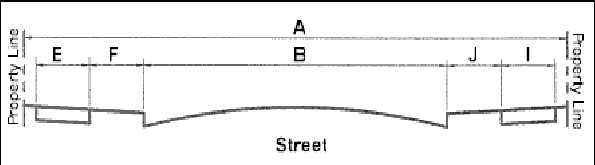 |
A - Width of Right of Way from Property Line to Property Line
B - Width of Street from face of curb to face of curb
F & J - Typical tree lawn between face of curb and sidewalk
E & I - Sidewalk.
(Ord. 04-11. Passed 1-18-11.)
1198.01 PURPOSE.
(a) Residential development in Canal Winchester has a direct effect on the character and livability of the community. Therefore, the City of Canal Winchester has the responsibility to adopt standards that promote desirable residential development that fits the context and character of the existing community. The following findings warrant the need for exterior appearance requirements for residential development:
(1) The adopted community plan recommends promoting high quality standards in building design that is in good scale and harmony with surrounding neighborhoods and buildings, and the natural surroundings.
(2) Providing for compliance with appearance regulations will assist in creating quality development with residential neighborhoods.
(3) Limiting the garage appearance within the front elevation limits the negative visual impact.
(4) A balance of natural and synthetic building materials allows for design creativity and promotes a high quality development.
(5) Trim around windows completes the appearance on every elevation.
(6) Placing windows, doors, porches, and other features on each elevation enhances the visual environment and contributes to the overall architectural diversity of a neighborhood.
(7) The lack of detailing, architectural features, and trim on elevations detracts from a dwelling and reduces the visual quality of a neighborhood.
(b) Residential appearance standards provide design requirements that are applicable to single, two, and three-family dwelling units. For purposes of this section, a single-, two-, and three-family dwelling unit will be defined as a "house." These requirements are designed to increase the quality of neighborhoods, to promote positive architectural appearance within residential areas, to encourage design flexibility and creativity, and to establish an interesting, aesthetically pleasing residential environment. It is also the intent of this section to promote durable, quality materials that will allow residential neighborhoods to endure and mature for future generations in the city. (Ord. 18-047. Passed 1-7-19.)
1198.02 APPLICABILITY.
(a) These requirements shall apply to the construction of all new homes, and additions to homes, unless designated as exempt in subsection (a)(3).
(1) Compliance Required. These requirements shall apply to any new home or to certain additions or alterations of an existing house constructed in compliance with the regulations of this section. If an existing home is expanded or altered, the addition or alteration must comply with these architectural requirements when the alteration encompasses more than fifty percent (50%) of the Ground Floor Area (square feet), or the ground floor area is expanded by more than fifty percent (50%).
(2) Minimum Requirements. These requirements are minimum appearance requirements applicable to all houses in all districts, including Planned Development Districts, except as may be specifically approved in the Planned Development District ordinance.
(3) Exemption. Houses in the districts described below are exempt with these requirements:
A. Houses located within a planned district approved prior to the effective date of this section.
B. Houses located in a planned district approved after the effective date of this section with specific substitute residential appearance requirements contained in the adopted planned district ordinance. Residential appearance objectives for Planned Development Districts shall be adopted by City Council. These objectives explain more general intents regarding appearance in order to allow for creativity in meeting them through the Planned Development District process. Planned Development District proposals must demonstrate how the proposal addresses the residential appearance objectives and replace these minimum requirements.
C. Houses located within the Old Town Overlay District (Chapter 1175) are exempt from the requirements of this section. These residential homes shall be regulated by the Landmarks Commission with the Certificate of Appropriateness Procedures for Design Review. (Ord. 18-047. Passed 1-7-19.)
1198.03 DEFINITIONS.
(a) For the purpose of this section, the following definitions apply:
(1) "Blank Elevation" An elevation that lacks the minimum required openings and architectural features, such as windows, doors, exterior chimneys, or other similar architectural features.
(2) "Breastboard" A lower flat area of a door or window crosshead.
(3) "Chimney" A structure projecting from the exterior wall of a house and enclosing or appearing to enclose a flue that carries off smoke. A chimney may or may not extend vertically to the eaves line or have a foundation/connected to the ground.
A. "Cantilevered Chimney" A chimney that projects from the exterior wall and does not have a foundation or extension to the ground.
B. "Shed-type Chimney" A chimney that does not extend full height vertically to the eaves line. A shed chimney typically includes a direct vent outlet in the chimney wall.
(4) "Corbel" A build out of one or more courses of brick or stone from the face of a wall, traditionally to form a support for timbers.
(5) "Cornice" Overhang of a pitched roof at the eaves line, usually consisting of a fascia board, a soffit for a closed cornice, and appropriate moldings.
(6) "Corrugated Metal Roofing" A roofing material that consists of interlocking rippled metal sheets that are fastened directly to the roof sheathing.
(7) "Crosshead" Decorative form that resembles a lintel used to top a door or window, consisting of a breastboard with crown moulding surrounding the top portion, and moulded together as one piece. Crossheads come in heights from 6" to 18". A variety of accessories can be added to complement the design of a simple crosshead.
(8) "Crown Moulding" Moulding used on cornice or wherever an interior angle is to be covered.
(9) "Direct Vent Outlet" An outlet through an exterior wall associated with the air supply and/or exhaust of a fire burner. It may or may not occur in a projecting box/chimney.
(10) "Dormer" A window set vertically in a structure projecting through a sloping roof; also the roofed structure containing that window.
(11) "Eaves" The margin or lower part of a roof projecting over a wall.
(12) "Elevation" A geometric projection of the front, side, or rear outer surface of a building onto a plane perpendicular to the horizontal; a vertical projection.
(13) "Façade" The front, sides or rear faces of a building.
(14) "Fascia" A horizontal piece (such as a board) covering the joint between the top of a wall and the projecting eaves also called a fascia board.
(15) "French Drain" A French drain or weeping tile is a trench filled with gravel or rock containing a perforated pipe that redirects surface water and groundwater away from an area. A French drain can have perforated hollow pipes along the bottom to quickly vent water that seeps down through the upper gravel or rock.
(16) "Frieze Board" A decorated band along the upper part of an exterior wall. In house construction a horizontal member connecting the top of the siding with the soffit of the cornice.
(17) "Foundation Cladding" An aesthetic enhancement to the foundation concealing exposed portions with an approved material.
(18) "Gable"
A. The vertical triangular end of a building from cornice or eaves to ridge.
B. The similar end of a gambrel roof.
C. The end wall of a building.
D. A triangular part of a structure.
(19) "Masonry" Natural or natural-appearing stone or brick.
(20) "Plinth" A continuous, usually projecting course of stone or brick forming the base or foundation of a wall.
(21) "Projection" Any component of a structure that extends out from the main building.
(22) "Quoin" Corner stones that anchor the edge of the building wall or decorative feature to imitate corner stones, which wrap the corner of an elevation and join two abutting walls.
(23) "Soffit" The exposed undersurface of any overhead component of a building.
(24) "Standing Seam Metal Roof" Roofing material constructed of interlocking metal panels that run from the ridge of the roof to the eave. The seams of the two panels are raised above the surface to allow the water to run off rather than seep between the panels. The seams are fastened to the roof using hidden anchors that are located on the raised portion of the panel that is overlapped by the adjacent panel hiding the fastener.
(25) "Stucco" A coarse plaster composed of Portland or masonry cement, sand, and hydrated lime mixed with water and applied in a plastic state to form a hard exterior covering.
(26) "Trim" The finished woodwork or similar architectural element used to enhance, border or protect the edges of openings or surfaces, such as windows or doors.
(27) "Vinyl Siding Accessories" Exterior design elements that serve to provide more visual interest and complement the primary home design.
(28) "Water Table" A projecting brick or stone stringcourse, molding or ledge placed to divert rainwater from a building.
(Ord. 18-047. Passed 1-7-19.)
1198.04 RESIDENTIAL DESIGN REQUIREMENTS.
(a) Design Requirements. In addition to all applicable zoning and development requirements, the following design requirements shall apply as outlined per 1198.02.
(1) Architectural Diversity (Same house next to each other). To discourage the appearance of tract-type housing, all single-family residential developments shall incorporate architectural diversity.
A. Houses with the same or very similar design shall not be directly across the street and shall have a minimum 3-lot separation on the same side of the street or diagonal from each other.
B. Minimum variations in house design shall be created by providing a minimum of two items from each of the two lists below, or by any other means as approved by the Planning and Zoning Commission with a similar degree of variation.
(i) Alterations of perceived scale and massing:
Reorientation/relocation of the garage and driveway.
Change in the basic roof by a change of the roof type, the roof form through the addition of dormers and gables, and/or reorientation of the roof spine from parallel to perpendicular to the street.
Addition or relocation of significant bump outs to the front or side of the house that alter the perceived massing of the house such as, two story bay windows, one story sunrooms, corner towers, balconies or other approved features.
Other significant exterior features proposed by the applicant if approved by the Planning and Zoning Commission.
(ii) Alterations of character, detail and color:
Change architectural style.
Change in material of significant proportions (40%) of the house façade.
Addition or alteration of significant new detailing package with altered accent color to include any three items such as, trims, shutters, style and color of a front door or garage door.
Other significant exterior features proposed by the applicant if approved by the Planning and Zoning Commission.
(2) Chimneys. All chimneys must extend full height, from ground and vertically past the eaves line. Cantilevered and shed-type chimneys are prohibited. Chimneys must be finished in masonry or stucco but need not match the background wall in material or color.
(3) Driveways. Driveways for residential developments shall consist of concrete, asphalt, or brick pavers. The Planning and Zoning Commission may permit a similar construction material as an alternative only upon prior approval. All driveway aprons shall be concrete. All driveways shall be a flat, earth tone color. The maximum driveway width at the right-of-way line shall be ten (10) feet wide, not including the approach. The Driveway may flare to be wider at the garage. Driveways should be designed to be grouped to increase the amount of open space along the street.
(4) Entryways and Porches. The design of each houses shall emphasize the house mass and entry. The front entrance should be the focal point of the home and be designed to shelter you from the elements and be inviting. Flat front entryways shall be prohibited. All front entryways must include features which extend beyond the front façade of the primary living area.
A. Portico. Porticos offer a visual cue on where to enter the house and connects the indoors to the outdoors. Typically, it is a structure consisting of a roof supported by columns or piers, usually attached to the building as a porch. Portico's can encroach the front setback or a build-to line by up-to seven (7) feet.
B. Front Porches. Front porches provide a "stage" for interaction between the house and the street. Neighbors can publicly communicate much like the older neighborhoods in Canal Winchester. Front porches shall be a minimum of seven (7) feet in depth and ten (10) feet wide. Front porches can encroach the established front setback or build-to line by up-to seven (7) feet.
(5) Finish Building Materials. The design of buildings shall coordinate the materials and details of all sides of the building with the design of the front elevation and street sides. Wood board or shake, brick, stone, cultured stone, fibrous cement siding, stucco and vinyl siding are the permitted finish building materials. Asphalt dimensional shingles, natural or simulated slate, tile, standing seam metal, natural or simulated wood shingles or shakes are the permitted roof materials. Corrugated metal roofing is not a permitted roof material.
A. Asphalt Dimensional Shingles. Asphalt Dimensional shingles must be a 25-year "true" dimensional shingle. Painted shadows are not permitted. Shingles must have a minimum weight of 240 pounds per 100 square feet and be installed according to the manufacture's specifications.
B. When a change in materials occurs at corners, the change must occur at the inside of the corner unless the masonry on the street-facing façade extends at least two feet past the outside corner. If a house has a side gable and a material change occurs on the outside corner, or if two different materials are used on the facades of main and upper floors, rather than extending the materials around the corner, a quoin or minimum 5 ¼-inch wide corner board must be used along the vertical length of the non-masonry corner.
(6) Foundations. There shall be no more than twelve (12) inches of exposed foundation walls. If there are more than twelve (12) inches of foundation wall exposed, they must be finished with one of the following: brick, veneer brick, stone or cultured stone designed by the manufacturer for at-grade or below-grade installation.
(7) Four-Sided Architecture. The purpose of requiring four-sided architecture on all residential dwellings is to avoid large areas of blank exterior walls. Each side elevation must contain at least two (2) design elements per floor and each elevation facing a street or rear elevation must contain at least three (3) design elements per floor. Blank facades are not permitted for any detached garages or accessory structures. Typical design elements are included below, but this list is not all-inclusive.
A. The eligible design elements are as follows:
A door of at least seventeen (17) square feet in area.
A window of at least six (6) square feet in area. Windows closer than ten (10) feet shall be considered as one (1) element. A set of adjacent windows, such as double or bay windows, shall be considered as one element.
A chimney.
An articulated gable vent of at least four (4) square feet in area.
A dormer.
Porches, decks, balconies or similar structure.
A Sunroom.
Architectural cornice returns.
A similar significant permanent architectural feature consistent with the style of the house only upon prior approval by the Planning and Zoning Commission.
B. Unacceptable design elements include:
Sides of porches.
Rooflines.
Water Tables.
Garage Doors.
Egress Steps required by building code.
(8) Garages. Design of each houses shall be designed to emphasize the house mass and entry, garages shall be clearly secondary in character. Garages may be attached or detached. All single-family residential developments shall have a mix of front loaded and side loaded garages. A minimum 25% of the lots must be designed for a detached or standard side entrance garage. Garages attached via a breezeway shall be considered detached for purposes of this standard. For corner lots, the garage shall be oriented towards the "lower" defined street classification as determined by the Planning and Zoning Commission. Garage doors shall be a maximum 9 feet height. If there is a living area above the garage, the maximum height of the roof over the garage shall be 35 feet. Otherwise, the maximum height of the roof over the garage is 18 feet.
A. Front Loaded Garages:
Shall be located a minimum four (4) feet behind the front line of the livable area of the home. A covered or uncovered porch shall not be considered a livable area of a home.
Garage doors shall not exceed forty-five percent (45%) of the house width (frontage). Where more than a standard 2-car front loaded garage is provided, the additional garage bay(s) shall be offset from and architecturally designed to appear separate and distinct from the 2-car garage and the garage doors shall not exceed fifty percent (50%) of the house width.
B. Side Loaded Garages:
Side loaded garages may be loaded from an inside court area.
The garage elevation facing the street must incorporate design features also found in the front elevation of the home including, but not limited to, windows.
(9) Gutters and Downspouts. Gutters and downspouts are required on all homes. Downspouts may be tied into curb drains or exit directly into a French drain system to discharge the water in the rear of the yard. No more than 50% of the roof drainage may lead to the curb.
(10) Roof Pitch. The main architectural roof of a house must have a minimum 6:12 pitch. Dormers, porches, and other similar secondary architectural features may have roofs with a minimum 4:12 pitch. Eaves and overhangs are required and in no case shall they be less than eight (8) inches on any elevation.
(11) Vinyl Homes. This section shall serve as a guide for constructing a vinyl sided home. Where the vinyl sided home requirements overlap with four-sided architecture requirements, the requirements of this section shall not be counted towards the minimum four-sided architecture requirements, but shall be in addition those requirements. All vinyl materials must have a minimum thickness of .046 inches. The siding must have a low-gloss finish. Any predominantly vinyl-sided home must include complementary accessories and detailing where vinyl siding elevations occur, as follows:
A. A detailed main entryway by use of a minimum eight (8) inch wide three-dimensional door-surround system;
B. Minimum six (6) inch wide frieze or fascia boards; and
C. Minimum eight (8) inch wide water table trim board at the foundation.
D. At least two of the following accessory types must be utilized per home. The selected accessory type must occur on each vinyl-sided elevation as indicated on the following table. Additional accessories may be utilized in addition to the minimum requirements.
Minimum Accessories for Vinyl-Sided Homes | Select Accessory Type Must Occur (at least) When the Exterior Wall Elevation is Vinyl. |
Select two accessory types: | |
Shutters Pairs | X |
Crosshead | X |
Masonry Water Table | X |
Gable Vent | X |
Shutter shall be sized to fully cover the window and shall be operable or appear as such, and utilize shutter hardware including s-clips and hinges. Shutters shall be louvered, raised or flat paneled or board and batten and made of painted wood, vinyl, painted synthetic, PVC or Hardiplank or substantially similar materials as determined by the Planning and Zoning Commission.
Crossheads must occur at least above all windows on vinyl-sided elevations.
Masonry water table and plinth must occur along all elevations of a vinyl-sided house. The height of this feature shall be at least two (2) feet as measured from grade.
Gable vents must be articulated decorative gable vent(s) of at least four square feet in area and occur in at least the front, or side of vinyl-sided homes.
(12) Windows (Trim and Shutters): Trim is required with all windows on any elevation. Trim shall include either a top and bottom finish of soldier course, rowlock, lintel or sill; or a minimum 3 ½- inch board around all sides of the window.
A. Shutter shall be sized to fully cover the window and shall be operable or appear as such, and utilize shutter hardware including s-clips and hinges. Shutters shall be louvered, raised or flat paneled or board and batten and made of painted wood, vinyl, painted synthetic, PVC or Hardiplank, or substantially similar materials as determined by the Planning and Zoning Commission.
(Ord. 18-047. Passed 1-7-19.)
1199.01 PURPOSE.
(a) Commercial development in Canal Winchester has a direct affect on the character and livability of the community. Canal Winchester, therefore, has a responsibility to adopt standards to promote desirable commercial development.
(b) These Commercial Development Standards aspire to create a high quality built environment throughout Canal Winchester and to protect the municipality's character. Through architectural and site standards, this Chapter aims to enhance commercial development in Canal Winchester. (Ord. 8-12. Passed 4-2-12.)
1199.02 APPLICABILITY.
Applications for new non-residential construction shall require the developer to satisfy these Commercial Development Standards in addition to the Zoning Code, Subdivision Regulations and other applicable documents and standards. The Commercial Development Standards shall be applicable as follows:
(a) Only non-residential structures located within the General Commercial, Neighborhood Commercial, Suburban Office, Planned Commercial District, Planned Unit District, or Planned Industrial District zoning districts shall be subject to the Commercial Development Standards. Any standards specifically stated in an adopted zoning text shall supersede the related standard found in the Commercial Development Standards.
(b) Properties located within the Old Town Overlay are subject to Section 1175.01 of this Zoning Code and the Old Town Guidelines and shall not be required to meet the Commercial Development Standards.
(c) New additions or accessory structures that have a square footage of less than fifty (50) percent of the existing buildings square footage shall only be required to meet Section 1199.03 (Building Design) of these Commercial Development Standards. If an addition or accessory structure is fifty (50) percent or larger than the existing building, the entire building and site shall be subject to all Commercial Development Standards.
(d) All newly constructed parking areas shall meet the requirements of the Commercial Development Standards.
(Ord. 8-12. Passed 4-2-12.)
1199.03 BUILDING DESIGN.
Buildings shall be designed to be seen from three hundred sixty (360) degrees and have the same caliber of finish on all elevations. Building additions and accessory structures, whether attached or detached, shall be of similar design, materials, and construction to that of the existing or principal structure.
(a) Architectural Features. The purpose of requiring four-sided architecture is to avoid large areas of blank exterior. For every one hundred (100) feet of elevation width, each side and rear elevation must contain at least two (2) design elements and each front elevation must contain at least three (3) design elements. For multi-story buildings, each story on a single elevation shall contain at least two (2) design elements. Typical design elements are as follows:
(1) A door of at least twenty-eight (28) square feet in area with an awning, window, faux window or other feature subject to approval by the Planning and Zoning Commission.
(2) A window of at least six (6) square feet in area. Windows closer than ten (10) feet shall be considered as one (1) element. A set of adjacent windows, such as double or bay windows, shall be considered as one element.
(3) A chimney.
(4) An articulated gable vent of at least four (4) square feet in area.
(5) Porches, decks or similar structures.
(6) A similar significant permanent architectural feature consistent with the style of the building upon approval by the Planning and Zoning Commission.
(b) Articulation. A building frontage that exceeds a width of fifty (50) feet shall incorporate articulation and offset of the wall plane to inhibit a large expanse of blank wall and add interest to the facade.
(c) Materials. All exterior walls shall be comprised of eighty (80) percent natural material with brick or stone as the predominant material. Other natural materials may also be incorporated into the building's exterior design. Use of "newer" materials is subject to approval by the Planning and Zoning Commission. Stucco, drivit and like materials may be used as accents provided the total square footage of accent material does not exceed twenty (20) percent of the gross exterior building wall square footage.
(d) Glass. Elevations facing the primary street shall be a minimum of forty (40) percent glass between the height of two (2) feet and ten (10) feet and have an unobstructed view of the building interior to a depth of four (4) feet. The use of black, gold, green, silver, or any other reflective colored glass on a building is prohibited. The use of spandrel glass is also prohibited. Frosted glass may be permitted in some cases, subject to approval of the Planning and Zoning Commission.
(e) Building Orientation. Buildings shall be oriented to face the primary street right of way. An entryway shall be located on the front of the building. Corner entrances are acceptable to meet this requirement if one side of the corner entrance faces the primary street right of way.
(f) Roofing. All pitched roofs shall be of dimensional shingles, standing seam metal, slate, or simulated slate.
(g) Mechanical Equipment. All external and rooftop mechanical equipment, including satellite antennas, and trash dumpsters shall be screened from view at all property lines on which the building is located. Screening materials shall be complimentary to those used on the majority of the building. For ground mounted equipment, landscaping is the preferred method of screening. If two or more buildings are located on the same property, rooftop equipment shall not be visible at ground level within fifty (50) feet from any building.
(h) Drive Thru Features. A drive thru, if deemed appropriate for the site by the Planning and Zoning Commission via a Conditional Use of the applicable zoning district, shall be designed as an integral part of the structure it serves. Features incorporated with a drive through, including, but not limited to canopies, awnings and support posts, shall match the materials and color scheme of the building they are serving. Drive thru features shall not have any pick-up windows, ordering areas, signage, or other related items located on the front elevation of a building or located between the front of the building and a street right of way.
(i) In-Line Retail Exemption. Side or rear elevations of in-line retail developments may be exempt from the building design standards of Section 1199.03 if such elevations are not visible to customer traffic, a public right of way or if a future phase of the inline retail development is forthcoming adjacent to the elevation. Such exempt elevations shall use materials complimentary to the primary elevation and be screened by landscaping, mounding, fencing, or a combination thereof, as outlined in Section 1191.03(f), and as deemed appropriate by the Planning and Zoning Commission.
(Ord. 8-12. Passed 4-2-12.)
1199.04 SITE DESIGN.
(a) Build-To Line. To promote quality streets, buildings shall meet build-to lines along public roadway frontages. Build-to lines shall be fifty (50) feet from the right of way on major arterials as designated on the Canal Winchester Transportation Thoroughfare Plan and twenty-five (25) feet from the right of way on all other streets.
(1) In order to achieve quality streetscapes, variation from the build-to line will be permitted to allow for added green space, amenities, outdoor seating and the like. Buildings may be located further from the right of way than the established build-to line per the following:
Building Height | Variation from Build-To Line |
One Story Building | 0 feet to 5 feet |
Two Story Building | 0 feet to 10 feet |
Three Story Building | 0 feet to 15 feet |
(2) At least fifty (50) percent of the building's front elevation shall be located within the applicable variation from the build-to line range.
(3) Uncovered seating areas or architectural features may project up to five (5) feet closer to the right of way than the established build-to line.
(4) Buildings larger than twenty thousand (20,000) square feet or attached to existing in-line retail space shall be exempt from the build to line requirements if located more than three hundred (300) feet from the right of way.
(b) Sidewalks and Multi Purpose Paths. A sidewalk, or multi-purpose path as designated in the Canal Winchester Transportation Thoroughfare Plan, shall be constructed along all public streets. In addition, a sidewalk shall connect the building entrance with the sidewalk or multi-purpose path along the primary public street.
(c) Adjacent Pavement. Pavement is prohibited directly adjacent to any building elevation, except for loading zone areas, vehicular building entrances, drive thru windows, or at entrance walk ways into the building.
(d) Trash Containers, Service Areas and Loading Zones. Trash containers, service areas and loading zones shall be located at the rear of the building. Trash containers, service areas and loading zones may be permitted on the side of a building if not oriented towards a public or private street and properly screened from public or private streets and residential zoning districts.
(e) Utility Boxes. Utility boxes shall be located to the rear of the building and painted the same, or primary, color of the building elevation where the utility box is located.
(Ord. 8-12. Passed 4-2-12.)
1199.05 PARKING LOT DESIGN.
Parking lot areas shall be designed to reduce their visual impact, production of excess heat and effect on drainage. Appropriately sized landscaped areas shall be provided within each parking lot area allowing for a variety of shade trees to be planted that will not buckle the parking lot's surface and at the same time provide shade. Therefore, all off-street parking lot areas shall be designed using the "parking bay" concept, which consists of parking spaces grouped together and each parking bay separated by landscaped tree islands.
(a) Parking Lot Location. All parking spaces, drives or other structures for vehicular parking or movement shall be located to the rear or side of the principal building with no more than fifty (50) percent of such parking area located to the side of the principal building.
(1) Buildings larger than twenty thousand (20,000) square feet or attached to existing in-line retail space shall be permitted to have parking to the front of the building if the building is located more than three hundred (300) feet from the right of way and the parking lot is located no closer than two hundred (200) feet from the right of way.
(2) If a drive thru is deemed appropriate by the Planning and Zoning Commission and designed per Section 1199.03(h) of this Zoning Code, a drive lane may be permitted to be located in front of the building. In such case, the building shall be moved the furthest away from the build-to line as indicated in Section 1199.04(a) (1) of the Commercial Development Standards.
(b) Parking Bays. No parking bay shall contain more than twenty-four (24) total parking spaces, with a maximum of twelve (12) spaces in a single row.
(c) Maximum Number of Parking Spaces. Off street parking areas shall only be permitted to have twenty-five (25) percent more spaces than stated as the applicable minimum in Section 1185.03 of this Zoning Code.
(1) Parking spaces above the maximum shall be permitted with an additional sixty (60) square feet of landscaping provided for every one (1) additional parking spaces. The provided additional landscaping shall be in addition to the minimum landscaping required in Section 1191.02(c)(2) of this Zoning Code.
(2) Additional landscaping shall include a mix of trees and shrubs and be clearly identified as additional landscaping on the site's landscaping plan.
(d) Parking Lot Islands. Each landscaped tree island in a single loaded parking stall design shall have a minimum area of one hundred and sixty two (162) square feet with a minimum width of nine (9) feet. Each landscaped island located in a double loaded parking stall design shall have a minimum area of three hundred twenty four (324) square feet, with a minimum width of nine (9) feet. The landscaped tree island(s) shall contain at least one shade tree and include at least fifty (50) square feet of other plant materials.
(e) Bio-swales. Bio-swales, also referred to as rain gardens, may be incorporated in the overall parking lot design. In addition to separating parking bays, when properly designed bio-swales/rain gardens can also assist with stormwater quality and quantity management.
(f) Intersection Site Distance. When a drive isle intersects with an internal service road, nothing shall materially impede the vision between a height of two and one-half (2½) feet and ten (10) feet for the area bounded by the intersecting street lines of those roadways and a line joining points along said roadways fifteen (15) feet from the point of intersection. (Ord. 8-12. Passed 4-2-12.)
1199.06 SITE LIGHTING.
Site lighting shall be required for all developments and be designed to sufficiently illuminate the site and minimize spillover off of the property.
(a) Design. All external lighting shall be decorative or historic in design. Typical "shoe box" light fixtures are not acceptable. Pack light, wall pack lights and similar lights that primarily shine perpendicular to (away from) a building's elevation are not permitted on any building elevation. Decorative wall lights that shine parallel to (up or down) a building's elevation are subject to approval by the Planning and Zoning Commission.
(b) Lighting Intensity. Foot candles measure the intensity of light. One foot candle is equal to the amount of light generated by one candle shining on a square foot surface one foot away. All parking lot areas shall have lighting intensity meeting the following standards as measured at grade:
Maximum Intensity | 20 Foot Candles |
Average Intensity | 1 to 3 Foot Candles |
(c) Light Spillage. All outdoor lighting shall be directed, reflected or shielded so as not to be of excessive brightness or cause glare hazardous to pedestrians or drivers, create a nuisance or unreasonably interfere with a neighboring property owner's right to enjoy his property. Light spillage shall not exceed one tenth (0.1) foot candles when adjacent to a residential district or existing residential use.
(d) Light Pole Height. Pole heights should be in harmony with the parcel, building and parking lot size as well as the surrounding area. Smaller parcels in a more dense condition pole height should be limited in height to respond to the smaller parcels and more human scale of the site. In large commercial centers with large building footprints, parcels and parking lots, the pole heights can be higher to reduce the number of poles needed to adequately light the site. Parking lots with thirty (30) or less spaces shall have a maximum lighting pole height of eighteen (18) feet. Parking lots with more than thirty (30) spaces shall have a maximum lighting pole height of thirty (30) feet.
(Ord. 8-12. Passed 4-2-12.)
1199.07 SIGNAGE.
(a) Monument Signs. All freestanding signs shall be monument-type, have a base consistent with the primary building material and have a minimum of fifty (50) square feet of year-round landscaping around all sides of the monument sign.
(b) Multi Tenant Buildings. For multi-tenant buildings, signs for first floor tenants shall not extend above the window sill of the second story unless the tenant is also located on the second floor.
(c) Prohibited Signs. Cabinet box, exposed neon, exposed LED, changeable copy (manual or electronic), roof-mounted, monopole, rotating, signs with flashing messages or bare bulbs, signs on backlit awnings, off-premise signs, billboards, and bench signs are not permitted.
(Ord. 8-12. Passed 4-2-12.)
1199.08 STORM WATER DETENTION.
(a) Detention Basins. Dry detention basins are prohibited. All detention basins shall be wet basins and may require aeration devices in their design. The requirement of aeration devices and their installation detail shall be determined and approved by the Technical Review Group.
(b) Bio-retention Basins. Bio-retention basins, also known as rain gardens, may be used only when approved by the municipality. (Ord. 8-12. Passed 4-2-12.)

