
Canton City Zoning Code
CHAPTER 110
DESIGN STANDARDS: WATER SYSTEM
110.01.00 - Generally.
Chapter 110 also establishes standards and requirements for the provision of water infrastructure by all development in the City of Canton. This chapter contains requirements for water systems and cross connection controls.
(Ord. No. 2014-18, § 2, 8-21-2014)
110.02.01 - Pre-construction requirements.
A.
Water pressure flow test.
1)
A water pressure test must be run on the existing water line to determine the adequacy of water supply line for the project.
2)
The test shall consist of a fire hydrant flow test and a 24-hour pressure test.
3)
Test information shall consist of the following:
a.
Static pressure and elevation of static gauge.
b.
Recorded flow in GPM and residual pressure.
c.
Maximum elevation in development.
d.
Available flow at maximum elevation with 20 PSI residual pressure.
e.
Twenty-four hour pressure chart.
4)
An adequate supply of water for the proposed project must be available prior to the approval of any plans. Flow tests are valid for one year.
5)
The fire department will run the test at the developer's expense.
6)
All projects which have flow test results with static pressure less than 35 psi will require a special design study to be accomplished and submitted to the city for approval to ensure no problems are encountered during peak demands. This study must be approved by the city prior to construction plan approval.
7)
Plans shall not be stamped or approved until the flow test is completed.
B.
Plan review process.
1)
Preliminary plan requirements.
a.
Preliminary plans shall include the portion of the county tax maps highlighting the land to be developed, the type of development, the number of units, the tie-in location and the general plan for water supply. The plans shall also include the name, address and telephone number of the developer or his representative.
i.
Questions relating to adequate fire protection, multiple feeds, water supply and proposed location of connection(s) should be resolved at this stage before proceeding with detailed planning.
ii.
The submittal for preliminary review must include all land to be developed although the land is to be developed in several phases or units.
iii.
Adequacy determinations of the existing water supply system will be made for the entire project.
b.
Developer/land owner must submit a set of preliminary plans for any proposed project to the City of Canton Engineering Department prior to submitting the construction plans.
2)
Construction plan requirements.
a.
The developer must then submit six paper copies of construction plans, plus the electronic data on disc, as outlined in these specifications, to the City of Canton Engineering Department for review.
b.
All plans for water main projects shall bear a suitable title showing the name of the project.
c.
Plans shall show the scale in feet, the north arrow, date, the name of the design professional, the design professional's signature and his registration stamp. All design professionals preparing construction plans and specifications must be registered in the State of Georgia as a professional engineer or a registered land surveyor.
d.
If the project requires a water line extension of more than 500 feet to reach the project, a registered professional engineer must design and stamp the line extension.
e.
The cover sheet shall include the owner's/developer's name, address, telephone number, and fax number, plus the design professional's name, address, telephone number, and fax number. The cover sheet shall also include the funding source if state or federally funded, and a detailed project location map. The cover sheet shall also show the numbers of the tax map and parcel in bold letters.
f.
The plans shall be clear and legible. They shall be drawn to a scale which will permit all necessary information to be plainly shown.
g.
Plans shall be submitted on 22-inch by 34-inch drawing sheets and shall be submitted concurrently in an "Autocad" drawing electronic format. A sheet index shall be provided, as well as a legend of symbols used.
h.
Horizontal locations shall be referenced to Georgia State Plane Coordinates (west zone feet). Vertical locations shall be shown referenced to mean sea level. Reference all horizontal locations to the NAD83/94 (latest adjustment) datum and reference all vertical locations to the NAVD88 datum. All orthometric locations shall be referenced to Geoid 99/03. All points are subject to verification by the City of Canton Engineering Department.
i.
Water line locations shall be shown on plans and submitted in ASCII Text or EXCEL electronic format for each point. The developer shall provide ASCII or EXCEL spread sheet files for coordinate data (comma delimited). Each point I.D. (valves, water main, etc.) shall be shown at the correct location on the printed plans.
j.
Water Mains along city, county or state roads and cross country shall be located at 50-foot intervals (ground and top of pipe). If water main is within the development and maintains a constant distance behind curb and constant depth, locate at all transitions (vertical and horizontal).
k.
All fittings, tees and bends, valves, and air release valves shall also be located. All vertical locations shall be finished ground and top of pipe. The contractor shall place a vertical piece of two-inch diameter PVC pipe on top of the pipe at all bends, tees, fittings, valves, elevation transitions, horizontal transitions and every 50 feet along the length of the water main (city, county or state roads and cross country) for the purpose of enabling the surveyor/engineer to locate the water main for "as-builts." The contractor will then be responsible for removing the vertical PVC sections after the as-built locations have been verified by the city. The ground, top of pipe, top of fitting and top of valve elevation of shall be located. The size and material of all pipes, valves and fittings shall be recorded.
l.
All electronic point data shall include:
i.
Point ID (see city staff).
ii.
Northing.
iii.
Easting.
iv.
Ground elevation.
v.
Top of pipe, valve or hydrant elevation.
vi.
Point description (pipe, fitting or valve type and size).
m.
Construction plans shall consist of the following:
i.
Site plan showing the water layout only with project name, streets, street names, topography with contour lines at two-foot intervals, location map, lot layout (if subdivision) or building location (multi-family, commercial or industrial site), land lots, district and north arrow. Lot numbers shall run in consecutive order and there shall be no duplicate lot numbers within the project. Note if any other utilities are existing. Plan scale shall be a minimum of one inch equals 100 feet. Both the construction plans and "as-builts" ("as-built" plans document the final location of infrastructure and utilities) shall show station numbers along the alignment plus call out the specific stations of all features such as tees, crosses, fire hydrants, bends, etc. along with the point I.D. match lines shall be provided where necessary.
ii.
Proposed pipe materials, sizes, lengths and alignment.
iii.
Proposed service lateral locations.
iv.
Location, type and size of water valves and air release valves (to be installed at highest points of system).
v.
Thrust blocks where used.
vi.
Fire hydrant locations.
vii.
Water system materials.
viii.
Location and sizes of existing water lines surrounding project, with nearest line valve in each direction from proposed connection.
ix.
Detail of connection to existing water lines.
x.
Proposed meter sizes and locations.
xi.
Detailed plan of fire line meters, detector meters, compound meters, backflow preventers, etc. if applicable.
xii.
Any other items incidental to the proposed system.
xiii.
Details of special water line installations such as stream crossings, elevated lines on piers, bridges, pipe bedding, special highway crossings, railroad crossings, etc.
xiv.
Show all right-of-way widths, easement widths and pavement widths.
xv.
Plan and profile sheets shall be prepared with a horizontal scale of one inch equals 50 feet and a vertical scale of one inch equals ten feet. These scales also apply to any profile view of sanitary sewers.
xvi.
Bench marks and control points shall be shown on the plan sheets. Horizontal and vertical coordinate data shall be provided for each bench mark and control point. The vertical datum used shall be the elevation above mean sea level.
xvii.
A sheet index shall be provided, as well as a legend of symbols used.
xviii.
Each plan sheet should include a note stating the contractor must call the utilities protection center "call before you dig" telephone number (1-800-282-7411) four days before starting any excavation.
xix.
All construction plans submitted for review of revisions requested by the city must list each revised item with a cloud around the revised area on the plan sheet and must identify which reviewing authority requested the revision.
xx.
Each set of construction plans shall include a reproduction of standard detail W725 "call before you dig" detail (see chapter 112 of UDC) from the utilities protection center.
n.
The general notes for water system construction shown in standard Detail W726 shall be included in each set of plans. See chapter 112 of this UDC.
C.
Plan approval. Work shall not begin until plan approval is received from the City of Canton. The city engineer shall have final approval of the preliminary plans, construction plans and final plans. If a discrepancy occurs between the approved plans and this UDC, this UDC shall be the superseding document. The city engineer may modify or cause to be modified any plans that he believes are in the best interest and future integrity of the City of Canton.
D.
Revisions to approved plans.
1)
When any deviations from approved plans are proposed, the city engineer shall be notified for authorization. Revised plans should be submitted as soon as possible to the city engineer. Minor changes not affecting water system operation may be allowed in the field during construction by the city engineer. The city engineer shall have authority as to what constitutes a minor or major change. "As-built" drawings and the required electronic data on disc shall be furnished to the City of Canton Engineering Department at the completion of construction.
2)
Any section or unit must be built in accordance with the plans. If the developer decides to phase a section off, a new set of plans showing the phase change will have to be resubmitted and approved.
E.
Approval by other government agencies. No part of the plan approval process is intended to relieve the developer of the responsibility to comply with the minimum applicable standards of any appropriate local, state or federal regulatory agency.
F.
Relocation of existing water and sewer facilities. All existing water or sewer facilities that have to be relocated, as might occur at roadway entrances, easements, elevation changes, etc., will be relocated by the developer's contractor at the developer's expense. The city will inspect all such work prior to acceptance.
G.
Easement acquisition and utility encroachment permits.
1)
It shall be the responsibility of the developer to obtain any off-site easements required to connect the project to the existing water system. Easements will be conveyed to the City of Canton for all facilities which are to be conveyed to the city. This process must be started early enough to allow construction of the water mains before any building construction is to begin. No building permits, water meter or sewer tap applications shall be issued until off-site water mains and sewers have been constructed and accepted. This condition shall override any provision for speed up of house starts such as furnishing a bond to guarantee completion of the streets and other appurtenances.
2)
Easement drawings shall be prepared for work outside the development prior to approval of the water system plans. The drawings shall be of a size suitable for legal recording and shall be prepared by a registered land surveyor. The drawing must be clear and legible for printing. The drawing shall be at a reasonable scale and shall not be a reduced copy of the plan sheet. The drawing will show property lines, the name of property owners with the length of line encroaching on each property owner, size of line, width of permanent and construction easement, scale of drawing, north arrow, land lot and district numbers, and a tie to the nearest land lot corner. Any streets or other existing easements shall also be shown. Easement agreements referencing these drawings shall be prepared and attached to the drawings, signed by the property owners, and recorded at the Cherokee County Clerk of Superior Court's office. A copy of the recorded easement agreement shall be provided to the city before the construction plans are approved and stamped.
3)
All easements shall allow adequate room to construct the water main and appurtenances. Permanent easements shall be a minimum of 20 feet wide. Wider easements shall be required where water lines are deeper than normal. The maximum cross-slope of the permanent easement shall be ten percent.
(Ord. No. 2014-18, § 2, 8-21-2014; Ord. No. 2022-0317-01, 3-17-2022)
110.02.02 - Design criteria.
A.
General. The criteria listed herein is not intended to cover all aspects of design, but rather to mention the basic guidelines and those particulars that are required by the City of Canton.
B.
Water supply (all water supply systems).
1)
Residential water supply for domestic use shall be in accordance with table 110-1 and provide a minimum pressure of 20 psi.
2)
Exceptions may be made when deemed necessary by the city. Demand for other than residential to be determined for each specific development.
3)
Residential developments that exceed 150 lots shall have an additional water connection to the existing city water system at each additional entrance.
Table 110-1 Instantaneous Water Demands for Residential Areas
C.
Water main extension requirements.
1)
All specifications required by the city and by the Georgia Department of Natural Resources must be met by the developer.
2)
Developers are required to extend all mains along their entire property frontage if the existing main is adjacent to the proposed development. The size of the main will be set in accordance with subsection D below.
3)
If an existing main must be extended to serve a particular development, the developer will be required to pay all of the initial costs, including but not limited to contract prices, testing fees, engineering fees, etc.
4)
In certain circumstances, the city may require a larger pipe size to be installed than is required by these standards, and the cost of this over sizing may be funded by the city. The developer may be required to pay all of the initial costs. If the purpose of the over sizing is to improve service to existing customers or part of the city's master plan for a network of large mains to transfer water around the city, the city may enter into negotiations with the developer to provide funding for the betterment.
5)
Nothing contained in this section shall be construed as requiring the city to make main extensions or to furnish service to any person.
D.
Minimum water main sizes.
1)
Any system, whether served from an existing city water main or otherwise, shall have a minimum pipe size of eight inches. Actual sizes may be larger depending on the size required to meet the demand of the proposed development and/or the city's master water plan.
2)
Where a water main extension from an existing city water main is required along an existing public right-of-way or future supply route, the size of pipe to be used will be either eight inches, or a size equal to the existing city main, if larger than eight inches, or the size required to meet the demand of the development, whichever pipe size is largest. The city may require a larger pipe size to be installed than is required by this standard. The cost of this over sizing may be funded by the city, in accordance with the line extension policy (subsection C above.)
E.
Water main sizes.
1)
Multi-family. Water mains shall be no less than eight inches in diameter for multi-family developments.
2)
Large shopping centers, malls, etc. Water mains shall be no less than eight inches in diameter.
3)
Commercial areas with less than 200,000 square feet. Water mains shall be no less than eight inches in diameter.
4)
Motels, light industry and schools. Water mains shall be no less than eight inches in diameter.
5)
Commercial areas with 200,000 square feet or more, heavy industry, large/tall buildings. Water mains shall be no less than ten inches in diameter.
6)
Single-family. Single-family residential developments shall use a minimum of 8 inch water mains; larger size mains dependent on demand.
F.
Fire protection.
1)
Minimum flows.
a.
Minimum flows shall meet the requirements of Appendix B of the latest edition of the International Fire Code, as adopted by the State of Georgia.
b.
Minimum residential flow: Seven hundred fifty GPM for 30 minutes.
c.
The city may require these recommended flow/duration quantities prior to development of property.
2)
Fire hydrants will be required as set forth in these specifications where a proposed system is to be served from an existing city water main or in any case where the city is to accept a new system for ownership and operation.
3)
Fire protection—Hose lay. Hose lay distance is defined as being measured along the route a piece of fire apparatus must travel in laying a fire hose from the fire to the fire hydrant.
4)
All plans for development must meet all applicable fire protection codes.
5)
All requirements for design criteria and material and construction specifications must be met to secure a permit from the department of natural resources for construction.
6)
Spacing of fire hydrants shall meet the requirements of Appendix C of the latest edition of the International Fire Code, as adopted by the State of Georgia.
a.
Fire hydrants shall be located at all intersections and at the end of the line on all cul-de-sacs.
b.
Water line extensions along existing roads/highways.
i.
Fire hydrants shall be spaced not more than 1,000 feet apart.
ii.
Installations requiring fire hydrants shall have a maximum spacing of 1,000 feet as measured along the roadway.
iii.
Fire hydrants shall be required at the end of all dead-end lines such as those installed in cul-de-sacs.
iv.
Fire hydrants shall be located on the back side of the right-of-way.
v.
Fire hydrants shall be located at all intersections.
vi.
Fire hydrants shall be located at or within 200 feet of the main entrance to the development.
7)
Fire lines shall be metered per subsection J below.
8)
Any vault that has a fire department connection must have a fire hydrant on the city water main side of the vault.
G.
Sprinkler systems.
1)
All in-house sprinkler systems shall have a double check detector assembly equipped with a by-pass meter assembly to monitor low flow.
2)
All in ground sprinkler systems shall have a double check backflow preventer.
H.
Disconnection of wells.
1)
All wells in developments which supply water to distribution are to be disconnected.
2)
It shall be the developer's responsibility to fill, plug, and seal the wells in such a manner which meets the requirements of the Georgia EPD rules for safe drinking water.
I.
Location of water lines and fixtures.
1)
Existing roads.
a.
On existing roads, water mains shall be located on the south and west side of the road, within five feet of the edge of the right-of-way whenever possible. Water mains shall be installed so that the top of the pipe is a minimum of four feet below final grade, four feet below the edge of the pavement, or four feet below the ditch paralleling the road, whichever is deepest. Permission must be granted by the city to vary from this requirement.
b.
Fire hydrants on existing roads shall be located as near to the right-of-way as practical or as required by the City of Canton or the Cherokee County DOT.
c.
Fire hydrants shall be located between the water line and the right-of-way.
d.
All water mains located within right-of-way shall be polywrapped.
2)
Existing state or federal highways and roads.
a.
On existing county, state or federal highways and roads, water mains shall be located on the south and west side of the road whenever possible, and within five feet of the edge of the right-of-way. Water mains shall be installed so that the top of the pipe is a minimum of four feet below final grade, four feet below the edge of the pavement, or four feet below the ditch paralleling the road, whichever is deepest. Permission must be granted by the Georgia DOT and the city to vary from this requirement.
b.
Fire hydrants on existing county, state or federal roads shall be located as near to the right-of-way as practical or as required by the Cherokee County DOT or Georgia Department of Transportation.
c.
Fire hydrants shall be located between the water line and the right-of-way.
d.
All water mains located within county, state or federal highways and roads right-of-way shall be polywrapped.
3)
New streets in subdivisions.
a.
Water mains on new streets in subdivisions shall be located on the south and west sides of the streets, five feet from the back of the curb. Water mains shall be installed so that the top of the pipe is a minimum of four feet below final grade, four feet below the edge of the pavement, or four feet below the ditch paralleling the road, whichever is deepest. Permission must be granted by the city to vary from this requirement.
b.
Fire hydrants on new streets shall be located between the water main and the right-of-way and as near to the right-of-way as practical.
c.
The construction of the water main shall not begin until the rough grading is completed and all curbing is installed.
4)
Service laterals.
a.
Service laterals shall be located with a minimum bury equal to that of the main line within the right-of-way and reducing to a depth of 12 inches at the water meter location.
i.
Service line size shall be one inch for single residential service and one inch for double residential service.
ii.
All long side services for single-family residential shall be encased in two-inch PVC pipe.
iii.
All long side services for developments other than single-family residential shall be encased in four-inch PVC pipe.
iv.
All PVC casings for long side services shall be a minimum of two inches in diameter.
v.
The contractor shall install the appropriate size service saddle and corporation stop at the main, service laterals and curb stops in meter boxes.
vi.
For double residential services, the contractor shall provide a cut-off valve on the service on the water main side of the service tee, the service tee, all necessary bends and the curb stops in the meter boxes. The cut-off valve on the service shall be buried without a valve box.
b.
If a three-inch meter is used for the development, the developer must install four-inch DIP from the main to the meter, and then utilize a four-inch by three-inch reducer at the meter. The city will not accept three-inch service material.
c.
Any portion of service lateral located under pavement shall be encased in PVC pipe, extending a minimum of three feet beyond the edge of pavement and/or sidewalk on both sides of the road. Copper tubing shall be used for all services. A "W" shall be sawed into the curb where each service tap is made for permanent location.
d.
At all common areas within residential or other developments, the developer shall include in the water plans a water service and meter at the edge of the street right-of-way.
5)
Within commercial developments. Water mains within commercial, multi-family, industrial, office/institutional or school developments shall be installed so that the top of the pipe is a minimum of four feet below final grade, four feet below the edge of the pavement, or four feet below the ditch paralleling the road, whichever is deepest. Permission must be granted by the city to vary from this requirement.
6)
Water valves.
a.
Valves less than 16-inch shall be gate valves.
i.
Valves 16 inches and larger in diameter shall be butterfly valves.
ii.
Water valves at intersections shall be located behind the curb or edge of pavement.
iii.
As a general rule, at intersections, the number of valves shall equal the number of streets leaving the intersection. (In other words, four valves where two roads cross and three valves where one road tees into another road.) The city may require valves in excess of this requirement if the water system layout warrants additional valves.
b.
The maximum spacing of line valves shall be 1,000 feet.
i.
The city may require closer spacing in high-density urban areas and subdivisions. Generally, the city will require a main line valve at every fire hydrant as a minimum. The required spacing shall be at the discretion of the city based on individual development circumstances.
ii.
Unless at an intersection, line valves shall be located at fire hydrants.
iii.
Concrete valve markers are required at all line valves and at the end of every dead-end line.
c.
All fire hydrants shall be provided with a six-inch gate valve between the water main and the hydrant.
i.
Wherever possible, the gate valve for a hydrant shall be connected to the main by using a locked hydrant tee.
ii.
Wherever possible, the developer shall connect the gate valve to the hydrant by using a locked hydrant adapter or anchor coupling.
iii.
When connections using locked hydrant fittings are not feasible, the connections shall be rodded together.
d.
All valves shall be provided with valve boxes.
i.
Each valve box shall have a concrete collar.
ii.
These collars must be a minimum of three and one-half inches thick. They shall be square and sized 24 inches by 24 inches.
iii.
Pre-cast collars may be used, provided that they are grouted in place to the valve box.
iv.
The box is to be flush with or a maximum of one inch above the finished grade.
v.
The edge of the valve box is to be one-half inch above the edge of the concrete collar.
7)
Gate valves and line plug.
a.
A gate valve and a minimum of 36 linear feet of pipe shall be provided at the end of all lines for phased developments, and at locations where the water main may be extended in the future for water system improvements.
b.
The end of the line shall be provided with a M.J. plug and a thrust collar. A valve marker will be placed directly above the plug.
8)
Air release valves.
a.
Air release valves (ARV) shall be located where appropriate as determined by the design professional responsible for the water system design.
b.
All ARV locations are subject to the approval of the city. In general, within subdivisions, ARV's are not necessary as long as services are located at the water main high points.
c.
Valve markers are required at each A. and V. assembly.
9)
Road crossings.
a.
At all road crossings, the water main shall be encased in steel casing. The water main inside the casing shall be restrained with "Field Lok" or "Fast-Grip" gaskets. The ends of the casing shall be sealed with brick to secure the position of the main.
b.
Steel casings shall be sized as follows in table 110-2:
Table 110-2 Steel Casing Size
10)
Polyethylene encasement.
a.
Ductile iron water mains shall be provided with black polyethylene encasement whenever the water main either crosses or is in close proximity to a steel gas main.
b.
Ductile iron water mains shall be provided with black polyethylene encasement whenever the water main is installed along a city, county, state or federal roadway.
c.
Ductile iron pipe (DIP) installed in low-lying damp areas and in areas where anode beds are known to exist shall also be provided with polyethylene encasement.
d.
The length of the encasement shall be in accordance with DIPRA recommendations.
e.
The city engineer shall have final authority over the required length of the encasement during the plan review process.
11)
Easements.
a.
Water mains that are located off the right-of-way shall have a minimum 20 feet wide permanent easement.
b.
The maximum cross-slope of the permanent easement shall be ten percent.
c.
See section 110.02.01.G regarding the requirements for water line easements.
12)
Acceleration/deceleration lanes. Where applicable, if an acceleration lane or a deceleration lane is to be constructed and will cover or encroach over existing non-DIP water mains, it is the developer's responsibility to relocate the existing main out from under the proposed pavement and replace the existing main with ductile iron pipe. (See detail W720 "Blow-Off Assembly" in chapter 112.)
13)
Dams. Water mains shall be a minimum of 20 feet from the toe of a dam.
J.
Fire line metering requirements.
1)
All double check detector assembly, compact fire line assembly, or factory mutual fire line meters as required will be handled by the developer under the supervision of the city inspectors. The cost of installation will be at a rate established for each individual site.
2)
All existing un-metered fire service systems having private fire hydrants, hand hose connections, or sprinkler heads on private property are required to have an underwriter approved double check detector assembly, compact fire line assembly, or factory mutual fire line assembly with the proper backflow device installed as part of the fire service system.
3)
Persons making applications for new fire service connections with private fire hydrants, hand hose connections, or sprinkler heads will be required to have an underwriter approved double check detector assembly, compact fire line assembly, or factory mutual fire line assembly with the proper backflow device installed as part of the fire service system.
4)
The contractor shall install a curb stop that can be locked in the on or off position on all two-inch and smaller double check detector assembly (DCDA) connections.
5)
When unauthorized (i.e., non-fire fighting water and/or water use without prior notification and approval of the city) is used through the detector meter, the customer will be notified and given 60 days to repair the leak or flow problem. If the meter continues to show usage after the next 60-day reading cycle the customer will then be charged an illegal hook-up fee determined by the city. The city will then determine if a compact fire line assembly or factory mutual fire line meter will need to be installed. If the repair is not made within the given time, this will result in notification to the fire district office and possible disconnection of fire protection water service until corrective action is taken and approved by the city.
6)
If the normal usage of the development is such that the service meter required to serve the development is larger than two inches, the city shall require that the developer install an eight-inch or larger compact fire line meter assembly and vault to serve both the normal usage and the fire line needs of the development. If the normal usage of the development is such that a two-inch meter or smaller can be used to serve the development, the developer will be allowed to use a two-inch or smaller meter for the normal usage and a detector meter assembly on the fire line.
7)
When unauthorized water is used through a detector meter in three or more billing periods in one calendar year, it shall be replaced with a factory mutual fire line meter. Unauthorized use of water is defined as non-fire fighting water and/or water use without prior notification and approval of the city. The regular monthly fire service standby charge shall be continued for fire service installations having a detector or factory mutual fire line meter. The water that is measured by the detector meter will be billed at five times the normal water charge. If the services of legal council are required to collect bills, the cost of council shall be added to the billing.
8)
The detector meters on the backflow preventers shall be Neptune T-10 with E-Coder Register compatible with the city's meter reading equipment.
9)
All domestic water supplies must be metered with a proper meter.
10)
Installation of detector meters or factory mutual fire line meters as required will be the responsibility of the developer under supervision of the city's inspectors.
11)
The city shall have the right to cut off water service to buildings whose owners refuse to comply with these provisions upon proper notification of 60 days.
K.
Water pump stations. Where pump stations are required to serve a development, the developer's design professional shall prepare and submit detailed plans, specifications and calculations for the city's review. Design requirements shall be discussed in the preliminary stages of plan review. Each case shall be reviewed individually, and the city shall retain the right to require changes to the pump station design or materials at the city's discretion.
L.
Water mains on private roads. The city may accept for ownership water mains installed along roadways that are not dedicated for public use (i.e., are without public right-of-way) if the property owners dedicate a permanent easement to the city.
M.
Protection of water supply and other utilities.
1)
Cross connection control.
a.
The City of Canton has an established cross-connection program to prevent the entry of contaminants or pollutants into any area of the potable water supply through the control of cross connections.
b.
It is illegal to introduce any substance into or to have any cross connections with the potable water supply.
c.
There shall be no physical connection between a public or private potable water supply system and a sanitary sewer which would permit the passage of any sewage or polluted water into the potable water supply.
d.
See also the cross-connection control program section of this chapter.
2)
Separation between water main and sanitary sewer mains.
a.
Whenever possible, water mains should be laid at least ten feet horizontally from any existing or proposed sanitary sewer main. Should conditions prevent a separation of ten feet, the lines shall be laid in separate trenches. In either case, the elevation of the invert of the water main shall be at least 12 inches above the crown of the sewer. These distances are measured edge to edge.
b.
When water mains cross over sewer mains, the water main shall be laid so that the invert of the water main shall be at least 18 inches above the crown of the sewer. The two pipes shall be installed such that a full length of pipe will be centered over the crossing so that all joints will be separated as much as possible. Ductile iron pipe shall be installed for both mains.
c.
In the rare circumstance when the 18-inch clearance between the water and sewer mains cannot be maintained, the DIP mains shall be installed as described in the paragraph above with the joints as far apart as possible, plus both mains shall be placed in casing for a distance of ten feet on each side and grout each end of casing.
(Ord. No. 2014-18, § 2, 8-21-2014; Ord. No. 2017-07, 3-16-2017; Ord. No. 2018-0920-02, 9-20-2018)
110.02.03 - Materials for water line construction.
A.
General.
1)
All materials used in the work including equipment shall be new and unused materials of a reputable U.S. manufacturer conforming to the applicable requirements of these specifications, and no materials shall be used in the work until they have been approved by the city.
2)
Any reference to a AWWA, ANSI, ASTM or other such specification shall mean the latest revision published.
3)
Any pipe, solder or flux used in the installation or repair of the water lines shall be lead free. Pipes and fittings shall not contain more than 8.0 percent lead and solder and flux shall not contain more than 0.2 percent lead.
B.
Water main.
1)
Ductile iron pipe.
a.
Ductile iron pipe shall be used for all water mains, except where the city engineer approves otherwise.
b.
Ductile iron pipe shall be thickness class 50, designed in accordance with AWWA C150 and manufactured in accordance with AWWA C151.
c.
Ductile iron pipe shall have an outside bitumastic coating per AWWA C151. It shall have an inside standard cement lining with bituminous seal coat per AWWA C104.
d.
Pipe joints.
i.
Except where restrained, flange, or mechanical joints are specified, straight pipe joints shall be push on, rubber gasket type such as Fastite as manufactured by American Ductile Iron Pipe or alternate acceptable to the city conforming to AWWA C111.
ii.
Pipe shall be in 18-foot to 20-foot nominal lengths with standard deflection pipe sockets.
iii.
Where restrained joints are shown, the joints shall be "flex-ring" type as manufactured by American Ductile Iron Pipe, TR Flex as manufactured by U.S. Pipe or alternate acceptable to the city.
e.
Where river crossing pipe is required, the pipe shall be "flex-lok boltless ball joint pipe" as manufactured by American Ductile Iron Pipe or alternate acceptable to the city.
f.
Where specified, flanged pipe shall meet AWWA C151 specifications and be used with fittings meeting AWWA C110 or AWWA C153.
g.
Certificates of conformance with the foregoing specifications shall be furnished with each lot of pipe supplied.
2)
Copper tubing for water service laterals.
a.
Service lateral pipe shall be copper service pipe, type K, soft temper, seamless copper tubing, conforming to ASTM B-88. Compression joints will be used.
b.
Service line size shall be one inch for single residential service and one inch for double residential service. Service line size shall be one inch minimum for all other types of developments.
c.
All service lines smaller than four inches in diameter shall be copper. Service lines four inches in diameter and larger shall be ductile iron.
3)
PVC casing for services.
a.
Long side service lines shall be bored and encased in PVC pipe.
b.
PVC casing pipe used for long-side services shall be schedule 40 and a minimum of two inches in diameter for residential developments and four inches in diameter for all other type developments.
4)
Casing pipe.
a.
Casing pipe, where required under the street, shall be smooth steel pipe conforming to ASTM A-139, Grade B, electric fusion welded steel pipe.
b.
The pipe shall have minimum yield strength of 35,000 psi.
c.
The exterior and interior of the pipe shall have a bitumastic varnish coating.
d.
Minimum wall thickness: 0.250 inch or as required by the DOT or other governing body having jurisdiction over the crossing.
5)
Ductile iron pipe fittings.
a.
Fittings shall be ductile iron and furnished in accordance with AWWA C110 or AWWA C153, and shall be a minimum of 350 psi pressure class rating.
b.
Joints shall be mechanical joint with retainer glands conforming to AWWA C111, except where approved otherwise by the city.
c.
Cement mortar lining conforming to AWWA C104 or fusion-bonded epoxy coating conforming to AWWA C116 shall be furnished for fittings.
C.
Fire hydrants.
1)
All fire hydrants shall comply in all respects with city standards and shall be designed and manufactured to comply with the requirements of AWWA C502.
2)
The hydrants shall be designed for 250 pounds working pressure.
3)
The hydrants shall be of simple design, easy to operate, effectively and positively drained and protected from damage by freezing, and convenient for repairing and replacing parts.
4)
Hydrants shall be equipped with one four and one-half-inch diameter pumper nozzle and two two and one-half-inch diameter hose connections, which shall have threads meeting the latest requirements of the state fire insurance commission.
5)
Hydrants shall have a safety flange on the barrel and a safety coupling on the valve stem to prevent damage to barrel and stem in case of traffic accident. Safety coupling shall be set two inches to six inches above the finish grade.
6)
Hydrants shall be M&H Style 129 model or Mueller Company's Super Centurian traffic model.
7)
The connection at the base of the hydrant shall be mechanical joint with ductile iron retainer gland for six-inch ductile iron pipe. The valve opening shall meet the requirement of the AWWA Specifications for a five and one-quarter-inch hydrant. The valve, valve seat and inner working parts shall be easily accessible. The height from the surface of the ground to the bottom of the hose nozzle shall be no less than 24 inches.
8)
Each hydrant shall be neatly painted with Sherwin Williams Product No. C19387 Chrome Aluminum Spray Enamel paint.
9)
Each hydrant shall be tested to 200 psi. The first test shall be made with the valve closed. The second test shall be made with the main valve open but all nozzles closed. While the test is being carried on, the hydrant shall be subjected to a hammer test. Any hydrant showing defects by leakage, sweating, or otherwise shall be rejected. The barrel and all parts shall withstand these tests. These tests shall be made in the field after the hydrants are installed.
10)
Leads from the main line to the fire hydrant shall use six-inch ductile iron pipe and shall have a six-inch gate valve between the main line and fire hydrant. The valve shall be connected to the main line by using a locking (anchoring) hydrant tee. Retainer glands or steel rods must be used to insure adequate connection of fire hydrant to valve. When the hydrant is close enough to the valve to allow its use, the hydrant shall be connected to the valve by using an anchor coupling acceptable to the city.
D.
Valves and accessories.
1)
Gate valves.
a.
Valves 16 inches and smaller shall be gate valves.
b.
The valves shall be of non-rising stem design, and have an iron body, bronze mounted, resilient seated, meeting all requirements of AWWA C509 or AWWA C515.
c.
All interior ferrous surfaces of valves shall have a fusion-bonded epoxy coating meeting the requirements of AWWA C550.
d.
Valves shall be designed for a minimum working pressure of 250 psi and shall have two-inch square operating nuts, except in meter vaults where handwheels shall be installed.
e.
Valves for pipe smaller than four inches in diameter shall have handwheels suitable for use inside standard valve boxes.
f.
Valves shall open when turned counter-clockwise.
g.
Valves sized two inches through 12 inches shall be Mueller Co. A-2360 with mechanical joints or alternate acceptable to the city.
h.
Fourteen-inch and 15-inch valves shall be Mueller Co. A-2361 with mechanical joints or alternate acceptable to the city.
i.
Mechanical joints shall be fitted with retainer glands.
j.
Where flange joints are used, flanges must meet the requirements of AWWA C115.
2)
Butterfly valves.
a.
Valves larger than 16 inches in diameter shall be butterfly valves.
b.
All butterfly valves shall be bubble-tight closing at the rated pressure with flow in either direction, and shall be satisfactory for applications involving throttling service and frequent operations or operations after long periods of inactivity.
c.
Valves shall meet the full requirements of AWWA C504, for 250 psi working pressure and shall be suitable for above ground or buried service.
d.
All interior ferrous surfaces of valves shall have a fusion-bonded epoxy coating meeting the requirements of AWWA C550.
e.
Valve bodies shall be equipped with integrally cast mechanical joint ends meeting AWWA C111. Mechanical joints shall be furnished with retainer glands.
f.
Butterfly valves installed underground shall come equipped with a manual operator. This manual operator shall be of the traveling nut, self-locking type and shall be designed to hold the valve in any intermediate position between fully open and fully closed without creeping or fluttering. Operators shall be equipped with mechanical stop-limiting devices to prevent over travel of the disc in the open and closed positions.
g.
Valves shall open when turned counter-clockwise. Operators shall be fully enclosed and designed for buried operation.
3)
Valve boxes.
a.
Valves boxes for valves shall be approved standard cast iron adjustable shaft boxes having a minimum shaft diameter of five and one-quarter inches.
b.
The casing shall be coated with two coats of bitumastic paint.
c.
The lids of all boxes shall bear the word "water" or the letter "W".
4)
Air and vacuum relief valve assemblies.
a.
The valve shall be a combination air/vacuum- double orifice automatic air release valve with two-inch connection to the pipe line.
b.
The valve shall be of one-piece body design.
c.
The internal parts shall have a small orifice within tripod for small air discharge and a big orifice within bonnet of base housing for main air discharge and allow air to enter in the event of a vacuum condition.
d.
The material of the body and the flow shall be Delrin (Poloximethylene, POM).
e.
The valve sealing is rubber made of EPDM.
f.
The valve shall have a protection cap of PE.
g.
Air and vacuum valves shall be manufactured by H-TEC or alternate acceptable to the city.
h.
Valves shall be a minimum of one inch.
i.
Gate valves between water main and air release valve shall be bronze, solid wedge with screw connection equal to Jenkins Company Figure 325J or alternate acceptable to the city.
j.
Meter box shall be equal to the NDS Style D-1200 or alternate acceptable to the city.
5)
Tapping sleeves.
a.
Tapping sleeves for existing water mains sized four inches through 12 inches shall be either an American Flow Control Series 2800, or a Ford Stainless Style FAST Tapping Sleeve or alternate acceptable to the city. Sleeves shall have a flanged connection to the tapping valve.
b.
Tapping sleeves for existing water mains sized larger than 12 inches in diameter shall be an American Flow Control Series 1004 or alternate acceptable to the city. The sleeve shall be mechanical joint type with a flanged connection to the tapping valve. It shall be capable of withstanding a working pressure of 250 psi for the pipe size and type shown.
6)
Tapping valves. Tapping valves shall be American Flow Control Series 2500, mechanical joint by flanged ends, 250 psi, or alternate acceptable to the city.
7)
Pipe connection couplings.
a.
Pipe connections between new pipe and existing pipe shall be made with Dresser Style 90 long steel couplings for pipe sizes two inches and below.
b.
For pipe sizes above two inches, M.J. solid sleeves (long style) shall be used.
c.
Spacer rings must be used at all solid sleeve locations. A spacer ring is defined as a short section of pipe cut to fit into the gap between the two plain ends of pipe at the sleeve location.
d.
Field joints shall be made to insure permanently tight joints under all reasonable conditions of expansion, contraction, shifting, etc.
8)
Curb stops.
a.
All metal parts of curb stops shall be made of bronze.
b.
The stops shall be Ford B43-332W with padlock wings or alternate acceptable to the city for copper service pipe.
c.
The stop shall be operated with a combined cap and tee and shall open when turned counter-clock wise.
d.
The stop shall be compression joint inlet with meter swivel nut outlet.
9)
Service line couplings.
a.
Service line pipe couplings shall be compression style Ford C44 or alternate acceptable to the city.
b.
Branch connection shall be one inch by three-quarters inch by three-quarters inch Ford Y44-243 or alternate acceptable to the city.
c.
A cut-off valve (such as a Ford B44-444 Curb Stop) shall be installed on the water main side (the one-inch side) of the wye and shall be buried without a valve box.
d.
Female compression adapters shall be a Mueller-H-15451 or alternate acceptable to the city.
e.
Male compression adapters shall be a Mueller-H-15428 or alternate acceptable to the city.
10)
Corporation stops.
a.
Corporation stops shall have AWWA tapered threaded inlet and compression joint outlet connection for copper service pipe.
b.
All metal parts of the stop assembly shall be made of bronze.
c.
The stop shall be operated with a tee head and shall open when turned counter-clockwise.
d.
Corporation stops for copper service line pipe outlets shall be Ford FB1000 or alternate acceptable to the city.
11)
Electric conductive wire.
a.
Where PVC pipe is allowed to be installed, electric conductive wire shall be placed in the trench one foot above the pipe.
b.
The tracer wire shall be 12-gauge, plastic coated copper wire suitable for this purpose.
c.
Foil tape will not be acceptable.
12)
Meter boxes for single-family residential (subdivisions).
a.
Meter boxes shall be manufactured by Star Pipe Products or alternate acceptable to the city and shall be of cast iron, oval shape and have minimum inside dimensions of 19 inches by ten inches and shall be at least 11½ inches deep.
b.
Lids shall fit snugly. Lids shall be banded together with a steel strapping and painted with black asphaltic paint before shipping.
c.
The combined weight of the box and lid shall be not less than 60 pounds.
d.
The lid shall be of cast iron and shall be designed to rest firmly on the seat inside the box and over-hang to prevent dirt from falling into the seat.
e.
The lid shall be easily removed and replaced.
13)
Service saddles—Double strapped.
a.
Double strapped service saddles are required for services two and one-half inches and smaller in diameter and shall be Ford F202 double strap clamps suitable for use with ductile iron or PVC pipe or alternate acceptable to the city. See subsection D.5 above regarding the requirements for four-inch and larger diameter taps.
b.
If a three-inch meter is used for the development, the developer must install four-inch DIP from the main to the meter, and then utilize a four-inch by three-inch reducer at the meter.
c.
The city will not accept three-inch service material.
14)
Meters and backflow preventers.
a.
All meters two inches and smaller will be installed by the city in boxes located at the edge of the right-of-way. All meters three inches and larger will be installed by the developer under the supervision of the city engineer. All meters three inches and larger shall be in vaults located at the edge of the street right-of-way or proper easement shall be provided. No meter will be set until the meter set fee is paid and a building permit issued for the lot requesting service. Services shall be sized and located as shown in detail W724 "Water Line Maintenance Sign" (see chapter 112). All meters must register in gallons and programmed to read in thousand gallon units.
b.
Except as elsewhere provided, all meters, service connections, and other equipment furnished by or for the city shall be and remain the property of the city. The city will, at its own expense, make routine tests of meters when it considers such tests.
c.
All meters must be installed with at least five times the pipe diameter of straight pipe the same size as meter on the inlet and outlet side to permit proper calibration.
d.
All three-inch and larger meters shall be a Neptune T-10 with E-Coder Register.
e.
Each register shall compatible with the city's meter reading equipment.
f.
All meter installed inside vaults must be level parallel, vertical, and horizontal to the meter vault.
g.
A Number 57 stone gravel bed (four-feet minimum) or a positive drain shall be required underneath all vaults for drainage. All bedding must be level for proper functioning of the meter.
h.
Stand-on pipe supports are required underneath the meter and wheel valves for support of the weight.
i.
All openings or holes in the vault will be required to be enclosed with concrete and made water tight.
15)
Polyethylene tubing for ductile iron pipe.
a.
Where required by the city, polyethylene encasement tubing shall be manufactured of virgin polyethylene material conforming to the requirements specified in AWWA C105, section 4.1.1 for linear, low density polyethylene film.
b.
The polyethylene film shall have a minimum thickness of eight mil.
c.
Black polywrap shall be used for water mains and green polywrap shall be used for sewer force mains.
16)
Valve markers.
a.
One concrete valve marker shall be furnished and set at each line valve.
b.
The marker shall be made of 3,000 PSI concrete, and shall be four feet long and four inches on each side, with two #3 reinforcing bars as shown on the detailed drawings.
c.
The markers shall be set an even number of feet between the center line of the valve and the center line of the aluminum disc in the top of the marker, and the distance in feet between the valve and marker shall be stamped in the marker at the time of setting.
17)
Valve box collars.
a.
Each valve box shall have a concrete collar. These collars must be a minimum of three and one-half inches thick. They shall be square and sized 24 inches by 24 inches.
b.
Precast collars may be used, provided that they are grouted in place to the valve box.
c.
The box is to be flush with or a maximum of one inch above the finished grade.
d.
The edge of the valve box is to be one-half inch above the edge of the concrete collar.
18)
Concrete for thrust blocks and thrust collars. Concrete for thrust blocks and thrust collars shall have a minimum compressive strength of 3,000 PSI at 28 days.
19)
Subgrade stabilizer stone. Stabilizer for subgrade shall be either approved crushed stone or gravel, uniformly graded from one-quarter inch to three-quarter inch in size.
20)
Retainer glands. Retainer glands for mechanical joints shall be EBAA Mega-Lug or alternate acceptable to the city.
21)
Locked fire hydrant tee and adapter. Locked fire hydrant tees and adapters (anchor coupling) shall be submitted to the city for approval.
22)
"Fast-Grip" gaskets. Inside of all casings and wherever else required by the city, DIP water main joints shall be slip joint restrained by using American Pipe "Fast-Grip" gaskets, U. S. Pipe "Field-Lok" gaskets or alternate acceptable to the city.
23)
Nitrile (NBR) gaskets. In areas where underground fuel storage tanks are located or are known to have been located and as directed by the city, the DIP water main joints shall use American Pipe "Nitrile (NBR)" (Acrylonitrile Butadiene) gaskets or alternate acceptable to the city.
(Ord. No. 2014-18, § 2, 8-21-2014; Ord. No. 2022-0317-01, 3-17-2022)
110.02.04 - Construction methods.
A.
Excavation general.
1)
It is the responsibility of the general contractor, any subcontractor, their employees, and inspectors of job sites to observe all safety regulations. Deficiencies in safety measures noted should be immediately reported to the contractor's superintendent, so that immediate corrective measures can be taken by the contractor. It is, however, the contractor's responsibility to conform to all safety regulations and practices as pertain to his construction site. The contractor shall contact the U.S. Department of Labor, Occupational Safety and Health Administration (OSHA), Region IV, Atlanta, Georgia for any assistance needed to complying with the appropriate regulations.
2)
All unsuitable excavated material must be properly disposed of in a manner acceptable to the city and in a manner that will not adversely affect the environment. It shall be expressly understood that these standards are for the installation of all underground water mains and appurtenances. All work shall conform to the applicable provisions of the AWWA Specifications except as otherwise specified herein.
B.
Erosion and sedimentation control.
1)
All erosion and sedimentation control methods shall be in compliance with the local, state, and federal regulations, the Manual for Erosion Control in Georgia and the EPD requirements regarding the NPDES storm water monitoring permits (see the soil erosion, sedimentation and pollution control section of chapter 107 of this UDC).
2)
The contractor shall designate one individual to be responsible for the implementation and maintenance of erosion and sedimentation controls on a 24-hour, everyday basis. The contractor shall furnish the city the individual's name, address, and 24-hour telephone number. This information shall be updated as is necessary.
C.
Clearing and grubbing.
1)
Areas for water system construction shall be cleared and grubbed.
2)
All trees, shrubs, stumps, brush, paving and other waste material must be removed from the site. No trees or stumps shall be pushed beyond the right-of-way or buried nor shall any timber beyond the right-of-way damaged.
3)
On water line extensions to the development, the road right-of-way shall be cleared to the width necessary for trenching and pipe laying operations. All stumps and roots within the trench dimensions shall be grubbed to such depths and widths as will enable the trenching to be done.
4)
The contractor shall remove only such trees on or along the work as the city engineer and community development director permits, and shall carefully protect all other trees adjacent to the work. The contractor shall not permit excavating machinery or trucks to scrape the bark or tear the limbs from the trees, nor connect ropes or guy cables to them.
D.
Trench excavation.
1)
It is the responsibility of those installing water mains and related appurtenances to conform to OSHA regulations during trench excavation. OSHA publications are available to assist the contractor in having a safe construction site). Publications from OSHA can be obtained by contacting OSHA Publications Distribution, Washington, D.C. The city assumes no liability or responsibility for unsafe trench conditions.
2)
Trenches shall have a minimum width of 12 inches plus the diameter of the outside of the bell of the water main and the depth thereof shall be such that the water mains shall be installed so that the top of the pipe is a minimum of four feet below final grade, four feet below the edge of the pavement, or four feet below the ditch paralleling the road, whichever is deepest. Permission must be granted by the city to vary from this requirement. Maximum trench width at the top of the pipe shall not be more than the outside diameter of the bell plus two feet. The sides of the trench above the pipe shall be sloped or benched as necessary to maintain stability. Minimum pipe cover shall be as shown on the approved plans.
3)
Pipe trenches shall be straight and true to grade and in the location shown on the plans. Trenches shall be dug so that the pipe can be laid to the alignment and depth required, and the trench shall be of such width and shall be braced and drained so that the workmen may work therein safely and efficiently. Chocking under the pipe will not be permitted. All joints shall be as specified herein. Excavation must be made under the bell of each pipe so that the entire length of the pipe will lie uniformly on the bottom of the trench and the pipe weight shall not rest on the bells.
4)
Trenches shall be free of water during the work. Whenever water is present in the trench, it shall be removed in a manner satisfactory to the city and enough backfill shall be placed on the pipe to prevent floating. Any pipe that has floated shall be removed from the trench and re-laid later during dry conditions. Pipe shall not be laid in wet trench conditions that preclude proper bedding, or on frozen trench bottom, or when, in the opinion of the city, the trench conditions or the weather are unsuitable for proper installation.
a.
The contractor shall do all necessary pumping or bailing, build all drains and do all other work necessary at his own expense to keep the trenches clear of water during the progress of the work.
b.
Structures will not be built or pipe will not be laid in water, and water shall not be allowed to flow over or rise upon any concrete, masonry or pipe until the same has been inspected and the concrete or joint material has thoroughly set.
c.
All water pumped, bailed or otherwise removed from the trench or other excavation shall be conveyed in a proper manner to a suitable place of discharge where it will not cause injury to the public health or to public or private property or to work completed or in progress, or to the surface of the streets or cause any interference with the use of same by the public.
5)
All changes in grade shall be made gradually. At points of interference with storm sewers and cross drains on DOT right-of-way, the pipe will be run under the conflicting utility unless the water main can be installed above the storm sewer while maintaining both the required one foot separation and the required cover specified in section 109.05.04.D.2 above. Where the water main crosses beneath a storm sewer, there shall be a minimum of 12-inch clearance between the main and the storm sewer.
6)
In laying pipe across water courses, the top of the water main or casing shall be a minimum of four feet below the creek or river bed. Four feet of cover shall be maintained over water mains crossing ditches or depressions of any kind. Railroad crossings shall be installed according to American Railway Engineering Association requirements.
7)
Where necessary, the line shall be lowered at valves so that the top of the valve stem is approximately three feet below the finished grade. The trench shall be deepened to provide a gradual approach to all low points of the line.
8)
Excavation will not be made under highways, streets, alleys or private property until satisfactory arrangements have been made with the city, county, state or owners of the property to be crossed.
a.
All excavated material shall be placed so as to not interfere with public travel on the streets and highways along which the lines are laid.
b.
All work shall be performed to cause the least possible inconvenience to the public.
c.
Adequate temporary bridges or crossings shall be constructed and maintained where required to permit uninterrupted vehicular and pedestrian traffic.
d.
No more than 100 feet of trench shall be opened on any line in advance of pipe laying. The city engineer shall have the right to limit the amount of trench open at any one time to less than 100 feet if he believes the reduced limits are necessary.
9)
All excavations shall be adequately guarded with barricades and lights in compliance with all OSHA, City of Canton, and Georgia Department of Transportation requirements so as to protect the public and workers from hazard.
10)
When possible, all crossings of paved highways or driveways shall be made by boring or jacking the pipe under the pavement and shall be done in such manner as not to damage the pavement or sub-grade, unless the casing or pipe is in solid rock, in which case the crossing shall be made by the open cut method, wet bore or by tunneling.
a.
Wherever streets, roads, or driveways are cut, they shall be immediately backfilled and compacted after the pipe is laid and shall be maintained in first-class condition as passable at all times until repaved. Backfilling, compaction, dressing and clean-up shall be kept as close to the line laying crew as is practical, and negligence in this feature of the work will not be tolerated.
b.
Streets, sidewalks, parkways, and other public and private property disturbed in the course of the work shall be restored to as near as original condition as possible or better in a manner satisfactory to the city.
11)
In excavation and backfilling and laying pipe, care must be taken not to remove or injure any water, sewer, gas or other pipes, conduits or other structures without an order from the designer. When an obstruction is encountered, the contractor shall notify the designer who will have the owners of the obstruction adjust same or make necessary changes in grade and/or alignment to avoid such obstruction. Any house connection, drains or other structures damaged by the contractor shall be repaired immediately.
12)
All excavation shall be placed on one side of the trench, unless permission is given by the city to place it on both sides. Excavation materials shall be so placed as not to endanger the work and so that free access may be had at all times to all parts of the trench and to all fire hydrants or water valve boxes, etc.
13)
Excavations adjacent to existing or proposed buildings and structures, or in paved streets or alleys shall be adequately protected by the use of trench boxes, sheathing, shoring and bracing to support the sides of the excavation and to prevent cave-ins of the excavation, or the undermining or subsequent settlement of adjacent structures or pavements. Underpinning of adjacent structures shall be done when necessary to maintain structures in safe condition.
14)
Construction occurring around active sewer systems shall be done in such a way so as to prevent the passage of wastewater onto the ground. Absolutely no wastewater shall be allowed to spill onto the ground.
E.
Rock excavation.
1)
Wherever rock is encountered in the excavation, it shall be removed by suitable means. Drilling and blasting operations shall be conducted with due regard for the safety of persons and property in the vicinity and in strict conformity with requirements of all ordinances, laws and regulations relative to the handling, storing and use of explosives.
2)
The developer is fully responsible for filing for and acquiring any blasting permits which may be required by those agencies with such jurisdiction. Before blasting, the contractor shall cover the excavation with heavy timbers and mats in such a manner as to prevent damage to persons or the adjacent property. Rock excavation near existing pipelines or other structures shall be conducted with the utmost care to avoid damage. The contractor shall be wholly responsible for any damage resulting from blasting, and any injury or damage to structures or property shall be promptly repaired by the contractor to the satisfaction of the city and property owner.
3)
Rock in trenches shall be excavated over the horizontal limits of excavation and to depths as follows in table 110-3:
Table 110-3 Rock Excavation Requirements
4)
The space below grade for pipe lines shall then be backfilled with subgrade stabilizer or other approved bedding material and compacted.
5)
In rock excavation, the backfill from the bottom of the trench to one foot above the top of the pipe shall be finely pulverized soil, free from rocks and stones. The rest of the backfill shall not contain over 50 percent broken stone, and the maximum sized stone placed in the trench shall not exceed two inches in diameter. Excess rock and fragments of rock larger than two inches in diameter shall be loaded and hauled to disposal. If it is necessary, in order to comply with these specifications, selected backfill shall be borrowed and hauled to the trenches in rock excavation. Sides of the trench shall be trimmed of projecting rock that will interfere with backfilling operations. Rock excavation by blasting shall be at least 75 feet in advance of pipe laying.
F.
Subgrade and bedding.
1)
The bottom of the trench shall be accurately cut to grade so that the pipe will have a longitudinal bearing on undisturbed soil for the full length of the pipe, except for such distances that are necessary for bell holes.
2)
If the soil at the bottom of the trench is in such condition that it cannot be properly shaped or graded, due to the hardness of the soil and in all cases where rock or shale is encountered at sub-grade, the trench shall be refilled with suitable backfill material to the required sub-grade elevation, thoroughly tamped with mechanical tampers and shaped to fit the outside of the pipe as specified in the preceding paragraph. Wherever water is encountered in conjunction with the additional sub-grade excavation, the backfill shall consist of sub-grade stabilizer stone.
3)
In the event that a trench is excavated below grade, the contractor shall refill the trench to the proper grade with suitable, thoroughly compacted material.
a.
Allowable soils shall be dry course-grained soils ranging from well-graded gravel-sand mixtures with little or no fines to clayey sands and sand-clay mixtures with appreciable amounts of fines.
b.
All soil materials shall have 100 percent passing a one and one-half-inch sieve and a maximum of 55 percent passing a no. 200 sieve. The maximum volume change allowable shall be 15 percent.
c.
Allowable soils shall be class I and class II as defined in section 810 of the Georgia Department of Transportation Specifications for the Construction of Roads and Bridges.
4)
All gravel or crushed stone used for class "C" bedding shall have a gradation equal to or smaller than #57 stone in order to limit the void area, and all the material must pass a one and one-half-inch sieve. Where sand or other acceptable soil is used, it shall be spread over the trench bottom, compacted to at least 90 percent maximum density and shaped before placing the pipe; after the pipe is placed, additional material shall be compacted under the haunches and for the full trench width as described above.
G.
Installation of water main.
1)
Pipe and accessories shall at all times be handled with care to avoid damage. Proper and suitable tools and equipment for the safe and convenient handling and laying of pipe shall be used. Whether moved by hand, skidways or hoists, material shall not be dropped or bumped. Great care shall be taken to prevent the pipe from being damaged, particularly the cement lining on the interior of ductile iron pipe. Each joint of pipe shall be unloaded opposite or near the place where it is to be laid in the trench. All pipe shall be carefully examined for cracks and other defects. All such material that is defective in manufacture, has been damaged in transit, after delivery or in installation, shall be removed from the job site and replaced with new material.
2)
All pipe shall be laid straight, true to line and grade. Bell and coupling holes shall be dug in the trench and the pipe shall have a continuous bearing with the trench bottom between bell or coupling holes. No shimming or blocking up of the pipe shall be allowed. When the work is not going on, all pipe openings shall be securely closed by the insertion of the proper size plug and caulking so that dirt and debris will not be washed into the pipe in case of rain. The inside of the pipe shall be clean and free of trash and dirt, and if necessary a swab or brush shall be used to clean the pipe before lowering it into the trench. All pipe and fittings shall be kept clean until completion of the work.
3)
Water mains shall be joined by "push-on" joints using elastomeric gaskets to affect the pressure seal. The spigot end of the pipe and the inside of the bell shall be thoroughly cleaned and the gasket inspected to see that it is properly placed. Lubricant shall be applied to the spigot end of the pipe and it shall be inserted into the bell of the adjoining pipe to the stop mark on the pipe, and the assembly shall be made as recommended by the pipe manufacturer. Lubricant used must be non-toxic and supplied or approved for use by the pipe manufacturer.
4)
Restrained joints shall be provided where specified on the approved plans and shall be of the type specified in section 110.02.03.B above. Assembly shall be in accordance with the manufacturer's recommendations. While the typical bedding required for water mains is type 3, all restrained pipe and bends shall have type 4 bedding.
5)
Water shall not be allowed to run or stand in the trench before the trench has been backfilled. The contractor at no time shall open up more trench than his available pumping facilities are able to dewater.
6)
Where allowed by the city, PVC water mains shall be installed in accordance with the requirements of ASTM D 2774, latest revision. Where PVC pipe is installed, electric conductive wire shall be placed in the trench one foot above the pipe.
7)
Ductile iron water mains shall be wrapped in black polyethylene tubing where required by the city. Polyethylene tubing shall be installed in accordance with AWWA C105, Method A, latest revision.
8)
At changes in direction of the main and at other points shown on the plans or directed by the city, the line shall be adequately blocked with concrete or restrained in some other manner approved by the city. The city engineer shall be notified by the contractor before blocking is placed. Prior to blocking any joint or fitting with concrete, that joint or fitting shall be wrapped with polyethylene film in such a manner that the concrete will not stick directly to the pipe but that the load bearing capacity of the blocking will not be affected.
9)
For water mains, the contractor shall place a vertical piece of two-inch diameter PVC pipe on top of the pipe at all bends, fittings, valves, elevation transitions and every 50 feet along the length of the water main for the purpose of enabling the surveyor to determine the water main elevation for "as-builts." The contractor will then be responsible for removing the vertical PVC sections after the as-built locations have been verified by the city. The PVC shall be capped by approved method to prevent trash from entering the PVC prior to the depth being measured.
H.
Backfilling trenches.
1)
Backfill material shall consist of fine, loose earth containing sufficient but not excessive moisture content for thorough compaction.
a.
Material that is too dry for adequate compaction shall receive a prior admix of sufficient water to secure adequate moisture content.
b.
Material having excessive water content shall not be placed at any time.
c.
Backfill material shall be free of large clods, stones, vegetable matter, debris, and other objectionable material.
d.
All unsuitable excavated material and excess material must be properly disposed of in a manner that will not adversely affect the environment.
e.
After the pipe has been laid, backfilling shall be done in two distinct operations.
i.
In general, all backfill beneath, around and to a depth of 12 inches above the top of the pipe shall be placed by hand in four-inch layers for the full width of the trench and thoroughly compacted by hand with vibratory equipment.
ii.
The remainder of the backfill shall be placed in six-inch layers and compacted to the top of the trench, either by pneumatic hand tamps, hydro-tamps, or other approved methods.
iii.
Care shall be taken so that the pipe is not laterally displaced during backfilling operations.
iv.
The backfill lifts shall be placed by an approved method in accordance with that hereinafter specified.
v.
Backfill materials shall be the excavated materials without bricks, stone, or corrosive materials.
2)
Backfill under permanent concrete or bituminous pavement or floors and as elsewhere specified or indicated on the plans shall be approved bank-run sand or compacted graded aggregate free from large stones and containing not more than ten percent by weight of loam or clay. This backfill shall be compacted to 95 percent as determined by the standard proctor test from pipe bedding to one foot above the pipe, and the remainder of the trench up to the concrete trench cap shall be compacted to 100 percent as determined by the standard proctor test. Mechanical vibrating equipment shall be used to achieve the required compaction.
3)
Backfill under gravel or crushed stone surfaced roadways and surface treated type bituminous roadways shall be the approved suitable excavated material placed as described above for the full depth and width of the trench. Backfill shall be free from large stones and contain no more than ten percent by weight of loam or clay. This backfill shall be compacted to 95 percent as determined by the standard proctor test from pipe bedding to one foot above the pipe, and the remainder of the trench shall be compacted to 100 percent as determined by the standard proctor test. Mechanical vibrating equipment shall be used to achieve the required compaction.
4)
Backfill in unpaved areas shall be compacted with mechanical vibrating equipment to 98 percent as determined by the standard proctor test. Backfill material from pipe bedding to ground surface by shall be excavated earth free from large stones and other debris.
5)
Where sheeting is used in connection with the work, it shall not be withdrawn before the trench is sufficiently filled to prevent damage to banks, road surfaces, adjacent pipes, adjacent structures or property. When the removal of sheeting endangers adjoining improvements, it will be left in place.
6)
All costs of compaction testing shall be the responsibility of the developer.
I.
Thrust restraint for pressure lines.
1)
Reaction blocking.
a.
Underground piping installed around curves and at all unsupported changes of direction, all tees, wyes, crosses, plugs and other like fittings shall be solidly and properly blocked with high early strength concrete against solid earth to take the reaction of the main pressure and to prevent lateral movement of the pipe or fittings when under pressure.
i.
Concrete for reaction blocking shall be class A concrete and shall have a minimum compressive strength of 3,000 psi at 28 days.
ii.
The contractor shall allow the concrete to set up for a minimum of four hours before backfilling. The blocking, unless otherwise shown, shall be so placed that the pipe and fitting joints will be accessible for repair.
b.
Reaction blocking shall be constructed in conformance with the standard detail drawings in chapter 112 of this UDC. Prior to blocking any joint or fitting with concrete, that joint or fitting shall be wrapped with polyethylene film is such a manner that the concrete will not stick directly to the fitting, but that the load bearing capacity of the blocking will not be affected.
c.
The sizing of the thrust block bearing area given in the detailed drawings is based on a soil strength of 2,000 PSF and a water pressure of 250 PSI. The design professional preparing the water main design shall verify the soil conditions before the thrust block design is implemented.
2)
Retainer glands. Mechanical joint fittings and valves on ductile iron pipe shall be installed with retainer glands where specified herein.
3)
Rodding/straps.
a.
Where blocking cannot be poured against undisturbed earth, the contractor shall pour concrete deadmen with threaded rods and/or metal straps coming out of the deadmen and connecting to the valve/fitting for restraint.
b.
The rods and metal straps shall be coated with an approved bitumastic coating prior to backfilling.
c.
Vertical bends shall be restrained with threaded rods and concrete deadmen as shown in the standard detail drawings in chapter 112 of this UDC.
4)
Restrained joints.
a.
Where approved by the city, another option to using concrete blocking in restricted areas is the use of restrained joints.
b.
Restrained joints shall be provided where specified on the approved plans and shall be of the type specified in section 110.02.03.B above.
c.
Assembly shall be in accordance with the manufacturer's recommendations.
d.
While the typical bedding required for water mains is type 3, all restrained pipe and bends shall have type 4 bedding.
J.
Setting fire hydrants.
1)
Fire hydrants shall be placed at the locations shown on the plans.
a.
Gate valves for fire hydrants shall be connected directly to the main by means of a "locked hydrant tee." All other connections between the main and the fire hydrant shall be mechanical joint with ductile iron retainer glands.
b.
Fittings shall be restrained by a "locked hydrant adapter" whenever the fire hydrant is located close enough to the main to allow its use.
c.
Not less than four cubic feet of No. 5 or No. 57 stone shall be placed around the base of the hydrants, as shown in the standard detail drawings in chapter 112.
d.
Before placing the hydrants, care shall be taken to see that all foreign material is removed from within the body.
e.
The stuffing boxes shall be tightened and the hydrant valve opened and closed to see that all parts are in first class working condition.
f.
All hydrant openings shall be kept capped, except when hydrant is being worked on.
2)
When a fire hydrant has been constructed but is not yet in service, the contractor shall provide and attach to the fire hydrant a flag or collar indicating that the fire hydrant is not in service. Said flags or collars shall remain on the fire hydrant until it is put into service. Whenever an existing fire hydrant is taken out of service, whether temporarily or permanently, it shall be equipped with a flag or collar indicating that it is not in service. The contractor shall provide and install flags or collars as required and shall notify the fire department whenever the operating status of any fire hydrant changes.
3)
Fire hydrants shall only be operated with a specifically designed fire hydrant wrench. If the contractor observes any other contractor or person operating a fire hydrant with an unapproved fire hydrant wrench, he shall report that fact to the city immediately.
4)
It is the contractor's responsibility to insure that all new facilities are maintained in new condition until final completion of the project and acceptance by the city. Fire hydrants with damaged operating nuts shall not be accepted.
K.
Setting valves and fittings.
1)
Valves and fittings shall be placed where shown on the plans.
a.
Valves shall be set plumb, and shall have cast iron valve boxes.
b.
The valve boxes shall be placed directly over the valve and set plumb, the top of the box being brought to the surface of the ground.
c.
After the boxes are in place, earth shall be filled in the trench and thoroughly tamped around the box.
d.
After all settlement has taken place, a concrete collar shall be constructed for each valve box.
2)
Fittings shall be properly braced to insure that they will not be blown off or broken loose under the greatest possible working pressure.
a.
All fittings shall be mechanical joint unless specified otherwise.
b.
In situations where there is insufficient undisturbed earth to act as a bearing surface or where otherwise directed by the city, fittings shall be restrained by the use of threaded rods or other method acceptable to the city.
c.
Line valves shall be supported and restrained by concrete blocking and threaded rods as shown in the detailed drawings.
3)
Valve stem extensions shall be installed where the valve operating nut is more than three feet below the finished grade. The valve stem extension shall be of sufficient length to place its operating nut at a depth between two and three feet below finished grade.
L.
Marking location of valves and the end of the main.
1)
Each main line water valve shall be marked by cutting a letter "V" in the curb. The "V" shall be turned to point toward the valve. The letter height shall be six inches.
2)
Concrete valve markers shall be set for main line water valves with an even number of feet between the center line of the valve and the center line of the aluminum disc in the top of the marker, and the distance in feet between the valve and marker shall be stamped in the marker at the time of setting.
3)
A concrete valve marker shall be placed directly over the end of any water main stubbed out for future use or any dead end main. The letters "EOL" shall be cast into the top of the marker or stamped into the aluminum disc in the top of the marker.
M.
Placing of steel casing pipe.
1)
Casing pipe shall be installed at the locations required by the city. Unless directed otherwise, the installation procedure shall be the dry bore method. The hole is to be mechanically bored and cased through the soil by a cutting head on a continuous auger mounted inside the casing pipe. The installation of the casing and boring of the hole shall be done simultaneously by jacking. Lengths of casing are to be full circumference butt-welded to the preceding section installed. Excavation material will be removed and placed at the top of the working pit.
2)
Jacks for forcing the casing pipe through the roadbed shall have a jacking head constructed in such a manner as to apply uniform pressure around the ring of the pipe. The casing to be jacked shall be set on guides, braced together, to properly support the section of the pipe and direct it to the proper line and grade. In general, roadbed material shall be excavated just ahead of the pipe, the excavated material removed through the pipe, and the pipe then forced through the roadbed into the excavated space.
3)
Where pipe is required to be installed under railroads, highways, streets or other facilities by jacking or boring methods, construction shall be done in a manner that will not interfere with the operation of the facility, and shall not weaken the roadbed or structure.
4)
The use of water or other fluids in connection with the boring operation will be permitted only to the extent necessary to lubricate cuttings. Jetting will not be permitted.
5)
The diameter of the excavation shall conform to the outside diameter and circumference of the casing pipe as closely as practicable. Any voids which develop during the installation operation shall be pressure grouted.
6)
The casing shall be jacked from the low or downstream end. At each end of the casing pipe the void between the carrier pipe and casing shall be sealed with brick and mortar. Any pipe damaged in jacking operations shall be removed, and replaced by the contractor at their expense.
7)
After the steel casing pipe has been installed, the DIP carrier pipe shall be installed in the casing pipe. Care shall be exercised at all times to protect the coating and lining of this pipe and to maintain tight, full-seated joints in the carrier pipe. Where the carrier pipe is 24 inches in diameter or less, joint gaskets shall be "Field-Lok" gaskets or approved equal inside of the casing.
N.
Connection to the existing city water system.
1)
All persons desiring a tap must make application at the city at least seven working days prior to the date the tap is to be made.
2)
The contractor shall furnish the following information when making application:
a.
Approved plan for the project.
b.
Copy of street or highway permit if available.
c.
Meter size or detector check applications if for apartments, shopping centers, or residential developments.
d.
Billing address and purchase order if required.
e.
Plan and profile of meter installation larger than two inches.
3)
The city will schedule the tap to conform to their work schedule and notify the contractor so that he can complete his preparation.
4)
The contractor shall furnish the following at site:
a.
Tapping sleeve and valve installed on the line and ready for tapping.
b.
Proper traffic control devices and person(s) to direct traffic if required.
c.
Backhoe or lift capable of handling the tapping machine.
d.
Minimum of three people to assist with the work.
5)
The contractor will be billed for the tap plus an hourly rate for the city's operator, his helper, truck, and any other equipment used if made by city forces.
O.
Water line tap made by private contractor on city line.
1)
The city shall be notified one week prior to date tap is to be made.
2)
City personnel shall supervise the tap and associated work by private contractor.
3)
All taps shall be made on wet line.
4)
All taps to be made with saddles or tapping sleeves.
P.
Interruption of water supply during construction.
1)
Interruptions of water service will not be allowed without the permission and supervision of city personnel.
2)
Residents and building occupants shall be informed of the date, time of cutoff and the duration of stoppage. Failure to do so will make the contractor liable for any damages reported to the City of Canton Engineering Department.
a.
Four days' notice shall be prepared and given to the affected customers and must be coordinated with the city.
b.
When it is necessary to schedule a water outage for any construction, signs must be posted at least four days in advance to notify the public.
c.
In some cases, the water outage may need to be scheduled for nights or weekends to lessen the inconvenience to businesses or schools.
d.
See standard detail No. W724 "Water Line Maintenance Sign" in chapter 112 for sign requirements. These signs are to be provided and installed by the developer.
Q.
Railroad crossings.
1)
All railroad crossings shall conform to the requirements of the American Railway Engineering Association Manual for Railway Engineering.
2)
The contractor shall secure permission from the railroads to schedule the work so as not to interfere with the operation of the railroads. The contractor shall be held responsible for any delays or damages occurring to the railroads.
3)
The contractor will furnish the railroad with such additional insurance as may be required, cost of same to be borne by the contractor, together with the costs for flagmen, watchmen, temporary work of any nature, safety devices and any other items that may be imposed by the railroad.
R.
Highway crossings.
1)
The contractor shall be responsible for coordinating and scheduling all construction work in the Georgia State Highway right-of-way with the Georgia Department of Transportation.
2)
Work along and across Georgia State Highway right-of-way shall conform to Georgia DOT Standard Specifications for Construction of Roads and Bridges. The developer is required to obtain all necessary permits.
3)
Traffic control within the Georgia State Highway right-of-way shall comply with section 107.09 of the State of Georgia DOT Standard Construction Specifications, or Sections 104.05 and 107.07 of the U.S. Manual on Uniform Traffic Control Devices for Streets and Highways, latest editions.
S.
Stream crossings. Crossing streams shall be done in compliance with the federal, state and local laws and permit requirements. The methods described below are subject to change due to more recent regulations implemented by the varying government agencies. The developer is liable for knowing and complying with the most stringent regulations in force at the time of construction.
1)
The suggested method of crossing a river, stream, creek, impoundments, or wet weather ditch is with a bore under the creek or river with a minimum of four feet of cover between the lowest point in the stream and the top of outside diameter of the casing. Casings and ductile iron pipe are required for all stream crossings and shall extend a minimum of 20 feet beyond the vegetative buffer (city or state buffer, whichever is wider) on each side. An open cut of the stream is allowable if no endangered species are affected and if the developer obtains permission from the various governing agencies. If the stream is open cut, concrete collars or encasement must be provided at all joints for ductile iron pipe with less than four feet of cover.
2)
Design engineer is responsible for checking and designing against floatation.
3)
The stream bed and sides at the crossing site shall be protected from erosion in accordance with the latest edition of the Manual for Erosion and Sediment Control in Georgia.
4)
Where streams are allowed to be open cut, the construction in stream beds shall follow the following guidelines:
a.
Construction in and around stream beds must adhere to the current regulations of the Georgia EPD, the Corps of Engineers, the City of Canton and the U.S. Department of Fish and Wildlife. The design engineer and contractor are responsible for knowing and complying with these regulations. Any item published within these specifications that is in conflict with stream bed protection regulations is hereby deemed invalid, unless the specification herein is considered more stringent by the reviewing agency.
b.
Fording of live streams with construction equipment will not be permitted, unless specifically approved in writing. Unless otherwise approved in writing, mechanized equipment shall not be operated in live streams except as may be required to construct temporary diversion structures, and temporary or permanent structures.
c.
Erosion control measures shall be installed prior to performing any stream crossings. All work should be performed when stream flows are at their lowest, and all work should be performed as quickly and safely as possible. As soon as conditions permit, the stream bed shall be cleared of all falsework, debris, and other obstructions placed therein or caused by the construction operations.
d.
Erosion control measures can include, but is not limited to, the following items:
i.
Silt fencing, two rows of type C.
ii.
Erosion control checkdams.
iii.
Channel diversion through temporary storm drain pipe.
iv.
Rock filter dams.
v.
River stone in the creek bed.
vi.
Geotextiles for stream bank restoration.
vii.
Special vegetative installations.
e.
The construction and installation of the various structures listed above are detailed in the Manual for Erosion and Sedimentation Control in Georgia or the Georgia Department of Transportation Standards and Construction Details, both of which are available for purchase by the contractor. All measures must be approved by the NRCS and the EPD.
T.
Replacement of pavement.
1)
General.
a.
Contractor shall fully restore and replace all pavement, curbs, gutters, sidewalks and other surface structures removed or disturbed, to a condition that is equal to or better than the original condition in a manner satisfactory to the city.
b.
Contractors which are utilizing the roadway shoulders for construction are required to stabilize the earth shoulders every three days as a maximum time period. They are required to stabilize the shoulder before leaving the work area on any particular day if rain is forecast within the next 24 hours.
2)
Pavement cuts.
a.
All paved roads will be bored and cased. A bore must be attempted before consideration will be given to cutting the street.
b.
Existing roadways shall not be open cut unless permission is granted by the City of Canton Engineering Department, Cherokee County Engineering Department, or Georgia DOT Submittal of an authorization letter from the City of Canton Engineering Department, Cherokee County Engineering Department, or Georgia D.O.T is required.
c.
One lane of traffic shall be maintained open at all times. Construction work shall be limited to time between 9:00 a.m. and 4:00 p.m.
d.
The contractor shall furnish traffic control devices and certified personnel to direct traffic, if required.
e.
The above requirements may be altered with the written approval of the City of Canton Engineering Department in extenuating circumstances.
f.
Assuming that a road bore has been attempted and failed, or that the developer has received permission to open cut a road, pavement replacement shall meet the current specifications as required by the City of Canton, Cherokee County or Georgia DOT.
g.
The contractor shall adhere to the Georgia DOT Specifications for the Installation of Safety Barricades, section 107.09 during construction in the roadway or shoulder.
h.
Where possible, all pipe under existing paved driveways will be either free bored or installed in casing.
U.
Location and protection of existing underground utilities.
1)
It is the responsibility of the contractor to locate and protect all underground utilities and structures. No utility or structure is to be moved or disturbed without the approval of the utility company or the owner of the structure. Any damage caused by waterline installation to any utility or structure shall be immediately reported to the city engineer and repaired at the contractor's expense.
V.
Clean-up.
1)
The contractor shall remove all unused material, excess rock and earth, and all other debris from the construction site as closely behind the work as practical. If the contractor fails to maintain clean-up responsibilities as directed by the city's representative, the city may choose to use their own forces to do so, followed by an invoice to the developer for the city's work.
2)
All trenches shall be backfilled and tamped before the end of each work day.
3)
Prior to requesting the "completion of water main construction" inspection, the contractor shall do the following:
a.
Remove and dispose of in an acceptable manner all shipping timbers, shipping bands, spacers, excess materials, broken material, crates, boxes and any other material brought to the job site.
b.
Repair or replace any work, trees, lawns, shrubs, fences, flower beds, drainage culverts or other property damaged during the water line construction. All items damaged beyond repair shall be replaced with "in-kind" or better material that existed prior to construction.
c.
Insure that all valves have been located and are fully open. Adjust all valve boxes to grade and pour concrete collars around all valve boxes outside paved areas.
d.
Insure that fire hydrants are set to grade and that connections are open.
e.
All easement areas shall be cleared of trees, stumps and other debris and left in a condition such that the easement can be maintained.
f.
All shoulders, ditches, culverts, and other areas impacted by the water main construction shall be at the proper grades and smooth in appearance.
W.
Grassing.
1)
A uniform stand of grass or mulch for erosion protection is required over all road shoulders and water main easements prior to the city's acceptance of the water main. Grass shall be as defined and planted in conformity with the temporary and permanent disturbed area stabilization of the Manual for Erosion and Sediment Control in Georgia, most current edition.
2)
Grass seed shall be selected based on the type of seed suitable to the area and season of year. Refer to the Manual for Erosion and Sediment Control in Georgia for grass growing schedule, selection of grass seed, fertilizers, lime, inoculants, mulching, etc.
3)
The contractor shall provide water for irrigation from the nearest available metered source. The soil must be thoroughly wet to a depth that will insure germination of the seed. Water must be applied at a rate not causing runoff or erosion.
4)
Growth and coverage on areas grassed shall be considered in reasonably close conformity with the intent of this requirement when a viable stand of grass covers at least 98 percent of the total area with no bare spots exceeding one square foot and the ground surface is fully stabilized against erosion. The contractor shall repeat all work, including plowing, fertilizing, watering, and seeding as necessary to produce a satisfactory stand.
5)
The contractor or developer shall do all maintenance work necessary to keep all planted areas in satisfactory condition until the work is finally accepted. This shall include mowing, repairing washes that occur, reseeding, and water as required to produce a healthy and growing stand of grass. Mowing will be required to remove tall and obnoxious weeds before they go to seed.
X.
Standard detailed drawings. Installation of fire hydrants, water valves, valve boxes, meters, long side services, water lines, etc. shall be made in accordance with the standard detailed drawings in chapter 112 of this UDC.
Y.
Barricades.
1)
The contractor shall provide, erect and maintain all necessary barricades, suitable and sufficient red lights, danger signals and necessary precautions for the protection of the work and the safety of the public.
2)
Streets closed to traffic shall be protected by effective barricades on which shall be placed acceptable warning signs.
3)
Barricades shall extend completely across the street which is to be closed, and shall be illuminated at night by lights not farther than five feet apart, and lights shall be kept burning from sunset to sunrise.
Z.
Fences.
1)
The contractor shall temporarily remove fences on or crossing the right-of-way for such periods of time only as are necessary to perform clearing, grubbing, trenching, pipe laying and backfilling operations.
2)
Gaps made in fences shall be closed in a substantial manner at night and during any suspension of work.
3)
Upon completion of the pipe line, fences shall be restored to as good condition as before disturbed.
AA.
Rip-rap.
1)
Where required, stone rip-rap shall be dumped and hand placed to form a compact layer.
2)
Stone rip-rap shall be placed to a thickness of not less than eight inches and not more than 18 inches, to the length and width shown on the plan or as directed by the city engineer.
3)
A geotextile liner shall be installed between the soil and the stone.
(Ord. No. 2014-18, § 2, 8-21-2014)
110.02.05 - Water line inspection, testing and acceptance.
A.
Inspection.
1)
Inspection will be done and scheduled as received by the City of Canton Engineering Department.
2)
The city engineer shall be notified when specific inspections are required so that the inspection time can be scheduled.
3)
The contractor shall present the following when requesting a final project inspection:
a.
The size and length of all lines installed including services.
b.
A completed project information form (see figure 2).
c.
As-built plans and electronic data prepared in accordance with the requirements set forth in subsection E below ("as-built" record drawings).
4)
Under no circumstances shall any buildings and plumbing fixtures be connected to the main until the main is inspected and approved by the city.
5)
Upon request, the contractor shall furnish the city engineer with appropriate copies of the manufacturer's certification that the materials to be used meet the materials requirements of these specifications. The city inspector may reject any materials not meeting specifications or any faulty or damaged materials. Any materials so rejected just be removed from the project immediately and must be prominently marked so that they can be spotted on this or any other project.
6)
Authorized representatives of the City of Canton, which may include appropriate county, state or federal agencies, shall have access to the site for inspection at any time.
7)
The city engineer shall be notified by 8:30 a.m. of each workday when work is scheduled unless authorized otherwise.
8)
The city engineer may at any time direct that he/she be allowed to see any pipe work, bedding, fire hydrant, tee, valve or other appurtenance. If the city engineer so directs, all pipe work shall be left open until the city engineer views the work. The trench may be backfilled with the approval of the city engineer if the work is not inspected by the close of the working day. Valves, fire hydrants, tees, thrust blocking or lot services shall not be backfilled without the approval of the city engineer.
9)
The contractor shall complete the project and shall have cleaned up the job site prior to requesting a final project inspection. The city engineer may terminate the inspection and direct further work at any time he feels that the project is not substantially complete and ready for inspection. The contractor shall furnish adequate personnel to check for open valves and give assistance needed by the city engineer.
10)
The representative of the City of Canton Engineering Department will normally visually inspect all water lines and appurtenances for conformance to the specifications and will check the measurements shown on the "as-builts" for accuracy. The representative will perform pressure and leakage tests to insure all lines are watertight. The representative shall also supervise a disinfection test.
a.
Any of the following tests may also be required at the discretion of the city engineer:
i.
Fire hydrant/hammer test (see section 110.02.03.C).
ii.
Trench compaction tests.
b.
Any defects found by these tests must be corrected before construction of the project may proceed.
11)
A punch list shall be issued for corrective work if needed. However, the city engineer shall not perform the contractor's work by finding all of his problems before the project is reasonably complete.
B.
Compaction testing.
1)
All trenches shall be subject to compaction testing after backfilling and shall meet the compaction requirements set forth in section 110.02.04.H.
2)
All trenches failing to meet compaction requirements shall be excavated and re-compacted and retested. This process shall continue until a passing test is achieved.
3)
All costs of compaction testing shall be the responsibility of the developer.
C.
Fire hydrant and valve testing.
1)
All fire hydrants shall be tested per section 110.02.03 and flushed to check the operation of the hydrant.
2)
All valves shall be located and their operation checked. All valves shall be left fully open.
D.
Water system testing.
1)
General.
a.
All lines designed to operate under pressure shall be successfully tested. Tests of installed piping shall consist of a pressure and leakage test and a disinfection test.
b.
All piping to be tested must satisfactorily comply with these tests before being eligible for acceptance. In general, tests shall be conducted in accordance with AWWA C600 and C651 except as otherwise herein specified.
2)
Pressure and leakage testing.
a.
After all piping has been placed, each section between line valves shall be tested by the developer's contractor in the presence of the city engineer or his designated representative and tests shall be continued until all leaks have been made tight to the satisfaction of the city. The contractor shall furnish all necessary meters, pumps, gauges, bulkheads, and other materials and appliances necessary to conduct the test as herein required. Every precaution must be taken to valve-off or otherwise protect control equipment in or attached to the pipe line to prevent damage thereto.
b.
Before applying the specified test pressure, all air shall be expelled from the pipe. If hydrants, blow-offs or air release valves are not available at the high places, the contractor shall make the necessary taps at points of highest elevation before the test is made and insert plugs before the test has been completed.
c.
Prior to the pressure test, pipe laid in trenches shall be backfilled adequately to secure the pipe during the test. Any observed leakage shall require corrective measures to pipe lines and/or joints to the satisfaction of the city engineer.
d.
The city will furnish the necessary water for testing and disinfection of the lines; however, any water lost through breakage of lines or unnecessary or excessive flushing of lines will be charged to the contractor at the current residential rate.
e.
All lines shall be tested to a pressure of one and one-half times the working pressure at the lowest point of the system to be tested. Test duration shall be two hours. However, test pressure shall not exceed pipe, valve and/or thrust-restraint design pressures. The city engineer or his representative may require a 24-hour test if he so desires. Test pressure shall not vary by more than plus five psi for the duration of the test which may require periodic pumping (in which case the added water will be counted as part of the leakage). Lines shall be tested in sections between the valves. The rate of leakage shall not exceed 13.5 gallons per 24 hours per inch diameter per mile of water main. (See table 110-4.)
Table 110-4 Leakage Tabulation
f.
Any section of the line not meeting the above test shall have the leaks found and corrected at once and re-tested until the leakage falls within the limits specified above. Leakage testing must be witnessed and approved by the city.
3)
Disinfection. After leakage testing and all necessary repairs have been made, the contractor shall flush and disinfect all potable water mains and equipment installed in strict accordance with AWWA Standard for Disinfecting Water Mains, C651, latest revision.
a.
The method of disinfection shall be the continuous — feed method as per AWWA C651, latest revision, section 4.4.3. Care shall be taken in filling the mains so that entrained air is drawn from the pipes at all high points so as to permit intimate contact of the disinfection agent with the entire inside surface of the pipe and appurtenances. The potable water shall be chlorinated so that after a 24 hour holding period in the main, there will be a free chlorine residual of not less than ten mg/L at all points in the system when tested with a standard orthotolindine solution.
b.
The form of chlorine shall be a one percent solution made from either sodium hypochlorite or calcium hypochlorite which shall be measured and pumped into the pipeline. Water must be flowing during the feeding operation and the injection point must be located so that the flow of water will disperse the chlorine throughout the pipeline. AWWA C651 requires the injection point be located at a point not more than 10 feet from the point of connection to the existing water supply. The chlorine should be fed at a constant rate such that the water will have not less than 25 mg/L free chlorine. Table 110-5 gives the amount of chlorine required for each 100 feet of pipe of various diameters to produce a 25 mg/L concentration.
Table 110-5 Chlorination Tabulation
c.
After 24 hours, the line shall be flushed until the chlorine content is not more than two parts per million. When this step is completed, the developer will notify the city engineer so as to schedule the taking of the water sample for the bacteria test. If the samples show evidence of contamination upon testing, the above procedure of disinfection shall be repeated until approved samples are obtained. No connections shall be made to the existing system until all of the samples have been tested and approved by the city engineer. The developer may be required to add additional taps for bleeding purposes at the ends of water mains or wherever necessary for taking samples.
d.
The contractor shall dechlorinate the highly-chlorinated water being flushed from the water main to open areas where the discharge will not damage the roadbed or adjacent property.
e.
The chlorine residual of water being disposed may be neutralized by treating the water with one of the chemicals listed in table 110-6:
Table 110-6 Chemical Required*
*
Amounts of chemicals required to neutralize various residual chlorine concentrations in 100,000 gal (378.5 m 3 ) of water.
E.
"As-built" record drawings. At the completion of the water line installation and when requesting the final project inspection, the city engineer shall receive from the contractor three sets of printed "as-built" plans and electronic data prepared in accordance with the following requirements:
1)
Attached to the "as-builts" shall be a completed project information form (figure 2), which includes the name of the project, the project location, the developer's name and telephone number, the contractor's name and telephone number, the street names, the water main size for each street, the length of the water main for each street, the pipe material used on each street, the cost of the water facilities for each street, and the work start date and work completion date for each street.
2)
Three sets of "as-built" plans shall be submitted to the city engineer.
a.
The plans shall show all water information "as-built" in the field and any field changes made to the approved plans.
b.
In the event "as-builts" cannot be made available at the completion of the line, the city engineer may authorize the continuation of the construction; however, the final inspection cannot be conducted and the conditional approval letter cannot be written until "as-builts" are received.
c.
In the event that the designer does not perform the field staking, the contractor must furnish certification from a licensed engineer or surveyor attesting to the accuracy of all as-built information presented. This certification and the certification of the engineer/land surveyor preparing the "as-builts" must be shown on the drawings.
d.
"As-built" drawings shall include a site plan, plan and profile sheets, and any supplementary drawings and shop drawings. Stationing of the water main alignment and the various water system appurtenances shall be required on the "as-builts" as well as the construction drawings along with the point I.D.
e.
The "as-built" drawings shall meet the same requirements as the plans for review.
f.
The printed version of the as-built water plan shall show the correct location and point I.D. of water mains at all transitions (vertical and horizontal) at 50-foot intervals along city, county, state or federal road ways), fire hydrants, fittings, tap location(s), valves, meters, and lot services.
3)
"As-built" plans shall be submitted on 22-inch by 34-inch drawing sheets and shall be submitted concurrently in an "AutoCAD" drawing electronic format.
a.
The monumentation and the calculations used to reference and determine the coordinate system for locations shall be supplied at the same time that "as-built" plans are submitted.
b.
As-built information for utility locations shall be shown on plans and submitted in ASCII text electronic format for each point.
4)
Horizontal locations shall be referenced to Georgia State Plane Coordinates (west zone feet). Vertical locations shall be shown referenced to mean sea level. Reference all horizontal locations to the NAD83/94 (latest adjustment) datum and reference all vertical locations to the NAVD88 datum. All orthometric locations shall be referenced to Geoid 99/03. All points shall be verifiable by the City of Canton Engineering Department control network. All horizontal and vertical locations shall have no translation, rotation or angle adjustment. All points are subject to verification by the City of Canton Engineering Department.
5)
The information submitted electronically for water mains, including correct locations of the water main, point I.D. of water mains at all transitions (vertical and horizontal) at 50-foot intervals along city, county, state or federal roadways), fire hydrants, valves, fittings, main line taps, master meters, and fire line meters, shall include:
a.
Point I.D. (see City of Canton Engineering Department staff).
b.
Northing.
c.
Easting.
d.
Ground elevation.
e.
Top of pipe, valve or hydrant elevation.
f.
Point description (pipe, fitting or valve type and size).
6)
The following are specific guidelines for the preparation of the printed version of the "as-built" drawings:
a.
Water "as-built" shall be a separate plan.
b.
No contour lines.
c.
Location of service, meter and backflow preventer shall be shown.
d.
Road names shall be on plans.
e.
The center of all fire hydrants shall be located horizontally and vertically as described above.
f.
All lots shall be numbered.
g.
Printed "as-builts" shall be clear and legible.
h.
Roads shall be shown on all plans.
i.
"As-built" shall be in large clear print on plans.
j.
Drawings sheet shall be no larger than 22 inches by 34 inches.
k.
Scale shall be no larger than one inch equals 20 feet, no smaller than one inch equals 100 feet for cross-country lines and one inch equals 50 feet for congested areas.
l.
When a phase of a subdivision is completed, a location sketch of the entire subdivision with said phase outlined shall appear on the plans.
m.
Ground water and solid rock encountered during construction shall be noted on "as-builts."
n.
Water point I.D.'s (valve I.D., water main points, etc…) shall be on plans, electronic data and ASCII or EXCEL data file. All point I.D.'s shall correspond.
7)
As-built water plans for commercial, multi-family, school and industrial sites shall show the following at a minimum scale of one inch equals 100 feet:
a.
Location, size and elevation of all existing and proposed water, sanitary sewer, and fire lines and of any easements required.
b.
Location and size of all fire mains and location of all fire hydrants.
c.
Location, size and number of dwelling units and buildings.
8)
The "as-builts" must be printed from the AutoCAD files supplied to the City of Canton Engineering Department concurrently with the "As-Builts." These plans shall have been corrected to show all field changes made to the approved drawings. Hand marked copies prepared by the contractor will not be accepted for "as-builts."
9)
As-built drawings shall include the site plan, construction plan sheets, and any supplementary drawings and shop drawings. Plan of fire meters or detector meters should be shown if applicable. "As-builts" is to be stamped in large clear print on plans.
10)
The City of Canton shall have the right to withhold water meters until the "as-builts" have been submitted as required.
11)
Final plat and/or final plans will not be approved or signed by the City of Canton until "as-builts," easement drawing and easement agreements have been completed and submitted to the City of Canton Engineering Department.
F.
Acceptance. Please refer to figure 1 for the procedures related to the final approval and acceptance of water and sanitary sewer facilities:
Figure 1
City of Canton
Maintenance Bond/Letter of Credit
Administrative Policy & Procedures
General
• All new developments must submit to the City a maintenance bond or letter of credit prior to approval of the final plat for residential developments or the acceptance of the as-built drawings for all other developments.
• Once the water and sewer infrastructure is in place and approved, the developer must submit a maintenance bond or letter of credit in a form acceptable to City of Canton Engineering Department staff, prior to the city's approval of the final plat or as-built plans.
• The maintenance bond or letter of credit amount will be generally determined by the linear feet of water and linear feet of sewer infrastructure within the development.
• Maintenance bonds or letters of credit shall be for a period of 12 months from the receipt of Final Plat approval for residential developments or acceptance of as-built drawings for all other developments.
Approval of Infrastructure for Final Plat Recording
1) Upon the completion of the water and/or sewer construction, the developer shall contact the City of Canton Engineering Department requesting a final inspection of infrastructure.
2) If the City Engineer finds, upon inspection, that all infrastructures meet the requirements of the City of Canton Unified Development Code (UDC), he/she shall provide written notice of acceptance to the developer.
3) If the City Engineer finds, upon inspection, that infrastructures do not meet the requirements of the City of Canton UDC, the City Engineer shall provide the developer with written notice detailing the reasons for rejections of the infrastructure.
4) Once the City Engineer finds that all infrastructures meet the requirements of the City of Canton (UDC), the City Engineer shall require the developer to post maintenance bond or letter of credit.
5) Once a maintenance bond or letter of credit has been posted, the City Engineer will approve the final plat for residential developments or accept the as-built drawings for all other developments.
6) Final plat will not be signed or as-built drawings will not be accepted until a satisfactory maintenance bond or letter of credit has been posted.
No Exceptions.
Maintenance Bond/Letter of Credit Amount
1) The maintenance bond or letter of credit amount will be determined generally by the linear footage of water line and/or the linear footage of sewer line within the development.
2) Per foot amount will be determined by the City Engineer taking into account the current economic climate as well as the cost of materials, labor and fuel.
3) The minimum maintenance bond and/or letter of credit amount required for a development shall be $5,000 for water and $5,000 for sewer.
Approval of Water and Sewer System for City Acceptance
1) The 18-month maintenance period will allow the City Engineer to assure compliance with the City of Canton UDC development specifications. The developer shall be required to contact the City Engineer in writing at the end of the 9-month period to initiate the City's punch list.
2) The City Engineer shall prepare a single punch list to the developer affording a 60-day period in which to make all necessary repairs. The developer shall be required to contact the City Engineer in writing at the end of the 60-day period after all punch list items have been completed. The City Engineer shall have 30 days to make its final review for approval and shall notify the developer in writing of the results of this inspection. An extension of the bond may be granted at the discretion of the City Engineer. The developer shall pay for any additional inspections required by the developer's failure to complete punch list items prior to final approval.
3) If any punch list items are not completed by the developer within the specified period of time or extensions the maintenance bond or letter of credit shall be utilized to pay for the full cost of the repairs. Should the amount of the maintenance bond or letter of credit be inadequate to pay for the full cost of the repairs, the City of Canton shall have the authority to collect the remaining amount from the developer.
Official Acceptance/Release of Bond or Letter of Credit
1) At the time that the work is inspected and found free from defects, the City Engineer shall provide the developer with written "Final Approval" for the acceptance of the water and sewer infrastructure.
2) Upon the issuance of final approval, the City of Canton shall release the maintenance bond or letter of credit.
Lift Station Maintenance Bond
1) All new subdivisions or commercial developments that include wastewater lift station(s) will be required to post a maintenance bond or letter of credit for each lift station.
2) The amount of the maintenance bond or letter of credit will be in amount as determined by the City Engineer.
3) The maintenance bond or letter of credit will be for an 18-month period from the date of acceptance a limited warranty deed for the fee simple ownership of the real property upon which the pump station is constructed.
4) The maintenance bond or letter of credit will be released following the expiration of the 18- month maintenance period and upon final inspection and final approval of the lift station.
5) The developer shall provide a detailed construction cost report to the City of Canton Engineering Department upon completion of construction of any lift station prior to the acceptance of as-built drawings.
Figure 2
City of Canton
Project Information Form
Water System Facilities
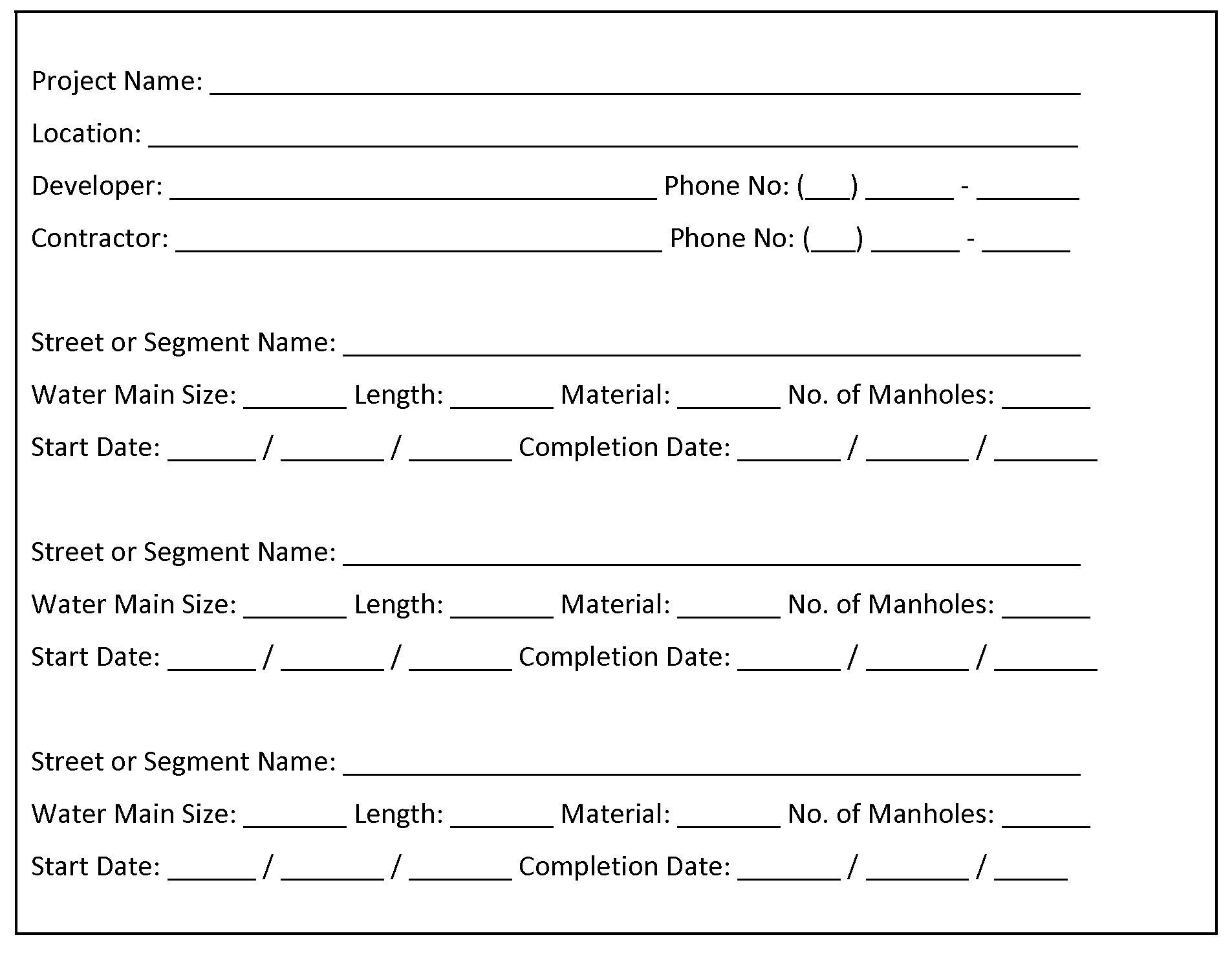
(Ord. No. 2014-18, § 2, 8-21-2014)
110.03.01 - General provisions.
A.
Introduction.
1)
A cross-connection can be generally defined as a physical connection between two otherwise separate piping systems or vessels, one of which contains potable water and the other does not. There are two main approaches to provide against actual or potential cross-connections, the "fixture outlet" approach and the "containment" approach.
2)
With the "fixture outlet" approach, cross-connection control protective devices are placed at internal high hazard locations within the customer's internal water system as well as at all locations where cross-connections exist at the "last free-flowing outlet." This approach entails extensive cross-connection survey work on behalf of the water purveyor as well as constant policing of the plumbing within each customer's premises. In a large water supply system, fixture outlet protection is virtually impossible to achieve and police due to the quantity of systems involved, the complexity of the plumbing systems inherent in many industrial sites, and the fact that plumbing changes are made within industrial and commercial establishments that do not require approval or permitting.
3)
The "containment" approach isolates the customer from the water main at all service connections, utilizing a minimum number of backflow devices throughout the system. Although this approach does not protect the customer within the building, it does effectively remove the possibility of contamination to the public water supply.
4)
Due to the number of commercial customers and the difficulties associated with "fixture outlet" protection, the "containment" approach will be employed by the City of Canton for protection of the public water supply.
B.
Purpose. The purpose of the City of Canton Cross-Connection Control Program includes the following:
1)
To protect the public water supply served by the City of Canton Water System from the entry of contaminants or pollutants into the system through the control of cross-connections. Control of contaminants or pollutants which could backflow or back-siphon into the public water system shall be accomplished by isolation and containment at the service connection.
2)
To promote and encourage the elimination or control of existing cross-connections, actual or potential, between the customer's in-plant potable water system and nonpotable water systems, plumbing fixtures and industrial piping systems.
3)
To provide for the maintenance of a continuing program of cross-connection control which will effectively prevent the contamination or pollution of all potable water systems by cross-connection.
C.
Authority. The Georgia Rules for Safe Drinking Water (391-3-5-13) state that a water supplier has the responsibility to prevent water from unapproved sources or any contaminants from entering the public water system. In partial fulfillment of this responsibility, the rules require that the water supplier develop a written program for the elimination and prevention of all cross-connections when requested by the Georgia Environmental Protection Division (EDP).
D.
Applicability. The provisions of backflow prevention by isolation and containment are applicable to any customer or system supplied by the City of Canton's water distribution system including irrigation sprinklers, fire protection systems, residential systems, and other service connections.
E.
Responsibilities.
1)
The Council of the City of Canton is responsible for establishing regulations regarding the control of cross-connections to the public distribution system.
2)
The city engineer is responsible for the enforcement of these regulations in an effort to protect the public water supply system through the prevention of backflow or back siphonage of contaminants or pollutants. This responsibility begins with the production of water and extends throughout the distribution system to the service connection, applying to new construction as well as to existing customers and situations.
3)
The City of Canton Building Department is responsible for enforcing the city's adopted plumbing code regulations in an effort to prevent backflows on the customer's premises from entering the customer's own potable water system. This responsibility extends to both new and existing customers.
4)
The water customer is responsible for complying with the city regulations including maintenance, testing, and reporting on certain devices.
a.
Customers are required to allow on-site inspections to verify compliance with the city's cross-connection control program.
b.
The customers have a dual responsibility for protecting the water in their own system from degradation due to conditions originating on their premises and for protecting the quality of water in the public distribution system.
c.
The customer is liable for any health hazard due to backflow from unprotected cross-connections on their premises.
d.
The customer is responsible for the costs of procurement, installation, testing, and maintenance of al backflow prevention devises on their premises and serving their premises.
F.
Reference material. The manuals listed below provide information relating to cross-connection control and backflow prevention.
1)
Cross-Connection Control Manual, U.S. EPA Office of Water, June 1989, EPA 570/9-89-007.
2)
Cross-Connection Control Manual, Ninth Edition. The EPA Cross Connection Control Manual defines, describes, and illustrates typical cross-Connections and suggest simple methods and devices to eliminate them.
3)
Recommended Practice for Backflow Prevention and Cross Connection Control, AWWA Manual M14, 2nd edition, 1990. The AWWA manual sets forth criteria for the selection and installation of backflow prevention devices and outlines procedures and techniques for maintenance and inspection of these devices.
(Ord. No. 2014-18, § 2, 8-21-2014)
110.03.02 - Implementation.
A.
Hazard assessment.
1)
Two degrees of hazard are considered, as determined by whether the impurities potentially involved are contaminants or pollutants. The two degrees of hazard, health and nonhealth, are defined below based on definitions given in the AWWA Manual M14 2nd edition:
a.
Health (contaminants). A cross-connection or potential cross-connection involving any substance that could, if introduced into the potable water supply, cause death, illness, spread disease, or have a high probability of causing such effects.
b.
Nonhealth (pollutants). A cross-connection or potential cross-connection involving any substance that generally would not be a health hazard, but would constitute a nuisance, or be aesthetically objectionable, if introduced into the domestic water supply.
2)
Chapter 4 in the AWWA Manual M14 provides guidance for the assessment of hazard and selection of backflow protection assemblies for premises isolation. Information from the chapter is summarized in table 110-7. Chapter 5 of the AWWA Manual M14 and chapter 2 of the EPA Cross-Connection Control Manual provide additional examples and illustrations of customer types and typical cross-connections that pose hazards to the public water supply system.
Table 110-7: Guidance for the Assessment of Hazard and Selection of Assemblies for Premises Isolation
B.
New customers.
1)
The city building department shall review all plans for new construction and shall advise developers of regulations in advance and determine that appropriate protection measures and devices are proposed.
2)
New construction will be inspected for City of Canton plumbing code compliance by inspectors in the city building department to determine that individual cross-connections are isolated from the public water supply.
3)
The city will inspect all new service connections for cross-connection control compliance and determine the degree of hazard to the public water supply. Based on the hazard assessment, the city will require the customer to install an appropriately selected backflow prevention device.
4)
Devices required by either the city building department or the cross-connection control program will be installed at the developer, builder, or owner's expense.
5)
The city will refuse service in cases of noncompliance.
C.
Fire protection systems.
1)
If the service connection to a premise is intended to be used for fire protection it shall be classified and/or defined as follows in table 110-8:
Table 110-8 Fire Protection Systems — 1
2)
The terminology and definitions for types of fire protection systems presented in table 110-9 shall also be applicable.
3)
Sprinkler systems shall be further classified in accordance with table 110-10.
4)
Standpipe systems shall be further classified as follows in accordance with table 110-11.
Table 110-9 Fire Protection Systems — 2
Table 110-10 Sprinkler System Classifications
Table 110-11 Standpipe System Classifications
5)
Fire protection systems as defined by the International Fire Code shall be contained from the City of Canton Water System by backflow prevention devices that have approvals as required and are classified or listed by the Underwriters Laboratories and Factory Mutual Insurance as follows:
a.
Class I, II, III sprinkler systems and nonhazardous standpipe or combined systems shall be contained by the installation of a double detector check valve (DDC BFP).
b.
Class IV, V and VI sprinkler systems and hazardous standpipe or combined systems shall be contained by the installation of a reduced pressure zone detector check (RPDC BFP).
c.
Class systems with combination hazards shall be contained from the public water mains by procedures applicable to the component that requires the higher degree of protection.
6)
Single detector checks that are used on nonhazardous fire protection systems class I, II, or III may not considered as a component part of a DDC BFP. Specifically, the addition of a second single check to one of these devices may not be substituted for a DDC assembly that is approved for backflow prevention.
7)
It is intended that the approved DDC BFP be in lieu of, not in addition to, the checking devices already required by the Standard Plumbing Code in the supply to class I, or II, or the DCV BFP already required on class III nonhazardous systems, and that the approved RPDC be in lieu of the RPZ already required on hazardous systems. The only additional checking device intended is a three-quarter-inch DCV or RPZ BFP in the three-quarter-inch copper bypass line, in conjunction with the bronze detector meter.
8)
The purpose of certain checking devices used, or likely to be used, with fire protection systems is given below to call attention to those that are approved for use as backflow prevention devices and those that are not.
Table 110-12 Fire Protection System Checking Devices Approved for Use as Backflow Prevention Devices
9)
The shutoff valves required for periodic testing of the backflow prevention device shall be outside stem and yoke (OS&Y), FDA-approved fused epoxy coated inside and out, with resilient seats, and the inlet valve shall include an approved test cock on the upstream side. All components shall be listed for fire protections service by Underwriters Laboratories and Factory Mutual. The exception is that ball valves may be utilized for shut off means on pipe sizes below two inches as approved by the cross-connection program administrator.
10)
The city has a designated cross-connection control program administrator. The program administrator shall coordinate and perform site inspections, provide customer notifications, and maintain all correspondence and records. The record system shall facilitate the monitoring of the following:
a.
Installation date of assemblies;
b.
Location of assemblies;
c.
Inspection and testing of assemblies;
d.
Performance of licensed testers;
e.
Calibration of testing devices.
11)
Tasks to be performed annually:
a.
Update list of potential sources of contaminants and pollutants;
b.
Notify customers of testing requirements for installed backflow prevention devices;
c.
Update list of approved backflow devices and approved tests.
D.
Backflow prevention devices.
1)
Selection.
a.
Backflow prevention devices shall be selected based on the degree of hazard assigned to the customer as follows:
i.
Those customers that are categorized under the health degree of hazard shall be required to install an approved reduced-pressure zone backflow-prevention assembly (RPZ) and have the device tested for proper operation annually.
ii.
Those customers that are categorized under the nonhealth degree of hazard shall be required to install an approved double check valve assembly (DCVA) and have the device tested for proper operation annually.
b.
Refer to the hazard assessment section (see subsection A above) of this section for guidelines regarding the selection of backflow prevention devices for particular customer types.
c.
Lawn sprinkler systems are open to the atmosphere and are not classified as a pressure type cross-connection. However, due to the special nature of the system, if no chemicals are injected into the system, the minimum protection against backflow shall include a double check valve assembly. If chemicals are injected or connections are made so that chemicals could be injected easily, minimum protection shall include a reduced pressure zone type backflow prevention device.
d.
Water being introduced into a vessel, tank, tanker truck, or miscellaneous other containers from any connection to the City of Canton Water System shall be through a method approved by the city engineer. Drawing 5 of chapter 112 of this UDC shows three approved methods for filling tanks.
2)
Approval devices.
a.
All backflow prevention devices shall be approved in accordance with the applicable standards of the American Society of Sanitary Engineering, the American Water Works Association, and the University of Southern California Foundation of Cross Connection Control and Hydraulic Research. Final approval acceptable devices will rest with the program administrator. A list of approved devices is maintained by the Canton Engineering Department.
b.
If no standard yet exists for particular device, or if the device is a derivative on one covered by a national standard, the program administrator shall determine whether the device shall be allowed on the water service connection.
3)
Installation of devices.
a.
The location of all backflow prevention devices shall be in an area that provides a safe working environment for testing and maintenance. The area shall be readily assessable, dry, and free from dirt, extreme cold or heat, and electrical hazards.
b.
Facilities that require a continuous, uninterrupted water supply shall install backflow prevention devices in parallel for testing and maintenance purposes. In no case shall a bypass arrangement be installed without approval of the cross-connection program administrator.
c.
Backflow prevention devices equipped with atmospheric vents, or with relief openings, shall be so installed and so located as to prevent any vent or any relief opening from being submerged. They shall be installed in the position as recommended by the manufacturer, and shall be protected from freezing. Illustrations of typical installations of backflow prevention devices can be found in chapter 112 of this UDC. The following guidelines shall govern the installation of backflow prevention devices:
i.
Backflow prevention device—Double check valve assembly (DCVA). This device shall not be buried in earth but may be installed below ground in a pit provided ball valve test cocks fitted where brass plugs are used. A positive shutoff valve shall be near the inlet and outlet sides of the device, and three ball valve test cocks provided on the device. A fourth test cock shall be provided on the upstream side of the inlet shut-off valve. When below ground, a union or flange shall be near the inlet and outlet sides. No intervening connections shall be between the shut-off valves and the backflow prevention device.
ii.
Backflow prevention device—Reduced-pressure zone assembly (RPZ). This device shall not be installed below ground. Where relief valve discharge could cause water damage, it shall be piped via an air gap, or a funnel, at the vent/relief port to a floor drain or other approved location. A positive shutoff valve shall be near the inlet and outlet sides of the device, and three approved test cocks provided on the device. A fourth test cock shall be provided on the upstream side of the inlet shutoff valve. A bronze strainer with 20-mesh stainless steel screen shall be included between the inlet shutoff valve and the device on sizes through two-and-one-half-inch. No intervening branch connection(s) shall be between the shutoff valves and the backflow prevention device. When the reduced pressure zone device is installed in a line subject to periodic no-flow conditions and the supply pressure is subject to fluctuations, an auxiliary directional check with soft disc, capable of functioning in any installed position of the RPZ, shall be provided between the inlet shutoff valve and RPZ head to lock the supply pressure in, and percent discharge through the vent/relief port. When a water pressure-reducing valve is required in the same line with the RPZ device, it is usually possible to locate the reducing valve upstream of the device and take advantage of the check valve effect of the reducing valve. In such case, the auxiliary directional check would be required.
iii.
Note: A thermal expansion control device shall be installed between a backflow prevention device and a water heater to limit the static pressure increase due to thermal expansion of the heated water. Providing and installing thermal expansion control device shall be the sole responsibility of the owner/occupant of the property. Testing procedures are outlined in the Manual of Cross-Connection Control, from the Foundation for Cross-Connection Control and Hydraulic Research published by the University of Southern California.
d.
Maintenance and testing of devices.
i.
Customers are responsible for maintaining backflow prevention devices in roper working order. Customers with RPZ and DCVA backflow prevention devices shall have the devices tested on an annual basis, or following repairs and/or clearing of devices. The city shall keep records of the testing, maintenance and repair of RPZ and DCVA backflow prevention devices and shall send out notices to customers when annual inspections come due.
ii.
Field testing and repair of these devices shall be by a person who is certified to understand the design and intended operation of backflow prevention devices. Tester must provide credentials of certification to the city for approval by the city. A list of approved testers is maintained by the Canton Engineering Department.
E.
Emergency notification procedures.
1)
Initial signs of possible contamination of the public water system may be complaints from customers or direct notification from a customer knowledgeable of a contamination incident.
2)
A cross-connection may contaminate only the customer's plumbing system. This is usually the case unless the pressure in the water distribution system is less than on the customer's property. Evidence of contamination may be discoloration of the water and/or the water may have an odor present. Although these are the simplest signs to look for, not all chemicals may be as easy to detect.
3)
City personnel shall use the following notification and operation procedures in the event of a possible contamination to the water system.
a.
Required information. The following information will be obtained for transmission to the city manager and the cross-connection control program administrator by the first city employee either on the scene or receiving information of a contamination incident:
i.
Location, time, and date of incident.
ii.
Name of person(s) or company and phone number.
iii.
Name and phone number of person(s) with any information of incident.
iv.
Type of material involved, if known.
v.
Physical description of contamination. Color of water, odor, taste?
b.
Notification of city personnel.
i.
Notify city manager.
ii.
Notify cross-connection control administrator.
iii.
Notify building inspectors as needed. Building inspectors will be notified and requested to assist in locating the source of contamination.
iv.
Notify water treatment plant personnel. Water treatment plant personnel shall be notified as to the type of emergency, so that they may assist in the location, identification, and correction of any cross-connection which may affect the supply system. Laboratory personnel from the plant will be required to take samples of the contaminated water for analysis.
c.
Notification of EPD.
i.
Notify the Environmental Protection Division.
ii.
The emergency response program phone numbers are (800) 241-4113, (404) 656-4863 and (404) 656-6905.
d.
Notification of Cherokee County Department of Public Services.
i.
Notify health department personnel.
ii.
Health department personnel will be notified and requested to respond in the event of an emergency, so that they may assist with the identification and treatment of the contamination.
e.
Notification of the public. If an incident or emergency warrants public notification the following person(s) are authorized to make statements to the news media and shall be in charge of handling the emergency in the order listed:
i.
Mayor of the City of Canton;
ii.
City Manager of the City of Canton.
4)
Operation procedures.
a.
Upon arrival on the scene, the extent of the contamination should be assessed. It should be determined whether the contaminant has entered the public water system or if it is still contained on a customer's premises.
b.
Service crew(s) shall be dispatched to the scene. Service crew(s) shall locate and turn off the customer's water service at the meter and fire line valves where the source of contamination is identified. Service crew(s) shall be prepared to close all necessary valves to isolate a section of the distribution system when instructed to do so. If the distribution system is contaminated, the contamination shall be contained in the smallest are possible.
c.
City personnel will personally notify each customer as the water service to each customer is shut off. Personnel from the police and fire departments may be required to assist in the notification of the Individual premises located within the affected area. The local paper and radio stations will be used when appropriate, as authorized by the city manager.
d.
A laboratory technician shall be dispatched to the backflow site. The laboratory technician shall collect the necessary samples and make provisions for further testing.
e.
Samples shall be taken to determine the type of contaminant and to what extent the contamination exists. Samples will be taken to the water system laboratory and may be sent to the state lab for identification. The city manager shall be kept informed of the results, so that the area of contaminated water can be isolated. Samples should be taken outside of the isolated area to ensure that the contaminant is contained.
f.
After the contaminant is identified, the cross-connection and the place of occurrence shall be located. All drinking fountains should be turned off. Water service shall be discontinued at the place of occurrence until an approved backflow prevention device is installed and tested.
g.
Service crews shall start flushing the water system upon the city manager's order to do so and shall continue flushing lines until lab tests show the contaminant to be at a safe level for human consumption. If necessary, the water mains will be resterilized using chlorine and/or treated with other chemicals to remove the residual effects of the contaminant.
F.
Public awareness. General methods that the city may use to inform its customers of the potential dangers from illegal and improper cross-connection include the following:
1)
Written descriptions of potential cross-connection locations and the need to protect the public water system can be included as special interest articles for newspaper and local publications.
2)
Providing speakers for civic clubs, political bodies and other functions.
3)
Providing informational pamphlets to be distributed at schools and other locations.
4)
Scrolling text messages about backflow prevention can be put on the government access channel of the local cable TV.
5)
Public service announcements on local radio stations.
(Ord. No. 2014-18, § 2, 8-21-2014)
110.03.03 - General conditions and enforcement.
A.
Request for inspection. The applicant for a building sewer connection permit shall notify the City of Canton Building Department when the building sewer is ready for inspection and connection to the city wastewater system. The connection and testing shall be made in the presence of the building inspector or his representative.
B.
Guarding excavations. All excavations for building sewer installation shall be adequately guarded with barricades and lights in compliance with all OSHA and Georgia Department of Transportation requirements so as to protect the public from hazard. Streets, sidewalks, parkways and other public property disturbed in the course of the work shall be restored to a good as new condition in a manner satisfactory to the city.
C.
Restoration of disturbed public property.
1)
A three-day notice is required.
2)
All water or wastewater construction work conducted on the public right-of-way or any public property shall be conducted only with proper permission from the City of Canton Engineering Department. The developer shall be required to post a bond with the city so that proper restoration of the disturbed are is assured. All disturbed areas as a result of such construction shall be restored to a condition that is "as good as new." The scheduling of such construction activities shall be as approved by the city manager if such scheduling approval is determined to be in the public's best interest.
D.
Backflow prevention.
1)
When required. All wastewater treatment plants, and water plants, commercial businesses, industries, or institutions shall be required to install backflow prevention mechanisms. Additionally, approved backflow preventers or vacuum breakers shall be installed with all plumbing fixtures or equipment for which the potable water supply outlet may be submerged without the protection of a minimum air gap. The particular backflow prevention devices utilized in any given situation shall be as specified in the plumbing code or as approved by the city.
2)
Minimum required air gap. The minimum required air gap shall be measured vertically from the lowest end of a potable water outlet to the flood rim or line of the fixture or receptacle into which it discharges. The minimum required air gap shall be twice the effective opening of a potable water outlet unless the outlet is a distance less than three times the effective opening away form a wall or similar vertical surface in which cases the minimum required air gap shall be three times the effective opening of the outlet. In no case shall the minimum required air gap be less than is provided in the plumbing code.
E.
Temporary water supply standpipes in elbows only.
1)
All standpipes installed for the purpose of providing temporary water supply at any given location shall be installed on a 90-degree elbow.
2)
Tees, crosses and wyes or other connecting device shall not be utilized.
3)
When the permanent water connection is made, the temporary elbow shall be removed.
F.
Capping and sealing of discontinued water and sewer connections. All water and sewer connections for which service has been discontinued as a result of the demolition of the structure being served by the connection, or for any other reasons, shall be properly and permanently capped and sealed to prevent the entrance of ground or surface water in the case of sewers and the escape of potable water in the case of water lines.
G.
Location of water meters.
1)
All water meters shall in installed at an easily accessible location on or near the property line of the premises being served adjacent to the public right-of-way. Water meters shall not be installed behind enclosed fences, in pave driveways, in paved parking areas or sidewalks.
2)
Generally, the city shall locate meters at or near the customer's curb or property line. When it is impractical to locate meters at or near the customer's curb or property line, the city may locate a meter in any other reasonable convenient or accessible place which affords protection against damage.
3)
When meters are grouped, the city shall tag each meter to identify the customer whose services are measured by that meter.
H.
Wastewater lift stations.
1)
All wastewater lift stations installed in the city which serve two or more buildings shall be designed and constructed in strict conformity to the wastewater lift station specifications sections of chapter 111 of this UDC.
2)
Engineering plans shall be prepared for all wastewater lift stations and such plans shall be approved by the city water system prior to construction.
(Ord. No. 2014-18, § 2, 8-21-2014)
110.03.04 - General use of public water and wastewater facilities.
A.
General.
1)
Unauthorized connections prohibited.
a.
No person shall make an authorized water or sewer connection nor obtain unauthorized water or wastewater services.
b.
Persons so make unauthorized connections or obtaining unauthorized service shall be subject to a fee as set forth in the city water and wastewater fee schedule, published separately.
2)
Requirements to prevent cross-connections.
a.
The construction and operation of all water and wastewater system piping shall be in such a manner so as to control cross-connections or the possibility thereof.
b.
It is the intent of section 110.03.00 to protect the public health by providing regulations whereby the possibilities for the contamination of the water supply due to cross-connections with the wastewater system are greatly reduced or eliminated.
3)
Malicious damage to equipment.
a.
No person shall maliciously, willfully, or negligently break, damage, destroy, uncover, deface, or tamper with any structure, appurtenance or equipment which is a part of the water or wastewater facilities.
b.
Any person violating this provision shall be subject to immediate arrest under the charge of disorderly conduct.
B.
Water system.
1)
Conditions for use of private wells (see City of Canton Industrial Pretreatment Program Manual).
2)
Responsibility for meter and meter box.
a.
All meters shall be installed, tested, repaired, and removed by the city.
b.
Except as elsewhere provided, all meters, service connections, and other equipment furnished by or for the city shall be and remain the property of the city.
c.
The city will, as its own expense, make routine tests of meters when it considers such tests.
(Ord. No. 2014-18, § 2, 8-21-2014)
110.03.05 - Powers and authority of city employees.
A.
Right to enter premises.
1)
Duly authorized employees and representatives of the city and authorized representatives of applicable federal and state regulatory agencies bearing proper credentials and identification shall have the right to enter the premises of any user to determine whether the user is complying with all requirements of this appendix and any wastewater discharge permit or order issued hereunder. Users shall allow these persons ready access to all parts of the premises for the purposes of inspection, sampling, records examination and copying, and the performance of any additional duties.
2)
Where a user has security measures in force which require proper identification and clearance before entry into its premises, the user shall make necessary arrangements with its security guards so that, upon presentation of suitable identification, the city manager or designee will be permitted to enter without delay for the purposes of performing specific responsibilities.
3)
The city manager shall have the right to set up on the user's property, or require installation of, such devices as are necessary to conduct sampling and/or metering of the user's operations.
4)
The city manager may require the user to install monitoring equipment as necessary. The facility's sampling and monitoring equipment shall be maintained at all times in a safe and proper operating condition by the user at its own expense. All devices used to measure wastewater flow and quality shall be calibrated frequently to ensure their accuracy.
5)
Any temporary or permanent obstruction to safe and easy access to the facility to be inspected and/or sampled shall be promptly removed by the user at the written or verbal request of the city manager and shall not be replaced. The costs of clearing such access shall be the responsibility of the user.
6)
Unreasonable delays in allowing the city manager access to the user's premises shall be a violation of this UDC.
B.
Notice of violation.
1)
When the city manager or designee finds that a user has violated, or continues to violate, any provision of section 110.03.00, a wastewater discharge permit or order issued hereunder, or any other pretreatment standard or requirement, the city manager may serve upon that user a written notice of violation.
2)
Within ten days of the receipt of this notice, an explanation of the violation and a plan for the satisfactory correction and prevention thereof, to include specific required actions, shall be submitted by the user to the city manager. Submission of this plan in no way relieves the user of liability for any violations occurring before or after receipt of the notice of violation.
3)
Nothing in section 110.03.00 shall limit the authority of the city manager to take any action, including emergency actions or any other enforcement action, without a notice of violation first being issued.
C.
Show cause hearing.
1)
The city manager may order a user who has violated, or continues to violate, any provision of section 110.03.00, a wastewater discharge permit or order issued hereunder, or any other pretreatment standard or requirement, to appear before the city manager and show cause why the proposed enforcement action should not be taken.
2)
Notice shall be served on the user specifying the time and place for the meeting, the proposed enforcement action, the reasons for such action, and a request that the user show cause why the proposed enforcement action should not be taken.
3)
The notice of the meeting shall be served at least ten days prior to the hearing.
4)
A show cause hearing shall not be a bar against, or prerequisite for, taking any other action against the user.
D.
Compliance orders.
1)
When the city manager finds that a user has violated, or continues to violate, any provision of this section 110.03.00, a wastewater discharge permit or order issued hereunder, or any other pretreatment standard or requirement, the city manager may issue an order to the user responsible for the discharge directing that the user come into compliance within a specified time.
2)
If the user does not come into compliance within the time provided in the compliance order, sewer service may be discontinued unless adequate treatment facilities, devices, or other related appurtenances are installed and properly operated.
3)
Compliance orders also may contain other requirements to address the noncompliance, including additional self-monitoring and management practices designed to minimize the amount of pollutants discharged to the sewer.
4)
A compliance order may not extend the deadline for compliance established for a pretreatment standard or requirement, nor does a compliance order relieve the user of liability for any violation, including any continuing violation, Issuance of a compliance order shall not be a bar against, or a prerequisite for, taking any other action against the user.
E.
Cease and desist orders.
1)
When the city manager finds that a user has violated, or continues to violate, any provision of this section 110.03.00, a wastewater discharge permit or order issued hereunder, or any other pretreatment standard or requirement, or that the user's past violations are likely to recur, the city manager may issue an order to the user directing it to cease and desist all such violations and directing the user to:
a.
Immediately comply with all requirements.
b.
Take such appropriate remedial or preventive action as may be needed to properly address a continuing or threatened violation, including halting operations and/or terminating the discharge.
2)
Issuance of a cease and desist order shall not be a bar against, or a prerequisite for, taking any other action against the user.
F.
Emergency suspensions.
1)
The city manager may immediately suspend a user's discharge, after informal notice to the user, whenever such suspension is necessary to stop and actual or threatened discharge which reasonably appears to present or cause an imminent or substantial endangerment to health or welfare of persons. The city manager may also immediately suspend a user's discharge, after notice and opportunity to respond, that threatens to interfere with the operation of the POTW, or which presents, or may present, an endangerment to the environment.
2)
Any user notified of a suspension of its discharge shall immediately stop or eliminate its contribution.
a.
In the event of a user's failure to immediately comply voluntarily with the suspension order, the city manager may take such steps as deemed necessary, including immediate severance of the sewer connection, to prevent or minimize damage to the POTW, its receiving stream, or endangerment to any individuals.
b.
The city manager may allow the user to recommence its discharge when the user has demonstrated to the satisfaction of the city manager that the period of endangerment has passed.
3)
A user that is responsible, in whole or in part, for any discharge presenting imminent endangerment shall submit a detailed written statement, describing the causes of the environmental remediation.
4)
A petition for injunctive relief shall not be a bar against, or a prerequisite for, taking any other action against a user.
G.
Civil penalties.
1)
The city manager may recover reasonable attorney's fees, court costs, and other expenses associated with enforcement activities, including sampling and monitoring expenses, and the cost of any actual damages incurred by the city.
2)
In determining the amount of civil liability, the court shall take into account all relevant circumstances, including, but not limited, the extent of harm caused by the violation, the magnitude and duration of the violation, any economic benefit gained through the user's violation, corrective actions by the user, the compliance history of the user, and any other factor as justice requires.
3)
Filing a suit for civil penalties shall not be a bar against, or a prerequisite for, taking any other action against a user.
H.
Criminal prosecution.
1)
A user who willfully or negligently violates any provision of section 110.03.00, a wastewater discharge permit, or order issued hereunder, or any other pretreatment standard or requirement shall, upon conviction, be guilty of a misdemeanor, punishable by a fine of up to $1,000.00 or 12 months in prison for each offense.
2)
A user who willfully or negligently introduces any substance into the POTW which causes personal injury or property damage shall, upon conviction, be guilty of a misdemeanor punishable by a fine of up to $1,000.00 or 12 months in prison for each offense. This penalty shall be in addition to any other cause of action for personal injury or property damage available under state law.
3)
A user who knowingly makes any false statements, representations, or certifications on any application, record, report, plan, or other documentation filed, or required to be maintained, pursuant to section 110.03.00, wastewater discharge permit, or order issued hereunder, or who falsifies, tampers with, or knowingly renders inaccurate any monitoring device or method required under this section shall, upon conviction, be punishable, by a fine of up to $1,000.00 or 12 months in prison for each offense.
I.
Remedies nonexclusive.
1)
The remedies provided for in this section are not exclusive. The city manager may take any, all, or any combination of these actions against a noncompliant user.
2)
Enforcement of pretreatment violations will generally be in accordance with the city's enforcement response plan. However, the city manager may take other action against any user when the circumstances warrant. Further, the city manager is empowered to take more than one enforcement action against any noncompliant user.
J.
Water supply severance.
1)
Whenever a user has violated or continues to violate any provision of section 110.03.00, a wastewater discharge permit, or order issued hereunder, or any other pretreatment standard or requirement, water service to the user may be severed.
2)
In the event of such terminations under section 110.03.05, the city shall retain all rights to collect unpaid bills or amounts owed by the terminated user according to law or other provision of the section.
a.
Such rates or charges, if not paid when due, shall constitute a lien upon the premises served.
b.
Past due amounts shall bear interest at the same rate as would unpaid ad valorem taxes.
3)
Service will only recommence, at the user's expense, after it has satisfactorily demonstrated its ability to comply.
K.
Public nuisances.
1)
A violation of any provision of section 110.03.00, a wastewater discharge permit, or order issued hereunder, or any other pretreatment standard or requirement is hereby declared a public nuisance shall be corrected or abated as directed by the city manager.
2)
Any persons creating a public nuisance shall be subject to the provisions of the City Code governing such nuisances, including reimbursing the city for any costs incurred in removing, abating, or remedying said nuisance.
L.
Publication of users in significant noncompliance. The city manager shall publish annually, in the largest daily newspaper published in the municipality where the POTW is located, a list of the users which, during the previous 12 months, were in significant noncompliance with applicable pretreatment standards and requirements.
M.
Notification delivery of enforcement actions.
1)
Written notice personally delivered or placed in the U.S. mail by certified mail to the person's last known address shall be deemed sufficient notice for all enforcement actions in section 110.03.00 with the exceptions included in section 110.03.00.
2)
Such notice may be served on any authorized representative of the user.
3)
With respect to code violations regarding nonpayment of amounts due under section 110.03.05, only notice mailed to the person's last known address of the amount owed and the date upon which payment is due shall be required.
(Ord. No. 2014-18, § 2, 8-21-2014)

