
Cape Canaveral City Zoning Code
ARTICLE X
- A1A ECONOMIC OPPORTUNITY OVERLAY DISTRICT
Sec. 110-585. - Introduction.
(1)
The A1A Economic Opportunity Overlay District ("EOOD" or "District") provides guidelines and standards for public and private development projects in commercially zoned areas along A1A. Consistent with the intent of the 2009 Community Visioning and the 2012 Community Redevelopment Plan, the District is developed to promote hospitality related commercial development that capitalizes on the economic benefits of Port Canaveral; provide guidance and direction in the design of new buildings and rehabilitation of existing buildings and storefronts in order to improve their appearance, enhance the corridor's identity and promote the pedestrian environment of the District.
(2)
All projects within the boundaries of the District shall comply with the following Design Guidelines and Development Standards. These requirements have the overall goal of encouraging compact, pedestrian-oriented developments and attractive public outdoor spaces. The District is designed to create a unique identity for the A1A Corridor with a distinct sense of place while attracting new businesses and customers, and providing for the comfort, convenience, and safety of workers, residents and shoppers.
(3)
The District Design Guidelines and Development Standards ("Standards") set forth in this Article shall be in addition to and not in substitution of the underlying zoning district regulations and other regulations contained in this Code which shall also remain applicable to the District. The District Standards of this Article will govern development and redevelopment within the District and will control where conflicts between regulations occur.
(Ord. No. 11-2012, § 2(Exh. A), 7-17-12; Ord. No. 07-2015, § 2, 8-18-15)
Sec. 110-586. - Boundary and organization.
The boundaries of the District are shown on Figure 1 and Figure 1a. The District primarily consists of properties zoned for commercial, office, and industrial uses which abut or are in close proximity to A1A generally extending from the city limits on the north to E. Grant Avenue on the south. Whereas the boundaries of the District are identified on the Figures below, the zoning boundaries and/or specific zoning districts represented in Figure 1a and subsequent Figures are for reference purposes only; the official City Zoning Map is maintained within the Community Development Department.
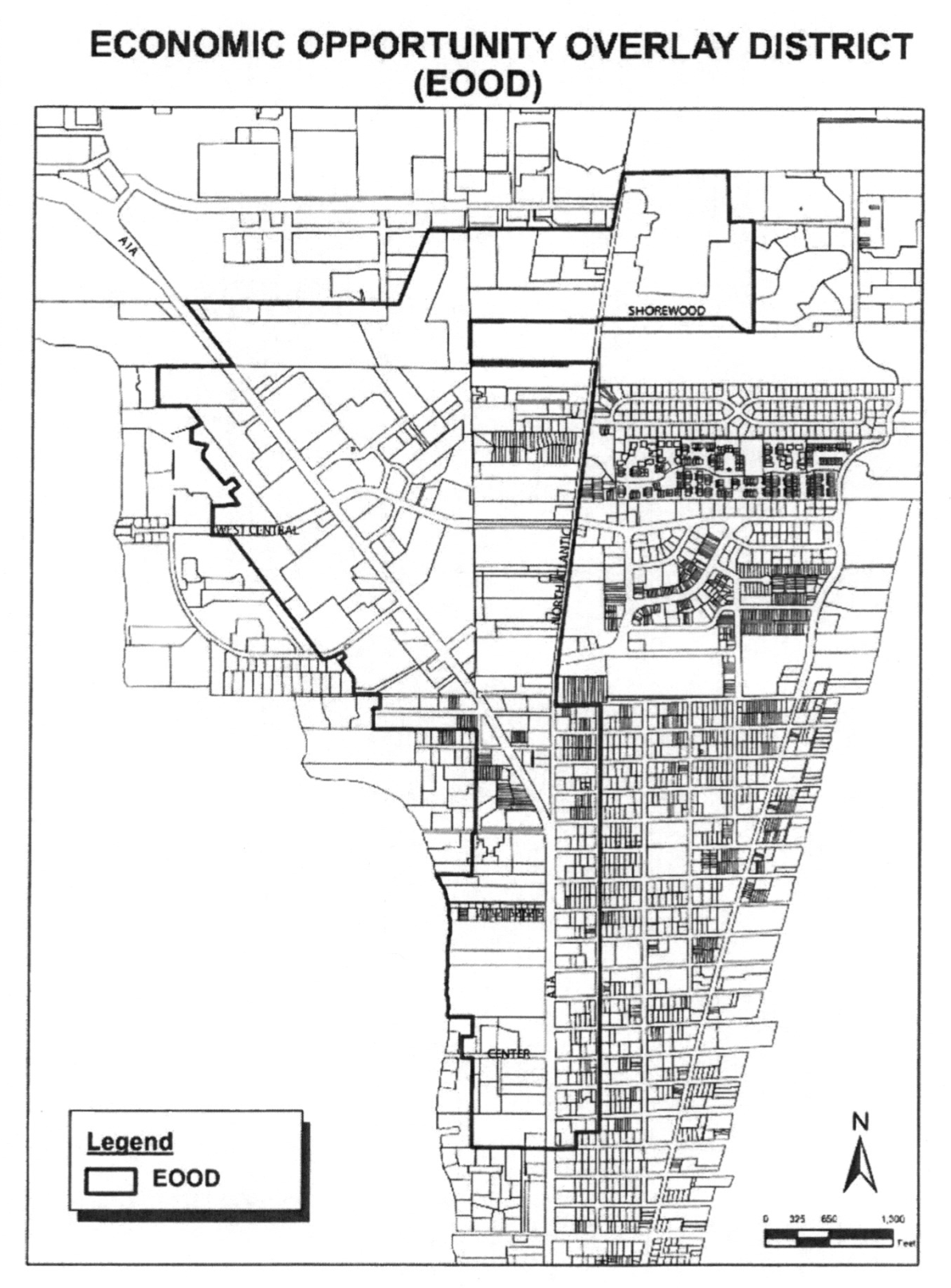
Figure 1. Economic Opportunity Overlay District Boundary Map
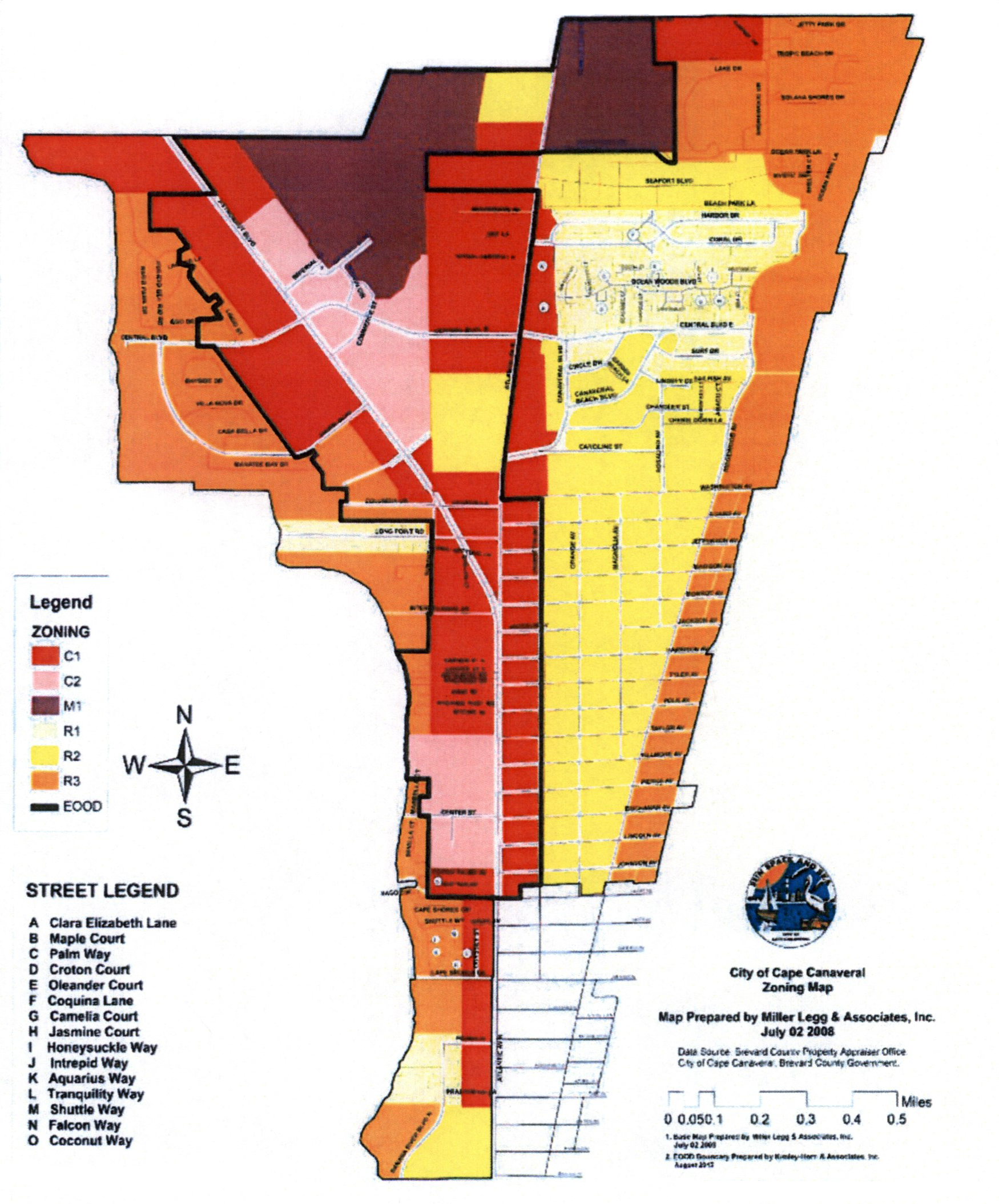
Figure 1a. Economic Opportunity Overlay District Boundary Map (Zoning)
(Note: Figure 1a is a graphic representation of the EOOD District boundary; the official zoning map is maintained in the Community Development Department).
(Ord. No. 11-2012, § 2(Exh. A), 7-17-12; Ord. No. 07-2015, § 2, 8-18-15)
Sec. 110-587. - Applicability.
(1)
The District is a commercial corridor of approximately one and three-quarter miles, generally centered on both A1A (Astronaut Boulevard) and N. Atlantic Avenue and recognized as extending from the entrance to the City of Cape Canaveral on the north to Grant Avenue on the south.
(2)
The area of the district along A1A is intended to serve as the main gateway into the City of Cape Canaveral. The area of the district along Central Boulevard is intended to serve as the main street to the City of Cape Canaveral's Town Center and as a transition between the land use, circulation, and streetscape along A1A and the Town Center. This District is intended to have the most intensive commercial and residential uses within the City. The EOOD is meant to provide a lively and attractive interface between the proposed Town Center and the adjacent residential communities, while maintaining a primarily commercial street frontage along A1A, N. Atlantic Avenue and Central Boulevard.
(3)
The streets will have a retail/commercial service atmosphere with small or large neighborhood stores at street level and apartments or offices on upper stories. The retail composition of the district shall include, but not be limited to, retail stores, personal services, hotels, cultural facilities, hospitals, clinics, pharmacies, medical marijuana treatment center dispensing facilities, convenience stores with gas, high-tech manufacturing, entertainment, and eating establishments including rooftop restaurants that serve the EOOD as well as stores, eating establishments, and business services (printing, accounting, etc.) that serve the other businesses and office users in the area. Residential uses shall be permitted within the District; however, shall be limited to upper stories along A1A, N. Atlantic Avenue and Central Boulevard within the District.
(4)
The main street component of the District is intended to provide a mixed-use, pedestrian-oriented focus for the proposed Town Center, with land uses serving Town Center residents and visitors. This sub-district provides the City of Cape Canaveral with a small-town style walkable center that is convenient, useful, safe and attractive for pedestrians and lively, yet relaxed. Small-scale retail and other commercial uses shall occupy as much of the ground floor frontages along Central Boulevard as the market will bear. Upper stories shall be office or residential along these main streets. This district also shall provide the potential for continuum-of-care developments including opportunities for aging in place and include such uses as independent, assisted living and skilled care facilities.
(Ord. No. 11-2012, § 2(Exh. A), 7-17-12; Ord. No. 07-2015, § 2, 8-18-15; Ord. No. 04-2018, § 2, 6-19-18)
Sec. 110-588. - Purpose.
The purpose of these design guidelines and standards are to provide flexibility in the uses and design requirements for the A1A EOOD, while setting minimum design standards to facilitate quality development. These standards will guide future development and redevelopment within the City of Cape Canaveral so that it creates more vital commercial cores and corridors, protects adjacent residential neighborhoods and neighborhood commercial centers, promotes the use of quality building materials, enhances the streetscape on all public streets, and continues to improve the image and pride in the city.
(Ord. No. 11-2012, § 2(Exh. A), 7-17-12)
Sec. 110-589. - Goals.
The A1A Economic Opportunity Overlay District (EOOD) provides design guidelines and standards which are intended to promote and enhance the identity of the district. Specifically, the goals of the EOOD are:
(1)
To create attractive, functional, and lasting buildings and places.
(2)
To encourage the design, construction and operation of buildings and places that are environmentally responsible, sustainable and healthy places to live, work, and play.
(3)
To promote development and redevelopment that preserves and enhances the physical appearance of the corridor and contributes to the district's unique sense of place.
(4)
To encourage the use of quality materials in development and redevelopment.
(5)
To encourage development that adds to a pedestrian friendly retail environment and contributes to the safety and comfort of both pedestrian and automobile traffic.
(6)
To provide direction in site planning and to ensure a high degree of design quality in development within the A1A EOOD through the use of Design Guidelines and Standards.
(7)
To enhance and protect the commercial corridors and primary entrances into the City of Cape Canaveral.
(Ord. No. 11-2012, § 2(Exh. A), 7-17-12)
Sec. 110-590. - Objectives.
(1)
The design guidelines and standards are intended to address the built environment within the City of Cape Canaveral and to recognize aesthetic design as an integral part of the planning and development process.
(2)
The guidelines and standards are intended to ensure that the appearance of new development, infill development, and redevelopment is representative of the City of Cape Canaveral's Community Vision.
(3)
The guidelines and standards will enable development to occur in a manner that is not only beneficial and worthwhile for the developers and property owners, but the development will also have a positive impact on the surrounding properties, neighborhoods, citizens, and the entire city.
(Ord. No. 11-2012, § 2(Exh. A), 7-17-12)
Sec. 110-591. - Design principles.
The A1A Economic Opportunity Overlay District (EOOD) is based upon a set of design principles. These principles are:
(1)
Consistency: The A1A Commercial corridor features a mixture of development types including community serving retail uses, office buildings, hotels and convention facilities, strip-commercial centers, neighborhood-serving retail, entertainment uses, attractions, and restaurants. Design of these structures has been influenced by use, age, and site dimensions. Within the context of these constraints, developments can achieve the principle of consistency through selection of colors, exterior surface materials, scale, rhythm, proportions, landscaping and sign programs.
(2)
Activity: Active street life, which can be enhanced by design considerations, is a major component of thriving pedestrian commercial districts. There are many opportunities to insert options for increased street-level pedestrian activity along A1A. Through building orientation, circulation, storefront design and landscaping, development can further promote the principle of safe pedestrian activity.
(3)
Pedestrian orientation: Pedestrian orientation can be achieved through storefront ornamentation, reduction of blank surfaces, building articulation, proportion, rhythm, color, and texture. Standards based upon this principle address wall surfaces, windows, awnings, signage, and architectural treatments.
(4)
Safety: Public safety is critical to the success of a commercial district. Public safety in this case refers not only to safety from criminal activity, but also creating an environment in which pedestrian and automobile traffic can safely coexist. The design and development of commercial centers and the public open space adjacent to them shall include considerations of public safety. Public safety issues can be addressed through site planning considerations such as the location of parking lots, lighting, signage and landscaping.
(5)
Simplicity: Design Guidelines and Standards for the district shall provide for public convenience by clearly identifying the nature of the business and communicating points of ingress and egress for pedestrian and automobile traffic. These issues can be addressed through architectural treatments as well as through site planning considerations such as the location of parking lots, lighting, signage and landscaping.
(Ord. No. 11-2012, § 2(Exh. A), 7-17-12; Ord. No. 07-2015, § 2, 8-18-15)
Sec. 110-592. - Definitions.
The following words and phrases, whenever used in this article, shall be construed as defined in this section. Words and phrases not defined herein shall be construed as defined in section 110-1 of this Code.
Accent color: A contrasting color used to emphasize architectural elements.
Architectural bay: The area enclosed by the storefront cornice above, piers on the side and the sidewalk at the bottom.
Attraction and destination uses: A land use which by its nature generates high volumes of multimodal transportation activity which may originate outside of the city limits and may include but not limited to theme parks, activity centers, and town centers.
Awning: A roof-like cover, fixed or capable of being raised or lowered, made of fire resistant cloth, wood, metal or plastic with or without a metal frame, which protrudes from a building façade as a roof-like structure and is supported entirely by the building without the use of ground supports.
Awning sign: Any sign located on the valance of a shelter supported entirely from the exterior wall of a building which extends over a building feature such as a door or window or a landscape/site feature such as a patio, deck or courtyard and which is constructed of fabric.
Bright paint: Paint containing "fluorescent dye of pigment which absorbs UV radiation and re-emits light of a violet or bluish hue used to increase the luminance factor and to remove the yellowishness or white or off-white materials." (Coatings Encyclopedic Dictionary)
Building articulation: Architectural features, which serve to add interest to a building, or highlight a site feature. Building articulation can be achieved through undulation of the building façade, changes in building height, highlighting an entrance, etc.
Building attachment: Any feature secured to the façade of the building, such as awnings, loggias, arcades, etc.
Building façade: The portion of the building wall that is visible to the public. This includes all four sides of the building.
Building form: The horizontal and vertical organization of building features, as well as the overall shape and site orientation of buildings.
Building opening: Penetrations to the building façade including windows and doors.
Building setback: A line parallel to the property line delineating a zone which cannot be used for buildings.
Building zone: A zone within a property along a street frontage which defines the limits of where the building façade must be located. This zone is generally parallel to the right-of-way and is defined by a minimum and maximum distance from the right-of-way.
Canopy: A projecting horizontal architectural element, other than an awning, made of fire-resistant cloth, wood, metal or plastic with or without metal or wood frames, attached or detached and supported, in part, or entirely, by the ground.
Cast stone: A refined architectural concrete building unit manufactured to simulate natural cut stone, used in masonry applications.
Color palette: A color scheme that incorporates related colors of complimentary hues and shades.
Cornice: The uppermost horizontal architectural band of moldings along the top of a wall or just below a roof.
Curtain wall: A non-structural building façade or outer covering which does not carry any dead load from the building except its own load.
Entablature: The superstructure of moldings and bands which lie horizontally above a column.
Façade: The front of a building or any of its sides facing a public way or space.
Floor area ratio (FAR): A measurement of the intensity of building development on a site. The floor area ratio is the relationship between the gross floor area on a site and the gross land area. The FAR is calculated by adding together the gross floor areas of all buildings on the site and dividing by the gross land area.
Florida Friendly Landscaping: Quality landscapes that conserve water, protect the environment, are adaptable to local conditions, and are drought tolerant. The principles of such landscaping include planting the right plant in the right place, efficient watering, appropriate fertilization, mulching, attraction of wildlife, responsible management of yard pests, recycling yard waste, reduction of storm water runoff, and waterfront protection. Additional components include practices such as landscape planning and design, soil analysis, the appropriate use of solid waste compost, minimizing the use of irrigation, and proper maintenance.
Frieze: Ornamental architectural horizontal band that runs above doorways and windows or below the cornice.
Ground floor: The lowest story within a building which, for the purpose of identifying street-level pedestrian activity, is the first 15 feet measured vertically and accessible to the street, the floor level or which is within three feet above or below curb level and is parallel to or primarily facing any public street
Hanging sign: A type of sign which is similar to projecting signs except that they are suspended below a marquee or under a canopy, making them generally smaller than projecting signs.
High technology: High-technology uses include but are not limited to the manufacture, machining, maintenance, repair, and testing of equipment and products that support the aerospace, automotive, aviation, naval, and military industries.
Massing: The organization of buildings and other structures relative to other District features such as parking areas, streets, and public spaces.
Mixed-use development: A type of development which may include one building, set of buildings, or defined project area for more than one purpose and may include any combination of uses, but not limited to residential, retail shops, eating establishments including rooftop restaurants, professional offices, industrial, and civic uses in either a horizontal or vertical setting.
Muntin: A strip of wood or metal separating and holding panes of glass in a window.
Parapet: A low wall along the edge of a roof.
Pedestrian refuge: Pedestrian refuges are areas protected from vehicles or bicycles by curbing, bollards, or other features at the midpoint of the crosswalk.
Pedestrian sign: A type of sign which is attached to a wall or to the underside of an awning, architectural canopy or marquee with one or two faces perpendicular to the face of the building which identifies a use of service exclusively or primarily by symbol.
Planned Development (PD): A designed development where the regulations of the underlying zone in which the development is situated are waived to allow flexibility and creative initiative in site, building design and location in accordance with the approved plan and imposed general requirements.
Port of call facility: A tourist-related use with a range of uses which may include, but is not limited to commercial parking, transportation transfer facility, vehicle rental, taxi service, retail, restaurants visitor/information center, provision for hotel, and other tourist support services.
Primary color: One to three base colors chosen to dominate a color scheme. This definition does not relate to the color value or hue.
Project: The erection, construction, major commercial additions, or major exterior alteration of any building or structure, including, but not limited to monument signs located in an Economic Opportunity Overlay District. A project does not include construction that consists solely of (1) interior remodeling, interior rehabilitation or repair work; or (2) a residential building on a parcel or lot which is developed entirely as residential use and consists of three or fewer dwelling units, unless expressly provided for in an Economic Opportunity Overlay District established pursuant to this article.
Projecting sign: A type of sign which is attached to a building face and projects out perpendicularly to the building wall by more than 18 inches and is effective when oriented to pedestrians.
Public space: Any space that is intended for use by the general public. Public spaces may be privately or publicly owned and maintained. Examples of public spaces can include squares, plazas, greens, courtyards, storefront gathering areas, etc.
Service area: An area of a building site not intended for public access, which is dedicated to business or maintenance functions. Service areas may include dumpster enclosures, loading docks, services, etc.
Shared parking: Shared parking is a tool by which adjacent land uses that have different parking demand patterns may reduce the combined parking requirements for each use and use the same parking spaces/areas throughout the day.
Stepback: A stepback is a setback located on the upper stories of a building, typically to reduce the bulk of a building or to provide outdoor floor space.
Street wall: The wall of façades created in a pedestrian oriented district when stores are built to the front yard and side yard setback. Street walls can sometimes be used in place of building façades, and shall be designed to imitate the architecture of the building.
Stucco: A coarse plaster composed of Portland or masonry cement, sand and hydrated lime mixed with water and applied in a plastic state to form a hard covering for exterior walls.
Wall sign: A type of sign which is attached to the face of a building wall which shall not project more than 18 inches and may include channel panels or letters made out of wood, metal, or recycled composite material.
Water-efficient landscaping: Landscaping that maximizes the conservation of water, via the application of one or more of the principles of Florida Friendly Landscaping.
Window sign: See section 94-1, Definitions.
(Ord. No. 11-2012, § 2(Exh. A), 7-17-12; Ord. No. 08-2014, § 3, 9-16-14; Ord. No. 07-2015, § 2, 8-18-15)
Sec. 110-604. - Intent.
All projects, as defined in the A1A Economic Opportunity Overlay District, shall be reviewed for compliance with this article prior to being issued a building permit.
(Ord. No. 11-2012, § 2(Exh. A), 7-17-12)
Sec. 110-605. - General.
The director of community development or designee, shall have the authority to render interpretations of this Code, to adopted policies and procedures in order to clarify the application of its provisions. Such interpretations, policies and procedures shall be in compliance with the intent or purpose of this Code.
(Ord. No. 11-2012, § 2(Exh. A), 7-17-12; Ord. No. 07-2015, § 2, 8-18-15)
Sec. 110-606. - Procedures for design compatibility approvals.
No building permit will be issued for any project, and no person will perform any construction work on a project, until the documents required by section 22-44 of this Code have been submitted to the community development department and approved according to the procedures in article III of chapter 22 of this Code.
(Ord. No. 11-2012, § 2(Exh. A), 7-17-12; Ord. No. 07-2015, § 2, 8-18-15)
Sec. 110-607. - Plan submittals.
A design compatibility approval shall also include the site plan criteria set forth in section 110-222 of this Code.
(Ord. No. 11-2012, § 2(Exh. A), 7-17-12)
Sec. 110-608. - Nonconforming uses, structures and buildings.
Those legally existing uses, structures and buildings that do not comply with the provisions of this article at the time of its adoption shall be deemed nonconforming and shall be governed by article V of chapter 110 of this Code.
(Ord. No. 11-2012, § 2(Exh. A), 7-17-12; Ord. No. 07-2015, § 2, 8-18-15)
Sec. 110-609. - Use matrix.
The District is intended to serve as both the main gateway area into the city as well as the main street to the city's proposed Town Center. The following land use matrix (Table 1) identifies the uses which are permitted by right (P), permitted by a special exception (SE), or not allowed (NA).
1 Added use.
2 Use included to clarify intent of code.
3 Shall be permitted only on properties adjacent to or contiguous with Highway A1A (a.k.a. Astronaut Boulevard and N. Atlantic Avenue south of International Drive). For purposes herein, a pharmacy shall include any use where a pharmacy is included as an accessory use or department of the principal use. Medical marijuana treatment center dispensing facilities shall not be located within 500 feet of the real property that comprises a public or private elementary, middle or secondary school, or as otherwise provided in Chapter 381, Florida Statutes, as may hereafter be amended.
* Uses not specifically listed may be approved as a Planned Development (PD).
(Ord. No. 11-2012, § 2(Exh. A), 7-17-12; Ord. No. 03-2013, § 2, 3-19-13; Ord. No. 07-2015, § 2, 8-18-15; Ord. No. 12-2017, § 2, 8-15-17; Ord. No. 04-2018, § 2, 6-19-18)
Sec. 110-610. - Similar and compatible uses.
Any use not specifically listed may be authorized by the city council as a planned development on a case-by-case basis.
(Ord. No. 11-2012, § 2(Exh. A), 7-17-12)
Sec. 110-611. - Property containing both commercial and residential zoning district designations.
In the event that a parcel of real property located within the District contains both a commercial and residential zoning district designation, the residential portion of the parcel may be developed in accordance with either the applicable underlying zoning regulations or as an accessory use to the principal commercial development on the commercial portion of the parcel. Accessory uses may include, but are not limited to, restaurant/bar, recreational amenities, boardwalk, sundries, and parking structure, provided the city manager or his designee deems the accessory use is compatible with the principal use and compatible with the surrounding properties. The city manager or his designee may impose, in writing, reasonable safeguards and conditions on the approval of any development permit authorizing an accessory use. Any violation of these safeguards and conditions of the accessory use in furtherance of the compatibility requirements of this section and/or the public health, safety and welfare. Accessory uses and structures shall be constructed or developed only after development of the principal use and shall not become a use independent of the principal use. Further, the residential portion of the parcel shall not be subdivided from the commercial portion so long as any such accessory use remains on the parcel.
(Ord. No. 07-2015, § 2, 8-18-15)
Sec. 110-621. - Intent.
(1)
Site planning involves the proper placement and orientation of structures, structure height, development acreage, open spaces, parking and pedestrian and vehicular circulation on a given site. The purpose of good site design is to create a functional and attractive development, to minimize adverse impacts, and to ensure that a project will be an asset to the community.
(2)
Proper site planning shall promote harmony between new and existing buildings and shall be sensitive to the scale, form, height, and proportion of surrounding development. Good design with complementary landscaping is a major component in creating vibrant commercial areas that foster a pleasant and desirable character, pedestrian activity, and economic vitality. Factors such as the size and massing of buildings, the orientation of storefronts, and circulation greatly influence the quality of the pedestrian experience.
(3)
Within the district, site planning and design of new buildings and the rehabilitation of existing buildings shall promote continuity of the historic context of buildings (as shown in historic documentation) in relationship to the existing pattern and scale of streets, sidewalks and parking. The guidelines and standards below reinforce the existing historic development patterns (as shown in historic documentation) and provide a site planning framework for both infill developments and rehabilitation and revitalization of existing buildings.
(Ord. No. 11-2012, § 2(Exh. A), 7-17-12; Ord. No. 07-2015, § 2, 8-18-15)
Sec. 110-622. - LEED or LEED equivalent design.
(1)
Intent: LEED (Leadership in Energy and Environmental Design) is a national consensus-based, market-driven building rating system developed by the U.S. Green Building Council to encourage the development and implementation of green building practices. This rating system is incorporated in the categories of site, water, energy, materials, and air quality. The city desires to encourage, where practical, the use of LEED or a LEED equivalent rating system in the design of projects within the District.
(2)
Categories: The following LEED or LEED equivalent categories shall be considered in the design of projects within the district to the maximum extent practical.
a.
Sustainable Sites (SS). The project shall include consideration of erosion and sedimentation control; optimum site selection which avoids areas such as wetlands, floodplains, etc.; siting projects to promote urban redevelopment or use of brownfield sites; alternative transportation options; reduced site disturbance; innovative stormwater management; reduction of heat islands; and reduction of light pollution.
b.
Water Efficiency (WE). The project shall incorporate water-efficient landscaping as described in section 110-592; innovative wastewater technologies; and potable water use reduction, to the maximum extent practical.
c.
Energy and Atmosphere (EA). All projects shall optimize energy performance; utilize renewable energy or energy credits, where feasible; and reduce or eliminate the use of CFCs (chlorofluorocarbons), HCFSs (hydrochlorofluorocarbons) and Halons.
d.
Materials and Resources (MR). All projects shall, to the maximum extent practical during new construction or redevelopment, incorporate recycling and salvage of construction materials; use local materials (within 500 miles); use rapidly renewable materials; and use certified wood.
e.
Indoor Environmental Quality (IEQ). All projects shall comply with the Florida Clean Indoor Air Act (FICAA), where appropriate to prohibit smoking indoors; increase building ventilation effectiveness; meet or exceed the SMACNA (Sheet Metal and Air Conditioning Contractor's National Association) guidelines for occupied buildings; conduct minimum building flush out at 100 percent outside air prior to occupancy; encourage use of low-emitting materials which meet or exceed the VOC (volatile organic compound) limits; maximize indoor pollutant source control to minimize cross-contamination of occupied areas; provide operable windows and individual air controls, where practical; and maximize use of daylight and views.
f.
Innovation in Design (ID). Encourage the use of a LEED Accredited Professional (LEED AP) or LEED equivalent professional participant on the project.
(Ord. No. 11-2012, § 2(Exh. A), 7-17-12; Ord. No. 07-2015, § 2, 8-18-15)
Sec. 110-623. - Building orientation.
(1)
Buildings shall be oriented towards A1A, N. Atlantic Avenue and Central Boulevard as well as adjacent cross-streets in order to encourage pedestrian activity along the sidewalks of A1A, N. Atlantic Avenue and Central Boulevard and to facilitate pedestrian access to and from the sidewalk to adjacent properties.
a.
Projects with rear lot lines abutting a street, alley, or parking lot shall incorporate pedestrian entrances at the rear lot line in addition to those on A1A, N. Atlantic Avenue and Central Boulevard.
(Ord. No. 11-2012, § 2(Exh. A), 7-17-12; Ord. No. 07-2015, § 2, 8-18-15)
Sec. 110-624. - Building height.
(1)
Building height shall be correlated to the scale of the street along which it faces and shall encourage a comfortable pedestrian-oriented environment.
a.
The standard building height for projects shall be up to four stories or 45 feet.
b.
Increased building heights above four stories or 45 feet may be considered up to six stories or 65 feet, if height mitigation measures such as a building stepback (as illustrated in Figure 2 and Figure 2a) or setback are proposed and approved by the community appearance board. Buildings exceeding 45 feet shall provide a stepback of at least 14 feet along all sides facing a public roadway.
c.
Increased building heights above 65 feet may be considered pursuant to a Planned Development (PD) approved by the city council on a case-by-case basis. Building heights above 65 feet shall provide additional stepbacks of at least 14 feet each, at each four story interval or fraction thereof, along all sides facing a public roadway.
d.
Any single-story structure in which the floor to ceiling height exceeds 15 feet or the exterior façade height exceeds 25 feet, shall be designed to appear like a multistory structure. Exceptions to this requirement may be reviewed and considered for approval by the community appearance board based pursuant to requirements of this article.
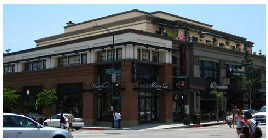
Figure 2. Building Height
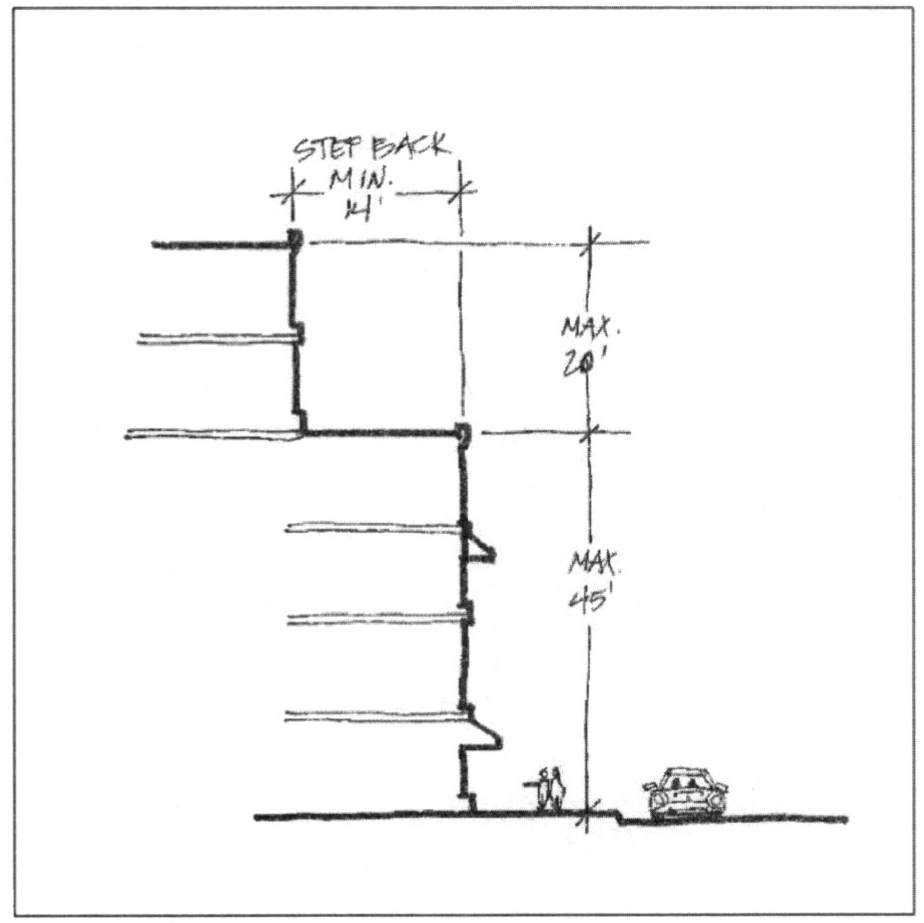
Figure 2a. Building Height-Stepback
(Ord. No. 11-2012, § 2(Exh. A), 7-17-12; Ord. No. 07-2015, § 2, 8-18-15)
Sec. 110-625. - Building setbacks and building zones.
(1)
Building setbacks. Buildings shall be setback from the right-of-way a sufficient distance to encourage pedestrian activity.
a.
Building setback along A1A shall be a minimum of 15 feet.
b.
Building setback along all other public streets shall be a minimum of ten feet.
c.
Except as noted above for stepbacks, building setbacks for the side and rear lot lines shall be a minimum of ten feet.
d.
Where adopted Fire Codes exceed these standards, the greater setback distances shall apply.
(2)
Building zones. Building zones as defined in section 110-592 defines the limits of where the building façade must be located in relation to the right-of-way line and/or property line.
a.
The Primary Building Zone (Zone 1) is the area of the building extending from the façade to a depth of ten feet (see Figure 3 and Figure 3a).
b.
The Secondary Building Zone (Zone 2) is the area of the building extending from the rear of the Primary Building Zone to a depth of ten feet (see Figure 3 and also Figure 3a).
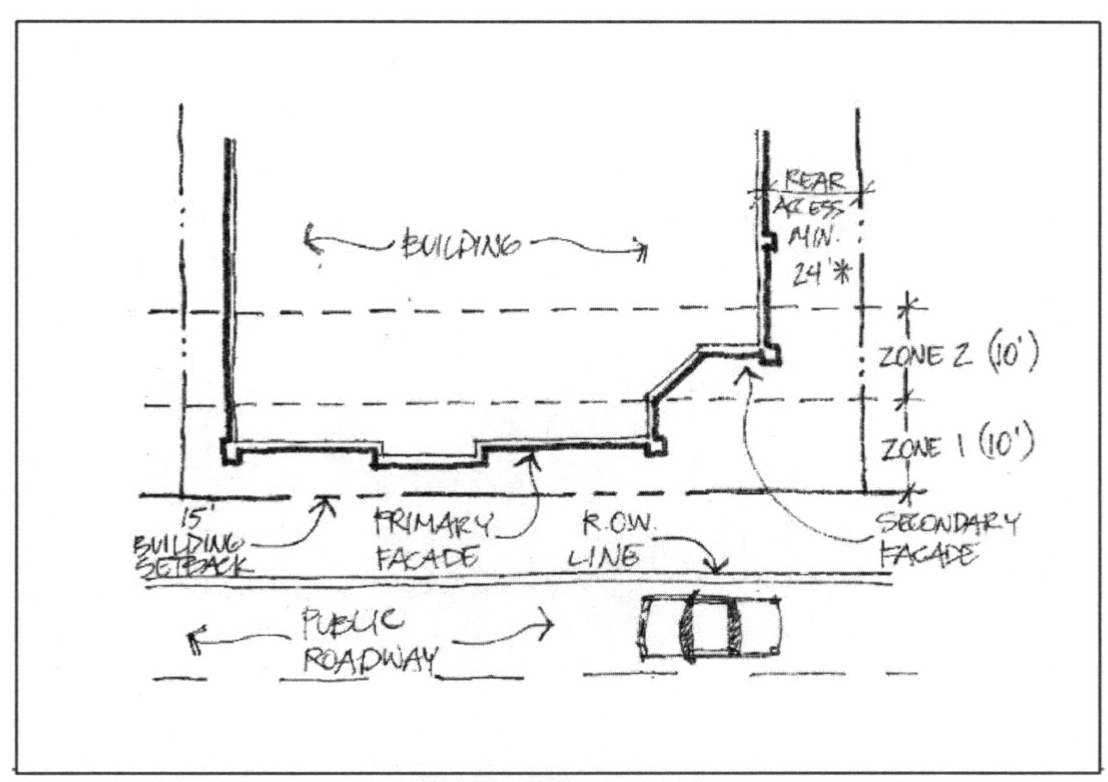
Figure 3. Building Zone Diagram
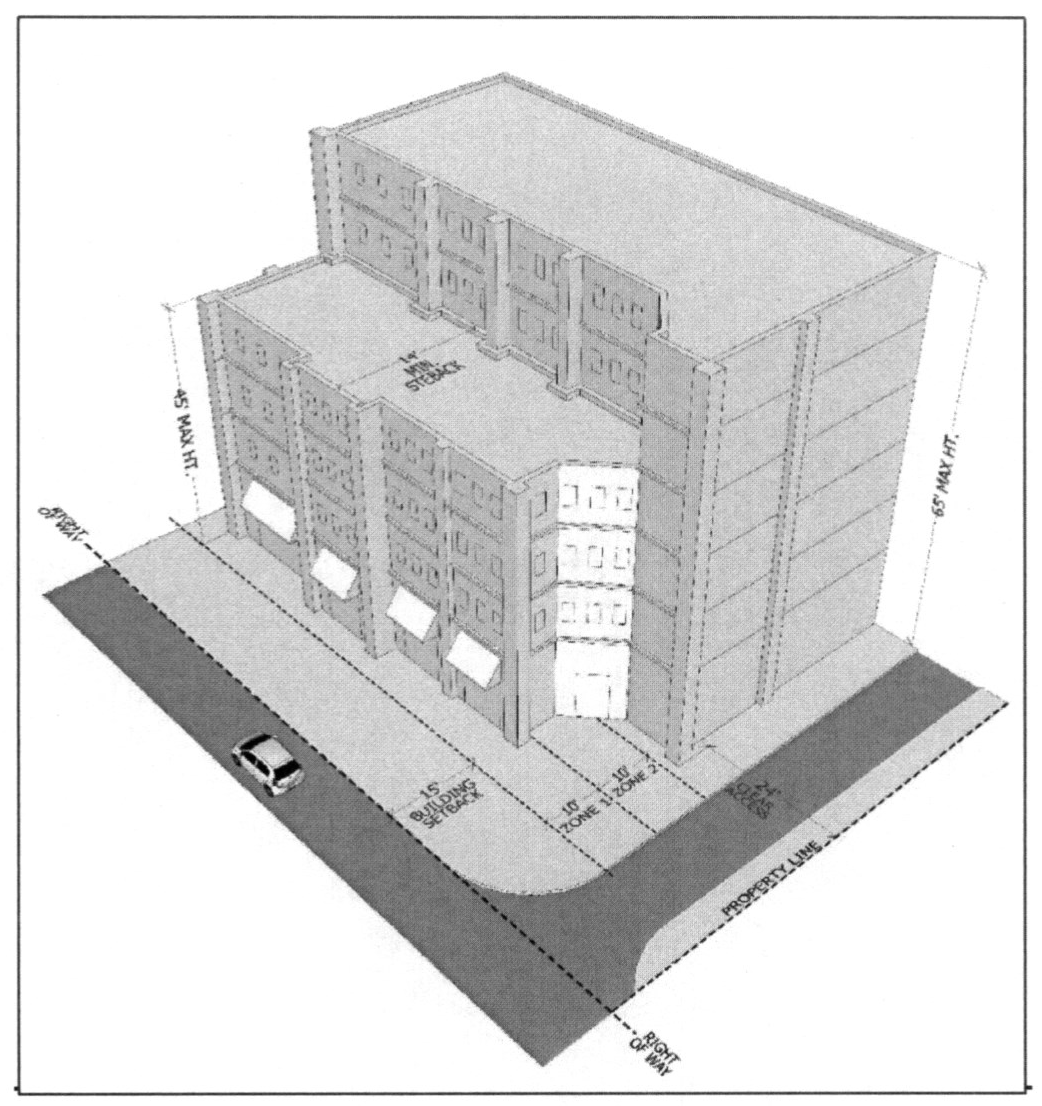
Figure 3a. Building Height-Stepback
(Ord. No. 11-2012, § 2(Exh. A), 7-17-12; Ord. No. 07-2015, § 2, 8-18-15)
Sec. 110-626. - Building frontage.
Building frontage is the percentage of the width of a lot that is required to be occupied by the building's façade within both the Primary and Secondary Building Zone.
a.
The maximum building frontage shall not exceed 90 percent of the lot width subject to provision of access as provided in sub-section (c) below.
b.
Primary Building Zones:
i.
Within the Primary Building Zone (Zone 1), a minimum of 50 percent and a maximum of 75 percent of the building façade shall be provided.
ii.
The remaining building façade width shall be located within the Secondary Building Zone (Zone 2).
c.
A minimum 24 foot access from the primary street shall be required which provides access to parking areas, service areas and or adjacent properties. Where access to the subject property is not provided from the primary street this distance may be reduced to ten feet and include a public space such as a plaza, pedestrian connection, sidewalk, arcade or similar feature. This area shall not include a wall or other similar feature which creates the appearance of a continuous wall section.
d.
The location of the primary façade's principal plane shall not be changed by façade extensions such as bay windows, awnings, porches, balconies, stoops, colonnades, or arcades, or by upper stories that are closer to or further from the street.
e.
The width of a porte-cochere may be counted as part of the primary façade.
f.
Modifications from these standards may be considered pursuant to a Planned Development (PD) approved by the city council on a case-by-case basis.
(Ord. No. 07-2015, § 2, 8-18-15)
Sec. 110-627. - Project size.
(1)
All uses within a project shall be sized to provide sufficient building setback and to encourage a pedestrian-oriented environment.
a.
All uses shall have a minimum lot size consistent with the area required to meet the building setback, lot coverage and development standards of the underlying zoning district.
b.
There shall be no minimum lot size for hotel development within the District. However, there shall be a minimum of 150 units that must be constructed at the same time.
c.
Building setback, lot coverage and developments that are inconsistent with these requirements may be approved pursuant to a planned development (PD) approved by the city council on a case-by-case basis.
(Ord. No. 11-2012, § 2(Exh. A), 7-17-12; Ord. No. 07-2015, § 2, 8-18-15)
Sec. 110-628. - Lot coverage.
(1)
Buildings and accessory structures shall be sized to maximize the efficient use of the lot.
a.
Lot coverage (as defined in section 110-1) shall be no more than 80 percent of the developable land area provided the setback, stormwater and landscaping requirements are met.
(Ord. No. 11-2012, § 2(Exh. A), 7-17-12; Ord. No. 07-2015, § 2, 8-18-15)
Sec. 110-629. - On-site circulation.
(1)
Provide easy sidewalk access for pedestrians by locating vehicle access and loading areas where there will be minimal physical or visual impact on pedestrians, the flow of traffic, and/or adjacent uses.
a.
All vehicular entrances shall, to the maximum extent possible, be located off of a side street or an alley in order to minimize pedestrian and vehicular conflicts.
b.
Walkways for pedestrian access shall be provided between parking areas and the project.
c.
Passenger loading zones located on the street shall not impede foot traffic or sidewalks.
d.
Parking lots and structures shall be designed to provide safe pedestrian circulation between parked vehicles and the primary building through the use of clearly marked pedestrian walkways, stop signs, speed bumps, lighting, or other similar measures.
e.
Pedestrian and vehicular connectivity shall be provided between parcels and a reduction to the need for additional, future curb cuts, and other means of cross access to adjacent parcels shall be encouraged.
(Ord. No. 11-2012, § 2(Exh. A), 7-17-12; Ord. No. 07-2015, § 2, 8-18-15)
Sec. 110-630. - Utility and service areas.
(1)
Utilities, storage areas, mechanical equipment, fire alarms, sprinklers and other service areas shall be located so that they are not visible from the public right-of-way.
a.
Storage areas and mechanical equipment installed as part of a new project shall be placed to the rear of the site and screened from public view by the use of landscaping, wall or other similar buffer.
b.
Utilities shall be constructed and installed underground per section 110-482.
c.
Roof-top equipment shall be screened from view on all sides by an appropriate architectural treatment such as a parapet wall or other architectural feature.
(Ord. No. 11-2012, § 2(Exh. A), 7-17-12; Ord. No. 07-2015, § 2, 8-18-15)
Sec. 110-641. - Intent.
The architectural elements used in the design of new buildings shall create and/or maintain continuity of the street wall and façade. New building façades shall employ architectural elements that provide gradual or compatible transitions between existing and new buildings. Such elements include continuity of scale, rhythm, proportion, massing and design, windows and transparency, façade treatment, building material, color, access, and open space which collectively serve as logical evolutions of the existing character of the street. This does not mean that identical architectural styles shall be duplicated from neighborhood buildings. Rather, continuity shall be maintained through a consistency in proportion and character of defining elements of existing façades or repetition of other architectural features.
(Ord. No. 11-2012, § 2(Exh. A), 7-17-12)
Sec. 110-642. - Similar and compatible design.
Any architectural design elements which are not specifically listed or which are inconsistent with these code requirements may be approved by the community appearance board on a case-by-case basis.
(Ord. No. 11-2012, § 2(Exh. A), 7-17-12)
Sec. 110-643. - Articulation.
(1)
Reduce the monotony of large buildings by breaking architectural elements into smaller pedestrian scale components or through use of varied materials, textures or colors, trim, roof lines, canopies and awnings in order to provide variation and visual interest. Façades shall be organized into three major components, the base (ground level), body (upper architecture) and cap (parapet, entablature or roofline), as illustrated in Figure 3.
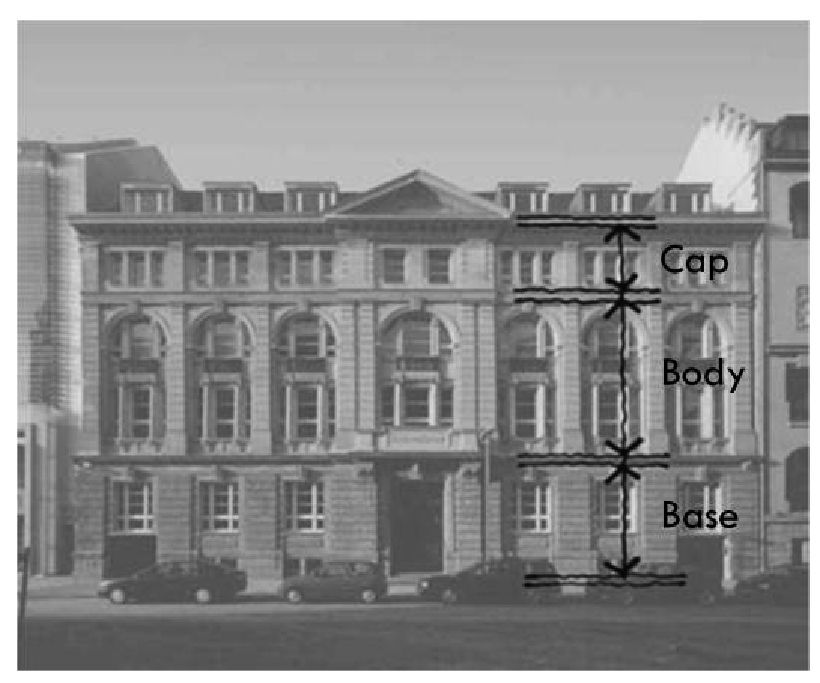
Figure 3. Building Articulation
a.
The incorporation of expressed architectural bays shall be encouraged to break up large unbroken surfaces along the street wall.
b.
All projects shall provide horizontal architectural treatments and/or façade articulations such as cornices, friezes, balconies, piers, awnings, pedestrian amenities, or other features for the first 15 feet of building height, measured vertically at street level.
c.
Projects with 60 linear feet or more of building frontage shall provide vertical architectural treatments and/or façade articulations such as columns, pilasters, indentations, storefront bays, windows, landscaping, or other feature at least every 30 feet on center. The vertical break shall be at least 24 to 36 inches in width.
(Ord. No. 11-2012, § 2(Exh. A), 7-17-12)
Sec. 110-644. - Building continuity.
(1)
Maintain building openings that enhance building design and continuity, as well as the pedestrian experience.
a.
Buildings shall be generally designed to maintain a continuous street wall along the length of a block except to accommodate building articulation pursuant to section 110-643 and maximum building frontage standards pursuant to section 110-626.
(Ord. No. 11-2012, § 2(Exh. A), 7-17-12; Ord. No. 07-2015, § 2, 8-18-15)
Sec. 110-645. - Scale.
(1)
Maintain human scale of building that enhances the pedestrian experience at the ground floor of commercial areas.
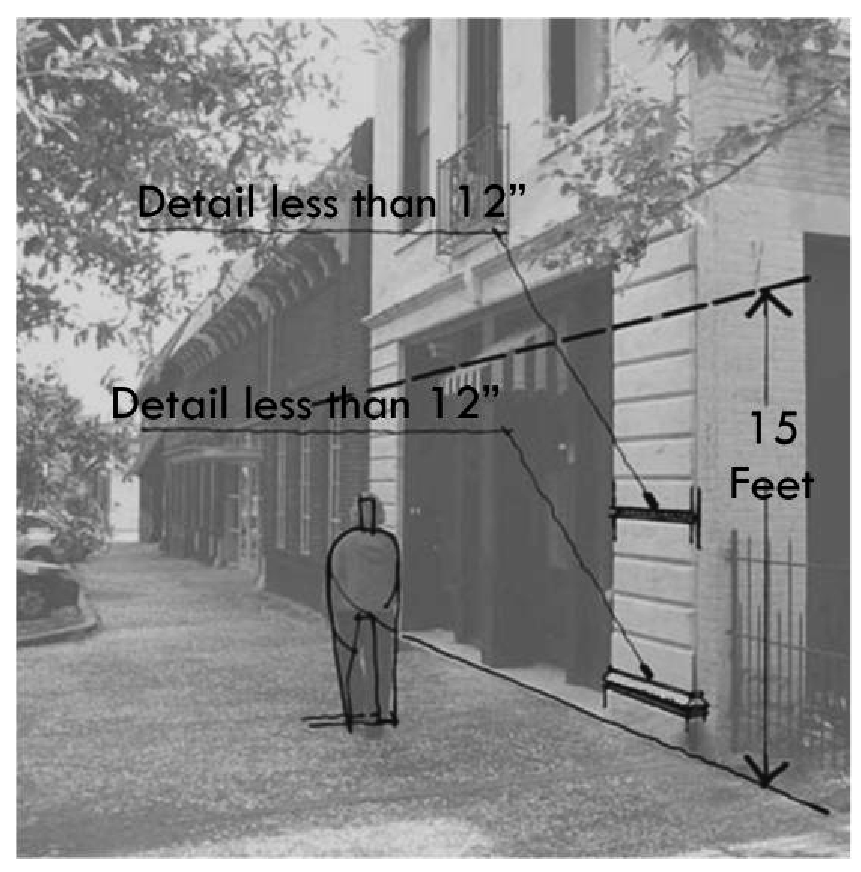
Figure 4. Building Scale
a.
Façades shall incorporate a minimum of two continuous details refined to the scale of 12 inches or less within the first 15 feet of the building wall, measured vertically at the street level, as illustrated in Figure 4.
(Ord. No. 11-2012, § 2(Exh. A), 7-17-12)
Sec. 110-646. - Proportion.
(1)
Maintain ground level pedestrian scale with traditional storefront façade components and proportions to provide a consistent pattern of architectural detailing, including the use of decorative elements, changes in rooflines and windows, and changes in building materials and color.
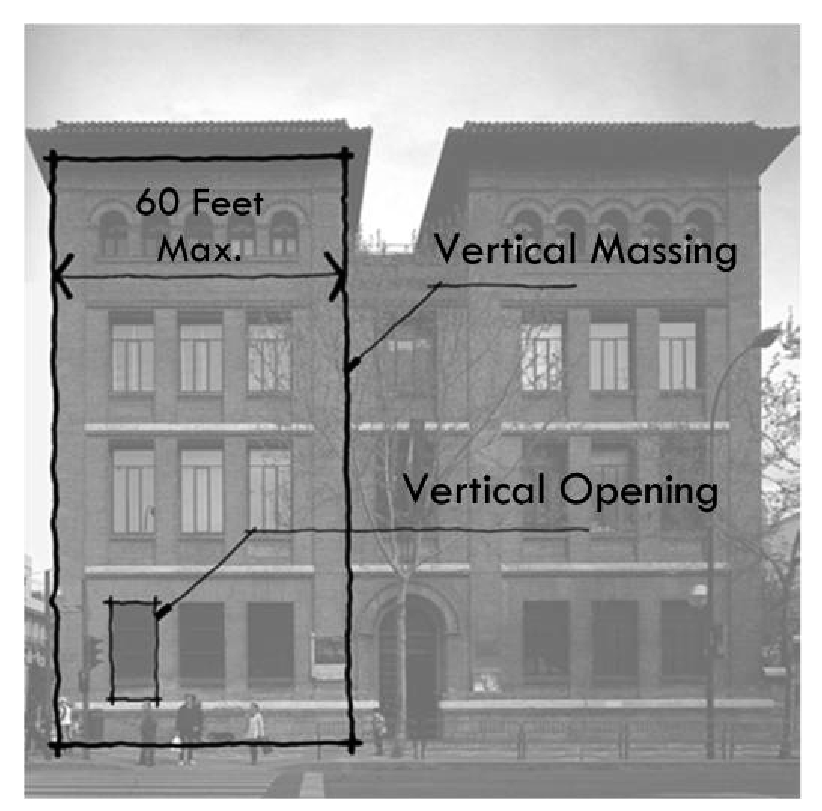
Figure 5. Building Proportion
a.
The frontage of buildings shall be divided in architecturally distinct sections of no more than 60 feet in width with each section taller than it is wide.
b.
Windows and storefront glazing shall be divided to be either square or vertical in proportion so that each section is taller than it is wide, as illustrated in Figure 5.
c.
Vertical and horizontal design elements, including columns, pilasters, and cornices, shall be defined at both the ground level and upper levels to break up the mass of buildings.
(Ord. No. 11-2012, § 2(Exh. A), 7-17-12)
Sec. 110-647. - Rhythm.
(1)
Solid blank walls shall be avoided through the use of façade modulation or other repetitive architectural detailing to maintain visual organization of the building's façade.
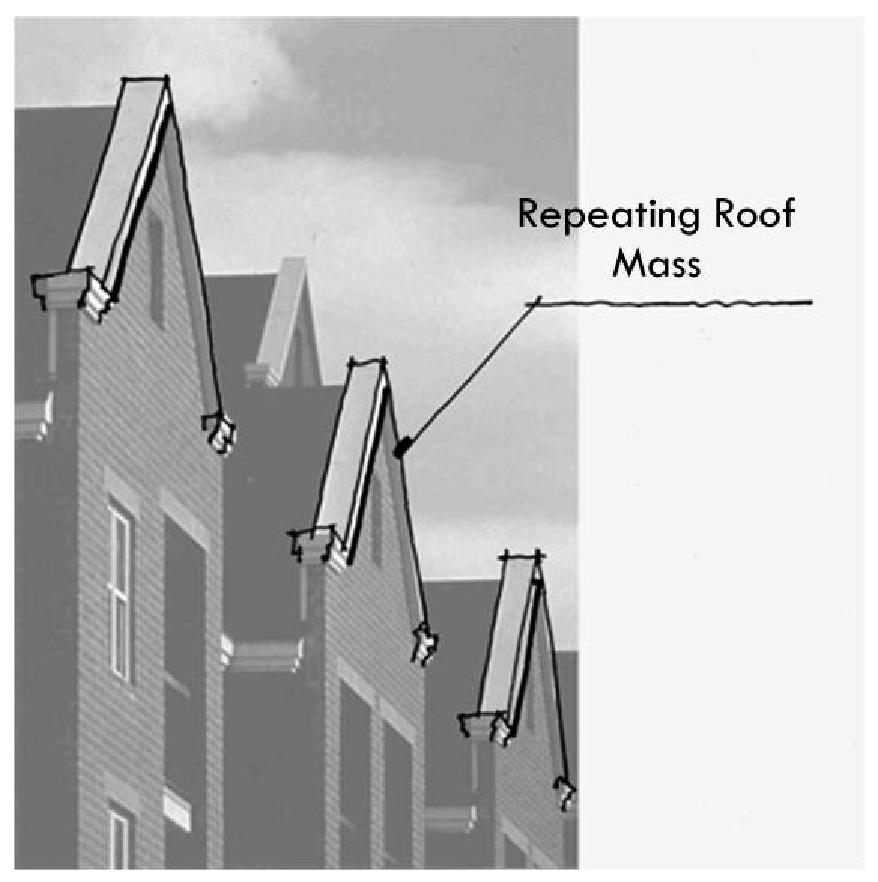
Figure 6. Facade Rhythm
a.
A minimum of one significant detail or massing component shall be repeated no less than three times along each applicable elevation, as illustrated in Figure 6.
b.
The scale of the chosen element shall relate to the scale of the structure.
(Ord. No. 11-2012, § 2(Exh. A), 7-17-12)
Sec. 110-648. - Entry treatment.
(1)
Construct a dominant entryway to reinforce the character of the building, add visual interest, break up the monotony of flat surfaces, add a vertical element to break up the façade of the building and create an inviting entrance.
a.
A dominant entryway fronting a public street that is differentiated from the building façade and provides a distinctive use of architectural treatments, materials, or special lighting shall be constructed.
b.
Buildings constructed on a corner shall place the dominant entry on the corner at a diagonal. The use of a curvilinear element for this entryway is strongly encouraged.
c.
Building entries shall be illuminated at night.
d.
Doors shall be comprised of non-tinted clear glass, which is free of temporary signage and/or other types of materials that may obstruct visibility.
(Ord. No. 11-2012, § 2(Exh. A), 7-17-12)
Sec. 110-649. - Roof lines.
(1)
Design new buildings to achieve consistency by creating continuity between the heights of adjacent roofs, parapets, and cornices, where possible.
a.
Roof lines shall be designed to reflect a distinct style (such as) a relatively consistent horizontal cornice with a dominant vertical architectural element to meet the roof line; or 2) a collage effect with clearly juxtaposed roof lines that have a repetitive element.
b.
Severe roof pitches that create prominent out-of-scale building elements shall be avoided.
(Ord. No. 11-2012, § 2(Exh. A), 7-17-12)
Sec. 110-650. - Exterior surface materials.
(1)
Select high quality, human-scale building materials to reduce building mass, create visual interest, and complement the community vision for architectural style of the A1A EOOD.
a.
The base of a building (the first two to five feet above the sidewalks) shall be differentiated from the rest of the building façade with treatments such as change in material and/or color.
b.
The exterior façade of buildings shall incorporate no less than two building materials including but not limited to tile, brick, stucco, cast stone, stone, formed concrete or other high quality, long-lasting masonry material over a minimum 75 percent of the surface area (excluding windows, doors and curtain walls.) The remainder of the wall area may incorporate other materials.
(Ord. No. 11-2012, § 2(Exh. A), 7-17-12)
Sec. 110-651. - Windows and transparency.
(1)
Add visual interest and create a feeling of openness by incorporating window display areas and windows with architectural defining features such as window frames, sashes, muntins, glazing, paneled or decorated jambs and moldings. For purposes of this section, a window display area shall be an interior storefront or shop window area which is visible from outside the storefront or shop and designed to display an arrangement of merchandise and other items for sale or otherwise designed to attract customers to the store or place of business. A window display area shall be oriented to create outside visual interest and shall have a minimum depth of at least three feet measured from the interior surface of the storefront or shop window into the store or shop and a maximum height of 15 feet measured from pedestrian grade.
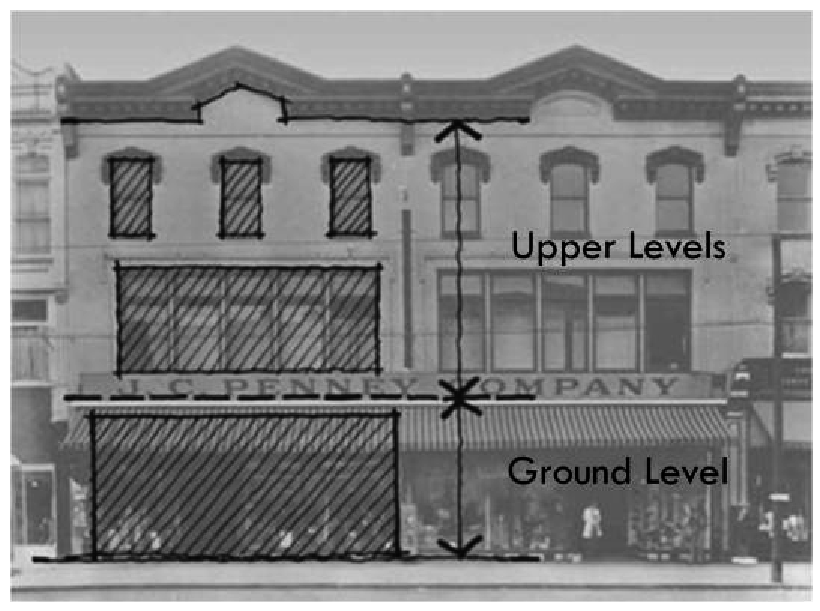
Figure 7. Windows & Transparency
a.
A minimum percentage of transparency along a street or primary travel way for different levels of non-residential uses shall be achieved as follows:
1.
Ground level retail: 25% of surface area minimum;
2.
Ground level office or other commercial uses: 15% of surface area minimum;
3.
Ground level of commercial use over 25,000 SF: 10% of surface area minimum; and
4.
Upper levels of all uses: 15% of surface area minimum.
b.
Transparency of the ground level shall be calculated within the first 15 feet of the building wall, measured vertically at street level, as illustrated in Figure 7.
c.
In cases where a building has more than two façades fronting a street or primary travel way, the transparency requirement shall only be required on two façades based on pedestrian traffic and vehicular visibility.
d.
All ground level windows shall be required to meet the minimum transparency requirements by providing either direct views to the building's interior or to a lit window display area. Window signs may be placed within the window display area, without limitation, provided any such window sign affixed to or in contact with the window glass shall not exceed 25 percent of the total window glass area fronting the window display area. Further, window signs outside of a window display area shall be prohibited unless such signs are exempted under section 94-4(6) of the City Code based on the amount of such signs that exist within total window glass area that is not incorporated into the window display area.
e.
Ground level windows shall extend above a minimum 18 to 24 inch base.
f.
A continuous curtain wall of glass which exceeds 30 feet in width and 15 feet in height without intervening vertical and horizontal breaks of at least 24 to 36 inches, shall be prohibited.
g.
Street facing, ground floor windows shall be comprised of non-tinted, clear glass.
h.
Windows on the upper levels of buildings may be comprised of tinted glass to reduce glare and unnecessary reflection.
(Ord. No. 11-2012, § 2(Exh. A), 7-17-12; Ord. No. 08-2014, § 3, 9-16-14)
Sec. 110-652. - Storefronts.
(1)
Promote an active pedestrian district by incorporating attractive and functional storefronts into new construction.
a.
Multiple tenants with storefronts within a single building shall be architecturally consistent, but defined and separated through structural bays, horizontal lintels, vertical piers or other architectural features up to 30-foot intervals.
b.
Individual storefronts shall not be used for storage or left empty without window displays.
(Ord. No. 11-2012, § 2(Exh. A), 7-17-12)
Sec. 110-653. - Color.
(1)
Use a color palette which complements adjacent buildings and promotes a consistent color scheme on the site.
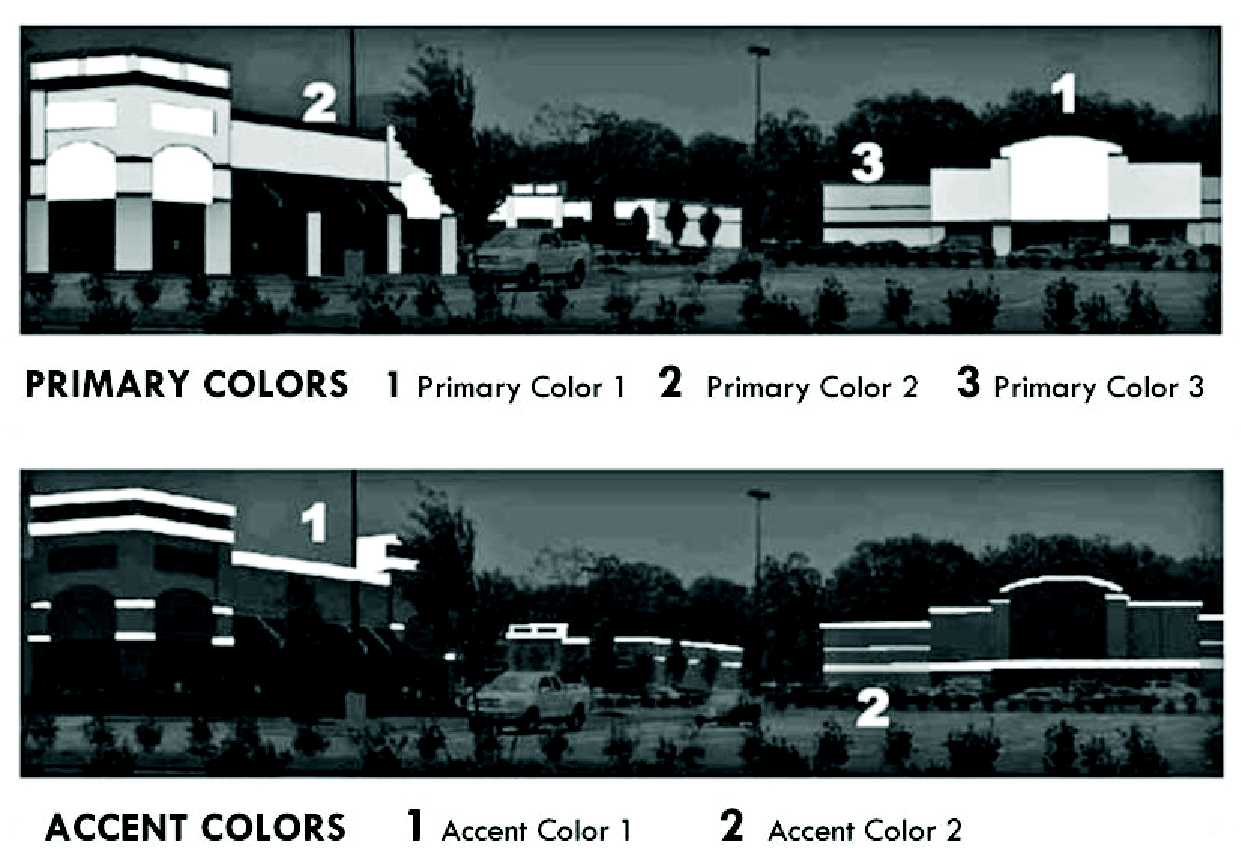
Figure 8. Building Color
a.
A maximum of three primary colors for each building segment may be proposed with a maximum of two accent colors, as illustrated in Figure 8.
b.
Bright or intense colors shall not be utilized for large areas unless consistent with the historical context of the area as shown in historic documentation.
c.
Bright colors on architectural detailing, trim, window sashes, doors and frames, or awnings may be used if they are consistent with the historical context of the area as shown in historic documentation.
d.
All vents, gutters, down spouts, etc., shall be painted to match the color of the adjacent surface, unless being used expressly as trim or an accent element.
(Ord. No. 11-2012, § 2(Exh. A), 7-17-12)
Sec. 110-654. - Awnings and canopies.
(1)
Add awnings or canopies to provide variation to simple storefront designs in order to establish a horizontal rhythm between structures where none exists and add color to a storefront.
a.
The size, scale and color of the awnings shall be compatible with the rest of the building and shall be designed as an integral part of the building architecture.
b.
Awnings and canopies shall be constructed of high quality, substantial materials which must be durable and fade resistant and maintained in good condition and replaced periodically.
c.
Canopies and awnings that span an entire building are discouraged. The careful spacing of awnings that highlight certain features of a storefront or entryway is encouraged.
d.
Canopies and awnings shall be located a minimum of eight feet above the sidewalk. Canopies and awnings may extend into the required setbacks by up to 50 percent of the required setback providing they do not impede pedestrian flows and or restrict utility and drainage easements.
(Ord. No. 11-2012, § 2(Exh. A), 7-17-12; Ord. No. 07-2015, § 2, 8-18-15)
Sec. 110-655. - Ground floor lighting.
(1)
Incorporate lighting into the design not only to accentuate architectural features, but to provide a safe environment for pedestrian activity.
a.
Lighting shall be shielded to prevent glare to adjacent properties.
b.
Intense lighting which is used solely for advertising purposes shall not be used.
c.
Buildings shall be highlighted through "up" lights or accent lights placed on the façade.
d.
Neon lighting shall not be used to outline a building except when it is integral to the architectural design of the structure, such as the instance of Art Deco or other historically and architecturally appropriate design elements.
(Ord. No. 11-2012, § 2(Exh. A), 7-17-12)
Sec. 110-656. - Utilities and stormwater management area screening.
(1)
Screen or enclose existing utilities, storage areas, mechanical equipment, fire alarms, sprinklers and other service areas with attractive landscaping or architectural barriers.
a.
Screen or enclose rooftop mechanical equipment by materials that are architecturally integrated with the building.
b.
Locate enclosed trash/recycling containers at the rear where they are not visible to the public.
c.
Trash/recycling storage bins shall be located within a gated, covered enclosure constructed of materials identical to the exterior wall of the building and screened with landscaping, so as not to be viewed from the public right-of-way.
(2)
When fencing is required around on-site stormwater management areas (retention/detention ponds) which are located in front of the building's primary façade and along a street or primary travel way, it shall be decorative fencing and shall not be chain-link fencing.
(Ord. No. 11-2012, § 2(Exh. A), 7-17-12)
Sec. 110-668. - Intent.
The location and design of parking lots and buildings in a development is critical in promoting safety for pedestrians and minimizing conflict with vehicles. Parking structures and areas shall form an integral part of the project and be well landscaped, so as not to detract from the pedestrian experience and maintain visual interest.
(Ord. No. 11-2012, § 2(Exh. A), 7-17-12)
Sec. 110-669. - Surface parking.
(1)
Locate surface parking in the rear or side of buildings and provide pedestrian access from the parking to the building and street. However, due to the nature of certain uses, the director of community development or designee may approve up to one row of parking between the front of a building and street.
a.
A surface parking lot adjacent to a public street shall conform to the landscape requirements detailed in division 6 of this article.
(Ord. No. 11-2012, § 2(Exh. A), 7-17-12; Ord. No. 07-2015, § 2, 8-18-15)
Sec. 110-670. - Parking structures.
(1)
When a parking structure is included in a project, it shall be integrated into the overall design of a development.
a.
Parking structures shall be compatible with the main building through a consistency in building material, color and architectural defining features.
(Ord. No. 11-2012, § 2(Exh. A), 7-17-12; Ord. No. 07-2015, § 2, 8-18-15)
Editor's note— Ord. No. 07-2015, § 2, adopted August 18, 2015, repealed § 110-670, which pertained to shared parking and derived from Ord. No. 11-2012, § 2(Exh. A), 7-17-12. Additionally, said ordinance renumbered § 110-671 as § 110-670.
Sec. 110-671. - Dimensions.
Each space must contain at least 180 square feet of area and shall conform to offstreet parking dimensional requirements as set forth in section 110-494.
(Ord. No. 04-2017, § 2, 4-18-17)
Sec. 110-683. - Intent.
Through the use of a variety of vegetation such as trees, shrubs, ground cover, perennials and annuals, as well as other materials such as rocks, water, sculpture or paving materials, landscaping unifies streetscape and provides a positive visual experience. Landscaping also can emphasize sidewalk activity by separating vehicle and pedestrian traffic, provide shade, define spaces, accentuate architecture, create inviting spaces and screen unattractive areas. Also, since water resources are limited and water restrictions are commonplace in East Central Florida, especially in the coastal areas, the city is incorporating water-efficient landscape standards as a means to help conserve water use for landscaping.
(Ord. No. 11-2012, § 2(Exh. A), 7-17-12)
Sec. 110-684. - Commercial site plan review.
(1)
All development and redevelopment of real property, including all structures, whether temporary or permanent, within the district shall comply with the provisions of this section.
a.
Construction requiring site plan review shall not be permitted until a landscape plan consistent with this section has been submitted to and approved by the community development department.
b.
Landscape plans for all projects shall be prepared, signed and sealed by a registered landscape architect.
c.
The landscape plans shall be drawn to a scale between one inch equals ten feet, and one inch equals 40 feet.
(2)
The landscape plan shall include notations of all elements required by this section or the information shall be attached to specify compliance with this section, and at a minimum, shall include the following.
a.
The "limit of work" line for the subject project to include any adjacent property trees located up to ten feet beyond the property line;
b.
All overhead utility lines, transformers, easements, and underground utilities, sidewalks located within the project, and ground or pole signs as defined in chapter 94 of this Code;
c.
All existing and proposed light poles, fire hydrants, and backflow prevention devices;
d.
Building finished floor elevation(s) and building overhang(s);
e.
Proposed site grading, including spot elevations, and contour lines at one-foot intervals;
f.
Healthy and viable existing on-site trees and shrubs of a Code-acceptable size, species and location that are intended to be preserved and applied toward the requirements of this section. Details of the protective barriers and/or other protective measures to be used for said preservation shall be provided;
g.
Notes indicating that all existing invasive exotic plants, as listed in the Florida Exotic Pest Plant Council (FLEPPC) Invasive Plant Species List (2011), shall be removed (any disturbance of a wetland area requires compliance with chapter 106 of this Code.);
h.
A plant schedule which describes all proposed landscape materials, including specifications as to the species, size, spacing, opacity, and quantity of plant material;
i.
In no case shall a landscape plan incorporate the use of prohibited invasive exotic plant species as described in F.S. § 581.091, as may be amended;
j.
Nothing in this article shall be construed to prohibit or be enforced to prohibit any property owner from implementing city-approved low impact development techniques for stormwater management and capture or Florida Friendly Landscaping on their land; and
k.
In all cases, a certification from the landscape architect stating that the landscape plan is designed in accordance with this section.
(Ord. No. 11-2012, § 2(Exh. A), 7-17-12)
Sec. 110-685. - Water efficient landscaping.
The following water-efficient landscaping principles shall be considered when designing a landscape plan as specified in section 110-684 of this Code:
(1)
Plant selection: In preparing the landscape plan, plant material shall be selected that is best suited to withstand the growing and soil conditions of coastal areas. Plant species that are freeze and drought tolerant are preferred.
(2)
Turf grass: Turf grass areas shall be consolidated and limited to those areas on the site that receive pedestrian traffic, provide for recreational uses, provide soil erosion control such as on slopes or in swales, where turf grass is used as a design unifier, or other similar practical use. The landscape plan shall label the intended use of turf areas.
(3)
Mulch: A layer of organic mulch, installed to a minimum depth of two inches, shall be specified on the landscape plans in plant beds and around individual trees in turf grass areas. Mulch shall not be required in annual beds.
(4)
Irrigation: Whenever available, reuse water shall be used for irrigation in accordance with section 90-176 of this Code. All irrigation systems shall conform to the requirements set forth in chapter 91 of this Code and shall be certified by the licensed contractor or licensed professional to be in compliance with chapter 91 irrigation system requirements in design. Certification shall include language providing that the system shall be installed in compliance with the chapter 91 irrigation system requirements. This certification shall be submitted to the city on the landscape plan.
(5)
As an option, Florida Friendly Landscaping principles, as described in F.S. § 373.185(1)(b), as may be amended, may be utilized for the entire landscape plan.
(6)
The landscape plan shall contain certification by the registered landscape architect that the landscape plan is designed in compliance with this Code and the certification shall be submitted to the city as a component of the initial submittal of the commercial site plan. Such certification shall be stated directly on the landscape plan.
(Ord. No. 11-2012, § 2(Exh. A), 7-17-12)
Sec. 110-686. - Screening between commercial or industrial zoning districts or uses and residential districts or uses.
(1)
Whenever the boundaries of a commercial or industrial zoning district or commercial or industrial use and a residential zoning district or residential use abut, a visual screen shall be provided within the required setbacks of the property which is developing or redeveloping.
(2)
Such visual screen shall:
a.
Be provided along the entire length of the boundary separating the commercial or industrial zoning district or commercial or industrial use from the residential zoning district or residential use.
b.
Have a minimum of one ten-point tree value as defined in section 110-567 which shall be planted every 35 feet with at least two five-point trees on the minimum 50-foot C-1 or 75-foot C-2 lot or commercial use and three five-point trees on the minimum 75-foot M-1 lot or industrial use.
(3)
Unless stated otherwise, all other requirements of section 110-566 not listed here, shall apply.
(Ord. No. 11-2012, § 2(Exh. A), 7-17-12)
Sec. 110-687. - Project perimeter.
(1)
To create visual interest and transition on the project perimeter, a landscaped area shall be provided between the adjacent properties and the public right-of-way.
a.
The landscaped area shall be equal to the full linear length of the property and have a minimum depth of five feet.
b.
At least 50 percent of the required landscaped area shall consist of landscaping capable of achieving a minimum of 30 inches in height, with one medium or large tree planted for each 25 feet or fraction thereof of the linear property length, or one small tree or palm tree planted for each 15 feet or fraction thereof of the linear property length. When locating trees, consideration shall be given to impact on underground and overhead utility lines.
c.
The layout of the required landscaped area shall be at the discretion of the owner, such that the required square footage may be aggregated to provide maximum aesthetic value. However, each perimeter requiring landscape must have at least 50 percent of the required landscape along that perimeter.
d.
Unless otherwise expressly required by this article, the community development director may exempt a perimeter boundary from this section if he determines that the perimeter boundary does not abut a public space, including, but not limited to, a public road, sidewalk or park, and the perimeter boundary does not create any visual interest or transition on the perimeter between adjacent properties.
e.
Commercial parking facilities subject to section 110-690 are exempt from this section.
(Ord. No. 11-2012, § 2(Exh. A), 7-17-12; Ord. No. 03-2013, § 2, 3-19-13; Ord. No. 07-2015, § 2, 8-18-15)
Sec. 110-688. - Building landscaping.
(1)
Landscaping is required at the base of buildings to create visual interest and to soften the contrast of the building and the other vegetated areas.
a.
A landscaped area shall be provided around the base of all buildings oriented toward public rights-of-way or public parking areas. The rear of the building shall not be included within the landscaped area unless it is oriented to a public right-of-way.
b.
This landscaped area shall be equal to 50 percent of the linear length of the building base oriented toward the rights-of-way or parking areas, with a minimum width of four feet.
c.
At least half of the required landscaped area shall contain landscape material other than ground cover, with trees provided at a ratio of one tree per 200 square feet of required landscaped area or fraction thereof. The distribution of the landscaped areas shall be at the discretion of the owner.
d.
Building landscaping may be applied towards meeting the perimeter landscaping requirement in this section.
(Ord. No. 11-2012, § 2(Exh. A), 7-17-12)
Sec. 110-689. - Surface parking lots.
(1)
Buffer off-street parking adjacent to a public right-of-way or residential buildings or residential zoned property with a landscaped barrier.
a.
Interior landscaping for off-street parking shall conform to the requirements of section 110-567 of this Code.
b.
Minimum landscape buffer width between the right-of-way and the parking or vehicular access area along A1A, Central Boulevard, and N. Atlantic Avenue shall be ten feet and five feet along all other streets.
c.
A knee wall which is at least 30 inches in height is required when an off-street parking area is located within 25 feet of the public right-of-way.
d.
A continuous landscape berm at an average height of 30 inches from grade may be permitted in lieu of a required knee wall.
e.
A knee wall or berm may be, staggered, meandering or continuous.
f.
A knee wall or berm shall not obstruct any safe sight distance triangle.
g.
A knee wall shall be compatible with the architectural design, material, and color of the principal building of the project.
h.
Lighting shall not be used to create an attraction, distraction, or commercial signage intent to the wall or berm.
i.
For the purpose of this standard, a mixed-use building which includes residential units shall not be defined or categorized as a residential building.
(Ord. No. 11-2012, § 2(Exh. A), 7-17-12; Ord. No. 07-2015, § 2, 8-18-15)
Sec. 110-690. - Required screening for commercial parking facilities.
A commercial parking facility shall include a fence or wall around the perimeter of the facility. Further, a perimeter boundary landscape buffer shall be required when a commercial parking facility is located adjacent to a non-industrial type use or a public space, including, but not limited to, a public road, sidewalk or park. When the perimeter boundary is located adjacent to a non-industrial type use the community and economic development director may exempt a perimeter boundary from the landscape buffer requirement if the landscape buffer would not create any visual interest or transition on the perimeter between adjacent properties (e.g. landscape buffer not visible from non-industrial use). Landscape buffers required pursuant to this section shall be consistent with the following:
(a)
Opaque walls and fences shall be continuously landscaped along the outside perimeter using shrubs and trees with minimal gaps or breaks in between plantings.
(b)
Chain link fencing or other non-opaque walls or fences shall be continuously landscaped along the outside perimeter with shrubs, plus one 10-point tree, as defined by section 110-567, every 35 feet in order to provide an opaque screen.
(Ord. No. 03-2013, § 2, 3-19-13)
Sec. 110-701. - Intent.
The placement, construction, color, font style, and graphic composition of signs have a collective impact on the appearance of the entire district. Therefore, signage shall be integrated with the overall design of a building and its surrounding landscape. Signage shall convey a simple straightforward message to identify businesses and/or to assist pedestrians and vehicular traffic in locating their destination. The size, number, location and use of signage are further regulated in chapter 94 of this Code.
(Ord. No. 11-2012, § 2(Exh. A), 7-17-12)
Sec. 110-702. - All signs.
(1)
Design signage which is incorporated into the overall design of a building and complements the façade or architectural element on which it is placed.
a.
All signs shall be maintained in good repair.
b.
Easy to read signs with a brief simple message and a limited array of font styles are encouraged.
c.
Colors shall be selected to contribute to the legibility and design integrity of a sign with sufficient contrast between the background color and that of the letter or symbol.
d.
Signs shall not dominate or obscure the architectural elements of building façades, roofs or landscaped areas.
e.
Signs may be constructed of metal, stone, wood, recycled composite material or other non-illuminated material.
f.
Signs made up of channel lettering, hung away from the face of a building such as a projecting sign and or signs perpendicular to the face of a building tend to have a lighter appearance and are permitted.
g.
Neon signs and channel lettering are permitted.
h.
Internal illumination shall be used only for signs composed of individual channel or neon letters or graphics.
i.
Energy efficient light, such as LED (light-emitting diode) or other current technology shall be used throughout all signage types.
j.
The height and width of letters and logos shall be properly proportioned to the sign area on which the sign is to be located.
k.
Signs shall be scaled to fit within the boundaries of a storefront or building it is advertising.
l.
The exposed backs of all signs visible to the public shall be suitably finished and maintained.
m.
Projects or buildings containing more than one storefront shall have a planned coordinated sign program that provides consistency with regard to height, size, shape, colors and degree of illumination.
n.
The restoration of historic signage as may be prescribed in recognized preservation guidelines and historic documentation is strongly encouraged.
o.
No later than 90 days following the closing of a business, any related signs shall be removed and replaced with blank panels or painted out.
(Ord. No. 11-2012, § 2(Exh. A), 7-17-12)
Sec. 110-703. - Awning signs.
(1)
Develop awning signs that are harmonious with architectural details of the façade and which do not detract from the overall design.
a.
Signage shall be limited to the skirt (valence) of the awning and shall not be on the awning face.
b.
If illuminated, awning sign illumination shall be external. Back-lit, translucent signs are prohibited. Lighting shall be directed downward and shall not illuminate the awning.
c.
To avoid having to replace awnings or paint out previous tenant signs when a new tenant moves in, the use of replaceable valances shall be considered.
d.
The shape, design, and color of the awnings shall be carefully designed to coordinate with, and not dominate, the architectural style of the building. Where multiple awnings are used, on the building, the design and color of the sign awnings shall be consistent.
(Ord. No. 11-2012, § 2(Exh. A), 7-17-12)
Sec. 110-704. - Pedestrian signs.
(1)
Develop coordinated pedestrian signage, which complements the pedestrian orientation of the A1A and Central Boulevard Corridor.
a.
Each business on the ground floor may have one pedestrian sign, except that corner businesses with frontage on both streets may have two pedestrian signs.
b.
Each business that is located on a second floor may have a pedestrian sign on the ground level if there is direct exterior pedestrian access to the second floor business space.
(Ord. No. 11-2012, § 2(Exh. A), 7-17-12)
Sec. 110-705. - Projecting signs.
(1)
Design projecting signs, which are compatible with the architectural context of the A1A EOOD and which improve the overall appearance of the area.
a.
Projecting signs shall be hung at a 90-degree angle from the face of the building.
b.
Appropriate materials include wood, metal, recycled composite material or other non-illuminated material with carved or applied lettering, or any other material that is architecturally compatible with the building to which the sign is attached.
c.
Sign supports and brackets shall be compatible with the design and scale of the sign and the architectural design of the building. Where appropriate, decorative iron and wood brackets are encouraged.
d.
The text, copy, or logo face shall not exceed 75 percent of the sign face of a projecting sign.
(Ord. No. 11-2012, § 2(Exh. A), 7-17-12)
Sec. 110-706. - Wall signs.
(1)
Design wall signs to be compatible with the architectural context of the A1A EOOD and which improve the overall appearance of the area.
a.
Multiple wall signs on a building façade shall be located in order to maintain a physical separation between each individual sign, so it is clear that the sign relates to a particular store below.
b.
Wall signs shall be mounted on a flat building surface, and, unless a projection is an integral design element, shall generally project as little as possible from the building's face. Wall signs shall not be placed over or otherwise obscure architectural building features, nor shall they extend sideways beyond the building face or above the highest line of the building to which it is attached.
c.
Wall signs shall be located on the upper portion of the storefront, within or just above the storefront opening. On multiple story buildings, the best location for a wall sign is generally a band or blank area between the first and second floors.
d.
New wall signs in a shopping center that does not have an approved sign program shall be placed consistent with sign locations on adjacent businesses.
e.
For new and remodeled shopping centers, a comprehensive sign program for all the signs in the center shall be developed and approved by the community appearance board.
(Ord. No. 11-2012, § 2(Exh. A), 7-17-12)
Sec. 110-707. - Hanging signs.
(1)
Design hanging signs to be suspended below a marquee or a canopy to help define entries and identify business names to pedestrians.
a.
Where overhangs or covered walkways exist, pedestrian-oriented hanging signs are encouraged.
b.
Hanging signs can be particularly useful for storefronts that have multiple tenants.
c.
Hanging signs shall be simple in design and not used to compete with any existing signage at the site, such as wall signs.
(Ord. No. 11-2012, § 2(Exh. A), 7-17-12)
Sec. 110-708. - Window signs.
Design window signs to complement the façade of the building and be incorporated into and not detract from the overall design.
(Ord. No. 11-2012, § 2(Exh. A), 7-17-12)
Sec. 110-709. - Business park/area multi-user sign.
Pursuant to a developer's agreement approved by council, a multi-user sign may be erected on SR A1A, Center Street and/or Central Boulevard to provide signage for properties/businesses located along Central Street, Imperial Boulevard, Brown Circle, and Commerce Street.
(Ord. No. 08-2014, § 3, 9-16-14)

