
Carl City Zoning Code
ARTICLE III
RESTRICTIONS ON PARTICULAR USES
Sec. 89-121. - Purpose of article.
The purpose of this article is to provide land use and development regulations for specific uses that will then be applicable to sites throughout Barrow County. This section includes provisions for site and architectural design standards applicable to residential and nonresidential uses, as specified in the sections below. Unless otherwise noted, these standards are intended to be applied within all zoning districts where the particular uses are permitted, whether by right or through special use approval.
(Ord. of 10-13-2020)
Sec. 89-122. - Agricultural separation requirements.
(a)
Distancing requirements for agricultural uses.
(1)
The following agricultural structures or operations, when constructed or established must be at least 200 feet from any property line adjacent to a residential structure or zoning district:
a.
Any active poultry house or other structure housing livestock of any type other than kennels and horse stables containing fewer than four stalls.
b.
Any structure used for processing, distilling, bottling or sale for on-site production of wine.
c.
A horse stable containing more than four stalls, and any corral, pen or designated riding area.
d.
Feedlots and hog parlors.
e.
Manure and other waste storage containers or pits and agricultural waste impoundment sites.
(2)
The following structures or operations when constructed or established must be at least 100 feet from any property line adjacent to a residential structure or zoning district:
a.
Accessory agricultural buildings for storage or operations not involving the housing of animals.
b.
Commercial greenhouses and nurseries.
c.
Kennels.
d.
Horse stables with four or fewer stalls.
(b)
Separation from existing agricultural uses. When a new residence is to be constructed on a neighboring property in proximity to any existing agricultural structure or operation for which separation is required by this Development Code, but the existing structure or operation does not comply with such required distance, the new residence shall be separated from such structure or operation as follows:
(1)
Increase principle building setback one foot for each one foot as described above.
(2)
Setback increase waived if natural or structural buffer is provided for one-half foot of each one foot of required distancing as described above.
(Ord. of 10-13-2020)
Sec. 89-123. - Environmentally hazardous uses.
(a)
Special use approval required. Any use that requires a federal or state permit due to the handling, storage, production or processing of bio-medical or hazardous materials, products or waste, if otherwise allowed in a zoning district, must obtain approval as a special use from the board of commissioners. The special use application shall include a copy of the application for the federal or state permit.
(1)
Section 313 businesses. Any business that is required to file a toxic chemical release inventory report (Form R or Form A) under Section 313 of the Emergency Planning and Community Right-to-Know Act (EPCRA, or Title III of the Superfund Amendments and Reauthorization Act of 1986, Public Law 99-499) is subject to special use approval in order to operate in Barrow County. An initial Form R or Form A must be included in the application for special use approval.
(2)
Annual reporting required. A Section 313 toxic chemical release inventory report (Form R or Form A) shall be filed with the application for an occupational tax certificate annually when filed with the U.S. Environmental Protection Agency and the state. Failure to submit such report annually may be grounds to void county approval through re-initiation of the special use approval.
(b)
EPCRA Section 313 businesses. Businesses that may be subject to EPCRA Section 313 are those businesses with ten or more full-time employees that manufacture, process or use any EPCRA Section 313 toxic chemical and that may be classified under any one of the following categories. Specific determinations are made under EPA rules on a business-by-business basis.
(1)
Mining or manufacturing facilities. Businesses involved with toxic chemicals and engaged generally in any of the following industrial classifications:
a.
Metal mining;
b.
Coal mining;
c.
Food and kindred products;
d.
Tobacco products;
e.
Textile mill products;
f.
Apparel and other finished products made from fabrics and other similar materials;
g.
Lumber and wood products (except furniture);
h.
Furniture and fixtures;
i.
Paper and allied products;
j.
Printing, publishing and allied industries;
k.
Chemicals and allied products;
l.
Petroleum refining and related industries;
m.
Rubber and miscellaneous plastics products;
n.
Leather and leather products;
o.
Stone, clay, glass and concrete products;
p.
Primary metal industries;
q.
Fabricated metal products, except machinery and transportation equipment;
r.
Industrial and commercial machinery and computer equipment;
s.
Electronic and other electrical equipment and components, except computer equipment;
t.
Transportation equipment;
u.
Measuring, analyzing and controlling instruments; photographic, medical and optical goods; watches and clocks; and
v.
Miscellaneous manufacturing industries.
(2)
Any facility that combusts coal or oil for the purpose of generating electricity for distribution in commerce.
(3)
Any refuse system regulated under federal law.
(4)
Wholesale establishments engaged in storing chemical or allied products, or petroleum terminals or bulk storage.
(5)
Businesses primarily engaged in solvents recovery services on a contract or fee basis.
(Ord. of 10-13-2020)
Sec. 89-124. - Outdoor display areas.
Merchandise or goods may be on display outdoors for the purpose of customer selection or direct sale or lease to customers only as follows:
(a)
Types of merchandise on permanent display. The following merchandise or goods may be located in outdoor display areas on a permanent basis (where the use is otherwise permitted):
(1)
New or used motorized vehicles that are in operable and running condition.
(2)
Plant nursery items.
(3)
Light building materials such as lumber, patio pavers and decorative stone; yard furniture such as benches, swings and bird baths; and yard maintenance materials such as fertilizer, mulch, straw and seed.
(4)
Daily outdoor display. Retail goods such as books, antiques, furniture and produce may be displayed outdoors or on a daily basis, provided it is brought inside at the end of each business day.
(b)
Temporary events. All other outdoor display of merchandise or goods shall be conducted on a temporary basis associated with special sales promotions or events in accordance with section 89-187.
(c)
Restrictions.
(1)
Merchandise or goods on display outdoors must be located at least 20 feet from any property line.
(2)
Any area outside of a building where merchandise or goods are displayed for customer selection or direct sale but which is permanently screened by an opaque fence or freestanding wall at least six feet in height or a buffer meeting the standards of the buffers and tree conservation article (article VIII) of this Development Code shall not be considered an outdoor display area, but as outdoor storage.
(Ord. of 10-13-2020)
Sec. 89-125. - Outdoor storage.
The outdoor storage of goods, material or merchandise not otherwise on display for customer selection or direct sale or lease to customers, where the use is otherwise permitted, is limited as follows:
(a)
Outdoor storage in commercial zoning districts.
(1)
The outdoor storage of goods, material, merchandise or vehicles not otherwise on display for customer selection or direct sale or lease to customers in any of the commercial zoning districts is prohibited, except in the C-3 intensive commercial zoning district and in the industrial zoning districts.
(2)
In the C-3 intensive commercial zoning district, outside storage of materials is only permitted as an accessory use and subject to the following:
a.
Outdoor storage must be located in the rear yard and not abutting any residential district; or
b.
Outdoor storage must be located 50 feet from any property line and future right-of-way line; and
c.
The outdoor storage area must be screened from view by an opaque fence or freestanding wall no less than eight feet in height or a buffer meeting the standards of the buffers, landscaping and tree conservation article (article VIII) of this Development Code.
(b)
Outdoor storage in the industrial zoning districts.
(1)
Any storage use operated as a principal use or accessory use on a property zoned M-1 or M-2 shall be:
a.
Contained entirely within a building; or
b.
Screened from view by an opaque fence or freestanding wall no less than eight feet in height and appropriately landscaped and maintained in accordance with buffer and landscaping requirements in article VIII;
c.
Located in rear yard; and
d.
Setback at least 50 feet from any property line and any future right-of-way line.
(2)
Additional restrictions apply to salvage, junk and wrecking yards (see section 89-183).
(Ord. of 10-13-2020)
Sec. 89-126. - Walls and fences.
(a)
Walls and fences shall not be located within a utility or drainage easement unless specified otherwise in this Development Code.
(b)
Walls and fences shall meet all height, location, material and other applicable requirements established in this Development Code.
(Ord. of 10-13-2020)
Sec. 89-127. - Standards for single-family and two-family dwellings.
All single-family and two-family dwellings, including on-site built and industrialized housing, and manufactured homes, shall meet or exceed the following requirements in order to be constructed, assembled, moved into, or relocated within Barrow County:
(a)
Foundation.
(1)
The structure shall be attached to a permanent foundation constructed in accordance with the building code or state regulations, as applicable.
(2)
Upon placement, all means of transportation, such as towing devices, wheels, axles, and hitches, shall have been removed.
(3)
The area beneath the ground floor of the structure shall either be a slab foundation or shall be enclosed around the exterior of the structure with a foundation wall or a non-load-bearing curtain wall constructed of masonry (stone or brick) poured in place concrete, or concrete block finished with stucco or similar material, at least four inches thick, penetrated by openings only for installed vents and access doors.
(4)
Each manufactured home shall have tie-downs or other devices securing the stability of the manufactured home and shall be installed in accordance with the requirements of the installation of manufactured homes and mobile homes rules and regulations established under Georgia Law (O.C.G.A. §§ 8-2-160 et seq.)
(5)
A polyethylene liner must be installed under homes as per FHA or southern building code requirements for single-family housing.
(b)
Landings.
(1)
At each exterior door there must be a landing that is a minimum of 36 inches by 36 inches level with the doorway threshold or as required by the building code.
(2)
All homes shall be landscaped with trees and shrubs in a manner consistent with the buffers, landscaping and tree conservation article (article VIII) of this Development Code.
(c)
Exterior siding.
(1)
Exterior siding materials shall consist of any combination of wood, brick, stone, authentic stucco, or similar materials; high-quality vinyl that meets standards of the vinyl siding institute, wood or fiber cement lap siding, or similar materials as approved by the planning and community development director.
(2)
Metal siding, corrugated metal, and vinyl-covered metal siding are prohibited with the exception of manufactured homes and industrialized homes as defined in this Development Code.
(d)
Landscaping.
(1)
Landscaping for single and two-family dwellings, including those located within major subdivisions, shall meet the requirements of article VIII, Buffers, Landscaping, and Tree Protection.
(2)
All exposed ground surfaces on any lot shall be paved, covered with crushed stone, or protected with grass or other vegetative cover that is capable of preventing soil erosion and of eliminating objectionable dust.
(3)
Adequate screening shall be provided in accordance with article VIII to minimize the impact of rear-facing residential developments when the rear yard is visible from a major public street (arterial or collector) or abutting property.
(e)
Roofs.
(1)
All roof surfaces shall have a minimum pitch of 4:12 (four inches of rise for every 12 inches of run), except that mansard and gambrel roofs must meet this requirement only for those surfaces that rise from the eaves.
(2)
All roof surfaces exposed to view shall be covered with asphalt or fiberglass shingles, wood shakes or shingles, standing seam (noncorrugated) metal, clay tiles, slate, or similar materials as approved by the planning and community development director.
(3)
Minimum roof overhang shall be six inches, excluding gutters, along all sides of the structure.
(4)
All dwelling units shall conform to maximum building height requirements defined in article IV, Lot and Building Standards.
(f)
Minimum square footage.
(1)
Every dwelling unit shall provide a heated gross floor area in accordance with the floor area provisions set forth in section 89-408.
(g)
Minimum structure width. The minimum width of the entire structure shall be greater than 16 feet. Structure width shall be measured between all parallel exterior walls, with the exception of extensions from the main structure for dormers, bay windows, entrance foyers and similar appurtenances, and extensions of no more than four feet for other architectural elements of the structure's design.
(h)
Deviations from standards; where allowed. The board of commissioners, or their designee, may approve deviations from the standards contained in this section for a single-family or two-family dwelling or a manufactured home on a case-by-case basis upon a finding that all of the following are met:
(1)
Such deviation shall provide an adequate balance between the protection of the health, safety and welfare of the general public and the right to unfettered use of private property; and,
(2)
Such deviation shall foster beneficial development of the county in the public interest.
(i)
Compliance with codes. The dwelling shall be constructed in accordance with all applicable requirements of the development and building codes as adopted by the county, or in accordance with standards established by the National Manufactured Housing Construction and Safety Standards Act of 1974 (42 U.S.C. 5401, et seq.) for manufactured homes, or in accordance with state law and regulations for industrialized buildings, whichever apply.
(Ord. of 10-13-2020)
Sec. 89-128. - Standards for multi-family projects (including townhouses).
All multi-family dwellings located in any zoning district must comply with the requirements of this section unless specified otherwise. Multi-family developments within the Highway Corridor Overlay District must also meet requirements of article XVI.
(a)
General requirements.
(1)
Recreation amenities must comply with article V, Subdivisions and Master Planned Developments. Every townhouse or multi-family development must contain a community recreation amenity of adequate size or variety to serve the development, such as a community pool, tennis courts, playground, basketball courts, sidewalks, or bike trails.
(2)
Off-street parking facilities shall be grouped in bays, either adjacent to streets or at the rear of dwellings; and no off street parking space shall be more than 100 feet distance by the most direct pedestrian route from a door of the dwelling unit it intends to serve.
(3)
Curb and gutter is required on all internal public streets.
(4)
All common areas not included within lots or occupied by dwelling units must be set aside for community open space or recreational amenities.
(5)
All primary resource conservation areas, as defined in this Development Code, must be set aside under a conservation easement drawn in accordance with the environmental protection article (article IX) of this Development Code.
(6)
In addition to the customary accessory uses to a dwelling the following shall apply:
a.
A manufactured home may not be used as an accessory building in the manufactured home park.
b.
Convenience retail sales space may be provided within a building in the park, limited to no more than 25 square feet (or ten percent) of gross floor area per manufactured home space. Outdoor display or storage of merchandise and gasoline pumps are specifically prohibited.
(b)
Building orientation.
(1)
The principal building shall be oriented towards the street.
(2)
Buildings that are front face to front face or back face to back face or front face to back face shall not be less than 75 feet apart. No dwelling shall be situated as to face the rear of another dwelling structure within the development or on adjoining properties, unless differences in terrain and elevation or vegetation would provide effective visual separation.
(c)
Dwelling units per building.
(1)
Townhouses: No more than ten nor fewer than three continuous townhouses can constitute a building.
(2)
Other multi-family buildings: No more than eight dwelling units per floor can be included within a building used exclusively as a multi-family dwelling.
(3)
Lofts and mixed-use buildings: Within a mixed use master planned development or a zoning district that is allowed to have lofts (dwelling units over retail or office space) or mixed-use arrangements of commercial and residential within the same building, the minimum floor area required for the dwelling units and the building heights will control the maximum number of units allowed.
(d)
Minimum floor area. Refer to floor area provisions set forth in section 89-408.
(e)
Maximum height.
(1)
All multi-family buildings shall be a maximum height of three stories unless adequate fire protection services and facilities are available and shall not exceed maximum height standards in section 89-406 and Table 4.1.
(2)
Special use approval by the board of commissioners may be granted for buildings over four stories.
(f)
Townhouse developments.
(1)
Staggered front facades: Dwelling units in a building shall be staggered and of varied design, singly or in pairs, by at least three feet.
(2)
Townhouse developments shall be designed to provide proper access to the rear of all dwelling units for firefighting purposes.
(3)
In a townhouse development, each townhouse shall be provided with at least 400 square feet of personal outdoor space immediately adjacent to and accessible from the unit. Such space shall be screened from view from adjacent properties with a decorative fence, trellis or lattice, wall, hedge or other landscape treatment at least six feet high.
(g)
Exterior siding materials. Exterior siding materials for multi-family projects, including townhomes, shall consist of any combination of brick, stone, authentic stucco, and/or natural wood or cement-based artificial wood siding (Hardi-plank/board) siding, or similar material as approved by the planning and community development director.
(Ord. of 10-13-2020)
Sec. 89-129. - Standards for manufactured home parks.
(a)
Manufactured home park permit required. A plan drawn to a scale of not more than 200 feet per inch submitted to the planning and community development department for approval in order to obtain a manufactured home park permit.
(b)
Restrictions.
(1)
The minimum lot area for a park is five acres.
(2)
The minimum road frontage is 50 feet.
(3)
All access within the park shall have a minimum easement width of 36 feet and a pavement width of 20 feet and are required to be built to county local residential street construction standards. All manufactured home spaces must have direct access to streets within the park. No direct driveway access shall be permitted between manufactured home spaces and any exterior street.
(4)
No space or manufactured home shall be rented for a period of less than 30 days.
(5)
At least 20 percent of the park must be set aside as open space or for recreation purposes.
(6)
All primary conservation resource areas, as defined in this Development Code, shall be set aside under a conservation easement drawn in accordance with the environmental protection article (article IX) of this Development Code.
(7)
All streets within the park shall be lighted with a minimum spacing of 200 feet each.
(8)
All off-street parking areas or spaces and driveways shall be paved. Minimum driveway width is ten feet.
(9)
Connection to a county-approved water supply and sanitary sewer system is required for all manufactured home parks.
(10)
The maximum number of manufactured home spaces allowed per acre is seven. Manufactured homes may be placed in a clustered manner with excess area used for recreation or open space.
(11)
All manufactured home spaces shall have a minimum area of 5,000 square feet, a lot width of 50 feet, and a minimum of 70 feet in one direction.
(12)
A copy of the park management rules and regulations must be submitted to the Planning and Community Development Department for approval. The park operator will be responsible for compliance with these regulations by all tenants. Failure to abide by these regulations or any of the Barrow County Manufactured Home Park Requirements will be considered a valid reason for revoking the manufactured home park permit required to operate a manufactured home park in Barrow County.
(13)
Manufactured housing placed within the park must meet all requirements regarding manufactured housing as outlined within this Development Code. All homes shall bear a HUD sticker containing the manufacturer's certification that the home has been constructed in accordance with the federal manufactured home construction and safety standards in effect on the date of manufacture.
(14)
All exposed ground surfaces in all parts of the manufactured home park shall be paved, covered with crushed stone, or protected with grass or other vegetative cover that is capable of preventing soil erosion and of eliminating objectionable dust.
(Ord. of 10-13-2020)
Sec. 89-130. - Standards for pre-owned manufactured homes.
These standards are applicable to any pre-owned manufactured home that is proposed to be moved into or relocated within the county. Mobile homes, which are defined as manufactured homes that do not conform to the Federal Manufactured Housing Construction and Safety Standards Act (the HUD Code), are not allowed to be moved into or relocated within the county.
(a)
Pre-owned manufactured home; defined. A pre-owned manufactured home is a manufactured home, as defined in this Development Code, which has been placed, used or occupied as a residence subsequent to its original purchase as a new unit from a manufacturer or dealer.
(b)
Required certification. All pre-owned manufactured homes moved into or relocated within Barrow County must bear an approval seal (label) of either HUD or the Georgia Department of Community Affairs and shall not have been altered in such a way that the home no longer meets the HUD code.
(c)
Reserved.
(d)
Required inspection. Any pre-owned manufactured home being moved into or relocated within the county must pass inspection by a qualified HUD-certified inspector acceptable to the Planning and Community Development Department.
(1)
This inspection will cover, but not be limited to:
a.
Sanitary facilities.
1.
Every plumbing fixture, water, and waste pipe shall be in a sanitary working condition free from leaks or obstructions.
2.
Both cold and hot water must be supplied.
3.
Water heating facilities must be in safe working condition.
b.
Exterior condition.
1.
Every habitable room shall have at least one window that can be opened facing directly to the outdoors.
2.
The exterior of the home shall be free of loose or rotting boards or timbers and any other conditions that might admit rain or moister to the interior portions of the walls or to the occupied spaces.
3.
The exterior siding shall be free of rot and rust and must be uniform in appearance.
4.
Roofs shall be structurally sound and have no obvious defects that might admit rain or cause moisture to collect on the interior portion of the home.
c.
Safety of operating systems (electrical, heating, etc.), including:
1.
Heating facilities must operate in a safe working condition. Where a central heating system is not provided, each manufactured home shall be provided with facilities whereby a heating appliance may be connected.
2.
Unvented fuel burning heaters shall be prohibited except for gas heaters listed for unvented use and the total input rating of the unvented heaters is less than 30 BTU per house per cubic foot of room content.
3.
Unvented fuel burning heaters shall be prohibited in bedrooms.
4.
Distribution panels shall be in compliance with the approved listing, complete with required breakers or fuses, with all unused openings covered with blank covers approved and listed for that purpose. Connections shall be checked for tightness. Panels shall be accessible.
5.
Electrical systems (switches, receptacles, fixtures, etc.) shall be properly installed, wired and shall be in working condition. The home shall be subjected to an electrical continuity test(s) to assure that all metallic parts are properly bonded.
d.
The presence of operable smoke detectors.
e.
Interior condition.
1.
Every floor, interior wall and ceiling shall be in sound condition.
2.
Doors and windows shall be operable, watertight and in good working condition.
3.
The floor system shall be in sound condition and free of warping, holes, extensive water damage or deterioration.
f.
Timing of inspection.
1.
For a manufactured home to be relocated within the county, the inspection shall be conducted prior to moving the home from the original site.
2.
For a manufactured home being moved into the county, either:
i.
The inspection shall be conducted prior to moving the home from the original site; or
ii.
With the owner's written approval and acceptance of all liability, the inspection may be conducted at the new home site prior to connecting the manufactured home to a water supply, to a sanitary waste disposal system, and to permanent power.
(Ord. of 10-13-2020)
Sec. 89-131. - Restrictions on all manufactured homes.
(a)
The following restrictions are placed on all manufactured homes:
(1)
No manufactured home designed as a single family dwelling may be connected to a stick built home, another manufactured home, or to any industrialized home to create a larger home or multi-family dwelling, unless the units were specifically designed and manufactured for that purpose.
(2)
Any additions or accessory structures should be self-supporting without adding any live or dead loads to the manufactured home, with the following exceptions:
a.
The loads have been considered by the home manufacturer and the attachment to the manufactured home is specifically included in the home manufacturer's installation instructions;
b.
The connection and transfer loads are design by a registered professional engineer or architect; or
c.
Manufactured homes designed as a single family dwellings may not be converted or modified for use as a multi-family dwelling, storage building, or for a commercial use, unless the unit was specifically designed and manufactured for that purpose such as classroom trailers, construction storage trailers and office trailers.
(Ord. of 10-13-2020)
Sec. 89-132. - Standards for shipping container-based structures and industrialized buildings.
These standards are applicable to buildings or structures constructed from retrofitted metal shipping containers. The intent of this section is to ensure that structures utilizing metal shipping containers are in compliance with the Georgia Industrialized Buildings Act. [(O.C.G.A.) Title 8, Chapter 2, Article 2, Part 1]. The Georgia legislature has provided rules and regulations for the inspection and safety of industrialized buildings and structures constructed from shipping containers which are not covered by US Department of Housing and Urban Development (HUD) standards for manufactured housing.
(a)
Industrialized building; defined. Any structure or component which is designed in accordance with the Georgia Industrialized Buildings Act and manufactured in such a manner that all parts or processes cannot be inspected at the installation site without disassembly or damage.
(b)
Building permits are required prior to the installation of shipping container-based structures and industrialized buildings, and must include:
(1)
Plans and specifications for installation of industrialized building systems and component modules.
(2)
Evidence of compliance with the Georgia Industrialized Buildings Act, such as an inspection seal or insignia issued by the Commissioner of the Georgia Department of Community Affairs.
(Ord. of 10-13-2020)
Sec. 89-133. - Standards for non-residential buildings.
The following standards apply to all new construction and alternations within commercial zoning districts. Commercial buildings, including office buildings, retail buildings, shopping centers, institutional buildings, and similar nonresidential buildings shall adhere to the requirements in this section. However, these standards are not applicable to farm structures in agricultural zoning districts, industrial development, and buildings or other structures within the Highway Corridor Overlay District.
(a)
Intent. The purpose of these standards is to promote high quality nonresidential development that utilizes a common element of attractive, durable building materials in order to enhance the visual appeal of the community as a whole. Overtime, these standards are meant to establish a unique environment that is aesthetically pleasing, reflects a community identify, and enhances the overall quality of life in Barrow County.
(b)
Alternate standards.
(1)
These standards are intended to be followed as outlined below. However, in the event the intent of these standards can be achieved with minor deviations that do not substantially affect the purpose and intent of this Section, the Planning & Community Development Director, or his or her designee, has the authority to modify the specific provisions on a case-by-case basis.
(2)
If substantial modifications or changes are desired for a particular property or project, the property owner may present proposed modifications to the board of commissioners, or their designee, for review. Any application for alternate architectural design standards shall be accompanied with proposed elevations, building material descriptions and renderings that provide sufficient information for the board of commissioners to make a determination whether the alternate proposal meets the intent of these standards. As part of the approval process, the board of commissioners, or their designee, may include conditions, modifications, or requirements deemed necessary to maintain the high level of development quality intended by this Code Section.
(c)
Exemptions.
(1)
Farm structures in agricultural zoning districts;
(2)
Buildings or other structures within the Highway Corridor Overlay District; and
(3)
Industrial development shall be exempt from design standards in subsection (e) of this section.
(d)
Building orientation.
(1)
Principal buildings shall be oriented towards the street.
(e)
Exterior building materials. All nonresidential principal buildings that are not exempt under this section meet the following requirements unless greater restrictions in this Code apply.
(1)
Building facades facing a street (other than an alley) shall have exterior material consisting of the following: Brick, natural or manufactured stone, authentic stucco, glass, architectural/precast concrete, block/CMU, natural wood and/or cement-base artificial wood siding, metal panels (plain, painted, baked, or acrylic finish), high-quality vinyl siding that conforms to standards of the Vinyl Siding Institute, and/or Exterior Insulating Finish System (EIFS), if installed in accordance with the EIFS manufacturer's specifications and by a contractor who is authorized by the EIFS manufacturer to install the product. Similar materials may be incorporated upon approval.
(2)
Building facades located at the rear of the building that are not facing towards, or visible from, a public street or adjacent development can be simplified, but must be compatible in color and material to the other facades.
(3)
Large, monolithic structures should have a change in plane every 500 feet articulated by slight offsets, vertical banding or similar architectural features that reduce visual impact of such structures.
(e)
Landscaping and buffers. Landscaping and buffers shall meet the requirements set forth in article VIII, Buffers, Landscaping, and Tree Protection.
(1)
Sufficient buffers and screening are required between residential and nonresidential uses and must meet the requirements of article VIII.
(f)
Exterior mechanical equipment. Exterior equipment located on the ground or roof are subject to the standards below. Additional standards in this Code may also apply.
(1)
Rooftop equipment shall be screened by building elements or otherwise integrated into the building design, so that it is not visible from the roof.
(2)
Ground mounted mechanical, HVAC, and similar equipment shall not be visible from a public street and shall be screened on all sides by dense landscaping or walls constructed of similar material to the principal building.
(g)
Dumpster enclosures.
(1)
Dumpsters and similar receptacles shall not be located at the rear or side of buildings where they are not visible from the street or adjacent residential property.
(2)
Dumpsters and similar receptacles shall be screened on all sides by opaque materials, including an access gate, that are compatible with the principal building.
(3)
Dumpsters and similar receptacles shall be placed on a concrete pad or similar, of sufficient size and strength to support the weight of service vehicles.
(4)
Dumpsters and similar receptacles shall not be located within a buffer zone.
(Ord. of 10-13-2020)
Sec. 89-134. - Restrictions on uses in commercial and industrial districts.
(a)
Neighborhood commercial district (C-1). The following restrictions apply to all uses in the C-1 neighborhood retail commercial district:
(1)
Overnight parking of commercial vehicles (except for cars and vans used for a permitted use) is prohibited.
(2)
Outside storage of any vehicles or automobiles that are being repaired or serviced in conjunction with a permitted use is prohibited in the C-1 district.
(3)
No light automotive repair establishment or full service gasoline station shall provide outside repair of vehicles except for replacing taillights, wiper blades, batteries and tires, and routine inspections.
(4)
Any veterinary office use permitted within this district shall not have outside runs or dog kennels.
(b)
Community commercial district (C-2). The following restrictions apply to all uses in the C-2 community commercial district:
(1)
C-2 uses are intended to be developed as planned shopping centers or other coordinated development or villages that will incorporate a higher level of design and land use relationships along with greater flexibility in site planning and minimum property restrictions. Strip commercial patterns of development are discouraged.
(2)
Overnight parking of commercial vehicles (except for cars and vans) is prohibited.
(3)
All business, servicing, storage or processing shall be conducted within a completely enclosed building except where the nature of the activity makes it impossible.
(4)
Any accessory use involving the storage of equipment, refuse, or spare parts, or motorized vehicles under repair, shall be kept inside an enclosed building or otherwise fully shielded from public view by a fully opaque fence at least six feet high kept in good repair.
(5)
All refuse and designated recycling collection location facilities must be contained within completely enclosed facilities that screens the trash receptacles from view, such as a fence or wall and opaque gate six feet high or higher.
(c)
Intensive commercial district (C-3). The following restrictions apply to all uses in the C-3 intensive commercial district:
(1)
All business, servicing, storage and processing shall be conducted within a completely enclosed building except where the nature of the activity makes it impossible. For example: Off-street loading, automobile parking for customers while on the premises and the sales of automobile fuel at service stations.
(2)
All vehicles in outside storage at auto repair shops, garages, or service stations awaiting repairs must be currently licensed by individuals other than the owner of the property of the business.
(3)
Land uses, processes, or equipment employed shall be limited to those that are not objectionable by reason of odor, dust, lights (which are bright), smoke, noise or vibration.
(4)
Truck terminals and truck stops must provide acceleration and deceleration lanes of at least 200 feet, plus a 50-foot taper, for trucks entering and leaving the site, and provide that truck traffic generated will not create a safety hazard or unduly impeded traffic movement.
(5)
Automobile laundry or car wash areas are provided on a paved area, along with sufficient area to contain a number of vehicles (at 200 per vehicle) equals to one third of the practical hourly capacity of the washing machines.
(d)
Light industrial district (M-1). The following restrictions apply to all uses in the M-1 light industrial district:
(1)
Lands zoned M-1 are required to be developed as planned industrial developments, except as specified below:
Individual industrial uses are allowed under the following conditions:
a.
Such proposed use will not substantially affect or alter nearby property values.
b.
Such proposed use is not inconsistent with the goals and policies of the Barrow County Comprehensive Plan.
c.
The site plan for such uses provides for adequate ingress and egress of vehicular traffic and will not cause health, safety or unreasonable traffic problems in the area.
d.
The proposed use is justified based on facts presented to indicate the need for such use.
(2)
A business requiring a permit from the Georgia Department of Natural Resources for the handling or storage of hazardous materials is not allowed in the M-1 district.
(e)
Heavy industrial district (M-2). The following use restrictions apply to all uses in the M-2 heavy industrial district:
(1)
A heavy manufacturing use shall not be located closer than 500 feet from any residential property line.
(2)
The subject use shall be carried on entirely within an enclosed building, with no outside storage except for vehicles used for the operation, unless the storage is screened from view by an opaque fence or freestanding wall no less than eight feet in height. See additional requirements within the restrictions chapter.
(3)
Where liquid waste is generated from the manufacturing process or air pollutants emitted, compliance with all applicable anti-pollution federal and state laws must be demonstrated.
(4)
Only incidental on-site sale of manufactured materials shall be permitted.
(5)
A business requiring a permit from the Georgia Department of Natural Resources for the handling or storage of hazardous materials is not allowed in the M-2 district unless approved as a special use by the board of commissioners.
(Ord. of 10-13-2020)
Sec. 89-135. - Sexually oriented businesses.
(a)
Purpose and intent of section. The purpose of this section is to regulate certain types of businesses, including but not limited to adult entertainment establishments, to the end that the many types of criminal activities frequently engendered by such businesses will be curtailed. However, it is recognized that such regulation cannot de facto approach prohibition. Otherwise, a protected form of expression would vanish. As to adult dance establishments, this section represents a balancing of competing interests: reduced criminal activity and protection of the neighborhoods through the regulation of adult entertainment establishments versus the protected rights of adult entertainment establishments and patrons.
(b)
Permits and approvals required.
(1)
Sexually oriented establishment permit required.
a.
It shall be unlawful for any person to engage in, conduct or carry on in or upon any premises within the county any of the sexually oriented establishments defined in this section without a sexually oriented establishment permit so to do. No permit so issued shall condone or make legal any activity thereunder if the activity is deemed illegal or unlawful under the laws of the state or the United States.
b.
It shall be unlawful for any person to operate an adult bookstore, adult cabaret, adult dancing establishment, adult hotel or motel, adult massage parlor, adult mini-motion picture theater, adult motion picture arcade, adult motion picture theater, adult video store, encounter center, erotic dancing establishment, escort bureau or introduction service unless such business shall have a currently valid sexually oriented establishment permit or shall have made proper application for renewal within the time required therefor under this article, which permit shall not be under suspension or permanently or conditionally revoked.
c.
No person shall advertise or cause to be advertised an erotic dance establishment without a valid sexually oriented establishment permit issued pursuant to this Development Code.
(2)
Special use approval required. Prior to using the premises as a sexually oriented establishment, any person, association, partnership, corporation, or other business entity must first have applied for and received special use approval for the operation of such establishment.
(c)
Use limitations.
(1)
No person shall publicly display or expose or suffer the public display or exposure of, with less than a full opaque covering, any portion of a person's genitals, pubic area or buttocks in a lewd and obscene fashion.
(2)
It shall be unlawful for a permittee under this article to admit or permit the admission of minors within the permitted premises.
(3)
An adult entertainment establishment permittee shall conspicuously display all permits and licenses required by this article.
(4)
It shall be unlawful for any person to sell, barter or give or offer to sell, barter or give to any minor any service, material, device or thing sold or offered for sale by an adult bookstore, adult motion picture theater, adult massage parlor or adult dancing establishment or other adult entertainment facility.
(5)
No adult entertainment establishment shall employ or contract with as an employee or dancer a person under the age of 18 years or a person not licensed pursuant to this Development Code.
(6)
The following provisions, in addition to all others, shall apply to erotic dance and entertainment establishments:
a.
No later than March 1 of each year, an erotic dance establishment permittee shall file a verified report with the licensing officer showing the permittee's gross receipts and amounts paid to dancers for the preceding calendar year.
b.
An erotic dance establishment permittee shall maintain and retain for a period of two years the names, addresses and ages of all persons employed as dancers.
c.
An erotic dance establishment may be open only between the hours of 8:00 a.m. and 1:00 a.m. Monday through Friday, and Saturday from 8:00 a.m. through 12:00 a.m. on Sunday. No permittee shall permit his place of business to be open on December 25.
d.
No erotic dance establishment permittee shall serve, sell, distribute or suffer the consumption or possession of any malt or vinous beverages, intoxicating liquor or other alcoholic beverage or controlled substance upon the premises of the permittee.
e.
All dancing in an erotic dance establishment shall occur on a platform intended for that purpose which is raised at least two feet from the level of the floor.
f.
No dancing shall occur closer than ten feet to any patron.
g.
No dancer in an erotic dance establishment shall fondle or caress any patron, and no patron shall fondle or caress any dancer.
h.
No patron shall directly pay or give any gratuity to any dancer.
i.
No dancer shall solicit any pay or gratuity from any patron.
j.
All areas of an establishment for which a permit has been issued under this Development Code shall be fully lighted at all times patrons are present. Full lighting shall mean illumination equal to 3.5 footcandles per square foot.
(d)
Distancing and location requirements. No sexually oriented establishment, business or use restricted under this section shall be located within the following distances as defined and measured as stated herein:
(1)
Within 1,000 feet of any parcel of land which is either zoned or used for residential uses or purposes.
(2)
Within 1,000 feet of any parcel of land upon which a church, school, governmental building, library, civic center, public park or playground, community club, or prison is located.
(3)
Within 1,000 feet of any parcel or land upon which another establishment regulated or defined under this section is located.
(4)
Within 1,000 feet of any parcel of land upon which any other establishment selling alcoholic beverages is located.
(5)
After issuance of any license, no change in the location of the building on the premises or customer entry locations shall be made which would affect compliance with any distance requirements of this section.
(6)
On less than three acres of land containing at least 100 feet of road frontage.
For the purpose of this subsection, distance shall be by airline measurement from the property line, using the closest property lines of the parcels of land involved. For purposes of this section, the term "parcel of land" means any quantity of land capable of being described by location and boundary, designated and used or to be used as a unit.
(f)
Unlawful operation declared nuisance. Any adult entertainment establishment operated, conducted or maintained contrary to the provisions of this section is hereby declared to be unlawful and a public nuisance. The county may, in addition to or in lieu of prosecuting a criminal action under this section, commence an action or proceeding for abatement, removal or enjoinment thereof in the manner provided by law. It shall take such other steps and shall apply to such court as may have jurisdiction to grant such relief as will abate or remove such adult entertainment establishment and restrain and enjoin any person from operating, conducting or maintaining an adult entertainment establishment contrary to the provisions of this section. In addition, violation of the provisions of this section shall be per se grounds for suspension or revocation of a permit granted under this section.
(g)
Cleanliness of premises. Each premises for which a permit has been issued under this section shall be maintained in a clean and sanitary condition and shall be cleaned at least once daily and more frequently when necessary. This activity shall be supervised by the person in charge of the premises. There shall be provided adequate facilities, equipment and supplies on the premises to meet this requirement and adequate ventilation and illumination shall be provided to permit thorough, complete cleaning of the entire premises. Trash and garbage shall not be permitted to accumulate or to become a nuisance on or in the immediate vicinity of the premises but shall be disposed of daily or as often as collections permit.
(h)
Self-inspection of premises. The permittee of premises for which a permit has been issued under this section, or his designated representative, shall make sanitary inspections of the premises at least once a month and shall record his findings on a form supplied by the planning and community development department. Each premises shall post and maintain in a readily accessible place a schedule for maintaining the sanitation of the premises.
(i)
Authority to seal premises for unsanitary or unsafe conditions. Premises for which a permit has been issued under this section, or any part thereof, may be sealed by order of the planning and community development department on finding of a violation of this section resulting in an unsanitary or unsafe condition. Prior to sealing, the planning and community development department shall serve on the permittee, by personal service or by posting in a conspicuous place on the premises, a notice of the violation and an order to correct it within 24 hours after service. If the violation is not so corrected, the planning and community development department may physically seal that portion of the premises causing the violation and order the discontinuance of use thereof until the violation has been corrected and the seal removed planning and community development department. The planning and community development department shall affix to the sealed premises a conspicuous sign labeled "unclean" or "unsafe", as the case may be.
(j)
Abatement as sanitary nuisance. Premises for which a permit has been issued under this section, or any part thereof, may be abated as a sanitary nuisance.
(Ord. of 10-13-2020)
Sec. 89-136. - Timber harvesting notice.
(a)
Notice. Pursuant to and in compliance with O.C.G.A. § 12-6-24, all persons or firms harvesting standing timber in any unincorporated area of the county for delivery as pulpwood, logs, poles, posts, or wood chips to any wood yard or processing plant shall provide notice of such harvesting operations to the planning and community development director prior to entering onto the property if possible, but in no event later than 24 hours after entering onto the property. Further, such persons shall give notice of cessation of cutting within 24 hours after the job is completed. Such notice shall be provided for each separate tract to be harvested and shall be on and comply with the form provided by the Georgia Forestry Commission at Section 224-2-.01 of the Rules of the Georgia Forestry Commission, as such form and Rule may be amended from time to time. Such notice may be submitted in person, by mail, by facsimile transmission, or by e-mail transmission. Any subsequent change in the facts provided in the notice shall be reported to the planning and community development director within three business days after such change. A copy of all timber harvest notices received by the planning and community development director shall be provided to the county tax assessor and the county tax commissioner.
(b)
Fees. There is no fee required for submitting a notice of timber harvest.
(c)
Penalty. Violation of the notice requirements of this subsection shall be punishable by a fine not exceeding $500.00.
(Ord. of 10-13-2020)
Sec. 89-137. - Standards for industrial buildings.
(a)
The following standards are applicable to all new construction and alternations within the M-1 and M-2 zoning districts.
(b)
Architectural standards:
(1)
Buildings with less than 30,000 square feet: All exterior walls shall be constructed with full-depth masonry brick.
(2)
Buildings with 30,000 square feet or more: All exterior walls shall be constructed with either:
1.
Full-depth masonry brick; or
2.
Tilt/architectural pre-cast concrete, with a high-grade stucco finish, provided that the stucco finish shall be limited to neutrals and earth tones. For purposes of this section, "neutrals" refers to whites, beiges, or grays, and "earth tones" refer to browns, umbers, sienna, terracotta, and brick tones. Fluorescent colors and those that are bright in intensity are prohibited.
(c)
Any structures over 500,000 square feet shall require special use approval.
(Ord. of 1-20-2022, § 2(Exh. A))
Sec. 89-156. - Application.
The following provisions apply to principal uses or structures in all zoning districts where the use is otherwise allowed, whether by right or through special use approval.
(Ord. of 10-13-2020)
Sec. 89-157. - Agricultural uses.
(a)
Livestock sales pavilion or farmers' market, including abattoirs.
(1)
Shall be operated in accordance with state and county health department regulations.
(2)
Any buildings or structures housing or holding livestock shall be located at least 100 feet from any property line and 300 feet from any property zoned or used for residential purposes.
(b)
Raising and breeding of animals.
(1)
Acreage restrictions.
a.
The keeping of cattle, poultry and other non-domestic animals other than feedlots and hog parlors shall require not less than five acres in area.
b.
Feedlots and hog parlors shall be conducted on tracts of land not less than ten acres in area.
c.
Commercial and noncommercial kennels (shelters) shall be located on a site of not less than one acre, and shall be enclosed by a six-foot fence.
(2)
All new structures shall be located in accordance with the agricultural distancing requirements of section 89-122 of this Development Code.
(3)
Except in the agricultural zoning district, there shall be not less than 5,000 square feet of fenced lot area not covered by the principal structure for each animal, unless the property is a bona fide farm. All agricultural distancing requirements of section 89-122 of this Development Code must be met.
(c)
Riding stables.
(1)
Horse stables with five or more stalls are allowed within an equestrian oriented subdivision for the common use of all residents in the subdivision.
(2)
Riding stables must have an area of not less than four acres for one horse, and an additional two full acres for each additional horse kept on the property.
(3)
Riding stables must meet the separation requirements of section 89-122 of this Development Code.
(Ord. of 10-13-2020)
Sec. 89-158. - Aircraft landing area.
All private aircraft landing facilities are subject to special use approval.
(a)
Private landing strips.
(1)
For fixed-wing aircraft, a 1,000-foot clear zone extending from the end of all runways shall be secured through ownership or easement, but in no case shall the end of a runway be closer than 200 feet from any property line.
(2)
For both fixed- and rotary-wing aircraft, neither the landing area nor any building, structure or navigational aid shall be located within 400 feet of any property line adjacent to a residential district or use.
(3)
If located within or adjacent to a residential district or use, the hours of operation shall be limited to daylight hours.
(b)
Heliports, private use.
(1)
Private use heliports shall, as a minimum, have a takeoff and landing area 1½ times the overall length of the largest helicopter expected to use the facility. The surface of the area shall be grassed, paved or treated as may be required to minimize dust or blowing debris.
(2)
The owner of a private use heliport shall erect a safety barrier around the peripheral area surrounding the takeoff and landing area. The safety barrier shall be a fence, wall or hedge no less than three feet in height and fully enclosed with a self-locking gate.
(3)
If located within or adjacent to a residential district or use, the hours of operation shall be limited to daylight hours.
(Ord. of 10-13-2020)
Sec. 89-159. - Animal hospitals and veterinary clinics.
All structures shall be located and activities conducted at least 200 feet from any property or structure zoned or used for residential purposes.
(a)
Adequate sound- and odor-proofing shall be provided so the use does not create a nuisance.
(b)
No boarding shall be allowed unless required in connection with medical treatment.
(c)
No outside runs or kennels shall be allowed when such facilities are located within any neighborhood commercial district or a planned center.
(Ord. of 10-13-2020)
Sec. 89-160. - Asphalt plants and concrete plants.
Asphalt plants, temporary batch plants and concrete plants are subject to the following minimum standards:
(a)
Use restrictions.
(1)
Compliance with all applicable federal and state laws.
(2)
All necessary federal and state permits are obtained.
(3)
No operation shall be allowed between the hours of 7:00 p.m. and 5:00 a.m. No operation shall be permitted on Sundays, New Years Day, Independence Day, Thanksgiving or Christmas Day. These restrictions shall not apply to routine maintenance and may be varied for special projects, including department of transportation projects and large commercial projects, with the approval of the board of commissioners.
(4)
Asphalt mixing shall be a sealed process.
(b)
Site requirements.
(1)
Minimum acreage to be five acres unless located on the property of an active quarry.
(2)
A 1,000-foot setback is required at the time of erection from any residential district (as defined on Table 2.1 in Article II).
(Ord. of 10-13-2020)
Sec. 89-161. - Automobile, boat, trailer and truck sales.
An establishment for the sale of new or used automobiles, trucks, boats or recreational vehicles shall meet the requirements of this section.
(a)
No vehicle parked for sale or service shall be located closer than 20 feet from the street right-of-way line.
(b)
Where such an establishment is an authorized dealer of new cars, boats or recreational vehicles, a service facility may also be permitted provided such service facility meets the requirements of a general automotive repair establishment and all surfaces where vehicles are stored or displayed for sale and all parking areas shall be paved.
(c)
Such establishments that deal exclusively in used vehicles only shall not have any service facility on the premises unless approved as a special use.
(Ord. of 10-13-2020)
Sec. 89-162. - Automobile, truck and trailer lease and rentals.
(a)
All vehicles available for rent or lease shall be setback at least 30 feet from the street right-of-way line.
(b)
All parking areas shall be clearly marked and no unit shall be parked outdoors other than within these boundaries, except when being serviced.
(Ord. of 10-13-2020)
Sec. 89-163. - Automobile wash service.
(a)
An automobile wash service must provide a paved area located on the same lot for the storage of vehicles awaiting service equal to ⅓ of the practical hourly capacity of the wash machines.
(b)
The principal structure associated with this use shall be located at least 100 feet from all property lines.
(Ord. of 10-13-2020)
Sec. 89-164. - Automotive oil change and lubrication shops.
An establishment principally providing oil change and lubrication services for automobiles and light trucks (under one ton), and which may also include light maintenance such as replacement of windshield wipers and automotive fluids, is subject to the following restrictions:
(a)
All minor auto repair, maintenance, service, storage of materials or similar activities connected with this use shall be carried on entirely within an enclosed building.
(b)
This use shall be located at least 100 feet away from any residential district or use.
(c)
No outside storage of parts or non-operable vehicles are allowed on the property.
(Ord. of 10-13-2020)
Sec. 89-165. - Automotive repair and paint shops.
An establishment principally providing repair and maintenance services for vehicles, including tune-ups and cyclical maintenance, the sale and installation of tires, engine repairs and overhauls, repair or replacement of transmissions and mufflers, body shops and glass shops, is subject to the following restrictions:
(a)
This use shall not be permitted within 300 feet of any property used for a residence, school, park, church, playground or hospital.
(b)
All activities shall be carried on entirely within an enclosed building.
(c)
This use shall not be established on a lot which is either adjacent to or directly across the street from any residential zoning district.
(Ord. of 10-13-2020)
Sec. 89-166. - Bed and breakfast inns, rooming and boarding houses.
A bed and breakfast inn or rooming and boarding house, except for a bed and breakfast inn in the C-2 or C-3 zoning district, must meet the following requirements:
(a)
Use restrictions.
(1)
A bed and breakfast inn may contain no more than 15 guest rooms, and a rooming and boarding house may be occupied by no more than 15 roomers or boarders, exclusive of the owner-occupant family of the residence.
(2)
Food service shall be limited to breakfast only and shall be served exclusively to guests taking lodging in the facility.
(3)
Individual rooms that are rented shall not contain cooking facilities.
(4)
The exterior appearance of the structure shall not be altered from its single-family character unless the changes are approved by the board of commissioners as a special use.
(5)
The owner of the bed and breakfast inn or rooming and boarding house must reside on the property.
(6)
One employee shall be allowed to assist the owner, unless otherwise approved by the board of commissioners.
(7)
Maximum length of stay shall not exceed 14 days for bed and breakfast inns.
(8)
Rooming and boarding houses may offer residence on a permanent or long term (more than 30 days) basis.
(b)
Site restrictions.
(1)
Must meet the minimum acreage requirements of the specific zoning district.
(2)
No parking area for guests to be located closer than 50 feet to any residential property line.
(Ord. of 10-13-2020)
Sec. 89-167. - Bulk petroleum storage.
(a)
Any structures or buildings shall be located not less than 100 feet from any property line.
(b)
Any structures or buildings shall be located not less than 200 feet from any property used or intended to be used for residential purposes.
(Ord. of 10-13-2020)
Sec. 89-168. - Cemeteries, mausoleums and crematories.
(a)
Crematories; site requirements.
(1)
All buildings shall be setback not less than 200 feet from all property lines.
(2)
All buildings shall be not less than 500 feet from any property zoned or used for residential purposes.
(b)
Cemeteries and mausoleums; site requirements.
(1)
A cemetery, with or without a mausoleum, must be located on a tract of not less than 25 acres.
(2)
A cemetery, with or without a mausoleum, shall be provided with direct access to a public street.
(3)
Graves shall be setback not less than 50 feet from all property lines.
(4)
When abutting any residential property line, a 50-foot buffer shall be required.
(5)
Buildings shall be not less than 200 feet from any property line or future street right-of-way lines.
(6)
The property shall be landscaped and maintained.
(c)
Existing cemeteries. Any cemetery or place of burial recognized by the Barrow County Tax Commissioner as tax exempt (under O.C.G.A. § 48-5-41), and any "family plot" or other burial ground discovered on the site, must be protected under the requirements of state law (O.C.G.A. §§ 36-72-1 et seq.). State law currently defines "burial ground" and "cemetery" as follows:
Burial ground: An area dedicated to and used for interment of human remains. The term shall include privately owned burial plots, individually and collectively, once human remains have been buried therein. The fact that the area was used for burial purposes shall be evidence that it was set aside for burial purposes.
Cemetery or cemeteries: Any land or structure in this state dedicated to and used, or intended to be used, for interment of human remains. It may be either a burial park for earth interments or a mausoleum for vault or crypt interments or a combination of one or more thereof.
(Ord. of 10-13-2020)
Sec. 89-169. - Churches and other places of worship.
(a)
When in a residential district (as defined on Table 2.1 in article II), any building or structure established in connection with these uses shall be setback not less than 75 feet from any property line, except where this adjoining property is zoned for nonresidential use, in which case the setback shall be the same as required for the adjoining nonresidential district. Where this property line is a street line, the front yard setback established for the residential district shall apply.
(b)
When in a residential district, these uses shall be permitted only on a lot which has access to an arterial or collector street.
(c)
Unless the site is located in an M-1 or M-2 zoning district, property containing a church or other place of worship must contain at least three acres.
(d)
Have frontage on a public street of at least 60 feet and have a minimum lot width of 200 feet.
(e)
No parking area shall be established within 20 feet of the property line of an adjoining residential district.
(f)
Where a building or structure was previously used for purposes other than as a church or other place of worship and is later converted to use as a church or place of worship, such building or structure must be brought into compliance with all Development Code requirements applicable to churches and other places of worship including, but not limited to, parking regulations and life safety codes.
(Ord. of 10-13-2020)
Sec. 89-170. - Community and neighborhood recreation centers.
(a)
Community recreation centers. Nonprofit community recreation centers, such as senior centers and YMCA/YWCAs, shall be subject to the following minimum requirements:
(1)
The use must be owned and operated by a nonprofit organization.
(2)
Minimum site area of three acres, except that senior centers must be located on a site of at least one acre.
(3)
Structures associated with said use to be located a minimum of 50 feet from any property line.
(4)
Structure associated with said use to be limited to 45 feet in height.
(5)
When abutting any residential property line a 25-foot wide buffer at the rear and side yards shall be required.
(b)
Neighborhood recreation centers. Neighborhood recreation centers, amenities, and swimming pools are subject to the following:
(1)
Outdoor activity shall cease by 11:00 p.m.
(2)
Lighting shall be established in such a way that adjacent properties and roadways are not adversely affected, and that no direct light is cast upon adjacent properties and roadways. If lighting is to be established, it shall be shown on the landscaping plan for the project.
(3)
This use shall be permitted only upon written approval of the health department to indicate compliance with the health department swimming pool regulations. A swimming pool shall be enclosed by a fence or wall having a height of not less than six feet.
(4)
Site plans shall be approved by the planning and community development director to ensure compatibility of the facility with the neighborhood in which it is to be located, and to ensure compliance with all applicable laws and provisions of this Development Code. The facility shall be designed to accommodate no more than those residing within the surrounding and adjoining residential developments.
(5)
Setbacks of buildings and structures.
a.
Buildings and structures established in connection with such use shall be setback not less than 50 feet from any property line, except when this property is a street line. In this case, the front yard setback of the district shall apply.
b.
The setback may be reduced to 20 feet from an interior property line if a structural buffer is provided along said property line that effectively provides a visual and noise screen for adjacent property to a height of eight feet.
(Ord. of 10-13-2020)
Sec. 89-171. - Community food banks and housing shelters.
Charitable, nonprofit establishments that provide meals, food distribution, short-term housing and/or room and board accommodations for poor, transient, or needy individuals shall meet the following minimum criteria:
(a)
Adequate showers and restroom facilities must be provided at the location to meet the needs of overnight guests.
(b)
Beds must be provided for all overnight guests excluding staff and volunteer workers.
(c)
Guests of the shelter shall be required to leave the shelter premises no later than 7:00 a.m., unless otherwise established by the board of commissioners.
(d)
All premises shall be maintained in a clean, safe, and sanitary fashion.
(e)
Within the commercial zoning districts, a community food bank or housing shelter may be located in a church or other place of worship as an accessory use, provided it meets the above minimum standards of this section.
(f)
No shelter shall be located closer than 500 feet to the nearest single-family property line measured from the closest corner or wall of the shelter.
(Ord. of 10-13-2020)
Sec. 89-172. - Day care facilities.
(a)
Group day care facility. A day care facility accommodating up to a maximum of 18 adults or children is subject to the following:
(1)
Care shall be limited to fewer than 24 hours per day.
(2)
A maximum of 18 adults or children for whom compensation is received.
(3)
Outdoor play areas shall be provided in the rear or side yards for all group day care facilities and shall be enclosed by a solid hedge, wall or fence six feet high. All outdoor play areas shall be separated from driveways, streets and parking areas.
(4)
Group day care facilities shall provide adequate areas for the safe drop-off and pick-up of children. These areas shall be off-street in a driveway, turnaround or parking area.
(5)
When within or adjacent to a residential district, the facility may operate for a 14-hour period per day with outdoor activities limited to daylight hours between 8:00 a.m. to 8:00 p.m. in order to limit noise impacts to neighboring residents.
(6)
All group day care facilities shall obtain necessary state licenses and shall be operated in conformance with all applicable state and local regulations.
(7)
When operated as an accessory use, the group day care facility shall be located within a nonresidential building and otherwise comply with all requirements of this subsection, above.
(8)
A group day care facility operated as a principal use shall comply with all of the property development and performance standards for the zoning district in which it is located, and shall not be located within 300 feet of another group day care facility.
(b)
Day care centers and private kindergartens. Day care facilities for 19 or more adults or children and private kindergartens are subject to the following:
(1)
Care or services shall be limited to fewer than 24 hours per day.
(2)
The lot on which these uses are established shall have access on arterials or collector streets.
(3)
There shall be not less than 30 square feet of indoor play area for each child at maximum enrollment, and not less than 100 square feet per child of outdoor play area at maximum enrollment.
(4)
The outdoor play area shall be enclosed by a fence not less than six feet in height.
(5)
Such facilities shall provide adequate areas for the safe drop-off and pick-up of children. These areas shall be off-street in a driveway, turnaround or parking area.
(6)
When within or adjacent to a residential zoning district, the day care center may operate for no more than a 14-hour period per day with outdoor activities limited to daylight hours between 8:00 a.m. to 8:00 p.m. in order to limit noise impacts to neighboring residents.
(7)
All such uses shall obtain necessary state licenses and shall be operated in conformance with all applicable state and local regulations.
(8)
When operated as an accessory use, a day care center shall be located within a nonresidential building and otherwise comply with all requirements of this subsection, above.
(9)
A day care center or private kindergarten operated as a principal use shall comply with all of the property development and performance standards for the zoning district in which it is located and shall not be located within 300 feet of any other day care center or group day care facility.
(Ord. of 10-13-2020)
Sec. 89-173. - Fraternity and sorority houses and residence halls.
Fraternity and sorority houses and residence halls must be located within 1,000 feet of an accredited institution of higher education.
(Ord. of 10-13-2020)
Sec. 89-174. - Gasoline stations, truck stops and convenience stores with fuel pumps.
Any use that dispenses gasoline or diesel fuel, whether as a principal or accessory use, shall comply with the requirements of this section.
(a)
General requirements.
(1)
The property shall have minimum frontage on a public street of 120 feet and minimum area of 12,000 square feet.
(2)
Gasoline pumps, canopies, tanks and other service facilities shall be setback not less than 20 feet from the future right-of-way line of the following streets, whichever is greater:
a.
U.S. or state numbered highway: As required by the Georgia Department of Transportation;
b.
Arterial streets: 80 feet from centerline
c.
Major collector streets: 70 feet from centerline;
d.
Minor collector streets: 60 feet from centerline;
e.
Local commercial or industrial street: 50 feet from the centerline; and
f.
Local residential street: a distance equal to the front setback required by the zoning district for a principal building.
(3)
All operations except for the sale of gasoline or diesel fuel shall be conducted in an enclosed building.
(4)
Exterior lighting shall be deflected away from adjacent properties.
(5)
Unless elsewhere permitted in the district, major auto repair shall not be permitted.
(6)
No outside storage of parts or non-operable vehicles.
(b)
Requirements for full service gasoline stations. A building or structure used for the retail sale and dispensing of fuel, lubricants, tires, batteries, accessories, and supplies, including installation and minor services customarily incidental, are subject to the following in addition to the general requirements of this section:
(1)
No major automobile repairs such as engine overhaul, transmission and differential repairs, body and fender work and other repairs of a similar nature shall be performed.
(2)
Building shall not exceed 8,000 square feet in floor area.
(3)
An emissions or auto inspection station may be an accessory use to a gasoline service station provided it is fully enclosed in a permanent building.
(c)
Truck stops. Establishments that cater to the fueling needs of the trucking industry are subject to the following in addition to the general requirements of this section:
(1)
All uses other than the dispensing of fuel must be contained within a single principal building. Such building may contain convenience shopping space, a restaurant, TV viewing and recreation lounges, restroom facilities, showers and dormitory space, but cannot be larger than 10,000 square feet in gross floor area.
(2)
No major repairs such as engine overhaul, transmission and differential repairs, body and fender work and other repairs of a similar nature shall be performed on the site.
(3)
Truck parking areas must be at least 300 feet from any residential property and separated from adjoining residential property by a 200-foot wide buffer.
(d)
Convenience stores with fuel pumps. A convenience store with fuel pumps are subject to the following in addition to the general requirements of this section:
(1)
The convenience store shall not exceed 5,000 square feet in gross floor area.
(2)
No automotive repairs may be done on site.
(Ord. of 10-13-2020)
Sec. 89-175. - Golf courses.
(a)
Minimum course standards. New golf courses shall meet United States Golf Association requirements for regulation play and must provide at least 18 holes covering a minimum course distance of 5,500 yards, except as follows:
(1)
A golf course incorporated into a residential development or a type of master planned development may be a regulation nine-hole course with a minimum course distance of 3,000 yards; and
(2)
A course meeting the United States Golf Association requirements for an executive golf course (minimum course distance of 4,000 yards) may be incorporated into an office park development or type of master planned development.
(b)
Lighting restrictions. Outside lighting of golf courses and their accessory uses shall be completely screened from any adjoining residential use such that no light or glare is cast on such residential use.
(c)
Accessory uses to a golf course. The following accessory uses are permitted in association with an 18-hole regulation or executive golf course:
(1)
Buildings used to house equipment solely for the maintenance and operation of the golf course, not to exceed 3,000 square feet.
(2)
Country club or clubhouse, which may include:
a.
Tennis courts and other recreational courts;
b.
Swimming pools; and
c.
Food service with an 18-hole regulation or executive golf course only, or with a nine-hole golf course in a master planned development.
(3)
Putting green.
(4)
Pro-shop with an 18-hole regulation or executive golf course only.
(5)
Cart rental and staging area;
(6)
A driving range is allowed as an accessory use to a golf course only with special use approval, and in compliance with the requirements of subsection 89-178(1) of this Development Code.
(d)
Use limitations.
(1)
Two thousand square feet of gross floor area for pro-shop.
(2)
Forty thousand square feet for a clubhouse or country club with an 18-hole regulation or executive golf course.
(3)
Ten thousand square feet for a clubhouse with a nine-hole regulation golf course.
(4)
Buildings and structures must be setback at least 100 feet from any property line.
(5)
Loud speakers are not allowed if adjacent to a residential zoning district or any type of master planned development.
(Ord. of 10-13-2020)
Sec. 89-176. - Institutional uses.
(a)
Hospitals.
(1)
At least 100 feet shall separate all buildings from any residential district, of which the outermost 50 feet shall be a buffer.
(2)
At least 50 feet shall separate all parking areas from any residential district or use, of which ten feet shall be a buffer.
(3)
Access is limited to arterials or collectors.
(b)
Schools, private.
(1)
Private schools of general and special education (i.e., not including private schools for personal enrichment, job training or vocational training) are subject to following minimum requirements:
a.
Minimum lot size of five acres.
b.
Minimum public road frontage of 100 feet on a minor or major collector or arterial road.
(2)
Private elementary and secondary schools.
a.
The private school must provide a curriculum recognized by the state board of education as being equivalent to that offered in the public school system under state standards.
b.
Temporary mobile classrooms require a special use permit.
(3)
Private junior colleges, four-year colleges and universities.
a.
The private school must be eligible for accreditation by a national educational organization recognized by the state.
b.
The private school must offer a curriculum and degrees equivalent to those offered in similar but public schools operated by the state board of regents.
(c)
Private planetaria, aquariums, botanical gardens and other nature exhibitions. Such uses shall not locate any structure closer than 100 feet to any property used or zoned residential.
(d)
Zoos. Such uses shall follow the distancing requirements and other restrictions for "livestock" under section 89-122 of this Development Code.
(Ord. of 10-13-2020)
Sec. 89-177. - Mining or quarry operations.
(a)
Special use approval required. Quarries and open pit mines, and soil or sand removal or extraction operations, require special use approval by the board of commissioners.
(b)
Application requirements. All applications for a mining or quarrying operation shall include the following:
(1)
A site plan containing the following information must be a part of such application:
a.
Equipment, roads, buildings proposed or existing.
b.
Points of ingress and egress.
c.
All roads adjacent to the property.
d.
All existing or proposed buffers.
e.
Existing lakes, ponds, streams, rivers, or other waterways, wetlands and flood hazard areas.
f.
Parking areas
g.
North arrow, scale of drawing and area to be excavated.
h.
Proposed handling and storage areas or overburden, by products and excavated material.
(2)
A copy of all documents submitted or prepared for submission to the Georgia Department of Natural Resources for the purposes of obtaining a state mining permit.
(3)
A statement as to the intended use of explosives or other hazardous materials and the methods and procedures proposed for the handling, use, storage and disposal of such materials.
(c)
Restrictions.
(1)
No operation shall be allowed between the hours of 7:00 p.m. and 5:00 a.m. No operation shall be permitted on Sundays, New Years Day, Independence Day, Thanksgiving or Christmas Day. These restrictions shall not apply to routine maintenance and may be varied for special projects, including department of transportation projects and large commercial projects, with the approval of the board of commissioners.
(2)
Access is required from paved streets other than residential subdivision streets. Said streets shall be able to withstand maximum load limits established by the State of Georgia.
(3)
All gravel and pit access roads shall be maintained with a dustless, non-oiled surface.
(4)
Gates must be provided at all points of vehicular and pedestrian ingress and egress and shall be locked when not in regular use.
(5)
For quarries and open pit mines, the maximum depth of excavation shall not be below existing groundwater, except in cases where the reclamation plan indicates that a lake or lakes will be a part of the final use of the land or where such plan indicates that adequate fill from overburden is to be used to refill such excavation. No excavation shall be allowed to lower the water table of the surrounding inhabited properties to the extent there are wells with potable water within 1,000 feet of the excavation area.
(6)
Notices shall be posted at regular intervals along the outer limits of the property, which shall warn against trespassing and shall contain a statement pertaining to the use of explosives, if applicable.
(7)
The area being excavated for stone mining and quarrying shall be enclosed within a barrier fence of at least four feet high located at least ten feet back from the edge of any excavation. For other mining operations covered by this section, the excavation area shall be surrounded by a four-foot high fence or earthen berms of at least four feet in height covered with thorny shrubs.
(8)
All work areas shall be sufficiently illuminated, naturally or artificially, in accordance with the form of the operation and state hours of operation. No direct artificial illumination resulting from the operation shall fall on any land not covered by the application.
(9)
Sound levels at the boundaries of the property shall not exceed the following limits when adjacent to residential, commercial or industrial zoning districts existing at the time of establishment of the quarry or mining operation:
a.
Long duration sound. For any sound lasting continuously for one second or more, maximum limits are: 60 dBA for projects adjacent to a residential district; 65 dBA for projects adjacent to a commercial district; and 75 dBA for projects adjacent to an industrial district other than heavy industrial.
b.
Short duration sound. For any sound having a duration of less than one second, including impulsive sound (i.e., sound having an abrupt onset and rapid decay), the limit shall be 80 dBA at the property line when adjacent to a residential, commercial or industrial zoning district.
c.
Method of sound measurement. These sound levels are to be measured in decibels in accordance with the standards promulgated by the American National Standards Institute (ANSI), and shall be made with a sound level meter using the (a-) weighting scale.
(10)
The blasting limit of 2.0 inches/second peak particle velocity as measured from any of three mutually perpendicular directions in the ground adjacent to off-site buildings shall not be exceeded.
(11)
Millisecond-delay blasting shall be used to decrease the vibration level from blasting.
(d)
Distance requirements.
(1)
Soil or sand removal or extraction operations. Such uses shall not be established within 500 feet of a residential use or 200 feet of any other use.
(2)
Quarries and open pit mines. Such uses shall not be established within 500 feet of a residential use or 200 feet of any other use.
a.
The operational and removal area of such uses shall not be established within 500 feet of any property line.
(e)
State permits. A copy of the state permit approval shall be maintained on file with the planning and community development department.
(Ord. of 10-13-2020)
Sec. 89-178. - Outdoor commercial recreation and entertainment.
Outdoor commercial recreation and entertainment includes uses such as drive-in theaters, amusement parks, miniature golf, tennis courts, etc. (See also section 89-185 for stadiums, coliseums and amphitheaters, which are exempt from the requirements of this section.) Restrictions that apply to such uses in general, and restrictions that have application to specific types of operations, are as follows:
(a)
General restrictions. The following provisions apply to all outdoor commercial recreation and entertainment uses:
(1)
Unless otherwise required below, all facilities shall be enclosed by a wall or fence and buffer area ten feet in depth to screen adjacent property.
(2)
Central loudspeakers shall be prohibited.
(3)
Lighting shall be established in such a way that adjacent properties and roadways are not adversely affected, and that no direct light is cast upon adjacent properties and roadways.
(4)
No outdoor commercial recreation or entertainment operation shall be allowed between the hours of 5:30 p.m. and 8:00 a.m. unless specifically authorized as a condition of special use approval of the board of commissioners.
(5)
Sound levels at the boundaries of the property shall not exceed the following limits when adjacent to residential, commercial or industrial zoning districts existing at the time of establishment of the outdoor commercial recreation or entertainment operation:
a.
Long duration sound. For any sound lasting continuously for one second or more, maximum limits are: 60 dBA for projects adjacent to a residential district; 65 dBA for projects adjacent to a commercial district; and 75 dBA for projects adjacent to an industrial district other than heavy industrial.
b.
Short duration sound. For any sound having a duration of less than one second, including impulsive sound (i.e., sound having an abrupt onset and rapid decay), the limit shall be 80 dBA at the property line when adjacent to a residential, commercial or industrial zoning district.
c.
Method of sound measurement. These sound levels are to be measured in decibels in accordance with the standards promulgated by the American National Standards Institute (ANSI), and shall be made with a sound level meter using the (a-) weighting scale.
(b)
Drive-in theater.
(1)
The theater screen, projection booth or other buildings shall be setback not less than 500 feet from any residential district or existing residence. A minimum 100-foot buffer shall be provided adjacent to and residential zoning district. If not adjacent to a residential district, a buffer area ten feet in depth shall surround the perimeter of the property on which it is located.
(2)
Driving and parking areas shall be paved.
(3)
Ingress and egress from a public street shall be so designed and constructed as to provide for safe traffic movement and shall include 200-foot acceleration and deceleration lanes on the street from which the theater is accessed.
(4)
This use shall be accessed only from collectors or arterials.
(5)
The theater screen shall not be visible from any street located within 2,000 feet of the screen.
(6)
The theater shall be enclosed by a wall or fence of adequate height to screen the parking area from view of adjacent property.
(c)
Fairgrounds and amusement parks.
(1)
All buildings and structures associated with this use shall be setback not less than 200 feet from any property line.
(2)
This use shall not be permitted within 500 feet of a residential zoning district.
(3)
Vehicular access shall be derived only from an arterial street.
(4)
The facility shall be enclosed by a security wall or fence not less than six feet in height.
(d)
Tennis centers, clubs and facilities. All buildings and structures associated with such use shall be setback not less than 50 feet from a residential zoning district.
(e)
Go-cart concessions.
(1)
All buildings and structures associated with this use shall be setback not less than 200 feet from any property line.
(2)
This use shall not be permitted within 500 feet of the boundary of an R district.
(3)
This facility shall be enclosed by a wall or solid fence of not less than six feet in height.
(4)
The maximum area occupied by the facility shall not exceed 40,000 square feet.
(f)
Outdoor commercial racing. Outdoor commercial racing of motorcycles, automobiles, trucks, tractors or any other motorized vehicles is subject to the following additional minimum requirements:
(1)
Permits required.
a.
Special use approval as provided in the procedures and permits article (article XII) of this Development Code.
b.
All necessary federal and state permits, if any.
c.
Traffic impact study must be submitted with the application.
(2)
Operational limitations.
a.
A noise and air pollution abatement plan must be approved by the board of commissioners as part of the special use approval.
b.
No damaged vehicles shall be stored on the site for more than seven days.
c.
Hours of operation are 8:00 a.m. to 11:00 p.m., unless otherwise approved by the board of commissioners.
(g)
Golf courses and clubhouses, private. See section 89-175 of this Development Code for restrictions relating to golf courses and golf course related uses.
(Ord. of 10-13-2020)
Sec. 89-179. - Personal care homes.
(a)
Personal care homes shall be categorized and regulated based on the following classifications as defined in section 89-10:
(1)
Small personal care home (up to three persons with no medical or nursing care).
(2)
Group personal care home (up to 15 persons with no medical or nursing care).
(3)
Congregate personal care home (16 or more persons with no medical or nursing care, or any number of persons with medical or nursing care).
(b)
All personal care homes must comply with the rules and regulations for their operation established and enforced by the Georgia Department of Human Services ("DHS") and must obtain a permit from the DHS prior to operating in Barrow County.
(c)
All personal care home operators shall obtain an occupational tax certificate in accordance with the provisions of article 2, of chapter 26 of the Barrow County Code of Ordinances prior to providing any personal care services and shall annually renew the certificate as required thereunder.
(d)
The Barrow County Fire Marshal shall be authorized to inspect the dwelling for compliance with this section prior to issuance of an occupational tax certificate or a renewal thereof.
(e)
A personal care home of any type (small, group, or congregate) in a residential zoning district shall be at least 1,000 feet from any other personal care home (of any type). The 1,000-foot distance is measured by the straight line which is the shortest distance between the property lines of the two tracts of land on which each facility is located.
(f)
A personal care home of any type (small, group, or congregate) in a residential zoning district shall not function as a work release facility for convicts or ex-convicts, function as a facility serving as an alternative to incarceration, or function as a drug rehabilitation treatment center; however, notwithstanding the foregoing restrictions, this subsection (f) shall not prevent the operation of a personal care home for recovering drug addicts where such a living arrangement is shown to be therapeutically necessary or the residents of the personal care home qualify as "handicapped" under the federal Fair Housing Act.
(g)
All personal care homes operated within residential districts shall adhere to all requirements applicable to property within the district in which the personal care home is located, except as specifically required in this section. In the event of any conflicts, the provisions of this section shall prevail.
(h)
Small personal care homes in a residential district shall retain the outward appearance of a single-family home.
(i)
Small personal care homes shall conform to the parking requirements of the zoning district in which the home is located.
(j)
The managing caregiver of a small personal care home or a group personal care home must be a full time resident of the facility.
(k)
The holder of the occupational tax certificate for a small personal care home or a group personal care home shall notify the Barrow County Planning and Community Development Department of the name of each resident that resides within the facility and shall update the list within 30 days of the date that a resident moves in or moves out of the facility.
(l)
Any dwelling or use that constitutes a personal care home under this Unified Development Code, but also might fall under additional definitions (e.g. rooming and boarding house, retirement community, guest house, fraternity or sorority) shall comply with the requirements of this section 89-179 and shall be located in zoning districts as described for the appropriately sized personal care home in Table 2.3.
(Ord. of 10-13-2020)
Sec. 89-180. - Private ambulance and emergency medical services.
(a)
These uses shall be permitted only on property with frontage on an arterial or collector with access limited to that arterial or collector.
(b)
The proposed development shall be reviewed and written approval granted by the director of public safety and planning and community development director prior to issuance of any permit or license.
(c)
The owner of the business shall bear all costs for traffic signs and signals necessary to advise the motoring public of emergency vehicle access. The requirement for, and location of these warning signs and signal devices shall be determined by the director of public works.
(Ord. of 10-13-2020)
Sec. 89-181. - Public utility buildings and structures.
Use of a property for a public utility structure, such as an electric transformer station, gas regulator station and telephone exchange, shall be subject to the following requirements:
(a)
These uses shall be essential for service to the area in which they are located.
(b)
Any building or structure, except an enclosing fence, shall be setback not less than 20 feet from any property line, 60 feet from any other building or structure and shall meet all applicable yard requirements.
(c)
These uses shall be enclosed by a fence not less than eight feet in height and a buffer of at least ten feet in depth.
(d)
The required front yard and other open space on the premises outside the fenced area shall be grassed, landscaped and maintained in an appropriate manner.
(e)
The storage of vehicles and equipment on the premises shall be prohibited.
(f)
Site and development plans shall be approved by the planning and community development director to ensure compatibility of the facilities with the neighborhood in which they are to be located.
(Ord. of 10-13-2020)
Sec. 89-182. - Radio, television and telecommunications.
(a)
Purposes.
(1)
Provide for the appropriate location and development of communications towers and antennae to serve the residents and businesses of Barrow County, Georgia.
(2)
Minimize adverse visual impacts of towers and antennae through careful design, siting, landscaping, screening, and innovative camouflaging techniques.
(3)
Avoid potential damage to adjacent properties from tower failure through engineering and careful siting of tower structures.
(4)
Lessen traffic impacts on surrounding residential areas.
(5)
Maximize use of any new and existing communications towers so as to minimize the need to construct new towers and minimize the total number of towers throughout the County provided however that the use of shorter towers of a height which does not require lighting under FAA Regulations will normally be given preference over the use of taller structures even when the use of unlighted structures may require a larger number of towers to serve the county.
(6)
Maximize and encourage use of alternative tower structures as a primary option rather than construction of additional single-use towers.
(7)
Encourage and promote the location of new communications towers in areas which are not zoned for residential use.
(8)
Provide development standards for telecommunication facilities that are consistent with the requirements of the Federal Telecommunications Act of 1996, as amended; the Federal Communications Commission (FCC) and/or other applicable federal, state and local laws, statutes, ordinances and regulations.
(b)
Exemptions.
(1)
Wireless communications facilities for which a permit was issued prior to the effective date of this Development Code are not required to meet the standards contained herein.
(2)
Wireless communication facilities located on properties owned by Barrow County are not subject to the requirements this section.
(3)
Antennae and towers less than 70 feet in height, owned and operated by the holder of an amateur radio license issued by the Federal Communications Commission are exempt from the requirements of this section.
(4)
Personal over-the-air devices for audio or video programming and wireless internet services are not subject to the requirements of this section.
(5)
Monopole towers 100 feet or less in height located within electrical sub-stations are not subject to the requirements this section.
(6)
Satellite ground relay station facilities are not subject to the requirements of this section.
(7)
Notwithstanding any other provision of this Code, the installation, maintenance, and operation of antennas and other associated equipment of the type commonly known as small cell communications equipment or small wireless facilities, shall be governed by the County's Small Wireless Facilities and Antennas Ordinance, unless otherwise required by law.
(c)
Principal or accessory use. Antennae, towers and concealed support structures may be either a principal use or an accessory use and may be located on a nonconforming lot or on a lot containing a nonconforming use. The construction of a tower or concealed support structure in compliance with this section shall not be considered an expansion of a nonconforming use.
(d)
Approval required.
(1)
No wireless communications facility located on private property shall be constructed unless it has first been approved as determined by the following Table 3.1.
Table 3.1: Approval process for wireless communications facilities
Key:
BP = Building permit
A = Administrative approval
SU = Special use approval required
* On nonresidential properties only, such as churches, schools, etc.
** Overlay district restrictions apply whenever more restrictive than those imposed by an underlying zoning district.
*** 1. ;hg;Notwithstanding any other provision of this Code, the installation, maintenance, and operation of antennas and other associated equipment of the type commonly known as small cell communications equipment or small wireless facilities shall be governed by the County's Small Wireless Facilities and Antennas Ordinance, unless otherwise required by law.
2.
The approval processes in this section shall comply with the Federal Telecommunications Act of 1996, as amended, the Federal Communications Commission (FCC) and/or other applicable Federal, State and local laws, statutes, ordinances and regulations.
(2)
No antenna, tower or concealed support structure shall be located on a lot platted or used for single-family residential purposes.
(3)
Concealed support structures in the AR, R-1 and R-2 zoning districts shall be allowed only in conjunction with an existing nonresidential use.
(4)
A temporary wireless communication facility may be approved by administrative review in any zoning district for a period not to exceed 90 days. The application shall include an explanation of the urgency of need for a temporary facility in addition to all other documentation requirements.
(5)
In addition to the standards enumerated for administrative review or special use approval, the following factors shall also be considered:
a.
Height of the proposed tower or concealed support structure.
b.
Proximity of residential uses.
c.
Topography of the surrounding area.
d.
Surrounding tree cover and existing vegetation.
e.
Design of the structure with particular reference to characteristics that have the effect of reducing or eliminating visual obtrusiveness.
f.
Whether there exist or have been approved other suitable towers or tall structures within the geographic area required to meet the proposed service provider's engineering requirements. The lack of suitable alternatives may be demonstrated by one or more of the following:
1.
That existing towers or tall structures are not located within the necessary geographic area.
2.
That existing towers or tall structures are not of sufficient height to meet system engineering requirements.
3.
That existing towers or tall structures do not have the structural capacity to support the service provider's antennae or do not have sufficient ground or interior space for related equipment.
4.
That the proposed service provider's antennae would cause interference with antennae on existing towers or tall structures or that existing systems would cause interference with the proposed service provider's signal.
5.
That other limiting factors, not including economic considerations, render existing towers or tall structures unsuitable.
(6)
Any decision to deny an application to place, construct, or modify personal wireless service facilities shall be in writing and cite the basis on substantial evidence contained in a written record.
(e)
Height limitations and colocation requirements.
(1)
Antennae attached to existing buildings or structures other than towers shall not increase the total height by more than 20 feet.
(2)
Concealed support structures in any agricultural or residential district shall not exceed 70 feet in height. Concealed support structures in other districts shall not exceed 100 feet in height. Colocation for additional users may be required contingent upon the design of the structure.
(3)
Towers located in agricultural districts shall not exceed 250 feet in height.
(4)
Monopoles located in the AR, R-3 and MH districts shall not exceed 150 feet in height.
(5)
Monopoles located in commercial and industrial districts shall not exceed 200 feet in height.
(6)
Self-support (lattice) and guyed towers shall not exceed 350 feet in height.
(7)
All towers over 100 feet in height shall have structural capacity and ground or interior space to accommodate multiple users. Towers up to 160 feet shall accommodate at least three users. Towers over 160 feet shall accommodate at least five users.
(f)
Design criteria.
(1)
Setbacks.
a.
All towers shall be located no less than a distance equal to the height of the tower from any property zoned or used for single-family residential purposes.
b.
All towers shall be located at least ⅓ of its height from any public right-of-way.
c.
Setbacks shall be based on the entire lot on which the tower is located and shall not be applied to any lease area within the host parcel.
d.
Accessory structures or anchors in conjunction with a tower shall comply with the minimum yard requirements of the zoning district in which they are located.
(2)
Landscaping, screening and visual impact.
a.
A minimum ten-foot wide area meeting buffer standards shall surround towers and related equipment. Landscaping and buffer areas must be under the ownership or long-term lease of the tower owner. The required buffer area may be reduced or waived by the planning and community development director if existing natural vegetation provides sufficient screening from adjacent properties and public rights-of-way.
b.
Antennae and related equipment attached to existing structures other than towers shall be of the same color as any feature of the structure that forms the background.
c.
Antennae and related equipment attached to historically or architecturally significant structures or within significant view corridors, as established by Barrow County or state or federal law or agency, shall be concealed in a manner that matches the architectural features of the structure.
d.
Concealed support structures shall have all related equipment screened from view by one of the following methods:
1.
Locating all equipment in an existing building;
2.
Locating all equipment in an underground vault; or
3.
Locating all equipment in a new building that is of an architectural style similar to existing buildings or compatible with the specific environment.
(3)
Lighting. Security lighting of the facility is allowed to the extent that the light source is shielded from adjacent properties. Towers shall not be lighted beyond that required by the FAA. If lighting is required on a tower located within one mile of a residential use, the owner shall request FAA approval of a dual-lighting system.
(4)
Security. All towers and related equipment shall be enclosed by decay-resistant security fencing not less than six feet in height and shall be equipped with other anti-climbing devices as appropriate to prevent unauthorized access.
(5)
Signage. Tower facilities shall have mounted in a conspicuous place, a sign of not more that one square foot in area, identifying the facility's owner and providing a means of contact in the event of an emergency. All other signs and any form of advertising are prohibited.
(6)
Compliance. All towers, concealed support structures, antennae and related equipment shall comply with all building, electrical and other codes currently in force, the applicable standards of the electronic industries association and the applicable regulations of the Federal Communications Commission and Federal Aviation Administration.
(g)
Application requirements.
(1)
Administrative review. Applicants shall submit the following documentation for administrative review:
a.
A written statement of commitment to use the proposed site from at least one federally-licensed wireless service provider.
b.
Narrative and graphic materials, such as signal propagation plots, prepared by a radio frequency engineer clearly explaining and illustrating the proposed service provider's need for the new antenna installation. In documenting need, the applicant will address existing towers and tall structures located within one mile of the proposed location, the required antenna height and alternate locations as may be appropriate.
c.
For towers or concealed support structures, a report from a qualified independent engineer licensed in the State of Georgia documenting the following:
1.
The location of the facility by longitude and latitude and Georgia State Plane Coordinate System, ground elevation and total height.
2.
Total anticipated capacity of the tower or concealed support structure, including assumptions as to number and type of antennae supported.
3.
Evidence of the structural integrity of the structure with respect to wind and ice loading.
4.
Design characteristics that indicate the limits of falling debris in the event of catastrophic structural failure.
d.
Architectural renderings or simulated photographs of all proposed structure(s) in context with particular attention to views from public streets or residential uses.
e.
Identity and current contact information of the person authorized by the applicant to answer questions from the local government or community regarding construction and operation of the facility. Include name, mailing address, telephone number, facsimile number and electronic mail address, if applicable.
(2)
Special use. All applicants for special use approval shall submit the following in addition to all documentation required by the procedures and permits article (article XII) for special use applications:
a.
A written statement of commitment to use the proposed site from at least one federally-licensed wireless service provider.
b.
Narrative and graphic materials, such as signal propagation plots, prepared by a radio frequency engineer clearly explaining and illustrating the proposed service provider's need for the new antenna installation. In documenting need, the applicant will address the proposed site's relationship to the existing antenna network, existing towers and tall structures located within one mile of the proposed location, the required antenna height and alternate locations as may be appropriate.
c.
Architectural renderings or simulated photographs of all proposed structure(s) in their physical environment with particular attention to views from public streets or residential uses.
d.
For towers or concealed support structures, a report from a qualified independent engineer licensed in the State of Georgia documenting the following:
1.
The location of the facility by longitude and latitude and Georgia State Plane Coordinate System, ground elevation and total height.
2.
Total anticipated capacity of the tower or concealed support structure, including assumptions as to number and type of antennae supported.
3.
Evidence of the structural integrity of the structure with respect to wind and ice loadings.
4.
Design characteristics that indicate the limits of falling debris in the event of catastrophic structural failure.
e.
A scale drawing of the site and area that indicates distances to the nearest residential uses.
f.
A map that illustrates the proposed tower location with respect to the nearest airport.
g.
A determination by the FAA regarding hazards to air navigation.
h.
Identity and current contact information of the person authorized by the applicant to answer questions from the local government or community regarding construction and operation of the facility. Include name, mailing address, telephone number, facsimile number and electronic mail address, if applicable.
(Ord. of 10-13-2020)
Sec. 89-183. - Salvage, junk, wrecking and scrap yards.
(a)
Junk yards and scrap yards, including vehicle or other salvage and wrecking yards, are subject to the following requirements:
(1)
This use shall be enclosed by an opaque fence (including chain link with interwoven solid strips) or wall not less than eight feet in height, which provides visual screening, with a locked gate to prevent unauthorized entry.
(2)
Junk yards and scrap yards must be more than 500 feet from any residential structure other than the residence of the property owner; a 200-foot setback is required from property lines.
(3)
The incidental sale of auto parts removed from cars on the site shall be permitted.
(4)
Junk yard and scrap yard owners shall take reasonable steps to control rodent and insects infestation.
(5)
All burning shall be in conformance with the State of Georgia Air and Water Pollution Act.
(6)
There shall be adequate drainage with no slope more than five percent in grade and shall be adequately maintained to prevent rodent and vermin infestation, and meet EPA specifications in regard to contamination.
(7)
Junk vehicles shall not be stacked or layered as to endanger public health and welfare.
(8)
The minimum area shall be five acres and the maximum area shall be 25 acres.
(9)
Exterior lighting shall be arranged so that it is deflected away from adjacent properties and thoroughfares.
(b)
Storage yards for damaged or confiscated automobiles.
(1)
This use shall be enclosed by a fence or wall not less than eight feet in height which provides visual screening.
(2)
No dismantling, repair or other activity shall be conducted.
(3)
This use shall be located at least 200 feet from any residential district or use.
(4)
These automobiles shall not be held longer than provided by state and county law.
(Ord. of 10-13-2020)
Sec. 89-184. - Self-service storage, mini-warehouses.
Minimum standards for the use, site development, construction, and placement of self-service storage facilities and mini-warehouses shall be as follows:
(a)
General regulations.
(1)
No wholesale or retail sales shall be permitted within a storage bay. A self-service storage facility included within a commercial or industrial development shall have a minimum of one acre and a maximum of five acres devoted exclusively for such use.
(2)
As a principal use, a self-storage facility shall not occupy a site larger than ten acres.
(3)
The only commercial activities permitted exclusively on the site of the self-service storage facility shall be rental of storage bays, pick-up and delivery of goods or property in dead storage, and the sale or rental of items related to moving and storage such as moving boxes, packing supplies and hand trucks.
(4)
Storage bays shall not be used to manufacture, fabricate, or process goods; service or repair vehicles, boats, small engines or electrical equipment, or to conduct similar repair activities; conduct garage sales or retail sales of any kind; rehearsing or practicing utilizing band instruments; conversion to an apartment or dwelling unit; or to conduct any other commercial or industrial activities on site.
(5)
Residential quarters for security purposes may be established on the site (see the night watchman section of this article).
(6)
A minimum six-foot fence or wall shall enclose the self-storage facility. Said fence or wall shall be constructed of brick, stone, masonry units, wood, chain link, cyclone, or other similar materials. Said fence or wall shall be setback a minimum of 20 feet from the side and rear property lines. Fences and walls shall adhere to the required front yard setback. This requirement will be inapplicable should the facility comply with landscape requirements of self-storage.
(7)
Individual storage bays within a self-service storage facility shall not be considered a premises for the purpose of assigning a legal address in order to obtain an occupational license or any other governmental permit or licenses to do business.
(8)
Except as provided, all property stored on site shall be entirely within enclosed buildings. Storage of flammable liquids, highly combustible or explosive materials, or hazardous chemicals are prohibited.
(b)
Access. A self-service storage facility shall be located on a lot that gains access from a local commercial or industrial street, a minor or major collector, or an arterial street.
(c)
Outside storage. Open storage of recreational vehicles and dry storage of pleasure boats of the type customarily maintained by private individuals for their personal use, truck trailers, antique cars and other vehicles shall be permitted within a self-service storage facility provided the following conditions are met.
(1)
Such storage shall take place only within a designated area. The area so designated shall be clearly delineated upon the site plan submitted for approval by the county.
(2)
The storage area shall not exceed 25 percent of the total buildable area of the site.
(3)
The storage area shall be entirely screened from view from adjacent residential properties and public streets by a building or by the installation of a six-foot high opaque wall or fence. If existing vegetation or topography provides the required screening, then this wall or fence requirement may be eliminated.
(4)
Vehicles shall not be stored within the area set aside for minimum building setbacks.
(5)
No vehicle maintenance, washing, or repair shall be permitted on site. Pleasure boats stored on site shall be stored upon wheeled trailers. No dry stacking of boats shall be permitted on site.
(d)
Development regulations.
(1)
Separation between storage buildings.
a.
If separate buildings are constructed, there shall be a minimum of 20 feet separating the individual buildings.
b.
Buildings shall be situated or screened so that overhead access doors do not face public roads or residentially zoned property.
(2)
Maximum bay size. The maximum size of a storage bay shall be 450 square feet.
(3)
Maximum building height.
a.
With the exception of the structure used for security quarters, the maximum height of a self-service storage facility shall be one story unless the board of commissioners approves additional stories.
b.
The height of the building shall not exceed 12 feet.
c.
All self-service storage facilities shall utilize gable roofs with not less than a 2:12 slope.
(4)
Parking requirements.
a.
Designated customer parking is not required; however, a minimum of five parking spaces shall be provided adjacent to the facility's leasing office, if a leasing office is located on site.
b.
Interior parking. Interior parking shall be provided in the form of aisleways adjacent to the storage bays. These aisleways may be used for both circulation of traffic and user parking while using the storage bays. The minimum width of these aisleways shall be as follows:
1.
If aisleways permit two-way traffic, minimum width shall be 24 feet.
2.
If aisleways permit only one-way traffic, minimum width shall be 20 feet.
c.
Prior to issuance of a certificate of occupancy, the traffic flow patterns in the aisleways shall be clearly marked. Marking shall consist at a minimum of the use of standard directional signage and painted lane markings with arrows. In order to assure appropriate access and circulation by emergency vehicles and equipment, the fire department shall approve the turning radii of the aisleways.
(e)
Dumpsters and trash receptacles. Dumpsters and trash receptacles shall be located where they are not visible from adjacent residentially-zoned properties and shall be adequately screened from view from all other adjacent properties and streets.
(Ord. of 10-13-2020)
Sec. 89-185. - Stadiums, coliseums, arenas and amphitheaters.
Stadiums, coliseums, arenas and amphitheaters are subject to the following minimum requirements:
(a)
Site requirements for an amphitheater. Minimum site area of five acres.
(b)
Site requirements for a stadium, coliseum or arena.
(1)
Minimum site area of ten acres.
(2)
A minimum 1,000-foot setback from any residential district.
(Ord. of 10-13-2020)
Sec. 89-186. - Special events venues.
Structures or spaces including, but not limited to, event facilities, banquet halls or similar facilities being leased for receptions, events, or similar functions, are subject to the following minimum requirements:
(a)
This use requires special approval in accordance with sections 89-1316.
(b)
Activities shall be limited to community or private parties, gatherings and charity events; weddings, wedding receptions and wedding or baby showers; and business functions. Other similar events may also be included, at the discretion of the planning and community development director.
(c)
For the purposes of public safety, such facilities or spaces shall be located with direct access from principal arterial, minor arterial, major collector, minor collector, state highway, or other road as appropriate to accommodate emergency and public safety access to the venue.
(d)
In the AG and AR districts, the minimum lot size to accommodate a special event venue shall be three acres.
(e)
Adequate parking and access shall be provided at the venue.
(f)
Lighting shall be established in such a way that adjacent properties and roadways are not adversely affected, and that no direct light is cast upon adjacent properties and roadways.
(g)
The maximum capacity of structure or space (number of guests) is subject to fire code limitations and additional restrictions, including provision of adequate restroom facilities for a proposed special event capacity.
(h)
If approved, this use may be subject to limitations on hours of operation and noise levels.
(Ord. of 10-13-2020)
Sec. 89-187. - Temporary events.
Temporary events are only allowed in zoning districts where they are permitted and only upon the issuance of a permit as provided in this section.
(1)
All temporary events are subject to the following:
a.
A temporary event shall not occur on property that is less than three acres in size.
b.
Hours of operation of a temporary event shall be between the hours of 7:00 a.m. to 11:00 p.m., excluding set up and clean up, unless otherwise specified by the permit issued for a specific temporary event. Notwithstanding such operating hours, the temporary event must comply with the Barrow County Noise Ordinance.
c.
No building, structure, activity, or portion of a temporary event, including any associated activities (such as parking and ticket/entrance gates), shall be permitted within 500 feet of the property line located within a R-1, R-2, or R-3 zoning district.
d.
For all temporary events that occur on property that is bordered by other than R-1, R-2, and R-3, no building, structure, activity, or portion of a temporary event, including any associated activities (such as parking and ticket/entrance gates) associated with a temporary event shall be permitted within 100 feet from any such property line.
e.
For the purposes of public safety, temporary events shall be located with direct access from a principal arterial, minor arterial, major collector, minor collector, state highway, or other road as necessary to accommodate emergency and public safety access to the venue, as determined in the discretion by the applicable Barrow County public safety and emergency officials as a result of the application and review process.
f.
A temporary sign associated with a temporary event must comply with temporary sign provisions in article VII.
g.
All temporary event parking shall be fully contained within the subject property. Temporary event parking may not occur within or along governmentally-owned right-of-way.
h.
Fireworks associated with a temporary event shall be prohibited, except for New Year's Eve, July 4 th , and Memorial Day, provided all applicable County and State regulations for fireworks are satisfied. Except for New Year's Eve, fireworks shall be prohibited after 10:00 p.m.
i.
Notwithstanding any provision that provides a more stringent limitation to the contrary, electronically amplified live and or recorded music and/or voices shall not exceed 70 dB(A) or ten dB(A) above ambient levels (whichever is more), when measured at or outside the property boundary.
j.
The number of individuals attending a temporary event at any one time shall be limited to 1,000 individuals, which includes the individuals hosting and/or working at the temporary event. The holder of a temporary event permit shall be responsible for denying access to the property and/or the temporary event to ensure that the number of attendees at any one time does not exceed 1,000 individuals.
k.
Two off-duty Barrow County deputies shall be employed by the temporary event facility to maintain law and order and to assist with traffic and parking. Two additional off-duty Barrow County deputies shall be employed if more than 400 individuals will be present on the subject property. If more than 700 individuals will be present on the subject property, two additional off-duty Barrow County deputies shall be employed by the temporary event facility. By way of example, a temporary event with 900 attendees (including the individuals hosting and/or working at the temporary event) is required to employ six off-duty Barrow County deputies to maintain law and order and to assist with traffic and parking. In the event more individuals attempt to attend the temporary event than may be accommodated based on the number of Barrow County deputies present at the temporary event, such individuals shall be denied access to the temporary event. Law enforcement officers from other jurisdictions may satisfy the requirements of this subsection upon approval in writing by the Barrow County Sheriff's Office.
(2)
Application requirements. Applications shall be submitted to the planning and community development department at least 45 calendar days in advance of the event. The application shall be furnished on a form provided by the county and shall include:
a.
The complete street address of the property to be used for the temporary event and evidence that the property meets the three-acre minimum requirement;
b.
Ownership information, including the name, address, email address, and telephone number of each person or entity with an ownership interest in the property;
c.
The written authorization of each person or entity with an ownership interest in the property;
d.
The name, address, telephone number, and email address of the applicant;
e.
The date and time of the proposed event;
f.
A description of the nature of the event;
g.
Signed acknowledgment that the applicant has read all regulations pertaining to temporary events and agrees to comply;
h.
A scaled drawing indicating the boundary of the site, parking, and location of associated activities, buildings, and/or structures shall be provided; and
i.
Documentation verifying the number of off-duty Barrow County deputies to be employed for the temporary event;
j.
Details regarding plans to provide security and traffic management for the temporary event;
k.
Liability insurance. A written public liability insurance policy naming the County as an additional insured with limits of not less than $300,000.00 for personal injury, per occurrence, and $100,000.00, property damage per occurrence against all claims arising from the temporary event. If the temporary event poses higher risks than covered by such insurance, the applicant shall be responsible for assessing the risks of the temporary event and obtaining additional insurance coverage naming the County as an additional insured at the direction of the County;
l.
Hold harmless agreement. The applicant is required to provide an executed indemnification and hold harmless agreement on the form provided by the County in which the applicant agrees to defend, pay, and hold harmless all County related entities, from any and all claims or lawsuits for personal injury or property damage arising from or in any way connected to the temporary event; excepting any claims arising solely out of the negligent acts of the County, its officers, and employees.
Each application shall be signed and sworn to by the applicant. False statements in any application shall be grounds for immediate revocation of the permit, denial of the application and/or denial of future applications.
(3)
Application review.
a.
Upon receipt of a complete temporary event permit application, the application shall be forwarded for review and consideration by the Barrow County Sheriff, Barrow County Fire Marshal, and the Barrow County Public Works Department, all of whom shall provide the director of planning and community development written statements noting any impact the proposed temporary event will have on county or state infrastructure, traffic, the provision of services, public safety, as well as concerns regarding compliance with applicable laws and regulations (the "statement of impact"). As determined in the discretion of the planning and community development director, the application may be forwarded to the Georgia Department of Transportation, Barrow County Environmental Health, or any other state agencies to seek a statement of impact.
b.
In considering an application and any related statement of impact, the director of planning and community development may schedule a meeting with the applicant, the sheriff's office, and any applicable county department representatives. Such meeting shall occur to determine any additional information necessary for the possible approval of the permit application. The county reserves the right to require any additional reasonable information identified by the director of planning and community development, the sheriff's office, or any county department, or as a result of any statement of impact, to address concerns regarding a proposed temporary event.
c.
The director of planning and community development shall have 14 calendar days to issue a decision regarding an application, and may approve, approve with conditions, or deny the temporary event permit. If the director of planning and community development fails to act on a complete application before the expiration of the 14 day review period, the director of planning and community development shall be deemed to have approved the temporary event permit application.
d.
The decision regarding an application shall be in writing and shall be personally delivered or deposited in the U.S. Mail by the fourteenth calendar day following receipt of a complete application.
e.
An applicant dissatisfied with the denial of or conditions imposed upon a permit may submit an appeal to the county manager. The appeal shall be in writing and shall be submitted within ten days after the date shown on the written decision. Upon notice of such appeal, the county manager shall issue a finding as to whether the denial or conditions imposed by the director of planning and community development shall be upheld.
f.
In deciding whether to approve, approve with conditions, or deny the temporary event, the director of planning and community development shall issue a permit only upon a determination that the activity or event, if permitted:
i.
Would not cause substantial detriment to the public good;
ii.
Would not interfere with another event or with the county's ability to reasonably provide public safety and emergency services;
iii.
Can reasonably be expected to function safely as proposed;
iv.
Would not be outweighed by potential damage or intrusion to or undue interference with the surrounding land uses;
v.
Will not deny reasonable police and fire protection to the county based upon the diversion of police, emergency, and fire resources to support the temporary event;
vi.
Will not cause irreconcilable interference with previously approved and/or scheduled construction, maintenance or other activities;
vii.
Would not negatively affect the safety and welfare of pedestrian and vehicular traffic;
viii.
Would not violate any applicable laws or regulations;
ix.
Provides an adequate transportation management/parking plan for traffic control/parking management; and
x.
Complies with the requirements and purpose of this section 89-187.
g.
When more than one permit application is received for the same date, and the director of planning and community development, with input from county staff and the sheriff's office, reasonably determines both temporary events cannot occur without interfering with the other or without interfering with emergency, police, and fire protection to the county, the first complete application that is received by the county shall receive priority, and the application submitted second in time may be denied.
(4)
Permit limitations:
a.
No more than four single-day permits may be issued for a property within a calendar year.
b.
A property is eligible for one permit per year for a temporary event lasting longer than one day, such as a carnival lasting multiple consecutive days, provided such permits shall be valid for no more than seven consecutive days.
c.
The issuance of a permit under this section shall in no way be construed as authorizing the property for hosting a concert or serving as a concert venue.
(5)
Enforcement, violations, and penalties.
a.
Enforcement action may be brought against any individual, including, but not limited to, the applicant, permit holder, or property owner. Any violation of the provisions of this section shall be enforced in magistrate court to the full extent authorized by O.C.G.A. § 36-1-20, subject to the specific sanctions set forth below.
b.
Barrow County Code Enforcement and the Barrow County Sheriff or his or her designee shall have authority to enforce the provisions of this section.
c.
The issuance of a citation for a violation of any of the provisions stated herein (including failure to obtain a temporary event permit or failing to conform to the conditions imposed upon the issuance of a permit) will result in a fine of up to $1,000.00, imprisonment not to exceed 60 days, or both at the discretion of the magistrate judge.
d.
The issuance of a citation shall also result in an administrative hearing before the board of commissioners, as provided in subsection (6) below, for the board of commissioners to determine whether the violator(s) and/or subject property shall be subject to a suspension in the eligibility to apply for future temporary event permits for up to 12 months.
e.
The county manager and the Barrow County Sheriff shall have the authority to close any event and require the guests to vacate the property immediately upon violation of the requirements or conditions set forth herein or to preserve public health, safety, and welfare of persons or property.
(6)
Administrative hearing on suspension.
a.
The board of commissioners shall have the duty of conducting hearings concerning the suspension of the issuance of future temporary event permits.
b.
Upon presentation of evidence to the director of planning and community development of a violation of this section, the director of planning and community development shall schedule a hearing before the board of commissioners and provide written notice to the adverse party of the time, place, and date of the scheduled hearing. The director of planning and community development shall also state in the written notice the basis for the administrative hearing and the violation or occurrence alleged that forms the basis for the potential suspension of the issuance of future temporary event permits.
c.
At the hearing, after presentation of the case against the adverse party, the adverse party will have an opportunity to present his/her case, to rebut the allegations made against him/her, and present whatever defenses he/she has. The adverse party shall have the right to be represented by an attorney, at the expense of the adverse party, and to present evidence and cross-examine opposing witnesses.
d.
At the conclusion of the hearing, the board of commissioners shall vote as to whether a suspension shall be applied and the length of any suspension. The director of planning and community development shall provide written notification via certified mail to the adverse party of the decision of the board of commissioners.
e.
The decision of the board of commissioners shall be final, unless appealed to the Superior Court of Barrow County within 30 days of receipt of the written notification to the adverse party of the board of commissioners' decision.
f.
For purposes of this subsection (6), notice shall be deemed delivered when personally served or when served by certified mail postage prepaid within three days after the date of deposit in the United States Mail.
(Ord. of 10-13-2020; Ord. of 3-8-2022)
Sec. 89-188. - Temporary offices for a development.
A temporary construction office or sales office serving a subdivision or other development project, where otherwise allowed, shall meet the following criteria:
(a)
Temporary construction buildings.
(1)
Temporary buildings used in construction work may be permitted in any zoning district and shall be removed immediately upon completion of final construction, and before a building permit is issued for the lot.
(2)
The temporary construction office may be a manufactured home or industrialized building.
(b)
Temporary sales office; location.
(1)
In all major subdivisions, a permit may be granted for the temporary use of one of the homes to be used as a real estate sales office for sale of the lots or new homes to be built and developed within the boundaries of the development.
(2)
A temporary sales office in a subdivision shall be removed within 30 days after certificates of occupancy have been approved on all but three homes.
(3)
The temporary sales office shall be located on a lot within an area that has received final plat approval and has been recorded with the clerk to the superior court.
(c)
Temporary sales office; restrictions.
(1)
Sales shall be limited to the lots and buildings within the subdivision where the temporary sales office is located, as defined by the approved final plat.
(2)
The temporary sales office may not be a manufactured home.
(Ord. of 10-13-2020)
Sec. 89-189. - Travel trailer park.
In any district where travel trailer parks are permitted, the applicant shall submit a sketch plan of the park subject to the following conditions:
(a)
No travel trailer park shall be located except with direct access to a county, state or federal highway, with a minimum lot width of not less than 50 feet for access points.
(b)
No entrance or exit shall be through a residential district or shall require movement of traffic from the park through a residential district.
(c)
The minimum lot area per park shall be three acres.
(d)
Spaces in travel trailer parks may be used by travel trailers provided they meet any additional laws or ordinances and shall be rented by the day or week only, and an occupant of such space shall remain in the same trailer park for a period of not more than 30 days.
(e)
Management headquarters, recreational facilities, toilets, showers, laundry facilities and other uses and structures customarily incidental to operation of a trailer park are permitted as accessory uses in any district in which trailer parks are allowed provided:
(1)
Such establishments and the parking area primarily related to their operations shall not occupy more than ten percent of the area of the park.
(2)
Such establishments shall be restricted in their use to occupants of the park.
(3)
Such establishments shall present no visible evidence of their commercial character which would attract customers other than occupants of the park.
(f)
No space shall be so located that any part intended for occupancy for sleeping purposes shall be within 50 feet of the right-of-way line of any freeway, expressway, arterial or collector streets.
(g)
In addition to meeting the above requirements, the travel trailer park site plan shall be accompanied by a certificate of approval from the Barrow County Health Department.
(Ord. of 10-13-2020)
Sec. 89-190. - Waste handling or disposal.
(a)
Recycling collection location. A location containing metal or heavy-duty plastic containers, bins, or dumpsters designed for short-term holding of pre-bagged recyclable items such as tin, aluminum, glass, and paper (no perishable or food items allowed) for scheduled minimum monthly pick up with no on-premises sorting shall meet the following requirements:
(1)
The center must be maintained in a safe, clean, neat, and sanitary fashion and shall not encompass an area larger than ½ acre.
(2)
Such location shall be visually screened and maintained.
(3)
All containers, bins or dumpsters and all vehicle maneuvering and parking areas (other than access driveways) shall be within the building setbacks.
(b)
Materials recovery center. The operation of material recovery center facilities may be permitted subject to special use approval on private property located in the industrial zoning districts subject to the following requirements:
(1)
The facility must be setback a minimum of 1,000 feet from any residential use.
(2)
All activities must be conducted in a fully enclosed building; no outside storage of materials.
(3)
An opaque fence or cyclone (chain link) type fence, six feet high, must enclose the entire business, which shall be maintained in good condition and does not detract from the surrounding neighborhood.
(c)
Wood chipping/shredding and yard trimming composting facilities.
(1)
Composting materials shall be limited to tree stumps, branches, leaves and grass clippings or similar vegetative materials, and not include animal products, inorganic materials such as bottles, cans, plastics or metals, or similar materials.
(2)
A three-foot high landscape earthen berm with a maximum slope of three to one and/or a minimum six-foot high, 100 percent opaque, solid wooden fence or masonry wall shall be constructed around the entire perimeter of the facility.
(3)
The fence/wall or berm must be located outside of a public right-of-way and interior to any landscape strip. The finished side of a fence/wall shall face the exterior property lines.
(d)
Landfills, subtitle D and construction-demolition materials. Subtitle D landfills and landfills approved for construction and demolition materials are subject to the following requirements:
(1)
No person may locate or operate a subtitle D or construction-demolition landfill that will likely create a nuisance; be conducive to insect and rodent infestation or the harboring and feeding of wild dogs or other animals; impair the air quality; impair the quality of the ground or surface waters; or likely create other hazards to the public health of safety as may be determined by the Barrow County Health Department.
(2)
Special use approval required. A special use permit application shall be submitted with design plans, specifications, maintenance and operation information, including the following:
a.
Proposed location;
b.
Fire protection;
c.
Drainage courses passing through or adjacent to site;
d.
Location of access roads;
e.
Special drainage devices.
f.
Number and type of equipment;
g.
Maintenance and operation procedures;
h.
Certificate of acceptance from Barrow County Health Department;
i.
A copy of the completed application to be submitted for state permit approval; and
j.
Other pertinent information necessary to indicate the development, operation, and appearance of the completed sanitary landfill disposal area.
(3)
Site and design requirements.
a.
All landfills shall have a minimum lot area of 25 acres.
b.
A minimum 200-foot buffer is required adjacent to residential districts or uses and a minimum 200-foot buffer is required adjacent to public right-of-way.
c.
All facilities shall be enclosed with a security fence at least six feet high with openings not more than those in two-inch mesh wire or similar fencing material or device. Such fencing shall be adequate to prevent paper or related refuse from blowing from the landfill onto neighboring property.
d.
Any changes in the normal drainage of the property upon which the sanitary fill is located shall be accommodated by storm sewers as necessary to properly care for drainage: such storm sewers shall be installed at the expense of the user.
(4)
Access.
a.
Access shall be from a paved road.
b.
Truck traffic routes and entrances to the facility shall be approved by the public works director.
c.
The subtitle D or construction-demolition landfill site must be accessible without traveling over residential streets, or through any residential subdivision or development.
(5)
Restrictions on operations.
a.
Compliance with all applicable federal and state laws and permit requirements is required on a continuing basis. Violations of state or federal requirements shall be grounds for revocation of special use approval as deemed necessary to protect the public health, safety and general welfare.
b.
Business hours shall be as set by the Georgia Environmental Protection Division but may be enforced by Barrow County.
c.
All subtitle D or construction-demolition landfills shall have and keep on their premises, in good working order, adequate equipment to comply with the requirements established for the use.
d.
No bio-medical or hazardous wastes as defined by federal and state laws shall be disposed or discharged into the landfill site.
e.
No waste shall be disposed of within 500 feet of a public street or highway or a property line adjoining a residential zoning district.
b.
All subtitle D or construction-demolition landfills shall have an operator in attendance at all times when the landfill is in use, and such landfill must be barricaded when closed to the public.
(6)
Fire control. At least one of the following methods shall be provided to control fires:
a.
Access to a supply of water at the sanitary landfill site; or
b.
Have access to an organized fire department which will provide service upon call; or
c.
Maintain a stockpile of earth adjacent to the working face of the fill.
(e)
Landfills, inert fill.
(1)
A development permit may be issued in any zoning district for filling of a specific natural land depression with earth, provided that:
a.
Such fill shall not include garbage or trash, materials subject to decomposition such as tree stumps, dry waste building materials, or any materials that contain internal voids such as concrete block; and
b.
Such facilities shall be allowed only in areas incapable of development without landfill operations.
(2)
Solid fill landfills intended for the disposal of dry waste building materials, broken concrete or asphalt paving, or other materials not subject to decomposition, are allowed in any zoning district, subject to the following:
a.
Special use approval is granted by the board of commissioners; and
b.
Such fill shall not include garbage or trash, or materials subject to decomposition such as tree stumps.
(3)
Lot area shall not exceed ten acres.
(4)
Access from paved streets, other than residential subdivision streets, is required. Said streets shall be able to withstand maximum load limits established by the State of Georgia.
(5)
No access through any residential subdivision or development.
(6)
Minimum 100-foot buffer required adjacent to residential districts and uses; minimum 50-foot buffer required adjacent to public rights-of-way.
(7)
Minimum six-foot high solid fence/wall shall be required around all property lines adjacent to residential districts or uses.
(8)
Business hours shall commence no earlier than 5:00 a.m. and cease by 7:00 p.m.
(9)
The operation of the landfill shall comply with all applicable federal, state and county licensing, permits, law, and authorization.
(f)
Bury pits.
(1)
The disposal by burial of dry waste building materials on a lot or within a development that is generated while a structure is under construction is prohibited. Such waste shall be removed from the property prior to issuance of a certificate of occupancy for the structure.
(2)
The disposal of domestic garbage or trash and the disposal of commercial and industrial waste products shall only be allowed in a sanitary landfill or as otherwise permitted or required by the county health department and in compliance with all applicable state and federal laws.
(Ord. of 10-13-2020)
Sec. 89-216. - Application.
The following provisions apply to accessory uses or structures in all zoning districts where the use is otherwise allowed, whether by right or through special use approval.
(Ord. of 10-13-2020)
Sec. 89-217. - Accessory buildings, uses and structures; in general.
(a)
Relationship to a principal use.
(1)
No accessory use or structure shall be allowed on any lot except in relation to an existing principle use on the lot.
(2)
When an accessory structure is attached to the principal building by breezeway, passageway or similar means, the accessory structure shall comply with the yard requirements of the principal building to which it is accessory.
(3)
No accessory structure shall be constructed upon a lot until construction of the principal building has commenced.
(4)
An accessory structure shall not be permitted in a side yard in the residential districts, or in the front yard of any district. See subsection (d) below for exceptions.
(b)
Restrictions on accessory buildings; all districts.
(1)
Accessory structures within a nonresidential district shall be used only by employees of the owner, the lessee or tenant of the premises, unless otherwise allowed by provisions of this resolution.
(c)
Relationship to a principal use.
(1)
No accessory structure shall be located closer than five feet to a side or rear lot line.
(2)
Accessory structures shall not exceed two stories in height.
(3)
An accessory structure shall not cover more than 30 percent of the rear yard.
(d)
Exceptions.
(1)
Corner lots or irregular lots that do not have a rear yard (see section 89-10, "Lots") may be exempt from section 89-217(a)(4). An accessory structure may be permitted in the side yard of a corner lot or irregular lot that does not have a rear yard in accordance with section 89-217(d).
a.
Accessory structures in a side yard must be screened from a public street by a fence or landscaping that is a minimum six feet in height.
b.
Accessory structures shall meet all other requirements provided herein.
(2)
Corner lots and irregular lots must comply with all other applicable regulations and restrictions provided herein.
(Ord. of 10-13-2020)
Sec. 89-218. - Customary accessory uses to a dwelling.
(a)
Allowed accessory uses. Any use that is customarily incidental to the principal residential use of a property, and normally found in conjunction with such principal use, is allowed as an accessory use to a dwelling. Without excluding any other such accessory use, each of the following is considered to be a customary accessory use to a dwelling and may be situated on the same lot with the principle use that it serves:
(1)
Private garage.
(2)
Outdoor parking area or carport.
(3)
Shed or tool room for the storage of equipment used in grounds or building maintenance.
(4)
Television or radio antenna, or a satellite dish antenna as set forth for personal over-the-air devices under the radio, television and telecommunications section of this article.
(5)
Children's playhouse, playground and play equipment.
(6)
Quarters for the keeping of pets (such as a doghouse) owned by the occupants of the dwelling for noncommercial purposes.
(7)
Private recreational facility, such as a swimming pool and bathhouse or cabana, jacuzzi, tennis court, deck or patio.
a.
Pools must be enclosed by a fence or wall at least four feet in height with a self-locking gate.
b.
Pools must be located within the principal building setback in accordance with section 89-407. Pool setbacks shall be measured from the surrounding wall or fence.
c.
Swimming pools located on a corner lot or irregular not that does not have a rear yard shall comply with applicable regulations in section 89-217(d).
(8)
Home occupation in accordance with the provisions of section 89-219.
(9)
Guest house in accordance with the provisions of section 89-220.
(10)
Relative residence in accordance with the provisions of section 89-221.
(11)
Personal horse stable for a single-family detached residence in accordance with the provisions of section 89-223.
(12)
Common laundry facility, rental or management office, central mail box pavilion, dumpster, designated recycling collection location, clubhouse, fitness amenities and tennis courts incidental to a multi-family dwelling or mobile home park for the exclusive use of the occupants of the dwelling or development, subject to the following conditions:
a.
Must be located within the building setbacks.
b.
Signage and advertisement for any commercial purposes shall not be visible outside the development or intended to attract off-site customers.
(13)
Noncommercial greenhouse.
(14)
Garbage pad, heating and air conditioning units.
(15)
Incidental storage is permitted provided that the material stored is incidental to the permitted use and is stored completely within a portion of the enclosed, principal structure permitted within the district or within permitted accessory structures. Adherence to the National Fire Protection Association Code 30 for flammable and combustible materials must be met including Chapter 4 of that code dealing with container storage and NFPA Code 101 (Life Safety Code).
(b)
General restrictions.
(1)
No accessory building, structure, use or deck shall be built upon a lot until construction of the principal building has commenced.
(2)
Accessory buildings and structures shall meet the setback requirements of the lot and building standards article (Article IV) of this Development Code.
(3)
Where a corner lot adjoins in the rear a lot in a residential district, no accessory structure shall be located closer to the side street right-of-way line than the principal building or closer than 25 feet to the rear property line. The setback of 25 feet will not be required when the adjoining yard is a rear yard.
(4)
Manufactured or mobile homes shall not be used for storage in any district nor allowed as an accessory use unless otherwise specified in this Development Code.
(5)
Shipping containers shall not be used as an accessory structure, except within AG and AC districts. Industrialized buildings constructed with shipping containers as a component are subject to the Georgia Industrialized Buildings Act and section 89-130 of this Development Code.
(c)
Restrictions in all residential districts. The following restrictions apply to accessory uses in all residential zoning districts:
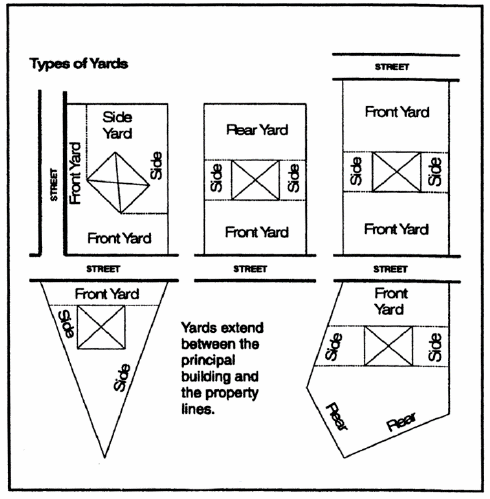
Figure 3.1 Types of Yards
(1)
All accessory structures shall be located in the side or rear yard, unless specified otherwise in this Development Code.
(2)
The floor area of an individual accessory structures shall not be more than 50 percent of the floor area of the principle building, and the cumulative floor areas of all accessory buildings shall not exceed 100 percent of the floor area of the principle building.
(3)
Any metal structures over 500 square feet shall require special use approval.
(Ord. of 10-13-2020)
Sec. 89-219. - Home occupations.
(a)
Home occupations; defined. Home occupations are types of commercial uses that are customarily performed in a small area of a residence that are of a low intensity nature and clearly incidental to the use of a residence. A home occupation is further defined as one of the following:
Family day care home: An accessory use within a private residence operated by the occupant of the dwelling that enrolls for pay, supervision and non-medical care, five or fewer children or elderly adults with no overnight stays, or no more than six children or elderly adults if the structure meets the building code requirements for institutional uses.
Home business: A home occupation that is limited to the office use of a practicing professional, an artist or a commercial representative, and may involve very limited visits or access by clients or customers, but does not involve the maintenance, repair, storage or transfer of merchandise received at the home.
Home office: A home occupation that is limited to an office use and does not involve visits or access by the public, suppliers or customers, and does not involve the receipt, maintenance, repair, storage or transfer of merchandise at the home.
(b)
Home occupations in general. Home occupations are subject to the following:
(1)
No home occupation use shall create noise, dust, vibration, smell, excessive traffic, smoke, glare, or electrical interference that would be detected beyond the dwelling unit.
(2)
A home occupation use shall not create traffic inconsistent with surrounding property uses.
(3)
There shall be no exterior lighting of the building or property that is not in character with a residential neighborhood.
(c)
Home office.
(1)
Home offices shall be located and conducted in such a manner that the average neighbor under normal circumstances would not be aware of their existence.
(2)
Permitted activities.
a.
A home office shall be limited to the personal conduct of a business within one's place of residence. There shall be no exterior indication that the business activity is taking place.
b.
A home office is allowed only as an accessory use to a residential dwelling.
(3)
Limitations on size and location.
a.
The floor area devoted to the home office can be no more than 25 percent of the heated floor area of the dwelling unit or 500 square feet (whichever is less). This limitation applies to the aggregate floor area of all areas devoted to the home office, whether located within the dwelling or in an accessory structure.
b.
There shall be no activity or display associated with the home office outside of any building or structure.
c.
The use shall be conducted entirely within the dwelling unit.
(4)
Activity controls.
a.
There shall be no exchange of merchandise of any kind on the premises.
b.
No use shall involve public contact on the property and no article, product or service shall be sold on the premises other than by telephone, unless this use has been granted a special permit.
c.
There shall be no activities on the premises that are associated with personal service occupations such as a barber shop, beauty shop, hairdresser or similar activities.
d.
There shall be no manufacturing, assembly or fabrication of products on the premises conducted as an occupation or commercial venture.
e.
There shall be no associates or employees on the premises other than other members of the family who reside on the premises.
f.
It shall be unlawful to store or park any business material, business equipment or business vehicle on the premises of the home office, unless any such business material, equipment or vehicle is confined entirely within the residence or in an approved accessory structure, except that one business vehicle complying with the restrictions contained in subsections 89-726(a) and (b), and used exclusively by the resident may be parked on a paved driveway or other paved parking area, in a carport or garage, or in a rear yard.
g.
There shall be no parking spaces provided or designated specifically for the home office.
(d)
Home business.
(1)
Special requirements.
a.
Whenever the applicant ceases to occupy the premises for which the home business was approved, no subsequent occupant of such premises shall engage in any home business until he shall have been issued a new special use approval.
b.
The applicant must be the owner of the property on which the home business is to be located or must have written approval of the owner of the property if the applicant is a tenant.
(2)
Limitations on size and location.
a.
The use shall be conducted entirely within the dwelling unit.
b.
No more than 50 percent of the dwelling unit may be used for the home business.
(3)
Activity controls. Only persons living in the dwelling unit plus one employee other than persons living in the dwelling unit shall be employed therein.
(4)
Outdoor storage and parking.
a.
It shall be unlawful to store or park any business material, equipment or vehicle on the premises of the home business, unless any such business material, equipment or vehicle is confined entirely within the residence or in an approved accessory structure, except that:
1.
One business vehicle complying with the restrictions contained in subsections 89-726(a) and (b), and used exclusively by the resident may be parked on a paved driveway or other paved parking area, in a carport or garage, or in a rear yard; and
2.
In an AG or AR district only, wreckers, dump trucks, flat bed trucks, tow trucks, mechanical earthmoving equipment or any commercial vehicle may be stored at the location of the home occupation and if such vehicle is used exclusively for an agricultural purpose.
(e)
Family day care home. Daily care for children or elderly adults for pay is allowed as a home occupation subject to the following limitations:
(1)
Care shall be limited to fewer than 24 hours per day.
(2)
A maximum of five children or elderly adults for whom compensation is received, or no more than six children or elderly adults if the structure meets the building code requirements for institutional uses.
(3)
For purposes of this section only, children who are related by blood, marriage or adoption to the childcare provider shall not be included in the calculation of the six person limitation, with the total maximum of no greater than eight children at any one time.
(4)
No family day care shall be established within 500 feet of another family day care.
(5)
No off-street parking may be provided for child pick up and drop off in a front yard, and all other outward appearance of the day care use shall be prohibited other than normal play equipment associated with a residence.
(6)
The day care services shall be provided exclusively by the resident of the home. There shall be no employees.
(7)
Not more than 25 percent of a residence may be used for the day care service.
(8)
Outdoor play areas shall be located in the rear or side yards and shall be separated from driveways, streets and parking areas.
(9)
No home occupation day care service may be established and operated in Barrow County until a business permit to do so has been obtained from the county.
(Ord. of 10-13-2020)
Sec. 89-220. - Guest house.
A detached dwelling unit that is used primarily for sleeping purposes by relatives, domestic employees or temporary guests of the family occupying the principal home on the lot must meet the following minimum requirements:
(a)
Standards for guest houses.
(1)
The guest house must be an accessory use to a dwelling already existing on the lot.
(2)
Minimum standards:
a.
The placement of a guest house on a lot shall not result in the violation of the lot coverage maximums applicable to the zone in which it is located.
b.
The water supply and sanitary sewage disposal system for the lot must be certified as adequate to support the guest house in combination with the main house.
c.
Adequate parking as outlined within this code must be provided specifically for the guest house. Access shall be provided through the principle dwelling units existing driveway.
(b)
Restrictions.
(1)
Guest houses shall be architecturally compatible with the main unit.
(2)
No more than one guest house may be located on any lot.
(3)
The guest house must be placed to the rear of the main house
(4)
The floor area of the guest house shall not exceed 50 percent of the existing living area of the principal residence nor more than 1,500 square feet, whichever is larger.
(Ord. of 10-13-2020)
Sec. 89-221. - Relative residence.
A second cooking facility may be constructed and used within a single-family residence for the exclusive use of relatives of the real property owner subject to the following restrictions:
(a)
The real property owner must live in the single-family residence.
(b)
The area of the second cooking facility shall not exceed the area of the main cooking facility.
(c)
Access to the relatives' living area shall be required from the interior of the residence although secondary access to the exterior of the dwelling is not prohibited.
(d)
Paved off-street parking shall be provided for additional vehicles as needed.
(Ord. of 10-13-2020)
Sec. 89-222. - Short term rentals.
Notwithstanding any other provision of this Unified Development Code, the operation of a short-term rental shall be governed by the short-term rental ordinance, and no person shall rent, lease, or otherwise exchange for compensation all or any portion of a short-term rental without first obtaining a short-term rental permit from the county.
(Ord. of 10-13-2020; Ord. of 6-14-2022, § 2)
Cross reference— Short-term rentals, §§ 26-150 et seq.
Sec. 89-223. - Horse stables, personal.
A building for the shelter and feeding of horses as an accessory use to a single-family detached residence is subject to the following:
(a)
A personal horse stable shall not contain more than four stalls.
(b)
Such stable shall be established on a lot having an area of not less than four acres for one horse, and an additional two full acres for each additional horse kept on the property.
(c)
The horse stable and any corral or designated riding area shall be located at least 100 feet from any property line.
(d)
All animals shall be maintained within a fully fenced area.
(Ord. of 10-13-2020)
Sec. 89-224. - Customary accessory uses to a church or other place of worship.
Any use that is customarily incidental to the principal use of a property as a church or other place of worship, and normally found in conjunction with such principal use, is allowed as an accessory use to a church or other place of worship subject to the following provisions:
(a)
Meeting facilities are permitted in all zoning districts; however a special use permit shall be required for such facilities in the M-1 or M-2 district.
(b)
Offices for the operation of the church or other place of worship are permitted in all zoning districts; however a special use permit shall be required for such facilities in the M-1 or M-2 district.
(c)
Except in the M-1 and M-2 districts, a church or other place of worship may have a residence for the housing of the pastor, priest, minister, rabbi, or other leader of the congregation for the church or other place of worship, provided that:
(1)
The residence shall be not less than 15 feet from the primary structure on the property; and
(2)
Customary accessory uses associated with a dwelling shall be permitted on the property if a residence exists as an accessory use on the property.
(d)
Except in the M-1 and M-2 districts, a church or other place of worship may have accessory instructional facilities as follows:
(1)
Rooms devoted to religious instruction, adult counseling, etc., related to the exercise or transmission of the religion's beliefs or philosophy are permitted with no additional requirements.
(2)
Schools sponsored by the church or other place of worship as general education facilities must comply with the requirements for private schools under subsection 89-176(b) of this Development Code. The minimum lot size requirement for the school shall be in addition to the minimum lot size required for the church or other place of worship itself.
(3)
In all cases, temporary classrooms require special use approval.
(e)
Except in the M-1 and M-2 districts, a church or other place of worship may have an accessory cemetery with the following requirements:
(1)
The cemetery, with or without a mausoleum, shall meet all minimum requirements for such uses under subsection 89-168(b) of this Development Code except for the minimum lot size.
(2)
The cemetery, in addition to the minimum lot size requirement for the church, shall be located on a site of at least five acres.
(f)
Within the commercial zoning districts, a community food bank or housing shelter may be located in a church or other place of worship as an accessory use, provided it meets the applicable minimum standards of the community food bank and housing section of this article (section 89-171).
(Ord. of 10-13-2020)
Sec. 89-225. - Customary accessory uses to a commercial or industrial use.
Any use that is customarily incidental to the principal commercial or industrial use of a property, and normally found in conjunction with such principal use, is allowed as an accessory use. Without excluding any other such accessory use, the following provisions apply to accessory uses in the commercial and industrial zoning districts:
(a)
Accessory buildings are subject to the following conditions:
(1)
Maximum height of two stories, not to exceed 40 feet.
(2)
Where any nonresidential lot adjoins the side or rear of a residential lot, any accessory building shall not be located within the required building setback.
(b)
Car washes accessory to gasoline stations and convenience food stores with fuel pumps, provided the car wash is located within an enclosed building that is located within the principal building setback.
(c)
Automobile, truck and trailer leasing and rentals accessory to an automobile service station, provided the following shall apply:
(1)
This use shall not be established on a lot of less than 20,000 square feet.
(2)
This use shall not occupy more than ten percent of the lot area.
(3)
Parking areas for the permitted trailers shall be located only in portions of the lot where off-street parking is permitted but no area or space shall occupy spaces set aside for required off-street parking or use by cars awaiting service.
(4)
No trailer shall be parked within 30 feet of the future street right-of-way line or in any way which interferes with normal traffic flow to, within or out of the lot.
(5)
All parking areas shall be clearly marked and no unit shall be parked outdoors other than within these boundaries except when being serviced.
(d)
Heating and air conditioning units subject to the following conditions:
(1)
When abutting any residential property line, heating and air conditioning units shall not be located in any required setback.
(2)
Heating and air conditioning units may be installed on a roof of any structure in the commercial and industrial zoning districts so long as the heating and air conditioning units do not exceed the height restrictions of the zoning district in which the building is located, and they are screened from a side or front view.
(3)
Ground based air conditioning and heating units shall not exceed 35 feet in height.
(e)
Incidental storage. Incidental storage, provided that the material stored is incidental to the permitted use, and is stored completely within a portion of the enclosed, principal structure permitted in the district or within the permitted accessory structure. Adherence to the National fire Protection Association Code 30 for flammable and combustible materials must be met including Chapter 4 of that code dealing with container storage, and NFPA Code 101 (Life Safety Code).
(f)
Free standing parking garages, subject to the following conditions:
(1)
When abutting any residential property line, free standing parking garages shall not be located within any required building setback for a principal building.
(2)
When abutting other nonresidential districts, freestanding parking garages shall not be closer than 10 feet to any rear or side property line.
(g)
Ambulance services accessory to a hospital or funeral home.
(h)
Clinic and pharmacy, as part of a planned office center.
(i)
Health service clinics, including a pharmacy as an accessory use.
(j)
Manufacturing and fabrication as an accessory use. If undertaken as an accessory use to a retail use allowed by right, such as a jewelry store or pottery, the manufacturing or fabrication activity may occupy no more than 25 percent of the gross floor area or 1,000 square feet (whichever is less). All products manufactured or fabricated on the premises must be sold on the premises as a retail activity.
(k)
Ancillary retail sales. The retail sale of goods and services as an accessory use to a primary industrial use on a property is allowed, insofar as the goods for sale have been produced on site or are in storage at the site for planned distribution to other areas. The ancillary retail sale of goods shall only be conducted as part of the permitted industrial use and shall not be a freestanding business.
(Ord. of 10-13-2020)
Sec. 89-226. - Accessory retail uses within office, hotel or multi-family buildings.
Retail sales and services accessory to the operation of an office building or institutional use, motel, hotel or multi-family building, must be conducted wholly within the building housing the use to which such activities are accessory (unless otherwise allowed under this section), and are further subject to the following conditions:
(a)
Retail sales, services and restaurants in a district other than community or intensive commercial, or within any type of master planned development.
(1)
Allowed accessory commercial uses. The following accessory uses are permitted: barber shops, beauty shops, laundry and dry cleaning pick up and distribution stations, and other similar personal service establishments, drugstores, book stores, florists, convenience food stores, liquor stores (within a hotel or motel only), gift shops, cafeterias and restaurants, private clubs, laundry facilities for the convenience of residents, and newsstands.
(2)
Maximum floor area. The floor space used or to be used for these accessory uses shall be limited to:
a.
A total of 25 square feet per dwelling unit in a high-rise apartment development; or
b.
Twenty-five square feet per room in a hotel or motel; or
c.
Ten percent of the net floor area in an office building or institutional use
(3)
Restrictions.
a.
Every public entrance to the accessory commercial use shall be from a lobby, hallway or other interior portion of the primary use structure except for a restaurant located within an office building, hotel or motel.
b.
No show window, advertising or display for the accessory commercial use shall be visible from the exterior of the primary use structure except for a restaurant located within an office building, hotel or motel.
c.
No merchandise shall be stored or displayed outside of the primary use structure.
(b)
Restaurants and cafeterias secondary to a hotel or motel and office building or institutional use may be located in a structure other than the primary use structure.
(Ord. of 10-13-2020)
Sec. 89-227. - Night watchman residence.
(a)
Night watchman residence, permanent. A permanent night watchman residence may be developed as an accessory use to a nonresidential use for the exclusive occupancy of personnel employed for the security of the principal use subject to the following standards:
(b)
Need. The principal use must be deemed by the planning and community development director as one requiring full-time security or 24-hour on-site management. Such uses include but are not limited to mini-warehouses, high-value warehousing or on-site storage, or outdoor storage of valuable materials or equipment.
(c)
Development restrictions.
(1)
The night watchman residence may consist of only one dwelling unit.
(2)
The residence shall meet the minimum floor area requirements of the building code as adopted by the board of commissioners, and may not be a manufactured home but must comply with all other standards of section 89-127 relating to single-family and two-family residences.
(3)
The residence may be a portion of a building primarily devoted to nonresidential uses or may be a separate residential building. If it is a separate building, the location, design, and materials of the residence shall be consistent and integral with the site plan and building design for the principal use.
(4)
Two off-street parking spaces shall be provided in addition to the parking required for the principal uses(s).
(Ord. of 10-13-2020)
Sec. 89-228. - Agricultural produce stands.
(a)
This use shall comply with the front yard setback established for the district in which it is located and be located no closer than 50 feet from any side or rear property line.
(b)
Access shall be provided by at least a collector road. There shall be adequate pull off and off-street parking available, and a minimum of four off-street parking spaces.
(c)
The stand shall sell only products grown or produced on the premises on which it is located.
(d)
Produce stands shall be no greater than 1,000 square feet, unless a larger size is approved as a special use.
(Ord. of 10-13-2020)
Sec. 89-229. - Permanent, temporary or portable sawmill.
(a)
Such a sawmill may only process timber removed from the property on which it is located, unless it is located in a C-3 or an industrial zoning district.
(b)
This use shall be setback not less than 400 feet from a residential structure or adjoining property.
(c)
Temporary or portable sawmills may be operated for a maximum period of six months.
(Ord. of 10-13-2020)
Sec. 89-230. - Agritourism.
(a)
Purpose and intent. The purpose of this section is to allow agricultural tourism with a special use permit and provide regulations related to agritourism to ensure this use is facilitated at an appropriate scale and intensity that limits impacts to adjacent properties, maintains the rural character, and preserves the agricultural heritage of the county.
(b)
Requirements. Agritourism may only be permitted upon the grant of a special use permit and in compliance with the following additional conditions:
(1)
Agritourism shall be associated with agricultural activity such as, but not limited to, farming, horticulture, and livestock rearing, and such agricultural activities shall be conducted on the same property as is being used for agritourism.
(2)
The minimum lot size of any property conducting agritourism shall be ten acres. Contiguous parcels under common ownership that together constitute the same farm may be counted toward this requirement. Barrow County makes no representation regarding any impact use of a property for agritourism may have on conservation use value assessment.
(3)
Any competition utilizing motorized vehicles shall not be permitted as an agritourism activity.
(4)
Nothing in this section shall be construed as permitting overnight lodging as part of an agritourism use. To the extent a property is to be used for overnight lodging, all permitting requirements otherwise required by the Code shall apply.
(5)
A minimum 100-foot setback is required from all property lines for all activity areas, gathering spaces, patios, pavilions, or other structures, whether permanent or temporary, associated with agritourism, including parking. Where this Code provides for greater setbacks for specific uses or structures, such specific setbacks shall apply.
(6)
The regulations pertaining to noise set forth in section 58-4 shall apply to any property used for agritourism, but in no event shall sound levels at the boundaries of the property exceed the following limits:
a.
Long duration sound. For any sound lasting continuously for one second or more, maximum limits are: 60 dBA when adjacent to a residential district; 65 dBA when adjacent to a commercial district; and 75 when adjacent to an industrial district other than heavy industrial.
b.
Short duration sound. For any sound having a duration of less than one second, including impulsive sound (i.e., sound having an abrupt onset and rapid decay), the limit shall be 80 dBA at the property line when adjacent to a residential, commercial or industrial zoning district.
c.
Method of sound measurement. These sound levels are to be measured in decibels in accordance with the standards promulgated by the American National Standards Institute (ANSI), and shall be made with a sound level meter using the (a-) weighting scale.
(7)
Amplified sound or music for outdoor activities shall be permitted only during the hours specified in the special use permit.
(8)
Lighting shall be established in such a way that adjacent properties and roadways are not adversely affected, and that no direct light is cast upon adjacent properties and roadways.
(9)
Hours of operation shall commence no earlier than 6:00 a.m. and cease by 10:00 p.m.
(10)
If located adjacent to any residential district or an AG district used for single-family dwellings, the minimum buffers required for the heavy industrial district as specified in Table 8.1 shall be required.
(11)
Tents and temporary structures associated with an agritourism use may be permitted on a property for a maximum of 30 consecutive days, no more than four times each calendar year.
(c)
Uses. All services, attractions, or products offered, including retail as part of an agritourism use, shall be related to and support such agricultural activities. Agritourism activities shall be permitted only where the board of commissioners has granted specific approval. An applicant proposing one or more of the following activities must specifically request approval by the board of commissioners of each activity:
a.
Cut your own/pick your own. A working farm that grows trees, fruits, vegetables, and/or nuts where sales are made directly to the public and where the customers may participate in the harvesting.
b.
Educational demonstrations. Demonstrations that teach the ability to create a product where raw materials are grown from a working farm.
c.
Farm retail sales. A working farm where products produced on the farm are sold directly to the public either from the main dwelling or from an accessory building of less than 1,000 square feet.
d.
Farm tours. Tours where visitors are shown working farm operations and are taught about farm processes.
e.
Fee fishing/hunting. Offering private property for fishing or hunting for a fee to the public or to private parties.
f.
Petting zoo. Area for visitors to interact one on one with animals.
g.
Seasonal events/activities. Seasonal events and activities, including, but not limited to hay rides, holiday lighting displays, Easter egg hunts, and corn mazes.
h.
Horseback riding. Lessons in riding to members of the public for pay. Also includes offering trails for horse owners to bring and ride their own stock. This does not include facilities open to the public to watch horses and riders train.
i.
Other uses specifically requested, provided that such uses meet the intent of this section and it is determined that there will be minimal impact to surrounding properties. However, nothing in this section shall be construed as permitting the short-term rental of a property, or the use of property as a special event venue. In order for a property used for agritourism to also be used as a special event venue or for short-term rental, separate applications for such special use of property must be submitted and approved.
(Ord. No. 6-14-2022, § 2)
Sec. 89-251. - Purpose of article.
The purpose of the Airport Hazard (AHO) Overlay District is to protect the public health, safety, and welfare by assuring that development within areas impacted by airport operations is appropriately planned to mitigate the impact of such operations. Further, this overlay district is intended to prevent the establishment of air space obstructions in air approaches through height restrictions and other land use controls, as deemed essential to protect the public health, safety, and welfare consistent with Federal Aviation Regulations (FAR) Part 77.
This overlay district is intended to be applied to properties which lie within close proximity to the Barrow County Airport (WDR) where aircraft are likely to fly at relatively low elevations. This overlay district is further intended to identify noise zones which should be planned to regulate future airport encroachment by inappropriate land uses and to minimize the effects of airport noise. A map of the Airport Hazard Overlay District is provided as Exhibit "A" which is attached hereto and incorporated herein by reference.
(Ord. of 10-13-2020)
Sec. 89-252. - Airport Hazard Overlay (AHO) with subzones established.
The designated approach zones described below are areas on the ground that generally correspond to airspace imaginary surfaces above ground.
(a)
Approach Zone 1 (AZ1). The inner edge of AZ1 is 1,000 feet wide, perpendicular to the runway centerline, and located 200 feet from the threshold of Runway 31. The approach zone expands outward uniformly to a width of 3,500 feet at a horizontal distance of 10,000 feet. Its centerline is the continuation of the centerline of the runway.
(b)
Approach Zone 2 (AZ2). The inner edge of AZ2 is 500 feet wide, perpendicular to the runway centerline, and located 200 feet from the threshold of runways 5, 23, and 13. AZ2 expands outward uniformly to a width of 2,000 feet at a horizontal distance of 5,000 feet. Its centerline is the continuation of the centerline of the runway.
(Ord. of 10-13-2020)
Sec. 89-253. - General regulations.
(a)
Building permit.
(1)
Existing uses. No permit shall be granted that would allow the establishment or creation of an obstruction or permit a legal nonconforming use, structure, or tree to become a greater hazard to air navigation than it was on the effective date of this division, or any amendments thereto, or than it is when the application for a permit is made. Except as indicated, all applications for such a permit shall be granted.
(2)
Applications for building permits within approach zones shall include a completed FAA obstruction evaluation / airport airspace analysis. FAA form 7460-01 must be submitted to the FAA to initiate the analysis and evaluate potential hazards to air navigation.
(b)
Airport noise; agreement and waiver of rights. All planning actions will require as a condition of approval that the applicant sign an agreement with Barrow County agreeing that airport noise is likely to increase in the future and that they waive all rights to file formal complaints about airport noise. The agreement shall be evidenced by an Affidavit of Facts Effecting Title recorded in the real estate records of Barrow County. Such Agreement shall at a minimum contain the following provisions:
(1)
Any building constructed within the Airport Hazard Overlay Zone should at a minimum meet the Georgia Power Good Cents insulation requirements to minimize aircraft noise in the building.
(2)
All deeds transferring property within the Airport Hazard Overlay Zone shall contain the following:
"This property is in an area in the Airport Hazard Overlay Zone and is subject to overflights using the Barrow County Airport. As a result, residents in the Airport Hazard Overlay Zone may be subject to some inconvenience, annoyance or discomfort arising from the noise of such operations. Residents of property near a public use airport should therefore be prepared to accept such inconvenience, annoyance, and discomfort from normal airport operations or growth in the amount of air traffic and covenant to a waiver of rights to complain about airport noise from normal operations."
Sec. 89-254 - Restrictions.
The following land use restrictions shall apply within airport Approach Zones in addition to those provisions stated for the underlying zoning district affected by the Airport Hazard Overlay Zone.
(a)
Types of land uses, restricted. To protect the airport from encroachment by incompatible uses and to minimize the effects of noise and safety hazards associated with airport operations, the following uses shall be prohibited, unless otherwise approved as special uses by the Board of Commissioners of Barrow County in accordance with the review criteria set forth below.
(1)
Churches, schools, stadiums, lodges and clubs, and other similar places of public assembly;
(2)
Multi-family dwellings;
(3)
Hospitals, public and private institutions and other uses where concentrations of persons are customary;
(4)
Industrial and/or heavy commercial uses which emit smoke, dust, flame, or glare of such magnitude as to constitute a hazard to aircraft;
(5)
Restaurants or bars that provide seating for customers;
(6)
Gas stations* and fuel storage facilities*;
(7)
Solid waste transfer stations or other facilities that may attract birds;
(8)
Theaters and outdoor theaters; or
(9)
Other similar uses deemed by the airport director or designated representative to constitute a hazard to aircraft or affect the FAA-approved instrument approach to the runways by means of height, type of construction, interference with radio navigation signals, visual distraction, or other means without conditions imposed as a result of special use approval.
* No variance or special use permit may be granted to allow any of these uses in the Airport Hazard Overlay Zone.
(b)
Additional restrictions on uses. Notwithstanding any other provisions of this division, no use shall:
(1)
Be made of land or water within any of the subzones established in this division in such a manner as to create electrical interference with navigational signals or radio communication between airport and aircraft;
(2)
Make it difficult for pilots to distinguish between airport lights and other lights;
(3)
Result in glare in the eyes of pilots using the airport;
(4)
Impair visibility in the vicinity of the airport;
(5)
Create bird strike hazards; or
(6)
Otherwise in any way endanger or interfere with the landing, takeoff, or maneuvering of aircraft intending to use or using the airport.
(c)
Height restrictions.
(1)
Except as otherwise provided in this division, no structure shall be erected, altered, or maintained in any zone created by this division to a height that penetrates FAR Part 77 airspace surfaces.
(2)
Any new structure within the AHO Zone must also comply with applicable height requirements set forth in section 89-405.
(3)
Barrow County may take physical action to top or remove, as appropriate, any tree in the approach zones which is determined to be a hazard to air navigation.
(Ord. of 10-13-2020)
Sec. 89-255 - Review criteria for special uses in the Airport Hazard Overlay Zone.
(a)
In evaluating and deciding any application for a special use permit in the Airport Overlay (AH) Overlay Zone, the approval authority shall apply the following review criteria:
(1)
Whether the proposed use is compatible in view of the use and development of the airport;
(2)
Whether the proposed use will adversely affect the airport and whether the airport will adversely affect the proposed use;
(3)
Whether permitted uses in the airport overlay zone are available and appropriate for the subject property;
(4)
Whether the proposed use will or could cause an excessive or burdensome use of existing streets, transportation facilities, utilities, or schools;
(5)
Whether the proposed use is in conformity with the policy and intent of the comprehensive plan; and
(6)
Other factors found to be relevant by the hearing authority for review of the proposed use.
(b)
The Barrow County Airport Authority shall be given an opportunity to review the planning and community development department staff report and to recommend in writing either approval or denial of the special use to the planning commission. The planning commission shall forward the airport authority's recommendation to the board of commissioners with the planning commission's recommendation. The airport authority's recommendation shall be advisory only and shall not be binding on the planning commission or on the board of commissioners.
(Ord. of 10-13-2020)
Sec. 89-301. - Designated uses not allowed.
The following specific uses are not allowed in any zoning district in Barrow County:
(a)
Leather and hide tanning and finishing, except taxidermy.
(b)
Mobile home (pre-1976).
(c)
Paper manufacturing other than finished stationery products.
(d)
Petroleum and coal products manufacturing other than asphalt plants.
(e)
Solid waste combusters or incinerators.
(Ord. of 10-13-2020)
Sec. 89-302. - Noxious manufacturing or industrial activities not allowed.
(a)
Prohibited noxious or hazardous products. A manufacturing or industrial activity that produces any of the following as products or by-products of the manufacturing process is prohibited:
(1)
Caustic or corrosive acids.
(2)
Chlorine or other noxious gases.
(3)
Explosives.
(4)
Fertilizer or glue.
(5)
Products involving hair or fur.
(b)
Prohibited noxious or hazardous processes. A manufacturing or industrial use that involves any of the following is prohibited:
(1)
Tanning or finishing of leather or other hides, except taxidermy.
(2)
Petroleum refining.
(3)
Processing of sauerkraut, vinegar or yeast.
(4)
Rendering or refining of fats and oils.
(5)
Wood preservation.
(Ord. of 10-13-2020)

