
Carolina Beach City Zoning Code
ARTICLE 3
- ZONING
3.1 - GENERAL
A.
INTRODUCTION
1.
This article contains the specific use and area regulations for each zoning district found in the town's planning jurisdiction. The material has been divided into the following sections:
a)
Zoning districts described. The intended application for each district, guiding its placement in relation to either existing or proposed development, and describing generalized densities and regulations unique to that district.
b)
Table of permitted uses. The listing of land uses permitted by right, by conditional zoning, or by special use in each district.
c)
Table of dimensional standards for lots and principal structures. The tabular listing of standards concerning lot sizes, setbacks or yards, height limitations and other dimensional requirements for lots and principal structures in each district.
d)
Table of dimensional standards for accessory structures. The tabular listing of standards concerning lot sizes, setbacks or yards, height limitations, and other dimensional requirements for accessory structures in each district.
e)
General development standards. Requirements regarding standards of development that apply within some or all of the town's zoning districts. These include such things as parking, landscaping, and sidewalks.
2.
The use of separate sections to describe the various standards for each district does not relieve any person from complying with all the requirements for the same district.
B.
COMPLIANCE WITH DISTRICT REGULATIONS
1.
No person may use, occupy, or sell any land or buildings or authorize or permit the use, occupancy, or sale of land or buildings under his control except in accordance with all of the applicable provisions of this ordinance, , and subsequent amendments thereto, and other applicable town regulations.
2.
For purposes of this section, the "use" or "occupancy" of a building or land relates to anything and everything that is done to, on, or in that building or land.
(Ord. No. 24-1230, 7-9-2024)
3.2 - ZONING DISTRICTS ESTABLISHED
To regulate the height and size of buildings; to regulate the intensity of land usage; to regulate areas for open space; to regulate the location of land uses; to provide for the improved environment; and to promote the health, safety, and general welfare of its citizens, the town and its extraterritorial planning jurisdiction are hereby divided into the following zoning districts:
(Ord. No. 24-1230, 7-9-2024)
3.3 - ZONING DISTRICTS DESCRIBED
A.
R-1, Residential District (Single- and Two-family Dwellings).
1.
Purpose. The R-1 district is established to provide for moderate to high-density single-family and two-family residential use.
2.
Intent. The regulations of this district are intended to discourage any use which, because of its character, would not be in harmony with the residential community and which would be detrimental to the residential quality and value of the district.
B.
R-1B, Residential District (Single-family Dwellings).
1.
Purpose. The R-1B district is established to provide for moderate density, single-family residential use.
2.
Intent. The regulations of this district are intended to discourage any use which, because of its character, would not be in harmony with the residential community and which would be detrimental to the residential quality and value of the district.
C.
R-2, Residential District (Single-family Dwellings).
1.
Purpose. The R-2 district is established to provide for moderate density single-family residential use and other compatible uses.
2.
Intent. The regulations of this district are intended to discourage any use which, because of its character, would not be in harmony with the residential community and which would be detrimental to the residential quality and value of the district.
D.
R-3, Residential District (Single-family Dwellings).
1.
Purpose. The R-3 district is established to provide for moderate to low density single-family residential use and other compatible uses.
2.
Intent. The regulations of this district are intended to discourage any use which, because of its character, would not be in harmony with the residential community and which would be detrimental to the residential quality and value of the district.
E.
C, Natural Resources Conservation District.
1.
Purpose. This district is established to preserve the economic, aesthetic, and unique and irreplaceable natural resource assets of the land, vegetation, surface waters, and underground waters of this district, while also providing for an environmentally compatible setting for appropriately designed and located single-family residential development. In doing so, the public health and safety and welfare shall be preserved.
F.
MF, Multifamily Residential District.
1.
Purpose. This district is established to provide for moderate to high-density single-family and multifamily residential uses and other compatible uses of varying types and designs. It functions as an alternative housing type near or in direct relationship to single-family detached housing while in harmony with and maintaining the integrity of the residential district.
2.
Intent. The regulations of this district are intended to discourage any use which, because of its character, would not be in harmony with the residential community and which would be detrimental to the residential quality and value of the district.
G.
MH, Residential District (Mobile Homes, Single- and Two-family Dwellings).
1.
Purpose. This district is established to provide for moderate to high-density mobile home, single, and two-family residential uses and other compatible uses.
2.
Intent. The regulations of this district are intended to discourage any use which, because of its character, would not be in harmony with the residential community and which would be detrimental to the residential quality and value of the district. [Note—The connection of mobile homes to form multiple units is prohibited.]
H.
MX, Mixed Use Transitional District.
1.
Purpose. This district is established to provide for an area of transitional land uses between intensified use districts or elements and residential districts. This district includes an area of mixed land uses between the intensive, commercial, central part of town and the quiet residential areas and may also be employed as a transitional area between busy major thoroughfares and quieter residential areas.
2.
Intent. The regulations of the district seek to maintain a modest scale of structures, as well as a pedestrian-oriented nature, so that uses in the district may provide a suitable transition from commercial to residential areas. Permitted uses include a mixture of single-family homes, two-family dwellings, and small-scale office and institutional uses. Small hotels and motels and multifamily housing of modest density and size may also be permitted in this district.
I.
T-1, Tourist District.
1.
Purpose. This district is established to provide land for the town's tourist industry, and as a complementary district to the CBD Central Business District.
2.
Intent. The primary land uses intended for this zoning district are moderate- to high-density residential development, as well as hotels, motels, and restaurants.
J.
NB, Neighborhood Business District.
1.
Purpose. This district is established to accommodate and provide for the development of small, pedestrian-oriented shopping and service activities providing necessity goods and personal services to the immediate neighborhood. This district also provides for single-family detached homes and related residential uses. Such districts should be located at the intersection of a major street or collector. Uses in NB districts should have architecture and site layouts which are compatible with nearby residential structures and uses.
2.
Intent. The regulations of this district are intended to discourage any use which, because of its character, would not be in harmony with the residential community or which would be detrimental to the surrounding residential uses.
K.
CBD, Central Business District.
1.
Purpose. This district is established to accommodate, protect, rehabilitate, and maintain the traditional Central Business District and boardwalk area of the town. This area accommodates a wide variety of pedestrian-oriented, commercial and service activities, including retail, business, office, professional, financial, entertainment, and tourism.
2.
Intent. The regulations of this district are intended to encourage the use of land for concentrated development of permitted uses while maintaining a substantial relationship between land uses and the capacity of the town's infrastructure. Developments which would significantly disrupt the historic balance between pedestrians and automobiles within the district, thereby destroying the pedestrian-oriented nature of the area, are specifically discouraged. Large, off-street parking areas are encouraged to locate outside the district. Similarly, buildings and structures should have pedestrian-oriented activities at ground level.
L.
HB, Highway Business District.
1.
Purpose. This district is established to accommodate businesses oriented toward the motoring public and which require a high volume of traffic.
2.
Intent. The regulations of this district are intended to support businesses that serve the entire community and beyond. For the most part, they are located on major thoroughfares so that they can be conveniently reached by automobile and to avoid sending heavy automobile traffic through smaller streets or residential areas. Certain wholesale activities are also permitted in HB district.
M.
MB-1, Marina Business District. This district is established to reserve areas along the water's edge for maritime uses, water dependent uses, and water-oriented uses. This district also provides for certain residential and other non-water dependent uses which are closely aligned with water-oriented uses. Land uses, which would wall off the public from public trust waters, are specifically discouraged.
N.
I-1, Industrial District. This district is established to provide for warehousing, storage, and light industrial activities compatible with a small, tourist-oriented, environmentally sensitive, coastal community. Light industries are generally characterized as having small physical plants, lower land requirements, and higher worker-to-land ratios. Such industries typically generate few objectionable impacts in terms of noise, lights, heavy truck traffic, fumes, smoke, dust, odor, or other similar characteristics. Furthermore, any negative environmental impacts associated with these industries may generally be mitigated through proper site planning, buffering, and operations management. This district is located in areas that are readily accessible from major thoroughfares, so as to minimize traffic impacts on non-industrial areas of the community.
O.
FP, Floodplain Overlay District.
1.
Purpose; intent. The 100-year floodplain as depicted on the latest National Flood Insurance Program's (NFIP) flood insurance rate map is hereby incorporated by reference as part of the official zoning map for the town. Development within the 100-year floodplain must conform with all provisions of Article 5, Flood Damage Prevention. It is the intent of the Town Council to promote the public health, safety, and general welfare and to minimize public and private losses due to flood conditions in Special Flood Hazard Areas (SFHA) through compliance with Article 5, Flood Damage Prevention.
P.
Height Overlay District (HOD). This district is established to preserve the character of the town's traditional single-family residential neighborhoods. This area can be described as having a high concentration of permanently occupied homes in comparison to seasonal units. The regulations of this district limit height to 45 feet.
(Ord. No. 24-1230, 7-9-2024)
3.4 - TABLE OF USES
A.
Generally. Table 3.2 sets forth the permitted, conditional zoning, and special uses allowed in each zoning district.
1.
Permitted by right (P). The letter "P" in the zoning district column opposite the listed use means the use is permissible by right in the zoning districts in which it appears.
2.
Permitted use with standards (PS). Uses with additional standards are denoted with a "PS."
3.
Conditional zoning (CZ). The letters "CZ" in the zoning district column opposite the listed use means that conditional zoning, as set forth in Section 2.21 of this ordinance, must be obtained before the use may be created. Use standards may also be required for certain conditional zoning uses.
4.
Special use permit (S). The letter "S" in the zoning district column opposite the listed use means that a special use permit, as set forth in Section 2.14(C) of this ordinance, must be obtained before the use may locate in the district in which it appears.
5.
Prohibited. A use specifically prohibited in the table of permissible uses for every zoning district. Any use listed as prohibited has been reviewed and considered as having a detrimental impact on the health and safety of the community.
B.
Use designation.
1.
If a "P" or "CZ" or "PS" does not appear in a zoning district column opposite a listed use, the use is not permitted in that zoning district.
2.
Uses not listed. The uses listed may not address all possible uses. In determining if a use is permitted, the UDO Administrator shall consider which category of expressed uses most closely matches the use proposed and apply the regulations pertaining to that category to the proposed use No interpretation shall be made which would change the character of a zoning district relative to the purpose of such zoning district and the other uses allowed.
a)
Interpretation of unlisted uses. Where a proposed use is not specifically listed in the table of permissible uses, the UDO Administrator may permit the proposed use upon a determination that the proposed use has an impact similar in nature, function, and/or duration similar to another permitted used listed in the table of permissible uses. The UDO Administrator shall give due consideration to the purpose and intent statements in this section concerning the base zoning district(s) involved, the character of the uses specifically identified, and the character of the use(s) in question.
b)
Standards for determining unlisted uses. In determining the use which most closely matches the proposed use, the UDO Administrator shall consider all relevant characteristics of the proposed use, including but not limited to the following:
i)
The volume and type of sales, retail, wholesale, etc.
ii)
The size and type of items sold and nature of inventory on the premises.
iii)
Any processing done on the premises, including assembly, manufacturing, warehousing, shipping, distribution.
iv)
Any dangerous, hazardous, toxic, or explosive materials used in the processing.
v)
The nature and location of storage and outdoor display of merchandise, whether enclosed, open, inside, or outside the principal building; predominant types of items stored (such as business vehicles, work-in-process, inventory, and merchandise, construction materials, scrap and junk, and raw materials including liquids and powders).
vi)
The type, size, and nature of buildings and structures.
vii)
The amount and nature of any nuisances generated on the premises, including but not limited to noise, smoke, odor, glare, vibration, radiation, and fumes.
viii)
Any special public utility requirements for serving the proposed use type, including but not limited to water supply, wastewater output, pre-treatment of wastes and emissions required or recommended, and any significant power structures, and communications towers or facilities.
ix)
The impact on adjacent lands created by the proposed use.
x)
If requested, the applicant shall submit evidence to the UDO Administrator of the anticipated traffic, noise, light, or odor of the proposed use. Reports prepared by the applicable professional trade may be required (e.g. transportation engineer, environmental scientist, etc.).
c)
Decision by zoning administrator. A final determination on the proposed use shall be provided in writing to the applicant and subject to appeal by the Board of Adjustment.
(Ord. No. 24-1230, 7-9-2024; Ord. No. 25-1261, 8-12-2025)
3.5 - USE STANDARDS FOR PARTICULAR USES
This article provides regulations, standards, and conditions for certain uses, which are unusual in their nature or complexity or are potentially incompatible with their surroundings unless special protective restrictions are applied. Each use listed in this article shall comply with the regulations of the district in which it is located, with the requirements specified.
(Ord. No. 24-1230, 7-9-2024)
3.6 - ACCESSORY USE STANDARDS
A.
ACCESSORY USE OR STRUCTURE, GENERAL STANDARDS
1.
These general standards apply to allow accessory uses and structures.
2.
In no case shall there be more than one (1) customary accessory building on the lot except for the exemptions provided herein.
a)
The following shall be exempted from the one (1) customary accessory building:
i)
Fence.
ii)
Flagpole.
iii)
Dog house not to exceed 16 square feet.
iv)
Pump house not to exceed 16 square feet.
v)
Playhouse not to exceed 36 square feet nor eight (8) feet in height.
vi)
Private swimming pools and their associated decks, fencing, and equipment.
vii)
Structural beach crossover.
viii)
Marinas.
ix)
Electric (EV) charging station.
b)
The exemptions shall not have sewer, electrical, and plumbing, except for marinas, beach crossovers, pools, and pump houses, where applicable.
c)
These exemptions are not considered as part of the lot coverage for bulk purposes. Impervious coverage limitations are still applicable.
B.
ACCESSORY USE OR STRUCTURE, NONRESIDENTIAL
1.
Accessory structures associated with nonresidential uses shall:
a)
Be included when calculating the total allowable lot coverage.
b)
Not be permitted within any required front or side yard, or within five (5) feet of the rear lot line.
c)
Not exceed the size of the primary structure.
d)
Not be used as a dwelling unit.
C.
ACCESSORY USE OR STRUCTURE, RESIDENTIAL
1.
Accessory structures associated with residential uses shall:
a)
Be included when calculating the total allowable lot coverage, and shall not constitute a proportionate size greater than 25% of the principal building's lot coverage, regardless of the lot size.
b)
Be limited to 15 feet in height.
c)
Not be permitted within any required front or side yard, or within five (5) feet of the rear lot line.
d)
Not be occupied, leased, rented, or otherwise used for profit, income, or for gain.
e)
Not be used as a dwelling unit.
f)
Contain no more than three (3) internal plumbing fixtures (water heater is exempt).
g)
Meet State Building Code requirements if any dimension is greater than 12 feet.
D.
HOME OCCUPATIONS, CUSTOMARY
1.
Home occupations shall adhere to the following regulations:
a)
The use of the dwelling unit for a home occupation shall be clearly incidental and subordinate to its use for residential purpose by its occupants, and not more than 25% of the floor area of a single level of the dwelling unit shall be used in the conduct of the home occupation.
b)
No home occupation shall be conducted in any accessory building.
c)
There shall be no change in the outside appearance of the building or premises, or other visible evidence of the conduct of such home occupation.
d)
No traffic shall be generated by such home occupation in greater volumes than would normally be expected in a residential neighborhood. A resident of the premises may park only one (1) commercial vehicle with manufacturer's rating of not more than 2,000 pounds or a payload capacity of 6,000 pounds off-street for use in the home occupation. Vehicles used primarily as passenger vehicles, including pickup trucks and step-type vans only, shall be permitted in connection with the conduct of the customary home occupation.
e)
Any need for parking generated by the conduct of such home occupation shall be restricted to the property boundaries.
f)
Only one (1) person other than members of the family residing on the premises shall be engaged in such occupation.
g)
No equipment or process shall be used in such home occupation, which creates noise, vibration, glare, fumes, or electrical interference detectable to the normal senses off the lot. In the case of electrical interference, no equipment or process shall be used which creates visual or audible interference in any radio or television receivers off the premises or causes fluctuations in line voltages off the premises.
h)
No display of products shall be visible from off-site and the selling of merchandise or the manufacture of merchandise for sale, except baking, sewing, and/or handicrafts normally made in the home is prohibited.
i)
Instruction in music, dancing, or tutoring of academic subjects shall be limited to four (4) students at a time.
j)
Home occupations are restricted to residential dwellings and limited to office, off-site services, on-site sales/manufacturing. Home occupations shall not include day nurseries, day care centers, adult day care centers, day care home, preschool, or drop-in child care.
E.
OUTDOOR DISPLAY
1.
The purpose of this section is to promote business through the creative use of outdoor space by providing businesses the opportunity to display products in a manner that enhances commerce while maintaining the town's property values. Outdoor displays allow businesses an opportunity to attract the public by offering a sample of the products which are available inside an enclosed building.
2.
Businesses may display their merchandise outdoors on private property under the following criteria:
a)
All outdoor displays shall be secured during any hours that the business is not open.
b)
No additional signage shall be allowed for outdoor displays beyond the allowances permitted in accordance with the sign requirements of this ordinance.
c)
Outdoor display areas shall:
i)
Be located no more than 4.5 feet from the principal building; and/or
ii)
Cover no more than 5% of the lot.
d)
Outdoor displays shall be located on a durable surface and shall not be located in required landscaping areas.
e)
Where an outdoor display is located on a private sidewalk and/or walkway, an unobstructed portion of the sidewalk and/or walkway, measuring not less than three (3) feet in width shall be continuously maintained for pedestrian access.
f)
No point of access or egress from any building shall be blocked at any time by an outdoor display.
g)
All outdoor display areas must be maintained and displayed in a neat, orderly, and safe manner.
h)
No outdoor display areas shall be located in the sight distance triangle.
i)
Vending and ice machines outside of the building shall be located against and parallel to the building.
j)
No outdoor displays shall be allowed in areas set aside, required, or designated for driving aisles, driveways, maneuvering areas, emergency accessways, required off-street parking, or unloading/loading.
k)
Tents shall meet the following when used in conjunction with the outdoor display area:
i)
Limited to a maximum of 100 square feet.
ii)
Removed when the business is not open.
iii)
Secured with tie downs on each pole while tent is in use.
l)
Rooftop displays are prohibited.
m)
Sale, display, or rentals of vehicles associated with a legally permitted use are exempt from these requirements.
F.
OUTDOOR SEASONAL SALES
1.
Outdoor seasonal sale permits shall be issued by the UDO Administrator in accordance with the following:
a)
Operations shall be limited to 90 days per calendar year.
b)
The activity shall be located at:
i)
Churches, places of worship, parish houses, or schools; or
ii)
An existing legally permitted nonresidential use.
c)
The use shall not involve the construction of permanent structures.
d)
One (1) temporary sign may be allowed in accordance with the temporary sign standards in Article 4 Zoning.
e)
One (1) temporary structure (i.e., tent) may be allowed with the approval of the fire marshal.
f)
No part of the operation shall be located in any required setback, site triangle, or required buffer.
g)
No structure shall be located within required parking spaces or drive aisles.
G.
SWIMMING POOL, PRIVATE (INCLUDING HOT TUBS)
1.
Private swimming pools. All outdoor private swimming pools shall be enclosed by a fence or other permanent barrier which discourages climbing and is designed so as to minimize the possibility of unauthorized or unwary persons entering the pool area. Entrances through the barrier shall be provided with self-closing gates having simple positive self-latching closure mechanisms with hardware provided for padlocking. The barrier shall not be less than 48 inches in height above the adjacent ground surface outside the barrier. Fencing will be required around all sides of the swimming pool.
2.
Swimming pools setbacks. For the purposes of this ordinance, setbacks provided herein shall also be applicable to private hot tubs.
a)
Setbacks for swimming pools less than 30 inches above the ground level of the graded lot:
i)
Front setback: As required for the zoning district
ii)
Side setback: Five (5) feet
iii)
Corner setback: Five (5) feet
iv)
Rear setback: Five (5) feet
b)
Setbacks for swimming pools more than 30 inches above the ground level of the graded lot:
i)
Front setback: As required for the zoning district
ii)
Side setback: Five (5) feet
iii)
Corner setback: 7.5 feet
iv)
Rear setback: Five (5) feet
H.
TEMPORARY HEALTH CARE STRUCTURES
1.
The purpose of allowing temporary health care structures is to accommodate the need for living quarters for ill family members on the same lot as a family caregiver. The following regulations shall apply:
a)
Allowed as an accessory use to a single-family unit only.
b)
Only one (1) temporary family health care structure shall be allowed on a lot in addition to the one customary accessory structure.
c)
Shall comply with all setbacks and lot coverage requirements that apply to the district it is located.
d)
Maximum size is 300 square feet of indoor gross floor area.
e)
Required to connect to water, sewer, and electric utilities serving the property.
f)
Must be used by an individual who is the named legal guardian of the mentally or physically impaired person and is used to provide care for the mentally or physically impaired person.
g)
Limited to one (1) occupant who shall be the mentally or physically impaired person with a doctor's certification.
h)
An annual permit is required with the renewal of a doctor's certification.
i)
Any temporary family health care structure shall be removed within 60 days in which the mentally or physically impaired person is no longer receiving or is no longer in need of the assistance.
j)
Complies with applicable provisions of the State Building Code and NCGS 143-139.1.
k)
Placing the temporary family health care structure on a permanent foundation shall not be required or permitted.
I.
TEMPORARY STORAGE CONTAINERS
1.
Temporary storage containers shall conform to the following requirements and other requirements as applicable:
a)
A storage container may not exceed 160 square feet in size, nor be more than eight (8) feet in height.
b)
Container must not be located within the right-of-way.
c)
A temporary storage container must be removed within 30 days of its initial placing on a lot and shall not be replaced for six (6) months from the date of removal. Temporary storage containers for residential use may be placed on property twice during a calendar year.
d)
Dumpsters placed for the purpose of collecting waste from construction shall be exempt from these rules.
e)
Temporary storage containers in commercial areas shall not encroach into any required parking or landscaping area.
f)
Temporary storage containers shall not be used as living space.
2.
Container shall be removed within 48 hours of an event of a hurricane or immediately upon flood warning notification.
J.
TRAILER, TEMPORARY CONSTRUCTION
Trailers for office, security, or storage purposes are permitted on construction sites provided they are located at least five (5) feet off the property lines and 10 feet off public rights-of-way. Temporary construction trailers are subject to a permit authorized by the Building Inspector.
(Ord. No. 24-1230, 7-9-2024)
3.7 - RESIDENTIAL USE STANDARDS
A.
DWELLING, MULTI-FAMILY (UNITS > 4)
1.
The purpose of this section is to establish criteria for the development of multi-family housing with due consideration of harmony with the surrounding community and existing zoning district.
2.
All proposed multi-family developments of five (5) or more units shall comply with the dimensional requirements, density specifications, and lot coverage requirements for the district in which the use is to be located.
3.
No principal structure shall be located closer than 15 feet to another principal structure on site.
4.
A minimum of 25% of the gross acreage of a multi-family development of five (5) or more units shall be permanent open space.
B.
FAMILY CARE HOME
Where permitted, the following shall apply:
1.
Up to six (6) special needs persons may reside in a group home setting in accordance with the family care home provisions of NCGS 160D-907.
2.
Family care homes shall be separated by a half-mile radius from other family care homes within the zoning jurisdiction of the Town of Carolina Beach.
3.
Any such family care home shall comply with the applicable dimensional requirements for a single-family dwelling.
C.
MANUFACTURED HOMES
1.
All new or replacement manufactured homes shall comply with the applicable NC Wind Zone requirement.
2.
Manufactured housing, appearance criteria. The following appearance criteria shall be required for all manufactured housing units:
a)
The manufactured home shall be set up in accordance with the standards established by the state department of insurance.
b)
A continuous, permanent masonry foundation or masonry curtain wall constructed in accordance with the standards of the state uniform residential building code for one- and two-family dwellings, unpierced except for required ventilation and access, shall be installed under the perimeter of the manufactured home.
c)
The towing apparatus, wheels, axles, and transporting lights shall be removed and shall not be included in length and width measurements.
d)
Stairs, porches, entrance platforms, ramps, and other means of entrance and exit to and from the manufactured home shall be installed or constructed in compliance with the standards of the State Building Code, attached firmly to the primary structure and anchored securely to the ground. Wood stairs shall be only used in conjunction with a porch or entrance platform with a minimum of 24 square feet.
e)
The manufactured home shall have the HUD sticker.
f)
The manufactured home shall have a minimum width of 16 feet.
g)
The manufactured home shall have a length not exceeding four (4) times its width, with the length measured along the longest axis and width measured perpendicular to the longest axis at the narrowest part.
(Ord. No. 24-1230, 7-9-2024)
3.8 - PLANNED UNIT DEVELOPMENT STANDARDS
A.
PURPOSE
1.
Residential, business, and industrial planned unit developments are intended to encourage innovation, flexibility of design, and better land use by allowing deviations from the standard requirements of the town's specific zoning districts. The purpose of providing for these uses is to promote:
a)
Improved compatibility of new development with existing residential neighborhoods, commercial enterprises, and industrial uses.
b)
Flexibility of design to take greatest advantage of a site's natural and developmental qualities.
c)
Accumulation of large areas of usable permanent open space to preserve important natural resources.
d)
Efficient use of land that may result in lower development and public service cost.
2.
All proposed planned unit developments units shall comply with the dimensional requirements, density specifications, and lot coverage requirements for the district in which the use is to be located. With the exception of townhouse lots, any lots created within a planned unit development shall be subject to the minimum lot size for the district in which the site is located.
3.
No principal structure shall be located closer than 15 feet to another principal structure on site.
4.
Where a planned unit development proposes structures to be located on the same lot and behind another existing or proposed structure, a minimum 12 foot permanent access easement shall be established and perpetually maintained to grant access to the adjoining street frontage and driveway connection.
5.
Planned unit developments shall not be permissible where a property is subject to an existing nonconforming situation. Any existing nonconforming situation shall be ameliorated prior to the issuance of a zoning permit for a planned unit development.
B.
BUSINESS PLANNED UNIT DEVELOPMENT REGULATIONS
1.
The following regulations shall apply to business planned unit developments:
Permanent open space. At least 10% of the gross acreage of the planned business development shall be designated as a permanent open space and landscaped according to an approved landscaped plan. Landscaping required as a buffer may be counted toward the required 10%.
C.
INDUSTRIAL PLANNED UNIT DEVELOPMENT REGULATIONS
1.
The following regulations shall apply to industrial planned unit developments:
a)
Acreage requirements. The minimum size for an industrial planned unit development is three (3) acres. This acreage requirement may be waived by the Town Council after a favorable recommendation for such a waiver by the Planning and Zoning Commission.
b)
Permanent open space. At least 10% of the gross acreage of an industrial planned unit development shall be designated as permanent open space and landscaped according to an approved a landscape plan. Landscaping required as a buffer shall not be counted towards the required 10%.
c)
Maximum lot coverage. The maximum coverage of the site by structures shall be 50% of the net buildable area.
D.
RESIDENTIAL PLANNED UNIT DEVELOPMENT REGULATIONS (UNITS < = 4)
1.
The following regulations shall apply to residential planned unit developments of four (4) or fewer units.
a)
Residential planned unit developments in this category may be comprised of up to four (4) individual structures not to exceed four (4) total dwelling units.
b)
No subdivision of lots below the minimum lot area for the district within which the use is located shall be permitted except through the townhouse approval process.
c)
For townhouse projects, no unit shall be connected on more than two (2) sides by common walls. All yard dimensional requirements shall apply to the property lines of the entire development. The minimum lot size and setback requirements of the base zoning district shall only apply to the parent parcel. Zero lot lines may be utilized for individual units.
d)
No residential PUD structure subject to this section shall exceed 40 feet in height.
E.
RESIDENTIAL PLANNED UNIT DEVELOPMENT REGULATIONS (UNITS > 4)
1.
The following regulations shall apply to residential planned unit developments.
a)
Townhouse. All yard dimensional requirements shall apply to the property lines of the entire development. The minimum lot size and setback requirements of the base zoning district shall only apply to the parent parcel. Zero lot lines may be utilized for individual units.
2.
Permanent open space. A minimum of 25% of the gross acreage of a residential planned unit development shall be permanent open space, as defined below. For the purposes of this section, permanent open space shall be defined as any land to be utilized as landscaped green space, parks, playgrounds, parkway medians, active recreational uses, or for other similar functions; areas required as setbacks or for separation between structures may be utilized in calculating a projects permanent open space requirements. Manmade lakes or other watercourses may be used to fulfill the requirements of this section. Designated wetlands or marsh may not be calculated as part of the permanent open space requirement nor utilized in calculating density.
3.
Proposals should limit the height of structures to 40 feet. In the instance that an increase in height above 40 feet is proposed, the following factors and information shall be considered:
a)
The applicant shall provide the height of all existing structures abutting the subject site and within a 100 foot linear distance from the property line of the subject site. The height of all inventoried structures shall be provided in a table format as part of the application.
b)
Consideration should be made to reduce the building footprint in favor of the proposed height increase above 40 feet. The applicant should consider increasing the required setbacks by two (2) feet for every one (1) foot of additional height above 40 feet.
4.
Commercial uses. Except in residential zoning districts, residential planned unit developments may contain commercial development (planned business development) not exceeding 10% of the total development project area. Such commercial development shall be located and designed so as to be functionally and architecturally compatible with a residential neighborhood. Requirements shall include modest, subdued signage and outdoor lighting in keeping with a residential area, minimal, well landscaped, off-street parking, and easy access by bicycle or on foot via connecting sidewalks. Traffic from outside the planned unit development wishing to gain access to the commercial businesses associated with the development shall not be permitted to cut through a residential area to reach the business location.
F.
REVIEW CRITERIA: PUD CONDITIONAL ZONING USES ONLY
1.
The following review criteria are established as general guidelines for the Planning and Zoning Commission and the Town Council in their deliberations and decision making regarding planned unit developments:
a)
Degree of departure of the proposed planned unit development from surrounding areas in terms of character or density. Type of use shall be limited to those which are permitted or conditionally permitted in the underlying zoning district.
b)
Compatibility within the planned unit development and relationship with the surrounding neighborhoods.
c)
Prevention of the erosion of property values and degrading of surrounding area.
d)
Provision for future public recreational facilities, transportation, water supply, sewage disposal, surface drainage, flood control, and for soil conservation as shown in the development plans.
e)
The nature, intent, and compatibility of permanent open space, including the proposed method for the maintenance and conservation of said permanent open space.
f)
The feasibility and compatibility of the specified stages contained in the preliminary development plan to exist as an independent development.
g)
The availability and adequacy of water and sewer service to support the proposed planned unit development.
h)
The availability and adequacy of primary streets and thoroughfares to support traffic to be generated within the proposed planned unit development, including the promotion of bicycling, walking, and other alternatives to the automobile. The adequacy of internal turnaround movements and access to any structures located to the rear of any proposed developments. Pavement widths for transportation access shall be no less than 20 feet.
i)
The benefits within the proposed development and to the general public to justify the requested departure from the standard zoning district requirements.
j)
The conformity and compatibility of the planned unit development with any adopted development plan of the town.
k)
The conformity and compatibility of the proposed open space, primary and secondary uses within the proposed planned unit development.
l)
Provision for emergency vehicle access and service to the proposed development.
m)
Preservation of important natural amenities on the site of the proposed development.
G.
PERFORMANCE BOND
To ensure the full completion of any required public infrastructure of planned unit development projects, a performance bond shall be posted for each PUD by the contractor prior to the issuance of a certificate of occupancy. The amount of the performance bond and timeframe for completion of the infrastructure shall be determined after the CZ is reviewed and issued by the Planning and Zoning Commission and Town Council, respectively.
(Ord. No. 24-1230, 7-9-2024)
3.9 - NONRESIDENTIAL USE STANDARDS
A.
ADULT ENTERTAINMENT ESTABLISHMENT
1.
Adult entertainment establishments designated as Class II, as defined in Code of Ordinances Section 14-63(b), are prohibited within the jurisdictional limits of the town except by issuance of a conditional zoning approval. Adult entertainment establishments may be located within the I-1 zoning district by issuance of a conditional zoning, subject to requirements of the zoning district and provided that:
a)
Each adult entertainment establishment shall be located a minimum of 1,500 feet from any existing adult entertainment establishments. Such measurement shall be the minimum distance measured in a straight line from the closest point of the building of the proposed business to the nearest property line of an existing adult entertainment establishments.
b)
Each adult entertainment establishment shall be located a minimum of 1,500 feet from any residential or tourist zoned areas, church, school, public, or private park, or recreational facility. Such measurements shall be the minimum distance measured in a straight line from the closest point of the building of the proposed business to the nearest property line of a residential use, any place of worship, school, public or private park, or recreational facility.
B.
ANIMAL CARE FACILITIES
1.
Animal care facilities with outdoor areas shall meet the following standards:
a)
Shall maintain compliance with all federal and state regulations.
b)
Located 200 feet from a residential use in a residential district as measured in a straight line distance from the closing point of the building of the proposed use to the nearest property line of the residential use.
c)
Shall not be located in the front setback and must meet a minimum setback of five (5) feet from the side and rear property lines.
d)
Shall provide a minimum six (6) foot barrier that has a minimum 80% opacity. Barriers larger than six (6) feet in height may be approved as a condition of the conditional zoning.
C.
AUTOMOTIVE (including motorcycles, RVs, and other consumer motor vehicles)
1.
No outside storage of junk vehicles or parts shall be permitted.
2.
Limitations shall be placed on outdoor repair areas to protect surrounding properties and uses from any objectionable characteristics resulting from repair activities.
a)
The size of outdoor repair area shall not exceed 30% of the lot.
b)
Minimum setbacks for outdoor repair areas shall be 15 feet from all property lines.
c)
Any outdoor repair areas shall be completely shielded from streets and adjacent properties by buildings and/or fencing that is at least six (6) feet high and offers 100% opacity.
d)
No encroachments of displayed vehicles within 20 feet from the street right-of-way or within areas designated as vehicle sight distance at street or driveway intersections.
e)
Provide egress and ingress to and from the property in a forward movement.
f)
All lighting shall be directed to the interior of the property so as not to cause impact upon adjacent properties or to street rights-of-way.
g)
Areas utilized for wash areas shall provide for the proper drainage and retention of water runoff. No water shall leave the site. Any wash areas shall be comprised of a hardscape surface not to include gravel, turf, or vegetative ground cover. Washing, vacuuming, drying, and polishing facilities may not be located in any required setback or buffer area.
D.
BED AND BREAKFAST INNS
1.
Only one (1) person other than the members of the family residing on the premises shall be engaged in such business.
2.
Other than normal maintenance and improvements necessary to comply with the applicable regulations, no change to the exterior appearance of the building or premises shall occur which reflect visible evidence of the business.
3.
The owner must reside within the structure on the premises.
4.
Signage must comply with the applicable regulations with minimum illumination.
5.
One (1) additional parking space will be required for each room available for rent.
E.
BOAT AND PERSONAL WATER CRAFT (PWC) RENTAL
Any operation, whether as principal or accessory, that plans to rent boats and PWC, shall meet the following requirements:
1.
No rental item shall be permitted to encroach into any public right-of-way or site triangle in accordance with the off-street parking design and construction standards for vision clearance.
2.
All exterior display areas shall be paved or stoned with proper drainage provided.
3.
All lighting shall be directed to the interior of the property and shall not impact adjacent properties or public rights-of-way.
4.
Rental, maintenance, and all related functions shall be conducted within a permanent on-site building on land having restrooms facilities for patrons and employees.
5.
All boat slips (wet slips, dry slips, dry stacks) shall be shown on the site plan.
F.
BOAT AND PERSONAL WATER CRAFT (PWC) SALES AND REPAIR FACILITY
Limitations shall be placed on outdoor repair areas to protect surrounding properties and uses from any objectionable characteristics resulting from repair activities.
1.
The size of outdoor repair area shall not exceed 30% of the lot.
2.
Minimum setbacks for outdoor repair areas shall be 15 feet from all property lines.
3.
Any outdoor repair areas shall be completely shielded from streets and adjacent properties by buildings and/or fencing that is at least six (6) feet high and offers 100% opacity.
4.
No outside storage of junk boats, trailers, or parts shall be permitted.
G.
BODY PIERCING AND/OR TATTOO FACILITY
1.
A conditional zoning shall be required if alcohol is proposed for on-premises consumption.
2.
All approval letters from New Hanover County Health Department and North Carolina Department of Health and Human Services and/or any subsequent government entity that regulates this activity shall be posted on-site.
3.
Hours of operation shall be limited from 8:00 AM to 9:00 PM.
4.
Separation requirements: Body piercing and/or tattoo facility shall be located a minimum distance measured in a straight line from the closest point of the building of the proposed business to the nearest property line of any of the following:
a)
200 feet of a residential district.
b)
200 feet of any religious institution or school.
c)
200 feet of any public parks, playgrounds, or libraries.
d)
400 feet of any other body piercing or tattoo facility establishments.
H.
CEMETERIES, PUBLIC AND PRIVATE
In the development of new cemeteries, particular attention shall be given to the prevention of groundwater contamination and other regulations of state permit requirements.
I.
COMMERCIAL OUTDOOR RECREATION
When subject to a conditional zoning approval, commercial outdoor recreation uses shall consider the following:
1.
Presence of flashing lighting whether intermittent, moving, or animated.
2.
The emission of smoke or steam.
3.
Characters or animals that may be animated (i.e. inanimate life size replicas of birds and animals indigenous to the area are permitted).
4.
Sound levels of any proposed sound system and proximity to residential districts/structures.
5.
Proposed hours of operation and proximity to residential districts/structures.
6.
Occupancy levels and availability of parking.
J.
DAY NURSERIES, DAY CARE CENTERS, ADULT DAY CARE CENTERS, DAY CARE HOME, OR PRESCHOOL
1.
Institutions for the care or instruction of preschool age children, such as day nurseries, day care centers, or kindergartens, or for the care and/or recreation of elderly and/or handicapped adults, shall meet the following standards:
a)
A kindergarten or nursery school, which is a program operated for only a part of the day and focused on educational purposes, must meet the standards provided by the state department of public instruction or its successor agency.
b)
Day nurseries, day care centers, or day care homes must meet the standards provided by the division of social services of the state department of human resources or its successor agency.
c)
For institutions which care for 10 children or less, the minimum lot area and lot width shall be the same as for a single-family dwelling in the district in which the institution is located. Institutions which care for more than 10 children shall provide an additional 1,000 square feet of lot area for each 10 children.
K.
DROP-IN CHILD CARE PROVIDERS
1.
Register and post a notice stating that the facility is not regulated by the state per G.S. 110-86.
2.
Drop-ins are recommended to follow state day care student/teacher ratios.
3.
Occupancy of drop-in child care facilities shall adhere to the State Building Code.
4.
Exterior play areas shall be fenced to a minimum height of four (4) feet.
L.
DRY STACK STORAGE FACILITY
1.
Intent: Carolina Beach is a boater friendly community. Dry stack storage facilities offer infrastructure to support a boating community. Despite this, some dry stack storage facilitates may have adverse secondary impacts. To address possible adverse impacts and in order to ensure the health, safety, and well-being of the citizens and visitors of the town, all persons requesting dry stack storage facilities shall comply with the following regulations:
a)
Boats located in a dry stack storage facility shall not be used for living purposes, sleeping, housekeeping, or business purposes.
b)
Any outdoor storage of boats shall meet the requirements for the use type storage yards, outdoor provisions as provided in this ordinance.
c)
Junk boats or parts associated with the dry stack storage facility shall be located in a building.
M.
GOVERNMENT/PUBLIC FACILITIES AND UTILITIES
1.
In residential districts, all buildings shall provide buffering with landscaping and/or fencing suitable to screen the activity from surrounding residential properties.
2.
Minor structures such as hydrants, telephone or light poles, pole transmitters or transformers, or similar equipment shall not be subject to these regulations.
N.
MARINA, COMMERCIAL
Any operation shall meet the following requirements:
1.
Parking shall be provided in accordance with the requirements of this Article.
2.
Restroom facilities shall be provided for the exclusive use of the commercial marina patrons.
3.
Properly screened and adequately sized solid waste disposal facilities shall be provided for the exclusive use of commercial marina patrons.
4.
Water, electricity, & sewer pump out shall be provided.
5.
If any accessory uses conduct business in an office, it shall be in a permanent on site building on land.
O.
MIXED USE NONRESIDENTIAL-RESIDENTIAL
1.
The purpose of the mixed use nonresidential-residential use is to accommodate commercial and/or residential uses within a building and/or development.
a)
The first habitable floor shall have 50% of the building footprint dedicated to a nonresidential use. Such nonresidential use shall be located along the primary street frontage. No residential uses shall be visible along any street lot line on the first habitable floor.
b)
In a VE flood zone the nonresidential use may be reduced to 25% of the building footprint.
c)
For each lot that is 10 acres or greater, subsections (a) and (b) above shall not apply, and cumulative nonresidential uses shall occupy a minimum of 3,000 square feet per acre. Stand-alone residential buildings shall not be located any closer than three (3) times the setback distance to a major thoroughfare (Lake Park and Dow).
d)
There shall be pedestrian connectivity between all nonresidential uses.
e)
Mixed use nonresidential-residential developments located in the CBD shall have the primary building facade and at least one (1) ingress/egress point located adjacent to a public right-of-way/street lot line, or town property.
f)
A conditional zoning shall be required if the mixed-use nonresidential-residential development meets any of the following:
i)
Mixed use buildings that are cumulatively more than 25,000 square feet of gross floor area.
ii)
Building height that exceeds 50 feet.
P.
PERMANENT COMMERCIAL PARKING FACILITY
1.
Parking lot purpose. The purpose of allowing freestanding parking lots is to augment Central Business District (CBD) businesses that have limited or no parking due to the layout of the CBD and boardwalk area, to relieve traffic congestion in the streets, to minimize any detrimental effects of off-street parking areas on adjacent properties, and to increase public access to beach and sound front areas.
2.
Goals. The regulations in this section are set forth to accomplish the following:
a)
Protect the adjacent properties from any negative impacts associated with developed/impervious areas.
b)
Promote development of long-term viable uses in the town's Central Business District.
c)
Stay consistent with the landscaping and development goals of this Article.
d)
Increase the public health and safety of the residents and visitors.
e)
Ensure the property's intended use is clearly delineated on-site.
3.
Parking lots are permitted to accommodate two (2) axle vehicle parking. Parking lot design shall meet all minimum requirements of off-street parking and loading requirements of this Article, and building code requirements including ADA requirements for handicap spaces.
4.
Parking lot requirements:
a)
Landscaping shall be installed in accordance with a "Type A" buffer yard as defined in the landscaping and development specification standards of this Article.
b)
Number of accessible handicap parking spaces shall be provided in compliance the North Carolina State Building Code.
c)
Trash receptacles shall meet the following.
i)
To be maintained as to not impact adjoining properties (i.e. smell, debris).
ii)
The number of trash receptacles shall be located on-site equivalent to the number of handicap spaces. Trash receptacles shall be a minimum of 55 gallons contained in a secured structure.
d)
Concrete or asphalt aprons shall be installed from the property line to the connecting street.
e)
Signage required.
i)
Towing signage shall be posted in accordance with Chapter 16, Article VII of the Town's General Code.
ii)
A minimum of two (2) foot by two (2) foot permanent sign posted at all entrances and pay stations stating that town decals, stickers, license plates, and any other identification of permission by town are not accepted in the lot.
iii)
Signs shall include the operator and the operator's contact information.
iv)
The sign structure displaying the required information shall be clearly displayed in letters not less than one (1) and one-half-inch (1.5) in height on a contrasting background.
v)
Additional allowed signage shall be installed accordance with the requirements of this Article.
5.
Shall meet all Stormwater Management Regulations.
6.
Any temporary commercial parking lot which operated in 2021 shall be considered a nonconforming use and will be required to comply with requirements one (1) through four (4) stated above immediately but shall have 24 months from the adoption of this text amendment to meet requirement five (5) and all applicable stormwater regulations.
Q.
RENTAL OF GOLF CARTS, MOPEDS, E-BIKES, AND SCOOTERS
1.
Any operation, whether as principal or accessory, that plans to rent golf carts, mopeds, and/or scooters shall meet the following requirements:
a)
No rental item shall be permitted to encroach into any public right-of-way or site triangle in accordance with and the off-street parking design and construction standards for vision clearance.
b)
All exterior display areas shall be paved or stoned with proper drainage provided.
c)
All lighting shall be directed to the interior of the property and shall not impact adjacent properties or public rights-of-way.
d)
Rental, maintenance, and all related functions shall be conducted within a permanent building having restrooms facilities for patrons and employees.
e)
Any rental item that is viewable by a patron, whether inside or outside, shall be considered "displayed for rent" and shall meet the requirements for on-site parking where applicable. Display areas may be indoors or outdoors, but shall not be located in required parking or landscape buffer areas.
f)
A minimum of $1,000,000 liability insurance policy shall be secured by the operator and the town shall be named as an additional insured party.
g)
It shall be the responsibility of the operator to ensure that all federal, state, and local safety and motor vehicles laws are adhered to.
h)
Rental of these items may be permitted in the designated zoning districts as an accessory use to other permitted commercial uses if parking and other standards can be met.
R.
SHOOTING RANGE
1.
This section is intended to regulate the establishment and operation of shooting range facilities. Such recreational and training complexes, due to their potential noise impacts and safety concerns, merit careful review to minimize adverse effects on adjoining properties. Further, the regulations of this section have been made with reasonable consideration among other things, as to the character of the town and its areas and their peculiar suitability for these businesses and recreational facilities.
2.
All new shooting facilities shall be designed, constructed, and operated in strict compliance with National Rifle Association (herein referred to as the NRA) standards, specifically the most recent edition of "The Range Manual, A Guide to Planning and Construction," In addition, construction standards shall comply with all appurtenant North Carolina Building Codes and verified by a professional engineer.
3.
Outdoor shooting stations shall be prohibited within the planning jurisdiction of the town. Only indoor ranges shall be permissible.
4.
Distance from occupied dwelling. All shooting range stations shall be located at least 500 feet from a residential district as measured in a straight line distance from the closest point of the proposed building to the nearest property line of a residential district. A shooting range lawfully operating as a conforming use shall not be rendered nonconforming by the subsequent location of a residence within the 500 feet separation requirement.
5.
The permittee shall be required to carry a minimum of $1,000,000 of liability insurance. Such insurance shall name the town as an additional insured party and shall save and hold the town, its elected and appointed officials, and employees acting within the scope of their duties harmless from and against all claims, demands and causes of action of any kind or character, including the cost of defense thereof, arising in favor of a person or group's members or employees or third parties on account of any property damage arising out of use of the range, or in any way arising out of the acts or omissions of the permittee, his/her group, club, or its agents or representatives. The town shall be notified of any policy changes or lapses in coverage.
6.
Permit display. Permits shall be kept and displayed in a readily visible location on the shooting range facility and at all times be available for public inspection.
7.
Changes or expansions. If any shooting range facility is intended to be substantially changed or expanded to include types of ranges, operations, or activities not covered by an approved permit or otherwise cause nonconformance with this section, a new permit for the entire facility shall be secured.
8.
Abandonment and discontinuance. When an existing shooting range is discontinued without the intent to reinstate the range use, the property owner shall notify the town of such intent by providing written notice to the UDO Administrator.
9.
Hours of operation shall be limited to 10:00 AM to 9:00 PM.
S.
SWIMMING POOLS, PUBLIC
1.
Public or shared use swimming pools shall meet all applicable requirements of the town, the county, and the county health department (Rules Governing Public Swimming Pools 15A-NCAC 18A.2500).
2.
The developer shall submit plans, drawn to scale, depicting all elements associated with the swimming pool, including size, volume, depth, decking or walkway, mechanical, plumbing, proposed method of water supply, sewage and other wastewater disposal, drainage, method and description of discharge area, and relation to lot and other structures, as applicable.
3.
The plan shall show evidence of all applicable approvals of the town, the county, and the county health department prior to transmittal to the approval commissions and/or council, and issuance of a conditional zoning.
4.
All outdoor swimming pools shall be enclosed by fencing and contain adequate walk or deck around the pool perimeter in compliance with county health department standards (rules governing swimming pools, 15A NCAC 18A.2500. For the purposes of this article loose gravel or stone, sod, grass, artificial turf, or similar groundcovers shall not be utilized as the perimeter materials of a pool. Poured concrete, decking, and pavers are the preferred perimeter materials for pools.
T.
TENNIS COURTS
Provisions shall be made to compensate for impervious surfaces and drainage runoff containment, and meeting the requirements of the town. Lighting, if used, shall be shielded so as not to shine on adjoining properties.
U.
UTILITIES, PRIVATE
1.
Utility stations or substations, not including service or storage yards, and radio, television, telephone communication towers. Utility stations, including telephone repeater stations; relay stations; water supply reservoirs, wells, filter beds, sewage treatment plants and pumping stations, electric power, and gas substations, but not including service or storage yards or radio, television, telephone communication (i.e., cellular telephone) towers or co-located antennae. Such utility stations shall be subject to the following standards of development:
a)
Suitable fencing shall be required to protect the public, along with enough landscaping and planting to effectively screen the activity from surrounding residential property. Other conditions may be attached by the reviewing board to prevent nuisance to surrounding property, because of noise, smoke, gas, odor, heat or vibration, the emission of which shall not be permitted in any residential district.
b)
Suitable off-street parking space for maintenance, service, or other vehicles shall be provided.
c)
Minor structures, such as hydrants, telephone or light poles, pole transmitters or transformers, or similar equipment, shall not be subject to these regulations.
d)
The provisions of this section shall apply to public utility transmitting or relay stations, provided that no such station shall be permitted on a site less than one (1) acre in area, and provided further that no site shall have a horizontal dimension less than twice the height of the tallest structure on the site.
e)
In residential districts, all buildings shall be in character with surrounding residences.
2.
Utility transmission lines. Transmission lines for use by a public utility serving the local or regional area, including telephone, electric light, and power lines, shall be subject to the following standards:
a)
The provisions of this section shall not apply to telephone, electric light, and power lines carrying less than 33,000 volts and usually located along public highways, or to local underground conduits, cables, gas, sewer, and water mains or pipes.
b)
It is clearly demonstrated that the establishment of the particular use in the area is necessary for the operation of the public utility system, or required to supply utility service to the local area.
c)
The location and construction of any transmission line shall be such as not to endanger the public or surrounding property. A right-of-way of sufficient width shall be required to permit the safe construction and maintenance of the transmission line and to prevent any hazard to surrounding property. On a one- or two-circuit transmission line, the distance from the tower base to the nearest boundary of the transmission line, right-of-way shall be no less than 25 feet; on a three- or four-circuit transmission line, the distance from the tower base to the nearest boundary of the transmission line right-of-way shall be no less than 50 feet. When subject to a conditional zoning request, suitable fencing or landscaping of a tower base may be required when, in the opinion of the reviewing board, it is necessary to protect the public or conserve the values of surrounding property.
d)
Gas booster stations or storage tanks shall not be permitted in residential districts.
e)
Any sub-station along such transmission lines shall be subject to the requirements for utility stations set forth in this article.
(Ord. No. 24-1230, 7-9-2024; Ord. No. 25-1261, 8-12-2025)
3.10 - EATING AND/OR DRINKING ESTABLISHMENTS
A.
Eating and/or drinking establishments are businesses that cater to the public and are strongly encouraged by the town due to their support of a resort market niche and year-round residency. Despite this, some eating and/or drinking establishments may have adverse secondary impacts. To address possible adverse impacts and in order to ensure the health, safety, and well-being of the citizens of the town, as well as that of the tourists and visitors to the town, all persons requesting to open an eating and/or drinking establishment shall sign a statement of agreement to abide by the following regulations. Failure to comply with these regulations shall constitute a violation of this ordinance.
B.
Standards for all eating and/or drinking establishments:
1.
Shall not provide any material misrepresentation, misstatement, or omission, concerning information required to be provided for approval.
2.
Shall comply with all provisions of the North Carolina Alcohol Beverage Commission (ABC) Commission and/or North Carolina Alcohol Law Enforcement (ALE) requirements, if applicable. Any eating and/or drinking establishment that receives a permit from the ABC Commission as a private club shall be considered a bar/tavern and shall meet all requirements for that use.
3.
Shall adhere to standards and regulations of the town's noise ordinance. Offenses shall be subject to the regulations as listed in Section 18-140, of the Town's General Code. If applicable, all violations shall be submitted to ABC Commission by the town to ensure all operators stay in compliance with all provisions of the ABC Commission.
4.
Shall meet fire codes and limit occupancy to the maximum number allowed for the establishment.
5.
At the time of application and excluding bar/taverns, all eating and/or drinking establishments shall provide the town with a menu having a food and/or non-alcoholic beverage as the primary business.
6.
Outdoor areas.
a)
Proposed temporary outdoor entertainment areas that are not identified on the approved site plan shall be reviewed in accordance with Chapter 14, Article IX, of the Town's General Code [special events].
b)
Outdoor artificial lighting fixtures shall not be designed and positioned so that the point source of light (light bulb) is directly visible from adjacent properties, rights-of-way, or ocean and sound front areas.
C.
A conditional zoning shall be required if an eating and/or drinking establishment meets any of the following:
1.
Meets the criteria for a bar/tavern; or
2.
Any establishment other than a standard restaurant, wine shop, beer shop, distillery, or brewery that proposes to serve alcohol for on-premises consumption.
D.
Standards for bars/taverns.
1.
Bars/taverns which because of their nature may have serious adverse secondary impacts, and are therefore required to meet the minimum separation requirements as provided herein.
2.
No new bars/taverns shall be permitted within straight line distance from the closest point of the building of the proposed business to the nearest property line of any of the following:
a)
200 feet of an established religious institution or school.
b)
200 feet of any residential district.
E.
Standards for beer shops (on-premise).
1.
All beer shops shall meet all requirements of the ABC Permit.
2.
Any indoor or outdoor areas shall be located three (3) times the minimum setback yard from any residential district.
F.
Standards for breweries.
1.
Generally. Breweries are establishments that are encouraged by the town due to their support of a resort market niche and year-round residency. Despite this some brewery establishments may have adverse secondary impacts. To address possible adverse impacts and in order to ensure the health, safety, and well-being of the citizens of Carolina Beach, as well as that of the tourists and visitors to the town, all persons requesting to open a brewery shall follow the regulations below.
a)
No outdoor production operation shall be visible from adjacent properties or rights-of-way.
b)
Breweries may provide on-premises consumption of malt-beverage or unfortified wines that are not manufactured on site.
c)
Shall comply with all provisions of the ABC Commission, if applicable. Any brewery establishment that receives a permit from the ABC Commission as a private club shall be considered a bar/tavern and shall meet all requirements for that use.
d)
Breweries located in the Central Business (CBD) and Highway Business (HB) shall be limited to 6,000 square feet of indoor gross floor area.
G.
Standards for distilleries.
1.
Shall comply with all provisions of the ABC Commission, if applicable. Any distillery establishment that receives a permit from the ABC Commission as a private club shall be considered a bar/tavern and shall meet all requirements for that use.
H.
Standards for event venue/bar.
1.
On-premises alcohol sales are limited to the duration of the event.
2.
Alcohol point of sale shall be:
a)
Indoors or
b)
Outdoor area located a minimum of 20 feet from any property line.
3.
Outdoor areas designated for point of sales and consumption shall be designated on the site plan and shall have a barrier that is four (4) to six (6) feet in height. Any changes to the outdoor areas shall be considered a major modification of the conditional zoning approval.
4.
The 200 foot requirement for separation may be waived by Town Council for event venue/bars located adjacent to the MX zoning district.
I.
Standards for wine shops (on-premise).
1.
All wine shops shall meet all requirements of the ABC Permit.
J.
Provisions construed as consistent with state law. The provisions of this section are:
1.
Not to be construed as regulating any activity which the town is forbidden by state law to regulate.
2.
Not to be construed as applying to any activity the town is prohibited from regulating because the North Carolina General Assembly has so clearly expressed its intent in the course of providing a complete and integrated regulatory scheme that municipalities are prohibited from enacting provisions concerning matters covered by the regulatory scheme.
3.
Not to be interpreted or construed as imposing requirements different from those that are imposed by the state.
4.
To be interpreted so that they are consistent with any requirements and regulations imposed by the state.
5.
State law reference(s)—Authority, G.S.160A-174, 160A-181, 18B-100.
(Ord. No. 24-1230, 7-9-2024)
3.11 - MANUFACTURING, ASSEMBLY, STORAGE, AND PROCESSING USES
A.
FLAMMABLE LIQUID STORAGE
1.
Aboveground storage of flammable and combustible liquids in quantities greater than 1,000 gallons shall be subject to the following requirements:
a)
The requirements of the fire prevention code of the National Board of Fire Underwriters American Insurance Association shall be met.
b)
All storage tanks and loading facilities shall be located at least 25 feet from any exterior property line.
c)
All storage tanks and loading facilities shall be located at least 100 feet from any exterior property line bordering a residential district.
d)
As a prerequisite to the approval of a conditional zoning, the reviewing board shall find that the use of the proposed site for flammable liquid storage will not endanger the safety of residential or other properties in the area, and that vehicular access to the storage facility will be provided from major thoroughfares and will not require the use of residential streets for access to the site.
e)
Off-street parking and loading shall be provided in accordance with the requirements of this ordinance.
B.
STORAGE YARDS, OUTDOOR
1.
In the HB zoning district, outdoor storage yards shall only be allowed on conforming lots of at least 10,000 square feet that are no greater than 25,000 square feet.
2.
RV/boat storage yards shall be located a minimum of 100 feet from North Lake Park Boulevard. No impound yards shall be located on lots abutting Lake Park Boulevard. All outdoor storage yards shall be located a minimum of 20 feet from residential districts. Plantings equivalent to those required for a Type B buffer yard shall be located adjacent to any residential district.
3.
Perimeter fencing a minimum of six (6) feet in height with interior security lighting shall be required. When an outdoor storage yard is in HB or adjacent to a residential district, a wood fence eight (8) feet in height and 80% in opacity shall be required. Fence material, opacity, and height requirements shall not apply to outdoor storage yards adjacent to the conservation zoning district that is designated as a military buffer zone.
4.
No junked vehicles shall be stored on-site. General maintenance only shall be allowed. No repairs shall be conducted that result in dismantling any portion of the vehicle or vehicle's engine. In the event a wrecked vehicle is towed to an outdoor storage yard it may be stored temporarily for up to 30 days.
5.
Vehicles located in an outdoor storage yard shall not be used for living purposes, sleeping, housekeeping, or business purposes.
6.
All access and internal circulation shall be designed to provide adequate maneuverability. Parking design and surfacing shall be constructed in accordance with the requirements of this ordinance. No parking spaces are required to accommodate employees or patrons.
7.
Storage yards shall be consistent with all provisions of this ordinance and Town Code, to include, but not be limited to, Chapter 16, Article VII, Wrecker/towing Services and Impoundment.
(Ord. No. 24-1230, 7-9-2024)
3.13 - DIMENSIONAL REQUIREMENTS
A.
GENERAL
1.
The following dimensional standards shall be regarded as the minimum required for each zoning district. The minimum lot sizes, widths, setbacks, or other open spaces required by this ordinance, including those provisions regulating intensity of use, for each and every building hereafter erected or structurally altered shall not be encroached upon, unless specifically authorized by this ordinance.
2.
The location of required front, side, and rear setbacks on irregularly shaped lots shall be determined by the UDO Administrator. Such determinations shall be based on the spirit and intent of the district regulations to achieve spacing and locations of buildings or groups of buildings on individual lots. This provision shall be adhered to, particularly in the case of lots which have lost land surface area due to the actions of tidal waters.
1. Maximum height may differ if the structure is located within the height overlay district contained on the town's official zoning map.
2. Landscaping buffer requirements of this ordinance may be greater than the required side or rear yard setbacks.
3. All corner lots shall not have less than a 12.5 foot setback on a side street lot line.
4. The building height maximum may be exceeded by up to eight (8) feet when renovating existing multi-family residential structures of more than 35 units when the additional height is directly attributable to ensuring compliance with the North Carolina Elevator requirements for adequate overhead clearance. Building height allowance does not include elevator equipment.
1. Maximum height may differ if structure is located within the height overlay district contained on the town's official zoning map.
2. Landscaping buffer requirements of this ordinance may be greater than the required side or rear yard setbacks.
3. Except within the CBD district, all corner lots shall not have less than a 12.5 foot setback on a side street lot line.
4. In the CBD district, the maximum 50-foot height limitation may be exceeded for sprinklered structure(s) which shall be subject to a conditional zoning approval.
5. In the T-1 zoning district, the impervious coverage percentage may exceed 65% but not more than 80%.
B.
ADDITIONAL DIMENSIONAL REQUIREMENTS
1.
In addition to the dimensional standards set forth by zoning district, the following special dimensional standards are established:
a)
Corner lots. Except within the CBD district, all corner lots shall not have less than a 12.5 foot setback on a side street lot line. Accessory structures on corner lots shall also be subject to this requirement.
b)
Front setbacks on through lots. On through lots, the minimum front setbacks for the respective zoning districts shall apply wherever such lots have frontage on a street.
c)
Sight distance at intersections. On corner lots abutting to vehicular traffic rights-of-way, no planting, fence, wall, sign, or structure or other type of obstructions not specifically exempted shall be permitted in the space between 30 inches above ground level and 10 feet above ground level within a sight distance triangle that abuts a right-of-way. A sight distance triangle shall be the visually unobstructed area of a street/driveway corner as determined by measuring a distance of 30 feet along the intersecting curb lines, or edges of pavement of the intersecting street/driveway if curbs are not present, and connecting the two (2) points by a straight line to form a triangular shaped area over the corner. One (1) support post not to exceed five (5) square feet may be utilized in the sight triangle to support the cantilever floors above. Structures deemed essential for public utilities, as determined by the Public Works or Public Utilities Director, may be exempt.
d)
Jurisdictional wetlands shall not be considered a part of a lot or open space for the purpose of meeting open space or density requirements, except where modified (i.e., filled or drained) by permission from U.S. Army Corps of Engineers or the state division of coastal management.
C.
REDUCTION OF FRONT YARD SETBACK
1.
A front yard setback may be reduced to no less than the calculated average front yard setback distance for existing buildings on all lots located wholly or partly within 200 feet, as measured from each side lot line, of the subject property. Calculating the average front yard setback shall be subject to the following criteria:
a)
All lots being in the same zoning district.
b)
All lots shall front on the same side of the same street.
c)
All lots shall be considered as having the minimum required front yard setback if the lot is vacant.
d)
In no instance shall the calculated average front yard setback be reduced to less than 50% of the required setback.
D.
SETBACK EXCEPTIONS
1.
Allowable intrusions into required yard setbacks. Any structure or portion of a structure may be located within a setback area up to 30 inches above the ground level of the graded lot. Examples include a platform deck without guardrails, a raised wooden sidewalk, and/or pool decking.
2.
It is not the intent of this provision to allow or encourage structures to overbuild on lots but, rather, to provide for minor architectural embellishments and necessary mechanical appurtenances within required setbacks that are consistent with the State Building Code.
*Cantilevers, excluding roof overhangs, shall be the only intrusion in the table above that is used in determining lot coverage. In addition, where front setbacks have been reduced as result of this article, no front cantilevers shall be allowed.
3.
Fences, walls, poles, posts, and other customary yard accessories, ornaments, and furniture may be permitted in any yard setback.
4.
One (1) trellis may be permitted per lot that encroaches into a setback area as long as it meets the following regulations:
a)
Maximum trellis height nine (9) feet.
b)
Twenty-four inches spacing between all horizontal cross rafters on the top of the trellis with no other temporary or permanent structural members allowed, including lattice, cloth, fabric canvas, etc.
c)
Vertical supports shall not occupy more than 10% per side of the structure. The purpose of this condition is to maintain openness of the trellis structure.
d)
A trellis shall be freestanding with no connections to other structures.
e)
A trellis may encroach four (4) feet into either the side or rear yard, but not both.
f)
Where a trellis is placed in the side yard, the rear yard setback for that zoning district shall be observed. Where a trellis is placed in the rear yard, the side setback for that zoning district shall apply.
E.
HEIGHT REGULATIONS
1.
With the exception of a conditional zoning proposal within the CBD zoning district, structures shall not exceed 50 feet in height.
2.
Within the CBD zoning district, any proposed structure which exceeds 50 feet in height shall be equipped with sprinkler fire suppression systems, and plans of said proposal shall be submitted for review and approval as a conditional zoning request.
3.
Structures in the height overlay district as defined by the official town zoning map shall not exceed 45 feet in height.
4.
Exceptions to height requirements. Exceptions to the building heights are as follows:
a)
Regulations, including height limitations, for wireless telecommunication towers and facilities as provided in this ordinance.
5.
Setback requirements for structures exceeding maximum height regulations. Setbacks may be increased as a condition of approval for structures exceeding maximum height requirements. Where structures are permitted to exceed the 50 feet maximum height regulation the following shall apply:
a)
The minimum required front setback shall be increased by one (1) foot for each foot in height exceeding the maximum height requirements.
b)
The minimum required side setback shall be increased by one (1) foot cumulatively for each foot in height exceeding the maximum height requirements.
F.
DEVELOPMENT LINE AND/OR CAROLINA BEACH BUILDING LINE
No individual or privately owned structure shall encroach over the Carolina Beach Development Line as recorded in deed book 62, page 145 in the New Hanover County Register of Deeds. Allowed exceptions are limited to beach crossovers, piers, and sand fencing permitted under CAMA regulations. This is the oceanfront setback line required for the Town of Carolina Beach.
G.
STRUCTURAL BEACH CROSSOVER
1.
Structural Beach Crossover. It is the intent of this section to recognize that there is a need for allowances to be granted to protect the dunes system with proper location and design of structures while preserving scenic and natural ecological conditions of the barrier dune and beach systems. Structural beach crossover shall be permitted across sand dunes so long as they are designed and constructed in a manner that entails negligible alteration on the sand dune subject to the following regulations:
a)
The crossover shall be no greater than six (6) feet in width.
b)
Height above grade shall be at least 12 inches, but no more than an average of 18 inches.
c)
Handrails and guardrails shall be open on any private access and shall be limited to 42 inches in height, unless otherwise required by the State Building Code.
d)
Horizontal development shall meet the following:
i)
Maximum 200 square feet west of the CAMA static vegetation line.
ii)
Maximum 40 square feet east of the CAMA static vegetation line.
iii)
Horizontal development shall not cumulatively exceed 200 square feet.
e)
East of the CAMA static vegetation line, no vertical development shall be allowed with the exception of handrails up to 42 inches.
f)
The crossover shall be raised on posts or pilings of five (5) feet or less depth, so that wherever possible only the posts or pilings touch the frontal dune.
g)
Public crossovers, municipal boardwalks, and fishing piers are exempt from the beach crossover requirements.
(Ord. No. 24-1230, 7-9-2024)
3.14 - GENERAL DEVELOPMENT STANDARDS
A.
ZONING AFFECTS USE OF LAND AND STRUCTURES
1.
The regulations established herein for each district shall be the minimum regulations unless specified otherwise and shall apply uniformly to each class or kind of land or structure, except as hereinafter provided.
2.
No land or structure shall be used or occupied, and no structure or parts shall be constructed, erected, altered, or moved unless in conformity with all of the regulations herein specified for the district which it is located.
3.
Every building hereafter erected or structurally altered shall be located on a lot meeting the requirements of the district in which it is located.
4.
A use or building not expressly permitted by right, by conditional zoning, or granted by a special use permit shall not be allowed in a zoning district with the exception of lawfully established nonconforming situations.
5.
The minimum setbacks, yards, and other open spaces, including the intensity of use provisions contained in this ordinance, for every building hereafter erected or structurally altered, shall not be encroached upon or considered as yard, open space requirements, or intensity of use requirements for any other building unless specifically permitted. This provision shall be adhered to, particularly in the case of lots which have lost land surface area due to the actions of tidal waters.
6.
Rights-of-way, public or private, for streets and road shall not be considered a part of a lot or open space, or front, side, or rear yard for the purpose of meeting yard requirements.
7.
In no case shall there be more than one (1) principal building unless otherwise allowed by this ordinance. More than one (1) principal structure devoted to a nonresidential, PUD, or multi-family use may be located on a lot subject to all applicable requirements of this ordinance.
B.
EVERY LOT SHALL HAVE ACCESS TO A STREET
1.
Every structure hereafter erected or moved shall be on a lot adjacent to a street, or to a right-of-way, or easement which was platted and recorded prior to the adoption of the ordinance from which this article is derived. The following are exempt from the requirements of this section:
a)
Lots of record prior to the adoption date of the initial zoning ordinance (April 24, 1979) that have sufficient area to meet the minimum requirements of the district in which they are located.
b)
Single- and/or two-family dwellings on a lot having access over an existing private access easement.
c)
No building permit for any structure shall be issued which requires NCDOT or town approval for a driveway permit until said permit has been approved. Evidence of approval shall accompany the application for building permit.
C.
UNDERGROUND ELECTRIC SERVICE
Underground electric service to all new construction is required. Notwithstanding the above, a developer or builder shall not be required to bury power lines that existed above ground at the time of first approval of a plat or development plan by the town, whether or not the power lines are subsequently relocated during construction of the subdivision or development plan or the power lines are located outside the boundaries of the parcel of land that contains the subdivision or the property covered by the development plan.
(Ord. No. 24-1230, 7-9-2024)
3.15 - FILL AND GRADE
A.
PURPOSE
To prevent the unrestricted placement of fill material and to reduce the potential for increased flooding conditions throughout the planning jurisdiction, the Town of Carolina Beach hereby establishes this set of fill, grade, and excavation requirements.
B.
FILL, GRADING, AND EXCAVATION
1.
No lot, parcel, or tract of land may be disturbed by grading, filling, and excavation without a town fill and grade permit.
2.
Permits for fill and grade shall be accompanied by a scaled grading plan depicting elevation change prepared by a licensed surveyor, landscape architect, or professional engineer.
3.
The amount of fill added to a lot shall not be greater than one (1) foot above the crown of the highest adjoining street or access easement or even with the highest adjacent lot. For lots where the adjacent lot elevation exceeds one (1) foot above the crown of the adjoining street, then the fill added to the subject property may not exceed that of the highest adjacent lot or four (4) feet above the crown of the highest adjoining lot, whichever is less. Fill shall be added based upon the existing grade of each lot. The CBD and HB zoning districts shall be exempt from these requirements.
4.
Fill may be added up to the property line and internal to the lot for the driveway. Retaining walls, where necessary, may be permitted and shall not be subject to setback requirements.
5.
Fill that is necessary to meet any town/NCDEQ Stormwater permit requirement may exceed the one (1) foot limit. In which case, fill shall only be allowed to the minimum extent necessary to obtain a permit.
6.
Fill or excavation within any VE Special Flood Hazard Area shall be subject to all applicable provisions of the Town's Flood Damage Prevention Ordinance.
7.
Requests for fill placement above the maximum height permitted shall be accompanied by a letter prepared by a licensed North Carolina engineer documenting tidal influence. In such cases, fill shall only be allowed to the minimum extent necessary to prevent tidal flooding subject to the evidence submitted within the engineers letter. All such requests for fill in tidal locations above the allowance provided herein shall be required to submit an engineered drainage plan to control and treat the difference in the stormwater runoff volume between the predevelopment and post-development conditions for the one-year, 24-hour storm. Any other requests for fill placement above the maximum height permitted shall be subject to the variance process as provided in Article 2.
(Ord. No. 24-1230, 7-9-2024)
3.16 - IMPERVIOUS COVERAGE
A.
PURPOSE
1.
Development and redevelopment that increases the impervious coverage in the Town of Carolina Beach alters the hydrologic response of local watersheds and increase stormwater runoff rates and volumes, flooding, soil erosion, stream channel erosion, nonpoint and point source pollution, and sediment transport and deposition, as well as reducing groundwater recharge.
2.
These changes in impervious coverage contribute to stormwater runoff and increased quantities of water-borne pollutants and alterations in hydrology that are harmful to public health and safety as well as to the natural environment.
3.
Therefore, the Town of Carolina Beach establishes this set of impervious coverage limitations.
B.
APPLICABILITY
1.
With the exception of the CBD and HB zoning district, all development activities within any other zoning district shall be subject to the impervious coverage limitations provided in this section. The impervious coverage limitations are applicable in addition to any specific stormwater management requirements of Article 6.
2.
Development may not exceed 65% impervious surface coverage of total lot area and the total amount of impervious surface must remain below the maximum impervious surface coverage allowed by any other regulatory agency.
3.
Lots with existing impervious coverage exceeding 65% may remove and replace their existing impervious coverage surface, but there shall be no expansion above the current impervious coverage percentage existing on the lot. For example, if a lot has an existing impervious coverage percentage of 85% then such lot owner may be permitted to remove and replace the existing impervious materials on the site up to 85% coverage, regardless of replacement location on the site. In such instances, a building stormwater, or zoning permit must be applied for and issued within a period of 180 days following removal of impervious material.
C.
IMPERVIOUS COVERAGE PLAN
An impervious coverage plan shall be required prior to the issuance of any permits for new construction, redevelopment, or renovation/expansion projects where the impervious surface coverage is increased by greater than 325 square feet. For redevelopment whereby the impervious coverage expansion is less than 500 square feet, such plan may be a scaled plan prepared by the owner or any applicable professional. For all other impervious coverage additions, the plan must be prepared by a licensed surveyor, landscape architect, architect, or professional engineer. Removal and replacement requests for impervious coverage nonconformities shall require plan submittal from a licensed surveyor, landscape architect, architect, or professional engineer.
(Ord. No. 24-1230, 7-9-2024)
3.17 - FLOOD ZONE PROVISION PURPOSE
A.
Generally. It is the purpose of this section to promote the public health, safety, and general welfare and to minimize public and private losses due to flood conditions by restricting or prohibiting uses which are dangerous to health, safety, and property due to water or erosion, or in flood heights or velocities, and further regulate such uses along with control of alteration of flood plains, or other resources so as to achieve this end.
B.
Flood damage prevention ordinances. This ordinance (Article 5) shall be utilized as the required standards for all flood-related matters affecting construction, reconstruction, and other development within the established special flood hazard areas as shown on the adopted Flood Insurance Rate Map.
(Ord. No. 24-1230, 7-9-2024)
3.18 - CAMA PROVISIONS PURPOSE
A.
In keeping with the national objectives to preserve our natural resources along the coastal areas, the town subscribes to the provisions of the CAMA adopted by the North Carolina General Assembly. All coastal areas are required to enforce the provisions of the Act and subsequent administrative requirements and, for purposes of this article, the following shall be adhered to:
1.
AEC Area of Environmental Concern Overlay District. This district is established for those areas designated as areas of environmental concern or interior areas of environmental concern as described by Chapter 15 of the North Carolina Administrative Code, Subchapter 7H (15A NCAC 07H 0101 et seq.). This district shall co-exist with any and all other use districts and, in the event of conflict with the requirements of this district and any other district requirements, the more restrictive requirements shall take precedence over the requirements of the conflicting district(s) regulations. All requirements of the AEC overlay district shall be complied with prior to authorization and/or issuance of permits for land uses and/or construction.
2.
Enforcement. Prior to authorization and/or issuance of a building or other required permit for any new construction and/or repair/alteration, the Building Inspector, in his capacity as the designated official responsible for minor development permits, shall determine the applicability of the provisions of G.S. 113A-100 et seq. and especially the state guidelines for areas of environmental concern (AEC) (15A NCAC 07H 0101 et seq.) in reference to the property that the permit is being applied for, and if the subject property is located within an area of environmental concern, the inspector shall state this determination in writing and advise the applicant and/or owner of the property that the provisions of the CAMA must be complied with satisfactorily prior to the issuance of a building permit.
(Ord. No. 24-1230, 7-9-2024)
3.19 - ESTABLISHMENT OF HARBOR AND PIERHEAD LINE
A.
When applicable permits are obtained as by law required in the design and construction of piers and docks along the Intracoastal Waterway and Myrtle Grove Sound within the jurisdiction of the town, the following description shall be the proposed harbor and pierhead line which shall limit the extension of piers and docks to protect the general health and safety of the citizens who use these waters for commercial and recreational purposes:
1.
Legal description of the revised pierhead line in the Myrtle Grove Sound Area for the Town of Carolina Beach.
2.
Located in the Town of Carolina Beach, Federal Point Township, New Hanover County, State of North Carolina and being shown on a map entitled "Map of Proposed Revisions to the Carolina Beach Pierhead Line for the Town of Carolina Beach" as recorded in Map Book 57, Page 169 of the New Hanover County Registry.
(Ord. No. 24-1230, 7-9-2024)
3.20 - FENCE REGULATIONS
A.
PURPOSE
All fences shall be considered structures as defined in this ordinance. This section provides standards for the erection, construction, location, and maintenance of fences and ensures that hazardous or nuisance situations do not result from said erection, construction, location or maintenance; and, furthermore, the provisions of this article shall be applicable to all fences constructed on property located within the municipal limits of the town.
B.
PERMITTED LOCATION OF FENCES
Fences are permitted in the required setbacks subject to the provisions provided herein. All fences shall be located at least 36 inches from fire hydrants. Fences may be erected on the property line at the property owner's risk. No "as-built" surveys are required by the town for fences.
C.
LOCATION OF FENCES TO PREVENT HAZARDOUS TRAFFIC SITUATIONS
No fence shall be erected in any location that interferes within a sight distance triangle of motorists utilizing public or private roadways. A sight distance triangle shall be the visually unobstructed area of a street/driveway corner as determined by measuring a distance of 30 feet along the intersecting curb lines, or edges of pavement of the intersecting street/driveway if curbs are not present, and connecting the two (2) points by a straight line to form a triangular shaped area over the corner.
D.
HEIGHT RESTRICTIONS
1.
Measurement.
a)
Height shall be measured at the highest point, not including columns or posts, after any fill or grading of the site. The point of measurement shall be along the outside of the fence adjacent to the abutting property. If the fence is adjacent to a right-of-way, the height shall be measured from the grade at the right-of-way line.
b)
Columns or posts shall not extend more than 18 inches above the built height of the fence. Columns or posts shall be separated by a horizontal distance of at least four (4) feet, except at gates.
c)
Any retaining wall or berm below the fence shall be considered as part of the overall height of the fence. Bulkheads that are adjacent to estuarine waters are exempt from this regulation.
2.
No fence shall exceed six (6) feet in height, except for fences located in the industrial zoning district.
3.
No fence shall exceed four (4) feet in height when located in the front yard setback, except for fencing required for nonconforming commercial pools located within a front setback which shall meet the following:
a)
Not exceed five (5) feet in height.
b)
Maximum opacity of 50%.
4.
Exemptions. Town facilities, utilities, and all uses specifically identified as having an allowance for fencing exceeding six (6) feet shall be exempt from the height requirements provided herein.
E.
ZONING PERMIT REQUIRED FOR ALL FENCES
No fence shall be erected by any person until a permit for same has been issued by the UDO Administrator. A building permit shall also be required for all fences exceeding six (6) feet in height. Properties located in an area of environmental concern (AEC) require a CAMA permit. Sand fences and silt fences are exempt from these permit requirements.
F.
MAINTENANCE REQUIRED
All fences shall at all times be kept in good repair. If at any time a fence should become unsafe or poorly maintained, the Building Inspector or Code Enforcement Officer shall notify the owner of such condition, and, upon failure of the owner to correct such situation within a 30-day period, the Building Inspector or Code Enforcement Officer shall take appropriate legal action to have such fence repaired or removed.
G.
CONSTRUCTION STANDARDS
All fences permitted in all districts shall meet the structural requirements of the State Building Code and other wind resistant construction requirements that may be specified or suggested by the Building Inspector. Fences shall be constructed so that the finished (sheathed) side is oriented toward adjoining lots or the public right-of-way.
H.
NONCONFORMING FENCES
Fences erected before the adoption of the ordinance from which this section is derived, which violate the provisions of this article, shall be considered nonconforming. If more than 50% of a nonconforming fence is destroyed or removed for any reason, then only that portion of the fence shall comply with the provisions of this article.
I.
GATED STREETS AND DRIVES
1.
Permits shall be obtained and are subject to approval by the town. All gates shall meet the following requirements:
a)
Shall not be located in an improved public access easement or public right-of-way.
b)
A vehicle turnaround shall be provided before the gate entrance. The turnaround shall be a minimum of 20 feet from the curb line or end of the abutting street.
c)
Gate setback: Minimum of 60 feet from curb line or end of abutting street.
d)
All gates will be required to open away from, not toward, a vehicle entering the development.
e)
Pedestrian access shall be provided.
f)
The gate entrance shall be illuminated.
g)
Emergency access shall be approved by the Town of Carolina Beach Fire Marshal and meet the North Carolina State Fire Prevention Code.
h)
Opening gate requirements:
i)
Single gate width: Minimum clear width of 22 feet from curb face to curb face for one-way or two-way traffic.
ii)
Dual gate width: Minimum clear width of 14 feet per lane from curb face to curb face on both travel lanes.
i)
The closing of town streets and facilities for safety and maintenance reasons shall be exempt from the requirements above.
(Ord. No. 24-1230, 7-9-2024; Ord. No. 25-1260, 7-8-2025)
3.21 - PEDESTRIAN FACILITIES AND SIDEWALKS
A.
These regulations are intended to promote walking and other forms of nonmotorized transportation, allow the citizens to reap significant social, environmental, and health benefits that are often not available in auto-oriented places. This will be achieved by ensuring safe, convenient, and accessible sidewalks to provide opportunities for exercise, help people meet and socialize, and give children and others who do not drive, mobility options.
B.
Within the CBD and where abutting an NCDOT roadway, all new development and redevelopment that exceeds 50% or more of the current tax or appraised value shall install sidewalks in accord with the provisions of this section. Single-family and two-family dwellings are excluded from this requirement. All subdivisions of six (6) or more lots shall be required to install sidewalks along any proposed street or roadway (to include both street sides if applicable).
C.
Curb and gutter and at grade sidewalks. The town may require the property owner(s) to install curb and gutter at the existing road edge, or installation within the width of the existing road. The developer will be required to add any necessary asphalt to maintain the uniform appearance of the existing roadway. If curb and gutter is not utilized, the required horizontal separation distance of five (5) feet shall be provided from the edge of existing roadway to the installed sidewalk.
D.
Any associated landscaping shall be provided in accordance with the requirements of the landscape and buffer section contained in this article.
E.
Sidewalks. Sidewalks may be required to be installed within the right-of-way behind the curb and gutter, as applicable. Sidewalks shall connect to adjacent existing facilities where applicable.
F.
Sidewalk design standards:
1.
Sidewalks shall have a minimum width of five (5) feet along and within the CBD, or state roads maintained by the NCDOT. Sidewalks shall have a minimum width of four (4) feet for residential subdivisions of six (6) or more lots adjacent to town maintained roads. If the installed sidewalk cannot fit on the existing right-of-way the property owner(s) will be required to provide the town with an easement to maintain sidewalks.
All sidewalks must meet ADA requirements, including where necessary to serve required cluster mailbox locations within subdivisions or multi-family development.
2.
Sidewalks shall be installed continuously through any existing or proposed driveway.
G.
Installed sidewalks shall be for the entire length of the property.
H.
All specifications for curb, gutter, and sidewalks are available upon request from the Public Works Department and as provided in Chapter 34, Article 7 of the Town's General Code.
(Ord. No. 24-1230, 7-9-2024)
3.22 - COMMERCIAL VEHICLE STORAGE
A.
Commercial trailers. A commercial trailer or semi-trailer over 25 feet in length shall not be parked or stored on any residential dwelling or residentially zoned area except in an enclosed building. This regulation shall not be interpreted to prohibit the loading and unloading of commercial trailers in any such district.
B.
Commercial vehicles. One (1) commercial vehicle with manufacturer's rating of not more than one (1) ton (2,000 pounds) or a payload capacity of 6,000 pounds may be parked on any lot containing a principal building, provided that such vehicle is parked off the street and is used for business purposes by a resident of the premises. No commercial vehicles with more than two (2) axles are allowed to be parked in any residential district or use except in an enclosed building. This regulation shall not be interpreted to prohibit commercial vehicles from loading or unloading in any residential district.
(Ord. No. 24-1230, 7-9-2024)
3.23 - DRIVEWAYS
A.
Purpose. The purpose of this section is to provide standards for driveway placement and design in order to safely provide access to streets while minimizing interference to traffic flow.
B.
Applicability. The standards detailed in this section apply to any proposed driveway connecting to a town-maintained road. All driveways connecting to a state-maintained road will be required to meet both town and state driveway standards.
C.
Driveway design standards. These standards apply to all driveways connecting private property to public streets. All driveways shall be paved from the street edge to the property line per the design standards listed below. In no case shall a driveway have a width that exceeds 36 feet per lot, regardless of street frontage.
D.
Drainage. All proposed driveways will be reviewed by the town to ensure positive drainage to the right-of-way on roads maintained by the town or to an official town conveyance systems. It is the responsibility of the contractor or property owner to design and cover the cost of any modifications to the drainage system.
1.
Piping existing ditches. A minimum 15 inch reinforced concrete pipe (RCP) culvert is required to pipe existing drainage under a proposed driveway. Driveway drainage pipes must be consistent with the size and drainage capacity of the surrounding right-of-way.
E.
Inspections. Every proposed driveway must be inspected by the Operations Director or their designee prior to the addition of any concrete or asphalt. Failure to comply may result in a stop work order issued by the Operations Director, as well as the removal or alteration of any driveway not in compliance with the requirements of this section. A final inspection of the driveway is required once all proposed work has been completed.
F.
Maintenance. The town will only be responsible for maintenance on driveways when it relates directly to street or drainage maintenance within the town maintained adjoining right-of-way. All driveways connecting to a state maintained right-of-way shall be subject to NCDOT maintenance specifications.
(Ord. No. 24-1230, 7-9-2024)
3.24 - OFF-STREET PARKING
A.
PURPOSE
1.
The purpose of this section is to:
a)
Provide off-street parking standards which will alleviate traffic congestion in the streets and promote safe and unrestricted traffic flow.
b)
Provide for the efficient storage of vehicles while minimizing the detrimental effects of off-street parking on adjacent properties.
c)
Control the impacts of stormwater drainage and soil erosion and promotes visual enhancement through adequate landscaping.
d)
Ensure the proper and adequate development of off-street parking throughout the town and its environs.
B.
APPLICABILITY
1.
The off-street parking standards contained herein shall apply to all new construction and uses, changes of use, expansions, additions and renovations to existing structures and uses.
2.
Exemption of parking requirements in the Central Business District. Where properties are located within the CBD, off-street parking requirements are not applicable if public parking spaces are located within 500 feet of the use as measured in a straight line from the closest point of the building to the closest public parking space. Where such use does not have building, then the measurement shall be from the property line of said use.
C.
MINIMUM OFF-STREET PARKING REQUIREMENTS
1.
The number of exclusive off-street residential parking spaces required by this section shall be provided on the same lot with the principal use, unless otherwise permitted by this ordinance, and the required number of off-street parking spaces specified for each use shall be considered as the absolute minimum.
2.
In the case of mixed uses (an establishment comprised of more than one (1) use; e.g. restaurant and hotel), which may include a principal and accessory use, the total requirements for off-street parking shall be the sum of the requirements of the various uses computed separately and the off-street parking space for one (1) use shall not be considered as providing the required off-street parking for any other use.
3.
Handicapped parking spaces shall be in accordance with the regulations set forth by the Americans with Disabilities Act and shall be identified by appropriate signage. The minimum number of spaces shall be provided in accordance with the State Building Code.
4.
Where fractional spaces are indicated, the total will be counted and rounded up to the next whole number.
5.
Residential units stacked on top of each other with common ownership of land must provide for two (2) unobstructed parking spaces per unit.
6.
Garages and carports may be considered in meeting the applicable-parking requirements.
7.
Electric vehicle (EV) car charging stations may count towards up to 5% of the minimum off-street parking requirement.
D.
MINIMUM OFF-STREET PARKING RATIOS
1.
The following table establishes the formulas to be used to calculate the number of parking spaces required for a particular use. For uses that do not correspond to the use types listed in Table 3.6, Minimum Off-Street Parking Spaces Required, the UDO Administrator shall determine the minimum parking space requirement. In such instances, the applicant shall provide adequate information for review, which includes, but is not limited to the type of use(s), number of employees, the occupancy of the building, square feet of sales, service and office area, parking spaces proposed, and hours of operation.
2.
Unless otherwise noted, off-street parking spaces shall be based upon gross floor area.
E.
GENERAL PROVISIONS AND REQUIREMENTS
1.
Minimum parking space size. The minimum size parking space for 90-degree parking or other diagonal parking spaces shall be nine (9) feet in width and 18 feet in length. Parallel parking spaces shall not be less than eight (8) feet in width and 22 feet in length. Golf cart spacing may be six (6) feet in width by 14 feet in length.
2.
For nonresidential uses only, up to 20% of the required parking may be utilized for golf cart/low-speed vehicle parking or compact vehicle parking. Each space shall be designated, "compact vehicle or golf cart/LSV only." In utilizing the 20% exception, all nonresidential uses must provide a bicycle rack with a minimum of four (4) spaces.
3.
Minimum parking drive/aisle size. See the table inset for the drive/aisle standards for both one-way and two-way traffic flow. Notwithstanding the forgoing, the Technical Review Committee may modify the required parking drive/aisle and parking module (the combined dimension of two (2) parked vehicles and the aisle between) dimensions based upon the minimum parking drive/aisle and parking module dimensions recommended by the Urban Land Institute or other comparable national standard using factors that include, but are not limited to, the acceptable minimum level of comfort for the turning movement; the ease of maneuverability into and out of spaces; site location; site dimensions; site constraints such as trees, power poles, buildings, or other natural or manmade structures; surrounding streets; and traffic flow.
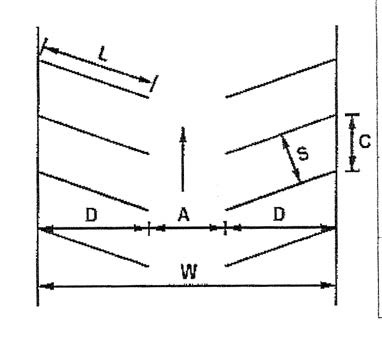
4.
Parking space for dwellings. Driveways for dwellings shall be designed and constructed to accommodate the required amount of parking per dwelling.
5.
Assigning of parking spaces. The required parking spaces for any number of separate buildings or uses may be combined in one (1) common parking lot facility; however, the required parking assigned to one (1) use may not be assigned to another active use at the same time.
6.
Location of parking space. The initial obligation of the property owner or developer is to provide the required parking within the property of the principal use. However, off-site parking may be allowed when such parking facility is within 500 feet of the applicable principal use property, when such off-site parking facility is in the same ownership as the applicable principal use and when the off-site parking facility can allow safe and unrestricted pedestrian access between both sites by improved access easements, walkways, or sidewalks in conformance with standards of the town. The maximum distance of off-site parking may be exceeded, subject to issuance of a variance for a use which contains seating capacity of 1,000 or more (e.g, auditoriums, stadiums, or amphitheaters). Off-site parking shall be measured in a straight line distance from the closest point of the building to the parking space. Where such use does not have building, then the measurement shall be from the closest property line of said use.
7.
Parking reduction or assignment to another use. The parking spaces required by this section shall not be reduced below the minimum required for the use or facility to which it is assigned, nor shall any parking spaces required by this section be used for any other purpose or use unless otherwise specified by this article - with the exception of electric vehicle (EV) charging stations that may occupy no more than 5% of the required parking spaces and subject to accessory structure setbacks. Any additional charging stations shall be located in parking spaces not subject to the minimum requirement. Required off-street parking spaces and loading spaces are permanent areas and shall not be used for any other aboveground purpose.
8.
Myrtle Grove Sound and Ocean terminating parking access. On all streets which terminate with the ocean berm or the waters of Myrtle Grove Sound where dwellings, hotels, or motels are located on corner lots which abut the terminated street and the dominant highway or right-of-way, such dwellings, hotels, or motels shall have the entrance to such projects for ingress and egress on the dominant street only, where parallel to the ocean or sound as to not disrupt public access, unless the Technical Review Committee determines the new ingress/egress will not negatively impact the level of public access. Minimal evaluation criteria that shall be met:
a)
Enhance access by defining additional public parking.
b)
Increase public safety by allowing access on the terminating street.
c)
Include improvements to public access to the ocean and/or soundfront areas.
F.
PARKING DESIGN AND CONSTRUCTION
1.
Required surfacing. All parking facilities shall provide a paved surface of concrete or asphalt material. Concrete pavers, brick, pervious, or semi-pervious materials (e.g., "turfstone" or gravel) or similar material may be used if determined to exhibit wear resistance and load-bearing characteristics acceptable to the Public Works. In all instances, such surface shall be dustproof. Dustproof shall be presumed to include clean-washed stone and other materials that do not create aerial disturbance or residue.
2.
Barriers. Each parking space shall be equipped with a curb, wheel stop, or similar device to prevent vehicle encroachment beyond property lines of parking facilities into pedestrian ways or traffic isles.
3.
Vision clearance. In order to maintain an acceptable and safe line of sight for motor vehicle drivers, no parking spaces, fences, walls, posts, signs, lights, shrubs, trees, or other type of obstructions not specifically exempted shall be permitted in the space between 30 inches above ground level and 10 feet above ground level within a sight distance triangle. A sight distance triangle shall be the visually unobstructed area of a street/driveway corner as determined by measuring a distance of 30 feet along the intersecting curb lines, or edges of pavement of the intersecting street/driveway if curbs are not present, and connecting the two (2) points by a straight line to form a triangular shaped area over the corner.
4.
Radii at intersection of parking facility, driveway, and street. The minimum corner paved radius at intersections of the parking facility, driveways, and streets shall be 15 feet.
5.
Maneuvering. All parking facilities shall be designed and constructed so that maneuvering shall take place entirely within the property lines of the facility and shall be arranged so that ingress and egress is by forward motion of the vehicle. Exceptions may be granted for maneuvering of vehicles that meet the following conditions and the required sidewalk and landscaping regulations shall be waived for those parking spaces.
a)
Single- and multifamily dwellings.
b)
Commercial establishments meeting the following criteria:
i)
Located on a non-through street.
ii)
Applicable NCDOT approval has been obtained and provided to town.
iii)
Located in the Highway Business (HB) Zoning District.
6.
Drainage. All stormwater drainage from parking facilities shall either be retained on-site or piped to an appropriate underground stormwater system or to open drainage ditches as approved by the Directors of Public Works and Public Utilities and as required by the applicable stormwater management ordinances of the town.
7.
Landscaping. Parking facilities shall be subject to the provisions of the landscape requirements of this ordinance.
8.
Markings and signs. All required parking spaces contained within a parking facility shall be adequately marked on the paved surface and any directional markings or signs shall be provided by the owner or developer.
9.
Voiding of certificate of compliance. The certificate of compliance for the use of any building, structure, or land where off-street parking space is required shall be withheld until the provisions of this article are complied with. Failure to comply with the requirements of this article shall cause any certificate of compliance previously issued to become null and void immediately.
(Ord. No. 24-1230, 7-9-2024; Ord. No. 25-1261, 8-12-2025)
3.25 - OFF-STREET LOADING REQUIREMENTS
A.
Purpose. The purpose of this section is to provide off-street loading standards which will lessen congestion in the streets and promote safe and unrestricted traffic flow and to provide for the safe and efficient use of property to serve the loading and unloading needs of commercial facilities.
B.
Applicability. The off-street loading standards contained herein shall apply to all new construction and uses, changes of ownership and uses, and expansions, additions and renovations to existing structures unless subject to exemption provisions as provided herein. Residential uses shall be exempt from off-street loading requirements.
1.
Waiver of loading requirements in the CBD, MB-1, I-1, T-1, MX, HB, and NB zoning district. Where properties are located within the CBD, off-street loading requirements are exempt subject to submission and approval of a loading space plan by the UDO Administrator. Within the MB-1, I-1, T-1, MX, HB, and NB zoning districts where buildings are less than 15,000 square feet, the loading requirements may be waived based on approval of a loading plan by the UDO Administrator. Loading plans submitted by applicants in all districts shall address the following:
a)
Time loading will take place.
b)
Approximate size of truck used for loading.
c)
Duration of loading period.
d)
Location of the loading area.
C.
Minimum off-street loading requirements.
1.
The minimum number of off-street loading spaces shall be determined by the gross floor area of the establishment as provided by the table herein.
2.
For uses whereby the applicant seeks relief from these requirements, and where no waiver may be sought, a variance may be applied for. As part of the request for a variance the applicant shall provide a detailed estimate of the anticipated quantities of goods and frequency of delivery.
D.
Location of off-street loading space. All required loading spaces shall be located on the same lot and shall have the same zoning as the use it is to serve. No off-street loading space shall be located in a required front yard or within a triangular sight distance. Loading facilities shall be constructed so that all maneuvering will take place entirely within the property lines of the facility. Interior off-street loading spaces may be located inside the structure it serves, provided the other provisions of this section, such as size and access, are met.
E.
Size of off-street loading space. Unless otherwise specified, an off-street loading space shall be 12 feet in width by 45 feet in length, exclusive of aisles and maneuvering space, and shall have a vertical clearance of at least 15 feet.
F.
Surfacing of off-street loading space. All off-street loading spaces shall be paved with asphalt or concrete material, or with alternative paving material (e.g., concrete pavers, brick, "turfstone," or similar material) determined to exhibit equivalent wear resistance and load-bearing characteristics as asphalt or concrete, of a type and thickness capable of carrying, without damage, the heaviest vehicle loads reasonably anticipated on such surface, as approved by the Public Works Director.
G.
Repair and service. No motor vehicle repair work or service of any kind shall be permitted in conjunction with loading facilities, except emergency repair service necessary to relocate a vehicle to a normal repair facility.
H.
Utilization. Off-street loading space shall not be used to satisfy the space requirements for off-street parking facilities or portions thereof, nor vice versa.
I.
Access. Each off-street loading space shall be provided with unobstructed ingress and egress to a public or private street.
J.
Voiding of certificate of compliance. The certificate of compliance for the use of any building, structure, or land where off-street loading is required shall be withheld until the provisions of this section are complied with. Failure to comply with the requirements of this section shall cause any certificate of compliance previously issued to become null and void immediately.
(Ord. No. 24-1230, 7-9-2024)
3.27 - LANDSCAPE AND BUFFER REQUIREMENTS
A.
PURPOSE
This article is established for the purpose of regulating, controlling, preserving, and setting forth methods of continued maintenance assurances of all regulated vegetation located within the municipal limits of the town, and furthermore establishes authority to regulate and control the degree of impervious surfaces constructed on properties and the placement and configuration of fill soil and materials on properties located within said municipality.
B.
AUTHORITY
North Carolina General Statutes 160A-174(a), 160D-923, 143-214.7, and 143-215.51 (G.S. 160A-174(a), 160D-923, 143-214.7 and 143-215.51.
C.
BENEFITS OF TREES AND LANDSCAPING
1.
The town finds it important to adopt an ordinance to preserve and protect trees since numerous benefits are derived from this practice, including the following:
a)
Maintains the visual character of the community and contributes to the aesthetic quality of property and enhances its value.
b)
Screens objectionable views within and between uses.
c)
Reduces glare, heat, and assists in noise abatement, maintaining the climatic balance and decreasing wind velocity.
d)
Contributes to the process of air purification and oxygen regeneration.
e)
Assists in the stabilization and fertilization of soil and in the prevention of soil erosion.
f)
Contributes to the process of groundwater recharge and stormwater runoff retardation and protecting against flood hazards and erosion.
g)
Promotes energy conservation by maximizing the shading and cooling effects of trees.
h)
Provides a haven for birds, reptiles, and mammals that in turn help control the insect population.
i)
Provides nuts and fruits for wildlife.
j)
Provides important psychological, sociological, and aesthetic counterpoints to the manmade urban setting.
D.
APPLICABILITY
In order to adhere to the above-described functions, these regulations shall be applicable to any and all regulated vegetation and to all areas proposed for the reduction of ground absorption area through the construction of impervious surfaces and to all areas proposed for land elevation and modification of configuration by the deposition of fill soil or materials as specified herein or as may be described by subsequent applicable regulations of the town.
E.
BUFFER YARD AND STREET YARD LANDSCAPING
1.
For proposed new construction or expansion. A buffer yard, as defined herein, shall be provided for all new construction or expansion that is proposed in any amount equal to 50% or more of the current tax or appraised value. However, no buffer yard improvements shall be required for those portions of existing lot frontage used for driveways constructed in accordance with town regulations.
2.
Required landscape types. It is required that buffer and street yards be landscaped by meeting the requirements of Type A—E set forth in this section. Any side or rear yard that abuts a residential use or residential district shall provide for a six (6) foot fence with 80% opacity. A landscaping/buffer yard information guide and plant selection list is available from the UDO Administrator.
a)
Type A. For every 50 linear feet, or fraction thereof, the buffer yard shall contain one (1) canopy tree or two (2) understory trees, and three (3) shrubs.
b)
Type B. For every 50 linear feet, or fraction thereof, the buffer yard shall contain two (2) canopy trees or four (4) understory trees, and six (6) shrubs.
c)
Type C. For every 50 linear feet, or fraction thereof, the buffer yard shall contain two (2) canopy trees or four (4) understory trees, and six (6) shrubs.
d)
Type D. For every 50 linear feet of frontage, or fraction thereof, the street yard shall contain one (1) understory tree with sidewalks or planters built within the sidewalk. Street yards located within the CBD shall include sidewalks with planting areas either adjacent to the curb or planters located within the sidewalk. In the Central Business District, sidewalks and tree plantings will be required for all new construction. Any side or rear yard that abuts a residential district shall provide for a Type B landscape buffer yard.
e)
Type E. For every 25 linear feet of frontage, or fraction thereof, the lot shall contain a minimum of one (1) tree. At planting each tree shall be a minimum of:
i)
Six (6) feet tall.
ii)
Two (2) inches in caliper.
3.
Preservation of vegetation. If vegetation exists in the proposed buffer yard area, the UDO Administrator may grant credit toward meeting buffer yard requirements for preservation of the vegetation provided their caliper or height is equal to or exceeds the specifications herein described.
4.
Planting and replacement of vegetation. All buffer yards shall be landscaped with a combination of live vegetation, ground cover, grass, trees, and/or shrubs. Vegetation to be planted pursuant to this section shall be indigenous with or compatible to the town area and be approved by the UDO Administrator.
5.
Minimum size at planting. All shrubs be 12 inches high, understory trees six (6) feet high, and canopy trees 2.5 inches caliper.
F.
TREE/LANDSCAPE PLAN
1.
Required. A tree/landscaping plan shall be required for all clearing, grading, or other earth disturbing activity proposals. The plan must contain the information set forth in this section (the required tree/landscape plan can be incorporated into any applicable development approval application).
2.
Landscape plan submittal requirements. The landscape plan shall contain the following information:
a)
General location, type, and quantity of existing plant materials.
b)
Existing plant materials and areas to be left in natural state.
c)
Methods and details for protecting existing plant materials during construction and the approved erosion control plan, if required.
d)
Locations, size, and labels for all proposed plants.
e)
Plant lists with common name, quantity, spacing, and size of all proposed landscape material at the time of planting.
f)
Location and description of other landscape improvements, such as earth berms, walls, fences, screens, sculptures, fountains, street furniture, lights, and courtyards or paved areas.
g)
Planting and installation details as necessary to ensure conformance with all required standards.
h)
Location and type of irrigation system, if applicable.
i)
Location of any proposed buildings.
j)
Layout of parking and traffic patterns.
k)
Location of overhead and underground utilities.
l)
Location of signage.
m)
Connections to existing streets.
n)
Zoning designation of adjacent properties.
o)
Landscape plan shall be drawn to scale and include a north arrow and necessary interpretive legends.
3.
Information guide and plant selection list. A landscaping/buffer yard information guide and plant selection list is available from the UDO Administrator.
(Ord. No. 24-1230, 7-9-2024)
3.28 - PLANTING AND VEGETATION DESIGN SPECIFICATION STANDARDS
A.
PARKING FACILITIES LANDSCAPING
1.
All parking facilities required by town regulations shall submit the site plan to the UDO Administrator for review and approval of the landscaping requirements of this section.
2.
Minimum standards. At least 8% of the gross paved area of a parking facility shall be landscaped and located in the interior. For purposes of this section, interior shall mean the area within the parking facility curb or pavement and extensions that create a common geometric shape such as a square, rectangle, or triangle.
a)
All plantings shall be evenly distributed throughout the parking facility.
b)
All interior plantings shall be curbed or otherwise physically protected.
c)
Consecutive parking spaces shall incorporate landscaped peninsulas no more than 15 spaces apart and at the ends of all parking rows. Peninsulas shall be a minimum of eight (8) feet wide by 18 feet length measured from back of curb/barrier to back of curb/barrier.
B.
DUMPSTER ENCLOSURES
Refuse collection agency to be used must be included on final site plans. The refuse collection site must be enclosed on three (3) sides by a minimum six (6) foot opaque fence.
C.
MAINTENANCE
1.
All planted and retained living material required to meet the provisions of this article shall be maintained by the owner of the property on which the material is located, excluding Type E buffer yard.
2.
Nonliving screening buffers shall be maintained, cleaned, and repaired by the owner of the property on which the buffer is located. Such buffers shall be kept free of litter and advertising.
3.
Where ground cover material is placed within the street yard or within a public or private right-of-way, it shall be the responsibility of the property owner to contain this ground cover material and to remove it from public sidewalks and streets immediately after rain and wind events. Ground cover material placed in the town right-of-way may require the approval of the town manager.
(Ord. No. 24-1230, 7-9-2024)
3.29 - GENERAL SIGNAGE
A.
PURPOSE
1.
It is the intent of the Town Council to protect public interest, safety, and welfare and, to that end, the purpose of these sign regulations are specifically declared to be as follows:
a)
To promote economic development while minimizing the negative impacts that signs may have on the visual appearance of the town.
b)
To provide orientation and guidance to our tourists/visitors and identification of public areas, natural resources, historical and cultural landmarks, and places of interest and in so doing reduce confusion, traffic congestion, and air pollution.
c)
To inform and educate visitors and residents of opportunities and events both commercial and noncommercial occurring in the Town of Carolina Beach.
d)
To permit and regulate signs in such a way as to support and compliment land use objectives.
2.
It is not the purpose or intent of this article to regulate signage displayed for special occasions not associated with a business (i.e., balloons for birthday parties or to celebrate the birth of a baby, etc.).
B.
ADMINISTRATION
Permit required. Except as otherwise provided, no sign shall be erected, altered, constructed, moved, converted, or enlarged except in accordance with the provisions of this section and pursuant to issuance of a sign permit in accordance with Article 2.
C.
SIGN NUMBER AND SIZE
1.
Number of signs. Unless otherwise stated, the number of signs is detailed in the sections below, except for corner or double frontage lots.
2.
Corner/double frontage lots. For permanent freestanding signage, a second sign may be placed on corner or double frontage lots. Where two (2) signs are allowed, one (1) sign shall be adjacent to one (1) public right-of-way and the second sign shall face the other public right-of-way. If signs are used on opposite/separate frontages, each sign may use the maximum size allowable. If the second sign is on a corner lot line, then the total square footage of the two (2) signs shall not exceed the normal maximum size allowance, except when a corner lot meets the following criteria:
a)
The corner lot is located in the CBD or HB zoning district.
b)
The lot is larger than 30,000 square feet.
c)
The sign is limited to 10 feet in height.
d)
The sign is set back an additional five (5) feet beyond the required 10 feet setback from all lot lines.
e)
Meeting the four (4) criteria above will permit each sign on a corner lot to use the maximum size allowable for a freestanding sign on each frontage.
3.
Size calculations. The term "sign" shall include all structural members. A sign shall be constructed to be a display surface or device containing organized and related elements composed to form a single unit. In cases where matter is displayed in a random or unconnected manner without organized relationship of the components, each such component shall be considered to be a single sign.
a)
Sign area.
i)
Attached. The area of a sign composed in whole or in part of freestanding letters, devices, or sculptured matter not mounted on a measurable surface shall be constructed to be the area of the least square, rectangle, or circle that will enclose the letters, devices, and/or sculptured matter.
ii)
Freestanding. All surface areas and any lettering or sculptured matter outside the sign surface area.
b)
Sign height. The height of a sign shall be computed as the distance from the base ground level to the top of the highest vertical attached component of the sign.
c)
Sign face. Where a sign has two (2) or more faces, the area of all faces shall be included in determining the area of the sign, except that where two (2) such faces are placed back-to-back and are at no point more than one and one-half feet from one another.
D.
SIGN LOCATION AND SETBACK MEASUREMENT
1.
No signage shall be placed in any location that interferes with the sight distance triangle of motorists utilizing public or private roadways.
a)
A sight distance triangle is the visually unobstructed area of a street/driveway corner.
b)
It is determined by measuring a distance of 30 feet along the intersecting curb lines, or edges of pavement of the intersecting street/driveway if curbs are not present, and connecting the two (2) points by a straight line to form a triangular shaped area over the corner.
2.
No signs shall be located in a public right-of-way with the exception of NCDOT rights-of-way in accordance with Session Law 2011-408.
3.
Setbacks. Unless specifically stated otherwise, setbacks shall be measured from the nearest point on the sign pole to the nearest point on a lot line, structure, or other relevant boundary. In no case shall such sign encroach into any right-of-way or adjacent lot.
E.
SIGNS NOT REQUIRING A PERMIT
1.
The following types of signs are exempt from permit requirements whether for residential or nonresidential use and subject to the requirements provided herein:
a)
Governmental signs.
b)
Window/door signs.
c)
Any sign required by a government agency (e.g., address number sign).
d)
Residential signage.
e)
Temporary commercial yard signage.
f)
Any temporary signage unless stated otherwise in this article.
g)
Any sign that is not designed for view by vehicular traffic may be displayed as long as the signage does not violate any of the prohibited sign regulation.
2.
Temporary signage in residential districts: Each lot in a residential district shall be permitted to place banners, flags, and yard signs without the issuance of a permit so long as the proposed banner, flag, or yard sign meets the following requirements:
a)
Flags and banners.
i)
No more than two (2) shall be displayed per 50 feet of road frontage.
ii)
Size shall be limited to a maximum of 24 square feet and 20 feet in height.
iii)
Must meet all relevant size and location requirements.
iv)
Shall remain within the boundaries of the lot for which they are associated.
b)
Yard signs. Four (4) temporary signs related to noncommercial activities or events may be placed on a parcel 30 days prior to said activity/event, remain up during said activity/event, and must be removed within 10 days of the conclusion of said activities/event. These yard signs shall follow the regulations below:
i)
The signs shall be non-illuminated and may not exceed a cumulative of 20 square feet for all such signs. No yard sign shall exceed five (5) feet in height.
ii)
The sign shall be setback at least five (5) feet from the road and/or lot line whichever is greater and not impose upon the intersection sight triangle.
iii)
The person, party, or parties responsible for the erection or distribution of any such signs shall be liable for the removal of such signs.
iv)
The lot occupant or, in the case of unoccupied lot, the lot owner, shall be responsible for violations on a particular lot.
v)
No temporary signage is permitted in the public right-of-way. With the exception of NCDOT rights-of-way in accordance with Session Law 2011-408.
vi)
Off-site directional signage shall be related to an event, will only be permitted while the activity/event is on-going, and shall be removed within 48 hours of the conclusion of said activity/event.
vii)
No commercial signs shall be placed off-site on a residential lot which are unrelated to ongoing activities on that residential lot. Signs related to ongoing activities shall be removed within 10 days from the completion of said activity.
3.
Temporary yard signs for nonresidential uses not requiring a permit.
a)
Four (4) temporary signs related to noncommercial activities or events may be placed on a parcel 30 days prior to said activity/event, remain up during said activity/event, and must be removed within 10 days of the conclusion of said activity/event.
b)
The sign must be non-illuminated and may not exceed 20 square feet or five (5) feet in height.
c)
The [sign] must be setback at least five (5) feet from the road and/or lot line whichever is greater and not impose upon the intersection sight triangle.
d)
The person, party, or parties responsible for the erection or distribution of any such signs shall be liable for the removal of such signs.
e)
The lot occupant or, in the case of unoccupied lot, the lot owner, shall be responsible for violations on a particular lot.
f)
No temporary signage is permitted in the public right-of-way.
g)
Off-site directional signage must be related to an event, will only be permitted while the activity/event is on-going, and must be removed within 48 hours of the conclusion of said activity/event.
F.
RESERVED
G.
PROHIBITED SIGNS/DISPLAYS
1.
The following signs are prohibited within the planning jurisdiction of the town:
a)
Billboard signs.
b)
Signs in disrepair, that are unsafe, which no longer can be easily recognized for their intended purpose due to disrepair or fading, or are no longer applicable to the associated property use.
c)
Strobe lights or any other type of flashing lighting or beacons. Exceptions: Flashing signs may be permitted in the Central Business District as long as they are not located adjacent to Lake Park Boulevard. Flashing signs may be permitted in the CBD as long as they are not visible from the roadway. These exceptions do not allow for strobe lights.
d)
Moveable, animated, flashing signs including balloons and/or human signs.
e)
Pennant or consecutively linked flagging or similar devices.
f)
Signs which resemble or are visibly similar to official governmental traffic signs or signals or employ lighting, or employ the words of official signs such as "stop," "caution," "danger," "slow," or "warning."
g)
Signs located within or protruding in public areas or rights-of-way, unless specifically permitted herein. Any person erecting a sign in a public area shall indemnify and hold harmless the town and its officers, agents, and employees from any claim arising out of the presence of the sign on town property or rights-of-way.
h)
Signs that make noise.
i)
Signs displaying or containing obscenities. For purposes of this section, obscenity shall be determined in accordance with NCGS 14-190.1(b)—(d).
j)
Roof signs.
k)
Snipe signs.
l)
Handwritten messages on permanent signs.
m)
Vehicle/trailer signs.
Any other sign not mentioned by this article.
H.
SIGN LIGHTING
1.
Interior sign lighting shall be shaded with an opaque sign face surface sufficient to reduce the glare on roadways and surrounding properties. Silhouette lighting may be utilized. Such lighting shall be placed so as to provide even illumination to the signage and to avoid hot spots or dark areas on the signage.
2.
Signs utilizing bare bulbs or neon type lighting shall be such that they minimize the glare on roadways and surrounding properties.
3.
No floodlights shall be utilized as a part of a sign illumination system which are not hooded or shielded so that the light source is not visible from any public right-of-way or adjacent property, nor shall any sign otherwise reflect or emit a glaring light so as to impair driving vision.
I.
NONCONFORMING SIGNS, ILLEGAL SIGNS, VIOLATIONS AND PENALTIES
All signs shall be subject to nonconforming situation and enforcement action requirements as applicable.
(Ord. No. 24-1230, 7-9-2024)
3.30 - RESIDENTIAL SIGNAGE
A.
Governmental signs. Size, location, and length of time of these signs shall be approved by the town manager or his designee.
B.
Residential development entry signage. Two (2) attached entrance signs or one (1) monument or freestanding sign per principal entrance are allowed. Such signs shall not exceed an area of 20 square feet per sign face and an aggregate area of 40 square feet if signs are multiple-faced, nor shall they exceed a height of six (6) feet if freestanding. They may be illuminated.
(Ord. No. 24-1230, 7-9-2024)
3.31 - COMMERCIAL AND NONRESIDENTIAL SIGNAGE
A.
APPLICABILITY
The following permanent and temporary signs shall be permitted in all districts where associated with a permitted commercial or nonresidential use(s) on the same property.
B.
ATTACHED SIGNS
1.
Attached signs shall be allowed on all sides of a business. The total allowable building face signage shall not exceed 25% of the front building face and may be apportioned among any/all building faces. A building face shall be measured from ground level at the foundation to the roof overhang (or junction of roof and front wall line) and from side-to-side of building.
2.
If utilized, projecting signage shall have a clearance of at least 10 feet between the adjacent ground level and the lowest portion of the sign. No attached sign shall project more than four (4) feet from the building facade. In the CBD, where buildings are adjacent to a right-of-way, a projecting sign shall be allowed to encroach up to two (2) feet into the right-of-way subject to required ground level clearance.
3.
Canopy/awning signs shall be considered as attached signs. In no instance shall a canopy/awning sign exceed the canopy awning area.
C.
DIRECTIONAL SIGNS
1.
On-premises directional signs.
a)
On-premises directional signs shall be limited to not more than four (4) square feet and shall not exceed three (3) feet in height.
b)
For every driveway cut, two (2) directional signs shall be allowed on private lot adjacent to the right-of-way.
D.
PERMANENT FREESTANDING SIGNS
1.
Unless stated elsewhere in the article, no business/property or lot shall have more than one (1) freestanding sign.
2.
A permanent freestanding sign shall have a minimum setback of 10 feet from all lot lines.
3.
Maximum size equals one-half a square foot of sign area per one (1) linear foot of road frontage or 25 square feet per commercial and/or residential unit located on the development site, whichever is greater, but not to exceed the below requirements.
E.
TEMPORARY SIGNS WHICH REQUIRE A SIGN PERMIT
1.
Each business shall be allotted one (1) temporary freestanding or attached sign year-round. Permits for temporary signage shall be issued annually with the following limitations:
a)
A-frame signs not exceeding eight (8) square feet per side in area with a maximum height of four (4) feet.
b)
Portable signs not exceeding 10 square feet and five (5) feet in height.
c)
Banner signs not exceeding 24 square feet and eight (8) feet in height.
d)
Commercial flagging shall be limited to 24 square feet in area and shall have the same height restrictions as permanent freestanding signs.
e)
Feather flags shall be limited to 20 square feet and 10 feet in height.
2.
Temporary signs may be placed on public sidewalks in the CBD. In all other districts, such signs may be placed up to the right-of-way but shall not encroach into the right-of-way. No temporary sign shall be placed where the unobstructed space for the passageway of pedestrians is reduced to less than four and one-half (4.5) feet.
(Ord. No. 24-1230, 7-9-2024)
3.33 - PURPOSE AND LEGISLATIVE INTENT
A.
The purpose of this article is to provide for the public health, safety, and welfare by ensuring that residents, businesses, and public safety operations in the town have reliable access to telecommunications networks and state of the art mobile broadband communications services while also ensuring that this objective is accomplished according to the town's zoning, planning, and design standards. To accomplish the objectives stated in this section and to ensure that the placement, construction, or modification of wireless telecommunications facilities complies with all applicable federal laws, including, without limitation, Section 6409 of the federal Middle Class Tax Relief and Job Creation Act of 2012, 47 USC 1455(a), which, among other things, creates a national wireless emergency communications network for use by first responders that in large measure will be dependent on facilities placed on existing wireless communications support structures, the town adopts this single, comprehensive wireless telecommunications ordinance.
B.
By enacting these regulations, it is the town's intent to ensure the community has sufficient wireless infrastructure to support its public safety communications and to ensure access to reliable wireless communications services throughout all areas of the town.
(Ord. No. 24-1230, 7-9-2024)
3.34 - APPROVALS REQUIRED FOR WIRELESS FACILITIES AND WIRELESS SUPPORT STRUCTURES
A.
Administrative review and approval. The following types of applications are subject to the review process as provided in section 3.34. No other type of zoning or site plan review is necessary.
1.
New wireless support structures that are less than 50 feet in height, in any commercial zoning district.
2.
New wireless support structures that are less than 150 feet in height, in any industrial district.
3.
Concealed wireless facilities that are 50 feet or less in height, in any residential district.
4.
Concealed wireless facilities that are 150 feet or less in height, in any zoning district except residential districts.
5.
Monopoles or replacement poles located on public property or within utility easements or rights-of-way, in any zoning district.
6.
Carrier on wheels or cell on wheels (COWs), in any zoning district, if the use of the COW is either not in response to a declaration of an emergency or disaster by the Governor, or will last in excess of 120 days.
7.
Substantial modifications.
8.
Collocations.
9.
Small cell and micro wireless facilities.
B.
Conditional zoning. Any application for wireless facilities and/or wireless support structures not subject to administrative review and approval pursuant to this article shall be permitted in any district upon the granting of a conditional zoning from the town in accordance with the standards for granting conditional zoning set forth in Article 2.
C.
Exempt from all approval processes. The following are exempt from all town zoning approval processes and requirements:
1.
Removal or replacement of transmission equipment on an existing wireless tower or base station that does not result in a substantial modification as defined in this ordinance.
2.
Ordinary maintenance of existing wireless facilities and wireless support structures, as defined in this ordinance.
3.
Wireless facilities placed on utility poles.
4.
COWs placed for a period of not more than 120 days at any location within the town or after a declaration of an emergency or a disaster by the Governor.
(Ord. No. 24-1230, 7-9-2024)
3.35 - ADMINISTRATIVE REVIEW AND APPROVAL PROCESS
A.
Contents of application package.
1.
For new sites. All administrative review application packages must contain the following:
a)
Administrative review application form signed by the applicant.
b)
Copy of lease or letter of authorization from the property owner evidencing the applicant's authority to pursue the application. Such submissions need not disclose financial lease terms.
c)
Site plans detailing proposed improvements which complies with the town's existing site plan requirements. Drawings must depict improvements related to the applicable requirements, including property boundaries, setbacks, topography, elevation sketch, and dimensions of improvements.
d)
Documentation from a licensed professional engineer of calculation of the fall zone and certification that the wireless support structure has sufficient structural integrity to accommodate the required number of additional users as provided in this article.
2.
For other sites/facilities. All administrative review application packages must contain the following:
a)
Administrative review application form signed by the applicant.
b)
For collocations and substantial modifications, written verification from a licensed professional engineer certifying that the host support structure is structurally and mechanically capable of supporting the proposed additional antenna or configuration of antennas.
c)
For substantial modifications, drawings depicting the improvements along with their dimensions.
B.
Fees. The total fees for reviewing an administrative review application shall be in accordance with the annually adopted rates and fees schedule.
C.
Procedure and timing.
1.
Applications for collocation, monopole or replacement pole, concealed wireless facility, small and micro wireless facility, nonexempt COW or substantial modification. Within 30 days of the receipt of an application for a collocation, a monopole or replacement pole, a concealed wireless facility, a nonexempt COW or a substantial modification, the UDO Administrator will:
a)
Review the application for conformity with this article. An application under this subsection is deemed to be complete unless the UDO Administrator notifies the applicant in writing, within 10 calendar days of submission of the application of the specific deficiencies in the application which, if cured, would make the application complete. Upon receipt of a timely written notice that an application is deficient, an applicant may take 10 calendar days from receiving such notice to cure the specific deficiencies. If the applicant cures the deficiencies within 10 calendar days, the application shall be reviewed and processed within 30 calendar days from the initial date the application was received. If the applicant requires a period of time beyond 10 calendar days to cure the specific deficiencies, the 30 calendar days deadline for review shall be extended by the same period of time.
b)
Make a final decision to approve the collocation application or approve or disapprove other applications under this subsection.
c)
Advise the applicant in writing of its final decision. If the zoning authority denies an application, it must provide written justification of the denial, which must be based on substantial evidence of inconsistencies between the application and this article.
d)
Failure to issue a written decision within 30 calendar days shall constitute an approval of the application.
2.
Applications for new wireless support structures that are subject to administrative review and approval. Within 45 calendar days of the receipt of an application for a new wireless support structure that is subject to administrative review and approval under this article, the UDO Administrator will:
a)
Review the application for conformity with this article. An application under this subsection is deemed to be complete unless the UDO Administrator notifies the applicant in writing, within 15 calendar days of submission of the application of the specific deficiencies in the application which, if cured, would make the application complete. Upon receipt of a timely written notice that an application is deficient, an applicant may take 15 calendar days from receiving such notice to cure the specific deficiencies. If the applicant cures the deficiencies within 15 calendar days, the application shall be reviewed and processed within 45 calendar days from the initial date the application was received. If the applicant requires a period of time beyond 15 calendar days to cure the specific deficiencies, the 45 calendar days deadline for review shall be extended by the same period of time.
b)
Make a final decision to approve or disapprove the application.
c)
Advise the applicant in writing of its final decision. If the zoning authority denies an application, it must provide written justification of the denial, which must be based on substantial evidence of inconsistencies between the application and this article.
d)
Failure to issue a written decision within 45 calendar days shall constitute an approval of the application.
3.
Building permit. A Building Inspector shall issue a building permit following approval of the application under administrative review in accordance with the process and standards in this article.
(Ord. No. 24-1230, 7-9-2024)
3.36 - CONDITIONAL ZONING PROCESS
A.
Granting of conditional zoning for wireless facilities or support structures in zoning districts. Any wireless facility or wireless support structures not meeting the requirements of this article may be permitted in all zoning districts upon the granting of a conditional zoning, subject to:
1.
The submission requirements of subsection (b) of this section.
2.
The applicable standards of this article.
3.
The requirements of the conditional zoning process as provided in Article 2 of this ordinance.
B.
Content of conditional zoning application package. All conditional zoning application packages must contain the following:
1.
Conditional zoning application form signed by the applicant.
2.
Copy of lease or letter of authorization from the property owner evidencing the applicant's authority to pursue zoning application. Such submissions need not disclose financial lease terms.
3.
Written description and scaled drawings of the proposed wireless support structure or wireless facility, including structure height, ground and structure design, and proposed materials.
4.
Number of proposed antennas and their height above ground level, including the proposed placement of antennas on the wireless support structure.
5.
Line-of-sight diagram or photo simulation, showing the proposed wireless support structure set against the skyline and viewed from at least four (4) directions within the surrounding areas.
6.
A statement that the proposed wireless support structure will be made available for collocation to other service providers at commercially reasonable rates, provided space is available and consistent with this article.
7.
Notification of surrounding property owners and posting as required by the conditional zoning process.
C.
Procedure and timing. Within 150 calendar days of the receipt of an application under this section, the UDO administrator will:
1.
Complete the process for reviewing the application for conformity with ordinances applicable to conditional zoning. An application under this section is deemed to be complete unless the UDO Administrator notifies the applicant in writing, within 30 calendar days of submission of the application of the specific deficiencies in the application which, if cured, would make the application complete. Upon receipt of a timely written notice that an application is deficient, an applicant may take 30 calendar days from receiving such notice to cure the specific deficiencies. If the applicant cures the deficiencies within 30 calendar days, the application shall be reviewed and scheduled for action by the Town Council within 150 calendar days from the initial date the application was received, which shall include a vote by the Planning and Zoning Commission during that same time. If the applicant requires a period of time beyond 30 calendar days to cure the specific deficiencies, the 150 calendar days deadline for review shall be extended by the same period of time.
(Ord. No. 24-1230, 7-9-2024)
3.37 - GENERAL STANDARDS AND DESIGN REQUIREMENTS
A.
Design. Wireless support structures shall be subject to the following:
1.
Wireless support structures shall be engineered and constructed to accommodate a minimum number of collocations based upon their height:
a)
Support structures 60 to 100 feet shall support at least two (2) telecommunications providers.
b)
Support structures greater than 100 feet but less than 150 feet shall support at least three (3) telecommunications providers.
c)
Support structures greater than 150 feet in height shall support at least four (4) telecommunications carriers.
2.
The equipment compound area surrounding the wireless support structure must be of sufficient size to accommodate accessory equipment for the appropriate number of telecommunications providers in accordance with subsection (A)(1)(a) of this section.
3.
Concealed wireless facilities shall be designed to accommodate the collocation of other antennas whenever economically and technically feasible. Antennas must be enclosed, camouflaged, screened, obscured, or otherwise not readily apparent to a casual observer.
4.
Upon request of the applicant, the Town Council may waive the requirement that new wireless support structures accommodate the collocation of other service providers if it finds that collocation at the site is not essential to the public interest, or that the construction of a shorter support structure with fewer antennas will promote community compatibility.
5.
A monopole or replacement pole shall be permitted within utility easements or rights-of-way, in accordance with the following requirements:
a)
The utility easement or right-of-way shall be a minimum 100 feet in width.
b)
The easement or right-of-way shall contain overhead utility transmission and/or distribution structures that are 80 feet or greater in height.
c)
The height of the monopole or replacement pole may not exceed by more than 30 feet the height of existing utility support structures.
d)
Monopoles and the accessory equipment shall be set back a minimum of 15 feet from all boundaries of the easement or right-of-way.
e)
Single carrier monopoles may be used within utility easements and rights-of-way due to the height restriction imposed by subsection (A)(5)c of this section.
f)
Poles that use the structure of a utility tower for support are permitted. Such poles may extend up to 20 feet above the height of the utility tower.
B.
Setbacks. Unless otherwise stated herein, each wireless support structure shall be set back from all property lines a distance equal to its engineered fall zone.
C.
Height. In residential districts, wireless support structures shall not exceed a height equal to 50 feet from the base of the structure to the top of the highest point, including appurtenances. Notwithstanding the foregoing, the Town Council shall have the authority to vary the foregoing height restriction upon the request of the applicant as part of the conditional zoning process. With its request, the applicant shall submit such technical information or other justifications as are necessary to document the need for the additional height.
D.
Aesthetics. Lighting and marking. Wireless facilities or wireless support structures shall not be lighted or marked unless required by the Federal Communications Commission (FCC) or the Federal Aviation Administration (FAA).
E.
Signage. Signs located at the wireless facility shall be limited to ownership and contact information, FCC antenna registration number (if required) and any other information as required by government regulation. Commercial advertising is strictly prohibited. Notwithstanding the foregoing, nothing in this article shall prohibit signage that is approved for other uses on property on which wireless facilities are located (i.e., approved signage at locations on which concealed facilities are located).
F.
Accessory equipment. Accessory equipment, including any buildings, cabinets, or shelters, shall be used only to house equipment and other supplies in support of the operation of the wireless facility or wireless support structure. Any equipment not used in direct support of such operation shall not be stored on the site.
G.
Fencing.
1.
Ground-mounted accessory equipment and wireless support structures shall be secured and enclosed with a fence not less than six (6) feet in height as deemed appropriate by the Town Council.
2.
The Town Council may waive the fence requirement) of this section if it is deemed that a fence is not appropriate or needed at the proposed location.
(Ord. No. 24-1230, 7-9-2024)
3.38 - MISCELLANEOUS PROVISIONS
A.
Abandonment and removal. If a wireless support structure is abandoned, and it remains abandoned for a period in excess of six (6) consecutive months, the town may require that such wireless support structure be removed only after first providing written notice to the owner of the wireless support structure and giving the owner the opportunity to take such action as may be necessary to reclaim the wireless support structure within 60 days of receipt of said written notice. In the event the owner of the wireless support structure fails to reclaim the wireless support structure within the 60-day period, the owner of the wireless support structure shall be required to remove the same within six (6) months thereafter. The town shall ensure and enforce removal by means of its existing regulatory authority, with costs of removal charged to the owner.
B.
Multiple uses on a single parcel or lot. Wireless facilities and wireless support structures may be located on a parcel containing another principal use on the same site or may be the principal use itself.
(Ord. No. 24-1230, 7-9-2024)
3.39 - EXISTING WIRELESS FACILITIES AND WIRELESS SUPPORT STRUCTURES
A.
Nonconforming use. Wireless facilities and wireless support structures that were legally permitted on or before the date of the ordinance from which this article is derived was enacted shall be considered a permitted and lawful use.
B.
Activities at nonconforming wireless support structures. Notwithstanding any provision of this article:
1.
Ordinary maintenance may be performed on a nonconforming wireless support structure or wireless facility.
2.
Collocation of wireless facilities on an existing nonconforming wireless support structure shall not be construed as an expansion, enlargement or increase in intensity of a nonconforming structure, and/or use and shall be permitted through the administrative approval process defined herein; provided that the collocation does not substantially modify the size of the equipment compound at that location or otherwise substantially modify the existing nonconformity.
3.
Substantial modifications may be made to nonconforming wireless support structures utilizing the conditional zoning process defined herein.
(Ord. No. 24-1230, 7-9-2024)
3.46 - CONTINUATION OF NONCONFORMING SITUATIONS
A.
Nonconforming situations that were otherwise lawful on the effective date of the initial ordinance (April 24, 1979) may be continued, subject to the restrictions and qualifications set forth herein.
1.
Central Business District (CBD) nonconforming situations. It is the intent of this section to recognize the contribution that existing drive-in/drive-thru restaurants and drive-in/drive-thru banks have made for the betterment of a vibrant and successful central business district core and which have survived both economic down turns and natural disasters over the course of the last 30 years. It is also the intent of this section to help foster the implementation of the master development plan for the CBD which attempts to strike a better balance between automobile dependent uses and the safety of pedestrians on our existing and future sidewalks. Given this, the town continues to support existing drive-in/drive-thru facilities associated with banking and fast food restaurants, but does not wish to approve any new drive-in/drive-thru facilities of any kind in the CBD. These existing drive-in/drive-thru facilities shall be exempted from this article but shall comply with all other provisions of this chapter and any other state or federal regulations.
2.
Requirements applicable to certain restaurants and banks with drive-thru's and adjacent to state-maintained roadways. The following requirements shall apply to all restaurant and banks with functioning drive-thru's and located adjacent to a state-maintained roadway that are existing as of May 10, 2011.
a)
The same use may continue to exist, however, no new drive-in/drive-thru facility shall be permitted to be replaced at an existing drive-in/drive-thru site (e.g., drive-in/drive-thru restaurants may be replaced with another drive-in/drive-thru restaurant but a drive-in/drive-thru restaurant shall not be replaced with a drive-in/drive-thru bank or any other drive-in/drive-thru facility).
b)
Should any one (1) of the four (4) existing drive-in/drive-thru's be closed, abandoned, or discontinued for any reason for greater than one (1) year then the nonconforming status shall be eliminated and only a conforming use shall be permitted at this site.
c)
Because all four (4) of these drive-in/drive-thru facilities are located in a special flood hazard area (SFHA) any improvements, expansions, additions, or alternations shall comply the National Flood Insurance Program.
d)
Any site improvements or building expansions, additions, or alternations shall comply with the building code and this chapter.
(Ord. No. 24-1230, 7-9-2024)
3.47 - NONCONFORMING LOTS
A.
Use by right when all setbacks can be met. Where the owner of a lot of record identified as nonconforming by the county tax parcel identification numbers as they exist on December 13, 2005, does not own sufficient land to enable the owner to conform to the dimensional requirements established by this chapter, such lot may be developed as a single-family residence, provided the lot can be used in conformance with all of the regulations (other than the area or width requirements) applicable to the district in which the lot is located, such use may be made as of right. Nonconforming lots created by transfer on or after December 14, 2005, shall not be developed.
B.
Recombination of lots required when possible. Whenever this article creates a nonconforming lot, and the owner of the nonconforming lot also owns land having continuous frontage to it, and a portion of this other land can be combined with the nonconforming lot to create a conforming lot (without thereby creating other nonconformities), the owner of the nonconforming lot, or his successor in interest, shall combine the lots in accordance with the town's subdivision ordinance to create one (1) or more conforming lots prior to developing the property. This section does not apply to those parcels identified as nonconforming lots of record as of July 14, 2004, and any subsequent nonconforming lots of recorded created between July 14, 2004, and December 14, 2005.
C.
Odd lots groupings. Where lots of record having the same street front have been combined in odd-numbered contiguous groups (3, 5, 7, etc.) existing conformities within the group (i.e. a minimum of two (2) adjoining lots) shall be maintained and the remaining single lot may be developed as a nonconforming lot as provided in subsection (a) of this section.
D.
Subdivide platted lots. Where original platted lots in common ownership create an area over the minimum lot size, but will not meet the lot size or frontage requirements when subdivided, then the owner may subdivide the platted lots in accordance with the town's subdivision ordinance to create lots that are no more than 25% less than the minimum lot size for that district.
E.
Reduction of required lot area when lost to shore erosion. Where lots abut the estuarine tidal waters as defined by this ordinance or by the Carolina Beach Erosion Control and Hurricane Wave Protection Projects and where lot depth has been lost due to the encroachment of such waters, making such lot area non-conforming to the zoning district requirements, the existing lot area may be considered conforming to meet the minimum lot area requirements of the zoning district in which located. However, the front and side yards of the zoning district shall apply.
F.
Reduction of required lot area. Where lots abut estuarine and/or ocean tidal waters, as defined in this ordinance, and where lot depth has been lost due to the encroachment of such waters, making such lot area nonconforming to the zoning district requirements, the existing lot area may be considered conforming to meet the minimum lot area requirements of the zoning district in which located. However, the front and side setbacks of the zoning district shall apply. Lots which have lost area due to estuarine and ocean tidal waters or Carolina Beach Erosion Control and Hurricane Wave Protection Projects may be developed in accordance with all applicable permitted uses of the zoning district in which located, provided that the actual lot area extending to the Carolina Beach development/building line or Kure Beach's Beach Re-nourishment Easement Line shall be utilized when computing the density for multifamily dwellings per lot. The UDO Administrator shall make the determination of actual lot area.
G.
For sound-front lots, a 50% reduction in the front yard may be permitted where full compliance with off-street parking requirements can be met.
H.
Where the Carolina Beach development/building line creates a reduction in lot area that results in a non-conforming lot a 50% reduction in the front yard setback may apply where full compliance with off-street parking requirements can be met.
I.
Lots which have lost area due to estuarine tidal waters or Carolina Beach Erosion Control and Hurricane Wave Protection Projects may be developed in accordance with all applicable permitted uses of the zoning district in which located, provided that the actual lot area above the mean high water level shall be utilized when computing the density for multifamily dwellings per lot. The UDO Administrator shall make the determination of actual lot area subject to appeal.
(Ord. No. 24-1230, 7-9-2024)
3.48 - EXTENSION OR ENLARGEMENT OF NONCONFORMING SITUATIONS, INCLUDING LAND USES AND BUILDINGS
A.
No increase in the extent of nonconformity. Except as specifically provided in this section, it shall be unlawful for any person to engage in any activity that causes an increase in the extent of nonconformity of a nonconforming situation.
B.
Nonconformity may extend throughout a completed building. Subject to subsection (e) of this section, a nonconforming use may be extended throughout any portion of a completed building that, when the use was made nonconforming by this article, was manifestly designed or arranged to accommodate such use. A nonconforming use may not be extended to additional buildings or to land outside the original building.
C.
Physical alteration or addition of new structures. Physical alteration of structures or the placement of new structures on open land are unlawful if they result in:
1.
An increase in the total amount of space devoted to a nonconforming use.
2.
Greater nonconformity with respect to dimensional restrictions such as yard requirements or height limitations. For example, a structure may not be enlarged whereby there is further encroachment into a required setback.
D.
Nonconformity may not be increased to cover more land. A nonconforming use of open land may not be extended to cover more land than was occupied by that use when it became nonconforming.
E.
Increase in volume, intensity, or frequency of nonconforming use may be allowed. The volume, intensity, or frequency of use of property where a nonconforming situation exists may be increased and the equipment or processes used at a location where a nonconforming situation exists may be changed if these or similar changes amount only to changes in the degree of activity rather than changes in kind and in no violations of other subsections.
F.
Repairs and maintenance are encouraged. Minor repairs to and routine maintenance of property where nonconforming situations exist are permitted and encouraged.
(Ord. No. 24-1230, 7-9-2024)
3.49 - RECONSTRUCTION, MAINTENANCE, FULL OR PARTIAL DEMOLITION AND RENOVATION OF NONCONFORMING SITUATIONS
A.
Intent: Nonconforming uses created by a change in regulations may continue to exist and shall be subject to all other provisions of this article. Nonconforming regulations pertaining to fences are found in the fence section within Division 2 of this article. The Town strongly values the improvement of nonconforming structures as long as those improvements are not associated with negative impacts to adjacent properties. To help manage the multitude of issues with improving nonconforming structures some latitude for design improvements can be utilized.
B.
Any building or structure for which normal repair, renovation, demolition and reconstruction, or routine maintenance is proposed in an amount less than 100% of the current tax or certified appraised value of the building or structure, regardless of the reason for such repair or maintenance, shall meet the following:
1.
No increase in the density with which the building or structure was originally constructed,
2.
No increase in building height except when elevating a structure to meet Article 5: Flood Damage Prevention,
3.
If the repairs exceed 50% of the current tax or certified appraisal value but not greater than 100%, then the structure must comply with setback provisions where abutting a non-street lot line in addition to complying with the minimum off-street parking requirements, and
4.
No additional nonconformities are created, except for the following:
a.
For buildings or structures that are nonconforming due to exceeding lot coverage, an additional 2% lot coverage may be added if the following are met:
i.
No additional nonconformities result from the added lot coverage.
ii.
Any additional lot coverage shall be associated with an on-site reduction in impervious area. The reduction shall be two times the size of the lot coverage area added (i.e. 100 sf added lot coverage requires an additional 200 sf pervious area to be added).
iii.
Any pervious materials allowed by Town Code may be utilized for the reduction of impervious areas.
iv.
Additional lot coverage shall only be added to the principal building(s).
v.
Additional lot coverage shall not encroach any further toward a property line than the existing principal building(s).
C.
In the event normal repairs, renovations, full or partial demolition will result in new construction to a nonconforming structure exceeding 100% of the current tax or certified appraised value of the building or structure in any period of 12 consecutive months (except as otherwise allowed in subsection (E) of this section), regardless of the reason for such repairs, renovations, full or partial demolition, or maintenance, the owner shall be entitled to undertake new construction using the same building density with which the building or structure was originally constructed, provided that the following provisions are met:
1.
The number of living units or non-residential spaces are not increased.
2.
No additional nonconformities are created.
3.
All current minimum setbacks are met for the zoning district in which the structure is located.
4.
Maximum building height of the structure shall not exceed those of the zoning district in which it is located.
5.
Landscaping and buffer requirements shall meet the minimum requirements of the zoning district in which it is located.
6.
All parking requirements shall meet the minimum requirements of the district in which it is located.
7.
Lot coverage shall not exceed that of the original construction that is being replaced.
8.
All stormwater requirements of the town shall be met.
D.
In any event, normal repair, renovation, or new construction shall be consistent with regulations as established by the State Building Code, state division of coastal management, the Federal Emergency Management Act, the flood damage prevention ordinance or any other state, or federal regulation that would supersede the provisions of this article.
E.
Any nonconforming structure or structures containing a nonconforming or conforming use which was lawful on the adoption date of this article or was made unlawful by subsequent changes to the Carolina Beach Town Code can be rebuilt in the event it is damaged or destroyed, whether in whole or in part, by fire, wind, flood, or other calamity or catastrophic event. Any such restoration, reconstruction, or repair shall be subject to the following requirements:
1.
The construction shall be based upon and be substantially similar to the prior structure with no increase in nonconforming uses or nonconforming situations.
2.
The footprint of the foundation shall not be increased.
3.
Any such work shall comply with the electrical, plumbing, heating/air-conditioning, and building code in effect at the time of the construction work. Said restoration, reconstruction, or repair shall meet all other regulations as specified by the state division of coastal management, the Federal Emergency Management Act, the flood damage prevention ordinance or any other state, or federal regulation that would supersede the provisions of this article.
4.
Reconstruction of a structure in accordance with this subsection (E) may cause new height nonconformities in order to meet all state and federal flood regulations. In this scenario, the structure may exceed height regulations of the district by no more than what is required to meet flood requirements.
5.
The number of living units or nonresidential spaces shall not be increased and no additional nonconformities shall be created.
F.
Reconstruction of a nonconforming building, structure or use under the provisions of subsection (E) of this section shall be subject to the following restrictions:
1.
A letter of intention to reconstruct with certification of the original building or footprint is required to be delivered to the Building Inspector and UDO Administrator within 180 days from the date the building was damaged or destroyed. Prior to such letter of intent, buildings shall be made safe so as not to endanger the public or jeopardize public safety. Said 180-day period may be extended by an action of the Town Council.
2.
A building permit is to be obtained from the Building Inspector within 365 days from the date the building or structure was damaged or destroyed, and if the building permit is not obtained within the 365 days, the reconstruction will have to be conforming. Any extensions to this time may be granted by the Town manager for up to 365 additional days, if the applicant provides a letter giving reason why the building permit has been unobtainable.
(Ord. No. 24-1230, 7-9-2024; Ord. No. 25-1251, 2-11-2025)
3.50 - CHANGE IN KIND OF NONCONFORMING USE
A.
A nonconforming use shall not be changed to another nonconforming use.
B.
If a nonconforming use and a conforming use, or any combination of nonconforming uses exist on one lot, the use made of the property may be changed only to a conforming use. Conforming uses, except adult oriented businesses, may be established or re-established in nonconforming buildings or structures, provided that off-street parking is provided as required by this article and provided no other provision of this article for the establishment of new uses is violated.
(Ord. No. 24-1230, 7-9-2024)
3.51 - ABANDONMENT AND DISCONTINUANCE OF NONCONFORMING SITUATIONS
A.
Except as specified elsewhere, when a nonconforming use is discontinued for a consecutive period of 180 days, the property involved may thereafter be used only for conforming purposes.
B.
For purposes of determining whether a right to continue a nonconforming situation is lost pursuant to this subsection, all of the buildings, activities, and operations maintained on a lot are generally to be considered as a whole. For example, the failure to rent one (1) apartment in a nonconforming apartment building or one (1) space in a nonconforming manufactured home park for 180 days shall not result in a loss of the right to rent that apartment or space thereafter so long as the apartment building or manufactured home park as a whole is continuously maintained. But if a nonconforming use is maintained in conjunction with a conforming use, discontinuance of a nonconforming use for the required period shall terminate the right to maintain it thereafter. Therefore, if a manufactured home is used as a nonconforming use on a residential lot where a conforming residential structure is also located, removal of that manufactured home for 180 days terminates the right to replace it.
(Ord. No. 24-1230, 7-9-2024)
3.52 - DISCONTINUANCE OF NONCONFORMING ADULT ENTERTAINMENT ESTABLISHMENT OR BARS/TAVERNS
A.
Notwithstanding the provisions of Section 3.45, adult entertainment establishments or bars/taverns shall be governed by the following:
1.
Any adult entertainment establishment or bar/tavern that fails to comply with the use and locational requirements of this article but which was operating before the effective date of the ordinance from which this article is derived, or any such business which subsequently fails to meet use or locational requirements because of amendments to the zoning map, shall not be deemed to be in violation of this article but shall be a nonconformity. Any such business which ceases active operation for a period of 180 days (natural disasters excluded) shall be subject to all the requirements of this article and the property may thereafter be used only for conforming uses.
(Ord. No. 24-1230, 7-9-2024)

