
Carolina Beach City Zoning Code
7.3
DEFINITIONS
Unless otherwise specifically provided, or unless clearly required by the context, the words and phrases defined in this section shall have the meaning indicated when used in this ordinance.
Accessory apartments means a self-contained dwelling unit incorporated within an existing structure for a single family.
Accessory entertainment means cumulatively all areas that include dance floors, stages, live performances, disc-jockey areas, and/or any other entertainment.
Accessory use, structure or building means a use or structure on the same lot with, and of a nature customarily incidental and subordinate to, the principal use or structure.
Administrative decision means decisions made in the implementation, administration, or enforcement of development regulations that involve the determination of facts and the application of objective standards set forth in this ordinance or local government development regulations. These are sometimes referred to as ministerial decisions or administrative determinations.
Administrative hearing means a proceeding to gather facts needed to make an administrative decision.
Adult day care centers means institutions for the care of instruction of non-preschool aged persons.
Adult entertainment establishment means retail or service establishments permitted in Class II as defined in Code of Ordinances, chapter 14, section 14-63(b) and which consist of, but are not limited to, cabarets, bars, taverns, theaters, or other establishments which allow individuals, whether a patron, guest, invitee, employee (permanent or temporary), or entertainer (contracted or otherwise) who is scantily clad and who performs for the purpose of promotions, exhibition, and/or monetary gain through payment or solicitation(s).
Agricultural use means the raising of crops and shall not include the raising of livestock.
Aircraft means a device that is used or intended to be used for flight in the air. The term does not refer to unmanned devices such as drones, kites, amateur rockets, and RC aircraft.
Aircraft takeoff and landing zone means any area which is specifically used or planned to be used for the landing or taking off of aircraft.
Alley means a strip of land owned publicly or privately, set aside primarily for vehicular service access to the rear or side of property otherwise fronting on a street of a higher classification.
Alterations means any change, addition or modification in construction or type of occupancy, any change in the structural members of a building, such as walls, or partitions, columns, beams, or girders, the consummated act of which may be referred to herein as "altered" or "reconstructed."
Animal care facilities means any commercial facility used for the purpose of the boarding, treatment, grooming, or sale of domesticated animals. Domesticated animals, for the purpose of this ordinance, shall be defined as dogs, cats, and other generally accepted household pets.
Apartment. See definition for housing unit.
Apartment house means any building or portion thereof used as a multiple dwelling for the purpose of providing three (3) or more separate dwelling units which may share egress and other essential facilities.
Appurtenances means items required for the operation and maintenance of a building, including parapet walls, skylights, ventilation equipment, domes, flagpoles, cooling towers, housing for elevator equipment, stairways, tanks, fans, air conditioning and heating equipment, and similar operational devices.
Arterial street means a street used or intended to be used primarily for fast or heavy through traffic. The term "arterial street" includes freeways and expressways as well as standard arterial, minor arterial, and major collector for rural-type streets and highways and major thoroughfare streets and highways for urban areas as defined by the state department of transportation functional highway classification guide.
Art galleries means a building containing the display of photographs, paintings, sketches, sculptures, or other items of art for show or sell.
Auction sales means a building, area, or areas within a building used for the public sale of goods, wares, merchandise, or equipment to the highest bidder. This definition excludes therefrom an auction, the principal purpose of which is the sale of livestock or motor vehicles.
Automotive means establishments engaged in vehicle sales (including motorcycles, RVs, and other consumer motor vehicles), automotive rental, towing, washing, servicing and repair such as transmission, engine repair, bodywork, and repainting. Retail items customarily sold at service stations are included. Rental of boats and personal watercraft (PWC), golf carts, mopeds, e-bikes, and scooters shall not be included.
Awning means a roofline projection, which extends from a building to shelter a passerby from the weather.
Bakery, retail means an establishment primarily engaged in the retail sale of baked products for consumption off-site. The products may be prepared either on-or off-site. Such use may include incidental food service. A bakery shall be considered a general retail use.
Bakery, wholesale means a bakery in which there is permitted the production and/or wholesaling of baked goods, but where over-the-counter or other retail dispensing of baked goods shall be prohibited.
Barrier means curbs, walls, fences, or similar protective devices designed and located to protect public right-of-way and adjoining properties from damaging effects.
Basement means a story partly underground but having at least 60% of its height above the average level of the adjoining ground. A basement shall be counted as a story for the purpose of height measurement if the vertical distance between the ceiling and the average level of the adjoining ground is more than five (5) feet, if used for business, commercial, industrial, or dwelling purposes.
Bed and breakfast inn is a form of guest lodging in which bedrooms are rented and breakfast is served. Bed and breakfast accommodations may only be provided in buildings principally used as private residences, or in accessory structures meeting the requirements of this ordinance. The term is intended to describe the offering of temporary lodging in a private home having architectural and historic interest, rather than the provision of food service or the offering of facilities for long term occupancy, such as provided by boardinghouses, inns, and similar guest lodging.
Bedroom means a room intended primarily for sleeping.
Block means a tract of land bounded by streets or by a combination of one (1) or more streets and public parks, cemeteries, railroad rights-of-way, bulkhead lines or shorelines of waterways, or corporate boundary lines.
Boat (vessel) and personal watercraft (PWC) means watercraft of any type or size specifically designed to be self-propelled, whether by engine, sail, oar, paddle, or other means, used to travel from place to place by water. A boat or vessel shall also include any machine designed or intended to travel over water by self-propulsion.
Boat and personal water craft (PWC) rental means a maritime establishment in which boats are rented from a dry stack, dry storage, or wet slip.
Boats and boat trailers means a vessel or craft for use on the water, which is customarily mounted upon a highway vehicle designed to be hauled by an automobile vehicle.
Boat repair and sales facility means a facility where boats are repaired and sold.
Body piercing facility means a building where the piercing of holes in parts of the body other than the ear, in order to insert rings, studs, or other pieces of jewelry.
Brewery means an establishment engaged in the production and distribution of beer and other fermented malt beverages. The establishment may include area for demonstration, education, tasting, and other uses permitted in the district, in accordance with state and local laws.
Buffer means a dense, evergreen hedge or a combination of planting materials and fencing used to enclose, screen, or separate certain uses as specified in this ordinance. The design, composition, height, and location of such facilities shall be in accordance with the requirements of this ordinance.
Buildable means not constrained by environmentally sensitive conditions that would limit site development. In most instances, lands which are prohibited from development by state or federal environmental permitting agencies are not regarded as "buildable." An exception to this rule-of-thumb is private oceanfront property subject to CAMA regulations; this property can be utilized for meeting or calculating density, minimum lot area, setbacks, lot coverage, and other such requirements of this ordinance.
Building means any structure enclosed and isolated by exterior walls constructed for supporting or sheltering any use or occupancy.
Building area means the aggregate of the maximum horizontal cross section area of the main building on a lot and all accessory buildings.
Building height means that distance measured from the highest appurtenance on the structure to:
1.
The average front street line.
2.
The average nearest front street line where there is not an adjacent right-of-way.
3.
An average of each front street line on through lots.
Building Inspector means the officer or other designated authority charged with the administration of the building code or his duly authorized representative or agent.
Building or structure, existing, means any structure erected prior to the adoption of the ordinance, or one (1) for which a legal building permit has been issued.
Building permit means permission granted by the building inspector for the erection, relocation, reconstruction, or structural alteration of any building.
Bus means any motor vehicle designed to carry more than nine (9) passengers and any motor vehicle other than a taxicab; designed for the transportation of persons.
Camping trailer means a vehicular portable structure mounted on wheels, constructed with collapsible partial side walls of fabric, plastic, or other material for folding compactly while being drawn by another vehicle and when unfolded at the site or location, providing temporary living quarters, and which is designed for recreation, travel, or camping purposes.
Car wash means a structure or portion thereof, the principal use of which is the washing of automobiles or other motor vehicles.
Carport: See definition for structures and shed, open.
Certificate of compliance means a certification that a premises conforms to provisions of the this ordinance and building code and may be used or occupied; also known as a certificate of occupancy.
Certiorari means an appellate proceeding which brings into superior court or other appropriate forum the record of administrative, judicial, or quasi-judicial actions for the purposes of either reexamining the action taken by the inferior body to determine the appropriateness of said action or to obtain further information in the pending case.
Cluster development means a form of planned unit development that concentrates buildings on a part of the site (the cluster area) to allow the remaining land (the open space) to be used for recreation, common open space, or preservation of environmentally sensitive areas. The open space may be owned by either a private or public entity.
Collector street means a street used or intended to be used to carry traffic from minor streets to the system of arterial streets including the principal entrance streets to residential developments and shall include all rural minor collector streets or highways and urban minor thoroughfare streets and highways as defined by the state department of transportation functional highway classification guide.
Commercial means a nonresidential use providing for the sale of general merchandise or convenience goods and services or other uses not utilized for the primary purpose of a dwelling(s).
Commercial vehicle means a vehicle designed, maintained, or used primarily for the transportation of merchandise or materials used in a business.
Commercial vessel means any commercial boat used for off-site activities from the property, within a public or commercial marina. Examples shall include but not be limited to the following uses or activities: charter boats, dive boats, dinner cruises, scenic cruises, boat taxi, etc.
Common areas and facilities means those areas of a housing project and of a property upon which it is located that are for the use and enjoyment of the owner of housing units located in the project. The areas may include the land, roofs, main walls, elevators, staircases, lobbies, halls, parking space, and community facilities.
Common open space means a parcel or parcels of land or an area of water or a combination of both land and water within the boundaries of the development, which is designated and intended for the leisure and recreational use of the residents of the development, not including streets or off-street parking areas. Common open space shall be substantially free of structures, but may contain such improvements as are in the plan as finally approved and are appropriate for the benefit of residents of the development.
Common party walls means a wall, used jointly by two (2) parties under easement agreement, erected upon a line separating two (2) parcels of land, each of which is a separate real estate entity.
Comprehensive plan means any extensively developed plan, also called a master plan or land use plan, prepared, and recommended for approval by the Planning and Zoning Commission and certified and adopted by the Town Council, including proposals for future land use, transportation, urban redevelopment, and public facilities. Devices for the implementation of these plans, such as zoning, official map, subdivision control ordinances, and capital improvement programs shall also be considered a part of the comprehensive plan.
Conditional zoning means a legislative zoning map amendment with site specific conditions incorporated into the zoning map amendment.
Condominium means a system of individual fee simple ownership of units in a multi-unit structure, combined with joint ownership of common areas and facilities of the structures and land.
Construction, start of includes substantial improvement, and means the date the building permit was issued, provided the actual start of construction, repair, reconstruction, rehabilitation, addition, or improvement was within 180 days of the permit date. The actual start means the first placement of permanent construction of a structure (including a manufactured home) on a site, such as the pouring of slabs or footings, installation of piles, construction of columns, or any work beyond the stage of excavation including underground utilities (water, sewer, electrical, storm drain) or the placement of a manufactured home on a foundation. Permanent construction does not include land preparation, such as clearing, grading, and filling; nor does it include the installation of streets and/or walkways; nor does it include excavation for a basement, footings, piers or foundations, or the erection of temporary forms; nor does it include the installation on the property of accessory buildings, such as garages or sheds not occupied as dwelling units or not part of the main structure. For a substantial improvement, the actual start of construction means the first alteration of any wall, ceiling, floor, or other structural part of the building, whether or not that alteration affects the external dimensions of the building.
Conversion means a conversion is the modification of an existing residential structure to increase its density by one (1) or more housing units.
Curb means a structural element at the edge of an existing or proposed street or other way, generally at a higher elevation than the adjacent edge of roadway, installed to deter vehicles and water from leaving the roadway, to otherwise control drainage, to delineate the edge of existing or future roadways or driveways, to present a more finished appearance to the street, to assist in the orderly development of the roadside and to contribute to the stability and structural integrity of the pavement.
Cul-de-sac street means a minor street closed at one (1) end with a turnaround provided for vehicular traffic.
Day care center, adult means a place receiving a payment, fee or grant for the temporary, part-time care of more than five (5) adults, for more than four (4) hours per day.
Day care center, child means a place receiving a payment, fee, or grant for the temporary, part-time care of more than five (5) children, 13 years of age or less, for more than four (4) hours per day, without transfer of custody. The term "day care center, child" includes "kindergartens," "day nurseries," "nursery schools" or other similar establishments.
Day spa means a commercial enterprise, private club, or business established for the purpose of providing an indoor facility for personal services provided by professional, licensed estheticians, massage therapist and other licensed therapist.
Deck means an unenclosed structure designed for open-air recreation and leisure. A deck may be covered by the floor of another room or deck, but not by a roof. The installation of permanent screening to wall or roof enclosures shall be regarded as the conversion of a deck into a porch.
Deeded means conveyed through legal change of title or ownership.
Deeded lot means a lot created by metes and bounds description and which is not a legal lot of record.
Determination means a written, final, and binding order, requirement, or determination regarding an administrative decision.
Developer means a person, including a governmental agency or redevelopment authority, who undertakes any development and who is the landowner of the property to be developed or who has been authorized by the landowner to undertake development on that property.
Development means unless the context clearly indicates otherwise, any of the following:
1.
The construction, erection, alteration, enlargement, renovation, substantial repair, movement to another site, or demolition of any structure.
2.
The mining, dredging, paving, excavation, grading, filling, clearing, or alteration of land.
3.
The subdivision of land as defined in G.S. 160D-802.
4.
The initiation or substantial change in the use of land or the intensity of use of land.
5.
Any land disturbing activity on improved or unimproved real estate that changes the amount of impervious or partially impervious surfaces on a parcel, or that otherwise decreases the natural infiltration of precipitation into the soil.
6.
This definition does not alter the scope of regulatory authority granted by North Carolina G.S. ch. 160D.
Development approval means an administrative or quasi-judicial approval made pursuant to this ordinance that is written and that is required prior to commencing development or undertaking a specific activity, project, or development proposal. Development approvals include, but are not limited to, zoning permits, site plan approvals, special use permits, variances, and certificates of appropriateness. The term also includes all other regulatory approvals required by regulations adopted pursuant to this ordinance, or a local act or charter that regulates land use or development.
Development regulation means a unified development ordinance, zoning regulation, subdivision regulation, erosion and sedimentation control regulation, floodplain or flood damage prevention regulation, stormwater control regulation, wireless telecommunication facility regulation, historic preservation or landmark regulation, housing code, state building code enforcement, or any other regulation adopted pursuant to G.S. 160D, or a local act or charter that regulates land use or development.
Development line and/or Carolina Beach building line means line established by the town representing the seaward-most allowable location of oceanfront development.
Distillery means an establishment where the production of spirituous liquor takes place in accordance with G.S. 18B-1105 and 18B-1114.7.
Down-zoning means a zoning ordinance that affects an area of land in one (1) of the following ways:
1.
By decreasing the development density of the land to be less dense than was allowed under its previous usage.
2.
By reducing the permitted uses of the land that are specified in a zoning ordinance or land development regulation to fewer uses than were allowed under its previous usage.
Drive-in/through (thru) facility means any facility that communicates and/or conducts transactions with patrons that are in their vehicle.
Drive-up bank teller facility means a device designed to permit access to bank teller services by persons in their vehicles.
Driveway, private means the area outside a street intended to serve as ingress and/or egress for vehicular traffic between the street property line and an off-street parking area outside the street.
Driveway, public means the area between the roadbed of a public street and other property, designed for, or installed, serving as ingress and/or egress for vehicular traffic between such roadbed or traveled portion of the street and off-street parking area or private driveway.
Drop-in child care means child care arrangement where care is provided while parents or legal guardian participate in activities that are not employment related, and where the parents are on the premises or otherwise easily accessible. These arrangements can be available in health spas, health clubs, bowling alleys, shopping centers, resort hotels, or other similar locations. Care can be provided while parents or legal guardian occasionally run errands or participate in leisure activities.
Dry stack storage means vertical storage of boats in a rack system, providing for storage of at least two (2) layers of boats.
Dune means a ridge or mound of loose, wind-blown material, usually sand.
Dwelling means a building that contains one (1) or more dwelling units used, intended, or designed to be used, rented, leased, let, or hired out to be occupied for living purposes.
Dwelling unit: See housing unit.
Ear piercing facility means a building where the practice of making holes in the lobes or edges of the ears to allow the wearing of earrings. See body piercing facility.
Eating and/or drinking establishment means an establishment whose principal business is the sale of foods, frozen desserts, and/or both alcoholic and nonalcoholic beverages to a customer in a ready-to-consume state, and whose design and principal method of operation determines its classification as follows:
1.
Bars and taverns means establishments primarily engaged in the sale and service of alcoholic beverages for on-premises consumption during any period of the day as permitted by law. The incidental sale or provision of food or snacks shall not entitle such a use to be considered a restaurant under other provisions of this Code. Synonyms: Private club as defined by the ABC ccommission, tavern, saloon, barroom, inn, pub, watering hole, drinking hole, gin mill, tap room.
2.
Drive-in/drive-thru restaurant means establishments serving from edible containers or in paper, plastic, or other disposable containers at a drive-in window. Consumption shall be off-premises, within the principal building, or at other facilities on the premises outside the principal building.
3.
Eatery means establishments serving by delivery; pick-up; from an inside; outside; and/or a walk up ordering counter. These eateries cater to the sale of baked goods, sandwiches, salads, ice, cream, donuts, beverages and/or other similar foods.
4.
Event Venue/Bar means a commercial establishment, either indoors or outdoors, with the primary purpose of providing space for meetings, gatherings, reunions, weddings, conventions, private parties, and other similar gatherings. Includes convention centers, wedding and event venues, and other uses not included as part of meeting facilities.
5.
Standard restaurant means establishments substantially engaged in preparing and serving meals. Standard restaurants shall have an inside dining area and may include outside dining. To qualify as a standard restaurant, the establishment shall meet all criteria of the ABC commission for a restaurant designation as defined by G.S. 18B-1000.
6.
Beer Shop means an establishment substantially engaged in retail sale of malt beverages on and off premises subject to the ABC Commission regulations.
7.
Wine Shop means an establishment substantially engaged in retail sale of unfortified wine and fortified wine for consumption on and off premises subject to the NC ABC Commission regulations.
Electric vehicle (EV) charging station means an electrical component assembly or cluster of component assemblies designed specifically to charge batteries within electric vehicles and may be located in a public or private parking space that is served by battery charging station equipment. Such stations shall be considered to be accessory uses/structures.
Enforcement definitions. For the purposes of this ordinance and applicable administrative appeal and review provisions, the terms set forth below where context permits can be in the singular, or plural, or both and shall have the following meaning, (regardless of whether or not capitalized, italicized, or otherwise made distinct) except where the context clearly indicates otherwise:
1.
Chronic violator. A chronic violator is the owner of a particular property whereupon the town gave notice at least three (3) times in the previous calendar year pursuant to G.S. 160A-200.1 that a particular situation or condition exists on the particular property in violation of any particular provision of an ordinance and the same constituting a public nuisance.
2.
Final decision means a final decision by the Board of Adjustment on matters within the scope of this ordinance made in the course of applicable administrative review or appeal provisions and thereafter subject to judicial review. As of February 2, 2009, administrative remedies for appeal of Decisions and review of Motions to revoke, which must be exhausted before judicial review are found in Article 2 of this ordinance. Judicial review provisions upon exhaustion of administrative remedies are set forth in G.S. 160D.
3.
Order means a directive by the UDO Administrator, which is also deemed a decision under this ordinance.
4.
Ownership interest means an ownership or leasehold interest in property, including an interest created by easement, restriction, or covenant in property and an option or contract to purchase the property.
5.
Person(s) liable means the holder of any applicable approvals, owner, tenant, or occupant of any building or land or part thereof and any architect, builder, contractor, agent, person in authority, permittee, licensee, or other person who participates in, assists, directs, creates, maintains, or is otherwise responsible for any violation, and who may thereby be held responsible for the same and be made subject to all enforcement mechanisms, remedies, and sanctions as provided in this ordinance and other land development ordinances, and any additional enforcement mechanisms, remedies, sanctions, and legal processes that may be otherwise permitted by law.
6.
Public nuisance means everything in the town's jurisdictional limits, or within one (1) mile thereof which the official determines in a decision to be dangerous or prejudicial to the public health or public safety.
Estuarine tidal water for purposes of this ordinance, shall be construed to mean the Myrtle Grove Sound, the Atlantic Intracoastal Waterway (AIWW), marsh, swamp, or other watercourse or other wetland area that may be determined by the UDO Administrator or Building Inspector or other official or agency which has jurisdiction over such matters.
Evidentiary hearing means a hearing to gather competent, material, and substantial evidence in order to make findings for a quasi-judicial decision required by a development regulation adopted under G.S. 160D.
Exempt plat means divisions of land and creation of lots which do not meet the statutory definition of subdivision in accordance with NCGS 160D-802 or are as provided in this section. In accordance with NCGS 160D-802(a)(1) and (4), newly created lots must be equal to or exceed the dimensional standards of the zoning district in which they are located. In addition to the divisions of land identified in NCGS 160D-802(a)(1) through (4), the following divisions of land shall not be included within the definition of the term "subdivision" and shall not be subject to the lot dimensional standards in this ordinance: (1) the division of land for the purpose of creating a lot for use as a site for a public utility; (2) the creation of a lot to be conveyed to the town or to a non-profit entity for the purpose of creating public parks, public access, or public open space, provided that the plat and the deed creating such parcel shall specifically state that the parcel created may not be used for any other purpose; and (3) the division of land owned by a governmental entity to facilitate the conveyance of a portion of said land to another governmental entity for governmental or public use.
Expenditure means a sum of money paid out in return for some benefit or to fulfill some obligation. Whenever the term is used hereafter, it also includes binding, contractual commitments to make future expenditures, as well as any other substantial changes in position.
Exterior architectural feature means the architectural style, general design, and general arrangements of the exterior of a building or other structures including the kind, texture and color of the building materials, the size and scale of the building, and the type and style of all windows, doors, light fixtures, signs and other appurtenant features.
Extraterritorial area or jurisdiction means that land beyond the corporate limits extending for a distance of up to one (1) mile in all directions as delineated on the official zoning map for the town.
Family means one (1) or more individuals occupying a premises and living as a single nonprofit housekeeping unit, including domestic servants, provided that a group of five (5) or more persons who are not related by blood or marriage shall not be deemed to constitute a family.
Family care home means a home with support and supervisory personnel that provides room and board, personal care, and habitation services in a family environment for not more than six (6) resident handicapped persons.
Farmers market means an establishment primarily engaged in the retail sale of solely fresh fruits and fresh vegetables. Such uses are typically found in public or municipal markets.
Fill means any act, or the conditions resulting therefrom, by which soil, earth, sand, gravel, rock, or any similar material is deposited, placed, pushed, pulled or transported.
Fire escape means a fireproof stairway down an outside wall, to help people escape from a burning building.
Fishing pier public and private means an ocean based facility extending into the water which may permit the general public or private guests the opportunity to fish, crab, or sightsee and which may be subject to payment for use. Boating activities not permitted.
Flammable liquids means liquids that ignite easily and burn freely.
Floating structure means a barge-like structure, that is not used as a means of transportation on water but which serves purposes or provides services typically associated with a structure on or other improvement to real property used for human habitation or commerce. Incidental movement or the capability of movement upon water does not preclude a structure from classification as a floating structure. Registration of the structure as a vessel in accordance with G.S. Chapter 75A does not preclude a structure from classification as a floating structure.
Floodlands means those lands, including the floodplains, floodways, and channels, subject to inundation by the 100-year recurrence interval flood, or, where such data are not available, the maximum flood of record.
Flood protection elevation means the elevation to which structures and uses regulated by this ordinance are required to be elevated or floodproofed. This elevation is shown on the official flood hazard boundary map (FHBM).
Floodplain means those flood lands, not including the floodway, subject to inundation by the 100-year recurrence interval flood, or where such data is not available, the maximum flood of record.
Floodproofing means a combination of structural provisions, changes, or adjustments to properties and/or structures subject to flooding primarily for the reduction or elimination of flood damage to properties, water, and sanitary facilities, structures, and contents of buildings.
Floodway means that area subject to inundation by the 10 year recurrence interval flood.
Foundation survey means a survey prepared by a registered land surveyor (RLS) for the purpose of determining positional data on a foundation that has been set either on pilings or masonry.
Frontage street means a minor street auxiliary to, and located on the side of, an arterial street for control of access and for service to the abutting development.
Frontal dune means the first mound of sand located landward of the ocean beach having sufficient vegetation, height, continuity and configuration to offer protective value.
Fuel pump island means any device or group of devices used for dispensing motor fuel or similar petroleum products to the general public.
Funeral homes and crematoriums means a building or part thereof used for human funeral services. Such building may contain space and facilities for (a) embalming and the performance of other services used in the preparation of the dead for burial; (b) the performance of autopsies and other surgical procedures; (c) the storage of caskets, funeral urns, and other related funeral supplies; (d) the storage of funeral vehicles; (e) facilities for cremation; and (f) a chapel/services connected with rituals before burial or cremation.
Garage, private, means a building or space used as an accessory to or a part of a principal building permitted in any residential district, and providing for the storage of motor vehicles and in which no business, occupation or service for profit is conducted.
Garage, repair: See automotive major.
Gardens, arboretums, nurseries, and greenhouses means a retail business whose principal activity is the selling of plants grown on or off site and having outside growing or display.
Government/public facilities means indoor or outdoor areas of local, state, or federal control intended to serve public function as, but not limited to transportation, sanitary sewer, solid waste, drainage, potable water, educational, parks and recreational, and health systems and facilities.
Grade, existing means the average grade of the lot prior to the addition of fill or any man-made alterations.
Grade, finished means the final elevation of the ground surface after man-made alterations, such as grading, grubbing, filling, or excavating, have been made on the ground surface. May also be referred to as a "graded lot."
Gross floor area means measured from the exterior building walls of the use. The area shall include:
1.
Commercial uses: All floors where the business is conducted. Floor area shall include halls, lobbies, arcades, stairways, elevator shafts, enclosed porches, and balconies.
2.
Industrial uses: All floors devoted to a particular uses.
3.
Residential uses: All floors.
Gross floor area, outdoor, means any unheated areas where business is conducted. Any outdoor areas shall meet NC building code.
Group care/rehabilitation facility means any facility licensed by the state department of human resources for the provision of non-resident services including guidance, therapy, counseling, or rehabilitation for one (1) or more individuals.
Handicapped person means a person with a temporary or permanent physical, emotional or mental disability, including, but not limited to, mental retardation, cerebral palsy, epilepsy, autism, hearing and sight impairments, emotional disturbances or orthopedic impairments, but not including mentally ill persons who are dangerous to others as defined in G.S. 122-58.2(1)b.
Health spa means a commercial enterprise, private club, or business established for the purpose of providing an indoor facility for physical exercise with the use of athletic equipment and accessory services. The term "health spa" includes private exercise clubs, figure salons or health clubs and is classified as a personal service establishment.
Height: See building height.
High rise means a multi-story building over five (5) stories or over 50 feet.
High-water elevation means the average annual high-water level of a pond, stream, lake, flowage, or wetland referred to an established datum plane; or where such elevation is not available, the elevation of the line up to which the presence of the water is so frequent as to leave a distinct mark by erosion, change in, or destruction of vegetation or other easily recognized topographic, geologic, or vegetative characteristic.
Home occupation means an occupation for gain or support customarily conducted on the premises by a person or family residing thereon.
Hotel: See motel.
Housing unit (dwelling unit) means one (1) or more rooms together, constituting a separate, independent housekeeping establishment and physically separated from any other housing unit, which may be in the same structure, and containing permanent provisions for living, sleeping, sanitation and kitchen facilities for not more than one (1) family.
Housing unit, types definitions.
Impervious coverage and surfaces means any constructed surfaces (rooftops, sidewalks, roads, and parking lots) covered by impenetrable materials such as asphalt, concrete, brick, and paving stones. These materials seal surfaces, repel water, and prevent precipitation from infiltrating soils. Soils compacted by urban development are also highly impervious. Unwashed crushed stone containing fines is impervious. Impervious surface does not include a slatted deck; the water area of a swimming pool; a surface of number 57 stone, as designated by the American Society for Testing and Materials, laid at least four (4) inches thick over a geotextile fabric; or porous pavement with a hydraulic conductivity greater than 0.001 centimeters per second (1.41 inches per hour). Alternative materials, not subject to the definition of impervious surface, may be proposed subject to certification of a licensed and certified North Carolina professional engineer of compliance with the hydraulic conductivity standard of 1.41 inches per hour or greater. Such certification shall be in the form of a letter under seal.
Improvement, public means any sanitary sewer, storm sewer, open channel, water main, roadway park, parkway, public-access sidewalk, pedestrian way, planting strip, or other facility for which the town may ultimately assume the responsibility for maintenance and operation.
Junk yard: See salvage operation.
Junked vehicle means a motor vehicle that:
1.
Does not display a current plate when the motor vehicle is required by laws of the state to have such a license plate to operate on public roads, unless stored within an enclosed structure; and that:
2.
Is partially dismantled or wrecked; or
3.
Cannot be self-propelled or moved in the manner in which it was originally; or
4.
Is more than five (5) years old and appears to be worth less than $500.00.
Kitchen means any interior part of a building that is designed and used for the preparation, storage, or consumption of food. A building shall be considered as having a kitchen if there is a combination of more than one (1) of the following: countertop, cabinet, sink, refrigerator, or stove.
Landfill, reclamation means a fill to improve steep, low, or otherwise unusable land (not to include wetlands) consisting of masonry or other non-organic or nontoxic matter.
Landfill, sanitary, means a fill consisting of trash, garbage, and other waste and refuse placed in trenches, compressed, and covered with compacted earth.
Landowner means any owner of a legal or equitable interest in real property, including the heirs, devisees, successors, assigns, and personal representative of such owner. The landowner may allow a person holding a valid option to purchase to act as his agent or representative for purposes of submitting a proposed site-specific vesting plan under this section, in the manner allowed by ordinance.
Landscape and buffer definitions. The following words, terms, and phrases, when used in this ordinance, shall have the meanings ascribed to them in this section as it pertains to landscape and buffer requirements, except where the context clearly indicates a different meaning.
1.
Buffer yard means the width of the area for the required installation of landscaping and screening materials around the entire perimeter of all lot uses.
2.
Caliper means a standard trunk diameter measurement for nursery grown trees taken six (6) inches above the ground for up to and including four (4) inch Caliper size, and 12 inches above the ground for larger sizes.
3.
Deciduous means those plants that annually lose their leaves.
4.
Evergreen means those plants that retain foliage throughout the year.
5.
Ground cover means a prostrate plant growing less than two (2) inches in height at maturity that is grown for ornamental purposes. Ground covers are used as an alternative to grasses. On slopes, ground covers control erosion while eliminating the maintenance of mowing on hillsides. Many ground covers survive in poor soils, shade, and other adverse conditions.
6.
Ground cover material means any natural or artificial material such as bark chips, pine needles, stone, rock, wood mulch or similar materials used at the base of plants for the purpose of retaining water, minimizing weed growth, or purely aesthetic purposes.
7.
Intensive commercial means a business use that has a gross floor area of greater than 10,000 square feet.
8.
Landscaping means the process or product of site development, including grading, installation of plant materials, and seeding of turf or ground cover.
9.
New construction means any construction other than renovation to existing structures where the size or intensity is not increased, which requires a building permit issued by the town, or which results in an increase of impervious surfaces or which requires the placement of fill soil or materials, including, but not limited to, multifamily, nonresidential, and parking lot construction.
10.
Planter means a structure or area consisting of at least one (1) understory tree surrounded by flowers and shrubs.
11.
Planting area means a ground surface free of impervious material, which is utilized for landscape purposes.
12.
Shrub means a woody plant or bush with a minimum height of 12 inches and maximum of 10 feet. It is distinguished from a tree by having several stems rather than a single trunk.
13.
Street tree means a tree planted along the street behind the right-of-way.
14.
Street yard means a planting area parallel to a public or private street designed to provide continuity of vegetation along the right-of-way and to soften the impact of development by providing a pleasing view from the road.
15.
Tree, canopy means any tree that is normally more than 40 feet in height with a spread of at least 15 feet at maturity that provides shade from its foliage mass; also individual or tree groups forming an overhead cover. Canopy trees should be located so as to minimize potential interference with utilities and avoid sight obstructions. New canopy trees shall be at least 2.5 inches in diameter measured six (6) inches above the ground and at least eight (8) feet in height.
16.
Tree, understory means any tree that is normally less than 25 feet in height with a spread of at least five (5) feet at maturity, but that still provides shade and a degree of protection to the earth and vegetation beneath it. Multiple trunk understory trees shall have at least three trunks and be at least six (6) feet in height.
Laundries and dry cleaning means any establishment which launders or dry cleans articles dropped off on the premises directly by the customer, or where articles are dropped off, sorted, and cleaned by and for nonresidential establishments, and/or where articles are cleaned on the premises by the customer.
Least dimensions means the least dimension of a yard is the least of the horizontal dimensions of such yards. If two (2) opposite sides of a yard are not parallel, such least dimension shall be deemed to be the mean distance between them.
Legislative decision means the adoption, amendment, or repeal of a regulation under this ordinance or an applicable local act. The term also includes the decision to approve, amend, or rescind a development agreement consistent with the provisions of Article 10 of G.S. ch. 160D.
Legislative hearing means a hearing to solicit public comment on a proposed legislative decision.
Live entertainment complex means a place of assembly, open to the public and operated for profit, where live entertainment, parties, receptions, and other gatherings are held. Live entertainment complexes may serve alcoholic beverages, and may serve catered meals provided the owner or operator holds the appropriate licenses and permits and complies with any applicable standard of a bar or tavern in accordance with this ordinance. All such establishments shall be located within a fully enclosed building.
Loading space, off-street means space for bulk pickups and deliveries, scaled to delivery vehicles and accessible to such vehicles at all times even when required off-street parking spaces are filled. Required off-street loading space is not to be included as off-street parking space in computation of required off-street parking space.
Lot means a parcel of land whose boundaries have been established by some legal instrument such as a deed or a recorded map and which is recognized as a separate legal entity for purposes of transfer of title. Such lot may be occupied or intended for occupancy by a principal building together with its accessory buildings including the open space required under this ordinance. For the purpose of this ordinance, the term "lot" shall mean any number of contiguous lots or portions thereof upon which permitted structures are located or are intended to be located. If a public road crosses a parcel of land otherwise characterized as a lot by this definition, the land on each side of the public road shall constitute a separate lot.
Lot, corner means a lot located at the intersection of and abutting upon two (2) or more streets. A lot abutting on a curved street or streets shall be considered a corner lot if straight lines drawn from the foremost points of the side lot lines to the foremost point of the lot meet at an interior angle of less than 135 degrees. A front of the required depth shall be provided in accordance with the district requirements for one (1) frontage designated by the owner at the time of the building permit issuance and the second yard setback shall conform to the side setback requirements of the zoning district. In the case of corner lots with more than two (2) frontages, the third or more yards shall conform to the side setback requirements.
Lot coverage means that portion of a lot occupied by any semi-pervious or impervious structure or structures, either at ground level or the equivalent thereto when a structure is elevated on pilings, excepting parking areas and areas covered by the eaves of roofs. Lot coverage may be used interchangeable with the term "site coverage." The intent of lot coverage requirements is to regulate bulk standards. For the purposes of calculating total lot coverage, any wetlands (404/jurisdictional) defined by CAMA and/or US Corps of Engineers shall be excluded from the gross acreage within the project area.
Lot depth means the distance between the midpoints of straight lines connecting the foremost points of the side lot lines in front and the rearmost points of the side lot lines in the rear.
Lot, flag means lots or parcels with less frontage on a public street than is normally required. The panhandle is an access corridor to lots or parcels located behind lots or parcels with normally required street frontage.
Lot frontage means that portion of a lot abutting a street. In the case of a corner lot, the owner shall determine which street lot line shall be considered to be the front of the lot. For the purpose of determining dimensional requirements on corner lots and through lots, please see respective definitions for each term. No lot shall front on an alley.
Lot line means a line dividing one (1) lot from another, or from a street or other public space or public trust area.
Lot line wall means a wall adjoining and parallel to the lot line used primarily by the party upon whose lot the wall is located.
Lot of record means a lot which is a part of a subdivision, a plat of which has been recorded in the office of the register of deeds of the county or a lot described by metes and bounds, the description of which has been so recorded at the time of adoption of the ordinance from which this ordinance is derived, and which actually exists as so shown.
Lot of record, legal means a lot which is a part of a town-approved subdivision, a plat of which has been recorded in the office of the register of deeds of the county. In addition, this definition shall include lots for which a plat and/or deed is recorded in the office of the register of deeds and the lot was created prior to June 18, 1973; or a lot which at the time of creation met all subdivision and zoning requirements provided a plat is approved by the administrator and recorded with the register of deeds containing a certification as to having met the then existing regulations in effect.
Lot, through means a lot other than a corner lot with frontage on more than one (1) street. Through lots abutting two (2) streets may be referred to as double frontage lots. On a through lot, all street lines shall be deemed front lot lines and front setbacks shall be provided on all frontages; in the case of two (2) or more contiguous through lots, there shall be a common front lot line.
Lot types: See table and figure below for terminology used in this ordinance with reference to corner lots, interior lots, and through lots.
The figure below illustrates the lot types with labels A through C.
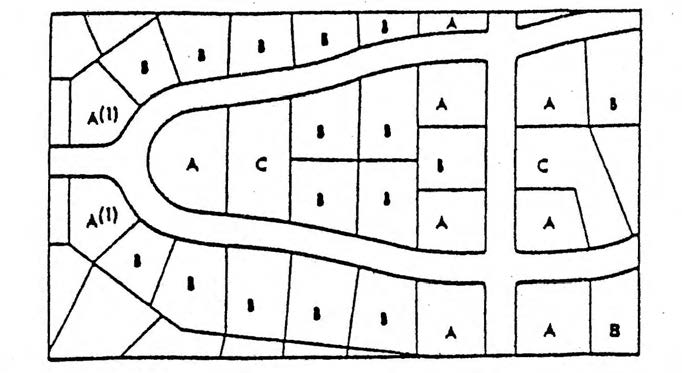
Lot width means the mean horizontal distance between the side lot lines of a lot measured at a point midway between the front lot line and the rear lot line; or at the rear lot line; or at the rear line of the required front yard/setback (building line) especially on irregular shaped lots.
Manufacturing means the making of goods and articles by hand or, especially, by machinery, often on a large scale and with division of labor.
Manufacturing, artisan means the on-site production of goods by hand manufacturing involving the use of hand tools and small-scale light mechanical equipment. Typical uses include woodworking and cabinet shops, ceramic studios, jewelry manufacturing, and similar types of arts and crafts or very small-scale manufacturing uses that have very limited, if any, negative external impacts on surrounding properties, water resources, air quality, and/or public health.
Manufactured housing, definitions:
Manufacturing, limited means the manufacturing of finished parts or products, primarily from previously prepared materials. Typical uses include: printing and related support activities; machinery manufacturing; computer and electronic product manufacturing; electrical equipment, appliance, component manufacturing/assembly; furniture and related product manufacturing/assembly; and other manufacturing and production establishments.
Marina, docks and/or piers, commercial means any marina, pier, or dock which caters to the general public, provides goods or services for sale, and/or, if located in a private residential development, makes available marina facilities to other persons besides occupants of said residential development shall be regarded as a commercial marina. Fishing piers available to the general public are included as part of this use type. Examples of permitted uses shall include but not be limited to the following on or off-site activities/services: charter boats, dive boats, dinner cruises, scenic cruises, boat rentals, boat taxi, etc.
Marina, docks and/or piers, private residential means a boat basin with facilities for berthing, securing or storing various types of watercraft for the exclusive purpose of the residential owners or renters thereof rather than the public at large.
Marina, docks, and/or piers, public means any marina, pier, or dock owned/operated by a government entity, which caters to the general public.
Mean sea level datum means sea level datum, as established by the flood damage prevention article, as established by the United States Coast and Geodetic Survey.
Meeting facilities means a space for established nonprofit organizations such as community centers, lodges, fraternal, social organizations, or religious assemblies.
Minor street means all rural local roads and urban local streets or cul-de-sac streets as defined by the state department of transportation functional highway classification guide and which is used solely to afford access to property along such street and access to the collector and arterial street systems.
Mixed use nonresidential-residential means a development that contains both nonresidential and residential uses.
Mobile home (manufactured home): See manufactured housing definitions.
Motel (hotel) means a building providing sleeping accommodations commonly available on a daily basis for pay to transient and permanent guests or tenants. Dining rooms, restaurants or cafes, if existing, shall be conducted in the same building or buildings in connection therewith.
Motel-iminium/hotel-iminium means a structure containing individually owned hotel or efficiency units, and operated in the manner of a hotel or motel.
Motel (Hotel) room means a room used for transient lodging, which in addition to a sleeping area may provide kitchen accommodations.
Multi-use facility means a facility containing less than 25,000 square feet of gross floor area containing more than two (2) stores, service establishments, offices, or other commercial permitted uses planned, organized, and managed to function as a unified whole and featuring all of the following:
1.
Common driveways;
2.
Common parking;
3.
Common signage plan; and
4.
Common landscaping plan.
Multiphase development means a development containing 25 acres or more that:
1.
Is submitted for site plan approval for construction to occur in more than one (1) phase, and
2.
Is subject to a master development plan with committed elements, including a requirement to offer land for public use as a condition of its master development plan approval.
Municipality means the town of Carolina Beach.
Natural feature means any outside landscape feature on the site such as trees, shrubs, or rock formations.
Navigable stream means any stream capable of floating any boat, skiff, or canoe of the shallowest draft used for recreation purposes.
Net buildable area means the total area within the project property boundary less any wetlands (404/jurisdictional) defined by CAMA and/or US Corps of Engineers.
Nonconforming lot means a lot existing at the effective date of the ordinance or any amendment to it (and not created for the purpose of evading the restrictions of this ordinance) that cannot meet the minimum area or lot width requirements of the district in which the lot is located.
Nonconforming project means any structure, development, or undertaking that is incomplete at the effective date of the ordinance and would be inconsistent with any regulation applicable to the district in which it is located if completed.
Nonconforming situation means a situation that occurs when, on the effective date of the ordinance or any amendment to it, an existing lot or structure or use of an existing lot or structure does not conform to one (1) or more of the regulations applicable to the district in which the lot or structure is located. Among other possibilities, a nonconforming situation may arise because a lot does not meet minimum acreage requirements, because structures do not satisfy maximum height or minimum floor-space limitations, because the relationship between existing buildings and the land (in such matters as density and setback requirements) is not in conformity with this ordinance, or because land or buildings are used for purposes made unlawful by the ordinance.
Nonconforming use means a nonconforming situation that occurs when a building or land lawfully occupied by a use on the effective date of the ordinance or amendment hereto which does not conform after the passage of the ordinance from which this ordinance is derived or amendment with the use requirements of the district in which it is located. For example, an industrial building in a residential district may be a nonconforming use.
Nonconformity, dimensional, means a nonconforming situation that occurs when the height, size, or minimum floor space of a structure or the relationship between an existing building or buildings and other buildings or lot lines does not conform to the regulations applicable to the district in which the property is located.
Nonresidential use or district shall be those uses in the "nonresidential" section of the table of uses. When referring to a zoning district or "district," it shall be the following zoning districts: CBD, NB, HB, T-1, I-1, MB-1, and MX. May also be referred to as "other district."
Office, general means a use type that provide for activities that are conducted in an office setting and generally focus on business, professional, or financial services. Examples include offices for conducting the affairs of a general business or civic establishment, financial services, or sales of real estate or other personal property, stock brokerage, investment services, offices for lawyers, accountants, engineers, and similar professions. Accessory uses may include cafeterias, day care facilities, recreational or fitness facilities, parking, or other amenities primarily for the use of employees in the office.
Official means the UDO Administrator or designee or town manager, if specified.
Open space, when used in conjunction with planned unit developments and performance residential developments, means all usable land area not occupied by structures and linked together for the use and enjoyment of the community. Required setback areas are considered when linked together with the open space areas.
Open space, permanent, means any land to be utilized as landscaped green space, parks, playgrounds, parkway medians, active recreational uses, or for other similar functions; areas required as setbacks or for separation between structures may be utilized in calculating a projects permanent open space requirements. Manmade lakes or other watercourses may be used to fulfill the requirements of this section. Designated wetlands or marsh may not be calculated as part of the permanent open space requirement, nor utilized in calculating density.
Outdoor entertainment area means exterior space dedicated to accessory entertainment uses to include dance floors, stages, live performances, disc-jockey areas, and/or any other similar on-site amusement activities.
Outdoor shower enclosure means an outdoor area that has been enclosed for the purpose of taking a shower that may be roofed.
Outlot means a parcel of land, other than a lot or block, so designated on the plat, but not of standard lot size, which can be either redivided into lots or combined with one (1) or more other adjacent outlots or lots in adjacent subdivisions or minor subdivisions in the future for the purpose of creating buildable lots.
Outdoor display means the displaying of goods, merchandise, or products outdoors such that the items are readily available for sale at retail on the same lot and in conjunction within a permanent fully-enclosed building. Under no circumstance shall displayed items be available for purchase at any location other than the designation point of transaction inside the permanent fully-enclosed building.
Outdoor seasonal sales mean temporary uses which include Christmas tree, pumpkin sales lots, fruit, and vegetable stands. This use is designed to recognize outdoor seasonal sales as customarily accepted uses that typically occur during certain times of the year. These regulations are intended to prohibit the uses from negatively impacting the surrounding areas.
Overhead canopy means any structure placed over, around or near a fuel pump island or drive-up bank teller facility and intended to provide lighting and/or protection from the elements for fuel pump island or drive-up bank teller facility users.
Parking facility means any area, either open or enclosed, structural, or natural, for the storage of a vehicle or vehicles. Each parking facility shall have an approved means of ingress and egress. A parking lot is a subset of a parking facility and is defined in this section.
Parking lot means an open area, outside of the public right-of-way, for the storage of a vehicle or vehicles. The term "parking area" shall be included in this definition. Each parking lot shall have an approved means of ingress and egress.
Parking lot commercial means a parking lot designed to accommodate two axle transportation vehicles for employees and customers of area businesses.
Parking space, off-street means an adequate-sized space for parking a vehicle with room for opening doors on both sides, proper access to streets and adequate maneuvering room.
Party wall means a wall containing no opening which extends from the elevation of building footings to the elevation of the outer surface of the roof or above and which separates contiguous buildings but is in joint use of each building.
Performance guarantee means any of the following forms of guarantee:
1.
Surety bond issued by any company authorized to do business in this State.
2.
Letter of credit issued by any financial institution licensed to do business in this State.
3.
Other form of guarantee that provides equivalent security to a surety bond or letter of credit. (G.S. 160D-804.1)
Personal property means property owned, utilized, and maintained by an individual or members of his residence and acquired in the normal course of living in or maintaining a residence. It does not include merchandise that was purchased for resale or obtained on consignment.
Personal service establishment means use types related to the provision of services or product repair for consumers. Personal services use types meet frequent or recurrent service needs of a personal nature, including the repair of small personal items or electronics such as shoes, watches, jewelry, and clothing. Examples include banks, credit unions, print shops, massage therapy and day spas, gymnasiums, fitness centers, photocopy services, photo studio, barber/beauty shops, and tanning and nail salons. Body piercing and tattoo parlors shall not be considered personal service establishments.
Person aggrieved means:
1.
Persons having an ownership interest in property that is the subject of violations;
2.
Persons who suffer special damages (distinct from any damage from the remainder of the community):
a)
Directly and proximately caused by violations;
b)
By virtue of their ownership interest in property adjacent to property that is the subject of violations.
c)
Property is adjacent if it is separated from the subject only by any right-of-way, easement, street, road, alley, or buffer.
3.
An incorporated or unincorporated association to which owners or lessees of land and premises or property thereon in a designated area belong by virtue of their owning or leasing said property, or an association otherwise organized to protect and foster the interest of the particular neighborhood or local area, so long as at least one (1) of the members of the association has an ownership interest in land or premises or a building in the area and is a person aggrieved in the manner of subsections (1) and (2) of this definition, and the association was not created in response to a particular approval, decision, final decision, situations, or conditions.
4.
A town officer or official, department, board, or commission.
Pervious coverage and surfaces means a slatted deck; the water area of a swimming pool; a surface of number 57 stone, as designated by the American Society for Testing and Materials, laid at least four (4) inches thick over a geotextile fabric; or porous pavement with a hydraulic conductivity greater than 0.001 centimeters per second (1.41 inches per hour). Alternative materials, not subject to the definition of impervious surface, may be proposed subject to certification of a licensed and certified North Carolina professional engineer of compliance with the hydraulic conductivity standard of 1.41 inches per hour or greater. Such certification shall be in the form of a letter under seal.
Pet shops and pet supply stores means a retail sales establishment primarily involved in the sale of domestic animals, such as dogs, cats, fish, birds, and reptiles, excluding exotic animals and farm animals such as horses, goats, sheep, and poultry.
Planned unit development means a land development project planned as an entity by means of a unified site plan which permits flexibility in building site, mixtures in building types and land uses, usable open space, and the preservation of significant natural features.
Planning and development regulation jurisdiction means the geographic area defined in Part 2 of G.S. 160D within which a city or county may undertake planning and apply the development regulations authorized by G.S. 160D.
Planning and Zoning Commission means the board created by the Town Council as authorized by G.S. 160D, (G.S. 160D-200, 160D-202, 160D-903 et seq.).
Planning Director means the Town Planning and Zoning Director.
Post office means a facility that contains service windows for mailing packages and letters, post office boxes, offices, vehicle storage areas, and sorting and distribution facilities for mail.
Preliminary plat means a map showing the salient features of a proposed subdivision submitted to an approving authority for purposes of consideration.
Primary dunes means the first mounds of sand located landward of the ocean beaches having an elevation equal to the mean flood level (in a storm having a one 1% chance of being equaled or exceeded in any given year) for the area plus six (6) feet. The primary dune extends landward to the lowest elevation in the depression behind the same mound of sand (commonly referred to as the dune trough).
Principal building or structure means a building or structure containing the principal use of the lot, including any land area necessitated by the character of the principal use (e.g., outside storage) for its complete operation, excluding off-street parking.
Principal use means the primary purpose or function that a lot serves or is intended to serve according to its zoning classification.
Public notice or public notice of a hearing means notice of the time and place hereof, generally published once a week for two (2) successive calendar weeks in a newspaper having general circulation in the town.
Public way means any public road, street, highway, walkway, drainage, or part thereof.
Quasi-judicial decision means a decision involving the finding of facts regarding a specific application of a development regulation and that requires the exercise of discretion when applying the standards of the regulation. The term includes, but is not limited to, decisions involving variances, special use permits, certificates of appropriateness, and appeals of administrative determinations. Decisions on the approval of subdivision plats and site plans are quasi-judicial in nature if the regulation authorizes a decision-making board to approve or deny the application based not only upon whether the application complies with the specific requirements set forth in the regulation, but also on whether the application complies with one (1) or more generally stated standards requiring a discretionary decision on the findings to be made by the decision-making board.
Recreation, commercial indoor means any form of play, amusement or relaxation used for monetary gain conducted within an enclosed structure. Examples include billiards, bowling, theaters, fortune tellers, skating rinks, golf simulation, and coin-operated games. No amusement device shall contain any automatic payoff device for the return of money, trade, token, or slug and no provisions whatever shall be made for the return of money to the player. However, this shall not be construed as to prohibit the awarding of free play of the game or device.
Recreation, commercial outdoor means any form of play, amusement, or relaxation used for monetary gain not conducted within an enclosed structure. Examples include miniature golf, golf driving ranges, par-3 golf courses, open air theaters, standard golf courses, miniature racers, go-carts, amusement rides, carnivals, and similar enterprises.
Recreational vehicle (RV) means a vehicle for noncommercial, recreational use, including a motor home (including Class A, B and C), travel trailer, camper shell, cab-over-camper, fifth wheel, horse trailer, or trailers mounted with recreational vehicle such as a water craft or off-road vehicle.
Religious institution means a church or place of worship or religious assembly with related facilities such as the following in any combination: rectory or convent, meeting hall, offices for administration of the institution, or playground.
Rental items means any items for rent that are located on the premises of the principal business that may also sell the same items.
Repair area means any area utilized to conduct repairs, or store parts and tools being utilized for repair work.
Replat means the process of changing, or the map or plat which changes, the boundaries of a recorded subdivision plat or part thereof. The legal dividing of a large block, lot or outlot within a recorded subdivision plat without changing exterior boundaries of such block, lot, or outlot is not a replat.
Residential use or district shall be those uses in the "residential" section of the table of uses. When referring to a zoning district or "district," it shall be the following zoning districts: R-1, R-1B, R-2, R-3, C, MF, and MH.
Restaurant: See eating and/or drinking establishment.
Retail sales means use types involved in the sale, repair, or lease of new or used products to the general public. Accessory uses may include offices, display of goods, limited assembly, processing, or repackaging of goods for on-site sale. Retail sales does not include the following:
1.
Repair and service establishments, including automotive and marine related uses.
2.
Bars, taverns, restaurants, wine/beer shop with on-site consumption, and similar eating establishments.
3.
Personal service establishments.
4.
An establishment that involves the sale, distribution, or presentation of materials, or activities emphasizing sexually explicit content.
Roominghouse means a dwelling unit not owner occupied where individual sleeping rooms are rented under separate agreement or lease, either written or oral, regardless [of] whether an agent, or rental manager is in residence.
Salvage operation means an establishment for storing, keeping, buying, or selling of junk. "Junk" shall be defined as old or scrap copper, brass, rope, rags, batteries, paper, trash, rubber or discarded, dismantled, or wrecked automobiles, or parts thereof, iron, steel and other old or scrap ferrous or nonferrous material.
Sand Dune means any naturally occurring accumulations of sand in ridges or mounds landward of the beach.
Schools, commercial for specialized training means an institution providing instruction and including accessory facilities traditionally associated with professional schools, dance schools, business schools, trade schools, art schools, and similar facilities for the adult population.
Schools, public and private means an institution providing full time instruction and including accessory facilities traditionally associated with a program of study for the teaching of children or adults including, preschool, primary and secondary schools, and colleges.
Self-service storage facility means any real property designed and used for the purpose of renting or leasing individual storage spaces to tenants who are to have access to such space for the purpose of storing and removing personal property.
Service station means buildings and premises where gasoline, oil, grease, batteries, tires, and automobile accessories may be supplied and dispensed at retail.
Setback means a line that establishes the minimum allowable horizontal distance per the dimensional requirements of the zoning district between the lot line and the nearest portion of any structure from 30 inches above the ground level of the graded lot upward. May also be referred to as "building setback line(s)" or "setback line."
1.
Setback, front means setback measured from the front lot line(s).
2.
Setback, rear means a setback from an interior lot line lying or rear lot line on the opposite side of the lot from the front setback.
3.
Setback, side means the side yard setback shall extend from the required front yard setback line(s) to the required rear yard setback line and shall be measured from the side lot line.
Shopping center/big box means one (1) or more commercial establishments, containing 25,000 square feet or more of indoor gross floor area on one (1) site. This definition would include malls, a commercial unit or plaza with multiple units, and any community shopping area designed to utilize shared facilities (e.g., parking, signage, landscaping).
Shorelands means those lands lying within the following distances: 1,000 feet from the high-water elevation of navigable lakes, ponds, and flowages or 300 feet from the high-water elevation of navigable streams or to the landward side of the floodplain, whichever is greater.
SIC Manual, Standard Industrial Classification Manual means a book published by the federal government that classifies establishments by the type of activity in which they are engaged.
Sign definitions. The following words, terms, and phrases, when used in this ordinance, shall have the meanings ascribed to them in this section as it pertains to signage requirements, except where the context clearly indicates a different meaning.
1.
A-frame sign means a temporary sign typically consisting of two (2) sign faces attached back-to-back by top hinges.
2.
Address number sign: See Code of Ordinances, chapter 34, article IV property numbering.
3.
Animated sign means any sign that uses movement or change of lighting to depict action or create a special effect or scene.
4.
Attached sign means any sign painted on, attached to and erected parallel to the face of, or erected and confined within the limits of, the outside facade of any building and supported by such building facade and which displays an advertising surface. Attached signs may also be located on porch railings and support posts.
5.
Banner sign means a temporary suspended sign made of a flexible material such as canvas, sailcloth, plastic, or waterproof paper that may or may not be enclosed or partially enclosed on a rigid frame (i.e., feather signs).
6.
Billboard sign means a sign which advertises a business, product, organization, entertainment, event, person, place, or thing and which is located off-premises from the place of the advertised element(s).
7.
Canopy/awning sign means any sign consisting of lettering and/or logos applied to an awning, canopy, or other fabric, plastic, or structural protective cover over a door, entrance, window, or outdoor service area.
8.
Commercial sign means a sign intended to advertise a commercial enterprise.
9.
Directional sign means a permanent sign displayed strictly for the direction, safety, or convenience of the public, including signs which identify parking areas, entrances, or exits, etc.
10.
Flag, feather means a vertical portable sign that contains a harpoon-style single pole or staff driven into the ground for support or supported by means of an individual stand.
11.
Flags means flexible materials such as cloth, paper, plastic, and typically displayed on a flag pole or structure. Windsocks are interpreted to represent permitted flagging.
12.
Flashing sign means a sign, which contains or uses, for illustration, any lights or lighting devices, which change color, flashes or alternates, shows movement or motion, or changes the appearance of said sign or part thereof automatically on a time interval of less than 20 seconds. Animated fading from one (1) message to another message is permitted within a maximum fading period of two seconds.
13.
Freestanding sign means a sign supported by structures or supports that are placed on, or anchored in, the ground and that is independent from any building or other structures.
14.
Governmental sign means a sign provided and erected by a governmental entity which typically promotes:
a)
The health and safety of the community;
b)
Town-sponsored events;
c)
A public way finding system; and
d)
Any other town activities as deemed appropriate by the town manager.
15.
Human sign means costumes or signs worn, held or carried by individuals for the purpose of attracting attention to a commercial site.
16.
Illegal sign means any sign that was in violation of the zoning ordinance at the time the sign was originally established.
17.
Nonconforming sign means any sign which does not conform to the regulations of this ordinance, but did conform when it was originally permitted.
18.
Noncommercial sign means a sign not intended to advertise a commercial enterprise.
19.
Nonresidential means any building, structure, or use that is not exclusively a dwelling.
20.
Obscene means material which depicts or describes sexual conduct that is objectionable or offensive to accepted standards of decency which the average person, applying contemporary community standards, would find, taken as a whole, appeals to prurient interests or material which depicts or describes, in a patently offensive way, sexual conduct specifically defined by the applicable state law, which, taken as a whole, lacks serious literary, artistic, political, or scientific value.
21.
Off-premises parking sign means a sign used to direct vehicular traffic onto the parking premises where it is displayed for a business or service activities at another location, but cannot impede the line of sight for traffic.
22.
Permanent sign means all signs not designated as temporary.
23.
Portable sign means a temporary sign attached on support frame without lighting.
24.
Projecting sign means a type of attached signage placed at a right angle to the facade of the associated structure.
25.
Residential development entry sign means a sign identifying a residential subdivision, multifamily development or traditional neighborhood development, located on site, and at the major entrance points to such a development.
26.
Roof sign means any sign erected or constructed upon the roof of any building and supported solely on the roof of the building.
27.
Sign means any surface, fabric, device, or display which bears lettered, pictorial, or sculptured matter, including forms shaped to resemble any human, animal, or product, designed to convey information visually and which is exposed to public view.
28.
Snipe sign means any sign of any material whatsoever that is attached in any way to a utility pole, tree, street sign, or pole.
29.
Special event sign means a sign advertising a special communitywide event such as community fishing tournaments, schools, or civic events, and/or festivals.
30.
Temporary sign means any sign that is not permanently affixed, placed, attached, or erected, and may have time limitations.
31.
Tow truck sign. See Code of Ordinances, chapter 16, article VII, wrecker/towing services and impoundment.
32.
Vehicle/trailer sign means any temporary sign mounted on a vehicle, boat, or trailer and used for advertising or promotional purposes.
33.
Window/door sign (interior/exterior) means a sign located within the interior or exterior of the transparent area of any window or door.
34.
Yard sale sign: See Code of Ordinances, chapter 14, sections 172 through 174.
Site Plan means a plan for proposed development including the criteria as required by this ordinance.
Site Plan, major means a plan for proposed development that is comprised of the following:
1.
Residential uses of five (5) or more units.
2.
New nonresidential (office, commercial, or industrial, etc.) use.;
3.
Increase in intensity of the nonresidential development or residential development consisting of five (5) or more existing dwelling units to include any increase in density of units, whether residential, office, commercial, or industrial; an increase in number of off-street parking or loading spaces; or an increase in impervious surface area; or an increase in overall ground coverage by structures; or a reduction in approved open space or screening; or a change in access and internal circulation design.
4.
All other development not subject to minor site plan, conditional zoning, subdivision, or special use permit approval.
Site Plan, minor means a plan for proposed development that is comprised of the following:
1.
Changes of use.
2.
Proposals for single-family residential uses and residential structures consisting of four (4) or fewer dwelling units or for renovation/rehabilitation projects that will modify an existing structure's footprint.
3.
Accessory structures, construction/installation of fences/walls, piers, docks, decks, stairs, signs, driveways, and/or similar ancillary support items.
4.
Increase in intensity or units of residential development consisting of four (4) or fewer existing dwelling units and to include any increase in number of off-street parking or loading spaces; or an increase in impervious surface area; or an increase in overall ground coverage by structures; or a reduction in approved open space or screening; or a change in access and internal circulation design.
Site-specific vesting plan means a plan submitted to the town describing with certainty the type and intensity of use for a specific parcel or parcels of property. Such site-specific vesting plan shall be presented to the Town Council for approval following a duly held public (legislative) hearing. Such plan may be in the form of, but not be limited to, any of the following plans or approvals: A planned unit development, a subdivision plat, a site plan, a conditional zoning, or any other development approval as may be utilized by the town.
Sleeping unit means a room or space in which people sleep, which can also include permanent provisions for living, eating, and either sanitation or kitchen facilities but not both. Such rooms and spaces that are also part of a dwelling unit are not sleeping units.
Special use means a use that is subject to the quasi-judicial hearing process as required by this ordinance.
Special use permit means a permit issued to authorize development or land uses in a particular zoning district upon presentation of competent, material, and substantial evidence in accordance with the quasi-judicial decision making process.
Standing means the following:
1.
Any person possessing any of the following criteria:
a)
An ownership interest in the property that is the subject of the decision being appealed, a leasehold interest in the property that is the subject of the decision being appealed, or an interest created by easement, restriction, or covenant in the property that is the subject of the decision being appealed.
b)
An option or contract to purchase the property that is the subject of the decision being appealed.
c)
An applicant before the decision-making board whose decision is being appealed.
2.
Any other person who will suffer special damages as a result of the decision being appealed.
3.
An incorporated or unincorporated association to which owners of lessees of property in a designated area belong by virtue of their owning or leasing property in that area, or an association otherwise organized to protect and foster the interest of the particular neighborhood or local area, so long as at least one (1) of the members of the association would have standing as an individual to challenge the decision being appealed, and the association was not created in response to the particular development or issue that is the subject of the appeal.
4.
A local government whose decision-making board has made a decision that the governing board believes improperly grants a variance from or is otherwise inconsistent with the proper interpretation of a development regulation adopted by the governing board.
Story means that portion of a building between the surface of any floor and the floor or roof above it. The following are considered stories:
1.
Mezzanine: If it exceeds 25% of the total floor area of the story immediately below it;
2.
Penthouse: If it exceeds 25% of the total area of the roof;
3.
Basement: See definition of basement.
Story, half, means a story which is situated in a sloping roof, the floor area of which does not exceed two-thirds of the floor area of the story immediately below it, and which does not contain an independent dwelling unit.
Street includes the term "alley," "road," "avenue," "lane," "cul-de-sac," "highway," or "thoroughfare," whether designated as public or private.
Street classifications. Determined in accordance with the following definitions and the thoroughfare plan/comprehensive transportation plan for the town on file with the UDO Administrator.
1.
Major thoroughfare: Their primary function is movement. Access should be permitted to the extent that movement is not compromised and appropriate spacing and design criteria are employed. These streets should move large volumes of traffic a relatively long distance at relatively high speeds. Major thoroughfares are identified in the thoroughfare plan for the town.
2.
Collector streets: Collector streets are used to carry moderate amounts of traffic volume and provide limited access to adjacent properties. Their function is to collect and distribute traffic to and from local and arterial streets. Collector streets are identified in the thoroughfare plan for the town.
3.
Local streets: Those streets that are used for low volume, slow speed traffic movements. Their function is to provide direct access (termination) to properties.
Street line means a dividing line between the street and the lot, as established by the town; also called the "right-of-way" line.
Street types.
1.
Private street means a right-of-way for vehicular traffic that is constructed to acceptable public street standards for the town and dedicated for use by a select portion of the public. The responsibility for the maintenance of a private street shall be by an established owners association or other private property owner legal agreements.
2.
Public street means a right-of-way for vehicular traffic dedicated and accepted by the state department of transportation or the town for public use.
Structure means anything constructed or erected with a fixed location on the ground, or attached to something having a fixed location on the ground. Structures include buildings, manufactured homes, walls, fences, signs and billboards, swimming pools, and other similar type uses.
Structure, open shed, means any structure that has no enclosing walls.
Structure, shed, means any structure built for the support, shelter, or enclosure of persons, animals, chattels, or property of any kind that has enclosing walls for less than 50% of its perimeter.
Subdivider means any person, firm, or corporation, or any agent thereof, dividing or proposing to divide land resulting in a subdivision, minor subdivision, or replat.
Subdivision, Major means the division of a tract of land into six (6) or more lots.
Subdivision, Minor means the division of a tract of land into five (5) or fewer lots, regardless off right-of-way dedication or utility extension.
Subdivision, Minor Expedited means the division of one (1) existing parcel of land under single ownership that is not exempt per G.S. 160D-802(a); one (1) where no part of the tract or parcel to be divided has been divided in the 10 years prior to the proposed division; two (2) the entire area of the tract or parcel to be divided is greater than five (5) acres; three (3) after division, no more than three (3) lots result from the division and all resultant lots comply with all lot dimension size requirements of the applicable zoning district and the use of the lots is in conformity with the applicable zoning district; and (4) a permanent means of ingress and egress is recorded for each.
Subdivision means and includes all divisions of a tract or parcel of land into two (2) or more lots, building sites, or other divisions when any one (1) or more of those divisions is created for the purpose of sale or building development, whether immediate or future, and shall include all divisions of land involving the dedication of a new street or a change in existing streets; provided, however, that the following shall not be included within this definition nor be subject to the regulations prescribed by this ordinance:
A.
The combination or recombination of portions of previously subdivided and recorded lots where the total number of lots is not increased and the resultant lots are equal to or exceed the standards contained herein;
B.
The divisions of land into parcels greater than 10 acres where no street right-of-way dedication is involved;
C.
The public acquisition by purchase of strips of land for the widening or openings of streets or for public transportation system corridors;
D.
The division of a tract in single ownership whose entire area is no greater than two (2) acres into not more than three (3) lots, where no street right-of-way dedication is involved and where the resultant lots are equal to or exceed the standards of this ordinance.
E.
The division of a tract into parcels in accordance with the terms of a probated will or in accordance with intestate succession under Chapter 29 of the General Statutes.
F.
The town may provide for expedited review of specified classes of subdivisions as specified in Article 2.
Swimming pools, private, means any swimming pool operated in conjunction with a residential dwelling unit, the use of which is limited to occupants of that residence and their invitees. Aboveground private swimming pools which are portable and temporary in nature and which do not incorporate decking or other similar permanent structure are exempt from this definition and the rules/regulations governing such structures. For the purposes of this ordinance, hot tubs shall be included in the definition of private swimming pools.
Swimming pools, public, means any swimming pool operated other than a private swimming pool or as a therapeutic pool used in physical therapy programs operated by medical facilities licensed by the department of human resources or operated by a licensed physical therapist, or to therapeutic chambers drained, cleaned and refilled after each individual use. The term "public swimming pool" means any structure, chamber, or tank containing an artificial body of water used by the public for swimming, diving, wading, recreation, or therapy, together with buildings, appurtenances, and equipment used in connection with the body of water, regardless of whether a fee is charged for its use. The term includes but is not limited to, municipal, school, hotel, motel, apartment, multifamily, boardinghouse, athletic club, or other membership facility pools and spas (G.S. 130A-280—130A-282).
Tattooing means the inserting of permanent markings or coloration, or the producing of scars, upon or under human skin through puncturing by use of a needle or any other method.
Tattoo studio means an establishment where tattooing services are provided.
Technical review committee means a committee to facilitate communication and coordination between departments responsible for development review which may include, but not necessarily be limited to, the following individuals/departments: UDO Administrator, building inspector, town manager, fire department, police department, public works department, Division of Coastal Management, NC Department of Environmental Quality, NC Department of Public Safety, and/or US Army Corp of Engineers.
Telephone communication facility, unattended, means a windowless structure containing electronic telephone equipment that does not require regular employee attendance for operating.
Temporary health care structure means a transportable residential structure, providing an environment facilitating a caregiver's provision of care for a mentally or physically impaired person. The following terms shall apply under temporary family health care regulations:
1.
Activities of daily living. Bathing, dressing, personal hygiene, ambulation or locomotion, transferring, toileting, and eating.
2.
Caregiver. An individual 18 years of age or older who (i) provides care for a mentally or physically impaired person and (ii) is a first or second degree relative of the mentally or physically impaired person for whom the individual is caring.
3.
First or second degree relative. A spouse, lineal ascendant, lineal descendant, sibling, uncle, aunt, nephew, or niece and includes half, step, and in-law relationships.
4.
Mentally or physically impaired person. A person who is a resident of this state and who requires assistance with two or more activities of daily living as certified in writing, by a physician licensed to practice in this state.
Temporary storage containers means any container intended for storing or keeping household goods, other personal property or business related goods that is intended to be filled, refilled, or emptied while located outdoors and later removed from the property for storage or disposal off-site.
Tennis courts, commercial means a commercial facility for the playing of tennis at which there is a clubhouse including restrooms. A tennis facility may provide additional services customarily furnished by a club, such as swimming, outdoor recreation, and related retail sales.
Tower means a structure that is designed to support (i.e., electrical wires), contain (i.e., water), receive or send communications (i.e., television, radio, telephone), normally at a commercial, industrial, institutional, or other significant scale or magnitude.
Towing service, automotive or truck, means a major automotive use established to tow or remove motor vehicles from one (1) location to another. A towing service includes the temporary storage of motor vehicles at its site, but under no circumstances shall any motor vehicle remain on the premises of a towing service for more than 24 hours unless stored within an enclosed structure or the tow service is located in an industrial district. Such services shall comply with all ordinances of the town.
Town Council means the Mayor and members of the governing body of the town.
Trellis means a structure usually consisting of parallel rows of piles supporting an open roof of girders and cross rafters.
UDO Administrator means the Town of Carolina Beach official or other designated authority charged with the administration of this ordinance, or his duly authorized representative or agent. Such official shall be designated by the town manager. It is the intention of this ordinance that all questions arising in connection with enforcement and interpretation shall be presented first to the UDO Administrator and/or designated agent. Appeal of his/her decision may be made to the Board of Adjustment.
Utilities means all utilities including, but not limited to, transmission lines, telephone repeater stations, relay stations, water supply reservoirs, wells, filter beds, sewage treatment plants, pumping stations, electric power and gas substations, service or storage yards. Private utilities shall consist of any transmission lines, infrastructure, stations, or buildings not owned or maintained by the town.
Variance means a relaxation of the terms of this ordinance in accordance with the statutory requirements of G.S. 160D-705(d).
Vehicle means any of the following:
1.
Commercial vehicle means a vehicle designed, maintained, or used primarily for the transportation of merchandise or materials used in a business.
2.
Motor vehicle means all machines designed or intended to travel over land or water by self-propulsion or while attached to any self-propelled vehicle.
Vested right means the right to undertake and complete the development and use of property under the terms and conditions of an approved site-specific vesting plan.
Vision clearance. In order to maintain an acceptable and safe line of sight for motor vehicle drivers, no parking spaces, fences, walls, posts, signs, lights, shrubs, trees or other type of obstructions not specifically exempted shall be permitted in the space between 30 inches above ground level and 10 feet above ground level within a sight distance triangle. A sight distance triangle shall be the visually unobstructed area of a street/driveway corner as determined by measuring a distance of 30 feet along the intersecting curb lines, or edges of pavement of the intersecting street/driveway if curbs are not present, and connecting the two (2) points by a straight line to form a triangular shaped area over the corner.
Warehouse means a building where wares, or goods, are stored, as before distribution to retailers, or are kept in reserve, in bond, etc.
Warehouse, mini storage, means a building or group of building in varying sizes of individual compartmentalized, and controlled access stalls or lockers for dead storage of customer's goods or wares. See also self-service storage.
Wet boat slip means a space used to moor, store, or park a single watercraft in or over water. Includes residential, commercial, and transient slips.
Wholesale sales means an establishment or place of business primarily engaged in selling and/or distributing merchandise to retailers; to industrial, commercial, institutional, or professional business users, or to other wholesalers; or acting as agents or brokers and buying merchandise for, or selling merchandise to, such individuals or companies.
Wireless definitions. For purposes of wireless regulations, and where not inconsistent with the context of a particular section, the defined terms, phrases, words, abbreviations, and their derivations shall have the meaning given in this section. When not inconsistent with the context, words in the present tense include the future tense, words used in the plural number include words in the singular number and words [used] in the singular number include the plural number. The word "shall" is always mandatory, and not merely directory.
1.
Abandonment means cessation of use of a wireless support structure for wireless telecommunications activity for at least the minimum period of time specified under this ordinance.
2.
Accessory equipment means any equipment serving or being used in conjunction with a wireless facility or wireless support structure. The term "accessory equipment" includes utility or transmission equipment, power supplies, generators, batteries, cables, equipment buildings, cabinets, and storage sheds, shelters, or similar structures.
3.
Antenna means communications equipment that transmits, receives, or transmits and receives electromagnetic radio signals used in the provision of all types of wireless communications services.
4.
Base station means a station at a specific site authorized to communicate with mobile stations, generally consisting of radio transceivers, antennas, coaxial cables, power supplies, and other associated electronics.
5.
Carrier on wheels or cell on wheels (COW) means a portable self-contained wireless facility that can be moved to a location and set up to provide wireless services on a temporary or emergency basis. A COW is normally vehicle-mounted and contains a telescoping boom as the antenna support structure.
6.
Collocation means the placement or installation of wireless facilities on existing structures, including electrical transmission towers, water towers, buildings, and other structures capable of structurally supporting the attachment of wireless facilities in compliance with applicable codes.
7.
Concealed wireless facility means any wireless facility that is integrated as an architectural feature of an existing structure, or any new wireless support structure designed to camouflage or conceal the presence of antennas or towers so that the purpose of the facility or wireless support structure is not readily apparent to a casual observer.
8.
Electrical transmission tower means an electrical transmission structure used to support high voltage overhead power lines. The term "electrical transmission tower" shall not include any utility pole.
9.
Eligible facilities request means a request for modification of an existing wireless tower or base station that involves collocation of new transmission equipment or replacement of transmission equipment but does not include a substantial modification. This includes a small wireless facility.
10.
Equipment compound means an area surrounding or near the base of a wireless support structure within which are located wireless facilities.
11.
Existing structure means a wireless support structure, erected prior to the application for an eligible facilities request, collocation, or substantial modification under this ordinance, that is capable of supporting the attachment of wireless facilities. The term "existing structure" includes, but is not limited to, electrical transmission towers, buildings, and water towers. The term "existing structure" shall not include any utility pole.
12.
Fall zone means the area in which a wireless support structure may be expected to fall in the event of a structural failure, as measured by engineering standards.
13.
Micro wireless facility means a small wireless facility that is no larger in dimension than 24 inches in length, 15 inches in width, and 12 inches in height and that has an exterior antenna, if any, no longer than 11 inches.
14.
Monopole means a single, freestanding pole-type structure supporting one (1) or more antennas. For the purposes of this ordinance, a monopole is not a tower or a utility pole.
15.
Ordinary maintenance means ensuring that wireless facilities and wireless support structures are kept in good operating condition.
a)
The term "ordinary maintenance" includes:
i)
Inspections, testing, and modifications that maintain functional capacity and structural integrity (e.g., the strengthening of a wireless support structure's foundation or of the wireless support structure itself).
ii)
Replacing antennas of a similar size, weight, shape, and color, and accessory equipment within an existing equipment compound and relocating the antennas to different height levels on an existing monopole or tower upon which they are currently located.
b)
The term "ordinary maintenance" does not include substantial modifications.
16.
Replacement pole means a pole of equal proportions and of equal height or such other height that would not constitute a substantial modification to an existing structure in order to support wireless facilities or to accommodate collocation. Requires removal of the wireless support structure it replaces.
17.
Small wireless facility means a wireless facility that meets both of the following qualifications:
a)
Each antenna is located inside an enclosure of no more than six (6) cubic feet in volume or, in the case of an antenna that has exposed elements, the antenna and all of its exposed elements, if enclosed, could fit within an enclosure of no more than six (6) cubic feet.
b)
All other wireless equipment associated with the facility has a cumulative volume of no more than 28 cubic feet. For purposes of this sub-subdivision, the following types of ancillary equipment are not included in the calculation of equipment volume: electric meters, concealment elements, telecommunications demarcation boxes, ground-based enclosures, grounding equipment, power transfer switches, cut-off switches, vertical cable runs for the connection of power and other services, or other support structures.
18.
Substantial modification means the mounting of a proposed wireless facility or wireless facilities on a wireless support structure that substantially changes the physical dimensions of the support structure. A mounting is presumed to be a substantial modification if it meets any one (1) or more of the following criteria:
a)
Increases the existing vertical height of the wireless support structure by more than 10 percent, or the height of one (1) additional antenna array with separation from the nearest existing antenna not to exceed 20 feet, whichever is greater;
b)
Adds an appurtenance to the body of a wireless support structure that protrudes horizontally from the edge of the wireless support structure more than 20 feet, or more than the width of the wireless support structure at the level of the appurtenance, whichever is greater (except where necessary to shelter the antenna from inclement weather or to connect the antenna to the tower via cable);
c)
Increases the square footage of the existing equipment compound by more than 2,500 square feet.
19.
Tower means a lattice-type structure, guyed or freestanding, that supports one (1) or more antennas.
20.
Utility pole means a structure owned and/or operated by a public utility, municipality, electric membership corporation or rural electric cooperative that is designed specifically for and used to carry lines, cables, or wires for telephone, cable television, or electricity, or to provide lighting.
21.
Water tower means a water storage tank, or a standpipe or an elevated tank situated on a support structure, originally constructed for use as a reservoir or facility to store or deliver water.
22.
Wireless facility or wireless facilities means the set of equipment and network components, exclusive of the underlying wireless support structure, including, but not limited to, antennas, accessory equipment, transmitters, receivers, base stations, power supplies, cabling, and associated equipment necessary to provide wireless telecommunications services.
23.
Wireless support structure means a freestanding structure, such as a monopole or tower, designed to support wireless facilities. This definition does not include utility poles.
Violation means a breach, infringement, or transgression of any law, requirement in this ordinance or other land development provisions, or failure to comply with any approval procedures or permission as specified by this ordinance. The town may invoke enforcement procedures as specified in this ordinance in response to violations. Violations do not include matters that state or federal law expressly prohibit the town from regulating.
Yard means a required open space unoccupied by any structure or portion of a structure from 30 inches above the ground level of the graded lot upward; provided, however, that fences, walls, poles, posts, and other customary yard accessories, ornaments and furniture may be permitted in any yard. Yards are established as a result of front, rear, and side setbacks as provided below.
1.
Yard, front means the area between side lot lines across the front of a lot adjoining a street as required by the minimum front setback. Depth of a required front yard shall be measured at right angles to a straight line joining the foremost points of the side lot lines, but in no case need it be greater than the setback of the zoning district. The foremost point of the side lot line, in the case of rounded property corners at street intersections, shall be assumed to be the point at which the side and front lot lines would have met without such rounding. Front and rear yard lines shall be parallel.
2.
Yard, rear means the area between the side lot lines across the rear of the lot as required by the minimum rear setback. Through lots have no rear yard, only front and side yards.
3.
Yard, side means the area extending from the rear line of the required front yard line to the foremost lines of the rear yard as required by the minimum rear setback. In absence of a clearly defined rear yard, as in the case of a through lot, any portion of the lot not designated as a front yard shall be a side yard. The side yard requirements for dwellings shall be waived where dwellings are erected above stores or shops not otherwise required to have side yards.
The figure below illustrates locations and methods of measuring yards on rectangular and nonrectangular lots. In each of the examples shown, the street frontage is to the bottom of the diagram.
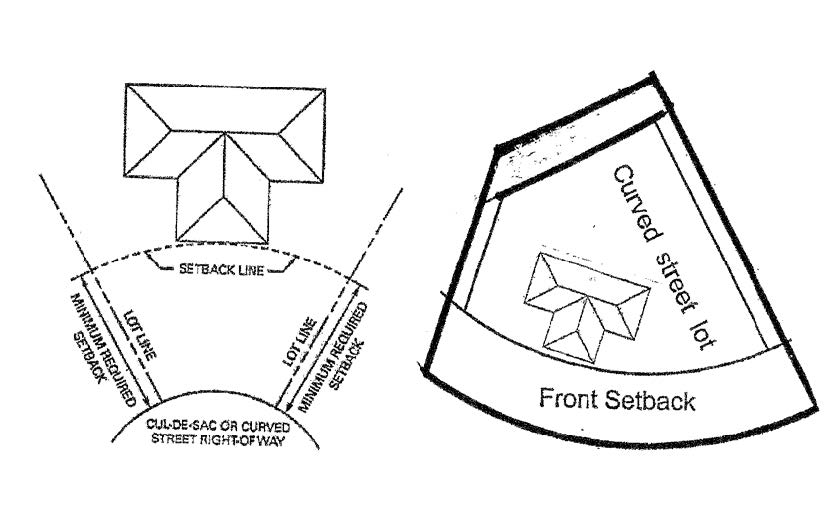
Yard Sale means the sporadic and infrequent sale of used personal items within residential areas. Such sales shall be temporary and limited to not more than twice per calendar year per property.
Zero lot line means a development concept for residential subdivisions that allows the placement of single-family dwelling units on or near the side lot lines. Any wall, constructed on the side or rear lot line shall be a solid doorless and windowless wall. Such wall shall contain no electrical, mechanical, heating, air conditioning, or other fixtures that project beyond such wall. Roof eaves may encroach two (2) feet into the adjoining lot. A three (3) foot maintenance and access easement with a maximum eave encroachment easement of two (2) feet within the maintenance easement shall be established on the adjoining lot and shall assure access to the lot line wall at reasonable periods of the day for normal maintenance. Where zero (0) side or rear setbacks are proposed, the buildable area for each lot shall be indicated on the preliminary and final subdivision plat. Zero lot lines shall not be allowed on any perimeter boundary line or lot line.
(Ord. No. 25-1261, 8-12-2025)

