
Carson City City Zoning Code
Title 10
VEHICLES AND TRAFFIC
Chapter 10.04 - DEFINITIONS
Sections:
Chapter 10.06 - OBEDIENCE TO AND EFFECT OF TRAFFIC LAWS
Sections:
Chapter 10.08 - TRAFFIC SIGNS, SIGNALS AND MARKINGS
Sections:
Chapter 10.10 - DRIVING ON RIGHT SIDE OF HIGHWAY—OVERTAKING AND PASSING—USE OF HIGHWAY
Sections:
Chapter 10.12 - RIGHT-OF-WAY
Sections:
Chapter 10.14 - PEDESTRIANS' RIGHTS AND DUTIES
Sections:
Chapter 10.16 - TURNING AND STARTING AND SIGNALS ON STOPPING AND TURNING
Sections:
Chapter 10.18 - SPECIAL STOPS REQUIRED
Sections:
Chapter 10.20 - SPEED RESTRICTIONS
Sections:
Chapter 10.22 - RECKLESS DRIVING—PERSONS UNDER THE INFLUENCE OF LIQUOR, DRUGS
Sections:
Chapter 10.24 - STOPPING, STANDING AND PARKING
Sections:
Chapter 10.25 - SPECIAL RESPONSIBILITIES OF VEHICLE DRIVERS AND OWNERS
Sections:
Chapter 10.26 - MISCELLANEOUS RULES
Sections:
Chapter 10.28 - TRAFFIC HIGHWAYS AND ZONES
Sections:
Chapter 10.30 - MOTORCYCLES
Sections:
Chapter 10.32 - FAILURE TO OBEY CITATION
Sections:
10.04.010 - Definitions generally.
10.04.020 - Alley.
"Alley" means a highway:
1.
Within a city block set apart for public use, vehicular traffic and local convenience.
2.
Which primarily services access to the rear entrance of abutting property.
3.
Designed for the special accommodation of abutting property, but not a cul-de-sac.
10.04.030 - Authorized emergency vehicle.
"Authorized emergency vehicle" means a vehicle permitted to depart from certain traffic laws when equipped and operated in the manner provided by law.
10.04.040 - Bicycle.
"Bicycle" means a device propelled by human power upon which a person may ride, having two (2) tandem wheels either of which is over fourteen inches (14″) in diameter, or every such device generally recognized as a bicycle though equipped with two (2) front or two (2) rear wheels.
10.04.050 - Bus.
"Bus" means a vehicle owned by the state, a political subdivision or a private school or nursery, designed for carrying more than ten (10) passengers and used for the transportation of persons, or a vehicle other than a taxicab, designed and used for the transportation of persons for compensation.
10.04.060 - Bus stand.
"Bus stand" means a fixed area in or adjacent to the highway to be occupied exclusively by buses for layover and operating schedules or in receiving or discharging passengers.
10.04.070 - Business district.
"Business district" means the territory contiguous to and including a highway when within any six hundred feet (600′) along such highway there are buildings in use for business or industrial purposes, including but not limited to hotels, banks or office buildings, railroad stations and public buildings which occupy at least three hundred feet (300′) of frontage on one side or three hundred feet (300′) collectively on both sides of the highway.
10.04.080 - Center or centerline.
"Center" or "centerline" means a continuous or broken line marked upon the surface of a highway by paint or otherwise to indicate each portion of a highway allocated to traffic proceeding in the two (2) opposite directions, and, if a line is not marked, it is an imaginary line in the highway equally distant from the edges or curbs of the highway.
10.04.090 - Central business district.
"Central business district" means all highways within the area described as such by any chapter of the CCMC.
10.04.100 - City.
"City" means Carson City.
10.04.102 - Class A vehicle.*
Any combination of motor vehicles with a gross combination weight rating (GCWR) of twenty-six thousand one (26,001) pounds or more, provided the vehicle being towed has a gross vehicle rating (GVWR) of ten thousand (10,000) pounds or more.
(Ord. 1998-30 § 1, 1998).
* See Figure 10.04 in this chapter.
10.04.104 - Class B vehicle.*
Any single vehicle with a GVWR of twenty-six thousand one (26,001) or more pounds, or any such vehicle towing a vehicle weighing less than ten thousand (10,000) pounds GVWR.
(Ord. 1998-30 § 2, 1998).
* See Figure 10.04 in this chapter.
10.04.106 - Class C vehicle.
Any single vehicle, or combination of vehicles that does not meet the definition of Class A or Class B, but that is placarded for hazardous materials.
(Ord. 1998-30 § 3, 1998).
10.04.110 - Combination of vehicles.
"Combination of vehicles" means two or more vehicles coupled together.
10.04.120 - Commercial vehicle.
"Commercial vehicle" means every vehicle designed, equipped, maintained or used primarily for the transportation of property for industrial or commercial purposes.
(Ord. 1985-3 § 1, 1985).
Figure 10.04
VEHICLE CLASSIFICATION SYSTEM
Class "A"
Any combination of motor vehicles with a gross combination weight rating (GCWR) of 26,001 pounds or more, provided the vehicle being towed has a gross vehicle rating (GVWR) of 10,000 pounds or more.
Examples:
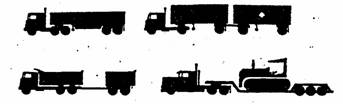
Class "B"
Any single vehicle with a GVWR of 26,001 or more pounds, or any such vehicle towing a vehicle weighing less than 10,000 pounds GVWR.
Examples:
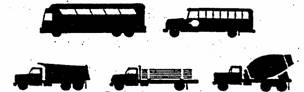
Class "C"
Any single vehicle, or combination of vehicles that does not meet the definition of Group A or Group B, but that either is designed to transport 16 or more passengers including the driver, or is placarded for hazardous materials.
Examples:
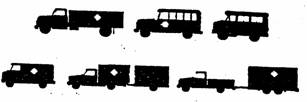
NOTE: A CDL of any class allows you to drive your personal vehicle. You won't need any other license.
The following are types of endorsements you may need:
The following restrictions may apply:
May not drive vehicles with air brakes unless appropriate knowledge and skills tests are passed.
Intrastate only.
10.04.130 - Common carrier.
"Common carrier" means every common carrier of passengers operating between fixed termini, over regular routes and on fixed schedules.
10.04.140 - Controlled-access highway.
"Controlled-access highway" means every highway to or from which owners or occupants of abutting lands and other persons have no legal right of access except at such points only and in such manner as may be determined by a public authority.
10.04.145 - Controlled substance.
"Controlled substance" has the meaning ascribed to it in Section 453.041 of the Nevada Revised Statutes.
(Ord. 1983-18 §§ 8 (part), 9, 1983).
10.04.150 - Crosswalk.
"Crosswalk" means:
1.
That part of a highway at an intersection included within the connections and the lateral lines of the sidewalks on opposite sides of the highway measured from the curbs, or, in the absence of curbs, from the edges of the traveled portions of highways; or
2.
Any portion of a highway at an intersection or elsewhere distinctly indicated for pedestrian crossing by lines or other markings on the surface.
10.04.160 - Curb loading zone.
"Curb loading zone" means a space adjacent to a curb reserved for the exclusive use of vehicles during the loading or unloading of passengers or materials.
10.04.170 - Department of Highways.
"Department of Highways" means the Department of Highways of the state of Nevada.
10.04.180 - Double parking, double standing or double stopping.
"Double parking" or "double standing" or "double stopping" means the parking, standing or stopping of a vehicle upon the highway side of another vehicle parking, standing or stopping, but not illegally within or adjacent to an open parking space.
10.04.190 - Driveaway-towaway operation.
"Driveaway-towaway operation" means any operation in which any motor vehicle, trailer or semitrailer, singly or in combination, new or used, constitutes the commodity being transported, when one (1) set or more of wheels of any such vehicle are on the highway during the course of transportation, whether or not any such vehicle furnishes the motive power.
10.04.200 - Driver.
"Driver" means every person who drives or has physical control of a vehicle.
10.04.210 - Explosives.
"Explosives" means any chemical compound or mechanical mixture that is commonly used or intended for the purpose of producing an explosion and which contains any oxidizing and combustive units or other ingredients in such proportions, quantities or packing that an ignition by fire, by friction, by concussion, by percussion or by detonator of any part of the compound or mixture may cause such a sudden generation of highly heated gasses that the resultant gaseous pressures are capable of producing destructive effects on contiguous objects or of destroying life or limb.
10.04.220 - Farm tractor.
"Farm tractor" means every motor vehicle designed and used primarily as a farm implement for drawing plows, mowing machines and other implements of husbandry.
10.04.230 - Flammable liquid.
"Flammable liquid" means any liquid which has a flash point of seventy degrees Fahrenheit (70°F), or less, as determined by a tagliabue or equivalent closed-cup test device.
10.04.240 - Freight curb loading zone.
"Freight curb loading zone" means a space adjacent to a curb for the exclusive use of vehicles during the loading or unloading of freight.
10.04.250 - Highway.
"Highway" means the entire width between the boundary lines of every way maintained by a public authority when any part of such way is open to the use of the public for purposes of vehicular traffic.
10.04.260 - House coach.
"House coach" means a motor vehicle which is designed, constructed and equipped as a dwelling place or living abode, either permanently or temporarily.
10.04.270 - House trailer.
"House trailer" means:
1.
A trailer which is designed, constructed and equipped as a dwelling place, living abode or sleeping place, either permanently or temporarily, and is equipped for use as a conveyance on a highway; or
2.
A trailer or semitrailer whose chassis and exterior shell is designed and constructed for use as a house trailer, as defined in subsection 1, but which is used instead permanently or temporarily for the advertising, sales, display or promotion of merchandise or services, or for any other commercial purpose except the transportation of property for hire or the transportation of property for distribution by a private carrier.
10.04.280 - Implement of husbandry.
"Implement of husbandry" means every vehicle designed and adapted exclusively for agricultural, horticultural or livestock raising operations or for lifting or carrying an implement of husbandry and in either case not subject to registration if used upon the highways.
10.04.290 - Intersection.
"Intersection" means:
1.
The area embraced within the prolongation or connection of the lateral curb lines or, if none, then the lateral boundary lines of the roadways of two (2) highways which join one another at, or approximately at, right angles, or the area within which vehicles traveling upon different highways joining at any other angle may come in conflict.
2.
Where a highway includes two (2) roadways thirty feet (30;′) or more apart, then every crossing of each roadway of such divided highway by an intersecting highway shall be regarded as a separate intersection. In the event such intersecting highway also includes two (2) roadways thirty feet (30′) or more apart, then every crossing of two (2) roadways of such highways shall be regarded as a separate intersection.
3.
The junction of an alley with a street, road or highway shall not constitute an intersection.
10.04.300 - Laned highway.
"Laned highway" means a highway which is divided into two (2) or more clearly marked lanes for vehicular traffic.
10.04.310 - Motor vehicle.
"Motor vehicle" means every vehicle which is self-propelled but not operated on rails.
10.04.320 - Motorcycle.
"Motorcycle" means every motor vehicle equipped with a seat or a saddle for the use of the driver and designed to travel on not more than three (3) wheels in contact with the ground, excluding a tractor.
10.04.330 - Official traffic control device.
"Official traffic control device" means every sign, signal and marking and device not inconsistent with this chapter or prohibited by law, placed or erected by a public authority for the purpose of regulating, warning or guiding traffic.
10.04.340 - Owner.
"Owner" means a person, other than a lien holder, having the property in or title to a vehicle, The term includes a person entitled to the use and possession of a vehicle subject to a security interest in another person, but excludes a lessee under a lease not intended as security.
10.04.350 - Park or parking.
"Park" or "parking" means the standing of a vehicle, whether occupied or not, otherwise than temporarily for the purpose of and while actually engaged in loading or unloading of merchandise or passengers.
10.04.360 - Parking meter.
"Parking meter" means a mechanical timing device authorized by an ordinance of a municipality to be used for the purpose of regulating parking.
10.04.365 - Parking meter zone.
"Parking meter zone" means a certain designated and marked off section of the street within the marked boundaries where the vehicle may be temporarily parked and allowed to remain for such period of time as the parking meter attached thereto may indicate.
10.04.370 - Passenger car.
"Passenger car" means every motor vehicle, except motorcycles, power cycles and motor-driven cycles, designed for carrying ten (10) passengers or less and used for the transportation of persons.
10.04.380 - Passenger curb loading zone.
"Passenger curb loading zone" means an area adjacent to a curb or edge of a highway reserved for the exclusive use of vehicles during the loading or unloading of passengers.
10.04.390 - Pedestrian.
"Pedestrian" means any person afoot.
10.04.400 - Person.
"Person" means every natural person, firm, co-partnership, association or corporation.
10.04.410 - Pole trailer.
"Pole trailer" means every vehicle without motive power designed to be drawn by another vehicle and attached to the towing vehicle by means of a reach or pole, or by being boomed or otherwise secured to the towing vehicle, and ordinarily used for transporting long or irregularly shaped loads such as poles, pipes or structural members capable generally of sustaining themselves as beams between the supporting connections.
10.04.420 - Police officer.
"Police officer" means every officer authorized by the sheriff to direct or regulate traffic or to make arrests for violations of traffic laws, ordinances or regulations.
10.04.425 - Premises to which the public has access.
1.
"Premise to which the public has access" means property in private or public ownership onto which members of the public regularly enter, are reasonably likely to enter, or are invited or permitted to enter as invitees or licensees, whether or not access to the property by some members of the public is restricted or controlled by a person or a device.
2.
The term includes, but is not limited to:
a.
A parking deck, parking garage or other parking structure;
b.
A paved or unpaved parking lot or other paved or unpaved area where vehicles are parked or are reasonably likely to be parked;
c.
A way that provides access to or is appurtenant to:
(1)
A place of business,
(2)
A governmental building,
(3)
An apartment building,
(4)
A mobile home park,
(5)
A residential area or residential community which is gated or enclosed or the access to which is restricted or controlled by a person or device,
(6)
Any other similar area, community, building or structure.
3.
The term does not include:
a.
A private way on a farm;
b.
The driveway of an individual dwelling.
(Ord. 2000-15 § 2, 2000: Ord. 1983-18 §§ 8 (part), 9, 1983).
10.04.430 - Private way or driveway.
"Private way" or "driveway" means every way or place in private ownership and used for vehicular travel by the owner and those having express or implied permission from the owner, but not by other persons.
10.04.440 - Public authority.
"Public authority" means the Department of Highways or the board, as the case may be, having jurisdiction relating to traffic over a highway.
10.04.450 - Railroad.
"Railroad" means a carrier of persons or property upon cars, other than streetcars, operated upon stationary rails.
10.04.460 - Railroad sign or railroad signal.
"Railroad sign" or "railroad signal" means any sign, signal or device erected by a public authority or by a railroad and intended to give notice of the presence of railroad tracks or the approach of a railroad train.
10.04.470 - Railroad train.
"Railroad train" means a steam, electric or other motor engine, with or without cars coupled thereto, operated upon stationary rails, except streetcars.
10.04.480 - Residence district.
"Residence district" means the territory contiguous to a highway not comprising a business district when the frontage on such for a distance of three hundred feet (300′) or more is mainly occupied by dwellings or by dwellings and buildings in use for residence.
10.04.490 - Right-of-way.
"Right-of-way" means the right of one vehicle or pedestrian to proceed in a lawful manner in preference to another vehicle or pedestrian approaching under such circumstances or direction, speed and proximity as to give rise to danger of collision unless one grants precedence to the other.
10.04.500 - Road.
"Road" means the entire width between the boundary lines of every highway outside the urban district and open to the use of the public for purposes of vehicular traffic.
10.04.510 - Safety zone.
"Safety zone" means the area officially set aside within a highway for the exclusive use of pedestrians and which is so plainly marked or indicated by proper signs as to be plainly visible at all times while set apart as a safety zone.
10.04.520 - School bus.
1.
"School bus" means every motor vehicle owned by or under the control of a public or governmental agency or a private school and regularly operated for the transportation of children to or from school or a school activity or privately owned and regularly operated for compensation for the transportation of children to or from school or a school activity.
2.
"School bus" does not include a passenger car operated under a contract to transport children to and from school, a common carrier or commercial vehicle under the jurisdiction of the Interstate Commerce Commission or the Public Service Commission of Nevada when such vehicle is operated in the regular conduct of its business in interstate or intrastate commerce within the state of Nevada.
10.04.530 - Security agreement.
"Security agreement" means a written agreement which reserves or creates a security interest.
10.04.540 - Security interest.
"Security interest" means an interest in a vehicle reserved or created by agreement and which secures payment or performance of an obligation. The term includes the interest of a lessor under a lease intended as security. A security interest is perfected when it is valid against third parties generally, subject only to specific statutory exceptions.
10.04.550 - Semitrailer.
"Semitrailer" means every vehicle so designed and used in conjunction with a motor vehicle that some part of its own weight and that of its own load rests upon or is carried by another vehicle, except a pole trailer.
10.04.560 - Sidewalk.
"Sidewalk" means that portion of a highway between the curblines or the lateral lines of a highway and the adjacent property lines intended for the use of pedestrians.
10.04.565 - Skateboard, roller skates, and in-line skates.
1.
Skateboard. A device with wheels for riding upon, usually standing, including, without limitations, skateboards of all types.
2.
Roller Skates and In-line Skates. A non-motorized device with wheels or rollers upon which a person may ride.
3.
This definition does not apply, so long as they are used for the purposes for which they are intended, to wagons, wheelchairs and strollers or other devices designed and used for the purpose of transporting children, infants, physically challenged, or, incapacitated persons, or to bicycles, or to carts or other devices intended and used for transporting merchandise or materials.
(Ord. 2000-13 § 2, 2000).
10.04.570 - Special mobile equipment.
1.
"Special mobile equipment" means every vehicle not designed or used primarily for the transportation of persons or property and of soliciting a ride or any business from the driver or any occupant of a vehicle only incidentally operated or moved upon a highway, including but not limited to scoop mobiles, forklifts, ditch-digging apparatus, well-boring apparatus and road construction and maintenance machinery such as asphalt graders, bituminous mixers, bucket loaders, tractors other than truck tractors, leveling graders, finishing machines, motor graders, road rollers, scarifiers, earth-moving carryalls and scrapers, power shovels and draglines, and self-propelled cranes and earth-moving equipment.
2.
"Special mobile equipment" does not include house trailers, dump trucks, truck-mounted transit mixers, or other vehicles designed for the transportation of persons or property to which machinery has been attached.
10.04.580 - Stand or standing.
"Stand" or "standing" means the halting of a vehicle, whether occupied or not, otherwise than for the purpose of and while actually engaged in receiving or discharging passengers.
10.04.590 - Stop.
"Stop," when required, means complete cessation from movement.
10.04.600 - Stop or stopping.
"Stop" or "stopping" means, when prohibited, any halting, even momentarily, of a vehicle, whether occupied or not, except when necessary to avoid conflict with other traffic or in compliance with the directions of a police officer or official traffic control device.
10.04.610 - Street.
"Street" means the entire width between the boundary lines of every highway inside the urban district when any part of such highway is open to the use of the public for purposes of vehicular traffic.
10.04.620 - Taxicab.
"Taxicab" means a motor vehicle designed or constructed to accommodate and transport not more than six (6) passengers, including the driver, and used to transport passengers for a charge or fee.
10.04.630 - Taxicab stand.
"Taxicab stand" means a fixed area in a highway parallel and adjacent to the curb or edge of the highway and set aside for taxicabs to stand for passengers.
10.04.640 - Through highway.
"Through highway" means every highway or portion thereof on which vehicular traffic is given the right-of-way, and at the entrance to which vehicular traffic from intersecting highways is required by law to yield right-of-way to vehicles on such through highway in obedience to either an authorized stop sign or a yield sign, or other official traffic control device.
10.04.650 - Tow car.
"Tow car" means a motor vehicle which has been altered or designed and equipped for and exclusively used in the business of towing vehicles by means of a crane, hoist, tow bar, towline or dolly, or is otherwise exclusively used to render assistance to other vehicles.
10.04.660 - Traffic.
"Traffic" means pedestrians, ridden or herded animals, vehicles and other conveyances either singly or together using any highway for purposes of travel.
10.04.670 - Traffic control signal.
"Traffic control signal" means any official traffic control device, whether manually, electrically or mechanically operated, placed or erected by a public authority, by which traffic is alternately directed to stop or proceed.
10.04.680 - Trailer.
"Trailer" means every vehicle designed to be drawn by a motor vehicle and so constructed that no part of its weight rests upon the towing vehicle, except a pole trailer.
10.04.690 - Traveled portion of highway.
"Traveled portion of highway" means that portion of a highway improved, designed or ordinarily used for vehicular traffic, exclusive of the berm or shoulder.
10.04.700 - Truck.
"Truck" means every motor vehicle which is used for the transportation or delivery of goods with a body built and designed for that purpose.
10.04.710 - Truck tractor.
"Truck tractor" means every motor vehicle designed and used primarily for drawing other vehicles and not so constructed as to carry a load other than the part of the weight of the vehicle and load so drawn.
10.04.720 - Two-directional highway.
"Two-directional highway" means a highway upon which vehicles are allowed to proceed in opposite directions.
10.04.730 - Vehicle.
"Vehicle" means every device in, upon, or by which any person or property is or may be transported or drawn upon a highway, except devices moved by human power or used exclusively upon stationary rails.
10.06.010 - Required obedience to traffic laws.
Required obedience to traffic laws. It is unlawful, unless otherwise declared in this chapter with respect to particular offenses, to do any act forbidden or fail to perform any act required by this chapter.
10.06.020 - Obedience to police officers.
It is unlawful for any person wilfully to fail or refuse to comply with any lawful order or direction of any police officer invested by law with authority to direct, control or regulate traffic.
10.06.030 - Persons riding animals or driving animal-drawn vehicles.
Every person riding an animal or driving any animal-drawn vehicle upon a highway shall be granted all of the rights and shall be subject to all of the duties applicable to the driver of a vehicle, except those provisions which by their nature can have no application.
10.06.040 - Persons working on highways—Exceptions.
Unless specifically made applicable, the provisions of this chapter, except those relating to driving under the influence of drugs or intoxicating liquor as provided herein, shall not apply to persons, teams, motor vehicles and other equipment while actually engaged in work upon the surface of a highway but shall apply to such persons and vehicles when traveling to or from such work.
10.06.050 - Authorized emergency vehicles.
1.
The driver of an authorized emergency vehicle, when responding to an emergency call or when in pursuit of an actual or suspected violator of the law or when responding to but not upon returning from a fire alarm, may exercise the privileges set forth, subject to the conditions stated, in this section.
2.
The driver of an authorized emergency vehicle may:
(a)
Park or stand, without regard to the provisions of this chapter.
(b)
Proceed past a red or stop signal or stop sign, but only after slowing down as may be necessary for safe operation.
(c)
Exceed any speed limits so long as he does not endanger life or property.
(d)
Disregard regulations governing direction of movement or turning in specified directions.
3.
The exemptions granted in this section to an authorized emergency vehicle apply only when such vehicle is making use of audible and visual signals as required by law.
4.
The provisions of this section do not relieve the driver of an authorized emergency vehicle from the duty to drive with due regard for the safety of all persons, and such provisions do not protect the driver from the consequences of his reckless disregard for the safety of others.
10.08.010 - Obedience to and required traffic control devices.
1.
It is unlawful for any driver to disobey the instructions of any official traffic control device placed in accordance with the provisions of this chapter, unless at the time otherwise directed by a police officer.
2.
No provisions of this chapter for which such devices are required shall be enforced against an alleged violator if at the time and place of the alleged violation such device is not in proper position and sufficiently legible to be seen by an ordinarily observant person. Whenever a particular provision of this chapter does not state that such devices are required, such provisions shall be effective even though no devices are erected or in place.
3.
Whenever devices are placed in position approximately conforming to the requirements of this chapter, such devices shall be presumed to have been so placed by the official act or direction of a public authority, unless the contrary is established by competent evidence.
4.
Any device placed pursuant to the provisions of this chapter and purporting to conform to the lawful requirements pertaining to such devices shall be presumed to comply with the requirements of this chapter unless the contrary is established by competent evidence.
5.
Traffic control devices shall be placed, maintained or removed by the public works director in accordance with engineering studies performed pursuant to the Manual on Uniform Traffic Control Devices and Carson City ordinances relating to traffic.
6.
Any person aggrieved by the decision of the public works director to place a traffic control device on any public street, may appeal the decision to the board of supervisors provided such appeal is made within thirty (30) days of placement.
(Ord. 1982-3A § 1, 1982).
10.08.020 - Traffic control signal legend.
1.
Whenever traffic is controlled by official traffic control devices exhibiting different colored lights, or colored lighted arrows, successively one at a time or in combination as declared in the manual and specifications adopted by the Department of Transportation, only the colors green, yellow and red shall be used, except for special pedestrian control devices carrying a word legend as provided in Section 10.14.010. Such lights, arrows and combinations thereof indicate and apply to drivers of vehicles and pedestrians as provided in this section.
2.
When the signal is circular green alone:
a.
Vehicular traffic facing such a signal may proceed straight through or turn right or left unless another device at such place prohibits either or both such turns. Such vehicular traffic, including vehicles turning right or left, shall yield the right-of-way to other vehicles and to pedestrians lawfully within the intersection or an adjacent crosswalk at the time such signal is exhibited.
b.
Pedestrians facing such a signal may proceed across the highway within any marked or unmarked crosswalk, unless directed otherwise by another device as provided in Section 10.14.010.
3.
Where the signal is circular green with a green turn arrow:
a.
Vehicular traffic facing such a signal may proceed to make the movement indicated by the green turn arrow or such other movement as is permitted by the circular green signal, but such traffic shall yield the right-of-way to pedestrians lawfully within an adjacent crosswalk and to other traffic lawfully using the intersection at the time such signal is exhibited. Drivers turning in the direction of the arrow when displayed with the circular green are thereby advised that so long as a turn arrow is illuminated, oncoming or opposing traffic simultaneously faces a steady red signal.
b.
Pedestrians facing such signal may proceed across the highway within any marked or unmarked crosswalk unless directed otherwise by another device as provided by Section 10.14.010.
4.
Where the signal is a green turn arrow:
a.
Vehicular traffic facing such a signal may proceed only in the direction indicated by the arrow signal so long as the arrow is illuminated, but such traffic shall yield the right-of-way to pedestrians lawfully within the adjacent crosswalk and to other traffic lawfully using the intersection.
b.
Pedestrians facing such a signal shall not enter the highway until permitted to proceed by another device as provided in Section 10.14.010.
5.
Where the signal is a green straight-through arrow alone:
a.
Vehicular traffic facing such a signal may proceed straight through but shall not turn right or left. Such vehicular traffic shall yield the right-of-way to other vehicles and pedestrians lawfully within the intersection or an adjacent crosswalk at the time such signal is exhibited.
b.
Pedestrians facing such a signal may proceed across the highway within the appropriate marked or unmarked crosswalk, unless directed otherwise by another device as provided in Section 10.14.010.
6.
Where the signal is a steady yellow signal alone:
a.
Vehicular traffic facing such a signal is thereby warned that the related green movement is being terminated or that a steady red indication will be exhibited immediately thereafter, and such vehicular traffic shall not enter the intersection when the red signal is exhibited.
b.
Pedestrians facing such a signal, unless otherwise directed by another device as provided in Section 10.14.010, are thereby advised that there is insufficient time to cross the highway.
7.
Where the signal is a steady red signal alone:
a.
Vehicular traffic facing such a signal shall stop before entering the crosswalk on the nearest side of the intersection where the sign or pavement marking indicating where the stop shall be made, or in the absence of any such crosswalk, sign or marking, then before entering the intersection, and, except as provided in paragraph c, shall remain stopped or standing until the green signal is shown.
b.
Pedestrians facing such a signal shall not enter the highway, unless permitted to proceed by another device as provided in Section 10.14.010.
c.
After complying with the requirement to stop, vehicular traffic facing such a signal and situated on the extreme right of the highway may proceed into the intersection for a right turn only when the intersecting highway is two-directional or one-way to the right, or vehicular traffic facing such a signal and situated on the extreme left of a one-way highway may proceed into the intersection for a left turn only when the intersecting highway is one-way to the left, but shall yield the right-of-way to pedestrians and other traffic proceeding as directed by the signal at such intersection.
d.
Vehicular traffic facing such signal shall not proceed on or through any private or public property to enter the interesting street where traffic is not facing a red signal to avoid such red signal.
8.
Where the signal is a steady red with a green turn arrow:
a.
Vehicular traffic facing such a signal may enter the intersection only to make the movement indicated by the green turn arrow, but shall yield the right-of-way to pedestrians lawfully within an adjacent crosswalk and to other traffic lawfully using the intersection. Drivers turning in the direction of the arrow are thereby advised that so long as the turn arrow is illuminated, oncoming or opposing traffic simultaneously faces a steady red signal.
b.
Pedestrians facing such a signal shall not enter the highway, unless permitted to proceed by another device as provided in Section 10.14.010.
9.
If a signal is erected and maintained at a place other than an intersection, the provisions of this section shall be applicable except as to those provisions which by their nature can have no application. Any stop required shall be made at a sign or pavement marking indicating where the stop shall be made, but in the absence of any such device the stop shall be made at the signal.
10.
Whenever signals are placed over the individual lanes of a highway, such signals shall indicate and apply to drivers of vehicles as follows:
a.
A downward-pointing green arrow means that a driver facing such signal may drive in any lane over which the green signal is shown.
b.
A red "X" symbol means a driver facing such signal shall not enter or drive in any lane over which such red signal is shown.
(Ord 2005-4 § 1, 2005).
10.08.030 - Flashing signals.
Whenever an illuminated flashing red or yellow signal is used in conjunction with an official traffic control device, it shall require obedience by vehicular traffic as follows:
1.
When a red lens is illuminated with rapid intermittent flashes, drivers of vehicles shall stop before entering the nearest crosswalk in an intersection of at a limit line when marked, or, if none, then before entering the intersection, and the right to proceed shall be subject to the rules applicable after making a required stop.
2.
When a yellow lens is illuminated with rapid intermittent flashes, drivers of vehicles may proceed past such signal and through the intersection or other hazardous location only with caution.
10.08.040 - Display of unauthorized signs, signals or markings.
1.
It is unlawful for any person to place, maintain or display upon or in view of any highway any unauthorized sign, signal, marking or device which purports to be or is an imitation of or resembles an official traffic control device or railroad sign or signal, or which attempts to direct the movement of traffic, or which hides from view or interferes with the effectiveness of any such device, sign or signal, and no person shall place or maintain nor shall any public authority permit upon any highway any sign, signal or marking bearing thereon any commercial advertising.
2.
Every such prohibited sign, signal or marking is hereby declared to be a public nuisance, and the proper public authority may remove the same or cause it to be removed without notice.
3.
This section does not prohibit the erection upon private property adjacent to highways of signs giving useful directional information and of a type that cannot be mistaken for official traffic control devices.
10.08.050 - Interference with official traffic control devices, railroad signs or signals.
A person shall not, without lawful authority, attempt to or alter, deface, injure, knock down or remove any official traffic control device or any railroad sign or signal or any inscription, shield or insignia thereon, or any other part thereof.
10.08.060 - Testing of traffic control devices.
The sheriff may, upon the approval of the board, test traffic control devices under actual conditions of traffic.
10.08.070 - Directing traffic.
1.
Officers of the sheriff's office or such officers as are assigned by the sheriff are hereby authorized to direct all traffic by voice, hand or signal in conformance with traffic laws; provided, that, in the event of a fire or other emergency or to expedite traffic or to safeguard pedestrians, police officers may direct traffic as conditions may require notwithstanding the provisions of the traffic laws.
2.
Officers of the fire department, when at the scene of a fire, may direct or assist the police officers in directing traffic thereat or in the immediate vicinity.
10.08.080 - Obedience to police and fire officials.
No person shall wilfully fail or refuse to comply with any lawful order or direction of a police officer or fire department official.
10.08.090 - Obedience by public employees.
The provisions of this title shall apply to the driver of any vehicle owned by or used in the service of the United States Government, this state, or Carson City, and it shall be unlawful for any said driver to violate any of the provisions of this title, except as otherwise permitted in this title or by state statute.
10.10.010 - Drive on right side of highway—Exceptions.
Upon all highways of sufficient width a vehicle shall be driven upon the right half of the highway, except as follows:
1.
When overtaking and passing another vehicle proceeding in the same direction under the laws governing such movements;
2.
When the right half of the highway is closed to traffic;
3.
Upon a highway divided into three (3) lanes for traffic under the laws applicable thereon;
4.
Upon a highway designated and posted for one-way traffic; or
5.
When the highway is not of sufficient width.
10.10.020 - Passing vehicles proceeding in opposite directions.
Drivers of vehicles proceeding in opposite directions shall pass each other keeping to the right, and upon highways having width for not more than one (1) line of traffic in each direction, each driver shall give to the other at least one-half (½) of the paved portion of the highway as nearly as possible.
10.10.030 - Overtaking a vehicle on the left.
1.
The driver of a vehicle overtaking another vehicle proceeding in the same direction shall pass to the left thereof at a sate distance and shall not again drive to the right side of the highway until safely clear of the overtaken vehicle.
2.
Except when overtaking and passing on the right is permitted, the driver of an overtaken vehicle shall give way to the right in favor of the overtaking vehicle on audible signal and shall not increase the speed of his vehicle until completely passed by the overtaking vehicle.
10.10.040 - When overtaking on the right is permitted.
1.
The driver of a vehicle may overtake and pass upon the right of another vehicle only under the following conditions:
a.
When the driver of the vehicle overtaken is making or signaling to make a left turn.
b.
Upon a highway with unobstructed pavement, not occupied by parked vehicles, of sufficient width for two or more lines of moving vehicles in each direction.
c.
Upon any highway on which traffic is restricted to one direction of movement, where the highway is free from obstruction and of sufficient width for two (2) or more lines of moving vehicles.
2.
The driver of a vehicle may overtake and pass another vehicle upon the right only under conditions permitting such movement in safety.
3.
The driver of a vehicle shall not overtake and pass another vehicle upon the right when such movement requires driving off the paved portion of the highway.
10.10.050 - Limitations on overtaking on the left.
1.
A vehicle shall not be driven to the left side of the center of a two (2)-lane, two (2)-directional highway and overtaking and passing another vehicle proceeding in the same direction, unless such left side is clearly visible and is free of oncoming traffic for a sufficient distance ahead to permit such overtaking and passing to be completely made without interfering with the safe operation of any vehicle approaching from the opposite direction or any vehicle overtaken.
2.
A vehicle shall not be driven to the left side of the highway at any time:
a.
When approaching the crest of a grade or upon a curve in the highway where the driver's view is obstructed within such distance as to create a hazard in the event another vehicle might approach from the opposite direction.
b.
When approaching within one hundred feet or traversing any intersection or railroad grade crossing.
c.
When the view is obstructed upon approaching within one hundred feet (100′) of any bridge, viaduct or tunnel.
3.
Subsection 2 does not apply upon a one (1)-way highway.
10.10.060 - No-passing zones.
1.
The board may determine those zones of highways where overtaking and passing to the left would be hazardous, and may by the erection of official traffic control devices indicate such zones. When such devices are in place and clearly visible to an ordinarily observant person every driver of a vehicle shall obey the directions thereof.
2.
Except as provided in subsection 3, a driver shall not drive on the left side of the highway within such zone or on the left side of any pavement striping designed to mark such zone throughout its length.
3.
A driver may drive across a pavement striping marking such zone to an adjoining highway if he has first given the appropriate turn signal and there will be no impediment to oncoming or following traffic.
10.10.070 - One-way highways—Rotary traffic islands.
1.
Upon a highway designated and signposted for one-way traffic a vehicle shall be driven only in the direction designated.
2.
A vehicle passing around a rotary traffic island shall be driven only to the right of such island.
10.10.080 - Driving on highways laned for traffic.
1.
Whenever any highway has two (2) or more clearly marked lanes for traffic:
Traveling in one direction, vehicles shall be driven as nearly as practicable entirely within a single lane and shall not be moved from such lane until the driver has given the appropriate turn signal and ascertained that such movement can be made with safety.
2.
Upon a highway which has been divided into three clearly marked lanes a vehicle shall not be driven in the extreme left lane at any time. A vehicle on such a highway shall not be driven in the center lane except:
a.
When overtaking and passing another vehicle where the highway is clearly visible and such center lane is clear of traffic for a safe distance;
b.
In preparation for a left turn; or
c.
Where such center lane is at the time allocated exclusively to traffic moving in the direction in which the vehicle is proceeding, and is posted to give notice of such allocation.
3.
Whenever a highway has been designed to provide a single center lane to be used only for turning, by traffic moving in both directions, the following rules apply:
a.
A vehicle shall be driven in the center turn lane only for the purpose of making a left-hand turn.
b.
A vehicle shall not travel more than two hundred feet (200′) in a center turn lane prior to making a left-hand turn.
(Ord. 1984-19 § 1, 1984) .
10.10.090 - Following too closely.
1.
The driver of a vehicle shall not follow another vehicle more closely than is reasonable and prudent, having due regard for the speed of such vehicles and the traffic upon and the condition of the highway.
2.
The driver of any truck or combination of vehicles eighty inches (80″) or more in overall width, which is following a truck, or combination of vehicles eighty inches (80″) or more in overall width, shall, whenever conditions permit, leave a space of five hundred feet (500′) so that an overtaking vehicle may enter and occupy such space without danger, but this shall not prevent a truck or combination of vehicles from overtaking and passing any vehicle or combination of vehicles while moving on a highway on which there are two (2) or more lanes available for traffic moving in the same direction.
3.
Motor vehicles being driven upon any highway outside of a business district in a caravan or motorcade, whether or not towing other vehicles, shall be operated to allow sufficient space between each such vehicle or combination of vehicles so as to enable any other vehicle or combination of vehicles to enter and occupy such space without danger.
10.10.100 - Driving on divided highways.
Whenever any highway has been divided into two (2) highways by leaving an intervening space or by a physical barrier or clearly indicated dividing section so constructed as to impede vehicular traffic, every vehicle shall be driven only upon the right-hand highway and a vehicle shall not be driven over, across or within any such dividing space, barrier or section nor make any left turn, semicircular turn or U-turn, except through an opening in such physical barrier or dividing section or space or at a crossover or intersection established by a public authority.
10.10.110 - Restricted access.
When official traffic control devices are erected giving notice thereof, a person shall not drive a vehicle onto or from any controlled-access highway except at those entrances and exits which are indicated by such devices.
10.10.120 - Restrictions on use of controlled-access highway.
The Department of Highways and local authorities may with respect to any controlled-access highway under their respective jurisdictions prohibit the use of any such highway by pedestrians, bicycles or other nonmotorized traffic.
10.12.010 - Vehicle approaching or entering intersection.
1.
The driver of a vehicle approaching an intersection shall yield the right-of-way to a vehicle which has entered the intersection from a different highway.
2.
When two (2) vehicles enter an intersection from different highways at approximately the same time, the driver of the vehicle on the left shall yield the right-of-way to the vehicle on the right.
3.
This section shall not apply at intersections controlled by official traffic control devices or to vehicles approaching each other from opposite directions, when the driver of one such vehicle is intending to or is making a left turn.
10.12.020 - Vehicle turning left.
The driver of a vehicle within an intersection intending to turn to the left shall yield the right-of-way to any vehicle which has approached or is approaching from the opposite direction which is within the intersection or so close thereto as to constitute an immediate hazard, but such driver, having so yielded and having given a signal when and as required, may make such left turn and the driver of all other vehicles approaching the intersection from the opposite direction shall yield the right-of-way to the vehicle making the left turn.
10.12.030 - Vehicle entering stop or yield entrance to through highway, intersection.
1.
Where proper signs have been erected, the driver of a vehicle shall stop or yield at the entrance to a through highway and shall yield the right-of-way to other vehicles which have entered the intersection from such through highway or which are approaching so closely on such through highway as to constitute an immediate hazard, but such driver having so yielded may proceed and the drivers of all other vehicles approaching the intersection on such through highway shall yield the right-of-way to the vehicles so proceeding into or across the through highway.
2.
The driver of a vehicle shall stop in obedience to a stop sign or yield in compliance with a yield sign at an intersection if a stop sign or a yield sign is erected at one (1) or more entrances thereto although not a part of a through highway and shall proceed cautiously, yielding to vehicles not so obligated to stop or yield and which are within the intersection or approaching so closely as to constitute an immediate hazard during the time such driver is moving across or within the intersection.
10.12.040 - Vehicle entering highway from private way.
The driver of a vehicle about to enter or cross a highway from a private way shall yield the right-of-way to all vehicles approaching on such highway.
10.12.050 - Operation of vehicles on approach of authorized emergency vehicles.
Upon the immediate approach of an authorized emergency vehicle, making use of audible and visual signals meeting the requirements of NRS 484.787, or of a police vehicle properly and lawfully making use of an audible signal only, the driver of every other vehicle shall yield the right-of-way and shall immediately drive to a position parallel to, and as close as possible to, the right-hand edge or curb of a highway clear of any intersection and shall stop and remain in such position until the authorized emergency vehicle has passed, except when otherwise directed by a police officer.
10.14.010 - Pedestrians' right-of-way in crosswalks—Pedestrian obedience to traffic control devices.
1.
Except as provided in Section 10.14.020, when official traffic control devices are not in place or not in operation, the driver of a vehicle shall yield the right-of-way, slowing down or stopping if need be so to yield, to a pedestrian crossing the highway within a crosswalk when the pedestrian is upon the half of the highway upon which the vehicle is traveling, or when the pedestrian is approaching so closely from the opposite half of the highway as to be in danger.
2.
No pedestrian shall suddenly leave a curb or other place of safety and walk or run into the path of a vehicle which is so close that it is impossible for the driver to yield.
3.
Whenever a vehicle is stopped at a marked crosswalk or at an unmarked crosswalk at an intersection, the driver of any other vehicle approaching from the rear shall not overtake and pass such stopped vehicle until such driver has determined that the vehicle being overtaken was not stopped for the purpose of permitting a pedestrian to cross the highway.
4.
Whenever signals exhibiting the words "Walk" or "Don't Walk" are in place, such signals shall indicate as follows:
a.
While the "Walk" indication is illuminated, pedestrians facing the signal may proceed across the highway in the direction of the signal and shall be given the right-of-way by the drivers of all vehicles.
b.
While the "Don't Walk" indication is illuminated, either steady or flashing, a pedestrian shall not start to cross the highway in the direction of the signal, but any pedestrian who has partially completed his crossing during the "Walk" indication shall proceed to a sidewalk, or to a safety zone if one is provided.
c.
Whenever the word "Wait" shall appear in a signal, such indication has the same meaning as assigned to this section to the "Don't Walk" indication.
d.
Whenever a signal system provides a signal phase for the stopping of all vehicular traffic and the exclusive movement of pedestrians, and "Walk" and "Don't Walk" indications control such pedestrian movement, pedestrians may cross in any direction between corners of the intersection offering the shortest route within the boundaries of the intersection when the "Walk" indication is exhibited, and when signals and other official traffic control devices direct pedestrian movement in such manner as provided in this section and in Section 10.08.020.
10.14.020 - Crossing at other than crosswalks.
1.
Every pedestrian crossing a highway at any point other than within a marked crosswalk or within an unmarked crosswalk at an intersection shall yield the right-of-way to all vehicles upon the highway.
2.
Any pedestrian crossing a highway at a point where a pedestrian tunnel or overhead pedestrian crossing has been provided shall yield the right-of-way to all vehicles upon the highway.
3.
Between adjacent intersections at which official traffic control devices are in operation pedestrians shall not cross at any place except in a marked crosswalk.
4.
A pedestrian shall not cross an intersection diagonally unless authorized by official traffic control devices.
5.
When authorized to cross diagonally, pedestrians shall cross only in accordance with the official traffic control devices pertaining to such crossing movements.
10.14.030 - Pedestrians to use right half of crosswalk.
Pedestrians shall move whenever practicable upon the right half of crosswalks.
10.14.040 - Pedestrians on highways—Soliciting rides, business—Pedestrians under the influence of intoxicating liquors, drugs.
1.
Where sidewalks are provided it shall be unlawful for any pedestrian to walk along and upon an adjoining highway.
2.
Pedestrians walking along highways where sidewalks are not provided shall walk on the left side of such highways facing the approaching traffic.
3.
A person shall not stand in a highway for the purpose of soliciting a ride or any business from the driver or any occupant of a vehicle.
4.
It is unlawful for any pedestrian who is under the influence of intoxicating liquor or any narcotic or stupefying drug to be within the traveled portion of any highway.
5.
Except as otherwise provided by this code, no pedestrian shall stand or remain upon a highway in such a manner as to interfere with the lawful movement of traffic or create a risk of harm to himself or others.
6.
The provisions of this section apply also to riders of animals.
(Amended by Ord. 1997-10 § 1, 1997).
10.16.010 - Required position and method of turning at intersections.
When the driver of a vehicle intends to turn at an intersection:
1.
When the turn is a right turn, both the approach for the right turn and the right turn shall be made as close as practicable to the right-hand curb or edge of the highway.
2.
Where both intersecting highways are two (2)-directional, the approach for a left turn shall be made in that portion of the right half of the highway nearest the centerline thereof; and after entering the intersection the left turn shall be made so as to leave the intersection to the right of the centerline of the highway being entered; and in all cases, except where otherwise directed by official traffic control devices, simultaneous left turns by opposing traffic shall be made in front of each other.
3.
When the turn is a left turn from a two (2)-directional highway into a one (1)-way highway, the approach for a left turn shall be made in that portion of the right half of the highway nearest the centerline thereof and the turn shall be made by turning from the right of such centerline where it enters the intersection as close as practicable to the left-hand curb of the one (1)-way highway.
4.
When making a left turn from a one (1)-way highway into a two (2)-directional highway, such turn shall be made by passing to the right of the centerline of the highway being entered upon leaving the intersection, and the approach of such turn shall be made as close as practicable to the left-hand curb of the one (1)-way highway.
5.
When making a left turn where both intersecting highways are one (1)-way, both the approach for the left turn and the left turn shall be made as close as practicable to the left-hand curb or edge of the highway.
10.16.020 - Disobedience of directions of traffic control devices.
Whenever official traffic control devices are erected indicating that no right or left turn is permitted, it is unlawful for any driver of a vehicle to disobey the directions of any such sign.
10.16.030 - U-turns.
1.
The driver of a vehicle shall not turn such vehicle so as to proceed in the opposite direction upon any highway in a business district, or any intersection controlled by an official traffic control device. Such U-turn may be made upon any other highway only at an intersection, and then only from the right-hand side of the highway when such movement can be made in safety without interfering with other traffic, unless the board has prohibited such turning by ordinance.
2.
This section does not prohibit a U-turn on roads where such turns can be made with safety.
10.16.040 - Turning on curve or crest of grade prohibited.
A vehicle shall not be turned so as to proceed in the opposite direction upon any curve, or upon the approach to or near the crest of a grade, where such vehicle cannot be seen by the driver of any other vehicle approaching from either direction within five hundred feet (500′).
10.16.050 - Starting parked vehicle.
A person, except when stopping, standing or parking where no parking is permitted, shall not start a vehicle which is stopped, standing or parked on a highway unless and until such movement can be made with safety.
10.16.060 - Turning movements and required signals.
1.
A driver shall not turn a vehicle from a direct course upon a highway unless and until such movement can be made with reasonable safety, and then only after giving a clearly audible signal by sounding the horn if any pedestrians may be affected by such movement or after giving an appropriate signal if any other vehicle may be affected by such movement.
2.
A signal of intention to turn right or left shall be given continuously during not less than the last one hundred feet (100′) traveled by the vehicle before turning regardless of the weather.
3.
A driver shall not stop or suddenly decrease the speed of a vehicle without first giving an appropriate signal to the driver of any vehicle immediately to the rear.
10.16.070 - Signals by hand and arm or signal lamps.
Any signal required by this title to be made by a driver when making a turn or a stop shall be given either by means of a hand and arm or by a signal lamp or signal device of a type approved by the Department of Motor Vehicles, but when a vehicle is so constructed or loaded that a hand and arm signal would not be visible both to the front and rear of such vehicle then such signals shall be given by a signal lamp or signal device.
10.16.080 - Method of giving hand and arm signals.
All signals given by hand and arm shall be given by hand and arm extended beyond the left side of the vehicle in the following manner, and shall indicate the turns that follow:
1.
Left turn: Hand and arm extended horizontally.
2.
Right turn: Hand and arm extended upward.
3.
Stop or decrease speed: Hand and arm extended downward.
4.
Reentering lane of traffic from parked position: Hand and arm extended horizontally.
10.18.010 - Obedience to signal indicating approach of railroad train.
1.
Whenever any person driving a vehicle approaches a railroad grade crossing and a clearly visible official traffic control or railroad device gives warning of the immediate approach of a train, the driver of such vehicle shall stop within fifty feet (50′) but not less than fifteen feet (15′) from the nearest track of such railroad and shall not proceed until he can do so safely. The foregoing requirements shall apply when:
a.
A clearly visible electric or mechanical signal device gives warning of the immediate approach of a railroad train.
b.
A crossing gate is lowered or when a flagman gives or continues to give a signal of the approach or passage of a railroad train.
c.
A railroad train approaching within approximately one thousand five hundred feet (1,500′) of the highway crossing emits a signal audible from such distance and such railroad train, by reason of its speed or nearness to such crossing, is an immediate hazard.
d.
An approaching railroad train is plainly visible and is in hazardous proximity to such crossing.
2.
A person shall not drive any vehicle through, around or under any crossing gate or barrier at a railroad crossing while such gate or barrier is closed or is being opened or closed.
10.18.020 - All vehicles must stop at certain railroad grade crossings.
The Department of Highways, and the board with the approval of the Department of Highways, may designate dangerous highway grade crossings of railroads and erect official traffic control devices at such crossings directing a stop. When such stop signs are erected the driver of any vehicle shall stop within fifty feet (50′) but not less than fifteen feet (15′) from the nearest track of such grade crossing and shall proceed only upon exercising due care.
10.18.030 - Certain vehicles must stop at all railroad grade crossings.
1.
Except as otherwise provided in this section, the driver of any motor vehicle carrying passengers for hire, or of any school bus carrying any school child, or of any vehicle carrying any explosive or flammable liquid as a cargo or part of a cargo, before crossing at grade any track or tracks of a railroad, shall stop such vehicle within fifty feet (50′) but not less than fifteen feet (15′) from the nearest rail of such railroad and while so stopped shall listen and look in both directions along such track for any approaching train, and for signals indicating the approach of a train, and shall not proceed until he can do so safely.
2.
After stopping as required in this section and upon proceeding when it is safe to do so, the driver of any such vehicle shall cross only in such gear of the vehicle that there will be no necessity for changing gears while traversing such crossing and the driver shall not shift gears while crossing the track or tracks.
3.
When stopping is required at a railroad crossing the driver shall keep as far to the right of the highway as possible and shall not form two (2) lanes of traffic unless the highway is marked for four (4) or more lanes of traffic.
4.
No such stop need be made at a railroad crossing:
a.
Where a police officer or official traffic control device controls the movement of traffic.
b.
Which is marked with a device indicating that the crossing is abandoned.
10.18.040 - Moving heavy equipment at railroad grade crossings.
1.
It is unlawful for any person to operate or move any crawler-type tractor, power shovel, derrick, roller, or any vehicle, equipment or structure having a normal operating speed of ten (10) or less miles per hour or a vertical body or load clearance of less than one-half inch (½″) per foot of the distance between any two (2) adjacent axles or in any event of less than nine inches (9″), measured above the level surface of a highway, upon or across any tracks at a railroad grade crossing without first complying with this section.
2.
Before making any such crossing the person operating or moving any such vehicle or equipment shall first stop the same not less than fifteen feet (15′) nor more than fifty feet (50′) from the nearest rail of such railroad and while so stopped shall listen and look in both directions along such track for any approaching train and for signals indicating the approach of a train, and shall not proceed until the crossing can be made safely.
3.
No such crossing shall be made when warning is given by automatic signal or crossing gates or a flagman or otherwise of the immediate approach of a railroad car or train. If a flagman is provided by the railroad, movement over the crossing shall be under his direction.
10.18.050 - Overtaking and passing school bus.
1.
Except as provided in subsection 2, the driver of any vehicle upon a highway, street or road, when meeting or overtaking, from either direction, any school bus, equipped with signs and signals required by law, which has stopped on the highway, street or road for the purpose of receiving or discharging any pupil and is displaying a flashing red light signal visible from the front and rear, shall bring his vehicle to a stop immediately and shall not proceed past the school bus until the flashing red signal ceases operation.
2.
The driver of a vehicle upon a highway, street or road with separate roadways divided by a physical barrier need not stop upon meeting or passing a school bus which is upon the other roadway. The driver of a vehicle need not stop upon meeting or passing a school bus when the bus is stopped at an intersection or a place where traffic is controlled by a police officer or an official traffic signal.
3.
Any person who violates any of the provisions of this section is guilty of a misdemeanor.
10.18.060 - Temporary roadblocks—Establishment—Minimum requirements.
1.
For the purpose of this section, a "temporary roadblock" means any structure, device or means used by police officers for the purpose of controlling all traffic through a point on the highway whereby all vehicles may be slowed or stopped for the purpose of identifying the occupants.
2.
The police officers may establish temporary roadblocks upon the highways of Carson City for the purpose of apprehending persons known to such officers to be wanted for violation of the laws of this state, or of any other state, or of the United States, and using the highways of this state for the purpose of escape.
3.
For the purpose of warning and protecting the traveling public, the minimum requirements to be met by such officers establishing temporary roadblocks are:
a.
The temporary roadblock shall be established at a point on the highway clearly visible at a distance of not less than one hundred (100) yards in either direction.
b.
At the point of the temporary roadblock, a sign shall be placed on the centerline of the highway displaying the word "Stop" in letters of sufficient size and luminosity to be readable at a distance of not less than fifty (50) yards in both directions, either in daytime or darkness.
c.
At the same point of the temporary roadblock, at least one (1) red light, on and burning, must be placed at the side of the highway, which shall be a flashing or intermittent beam of light clearly visible to the oncoming traffic at a distance of not less than one hundred (100) yards.
d.
At a distance of not less than one-quarter (1/4) of a mile from the point of the temporary roadblock, warning signs shall be placed at the side of the highway, containing any wording of sufficient size and luminosity to warn the oncoming traffic that a "police stop" lies ahead. A burning beam light, flare or lantern shall be placed near such signs for the purpose of attracting the attention of the traffic to the sign.
4.
This section does not limit the existing authority of police officers in the performance of their duties involving traffic control.
5.
It is unlawful for any person to proceed or travel through a roadblock without subjecting himself to the traffic control so established.
10.20.010 - Basic rule.
It is unlawful for any person to drive or operate a vehicle of any kind or character at:
1.
A rate of speed greater than is reasonable or proper, having due regard for the traffic, surface and width of the highway; or
2.
Such a rate of speed as to endanger the life, limb or property of any person; or
3.
A speed in excess of twenty-five (25) miles per hour on or through the highways of Carson City; provided, however, that it shall be unlawful to operate any truck or motor vehicle of a rated load capacity of one and one-half (1.5) tons, or more, upon the streets and alleys of Carson City at a speed in excess of fifteen (15) miles per hour;
4.
It is unlawful for any person to drive or operate a vehicle of any kind or character at a speed greater than twenty-five (25) miles per hour, on or through the highways of Carson City, unless any such highways are otherwise specifically ordered to be posted at speeds other than twenty-five (25) miles per hour by the public works director, based on a complete engineering and traffic survey for speed zoning.
5.
A rate of speed greater than that posted by a public authority for the particular portion of highway being traveled in Carson City.
(Ord. 1991-9 § 1, 1991: Ord. 1982-14 § 1, 1982).
10.20.020 - Duty of driver to decrease speed under certain circumstances.
The fact that the speed of a vehicle is lower than the prescribed limits does not relieve the driver from the duty to decrease speed when approaching and crossing an intersection, when approaching and going around a curve, when approaching a hill crest, when traveling upon any narrow or winding highway, or when special hazards exist or may exist with respect to pedestrians or other traffic, or by reason of weather or other highway conditions, and speed shall be decreased as may be necessary to avoid colliding with any person, vehicle or other conveyance on or entering a highway in compliance with legal requirements and the duty of all persons to use due care.
10.20.030 - School buses—Speed restrictions.
A school bus shall not exceed a speed of fifty (50) miles per hour or the posted speed limit when transporting pupils to and from school or a school activity.
10.20.040 - Minimum speed regulation.
1.
A person shall not drive a motor vehicle at such a slow speed as to impede the normal and reasonable movement of traffic except when reduced speed is necessary for safe operation or in compliance with law.
2.
Whenever the board determines on the basis of an engineering and traffic investigation that slow speeds on any part of a highway consistently impede the normal and reasonable movement of traffic, such board may establish a minimum speed limit below which no person shall drive a vehicle except when necessary for safe operation or in compliance with law.
3.
Such speed limit shall be in effect after the erection of appropriate signs.
10.20.050 - Driving to extreme right when impeding traffic.
If any driver drives a motor vehicle at a speed so slow as to impede the forward movement of traffic proceeding immediately behind such vehicle, or any highway whereon a higher speed is lawful, the driver shall, when the width of the highway permits, drive to the extreme right of the highway until such impeded traffic has passed by.
10.20.060 - Special speed limitations.
1.
It is unlawful for any person to drive any vehicle equipped with solid rubber or cushion tires at a speed greater than ten miles per hour.
2.
It is unlawful for any person to drive a vehicle over any bridge or other elevated structure constituting a part of a highway at a speed which is greater than the maximum speed which can be maintained with safety to such bridge or structure, when such structure is signposted as provided in this chapter.
10.22.010 - Reckless driving.
It is unlawful for any person to drive or operate any vehicle within Carson City in:
1.
Wilful or wanton disregard of the safety of persons or property; or
2.
An unauthorized speed contest or drag race.
A violation of this section constitutes reckless driving.
(Ord. 1982-15 § 1, 1982: amended by Ord. 1979-4 § 1, 1979).
10.22.015 - Careless driving.
It is unlawful for any person to drive or operate any vehicle in a careless or negligent manner or in other than a prudent manner within Carson City. A violation of this section constitutes careless driving.
(Ord. 1979-4 § 2, 1979).
10.22.017 - Drinking alcoholic beverage while driving motor vehicle unlawful; unlawful to have open container of alcoholic beverage within passenger area of motor vehicle while on highway.
1.
It is unlawful for a person to drink an alcoholic beverage while he is driving or in actual physical control of a motor vehicle upon a highway.
2.
Except as otherwise provided in this subsection, it is unlawful for a person to have an open container of an alcoholic beverage within the passenger area of a motor vehicle while the motor vehicle is upon a highway. This subsection does not apply to a motor vehicle which is designed, maintained or used primarily for the transportation of persons for compensation, or to the living quarters of a house coach or house trailer.
3.
As used in this section:
a.
"Alcoholic beverage" has the meaning ascribed to it in NRS 202.015.
b.
"Open container" means a container which has been opened or the seal of which has been broken.
c.
"Passenger area" means that area of a vehicle which is designed for the seating of the driver or a passenger.
(Ord. 2000-27 § 3, 2000).
10.22.020 - Persons under the influence of intoxicating liquor, controlled substances.
1.
It is unlawful for any person who:
a.
Is under the influence of intoxicating liquor;
b.
Has 0.08 percent or more by weight of alcohol in his blood; or
c.
Is found by measurement within two (2) hours after driving or being in actual physical control of a vehicle to have 0.08 percent or more by weight of alcohol in his blood, to drive or to be in actual physical control of a vehicle on a public street or highway or on premises to which the public has access within Carson City.
2.
It is unlawful for any person who:
a.
Is under the influence of a controlled substance;
b.
Is under the combined influence of intoxicating liquor and a controlled substance; or
c.
Inhales, ingests, applies or otherwise uses any chemical, poison or organic solvent, or any compound or combination of any of these, to a degree which renders him incapable of safely driving or exercising actual physical control of a vehicle, to drive or be in actual physical control of a vehicle on a public street or highway or on premises to which the public has access within Carson City. The fact that any person charged with a violation of this subsection is or has been entitled to use that drug under the laws of this state is not a defense against any charge of violating this subsection.
3.
As used throughout Chapter 10 of CCMC, the phrase "0.08 percent or more by weight of alcohol in his blood" includes a concentration of alcohol in the blood or breath of a person of 0.08 gram or more by weight of alcohol:
a.
Per one hundred (100) milliliters of his blood; or
b.
Per two hundred ten (210) liters of his breath.
4.
It is unlawful for any person to drive or be in actual physical control of a vehicle on a highway or on premises to which the public has access with an amount of a prohibited substance in his blood or urine that is equal to or greater than:
5.
If consumption is proven by a preponderance of the evidence, it is an affirmative defense under subsection 1(c) of this section that the defendant consumed a sufficient quantity of alcohol after driving or being in actual physical control of the vehicle, and before his blood was tested, to cause the alcohol in his blood to equal or exceed 0.08 percent. A defendant who intends to offer this defense at trial or preliminary hearing must, not less than fourteen (14) days before the trial or hearing at such other time as the court may direct, file and serve on the prosecuting attorney a written notice of that intent.
6.
This ordinance expires by limitation on the date of the repeal of the federal law requiring each state to make it unlawful for a person to operate a motor vehicle with a blood alcohol concentration of 0.08 percent or greater as a condition to receiving federal funding for the construction of highways in the State of Nevada.
(Ord. 2003-31 § I, 2003: Ord. 2000-14 § 2, 2000: Ord. 1989-33 § 1, 1989: Ord. 1983-18 § 1, 1983: Ord. 1982-16 § 1, 1982).
10.22.021 - Violation of Section 10.22.020—Penalties.
1.
Any person who violates the provisions of Carson City Municipal Code (CCMC) Section 10.22.020:
a.
For the first offense within seven (7) years, is guilty of a misdemeanor. Unless he is allowed to under-go treatment as provided in Section 10.22.022, the court shall:
(1)
Except as otherwise provided in subparagraph (4) or subsection 6 of this section, order him to pay tuition for an educational course on the abuse of alcohol and controlled substances approved by the Department of Motor Vehicles of the state of Nevada and complete the course within the time specified in the order, and the court shall notify the Department if he fails to complete the course within the specified time;
(2)
Unless the sentence is reduced pursuant to Section 10.22.022, sentence him to imprisonment for not less than two (2) days nor more than six (6) months in jail or to perform not less than forty-eight (48) hours, but not more than ninety-six (96) hours of work for the community while dressed in distinctive garb which identifies him as having violated the provisions of CCMC Section 10.22.020; and
(3)
Fine him not less than four hundred dollars ($400.00) nor more than one thousand dollars ($1,000.00);
(4)
If the offender is found to have a concentration of alcohol of 0.18 or more in his blood or breath, order him to attend a program of treatment for the abuse of alcohol or drugs pursuant to the provisions of NRS 484.37945.
b.
For a second offense within seven (7) years, is guilty of a misdemeanor. Unless the sentence is reduced pursuant to Carson City Municipal Code Section 10.22.023, the court shall sentence him to:
(1)
Imprisonment for not less than ten (10) days nor more than six (6) months in jail; or
(2)
Residential confinement for not less than ten (10) days nor more than six (6) months, in the manner provided in NRS 4.376 to 4.3766, inclusive, or 5.0755 to 5.078, inclusive; and
(3)
Fine him not less than seven hundred fifty dollars ($750.00) nor more than one thousand dollars ($1,000.00), or order him to perform an equivalent number of hours of community service while dressed in distinctive garb that identifies him as having violated the provisions of CCMC Section 10.22.020; and
(4)
Order him to attend a program of treatment for the abuse of alcohol or drugs pursuant to the provisions of NRS 484.37945.
(5)
A person who wilfully fails or refuses to complete successfully a term of residential confinement or a program of treatment ordered pursuant to this subsection is guilty of a misdemeanor.
2.
Any offense which occurred within seven (7) years immediately preceding the date of the principal offense or after the principal offense constitutes a prior offense for the purposes of this section, when evidenced by a conviction, without regard to the sequence of the offenses and convictions. The facts concerning a prior offense must be alleged in the complaint, and must be proved at the time of sentencing instead of at trial.
3.
A person convicted of violating the provisions of Carson City Municipal Code Section 10.22.020 must not be released on probation, and a sentence imposed for violating CCMC Section 10.22.020 must not be suspended except as provided in CCMC Sections 10.22.022, 10.22.023, NRS 4.373, 5.055, 484.37937 and 484.3794 that portion of the sentence imposed that exceeds the mandatory minimum. No prosecuting attorney may dismiss a charge of violating the provisions of CCMC Section 10.22.020 in exchange for a plea of guilty, guilty but mentally ill, or nolo contendere to a lesser charge or for any other reason unless he knows or it is obvious that the charge is not supported by probable cause or cannot be proved at the time of trial.
4.
Any term of confinement imposed under the provisions of this section may be served intermittently at the discretion of the judge, except that a person who is convicted of a second or subsequent offense within seven (7) years must be confined for at least one (1) segment of not less than forty-eight (48) consecutive hours. This discretion must be exercised after considering all the circumstances surrounding the offense, and the family and employment of the offender, but any sentence of thirty (30) days or less must be served within six (6) months from the date of conviction or, if the offender was sentenced pursuant to CCMC Section 10.22.022 or 10.22.023 and the suspension of his sentence was revoked within six (6) months after the date of revocation. Any segment of time for which the offender is confined must consist of not less than twenty-four (24) consecutive hours.
5.
Jail sentences simultaneously imposed under this section and NRS 483.560, 485.330 or ordinances prohibiting similar conduct must run consecutively.
6.
If a person who violated the provisions of CCMC Section 10.22.020 possesses a driver's license issued by a state other than the state of Nevada and does not reside in the state of Nevada, in carrying out the provisions of subsection 1(a)(1) above, the court shall:
a.
Order the person to pay tuition for and submit evidence of completion of an educational course on the abuse of alcohol and controlled substances approved by a governmental agency of the state of his residence within the time specified in the order; or
b.
Order him to complete an educational course by correspondence on the abuse of alcohol and controlled substances approved by the department within the time specified in the order, and shall notify the department if the person fails to complete the assigned course within the specified time.
7.
If the defendant was transporting a person who is less than fifteen (15) years of age in the motor vehicle at the time of the violation, the court shall consider that fact as an aggravating factor in determining the sentence of the defendant.
8.
If a person is convicted of a first violation of CCMC Section 10.22.020 or NRS 484.379 and he is under twenty-one (21) years of age at the time of the violation, the court shall, before sentencing the offender, require an evaluation of the offender pursuant to NRS 484.37943 to determine whether he is an abuser of alcohol or other drugs.
9.
As used in this section, unless the context otherwise requires:
a.
"Concentration of alcohol of 0.18 or more in his blood or breath" means 0.18 gram or more of alcohol per one hundred (100) milliliters of the blood of a person or per two hundred ten (210) liters of his breath.
b.
"Offense" means:
(1)
A violation of CCMC Section 10.22.020, NRS 484.379, or 474.3795;
(2)
A homicide resulting from driving or being in actual physical control of a vehicle while under the influence of intoxicating liquor or a controlled substance or resulting from any other conduct prohibited by CCMC Section 10.22.020, NRS 484.379, or 484.3795; or
(3)
A violation of a law of any other jurisdiction that prohibits the same or similar
conduct as set forth in subsection (1) or (2) above.
(Ord. 2004-3 § 1, 2004: Ord. 2000-14 § 3, 2000: Ord. 1989-33 § 2, 1989: Ord. 1983-18 §§ 2 (part), 3, 1983).
10.22.022 - Violation of Section 10.22.020, first offense—Treatment for alcoholism or drug abuse.
1.
Except as otherwise provided in subsection 7 of this section, a person who is found guilty of a first violation of Carson City Municipal Code (CCMC) Section 10.22.020 or NRS 484.379 other than a person who is found to have a concentration of alcohol of 0.18 or more in his blood or breath may, at that time or any time until he is sentenced, apply to the court to undergo a program of treatment for alcoholism or drug abuse which is certified by the state Health Division of the Department of Human Resources for at least six (6) months. The court shall authorize that treatment if:
a.
He is classified as an alcoholic or abuser of drugs by:
(1)
An alcohol and drug abuse counselor who is licensed or certified pursuant to Chapter 641C of NRS, to make that diagnosis; or
(2)
A physician who is certified to make that diagnosis by the State Board of Medical Examiners;
b.
He agrees to pay the cost of the treatment to the extent of his financial resources; and
c.
He has served or will serve a term of imprisonment in jail of one (1) day, or has performed or will perform twenty-four (24) hours of community service.
2.
A prosecuting attorney may, within ten (10) days after receiving notice of an application for treatment pursuant to this section, request a hearing on the matter of whether the offender is eligible to undergo a program of treatment for alcoholism or drug abuse. The court shall order a hearing on the application if the prosecuting attorney requests it or may order a hearing on its own motion. The hearing must be limited to the question of whether the offender is eligible to undergo such a program of treatment.
3.
At the hearing on the application for treatment the prosecuting attorney may present the court with any relevant evidence on the matter. If a hearing is not held, the court shall decide the matter upon affidavits and other information before it.
4.
In granting an application for treatment the court shall:
a.
Immediately sentence the offender and enter judgment accordingly;
b.
Suspend the sentence for not more than three (3) years upon the condition that the offender be accepted for treatment by a treatment facility, that he complete the treatment satisfactorily and that he comply with any other condition ordered by the court;
c.
Advise the offender that:
(1)
If he is accepted for treatment by a facility, he may be placed under the supervision of the facility for a period not to exceed three (3) years and during treatment he may be confined in an institution or, at the discretion of the facility, released for treatment or supervised aftercare in the community,
(2)
If he is not accepted for treatment by such a facility or fails to complete the treatment satisfactorily, he shall serve the sentence imposed by the court. Any sentence of imprisonment must be reduced by a time equal to that which he served before beginning treatment,
(3)
If he completes the treatment satisfactorily, his sentence must be reduced to a term of imprisonment which is no longer than that provided for the offense in subsection 1(C) of this section and a fine of not more than the minimum provided for the offense in Section 10.22.021, but the conviction remains on his record of criminal history.
5.
The court shall administer the program of treatment pursuant to the procedures provided in Sections 458.320 and 458.330 of Nevada Revised Statutes, except that the court:
a.
Shall not defer the sentence, nor set aside the conviction or impose conditions upon the election of treatment except as otherwise provided in this section;
b.
May immediately revoke the suspension of sentence for a violation of any condition of the suspended sentence.
6.
The court shall notify the Department of Motor Vehicles on a form approved by the Department, upon granting the offender's application for treatment and his failure to be accepted for or complete treatment.
7.
A person may not apply to the court to undergo a program of treatment pursuant to subsection 1 of this section if, within the immediately preceding seven (7) years, he has been guilty of:
a.
A violation of NRS 484.3795;
b.
A homicide resulting from driving or being in actual physical control of a vehicle while under the influence of intoxicating liquor or a controlled substance or resulting from any other conduct prohibited by CCMC 10.22.020, NRS 484.379 or NRS 484.3795; or
c.
A violation of a law of any other jurisdiction that prohibits the same or similar conduct as set forth in paragraph (a) or (b) of this section.
d.
For the purposes of subsection 1 of this section, a violation of a law of any other jurisdiction that prohibits the same or similar conduct as CCMC Section 10.22.020 or NRS 484.379 constitutes a violation of CCMC Section 10.22.020 or NRS 484.379.
8.
As used in CCMC Sections 10.22.022 and 10.22.023, inclusive:
a.
"Evaluation center" means a facility which is approved by the state Health Division of the Department of Human Resources to provide an evaluation of an offender to a court to determine if the offender is an abuser of alcohol or another drug. The term includes a facility operated by a court or other governmental agency.
b.
"Treatment facility" means a facility for the treatment of abuse of alcohol or drugs, which is certified by the state Health Division of the Department of Human Resources.
(Ord. 2004-3 § 2, 2004: Ord. 2000-14 § 4, 2000: Ord. 1989-33 § 3, 1989: Ord. 1983-18 §§ 2 (part), 4, 1983).
10.22.023 - Violation of Section 10.22.020, second offense—Treatment for alcoholism or drug abuse.
1.
Except as otherwise provided in subsection 2 of this section, a person who is found guilty of a second violation of Carson City Municipal Code (CCMC) Section 10.22.020 or NRS 474.379 within seven (7) years may, at that time or any time before he is sentenced, apply to the court to undergo a program of treatment for alcoholism or drug abuse which is certified by the state Health Division of the Department of Human Resources for at least one (1) year if:
a.
He is diagnosed as an alcoholic or abuser of drugs by:
(1)
An alcohol and drug abuse counselor who is licensed or certified pursuant to Chapter 641C of NRS to make that diagnosis, or
(2)
A physician who is certified to make that diagnosis by the Board of Medical Examiners;
b.
He agrees to pay the costs of the treatment to the extent of his financial resources; and
c.
He has served or will serve a term of imprisonment in jail of five (5) days, and if required pursuant to CCMC Section 10.22.021, has performed or will perform not less than one-half of the hours of community service.
2.
A person may not apply to the court to undergo a program of treatment pursuant to subsection 1 of this section if, within the immediately preceding seven (7) years, he has been found guilty of:
a.
A violation of NRS 484.3795;
b.
A homicide resulting from driving or being in actual physical control of a vehicle while under the influence of intoxicating liquor or a controlled substance or resulting from any other conduct prohibited by CCMC Section 10.22.020, NRS 484.379 or 484.3795; or
c.
A violation of a law of any other jurisdiction that prohibits the same or similar conduct as set forth in paragraph (a) or (b) above.
3.
For the purposes of subsection 1 of this section, a violation of a law of any other jurisdiction that prohibits the same or similar conduct as CCMC Section 10.22.020 or NRS 484.379 constitutes a violation of CCMC Section 10.22.020 or NRS 484.379.
4.
A prosecuting attorney may, within ten (10) days after receiving notice of an application for treatment pursuant to this section, request a hearing on the matter. The court shall order a hearing on the application upon the request of the prosecuting attorney or may order a hearing on its own motion.
5.
At the hearing on the application for treatment, the prosecuting attorney may present the court with any relevant evidence on the matter. If a hearing is not held, the court shall decide the matter upon affidavits and other information before the court.
6.
If the court determines that an application for treatment should be granted, the court shall:
a.
Immediately sentence the offender and enter judgment accordingly;
b.
Suspend the sentence of the offender for not more than three (3) years upon the condition that the offender be accepted for treatment by a treatment facility, that he complete the treatment satisfactorily and that he comply with any other condition ordered by the court;
c.
Advise the offender that:
(1)
If he is accepted for treatment by such a facility, he may be placed under the supervision of the facility for a period not to exceed three (3) years and during treatment he may be confined in an institution or, at the discretion of the facility, released for treatment or supervised aftercare in the community,
(2)
If he is not accepted for treatment by such a facility or he fails to complete the treatment satisfactorily, he shall serve the sentence imposed by the court. Any sentence of imprisonment must be reduced by a time equal to that which he served before beginning treatment,
(3)
If he completes the treatment satisfactorily, his sentence will be reduced to a term of imprisonment which is no longer than that provided for the offense in subsection (1)(c) of this section and a fine of not more than the minimum provided for the offense in CCMC Section 10.22.021, but the conviction must remain on his record of criminal history.
7.
The court shall administer the program of treatment pursuant to the procedures provided in NRS 458.320 and 458.330, except that the court:
a.
Shall not defer the sentence, set aside the conviction or impose conditions upon the election of treatment except as otherwise provided in this section;
b.
May immediately revoke the suspension of sentence for a violation of a condition of the suspension.
8.
The court shall notify the department, on a form provided by the department, upon granting the application of the offender for treatment and his failure to be accepted for or complete treatment.
(Ord. 2004-3 § 3, 2004).
10.22.026 - Affidavit of expert, others as to presence, existence of alcohol, controlled substance—Procedure for admission.
1.
Whenever a person is charged with an offense punishable under Section 10.22.020 and it is necessary to prove the existence or quantity:
a.
Of any alcohol; or
b.
The identity, existence or quantity of a controlled substance, chemical, poison or organic solvent, the district attorney may request that the affidavit of an expert or other person described in Section 50.315 and/or 50.325 of the Nevada Revised Statutes be admitted in evidence at the trial of the offense.
2.
Such request shall be made at least 10 days prior to the date set for such trial and shall be sent to the defendant's counsel and to the defendant, by registered or certified mail by the prosecuting attorney.
3.
If such defendant, or his counsel, notifies the district attorney by registered or certified mail at least 96 hours prior to the date set for such trial that the presence of the expert or another person is demanded, the affidavit shall not be admitted. A defendant who demands the presence of the expert or other person and is convicted shall pay the fees and expenses of that witness in court.
4.
If at the trial the affidavit of an expert or other person has been admitted in evidence, and it appears to be in the interest of justice that the expert or other person be examined or cross-examined in person, the judge may adjourn the trial for a period not to exceed 3 judicial days for the purpose of receiving such testimony. The time within which a trial is required is extended by the time of such adjournment.
(Ord. 1989-33 § 4, 1989: Ord. 1983-18 § 6, 1983: Ord. 1979-4 § 3 (part), 1979).
10.22.027 - Affidavits—Forms.
The affidavits referred to in Section 10.22.026 of the Carson City Municipal Code shall be substantially in the forms as set out in NRS 50.315.
(Ord. 1989-33 § 5, 1989: Ord. 1983-18 § 7, 1983).
10.22.028 - Device to prevent person who has consumed alcohol from starting vehicle; "device" defined.
As used in Section 10.22.028 to Section 10.22.030, inclusive, unless the context otherwise requires, "device" means a mechanism that:
1.
Tests a person's breath to determine the concentration of alcohol in his breath; and
2.
If the results of the test indicate that the person has a concentration of alcohol of 0.02 or more in his breath, prevents the motor vehicle in which it is installed from starting.
10.22.029 - Device to prevent person who has consumed alcohol from starting vehicle; Imposition by court order; installation and inspection; exceptions.
1.
Except as otherwise provided in subsections 2. and 5., a court:
(a)
May order a person convicted of a violation of Section 10.22.020 that is punishable pursuant to paragraph (a) or (b) of subsection 1. of Section 10.22.021, if the person is found to have had a concentration of alcohol of less than 0.18 in his blood or breath to install at his own expense, for a period of not less than three (3) months nor more than six (6) months, a device in any motor vehicle which he owns or operates as a condition to obtaining a restricted license pursuant to Nevada Revised Statute 483.490 or as a condition of reinstatement of his driving privilege.
(b)
Shall order a person convicted of:
(1)
A violation of Section 10.22.020 that is punishable pursuant to paragraph (a) or (b) of subsection 1. of Section 10.22.021, if the person is found to have had a concentration of alcohol of 0.18 or more in his blood or breath to install at his own expense, for a period of not less than twelve (12) months nor more than thirty-six (36) months, a device in any motor vehicle which he owns or operates as a condition to obtaining a restricted license pursuant to Nevada Revised Statute 483.490 or as a condition of reinstatement of his driving privilege.
2.
A court may provide for an exception to the provisions of subparagraph (1) of paragraph (b) of subsection 1. for a person who is convicted of a violation of Section 10.22.020 that is punishable pursuant to paragraph (a) of subsection 1. of Section 10.22.021, to avoid undue hardship to the person if the court determines that:
(a)
Requiring the person to install a device in a motor vehicle which the person owns or operates would cause the person to experience an economic hardship; and
(b)
The person requires the use of the motor vehicle to:
(1)
Travel to and from work or in the course and scope of his employment;
(2)
Obtain medicine, food or other necessities or to obtain health care services for himself or another member of his immediate family; or
(3)
Transport himself or another member of his immediate family to or from school.
3.
If the court orders a person to install a device pursuant to subsection 1.:
(a)
The court shall immediately prepare and transmit a copy of its order to the Director of the Nevada State Department of Motor Vehicles (hereinafter "director"). The order must include a statement that a device is required and the specific period for which it is required. The director shall cause this information to be incorporated into the records of the department of motor vehicles and noted as a restriction on the person's driving license.
(b)
The person who is required to install the device shall provide proof of compliance to the department of motor vehicles before he may receive a restricted license or before his driving privilege may be reinstated, as applicable. Each model of a device installed pursuant to this section must have been certified by the committee on testing for intoxication.
4.
A person whose driving privilege is restricted pursuant to this section shall:
(a)
If he was ordered to install a device pursuant to paragraph (a) of subsection 1., have the device inspected by the manufacturer of the device or its agent at least one (1) time during the period in which he is required to use the device; or
(b)
If he was ordered to install a device pursuant to paragraph (b) of subsection 1., have the device inspected by the manufacturer of the device or its agent at least one (1) time each ninety (90) days,
to determine whether the device is operating properly. An inspection required pursuant to this subsection must be conducted in accordance with regulations adopted pursuant to Nevada Revised Statutes 484.3888. The manufacturer or its agent shall submit a report to the director indicating whether the device is operating properly and whether it has been tampered with. If the device has been tampered with, the director shall notify the court that ordered the installation of the device.
5.
If a person is required to operate a motor vehicle in the course and scope of his employment and the motor vehicle is owned by his employer, the person may operate that vehicle without the installation of a device, if:
(a)
The employee notifies his employer that the employee's driving privilege has been so restricted; and
(b)
The employee has proof of that notification in his possession or the notice, or a facsimile copy thereof, is with the motor vehicle.
This exemption does not apply to a motor vehicle owned by a business which is all or partly owned or controlled by the person otherwise subject to this section.
6.
The running of the period during which a person is required to have a device installed pursuant to this section commences when the department of motor vehicles issues a restricted license to him or reinstates his driving privilege and is tolled whenever and for as long as the person is, with regard to a violation of Section 10.22.020 imprisoned, serving a term of residential confinement, confined in a treatment facility, or on probation.
7.
As used in this section:
(a)
"Concentration of alcohol of 0.18 or more in his blood or breath" means 0.18 gram or more of alcohol per one hundred (100) milliliters of the blood of a person or per two hundred ten (210) liters of his breath.
(b)
"Concentration of alcohol of less than 0.18 in his blood or breath" means less than 0.18 gram of alcohol per one hundred (100) milliliters of the blood of a person or per two hundred ten (210) liters of his breath.
(c)
"Treatment facility" has the meaning ascribed to it in Nevada Revised Statute 484.3793.
10.22.030 - Device to prevent person who has consumed alcohol from starting vehicle: Penalties for tampering with or driving without device; probation and suspension of sentence prohibited; plea bargaining restricted.
1.
A person required to install a device pursuant to Section 10.22.029 shall not operate a motor vehicle without a device or tamper with the device.
2.
A person who violates any provision of subsection 1.:
(a)
Must have his driving privilege revoked in the manner set forth in subsection 4. of Nevada Revised Statute 483.460; and
(b)
Shall be:
(1)
Punished by imprisonment in jail for not less than thirty (30) days nor more than six (6) months; or
(2)
Sentenced to a term of not less than sixty (60) days in residential confinement nor more than six (6) months, and by a fine of not less than five hundred dollars ($500.00) nor more than one thousand dollars ($1,000.00).
No person who is punished pursuant to this section may be granted probation, and no sentence imposed for such a violation may be suspended. No prosecutor may dismiss a charge of such a violation in exchange for a plea of guilty, guilty but mentally ill or nolo contendere to a lesser charge or for any other reason unless, in his judgment the charge is not supported by probable cause or cannot be proved at trial.
10.24.005 - Definitions.
Definitions contained in Chapter 10.04 - Definitions are applicable to Chapter 10.24 - Stopping, Standing and Parking. Additional definitions applicable to 10.24 are as follows:
1.
"Public works director" means the Director of the Carson City Public Works Department or his/her designee.
2.
"Controlled parking zone" means the street, alley, road, highway or publicly operated parking lot on or within which parking of vehicles is controlled and regulated with the aid of time limit signs.
10.24.010 - Stopping, standing or parking outside of business or residence districts.
1.
Upon any highway outside of a business or residence district no person shall stop, park or leave standing any vehicle, whether attended or unattended, upon the paved or main-traveled part of the highway when it is practicable to stop, park or so leave such vehicle off such part of the highway, but in every event an unobstructed width of the highway opposite a standing vehicle shall be left for the free passage of other vehicles and a clear view of such stopped vehicles shall be available from a distance of 200 feet in each direction upon such highway.
2.
This section shall not apply to the driver of any vehicle which is disabled while on the paved or main-traveled portion of a highway in such manner and to such extent that it is impossible to avoid stopping and temporarily leaving such disabled vehicle in such position.
10.24.020 - Removal of vehicles.
1.
Whenever any police officer finds a vehicle standing upon a highway in violation of any of the provisions of this chapter, such officer may move such vehicle, or require the driver or person in charge of the vehicle to move it to a position off the paved or improved main-traveled part of such highway.
2.
Members of the Carson City Sheriff's office or city employees designated by the public works director are hereby authorized to remove or cause to be removed a vehicle from a street or highway to the nearest tow yard or other place of safety, or to a secure area maintained by the Carson City Sheriff's office or otherwise maintained or designated by contract or otherwise by Carson City under any of the circumstances hereinafter enumerated:
a.
When any vehicle is left unattended upon any bridge or causeway, where such vehicle constitutes an obstruction to traffic;
b.
When a vehicle upon a highway is so disabled as to constitute an obstruction to traffic and the person in charge of the vehicle is by reason of physical injury incapacitated to such an extent as to be unable to provide for its custody or removal;
c.
When any vehicle is illegally parked in a parking space or location for over twenty-four (24) hours and is so parked illegally as to constitute a definite hazard or obstruction to the normal movement of traffic.
3.
Whenever a person removes a vehicle from a highway as authorized in this section and knows or is able to ascertain from the registration records in the vehicle or by other reasonable means the name and address of the owner thereof, the person who removes the vehicle shall promptly give or cause to be given notice in writing, and by telephone if possible, to the registered owner that the vehicle has been removed. In the event that any such vehicle is stored in a public tow yard, a copy of such notice shall be given to the proprietor of such tow yard.
4.
Whenever a person removes a vehicle from a highway under this section and does not know and is not able to ascertain the name of the owner, or for any other reason is unable to give the notice to the owner as hereinbefore provided, and in the event the vehicle is not returned to the owner within a period of three (3) days, then and in that event, the person shall immediately send or cause to be sent written report of such removal by mail to the Nevada Department of Motor Vehicles, and shall file a copy of such notice with the proprietor of any public tow yard in which the vehicle may be stored. Such notice shall include a complete description of the vehicle, the date, time and place from which removed, the reasons for such removal and the name of the place where the vehicle is stored.
(Ord. 1996-7 § 1, 1996: Ord. 1992-33 § 2, 1992).
10.24.030 - Stopping, standing or parking prohibited in specified places.
1.
A person shall not stop, stand or park a vehicle, except when necessary to avoid conflict with other traffic or in compliance with law or the directions of a police officer or official traffic control device, in any of the following places:
a.
On a sidewalk;
b.
In front of a public or private driveway;
c.
Within an intersection;
d.
Within fifteen feet (15′) of a fire hydrant;
e.
On a crosswalk;
f.
Within twenty feet (20′) of a crosswalk at an intersection;
g.
Within thirty feet (30′) upon the approach to any official traffic control signal located at the side of a highway;
h.
Between a safety zone and the adjacent curb or within thirty feet (30′) of points on the curb immediately opposite the ends of a safety zone;
i.
Within fifty feet (50′) of the nearest rail of a railroad;
j.
Within twenty feet (20′) of a driveway entrance to any fire station and, on the side of a highway opposite the entrance to any fire station, within seventy-five feet (75′) of such entrance;
k.
Alongside or opposite any highway excavation or obstruction when such stopping, standing or parking would obstruct traffic;
l.
On the highway side of any vehicle stopped or parked at the edge of or curb of a highway;
m.
Upon any bridge or other elevated structure;
n.
Within five feet (5′) of a public or private driveway;
o.
At any place where official traffic control devices prohibit stopping, standing or parking
p.
In front of any area designated "Parking For Residents Only" or "Non-Resident Parking Prohibited."
2.
A person shall not move a vehicle not owned by such person into any such prohibited area or away from a curb such distance as is unlawful.
3.
The public works director may place official traffic-control devices prohibiting or restricting the stopping, standing or parking of vehicles on any highway where in his/her opinion such stopping, standing or parking is dangerous to those using the highway or where the stopping, standing or parking of vehicles would unduly interfere with the free movement of traffic thereon. It is unlawful for any person to stop, stand or park any vehicle in violation of the restrictions stated on such devices.
(Amended by Ord. 1973-25 § 1, 1973).
10.24.040 - Prohibited parking in front of theaters, hotels, other buildings.
A person shall not park a vehicle at any time on any of the following parts of highways, sidewalks or sidewalk areas, where official traffic-control devices are erected giving notice thereof:
1.
In front of a theater entrance;
2.
In front of the entrance or exit of a hotel;
3.
In front of the entrance to any building where any such official traffic-control device has been erected.
10.24.050 - Parallel and angle parking.
1.
Except as otherwise provided in this section, every vehicle stopped or parked upon a highway where there are adjacent curbs shall be stopped or parked with the right-hand wheels of such vehicle parallel to and within eighteen inches (18″) of the right-hand curb.
2.
Parking of vehicles is permitted with the left-hand wheels adjacent to and within eighteen inches (18″) of the left-hand curb of a one-way highway unless said parking is prohibited by a traffic-control device.
3.
Angle parking may be permitted on certain highways where traffic-control devices so indicate.
10.24.060 - Obedience to angle parking traffic control devices.
Upon those highways which have official traffic control devices permitting angle parking, a person shall not stop, stand or park a vehicle other than at the angle to the curb or edge of the highway indicated by such devices.
10.24.070 - Parking in alleys.
1.
Unless otherwise provided by this title, a person shall not:
a.
Stop, stand or park a vehicle within an alley in a business district except for the expeditious loading or unloading of goods.
b.
Stop, stand or park a vehicle in any other alley in such a manner, or under such conditions as to leave available less than ten feet (10′) of the width of the alley for the free movement of vehicular traffic.
2.
A person shall not stop, stand or park a vehicle within an alley in such position as to block the driveway or entrance to any abutting property.
10.24.080 - All-night parking prohibited.
1.
A person, except physicians or other persons on emergency calls, shall not park a vehicle on any highway which has an official traffic control device prohibiting all-night parking for a period of time longer than thirty (30) minutes between the hours of two a.m. and five a.m. of any day.
2.
A person shall not park and occupy or sleep in, on or about a vehicle on any highway or public street in Carson City between the hours of ten p.m. and five a.m. of any day.
3.
Subsection 1 of this section shall not apply to occupied motorhomes parked adjacent to and with the permission of residential property owners in residential districts in Carson City for periods less than seventy-two (72) hours.
(Ord. 1985-32 § 1, 1985).
10.24.090 - Parking for certain purposes prohibited.
No person shall park a vehicle upon any highway for the principal purpose of:
1.
Displaying such vehicle for sale.
2.
Washing, greasing or repairing such vehicle, except repairs necessitated by an emergency.
3.
Soliciting business.
4.
Selling merchandise from such vehicle except in a duly established market place, or one so authorized or licensed by the board.
5.
Storage of operational motorized and nonmotorized vehicles for more than one hundred sixty-eight (168) hours.
6.
Storage of inoperative motorized and nonmotorized vehicles or abandonment for more than twenty-four (24) hours.
7.
Overnight parking or storage of motorized or non-motorized commercial vehicles in residential or office use districts except:
a.
A commercial panel truck, pick-up truck or van may be parked overnight adjacent to the driver's residence if it is his personal means of transportation to and from his place of employment.
b.
A commercial vehicle may be parked overnight adjacent to a construction project in which it is being used.
(Ord. 1985-3 § 2, 1985: Ord. 1981-35 § 1, 1981).
10.24.100 - Parking adjacent to schools.
When official traffic control devices are erected giving notice thereof, a person shall not park a vehicle upon either side of any highway adjacent to any school.
10.24.110 - Parking prohibited on narrow highways.
When official traffic control devices are erected prohibiting parking upon a narrow highway, a person shall not park a vehicle upon any such highway.
10.24.120 - Standing or parking on one-way highways.
When official traffic control devices are erected giving notice thereof, a person shall not stand or park a vehicle upon the left-hand side of a one-way highway.
10.24.130 - Reserved.
Editor's note— Ord. No. 2013-8, § VIII, adopted February 21, 2013, repealed § 10.24.130, which pertained to standing or parking on one-way roadways.
10.24.140 - Stopping, standing or parking near hazardous or congested places.
When official traffic control devices are erected at hazardous or congested places, a person shall not stop, stand or park a vehicle in any such designated place.
10.24.145 - Parking space designated for handicapped: Signs; required plates, stickers or placards for parking; prohibited acts; penalty.
1.
Any parking space designated for the handicapped must be indicated by a sign:
a.
Bearing the international symbol of access with or without the words "Parking," "Handicapped Parking," "Handicapped Parking Only," or "reserved for the Handicapped," or any other word or combination of words indicating that the space is designated for the handicapped.
b.
Stating "Minimum fine of $250.00 for use by others" or equivalent words; and
c.
The bottom of which must be not less than four (4) feet above the ground.
2.
In addition to the requirements of subsection 1., a parking space designated for the handicapped which:
a.
Is designed for the exclusive use of a vehicle with a side-loading wheelchair lift; and
b.
Is located in a parking lot with sixty (60) or more parking spaces, must be indicated by a sign using a combination of words to state that the space is for the exclusive use of a vehicle with a side-loading wheelchair lift.
3.
If a parking space is designed for the use of a vehicle with a side-loading wheelchair lift, the space which is immediately adjacent and intended for use in the loading and unloading of a wheelchair into or out of such a vehicle must be indicated by a sign:
a.
Stating "No Parking" or similar words which indicate that parking in such a space is prohibited;
b.
Stating "Minimum fine of $250.00 for violation" or similar words indicating that the minimum fine for parking in such a space is two hundred fifty dollars ($250.00); and
c.
The bottom of which must not be less than four (4) feet above the ground.
4.
An owner of private property upon which is located a parking space described in subsection 1., 2. or 3. shall erect and maintain or cause to be erected and maintained any sign required pursuant to subsection 1., 2. or 3., whichever is applicable. If a parking space described in subsection 1., 2. or 3. is located on public property, the governmental entity having control over that public property shall erect and maintain or cause to be erected and maintained any sign required pursuant to subsection 1., 2. or 3., whichever is applicable.
5.
A person shall not park a vehicle in a space designated for the handicapped by a sign that meets the requirements of subsection 1., whether on public or privately owned property, unless he is eligible to do so and the vehicle displays:
a.
Special license plates issued pursuant to NRS 482.384;
b.
A special or temporary parking placard issued pursuant to NRS 482.384;
c.
A special or temporary parking sticker issued pursuant to NRS 482.384;
d.
Special license plates, a special or temporary parking sticker, or a special or temporary parking placard displaying the international symbol of access issued by another state or a foreign country; or
e.
Special license plates for a disabled veteran issued pursuant to NRS 482.377.
6.
Except as otherwise provided in this subsection, a person shall not park a vehicle in a space that is reserved for the exclusive use of a vehicle with a side-loading wheelchair lift and is designated for the handicapped by a sign that meets the requirements of subsection 2., whether on public or privately owned property, unless:
a.
The person is eligible to do so; and
b.
The vehicle displays the special license plates or placard set forth in subsection 5.; and
c.
The vehicle is equipped with a side-loading wheelchair lift. A person who meets the requirements of paragraphs (a) and (b) may park a vehicle that is not equipped with a side-loading wheelchair lift in such a parking space if the space is in a parking lot with fewer than sixty (60) parking spaces.
7.
A person shall not park in a space which:
a.
Is immediately adjacent to a space designed for use by a vehicle with a side-loading wheelchair lift; and
b.
Is designated as a space in which parking is prohibited by a sign that meets the requirements of subsection 3., whether on public or privately owned property.
8.
A person shall not use a plate, sticker or placard set forth in subsection 5. to park in a space designated for the handicapped unless he is a person with a permanent disability, disability of moderate duration or temporary disability, a disabled veteran, or the driver of vehicle in which any such person is a passenger.
9.
A person who violates any of the provisions of subsections 5. to 8., inclusive, is guilty of a misdemeanor (see NRS 484B.467) and shall be punished:
a.
Upon the first offense, by a fine of two hundred fifty dollars ($250.00);
b.
Upon the second offense, by a fine of two hundred fifty dollars ($250.00) and not less than eight (8) hours, but not more than fifty (50) hours, of community service;
c.
Upon the third or subsequent offense, by a fine of not less than five hundred dollars ($500.00), but not more than one thousand dollars ($1,000.00) and not less than twenty-five (25) hours, but not more than one hundred (100) hours, of community service.
10.
A person who has received a notice of infraction under this paragraph who then supplies a valid placard belonging to the person who received the infraction shall, on the first such occasion, have the fine set aside. Subsequent infractions by a person with a valid placard shall have the fine reduced to ten dollars ($10.00).
(Ord. 2007-6 § 2, 2007: Ord. 1998-18 § 1, 1998: Ord. 1996-7 § 2, 1996: Ord. 1992-33 § 3, 1992: Ord. 1985-30 § 1, 1985: Ord. 1982-17 § 1, 1982: Ord. 1980-20 § 1, 1980).
10.24.147 - Resident parking only.
1.
The Carson City Public Works Director, upon receipt of a written request for "Resident Parking Only," will conduct a study to evaluate the impact of making such designation.
2.
If the request is granted, the applicant shall pay the actual cost of both labor and materials for required sign placement and curb painting. All resident parking zones shall have a painted curb to accompany the signage. The board of supervisors may waive any or all of the applicant costs for any applicant upon a finding of special circumstances.
3.
Disabled residents issued a parking permit or license plate by the Nevada State Department of Motor Vehicles and Public Safety pursuant to NRS 482.384 or NRS 482.377 may be given special considerations if existing off-street parking cannot be accessed by the resident or other circumstances warrant.
4.
The public works director reserves the right to discontinue any and all "Resident Parking Only" zone permits, if it is determined that any of the following conditions exist:
a.
The applicant has vacated the residence;
b.
The zone no longer qualifies under any and all subsections 1. through 3.;
c.
The continued use of the zone is determined to be unsafe or the street classification changes by study.
5.
No person, except for the "Resident Parking Only" applicant or their guest, shall stop, stand or park a vehicle for any purpose or length of time in any "Residential Parking Only" zone.
(Ord. 2006-9 § 1, 2006: Ord. 1988-2 § 1, 1988: Ord. 1986-51 § 1, 1986).
10.24.150 - General parking regulations.
1.
Vehicles shall be parked only in parking spaces.
2.
The public works director may from time to time designate certain areas in which parking shall be reserved for public conveyances or for loading zones, and no vehicle, other than those designated, shall park or stand in any such space or zone at any time. Such spaces or zones shall be designated by appropriate painted stripes along the curbs, or by signs.
3.
No person shall stop, stand or park any vehicle within fifteen (15) feet of any fire hydrant.
4.
No vehicle shall be stopped or parked so as to be on or overlap any parking line marked on any street in Carson City for the purpose of designating a parking space.
5.
The public works director may designate city employees who shall be charged with enforcing the provisions of this chapter.
6.
The public works director may designate controlled parking zones with time restrictions. The public works director shall fix the time limitations for legal parking in such zones and the hours during the day when the time limitations shall be effective. In controlled parking zones, time limit signs shall be installed in such numbers and at such locations as necessary for the regulation, control and inspection of the parking of vehicles therein, including the reservation of loading zones for commercial vehicles.
(Ord. 1987-10 § 6, 1987: amended by Ord. 1975-7 § 1, 1975).
10.24.160 - Standing in passenger curb loading zone.
A person shall not stop, stand or park a vehicle for any purpose or period of time except for the expeditious loading or unloading of passengers in any place marked as a passenger curb loading zone during hours when the regulations applicable to such passenger curb loading zone are effective.
10.24.170 - Standing in freight curb loading zone.
1.
A person shall not stop, stand or park a vehicle for any purpose or length of time other than for the expeditious unloading and delivery or pickup and loading of materials in any place marked as a freight curb loading zone during hours when the provisions applicable to such zones are in effect.
2.
The driver of a vehicle may stop temporarily at a place marked as a freight curb loading zone for the purpose of and while actually engaged in loading or unloading passengers, when such stopping does not interfere with any motor vehicle used for the transportation of materials which is waiting to enter or about to enter such zone.
10.24.180 - Standing in restricted parking zone.
A person shall not stop, stand or park a vehicle for any purpose or length of time in any restricted parking zone other than for the purpose to which parking in such zone is restricted, except that a driver of a passenger vehicle may stop temporarily in such zone for the purpose of and while actually engaged in loading or unloading of passengers when such stopping does not interfere with any vehicle which is waiting to enter or about to enter the zone for the purpose of parking in accordance with the purposes to which such parking zone is restricted.
10.24.190 - Stopping, standing and parking of buses and taxicabs.
The operator of a bus or taxicab shall not stop, stand or park upon any highway in any business district at any place other than a bus stop or taxicab stand, respectively, except that this provision does not prohibit the driver of any such vehicle from temporarily stopping in accordance with other stopping, standing or parking regulations at any place for the purpose of and while engaged in the expeditious unloading or loading of passengers.
10.24.200 - Restricted use of bus and taxicab stands.
1.
A person shall not stop, stand or park a vehicle other than a bus in a bus stop, or a taxicab in a taxicab stand, when such stop or stand has been officially designated and appropriately signed, except that the driver of a passenger vehicle may temporarily stop there and for the purpose of and while actually engaged in expeditiously loading or unloading of passengers when such stopping does not interfere with any bus or taxicab waiting to enter or about to enter such zone.
2.
The person, firm, or corporation requesting or using such exclusive bus or taxicab space shall pay annually a fee of one hundred fifty dollars ($150.00) for each such space. Such payment shall be made on or before the anniversary date of person's, firm's, or corporation's business license. The payment shall be a condition precedent to the issuance or renewal of a business license. The Carson City Treasurer shall note on the business license the location of each such taxicab or bus stand, parking place, or space and the fact of payment. The public works director may revoke the privilege herein granted; provided, however, that a refund shall be issued on a pro rata basis for any portion of the fee for the ensuing year or any portion thereof.
(Amended by Ord. 1977-4 § 1, 1977).
10.24.210 - Regulation of stopping, standing or parking by board.
1.
The public works director may erect official traffic control devices regulating the stopping, standing or parking of vehicles on any highway under its jurisdiction.
2.
Whenever devices are erected giving notice thereof, it is unlawful for any person to stop, stand or park a vehicle for longer than the time designated by any such sign.
10.24.300 - Reserved.
Editor's note— Ord. No. 2013-8, § XIV, adopted February 21, 2013, repealed § 10.24.300, which pertained to declaration of controlled parking zone. See Code Comparative Table and Disposition List for complete derivation.
10.24.305 - Reserved.
Editor's note— Ord. No. 2013-8, § XV, adopted February 21, 2013, repealed § 10.24.305, which pertained to placing of time limit signs. See Code Comparative Table and Disposition List for complete derivation.
10.24.310 - Collection and revenues.
The Carson City Treasurer shall collect any fines or fees assessed for violations of the provisions of this chapter. All revenues, including fines and fees (including fees for permits) collected from enforcement of this chapter must be credited to the traffic/transportation fund, which is devoted exclusively to the following purposes:
1.
For the purchasing, leasing, acquiring, improving, operating and maintaining of off-street parking facilities;
2.
For the installation and maintenance of traffic control devices and signals;
3.
For the painting and marking of streets and curbs required for the direction of traffic and parking of motor vehicles;
4.
To be pledged as security for the payment of principal and of interest on off-street parking revenue bonds; or
5.
For the regulation, control and inspection of parking and traffic upon the public streets.
(Ord. 1992-33 § 6, 1992).
10.24.315 - Reserved.
Editor's note— Ord. No. 2013-8, § XVII, adopted February 21, 2013, repealed § 10.24.315, which pertained to parking space and zone markings. See Code Comparative Table and Disposition List for complete derivation.
10.24.320 - Reserved.
Editor's note— Ord. No. 2013-8, § XVIII, adopted February 21, 2013, repealed § 10.24.320, which pertained to collection. See Code Comparative Table and Disposition List for complete derivation.
10.24.325 - Prohibited acts.
It is a violation of the provisions of this chapter for any person:
1.
To cause, allow or permit any vehicle registered in the name of or operated by such person to be parked in a space regulated by a time limit sign, for a period exceeding the time limit designated on the sign;
2.
To park any vehicle across any line or marking of a parking space or in such a position that the vehicle is not entirely within the area designated by such lines or markings;
3.
To deface, injure, tamper with, destroy, remove or impair the usefulness of any parking sign or tire mark installed or made under the provisions of this chapter;
4.
To park any vehicle in any space regulated by a time limit sign with a service parking permit which has expired or has been revoked.
(Ord. 1996-7 § 3, 1996: Ord. 1992-33 § 9, 1992).
10.24.330 - Reserved.
Editor's note— Ord. No. 2013-8, § XIX, adopted February 21, 2013, repealed § 10.24.330, which pertained to chapter not applicable to certain governmental vehicles. See Code Comparative Table and Disposition List for complete derivation.
10.24.335 - Hearing officer.
The public works director shall appoint an administrative hearing officer ("Hearing Officer") to hold hearings and make findings on alleged parking violations as required by this chapter. The Hearing Officer serves in that capacity at the compensation established by the Board of Supervisors, if any.
(Ord. 1996-7 § 4, 1996: Ord. 1992-33 § 11, 1992).
10.24.340 - Infractions.
It is a civil infraction, for which the registered owner of a vehicle is liable, for such vehicle to be parked or found parked in violation of any of the provisions of this chapter. Whenever any vehicle is found in violation of the provisions of this chapter, a notice of infraction must be issued.
(Ord. 1992-33 § 12, 1992).
10.24.345 - Notice of infraction.
1.
The public works director shall provide forms for notices of infraction for notifying alleged violators to either pay the fine or make arrangements to appear before the Hearing Officer to answer to charges of violating the parking laws and regulations of Carson City. The notice of infraction forms must include serially numbered sets of notices of infraction in duplicate in the form prescribed and approved by the Public Works Director and containing the information required by this chapter.
2.
The Public Works Director is responsible for the issuance of books of notices of infraction forms for parking infractions to the employees charged with the duty of enforcing the parking regulations, and shall maintain a record of every book so issued and shall require a written receipt for each book.
(Ord. 1996-7 § 5, 1996: Ord. 1992-33 § 13, 1992).
10.24.350 - Notice of infraction—Contents.
The notice of infraction must be on the form which is prescribed by the Public Works Director and must contain the following information:
1.
The state and license number of the vehicle parked in violation of the provisions of this title;
2.
The location at which the violation occurred;
3.
The date and time of the violation;
4.
The notation of the person who issued the notice of infraction;
5.
The section of this code which has been violated;
6.
Information which advises of the manner and the time within which the notice of infraction must be answered; and
7.
Any other reasonable information which is prescribed by the Public Works Director.
(Ord. 1992-33 § 14, 1992).
10.24.355 - Notice of infraction—Issuance and filing.
The notice of infraction may be issued by the Sheriff, Deputy Sheriff or by any person who is authorized by the Public Works Director. The original notice of infraction, or a facsimile thereof, must be filed with and retained by the city and is deemed to be a public record of matters which are observed pursuant to a duty which is imposed by the law and is prima facie evidence of the facts which are alleged therein. A duplicate of the notice of infraction must be placed in a conspicuous place on the vehicle found in violation of this chapter.
(Ord. 1992-33 § 15, 1992).
10.24.360 - Notice of infraction—Service.
1.
The notice of infraction is served upon the owner of the vehicle by affixing the notice to the vehicle in a conspicuous place. Service of the notice of infraction by affixation has the same force and effect, and is subject as the same penalties for the disregard thereof, as if the notice of infraction was personally served upon the owner of the vehicle. In lieu of the service of affixation, the notice of infraction may be personally served upon the owner of the vehicle.
2.
For the purpose of this chapter, an operator of a vehicle who is not the registered owner thereof but who uses or operates the vehicle with the permission of the owner, express or implied, is deemed to be the agent of the owner to receive a notice of infraction, whether it is personally served on the operator or served by affixation, and service in either manner is also deemed to be lawful service upon the owner.
(Ord. 1992-33 § 16, 1992).
10.24.365 - Schedule of civil fines and penalties and use of collection agency.
1.
The civil fines and penalties imposed for violations of this chapter are as follows:
a.
For parking a vehicle in an area posted with a parking time limit for a period longer than the prescribed time, the fine is fifteen dollars ($15.00). If the fine is not paid within thirty (30) days from the date of issuance of notice of infraction, a penalty of fifteen dollars ($15.00) is added.
b.
For any other violation of the provisions of this chapter, except as otherwise noted, fines are twenty-five dollars ($25.00). If this fine is not paid within thirty (30) days from date of issuance of infraction, a penalty of twenty-five dollars ($25.00) is added.
2.
If any fines or penalties are due and are not paid within forty-five (45) days from the date of issuance of the notice of infraction, a fifteen dollar ($15.00) service charge is added and the total debt may be referred to a city-designated credit agency for collection.
3.
No combination of fines or penalties imposed by this chapter by a single notice of infraction (other than paragraph 10.24.145) may exceed that amount allowed in NRS 244.3575, as amended.
(Ord. 1996-7 § 6, 1996: Ord. 1992-33 § 17, 1992).
10.24.370 - Liability.
The fines, penalties and charges imposed under this chapter constitute legal debts to Carson City. The operator of a vehicle is liable for those debts which are imposed pursuant to this chapter. The registered owner of the vehicle, even if he or she is not the operator thereof, is also liable for those debts. A registered owner who pays any civil fine pursuant to this chapter has the right to recover from the operator of the vehicle the civil fines so paid, and has a cause of action in any court which has appropriate jurisdiction against the operator of the vehicle for the amount so paid.
(Ord. 1992-33 § 18, 1992).
10.24.375 - Presumption that registered owner parked vehicle.
Upon the alleged violation of any provision of this chapter, proof that the particular vehicle described in the complaint was parked in violation of any such law or regulation, together with proof that the person named in the notice of infraction was at the time of the alleged violation the registered owner of such vehicle, constitute a prima facie presumption that the registered owner of such vehicle was the person who placed or parked the vehicle at the point or location where, and at the time during which, such alleged violation occurred.
(Ord. 1992-33 § 19, 1992).
10.24.380 - Notice of infraction—Response.
1.
A person responding to a notice of infraction shall:
a.
Admit the commission of the infraction and pay the appropriate fine; or
b.
Deny liability for the infraction and schedule a hearing before the Hearing Officer. A bail in the amount of the fine, not to exceed twenty-five dollars ($25.00), shall be placed on deposit. This bail is subject to full or partial forfeiture should the Hearing Officer rule that the infraction is justified. Hearing request must be made within forty-five (45) days of the infraction.
2.
The burden to prove any defense is upon the person raising such defense.
3.
If the Hearing Officer finds that the infraction has not occurred or an infraction has been committed but one, or more, of the defenses set forth below is applicable, the Hearing Officer may dismiss the notice of infraction and release the registered owner and operator from liability thereunder. Such defenses include, but are not limited to:
a.
At the time of the receipt of the notice, possession of the subject vehicle had been acquired in violation of the criminal laws of the State of Nevada;
b.
Compliance with the subject ordinances would have presented an imminent and irrefutable injury to persons or property;
c.
The registered owner of the subject vehicle can show that the vehicle was parked in violation of this chapter without the implied or expressed permission of the registered owner.
4.
If the Hearing Officer finds that the infraction has been committed, but the subject vehicle was mechanically incapable of being moved from such location for a period less than six (6) hours, the Hearing Officer may reduce the civil fine associated therewith.
5.
If the Hearing Officer finds that an infraction has been committed and no applicable defense exists, the Hearing Officer may, in the interest of justice and on behalf of the city, allow the timely or periodic payment of the applicable penalty.
6.
A party against whom the Hearing Officer has entered a finding of liability and assessment of fine or penalties, whether by default or otherwise may, upon posting payment of the assessed fine and accumulated penalties, appeal to the Carson City Justice Court within ten (10) days from the date of entry of the finding and assessment. Appeal must be made by filing with the Carson City Justice Court a written notice ("notice of appeal") containing the appellant's name, current address, phone number, citation number, and a statement that the appellant appeals the finding and assessment. Justice Court will file a copy of the notice of appeal with the Hearing Officer.
7.
Upon receipt of timely notice of appeal, the Hearing Officer shall forward the notice, together with a copy of the citation and a copy of the Hearing Officer 's finding and assessment, to the Justice Court, and a copy of the same to the office of the Carson City District Attorney.
8.
An appeal is a civil action, except that no formal complaint need be filed nor summons issued. The filing of the notice of appeal constitutes a submission by the appellant to the jurisdiction of the Carson City Justice Court and to all notices and orders issued by said court during appeal, and to final judgment of said court on resolution of the appeal.
(Ord. 1992-33 § 20, 1992).
10.24.385 - Twenty-day notice of violation.
If a fine is not paid within twenty (20) days after the date of service of the notice of infraction, a twenty (20)-day notice of violation shall be sent by first class mail to the registered owner of the vehicle to which such in-fraction was issued. Such notice must be substantially in the following form:
TWENTY DAY NOTICE OF VIOLATION
Parking Notice of Infraction No. _____ was issued on _______ to a vehicle registered to you, bearing License No. _____ for the violation of _______. At the time of the infraction, a parking Notice of Infraction envelope was placed on the vehicle in a conspicuous place.
The initial fine of $_____ must be paid by ________ (insert date 10 days after the date of this letter) to avoid further proceedings or costs. Payment may be placed in the enclosed envelope and delivered or mailed to the above address.
If you feel this Notice of Infraction was issued in error, you must first post the bail in the amount of $_____ by ________ (insert date 10 days after the date of this letter) and request a hearing before the Hearing Officer. Failure to pay the fine within the designated time will result in a penalty of ($_____) being added to the fine. In addition, by ________ (insert date 25 days after the date of this letter), all unpaid or unresolved violations will be charged an additional Fifteen Dollar ($15) service charge and may be referred to a city designated agency for collection. (CCMC 10.24.145, 10.24.365).
(Ord. 1992-33 § 21, 1992).
10.24.390 - Final notice of violation.
If a fine is not paid within thirty (30) days after the date of service of the notice of infraction, a final notice of violation shall be sent by first class mail to the registered owner of the vehicle to which such infraction was issued. Such notice must be substantially in the following form:
FINAL NOTICE OF VIOLATION
Parking Notice of Infraction No. _____ was issued on _______ to a vehicle registered to you, bearing License No. _____ for the violation of _______. At the time of the infraction, a parking Notice of Infraction envelope was placed on the vehicle in a conspicuous place.
The initial fine of $_____ was not paid and after the thirtieth (30th) day a penalty of ($_____) was added. To avoid further proceedings or costs payment may be placed in the enclosed envelope and delivered or mailed to the above address.
If you feel this Notice of Infraction was issued in error, you must first post the fine and penalties in the amount of $_____ by _______ (insert date 15 days after this letter) and request a hearing before the Hearing Officer. Failure to pay the fine and penalties within the designated time will result in an additional Fifteen Dollar ($15) service charge and the total debt may be referred to a city-designated credit agency for collection (CCMC 10.24.145, 10.24.365).
(Ord. 1992-33 § 22, 1992).
10.24.400 - Special or temporary parking permits or special license plates for physically handicapped person, disabled veteran or ex-prisoner of war—Uses and limitations.
1.
Except as provided in subsection 2, an owner or operator of a motor vehicle displaying a special parking permit, a temporary parking permit, special plates for a physically handicapped person, issued pursuant to NRS 482.384 or 482.3845, or special plates for a disabled veteran or ex-prisoner or war, issued pursuant to NRS 482.377, may park the motor vehicle for not more than four hours at any one time in a controlled parking zone restricted as to the length of time parking is permitted, without penalty, removal or impoundment of the vehicle if the parking is otherwise consistent with public safety and is done by a physically handicapped person, a disabled veteran or a person transporting a physically handicapped person or disabled veteran.
2.
This section does not authorize the parking of a motor vehicle in any privately or municipally owned facility for off-highway parking without paying the required fee for the time during which such vehicle is so parked.
(Ord. 1992-33 § 23, 1992).
10.24.500 - Service parking permits.
The Public Works Director is authorized to issue a permit for service parking. Service parking is use of parking space while rendering service in cleaning, painting, adjusting or making minor repairs or replacements in or to buildings or building equipment or to public utilities in the vicinity of the service parking space. Service parking permits may also be issued for the use of parking in controlled spaces while in the process of making deliveries or pickups. The following conditions apply to the issuance of service parking permits:
1.
Application shall be made on a form provided by the city. The applicant shall set forth the applicant's business and the necessity for such permit.
2.
If, in the opinion of the Public Works Director, it appears that a necessity exists, the city shall issue such permit upon the payment of the fees.
3.
Upon entering any space available, the permittee shall place the parking permit on the driver's side of the dashboard in clear view of a parking enforcement officer.
4.
The permit must not be used during hours when parking or stopping in a parking space is prohibited.
5.
The parking permit must be used in service vehicles only.
6.
The Public Works Director may revoke any permit if the permit is used for any purpose other than that authorized herein or for any violation of the terms and conditions of this chapter.
7.
Upon revocation of a permit, the permittee shall immediately return the permit to the city. Fees collected for the permit will not be refunded upon revocation.
8.
All service parking permits are valid on the day they are issued (unless revoked) and automatically expire on December 31st of the year they are issued. From December 1st to December 31st of each year, permits may be issued which are effective on January 1st of the following year.
9.
The fee for a permit is one hundred dollars ($100.00) per whole year. The fee for a permit issued after January 31st of any year is eight dollars and thirty-five cents ($8.35) per month or any portion of a month. Replacement permit may be obtained upon payment of a ten dollar ($10.00) fee for each permit replaced.
(Ord. 1992-33 § 24, 1992).
10.24.600 - Client parking zones and permits.
The Public Works Director is authorized to issue a permit to a business for client parking zones, which term means use of an authorized public parking space while conducting business at the business that is the recipient of the permit. The following conditions apply to the issuance of client parking permits:
1.
Application shall be made on a form provided by the City. The application must contain a statement of the applicant's business necessity for the permit and the number of zones requested.
2.
If, in the opinion of the Public Works Director, it appears that a necessity exists and no detrimental effect is placed upon the public, the City shall issue such permit upon payment of the fees prescribed.
3.
The Public Works Director may revoke any permit if the client parking zone is used for any purpose other than that authorized herein or for any violation of the terms and conditions of this chapter or the permit. Fees collected for the permit will not be refunded upon revocation.
4.
All client parking permits are valid on the day they are issued (unless revoked) and automatically expire on December 31st of the year they are issued. From December 1st to December 31st of each year, client parking permits may be issued which are effective on January 1st of the following year.
5.
The fee for a client parking permit is three hundred dollars ($300.00) per whole year. The fee for a permit issued after January 31st of any year is twenty-five dollars ($25.00) per month or any portion of a month. The permittee shall also pay, at the time of issuance of the permit, the actual cost of both labor and materials for required sign placement and any necessary curb painting.
(Ord. 1996-7 § 7, 1996: Ord. 1992-33 § 25, 1992).
10.24.650 - Client parking enforcement procedures.
1.
No person, except for a valid client of the business applicant, shall stop, stand or park a vehicle in a client parking zone.
2.
If the city receives notification that a vehicle is parked in a designated zone in violation of this chapter, a parking enforcement officer shall be dispatched at the earliest time possible to investigate and, where appropriate, issue a notice of infraction.
(Ord. 1992-33 § 26, 1992).
10.25.010 - Duty to stop at scene of accident involving damage to vehicle or property.
1.
The driver of any vehicle involved in an accident resulting only in damage to a vehicle or other property which is driven or attended by any person shall immediately stop such vehicle at the scene of such accident or as close thereto as possible, and shall forthwith return to and in every event shall remain at the scene of such accident until he has fulfilled the requirements of Section 10.25.020.
2.
Every such stop shall be made without obstructing traffic more than is necessary.
(Ord. 1989-34 § 2, 1989).
10.25.020 - Duty to give information and render aid.
1.
The driver of any vehicle involved in an accident resulting in injury to or death of any person or damage to any vehicle or other property which is driven or attended by any person shall:
a.
Give his name, address and registration number of the vehicle he is driving, and shall upon request and if available exhibit his license to operate a motor vehicle to any person injured in such accident or to the driver or occupant of or person attending any vehicle or other property damage in such accident;
b.
Give such information and upon request manually surrender such license to any police officer at the scene of the accident or who is investigating the accident; and
c.
Render to any person injured in such accident, reasonable assistance, including the carrying, or the making of arrangements for the carrying, of such person to a physician, surgeon or hospital for medial or surgical treatment if it is apparent that such treatment is necessary, or if such carrying is requested by the injured person.
2.
If no police officer is present, the driver of any vehicle involved in such accident after fulfilling all other requirements of subsection 1, insofar as possible on his part to be performed, shall forthwith report such accident to the nearest office of the Carson City sheriff or of the Nevada Highway Patrol and submit thereto the information specified in subsection 1.
(Ord. 1989-34 § 3, 1989).
10.25.030 - Duty upon damaging unattended vehicle or other property.
1.
The driver of any vehicle which collides with or is involved in an accident with any vehicle or other property which is unattended, resulting in any damage to such other vehicle or property, shall immediately:
a.
Stop, and shall then and there locate and notify the operator or owner of such vehicle or other property of the name and address of the driver and owner of the vehicle striking the unattended vehicle or other property, or shall attach securely in a conspicuous place in or on such vehicle or property a written notice giving the name and address of the driver and of the owner of the vehicle doing the striking; and
b.
Give notice of such accident by the quickest means of communication to the nearest office of the Carson City sheriff or of the Nevada Highway Patrol.
2.
Whenever the driver of a vehicle is physically incapable of giving an immediate notice of an accident as required in subsection 1 and there was another occupant in the vehicle at the time of the accident capable of doing so, such occupant shall make or cause to be given the notice not given by the driver.
(Ord. 1989-34 § 4, 1989).
10.25.040 - Insurance—Security for payment of tort liabilities required—Penalties.
1.
Except as otherwise provided in subsection 4, the owner of a motor vehicle shall not:
a.
Operate the motor vehicle, if it is registered or required to be registered in this state, without having security for payment of liabilities arising from maintenance or use of the vehicle as required by NRS 485.185;
b.
Operate or knowingly permit the operation of the motor vehicle without having evidence of current insurance of the operator or the vehicle in the vehicle;
c.
Fail or refuse to surrender, upon demand, to a peace officer or to an authorized representative of the department proof of security;
d.
Knowingly permit the operation of the motor vehicle in violation of subsection 3 of NRS 485.186.
2.
A person shall not operate the motor vehicle of another unless:
a.
He first ensures that the required evidence of current proof of financial responsibility is present in the motor vehicle; or
b.
He has his own proof of financial responsibility which covers him as the operator of the motor vehicle.
3.
Except as otherwise provided in subsection 4, any person who violates subsection 1 or 2 shall be punished by a fine of not less than six hundred dollars ($600.00) nor more than one thousand dollars ($1,000.00) for each violation. The fine must be reduced to one hundred dollars ($100.00) for the first violation if the required proof of financial responsibility is obtained not later than thirty (30) days after the fine is imposed.
4.
A court:
a.
Shall not fine a person for a violation of paragraph (a), (b) or (c) of subsection 1 or for a violation of subsection 2 if he presents evidence to the court that the proof of financial responsibility required by NRS 485.185 was in effect at the time demand was made for it.
b.
Except as otherwise provided in paragraph (a), may impose a fine of one thousand dollars ($1,000.00) for a violation of paragraph (a), (b) or (c) of subsection 1, and suspend the fine on the condition that the person presents proof to the court each month for twelve (12) months that the security required by NRS 485.185 is currently in effect.
5.
Failure to deposit security if so required by the provisions of NRS 485.190 is prima facie evidence of violation of the provisions of this section.
6.
The provisions of paragraphs (b) and (c) of subsection 1 do not apply if the motor vehicle in question displays a valid permit issued by the department pursuant to NRS 482.3212, 482.396, 482.3965, 482.423 or 482.424 authorizing the movement or operation of that vehicle within the state for a limited time.
7.
All ordinances or parts of ordinances in conflict herewith are repealed.
8.
The clerk is authorized and directed to cause this ordinance to be published for three issues on separate days in the Nevada Appeal, a newspaper of general circulation in Carson City, Nevada, after which this ordinance shall be in full force and effect.
(Ord. 1996-39 § 2, 1996).
10.25.050 - Driving without valid license prohibited.
1.
It is unlawful for any person to drive a motor vehicle upon a public street or highway within Carson City without being the holder of a valid driver's license.
2.
The court shall require any person convicted of violating this section to obtain a valid driver's license or produce a notice of disqualification from the Nevada Department of Motor Vehicles.
(Ord. 1989-34 § 6, 1989).
10.25.060 - Driving while license canceled, suspended or revoked—Suspended sentences and plea bargaining prohibited—Penalties.
1.
Except as provided in subsection 2, any person who drives a motor vehicle on a highway or on premises to which the public has access at a time when his driver's license has been canceled, revoked or suspended is guilty of a misdemeanor.
2.
Except as otherwise provided in this subsection, if the license of the person was suspended, revoked or restricted because of:
(a)
A violation of NRS 484C.110, 484C.120, 484C.210 or 484C.430;
(b)
A homicide resulting from driving or being in actual physical control of a vehicle while under the influence of intoxicating liquor or a controlled substance or resulting from any other conduct prohibited by NRS 484C.110, 484C.130 or 484C.430; or
(c)
A violation of a law of any other jurisdiction that prohibits the same or similar conduct as set forth in paragraph (a) or (b), the person shall be punished by imprisonment in jail for not less than thirty (30) days nor more than six (6) months or by serving a term of residential confinement for not less than sixty (60) days nor more than six (6) months, and shall be further punished by a fine of not less than five hundred dollars ($500.00) nor more than one thousand dollars ($1,000.00). A person who is punished pursuant to this subsection may not be granted probation, and a sentence imposed for such a violation may not be suspended. A prosecutor may not dismiss a charge of such a violation in exchange for a plea of guilty, guilty but mentally ill or nolo contendere to a lesser charge or for any other reason, unless the prosecutor believes the charge is not supported by probable cause or cannot be proved at trial. The provisions of this subsection do not apply if the period of revocation has expired but the person has not reinstated the license.
3.
Any term of confinement imposed under the provisions of this section may be served intermittently at the discretion of the judge or justice of the peace. This discretion must be exercised after considering all the circumstances surrounding the offense, and the family and employment of the person convicted. However, the full term of confinement must be served within six (6) months after the date of conviction, and any segment of time the person is confined must consist of not less than twenty-four (24) hours.
4.
Jail sentences simultaneously imposed under this section, CCMC 10.22.020 or NRS 484C.320, 484C.330, 484C.400, 484C.410 or 484C.420 must run consecutively.
(Ord. 1989-34 § 7, 1989).
(Ord. No. 2014-8, § I, 5-15-2014)
10.25.070 - Driving when nonresident privileges canceled, suspended or revoked.
No person whose driving privilege as a nonresident has been canceled, suspended or revoked, as provided in NRS 483.010 to 483.630, inclusive, shall drive any motor vehicle within Carson City while such privilege is canceled, suspended or revoked.
(Ord. 1989-34 § 8, 1989).
10.25.080 - Penalties.
Except as otherwise provided in this chapter, any person who commits any of the acts or offenses defined or set out in this chapter shall, upon conviction, be punished by a fine not exceeding one thousand (1,000), or by imprisonment in jail for a term not exceeding six (6) months, or by both such fine and imprisonment.
(Ord. 1989-34 § 9, 1989).
10.26.010 - Unattended motor vehicle—Stopping engine, locking ignition, removing key.
The person driving or in charge of any motor vehicle, except a commercial vehicle loading or unloading goods shall not permit it to stand unattended without first stopping the engine, locking the ignition and removing the key.
10.26.020 - Unattended motor vehicle—Standing on grade.
A vehicle shall not be permitted to stand unattended upon any perceptible grade without stopping the engine and effectively setting the brake thereon and turning the front wheels to the curb or side of the highway.
10.26.030 - Limitations on backing.
The driver of a vehicle:
1.
Shall not back the vehicle unless such movement can be made with reasonable safety and without interfering with other traffic; and
2.
Shall not back into an intersection, on or over a crosswalk, or around a street corner; and
3.
Shall in every case yield the right-of-way to moving traffic and pedestrians.
10.26.040 - Driving upon sidewalk.
The driver of a vehicle shall not drive upon or within any sidewalk area except at a permanent or temporary driveway or alley entrance.
10.26.050 - Obstruction to driver's view or driving mechanism.
1.
A person shall not drive a vehicle when it is so loaded, or when there are in the front seat such number of persons, exceeding three, as to obstruct the view of the driver to the front or sides of the vehicle or as to interfere with the driver's control over the driving mechanism of the vehicle.
2.
A passenger in a vehicle shall not ride in such position as to interfere with the driver's view ahead or to the sides, or to interfere with his control over the driving mechanism of the vehicle.
3.
A vehicle shall not be operated upon any highway unless the driver's vision through any required glass equipment is normal.
10.26.060 - Riding in house trailers.
No person shall occupy a house trailer while it is being moved upon a public highway.
10.26.070 - Coasting prohibited.
1.
The driver of any motor vehicle when traveling upon a downgrade shall not coast with the gears of such vehicle in neutral.
2.
The driver of a commercial motor vehicle when traveling upon a downgrade shall not coast with the clutch disengaged.
10.26.080 - Following fire apparatus prohibited.
The driver of any motor vehicle other than an authorized emergency vehicle on official business shall not follow any fire apparatus traveling in response to a fire alarm closer than five hundred feet (500′) or driving to or park such vehicle within five hundred feet (500′) of fire apparatus which stopped in answer to a fire alarm.
10.26.090 - Crossing fire hose.
A vehicle shall not be driven over any unprotected hose of a fire department when laid down on any highway or private way or place for use at any fire or alarm of fire or practice runs, without the consent of the fire department official in command.
10.26.100 - Putting glass, injurious substance on highway prohibited.
1.
No person shall throw or deposit upon any highway any glass bottle, glass, nails, tacks, wire, cans or any other substance likely to injure any person, animal or vehicle upon such highway.
2.
Any person who drops, or permits to be dropped or thrown, upon any highway any destructive or injurious material shall immediately remove the same or cause it to be removed.
3.
Any person removing a wrecked or damaged vehicle from a highway shall remove any glass or other injurious substances dropped upon the highway from such vehicle.
10.26.110 - Driving through funeral or other procession.
1.
The operator of a motor vehicle shall not drive between the vehicles, persons or animals comprising a funeral or other authorized procession when such funeral or procession vehicles are properly identified by pennants or other authorized insignia and while such funeral or other procession is in motion, except when otherwise directed by a police officer.
2.
This section does not apply to authorized emergency vehicles.
10.26.120 - Drivers in a procession.
All vehicles, persons or animals comprising a funeral or other procession shall proceed as near to the right-hand side of the highway as practicable and shall follow the preceding vehicles, persons or animals in such processions as closely as is practicable and safe.
10.26.130 - Permits required for parades, processions, sound trucks, oversized or overweight vehicles or equipment.
1.
A procession or parade, except the forces of the United States armed services, the military forces of this state and the forces of the sheriff's office and fire department, shall not occupy, march or proceed along any highway except in accordance with the permit issued by the proper public authority.
2.
A sound truck or other vehicle equipped with an amplifier or loudspeaker shall not be driven on any highway for the purpose of selling, offering for sale or advertising in any fashion except in accordance with a permit issued by the board.
3.
An oversized or overweight vehicle or equipment shall not be driven, occupied or proceed upon any highway except in accordance with a permit issued by the board.
10.26.140 - Unlawful riding.
A person shall not ride on any vehicle upon any portion thereof not designed or intended for the use of passengers. This provision does not apply to an employee engaged in the necessary discharge of a duty, or to a person or persons riding within truck bodies and space intended for merchandise.
10.26.150 - Boarding or alighting from vehicles.
A person shall not board or alight from any vehicle while such vehicle is in motion.
10.26.160 - Motor must be shut off when supply tank being filled with fuel.
It is unlawful for the driver of any motor vehicle to leave the engine or the motor running while the supply tank of the vehicle is being filled with gasoline or other motor fuel.
10.26.170 - Removal of barriers, signs prohibited—Driving on highway closed to traffic unlawful.
1.
It is unlawful for any person to remove any barrier or sign stating that a highway is closed to traffic.
2.
It is unlawful to pass over a highway that is marked, signed or barricaded to indicate that it is closed to traffic.
10.26.180 - Fusees—Limitation on color.
No fusee which produces other than red light shall be placed on the highway to warn of any stalled vehicle or other hazard to traffic.
10.26.190 - Driving through safety zone prohibited.
No vehicle shall at any time be driven t rough or wit in a safety zone.
10.26.200 - Tow car operator to place highway warning to disabled vehicle.
The operator of a tow car used for the purpose of rendering assistance to other vehicles shall, when the rendering of assistance necessitates the obstruction of any portion of the roadway outside a business or residence district, place a highway warning sign one hundred feet (100′) in advance of and one hundred feet (100′) to the rear of the disabled vehicle.
10.26.210 - Placement of flares, warning lights near warning signs by tow car operator when assistance rendered to disabled vehicle during darkness.
Where a motor vehicle is disabled on the highway during darkness, the tow car operator shall immediately upon arrival place warning signs upon the highway as prescribed in Section 10.26.200 and shall place not less than one (1) red flare, red lantern, warning light or reflector in close proximity to each warning sign.
10.26.220 - Effect of bicycle regulations.
1.
It is unlawful for any person to do any act forbidden or fail to perform any act required in Sections 10.26.230 to 10.26.310, inclusive.
2.
The parent of any child and the guardian of any ward shall not authorize or knowingly permit any such child or ward to violate any of the provisions of this title.
3.
The provisions applicable to bicycles shall apply whenever a bicycle is operated upon any highway or upon any path set aside for the exclusive use of bicycles subject to those exceptions stated herein.
10.26.230 - Traffic laws apply to persons riding bicycles.
Every person riding a bicycle upon a highway shall be granted all of the rights and shall be subject to all of the duties applicable to the driver of a vehicle except as to special provisions in Sections 10.26.240 to 10.26.310, inclusive, and except as to those provisions of this title which by their nature can have no application.
10.26.240 - Riding on bicycles.
1.
A person propelling a bicycle shall not ride other than upon or astride a permanent and regular seat attached thereto.
2.
No bicycle shall be used to carry more persons at one (1) time than the number for which it is designed and equipped.
10.26.250 - Clinging to vehicles.
No person riding upon any bicycle, coaster, roller skates, sled or toy vehicle shall attach the same or himself to any vehicle upon a highway.
10.26.260 - Riding on roadways and bicycle paths.
1.
Every person operating a bicycle upon a highway shall ride as near to the right side of the highway as practicable, exercising due care when passing a standing vehicle or one (1) proceeding in the same direction.
2.
Persons riding bicycles upon a highway shall not ride more than two (2) abreast except on paths or parts of highways set aside for the exclusive use of bicycles.
3.
Wherever a usable path for bicycles has been provided adjacent to a highway, bicycle riders shall use such path and shall not use the highway.
4.
No person shall ride or park a bicycle upon a sidewalk parallel and adjacent to Carson Street.
10.26.270 - Carrying articles.
No person operating a bicycle shall carry any package, bundle or article which prevents the driver from keeping at least one (1) hand upon the handlebars.
10.26.280 - Emerging from alley or driveway on a bicycle.
The operator of a bicycle emerging from an alley, driveway or building, shall upon approaching a sidewalk or the sidewalk area extending across any alleyway, yield the right-of-way to all pedestrians approaching on said sidewalk or sidewalk area, and upon entering the highway shall yield the right-of-way to all vehicles approaching on said highway.
10.26.290 - Bicycle parking.
No person shall park a bicycle upon a street other than upon the street against the curb or upon the sidewalk in a rack to support the bicycle or against a building or at the curb, in such manner as to afford the least obstruction to pedestrian traffic.
10.26.300 - Sidewalk riding.
1.
The sheriff is authorized to erect signs on any sidewalk, street, or highway prohibiting the riding of bicycles, skateboards, roller skates, in-line skates, or similar devices thereon by any person. When such signs are in place it is unlawful for any person to disobey the same.
2.
Whenever any person is riding a bicycle, skateboard, roller skates, in-line skates, or similar devices upon a sidewalk, street or highway, such person shall yield the right-of-way to any pedestrian and shall give an audible signal before overtaking and passing any such pedestrian.
(Amended by Ord. 20-13 § 3, 2000).
10.26.310 - Lamps and other equipment on bicycles.
1.
Every bicycle when in use at nighttime shall be equipped with a lamp on the front which shall emit a white light visible from a distance of at least five hundred feet (500′) to the front and with a red reflector on the rear of a type approved by the Department of Motor Vehicles which shall be visible from all distances from fifty feet (50′) to three hundred feet (300′) to the rear when directly in front of lawful upper beams of headlamps on a motor vehicle. A lamp emitting a red light visible from a distance of five hundred feet (500′) to the rear may be used in addition to the red reflector.
2.
No person shall operate a bicycle unless it is equipped with a bell or other device capable of giving a signal audible for a distance of at least one hundred feet (100′), but a bicycle shall not be equipped with nor shall any person use upon a bicycle any siren or whistle.
3.
Every bicycle shall be equipped with a brake which will enable the operator to make the braked wheels skid on dry, level, clean pavement.
10.28.010 - Authority to establish play highways.
The sheriff shall have authority to declare any highway or part thereof a play highway and to place appropriate signs or devices in the highway indicating and helping to protect the same.
10.28.020 - Play highway traffic.
Whenever authorized signs are erected indicating any highway or part thereof as a play highway, no person shall drive a vehicle upon any such highway or portion thereof except drivers of vehicles having business or whose residences are within such closed area, and then any said driver shall exercise the greatest care in driving upon any such highway or portion thereof.
10.28.030 - Crosswalks, safety zones and traffic lanes.
1.
The sheriff shall designate crosswalks, establish safety zones, and mark traffic lanes.
2.
The sheriff is hereby authorized:
a.
To designate and maintain, by appropriate devices, marks or lines upon the surface of the highway, crosswalks at intersections where in his opinion there is particular danger of pedestrians crossing the highway, and at such other places as he may deem necessary.
b.
To establish safety zones of such kind and character and at such places as he may deem necessary for the protection of pedestrians.
c.
To mark lanes for traffic on highway pavements at such places as he may deem advisable, consistent with the traffic ordinances of this city.
10.28.040 - Designation of one-way highways or alleys.
Whenever any provisions of the Carson City Municipal Code designates any one-way highway or alley the sheriff shall place and maintain signs giving notice thereof, and no such regulation shall be effective unless such signs are in place. Signs indicating the direction of lawful traffic movement shall be placed at every intersection where movement of traffic in the opposite direction is prohibited.
10.28.050 - Movement in indicated direction on one-way highways or alleys.
Upon those highways and parts of highways and in those alleys vehicular traffic shall move only in the indicated direction when signs indicating the direction of traffic are erected and maintained at every intersection where movement in the opposite direction is prohibited.
10.28.060 - Through highways designated.
Those highways and parts of highways where stop signs are placed, adjacent thereto at intersections with other highways are hereby declared to be through highways for the purpose of this chapter.
10.28.070 - School zone driving regulations.
The driver of any vehicle approaching or passing a school, or in a designated school zone, on days when schools are in session, shall proceed with extreme caution, and in no event at a greater rate of speed than the posted speed, provided that there shall be posted legible and visible signs designating such school zones.
10.28.080 - School zones.
All those highways and portions of highways must be designated as school zones by the board of supervisors pursuant to a resolution presented by the director of public works.
(Ord. 1992-35 § 1, 1992).
10.28.100 - Draining upon paved highways prohibited.
It is unlawful for any person operating any automobile, motorcycle, or other motor vehicle, or any machinery or apparatus using gasoline or other product of petroleum for its motor power, to drain from the crank or gear case, or from any part of said machine, upon any highway.
10.28.110 - Automobile construction and repair on highways.
It is unlawful for any person to construct, or cause to be constructed, or repair, or caused to be repaired, any automobile, motorcycle, or other vehicle of any kind upon any highway.
10.28.120 - Unlawful to put certain articles on public
It is unlawful for any person to throw, deposit, or place in or upon any highway any ashes, nails, tacks, tin, wire, bottles, glass, thorns, or thorny branches of trees or bushes, or any article or thing likely to puncture or injure the tire of any automobile, motorcycle or other vehicle.
10.28.130 - Restriction on use of metal tired vehicles.
No metal tired vehicle shall be operated over any of the improved roadways in Carson City, except over roadways constructed of gravel or clay bound gravel, if such vehicle has on the periphery of any of the road wheels any lug, flange, cleat, ridge both or other projection of metal or wood which projects radially beyond the tread or traffic surface of the tire, unless the roadway is protected by putting down solid planks or other suitable material or by attachments to them which so as to prevent such vehicles from damaging the roadway, except that this prohibition shall not apply to tractors or traction engines equipped with what is known as caterpillar treads, when such caterpillar does not contain any projections of any kind likely to injure the surface of the road.
10.28.140 - Driving on recently constructed roadway, street or highway, prohibited.
It is unlawful for any person to drive a vehicle, drive or ride an animal or animals or a load of any kind upon a roadway, street or highway recently constructed or repaired or wholly or partly of concrete or upon the surface of any improved roadway, street or highway of macadam, Portland cement concrete, or asphaltic concrete material; and which has not been opened to all classification of traffic after the construction or repair by order of the Carson City engineer, or by order of any other person having charge of the construction or repair of said roadway, street or highway; provided due notice to the public has been given that the roadway, street or highway is closed to traffic, by signs or barriers at either entrance to such roadway, street or highway stating that the roadway, street or highway is closed at all or certain classifications of traffic designated by the Carson City engineer as hereafter provided.
10.28.150 - Carson City engineer authorized to erect signs or barriers.
1.
The Carson City engineer is hereby authorized to erect and maintain traffic control signs or barriers at either entrance or at any point along and upon every roadway, street or highway in Carson City for the entire period of time in which such roadway, street or highway or any portion thereof is being constructed, repaired, resurfaced and for such period of time thereafter as he shall, in his discretion, deem it to be practical for traffic to proceed with safety along and over such street or any portion thereof without damage to such roadway, street or highway.
2.
Every sign or barrier erected by the Carson City engineer pursuant to this chapter:
a.
Shall designate by classification the type or character of traffic authorized to proceed along and over the roadway, street or highway or such portion thereof being constructed, repaired, or resurfaced; and shall also designate the maximum speed at which all vehicles may be operated between the points where such signs or barriers have been erected.
b.
May prohibit any or all of the classifications of traffic enumerated in Section 10.04.650 during the period of time as set forth in subsection 1 herein.
c.
May designate the weight, length and size of all vehicles, the size, width and types of the road wheels with which each vehicle is equipped.
10.28.160 - Restrictions on use of metal tired vehicles —Violation for driving on recently constructed roadway—Notice of restrictions in signs or barriers erected by city engineer—Damages.
Any person who shall wilfully or negligently damage a roadway, street or highway by violating Sections 10.28.130 or 10.28.140, and any person who shall wilfully or negligently violate the provisions set forth in any sign or barrier erected by the Carson City engineer as provided in Section 10.28.150 herein shall be liable for the amount of such damage caused to any roadway, street or highway; and the amount of such damage may be recovered in any action in any court of competent jurisdiction; in the name of Carson City or interested party.
10.28.170 - Load limits.
It is unlawful for any person owning or having control of any truck, truck tractor, trailer or other vehicle to carry or cause or permit to be carried thereon, along or over any highway in Carson City any load exceeding the statutory load limits of the state of Nevada, provided that in accordance with NRS 405.010 and 484.752, the board may direct that a reduced maximum weight limit be posted for any highway, road or portion or structure thereof under its jurisdiction.
(Ord. 1998-30 § 4, 1998).
10.28.180 - Truck route restrictions.*
The board may adopt a resolution finding that a specific highway, road or portion thereof, because of its residential character and public safety, is deemed inappropriate to allow Class A, B, and C vehicle through traffic, and may direct that such specific highway, road or portion thereof be designated as a trucks prohibited route. Such prohibited Class A, B, and C vehicle travel shall not apply to school buses, garbage or refuse haulers on assigned routes, or to any restricted class vehicle which may have a local delivery or business within the restricted zone.
* See Figure 10.28 in this chapter.
Figure 10.28
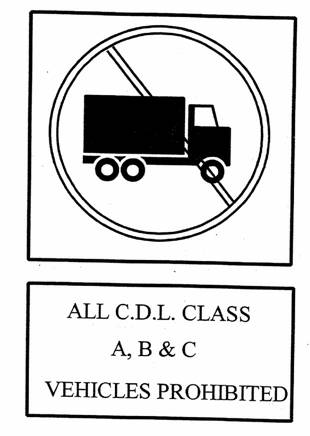
(Ord. 1998-30 § 5, 1998).
10.30.010 - Definitions.
As used in this chapter:
1.
"Moped" means a vehicle which looks and handles essentially like a bicycle and can be propelled either by pedaling or by a small engine and:
a.
Is designed to travel on not more than three (3) wheels in contact with the ground but is not a tractor; and
b.
Is capable of a maximum speed of not more than thirty (30) miles per hour on a flat surface with not more than one percent (1%) grade in any direction when the motor is engaged.
2.
"Motorcycle" means every motor vehicle equipped with a seat or a paddle for the use of the driver and designed to travel on not more than three (3) wheels in contact with the ground, including a power cycle but excluding a tractor and a moped.
3.
"Muffler" means a device consisting of a series of chambers or baffle plates, or other mechanical design, for the purpose of receiving exhaust gas from an internal combustion engine, and is effective in reducing noise, but does not include such a device equipped with an apparatus which permits the exhaust gas to be discharged directly into the air without passing through such device.
(Ord. 1978-13 § 1 (part), 1978).
10.30.020 - Restrictions on number of persons carried.
1.
A motorcycle shall not be driven upon a highway while carrying more than one (1) person unless such motorcycle is designed by the manufacturer to carry more than one (1) person.
2.
A passenger shall ride:
a.
Behind the driver and astride the permanent or regular seat which was designed for two (2) persons;
b.
Astride another seat firmly attached at the rear of the driver; or
c.
In a sidecar attached.
3.
Every such motorcycle designed for transporting a passenger shall be equipped with footrests adjusted to fit such passenger.
10.30.030 - Regular seats required.
1.
A person driving a motorcycle shall ride only upon the permanent and regular seat attached thereto.
2.
A person shall not drive a motorcycle with the seat for the driver so positioned that the driver, when sitting astride the seat with the motorcycle in a stopped and upright position, cannot reach the ground with both feet simultaneously.
10.30.040 - Handlebar height above seat.
A person shall not drive a motorcycle equipped with handlebars which are more than fifteen inches (15″) in height above the uppermost portion of the driver's seat when such seat is depressed by the weight of the driver.
10.30.050 - Both hands on handlebars.
The driver of a motorcycle shall drive with one (1) hand on each handlebar at all times, except when such driver is making an arm signal for a turn.
10.30.060 - Fenders required.
A person shall not drive a motorcycle unless the wheels are protected by fenders to prevent the throwing of rocks, dirt, water or other substances to the rear.
10.30.070 - Use of protective headgear required.
1.
Except as provided in subsections 2 and 3, when any motorcycle is being driven on a highway, the driver and passenger shall wear protective headgear securely fastened on the head and protective glasses, goggles or face shields meeting such standards adopted by the Nevada Department of Motor Vehicles.
2.
When a motorcycle is equipped with a transparent windscreen meeting such standards, the driver and passenger are not required to wear glasses, goggles or face-shields.
3.
When a motorcycle is being driven in a parade authorized by a local authority, the driver and passenger are not required to wear the protective devices provided for in this section.
10.30.080 - Prohibiting sale of headgear not meeting stands.
1.
A person shall not sell, offer for sale or distribute any protective headgear, glasses, goggles or face shields for use by any drivers or passengers of motorcycles or transparent windscreens for motorcycles unless such equipment is of a type and specification meeting the standards therefor adopted by the Nevada Department of Motor Vehicles.
2.
The provisions of this section shall not prohibit the sale of protective headgear, glasses, goggles or faceshields which comply with the rules and regulations adopted by the United States Department of Transportation.
10.30.090 - Motor vehicle laws apply to persons driving motorcycle.
A person driving a motorcycle upon a highway is entitled to all the rights and subject to all the duties applicable to the drivers of motor vehicles as provided by law, except those provisions which by their nature can have no application.
10.30.100 - Full use of traffic lane entitled.
Every motorcycle when being driven on the highway is entitled to full use of the traffic lane it is occupying, and a person shall not drive another motor vehicle in a manner which would deprive any such motorcycle of such use.
10.30.110 - Passing between motor vehicles—Riding abreast.
1.
A person, except a police officer in the performance of his duty, shall not drive a motorcycle between moving or stationary vehicles occupying adjacent traffic lanes.
2.
Except as provided in subsection 3, a person shall not drive a motorcycle abreast of or overtake or pass another vehicle within the same traffic lane.
3.
Motorcycles may, with the consent of the drivers, be operated no more than two (2) abreast in a single traffic lane.
10.30.120 - Violations.
1.
Except as otherwise provided in this section, it is unlawful for any person to use, operate or drive a motorcycle that is not equipped with an effective and operating muffler:
a.
Within five hundred feet (500') of a residence owned or occupied by another person;
b.
In a manner so as to disturb the peace and quiet of another person; or
c.
On any public road or highway.
2.
For purposes of subsection 1, a motorcycle that is not equipped with an effective and operating muffler is deemed to be used, operated or driven in a manner so as to disturb the peace and quiet of another person if the motorcycle creates:
a.
An unreasonably loud, disturbing or unnecessary noise, or dust, smoke or exhaust fumes, which cause material distress, discomfort or injury to a person of ordinary sensibilities; or
b.
Any noise of such character, intensity or continuous duration, or dust, smoke or exhaust fumes, which substantially interfere with the reasonable and comfortable enjoyment of a residential dwelling by a person of ordinary sensibilities.
3.
The provisions of this section do not apply to the proper and lawful use or operation of a motorcycle that is not equipped with an effective and operating muffler:
a.
By a person in any place or manner that is expressly permitted under federal or state laws or regulations.
b.
By an agent or employee of a federal, state or local governmental entity, including, without limitation, an agent or employee of a law enforcement agency, for official governmental purposes.
c.
For the performance of agricultural or farming activities on property that is zoned for such purposes.
d.
For the temporary and immediate entrance into or exit from any property.
(Ord. 1978-13 § 1 (part), 1978).
10.31.010 - Off-road vehicles, all-terrain vehicles and motorcycles that are not street-legal motorcycles.
1.
Except as otherwise provided in this section, it is unlawful for any person to use, operate or drive an off-road vehicle, all-terrain vehicle or motorcycle that is not a street-legal motorcycle:
a.
Within five hundred feet (500') of a residence owned or occupied by another person;
b.
In a manner so as to disturb the peace and quiet of another person; or
c.
On any public road or highway.
2.
For purposes of subsection 1, an off-road vehicle, all-terrain vehicle or motorcycle that is not a street-legal motorcycle is deemed to be used, operated or driven in a manner so as to disturb the peace and quiet of another person if the vehicle creates:
a.
An unreasonably loud, disturbing or unnecessary noise, or dust, smoke or exhaust fumes, which cause material distress, discomfort or injury to a person of ordinary sensibilities; or
b.
Any noise of such character, intensity or continuous duration, or dust, smoke or exhaust fumes, which substantially interfere with the reasonable and comfortable enjoyment of a residential dwelling by a person of ordinary sensibilities.
3.
The provisions of this section do not apply to the proper and lawful use or operation of an off-road vehicle, all-terrain vehicle or motorcycle that is not a street-legal motorcycle:
a.
By a person in any place or manner that is expressly permitted under federal or state laws or regulations.
b.
By an agent or employee of a federal, state or local governmental entity, including, without limitation, an agent or employee of a law enforcement agency, for official governmental purposes.
c.
For the performance of agricultural or farming activities on property that is zoned for such purposes.
d.
For the performance of maintenance activities on private property, including, without limitation, snow plowing and weed removal.
e.
For the temporary and immediate entrance into or exit from any property.
4.
As used in this section:
a.
"All-terrain vehicle" means a small, open cabin, motor vehicle equipped with three or more wheels fitted with large, low-pressure tires or treads, or both, and which is designed to traverse varied, uneven terrain as well as roads, and is commonly known as an ATV, quad bike, three-wheeler, four-wheeler or quadricycle.
b.
"Motor vehicle" has the meaning ascribed to it in CCMC 10.04.310.
c.
"Off-road vehicle" means a motor vehicle that is capable of transporting a person and which is designed or used primarily for recreational activities away and off of public rights-of-way, including, without limitation, such vehicles commonly known as a dune buggy, go-cart, snowmobile, side-by-side, utility task vehicle, recreational off-highway vehicle or multipurpose off-highway utility vehicle.
d.
"Street-legal motorcycle" means a motorcycle that is lawfully licensed or registered for use on public roads and highways as determined by the rules, regulations or policies adopted by the Nevada Department of Motor Vehicles. The term includes a motorcycle that was not originally equipped or certified at the time of sale by the manufacturer for use on public roads and highways but has since been certified for such use by the Nevada Department of Motor Vehicles.
10.32.010 - Failure to obey citation.
1.
It is unlawful for any person to violate his written promise to appear given to a peace officer upon the issuance of a traffic citation prepared manually, regardless of the disposition of the charge for which the citation was originally issued.
2.
A person may comply with a written promise to appear in court by an appearance by counsel.
3.
A warrant may issue upon a violation of a written promise to appear.
(Ord. 2002-31 § 2, 2002).

