
Carson City City Zoning Code
Title 2
ADMINISTRATION AND PERSONNEL*
Chapter 2.31 - FEES ON COURT ACTIONS TO SUPPORT PROGRAMS FOR COURT SECURITY[2]
Editor's note—Ord. No. 2009-12, §§ I, III, IV, adopted July 2, 2009, amended the Code by adding provisions designated as a new Ch. 2.33. Inasmuch as there already exist provisions so designated, Ord. No. 2009-12 has been included herein as a new Ch. 2.31 at the discretion of the editor. See also the Code Comparative Table and Disposition List.
Chapter 2.33 - ADDITIONAL FEES FOR DISSOLUTION OF MARRIAGE[3]
Editor's note— Ord. No. 2008-36, § I, adopted December 4, 2008, renumbered former Ch. 19.05 as Ch. 2.33. See also the Code Comparative Table and Disposition List. Subsequently, it should be noted that Ord. No. 2009-1 also renumbered Ch. 19.05 as Ch. 2.33. Ord. No. 2009-1 provides, "An ordinance amending Carson City Municipal Code, Title 19, Airport Rules and Regulations; to relocate Section 19.05 which addresses fees for dissolution of marriage to Section 2.33."
Chapter 2.35 - FEES ON COURT ACTIONS TO SUPPORT PROGRAMS FOR LEGAL AID, PRO BONO PROGRAMS AND TO PROVIDE LEGAL SERVICES TO ABUSED OR NEGLECTED CHILDREN OR VICTIMS OF DOMESTIC VIOLENCE[5]
Editor's note—Ord. No. 2011-2, § I, adopted March 3, 2011, amended the title of Ch. 2.35 to read as herein set out. See also the Code Comparative Table and Disposition List.
Chapter 2.42 - CARSON CITY BUILDING PERMIT ENTERPRISE FUND ADVISORY COMMITTEE
Editor's note— Ord. No. 2022-20, § I, adopted Nov. 17, 2022, repealed Ch. 2.42, §§ 2.42.010—2.42.090, which pertained to Carson City Building Permit Enterprise Fund Advisory Committee and derived from Ord. No. 2008-5 §§ 2—10, adopted 2008.
Chapter 2.45 - FEES ON DOCUMENT RECORDING TO SUPPORT LEGAL SERVICES FOR ABUSED AND NEGLECTED CHILDREN
Sections:
2.02.010 - Ward boundaries. (art. 1, § 1.060 and art. 2, §§ 2.090, 2.100 and 2.110 of the Carson City Charter).
There are hereby established in Carson City four (4) contiguous election wards numbered consecutively as Ward One, Ward Two, Ward Three and Ward Four, with each ward corresponding to the alignment of boundaries as depicted in the Carson City, Nevada Official Board of Supervisors Ward Boundaries Map, which may be amended from time to time in accordance with article 1, § 1.060 of the Carson City Charter. Any ordinance and amendment to the Carson City, Nevada Official Board of Supervisors Ward Boundaries Map that realigns the boundaries of a ward must be:
1.
Adopted by the Carson City Board of Supervisors in the manner prescribed by the Carson City Charter; and
2.
Filed and recorded in the Office of the Carson City Clerk-Recorder and published on its official Internet website.
(Ord. 2001-16 § 1—4: Ord. 1991-66 § 1, 1991: Ord. 1981-50 § 1).
(Ord. No. 2011-21, § I, 12-15-2011; Ord. No. 2021-16, § I, 12-30-2021)
2.02.020 - Reserved.
Editor's note— Ord. No. 2021-16, § III, adopted Dec. 30, 2021, repealed § 2.02.020, which pertained to creation of board of supervisors and derived from Ord. 1974-7 § 2, adopted 1974.
2.02.030 - Qualifications of supervisor.
A person is not eligible to be elected or appointed to office as a Supervisor unless the person meets all qualifications for the office as required by the Carson City Charter and any provision of NRS not otherwise in conflict with the Carson City Charter.
(Ord. 1974-7 § 3, 1974).
(Ord. No. 2020-11, § I, 9-3-2020)
2.02.040 - Meetings of the Board of Supervisors. (art. 2, §§ 2.050 and 2.090-2.110, inclusive, of the Carson City Charter; NRS 244.085).
1.
Except as otherwise provided in this subsection, regular meetings of the Board of Supervisors must be held in Carson City on the first and third Thursday of each calendar month, unless such day falls on a holiday or on a nonjudicial day, in which event the regular meeting must be held on the next judicial day. By a motion made in a properly noticed meeting, the Board of Supervisors may take action to change the date of an ensuing, regularly scheduled meeting if:
(a)
The Board of Supervisors finds that it is in the best interest of the public to change the date; and
(b)
The change in the meeting date is made not less than twenty (20) days before the date on which the meeting is to occur.
2.
The official meeting place of the Board of Supervisors is the Robert 'Bob' Crowell Board Room, located at the Carson City Community Center, 851 E. Williams Street, Carson City, Nevada.
3.
The Board of Supervisors may, as it deems necessary, hold additional regular, work session or special meetings during any calendar month by specifying the date, time, place and purpose of any such meeting in a notice properly made pursuant to applicable law.
4.
Nothing contained in this section shall be construed to prohibit the Board of Supervisors from recessing a regularly scheduled meeting and continuing the meeting to a later time and place certain if such time and place are established by an appropriate motion made during the regularly scheduled meeting.
(Ord. 1996-68 § 1, 1996: Ord. 1989-10A § 1, 1989).
(Ord. No. 2021-16, § II, 12-30-2021)
2.04.015 - Establishment of personnel rules and regulations.
Pursuant to section 2.330 of the Carson City Charter, the Carson City board of supervisors by regulation shall adopt personnel rules and regulations containing policies and procedures applying to all classified employees of the city and extended to unclassified employees when determined applicable by the city manager. The rules and regulations adopted shall supersede conflicting policies, procedures and standards of all city departments.
(Ord. 1983-3 § 2, 1983).
2.04.371 - Reserved.
Editor's note— Ord. No. 2017-10, § I, adopted June 1, 2017, repealed § 2.04.371, which pertained to schematic of class series. See Code Comparative table for complete derivation.
2.04.383 - Reserved.
Editor's note— Ord. No. 2017-10, § II, adopted June 1, 2017, repealed § 2.04.383, which pertained to personnel compensation schedule. See Code Comparative Table for complete derivation.
2.04.400 - Public officers.
In addition to all elected public officers, the following appointed positions are "public officers" as that term is defined in NRS 281A.160, to provide for the continuing administration of the city government and its corresponding powers, trusts and duties:
Chief alternative sentencing
Chief financial officer/Controller
City manager
Deputy city manager
Internal auditor
Library director
Public guardian
(Ord. 128 § 1, 1998: Ord. 121 § 1, 1998: Ord. 1998-17 § 1, 1998: Ord. 1997-49 § 1, 1997: Ord. 1997-41 § 1, 1997: Ord. 1997-2 § 1, 1997: Ord. 1996-69 § 1, 1996: Ord. 1996-50 § 1, 1996: Ord. 1996-41 § 1, 1996: Ord. 1995-52 § 1, 1995: Ord. 1995-27 § 1, 1995: Ord. 1994-41 § 1, 1994: Ord. 1994-11 § 1, 1994: Ord. 1994-7 § 1, 1994: Ord. 1993-41 § 1, 1993: Ord. 1993-30 § 1, 1993: Ord. 1991-46 § 1, 1991: Ord. 1991-44 § 1, 1991: Ord. 1991-4 § 1, 1991: Ord. 1990-23 § 1, 1990: Ord. 1990-18 § 1, 1990: Ord. 1989-47 § 1, 1989: Ord. 1989-13 § 1, 1989: Ord. 1988-19 § 1, 1988: Ord. 1988-11 § 1, 1988: Ord. 1987-38 § 1, 1987: Ord. 1987-31 § 1, 1987: Ord. 1987-28 § 1, 1987: Ord. 1987-27 § 1, 1987: Ord. 1986-43 § 1, 1986: Ord. 1986-1 § 1, 1986: Ord. 1985-45 § 1, 1985: Ord. 1985-14 § 1, 1985: Ord. 1983-3 § 5, 1983: Ord. 1979-20A § 4, 1979: Ord. 1975-19 § 1, 1975: Ord. 1975-12 § 2 (part), 1975).
(Ord. No. 2017-10, § III, 6-1-2017)
2.04.410 - Reserved.
Editor's note— Ord. No. 2017-10, § IV, adopted June 1, 2017, repealed § 2.04.410, which pertained to elected and appointed officers and employees annual, sick and disability leave. See Code Comparative Table for complete derivation.
2.06.010 - Policies for compensation and benefits of unclassified employees.
1.
The purpose of this chapter is to provide a fair method for formulating and revising policies affecting the compensation and benefits of unclassified employees. It is the further purpose of this chapter to provide notice of the adoption of and proposed changes to policies affecting the compensation and benefits of unclassified employees to encourage and allow for participation in the process by Carson City residents, elected officials and unclassified employees. This chapter is not meant to create, imply or be a part of any employment contract between Carson City and any unclassified employee, and this chapter may be repealed at any time through the usual procedure for repealing chapters.
2.
The board of supervisors shall adopt a resolution to fix the salaries, other compensation and benefits of all appointive county officers and employees ("compensation and benefits resolution"). For the purposes of this section, appointive county officers and employees are those employees listed in CCMC 2.04.400 and the unclassified employees of the district court and the justice court. Board of supervisors' resolution 1993-R-56 adopted June 3, 1993, constitutes the resolution required by this subsection.
3.
In addition to the compensation and benefits resolution required by subsection 2, the board of supervisors shall also adopt a resolution to state the policy of Carson City relating to the employment, compensation and benefits of appointive county officers and employees ("policy resolution"). The compensation and benefits resolution must be based on the policy resolution and modifications, amendments, repealers or any other changes to the compensation and benefits resolution may only be made after the board makes findings that any modification, amendment, repealer or other change is consistent with the terms of the policy resolution.
4.
A written statement of any proposed modification, amendment, repealer or any other change to any resolution required by this section must be delivered to each elected city official, the special master, the district court judges and justice court judges and each department head and posted in four (4) places as if required by the state open meeting law (NRS 241) at least ten (10) calendar days before the day of the hearing at which the resolution making the modification, amendment, repealer or any other change is heard.
5.
Any action taken in violation of this section is void.
(Ord. 1993-53 §§ 2 (part), 3, 1993).
2.08.010 - Authority to command aid of residents during fires.
The fire chief, and in his absence, the deputy fire chief of the fire department of Carson City, shall have the right and authority to require and command the services, when needed, of all able-bodied male residents of said city, in removing property from any fire in the city, in caring for any exposed property in time of or after such fire, and in subduing any such fire.
2.08.020 - Failure of resident to aid when so commanded.
If any able-bodied male resident of said city shall, without valid excuse, wilfully disregard the requirements and commands of the fire chief, or of the deputy fire chief of the fire department, as contemplated by Section 2.08.010, he shall, on conviction thereof, be fined not more than fifty dollars ($50.00), or imprisoned in the city jail for not more than one month, or punished by both such fine and imprisonment at the court's discretion.
2.08.030 - Taking fire equipment outside city.
1.
No engine, hose carriage, hose or other property of any fire company of the fire department of the city shall be taken out of the city without the permission of the fire chief or deputy fire chief.
2.
The fire engines of the fire department shall not all, at one time on any occasion, be taken outside the city.
2.14.010 - Introduction.
As the demand for enhanced accountability and the increased examination of an adequate system of internal controls occurs in the public sector due to the Sarbanes-Oxley Act, so does the significance and importance of an audit committee.
The independence and objectivity between the Carson City audit committee and the city's management team ensures that internal controls are a key management objective of the city's operation. The Government Finance Officers Association and the Institute of Internal Auditors encourage the effective use of an audit committee in the public sector and considers this committee an integral element of public accountability and governance. The Carson City audit committee plays a key role with respect to integrity of the city's financial information; its systems of internal controls, the legal and ethical conduct of management and employees, and is an invaluable tool for ensuring that those responsible for financial management (management, auditors, and governing boards) meet the respective responsibilities for internal control compliance and financial reporting. Additionally, the Carson City audit committee provides a vehicle for open communications between the board of supervisors, the city management team, internal audit, and the independent external auditors.
(Ord. 2008-10 § 3, 2008)
2.14.020 - Purpose of the Carson City audit committee.
The role of the Carson City audit committee is to maintain oversight of the auditing function, both internal and external resulting in increased integrity and efficiency of the audit processes for the city and the city's system of internal controls and financial reporting. The committee has three primary characteristics for it to successfully fill its obligations:
1.
Independence. The Carson City audit committee will be independent both in fact and in appearance and requires processes to be in place to ensure such independence is maintained at all times.
2.
Communication. The Carson City audit committee will maintain an open line of communication with the board of supervisors, city management, internal and external auditors; providing direction for the city's audit function and a framework of accountability.
3.
Accountability. The Carson City audit committee contributes to the integrity of the financial reporting process and reinforces the culture of a strong system of internal controls throughout the city.
The Carson City audit committee shall provide oversight to the city's internal controls by assuring that the system of internal controls established by management are reviewed on a regular and systematic basis for functionality and effectiveness. The Carson City audit committee's duties shall include, but are not limited to, development of the risk assessment and annual work plan, review of all individual audit reports, review of the annual report of audits completed, review the status of corrective actions, the annual budget, and the performance of the internal auditor. Upon completion of these reviews, the Carson City audit committee will make appropriate recommendations to the board of supervisors.
(Ord. 2008-10 § 4, 2008)
2.14.030 - Composition of the Carson City audit committee.
1.
The Carson City audit committee will be independent and objective in its collective mindset individually and as a group. The committee will reflect the following attributes:
a.
Excellent communication skills with each other and with others;
b.
A willingness to fully participate in complex and sensitive matters that require resolution;
c.
Public accounting, governmental accounting and auditing experience.
2.
The Carson City audit committee shall be comprised of five (5) members; one (1) member from the board of supervisors and four (4) members from the public at-large.
a.
One (1) member of the Carson City audit committee will be selected from the board of supervisors. The board member shall be selected each January when the board of supervisors addresses board and commission assignments.
b.
The four (4) members at-large of the Carson City audit committee will be interviewed and selected by the board of supervisors. These members should have experience in financial services, public accounting, and/or governmental auditing, and current knowledge of public laws and regulations governing an audit committee. The terms shall be for staggered two (2) years; expiring on each alternate year.
c.
The members at-large shall not accept any consulting, advisory, or other compensatory fees from the city and may not be an affiliated person with the city or any subsidiary thereof.
3.
Should a vacancy occur in any position on the Carson City audit committee, the board of supervisors must follow the procedure set forth above to select a new member for the committee. The selection must occur within one (1) month of the vacancy occurring.
4.
When deemed necessary, the Carson City audit committee may request that the city manager and other management employees attend a Carson City audit committee meeting in an advisory capacity. This individual may be requested to provide necessary information relative to internal controls, data, and analysis related to the specific objectives of the Carson City audit committee.
(Ord. 2008-10 § 5, 2008)
2.14.040 - Responsibilities of the Carson City audit committee.
1.
The Carson City audit committee will review and make recommendations to the board of supervisors regarding the annual financial audit, performance, compliance and efficiency audits, including specific issues of concern providing a higher level of accountability over the use of public funds and the adequacy of any city department or office performance measure for internal audit purposes. Reviews and recommendations by the internal auditor will be guided by the internal auditing standards. As appropriate, background documents related to specific audit issues will be sent to the committee during the course of each year.
2.
The Carson City audit committee will:
a.
Provide input into the annual risk assessment plan developed by the city auditor to identify areas of risk or exposure facing the city's organization; review and assess the steps necessary to minimize such risks in the future and improve operating efficiencies; oversee the internal auditor's creation and implementation of processes to indentify potential fraud, waste and abuse of city resources and property and a findings reporting protocol;
b.
Identify with key directors significant risks or exposures facing their organizations/operations to develop a "risk plan" and "audit work plan" to prioritize the city auditor's work load and assess the need for professional services;
c.
Annually review the audit scope and work plan of the city auditor in conjunction with the external auditors plan to address the coordination of audit efforts to ensure the completeness of coverage, reduction of redundant efforts and effective use of audit resources;
d.
Discuss the fiscal health of the city in relation to the adopted budget with the city manager and the director of finance;
e.
Consider matters related to the systems of internal controls, including overseeing compliance by management with applicable policies and procedures;
f.
Review and make recommendations to the board of supervisors regarding audit findings including the status and implementation of recommendations for both internal and external audits;
g.
Review and make recommendations to the board of supervisors pertaining to the internal audit budget for operating expenses and capital expenditures;
h.
Oversee the appointment of the independent auditors to be engaged by the board of supervisors for external reporting and recommend to the board of supervisors the related audit fees;
i.
Recommend to the board of supervisors to engage outside professional services when deemed appropriate for audit issues;
j.
Review the internal audit charter and make recommendations to the board of supervisors when changes are deemed necessary;
k.
Review and make recommendations to the board of supervisors for special requests for audit projects and have the authority to perform other duties as may be delegated to it by the board of supervisors;
3.
Generally Accepted Auditing Standards (GAAS) and Government Auditing Standards require an independent auditor to evaluate the city's internal controls in connection with determining the extent of their audit procedures. The external auditors are required to alert the Carson City audit committee and the governing body regarding material matters. The Carson City audit committee will:
a.
Review and make recommendations to the board of supervisors pertaining to the external auditors annual audit plan and inquire into external audit matters as deemed appropriate;
b.
Oversee the appointment of the independent auditors to be engaged by the board of supervisors for external reporting and establish the related audit fees; review and evaluate the performance of the independent auditors and establish a regular schedule for periodically re-bidding the annual audit;
c.
Review and make recommendations to the board of supervisors regarding all significant written communications between the independent auditors and management, such as any management letter or schedule of unadjusted differences.
(Ord. 2008-10 § 6, 2008)
2.14.050 - Meetings of the Carson City audit committee.
1.
The Carson City audit committee will meet quarterly. All members are expected to attend on a regular basis.
2.
The Carson City audit committee may ask members of management or others to attend meetings and to provide pertinent information when necessary.
3.
Meetings are scheduled in accordance with the state's open meeting laws. The city auditor shall establish the agenda for meetings and will provide to members in advance, all appropriate briefing material.
(Ord. 2008-10 § 7, 2008)
2.14.060 - Organizational chart.
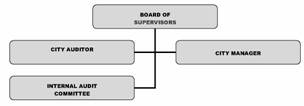
(Ord. 2008-10 § 8, 2008)
2.16.010 - Organization.
1.
There is hereby established pursuant to NRS 244.3071 et seq. a commission to be known as the Carson City parks and recreation commission.
2.
This commission shall consist of seven members who shall be appointed by the board.
3.
The commission shall be composed of one member who shall be a member of the Board of Supervisors, and one member who shall be a member of the Board of Trustees of the Carson City School District. The remaining members shall be qualified electors of Carson City and appointed, where possible, from a diverse cross-section of the community. That cross-section should consist of but not be limited to: service groups, professional parks or maintenance groups, adult sports groups, youth sports or service groups, environmental interest, and general public.
(Ord. 2005-17 § 1, 2005: Ord. 1991-56 § 1, 1991: Ord. 1981-45 § 1, 1981: Ord. 1974-10 § 1, 1974).
2.16.020 - Membership requirements.
Members of the Carson City parks and recreation commission shall be qualified electors of Carson City.
(Ord. 1981-45 § 2, 1981).
2.16.030 - Term of office.
1.
All terms will be for four (4) years.
2.
Members whose terms have expired shall continue to serve until their successors have been appointed.
3.
Terms of office shall commence and end on January 1st.
(Ord. 1991-56 § 2, 1991: Ord. 1985-36 § 1, 1985: Ord. 1985-28 § 1, 1985).
2.16.040 - Meetings and officers—Legislative procedure—Removal of commissioner—No compensation.
1.
The commission shall meet in regular session and shall elect from their members a chairman and a vice-chairman at the first regular meeting conducted each calendar year. Officers shall hold office for one calendar year or until their successors are named.
2.
The city shall provide a secretary for each and every meeting of the commission.
3.
The commission shall by recorded vote, adopt rules and regulations for governing procedure and shall adopt appropriate by-laws by which to be governed.
4.
A majority shall constitute a quorum.
5.
The commission shall schedule at least one meeting bi-monthly, in regular session with the director of the park and recreation department or the director's designated representative. The bi-monthly meetings shall be held on the first Tuesdays of February, April, June, August, October, and December, unless notice is otherwise provided.
6.
The chair and the parks and recreation director together can cancel a meeting or schedule a special meeting as needed.
7.
The commission members shall receive no compensation.
(Ord. 1991-56 § 3, 1991).
2.16.045 - Removal for cause.
Upon recommendation of the park and recreation commission the board may remove for cause any commissioner for:
1.
Dereliction of duty, or
2.
Nonparticipation, or
3.
Nonattendance, or
4.
For any other reason shown as just cause.
(Ord. 1991-56 § 4, 1991).
2.16.050 - Duties and responsibilities.
1.
The commission shall act in advisory capacity to the board.
2.
The commission shall cooperate with other governmental agencies and civic groups in the advancement of sound recreation planning.
3.
The commission shall:
a.
Recommend policies on park and recreation services;
b.
Advise on acquisition and development of park and recreation areas and facilities;
c.
Aid in coordinating park and recreation services with the programs of other governmental agencies and voluntary organizations;
d.
Make recommendations to the board on acceptance of bequests of real property, equipment and moneys for park and recreation purposes;
e.
Review and make recommendations concerning the park and recreation department's capital budgets; and
f.
Review and make recommendations to the board concerning the acceptance and spending of the residential construction tax.
(Ord. 2007-16 § 1, 2007: Ord. 2005-17 § 2, 2005: Ord. 1991-56 § 5, 1991).
2.16.060 - Severability.
If any of the provisions of this chapter or the application thereof to any person or circumstances is held invalid, such invalidity shall not impair the other provisions of this chapter. To this end the provisions of this chapter are declared to be severable.
(Ord. 1991-56 § 6, 1991).
2.28.010 - Compensation for election board officers.
The compensation and conditions of employment for voting board officers, counting board officers, those employees for the purpose of conduction early voting, specially appointed deputy sheriffs and other election board officers shall be fixed by resolution of the board of supervisors.
(Ord. 2008-1 § 1, 2008: Ord. 1984-8 § 1, 1984).
2.29.010 - Examination of bills and requests for payment.
The controller or his designee shall examine and verify all bills and other requests for payment as to their validity, accuracy and required previous approvals, and shall prepare for approval a warrant upon the treasurer representing each such demand, which warrant shall specify in whose favor it is drawn, and the amount thereof, together with the name or reference number of the fund and of the bank out of which it is payable when executed and approved. He shall note such bills and other requests for payment and warrants upon a register book of warrants, setting forth the number of the warrant, in whose favor the warrant is drawn, and the amounts thereof, together with dates and the name or reference number of the fund and of the bank out of which the warrant is payable.
(Ord. 1977-5 § 1 (part), 1977).
2.29.020 - Approval or disapproval by city manager—Action by board.
All bills or other requests for payment verified in the foregoing manner shall thereupon be presented by the controller, together with the register book of demands and warrants to the city manager who shall audit the same, and if found authorized, correct and legal, shall signify by his signature, as agent for the board, upon the register book of demands and warrants those demands which are approved or disapproved by him. Upon approval, the warrants, prepared as aforesaid, shall issue. He shall then cause the register book of bills and other requests for payment and warrants to be presented at least once a month to the board of supervisors, who shall, by motion entered in its minutes, ratify the action taken on the bills or other requests for payment.
(Ord. 1977-5 § 1 (part), 1977).
2.31.010 - Fees in district court.
Pursuant to the 75th Regular Session of the Nevada Legislature Assembly Bill No. 65 Section 3 — Committee on Judiciary, an act relating to courts; providing for the collection and disposition of additional court fees, there is imposed, in addition to any other fee required by law, a filing fee of twenty dollars ($20.00) to be paid on the commencement of any civil action or proceeding in the First Judicial District Court for which a filing fee is required and on the filing of any answer or appearance in any such action or proceeding for which a filing fee is required, except as otherwise required pursuant to Nevada Revised Statute (NRS) 19.034 Reduced Fees for Adoption of Child with Special Needs.
2.31.020 - Collection—Payment to treasurer.
1.
On or before the fifth day of each month, the Carson City Clerk of the Court shall account for and pay over to the Carson City Treasurer any such fees collected by him during the preceding month for credit to an account for programs for court security in the Carson City General Fund. The money in that account must be administered by Carson City and:
(a)
May be used only for programs for court security;
(b)
Must not be used to supplant existing budgets for bailiffs or deputy marshals who are assigned to work in a courtroom; and
(c)
If any balance remains, may be carried forward to the next fiscal year.
2.
As used in this section, "programs for court security" includes, without limitation:
(a)
Funding for additional positions for bailiffs, marshals, security guards and similar personnel;
(b)
Supplementing existing funding used to pay bailiffs, marshals, security guards and similar personnel;
(c)
Acquiring necessary capital goods for court security;
(d)
Providing security training and education to personnel;
(e)
Conducting security audits; and
(f)
Acquiring or using appropriate technology relating to court security.
2.32.010 - Purpose and scope.
The provisions of Sections 2.32.010 to 2.32.060 are intended to provide a procedure for storing and disposing of lost or abandoned property. The provisions shall not apply to property which has an apparent value less than the reasonably anticipated costs of removing and storing it and nor shall it apply to abandoned vehicles.
(Ord. 1999-26 § 3 (part), 1999).
2.32.020 - Definitions.
As used in Sections 2.32.010 to 2.32.060, the words and terms defined in this section shall have the following meanings unless the context otherwise requires.
"Custodian" means the sheriff, private towing or storage company.
"Finder" means any person who delivers found property to the sheriff or who directs the sheriff to the location of such property,
"Round property" means any property of value other than real property or fixtures thereon, which is abandoned, lost or left unattended in a public place including, without limitation, a street, alley or parking lot.
(Ord. 1999-26 § 3 (part), 1999).
2.32.030 - Delivery to sheriff.
1.
Any person finding found property may turn such property over to the sheriff or may direct the sheriff to the location thereof.
2.
If the property has an apparent value in excess of the costs of removing and storing it, the sheriff shall take possession of the property and issue a receipt to the finder acknowledging the name of the finder, the date, the location, the circumstances of the finding, the description of the property, and state that the finder may claim the property within ninety (90) days from the date listed on the receipt if it has not been claimed by the owner and if the sheriff stores the found property in his storage facility.
3.
The sheriff may place the property in his storage facility or deliver it to a private towing or storage company. Delivery to such a private company shall relieve Carson City of any further responsibility for or claim to the property. The sheriff shall give all found money or negotiable instruments to the treasurer, who must give a receipt to the sheriff. All found property shall remain on the record of found property as provided in Section 2.32.040.
(Ord. 1999-26 § 3 (part), 1999).
2.32.040 - Record of found property, notice to owner and disposition of property.
1.
The sheriff shall keep a record of all found property which contains a description of the property, the location where it was found, the name and address of the person who found and reported it, and the location where the property is being stored. Any person claiming to have lost property may inquire to the sheriff whether or not his property has been found. The sheriff need not respond to such inquiry unless it is made with detailed identification of the property and the approximate time and location where it was lost.
2.
If the identity of the owner of the property is ascertainable from the property itself and if the owner has not claimed and identified it, the sheriff shall attempt to locate the owner. If the property has a serial number or other identifying number, the attempt shall include an inquiry of any person or agency having a record of ownership. If the owner is identified, the custodian shall attempt to notify him or her by mailing a notice. The notice shall inform him or her of the location of the property, that the property may be claimed within thirty (30) days after mailing the notice upon payment of any costs and expenses incurred in removing, moving and storing the property, and that if he or she does not claim the property within the thirty (30) day period, then the property will be offered to the finder. The notice shall also inform the owner that his or her failure to claim the property will not relieve him or her of the liability for the expenses incurred in removing, moving and storing the property.
3.
If the owner is identified and does not claim the property and pay the expenses incurred in removing, moving and storing the property, if any, within thirty (30) days after mailing the notice, the finder may claim the property upon payment of the above-stated expenses.
4.
If the owner does not claim the property within sixty (60) days after receipt of the property by the sheriff, the finder may claim the property upon payment of the costs and expenses incurred in removing, moving and storing the property, if any.
5.
If the finder does not claim the property and pay the expenses incurred in removing, moving and storing the property if any within ninety (90) days after receipt of the property by the sheriff, Carson City becomes the owner of the property.
(Ord. 1999-26 § 3 (part), 1999).
2.32.050 - Disposition of unclaimed property.
1.
All unclaimed property which becomes the property of Carson City shall be disposed of as provided in this section.
2.
All property, except weapons, may be kept for Carson City use, sold at a public auction, or donated to a nonprofit organization as defined in NRS 372.3261. All found money and all proceeds received from a public auction must be placed in the general fund.
3.
Lost or abandoned weapons may be retained or traded by the sheriff for official use by the sheriff's department or destroyed by the sheriff's department.
4.
Property which fails to be sold at a public auction may be removed to a disposal facility.
5.
All property that is not otherwise disposed of pursuant to the terms of this chapter may be sold through an internet based public auction.
(Ord. 1999-26 § 3 (part), 1999).
2.32.060 - Public auction.
1.
No public auction shall be valid unless notice of the auction is published as least once a week for two (2) successive weeks prior to the sale, in some newspaper published in Carson City. The notices must be printed with at least five (5) days intervening between the publications. Notices must also be posted at least ten (10) days prior to the sale in at least three (3) public places in Carson City.
2.
The notice of such sale shall:
a.
Give a description of the property to be sold; and
b.
Give the time and the place of the sale.
3.
The notice provisions of this section do not apply to the disposal of unclaimed property through an internet based public auction.
(Ord. 1999-26 § 3 (part), 1999).
2.33.010 - Court fee for dissolution of marriage.
Defendants in an action for divorce, annulment of separate maintenance shall, pursuant to NRS 19.033, pay to the clerk-treasurer an additional filing fee of five dollars which shall be paid on the appearance of a defendant in such action in district court in addition to any other fees provided by law, which shall be collected from the defendant upon the filing of the first paper in the action by the defendant.
(Ord. No. 2008-36, § I, 12-4-2008)
2.33.020 - Accounting of court fee.
On or before the fifth day of each month, the Carson City Clerk shall account for and pay to the Carson City-Treasurer all fees collected during the preceding month pursuant to Section 2.33.010.
(Ord. No. 2008-36, § I, 12-4-2008)
2.35.010 - Fees in district court.
1.
Pursuant to NRS 19.0312, the Carson City clerk recorder, in his capacity as clerk of the First Judicial District Court, shall, on the commencement of any civil action or proceeding in district court for which a filing fee is required and on the filing of any answer or appearance in any such action or proceeding collect an additional five dollar ($5.00) filing fee to offset a portion of the costs of providing pro bono programs and of providing legal services without a charge to abused or neglected children of victims of domestic violence which fee is to be remitted to the entity or entities operating a program that receives the fees charged pursuant to NRS 19.031 for programs for the indigent.
2.
Pursuant to NRS 19.0312, the Carson City clerk recorder, in his capacity as clerk of the First Judicial District Court, shall, on the filing of any motion or other paper that seeks to modify or adjust a final order that was issued pursuant to Chapter 125, 125B or 125C or NRS and on the filing of any answer or response to such a motion or other paper collect an additional twenty-five dollar ($25.00) fee to offset a portion of the costs of providing pro bono programs and of providing legal services without charge to abused or neglected children or victims of domestic violence which fee is to be remitted to the entity or entities operating a program that receives the fees charged pursuant to NRS 19.031 for programs for the indigent.
3.
An additional filing fee may not be imposed pursuant to subsection 2 for:
a.
A motion filed solely to adjust the amount of support for a child set forth in a final order; or
b.
A motion for reconsideration or for a new trial that is filed within ten (10) days after a final judgment or decree has been issued.
4.
Any fees collected pursuant to the ordinance codified in this section must be used for the benefit of the persons to whom the entity or entities operating a program for legal services that receives money pursuant to this section provides legal services with a charge.
(Ord. 2002-15 § 3, 2002).
2.35.020 - Fees in justice court.
1.
Pursuant to NRS 4.071, the Carson City justice court clerk, in his capacity as the clerk of the justice court of Carson City township, shall on the commencement of any action or proceeding in justice court for which a filing fee is required and on the filing of any answer or appearance in any such action or proceeding for which a filing fee is required collect an additional five dollar ($5.00) filing fee to offset a portion of the costs of providing pro bono programs and of providing legal services without a charge to abused or neglected children and victims of domestic violence which fee is to be remitted to the entity or entities operating a program for legal services that receives the fees charged pursuant to NRS 19.031 for programs for the indigent.
2.
Any fees collected pursuant to the ordinance codified in this section must be used for the benefit of the persons to whom the entity or entities operating a program for legal services that receives money pursuant to this section provides legal services without a charge.
(Ord. 2002-15 § 4, 2002).
2.35.030 - Collection—Payment to treasurer.
1.
On or before the first Monday of each month, the clerk recorder of the First Judicial District Court and the justice of the peace shall account for and pay over to the county treasurer any fees collected pursuant to NRS 19.031 and CCMC 2.35.010 and 2.35.020 during the preceding month.
2.
The county treasurer shall remit quarterly to the entity or entities eligible to receive fees collected pursuant to NRS 19.031 and CCMC 2.35.010 and 2.35.020 all the money received by him from the clerk recorder of the First Judicial District Court and the justice of the peace on a pro-rata basis based on the amount of time a particular entity spent providing services for which fees collected pursuant to NRS 19.031 or CCMC 2.35.010 or 2.35.020 are entitled to be received as compared to the amount of time all entities spent providing services for which fees collected pursuant to NRS 19.031 or CCMC 2.35.010 or 2.35.020 are entitled to be received.
3.
Any such entity may file an appeal with the Board of Supervisors within 15 calendar days of receipt of a disbursement from the county treasurer as to the distribution of the fees collected pursuant to NRS 19.031 or CCMC 2.35.010 or 2.35.020. The appeal must state how the distribution of the fees did not comply with all relevant state law or Chapter 2.35 of the Carson City Municipal Code. A copy of the appeal and notice of the date and time of the resulting hearing of the appeal shall be placed by the county treasurer in the mail to the last known address at least 7 calendar days prior to the hearing to all entities that may be subject to any resulting disbursement adjustment. The Board of Supervisors will review de novo the distribution of the fees collected pursuant to NRS 19.031 and CCMC 2.35.010 and 2.35.020 to determine whether the fees were properly distributed. Any disbursement adjustments determined by the Board of Supervisors' de novo review shall constitute a final decision and subtracted from and added to one or more future respective disbursements as the case might require to adjust, or otherwise be reimbursed and corrected.
(Ord. 2002-15 § 5, 2002).
2.36.010 - Fees in district court.
Pursuant to NRS 19.0313, the Carson City clerk recorder, in his capacity as clerk of the First Judicial District Court, shall, on the commencement of any civil action or proceeding in the district court for which a filing fee is required, and on the filing of any answer or appearance in any such action or proceeding for which a filing fee is required, charge and collect a fee of ten dollars ($10.00) from the party commencing, answering or appearing in the action or proceeding. These fees are in addition to any other fee required by law.
(Ord. 2001-10 § 1, 2001: Ord. 1995-45 § 2 (part), 1995).
2.36.020 - Fees in justice's court.
Pursuant to NRS 4.063, the justices of the peace of Carson City shall, on the commencement of any action or proceeding in the justices' courts for which a fee is required, and on the answer or appearance of any party in any such action or proceeding for which a fee is required, charge and collect a fee of five dollars ($5.00) from the party commencing, answering or appearing in the action or proceeding. These fees are in addition to any other fee required by law.
(Ord. 1995-45 § 2 (part), 1995).
2.36.030 - Collection—Payment to treasurer.
On or before the fifth day of each month, the clerk recorder and the justices of the peace shall account for and pay over to the county treasurer all fees collected by them during the preceding month pursuant to Section 2.36.010 or 2.36.020 for credit to an account for dispute resolution in the county general fund. The money in that account must not be used for purposes other than programs established pursuant to NRS 3.500 or NRS 244.1607.
(Ord. 1995-45 § 2 (part), 1995).
2.37.010 - Fees in district court.
Pursuant to NRS 19.0315, the Carson City clerk recorder, in his capacity as clerk of the First Judicial District Court, shall, on the commencement of any civil action or proceeding in the district court for which a filing fee is required and on the filing of any answer or appearance in any such action or proceeding for which a filing fee is required, charge and collect a fee of ten dollars ($10.00) from the party commencing, answering or appearing in the action or proceeding. These fees are in addition to any other fee required by law.
(Ord. 2001-11 § 3, 2001; Ord. No. 2014-15, § 1, 11-20-2014)
2.37.020 - Collection—Payment to treasurer.
On or before the fifth day of each month, the Carson City clerk recorder shall account for and pay over to the Carson City treasurer any such fees collected by him during the preceding month for credit to an account for programs for the prevention and treatment of the abuse of alcohol and drugs in the Carson City general fund. The money in that account must be used only to support programs for the prevention or treatment of the abuse of alcohol or drugs which may include, without limitation, any program of treatment for the abuse of alcohol or drugs established in a judicial district pursuant to NRS 453.580.
(Ord. 2001-11 § 4, 2001; Ord. No. 2014-15, § 1, 11-20-2014)
2.37.030 - Fees in justice court.
Pursuant to NRS 4.075, the Carson City justice court shall, on the commencement of any civil action or proceeding in the justice court for which a filing fee is required and on the filing of any answer or appearance in any such action or proceeding for which a filing fee is required, charge and collect a fee of ten dollars ($10.00) from the party commencing, answering or appearing in the action or proceeding. These fees are in addition to any other fee required by law.
(Ord. No. 2014-15, § 1, 11-20-2014)
2.37.040 - Collection—Payment to treasurer.
On or before the fifth day of each month, the Carson City justice court shall account for and pay over to the Carson City treasurer any such fees collected by such court during the preceding month for credit to an account for programs for the prevention and treatment of the abuse of alcohol and drugs in the Carson City general fund. The money in that account must be used only to support programs for the prevention or treatment of the abuse of alcohol or drugs which may include, without limitation, any program of treatment for the abuse of alcohol or drugs established in a judicial district pursuant to NRS 453.580.
(Ord. No. 2014-15, § 1, 11-20-2014)
2.38.010 - Definitions.
The following definitions shall apply throughout this chapter unless a different meaning is clearly indicated by the context or is stated in any of the several sections:
1.
"Assistant" means an assistant alternative sentencing officer.
2.
"Board" means the board of supervisors.
3.
"Chief" means the chief of the department of alternative sentencing.
4.
"Court" means a court having jurisdiction over a person who is charged with a misdemeanor.
5.
"Department" means the Carson City department of alternative sentencing created pursuant to NRS 211A.080.
6.
"Probationer" means a person who has been convicted of a misdemeanor, who:
a.
Has had his or her sentence suspended pursuant to NRS 4.373 or 5.055, and is serving that suspended sentence; or
b.
Has been sentenced to a term of residential confinement pursuant to NRS 4.3762 or 5.076, and is serving that term of residential confinement.
(Ord. 1996-40 §§ 2 (part), 3, 1996).
2.38.020 - Creation of department.
The board creates a department of alternative sentencing to provide a program of supervision for probationers.
(Ord. 1996-40 §§ 2 (part), 4, 1996).
2.38.030 - Duties of department.
The department shall:
1.
Supervise a probationer, who as a condition of a suspended sentence or a sentence of residential confinement, is released under the supervision of the department by the court;
2.
At the time a probationer is released under the supervision of the department:
a.
Provide the probationer and the sheriff's office with a written statement describing the terms or conditions of the suspended sentence or residential confinement imposed by the court, and
b.
Explain the terms or conditions to the probationer;
3.
Be knowledgeable about the conduct and activities of each probationer under the supervision of the department;
4.
Use all reasonable methods to assist a probationer under the supervision of the department to improve his conduct and comply with the terms or conditions of his suspended sentence or residential confinement;
5.
Collect and disburse any money in accordance with the orders of the court and make a written records of any money so collected or disbursed;
6.
Cooperate with and assist any agency of law enforcement and any agency providing social services as requested by the court, or as necessary to fulfill the duties of the department.
(Ord. 1996-40 §§ 2 (part), 5, 1996).
2.38.040 - Qualifications of chief.
The chief:
1.
Must be appointed by the action of a majority of the board based upon the recommendations from a screening panel comprised of the municipal court judges, senior judge of the district court, sheriff and district attorney or their designees;
2.
Must have at least five (5) years' experience, with an increasing level of responsibility, in the field of law enforcement, corrections or supervision of persons on probation or parole;
3.
Is in the unclassified service of the county.
(Ord. 1996-40 §§ 2 (part), 6, 1996).
2.38.050 - Duties of chief.
The chief shall:
1.
Hire assistant alternative sentencing officers and other employees as necessary to carry out the responsibilities of the department within the limitations of appropriations to the department by the board;
2.
Direct the work of all assistants and employees;
3.
Be responsible for the fiscal affairs of the department;
4.
Be responsible for the completion of any report regarding an investigation or the supervision of a probationer and any report requested by the court or the board; 5. After reviewing and considering recognized correctional programs and courses for training correctional staff, develop and provide to assistants and other employees training in methods and policies regarding the investigation and supervision of probationers, the recordkeeping of the department and the reporting on matters relating to probationers;
6.
Submit a written report, on or before January 31st of each year, to the board and to each court having jurisdiction over a probationer under his supervision, setting forth in detail the activities of the department during the previous calendar year. The report must include statistical data concerning the department's activities and operations and the probationers who were under the supervision of the department during that period;
7.
Advise the court of any probationer who has violated the terms or conditions of his suspended sentence or residential confinement.
(Ord. 1996-40 §§ 2 (part), 7, 1996).
2.38.060 - Duties of assistant.
An assistant shall:
1.
Maintain detailed written records of his daily work;
2.
Make any report as required by the court or the chief; and
3.
Carry out any duty of the department as assigned by the chief.
(Ord. 1996-40 §§ 2 (part), 8, 1996).
2.38.070 - Fees for cost of supervision—Imposition—Waiver or reduction.
1.
Each probationer shall pay fees established by resolution of the board to defray the cost of the supervision of a probationer. The schedule adopted must provide for a monthly fee of not less than twenty dollars ($20.00) for the supervision of a probationer.
2.
Except as otherwise provided in subsection 3:
a.
The department shall charge each probationer the fee set forth in the schedule adopted pursuant to subsection 1.
b.
Payment of the required fee by the probationer is a condition of his suspended sentence or residential confinement.
3.
If the chief determines that payment of the fee would result in economic hardship to a probationer, the chief may waive the imposition of, or reduce the amount of, the fee. If the chief waives the imposition of the fee, payment of the fee by the probationer does not constitute a condition of his suspended sentence or residential confinement.
(Ord. 1996-40 §§ 2 (part), 9, 1996).
2.38.080 - Disclosure of information obtained in discharge of duties prohibited—Exceptions.
1.
Any information regarding a probationer obtained by the chief, an assistant or other employee of the department in the discharge of his duties shall be deemed confidential. Except as otherwise provided in subsection 2, the chief, an assistant or other employee of the department shall not disclose such information.
2.
The chief, an assistant or other employee of the department shall disclose information obtained in the discharge of his duties to the court or the district attorney upon request, or to any other person as ordered by the court or as provided by law.
(Ord. 1996-40 §§ 2 (part), 10, 1996).
2.39.010 - Fees in justice/municipal courts.
1.
The justices or judges of the justices' or municipal courts of Carson City, Nevada, shall impose for not longer than twenty-five (25) years, in addition to an administrative assessment imposed pursuant to NRS 176.059, an administrative assessment for the provision of court facilities.
2.
When a defendant pleads guilty or guilty but mentally ill or is found guilty of a misdemeanor, including the violation of any municipal ordinance, the justice or judge shall include in the sentence the sum of ten dollars ($10.00) as an administrative assessment for the provision of court facilities and render a judgment against the defendant for the assessment.
3.
The provisions of subsection (2) do not apply to:
a.
An ordinance regulating metered parking; or
b.
An ordinance that is specifically designated as imposing a civil penalty or liability pursuant to NRS 244.3575 or 268.019.
(Ord. 2003-15 § 3, 2003).
2.39.020 - Collection of administrative assessment.
1.
The money collected for an administrative assessment for the provision of court facilities must not be deducted from the fine imposed by the justice or judge but must be taxed against the defendant in addition to the fine.
2.
The money collected for such an administrative assessment must be stated separately on the court's docket and must be included in the amount posted for bail.
3.
If the defendant is found not guilty or the charges are dismissed, the money deposited with the court must be returned to the defendant.
4.
If the justice or judge cancels a fine because the fine has been determined to be uncollectible, any balance of the fine and the administrative assessment remaining unpaid shall be deemed to be uncollectible and the defendant is not required to pay it. If the fine is determined to be uncollectible, the defendant is not entitled to a refund of the fine or administrative assessment he has paid and the justice or judge shall not recalculate the administrative assessment.
5.
If the justice or judge permits the fine and administrative assessment for the provision of court facilities to be paid in installments, the payments must be applied in the following order:
a.
To pay the unpaid balance of an administrative assessment imposed pursuant to NRS 176.059;
b.
To pay the unpaid balance of an administrative assessment for the provision of court facilities pursuant to this section; and
c.
To pay the fine.
(Ord. 2003-15 § 4, 2003).
2.39.030 - Distribution of administrative assessment.
The money collected for administrative assessments for the provision of court facilities in the Carson City justice/municipal courts must be paid by the clerk of the court to the Carson City treasurer on or before the fifth day of each month for the preceding month. The Carson City treasurer shall deposit the money received in a special revenue fund.
(Ord. 2003-15 § 5, 2003).
2.39.040 - Limitations on use of administrative assessment.
1.
Carson City may use the money in the special revenue fund only to:
a.
Acquire land on which to construct additional facilities for the municipal/justice courts or a regional justice center that includes the municipal/justices' courts.
b.
Construct or acquire additional facilities for the municipal/justices' courts or a regional justice center that includes the municipal/justices' courts.
c.
Renovate or remodel existing facilities for the municipal/justices' courts.
d.
Acquire furniture, fixtures and equipment necessitated by the construction or acquisition of additional facilities or the renovation of an existing facility for the municipal/justices' courts or a regional justice center that includes the municipal/justices' courts. This paragraph does not authorize the expenditure of money from the fund for furniture, fixtures or equipment for judicial chambers.
e.
Acquire advanced technology for use in the additional or renovated facilities.
f.
Pay debt service on any bonds issued pursuant to subsection 3 of NRS 350.020 for the acquisition of land or facilities or the construction or renovation of facilities for the municipal/justices' courts or a regional justice center that includes the municipal/justices' courts.
2.
Any money remaining in the special revenue fund after five (5) fiscal years must be deposited in the general fund for the continued maintenance of court facilities if it has not been committed for expenditure pursuant to a plan for the construction or acquisition of court facilities or improvements to court facilities.
3.
The Carson City treasurer shall provide, upon request by a municipal/justice court, monthly reports of the revenue credited to and expenditures made from the special revenue fund.
4.
If money collected pursuant to this section is to be used to acquire land on which to construct a regional justice center, to construct a regional justice center or to pay debt service on bonds issued for these purposes, the county and the participating cities shall, by interlocal agreement, determine such issues as the size of the regional justice center, the manner in which the center will be used and the apportionment of fiscal responsibility for the center.
(Ord. 2003-15 § 6, 2003).
2.40.010 - Commission on personal property tax collected to be paid into county treasury.
1.
Except as otherwise provided in this section, on all money collected from personal property tax by the Carson City assessor and Carson City treasurer, there must be reserved and paid into the county treasury, for the benefit of the general fund of the city of Carson City, by the Carson City assessor or the Carson City treasurer, a percentage commission of eight percent (8%) on the gross amount of collection from personal property tax.
2.
One-quarter (¼) of the commission reserved to subsection 1 must be accounted for separately in the account for the acquisition and improvement of technology in the office of the county assessor created pursuant to NRS 250.085.
(Ord. 2005-22 § 3, 2005).
2.40.020 - Account for the acquisition and improvement of technology in the office of the county assessor.
1.
There is hereby created in Carson City's general fund an account to be designated as the account for the acquisition and improvement of technology in the office of the Carson City assessor.
2.
The money in the account must be accounted for separately and not as a part of any other account and must not be used to replace or supplant any money available from other sources to acquire technology for and improve technology used in the office of the Carson City assessor.
3.
The money in the account must be used to acquire technology for or improve the technology used in the office of the Carson City assessor, including, without limitation, the payment of costs associated with acquiring or improving technology for converting and archiving records, purchasing hardware and software, maintaining the technology, training employees in the operation of the technology and contracting for professional services relating to the technology. At the discretion of the Carson City assessor, the money may be used by other city offices that do business with the Carson City assessor.
4.
On or before July 1 of each year, the Carson City assessor shall submit to the board of supervisors a report of the projected expenditures of the money in the account for the following fiscal year. Any money remaining in the account at the end of a fiscal year that has not been committed for expenditure reverts to the Carson City general fund.
(Ord. 2005-22 § 4, 2005).
2.41.010 - Purpose of the Carson City cultural commission.
The Carson City cultural commission will act as the primary advisory body for the Carson City board of supervisors for matters relating to arts and culture and will serve as the coordinator and catalyst bringing government, the arts and cultural community and public together for the cultural benefit of all Carson City's citizens.
(Ord. 2008-4 § 2, 2008).
2.41.020 - Findings supporting the creation of the Carson City cultural commission.
The Carson City board of supervisors finds that:
1.
The creation of the Carson City cultural commission:
a.
Is necessary to further develop our community's heritage as it relates to culture, history, the Arts and the Humanities.
b.
Will enhance the interests of the peace, health, safety and welfare of the community.
2.
The professions relating to the performing, fine arts and the humanities are essential to human needs and enhance the city's physical beauty, economic health and quality of life.
3.
An increase in cultural amenities is crucial to further stimulate economic development and redevelopment.
(Ord. 2008-4 § 3, 2008).
2.41.030 - Creation of the Carson City cultural commission.
1.
There is hereby established the Carson City Cultural Commission.
2.
The creation of the Carson City Cultural Commission is consistent with the objectives of the community at large as those objectives relate to arts and culture in Carson City.
(Ord. 2008-4 § 4, 2008).
2.41.040 - Membership and terms of office of the Carson City cultural commission.
1.
The Carson City cultural commission shall consist of seven members appointed by the board of supervisors.
2.
Except as otherwise provided in this subsection, members shall be appointed for a term of 3 years which commence and end on January 1st and may serve for unlimited consecutive terms. For the initial terms of the members of the commission, 2 members shall be appointed to serve a term beginning on the date of appointment and ending on January 1, 2009; 3 members shall be appointed to serve a term beginning on the date of appointment and ending on January 1, 2010 and 2 members shall be appointed to serve a term beginning on the date of appointment and ending on January 1, 2011.
3.
A member shall continue in office for the term for which that member was appointed or until a successor is appointed.
4.
If a member has three unexcused absences from regularly scheduled meetings of the Carson City cultural commission in a single calendar year, the office of the member shall be declared vacant. Carson City staff assigned to assist the commission shall advise the Carson City board of supervisors of any member with 3 absences from regular meetings. Attendance at meetings called outside the regular schedule, are not subject to absence quotas.
5.
The board of supervisors may remove any member of the commission for cause.
6.
Vacancies, whether scheduled or unscheduled, shall be filled, by appointment by the board of supervisors.
(Ord. 2008-4 § 5, 2008).
2.41.050 - Requirements for membership on the Carson City cultural commission.
Members of the commission must meet the following qualification criteria:
1.
Be residents of Carson City;
2.
Have a broad and informed perspective of the arts along with a demonstrated knowledge and responsiveness to the existing arts community and community at large;
3.
Represent a cross section of the city's age, multi-cultural, socio-economic, professional, artistic and volunteer diversity;
4.
Have an appreciation for Carson City's rich cultural tradition.
(Ord. 2008-4 § 6, 2008).
2.41.060 - Duties and powers of the Carson City cultural commission.
1.
At the first meeting of the Carson City cultural commission, and thereafter at its first meeting of each subsequent year, the members shall elect a chair and a vice chair. In the absence or disability of the chair and vice chair, the commission may designate a temporary chair.
2.
The commission shall meet at least quarterly and all its meetings shall be open to the public pursuant to the Open Meeting Law.
3.
The commission's chair or a majority of the commission may call special meetings.
4.
A seat will be deemed filled once the city clerk has sworn in a nominee.
5.
The commission shall keep minutes, which shall be available for public inspection, of all of its resolutions, proceedings, and other actions.
6.
The commission shall adopt and amend, by the affirmative vote of a majority of the members, rules and regulations for the conduct of the commission's business. Such rules and regulations shall be submitted to the board of supervisors and shall not become effective until approved and ordered.
7.
The commission shall submit an annual report and work-plan to the board of supervisors no later than May 1 of each year. Attendance records of members shall be included as part of the annual report.
8.
Members of the commission shall be required to file annual statements of economic interest pursuant to the city's conflict of interest requirement pursuant to Nevada Revised Statutes. Members are expected to declare their conflicts of interest on associated agenda items and most abstain from any votes taken in relation to declared conflicts of interest.
9.
The commission may create committees and subcommittees to advise the commission on any of the functions, duties or responsibilities of the commission.
(Ord. 2008-4 § 7, 2008).
2.41.070 - Functions of the Carson City cultural commission.
The functions of the Carson City cultural commission include, but are not limited to:
1.
Advising the board of supervisors on matters pertaining to the city's arts and cultural programming.
2.
Fostering public and private partnerships for providing arts and cultural programs for the citizens of Carson City, without directly engaging in program management deemed in competition with existing constituent organization programming.
3.
Promoting access and awareness for the public to the highest quality arts opportunities possible.
4.
Promoting an environment that supports the work and advancement of artists and arts groups and celebrate the city for its ethnic diversity, creativity and its leadership in arts and culture.
5.
Making recommendations to the board of supervisors regarding grants-in-aid to individual and group of artists, cultural groups and arts organizations.
6.
Encouraging the provision of cultural and artistic facilities and features in public and commercial construction.
7.
Facilitating and promoting the establishment of an Art in Public places policy that supports the installation of publicly significant art installations, and encourage the inclusion of public art components in private development.
8.
Helping to identify and designate cultural districts, neighborhoods and landmarks throughout the city.
9.
Promoting a cultural environment that stimulates economic development, cultural tourism and enhanced public participation.
10.
Promoting greater arts education in the schools and through programs accessible to the public.
(Ord. 2008-4 § 8, 2008).
2.41.080 - Cooperation of Carson City cultural commission with other private and public entities.
1.
The commission may act in the capacity of a peer panel:
a.
To select public art and art in public places;
b.
To review and evaluate requests for funding; and
c.
To advise on the allocation of funds from a cultural trust fund and other general fund revenues appropriated to the arts.
2.
From time-to-time, the commission shall make recommendations to the board of supervisors on the selection of professional management firms and staff to administer the city's arts and cultural program and initiatives.
3.
The commission will work with its partners in the community including, but not limited to, the Carson City Arts & Culture Coalition, Western Nevada College, Nevada Department on Cultural Affairs, Carson City's Convention & Visitors Bureau, the Carson City Redevelopment Authority and Carson City's future downtown business improvement district.
(Ord. 2008-4 § 9, 2008).
2.41.090 - Duties of Carson City to support the Carson City cultural commission and other arts and cultural entities.
Carson City shall provide staff support to the Carson City cultural commission, local and regional philanthropic organizations and foundations, and various partner organizations affiliated with the Carson City Arts & Cultural Coalition.
(Ord. 2008-4 § 10, 2008).
2.43.010 - County Treasurer to collect taxes on personal property.
Pursuant to NRS 361.5605, the Carson City Board of Supervisors hereby designates the Carson City Treasurer to collect taxes on personal property in Carson City that are otherwise collectible by the Carson City Assessor. The Carson City Treasurer shall have the same rights, powers, duties and liabilities as the Carson City Assessor under chapter 361 of NRS for the collection of those taxes on personal property.
(Ord. 2008-24 § 3, 2008)
2.44.010 - Majority voting required on use of public funding for Carson City Center Project.
No public funding shall be used for the proposed Carson City Center Project (commonly known as the Nugget Economic Development Project or the Nugget Project) without a majority vote of the people approving such public funding.
(Ord. 2008-24 § 3, 2008)
2.45.010 - Document Recording Fee.
1.
Except as otherwise provided in NRS 247.305, the Carson City Clerk-Recorder shall, in addition to any other fee the Clerk-Recorder is authorized to charge and collect pursuant to NRS, charge and collect a fee of six dollars ($6.00) for recording a document, instrument, paper, notice, deed, conveyance, map, chart, survey or any other writing.
2.
The amount of fees collected pursuant to subsection 1. must be:
(a)
Paid and remitted in the manner required by NRS 247.305; and
(b)
Used to provide legal services for abused and neglected children in accordance with NRS 247.305.
(Ord. No. 2019-12, § II, 11-21-2019)
2.50.010 - Creation of office. (NRS 180.450 and 260.010)
The board hereby establishes in Carson City the office of the public defender.
(Ord. No. 2023-9, § II, 6-15-2023)
2.50.020 - Purpose of office; duties. (NRS Chapter 180; NRS 260.010)
1.
The purpose of the office of the public defender is to provide:
(a)
Indigent defense services, as that term is defined in NRS 180.004; and
(b)
Legal services to adults or juveniles in other matters when:
(1)
Carson City is required to provide counsel, including, without limitation, appointments that are made pursuant to the provisions of NRS 62D.100, 128.100, 432B.420 or 433A.170; and
(2)
The courts in Carson City have determined that the appointment of counsel is warranted.
2.
Subsection 1 does not apply to indigent defense services or legal services for which Carson City has entered into a contract with another party to provide the services.
3.
For the purpose of this section, indigent defense services or legal services provided by the office of the public defender do not include services under the provisions of NRS 34.750 or Chapters 159, 159A or 253 of NRS.
(Ord. No. 2023-9, § III, 6-15-2023)
2.50.030 - Appointment of the public defender. (NRS 260.010)
The public defender must be appointed by the board.
(Ord. No. 2023-9, § IV, 6-15-2023)
2.50.040 - Personnel; office space. (NRS Chapters 180 and 244; NRS 260.040)
1.
The board will fix the salaries and benefits of the public defender and any employees of the office of the public defender.
2.
The public defender shall appoint deputy public defenders and employees of the office of the public defender.
3.
Carson City shall provide the necessary office space, supplies and materials for the office of the public defender in accordance with any requirements set forth in state law and regulations, and consistent with applicable city policies and procedures for the provision of such items, if any.
(Ord. No. 2023-9, § V, 6-15-2023)

