
Carver City Zoning Code
ARTICLE V
- SPECIAL REGULATIONS
Sec. 50-86.- Performance standards.
Every use permitted by this Ordinance shall be so established and maintained as to comply with the provisions of the following performance standards:
(1)
Prohibited materials. Construction techniques. The following materials and/or construction techniques are prohibited for all structures erected within the city:
A.
Face materials which rapidly deteriorate or become unsightly such as galvanized metal, unfinished structural clay tile and metal panels not factory finished with a permanent surface.
B.
Structures comprised exclusively of metal, save and except metal yard storage structures which do not have a floor area in excess of 200 square feet.
C.
Other than in the AG district, structures where wood poles or timbers are the primary support for the walls and roof system or form the foundation of the structure (pole structures).
D.
Sheet metal, plastic or fiberglass siding, unless such siding is a component of a factory fabricated and finished panel. Hoop type or other temporary structures on which plastic or polyethylene is placed shall be prohibited.
(2)
Pole structures. Pole structures shall be permitted only within the AG, agriculture district. Pole structures shall be defined as structures where wood poles, timbers or other columns are the primary support for the roof and wall system and form the foundation structure.
(3)
Exterior lighting.
A.
Exterior lighting shall be designed and arranged to limit direct illumination and glare upon or into any contiguous parcel. Reflected glare or spill light shall not exceed five-tenths foot-candle as measured on the property line when abutting any residential parcel and one footcandle on any abutting commercial or industrial parcel. Streetlights installed in public right-of way shall be excepted from these standards.
B.
Mitigative measures shall be employed to limit glare and spill light to protect neighboring parcels and to maintain traffic safety on public roads. These measures shall include lenses, shields, louvers, prismatic control devices and limitations on the height and type of fixtures. The city may also limit the hours of operation of outdoor lighting if it is deemed necessary to reduce impacts on the surrounding neighborhood.
C.
No flickering or flashing lights shall be permitted.
D.
Direct, off-site views of the light source shall not be permitted except for globe and/or ornamental light fixtures approved in conjunction with a site and building plan. Globe and ornamental fixtures shall only be approved when the developer can demonstrate that off-site impacts stemming from direct views of the bulb are mitigated by the fixture design and/or location.
E.
The city may require submission of a light distribution plan if deemed necessary to ensure compliance with the intent of this section.
(4)
Noise and vibration.
A.
Noises emanating from any use shall be in compliance with and regulated by the standards of the state pollution control agency. Any use established or remodeled after the effective date of the ordinance from which this section is derived shall be so operated as to prevent vibration discernible at any point beyond the zoning lot line of the site on which such use is located. The city may also limit the hours of operation of outdoor noise if it is deemed necessary to reduce impacts on the surrounding neighborhood.
Ground vibration and noise caused by motor vehicles, trains, aircraft operations or temporary construction or demolition shall be exempt from these regulations. However, if deemed appropriate, the city may establish limits on the hours of operation of temporary construction or demolition operation to limit off-site impacts.
(5)
Smoke and particulate matter. No use shall produce or emit smoke, dust or particulate matter exceeding applicable regulations established by the state pollution control agency.
(6)
Odor. No use shall produce unreasonable or disturbing odors beyond the property line exceeding applicable regulations established by the state pollution control agency. Any use creating periodic odors, such as what may be created from incinerators and chemical processes, shall be prohibited if such odors are perceptible beyond the zoning lot line of the site on which the use is located.
(7)
Toxic or noxious matter. No use or operation shall emit a concentration of toxic or noxious matter across the property line which exceeds applicable regulations of the state pollution control agency.
(8)
Radiation. No operation shall be conducted which exceeds the standards established by applicable regulations of the state department of health.
(9)
Heat and humidity. No use shall produce any unreasonable, disturbing or unnecessary emissions of heat or humidity beyond the property line which cause material distress, discomfort or injury to persons of ordinary sensitivity.
(10)
Electromagnetic interference. No use shall produce electromagnetic interference with normal radio or television reception in any residential district, or exceed applicable standards established by any applicable federal or state regulations.
(11)
Fire and explosive hazards. All uses shall be subject to the fire prevention code of the city.
(12)
Liquid or solid waste. All uses shall be subject to applicable regulations of the city, metropolitan council, the Minnesota Pollution Control Agency, and any other applicable agency that governs discharge into a public storm or sanitary sewer, waterway or stream or the storage or disposal of waste materials.
(13)
Explosives. Any use requiring the storage, utilization, or manufacturing of products which could decompose by detonation shall be in compliance with the most current edition of the Uniform Fire Code and the regulations of the ATF. This standard shall not apply to the storage or usage of liquefied petroleum of natural gas for normal residential or commercial purposes, or ammunition or gunpowders for sporting purposes.
(14)
Traffic control. The traffic generated by any use shall be channelized and controlled in a manner that will avoid congestion on public streets, safety hazards and excessive traffic through residential areas. Traffic into and out of all commercial and industrial uses and areas shall, in all cases, be forward moving with no backing onto streets or pedestrian ways. No access drive to any zoning lot shall be located within 30 feet of any two intersecting street right-of-way lines.
(15)
Steep slope. Slopes in excess of 18 percent measured over a distance of 50 horizontal feet shall be left in their natural state unless the alteration of the slope is unavoidable, there are no viable alternatives, and the alteration conforms to all other city requirements as determined by the city engineer and city planner and approved by the city council. Alterations shall be designed by a professional engineer and approved by the city engineer. Activities intended to stop slumping or erosion shall be exempt from this standard if approved by the city engineer. In no case shall alteration of or construction upon natural slopes of 30 percent or greater measured over a distance of 50 horizontal feet be permitted.
For purposes of this subdivision, slopes that are constructed through grading activities that have been designed by a professional engineer and approved by the city engineer are exempt from this subdivision.
Natural slopes that have had previous remediation activities designed to stop slumping or erosion may not be altered or developed except in accordance with this subdivision.
(16)
Outside storage. In all districts except AG, all material and equipment shall be stored within a structure or fully screened so as to not be visible from adjoining properties except for the following:
A.
Construction and landscaping materials and equipment temporarily being used on the premises.
B.
Agricultural equipment and materials if they are being used or are intended for use on the premises.
C.
Private recreational vehicles, boats, equipment, etc.
D.
Public recreational equipment and facilities.
E.
In commercial and Industrial districts, merchandise of the type customarily displayed outdoors for retail sale may be so displayed beyond the principal structure without screening provided that in no event shall the outside display area exceed the lesser of: (i) five percent of the ground floor area of the principal structure, or (ii) 1,000 square feet.
In the I-1 district, outside storage screening or enclosure may be required in cases where industrial uses are adjacent to or across the street from property zoned or proposed to be developed for residential or public use.
(17)
Screening. The screening of outside areas required herein to be screened shall consist of a solid fence or wall at least 75 percent opaque and not less than six feet nor more than eight feet in height. Such a screen wall or fence shall be designed and constructed as to be architecturally harmonious with the principal structure and located so as to not extend within 15 feet of any street or driveway opening onto a street. The screening shall be 15 feet from the street right-of-way with landscaping (trees, shrubs, grass and other planting) between the screening and the pavement. A screen planting may be substituted for a screen wall or a fence at the discretion of the council, provided that any such screen planting shall fulfill the foregoing height and opacity requirements throughout each season of the year within 24 months after date of planting, and that no such screen planting shall be located across any existing easements.
(18)
Landscaping. All exposed ground areas of a permitted use which are not devoted to drives, sidewalks, patios or similar uses shall be landscaped with grass, shrubs, trees or other ornamental landscaping materials which shall be kept neat, clean and uncluttered. No landscaped area shall be used for the parking of vehicles or the storage or display of materials, supplies or merchandise. No landscaping shall exceed three feet in height within a sight triangle. Height shall be measured from the top of the curb, or in the absence of a curb, from the elevation of the centerline of the roadway.
(19)
Fences. A wall, fence or hedge may occupy part of the required front, side or rear yard including the setback, as follows:
A.
All boundary fences and hedges shall be located upon the private property of the person constructing or causing the construction of such fence.
B.
Fences, hedges and retaining walls may be placed on that portion of the zoning lot which are encumbered by drainage and utility easements at the risk of the property owner. However, no fence, hedge or retaining wall may be located or constructed within the drainage and utility easement of a stormwater drainage pond unless this improvement is approved by the building official under the standards set forth in section 50-138. If, for any reason, the fence, hedge, retaining wall or other improvement upon the property which is encumbered by the drainage and/or utility easement needs to be removed by the city or any agent of the city for drainage and/or utility concerns, the removal, repair and/or replacement shall be at the property owner's expense.
C.
Every fence shall be constructed in a substantial, workmanlike manner and of material reasonably suited for the purpose for which the fence is proposed to be used. Every fence shall be maintained in such condition as to not become a hazard, eyesore, or public or private nuisance. Any fence which does not comply with the provisions of this chapter or which endangers the public safety, health or welfare shall be considered a public nuisance. Abatement proceedings may be instituted by the proper city official after 15 days notification, if the owner of such fence has not undertaken the necessary repairs to abate the nuisance. Link fences shall be constructed in such a manner that no barbed ends shall be exposed.
D.
The finished side of any fence or retaining wall must face the abutting property.
E.
A permit is required for all fences.
F.
Fences and retaining walls must not impair sight lines from public roadways.
G.
Fences and retaining walls must be in good repair and not pose a danger to persons or property.
H.
On a corner zoning lot in any residential district, no fence or accessory structure or planting shall rise over three feet in height within the sight triangle nor shall any fence, retaining wall or planting exceed a height of three feet within ten feet of the property line when it will interfere with traffic visibility from any driveway or alley. All heights shall be measured from the top of the curb, or in the absence of a curb, from the elevation of the centerline of the abutting roadway.
I.
Fence height restrictions shall be as follows:
1.
In all zoning districts, fences shall not exceed three feet maximum height when located within those portions of the yard that are closer to the street than the principal structure.
2.
In residential zoning districts, fences may have a six-foot maximum height for those portions of the yard that are not adjacent to a street.
3.
In commercial and industrial zones, fences may have an eight foot maximum height for those portions of the yard that are not adjacent to a street.
J.
Chain link fence may only be used in those portions of the zoning lot that are to the sides and rear of the principal structure.
K.
Barbed wire, razor wire, concertina wire and electric fences are prohibited in all zones except that barbed wire and electric fences used for maintaining livestock are permitted in an agricultural zoning district.
L.
Retaining walls up to four feet in height are permitted without city review. No retaining wall may be constructed at a height in excess of four feet unless the retaining wall is reviewed and approved by the city. The applicant must submit an application for a building permit and drawings for the retaining wall in excess of four feet in height prepared by a licensed professional engineer registered in the State of Minnesota and the retaining wall must be constructed in conformance with the approved drawings. In reviewing a retaining wall in excess of four feet in height, the city may have the plans reviewed by the city's engineer if deemed necessary by the city staff, the costs of which must be paid by the applicant. In granting approval for a retaining wall at a height in excess of four feet, the city may impose any conditions determined necessary.
Sec. 50-87. - Home occupations.
(1)
Home occupations are permitted by this Ordinance but must be established and maintained so as to comply with the provisions of the following standards:
A.
Conduct of the home occupation does not result in any alterations to the exterior of the residence.
B.
Conduct of the home occupation does not generate more noise, vibration, glare, fumes, odors, or electrical interference than normally associated with residential occupancy in the neighborhood.
C.
The home occupation is not of a scale requiring the use of a commercial vehicle with length in excess of 18 feet for the delivery of materials to or from the premises or for use in the home occupation. Parking of any vehicle used for the home occupation may not block the sidewalk.
D.
The use shall not generate sewage of a nature or rate greater than that normally associated with residential occupancy nor shall it generate hazardous waste or solid waste at a rate greater than that normally associated with residential occupancy.
E.
The home occupation may increase vehicular traffic flow and parking by no more than one additional vehicle at a time and any need for parking generated by the conduct of a home occupation shall be met off the street, other than in a required front yard, and, if in a driveway, in such a manner that access to the garage is not eliminated.
F.
No more than one person other than those living in the residence may be employed in the home occupation.
G.
No outdoor display of goods or outside storage of equipment or materials shall be permitted.
H.
No accessory structure may be used for operations, display of goods or the storage of equipment or materials used in the home occupation.
I.
No home occupation will be allowed that jeopardizes the health and safety of residents of the city.
J.
A home occupation must be owned or operated by a person living in the residence.
Sec. 50-88. - Parking and driveways.
This section sets minimum standards for off-street requirements for new construction and expansion of or changes to existing uses. The purpose of this section is to ensure that uses have a minimum level of off-street parking to avoid congestion on surrounding streets while avoiding excessive parking, discouraging pedestrian access, driving up the cost of development, and inviting excessive levels of traffic congestion, which creates an increase in flooding and nonpoint source pollution. On-street parking is also encouraged in some locations in order to provide a buffer between pedestrians and vehicular traffic.
(1)
Parking ratios.
A.
Generally.
1.
Applicability: The minimum parking ratio standards apply to all zoning districts except the central business district ("CBD") and agriculture ("A-1") zoning district.
2.
Uses not identified: The zoning administrator shall determine the parking requirement for uses that do not correspond to the categories listed in Table 50-88-1. In such instances, the applicant shall provide adequate information by which the proposal can be reviewed, which includes but may not necessarily be limited to the following:
a.
Type of uses;
b.
Number of employees;
c.
Structure design capacity;
d.
Square feet of sales area and service area;
e.
Parking spaces proposed on site;
f.
Parking spaces provided elsewhere; and
g.
Hours of operation.
3.
Multiple uses: Where the application identifies accessory or multiple uses within a structure or multiple structures, the minimum standards shall apply to each use or structure. This does not apply to subdivision (2) shared parking of this section.
4.
Fractional measurements: When units or measurements determining the number of required off-street parking spaces result in a fractional space, then such fraction equal or greater than one-half shall require a full off-street parking space.
5.
Floor area measurement: Floor area and gross floor area (GFA) are synonymous for purposes of this chapter.
B.
Minimum parking ratios. Table 50-88-1 establishes the minimum numbers of parking spaces required for the uses indicated. For the purposes of parking calculations, the gross area of any parking garage within a structure shall not be included within the GFA of the structure. Parking requirements may be met by one or more of a combination of the following methods.
1.
Providing on-site parking spaces: Only spaces that are designed consistent with this section are counted toward the minimum parking required. Spaces at gasoline pumps and bays for auto repair/service are not counted toward the minimum parking required. No part of a parking or loading space required for any structure to comply with this chapter shall be included as part of a parking or loading space required for another structure.
2.
Providing off-site parking spaces in a shared parking facility: Shared parking facilities must conform to subdivision (2) shared parking of this section.
C.
Maximum parking ratios.
1.
Table 50-88-1 indicates the maximum number of parking spaces established for the use or structure. If a maximum parking space ratio applies, the number of parking spaces shall not exceed the maximum number permitted.
2.
The maximum spaces allowed do not include accessible spaces required by the building code.
D.
Proof of parking. A Development may be granted a deferment on the construction of parking spaces if a plan showing proof that parking can be provided on-site is provided to and approved by the city. Upon review and acceptance by the city, the city council may permit the applicant to construct fewer than the required number of parking spaces. This permission is subject to the condition that the city in its sole discretion may require the property owner to construct the remainder of the parking spaces if the city so determines that conditions warrant an increase in the number of spaces provided. A development agreement, easements or other agreements acceptable to the city attorney shall be executed and recorded to ensure that the parking spaces will be constructed if determined to be needed.
(2)
Shared parking.
A.
Generally. Parking spaces required under this section may be provided cooperatively for two or more uses in a development or for two or more individual uses, subject to the requirements of this section.
B.
Cooperative parking. Off-street parking requirements of a given use may be met with off-site, off-street parking facilities of another use when, and if, all of the following conditions are met:
1.
The off-site, off-street parking facilities are within 300 feet of the subject property;
2.
The parking demands of the individual uses, as determined by the zoning administrator based upon minimum off-street parking requirements, are such that the total parking demands of all the uses at any one time is less than the total parking stalls required;
3.
A written agreement between the owners and tenants is executed for a minimum of 20 years, approved by the zoning administrator as provided in subsection 4. below. The agreement shall be recorded and a copy maintained in the project file. Should a lease expire or otherwise terminate, the use for which the off-site parking was provided shall be considered nonconforming and any and all approvals, including CUP's shall be subject to revocation. Continuation or expansion of the use shall be prohibited unless the use is brought into compliance with the parking regulations of this division.
4.
An application for approval of a cooperative parking plan shall be filed with the zoning administrator by the owners of the entire land area to be included within the cooperative parking plan, the owner or owners of all structures then existing on such land area, and all parties having a legal interest in such land area and structures, including the written consent of mortgagees. Sufficient evidence to establish the status of applicants as owners or parties in interest shall be provided. The application shall include plans showing the location of the uses or structures for which off-street parking facilities are required, the location of the off-street parking facilities, and the schedule of times used by those sharing parking in common; and
5.
Pursuant to the same procedure and subject to the same limitations and requirements by which the cooperative parking plan was approved and registered, any such plan may be amended or withdrawn, either partially or completely, if all land and structures remaining under such plan comply with all the conditions and limitations of the plan, and all land and structures withdrawn from such plan comply with the regulations of this division.
C.
Shared parking. Developments that contain a mix of uses on the same parcel, as set forth in Table 50-88-2, may reduce the amount of required parking in accordance with the following methodology;
1.
Determine the minimum parking requirements in accordance with Table 50-88-2 for each land use as if it were a separate use;
2.
Multiply each amount by the corresponding percentages for each of the five time periods set forth in Columns (B) through (F) of Table 50-88-2;
3.
Calculate the total for each time period; and
4.
Select the total with the highest value as the required minimum number of parking spaces.
Table 50-88-1
Parking Ratios
DU = Dwelling Unit; sf = square feet; and GFA = gross floor area. A dash ("-") means that the standard is not applicable.
Table 50-88-2
Shared Parking Standards
(3)
Dimensions.
A.
Generally. Off-street parking spaces shall have a width of at least 9 feet. Stall depth shall have the minimum established in Table 50-88-3 (see Figure 50-88-1), exclusive of access or maneuvering area, ramps, and other appurtenances. The minimum width of access aisles internal to a parking lot or structure shall be as prescribed in Table 50-88-3.
Table 50-88-3
Minimum Stall Length and Aisle Width
Stall depth = the projected vehicle length from the wall measured Perpendicular to the aisle; and aisle width = traveled path through a parking facility that provides access to parking stalls.
Figure 50-88-1
Parking Space and Stall Dimensions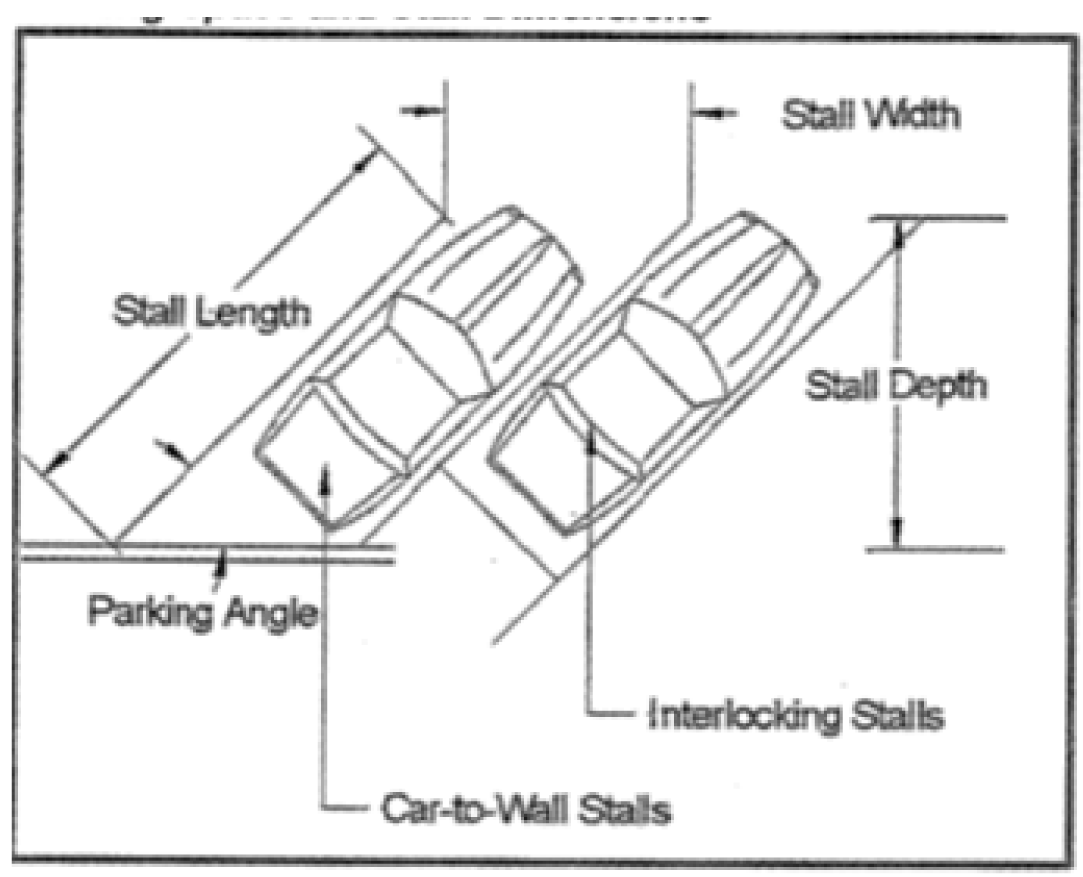
B.
Compact Vehicles. Up to 20 percent of the required parking spaces may be designated for use by compact vehicles with minimum dimensions of eight feet in width and 16 feet in length. Compact vehicle parking areas shall be identified by individually marking each parking space surface with lettering a minimum of six inches in size.
C.
Turnarounds. All parking areas containing three or more parking spaces shall include a turnaround that is designated and located so that vehicles can enter and exit the parking area without backing onto a public right-of-way.
(4)
Location.
A.
Generally. Except as otherwise permitted under a cooperative parking plan, off-street parking facilities shall be located on the zoning lots on which the use or structure or which they are provided is located.
B.
Rear parking.
1.
For purposes of this section "rear parking" means that parking areas are located between the principal structure and the rear zoning lot line or an alley, or interior to a block.
2.
Parking to the rear of the principal use or principal structure is encouraged in all zoning districts.
3.
Rear parking areas that are screened from the view of public streets by the principal structures are exempt from the parking lot screening requirements from public rights-of-way.
C.
Setback requirements:
1.
Within residential districts: Parking spaces accessory to one-family and two-family structures may be located anywhere on the zoning lot containing the principal structure. Parking spaces designed for multiple-family structures shall be set back at least five feet from an interior side zoning lot line and at least eight feet from a rear zoning lot line.
2.
All other districts: Off street parking spaces shall not be less than ten feet from a street right-of-way line nor less than five feet from any interior side zoning lot line or rear zoning lot, except where a side zoning lot line or rear zoning lot line is abutting a residential district then off-street parking shall not be less than ten feet from said zoning lot lines.
(5)
Construction and maintenance. Off-street parking facilities shall be constructed, maintained, and operated in accordance with the specifications described in subsections below.
A.
Pavement. Parking and loading service areas shall be paved with asphalt, bituminous, concrete or other surfaces of comparable durability approved by the city engineer. Parking and loading areas shall be graded and drained in order to dispose of all surface water.
B.
Driveways. Driveways shall not be wider than 24 feet.
C.
Drainage and maintenance. Areas shall be properly graded for drainage and maintained in good condition free of weeds, dust, trash, and debris.
D.
Wheel guards. Boundary or perimeter areas shall be provided with continuous curbing so located that no part of parked vehicles will extend beyond the property line or applicable setback of the parking area.
E.
Lighting. Facilities shall be arranged so that the source of light is concealed from public view and from adjacent residential properties and does not interfere with traffic.
F.
Pervious pavement. Vehicle parking spaces may exceed the maximum number of spaces permitted if the additional spaces are designed as pervious pavement. Pervious pavement shall comply with the following conditions:
1.
Pervious pavement shall be located only on soils determined by the city engineer as suitable for use as pervious pavement.
2.
Pervious payment shall not be located on any slope exceeding ten percent over 20 feet; and
3.
The pervious pavement area shall be vacuum swept and washed with a high-pressure hose at least four times per year.
(6)
Bicycle parking.
A.
Generally. Bicycle parking spaces shall be required for all nonresidential uses and structures as provided in Table 50-88-1.
B.
Design. Bicycle spaces may be provided with bicycle storage racks.
C.
Location. Where bicycle spaces are required by this section, they shall be located within 50 feet of the primary entrance. The spaces shall not be located behind any wall, shrubbery, or other visual obstruction lying between the principal structure and the bicycle spaces. If required bicycle spaces are not visible from the street, signs must be posted indicating their location. Areas used for required bicycle parking shall be paved, drained, and well lighted. Spaces within offices and commercial facilities or located on balconies or within residential dwelling units shall not be counted toward required parking.
D.
Not applicable to CBD district. This subdivision (6) shall not be applicable to the CBD district.
Sec. 50-89. - Off-street loading facilities.
(1)
Loading space required. Adequate off-street loading space shall be provided in connection with any structure which requires receipt or distribution of materials by vehicles.
(2)
Location. All loading berths shall be 25 feet or more from the intersection of two street right-of-way lines. Loading berths shall not occupy any setback requirement bordering a street.
(3)
Size. Unless otherwise specified the first berth required shall not be less than 12 feet in width and 50 feet in length. Additional berths shall be not less than 12 feet in width and 25 feet in length. All loading berths shall maintain a height of 14 feet or more.
(4)
Access. Each loading berth shall be located with appropriate means of access to a public street or alley in a manner which will least interfere with traffic.
(5)
Surfacing. All loading berths and access ways shall be improved with a durable material.
(6)
Prohibited Uses. Any area allocated as a required loading berth or access drive so as to comply with the terms of this Ordinance shall not be used for the storage of goods, inoperable vehicles nor be included as a part of the area necessary to meet the off-street parking area.
Sec. 50-90. - Grading.
(1)
Permit required. It shall be unlawful for any person to deposit upon or excavate from land any material in the amount of 50 cubic yards or more or to a depth of two feet or more, without first securing a grading permit from the city. The provisions of this section shall not be construed to apply to activities commonly associated with land development that is subject to the terms of a developer's agreement and building permits.
(2)
Mining prohibited. Mining within the City of Carver is prohibited.
(3)
Exceptions. No grading permit shall be required for any person making any excavation or material deposit relative to the following:
A.
Construction of structure for which a building permit was previously applied for and was granted, provided the contemplated excavation or filling operation was sufficiently described at the time of building permit application.
B.
Installation of utilities for which appropriate permits have been secured or under any contract directly or indirectly with the city.
C.
Site grading for an approved subdivision as permitted in the approving resolution.
(4)
Applications for permits. Applications for grading permits shall be filed jointly by the land owner or owners and the earth moving contractor with the city and shall be accompanied by the following:
A.
A legal description of the lands upon which grading operations shall be performed.
B.
Copies of any agreements contemplated or entered into between the owner of the land and any other person charged with performance of such grading.
C.
Application fee and cost reimbursement agreement as established in the city fee schedule.
D.
A map showing existing conditions on the site and within 350 feet of the perimeter of the site including land ownership, structures, utilities, roadways, vegetation, drainage courses and other pertinent natural features, such as contour lines if requested by the city engineer or city council.
E.
A plan for removal or deposits upon subject property in accordance with provisions of this Ordinance, and showing final topography indicated by contour lines at no greater interval than two feet; steps to be taken to conserve topsoil; anticipated future use of the property including location of future roads, drainage courses and other improvements.
F.
Financial security in a manner approved by the city attorney, sufficient in value to cover the expense of the completion of the development plan or to bring such portion of the completed project to a safe grade and elevation so as to be healthful and safe to the general public and to provide safe and adequate drainage of the site.
(5)
Review and inspection. In all cases, each application for permits for the above shall be reviewed by the city engineer before the permit is granted. Also, in all cases of the above, the city engineer has the right to review procedures, processes and results in view of the operations to determine whether they are in accordance with general public welfare and safety through regular onsite inspections. The city engineer, upon determining the permittees operation creates a serious and immediate safety hazard, may order the operation ceased for a period of 72 hours.
Upon so ordering, the city engineer shall immediately notify the mayor and the permittee in writing of the hazard and the mayor shall call a special meeting of the council. The permittee shall be given notice and requested to attend this meeting. If the council determines that an immediate safety hazard exists, the permit shall be withdrawn until the permittee complies with council directives to eliminate the hazard.
Sec. 50-91. - Underground utilities.
(1)
Underground placement required. All utility lines hereafter installed, constructed, or placed within the city for electric, telephone, TV cable, internet or other like or similar services to serve customers, whether owned, installed, or constructed by the supplier, consumer or any party, shall be installed and placed underground in an approved, safe manner, subject only to the exceptions stated herein. Electrical transmission facilities rated 25kV class and above may be installed above ground. To the extent that Xcel Energy seeks to install such electrical distribution lines not related to a subdivision of property within the city, the city council recognizes that pursuant to Section 5.3 of Xcel Energy's tariff on file with the Minnesota Public Utilities Commission, city users of Xcel Energy services may be surcharged, or the city may be required to pay upfront, the incremental costs of placing such lines underground. The city council may, in its discretion, by resolution, either direct that such electrical distribution lines be placed below ground and determine whether or not the incremental costs shall be paid upfront by the city or surcharged to Xcel Energy service users within the city or, in the alternative, permit the electrical distribution lines to be placed on poles over ground. To the extent Minnesota Valley Electric Coop has a similar tariff in place with the Minnesota Public Utilities Commission, the city council may proceed as provided under this subdivision.
(2)
Subdivision with existing utility lines. If any land within the city upon which overhead utility lines are located is subdivided pursuant to the terms of the city's subdivision ordinance (other than a minor subdivision with consent of the city council) a condition of the approval of the subdivision shall be that overhead utility lines are relocated and placed underground at the expense of the property owner. The plan shall be subject to review by the planning commission and city council.
(3)
Subdivision, new utility lines. If any land within the city is subdivided pursuant to the terms of the city's subdivision ordinance and upon which overhead utility lines are proposed to be constructed, a condition of the approval of the subdivision shall be that utility lines are placed underground at the expense of the property owner. The plan shall be subject to review by the planning commission and city council.
Sec. 50-92. - Agricultural operations.
Agricultural operations including ag-related structures in existence at the time of adoption of this Code shall be encouraged to continue if in an agriculture district. Feedlots as defined in this Ordinance shall not be permitted within city boundaries. Feedlots shall be defined as defined in the Carver County Zoning Ordinance, as amended from time to time.
Sec. 50-93. - Signs.
(1)
Findings, purpose, and intent. The purpose of this section is to protect and promote the general welfare, health, safety, and order within the city through the establishment of a comprehensive and impartial series of standards, regulations and procedures governing the erection, use and display of devices, signs or symbols serving as visual communicative media to persons situated within or upon public rights-of-way or properties.
The provisions of this section are intended to provide a reasonable degree of freedom of choice, an opportunity for effective communication, and a sense of concern for the visual amenities on the part of those designing, displaying or otherwise utilizing needed communicative media of the types regulated by this section; while at the same time, ensuring that the public is not endangered, annoyed or distracted by the unsafe, disorderly, indiscriminate or unnecessary use of such communicative facilities.
(2)
Scope of regulations.
A.
It shall be unlawful for any person to erect, construct, enlarge, move, alter, or convert any sign within the city except in accordance with the provisions of this section.
B.
Any sign provided for in any zoning district may contain non-commercial messages. To the extent any conflict arises between this provision and any other language found in this section, this provision shall control.
C.
For purposes of this section, a "non-commercial message" or "non-commercial speech" shall mean any message or speech that does not meet the definition of "commercial message" or "commercial speech" as set forth in this zoning ordinance. Nothing herein shall be construed to permit display of any message which is obscene, illegal or speech which is otherwise unprotected under the First Amendment of the United States Constitution. Nothing herein shall be construed to prohibit a prosecution for violation of a criminal statute by the city or other duly constituted government authority or a civil action by the city or other private person or entity.
(3)
Permits.
A.
Permit requirement and application. Except as specifically exempted from the provisions of this section 50-93, it is unlawful for any person to post, display, substantially change, or erect a sign without a permit. A change in the face of a sign shall not constitute a substantial change. Applications for sign permits shall be filed by the sign owner or its agent via the city's sign permit application or building permit application. The application shall describe and set forth the following:
1.
The street address of the property where the subject sign is to be located.
2.
A site plan to scale showing the property, structures, existing and proposed signs, and any other physical features.
3.
The aggregate area and copy area for all signs on the parcel.
4.
The size of any other signs located within the property.
5.
The name(s) and address(es) of the owner(s) of the property upon which the sign is to be located.
6.
Name, address, telephone number, and signature of the applicant, if different from the owner, requesting placement of the sign.
7.
Name, address, telephone number, and signature of the sign contractor.
8.
The type of sign to be erected, the area and face area of the sign, the height of the sign (if freestanding), the shape of the sign, the color(s) of the sign, the material of the sign and details showing how the sign will be mounted, installed, or erected.
9.
For free-standing and monument signs, show dimensioned sign location on the site plan and include structural foundation and mounting details. Indicate the location and size of all existing free-standing and monument signs on the property.
10.
Copy of stress sheets, if applicable, and calculations.
B.
Permit fees. Fees for sign permit applications shall be imposed as established in the city fee schedule. The intent of this requirement is to recover costs associated with administering this section. Permit fees shall reflect the costs of reviewing and processing permits, as well as costs associated with periodic enforcement activities and compliance checks.
C.
Permit generally.
1.
Except as provided in subdivision (5) of this section 50-93, no sign or sign structure shall be erected, altered, rebuilt, or relocated until a permit has first been issued by the city.
2.
The city may inspect all existing signs to determine if signs conform to the provisions of the section. The city is authorized and empowered to revoke any permit issued upon failure of the holder to comply with any provision of this section 50-93 or other ordinances of the city. The city may take other action necessary to assure correction of violations. Appeal from a revocation of a permit shall be in accordance with the provisions for appeal of a permit denial as set forth in subdivision (3)C.4. of this section.
3.
A sign permit shall become null and void if the sign for which the permit was issued has not been completed and erected within the time frame specified by the permit or six months after the date of issuance, whichever is longer.
4.
In the event a permit is denied or revoked, the city shall provide the applicant with a written denial, indicating the reason(s) for denial or revocation. The applicant may appeal a denial or revocation to the board of adjustments and appeals by filing a notice of appeal with the city within ten days of written notice of the permit denial. The notice shall state the reasons for the appeal.
(4)
Nonconforming signs. It is the policy of the city to encourage that all signs within the city be brought into compliance with the terms and requirements of this section 50-93.
A.
The city finds that nonconforming signs may adversely affect the public health, safety, and welfare of the community. Nonconforming signs may adversely affect the aesthetic characteristics of the city and may adversely affect public safety due to the visual impact to motorists and the structural characteristics. Registration requirements are required to minimize adverse effects through annual inspection and maintenance. The city will remain cognizant of the locations and maintenance of nonconforming signs.
B.
The city may inspect existing signs in the city to determine if they conform to the provisions of this section 50-93.
C.
Any nonconforming sign which is not used for a continuous period of one year shall not be reused for sign purposes unless and until it fully conforms with the terms and requirements of this section 50-93.
D.
No change in shape, size, or design, is permitted except to make a non-conforming sign comply with all requirements of this section 50-93.
E.
A nonconforming sign may not be replaced by another nonconforming sign.
(5)
Signs allowed without a permit.
A.
Signs described in this subdivision may be erected without a permit but must comply with all other provisions of this section.
B.
The following types of signs shall be exempt from the permit requirements of subdivision (3):
1.
Signs in compliance with the Fair Campaign Practices Act contained in M.S.A. § 211.B.045, as amended from time to time.
2.
Non-governmental traffic control devices that do not contain commercial messages provided that the sign shall not be larger than four square feet. The maximum height of the sign shall not exceed five feet from the ground. The placement of the directional signs shall be so located such that the sign does not adversely affect adjacent properties (including site lines or confusion of adjoining egress or ingress) or the general appearance of the site from the right-of-way.
3.
Three non-illuminated free-standing signs per property having an aggregate sign area of not more than 12 square feet, provided that said sign shall not exceed four feet in height. Said sign must be entitled on private property and not be located within the public right-of-way or cause sight line hazard to the public right-of-way.
4.
Signs for the sole purpose of displaying street numbers as may be required by other ordinances and other signs required by law.
5.
Flags provided that the height of a flagpole shall not exceed the allowed height provided for a structure in the applicable zoning district, or 50 feet, whichever is less, and in residential districts shall not exceed 25 feet in height or the height of the principal structure on the zoning lot, whichever is less. Each zoning lot shall be allowed a maximum of three flag poles.
6.
Window signs installed for the purpose of viewing from outside the premises.
7.
Signs temporarily placed on city-controlled property to communicate information about local businesses and events, as approved by the city under separate permit or policy.
8.
Public notice signs, traffic control devices, or other official government signs when posted by a government officer in the performance of their duties.
(6)
Prohibited signs. Except as otherwise provided, the following types of signs or advertising devices are prohibited in all zoning districts of the city:
A.
Temporary signs that are not expressly authorized under subdivisions (5)B.7 or (8)A.5.
B.
Roof signs including signs mounted on a roof surface or projecting above the roof line of a structure if either attached to the structure or cantilevered over the structure.
C.
Signs with dynamic displays, except those allowed under subdivision (7)F.
D.
Rotating signs.
E.
Pylon signs.
F.
Interior and exterior animated signs and flashing signs. No sign shall be permitted which is animated by means of flashing, blinking, or traveling lights or any other means not providing constant illumination. However, changing signs are permitted.
G.
Signs which are designed to resemble official traffic signs except signs which are used to control traffic on private property.
H.
Wind activated devices other than flags and banners.
I.
Any sign when placement of the sign makes a location inaccessible under the Americans with Disabilities Act.
J.
Signs painted on or attached to utility poles, trees, rocks, or other similar objects.
K.
Signs which obstruct a fire escape, required exit, window or door opening used as a means of ingress or egress, or which interfere with any opening required for ventilation, or which violate any code of the city, including the Life Safety Code and the Fire Prevention Code.
L.
Signs occupying any parking other than signs designating the space reserved for handicapped or other use.
M.
Signs which do not conform to city-adopted building and electrical codes.
N.
Signs which emit audible sound, odor, or visible matter.
O.
Signs attached to any street signs or any signs directing or controlling traffic, or any sign attached to a pole supporting such signs.
P.
Signs projected onto a structure.
Q.
Signs within public right-of-way except for official traffic signs or other publicly owned or maintained signs. Certain signs used within the central business district zoning district are excluded from this prohibition provided that they strictly adhere to all requirements in subdivision 8(A).5.
R.
Signs which are in violation of the rules and regulations of any zoning overlay district or historic district presently existing or as may later be enacted.
S.
Any sign constructed of non-durable material including, but not limited to, paper, cardboard, or flexible plastic that shows signs of significant damage from weather or the elements. Nothing herein shall prohibit such a sign from being replaced by an identical sign.
T.
Abandoned signs. Signs (including sign structures) shall be deemed abandoned if the business, service, event, or principal use of the zoning lot on which it is located has been discontinued for six months.
U.
Any sign that is structurally unsound or is a hazard to traffic or pedestrians.
V.
Dilapidated or neglected signs. A sign (including sign structure) will be dilapidated or neglected if it does not present a neat and orderly appearance, which may be manifested by the following: rust or holes on or in the sign or sign structure, or broken, missing, loose or bent parts, faded or flaking paint, non-operative or partially non-operative illuminating or mechanical devices or missing letters in sign copy.
W.
Billboard signs.
(7)
General provisions. Except as otherwise provided in this section 50-93, the following general regulations apply to all zoning districts in the city:
A.
Maintenance and appearance of signs.
1.
All signs shall be maintained in good condition and present a neat and orderly appearance. Any sign showing gross neglect, that becomes dilapidated, or is located on unmaintained ground area may be required to be repaired or removed. Any sign, due to its condition, that poses a threat to public safety will be required to be repaired or removed.
2.
Written notice will be sent to the property owner detailing the findings. The property owner will have ten days to correct the deficiencies or to remove the sign(s). If the owner refuses to correct the deficiencies or remove the sign, the city may issue a citation under the enforcement provisions of this section.
B.
Illumination of signs.
1.
The light from any illuminated sign shall not be of an intensity or brightness which will interfere with the peace, comfort, convenience, and general welfare of residents or occupants of adjacent properties.
2.
No sign shall have blinking, flashing, or fluctuating lights or other illuminating devices which have a changing light intensity, brightness, or color except those in compliance with subdivision (7)F. of this section 50-93.
3.
No color lights shall be used at any location or in any manner so as to be confused with or construed as traffic control devices.
4.
Neither direct nor reflected light from primary light sources shall create a hazard to operators of motor vehicles.
C.
Reserved.
D.
Banners.
1.
Wall-mounted banners shall be permitted on property zoned for non-residential districts.
2.
Banners shall not be permitted on property located in any residential district, including those properties that contain a business located in a residential district.
3.
Each zoning lot may have a maximum of two banners not exceeding 30 square feet in area of sign per banner.
4.
Wall-mounted banner width shall not exceed tenant frontage. Free standing banners or other banners that are not wall mounted are not permitted.
5.
Banner signs must not cover significant architectural features.
6.
In the Carver Historic District, banners must not be placed any higher than ten feet from the foundation of the structure. Banner signs in the Carver Historic District may cover a significant architectural feature if it cannot be avoided in order to place sign no higher than ten feet from the foundation of the structure.
E.
Placement of signs. Except within the central business district, all monument signs must be set back a minimum of ten feet from the public right-of-way unless a different setback is required or permitted elsewhere in this section. Within the central business district, all signs must be set back at least five feet from the public right-of-way or the existing structure setback.
F.
Dynamic display signs. Unless specifically prohibited elsewhere in this section, any sign permitted under this section may contain dynamic display subject to the following conditions:
1.
Dynamic sign faces may not exceed eight feet by ten feet in any zoning district.
2.
The images and messages displayed must be static, and the transition from one static display to another must be instantaneous without any special effects.
3.
Dynamic displays are not allowed in the Carver Historic District.
G.
Signage in Carver Historic District. Signage for any properties under the jurisdiction of the Carver Heritage Preservation Commission (HPC) must be approved by the HPC before a sign permit will be issued, with the exception of banner signs and temporary signs.
H.
Substitution of signage not allowed. In the event that one or more allowed types of signs per property type cannot be utilized on that property for any reason, including size of property or structure configuration, that particular sign cannot be placed on the property and the copy area of the signage cannot be transferred to another type of sign unless specifically provided for elsewhere in this section.
(8)
Requirement by zoning district.
A.
Central business district (CBD). The following signs shall be allowed by permit in the CBD:
1.
Monument signs. One monument sign shall be permitted per each zoning lot or separate building pad that has street frontage. The sign shall not exceed 30 square feet in area and ten feet in height.
2.
Wall sign or canopy sign. Wall signs or canopy signs are permitted provided the signs do not exceed ten percent of the wall up to 80 square feet in area, whichever is smaller. No Wall Sign shall extend further than within one foot of the curb.
3.
One rear door sign not to exceed four square feet in size shall be permitted per rear or side door and is to be located on the door.
4.
One under-canopy sign per tenant not exceeding six square feet in size. Under-canopy signs shall extend perpendicular to the wall and shall be attached at a uniform height sufficient to assure the safety of pedestrians. Under-canopy Signs shall match the wall sign or canopy sign in graphics unless otherwise approved by the official.
5.
A-frame, sandwich board, or sidewalk signs within the public right-of-way, provided, however, that the following standards are satisfied at all times:
a.
Any such sign may not be placed within the actual street or within any parking space.
b.
Any such sign may not interfere with vehicular traffic or be located in such a way as to be in noncompliance with the Americans with Disabilities Act.
c.
The area of any sign surface shall not be greater than 12 square feet per side and the height of such signs shall not exceed four feet.
d.
Permission for placement of any such sign must be provided by the underlying fee owner of the property.
B.
General commercial (GC) and freeway commercial (FC) districts. The following signs shall be allowed by permit in the GC and FC district:
1.
TH 212 frontage monument sign. One monument sign may be permitted per zoning lot that has frontage on TH 212 and is zoned freeway commercial under the following conditions:
a.
The sign is accessory to a principal structure. No sign of this type shall be allowed as the sole use of a zoning lot.
b.
This sign may be permitted instead of the monument sign allowed in subdivision (8)B.2. below. Under no circumstance shall this sign be allowed in addition to a monument sign.
c.
Only one sign of this type is allowed per zoning lot.
d.
The face of sign and supporting structure must be architecturally designed in a manner complementary to the primary structure on the zoning lot.
e.
The sign shall be set back at least 40 feet from the TH 212 right-of-way.
f.
The sign shall be set back at least ten feet from any other adjacent property line.
g.
The dimensions of the sign shall not exceed 480 square feet in area and the maximum height 20 feet in height.
2.
Monument signs. One monument sign shall be permitted per each zoning lot that has street frontage. One monument sign may be installed per street frontage. The height of sign shall not exceed ten feet and the face of sign shall not exceed 80 square feet. Such signs shall be located at least ten feet from any property line. No sign may be placed on a property that has an adverse effect on traffic sight lines as determined by the city engineer.
3.
Wall sign or canopy sign.
a.
Structures exceeding 100,000 square feet. Wall signs for structures exceeding 100,000 square feet shall be approved as a part of the planned commercial development (PCD) process and may vary from the requirements for wall signs in this subsection. Approved wall signs shall be as shown on the approved site plans for the PCD and shall be aesthetically sized and located based on the area and architecture of the structure.
b.
Structures less than 100,000 square feet.
1.
Wall signs shall be permitted on the street frontage and entrance façade.
2.
Wall signs shall not be mounted upon the wall of any structure which faces any adjourning residential district without an intervening structure or street.
3.
Canopy signs may be substituted for wall signs.
4.
The total of all wall signs or canopy signs for each structure face shall not exceed the square footage established in the following table:
4.
Menu board. One menu board sign is permitted per drive-through facility. Such sign shall not exceed 45 square feet in size, nor be greater than eight feet in height. Such sign is permitted in addition to any other sign permitted in the zoning district.
5.
One rear door sign not to exceed four square feet in size shall be permitted per rear or side door and is to be located on the door.
6.
One under-canopy sign per tenant not exceeding six square feet in size. Under-canopy sign shall extend perpendicular to the wall and shall be attached at a uniform height sufficient to assure the safety of pedestrians. Under-canopy Signs shall match the wall sign or canopy sign in graphics unless otherwise approved by the official.
7.
Directional signs are permitted at each point of ingress and egress into a zoning lot. Directional signs may additionally be permitted at a street intersection if the zoning lot abuts two streets.
C.
Industrial (I-1) district. The following signs shall be allowed by permit in the I-1 district.
1.
Monument Signs.
a.
Primary monument signs. A maximum of two primary monument signs per entrance from a public right-of-way are permitted in an industrial or office park. No monument sign shall exceed ten feet in height. No primary monument sign shall be located within 20 feet of the public right-of-way of the street which affords the principal means of access to the industrial or office park. The permitted area for primary monument signs shall not exceed 64 square feet. No sign may be placed on a property that has an adverse effect on traffic sight lines as determined by the city engineer.
b.
Secondary monument signs. One secondary monument sign shall be permitted for each structure in the industrial or office park, not to exceed 32 square feet in area. The height of a secondary monument sign shall not exceed eight feet.
2.
Wall signs. Structures of three stories or greater may have one wall sign per right-of-way frontage located at the top of the structure that shall not be greater than 48 square feet in area.
3.
Door or wall sign. One sign of up to four square feet is permitted for each tenant within a structure that does not contain a common front entry. Such signs shall be located on the door of the suite, or on a wall immediately adjacent to the door of the suite for business establishments.
4.
Directional signs are permitted at each point of ingress and egress into a zoning lot. Directional signs may additionally be permitted at a street intersection if the zoning lot abuts two streets.
D.
Agricultural and residential districts. The following signs shall be allowed by permit in the agriculture (A-1), low density residence (R-1), and medium density residence (R-2) districts.
1.
Subdivision signs. Subdivision signs shall be allowed if constructed as a maximum of two monument signs per entrance into any residential subdivision or residential real estate development is permitted. These signs shall not exceed ten feet in height or 32 square feet in area and must be set back at least ten feet from the right-of-way. A monument sign may be externally illuminated. Subdivision signs shall be reviewed with preliminary plat approval, and ongoing ownership and maintenance of the sign shall be specified as a condition of approval.
(9)
Table of sign regulations. The official is authorized to prepare a table summarizing these regulations. The table shall be for convenient reference only. The detailed regulations set forth in this section shall control in the event of any conflict between the table and these regulations. The following shall be prominently posted on each page of the sign regulation table: "This sign regulation table is for illustrative purposes only. In all cases, the text of the written sign ordinance shall govern the characteristics allowed for all permitted signs."
(Ord. No. 06-2025, § 1, 5-5-2025)
Sec. 50-94. - Dwelling below ground level.
Earth sheltered dwellings, meaning residential structures so constructed that 50 percent or more of the exterior surface area of the structure excluding garages and accessory structures is covered with earth and all applicable codes and ordinances including the Building Code are satisfied, shall be permitted pursuant to applicable regulations of this Ordinance. Partially completed structures shall not be considered earth sheltered.
Sec. 50-95. - Space between structures.
In cases where several principal structures might be constructed on one zoning lot the minimum space between such structures shall be not less than 20 feet.
Sec. 50-96. - Design by registered architect, engineer or land surveyor.
The design of structures and the drawing of site plans, etc., shall be done by such persons as required pursuant to M.S.A. § 326.03 or amendments thereof.
Sec. 50-97. - Structure moved onto zoning lot.
(1)
Permits required.
A.
No person shall move, remove, raise or hold any structure within the limits of the city without first obtaining a permit from the building official.
B.
No person shall move any structure over, above or across any highway, street or alley in the city without first obtaining a permit from the building official.
(2)
Application. A person seeking issuance of a permit hereunder shall submit an application for such permit with the building official.
A.
Form. The application shall be made in writing, on forms provided by the building official, and shall be filed in the office of the city clerk.
B.
Contents. The application shall set forth:
1.
A description of the structure proposed to be moved, giving street number, construction materials, dimensions, number of rooms and condition of exterior and interior, and photographs, showing ground and street elevations;
2.
A legal description of the zoning lot from which the structure is to be moved;
3.
A legal description of the zoning lot to which it is proposed such structure be moved, if located within the city.
4.
The portion of the premises to be occupied by the structure when moved if located in the city;
5.
The highways, streets and alleys over, along or across which the structure is proposed to be moved;
6.
Proposed moving date and hours.
(3)
Duties of permittee. Every permittee under this chapter shall:
A.
Use designated streets. Move a structure only over streets designated for such use in the written permit.
B.
Notify of revised moving time. Notify the building official in writing of a desired change in moving date and hours as proposed in the application.
C.
Notify of damage. Notify the building official in writing of any and all damage done to property belonging to the city within 24 hours after the damage or injury has occurred.
D.
Display lights. Cause red lights to be displayed during the nighttime on every side of the structure, while standing on a street, in such manner as to warn the public of the obstructions, and shall at all times erect and maintain barricades across the streets in such manner as to protect the public from damage or injury by reason of the removal of the structure.
E.
Street or other occupancy. No structure not on a foundation or attached to the ground in such way as is approved by the building official shall be allowed to remain in the city for more than 24 hours except when located on a removal location in the city; any structure moved to a location in the city must be placed on a permanent foundation or attached to the ground as approved by the building official within 72 hours of its removal to said location, unless an extension is granted by the zoning administrator upon good cause shown. No structure shall be stored or allowed to stand on a city street for more than eight hours without having received permission to do so from both the city and the Carver County Sheriff's Department.
F.
Comply with governing law. Comply with the Building Code, this Ordinance and all other applicable ordinances and laws upon relocating the structure in the city.
G.
Clear old premises. Remove all rubbish and materials and fill all excavations to existing grade at the original structure site, when located in the city, so that the premises are left in a safe and sanitary conditions.
H.
Public utilities. The city clerk shall certify that all sewer charges and water bills payable against the property within the city from which the structure is to be moved have been paid and that all sewer and water connections have been plugged or discontinued at the curb line from the removal property or at the main and that all taxes against the property have been paid in full.
I.
Painting. Paint or cause to be painted all exterior walls, doors and door frames, window frames as well as screen and storm windows of the structure moved, unless waived by the building official.
J.
Grading and grassing. Install or cause to be installed a finished grade on all parts of the premises on to which the structure is moved, including the planting, seeding, or installation of live sodding or appropriate grasses on all parts of the plot or parcel involved.
K.
Roofing. Install or cause to be installed new roofing upon the structure whenever in the opinion of the building official the existing roofing is unsightly, dilapidated or leaking.
L.
Drainage. Shall construct and provide all necessary and proper drainage for the premises on to which the structure is moved, such drainage to be installed and constructed according to plans to be submitted by the owner and approved by the building official and the city engineer, if determined necessary by the building official.
M.
Completion of relocating. If the structure is relocated in this city, complete within 90 days after relocating, all remodeling, additions, or repairs as shown on the plans accompanying the application.
(4)
[Reserved.]
(5)
Moving structures into city. Any person, firm, association or corporation desiring to move any structure to within the limits of the city from outside of the city limits shall comply with subdivision (4) above plus the following additional requirements:
Notify the building official of the city prior to the process of moving of the structure to arrange sufficient inspections to his satisfaction in order to determine whether the structure complies with the applicable ordinances of the city and for purpose of determining the appropriateness of the structure as provided in this Ordinance.
(6)
Miscellaneous conditions. It shall not be intended by this Ordinance to interfere with or abrogate or annul any easement, covenant or other agreement between parties, provided however, that when this Ordinance imposes a greater or heavier restriction than is imposed or required by any other ordinance, rule, regulation or by easements, covenants, or agreements, the provisions of this Ordinance shall control.
(7)
Nonapplicability.
A.
The permit requirements of this subsection shall not apply to mobile homes, trailer coaches or modular type structures and similar types of structures licensed by the State of Minnesota for travel upon the highways or which do not require a special permit for travel from the State of Minnesota and any of its political subdivisions. Nor shall the permit provisions hereof apply to structures 16 feet wide by 22 feet in length and 13 feet six inches high, or less, when loaded on a vehicle or trailer.
B.
The provisions of this chapter shall not apply to the raising of a structure for purposes of repairing or reconstructing the foundation of a residential home when the person doing the raising owns the structure and the structure is used or intended to be used by the person as a residence.
(Ord. No. 02-2017, § 7, 2-21-2017)
Sec. 50-98. - Licensed group family daycare or nonresidential programs.
Licensed group family daycare or nonresidential programs shall be considered a permitted single-family residential use of property as defined in M.S.A. § 245.14.
Sec. 50-99. - Alternative energy systems.
(1)
Building-integrated and building-mounted solar energy systems. In those districts that permit building-integrated solar energy systems as an accessory use, the solar energy system shall be installed in a manner that is in compliance with all terms of this Ordinance including height and setback restrictions of the zoning district in which it is proposed to be located. Notwithstanding the height limitations of the zoning district, building-mounted solar energy systems shall not extend higher than three feet above the ridge level of a roof on a structure with a gable, hip or gambrel roof and shall not extend higher than ten feet above the surface of the roof when installed on a flat or shed roof if the solar energy system is visible from a public right-of-way. All solar energy systems shall meet the standards of the Minnesota Building Code, and a building permit shall be received prior to installation.
(2)
Ground-mounted solar energy systems. In those residential districts that permit ground-mounted solar energy systems as an accessory use, the ground-mounted solar energy system shall be installed in compliance with the following requirements:
A.
Size. Ground-mounted solar energy systems are considered accessory structures. The size of the system based on the square feet of the solar panels will be calculated as part of the maximum combined number and size of accessory structures allowed by lot size.
B.
Setbacks. Ground-mounted solar energy systems including any appurtenant equipment shall comply with the accessory structure setback requirement and placement limitations for the district in which it is installed when oriented in any position. Ground-mounted solar energy systems are not permitted in front or side yards.
C.
Height. The height of ground-mounted solar energy systems shall be in accordance with accessory building height limitations when oriented at maximum tilt.
D.
Glare. The panels of ground-mounted solar energy systems shall be placed and arranged such that reflected solar radiation or glare shall not be directed onto roadways or residential buildings. Prior to the issuance of a permit for a ground-mounted solar energy system, the permit applicant must provide an analysis or technical documentation from the manufacturer of the ground-mounted solar energy system demonstrating that the ground-mounted system will not impact roadways or residential buildings due to glare.
E.
Feeder lines. The electrical collection system shall be placed underground within the interior of each property.
F.
Easements. The solar energy system shall not encroach on public easements.
G.
Utility notification. No grid inter-tie solar energy system shall be installed until evidence has been given to the city that the owner has submitted notification the utility company of the customer's intent to install an interconnected customer-owned solar energy system. Off-grid systems are exempt from this requirement.
H.
Abandonment. If the solar energy system remains nonfunctional or inoperative for a continuous period of 12 months, the system shall be deemed abandoned and shall constitute a public nuisance. The owner shall remove the abandoned system at their expense within 90 days. Removal includes the entire structure including transmission equipment, structures and foundations, and the restoration of soil and vegetation.
(3)
Community solar energy systems shall be a permitted accessory use within the industrial, freeway commercial, general commercial and public/institutional zoning districts subject to the following conditions:
A.
Rooftop installation. Community solar energy systems shall be installed on a rooftop. The owner or contractor shall receive a building permit and/or mechanical permit before installing a rooftop community solar energy system. All rooftop systems shall meet the standards of the Minnesota Building Code.
B.
Placement. A rooftop community solar energy system shall be placed on the roof to limit visibility from the public right-of-way or to blend into the roof design, provided that minimizing visibility still allows the owner to reasonably capture solar energy. Rooftop systems shall not exceed the maximum height in any zoning district.
C.
Pitched roofs. On pitched roofs with a slope greater than 15 percent, solar panels shall be flush-mounted and shall not exceed above the peak of the roof.
D.
Glare. All solar energy systems shall minimize glare that affects adjacent or nearby properties. Steps to minimize glare nuisance may include selective placement of the system, selective orientation of the panels, or rooftop screening. All proposed projects shall conduct and submit a glare study to identify potential impacts and mitigation strategies. To complete this glare study, the applicant can use the solar glare hazard analysis tool (SGHAT). Once installed, if the solar energy system creates glare onto neighboring properties and/or streets and highways and the city determines that such glare constitutes a nuisance, the city shall require a more detailed glare study - prepared by a third-party consultant mutually acceptable to the city and applicant - to identify additional actions and/or screening that may be required to substantially eliminate or block the glare from entering the neighboring property and/or street and highway.
E.
Abandonment. If the solar energy system remains nonfunctional or inoperative for a continuous period of 12 months, the system shall be deemed abandoned and shall constitute a public nuisance. The owner shall remove the abandoned system at their expense within 90 days. Removal includes the entire structure including transmission equipment, structures and foundations, and the restoration of soil and vegetation.
(4)
Wind energy conversion systems shall be a permitted accessory use within all districts of this chapter including but not limited to height restrictions of the zoning district within which it is proposed to be located. For any turbine and pole assembly weighing in excess of 250 pounds, the applicant must apply for a building permit and shall provide either structural engineering plans or documentation from the manufacturer pertaining to the installation.
(Ord. No. 10-2018, § 10, 6-4-2018)
Sec. 50-100. - Swimming pools and spas.
A.
A building permit shall be obtained prior to construction or installation for any swimming pool or spa that exceeds both 5,000 gallons in capacity and has a minimum 24 inch depth shall not be constructed or established, without first obtaining a building permit from the city.
B.
Swimming pools and spas are accessory structures in all residential districts under the this Ordinance and must meet appropriate setback regulations regardless of the size of the swimming pool or spa.
C.
Swimming pools and spas shall only be constructed in rear yards.
D.
No pool or spa shall be located within ten feet (measured horizontally) of underground or overhead utility lines of all types.
E.
All swimming pools or spas that exceed both 5,000 gallon capacity and a 24 inch depth shall be constructed with a safety fence so as to inhibit climbing at least five feet in height that completely encloses the pool or spa. The safety fence may be less than five feet in height if a fence is constructed on top of the outside wall of an above ground pool or spa in such a manner that the wall of the pool or spa effectively serves as a part of the safety fence provided that the total combined wall and fence is not less than five feet in height and inhibits climbing. All openings or points of entry into the pool or spa area shall be equipped with gates or doors. All gates and doors shall have a latch which shall be so constructed and so placed as to be inaccessible to small children. All gates and doors shall be latched when the pool is not in use.
F.
Any outdoor lighting of the pool or spa shall not be permitted to spill or shine upon adjacent properties.
G.
The conduct of persons and the operation of pools and spas shall be the responsibility of the owner and the tenant thereof and such conduct of persons and operation of the pool shall be done in a manner so as to avoid any nuisance or breach of the peace, and it shall be unlawful to allow loud noises to go beyond the boundaries of the property upon which the pool or spa is located to adjacent property.
H.
All back flushing water or pool drainage water shall be directed onto the property of the owner, or onto approved drainage ways. No pool water shall be drained into the city's sanitary sewer. Drainage onto public streets or other public drainage ways shall require the permission of the city. The person who drains a swimming pool or spa must regulate the volume and rate of the discharge to prevent damage to public or private property.
I.
The filling of pools or spas from the fire hydrants or other public facilities is prohibited.
J.
Violation of this Ordinance section shall be punished as a misdemeanor under the laws of the State of Minnesota.
Sec. 50-101. - Landscape plan requirements.
(1)
Plan Required. A landscape plan shall be approved by the city and implemented by the property owner:
(a)
For any new development or new structure construction in any commercial; multiple residential, industrial, institutional zoning district; and planned development districts, except as otherwise provided by specific planned development agreements;
(b)
For any existing commercial, industrial or institutional structure to be expanded by ten percent or greater square feet, where an approved landscape plan is not on file with the City; and
(c)
No building permit for any construction described in items (a) and (b) of this subparagraph, shall be issued unless a landscape plan required hereunder is approved by the city.
(d)
The plan as required under Item (b), above, may be implemented over a period of not greater than three years from the date of the building permit issuance and a performance guarantee shall not be required. However, if the plan is not fully implemented within three years, the city may complete the landscaping and, if necessary, attempt to recover its cost from the benefited property for the improvement by billing or assessment, as appropriate.
(2)
Landscape plan required. In every case where landscaping is required by provision of the City Code or by an approval granted by the city, for a structure to be constructed on property, the applicant for the building permit shall submit a landscape plan prepared in accordance with the provisions of this subdivision. The landscape plan shall include the following information:
(a)
General. Name and address of developer, owner, and contact person; name and address of Minnesota registered landscape architect, or Minnesota certified nurseryperson; date of plan preparation; date and description of all revisions; name of project or Development.
(b)
Site Map. One scale drawing of the site based upon a survey of property lines with indication of scale and North point; name and alignment of proposed and existing adjacent on-site streets; location of all proposed and existing utility easements and rights-of-way; location of existing and proposed structures; topographic contour intervals; existing and proposed location of parking areas; water bodies; proposed sidewalks and trails.
(c)
Two scale drawings of proposed landscaping of the site based upon a survey of property lines with indication of scale and North point; existing and proposed topographic contours using mean sea level datum at two-foot intervals; details of proposed planting beds and foundation plantings; delineation of both sodded and seeded area; location and identification of proposed landscape or man-made materials used to provide screening from adjacent and neighboring properties; location and identification of trees; details of fences, tie walls, planting boxes, retaining walls, berms and other landscape improvements and details in legible scale; location of landscape islands and planter beds with identification of plant materials used.
(d)
Planting schedule. A table containing the common names and botanical names, size of plant materials, root specifications, quantities, and special planting instructions.
(3)
Performance guarantee.
(a)
A performance guarantee in an amount equal to 25 percent greater than the cost of installing the landscaping as determined by the city engineer shall be required to insure completion and maintenance of all landscaping in accordance with the approved landscape plan required hereunder.
(b)
The performance guarantee shall be approved in form as to security by the city.
(c)
The performance guarantee shall cover one full calendar year subsequent to the completion of the landscaping as provided in the approved landscape plan and shall be released only upon inspection and written notice of conformance by the city.
(d)
For any landscaping or screening that is unacceptable, the applicant shall replace the material to the satisfaction of the city before the guarantee is released. Where this is not done, the city, at its sole discretion, may use the proceeds of the performance guarantee to accomplish performance.
(4)
Landscape specifications.
1.
Definitions. For the purpose of this subdivision, the following definitions shall apply:
(a)
Caliper—The length of a straight line measured through the trunk of a tree six inches above ground level.
(b)
Coniferous/evergreen tree— A woody plant which, at maturity, is at least 30 feet or more in height, having foliage on the outermost portion of the branches year-round.
(c)
Deciduous overstory shade tree—A woody plant which, at maturity, is 30 feet or more in height, having a defined crown which loses leaves annually.
(d)
Deciduous understory ornamental tree—A woody plant which, at maturity, is less than 30 feet or more in height, with a single trunk, unbranched for several feet above the ground having a defined crown which loses leaves annually.
(e)
Plant material average size (coniferous)—The total height of all coniferous trees six feet or over, divided by the total number of such trees.
(f)
Plant materials average size (shade or ornamental)—The total diameter of all deciduous overstory trees two and one-half or more in diameter, divided by the total number of trees.
2.
All landscape plans and landscaping under this subdivision shall follow and be in compliance with the following requirements together with all other City Code regulations:
(a)
Minimum size at time of planting.
(1)
Deciduous overstory trees, at planting, shall be a minimum of two and one-half caliper inches.
(2)
Deciduous understory trees, at planting, shall be a minimum of one and one-half caliper inches.
(3)
Coniferous trees, at planting, shall be a minimum of six feet in height.
(4)
Hedge materials, at planting, shall be a minimum of three feet in height.
(b)
Minimum required plant material. The landscape plan and landscaping thereunder shall provide for plant material equal to three percent of the value of the structure(s), not including the cost of land and site improvements, which will be preserved. The city may approve a landscape plan which does not meet this standard, where the intent and purpose of this subdivision is otherwise met.
(c)
Planting islands. Planting islands shall be required where necessary to visually break up expanses of hard surface parking areas, to provide safe and efficient traffic movement, and to define rows of parking. Planting islands shall occupy at least five percent of the parking area. Planting islands shall not be required in parking areas with less than 50 parking spaces. Planting shall be in accordance with this chapter.
(d)
Method of installation. All deciduous and coniferous trees shall be planted in accordance with American Nurseryman's Standards.
(e)
Lawn establishment. All areas that do not contain planting beds shall be sodded not later than 30 days following the issuance of a certificate of occupancy, or June 30 following the issuance of a certificate of occupancy in November through May of any given year.
(f)
Slopes and berms. Slopes and berms steeper than three feet horizontal to one foot vertical shall not be permitted unless specifically approved by the city engineer. In areas where steeper slopes are allowed, there shall be special landscape treatment such as special seed mixtures, terracing or retaining walls.
(g)
Landscape maintenance. The property owner shall be responsible for the maintenance of all landscaped areas and the installation of health replacement plants for any plants that die or are removed due to disease. Maintenance shall include removal of litter, dead plant materials, unhealthy or diseased trees, and necessary pruning. Natural water courses within a buffer shall be maintained as free flowing and free of debris.
(h)
Erosion control. All areas of any site shall be restored and maintained in accordance with requirements of the Carver City Code.
(i)
Placement of plant materials. No plant materials shall be allowed, within any utility easement or street right-of-way except at the discretion of the city.
(j)
Diseased and nuisance trees. Prior to grading, all diseased and nuisance trees on the subject property, shall be identified by a certified tree. All diseased and nuisance trees so identified shall be removed from the property at the time of grading and prior to the commencement of structure construction.
(k)
Tree preservation. Tree preservation shall be required.
(5)
Landscaping along highway corridors.
1.
Purpose. The provisions in this subparagraph are adopted in order to preserve, protect and enhance existing landscapes and landscaping which is located along State Highway 212.
2.
Visual penetration areas. The requirements herein shall apply to those areas along the highway system bordering the city where the visual penetration of the motorist extends beyond the right-of-way boundary as identified in the comprehensive plan.
3.
Existing wooded lots. Existing wooded areas shall be preserved for a minimum of 50 feet adjacent and parallel to the highway right-of-way. Beyond 50 feet, existing wooded areas shall be preserved except that a maximum of 40 percent of the wooded area may be developed with an impervious surface provided all other applicable City Code provisions pertaining to impervious surface, preservation of trees, vegetation, bluffs and slopes are met.
4.
Screening visual penetration areas. Adjacent to the highway right-of-way, a planting screen of a mixture of overstory and understory coniferous plant material shall be planted which shall provide a visual screen at time of maturity. This planting shall be provided within the minimum 25-foot setback area required adjacent to highway right-of-way.
(6)
Irrigation system.
1.
System required.
(a)
All landscape plans and implementation thereof required by this subdivision shall include an underground irrigation system.
(b)
Exception. If the property area to be landscaped is very large or reserved for future expansion or the system would not be in keeping with the character of the area as determined by the city, an underground irrigation system is not required.
2.
System specification. All irrigation systems shall be a fully automatic programmable system, capable of alternate date watering. Each system shall be capable of achieving one inch of precipitation per week under an alternate day watering regime. The system shall provide head to head coverage with uniform levels of total precipitation throughout all irrigated areas, and shall provide full and equal coverage onto public rights-of-way to the back of curb. Systems which extend beyond private property onto public rights-of-way shall be subject to approval by the city. The system shall meet Minnesota Department of Health standards and shall provide backflow preventers. All systems shall have a designated billing address.
(7)
Screens and buffers.
1.
Definition and purpose. Screens and buffers are designated areas of yard or open area where distance, planting, berming and fencing help minimize adverse impacts of public nuisances, such as: noise, glare, activity, or dust, which are often times associated with parking, storage, signs or structures.
2.
Screens and buffers requirements.
(a)
All parking, loading service, utility, and outdoor storage areas shall be screened from all public streets and adjacent differing land use by a combination of any of the following: earth mounds, walls, fences, shrubs, deciduous overstory, understory or coniferous trees or hedge materials. The height and depth of the screening shall be consistent with the height and size of the area to be screened. When natural materials, such as trees or hedges, are used to meet the screening requirements of this item, density and species of planting shall be such as to achieve 75 percent opacity year-round at maturity.
(b)
Buffers. All zoning lot boundary lines shall be bordered by a buffer which shall not extend into or be located within any portion of a street right-of-way. Where a required drainage, utility or other easement is partially or wholly within a required buffer, the developer shall design and implement an alternative buffer to eliminate or minimize plantings within the required easement. Such design may necessitate choosing a buffer with more land area and fewer required plantings.
(c)
Exception to requirements. Buffer yard requirements may be waived or modified by the city where the intent is otherwise satisfied by significant change in elevation, an existing screen, significant distance or similar circumstances.
3.
Completion deadline. All plant materials required within a specified buffer yard shall be planted to completion within six months from date of issuance of a building permit unless otherwise approved by the city due to the time of the year or construction for a large project. In no case shall the period exceed six months from issuance of the certificate of occupancy.
(8)
All open areas of any site, zoning lot, tract or parcel shall be graded to provide proper drainage, and except for areas used for parking, drives or storage, shall be landscaped with trees, shrubs or planted ground cover.
(9)
Such landscaping shall conform with a landscape planting plan submitted at the time of issuance of a conditional use permit.
(10)
It shall be the owner's responsibility to see that this landscaping is maintained in an attractive and well-kept condition. All vacant Zoning Lots, tracts, or parcels also are to be properly maintained.
Sec. 50-102. - Opt-out of M.S.A. § 462.3593.
Pursuant to authority granted by M.S.A. § 462.3593, subd. 9, the City of Carver opts-out of the requirements of M.S.A. § 462.3593, which defines and regulates temporary family health care dwellings.
(Ord. No. 08-2016, § 1, 8-15-2016)

