
Cedar Falls City Zoning Code
ARTICLE I
- IN GENERAL
Sec. 26-1.- Title.
This chapter shall be known and may be cited and referred to as the zoning chapter of the city.
(Ord. No. 2922, § 1(29-1), 5-7-2018)
Sec. 26-2. - Definitions.
The following words, terms and phrases, when used in this chapter, shall have the meanings ascribed to them in this section, except where the context clearly indicates a different meaning. The word "used" or "occupied" includes the words "intended, designed or arranged to be used or occupied."
(1)
General zoning definitions.
Access drive means a driveway or easement allowing access to a lot not having frontage upon a street.
Accessory dwelling unit is a small secondary dwelling unit that is accessory to a detached single-unit dwelling either created within the existing building envelope of the principal dwelling, or within a detached accessory building, that meets the standards set forth in this chapter. Properties with ADUs shall not be considered duplexes.
Accessory use or structure means a use or structure on the same lot with and of a nature customarily incidental and subordinate to the principal use or structure, and as further described in section 26-142 accessory uses.
Administrator means the federal insurance administrator, to whom the secretary has delegated the administration of the program.
Alley means a public way, other than a street, 20 feet or less in width, affording a secondary means of access to abutting property.
Apartment hotel means a building containing both dwelling units and rooming units, used primarily for permanent occupancy.
Assessed value means the assessed value for general property tax purposes of a property as established by the Assessor of Black Hawk County, Iowa.
Bed and breakfast enterprises is synonymous with lodging house or guest lodging and means any building or portion thereof containing not more than five guest rooms for which compensation is received for short-term overnight lodging.
Bed and breakfast inn is synonymous with hotel, and means a lodging establishment containing six or more guest rooms.
Boardinghouse means a building other than a hotel or other overnight lodging facility where, for compensation, lodging and meals are provided by the building owners or managers for resident boarders with meals for all resident boarders provided in a central kitchen facility within said building. Residents within said boardinghouse facility shall be accommodated with weekly, monthly, or yearly tenant agreements or leases.
Building means all residential housing, cabins, factories, warehouses, storage sheds and other walled or roofed structures constructed for occupancy by people or animals or for storage of materials.
Building, height of means the vertical distance from grade to the highest point of any roof ridge.
Building line means a line on a plat of official record indicating the minimum distance of open space that must be maintained between the property line and any structure on the lot.
Building setback (see Yard) means the minimum required area of unobstructed open space on a lot measured from the property line.
Carport means a roofed structure providing space for the parking of motor vehicles and enclosed on not more than two sides. A carport attached to a principal building shall be considered as part of the principal building and subject to all yard requirements in this chapter.
Clinic means a building used by physicians or dentists, osteopaths, chiropractors and allied professions for outpatient care of persons requiring such professional service.
Day nursery or nursery school means any private agency, institution, establishment or place which provides supplemental parental care or educational work, other than lodging overnight, to more than 12 children.
Development means any manmade change to improved or unimproved real estate, including but not limited to, buildings or other structures, mining, dredging, filling, grading, paving, excavation or drilling operations.
Driveway, commercial means an improved area that is designed and intended to provide vehicular ingress and egress from a public street or public alley to and across a private property. It provides access to facilities on the private property including parking lots, garages, warehouses or business sites. Commercial driveways may cross property lines to access multiple businesses when specifically permitted by the city.
Driveway, hard surface means a paved area, as defined in article VI, of chapter 19, of this Code. It does not include gravel or granular surface materials.
Driveway, residential means an improved area that is designed and intended or used to provide vehicular ingress and egress from a public street or public alley to and across a private property. Driveways shall be entirely paved with a hard surface material. Driveways may provide off-street parking for dwellings and access to garages, parking areas and parking lots, when these facilities are specifically permitted. See section 26-222 for additional regulations.
Dwelling means any building or structure containing one or more units used, intended, or designed for occupancy by persons, including any attached appurtenances.
Dwelling, condominium means a multiple dwelling whereby the fee title to each dwelling unit is held independently of the others.
Dwelling, multiple means any structure containing three or more dwelling units.
Dwelling, row means any one of three or more attached dwellings in a continuous row, each such dwelling designed and erected as a unit on a separate lot, and separated from one another by an approved wall.
Dwelling, single-unit means a structure containing one dwelling unit.
Dwelling, single-unit bi-attached means a dwelling designed for or occupied by one unit only which is erected on a separate lot and is joined to another such residence on one side only by a wall located on the lot line and which has yards on the remaining sides.
Dwelling, two-unit means a structure containing two dwelling units.
Dwelling, two-unit conversion means a structure that was originally constructed as a single-unit dwelling, but which was subsequently converted to a two-unit dwelling.
Dwelling unit means any building, room, or group of adjoining rooms providing complete independent living facilities for one or more persons, including permanent provisions for living, sleeping, eating, cooking, and sanitation.
Facade means the entire exterior wall of a building along a street, including all stories.
Factory-built home park means a parcel or contiguous parcels of land divided into two or more factory-built housing lots for rent or sale.
Factory-built housing means any structure, designed for residential use, which is wholly or in substantial part made, fabricated, formed or assembled in manufacturing facilities for installation or assembly and installation on a building site. Factory-built housing includes mobile homes, manufactured homes and modular homes and also includes park trailers and other similar vehicles placed on a site for greater than 180 consecutive days.
Factory-built structure means any structure which is, wholly or in substantial part, made, fabricated, formed or assembled in manufacturing facilities for installation, or assembly and installation, on a building site.
Fair market value means the dollar amount a person would be willing but not obligated to accept, and a buyer would be willing but not compelled to pay, for an item of sale. It is an estimate of what is a fair, economic, just and equitable value under normal local market conditions. In appropriate circumstances this may be the assessed value of the property.
Family means one or more persons occupying a single dwelling unit, provided that, unless all members are related by blood, marriage or adoption, no such family shall contain over four persons.
Family day care home means an occupied residence in which a person provides supplemental parental care or educational work, other than lodging overnight, to more than six but not more than 12 children.
Floor area ratio means the gross floor area of all buildings on a lot, divided by the lot area on which the buildings are located.
Garage, private means an enclosed structure intended for the parking of the private motor vehicle of the families resident upon the premises.
Gasoline filling station means any building or premises used for:
(1)
The retail sale of liquefied petroleum products for the propulsion of motor vehicles, including sale of such products as kerosene, fuel oil, package naphtha, lubricants, tires, batteries, antifreeze, motor vehicle accessories and other items customarily associated with the sale of such products;
(2)
The rendering of services and making of adjustments and replacements to motor vehicles, and the washing, waxing and polishing of motor vehicles, as incidental to other services rendered; and
(3)
The making of repairs to motor vehicles, except those of a major type. Repairs of a major type are defined to be spray painting, body, fender, clutch, transmission, differential, axle, spring and frame repairs, major overhauling of engines requiring the removal of the engine cylinder head or crankcase pan, repairs to radiators requiring the removal thereof, or complete recapping or retreading of tires.
Group home means a community-based residential home which is licensed as a residential care facility or an intermediate care facility for the mentally retarded under I.C.A. ch. 135C or as a child foster care facility under I.C.A. ch. 237 to provide room and board, personal care, habilitation services and supervision in a family environment exclusively for handicapped persons, as defined in section 3602(f) of the Fair Housing Amendments Act, and any necessary support personnel. However, group home does not mean an individual foster care family home licensed under I.C.A. ch. 237.
Guest room means a room that is intended, arranged or designed to be occupied by no more than three guests, but in which no mechanical provision is made for cooking, heating or cooling of food or beverages.
Historic structure means a structure that is:
(a)
Listed individually in the National Register of Historic Places (a listing maintained by the Department of Interior) or preliminarily determined by the Secretary of Interior as meeting the requirements for individual listing on the National Register;
(b)
Certified or preliminarily determined by the Secretary of Interior as contributing to the historical significance of a registered historic district or a district preliminarily determined by the Secretary to qualify as a registered historic district;
(c)
Individually listed on a state inventory of historic places in states with historic places in states with historic preservation programs which has been approved by the Secretary of Interior; or
(d)
Individually listed on a local inventory of historic places in communities with historic preservation programs that have been certified either:
1.
By an approved state program as determined by the Secretary of Interior; or
2.
Directly by the Secretary of Interior in states without approved programs.
Home occupation means a secondary use carried on entirely within the residence where there is no evidence of such occupation being conducted on the premises by virtue of outside storage, displays, noise, odors, electrical disturbances or traffic generation, with no more than one nonresident assistant and where not more than one-half of the floor area of any one floor is devoted to such use. Only one nameplate shall be allowed.
Hotel means a building in which lodging is provided and offered to the public for compensation, and which is open to transient guests, in contradistinction to a boardinghouse or roominghouse.
Junkyard means any area where waste, discarded or salvaged materials are bought, sold, exchanged, baled or packed, disassembled, kept, stored or handled, including house wrecking yards, used lumber yards and places or yards for storage of salvaged house wrecking and structural steel materials and equipment; but not including areas where such uses are conducted entirely within a completely enclosed building, and not including automobile, tractor or machinery wrecking and used parts yards and the processing of used, discarded or salvaged materials as part of manufacturing operations, and not including contractors' storage yards.
Kennel means any premises on which four or more dogs or four or more cats, six months old or older, are kept. The term shall not include a veterinary hospital.
Landscape area means that area of private property maintained as open or "green" space, not subject to vehicular traffic, which consists of living landscape material.
Lot means a parcel of land of at least sufficient size to meet minimum zoning requirements for use, coverage and area to provide such yards and other open space as are required in this chapter. No portion of an established floodway area lying within a lot or any access drive through a property shall be used in computing the number of dwelling units to be constructed. Such lot shall have frontage on a public street or private street and may consist of:
(1)
A single lot of record;
(2)
A portion of a lot of record;
(3)
A combination of complete lots of record, of complete lots of record and portions of lots of record, or of portions of lots of record; and
(4)
A parcel of land described by metes and bounds;
provided that in no case of division or combination shall any residual lot or parcel be created which does not meet the requirements of this chapter.
Lot, corner means a lot abutting upon two or more streets at their intersection.
Lot depth means the mean horizontal distance between the front and rear lot lines.
Lot, double frontage means a lot having a frontage on two nonintersecting streets, as distinguished from a corner lot.
Lot, interior means a lot other than a corner lot.
Lot lines means the lines bounding a lot.
Lot of record means a lot which is a part of a subdivision recorded in the office of the county recorder, or a lot or parcel described by metes and bounds, the description of which has been so recorded.
Lot, reversed frontage means a corner lot, the side street line of which is substantially a continuation of the front line of the first platted lot to its rear.
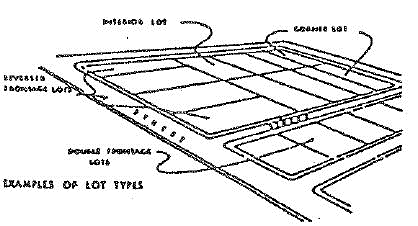
Examples of Lot Types
Lot width means the width of a lot measured at the building line and at right angles to its depth.
Main body means that portion of a dwelling encompassed by the exterior walls as originally assembled or built. When a dwelling is irregularly shaped, the main body shall be construed as that portion of the structure occupying the majority of geometric bulk.
Manufactured home means a factory-built single-unit structure, which is manufactured or constructed under the authority of 42 USC section 5403, Federal Manufactured Home Construction and Safety Standards, and is to be used as a place for human habitation, but which is not constructed with a permanent hitch or other device allowing it to be moved other than for the purpose of moving to a permanent site, and which does not have permanently attached to its body or frame any wheels or axles. A mobile home is not a manufactured home unless it has been converted to real property and is taxed as a site-built dwelling. Manufactured homes shall be considered the same as any site-built single-unit detached dwelling.
Mini-storage warehouses means a building or group of buildings in a controlled access and fenced compound that contains varying sizes of individual compartmentalized stalls or lockers for the storage of customers' goods or wares.
Mobile home means any vehicle without motive power used or so manufactured or constructed as to permit its being used as a conveyance upon the public streets and highways, and so designed, constructed or reconstructed as will permit the vehicle to be used as a place for human habitation by one or more persons; but shall also include any such vehicle with motive power not registered as a motor vehicle in the state. A mobile home is factory-built housing built on a chassis. A mobile home shall not be construed to be a travel trailer or other form of recreational vehicle. A mobile home shall be construed to remain a mobile home, subject to all regulations applying thereto, whether or not wheels, axles, hitch or other appurtenances of mobility are removed and regardless of the nature of the foundation provided. However, certain mobile homes may be classified as manufactured homes. Nothing in this chapter shall be construed as permitting a mobile home in other than an approved mobile home park, unless such mobile home is classified as a manufactured home.
Mobile home accessory building or structure means any awning, cabana, ramada, storage structure or carport, fence, windbreak or porch established for the use of the occupants of the mobile home on a mobile home space.
Mobile home space means a designated portion of the mobile home park designed for the accommodation of one mobile home and for its accessory buildings or structures for the exclusive use of the occupant.
Modular home means factory-built housing certified as meeting the Iowa State Building Code as applicable to modular housing. Once certified by the state, modular homes shall be subject to the same standards as site-built homes.
Nursing or convalescent home means a building or structure having accommodations and where care is provided for invalid, infirm, aged, convalescent or physically disabled or injured persons, not including insane and other mental cases, inebriates or contagious cases.
Parking area means that portion of a parcel of land that is improved and designated or commonly used for the parking of one or more motor vehicles.
Parking lot means an area improved and designated or commonly used for the parking of three or more motor vehicles.
Parking space, also parking stall means an area measuring at least nine feet wide and 19 feet long for all commercial, institutional, or manufacturing uses or eight feet wide and 18 feet long for residential uses only, connected to a public street or alley by a driveway not less than ten feet wide, and so arranged as to permit ingress and egress of motor vehicles without moving any other vehicle parked adjacent to the parking space.
Permanent storage means the volume of water which is stored upstream from a dam or in an impoundment up to the level of the principal outlet works of the structure, usually expressed in acre-feet.
Porch, unenclosed means a roofed projection which has no more than 50 percent of each outside wall area enclosed by a building or siding material other than meshed screens.
Principal use means the main use of land or structures, as distinguished from an accessory use.
Public sewer system means a municipally owned, operated and maintained sanitary sewer system.
Public water supply means a municipally owned, operated and maintained water supply.
Recreational vehicle means a vehicle built on a single chassis; 400 square feet or less when measured at the largest horizontal projection; designed to be self-propelled or permanently towable by a light duty truck; and designed primarily not for use as a permanent dwelling but as temporary living quarters for recreational camping, travel, or seasonal use.
Roominghouse means an owner-occupied or manager-occupied single dwelling unit wherein individual sleeping rooms are provided to not less than three unrelated resident tenants. Not more than one kitchen facility shall be established within said structure wherein meals may be prepared by resident tenants. Said rooming or boarding facility shall be distinctive from transient lodging facilities such as hotels, beds and breakfasts, other overnight lodging facilities or public eateries. Residents within said roominghouse facility shall be accommodated with weekly, monthly, or yearly tenant agreements or leases.
Satellite receiving dish means a device whose purpose is to receive communication or other signals from orbiting satellites and other extraterrestrial sources, most often comprised of an antenna/dish, a low-noise amplifier, and a coaxial cable whose purpose is to carry the signals to a receiver.
Site coverage ratio means that proportion of the lot on which buildings and outdoor storage of materials and products may be placed.
Special exception permit means an authorization by the city board of adjustment to allow building improvements or other development when such project conforms with specified rules, regulations and/or performance standards required for said improvements or development in special areas of the city as identified by the zoning ordinance.
Storefront means the facade of the ground-level story of a building. The area of the storefront will be calculated using the first 15 vertical feet of the facade, unless otherwise demonstrated by applicant, as evidenced by the storefront cornice height or interior ceiling height.
Story means that portion of a building included between the surface of any floor and the surface of the floor next above it, or, if there is no floor above it, then the space between the floor and the ceiling or roof next above it.
Story, half means a space under a sloping roof which has the line of intersection of roof decking and wall face not more than four feet above the top floor level.
Street line means the right-of-way line of a street.
Street, private means any private way 20 feet or more in width which is approved by the city council after recommendation by the city planning and zoning commission.
Street, public means any thoroughfare or public way not less than 30 feet in width which has been dedicated to the public or deeded to the city for street purposes, and also any such public way as may be created after enactment of this chapter, provided it is 40 feet or more in width.
Structural alterations means any replacement or changes in the type of construction or in the supporting members of a building, such as bearing walls or partitions, columns, beams or girders, beyond ordinary repairs and maintenance.
Structure means anything constructed or erected on the ground or attached to the ground, including but not limited to buildings, factories, sheds, cabins, factory-built housing, storage tanks and other similar uses. For zoning purposes anything, excluding fences, judged to be permanently affixed to the site and measuring at least 30 inches in height, as measured from natural grade, shall be considered a structure.
Temporary storage means a volume of water which may be stored upstream from a dam or in an impoundment above the level of the principal outlet works, usually expressed in acre-feet.
Travel trailer means a towed recreational vehicle ranging from ten to 35 feet in length and a maximum of eight feet in width.
Wind energy conversion system means a device or assemblage of devices which directly or indirectly converts wind energy to usable thermal, mechanical or electrical energy.
Variance means a grant of relief by a community from the terms of the zoning ordinance.
Violation means the failure of a structure, property, property use or other development to be fully compliant with city regulations.
Yard means an open space on the same lot with a building or structure unoccupied and unobstructed by any portion of a structure from 30 inches above the general ground level of the graded lot upward. In measuring a yard for the purpose of determining the depth of a front yard or the depth of a rear yard, the least distance between the lot line and the main building shall be used. In measuring a yard for the purpose of determining the width of a side yard, the least distance between the lot line and the nearest permitted building shall be used.
Yard, front means a yard extending across the full width of the lot and measured between the front lot line and the building.
Yard, rear means a yard extending across the full width of the lot and measured between the rear lot line and the building or any projections other than steps, unenclosed balconies or unenclosed porches. On both corner lots and interior lots, the rear yard is the opposite end of the lot from the front yard.
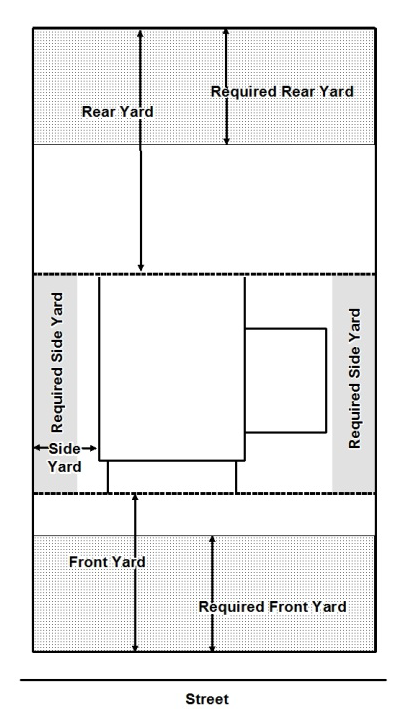
Figure 1
Yard, required means that portion of the front yard, side yard and rear yard as established by the setback requirements of the zoning district or of this chapter. It must be maintained in open, unobstructed space as measured from the property line to the required setback line except for allowable yard encroachments as outlined in section 26-90. If the building structure is located at the required setback line, then the setback distance shall be measured from the property line to the foundation of the structure. Refer to Figure 1.
Yard, side means a yard extending from the front yard to the rear yard and measured between the side lot lines and the nearest building.
(2)
General floodplain definitions.
Appurtenant structure is a structure which is on the same parcel of the property as the principal structure to be insured and the use of which is incidental to the use of the principal structure.
Base flood means the flood having a one percent chance of being equaled or exceeded in any given year (See 100-year (one percent) flood). This is the regulatory standard also referred to as the 100 year flood. The base flood is the national standard used by the National Flood Insurance Program (NFIP) and all federal agencies for the purpose of requiring the purchase of flood insurance and regulating new development. Base flood elevations (BFEs) are typically shown on the flood insurance rate maps (FIRMs).
Base flood elevation is the elevation floodwaters would reach at a particular site during the occurrence of a base flood event.
Basement means any enclosed area of a building which has its floor or lowest level below ground level (subgrade) on all sides. Any basement situated with less than one-half of its height below grade shall be counted as a story for the purpose of height regulations. A basement having more than one-half of its height below grade is not included in computing the number of stories for the purpose of height measurement. Also see Lowest floor.
Channel means a natural or artificial watercourse having definite banks and beds with visible evidence of flow or occurrence of water.
Development means any manmade change to improved or unimproved real estate, including, but not limited to constructing or installing buildings or other structures, mining, dredging, filling, clearing, grading, paving, excavation, drilling operations or storage of equipment or materials. Development does not include minor projects or routine maintenance of existing buildings and facilities. It also does not include gardening, plowing, and similar practices that do not involve filling or grading.
Elevating means raising a structure or property by fill or other means to or above the minimum flood protection level.
Enclosed area below lowest floor means the floor of the lowest enclosed area in a building when all the following criteria are met:
(1)
The enclosed area is designed to flood to equalize hydrostatic pressure during flood events with walls or openings that satisfy the provisions of section 26-177(e)(7)a.1 through 4; and
(2)
The enclosed area is unfinished (not carpeted, drywalled, etc.) and used solely for low damage potential uses such as building access, parking, or storage; and
(3)
Machinery and service facilities (e.g., hot water heater, HVAC, electrical service, and all components thereof) contained in the enclosed area are located at least one foot above the base flood elevation; and
(4)
The enclosed area is not a basement as defined in this section.
Encroachment limits means a set of lines which delineate the boundaries of the floodway established in the floodplains as the designated width of channel and overbank areas through which the regulatory flood must pass.
Existing construction is any structure for which the start of construction commenced before the effective date of the first floodplain management regulations adopted by the community. May also be referred to as existing structure.
Factory-built home means any structure designed for residential use which is wholly or in substantial part made, fabricated, formed or assembled in manufacturing facilities for installation or assembly and installation, on a building site. For the purpose of this section, a factory-built home includes a mobile home, manufactured home, and modular homes; and also includes recreational vehicles which are placed on a site for greater than 180 consecutive days and not fully licensed for and ready for highway use.
Factory-built home park or subdivision means a parcel or contiguous parcels of land divided into two or more factory-built home lots for sale or lease.
Factory-built home park or subdivision, existing is a factory-built home park or subdivision for which the construction of facilities for servicing the lots on which the factory-built homes are to be affixed (including at a minimum, the installation of utilities, the construction of streets, and either final site grading or the pouring of concrete pads) is completed before the effective date of the first floodplain management regulations adopted by the community.
Factory-built home park or subdivision, expansion of existing is the preparation of additional sites by the construction of facilities for servicing the lots on which the factory-built homes are to be affixed (including at a minimum, the installation of utilities, the construction of streets, and either final site grading or the pouring of concrete pads).
Factory-built home park or subdivision, new is a factory-built home park or subdivision for which the construction of facilities for servicing the lots on which the factory-built homes are to be affixed (including at a minimum, the installation of utilities, the construction of streets, and either final site grading or the pouring of concrete pads) is completed on or after the effective date of the first floodplain management regulations adopted by the community.
Five hundred year flood (500-year flood) means a flood, the magnitude of which has a two-tenths percent chance of being equaled or exceeded in any given year or which the magnitude, on average, will be equaled or exceeded at least once every five hundred years.
Flood means a general and temporary condition of partial or complete inundation of normally dry land areas resulting from the overflow of streams or rivers or from the unusual and rapid runoff of surface waters from any source.
Flood elevation means the elevation floodwaters would reach at a particular site during the occurrence of a specific flood. For instance, the 100-year flood or the 100-year (one percent) is that flood, the magnitude of which has a one percent (one percent) chance of being equaled or exceeded in any given year. The 500-year flood or the 500-year (0.2 percent) flood is that flood, the magnitude of which has a two-tenths of one percent (0.2 percent) chance of being equaled or exceeded in any given year.
Flood insurance rate map (FIRM) means the official map prepared as part of, but published separately from, the flood insurance study, which delineates both the flood hazard areas and the risk premium zones applicable to the community.
Flood insurance study means a report published by the Federal Emergency Management Agency (FEMA) issued along with a community's flood insurance rate maps. The study contains such background data as the base flood discharge and water surface elevations that were used to prepare the FIRMs.
Floodplain means any land susceptible to being inundated by water as a result of a flood.
Floodplain buildable area means that portion of the lot remaining after the minimum yard area requirements (i.e., setbacks) of this chapter have been met, and shall not include that portion of the property within the 500-year floodplain.
Floodplain management is an overall program of corrective and preventive measures for reducing flood damages and promoting the wise use of floodplain, including but not limited to emergency preparedness plans, flood control works, floodproofing and floodplain management regulations.
Flood profile means a graph or a longitudinal profile showing the relationship of the water surface elevation of a flood event to a location along a stream or river.
Floodproofing means a combination of structural and non-structural provisions, changes or adjustments incorporated in the design or construction and alteration of individual buildings, structures, or properties, including utilities, water treatment and sanitary facilities, which will reduce or eliminate flood damages.
Floodway means the channel of a river or stream and those portions of the floodplain adjoining the channel which are reasonably required to carry and discharge floodwaters or flood flows so that confinement of flood flows to the floodway area will not cumulatively increase the water surface elevation of the base flood by more than one foot.
Floodway fringe means the land adjacent to a body of water between the floodway and the outer (landward) limits of the special flood hazard area, as defined by the regulatory flood as delineated on the official floodplain zoning map.
Habitable space for flood protection purposes means any floor or level, including a basement, which is suitable for human habitation. It excludes a garage, a detached accessory structure, or an area for housing electrical, plumbing, heating, ventilating and other utility systems underneath a structure elevated to comply with flood protection requirements.
Highest adjacent grade is the highest natural elevation of the ground surface prior to construction next to the proposed walls of a structure.
Historic structure means any structure that is:
(1)
Listed individually in the National Register of Historic Places, maintained by the Department of Interior, or preliminarily determined by the Secretary of the Interior as meeting the requirements for individual listing of the National Register;
(2)
Certified or preliminarily determined by the Secretary of the Interior as contributing to the historical significance of a registered historic district or a district preliminarily determined by the Secretary to qualify as a registered historic district;
(3)
Individually listed on a state inventory of historic places in states with historic preservation programs which have been approved by the Secretary of the Interior; or,
(4)
Individually listed on a local inventory of historic places in communities with historic preservation programs that have been certified by either i) an approved state program as determined by the Secretary of the Interior or ii) directly by the Secretary of the Interior in states without approved programs.
Lowest floor means the floor of the lowest enclosed area in a building, including a basement, except when the criteria listed in the definition of enclosed area below lowest floor are met.
Maximum damage potential development means hospitals and like institutions; buildings or building complexes containing documents, data, or instruments of great public value; buildings or building complexes containing materials dangerous to the public or fuel storage facilities; power installations needed in emergency or other buildings or building complexes similar in nature or use.
New construction (new buildings, new factory-built homes or parks) means those structures or development for which the start of construction commenced on or after February 1, 1985.
Obstruction means any dam, wall, wharf, embankment, levee, dike, pile, abutment, projection, excavation, channel rectification, bridge, conduit, culvert, building, wire, fence, rock, gravel, refuse, fill, structure or matter in, along, across or projecting into any watercourse or floodplain area which may impede, retard or change the direction of the flow of water, either in itself or by catching or collecting debris carried by such water, or that is placed where the flow of water might carry material or structure downstream to the damage of other properties.
Official floodplain zoning map means the maps on file with the city that indicate those portions of land known as the floodway, floodway fringe and general floodplain, which are subject to the regulations of this chapter.
One hundred year flood means a flood, the magnitude of which has a one percent chance of being equaled or exceeded in any given year or which, on average, will be equaled or exceeded at least once every 100 years.
Program means the National Flood Insurance Program (NFIP).
Public damages shall consist of but not necessarily be limited to the following:
Public sewer system means a municipally owned, operated, and maintained sanitary sewer system.
Reach is a hydraulic engineering term used to describe longitudinal segments of a stream or river. A reach will generally include the segment of the flood hazard area where flood heights are primarily controlled by manmade or natural obstructions or constrictions. In an urban area, an example of a reach would be the segment of a stream or river between two consecutive bridge crossings.
Regulatory flood means a flood, the magnitude of which has a two-tenths (0.2 percent) of one percent chance of being equaled or exceeded in any given year. Regulatory flood is also referred to in this chapter as the 500-year flood and the 500-year (0.2 percent) flood.
Repetitive loss includes flood-related damage sustained by a structure on two separate occasions during a 10-year period for which the cost of repairs at the time of each such flood event, on the average, equals or exceeds 25 percent of the market value of the structure before the damage occurred.
Recreational vehicle means a vehicle that is:
(1)
Built on a single chassis;
(2)
Four hundred square feet or less when measured at the largest horizontal projection;
(3)
Designed to be self-propelled or permanently towable by a light duty truck; and
(4)
Designed primarily not for use as a permanent dwelling but as a temporary living quarters for recreational, camping, travel, or seasonal use.
Regulatory flood means a flood, the magnitude of which has a two-tenths (0.2 percent) of one percent chance of being equaled or exceeded in any given year. Regulatory flood is also referred to in this chapter as the 500-year flood and the 500-year (0.2 percent) flood.
Routine maintenance of existing buildings and facilities means repairs necessary to keep a structure in a safe and habitable condition. Such routine maintenance and repair activities include:
(1)
Normal maintenance of structures such as re-roofing, replacing roofing tiles and replacing siding;
(2)
Exterior and interior painting, papering, tiling, carpeting, cabinets, counter tops and similar finish work;
(3)
Basement sealing;
(4)
Repairing or replacing damaged or broken windowpanes;
(5)
Repairing plumbing systems, electrical systems, heating or air conditioning systems, and repairing wells or septic systems.
(6)
Other routine maintenance and repair activities that do not trigger a building permit.
Special exception permit means an authorization by the city board of adjustment to allow building improvements or other development when such project conforms with specified rules, regulations and/or performance standards required for said improvements or development in special areas of the city as identified by the zoning ordinance.
Special flood hazard area (SFHA) is the land within the City of Cedar Falls subject to the base flood. This land is identified on the City of Cedar Falls' flood insurance rate maps as Zone A, A1—30, AE, AH, AO, AR, A99.
Start of construction includes substantial improvement and new construction, means the date the development permit was issued, provided the actual start of construction, repair, reconstruction, rehabilitation, addition, placement, or other improvement, was within 180 days of the permit date.
The actual start means either the first placement or permanent construction of a structure on a site, such as pouring of a slab or footings, the installation of pile, the construction of columns, or any work beyond the stage of excavation; or the placement of a factory-built home on a foundation.
Permanent construction does not include land preparation, such as clearing, grading and filling; nor does it include the installation of streets and/or walkways; nor does it include excavation for a basement, footings, piers, or foundations or the erection of temporary forms; nor does it include the installation on the property of accessory buildings such as garages or sheds not occupied as dwelling units or not part of the main structure.
For a substantial improvement, the actual start of construction means the first alteration of any wall, ceiling, floor, or other structural part of the building, whether or not that alteration affects the external dimensions of the building.
Structure means anything constructed or erected on the ground or attached to the ground, including but not limited to buildings, factories, sheds, cabins, factory-built housing, storage tanks, grain storage facilities, and other similar uses. For zoning purposes anything, excluding fences, judged to be permanently affixed to the site and measuring at least 30 inches in height, as measured from natural grade, shall be considered a structure.
Substantial damage means damage of any origin sustained by a structure whereby the cost of restoring the structure to its before-damaged condition would equal or exceed 50 percent of the fair market value of the structure before the damage occurred. Volunteer labor and donated materials shall be included in the estimated cost of repair.
Substantial improvement means any improvement to a structure which satisfies either of the following criteria:
(1)
Any repair, reconstruction, or improvement of a structure, the cost of which equals or exceeds 50 percent of the fair market value either;
a.
before the start of construction of the improvement, or
b.
if the structure has been substantially damaged and is being restored, before the damage occurred.
(2)
Any addition which increases the original floor area of a building by 25 percent or more. All additions constructed after February 1, 1985, the effective date of the first floodplain management regulations adopted by the City of Cedar Falls, shall be added to any proposed addition in determining whether the total increase in original floor space would exceed 25 percent.
The term does not, however, include any improvement of a structure to correct existing violations of state or local health, sanitary, or safety code specifications which have been identified by the local code enforcement official and which are the minimum necessary to assure safe living conditions. The term also does not include any alteration of an historic structure, provided the alteration will not preclude the structure's designation as an historic structure.
Temporary storage means a volume of water which may be stored upstream from a dam or in an impoundment above the level of the principal outlet works, usually expressed in acre-feet.
Variance means a grant of relief by a community from the terms of the floodplain management regulations.
Violation means the failure of a structure or other development to be fully compliant with the community's floodplain management regulations.
(Ord. No. 2922, § 1(29-2), 5-7-2018; Ord. No. 2929, § 1, 9-4-2018; Ord. No. 2931, § 1, 10-1-2018; Ord. No. 3051, § 1, 4-15-2024; Ord. No. 3085, §§ 1, 2, 11-18-2024)
Sec. 26-3. - Interpretation of chapter.
In their interpretation and application, the provisions of this chapter shall be held to be minimum requirements. Where this chapter imposes a greater restriction than is imposed or required by other provisions of law or by other rules or regulations or ordinances, the provisions of this chapter shall control.
(Ord. No. 2922, § 1(29-3), 5-7-2018)
Sec. 26-4. - Amendments to chapter.
(a)
The city council may, from time to time, on its own action or on petition, after public notice and hearings as provided by law, and after reports by the city planning and zoning commission, amend, supplement or change the boundaries or regulations established in this chapter or subsequently established. Such amendment shall not become effective except by the favorable vote of a majority of all the members of the city council.
(b)
Prior to and in addition to the requirements of subsection (a) of this section, whenever any person desires that any amendment or change be made in this chapter as to any property in the city, there shall be presented to the city planning and zoning commission a petition requesting such change or amendment signed by the owners of at least 50 percent of the area of all the real estate included within the boundaries of the tract as described in the petition. The petition shall contain a legal description of the real estate for which rezoning is requested, the existing zoning classification and the requested zoning classification. The petition shall also have attached to it a plat which identifies the real estate for which rezoning is requested and which also shows all public streets and highways within a distance of 300 feet; the platted addition, if any, or the government section number and quarters in which the real estate is located; the existing zoning classification; and the requested zoning classification. Such plats shall be of a scale of not less than 300 feet to one inch. Within 30 days after the filing of such petition, the city planning and zoning commission, acting as a commission or acting through its chairperson, vice-chairperson or other authorized agent, shall fix a time, date and place of hearing on the petition, which date shall be no more than 60 days after the filing of such petition. The petitioner for such change or amendment shall thereafter cause a notice of hearing to be published once in a newspaper of general circulation published within the city, at least seven but not more than 14 days before the date fixed for such hearing. Such notice shall contain the time, date and place of the hearing, the existing zoning classification, the requested zoning classification and a reproduction of the plat attached to the petition, and shall be signed by the petitioners. The city planning and zoning commission may, upon the unanimous approval of the members present at a meeting, act upon a petition for rezoning or initiate a zoning change or amendment without the necessity of such a plat, notice or hearing.
(c)
In case the proposed amendment, supplement or change is disapproved by the city planning and zoning commission, such amendment, supplement or change shall not become effective except by the favorable vote of at least two-thirds of all the members of the city council. In case a written protest against a proposed amendment, supplement or change is filed with the city clerk duly signed by the owners of 20 percent or more of the area of the lots included in such proposed change, or by the owners of 20 percent or more of the property which is located within 200 feet of the exterior boundaries of the property for which the amendment, supplement or change is proposed, such amendment shall not become effective except by the favorable vote of at least three-fourths of all the members of the city council. Whenever any petition for an amendment, supplement or change of the zoning or regulations contained in this chapter or subsequently established shall have been denied by the city council, then no new petition covering the same property or the same property and additional property shall be filed with or considered by the city council until six months shall have elapsed from the date of the filing of the first petition.
(d)
Unless any lot, tract or parcel of land hereafter zoned to a less restrictive classification than as provided in this chapter has been used or developed for such less restrictive classification within two years from such rezoning, or unless there exists an unexpired building permit for the development thereof at the end of such two years, the city planning and zoning commission may, prior to the bona fide commencement of the use or development of the land in its less restrictive classification, after seven days' notice, in writing, to the then record owner of the land providing a reasonable opportunity to be heard, initiate and recommend to the city council that the land be rezoned to its zoning classification as established at the date of the passage of the ordinance from which this chapter is derived.
(e)
Before any action has been taken as provided in this section, the party proposing or recommending a change in district regulations or district boundaries shall deposit with the city clerk such sum as established by the council from time to time to cover the costs of this procedure. The fee will be nonrefundable.
(Ord. No. 2922, § 1(29-4), 5-7-2018)
Sec. 26-26. - Application of provisions.
(a)
No land use shall be established, nor shall any structure be erected, constructed, installed, moved, converted, enlarged, reconstructed or structurally altered, except in conformity with the regulations and standards of this chapter.
(b)
No land shall be used or altered, except in conformity with the regulations and standards of this chapter.
(Ord. No. 3125, § 1, 11-3-2025)

