
Central City Zoning Code
CHAPTER 12A
CITY CENTER OVERLAY DISTRICT CCO
Sec. 12A.1.1.- Purpose.
The intent of the City Center Overlay District is to encourage the development of a people-oriented, mixed-use area, consisting of retail, office, residential, governmental, and entertainment uses. It is intended that this district will be an inviting focal point capable of supporting community activity, stimulate additional compatible development, and be a draw for residents and visitors.
More specifically, purposes of this district are as follows:
A.
Promote the development of an institutional and commercial service district where a variety of retail, commercial, office, civic, entertainment and residential uses are permitted in a pedestrian accessible environment.
B.
Provide flexible regulations regarding streetscape design, landscape design, parking, architectural and facade design, residential dwelling units, and setback standards.
C.
Encourage development of buildings that are harmonious with each other and with the adopted Central Land Use Plan, the recommendations of the Central City Center development strategy.
D.
Encourage flexibility in design, while producing a higher quality of development that brings coherence as the City of Central grows.
Sec. 12A.1.2. - Objectives.
In order to achieve the purposes above, the following objectives shall be realized:
A.
The pedestrian environment in the City Center is essential for developing the sense of place and community cohesion desired by the City. Amenities shall be provided in the City Center to promote pedestrian usage.
B.
In the City Center Overlay District, vehicular circulation and parking should be accommodated without impacting the pedestrian experience. Adequate measures shall be provided to reduce vehicular/pedestrian circulation conflicts.
C.
Signs shall be of a scale, height, material and illumination that reflect the traditional concepts being promoted in the City Center.
D.
The size, scale, and design of buildings in the City Center should be complementary to a pedestrian environment and designed to provide a harmonious transition between commercial development, open space and civic amenities, and residential uses.
E.
The City of Central values high-quality design standards and materials; and encourages solutions that achieve these goals affordably so that business and property owners are benefited rather than burdened by the development process.
F.
The City of Central encourages renovations and improvements that create a unique and attractive image for each business while respecting the original design parameters of its facade as well as those of its neighbors.
Sec. 12A.1.3. - Applicability.
The City Center Overlay District applies to any new development, expansion of an existing structure, and redevelopment over fifty percent (50%) of the value of the structure or site, whichever is greater. In the event of a conflict between the requirements of this overlay district, the underlying base zoning, and/or another other overlay district, the requirements of the City Center Overlay Districts shall govern.
Sec. 12A.1.4. - Location.
The City Center Overlay District is shown on the official Zoning Map of the City of Central.
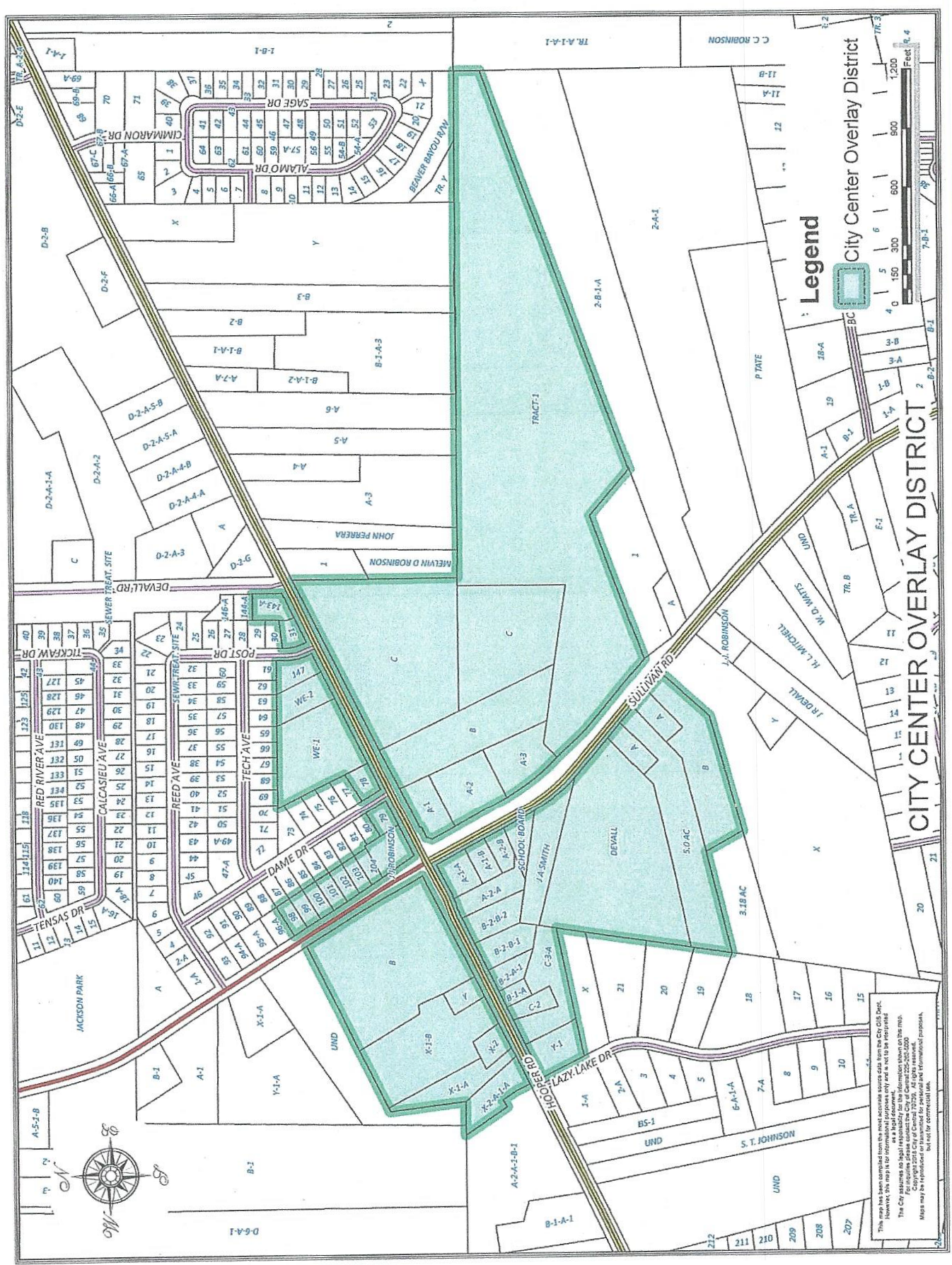
Sec. 12A.1.5. - Overlay district site plan review.
All multi-family and non-residential development in the Central City Center Overlay District shall be required to go through site plan review to promote orderly development and to assure such development occurs in a manner that is in line with these regulations and promotes the general health, safety and welfare of the City.
A.
Site Plan Review. Site plan review is required as follows:
1.
Applications for development up to ten (10) acres in the City Center Overlay District shall be reviewed through the Conditional Use (CUP) process for compliance with the City Center Overlay District standards.
2.
Applications for development over ten (10) acres in the City Center Overlay District shall be reviewed through the Planned Unit Development (PUD) for compliance with the City Center Overlay District standards.
3.
When the development is also requesting a conditional use or variance, the submission of the site plan shall be a requirement of the application to be reviewed concurrently.
B.
Submittal Requirements. In addition to any other information required by Title 7 Chapter 4 Sec 7:4.101 Site Plan Review, site plans must be prepared at a scale of not more than fifty (50) feet to one (1) inch and contain the following information:
1.
The name of the individual or firm preparing the plan.
2.
A north arrow, scale, and date.
3.
The boundaries and dimensions of the property involved, the general location of all existing easements, sector lines and property lines, existing streets and bicycle/pedestrian facilities, structures or waterways, and other significant features in or adjoining the property.
4.
The approximate location and sizes of sanitary and storm sewers, water mains, culverts, and other underground utilities and structures in or near the project.
5.
The Base Flood Elevation (BFE) and the existing elevation of the lowest portion of the property.
6.
The general location and character of any proposed streets, street sections, alleys, driveways, curb cuts, entrances and exits, loading areas (including number of loading and parking spaces), bicycle and pedestrian facilities, exterior lighting systems, storm drainage and sanitary facilities.
7.
The approximate height of all proposed principal and accessory structures.
8.
Building elevations and dimensions, with a narrative of how the proposed development addresses the design goals of this City Center Overlay District.
9.
General location of parking, pedestrian and bicycle circulation.
10.
General location, height and material of all fences, walls, screen planting and landscape, including any required and additional street trees.
11.
General location, character, size and height, and orientation of proposed signs.
12.
A tabulation of the total gross area in square feet of the project site and the floor areas in square feet of any building(s) in the proposed development.
13.
Landscape, open space and design information necessary to meet the requirements of this ordinance.
14.
When required by the City of Central, (see Title 7 Chapter 15 Section 7:15.2 Stormwater Management Plan), a Stormwater Management Plan in accordance with Chapter 15 Floodways, Floodplain, Drainage and Water Quality shall be required.
15.
Such other information as may be required in order to meet the standards in the zoning district in which the use is to be located.
C.
The Zoning Administrator may waive submittal requirements for site plans where such information is not necessary to determine the nature of the development or that the development meets relevant approval criteria.
Sec. 12A.1.6. - Review standards.
In reviewing site plans, the relationship of the site plan to adopted land use policies, and the goals and objectives of this City Center Overlay District must be evaluated. In addition, the following characteristics must be considered:
A.
Degree of Conformity with Existing Zoning Standards.
B.
Regulations of this City Center Overlay District and any other applicable regulations within the City Code, and the goals and policies of adopted City plans.
C.
The location, arrangement, size, design and general site compatibility of buildings, lighting and signs, including:
1.
Compatibility with, and mitigation of, any potential impact upon, adjacent property.
2.
Site illumination designed and installed to minimize adverse impact on adjacent properties.
3.
Signs in accordance with these overlay regulations and the City of Central Comprehensive Zoning Ordinance as amended.
D.
Landscape and the arrangement of open space or natural features on the site must:
1.
Create a desirable and functional environment for motorists, pedestrians, bicyclists and occupants of residential dwellings, business owners and employees. To achieve such an environment, landscape may take advantage of open space design features such as bike paths, running paths and outdoor relaxation areas.
2.
Preserve unique natural resources.
3.
Protect natural resources and landscaping on adjacent sites.
4.
Design drainage facilities to promote the use and preservation of natural watercourses and patterns of drainage.
5.
Utilize plant materials suitable to withstand the climatic conditions of Central and microclimate of the site. The use of native species is encouraged.
6.
Screening to buffer the impact of the development on adjacent uses and enhance the appearance and image of the City by screening incompatible uses and certain site elements, and creating a logical transition to adjoining lots and developments.
E.
Circulation systems and off-street parking must be designed to:
1.
Adhere with the adopted City of Central Access Management Policy.
2.
Provide adequate and safe access to the site for motor vehicles as well as alternate modes of transportation, including pedestrians, bicyclists and public transit.
3.
Minimize potentially dangerous traffic movements.
4.
Separate pedestrian and auto circulation and provide for bicycle parking or storage where required.
5.
Minimize curb cuts by using cross-access servitudes and shared parking.
6.
Design off-street parking lots or garages to minimize adverse impacts on adjacent properties, particularly through the use of perimeter and interior landscape, and promote logical and safe parking and internal circulation.
7.
Clearly define pedestrian access from the parking area to the building(s).
8.
A clearly defined visible and identifiable network of pedestrian connections should be provided in and between parking, street sidewalks, open spaces, buildings and public transit.
Sec. 12A.1.7. - Permitted uses and structures.
The uses that are permitted in the City Center Overlay District are the same as those permitted in the underlying zoning district. Provided, however, the following exceptions:
A.
Permitted Uses.
1.
Farmer's Markets.
B.
Conditional Uses.
1.
Any use in the B-5 Large Scale Commercial/Business District.
2.
Mixed-use development, not to exceed the maximum residential density allowed in R-3.
3.
Alcohol sales (packaged or in a restaurant).
4.
Churches.
C.
Prohibited Uses.
1.
Single or two-family residential.
2.
Outdoor storage areas.
3.
Manufacturing housing.
4.
Manufacturing housing parks.
5.
Mobile homes.
6.
Mobile home parks.
Sec. 12A.1.8. - Lot, structure, and bulk standards.
These standards consider the degree of compatibility between adjoining uses, sensitivity to the characteristics of the site, the need for free access for emergency vehicles, the need for adequate amounts of light and air between buildings, and the need for proper amounts of open space for the exclusive use of residents on the site. There is a desire to create a comfortable and interesting pedestrian environment with buildings as close to the road as practicable.
A.
Building Setbacks. Buildings and uses in the City Center Overlay District, except for residential dwellings of four (4) units or less, shall comply with the following requirements:
1.
There shall be no minimum required front, side, or rear yard setbacks, subject to the following conditions:
a.
The site or parcel meets all other building code and health and safety code requirements regards utility servitudes, public right-of-ways and emergency access.
2.
No building or structure shall be constructed in any minimum pedestrian, parking, or planting zone for any of the permitted street sections in the City Center (see Sec. 1.10.A.4 Parking, Circulation and Corridor Management Standards—Street).
B.
Lot and Building Area. There shall be no minimum square footage or maximum building size for development sites in the City Center Overlay District.
C.
Building Height. The maximum height shall be four (4) stories or fifty-six (56) feet in height.
Sec. 12A.1.9. - Structure design standards.
Buildings and uses in the City Center Overlay District, except for residential dwellings of four (4) units or less, shall comply with the following requirements:
A.
Building Entrances.
1.
The primary entrance for each business shall be well defined and oriented to the public street. If residential dwellings are located above the ground floor, separate street level access is required for residential uses.
2.
Multi-tenant shopping centers shall have their primary facade oriented toward the public street with entrances facing or clearly visible from the primary thoroughfare.
B.
Façade Design.
1.
Windows. Commercial building facade windows shall be constructed of clear and non-tinted glass.
2.
Exterior Building Materials.
a.
Architectural details, materials, colors, textures and landscape treatments shall be coordinated to provide visual continuity, quality and consistency.
b.
Traditional building materials, such as finished masonry, stone, brick, or wood, shall be used as the predominant exterior building materials for all new construction, renovations, and additions.
c.
Plain concrete block, plain concrete, corrugated metal, plywood, vinyl siding and sheet pressboard, prefabricated metal wall panels, and plastic are prohibited.
d.
At the building's interface with a sidewalk, cast concrete or another product shall be used that is not subject to chipping and fragmenting.
e.
Cement-based finishes, cement plaster, and Exterior Insulation Finish System (E.I.F.S.) are permitted only if used a minimum of ten (10) feet above grade where such finishes will be less susceptible to damage, and provided they cover no more than ten percent (10%) of the exterior surface area.
f.
The Planning Commission may approve alternative manufactured exterior materials if there is a compelling structural reason, upon finding that such materials replicate authentic traditional building materials in terms of appearance and durability.
3.
Roofs.
a.
Flat roofs must be enclosed by parapet walls with a minimum of forty-two (42) inches in height, or as required to conceal mechanical equipment from view of the public right(s)-of-way.
b.
The roofline at the top of the structure shall not run in a continuous plane for more than fifty (50) feet in either direction without offset of the roof plane. Rooflines shall be broken up by providing articulations in the façade of structures; changes in the height of portions of the roof; or change in color, materials, forms, etc.
c.
Structures shall use decorative roof elements such as projecting cornices, roof overhangs, or porte cocheres to enhance roof edges and define public entrances, main pedestrian routes, and activity areas.
d.
The front façade of any building shall have a permanent roof covering a minimum eight (8) foot walkway (except for any landscaped areas) for safe pedestrian access to the entrance from the street and parking areas.
e.
Roof Pitch: Notwithstanding anything to the contrary herein, the pitch ratio of the main roof of any residential structure must be, at a minimum, 6:12 for at least 50 percent of the building elevation(s) facing a roadway(s). This roof pitch requirement shall only be applicable to new residential construction; not renovations to existing residences or the replacement of a damaged or destroyed residence.
4.
Fire Escapes. Fire escapes shall not be permitted on a building's front facade. In buildings requiring a second means of egress pursuant to the local building codes, internal stairs or other routes of egress shall be used.
5.
Side or Rear Façade Design. Wherever a side or rear facade is visible from a public or private street, or if parking is located at the side or rear of a building, the facade shall be designed to create a pleasing appearance, in accordance with the following design criteria:
a.
Materials and architectural features the same as those present on the front of the building shall be used on the side or rear facade.
b.
Open areas shall be landscaped with lawn, ground cover, ornamental shrubs, and trees, provided that sufficient light penetrates into the space.
(Ord. No. 2022-21, § 2, 5-24-2022)
Sec. 12A.1.10. - Parking, circulation, and corridor management standards.
Adherence to and enforcement of the following standards will improve the identity of the City Center, reduce the number of curb cuts, promote unified development planning of multiple tracts, diversify architecture and land uses, minimize surface runoff through a reduction of redundant parking, improve pedestrian safety, and integrate commercial and residential land uses along major corridors. It is the intent of these standards to provide substantive direction while providing flexibility in their application.
A.
Streets.
1.
All streets in the City Center should be designed to promote accessibility and connectivity between uses, structures, and sites.
2.
All streets in the City Center should be designed with regard to safety, efficiency and convenience for automobile, bicycle, pedestrian and transit (if applicable) modes of travel.
3.
Street right of ways in the City Center should be designed for sub-surface drainage, off-street parking, bicycle lanes, and sidewalks.
4.
Street Sections. The follow street sections identified in the City of Central Development Code, Appendix J, may be utilized in the City Center:
a.
Section F.
b.
Section J.
c.
Section H.
d.
Section I.
B.
Site Connectivity. Sites in the City Center, except for proposed residential development of four (4) units or less, shall comply with the following requirements:
1.
Adjacent properties shall utilize joint use driveways whenever possible and provide connections between parking lots. Owners shall provide cross access easement areas between adjacent properties and developments to provide vehicular access to adjacent sites without having to re-enter the public right-of-way.
2.
Joint driveways and parking lot cross connections shall provide sufficient width to accommodate two-way vehicular travel.
3.
Joint driveways and parking lot cross connections shall provide pedestrian and bicycle connections.
4.
Proposed development plans for sites abutting an arterial or major collector street must include internal vehicle connections from the subject development site to each adjacent site, where applicable. Exceptions may be provided where abutting uses are clearly incompatible or where physical conditions or existing development on adjacent sites precludes such connection now or in the future considering the potential for redevelopment. Development plans shall include joint use driveways with adjacent sites wherever feasible.
5.
Internal Site Street Network. The street network within developments shall provide for future public street connections to adjacent developable or redevelopable parcels, and shall include block lengths not in excess of 660 feet, except where additional spacing is required in conformance with municipal development standards and unless the developer demonstrates that a block length must be greater due to the existence of one or more of the following conditions:
a.
Physical conditions (e.g. topography), buildings or other existing development on adjacent lands physically preclude a block length 660 feet or less; or
b.
An existing public street terminating at the boundary of the development site, has a block length exceeding 660 feet, or is situated such that the extension of the street(s) into the development site would create a block length exceeding 660 feet. In such cases, every effort shall be made to accomplish reasonable block lengths to maintain walkability.
C.
Sidewalks.
1.
Unobstructed concrete (or other permanent hard surface) sidewalks measuring a minimum of five (5) feet in width and shall be provided along both sides of all public roads.
2.
When a sidewalk crosses a driveway, the appearance of the sidewalk shall be maintained across the driveway to indicate that pedestrians have the right-of-way.
D.
Parking and Circulation. Parking and parking lot design shall comply with the following standards, in addition to the provisions of Section 16, Off-Street Parking in the Comprehensive Zoning Ordinance. In all cases where there is a conflict, these standards shall apply.
1.
Location of Parking in City Center. The following location standards apply to all sites and uses other than residential development of two (2) or less units.
a.
On-premises surface parking shall not be placed in front of the principal front wall plane of a building, extended across the entire width of a lot, unless the parking is screened from view from the public street by other buildings.
b.
Where the lot width at the principal front wall plane of the building is greater than two hundred (200) feet, the provisions of this paragraph shall only apply to that portion of the front yard extending beyond the side facades of the building, parallel to the front lot line, equal in length to the side yard setback(s) that would otherwise be required for the building in the district within which it is located.
c.
Where a lot abuts more than two streets, these provisions shall apply to no more than two streets.
2.
Required Parking Spaces.
a.
In order to maximize the amount of land area left for landscaping and open space, paving shall be confined to the minimum area necessary to comply with the parking requirements of Section 16, Off-Street Parking in the Comprehensive Zoning Ordinance. Accordingly, the maximum number of parking spaces that may be provided is one hundred twenty percent (120%) of the minimum parking requirement.
b.
Shared Parking. Where multiple uses with different parking requirements occupy the same structure or lot, the required vehicle and bicycle parking and loading spaces is the sum of the requirements for each use computed separately, unless otherwise permitted by this Ordinance. Except for the following:
i.
Approval by Building Official that confirms that the use of each such facility does not take place at the same hours, during the same days.
ii.
The users of the shared parking shall record an agreement to share parking facilities. A copy of the recorded agreement shall be given to the Planning Commission.
c.
Credit for On-Street Parking Spaces. In the City Center, on-street parking spaces located along the front or side property line may be counted toward required off-street parking spaces for non-residential uses, subject to the following conditions:
i.
New on-street parking spaces may also be created to count toward required off-street parking but shall be located along the side or front property line, and shall be accessible twenty-four (24) hours a day.
ii.
Where on-street parking spaces are unmarked, the number of parking spaces is calculated by dividing the length of the on-street parking area located parallel to property line of the property under consideration divided by eighteen (18), where a fraction of less than one-half (½) is disregarded, and a fraction of one-half (½) or more is counted as one (1) space.
iii.
Where on-street parking spaces are marked, each marked space counts as one (1) required parking space, including any space where at least fifty percent (50%) of the width is located along the property line of the property under consideration.
iv.
In a multi-tenant structure, all commercial tenants may utilize this provision.
3.
Pedestrian Circulation. Convenient pedestrian circulation systems that minimize pedestrian-motor vehicle conflicts shall be provided continuously throughout all development sites, subject to the following:
a.
Unobstructed hard-surface sidewalks measuring a minimum of five (5) feet in width and shall be provided along both sides of all public roads. These sidewalks shall be dedicated to the City and contained within appropriate rights-of-way.
b.
Parking lot layout shall accommodate pedestrian circulation from the required public sidewalks at the edge of the parking lot to the entrance of the buildings. Sidewalks outside of the public right-of-way shall be privately owned and maintained, comprised of concrete, textured paving or brick pavers, and shall be a minimum of four (4) feet in width.
c.
Pedestrian crosswalks shall be provided at the intersection of all driveways and sidewalks, and from parking areas to building entrances, which shall be distinguished by textured paving, brick pavers or painting, and shall be integrated into the sidewalk network.
d.
Where a development adjoins any existing bicycle route or pedestrian facility, the development's internal pedestrian circulation shall be linked to the public amenities. Where public amenities are incomplete but proposed as part of an adopted plan, stub-outs for future linkages shall be provided by the development.
e.
The front facade of any building shall have a minimum eight (8) foot pedestrian walkway (except for any landscaped areas) for safe pedestrian access to the entrance from the street and parking areas.
f.
When parking is located behind buildings, one (1) pedestrian pass-through shall be provided for every three hundred fifty (350) feet of frontage along a block face. Pedestrian pass-throughs shall have a minimum width of eight (8) feet, be designed so that they cannot be closed or locked, and shall be designed to be safe and visually interesting for pedestrians.
4.
Bicycle Circulation.
a.
Where a development adjoins any existing bicycle route or pedestrian facility, the development's internal bicycle circulation shall be linked to the public amenities. Where public amenities are incomplete but proposed as part of an adopted plan, stub-outs for future linkages shall be provided by the development.
b.
Where off-street parking facilities are provided, bicycle parking spaces shall also be provided as required in Table XXX: Required Bicycle Parking Spaces. In all cases where bicycle parking is required, a minimum of two (2) spaces shall be required.
c.
The bicycle parking area must be convenient to building entrances and street access, but may not interfere with normal pedestrian and vehicle traffic.
d.
All bicycle parking spaces must be located on the same lot as the use, or within fifty (50) feet of the lot on private or public property. The property owner responsible for the parking spaces shall make a suitable arrangement with the private owner or the City of Central to place bike parking spaces in the right-of-way.
e.
Required bicycle parking spaces must have a minimum of two (2) feet in width and six (6) feet in length, with a minimum overhead clearance of seven (7) feet. Each space must be accessible without moving another bicycle. There must be an aisle at least five (5) feet wide between each row of bicycle parking to allow room for bicycle maneuvering.
f.
If required bicycle parking is not visible from the street or principal building entrance, signs must be posted indicating their location.
Sec. 12A.1.11. - Open space standards.
The preservation and establishment of open space (including active and passive green open spaces) when required in the City Center should enhance and preserve the natural environment, not negatively impact buildings and structures (e.g. should not create drainage or access issues), and should enhance the natural and cultural amenities of the development.
A.
Open Space Development Standards.
1.
Open spaces may be jointly development and maintained by separate uses within the City Center. The required amount of open space shall be no less than the sum of the open space requirements for each individual use, structure, or parcel.
2.
For developments over ten thousand (10,000) square feet, no required open space shall be used to meet the stormwater BMP requirements (see Title 7 Chapter 15 Section 7:15.2 Stormwater Management Plan). However, the amount of open space used to meet the stormwater retention requirement should not exceed ten (10) percent of the total provided open space on any development.
B.
Open Space Design and Performance Standards.
1.
Open spaces should be directly accessible to a street, bicycle or pedestrian path, or other public right-of-way.
2.
Open spaces should be open to the public at a minimum of the hours between sunrise and sunset.
3.
Open spaces should contain seating, trash receptacles, landscaping, and other amenities such as water features, kiosks, and passive recreation areas, where appropriate.
4.
Open spaces should contain artwork, landmarks and wayfaring signage, where appropriate.
5.
Special consideration should be given to preserving and/or incorporating existing trees and wooded areas in the public open space network. Additional density and/or reductions in required parking could may be considered when significant areas of existing trees are conserved.
Sec. 12A.1.12. - Landscaping and screening.
A.
Landscaping. All landscaping should meet at the minimum the requirements of the base zoning district and Chapter 18 of the Development Code.
B.
Trees and Plantings. In addition to landscaping requirements of the base zone district, new development shall be required to install and maintain street trees in conformance with the requirements of the applicable roadway sections approved for use in the City Center. Generally, this will include trees planted at thirty-five (35) - forty (40) feet on center in the required planting area shown in the street sections. Trees shall be Class A from the following list:
C.
Screening of Service and Loading Areas and Utilities.
1.
Trash collection, trash compaction, recycling collection and other similar service areas must be located on the side or rear of the building and must be effectively screened from view from residential properties and public rights-of-ways. Wall or fence materials must be compatible with the primary structure.
2.
All loading areas visible from residential property or public rights-of-way must provide a one hundred percent (100%) opaque, year-round screen. This screen must consist of walls, fences, plant materials or a combination totaling six (6) feet in height at installation. Wall or fence materials must be compatible with the primary structure.
3.
Mechanical Equipment.
a.
All roof, ground and wall-mounted mechanical equipment (e.g. air conditioning equipment, compressors, duct work, transformers or elevator equipment) must be screened from ground level view from residential districts or public rights-of-way.
b.
Roof-mounted mechanical equipment must be shielded from view on all sides. Screening materials must be consistent with the primary building materials, and may include metal screening or louvers painted to blend with the primary structure.
c.
Wall or ground-mounted equipment screening must be constructed of:
i.
Planted vegetative screens; or,
ii.
Brick, stone, reinforced concrete or other similar masonry materials.
4.
Utilities. With the exception of those located in the right-of-way, all above-ground utilities and appurtenances to underground utilities which require above-ground installation must be screened by a continuous planting of shrubs, with a minimum mature height equal to that of the utility structure. Required access points to these utilities are exempt from screening.
Sec. 12A.1.13. - Signs.
Any time there is a new sign or a modification or replacement of an existing sign in the City Center Overlay District, the following standards shall apply. These sign requirements shall be considered a supplement to City of Central Comprehensive Zoning Ordinance. In all cases where there is a conflict, these standards shall apply.
A.
General Sign Standards.
1.
Sign materials shall relate to the materials and style of the building(s) they serve.
2.
In general, multi-tenant signs are discouraged, especially where building mounted signs are easily read from the main street upon which the businesses front. In such cases, a single, plaza sign denoting the name of the plaza is preferred.
3.
Signs oriented to pedestrians (e.g. projecting signs supported by ornamental brackets) are strongly encouraged.
4.
Electronic message signs and electronic display signs are prohibited.
5.
All lighting shall concentrate the illumination upon the area of the sign to prevent glare upon the street or adjacent property. All sign illumination shall be designed, located, shielded, and directed to prevent both the casting of glare or direct light upon adjacent publicly dedicated roadways and surrounding properties and the distraction of operators of vehicles or pedestrians in the public right-of-way.
6.
Signs with flashing or blinking lights, or other illuminating device that has a changing light intensity, brightness or color, traveling/chasing or blinking lights, or rotating beacons are prohibited. Time and temperature components of signs are not considered flashing signs.
B.
Freestanding Signs.
1.
Freestanding principal use signage shall be limited to monument signs.
2.
Lower, monument-style signs are preferred where visibility from the right-of-way is not an issue. Preferred monument signs are low, horizontal with raised lettering and set off by flowers, shrubs and/or a lawn.
3.
Ample landscaping shall be provided at the base of all signs.
C.
Attached Permanent Signs.
1.
Awning, Canopy, and Under-Gallery Signs.
a.
Under-awning, under-canopy signs, and under-gallery signs shall be attached to the underside of an awning, canopy, or gallery and cannot project beyond the awning, canopy, or gallery.
b.
Under-awning, under-canopy signs, and under-gallery signs shall maintain a minimum clearance of seven (7) feet.
c.
A maximum of one (1) under-awning, under-canopy signs, and under-gallery sign is permitted per business establishment with frontage on the street where the awning, canopy, or gallery is installed.
d.
Awnings and canopies shall be compatible in material and construction to the style and character of the structure and compatible with the overall color scheme of the facade.
2.
Projecting Sign.
a.
Projecting signs are permitted for non-residential uses. Projecting signs are permitted a maximum of two (2) sign faces. Only one (1) projecting sign is permitted per ground floor business establishment.
b.
Projecting signs shall not project more than two (2) feet from the curb line, as measured from the building to which they are attached. No projecting sign may project more than four (4) feet from the building face to which it is attached.
c.
The bottom of any projecting sign shall be at least seven (7) feet above the sidewalk. No projecting sign affixed to a building may project higher than the building height, including the sign support structure.
3.
Wall Sign.
a.
Wall signs shall be safely and securely attached to the building wall no less than seven (7) feet above the ground. Wall signs shall be affixed flat against the building wall and shall not project more than eighteen (18) inches from the building wall.
b.
No wall sign affixed to a building, including sign support structure, may project beyond the ends or top of the wall to which it is attached.
c.
Wall signs shall be constructed of wood or metal, or may be painted on a structure.
4.
Window Sign (Permanent).
a.
Window signs are permitted for all non-residential uses.
b.
All window signs, temporary or permanent, including neon window signs and neon tubing, are limited to ten percent (10%) of the surface of the total window area. Window area is counted as a continuous surface until divided by an architectural or structural element.
c.
Mullions are not considered an element that divides window area.
D.
Sidewalk Displays.
1.
Sidewalk displays shall be permitted directly in front of a business provided at least five (5) feet of clearance is maintained along pedestrian circulation routes.
2.
Display cases shall be located against the building wall and shall not be more than two (2) feet deep. The display area shall not exceed fifty (50%) percent of the length of the storefront.
3.
Display cases shall be permitted only during normal business hours, and shall be removed at the end of the business day. Cardboard boxes shall not be used for sidewalk displays.
4.
Sidewalk displays shall maintain a clean, litter-free and well-kept appearance at all times and shall be compatible with the colors and character of the storefront from which the business operates.
Sec. 12A.1.14. - Utilities.
All utilities shall be placed underground.
Sec. 12A.1.15. - Lighting.
1.
General.
a.
Lighting must be placed and shielded so as to direct the light onto the site and away from adjoining properties. The lighting source shall not be directly visible from adjoining properties.
b.
Floodlights, wall pack units, other types of unshielded lights, and lights where the lens is visible outside of the light fixture shall be prohibited.
2.
Appropriate Lighting Levels.
a.
Sidewalks and parking areas shall be properly lighted to facilitate the safe environment of pedestrians and vehicles and provide a secure environment.
b.
In parking areas, the light intensity shall average a minimum of one (1) foot candle, measured five (5) feet above the surface.
c.
In pedestrian areas, the light intensity shall average a minimum of two (2) foot candles, measured five (5) feet above the surface.
d.
The maximum average light intensity shall be ten (10) foot candles.
e.
Generally, more, smaller lights, as opposed to fewer high-intensity lights, should be used.
3.
Traditional or Decorative Features.
a.
These cut-off, orientation and shielding requirements may be waived or modified for traditional-style or decorative lighting fixtures, upon making the determination that the fixtures will comply with the illumination levels specified herein, will not cause glare or interfere with the vision of motorists, and will be consistent with the spirit and intent of these design regulations.
(Ord. No. 2018-33, 10-5-2018)
Editor's note— Footcandle: A unit of illuminance on a surface that is everywhere one foot from a uniform point source of light of one (1) candle and equal to one (1) lumen per square foot.

