
Ceres City Zoning Code
CHAPTER 02
DEFINITIONS
18.02.010 - Definitions and interpretive provisions.
For the purpose of carrying out the provisions and intent of this title, words, phrases, and terms shall be deemed to have the meanings ascribed to them and shall be interpreted to have the standards and include the parts, elements and the features set forth in this chapter. When not inconsistent with the context, words used in the present tense include the future; words in the singular number include the plural; words in the plural number include the singular. The word "shall" is mandatory, and the word "may" is permissive.
Abut, adjacent, adjoining: Contiguous to or having a common property line or district line, or separated only by a private street, street, alley or easement.
Access, access way: The place, means, or way by which pedestrians and vehicles shall have safe, adequate and usable ingress and egress to a property and use as required by this title.
Access, approved: Access to a State highway, County road, or City street of not less than 40 feet in width, by a connecting access of not less than 30 feet which said connecting access being owned by the owner of the parcel or parcels to which it furnishes access or an irrevocable easement for the permanent use of such parcel or parcels.
Accessory dwelling unit (ADU): An attached or detached residential dwelling unit that is subordinate to a principal residence on the same lot and that provides complete independent living facilities for one or more persons. These units include permanent provisions for bedrooms, bathrooms and kitchen facilities. An accessory dwelling unit shall include efficiency units and manufactured homes as defined by California Health and Safety Code sections 17958.1 and 18007, respectively.
Accessory structure/building: A structure/building which occupies a portion of a lot, whether attached or detached, and which is subordinate to or incidental to the principal use on the same lot. Such structures/buildings shall include, but are not limited to: patio covers, metal, fabric or wooden structures that cover a vehicle or a recreational vehicle, arbors or trellises, sheds, detached garages, cabanas, workshops, covered or uncovered decks, accessory dwelling unit and similar structures (i.e. pop-up tent or easy up tent structures). No accessory structure/building of any size shall be located within the front yard or exterior side yard area of a single-family residential lot. Accessory structures/buildings may be located within the side yard or rear yard areas of a single-family residential lot provided such structures comply with the applicable setback requirements and if said structures have been legally permitted by the City.
Accessory use: A use subordinate to or incidental to the principal use on the same lot.
Advertise: To praise publicly, promote, or otherwise call attention by audio or visual means, to any product, service, activity or occurrence.
Advertising structure: Self-supporting structure erected or maintained for outdoor advertising purposes, upon which any poster, bill, printing, painting or other advertisement of any kind, including statuary, may be placed for advertising purposes. "Advertising structure" does not include:
A.
Official notices issued by any court or public body or officer.
B.
Notices posted by any public officer in the performance of a public duty or by any person in giving legal notices.
C.
Directional, warning or information structures required or authorized by law or by Federal, State, County, or City authority.
D.
A structure erected near a city or county, which contains the names of such city or county and the names of, or any other information regarding civic, fraternal, or religious organizations erected with the approval of the Director of Community Development.
Advertisement, off site: To advertise off the location where a product, service, activity or occurrence is or will exist.
Advertisement, on site: To advertise on the location where a product, service, activity or occurrence is or will exist.
Advisory agency: Agencies advisory to the City Council on all matters related to the zoning and use of land and structures. Such agencies shall include but are not limited to the Planning Commission and other committees the City Council may form or authorizes from time to time.
Aggregate surface area: The computed area of a sign background. Where a sign is composed of "cut-out" elements, the aggregate surface shall be computed on the basis of a rectangle equivalent in dimensions to the extreme height and width dimensions of said display. This definition shall also apply to "script," "panel," and similar signs composed as separate elements. For the purposes of this definition, channel letters or symbols that are not framed by a background will to computed based on the induvial letters or symbols for determiner sign area.
Agriculture: The tilling of the soil, the raising of crops, horticulture, viticulture, small livestock farming, dairying and animal husbandry for the purpose of selling the products resulting from such activity for financial gain or profit.
Airport: Land and buildings improved and intended for the use, servicing, maintenance or storage of aircraft.
Alley or lane: A public or private way, not more than 30 feet wide affording only secondary means of access to abutting property.
Alluvial fan: A geomorphologic feature characterized by a cone or fan-shaped deposit of boulders, gravel, and fine sediments that have been eroded from mountain slopes, transported by flood flows, and then deposited on the valley floors, and which is subject to flash flooding, high velocity flows, debris flows, erosion, sediment movement and deposition, and channel migration.
Alteration: Any change to the use, or intended use, of land.
Amendment: An addition, deletion or a change in the wording, context or substance of this title or the Zoning Map.
Animal hospital: A place where animals or pets are given medical or surgical treatment and are cared for during the time of such treatment. Use as a kennel shall be only incidental to such hospital use.
Annexation (annex): The extension of the municipal boundaries of the City of Ceres to include land not previously included within the municipal boundaries of the City of Ceres.
Appeal: A process for requesting a formal change to an official decision that was made by City officials (i.e., Planning Commission or Director of Community Development). When a person disagrees with a decision, an appeal may be filed so that the City Council can review the determination that was made.
Apex: The point of highest elevation on an alluvial fan, which on undisturbed fans is generally the point where the major stream that formed the fan emerges from the mountain front.
Area of shallow flooding: A designated AO or AH zone on the flood insurance rate map (FIRM). The base flood depths range from one to three feet; a clearly defined channel does not exist; the path of flooding is unpredictable and indeterminate; and velocity flow may be evident. Such flooding is characterized by ponding or sheet flow.
Assessor: The County Assessor of the County of Stanislaus.
Automobile and trailer sales lot: An open area, other than a street, used for the display and sales of new or used automobiles and trailer coaches.
Automobile body and paint shop: A business which performs automobile and truck body repairs and painting in an enclosed building.
Automobile repair garage: A business which services automobiles and trucks, does major mechanical repairs, replaces and rebuilds automobile engines and components, excluding body work.
Automobile service station: A business engaged primarily in the sale of motor fuels, but also in supplying goods and services generally required in the operation and maintenance of motor vehicles. Operations may include sale of petroleum products; sale and servicing of tires, batteries, automotive accessories, and replacement items; lubrication services; washing of cars.
Automobile wrecking: The wrecking or dismantling of used motor vehicles or trailers, or the storage of, sale of, or dumping of dismantled, obsolete or wrecked motor vehicles or their parts.
Aviary: Any place where more than five domestic and/or non-domestic birds are kept outside.
Bar: A bar is a retail business establishment that serves alcoholic beverages, such as beer, wine, liquor, cocktails, and other beverages such as mineral water and soft drinks and often sells snack foods such as potato chips or peanuts, for consumption on premises. Some types of bars, such as pubs, may also serve food from a restaurant menu.
Base flood: The flood having a one percent chance of being equaled or exceeded in any given year.
Base flood elevation: The elevation shown on the flood insurance rate map (FIRM) and found in the accompanying flood insurance study (FIS) for zones A, AE, AH, A1-A30, AR, V1-V30, or VE that indicates the water surface elevation resulting from the flood that has a one percent chance of equaling or exceeding that level in any given year - also called the base flood.
Basement: A space wholly or partly underground, and having more than one-half of its height, measuring from its floor to its ceiling, below the average adjoining grade; if the finished floor level directly above a basement is more than six feet above grade at any point, such basement shall be considered a story. As it pertains to flooding provisions of this title, basement shall include any area of the building having its floor subgrade, or below ground level, on all sides.
Beginning of construction: The incorporation of labor and material within the foundation of the building or buildings.
Block frontage: All property fronting on one side of a street between intersecting and intercepting streets, or between a street and right-of-way, waterway, end of a cul-de-sac, or City boundary. An intercepting street shall determine only the boundary of the block frontage on the side of the street that it intercepts where the City boundary intersects or intercepts a street in a block, the block shall be considered to end at the City boundary.
Boarding house or rooming house: A building containing a single-dwelling unit, where lodging is provided with or without meals for compensation to not more than three nontransients.
Breezeway: A roofed passageway, open on at least two sides, where the roof is in keeping with the design and construction of the main building. Said breezeway shall be considered an inner court that is created by a roof structure connecting two buildings. The space between buildings connected by a breezeway shall not be less than six feet in length.
Building, structure: Any structure built and maintained for the support, shelter, or enclosure of persons, animals, or property of any kind. No building shall be located within any future right-of-way or public easement established by authority of the City Council in the manner prescribed by law.
Building, attached: Any two or more buildings closer than six inches together or physically adjoined in some way. Garages shall be considered attached if the roof structure is continuous with the building adjacent to it.
Building end: The side(s) of the building that is (are) not the building front or building rear.
Building front: The side(s) of the building where the main entrance or building facade is located.
Building height: The vertical distance measured from sole plate to the highest portion of the roof of the building, exclusive of chimneys, ventilators and other exceptions to building height permitted in the zones in which it is located.
Building line: A line on private property, established by ordinance which regulates the location of buildings and/or structures as they relate to the rights-of-way of alleys, streets, highways or easements.
Building, main: A building within which is conducted the principal use permitted on the lot, as provided by this title.
Building, metal: A building whose components are prefabricated and are composed of metal.
Building rear: The side(s) of the building diametrically opposed to the front of the building.
Building site: The ground area of a building, together with all the open space accepted before and required by this title.
Business: Any activity on, or use of, land which involves the buying, selling, processing or improving of things, or the rendering of services and having financial gain as the primary aim of the activity or use; whether or not such activity or use be for hire or on account of the buyer, seller, processor, improver or renderer.
Cabana: A detached structure used as a bathhouse or related to a residential trailer, but not used for sleeping purposes.
Carnival: A traveling or itinerant commercial amusement enterprise consisting of side shows, vaudeville, games, merry-go-rounds or other mechanical amusement devices temporarily located within the City of Ceres.
Carport: A permanent roofed structure with two fully enclosed sides or less to be used for automobile shelter and automobile storage.
Cellular mobile radio-telephone utility facility: A transmitting and/or communication tower and/or facilities used for either private or quasi-public communication purposes. Cellular structures are those structures which are independent of all other structures and house cellular equipment. Antennas consist of the following types:
A.
Whip antennas: Cylindrical antennas approximately two inches in diameter and varying in length from ten feet to 15 feet.
B.
Dish antennas: Circular antennas which vary in diameter from two feet to 12 feet.
C.
Panel antennas: Panel antennas incorporate a fiberglass cover/panel backed by a metallic reflector. These antennas vary in approximate size from one foot by six inches to four feet by one foot.
D.
Small cell sites: Low-powered cellular radio access nodes that operate in licensed and unlicensed spectrum that have a range of ten meters to a few kilometers. They are "small" compared to a mobile macrocell, partly because they have a shorter range and partly because they typically handle fewer concurrent calls or sessions.
Child care facility: Any building, group of buildings, or portion thereof used for the daytime care of children.
Church: A permanently located building commonly used for any type of religious worship. Such building shall be fully enclosed with walls (including windows and doors), having a roof (canvas or fabric excluded) and shall conform to applicable legal requirements affecting design and construction.
Circus: A traveling or itinerant commercial amusement enterprise utilizing an enclosure of any kind used for exhibitions of horsemanship, acrobatic performances, acts of clowns, feats of animal training, or the like, temporarily located within the City of Ceres.
City: The incorporated City of Ceres.
City Clerk: The City Clerk of the City of Ceres.
Clinic: A place for group medical services not involving overnight housing of patients.
Club: An association of persons (whether or not incorporated), religious or otherwise, for social purpose, but not including groups which are organized primarily to render a service carried on as a business for profit.
Coin/card-operated amusement device: Any video game amusement machine or device operated by means of the insertion of a coin, token, card or similar object for the purpose of amusement or skill and for the playing of which a fee is charged. This shall not include vending machines which are not incorporating game or amusement features nor does this include any coin-operated mechanical music device.
Commercial: Used to describe those areas and buildings within the City of Ceres used primarily for trade or business.
Commercial recreation facility: Commercial swimming pools, bowling alleys, skating rinks, dance halls, drive-in theaters, walk-in theaters, golf courses and driving ranges and similar uses as determined by the Planning Commission or Director of Community Development. This shall also include amusement game arcades and the operation of more than six "coin-operated amusement devices" as defined in this section.
Commission, Planning Commission: The Planning Commission of the City of Ceres.
Compatible use: Any use that by its manner of operation is suitable in the district in which it is located. Said use of land or buildings shall be in harmony with the uses on abutting properties in the same district.
Conditional use permit (CUP): A discretionary permit issued by the Planning Commission under the provisions of this title, to allow a conditional use that may or may not be allowable under the Zoning Ordinance. If approval is granted, the developer/applicant must meet certain conditions to ensure the use is not detrimental to the public health, safety, and welfare and will not impair the integrity and character of the surrounding area. Each application is considered on its individual merits. CUPs require a public hearing approval and are subject to the fulfillment of certain conditions by the developer. An "administrative conditional use permit" shall mean a specific type of use permit issued by the Director of Community Development. An administrative conditional use permit shall also be subject to the findings set forth in subsection 18.30.030.E and section 18.30.090 of this title.
Corner cutback: The provisions for and maintenance of adequate and safe visibility for vehicular and pedestrian traffic at all intersections of streets, alleys, or private driveways. Such space shall be kept free of buildings, structures, and landscaping which would constitute a visual obstruction.
Cottage food operations (CFO): An enterprise where an individual prepares and packages non-potentially hazardous foods in a primary residential dwelling unit, which serves as his or her private residence, said foods being for the direct and/or indirect sale to consumers, and that does not have more than one full-time equivalent employee, and does not generate gross annual sales beyond those identified in California Health and Safety Code section 113758.
Council, City Council: The City Council of the City of Ceres.
County: The County of Stanislaus.
County Recorder: The County Recorder of Stanislaus County.
Court: An open, unoccupied space other than yard, on the same lot with a building or group of buildings.
Development: Any manmade change to improved or unimproved real estate, including, but not limited to, buildings or other structures, mining, dredging, filling, grading, paving, excavation or drilling operations or storage of equipment or materials.
Development agreement (DA): A legislatively approved contract between the City and a person having legal or equitable interest in real property within the jurisdiction that "freezes" certain rules, regulations, and policies applicable to development of a property for a specified period of time, usually in exchange for certain concessions by the owner. These agreements can be amended from time to time.
Development unit, phase: Those portions and uses of a planned community district that are proposed for development at one time and under one planned unit development permit. Development units may consist of portions of a planned community district or of the entire district.
Director: shall mean the Director of Community Development for the City of Ceres.
Domestic animal: Animals normally kept as pets, as defined in title 8.
Dormitory: A guest room designed, intended for or occupied as sleeping quarters by more than two persons, either related or unrelated. Every 100 square feet of total enclosed floor area in a dormitory shall be considered as a separate guest room for purposes of calculating off-street parking requirements.
Drainage channel: Any existing or proposed open ditch, open culvert, open channel or canal, naturally created, designed or constructed to transmit water for flood control or irrigation purposes, which existing or proposed ditch, culvert, channel or canal is delineated on County flood control district plans or on drainage plans prepared by the City of Ceres.
Driveway: An accessway to a required off-street parking facility that has an impervious surface such as asphalt or concrete.
Driveway (single-family residential lot): A private roadway for the exclusive use of the occupants of a property and their guests which provides vehicular access from a public street to required off-street parking spaces, garages, or recreational vehicle storage for a single-family residential lot. No more than 50 percent of the lot shall be covered by a driveway.
Dry cleaning or laundry agency: An establishment, commonly known to the trade as a pickup shop, tailor shop, service inlet or outlet upon, in or through which is operated a service for receiving and delivering wearing apparel, or fabrics to which spotting, sponging, dry cleaning, laundering or pressing or other finishing service is to be performed.
Dump: A place used for the disposal, abandonment, discarding, dumping, reduction, burial or incineration of any garbage, trash, refuse or waste material.
Dwelling: A building or portion thereof designed and used exclusively for residential occupancy, with the exception of permitted home occupations, including one-family, two-family and multiple-dwellings, but not including hotels, boarding or rooming houses, tents, cabins, trailers or trailer coaches.
Dwelling footprint: The total square footage of the horizontal areas of a dwelling with attached garage. All horizontal dimensions shall be taken from the exterior faces of walls including walls or other enclosures of enclosed porches. Where a single-family dwelling has a detached garage (and does not include an attached garage), the footprint of the detached garage shall be counted as part of the dwelling.
Dwelling, group: A detached building designed and used for occupancy by two or more families, all sharing the same kitchen and sanitary facilities.
Dwelling, multiple: A detached building designed and used for occupancy by three or more families, all living independently of each other and having separate kitchen and sanitary facilities for each family.
Dwelling, single-family: A detached building designed or used exclusively for the occupancy of one family and having a kitchen facility for only one family.
Dwelling, two-family: A detached building designed and used for occupancy by two families, both living independently of each other and having separate kitchen and sanitary facilities for each family. The term "duplex" shall mean the same as "dwelling, two-family."
Dwelling unit: One or more rooms used as a residence and constituting a separate and independent housekeeping unit with a single kitchen and sanitary facilities.
Easement: A space on a lot or parcel of land, and so indicated on a subdivision map or in a deed restriction, reserved for or used for public utilities or public uses.
Educational institution: Public, parochial and other nonprofit institutions conducting regular academic instruction at kindergarten, elementary, secondary and collegiate levels, and including graduate schools, universities, and nonprofit research institutions. Such institutions must either:
A.
Offer general academic instruction equivalent to the standards prescribed by the State Board of Education, or
B.
Confer degrees as a college or university of undergraduate or graduate standing, or
C.
Conduct research.
This definition does not include schools, academies or institutes, incorporated or otherwise, which operate for a profit, nor does it include commercial or trade schools.
Elevation plan: A mechanically drawn side view of a building(s) or structure(s), including but not limited to the following:
A.
Name and address of the owner of the building or structure and the property.
B.
Name and address of the person who prepared the plan.
C.
Scale, preferably no less than one-quarter inch equals one foot.
D.
Date of preparation.
E.
Views and proper labeling of the front, rear, and sides of all buildings and structures, including signs.
F.
Description by word and/or rendering of all materials exposed on the front, rear and sides of all buildings and structures, including signs.
Emergency shelter: Housing with minimal supportive services for homeless persons that is limited to occupancy of six months or less by a homeless person. No individual or household shall be denied emergency shelter because of an inability to pay.
Employee housing: Employee housing for six or fewer workers shall be deemed a single-family structure with a residential land use, and shall be treated the same as a single-family structure with a residential land use, and shall be treated the same as a single-family dwelling of the same type in the same zone. Includes but is not limited to farmworker housing.
Encroachment: The advance or infringement of uses, plant growth, fill, excavation, buildings, permanent structures or development into a floodplain which may impede or alter the flow capacity of a floodplain.
Environmental design plan: Any plan established to supplement the general plan of the City. Examples of such plans include bikeways plans and civic design plans.
Environmental impact report: A detailed statement setting forth the environmental effects and considerations pertaining to a project as specified in section 21100 of the California Environmental Quality Act.
Environmental Review Committee: A committee composed of the Director of Community Development, City Engineer and a representative of the County Health Department or their designated representative.
Erect: To build, construct, attach, hang, place, suspend or fix, and shall also include suspending of wall signs.
Exterior architectural feature: The architectural elements embodying style, design, general arrangement, and components of all the of the outer surfaces of an improvement, including, but not limited to, the kind, color, and texture of the building materials and the type and style of all windows, doors, lights, signs, and other fixtures appurtenant to such improvement.
Facade: The front or main face of a building.
Family: Two or more persons related by birth, marriage, or adoption; or an individual or group of persons living together in a dwelling unit.
Federal government: The government of the United States of America.
Fence: Any structure forming a physical barrier which is so constructed that not less than 50 percent of the vertical surface is open to permit the transmission of light, air, and vision through the surface in a horizontal plane, but which is impenetrable to persons and animals. This shall include wire mesh, steel mesh, chain link, louver, stake, masonry, vinyl, wrought iron, and other similar materials.
Flood boundary and floodway map (FBFM): The official map on which the Federal Emergency Management Agency or Federal Insurance Administration has delineated both the areas of special flood hazards and the floodway.
Flood design: A flood of one percent frequency over a period of 100 years, which is used to establish the floodplain.
Flood, flooding, or flood water:
A.
A general and temporary condition of partial or complete inundation of normally dry land areas from the overflow of inland or tidal waters; the unusual and rapid accumulation or runoff of surface waters from any source; or mudslides which are proximately caused by flooding and are akin to a river of liquid and flowing mud on the surfaces of normally dry land areas, as when earth is carried by a current of water and deposited along the path of the current.
B.
The collapse or subsidence of land along the shore of a lake or other body of water as a result of erosion or undermining caused by waves or currents of water exceeding anticipated cyclical levels or suddenly caused by an unusual and unforeseeable event which results in "flooding" as defined in this definition.
Flood hazard boundary map: The official map on which the Federal Emergency Management Agency or Federal Insurance Administration has delineated the areas of flood hazards.
Flood insurance rate map (FIRM): The official map on which the Federal Emergency Management Agency or Federal Insurance Administration has delineated both the areas of special flood hazards and the risk premium zones applicable to the community.
Flood insurance study: The official report provided by the Federal Insurance Administration that includes flood profiles, the flood insurance rate map, the flood boundary and floodway map, and the water surface elevation of the base flood.
Floodplain administrator: The individual appointed to administer and enforce the floodplain management regulations.
Floodplain management: The operation of an overall program of corrective and preventive measures for reducing flood damage and preserving and enhancing, where possible, natural resources in the floodplain, including, but not limited to emergency preparedness plans, flood control works, floodplain management regulations, and open space plans.
Floodplain management regulations: This chapter and other zoning ordinances, subdivision regulations, building codes, health regulations, special purpose ordinances (such as grading and erosion control) and other applications of police power which control development in flood-prone areas. This term describes Federal, State or local regulations in any combination thereof which provide standards for preventing and reducing flood loss and damage.
Floodplain or flood-prone area: Any land area susceptible to being inundated by water from any source (see definition of "flood, flooding, or flood water").
Floodproofing: Any combination of structural and nonstructural additions, changes, or adjustments to structures which reduce or eliminate flood damage to real estate or improved real property, water and sanitary facilities, structures, and their contents. (Refer to FEMA Technical Bulletins TB 1, TB-3, and TB 7 for guidelines on dry and wet floodproofing.)
Floodway: The channel of a river or other watercourse and the adjacent land areas that must be reserved in order to discharge the base flood without cumulatively increasing the water surface elevation more than one foot. Also referred to as "regulatory floodway."
Floodway encroachment lines: The lines marking the limits of floodways on federal, State, and local floodplain maps.
Floodway fringe: That area of the floodplain on either side of the "regulatory floodway" where encroachment may be permitted.
Floodplain: That area which has been or may be covered by flood water or inundated by ground water during a design flood.
Floor area: The sum of the gross horizontal areas of the several floors of the building, excluding areas used for accessory garage purposes and such basement and cellar areas as are devoted exclusively to uses accessory to the operation of the building. All horizontal dimensions shall be taken from the exterior faces of walls including walls or other enclosures of enclosed porches. Whenever the term "floor area" is used in this title as a basis for requiring off-street parking for any structure, it shall be assumed that, unless otherwise stated, floor area applies not only to the ground floor area but also to any additional stories and basement of the structure.
Floor area ratio (FAR): The ratio of gross building floor area to total lot area expressed as such. Example: two square feet of gross floor area for every three square feet of total lot area would result in a floor area ratio of 0.66:1.
Floor plan: A mechanically drawn top view of a building or structure including but not limited to the following:
A.
Name and address of the owner of the building or structure and the property located on.
B.
Name and address of the person who prepared the plan.
C.
North point.
D.
Scale, preferably not less than one-fourth inch equals one foot.
E.
Date of preparation.
F.
The total square footage of each building area.
G.
Location, by dimension and proper labeling of all rooms, hallways, interior spaces, patios and carports.
Front wall: The wall of the building or structure nearest the street which the building fronts, but excluding certain architectural features such as cornices, canopies, eaves or embellishments.
Frontage: The line where a lot abuts a dedicated street or highway right-of-way line. Frontage is expressed in lineal feet and is measured along the right-of-way line. Where a future street or highway right-of-way line has been established on the general plan or other official plan, frontage shall be measured along that line.
Functionally dependent use: A use which cannot perform its intended purpose unless it is located or carried out in close proximity to water. The term includes only docking facilities, port facilities that are necessary for the loading and unloading of cargo or passengers, and ship building and ship repair facilities, and does not include long-term storage or related manufacturing facilities.
Garage: An accessory building or portion of a main building used for the housing of vehicles. A garage shall be enclosed on all sides.
Garage, private: A garage on the same lot as a dwelling used for the housing of vehicles of the occupants of the dwelling; provided, however, that such private garage shall not be used for the housing of any vehicle with a gross vehicle weight of greater than five tons.
Garage, public: Any structure for housing vehicles other than a private garage.
General plan: The adopted general plan for the City of Ceres. The general plan is the foundation for local land use planning and is amended from time to time. The plan acts as a guide for the City - usually ten to 20 years - consisting of goals and policies for the physical development of the City. Land use ordinances are based on those goals and policies that are listed in the general plan. The general plan covers all of the land within the jurisdiction and any additional land that, in the agency's judgment, bears relation to its planning.
General plan amendment: A general plan amendment is the process by which it is possible to modify the goals and policies listed in the general plan or modify general plan land use designations of property from one designation to another.
Grade: The gradient, the rate of incline or decline expressed as a percent. For example, a rise of 25 feet in a horizontal distance of 100 feet would be expressed as a grade of 25 percent. See also "slope" in this section.
Greenhouse: A building or structure chiefly of glass, glass-like or translucent material, cloth or lath, which is devoted to the protection or cultivation of flowers or other tender plants, and shall be classified as a building in determining lot coverage.
Guest: Any transient person who occupies a room for sleeping purposes.
Guest room: A room which is designed to be occupied by guests for sleeping purposes, but not including dormitories.
Hazardous materials: All substances included on the comprehensive master list of hazardous substances compiled and maintained by the California Department of Health Services in compliance with State law (Health & Saf. Code, § 25282.)
Hedge: A plant or series of plants, shrubs or other landscape material, so arranged as to form a physical barrier or enclosure.
Highest adjacent grade: The highest natural elevation of the ground surface prior to construction next to the proposed walls of a structure.
Highway: A major or secondary highway as designated on the general plan.
Highway right-of-way line: Either the existing right-of-way if it conforms to the general plan or the future right-of-way line for a local, collector or major thoroughfare as designated on the general plan or adopted plan line. A yard abutting such a street or thoroughfare shall be measured from this future right-of-way.
Historic landmark: Any improvement that has special historic, cultural, aesthetic, or architectural character, interest, or value as part of the development, heritage, or history of the City, the State of California, or the nation, and that has been designated pursuant to this chapter.
Historic or cultural resource: Improvements, building, structures, signs, features, sites, places, or other objects of historic, aesthetic, educational, cultural, or architectural significance to the citizens of the City, which may or may not have been officially designated as "historic landmarks" or "historic sites" as defined by this Code.
Historic site: A parcel, parcels or part thereof constituting part of the premises on which a historic or cultural resource is situated, and which has been designated a historic site pursuant to this chapter.
Historic structure: Any structure that is:
A.
Listed individually in the National Register of Historic Places (a listing maintained by the Department of Interior) or preliminarily determined by the Secretary of the Interior as meeting the requirements for individual listing on the National Register;
B.
Certified or preliminarily determined by the Secretary of the Interior as contributing to the historical significance of a registered historic district or a district preliminarily determined by the Secretary to qualify as a registered historic district;
C.
Individually listed on a state inventory of historic places in states with historic preservation programs which have been approved by the Secretary of Interior; or
D.
Individually listed on a local inventory of historic places in communities with historic preservation programs that have been certified either by an approved state program as determined by the Secretary of the Interior or directly by the Secretary of the Interior in states with approved programs.
Home occupation: Any occupation conducted entirely within a dwelling unit and carried on by persons residing in the dwelling unit, which use is clearly incidental and secondary to the use of the dwelling for dwelling purposes, and which does not change the residential character thereof. "Home occupation" shall not include those occupations which are a nuisance by reason of noise, odor, dust, vibration, fumes, smoke, electrical interference, or other causes, and all home occupations shall be subject to the issuance of a home occupation permit issued by the Director of Community Development if he finds that the proposed home occupation meets the requirements of this section.
Hospital or general hospital: An institution in which patients are given medical or surgical care and which is licensed by the State.
Hotel: Any building or portion thereof designed for or used by or containing six or more guest rooms or suites of rooms or a combination of six or more guest rooms or suites of rooms and not more than two dwelling units, but not including any institutions in which human beings are housed or detained under legal restraint.
House: (Accessory living quarters) living quarters within a detached accessory building located on the same premises with the main building, for use by temporary guests of the occupant of the premises, such quarters having no kitchen facilities and not rented or otherwise used as a separate dwelling unit. A guest house shall be deemed to be an accessory building and subject to all the standards related to accessory buildings.
Improvement: Any building, structure, place, parking facility, fence, gate, wall, work of art, or other object constituting a physical betterment of real property, or any part of such betterment.
Industrial: Is used to describe those areas and buildings within the City used primarily for industry.
Industrial recreational facility: Active indoor recreation activities that may only be permitted within existing industrial-zoned buildings with a conditional use permit approval and include, but are not limited to: archery ranges, dance studios, fencing clubs, go-kart racing, health clubs, exercise and sports performance training facilities, indoor sports complexes and fields (i.e., baseball fields/batting cages, basketball courts, gymnastics facilities, soccer/football fields, skating/hockey rinks, and tennis courts), martial arts studios, shooting ranges, simulated shooting games (i.e., laser tag and paintball wars, etc.), swimming pools, trampoline facilities, and similar uses as determined and approved by the Planning Commission.
Industry: The manufacture, fabrication, processing, reduction or destruction of any article, substance or commodity, or any other treatment thereof in such a manner as to change the form, character or appearance thereof, and including storage elevators, truck storage yards, warehouse, wholesale storage and similar types of enterprises.
Initial study: A preliminary analysis prepared by the lead agency, as required by the California Environmental Quality Act which identifies the potential environmental impacts of a proposed project. This process is used to determine whether an Environmental Impact Report or a Negative Declaration or Mitigated Negative Declaration would be prepared.
Junior accessory dwelling unit (JADU): A unit no more than 500 square feet in size, typically attached to an existing single-family home that has an entrance from the outside directly to the JADU. These units must have a cooking facility but are not required to have sanitary facilities.
Junk: Any worn out, cast off, or discarded article or material which is ready for destruction or has been collected or stored for salvage, conversion, or restoration to some use. Any article or material which, unaltered or unchanged, and without further reconditioning can be used for its original purpose readily as when new, shall not be considered junk.
Junkyard: Any lot, or the use of any portion of a lot, for the dismantling or wrecking of automobiles or other motor vehicles or machinery, or for the storage or keeping of junk, including scrap metals or other scrap materials or storage of used building and household materials, or storage of leftover materials from the building of individual homes or a subdivision of homes.
Kennel: A place where five or more dogs or cats over four months old are kept for commercial or noncommercial purposes. The term "kennel" shall not apply to animal control shelters operated by governmental agencies, nonprofit societies for the care of stray animals or to veterinary hospitals.
Kitchen: Any room intended or designed to be used or maintained for the cooking or preparation of food.
LAFCO out of boundary service agreement: A process through the Stanislaus County Local Agency Formation Commission (LAFCO) by which it is possible (through an agreement) for the City of Ceres to provide services (including, but not limited to, water and sewer) for property outside its jurisdictional boundaries but generally within its sphere of influence.
Land use zoning map: The general zoning map of the City.
Landscape plan: For the purpose of this title, a "landscape plan" shall mean top and side views of a piece of property including but not limited to the following:
A.
Name and address of the owners of the property.
B.
Name and address of the person who prepared the plan.
C.
Overall dimensions of the entire property.
D.
Identification of all property lines.
E.
North point.
F.
Scale, preferably no less than one-quarter inch equals one foot.
G.
Date of preparation.
H.
Views, location, and proper labeling of all ground covering and irrigation systems.
I.
Description by word and/or rendering of all ground covering materials.
Landscaping/landscape area: The area of land that includes the original planting of suitable vegetation (such as trees, shrubs, lawn/grass, mulch/bark) in conformity with the requirements of this title, and the continued maintenance thereof.
Laundromat: An establishment having self- service coin-operated laundry machines, excluding dry cleaning equipment.
Laundry plant: An establishment equipped to perform the service of tailoring, or dry cleaning by immersion and agitation, or by immersion only, in a nonvolatile commercially moisture-free solvent using not more than one dry cleaning machine of a maximum 60-pound capacity with a State licensed operator in attendance at all times and/or one laundry machine of a maximum 50-pound capacity.
Levee: A manmade structure, usually an earthen embankment, designed and constructed in accordance with sound engineering practices to contain, control or divert the flow of water so as to provide protection from temporary flooding.
Levee system: A flood protection system which consists of a levee, or levees, and associated structures, such as closure and drainage devices, which are constructed and operated in accord with sound engineering practices.
Liquor: Any alcoholic or intoxicating beverage.
Livestock: Those animals normally used, raised or kept for agricultural purposes.
Loading space: An off-street space or berth on the same lot with a main building, or contiguous to a group of buildings, for the temporary parking of commercial vehicles while loading or unloading, which space shall abut a street, alley, or other appropriate means of ingress and egress. A loading space shall be not less than 12 feet in width, 40 feet in length, and with 14 feet of vertical clearance.
Lot area: The total square footage of any one legal lot.
Lot Definitions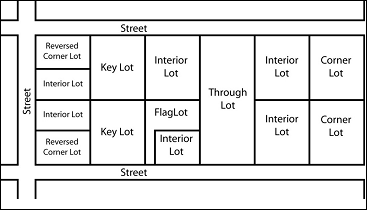
Lot, corner: A lot located at the intersection of two or more streets at an angle of not more than 120 degrees. If the angle is greater than 120 degrees, it shall be considered an interior lot. If a lot meets the definition of a corner lot but has imposed a nonvehicular access easement and a solid masonry wall on a street side, then this area shall be an interior lot line for purposes of determining yard areas and setbacks. The designation of the front and side of a corner lot may be made by the subdivider.
Lot coverage: That portion of a lot or building site which is occupied by any building, accessory structure or covered patio used for human occupancy.
Lot, cul-de-sac or curvilinear: A lot fronting on, or with more than one-half of its width fronting on the turn-around end of the cul-de-sac street or on the outside curve of a curvilinear street.
Lot depth: The average horizontal distance between the front and rear lot lines of interior lots measured in the same direction as the side lines of interior lots. Lot depth for all other lots is the average horizontal distance from the front lot line to the most opposite lot line.
Lot, flag: A flag lot is a property located behind another property, with an access strip of land to get back to it from a public street.
Lot, key: Any lot so located where the side lot line abuts the rear lot line of one or more lots, and is not separated by an alley.
Lot or parcel of land: The term lot or parcel of land shall mean:
A.
A piece of real property with a separate and distinct number or other designation shown on a plat recorded in the office of the County Recorder of Stanislaus County; or
B.
A piece of real property delineated on an approved record of survey, lot split or subparceling map as filed in the office of the County Recorder and abutting at least one public street; or
C.
A piece of real property containing not less lot area than required by the zone in which it is located, abutting at least one public street and held under separate ownership from adjacent property prior to the effective date of the ordinance codified in this title.
Lot, reversed corner: A corner lot, the side line of which is substantially a continuation of the front lot lines of the lots to its rear, whether across an alley or not.
Lot, interior: A lot other than a corner lot.
Lot, substandard: A lot whose area, width, or depth is less than that required in the zone in which it is located.
Lot, through, double frontage lot: A lot having frontage on two parallel or approximately parallel dedicated streets, not including a corner or reversed corner lot. The Planning Commission shall determine which frontage or frontages shall be considered as the lot front or lot frontages for purposes of compliance with yard, setback, and lot depth provisions of this title.
Lot line or property line: Any line bounding a lot as defined by this Code.
Lot line, front:
A.
On an interior lot, "front lot line" means the property line abutting a street.
B.
On a corner lot, the subdivider may determine which property line shall be the front lot line.
C.
On a through lot or a lot with three or more sides abutting a street, the Planning Commission shall determine which property line shall be the front lot line.
Lot line, rear: A lot line not normally abutting a street which is normally opposite and most distant from the front lot line. "Rear lot line" shall be established as follows:
A.
Interior lots rear lot line shall be opposite the front line.
B.
Triangular or irregularly shaped lot, rear lot line shall be established by a line within the lot, parallel to and at a maximum distance from the front lot line, having a length of not less than ten feet.
C.
A lot which is bounded on all sides by streets may have no rear lot line.
D.
Corner lot, rear lot line will normally be the lot line opposite the front lot line. However, the developer may for site design purposes establish the interior side lot line as the rear lot line and the rear lot line as the interior side lot line. Such designation must be requested by the developer and approved by Director of Community Development.
Lot line, side: Any lot line not a front lot line or rear lot line. On a lot with three or more sides abutting a street, all lot lines abutting a street, other than the front lot line, may be side lot lines. On lots with two or more sides abutting the street, the side lot line(s) abutting a street shall be the exterior side lot line and the side lot line(s) not abutting a street shall be known as the interior side lot line(s).
Lot of record: A parcel of land as shown on the records of the County Assessor at the time of the passage of the ordinance codified by this title.
Lot width: The width of the lot at its narrowest width. Said width is determined at the front property line for interior lots through lots and corner lots. The width of cul-de-sac, curvilinear and irregular lots may be determined at the front yard setback line.
Lowest floor: The lowest floor of the lowest enclosed area, including basement. An unfinished or flood-resistant enclosure, usable solely for parking of vehicles, building access or storage in an area other than a basement area (see definition of "basement") is not considered a building's lowest floor, provided that such enclosure is not built so as to render the structure in violation of the applicable nonelevation design requirements of this chapter. (Note: This definition allows attached garages to be built at grade. Below grade garages are not allowed as they are considered to be basements.)
Main dwelling unit: The primary dwelling unit, existing or proposed, which provides complete independent living facilities for one or more persons.
Maintenance: The term "maintenance" shall mean:
A.
For buildings, walls, fences, driveways, walkways, parking lots, courts, and patios; to paint, repair or perform other various tasks needed to keep the aforementioned in a state as prescribed by the Director of Community Development.
B.
For landscaped areas; to water, prune, fertilize, spray or perform other various tasks needed to keep the aforementioned in a maintained and manicured state.
Marquee: A fixed shelter used only as a roof extending over a building line and which is entirely supported by the building to which it is attached.
Manufactured home: A structure, transportable in one or more sections, which is built on a permanent chassis and is designed for use with a permanent foundation when attached to the required utilities. The term "manufactured home" does not include a "recreational vehicle."
Manufactured home park or subdivision: A parcel (or contiguous parcels) of land divided into two or more manufactured home lots for rent or sale.
Mean ground level: The top of the nearest adjoining curb. If there are not adjoining curbs, the "mean ground level" shall mean the average natural elevation of the lot or piece of property.
Mean sea level: For purpose of the National Flood Insurance Program, the National Geodetic Vertical Datum (NGVD) of 1929 or other datum, to which base flood elevations shown on a community's flood insurance rate map are referenced.
Mitigated negative declaration: A written statement prepared by the lead agency, as required by the California Environmental Quality Act stating that revisions or conditions of approval for a project and agreed to by the applicant, will not have a significant effect on the environment.
Mobile home: A transportable structure or trailer coach built on a chassis for future movement, and designed to be used as a dwelling without a permanent foundation when connected to the required utilities, and intended for occupancy by one family. No such structure shall be deemed to be a mobile home which is less than eight feet nor greater than 14 feet in width for a single section, nor less than 32 feet nor greater than 70 feet in length for a single section.
Mobile home access drive: A private thoroughfare which affords internal circulation for a mobile home park.
Mobile home access drive line: The boundary line between an access drive and the abutting mobile home space.
Mobile home access drive, side: That access drive bounding a corner mobile home space and which extends in the same general direction as the line determining the depth of the mobile home space.
Mobile home area: The sum in square feet of the ground area occupied by a mobile home and all structures on a mobile home space.
Mobile home building line: A line parallel with the front mobile home line or access drive and distance there from the depth of the required front yard.
Mobile home park: Any area or tract of land where space is rented or sold or held for rent to one or more owners or users of residential trailers or mobile homes.
Mobile home park storage area: An area within a mobile home park intended for the storage of items and the accommodation of uses commonly associated with and incidental to the uses permitted in a mobile home park and its operation and maintenance thereof.
Mobile home, residential: Vehicle with or without motive power, designed and constructed to travel on the public thoroughfares in accordance with the provisions of the California State Vehicle Code and to be used for human habitation.
Mobile home space: A plot of ground within any trailer park designed for the accommodation of one residential trailer and related facilities.
Mobile home space, corner: A mobile home space situated at the intersection of two or more access drives.
Mobile home space depth: The horizontal distance between the front and rear mobile home space line.
Mobile home space, interior: A mobile home space other than a corner mobile home space.
Mobile home space line, front: In case of an interior mobile home space, a line separating the mobile home space from the access drive, and in the case of a corner lot, a line separating the narrowest access drive frontage of the mobile home space from the access drive.
Mobile home space line, rear: A mobile home space line which is opposite and most distant from the front mobile home space line and, in the case of an triangular or irregularly shaped mobile home space, a line within the mobile home space line, having a length of not less than ten feet.
Mobile home space line, side: Any mobile home space boundary line not a front mobile home space line or a rear mobile home space line.
Mobile home space width: The horizontal distance between the side mobile home space lines measured at right angles to the mobile home space depth at the front mobile home line.
Mobile home space yard: An open area on a mobile home space unoccupied and unobstructed from the ground upward.
Mobile home space yard, front: mobile home space yard extending across the full width of the mobile home space, the depth of which is the distance between the front mobile home space line and the building line.
Mobile home space yard, rear: A mobile home space yard contiguous to the rear line of a mobile home space and extending from side line to side line.
Mobile home space yard, side: A mobile home space yard between the mobile home and the side line, extending from the front building line to the rear yard.
Motel: A building or group of buildings used for transient residential purposes containing guest rooms or dwelling units with automobile parking space provided in connection therewith, which building or group is designated, intended, or used primarily for the accommodation of transient automobile travelers; including groups designated as auto cabins, auto courts, motor courts, motor hotels, and similar designations.
Negative declaration: A written statement prepared by the lead agency, as required by the California Environmental Quality Act briefly describing the reasons why a proposed project will not have a significant effect on the environment.
Net acre: For the purposes of this title, the term "net acre" shall mean an acre of land less all required public dedications. For computation purposes, a "net acre" is assumed to be 75 percent of a total gross acre, or undeveloped acre, or portion thereof.
Net density: The number of dwelling units per net acre of land.
Nonconforming building: A building or portion thereof lawfully existing on the effective date of the ordinance codified in this title, which was designed, erected or structurally altered for use which does not conform to the uses permitted in the zone in which it is located, or which does not comply with one or more of the property development standards of the zone in which it is located.
Nonconforming use: A lawful use of a building or land existing on the effective date of the ordinance codified in this title which does not conform to the uses permitted in the zone in which it is located.
Nursing home: A structure operated as a lodging house in which nursing, dietary, and other personal services are rendered to convalescents, invalids, or aged persons, not including persons suffering from contagious or mental diseases, alcoholism, or drug addiction, and in which surgery is not performed and primary treatment, such as customarily is given in hospitals and sanitariums, is not provided. A convalescent home or a rest home shall be deemed a nursing home.
Obstruction: For floodplain purposes, includes, but is not limited to, any dam, wall, wharf, embankment, levee, dike, pile, abutment, protection, excavation, channelization, bridge, conduit, culvert, building, wire, fence, rock, gravel, refuse, fill, structure, vegetation or other material in, along, across or projecting into any watercourse which may alter, impede, restrain, retard or change the direction and/or velocity of the flow of water, or due to its location, its propensity to snare or collect debris carried by the flow of water, or its likelihood of being carried downstream.
Open space: The area of a lot which is not occupied by building coverage, parking lot or driveway.
Open space, private: That usable open space which is intended to be used by the occupants of a single dwelling unit.
Open space, public: That usable open space which is intended to be used by the occupants of several dwelling units.
Ordinance or zoning ordinance:Title 18 of the Ceres Municipal Code.
Parking area, common: A public or private parking area jointly used by two or more uses.
Parking area, private: An open area, other than a street, used for parking of automotive vehicles and restricted from general public use. Such areas shall have frontage on or access to a dedicated street or alley.
Parking area, public: An area, other than a private parking area or street used for the parking of vehicles and available for public or quasi-public use, either free or for a fee. Such areas shall have frontage on or access to a dedicated street or alley.
Parking space, automobile: Space exclusive of driveways, ramps, columns, loading areas, office or work areas within a building or open parking area for the parking of one automobile. A parking space shall be not less than nine feet in width, 20 feet in length and shall be accessible and usable for the parking of a standard motor vehicle.
Patio: An open area or an accessory outdoor living structure not exceeding 14 feet in height and open on at least one side. If covered, a patio shall be included for the purposes of determining let coverage and floor area ratio.
Permittee: The person, firm or corporation who is proposing to use or who is using the land pursuant to the permit required by this title at the time the matter is under consideration in connection with any procedure under this title.
Permitted use: Any use listed as a principal use or accessory use, and shall further include a conditional use as listed for the particular district, provided a conditional use permit is obtained.
Person: An individual, firm, partnership, joint venture, association, social club, fraternal organization, corporation, estate, trust, receiver, syndicate, the federal or State government, City, County special district, or any other group or combination acting as an entity, excepting the City.
Planned community: For the purposes of this title, the term "planned community" shall mean:
A.
Land under unified control, planned and developed as a whole;
B.
In a single development operation or a definitely programmed series of development operations, including all lands and buildings;
C.
For principal and accessory structures and uses substantially related to the character of the district;
D.
According to comprehensive and detailed plans which include not only streets, utilities, lots or building sites, and the like, but also site plans, floor plans, and elevations for all buildings as intended to be located, constructed, used, and related to each other, and detailed plans for other uses and improvements on the land as related to the buildings, and;
E.
With a program for provisions, operation, and maintenance of such areas, improvements, facilities, and services as will be for common use by some or all of the occupants of the district, but will not be provided, operated or maintained at general expense.
Plant nursery: Land and buildings improved and intended for sale of planting stocks, gardening equipment, and related outdoor furniture, supplies, and masonry. "Plant nursery" shall not include a "cannabis business" as defined in section 5.22.020 of the Ceres Municipal Code.
Planting, maintenance required: In a space between a fence or wall and a property line or right-of-way line, the planting shall be regulated so as to maintain the required open areas in the fence structure in order to preserve passage of light and air and permit necessary visibility.
Portable outdoor storage unit: Any container which is rented, loaned or owned by owners or occupants of property for their temporary use and is designed for the transportation and storage of personal property of any kind.
Poultry: A species of fowl.
Poultry farm: Any premises on which the primary use is the breeding, raising or maintaining of poultry for sale, or for production of eggs for sale, or both, or where the primary income from the premises is derived from the aforesaid occupation.
Prezoning: The zoning of unincorporated property by the City of Ceres prior to its annexation by the City.
Private noncommercial use: A use operated by a private nonprofit club or association, such as fraternal association, improvement associations, and similar groups; said use having the purpose primarily of serving the members of the club or association and including uses such as private golf courses, country clubs, swimming pools, riding clubs, private lodges and like uses.
Property development standards: Regulations to be applied to each district addressing:
A.
Lot area.
B.
Lot coverage.
C.
Lot dimensions.
D.
Setback requirements.
E.
Distance between buildings.
F.
Population density.
G.
Building height.
H.
Site plan approval.
I.
Yards, landscaping, open space requirements.
J.
Fences, hedges, walls.
K.
Off-street parking and loading.
L.
Access.
M.
Signing.
N.
Laundry and clothes drying areas.
O.
Solid waste storage, disposal facilities.
P.
Recreational areas.
Q.
Park-in-lieu fees.
R.
Security.
Property line: Property line shall have the same meaning as lot line.
Provisions: Includes all regulations and requirements referred to in reference.
Quasi-public organization: Any nongovernmental, nonprofit organization that is devoted to public service or welfare.
Recreational facility: A building or place that provides a particular service or is used for a particular industry.
Recreational vehicle: A vehicle which is:
A.
Built on a single chassis;
B.
Four hundred square feet or less when measured at the largest horizontal projection;
C.
Designed to be self-propelled or permanently towable by a light-duty truck; and
D.
Designed primarily not for use as a permanent dwelling but as temporary living quarters for recreational, camping, travel, or seasonal use.
Recycling center: An operation which is certified by the California Department of Conservation and which accepts from consumers, and pays or provides the redemption value and applicable redemption bonus pursuant to section 14572 of the California Public Resources Code for empty beverage containers intended to be recycled.
Regulatory floodway: The channel of a river or other watercourse and the adjacent land areas that must be reserved in order to discharge the base flood without cumulatively increasing the water surface elevation more than one foot.
Residence: A building used, designed and intended to be used as a home or dwelling place.
Residential: Describes those areas and buildings within the City used primarily for living and dwelling purposes.
Residential care facilities: A state-licensed structure operating as a lodging house in which nursing, dietary, and other personal services are rendered to convalescents, invalids, or aged persons in return for compensation, but in which no surgical or other primary treatments, such as customarily provided in hospitals or sanitariums are performed, and in which no persons are kept or served who normally would be admissible to a mental hospital. Residential care facilities include convalescent homes, rest homes, nursing homes, and other residential care facilities as deemed similar by the Director of Community Development.
Rest home for the aged: A building containing a State or County licensed dwelling unit, where lodging is provided with or without meals for compensation to more than three ambulatory, well, and 65 years old or over nontransients.
Restore or renovate: To return a use, building, structure, or piece of land to a former or normal state.
Retail store: A business selling goods, wares, services, or merchandise directly to the ultimate consumer.
Rezoning: The legislative act of amending a zoning designation of a property on the zoning map, which changes said designation from one zone district to another zone district.
Riverine: Relating to, formed by, or resembling a river (including tributaries), stream, brook, etc.
Room: An interior space of a building of structure totally enclosed or set apart by walls, including closets or hallways.
Sanitarium: A health station or retreat or other place where patients are housed and where medical or surgical treatment is given. This does not include mental institutions or places for the treatment of narcotics addicts.
Schools; elementary, intermediate, junior high, and high: An institution of learning which offers instructions in the several branches of learning and study required to be taught in the public schools by the Education Code of the State.
School, private: An institution conducting regular academic instruction at kindergarten, elementary and secondary levels operated by a nongovernmental organization.
Setback line, front yard: The line which defines the depth of the required front yard. The setback line is parallel with the street line, or when established by general plan, with the highway right-of-way, removed therefrom by the perpendicular distance prescribed for the front yard in the zone.
Setback line, rear yard or side yard: The line which defines the width or depth of the required rear or side yard. The setback line is parallel with the property line, removed therefrom by the perpendicular distance prescribed for the yard in the zone.
Shipping container: Any container which is rented or purchased by owners or occupants of property for their temporary or permanent use and is designed for storage of personal property of any kind.
Shopping center: Any combination of five or more separately owned and operated offices or commercial uses developed as a single project on a site of at least one acre, and includes neighborhood commercial as well as community commercial uses.
Side street: That street bounding a corner or reversed corner lot which extends in the same general direction as the line determining the depth of the lot.
Site plan or plot plan: A mechanical drawing of a piece of property, including but not limited to the following:
A.
Name and address of the owner of the property.
B.
Name and address of the person who prepared the plan.
C.
North point.
D.
Scale—preferably no less than one inch equals 30 feet, or 1/8″ = 1′.
E.
Date of preparation.
F.
Proposed use classification for each building or activity area.
G.
All required street widening, street width and parkway widths, and alleys.
H.
Location of all existing or proposed public or private easements.
I.
Overall dimensions of entire property, identify all property lines.
J.
Net area of site.
K.
A complete legal description and site address.
L.
Indicate the square footage of each building or activity area and total number of parking spaces provided.
M.
Location, by dimension and proper labeling, of all:
1.
Buildings, building heights and activity areas;
2.
Parking areas, including layout of parking stalls and landscaping;
3.
Driveways, alleys, and accessways, including entrances to and from;
4.
Public streets;
5.
Sidewalks (public), and walkways (private);
6.
Fences, walls, screens, and landscaping;
7.
Exterior lighting;
8.
Site drainage, including natural drainage courses;
9.
Signs;
10.
Recreation areas, facilities.
N.
Disposition of all existing buildings on the property.
O.
Indicate location and extent of any filled ground or dump conditions.
P.
Existing and finish grades and drainage plan.
Site plan approval (SPA): The approval by the Planning Commission of a site plan, floor plans, elevations and a landscape plan of a proposed development to ensure that the development is in conformity with both the intent and provisions of this title.
Slope: A natural or artificial incline, as a hillside or terrace. Slope is usually expressed as a ratio. For example, a horizontal distance of 50 feet with a rise of 100 feet would be expressed as a 1:2 slope.
Special flood hazard area (SFHA): An area having special flood hazards and shown on an FHBM or FIRM as zone A, AO, A1-A30, AE, A99, or AH.
Stable, private: A detached accessory building for the keeping of horses owned by the occupants of the premises and not kept for remuneration, hire or sale.
Stable, riding: Any stable where horses are kept for hire.
Start of construction: Includes substantial improvement, and means the date the building permit was issued, provided the actual start of construction, repair, reconstruction, rehabilitation, addition placement, or other improvement was within 180 days of the permit date. The actual start means either the first placement of permanent construction of a structure on a site, such as the pouring of slab or footings, the installation of piles, the construction of columns, or any work beyond the stage of excavation; or the placement of a manufactured home on a foundation. Permanent construction does not include land preparation, such as clearing, grading and filling; nor does it include the installation of streets and/or walkways; nor does it include excavation for a basement, footings, piers, or foundations or the erection of temporary forms; nor does it include the installation on the property of accessory buildings, such as garages or sheds not occupied as dwelling units or not part of the main structure. For a substantial improvement, the actual start of construction means the first alteration of any wall, ceiling, floor, or other structural part of a building, whether or not that alteration affects the external dimensions of the building.
Storage: The placing or keeping of personal property of any kind in a yard or on a lot.
Story: A space in a building between the surface of any floor and the surface of the floor next above, or if there be no floor above, then the space between such floor and the ceiling or roof above.
Story, half: A partial story under a gable, hip or gambrel roof, the wall plates of which on at least two opposite exterior walls are not more than four feet above the floor of such story, provided, however, that any partial story used for one or more dwelling units, shall be deemed a full story.
Street, road: A public or approved private right-of-way which provides a means of access to abutting property.
Street, center line: The center line of a street or right-of-way as established by official surveys.
Street, collector: A street which is intended to ultimately serve more than 50 dwelling units and has a minimum width of 60 feet.
Street line: The boundary line between a street right-of-way and abutting property.
Street, local, minor street: A street which is intended to ultimately serve 50 or less dwelling units and has a minimum width of 50 feet.
Street, major, arterial street: A street which has a minimum width of 100 feet.
Structural alteration: Any change in the supporting members of a building, such as in a bearing wall, column, beam or girder, floor or ceiling joists, roof rafters, roof diaphragms, roof trusses, foundations, piles or retaining walls or similar components.
Structure: Anything constructed or built, any edifice or building of any kind, or any piece of work artificially built up or composed of parts, joined together in some definite manner, which requires location on the ground or is attached to something having a location on the ground, including swimming and wading pools and patios, excepting outdoor areas such as paved areas, walks, tennis courts and similar recreation components.
Substantial damage: Damage of any origin sustained by a structure whereby the cost of restoring the structure to its before-damaged condition would equal or exceed 50 percent of the market value of the structure before the damage occurred. Market value shall be determined by estimating the cost to replace the structure in new condition and adjusting that cost figure by the amount of depreciation which has accrued since the structure was constructed. The cost of replacement of the structure shall be based on a square foot cost factor determined by reference to a building cost estimating guide recognized by the building construction industry. The amount of depreciation shall be determined by taking into account the age and physical deterioration of the structure and functional obsolescence as approved by the floodplain administrator, but shall not include economic or other forms of external obsolescence. Use of replacement costs or accrued depreciation factors different from those contained in recognized building cost estimating guides may be considered only if such factors are included in a report prepared by an independent professional appraiser and supported by a written explanation of the differences.
Substantial improvement: Any reconstruction, rehabilitation, addition, or other proposed new development of a structure, the cost of which equals or exceeds 50 percent of the market value of the structure before the "start of construction" of the improvement. This term includes structures which have incurred "substantial damage," regardless of the actual repair work performed. The term does not, however, include either:
A.
Any project for improvement of a structure to correct existing violations or State or local health, sanitary, or safety code specifications which have been identified by the local code enforcement official and which are the minimum necessary to assure safe living conditions; or
B.
Any alteration provided that preclude the designation as of a "historic structure," provided the alteration will not preclude the structure's continued designation as a "historic structure."
Supermarket: A market having 10,000 or more square feet of floor area devoted principally to the sale of food.
Supportive housing: Housing with no limit on length of stay, that is occupied by a target population, and that is linked to an on-site or off-site service that assists the supportive housing residents in retaining housing, improving his or her health status, and maximizing his or her ability to live and, when possible, work in the community.
Swimming pool: An above grade or below grade body of water created by artificial means which is designed for and offers the possibility of use for swimming, bathing and/or total bodily immersion by any person, any portion of which exceeds 18 inches in depth. This definition shall not include: hot tubs, spas, bathtubs, whirlpool baths, therapeutic baths, saunas or similar structures as determined by the Planning Commission when located at least 24 inches above finished grade and physically separated from a swimming pool structure by at least three feet.
Target population: Persons with low incomes who have one or more disability, including mental illness, HIV or AIDS, substance abuse, or other chronic health condition, or individuals eligible for services provided pursuant to the Lanterman Developmental Disabilities Services Act (division 4.5, commencing with section 4500 of the Welfare and Institutions Code), and may include, among other populations, adults, emancipated minors, families with children, elderly persons, young adults aging out of the foster care systems, individuals exiting from institutional settings, veterans, and homeless people.
Temporary use: A use intended to be operated on a temporary or seasonal basis. Temporary uses shall include the following types:
A.
Seasonal or theme-oriented use: This type of use shall be limited to fireworks stands, pumpkin lots, Christmas tree lots, and City-sponsored activities. These uses shall not be operated for a period of more than 30 days during a 12-month period.
B.
Special business use event: This type of use is defined as one which is operated in conjunction with established permanent commercial uses which do not result in a substantial alteration to the capacity and/or circulation of off-street parking areas as determined by the Director of Community Development. Such activities may include grand openings, sidewalk sales, parking lots sales, promotions, and related activities, and other similar activities as may be determined by the Director of Community Development. The sales of items at such special business or use events shall be limited to only those types of merchandise customarily offered for sale by the business conducting the special business or use event. Special business or use event sales shall be conducted only on property immediately adjacent to the business conducting the sale.
C.
Photography/filming: This type of permit shall be processed under temporary use permits as identified under subsection 18.30.030.D, of the Ceres Municipal Code, and shall also be required to receive clearance through the City Council for any street closures or use of public rights-of-way in accordance with chapter 12.01 of the Ceres Municipal Code.
Trade school: Private schools offering instruction preponderantly in the technical, commercial or trade skills, such as real estate schools, business colleges, electronic schools, automotive and aircraft technicians schools and similar commercial establishments.
Trailer: A vehicle without motor power designed and constructed to travel on the public thoroughfares in accordance with the provisions of the California State Vehicle Code and to be used for human habitation. No trailer shall be used as a place of human habitation except in regularly established trailer parks.
Transient: A person who received dwelling accommodations for a price, with or without meals, for a period of not more than 180 consecutive days.
Transitional housing: Buildings configured as rental housing developments, but operated under program requirements that require termination of assistance and recirculating of the assisted unit to another eligible program recipient at a predetermined future point in time that shall be no less than six months from the beginning of the assistance.
Usable open space: The term "usable open space" shall mean:
A.
The aggregate area of front, side and rear yards, uncovered patios, and balconies and decks having a depth of not less than six feet and area not less than 60 feet, on a building site or building which is available and accessible to the occupants of the building or building site for purposes of active and/or passive outdoor recreation.
B.
This area is exclusive of driveways, areas for off-street parking and services, and ground level areas with a width of less than five feet or maximum dimension of under ten feet. At least 75 percent of the usable open space shall have a slope of ten percent or less.
Use: The purpose for which land or building is erected, enlarged, arranged, designed or intended, or for which land or building is or may be occupied or maintained.
Used: Includes the words "arranged for," "designed for," "occupied for," or "intended to be occupied for."
Variance (floodplain management regulation): A permit for deviation from the terms of a floodplain management regulation and the provisions established in the zone in which the property is located, granted by the Planning Commission pursuant to and intended to permit the fair use of property in cases where the strict enforcement of the law would, because of exceptional conditions on the land such as the location, size, shape or slope of the lot, work an unnecessary hardship on the subject property which would not apply to other properties in the same zone.
Violation: The failure of a structure or other development to be fully compliant with the community's floodplain management regulations. A structure or other development without the elevation certificate, other certifications, or other evidence of compliance required in Chapter 40 is presumed to be in violation until such time as that documentation is provided.
Visual obstruction: Any fence, hedge, tree, shrub, wall or structure exceeding three feet in height, measured from the crown of intersecting or intercepting streets, alleys or driveways, which limit the visibility of persons in motor vehicles on the streets, alleys or driveways. This does not include trees kept trimmed of branches below a minimum height of seven feet.
Wall: Any structure or device forming a physical barrier, which is so constructed that 50 percent or more of the vertical surface is closed and prevents the passage of light, air, and vision through the surface in a horizontal plane. This shall include concrete, concrete block, wood or other materials that are solids and are so assembled as to form a solid barrier. Walls shall be constructed to conform to the standards of the City's Building Code and/or California Building Code. Walls within in front or exterior side yard setback shall not be more than three feet in height.
Water surface elevation: The height, in relation to the National Geodetic Vertical Datum (NGVD) of 1929, (or other datum, where specified) of floods of various magnitudes and frequencies in the floodplains of coastal or riverine areas.
Watercourse: A lake, river, creek, stream, wash, arroyo, channel or other topographic feature on or over which waters flow at least periodically. "Watercourse" includes specifically designated areas in which substantial flood damage may occur.
Wholesaling: The selling of any type of goods for the purpose of resale.
Yard: Any open space other than a court on the same lot with a building or a dwelling group, which space is generally open from the ground to the sky, except for the projections and/or accessory buildings permitted by this title.
Yard, front: A space between the front yard setback line and the front lot line of the existing or future highway right-of-way line, and extending the full width of the lot.
Yard, rear: A space between the rear yard setback line and the rear lot line, extending the full width of the lot.
Yard, side: A space extending from the front yard setback line, or from the front lot line where no front yard is required by this title, to the rear yard setback line or rear lot line between a side line and side yard setback line.
Yard, exterior side: A space extending from the front yard setback line to the rear year setback line for a property that is located on a corner.
Zone (district): A portion of the City within which the use of land and structures and the location, height, and bulk of structures are governed by this title.
(Ord. No. 2020-1059, § 1, 3-23-2020; Ord. No. 2021-1068, § 3, 7-12-2021; Ord. No. 2021-1067, § 1, 7-26-2021)

