
Ceres City Zoning Code
CHAPTER 26
SIGNING STANDARDS
18.26.010 - Purpose and intent.
The purpose of this chapter is to establish sign regulations that are intended to:
A.
Protect the general public health, safety, welfare and aesthetics of the community.
B.
Promote the City's standards for appearance by regulating the design, character, location, type, quantity, quality of materials, scale, color, illumination, and maintenance of signs.
C.
Improve pedestrian and traffic safety.
D.
Maintain and enhance the City's ability to attract and retain businesses which are sources of economic development, employment, and revenue for the City and its residents.
E.
Minimize the possible adverse effect of signs on nearby public and private property.
F.
Enable the fair and consistent enforcement of these sign regulations.
(Ord. No. 2020-1059, § 1, 3-23-2020)
18.26.020 - Applicability.
No sign may be erected, placed, established, painted, created or maintained in the City except in conformance with the standards, procedures, exemptions, and other requirements of this chapter. Any applicable master or specific plan guidelines may be more restrictive. The effect of these regulations is to:
A.
Establish an approval system to allow a variety of types of signs, subject to the standards and procedures of this chapter.
B.
Allow certain signs that are small, unobtrusive, and incidental to the principal use of the respective lots on which they are located, subject to the substantive requirements of this chapter, but without a requirement for formal approvals.
C.
Provide for temporary signs in limited numbers and circumstances.
D.
Provide for the repair or removal of abandoned, dilapidated or unsafe signs, which may be causing a hazard for pedestrians or vehicles.
E.
Provide for the enforcement of the provisions of this chapter.
(Ord. No. 2020-1059, § 1, 3-23-2020)
18.26.030 - Approvals.
A sign approval shall be obtained from the Planning Division before erection or display of any signs, except as provided by section 18.26.060. A building permit is generally required for most types of new signs made of permanent materials and shall be obtained concurrent with or immediately following any sign approval required.
A.
A sign approval shall expire 18 months after its effective date, unless the sign has been erected or a different expiration date is stipulated at the time of approval. A sign approval shall remain valid for the duration of any building permit issued for the proposed sign.
B.
A sign approval shall become void if the sign is not constructed, installed, or maintained in accordance with the approved application. The sign will then be considered illegal and shall be required to be corrected to conform to the terms of this chapter or be abated according to the provisions of section 18.26.140. Any sign not legally erected or erected without a sign approval after the effective date of this chapter shall be considered illegal.
(Ord. No. 2020-1059, § 1, 3-23-2020)
18.26.040 - Fees.
Each application for a sign for which an approval is required by this chapter shall be accompanied by a sign approval fee as established by City Council resolution from time to time.
(Ord. No. 2020-1059, § 1, 3-23-2020)
18.26.050 - Definitions.
The following words and phrases utilized in this chapter not defined elsewhere are defined below:
A-frame sign. A freestanding sign usually hinged at the top, or attached in a similar manner, and widening at the bottom to form a shape similar to the letter "A." Such signs are usually designed to be portable, hence they are not considered permanent signs.
Abandoned sign. Any display remaining in place or not maintained for a period of 180 days or more which no longer advertises or identifies an ongoing business, product or service available on the business premises where the display is located.
Animated or moving sign. Any sign which uses movement lighting or special materials to depict action or create a special effect.
Architectural feature. An element that appears to be part of the designated sign area, but is actually physically integrated into a building's design (stone, stucco, wood or other building material) and is not utilized as part of calculating sign area (i.e., illuminated sign letters vs. non-illuminated background area for signage).
Attached sign. Any sign which is affixed to and made an integral part of a building or structure. Attached signs include, but are not limited to wall signs, roof signs and projecting signs, to distinguish them from freestanding and ground signs.
Awning. A temporary or permanent structure attached to, or supported by a building, designed for aesthetics, or shelter over a pedestrian or vehicular way and which may or may not project over public property.
Balloon. Any cloth, plastic, paper, or similar material used for advertising purposes, typically hot or cold air captive balloons, inflatable animals, or similar signs, which may be attached to any structure, staff, pole, line, framing or vehicle, and may or may not be designed to move with the wind.
Banner. Any cloth, plastic, paper, or similar material used for advertising purposes attached to any structure, staff, pole, line, framing or vehicle, anchored or secured to attract attention by windblown movement.
Business center. Shopping centers, major single-tenant and multi-tenant commercial and industrial buildings located on sites greater than five acres.
Business frontage. The primary business frontage is that portion of the building elevation facing a street, parking lot or walkway in which the primary entrance to the building is located. All other business frontage is secondary business frontage. If more than one business is located in a single building, then such length shall be limited to that portion which is occupied by each individual business.
Canopy. Any fixed overhead shelter used as a roof, which may or may not be attached to a building and which does not project over public property.
Construction sign. Sign located on a site during construction, which informs of new buildings, opening dates, leasing opportunities and/or identifies the architects, engineers, contractors, and financiers.
Dilapidated sign. Any sign or element of a sign which is excessively weathered or structurally unsound, or where the copy can no longer be seen or understood by a person with normal eyesight under normal viewing conditions.
Directional sign. The primary intent of the directional sign is to direct both pedestrian and vehicular traffic to parking or buildings on the premises that are not readily identifiable from the adjacent sidewalk or street. The advertisement of the business or use is not the main function of this type of sign.
Electronic changeable copy sign. A sign utilizing grouped lighting elements under electronic control to permit the regular and frequent change of copy.
Feather banner. Any cloth, plastic, paper or similar material used for advertising purposes attached to any pole or similar device, anchored or secured to attract attention by windblown movement.
Flag. Any cloth, plastic, paper or similar material used for advertising purposes, most typically flown from a pole, but may be attached to any structure, staff, pole, line, framing or vehicle, whose windblown movement is designed to attract attention, but not including official flags of the United States, the State of California and other states of the nation, counties, municipalities, official flags of foreign nations and nationally or internationally recognized organizations.
Free standing sign. Any sign which is supported by structures or supports that are not attached to a building or buildings.
Ground sign. A freestanding sign six feet or less in height with a base or method of support which is an integral part of the sign.
Highway oriented use. Any professional, retail or commercial, or industrial use located on property within 200 feet of the State Highway 99 right-of-way.
Marquee. A permanent roofed structure attached to and supported by a building and projecting over public property.
Neon signs. Any type of advertising with tubes internally illuminated with neon or similar type of gas. A single neon tube, used around a building as a trim or accent, is not considered a sign.
Nonconforming sign. Any legally established sign which fails to conform to the regulations of this chapter.
Off-site advertising or billboard. Any sign advertising an establishment, merchandise, service or entertainment, which is not sold, produced, manufactured or offered at the property on which the sign is located.
Pennant. Any cloth, plastic, paper or similar material used for advertising purposes, most typically hung along a string, but may be attached to any structure, staff, pole, line, framing or vehicle, whose windblown movement is designed to attract attention.
Portable sign. Any sign not permanently attached to the ground or other permanent structure, or a sign designed to be transported.
Project identification monument sign. A specific type of ground sign supported from grade to the bottom of the sign with the appearance of having a solid base. These signs are generally located at the primary entry points to a project, and identify the name of a center or group of buildings rather than that of an individual tenant.
Reader board. A sign constructed so that individual letters or other advertising material can easily be changed, used only by businesses, activities or uses that depend on frequently changing events.
Sign. Any device, fixture, placard or structure that uses any color, form, graphic, illumination, symbol or writing to advertise, announce the purpose of a person or entity, or communicate information of any kind to the public.
Sign approval. An approval issued by the Planning Division to any person or entity authorized by this chapter to erect a sign, except as exempted. A building permit issued by the Building Department may also be required prior to a sign being lawfully erected.
Sign area. The entire face of a sign, including the surface and any framing projections or molding, but not including the support structure. Where a sign consists of individual letters or an individual logo/symbol that is attached to or painted on the wall of a building or structure where there is no distinguishable frame or border, the combined square footage of each individual letter or individual logo/symbol will be considered as the sign area. If the calculations of individual letters or logos/symbols cannot be determined, then dimensions around each letter or logo/symbol may be used to determine the sign area. For ground signs, figure 1 illustrates measurements of sign area and height. Ground sign area is the area of the sign and structure beginning at a point above the base or pedestal upon which the sign is mounted.
Figure 1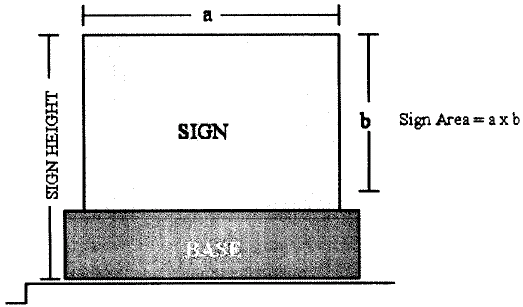
Sign height. Sign height shall be measured as the vertical distance from the top of the street curb nearest the sign, to the top of the sign, including the support structure and any design elements. See figure 1.
Temporary sign. Nonilluminated signs on private property either designed to be displayed for a short period of time, not permanently affixed to a building or property or constructed of lightweight materials such as paper, cloth, cardboard, wallboard, etc.
Window sign. Any sign that is painted, applied or attached to a window or located in such a manner that it can be seen from the exterior of the structure.
Yard sign. A sign placed in the front or side yard of any property that does not exceed more than six square feet and is not more than three feet in height.
(Ord. No. 2020-1059, § 1, 3-23-2020)
18.26.060 - Exempt signs.
A sign approval is not required for the signs contained in this section. The location, number, and area of these signs are regulated only by this section and are allowed in addition to signs regulated by other sections of this chapter.
A.
Official signs. Official signs posted pursuant to and in the discharge of any governmental function by public officials in the performance of their duties (including traffic and street name signs, as well as notices, emblems or other forms of identification and signs required by law). Sign groupings for the purpose of display of logos of nonprofit service organizations where such grouping is provided for and approved by the City Council shall be considered official signs.
B.
Interior signs. Signs located in the enclosed lobby or court of any building or group of buildings, which are not visible from any public right-of-way.
C.
Window signs. Signs in windows not exceeding 25 percent of the window area. Painted windows signs that celebrate the recognized holidays, and not commercial advertisements or sales, shall not exceed 50 percent of the window area.
D.
Informational signs. Signs for the safety and convenience of the public such as "restrooms," "danger," "impaired clearance," "no smoking," and other signs of a similar nature, up to two square feet per sign, unless a larger sign is otherwise required by State or Federal law.
E.
Yard signs. Nonilluminated and noncommercial yard signs are permitted in any number either freestanding or attached, limited to a total sign area of six square feet per sign in residential zones and 32 square feet per sign in other zones. No single yard sign shall be erected for more than 130 days. No sign shall be erected on private property without the property owner's consent. Ground-mounted yard signs may be placed within City right-of-way or within a public utility easement (excluding canal easements/ownership) provided that such signs: (1) shall not be placed any closer than ten feet from the edge of the paved portion of a roadway where no sidewalk is present or five feet back from the edge of sidewalk; (2) shall comply with Code section 18.27.020 (Clear Vision Triangle); and (3) shall not create a safety hazard for vehicles exiting existing commercial and residential driveways. Yard signs are not permitted at any time within canal easements or /ownership or on utility poles located in a utility easement. Yard signs that are installed within City right-of-way or within a public utility easement may be removed by the City/utility authority as necessary to accommodate work within said right-of-way or utility easement. In such an event, neither the City nor the utility removing the sign shall not have any liability to the owner(s) of such yard signs.
F.
Nameplates, street addresses and building directories. Street addresses and nameplates not exceeding two square feet in area for single-family or two-family dwelling structures and four square feet per sign for all other uses, and displaying only the name of the premises upon which it is displayed; the name of the owner or lessee of such premises; and the address of such premises. Buildings with more than five tenants may have building directories not to exceed nine square feet, affixed flat against the wall of a building, or as a ground sign, which only show the name and/or address of the persons or entity occupying the building.
G.
Seasonal decorations. Holiday greetings, decorations, and displays, excluding advertising signs disguised as seasonal decorations.
H.
Plaques. Solid metal plaques or cut inscriptions, either erected by recognized historical agencies, or which show names of buildings and dates of construction, provided the sign does not exceed four square feet in area.
I.
Replacement of sign copy. The removal and replacement of sign copy without increasing or decreasing the area of the sign. The sign container, including the structural and electrical connections, with the exception of necessary maintenance or repairs, shall remain unchanged. Any increase or decrease to the area of the sign shall require a sign approval.
J.
Flags. The flag of any country, state, school or duly constituted governmental body, or charitable, civic or nonprofit organization, when not intended to be displayed for advertising purposes.
K.
Artwork. Any sculpture, display, or decoration clearly intended to be a work of art rather than related to the use of the property, as determined by the Director of Community Development. Any decision of the Director may be appealed to the Planning Commission.
L.
Bulletin boards. Bulletin boards not over 24 square feet in area for public, charitable or religious institutions when the same are located on the premises of such institutions.
M.
Real estate signs.
1.
One nonilluminated sign on each street frontage for any lot or building which serves solely to advertise the sale, lease or rental of or an offer to build to suit on the premises where the sign is located, provided the sign does not exceed 24 square feet in area and ten feet in height if the sign is in a commercial, professional or industrial zone, or six square feet in area and four feet in height if the sign is in a residential zone.
2.
Three nonilluminated open house directional signs, each not exceeding three square feet in area and 42 inches in height, which shall be permitted during daylight hours only in the general vicinity of the open house, provided they do not contain any advertising message other than the real estate office name and contact information, and that such signs are located on private property with permission of the property owner.
N.
Garage sale signs. One sign may be permitted to advertise said sale, which sign shall be displayed only at the sale, only during the date or dates and hours of said sale, not to exceed six square feet in area nor six feet in height, provided the resident has obtained a garage sale permit pursuant to chapter 5.18 of this Code.
(Ord. No. 2020-1059, § 1, 3-23-2020)
18.26.070 - Prohibited signs.
Except as otherwise provided, the signs described in this section are prohibited.
A.
Signs constituting a potential traffic hazard by being placed in such a manner as to obstruct free and clear vision of pedestrian traffic, or which simulate in size, color, lettering or design any traffic sign or signal.
B.
Signs within the public right-of-way, including those on street trees, utility poles, street signals, streetlights, street name signs, traffic warning signs or sidewalks, fences/walls, except official signs or other signs specifically permitted by section 18.26.060 of this chapter. This prohibition includes "sign twirlers," "sign spinners," "sign clowns," "sign walkers," "human directional," and human "sandwich board" signs. Signs located within the public right-of-way may be removed by and discarded without any notice to the potential owner of said sign.
C.
Signs consisting of any moving, swinging, rotating, flashing, blinking or otherwise animated components, except barber poles, clocks, thermometers, or electronic changeable copy signs unless otherwise approved pursuant to section 18.26.110.
D.
Windblown devices and signs whose movement is designed to attract attention, such as feather flags/feather banners, pennants, flags, inflatable signs or balloons, inflatable animals (other than those inflatables permitted by a temporary use permit) or similar signs, or reflective attachments to sign faces, unless otherwise specifically permitted or exempted by section 18.26.060 or 18.26.080 of this chapter or any design guidelines of an adopted specific plan.
E.
Vehicle signs or signs on or affixed to trucks, vans, automobiles, trailers or other vehicles which advertise, or provide direction to, a use or activity not related to the lawful making of deliveries or sales of merchandise or rendering of service from such vehicle. Vehicles used for the lawful activities described shall be parked in reasonable proximity to the business they advertise when not in use, as determined by the Director of Community Development.
F.
Portable signs or freestanding signs not permanently affixed, anchored or secured to the ground or structure on the lot they occupy, including A-frame signs, unless specifically allowed by section 18.26.080 of this chapter.
G.
Obstructing signs or signs erected in such a manner that any portion of their surface or supports will interfere in any way with the free use of any fire escape, exit or standpipe or obstruct any required stairway, door ventilator or window.
H.
Roof signs or any signs erected, constructed and maintained upon or over the roofline of any building.
I.
Any sign located on vacant or unoccupied property that was erected for a business which has since vacated.
J.
Permanent signs containing fluorescent colors as all or part of their copy.
K.
Off-site advertising or billboards shall be prohibited in all zones.
(Ord. No. 2020-1059, § 1, 3-23-2020)
18.26.080 - Temporary signs.
Temporary signs are those nonilluminated signs on private property either designed to be displayed for a short period of time, not permanently affixed to a building or property, or constructed of lightweight materials such as paper, cloth, cardboard, wallboard, etc. A sign approval is required for the following temporary signs:
A.
Grand opening and going-out-of-business signs. An unlimited number of on-site temporary signs may be displayed for a maximum of 30 calendar days in conjunction with a grand opening, or a minimum of 90 calendar days in conjunction with a going-out-of-business sale, with a temporary sign permit issued by the Planning Division. Only one "Grand Opening" or "Going-Out-Of-Business" sale sign shall be permitted per business at any one location.
B.
Special events and promotional signs. One on-site temporary banner no more than 72 square feet in area per banner per street frontage for outdoor sales, special events, special promotional sales, and temporary uses such as Christmas tree sales and Halloween pumpkin sales are permitted to be displayed up to a maximum of 90 days per calendar year, with a temporary sign permit issued by the Planning Division. A banner is permitted to be attached at the front end of the building where said promotional sales/event is being held, but said banner may not be displayed above the roofline of any building, nor attached to trees or related landscaping, and a banner shall not be attached above the top of any light standard, pole, ground sign, pole sign, or utility/transformer structure but may otherwise be located anywhere on the property that a permanent sign is allowed. There shall be no maximum length of time between the display of banners, as long as the cumulative total does not exceed 90 days. The 90-day time period shall include the display of temporary signs for grand openings (up to 30 days) as described in subsection A. of this section. In addition, inflatable balloons, animals, or similar signs shall be permitted to be displayed up to 15 days per calendar year, with a sign permit issued by the Planning Division. Certain types of hot air inflatable balloons, animals, or similar signs may be prohibited by Federal Aviation Administration regulations.
C.
Fireworks stands. Temporary signs may be displayed in conjunction with fireworks stands for the duration of the sales as specified in the permit issued for the use, which shall be subject to review and approval by the Fire Department.
D.
Construction signs. One such sign not to exceed 40 square feet in area and eight feet in height is permitted per building site, located a minimum of ten feet from the street right-of-way line. No construction sign shall be erected prior to the issuance of a building permit, and the sign must be removed upon expiration of the building permit. In addition to information on the new buildings, or identification of architects, engineers, contractors, and financiers, the sign may include any sketch or architectural rendering of the proposed use.
E.
Subdivision signs.
1.
A maximum of two on-site, nonilluminated double-faced signs advertising a residential subdivision are permitted, limited to 32 square feet per side, two side maximum, and eight feet in height, located a minimum of ten feet from the street right-of-way. These signs shall be removed not later than three years from the recording date of the subdivision, except that the Planning Director may grant one-year time extensions until 90 percent occupancy is reached.
2.
One nonilluminated off-site subdivision sales sign identifying the location of the subdivision shall be permitted per development, limited to 32 square feet per side, two side maximum, and eight feet in height. The sign shall be located on private property, a minimum of ten feet from the street right-of-way, where it shall not constitute a traffic hazard. These signs shall be removed not later than three years from the recording date of the subdivision, except that the Planning Director may grant one-year extensions until 90 percent occupancy is reached.
3.
Additional on-site signs containing information about the model name or number, floor plan, area, or price are permitted in residential subdivisions provided there is not more than one such sign for each model. Signs concerning models shall not have an area exceeding three square feet nor a height of more than three feet, and shall be located immediately adjacent to the model to which they refer. Signs authorized under this section shall not be erected until the subdivision map is recorded and building permits are issued for the construction of the project.
4.
One subdivision banner for grand openings not to exceed 72 square feet in area or 20 feet in height may be permitted within the boundaries of the recorded subdivision. In addition, a maximum of four flags not to exceed 20 feet in height and eight square feet in area may be permitted within the subdivision. The banner and flags shall be permitted for no more than 180 days from the date specified on the sign approval.
5.
One nonilluminated sales office sign which shall not exceed 12 square feet in area, may be permitted to be attached to the model home or temporary trailer, and shall not be higher than the plane surface to which it is attached.
(Ord. No. 2020-1059, § 1, 3-23-2020)
18.26.090 - Free standing directional signs.
A.
Freestanding directional signs may be allowed in any multiple-family, professional, commercial or industrial zone as deemed appropriate in size, number, and location by the Director of Community Development.
B.
Directional signs are not permitted to obstruct traffic visibility.
C.
The maximum height of this type of sign shall not exceed six feet.
D.
The maximum allowable sign area permitted per side or face is 12 square feet, provided the business identification does not exceed half of the area on a given sign face.
(Ord. No. 2020-1059, § 1, 3-23-2020)
18.26.100 - Tenant identification signs.
The following regulations apply to the primary source of on-site advertising for legally maintained uses:
A.
Single-family residential (single- and two-family uses).
1.
For street addresses, nameplates, etc., see subsection 18.26.060.F of this chapter.
2.
For single-family residential subdivisions, one nonilluminated project identification monument sign identifying the name of the development may be permitted adjacent to the main entrance. The sign, or lettering on a wall or fence, may not exceed 30 square feet in area and six feet in height. The sign shall be located in a landscaped portion of the right-of-way or some other area that is authorized for this purpose and shall not be permitted to obstruct traffic visibility. Property owners shall make provisions for the ongoing maintenance of the sign and landscaping. More than one monument sign, a larger monument sign (area and height), or an illuminated monument sign may be permitted by the Planning Commission in conjunction with a discretionary permit or approval, or with the approval of a conditional use permit.
B.
Multiple-family residential.
1.
For projects with five to 29 units, one parallel attached, ground or project identification monument sign per street frontage is permitted, not to exceed 20 square feet per face and six feet in height. Projects with 30 units or more may have one parallel attached, ground or project identification monument sign per street frontage, not to exceed 30 square feet per face and six feet in height. Additional project identification monument signs for larger projects may be permitted if warranted at the discretion of the Director of Community Development.
C.
Retail/commercial. The following regulations apply to single-tenant buildings or multiple-tenant buildings located on sites less than one acre in size.
1.
Any number of parallel attached signs is permitted, as long as the total area does not exceed one square foot of sign area per lineal foot of primary business frontage, and one-half square foot of sign area per lineal foot of secondary business frontage.
2.
Awning, canopy and marquee signs are allowed and considered as attached signs, as long as the sign copy is placed on the vertical portion or fringe. These signs may project over the public right-of-way, to be maintained a minimum of eight feet above the sidewalk and two feet from the face of the curb.
3.
One ground sign is permitted, not to exceed 32 square feet in area and six feet in height, except when located on sites with a freestanding center identification sign (not including uses located on a pad or property which is separate from the main building or buildings, but part of a business center) or where a conditional use permit is approved pursuant to subsection a below. Ground signs must be located in a landscaped portion of the front setback. Ground signs may incorporate a street address up to four square feet in area into the base of the sign in addition to the otherwise permitted area. Allowable ground signs may be replaced with a 20-foot high freestanding sign of equal area if the use is highway oriented, located within 200 feet of the State Highway 99 right-of-way, as described in subsection H of this section.
a.
Where an existing developed site with frontage on an arterial street or expressway, as defined by the circulation element of the general plan, has been developed with less than a ten foot landscaped setback and has a legally nonconforming sign, as established with a valid building permit, greater than six feet in height, a conditional use permit may be granted to replace said sign with a sign up to the lesser of 12 feet or the existing sign height. In granting such a conditional use permit, the Planning Commission shall consider the minimum height required to provide for unobstructed visibility of the sign for oncoming traffic, and the proposed design of the sign. Sign design shall incorporate the architecture of the site and not be unnecessarily massive. A single pole design will not be permitted.
4.
Reader boards can be permitted as part of the overall allowed sign area and may be allowed only as approved by the Director of Community Development. No more than one reader board is permitted per lot or business center. The area and height of a ground or freestanding type of reader board, when permitted, are subject to the standards applicable to those types of signs and are not in addition to any other ground or freestanding sign.
5.
In addition to the allowable signs noted above, for uses proposed with a drive-thru window operation: up to two freestanding menu boards for a combined area of 30 square feet in area and no more than six feet in height may be permitted per drive-thru lane subject to the approval of the Director of Community Development. Additionally, a separate order screen/order canopy may also be permitted in conjunction with the menu boards at the discretion of the Director of Community Development. These signs may not be located in any required setback, are not desirable within the front setback, and shall not be permitted to obstruct traffic visibility. Menu boards may not be oriented so as to be readable from the primary street frontage. The main function of this type of sign is for customer convenience rather than business advertisement and permitted menu boards may be electronic.
6.
A sign program approved by the Planning Commission in conjunction with any discretionary permit or approval shall be required for all new commercial and industrial centers consisting of four or more tenant spaces. The purpose of the program shall be to integrate signs with building and landscaping design to form a unified architectural statement. This shall be achieved by:
a.
Using the same background color, and generally allowing signs to be of up to three different colors and up to two type styles per multi-tenant center.
b.
Using the same type of cabinet supports, or method of mounting for signs of the same type, or by using the same type of construction material for components, such as sign copy, cabinets, and supports.
c.
Using the same form of illumination for all signs.
d.
Using the same lettering height for all signs.
e.
Major tenants will be permitted to deviate from the sign program to accommodate national trademarks or logos.
E.
Industrial. The following regulations apply to industrial uses on sites less than one acre in size:
1.
Any number of parallel attached signs is permitted, as long as the total area does not exceed one square foot of sign area per lineal foot of primary business frontage, and one-half square foot of sign area per lineal foot of secondary business frontage; provided, that the maximum area per sign does not exceed 100 square feet.
2.
Awning, canopy and marquee signs are allowed and considered as attached signs, as long as the copy is placed on the vertical portion or fringe. These signs may project over the public right-of-way, to be maintained a minimum of eight feet above the sidewalk and two feet from the face of the curb.
3.
One ground sign is permitted, not to exceed 30 square feet in area and six feet in height.
4.
Signs more than six feet in height may be allowed for certain uses listed later in this section.
F.
Business centers.
1.
Freestanding center identification signs.
a.
In addition to the tenant identification signs permitted in this section business centers located on sites greater than one acre may have a maximum of one freestanding center identification sign not exceeding 150 square feet per side, or one-half square foot of sign area per lineal foot of street frontage, whichever is less. On business centers over five acres in size that have frontage on more than one street, two such signs, one for each frontage, is permitted. These signs may not exceed a maximum height of 25 feet, except when located within 750 feet from the right-of-way of State Highway 99, where a maximum height of 35 feet is permitted. Freestanding center identification signs shall be located in a landscaped portion of the front setback. Freestanding signs over six feet in height are not permitted for uses located on a pad or property of any size which is separate from the main building or buildings, but part of a business center, except when the use is highway oriented, located within 200 feet of the State Highway 99 right-of-way, as permitted by subsection H of this section.
b.
Freestanding center identification signs located within 750 feet from the right-of-way of State Highway 99 on sites greater than five acres in size may not exceed a maximum of 500 square feet per side, or one-half square foot of sign area per lineal foot of street frontage, whichever is less, for retail/commercial uses, and 85 feet in height. For industrial uses, sign area may not exceed a maximum of 150 square feet per side, or one-half square foot of sign area per lineal foot of street frontage, whichever is less, and 35 feet in height.
2.
Sign program. A sign program approved by the Planning Commission in conjunction with any discretionary permit or approval shall be required for all new commercial and industrial centers consisting of four or more tenant spaces. The purpose of the program shall be to integrate signs with building and landscaping design to form a unified architectural statement. This shall be achieved by:
a.
Using the same background color, and generally allowing signs to be of up to three different colors and up to two type styles per multi-tenant center.
b.
Using the same type of cabinet supports, or method of mounting for signs of the same type, or by using the same type of construction material for components, such as sign copy, cabinets, and supports.
c.
Using the same form of illumination for all signs.
d.
Using the same lettering height for all signs.
e.
Major tenants will be permitted to deviate from the sign program to accommodate national trademarks or logos.
f.
Shopping centers located on sites more than five acres in size with a sign program meeting the above criteria are allowed any number of parallel attached signs, as long as the total area does not exceed 1½ square foot of sign area per lineal foot of primary business frontage, and one-half square foot of sign area per lineal foot of secondary business frontage. Signs for individual businesses may not exceed a maximum of 80 percent of the business frontage for that business.
3.
Project identification monument sign. In addition to other signs allowed by this section, one nonilluminated project identification monument sign identifying the name of the business center may be permitted adjacent to the main entrance. The sign, or lettering on a wall, may not exceed 30 square feet in area and six feet in height. The sign shall be located in a landscaped portion of the front setback, and shall not be permitted to obstruct traffic visibility. More than one monument sign, a larger monument sign (area and height), or an illuminated monument sign may be permitted by the Planning Commission in conjunction with a discretionary permit or approval.
4.
Reader boards. Reader boards can be permitted as part of the overall allowed sign area. Reader boards may be allowed only as approved by the Director of Community Development. No more than one reader board is permitted per lot or business center. The area and height of a ground or freestanding type of reader board are subject to the standards applicable to those types of signs and are not in addition to any other ground or freestanding sign.
G.
Hospitals. In addition to the tenant identification signs permitted above for retail commercial uses, hospitals may have one freestanding identification sign per street frontage not to exceed 20 feet in height and 50 square feet in area. Directional signs locating emergency entries and exits may be permitted in addition to those discussed elsewhere in this chapter upon approval by the Director.
H.
Highway oriented uses.
1.
For highway oriented retail, commercial and industrial uses located on property within 200 feet of the State Highway 99 right-of-way, any ground sign allowed by this chapter may be replaced by one freestanding identification sign not to exceed a maximum area of 50 square feet per side, or one-half square foot of sign area per lineal foot of street frontage, whichever is less, and 20 feet in height.
2.
In addition to other signs permitted by this chapter, except for freestanding identification signs allowed under subsection H.1 of this section, tourist-oriented hotel, motel, restaurant or service station uses located within 200 feet of the State Highway 99 right-of-way may have one freestanding sign not to exceed 35 feet in height, and 150 square feet in area. Adjacent parcels will be required to provide joint access whenever feasible.
3.
Freestanding signs for highway-oriented uses may be higher than allowed by this subsection, subject to the approval of a conditional use permit by the Planning Commission. The Planning Commission will take into consideration evidence presented by the applicant illustrating whether an overcrossing or ramp of State Highway 99, sound wall, structure or existing vegetation will obstruct the visibility of said sign from the northbound or southbound lanes of the highway. In no case shall the Planning Commission approve a request for any Freestanding Center Identification sign above 85 feet in height.
I.
Theaters. Traditional methods of theater advertising require a unique type of sign program. The size, location, type, and number of signs for theaters shall be subject to conditional use permit approval at the time the use is established.
J.
Gas stations.
1.
One freestanding motor fuel price sign not more than 30 square feet in area and not more than six feet in height is permitted for a gas station, unless a larger or taller sign is mandated by the California Business and Professions Code. The content of the motor fuel price sign shall be limited to grades and prices of motor fuels under full- and self-service and cash versus credit conditions as required by the California Business and Professions Code. The location of said signs shall be subject to approval by the Director of Community Development. Motor fuel price signs may incorporate an electronically changeable display for the price only.
2.
Signs on service station pump island canopies are permitted as long as the total area does not exceed one-half square foot of sign area per lineal foot of canopy sides that face a public street. Canopy signs are not permitted to project beyond or above the canopy roof.
3.
Review/Approval Process: Planning Division review and approval is required for display racks, tent/awning signs, and any other sign which requires a building permit. All other additional signs/advertising devices do not require formal approval, as long as they adhere in type, size, number, and location to the standards noted above.
K.
Auto/motor vehicle sales.
1.
Permitted signs/advertising devices. The following additional types of signs/advertising devices are permitted for auto/motor vehicle sales:
a.
Pole banners, consisting of vertical fixed panels mounted at the top and bottom with brackets on light standards or poles, according to the following criteria:
(1)
No more than one per permanent light standard or pole, or two if directly opposite each other.
(2)
May not exceed 60 square feet in total area.
(3)
Must have a minimum vertical clearance of eight feet.
(4)
May not extend above the top of the light standard or pole it is attached to.
(5)
Non-permitted off-site or on public utility poles.
b.
Sno-cones/fan display pole banners, according to the following criteria:
(1)
No more than one per permanent light standard or pole.
(2)
May not exceed 12 feet in height and eight feet in width.
(3)
May not extend above the top of the light standard or pole it is attached to.
(4)
Must have a minimum vertical clearance of eight feet.
(5)
Not permitted off site or on public utility poles.
c.
Car toppers (signs magnetically attached to the top or hood of a vehicle), according to the following criteria:
(1)
One sign/device per vehicle.
(2)
May not extend more than 18 inches above the roof of the vehicle.
d.
Under the hood signs (signs designed to fit under an open hood), according to the following criteria:
(1)
No more than one sign under the hood of each vehicle.
(2)
May not extend beyond the body of the vehicle.
e.
Window stickers, according to the following criteria:
(1)
Unlimited in size and number, as long as stickers are confined to vehicle windows only.
f.
Display racks/ramps, according to the following criteria:
(1)
No more than one rack/ramp per 100 feet of frontage.
(2)
No portion of rack/ramp may be more than six feet above grade.
(3)
Not permitted in any setback.
g.
Flags (governmental and/or non-governmental), according to the following criteria:
(1)
No more than 24 square feet in area per flag.
(2)
No more than one flag per permanent light standard or pole.
h.
Antenna (slip-on) pennants, according to the following criteria:
(1)
No more than one per vehicle.
(2)
May not project above the height of the antenna when fully extended.
i.
Balloons, except such devices regulated under subsections 18.42.160.A and B, temporary signs for the purposes of display time allowances for inflatable balloons or similar signs.
j.
Pennants/metallic-plastic vinyl streamers, according to the following criteria:
(1)
Pennants or streamers permitted between poles and/or buildings.
k.
Banners, except such devices shall be regulated under subsections 18.42.160.A and B, temporary signs for the purposes of display time allowances and shall comply with the following criteria:
(1)
No more than one banner per street frontage.
(2)
Each banner shall not exceed a maximum area of 72 square feet.
(3)
Banners may not be displayed above the roof line of any building, or above the top of any light standard, pole ground sign, or pole sign.
(4)
Banners may be located anywhere on the property that a permanent sign is allowed.
l.
Temporary or permanent tent/awning signs, according to the following criteria:
(1)
No more than one tent/awning sign per site.
(2)
May not exceed a maximum height of 15 feet.
(3)
May not exceed a maximum area of 20 feet by 40 feet.
2.
Maintenance. All signs/advertising devices permitted by this section shall be maintained in good condition at all times.
3.
Review/approval process. Planning and Community Development Department review and approval is required for display racks, tent/awning signs, and any other sign which requires a building permit. All other additional signs/advertising devices do not require formal approval (except as noted above for subsections i. and k.), as long as they adhere in type, size, number and location to the standards noted above.
(Ord. No. 2020-1059, § 1, 3-23-2020)
18.26.110 - Electronic changeable copy signs.
A.
Conditional use permit required. Electronic changeable copy signs may be utilized only pursuant to a Conditional Use Permit.
B.
Retail and commercial, including business centers. Electronic changeable copy signs may be utilized as up to 32 square feet of the allowable copy area of a permitted ground sign in the C-2, CC, HC, and RC zones for parcels with frontage on arterial streets or expressways as defined by the circulation element of the general plan. The electronic changeable copy portion of such sign may not exceed the lesser of the maximum allowed sign height or 16 feet in height. Only one electronic changeable copy sign is permitted per site or business center.
C.
Standards.
1.
Illumination. An automatic dimming circuit to reduce the level of illumination glare between dusk and dawn shall be incorporated into all electronic changeable copy signs. The sign's brightness shall not exceed 0.3 footcandles (over ambient levels) as measured using a footcandle meter at a distance on 100 feet from the sign face.
2.
Hours of operation. Electronic changeable copy signs may operate as changeable signs between the hours of 6:00 a.m. and 10:00 p.m., but must be programmed to remain static between the hours of 10:00 p.m. and 6:00 a.m.
3.
Frequency of change. Copy may be changed a maximum of once every 20 seconds. In no case may an electronic changeable copy sign be operated in a fashion which creates the illusion of flashing, blinking, movement, or animation.
4.
Content of message. Message displayed shall only direct attention to businesses located on the site or business center. No off-site advertising shall be permitted. Community emergency messages authorized by the City are also permitted with approval of the property or sign owner.
5.
Audio. Use of any audio or sound-producing device in conjunction with electronic changeable copy signs is prohibited.
D.
Conditional use permit findings. In granting any conditional use permit for electronic changeable copy signs, the Planning Commission shall make the following findings:
1.
The sign is designed and located in such a manner that it does not obstruct visibility of pedestrians or vehicular traffic.
2.
The sign as designed and located conforms to all provisions of the Zoning Code and to the goals and policies of the general plan.
3.
Granting of the sign request will not be detrimental to the public health, safety, convenience, or welfare, or injurious to other property or improvements in the vicinity.
4.
Sign design provides for integration with architecture and landscaping of the site to provide a unified architectural statement through use of means such as consistency of colors, materials, and architectural form.
5.
Any nonconforming or illegal signs located on the site or business center shall be removed in conjunction with installation of the electronic changeable copy sign.
(Ord. No. 2020-1059, § 1, 3-23-2020)
18.26.120 - Illumination.
Direct or indirect lighting methods shall be allowed; provided, that they are not harsh, unnecessarily bright and shall be so located or shielded to prevent glare to surrounding properties or streets, at the discretion of the Director of Community Development.
(Ord. No. 2020-1059, § 1, 3-23-2020)
18.26.130 - Maintenance and use of nonconforming signs; removal without compensation.
A.
Any sign legally established pursuant to any prior ordinances or regulations of the City which fails to conform to the requirements of this chapter shall be allowed continued use, except that any such sign shall not be:
1.
Expanded, moved, or relocated.
2.
Used, if its use has ceased, or the structure upon which the sign is located has been abandoned by its owner for a period of 180 days or more.
B.
Any legally nonconforming sign which fails to conform to the provisions of this chapter shall be either abated or removed, or alternatively, brought into compliance with the provisions of this chapter, without the payment of any compensation to the owner, if any of the criteria set forth in California Business and Professions Code section 5497, as it presently exists or as it may be amended, are found to exist.
(Ord. No. 2020-1059, § 1, 3-23-2020)
18.26.140 - Removal of illegal signs; procedure.
A.
Illegal signs. Any sign which was prohibited or illegal at the time of installation, and which does not conform to the provisions of this chapter, and any legally nonconforming sign which meets the criteria set forth in California Business and Professions Code section 5497, shall be either abated and removed, or in the alternative, brought into compliance with the provisions of this chapter, without payment of any compensation to the owner.
B.
Notice of violation. The Director of Community Development, or his or her designee after conducting an investigation, shall order the abatement and removal of any such sign, or in the alternative direct that such sign shall comply with the provisions of this chapter, by giving notice of violation to the business owner using said sign and to the owner of the real property upon which the sign is located. The notice of violation shall contain the following information:
1.
It shall describe or otherwise identify the sign and specify the violation requiring its removal or correction.
2.
It shall order that the sign be either removed or that it be brought into compliance with the provisions of this chapter within 30 days from the date that the notice of violation is mailed.
3.
It shall contain a notice of the right to appeal.
C.
Mailing of notice. The notice of violation shall be sufficient if it is mailed via first-class U.S. mail to the business owner at the business address upon which the sign is located, and to the property owner at the address shown on the last equalized assessment roll of the County. If there is no known business owner conducting business upon the property, then notice pursuant to this section to the owner of the real property shall be sufficient.
D.
Appeal. If the business owner or the real property owner do not agree with the determination of the Director of Community Development or his or her designee, either or both such parties may appeal the determination by filing with the office of the Director a notice of appeal, which notice shall be served and received by the Director of Community Development not later than 30 days from the date that the notice of violation was mailed.
E.
Extension of time. The Director of Community Development shall have the authority to extend the 30-day time period for the removal or correction of a sign, if he or she determines that the affected party is acting in good faith. Such extensions of time shall not exceed a total of 120 days without the prior approval of the Planning Commission. Extensions granted pursuant to this subsection shall not extend the time to appeal a determination of the Director of Community Development.
F.
Hearing. Upon the timely receipt by the Director of Community Development of a notice of appeal, an administrative hearing shall be set before the Planning Commission within 30 days of receipt of the said notice of appeal. Written notice of the date of the hearing on the appeal shall be given to the appellant via first-class U.S. mail at least ten days prior to the hearing date.
G.
Final decision. The Planning Commission shall hear and determine the appeal, and its decision shall be final, subject to the appeal provision in title 1.
H.
Removal of sign. Upon a determination by the Planning Commission that the offending sign must be removed, or in the absence of an appeal and upon the expiration of the 30-day compliance period, the City may cause the removal of the sign, either by use of its own personnel or by contracting for its removal with appropriate and qualified contractors. The owner of the real property and the owner of the business upon which the sign is located shall be jointly and severally responsible for all cost and expense incurred by the City for the removal of the sign, and the City may cause a lien to be placed against said real property for such costs and expense. Nothing in this chapter shall otherwise limit the City from enforcing such other legal remedies it may have to collect the cost and expenses incurred regarding the removal of said sign from the owner of the real property or the owner of the business located upon said property.
I.
Storage.
1.
Signs removed by the City pursuant to this chapter shall be stored for a period of 30 days, during which time they may be recovered by the owner upon payment to the City of all costs of removal and storage. The City shall give written notice to the business owner and the owner of the real property of their right to reclaim the stored property within 30 days upon the payment to the City of all costs of removal and storage. The written notice so given shall contain a statement of the amount required to redeem said property. Said notice shall be served as provided in subsection C of this section.
2.
If said property is not recovered prior to the expiration of the 30-day period, the sign and supporting structures shall be deemed abandoned, title shall vest in the City, and the City may sell or otherwise dispose of the property as it may determine and apply any proceeds received therefrom to the satisfaction of its cost and expenses.
(Ord. No. 2020-1059, § 1, 3-23-2020)
18.26.150 - Inventory and abatement.
Within six months from the date of adoption of this chapter, the City shall commence a program to inventory and identify illegal or abandoned signs within its jurisdiction. Within 60 days after this six month period, the City shall commence abatement of illegal or abandoned signs, pursuant to the same procedural rules set forth in section 18.26.140 of this chapter.
The Director of Community Development, or designee, shall maintain a program that inventories and identifies illegal and abandoned signs within the City. The City shall commence abatement proceedings for illegal or abandoned signs, pursuant to the same procedural rules set forth in section 18.26.140 of this chapter.
(Ord. No. 2020-1059, § 1, 3-23-2020)
18.26.160 - Abandoned, dilapidated or unsafe signs, frames, structural members and supporting poles.
A.
Dilapidated signs. Signs considered dilapidated, or signs determined to be unsafe and dangerous or hazardous to the public safety or welfare shall either be repaired or removed from the site by the owner, agent, or person having the beneficial use of the building, structure, or premises upon which such sign may be found within ten days after written notification from the Planning Division.
B.
Graffiti. Graffiti on a sign shall be removed by the owner, agent or person having the beneficial use of the building, structure or premises upon which the sign may be found. A sign with graffiti constitutes a dilapidated sign under subsection A of section 18.26.160 and a public nuisance under title 19.
C.
Maintenance standards. All parts, portions, units, and materials composing a sign, together with the frame, background, surface, support, or enclosure shall be maintained in a like-new, safe condition, painted, and adequately protected from weathering with all braces, bolts, and structural parts and supporting frames and fastenings reasonably free from deterioration, rot, rust, and loosening so that they do not create a hazard to persons or property or constitute a nuisance. Signs not meeting these maintenance standards will be considered dilapidated under section 18.26.160, and public nuisances under title 19.
D.
Removal; extension of time. The owner of an abandoned sign shall remove said sign within 30 days after receipt of written notification, if there is no further intended use of the sign and its structural portions. However, the owner of a sign, the purpose of which has been abandoned, who desires to make subsequent use of the structural portions of such sign in its present location, may, within 30 days after receipt of written notification, make an application to the Director of Community Development for an extension of time. Where the owner submits reasonable evidence that he or she is endeavoring to secure a use for the sign such as a new tenant, arrival of a new product line, or similar circumstances, the Director of Community Development may grant extensions of time. The Director of Community Development may require, as a condition of granting such extension, to paint out, obscure, or remove some or all elements of the message or face portion, or structural members of the sign in such a manner as to leave the remaining structure neat and unobtrusive in appearance and in harmony with the structure to which it is attached. The Director of Community Development may also require that such work be done within a specified time period after the granting of such extension, or that the extension shall be invalidated by such failure.
(Ord. No. 2020-1059, § 1, 3-23-2020)

