
Chatsworth City Zoning Code
ARTICLE III
DISTRICTS
Sec. 56-51. - Establishment of districts and zone map.
(a)
The jurisdictional area is hereby classified and divided into districts designated as follows:
(Ord. of 12-4-1973, § 4.0(A))
Sec. 56-52. - Zone maps.
The zone maps on file in the office of the county clerk are hereby declared to be a part of these regulations, and show the boundaries of and the area covered by the districts. Notations, references, indications and other matters shown on the zone maps are as much a part hereof as if they were fully described in this chapter.
(Ord. of 12-4-1973, § 4.0(B))
Sec. 56-53. - Boundaries
(a)
The boundaries of the districts established by this article are as shown on the zone map, which is a part of this chapter. Such boundaries may be changed only by amending this chapter.
(b)
When the exact boundaries of a district are uncertain, they shall be determined by use of the scale of the zone map.
(c)
When a right-of-way is vacated, the districts adjoining each side are respectively extended to the center of the area so vacated.
(d)
In the case of further uncertainty, the board shall interpret the intent of zone map as to the location of the boundary in question.
(Ord. of 12-4-1973, § 4.0(C))
Sec. 56-80. - Established.
The AG Agriculture District is established to include lands for agricultural uses.
(Ord. of 12-4-1973, § 5.0)
Sec. 56-81. - Uses permitted.
(a)
The following uses shall be permitted in the AG Agriculture District, plus such other uses as the board may deem to be similar in nature. All uses shall be subject to the property development standards in section 56-83 and article IX of this chapter, pertaining to property development standards.
(1)
Commercial greenhouse.
(2)
Dwelling, farm.
(3)
Dwelling, single-family.
(4)
Farm, general.
(5)
Farm equipment, sales and service.
(6)
Home occupation.
(7)
Manufactured home/mobile home (1) (ZT-1-01).
(8)
Municipal or government building.
(9)
Police station or fire station.
(10)
Private swimming pool.
(11)
Public park or recreational facilities.
(12)
Railroad right-of-way and necessary uses.
(13)
Roadside produce sales stand.
(14)
School, public or private.
(15)
Signs.
(16)
Tourist home.
(17)
Warehouse and storage of grain, seed and dry fertilizer storage facilities, including grain storage and drying facilities.
(b)
The manufactured home/mobile home shall be no more than ten years of age except when the board of appeals reviews a variance request in which the board of appeals may allow for the placement of a mobile home/manufactured home more than ten years of age, and the manufactured home/mobile home shall be placed on a permanent foundation. A permanent foundation means a closed perimeter formation consisting of materials such as concrete, mortared concrete block, or mortared brick placed on a footing extending into the ground below the frost line (a minimum of 36 inches) which shall include, but not necessarily be limited to, basements, cellars, or crawl spaces, but does exclude the use of piers.
(Ord. of 12-4-1973, § 5.1; Res. of 2-11-1986; Res. of 10-10-1995; Res. of 7-11-2024(1), Exh. A)
Sec. 56-82. - Special uses.
The following uses may be permitted by special use permit in the AG Agriculture District as provided for in article X of this chapter, pertaining to special uses.
(1)
Advertising structure (ZT-1-86).
(2)
Agricultural product manufacturing (ZT-1-93).
(3)
Anhydrous ammonia or similar liquefied fertilizer, and bulk fertilizer storage and distribution (commercial).
(4)
Asphalt or asphaltic concrete batching plant.
(5)
Assembly halls for use by nonprofit organizations.
(6)
Auction sales yard.
(7)
Bait sales (live).
(8)
Bed and breakfast.
(9)
Bottled gas, storage and distribution.
(10)
Bulk storage or petroleum products.
(11)
Camping facility.
(12)
Compost facility (ZT-3-93).
(13)
Contractor's storage yard.
(14)
Country club or golf course.
(15)
Craft and service occupations (ZT-2-93).
(16)
Earth covered dwelling.
(17)
Farm worker tenant housing.
(18)
Kennel.
(19)
Lodge or private club.
(20)
Machine shop.
(21)
Manufacturing, storage or use of explosives.
(22)
Mobile home.
(23)
Outdoor commercial recreational enterprise.
(24)
Penal or correctional institution.
(25)
Private recreational development.
(26)
Public or commercial sanitary landfill, or garbage disposal plant.
(27)
Race track (outdoor).
(28)
Riding stable.
(29)
Seasonal hunting or fishing lodge.
(30)
Shooting range (outdoor).
(31)
Slaughterhouse.
(32)
Theater (outdoor).
(33)
Welding shop.
(34)
Wholesale produce terminal.
(35)
Windmills (needs to comply with article VIII of this chapter, pertaining to regulating the siting of wind energy conversion systems in the county).
(36)
Solar farm.
(37)
Adult-use craft grower organization.
(38)
Adult-use cannabis cultivation organization.
(39)
Adult-use processing organization.
(40)
Adult-use transporting organization.
(Ord. of 12-4-1973, § 5.2; Res. of 10-11-1983; Res. of 2-11-1986; Res. of 5-11-1993; Res. of 6-8-1993; Res. of 7-13-1993; Res. of 10-10-1995; Res. of 1-12-2006; Res. No. 2019-03-08, 3-14-2019; Ord. of 10-17-2019)
Sec. 56-83. - Property development standards.
The following property development standards shall apply to all land and structures in the AG Agriculture District.
(1)
Minimum lot area. A lot on which a dwelling is erected or changed may not be smaller in area, in square feet per dwelling unit, than that prescribed for it in this subsection.
a.
Single-family with municipal sewage disposal system: 40,000 square feet;
b.
Single-family with municipal, community or individual water supply and individual sewage disposal system: 1½ acres.
(2)
Lot dimensions.
a.
All lots hereafter created shall have a minimum width of 150 feet and a minimum depth of 200 feet. Curve and cul-de-sac lot width shall be measured as chord distance at the building setback line. Refer to zoning cases ZT-2-89 and ZT-3-89.
b.
Exceptions. The provisions of section 56-654 shall apply.
(3)
Ground floor area in square feet per dwelling unit. No dwelling may be established, erected or changed so that its ground floor area, in square feet, is less than that prescribed by the following table.
(4)
Building height.
a.
No main building or structure, other than an agricultural structure, may be changed or erected in this district so as to have a height greater than 35 feet.
b.
Exceptions. The provisions of section 56-654 shall apply.
(5)
Yards.
a.
General yard requirements. The following are minimum yard sizes, except as otherwise provided by this chapter.
1.
Front.
(i)
Lots abutting a major highway or area service highway shall have a front yard of 50 feet.
(ii)
Lots abutting a collector or local street shall have a front yard of 40 feet.
2.
Side. The minimum width of each side yard for a dwelling shall not be less than 25 feet.
3.
Rear. The minimum depth of a rear yard for a dwelling shall not be less than 50 feet.
b.
Exceptions. The provisions of section 56-654 shall apply.
(6)
Lot coverage. The buildings on a lot may not exceed in coverage 20 percent of total lot area.
(7)
Off-street parking. The provisions of section 56-654 shall apply.
(8)
Outdoor advertising. Signs may be permitted in this district under the following conditions:
a.
One nonflashing sign for each street frontage containing not more than 40 square feet and pertaining only to products for sale upon the premises or services rendered thereon or therefrom, shall be permitted in this district.
b.
Name signs shall be permitted subject to the following conditions:
1.
Name signs shall display only the:
(i)
Name of the premises upon which it is displayed;
(ii)
Name of the owner, lessee of said premises;
(iii)
Address of said premises;
(iv)
Nature of occupation engaged in on said premises;
(v)
"For Rent" and "For Sale" signs shall be permitted;
(vi)
Signs for institutional uses including churches, hospitals, rest homes, private clubs and similar uses shall be permitted subject to the following regulations:
2.
One freestanding sign for each main use per frontage:
(i)
The sign shall contain only the name and address of the building, its occupants and the services rendered.
(ii)
The sign shall not exceed 32 square feet in area, exclusive of architectural features. The sign structure shall not exceed eight feet in height.
(iii)
The sign face may be internally illuminated but shall not be floodlighted.
(iv)
Signs shall be set back 15 feet from public rights-of-way; however, this setback may be reduced to ten feet subject to approval of a special use permit. In no case shall signs be located within required rear or interior side yards.
3.
One sign attached to the face of the main building:
(i)
The sign shall contain only the name of the building and its occupants.
(ii)
Letter or numeral heights shall not exceed one foot.
(iii)
The sign shall not exceed ten square feet in area.
(iv)
The sign face may be internally illuminated or floodlighted.
(9)
Loading. The provisions of section 56-654 shall apply.
(Ord. of 12-4-1973, § 5.3; Res. of 2-11-1986)
Sec. 56-110. - Established.
The FP Floodplain District is established to include areas that are within the floodplain of rivers and creeks and thus subject to inundation.
(Ord. of 12-4-1973, § 6.0)
Sec. 56-111. - Uses permitted.
The following uses shall be permitted in the FP Floodplain District, plus such other uses as the board may deem to be similar in nature. All uses shall be subject to the property development standards in section 56-113 and article IX of this chapter, pertaining to property development standards.
(1)
Farm, general.
(2)
Public park or recreational facility.
(3)
Railroad right-of-way and necessary uses.
(4)
Tourist home.
(Ord. of 12-4-1973, § 6.1; Res. of 7-11-2024(1), Exh. A)
Sec. 56-112. - Special uses.
The following uses may be permitted by special use permit in the FP Floodplain District as provided for in article X of this chapter, pertaining to special uses.
(1)
Camping facility.
(2)
Country club or golf course.
(3)
Outdoor commercial recreational enterprise.
(4)
Private recreational development.
(5)
Shooting range, outdoor.
(Ord. of 12-4-1973, § 6.2)
Sec. 56-113. - Property development standards.
The following property development standards shall apply to all land and structures in the FP Floodplain District.
(1)
Lot area. No requirements.
(2)
Lot dimensions. No requirements.
(3)
Ground floor area. No requirements.
(4)
Building height.
a.
No main building or structure, other than an agricultural structure, may be changed or erected in this district so as to make its height greater than 35 feet.
b.
Exceptions. The provisions of article IX of this chapter, pertaining to property development standards, shall apply.
(5)
Yards.
a.
General yard requirements. The following are minimum yard sizes except as otherwise provided in this chapter.
1.
Front.
(i)
Lots abutting a major highway or area service highway shall have a front yard of 50 feet.
(ii)
Lots abutting a collector or local street shall have a front yard of 40 feet.
2.
Side. No requirements.
3.
Rear. No requirements.
b.
Exceptions. The provisions of article IX of this chapter shall apply.
(6)
Lot coverage. The buildings on a lot may not exceed in coverage 20 percent of the total lot area.
(7)
Off-street parking. The provisions of article IX of this chapter shall apply.
(8)
Outdoor advertising. None permitted.
(9)
Loading. The provisions of article IX of this chapter shall apply.
(Ord. of 12-4-1973, § 6.3)
Sec. 56-140. - Established.
The RA Rural Residence District is established to include single-family residential estate homes in a semirural environment.
(Ord. of 12-4-1973, § 7.0)
Sec. 56-141. - Uses permitted.
The following uses shall be permitted in the RA Rural Residence District, plus such other uses as the board may deem to be similar in nature. All uses shall be subject to the property development standards in section 56-143 and article IX of this chapter, pertaining to property development standards.
(1)
Agricultural uses that do not involve the raising or boarding of livestock or the processing of animal products.
(2)
Dwelling farm.
(3)
Dwelling, single-family, not more than one dwelling per lot.
(4)
Home for the aged.
(5)
Home occupation.
(6)
Municipal or government building.
(7)
Nursing home, orphanage.
(8)
Plant nursery.
(9)
Police station or fire station.
(10)
Private swimming pool.
(11)
Public library.
(12)
Public park or recreational facilities.
(13)
School, public or private.
(14)
Signs.
(15)
Tourist home.
(Ord. of 12-4-1973, § 7.1; Res. of 10-8-1996; Res. of 7-11-2024(1), Exh. A)
Sec. 56-142. - Special uses.
The following uses may be permitted by special use permit in the RA Rural Residence District as provided for in article X of this chapter, pertaining to special uses.
(1)
Assembly halls for use by nonprofit organizations.
(2)
Bed and breakfast.
(3)
Charitable organizations.
(4)
Country club or golf course.
(5)
Craft and service occupations.
(6)
Farm, seasonal worker housing, tenant.
(7)
Greenhouse, not exceeding 1,000 square feet.
(8)
Kindergarten, day nursery, day care center or day care home, other than as a part of a school providing other grades.
(9)
Lodge or private club.
(10)
Mobile home (see section 56-28).
(11)
Planned unit development (subject to the requirements of article VII of this chapter, pertaining to planned unit developments).
(12)
Private recreational development.
(13)
Railroad right-of-way and necessary uses.
(14)
Windmills (needs to comply with article VIII of this chapter pertaining to, regulating the siting of wind energy conversion systems in the county).
(Ord. of 12-4-1973, § 7.2; Res. of 10-11-1983; 1-10-1989; Res. of 1-10-1989; Res. of 10-10-1995; Res. of 1-12-2006)
Sec. 56-143. - Property development standards.
The following property development standards shall apply to all land and structures in the RA district.
(1)
Minimum lot area. A lot on which a dwelling is erected or changed may not be smaller in area, in square feet per dwelling unit, than that prescribed for it in this section:
a.
Single-family with municipal water supply and municipal sewage disposal system: 15,000 square feet;
b.
Single-family with municipal or community water supply and individual sewage disposal system: 22,000 square feet;
c.
Single-family with individual water supply and individual sewage disposal system: one acre;
(2)
Lot dimensions.
a.
All lots hereafter created shall have a minimum width of 120 feet and a minimum depth of 120 feet. Curve and cul-de-sac lot width shall be measured as chord distance at the building setback line.
b.
Exceptions. The provisions of article IX of this chapter, pertaining to property development standards, shall apply.
(3)
Ground floor area in square feet per dwelling unit. No dwelling may be established, erected or changed so that its ground floor area, in square feet, is less than that prescribed by the following table:
(4)
Building height.
a.
No main building or structure, other than an agricultural structure, may be changed or erected in this district so as to have a height greater than 35 feet.
b.
Exceptions. The provisions of article IX of this chapter shall apply.
(5)
Yards.
a.
General yard requirements. The following are minimum yard sizes, except as otherwise provided by this chapter.
1.
Front.
(i)
Lots abutting a major highway or area service highway shall have a front yard of 50 feet.
(ii)
Lots abutting a collector or local street shall have a front yard of 40 feet.
2.
Side. The minimum width of each side yard for a dwelling shall not be less than ten feet.
3.
Rear. The minimum depth of a rear yard for a dwelling shall not be less than 40 feet.
b.
Exceptions. The provisions of article IX of this chapter shall apply.
(6)
Lot coverage. The buildings on a lot may not exceed in coverage 25 percent of total lot area.
(7)
Off-street parking. The provisions of article IX of this chapter shall apply.
(8)
Outdoor advertising. Signs and other commercial advertising shall be permitted in this district only as provided in this section.
a.
Name plates shall be permitted subject to the following conditions:
1.
Name plates shall not exceed two square feet in area.
2.
Name plates shall display only the:
(i)
Name of the premises upon which it is displayed;
(ii)
Name of the owner or lessee of said premises;
(iii)
Address of said premises; and
(iv)
Nature of the home occupation engaged in on said premises.
b.
"For Rent" and "For Sale" signs shall be permitted. Not more than two such signs, not exceeding a total of six square feet in area, shall be permitted on any lot or parcel.
c.
Subdivision signs: on site:
1.
Temporary real estate signs advertising real property which has been subdivided for purposes of sale or lease shall be permitted, subject to the following conditions:
(i)
The construction of any sign shall be in strict compliance with the provisions of this chapter and all other laws of the county.
(ii)
The sign shall remain only as long as some portion of the property advertised for sale remains unsold, or for a period of two years, whichever period is shorter. Subject to approval of the board, said time may be extended for one year. Not more than two such extensions may be granted.
(iii)
The signs shall be located on the premises which they advertise.
(iv)
No sign shall exceed 480 square feet in area.
(v)
Not more than two such signs shall be permitted in any subdivision under five acres in size. In subdivisions involving more than five acres, one additional sign shall be permitted for each additional five acres.
2.
Identification signs containing the tract name are permitted, provided there shall be not more than one for each three lots. Said signs shall not exceed ten square feet.
3.
Signs are permitted on the same lot with a model home provided they do not exceed four in number and shall not exceed four square feet in area. Said signs shall be removed after the developer concludes the initial sale of the lots or homes to their initial owners.
d.
Subdivision signs: off-site temporary real estate directional signs. Temporary real estate directional signs, subject to special use, directing prospective purchasers to a subdivision having lots or houses for sale may be erected and maintained provided said signs do not create hazardous traffic conditions. Such signs shall be subject to the following standards:
1.
The sign shall not exceed 160 square feet in area.
2.
The sign shall be set back not less than eight feet from the front property line.
3.
The sign shall be not less than six nor more than 18 feet above the crown of the nearest adjacent road or the higher of the two crowns of two adjacent roads.
e.
Temporary off site open house signs. Temporary open house signs shall be permitted for a period of 48 hours provided that the sign shall be limited to a double faced sign not more than two feet by three feet in size.
f.
Signs for institutional uses including churches, hospitals, rest homes, private clubs and similar uses shall be permitted subject to the following regulations:
1.
One freestanding sign for each main use per frontage:
(i)
The sign shall contain only the name and address of the building, its occupants and the services rendered.
(ii)
The sign shall not exceed 32 square feet in area, exclusive of architectural features. The sign structure shall not exceed eight feet in height.
(iii)
The sign face may be internally illuminated but shall not be flood lighted.
(iv)
Signs shall be set back 15 feet from public rights-of-way; however, this setback may be reduced to ten feet subject to approval of a special use permit. In no case shall signs be located within required rear or interior side yards.
2.
One sign attached to the face of the main building:
(i)
The same shall contain only the name of the building and its occupants.
(ii)
Letter or numeral heights shall not exceed one foot.
(iii)
The sign shall not exceed ten square feet in area.
(iv)
The sign face may be internally illuminated.
(Ord. of 12-4-1973, § 7.3)
Sec. 56-170. - Established.
The R1 Single-Family District is established to provide for single-family residences only.
(Ord. of 12-4-1973, § 8.0)
Sec. 56-171. - Uses permitted.
The following uses shall be permitted in the R1 Single-Family Residence District, plus such other uses as the board may deem to be similar in nature. All uses shall be subject to the property development standards in section 56-173 and article IX of this chapter, pertaining to property development standards.
(1)
Accessory buildings, including private garages.
(2)
Agricultural uses that do not involve the raising or boarding of livestock or the processing of animal products.
(3)
Dwelling, farm.
(4)
Dwelling, single-family, not more than one dwelling per lot.
(5)
Home occupation.
(6)
Municipal or government building.
(7)
Private swimming pool.
(8)
Public park or recreational facilities.
(9)
School, public or private.
(10)
Signs
(11)
Tourist home.
(Ord. of 12-4-1973, § 8.1; Res. of 10-8-1996; Res. of 7-11-2024(1), Exh. A)
Sec. 56-172. - Special uses.
The following uses may be permitted by special use permit in the R1 Single-Family Residence District as provided for in article X of this chapter, pertaining to special uses.
(1)
Bed and breakfast.
(2)
Country club or golf course.
(3)
Kindergarten, day nursery, day care center or day care home (other than as a part of a school providing other grades).
(4)
Planned unit development (subject to the requirements of article VII of this chapter, pertaining to planned unit developments).
(5)
Railroad right-of-way and necessary uses.
(Ord. of 12-4-1973, § 8.2; Res. of 1-10-1989; Res. of 1-10-1989; Res. of 10-10-1995)
Sec. 56-173. - Property development standards.
The following property development standards shall apply to all land and structures in the R1 Single-Family Residence District.
(1)
Minimum lot area. A lot on which a dwelling is erected or changed may not be smaller in area, in square feet per dwelling unit, than that prescribed for it in this section:
a.
Single-family with municipal water supply and municipal sewage disposal system: 7,200 square feet;
b.
Single-family with municipal water supply and individual sewage disposal system: 15,000 square feet;
c.
Single-family with individual water supply and individual sewage disposal system: 22,000 square feet;
d.
Exceptions. The provisions of article IX of this chapter, pertaining to property development standards, shall apply.
(2)
Lot dimensions.
a.
All lots hereafter created shall have a minimum width of 60 feet and a minimum depth of 120 feet. Curve and cul-de-sac lot width shall be measured as chord distance at the right-of-way line.
b.
Exceptions. The provisions of section 56-655(b) shall apply.
(3)
Ground floor area in square feet per dwelling unit. No dwelling may be established, erected or changed so that its ground floor area, in square feet, is less than 960 square feet for a single-family, one-story dwelling or 720 square feet for a two-story, single-family dwelling.
(4)
Building height.
a.
No main building or structure, other than an agricultural structure, may be changed or erected in this district so as to have a height greater than 35 feet.
b.
Exceptions: The provisions of article IX of this chapter shall apply.
(5)
Yards.
a.
General yard requirements. The following are minimum yard sizes, except as otherwise provided by this chapter.
1.
Front.
(i)
Lots abutting a major highway or area service highway shall have a front yard of 50 feet.
(ii)
Lots abutting a collector or local street shall have a front yard of 40 feet.
2.
Side. The minimum width of each side yard for a dwelling shall be not less than ten feet.
3.
Rear. The minimum depth of rear yard for a dwelling shall not be less than 20 feet.
b.
Exceptions. The provisions of article IX of this section shall apply.
(6)
Lot coverage. The buildings on a lot may not exceed in coverage 30 percent of the total area.
(7)
Off-street parking. The provisions of article IX of this chapter shall apply.
(8)
Outdoor advertising. The provisions of section 56-143, pertaining to the RA district, shall apply.
(Ord. of 12-4-1973, § 8.3)
Sec. 56-200. - Established.
The R2 Low Density Multiple-Family Residence District is established to include areas for single, two and medium density multiple-family residences.
(Ord. of 12-4-1973, § 9.0)
Sec. 56-201. - Uses permitted.
The following uses shall be permitted in the R2 Low Density Multiple-Family Residence District plus such other uses as the board may deem to be similar in nature. All uses shall be subject to the property development standards in section 56-203 and article IX of this chapter, pertaining to property development standards.
(1)
All uses permitted in the R1 district.
(2)
Boardinghouse or lodginghouse.
(3)
Dwelling, multiple-family.
(4)
Dwelling, two-family.
(5)
Home occupation.
(6)
Manufactured home/mobile home; provided, however, the manufactured home/mobile home shall be no more than ten years of age except when the board of appeals reviews a variance request in which the board of appeals may allow for the placement of a mobile home/manufactured home more than ten years of age, and the manufactured home/mobile home shall be placed on a permanent foundation. A permanent foundation means a closed perimeter formation consisting of materials such as concrete, mortared concrete block, or mortared brick placed on a footing extending into the ground below the frost line (a minimum of 36 inches) which shall include, but not necessarily be limited to, basements, cellars, or crawl spaces, but does exclude the use of piers.
(7)
Private swimming pool.
(8)
Public library or museum.
(9)
Tourist home.
(10)
University or college building.
(Ord. of 12-4-1973, § 9.1; Res. of 7-11-2024(1), Exh. A)
Sec. 56-202. - Special uses.
The following uses may be permitted by special use permits in the R2 Low Density Multiple-Family Residence District as provided for in article X of this chapter, pertaining to special uses.
(1)
All special uses permitted in R1 district.
(2)
Bed and breakfast.
(3)
Charitable institutions.
(4)
Fraternity, sorority or student cooperative.
(5)
Fire station.
(6)
Home for the aged.
(7)
Nursing home, orphanage.
(Ord. of 12-4-1973, § 9.2; Res. of 10-10-1995; Res. of 8-14-2003)
Sec. 56-203. - Property development standards.
The following property development standards shall apply to all land and structures in the R2 Low Density Multiple-Family Residence District.
(1)
Minimum lot area. A lot on which a dwelling is erected or changed may not be smaller in area, in square feet per dwelling unit, than that prescribed for it in this section:
a.
Single-family with municipal water supply and municipal sewage disposal system: 6,000 square feet;
b.
Single-family with municipal water supply and individual sewage disposal system as approved by the county public health department: 12,000 square feet;
c.
Single-family with individual water supply and individual sewage disposal system as approved by the county public health department: 15,000 square feet;
d.
Two-family with municipal water supply and municipal sewage disposal system: 4,000 square feet;
e.
Two-family with municipal water supply and individual sewage disposal system as approved by the county public health department: 8,000 square feet;
f.
Two-family with individual water supply and individual sewage disposal system as approved by the county public health department: 11,000 square feet;
g.
Multifamily with municipal water supply and municipal sewage disposal system or a comparable sewage disposal system as approved by the county public health department: 3,000 square feet per dwelling unit for the first two dwellings and 1,500 square feet for each additional unit;
h.
Multifamily with individual water supply and individual sewage disposal system as approved by the county public health department: 15,000 square feet per dwelling unit for the first two dwellings and 7,500 square feet for each additional unit;
i.
Exceptions: The provisions of article IX of this chapter, pertaining to property development standards, shall apply.
(2)
Lot dimensions.
a.
All lots hereafter created shall have a minimum width of 50 feet and a minimum depth of 120 feet. Curve and cul-de-sac lot width shall be measured as chord distance at the right-of-way line.
b.
Exceptions. The provisions of article IX of this chapter shall apply.
(3)
Ground floor area in square feet per dwelling unit. No dwelling may be established, erected or changed so that its ground floor area, in square feet, is less than that prescribed by the following table:
(4)
Building height.
a.
No main building or structure, other than an agricultural structure, may be changed or erected in this district so as to have a height greater than 40 feet.
b.
Exceptions—The provisions of article IX of this chapter shall apply.
(5)
Yards.
a.
General yard requirements. The following are minimum yard sizes, except as otherwise provided by this chapter.
1.
Front.
(i)
Lots abutting a major highway or area service highway shall have a front yard of 40 feet.
(ii)
Lots abutting a collector or local street shall have a front yard of 20 feet.
2.
Side. The minimum width of each side yard for a dwelling shall not be less than ten feet.
3.
Rear. The minimum depth of a rear yard for a dwelling shall not be less than 20 feet.
b.
Exceptions. The provisions of article IX of this chapter shall apply.
(6)
Lot coverage. The buildings on a lot may not exceed in coverage 40 percent of total lot area.
(7)
Off-street parking. The provisions of article IX of this chapter shall apply.
(8)
Outdoor advertising. The provisions of section 56-143, pertaining to the RA district, shall apply.
(9)
Loading. No requirements.
(10)
Other requirements for residential use. The minimum distance between main buildings on the same lot shall be 15 feet.
(Ord. of 12-4-1973, § 9.3)
Sec. 56-230. - Created.
The R3 Interchange Residence District is created to protect the residential environment at interchanges and to prevent conflict between highway traffic and residential access.
(Ord. of 12-4-1973, § 10.0)
Sec. 56-231. - Uses permitted.
The following uses shall be permitted in the R3 Interchange Residence District, plus such other uses as the board may deem to be similar in nature. All uses shall be subject to the property development standards in section 56-233 and the interchange development standards in section 56-478.
(1)
Accessory buildings, including garages.
(2)
Dwelling, farm.
(3)
Dwelling, single-family.
(4)
Farm, general.
(5)
Home occupation.
(6)
Private swimming pool.
(7)
Public park or recreational facilities.
(8)
School, public or private.
(9)
Signs.
(10)
Tourist home.
(Ord. of 12-4-1973, § 10.1; Res. of 7-11-2024(1), Exh. A)
Sec. 56-232. - Special uses.
The following uses only may be permitted by special use permit in the R3 Interchange Residence District, as provided for in article X of this chapter, pertaining to special uses.
(1)
Recreational use of a reclaimed borrow pit, subject to the requirements of section 56-529, pertaining to mineral extraction.
(2)
Clinics.
(3)
Church or temple.
(4)
Country club or golf course.
(5)
Fire station.
(6)
Kindergarten, day nursery, day care center or day care home, other than as a part of a school providing other grades.
(7)
Planned unit development, subject to the requirements of article VII of this chapter, pertaining to planned unit developments.
(8)
Transmission lines for gas, oil, electricity or other utilities and necessary substation and distribution centers.
(Ord. of 12-4-1973, § 10.2)
Sec. 56-233. - Property development standards.
The following property development standards shall apply to all land and structures in the R3 Interchange Residence District.
(1)
Minimum lot area. A lot on which a dwelling is erected or changed may not be smaller in area, in square feet per dwelling unit, than that prescribed for it in this section.
a.
Single-family dwellings in approved subdivisions with municipal water supply and municipal sewage disposal system: 7,200 square feet;
b.
Single-family dwellings in approved subdivisions with municipal or community water supply and individual sewage disposal system: 15,000 square feet;
c.
Single-family dwellings in approved subdivisions with individual water supply and individual sewage disposal system: one acre.
(2)
Lot dimensions. Single-family dwelling lots in approved subdivisions shall have a minimum width of 60 feet and a minimum depth of 120 feet. Curve and cul-de-sac lot width shall be measured as chord distance at the right-of-way line.
(3)
Ground floor area in square feet per dwelling unit. No dwelling may be established, erected or changed so that its ground floor area, in square feet, is less than 960 square feet for a single-family, one-story dwelling or 720 square feet for a two-story, single-family dwelling.
(4)
Building height.
a.
No main building or structure, other than an agricultural structure, may be changed or erected in this district so as to have a height greater than 35 feet.
b.
Exceptions. The provisions of article IX of this chapter, pertaining to property development standards, shall apply.
(5)
Yards.
a.
General yard requirements. The following are minimum yard sizes, except as otherwise provided by this chapter.
1.
Front. All lots shall face on and abut interior collector streets, local streets, frontage roads or other access roads and shall have a front yard of 40 feet.
2.
Side. The minimum width of each side yard for a dwelling shall not be less than ten feet.
3.
Rear. The minimum depth of each rear yard for a dwelling shall not be less than 20 feet.
b.
Setback distance from intersecting highway. All residential buildings and structures shall be setback at least 80 feet from the right-of-way line of intersecting highways and 100 feet from the interstate freeway right-of-way. A variance for a lesser setback distance from the intersecting highway may be granted by the board if the application of this requirement is determined to cause undue hardship.
c.
Exceptions. The provisions of article IX of this chapter shall apply.
(6)
Lot coverage. The buildings on a lot may not exceed in coverage 30 percent of total lot area.
(7)
Off-street parking. The provisions of article IX of this chapter shall apply.
(8)
Outdoor advertising. The provisions of section 56-143, pertaining to the RA district, shall apply.
(9)
Loading. No requirements.
(10)
Screen and sound buffer. A dense compact vegetative planting capable of obtaining a height of eight feet and eight feet in width shall be provided along the rear lot line of lots backing on the intersecting highway or interstate freeway. This planting strip shall be maintained in an orderly manner.
(11)
Underground utilities. The provisions of the C4 Interchange Business District in section 56-383 shall apply.
(Ord. of 12-4-1973, § 10.3)
Sec. 56-260. - Established.
The MH Mobile Home District is established for exclusive occupancy by mobile homes.
(Ord. of 12-4-1973, § 11.0)
Sec. 56-261. - Uses permitted.
The following uses shall be permitted in the MH Mobile Home District, plus such other uses as the board may deem to be similar in nature. All uses shall be subject to the property development standards in section 56-263 and article IX of this chapter, pertaining to development standards.
(1)
Farm, general.
(2)
Mobile home park.
(3)
Mobile home or trailer sales.
(4)
Signs.
(5)
Tourist home.
(6)
Additional accessory uses to those cited in section 56-25, as follows:
a.
Awning.
b.
Cabana.
c.
Storage cabinet.
d.
Carport.
e.
Private swimming pool (one pool per mobile home park).
f.
Windbreak.
g.
Porch, with a floor area exceeding 25 square feet, having an opaque top or roof, shall be considered an accessory use to the mobile home, and shall be constructed of fire resistant materials.
(Ord. of 12-4-1973, § 11.1; Res. of 7-11-2024(1), Exh. A)
Sec. 56-262. - Special uses.
The following uses may be permitted by special use permit in the MH Mobile Home District as provided for in article X of this chapter: Railroad right-of-way and other necessary uses.
(Ord. of 12-4-1973, § 11.2)
Sec. 56-263. - Property development standards.
The following property development standards shall apply to all land and structures in the MH Mobile Home District. However, the standards of the state mobile home park act (chapter 111½, paragraphs 711-736, Illinois Revised Statutes, 1971) shall supersede these standards if the standards included in the act are more stringent.
(1)
Minimum lot area.
a.
The minimum area required for each mobile home park shall be ten acres. The minimum number of spaces completed and ready for occupancy before first occupancy is permitted is ten.
b.
All mobile home spaces shall contain a minimum of 4,000 square feet, except that all mobile home spaces designed to accommodate doublewide mobile homes shall contain a minimum of 5,000 square feet.
(2)
Lot dimensions. The minimum width for each mobile home space is 40 feet, except that any mobile home unit greater than 12 feet in width shall have a minimum width of 50 feet. Curve and cul-de-sac lot width shall be measured as chord distance at the required front space line.
(3)
Ground floor area. No mobile home may be established, erected or changed so that its ground floor area, in square feet, is less than that prescribed by the following:
(4)
Building height.
a.
No main building or structure, other than an agricultural structure, may be changed or erected in this district so as to have a height greater than 35 feet.
b.
Exceptions. The provisions of article IX of this chapter shall apply.
(5)
Yards.
a.
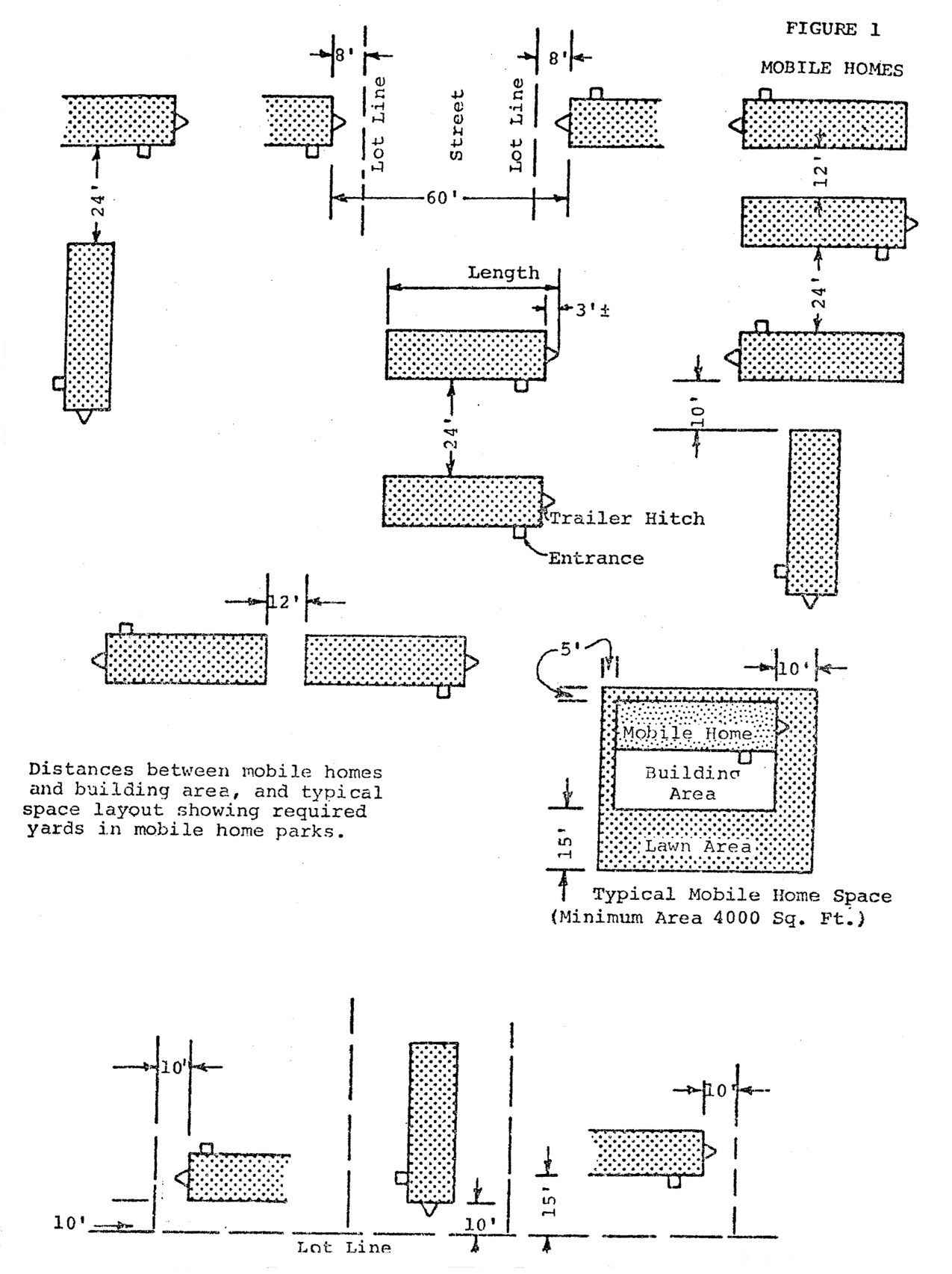
General yard requirements of the mobile home park. The following are minimum yard sizes, except as otherwise provided by this chapter as provided for in subsection (9) of this section and Figure 1:
1.
Front.
(i)
Lots abutting a major highway or area service highway shall have a front yard of 50 feet.
(ii)
Lots abutting a collector or local street shall have a front yard of 40 feet.
2.
Side. The minimum width of each side yard for a mobile home park shall not be less than ten feet.
3.
Rear. The minimum depth of a rear yard for a mobile home park shall not be less than 20 feet.
b.
Exceptions. The provisions of article IX of this chapter shall apply.
(6)
Lot coverage. No mobile home and accessory structures shall exceed 40 percent coverage of the total space.
(7)
Off-street parking.
a.
Off-street parking areas or on-street parking lanes shall be provided for the use of mobile home park residents and guests.
b.
There shall be two off-street or on-street parking spaces provided for each mobile home stand.
c.
Pavement: Same as for streets.
d.
The provisions of article IX of this chapter shall apply.
(8)
Outdoor advertising. The provisions of section 56-143, RA district, shall apply.
(9)
Other requirements for mobile home parks. The following requirements shall apply to all mobile home parks in addition to the previous requirements:
a.
No mobile home or accessory structure shall be located closer than five feet from any rear or side space line, and no closer than ten feet to any front space line. Corner spaces shall be considered as having two frontages. No hitch or other appurtenance less than four feet high or any other protrusion of 18 inches or less from the side of the mobile home shall be included in this measurement.
b.
Yards and distances between structures.
1.
The minimum distance between mobile home stands on opposite sides of the street shall be 60 feet.
2.
The minimum distance between a mobile home stand and a street pavement, a common parking area, a common walk or other common area shall be eight feet.
3.
The minimum distance between a mobile home stand and the park boundary when:
(i)
Adjoining residential land use or a residential or local street, shall be 15 feet;
(ii)
Adjoining land use is other than residential or an arterial street, shall be 30 feet.
4.
Other minimum yard dimensions as shown in Figure 1.
c.
Streets.
1.
Streets shall be provided on the site where necessary to furnish principal trafficways for convenient access to the mobile home stands and other important facilities on the property. Streets shall be privately owned and maintained.
2.
The primary entrance road connecting the mobile home park with a public street or road shall be no less than 24 feet wide and shall be constructed and maintained by the owner of the mobile home park.
3.
A secondary entrance road connecting the mobile for mobile home parks that contain 25 or more acres in total area. This entrance shall connect the mobile home park street system with a public street or road. Such secondary road shall be no less than 24 feet wide and, if the primary and secondary entrances both connect to the same public street or road, there shall be a separation of no less than 250 feet between both entrances. The owner shall have the secondary entrance open for emergency use at all times but may choose to close this entrance to private vehicular traffic. The secondary entrance road shall be constructed and maintained by the owner of the mobile home park.
4.
The interior street system within the mobile home park shall have a minimum pavement width of 24 feet with off-street parking. Dead-end streets shall be limited to 300 feet and shall provide a "T" type turn-around that is 24 feet wide and extends 25 feet in depth on both sides of and perpendicular to the 24-foot-wide access drive.
5.
The minimum pavement width of 24 feet for the interior street system shall be increased to 36 feet if on-street parking is permitted. This additional width shall be clearly marked so that two lanes of moving traffic can be accommodated at all times.
6.
Streets shall be adapted to the topography and shall have suitable alignment and gradient for safety of traffic, satisfactory surface water and groundwater drainage, and proper functioning of sanitary and storm sewer systems.
7.
Street intersections shall generally be at right angles. Acute angles of street intersections shall be not less than 85 degrees. Offsets at intersections and intersections of more than two streets at one point shall be avoided.
8.
Street improvements shall extend continuously from the existing improved street system to provide suitable access to the mobile home stands and other important facilities on the property, to provide adequate connections to existing or future streets at the boundaries of the property and to provide convenient circulation for vehicles.
9.
Pavements and surfacings other than cement concrete shall be protected at the edges by curbs, gutters or other suitable edging where necessary to prevent raveling of the wearing surface and shifting of the pavement base.
10.
Street base shall be well-drained, uniformly graded, and compacted.
11.
Flexible pavement.
(i)
Base: as required by minimum standards set forth in chapter 52, pertaining to subdivisions.
(ii)
Wearing surface: bituminous concrete, minimum 1½ inches thick compacted to maximum practical density, or a double seal coat in accordance with standard specifications for road and bridge maintenance, state department of transportation.
12.
Rigid pavement. Portland cement concrete, minimum six inches thick on a prepared subgrade constructed in accordance with the minimum standards set forth in chapter 52, pertaining to subdivisions.
d.
Driveways.
1.
Driveways shall be provided on the site where necessary for convenient access to service entrances of buildings, to delivery and collection points for refuse and other material, and elsewhere as needed.
2.
Driveway serving a single facility or single mobile home space, minimum nine feet; where used as walk, minimum 11 feet.
3.
Pavement; same as for streets.
e.
Walks.
1.
Individual walks: to each mobile home stand from a paved street or from a paved driveway or parking space connecting to a paved street.
2.
Common walks: in locations where pedestrian traffic is concentrated; for example, at the park entrance, and to the park office and other important facilities. Common walks should preferably be through interior areas removed from the vicinity of streets.
3.
Width shall generally be at least two feet for walks on individual spaces and at least 3½ feet for common walks.
4.
Pavement: Same as for streets.
f.
Laundry facilities.
1.
Laundry facilities shall be provided either individually in each mobile home and its space, in a centralized common facility, in decentralized common facilities, or in a combination of these to suit local preferences and the availability of washers and dryers supplied in current mobile home models.
2.
Where centralized provisions of washers, dryers, or common drying yards are provided they shall be located convenient to the mobile home spaces.
g.
Recreation facilities.
1.
Recreational areas and facilities, such as playgrounds, swimming pools, and community buildings shall be provided to meet the anticipated needs of the clientele the park is designed to serve. Provision of separate adult and tot lot recreation areas is encouraged.
2.
Not less than one-half acre per 25 units shall be devoted to design and developed recreational facilities, generally provided in a central location or, in the larger parks, decentralized. The minimum dimension of a recreation area shall be 100 feet. Recreation area includes space for community buildings, adult recreation and child play areas and swimming pools.
3.
No outdoor recreational area shall contain less than 2,500 square feet.
4.
Recreational areas shall be located so as to be as free from traffic hazards as possible.
h.
Screen planting and fences.
1.
A tight screen planting six feet in width and height, effective during all seasons of the year, should be placed adjacent to the boundary of the mobile home park, and such screen planting shall be maintained in an orderly manner, in original or better condition.
2.
A chainlink fence five feet high shall be placed at boundary line of mobile home park.
3.
Fences or freestanding walls shall be installed where necessary for screening purposes, such as around laundry yards, refuse collection points, and play grounds.
4.
A solid fence no less than four feet in height shall screen all refuse collection points.
5.
All fences and walls shall be located at least 18 feet from interior street centerlines and at least three feet from the pavement edge of streets, driveways, parking spaces and walks.
6.
Fences and walls shall be appropriately designed for the function intended and shall be substantially constructed and maintained to withstand conditions of soil, weather and use.
i.
Community facilities. Essential community facilities and services such as schools, recreation areas, police and fire protection shall be reasonably accessible to the park, or provisions shall be made assuring these facilities and services. Every mobile home park shall be provided with a management office and postal pickup and delivery facility as approved by the U.S. Post Office.
j.
Sanitary facilities.
1.
The mobile home park shall be provided with a complete sanitary sewer system, which shall connect with an existing approved sanitary sewer outlet or shall be provided with a separate treatment plant, to be provided by the developer in accordance with the minimum requirements of the applicable state agencies.
2.
The plans for the installation of a sanitary sewer system shall be provided by the developer of a mobile home park and approved by the applicable state agencies. Upon the completion of the sanitary sewer installation, the plans for such system as built shall be filed with the planning commission.
k.
Water system. Each mobile home park shall be connected to a water distribution system and water treatment facility. The mobile home park owner shall provide a water distribution system in accordance with the standards and minimum requirements of the applicable state agencies and the county health department.
l.
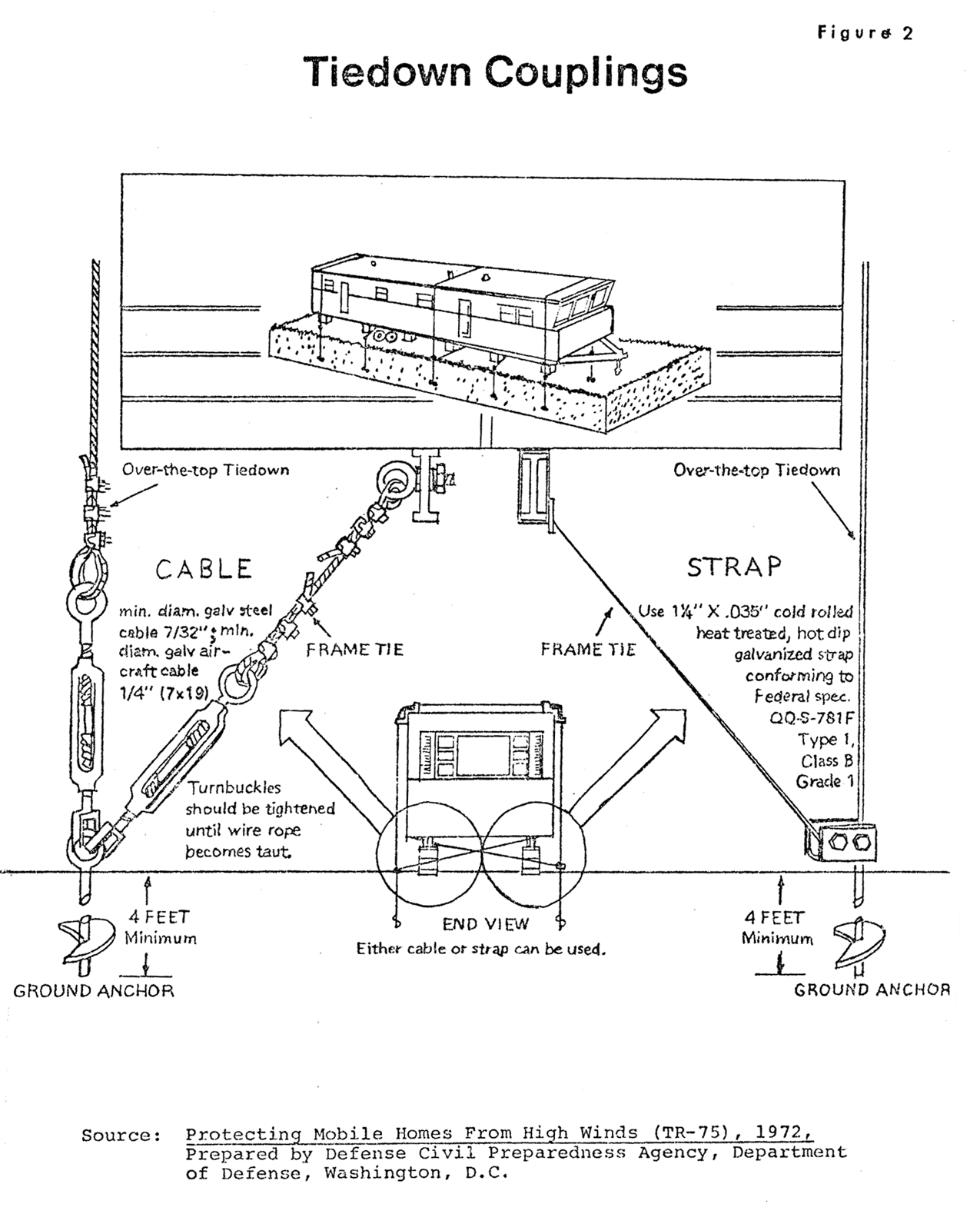
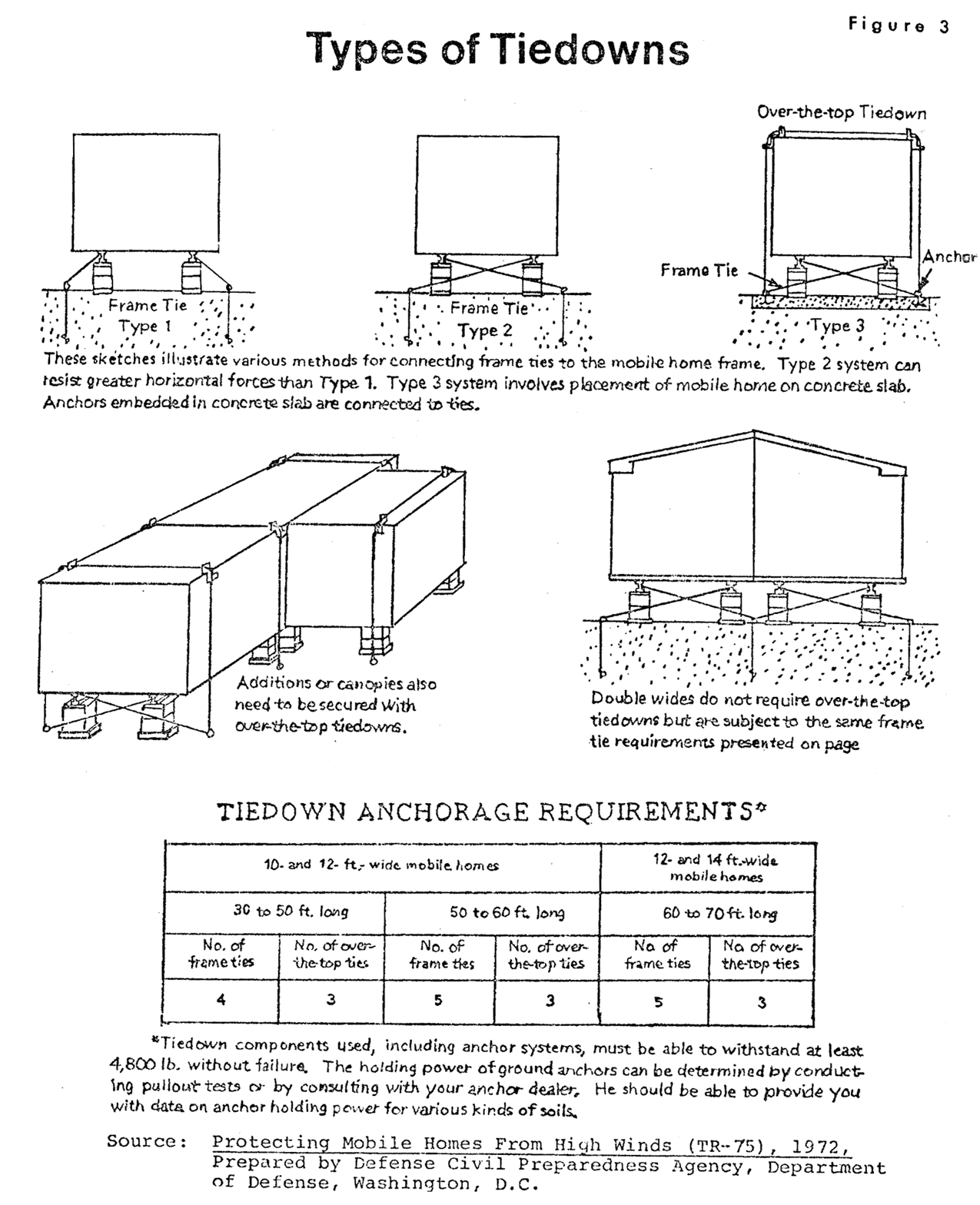
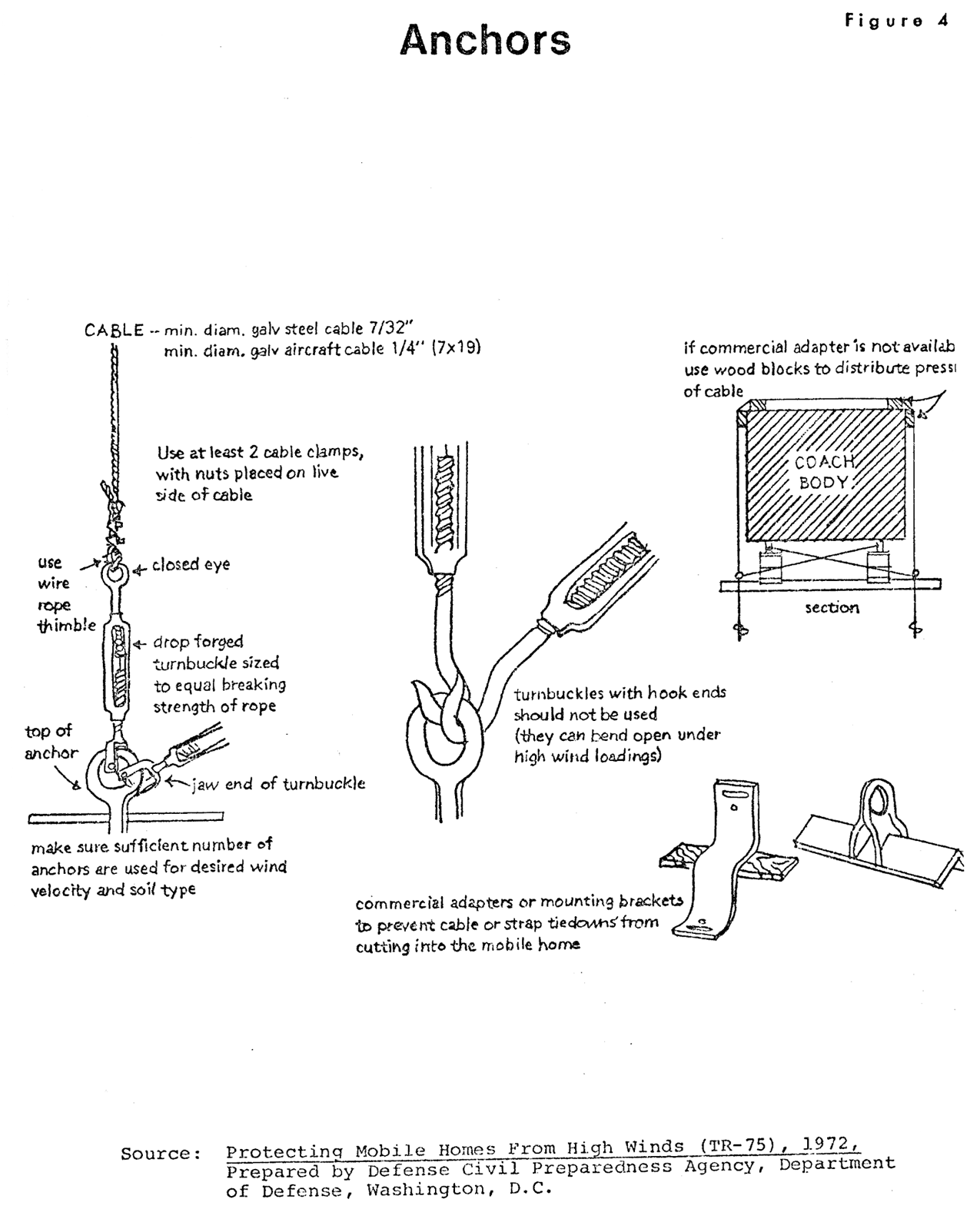
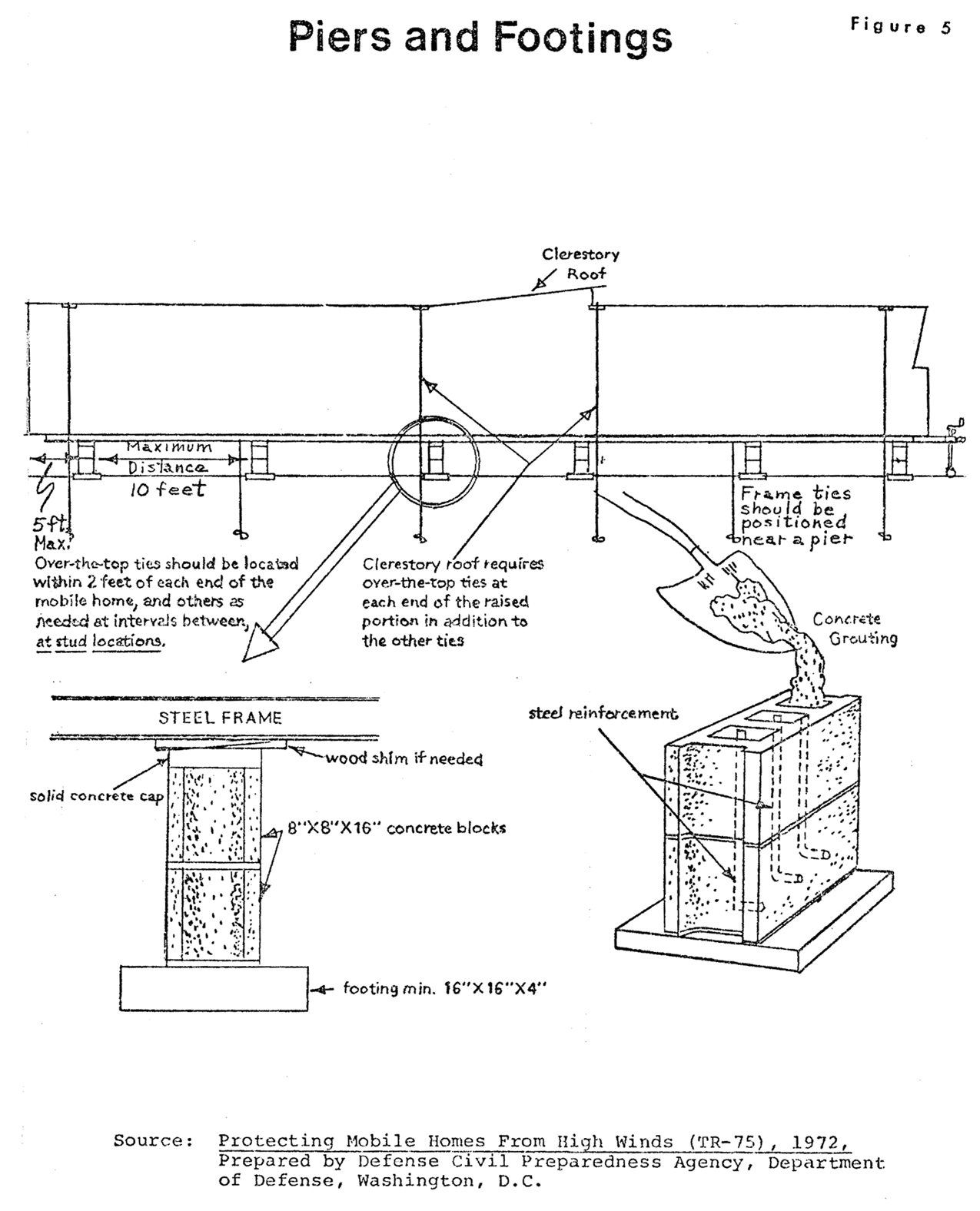
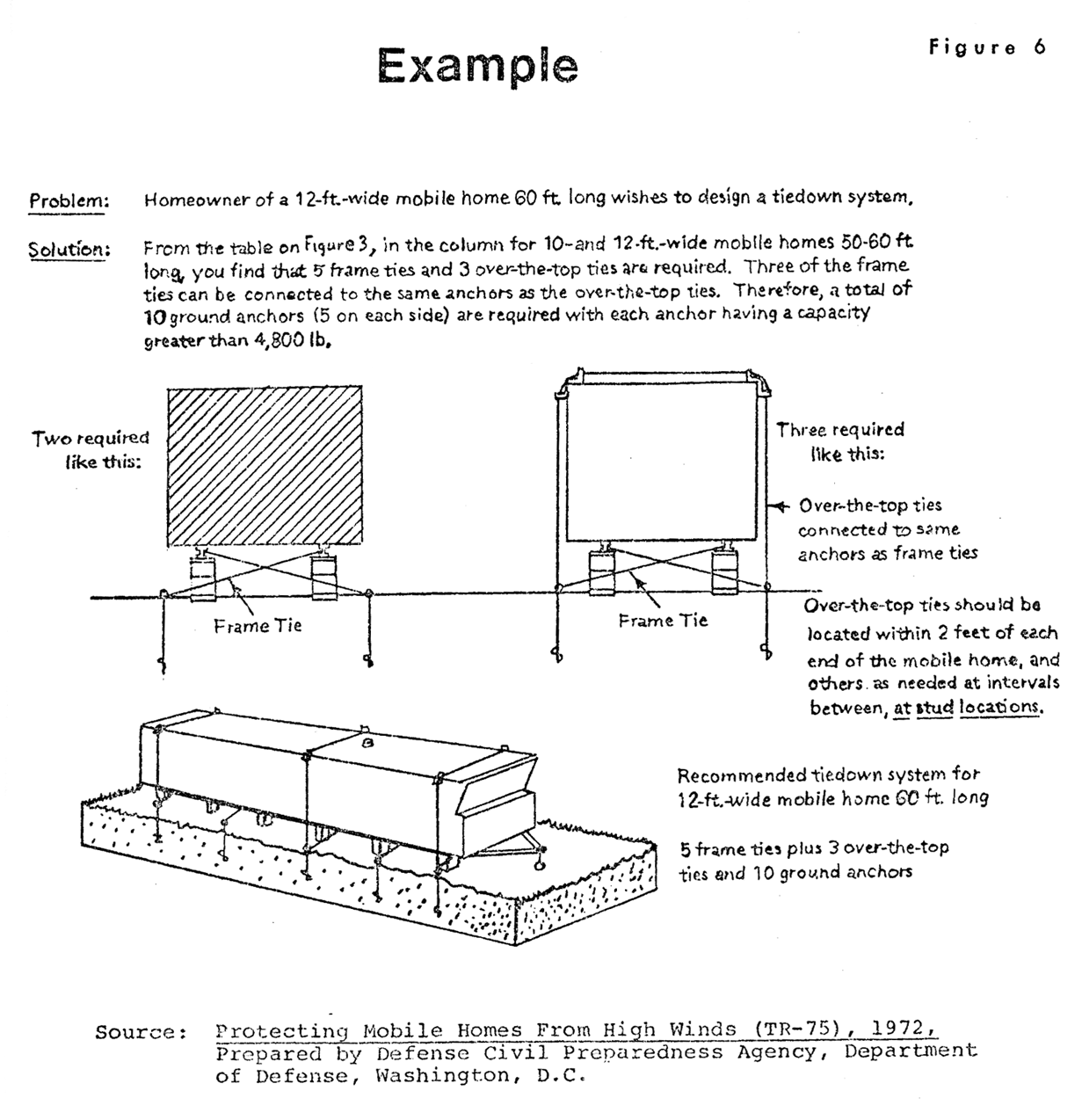
Mobile home stands and tie-downs. A permanent concrete stand shall support the home, and any additions thereto, and be constructed of a material adequate to support ten tons on the weight bearing surface. The mobile home stand shall be provided with over-the-top and frame tie-downs with such anchors as cast-in-place concrete dead men, eyelets imbedded in the concrete stand, screw augers, arrowhead anchors, or other devices capable of sustaining a minimum tensile strength of 4,800 pounds. Each mobile home shall be secured by steel cables or straps of sufficient strength to withstand the minimum tensile strength of 4,800 pounds. See Figures 2 through 6. The size of the mobile home stand shall be no less than the dimensions of the mobile home anticipated with appurtenant structures or appendages, including any additions to the mobile home.
m.
Street signs and mobile home lot numbers.
1.
Street signs shall be provided by the mobile home park owner, such signs shall comply with county standards, and shall clearly identify every street in the mobile home park.
2.
Each mobile home space shall be assigned a consecutive number as a means of identification. Each number shall be constructed of weather resistant material and positioned on the space in such a manner that each space can be identified from the park street.
n.
Underground utilities.
1.
All utility lines such as electric, telephone, television cables and other communication cables shall be installed underground and comply with the national electric code and chapter 3 of NFPA Standard 501A. The methods of construction shall be those commonly used by the utility industry with aboveground access points for distribution and maintenance. All lines shall be installed in compliance with the regulations of the state commerce commission pursuant to the state public utilities act, 220 ILCS 5/101 et seq.
2.
Park drives shall be provided with an average illumination of at least 2,500 lumens every 150 feet or equivalent. Illumination shall be placed at such mounting heights as necessary to provide adequate illumination for safe pedestrian and vehicular movement at night.
o.
Ground cover requirements. All ground surface area in a mobile home park shall be paved, covered with smooth all weather dust-free surface, or sown to grass so as to curtail soil erosion and eliminate dust.
p.
Site drainage requirement. The ground surface area within every mobile home park shall be graded and equipped to drain all surface water in a safe efficient manner. Drainage improvements shall be connected with any natural watercourses and shall drain all low areas within the park. A storm water system shall be constructed either above ground or under ground and connected to an adequate outfall as approved by the appropriate municipal authority or county superintendent of highways.
q.
Miscellaneous requirements.
1.
Mobile home occupancy. No mobile home shall be occupied by more than one family as defined in this chapter, except that mobile homes originally designed to accommodate two families may be allowed.
2.
Responsibilities of park occupants.
(i)
The park occupant shall be responsible for proper placement of his mobile home on its mobile home stand and proper installation of all utility connections in accordance with the instructions of the park management.
(ii)
Approved fire resistant wood or metal skirtings, porches, awnings, and other additions shall be installed only if permitted and approved by the park management and the applicable municipal official. When installed, they shall be maintained in good repair. The space immediately underneath a mobile home shall be used for storage only if permitted by the park management and the applicable official. If permitted, the following conditions shall be satisfied:
A.
The storage area shall be provided with a base of impervious material.
B.
Stored items shall be located so as not to interfere with the underneath inspection of the mobile home.
C.
The storage area shall be enclosed by skirting.
(iii)
The park occupant shall be obligated to meet the requirements of section 176(A) of chapter 111½ of the Illinois Revised Statutes, 1967, for the purpose of complying with the registration of title of all mobile homes located therein.
(Ord. of 12-4-1973, § 11.3)
Sec. 56-290. - Established.
The C1 Local Business District is established to include areas that are associated with residential areas and appropriate to meeting their every day shopping and service needs.
(Ord. of 12-4-1973, § 12.0)
Sec. 56-291. - Uses permitted.
The following uses shall be permitted in the C1 Local Business District, plus such other uses as the board may deem to be similar in nature. All uses shall be subject to the property development standards in section 56-593 and article IX of this chapter, pertaining to property development standards.
(1)
Apparel store.
(2)
Bakery, retail.
(3)
Bank.
(4)
Barbershop.
(5)
Beauty shop.
(6)
Business or professional office.
(7)
Clinic.
(8)
Dairy, retail only (no processing).
(9)
Delicatessen.
(10)
Dressmaking shop.
(11)
Drugstore.
(12)
Dry cleaning establishment.
(13)
Electric appliance service and sales.
(14)
Farm, general.
(15)
Flower shop.
(16)
Garden shop.
(17)
Gift shop.
(18)
Grocery.
(19)
Hardware store.
(20)
Jewelry store.
(21)
Laundry agency.
(22)
Meat market.
(23)
Millinery shop.
(24)
Municipal or government building.
(25)
Pet shop.
(26)
Police station or fire station.
(27)
Postal station.
(28)
Private swimming pool.
(29)
Public library or museum.
(30)
Public or employee parking area.
(31)
Public park or recreational area.
(32)
Radio-TV service and sales.
(33)
Record shop.
(34)
Reducing salon.
(35)
Restaurant.
(36)
Restaurant, drive-in.
(37)
Self-service laundry and dry cleaning.
(38)
Shoe repair shop.
(39)
Signs.
(40)
Stationer.
(41)
Supermarket.
(42)
Tailor and pressing shop.
(43)
Telegraph office.
(44)
Tourist home.
(45)
Variety store.
(Ord. of 12-4-1973, § 12.1; Res. of 7-11-2024(1), Exh. A)
Sec. 56-292. - Special uses.
The following uses may be permitted by special use permit in the C1 Local Business District as provided in article X of this chapter, pertaining to special uses.
(1)
Advertising structure.
(2)
Assembly halls for use by nonprofit organizations.
(3)
Drive-up window.
(4)
Filling or service station.
(5)
Kindergarten or day nursery, other than as part of a school providing other grades.
(6)
Outdoor commercial recreational enterprise.
(7)
Planned unit development (subject to the requirements of article VII of this chapter, pertaining to planned unit developments).
(8)
Private recreational development.
(9)
Railroad right-of-way and necessary uses.
(10)
Tattoo parlors or studios.
(11)
Adult-use dispensing organization.
(12)
Adult-use infuser organization.
(13)
Adult processing organization.
(14)
Adult-use transporting organization.
(Ord. of 12-4-1973, § 12.2; Res. of 3-10-1987; Res. of 8-19-1997; Res. No. 2013-08-45, 8-15-2013; Ord. of 10-17-2019)
Sec. 56-293. - Property development standards.
The following property development standards shall apply to all lands and structures in the C1 Local Business District.
(1)
Lot area. No requirements.
(2)
Lot dimensions. No requirements.
(3)
Ground floor area. No requirements.
(4)
Building height.
a.
No main building or structure, other than an agricultural structure, may be changed or erected in this district so as to have a height greater than 35 feet.
b.
Exceptions. The provisions of article IX of this chapter, pertaining to property development standards, shall apply.
(5)
Yards.
a.
General yard requirements. The following are minimum yard sizes except as otherwise provided by this chapter.
1.
Front.
(i)
Lots abutting a major highway or area service highway shall have a front yard of 15 feet.
(ii)
Lots abutting a collector or local street shall have a front yard of 15 feet.
2.
Side. Except where a business district adjoins a residential district, there is no minimum side yard for a business use. Where a business district is separated from an adjoining residential district by a street, the minimum side yard is five feet. Where the two districts adjoin within the same block, the minimum side yard is ten feet.
3.
Rear. Except where a business district adjoins a residential district, there is no minimum rear yard for a business use. Where a business district is separated from an adjoining residential district by a street, the minimum rear yard is five feet. Where the two districts adjoin within the same block, the minimum rear yard is ten feet.
b.
Exceptions. The provisions of article IX of this chapter shall apply.
(6)
Lot coverage. The buildings on a lot may not exceed in coverage 35 percent of the total lot area.
(7)
Off-street parking. The provisions of article IX of this chapter, shall apply.
(8)
Outdoor advertising.
a.
The following signs shall be permitted:
1.
Signs indicating the name and nature of the occupancy or the name and address of the building or the name and address of the owner. These signs shall be attached to the building in which the occupancy is located.
2.
"For Rent" or "For Sale" signs posted on the subject lot or building by the owner or his authorized agent. Said signs shall not exceed six square feet in area and there shall be not more than two such signs for any one lot, building or occupancy.
3.
Directional signs related to the location of buildings or activities on the property on which the signs are located. Each directional sign shall not exceed six square feet in area.
4.
One freestanding sign subject to the following regulations:
(i)
The sign shall contain thereon only the name of the buildings, occupants or groups thereof.
(ii)
The sign shall not exceed 100 square feet in area.
(iii)
The sign shall not exceed 35 feet in height, except by special use permit.
b.
The following regulations shall apply to signs for each occupancy:
1.
A sign may not exceed one square foot in area for each front foot of the structure or portion of the structure wherein the pertaining use is conducted, or one-half square foot of sign for each front foot of the lot upon which the structure is located. The total sign area per commercial use may not exceed 100 square feet, for each building frontage. The minimum sign area for occupancy need not be less than 40 square feet.
2.
Building frontage to be used in calculating the permitted sign area shall include frontage whereon a public entrance to the occupancy is located. Separate calculations may be made for front, side and rear entrances and separate signs may be erected on each of these building frontages.
3.
Signs shall not extend over a public sidewalk or right-of-way. All faces of signs mounted on or attached to a building shall be parallel to the face of the building except that "fin" type signs shall be permitted in connection with automobile service stations.
4.
No blinking, flashing, rotating or animated signs shall be permitted on the exterior of any building in this district.
5.
In cases where the building has a rear parking lot, signs may be located on the side or rear of the building and shall be developed to the same standards as are required in the front of said store; provided, however, that said signs shall not be lighted in such manner as to be disturbing to the abutting residential district.
6.
Lights used to illuminate signs shall be so installed as to concentrate the illumination on the sign and so as to minimize glare upon a public street or adjacent property.
7.
No red, green or amber lights or illuminated signs may be placed in such position that they reasonably can be expected to interfere with or be confused with any official traffic control device or traffic signal or official directional guide signs.
(9)
Loading. The provisions of article IX of this chapter shall apply.
(10)
Other requirements for commercial uses. Outdoor lighting shall be arranged so as to minimize glare upon adjoining residential districts.
(Ord. of 12-4-1973, § 12.3)
Sec. 56-320. - Established.
The C2 Central Business District is established to include areas that are intended to serve as the central trading area for urban places.
(Ord. of 12-4-1973, § 13.0)
Sec. 56-321. - Uses permitted.
The following uses shall be permitted in the C2 Central Business District, plus such other uses as the board may deem to be similar in nature. All uses shall be subject to the property development standards in section 56-323 and article IX of this chapter.
(1)
All uses permitted in the "C1" district.
(2)
Assembly halls for nonprofit organizations.
(3)
Automobile sales.
(4)
Billiard room.
(5)
Boardinghouse or lodginghouse.
(6)
Charitable institutions.
(7)
Department store.
(8)
Dressmaking shop.
(9)
Hotel or motel.
(10)
Municipal or government building.
(11)
News dealer.
(12)
Night club.
(13)
Nursing home.
(14)
Office supplies.
(15)
Photographic studio.
(16)
Print shop and newspaper.
(17)
Public garage.
(18)
Railroad rights-of-way and necessary uses.
(19)
Railway or motor bus station.
(20)
Retail showroom.
(21)
Studio business (art, interior decorating, music, etc.).
(22)
Tavern.
(23)
Theater, indoor.
(24)
Tourist home.
(Ord. of 12-4-1973, § 13.1; Res. of 7-11-2024(1), Exh. A)
Sec. 56-322. - Special uses.
The following uses may be permitted by special use permit in the C2 Central Business District as provided for in article X of this chapter, pertaining to special uses.
(1)
Advertising structure.
(2)
Automobile repair (all indoors).
(3)
Commercial greenhouse.
(4)
Drive-up window.
(5)
Farm equipment sales and service.
(6)
Filling or service station.
(7)
Locker, cold storage for individual use.
(8)
Tattoo parlors or studios.
(9)
Adult-use dispensing organization.
(10)
Adult-use infuser organization.
(11)
Adult processing organization.
(12)
Adult-use transporting organization.
(Ord. of 12-4-1973, § 13.2; Res. of 3-10-1987; Res. of 8-19-1997; Res. No. 2013-08-45, 8-15-2013; Ord. of 10-17-2019)
Sec. 56-323. - Property development standards.
The following property development standards shall apply to all land and structures in the C2 Central Business District.
(1)
Lot area. No requirements.
(2)
Lot dimensions. No requirements.
(3)
Ground floor area. No requirements.
(4)
Building height.
a.
No main building or structure, other than an agricultural structure, may be changed or erected in this district so as to have a height greater than 75 feet.
b.
Exceptions. The provisions of article IX of this chapter, pertaining to property development standards, shall apply.
(5)
Yards.
a.
General yard requirements. The following are minimum yard sizes except as otherwise required by this chapter.
1.
Front. No requirements.
2.
Side. Except where a business district adjoins a residential district, there is no minimum side yard for a business use. Where a business district is separated from an adjoining residential district by a street, the minimum side yard is five feet. Where the two districts adjoin within the same block, the minimum side yard is ten feet.
3.
Rear. Except where a business district adjoins a residential district, there is no minimum rear yard for a business use. Where a business district is separated from an adjoining residential district by a street, the minimum rear yard is five feet. Where the two districts adjoin within the same block, the minimum rear yard is ten feet.
b.
Exceptions. The provisions of article IX of this chapter shall apply.
(6)
Lot coverage. No requirements.
(7)
Off-street parking. The provisions of article IX of this chapter shall apply.
(8)
Outdoor advertising. Signs may be permitted in this district under the conditions set forth in this subsection:
a.
General requirements. No sign shall be erected at the intersection of any streets in such a manner as to obstruct free and clear vision of operators of motor vehicles, or at any location where, by reason of the position, shape or color, it may interfere with, obstruct the view of, or be confused with any authorized traffic sign, signal or device; or which makes use of the words "stop," "danger," or any other word, phrase, symbol or character in such manner as to interfere with, mislead or confuse traffic.
b.
Location. For signs within 50 feet of a property line which is the boundary between a C district and a residential district, all the provisions of the C1 district, section 56-293 shall apply.
c.
Size. No limitation.
d.
Lighting.
1.
No red, green or amber lights or illuminated signs may be placed in such position that they reasonably can be expected to interfere with or be confused with any official traffic control device or traffic signal or official directional guide signs.
2.
Lights used to illuminate signs shall be so installed as to concentrate the illumination on the sign and so as to minimize glare upon a public street or adjacent property.
(9)
Loading. The provisions of article IX of this chapter shall apply.
(10)
Other requirements for commercial use. The provisions of section 56-293 shall apply.
(Ord. of 12-4-1973, § 13.3)
Sec. 56-350. - Established.
The C3 General Business District is established to include areas that are appropriate to all kinds of businesses and services.
(Ord. of 12-4-1973, § 14.0)
Sec. 56-351. - Uses permitted.
The following uses shall be permitted in the C3 General Business District, plus such other uses as the board may deem to be similar in nature. All uses shall be subject to the property development standards in section 56-353 and article IX of this chapter, pertaining to property development standards.
(1)
All uses permitted in the C2 district.
(2)
Automobile, repair all indoors, including storage of vehicles.
(3)
Bait sales (live).
(4)
Boat sales, service, storage and rental.
(5)
Bowling alley.
(6)
Greenhouse (not exceeding 1,000 square feet).
(7)
Farm equipment, sales and service.
(8)
Farm general.
(9)
Filling or service station.
(10)
Laboratories for testing and research, excluding the raising of animals for research and excluding the testing of fissionable material.
(11)
Mobile home or trailer sales.
(12)
Roadside produce sales stand.
(13)
Tourist home.
(14)
Truck service center.
(15)
Veterinary hospital for small animals.
(16)
Wholesale business.
(Ord. of 12-4-1973, § 14.1)
Sec. 56-352. - Special uses.
The following uses may be permitted by special use permit in the C3 General Business District as provided for in article X of this chapter, pertaining to special uses.
(1)
Advertising structure.
(2)
Auction sales yard, excluding livestock.
(3)
Automobile laundry.
(4)
Camping facility.
(5)
Contractors' storage yard.
(6)
Drive-up window.
(7)
Material storage, open.
(8)
Planned unit development, subject to the requirements of article VII of this chapter, pertaining to planned unit developments.
(9)
Truck freight terminal.
(10)
Tattoo parlors or studios.
(11)
Adult-use dispensing organization.
(12)
Adult-use infuser organization.
(13)
Adult processing organization.
(14)
Adult-use transporting organization.
(Ord. of 12-4-1973, § 14.2; Res. of 3-10-1987; Res. of 8-19-1997; Res. No. 2013-08-45, 8-15-2013; Ord. of 10-17-2019)
Sec. 56-353. - Property development standards.
The following property development standards shall apply to all land and structures in the C3 General Business District.
(1)
Lot area. No requirements.
(2)
Lot dimensions. No requirements.
(3)
Ground floor area. No requirements.
(4)
Building height.
a.
No main building or structure, other than an agricultural structure, may be changed or erected in this district so as to have a height greater than 35 feet.
b.
Exceptions. The provisions of article IX of this chapter, pertaining to property development standards, shall apply.
(5)
Yards.
a.
General yard requirements. The following are minimum yard sizes except as otherwise provided by this chapter.
1.
Front. No requirements.
2.
Side. Except where a business district adjoins a residential district, there is no minimum side yard for a business use. Where a business district is separated from an adjoining residential district by a street, the minimum side yard is five feet. Where the two districts adjoin within the same block, the minimum side yard is ten feet.
3.
Rear. Except where a business district adjoins a residential district, there is no minimum rear yard for a business use. Where a business district is separated from an adjoining residential district by a street, the minimum rear yard is five feet. Where the two districts adjoin within the same block, the minimum rear yard is ten feet.
b.
Exceptions. The provisions of article IX of this chapter shall apply.
(6)
Lot coverage. No requirements.
(7)
Off-street parking. The provisions of article IX of this chapter shall apply.
(8)
Outdoor advertising. The provisions of the C2 district shall apply.
(9)
Loading. The provisions of article IX of this chapter shall apply.
(10)
Other requirements for commercial uses. The provisions of section 56-293 shall apply.
(Ord. of 12-4-1973, § 14.3)
Sec. 56-380. - Established.
The C4 Interchange Business District is established to include areas that are close to freeway interchanges. Uses permitted are those appropriate to the limited accommodation and service needs of the traveling public.
(Ord. of 12-4-1973, § 15.0)
Sec. 56-381. - Uses permitted.
The following uses shall be permitted in the C4 Interchange Business District, plus such other uses as the board may deem to be similar in nature. All uses shall be subject to the property development standards in section 56-383 and article IX of this chapter, property development standards.
(1)
Farm, general.
(2)
Filling or service station.
(3)
Hotel or motel.
(4)
Private swimming pool.
(5)
Public or employee parking area.
(6)
Railroad right-of-way and necessary uses.
(7)
Restaurant.
(8)
Signs.
(9)
Tourist home.
(Ord. of 12-4-1973, § 15.1; Res. of 7-11-2024(1), Exh. A)
Sec. 56-382. - Special uses.
The following uses only may be permitted by special use permit in the C4 Interchange Business District as provided for in article X of this chapter, pertaining to special uses.
(1)
Advertising structure.
(2)
Camping facility.
(3)
Drive-up window.
(4)
Recreational use of a reclaimed borrow pit, subject to the requirements of article IV of this chapter, pertaining to mineral extraction.
(5)
Outdoor commercial recreational facilities.
(6)
Planned unit development, subject to the requirements of article VI of this chapter, pertaining to home occupations.
(7)
Rental of trucks and trailers only in combination with filling or service stations.
(8)
Transmission lines for gas, oil, electricity or other utilities and necessary substation and distribution centers.
(9)
Truck service center.
(Ord. of 12-4-1973, § 15.2; Res. of 3-10-1987; Res. of 8-19-1997)
Sec. 56-383. - Property development standards.
The following property development standards shall apply to all land and structures in the C4 Interchange Business District.
(1)
Lot area. The minimum lot size shall be 12,000 square feet.
(2)
Lot dimensions. Each lot shall have a minimum width of 100 feet.
(3)
Ground floor area. No requirement.
(4)
Building height.
a.
No main building or structure, other than an agricultural structure, may be changed or erected in this district so as to have a height greater than 75 feet, provided that buildings or structures over 75 feet in height may be erected subject to special use permit as provided for in this chapter.
b.
Exceptions. The provisions of article IX of this chapter, pertaining to property development standards, shall apply.
(5)
Yards.
a.
General yard requirements. The following are minimum yard sizes.
1.
Front. All buildings and structures shall be set back at least 50 feet from the front lot line, except when facing an intersecting highway or interstate freeway in which case the setback shall be 80 feet from the nearest intersecting highway right-of-way and 100 feet from the nearest interstate freeway right-of-way.
2.
Transitional. No building or structure in the C4 district shall be located within 125 feet of a residential use or residential district. Such intervening open area shall be landscaped with trees, flowers, shrubs, sown to grass, and a dense compact screen planting capable of obtaining a height of six feet and three feet in width shall be required and maintained in an orderly manner along any lot line adjoining any residential use or residential district.
3.
Service. A service area where trash or refuse is stored shall be construed to be a service yard. If the area is visually observable to a street, residential use or residential district, it shall be enclosed by a solid fence or chainlink fence with a compact screen planting of not less than six feet in height and three feet in width. This screen planting shall be maintained in an orderly manner.
b.
Exceptions. The provisions of article IX of this chapter shall apply.
(6)
Lot coverage. The buildings on a lot may not exceed over 50 percent coverage of the total lot area.
(7)
Off-street parking. The provisions of article IX of this chapter shall apply.
(8)
Outdoor advertising. The provisions of section 56-293, C1 district, shall apply.
(9)
Loading. The provisions of article IX of this chapter shall apply.
(10)
Other requirements for commercial uses.
a.
Enclosed buildings. All business and servicing except off-street parking, off-street loading and rental of trucks and trailers in combination with filling or service stations shall be conducted within completely enclosed buildings.
b.
Underground utilities. All utilities such as electric, telephone, television cable and other communication cables shall be installed underground and comply with the national electric code and chapter 3 of NFPA, Standard 501A. The methods of construction shall be those commonly used by the utility industry with aboveground access points for distribution and maintenance. All lines shall be installed in compliance with the regulations of the state commerce commission pursuant to the state public utilities act, 220 ILCS 5/101 et seq. All transformer boxes shall be located so as not to be unsightly or hazardous to the public.
c.
Glare. The provisions of the C1 district, section 56-293, shall apply.
(Ord. of 12-4-1973, § 15.3)
Sec. 56-410. - Established.
The I1 Light Industrial District is established to include most of the existing industrial developments and provide for their expansion. Generally, the permitted uses will include only those where all of the operations, including the storage of materials, are confined within a building.
(Ord. of 12-4-1973, § 16.0)
Sec. 56-411. - Uses permitted.
The following uses shall be permitted in the I1 Light Industrial District, plus such other uses as the board may deem to be similar in nature. All uses shall be subject to the property development standards in section 56-413 and article IX of this chapter, pertaining to property development standards.
(1)
Advertising structures.
(2)
Automobile repair (all indoors).
(3)
Bank.
(4)
Boat sales, service, storage and rental.
(5)
Farm, general.
(6)
Farm seasonal worker housing, tenant.
(7)
Filling or service station.
(8)
Greenhouse, commercial.
(9)
Industrial park.
(10)
Industry, light.
(11)
Kennel.
(12)
Laboratories for testing and research excluding the raising of animals for research and excluding the testing of fissionable materials.
(13)
Mobile home or trailer sales area.
(14)
Municipal or government building.
(15)
Police or fire station.
(16)
Public garage.
(17)
Public or employee parking area.
(18)
Railroad right-of-way and necessary uses.
(19)
Restaurant.
(20)
Signs.
(21)
Tourist home.
(22)
Truck service center.
(23)
Warehouse and storage of grain, seed, and dry fertilizer storage facilities, including grain storage and drying facilities.
(24)
Whole business.
(Ord. of 12-4-1973, § 16.1; Res. of 7-11-2024(1), Exh. A)
Sec. 56-412. - Special uses.
The following uses may be permitted by special use permit in the I1 Light Industrial District as provided for in article X of this chapter.
(1)
Anhydrous ammonia or similar liquefied fertilizers, storage and distribution (commercial).
(2)
Auction sales yard, excluding livestock.
(3)
Automobile laundry.
(4)
Bottled gas, storage and distribution.
(5)
Bulk storage of petroleum products.
(6)
Contractor's storage yard.
(7)
Drive-up window.
(8)
Dwelling, farm.
(9)
Junk yard.
(10)
Manufacturing, storage and use of explosives.
(11)
Penal or correctional institution.
(12)
Petroleum tank farm.
(13)
Planned unit development, subject to the requirements of article VII of this chapter, pertaining to planned unit developments.
(14)
Public or commercial sanitary landfill, refuse dump, or garbage disposal plant.
(15)
Slaughterhouse.
(16)
Truck freight terminal.
(17)
Wholesale produce terminal.
(18)
Adult-use craft grower organization.
(19)
Adult-use cannabis cultivation organization.
(20)
Adult-use dispensing organization.
(21)
Adult-use infuser organization.
(22)
Adult processing organization.
(23)
Adult-use transporting organization.
(Ord. of 12-4-1973, § 16.2; Res. of 8-19-1997; Ord. of 10-17-2019)
Sec. 56-413. - Property development standards.
The following property development standards shall apply to all land and structures in the I1 Light Industrial District.
(1)
Lot area. No requirements.
(2)
Lot dimensions. No requirements.
(3)
Ground floor area. No requirements.
(4)
Building height.
a.
No main building or structure, other than an agricultural structure, may be changed or erected in this district so as to have a height greater than 75 feet.
b.
Exceptions. The provisions of article IX of this chapter, pertaining to property development standards, shall apply.
(5)
Yards.
a.
General yard requirements. The following are minimum yard sizes except as otherwise provided by this chapter.
1.
Front. No requirements.
2.
Side. Except where an industrial district adjoins a residential district, there is no minimum side yard for an industrial use. Where an industrial district is separated from an adjoining residential district by a street, the minimum side yard is five feet. Where the two districts adjoin within the same block, the minimum side yard is 30 feet.
3.
Rear. Except where an industrial district adjoins a residential district, there is no minimum rear yard for an industrial use. Where an industrial district is separated from an adjoining residential district by a street, the minimum rear yard is five feet. Where the two districts adjoin within the same block, the minimum rear yard is 30 feet.
b.
Exceptions. The provisions of article IX of this chapter shall apply.
(6)
Lot coverage. The buildings on a lot may not exceed in coverage 75 percent of the total lot area.
(7)
Off-street parking. The provisions of article IX of this chapter shall apply.
(8)
Outdoor advertising. Signs and advertising structures may be permitted in this district under the conditions set forth in this subsection.
a.
General requirements. No sign or advertising structure shall be erected at the intersection of any streets in such a manner as to obstruct free and clear vision of operators of motor vehicles, or at any location where, by reason of the position, shape or color, it may interfere with, obstruct the visions of, or be confused with any authorized traffic sign, signal or device; or which makes use of the words "stop," "danger," or any other word, phrase, symbol or character in such manner as to interfere with, mislead or confuse traffic.
b.
Location. No sign or advertising structures shall be located within 50 feet of the boundary line between an I1 district and a residential district when such sign or advertising structure faces said residential district.
c.
Size. No limitation.
d.
Lighting.
1.
No red, green or amber lights or illuminated signs may be placed in such position that they could reasonably be expected to interfere with or be confined with any official traffic control device or traffic signal or official directional guide signs.
2.
Lights used to illuminate signs or advertising structures shall be so installed as to concentrate the illumination on the sign or advertising structure and so as to minimize glare upon a public street or adjacent property.
(9)
Loading. The provisions of article IX of this chapter shall apply.
(10)
Other requirements for industrial uses. The following restrictions and performance standards shall apply to all industrial uses, in addition to the previous requirements:
a.
Smoke.
1.
No light industrial use may emit more than ten smoke units per hour per stack or smoke in excess of Ringelmann No. 2. However, once during any 24-hour period, for soot blowing, process purging, and fire cleaning, each stack may emit an additional ten smoke units, and during that time it may emit smoke up to and including Ringelmann No. 3.
2.
In this section, the term "Ringelmann number" means the number of the area on the Ringelmann chart that most nearly matches the light-obscuring capacity of smoke. The Ringelmann chart is described in the U.S. Bureau of Mines Information Circular 6888, on which are illustrated graduated shades of gray for use in estimating smoke density. Smoke below the density of Ringelmann No. 1 shall be considered as no smoke or Ringelmann No. 0; and "smoke unit" means the number obtained when the smoke density in Ringelmann number is multiplied by the time of emission in minutes. For the purpose of this calculation, a Ringelmann density reading shall be made at least once a minute during the period of observation. Each reading shall then be multiplied by the time in minutes during which it is observed. The products so computed shall then be added to give the total number of smoke units observed during the entire observation period.
b.
Odor. No I1 industrial use may release an odor that is detectable at the lot line.
c.
Toxic materials. For a light industrial use, the emission of toxic and noxious materials may not produce any concentration at a residence or business district boundary line exceeding the following percentage of the threshold limit values for toxic materials in industry as set forth in threshold limit values for the current year, as adopted at the annual meeting of the American Conference of Governmental Industrial Hygienists:
d.
Glare and heat.
1.
No light industrial use may cause heat at the lot line so intense as to be a public nuisance or hazard. No such use may cause illumination at or beyond any residence district boundary in excess of 0.1 foot candle in any plain.
2.
As used in this section, the term "foot candle" means a unit of illumination equal to the illumination at all points that are one foot from a uniform point source of one candle power.
e.
Vibration.
1.
No light industrial use may cause, at the lot line, continuous earth borne vibrations higher than the limits set forth in column I of the following table. Nor may it cause, at any residence district boundary, continuous earth borne vibrations higher than the limits set forth in column II.
2.
Definitions. As used in this subsection:
Displacement—the maximum amount of motion in any direction as determined by any three-component (simultaneous) measuring system approved by the board.
Three-component measuring system—instrumentation that can measure earth borne vibrations in a horizontal as well as a vertical plane.
f.
Noise.
1.
At no boundary of a residence or business district may the sound pressure level of any light industrial use (except for background noises produced by sources not under control of this chapter, such as the operation of motor vehicles or other transportation facilities) exceed the following decibel limits:
2.
Sound levels shall be measured with a sound-level meter and associated octave band filter, manufactured and calibrated according to standards prescribed by the American Standards Association. Measurements shall be made using the flat C network of the sound level meter and the fast meter movement of the octave band analyzer. Impulsive noises are subject to the performance standards prescribed by this section if they cause rapid fluctuations of the needle of the sound level meter with a variation of no more than plus or minus two decibels. Noises incapable of being so measured, such as irregular and intermittent noises, shall be controlled so as not to be a nuisance to adjacent uses.
3.
Definition. As used in this subsection:
Octave band—all the frequencies from one frequency to a second. In sound octave bands, the second frequency is usually twice the first one.
Octave band filter—an electrical device that separates the sounds in each octave band and presents them to the sound level meter.
g.
Fire hazards.
1.
Solid substances ranging from free or active burning to intense burning may be stored, used, or manufactured only within completely enclosed buildings having incombustible exterior walls and protected throughout by an automatic fire extinguishing system.
2.
The storage, utilization, or manufacture of flammable liquids or materials which produce flammable vapors or gases shall be permitted in accordance with the rules and regulations of the state fire marshal. A certificate of compliance, issued by the state fire marshal's office, stating that the plans and specifications of the state fire marshal shall accompany the application for an improvement location permit.
3.
Definition. As used in this subsection:
Free burning—a rate of combustion described by a substance that burns actively and easily supports combustion.
Intense burning—a rate of combustion described by a substance that burns with a high degree of activity and is consumed rapidly.
h.
Detonation materials. No activity involving the storage, use, or manufacture of materials that decompose by detonation may be carried on except in accordance with the rules issued by the state fire marshal. These materials include primary explosives such as lead azide, lead styphnate, fulminates, and tetracene; high explosives such as TNT, RDX, HMX, PETN, and picric acid; propellants and their components, such as nitrocellulose, black powder, boron hydrides, hydrazine and its derivatives; pyrotechnics and fireworks such as magnesium powder, potassium chlorate, and potassium nitrate; blasting explosives such as dynamite and nitroglycerine; unstable organic compounds such as acetylides, tetrazoles, and ozonides; strong oxidizing agents such as liquid oxygen, perchloric acid, perchlorates, chlorates, and hydrogen peroxide in concentrations greater than 35 percent; and nuclear fuels, fissionable materials and products, and reactor elements such as Uranium 235 and Plutonium 239.
i.
Particulate matter.
1.
The rate of emission of particulate matter from all sources within the boundaries of any lot may not exceed a net figure of one pound per hour per acre for a light industrial use of which no more than ten percent by weight may be particles larger than 44 microns (325 mesh). The net rate of emission shall be computed by:
(i)
Determining the maximum emission in pounds per hour from each source of emission within the boundaries of the lot and dividing this figure by the number of acres of lot area, thus obtaining the gross hourly emission rate per acre for each source;
(ii)
Deducting from that gross rate the appropriate correction factors for height of emission and stack velocity as respectively specified in subsections (10)i.2 and 3 of this section, thus obtaining the net hourly emission rate per acre for each source; and
(iii)
Adding the individual rates of emission so computed to obtain the total net hourly emission rate per hour from all sources within the boundaries of the lot.
2.
The allowance for height of emission is as follows (interpolate for intermediate values):
3.
The allowance for velocity of emission is as follows (interpolate for intermediate values):
4.
Dust and other kinds of air pollution that are borne by the wind from such sources within lot boundaries as storage areas, yards, and roads shall be kept to a minimum by appropriate landscaping, paving, oiling, fencing, or other means.
5.
As used in this section, the term "particulate matter" means divided liquid or solid material that is discharged and carried along in the air.
j.
Exceptions. Subsections (10)a. through i. of this section do not apply to:
1.
Site preparation or construction, maintenance, repair, alteration, or improvement of buildings, structures, equipment, or other improvements on or within the lot line;
2.
The operation of motor vehicles or other facilities for the transportation of personnel, materials, or products;
3.
Conditions beyond the control of the user such as fire, explosion, accident, failure, or breakdown;
4.
Safety or emergency warning signals or alarms necessary for the protection of life, limb, or property; or
5.
Processes for which there is no known means of control. Research shall be promptly conducted to discover methods of control leading to the installation of protective equipment.
(Ord. of 12-4-1973, § 16.3)
Sec. 56-442. - Established.
The I2 General Industrial District is established to provide for general industrial operations utilizing both enclosed and unenclosed space for storage, fabricating and manufacturing.
(Ord. of 12-4-1973, § 17.0)
Sec. 56-443. - Uses permitted.
The following uses shall be permitted in the I2 General Industrial District, plus such other uses as the board may deem to be similar in nature. All uses shall be subject to the property development standards in section 56-445 and article IX of this chapter, pertaining to property development standards.
(1)
All uses permitted in the I1 district.
(2)
Concrete, ready-mix plant.
(3)
Contractors' storage yard.
(4)
Industry, general.
(5)
Material storage, open.
(6)
Tourist home.
(7)
Truck freight terminal.
(8)
Wholesale produce terminal.
(Ord. of 12-4-1973, § 17.1; Res. of 7-11-2024(1), Exh. A)
Sec. 56-444. - Special uses.
The following uses may be permitted by special use permit in the I2 General Industrial District as provided for in article X of this chapter, pertaining to special uses.
(1)
Anhydrous ammonia or similar liquefied fertilizers, storage and distribution (commercial).
(2)
Asphalt and asphaltic concrete batch plant.
(3)
Bottled gas storage and distribution.
(4)
Bulk storage of petroleum products.
(5)
Junk yard.
(6)
Manufacturing, storage or use of explosives.
(7)
Penal or correctional institution.
(8)
Petroleum tank farm, commercial.
(9)
Public or commercial sanitary landfill, refuse dump or garbage disposal plant.
(10)
Slaughterhouse.
(11)
Planned unit development, subject to requirements of article VII of this chapter, pertaining to planned unit developments.
(12)
Solar farm.
(13)
Adult-use craft grower organization.
(14)
Adult-use cannabis cultivation organization.
(15)
Adult-use dispensing organization.
(16)
Adult-use infuser organization.
(17)
Adult processing organization.
(18)
Adult-use transporting organization.
(Ord. of 12-4-1973, § 17.2; Res. No. 2019-03-08, 3-14-2019; Ord. of 10-17-2019)
Sec. 56-445. - Property development standards.
The following property development standards shall apply to all land and structures in the I2 General Industrial District.
(1)
Lot area. No requirement.
(2)
Lot dimensions. No requirement.
(3)
Ground floor area. No requirement.
(4)
Building height. No requirement.
(5)
Yards.
a.
General yard requirements. The following are minimum yard sizes except as otherwise provided by this chapter.
1.
Front. No requirements.
2.
Side. Except where an industrial district adjoins a residential district, there is no minimum side yard for an industrial use. Where an industrial district is separated from an adjoining residential district by a street, the minimum side yard is five feet. Where the two districts adjoin within the same block, the minimum side yard is 30 feet.
3.
Rear. Except where an industrial district adjoins a residential district, there is no minimum rear yard for an industrial use. Where an industrial district is separated from an adjoining residential district by a street, the minimum rear yard is five feet. Where the two districts adjoin within the same block, the minimum rear yard is 30 feet.
e.
Exceptions. The provisions of article IX of this chapter, pertaining to property development standards, shall apply.
(6)
Lot coverage. No requirements.
(7)
Off-street parking. The provisions of article IX of this chapter shall apply.
(8)
Outdoor advertising. The provisions of the I1 district shall apply.
(9)
Loading. The provisions of article IX of this chapter shall apply.
(10)
Other requirements for industrial uses. The following restrictions shall apply to all industrial uses, in addition to the previous requirements.
a.
Smoke.
1.
No general industrial use may emit more than 30 smoke units per hour per stack or smoke in excess of Ringelmann No. 2. However, once during any six-hour period, for soot blowing, process purging, and fire cleaning, each stack shall be permitted an additional ten smoke units, and during that time it may emit smoke up to and including Ringelmann No. 3.
2.
Definition. As used in this subsection:
Ringelmann number—the number of the area on the Ringelmann chart that most nearly matches the light-obscuring capacity of smoke. The Ringelmann chart is described in the U.S. Bureau of Mines Information Circular 6888, on which are illustrated graduated shades of gray for use in estimating smoke density. Smoke below the density of Ringelmann No. 1 shall be considered as no smoke or Ringelmann No. 0.
Smoke unit—the number obtained when the smoke density in Ringelmann number is multiplied by the time of emission in minutes. For the purpose of this calculation, a Ringelmann density reading shall be made at least once a minute during the period of observation. Each reading shall then be multiplied by the time in minutes during which it is observed. The products so computed shall then be added to give the total number of smoke units observed during the entire observation period.
b.
Odor. No general industrial use may release an odor that is detectable at the lot line.
c.
Toxic materials. For a general industrial use, the emission of toxic and noxious materials may not produce any concentration at a residence or business district boundary line exceeding the following percentage of the threshold limit values for toxic materials in industry as set forth in threshold limit values for the current year, as adopted at the annual meeting of the American Conference of Governmental Industrial Hygienists:
d.
Glare and heat.
1.
No general industrial use may cause heat at the lot line so intense as to be a public nuisance or hazard. No such use may cause illumination at or beyond any residence district boundary in excess of 0.1 foot candle in any plain.
2.
Definition. As used in this subsection:
Foot candle—a unit of illumination equal to the illuminating at all points that are 1 foot from a uniform point source of one candle power.
e.
Vibration.
1.
No general industrial use may cause at any R, or C district boundary continuous earth borne vibrations higher than the limits set forth in column I of the following table. Nor may it cause at any residence district boundary continuous earth borne vibrations higher than the limits set forth in column II.
2.
Definition. As used in this subsection:
Displacement—the maximum amount of motion in any direction determined by any three component (simultaneous) measuring system approved by the board.
Three-component measuring system—instrumentation that can measure earth borne vibrations in a horizontal as well as a vertical plane.
f.
Noise.
1.
At no boundary of a residence or business district may the sound pressure level of any general industrial use, except for background noises produced by sources not under control of this chapter, such as the operation of motor vehicles or other transportation facilities, exceed the following decibel limits:
2.
Sound levels shall be measured with a sound-level meter and associated octave band filter, manufactured and calibrated according to standards prescribed by the American Standards Association. Measurements shall be made using the flat C network of the sound level meter and the fast meter movement of the octave band analyzer. Impulsive noises are subject to the performance standards prescribed by this section if they cause rapid fluctuations of the needle of the sound level meter with a variation of no more than plus or minus two decibels. Noises incapable of being so measured, such as irregular and intermittent noises, shall be controlled so as not to be a nuisance to adjacent uses.
3.
Definition. As used in this subsection:
Octave band—all the frequencies from one frequency to a second. In sound octave bands, the second frequency is usually twice the first one.
Octave band filter—an electrical device that separates the sounds in each octave band and presents them to the sound level meter.
g.
Fire hazards.
1.
Solid substances ranging from free or active burning to intense burning may be stored, used, or manufactured only within completely enclosed buildings having incombustible exterior walls and protected throughout by an automatic fire extinguishing system.
2.
The storage, utilization, or manufacture of flammable liquids or materials which produce flammable vapors or gases shall be permitted in accordance with the rules and regulations of the state fire marshal. A certificate of compliance, issued by the state fire marshal's office, stating that the plans and specifications for a general industrial use comply with the rules and regulations of the state fire marshal shall accompany the application for an improvement location permit.
3.
As used in this section:
Free burning—a rate of combustion described by a substance that burns actively and easily supports combustion; and
Intense burning—a rate of combustion described by a substance that burns with a high degree of activity and is consumed rapidly.
h.
Detonation materials. No activity involving the storage, use, or manufacture of materials that decompose by detonation may be carried on except in accordance with the rules issued by the state fire marshal. These materials include primary explosives such as lead azide, lead styphnate, fulminates, and tetracene; high explosives such as TNT, RDX, HMX, PETN, and picric acid; propellants and their components, such as nitrocellulose, black powder, boron hydrides, hydrazine and its derivatives; pyrotechnics and fireworks such as magnesium power, potassium chlorate, and potassium nitrate; blasting explosives such as dynamite and nitroglycerine; unstable organic compounds such as acetylides, tetrazoles, and ozonides; strong oxidizing agents such as liquid oxygen, perchloric acid, perchlorates chlorates, and hydrogen peroxide in concentrations greater than 35 percent; and nuclear fuels, fissionable materials and products, and reactor elements such as Uranium 235 and Plutonium 239.
i.
Particulate matter.
1.
The rate of emission of particulate matter from all sources within the boundaries of any lot may not exceed a net figure of three pounds per hour per acre for a general industrial use of which no more than ten percent by weight may be particles larger than 44 microns (325 mesh). The net rate of emission shall be computed by:
(i)
Determining the maximum emission in pounds per hour from each source of emission within the boundaries of the lot and dividing this figure by the number of acres of lot area, thus obtaining the gross hourly emission rate per acre for each source;
(ii)
Deducting from that gross rate the appropriate correction factors for height of emission and stack velocity as respectively specified in subsections (10)i.2. and 3. of this section, thus obtaining the net hourly emission rate per acre for each source; and
(iii)
Adding the individual rates of emission so computed to obtain the total net hourly emission rate per hour from all sources within the boundaries of the lot.
2.
The allowance for height of emission is as follows (interpolate for intermediate values):
3.
The allowance for velocity of emission is as follows (interpolate for intermediate values):
4.
Dust and other kinds of air pollution that are borne by the wind from such sources within lot boundaries as storage areas, yards, and roads shall be kept to a minimum by appropriate landscaping, paving, oiling, fencing, or other means.
5.
As used in this section:
Particulate matter—divided liquid or solid material that is discharged and carried along in the air.
j.
Exceptions. Subsections (10)a. through i. of this section do not apply to:
1.
Site preparation or construction, maintenance, repair, alteration, or improvement of buildings, structures, equipment, or other improvements on or within the lot line;
2.
The operation of motor vehicles or other facilities for the transportation of personnel, materials, or products;
3.
Conditions beyond the control of the user such as fire, explosion, accident, failure, or breakdown;
4.
Safety or emergency warning signals or alarms necessary for the protection of life, limb, or property; or
5.
Processes for which there is no known means of control. Research shall be promptly conducted to discover methods of control leading to the installation of protective equipment.
k.
General industrial uses near residence districts. The performance standards prescribed by subsections (10)a. through i. of this section for light industrial uses apply also to general industrial uses that are located within 500 feet of a residence district boundary.
(Ord. of 12-4-1973, § 17.3)
Sec. 56-474. - Designed.
The I3 Interchange Industrial District is designed to accommodate light industrial uses that are relatively clean activities such as the manufacture and storage of products within totally enclosed buildings and which require freeway access and prestige frontage.
(Ord. of 12-4-1973, § 18.0)
Sec. 56-475. - Uses permitted.
The following uses shall be permitted in the I3 Interchange Industrial District, plus such other uses as the board may deem to be similar in nature. All uses shall be subject to the property development standards in section 56-477 and article IX of this chapter, pertaining to property development standards, and the industrial performance standards in the I1 industrial district, section 56-413.
(1)
Farm, general.
(2)
Industrial park.
(3)
Printing and publishing establishments.
(4)
Parcel delivery services.
(5)
Railroad right-of-way and necessary uses.
(6)
Tourist home.
(7)
Warehouse, storage.
(8)
Wholesale business.
(Ord. of 12-4-1973, § 18.1; Res. of 7-11-2024(1), Exh. A)
Sec. 56-476. - Special uses.
The following uses only may be permitted by special use permit in the I3 Interchange Industrial District and are subject to all applicable requirements and procedures appearing in article X of this chapter, pertaining to special uses:
(1)
Recreational use of a reclaimed borrow pit, subject to the requirements of article IV of this chapter, pertaining to mineral extraction.
(2)
Planned unit developments, subject to the requirements of article VII of this chapter, planned unit developments.
(3)
Transmission lines for gas, oil, electricity or other utilities and necessary substation and distribution centers.
(4)
Truck freight terminal.
(Ord. of 12-4-1973, § 18.2)
Sec. 56-477. - Property development standards.
The following property development standards shall apply to all land and structures in the I3 Interchange Industrial District.
(1)
Lot area. The minimum lot size shall be 43,560 square feet (one acre).
(2)
Lot dimensions. Each lot shall have a minimum width of 150 feet.
(3)
Ground floor area. No requirement.
(4)
Building height.
a.
No main building or structure, other than an agriculture structure, may be changed or erected in this district so as to have a height greater than 75 feet.
b.
Exceptions. The provisions of article IX of this chapter, pertaining to property development standards, shall apply.
(5)
Yards.
a.
General yard requirements. The following are minimum yard sizes.
1.
Front. All buildings and structures shall be setback at least 50 feet from the front lot line, except when facing an intersecting highway or interstate freeway in which case the setback shall be 80 feet from the nearest intersecting highway right-of-way and 100 feet from the nearest interstate freeway right-of-way.
2.
Transitional. No building or structure in the I3 district shall be located within 125 feet of a residential use or residential district. Such intervening open area shall be landscaped with trees, flowers, shrubs, sown to grass, and a dense compact screen planting capable of obtaining the height of six feet, and three feet in width shall be required and maintained in an orderly manner along any lot line adjoining any residential use or residential district.
3.
Service. A service area where trash or refuse is stored shall be construed to be a service yard. If this area is visually observable to a street, residential use or residential district, it shall be enclosed by a solid fence or chainlink fence and a dense compact screen planting of not less than six feet in height and three feet in width. This screen planting shall be maintained in an orderly manner.
b.
Exceptions. The provisions of article IX of this chapter shall apply.
(6)
Lot coverage. The buildings on a lot may not exceed over 75 percent coverage of the total lot area.
(7)
Off-street parking. The provisions of article IX of this chapter shall apply.
(8)
Outdoor advertising. The provisions of the I1 district shall apply.
(9)
Loading. The provisions of the I1 district shall apply.
(10)
Other requirements for industrial uses.
a.
Underground utilities. The provisions of the C4 interchange business district section 56-383 shall apply.
b.
Glare. The provisions of the C1 district, section 56-293 shall apply.
(11)
Enclosed buildings. All activities shall be conducted within completely enclosed buildings except off-street parking areas.
(12)
Loading and unloading location. Trucks shall be loaded and unloaded within enclosed buildings and truck loading berths shall not be located in the building frontage facing the intersecting highway.
(Ord. of 12-4-1973, § 18.3)
Sec. 56-478. - Interchange development standards.
The purpose of this section is to provide realistic controls for assuring safe and convenient access to the development of properties that adjoin interchanges and discourage the indiscriminate location of access points along the intersecting highway.
(1)
Area of control. The following interchange development standards shall apply to all business, residential and industrial development within a radius of one-half mile of the interchange structure except where the area of control extends inside the corporate limits of a municipality that is not subject to the regulations of this chapter. Provisions of the C4, R3 and I3 districts shall apply to all business, residential and industrial development within the specified area of control.
(2)
Setback distance from intersecting highway. Buildings and structures shall be set back at least 80 feet from the right-of-way line of intersecting highways and 100 feet from the interstate freeway right-of-way. In case of usual changes in alignment of the highway right-of-way line or unusual topographic conditions which would cause undue hardship in the application of this requirement, a variance for a lesser setback distance from the intersecting highway may be granted by the board.
(3)
Limitation of access.
a.
The state department of transportation has developed access regulations for each particular interchange based on ramp design and ramp speed. These regulations shall apply only when they are more restrictive than the following regulations.
b.
Access from abutting property to an intersecting highway shall be permitted only at points of access existing prior to the adoption of the ordinance from which this chapter is derived, or future access points shall be located as follows:
1.
There shall be no access points located within 700 feet of the most remote end of taper of any existing or proposed entrance or exit ramp of an interchange or at intervals of less than 700 feet thereafter. A lesser distance may be permitted by the board upon prior written approval by the state department of transportation or the agency having jurisdiction over the intersecting highway.
2.
To avoid dangerous off-set intersections, public streets along opposite sides of intersecting highways shall be located either directly opposite each other or directly opposite a median strip crossover, or separated by at least 300 feet of lateral distance. A lesser distance may be permitted by the board upon prior written approval by the state department of transportation or the agency having jurisdiction over the intersecting highway.
3.
Access and site planning principals to be applied are illustrated on Figure 7.
Examples of access and site planning principles for interchange areas.
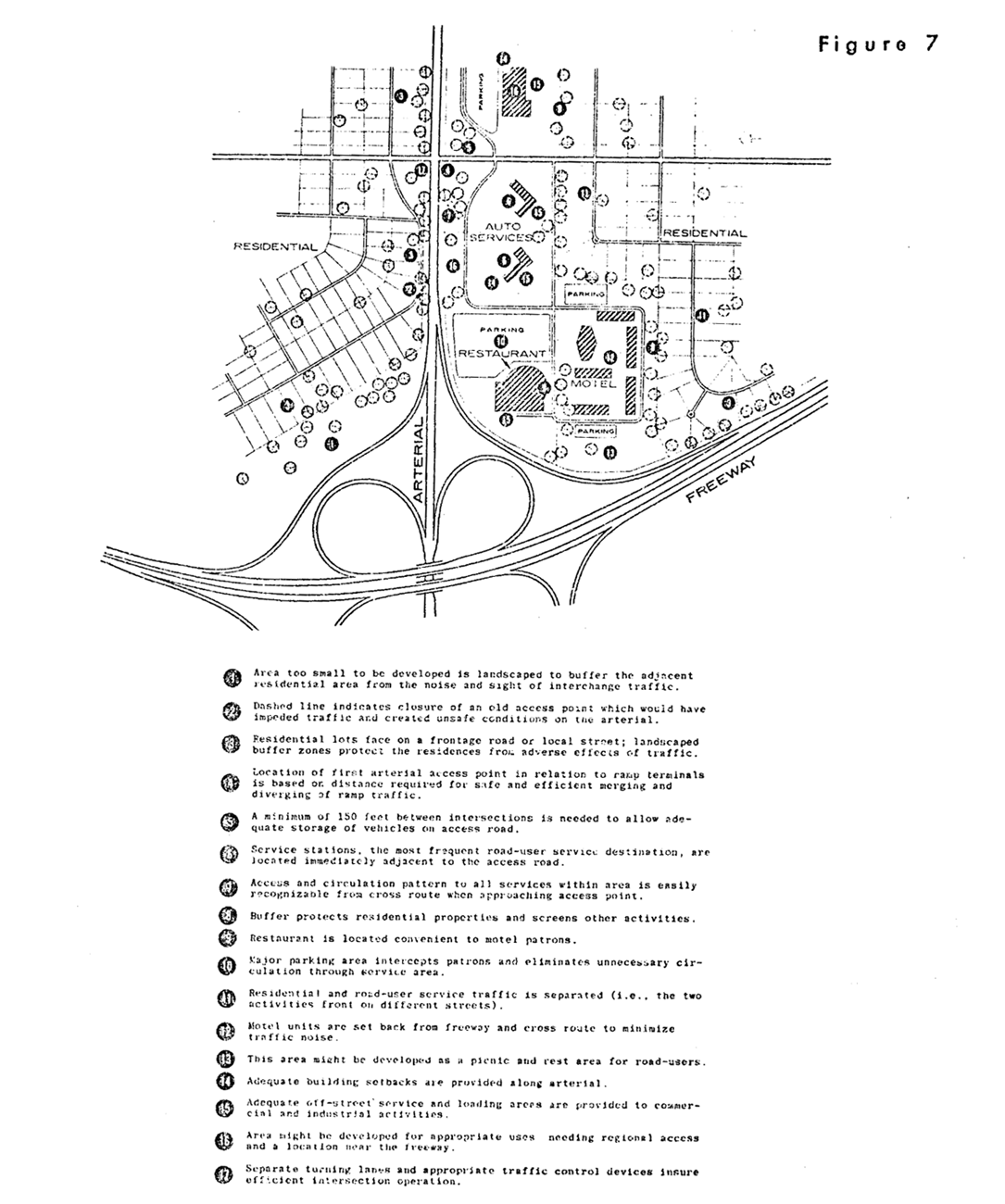
(Ord. of 12-4-1973, § 19.0)

