
Chesapeake City Zoning Code
ARTICLE 19
- DESIGN, DEVELOPMENT AND PERFORMANCE STANDARDS
§ 19-100.- Intent.
The intent of this chapter is to provide a description of basic design, development and performance standards which apply generally to all developments in the several different zoning district classifications. Development standards which are specific to particular zoning district classifications are found in the chapters for those classifications.
§ 19-200. - In general.
This article and other related provisions of the zoning ordinance shall govern the standards applicable to the configuration and development of lots within the city. The provisions of the Chesapeake Subdivision Ordinance (chapter 70 of the city Code), Erosion and Sediment Control Ordinance (chapter 26, article III, section 26-51 et seq., of the city Code) and Flood Zone Management Ordinance (chapter 26, article IV, section 26-86 et seq., of the city Code) shall also apply to such development. Where the provisions of the ordinances conflict, the strictest provision shall apply, unless otherwise provided for in this ordinance. Developers should note that certain types of development may be subject to regulations contained in other chapters of the city Code, and a review of the Code should be made to determine whether such regulations apply.
§ 19-201. - Lot regulations.
A.
Calculation of required lot area. The minimum lot size requirements of the different zoning district classifications of this zoning ordinance establish the minimum "required lot area" for the lots in those districts. Minimum lot sizes resulting from adjustments approved in accordance with section 19-800 et seq. of this ordinance shall establish the minimum "required lot area" for those lots benefiting from such adjustments. When a lot is measured for compliance with the lot size requirements of the zoning district or an adjustment approved in accordance with section 19-800 et seq., the following properties shall be excluded from the measurement of the lot:
(1)
Land constituting tidal wetlands, as the term "wetlands" is defined in Title 28.2-1300 of the Code of Virginia, 1950, as amended;
(2)
Land submerged under nontidal waters, up to the normal watermark;
(3)
Land within an open drainage ditch, measured from top of bank; provided, however, that up to a maximum of ten (10) percent of the minimum required lot area may be within such properties and still be included in the calculation of lot area.
B.
Combinations of lots. When an owner proposes to combine two or more lots into one development site, all area, frontage, yard and other site requirements for each lot shall apply unless the developer vacates the individual lot lines to produce a single lot.
C.
Arrangements of new lots. Lots shall be located and oriented to existing or proposed adjacent lots so that the arrangement of yards by type (front, side and rear) is logically related to adjacent yard patterns.
D.
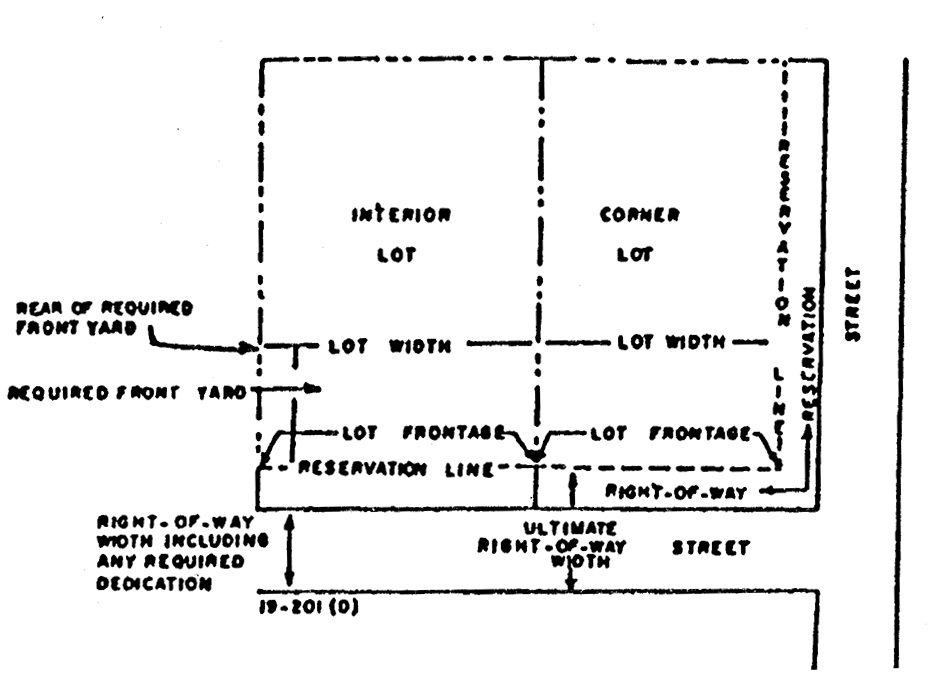
Measurement of lot frontage and width.
1.
Lot frontage shall be measured along the street reservation line, as determined under section 19-202, or, as applicable, from the alternative right-of-way lines described in section 19-202. Where a lot fronts on more than one street, both front yards shall meet lot frontage requirements, which in all cases shall be a minimum of 80 percent of the minimum lot width for the zoning district in which the property is located, except for the lots approved for a reduction in accordance with subsections 19-201.D.6 and 7 of this ordinance or otherwise established in this ordinance or the City Code.
2.
Lot width shall be measured along the interior edge of the required front yard. Where a lot fronts on more than one street, both front yards shall meet lot width requirements.
3.
Illustration:
4.
Additional regulations pertaining to lot frontage and measurement of lot width, as set out in section 70-89 of the city Code, shall apply.
5.
Adjustments approved in accordance with sections 19-800 et seq. may affect the calculation of lot frontage. (See section 19-804 for more information.)
6.
The minimum lot frontage for lots used exclusively for storm water management, open space or conservation shall be fifty (50) feet.
a.
In order to qualify for the reduction to fifty (50) feet, the chief of the fire department or designee and the director of development and permits, or designee must determine that a minimum lot frontage of fifty (50) feet is sufficient to support ingress and egress for fire, safety and maintenance equipment. If either the fire department or designee or the director of development and permits, or designee determine that fifty (50) feet is insufficient for ingress and egress for fire, safety and maintenance equipment, the minimum lot frontage established in subsection 19-201.D.1 of this ordinance shall apply or such frontage as may be required by an applicable zoning district.
b.
The planning director or designee may require that a lot that qualifies for a minimum lot frontage reduction be improved with an acceptable surface material to accommodate ingress and egress for fire, safety and maintenance equipment and may require that the owner of a lot approved for a minimum lot frontage grant an appropriate easement to ensure that the lot is exclusively used for the purpose that provides the basis for qualifying for a minimum lot frontage reduction to 50 feet and to ensure appropriate ingress and egress.
c.
For purposes of this section, the phrase "storm water management" shall have the same meaning as set out in section 26-344 of the City Code, "open space" shall mean the acreage required by section 19-700, et. seq. of this ordinance and "conservation" shall mean property permanently set aside by easement or similar device for conservation purposes on which no development or further subdivision will occur and which does not qualify as a preservation division as defined in section 70-1 of the City Code and section 10-201 of this zoning ordinance.
d.
Lots used for active recreation shall meet the minimum lot frontage required by subsection 19-201.D.1 of this ordinance.
e.
Lots regulated by subsection 70-89(a) of the City Code shall not qualify for a reduction of minimum lot frontage.
7.
The planning director or designee may approve a greater reduction in the minimum lot frontage than permitted in subsection 19-201.D.6 of this ordinance or a waiver of minimum lot frontage for lots used exclusively for storm water management, open space or conservation in accordance with the following:
a.
For purposes of this section, the phrase "storm water management" shall have the same meaning as set out in section 26-344 of the City Code, "open space" shall mean the acreage required by section 19-700, et. seq. of this ordinance and "conservation" shall mean property permanently set aside by easement or similar device for conservation purposes on which no development or further subdivision will occur and which does not qualify as a preservation division as defined in section 70-1 of the City Code and section 10-201 of this zoning ordinance.
b.
Minimum lot frontage may only be reduced to the frontage determined by the chief of the fire department or designee and the director of development and permits, or designee to be sufficient for ingress and egress for fire, safety and maintenance equipment. If the chief of the fire department or designee and the director of development and permits, or designee determine that no frontage is necessary to support ingress and egress for fire, safety and maintenance equipment the planning director or designee may waive the requirement for minimum lot frontage.
c.
The reduction or waiver is consistent with sound planning practices.
d.
The planning director or designee may require that a lot approved for a minimum lot frontage reduction be improved with an acceptable surface material to accommodate ingress and egress for fire, safety and maintenance equipment. and may require that the owner of a lot approved for a reduction or waiver of minimum lot frontage grant an appropriate easement to ensure that the lot is exclusively used for the purpose that provides the basis for qualifying for a minimum lot frontage reduction and to ensure appropriate ingress and egress.
e.
The planning director or designee shall not approve a minimum lot frontage adjustment for a lot used for active recreation or for those lots that are regulated by subsections 70-89(a) or (b) of the City Code.
8.
Lot frontage established on or for an existing or residual lot by the introduction of a stub street, as defined in chapter 70 of the City Code, is exempt from the minimum lot frontage and lot width requirements set out in this ordinance. Lot frontage established on or for an existing or residual lot created by the introduction of a stub street shall comply with the minimum lot frontage required by chapter 70 of the City Code.
(Ord. No. 00-O-107, 9-19-00; Ord. No. 02-O-084, 7-16-02; Ord. No. 04-O-176, 12-21-04; Ord. No. 05-O-015, 3-8-05; Ord. No. 05-O-071, 6-21-05; Ord. No. 05-O-087, 7-19-05; Ord. No. 09-O-051, 5-19-09; Ord. No. 24-O-064, 6-18-24)
§ 19-202. - Required yards and setbacks.
A.
Measuring yards and setbacks from streets.
1.
Unless expressly stated otherwise in this ordinance, each required yard abutting a street shall be measured from the street reservation line (ultimate right-of-way width) as shown on the city's adopted Master Transportation Plan. If the road is not shown on the adopted Master Transportation Plan, the setbacks shall be measured from any other established reservation line shown on site plans, subdivision plats, surveys, or recorded exhibits approved or accepted by the city.
2.
Where no reservation line exists or the street is constructed to its ultimate width, the setback shall be measured from the right-of-way line.
3.
Where no reservation line exists and the right-of-way line cannot be firmly established each required yard shall be measured from a line located twenty-five (25) feet from the centerline of the pavement.
B.
Measuring yards and setbacks from lot lines. Required yards shall be measured from the property line of the lot in question, at the distance specified for the zoning district classification in which the lot is located, except in the following circumstances: where wetlands, as defined in the Code of Virginia, 1950, as amended, extend onto the lot, the required yard shall be measured from the closest boundary of the wetlands; where a nontidal body of water extends onto the lot, the required yard shall be measured from the normal watermark.
Illustration:
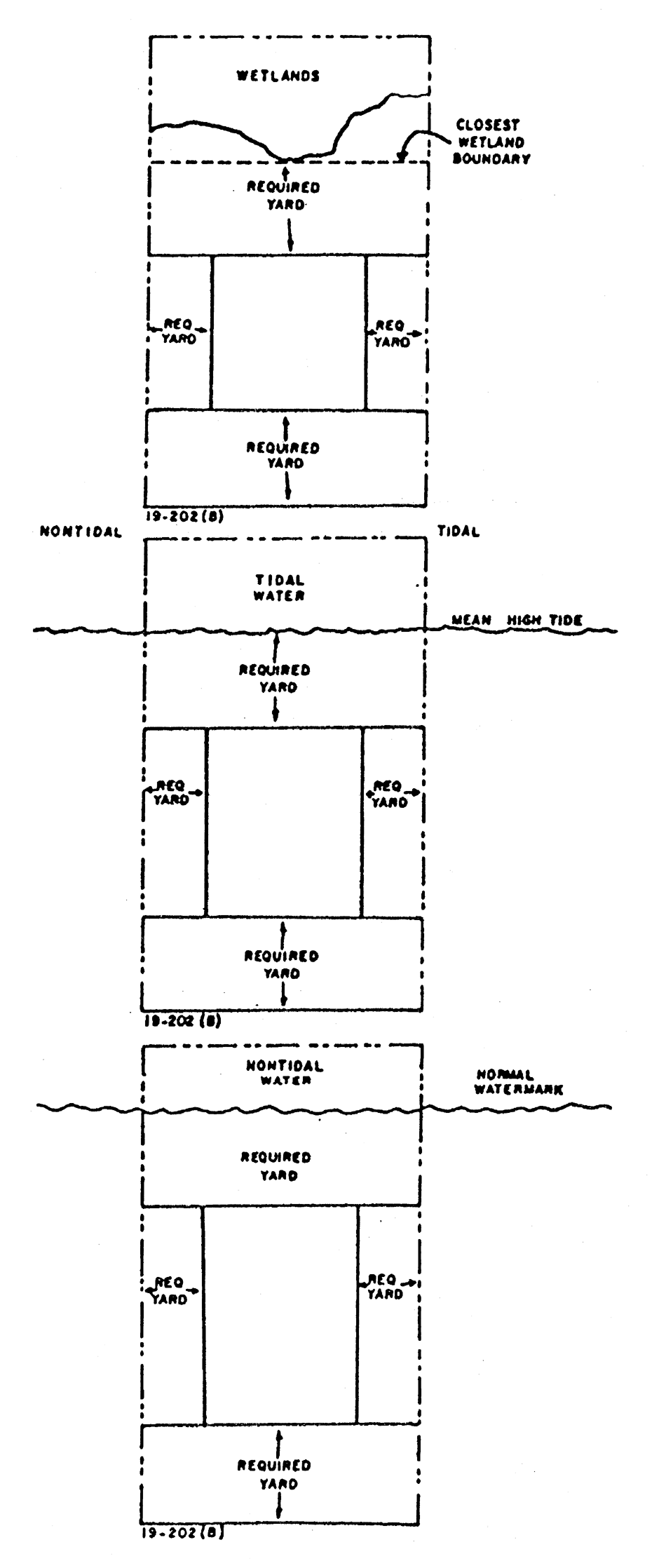
Measuring Yards and Setbacks from Lot Lines
C.
Front yard requirements.
1.
On interior lots, the front yard shall be construed to be the portion of the lot nearest the street.
2.
On corner lots, both portions of the lot facing a street shall be treated as a front yard; however, the depth of the front yard that is to the side of the principal structure built on the lot may be reduced by up to one-half (½) of the front yard requirement, subject to the following:
a.
The yard created by such reduction shall not be less than fifteen (15) feet in depth.
b.
The minimum required side yard behind the principal structure shall be increased by an amount equal to any such reduction.
3.
On through lots, where opposite sides of a lot front on a street, both portions of the lot facing a street shall be treated as front yards.
4.
Unless expressly stated elsewhere in this ordinance or in chapter 70 of the City Code, the depth of the required front yard shall meet the minimum criteria for the zoning district in which the property is located. The depth of an established front yard shall be equal to or greater than the depth required for the required front yard at all points of the front yard, with the interior edge of the required front yard being measured parallel with the street reservation or right-of-way line, as may be applicable. Except in the case of lots located on culs-de-sac subject to section 70-89 of the City Code, minimum lot width shall be measured at the interior line of the required front yard.
D.
Side yard requirements.
1.
Side yards on lots shall run from the interior edge of the required front yard to the interior edge of the required rear yard. On corner lots, the required side yards shall run from the point where side yard lines intersect with required front yard lines.
2.
The width of a side yard shall be equal to or greater than the minimum required by the district regulations for the zoning classification involved (the "required side yard") at all points of the side yard, with its interior edge being measured parallel with the side lot line.
E.
Rear yard requirements.
1.
The depth of a rear yard shall be equal to or greater than the minimum depth required by the district regulations for the zoning classification involved (the "required rear yard") at all points of the rear yard, with its interior edge being measured parallel with the rear lot line.
2.
In the case of through lots and corner lots, there will be no rear yards, but only front and side yards.
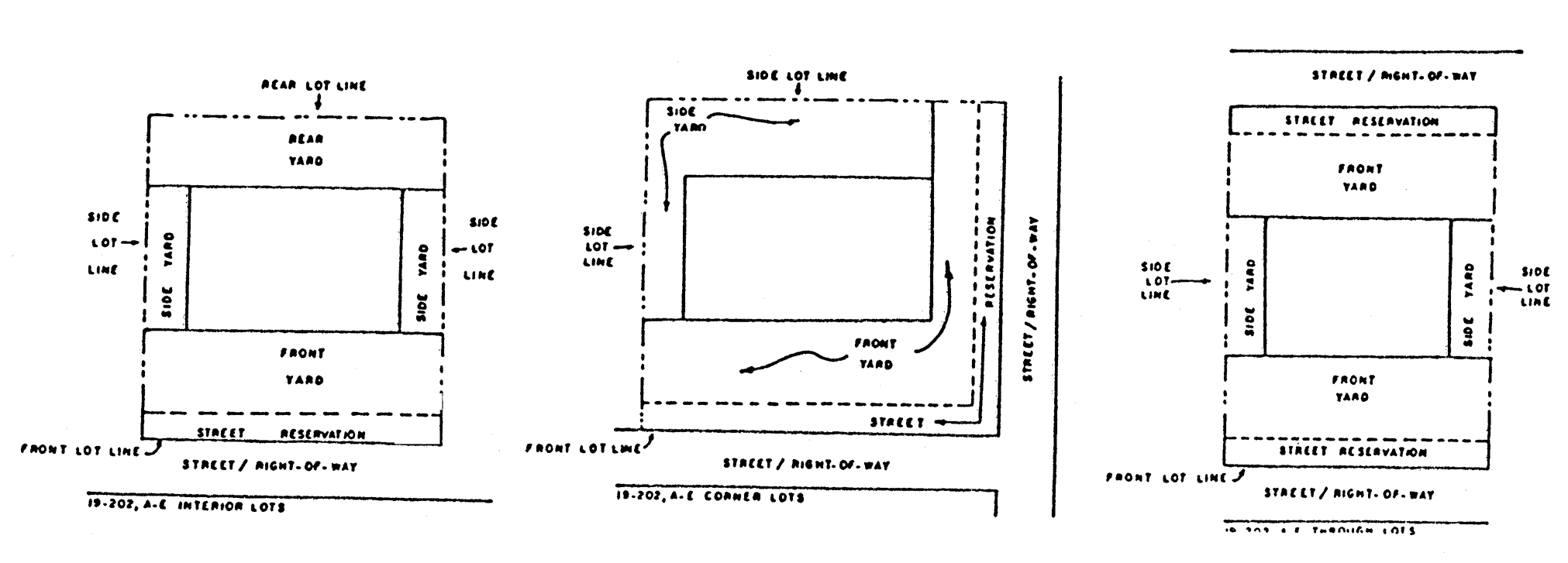
Illustration for subsections C, D and E
F.
Yard measurements for lots having unusual configurations.
1.
Where the configuration of a lot is such that the location of and differentiation among side lot lines and rear lot lines is not readily apparent, the zoning administrator shall have the authority to designate side lot and rear lot lines, in accordance with the following standards:
a.
Those lot lines that, in their overall direction, tend toward being perpendicular to the street right-of-way shall be considered to be side lot lines.
b.
Those lot lines that, in their overall direction, tend toward being parallel to the street right-of-way shall be considered to be rear lot lines
2.
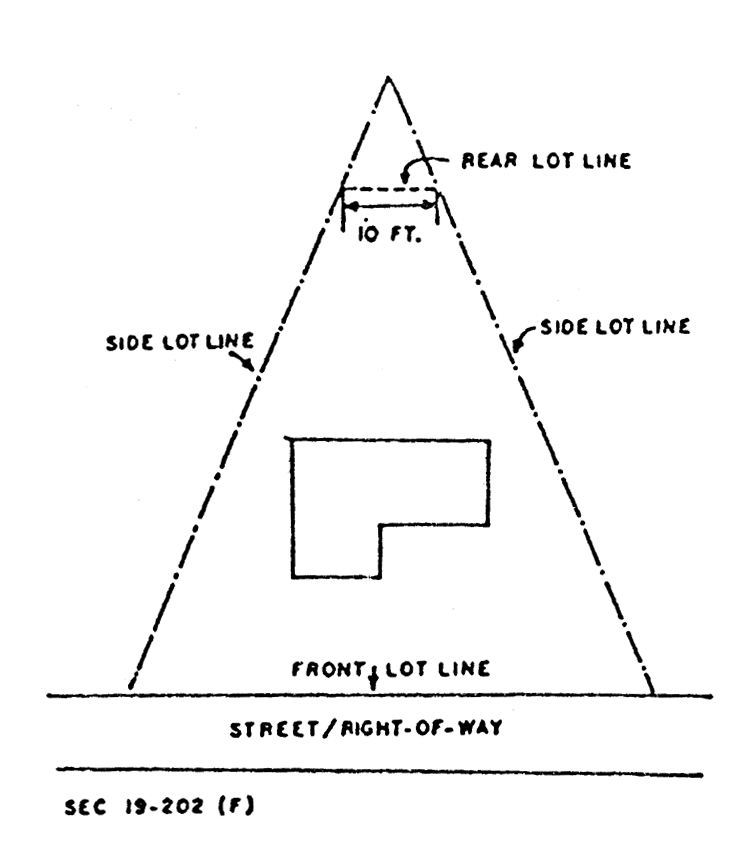
Where the side lot lines of a lot join together in a point creating a rear yard that is triangular in shape, the rear lot line of the lot, for purposes of determining minimum yard setbacks, shall be a line drawn parallel to the front lot line at a point where the distance between the side lot lines is at least ten (10) feet.
Illustration:
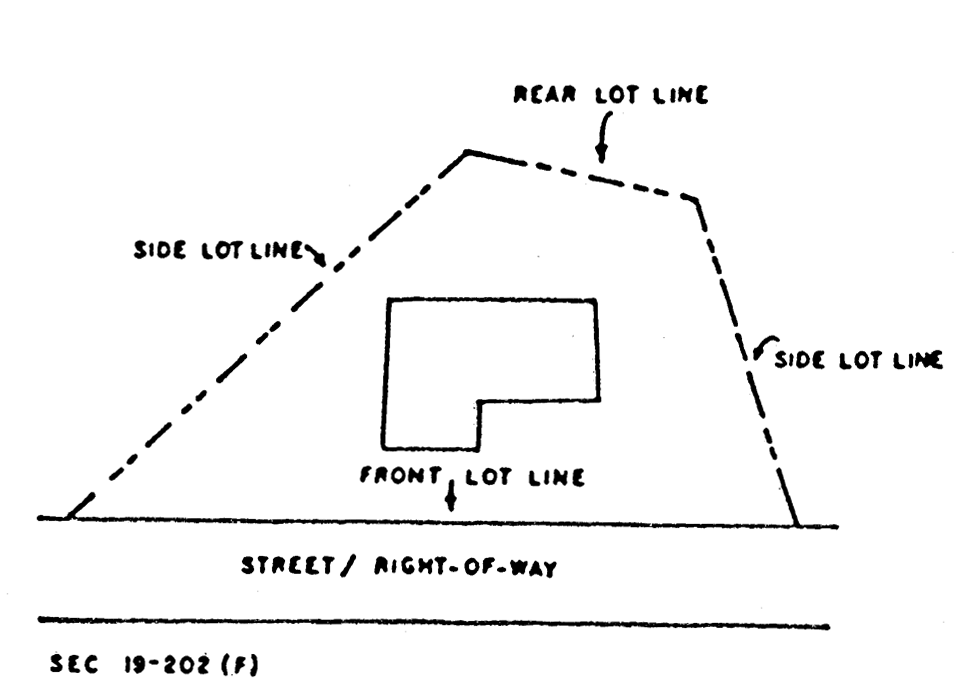
Yard measurements lots unusual configurations (1)
Yard measurements lots unusual configurations (2)
G.
Permitted extensions into minimum required yards. The following extensions into a required yard from a lawfully constructed building shall be permitted, provided that such structures shall not extend into an existing public easement:
1.
Uncovered terraces or decks which do not exceed thirty (30) inches in height when measured from the established yard grade.
2.
Awnings or canopies, unenclosed front yard porches and patios, provided that they do not project more than five (5) feet into the required yard. In no case shall the projection be closer than twenty (20) feet from any street right-of-way line or street reservation line (exception: service station pump island canopies, which are regulated by the requirements of chapter 14, article VI (section 14-271 et seq.), of the City Code).
3.
Overhanging eaves and gutters projecting thirty (30) inches or less into the required yard, provided that such projection is a minimum of five (5) feet from any lot line.
4.
Chimneys projecting twenty-four (24) inches or less into the required yard, provided that such projection is a minimum of five (5) feet from any lot line.
5.
Heating, ventilation and air conditioning (HVAC) and pump house equipment may be located at a minimum setback of five (5) feet from the nearest property line.
6.
Unroofed handicap ramps that are attached to a single-family detached dwelling unit may extend into minimum required setbacks provided that the following requirements are met:
a.
The handicap ramp provides a reasonable modification for the benefit of a person with a protected disability status in accordance with the Americans with Disabilities Act of 1990 (42 U.S.C. Section 12131 et seq., as amended); and
b.
The handicap ramp extension is a minimum of five (5) feet from any lot line; and
c.
All handicap ramps installed pursuant to this ordinance shall be removed, or a variance shall be obtained from the board of zoning appeals, within six (6) months of said ramp ceasing to be necessary to accommodate a person with a protected disability status.
H.
Uses and structures permitted in required yards.
1.
Accessory structures may be allowed in accordance with the requirements of article 14 of this ordinance.
2.
Every structure located in a required yard shall be subject to relocation at the expense of the owner, whenever such relocation is determined by the zoning administrator and the director of development and permits, or designee, to be necessary to accommodate the widening or improvement of the adjacent street right-of-way.
I.
Yard requirements for open land. If a use is located on a lot and no buildings or structures are erected as part of that use of the lot (for example, it is used only for the storage of vehicles), the use shall not extend into the yards required for such a lot under the applicable zoning district regulations, unless another provision of this zoning ordinance requires or permits a different minimum yard. Front, side and rear yards shall not be required on lots used for agricultural purposes, open public areas or open space, but any structure associated with those uses shall comply with the applicable setback requirements.
(Ord. No. 95-O-075, 4-18-95; Ord. No. 02-O-084, 7-16-02; Ord. No. 05-O-015, 3-8-05; Ord. No. 05-O-166, 12-20-05; Ord. No. 09-O-051, 5-19-09; Ord. No. 17-O-081, 11-21-17; Ord. No. 19-O-077, 6-18-19; Ord. No. 23-O-036, 4-18-23)
§ 19-203. - Modifications in required yards and setbacks.
Required yards and setbacks for principal buildings may be reduced by the zoning administrator or designee pursuant to the authority in sections 6-1800, 7-402, 7-502, 8-302, 9-302, 9-402, 13-1703, and 15-103 of this ordinance.
(Ord. No. 96-O-011, 1-16-96; Ord. No. 97-O-141, 11-18-97; Ord. No. 98-O-121, 8-25-98; Ord. No. 03-O-029, 3-18-03)
§ 19-204. - Visibility clearance at intersections and entrances.
A.
At intersections (corner lots). On a corner lot no fence, wall, hedge or other planting or structure that will obstruct vision between a height of two and one-half feet and ten feet above the pavement centerline grades of the intersecting streets shall be erected, placed or maintained within the triangular area formed by the edge of the pavement of each intersecting street at such corner lot and a straight line which joins those pavement edges at points which are forty-five (45) feet from the point where the projections of the pavement edges intersect.
B.
At commercial entrances. Visibility clearance shall also be required at all entrances onto public or private streets from properties zoned or used for office and institutional, business, industrial, multifamily and similar purposes, provided that the two equal sides of the triangle forming this visibility clearance area may be twenty (20) feet in length, rather than the forty-five (45) feet required for street intersections.
C.
At single-family and duplex residential entrances. Visibility clearance shall also be required at all entrances onto public or private streets from driveways in single-family (including driveways within single-family condominium developments) and duplex dwelling units, provided that the two equal sides of the triangle forming this visibility clearance area may be ten (10) feet in length, rather than the longer distances required for other entrances.
D.
Exceptions. An exception to the above requirements may be permitted by the zoning administrator, with the concurrence of the director of development and permits, or designee, where terrain features present substantial obstacles to providing and maintaining the required clearance dimensions, but the clearance which is approved by the zoning administrator shall be the maximum which, in the zoning administrator's professional judgment, is reasonably practical to provide and maintain.
Illustrations for subsections A, B AND C:
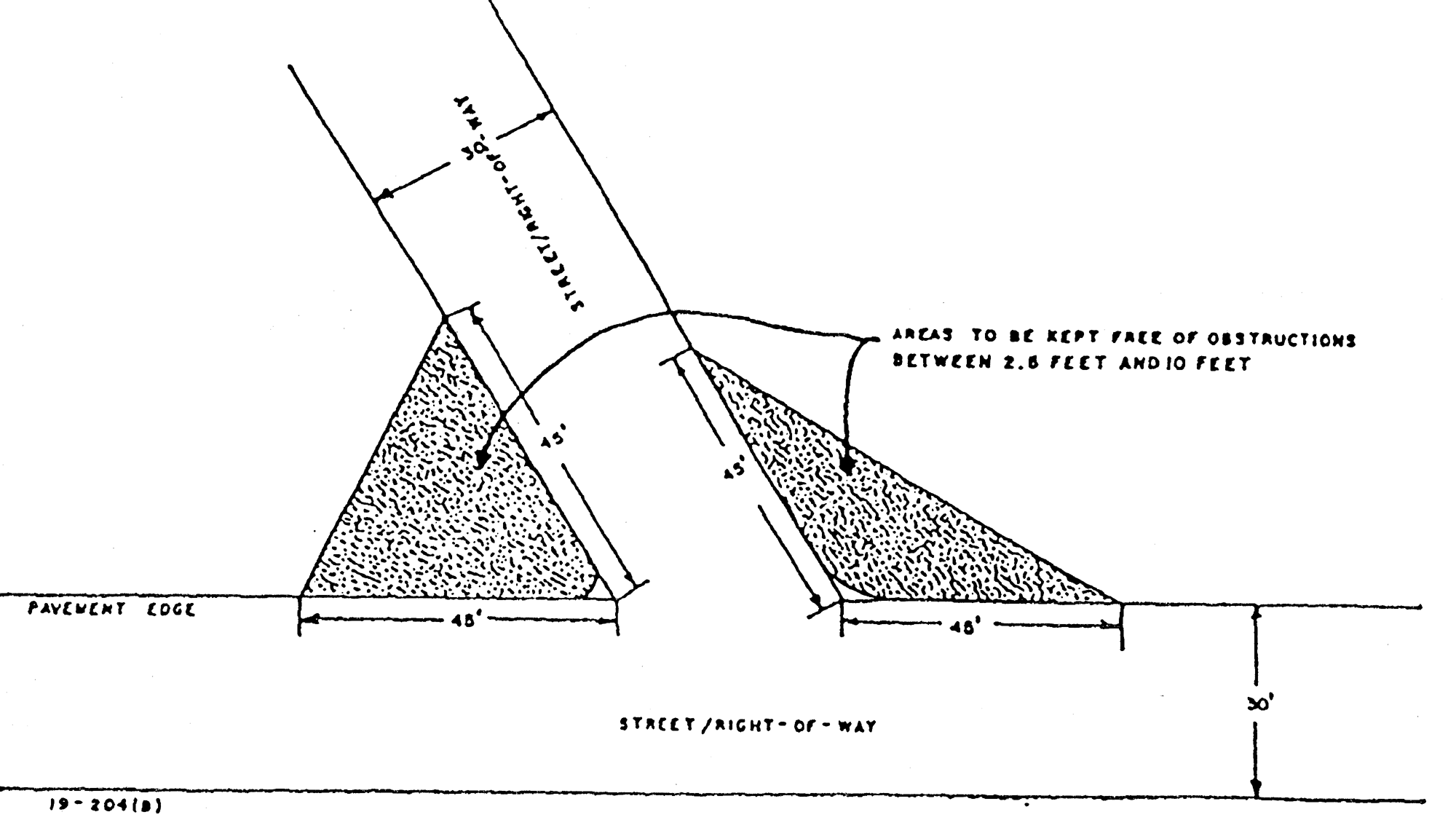
Visibility Clearance at Intersections and Entrances
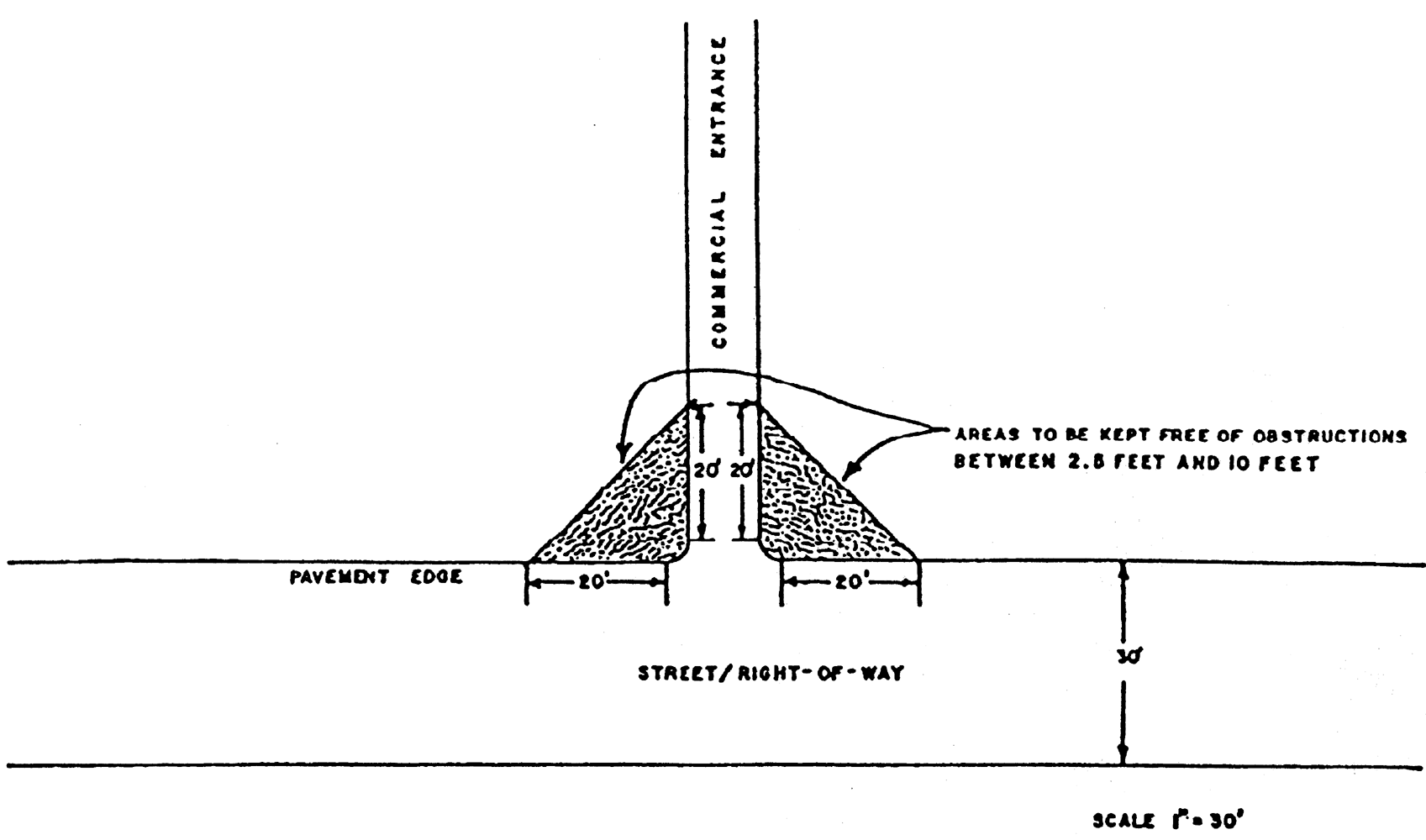
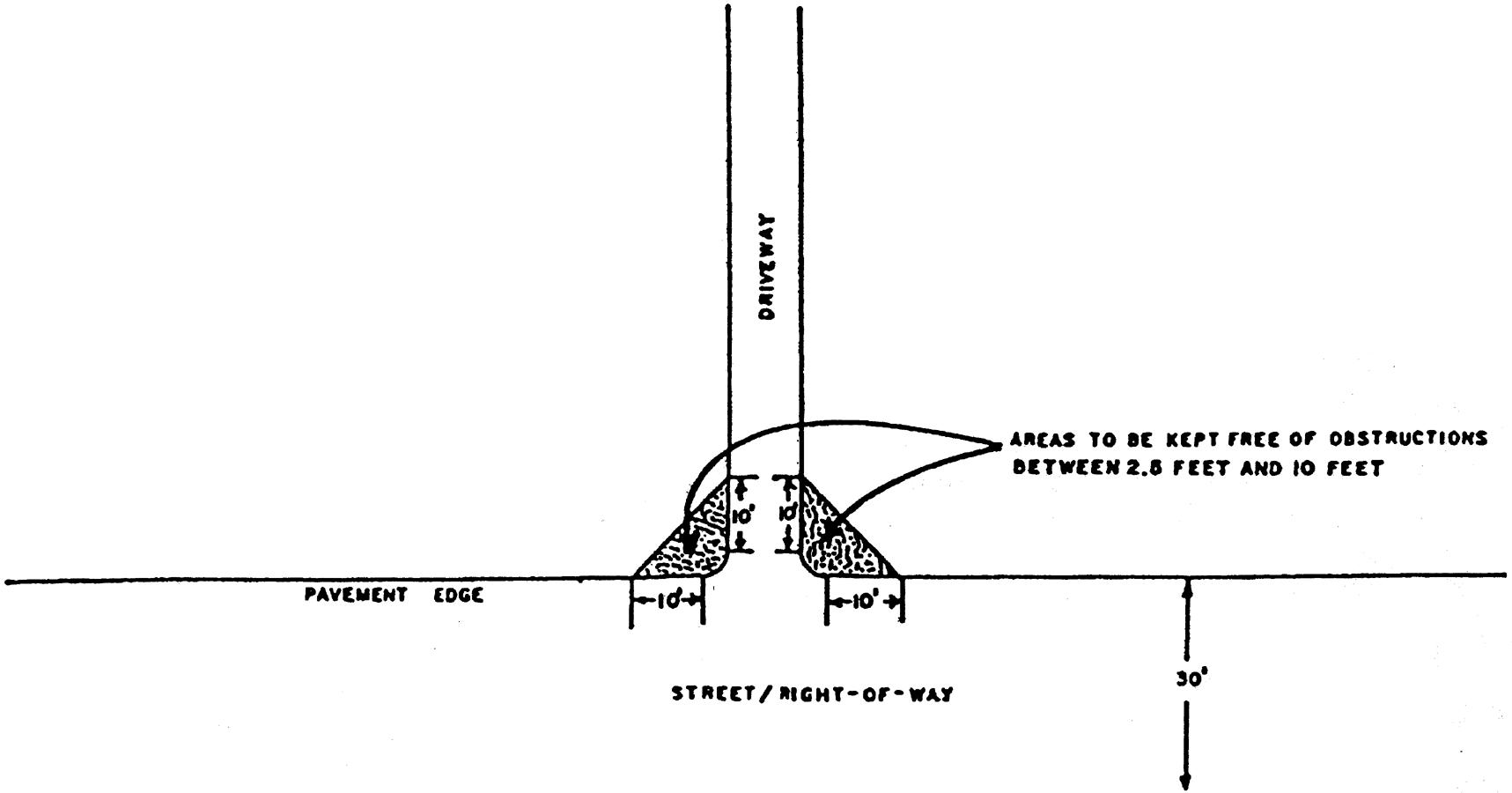
Driveways
(Ord. No. 09-O-051, 5-19-09)
§ 19-205. - Height exemptions and limitations; extension through conditional use permit.
A.
Exemptions from height limitations. The height limitations set out elsewhere in this zoning ordinance shall not apply to chimneys, church spires, belfries, cupolas and other domes not used for human occupancy, skylights, solar energy devices, amateur radio communication antennas (see section 14-600), ventilators, heating and air conditioning units, tanks, and other necessary mechanical equipment usually located on a roof, parapet walls or bulkheads; nor to city-owned communication towers, water towers, and similar public use structures; nor to public and private bridges depicted on the adopted Master Transportation Plan or approved in accordance with section 15.2-2232, Code of Virginia, 1950, as amended, provided that such features and structures shall be erected only to a height necessary to accomplish the purpose intended. Mechanical equipment located on a roof shall be hidden by a wall or other similar enclosure extending not more than one foot above the height of such equipment and designed in harmony with the building.
B.
Exceptions to height limitations through conditional use permit. The construction of buildings or structures exceeding the height limitations set out in this ordinance may be approved through a conditional use permit approved by city council, except that no conditional use permit shall be required for adjustments approved in accordance with sections 19-800 et seq., provided that the following findings are made:
1.
The proposed height of the building or structure will not have a substantial adverse impact on the light and air of adjacent and nearby properties;
2.
The director of development and permits or designee has certified in writing that the building as proposed will meet all applicable building code requirements, and the fire marshal has certified in writing that the proposed building or structure can be properly protected and will not endanger improvements on adjacent properties, in case of fire;
3.
The proposal shall not constitute a hazard to aerial navigation (city council may require the developer to obtain certification from the Federal Aviation Administration regarding this);
4.
All other requirements of the zoning ordinance regarding conditional use permits, as may be applicable, have been met.
C.
Exception to height limitations for planned unit developments (PUD). The erection of buildings or structures exceeding the height limitations set out in this zoning ordinance may be approved by city council as part of its approval of a proposed planned unit development (PUD), provided that city council makes the findings set out in subsection (B) above.
D.
Reduction of height limitations for air traffic safety. The permitted heights of buildings and structures shall be reduced if the director of planning determines that a proposed structure would interfere with air traffic using any established airport or other landing area in the city.
E.
Height limitations and other development restrictions and conditions necessary to protect public emergency communications. In the interest of public safety, the city manager or designee is hereby authorized to impose height limitations and other development restrictions and conditions on any building or structure proposed to exceed seventy-five (75) feet in height, where necessary to prevent interference with public emergency communications. Prior to exercising this authority, the city manager or designee shall make preliminary findings that the proposed height or design of a building or structure will, or is reasonably likely to, inhibit or interfere with the transfer of radio microwaves used in the city's emergency communication system, as determined on the basis of accepted industry standards for adequate radio coverage. Where such preliminary findings are made, the city manager or designee may require the property owner to provide engineering studies, acceptable to the city, to determine the precise nature and extent of any potential detrimental impact and to identify methods of eliminating such detrimental impact, including but not limited to, the relocation or redesign of the building or structure. Upon receipt of such studies, or on the basis of other reliable analysis, the city manager or designee may impose height limitations or other development restrictions and conditions as necessary to eliminate the potential interference. No certificate of occupancy shall be issued for the affected building or structure until all such height limitations and other development restrictions and conditions imposed by the city manager or designee have been met.
(Ord. No. 00-O-097, 8-15-00; Ord. No. 04-O-011, 1-20-04; Ord. No. 04-O-176, 12-21-04; Ord. No. 09-O-051, 5-19-09; Ord. No. 17-O-081, 11-21-17)
§ 19-206. - Reasonable deviations.
A.
Within the urban overlay district and as part of an application for a change in the zoning district classification for a property (rezoning application) or an application for a conditional use permit, city council may approve a reasonable deviation from one or more of the following requirements otherwise applicable to the proposed development:
1.
Required yards and setbacks;
2.
Required landscaping;
3.
Height restrictions;
4.
Minimum lot frontage, width, and size; and
5.
Maximum lot coverage.
B.
Standard. City council may approve a reasonable deviation for good cause shown and upon a finding that there will be no significant detrimental effect on city services, neighboring properties, or the surrounding area. For purposes of this section, "good cause" means that the reasonable deviation improves the overall quality or design of the development.
C.
Procedure.
1.
An applicant requesting a reasonable deviation must:
a.
Specifically indicate the nature and extent of each requested deviation on their application;
b.
Visually identify each requested reasonable deviation on any plan and drawing submitted as part of the application; and
c.
Provide sufficient information to demonstrate the requested deviation satisfies the good cause requirement of this section.
2.
Each requested reasonable deviation must be explicitly identified in all published notices of the public hearing as required by applicable law.
3.
If an applicant requests a reasonable deviation that has not been advertised for a public hearing, then the applicant must request a continuance for this purpose. The planning commission or city council may grant the continuance or elect to hear the application without the unadvertised reasonable deviation. If the continuance is granted, the planning department and other affected departments shall review the request and provide the planning commission or city council with comments and a recommendation thereon.
(Ord. No. 24-O-090, 8-20-24)
§ 19-300. - Public improvements required.
Every development shall be required to install public improvements in accordance with the requirements of chapter 70 of the city Code.
§ 19-401. - Intent.
The intent of these regulations is to reduce traffic hazards and conflicts, to provide adequate parking for the travelling public and to ensure that the parking and traffic circulation facilities provided are adequate to address the intensity of the uses involved.
§ 19-402. - Application.
A.
In general. Off-street parking, loading spaces and off-street parking ingress and egress entrances shall be provided in accordance with the provisions of this section and section 19-409 at the time of erection, alteration, enlargement or change in use of any structure.
B.
Existing parking and/or loading spaces and/or off-street parking ingress and egress entrances. Any use for which parking and/or loading spaces and/or off-street parking ingress and egress entrances were approved and provided prior to the effective date of this zoning ordinance shall be considered to be in compliance with this ordinance, provided that the use is not changed to one which requires more parking (under section 19-411 of this zoning ordinance) than the use existing on the site on the effective date of this ordinance. If any change is planned for the use of the site or any alteration or expansion is planned for the occupied structures on the site which results in an increase in the required parking for the site under the standards of section 19-411 below, a site plan must first be submitted to and approved by the director of development and permits, with the concurrence of the zoning administrator, in accordance with the standards set out below, before such change, alteration or expansion may occur.
(Ord. No. 95-O-074, 4-18-95; Ord. No. 25-O-007, 2-18-25)
§ 19-403. - Parking and traffic circulation area design.
A.
In general. Parking areas shall be designed to minimize on-site and off-site traffic hazards and conflicts in order to provide safe and convenient access to the travelling public; to reduce or prevent congestion in the public streets; and to facilitate the provision of emergency services.
B.
Stacking lanes, internal circulation and parking for developments providing drive-through or window pickup service for vehicles.
1.
Those developments providing an order and drive-through service on the site shall be designed so that those vehicles engaged in ordering and pickup do not interfere with the parking and movement of other vehicles, including vehicles engaged in loading and off-loading activities at the site. Stacking lanes shall be provided to accommodate at least five (5) vehicles, regardless of the number of service windows. The site shall also be designed toinclude a minimum of two (2) designated extra off-street parking spaces, above the number otherwise required by this zoning ordinance for such developments, for vehicles having to move out of the drive-through line and await service after ordering. Any signs approved by the director of development and permits, or designee, and complying with this zoning ordinance, shall be provided for the spaces.
2.
Those developments providing a pickup service by vehicle, with no ordering on site, shall be designed so that those vehicles waiting for pickup service do not interfere with the parking and movement of other vehicles, including vehicles engaged in loading and off-loading activities at the site. Unless one or more stacking lanes are provided to accommodate at least five (5) vehicles as required for drive-through facilities, such developments shall provide special parking areas which shall include a minimum of five (5) designated extra parking spaces, above the number otherwise required by this zoning ordinance for such developments, for vehicles to wait for pickup service. Any signs, approved by the director of development and permits, or designee, and complying with this zoning ordinance, shall be provided for the spaces.
C.
Marking and arrangement of parking spaces and fire lanes.
1.
All parking spaces and fire lanes shall be clearly marked and visible at all times.
2.
The arrangements of parking spaces and circulation patterns approved as part of a final site plan shall not be changed without prior approval of the director of development and permits, or designee.
(Ord. No. 98-O-163, 11-17-98; Ord. No. 09-O-051, 5-19-09; Ord. No. 18-O-028, 3-20-18)
§ 19-404. - Location of parking.
A.
On-site requirement. Off-street parking spaces shall be provided on the same lot with the use which the parking serves, except as provided for below. In no event shall public right-of-way be used for parking in furtherance of commercial purposes unless (1) the parking is allowed in conjunction with an outdoor sale permitted in the public right-of-way under section 66-5 of the city Code, (2) the parking is necessary to facilitate a city or other governmental project or (3) the director of development and permits, or designee, expressly authorizes such parking by issuance of an annual permit pursuant to section 74-251(b) of the city Code. It shall otherwise be a violation of this ordinance to park any motor vehicle, boat, recreational vehicle, trailer or related equipment, on the public right-of-way in pursuance of commercial purposes, whether for display, storage or customer convenience.
B.
Alternative location.
1.
Where practical difficulties prevent the location of parking on-site or where the public safety or public convenience would be served by the location of parking other than on the same lot, the planning commission may grant a special exception, in accordance with sections 19-900 through 19-902 of this zoning ordinance, authorizing such alternative location of required parking space as will adequately serve the public interest, provided that such space shall be located on land in the same ownership or control as that for the land on which the principal use is located (or, in the case of cooperative parking as set out below, in the ownership of at least one of the participants in the cooperative parking arrangement).
2.
Where an alternative location for parking is provided, such alternative location need not be in the same zoning district classification as that of the lot on which the principal use is located. However, property zoned for residential uses may be used as an alternative location for parking to support a nonresidential use on another lot only through the issuance of a conditional use permit, in accordance with the requirements of article 17 of this zoning ordinance.
3.
For nonresidential uses, no parking space shall be located farther than five hundred (500) feet, measured along the path of pedestrian access, from the entrance of the use such space serves.
4.
As part of a special exception, the planning commission may increase the maximum distances set out above for a particular development upon making the following findings: (a) that the public interest or convenience would be equally or better served by such increased distance; (b) that the allowance of a greater distance would not be a departure from sound engineering and design practice; and (c) that the allowance of a greater distance would not otherwise be contrary to the purpose and intent of this ordinance.
5.
As part of a special exception, the planning commission may approve alternative parking surfaces for alternative parking locations under section 19-406.C. of this ordinance in cases where the planning commission finds that the alternative surface will serve the public interest or convenience and will not contravene sound engineering and design practices.
(Ord. No. 96-O-030, 2-20-96; Ord. No. 96-O-195, 12-17-96; Ord. No. 00-O-008, 1-18-00; Ord. No. 09-O-051, 5-19-09; Ord. No. 25-O-115, 11-18-25)
§ 19-405. - Cooperative parking.
A.
Upon the granting of a special exception, parking spaces required under the provisions of this ordinance may be provided cooperatively for two or more uses in a development or for two or more individual uses, subject to arrangements that will assure the permanent availability of such space as such arrangements are approved by the planning commission.
B.
The amount of such combined space shall be equal to the sum of the amounts required for the separate uses, provided that the planning commission may reduce the amount of space required for a church or other similar place of worship or for a meeting place of a civic, fraternal or similar organization or for other uses approved by the planning commission, where the commission finds that the cooperating uses have different hours of normal activity. The planning commission, at its discretion, may make its approval of a cooperative parking arrangement subject to certain conditions, may impose a specific time limit on its approval of such arrangement or may otherwise make the arrangement subject to further review and revocation.
(Ord. No. 25-O-115, 11-18-25)
§ 19-406. - Pavement requirements.
A.
In general. Unless otherwise provided for in this ordinance, required parking lots shall have a paved surface approved by the director of development and permits or designee. The requirements of this section shall not apply to parking lots for public parks operated by the city's department of parks, recreation, and tourism.
B.
Permit required for new paving. Unless previously approved and provided for in an approved site plan, no site or portion of a site may be paved until the owner or developer has obtained a permit from the director of development and permits, or designee, approving the paving plan and the plan of the owner or developer for providing stormwater management for the additional runoff produced by the paving.
C.
Alternative surfaces. Alternative parking surfaces may be approved by the planning commission or by city council, as may be applicable, in the following circumstances:
1.
As part of the approval of a conditional use permit.
2.
As part of a site plan for development within the rural overlay district.
3.
As part of the approval of an alternative location of parking under section 19-404.B of this ordinance pursuant to the standards set out therein.
(Ord. No. 00-O-008, 1-18-00; Ord. No. 04-O-013, 1-27-04; Ord. No. 05-O-014, 3-8-05; Ord. No. 09-O-051, 5-19-09; Ord. No. 17-O-081, 11-21-17)
§ 19-407. - Lighting for parking areas.
All lighting used to illuminate parking areas shall be arranged and installed so that the direct or reflected illumination does not exceed 0.5 footcandles above background measured at the lot line of any adjoining property zoned or used for residential purposes. All lighting shall be directed away from adjoining properties and public rights-of-way to reduce glare and interference.
§ 19-408. - Nature and size of parking spaces and parking areas.
A.
In general. For computation purposes only, an off-street parking space shall be considered to consist of an identified and marked space of at least nine (9) feet by eighteen (18) feet, plus adequate related access and maneuvering room, in accordance with the requirements of the director of development and permits, or designee. Off-street parking requirements shall be considered to be met only where actual spaces meet the performance requirements set out below.
B.
Performance standards. All parking areas shall meet the following performance requirements:
1.
Parking areas, garages and storage areas shall be designed and constructed so that all maneuvering to park and unpark can take place entirely within property lines of lots, garages and storage areas and allow vehicles to exit onto adjoining streets or alleys in a forward direction.
2.
In regard to any given site, the use of streets, sidewalks, alleys or other public rights-of-way for parking or maneuvering to and from off-street parking spaces is prohibited, except where such maneuvering is necessary in the use of driveways for access to and from single-family and two-family dwellings.
C.
Modifications. Modifications in the actual dimensions of parking spaces below those set out above may be approved by the director of development and permits, or designee, provided that the sizing and arrangement of the spaces meet the performance requirements of this zoning ordinance and comply with the requirements of the director.
D.
Handicapped parking. Handicapped parking spaces shall meet the requirements of the Uniform Statewide Building Code. In addition to those requirements, establishments located in the O and I, AC, B-1, B-2, B-5, M-1, M-2 and M-3 zoning districts and having twenty-five (25) or more off-street parking spaces shall provide at least one additional van-accessible parking space which shall be posted with a sign limiting usage to disabled persons in wheelchairs.
(Ord. No. 02-O-008, 1-15-02; Ord. No. 09-O-051, 5-19-09; Ord. No. 25-O-007, 2-18-25)
§ 19-409. - Parking space ingress and egress.
Ingress and egress to and from any off-street parking area shall be limited to driveway entrances and exits specified in permits issued by the director of development and permits, or designee.
(Ord. No. 09-O-051, 5-19-09)
§ 19-410. - Minimum off-street parking space requirements based upon zoning classification.
A.
Compliance required with both section 19-410 and 19-411. Unless modified through a special exception in accordance with sections 19-900 through 19-902 of this zoning ordinance, each required site plan for a property shall provide an area for parking and traffic circulation that meets the parking space standards of both this section and section 19-411 below.
B.
Requirements based upon zoning classification. The number of parking spaces required for developments in the O&I, AC, B-1, B-2, M-1 and M-2 zoning districts shall be one (1) parking space for every two hundred (200) square feet of gross floor area devoted to office space, customer service or retail sales and one-half (.5) parking space for every one thousand (1,000) square feet of remaining gross floor area.
(Ord. No. 94-O-178, 9-20-94; Ord. No. 97-O-070, 6-17-97; Ord. No. 25-O-115, 11-18-25)
§ 19-411. - Schedule of specific requirements for number of off-street parking spaces.
A.
Parking groups established. Every use listed in each zoning district's table of permitted and conditional uses shall have a "parking group" number assigned to it. The different parking groups and their identifying numbers are listed in subsection B. below. Unless modified through a special exception in accordance with sections 19-900 through 19-902 of this zoning ordinance, every use that is constructed or expanded after the effective date of this zoning ordinance must contain, at a minimum, the number of parking spaces required under the parking group assigned to that use.
B.
Requirements for parking groups. The applicable parking groups and the parking space standards for each are as follows:
C.
As used herein, the phrase "one space per" shall mean that at least one parking space is required for all uses, with additional spaces required at the thresholds listed above.
D.
Schools requiring conditional use permits.
1.
Where a school or school addition or expansion requires a conditional use permit, the owner, as part of the use permit application, may request a deferral on a portion of the off-street parking requirements. Such request shall include the following:
a.
A site plan showing where the required parking would be located if the deferral were not approved. Such parking plan must meet all requirements of this zoning ordinance.
b.
A detailed written plan and site plan showing the off-street parking being proposed for actual construction, and setting out how parking on the site will be controlled in the absence of the additional parking spaces in order to prevent congestion on the site and on adjoining streets.
2.
City council may approve, modify or deny such a requested deferral as part of any conditional use permit granted for a school or school expansion. Such deferral shall be subject to revocation upon a finding that the parking control plan has not prevented congestion on the site and on adjoining streets. Such revocation shall occur only after public notice and hearing before city council that complies with the notice requirements for hearings on rezoning applications.
E.
Schools requiring only site plans.
1.
Where such addition or expansion is subject only to site plan review, the owner, as part of the site plan submission, may request a deferral on a portion of the off-street parking requirements. Such request shall include the following:
a.
A site plan showing where the required parking would be located if the deferral were not approved. Such parking plan must meet all requirements of this zoning ordinance.
b.
A detailed written plan and site plan showing the off-street parking being proposed for actual construction, and setting out how parking on the site will be controlled in the absence of the additional parking spaces in order to prevent congestion on the site and on adjoining streets.
2.
As part of a special exception in accordance with sections 19-900 through 19-902 of this zoning ordinance, the planning commission may approve, modify or deny such a requested deferral as part of any site plan for a school or school expansion. Such deferral shall be subject to revocation upon a finding that the parking control plan has not prevented congestion on the site and on adjoining streets. Such revocation shall occur only after public notice and hearing before the planning commission that complies with the notice requirements for hearings on rezoning applications.
3.
No certificate of occupancy for any such school or school addition or expansion may be issued until the planning commission has acted on the application for deferral and all parking areas required by the planning commission have been constructed. However, the site plan for the addition or expansion, other than the parking areas, may be approved, and building permits may be issued for construction, prior to planning commission hearing on the application.
F.
Because of varied, unknown, or unusual operating characteristics of these uses, the director of development and permits, or designee, shall determine the parking requirement. In making such a determination, the director of development and permits, or designee, shall be guided by:
1.
The number of persons to be employed in such building or by such use;
2.
The number of persons expected to visit or patronize such building or use;
3.
The anticipated percentage of employees, visitors, or patrons driving vehicles to such building or use;
4.
The need for safe and convenient loading or unloading space for employees, visitors, patrons, and goods; and
5.
Any parking or traffic data prepared by or for the city or submitted by the owner or operator of such building or use. This data may include, but is not limited to, site studies from similar uses, generally accepted engineering standards, or independent engineering calculations based on the nature of the proposed building or use.
(Ord. No. 94-O-092, 6-21-94; Ord. No. 94-O-178, 9-20-94; Ord. No. 95-O-032, 2-21-95; Ord. No. 96-O-107, 7-16-96; Ord. No. 96-O-177, 11-19-96; Ord. No. 99-O-104, 7-20-99; Ord. No. 02-O-136, 11-19-02; Ord. No. 04-O-124, 8-17-04; Ord. No. TA-Z-07-10, 8-21-07; Ord. No. 09-O-051, 5-19-09; Ord. No. 11-O-097, 9-20-11; Ord. No. 14-O-089, 7-15-14; Ord. No. 17-O-024, 5-16-17; Ord. No. 17-O-059, 9-12-17; Ord. No. 22-O-018, 2-15-22; Ord. No. 25-O-115, 11-18-25)
§ 19-412. - Changes in uses or structures prohibited if not in conformity with parking requirements; exception for legal nonconforming lots.
A.
Changes must meet parking requirements. A change in the use of a lot or in the structures on a lot, which would result in off-street parking requirements under this zoning ordinance which cannot be met for the site, is prohibited, unless cooperative parking or alternative parking arrangements allowed under this ordinance can be provided or a special exception is granted in accordance with section 19-900 et seq. Shopping centers as defined in section 3-403, shall be exempt from the requirements of this section, provided that the shopping center previously received final site plan approval from the city prior to the change in use.
B.
Legal nonconforming lots. A change in the use of an existing lot which is legally nonconforming as to off-street parking may occur, provided that one of the following occurs:
1.
The off-street parking requirement for the new use, based upon its parking group under this ordinance, is no greater than the off-street parking requirement for the former use; or
2.
Additional off-street parking meeting the dimensional and performance requirements of this ordinance is provided, so that the extent of the nonconformity, based upon parking group requirements, is not increased.
(Ord. No. 13-O-128, 10-15-13; Ord. No. 25-O-115, 11-18-25)
§ 19-413. - Off-street loading.
A.
Dimensional and location requirements for loading spaces.
1.
A loading space shall have minimum plan dimensions of twelve (12) feet by thirty-five (35) feet, with fourteen (14) feet overhead clearance.
2.
The loading space shall be designed and operated on the basis of the following performance standards:
a.
The loading space(s) shall be located on the site so that loading and unloading activities do not substantially interfere with pedestrian and vehicular circulation on the site, including the entry and exit of vehicles to and from the site.
b.
Loading space(s) shall be located so that loading and unloading activities do not occur in the lanes of traffic of adjacent public streets.
c.
Loading space(s) shall be located and designed so that vehicles using the spaces can safely maneuver into and out of the space(s).
d.
Where practical, loading space(s) shall be screened from view from residential properties.
B.
Numbers of spaces required. The minimum number of loading spaces required for developments shall be as follows:
1.
Developments in the O & I zoning district classification, without any retail operations, except as more specifically provided for below: one (1) loading space for every one hundred thousand (100,000) square feet of gross floor area.
2.
Developments in the B-1 or B-2 zoning district classifications, except as more specifically provided for below: one (1) loading space for every twenty thousand (20,000) square feet of gross floor area.
3.
Developments in the M-1 or M-2 zoning district classifications, except as more specifically provided for below:
4.
Retail operations and all first floor nonresidential uses, with a gross floor area of less than twenty thousand (20,000) square feet, and all wholesale and light industrial operations with a gross floor area of less than ten thousand (10,000) square feet: one (1) loading space, provided that the director of development and permits, or designee, may approve a modified space in accordance with subsection (C) below.
5.
Retail operations in general: one (1) loading space for every twenty thousand (20,000) square feet of gross floor area.
6.
Hotels and motels.
a.
Those providing sleeping accommodations, without associated restaurant, retail or personal services businesses on site: one (1) loading space for every one hundred thousand (100,000) square feet of gross floor area.
b.
Those providing associated restaurant, retail or personal services businesses on site: additional loading spaces, in accordance with the formulas set out above, based upon the combined gross floor area of such uses on the site.
C.
Waiver or modification of off-street loading requirements. Where the actual use planned for a building is found by the planning commission or the director of development and permits, or designee, as may be applicable, to be one for which the loading space requirements set out above are not needed, those requirements may be waived or modified; provided, however, that in the case of new construction or the modification of an existing facility, the developer shall make provisions to allow for the future construction or expansion of required off-street loading spaces.
(Ord. No. 09-O-051, 5-19-09)
§ 19-414. - Change or reduction in parking spaces or traffic arrangements on site.
Where off-street parking and loading spaces and traffic arrangements are required by these regulations, no owner or occupant of any land or building shall discontinue, change or dispense with such facilities or arrangements without establishing alternative facilities complying equally with the requirements of this ordinance. No such change in the number of parking spaces or their configuration may be made unless approved in advance by the director of development and permits, or designee.
(Ord. No. 09-O-051, 5-19-09)
§ 19-415. - Use of parking spaces for other activities.
No required off-street parking or loading area shall be used for the sale, repair, dismantling or servicing of any vehicle, equipment, materials or supplies nor shall any such area be obstructed in any other fashion unless specifically authorized under this ordinance. This provision shall not be applicable to single-family dwelling units and duplexes.
§ 19-416. - Reduction in number of parking spaces and parking setbacks in exchange for tree preservation.
A.
The planning director may approve preliminary site plans, which provide for the preservation of mature trees existing on the site in exchange for a reduction in the number of parking spaces required under this ordinance or a reduction in required parking area setbacks. The reduction in the number of parking spaces shall not exceed twenty-five (25) percent of the overall number required. The reduction in parking area setbacks shall not exceed fifty (50) percent of the required setback.
B.
No preliminary site plan shall be approved under this subsection unless or until the reduction in parking spaces or parking area setback is approved by a landscape review committee comprised of the planning director or designee, the director of development and permits, or designee, and two members of the planning commission appointed by the chairman for this purpose. All preliminary site plans showing a reduction in parking spaces or parking area setback in exchange for the preservation of trees shall be evaluated by the landscape review committee using the following criteria:
1.
The location, number, and density of the trees to be preserved;
2.
The species of the trees to be preserved, along with any unique or special value assigned to such species by the director of development and permits, or designee;
3.
The age, health and expected life span of the trees to be preserved;
4.
The historical significance, if any of the trees to be preserved;
5.
The types of measures to be taken to ensure the preservation and maintenance of the trees to be preserved;
6.
The overall benefit of the preservation of the trees as weighed against any adverse impact that may result from a reduction in parking area setbacks or parking spaces;
7.
The number of parking spaces to be provided will be adequate to serve the proposed use; and
8.
Sufficient area is shown on the site plan as reserved for additional parking in the event the number of spaces provided proves inadequate, in which case the planning director may require the property owner to install additional spaces to accommodate the use of the site.
In granting approval of a reduction of parking spaces under this subsection, the landscape review committee may impose stipulations designed to ensure that the trees are properly preserved and maintained and that parking areas are reserved. Any applicant aggrieved by the decision of the landscape review committee may file a written appeal to the planning commission within ten (10) days of the decision appealed from.
C.
Any property owner or developer who receives a reduction in the number of parking spaces or a reduction in parking area setbacks required in exchange for the preservation of mature trees shall:
(1)
Take all action deemed necessary by the planning director and/or landscape review committee to protect the trees from damage or destruction during clearing and construction activities;
(2)
Refrain from depositing fill material within the drip line of any tree to be preserved, and
(3)
Take such action as is necessary to ensure that the trees will not be removed in the future without the consent of the director of development and permits, or designee.
D.
In the event any tree or tree area to be preserved under this section is destroyed or, in the opinion of the director of development and permits, or designee, significantly damaged during clearing or construction activities, or is willfully destroyed, injured or removed in the future, the person responsible for such destruction, injury or removal shall replace such tree or group of trees by planting and preserving one (1) large tree of two (2) inch caliper and one (1) small tree six (6) to eight (8) feet in height within every 300 square feet of area in which the damaged or destroyed tree or group of trees stood.
(Ord. No. 97-O-141, 11-18-97; Ord. No. 98-O-042, 3-17-98; Ord. No. 03-O-029, 3-18-03; Ord. No. 09-O-051, 5-19-09; Ord. No. 10-O-127, 10-19-10)
Editor's note— Ord. No. 03-O-029, adopted March 18, 2003, changed the title of § 19-416 from "reduction in number of parking spaces in exchange for tree preservation" to "reduction in number of parking spaces and parking setbacks in exchange for tree preservation." The historical notation has been preserved for reference purposes.
§ 19-417. - Reduction in number of parking spaces in exchange for walkways at large retail establishments.
In accordance with section 13-2503 of this ordinance, the planning director or designee may approve a reduction in the required number of parking spaces for retail establishments having a gross floor area in excess of 50,000 square feet in exchange for landscaped pedestrian walkways. Such walkways shall meet the criteria set out in section 13-2503.A.4. of this ordinance. In any case where a conditional use permit or other city council approval is needed for a proposed retail establishment, the planning director's approval of reduced parking shall be subject to the concurrence of city council.
(Ord. No. 01-O-043, 5-8-01)
§ 19-501. - Submission of site plan deemed statement of compliance.
The submission of a site plan for any industrial development shall be presumed to constitute a submission by the owner and developer that the development as proposed does comply and upon construction will comply with all city, state and federal ordinances, statutes, rules and regulations governing the following conditions on the site:
1.
Noise.
2.
Air pollution.
3.
Water pollution.
4.
Electrical interference.
5.
Radioactivity.
6.
Fire and explosion.
§ 19-502. - Site plan approvals based upon presumption of compliance.
Approval of such site plans shall be made in reliance upon the above-referenced presumption of compliance, and a violation of any of the applicable performance standards shall constitute noncompliance with the site plan.
§ 19-503. - Violations of standards as violations of zoning ordinance.
In the event that the configuration or use of a site is subsequently reviewed by a public entity legally authorized to enforce laws or regulations relating to the above performance standards and a violation of those laws or regulations is found, such violation shall constitute a violation of this zoning ordinance, for which the zoning administrator may seek appropriate enforcement action.
§ 19-600. - Landscaping and buffering.
A.
In General. This section of the zoning ordinance of the city of Chesapeake shall be known and may be cited and referred to as the Chesapeake Landscape Ordinance. The Chesapeake Landscape Specifications Manual, including definitions, is hereby incorporated into and made a part of this ordinance.
B.
Intent. The intent of this ordinance is to provide minimum standards for the preservation, protection and enhancement of the ecologic and aesthetic environments of the City of Chesapeake. The urban forest which includes all landscaped areas within the city, serves to prevent soil erosion; reduce the hazards of flooding; absorb carbon dioxide and supply oxygen; reduce the effects of noise, glare, dust, and other objectionable activities generated by some land uses; provide shade and reduce adverse effects of winds; safeguard and enhance property values; buffer and screen adjacent properties; and promote the pleasant appearance and character of neighborhoods.
(Ord. No. 97-O-141, 11-18-97)
§ 19-601. - All sites.
A.
Landscaping plan requirements.
1.
A preliminary landscaping plan, showing the location and dimensions of green space, buffer yards, and existing and known proposed public and private easements, shall be required as part of any preliminary site plan for all multifamily and nonresidential developments and for all residential major subdivisions where rear or secondary front yards abut an existing or proposed right-of-way 80 feet or more in width.
2.
A final landscaping plan, prepared by a landscape designer, shall be submitted in the following circumstances: (a) as part of the final site plan for any multifamily or nonresidential development; (b) as part of the building permit application for any single-family or duplex residential construction on a lot, or (c) as part of any final subdivision plan for a residential major subdivision where rear or secondary front yards abut an existing or proposed right-of-way 80 feet or more in width.
3.
Such landscaping plans shall contain the landscaping and/or plant replacement specifications required under this ordinance and the Chesapeake Landscape Specifications Manual, which is hereby incorporated into and made a part of this ordinance by reference.
B.
Site analysis. A site analysis, including all tree preservation areas, is required as part of the submittal of each preliminary and final subdivision plat, site plan, or erosion and sediment control plan submitted to the city. Such site analysis shall, by plan and narrative, include all those elements required by the Chesapeake Landscape Specifications Manual. The site analysis may, upon approval of the director of development and permits, or designee, based on-site conditions, be presented in a narrative format only.
C.
Townhouse communities. In townhouse communities where adequate space does not exist for the placement of trees otherwise required under this ordinance, the city may approve the placement of trees in open spaces, common area, or end lots where adequate and appropriate space for mature growth exist. If such a plan is approved, it shall be the developer's responsibility to set forth a schedule for the installation of these plantings that meets the approval of the city. Further, the developer shall be responsible to call for city inspection and approval of said landscaping upon completion.
D.
Parking areas.
1.
Green space meeting the definition contained in the Chesapeake Landscape Specifications Manual shall be provided within the interior of parking areas at a ratio of thirty (30) square feet of green space per each off-street parking space, as defined in section 19-408 of this ordinance, provided that only those areas directly adjacent to and directly associated with the rows of parking will count towards required green space.
2.
The equivalent of 400 square feet of large tree canopy coverage (appendix B of the Chesapeake Landscape Specifications Manual) shall be planted for each 150 square feet of interior green space provided.
3.
Where feasible, as determined by the director of development and permits, or designee, utilities shall be located outside of required green space.
4.
Green space containing less than 150 square feet in contiguous area will not count toward interior green space required for parking. Individual green areas 150 square feet or more in contiguous area shall not substitute for more than 1,000 square feet of interior green space required for parking.
5.
A maximum of 30% of the required interior green space may be combined with required buffer yards when natural vegetation is being retained in any such buffer yard. This combination of required areas shall only be permitted in the vicinity of, and in conjunction with, tree preservation, as approved by the director of development and permits, or designee. When tree preservation is approved, up to 1,500 square feet of contiguous interior green space may count toward interior green space requirements.
6.
Green space no smaller than 9 x 18 feet in size and containing at least one large tree shall be required at both ends of each row of parking spaces containing 7 or more spaces. All parking lot trees shall be large trees, as listed in the Chesapeake Landscape Specifications Manual, unless otherwise approved by the director of development and permits or designee due to extenuating circumstances.
E.
Buffer yard requirements.
1.
Where the zoning classification for a site to be developed under this section is more intense than the classification of a property bordering such site, the landscaping plan for the more intensely zoned site shall include provisions for a buffer yard and/or structure required along the length of the property line that separates the site from the property having a less intense zoning classification, as provided for in section 19-610 below.
2.
A vegetated buffer as required by section 19-610 shall be installed on those sites bordering public or private streets, including alleys, service drives, and rights-of-way, unless waived or modified by the director of development and permits or designee pursuant to section 19-606 of this ordinance. All required landscaping shall be set back from the street and ingress/egress points an adequate distance to provide clear visibility, in accordance with section 19-204 of this ordinance. Tree locations and spacing may be adjusted to provide reasonable visibility of signage and to ensure safe ingress/egress.
3.
Street frontage hedges shall be restricted to a mature height of four (4) feet, except where they are required to screen service entrances and outside storage areas, in which case they shall be maintained at a height of six (6) feet.
4.
A minimum of seven (7) feet width, or fifty (50) percent of the required width, whichever is greater, of any required buffer yard must be located outside of all public or private easements. Where feasible, required trees must be located outside of all public easements or private utility easements. The director of development and permits, or designee, shall determine on a case-by-case basis whether the location of trees outside of a particular utility easement is feasible, giving due consideration to such factors as topography, size of the lot, and site design. No trees shall be planted in an easement where prohibited by the deed or agreement that created the easement. Required shrubs may be planted within a utility easement, provided that shrubs are not prohibited by the deed or agreement that created the easement. If no deed or agreement exists, no plant materials shall be placed in the easement area without the express permission of all persons having rights or interest in the easement.
5.
Any required buffers that are adjacent to public or private rights-of-way with an existing or proposed width of eighty (80) feet or more are to be provided by the landowner or developer and depicted on the final subdivision plat recorded in the clerk's office of the circuit court of the City of Chesapeake. The plat shall contain a note stating that no structure shall be located in the buffer and that all plant materials therein are to be maintained by the owner of the property.
6.
Screening for communication towers shall be in conformance with section 13-606 of this ordinance.
7.
A buffer yard D as described in Section 19-610 of this ordinance, with a three-foot berm, shall be required where the rear of any commercial or industrial building faces a public or private right-of-way having an existing or proposed width of 80 feet or more.
8.
For additional buffer yard and screening requirements, see section 14-200, entitled "Fences, walls and hedges;" section 14-500, entitled "Trash receptacles;" and Section 14-700, entitled "Signs."
(Ord. No. 97-O-141, 11-18-97; Ord. No. 08-O-121, 9-16-08; Ord. No. 10-O-127, 10-19-10; Ord. No. 17-O-081, 11-21-17)
Sec. 19-602. - Tree preservation and canopy requirements.
The landscape plan for every site shall contain the tree preservation and canopy requirements set out below.
A.
Tree preservation areas. Tree preservation areas which are marked on the plan shall be clearly delineated on the site. These areas are to be protected from traffic, equipment, excavation, stockpiles and staged materials. Areas set forth as tree preservation areas must remain marked and protected during construction in order to be included in the calculation of the required canopy.
B.
Tree canopy requirement—Nonresidential development. Each plan for nonresidential development shall provide a landscaping plan that, at tree maturity, provides a minimum canopy of ten percent (10%) of the calculation area.
C.
Tree canopy requirement—Residential development. Each residential plan shall provide a landscaping plan that, at tree maturity, provides minimum tree canopy as set out below.
1.
Tree canopy totaling fifteen percent (15%) of the calculation area for a residential site zoned for multifamily or townhouse use.
2.
The following tree canopy requirements apply to lots zoned single-family residential and lots zoned agricultural lawfully used for residential purposes:
a.
For lots smaller than one-half acre in size, twenty (20) percent of the calculation area as approved by the director of development and permits, or designee.
b.
For lots one-half (½) acre and larger, twenty (20) percent of the calculation area with a maximum requirement of eighteen (18) large trees or thirty-six (36) small trees or a combination as approved by the director of development and permits, or designee. Required trees shall be six (6) to eight (8) feet in height at the time of planting.
D.
Requirements for preservation and replacement. The canopy requirements set out above shall be met by preservation or replacement methods as indicated in the Chesapeake Landscape Specification Manual. Where final site conditions will make the successful preservation of existing plants unlikely, the City of Chesapeake may direct the owner or developer to provide new, appropriate species and locations to ensure canopy coverage as set forth by the ordinance.
E.
Incentives for preservation of trees. A credit toward canopy requirements will be given for the preservation of an outstanding tree, as defined in the Chesapeake Landscape Specifications Manual, or for the preservation of a cluster of trees, approved by the director of development and permits, or designee, pursuant to the following:
1.
The credit provided per outstanding tree will be 2.0 multiplied by the area defined by the boundaries of the existing drip line of the tree.
2.
The credit provided for a cluster of trees will be 1.25 multiplied by the area defined by the boundaries of the existing drip line of the cluster.
3.
Credit shall only be given under this subsection if the entire area under the drip line of the outstanding tree or cluster of trees is preserved in a manner satisfactory to the director.
4.
In the event one or more trees to be preserved under this subsection is destroyed or, in the opinion of the director, is significantly damaged during clearing or construction activities, or is willfully destroyed, injured or removed, the person responsible for such destruction, injury or removal shall replace such trees by planting or preserving one (1) large tree of four (4) inch caliper and one (1) small tree six (6) to eight (8) feet in height within every 300 square feet of area in which the damaged or destroyed tree or trees stood.
F.
Placement of newly provided landscaping for certain residential districts. A minimum of one large or two small trees, as specified in the Chesapeake Landscape Specifications Manual, shall be planted in the front yard of each residential lot for residential districts allowing ten or fewer dwelling units per acre.
(Ord. No. 97-O-141, 11-18-97; Ord. No. 98-O-042, 3-17-98; Ord. No. 98-O-156, 10-20-98; Ord. No. 08-O-121, 9-16-08; Ord. No. 10-O-127, 10-19-10)
Sec. 19-603. - Reserved.
Editor's note— Ord. No. 97-O-141, adopted Nov. 18, 1997, repealed § 19-603, which pertained to nonwooded sites and which derived from Ord. No. 93-O-145, adopted Oct. 21, 1993.
§ 19-604. - Final inspection and approval.
A.
Approval required for permanent certification of occupancy; temporary certificates. Prior to issuance of a permanent certificate of occupancy, the required landscaping shall be in place, and damaged or dead plants shall be pruned, removed or replaced as required by the director of development and permits, or designee, to ensure compliance with this ordinance. In the event that one of the following circumstances exists, a temporary certificate of occupancy, of an appropriate duration, may be issued. When such temporary certificate of occupancy is desired, the owner, developer, or builder shall submit in writing the circumstances justifying the request and the specific requested duration of the temporary certificate of occupancy.
l.
Planting season does not permit immediate installation.
2.
Weather conditions prohibit installation.
3.
Specified plant material is not available.
4.
Site conditions beyond the control of the owner, builder, or developer do not permit immediate installation.
B.
Reinspection and approval. When the required landscaping is complete, the owner, builder or developer shall call for a reinspection. After approval by the city of Chesapeake, the permanent certificate of occupancy will be issued, provided there are no other impediments.
C.
Bond requirement. The city may require that a bond or other security acceptable to the city be provided as a condition of development in order to ensure the timely completion of the landscape plan. No bond shall be required for single-family residential developments other than detached condominium units.
(Ord. No. 97-O-141, 11-18-97; Ord. No. 10-O-127, 10-19-10)
§ 19-605. - Maintenance.
Retained and newly provided landscaping shall be maintained in healthy condition. Damaged or dead plants shall be pruned, removed or replaced as required by the director of development and permits, or designee, to ensure compliance with this ordinance. Plant material lost due to work within utility easements shall be replaced and/or relocated as directed by the City of Chesapeake at the property owner's expense.
(Ord. No. 97-O-141, 11-18-97; Ord. No. 10-O-127, 10-19-10)
§ 19-606. - Waivers and modifications.
A.
Approval of waivers or modifications. Planting, preservation, buffer yard and green space requirements may be waived or modified by the joint approval of the city arborist and the planning director, or designee, under one or more of the following circumstances:
1.
The particular characteristics of the site, such as its size, configuration, topography or subsurface conditions, are such that strict application of the requirements of this ordinance would result in unreasonable hardship to the developer.
2.
Existing conditions on the site or neighboring sites are such that the buffering and canopy coverage intended by this ordinance are substantially provided without imposing such requirements.
3.
Existing conditions on neighboring sites are such that compliance with the requirements of this ordinance would not produce the effect intended by the ordinance.
B.
Appeal of decisions to the planning commission. Decisions made by the director of development and permits, or designee, may be appealed to the planning commission and placed on the next available agenda for a final decision.
(Ord. No. 97-O-141, 11-18-97; Ord. No. 10-O-127, 10-19-10)
§ 19-607. - Additions or modifications to existing development.
Additions or modifications to existing development shall be landscaped according to this ordinance. Landscaping requirements shall be confined to the area of new development. Decisions regarding the extent of new landscaping or preservation required will be made by the city of Chesapeake in accordance with this standard and may be appealed to the planning commission for a final decision.
§ 19-608. - Conditional use permits.
A.
Additional landscaping requirements. In addition to the landscaping requirements otherwise applicable to a use for which a conditional use permit is required, city council may impose further landscaping requirements as a condition of granting of any such use permit, in order to ensure the compatibility of the site with surrounding properties.
B.
Buffer yard requirements. Unless otherwise specified by city council, the buffer yard requirements for a use requiring a conditional use permit shall be based upon the zoning classification in which such use is a permitted use under this ordinance. When such use is not a permitted use in any zoning classification under this ordinance, the buffer yard requirements shall be based upon the most intensive zoning classification in which such use is a conditional use.
§ 19-609. - Violations.
Any violation of the terms of this section shall be a violation of the zoning ordinance and shall be subject to the penalties established for violations of the zoning ordinance. Enforcement action may be brought by the zoning administrator or by the city of Chesapeake.
§ 19-610. - Tables and buffer yard standards.
The tables entitled "Buffer Yard Standards" and "Table of Required Buffer Yards" are hereby made a part of this ordinance and shall be used to determine the nature and type of each buffer yard that is required for a site that is subject to this ordinance.
A.
Buffer yard standards.
* A standard opening shall be provided on each lot.
** Two small trees can be substituted for one required large tree. The terms "large tree," "small tree," and "shrubs" as used herein shall be assigned the meaning given in the Chesapeake Landscape Specifications Manual.
***17 shrubs 30″ in height may be used in lieu of 25 shrubs 18—24″ in height.
B.
Table of required buffer yards.
*Rear or side yard buffer required when bordering rights-of-way to be provided by the developer.
(Ord. No. 97-O-141, 11-18-97; Ord. No. 08-O-121, 9-16-08; Ord. No. 17-O-081, 11-21-17)
§ 19-701. - Intent and general requirement.
In order to ensure that there is adequate and appropriate space for normal leisure and recreational activities which are an integral part of residential neighborhood life and to facilitate the creation of a convenient, attractive and harmonious community, all subdivisions and developments on property zoned or used for residential purposes shall make provision for open space and related recreational areas within the subdivision or development site, in accordance with the terms set out below.
(Ord. No. 02-O-122, 10-15-02)
§ 19-702. - Standard for determining percentage of land to be devoted to open space and recreational area designation.
All subdivisions and developments on property zoned or used for residential purposes, including without limitation, single-family, two-family, multifamily, and group housing for the elderly developments, shall provide for the following percentages of the gross acreage of such subdivision or development to be designated for open space and related recreational use:
For purposes of calculating gross acreage, the following properties shall not be included: (1) land constituting tidal wetlands, as the term "wetlands" is defined in Title 28.2-1300 of the Code of Virginia, 1950, as amended; (2) land submerged under nontidal waters up to the normal watermark; (3) land within an open drainage ditch, measured from top of bank; provided that up to a maximum of ten (10) percent of the land may be within such properties and still be included in the calculation of gross acreage. Such properties shall not be included as open space and related recreational area, provided that the director of the department of parks, recreation, and tourism or designee ("parks, recreation, and tourism director") may recommend approval of up to a maximum of ten (10) percent of proposed open space within such properties upon finding that such properties provide the amenities intended under these open space requirements.
(Ord. No. 02-O-122, 10-15-02; Ord. No. 17-O-081, 11-21-17)
§ 19-704. - Required characteristics and siting of open space and recreational land; approval of land as part of subdivision or site plan review process.
A.
Characteristics and siting of the land.
1.
The land provided shall be easily accessible from all lots in the subdivision or development and must be located within the boundaries of the subdivision or development being presented for approval. Minimum lot width and minimum lot frontage may be reduced in accordance with section 19-2011.D.6 and 7 of this ordinance and the development standards applicable in each zoning district.
2.
The land provided must be well suited for leisure and recreational uses, as determined by the parks, recreation, and tourism director.
3.
No land shall be approved for open space and related recreational purposes if its use is impeded by the presence of liens, easements, soil conditions, environmental contamination, topographic conditions, or other encumbrances. In addition to required site plan and subdivision improvements, the subdivider or developer shall ensure that the land is suitably cleared and graded at the time of dedication, as determined by the parks, recreation and tourism director.
B.
Approval as part of subdivision or site plan review process. The location, condition, and configuration of such land must be approved as part of the preliminary subdivision or site plan review process, in accordance with the recommendations from the parks, recreation and tourism director. Notwithstanding anything to the contrary in this ordinance, land which is proffered for open space or related recreational purposes as part of a conditional rezoning or as required open space for a planned unit development or cluster development shall not be credited to meet any of the requirements of this section.
(Ord. No. 02-O-122, 10-15-02; Ord. No. 05-O-071, 6-21-05; Ord. No. 17-O-081, 11-21-17)
§ 19-705. - Street and pedestrian access.
Clearly defined street and pedestrian access, in readily usable condition, must be provided by the subdivider or developer to the public sites and open space areas for use by homeowners and the public. Access, other than by a paved street, shall be depicted on the recorded final subdivision plat or on the final site plan and shall serve as an access route for so long as the open space or recreational area is available for public or neighborhood use.
(Ord. No. 02-O-122, 10-15-02)
§ 19-706. - Dedication, preservation and maintenance.
A.
The land provided under this section may be dedicated to the city, subject to acceptance of such land by the city, for maintenance and operation or may be preserved by other means approved by the parks, recreation and tourism director and city attorney, provided that such alternative means shall provide comparable assurance that the land will be available and usable for open space and related recreational purposes. Dedication of the land to the city shall be free and clear of all liens and encumbrances and shall be accomplished by recordation of a plat or deed approved and signed by an authorized agent of the city.
B.
Dedication of required open space and recreational areas shall be accomplished prior to or simultaneously with final subdivision plat or final site plan approval. However, in cases where the subdivision or development is to occur in phases and the approved open space or recreational area is not located in the first phase of such subdivision or development, the directors of development and permits and parks, recreation, and tourism or their designees, may jointly agree to defer the dedication of the open space until such time that no more than 50% of the total number of lots shown on the approved preliminary subdivision plan have been recorded or, in the case of multifamily housing, no more than 50% of the total number of dwelling units shown on the approved preliminary site plan have been issued building permits. Such deferral shall be conditioned on 1) the subdivider or developer providing the city with a suitable bond or letter of credit to assure the dedication, said bond or letter of credit to be in an amount equal to the fair market value of the approved open space or recreational area, as determined by the director of development and permits or designee, and 2) the subdivider or developer providing the city with adequate access to the approved open space or recreational area, suitable for use by emergency vehicles, as determined by the director of development and permits or designee. Unless a deferral is granted, no building permit shall be issued for any structure or residential unit within the subdivision or development until such dedication is complete, with the exception of building permits for model homes in accordance with section 13-1505.B of this ordinance. Where dedication is deferred, no building permit shall be issued for more than 50% of the lots shown on the approved preliminary subdivision plan or for more than 50% of the dwelling units shown on the approved preliminary site plan until such dedication is complete.
C.
Proposals for conveyance of the land to a private entity shall be reviewed by the parks, recreation and tourism director and approved by the approval agent for the preliminary subdivision plan or preliminary site plan. Such proposal shall make sufficient provision to ensure the continued maintenance of the property and the right of public access to it.
D.
The subdivider or developer shall ensure that the land dedicated as open space or recreational area meets all development criteria for the zoning district in which the property is located. The subdivider or developer shall improve such land with drainage, utilities (including payment of pro rata), access, curb and gutter, and other public improvements applicable to subdivisions and developments under chapter 70 of the subdivision ordinance and article 18 of this ordinance. All bonding provisions in chapters 66 and 70 of the City Code shall apply to open space dedications. Notwithstanding anything to the contrary in this ordinance, landscaping shall consist of twenty percent (20%) tree canopy coverage, calculated in accordance with section 19-600 et seq. of this ordinance. The type and location of the large canopy trees shall be shown on a landscape plan approved by the director of development and permits, or designee. The twenty percent (20%) canopy coverage may be accomplished by preservation or new plantings; however, the director may in any case require trees along the perimeter of the open space and shall further require that all dead and dying trees be removed before the land is dedicated as open space.
(Ord. No. 02-O-122, 10-15-02; Ord. No. 09-O-051, 5-19-09; Ord. No. 10-O-127, 10-19-10; Ord. No. 17-O-081, 11-21-17)
Editor's note— Ord. No. 02-O-122, adopted October 15, 2002, amended § 19-706 in its entirety to read as herein set out. Formerly, § 19-706 pertained to preservation and maintenance and derived from original codification.
§ 19-707. - Adjustments to residential lot sizes.
A.
Subdivisions and developments other than townhouses, multifamily developments, and group housing for the elderly. When land has been dedicated or such dedication has been assured to the satisfaction of the city, for open space and related recreational use as required above, in subdivisions other than townhouses, multifamily, and group housing for the elderly developments, fifty percent (50%) of the lots in the subdivision may be reduced in size, subject to the following requirements:
1.
Such reduction in lot size shall be effected solely by reducing the size of the rear yard area.
2.
Each reduced lot shall still comply with all setback requirements of this zoning ordinance.
3.
No lot may be reduced in size by more than eight percent (8%) from the minimum size otherwise required by the applicable zoning classification. In the case of properties under an "(a)s" zoning classification, no lot shall be reduced to a size below the minimum lot size required under that classification. (For example, for any development within the R-12(a)s district, no lot may be reduced in size to less than 10,000 square feet, the minimum lot size permitted in that district.)
4.
The total acreage subtracted from the lots in a subdivision to reduce lot size under this section shall not exceed the total acreage of the land provided for open space and related recreational purposes in that subdivision.
5.
The reduced size lots shall not be concentrated in one area of the subdivision, but shall be located and arranged throughout the subdivision in a manner that maximizes the openness among the lots. Such arrangement shall be subject to review and approval as part of the preliminary subdivision plan.
6.
In the case of cluster developments, no adjustments in lot size shall be made.
7.
All minimum standards for parking, street width, landscaping and other development criteria shall be met within the reduced lot area.
B.
Townhouses, multifamily developments and group housing for the elderly. In the case of townhouses, multifamily developments, and group housing for the elderly, the land provided for open space and related recreational use may be included in calculating the overall density of the subdivision or development, for purposes of determining compliance with density requirements of this zoning ordinance.
(Ord. No. 02-O-122, 10-15-02)
§ 19-708. - Improvement of property; payment in lieu of improvement.
A.
The subdivider or developer shall improve the property provided under section 19-700 in accordance with a plan approved by the parks, recreation, and tourism director. The plan shall ensure that the property can be viably used and enjoyed as a public open space and recreational amenity. All improvements shown on the approved plan shall be completed by the time that fifty percent (50%) of the lots in a subdivision are created by the recordation of one or more approved final subdivision plats or the development has received final site plan approval. In lieu of such improvement, the subdivider or developer may opt to provide payment to the city of five hundred dollars ($500.00) per dwelling unit planned for the subdivision or development. All such fees shall be used at the discretion of the parks, recreation, and tourism director for the purpose of the development or improvement of neighborhood, community, and district parks for the subdivision or development, as described in the parks and recreation plan adopted by city council on October 15, 1991, as amended. Such payment shall be provided by the time of final subdivision plat or site plan approval for all subdivisions and developments with the exception of multifamily developments and group housing for the elderly, for which required payments shall be made prior to the issuance of any building permit for construction associated with the development.
B.
In cases where the subdivider or developer installs private improvements for the use of the residents of a subdivision, multi-family complex, planned unit development project or group housing for the elderly facility, a reduced fee in lieu of public open space and improvements shall be assessed, as provided in section 19-709.B.
(Ord. No. 02-O-122, 10-15-02; Ord. No. 03-O-003, 1-21-03; Ord. No. 17-O-081, 11-21-17)
§ 19-709. - Payment in lieu of providing open space and recreational area.
A.
Where the parks, recreation, and tourism director determines that the subdivision or development is not amenable to beneficial development of open space and related recreational areas, the subdivider or developer, in lieu of providing the required open space and related recreation area including improvements thereto, shall provide to the city a payment of one thousand ($1,000.00) dollars per dwelling unit planned for the subdivision or development. All such fees shall be used at the discretion of the parks, recreation, and tourism director for the purpose of developing or improving neighborhood, community, and district parks serving such subdivision or development, as described in the parks and recreation plan adopted by city council on October 15, 1991, as amended. Such payment shall be provided by the time of final subdivision plat or site plan approval for all developments with the exception of multifamily and group housing for the elderly developments, for which required payments shall be made prior to the issuance of any building permit for construction associated with the development. No lot size reduction shall be made in such subdivisions and developments.
B.
In cases where the subdivider or developer devotes privately owned land for the use of the residents of a subdivision, multi-family complex, planned unit development project or group housing for the elderly facility, a reduced fee in lieu of public open space and improvements in the total amount of two-hundred fifty dollars ($250.00) per dwelling unit or lot shall be assessed if each of the following criteria are met:
1.
Land within the subdivision or development is permanently set aside for a private park and/or recreational facility.
2.
The amount of land set aside is equal to the percentages required in section 19-702, above, excluding land constituting tidal wetlands as the term "wetlands" is defined in Title 28.2-1300 of the Code of Virginia, 1950, as amended; land submerged under nontidal waters up to the normal watermark; and land within an open drainage ditch, measured from top of bank. This calculation shall be in addition to open space required for cluster and planned unit developments and shall also be in addition to any open space proffered in a conditional rezoning.
3.
The land meets all development and subdivision regulations and is accessible to all residents of the subdivision or development.
4.
The land is improved with recreational amenities, the value of which shall equal or exceed the sum of five hundred dollars ($500.00) per dwelling unit, as verified by the director of parks, recreation, and tourism on the basis of a detailed description of the improvements and the purchase price for each such improvement. Such information shall be provided for the city as part of the preliminary and final subdivision and site plan review process.
5.
The improvements meet or exceed national safety standards, as determined by the director of parks, recreation and tourism.
6.
The subdivider or developer provides assurances of the perpetual maintenance of the land and improvements.
7.
The location of the private park and/or recreational facility is shown on the approved preliminary and final subdivision and site plans and on approved subdivision plats.
8.
The improvements are fully installed and the private park opens for use:
a.
Prior to the issuance of certificates of occupancy for more than seventy-five (75%) of all dwelling units or lots shown on the approved final site plan or approved final subdivision plan, or
b.
At such time that a homeowners' association or property owners' association accepts dedication of the private park and improvements, whichever is the first to occur.
(Ord. No. 02-O-122, 10-15-02; Ord. No. 03-O-003, 1-21-03; Ord. No. 17-O-081, 11-21-17)
§ 19-710. - Conveyance of dedicated open space and recreation areas.
Upon determination by the parks, recreation, and tourism director that any park, open space, or recreational area dedicated to the city under this section, or any portion thereof, no longer serves the purposes for which it was dedicated, the parks, recreation, and tourism director may recommend to the city manager that it be sold or disposed of, in whole or in part, as surplus property. No such park, open space, recreational area, or portion thereof, shall be conveyed without city council approval after a public hearing advertised in accordance with the requirements in section 15.2-1813 of the Code of Virginia, 1950, as amended. No such park, open space, recreational area, or portion thereof, shall be sold if needed to meet open space requirements in a planned unit development or cluster development, or if dedicated to satisfy a proffer or stipulation, unless and until the requirement is amended to allow the conveyance. Where portions of a lot are to be sold or conveyed, an approved subdivision plat shall be recorded prior to the conveyance in accordance with chapter 70 of the City Code. All costs associated with the subdivision shall be the responsibility of the grantee.
(Ord. No. 02-O-122, 10-15-02; Ord. No. 17-O-081, 11-21-17)
§ 19-711. - Appeals.
Appeals from determinations of the parks, recreation, and tourism director under this section 19-700 shall be made to the planning commission as part of preliminary subdivision or site plan review or as a separate application following advertising and posting in the same manner as required for preliminary site plans or subdivision plans. The planning commission may affirm, modify, or reverse the decision of the parks, recreation, and tourism director regarding the location, size, or suitability of the proposed open space and recreational areas and improvements thereto, but shall not have authority to hear appeals relating to the sale or conveyance of open space as surplus property. In addition, the variance authority in section 20-400 of this ordinance shall not apply to the requirements of this section, since such requirements are conditions of subdivision and site plan approval adopted by city council to meet the needs for open space and recreational areas generated by residential development and to promote and protect the public health, safety, and welfare.
(Ord. No. 02-O-122, 10-15-02; Ord. No. 17-O-081, 11-21-17)
§ 19-712. - Application of amendments.
The amendments adopted on October 15, 2002, as modified on January 21, 2003, shall apply to all residential subdivisions and developments that have not received final subdivision plan or site plan approval upon the effective date of the amendments; provided that, however, the increase in fees set out in sections 19-708 and 19-709 shall not apply to subdivisions and developments with valid approved preliminary subdivision plans and preliminary site plans on or before November 19, 2002. An emergency is deemed to this ordinance exist and shall become effective immediately upon adoption.
(Ord. No. 02-O-122, 10-15-02; Ord. No. 03-O-003, 1-21-03)
§ 19-801. - Purpose.
The purpose of this section is to provide a method for the city to acquire property for public purposes in exchange for adjustments to certain required development standards in the R-15s, R-15(a)s, R-12s, R-12(a)s R-10s, R-10, R-MF-1, R-MF-2 and industrial zoning districts. Adjustments to required development standards shall not be approved for developments under sections 6-2200, et. seq. and sections 13-200, et. seq. of this ordinance. Adjustments shall not be approved for development on land that is rezoned after December 21, 2004. Nothing in sections 19-800 et. Seq. Of this ordinance shall require the city to accept any dedication, approve any adjustment or construct a street or highway or limit the nature of the public uses implemented on property dedicated under theses sections.
(Ord. No. 04-O-176, 12-21-04)
§ 19-802. - Definitions.
Adjustment: A variation in the required minimum lot size, lot width, off-street parking and in the maximum building height according to the criteria set out in section 19-804.
Development: As defined in section 3-403.
Dedication: The transfer of property to the city in fee simple absolute for any public purpose.
Master road plan/master transportation plan: Shall mean those plans adopted by city council that depict the general location and configuration of existing and proposed streets and highways.
(Ord. No. 04-O-176, 12-21-04)
§ 19-803. - Dedication.
A.
To qualify for the adjustments set out in section 19-804, a dedication shall comply with all of the following criteria:
1.
The dedication must consist of land located in the same development for which any adjustment is sought.
2.
The dedication must consist of the entire area of land depicted on the master road plan or adopted Master Transportation Plan as public right-of-way.
3.
The dedication must conform to the alignment of the public right-of-way as depicted on the master road plan or adopted Master Transportation Plan as determined by the director of development and permits or designee.
4.
The dedication must not be required by chapter 70 of the City Code.
5.
The dedication must not be required by any condition proffered and adopted in accordance with section 16-204, or any similar ordinance predating section 16-204.
6.
The dedication must be made to the city in fee simple absolute.
7.
The dedication must be consummated in accordance with the following:
a.
If the request for adjustment accompanies a development site plan filed in accordance with article 18, then a preliminary and final site plan that incorporates the adjustments set out in section 19-804 may be approved, subject to a condition precedent that the dedication be made by the recordation of a deed with accompanying acquisition plat or subdivision or resubdivision plat before any building permit is issued for the development, and subject to the further condition that a note be placed on the final site plan that the development is located adjacent to a proposed or established alignment of a future street or highway. A note shall be placed on a deed, subdivision plat, or resubdivision plat, as applicable, stating that the property is dedicated for public use not limited solely to right-of-way.
b.
If the request for adjustment accompanies a preliminary or final subdivision plan or resubdivision plat filed in accordance with chapter 70 of the City Code, then the preliminary subdivision plan, final subdivision plan or resubdivision plat that incorporates the adjustments set out in section 19-804 may be approved subject to a condition precedent that the dedication be made by a subdivision or resubdivision plat in accordance with chapter 70 of the City Code and that a note be placed on the final subdivision plat that the development is located adjacent to a proposed or established alignment of a future street or highway. A note shall also be placed on a subdivision plat, or resubdivision plat, as applicable, stating that the property is dedicated for public use, not limited solely to right-of-way.
(Ord. No. 04-O-176, 12-21-04; Ord. No. 09-O-051, 5-19-09; Ord. No. 17-O-081, 11-21-17)
§ 19-804. - Adjustments to required development standards.
A.
Upon compliance with section 19-803, the following adjustments to the minimum lot size may be approved for development in accordance with the requirements of article 18 and chapter 70 of the City Code:
1.
The minimum lot size for the R-15s, R-15(a)s, R-12s, R-12(a)s R-10s and R-10 zoning districts may only be reduced in accordance with the following:
a.
Adjustment criteria.
i.
Lots in the R-15s zoning district may only be reduced to comply with the minimum lot size requirement for the R-12s zoning district.
ii.
Lots in the R-15(a)s zoning district may only be reduced to comply with the minimum lot size requirements for the R-12(a)s zoning district.
iii.
Lots in the R-12s zoning district may only be reduced to comply with the minimum lot size requirements for the R-10s zoning district.
iv.
Lots in the R-12(a)s zoning district may only be reduced to comply with the minimum lot size requirements for the R-10s zoning district.
v.
Lots in the R-10s zoning district may only be reduced to comply with the minimum lot size requirements for the R-8 zoning district.
vi.
Lots in the R-10 zoning district may only be reduced to comply with the minimum lot size requirements for the R-8 zoning district. No reduction shall be approved for any development containing two-family dwellings as permitted in the R-10 zoning district.
b.
Limitations.
i.
All reductions in minimum lot size under this section must be calculated and applied before any other adjustment or reduction is made under other sections.
ii.
If the property proposed to be dedicated under section 19-803 contains no jurisdictional wetlands as defined by federal, state or local law, the sum, as measured in square feet, of all approved reductions to the minimum lot size for lots in a development shall not exceed the amount of land, as measured in square feet, dedicated in accordance with section 19-803.
iii.
If any portion of the property proposed to be dedicated under section 19-803 contains jurisdictional wetlands as defined by federal, state or local law, the sum of all approved reductions to the minimum lot size for lots in a development shall not exceed the sum of the following:
(a)
The total number of square feet of property to be dedicated that does not contain jurisdictional wetlands, and
(b)
The total number of square feet equal to one-half (½) of the amount of square feet of the property containing jurisdictional wetlands.
If the proposed dedication consists entirely of property containing jurisdictional wetlands, the sum of all approved reductions to the minimum lot size for lots in a development shall not exceed the total number of square feet equal to one-half (½) of the amount of square feet of the property containing jurisdictional wetlands.
iv.
All other development standards shall not be adjusted, including, but not limited to, density requirements set out in article 5. Reductions in the minimum lot size for lots in a development shall not increase the number of lots above the number that could have been achieved absent the reductions.
v.
Nothing in this section shall be construed to alter or abolish the requirements of section 19-201.
B.
Upon compliance with section 19-803, the following adjustments to the required minimum lot width may be approved for development in accordance with the requirements of article 18 and chapter 70 of the City Code:
1.
The required minimum lot widths in the R-15s, R-15(a)s, R-12s, 12(a)s, R-10s and R-10 zoning districts may only be adjusted according to the following criteria:
a.
The minimum lot width required may only be adjusted on lots that qualify for an adjustment to the required minimum lot size under this section.
b.
The required minimum lot width for a lot qualifying for an adjustment to the required minimum lot size under this section may be adjusted to the required minimum lot width of the zoning district containing the required minimum lot size for which the lot qualifies under this section.
c.
For lots that qualify for required lot width adjustment, the adjusted minimum lot width shall be the standard for calculating the required lot frontage.
d.
Adjustments to the required minimum lot widths for lots in a development shall not result in an increase of the number of lots above the number of lots that could have been achieved absent the adjustments.
C.
Upon compliance with section 19-803, the following adjustments to the number of required off-street parking spaces may be approved for development in accordance with the requirements of article 18 and chapter 70 of the City Code:
1.
Required off-street parking spaces in the industrial zoning districts may only be adjusted according to the following:
a.
The number of off-street parking spaces required by the applicable parking group for a use, as set out in section 19-411, may only be reduced by a maximum of twenty-five (25) percent of the number of spaces required for the use as determined by the planning director or designee.
b.
If an adjustment in the number of off-street parking spaces required for a use results in a requirement for fewer parking spaces than required under section 19-410 or increases the difference between the number of spaces required by section 19-410 and section 19-411, no area or additional area shall be required for future development under section 19-410.
D.
Upon compliance with section 19-803, the following adjustments to the maximum building height may be approved for development in accordance with the requirements of article 18 and chapter 70 of the City Code:
1.
The maximum building height in the R-MF-1 and R-MF-2 zoning districts may only be adjusted according to the following:
a.
The maximum building height may be adjusted to allow one additional story.
b.
No adjustment to the maximum building height under this section shall result in a structure higher than forty-five (45) feet as measured according to the definition of building height in section 3-403.
c.
No adjustment to the maximum building height under this section shall be construed to affect density standards established in article 5. No adjustment shall result increase the number of units above the number of units that could have been achieved absent the adjustments.
E.
No adjustment shall be approved for any development under sections 6-2200 et seq. or for any development under sections 13-200 et seq. of this ordinance.
(Ord. No. 04-O-176, 12-21-04)
§ 19-901. - Intent.
The intent of these regulations is to grant the planning commission or city council the authority to provide flexibility in certain requirements of this zoning ordinance when doing so furthers stated goals in this zoning ordinance and protects the public health, safety, or welfare.
(Ord. No. 25-O-115, 11-18-25)
§ 19-902. - Exception from off-street parking requirements.
A.
Application.
1.
An application under this section for any of the following shall be filed with the planning department by the owner or owners of the property involved or by a person having an interest in the property and being expressly authorized by the owners to file the application:
a.
Location of off-street parking;
b.
Alternative surface of off-street parking, as permitted under section 19-406 of this zoning ordinance;
c.
Number of required off-street parking spaces; or
d.
Cooperative parking arrangements;
2.
Contents. An application under this section shall contain the following information:
a.
All information required for a conditional use permit under article 17 of this zoning ordinance;
b.
A study or analysis, in a form acceptable to the director of development and permits or designee, demonstrating that the requested special exception satisfies the standards articulated in this section; and
c.
Such additional materials and information as reasonably may be required by the reviewing departments, the planning commission, or city council in order for the application to be fully and appropriately reviewed and considered.
3.
Format; departmental review; scheduling of application for hearing.
a.
Format. The application shall be submitted in a format approved by the planning department.
b.
Departmental review. The application shall be reviewed by the planning director for completeness. If the application is found to be incomplete, the planning department shall return the application to the applicant, with a description of the manner and areas in which the application was incomplete. Notwithstanding any initial determination of completeness, the planning director, the planning commission, or the city council may at any time during the review process find that essential information is lacking and may deem the application incomplete and defer further review or action until such time that such information is provided.
c.
Scheduling application for hearing. After an application is initially determined to be complete, it shall be fully reviewed by the affected departments and a meeting with the applicant will be held to review departmental comments and recommendations. Following the final response of the applicant to the departmental recommendations, a staff report and recommendations shall be completed, normally within fourteen (14) days of the applicant's final response, for submission to the planning commission. The application may then be placed on the planning commission agenda for the commission hearing on the second Wednesday of the following month.
B.
Public hearing required; notice.
1.
No special exception may be granted until after a properly noticed public hearing.
2.
Notice. Notice of the public hearing to review a special exception application shall be the same as that provided for a rezoning application, as set out in section 16-105. In the event that consideration of a special exception application is continued to another date, no additional notice shall be required.
C.
Action by planning commission and city council.
1.
Approving authority.
a.
Planning commission as approving authority.
i.
The planning commission shall have the authority to approve special exceptions related to the location of and the required surface for off-street parking. This includes, without limitation, alternative locations and distances under section 19-404 and cooperative parking agreements under section 19-405. Any applicant aggrieved by the decision of the planning commission under this subpart may appeal to the city council by noting such appeal in writing filed with the planning director or designee within ten (10) days of the decision appealed from.
ii.
For all other applications for a special exception from off-street parking requirements, the planning commission shall review the application and provide city council with its recommendation thereon.
b.
City Council as approving authority. Unless otherwise stated herein, city council shall be the approving authority for each special exception from off-street parking requirements.
2.
Standard for review. No special exception application shall be recommended for approval unless the application meets the following standards:
a.
The proposal as submitted or as modified is in conformity with the adopted comprehensive plan, including specific applicable elements of the plan, and with official policies adopted in relation to the plan, including the purposes of this ordinance.
b.
The proposal as submitted or modified is compatible with the surrounding community and will have no more adverse effects on the health, safety, or comfort of persons living, working, or driving in the area than would strict adherence to all off-street parking requirements in this zoning ordinance.
3.
Factors considered. Without in any way limiting the discretion of the planning commission or the city council in its consideration of a specific application, the following factors may be considered in determining whether the application meets the required standards:
a.
Whether the proposed special exception will be consistent with the adopted policies in the adopted comprehensive plan of the city.
b.
Whether the proposed special exception will safely accommodate and serve the site, with particular attention being given to the adequacy and safety of the size and design of access roads, entrance and exit drives, and traffic circulation patterns, for both vehicular and pedestrian traffic on and near the site.
c.
Whether the proposed special exception will have any adverse effect upon, or will be incompatible with the use or enjoyment of adjacent and surrounding property, with particular attention being given to the following:
i.
The interference by the proposed use with any easements, roadways, rail lines, utilities and public or private rights-of-way.
ii.
The possible destruction, loss, or damage of a natural, scenic, or historic feature of significant importance.
iii.
The adequacy of any proposed landscaping and buffering measures to screen the site from neighboring properties zoned for or containing less intensive uses.
d.
Whether any proposed alternative surface for parking will have any adverse effects on environmental conditions on the property.
4.
Continuances to allow full review. The planning commission or city council, at its discretion may continue consideration of a special exception application to a subsequent meeting in order to fully review and act upon such application, as in the case of proposed rezonings.
(Ord. No. 25-O-115, 11-18-25)

