
Chesapeake City Zoning Code
ARTICLE 3
- INTERPRETATION AND DEFINITIONS
§ 3-101. - Provisions of ordinance held to be minimum requirements.
In the interpretation and application of this ordinance, the provisions set out shall be held to be minimum requirements. It is not intended by this ordinance to repeal, abrogate, annul or in any way impair or interfere with any other provisions of law or ordinance or any regulations or permits adopted or issued pursuant to law relating to the use or construction of buildings or premises or private restrictions, except as expressly provided herein; provided, however, that where this ordinance imposes a greater restriction than is imposed by such other provisions, the provisions of this ordinance shall control.
§ 3-102. - Conflicts with other ordinances.
In the event of a conflict between provisions within this ordinance, the provision imposing the greater restriction shall control, unless otherwise provided.
§ 3-201. - Authority of zoning administrator.
The zoning administrator shall have the authority and responsibility to interpret and apply the terms and provisions of this ordinance, including the definitions set out in section 3-400 and in other sections of this ordinance. The authority and responsibilities of the zoning administrator are more fully set out in article 20 of this ordinance.
§ 3-202. - Rules of construction and interpretation.
A.
Commonly used terms. The following rules of construction and interpretation shall apply:
1.
Words used in the present tense can include the future; words used in the masculine gender can include the feminine and neuter; words in the singular number can include the plural; and words in the plural can include the singular, unless the obvious construction of the wording indicates otherwise.
2.
The word "shall" is mandatory, unless the context clearly indicates otherwise.
3.
Unless otherwise specified, all distances shall be measured horizontally and at right angles to the line in relation to which the distance is specified.
4.
Unless otherwise specified, the term "day" shall mean calendar day.
5.
The word "building" includes the word "structure," and the word "structure" includes the word "building"; the word "lot" includes the word "plot"; the word "used" shall be deemed to include designed, intended or arranged to be used; the term "erected" shall be deemed also to include constructed, reconstructed, altered, placed, relocated or removed.
6.
The terms "land use" and "use of land" shall be deemed also to include building use and use of building.
7.
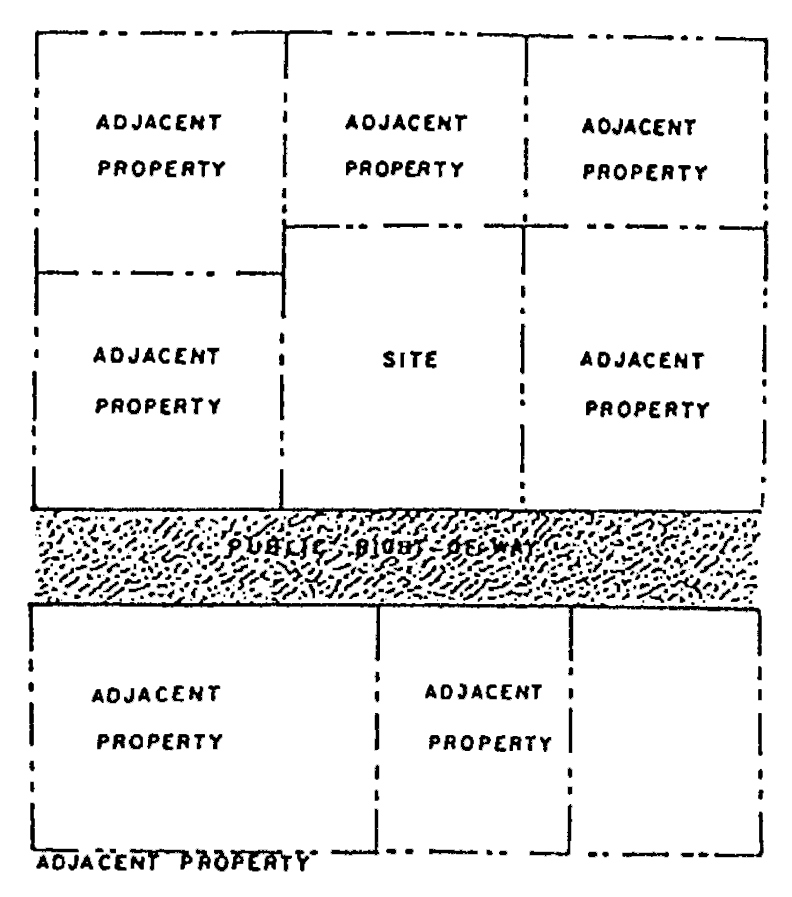
The word "contiguous" means touching and sharing a common point or line; the word "adjacent" may include "contiguous" but also means "separated only by a public right-of-way."
8.
The word "state" or "commonwealth" means the commonwealth of Virginia. The word "city" means the city of Chesapeake, Virginia.
9.
The term "the Code" means "the Code of the city of Chesapeake, Virginia."
10.
The term "this ordinance" or "this zoning ordinance" or "CZO" means chapter 29 of the Code of the city of Chesapeake, entitled "Zoning."
11.
The term "city" shall mean the city manager of the city of Chesapeake or the city manager's designee, unless the context clearly indicates otherwise.
B.
Rules for measurements. When measurements are made to determine compliance with the minimum distances required in this ordinance (height, width, length, setback, etc.), fractions of whole numbers shall be treated as follows:
1.
Numbers which are less than five-tenths (0.5) of a whole number shall be rounded to the next lower whole number.
2.
Numbers which are five-tenths (0.5) or more of a whole number shall be rounded to the next higher whole number.
C.
Property with multiple zoning classifications.
1.
Minimum lot frontage and width shall be measured based on the requirements of the zoning district in which the required dimension is or would be located.
2.
Minimum lot size shall be measured in accordance with the most restrictive zoning classification.
D.
Rules of measurements for calculating housing units. When calculations are made to determine the maximum number of housing units permitted under article 5 of this ordinance, numbers that are less than a whole number shall be rounded to the next lower whole number.
(Ord. No. 96-O-072, 5-21-96; Ord. No. TA-Z-07-08, 8-21-07; Ord. No. 07-O-168, 10-16-07)
Editor's note— Ord. No. 07-O-168, adopted October 16, 2007, enacted provisions intended for use as subsection C. Inasmuch as there are already provisions so designated, and at the discretion of the editor, said provisions have been redesignated as subsection D.
§ 3-301. - Nature of tables of uses.
A.
The tables of permitted and conditional uses, displayed elsewhere in this ordinance for each zoning district, set out all principal uses which are permitted or which may be permitted through the granting of a conditional use permit by city council in the city.
B.
Notwithstanding the table of permitted and conditional uses applicable in each zoning district, in cases where proposed development will cross zoning district lines private access lanes, storm water management and certain septic drain fields may be located in any zoning district subject to the requirements set out below:
1.
Private access lanes.
a.
The phrase "private access lane" means any improved surface used to accommodate vehicular ingress and egress for a particular development referred to below as the associated principal use.
b.
All private access lanes must be approved by a conditional use permit, except as setout in paragraph c., either as a component of a conditional use permit required for the associated principal use or separate from the associated principal use if the associated principal use is a permitted use in the zoning district in which it will be located and prohibited or conditional in the zoning district in which the private access lane will be located, except as setout in paragraph c.
c.
A conditional use permit is not required for private access lanes if the associated principal use is a permitted use in the zoning district in which the private access lane will be located, except that a conditional use permit is required for a private access lane when the associated principal use must obtain a conditional use permit.
2.
Storm water management as defined in section 26-344 of the City Code.
3.
The repair and replacement of septic drain fields approved by the health department that serve only one single-family residential dwelling. All newly installed septic drain fields shall comply with the applicable table of permitted and conditional uses.
All other components of a principal use shall comply with the table of permitted and conditional uses applicable to each zoning district. This subsection shall not be construed to limit or waive the development standards applicable in each zoning district.
(Ord. No. 05-O-133, 10-25-05)
§ 3-302. - Uses not listed; determination of zoning administrator or board of zoning appeals.
A.
Uses not listed are not allowed. Where a use is not listed in the table of permitted and conditional uses for a particular zoning district, it shall not be allowed in that district, subject to the exception set out below.
B.
Exception where use determined to be of similar nature or character as a listed use. In those instances in which a proposed use is not listed in a table, but is determined by the zoning administrator to be of a similar nature or character as a listed use, and such proposed use is also included within the same "major group" category as such listed use in the most recent edition of the Standard Industrial Classification Manual (the SIC Manual), published by the Federal Office of Management and Budget, such proposed use may be treated in the same manner as the listed use. Any decision by the zoning administrator regarding such a proposed use must be made in writing before any person may rely upon it or take any action in regard to it.
C.
Appeal from determination of zoning administrator; uses classified as conditional uses. In the event that the zoning administrator determines that a proposed use, not specifically listed in the table of permitted and conditional uses for a zoning district, is not a permitted or conditional use in such a district, such determination may be appealed to the board of zoning appeals, as provided for under article 20 of this ordinance, by a person aggrieved by the zoning administrator's determination. In the event that the board of zoning appeals overturns the zoning administrator's determination that the proposed use is not allowed as a permitted or conditional use in such a district, such decision shall result only in the proposed use being included as a conditional use in such zoning district. Such a result shall not preclude the zoning administrator or other aggrieved person from appealing the decision of the board of zoning appeals, as provided for under article 20 of this ordinance.
(Ord. No. 96-O-072, 5-21-96; Ord. No. 17-O-081, 11-21-17)
§ 3-400. - Definitions.
(Ord. No. 96-O-072, 5-21-96)
§ 3-401. - Other sources of definitions in this ordinance.
In addition to the definitions set out below, definitions of other terms are included in other sections of this ordinance. Those other sections include but are not limited to the following:
1.
Section 3-202 above, defining or clarifying the meaning of certain commonly used terms in this ordinance.
2.
Article 12, where definitions applying specifically to different special overlay districts are set out.
3.
Article 13, entitled "Supplemental Regulations," where definitions of special terms associated with particular uses and conditions included in that article may be set out. For example, section 13-1102 contains definitions associated with the regulation of "sexually oriented businesses."
4.
Section 14-703, containing definitions associated with the regulation of "signs."
5.
The Landscape Specifications Manual, incorporated into this ordinance by reference
in section 19-602.
§ 3-402. - Referral to sources outside this ordinance when definition not present or ambiguity exists.
In the event that a term used in this ordinance is not specifically defined in this ordinance or there is ambiguity or uncertainty regarding the meaning of a definition provided below, the zoning administrator shall refer to and rely upon the definitions or descriptions found in the documents listed below, in the following order of priority: (1) other chapters of the Chesapeake city Code; (2) the Virginia Uniform Statewide Building Code in effect at the time that such reference is made; (3) the Standard Industrial Classification Manual in effect at the time that such reference is made. Where these referral sources do not provide a clarifying definition, generally accepted dictionary definitions shall apply.
§ 3-403. - Definitions.
The following definitions shall be used in the interpretation and administration of this ordinance. The definitions of various terms as presented do not necessarily represent the same definitions as may be found for the same terms in other chapters of the City Code.
Abutting properties. Those properties which are contiguous, but specifically excluding any property separated by a public right-of-way.
(Ord. No. 24-O-005, 1-16-24)
Accessory building, structure or use. A building, structure or use on the same lot with and of a nature customarily incidental and subordinate to the principal building, structure or use. Where a building or structure is attached to or located within six (6) feet of the principal building or structure, it shall be considered a part thereof and not an accessory building or structure.
Accessory solar energy system. An electric generating structure that operates as an accessory to the authorized principal use of the property and is used to produce electric power for direct or net metering consumption by onsite users through the conversion of sunlight into electricity. For purposes of this ordinance, "net metering consumption" shall occur when the electric generating structure transfers surplus electricity generated by the accessory solar energy system to the public utility power grid in exchange for credits that may be drawn upon during times when electricity usage exceeds the electricity generation.
(Ord. No. 19-O-094, 7-16-19)
Adjacent properties. Those properties which are either (a) contiguous, or (b) separated only by a public right-of-way.
Adult day care centers. An establishment operated for purposes of providing day care (7:00 a.m. through 8:00 p.m.) to aged adults who reside elsewhere. Adult day care centers shall not include group housing for the elderly as defined in section 13-202 of this ordinance.
(Ord. No. 95-O-195, 10-17-95)
Adult uses. As defined in section 13-1100 et seq., entitled "Sexually Oriented Businesses."
(Ord. No. 96-O-072, 5-21-96)
Airport. Any area of land or water which is used or intended for use for landing and takeoff of aircraft, including all necessary facilities for the housing and maintenance of aircraft.
Aisle. A travelway by which motor vehicles enter and exit parking spaces.
Alley. A minor public or private street, not exceeding twenty-four (24) feet in width, primarily designed to serve as access to the side or rear of those properties, the principal frontage of which is on some other public street.
Alternative lending establishment. A financial institution regulated by section 6.2-1800, et seq. of the Code of Virginia, 1950, as amended, (pay day lender) or section 6.2-2200, et seq. of the Code of Virginia, 1950, as amended, (motor vehicle title lender).
(Ord. No. 12-O-014, 2-21-12; Ord. No. 17-O-081, 11-21-17)
Amateur radio communication antenna. An antenna which is used to facilitate two-way radio communications from a home radio operation, where that operation is an accessory use to the principal residential use of the property and is not part of a business or other commercial enterprise.
Animal unit. A standard unit used to calculate the relative impact of different kinds and classes of livestock. The equivalent value of one (1) animal unit for large and small animals is provided below. Where an animal is not listed, it shall not be allowed as a permitted accessory use; provided that the zoning administrator may determine that such animal is of a similar nature or character as a listed animal. In the case of such a determination, the proposed animal may be treated in the same manner as the listed animal. Any decision by the zoning administrator regarding such a proposed animal shall be made in writing.
Large animals:
One head of cattle = One animal unit
One horse = 0.25 animal units
One sheep = 0.2 animal units
One goat = 0.2 animal units
One llama = 0.2 animal units
One alpaca = 0.2 animal units
Horses shall include ponies, mules, burros and donkeys.
Small animals:
One chicken = 0.033 animal units
One duck = 0.0625 animal units
One turkey/goose = 0.125 animal units
One rabbit = 0.033 animal units
(Ord. No. 18-O-017, 2-20-18)
Apartment. See "Dwelling."
Automobile graveyard. As defined in chapter 19, article II (section 19-51 et seq.), of the city Code.
(Ord. No. 96-O-072, 5-21-96)
Bed and breakfast/tourist home establishment. A single-family dwelling unit used to accommodate overnight stays by guests for a period of time not to exceed ten (10) days within any thirty-day period. The operation must be conducted in strict accordance with section 13-1600 et seq. of this ordinance.
(Ord. No. 96-O-072, 5-21-96; Ord. No. 01-O-098, 10-16-01)
Beehive. A man-made accessory structure constructed and maintained to house a single colony of honey bees for the purpose of promoting pollination of plants and harvesting of honey.
(Ord. No. 15-O-090, 6-16-15)
Boardinghouse. An establishment primarily engaged in renting rooms, for periods of one (1) month or more, with or without board, on a fee basis. For the purposes of this zoning ordinance, an establishment shall be deemed to be primarily engaged in renting rooms when three or more boarders occupy the premises for consideration.
(Ord. No. 96-O-072, 5-21-96)
Borrow pit. A borrow pit shall be deemed a form of excavation, extraction or mining as defined in City Code section 26-221 and further clarified by zoning ordinance section 13-1200 et seq. and City Code section 26-241 et seq.
(Ord. No. 96-O-072, 5-21-96; Ord. No. 17-O-024, 5-16-17; Ord. No. 17-O-081, 11-21-17)
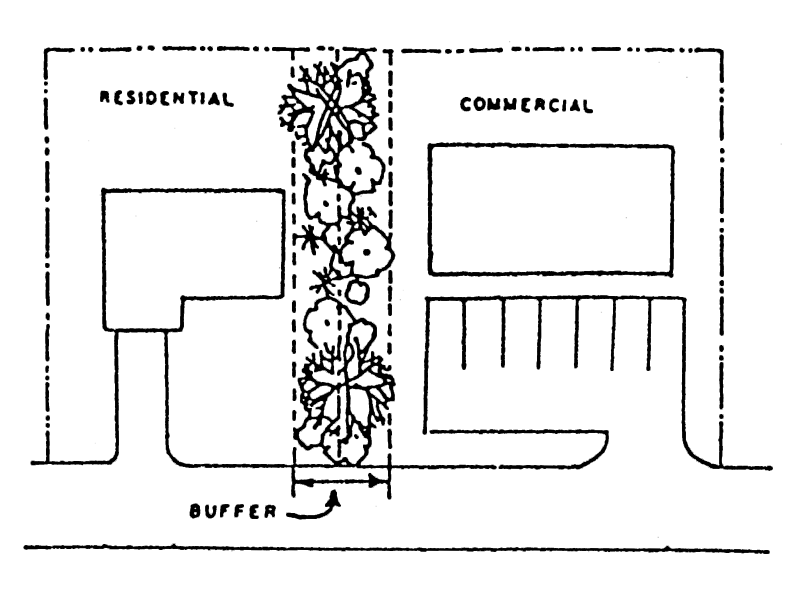
Buffer. An area within the property or site generally adjacent to and parallel with the property line, either consisting of natural existing vegetation or created by the use of trees, shrubs, fences and/or berms designed to limit the view of and/or sound from the site to adjacent sites or properties.
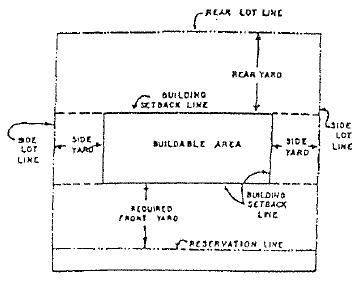
Buildable area. That portion of a lot remaining after the required yards have been provided.
Building. Any completely enclosed structure used or intended for supporting or sheltering any use or occupancy. The term is inclusive of any part thereof.
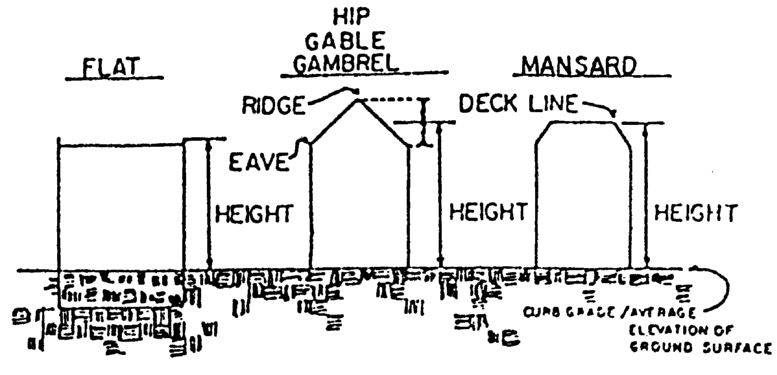
Building height. The vertical distance measured from the level of the curb or the established curb grade opposite the middle of the front of the structure to the highest point of the roof if a flat roof; to the deck line of a mansard roof; to the mean height level between the eaves and ridge of a gable, hip or gambrel roof; or to the highest point of any other structure. For buildings set back from the street line, the height shall be measured from the average elevation of the ground surface along the front of the building. The maximum building height limitations of this zoning ordinance shall apply to all structures, unless specifically exempted elsewhere in this ordinance.
Building setback line. A line designating each minimum required yard for a lot. See also "Buildable Area" and "Yard, Required."
Chesapeake Bay preservation area (CBPA). That land which (1) meets the criteria of the Chesapeake Bay Preservation Area Designation and Management Regulations, 9VAC25-830, and Section 62.1-44.15:72 of the Code of Virginia, 1950, as amended; and (2) is located within the area identified in the city's Chesapeake Bay Preservation Area Overlay District Map; and (3) is determined to be located within the Chesapeake Bay watershed in accordance with the city master drainage plan. The Chesapeake Bay preservation area shall consist of a resource protection area and a resource management area. See section 12-500 et seq. of this ordinance and article IX of chapter 26 of the City Code for provisions regarding the CBPA and those definitions related to it.
(Ord. No. 17-O-081, 11-21-17)
Church. A building, the primary use of which is for the periodic assembly of persons for religious worship and related purposes. The term "church" shall be deemed to include synagogues, temples and other similar houses of worship.
Cluster development. As defined in section 6-2200 et seq. of this ordinance.
(Ord. No. 96-O-072, 5-21-96)
Commercial vehicle. Any motor vehicle used for business, industrial, office or institutional purposes or having painted thereon or affixed thereto a sign. A commercial vehicle is defined to include self-propelled vehicles, vehicles that are not self-propelled (such as utility trailers and other types of trailers designed or used to store or haul equipment and materials), and the combination of self-propelled vehicles and vehicles that are not self-propelled. Agricultural equipment used as part of a permitted agricultural principal use shall not be considered a commercial vehicle.
(Ord. No. 18-O-028, 3-20-18; Ord. No. 22-O-080, 7-19-22)
Communication tower. As defined in section 13-601 of this ordinance.
(Ord. No. 96-O-072, 5-21-96)
Concrete and material crushing operation. An operation that uses machinery to crush or alter the physical state of concrete, brick or similar materials.
(Ord. No. 09-O-125, 11-10-09)
Conditional use/conditional use permit. As defined in article 17 of this ordinance, entitled "Conditional Use Permits."
(Ord. No. 96-O-072, 5-21-96)
Conditional zoning. As defined in article 16 of this ordinance, entitled "Zoning Amendments: Conditional Zoning."
(Ord. No. 96-O-072, 5-21-96; Ord. No. 17-O-024, 5-16-17)
Condominium. See "Dwelling, Multifamily."
Construction plan. Any preliminary and final site plan that includes an improvement of or modification to an existing or proposed public facility.
(Ord. No. 09-O-007, 1-27-09)
Decommissioning. The removal and proper disposal of solar energy equipment, facilities, or devices on real property, including restoration of the real property upon which such solar equipment, facilities, or devices are located. Restoration of the real property shall include soil stabilization, and revegetation of the ground cover of the real property disturbed by the installation of such equipment, facilities, or devices.
(Ord. No. 19-O-094, 7-16-19)
Density. The permitted number of dwelling units per acre of land, in accordance with the standards set out in section 5-600 et seq. of this ordinance.
Developer. An owner or any person with written authorization from the owner who intends to improve or does improve or construct improvements upon a given property.
Development. This term is used in two ways, with the applicable definition to be determined by the context in which it is used:
(1)
Any human-made change to improved or unimproved real estate, including but not limited to buildings or other structures, mining, dredging, filling, grading, paving, excavating or drilling operations.
(2)
A tract of land developed or to be developed as a unit under single ownership or unified control which is to be used for any business or industrial purpose or is to contain three or more residential dwelling units. The term "development," when used in this manner, shall not be construed to include any property which will be principally devoted to agricultural production.
Drive-through service. A facility designed to provide access to commercial products and/or services for customers remaining in their motor vehicles.
Dump. Any lot on which trash, debris, garbage or other waste, junk or scrap material is dumped or deposited and which has not been approved as a solid waste management facility in accordance with the requirements of section 62-86 et seq. of the City Code. Dumps are prohibited in all zoning districts.
(Ord. No. 17-O-081, 11-21-17)
Dwelling unit. A single unit providing complete, independent living facilities for one or more persons, including permanent provisions for living, sleeping, eating, cooking and sanitation.
Dwelling. A building or portion thereof that provides living facilities for one or more families. Dwellings include the following:
Single-family detached dwelling. A dwelling designed for and occupied by not more than one family and having no roof, wall or floor in common with any other dwelling unit.
Two-family dwelling (duplex). A detached residential building containing two dwelling units, designed for occupancy by not more than two families.
Single-family attached dwelling (townhouse). One of two or more residential buildings, occupying a separately recorded lot, each occupied by not more than one family and having a common or party wall separating the building from other buildings.
(Ord. No. 96-O-072, 5-21-96)
Multifamily dwelling. A residential building containing three or more dwelling units. (Apartment; may also include condominiums).
Mixed use dwelling. A dwelling located above the ground floor of a permitted commercial, retail, office or institutional use allowed in the B-1 neighborhood business district, B-5 urban business district, O & I office and institutional district and South Norfolk business overlay district only.
(Ord. No. 01-O-004, 1-23-01)
Single room occupancy (SRO) facility. A multi-family residential building designed for single-room occupancy with each unit containing food preparation and sanitary facilities and to be occupied by no more than one (1) adult as a primary residence and not as transient or overnight housing or lodging. All residents, and prospective residents, must be certified to occupy the units under applicable federal and local single room occupancy programs, including, but not limited to, applicable area median income requirements published by the Department of Housing and Urban Development in order for the SRO facility to qualify for the reduced parking space requirement set out in section 19-411.B of this ordinance.
(Ord. No. 11-O-097, 9-20-11)
Mobile home. The definition of mobile home and the circumstances under which such a structure may be treated as a permitted dwelling unit shall be as set out in section 13-900 et seq. of this zoning ordinance.
Easement. Unless the context clearly indicates otherwise, the term "easement" as used in this ordinance shall mean a right-of-way granted for the use of private land for a public or quasipublic purpose and within which the owner of the property shall not erect any permanent structures without the authorization of the easement holder. It is recognized that private easements are also granted for the use of property, but these are generally beyond the scope of this ordinance.
Excavation/extraction/mining. As defined in section 13-1200 et seq. of this ordinance and City Code section 26-221 et seq. When the term "excavation," "extraction" or "mining" is used by itself in this ordinance, it shall be deemed to include both of the other terms.
(Ord. No. 96-O-072, 5-21-96; Ord. No. 17-O-024, 5-16-17; Ord. No. 17-O-081, 11-21-17)
Family. One or more persons occupying the same dwelling unit, provided that, unless all members are related by blood, marriage, adoption or approved foster care placement, no such family shall contain more than five (5) persons, with the following exceptions:
(1)
Domestic servants employed on the premises may be housed on the premises without being counted as a family or families.
(2)
A group of not more than two (2) adults, who need not be related by blood or marriage, and the dependent children of each of the two (2) adults shall be treated as one family, provided that the children are under nineteen (19) years of age or are physically or developmentally disabled.
(3)
A residential facility in which no more than eight (8) mentally ill, intellectually disabled or developmentally disabled persons reside, with one (1) or more resident or nonresident staff persons, shall be considered for all purposes residential occupancy by a single family. Mental illness and developmental disability shall not include current illegal use of or addiction to a controlled substance as defined in section 54.1-3401, Code of Virginia, 1950, as amended. A residential facility shall be deemed to be any licensed group home or other residential facility for which the department of behavioral health and developmental services is the licensing authority pursuant to state law.
(4)
A residential facility in which no more than eight (8) aged, infirm or disabled persons reside with one or more resident counselors or other staff persons shall be considered for all purposes residential occupancy by a single family. For purposes of this subsection, "residential facility" means any assisted living facility or residential facility in which aged, infirm or disabled persons reside with one or more resident counselors or other staff persons and for which the department of social services is the licensing authority pursuant to state law.
(5)
A residential facility in which no more than three (3) persons sixty-two (62) years of age or older reside with a care provider. To qualify as a family, the care provider residing in the dwelling unit must own or lease the dwelling unit. Facilities not meeting the criteria of this definition shall be considered a nursing and personal care facility.
(Ord. No. 11-O-121, 12-20-11; Ord. No. 14-O-120, 9-23-14)
Family shelter home. A detached residential structure used exclusively for the purpose of providing temporary residence and support services for displaced children and their parents/legal guardians, for more than five (5) but not more than ten (10) such persons per lot.
Farmers market. A building, structure or place used by a group of farmers or producers to conduct an open air sale of locally or regionally produced agricultural, horticultural, or aquacultural produce, such as vegetables, fruit, herbs, grains, mushrooms, flowers, potted or bedding plants, honey, meat, dairy, eggs, fish, shrimp, oysters or clams, directly to the public on a regular basis. Handcrafted products (such as wooden furniture or textiles), value added products (such as jam, beeswax candles) or other handmade food products (such as baked goods and prepared foods) may be sold, but the total sum of vendors of these goods may not comprise the majority of the vendors. All products offered for sale are to be grown, raised or produced, at least in part, by the vendors; the resale of products is not permitted. For purposes of this definition, locally or regionally produced shall include any agricultural, horticultural or aquacultural produce that is grown, raised or produced either (1) within four hundred (400) miles of the city; or (2) in the Commonwealth of Virginia or the State of North Carolina. No produce or products shall be labeled or otherwise identified as "local" unless grown, raised or produced within one hundred (100) miles of the city. For purposes of this definition, value added items shall include items that are derived from or contain a main ingredient from the agricultural or horticultural produce on sale at the farmers market. The following uses are not included in the definition of a "farmers market:" 1) a wayside stand; 2) individuals selling items from a truck; 3) special outdoor events as regulated by this ordinance; 4) flea markets as defined in this ordinance; 5) yards sales as regulated by this ordinance; and 6) auctions. Farmers markets shall also not include government-sponsored farmers markets.
(Ord. No. 17-O-024, 5-16-17)
Fence. As defined in section 14-200 et seq. of this ordinance, entitled "Fences, walls and hedges."
(Ord. No. 96-O-072, 5-21-96; Ord. No. 17-O-081, 11-21-17)
Final site plan. A plan delineating the overall scheme of development, including existing and proposed improvements, of a tract of land. Said plan shall include, but not be limited to include, grading, engineering design, construction plans, survey data, and any other requirements put forth in article 18, entitled "Development Site Plans."
(Ord. No. 96-O-072, 5-21-96; Ord. No. 17-O-081, 11-21-17)
Flea market. A retail area where two (2) or more booths, tables or other structures or spaces located outdoors are rented or otherwise provided to merchants for conducting sales or services.
Floodplain. As defined in chapter 26, article IV (section 26-86 et seq.), of the city Code, entitled "Floodplain Management."
(Ord. No. 96-O-072, 5-21-96; Ord. No. 17-O-024, 5-16-17)
Floor area, gross. The area within the perimeter of the outside walls of a building, including all stories, without deduction for hallways, stairs, closets, thickness of walls, columns or other similar features.
Floor area, livable. Floor area designed for year-round family living, enclosed or protected from the weather, but not intended for storage or similar uses and not including garages, carports, cellars, basements, attics, open porches, atriums, patios and breezeways. Basement space may be included as livable floor area when designed as a family room, game room or similar use with an exposed outside wall containing windows or doors.
Floor area, net. The area within the perimeter of the outside walls of a building, after deductions for hallways, stairs, closets, thickness of walls, columns or other similar features.
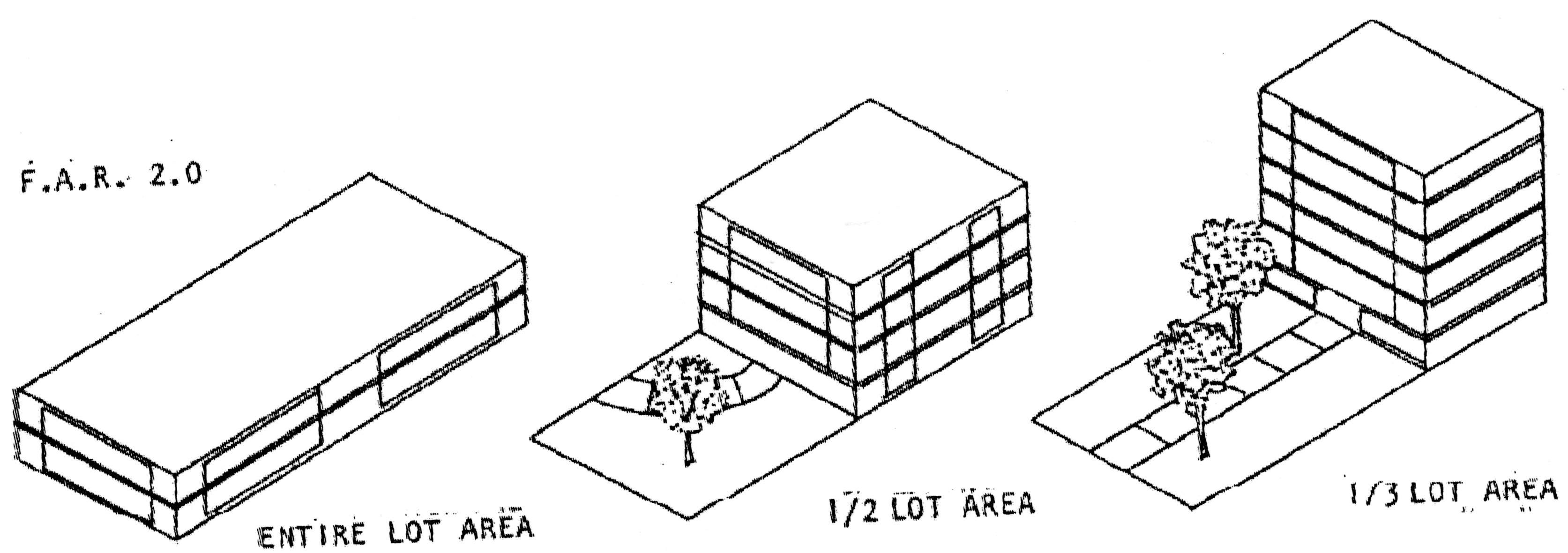
Floor area ratio (FAR). A mathematical expression of the bulk or intensity of land development, determined by dividing the gross floor area of all buildings at or above grade level on a given parcel of land by the gross square footage of that same parcel of land. The following shall be excluded from a maximum FAR calculation for a particular development:
(1)
Proposed and existing streets within the limits of a development, and
(2)
Parking structures, parking spaces and areas devoted to mechanical systems.
The diagram below illustrates three (3) ways that a 2.0 FAR might be reached subject to applicable development standards: two (2) stories covering the entire lot, four (4) stories covering half of the lot, or six (6) stories covering a one-third of the lot all result in the same FAR.
(Ord. No. 06-O-051, 5-16-06)
_____
Footcandle. A unit of illumination produced on a surface, all points of which are one (1) foot from a uniform point source of one (1) candle.
Fortuneteller. A person who professes to discern personal character or relationships and/or foretell future events using methods that are not part of a state or federally regulated, licensed or recognized profession. As used in this ordinance, the term is intended to include astrologers, palm readers and other similar practitioners.
Gas/service station. See "Motor Vehicle Service Station" and "Motor Vehicle Fuel Supply Station."
Grade. The average of the finished ground level at the center of all walls of a building. In case walls are parallel to and within five (5) feet of sidewalk, the ground level shall be measured at the sidewalk.
Gross acreage. The total area measured in acres within the boundaries of a lot.
Group care facility. A dwelling unit, organized within one (1) or more buildings, providing a residence for more than five (5) persons for purposes of providing special training, education, habilitation, rehabilitation, custodial care or supervision; except for those facilities included in the definition of family. (See the definition of "Family" above.)
(Ord. No. 11-O-121, 12-20-11)
Group housing for the elderly. As defined in section 13-200 et seq. of this ordinance.
(Ord. No. 96-O-072, 5-21-96)
Helicopter pad. A landing and takeoff site for a helicopter, not including accessory terminal and/or fuel accommodations.
High-rise apartments/condominiums. Any apartment or condominium structure exceeding thirty-five (35) feet in height.
Historic area. An area containing buildings or places in which historic events occurred or having special public value because of notable architectural or other features relating to the cultural or artistic heritage of the community, of such significance as to warrant conservation and preservation.
Home occupation. A non-residential use that is conducted, administered or operated as an accessory use to any permitted dwelling unit in accordance with the standards put forth in section 14-300 et seq. of this ordinance.
(Ord. No. 96-O-072, 5-21-96; Ord. No. 17-O-024, 5-16-17; Ord. No. 17-O-081, 11-21-17)
Homeowners association. See "Property Owners Association."
Horses. As used in this ordinance, this term shall also include ponies. The following terms related to horses, as used in this ordinance, shall have the following meanings:
Horse and pony keeping. The keeping of horses as an accessory use to a residential usage on a lot, subject to the conditions set out in article 14 of this ordinance, entitled "Accessory Uses and Structures."
Riding academy/school. An establishment providing the boarding and training of horses, as well as equestrian instruction.
Hospital. Establishments having more than one (1) operating room and providing inpatient or ambulatory surgical services. Other health care services may also be provided in such facilities.
(Ord. No. 99-O-104, 7-20-99)
Industrial park. A collection of two (2) or more detached buildings, located on a single lot or on adjacent lots zoned for industrial uses, which are part of a unified development or subdivision plan which contains: (1) an interior public street on which each of the buildings or building lots has direct frontage; and (2) separate parking facilities for the buildings located within the park.
Junk. As defined in chapter 19, article II (section 19-51 et seq.), of the city Code, entitled "Junkyards and Automobile Graveyards."
(Ord. No. 96-O-072, 5-21-96)
Junkyard. As defined in chapter 19, article II (section 19-51 et seq.), of the City Code, entitled "Junkyards, Automobile Graveyards, and Towing Service Storage Yards."
(Ord. No. 96-O-072, 5-21-96; Ord. No. 17-O-024, 5-16-17)
Kennel. Any place used for the breeding, boarding or keeping of five (5) or more dogs over four (4) months of age.
(Ord. No. 98-O-024, 2-17-98)
Livestock, domestic. Animals, excluding honey bees, normally raised on a farm, or as part of commercial agricultural or animal husbandry operation, or normally used for purposes related to agricultural production or commerce. Livestock, including animal breeds derived from livestock, shall not be deemed to be pets and may not be maintained as an accessory to a residential use unless specifically permitted under this zoning ordinance. Livestock shall be divided into two (2) groups:
(1)
Large animals—including horses, mules, donkeys, llamas, cattle, swine (excluding Vietnamese Potbellied Pigs, Juliana Pigs, or certified similar breeds that meet the requirements for pet pigs in section 14-903 of this ordinance), goats, sheep, and similar breeds.
(2)
Small animals—including chickens, except as provided for in the definition of pet, turkeys, and other types of fowl, rabbits, except as provided for in the definition of pet, fish, except as provided for in the definition of pet, and breeds similar to those listed as small animals.
(Ord. No. 96-O-072, 5-21-96; Ord. No. 05-O-010, 2-15-05; Ord. No. 15-O-090, 6-16-15; Ord. No. 18-O-017, 2-20-18; Ord. No. 19-O-055, 4-16-19)
Loading area. Off-street space which includes loading spaces and appurtenant maneuvering aisles, designed in accordance with the provisions of section 19-413 of this ordinance, for the loading or unloading of goods.
Lot (also lot of record). A lawfully platted or recorded parcel of land intended to be separately owned, developed and otherwise used as a unit. No lot may be created which does not meet the requirements of the subdivision and zoning ordinances of the City of Chesapeake.
(Ord. No. 17-O-081, 11-21-17)
Lot area, established. The area of a horizontal plane bounded by the front, side and rear lot lines of a lot.
Lot area, required. The area of a lot measured and calculated in accordance with the requirements of section 19-201.A of this zoning ordinance. All references to lot area or lot size in this zoning ordinance shall be deemed to refer to the required lot area, measured as required by section 19-201.A, unless the language or context of such reference clearly indicates that the established lot area is intended.
(Ord. No. 17-O-081, 11-21-17)
Lot, conforming. A lot of record which meets the specifications of the zoning and subdivision ordinances of the City of Chesapeake.
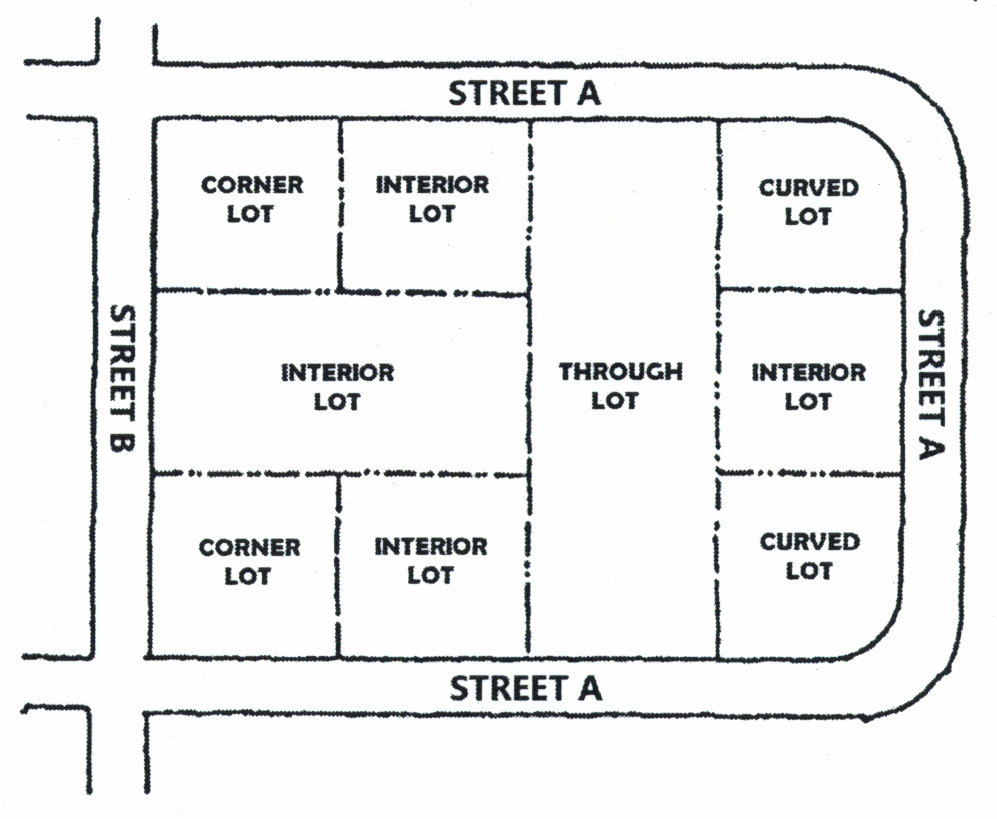
Lot, corner. A lot which abuts on and is at the intersection of two or more public rights-of-way.
Lot coverage. The percentage of a lot occupied or covered by buildings or roofed areas, including uncovered decks, balconies and terraces which are elevated higher than thirty (30) inches above grade, but not including normal roof overhangs and eaves.
Lot, curved. A curvilinear lot which abuts only one public right-of-way. Curved lots shall include those lots where the street frontage extends around to the side or rear of any structures on the lot.
(Ord. No. 20-O-030, 3-17-20)
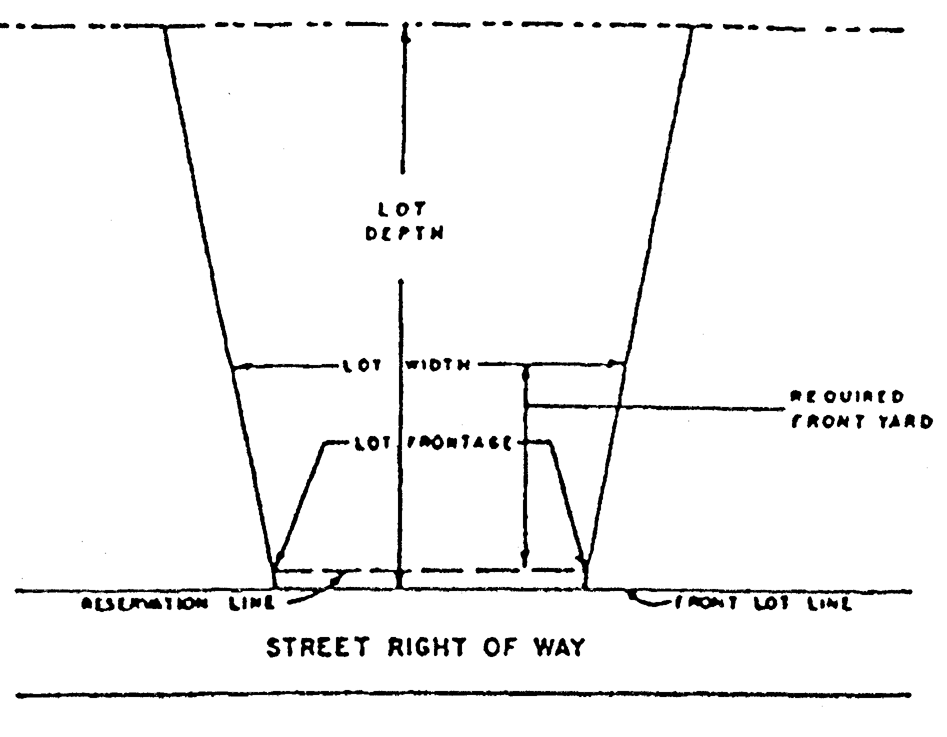
Lot depth. The distance measured in the mean direction of the side lines of the lot from the midpoint of the front lot line to the midpoint of the rear lot line.
Lot, end. The lot containing the end unit of a single grouping of townhouses.
Lot frontage. The width of the lot as measured along the street reservation line or along such other applicable line as provided for under section 19-202 of this ordinance. Minimum lot frontage shall be required in all zoning districts and shall be equal to eighty (80) percent of the minimum lot width for the district in which the lot is located. Additional lot frontage is required for certain lots of excessive depth, as determined by the director of planning, under section 70-89 of the city Code. Reduction in lot frontage as measured at the street or right-of-way reservation line may be permitted for lots located on cul-de-sacs and for certain residual lots in the A-1 agricultural district under section 70-89 of the City Code.
(Ord. No. 02-O-084, 7-16-02; Ord. No. 17-O-081, 11-21-17)
Lot, interior. A lot other than a through lot or corner lot.
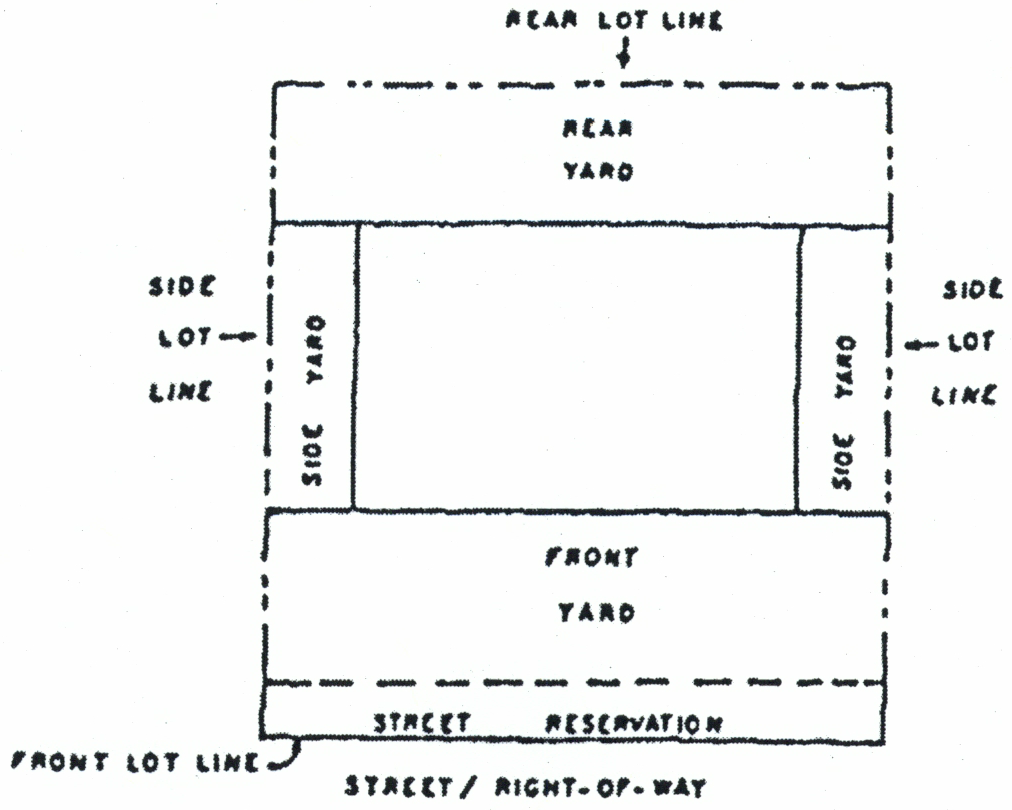
Lot line. A line dividing one lot from another or from a street or other public place. There are three (3) types of lot lines: front lot lines, rear lot lines and side lot lines.
Lot line, front. The line separating a lot from a public street or right-of-way. Where a front lot line separates a lot from an alley which functions as a secondary access for the lot, the alley shall be treated as a normal lot line, and the required yard shall be measured accordingly.
Lot line, rear. The lot line not intersecting a front lot line that is most distant from and most closely parallel to the front lot line.
Lot line, side. Any lot line not a front or rear lot line.
Lot line, side
(Ord. No. 20-O-030, 3-17-20)
Lot, through. A lot that has a pair of opposite lot lines along two streets that do not intersect and which is not a corner lot. On a through lot, both street lot lines shall be deemed front lot lines.
Lot width. The width of a lot measured at the rear of the required front yard. Minimum lot width requirements set out in this ordinance may be subject to special measurement for lots located on cul-de-sacs, as permitted in section 70-89 of the City Code.
(Ord. No. 02-O-084, 7-16-02)
Lot width
Major recreational equipment. As defined in section 6-2002 of this ordinance.
(Ord. No. 96-O-072, 5-21-96; Ord. No. 17-O-024, 5-16-17; Ord. No. 17-O-081, 11-21-17)
Major subdivision or major residential subdivision. See "Subdivision."
(Ord. No. 98-O-155, 10-20-98)
Marijuana. Any part of a plant of the genus Cannabis, whether growing or not, its seeds or resin; and every compound, manufacture, salt, derivative, mixture, or preparation of such plant, its seeds, its resin, or any extract containing one or more cannabinoids, but specifically excluding any hemp product containing a tetrahydrocannabinol concentration of no greater three-tenths (0.3) percent that is dispensed and possessed in compliance with applicable federal, state, and local law.
(Ord. No. 23-O-088, 8-15-23)
Marijuana dispensary. A retail facility that is licensed under state law to sell or resell marijuana.
(Ord. No. 23-O-088, 8-15-23)
Massage therapy establishment as defined in section 38-61 of the City Code.
(Ord. No. 04-O-030, 2-17-04)
Massage therapist as defined in section 38-61 of the City Code.
(Ord. No. 04-O-030, 2-17-04)
Medical care facility means any institution, place, building, or agency, at a single site or combined sites, whether or not licensed or required to be licensed by the state board of health or the state board of behavioral health and development services, whether operated for profit or nonprofit, and whether privately owned or operated or owned or operated by a local government unit, by or in which facilities are maintained, furnished, conducted, operated or offered for the prevention, diagnosis or treatment of human disease, pain, injury, deformity or physical condition, whether medical or surgical, of two (2) or more non-related mentally or physically sick or injured persons, or for the care of two (2) or more non-related persons requiring or receiving medical, surgical, or nursing attention or services as acute, chronic, convalescent, aged, physically disabled. Medical care facility shall include, but not be limited to the following:
1.
General hospitals. Facilities capable of providing overnight accommodation and distinct housing of patients whose length of stay averages less than thirty (30) days.
2.
Sanitoriums. Institutions for the treatment of chronic diseases, for medically supervised recuperation, or for convalescence.
3.
Nursing homes. Facilities or components thereof licensed by the Virginia Department of Health to provide long-term nursing care, including facilities known by varying nomenclature or designation such as convalescent homes, skilled nursing facilities or skilled care facilities, intermediate care facilities, extending care facilities and nursing or nursing care facilities.
4.
Behavioral Health and Developmental facilities. Facilities licensed by the Virginia Department of Behavioral Health and Developmental Services, in which care is provided to mentally disabled individuals who are not in need of skilled nursing care, but who need more intensive training and supervision than would be available in a rooming, boarding home, or group home.
5.
Psychiatric hospitals and intermediate care facilities. Facilities established primarily for the medical, psychiatric or psychological treatment of patients or the rehabilitation of alcoholics or drug addicts, as defined and licensed by the Virginia Department of Behavioral Health and Developmental Services.
6.
Specialized centers, clinics or satellite hospital facilities, or that portion of a physician's office (including on-site space for mobile technology) developed for the provision of:
a.
Outpatient or ambulatory surgery. Facilities that specialize in providing surgical procedures, pain management and certain diagnostic services, such as colonoscopy, which are considered more intensive than done in the average doctors office but not so intensive as to require an overnight or hospital stay after the procedure.
b.
Cardiac catheterization. Facilities capable of diagnosing and/or treating defects or abnormalities in the great arteries or veins of the heart structure through the use of specialized equipment and advanced fluoroscopic guidance.
c.
Computed tomography/"CT". Facilities that use x-rays taken from many angles and computer modeling to, among other procedures, help locate and size tumors and provide information on whether they can be surgically removed.
d.
Gamma knife surgery/stereotactic radiosurgery. Facilities capable of treating brain tumors through the use of a neurosurgical device that directs gamma radiation to a target point through a procedure that delivers a tumoricidal radiation dosage.
e.
Magnetic resonance imaging/"MRI". Facilities that provide images constructed through the detection and computer analysis of minute changes in magnetic properties of atomic particles within a strong magnetic field in response to the transmission of selected radiofrequency pulse sequences.
f.
Magnetic source imaging/"MSI". Facilities capable of mapping electric currents associated with biological activity by using an array of magnetometers to detect the resulting magnetic fields.
g.
Positron emission tomography/"PET". Facilities capable of providing tomography in which a computer-generated image of a biological activity within the body is produced through the detection of gamma rays that are emitted when introduced radionuclides decay and release positrons.
h.
PET/CT. Facilities that provide images obtained through a combination of PET and CT technologies.
i.
Radiation therapy. Facilities that utilize ionizing radiation or radioactive substances to destroy cancer cells or keep them from reproducing; in external radiation therapy, a beam of radiation is directed at the cancer utilizing a linear accelerator, while in internal radiation therapy, called brachytherapy or implant therapy, a source of radioactivity is surgically placed inside the body near the cancer.
j.
Single photon emission computed tomography/"SPECT". Facilities capable of measuring the emission of single photons of a given energy from radioactive tracers to construct images of the distribution of the tracers in the human body.
k.
Proton beam therapy. Facilities which utilize very large magnets to accelerate protons and charge them with a specific amount of energy, which is then delivered at a set depth to targeted cancer cells.
7.
Rehabilitation hospitals. Facilities that provide comprehensive inpatient and/or outpatient services, organized on an interdisciplinary basis, for a range of physical disabilities in order to restore normal form and function after injury or illness, such as spinal cord injured or brain injured patients or for chronic pain management; such facilities do not include single discipline facilities such as physical therapy centers, and do not include services to patients whose primary disability is psychiatric illness or substance abuse, although mental health services may be provided for individuals whose disability is primarily physical in nature.
8.
Freestanding emergency rooms. Facilities that operate as part of a medical care facility or a satellite department of a hospital and which provide initial treatment to patients with a broad spectrum of illnesses and injuries, including life-threatening conditions such as heart attacks, serious motor vehicle accidents, suicide attempts, etc. Staffing will include doctors and nurses with specialized training and/or board certification in emergency medicine, as well as other support staff. Such facilities provide extended hours of care beyond that typically offered by a physician's office or urgent care center; must accept all patients regardless of ability to pay or payment source; and may have designated entrances for patients who are transported by ambulance.
9.
Urgent care centers. Facilities that operate up to seven (7) days per week, including at least one day per calendar week later than seven (7) p.m., that provide for unscheduled, walk-in medical care at all times when open for patients, and offer on-site x-ray and care for most simple fractures and lacerations.
10.
Freestanding birthing centers. Facilities capable of providing obstetrical services specifically related to pregnancy and the delivery of newborns, regardless of whether the mother and/or newborn stays overnight.
11.
Any facility licensed by the Virginia Department of Health as a hospital.
12.
The phrase medical care facility shall not include offices and clinics of doctors and dentists or uses incident thereto which are not specifically defined as a medical care facility.
(TA-Z-07-10, 8-21-07; Ord. No. 17-O-024, 5-16-17)
Minor subdivision. See "Subdivision."
(Ord. No. 98-O-155, 10-20-98)
Mixed use. A unified development that incorporates two (2) or more different uses and may include a variety of housing types.
(Ord. No. 06-O-051, 5-16-06)
Mixed use building. A building designed and constructed for a mixture of residential and commercial or office uses.
(Ord. No. 07-O-168, 10-16-07)
Mixed use dwelling. See "Dwelling, Mixed Use Dwelling.
(Ord. No. 07-O-168, 10-16-07; Ord. No. 17-O-081, 11-21-17)
Mobile home. See "Dwelling, Mobile Home."
Motor vehicle fuel supply station. Any place of business having pumps and storage tanks or other fuel supply facilities at which fuels and/or oils for the use of motor vehicles are dispensed, sold or offered for sale at retail and where dispensing is performed by the customer or a station employee, but motor vehicle servicing or repair is not performed. Motor vehicle fuel supply stations shall not include motor vehicle service stations or public garages.
Motor vehicle repair garage. Any place of business used for the storage, repair or refinishing and servicing of motor vehicles with fuels and lubricants. The term "repair or refinishing" shall not include an automobile body repair shop or the rebuilding, dismantling or storage of junked vehicles.
Motor vehicle service station. Any place of business having as its purpose the servicing of motor vehicles with fuels and lubricants and including minor repairs and inspections incidental thereto, the operation of a wrecker service, the storage and rental of portable trailers, vans and/or trucks, provided not more than five (5) such vehicles are stored on the site at any one (1) time, but not including a general repair shop, paint or body shop, machine shop, vulcanizing shop, or operated as a radiator repair shop or other major body repair shop.
Municipal building and structure. Any building, structure, or use owned and operated by the City of Chesapeake, Virginia.
(Ord. No. 94-O-181, 9-20-94)
Nonconforming building, structure or use. As defined in article 15, entitled "Nonconformities and the Status of Approved Development Plans."
(Ord. No. 96-O-072, 5-21-96)
Office. The facilities in which the administrative activities, record-keeping, clerical work and other similar affairs of a business, profession, service, industry or government are conducted and, in the case of professions, such as dentists, physicians, lawyers and engineers, the facilities where such professional services are rendered, with the incidental sale of goods which are furnished as part of the professional service.
Off-site. Any area which does not fall within the boundary of the land to be developed.
Off-street parking. The area provided for vehicular parking and maneuvering outside of any public street or right-of-way as outlined in section 19-400 et seq. of this ordinance.
(Ord. No. 96-O-072, 5-21-96; Ord. No. 17-O-081, 11-21-17)
Open space. The total area of land or water within the boundaries of a project designed and intended for use and enjoyment as open area or improved for recreational purposes, with such improvements, including but not limited to pedestrian ways, play lots, swimming pools, tennis courts, basketball courts, etc., but not including the following improvements: buildings or other structures to be used for other than recreational purposes; planned or constructed streets, driveways and parking areas not directly supporting the open space area; and areas so located or so small, such as landscaped parking islands, as to have no substantial value for the purposes stated in this definition. Open space includes the following:
Dedicated open space. All open space within the boundaries of a lot which has been dedicated or is to be dedicated or conveyed to the city or an appropriate public agency, board or body for public use as open space.
Open space or common area. All space within the boundaries of a project that has been set aside for use by the residents of that project and not dedicated as public lands.
Owner. The owner of record of fee simple interest in real property.
Parking space. As defined in section 19-408 of this ordinance.
(Ord. No. 96-O-072, 5-21-96)
Person. Any individual, partnership, firm, association, joint venture, public or private corporation, trust, estate, commission, board, public or private institution, utility, cooperative; county, city, town or other political subdivision of the commonwealth of Virginia; any interstate body; or any other legal entity.
(Ord. No. 17-O-081, 11-21-17)
Pet. A domesticated animal kept for pleasure as an accessory use in a residential setting. The following animals may be considered pets if they are kept for pleasure and as an accessory use: hamsters; nonvenomous snakes less than six (6) feet long; iguanas; turtles; guinea pigs; domesticated birds kept indoors; ten (10) or fewer rabbits on one (1) lot; fish kept indoors or outdoors in a manner that is accessory to a principal use, as defined and permitted in subsection 14-101.C. of this Code, but shall not be construed to include the keeping or raising of fish for commercial or agricultural purposes. See article 14 of this Code and the definition of "livestock" within this article, regarding specific inclusions and exclusions of livestock and other animals from the definition of "pet."
(Ord. No. 05-O-010, 2-15-05; Ord. No. 12-O-107, 11-20-12; Ord. No. 13-O-148, 11-26-13; Ord. No. 17-O-081, 11-21-17)
Planned unit development. As defined in article 11 of this ordinance.
(Ord. No. 96-O-072, 5-21-96)
Plat. A schematic representation of land and, where required, of buildings and other structures, as part of a subdivision or site plan, in conformity with the requirements of this ordinance and of chapter 70 of the Chesapeake city Code.
Principal building/structure. The building or structure in which the principal use of the lot on which the building or structure is located is conducted.
Principal building build-to line means the line parallel to the front of the property line, where a building is required to be located. Functions as a maximum building setback that is intended to create an even building façade line close to the street.
(Ord. No. 22-O-104, 10-18-22)
Principal use. The primary activity or structure for which a lot is used, as permitted by this zoning ordinance. The definition of principal use includes the components of a principal use. Components of a principal use include, but are not limited to, the following: required landscaping, off-street parking, private access lanes for ingress and egress, principal structures, septic drain fields and storm water management as defined in section 26-345 et seq. of the City Code. This definition shall not limit or expand the definition of accessory use or accessory structure.
(Ord. No. 05-O-133, 10-25-05; Ord. No. 17-O-024, 5-16-17; Ord. No. 17-O-081, 11-21-17)
Proffer. A condition voluntarily offered by or with the authorization of the owner of property as part of a conditional rezoning application which mitigates the impacts related to the proposed rezoning. Proffers are further defined in section 16-200 et seq. of this ordinance.
(Ord. No. 96-O-072, 5-21-96; Ord. No. 17-O-081, 11-21-17)
Property owners association. An incorporated, nonprofit organization made up of property owners in a specified subdivision or development that shall be responsible for the maintenance and operation of open space, recreational facilities or amenities and other common areas, facilities or functions and that shall assess its members fees or dues to offset the cost thereof and shall have such other specific features or requirements as the city may require, as provided for in this zoning ordinance. Also defined in section 13-1803 of this ordinance.
(Ord. No. 96-O-072, 5-21-96; Ord. No. 17-O-024, 5-16-17)
Public facility. A structure which is a public improvement, as defined below.
Public franchise. A service operation which is granted by government action as a franchise in accordance with law. Public franchises include but are not limited to telephone, gas, electric and cable television services.
Public housing support services center. As defined in section 13-2100 et seq. of this ordinance.
(Ord. No. 96-O-072, 5-21-96; Ord. No. 17-O-024, 5-16-17)
Public improvement. Any improvement, facility or service, together with customary improvements and appurtenances thereto, necessary to provide for public needs such as: streets, alleys or pedestrian walks or paths; storm sewers; flood control improvements; water supply and distribution facilities; sanitary sewage disposal and treatment; public utility, energy and telephone services.
Public use. A use by any governmental agency or public franchise.
Public utility. Water and sewer service provided by the Chesapeake public utilities department and the Hampton Roads Sanitation District (HRSD).
Public utility facilities. Public facilities providing water or sanitary sewer services and owned by the city of Chesapeake or HRSD.
Public view. The normal line of sight from the public street right-of-way adjacent to a site and from the public pedestrian and motor vehicle areas of travel provided on a site.
Recreational vehicle (RV). See "Major Recreational Equipment."
Right-of-way. An area or strip of land, either public or private, on which an irrevocable right of passage has been recorded or on which such right of passage exists by prescription, easement or transfer of ownership.
Regional shopping mall. A facility with five (5) or more stores for retail goods and services that are structurally designed in an integrated fashion around or along both sides of an indoor open area including promenade, walkway, concourse or courtyard with the primary individual store entrances fronting on this open area and the main attraction are anchor stores including, but not limited to, mass merchandise and discount department stores. This definition shall include all offices, satellite and unattached buildings located within the mall ring road as determined by the zoning administrator.
(Ord. No. 11-O-072, 7-19-11)
Satellite wagering establishments. Establishments that offer pari-mutuel wagering, which is the system of wagering on horse races in which those who wager on horses that finish in the position or positions for which wagers are taken share in the total amounts wagered, plus any amounts provided by a licensee, less deductions required or permitted by law. Said establishments include pari-mutuel wagering on simulcast horse racing originating within the Commonwealth or from any other jurisdiction. All such wagering shall be conducted in accordance with Title 59.1 of the Virginia Code and shall take place only at a licensed horse racetrack or satellite facility designated by the Virginia Racing Commission.
(Ord. No. 17-O-059, 9-12-17)
Screen. A structure or planting consisting of fencing, berms and/or vegetation established or maintained for the purpose of limiting or obstructing the view of or sound from an object or use on a site or limiting or obstructing the view or sound from one site to another. (See "Buffer.")
Setback. See "Building Setback Line."
Sexually oriented businesses. As defined in section 13-1102 et seq., entitled "Sexually Oriented Businesses."
(Ord. No. 96-O-072, 5-21-96; Ord. No. 17-O-081, 11-21-17)
Shopping center. A single piece of real estate containing three (3) or more commercial establishments and a total business space of more than three thousand two hundred (3,200) square feet, and which is planned, constructed, owned and managed as a total entity with customer and employee parking provided on site.
(Ord. No. 13-O-128, 10-15-13)
SIC. "Standard Industrial Classification," from the manual printed by the Executive Office of the President, Office of Management and Budget.
Sign. As defined in section 14-700 et seq., entitled "Signs."
(Ord. No. 96-O-072, 5-21-96)
Site plan. A plan for a development of a single site, including all covenants, grants or easements and other conditions relating to use, location and bulk of building, density of development, common open space, public facilities and such other information as required by this zoning ordinance and chapter 70 of the Chesapeake city Code.
Skateboard ramp. As defined in section 14-800 et seq.
(Ord. No. 96-O-072, 5-21-96)
Solid waste management facility. As defined in chapter 62, article IV, et seq., of the Chesapeake City Code.
(Ord. No. 96-O-072, 5-21-96)
Stable. A structure used to shelter livestock, whether or not such structure contains a roof or other form of cover and/or walls.
(Ord. No. 18-O-017, 2-20-18)
Storage, outside. The keeping of equipment, vehicles, implements or materials of any kind in a setting other than a completely enclosed structure.
Street. A strip of land, subject to vehicular or pedestrian traffic and providing direct or indirect means of access to property, including but not limited to road, lane, drive, trail, court, place, terrace, alley, avenue, highway, boulevard or any other thoroughfare.
Street, public. An existing street or platted street, dedicated to and accepted by the city or acquired through prescription or purchase, for the general use of the public, including but not limited to road, lane, drive, trail, court, place, terrace, alley, avenue, highway, boulevard or any other thoroughfare.
Street frontage. See "Lot Frontage."
Structural alteration. Any change in the supporting members of a building, such as the bearing walls, beams or girders, or any change in the dimension or configuration of the roof or exterior walls.
Structure. Anything constructed, erected, installed or otherwise put in place which has a permanent location on or in the ground or which is attached to something having a permanent location on or in the ground; provided, however, that this definition shall not apply to objects or facilities that are wholly underground.
Subdivision. As defined in Section 70-1 of the Chesapeake City Code. The use of the term "minor subdivision" in this ordinance shall mean any subdivision of a single property into not more than five (5) lots, parcels or tracts of land, including the residual parcel, provided that (a) no new public street or public street extension is required, and existing public streets have been improved and accepted for maintenance by the city, (b) no public facilities need be installed, altered, improved or extended to serve the lots within the subdivision, and (c) none of the five (5) or fewer lots, including the residual parcel, are further subdivided. A minor subdivision of a single tract, parcel, or lot under this section may be recorded on multiple subdivision plats, referred to as "phasing", provided the phasing does not result in more than five (5) tracts, parcels, or lots created from the legal boundaries, or portion thereof, of the original single tract, parcel, or lot in existence prior to recordation of the first phasing subdivision plat. The use of the terms "major subdivision," "major residential subdivision," "residential major subdivision," or "major residential development" in this ordinance shall mean a subdivision other than one meeting the criteria for "minor subdivision" set out above.
(Ord. No. 98-O-155, 10-20-98; Ord. No. 24-O-064, 6-18-24; Ord. No. 24-O-126, 12-17-24)
Tobacco, smoke, or vape shop. Any establishment where the principal retail activity is related to selling or offering for sale supplies, equipment, or paraphernalia related to smoking or vaping, including, without limitation, tobacco, e-cigarette liquid, pipes, cigarettes, cigars, and vaporizers. No tobacco, smoke, or vape shop shall operate as a marijuana dispensary.
(Ord. No. 23-O-088, 8-15-23)
Tattoo parlor. Any place or establishment in which is offered or practiced the placing of designs, letters, scrolls, figures, symbols or any other marks upon or under the skin of any person with ink or any other substance resulting in the permanent coloration of the skin, including permanent make-up, by the aid of needles or other instruments designed to touch or puncture the skin, with body piercing being a permitted accessory use. This definition shall not include medical doctors, veterinarians, registered nurses or other medical services personnel licensed pursuant to Virginia Code Title 54.1, who conduct tattooing in the performance of professional medical services.
(Ord. No. 01-O-053, 6-20-01; Ord. No. 21-O-098, 9-21-21)
Townhouse. See "Dwelling. Single-Family Attached Dwelling (Townhouse)."
Tower, communication. See "Communications Tower."
Two-family dwelling. See "Dwelling. Two-Family Dwelling."
Unmanned public facility building. A public facility building which does not have an operational staff located on the site and which meets the requirements of section 13-1700 et seq. of this ordinance, entitled "Unmanned Public Facility Buildings and Related Structures."
(Ord. No. 17-O-024, 5-16-17; Ord. No. 17-O-081, 11-21-17)
Urgent care medical facilities. Establishments other than hospitals providing acute health care services seven (7) days a week and having hours of operation later than 7:00 p.m. at least one (1) evening per calendar week.
(Ord. No. 99-O-104, 7-20-99)
Use. The purpose or activity for which land or any building thereon is designed, arranged or intended or for which it is occupied or maintained. See also "Principal Use" and "Accessory Use."
Utility solar energy facility. An electric generating system which operates as a principal use of the property and is used to produce power for consumption by offsite users, consisting of one or more photovoltaic panels, support structures and associated control, conversion and transmission hardware.
(Ord. No. 19-O-094, 7-16-19)
Variance. A deviation from certain provisions of this ordinance granted by the board of zoning appeals in accordance with the standards set out in article 20 of this ordinance and other applicable laws, regulations and policies.
Wetlands mitigation bank. An area of land on which wetlands are to be restored, created, enhanced or preserved for purposes of engaging in the sale, exchange or transfer of wetlands mitigation credits required by federal and state authorities to compensate for adverse impact to wetlands. This definition shall not include wetlands mitigation banks owned and controlled by the United States, the Commonwealth of Virginia, the City of Chesapeake, or any department or agency thereof, or the Chesapeake School Board. Such wetlands mitigation banks shall be permitted uses in all zoning districts, provided wetlands mitigation banks owned and controlled by the Commonwealth of Virginia, the Chesapeake School Board or the City of Chesapeake, or any department or agency thereof, shall be subject to review for consistency with the adopted Comprehensive Plan as required by Section 15.2-2232 of the Code of Virginia, 1950, as amended.
(Ord. No. 00-O-098, 8-15-00; Ord. No. 17-O-081, 11-21-17)
Wetlands mitigation site. An area of land on which wetlands are to be restored, created, enhanced or preserved for use as regulatory wetlands mitigation sites, without regard to sale, exchange or transfer of mitigation credits. This definition shall not include wetlands mitigation sites owned and controlled by the United States, the Commonwealth of Virginia, the City of Chesapeake, or any department or agency thereof, or the Chesapeake School Board. Such wetlands mitigation sites shall be permitted uses in all zoning districts, provided wetlands mitigation sites owned and controlled by the Commonwealth of Virginia, the Chesapeake School Board, or the City of Chesapeake, or any department or agency thereof, shall be subject to review for consistency with the adopted Comprehensive Plan required by Section 15.2-2232 of the Code of Virginia, 1950, as amended.
(Ord. No. 00-O-098, 8-15-00; Ord. No. 17-O-081, 11-21-17)
Yard. An open space unoccupied and unobstructed by any structure or portion of a structure from thirty (30) inches above the general ground level of the graded lot upward; provided that fences, walls, poles, posts and other customary yard accessories and furniture may be permitted in any yard, subject to the other requirements of this zoning ordinance. A yard may be: (1) the required yard—the minimum yard dimensions required by this zoning ordinance for a lot; or (2) the established yard—the yard established by the location of a principal building or structure on the lot. All references to yards in this zoning ordinance shall be deemed to be required yards, unless the language or context of the reference clearly indicates established yards are intended.
Yard, front. A yard extending between the side lot lines across the front of a lot. In the case of corner lots and curved lots, all yards adjacent to street frontages shall be considered as front yards. In the case of through lots, front yards shall be required on all street frontages. Where one of the required front yards is not in keeping with the prevailing yard patterns, the zoning administrator may designate the front and rear yards. See article 19 of this ordinance.
(Ord. No. 17-O-081, 11-21-17; Ord. No. 20-O-030, 3-17-20)
Yard, rear. A yard extending between side lot lines across the rear of a lot. In the case of corner or through lots, there will be no rear yards, but only front and side yards, provided that in the case of through lots the zoning administrator may designate the front of the lot.
Yard, side. A yard extending from the rear of the required front yard to the front of the required rear yard.
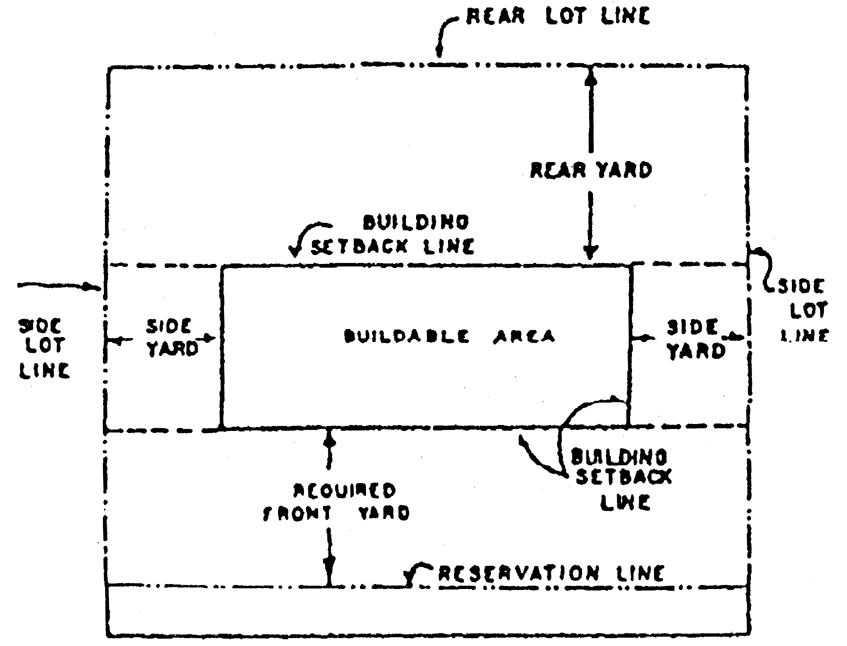
Yard, side
Zone, zoning, zoning district, zoning district classification. The classification of land within the city into areas and districts, such areas and districts being generally referred to as "zones" or "zoning districts," by legislative action and the prescribing and application in each area and district of regulations concerning building and structure designs, building and structure placement and uses to which land, buildings and structures within such designated areas and districts may be put.

