
Clare City Zoning Code
ARTICLE III
DISTRICT REGULATIONS
DIVISION 4. - C-1 COMMERCIAL DISTRICT[5]
Editor's note— Ord. of 9-5-2006 amended div. 4 in its entirety and enacted similar provisions as herein set out. The former div. 4 derived from Code 1985, §§ 5.51, 5.52, and 5.54—5.58.
Cross reference— Businesses, ch. 12.
DIVISION 5. - C-2 COMMERCIAL DISTRICT[6]
Editor's note— Ord. of 9-5-2006 amended div. 5 in its entirety and enacted similar provisions as set out herein. The former div. 5 derived from Code 1985, §§ 5.61—5.63 and 5.65—5.68.
DIVISION 6. - I INDUSTRIAL DISTRICT[7]
Cross reference— Businesses, ch. 12.
DIVISION 7. - IP INDUSTRIAL PARK DISTRICT[8]
Cross reference— Businesses, ch. 12.
Sec. 52-101. - Districts established.
For the purposes of this chapter, the city is hereby divided into the following six classes of districts:
(Code 1985, § 5.2)
Sec. 52-102. - District boundaries.
The boundaries of these districts are indicated upon the zoning map of the city, as amended, which is on file in the office of the city clerk and made a part of this chapter. Except where designated on such map, the district boundary lines are intended to follow lot lines, the centerlines of streets or alleys, railroad right-of-way lines, section lines, one-quarter section lines, one-eighth section lines or the corporate limit line, all as they existed at the time of the enactment of the ordinance from which this chapter is derived.
(Code 1985, § 5.3)
Sec. 52-103. - Zoning certificates of compliance.
No dwelling, building or structure subject to the provisions of this chapter shall be erected, altered, enlarged or moved upon a premises from another premises until a:
(1)
Zoning compliance certificate has been issued pursuant to the site plan review provisions contained in article VII; and
(2)
Building permit has been issued by the appropriate code enforcement officer.
(Code 1985, § 5.11)
Sec. 52-104. - Continuing existing uses.
Any building, structure or use lawfully existing upon the effective date of this Code may be continued.
(Code 1985, § 5.12)
Sec. 52-105. - Use of rear dwellings for residential purposes.
No building in the rear of a principal building and on the same lot therewith shall be used for residential purposes with the exception of a permitted accessory dwelling unit.
(Code 1985, § 5.13; Ord. No. 2020-009, Pt. 2, 11-2-2020)
Sec. 52-106. - Residential lot width.
Any lot used for residential purposes shall have a width of at least 75 feet facing on a dedicated street.
(Code 1985, § 5.14)
Sec. 52-107. - Accessory building front lot line setback.
No part of a detached accessory building shall be nearer to the front lot line than the front of the main building upon a parcel, when the lot or an adjoining lot is located in a residential district.
(Code 1985, § 5.15; Ord. No. 2007-02, 3-6-2007)
Sec. 52-108. - Accessory building height and setbacks.
Accessory buildings shall not exceed 28 feet in height and shall be distant at least six feet from any other separate structure on the same lot and shall not be closer than three feet to any lot line. In no case shall an accessory building for the storage of vehicles be closer to any street line than 20 feet.
(Code 1985, § 5.16)
Sec. 52-109. - Reduction or division of required yard.
No lot shall be divided or reduced so as to make the required area or dimensions less than the minimum required by this chapter, nor shall any yard required for a principal building be included as a part of a yard required under this chapter for any other building.
(Code 1985, § 5.17)
Sec. 52-110. - Yard requirements along zoning boundary line.
A lot having a side yard line along any zoning boundary line of a less restricted district shall have a side yard for the more restricted district.
(Code 1985, § 5.18)
Sec. 52-111. - Vision clearance on corner lots.
On any corner lot on which front and side yards are required, no wall, fence, structure, sign, tree, shrub or hedge may be maintained as to cause danger to traffic by obstructing the view.
(Code 1985, § 5.19)
Sec. 52-112. - Front yards on lots running through the block.
In any district where a lot runs through a block from street to street and where a front yard is required, such front yard shall be provided along each street lot line that is not a side lot line.
(Code 1985, § 5.20)
Sec. 52-113. - Projections.
Projections extending beyond the main wall of a building and attached thereto shall be considered as part of the building and such projections shall not occupy any of the minimum required yards or open spaces, except as follows:
(1)
Chimneys, flues, cornices, eaves, bays, ornamental features and other similar features may project not more than three feet into any required yard.
(2)
Terraces, steps, uncovered porches or other similar features shall not be higher than three feet above the average finished grade and shall not be located less than five feet from any lot line.
(Code 1985, § 5.21)
Sec. 52-114. - Height limit exceptions.
Exceptions to height limits set forth in this chapter include church spires, belfries, cupolas, chimneys, smokestacks, flagpoles, communication towers, masts, aerials and antennae, water towers, elevator bulkheads, monuments, cooling towers and necessary mechanical appurtenances. No structure which, by definition or category, qualifies for a height limit exception may impede or interfere with aviation traffic patterns or routes, or cause an unreasonable danger or safety risk to airborne craft.
(Code 1985, § 5.22)
Sec. 52-115. - Lot width and area exceptions.
Dwellings may be constructed on any officially plotted lot and recorded lot which is less than the minimum width or area, or both, required by this chapter, provided that the yard setbacks shall comply with this chapter.
(Code 1985, § 5.23)
Sec. 52-116. - Driveway and parking lot surfacing.
All driveway approaches on paved streets and off-street parking lots shall be surfaced with asphalt, bituminous aggregate, cement or seal coat and maintained so as to be dustfree and prevent sand or gravel from entering the street and storm drainage system.
(Code 1985, § 5.24)
Sec. 52-117. - Attachment of commercial communication antennas to existing structures.
Communication antennas may be appended or attached to any existing structure within districts zoned C-1, C-2, I or IP. A formal application for appendage or attachment of antennas to existing structures must be submitted in accordance with the procedures outlined in article VII.
(Code 1985, § 5.25)
Sec. 52-118. - Private garages or accessory buildings.
Private garages or accessory buildings attached to a building for a residence may be constructed within the R-1 or R-2 district with the following provisions:
(1)
If any portion of the garage protrudes beyond the remainder of the building line of the front of the house, that portion of the garage shall become the front building line of the structure from which the front yard setback requirements shall be measured.
(2)
If an attached garage is converted to living space or quarters, it must meet all setback requirements for that particular zoning district.
(3)
The height of any garage shall not exceed the maximum building height stipulated for the respective zoning district.
(4)
Private garages must be constructed of materials which will render it permanent in nature. No temporary or portable structures may be used to shelter vehicles within any residential district.
(Code 1985, § 5.26; Ord. No. 2008-01, 3-3-2008)
Sec. 52-119. - Change of use and occupancy permits for commercial or industrial purposes.
(a)
No change of use of any land or existing building or structure to be used for commercial (business) or industrial purposes shall be made. No change of occupants shall be made, and no building or structure erected shall be occupied in whole or in part until the owner or occupant has obtained a zoning compliance certificate/occupancy permit from the city manager, stating the use and/or building complies with the provisions of this chapter. A fee, as established and reviewed from time to time by the city commission, shall accompany each application.
(b)
No building or structure to be used for commercial (business) or industrial purposes, erected and subsequently altered, shall be used or changed in use following such alteration until the owner has obtained a zoning compliance certificate/occupancy permit from the city manager, stating that the use or building complies with the provisions of this chapter.
(c)
Occupancy permits shall be applied for and issued within ten days after the lawful erection or alteration of the building is complete or, in the case of an existing structure, before the new use commences. A record of all occupancy permits shall be kept on file in the office of the city manager and copies shall be furnished, upon request, to any person having proprietary or tenancy interest in the land or building affected.
(d)
The city manager shall have the power to revoke or cancel any occupancy permit in case of failure or neglect to comply with any of the provisions of this chapter or in case of any false statement or misrepresentation made in the application. The owner or his agent shall be notified of such revocation in writing, and any further misuse of the land or building shall be deemed a violation.
(e)
The city manager may, upon request, issue a temporary occupancy permit for part of a dwelling, building, structure or premises prior to completion in full, but such temporary certificate shall not remain in force for a period in excess of one year, nor more than ten days after full completion.
(Code 1985, § 5.27)
Sec. 52-120. - Display of handbills.
The display of handbills shall be regulated as follows:
(1)
No handbill shall be displayed within any public right-of-way of the city, upon any public land, ground or building within the city or upon any public utility apparatus or structure within the city without the specific permission and approval of the city manager.
(2)
Only handbills promoting or advertising not-for-profit, community or public events shall be approved for display.
(3)
All handbills approved for display shall include a "Must Be Removed By" date, and shall be removed by the responsible individuals/organizations not later than the stipulated date.
(4)
Political handbills are excluded from the requirement to obtain permission from the city manager prior to being posted; however, the responsible party/individual shall remove the handbills within one week (seven days) of the political election or event.
(Code 1985, § 5.28)
Sec. 52-121. - Nonconforming uses.
(a)
Any use of property that does not conform to the regulations prescribed in this chapter and which shall have been in existence prior to the adoption of the ordinance from which this chapter is derived shall be referred to as a nonconforming use.
(b)
Any nonconforming use of land or buildings may be continued for indefinite periods of time, and subject to such regulations as the zoning board of appeals may require for immediate preservation of the adjoining property and the ultimate removal of the nonconforming use. The zoning board of appeals may grant a change of occupancy from one nonconforming use to another, provided, the use is within the same or higher classification as the original nonconforming use; provided, however, that such change of use and occupancy will not tend to prolong and continue the nonconforming use. A nonconforming use once changed from a lower to a higher classification use shall not be changed to a lower classification use, and such prior classification use shall be considered abandoned.
(c)
A nonconforming use shall not be extended or rebuilt in case of obsolescence or total destruction by fire or other cause. In case of partial destruction of a building by fire or other cause, not exceeding 50 percent of its value, the building may be reconstructed. If the destruction is greater than 50 percent and less than the total of the building, the zoning board of appeals may grant a permit for repair after a public hearing and having due regard for the property rights of the persons affected when considered in the light of the public welfare and the character of the area surrounding the designated nonconforming use and the conservation and preservation of property.
(d)
A nonconforming use of land or the nonconforming use of a structure shall be lost when the following occurs:
(1)
The nonconforming use ceases for a period of more than six months; or
(2)
There is evidence of intent, or some act or omission, on the part of the owner or user which manifests his or her voluntary decision to abandon the nonconforming use.
(Code 1985, § 5.80; Ord. No. 2012-002, 2-6-2012)
State Law reference— Nonconforming uses and structures, MCL 125.583a.
Sec. 52-122. - Reserved.
Editor's note— Ord. No. 2020-004, adopted Oct. 5, 2020, repealed § 52-122, which pertained to prohibition of marihuana establishments and derived from Ord. No. 2018-008, adopted Nov. 5, 2018.
Sec. 52-141. - Purpose; uses.
(a)
The R-1 single-family district classification is intended primarily for single-family residential homes and special uses that are compatible with single-family dwelling neighborhoods.
(b)
Only the following principal uses are permitted in R-1 districts:
(1)
Single-family dwellings not to exceed one single-family dwelling per lot.
(2)
Public and parochial schools.
(3)
Churches, convents and rectories.
(4)
Family day cares.
(5)
State licensed residential facilities, as required by section 3b of Public Act No. 207 of 1921 (MCL 125.583b).
(c)
The following special uses are, when approved, permitted in R-1 districts:
(1)
Parks, playgrounds, golf courses, tennis courts and similar public nonprofit recreational uses.
(2)
Fire stations and water towers.
(3)
Community center buildings.
(4)
Cemeteries.
(5)
Hospitals, provided, the site shall have an area of two acres or more and the buildings are located 50 feet from property lines.
(6)
Planned residential unit developments.
(7)
Group day cares.
(8)
Home occupation/home professional offices.
(9)
Cooperative or for-profit markets selling agricultural produce or farm products to consumers (nonwholesale) on a period basis, that do not operate more than eight days in any calendar month.
(d)
Except for home occupation/home professional offices, the city planning commission shall be the approval authority for all special uses; and the city manager shall be the approval authority for all home occupation/home professional office special uses. The process for approval of special uses shall be as outlined in sections 52-342 and 52-343.
(Code 1985, § 5.31)
Sec. 52-142. - Accessory uses and buildings.
The following accessory uses and buildings are permitted in R-1 single-family districts:
(1)
Private garages.
(2)
Accessory buildings.
(3)
Home occupations, when carried on by the occupants within the dwelling and not in an accessory building.
(4)
Signs, as follows:
a.
One bulletin board for a church or school, not exceeding 12 square feet in area, when located ten feet from all property lines. Such signs may be illuminated, provided the source of light is not visible.
b.
One temporary, unlighted real estate sign, not exceeding eight square feet in area, advertising the sale, rental or lease of only the premises on which the sign is maintained, either located flat against the building or ten feet from any street line.
c.
One wall sign on the premises of a legal nonconforming use, not to exceed 20 square feet in area. Such sign may be illuminated, provided the source of light is not visible.
d.
Except for yard sale signs and similar one-day event signs (e.g., open houses, graduation parties, etc.), all off-premises signs, including real estate signs, are prohibited within city rights-of-way, unless approved by the city manager. Such one-day event signs shall be removed not later than the day after the event being signed.
e.
Political signs and posters associated with elections and election campaigns may be erected within public rights-of-way and on private property without approval; however, the respective individuals/parties are responsible for removing the signs within one week after the scheduled election/political event.
(5)
Accessory dwelling units.
(Code 1985, § 5.32; Ord. No. 2020-009, Pt. 3, 11-2-2020)
Sec. 52-143. - Building height, area and yards.
The following restrictions apply in R-1 single-family districts:
(1)
Maximum building height, 28 feet.
(2)
Minimum front yard, 25 feet.
(3)
Maximum front yard, no more than the average of homes within 500 feet of the subject parcel on the same street.
(4)
Minimum rear yard, 25 feet.
(5)
Minimum side yard, nine feet (three feet for a garage).
(6)
Minimum side yard corner lot, 12 feet.
(7)
Minimum lot width, 75 feet, except as provided in section 52-115.
(8)
Minimum lot area, 10,500 square feet.
(9)
Minimum square feet for any dwelling 300 square feet.
(Code 1985, § 5.33; Ord. No. 2013-001, 7-15-2013; Ord. No. 2021-006, 10-4-2021)
Sec. 52-144. - Residential appearance requirements.
The following appearance requirements for residential parcels shall be applied:
(1)
Intent. Single-family dwellings, whether tiny homes, mobile homes, manufactured homes, modular homes or site ("stick") built homes, located outside a mobile home park shall conform to the standards of this section. The standards herein are intended to prevent "grossly dissimilar" dwellings by promoting dwellings that positively affect the value of dwellings in the surrounding area, improve the desirability of an area to existing or prospective homeowners, increase the stability of the environment, support the most appropriate use of real estate and promote the public health, safety and welfare of the community.
(2)
Applicability. All single-family dwellings on individual lots shall meet the appearance standards noted in subsection (3), below. The determination for compliance with these standards for dwellings less than 720 square feet shall be made by the planning commission; the determination for compliance for dwellings 720 square feet and larger shall be made by the city building inspector. All single-family dwellings shall comply in all respects with this Code, including minimum heights for habitable rooms. Where a dwelling is required to comply with any federal or state standards or regulations for construction and where such standards or regulations for construction are different than those imposed by this Code, then, and in such event, such federal or state standard or regulation shall apply. Homes less than 400 square feet shall comply with the International Residential Code. The standards set forth in this definition shall not apply to a mobile home located in a licensed mobile home park, except to the extent required by state or federal law, or otherwise specifically required in provisions of this Code pertaining to such parks.
(3)
Exterior building appearance. Each home shall be aesthetically compatible in appearance with other residences in similar zoning districts in the surrounding area. Surrounding area shall be defined as within 2,000 feet from the edge of the lot in each direction, within the same zoning district, where at least 20 percent of the lots are developed. All dwellings shall be built with durable high-quality materials, including brick, wood, fiber-cement siding, vinyl siding or other materials of similar quality in terms of durability and appearance. Corrugated metal, unfinished wood and other materials dissimilar with other residences shall be prohibited. Compatibility shall also be based on the following factors:
a.
Building design. Building appearance and materials used in a new single-family dwelling shall be similar to the appearance and materials used in single family homes in the surrounding area. Dwellings shall be compatible with surrounding dwellings in terms of color, cladding material, style of roof/porches, nonstructural ornamentation, and the location/style of windows and doors.
b.
Roof pitch and overhang. The dwelling shall be aesthetically compatible in appearance with other residences in the vicinity, with either a roof overhang of not less than 12 inches on all sides or alternatively with windowsills or roof-drainage systems concentrating roof drainage at collection points along the sides of the dwelling. Roof types shall be gable roof, hip roof, or gambrel roof design with a minimum 4:12 roof pitch. Homes less than 400 square feet in floor area may have a flat roof.
c.
Building elevation. The dwelling has a minimum width across any front, side or rear elevation of 20 feet, except that tiny home dwellings may have a minimum width of eight feet on a side elevation.
d.
Building openings. The dwelling shall have an exterior door on the front elevation and a second being either in the rear or side of the dwelling. The front elevation of all single-family dwellings shall have a stoop, deck, patio or porch at the front entrance.
e.
Additions. Additions to existing buildings must complement the current residence's design with regard to height, proportion, scale, materials, and type of openings.
f.
The above standards shall not be construed to prohibit innovative design and appearance concepts involving such matters as solar energy, view, unique land contour, or variation from the common or standard designed home.
(4)
Building permit. All construction allowed under this chapter shall be commenced only after a building permit has been obtained in accordance with the city building code and other building regulations. Tiny homes shall adhere to the International Residential Code. All dwelling units and additions thereto shall be able to meet or exceed the construction standards of the applicable building, electrical, plumbing, mechanical and fire codes.
(5)
Foundation. All single-family dwellings shall be firmly attached to a permanent foundation constructed on the site in accordance with the city's building code and shall have a wall of the same perimeter dimensions as the dwelling and constructed of such materials and type as required in the applicable building code for single-family dwellings. If the dwelling is a mobile home as defined in this Code, such dwelling shall be installed pursuant to the manufacturer's setup instructions and shall be secured to the premises by an anchoring system or device complying with the rules and regulations of the state mobile home commission or shall have a perimeter wall as required in this subsection. When any dwelling is removed from its foundation, such foundation shall be completely removed and the site shall be returned to its original state.
(6)
Undercarriage. In the event that such dwelling unit shall be a mobile home or other home with wheels, the wheels, tongue, hitch assembly and other towing appurtenances shall be removed before attachment to its permanent foundation. The foundation or perimeter masonry skirting shall fully enclose the undercarriage and the chassis.
(7)
Storage area. Each such dwelling unit shall contain a storage area equal to ten percent of the square footage of the dwelling or 200 square feet, whichever is less, except for tiny homes, which shall have a storage area of at least 100 square feet. This storage area shall consist of a basement, attic, attached garage, or a separate detached accessory structure which complies with the standards of this zoning ordinance regarding accessory buildings and structures. The intent of these standards is to limit the extent of outdoor storage.
(8)
Sewage disposal and water supply. Each such dwelling unit shall be connected to a public sewer and water supply or to such facilities approved by the local health department.
(9)
Exceptions. The foregoing standards shall not apply to a mobile home located in a licensed mobile home park except to the extent required by state or federal law or otherwise specifically required in this section and pertaining to such parks. Mobile homes that do not conform to the standards of this section shall not be used for dwelling purposes within the city unless located within a mobile home park or a mobile home subdivision district for such uses, or unless used as a temporary residence as otherwise provided in this section.
(10)
Accessory buildings. Accessory buildings, when permitted, must complement any primary use building with regard to height, proportion, scale, materials, and design. Accessory dwellings may be permitted subject to section 52-325, but shall not be permitted on lots where the primary dwelling is a tiny home.
(11)
Appeals. An applicant may appeal to the zoning board of appeals within a period of 45 days from the receipt of notice of the decision of the approving authority as provided in subsection (2) above.
(Ord. No. 2007-02, 3-6-2008; Ord. No. 2021-006, 10-4-2021)
Editor's note— Ord. No. 2021-006, adopted Oct. 4, 2021, amended § 52-144, and in so doing changed the title of said section from residential design requirements to read as set out herein.
Sec. 52-145. - [Medical marijuana provisions.]
The following provisions shall apply to medical marijuana use as provided by state law.
(1)
Qualifying patients and qualifying care-givers as registered with the state may exercise their right to use, possess or cultivate medical marijuana in conformity with state law.
(2)
The medical marijuana use, possession and cultivation shall comply at all times with the Michigan Medical Marijuana Act and the General Rules of the Michigan Department of Community Health as they may be amended from time to time.
(3)
All medical marijuana plants cultivated shall be contained within a fully enclosed, locked facility, inaccessible on all sides and equipped with locks or other security devices that permit access only by the primary caregiver or qualifying patient cultivating the plants.
(4)
Cultivation shall be conducted so as not to create unreasonable dust, glare, noise, odors, or light spillage beyond the parcel and shall not be visible from an adjoining public way.
(5)
The principal use of the parcel shall be a dwelling and shall be in actual use as such. Any registered primary caregiver shall operate at his or her own primary residence.
(6)
Space allocated to marijuana cultivation shall not exceed 120 square feet but not greater than ten percent of total available living space. If medical marijuana is to be grown in an unattached building such as a pole barn or garage, the area allocated to marijuana cultivation shall not exceed ten percent of the unattached building, i.e., a garage or shed.
(7)
No transfer of medical marijuana to qualifying patients other than qualifying patients residing on the parcel shall occur.
(8)
Except as provided by the Medical Marijuana Act regarding caregivers recouping costs for cultivation and providing marijuana, there shall be no commercial cultivation or patient to patient transfer of marijuana for any type of consideration, cash or otherwise. This provision is intended to prohibit any type of medical marijuana dispensary or commercial activity.
(9)
No vested rights. A property owner shall not have vested rights or nonconforming use rights that would serve as a basis for failing to comply with this section or any amendment of this section.
(10)
No activities licensed by the State under Public Act 281 of 2016 shall be conducted in a residential zone.
(Ord. No. 2011-004, 3-7-2011; Ord. No. 2016-002, 12-5-2016)
Sec. 52-161. - Purpose; uses.
(a)
The R-2 multiple-family district is intended primarily for multiple-family dwellings and such uses as professional offices.
(b)
Only the following principal uses are permitted in R-2 districts:
(1)
R-1 district uses, except as modified in this section.
(2)
Multiple-family dwellings.
(3)
Mobile home parks.
(4)
State licensed day care centers.
(c)
The city planning commission shall be the approval authority for all special uses. The process for approval of special uses shall be as outlined in sections 52-342 and 52-343. The following special uses are, when approved, permitted in R-2 districts:
(1)
All special uses permitted in an R-1 district.
(2)
Medical, dental, legal, architectural, accounting, engineering and real estate offices, title companies, group day cares, insurance offices, barbershops and beauty salons.
(3)
Funeral homes and mortuaries.
(4)
Institutes of higher education, technical colleges and trade schools, but not including those operated as a part of the criminal justice process or related to any federal, state or local penal laws or institutions.
(Code 1985, § 5.41)
Sec. 52-162. - Accessory uses and buildings.
The following accessory uses and buildings are permitted in R-2 multiple-family districts:
(1)
Accessory uses and buildings permitted in the R-1 district, except as modified in this section.
(2)
Signs as set forth in section 52-142(4).
(3)
New buildings or conversions of existing dwellings which conform with the character of the neighborhood in which they are located.
(Code 1985, § 5.42)
Sec. 52-163. - Building height, area and yards.
The following restrictions apply in the R-2 multiple-family districts:
(1)
Maximum building height, 28 feet.
(2)
Minimum front yard, 25 feet.
(3)
Minimum side yard, nine feet, except as required in section 52-303.
(4)
Minimum rear yard, 25 feet, except as required in section 52-303.
(5)
Minimum side yard corner lot, 12 feet.
(6)
Minimum lot width, 75 feet, except as provided in section 52-115.
(7)
Minimum lot area, 10,500 square feet, except as provided in section 52-115.
(8)
Common open space of at least 40 percent of the total land area suitable for development within a multifamily development, and it shall be distributed more or less uniformly throughout the site area. The term "common open space" shall mean lands within the multifamily development to be used for park, recreation or
environmental amenities. Such lands shall not include public or private streets, driveways or parking areas. Within such lands, only facilities and structures for recreational purposes may be constructed, with the total impervious area of roofs and paving constituting not more than ten percent of the total open space.
(9)
Minimum square feet for any dwelling, 720 square feet.
(Code 1985, § 5.43; Ord. No. 2013-001, 7-15-2013)
Sec. 52-164. - Screening requirements.
In the R-2 multiple-family district, screening requirements shall be followed as indicated in section 52-304.
(Code 1985, § 5.45)
Sec. 52-165. - R-2 design requirements.
The following design requirements for residential parcels shall be applied:
(1)
Exterior building design. Additions to existing buildings must compliment the current residence's design with regard to height, proportion, scale, materials, and type of openings.
(2)
[Accessory buildings] must compliment any primary use building with regard to height, proportion, scale, materials, and design.
(Ord. No. 2007-002, 3-6-2008)
Sec. 52-166. - [Medical marijuana provisions.]
The following provisions shall apply to medical marijuana use as provided by state law.
(1)
Qualifying patients and qualifying care-givers as registered with the state may exercise their right to use, possess or cultivate medical marijuana in conformity with state law.
(2)
The medical marijuana use, possession and cultivation shall comply at all times with the Michigan Medical Marijuana Act and the General Rules of the Michigan Department of Community Health as they may be amended from time to time.
(3)
All medical marijuana plants cultivated shall be contained within a fully enclosed, locked facility, inaccessible on all sides and equipped with locks or other security devices that permit access only by the primary caregiver or qualifying patient cultivating the plants.
(4)
Cultivation shall be conducted so as not to create unreasonable dust, glare, noise, odors, or light spillage beyond the parcel and shall not be visible from an adjoining public way.
(5)
The principal use of the parcel shall be a dwelling and shall be in actual use as such. Any registered primary caregiver shall operate at his or her own primary residence.
(6)
Space allocated to marijuana cultivation shall not exceed 120 square feet but not greater than ten percent of total available living space. If medical marijuana is to be grown in an unattached building such as a pole barn or garage, the area allocated to marijuana cultivation shall not exceed ten percent of the unattached building, i.e. a garage or shed.
(7)
No transfer of medical marijuana to qualifying patients other than qualifying patients residing on the parcel shall occur.
(8)
Except as provided by the Medical Marijuana Act regarding caregivers recouping costs for cultivation and providing marijuana, there shall be no commercial cultivation or patient to patient transfer of marijuana for any type of consideration, cash or otherwise. This provision is intended to prohibit any type of medical marijuana dispensary or commercial activity.
(9)
No vested rights. A property owner shall not have vested rights or nonconforming use rights that would serve as a basis for failing to comply with this section or any amendment of this section.
(10)
No activities licensed by the State under Public Act 281 of 2016 shall be conducted in a residential zone.
(Ord. No. 2011-004, 3-7-2011; Ord. No. 2016-002, 12-5-2016)
Sec. 52-181. - Purpose; uses.
(a)
The C-1 commercial district classification is intended primarily for retail sales carried on within a building and service businesses.
(b)
Only the following principal uses without drive-through service to customers are permitted in C-1 districts:
(1)
Retail uses up to 49,999 square feet of gross floor area, as follows:
a.
Automobile sales and services.
b.
Bake shops.
c.
Camera shops.
d.
Candy stores.
e.
Clothing stores.
f.
Dairy stores.
g.
Department store.
h.
Drive-in restaurants.
i.
Drugstores.
j.
Florist shops.
k.
Furniture stores.
l.
Grocery stores or supermarkets.
m.
Hardware stores.
n.
Home appliance stores.
o.
Jewelry stores.
p.
Liquor, beer and wine sales.
q.
Meat markets.
r.
Paint and wallpaper stores.
s.
Plant materials and seed stores.
t.
Print shops.
u.
Produce markets.
v.
Restaurants.
w.
Shoe stores.
x.
Sporting goods stores.
y.
Taverns.
z.
Used merchandise housed within a building.
aa.
Variety stores.
(2)
Service businesses, as follows:
a.
Automobile courts.
b.
Banks.
c.
Barbershops.
d.
Beauty shops.
e.
Broadcasting stations.
f.
Cleaning and dying.
g.
Day care centers, state licensed.
h.
Frozen food lockers.
i.
Motels.
j.
Laundries, self-service.
k.
Parking lots.
l.
Pet grooming.
m.
Professional and business offices.
n.
Public utility substations.
o.
Shoe repair shops.
(3)
Commercial recreation facilities, as follows:
a.
Auditoriums.
b.
Bowling alleys.
c.
Clubs and lodges.
d.
Dancehalls.
e.
Golf course, miniature.
f.
Golf driving ranges.
g.
Theaters.
(4)
Commercial schools, as follows:
a.
Art schools.
b.
Business schools.
c.
Dance studios.
d.
Music studios.
e.
Professional studios.
f.
Trade schools.
(5)
Community facilities, as follows:
a.
Public and parochial schools.
b.
Churches, convents and rectories.
c.
Community center buildings.
d.
Fire stations and water towers.
e.
Hospitals.
(6)
Service stations, provided they are not within 100 feet of any building or ground of any school, public playground or institution dependent on children. No pump island shall be within 12 feet of a street line. There shall be a concrete curb, six inches in height, installed along all street lines except across authorized driveways. There shall be no open oil-draining pits.
(7)
Tourist homes, boardinghouses and convalescent homes.
(8)
Adult bookstores, adult motion picture theaters, massage parlors or cabarets (referred to in this section as "adult entertainment establishments") via a special use permit when the following conditions are met:
a.
No adult entertainment establishment may be established, operated or maintained within 1,000 feet of an R-1 or R-2 residential zoning district or within 1,000 feet of any church, state-licensed day care facility, public library, public park, preschool, elementary school, middle school or high school.
b.
No adult entertainment establishment may be established, operated or maintained within 500 feet of any other adult entertainment establishment.
c.
Distance limitations shall be measured in a straight line from the respective parcel or lot line of both the subject parcels and/or parcels zoned R-1 or R-2, or occupied by special uses specified in this subsection.
d.
If employees or patrons of an adult entertainment establishment promote, offer, solicit, allow or engage in acts of prostitution on the premises, the special use permit may be suspended or revoked. No criminal charge need be brought for suspension or revocation of the special use permit to occur. The acts described in this subsection may be shown to have occurred by a preponderance of the evidence.
e.
A permit shall be required to establish, operate or maintain an adult entertainment establishment. Such permit shall be approved by the city commission subsequent to review and recommendation of approval of the planning commission of the city. Any required fees for such permit shall be set and determined by the city commission.
(9)
Any other building use or service similar to the uses listed in this section in the type of service or goods sold or similar in the effect upon adjacent areas in more restricted use districts, except those uses listed in C-2 and I districts.
(c)
Residential and multifamily uses on the second floor within blocks 16, 21, 22, 27 and 28, original plat of the city, shall be permitted as a special use, subject to the following imposed conditions for each use and subject to the review and approval of the planning commission.
(1)
The special use application shall include a layout for each floor of the building and shall contain plans for dealing with tenant parking.
(2)
The main entrance and exit for each apartment shall not interfere with the use of the main floor.
(3)
Residential units shall comply with all building, electrical, plumbing and mechanical codes. Provisions regarding access and egress for each apartment shall comply with existing codes.
(4)
Any apartment or use not conforming with this special regulated use at the time of the adoption of Ordinance No. 1996-2 shall be referred to as a nonconforming use.
(d)
Any use permitted within any of the subsections noted above which contains a drive-through service or retail facility shall be permitted in C-1 as a special use, subject to article IV of this Code [zoning chapter].
(e)
Retail uses shall be defined to include retail sales distribution or storage of fireworks as defined in section 22-50, including all subsections, as provided by state law.
(Ord. of 9-5-2006; Ord. No. 2012-006, 11-5-2012; Ord. No. 2018-005, 9-4-2018)
Sec. 52-182. - Accessory buildings and uses.
Accessory buildings and uses customarily incidental to the uses listed in section 52-181 are permitted in the C-1 commercial district.
(Ord. of 9-5-2006)
Sec. 52-183. - Building height, area and yards.
In the C-1 commercial district, the following restrictions shall apply (unless more stringent requirements are set forth elsewhere in this chapter):
(1)
Maximum building height, 35 feet, except the maximum height for projects abutting an R-1 district shall be limited to 18 feet.
(2)
Minimum front yard, 15 feet, except where 60 percent of the frontage on one side of a street between two intersecting streets is developed with buildings that have observed a common front yard lesser in depth than required in this subsection. New buildings shall not be erected closer to the street line than the average building line so established.
(3)
Minimum rear yard, 15 feet, except as required in section 52-303, and except when a lot abuts an alley in the rear, no rear yard shall be required.
(4)
Minimum side yard, none, except as required in section 52-303.
(5)
Minimum lot width, none.
(6)
Minimum lot area, none.
(7)
Minimum square feet for any dwelling, 720 square feet.
(Ord. of 9-5-2006; Ord. No. 2013-001, 7-15-2013)
Sec. 52-184. - Screening requirements.
In the C-1 commercial district, screening requirements shall be followed as indicated in section 52-304, unless more stringent requirements are set forth elsewhere in this chapter.
(Ord. of 9-5-2006)
Sec. 52-185. - Nonconforming residential use or structures.
Any nonconforming residential use or residential building in the C-1 commercial district which has been destroyed or damaged by fire, explosion, act of God or public enemy may be reconstructed to a character similar to the original structure without increasing any nonconformity or changing the original use, unless to a conforming use. The restoration shall be commenced within six months of the date of the full or partial destruction and shall be diligently carried on to completion within one year after the commencement of the restoration.
(Ord. of 9-5-2006)
Sec. 52-186. - Outdoor storage.
Outdoor storage in the C-1 commercial district shall be regulated as follows, unless more stringent requirements are imposed elsewhere in this chapter:
(1)
Retail uses permitted by subsection 52-181(b)(1) may store goods held for resale to the public outdoors, provided that such storage does not present a detriment to the district, neighborhood or parcel by its appearance, manner, maintenance, etc. Storage that attracts wildlife or nuisance species of animals, including, but not limited to, seagulls, mice, rats, deer or raccoons, shall be deemed a substantial detriment to the C-1 district.
(2)
Outdoor storage of goods not held for resale to the public, including, but not limited to, pallets, packaging and parts, is permitted by all uses permitted under section 52-181, provided that such storage is wholly and completely enclosed by a fence that presents a visual barrier or screen. Screen fences shall:
a.
Not more than 12 feet in height, except in the DDA district which shall be contingent on securing planning commission approval.
b.
Be constructed and maintained in a workmanlike manner;
c.
Present a solid or semisolid visual barrier, including, but not limited to, a wooden fence rather than chain link.
(3)
Uses permitted by section 52-181 that involve motor vehicles, except motor vehicle dealers licensed by the state that hold motor vehicles for resale to the public (to which subsection (1) of this section applies), may store motor vehicles outdoors for a period of not more than 30 days. One extension of 30 days may apply if rendered necessary by an unavoidable delay in receiving repair parts, including, but not limited to, acts of God, acts of war or work stoppages, if awaiting specific repair parts for which an order has been placed.
(Ord. of 9-5-2006; Ord. No. 2012-004, 6-18-2012)
Sec. 52-211. - Purpose; uses.
(a)
The C-2 commercial district classification is intended primarily for warehouses, businesses that require large open and enclosed storage areas, and light industrial uses which possess few, if any, nuisance characteristics.
(b)
Only the following principal uses are permitted in C-2 districts:
(1)
Retail uses up to 50,000 square feet.
(2)
Animal hospitals.
(3)
Beverage bottling distributors.
(4)
Body shops.
(5)
Building contractors' storage lots.
(6)
Coal yard storage.
(7)
Commercial greenhouses
(8)
Dairy plants.
(9)
Electrical contractors.
(10)
Elevators.
(11)
Farm machinery sales and repairs.
(12)
Lumber and building materials sales and storage.
(13)
Machine shops.
(14)
Mobile home sales.
(15)
Newspaper printing.
(16)
Pet boarding.
(17)
Plumbing contractors.
(18)
Public garages.
(19)
Railway sidings and switches.
(20)
Road contractor storage lots.
(21)
Truck terminals.
(22)
Used car sale lots.
(23)
Warehouses.
(24)
Welding shops.
(25)
Woodworking shops.
(Ord. No. 2017-001, 5-15-2017)
Sec. 52-212. - Accessory buildings and uses.
Accessory buildings and uses customarily incidental to the uses listed in section 52-211 are permitted in the C-2 commercial district.
(Ord. of 9-5-2006)
Sec. 52-213. - Building height, area and yards.
In the C-2 commercial district, the following restrictions apply (unless more stringent requirements are set forth elsewhere in this chapter):
(1)
Maximum building height, 35 feet.
(2)
Minimum front yard, 15 feet.
(3)
Minimum rear yard, 15 feet, except as required in section 52-303, and except when a lot abuts an alley in the rear, no rear yard shall be required.
(4)
Minimum side yard, none, except as required in section 52-303.
(5)
Minimum lot width, none.
(6)
Minimum lot area, none.
(7)
In the case of the erection of a building for residential purposes, the height, area, yard, and square footage requirements shall be the same as R-2 district requirements.
(Ord. of 9-5-2006; Ord. No. 2013-001, 7-15-2013)
Sec. 52-214. - Screening requirements.
In the C-2 commercial district, screening requirements shall be followed as indicated in section 52-304, unless a more stringent requirement is set forth elsewhere in this chapter.
(Ord. of 9-5-2006)
Sec. 52-215. - Nonconforming residential use or structures.
Any nonconforming residential use or building in the C-2 commercial district, which has been destroyed or damaged by fire, explosion, act of God or public enemy, may be reconstructed to a character similar to the original structure without increasing any nonconformity or changing the original use, unless to a conforming use. The restoration shall be commenced within six months of the date of the full or partial destruction and shall be diligently carried on to completion within one year after the commencement of the restoration.
(Ord. of 9-5-2006)
Sec. 52-216. - Outdoor storage.
Outdoor storage in the C-2 commercial district shall be regulated as follows, unless more stringent requirements are imposed elsewhere is this chapter:
(1)
Retail uses permitted by subsection 52-211(b) may store goods held for resale to the public outdoors, provided that such storage does not present a detriment to the district, neighborhood or parcel by its appearance, manner, maintenance, etc. Storage that attracts wildlife or nuisance species of animals, including, but not limited to, seagulls, mice, rats, deer or raccoons, shall be deemed a substantial detriment to the C-2 district.
(2)
Outdoor storage of goods not held for resale to the public, including, but not limited to, pallets, packaging and parts, is permitted by all uses permitted under section 52-211, provided that such storage is wholly and completely enclosed by a fence that presents a visual barrier or screen. Screen fences shall:
a.
Not be less than five feet, nor more than 12 feet in height;
b.
Be constructed and maintained in a workmanlike manner;
c.
Present a solid or semisolid visual barrier, including, but not limited to, a wooden fence rather than chain link.
(3)
Uses permitted by section 52-211 that involve noncommercial motor vehicles, except motor vehicle dealers licensed by the state that hold motor vehicles for resale to the public (to which subsection (1) applies), may store noncommercial motor vehicles outdoors for a period of not more than 30 days. One extension of 30 days may apply if rendered necessary by an unavoidable delay in receiving repair parts, including, but not limited to, acts of God, acts of war or work stoppages, if awaiting specific repair parts for which an order has been placed.
(4)
Uses permitted by section 52-211 that involve commercial motor vehicles, heavy equipment, including railway cars, etc., may store fully operable, commercial motor vehicles and heavy equipment outdoors, provided that such storage does not present a detriment to the district, neighborhood or parcel by its appearance, manner, maintenance, etc. To fall within this subsection, commercial vehicles or heavy equipment must be licensed by the state, when and where a license is applicable to its use. Inoperable commercial motor vehicles or heavy equipment shall be regulated under subsection (2). To determine whether a specific piece of equipment or vehicle is operable, the city manager or his designee is authorized to and may require the owner to demonstrate its operation, without advance notice.
(Ord. of 9-5-2006)
Sec. 52-217. - Special uses.
Retail business in excess of 50,000 square feet of gross floor area.
(Ord. of 9-5-2006)
Sec. 52-219. - Sidewalks and pathways.
(a)
An eight-foot-wide pathway constructed of concrete, or a similar durable material deemed acceptable by the planning commission and the City of Clare Engineer, shall be required across the frontages of all properties abutting major roads as defined in the city's master plan. All properties that are not considered a major road shall be required to maintain a five-foot-wide sidewalk across the frontage. Properties abutting the following roads shall be required to maintain a ten-foot-wide nonmotorized vehicle pathway.
(b)
The city planning commission may reduce the width of the pathway from eight feet to five feet when it is determined that the majority of the pathway in a particular area already maintains an established width.
(c)
The pathway shall be constructed in either the proposed road right-of-way when the full dedication of the proposed road right-of-way is a requirement of the city, or the existing road right-of-way and in both instances, with the interior non road edge of the sidewalk being located one foot within the outer most edge of the right-of-way, unless another location is identified and improved by the city engineer.
(d)
Pathways shall consist of eight feet of concrete and two feet of brick pavers as part of the pathway design.
(e)
In the event of a conflict between this provision and the requirements of the complete streets system, the planning commission shall have the ultimate say as to which provisions serve the public interest most closely.
(Ord. No. 2014-010, 11-17-2014)
Sec. 52-220. - Building exteriors.
(a)
The exterior of all buildings, except any approved agricultural uses, shall be constructed of clay, brick or other comparably durable decorative building materials as approved by the planning commission.
(b)
Building frontages should be constructed with a minimum 90 percent brick or similarly durable material as determined by the planning commission. The remaining ten percent of the service material may be a color integrated block, EIFS, factory finish, seam metal or other similar materials as determined by the planning commission.
(c)
EIFS, block or similar materials that are susceptible to stinging shall not be utilized where signs may be installed as determined by the planning commission.
(d)
EIFS and similar materials that are susceptible to contacted damage shall not be utilized in areas below eight feet from the established grade.
(e)
Buildings having brick exterior shall not be reconstructed, remodeled, altered or painted if the building is currently unpainted without prior approval of the planning commission.
(Ord. No. 2014-010, 11-17-2014; Ord. No. 2017-001, 5-15-2017)
Sec. 52-241. - Purpose; use.
(a)
The I industrial district classification is primarily intended for moderate to heavy industrial uses with some nuisance characteristics. Residential construction is not permitted in the I district.
(b)
Only the following principal uses are permitted in the I district:
(1)
C-2 district uses, except that no building shall be erected or converted for use as a school, hospital, clinic or dwelling, except such as are integral to operations in connection with such businesses and industries permitted within the I district.
(2)
Communication towers, except as provided in section 52-117.
(3)
Fertilizer manufacture.
(4)
Machinery assembly.
(5)
Machinery manufacture.
(6)
Structural steel fabricating shops.
(7)
Any other similar building or use not listed in this subsection (b), provided it is a lawful use.
(c)
The following special uses are, when approved, permitted in the industrial district.
(1)
The special uses licensed and permitted under Public Act 281 of 2016, being medical marijuana growers, transporters, safety compliance facilities, provisioning centers, and processing centers are permitted as a special use in accordance with the specific requirement set forth elsewhere in this section, in particular section 52-351.
(2)
The special uses licensed and permitted under the Michigan Regulation and Taxation of Marijuana Act, MCL § 333.27951, etc., being medical marijuana growers, transporters, safety compliance facilities, and processing centers are permitted as a special use in accordance with the specific requirement set forth elsewhere in this section, in particular section 52-351, but no Adult Use Marijuana Retailers are permitted pursuant to the Michigan Regulation and Taxation of Marijuana Act.
(Code 1985, § 5.71; Ord. No. 2017-002, 5-15-2017; Ord. No. 2020-004, 10-5-2020)
Sec. 52-242. - Accessory buildings and uses.
Accessory buildings and uses customarily incidental to the uses listed in section 52-241 are permitted in the I industrial district.
(Code 1985, § 5.72)
Sec. 52-243. - Building height, area and yards.
The following restrictions apply in the I industrial district, unless more stringent requirements are set forth elsewhere in this chapter:
(1)
Maximum building height, 35 feet.
(2)
Minimum front yard, 15 feet.
(3)
Minimum rear yard, 15 feet, except as required in section 52-303, and except when a lot abuts an alley in the rear, no rear yard shall be required.
(4)
Minimum side yard, none, except as required in section 52-303.
(5)
Minimum lot width, none.
(6)
Minimum lot area, none.
(Code 1985, § 5.73; Ord. of 9-5-2006)
Sec. 52-244. - Outdoor storage.
Outdoor storage in the I industrial district shall be regulated as follows, unless more stringent requirements are set forth elsewhere in this chapter:
(1)
Retail uses permitted by section 52-241 may store goods held for resale to the public outdoors, provided that such storage does not present a detriment to the district, neighborhood or parcel by its appearance, manner, maintenance, etc. Storage that attracts wildlife or nuisance species of animals, including, but not limited to, seagulls, mice, rats, deer or raccoons, shall be deemed a substantial detriment to the I district.
(2)
Outdoor storage of goods not held for resale to the public, including, but not limited to, pallets, packaging and parts, is permitted by all uses permitted under section 52-241, provided that such storage is wholly and completely enclosed by a fence that presents a visual barrier or screen. Screen fences shall:
a.
Not be less than five feet, nor more than 12 feet in height;
b.
Be constructed and maintained in a workmanlike manner;
c.
Present a solid or semisolid visual barrier, including, but not limited to, a wooden fence rather than chain link.
(3)
Uses permitted by section 52-241 that involve noncommercial motor vehicles, except motor vehicle dealers licensed by the state that hold motor vehicles for resale to the public (to which subsection (1) applies), may store noncommercial motor vehicles outdoors for a period of not more than 30 days. One extension of 30 days may apply if rendered necessary by an unavoidable delay in receiving repair parts, including, but not limited to, acts of God, acts of war or work stoppages, if awaiting specific repair parts for which an order has been placed.
(4)
Uses permitted by section 52-241 that involve commercial motor vehicles, heavy equipment, including railway cars, etc., may store fully operable, commercial motor vehicles and heavy equipment outdoors, provided that such storage does not present a detriment to the district, neighborhood or parcel by its appearance, manner, maintenance, etc. To fall within this subsection, commercial vehicles or heavy equipment must be licensed by the state, when and where a license is applicable to its use. Inoperable commercial motor vehicles or heavy equipment shall be regulated under subsection (2). To determine whether a specific piece of equipment or vehicle is operable, the city manager or his designee is authorized to and may require the owner to demonstrate its operation, without advance notice.
(Code 1985, § 5.74; Ord. of 9-5-2006)
Sec. 52-245. - Signs and sandwich boards.
The construction of signs and the display of sandwich boards and handbills in the I industrial district shall be regulated as follows:
(1)
Signs. No sign shall be constructed, erected or displayed within any public right-of-way, upon any public land, ground or building, or upon any public utility apparatus or structure within the city without the specific permission and approval of the city planning commission. The administrative process and procedures for such approval shall be in accordance with the site plan application process outlined in article VII.
(2)
Off-premises signs. Off-premises signs are prohibited unless approved by the city planning commission and/or except as outlined under section 52-142(4).
(3)
Sandwich boards. Sandwich boards shall:
a.
Be constructed of durable, weather-resistant material.
b.
Be professionally lettered and painted, and appropriately maintained.
c.
Be freestanding.
d.
Only be displayed during the operating hours of the respective business or commercial activity.
e.
Not exceed five feet in height or three feet in width.
f.
Be displayed within one block of the respective business location.
g.
Not be an impediment or obstruction to pedestrian traffic.
h.
Not be erected within 20 feet of another sandwich board.
(Code 1985, § 5.75)
Sec. 52-271. - Boundaries; purpose; uses.
(a)
The district boundaries for the IP industrial park district shall be as identified and stipulated on the adopted zoning map of the city, as amended.
(b)
The IP district classification is primarily intended for wholesale, commercial, light, medium and heavy industrial uses. Residential construction is not permitted in the IP district. The term "light industry" refers to those manufacturing processes that are attractively built and landscaped, and have little negative external influence to impose upon surrounding land uses. The terms "medium industry" and "heavy industry" refer to those that have progressively more negative external effects on surrounding land uses. In addition to the actual manufacturing processes, the transportation system, employee and service vehicle traffic and the total socio-economic and environmental impact of the operation of the plant on surrounding land uses will be used to determine whether or not proposed uses are permitted in the IP district.
(c)
Uses licensed and permitted under Public Act 281 of 2016, the Medical Marijuana Facilities Licensing Act, MCL § 333.27101, et seq., and the Michigan Regulation and Taxation of Marijuana Act, MCL § 333.27951, et seq, and the applicable rules of the State of Michigan being Medical Marihuana Growers, Processors, Safety Compliance Facilities, Provisioning Centers, and Processing Centers, but not Marijuana Retailers permitted pursuant to the Michigan regulation and Taxation of Marijuana Act, are permitted as a special use as long as the facility is licensed by the state and meets the following requirements:
(1)
Uses licensed under the Public Acts noted above are permitted only in IP district zoned property located south of M-115. No facilities shall be permitted in IP zoned property north of M-115.
(2)
All marihuana licensed activities shall comply at all times with the laws and rules of the State of Michigan, referenced elsewhere in this section, as they may be amended from time to time.
(3)
Cultivation shall be conducted so as not to create dust, glare, noise, odors, or light spillage beyond the parcel and shall not be visible form an adjoining public way.
(4)
A marijuana cultivation facility shall not be located within 1,000 feet of an R-1 or R-2 residential zoning district or within 1,000 feet of any church, state-licensed day care facility, public library, public park, preschool, elementary school, middle school, high school or public recreation facility.
(5)
A marijuana cultivation facility shall obtain a zoning compliance certificate and if the applicant is not the owner of the parcel, such certificate shall include the property owners' consent to the use of the parcel as a marijuana cultivation facility.
(6)
No transfer of marijuana shall occur except marijuana plants subject to the Acts.
(7)
No marijuana facility shall be located, operated or maintained within 500 feet of any other marijuana cultivation facility.
(8)
Distance limitations shall be measured in a straight line from the respective parcel or lot line of both the subject marijuana plants pursuant to applicable law.
(9)
No person under 18 years will be admitted to the facility without his or her parent or legal guardian.
(d)
The following principal uses are prohibited in the IP district:
(1)
Manufacturing, refining or storage of asphalt, tar, concrete, gas, coke, coal, tar, petroleum products, hazardous chemicals, explosives and/or fertilizer.
(2)
Forges, foundries and/or metal stamping plants.
(3)
Tanning and curing of leather and hides.
(4)
Stockyards, slaughterhouses and rendering plants.
(5)
Junkyards and auto wrecking.
(6)
Paper and pulp manufacturing.
(7)
Processing of radioactive materials.
(e)
Commercial office buildings that have as their primary customer base typical industrial park tenants or have an established business relationship akin to typical industrial park tenants are permitted as a special use in the IP district, when approved. Such special use must be recommended by the Clare Industrial Development Corporation before being considered for approval by the city planning commission.
(f)
No vested rights. A property owner shall not have vested rights or nonconforming use rights that would serve as a basis for failing to comply with this section or any amendment of this section.
(Code 1985, § 5.75; Ord. No. 2011-004, 3-7-2011; Ord. No. 2016-002, 12-5-2016; Ord. No. 2017-002, 5-15-2017; Ord. No. 2018-003, 4-7-2018; Ord. No. 2020-004, 10-5-2020)
Sec. 52-272. - Accessory buildings and uses.
Accessory buildings and uses customarily incidental to the uses described in section 52-271(a) and (b) are permitted in the IP industrial park district, and the following regulations shall apply:
(1)
All manufacturing operations shall be carried on within fully enclosed buildings and no outside activity shall be carried on except the parking, loading or unloading of motor vehicles and trains, without prior written approval of the Clare Industrial Development Corporation.
(2)
Outdoor storage of equipment, raw materials, semifinished or finished products and the byproducts of manufacturing will only be permitted on rear yards, provided that such areas are screened from view from the street and adjoining property.
(3)
The location and construction of all accessory buildings must be approved by the industrial development corporation and the building inspector.
(4)
Temporary buildings are prohibited, except during the course of construction.
(Code 1985, § 5.76)
Sec. 52-273. - Building height, area and yards.
The following restrictions apply in the IP industrial park district:
(1)
Maximum building height, 50 feet. No building can be set closer to property lines than the maximum height of such building.
(2)
Minimum front yard, 50 feet. Front yards must be landscaped and maintained as a greenbelt. Driveways, sidewalks or other means of access to buildings and the interior of the property and public or utility rights-of-way are permitted in front yards.
(3)
Minimum side yards, 25 feet. All loading docks must be located at the side or rear of buildings.
(4)
Minimum rear yard, 25 feet, except lots adjacent to a railroad siding.
All front, side and rear yard restrictions apply to underground storage tanks.
(Code 1985, § 5.77)
Sec. 52-274. - Miscellaneous requirements.
(a)
Before a building permit for an IP industrial park site will be issued, the owner and/or builder must submit the following material to the Clare Industrial Development Corporation for review and comment:
(1)
A detailed site plan of the area, showing the location of all buildings, improvements, signage, walls or fencing, lighting and landscaping.
(2)
Engineering/architectural plans for all buildings and utilities (i.e., water, sewer, storm drainage, gas and electricity).
(3)
A description of the operation, including, but not limited to, the type of activity, number and type of employees, hours of operation, manpower and training requirements, water and sewer usage, energy consumption, solid waste disposal needs, air pollution, noise and vibration levels at the street, handling of hazardous materials and any health or safety hazards.
(b)
Any industrial park building permit shall become null and void if construction has not begun within one year from date of approval. Building construction must begin 12 months from the date of property acquisition and be completed within 12 months from the start of construction.
(c)
All principal structures must be of new steel or other metal, masonry and glass construction, and all exposed concrete block or metal must be painted within 60 days after date of occupancy, except the materials not normally painted or prefinished.
(d)
Walls and fences must be built within setback requirements and require prior approval of the industrial development corporation and the building inspector.
(e)
Except for directional signs, all signs must be mounted flat against buildings and illuminated by lighting which is not visible from the street or be freestanding and be illuminated by lighting which is not visible from the street. Before any sign shall be erected within the city industrial park, the industrial development corporation shall review the sign design and provide a recommendation for approval of the sign to the city. Billboards or other advertising signs are prohibited. Signs offering a building for sale or lease are allowed and can be located within front yards, provided that the sign is not more than 12 square feet. Such restrictions shall not apply to the industrial development corporation.
(f)
When an industrial park site fronts on two streets, the industrial development corporation will determine which side of the property is the front yard.
(g)
Solid or liquid wastes shall not be stored in open areas, except in containers or a manner approved by the industrial development corporation and the city manager.
(h)
Reasonable wear and tear excepted, all industrial park buildings and grounds shall be maintained and repaired in a good and sufficient condition to maintain the property in an aesthetically pleasing manner and in accordance with standards developed and approved by the industrial development corporation. Property damaged by any cause shall be repaired by the property owner as promptly as the extent of damage will permit. Vacant buildings shall be properly secured against damage from weather, fire and/or vandalism. The industrial development corporation shall have the right to enter vacant, damaged or unmaintained property to perform necessary maintenance and repairs to eliminate nuisance conditions. The cost of any such work shall become a lien against the property involved.
(Code 1985, § 5.79; Ord. No. 2012-003, 6-18-2012)
Sec. 52-275. - Intent.
The intent of these development design standards is to establish a regulatory zoning tool for an effective façade improvement program that will create self-sustaining, self-funded and long lasting benefit to the community of Clare, specifically the downtown development district. The general goals of the development façade standards are stated below:
(1)
Goals. The four primary goals of the design standards are as follows:
a.
Improve appearance. The goal is to encourage commercial property owners to improve the exterior appearance of their properties in a cost effective, affordable manner.
b.
Encourage development. The goal is to encourage development and renovation within downtown Clare.
c.
Preserve history. The goal is to preserve historical structures and streetscape in the downtown development district.
d.
Promote civic pride. The goal is to promote civic pride in the beauty of the city.
(2)
Objectives. The goals stated above can be achieved by following certain principals or objectives. The principals or objectives are described below with specific improvement examples that are strongly encouraged by these design standards.
a.
Maintain a unified historic appearance. Ill-conceived additions that detract from the building's original style shall be removed. If a building has historic character, the intent shall be to reveal the building's original form, materials and style. An example of this type of improvement would be to remove plywood covering transom or storefront display windows.
b.
Preserve historic features. Historic preservation is a goal of the Clare community for the downtown development district. Significant historic features and attractive elements, whether historic or otherwise, shall be preserved and restored if needed. For example, if there is a decorative iron cornice, with a piece missing, then every effort shall be made to replace the missing piece and to preserve the original cornice.
c.
Increase visibility. Storefronts shall be made of clear, transparent glass so that the inside of the store is visible. For example, dark tinted, opaque glass shall be replaced with clear glass and solid coverings over existing windows shall be removed. These changes will project a feeling of comfort for the potential customer and will create a more attractive, brighter commercial or retail space.
d.
Use high quality materials. High quality building materials, such as stone and brick, shall be used whenever possible as they project importance, integrity and substance. Typically, the cost of the high quality building materials is greater initially but the materials will last a great deal longer than cheaper materials and there will be a substantial savings in the long term. For example, use stone or brick rather than fake plaster (E.F.I.S.) or concrete block. Use real wood rather than plastic wood or chip board.
e.
Incorporate rich architectural details. The buildings shall include historical details to help give the architecture human scale.
f.
Use historically accurate colors. The building faces or façades shall be beautiful with balanced features and attractive colors that are compatible and historically accurate. The application of too many colors on one building face may not be historically accurate or appealing.
g.
Install tasteful lighting. Storefront lighting shall highlight the attractive architectural features of the building and be adequate for the customer to feel safe. The use of tasteful building lights that gently cast light on the wall, is preferable to the flashing or bright floodlight approach.
h.
Relate to surrounding buildings. Buildings, whether old or new, shall relate to the existing buildings on the street in form and proportion. The buildings shall be set on the zero lot line, close to the street and shall be in proportion to the height of adjacent buildings where possible to create a continuous street corridor. To illustrate, a very tall building shall not be built next to a single story building.
i.
Maintain human scale. The downtown buildings are to be a two-story minimum height but not to exceed four stories in order for the downtown to have a comfortable scale that people can relate to. See Illustration 52-275.
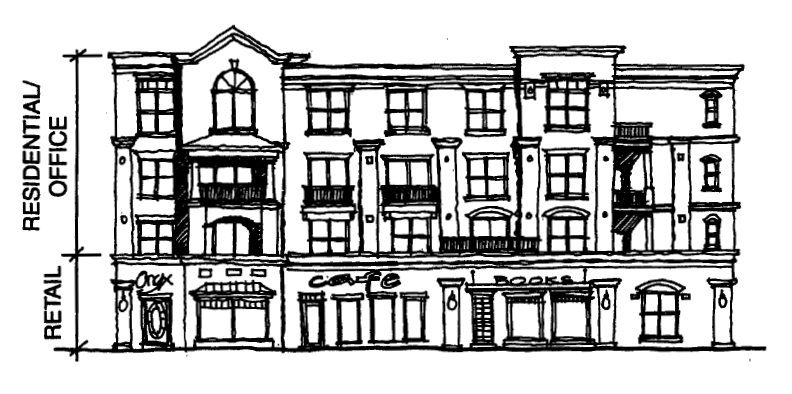
ILLUSTRATION 52-275
j.
Present an inviting building entryway. Entrances shall distinguish a building front by creating interest for the potential customer in the proper context of the historical design. Building entryways were historically recessed and often protected with an awning to provide some shelter from the elements.
k.
Use original proportions. The renovated storefronts shall fit into the existing original opening. To illustrate, an existing historical building storefront if expanded shall keep the existing storefront in place and simply add another second "duplicate" building storefront so it looks like there are now two building storefronts rather than one giant one. Likewise, replacement windows shall respect the original historic window opening sizes.
l.
Create attractive window displays. Window displays shall be attractive and interesting to customers. To encourage the shopper to come inside, the business shall place its most interesting products in the window in an artistic manner that makes the customer stop and then venture inside. These window displays also tell potential customers what is sold inside. Window displays shall be rotated on a regular basis to maintain interest.
m.
Minimize signage. Too many signs of different styles, fonts and wording are confusing to the person walking by. The signage shall be simple and shall communicate the business type inside without bombarding the customer with too many words.
n.
Modify security features. Security features are important to store owners but these features shall not scare away the customer. Bars over storefront windows and doors project an image of crime and lack of safety. Rather than using exterior security gate measures, stores shall use security glass and/or hidden roll up security gates at the back of the window displays.
o.
Maintain property. Broken windows and doors, litter and graffiti project an image of poverty and apathy. Broken windows and doors, for instance, shall be fixed immediately and graffiti shall be removed from the walls or walks. Litter shall be removed from the storefront area as soon as it happens to say, "We care about the community". Flower displays, boxes and planters also help to add warmth, color, and establish ownership to building fronts.
(Ord. No. 2008-01, 3-3-2008)
Sec. 52-276. - Reserved.
Editor's note— Ord. No. 2021-001, adopted April 19, 2021, repealed § 52-276, which pertained to development design standards and derived from Ord. No. 2008-01, adopted March 3, 2008.
Sec. 52-277. - Conflicts between standards.
The standards noted below apply to the downtown development district. When there are conflicts between the standards herein and those of other sections, the standards of this section shall take precedence. Except as otherwise noted, buildings and façades in Downtown Clare shall comply with the following requirements:
(1)
Building entrances. Building entrances shall follow the following standards:
a.
All buildings shall have at least one public, pedestrian entrance that faces the main street on the frontage line and is directly accessible from the sidewalk. In the event that the building faces upon a public space, the building face on the public space shall also be treated as a building front face.
b.
All buildings shall retain the original building entrance, if historically accurate.
c.
Rear entrances are permitted, only if there is a primary entrance from McEwan Street or the main street. The rear building entrances shall be decorative, attractive and well-maintained.
d.
Entrances with recessed doors are encouraged for protection from the elements and from doors swinging out into the sidewalk area.
e.
Doors:
1.
Doors shall use transparent glass.
2.
Doors for new construction shall be between seven and eight feet in height. Doors measuring six feet, eight inches high and over shall have a glass transom with a minimum height of 12 inches above the door.
3.
Front entrance doors shall be constructed out of wood, glass, steel, fiberglass or as approved by the city, provided it is compatible with the historic character of the district.
4.
Aluminum store fronts are prohibited.
5.
The building entry may be either centered or off centered.
6.
Entrances must be barrier-free and accessible to the physically challenged. See Illustration 52-277(a).
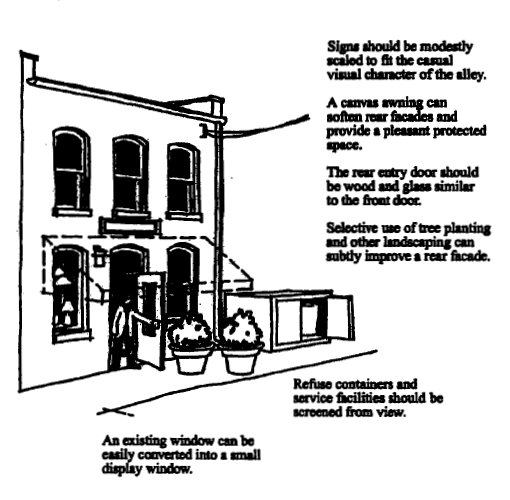
ILLUSTRATION 52-277(a)
(2)
Building placement. The placement of buildings shall follow these standards:
a.
Buildings shall be built at "build-to" lines with no minimum setbacks (zero setbacks along McEwan Street or other main streets), or the average setback of other buildings on the block as determined by the city. The upper third and fourth stories may be recessed to help maintain a human scale.
b.
A side setback between buildings in the downtown district is not required in Clare.
c.
The setback requirements may be adjusted where strict adherence would serve no good purpose or where the overall intent of downtown Clare would be better served by allowing an alternative setback, provided the conditions listed in subsections 1. through 3. below are found to exist. Such modification may be made by the city if all of the following are found to exist:
1.
That a modification in setback, or waiver of a setback altogether, will not impair the health, safety or general welfare of the city as related to the use of the premises or adjacent premises;
2.
That waiver of the setback along a common parcel line between two premises would result in a more desirable relationship between a proposed building and an existing building; and
3.
The adherence to a minimum required setback would result in the establishment of non-usable land area that could create maintenance problems. See Illustration 52-277(b).
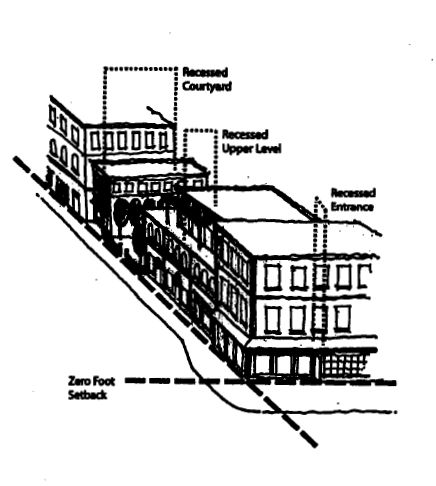
ILLUSTRATION 52-277(b)
(3)
Building height and mass. The various elements of building heights shall be as follows:
a.
The minimum height of all new buildings shall be two stories or 24 feet.
b.
The maximum height of a two-story building shall be 34 feet.
c.
The minimum height of a three-story building shall be 35 feet.
d.
The maximum height of a three-story building shall be 46 feet.
e.
The minimum height of a four-story building shall be 47 feet.
f.
The maximum height of a four-story building shall be 61 feet. No buildings within the downtown shall exceed four stories in height.
g.
The city may allow the construction or renovation of a one-story building if the architectural style includes a parapet or other appropriate architectural embellishments that are compatible with adjacent buildings in particular and downtown Clare in general. In such instances, the city may allow the minimum height of the one story building to be 18 feet in height.
h.
All stories shall contain habitable commercial, office, or residential spaces.
i.
First floor height of all two-story buildings or greater shall be a minimum of 12 feet.
j.
A transition line shall be provided between the first and second stories.
k.
Height exceptions: Special architectural features (e.g. corner towers, entry treatments, chimneys, steeples, belfries, turrets, flagpoles, parapet walls, etc.) will be allowed to exceed the above height requirements if:
1.
The feature is located at a corner (the intersection of two public right(s)-of-way); or,
2.
The building is located at a designated "gateway"; or
3.
The feature is deemed to be necessary to the type, use, or style of the building in question.
4.
Special architectural features shall not exceed the height of the remainder of the building by more than 35 percent.
5.
The height of any new building shall not exceed the height of any immediately adjacent new or existing two-story, three-story or four-story building by more than 15 percent unless the building is on a significant corner property and is approved by the city. See Illustration 52-277(c).
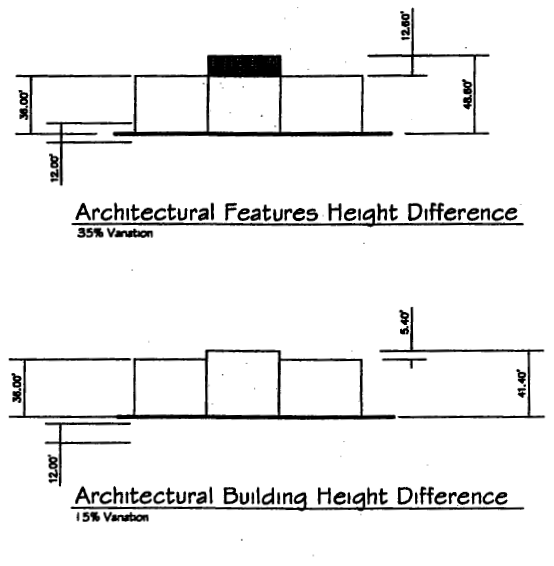
ILLUSTRATION 52-277(c)
(4)
Front façade design. All building façades that face a street shall conform to the following design criteria:
a.
Street face: Walls facing a public street shall include windows and architectural features customarily found on the front façade of a building such as awnings, cornice work, edge details or decorative finish materials. Blank walls shall not face a public street. Significant protrusions (more than six inches), such as awnings, cornice lines, details at the top of windows and sills are encouraged to create shadow lines or bands on the façade. Any building that terminates a view shall provide distinct and prominent architectural features of enhanced character and visibility to reflect the importance of the building's location.
b.
Storefront opening: The storefront opening shall be a rectangular opening ten feet to 12 feet high and approximately 70 percent of the width of the storefront or bay. The opening shall be almost entirely glass (window or showcases) with few subdivisions to help maintain visual contact between the street and the building interior. The glass framing system shall be wood or metal (aluminum or pre-painted steel). Recessed openings are required.
c.
Façade pattern: Large, long façades shall be subdivided into bays, through the location and arrangement of openings and architectural treatments that are compatible in size and scale to existing buildings. The maximum length without modulation shall be 30 feet. The bay width shall be 16 feet to 30 feet.
d.
Façade width to height ratio:
1.
One-story buildings: Single bay façades or individual bays of multiple bay façades, are not to exceed 1:2 (height to width) without the city approval.
2.
Two-story buildings: Single bay façades or individual bays of multiple bay façades, are not to exceed 1:1 (height to width) without the city approval. See Illustration 52-277(d).
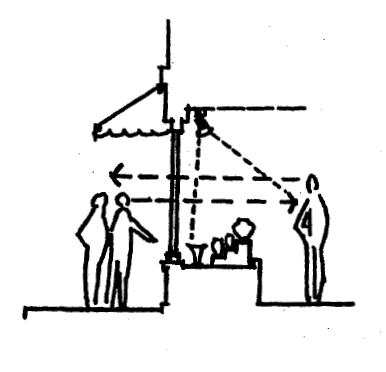
ILLUSTRATION 52-277(d)
e.
Roof type: Many of the roof configurations in the downtown are "flat" (less than 3:1 roof slope), some with parapets that conceal the roof itself:
1.
Existing flat roofs and parapets shall be maintained.
2.
All new retail/office or mixed use buildings shall have flat roofs and parapets.
3.
Sloping roofs, gabled 6:12 (height to width)or hipped may be allowed as special architectural features, particularly for residential townhouse development subject to review and approval by the city.
4.
Parapets may be stepped.
5.
Mansard roofs, geodesic domes and A frames are prohibited.
f.
Fenestration or window and door openings: All façades visible from the street must be glazed with transparent glass consistent with section 52-275(2)c.:
1.
First floor window area: minimum 40 percent of façade to 70 percent maximum.
2.
Second floor window area: minimum 25 percent of façade to 60 percent maximum.
3.
Butt-joint glazing is prohibited.
4.
The use of shutters shall generally not be used on commercial buildings. The city can waive this requirement, if it determines that it is in the best interest of the city and the downtown to do so.
5.
Mullion systems are encouraged.
6.
Windows and doorways shall be integrally designed.
7.
Façade openings including windows, doors, porches and colonnades shall be vertical in proportion.
8.
Sliding doors and windows are prohibited along frontage lines. See Illustration 52-277(d-2).
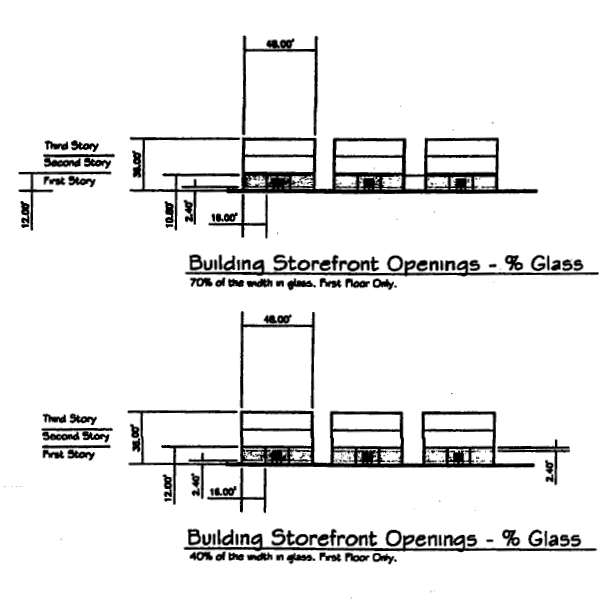
ILLUSTRATION 52-277(d-2)
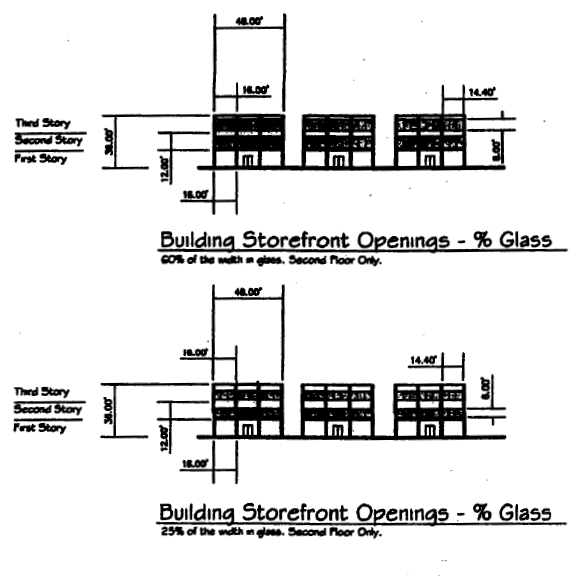
ILLUSTRATION 52-277(d-2) cont.
g.
Building materials:
1.
Buildings: The buildings are to be constructed from permanent materials that will weather handsomely over time, such as brick, stone, masonry, or other natural materials. The use of bare metal, aluminum or vinyl siding, mirrored glass and plastic shall not be allowed. Imitation stucco (Dry-Vit, Sto-Wall, E.I.F.S. and other brands) shall not be allowed below 11-foot height. Imitation stucco type products may be allowed above 11-foot height with special city approval provided the architecture is in character with the historic nature of the district. The use of metal panels, wood siding, and cement board siding shall not be allowed. The city may grant special approval of metal panels, wood siding or cement board siding in circumstances where the architecture is in keeping with the historic nature of the district.
2.
Façade frame: The façade frame, or wall, shall be brick or stone masonry constructed principally in a single plane. The top of the parapet wall shall be flat or step slightly to accentuate end piers unless a sloped roof is allowed by the city. The façade frame shall be capped by a stone coping. Brick or stone shall be laid primarily in running bond with decorative detail.
i.
Brick: Shall be standard modular brick with common tooled mortar joints. Untooled joints, or irregular shaped brick are prohibited. Brick color (commonly red or tan) and texture (smooth or glazed to rough) shall be compatible with original brick façades in downtown Clare. Decorative CMU or stucco may be used, subject to review and approval by the city, on rear or side façades.
ii.
Stone: Stone materials shall be smooth finish stone (limestone or sandstone). The stone shall be light to medium buff color. Pre-cast limestone manufactured to simulate traditional limestone or sandstone may be used with city approval.
iii.
Metal: Aluminum or painted sheet steel may be permitted after review and approval by the city. Color and finish shall coordinate with that of the window framing system.
3.
Parapet cap:
i.
Brick: The brick shall be standard modular brick with common tooled mortar joints. Untooled joints or irregular shaped brick are prohibited. Brick color (commonly red) and texture (smooth or glazed to rough) shall be compatible with original brick façades in downtown Clare. Decorative CMU or stucco may be used, subject to review and approval by the city, on rear or side façades.
ii.
Stone: The stone shall be smooth finish stone (limestone or sandstone). The stone shall be light to medium buff color. Pre-cast limestone to simulate traditional limestone or sandstone may be used with the city approval.
iii.
Metal: Metal shall be aluminum or painted sheet steel if permitted after review and approval by the city. The color and finish shall match that of window framing system.
4.
Storefront opening:
i.
Framing system: Wood is preferable, however, aluminum or pre-painted steel storefront glazing system is acceptable.
ii.
Glass: Glass shall be clear. Reflective, mirror, heavily tinted, or unusually colored glass is prohibited.
5.
Canopies:
i.
Fascia trim: Fascia trim shall be natural finish aluminum, bronze or painted metal.
ii.
Soffit: The soffit shall be metal or cement plaster.
iii.
Support rods: The support rods shall be metal and shall not block pedestrian movement.
iv.
Design: Canopies shall be narrow in elevation, six inches to 12 inches and flat or slightly angled. Typically, the canopies shall be flat or slightly angled so that the overall height dimension does not exceed 18 inches. Canopies shall be self supporting or supported by tension rods. Canopy projections shall be limited to 48 inches. Canopies shall be designed as an integral component of the building.
6.
Awnings:
i.
Design: Awnings shall be traditional in design and must be made from fabric or similar material, rather than metal, plastic or rigid fiberglass. Awnings shall not be made of high gloss, shiny or translucent materials.
ii.
Size: Awnings shall be proportional to the window opening and compatible in height, length, depth and bulk with the building façade. Awnings shall not obscure the architectural features of the building but rather the awnings shall respect the overall building façade. The awning shall match the width of the storefront or window opening.
iii.
Shape: An awning that is triangular in section sloping outward and down from the top of the awning (type A) or half round (type B) shall be used. The city may approve other awning shapes, such as round top, box or other unusual shapes, where such shape is appropriate to the integral architectural design of the façade. See Illustration 52-277(d-3).
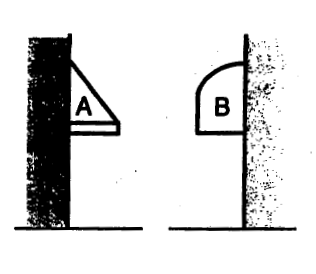
ILLUSTRATION 52-277(d-3)
iv.
Frame: The frame shall be a traditional historic frame. Wood or metal support structures shall be painted or bronzed.
v.
Fabric: Fabric shall be standard cloth fabrics in either solid, stripe or patterns.
vi.
Color: Color shall be a solid through color with the underside of the awning the same color as the exposed face. A maximum of three colors on the awning shall be allowed. Awning colors must be complementary and compatible wit the building façade.
vii.
Location: Awnings shall not cover distinctive architectural features of the building façade. All awnings shall be attached directly to the building, rather than supported by columns or poles. First floor awnings shall not be located higher than the midpoint between the highest level of the first floor and the window sill of the second floor. First floor awnings may encroach upon the frontage line but must avoid street trees and must provide a minimum clearance of eight feet of vertical clearance from the sidewalk surface grade. Awnings must be setback a minimum of two feet from the road curb and generally shall project no more than five feet from the building. Upper floor awnings shall be permitted only on vertically proportioned windows, provided the awning is only the width of the window and encroaches on the frontage line no more than three feet and is not used as a back lit sign.
viii.
Lighting: Internally illuminated or back-lit awnings are prohibited.
ix.
Awning signage: Awnings with lettering, symbols and/or other graphics shall be considered signage and shall be subject to the city's signage regulations. See Illustration 52-277(d-4).
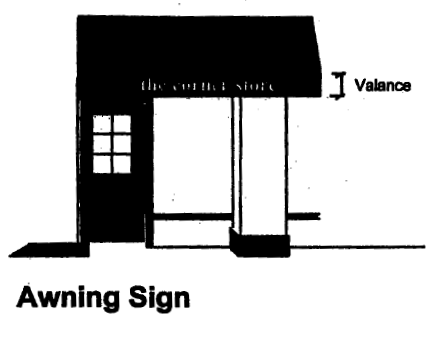
ILLUSTRATION 52-277(d-4)
7.
Balconies, railings and porch structures: Balconies, railings and porch structures shall be metal, stone, wood or pre-cast limestone.
8.
Windows:
i.
Second story windows shall maintain the height and width of the original historic window openings.
ii.
Window muttons shall be wood or metal and shall be painted or bronzed.
iii.
Curtains or blinds are permissible for second story windows in storage areas.
iv.
Window opening shall not be blocked or covered with a solid materials on the first floor.
9.
Security systems:
i.
Security systems shall not cover distinctive architectural features on the façade.
ii.
Laminated glass or security film must be installed on the inside of the window or door glass.
iii.
Security bars, solid metal security gates or solid roll-down windows shall be prohibited.
iv.
Link or grill type security devices shall be permitted only if installed from inside, within the window or door frames. With special permission by the city, link or grill type security devices may be installed on the outside if the coil box is recessed and concealed behind the building wall. Security grills shall be recessed and concealed during normal business hours. Models that provide a sense of transparency, in light colors, are encouraged. Other types of security devises fastened to the exterior walls are prohibited. The preferred location for the link or grill type of security system is behind the window display so merchandise is still visible after hours.
v.
Burglar alarms or security cameras shall not be visible from the street.
vi.
Any exterior security lighting shall be installed per the lighting section of these design standards and must meet the lighting requirements of the city.
h.
Building colors: Exterior colors shall be compatible with the colors on adjacent buildings and are subject to prior review and approval by the city. Proposed colors shall be specified on the plans. Historic paint colors are encouraged and typically no more than three colors shall be used without permission from the city. Gaudy or fluorescent colors are prohibited. The painting of brick or stone of existing unpainted buildings or proposed building construction shall generally not be allowed. The city may approve the painting of unpainted existing buildings or proposed building construction where the building painting is in keeping with the historic and architectural character of the city. The removal of paint on building surfaces shall be performed in such a way that the original masonry and mortar is not damaged.
i.
Air conditioners and other utility systems: Air conditioning units shall not be permitted on the front façade of any building or building façade where there is a pedestrian entry. Air conditioning units on side or rear walls shall be flush with the building walls and screened with decorative grills. In no instance shall the air conditioning drain onto walkways.
j.
Mechanical equipment: Roof top mechanical equipment shall be hidden from view for adjacent properties and from the rights-of-way.
(5)
Side and rear façade design. Whenever a side or rear façade is visible from a public street, or if parking is located at the side or rear of the building, the façade shall be designed to create a pleasing appearance, in accordance with the following design criteria:
a.
Design: Rear and side storefronts should be similarly designed as front façades described above.
b.
Parapet: If a parapet is used, the top of the parapet wall shall be flat or step slightly to accentuate end piers. If no parapet is used, downspouts shall be located at the outer sides of the façades, not in the middle of the façade.
c.
Materials: Materials and architectural features similar to those present on the front of the building should be used on the side or rear façade. Acceptable materials include brick, stone and precise limestone. Decorative CMU (concrete masonry unit) or stucco may be permitted with permission by the city. The buildings are to be constructed from permanent materials that will weather handsomely over time, such as brick, stone, masonry, or other natural materials. The use of bare metal, aluminum siding, mirrored glass and plastic shall not be allowed. Imitation stucco (Dry-Vit, Sto-Wall, E.I.F.S. and other brands) shall not be allowed below 11-foot height. Imitation stucco type products may be allowed above 11-foot height with special city approval provided the architecture is in character with the historic nature of the district. The use of metal panels, wood siding, and cement board siding shall not be allowed. The city may grant special approval of metal panels, wood siding or cement board siding in circumstances where the architecture is in keeping with the historic nature of the district.
d.
Building colors: Exterior colors shall be compatible with the colors on adjacent buildings and are subject to prior review and approval by the city. Proposed colors shall be specified on the plans. Historic paint colors are encouraged and typically no more than three colors shall be used without permission from the city. Gaudy or fluorescent colors are prohibited. The painting of brick or stone of existing unpainted buildings or proposed building construction shall generally not be allowed. The city may approve the painting of unpainted existing buildings or proposed building construction where the building painting is in keeping with the historic and architectural character of the city. The removal of paint on building surfaces shall be performed in such a way that the original masonry and mortar is not damaged.
e.
Service areas: Trash receptacle and service areas shall be completely screened with landscaping, a fence, a wall, or a combination thereof.
f.
Open space: Open areas shall be landscaped with lawn, ground cover, ornamental shrubs and trees. On every site involving new development or redevelopment, foundation plantings adjacent to the building may be required at the discretion of the city. The species and design shall be identical to or compatible with the landscaping schematic for the downtown development district.
g.
Streetscape: The area within the right-of-way between the curb and building shall be identical to or compatible with the streetscape scheme of the downtown development district.
h.
Roof top mechanical equipment: Roof top mechanical equipment shall be hidden from view for adjacent properties and for the rights-of-way.
(6)
Lighting. Exterior lighting must be placed so that sidewalks and parking areas are properly lighted to facilitate the safe movement of pedestrians and vehicles and provide a secure environment. Exterior lighting can also be used to tastefully highlight special architectural features of buildings.
a.
Type: Pole lighting shall be compatible with the historic-style street lamps. Floodlights, wall pack units, other types of unshielded lights, and lights where the lens is visible outside of the light fixture shall be prohibited, except where historical-style lighting is used that is compatible with historic-style street lamps. Lighting style shall be compatible with the historic character of the area.
b.
Lighting source: The lighting source shall not be directly visible from adjoining properties. The lighting shall be shielded so as to direct the light onto the site and away from adjoining properties.
c.
Intensity: In parking areas, the light intensity shall average a minimum of 1.0 foot candle, measured five feet above the surface. In pedestrian areas, the light intensity shall average 2.0 foot candles, measured five feet above the surface. The intensity of light shall not exceed ten feet candles at any location within the site and 1.0 foot candle at any lot boundary, except where it abuts a residential district or use where a maximum of 0.5 foot candle is permitted. Lighting shall not be flashing, pulsating or project unshielded glare onto the sidewalks or roadways.
d.
Height: The maximum height of light poles to the top of the fixture shall be 20 feet high. See Illustration 52-277(f) and (f-2).
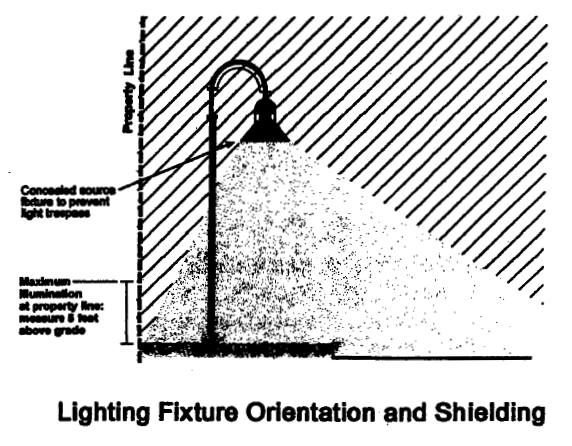
ILLUSTRATION 52-277(f)
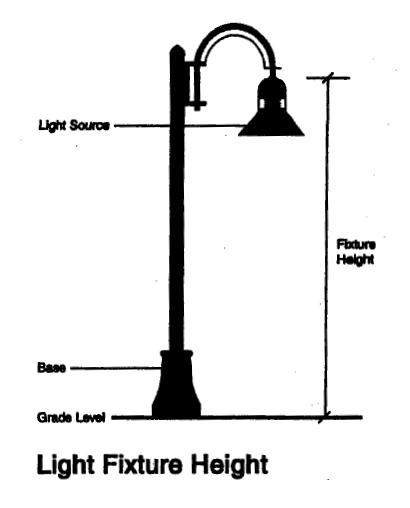
ILLUSTRATION 52-277(f-2)
(7)
Parking. Parking and parking lot design shall comply with the standards below:
a.
Parking lot: No new parking lot shall be created nor any existing parking lot expanded in front of a building unless the city determines that parking in front of the building would be acceptable for either of the following reasons:
1.
Front yard parking is required to maintain the continuity of front building setbacks in the block while making efficient use of the site; or
2.
Front yard parking is required for the purposes of traffic safety and to minimize driveway curb cuts where the new parking lot is proposed to connect with one or more parking lots on adjoining parcels.
b.
Parking: Parking located in front or on the side of a building shall be screened from the road with a 30 inches to four-foot high decorative brick, stone or other masonry wall complementing the adjacent buildings. A continuous evergreen hedge or decorative ornamental fence may be allowed with the city approval. Screen wall openings for vehicular and pedestrian access shall have a maximum width of 25 feet. Sight clearance must be maintained. Any required fencing shall be decorative iron rather than chain-link fence. See Illustration 52-277(g)(2).
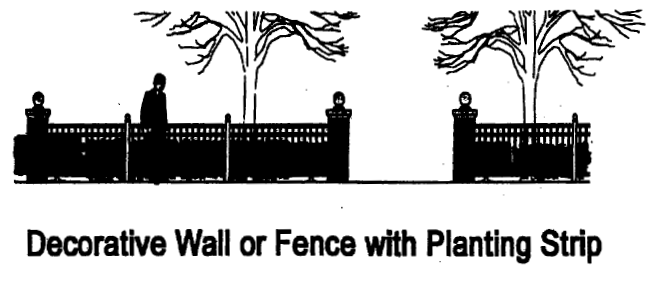
ILLUSTRATION 52-277(g)(2)
c.
Pavement: Paving shall be confined to the minimum area necessary to comply with the city parking requirements, in order to maximize the amount of land area left for landscaping and open space.
d.
Parking spaces: Parking spaces located adjacent to residential buildings and uses shall require the following:
1.
A six-foot high decorative brick wall shall be required between non-residential and residential uses.
2.
Wherever feasible, a five-foot wide opening(s) shall be provided in the wall to encourage and connect to existing or future pedestrian pathway systems located on adjacent parcels.
(8)
Landscaping. New landscaping shall comply with the city standards, in addition to the standards below:
a.
Street trees:
1.
Spacing: On every site involving new development or re-development, street trees shall be provided at 25- to 40-foot intervals.
2.
Variety: The species of street tree and exact locations shall be as specified on the future streetscape plan. In the event that future streetscape plan has not been prepared, then any of the following street trees shall be planted within the road right-of-way at 25- to 40-foot intervals: Norway Maple, Red Maple, Cleveland Pear, Aristocrat Pear or Little Leaf Linden.
3.
Street tree plan: A street tree plan shall be submitted for review and approval for any modifications that do not fit into subparagraph b. below. See Illustration 52-277(h).
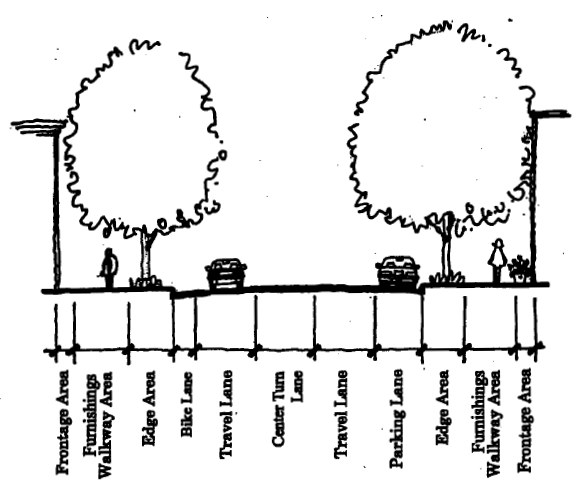
ILLUSTRATION 52-277(h)
b.
Landscape plan: On every site involving new development or total redevelopment, a landscape plan shall be submitted for review and approval.
c.
Window boxes: Window boxes with attractive, live floral displays are encouraged. The window boxes shall be placed below the windows and their width shall be proportionate to the individual window width.
(9)
Sidewalk displays. Sidewalk displays shall be permitted directly in front of a business establishment provided at least five feet of clearance is maintained along pedestrian circulation routes. Displays are required to comply with the following:
a.
Size: Display cases shall be located against the building wall and shall not be more than two feet deep. The display area shall not exceed 50 percent of the length of the storefront.
b.
Hours and materials: Display cases shall be permitted only during normal business hours, and shall be removed at the end of the business day. Cardboard boxes, pallets and plastic containers shall not be used for sidewalk displays.
c.
Maintenance and style: Sidewalk displays shall maintain a clean, litter-free and well-kept appearance at all items and shall be compatible with the colors and character of the storefront from which the business operates.
(10)
Courtyards and plazas.
a.
Design: Exterior public and semi-public spaces, such as courtyards or plazas, shall be designed to enhance surrounding buildings and provide functional amenities for the users.
b.
Composition: Exterior public or semi-public spaces shall include textured paving, landscaping, lighting, fountains, street trees, benches, trash receptacles and other items of street furniture, as appropriate.
c.
Edges: Courtyards shall have recognizable edges defined on at least three sides by buildings, walls, elements of landscaping, and elements of street furniture, in order to create a strong sense of enclosure.
d.
Integration: Courtyards and plazas shall be connected to the public sidewalk pathway system.
(11)
Outdoor cafe/cafes, outdoor eating areas and open front restaurant (i.e. window service).
a.
Size: Any outdoor eating area outside of the building footprint shall not exceed 15 percent of the gross floor area of the ground floor level of the principal building.
b.
Location: Outdoor eating areas (with the exception of sidewalk cafes) shall be located no closer than five feet from any street right-of-way or any vehicular parking or maneuvering areas and shall provide the minimum five feet of clearance space for pedestrian circulation. Such eating areas shall be separated from all vehicular parking and maneuvering areas by means of a greenbelt, wall, or architectural feature.
c.
Location and screening: The outdoor eating area shall not be located within 50 feet or any properties used or zoned for single-family residential purposes. The area shall be completely screened from view from all single-family residential properties by an obscuring wall or greenbelt, in compliance with this division.
d.
Maintenance: The outdoor eating area shall be kept clean and devoid of litter at all times. Fences or landscaping shall be provided to control blowing debris.
e.
Vending machines: All vending machines and arcades shall be located within a completely enclosed building.
f.
Outdoor sidewalk cafes: Outdoor sidewalk cafes shall be subject to the following standards:
1.
A minimum of five feet of sidewalk along the curb and leading to the entrance to the establishment must be maintained free of tables, chairs and other encumbrances to allow for pedestrian circulation. If the sidewalk is not wide enough to allow for a five-foot wide clearance for circulation, the cafe/cafes shall not be permitted. Planters, posts with ropes, or other removable enclosures are encouraged and shall be used to define the area occupied by the outdoor seating.
2.
Pedestrian circulation and access to store entrances shall not be impaired. Thus, a boundary (maximum encroachment width and length) into the public sidewalk shall be established, with an accessible aisle being maintained between this line and the curb, in accordance with the provisions of the National Americans with Disabilities Act (ADA) and Michigan Barrier Free Requirements.
3.
The operators of the outdoor cafe/cafes shall be responsible for a clean, litter-free, and well-kept appearance within and immediately adjacent to the area of the tables and chairs. Additional outdoor trash receptacles shall be required. Trash shall be emptied from any outdoor receptacles associated with an outdoor cafe/cafes on a daily basis. Outdoor cafe/cafes trash receptacles shall be removed from the sidewalks between November 1 and March 30. Written procedures for cleaning and trash containment and removal responsibilities of the cafe/cafes must be noted on the site plan to the satisfaction of the city.
4.
Tables, chairs, planters, trash receptacles, and other elements of street furniture shall be compatible with the architectural character of the adjacent buildings. If table umbrellas will be used, they shall complement building colors.
5.
Additional signs shall not be permitted, beyond what is permitted for the existing restaurant.
6.
The hours of operation for the outdoor seating area shall be established and noted on the plan.
7.
Preparation of food and beverages shall be prohibited in this outdoor area. The sale and consumption of alcohol are governed by the Michigan Liquor Control Act and any applicable local ordinance.
8.
Liability issues for use of the public sidewalk shall be addressed and reviewed by the city attorney.
(12)
Mechanical equipment.
a.
Mechanical and communication equipment. All air conditioning units, HVAC systems, exhaust pipes or stacks, elevator housing and satellite dishes and other telecommunications devices, including small cell wireless facilities as defined by the Small Cell Wireless Facilities Deployment Act, and other telecommunication devices shall be thoroughly screened from view from the public right-of-way and from adjacent properties, by using walls, fences, roof elements, penthouse-type screening devices or landscaping.
b.
Fire escapes. Fire escapes shall not be permitted on a building's front façade. [No] buildings requiring a second means of egress pursuant to the local building codes, internal stairs or other routes of egress shall be used.
(13)
Service access.
Service alley: A service alley or designed loading space shall be reserved at the rear of the building.
(Ord. No. 2008-01, 3-3-2008; Ord. No. 2009-004, 11-2-2009; Ord. No. 2019-003, 4-1-2019)
Sec. 52-278. - Miscellaneous requirements.
(a)
Before a building permit for a DDA parcel will be issued, the owner and/or builder must submit the following material to the downtown development authority/main street board for review and comment:
(1)
A detailed site plan of the area, showing the location of all buildings, improvements, signage, walls or fencing, lighting and landscaping.
(2)
Engineering/architectural plans for all buildings and utilities (i.e., water, sewer, storm drainage, gas and electricity).
(3)
A description of the operation, including, but not limited to, the type of activity, number and type of employees, hours of operation, manpower and training requirements, water and sewer usage, energy consumption, solid waste disposal needs, air pollution, building entrances and placement, front façade, rear façade, lighting, courtyards and plazas.
(b)
Any DDA/main street district building permit shall become null and void if construction has not begun within one year of date of approval.
(c)
All principal structures must conform to the development design standards applicable to the downtown development/main street district.
(d)
After review the downtown development authority/main street board shall issue its recommendation and report to the city planning commission for its use in evaluating the site plan pursuant to this chapter, section 52-411 et seq.
(Ord. No. 2008-01, 3-3-2008)
Sec. 52-279. - Sign review standards.
Sign review and approval is required by the City of Clare for all users in downtown Clare in accordance with the City of Clare Zoning Ordinance article IX, Signs. For projecting signs, suspended signs and wall signs, sign review and approval shall be reviewed and approved by the City of Clare in accordance with the Zoning Ordinance and the additional requirements below. In the event that there is a conflict between the article IX sign regulations and the standards noted herein, these downtown sign review standards shall govern. Signs erected within downtown Clare shall comply with the following:
(1)
Location.
a.
No sign shall be erected which shall be less than eight feet from ground level measured vertically from the bottom of said sign to ground level.
b.
No sign shall be erected within a distance of ten feet measured horizontally from any fire hydrant, traffic light or street lighting poles, nor shall any sign be erected in any location where, by reason of traffic conditions, fire or explosion hazards, it would imperil public safety or interfere with the function of the fire department.
c.
Signs shall be prohibited from extending, in any manner, into or over public rights-of-way traveled, or intended for use by motorized vehicles. However, projecting or canopy signs may extend into the right-of-way as permitted in subsection (8)f., below. Municipal banners may be permitted by special approval from the city manager.
d.
Signs shall be located either in the panel situated above the awning or transom windows, on the canvas awning, on the window or door glass, on the transom window area or on a small projecting sign.
e.
No wall, canopy or projecting sign shall extend above the roof or parapet of the structure to which it is attached by more than one foot. See Illustration 52-279(1).
ILLUSTRATION 52-279(1)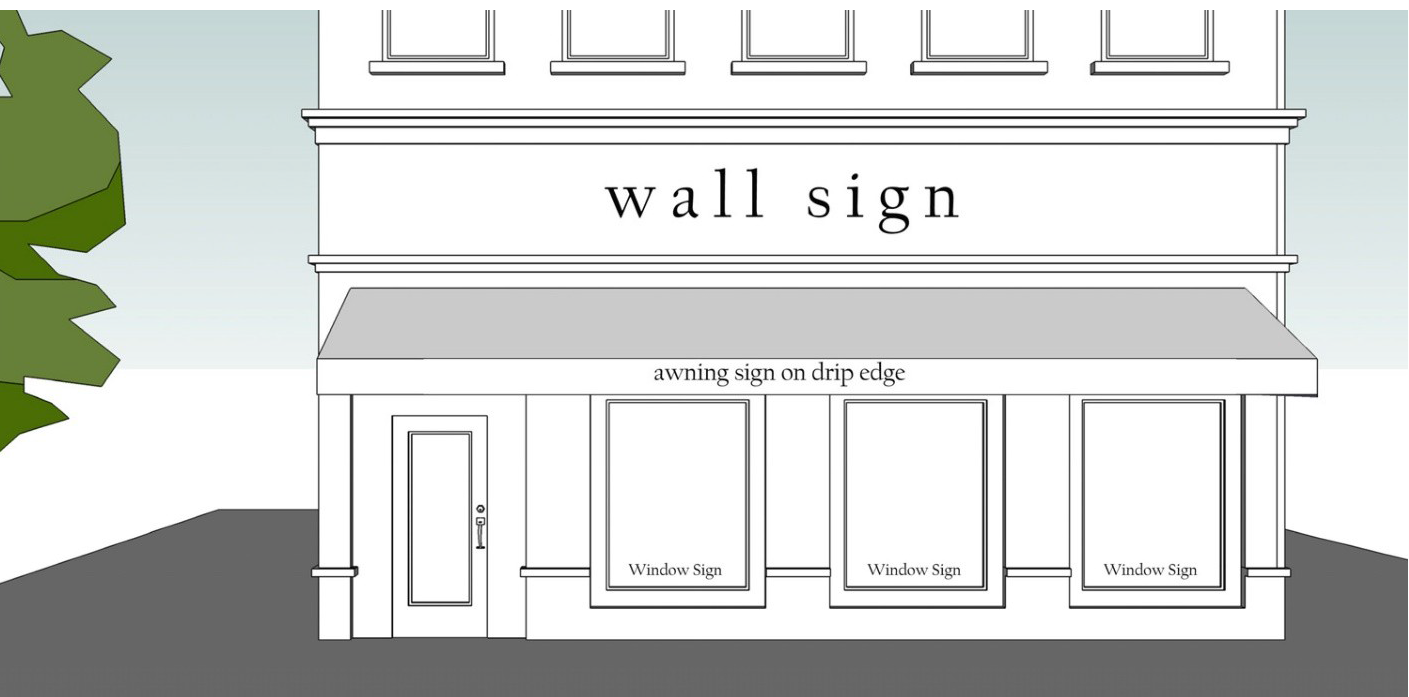
(2)
Sign size.
a.
The total surface area of all wall signs shall not exceed one and one-half square feet per lineal foot of building frontage, not to exceed 100 square feet. The sign size shall fit the existing features of the building and shall not cover up architectural details.
b.
The total area of freestanding ground signs shall not exceed one-half of a square foot per lineal foot of lot frontage, not to exceed 25 square feet for a single face sign, 50 square feet for a double face sign, or a total of 50 square feet of surface for any other sign configuration.
c.
If a façade is shared by more than one premises, the total sign area available to the façade under the terms of these standards shall be allocated so that the sign area available to each premises bears the same proportion that the façade area bears to the total façade area.
(3)
Projecting signs. Individual projecting signs to be mounted perpendicular to building façade shall be permitted subject to the following:
a.
The signboard shall not exceed eight square feet.
b.
Business signs may be located on the second story façade of the building so long as the minimum height requirements established elsewhere are met and the sign is not closer than three feet below the roof line of the building. (No signs shall be mounted on the roof line or roof top.)
c.
The distance from the ground to the lower edge of the signboard shall be eight feet minimum.
d.
The distance from the building wall to the signboard shall not exceed six inches.
e.
The width of the signboard shall not exceed three feet.
f.
The height of the lettering, numbers or graphics shall not exceed eight inches.
g.
The outside edge of a projecting sign shall not extend more than four feet from the face of the building that it is attached to or one-third of the sidewalk width whichever is less.
(4)
Lettering. Applied letters may substitute for wall-mounted signs, if constructed of painted wood, painted cast metal, bronze, brass or black anodized aluminum. Applied plastic letters shall not be permitted. The height of applied letters shall not exceed eight inches.
(5)
Wall-mounted signs. Wall-mounted signs shall be permitted subject to the following:
a.
The sign shall be affixed to the front façade of the building and shall project outward from the wall to which it is attached no more than six inches.
b.
The area of the signboard shall not exceed five percent of the ground floor building façade area, or 24 square feet, whichever is less.
c.
The maximum permitted height is 15 feet above the front sidewalk elevation and shall not extend above the base of the second-floor windowsill, parapet, eave or building façade.
d.
The height of the lettering, numbers or graphics shall not exceed eight inches.
e.
The sign shall be granted to commercial uses occupying buildings facing on public streets only and shall not be allocable to other uses.
f.
Wall-mounted signs shall be limited to one sign per business.
(6)
Painted window or door signs. Painted window or door signs shall be permitted, provided the following standards are met:
a.
The sign shall not exceed 20 percent of the window or door area, or four-square feet, whichever is less.
b.
The sign shall be silk-screened, hand painted, or may be of vinyl materials.
c.
The painted window door signs shall be limited to one sign per business, painted on either the window or the door, but not on both.
d.
The painted window or door signs may be in addition to only one of the following: a wall-mounted sign, a freestanding sign, an applied letter sign, a projecting sign or a valance awning sign.
e.
Painted or vinyl signs shall be professional in appearance.
(7)
Awning signs. Awnings or canopies used to advertise a business shall be made of cloth or materials resembling cloth. Awning signs shall be permitted for ground floor uses only provided the following standards are met:
a.
If acting as the main business sign, it shall not exceed ten square feet in area, and the height of the lettering, numbers or graphics shall not exceed eight inches.
b.
If acting as an auxiliary business sign, it shall be located on the valance only, shall not exceed four square feet in area, and the height of the lettering, numbers or graphics shall not exceed four inches. No awning sign shall extend vertically or horizontally beyond the limits of the awning.
c.
Limited to two such signs per business, on the valance.
d.
If acting as the main business sign, it shall not be in addition to a wall-mounted sign.
e.
Internally illuminated awning signs are prohibited. Indirect awning lighting is permitted after review and approval by the City of Clare. See Illustration 52-279(i).
(8)
Freestanding signs. One freestanding sign may be provided, subject to the following conditions:
a.
The building where the business to which the sign refers to shall be set back a minimum of ten feet from the street line.
b.
The area of the signboard shall not exceed three square feet.
c.
The height of the lettering, numbers or graphics shall not exceed four inches.
d.
The height of the top of the signboard, or of any posts, brackets or other supporting elements shall not exceed six feet from the ground.
e.
The signboard shall be constructed of wood, with wood or cast-iron brackets, and shall be architecturally compatible with the style, composition, materials, colors and details of the building.
f.
The sign shall be located within four feet of the main entrance to the business and its location shall not interfere with pedestrian or vehicular circulation.
g.
Freestanding signs shall be limited to one sign per building and shall not be in addition to wall-mounted, applied letters or projecting signs.
(9)
Corner business signage. Businesses located in corner buildings are permitted one sign for each street frontage.
(10)
Service entry signage. Businesses with service entrances may identify these with one sign not exceeding two square feet.
(11)
Directional signage. One directional sign, facing a rear parking lot, may be erected. This sign may be either wall-mounted on the real façade, projecting or freestanding, but shall be limited to four square feet in area.
(12)
Restaurant and cafe signage. In addition to other signage, restaurants and cafes shall be permitted the following, limited to one sign per business:
a.
A wall-mounted display within a shallow wood or metal case, clearly visible through a glass front, which shall be attached to the building wall, next to the main entrance, at a height of approximately five feet, shall not exceed a total area of two square feet, and may be lighted.
b.
A sandwich board sign, as follows:
1.
The area of the signboard, single-sided, shall not exceed five square feet. The height shall not exceed five feet and the width shall not exceed three feet.
2.
The signboard shall be professionally constructed of durable, weather-resistant materials such as wood, chalkboard or finished metal.
3.
Letters must be professionally painted or handwritten.
4.
The sign shall be located within four feet of the main entrance to the business and its location shall not interfere with pedestrian or vehicular circulation.
5.
The sign shall be removed at the end of the business day.
6.
The sign shall not be erected within 20 feet of another sandwich board.
(13)
Sign design standards.
a.
Signs affixed to the exterior of a building shall be architecturally compatible with the style, composition, materials, colors and details of the building, as well as with other signs used on the building or its vicinity.
b.
Signs shall fit within the existing façade features, shall be confined to signable areas, and shall not interfere with door and window openings, conceal architectural details or obscure the composition of the façade where they are located. Signs shall be placed on a façade only in a manner historically appropriate to the style of the building.
c.
Whenever possible, signs located on buildings within the same block-face shall be placed at the same height, in order to create a unified sign band.
d.
Wood and painted metal are the preferred materials for signs. Flat signs shall be framed with raised edges. Signs using wood shall use only high-quality exterior grade wood with suitable grade finishes. Sign materials shall be durable in nature.
e.
Sign colors shall be compatible with the colors of the building façade. A dull or matte finish is recommended, for it reduces glare and enhances legibility.
f.
Signs shall be spot-lighted (indirect lighting such as gooseneck light fixtures) with a diffused light source. Spot-lighting shall require complete shielding of all light sources; light shall be contained within the sign frame and shall not significantly spill over to other portions of the building, or site. Warm fluorescent bulbs may be used to illuminate the interior of display cases. Neon signs are not allowed.
g.
Signs shall be mounted so that the method of installation is concealed. Signs applied to masonry surfaces shall be mechanically fastened to mortar joints only and not directly into brick or stone. Drilling to provide electrical service shall also follow the same rule.
h.
Signage quantity shall be kept to a minimum and temporary signage shall be removed when in disrepair.
(Ord. No. 2008-01, 3-3-2008; Ord. No. 2009-001, §§ 1, 2, 5-4-2009; Ord. No. 2009-004, 11-2-2009; Ord. No. 2010-002, 7-19-2010; Ord. No. 2014-003, 8-4-2014; Ord. No. 2014-008, 10-6-2014; Ord. No. 2021-001, 4-19-2021)
Sec. 52-280. - Zoning; additional uses.
(a)
In accordance with the zoning map of the City of Clare, the entire downtown development district is zoned C-1. The permitted uses for C-1 are as set forth in section 52-181.
(b)
In addition to the uses set forth in section 52-181, within the downtown development district, use as a residence on the 2nd floor and above, is a permitted use by right.
(c)
This use is subject to all other provisions of this Code, and applies throughout the downtown development district.
(Ord. No. 2022-001, 7-5-2022, eff. 8-4-2022)

