
Clare City Zoning Code
ARTICLE IX
SIGNS
Sec. 52-437.- Purpose.
The purpose of this article is to regulate signs and to minimize outdoor advertising within the city so as to protect public safety, health and welfare; minimize abundance and size of signs to reduce visual clutter, motorist distraction, and loss of sight distance; promote public convenience; preserve property values; support and complement land use objectives as set forth in the city master plan and this chapter; and enhance the aesthetic appearance and quality of life within the city. The standards contained herein are intended to be content neutral.
These objectives are accomplished by establishing the minimum amount of regulations necessary concerning the size, placement, construction, illumination, and other aspects of signs in the city so as to:
(1)
Recognize that the proliferation of signs is unduly distracting to motorists and nonmotorized travelers, reduces the effectiveness of signs directing and warning the public, causes confusion, reduces desired uniform traffic flow, and creates potential for crashes.
(2)
Prevent signs that are potentially dangerous to the public due to structural deficiencies or disrepair.
(3)
Reduce visual pollution and physical obstructions caused by a proliferation of signs which would (diminish) the city's image, property values and quality of life.
(4)
Recognize that the principal intent of commercial signs, to meet the purpose of these standards and serve the public interest, should be for identification of an establishment on the premises. There are alternative channels of advertising communication and media are available for advertising which do not create visual blight and compromise traffic safety.
(5)
Enable the public to locate goods, services and facilities without excessive difficulty and confusion by restricting the number and placement of signs.
(6)
Prevent placement of signs which will conceal or obscure signs of adjacent uses.
(7)
Protect the public right to receive messages, especially noncommercial messages such as religious, political, economic, social, philosophical and other types of information protected by the First Amendment of the U.S. Constitution.
(8)
The regulations and standards of this article are considered the minimum necessary to achieve a substantial government interest for public safety, aesthetics, protection of property values, and are intended to be content neutral.
(9)
Prevent signs from conflicting with other allowed land uses.
(10)
Maintain and improve the image of the city by encouraging signs of consistent size which are compatible with and complementary to related buildings and uses, and harmonious with their surroundings.
(11)
Preserve and enhance the image of the city's commercial areas.
(Ord. of 9-5-2006; Ord. No. 2021-001, 4-19-2021)
Sec. 52-438. - Sign definitions.
The following words, terms and phrases, when used in this article, shall have the meanings ascribed to them in this article, except where the context clearly indicates a different meaning.
Accessory sign. A sign which pertains to the use of the premises on which it is located.
Animated sign. A sign which uses lights, moving parts, or other means to depict action, create an image of a living creature or person, or create a special effect or scene. This includes hot-air and gas-filled balloons, banners, pennants, streamers, festoons, ribbons, tinsel, pinwheels, nongovernment flags, and searchlights.
Awning or canopy sign. A nonrigid fabric marquee or awning-type structure which is attached to the building by supporting framework, which includes a business identification message, symbol and/or logo. See "wall sign."
Banner. A fabric, plastic or other sign made of nonrigid material without enclosing structural framework.
Business center. A grouping of two or more business establishments on one or more parcels of property which may share parking and access and are linked architecturally or otherwise present the appearance of a unified grouping of businesses. A business center shall be considered one use for the purposes of determining the maximum number of ground signs. An automobile or vehicle dealership shall be considered a business center regardless of the number or type of models or makes available, however, used vehicle sales shall be considered a separate use in determining the maximum number of signs, provided that the used vehicle sales section of the lot includes at least 25 percent of the available sales area.
Changeable message sign. A sign on which the message is changed mechanically or manually, including time/temperature signs; also called menu board, reader board or bulletin board.
Electronic message sign. A sign capable of displaying words, symbols, figures or images that can be electronically or mechanically changed by remote or automatic means, including animated graphics and video.
Festoon. A string of ribbons, tinsel, small flags, pinwheels or lights, typically strung overhead in loops.
Freestanding sign. A sign which is erected upon or supported by the ground, including "pole or pylon signs" and "ground signs."
Ground or monument sign. A three-dimensional, self-supporting, base-mounted freestanding identification sign, consisting of two or more sides extending up from the base, and upon which a message, business, group of businesses or center name is affixed.
Illegal sign. A sign which does not meet the requirements of this article and does not have legal nonconforming status.
Integral sign. A memorial sign or commemorative tablet which contains names of buildings, dates of erection, and monumental citations.
Luminance. The amount of light emitted from a source. Luminance is measured by candelas per square meter or cd/m2 or nits.
Luminous tube. See "neon (sign)" and "outline tubing sign."
Mansard. A sloped roof or roof-like façade. Signs mounted on the face of a mansard roof shall be considered wall signs.
Marquee. A permanent roof-like structure or canopy, supported by and extending from the face of the building. The structure extends from part or all of a building face and is constructed entirely of noncombustible materials. A marquee sign is a sign attached to or supported by a marquee structure.
Neon sign. See "outline tubing sign."
Nit. A unit of measurement of luminance. One nit is equal to one candela per square meter (1 cd/m2).
Nonconforming sign. A sign that does not comply with the size, placement, construction or other standards or regulations of this article, but were lawfully established prior to its adoption. Signs for which the zoning board of appeals has granted a variance are exempt and shall not be defined as nonconforming. This does not include any temporary sign, banner, or placard, including signs affixed to the interior or exterior of windows.
Obsolete sign. A sign that advertises a product that is no longer made or that advertises a business that has closed.
Outdoor advertising sign. A freestanding sign with a sign area in excess of 125 square feet.
Outline tubing sign. A sign consisting of glass tubing, filled with a gas such as neon, which glows when electric current is sent through it. See "neon (sign)" and "luminous tube."
Photometer. An instrument that measures light intensity in terms of luminance.
Pylon or pole sign. A sign supported on the ground by a pole, braces or monument, and not attached to any building or other structure.
Pylon overlay district. An area within the city that, due to its proximity to US-10, higher road speeds and auto-oriented character, allows taller pylon signs for improved visibility.
Regulatory sign. A sign installed by a public agency to direct traffic flow, regulate traffic operations and provide information in conformance with the Michigan Manual of Uniform Traffic Control Devices.
Residential entranceway sign. A sign which marks the entrance to a subdivision, apartment complex, condominium development, or other residential development.
Roof line. The top edge of a roof or building parapet, whichever is higher, excluding cupolas, pylons, chimneys, or similar minor projections.
Roof sign. Any sign that extends above the roof line or is erected over the surface of the roof.
Sandwich board sign. A sign that consists of two faces connected and hinged at the top and have a message targeted to pedestrians. Also known as A-frame sign.
Sign. Any display or object designed for the purpose of bringing attention to, identifying or advertising an establishment, project, goods, services, or other message to the general public. Unless otherwise indicated, the definition of "sign" includes interior and exterior signs which are visible from any public street, sidewalk, alley, park, or public property, but not signs which are primarily visible to and directed at persons within the premises upon which the sign is located.
Temporary sign. Temporary sign means a display sign, banner or other advertising device constructed of cloth, canvas, fabric, plastic or other light temporary material, with or without a structural frame, or any other sign intended for a limited period of display that is not permanently anchored to the ground or building.
Wall sign. A display which is painted on or attached directly to the building wall or door.
Window sign. A sign that is applied, painted, posted, displayed, or etched onto a glazed surface, regardless of opacity or perforation, including those placed or posted inside and located within 20 feet of the window that are visible and legible from the exterior as determined by the city manager or authorized designee.
(Ord. of 9-5-2006; Ord. No. 2021-001, 4-19-2021)
Sec. 52-439. - Exempt signs.
The following signs are specifically exempt from the provisions of this article provided they are not located in the public right-of-way or in conflict with the regulations found elsewhere in this chapter:
(1)
Address numbers with a numeral height no greater than six inches for residences and 18 inches for businesses.
(2)
Traffic control signs including regulatory and directional traffic control and street signs erected by a public agency in compliance with Michigan Manual of Uniform Traffic Control Devices.
(Ord. of 9-5-2006; Ord. No. 2021-001, 4-19-2021)
Sec. 52-440. - Prohibited signs.
The following signs shall be prohibited in any district:
(1)
Any sign that is not specifically permitted by this chapter is prohibited.
(2)
Signs which obstruct free access or egress from any building.
(3)
Any sign that gives the appearance of motion, including moving, scrolling, animated, or flashing elements. This includes changes of illumination levels and color, except as approved by special event permit.
(4)
Exterior pennants, spinners, inflatables, feather signs, and streamers.
(5)
Any sign which is structurally or electrically unsafe.
(6)
Any sign erected on a tree, utility pole, street furniture or waste receptacles.
(7)
Any sign on a motor vehicle or trailer which is parked so as to be visible from a public right-of-way outside of business hours for the primary purpose of advertising a business or product or service of a business located on the premises where such vehicle is parked.
(8)
Rope light, string light or similar lighting attached to, surrounding or otherwise drawing attention to a sign.
(9)
Any sign erected on or projecting into the public right-of-way, except for a-frame business signs as permitted in this chapter and other signs expressly permitted in the right-of-way in this article. The city may remove and destroy or otherwise dispose of, without notice to any person, any sign which is erected on the public right-of-way in violation of this subsection.
(10)
Signs that imitate a traffic control device.
(Ord. of 9-5-2006; Ord. No. 2021-001, 4-19-2021)
Sec. 52-441. - General standards for permitted signs.
Signs which are permitted as accessory uses serving a commercial or informational purpose may be permitted subject to the requirements of this article; provided, that no such sign shall be erected or altered until approved by the building official/city manager and until a sign permit has been issued pursuant to this chapter.
(1)
Sign setbacks.
a.
All signs, unless otherwise provided for, shall be set back a minimum of three feet from any public or private street right-of-way line or access drive in all districts. This distance shall be measured from the nearest edge of the sign, measured at a vertical line perpendicular to the ground to the right-of-way.
b.
Side yard setbacks for signs shall be the same as that required for the main structure or building, provided that all nonresidential signs shall be set back at least 100 feet from any residential district.
(2)
Location. Sign location to assure adequate sight distance. In order to ensure adequate sight distance for motorists, bicyclists and pedestrians, a minimum clear vision area shall be maintained between a height of 24 inches and six feet within a triangular area measured 25 feet back from intersection of public right-of-way lines. Furthermore, signs shall not be permitted where they obstruct motorist vision of regulatory signs, traffic-control devices or street signs. Within the discretion of the traffic control board or committee of the City of Clare, greater restrictions than are contained within this section may be imposed in order to protect minimum clear vision area or adequate line of sight. Such sight and condition respective requirements shall be within the sole discretion of the committee or board having authority over traffic control.
(3)
Design and construction. Signs, as permitted in the various zoning districts, shall be designed to be compatible with the character of building materials and landscaping to promote an overall unified and aesthetic effect in accordance with the standards set forth herein.
(4)
Illumination.
a.
The source of illumination may be internal or external. The source of the light shall not be exposed.
b.
Glare control for sign lighting shall be achieved through the use of full cutoff fixtures, shields, and baffles, and appropriate application of fixture mounting height, wattage, aiming angle, and fixture placement.
c.
All luminaires shall be shielded to direct light to a sign and shall contain shields, baffles or other appropriate elements to prevent direct light from extending above a horizontal plane extending from the top of the light source. No luminaire shall be aimed or directed such as to cause light from the luminaire to be directed toward residential buildings on adjacent or nearby land or public ways.
d.
Underground wiring shall be required for all illuminated signs not attached to a building.
(5)
Maintenance and construction.
a.
Every sign shall be constructed and maintained in a manner consistent with the building code provisions and maintained in good structural condition at all times. All signs shall be kept neatly painted, stained, sealed or preserved including all metal, wood or other materials used for parts and supports.
b.
All signs erected, constructed, reconstructed, altered or moved shall be constructed in such a manner and of such materials so that they shall be able to withstand wind pressure of at least 20 pounds per square foot or 75 mph.
c.
All signs, including any cables, guy wires, or supports shall have a minimum clearance of four feet from any electric fixture, street light, or other public utility pole or standard.
(6)
Measurement. Measurement of allowable sign area:
a.
The allowable area for signs shall be measured by calculating the square footage of the sign face and any frame of other material or color forming an integral part of the display or used to differentiate it from the background against which it is placed as measured by enclosing the most protruding points or edges of a sign within a rectangle.
b.
When a sign has two or more faces, the area of all faces shall be included in calculating the area of the sign except that where two such faces are placed back-to-back, only the larger face shall be considered, provided that both faces are part of the same structure and are separated by no more than two feet.
c.
For permanent signs, except projecting and hanging signs, sign area shall constitute the entire area within a rectangle or the sum of rectangles enclosing the extreme limits of writing, representation, emblem or any figure of similar character, regardless of opacity or missing space within the "extreme limits." Any single row of text shall be grouped into one continuous rectangle. For freestanding signs that have a non-black background, the entire surface area is included.
d.
For temporary signs and all projecting, window and hanging signs, the extreme limits of the sign including all background elements¸ regardless of opacity, are included in the calculation of sign area.
Sign Measurement (Section 52-441(e))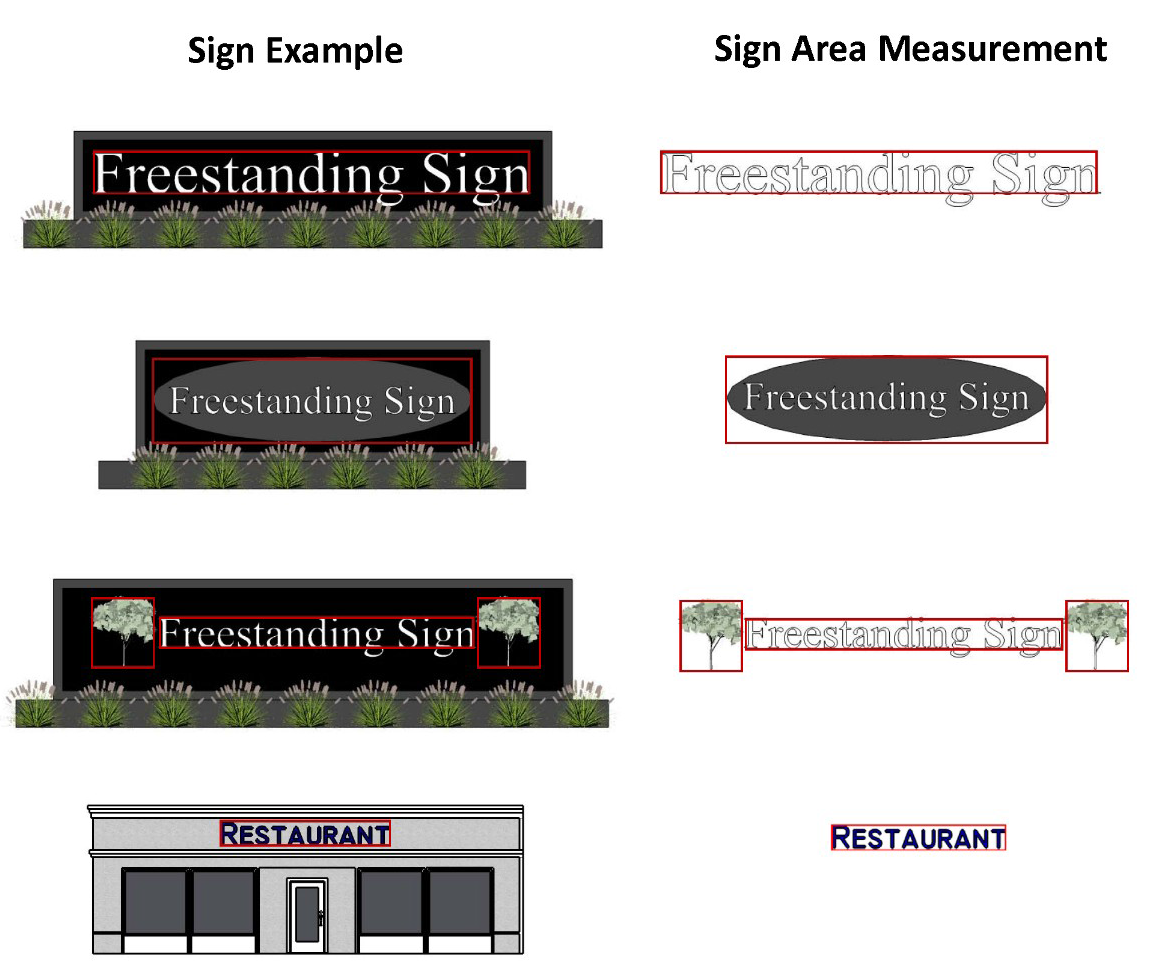
(6)
Substitution. Noncommercial messages shall be permitted on any sign constructed or erected in compliance with this article.
(7)
Severability. If any word, sentence, section, chapter or any other provision or portion of this code or rules adopted hereunder is invalidated by any court of competent jurisdiction, the remaining words, sentences, sections, chapters, provisions, or portions will not be affected and will continue in full force and effect.
(Ord. of 9-5-2006; Ord. No. 2021-001, 4-19-2021)
Sec. 52-442. - Specific sign standards.
The number, display area, and height of signs within the various zoning districts is provided in the table within this section and its accompanying footnotes. Additional standards for specific types of signs are given below:
(1)
Property access signs. No more than one sign shall be permitted for each approved driveway, with a maximum sign area of four-square feet per sign, and a maximum height of four feet.
(2)
Outdoor advertising signs. Outdoor advertising signs shall additionally comply with the provisions specified in article V.
(3)
Projecting and canopy signs. Projecting signs and canopy signs may be used as an alternative to wall signs listed in the sign dimensional standards and regulations table, provided that they meet the following standards:
a.
Any sign area on a canopy shall be included in calculations of maximum wall sign square footage.
b.
Projecting or canopy signs in the C-1 district shall be set back at least two feet from any street curb line, shall not extend more than six feet over the public right-of-way, and shall leave a minimum clearance of eight feet above the ground.
c.
Projecting or canopy signs, other than those in the C-1 district, shall have a minimum ground clearance of ten feet, shall be set back at least six feet from any adjacent public right-of-way, nor project over an alley or private access lane. A projecting sign shall not extend for more than two feet from the building to which it is attached.
d.
No wall, canopy or projecting sign shall extend above the roof or parapet of the structure to which it is attached by more than one foot.
e.
Wood posts or supporting arms shall not be used in conjunction with any projecting sign.
f.
Projecting signs shall not exceed 32 square feet in area.
g.
Canopy signs shall not be internally illuminated.
(4)
Non-residential uses in residential districts. Permanent signs of permitted non-residential uses in residential districts, including the use of a changeable message sign, are permitted subject to the following standards:
a.
A minimum setback from the street right-of-way or property line of 15 feet.
b.
Area not to exceed 45 square feet.
c.
A maximum of six feet in height.
(5)
Entranceway signs. One permanent sign per vehicular entrance identifying developments such as subdivision, apartment complexes, condominium communities, senior housing complexes, manufactured housing communities, office and industrial parks and similar uses, is permitted, provided that the sign is set back a minimum of 15 feet from any property line or public right-of-way; has a maximum height of six feet; and does not exceed 24 square feet in area.
(6)
Sandwich or A-frame signs. A-frame or sandwich board signs are permitted in the C-1, C-2, and I districts at the public entrances to businesses subject to the following requirements:
a.
Signs. Such signs may be permitted in the public right-of-way, provided a permit is obtained by the city.
b.
Sandwich boards. Sandwich boards shall:
1.
Be constructed of durable, weather-resistant material.
2.
Be professionally lettered and painted, and appropriately maintained. The sign shall not be illuminated, nor shall it contain moving parts, or have balloons, windsocks, pinwheels, streamers, pennants, or similar adornment attached to them.
3.
Be freestanding.
4.
Only be displayed during the operating hours of the respective business or commercial activity and shall otherwise be kept inside when not displayed.
5.
Not exceed five feet in height or three feet in width.
6.
Be displayed within one block of the respective business location.
7.
The sign shall be located within a sign zone extending from a minimum of three feet to 15 feet from the right-of-way. An A-frame sign shall not be located where it interferes with vehicular or pedestrian traffic flow or the visibility of motorists.
8.
Not be erected within 20 feet of another sandwich board.
(7)
Limits on wall signs. One wall sign shall be allowed per business, in addition to any other allowed ground signs. Businesses located on a corner lot shall be allowed up to two wall signs, one for each front façade. The maximum wall sign area shall not exceed ten percent of the front façade of the building (any façade which faces a public street), per use or business establishment.
(8)
Additional standards for ground signs.
a.
Only one ground sign is permitted per use, including uses which occupy more than one parcel and business centers, with additional signs permitted according to the following table, however, no site shall have more than two ground signs, regardless of the number of street frontages or the amount of frontage.
b.
Electronic messages may be allowed on ground signs, pursuant to the following:
1.
An electronic message sign may serve as one component of a permanent ground sign and is permitted up to a maximum of 50 percent of the total permanent sign area per sign face.
2.
Electronic message signs shall not emit more than 5,000 nits between sunrise and sunset, and no more than 250 nits at all other times, as measured with a photometer. The displays shall transition smoothly at a consistent rate from the permitted daytime brightness to the permitted nighttime brightness levels. All electronic message signs shall have functioning ambient light monitors and automatic dimming equipment which shall at all times be set to automatically reduce the brightness level of the sign proportionally to any reduction in the ambient light. In order to verify compliance with City Code or other applicable law, the interface that programs an electronic message sign shall be made available to city staff for inspection upon request. If the interface is not or cannot be made available upon the city's request, the sign shall cease operation until the city has been provided proof of compliance with City Code.
3.
Changeable copy.
i.
Changeable copy shall not change more than once per 30 seconds.
ii.
Changeable copy shall not and shall not appear to flash, scroll, travel, undulate, pulse, blink, expand, contract, bounce, rotate, spin, twist, or otherwise move, except as provided in iii, below.
iii.
Video messages may be permitted by special land use, subject to the following conditions:
(A)
The proposed sign is located in the Pylon Overlay district.
(B)
The proposed sign is set back a minimum of 20 feet from the front lot line.
(C)
Video display shall cease one hour after sunset to minimize distraction to motorists.
4.
All electronic message signs shall default to an unlit black screen when more than 50 percent of the light source fails or if the light source otherwise is not displaying properly.
(9)
Changeable message signs. Places of assembly shall be permitted one marquee sign, not to exceed 100 square feet, designed for periodic message change to indicate events. A portion of such sign may be an electronic display as permitted in subsection (8)b., above.
(10)
Additional restrictions. No ground sign is allowed on property fronting Highway U.S. 127 (note: this does not prohibit ground signs on Business Route 127). If site restrictions dictate, the planning commission will review a request for an eight-foot height allowance. For shopping centers and strip malls, only the name of the center is allowed on the ground sign. See table below.
(11)
Pylon Overlay District. Pylon signs may exceed the maximum height provided above within the pylon sign overlay zone. The Pylon Overlay district corresponds to the "Regional Commercial" designation on the city's Future Land Use Map and the "Neighborhood Commercial" designation, north of Witbeck Drive for parcels with Business US 10/15 and Business US 127 frontage. The following standards apply:
a.
There shall be no more than one pylon sign for each 300 feet of frontage along a single right-of-way.
b.
Pylon signs shall not exceed a maximum height of 30 ft in the area designated as "Regional Commercial" on the city's Future Land Use Map and a maximum height of 20 ft in the area designated as "Neighborhood Commercial" on the city's Future Land Use map.
c.
Pylon signs may contain electronic message display up to 25 percent of the sign area.
(12)
Temporary signs.
a.
Temporary signs shall be permitted as follows:
b.
Freestanding temporary signs shall be setback five feet from all property lines. Except as noted below in subsection (12)c., the maximum display time of freestanding temporary signs is 65 days. After this time expires, the sign shall be removed. Once the temporary sign is removed, there shall be a gap of at least 30 days between display of the same temporary sign on the same zoning lot.
c.
Notwithstanding the above, three square feet of temporary freestanding or temporary wall sign area is allowed on each zoning lot at any time and without permits or expiration of display time. The area of this sign is counted towards the area maximum in Table (l).
d.
When all or a portion of a building or land area on a zoning lot is listed or advertised for sale or lease, the maximum display time for temporary signs shall be the duration the building, building unit or land is listed or advertised for sale or lease. Once a building unit is leased or sold, the sign shall be removed if it has been displayed for more than 65 days. In all cases, the sign area limits in the Table (l) shall apply.
e.
Temporary signs shall be constructed of durable, all-weather materials and designed to remain in place and in good repair so long as they remain on display; provided, however, that each zoning lot may have one temporary freestanding sign up to three square feet constructed of any non-illuminated material. All temporary freestanding signs larger than three square feet shall have a frame or rigid border.
f.
Temporary signs shall be subject to the maintenance standards of this section.
(Ord. of 9-5-2006; Ord. No. 2021-001, 4-19-2021)
Sec. 52-443. - Nonconforming signs.
Nonconforming signs are those signs that do not comply with the size, placement, construction or other standards or regulations of this chapter, but were lawfully established prior to its adoption. Signs for which the board of appeals has granted a variance are exempt and shall not be defined as nonconforming. It is the intent of this article to encourage eventual elimination of nonconforming signs in a timely manner. This objective is considered as much a subject of public health, safety and welfare as the prohibition of new signs in violation of this article. Therefore, the purpose of this article is to remove illegal nonconforming signs while avoiding any unreasonable invasion of established private property rights. A nonconforming sign may be continued and shall be maintained in good condition as described elsewhere in this article; however, the following alterations are regulated:
(1)
A nonconforming sign shall not be structurally altered or repaired so as to prolong its useful life or so as to change its shape, size, type or design unless such change shall make the sign conforming.
(2)
A nonconforming sign shall not be replaced by another non-conforming sign.
(3)
A nonconforming sign shall not be reestablished after abandonment as defined in section 52-444, Dangerous, unsafe, abandoned, and illegally erected signs.
(4)
A nonconforming sign must not be re-established after damage or destruction if the estimated expense of reconstruction exceeds 50 percent of the appraised replacement cost as determined by the building official/city manager or if 50 percent or more of the face of the sign is damaged or destroyed.
(Ord. of 9-5-2006; Ord. No. 2021-001, 4-19-2021)
Sec. 52-444. - Dangerous, unsafe, abandoned, and illegally erected signs.
(a)
Dangerous signs. Any sign constituting an immediate hazard to health or safety shall be deemed a nuisance and may be immediately removed by the city and the cost thereof charged against the owner of the property on which it was installed.
(b)
Unsafe signs. Any sign that becomes insecure, in danger of falling, or otherwise unsafe but not considered an immediate danger by the building official/city manager to the health or safety of the public shall be removed or repaired according to the process outlined in subsection (e) below.
(c)
Abandoned signs. Any sign that advertises a business that has been discontinued for at least 90 days or that advertises a product or service that is no longer offered shall be deemed abandoned. Permanent signs applicable to a business temporarily suspended by a change in ownership or management shall not be deemed abandoned unless the structure remains vacant for at least six months. An abandoned sign shall be removed by the owner or lessee of the premises. If the owner or lessee fails to remove the sign, the building official/city manager shall initiate the process noted in subsection (e) below.
(d)
Illegally erected signs. The building official/city manager shall order the removal of any sign erected illegally in violation of this article, according to the process outlined in subsection (e) below.
(e)
Process for enforcing violations of this section. For violations of subsections (b) through (d), the building official/city manager shall send notice, by certified mail addressed to the owner of the property on which the sign is located. The notice shall describe the violation and allow seven days for removal. Should the sign not be removed or repaired within the time specified, the building official/city manager shall have the authority to remove the sign, and the property owner shall be liable for the cost thereof.
(Ord. of 9-5-2006; Ord. No. 2021-001, 4-19-2021)
Sec. 52-445. - Administration and appeals of sign ordinance standards.
(a)
Generally. The regulations of this article shall be administered and enforced by building official/city manager.
(b)
Violations. It shall be unlawful for any person to erect, construct, enlarge, alter, repair, move, use or maintain any sign in the city, or cause or permit the same to be done, contrary to or in violation of any of the standards and regulations of this article. Any such violation, including the failure to remove a sign when directed under the authority of this article, shall constitute a misdemeanor punishable in accordance with this Code of Ordinances.
(c)
Appeals. The Zoning Board of Appeals shall have power to hear and decide appeals where it is alleged by the appellant that there is error in any order, requirement, decision or determination made by any administrative official, in connection with the enforcement of this chapter. The Zoning Board of Appeals shall have power to authorize a variance from the strict application of this chapter where such application will result in practical difficulties to the person owning or having the beneficial use of the property or sign for which a variance is sought. For a building or property that is designated as historic by federal, state or local government, the zoning board of appeals may consider it to be a hardship or practical difficulty and may grant a variance, if is determined that a proposed sign is necessary and integral to the historic character of the building or property. The appeal procedures, and standards for review, for the zoning board of appeals in division 3 shall be applicable to appeals under this chapter.
(Ord. of 9-5-2006; Ord. No. 2021-001, 4-19-2021)
Sec. 52-446. - Permits and application.
Sign permits shall be issued by the city manager or his/her designee upon approval of a written application. Where electrical permits are required, they shall be obtained at the same time as the sign permit. All signs regulated by this article, except temporary signs in residential districts, window signs, and freestanding temporary signs in non-residential districts, that are erected, altered, relocated or maintained are subject to a permit from the city in accordance with the following regulations:
(1)
Applications for sign permits shall be made upon a form provided by the city for this purpose. The application shall contain the following information:
a.
Name, address, phone, and if available, fax and e-mail, of the person applying for the permit.
b.
Name, address, phone, and if available, fax and e-mail, of the person owning the parcel upon which the sign is proposed to be placed.
c.
Location of the building, structure, and parcel on which the sign is to be attached or erected.
d.
Position of the sign in relation to nearby buildings, structures, property lines, and existing or proposed rights-of-way.
e.
Two copies of the plans and specifications. The method of construction and/or attachment to a building, or in the ground, shall be explained in the plans and specifications.
f.
Name, address, phone, and if available, fax and e-mail of the person erecting the sign.
g.
The zoning district in which the sign is to be placed.
(2)
No permit shall be required for ordinary servicing, repainting of existing sign message or cleaning of a sign. No permit is required for change of message of a sign designed for periodic message change without change of structure, including a bulletin board or outdoor advertising sign.
(Ord. of 9-5-2006; Ord. No. 2021-001, 4-19-2021)
Sec. 52-447. - Permit fees.
Permit fees for signs shall be established by the city commission by resolution from time to time. The permit fees must relate to the cost of issuing the permit and may vary based on the size, type and height of the sign.
(Ord. of 9-5-2006; Ord. No. 2021-001, 4-19-2021)
Sec. 52-448. - False information.
A person providing false information under this article shall be guilty of a misdemeanor.
(Ord. of 9-5-2006; Ord. No. 2021-001, 4-19-2021)

