
Claremont City Zoning Code
ARTICLE V
- SUPPLEMENTARY DISTRICT REGULATIONS
DIVISION 2. - OFF-STREET PARKING[17]
Cross reference— Stopping, standing and parking, § 19-86 et seq.
DIVISION 3. - NOISE STANDARDS[18]
Cross reference— Peddlers and solicitors prohibited from making any noise to attract customers, § 8-121; nuisances, Ch. 11; noise, § 11-26 et seq.
DIVISION 5. - SEXUALLY ORIENTED BUSINESSES[19]
Editor's note— Ord. No. 410, adopted Jan. 10, 2001, added new provisions to Art. V of this chapter as Div. 4, §§ 22-578, 22-579. As other provisions existed within this Code as Art. IV, Div. 4, and still others as §§ 22-578, 22-579, the provisions of Ord. No. 410 have been redesignated as Div. 5, §§ 22-561, 22-562, at the editor's discretion.
Sec. 22-506. - Fences.
(a)
Landowners may erect fences on their property without a zoning permit in all zoning districts except the floodway and historic districts. Fences erected in such districts shall be subject to sections 22-446 et seq. and 22-397 et seq., respectively. Fences erected across drainage courses shall not obstruct flow.
(b)
Notwithstanding (a) above, the planning board may review, approve, restrict, and prohibit fences during site plan review.
(Ord. No. 181, § 2-14, 4-12-78; Ord. No. 236, § 8(2-14), 12-14-83)
Sec. 22-507. - Extraction of soil, sand or gravel.
There shall be no excavation or removal from the premises in any district of topsoil, earth, sand, gravel, clay or quarry stone (except in the connection with the necessary excavation and removal of not more than two hundred fifty (250) cubic yards of surplus material incidental to the bona fide construction of a building, landscaping or agricultural operation being executed on the premises) except in conformance with the regulations contained in this section. Excavation and removal of the above material in excess of two hundred fifty (250) cubic yards may occur in districts where it is a permitted use, subject to the planning board issuing a permit for excavation.
(Ord. No. 181, § 2-15, 4-12-78; Ord. No. 270, § 1(2-15), 12-10-86)
Cross reference— Earth excavation regulations, App. D.
Sec. 22-508. - Building height.
Building height shall be limited to seventy-five (75) feet in the industrial districts. In all other districts except the city center residential I, city center residential II, professional residential, mixed use and city center business II districts, building heights shall be limited to forty (40) feet, except by special exception, where, among other criteria, buildings of additional height are found to be a positive design element within the city while not significantly diminishing the light and air to or view from adjacent properties. Building heights in the city center residential I, city center residential II, professional residential, mixed use and city center business II districts shall conform to the table of dimensional regulations in section 22-389.
(Ord. No. 181, § 2-18, 4-12-78; Ord. No. 422, 1-10-01; Ord. No. 531, § 1, 4-10-2013)
Sec. 22-509. - Utility substations, stations or facilities.
Utility substations and similar utility stations or facilities are permitted in any zoning district subject to the conditions specified hereafter.
(1)
Such facilities shall be surrounded by a fence no less than six (6) feet in height and set back from the property lines in conformance with district regulations for front, side and rear yards.
(2)
A landscaped area at least ten (10) feet in width shall be maintained in the front, side and rear yards.
(Ord. No. 181, § 2-19, 4-12-78; Ord. No. 531, § 1, 4-10-2013)
Sec. 22-510. - Existing small lots.
Any lot in individual and separate nonaffiliated ownership from surrounding properties in existence on the effective date of this ordinance, may be developed for the purposes permitted in the district, provided it conforms to the front, side and rear yard requirements of that district, and provided that the use proposed for such lot will comply with all health and sanitary regulations for water and sewer disposal systems as required by the city and the state. Where two (2) or more lots or parcels of land, each of which lacks adequate area and/or dimension to satisfy the requirements of the zoning district in which it is located, are contiguous, are held in one (1) ownership, and, when combined, shall meet the district requirements, they shall be considered as one (1) lot or parcel for the purpose of this chapter.
(Ord. No. 181, § 2-20, 4-12-78)
Sec. 22-511. - Housing for the elderly.
Public housing projects for the elderly may be permitted in all but agricultural residential and rural residential districts, provided that they conform to the minimum lot size criteria for the district in which they are located, and that they conform to the following density and off-street parking regulations:
(1)
In R-1 and CR-1 districts garden-type apartments or developments not exceeding two (2) stories in height, and a maximum density of one (1) dwelling unit per two thousand five hundred (2,500) square feet.
(2)
In R-2, CR-2 and PR districts garden-type apartments or developments not exceeding two (2) stories in height, and a maximum density of one (1) dwelling unit per one thousand five hundred (1,500) square feet.
(3)
In R-2, CR-2, PR, B-2 and districts, buildings exceeding two (2) stories in height, and a maximum density of one (1) dwelling unit per one thousand five hundred (1,500) square feet.
(4)
In any zone, one (1) off-street parking space shall be provided for every three (3) dwelling units.
(Ord. No. 181, § 2-21, 4-12-78; Ord. No. 531, § 1, 4-10-2013)
Sec. 22-512. - Accessory uses, rear/side yards.
The following accessory uses shall be subject to rear and side yards specified regardless of the zoning district:
(Ord. No. 181, § 2-22, 4-12-78; Ord. No. 236, § 10(2-22), 12-14-83; Ord. No. 420, 1-10-01; Ord. No. 531, § 1, 4-10-2013)
Sec. 22-513. - Accessory dwelling units.
An accessory dwelling unit (ADU):
(1)
Is allowed only by conditional use permit, according to sections 22-100 and 22-101, in any zoning district that allows single-family dwelling units:
a.
The approved conditional use permit and its conditions of approval shall be recorded in the registry of deeds;
b.
Only one (1) ADU shall be permitted per single-family dwelling unit.
(2)
Shall be allowed only on properties containing an owner-occupied single-family dwelling:
a.
Owner must demonstrate on an annual basis that one (1) of the units is the owner's principal place of residence. A temporary absence by the property owner is allowed, provided the owner-occupied unit is not rented to or occupied by anyone other than the property owner during such absence;
b.
The owner of a property containing an accessory dwelling may reside in either the principal or the accessory dwelling unit;
c.
Prior to the issuance of a building permit to construct an ADU or any occupancy of an ADU, the owner shall execute and submit to the planning board for recording at the Sullivan County Registry of Deeds an acknowledgement of the owner occupancy requirement, in a form supplied by or acceptable to the planning board, which shall place all prospective purchasers on notice of the prohibition against renting out both units.
(3)
Shall be subsidiary in size and function to the principal dwelling unit and be consistent with the principal residential structure in appearance, height, design, colors, and materials and maintain aesthetic continuity with the principal dwelling unit as a single-family dwelling:
a.
The ADU shall not occupy more than forty (40) percent of the gross living area of the existing residential structure. While an ADU's floor area may be less than seven hundred fifty (750) square feet, it is not required to be;
b.
The ADU shall include not more than two (2) bedrooms;
c.
The ADU may be located within or added to the principal structure, or in a detached structure; provided, however, that any alterations, enlargements, or extensions of the principal structure and/or detached structure may not alter the appearance of the principal structure or the property as a whole in a manner that would look like it was designed to accommodate more than one family;
d.
A functional interior doorway shall be provided between the ADU and the principal dwelling unit, which may be locked;
e.
The ADU may use an existing exterior door as an entry, except new ADU entry doors shall not face the street;
f.
The ADU, including any new construction or physical addition to create an ADU, shall comply with all existing dimensional requirements of this chapter but shall not extend beyond the front wall of the dwelling structure;
g.
For the residents of the ADU there shall be at least one (1) extra on-site parking space located only in the rear or side yard, and there shall be no additional curb cut.
(4)
Shall be served by well and septic provisions which comply with New Hampshire Department of Environmental Services regulations, if the ADU is not served by public water and sewer.
(5)
An ADU that is within or attached to the principal dwelling unit shall not be considered to be an additional dwelling unit for the purposes of determining minimum lot size or development density of the property and no additional lot area is required for the addition of a detached ADU. A detached ADU shall meet the following minimum requirements:
a.
New construction must meet setbacks for the zoning district in which the ADU is located;
b.
Minimum distance between the detached ADU and other structures on the lot shall be as determined by the building code.
(6)
Shall not be allowed in duplex or multi-family dwellings.
(7)
Shall not be attached to mobile homes or manufactured housing units.
(8)
Is not allowed in condominium developments.
(9)
Shall always be under the same ownership as the principal dwelling unit and shall not be converted into condominium or any other form of legal ownership distinct from the ownership of the principal dwelling unit.
(10)
In the CR-1 and CR-2 districts, maximum lot coverage with a new ADU shall be increased to forty (40) percent.
(Ord. No. 554, § 1, 5-10-2017; Ord. No. 600, § 1, 12-14-2022)
Sec. 22-514. - Cottage developments.
(a)
Purpose. The purpose of this section is to provide opportunities for single-family housing that is small, energy-efficient, and affordable; to allow flexibility in site and design standards while promoting projects that ensure compatibility with surrounding land uses and existing neighborhoods; and to promote sustainability and neighborhood interaction through integrated design.
Cottage developments are intended to serve as part of the city's overall housing strategy to encourage affordability, innovation and variety in housing design and site development while ensuring compatibility with existing neighborhoods, and to promote a variety of housing choices to meet the needs of a population diverse in age, income, household composition and individual needs.
(b)
Applicable Use Districts. Cottage developments are allowed by conditional use in all zoning districts except the I1, I2 or I3 districts, in accordance with sections 22-100 and 22-101 of this chapter and the requirements of this section.
(c)
Number and Arrangement of Units. Cottage developments shall contain a minimum of three (3) and a maximum of sixteen (16) cottages, located in one or more clusters to maximize efficiency of land use and to encourage a sense of community among the residents. Each cluster shall include a minimum of three (3) units.
(d)
Lot Size. All cottage developments shall have a minimum lot area of one-half acre, except in the AR, RR, RR2, Rl and R2 Districts, where a minimum lot area of forty thousand (40,000) square feet is required.
(e)
Density and Building Coverage.
(1)
Permitted density shall be based on two thousand five hundred (2,500) square feet of lot area per each cottage.
(2)
The maximum permitted building coverage shall be sixty (60) percent per cottage lot. This allows for a one thousand (1,000) SF home (maximum allowed footprint for a cottage per the definition of a cottage) with one thousand five hundred (1,500) SF of open space left per cottage lot. Four hundred (400) SF of that one thousand five hundred (1,500) SF must be dedicated to common open space (See 514.6D).
(f)
Design Standards. The following design standards are intended to define design parameters to create a small community of cottages oriented around open space and to achieve compatibility with adjacent uses.
(1)
Individual Cottage Spaces. For each detached cottage, the site plan approved by the Planning Board shall delineate a building site for each detached cottage of no more than one thousand (1,000) square feet (Refer to definition of cottage).
(2)
Detached Cottages. At least fifty (50) percent of the cottages in the development shall be detached units.
(3)
Setbacks.
a.
Interior Setbacks. The minimum setback between units within a cottage development shall be ten (10) feet, measured from the nearest point of the exterior walls.
b.
Exterior Setbacks. Setbacks to property lines shall be in accordance with the underlying zoning district requirements.
(4)
Common Open Space. A minimum of four hundred (400) square feet of common open space shall be provided per cottage and per cluster. The common open space area for each cluster shall be contiguous and shall abut all of the cottages in the cluster. Cottages shall be oriented around and have their main entry from the common open space.
(5)
Roofs and Porches.
a.
The highest point of the roof of the cottage shall not exceed twenty-four (24) feet.
b.
Cottages shall have an unenclosed, covered front primary entry and porch of at least sixty (60) square feet in size. The front porch shall be oriented toward a common open space. The intent of this porch requirement is to create outdoor space in each cottage that is visually and physically connected to the common open space and to other cottages. The footprint of the porch shall be included when calculating the total floor area of a cottage.
(6)
Parking Location and Screening Requirements. The cottage development shall provide a minimum number of off-street parking spaces equal to one (1) parking space per cottage and a maximum number of off-street parking spaces equal to one and a half (1.5) spaces per cottage. In addition:
a.
Parking areas shall be screened from public streets and adjacent residential uses by landscaping or architectural screening.
b.
Parking areas shall be prohibited in the minimum required front yard.
c.
Parking areas shall be separated from the common open space by landscaping or an architectural screen.
(7)
Existing Dwellings. An existing detached or attached one-family dwelling that is incorporated into a cottage development and is nonconforming with respect to the standards of this section shall be permitted to remain on a site used for a cottage development and shall be considered a cottage for purposes of this section. However, the extent of the noncompliance may not be increased, unless the proposed change is determined by the Planning Board to be consistent in character, scale and design with the cottage housing development.
(8)
Street Facing Facades. All cottages within fifty (50) feet of a public street shall have street facing facades that avoid blank walls in order to avoid the appearance of "turning their backs" to the street. For all such cottages, a minimum of twenty-five (25) percent of the street facing facade shall be comprised of windows and/or glass doors.
(g)
Cottage developments may be permitted subject to satisfactory solution regarding:
(1)
The ownership, use, and maintenance of common open space land to be held in common;
(2)
Water supply; and
(3)
Wastewater disposal.
Such solution may be a homeowners association or similar legal mechanism.
(h)
Illustrations of Cottage Development Designs.
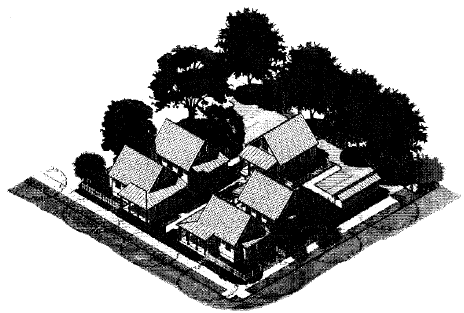
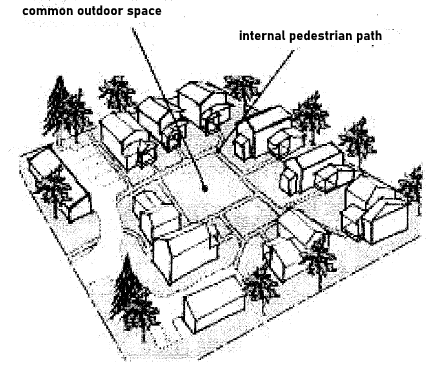
(Ord. No. 622, § 4, 2-28-2024)
Sec. 22-526. - When required, garage space.
Off-street parking spaces shall be provided in all districts in accordance with the specifications of this chapter whenever any new use is established or existing use is enlarged, replaced, reconstructed, or changed. Garage space on the lot or site shall be considered as off-street parking.
(Ord. No. 181, § 2-16, 4-12-78)
Sec. 22-527. - Existing uses.
(a)
The off-street parking requirements of this chapter shall not apply to uses lawfully existing on the effective date of this ordinance unless such uses are enlarged, reconstructed, replaced, or changed to a use requiring additional parking space.
(b)
The enlargement of any building shall require the provision of off-street parking for the existing building as if it were newly constructed in addition to the required off-street parking spaces for the enlargement.
(c)
When an existing use is changed to another use, parking spaces shall be provided as required in this chapter for the new use.
(d)
The planning board in approving the site plan for the reconstruction or replacement of existing permitted non-residential use may waive or modify the requirements for off-street parking as specified in this chapter provided there is no enlargement of the use and finding that lot topography and/or area prevent compliance and that adequate public parking is available.
(e)
Existing uses which are discontinued or abandoned for twelve (12) consecutive months shall comply with the off-street parking requirements of this chapter prior to reuse or reopening.
(Ord. No. 181, § 2-16.1, 4-12-78; Ord. No. 531, § 1, 4-10-2013)
Sec. 22-528. - Location generally.
Off-street parking facilities shall be provided on the same lot as the use they are intended to serve unless otherwise approved during the review process or unless the use is located in the mixed-use district where off-site parking is allowed as provided in section 22-537.
(Ord. No. 181, § 2-16.2, 4-12-78; Ord. No. 531, § 1, 4-10-2013)
Sec. 22-529. - Computation for multiuse buildings.
Where one (1) building is used for more than one (1) use, parking requirements shall be computed for each use as if it were a principal use. Warehouse calculations may only be applied if the entire structure is utilized as a warehouse and no retail activity is conducted within such structure.
(Ord. No. 181, § 2-16.3, 4-12-78; Ord. No. 318, § 1, 1-10-90)
Sec. 22-530. - Principal use not enclosed.
Where the principal use is not enclosed in a building, the portion of the lot so used shall be considered as part of the gross floor area for computing parking requirements.
(Ord. No. 181, § 2-16.4, 4-12-78)
Sec. 22-531. - Rounding-off computation.
Where the computation of parking spaces results in a fractional number, the fraction of one-half (½) or more shall be counted as one (1).
(Ord. No. 181, § 2-16.5, 4-12-78)
Sec. 22-532. - Parking lot design.
Off-street parking facilities for all uses other than one- and two-family dwellings shall comply with the following provisions:
(1)
Each parking space shall be a minimum of nine (9) feet wide. Parking spaces shall be at least nineteen (19) feet long for ninety (90) degrees or right-angle parking. For angle parking, the length of parking spaces shall be increased as specified by the city engineer.
(2)
Design and layout of off-street parking facilities shall in general comply with Special Report 125 - "Parking Principles" of the Federal Highway Research Board latest edition, and be approved by the city engineer.
(3)
Parking areas including all turning, maneuvering, and driveway access areas shall be constructed with durable materials to prevent dust and mud, and be graded and drained to properly dispose of surface waters to the satisfaction of the city engineer.
(4)
Lighting fixtures used to illuminate parking areas shall direct light away from adjacent properties and away from streets.
(5)
Except in the MU zoning district, no off-street parking shall be located within five (5) feet of any lot line, or in the industry district III, within a required yard, except that parking lots may be contiguous or interconnected. Parking in a nonresidential district shall not be permitted within twenty (20) feet of a residential district boundary, except in the PR district where parking shall not be permitted within five (5) feet of a residential boundary.
(6)
Except at exit or access driveways or walkways, a substantial wheel stop or guard rail shall be placed around the perimeter of parking areas containing more than five (5) spaces.
(7)
Multifamily parking. Parking in residential districts shall not be located within five (5) feet of side or rear property lines, or within ten (10) feet of any front property line, except that parking lots may be contiguous or interconnected. Parking in nonresidential districts shall not be permitted within twenty (20) feet of a residential district boundary, except in the PR district, where parking shall not be permitted within five (5) feet of a residential boundary.
(Ord. No. 181, § 2-16.6, 4-12-78; Ord. No. 236, § 9, 12-14-83; Ord. No. 359, 7-13-94; Ord. No. 363, 10-12-94; Ord. No. 411, 11-8-00; Ord. No. 531, § 1, 4-10-2013)
Sec. 22-533. - Table.
Except as otherwise provided in this chapter, off-street parking spaces shall be provided in accordance with the following:
Shared parking under section 22-540 may combine parking for any permitted use(s), including residential uses.
(Ord. No. 181, § 2-16.7, 4-12-78; Ord. No. 318, § 1, 1-10-90; Ord. No. 363, 10-12-94; Ord. No. 531, § 1, 4-10-2013; Ord. No. 605, § 1, 1-25-2023)
Sec. 22-534. - Maintenance of parking facilities.
Off-street parking facilities required by this chapter shall be maintained in a useable and functional condition, free of pot-holes, washouts, debris, and other hazards to the public. Landscaped and planted areas shall be maintained.
(Ord. No. 181, § 2-16.8, 4-12-78)
Sec. 22-535. - Truck loading space.
For new commercial or industrial buildings not including replacement or reconstruction of existing commercial and industrial buildings in excess of four thousand (4,000) square feet of floor area, space shall be provided at the rear or side of such buildings for the loading or unloading of trucks at the rate of one (1) space for the first twenty thousand (20,000) square feet of floor area plus one (1) space for each additional fifty thousand (50,000) square feet of floor area or fraction thereof. Each truck loading space shall constitute a rectangular area at least twelve (12) feet in width and sixty (60) feet in length with a vertical clearance of at least fifteen (15) feet.
(Ord. No. 181, § 2-17, 4-12-78)
Sec. 22-536. - Child care facilities.
Off-street parking spaces shall be provided for child caring facilities as follows:
(1)
Family daycare home, two (2) spaces.
(2)
Family group daycare home, two (2) spaces plus one (1) additional space for each four (4) additional children for which such family group daycare home is licensed, for a total of four (4).
(3)
Group child care centers, two (2) spaces plus one (1) additional space for each four (4) additional children for which such group child care centers are licensed, for a total of four (4).
(4)
Group home, two (2) spaces plus one (1) additional space for each four (4) additional children for which such group home is licensed, for a total of four (4).
(Ord. No. 249, § I, 6-12-85; Ord. No. 604, § 1, 12-14-2022)
Sec. 22-537. - Parking in the mixed use district.
(a)
Notwithstanding any provision of this chapter which may conflict with the following provisions, within the mixed use district there shall be provided parking facilities in accordance with the following minimum standards:
(b)
For any other use, the parking requirements in section 22-533 shall apply. These parking requirements may be reduced if it can be demonstrated that the parking demand associated with a specific use can be met through fewer off-street spaces or through shared parking.
(c)
In determining compliance with parking requirements in the mixed use district, parking may be provided off site within one thousand two hundred (1,200) feet where sufficient capacity is demonstrated.
(d)
If parking spaces are provided on the same lot as the use they are intended to serve, those spaces shall be located to the rear or side of buildings.
(Ord. No. 531, § 1, 4-10-2013)
Sec. 22-538. - Parking in the city center business II district.
In the city center business II district, off-street parking shall be located to the side or rear of buildings.
(Ord. No. 531, § 1, 4-10-2013)
Sec. 22-539. - Parking in the city center zoning districts.
In the city center residential I and II districts, the professional residential district, the city center business II district, and the mixed use district, off-street parking shall only be required for residential uses as provided for in section 22-533; however, shared parking under section 22-540 may be proposed for residential and non-residential uses.
(Ord. No. 605, § 1, 1-25-2023; Ord. No. 638, § 1, 10-9-2024)
Sec. 22-540. - Shared parking arrangements in city center districts.
(a)
Notwithstanding any provision of this chapter which may conflict with the following provisions, within the city center residential I and II districts, professional residential district, city center business II district and the mixed use district, applicants are encouraged to consider and propose shared parking arrangements to meet the minimum required number of off-street parking spaces for the proposed use. Shared parking may be proposed for any use permitted in such districts, including residential.
(b)
The purpose of shared parking arrangements is to reduce the total number of parking spaces required in the city center area to accommodate expected needs when land uses on different lots have different and complementary parking demand patterns and are able to use the same parking areas/spaces over time. Shared parking is most effective when these land uses have significantly different peak parking characteristics that vary by time of day, day of week, and/or season of the year, such as office, restaurant, retail, church, banking, or event spaces.
(c)
Proposals, including a site plan of all parking spaces/areas intended for shared parking and proximity to the uses/properties they will serve, will be evaluated based on expected parking needs for each use as otherwise established in this section and any applicable city regulations, operating hours, seasonal/daily peaks in parking demands, the property's orientation, location of access driveways, public transportation service, accessibility to other nearby parking areas, pedestrian connections, distance to parking area, availability of parking spaces, and cooperation of adjacent owners.
(d)
Shared parking shall be located no more than one thousand two hundred (1,200) linear feet from the proposed use(s) they will serve.
(e)
Approval of shared parking must be contingent upon the owners of all affected property/uses including the applicant entering an enforceable agreement guaranteeing access to, use of, management and maintenance (including without limitation snow and ice removal) of shared parking areas.
(Ord. No. 605, § 1, 1-25-2023)
Sec. 22-551. - General provisions.
(a)
The noise standards contained in this division shall be the minimum standards to be met and maintained by all nonresidential uses established after the effective date of this section.
(b)
No new use shall be commenced and no existing use shall be changed which will produce noise levels in excess of those shown in section 22-556.
(Ord. No. 271, § 1(2-27.1), 1-14-87)
Sec. 22-552. - Exemptions.
The following uses and activities shall be exempt from the provisions of this division:
(1)
Safety signals, warning devices and emergency relief valves.
(2)
Activities performed by or for any federal, state, country or city governmental agency.
(3)
Unamplified human voices and crowd noises generated at gatherings open to the public.
(4)
Bells, chimes, or carillons used for religious purposes or in conjunction with religious services.
(5)
Power tools, including lawn mowers, snowblowers and chain saws, when used for the maintenance of property.
(Ord. No. 271, § 1(2-27.2), 1-14-87; Ord. No. 372, 5-24-95)
Sec. 22-553. - Special exceptions.
(a)
The zoning board of adjustment may grant special exceptions for uses which produce noise levels in excess of those shown in section 22-556, only if the board first finds that:
(1)
The use will be located in a remote area.
(2)
All adjoining property owners consent, in writing.
(3)
All personnel who will be exposed to the noise will use safety equipment which will avoid injury from the noise.
(4)
The noise will not be a nuisance to any person.
(b)
When a special exception is granted, the zoning board of adjustment shall as a condition of the special exception, establish the maximum permissible noise levels for the use.
(Ord. No. 271, § 1(2-27.3), 1-14-87)
Sec. 22-554. - Measurement.
For purposes of testing to determine compliance with this division:
(1)
Continuous and impact noise shall be measured at the point on the other property where the noise is reported to be an annoyance to others, using both fast and slow meter response indications, as the case may require, by a sound level meter constructed in accordance with A.N.S.I. specifications. For the purpose of this section, impact noises are intermittent sounds such as from a punch press, drop forge hammer or release of compressed gases.
(2)
The city may, at its expense, take sound level measurements at anytime. Upon complaint from any citizen or group of citizens, the zoning official, after written notice to the owner or occupant of the property from which the noise is coming, may cause sound level measurements to be made. In the event the sound level measurements exceed those shown in section 22-556, the cost of such measurements shall be paid by the owner or occupant.
(3)
The city may, at its expense, take sound level measurements at anytime. Upon complaint from any citizen or group of citizens, the zoning official, after written notice to the owner or occupant of the property from which the noise is coming, may cause sound level measurements to be made. In the event the sound level measurements exceed those shown in section 22-556, the cost of such measurements shall be paid by the owner or occupant.
(Ord. No. 271, § 2(2-27.4), 1-14-87; Ord. No. 441, 11-19-02)
Sec. 22-555. - Compliance.
In the event any sound level measurements, whether conducted independently by the city or at the expense of the owner or occupant, indicate that noises are being generated which exceed those shown in section 22-556, the zoning official shall issue a cease and desist order to the owner or occupant. If that order is not obeyed, the matter shall be referred to the city solicitor for legal action and the full cost of such enforcement action shall be paid by the owner or occupant.
(Ord. No. 271, § 2(2-27.5), 1-14-87)
Sec. 22-556. - Permissible noise levels.
The noise limits shown in the following table shall be the maximum permitted under this section.
For the purpose of this table, "day" shall be defined as 7:00 a.m. to 10:00 p.m. and "night" shall be defined as 10:00 p.m. to 7:00 a.m.
(Ord. No. 271, § 2, 1-14-87; Ord. No. 359, 7-13-94; Ord. No. 411, 11-8-00; Ord. No. 442, 11-19-02)
Sec. 22-557. - Definitions.
Septage means septage as defined by RSA 485-A:2, IX-a, namely "material removed from septic tanks, cesspools, holding tanks, or other sewage treatment storage units, excluding sewage sludge from public treatment works and industrial waste." Septage includes domestic septage as well as septage from industrial and commercial sources.
Sludge means sludge as defined by RSA 485-A:2, XI-a, namely "the solid or semisolid material produced by water and waste water treatment processes."
Exceptional quality sludge: exceptional quality sludge is defined as that sludge which meets all of the following: the pollutant concentrations as set forth in 40 CFR 503.13(b)3; the Class A pathogen reduction requirements set forth in 40 CFR 503.32(a) and one of the vector attraction reduction requirements contained in 40 CFR 503.33(b)1 through 503.33(b)8.
Industrial sludge means sludge which is derived solely from processing of industrial wastewater as defined in 40 CFR 503.9.
(Ord. No. 379, 6-12-96)
Sec. 22-558. - Restrictions.
(a)
Only sludge of exceptional quality as defined herein may be disposed of or spread within the city. Such exceptional quality sludge may be spread in all zones.
(b)
A state permit will not be required for the disposal or spreading of exceptional quality sludge.
(c)
Any person intending to dispose of or spread exceptional quality sludge in the city shall provide access to the sludge to be so disposed of or spread to the director of the department of public works, or his designee from the Claremont Water and Sewer Division, for testing of the sludge as needed, to be determined by the director of public works or his designee. All costs of said testing shall be born by the person desiring to dispose of or spread the sludge within the city. The zoning administrator may waive the testing requirements of this ordinance upon acceptable documentation provided by the person proposing to spread exceptional quality sludge.
(d)
Septage shall not be spread in any zone of the city.
(e)
Industrial sludge shall be processed through a licensed waste treatment facility and composted prior to being spread as permitted herein.
(Ord. No. 379, 6-12-96; Ord. No. 379A, 7-10-96)
Sec. 22-559. - Compliance.
Any person not in compliance with the regulations contained herein shall be subject to any and all penalties permitted under New Hampshire law.
(Ord. No. 379, 6-12-96)
Sec. 22-561. - Purpose.
The intent of this division is to regulate the secondary effects of sexually oriented businesses in the following areas: crime control, protection of property values and the public health, safety and welfare, the prevention of civic blight, and the protection of children. It is neither the intent nor effect of this article to restrict or deny access by adults to sexually oriented materials protected by the First Amendment, or to deny access by the distributors and exhibitors of sexually oriented entertainment to their intended market; and neither is it the intent nor effect of this article to condone or legitimize the distribution of obscene material.
(Ord. No. 410, 1-10-01)
Sec. 22-562. - Special use permit procedures.
(a)
Special use permitting granting authority. The special use permit granting authority (SUPGA) shall be the zoning board of adjustment of the city.
(b)
Special use permit conditions.
(1)
At a minimum the following location, placement, and separation of sexually oriented businesses shall be established as condition for a permit under this section. Measurements shall be the straight line distance from structure to structure.
a.
Zoning district requirements. Sexually oriented businesses shall only be located on property within the business II district.
b.
Use setbacks. Sexually oriented businesses shall not be located within two hundred (200) feet of property used for any of the following uses:
1.
Public or private school;
2.
Child day care agency (as defined by RSA 170-E:2, IV, as amended);
3.
Public recreational field, trail or similar public-owned facility;
4.
Religious institution, church, or place of worship;
5.
Hospital, nursing home, or sheltered care facility;
6.
Single or multifamily residence.
c.
Separation of businesses. There shall be a minimum of five hundred (500) feet between each sexually oriented business.
d.
Town line setback. Sexually oriented businesses shall not be located within one thousand (1,000) feet of any municipal boundary.
(2)
As a condition of receiving or retaining a permit under this section, "specified sexual activities" or "specified anatomical areas" including instruments, devices, or paraphernalia which are designed for use in connection with "specified sexual activities" or their images, shall not be visible in any fashion whatsoever from the exterior of the building within which the business is located.
(3)
The zoning board of adjustment may impose additional requirements as conditions to receive a permit under this section in order to lessen potential audio or visual attractiveness to and impacts on minors, to minimize potentially negative impacts on nearby land uses and to prevent such use from being visually obtrusive from public rights-of-way or other public properties. Such requirements may include, but not be limited to, the building's and its entry's orientation on its lot, fencing, screening, sign size and location, and site and building lighting.
(Ord. No. 410, 1-10-01; Ord. No. 531, § 1, 4-10-2013)

