
Claremont City Zoning Code
ARTICLE VII
SIGNS20
Cross reference— Buildings and building regulations, Ch. 5; licenses and business regulations, Ch. 8.
Sec. 22-596.- Permit required.
(a)
No sign shall be placed, erected, moved, replaced, or reconstructed without a permit unless specifically exempted in this chapter. Such permit shall be issued by the zoning administrator provided the sign meets all the requirements of this chapter. Applications for a sign permit shall be made to the zoning administrator on the form provided by him and shall include a set of plans (to scale), showing site location, sign size, colors, the design, type and size of lettering, method of illumination (if any), and the type of materials to be used in construction.
(b)
All signs requiring a permit and signs permitted by section 22-603(7) and (9) that are to be located within the historic zoning district shall be subject to the provisions of section 22-397 et seq. and section 22-604(8).
(Ord. No. 236, § 7(2-13.1), 12-14-83; Ord. No. 619, § 1, 1-10-2024)
Sec. 22-597. - Construction and maintenance.
The material and construction of any sign shall be in accordance with the building code and other city requirements. All signs shall be maintained in a safe condition and, in good repair.
(Ord. No. 236, § 7(2-13.2), 12-14-83)
Sec. 22-598. - Location.
The placement of signs shall be as follows:
(1)
All signs shall be prohibited within the rights-of-way of public highways except that signs may project over public sidewalks provided no public hazard is created.
(2)
On corner lots no sign shall be erected or placed in such a manner so as to materially impair vision in a triangular area formed by the intersecting street right-of-way lines and a line connecting two (2) points on the street right-of-way lines located thirty (30) feet from their intersection.
(3)
Signs in all districts shall not be closer than five (5) feet to lot lines unless affixed to a building.
(Ord. No. 236, § 7(2-13.3), 12-14-83)
Sec. 22-599. - Billboards and off-premises advertising.
Billboards shall not be permitted. Signs not relating in subject matter to the premises on which they are located, or not related to products, accommodations, services, or activities on the premises are prohibited.
(Ord. No. 236, § 7(2-13.4), 12-14-83)
Sec. 22-600. - Sign movement and color.
No sign shall move nor create an illusion of movement through shimmering and/or rippling. No sign shall contain any parts which move except those parts unrelated to advertising and which solely indicate date, time, temperature, and similar public service announcements. No sign shall use phosphorescent, fluorescent, or day-glow colors.
(Ord. No. 236, § 7(2-13.5), 12-14-83)
Sec. 22-601. - Illumination.
Signs shall be illuminated only in accordance with the following restrictions:
(1)
No sign shall be intermittently illuminated nor of a traveling, tracing or sequential light type. No sign shall employ animated or flashing lights except such portions of a sign that are indicators of time, date, temperature, or for similar public service announcements.
(2)
No sign, or related outdoor lighting fixture, shall be so placed as to focus light directly into the eyes of any occupant of any vehicle traveling upon any street nor shall the sign, or fixture, be so placed as to focus light into any window of any residence.
(3)
In AR, RR, R-1, R-2, CR-1, CR-2 and PR districts, signs shall be artificially illuminated only by external, nonflashing white light. No sign shall be illuminated between the hours of 9:00 p.m. and 7:00 a.m., except for legally nonconforming uses which may have signs illuminated during normal business hours.
(4)
In B-2, CB-2, MU, I-2 and I-3 districts, illuminated signs are permitted subject to the following conditions:
a.
Sign illumination if permitted only between the hours of 7:00 a.m. and 12:00 midnight except that signs may be illuminated during any hours in which an establishment is open for business.
b.
Such portions of a sign as consist solely of indicators of date, time and temperature shall not be restricted as to hours of illuminations.
(Ord. No. 236, § 7(2-13.6), 12-14-83; Ord. No. 359, 7-13-94; Ord. No. 411, 11-8-00; Ord. No. 531, § 1, 4-10-2013)
Sec. 22-602. - Sign area measurement.
The measurement of the area of a sign shall be the surface area and shall be considered to include all lettering or elements of a sign, accompanying design and symbols, together with the background, whether open or closed, on which they are displayed, but not including any supporting framework and bracing which are incidental to the display itself and which are not designed to attract attention. Where the sign consists of letters or symbols affixed to a surface or building, without any distinguishing border, panel or background, the area shall be considered to be the smallest rectangle or shape which encompasses all of the letters and symbols. The area of one (1) side of a double-faced sign shall be regarded as the total area of the sign.
(Ord. No. 236, § 7(2-13.7), 12-14-83)
Sec. 22-603. - Signs allowed in all zoning districts without permits.
The following signs are allowed in all zoning districts as a permitted use without a sign permit:
(1)
One (1) temporary nonilluminated sign no greater than nine (9) square feet in area advertising the sale, rent or lease of the premises.
(2)
Political signs as regulated by RSA 664.
(3)
Temporary nonilluminated signs pertaining to yard, garage, and similar special sales or events. These signs shall only be displayed while such sale or special event is actively in progress.
(4)
Directional signs indicating entrance and exit driveways, parking regulations and signs deemed essential to protect the public health, safety and welfare. Such signs shall be no larger than four (4) square feet.
(5)
Signs and decorations displayed as part of the celebration of holidays, or national, state or local citywide events or festivals.
(6)
Temporary special promotional signs for public, institutional, cultural, or civic events occurring within or relative to the city.
(7)
Bulletin or announcement boards not exceeding thirty-two (32) square feet in total area on the premises of schools, churches or other public facilities.
(8)
One (1) temporary sign not exceeding thirty-two (32) square feet on a building or project under construction identifying the architect, owner, and/or contractor.
(9)
One (1) directory of the principal occupants of a building may be affixed to the exterior wall at each entrance to the building. Such directory shall not exceed one (1) square foot for each occupant.
(10)
One (1) sign not exceeding two (2) square feet identifying the name and/or address of the occupant.
(11)
One (1) temporary non-illuminated sign not exceeding thirty-two (32) square feet advertising the sale, rent, lease of an existing commercial or industrial use or land located in the B-2, CB-2, I-1, I-3 or MU zoning district.
(12)
One (1) temporary, nonilluminated sign, not exceeding nine (9) square feet, advocating a social or political message, if such signs are not regulated by RSA 664 and subject to the following limitations:
a.
No sign allowed by this section shall be placed within ten (10) feet of a city right-of-way.
b.
No sign allowed by this section shall be permitted to become an aesthetic detriment to the general neighborhood where it is located because of lack of maintenance or effects of weather.
(Ord. No. 236, § 7(2-13.8), 12-14-83; Ord. No. 307, § 1(2-13.8), 8-9-89; Ord. No. 359, 7-13-94; Ord. No. 386, 9-10-97; Ord. No. 411, 11-8-00; Ord. No. 531, § 1, 4-10-2013)
Sec. 22-604. - Signs allowed only by permit.
A permit shall be required for signs in the following zoning districts:
(1)
In R-1, R-2, CR-1 and CR-2 zoning districts one (1) exterior affixed, hanging or freestanding sign not exceeding four (4) square feet in area identifying a permitted use.
(2)
In AR and RR zoning district one (1) exterior affixed, hanging, or freestanding sign not exceeding twenty-four (24) square feet in area identifying a permitted use except that signs for home occupations shall be limited to four (4) square feet in area.
(3)
In PR zoning district one (1) exterior affixed, hanging, or free standing sign not exceeding sixteen (16) square feet in area identifying a permitted use.
(4)
In AR, RR, R-1, R-2, CR-1, CR-2 and PR zoning districts:
a.
One (1) sign not exceeding thirty-two (32) square feet indicating the name of a residential development consisting of a grouping of separate buildings.
b.
Signs not exceeding a total of forty (40) square feet in area identifying a lawfully-maintained, nonconforming use.
(5)
In B-2, CB-2, I-1, and I-2 zoning districts:
a.
Exterior affixed signs for each frontage. Exterior affixed signs shall not exceed two (2) square feet for each linear foot of frontage or one hundred fifty (150) square feet, whichever is less, except in the B-2 zone, if the gross ground floor area of the building on the lot exceeds twenty thousand (20,000) square feet. For each one thousand (1,000) square feet in excess of twenty thousand (20,000) square feet, an additional five (5) square feet of sign area shall be permitted, up to a maximum of three hundred (300) square feet. Buildings having frontage on two (2) streets may compute the building frontage on both streets, and two (2) square feet of signage may be permitted for each building frontage, but signs must be placed on the respective side of the building used for the computation and the amount allowed cannot be combined and put on one (1) frontage.
b.
One (1) hanging sign on each frontage provided that such sign has no more than two (2) faces and projects no more than eight (8) feet from the building face. Hanging signs shall not exceed twenty-five (25) square feet in area.
c.
Freestanding or ground signs subject to the following conditions:
1.
Signs shall not exceed thirty (30) feet in height nor obscure vision for traffic movement.
2.
The area of a sign area shall not exceed one hundred (100) square feet unless the gross ground floor area of the building on the lot exceeds twenty thousand (20,000) square feet. For each one thousand (1,000) square feet in excess of twenty thousand (20,000) square feet, an additional five (5) square feet of sign area shall be permitted, up to a maximum of three hundred (300) square feet.
3.
One (1) freestanding sign allowed per lot unless the street frontage in the same and contiguous ownership exceeds one hundred fifty (150) feet or where a lot fronts on two (2) streets, in which case two (2) freestanding signs are permitted. The combined area of the two (2) signs, however, shall not exceed one and one-half (1½) times the area permitted for one (1) sign.
(6)
In the MU zoning district:
a.
One (1) exterior affixed or hanging (parallel to building) sign not exceeding sixteen (16) square feet in area identifying a permitted use for each business within a building.
b.
One (1) freestanding sign per frontage, not exceeding sixteen (16) square feet in area identifying a permitted use, not to exceed eight (8) feet in height, and approved by the zoning administrator as conforming to the character of other signs in this district and being in accordance with the purposes of this district.
c.
As an alternative to (1) above, by special exception, one (1) exterior affixed sign per frontage, not exceeding forty-two (42) square feet in area, with no internal illumination, and subject to planning board design approval.
d.
As an alternative to subsection (6)b. above, by special exception, one (1) freestanding sign per frontage, not exceeding thirty-two (32) square feet in area, not to exceed eight (8) feet in height, and subject to planning board design approval.
(7)
In the I-3 zoning district:
a.
One (1) exterior affixed sign not exceeding fifty (50) square feet in area identifying the building or the permitted use(s) within the building.
b.
One (1) freestanding sign per frontage not exceeding one hundred (100) square feet in area identifying the building or the permitted use(s) within the building, be located on an integral base or raised landscaping, not to exceed ten (10) feet in height, and not to be located within a required yard.
(8)
In the Historic District:
Signs that comply with the following design standards will not be required to obtain a Certificate of Appropriateness as would otherwise be required under section 22-405(4).
The total number of signs and their total allowed square footage shall comply with the underlying zoning district except where specifically limited by the requirements below.
a.
General.
1.
Wood and metal signs are preferred.
Two types of signs are allowed in the Historic District - affixed and freestanding.
b.
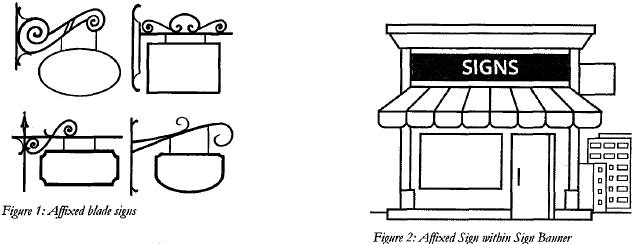
Affixed signage in the historic district may be in the form of:
1.
Blade or projecting signs:
•Blade or projecting signs shall:
(i)
Be limited to the first and second stories of a building only.
(ii)
Be attached to the building at right angles to the building face.
(iii)
Have attached, painted or engraved lettering.
(iv)
Have a maximum area of twelve (12) square feet each.
(v)
Not project above the roof or cornice line of the building.
(vi)
Clear sidewalks by a height of at least eight (8) feet above ground level.
(vii)
Be centered over or located near the principal doorway to the building.
(viii)
Not be located at building corners where they do not meet perpendicular to the building facade.
2.
Signage that is attached parallel to the building face:
•This type of signage shall be located within the existing sign banner of the building, if one exists.
•If no banner exists, the signage shall be located above the main entrance door and windows of the store face and shall not cover any architectural details.
3.
Lettering on storefront window or awning:
•If an awning exists, affixed signage may consist of lettering printed on the awning fringe.
•Window lettering shall be painted on or of applied vinyl.
(i)
Whenever possible, window signs should be located on the window beside the primary business entrance.
(ii)
Permanent window signs may be painted on or affixed to the inside of one (1) window of the business but may cover no more than twenty-five (25) percent of the total window area located on the front of the building.
(iii)
Additional information may be placed on the window of the entrance door of the business.
c.
Freestanding Signs.
1.
No such sign shall exceed five (5) feet in height from ground level to the top of the sign.
2.
The total area shall not exceed the underlying zoning district maximum.
3.
No freestanding sign shall be located closer than:
a.
Four (4) feet to any street right-of-way,
b.
Four (4) feet of any side property line or
c.
Fifty (50) feet of any dwelling.
4.
No freestanding sign shall obstruct driver visibility.
5.
Whenever possible and without obstructing driver visibility, freestanding signs shall be incorporated in a hedge or landscaping feature.
d.
Sign Lighting.
1.
Wall mounted and goose-neck fixtures are appropriate for lighting signs that are parallel to the building face.
2.
Blade signs may have directional pendant lighting.
3.
A ceiling mounted fixture may illuminate recessed entries.
4.
Neon lights and internally-lit signs are not permitted.
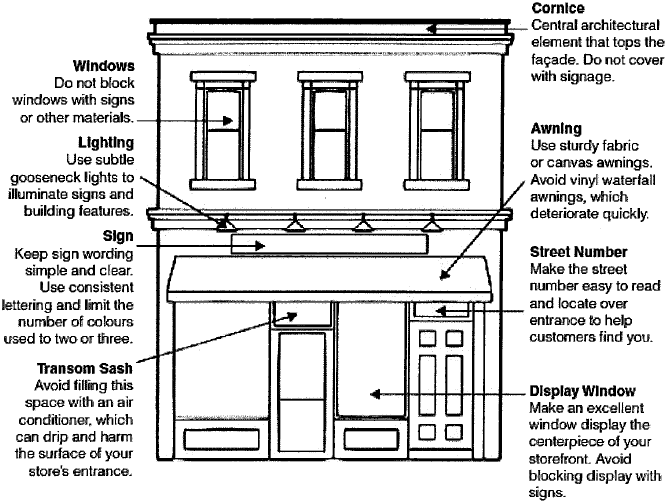
e.
Architectural features for signs in the historic district: See diagram below:
(Ord. No. 236, § 7(2-13.9), 12-14-83; Ord. No. 307, § 1(2-13.9), 8-9-89; Ord. No. 359, 7-13-94; Ord. No. 411, 11-8-00; Ord. No. 421, 1-10-01; Ord. No. 431, 3-13-02; Ord. No. 531, § 1, 4-10-2013; Ord. No. 619, § 1, 1-10-2024)
Sec. 22-605. - Status of nonconforming signs.
Existing signs for which a permit was previously issued or which met the requirements of this chapter in effect at the time of construction but which are not in conformance with the provisions of this chapter shall be deemed a nonconforming sign. Such nonconforming sign shall be subject to the following regulations:
(1)
Nonconforming signs may be replaced. However, no nonconforming sign shall be altered or relocated in any way, which makes the sign less in compliance with the requirements of this chapter than it was before the alteration.
(2)
Existing signs which are nonconforming because of improper illumination, location, size, color, or movement shall be permitted to remain indefinitely until destroyed, abandoned, or replaced with a different sign.
(3)
Nonconforming signs removed or destroyed by any means and not replaced within six (6) months shall lose their nonconforming status.
(Ord. No. 236, § 7(2-13.10), 12-14-83)

