
Clayton County Unincorporated
City Zoning Code
City Zoning Code
ARTICLE 1
- BASIC PROVISIONS
Sec. 1.1 - Title and Authority.
A.
This document shall be formally known as the "Clayton County Zoning Ordinance" and it may also be cited and referred to as the "Zoning Ordinance" or "Ordinance."
B.
This Ordinance shall be for the purpose of promoting the public health, safety and general welfare of the community and all of its citizens.
C.
This Ordinance shall be under the authority of Official Code of Georgia Annotated, Title 36, Chapter 66, Zoning Procedures, and Title 36, Chapter 67, Zoning Proposal Review Procedures, and all acts amendatory thereto.
Sec. 1.2 - Defined Words and Construction.
A.
The definitions contained in this Article shall be observed and applied in the interpretation of all other actions in this ordinance;
1.
Words used in the present tense shall include the future;
2.
Words used in the singular number shall include the plural and the plural the singular;
3.
Words used in the masculine gender shall include the feminine;
4.
The word "shall" is mandatory, not discretionary;
5.
The word "may" is permissive;
6.
The word "lot" shall include the words "tract" and "parcel;"
7.
The word "building" includes all other structures of every kind regardless of similarity to buildings;
8.
The phrase "used for" shall include the phrase "arranged for," designed for," intended for," "maintained for," and "occupied for;"
9.
The word "person" includes a corporation, firm, partnership or similar, as well as an individual;
10.
All measured distances shall be to the nearest whole foot;
11.
Parenthetical words or statements are integral parts of the definitions in which they are located;
12.
Any words not defined in Section 1.5 shall be construed in their generally accepted meanings as defined by standard dictionaries.
B.
The following rules of construction shall apply to this Ordinance:
1.
This document includes, but is not limited to the Clayton County Zoning Ordinance, the Clayton County Sign Ordinance, the Clayton County Telecommunications Ordinance, the Clayton County Tree Protection Ordinance, and the Clayton County Subdivision and Planned Unit Development (PUD) Regulations.
C.
The words generally used in this Ordinance are defined in Section 1.5, Definitions, and shall be viewed in that context.
Sec. 1.3 - Jurisdiction.
This Ordinance shall apply to all land within the jurisdiction of unincorporated Clayton County, being all portions of the County not in the ownership of the municipal, state, or federal government and to any area for which the Clayton County Board of Commissioners has jurisdiction consistent with the provisions of Georgia law.
Sec. 1.4 - Purpose.
This Ordinance is intended to guide the growth and development of Clayton County in accordance with the Clayton County Comprehensive Plan and for the following purposes:
A.
To secure adequate light, air, and convenience of access; and safety from fire, flood, and other dangers.
B.
To promote the public health, safety, comfort, convenience, morals and general welfare.
C.
To plan for the future development of the County to the end:
a.
That the community grows only with adequate public ways, utilities, health, education, and recreation facilities,
b.
That the needs of agriculture, industry, and business be recognized in future growth,
c.
That residential areas provided healthful surroundings for family life,
d.
That the growth of the community is commensurate with and promotes the efficient and economical use of public funds, and
e.
That the community strives for high aesthetic value and quality planning and design.
Sec. 1.5 - Defined Words.
For the purpose of these regulations, certain words or terms used shall be defined as follows:
Abandonment: The relinquishment of property or a cessation of the use of the property for a continuous period of one (1) year by the owner with neither transferring rights to the property to another owner nor of resuming the use of the property.
Accessory Dwelling: A dwelling unit, which is used for residential occupancy, created within an existing single-family home or on the same lot. It is an independent unit, but it may share an entrance, yard and parking with the principal unit.
Accessory Equipment: Any equipment serving or being used in conjunction with a Telecommunications Facility or Support Structure. This equipment includes, but is not limited to, utility or transmission equipment, power supplies, generators, batteries, cables, equipment buildings, cabinets and storage sheds, shelters or other structures.
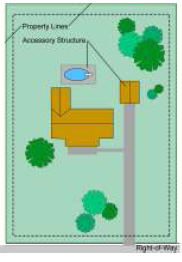
Accessory Structure: A structure which is subordinate to a primary structure in area, intent, and/or purpose; contributes to the comfort, convenience, or necessity of occupants of the primary building, structure, or principal use, and does not alter or change the character of the premises; is located on the same lot as the primary building, structure, or use.
Acupuncture: A therapy performed by a licensed massage therapist pursuant to the Acupuncture Act of Georgia (O.C.G.A. § 43-34-60 et seq.).
Adult Day Care Facility: Adult day care facilities shall include any building or portion thereof used to house six (6) or more adults requiring care, maintenance, and supervision for part of the a day.
Administrative Approval: Zoning approval that the Zoning Administrator is authorized to grant after an internal review of submitted document, site plan, or application.
Administrator: The individual or group responsible for the implementation and enforcement of the Ordinance. The Zoning Administrator, or his/her designee, shall be the administrator for the Zoning Ordinance, Tree Protection Ordinance, and Subdivision Regulations.
Agriculture: The use of land for the purpose of farming, dairying, pasturage or livestock yard, apiculture, horticulture, floriculture, viticulture, forestry and animal and poultry husbandry, and the necessary accessory uses. The operation of any accessory uses shall be secondary to that of the normal agricultural activities. Agriculture shall not include stock yards, or the commercial feeding of garbage or offal to swine or other animals.
Agritourism or Agritainment: As it is defined most broadly, involves any agriculturally-based operation or activity that brings visitors to a farm or ranch. Agritourism includes a wide variety of activities, including farm markets, roadside stands, U-pick operations, ice cream/bakery facilities, Christmas tree farm, pumpkin patch, wineries and winery tours and tastings, local products retail operations (local crafts, food products), corn mazes, farm-related interpretive facilities and exhibits, agricultural educational experiences, agriculturally related events/fairs/festivals, on-site farm/garden/nursery tours, walking and bicycling tours and trails, bird watching, and horseback riding.
Airport: An area of land which is designed, used or intended to be used for landing and takeoff of aircraft and any appurtenant areas, including buildings and other facilities such as refueling, parking, maintenance and repair facilities. The term "airport" applies to all such facilities, whether the facility is public or private.
Alley: A street which affords only secondary means of access to abutting property, and not intended for general traffic.
Alteration: A change in size, shape, character, occupancy or use of a building or structure.
Alteration, Structural: Any change in the supporting elements of a building such as bearing walls, columns, beams or girders.
Ambulatory surgical center or obstetrical facility: A public or private facility, not a part of a hospital, which provides surgical or obstetrical treatment performed under general or regional anesthesia in an operating room environment to patients not requiring hospitalization as defined by O.C.G.A. § 31-6-2.
Amend or Amendment: Any repeal, modification, or addition to a regulation; or any new regulation.
Amphitheater: An open-air, oval or round building with tiers of seats around a central open area.
Animal Hospital: A building or portion thereof designed or used for the care, observation or treatment of domestic animals.
Antenna: Any structure or device used to collect or radiate electromagnetic waves for the provision of cellular, paging, personal communications services and microwave communications. Such structures and devices include, but are not limited to, directional antennas, such a panels, microwave dishes and satellite dishes, and omni-directional antennas, such as whips.
Antenna Array: One or more roads, panels, discs, or similar devices used for the transmission or reception of radio frequency signals, which may include directional antenna (rod), directional antenna (panel), and parabolic antenna (disc). This does not include the support structure.
Apartment: One (1) or more rooms in an apartment building, with private bath and kitchen facilities or combination living space and commercial building, arranged, intended, designed, or occupied on a rental basis as a dwelling unit for a single family, an individual, or a group of individuals.
Apartment Building: A multi-family housing structure designed and constructed to accommodate three (3) or more dwelling units with independent cooking and bathroom facilities.
Appeal: The process by which an aggrieved party may petition for review of a decision made by an official or department of county government.
Applicant: The owner, owners, or legal representative of real estate who makes application to Clayton County for action affecting the real estate owned thereby.
Application: The application for and all accompanying documents and exhibits required of a petitioner by an approving authority for a development review process.
Art Gallery: A facility for the display and/or sale of works of art. Artists work in the fine arts, including but not limited to painting, illustration and sculpture. May include live performances of how to make these works of art.
Arterial Street/Road: See Street/Road, Major Arterial.
Artisan Gallery: A facility for the display and/or sale of works of art. Artisans are craftsmen who work in textiles, pottery, glass and other areas. Artisans make practical artistic products such as earrings, urns, stained glass and other accessories. May include live performances of how to make these works of art.
As Built Plan: A plan and supporting documentation which describes a particular site after construction has been completed. This plan should indicate all structures, hard surface features, utilities, landscaping areas, tree preservation zones and tree replacement areas.
Assisted Living Facility: A state licensed use in which domiciliary care is provided to adults who are provided with food, shelter and personal services within independent living units which include kitchen facilities in which residents have the option of preparing and serving some or all of their own meals. This use shall not include hospitals, convalescent centers, nursing homes, hospices, clinics, or similar institutions devoted primarily to the diagnosis and treatment of the sick or injured.
Attached Building: A building that is structurally connected to another building by a foundation, wall, or roof line. Carports, garages, porch awnings and the like shall be considered attached buildings.
Attached Wireless Communication Facility: An antenna array that is attached to an existing structure. These structures include, but are not limited to, utility poles, signs, water towers, rooftops, equipment facilities, and towers with any accompanying pole or device which attaches the antenna array to the existing building or structure and associated connection cables.
Automobile: A self-propelled, free-moving vehicle with four wheels, usually used to transport not more than six passengers and licensed by the appropriate state agency as a passenger vehicle.
Automobile Broker: A dealer who engages in the brokering, where there is an arrangement, for a fee, to provide the service of negotiating, assisting, or effecting the purchase of a new or used motor vehicle, not owned by the dealer, for another or others.
Automobile Repair, Major: A business where engine rebuilding or major reconditioning of worn or damaged motor vehicles or trailers; collision service, including body, frame, or fender straightening or repair; and overall painting of vehicles is performed.
Automobile Repair, Minor: A business that conducts repairs other than major repair including engine tune-up, muffler shops, shock absorber replacement shops, undercoating shops and tire stores.
Automobile Sales: The use of any building, land area, or other premise for the display and sale of new or used automobiles, generally, but may include light trucks or vans, trailers, or recreational vehicles and including any vehicle preparation or repair work conducted as an accessory use.
Automobile Service Station: Any building, land area, or other premise, or portion thereof, used for the retail dispensing or sales of vehicular fuels; servicing and repair of automobiles, and including as an accessory use the sale and installation of lubricants, tires, batteries, and similar vehicle accessories.
Automobile Wash: Any building or premises or portions thereof used for washing automobiles. The facility for washing automobiles may be self- service, semi-automatic, or automatic application of cleaner, brushes, rinse water, and heat for drying.
Awning: A roof-like cover that projects from the wall of a building for the purpose of shielding a doorway, or window from the elements. Awnings are often made of fabric or flexible plastic supported by a rigid frame, and may be retracted into the face of the building.
Banks and Loan Associations, Financial Establishments: A facility generally with the primary purpose of providing finance, investing money, and providing services to lenders, borrowers and investors on a direct and regular basis.
Barber Shops, Beauty Salons, and Nail Salons: A commercial facility where cosmetology services are offered or provided for a fee.
Basal Area: The cross-sectional area expressed in square inches, of a tree trunk at diameter breast height expressed herein in terms of "units" per acre.
Basement: A story partly underground but having more than one-half of its clear height below finished grade.
Bed and Breakfast Facility: An individual owner occupied residence containing no more than six (6) guest rooms for hire, for lodging by prearrangement for periods not to exceed three (3) consecutive weeks and providing for occasional meals daily (usually breakfast) and not a hotel, boarding, lodging house, or motel.
Berm: A man-made, formed, earth mound of definite height and width used for landscaping and obscuring purposes.
Best Management Practices (BMPs): A collected of structural measures and vegetative practices which, when properly designed, installed and maintained, will provide effective erosion and sedimentation control. The term "properly designed" means designed in accordance with the hydraulic design specifications contained in the "Manual for Erosion and Sediment Control in Georgia" specified in O.C.G.A. § 12-7-6(b).
Block: Property abutting on one side of a street and lying between the two (2) nearest intersecting or intercepting streets, intersecting railroad, intersecting waterway, or the end of a dead end street.
Board of Commissioners: The elected governing body of Clayton County, Georgia.
Board of Zoning Appeals: The Clayton County Board of Appeals as established in Article 10 of this Ordinance.
Boarding House: A building containing one (1) or more lodging units but not more than twenty (20) lodging units, all of which offer non-transient lodging accommodations, available only at weekly or longer rental rates to the general public (not for specific programs). Meals may only be provided from a single central kitchen and compensation for such meals, if provided, shall be included in the weekly or longer rental rate. No restaurant, meeting, reception, or banquet facilities shall be provided. The term "boarding home" does not include halfway or transitional houses, residential treatment facilities, nursing homes, sanitariums, hospital or other institutional facilities, or personal care homes.
Bona Fide Agricultural Purpose: a good faith commercial or domestic agricultural use of the land, any such determination of which shall be based upon, but not limited solely to, the following factors: 1.) the length of time the land will be so utilized; 2.) the productivity of land in its present use; 3.) the relationship of the property to the comprehensive zoning plan; and 4.) the current zoning classification of such lands as delineated on the official zoning map.
Bond: See Surety.
Buffer, Conservation: Any land in permanent vegetation, designed to intercept pollutants, stabilize stream banks and other riparian areas and manage other environmental concerns. Conservation buffers include: riparian buffers, filter strips, grassed waterways, shelter belts, windbreaks, living snow fences, contour grass strips, cross-wind trap strips, shallow water areas for wildlife, field borders, herbaceous wind barriers, and vegetative barriers.
Buffer Landscaping: Any trees, shrubs, walls, fences, berms, space, or related landscaping features required by Ordinance on private lots, and privately maintained, for buffering lots from adjacent properties or public rights-of-way for the purpose of increasing visual or other aspects of privacy and aesthetics.
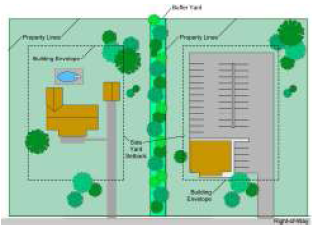
Buffer Yards: An area adjacent to front, side and rear property lines, measured perpendicularly from adjacent property lines and/or right-of-way lines, intended to provide attractive spaces to reduce the impacts of proposed uses on adjacent property or natural features and to screen incompatible uses from each other. Buffers also help to maintain existing trees or natural vegetation, to block or reduce noise, glare or other emissions and to maintain privacy. Buffer yards are in addition to, but separate from, the front, rear, or side yard setbacks.
Building: A structure having a roof, supported by columns or walls, and intended for the shelter, housings, or enclosure of an individual, animal; process, equipment, goods, or materials of any kind.
Building Area: The horizontal area of the buildings on a lot, measured from the outside exterior walls, excluding open areas or terraces, unenclosed porches or decks, and architectural features that project less than two feet.
Building, Detached: A building surrounded by open space on the same lot.
Building Code: The International Building Code pursuant to O.C.G.A. § 8-2-20.
Building Envelope: The three-dimensional space within which a structure is permitted to be built on a lot and that is defined by the maximum height regulations, minimum yard setbacks, and buffers when applicable.
Building, Frontage: The linear feet of the exterior wall of a building that faces any road or street that provides a means of direct ingress and egress to the lot.
Building Height: See Structure Height.
Building Inspector: The person or persons charged with the responsibility of issuing building permits, inspecting buildings, and issuing certificates of occupancy. This person is certified by the State or the International Code Council (ICC) in one or more disciplines; a residential or commercial building inspector, a plumbing, electrical or mechanical inspector or other specialty to inspect structures at different stages of completion.
Building Permit: A permit allowing a person, firm, or corporation to erect, construct, enlarge, alter, repair, move, improve, remove, convert, or demolish any building or structure or before starting any construction, excavation, or work within a subdivision within its jurisdiction, or the pursuit of changes to the condition of land.
Building, Principal: A building or structure in which is conducted the predominant use of the lot, on which it is located.
Building, Residential: A building which is arranged, designed, used, or intended to be used for residential occupancy by one or more families or lodgers and which includes, but is not limited to the following types:
A.
Single-family detached dwellings;
B.
Two-family dwellings;
C.
Single-family or two-family attached and semi-detached dwellings developed initially under single ownership or unified control;
D.
Multiple-family dwellings.
Business: The engaging in the purchase, sale, barter, or exchange of goods, wares, merchandise, or services; an occupation, employment, or enterprise which occupies time, attention, labor, and materials; or the maintenance or operation of offices, recreational, or amusement enterprises.
Business District: Refers to the Office Institutional (OI) and General Business Districts (GB).
Business Office: A facility generally focusing on business, government, professional or financial services. Business office shall include the following: advertising office; bank; business management consulting; data processing; financial business such as a lender, investment or brokerage house; collection agency; radio or television studio; real estate or insurance agent; professional service such as attorney, accountant bookkeeper, engineer, or architect; sales office, travel agency or any similar use.
Caliper: the diameter of thickness of the truck of a young tree or sapling as measured at six inches above the top of the root mass. This measurement is used for nursery-grown trees having a diameter of less than six inches.
Campground and RV Park: Any site, lot, field, or tract of land designed with facilities for short term occupancy by recreational vehicles and other camping equipment but not including mobile homes.
Cannabidiol (CBD Oil): CBD derivatives or extracts from hemp processing with federally defined THC level for hemp or lower available for commercial sales. But not including food products infused with THC unless approved by the United States Food and Drug Administration.
Canopy: A permanent roof-like structure projecting from a building and open on at least one side for the purpose of shielding a pedestrian walkway from the elements, or a freestanding roof-like structure supported by columns intended to shield a vehicular driveway or service area from the elements.
Capacity, Roadway: The maximum hourly rate at which vehicles can reasonably be expected to traverse a point or uniform section of a lane or roadway during a given time period under the prevailing roadway, traffic, and control conditions. See Level of Service.
Capital Improvement Plan: A proposed schedule of future projects listed in order of construction priority together with cost estimates and the anticipated means of financing each project.
Carport: An open-sided roofed automobile shelter, formed by extension of the roof from the side of a building.
Cemetery: Property used for the interring of the dead. Includes any crematory, mausoleum, or mortuary operated in conjunction with and on the same tract as the cemetery.
Certificate of Occupancy: A certificate stating that the occupancy and use of a structure complies with the provisions of the Clayton County Building Code and all other applicable regulations of Clayton County.
Chicken: A type of domestic fowl, Gallus domesticus, kept for its eggs, or meat, descended from various fowl of southeastern Asia and developed in a number of breeds.
Chicken Coop: A cage or pen wherein chickens are kept.
Clearing: The removal of vegetation from a property by any means.
Clinic: An establishment in which human patients are admitted for medical or dental study or treatment and in which the services of at least two physicians or dentists are provided.
Club or Lodge, Private: An association of persons, who are bona fide members paying annual dues, which owns, hires, or leases a building or portion thereof; the use of such premises being restricted to members and their guests. (The affairs and management of such "private club or lodge" are conducted by a board of directors, executive committee, or similar body chosen by the members.) It shall be permissible to serve food on such premises. The sale of alcoholic beverages to members and their guests shall be permitted provided it is secondary and incidental to the promotion of some other common objective of the organization.
Cluster: A development design technique that concentrates buildings on part of the site to allow the remaining land to be used for recreation, common open space, and preservation of environmentally sensitive features.
Collector Road: See Road, Collector.
Colleges, Universities, and Vocational or Technical Schools: A facility for the instruction of post-secondary education.
Co-Location: Use of a wireless communication facility or site by more than one wireless communication license holder for the placement of an antenna array on a tower structure.
Commercial Vehicle: Any motor vehicle licensed by the State as a commercial vehicle.
Commission: See Board of Commissioners.
Common Area: Those portions of a site and/or building(s) collectively owned or controlled.
Community Development: A department within Clayton County government that performs the administrative function for the Zoning Advisory Group, Board of Zoning Appeals and other functions as directed by the Board of Commissioners.
Community Donation Center: A facility operated by a charitable, nonprofit organization, as described by IRS Section 501(c)(3), for the collection of clothing, furniture, housewares, small electrical appliances, household textiles, toys, and other small household items. This facility may also sell said goods.
Comprehensive Plan: Refers to the Clayton County Comprehensive Plan. The plan includes goals, objectives and strategies for land use, growth management, transportation or thoroughfares, community facilities and services, environment concerns, infrastructure, aesthetics and identity, economic development, and parks and recreation. The plan was developed and adopted by the County pursuant to the Georgia Planning Act of 1989 and includes any part and/or policies separately adopted and any amendment to such plan and/or policies, or parts thereof.
Comprehensive Transportation Plan: The official plan adopted as part of the Clayton County Comprehensive Plan, as subsequently amended, which includes a street plan, sets forth the location, alignment, dimensions, identification, and classification of existing and proposed streets, and other thoroughfares. All proposed right-of-way widths, as shown on the Comprehensive Transportation Plan, whether actually acquired by the County or not, shall be used for the calculation and establishment of front property lines for the purpose of determining front yards and front setbacks except where the existing right-of-way is greater than the proposed right-of-way in which case the existing right-of-way shall be used. In no case shall there be any structures or signs located in the proposed right-of-way.
Conditional Use: A use that is designated by the Zoning Ordinance as being permitted in the district concerned if it meets special conditions, if found to be appropriate and upon application, is specifically authorized by the Board of Commissioners.
Condition of Approval: Stipulations or provisions that are provided above and beyond the minimum requirements that are set forth as a prerequisite for the approval of an application.
Condominium: Real estate lawfully subject to the Georgia Condominium Act, O.C.G.A. 44-30-70 et. Seq. by the recordation of condominium instruments, in which undivided interests in the common areas and facilities are vested in the condominium unit owners. A condominium development must have a registered condominium association to maintain the common areas.
Confined (or Concentrated) Animal Feeding Operation (CAFO): A facility where livestock or poultry are fed in confinement for at least 45 days per year and crop or forage growth is not maintained in the area of confinement. If at any time during the period of animal confinement, through a combination of grazing, trampling or manure deposition no vegetative cover is evident in the confined area, this would constitute a lack of maintenance of crop or forage growth.
Conforming Building or Structure: Any building or structure that complies with all the regulations of this Ordinance or of any amendment hereto governing the zoning district in which building or structure is located; and is designed or intended for a conforming use.
Concealed Support Structure: Any freestanding structure constructed for the primary purpose of supporting one or more antennae but designed to resemble an architectural or natural feature of the specific environment, concealing or camouflaging the presence of the antennae. The term includes but is not limited to clock towers, water towers, silos, light poles, flagpoles, and artificial trees.
Construction Plan(s): The maps or drawings showing the specific location and design of improvements to be built in accordance with the applicable requirements of Clayton County.
Controlled Access Highway: A traffic-way, including freeways, expressways, and other arterial streets, in respect to which owners or occupants of abutting property or lands and other persons have no legal right of access to or from the same, except at such points only and in such manner as may be determined by the public authority having jurisdiction over such traffic way.
Convalescent Center: See Nursing Home.
Court: An open unoccupied space bounded on two or more sides by the exterior walls of a building or exterior walls and lot lines.
County Arborist: The person appointed by the County Commission to administer the Tree Protection Ordinance [Chapter 86, Article II of this Code]. Person should be versed in the art of arboriculture, including tree surgery, the prevention and cure of tree diseases and the control of inspect pests.
County Street: For the purpose of this ordinance only, a county street is a street which is owned and/or maintained by Clayton County. Nothing herein shall be construed to designate any street as a county street for other than zoning purposes.
Covenants: Private and legal restrictions of various kinds on the usage of lots, typically within a subdivision and applied by the sub-divider and/or developer, that are recorded with the plat and deed.
Critical Establishment Period: The first two years after a tree is planted.
Critical Root Zone (CRZ): The minimum area beneath a tree which must be left undisturbed in order to preserve a sufficient root mass to give a tree a reasonable chance of survival. The critical root zone will typically be represented by a concentric circle centering on the tree's trunk with a radius equal in feet to one and three-tenths (1.3) times the number of inches of the trunk diameter.
Cross Dock: Any structure designed for the immediate transfer of material from one vehicle to another. A cross dock structure has no area designed for long term storage of materials.
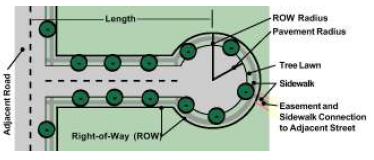
Cul-de-Sac: The turnaround at the end of a dead-end street.
Curb Level: The level of the established curb in front of such building measured at the center of such front. Where no curb level been established, the pavement elevation at the street center line similarly measured, or the mean elevation of the finished lot grade immediately adjacent to a building shall be considered the "curb level."
Cutting: the detaching or separating of any limb, branch, or root from a tree; for the purpose of erosion control, the removal of any soil or other solid material from a natural ground surface.
Day Care Center: As defined by Rules and Regulations of the Georgia Department of Human Resources and for the purposes of the Zoning Ordinance, any place operated by a person, society, cooperation, institution, or group wherein are received for pay for group care, for fewer than 24 hours per day without transfer of legal custody, having nineteen (19) or more children under eighteen (18) years of age, and which Is required to be licensed by both Clayton County and the Georgia Department of Human Resources.
Dead Tree: A tree that does not contain any live tissue, i.e., green leaves or live limbs.
Decorative Wall: A masonry wall consisting of brick, stone or similar materials as approved by the Zoning Administrator and constructed with a design that includes specific pattern elements or ornamentation.
Deciduous: A plant with foliage that drops or dies at the end of a growing season.
Dedication: The setting apart of land or interests in land for use that is accepted by the County by Code, resolution, or the recording of a plat.
Density Factor: A unit of measure used to prescribe the calculated tree coverage of a site.
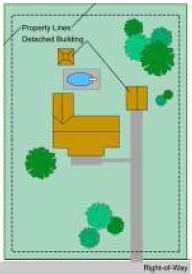
Detached Building: A building that has no structural connection with the principal building.
Developer: An individual, partnership, corporation (or agent thereof), or other entity that undertakes the responsibility for land development, particularly the designing of a subdivision plat or site development plan showing the layout of the land and the public improvements involved therein. In as much as the subdivision plat is merely a necessary means to the end of assuring a satisfactory development, the term "developer" is intended to include the term "sub-divider," even though the personnel involved in successive stages of the project may differ.
Development: Any man-made change to improved or unimproved real estate including but not limited to:
A.
Construction, reconstruction, or placement of a structure or any addition to a structure;
B.
Installing a manufactured home on a site, preparing a site for a manufactured home;
C.
Installing utilities, erection of walls and fences, construction of roads, or similar projects;
D.
Construction of flood control structures such as levees, dikes, dams, channel improvements, etc.;
E.
Mining, dredging, filling, grading, excavation, or drilling operations;
F.
Construction and/or reconstruction of bridges or culverts;
G.
Storage of materials or vehicles; or
H.
Any other activity that might change the direction, height, or velocity of flood or surface waters.
"Development" does not include activities such as the maintenance of existing buildings and facilities such as painting, re-roofing; resurfacing roads, gardening, plowing, and similar agricultural practices.
Development Plan: A plan and supporting documentation which describes a particular site which is to be disturbed or developed. This plan should indicate all structures, hard surface features, utilities, landscaping areas, tree preservation zones and tree replacement areas.
Diameter Breast Height (DBH): The standard measure of tree size for trees six inches or greater in caliper existing on a site. The tree trunk is measured at a height of four and one-half feet above the ground, and if a tree splits into multiple trunks below that point, the trunk is measured at its most narrow point beneath the split.
Diameter Tree: The diameter of a tree measured as follows:
1.
For existing preserved trees, at a point four and one-half feet above the ground;
2.
For new replaced trees, at a point six inches above ground; and
3.
For multiple trunk trees, as provided in the measure of diameter at breast height.
Director: The Director of the County's Transportation and Development Department.
Discount Store: A store that sells its products at lower prices.
Distribution Center: An establishment engaged in the receipt, storage, and distribution of goods, products, cargo, and materials, including transshipment by boat, rail, air, or motor vehicle.
District: A section of Clayton County for which uniform zoning regulations governing use, height, area, size, intensity of use of buildings and land, and open spaces about buildings, are established by the Zoning Ordinance.
Domestic Pets: Animals commonly used as household pets, protection, companions, and for the assistance of disabled persons. Domestic pets shall include, but not be limited to, dogs, cats, parakeets, parrots, finches, spiders, guinea pigs, hamsters, gerbils, rats, mice, rabbits, and aquarium fish.
Drainage Easement: A grant by a property owner to specific persons, the general public, corporations, utilities, or others, for the purpose of transporting stormwater.
Drip Line: a vertical line extending from the outermost branches of a tree to the ground.
Ds1: disturbed area stabilization with mulch only per "The Manual for Erosion and Sediment Control in Georgia."
Ds2: disturbed area stabilization with temporary vegetation per "The Manual for Erosion and Sediment Control in Georgia."
Ds3: disturbed area stabilization with permanent vegetation per "The Manual for Erosion and Sediment Control in Georgia."
Drive, Private: See Road, Private.
Drive-in Establishment: An establishment which offers merchandise, service, or entertainment to persons in motor vehicles.
Drive In Restaurant: Any place or premises used for sale, dispensing or service of food, refreshment or beverages in automobiles, including those establishments where customers may eat or drink the food or beverage on the premises.
Driveway: An access-way connecting one or more dwelling units and/or their parking spaces with a street.
Duplex: See Dwelling, Two-Family.
Dwelling: A building or structure or portion thereof, conforming to all requirements applicable to the residential use districts of the Zoning Ordinance and Clayton County Building Code or Georgia Building Code used exclusively for residential occupancy, including single-family dwelling units, two-family dwelling units, and multi-family dwelling units, but excluding hotels, boarding houses, and lodging houses.
Dwelling, Mobile Home: A structure, transportable in one or more sections, which, in the traveling mode, is eight feet or more in width or 40 feet or more in length or, when erected on site, is 320 or more square feet and which is built on a permanent chassis and designed to be used as a dwelling with or without a permanent foundation when connected to the required utilities and includes the plumbing, heating, air-conditioning, and electrical systems contained therein and manufactured prior to June 15. 1976.
Dwelling Site: A site within a manufactured home park and/or mobile home park with required improvements and utilities that is leased for the long term placement of manufactured homes and/or mobile homes.
Dwelling Unit: Any structure or portion thereof designed for or used for residential purposes as a self sufficient or individual unit by one (1) family and having permanently installed sleeping, cooking, and sanitary facilities.
Dwelling, Manufactured Home Type I (Double-Wide): A dwelling unit built in a factory bearing a seal of compliance with Federal Manufactured Housing Construction and Safety Standards (42 U.S.C.A. 5401 et seq.) which is at least twenty-three (23) feet in width for its entire length, has at least nine-hundred fifty (950) square feet of occupied space, and is installed and anchored on a permanent foundation and perimeter wall, according to the Georgia Manufactured Housing Code, as amended, and its pitched roof and siding are of materials customarily used for site constructed dwellings.
Dwelling, Manufactured Home Type II (Single-Wide): A dwelling unit built in a factory bearing a seal of compliance with Federal Manufactured Housing Construction and Safety Standards which has no less than six hundred (600) heated square feet, a minimum dimension of 12 feet by 50 feet (12' × 50'), and is installed and anchored on a permanent foundation and perimeter wall, according to the Georgia Manufactured Housing Code, as amended, and its pitched roof and siding are of materials customarily used for site constructed dwellings.
Dwelling, Mobile Home: A transportable dwelling unit manufactured prior to June 15, 1976 and not subject to the Federal Manufactured Housing Construction and Safety Standards 42 U.S.C.A. 5401 et seq.
Dwelling, Multi-Family: A residential building designed for or occupied by three (3) or more families, with the number of families in residence not exceeding the number of dwelling units provided.
Dwelling, Single-Family: A detached residential dwelling unit designed for and occupied by one (1) family.
Dwelling, Single-Family Detached Condo: A single-family detached condominium that is not on a separate lot from other single-family detached dwellings or nonresidential structures.
Dwelling, Two-Family: A residential building containing two (2) dwelling units designed for occupancy by not more than two (2) families.
Easement: A grant by a property owner to specific persons, the general public, corporations, utilities, governments, or others, for a specified purpose.
Efficiency Unit: A dwelling unit consisting of one principle room exclusive of bathroom, hallway, closets, or kitchen and dining alcove directly off the principal room.
Erosion: The process by which land surface is worn away by the action of wind, water, ice, or gravity.
Establishment: An economic unit, generally, at a single physical location, where business is conducted or services or industrial operation performed.
Estate Residential: Residential zoning district provided in Article 3.
Expressway: See Road/Street, Expressway.
Evergreen: A plant with foliage that remains green year-round.
Facade: The exposed exterior walls of any structure.
Family: An individual, or two or more persons if related by blood, marriage, adoption or guardianship and not more than three unrelated persons, occupying a single dwelling unit and using the same cooking facilities.
Family Day Care Home: A Home Occupation, type I, in which shelter, care, and supervision are provided for fewer than twenty-four (24) hours per day, without transfer of legal custody, having no more than six (6) children under eighteen (18) years of age who are not related to such persons and whose parent or guardians are not residents In the same private residence. All family day care homes shall meet the requirements of the adopted International Residential Building Code.
Farm: An area of at least three (3) acres used for agricultural operations, forestry, the operating of a tree or plant nursery, or the production of livestock and poultry as well as those properties classified by the Internal Revenue Service as a farm.
Farm Animals: Animals commonly used for transportation, food, skins, and other by-products. Farm animals include, but are not limited to, horses, cattle, pigs, sheep, goats, mules, donkeys, miniature horses, miniature donkeys, camels, emu, ostrich, llamas, alpacas, rabbits, mink, fox, buffalo, chickens, turkeys, quail, pheasants, and other animals or fowl of similar characteristics.
Feedlots: A lot or building or combination of lots and buildings intended for the confined feeding, breeding, raising, or holding of animals, including livestock and fowl, and specifically designed as a confinement area in which manure may accumulate, or where the concentration of animals is such that a vegetative cover cannot be maintained within the enclosure. Open lots used for the feeding and rearing of poultry (poultry ranges) shall be considered animal feedlots.
Fence, Chain-Link: A fence constructed of galvanized steel or similar materials as approved by the Building Inspector for the purpose of enclosing or securing an area. Chain-link fences shall not include wire fences or fences of similar construction.
Fence, Decorative Wall: A masonry wall consisting of brick, stone, or similar materials as approved by the Zoning Administrator and constructed with a design that include specific pattern elements or ornamentation.
Fence, Industrial: A chain-link or ornamental fence constructed of materials approved by the Building Inspector for the purpose of enclosing or securing an industrial use.
Fence, Living: A continuous hedgerow of living plant material planted and maintained for the purpose of enclosing an area.
Fence, Obscuring Wall: A masonry wall consisting of brick, stone, or similar materials as approved by the Zoning Administrator and constructed for the purpose of enclosing, obscuring or screening an area from view.
Fence, Ornamental: A fence consisting of wrought iron, galvanized steel, aluminum, vinyl, wood or similar materials fabricated into a design with specific pattern elements or ornamentation. Columns, or support structures may consist of brick, stone or stucco that is architecturally consistent with the primary structure. All spaces in the fence shall be open and unobstructed and the fence shall not block vision to an extent greater than 40 percent. Ornamental fences shall not include chain-link or wire fences or fences of similar construction.
Fence, Privacy: A fence constructed of wood, vinyl or similar materials that blocks vision to an extent greater than 40 percent for the purpose of obscuring or screening an area from public view.
Fence, Rail: A fence constructed of wood, vinyl or similar materials and consisting of one to four horizontal rails connecting to vertical posts spaced a minimum of six feet apart. All spaces in such fences shall be open and unobstructed and such fences shall not block vision to an extent greater than 40 percent.
Fence, Temporary: A fence constructed of canvas, plastic, chain-link, wood or similar material as approved by the Zoning Administrator for the purpose of enclosing or securing an area for a limited period of time.
Festoons: Strings of ribbons, tinsel, small flags, pennants, streamers, pinwheels, or other devices or long narrow strips of fabric, plastic, or other pliable material designed to move in the wind.
Film Studio: A place where cinema and television films/videos are made or produced.
Final Plat: The final map, drawing or chart upon which the sub-divider's as-built plan of subdivision is presented, and which, if approved, will be submitted for recording among the land records for Clayton County.
Final Stabilization: All land disturbing activities at a site have been completed and that for unpaved areas and areas not covered by permanent structures, one hundred (100) percent of the soil surface is uniformly covered in permanent vegetation with a density of seventy (70) percent or greater, or equivalent permanent stabilization measures such as the use of rip rap, gabions, permanent mulches or geo-textiles, have been used. For the purposes of this definition, permanent vegetation shall consist of: planted trees, shrubs, perennial vines; a crop of perennial vegetation appropriate for the time of year and region; or a crop of annual vegetation and a seeding of target crop perennials appropriate for the region. Final stabilization applies to each phase of construction.
Financial institution: A company engaged in the business of dealing with monetary transactions, such as deposits, loans, investments and currency exchange. Such as, banks, trust companies, insurance companies, and brokerage firms.
Finished Floor Area: See Floor Area, Finished.
Fitness Center and Gyms; Health Clubs and Spas: A health and recreational facility geared towards exercise, sports, and other physical activities. Activities include organized group instructional programs such as spinning classes, dance, aerobic exercises, yoga, and martial arts; organized team sports; and individual or group fitness opportunities such as cardiovascular training, weight training, and swimming. Individual activities may be self-guided or conducted under the supervision of a trainer. A Fitness Center may also accommodate accessory outdoor activities with features such as a running track, swimming pool, tennis courts and sport playing fields.
Flood: A general and temporary condition of partial or complete inundation of normally dry land areas from the overflow, the unusual and rapid accumulation, or the runoff of surface waters from any source.
Flood, Regulatory Base: Flood having a one (1) percent chance of being equaled or exceeded in any given year. This is often referred to as a one hundred year flood.
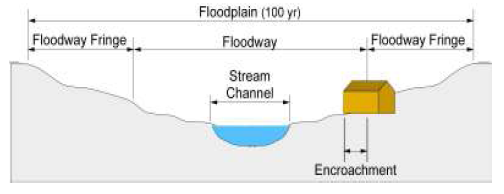
Floodplain: The relatively flat area or low land adjoining the channel of a river or stream which has been or may be covered by flood water. The flood plain includes the channel, floodway, and floodway fringe. Flood plain boundaries are to be determined by using the Floodway-Flood Boundary Maps of the Federal Insurance Administration/Federal Emergency Management Administration.
Floodway: The channel of a river or stream and those portions of the floodplains adjoining the channel which are reasonably required to efficiently carry and discharge the peak flood flow of the regulatory flood of any river or stream.
Floodway Fringe: Those portions of the floodplain lying outside the floodway.
Flood Hazard Area: The floodplain consisting of the floodway and the floodway fringe area.
Flood Insurance Rate Map: The official map on which the Federal Insurance Administration has delineated both the areas of special flood hazards and risk premium zones applicable to the community.
Floor Area (For determining floor area ratio): The sum of the gross horizontal areas of the several floors of the building enclosed by an exterior wall, excluding however, attic, and basement floors, open porches, breezeways, and garages.
Floor Area of a Building (For determining off-street parking and loading requirements): The sum of the gross horizontal areas of the several floors of the building, or portion thereof, devoted to a specific use; including accessory storage areas located within selling or working space such as counters, racks or closets; and any basement floor area devoted to retailing activities, to the production or processing of goods, or to business or professional offices.
Floor Area, Finished: That portion of floor area constructed, completed, and usable for living purposes with normal living facilities which includes sleeping, dining, cooking, working, entertainment, common space living rooms, areas for personal hygiene, or combination thereof. Floor area or portion thereof used only for storage purposes and not equipped for the facilities mentioned above shall not be considered Finished Floor Area.
Floor Area, Ground: That portion of Finished Floor Area located on the first (or nearest ground level) floor of the dwelling unit. The Floor Area of a primary structure does not include a garage, carport, deck, unfinished storage, patio, or open porch.
Floor Area Ratio: The floor area of the building or buildings on a lot divided by the area of such lot.
Florist and Gift Shops: A retail store selling, predominantly, floral arrangements, gifts, books, souvenirs, specialty items relating to history, original and handmade arts and products, collectibles, crafts.
Forestry: The science, business and art of creating, conserving and managing forests on a continuous basis for both commodity and non-commodity purposes.
Foundation: The supporting member of a wall or structure.
Freeway: See Road/Street, Freeway.
Front Line: With respect to a building, the foundation line that is nearest the front lot line.
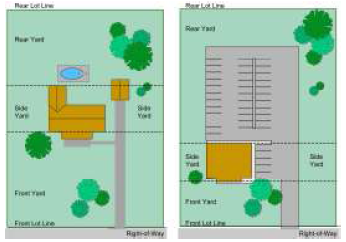
Front Lot line: For an interior or through lot, the line making the boundary between the lot and the abutting street right-of-way or a lake or watercourse; and for a corner lot, the line marking the boundary between the lot and each of the abutting streets.
Front Yard: The horizontal space between the nearest foundation of a building to the front lot line, extending to the side lines of the lot, and measured as the shortest distance from that foundation to the front lot line.
Frontage: See Lot Frontage.
Funeral Home, Mortuary, and Crematory: An establishment where the dead are kept and/or prepared/or burial or cremation.
Garage: A deck, building, or parking structure, or part thereof, used or intended to be used for the parking and storage of vehicles.
Garage, Community: A garage used exclusively for the parking and storage of vehicles owned or operated by residents of nearby dwelling units and their guests, which is not operated as a commercial enterprise and is not available to the general public and which is owned, leased, or cooperatively operated by such residents.
Garage, Municipal: A structure owned or operated by a municipality and used primarily for the parking and storing of vehicles owned by the general public.
Garage, Private Customer and Employee: A structure that is an accessory to a non-retail commercial or manufacturing establishment, building, or use and is primarily for the parking and storage of vehicles operated by the customers, visitors, and employees of such building and that is not available to the general public.
Garage, Private Residential: A structure that is accessory to a residential building and that is used for the parking and storage of vehicles owned and operated by the residents thereof, and that is not a separate commercial enterprise available to the general public.
Garage, Public: A structure, or portion thereof, other than a private customer and employee garage or private residential garage, used primarily for the parking and storage of vehicles and available to the general public.
Garage, Repair: Any building, premises, or land in which or upon which a business, service, or industry involving the maintenance, servicing, repair, or painting of vehicles is conducted or rendered.
Garage Sales: The sale or offering for sale of new, used, or secondhand items of personal property at any one residential premise at any one time. Included in this definition are all sales in residential areas which may be entitled "garage sale," "yard sale," "tag sale," "porch sale," "lawn sale," "attic sale," "basement sale," "rummage sale," "flea market sale" or any similar casual sale of tangible personal property.
Glare: The effect produced by brightness sufficient to cause annoyance, discomfort, or loss in visual performance and visibility.
Goods: Any goods, warehouse merchandise, or other personal property capable of being the object of a sale regulated hereunder.
Government Projects: Any building, structure, or alteration thereof paid for and used by the local, state or federal government entities.
Grading: Any land-disturbing activity, including clearing, grubbing, stripping, cutting, filling, stockpiling, or any combination thereof, and shall include the land in its cut or filled condition.
Greenbelt: An open area that may be cultivated or maintained in a natural state surrounding development or used as a buffer between land uses or to mark the edge of an urban or developed area.
Green Space: See Open Space.
Greenspace Trust Board: A citizen group appointed by the Board to oversee administration and management of the County Tree Fund and to assist the County Arborist in annually reviewing the Clayton County Tree Protection Ordinance.
Grocery, Full Service: a retailer licensed as a grocery store and dedicates at least five percent of the selling area to each of at least six of the following categories: (1) Fresh fruits and vegetables, (2) Fresh and uncooked meats, poultry and seafood, (3) Dairy products, (4) Canned foods, (5) Frozen foods, (6) Dry groceries and baked goods, and (7) Non-alcoholic beverages. In order for the square footage to be considered part of the selling area, it must be open to the public and may not include storage, preparation areas or rest rooms.
Ground Floor Area: See Floor Area, Ground.
Groundsheet Sign: A sign that is placed and affixed to either the ground or an approved support structure that is designed to be seen by aircraft passengers either landing or departing any airport facility. Said sign is not oriented to any ground transportation.
Group Home: Group home means a residence, operated by an affiliate of a national, regional, state or county organization with a philanthropic mission, shared by three or fewer persons, excluding resident staff who live together in a long term, single house-keeping environment in which staff persons provide care. The term "group home" shall not include a halfway house, a treatment center for alcoholism or drug abuse, a home for the detention and/or rehabilitation of juveniles placed in the custody of the state. A group home shall not allow use of the dwelling as a home for individuals formerly incarcerated, for any crimes including child molestation, aggravated child molestation, or child sexual abuse, as defined in O.C.G.A. § 16-6-4 or individuals required to register as sex offenders pursuant to O.C.G.A. § 42-1-12.
A group home may include a home for the disabled. As used in this subsection, the term "disabled" shall mean:
(1)
Having a physical or mental impairment that substantially limits one or more of such person's major life activities;
(2)
Having a record of having such an impairment; or
(3)
Being regarded as having such an impairment.
"Disabled" shall not include persons who currently use illegal controlled substances, persons who have been convicted of the illegal manufacture or distribution of controlled substances, sex offenders, and juvenile offenders or persons with or without disabilities who present a direct threat to the persons or property of others.
Gross Site Area: One or more parcels of land included in a single development plan, and preferably under common ownership, which constitute the entire area of the development shown on the site plan or subdivision plat. Gross site area shall include all land needed for required open space, buffer areas, landscaping, drainage facilities, parking, internal access roads or driveways, and other physical design features needed to serve the proposed development. The gross site area shall also include all land in floodplain, floodway, and dedicated easements or road right-of-way.
Ground Cover: Grasses or other plants grown to keep soil from being blown or washed away.
Ground Coverage: The area of a lot occupied by all buildings expressed as a percentage of the gross area of the lot.
Group Day Care Home: A Home Occupation, type II, wherein group care for not less than seven (7) nor more than eighteen (18) children under eighteen (18) years of age fir less than twenty-four (24) hours without transfer of legal custody and which is required to be licensed by both Clayton County and the Georgia Department of Human Resources. All group day care homes shall meet the requirements of the adopted International Residential Building Code.
Group Residence/Shelter: A state licensed 24-hour residential facility functioning as a single housekeeping unit for the sheltered care of persons with special needs which, in addition to providing food and shelter, may also provide some combination of personal care, social or counseling services and transportation. Bedroom suites shall not include kitchen facilities. For purposes of this ordinance, group residence/shelter shall not include those facilities which exclusively care for children under the age of 17.
Group Residence for Children: A dwelling unit or facility in which full time residential care is provided for children under the age of 17 as a single housekeeping unit. The group residence may provide food, shelter, combination of personal care, social or counseling services and transportation. Bedroom suites shall not include kitchen facilities. A group residence must comply with applicable federal, state and local licensing requirements.
Hardship: A proven difficulty with regard to one's ability to improve land stemming from the application of the development standards of the Zoning Ordinance, which may or may not be subject to relief by means of variance. In and of themselves, self-imposed situations and claims based on a perceived reduction of or restriction on economic gain shall not be considered hardships. Self-imposed situations include, but are not limited to: the purchase of land with actual or constructive knowledge that, for reasons other than physical characteristics of the property, the development standards herein will inhibit the desired improvement; any improvement initiated in violation of the standards of the Zoning Ordinance; any result of land division requiring variance from the development standards of this Ordinance in order to render that site buildable.
Height: See Structure Height.
Helicopter: Any rotor craft which depends principally for its support and motion in the air upon the lift generated by one or more power-driven rotors rotating on a substantially vertical axis.
Helicopter Port: A facility, either public or private, or an area of land, water, or structural surface which is designed, used or intended to be used for landing and takeoff of helicopters and any appurtenant areas, including buildings and other facilities such as refueling, parking, maintenance and repair facilities. The term "helicopter port" applies to all such facilities, whether the facility is public or private.
Helicopter Stop: A facility, either public or private, having a facility without the logistical support provided at a helicopter port at which helicopters land and take off, including the touchdown area. Helicopter stops may be at ground level or elevated on a structure. The term "helicopter stop" applies to all such minimum facilities, whether the facility is public or private.
Historic Area: A district or zone designated by a local authority or state or federal government within which the buildings, structures, appurtenances, and places are of basic and vital importance because of their association with history; or because of their unique architectural style and scale, including color, proportion, form, and architectural detail; or because of their being a part of or related to a square, park, or area the design or general arrangement of which should be preserved and/or developed according to a fixed plan based on cultural, historical, or architectural purposes.
Historic District: See Historic Area.
Historic Preservation: The protection, rehabilitation, and restoration of districts, sites, buildings, structures, and artifacts significant in history, architecture, archeology, or culture.
Historic Site: A structure or place of outstanding historical and cultural significance and designated as such by the State or Federal Governments.
Home Occupation: Any activity carried out for financial gain or profit by a resident or operating as a for-profit, non-profit, or not-for-profit entity, and conducted as a customary, incidental, and accessory use in the resident's dwelling.
Hookah: A water pipe used to smoke shisha or flavored tobacco or herbal product.
Hospital: An institution licensed by the Georgia Department of Community Health providing primary health care services and medical or surgical care to persons, inpatient and outpatient care, suffering from illness, disease, injury, or other abnormal physical or mental conditions, and including as an integral part of the institution, related facilities such as laboratories, outpatient facilities, medical offices and training facilities. The term "hospital" shall not include convalescent, nursing, shelter, or boarding homes.
Hotel: A building in which lodging or board and lodging are provided and offered to the public for compensation and in which ingress and egress to and from all rooms is made through an inside lobby or office supervised by a person in charge at all hours. As such, it is open to the public. Compensation is usually assessed on a day-to-day basis.
Hotel, Extended Stay: A hotel or motel offering individual rooms or suites containing a kitchen area with facilities where cooking is permitted.
Impervious Surface: Any material that prevents absorption of stormwater into the ground.
Impound Lot: A secured storage area for vehicles that have been taken under temporary custody of a local government.
Industrial District: Refers to the LI, Light Industrial and HI, Heavy Industrial Zoning Districts.
Industrial, General: The assembly, fabrication or processing of goods and materials using processes that ordinarily have greater than minimal impacts on the environment, or that otherwise do not constitute light manufacturing, and which may include open uses and outdoor storage. General manufacturing generally includes processing and fabrication of products made from extracted or raw materials.
Industrial, Heavy: The assembly, fabrication or processing of goods and materials using processes that ordinarily create noise, smoke, fume, odors, glare or health or safety hazards outside of the building or lot where such assembly, fabrication, or processing of goods that may be stored outside of the building. Heavy manufacturing generally includes processing of rock, metals, energy, and chemicals.
Industrial, Light: The assembly, fabrication or processing of goods and materials using processes that ordinarily do not create noise, smoke, fume, odors, glare or health or safety hazards outside of the building or lot where such assembly, fabrication, or processing of goods are housed entirely within an enclosed building. Light manufacturing generally includes processing and fabrication of finished products predominantly from previously prepared materials.
Industrial Waste: Solid Waste generated by manufacturing or industrial processes or operations as defined in O.C.G.A. 12-8-22.
Inoperable Vehicle: Any motorized vehicle incapable of immediately being driven.
Institutional Facility for the Developmentally Disabled/Mentally Ill: A residential facility that provides care, supervision and protection and operates under a license issued under the Georgia Department of Human Resources; provides for delivery of mental health services that are appropriate to the needs of the individual; and, complies with the rules adopted by the Georgia Department of Human Resources.
Interested Party: Interested parties shall include, but are not limited to, those persons, groups, property owners or other entities which are considered or consider themselves to be affected by a change in land use or the intended results of an application for a development permit.
Interior Lot: See Lot, Interior.
Interstate: See Limited Access Highway.
Junk: An automobile, recreational vehicle, boat, truck, other motor vehicle, large appliances, furniture or like materials which has been damaged to such an extent that it cannot be operated under its own power or used and/or will require major repairs before being made usable.
Junk Yard: A place, usually outdoors, where waste or discarded property, other than organic matter, including but not limited to automobiles and farm implements and trucks, is accumulated and is or may be salvaged for reuse or resale; this shall not include any industrial scrap metal yard. The storage, dealing in or the permitting of the accumulation of significant quantities of combustible, organic or nonmetal scrap materials such as, but not limited to, wood, paper, rags, garbage, tires, bones and shattered glass on the premises of such an establishment will disqualify it from being classified as a scrap metal yard, and the same will be classified as a junk yard.
Jurisdiction: All land within the unincorporated limits of Clayton County, Georgia.
Kennel: A place primarily for keeping four (4) or more adult dogs, or other small animals that are ordinarily bred for sale as pets. This includes temporary care facility for compensation.
Land Development Permit: The authorization necessary to begin a land disturbing activity under the provisions of this ordinance. See also "site development permit."
Land Disturbance Guidelines: A document prepared by the Director of The Department of Transportation and Development, setting forth standards and specifications which shall apply to the physical improvements required to be provided and installed by a sub-divider in a subdivision, in accordance with this article. In keeping with sound professional and technical practices, the Director may, from time to time, amend such guidelines.
Land Disturbing Activity: any activity which may result in soil erosion from water or wind and the movement of sediments into state waters or onto lands within the state, including, but not limited to, clearing, dredging, grading, excavating, transporting, and filling of land.
Landscaping: The improvement of a lot with grass, shrubs, trees, and other vegetation and/or ornamental objects. Landscaping may include pedestrian walks, flower beds, berms, fountains and other similar natural and man-made objects designed and arranged to produce an aesthetically pleasing effect.
Large Maturing Tree: A tree species that shall be a minimum of eight feet in height and have a caliper of at least two inches immediately after planting. These species shall have an average mature crown spread of at least twenty-five (25) feet and a height of thirty-five (35) feet when grown in Clayton County, Georgia.
Laundromat: An establishment where coin-operated or pay-per-use automatic washing machines, clothes dryers, or dry-cleaning machines are available to customers.
Legal Nonconforming Fence or Wall: A fence or wall which was legally erected or installed but is no longer in compliance with the provisions of this article. Such fences or walls must be located outside of any existing right-of-way and wholly upon the parcel to which they are associated.
Letter of Map Amendment (LOMA): An amendment to the currently effective FEMA map that establishes that a property is not located in a Special Flood Hazard Area (SFHA). A LOMA is only issued by FEMA.
Letter of Map Revision (LOMR): An official revision to the currently effective FEMA map. It is issued by FEMA and changes flood zones, delineations, and elevations.
Level of Service (LOS): An established minimum capacity of public facilities or services that must be provided per unit of demand or other appropriate measure of need.
Library: A public facility for the use and lending of literary, musical, artistic or reference media.
Limited Access Highway: Any roadway that operates at a high service level, consists of limited access, is divided, carries region-wide traffic and is generally classified as part of the interstate system.
Lighting, Canopy Structure: Any overhead protective structure providing outdoor illumination that is constructed in such a manner to allow pedestrian vehicles to pass under.
Lighting, Flood or Spot Light: Any light fixture or lamp that incorporates a reflector or refractor to concentrate the light output into a directed beam in a particular direction.
Lighting, Foot-Candle: A unit of luminance, which is the quantity of light, or luminous flux, arriving at a surface divided by the area of the illuminated surface, amounting to one lumen per square foot.
Lighting, Light Fixture: The assembly that holds a lamp and may include an assembly housing, a mounting bracket or pole socket, a lamp holder, a ballast, a reflector or mirror, and a refractor or lens. A light fixture also includes the assembly for luminous tube and fluorescent lighting.
Lighting, Light Pollution: Artificial light which causes a detrimental effect on the environment, enjoyment of the night sky or causes undesirable glare or unnecessary illumination of adjacent properties.
Lighting, Light Trespass: The shining of light produced by a luminaire beyond the boundaries of property in which it is located.
Lighting, Outdoor Fixtures: Outdoor artificial illuminating devices, outdoor fixtures, lamps and other similar devices, permanently installed or portable, used for flood lighting, general illumination or advertisement.
Lighting, Shielded Fixture: Outdoor light fixtures shielded or constructed so that light rays emitted by the fixture are projected below the horizontal plane passing through the lowest point on the fixture from which light is emitted, i.e. "shoe-box type" fixtures or mounted in a recessed fashion under a canopy or other structure such that the surrounding structure effectively shields the light in the same manner.
Live-Work Units: A live-work unit is a residential unit used as both living accommodations, which includes cooking space and sanitary facility in conformance with applicable building standards and Board of Health standards, and adequate working space accessible from the living area. If a live-work unit is not constructed to commercial fire safety standards, the commercial portion of the live-work unit may only be operated by one or more persons who reside in the unit, customers cannot come. If a live-work unit is constructed to commercial fire safety standards, a resident of the live-work unit may allow the commercial portion of the live-work unit to be operated by a third-party and customers may come.
Local Street/Road: A road designed primarily to provide access to abutting properties and discourage through traffic.
Lost Tree: A tree subjected to unauthorized damage and/or tree removal despite designation in the development plan as a protected or preserved tree.
Lodging House: See Boarding House.
Loading Space, Off Street: Space logically and conveniently located for bulk pickups and deliveries, scaled to the size of delivery vehicles expected to be used.
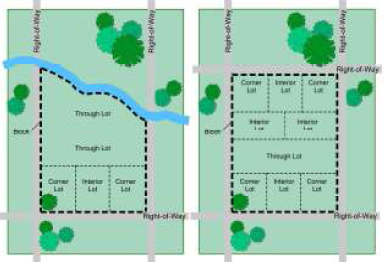
Lot: A contiguous area of land separated from other areas of land by separate description (including a recorded deed, a subdivision plat or record of survey map, or by metes and bounds) for purpose of sale, lease, transfer of ownership or separate use.
Lot Coverage: The area of a zoning lot occupied by the principal building and any accessory structures.
Lot Depth: The horizontal distance between the front and rear lot lines.
Lot Frontage: All property of a lot fronting on a street right-of-way or common, private drive, as measured between side lot lines.
Lot of Record: A lot which was lawfully created and is a part of a subdivision recorded in the office of the Clerk of the Court, or a parcel or lot described by metes and bounds, and a description of which has been so recorded.
Lot Width: The distance as measured between the side lot lines at the front set back line.
Lot, Buildable: Any lot upon which a building or structure is allowed to be constructed and occupied by the regulations of Clayton County. Generally, the lot shall have frontage on and access to an improved street, meet minimal setbacks, and have all necessary utilities available.
Lot, Corner: A lot situated at the intersection of two (2) streets or which fronts a street on two (2) or more sides forming an interior angle of less than one-hundred thirty-five (135) degrees.
Lot, Developed or Improved: A lot with buildings or structures.
Lot, Interior: A lot other than a corner lot with only one frontage on a street other than an alley.
Lot, Through: A lot fronting on more than one street, other than an alley, or abutting more than one street which do not intersect at the boundaries of the lot. Also includes lots fronting on both a street and a watercourse or lake.
Lowest Floor: The lowest of the following: (1) the top of the basement floor; (2) the top of the garage floor, if the garage is the lowest level of the building; (3) the top of the first floor of buildings elevated on pilings or constructed on a crawl space with permanent openings; or (4) the top of the floor level of any enclosure below an elevated building where the walls of the enclosure provide any resistance to the flow of flood waters unless: the walls are designed to automatically equalize the hydrostatic flood forces on the walls by allowing for the entry and exit of flood waters, by providing a minimum of two openings (in addition to doorways and windows) having a total area of one (1) square foot for every two (2) square feet of enclosed area subject to flooding. The bottom of all such openings shall be no higher than one (1) foot above grade; or such enclosed space shall be usable for the parking of vehicles and building access.
Luminairie: The complete lighting system including the lamp and light fixture.
Luminaire, Cut Off Angle: The angle, measured up from the nadir, between the vertical axis and the first line of sight at which the bare source is not visible.
Luminaire, Fully Shielded: A luminaire constructed or shielded in such a manner that all light emitted by the luminaire, either directly from the lamp or indirectly from the luminaire, is projected below the horizontal plane through the luminaire's lowest light emitting part as determined by photometric test or certified by the manufacturer.
Luminous Tube Lighting: Gas filled tubing which, when subjected to high voltage, becomes luminescent in a color characteristic of the particular gas used, e.g. neon, argon, etc.
Major Plat: The plat for a major subdivision.
Major Subdivision: See Subdivision, Major.
Maneuvering Space: An open space in a parking area which is immediately adjacent to a parking space; is used for and/or is necessary for turning, backing or driving forward a motor vehicle into such parking space, but is not used for the parking of or storage of motor vehicles.
Mansard: A steeply sloped, roof-like facade architecturally similar to a building wall.
Manufactured Home: A structure, used or intended to be used as a dwelling unit, transportable in one or more sections, which in the traveling mode is eight feet or more in width, or 40 feet or more in length, or, when erected on site, encloses 320 or more square feet of floor area; and which is built on a permanent chassis and designed to be used as a dwelling, with or without permanent foundation when connected to the required utilities, including the plumbing, heating, air conditioning and electrical systems contained therein. "Manufactured home" includes any structure that meets all of the requirements of this subsection except the size requirements and with respect to which the manufacturer voluntarily files a certification required by the Secretary of the United States Department of Housing and Urban Development and complies with the standards established under the National Manufactured Housing Construction and Safety Standards Act of 1974, 42 U.S.C. § 5401, et seq. For purposes of this ordinance, a "manufactured home" does not include a structure which otherwise complies with this subsection, but which was built prior to June 15, 1976, which units shall be classified as "mobile homes."
Manufactured Home Park: A parcel of land containing two (2) or more dwelling sites, with required improvements and utilities, that are leased for long term placement of Manufactured Home Dwellings, and shall include any street used or intended for use as part of the facilities of such Manufactured Home Park. A Manufactured Home Park does not involve sales of Manufactured Home Dwellings or Manufactured Home Dwellings in which unoccupied units are parked for inspection or sale.
Marina: A dock or basin providing secure moorings for pleasure boats and often offering supply, repair, and other facilities.
Marker (Survey): A stake, pipe, rod, nail, or any other object which is not intended to be a permanent point for record purposes.
Market Garden: A lot, or any portion thereof, managed and maintained by a person or group of persons for growing and harvesting, farming, community gardening, or any other use, which contributes to the production of agricultural, floricultural, or horticultural products for community supported agriculture or on-site sales. All products sold on-site must be grown on-site.
Massage Parlor: A facility whose principal business is to practice nonmedical or nonsurgical manipulative exercises or devise upon the human body manually or otherwise by any person other than a licensed physician, surgeon, dentist, occupational or physical therapists, chiropractor or osteopath with or without the use of therapeutic, electrical, mechanical or bathing devices. Massage parlors shall comply with regulations in Part I, Chapter 22, Article IV.
Massage Therapy: A therapy performed by a licensed massage therapist pursuant to the Georgia Massage Therapy Practice Act (O.C.G.A. § 43-24A-1 et seq.). Massage therapy shall comply with regulations in Part I, Chapter 22, Article IV.
Mature Tree: An existing hardwood, pine or other valuable tree that is at least four inches in diameter as measured four feet above grade and has attained the capability of flowering and reproducing.
Medical and Dental Offices, Clinics, and Physical Therapy Facilities: A health care facility in which a doctor, dentist, psychiatrist, psychologist, counselor, physician's assistant, nurse practitioner, or similar licensed medical provider treats or counsels patients. Also includes birthing centers and ambulatory surgical centers.
Mini-Warehouse/Self-Storage Facility: A building or portion thereof used for dead storage, mainly of the excess personal property of an individual or family, but also of small amounts of goods or merchandise for businesses or individuals.
Minor Plat: The plat for a minor subdivision.
Minor Subdivision: See Subdivision, Minor.
Mobile Home: See Dwelling, Mobile Home.
Mobile Home Park: See Manufactured Home Park.
Modular Home: See Manufactured Home.
Monopole: A single, freestanding pole-type structure supporting one or more telecommunications antenna.
Monument (Survey): A permanent physical structure which marks the location of a corner or other survey point.
Monument Sign: See "ground sign" under Freestanding Sign.
Motel: An establishment consisting of a group of attached or detached living or sleeping accommodations with bathroom and closet space, located on a single zoning lot, and designed for use by transient automobile tourists. A motel furnishes customary services such as maid service and laundering of linen, telephone, secretarial, or desk service, and the use and upkeep of furniture.
Motorized ATV/Off Road Vehicle or Motor Bikes: A motorized vehicle whose primary purpose and design is for usage other than transportation and generally off improved road surfaces. Also maybe referred to as not being street legal. Vehicles whose design and use are for use on challenging terrain and/or contests of speed and skill in adverse conditions. Examples but limited to; Dune Buggies, Motor Cross Bikes, Off-road motorcycles, Quad-runners, Three Wheelers.
Motor Home: See Recreational Vehicle.
Motor Vehicle: Any passenger vehicle, truck, tractor, tractor-trailer, truck-trailer, trailer, or semi-trailer propelled or drawn by mechanical power.
Mulch: A layer of wood chips, pine straw, hay or other material placed on the surface of the soil around plants to retain moisture, prevent weeds from growing, hold soil in place and aid in plant growth.
Multiple Family: See Dwelling, Multiple Family.
Municipal Solid Waste: Any solid waste derived from households as defined in O.C.G.A. 12-8-22.
Museum: An establishment serving as a repository for a collection of natural, scientific, technological, artistic or literary objects of interest, designed to be viewed by the public with or without an admission charge.
Music Studios: A facility maintained and equipped for sound recording and mixing for the purposes of producing a product for commercial consumption.
Natural Area: An area of natural vegetation that is generally undisturbed, un-maintained, and is self-perpetuating. It includes not only trees, but also native shrubs, ground covers, wildflowers, vines, and grasses.
Net Usable: That portion of land capable of being used after public right-of-way is excluded.
New Manufactured Home Park or Subdivision: Means a manufactured home park or subdivision for which the construction of facilities for servicing the lots on which the manufactured homes are to be affixed (including at a minimum, the installation of utilities, the construction of streets, and either final site grading or the pouring of concrete pads) is completed on or after the effective date of the Zoning Ordinance.
Nonconforming Building: A building, structure, or portion thereof, which was designed, erected, or structurally altered in accordance with the provisions of a current such that it does not conform to the regulations of the zoning district in which it is located.
Nonconforming Lot of Record: A lot that predates the zoning regulations and was created such that it does not conform to the regulations of the zoning district in which it is located.
Nonconforming Sign: A sign or portion thereof, which was designed, erected, or structurally altered such that it does not conform to the regulations of the zoning district in which it is located.
Nonconforming Use: A use of land, buildings, or structures which does not conform with the use regulations of the zoning district in which it is located.
Noxious Matter or Materials: Matter or materials that are capable of causing injury to living organisms by chemical reaction or is capable of causing detrimental effects upon the physical or economic well-being of individuals.
Nursery School, Kindergarten or Day Care Center: Any premises or portion thereof used for educational work or parental care of children of less than six years of age.
Nursing Home: A use in which domiciliary care is provided to 3 or more convalescing, chronically or terminally ill non-family members who are provided with food, shelter and care. This use shall not include hospitals, clinics or similar institutions devoted primarily to the diagnosis and treatment of the sick or injured. Convalescent Center, nursing home and personal care home are further distinguished in administrative and conditional use provisions.
Odorous Matter: Matter or material that yields an odor which is offensive in any way.
Office Park: A development on a tract of land in single ownership that contains a number of separate office buildings, as well as accessory and supporting uses, that is designed, planned, constructed, and managed on an integrated and coordinated basis.
Official Street Tree Planting Plan and Program: A plan and program developed by the County Arborist and adopted by the Board for the planting of trees along public streets, parks and other public places.
Official Zoning Map: A map of Clayton County, Georgia, that legally denotes the boundaries of zoning districts as they apply to the properties within the planning jurisdiction.
Off-site Improvements: Any premises not located within the area of the property to be subdivided, whether or not in the same ownership of the applicant for subdivision approval, upon which is located improvements required by or related to the property to be subdivided.
Open Sales Lot: Land used or occupied for the purpose of buying or selling merchandise stored or displayed out-of-doors. (Such merchandise includes, but is not limited to, passenger cars, trucks, motor scooters, motorcycles, boats, and monuments).
Open Space: An area of land not covered by buildings, parking structures, or accessory uses except for recreational structures. Open space may include nature areas; streams and flood plains; meadows or open fields containing baseball, football, and soccer fields, golf courses, swimming pools, bicycle paths, etc. Open Space does not include street rights-of-way, platted lot area, private yard, patio areas, or land scheduled for future development.
Outdoor Storage: See Storage, Outdoor.
Out Parcel: A lot which either temporarily cannot be built upon or is not intended for development and is intended only for aesthetics, safety, common use, or the public good. Out parcels are normally owned in common by individuals, adjoining property owners, or homeowners associations.
Overlay District: See Overlay Zone.
Overlay Zone: A zoning district that encompasses one or more underlying zones and that imposes additional requirements above that required by the underlying zoning district.
Overstory Tree: Trees which, at maturity, are generally greater than fifty feet at mature height comprise the canopy of a natural forest.
Owner: Any person, group, of persons, firm or firms, corporation or corporations, or any other legal entity having legal title to the land.
Parapet: Any low guarding wall at any point of a sudden drop, such as at the end of a terrace, roof, or balcony.
Parcel: See Lot.
Parking Space, Automobile: Space within a public or private parking area for the storage of one (1) passenger automobile or commercial vehicle under a one and one-half (1-1/2) ton capacity.
Particulate Matter: Dust, smoke, or any other form of air-borne pollution in the form of minute separate particles.
Paved: A durable surface for parking, driving, riding or similar activities that utilizes asphalt, concrete, brick, paving blocks or similar material. Crushed gravel, stone, rock, or dirt, sand or grass are not permitted as a paved surface.
Pawnbroker: One who lends money in exchange for personal property or title that can be sold if the loan is not repaid by a certain time.
Pawnshop: A pawnbroker's shop, especially one where unredeemed items are sold to the public.
Performance Surety: An amount of money or other negotiable security paid by the sub-divider, developer, or property owner or his surety to the County which guarantees that the sub-divider will perform all actions required by the County regarding an approved plat or other land development, and provides that if the sub-divider, developer, or property owner defaults and fails to comply with the provisions of approval, the sub-divider, developer, or property owner or his surety will pay damages up to the limit of the surety, or the surety will itself complete the requirements of the approval.
Permanent Foundation: A structural system for transposing loads from a structure to the earth at a depth below the established frost line without exceeding the safe bearing capacity of the supporting soil.
Person: A corporation, company, association, society, firm, partnership, organization, unit of government, or any other group that acts as a unit, as well as a natural person.
Personal Care Home: Any dwelling, whether operated for profit or not, which undertakes through its ownership or management to provide or arrange for the provision of housing, food service, and one or more personal services for two or more adults who are not related to the owner or administrator by blood or marriage. The term "personal care home" does not include buildings which are devoted to independent living units which include kitchen facilities in which residents have the option of preparing and serving some or all of their own meals, nor does it include halfway or transitional houses, residential treatment facilities, nursing homes, sanitariums, hospital or other institutional facilities, or rooming or boarding facilities which do not provide personal care.
For the purposes of these regulations personal care homes shall be classified as follows:
a.
A family personal care home shall be a personal care home for adults, in a family-type residence, non-institutional in character, which offers care to two through six persons.
b.
A group personal care home shall be a personal care home for adults, in a residence or other type building(s), non-institutional in character, which offers care to seven through 15 persons.
c.
A congregate personal care home shall be a personal care home for adults which offer care to 16 or more persons.
Petition: See Application.
Petitioner: A person submitting an application for a development permit or for the rezoning of land.
Personal Service Shop: Includes, but is not limited to, such uses as tanning establishment, massage therapy, acupuncture and day spa. Massage therapy shall comply with regulations in Part I, Chapter 22, Article IV.
Pharmacy: A store where medicinal drugs are dispensed and sold.
Photographic Studio: A facility specifically designed and built for the purpose of taking photographs.
Places of Worship: Any non-profit religious organization facility operated for worship or promotion of religious activities, including churches and other places of worship and classrooms for religious instruction, and accessory uses on the same site, including living quarters for clergy and child care facilities operated during services/events sponsored by the organization. Other establishments maintained by religious organizations, including fall-time educational institutions, daycares, hospitals and other potentially related operations (e.g., a recreational camp) are classified separately according to their respective activities.
Plan Book: A document submitted by the Applicant to the Zoning Administrator for all proposed development of new single family, two family, townhouse, condominium, and multiple family development. The documents shall includes, but are not limited to: allowable building elevations, design criteria applicable for entries, porches, doors, windows, dormers, columns, cornices, rakes, garages, roofs, landscaping, fencing, retaining walls, exterior colors and materials, and other pertinent information as required by the Zoning Administrator.
Planned Center: A single office, commercial, or industrial property or contiguous properties, planned, developed and managed as a unit for occupancy by five (5) or more principal businesses not sharing common space, that are separately owned and have no corporate relationship, such as a shopping center or office complex.
Planned Unit Development (PUD): A large-scale unified development meeting the requirements of the Zoning Ordinance. Generally a planned unit development consists of a parcel or parcels of land, controlled by a single landowner, to be developed as a single entity which does not correspond in size of lots, bulk or type of buildings, density, lot coverage, and required open space to the regulations established in any district of this Zoning Ordinance.
Planning Jurisdiction: The area that a governmental unit has planning authority as drawn by each community in compliance with O.C.G.A. § 36-66 and § 36-67. For the planning jurisdiction of Clayton County, see Jurisdiction Area.
Planning Office: The office of the Zoning Administrator and other professional planning staff within the Clayton County Department of Community Development.
Planting Season: The time period or season during which newly planted trees will have the best opportunity for survival, and consisting of that period from November 1st of any year to March 31st of the following year.
Plat: A map or chart that shows a division of land and is intended to be filed for record.
Plat, Final: The plan or map document of any subdivision in recordable form and any accompanying material as required by this Zoning Ordinance.
Plat, Preliminary: The plan or map upon which the approval of a proposed subdivision is based on as described in this Zoning Ordinance, indicating the proposed layout of the subdivision to be submitted to the Community Development Department for approval.
Porch: A roofed-over structure projecting out from the wall or walls of a main structure and commonly open to the weather in part.
Portable Sign: Any sign that is not permanently affixed to a building or other structure including but not limited to, signs mounted or painted on vehicles not used primarily for other purposes.
Post Development Conditions: The conditions that exist following the completion of the development activity in terms of topography, vegetation, land use and rate, volume and direction of stormwater runoff.
Poultry: See Chicken.
Practical Difficulty: A difficulty with regard to one's ability to improve land stemming from regulations of the Zoning Ordinance. A practical difficulty is not a "hardship," rather it is a situation where the owner could comply with the regulations within the Zoning Ordinance, but would like a variance from the Development Standards to improve his site in a practical manner.
Pre-Development Conditions: Those land use conditions that existed prior to the initiation of the development activity in terms of topography, vegetation, land use and rate, volume and direction of stormwater runoff.
Preliminary Plat: See Plat, Preliminary.
Primary Building/Structure: The building or structure in which the primary use of the lot or premises is located or conducted, with respect to residential uses, the primary building or structure shall be the main dwelling.
Primary Use: The main use of land or buildings as distinguished from an accessory use. A principal use may be either a permitted use or a conditional use.
Private Road: See Road, Private.
Private Tree: Any tree located on private property.
Professional Office: An office used by members of a recognized profession such as architects, artists, dentists, engineers, lawyers, musicians, physicians, surgeons or pharmacists, and Realtors or insurance agents and brokers.
Project Entrance Sign: A permanent freestanding sign located at a discernible entrance into a multi-family development; or at a discernible entrance into a development containing more than one principal building, such as a business center or office park; or into a development containing multiple lots, such as a particular residential, office, commercial or industrial subdivision.
Pruning: The elimination of live and dead branches from a tree's crown to improve tree structure, enhance vigor and maintain safety.
Public Improvements: Any storm drainage facility, street, highway, parkway, sidewalk, pedestrian-way, tree, lawn, off-street parking area, lot improvement, utility, or other facility for which the local government may ultimately assume the responsibility for maintenance and operation, or which may affect an improvement for which local government responsibility is established.
Public Tree: Any tree located on property belonging to the County.
Public Sewerage System: A community sewer system including collection and treatment facilities owned and maintained by a local government or an authority.
Public Street/Road: All property dedicated or intended for public highway, freeway, or roadway purpose and subject to public easements therefore.
Public Utility: Any person, firm, or corporation duly authorized to furnish under public regulation to the public, electricity, gas, steam, telephone, fiber optics, transportation, water, or sewerage systems.
Public Water System: A community water supply system including existing and new wells and/or surface water sources and intakes, treatment facilities, and distribution lines and includes such of the above facilities owned and maintained by a local government or an authority.
Public Works Agreement: A contract, between the developer and the County to complete the necessary improvements in accordance with the approved plans and specifications by a given date.
Public/Private Parking Area: A group of parking spaces in an open area not including any part of a street or alley, designed or used for temporary parking of motor vehicles.
Racetrack: Any venue for the sport of racing or competing where participants drive, ride, or control motorized vehicles. Racetrack includes, but is not limited to oval track racing, drag racing, motorcross, tractor pulling, go-carts racing, remote control airplane flying, and similar uses.
Rear Lot line: The lot line that is opposite the front lot line and farthest from it, except that for a triangular or other irregularly-shaped lot, the line ten feet long, parallel to the front lot line, and wholly within the lot, that is farthest from the lot line.
Rear Yard: The horizontal space between the nearest foundation of a building to a rear lot line and that rear lot line, extending to the side lines of the lot, and measured as the shortest distance from the foundation to the rear lot line. The rear yard of a corner lot shall be that yard at the opposite end of the lot from the front yard.
Recharge Area: Any portion of the earth's surface where water infiltrates into the ground to replenish an aquifer.
Recreational Vehicle: A vehicle which is built on a single chassis; 400 square feet or less when measured at the largest horizontal projections; designed to be self-propelled by a light duty truck; and designed primarily not for use as a permanent dwelling, but as quarters for recreational camping, travel, or seasonal use. A vehicle that is a temporary dwelling for travel, recreation and vacation use including but not limited to:
Travel Trailer: A vehicle identified by the manufacturer as a travel trailer, built on a chassis 8 feet or less wide and 30 feet or less long and designed to move on the highway.
Pick-Up Coach: A structure designed to be mounted on a truck chassis or cut-down car.
Motor Home: A self propelled vehicle with a dwelling constructed as an integral part of the vehicle.
Camping Trailer: A canvas, folding structure, built on a chassis with wheels and designed to move along the highway.
Tent: A collapsible shelter of canvas or other material stretched and sustained by poles and used for camping outdoors.
Recreational Vehicle Park: Any site, lot, field, of tract of land under single ownership, ownership of two or more people, owner occupied, or corporate ownership designed with facilities for short term seasonal or recreational, not for permanent year-round or family residency occupancy for recreational vehicles only.
Types of recreational vehicle parks:
Type 1: Transient over-night camping. Cater to traveling RV public where campers usually occupy sites for one to three nights.
Type 1a: Primitive unimproved camping. Sites generally without electric or water available except at central sites.
Type 2: Recreational/Seasonal Non Permanent camping - Lots rented for RV campers to remain on site all year round but which prohibit off season occupancy and is supervised by a RV park owner or manager who enforces occupancy restrictions. Individual lots are not subject to buildable lot and set back restrictions but the campground, taken as a whole, must comply with size restrictions listed for campgrounds.
Type 3: Owner occupied seasonal camping - Lots which are owned by individual RV owners and RV campers remain on-site all year round but which prohibit lots from being occupied during the off-season. The elected officers of an association of lot owners enforce occupancy restrictions. Individual lots are not subject to buildable lot and set back restrictions but the campground, taken as a whole, must comply with size restrictions listed for campgrounds.
Recycling Center: A lot of parcel of land, with or without buildings, upon which used house hold goods materials are separated and processed for shipment for eventual reuse in new products.
Registered Land Surveyor: A land surveyor properly licensed and registered through reciprocity permitted to practice in the State of Georgia.
Registered Professional Engineer: An engineer properly licensed and registered through reciprocity permitted to practice in the State of Georgia.
Regulatory Flood: The flood having a one percent probability of being equaled or exceeded in any given year, as calculated by a method and procedure which is acceptable to and approved by the Georgia Department of Natural Resources and the Federal Emergency Management Agency. The "Regulatory Flood" is also known by the term "Base Flood."
Regulatory Floodway: The channel of a river or stream and those portions of the flood plains adjoining the channel which are reasonably required to efficiently carry and discharge peak flow of the regulatory flood of any river or stream and, is that area covered by floodwaters in significant downstream motion or covered by significant volumes of stored water during the occurrence of the regulatory flood.
Replacement Tree: A new tree planted on a site to meet minimum site density factor requirements, regardless of whether trees existed prior to any development.
Replat/Resubdivision: Any change in a map of an approved or recorded subdivision plat.
Research, Experimental, or Testing Laboratories: A facility for scientific research, and the design, development and testing of computer software, and electrical, electronic, magnetic, optical and mechanical components in advance of product manufacturing, that are not associated with a manufacturing facility on the same site. Also includes chemical and biotechnology research, testing and development and materials and soils testing.
Residential District: Refers to the ER, RS-180, RS-110, RG, RM, and RMH zoning districts.
Residential Facility for the Development Disabled/Mentally Ill: A residential facility which provides residential services for persons with developmental disabilities or mental illnesses and such facility is licensed and regulated by the Georgia Department of Human Resources.
Residential Premises: All residential dwellings located within any type of zone, zoned area, zoning district, whether or not said areas or zones are residential, business, commercial or otherwise, within the geographical boundaries of the County.
Restaurant: Means a food serving establishment for the preparation, serving, and consumption on the premises of meals, which may include breakfast, lunch, or dinner. The establishment, including diners, coffee shops, cafeterias, cafes, luncheonettes, lunchrooms, catering establishments, and similar facilities by whatever name called shall have adequate kitchen and dining equipment.
Such establishments must have a minimum seating capacity of 50 in order to serve beer, wine and distilled spirits to be consumed on the premises as only incidental thereto.
The term shall not mean a "food sales establishment," as defined in the O.C.G.A. § 26-2-21, and which does not provide seating or facilities for consumption of food on the premises.
Restaurant, Drive-thru or Drive in: Any place or premises used for sale, dispensing or service of food, refreshment or beverages in automobiles, including those establishments where customers may eat or drink the food or beverage on the premises.
Rest Home: See Nursing Home.
Right-of-Way: A strip of land acquired by reservation, dedication, prescription, or condemnation, and intended to be occupied by a road, crosswalk, railroad, electric transmission lines, oil or gas pipeline, water line, sanitary storm sewer, and other similar uses.
Right-of-Way Width: The distance between property lines measured at right angles of the centerline of the street.
Right to Farm: The state law or local provision which protects farmers and farm operations from public and private nuisance lawsuits. A private nuisance interferes with an individual's use and enjoyment of the property. Public nuisances involve actions that injure the public at large.
Road/Street: Any vehicular route that: is an existing state, county, or municipal roadway; or is shown upon a plat approved pursuant to law; or is shown on a plat duly filed and recorded in the office of the county recording officer prior to the appointment of a planning board and the grant to such board to review plats; and includes the land between the street lines, whether improved or unimproved.
Road/Street Capacity: See Capacity, Roadway.
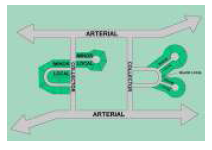
Road/Street, Arterial: A street with signals at important intersections and stop signs on the side streets and that collects and distributes traffic to and from collector streets.
Road/Street, Collector: A street designed to facilitate the collection of traffic from local streets and to provide circulation within neighborhood areas and convenient ways to reach arterial streets.
Road/Street, Dual: A street with opposing lanes separated by a median strip, center island, or other form of barrier, which cannot be crossed except at designated locations.
Road/Street, Expressway: A divided multi-lane major arterial street for through traffic with partial control of access and with grade separations at major intersections.
Road/Street, Freeway: A limited access highway with no grade crossings.
Road/Street, Local: A street designed to provide vehicular access to abutting property and to discourage through traffic.
Road/Street, Loop: A local street that has its only ingress and egress at two points on the same collector street.
Road/Street, Major/Primary Arterial: A street with access control, channelized intersections, restricted parking, and that collects and distributes traffic to and from minor arterials.
Road/Street, Minor/Secondary Arterial: A street with signals at important intersections and stop signs on the side streets and that collects and distributes traffic to and from collector streets.
Road/Street, Paper: A street that has never been built, shown on an approved plan, subdivision plat, tax map, or official map.
Road/Street, Private: Vehicular streets and driveways which are wholly within private property except where they intersect with other streets within public rights-of-way and are maintained by the owner(s), and a road/street that has not been accepted by the County or other governmental entity.
Road/Street, Public: All property dedicated or intended for public highway, freeway, or roadway purpose or subject to public easements therefore.
Road/Street, Service: A street running parallel to a freeway or expressway and serving abutting properties.
Roadside Stand: A structure for the display and sale of agricultural products, with no space for customers within the structure itself.
Rowhouse: A multi-family dwelling consisting of three or more attached dwelling units of similar or identical design, separated from others in a row by a vertical unpierced fire wall extending from the basement to the roof.
Satellite Dish/Antenna: An apparatus capable of receiving communications from a transmitter relay located in a planetary orbit, or broadcasted signals from transmitting towers.
School: A public or private institution which offers instruction in any of the branches of learning and study comparable to that taught in the public schools under the Georgia School Laws, including pre-kindergarten, kindergarten, elementary school, and junior and senior high schools, but excluding trade, business, or commercial schools.
Schools of Dance, Music or Similar Instruction: Instruction in dance, yoga, martial arts, music, or similar disciplines in a classroom or studio setting. This term does not include educational uses that are part of a college, university, seminary, primary or secondary school, trade school, or vocational school.
Scrap Metal Yard: A general industrial use established independent or ancillary to and connected with another general industrial use, which is concerned exclusively in new and salvaged metal pipes, wire, beams, angles, rods, machinery, parts, filings, clippings, and all other metal items of every type, and which acquires such items incidental to its connection with the other general industrial use or by purchase, consignment or bailment which stores, grades, processes, melts, cuts, dismantles, compresses, cleans, or in any way prepares said items for reuse by the connected other general industrial use or for storage, sale or shipment and use in other industries or businesses including open hearth, electric furnaces and foundry operations; such an establishment shall not include junk yards, dumps, or automobile graveyards.
Sedimentation: The process by which eroded material is transported and deposited by the action of water, wind, ice, or gravity.
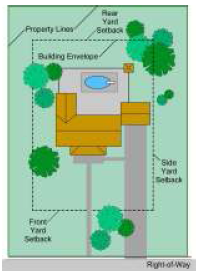
Service/Labor/Fraternal Organization Meeting Halls and Offices: permanent facility for organizations operating on a membership basis for the promotion of the interests of its members, including facilities for business associations; professional membership organizations; labor unions and similar organizations; civic and social organizations; political organizations, and other membership organizations. This term does not include outdoor firearm/archery ranges or adult entertainment establishments. Membership is not required for the rental of such facility.
Setback: The minimum horizontal distance between the wall of the building or foundation and a lot line or right-of-way.
Shrub: A woody plant, smaller than a tree, consisting of several small stems from the ground or small branches near the ground.
Shoulder: The portion of a street or road from the outer edge of the paved surface or back of curb to the right-of-way limit.
Shopping Center: A group of commercial establishments having a building composition that is an architectural unit and is not a miscellaneous assemblage of stores; planned, developed, analyzed as a unit, related in location, size and type of shops to the trade area that the unit serves, and providing on-site parking in definite relationship to the types and sizes of stores.
Side Lot line: A lot boundary line other than a front or rear lot line.
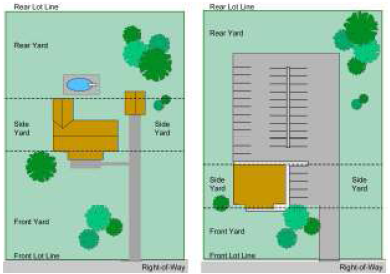
Side Yard: The horizontal space between the nearest foundation of a building to the side lot line and that side lot line, unoccupied other than by architectural appurtenances projecting not more than twenty-four (24) inches into that space; steps or terraces not higher than the level of the first floor of the building; and open lattice-enclosed fire escapes, fireproof outside stairways and balconies projecting not over twenty four (24) inches into that space.
Site Visibility Triangle: A triangular shaped portion of land established at street intersections in which nothing is erected, placed, planted, or allowed to grow in such a manner as to limit or obstruct the sight distance of motorists entering or leaving the intersection.
Site Development Plan (Site Plan): The plan indicating the location of existing and proposed buildings, structures, paved areas, walkways, vegetative cover, landscaping and screening within a site proposed for development which is to be submitted to the Community Development Department for approval prior to the release of improvement location permits on the site.
Small Box Discount Variety Store: A retail establishment with a floor area less than 12,000 square feet that offers for sale a combination and variety of convenience shopping goods and consumer shopping goods including household goods, personal care products, entertainment products, electronics, and other consumer products, including food or beverages for off-premise consumption, and that continuously offer a majority of the items in their inventory for sale at a price less than $10.00 per item. However, this definition does not include: (1) full service grocery stores; (2) retail stores (i) which do not sell items required to be sold in a Full Service Grocery Store; (ii) which are located within a permitted Shopping Center that contains not less than 75,000 square feet of retail space, and (iii) which are located within a Shopping Center that has been operating as a permitted Shopping Center in Clayton County for a period of not less than twenty (20) consecutive years; (3) convenience stores which also sell gasoline as part of a service station; (4) beauty supply stores; (5) art supply stores; (6) office supply stores; (7) small retail stores typically less than 5,000 sq. ft. which are housed inside office buildings.
Small Maturing Tree: A tree species that shall be a minimum of five (5) feet in height and have a caliper of at least one and one-half inches immediately after planting. These species shall have an average mature crown spread of at least fifteen (15) feet and a height of twenty-five (25) feet when grown.
Smoking Bar: An establishment that occupies exclusively an enclosed indoor space and that primarily is engaged in the retail sale of tobacco products for consumption by customers on the premises; derives revenue from the sale of food, alcohol or other beverages that is incidental to the sale of the tobacco products; prohibits entry to a person under the age of 18 years of age during the time when the establishment is open for business; prohibits any food or beverage not sold directly by the business to be consumed on the premises; maintains a valid permit for the retail sale of tobacco products as required to be issued by the appropriate authority in the city or town where the establishment is located; and, maintains a valid permit to operate a smoking bar issued by the department of revenue.
Solid Waste: Any garbage or refuse as defined in O.C.G.A. 12-8-22.
Solid Waste Handling: The storage, collection, transportation, treatment, utilization, processing, or disposal of solid waste, or any combination of such activities as defined in O.C.G.A. 12-8-22.
Sound Level Meter: An instrument standardized by the American Standards Association for measurement of the intensity of sound.
Special Flood Hazard Area: Those lands within the jurisdiction of Clayton County that is subject to inundation by the regulatory flood. The SFHA's of the County are generally identified as such on the Flood Insurance Rate Map of the County prepared by the Federal Emergency Management Agency.
Special Event Facility: A building used as a customary meeting or gathering place for personal social engagements or activities, where people assemble for parties, weddings, wedding receptions, reunions, birthday celebrations, corporate events, other business purposes, or similar such uses, in which food and beverages may be served to guests. This definition shall not include places of worship.
Specimen Tree: Any tree determined by the County Arborist to be of notable historic interest, high aesthetic value or of unique character because of species, type, age, size, location or health. See Appendix B of Article 14, Tree Protection [Section 86-71 of this Code].
Stable, Private: A building or structure which is located on a lot on which a dwelling is located, and which is designed, arranged, used, or intended to be used for housing saddle horses, ponies, mules, or other draught animals primarily for the use of occupants of the dwelling, but in no event for hire. Horses shall be subject to the animal unit/acreage restrictions for the available pasture space, as defined within the Agricultural zoning district.
Stable, Public: A stable other than a private stable which is used to house horses, ponies, mules or other draught animals on a pay-for-services, for-profit basis.
Stabilization: The process of establishing an enduring cover of vegetation by the installation of temporary or permanent structures for the purpose of reducing to a minimum the erosion process and the resultant transport of sediment by wind, water, ice or gravity.
Storage, Outdoor: The outdoor accumulation of goods, junk, cars, busses, tractor trailers, railroad cars, equipment, products, or similar materials for permanent or temporary holding.
Story: That portion of a building included between the surface of any floor and the surface of the floor next above it, or if there be no floor above it, then the space between the floor and the ceiling next above it. Any portion of a story exceeding fourteen (14) feet in height shall be considered as an additional story for each fourteen (14) feet or fraction thereof. A basement having more than one-half the clear floor-to-ceiling height above grade shall be considered a "story."
Story, Half: A space under a sloping roof which has the line of intersection of roof decking and wall, not more than three (3) feet above the top level of the story below. In such space, not more than sixty (60) percent of the floor area is completed for a principal or accessory use)
Street: See Road/Street.
Street Grade: The grade of the centerline of a street measured at any point along the street expressed as a percent.
Street Tree: Any existing tree or any tree to be planted on the street right-of-way.
Structural Alteration: A change, other than incidental repairs, which would prolong the life of the supporting members of a building, such as the addition, removal, or alteration of bearing walls, columns, beams, girders, or foundations. Also, substantial roofing and siding work when repairs are made to the structure beneath.
Structure: A composition of materials to form a construction for use, occupancy, or orientation whether installed on, above, or below the surface of land or water.
Structure Height: The vertical distance of a structure measured from the average elevation to the finished grade surrounding the structure of the highest point of the structure.
Sub-Divider: A person, individual, firm, partnership, association, corporation, estate, or trust, or any other group or combination acting as a unit, dividing or proposing to divide land so as to constitute a subdivision, as herein defined, including any agent of the sub-divider.
Subdivision: The division of a lot, tract or parcel of land into two (2) or more lots, parcels, sites or other divisions of land for the purpose, whether immediate or future, of transfer of ownership or for building development. It includes resubdivision and relates to the process of resubdividing or to the land or territory subdivided.
Subdivision, Major: All subdivisions not classified as minor subdivisions, including, but not limited to, subdivisions of five (5) or more lots, or any size subdivision requiring any new street, public or private.
Subdivision, Minor: A division of land into not more than four (4) lots, provided:
1.
A minor subdivision does not require the construction of any public improvements including street, sidewalks, sewer or water lines and street trees.
2.
All lots and any remaining tract shall be consistent with all applicable requirements of the Clayton County Zoning Ordinance, including lot size, setbacks, frontage on a public road, width to depth ratio, and lot width.
3.
At the time of filing, the property owner shall be required to show all possible lots which are permitted to be created through minor subdivision provisions of this Ordinance.
4.
All driveway permits shall be subject to the review of the Clayton County Department of Transportation and Development or the State of Georgia Department of Transportation.
Subdivision, Non-Residential: A subdivision whose intended use is other than residential.
Support Structure: A structure designed and constructed specifically to support an antenna array. This includes, but is not limited to, a monopole, self-supporting tower, and guy wire-support tower. A support structure does not include any device that is used to attach a wireless communication facility to a building or structure.
Surety: An amount of money or other negotiable security paid by the sub divider, developer, or property owner or his surety to the County which guarantees that the sub divider will perform all actions required by the County regarding an approved plat or in other situations, and provides that if the sub-divider, developer, or property owner defaults and fails to comply with the provisions of his approval, the sub divider, developer, or property owner or his surety will pay damages up to the limit of the bond, or the surety will itself complete the requirements of the approval.
Swimming Pool: A structure having a self-contained body of water at least eighteen (18) inches deep and eight (8) feet in diameter or width and used for recreational purposes. It may be above or below ground level, and shall be considered an accessory structure/use.
Tattoo Parlors, Body Art Studios, or Piercing Studios: Any establishment whose principal business activity, either in terms of operation or as held out to the public, is performing the practice of physical body adornment by using the techniques of body piercing and tattooing. The definition does not include ear piercing or body painting with pigments that are temporary in nature.
Tanning Studio: Any establishment that offers artificial tanning services to customers, primarily through the use of ultraviolet (UV) tanning beds, booths, or spray-on tanning solution.
Temporary Use/Structure: A land use or structure established for a limited and fixed period of time with the intent to discontinue such use or structure upon the expiration of the time period.
Temporary Wireless Telecommunications Facility: A portable wireless communication facility that lacks a permanent foundation and is used for a limited period while a permanent facility is under construction, under repair or during a special public event or emergency. Also called a Cell on Wheels (COW).
Tenant: A natural person, business or other entity that occupies land or buildings by ownership, under a lease, or through payment of rent; an occupant, inhabitant, or dweller of a place.
Theater: A facility for audio and visual productions and performing arts, excluding adult motion picture theaters and adult entertainment businesses.
Timber Harvesting: A timber management activity as part of a demonstrated ongoing agricultural land use. See Appendix C of Article 14, Tree Protection (Section 86-72 of this Code].
Tobacco and Vape Shops: Any business premises dedicated to the display, sale, distribution, delivery, offering, furnishing, or marketing of tobacco, tobacco products, or instruments, and vapor products including cigar stores, cigarette stands, permanent & temporary, smokers' supply stores, and tobacco stores, e-cigarette stores, electronic cigarette stores, vape shops, or any combination thereof. Tobacco, electronic cigarette, and other smoking supplies retailers shall not include any grocery store, supermarket, convenience store, or similar retail use that only sells conventional cigars, cigarettes, vapor products, or tobacco as an ancillary sale, no more than two percent of its gross floor area, or 200 square feet, whichever is less.
Topping: The severe cutting back of branches to a stub, bud, or a lateral branch not large enough to assume the terminal role.
Towing or Wreckage Service: A business engaged in offering a service whereby disabled motor vehicles are towed or otherwise removed from the place where they are disabled by use of a wrecker so designed for that purpose or by a truck, automobile, or other vehicle so adapted to that purpose.
Townhouse: A multi-family dwelling consisting of three or more attached dwelling units, separated from others by a fire rated wall extending from the basement to the roof, each of which has primary ground floor access to the outside.
Toxic Chemical: Any chemical deemed by the County Arborist to be damaging to the tree or the soil on public lands. A written list of chemicals deemed as such shall be made publicly available and maintained by the County Arborist with review by the Tree Commission.
Tractor Trailer Drop Lot: Property used solely for the temporary placement of tractor trailers where no structure is located on the premises.
Tractor Trailer Storage: Property used for the long term controlled storage of tractor trailers which include permanent office or security facilities.
Tractor, Truck parking: A location where primarily trucks, tractors, tractor-trailers, truck-trailers, trailers, or semi-trailers are parked.
Trailer: Trailers designed for human dwellings can be divided into RV or mobile homes. To be classified as a RV trailer it must be less than 400 sq. ft. and a trailer of 400 sq. ft. or more is classified as a mobile - single wide. Trailers used for construction or sales offices should not be considered the same as RV or as mobile homes. Also transport trailers used for storage or are abandoned present a different set of issues.
Transportation Improvement Plan (TIP): An annual document prepared by the Clayton County Board of Commissioners indicating local and state transportation projects which are planned for the following three (3) year period.
Transportation Level of Service Standards: A measure that describes the operational condition of the travel stream and acceptable adequacy requirements. Such standards may be expressed in terms such as speed and travel time, freedom to maneuver, traffic interruptions, comfort, convenience, geographic accessibility, and safety.
Tree: Any living, self-supporting woody or fibrous plant which normally obtains a diameter breast height of at least three (3) inches, and typically has one (1) main stem or trunk and many branches.
Tree Bank: A site such as a school or public park, where the owner/developer shall donate and plant the required trees when it is not feasible to plant the required trees within their site's project area.
Tree Bank Fund: A fund created to receive and hold monies paid by tree removal permit holder(s) in lieu of relocating or replacing trees when it is not feasible or desirable to do so on or off-site.
Tree Density Standard (TDS): The minimum number of Tree Density Units per acre which must be achieved on a property.
Tree Density Unit (TDU): A credit assigned to a tree, based on the basal diameter of the tree, in accordance with tables contained in Appendix D.
Tree Master Plan: A plan prepared by the County Arborist that guides the care, preservation, pruning, planting, replanting, removal, or disposition of trees on public lands.
Tree Permit: Consent given in writing by the County Arborist to a person, private firm or agency to maintain, remove or do any work requiring a permit involving any tree within the public right-of-way or other public property.
Tree Planting List: The recommended species of trees listed in Appendix A.
Tree Planting Standards and Specifications: The design standards and specifications adopted for the planting or maintenance of trees.
Tree Protection or Planting Plan: A plan that identifies tree protection areas where existing trees are to be protected and preserved, and replacement trees planted on a property to meet minimum requirements, as well as methods of tree protection to be undertaken on the site and other pertinent information.
Tree Protection Area (TPA): Any portion of a site wherein are located existing trees which are proposed to be preserved in order to comply with applicable requirements of these land development regulations, and shall include nothing less than the total area of the CRZ of the tree or group of trees collectively.
Tree Preservation Area: The total critical root zone surrounding a preserved or planted tree or trees that is essential to that tree's health and survival, and is protected within the guidelines of this Article.
Tree Removal: Any act which causes a tree to die within two (2) years after commission of the act, including but not limited to damage inflicted upon the root system in the critical root zone or trunk as the result of:
1.
The improper use of machinery on the trees;
2.
The storage of materials in or around the trees;
3.
Soil compaction;
4.
Altering the natural grade to expose the roots or to cover the tree's root system with more than four (4) inches of soil;
5.
Causing the infection or infestation of the tree by pests, fungus or harmful bacteria;
6.
Pruning judged to be excessive by the administrator or not in accordance with the standard set forth by the International Society of Arboriculture (ISA);
7.
Removal of more than twenty (20) percent of the critical root zone;
8.
Paving with concrete, asphalt or other impervious surface within such proximity as to be harmful to the tree or its root system; and
9.
The application of herbicides or defoliants to any tree without first obtaining a permit.
Tree Replacement Area: The area designated for a tree or trees to be planted in order to meet tree density requirements.
Tree Save Area: All areas designated for the purpose of meeting tree density requirements, saving natural trees, and/or preserving natural buffers.
Tree Thinning: The selective cutting or thinning of trees only for the clear purpose of good forestry management in order to protect said forest from disease or infestation and in no way shall be construed as including clear cutting.
Truck Sales: The sale of vehicles primarily designed to carry cargo and material.
Truck Stop: Any building, premises, or land in which or upon which a business, service, or industry involving the maintenance, servicing, storage, or repair of commercial vehicles is conducted or rendered, including the dispensing of motor fuel or other petroleum products directly into motor vehicles and the sale of accessories or equipment for trucks and similar commercial vehicles. A truck stop also may include overnight accommodations and restaurant facilities primarily for the use of truck crews.
Truck Terminals: Land and buildings used as a relay station for the transfer of a load from one vehicle to another or one party to another. The terminal facility may include storage areas for trucks and areas for the repair of trucks associated with the terminal.
Trucking Facility: Property used for reoccurring trucking operations, including storage of trucks and trailers. A trucking facility may include offices, dispatch facilities, areas for refueling and routine maintenance of company owned trucks and vehicles. No warehousing or cross dock facilities are located on the premises.
Two-Page Layout: The layout accompanying each zoning district in Article 3 of the Zoning Ordinance. The two-page layout includes permitted uses, conditional uses, and basic zoning district information.
Undisturbed Vegetation: The natural vegetation in a generally untouched, maintenance free, self-perpetuating stand comprised of indigenous trees, shrubs, herbs, shrubs, herbs, flowers or grasses.
Understory Tree: Trees which, at maturity, comprise the sub-canopy of a natural forest. These are generally twenty (20) to forty (40) feet at mature height.
Urban Garden: A lot, or any portion thereof, managed and maintained by a person or group of persons, for growing and harvesting, farming, community gardening, or any other use, which contributes to the production of agricultural, floricultural, or horticultural products for beautification, education, recreation, community use, consumption, off-site sale, or off-site donation. No on-site sales are permitted.
Urban Village: an area established to create a sense of place for the arts and entertainment.
Use: The purposes of which land, building, or structure thereon is designed, arranged, or intended, or for which it is occupied, maintained, let, or leased.
Use, Principal: The main use of land or buildings as distinguished from a subordinate or accessory use. (May be either "permitted" or "conditional")
Use, Permitted: A use which may be lawfully established in a "particular district or districts, provided it conforms to all requirements, regulations, and performance standards, if any, of such district.
Vapor Product: Any noncombustible product containing nicotine that employs a heating element, power source, electronic circuit, or other electronic, chemical, or mechanical means, regardless of shape or size that can be used to produce vapor or aerosol from nicotine or other substances in a solution or other form. Such term vapor product shall include, but shall not be limited to, any electronic cigarette, electronic cigar, electronic cigarillo, electronic pipe, or similar product or device and any vapor or aerosol cartridge or other container of nicotine or other substance in a solution or other form, including, but not limited to, a device component, part, or accessory of the device, that is intended to be used with or in an electronic cigarette, electronic cigar, electronic cigarillo, electronic pipe, or similar product or device.
Variance, Development Standards: A specific approval granted by a Board of Zoning Appeals in the manner prescribed by the Zoning Ordinance, to deviate from the development standards that the Ordinance otherwise prescribes.
Vehicle: A device used as a mode of transportation of persons and/or goods including but not limited to automobiles, semi-tractor trailers, all types of trailers, snowmobiles, recreational vehicles, motorcycles and like devices.
Vehicle, Inoperable: A vehicle which due to mechanical defect or failure or incorrect or unapparent licensing is not physically or legally or legally able to be operated.
Wall Sign: See Building Sign.
Warehousing and Distribution Centers: Land and building facilities engaged in storage, wholesale and distribution of manufactured products, supplies and equipment.
Wetland: An area that is inundated or saturated by surface or ground water at a frequency and duration that under normal circumstances supports a prevalence of hydrophytic vegetation.
Wholesale Establishment: A business establishment engaged in selling to retailers or jobbers rather than consumers.
Window Sign: See Building Sign.
Wireless Communications: Personal wireless services as defined in 47 U.S.C. § 332(7)(C) (the "Telecommunications Act of 1996"). This includes FCC licensed commercial wireless telecommunications services, including cellular, personal communication services (PCS), specialized mobile radio (SMR), enhanced specialized mobile radio (ESMR), paging, and similar services that currently exist.
Wireless Telecommunications Facility: Any unmanned facility established for the purpose of providing wireless transmission of voice, data, images or other information including, but not limited to, cellular telephone service, personal communications service (PCS), and paging service. A Telecommunication Facility can consist of one or more Antennas and Accessory Equipment or one base station.
Yard: An open space on the same lot with a building or structure, unoccupied and unobstructed from the general ground level to the sky, except as otherwise permitted. (a "yard" extends along a lot line, and to a depth or width specified in the yard requirements for the zoning district in which such lot is located).
Yard, Front: A yard extending along the full length of the front lot line between the side lot lines.
Yard, Rear: A yard extending along the full length of the rear lot lien between the side lot lines.
Yard, Side: A yard extending along a side lot line from the front yard to the rear yard.
Yard, Corner Side: A side yard which adjoins a public street, road, or highway.
Yard, Interior Side: A side yard which is located immediately adjacent to another lot or to an alley separating such side yard from another lot.
Yard, Transitional: A yard which must be provided on a lot in a Business District which adjoins a lot in a Residential District, or a yard which must be provided on a lot in a Manufacturing District which adjoins a lot in either a Residential or Business District.
Zoning Administrator: The Director of Community Development or such person appointed by the Director of Community Development having the duties and responsibilities set forth within the Ordinance.
Zoning Advisory Group: The advisory body appointed by the governing body of Clayton County under the procedures contained in the Zoning Ordinance.
Zoning District: See District.
Zoning Map: See Official Zoning Map.
Zoning Ordinances: an ordinance or resolution of a local government establishing procedures and zones or districts within its respective territorial boundaries which regulate the uses and development standards of property within such zones or districts. The term also includes the zoning map adopted in conjunction with a zoning ordinance which shows the zones and districts and zoning classifications of property therein." O.C.G.A. § 36-66-3.
Zero Lot Line: The location of a building on a lot in such a manner that one or more of the building's sides rest directly on a lot line.
(Ord. No. 08-221, § 1, 12-2-08; Ord. No. 2013-52, § 1, 2-19-13; Ord. No. 2015-135, § 1, 5-19-15; Ord. No. 2016-47, § 1, 3-1-16; Ord. No. 2017-41, § 1, 5-30-17; Ord. No. 2018-97, Pt. I, § 1, 10-16-18; Ord. No. 2018-130, §§ 11(1), 13, 12-18-18; Ord. No. 2020-48, § 1, 3-17-20; Ord. No. 2021-55, § 1, 3-16-21; Ord. No. 2021-56, § Pt. I(§§ 1, 2), 3-16-21; Ord. No. 2021-196, Pt. I(§ 1), 9-21-21; Ord. No. 2022-174, § 1, 8-16-22; Ord. No. 2022-277, § 1, 12-20-22; Ord. No. 2022-279, § 1, 12-20-22; Ord. No. 2023-15, pt. II, 1-17-23; Ord. No. 2023-85, § 1, 4-18-22; Ord. No. 2023-210, § 1, 9-19-23; Ord. No. 2023-211, § 1, 9-19-23; Ord. No. 2024-135, § 1, 5-21-24; Ord. No. 2024-196, § 1, 8-20-24; Ord. No. 2026-116, § 1, 5-19-26)
Sec. 1.6 - Compliance.
No structure shall be located, erected, constructed, reconstructed, moved, altered, converted, or enlarged; nor shall any structure or land be used or existing use be expanded, except in full compliance with all provisions of this Ordinance and after the lawful issuance of all permits and certificates required by this Ordinance.
Sec. 1.7 - Severability.
If any provision of this Ordinance or the application of any provision to particular circumstances is held unconstitutional or invalid by the courts, the remainder of the Ordinance or the application of such provision to other circumstances shall not be affected.
Sec. 1.8 - Interpretation.
The provisions of this Ordinance shall be held to be minimum requirements for the protections of the health, safety, and general welfare of the people at large, and are designed to encourage the establishment and maintenance of reasonable community standards for the physical environment. If two or more provisions within this Ordinance are in conflict or are inconsistent with one another, then the provision which is most restrictive shall control.
Sec. 1.9 - Jurisdiction.
This Ordinance shall apply to the entire unincorporated limits of Clayton County, Georgia.
Sec. 1.10 - Application.
When this Ordinance along with private covenants, private contracts, commitments, permits, agreements, state laws, federal laws or other regulations regulates a structure or parcel of land, the greater restriction shall control. In no instance shall this Ordinance be interpreted as altering or negating any other applicable regulations.
Sec. 1.11 - Saving Provision.
This ordinance shall not be construed as eliminating or reducing any action now pending under, or by virtue of, an existing law or previous Zoning Ordinance. Also, this Ordinance shall not be construed as discontinuing, reducing, modifying or altering any penalty accruing or about to accrue.
Sec. 1.12 - Repealer.
The Clayton County Zoning Ordinance dated October 6, 1987, and its associated Zoning Map and any revisions are hereby repealed. In the event all of this Ordinance is struck down as void, unconstitutional or invalid, including therefore this provision, that prior ordinances shall be considered to not have been repealed, and shall therefore still be in effect.
Sec. 1.13 - Transition Rules.
A.
Any application for a Building Permit that has been filed with the Department of Community Development or its designees and is full and complete, prior to the effective dates of this Ordinance, shall be regulated by the terms and conditions of the Zoning Ordinance that was in place at the time of filing. However, all administrative procedures and penalties shall follow those set forth by this Zoning Ordinance.
B.
Any application for a Zoning Map Amendment that was filed with the Department of Community Development or its designees, and is full and complete prior to the effective date of this Ordinance, shall continue through the process to completion pursuant to the terms and conditions of the Zoning Ordinance that was in place at the time of filing. However, if the proposed use would no longer be permitted in the proposed zoning district or the proposed zoning district no longer exists in this Ordinance, the Zoning Administrator shall amend the application such that the request for rezoning would accomplish the same end goal for the applicant.
C.
Any application before the Board of Commissioners, Zoning Advisory Group, or Board of Zoning Appeals (i.e. conditional use, development standards variance, land use amendment) that has been filed with the Department of Community Development or its designees and is full and complete, prior to the effective date of this Ordinance, shall continue the process pursuant to the terms and conditions of the Zoning Ordinance that was in place at the time of filing, provided that:
1.
If such application is no longer required by the terms of this Ordinance, the application will be dismissed; or,
2.
If the proposed use or development requires additional approvals from the Board of Commissioner, Zoning Advisory Group, or Board of Zoning Appeals pursuant to the terms of this Ordinance that were not required under the previous Ordinance, the application will be amended to include only those additional approvals that are now required and within the jurisdiction of the Board of Commissioners.
D.
Permits.
1.
All Building Permits issued prior to the effective date of this Ordinance shall be void 1 year after their date of issue if construction has not begun.
2.
Building Permits issued prior to the effective date of this Ordinance for which construction has begun shall become void if construction is abandoned for a period of 6 consecutive months or if, in the opinion of the Zoning Administrator, construction has otherwise ceased.
3.
All approvals which expire and/or become void shall comply with all applicable provisions of this Ordinance if re-issued.
Sec. 1.14 - Amendments.
A.
In accordance with the State of Georgia, O.C.G.A. § 36-66-4, the Board of Commissioners may amend or partially repeal the text of this Ordinance or they may amend the Official Zoning Map of this Ordinance as follows:
1.
The Board of Commissioners or the Zoning Advisory Group may initiate a proposal to amend or partially repeal the text according to the procedure of the State of Georgia and according to the Board of Commissioners Rules and Procedures.
2.
The Board of Commissioners, Zoning Advisory Group, or at least fifty (50) percent of the affected property owners may initiate an application to change the Official Zoning Map according to the procedure of the State of Georgia and according to the Board of Commissioners Rules and Procedures.
B.
In its review of the text and zoning map amendments, the Zoning Advisory Group and Board of Commissioners shall pay reasonable regard to:
1.
The most recently adopted Comprehensive Plan;
2.
Current conditions and the character of structure and uses in each district;
3.
The most desirable use for which the land in each district is adapted;
4.
The conservation of property values throughout the jurisdiction;
5.
Responsible development and growth; and
6.
The public health safety and welfare.
Sec. 1.15 - Repealer.
Should any section or provision of this Ordinance be declared by the courts to be unconstitutional or invalid, such declaration shall not affect the validity of the Ordinance as a whole or any part thereof other than the part so declared to be unconstitutional or invalid. It is the intent that any provision declared unconstitutional shall be severed from the Ordinance, and that the remainder of the Ordinance remain in effect.

