
Clute City Zoning Code
ARTICLE XVIII
- DEFINITIONS
Sec. 18.1. - Schedule.
For the purposes of this ordinance, certain terms or words used herein shall be interpreted as follows:
The word "person" includes a firm, association, organization, partnership, trust, company, or corporation, as well as an individual person, firm, or corporation.
The present tense includes the future tense, the singular number includes the plural, and the plural number includes the singular.
The word "shall" is mandatory; the word "may" is permissive.
The words "used" or "occupied" include the words "intended," "designed," or "arranged to be used or occupied."
The word "lot" includes the words "plot" or "parcel."
Accessory use or structure: A use or structure on the same lot with and of a nature customarily incidental and subordinate to, the principal use or structure.
Administrative official: The city manager or his designated official.
Automotive repair yard: Any tract or parcel of land whereon three or more automotive vehicles, including but not limited to autos, trucks, tractor-trailers and buses, are kept in compliance with the applicable requirements of all other ordinances of the city for the purpose of repairing such automotive vehicles.
Automotive storage yard: Any tract or parcel of land forming no part of an automotive repair yard or automotive wrecking and storage yard used by a wrecker company exclusively for the storage of vehicles in compliance with the applicable requirements of all other ordinances of the city and such automotive storage yard is surrounded by a solid fence or wall satisfying the requirements of such other ordinances.
Automotive wrecking and salvage yard: Any tract or parcel of land whereon three or more discarded, abandoned, junked, wrecked or work[n]-out automotive vehicles, including, but not limited to autos, trucks, tractor-trailers and buses, are kept or stored in compliance with the applicable requirements of all other ordinances of the city for the primary purpose of disassembling, dismantling, cutting up, stripping or otherwise wrecking such automotive vehicles to extract therefrom parts, components or accessories for sale of or use in an automotive repair or rebuilding business.
Base flood: A flood which is representative of large floods known to have occurred generally in the area and reasonably characteristic of what can be expected to occur. The base flood generally has a flood frequency of approximately 100 years as determined from an analysis of floods at a particular coastal site and other sites in the same general region.
Base flood elevation: Elevation of the base flood as determined by the flood insurance study for the City of Clute, Brazoria County, Texas.
Buildable area: The portion of a lot remaining after required yards have been provided.
Building: Any structure having a roof supported by columns or walls, used or intended to be used for shelter or the enclosure of persons, animals or property.
Construction site building. A commercial structure that is not open to the public and that is used temporarily for any purpose at a commercial site by a person constructing a building, road, bridge, utility or other infrastructure or improvement to real property.
Drive-in restaurant or refreshment stand: Any place or premises used for sale, dispensing, or serving of food, refreshments, or beverages in automobiles, including those establishments where customers may serve themselves and may eat or drink the food, refreshments, or beverages on the premises.
Dwelling, conventional: A single-family dwelling structure constructed of all customary materials of construction so as to conform to the Standard Building Code with the following exceptions:
(1)
Galvanized sheet metal;
(2)
Corrugated tin;
(3)
Transite; and
(4)
Wooden shingles are not permitted.
Provided however galvanized sheet metal or corrugated tin may be used if the conform to the Standard Building Code class 4 construction and if there is filed with the building official a certificate issued by a registered professional engineer licensed to practice in Texas, to which are affixed his signature and seal, certifying that the building or structure as so constructed meets the wind load requirements of the Standard Building Code for coastal regions.
Dwelling, multiple-family: A residential building designed for or occupied by three or more families, with the number of families in residence not exceeding the number of dwelling units provided.
Dwelling, single-family: A detached residential dwelling unit designed for and occupied by one family only.
Dwelling, townhouse: means A residential structure containing more than one dwelling unit built on separate lots, having separate exterior walls but a common roof and separate outside entrances.
Dwelling, two-family: A detached residential building containing two dwelling units, designed for occupancy by not more than two families.
Dwelling unit: One room, or rooms connected together, constituting a separate, independent housekeeping establishment for owner occupancy, or rental or lease on a weekly, monthly, or longer basis, and physically separated from any other rooms or dwelling units which may be in the same structure, and containing independent cooking and sleeping facilities.
Elevation: The height above mean sea level as determined by "The Flood Insurance Study for the City of Clute, Texas," dated December 1, 1983, and any revisions thereto, which are hereby incorporated by reference and declared to be a part of this ordinance.
Family: One or more persons occupying a single dwelling unit, provided that unless all members are related by blood or marriage, or legally adopted, no such family shall contain over five persons, but further provided that domestic servants employed on the premises may be housed on the premises without being counted as a family or families.
Filling station: An establishment for the retail sale of gas and oil.
Flood:
(a)
A general and temporary condition of partial or complete inundation of normally dry land areas from:
(1)
The overflow of inland or tidal waters; or
(2)
The unusual and rapid accumulation or runoff of surface waters from any source; or
(b)
The collapse or subsidence of land along the shore of a lake or other body of water as a result of erosion or undermining caused by waves or currents of water exceeding anticipated cyclical levels or suddenly caused by an unusually high water level in a natural body of water, accompanied by a severe storm, or by an unanticipated force of nature, such as flash flood or an abnormal tidal surge, or by some similarly unusual and unforeseeable event which results in flooding as defined in paragraph (a)(1) of this definition.
Home occupation: An occupation conducted in a dwelling unit, provided that:
(a)
No person other than members of the family residing on the premises shall be engaged in such occupation.
(b)
The use of the dwelling unit for the home occupation shall be clearly incidental and subordinate to its use for residential purposes by its occupants, and not more than 25 percent of the floor area of the dwelling unit shall be used in the conduct of the home occupation.
(c)
There shall be no change in the outside appearance of the building or premises, or other visible evidence of the conduct of such home occupation other than one (1) sign, not exceeding one (1) square foot in area, nonilluminated, and mounted flat against the wall of the principal building.
(d)
No home occupation shall be conducted in any accessory building.
(e)
There shall be no sales of goods or commodities in connection with such home occupation.
(f)
No traffic shall be generated by such home occupation in greater volumes than would normally be expected in a residential neighborhood, and any need for parking generated by the conduct of such home occupation shall be met off the street and other than in a required front yard.
(g)
No equipment or process shall be used in such home occupation which creates noise, vibration, glare, fumes, odors, or electrical interference detectable to the normal senses off the lot, if the occupation is conducted in a single-family residence. In the case of electrical interference, no equipment or process shall be used which creates visual or audible interference in any radio or television receivers off the premises, or causes fluctuations in line voltage off the premises.
HUD-Code manufactured home: A structure, constructed on or after June 15, 1976, according to the rules of the United States Department of Housing and Urban Development, transportable in one or more sections, which, in the traveling mode, is eight body feet or more in width and 40 body feet or more in length, or, when erected on site, is 320 or more square feet, and which is built on a permanent chassis and designed to be used as a dwelling with or without a permanent foundation when connected to the required utilities, and includes the plumbing, heating, air conditioning and electrical systems. The term does not include a recreational vehicle.
Installation: Used in reference to manufactured housing, means the transporting of manufactured home or manufactured home components to the place where they will be used by the consumer, the construction of the foundation system, whether temporary or permanent, and the placement and erection of a manufactured home or manufactured home components on the foundation system, and includes supporting, blocking, leveling, securing, anchoring, and proper connection of multiple or expandable sections or components, the installation of air conditioning, and minor adjustments.
Loading space, off-street: Space logically and conveniently located for bulk pick-ups and deliveries, scaled to delivery vehicles expected to be used, and accessible to such vehicles when required off-street parking spaces are filled. Required off-street loading space is not to be included as off-street parking space in computation of required off-street parking space.
Lot: For purpose of this ordinance, a lot is a parcel of land of at least sufficient size to meet minimum zoning requirements for use, coverage, and area, and to provide such yards and other open spaces as are herein required. Such lot shall have frontage on an improved public street, or on an approved private street, and may consist of:
(a)
A single lot of record;
(b)
A portion of a lot of record;
(c)
A combination of complete lots of record, of complete lots of record and portions of lots of record, or of portions of lots of record;
(d)
A parcel of land described by metes and bounds; provided that in no case of division or combination shall any residential lot or parcel be created which does not meet the requirements of this ordinance.
Lot frontage: The front of a lot shall be construed to be the portion nearest the street. For the purposes of determining yard requirements on corner lots and through lots, all sides of a lot adjacent to streets shall be considered frontage, and yards shall be provided as indicated under "Yards" in this section.
Lot measurements:
(a)
Depth of a lot shall be considered to be the distance between the midpoints of straight lines connecting the foremost points of the side lot lines in front and the rearmost points of the side lot lines in the rear.
(b)
Width of a lot shall be considered to be the distance between straight lines connecting front and rear lot lines at each side of the lot, measured across the rear of the required front yard; provided, however, that width between side lot lines at their foremost points (where they intersect with the street line) shall not be less than 80 percent of the required lot width except in the case of lots on the turning circle of culs-de-sac, where the 80 percent requirement shall not apply.
Lot of record: A lot which is part of a subdivision recorded in the office of the county clerk, or a lot or parcel described by metes and bounds, the description of which has been so recorded.
Lot types: The diagram (figure 1) which follows illustrates terminology used in this ordinance with reference to corner lots, interior lots, reversed frontage lots and through lots:
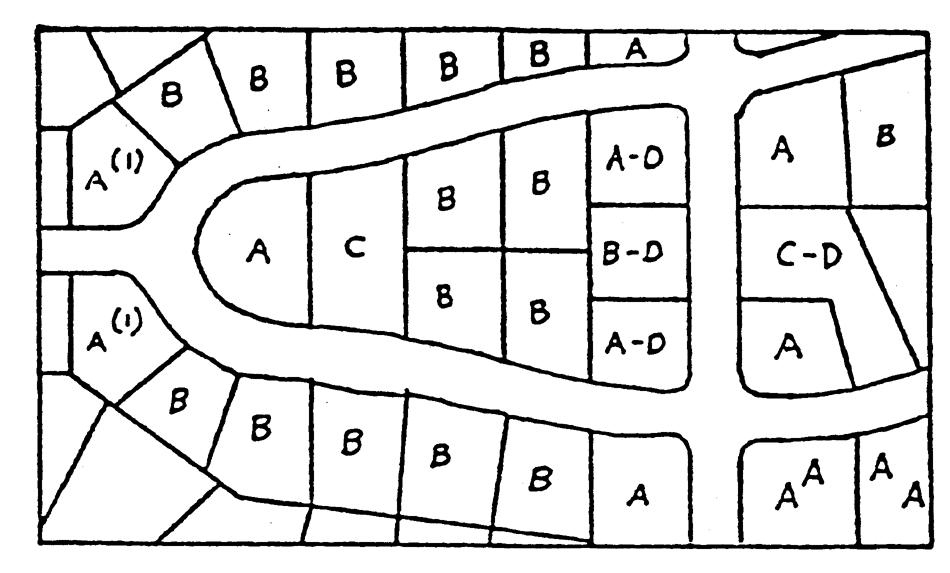
Lot types
NOTE:
A = ;hg;Corner lot, defined as a lot located at the intersection of two or more streets. A lot abutting on a curved street or streets shall be considered a corner lot if straight lines drawn from the foremost points of the side lot lines to the foremost point of the lot meet at an interior angle of less than 135 degrees. See lots marked A 1 in the diagram.
B = ;hg;Interior lot, defined as a lot other than a corner lot with only one frontage on a street.
C = ;hg;Through lot, defined as a lot other than a corner lot with frontage on more than one street. Through lots abutting two streets may be referred to as double frontage lots.
D = ;hg;Reversed frontage lot, defined as a lot on which the frontage is at right angles or approximately aright angles (interior angle less than 135 degrees) to the general pattern in the area. A reversed-frontage lot may also be a corner lot (A—D in the diagram), an interior lot (B—D), or a through (C—D).
Manufactured housing or manufactured home: A HUD-Code manufactured home or a mobile home and collectively means and refers to both.
Mobile home: A structure that was constructed before June 15, 1976, transportable in one or more sections, which, in the traveling mode, is eight body feet or more in width and 40 body feet or more in length, or, when erected on site, is 320 or more square feet, and which is built on a permanent chassis and designed to be used as a dwelling with or without a permanent foundation when connected to the required utilities, and includes the plumbing, heating, air conditioning and electrical systems.
Modular building. Modular or industrialized building.
Modular component. A structural part of housing or building constructed at a location other than the building site in a manner that prevents the construction from being adequately inspected for code compliance at the building site without (1) damage or (2) removal and reconstruction of a part of the housing or building."
Modular home. Modular or industrialized housing.
Modular or industrialized building. A commercial structure that is (1) constructed in one or more modules or constructed using one or more modular components built at a location other than the commercial site and (2) designed to be used as a commercial building when the module or the modular component is transported to the commercial site and erected or installed; but excluding (1) a commercial structure that exceeds three stories or 49 feet in height as measured from the finished grade elevation at the building entrance to the peak of the roof or (2) a commercial building or structure that is installed in a manner other than on a permanent foundation and is either (a) not open to the public or (b) less than 1,500 square feet in total area and used other than as a school or a place of religious worship.
Modular or industrialized housing. A residential structure that is (1) designed for the occupancy of one or more families, (2) constructed in one or more modules or constructed using one or more modular components built at a location other than the permanent site and (3) designed to be used as a permanent residential structure when the module or the modular component is transported to the permanent site and erected or installed on a permanent foundation system; but excluding (1) a residential structure that exceeds three stories or 49 feet in height as measured from the finished grade elevation at the building entrance to the peak of the roof, (2) housing constructed of a sectional or penalized system that does not use a modular component or (3) a ready-built home constructed in a manner in which the entire living area is contained in a single unit or section at a temporary location for the purpose of selling and moving the home to another location.
New/used car lot: A paved area for the display for sale of motorized and nonmotorized vehicles accompanied by an on-site office with staffing during normal business hours. Sale of vehicles shall only be allowed within an automobile sales lot as defined herein.
Outdoor advertising business: Provision of outdoor displays or display space on a lease or rental basis only.
Parking space, off-street: For the purposes of this ordinance, an off-street parking space shall consist of a space adequate for parking an auto mobile with room for opening doors on both sides, together with properly related access to a public street or alley and maneuvering room. Required off-street parking areas for three or more automobiles shall have individual spaces marked, and shall be so designated, maintained and regulated that no parking or maneuvering incidental to parking shall be on any public street, walk, or alley, and so that any automobile may be parked and unparked without moving another. For purposes of rough computation, an off-street parking space and necessary access and maneuvering room may be estimated at 300 square feet, but off-street parking requirements will be considered to be met only when actual spaces meeting the requirements above are provided and maintained, improved in a manner appropriate to the circumstances of the case, and in accordance with all ordinances and regulations of the city.
Service station: Buildings and premises where gasoline, oil, grease, batteries, tires, and automobile accessories may be supplied and dispensed at retail, and where in addition, the following services may be rendered and sales made, and no other:
(a)
Sale and servicing of spark plugs, batteries, and distributors and distributor parts.
(b)
Tire servicing and repair, but not recapping or regrooving.
(c)
Replacement of mufflers, and tail pipes, water hose, fan belts, brake fluid, light bulbs, fuses, floor mats, windshield wipers and wiper blades, grease retainers, wheel bearings, mirrors, and the like.
(d)
Radiator cleaning and flushing.
(e)
Washing and polishing, and sale of automotive washing and polishing materials.
(f)
Greasing and lubrication.
(g)
Providing and repairing fuel pumps, oil pumps, and lines.
(h)
Minor servicing and repair of carburetors.
(i)
Emergency wiring repairs.
(j)
Adjusting and repairing brakes.
(k)
Minor motor adjustments, not including major overhaul or rebuilding of engines or transmissions.
(l)
Sales of cold drinks, packaged foods, tobacco, and similar convenience goods for service station's customers, as accessory and incidental to principal operation.
(m)
Provision of road maps and other informational material to customers; provision of restroom facilities.
Uses permissible at a service station do not include major mechanical and body work, straightening of body parts, painting, welding, storage of automobiles not in operating condition, or other work involving noise, glare, fumes, smoke, or other characteristics to an extent greater than normally found in service stations. A service station is not a repair garage nor a body shop.
Sexually oriented business: An adult bookstore, adult theater, adult video store or other sexually oriented business as those terms are defined in V.T.C.A., Local Government Code ch. 243, and the decisions of the appellate courts having jurisdiction over the territory in which the city is located, and in chapter 123 of the Code of Ordinances of the city.
Sign: Any device designed to inform or attract the attention of persons not on the premises on which the sign is located, provided, however, that the following shall not be included in the application of the regulations herein:
(a)
Signs not exceeding one square foot in area and bearing only property numbers, post box number, names of occupants of premises, or other identification of premises not having commercial connotations;
(b)
Flags and insignia of any government except when displayed in connection with commercial promotion;
(c)
Legal notices, identification, informational, or directional signs erected or required by governmental bodies;
(d)
Integral decorative or architectural features of buildings, except letters, trademarks, moving parts, or moving lights;
(e)
Signs directing and guiding traffic and parking on private property, but bearing no advertising matter.
Sign, on-site: A sign relating its subject matter to the premises on which it is located, or to products accommodations, services, or activities on the premises. On-site signs do not include signs erected by the outdoor advertising industry in the conduct of the outdoor advertising.
Sign, off-site: A sign other than an on-site sign.
Signs, number and surface area: For the purpose of determining number of signs, a sign shall be considered to be a single display surface or display device containing elements organized, related, and composed to form a unit. Where matter is displayed in a random manner without organized relationship of elements, or where there is reasonable doubt about the relationship of elements, each element shall be considered to be a single sign. The surface area of a sign shall be computed as including the entire area within a regular geometric form or combinations of regular geometric forms comprising all of the elements of the matter displayed. Frames and structural members not bearing advertising matter shall not be included in computation of surface area.
Special exception: A special exception is a use that would not be appropriate generally or without restriction throughout the zoning division or district, but which, if controlled as to number, area, location or relation to the neighborhood, would promote the public health, safety, welfare, morals, order, comfort, convenience, appearance, prosperity, or general welfare. Such uses may be permitted in such zoning division or district as special exceptions, if specific provision for such special exceptions is made in this zoning ordinance.
Street line: The right-of-way line of a street.
Structure: Anything constructed or erected with a fixed location on the ground, or attached to something having a fixed location on the ground. Among other things, structures include buildings, mobile homes, walls, fences, billboards, and poster boards or panels.
Temporary building: A temporary field office or construction shack located at the site of and necessary for the prosecution of work directly connected to any construction project for which a building permit has been issued and is in force.
Other temporary and portable buildings: Any building or structure which does not satisfy the requirements of articles I, II, IX and XI, chapter 22, Code of Ordinances, City of Clute, Texas, other than temporary buildings permitted under section 6.9 of this ordinance.
Trailer: A vehicular, portable structure built on a chassis, but excluding a mobile home dwelling as defined above or a travel trailer as defined below.
Trailer park: A mobile home park located in an R-4 mobile home park district.
Travel trailer: A vehicular, portable structure built on a chassis, designed to be used as a temporary dwelling for travel and recreational purposes, having a body width not exceeding eight feet.
Variance: A variance is a relaxation of the terms of the zoning ordinance where such variance will not be contrary to public interest and where, owing to conditions peculiar to the property and not the result of the actions of the applicant, a literal enforcement of the ordinance would result in unnecessary and undue hardship. As used in this ordinance, a variance is authorized only for height, area, and size of structure or size of yards and open spaces; establishment or expansion of a use otherwise prohibited shall not be allowed by variance, nor shall a variance be granted because of the presence of nonconformities in the zoning district or uses in an adjoining zoning district.
Yard: A required open space other than a court unoccupied and unobstructed by any structure or portion of a structure from 30 inches above the general ground level of the graded lot upward, provided however that fences, walls, poles, posts, and other customary yard accessories, ornaments, and furniture may be permitted in any yard subject to height limitations and requirement limiting obstruction of visibility.
Yard, front: A yard extending between side lot lines across the front of a lot adjoining a public street.
In any required front yard, no fence or wall shall be permitted which materially impedes vision across such yard above the height of 30 inches, and no hedge ore other vegetation shall be permitted which materially impedes vision across such yard between the heights of 30 inches and ten feet.
In the case of through lots, unless the prevailing front yard pattern on adjoining lots indicates otherwise, front yards shall be provided on all frontages. Where one of the front yards that would normally be required on a through lot is not in keeping with the prevailing yard pattern, the administrative official may waive the requirement for the normal front yard and substitute therefor a special yard requirement which shall not exceed the average of the yards provided on adjacent lots.
In the case of corner lots which do not have reversed frontage, a front yard of the required depth shall be provided in accordance with the prevailing yard pattern and a second front yard of half the depth required generally for front yards in the district shall be provided on the other frontage.
In the case of reversed frontage corner lots, a front yard of the required depth shall be provided on either frontage, and a second front yard of half the depth required generally for front yards in the district shall be provided on the other frontage.
In the case of corner lots with more than two frontages, the administrative official shall determine the front yard requirements, subject to the following limitations:
(1)
At least one front yard shall be provided having the full depth required generally in the district;
(2)
No other front yard on such lot shall have less than half the full depth required generally.
Depth of required front yards shall be measured at right angles to a straight line joining the foremost points of the side lot lines. The foremost point of the side lot line, in the case of rounded property corners at street intersections, shall be assumed to be the point at which the side and front lot lines would have met without such rounding. Front and rear front yard lines shall be parallel.
Yard, rear: A yard extending across the rear of the lot between inner side yard lines. In the case of through lots and corner lots, there will be no rear yards, but only front and side yards. Depth of a required rear yard shall be measured in such a manner that the yard established is a strip of the minimum width required by district regulations with its inner edge parallel with the rear lot lines.
Yard, side: A yard extending from the rear line of the required front yard to the rear lot line, or in the absence of any clearly defined rear lot line to the point on the lot farthest from the intersection of the lot line involved with the public street. In the case of through lots, side yards shall extend from the rear lines of front yards required. In the case of corner lots, yards remaining after full and half-depth front yards have been established shall be considered side yards. Width of a required side yard shall be measured in such a manner that the yard established is a strip of land of the minimum width required by district regulations with its inner edge parallel with the side lot line.
Yard, special: A yard behind any required yard adjacent to a public street, required to perform the same functions as a side or rear yard, but adjacent to a lot line so placed or oriented that neither the term "side yard" nor the term "rear yard" clearly applies. In such case, the administrative official shall require a yard with minimum dimensions as generally required for a side yard or a rear yard in the district, determining which shall apply by the relation of the portion of the lot on which the yard is to be located to the adjoining lot or lots, with due regard to the orientation and location of structures and buildable areas thereon.
(Ord. No. 79-22, § 2(14), 8-9-79; Ord. No. 83-23, § 10, 12-8-83; Ord. No. 92-17, § 2(a), 11-5-92; Ord. No. 97-12, § 2(a), 9-11-97; Ord. No. 2004-17, § 1, 8-27-04; Ord. No. 2010-27, § 2(1), 12-9-10; Ord. No. 2016-020, § 2, 8-25-16)

