
Cobb County Unincorporated
City Zoning Code
City Zoning Code
ARTICLE II
ADMINISTRATION AND ENFORCEMENT
Sec. 134-31. - Nonconforming uses.
(a)
Purpose and intent. The purpose of a zoning ordinance is to have orderly use of property. Nonconforming uses that existed legally prior to the adoption or change of a zoning ordinance create land uses that do not conform to the zoning ordinance. It is the purpose of this nonconforming use provision to allow legally existing nonconforming uses to be retained with certain limitations to protect adjacent property owners and the public from the inconsistencies created by nonconforming uses. It is the intent that over time all nonconforming uses will be eliminated.
(b)
Continuance of nonconforming uses. A nonconforming use of a building, structure or land that was legal prior to the enactment of an amendment or adoption of the zoning ordinance shall be allowed to legally continue even though such use does not conform with the provisions of this chapter, subject to the following:
(1)
The nonconforming use cannot be expanded to occupy a greater area of land or building area.
(2)
The nonconforming use may continue only in the original building structure or land area that was originally occupied by the nonconforming use.
(3)
The nonconforming use of the building, structure or land cannot be intensified or escalated, for example, by increasing the number of deliveries, employees or customers coming to the nonconforming use, or noise, dust, fumes or other pollutants emanating from the nonconforming use.
(4)
A nonconforming use cannot be reinstated after it has been abandoned. It shall be prima facie evidence of abandonment for the owner and/or operator of the nonconforming use to discontinue the nonconforming use for 12 months, to fail to obtain a new or renew an existing business license as required under the Code of Cobb County, Georgia, for the operation of such nonconforming use, to fail to declare and remit the sales tax required by state law for the nonconforming use.
(5)
Failure to follow any other state, federal or local administrative procedure or regulation that is required for the nonconforming use shall be prima facie evidence of abandonment.
(6)
A nonconforming use cannot be changed to another nonconforming use.
(7)
A nonconforming use must maintain any screening or buffering that existed prior to the use becoming a nonconforming use or that was later voluntarily added.
(8)
A use that constitutes a nuisance as defined by state law is not and cannot become a nonconforming use.
(c)
Continuance of nonconforming structure or building. A building or structure that is nonconforming or that contains a nonconforming use at the time of enactment of the ordinance from which this chapter is derived or at the time of enactment of an amendment to this chapter may be retained, except that it shall not be:
(1)
Enlarged, altered or rebuilt, except for repairs necessary to maintain the structure or building in a safe and sanitary condition.
(2)
Rebuilt, altered or repaired after damage or deterioration exceeding 75 percent of its replacement cost at the time of destruction, except in conformity with this chapter.
(3)
Section 134-31 does not apply to signs. See section 134-311 et seq.
(d)
Continuance of nonconforming lot size. Any lot which is deficient pertaining to minimum lot size may be granted a permit for a principal structure, accessory structure or building addition, consistent with the other underlying zoning district requirements, if the zoning division manager is provided with documentation that demonstrates the lot size deficiency was caused by purchase or condemnation by an entity which has the power of eminent domain, or the condition existed prior to December 26, 1972.
(e)
Nothing in this section shall be construed to allow a use that is dangerous to the general public to continue to exist. This section shall also not be construed to not require changes to buildings or structures to comply with any fire code, life safety code or other safety ordinance or regulation.
(f)
To protect the public from inconsistent zoning requirements and to make nonconforming uses as consistent with conforming uses as possible, nonconforming uses must comply with zoning requirements such as parking, landscaping, setback, outside storage, screening or buffering requirements for the zoning district or use which does not substantially impact the nonconforming use or nonconforming structure.
(Ord. of 12-26-72; Ord. of 12-11-90, § 3-28-12.0; Ord. of 10-27-92; Ord. of 6-24-97 (eff. 7-1-97); Ord. of 2-9-99; Amd. of 2-22-11; Ord. of 7-24-12)
Editor's note— On July 24, 2012, the board of commissioners amended item number 4 of section 134-31. The amendment changed the time period of abandonment (to serve as prima facie evidence) for a nonconforming use from six months to 12 months. This amendment will automatically convert back from 12 months to six months unless it is extended by a majority vote of the board of commissioners during public hearings to occur on the fourth Tuesdays of January and February, 2014.
Sec. 134-32. - Procedures for conducting hearings.
(a)
The board of commissioners, planning commission and board of zoning appeals shall adopt separate policies, rules and procedures for the conduct of public hearings. Any rules for hearings which are currently in effect at the time of the passage of the ordinance from which this chapter is derived shall remain in effect unless in conflict with this chapter, and the procedures set forth in this chapter shall be controlling.
(b)
Any rules and procedures adopted by the board of commissioners, planning commission or board of zoning appeals shall contain, at minimum, the following:
(1)
An agenda for the meetings will be established by the Zoning Division Manager and available to the commissioners and the public in advance of the public meeting.
a.
A portion of the agenda may be designated as a consent agenda and all items contained therein may be voted on en gross following presentation of the consent items. Any commissioner or any citizen may have an item withdrawn from the consent agenda so that it shall be placed on the regular agenda for a full public hearing.
b.
The regular agenda contains those cases, which in the opinion of staff, raise issues which should be considered following a full public hearing.
(2)
Representatives/applicants, as a group, and representatives/opponents, as a group, shall be given a maximum often minutes for each side to present its case, unless, by general consensus, more time is allotted by the respective board. No further public input will be allowed except responses to questions asked by the commissioners.
(3)
All witnesses for the applicant and opponents shall be sworn in prior to making their presentations.
(4)
Voting on cases on the regular agenda will take place as to each case immediately following the close of the public hearing and commissioner discussion of the same case.
(Ord. of 12-26-72; Ord. of 12-11-90, § 3-28-8.6; Ord. of 1-11-94; Amd. of 6-27-23)
Sec. 134-33. - Approvals for developments fronting on state highways.
For all developments fronting on a state highway, no building permit shall be issued until the approval of the state highway department has been obtained by the applicant on entrances and exits, curb radii, drainage and other matters that are the appropriate concern of the department.
(Ord. of 12-26-72; Ord. of 12-11-90, § 3-28-11.6)
Sec. 134-34. - Variance applications.
(a)
Submission. An applicant for a variance shall file with or submit to the county, prior to processing of the application, the following:
(1)
A completed application shall be filed on forms prescribed by the county.
(2)
The notarized signature of the applicant and record titleholder shall appear upon the application.
(3)
The application fee shall be paid. These fees shall be established from time to time by resolution of the board of commissioners. A copy of the fee schedule shall be maintained for public inspection in the office of the zoning division manager.
(4)
The applicant shall submit a current boundary survey and plot plan, to scale, prepared by a registered surveyor or registered engineer. Such plans shall also include such other information thereon as may be required by the zoning or planning division of the county, including preliminary plans for development, building locations, parking areas, access points, adjacent streets, land lot lines and buffer areas.
(5)
Private sewage disposal must be approved by the county health department, and written approval from the health department must be filed with the application.
(6)
The applicant shall submit any other information required by the county zoning or planning staff which they deem necessary or desirable in processing the application which is related to the present or proposed use of the property.
(b)
Posting of public notice. The posting shall be the same as set forth in section 134-121(b) for zoning applications.
(c)
Reconsideration of rejected applications. If an application for variance is rejected, then any portion of the same property may not be considered for any type of variance for a period of 12 months from the date the application was rejected, unless by court order or pursuant to a settlement of litigation approved by the board of zoning appeals.
(d)
In no event shall an application be withdrawn more than once without prejudicing the right of the applicant or property owner to apply for a variance within 12 months of the first application.
(e)
An application which is withdrawn within seven days of the board of zoning appeals hearing without the permission of the board of zoning appeals shall be deemed a rejected application with a 12-month prejudice period.
(Ord. of 12-26-72; Ord. of 12-11-90, § 3-28-8.5; Ord. of 1-11-94; Ord. of 2-28-12; Ord. of 7-24-12)
Sec. 134-35. - Administrative variances when property acquired under exercise of eminent domain.
If the county or any other lawfully constituted state or federal governmental authority, agency or body or utility having the authority of eminent domain condemns or acquires property, and, as the sole result of such condemnation or acquisition, nonconformity is created in setback lines, required lot size, density or parking regulations, the zoning division manager or his designee shall be authorized to grant such administrative variances as are necessary to bring the property into conformance upon receipt of a properly documented request. Any variance granted under this section may not exceed 25 percent of the existing requirements without application to the board of zoning appeals except for the overall density which allows the existing number of lots, units or floor area ratio (F.A.R.) to remain as it exists at the time of condemnation or acquisition. The property must be legally conforming prior to such condemnation or acquisition in order to qualify for an administrative variance. The zoning division manager or his designee shall be required to maintain records which support the basis for granting such variance. Any variance granted under this section shall only apply to the current zoning district and use. In addition, the division manager of zoning or his designee shall file a certificate of administrative variance on the deed records of the county evidencing such variance. This section shall only apply to property acquired or condemned by an authority exercising eminent domain after December 26, 1972.
(Ord. of 12-26-72; Ord. of 12-11-90, § 3-28-8.10; Ord. of 8-13-91; Ord. of 1-11-94; Ord. of 9-26-95; Ord. of 11-23-99; Amd. of 2-25-14)
Sec. 134-36. - Temporary land use permits.
(a)
The board of commissioners may permit temporary land use permits for uses that are uniquely located and are considered compatible with adjoining zoning districts and nearby uses for designated periods of time for uses, exceptions or professions in areas, along roadways and within districts where the zoning regulations would otherwise prohibit such operations. Customary home occupations as defined in this chapter, do not require a temporary land use permit.
(b)
In addition thereto, the board of commissioners may grant temporary land use permits for limited periods of time for occupations or businesses compatible with the neighborhood from which such business or occupation is operated and where no nuisance as defined in state law or other significant adverse effect would result to the area or district zoned.
(c)
All applications for temporary land use permits shall be advertised in the same manner as applications for rezoning, and public hearings will be held thereon in the same manner as hearings on applications for rezoning are conducted.
(d)
The board of commissioners has determined that temporary land use permits are only appropriate if granted for a limited period of time. In no event shall the board of commissioners grant a land use permit for a period of time in excess of 24 months except on reapplication, readvertisement and public hearing. Land use permits that have been in existence for ten years or more from the adoption date of this amendment will continue to be considered upon each renewal, until the use ceases to operate or is relocated. The following uses are considered uses that are uniquely located and are also considered compatible with adjoining zoning districts and nearby uses that may be considered upon each renewal:
(1)
Land use permits for exceptions to the county's minimum square footage per adult occupant, minimum square footage per vehicle parked at a dwelling unit or mobile home.
(2)
Churches with accessory day care facilities (commonly known as pre-K, day care school, child development center, "mother's morning out," and the like) programs that have greater than 25 percent non-church members of the total number of children in the day care program will be considered upon each renewal.
(3)
Single-family residential structures used as professional offices that are not included within a platted subdivision, located along a four-lane arterial roadway, not architecturally or structurally altered unless necessary to accommodate access required by accessibility requirements or in accordance with fire safety regulations (when such alterations are necessary, architectural design shall be subject to review and approval by the board of commissioners) and signage that complies with the provisions of section 134-315 will be considered upon each renewal.
(4)
Farmers markets that are outdoor markets open to the public subject to the following minimum requirements:
a.
Tract size to be determined on a case by case basis.
b.
The displayed inventory of the products sold in each farmers market may include means fruits, vegetables, mushrooms, herbs, grains, legumes, nuts, shell eggs, honey or other bee products, flowers, nursery stock, baked goods, jams and jellies, canned vegetables, dried fruit, syrups, salsas, salad dressings, flours, coffee, tea, smoked or canned meats or fish, sausages, items prepared by a cottage food operator as authorized by state and local regulations, or other items as may be approved by the board of commissioners.
c.
Conceptual plan (which may be a scaled drawing prepared by the applicant) to be approved by the board of commissioners that includes:
• The area in which all booths to be used as part of the farmers market will be located.
• Location of parking areas.
• Location of portable restroom facilities, if needed.
• Location of any temporary signage associated with the farmers market (excluding signage within the parking area or within the booth areas).
d.
Statement of agreeable stipulations to be approved by the board of commissioners that includes:
• List of all items to be sold or demonstrated at the market, including a provision that will allow for additions or deletions as authorized by the district commissioner.
• Property owner's acknowledgement and authorization for the farmers market.
• Applicant's acknowledgement that all vendors participating will comply with all applicable state and county health regulations, including those associated with food preparation and presentation.
• Applicant's acknowledgement that there will be no loudspeakers utilized during the farmers market and that market will comply with the provisions of the Cobb County Noise Ordinance (section 50-257).
• Applicant's acknowledgement that there shall be no mechanized rides, video arcades or mechanized games conducted on the premises.
• Applicant's acknowledgement that the site must be cleaned up within two hours of the end of the market.
• Applicant's acknowledgement that there shall be no firearms sales or open flame cooking possessed or conducted on the premises.
• An emergency 24-hour contact for use by applicable county staff.
• Onsite manager to maintain an updated list of vendors with contact numbers and requisite business license numbers to be made available for inspection by county staff.
(5)
Reserved.
Land use permits, (other than those identified in subsections (d)(1), (2) and (3)) that have been in existence less than ten years from the adoption date of this amendment will be allowed to apply for one more renewal, which, if granted, may be granted for up to 24 months. Once the period of time for which the temporary land use permit was granted has expired, the use must cease or relocate.
All new applications, (other than those identified in subsections (d)(1), (2) and (3)) that have been approved for a temporary land use permit after the adoption date of this amendment may only be considered for one renewal up to 24 months from the date the temporary land use permit was granted. Once the period of time for which the temporary land use permit was granted has expired, the use must cease or relocate.
If the property where a land use permit has been granted is sold or otherwise conveyed, or the business for which the land use permit was granted is sold or otherwise conveyed, requiring a change in the business license, the approved land use permit shall no longer be valid. In order for the use to resume operation, a new land use permit must be applied for and approved by the board of commissioners.
(e)
The applicant or operator must reside full-time at the residence where the temporary home occupation or temporary business is performed if the property is located in a platted subdivision.
(f)
Any temporary signage approved with a temporary land use permit must be consistent with 134-314(f)(7) and 134-315(a).
(g)
The board of commissioners shall consider, at a minimum, the following in its determination of whether or not to grant a temporary land use permit:
(1)
Safety, health, welfare and moral concerns involving the surrounding neighborhood;
(2)
Parking and traffic considerations;
(3)
Number of nonrelated employees;
(4)
Number of commercial and business deliveries;
(5)
The general presumption of the board of commissioners that residential neighborhoods should not allow noncompatible business uses;
(6)
Compatibility of the business use to the neighborhood;
(7)
Hours of operation;
(8)
Existing business uses in the vicinity;
(9)
Effect on property values of surrounding property;
(10)
Circumstances surrounding neighborhood complaints;
(11)
Intensity of the proposed business use; and
(12)
Location of the use within the neighborhood.
(h)
Suspension or revocation. A holder of a temporary land use permit may be subject to suspension or revocation via a show-cause hearing conducted by the board of commissioners if the owner/property owner/operator is found in violation of any local, state or federal laws, regulations or ordinance regulating such business; or any reason which would cause the denial to issue or renew such permits; or the violation any of the board of commissioners stipulations of the temporary land use permit. The zoning division manager shall be authorized to post the property at least 30 days prior to a show-cause hearing with an "other business" sign, if the violations are not corrected within ten days of official notification provided by the county, and/or are habitual in nature, and/or endanger the public health, safety and welfare.
(Ord. of 1-8-74; Ord. of 12-11-90, § 3-28-10.1; Ord. of 11-23-99; Ord. of 12-9-03; Ord. of 2-26-08; Ord. of 3-13-12; Ord. of 7-23-13; Amd. of 2-25-14; Amd. of 8-12-14; Amd. of 3-22-16; Amd. of 2-28-17; Amd. of 2-11-20)
Sec. 134-37. - Special land use permits.
(a)
A special land use permit shall be required for the following types of uses of property regardless of the zoning classification or district for the realty:
(1)
Radio, television, microwave, land mobile, telephone or other communication towers or antennas, including antennas or other communications equipment or facilities to be placed on a tower that was or will be constructed pursuant to the exemption set forth in section 134-3(2).
(2)
Communication equipment buildings.
(3)
Noncommercial or nonprofit public community centers such as a YWCA, YMCA, Girls Club or Boys Club.
(4)
Private, parochial or other elementary, middle, junior or high schools which are not a part of the public school system of the state, but which teach the subjects commonly taught in the common schools of the state. This use shall not be permitted in the CF, IF, LI or HI zoning districts.
(5)
Colleges or universities which are institutions for higher education and are nonprofit educational institutions not owned or controlled by the state or any political subdivision, agency, instrumentality, district or municipality thereof, which provide a program of education beyond the high school level and which admit as regular students only individuals having a certificate of graduation from a high school, or the recognized equivalent of such a certificate, and which provide an educational program for which a bachelor's degree is awarded, or provide an educational program, admission into which is conditioned upon the prior attainment of a bachelor's degree or its equivalent, for which a postgraduate degree is awarded, or provide not less than a two-year program which is acceptable for full credit toward a bachelor's degree or its equivalent.
(6)
Asphalt plants.
(7)
Concrete plants.
(8)
Reserved.
(9)
Boarding, breeding or raising nondomestic or wild animals.
(10)
Private landfills.
(11)
Composting facilities.
(12)
Waste transfer stations.
(13)
Trash/garbage handling, hauling or disposal facilities or any use associated with these uses, except for general offices, dispatch offices, maintenance facilities or truck terminals for empty and clean trucks only. Any cleaning of empty trucks must occur entirely inside an enclosed building and all wash water and residue which is used in or results from such cleaning must be recaptured and not allowed to flow outside the enclosed building.
(14)
Auto salvaging and wrecking yards.
(15)
Automobile storage yards and wrecker services for damaged or confiscated vehicles.
(16)
Used or pre-owned automobile and truck sales lots separate from a new car dealership. No application for a special land use permit shall be considered unless the property on which the special land use permit has been applied for consists of at least one acre of paved surface for parking of vehicles excluding any area used for, but not limited to buildings, offices, service or sales areas, etc.
(17)
Truck stops/refueling stations.
(18)
Coliseums.
(19)
Stadiums.
(20)
Chipping, grinding or reduction of materials, stumps, trees, limbs, construction debris, glass, concrete, asphalt, rock, etc.
(21)
Used or discarded tire storage/disposal facilities.
(22)
Quarries or mining operations.
(23)
Scrap metal, iron or steel collection/recovery.
(24)
Any manufacturing or industrial use which also requires a permit from the environmental protection division of the department of natural resources of the state under the provisions of O.C.G.A. tit. 12, ch. 5, 8 or 9 (O.C.G.A. § 12-5-1 et seq., 12-8-1 et seq. or 12-9-1 et seq.).
(25)
Sawmills.
(26)
Hotels (suite).
(27)
Trade shows/expositions.
(28)
Flea markets.
(29)
Pain clinic and pain management clinic.
(30)
Recreational grounds or private parks, as long as the proposed uses within the property are consistent with the uses in other Cobb County public parks (e.g., Sandy Plains Park, Bells Ferry Park or Lost Mountain Park); provided however, where the proposed use contains a commercial component, the owner must also apply for the appropriate commercial zoning district.
(31)
Clubs or lodges (noncommercial), when located on a residentially zoned property, with the following minimum requirements.
a.
Minimum lot size is five usable acres, excluding flood plain.
b.
Primary access to the facility shall be from an arterial or major collector roadway.
c.
Structures associated with the use shall be located a minimum of 50 feet from any property line.
d.
Structures associated with the use shall be limited to 55 feet in height.
e.
When abutting any residential property line, a 50-foot landscaped screening buffer shall be approved by county staff (see landscaping standards). Additionally, in any zoning district for this specific use, the maximum impervious surface shall be 55 percent.
f.
An overall parking and landscape plan for the entire site shall be approved by county staff.
g.
One parking space per 250 square feet (net) of floorspace.
h.
A lighting plan shall be approved in accordance with section 134-269.
(32)
Fraternity and sorority houses and residence halls.
(33)
New cemeteries for human or animal internment or expansions of cemeteries for human or animal internment, if the expansion is of more than 20 acres or greater than 50 percent of its size.
(34)
Purpose built student housing.
a.
Sites shall be located in areas under the regional activity center (RAC) future land use designation.
b.
Sites are required to have principal access from an arterial or major collector roadway, as identified on the Cobb County Roadway Functional Classification Plan.
c.
Density shall be calculated using equivalent apartment units rather than the actual number of units. There shall be 0.5 equivalent apartment units per bedroom.
d.
Sites shall be designed to accommodate on-site parking for at least one vehicle for each unit, based on the equivalency calculation listed above in item (c). Parking may be reduced to 0.75 paved parking spaces per unit if the project is located with a tenth of a mile from a public transit stop, has direct bus service to the college or university, or is located within one-quarter mile of the college or university campus. Additional parking shall be provided for visitors. Accommodation for rideshare pick up/drop off shall also be provided.
e.
Traffic impact study required per section 134-121(a)(8). Traffic counts shall be within the last three years and performed while school is in session.
f.
Sites shall be designed with lighting that does not spill over into abutting properties and is the minimum to provide security for residents of multi-family housing developments.
g.
Buildings and sites shall be designed to minimize the transfer of noise by the use of noise absorbing/blocking material such as rough surface building facades, site fencing and vegetation.
h.
Minimum tract size is four acres.
i.
Maximum building height is 55 feet. When adjacent to single-family residential zoning districts, maximum building height is 35 feet.
j.
Maximum impervious surface coverage: 70 percent. For zoning districts in which the maximum coverage is less than 70 percent, the maximum per the zoning district shall prevail.
k.
No portion of floodplain, wetland area, or impervious community area (pools, clubhouses, tennis courts and parking facilities) may be used in calculating density.
l.
To enhance building/site security, applicants shall coordinate with local law enforcement to develop a security plan in accordance with the standards of crime prevention through environmental design (CPTED). Security plan shall be reviewed and updated annually.
m.
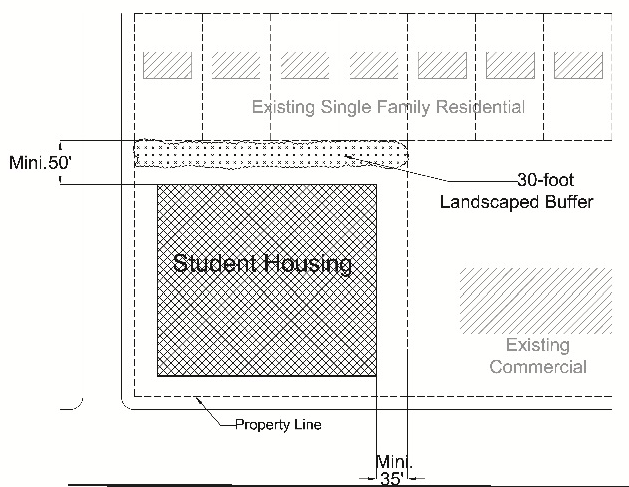
A 30-foot landscaped buffer shall be provided on any exterior property line that abuts existing single-family residential uses. The buffer shall be natural, but may need to be enhanced with additional landscaping to provide sufficient screening between the new development and the existing neighborhood. Privacy fencing shall be required on a case-by-case basis.
n.
When abutting residential uses, structures associated with the use shall be located a minimum of 50 feet from the property line. When abutting commercial uses, structures associated with the use shall be located a minimum of 35 feet from the property line.
o.
Floodplain and wetlands preservation requirements. Any development must meet all county, state and federal requirements relating to floodplains and wetlands. The board of commissioners encourages preservation of wetland areas.
p.
On-site management shall be required, 24 hours per day, seven days per week.
(b)
The board of commissioners may grant special land use permits for the uses enumerated in subsection (a) of this section. The granting of a special land use permit is conditional upon the site plan considered by the board of commissioners.
(c)
All applications for special land use permits shall be advertised in the same manner as applications for rezoning, and public hearings will be held thereon in the same manner as applications for rezoning are conducted.
(d)
The board of commissioners may grant special land use permits for any period of time in the discretion of the board of commissioners.
(e)
In addition to general district, the board of commissioners shall consider, at a minimum, the following in its determination of whether or not to grant a special land use permit:
(1)
Whether or not there will be a significant adverse effect on the neighborhood or area in which the proposed use will be located.
(2)
Whether or not the use is otherwise compatible with the neighborhood.
(3)
Whether or not the use proposed will result in a nuisance as defined under state law.
(4)
Whether or not quiet enjoyment of surrounding property will be adversely affected.
(5)
Whether or not property values of surrounding property will be adversely affected.
(6)
Whether or not adequate provisions are made for parking and traffic considerations.
(7)
Whether or not the site or intensity of the use is appropriate.
(8)
Whether or not special or unique conditions overcome the board of commissioners' general presumption that residential neighborhoods should not allow noncompatible business uses.
(9)
Whether or not adequate provisions are made regarding hours of operation.
(10)
Whether or not adequate controls and limits are placed on commercial and business deliveries.
(11)
Whether or not adequate landscape plans are incorporated to ensure appropriate transition.
(12)
Whether or not the public health, safety, welfare or moral concerns of the surrounding neighborhood will be adversely affected.
(13)
Whether the application complies with any applicable specific requirements set forth in this chapter for special land use permits for particular types of uses.
(14)
Whether the applicant has provided sufficient information to allow a full consideration of all relevant factors.
(15)
In all applications for a special land use permit the burden shall be on the applicant both to produce sufficient information to allow the county fully to consider all relevant factors and to demonstrate that the proposal complies with all applicable requirements and is otherwise consistent with the policies reflected in the factors enumerated in this chapter for consideration by the county.
(f)
Any special land use permit that is granted for a use that emits or creates odors must include an odor elimination/attenuation system as recommended by industry standards.
(g)
Suspension or revocation. A holder of a special land use permit may be subject to suspension or revocation via a show-cause hearing conducted by the board of commissioners if the owner/property owner/operator is found in violation of any local, state or federal laws, regulations or ordinance regulating such business; or any reason which would cause the denial to issue or renew such permits; or the violation any of the board of commissioners stipulations of the special land use permit. The zoning division manager shall be authorized to post the property at least 30 days prior to a show-cause hearing with an "other business" sign, if the violations are not corrected within ten days of official notification provided by the county, and/or are habitual in nature, and/or endanger the public health, safety and welfare.
(Res. of 9-25-84, §§ 1—4; Ord. of 4-15-86; Ord. of 12-11-90, § 3-28-10.2; Ord. of 9-26-95; Ord. of 6-24-97 (eff. 7-1-97); Ord. of 2-9-99; Ord. of 11-23-99; Ord. of 12-9-03; Ord. of 2-26-08; Amd. of 2-24-09; Ord. of 7-27-10; Amd. of 2-26-13; Ord. of 7-23-13; Amd. of 5-12-15; Amd. of 2-23-16; Amd. of 2-28-17; Amd. of 8-27-19; Amd. of 2-11-20; Amd. of 9-8-20; Amd. of 3-26-24; Amd. of 11-21-24)
Sec. 134-38. - Temporary mobile home occupancy and land use permit.
(a)
In all classifications there may be established a use for the temporary location of a mobile home or a temporary land use only upon issuance of a temporary land use permit, which may be issued by the board of commissioners upon the following conditions:
(1)
Application for a use permit shall be filed and shall meet all the requirements of an application for zoning as provided by this chapter. Such application shall have attached thereto a separate statement of the applicant that he recognizes that the use permit, if granted, is for a temporary time only and that the applicant shall cause the removal of the mobile home or the removal of all personalty on the termination of the use permit, or upon the applicant's failure to do so irrevocably grants the board of commissioners the right to remove the mobile home or personalty from the premises at the expense of the applicant, for which the applicant agrees to pay.
(2)
A mobile home may be parked and occupied in a residential area on property with a minimum of two acres, and not part of a recorded subdivision and where a medical hardship exists. In those instances where a medical hardship has been granted within a recorded subdivision the occupant will have a period of three years from July 1, 1997, to relocate. The board of commissioners has determined that no new applications for medical hardships will be accepted after July 1, 1997, on property less than two acres or within recorded subdivisions. For purposes of this section, the term "medical hardship" is defined as a person whose health or mental condition necessitates attention and supervision from the occupants of the dwelling located on the lot on which it is desired to have the mobile home parked and occupied. In no case shall such a use be allowed unless it is shown by the county health department or by other appropriate medical evidence that the person to occupy the mobile home falls within the provisions of this subsection and unless it is satisfactorily shown that the dwelling on the premises does not contain sufficient facilities to accommodate the proposed occupant of the mobile home. In addition, the application shall contain an affidavit or certified statement of a physician showing that present facilities are inadequate and stating that a hardship condition requiring the use of a mobile home for the health care of a member of the immediate family of the occupant of the premises exists.
(b)
The board of commissioners may permit the following:
(1)
A mobile home may be parked and occupied in all residential or commercial districts where a building permit has been applied for and obtained from the proper department of the county for the construction of either a home or a place of business.
(2)
A mobile home may be parked and occupied in any residential area where a medical hardship exists. For purposes of this section, the term "medical hardship" is defined as a person whose health or mental condition necessitates attention and supervision from the occupants of the dwelling located on the lot on which it is desired to have the mobile home parked and occupied. In no case shall such a use be allowed unless it is shown by the county health department or by other appropriate medical evidence that the person to occupy the mobile home falls within the provisions of this subsection and unless it is satisfactorily shown that the dwelling on the premises does not contain sufficient facilities to accommodate the proposed occupant of the mobile home. In addition, the application shall contain an affidavit or certified statement of a physician showing that present facilities are inadequate and stating that a hardship condition requiring the use of a mobile home for the health care of a member of the immediate family of the occupant of the premises exists.
(3)
A mobile home may be parked and occupied in any commercial or industrial district where a building permit has been applied for and where its primary function is that of an office or for storage or related purposes.
(4)
A mobile home may be parked and occupied in any district on property owned or leased by a church, chapel, temple, synagogue, other places of worship or a school for a period not to exceed 12 months where its primary function is that of an office or classroom or for storage or related purposes. Any new application for a land use permit after the adoption date of this amendment may only be renewed up to four times for a total period of five years. Land use permits that have been in existence for three years or longer, prior to the adoption date of this amendment, shall be allowed to apply for a maximum of three additional one-year renewals. Land use permits that have been in existence for less than three years from the adoption date of this amendment, shall be allowed to apply for subsequent one-year renewals for a period up to, but not exceed a total of six years from the date the original land use permit was granted. Not more than one mobile home for each two acres of vacant land may be located thereon.
(5)
In all residential classifications the division manager of zoning may grant a use permit for the temporary use of one of the homes or for the parking of a mobile home to be used as a real estate sales office for sale of the lots for new homes built and developed within the boundaries of the development, provided that final plans have been approved therefor by all county authorities. The specific location of the mobile home shall be subject to the approval of the division manager of zoning.
(6)
In all classifications, the board of commissioners may grant a temporary use permit for the use of the land itself under the same ordinance governing mobile home use.
In all instances where an application for a mobile home permit has been applied for, the board of commissioners shall take into consideration the need for such permit, the aesthetic effect that it may have on the neighborhood, and the location on the property of the mobile home, and may in its discretion grant or refuse a permit, and the grant or refusal shall not be mandatory, but in all instances shall be permissible depending on the finding of the board of commissioners as to the conditions stated in this section and any other lawful criteria.
(c)
Any person violating the terms of this section, either without obtaining a permit or for causing a mobile home to be parked or occupied for a period in excess of that granted by the board of commissioners, shall be deemed to have violated this section and be subject to all remedies provided under the ordinances of the county.
(d)
For purposes of this section only, the term "mobile home" is defined to include both mobile structures designed to function as residences and mobile structures designed to function as classrooms, offices and storage buildings.
(e)
Any violation of this section or the cessation of the need for a use permit shall be grounds for revocation of such permit by the board of commissioners in addition to all other remedies provided by law.
(Ord. of 12-11-90, § 3-28-10.3; Ord. of 6-24-97 (eff. 7-1-97); Ord. of 11-23-99)
Sec. 134-39. - Limited professional services permit (LPSP).
(a)
Purpose and intent. Limited impact professional services means a low-intensity commercial use that reuses a single-family detached dwelling for a commercial purpose; thereby discouraging demolition and permitting uses which do not generate large volumes of traffic, noise or other harmful effects. This use may be located on residential property subject to the following criteria.
(b)
Permitted uses. This use is only permitted on arterial roadways, as defined by the county department of transportation.
Permitted uses as follows:
Health practitioners, professional offices and specialized education and training/studios such as computer and electronics training schools, drama schools, driver's education schools, language schools, music schools, and studio facilities including, but not limited to dance/ballet, art, photography, yoga, martial arts, and fitness studios.
Parking, signage and lighting to be approved by the board of commissioners.
(c)
Use limitations.
(1)
The existing single-family detached dwelling shall be reused. The residential façade shall be maintained and any new construction shall be architecturally similar to the existing building.
(2)
No outdoor displays of products that are actively available for sale or lease.
(3)
New lighting to be installed shall be established so that no direct light shall cast over any property line.
(4)
No ground disturbance over 5,000 square feet is permitted.
(5)
Limited professional service permit shall be for a specific user and use only.
(6)
A commercial certificate of occupancy must be obtained prior to any occupational tax certificate being issued.
(7)
Applications for special exception for limited professional services permit shall be subject to the requirements and process for rezoning applications, as specified in sections 134-121 through 134-127.
(Amd. of 2-11-20)
Sec. 134-61. - Creation.
There is created a planning commission.
Sec. 134-62. - Membership; term of office; compensation of members; vacancies.
The planning commission shall be composed of five members. Each member of the board of commissioners shall be entitled to appoint one member to the commission. Each member appointed by a member of the board of commissioners shall serve concurrently with and at the pleasure of the appointing commissioner's term of office and until a successor is appointed. If an appointing commissioner is no longer in office due to a general election or a special election in which more than one year remains in that commissioner's term, any member appointed by that commissioner shall be subject to removal with or without cause and without regard to any unexpired term by the newly elected commissioner filling such seat. The newly elected commissioner shall have the right to appoint a new member to the commission under the same manner as his or her predecessor. Ex officio members of the commission who hold public office shall serve on the commission during the term they hold such public office. The compensation of the members, if any, shall be determined by the board of commissioners and shall be paid for each meeting of the commission actually attended. Any vacancy in the membership of the planning commission shall be filled for the unexpired term in the same manner as the original appointment. No person who holds elective public office shall be eligible to serve as a member during the term of such elective office, and the position of any member shall be deemed vacant upon such member qualifying as a candidate for elective public office. Such vacancy shall be filled for an unexpired term in the manner that original appointments are required to be made.
(Res. of 12-26-72, § III; Ord. of 12-11-90, § 3-28-9.4; Ord. of 2-25-97; Ord. of 7-26-05)
Sec. 134-63. - Officers; meetings; staff; finances.
The county planning commission shall elect one of its appointive members as chairman, who shall serve for one year or until he is reelected or his successor is elected. A second appointive member shall be elected as vice-chairman, and he shall serve for one year or until he is reelected or his successor is elected. The planning commission shall appoint a secretary, who may be an officer or an employee of the board of commissioners or of the planning commission. The planning commission shall meet at least once each month at the call of the chairman and at such other times as the chairman or planning commission may determine, and shall adopt rules for the actions, findings and determinations, which record shall be a public record. The planning commission may appoint such employees and staff as it may deem necessary for its work. In the performance of its duties the planning commission may cooperate with, contract with or accept funds from federal, state or local public or semipublic agencies or private individuals or corporations, may expend such funds, and may carry out such cooperative undertakings and contracts. It may make expenditures for the purchase of required equipment and supplies. The expenditures of the planning commission, exclusive of gifts to the commission or contract receipts, shall be within the amounts appropriated for the purpose by the board of commissioners.
(Res. of 12-26-72, § IV; Ord. of 12-11-90, § 3-28-9.5)
Sec. 134-64. - Preparation of development regulations.
It shall be the function and duty of the county planning commission to make such careful and comprehensive surveys and studies of existing conditions and probable future developments and to prepare such plans for physical, social and economic growth as will best promote public health, safety, morals, convenience, property or general welfare, as well as efficiency and economy, in the development of the county. In particular, the planning commission shall have the power and duty to:
(1)
Prepare a master plan or parts thereof for the development of the county.
(2)
Prepare and recommend for adoption to the board of commissioners a zoning ordinance or resolution and map for the county.
(3)
Prepare and recommend for adoption to the board of commissioners regulations for the subdivision of land within the county, and to administer the regulations that may be adopted.
(4)
Prepare and recommend for adoption to the board of commissioners a plat or an official map showing the exact location of the boundary lines of existing, proposed, extended, widened or narrowed streets, public open spaces or public building sites, together with regulations to control the erection of buildings or other structures within such lines, within the county or a specified portion thereof.
(Res. of 12-26-72, § V; Ord. of 12-11-90, § 3-28-9.6A)
Sec. 134-65. - Additional powers.
The planning commission may make, publish and distribute maps, plans and reports and recommendations relating to the plan and development of the county to public officials and agencies, public utility companies, civic, educational, professional and other organizations, and citizens. It may recommend to the executive or legislative officials of the county programs for public improvements and financing thereof. All public officials shall, upon request, furnish to the planning commission, within a reasonable time, such available information as it may require for its work. The planning commission, and its members and employees, in the performance of its functions, may enter upon any land, make examinations and surveys, and place and maintain necessary monuments and marks thereon; provided, however, that the planning commission shall be liable for any injury or damage to property resulting therefrom. In general, the planning commission shall have such powers as may be necessary to enable it to perform its functions and promote the planning of the county.
(Res. of 12-26-72, § V; Ord. of 12-11-90, § 3-28-9.6B)
Sec. 134-66. - Preparation of master plan.
It shall be the duty of the county planning commission to make a master plan of the county and to perfect it from time to time. Such master plan may show, among other things, existing and proposed streets, highways, expressways, bridges, tunnels and viaducts and approaches thereto; routes of railroads and transit lines; terminals, ports and airports; parks, playgrounds, forests, reservations and other public open spaces; sites for public buildings and structures; districts for residence, business, industry, recreation, agriculture or forestry; special districts for other purposes; limited development districts for purposes of conservation, water supply, sanitation, drainage, protection against floods and the like; areas for housing developments, slum clearance, and urban renewal and redevelopment; location of public utilities, whether publicly or privately owned, including, but not limited to, sewerage and water supply systems; zoning districts and other planning features, together with time and priority schedules and cost estimates for the accomplishment of the proposals. The master plan shall be based upon and include appropriate studies of the location and extent of present and anticipated population, social and economic resources and problems, and other useful data. Such plan may be adopted, added to and changed, from time to time, by a majority vote of the planning commission. It shall be a public record, but its purpose and effect shall be solely to aid the planning commission in the performance of its duties.
(Res. of 12-26-72, § V; Ord. of 12-11-90, § 3-28-9.6D)
Sec. 134-67. - Rules of procedure; deposit of costs prior to hearing on zoning amendments.
The county planning commission shall adopt such rules and regulations as it may deem advisable for the governing of the commission and adopt such rules and regulations as may be deemed advisable for the public to appear before the planning commission and be heard as to any changes, modifications or amendments to any planning or zoning resolution that may have been passed on by the board of commissioners. The commission may require a deposit of such advertising costs or other costs as may in its discretion seem proper before it will conduct a hearing in regard to any application in regard to any change, modification or amendment and before it will make a recommendation on the change, modification or amendment to the board of commissioners.
(Res. of 12-26-72; Ord. of 12-11-90, § 3-28-9.10)
Sec. 134-68. - Subdivisions.
(a)
Approval of subdivision plats as prerequisite to recording. No plat of a subdivision of property within the unincorporated portion of the county shall be filed or recorded in the office of the clerk of the superior court of the county until it shall have been submitted to and approved by the county in compliance with the development standards. A plat of a subdivision shall not be filed or recorded with the clerk of superior court which does not have the approval of the county as required by this section. The filing or recording of a plat of a subdivision without the approval the county as required by this section shall be punishable as a misdemeanor.
(b)
Plat approval does not constitute acceptance of dedications. The approval of a plat by the county shall not be deemed to constitute or effect an acceptance by the county or the public of the dedication of any street or other ground shown upon the plan.
(c)
Sale or transfer of property by reference to unapproved and unrecorded plat. The owner or agent of the owner of any land to be subdivided within the county who transfers or sells or agrees to sell or negotiate to sell such land by reference to or exhibition of or by other use of a plat of subdivision of such land before such plat has been approved by the county and recorded in the office of the clerk of the superior court in the county shall be guilty of a misdemeanor, and the description by metes and bounds in the instrument of transfer or other document used in the process of selling or transfer shall not exempt the transaction from such penalties. The county, through its attorney or other official designated by the board of commissioners, may enjoin such transfer or sale or agreement by appropriate action.
(d)
Streets in subdivisions. From and after the time when the platting jurisdiction of the county planning commission shall have attached by virtue of the adoption by the planning commission of a major street plan and the adoption by the board of commissioners of a set of land subdivision regulations recommended to it by the planning commission, as provided in subsection (a) of this section, the board of commissioners or other public authority shall not accept, lay out, open, improve, grade, pave or light any street or lay or authorize the laying of any water mains, sewers, connections or other facilities or utilities in any street within the county unless such street shall have been accepted or opened as, or shall otherwise have received the legal status of, a public street prior to legal platting, or unless such street corresponds in its location and lines with a street shown on a subdivision plat approved by the county; provided, however, that the board of commissioners may locate and construct or may accept any other street if the ordinance or resolution or other measure for such approval be first submitted to the county for its review and comment, and such street shall have the status of an approved street as fully as though it had been originally shown on a subdivision plat approved by the county.
(e)
Access to public street. From and after the time when the platting jurisdiction of the county planning commission shall have attached by virtue of adoption by the board of commissioners of a set of land subdivision regulations recommended to it by the planning commission, as provided in subsection (a) of this section, no building permit shall be issued for and no building or other structure shall be erected on any lot within the county unless the street giving access to the lot upon which the building is proposed to be placed shall be accepted or opened as, or shall have otherwise received the legal status of, a public street prior to that time, or unless such street corresponds in its location and lines with a street shown on a subdivision plat approved by the county or with a street located and accepted by the board of commissioners. Any building erected in violation of this subsection shall be deemed an unlawful structure, and the building inspector or county attorney or other official designated by the board of commissioners may bring appropriate action to enjoin such erection or cause it to be vacated or removed.
(f)
Definitions. For purposes of this section, the term "street" or "streets" means, relates to and includes streets, avenues, boulevards, roads, highways, expressways, lanes, alleys and other ways. The term "subdivision" means all divisions of a tract or parcel of land into two or more lots, building sites or other divisions for the purpose, whether immediate or future, of sale, legacy or building development, and includes all division of land involving a new street or a change in existing streets, and includes resubdivision, and, where appropriate to the context, relates to the process of subdividing or to the land or area subdivided; provided, however, that the following are not included within this definition: the combination or recombination of portions of previously platted lots where the total number of lots is not increased and the resultant lots are equal to the standards of the county.
(Res. of 12-26-72, § IX; Ord. of 2-22-77; Ord. of 12-11-90, § 3-28-9.11B, D—H, J, M; Amd. of 2-28-17)
Sec. 134-91. - Creation.
There is created a board of zoning appeals. The board of zoning appeals has delegated, quasijudicial powers.
(Amd. of 6-27-23)
Sec. 134-92. - Membership; term of office; compensation of members; removal of members.
The board of appeals shall be composed of five members. Each member of the board of commissioners shall be entitled to appoint one member to the board. Each member appointed by a member of the board of commissioners shall serve concurrently with and at the pleasure of the appointing commissioner's term of office and until a successor is appointed. If an appointing commissioner is no longer in office due to a general election or a special election in which more than one year remains in that commissioner's term, any member appointed by that commissioner shall be subject to removal with or without cause and without regard to any unexpired term by the newly elected commissioner filling such seat. The newly elected commissioner shall have the right to appoint a new member to the board in the same manner as his or her predecessor. The board of commissioners shall determine the amount of compensation, if any, to be paid to the members of the board of zoning appeals. No person who holds elective public office shall be eligible to serve as a member during the term of such elective office, and the position of any member shall be deemed vacant upon such member qualifying as a candidate for elective public office, except that members may be also members of the planning commission. Any vacancy in the membership shall be filled for the unexpired term in the same manner as the original appointment.
(Res. of 12-26-72, § X; Ord. of 12-11-90, § 3-28-9.12A; Ord. of 2-25-97; Ord. of 7-26-05)
Sec. 134-93. - Officers; meetings; rules of procedure.
The board of appeals shall elect one of its members as chairman, who shall serve for one year or until he/she is reelected or a successor is elected. A second appointive member shall be elected as vice-chairman, and he/she shall serve for one year or until he/she is reelected, or a successor is elected. The board of appeals shall appoint a secretary, who may be an officer or employee of the board of commissioners or of the planning commission. The board of appeals shall adopt rules in accordance with the provisions of this chapter. Meetings of the board of appeals shall be held at the call of the chairman and at such other times as the board may determine. The chairman, or in his absence the acting chairman, may administer oaths and compel the attendance of witnesses by subpoena. The board of appeals shall keep minutes of its proceedings, showing the vote of each member upon each question or, if absent or failing to vote, indicating such fact, and shall keep records of its examinations and other official actions, all of which shall be immediately filed in the office of the board and shall be a public record.
(Res. of 12-26-72, § X; Ord. of 12-11-90, § 3-28-9.12A; Amd. of 2-25-14)
Sec. 134-93.1. - Hearing notice.
In addition to the notice requirements set forth in subsections 134-121(c)(1) and (2), at least 30 days prior to the required public hearing for appeals of administrative decisions by officers or decisions on variances, a notice of the public hearing shall be mailed to the owner whose property or interest is the subject of such hearing, as applicable.
(Amd. of 6-27-23)
Sec. 134-94. - Powers.
(a)
The board of appeals shall have the power to:
(1)
Hear and decide appeals where it is alleged there is error in any order, requirement, decision or determination made by an administrative official in the enforcement of this chapter. The person filing the appeal shall pay a filing fee to the Cobb County Zoning Division equal to $100.00.
(2)
Hear and decide special exceptions to the terms of this chapter upon which such board is required to pass under this chapter. The following chapters are the only chapters of this Code that the board of appeals may consider:
Chapter 134 - Zoning
Chapter 50-75(b)(15)
Chapter 110 - Subdivisions
Chapter 58 - Floods
Chapter 106, article III - Sidewalks
(3)
Authorize upon appeal in specific cases such variance from the terms of this chapter as will not be contrary to the public interest where, owing to special conditions, a literal enforcement of the provisions of this chapter will, in an individual case, result in unnecessary hardship, so that the spirit of this chapter shall be observed, public safety and welfare secured, and substantial justice done. Such variance may be granted in such individual case of unnecessary hardship upon a finding by the board of appeals that:
a.
There are extraordinary and exceptional conditions pertaining to the particular piece of property in question because of its size, shape or topography;
b.
The application of this chapter to this particular piece of property would create an unnecessary hardship;
c.
Such conditions are peculiar to the particular piece of property involved; and
d.
Relief, if granted, would not cause substantial detriment to the public good or impair the purposes and intent of this chapter.
No variance may be granted for a use of land or building or structure that is prohibited by this chapter. No variance may be granted that would conflict with or alter a stipulation or condition imposed by the board of commissioners, except for setback variances which are less than 25 percent than the underlying requirement and do not alter the basic tenets of any site plan included and approved as a stipulation.
(b)
In exercising the powers described in subsection (a) of this section, the board of appeals may, in conformity with the provisions of this chapter, reverse or affirm, wholly or partly, or may modify the order, requirement, decision or determination, and to that end shall have all the powers of the officer from whom the appeal is taken, and may issue or direct the issuance of a permit.
(Res. of 12-26-72, § X; Res. of 9-25-73; Ord. of 12-11-90, § 3-28-9.12A; Ord. of 12-9-03; Ord. of 2-27-07; Amd. of 2-26-13; Amd. of 3-11-14; Amd. of 7-28-15; Amd. of 2-23-16; Amd. of 3-22-16; Amd. of 11-21-24)
Sec. 134-95. - Appeal procedure; effect of appeal.
(a)
Appeals to the board of appeals may be taken by any person aggrieved or by any officer, department, board or bureau of the county affected by any decision of the administrative officer. Such appeal shall be taken within 30 days from the date of the final decision of the administrative officer, by filing with the county clerk a notice of appeal specifying the jurisdictional grounds for appeal; the decision being appealed; the relief desired; the reason(s) why such relief should be granted and the documents relative to the issues raised in the appeal. The county clerk shall forthwith transmit to the administrative officer whose decision is being appealed and the members of the board of appeals the notice of appeal with all supporting documents received.
(b)
An appeal stays all legal proceedings in furtherance of the action appealed from, unless the officer from whom the appeal is taken certifies to the board of zoning appeals, after the notice of appeal is received by him/her, that by reason of facts of the case a stay would, in his/her opinion, cause imminent peril to life and property. In such case proceedings shall not be stayed otherwise than by a restraining order, which may be granted by the board of zoning appeals or by a court of record on application, on notice to the administrative officer from whom the appeal is taken, and on due cause shown.
(c)
The board of zoning appeals shall fix a reasonable time for the hearing of the appeal or other matter referred to it, and give public notice thereof, as well as due notice to the parties in interest, and decide the matter within a reasonable time. Upon the hearing, any party may appear in person or by agent or by attorney. The hearing procedures are set forth in the rules of procedure.
(Res. of 12-26-72, § X; Ord. of 12-11-90, § 3-28-9.12A; Ord. of 9-10-02; Amd. of 2-28-17)
Sec. 134-96. - Appeals from decision of board.
(a)
Any person or persons severally or jointly aggrieved by any decision of the board of zoning appeals may take an appeal to the superior court. The appeal to the superior court shall be by writ of certiorari. Such appeal may be filed within 30 days from the date of the decision of the board of zoning appeals, and upon failure to file the appeal within 30 days the decision of the board of zoning appeals shall final.
(b)
The Chairperson of the board of zoning appeals is authorized, without additional board approval, to approve or issue any form or certificate necessary to perfect the petition in O.C.G.A. § 5-3-1 et seq.
(c)
The County Clerk, Assistant County Clerk(s) and Deputy County Clerk(s) of the Board of Commissioners are authorized, for matters arising under this chapter 134, to accept all petitions, complaints, processes and summons in any action, suit or proceeding in any of the Courts of the State of Georgia or United States Courts in Georgia.
(Res. of 12-26-72, § X; Ord. of 12-11-90, § 3-28-9.12B; Amd. of 6-27-23)
Sec. 134-121. - Generally.
(a)
Applications for rezoning. An application for a zoning change affecting any property or properties may be initiated by the owner of real property, an applicant with the consent of the owner of real property, or the board of commissioners (each may be referred to as "applicant" throughout the rest of this division).
(1)
For applicant or owner initiated rezoning applications, the process set forth should be followed.
(2)
For a county initiated rezoning, the board of commissioners shall adopt a resolution authorizing staff to prepare an application and submit it for consideration following the procedures in this division, where applicable. The community development agency shall notify all impacted property owners of the potential rezoning application in writing via certified mail, return receipt requested, no less than 15 days prior to the board of commissioners' consideration of the resolution authorizing staff to prepare and submit an application for a county initiated rezoning.
(b)
Rezoning applications. Prior to processing of any application for rezoning or a land use permit from an applicant or owner, an application containing the following documentation shall be filed and the following procedures as set forth in this section shall be followed.
(1)
A completed application shall be filed on forms prescribed by the zoning division.
(2)
The notarized signatures of the applicant and record titleholder shall appear upon the application.
(3)
The application fee which has been established from time to time by resolution of the board of commissioners shall be paid. A copy of the fee schedule shall be maintained for public inspection in the zoning division offices.
(4)
The applicant shall submit a current boundary survey and plot plan, to scale, prepared by a registered surveyor or registered engineer. Such plans shall also include such other information thereon as may be required by the planning division and zoning division, including preliminary plans for development, building locations, parking areas, access points, adjacent streets, land lot lines, buffer areas, future right-of-way, wetlands, floodplains, utilities and retention.
(5)
Private sewage disposal must be approved by the county health department, and written approval from the health department must be filed with the application. Private sewage disposal shall be subject to the requirements of sections 122-241 and 122-242.
(6)
The applicant shall submit any other information required by the planning and zoning staff or other county departments which they deem necessary or desirable in processing the application, which is related to the present or proposed use of the property.
(7)
Every application for rezoning involving a request for a nonresidential zoning district shall include a complete written, documented analysis of the impact of the proposed rezoning with respect to each of the following matters:
a.
Whether the zoning proposal will permit a use that is suitable in view of the use and development of adjacent and nearby property;
b.
Whether the zoning proposal will adversely affect the existing use or usability of adjacent or nearby property;
c.
Whether the property to be affected by the zoning proposal has a reasonable economic use as currently zoned;
d.
Whether the zoning proposal will result in a use which will or could cause an excessive or burdensome use of existing streets, transportation facilities, utilities or schools;
e.
Whether the zoning proposal is in conformity with the policy and intent of the land use plan; and
f.
Whether there are other existing or changing conditions affecting the use and development of the property which give supporting grounds for either approval or disapproval of the zoning proposal.
(8)
Traffic studies shall be necessary for the following described rezoning applicants and shall be conducted in accordance with the following procedures.
a.
The applicant shall prepare an assumptions technical memorandum for approval by the county department of transportation before proceeding with the traffic study when required. The traffic study shall be completed as determined by the Director of the Cobb County Department of Transportation or his/her designee at least 15 business days prior to the Planning Commission hearing and the Zoning Division Manager is authorized to continue any case that does not meet this deadline.
b.
Any application for a rezoning involving a development expected to generate using gross trip generation more than 750 vehicle trips during a single day and/or more than 75 vehicle trips during a single hour, in single or multiple phases, shall be required to submit a traffic impact study (prepared in accordance with industry accepted standards, including at a minimum, level of service impacts for adjacent roadways and intersections) and a mitigation package to address the cumulative effects from the project's impact.
c.
Any application for a rezoning involving a development expected to generate using gross trip generation more than 3,000 vehicle trips during a single day and/or more than 250 vehicle trips during a single hour, in single or multiple phases, shall be required to submit a traffic impact study (prepared in accordance with industry accepted standards, including at a minimum, level of service impacts for adjacent roadways and intersections), the scope of which shall be determined by the Director of the Cobb County Department of Transportation or his/her designee and shall at a minimum address conditions and impacts resultant from the project within a ten-year scope. The applicant shall also include a mitigation package to address the cumulative effects from the project's impact.
d.
Rezoning applicants shall also be required to coordinate and fund any recommended mitigation measures identified by Cobb DOT, including through review of the traffic studies required above. These mitigation measures are limited to project related improvements that may also include coordination with applicable federal, state and local agencies including the Georgia Regional Transportation Authority and the Atlanta Regional Commission.
(c)
Public notice and advertising of hearings.
(1)
The applicant shall be required to post and maintain signs supplied by the zoning division on or near the right-of-way of the nearest public street, so as to be visible from the street, for at least 30 days immediately preceding the date for any public hearings on the application, which shall remain posted until a final decision by the applicable boards. In addition to the requirements of O.C.G.A. § 36-66-4, the zoning division shall supply a sign that contains the following language:
"PURSUANT TO THE OFFICIAL CODE OF COBB COUNTY, ZONING - SECTION 134-124(b) THE COBB COUNTY BOARD OF COMMISSIONERS IS AUTHORIZED TO CONSIDER AND MAY CONSIDER ALL CONSTITUTIONALLY PERMISSIBLE ZONING CLASSIFICATIONS, INCLUDING, BUT NOT LIMITED TO, INTERVENING CLASSIFICATIONS AND/OR THE CLASSIFICATION(S) SOUGHT BY THE APPLICANT."
It is the responsibility of the applicant to post the signs and to maintain the signs during the posting period. Failure to post and maintain the signs continuously may prohibit consideration of the application at any scheduled public hearing. If the signs are not posted continuously, the applicable board, in its sole discretion, may require reposting and readvertising prior to any future public hearing, for which the applicant shall pay an additional readvertising fee. The applicable board may also, in its sole discretion, continue, hold, approve or dismiss the application. Any dismissal under the provisions of this subsection shall be with prejudice unless specifically noted as being without prejudice by the dismissing board.
(2)
The zoning division shall be responsible for advertising in the legal organ of the county pursuant to O.C.G.A. § 36-66-4, as amended from time to time. In addition, the advertisement shall contain the following language:
"PURSUANT TO THE OFFICIAL CODE OF COBB COUNTY, ZONING - SECTION 134-124(b) THE COBB COUNTY BOARD OF COMMISSIONERS IS AUTHORIZED TO CONSIDER AND MAY CONSIDER ALL CONSTITUTIONALLY PERMISSIBLE ZONING CLASSIFICATIONS, INCLUDING BUT NOT LIMITED TO, INTERVENING CLASSIFICATIONS AND/OR THE CLASSIFICATION(S) SOUGHT BY THE APPLICANT."
(3)
It shall be the duty of the applicant/representative to notify in writing all property owners within a 1,000-foot radius of the subject property being rezoned, as shown on the most current tax records regarding a pending rezoning application, which includes the planning commission and the board of commissioners hearing dates. Mailings must be sent via the United States Postal Service. Such notice shall be satisfied by the applicant/representative mailing a copy of the application that includes notification of the planning commission and the board of commissioners hearing dates and the proposed site plan by first class mail (with a certificate of mailing) or by certified mail. Said notification must be postmarked 30 calendar days prior to the planning commission hearing. The applicant/representative is required to file with the zoning division proof of the mailing no later than 21 days prior to the planning commission zoning hearing for which the application is scheduled to be considered. Staff is authorized to continue any pending case in which the above requirements are not met.
(d)
Attendance at hearing. The applicant or representative of the applicant shall be required to attend all public hearings on the application. The failure to attend may result in dismissal with prejudice, rejection of the application or continuance of the hearing at the board's sole discretion. Failure of the applicant or his representative to appear at the next regularly scheduled hearing shall result in automatic dismissal with prejudice. The zoning division manager may waive the attendance requirement for land use permits based upon medical hardship.
(e)
Withdrawal of application.
(1)
An application may only be withdrawn upon a joint written request of the record titleholder and applicant or their legal counsel. In order to withdraw as of right and without prejudice, the request to withdraw must be given at the zoning division offices at least seven days prior to the hearing before the planning commission. Applicants or their legal counsel may personally request (via written or verbal request) withdrawal during a planning commission or board of commissioners public hearing, provided that the request is made prior to the close of the public hearing of the case before the applicable board. The public hearing shall be considered closed when announced as such by the chairman following presentations by the applicant and opposition during their allotted time period. If permission is denied at such time, the application may not be withdrawn and shall be acted upon by the applicable board in the usual manner. In no event shall an application be withdrawn after the vote by the board of commissioners. Further, in no event shall an application be withdrawn more than once without prejudicing the right of the applicant or owner to apply for a land use permit or rezoning within 12 months of the first application.
(2)
An application which is withdrawn within seven days of the planning commission hearing without the permission of the planning commission shall be deemed a rejected application with prejudice.
(3)
Applications which have been publicly heard by either the planning commission or the board of commissioners and which have been withdrawn without right and without permission of a majority of the applicable board as set forth in subparagraph 134-121(d)(1) above shall be deemed a rejected application with prejudice.
(f)
Resubmission of rejected/deleted applications.
(1)
If an application for rezoning, land use permit or special land use permit is rejected or deleted to another zoning classification, then any portion of the same property may not again be considered for rezoning, land use permit or special land use permit for a period of 12 months from the date of the board of commissioners' decision. An applicant may reapply for rezoning to a more restrictive classification than the application previously denied, or denied without prejudice, following the expiration of six months in accordance with O.C.G.A. § 36-66-4(c), as amended from time to time.
(2)
The board may only consider property for rezoning within the six-month time period in connection with settlement of litigation or pursuant to an order by a court of competent jurisdiction. The board shall advertise, post the property, and conduct another public hearing prior to taking such action.
(Ord. of 12-26-72; Ord. of 12-11-90, § 3-28-8.1; Ord. of 8-13-91; Ord. of 1-11-94; Ord. of 6-24-97 (eff. 7-1-97); Ord. of 12-9-97 (eff. 1-1-98); Ord. of 2-8-00; Ord. of 1-25-05; Amd. of 2-22-11; Amd. of 2-25-14; Amd. of 2-24-15; Amd. of 2-23-16; Amd. of 2-27-18; Amd. of 2-26-19; Amd. of 9-27-22)
Sec. 134-122. - Staff report.
After the filing of a proper application under this division, the planning division and zoning division shall make a written recommendation and zoning analysis (staff report) relating to the following:
(1)
Whether the zoning proposal will permit a use that is suitable in view of the use and development of adjacent and nearby property;
(2)
Whether the zoning proposal will adversely affect the existing use or usability of adjacent or nearby property;
(3)
Whether the zoning proposal will result in a use which will or could cause an excessive or burdensome use of existing streets, transportation facilities, utilities or schools;
(4)
Whether the zoning proposal is in conformity with the policy and intent of the land use plan; and
(5)
Whether there are other existing or changing conditions affecting the use and development of the property which give supporting grounds for either approval or disapproval of the zoning proposal.
(Ord. of 12-26-72; Ord. of 12-11-90, § 3-28-8.2; Ord. of 1-11-94)
Sec. 134-123. - Action by planning commission.
(a)
The planning commission shall conduct a public hearing on each application for a land use permit or rezoning in accordance with a schedule and procedures adopted by the board of commissioners. A staff report on each application shall be submitted to and considered by the planning commission at the public hearing. The planning commission shall investigate and consider each of the following matters:
(1)
Whether the zoning proposal will permit a use that is suitable in view of the use and development of adjacent and nearby property;
(2)
Whether the zoning proposal will adversely affect the existing use or usability of adjacent or nearby property;
(3)
Whether the zoning proposal will result in a use which will or could cause an excessive or burdensome use of existing streets, transportation facilities, utilities or schools;
(4)
Whether the zoning proposal is in conformity with the policy and intent of the land use plan and staff recommendations; and
(5)
Whether there are other existing or changing conditions affecting the use and development of the property which give supporting grounds for either approval or disapproval of the zoning proposal.
(b)
As to each application, the planning commission shall make a recommendation for approval, denial, deletion to an alternative zoning district, continuance, hold, withdrawal without prejudice, withdrawal with prejudice or no recommendation. Any two members of the board of commissioners, through a clerk's note at a board of commissioner's zoning meeting, can provide direction to the planning commission for a held or continued case on the planning commission's agenda to be considered and voted on at the next available planning commission hearing. Written minutes of the planning commission's recommendation to the board of commissioners shall be prepared, maintained and submitted to the board of commissioners prior to its hearing. Additionally, the staff report and applicant's report shall be submitted to the board of commissioners. All documents shall thereafter become public record.
(c)
The planning commission shall adopt such rules and regulations for the conduct of public hearings and meetings as are consistent with state law and this Code, which shall be published and available to the public. The planning commission shall be subject to conflict of interest rules pursuant to O.C.G.A. § 36-67A-2, as amended from time to time.
(Ord. of 12-26-72; Ord. of 12-11-90, § 3-28-8.3; Ord. of 1-11-94; Ord. of 7-27-04; Amd. of 2-24-15; Amd. of 11-21-24)
Sec. 134-124. - Action by board of commissioners.
(a)
Before taking action on an application for rezoning and after receipt of the staff report, the planning commission's recommendation and the applicant's report, where required, the board of commissioners shall conduct a public hearing on the application in accordance with rules and procedures as may be adopted by the board of commissioners from time to time. Prior to or in conjunction with the hearing, the board of commissioners shall review the applicant's report, if any, the staff report and the planning commission's recommendation.
(b)
So that the purpose of this chapter will be served and the health, public safety and general welfare secured, the board of commissioners may approve or deny the application, or other zoning agenda item, reduce the land area for which the application is made, change the zoning classification, district or category requested, either to the one(s) sought or to other constitutionally permissible classification(s) which may not necessarily be an intervening classification, add or delete conditions of the application, including but not limited to site-specific conditions, variances to zoning regulations, or allow an application to be withdrawn without prejudice with respect to the 12-month limitation of this division. This Code section shall apply to any application for rezoning, special land use permit, temporary land use permit, other business item, special exception or any other agenda item heard by the board of commissioners. An action by the board to defer or continue the application shall include a statement of the date and time of the next meeting at which the application will be considered, which statement shall constitute public notice of the hearing on the application, and no further notice except posting and legal advertising is required.
(c)
The decision by the board of commissioners to approve in whole or part, reject, condition or delete an application for rezoning shall be based on, but not limited to, a consideration of the following criteria:
(1)
Whether the zoning proposal will permit a use that is suitable in view of the use and development of adjacent and nearby property;
(2)
Whether the zoning proposal will adversely affect the existing use or usability of adjacent or nearby property;
(3)
Whether the zoning proposal will result in a use which will or could cause an excessive or burdensome use of existing streets, transportation facilities, utilities or schools;
(4)
Whether the zoning proposal is in conformity with the policy and intent of the land use plan; and
(5)
Whether there are other existing or changing conditions affecting the use and development of the property which give supporting grounds for either approval or disapproval of the zoning proposal.
(Ord. of 12-26-72; Ord. of 12-11-90, § 3-28-8.4; Ord. of 1-11-94; Ord. of 2-8-00; Ord. of 7-24-12; Amd. of 2-25-14)
Sec. 134-125. - Zoning approval does not ensure utilities or infrastructure.
Approval of an application for rezoning does not ensure the availability of utilities or other infrastructure in connection with development of the site.
(Ord. of 12-26-72; Ord. of 12-11-90, § 3-28-8.7; Ord. of 1-11-94)
Sec. 134-126. - Site plan/stipulation amendments.
On any rezoning, temporary land use permit, special land use permit, or other zoning agenda item which is conditioned upon a site plan, proposed minor modifications which do not alter or conflict with the basic intent of the site plan may be approved by the zoning division manager or designee after presentation and approval by the board of commissioners at any regularly scheduled meeting or hearing. Also, on any rezoning, temporary land use permit, special land use permit, or other zoning agenda item which is conditioned upon a stipulation or stipulations, proposed minor amendments specific and limited to stipulations (identified prior to a regularly scheduled meeting or hearing) which do not alter or conflict with the basic intent of the rezoning to which they apply may be approved by the zoning division manager or designee after consideration and approval by the board of commissioners at any regularly scheduled meeting or hearing. All other modifications must be advertised and rezoned in accordance with the provisions set forth in this division.
(Ord. of 12-26-72; Ord. of 12-11-90, § 3-28-8.8; Ord. of 1-11-94; Ord. of 9-26-95; Amd. of 2-22-11; Amd. of 2-28-17)
Sec. 134-127. - Appeal of rezoning decisions.
Any person, persons or entities jointly or severally aggrieved by any decision of the board of commissioners on a rezoning application may take an appeal to the superior court of the county. Any appeal must be filed within 30 days of the decision by the board of commissioners, and, upon failure to file the appeal within 30 days, the decision of the board of commissioners shall be final. For the purpose of this section, the appeal time shall run from the day the particular vote or action is taken.
(Ord. of 12-26-72; Ord. of 12-11-90, § 3-28-8.11; Ord. of 8-13-91; Ord. of 1-11-94; Amd. of 2-8-22)
Sec. 134-128. - Appeal of decisions on land use and special land use permits.
(a)
Any person, persons or entities jointly or severally aggrieved by any decision by the board of commissioners on land use or a special land use permit application may take an appeal to the superior court of the county. The quasijudicial appeal shall be limited to the proceedings and record before the board of commissioners. Any appeal must be filed within 30 days of the decision of the board of commissioners, and, upon failure to file the appeal within 30 days, the decision of the board of commissioners shall be final. For the purpose of this section, the appeal time shall run from the day the particular vote or action is taken.
(b)
The chairperson of the board of commissioners is authorized, without additional board approval, to approve or issue any form or certificate necessary to perfect the petition in O.C.G.A. § 5-3-1 et seq.
(c)
The County Clerk, Assistant County Clerk(s) and Deputy County Clerk(s) of the Board of Commissioners are authorized, for matters arising under this chapter 134, to accept all petitions, complaints, processes and summons in any action, suit or proceeding in any of the Courts of the State of Georgia or United States Courts in Georgia.
(Ord. of 12-26-72; Ord. of 12-11-90, § 3-28-8.12; Ord. of 1-11-94; Amd. of 6-27-23)
Sec. 134-129. - Reserved.
Editor's note— An amendment adopted Feb. 23, 2016 repealed § 134-129, which pertained to hazardous trees and derived from Ord. of 7-24-07.
Sec. 134-130. - Exterior stairways, decks, porches and balconies.
Exterior stairways, decks, porches and balconies, and all appurtenances attached thereto, of buildings shall be maintained so that they are structurally sound, in good repair with proper anchorage and capable of supporting the imposed loads.
(Ord. of 7-24-07)
Sec. 134-131. - Windows.
Windows of buildings shall be fully supplied and maintained with glass window panes or with a substitute approved by the designated Cobb County building official, which are without open cracks or holes. Screens, if provided, shall be securely fastened to the window.
(Ord. of 7-24-07)
Sec. 134-132. - Exterior doors and frames.
Exterior doors of buildings shall be maintained so that they fit reasonably well within their frames so as to substantially prevent rain and wind from entering a building. Exterior door jambs, stops, headers and moldings shall be securely attached to the structure and maintained in good condition without splitting or deterioration. Additionally, exterior doors shall be provided with proper hardware and maintained in proper working condition.
(Ord. of 7-24-07)
Sec. 134-133. - Gutters and shutters.
Gutters and shutters and all appurtenances attached thereto, of buildings shall be maintained so that they are structurally sound, in good repair with proper anchorage and attachment. Gutters shall be kept free from obstructions.
(Ord. of 7-24-07; Amd of 2-11-20)
Sec. 134-134. - Exterior building surface maintenance.
All exterior building surfaces, including but not limited to, doors, door and window frames, cornices, soffits, porches, trim, balconies, roofs, and decks, shall be maintained in good condition and without rot. Exterior wood surfaces, other than decay-resistant woods, shall be protected from the elements and decay by painting or other protective covering or treatment. Peeling, flaking and chipped paint shall be eliminated and surfaces repainted. All exterior walls shall be free from holes, breaks, and loose or rotting materials; and maintained weatherproof and properly surface coated where required to prevent deterioration.
(Amd. of 2-11-20)

