
Cobb County Unincorporated
City Zoning Code
City Zoning Code
ARTICLE IV
DISTRICT REGULATIONS
Sec. 134-191.- Summary of bulk regulations.
Explanation of Symbols:
*
Distance required fronting cul-de-sac
**
Distance if interior portion of development (interior shall be considered the portion which does not abut an exterior property boundary)
†
Distance if not interior portion of development
‡
Attached units
°
Commencing April 4, 1996 no new applications for rezoning will be accepted by the board of commissioners for these districts (Ordinance of February 27, 1996)
°°
Commencing April 14, 1999 no new applications for rezoning will be accepted by the board of commissioners (Ordinance of April 13, 1999)
=
The overall density of the development may be reduced due to the topography, drainage, deforestation or sediment and erosion concerns (Ordinance of February 27, 1996)
Notes:
1.
Minimum front yard setback is measured from the future public right-of-way (see diagrams within each district for specific setback requirements).
2.
Major side yard setback is measured from the future public right-of-way (see diagrams within each district for specific setback applications).
3.
See diagrams within each district for specific setback applications.
4.
R-12 District requires 15 feet between dwellings.
5.
BR = Bedrooms; E = efficiency apartment; sf or sq. ft. = square feet
6.
In the event of a conflict between the summary charts or diagrams, the chart shall prevail.
(Ord. of 12-26-72; Ord. of 12-11-90, § 5.0; Ord. of 10-27-92; Ord. of 2-22-94; Ord. of 9-13-94; Ord. of 10-25-94; Ord. of 2-27-96; Ord. of 6-24-97 (eff. 7-1-97); Ord. of 6-23-98; Ord. of 3-9-99; Ord. of 3-16-99; Ord. of 4-13-99; Ord. of 11-23-99; Ord. of 1-23-01; Ord. of 9-10-02; Amd. of 2-23-16; Amd. of 10-24-23)
Sec. 134-192. - Summary of uses.
Notes:
P = Permitted Use
SE = Special Exception Use
SLUP = Special Land Use Permit
(Ord. of 12-26-72; Ord. of 12-11-90, § 6.0; Ord. of 10-25-94; Ord. of 2-28-95; Ord. of 5-23-95; Ord. of 2-27-96; Ord. of 6-24-97 (eff. 7-1-97); Ord. of 12-9-97 (eff. 1-1-98); Ord. of 6-23-98; Ord. of 2-9-99; Ord. of 11-23-99; Ord. of 2-8-00; Ord. of 7-27-04; Amd. of 9-8-20; Amd. of 9-27-22; Amd. of 3-26-24)
Sec. 134-193. - R-80 single-family residential district.
The regulations for the R-80 single-family residential district (80,000-square-foot lot size) are as follows:
(1)
Purpose and intent. The R-80 district is established to provide locations for single-family residential uses or residentially compatible institutional and recreational uses which are within or on the edge of properties delineated for any residential category as defined and shown on the Cobb County Comprehensive Plan: A Policy Guide, adopted November 27, 1990. When residentially compatible institutional and recreational uses are developed within the R-80 district, they should be designed and built to ensure intensity and density compatibility with adjacent single-family detached dwellings and otherwise to implement the stated purpose and intent of this chapter.
(2)
Definitions. The following words, terms and phrases, when used in this section, shall have the meanings ascribed to them in this subsection, except where the context clearly indicates a different meaning:
a.
Community fair means a festival or fair such as the North Georgia State Fair conducted wholly within public areas owned by a local government, provided that any activity shall be conducted at least 200 feet from any property line. Any event shall not exceed 21 days.
b.
Customary home occupations means those occupations which are customarily performed in a small area of a residence due to the low intensity nature of such uses, subject to the following requirements:
1.
There shall be no exterior evidence of the home occupation, including but not limited to any type of identifying signs.
2.
No article, product or service used or sold in connection with such activity shall be other than those normally found on the premises.
3.
No mechanical equipment shall be used for such occupation except such equipment as is customary for purely household and hobby purposes.
4.
Such use shall be conducted entirely within the dwelling unit, and only persons living in the dwelling unit shall be employed in such occupation.
5.
No more than 25 percent of the dwelling unit may be used for the operation.
6.
No materials, equipment or business vehicles may be stored or parked on the premises, except that one business vehicle, used exclusively by the resident may be parked in a carport, garage, or rear or side yard. The off-site employees of the resident shall not congregate on the premises for any purpose concerning the business of the home occupation.
7.
There shall be no deliveries of supplies for use in the home occupation or pickups of the items produced by the occupant by commercial carrier.
8.
No clients or customers are allowed on the premises, except for individual instruction, such as tutoring, musical lessons and the like, for the purpose of supplementing an income.
c.
Group home means a dwelling shared by four or fewer persons, excluding resident staff, who live together as a single housekeeping unit and in a long term, family-like environment in which staff persons provide care, education and participation in community activities for the residents with the primary goal of enabling the residents to live as independently as possible in order to reach their maximum potential under the direction and guidance of a designated managing caregiver, who must be a resident of the group home. The term "group home" shall not include a halfway house, a treatment center for alcoholism or drug abuse, a work release facility for convicts or ex-convicts, a home for the detention and/or rehabilitation of juveniles adjudged delinquent or unruly and placed in the custody of the state, or other housing facilities serving as an alternative to incarceration. The term "group home" shall also not allow the use of a dwelling as an apartment or duplex. A group home shall not allow use of the dwelling as a home for individuals on parole, probation, or convicted and released from incarceration, for any crimes including child molestation, aggravated child molestation, or child sexual abuse, as defined in O.C.G.A. § 16-6-4 or individuals required to register as sex offenders pursuant to O.C.G.A. § 42-1-12. A group home may include a home for the handicapped. As used in this subsection, the term "handicapped" shall mean:
1.
Having a physical or mental impairment that substantially limits one or more of such person's major life activities so that such person is incapable of living independently;
2.
Having a record of having such an impairment; or
3.
Being regarded as having such an impairment.
However, the term "handicapped" shall not include current illegal use of or addiction to a controlled substance, nor shall it include any person whose residency in the home would constitute a direct threat to the health and safety of other individuals.
d.
Livestock, nondomestic and wild animals, and poultry means animals, nondomestic and wild animals, and species of the avian family which are or may be raised for the purpose of providing food or transportation, or being resold or bred, excluding only dogs, cats, rabbits, fish, pet mice, hamsters, gerbils, parrots and parakeets.
1.
Such animals shall only be permitted on a lot containing not less than two acres.
2.
All buildings used for animals shall be set back not less than 100 feet from any property line.
3.
All animals shall be maintained at least ten feet from any residential property line.
4.
Except in the RR district, there shall be not less than 5,000 square feet of fenced lot area not covered by the principal structure for each animal, unless the property is a bona fide farm.
5.
These rules are effective with respect to new construction, not existing uses.
(3)
Permitted uses. Anything not permitted or allowed by special exception is prohibited. Permitted uses are as follows:
Community fairs.
Cottage food operators as regulated by the Georgia Department of Agriculture in accordance with its Rules, Chapter 40-7-19, as may be amended from time to time subject to the following requirements:
1.
There shall be no signage or other exterior evidence of the cottage food operator.
2.
Deliveries of specialty ingredients such as herbs and spices, etc., limited to those made by the United States Postal Service or other carrier (FedEx, United Parcel Service, etc.) that routinely delivers mail/internet order products to residents.
3.
No cottage food products prepared by the cottage food operator may be picked up by a commercial carrier.
4.
There shall be no employees parking on the site unless approved by the board of commissioners in accordance with section 134-36 of the Cobb County Code.
Customary home occupations.
Designated recycling collection locations.
Executive golf courses (see section 134-270).
Fruit trees, nuts and vegetables.
Golf courses, 18-hole regulation, public and private (see section 134-270).
Golf courses, par 3 (see section 134-270).
Group homes.
In-home day care.
Livestock, nondomestic and wild animals, and poultry.
Nonprofit (seasonal use) fishing lakes.
Parking for vehicles.
Personal vehicle and equipment sales.
Private parks.
Radio, television and other communication towers and antennas subject to section 134-273.
Recreation grounds other than tennis courts and golf courses.
Residential, agricultural, farm and wood products and livestock and poultry sales.
Riding stables.
Single-family dwelling units (detached).
Temporary uses.
(4)
Lot size and setback requirements. Various flexible design options may apply when used with the open space community (OSC) overlay district, section 134-198.1. Otherwise, lot size and setback requirements are as follows:
a.
Minimum lot size: 80,000 square feet. The board of zoning appeals shall not be authorized to recommend a variance for more than 25 percent of the minimum lot size.
b.
Minimum lot width at front setback line: 75 feet; cul-de-sac, 50 feet.
c.
Minimum public road frontage: 75 feet; cul-de-sac, 50 feet.
d.
Minimum building setbacks: As shown and applied in the following diagram:
MINIMUM BUILDING SETBACK REQUIREMENTS FOR R-80 DISTRICT
Note: All setbacks shall be measured from future right-of-way.
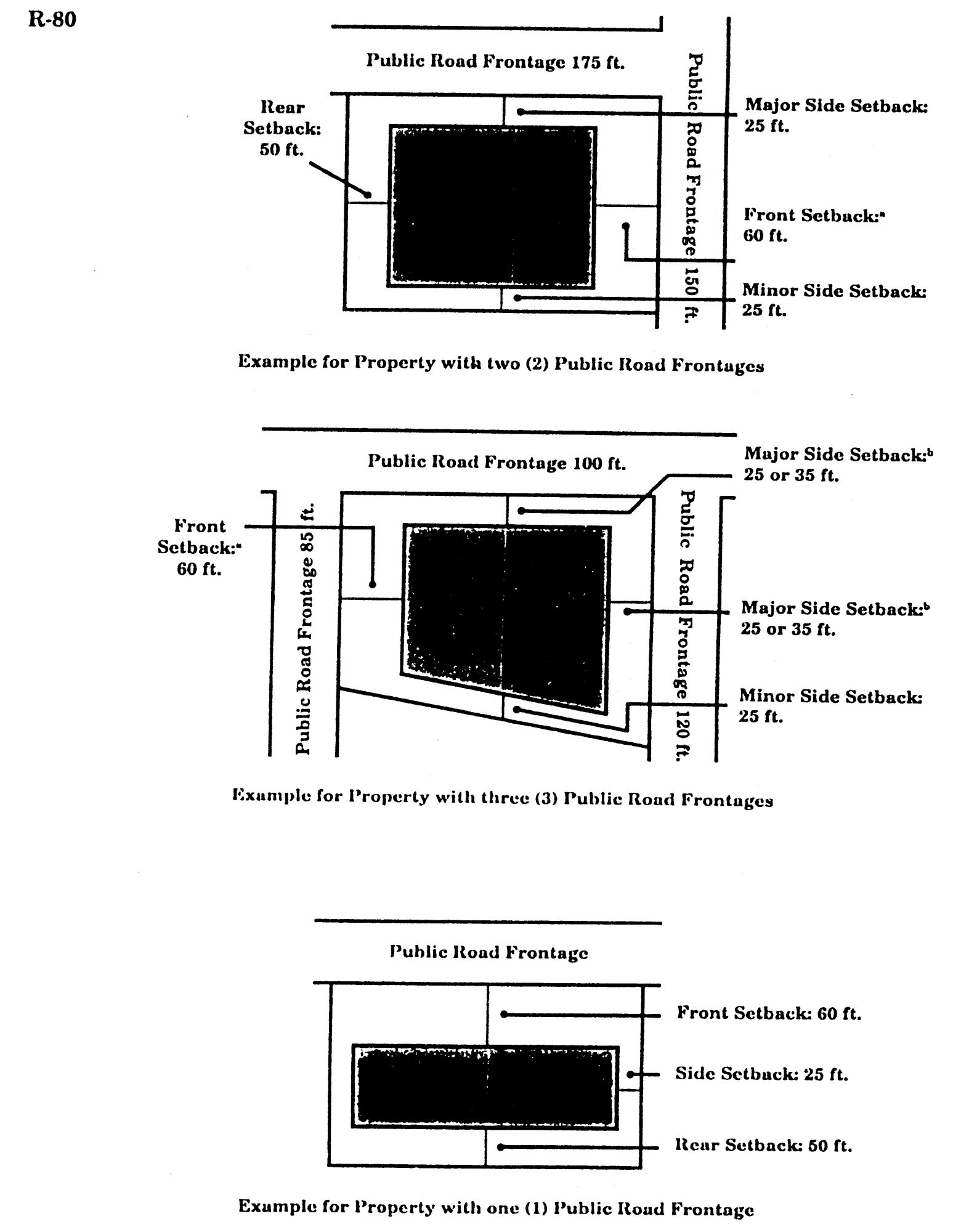
Minimum Building Setback Requirements for R-80 District
Notes:
a Property with shorter amount of road frontage will be the front setback for determining other setbacks (major side, side, rear).
b If structure fronts a major side setback, major side setback shall be 35 feet.
(5)
Landscape buffer and screening requirements. Landscape buffer and screening requirements are not applicable in this district.
(6)
Floodplain and wetlands preservation requirements. Any development must meet all state and federal requirements relating to floodplains and wetlands. The board of commissioners encourages preservation of wetland areas. Any development must also meet state and federal requirements relating to areas subject to the provisions of section 134-283, regarding mountain and river corridor protection act areas, and section 134-284, regarding metropolitan river protection act areas. No floodplains and/or wetlands may be used in calculating the overall density of the development.
(7)
Building and structure requirements. Maximum building height is 35 feet.
(8)
Parking requirements. See section 134-272 for paved parking specifications.
(9)
Lighting requirements. Any project permitted within the R-80 district which proposes any outdoor lighting, except individual residential lots, must have a county department of transportation approved lighting plan in accordance with the minimum conditions listed in section 134-269.
(10)
Special exception uses. See section 134-271 for special exception uses and requirements for all districts. Special exception uses for the R-80 district are the uses listed in section 134-271.
(11)
Use limitations.
a.
No sales of goods or products shall be permitted except as accessory to a customary home occupation, land use permit, special land use permit or special exception use.
b.
No sexually oriented businesses are permitted.
c.
All uses are subject to chapter 110, pertaining to subdivisions.
d.
It is found and declared that outside storage on properties within unincorporated Cobb County is a health risk and undesirable in that it provides harborage for rodents and insects, lowers property values, and constitutes a public nuisance; therefore, no outside storage is permitted, excluding firewood and lawn furnishings, unless otherwise allowed in this article.
e.
Maximum impervious surface shall not exceed 25 percent. Pervious pavement system and/or green roofs are considered 60 percent effective impervious and will be calculated as such when determining maximum impervious surface. In no case shall total pavement and roof areas (pervious and impervious) exceed 30 percent.
Required buffers may be included within required setbacks; however, in such case that the required buffer is greater than the required setback, the required buffer shall be adhered to. Additionally, necessary private utilities or access drives may be allowed through, over or across a landscaped buffer. Any such uses which are proposed through, over or across a designated undisturbed buffer must be approved pursuant to an original site plan or site plan modification as set forth under section 134-126.
(12)
Accessory buildings, structures, uses and decks.
a.
Size and setback limitations: Any accessory building, structure, use and deck up to 144 total gross square feet must be located at least five feet off the property line and limited to 15 feet in height subject to the development conditions list below (except for 15-foot height restriction). Any accessory building, structure, use and deck over 144 total gross square feet and up to 650 total gross square feet shall be limited to the building setbacks of the lot it is located on and is subject to the development conditions below. Any accessory building, structure, use and deck over 650 total gross square feet must be at least 100 feet from any property line and is subject to the development conditions below.
b.
Accessory buildings, structures, uses and decks shall be subject to the following development conditions:
1.
Maximum height is two stories or 35 feet.
2.
Buildings or structures shall have the meaning as defined in section 134-1. Accessory structures and uses shall also include Jacuzzis, tennis courts, basketball courts, swimming pools (private), playhouses and playgrounds. When calculating square footage for ground level uses such as tennis courts, basketball courts and above ground swimming pools and the like, the footprint shall be used in calculating total gross square feet.
3.
All accessory buildings, structures, uses and decks shall be located to the rear of the principal building, except for heating and air conditioning units or garbage pads, which may be located on the side of the primary structure and located within two feet of the primary structure.
4.
The rear of the primary structure shall be where the main portion of the building ends without consideration of wings.
5.
Architectural style and design are to be approved by the division manager of zoning or his designee, and are to be complimentary to the primary structure.
6.
Such structures or buildings shall be located on the same lot as and to the rear of the primary structure to which they are accessory. Uncovered decks that are attached to the primary structure may be located to the rear or side of the principal building. Covered decks, covered patios, and covered steps shall adhere to the building setbacks of the primary structure.
7.
No accessory building, structure, use or deck shall be constructed upon a lot until construction of the principal building has commenced.
8.
On a corner lot, no accessory building, structure, use or deck shall be located closer to the side street right-of-way line than the principal building.
9.
If the garage, accessory building, structure, use or deck is attached to the primary structure by a breezeway it shall be located up to a maximum of 25 feet from the primary structure to which it is attached. The breezeway may be enclosed or open.
10.
When an accessory building is intended to be habitable it shall be attached to the principal structure by a fully enclosed heated/cooled hallway and it shall comply with the yard requirements of the principal building to which it is accessory. The accessory building, structure or use shall be located up to a maximum of 25 feet from the primary structure to which it is attached.
11.
All accessory buildings, structures and uses in excess of 650 gross square feet shall be required to submit for plan review through the community development department or receive approval from the director of the community development department or zoning division manager, or their designees.
12.
The primary structure in a residential district shall be the principle house on the lot.
c.
Antennas and satellite dishes shall meet the requirements set forth in section 134-274.
d.
Incidental storage is permitted, provided that the material stored is incidental to the permitted use, as determined by the division manager of zoning or his designee, and stored completely within a portion of the enclosed principal structure permitted within the district, or within a permitted accessory structure.
e.
Neighborhood recreation centers, amenities and swimming pools are subject to the following:
1.
Site plans must be approved by the zoning staff to ensure compliance with all applicable laws and provisions of this chapter. The facility should be designed to include a detailed landscape plan that provides adequate screening of the facility which creates a visual and sound buffer for adjacent properties. The landscape plan shall be drawn to scale and shall include plant identification by common name. The facility shall be designed to accommodate no more than those residing within two adjoining residential developments except in those cases where a variance is obtained as in other cases.
2.
Buildings and structures established in connection with such use shall be set back not less than 100 feet from any property line.
i.
Upon written consent of all owners of property within 100 feet of the building or structure, the setback may be reduced to 50 feet from any exterior property line of the subdivision within which the use is located. Additionally, a detailed landscape plan must be submitted to and approved by the planning and zoning staff.
ii.
The setback may be reduced to 20 feet from an interior property line of the property on which the use is located if a ten-foot landscaped buffer is provided along the property line and a six-foot solid wood or masonry fence is erected and maintained along the line so as to provide a visual and noise screen for adjacent property; provided, however, the setback after reduction shall not be less than 100 feet from an exterior property line unless also reduced in accordance with subsection (12)e.2.i of this section. Such landscaped buffer shall be shown on the landscaping plan specified in subsection (12)e.1 of this section and must be approved by the planning and zoning staff.
iii.
When a property line is on a natural waterway, a property line setback may be waived provided a written waiver is obtained from both the community development department and the planning division and zoning division.
3.
Swimming pools must comply with all applicable ordinances and must have necessary approvals from the health department and building inspections department.
4.
Outdoor activity shall cease by 11:00 p.m.
5.
Lighting shall be established in such a way that values or quiet use and enjoyment of adjacent properties are not adversely affected, and that roadways and safe use thereof are not adversely affected. No direct light shall be cast upon adjacent properties or roadways. If lighting is to be established, the use of environmental or cutoff type fixtures only is permissible. If lighting is to be established in a recreation area adjacent to an existing or proposed county public road, a lighting plan must be submitted and approved by the county department of transportation to ensure that no light is cast upon the roadway and that no adverse impact will be created as a result of the lighting.
6.
No residence or structures shall be built upon any adjacent lot within the development within which the facility is located until construction of the recreation area has commenced to the extent that buyers of adjacent property will be aware of where the recreation area will be located.
7.
Parking requirements are as follows:
i.
A minimum of one space per five residences.
ii.
Parking spaces shall be paved and striped according to county standard 114, Parking Specifications, as it now exists or may hereafter be amended. No parking shall be allowed within a front yard setback.
(Ord. of 12-26-72; Ord. of 11-8-77, § 7; Ord. of 7-7-82, §§ 1, 3; Ord. of 12-11-90, § 3-28-7.1; Ord. of 8-13-91; Ord. of 6-9-92; Ord. of 10-27-92; Ord. of 2-22-94; Ord. of 5-23-95; Ord. of 7-11-95; Ord. of 9-26-95; Ord. of 2-27-96; Ord. of 6-24-97 (eff. 7-1-97); Ord. of 3-9-99; Ord. of 11-23-99; Ord. of 2-8-00; Ord. of 9-12-00; Ord. of 7-10-01; Ord. of 7-27-04; Ord. of 7-26-05; Ord. of 1-24-06; Ord. of 7-25-06; Ord. of 2-27-07; Ord. of 2-26-08; Amd. of 2-23-10; Ord. of 2-28-12; Ord. of 7-24-12; Amd. of 2-26-13; Amd. of 7-22-14; Amd. of 2-24-15; Amd. of 9-8-20; Amd. of 3-26-24)
Sec. 134-194. - RR rural residential district.
The regulations for the RR rural residential district are as follows:
(1)
Purpose and intent. The RR district is established to provide locations for large useable areas for limited residential, agricultural, park and open space needs. This district also serves to correlate growth with utility, service and transportation needs until urbanization is warranted. RR uses or residentially compatible institutional and recreational uses should be located within or on the edge of properties delineated for any residential category as defined and shown on the Cobb County Comprehensive Plan: A Policy Guide, adopted November 27, 1990. When residentially compatible institutional and recreational uses are developed within the RR district, they should be designed and built to ensure intensity and density compatibility with adjacent single-family detached dwellings and otherwise to implement the stated purpose and intent of this chapter.
(2)
Definitions. The following words, terms and phrases, when used in this section, shall have the meanings ascribed to them in this subsection, except where the context clearly indicates a different meaning:
a.
Agricultural produce stand means a structure not greater than 1,000 square feet for the purpose of seasonal sales of products grown or produced on the premises on which it is located.
b.
Community fair means a festival or fair such as the North Georgia State Fair conducted wholly within public areas owned by a local government, provided that any activity is conducted at least 200 feet from any property line. Any event shall not exceed 21 days.
c.
Customary home occupation means those occupations which are customarily performed in a small area of a residence due to the low intensity nature of such uses, subject to the following requirements:
1.
There shall be no exterior evidence of the home occupation, including but not limited to any type of identifying signs.
2.
No article, product or service used or sold in connection with such activity shall be other than those normally found on the premises.
3.
No mechanical equipment shall be used for such occupation except such equipment as is customary for purely household and hobby purposes.
4.
Such use shall be conducted entirely within the dwelling unit, and only persons living in the dwelling unit shall be employed in such occupation.
5.
No more than 25 percent of the dwelling unit may be used for the operation.
6.
No materials, equipment or business vehicles may be stored or parked on the premises, except that one business vehicle, used exclusively by the resident may be parked in a carport, garage, or rear or side yard. The off-site employees of the resident shall not congregate on the premises for any purpose concerning the business of the home occupation.
7.
There shall be no deliveries of supplies for use in the home occupation or pickups of the items produced by the occupant by commercial carrier.
8.
No clients or customers are allowed on the premises, except for individual instruction, such as tutoring, musical lessons and the like, for the purpose of supplementing an income.
d.
Group home means a dwelling shared by four or fewer persons, excluding resident staff, who live together as a single housekeeping unit and in a long term, family-like environment in which staff persons provide care, education and participation in community activities for the residents with the primary goal of enabling the residents to live as independently as possible in order to reach their maximum potential under the direction and guidance of a designated managing caregiver, who must be a resident of the group home. The term "group home" shall not include a halfway house, a treatment center for alcoholism or drug abuse, a work release facility for convicts or ex-convicts, a home for the detention and/or rehabilitation of juveniles adjudged delinquent or unruly and placed in the custody of the state, or other housing facilities serving as an alternative to incarceration. The term "group home" shall also not allow the use of a dwelling as an apartment or duplex. A group home shall not allow use of the dwelling as a home for individuals on parole, probation, or convicted and released from incarceration, for any crimes including child molestation, aggravated child molestation, or child sexual abuse, as defined in O.C.G.A. § 16-6-4 or individuals required to register as sex offenders pursuant to O.C.G.A. § 42-1-12. A group home may include a home for the handicapped. As used in this subsection, the term "handicapped" shall mean:
1.
Having a physical or mental impairment that substantially limits one or more of such person's major life activities so that such person is incapable of living independently;
2.
Having a record of having such an impairment; or
3.
Being regarded as having such an impairment.
However, the term "handicapped" shall not include current illegal use of or addiction to a controlled substance, nor shall it include any person whose residency in the home would constitute a direct threat to the health and safety of other individuals.
(3)
Permitted uses. Anything not permitted or allowed by special exception is prohibited. Permitted uses are as follows:
Agricultural produce stands with a minimum of four off-street parking spaces.
Commercial greenhouses and plant nurseries, so long as set back at least 100 feet from any residential property line.
Community fairs.
Cottage food operators as regulated by the Georgia Department of Agriculture in accordance with its Rules, Chapter 40-7-19, as may be amended from time to time subject to the following requirements:
1.
There shall be no signage or other exterior evidence of the cottage food operator.
2.
Deliveries of specialty ingredients such as herbs and spices, etc., limited to those made by the United States Postal Service or other carrier (FedEx, United Parcel Service, etc.) that routinely delivers mail/internet order products to residents.
3.
No cottage food products prepared by the cottage food operator may be picked up by a commercial carrier.
4.
There shall be no employees parking on the site unless approved by the board of commissioners in accordance with section 134-36 of the Cobb County Code.
Customary home occupations.
Dairies, so long as buildings used for livestock shall be set back not less than 200 feet from any property line and all animals are maintained at least 100 feet from any property line.
Designated recycling collection locations.
Executive golf courses (see section 134-270).
Farm and garden supply stores.
Field crops.
Fruit trees, nuts and vegetables.
Golf courses, 18-hole regulation, public and private (see section 134-270).
Golf courses, par 3 (see section 134-270).
Group homes.
In-home day care.
Livestock, nondomestic and wild animals, and poultry, on two or more acres.
Livestock sales pavilions.
Nonprofit (seasonal use) fishing lakes.
Outdoor golf driving ranges (see section 134-270).
Parking for vehicles.
Personal vehicle and equipment sales.
Poultry hatcheries. All structures shall be located and activities conducted at least 100 feet from any residentially zoned property.
Residential, agricultural, farm and wood products and livestock and poultry sales.
Riding stables.
Single-family dwelling units (detached).
Temporary uses.
(4)
Lot size and setback requirements. Lot size and setback requirements are as follows:
a.
Minimum lot size: 40,000 square feet. The board of zoning appeals shall not be authorized to recommend a variance for more than 25 percent of the minimum lot size.
b.
Minimum lot width at front setback line: 100 feet.
c.
Minimum public road frontage: 75 feet.
d.
Minimum building setbacks: As shown on and applied in the following diagram:
MINIMUM BUILDING SETBACK REQUIREMENTS FOR RR DISTRICT
Note: All setbacks shall be measured from future right-of-way.
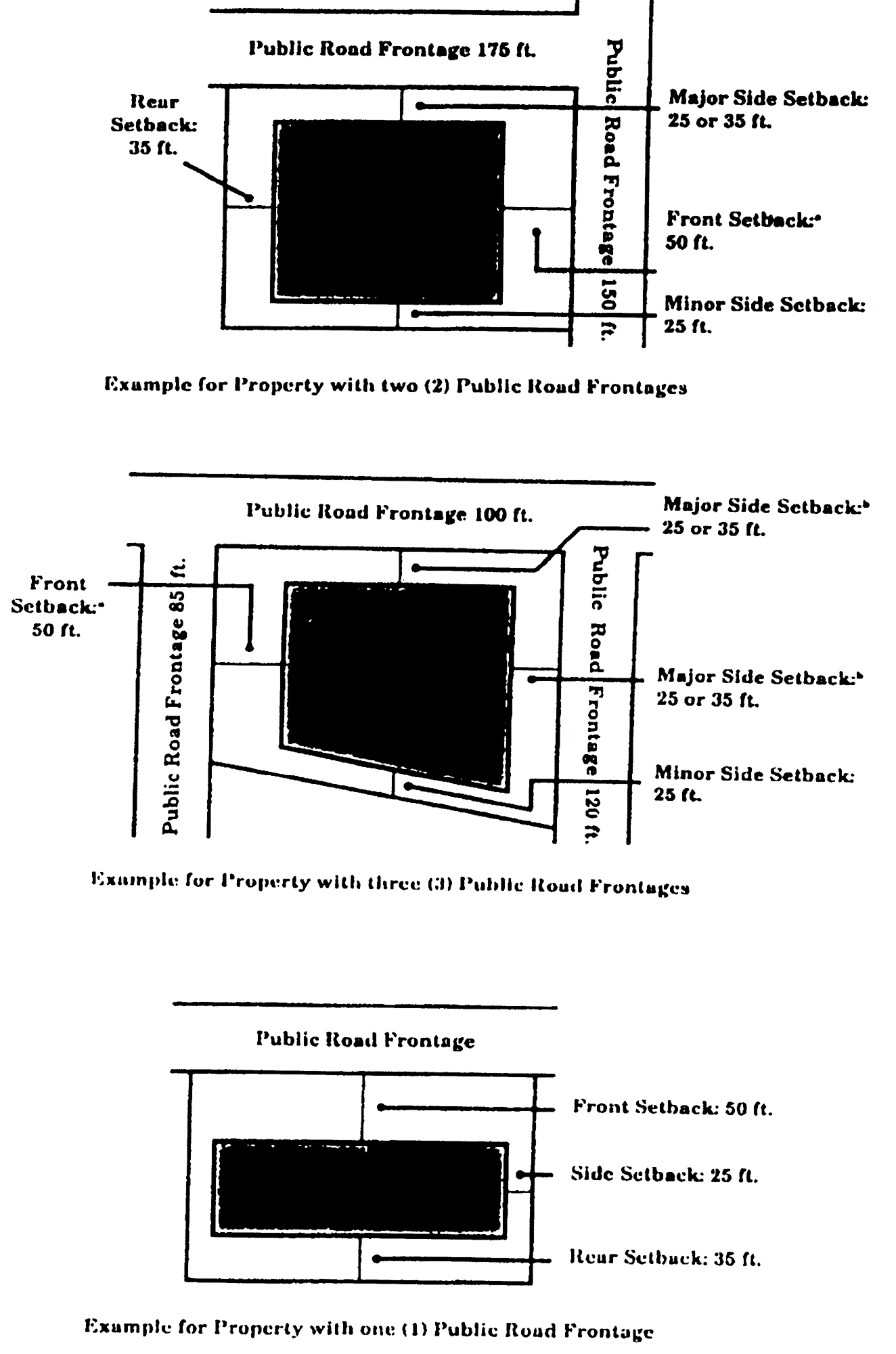
RR District
Notes:
a Property with shorter amount of road frontage will be the front setback for determining other setbacks (major side, side, rear).
b If structure fronts a major side setback, major side setback shall be 35 feet.
(5)
Landscape buffer and screening requirements. Landscape buffer and screening requirements are not applicable in this district.
(6)
Floodplain and wetlands preservation requirements. Any development must meet all state and federal requirements relating to floodplains and wetlands. The board of commissioners encourages preservation of wetland areas. Any development must also meet state and federal requirements relating to areas subject to the provisions of section 134-283, regarding mountain and river corridor protection act areas, and section 134-284, regarding metropolitan river protection act areas. No floodplains and/or wetlands may be used in calculating the overall density of the development.
(7)
Building and structure requirements. Maximum building height is 35 feet.
(8)
Parking requirements. See section 134-272 for paved parking specifications.
(9)
Lighting requirements. Any project permitted within the RR district which proposes any outdoor lighting, except individual residential lots, must have a county department of transportation approved lighting plan in accordance with the minimum conditions listed in section 134-269.
(10)
Special exception uses. See section 134-271 for special exception uses and requirements for all districts. Special exception uses for the RR district are the uses listed in section 134-271.
(11)
Temporary land use permits and special land use permits. See sections 134-36 and 134-37 for additional uses and requirements for all districts. Uses requiring land use permits or special land use permits for the RR district are the designated uses listed in sections 134-36 and 134-37.
(12)
Use limitations.
a.
It is found and declared that outside storage on properties within unincorporated Cobb County is a health risk and undesirable in that it provides harborage for rodents and insects, lowers property values, and constitutes a public nuisance; therefore, no outside storage is permitted, excluding firewood and lawn furnishings, unless otherwise allowed in this article.
b.
Maximum impervious surface shall not exceed 25 percent. Pervious pavement system and/or green roofs are considered 60 percent effective impervious and will be calculated as such when determining maximum impervious surface. In no case shall total pavement and roof areas (pervious and impervious) exceed 30 percent.
Required buffers may be included within required setbacks; however, in such case that the required buffer is greater than the required setback, the required buffer shall be adhered to. Additionally, necessary private utilities and access drives may be allowed through, over or across a landscaped buffer. Any such uses which are proposed through, over or across a designated undisturbed buffer must be approved pursuant to an original site plan or site plan modification as set forth under section 134-126.
(13)
Accessory buildings, structures, uses and decks.
a.
Size and setback limitations: Any accessory building, structure, use and deck up to 144 total gross square feet must be located at least five feet off the property line and limited to 15 feet in height subject to the development conditions list below (except for 15-foot height restriction). Any accessory building, structure, use and deck over 144 total gross square feet and up to 650 total gross square feet shall be limited to the building setbacks of the lot it is located on and is subject to the development conditions below. Any accessory building, structure, use and deck over 650 total gross square feet must be at least 100 feet from any property line and is subject to the development conditions below.
b.
Accessory buildings, structures, uses and decks shall be subject to the following development conditions:
1.
Maximum height is two stories or 35 feet.
2.
Buildings or structures shall have the meaning as defined in section 134-1. Accessory structures and uses shall also include Jacuzzis, tennis courts, basketball courts, swimming pools (private), playhouses and playgrounds. When calculating square footage for ground level uses such as tennis courts, basketball courts and above ground swimming pools and the like, the footprint shall be used in calculating total gross square feet.
3.
All accessory buildings, structures, uses and decks shall be located to the rear of the principal building, except for heating and air conditioning units or garbage pads, which may be located on the side of the primary structure and located within two feet of the primary structure.
4.
The rear of the primary structure shall be where the main portion of the building ends without consideration of wings.
5.
Architectural style and design are to be approved by the division manager of zoning or his designee, and are to be complimentary to the primary structure.
6.
Such structures or buildings shall be located on the same lot as and to the rear of the primary structure to which they are accessory. Uncovered decks that are attached to the primary structure may be located to the rear or side of the principal building. Covered decks, covered patios, and covered steps shall adhere to the building setbacks of the primary structure.
7.
No accessory building, structure, use or deck shall be constructed upon a lot until construction of the principal building has commenced.
8.
On a corner lot, no accessory building, structure, use or deck shall be located closer to the side street right-of-way line than the principal building.
9.
If the garage, accessory building, structure, use or deck is attached to the primary structure by a breezeway it shall be located up to a maximum of 25 feet from the primary structure to which it is attached. The breezeway may be enclosed or open.
10.
When an accessory building is intended to be habitable it shall be attached to the principal structure by a fully enclosed heated/cooled hallway and it shall comply with the yard requirements of the principal building to which it is accessory. The accessory building, structure or use shall be located up to a maximum of 25 feet from the primary structure to which it is attached.
11.
All accessory buildings, structures and uses in excess of 650 gross square feet shall be required to submit for plan review through the community development department or receive approval from the director of the community development department or zoning division manager, or their designees.
12.
The primary structure in a residential district shall be the principle house on the lot.
c.
Antennas and satellite dishes shall meet the requirements set forth in section 134-274.
d.
Incidental storage is permitted, provided that the material stored is incidental to the permitted use, as determined by the division manager of zoning or his designee, and stored completely within a portion of the enclosed principal structure permitted within the district, or within permitted accessory structure.
e.
Neighborhood recreation centers, amenities and swimming pools are subject to the following:
1.
Site plans must be approved by the zoning staff to ensure compliance with all applicable laws and provisions of this chapter. The facility should be designed to include a detailed landscape plan that provides adequate screening of the facility which creates a visual and sound buffer for adjacent properties. The landscape plan shall be drawn to scale and shall include plant identification by common name. The facility shall be designed to accommodate no more than those residing within two adjoining residential developments except in those cases where a variance is obtained as in other cases.
2.
Buildings and structures established in connection with such use shall be set back not less than 100 feet from any property line.
i.
Upon written consent of all owners of property within 100 feet of the building or structure, the setback may be reduced to 50 feet from any exterior property line of the subdivision within which the use is located. Additionally, a detailed landscape plan must be submitted to and approved by the planning and zoning staff.
ii.
The setback may be reduced to 20 feet from an interior property line of the property on which the use is located if a ten-foot landscaped buffer is provided along the property line and a six-foot solid wood or masonry fence is erected and maintained along the line so as to provide a visual and noise screen for adjacent property; provided, however, the setback after reduction shall not be less than 100 feet from an exterior property line unless also reduced in accordance with subsection (12)e.2.i of this section. Such landscaped buffer shall be shown on the landscaping plan specified in subsection (12)e.1 of this section and must be approved by the planning and zoning staff.
iii.
When a property line is on a natural waterway, a property line setback may be waived provided written waiver is obtained from both the community development department and the planning division and zoning division.
3.
Swimming pools must comply with all applicable ordinances and must have necessary approvals from the health department and building inspections department.
4.
Outdoor activity shall cease by 11:00 p.m.
5.
Lighting shall be established in such a way that values or quiet use and enjoyment of adjacent properties are not adversely affected, and that roadways and safe use thereof are not adversely affected. No direct light shall be cast upon adjacent properties or roadways. If lighting is to be established, the use of environmental or cutoff type fixtures only is permissible. If lighting is to be established in a recreation area adjacent to an existing or proposed county public road, a lighting plan must be submitted and approved by the county department of transportation to ensure that no light is cast upon the roadway and that no adverse impact will be created as a result of the lighting.
6.
No residence or structures shall be built upon any adjacent lot within the development within which the facility is located until construction of the recreation area has commenced to the extent that buyers of adjacent property will be aware of where the recreation area will be located.
7.
Parking requirements are as follows:
i.
A minimum of one space per five residences.
ii.
Parking spaces shall be paved and striped according to county standard 114, Parking Specifications, as it now exists or may hereafter be amended. No parking shall be allowed within a front yard setback.
(Ord. of 12-26-72; Res. of 8-14-73, § 8; Ord. of 11-8-77, §§ 1, 7; Ord. of 7-7-82, §§ 1, 3; Ord. of 12-11-90, § 3-28-7.2; Ord. of 8-13-91; Ord. of 6-9-92; Ord. of 10-27-92; Ord. of 2-22-94; Ord. of 5-23-95; Ord. of 7-11-95; Ord. of 9-26-95; Ord. of 2-27-96; Ord. of 6-24-97 (eff. 7-1-97); Ord. of 11-23-99; Ord. of 2-8-00; Ord. of 9-12-00; Ord. of 7-10-01; Ord. of 7-27-04; Ord. of 7-26-05; Ord. of 1-24-06; Ord. of 7-25-06; Ord. of 2-27-07; Ord. of 2-26-08; Amd. of 2-23-10; Ord. of 2-28-12; Ord. of 7-24-12; Amd. of 2-26-13; Amd. of 7-22-14; Amd. of 2-24-15; Amd. of 2-28-17; Amd. of 3-26-24)
Sec. 134-195. - R-40 single-family residential district.
The regulations for the R-40 single-family residential district (40,000-square-foot lot size) are as follows:
(1)
Purpose and intent. The R-40 district is established to provide locations for single-family residential uses or residentially compatible institutional and recreational uses which are within or on the edge of properties delineated for any residential category as defined and shown on the Cobb County Comprehensive Plan: A Policy Guide, adopted November 27, 1990. When residentially compatible institutional and recreational uses are developed within the R-40 district, they should be designed and built to ensure intensity and density compatibility with adjacent single-family detached dwellings and otherwise to implement the stated purpose and intent of this chapter.
(2)
Definitions. The following words, terms and phrases, when used in this section, shall have the meanings ascribed to them in this subsection, except where the context clearly indicates a different meaning:
a.
Community fair means a festival or fair such as the North Georgia State Fair conducted wholly within public areas owned by a local government, provided that any activity is conducted at least 200 feet from any property line. Any event shall not exceed 21 days.
b.
Customary home occupations means those occupations which are customarily performed in a small area of a residence due to the low intensity nature of such uses, subject to the following requirements:
1.
There shall be no exterior evidence of the home occupation, including but not limited to any type of identifying signs.
2.
No article, product or service used or sold in connection with such activity shall be other than those normally found on the premises.
3.
No mechanical equipment shall be used for such occupation except such equipment as is customary for purely household and hobby purposes.
4.
Such use shall be conducted entirely within the dwelling unit, and only persons living in the dwelling unit shall be employed in such occupation.
5.
No more than 25 percent of the dwelling unit may be used for the operation.
6.
No materials, equipment or business vehicles may be stored or parked on the premises, except that one business vehicle, used exclusively by the resident may be parked in a carport, garage, or rear or side yard. The off-site employees of the resident shall not congregate on the premises for any purpose concerning the business of the home occupation.
7.
There shall be no deliveries of supplies for use in the home occupation or pickups of the items produced by the occupant by commercial carriers.
8.
No clients or customers are allowed on the premises, except for individual instruction, such as tutoring, musical lessons and the like, for the purpose of supplementing an income.
c.
Group home means a dwelling shared by four or fewer persons, excluding resident staff, who live together as a single housekeeping unit and in a long term, family-like environment in which staff persons provide care, education and participation in community activities for the residents with the primary goal of enabling the residents to live as independently as possible in order to reach their maximum potential under the direction and guidance of a designated managing caregiver, who must be a resident of the group home. The term "group home" shall not include a halfway house, a treatment center for alcoholism or drug abuse, a work release facility for convicts or ex-convicts, a home for the detention and/or rehabilitation of juveniles adjudged delinquent or unruly and placed in the custody of the state, or other housing facilities serving as an alternative to incarceration. The term "group home" shall also not allow the use of a dwelling as an apartment or duplex. A group home shall not allow use of the dwelling as a home for individuals on parole, probation, or convicted and released from incarceration, for any crimes including child molestation, aggravated child molestation, or child sexual abuse, as defined in O.C.G.A. 16-6-4 or individuals required to register as sex offenders pursuant to O.C.G.A. 42-1-12. A group home may include a home for the handicapped. As used in this subsection, the term "handicapped" shall mean:
1.
Having a physical or mental impairment that substantially limits one or more of such person's major life activities so that such person is incapable of living independently;
2.
Having a record of having such an impairment; or
3.
Being regarded as having such an impairment.
However, the term "handicapped" shall not include current illegal use of or addiction to a controlled substance, nor shall it include any person whose residency in the home would constitute a direct threat to the health and safety of other individuals.
d.
Livestock, nondomestic and wild animals, and poultry means animals, nondomestic and wild animals, and species of the avian family which are or may be raised for the purpose of providing food or transportation, or being resold or bred, excluding only dogs, cats, rabbits, fish, pet mice, hamsters, gerbils, parrots and parakeets.
1.
Such animals shall only be permitted on a lot containing not less than two acres.
2.
All buildings used for animals shall be set back not less than 100 feet from any property line.
3.
All animals shall be maintained at least ten feet from any residential property line.
4.
Except in the RR district, there shall be not less than 5,000 square feet of fenced lot area not covered by the principal structure for each animal, unless the property is a bona fide farm.
5.
In the case of nondomestic or wild animals, all state and federal requirements must be met and a special land use permit is required.
(3)
Permitted uses. Anything not permitted or allowed by special exception is prohibited. Permitted uses are as follows:
Community fairs.
Cottage food operators as regulated by the Georgia Department of Agriculture in accordance with its Rules, Chapter 40-7-19, as may be amended from time to time subject to the following requirements:
1.
There shall be no signage or other exterior evidence of the cottage food operator.
2.
Deliveries of specialty ingredients such as herbs and spices, etc., limited to those made by the United States Postal Service or other carrier (FedEx, United Parcel Service, etc.) that routinely delivers mail/internet order products to residents.
3.
No cottage food products prepared by the cottage food operator may be picked up by a commercial carrier.
4.
There shall be no employees parking on the site unless approved by the board of commissioners in accordance with section 134-36 of the Cobb County Code.
Customary home occupations.
Designated recycling collection locations.
Executive golf courses (see section 134-270).
Fruit trees, nuts and vegetables.
Golf courses, 18-hole regulation, public and private (see section 134-270).
Golf courses, par 3 (see section 134-270).
Group homes.
In-home day care.
Livestock, nondomestic and wild animals, and poultry, on two or more acres.
Nonprofit (seasonal use) fishing lakes.
Parking for vehicles.
Personal vehicle and equipment sales.
Residential, agricultural, farm and wood products and livestock and poultry sales.
Riding stables.
Single-family dwelling units (detached).
Temporary uses.
(4)
Lot size and setback requirements. Various flexible design options may apply when used with the open space community (OSC) overlay district, section 134-198.1. Otherwise, lot size and setback requirements are as follows:
a.
Minimum lot size: 40,000 square feet. The board of zoning appeals shall not be authorized to recommend a variance for more than 25 percent of the minimum lot size.
b.
Minimum lot width at front setback line: 75 feet; cul-de-sac, 50 feet.
c.
Minimum public road frontage: 75 feet; cul-de-sac, 50 feet.
d.
Minimum building setbacks: As shown and applied in the following diagram:
MINIMUM BUILDING SETBACK REQUIREMENTS FOR R-40 DISTRICT
Note: All setbacks shall be measured from future right-of-way.
R-40 District
Notes:
a Property with shorter amount of road frontage will be the front setback for determining other setbacks (major side, side, rear).
b If structure fronts a major side setback, major side setback shall be 35 feet.
(5)
Landscape buffer and screening requirements. Landscape buffer and screening requirements are not applicable in this district.
(6)
Floodplain and wetlands preservation requirements. Any development must meet all state and federal requirements relating to floodplains and wetlands. The board of commissioners encourages preservation of wetland areas. Any development must also meet state and federal requirements relating to areas subject to the provisions of section 134-283, regarding mountain and river corridor protection act areas, and section 134-284, regarding metropolitan river protection act areas. No floodplains and/or wetlands may be used in calculating the overall density of the development.
(7)
Building and structure requirements. Maximum building height is 35 feet.
(8)
Parking requirements. See section 134-272 for paved parking specifications.
(9)
Lighting requirements. Any project permitted within the R-40 district which proposes any outdoor lighting, except individual residential lots, must have a county department of transportation approved lighting plan in accordance with the minimum conditions listed in section 134-269.
(10)
Special exception uses. See section 134-271 for special exception uses and requirements for all districts. Special exception uses for the R-40 district are the uses listed in section 134-271.
(11)
Temporary land use permits and special land use permits. See sections 134-36 and 134-37 for additional uses and requirements for all districts. Uses requiring land use permits or special land use permits for the R-40 district are the designated uses listed in sections 134-36 and 134-37.
(12)
Use limitations.
a.
No sale of goods or products shall be permitted except if accessory to a customary home occupation, land use permit, special land use permit or special exception use.
b.
No sexually oriented businesses are permitted.
c.
No materials, equipment or business vehicles may be stored or parked on the premises, except that one business vehicle, used exclusively by the resident may be parked in a carport, garage, or rear or side yard. The off-site employees of the resident shall not congregate on the premises for any purpose concerning the business of the home occupation.
d.
All uses are subject to chapter 110, pertaining to subdivisions.
e.
It is found and declared that outside storage on properties within unincorporated Cobb County is a health risk and undesirable in that it provides harborage for rodents and insects, lowers property values, and constitutes a public nuisance; therefore, no outside storage is permitted, excluding firewood and lawn furnishings, unless otherwise allowed in this article.
f.
Maximum impervious surface shall not exceed 30 percent. Pervious pavement system and/or green roofs are considered 60 percent effective impervious and will be calculated as such when determining maximum impervious surface. In no case shall total pavement and roof areas (pervious and impervious) exceed 35 percent. An undisturbed buffer equal to the required rear yard setback for this zoning district shall be established along the perimeter boundaries during construction until certificates of occupancy for affected lots are obtained. In the event that this undisturbed perimeter buffer conflicts with any required building setbacks, the required building setbacks may be altered by the zoning division manager or his/her designee, so to accommodate the 40-foot undisturbed perimeter buffer. The following uses shall be allowed within the undisturbed perimeter buffer (after certificates of occupancy are issued): public and private utilities, detention facilities, access drives, pools, decks, gazebos and fences. These uses shall not be allowed if an undisturbed buffer is stipulated by the board of commissioners.
Required buffers may be included within required setbacks; however, in such case that the required buffer is greater than the required setback, the required buffer shall be adhered to. Additionally, necessary private utilities and access drives may be allowed through, over or across a landscaped buffer. Any such uses which are proposed through, over or across a designated undisturbed buffer must be approved pursuant to an original site plan or site plan modification as set forth under section 134-126.
(13)
Accessory buildings, structures, uses and decks.
a.
Size and setback limitations: Any accessory building, structure, use and deck up to 144 total gross square feet must be located at least five feet off the property line and limited to 15 feet in height subject to the development conditions list below (except for 15-foot height restriction). Any accessory building, structure, use and deck over 144 total gross square feet and up to 650 total gross square feet shall be limited to the building setbacks of the lot it is located on and is subject to the development conditions below. Any accessory building, structure, use and deck over 650 total gross square feet must be at least 100 feet from any property line and is subject to the development conditions below.
b.
Accessory buildings, structures, uses and decks shall be subject to the following development conditions:
1.
Maximum height is two stories or 35 feet.
2.
Buildings or structures shall have the meaning as defined in section 134-1. Accessory structures and uses shall also include Jacuzzis, tennis courts, basketball courts, swimming pools (private), playhouses and playgrounds. When calculating square footage for ground level uses such as tennis courts, basketball courts and above ground swimming pools and the like, the footprint shall be used in calculating total gross square feet.
3.
All accessory buildings, structures, uses and decks shall be located to the rear of the principal building, except for heating and air conditioning units or garbage pads, which may be located on the side of the primary structure and located within two feet of the primary structure.
4.
The rear of the primary structure shall be where the main portion of the building ends without consideration of wings.
5.
Architectural style and design are to be approved by the division manager of zoning or his designee, and are to be complimentary to the primary structure.
6.
Such structures or buildings shall be located on the same lot as and to the rear of the primary structure to which they are accessory. Uncovered decks that are attached to the primary structure may be located to the rear or side of the principal building. Covered decks, covered patios, and covered steps shall adhere to the building setbacks of the primary structure.
7.
No accessory building, structure, use or deck shall be constructed upon a lot until construction of the principal building has commenced.
8.
On a corner lot, no accessory building, structure, use or deck shall be located closer to the side street right-of-way line than the principal building.
9.
If the garage, accessory building, structure, use or deck is attached to the primary structure by a breezeway it shall be located up to a maximum of 25 feet from the primary structure to which it is attached. The breezeway may be enclosed or open.
10.
When an accessory building is intended to be habitable it shall be attached to the principal structure by a fully enclosed heated/cooled hallway and it shall comply with the yard requirements of the principal building to which it is accessory. The accessory building, structure or use shall be located up to a maximum of 25 feet from the primary structure to which it is attached.
11.
All accessory buildings, structures and uses in excess of 650 gross square feet shall be required to submit for plan review through the community development department or receive approval from the director of the community development department or zoning division manager, or their designees.
12.
The primary structure in a residential district shall be the principle house on the lot.
c.
Antennas and satellite dishes shall meet the requirements set forth in section 134-274.
d.
Incidental storage is permitted, provided that the material stored is incidental to the permitted use, as determined by the division manager of zoning or his designee, and is stored completely within a portion of the enclosed principal structure permitted within the district, or within a permitted accessory structure.
e.
Neighborhood recreation centers, amenities and swimming pools are subject to the following:
1.
Site plans must be approved by the zoning staff to ensure compliance with all applicable laws and provisions of this chapter. The facility should be designed to include a detailed landscape plan that provides adequate screening of the facility which creates a visual and sound buffer for adjacent properties. The landscape plan shall be drawn to scale and shall include plant identification by common name. The facility shall be designed to accommodate no more than those residing within two adjoining residential developments except in those cases where a variance is obtained as in other cases.
2.
Buildings and structures established in connection with such use shall be set back not less than 100 feet from any property line.
i.
Upon written consent of all owners of property within 100 feet of the building or structure, the setback may be reduced to 50 feet from any exterior property line of the subdivision within which the use is located. Additionally, a detailed landscape plan must be submitted to and approved by the planning and zoning staff.
ii.
The setback may be reduced to 20 feet from an interior property line of the property on which the use is located if a ten-foot landscaped buffer is provided along the property line and a six-foot solid wood or masonry fence is erected and maintained along the line so as to provide a visual and noise screen for adjacent property; provided, however, the setback after reduction shall not be less than 100 feet from an exterior property line unless also reduced in accordance with subsection (12)e.2.i of this section. Such landscaped buffer shall be shown on the landscaping plan specified in subsection (12)e.1 of this section, and must be approved by the planning and zoning staff.
iii.
When a property line is on a natural waterway, a property line setback may be waived provided written waiver is obtained from both the community development department and the planning division and zoning division.
3.
Swimming pools must comply with all applicable ordinances and must have necessary approvals from the health department and building inspections department.
4.
Outdoor activity shall cease by 11:00 p.m.
5.
Lighting shall be established in such a way that values or quiet use and enjoyment of adjacent properties are not adversely affected, and that roadways and safe use thereof are not adversely affected. No direct light shall be cast upon adjacent properties or roadways. If lighting is to be established, the use of environmental or cutoff type fixtures only is permissible. If lighting is to be established in a recreation area adjacent to an existing or proposed county public road, a lighting plan must be submitted and approved by the county department of transportation to ensure that no light is cast upon the roadway and that no adverse impact will be created as a result of the lighting.
6.
No residence or structures shall be built upon any adjacent lot within the development within which the facility is located until construction of the recreation area has commenced to the extent that buyers of adjacent property will be aware of where the recreation area will be located.
7.
Parking requirements are as follows:
i.
A minimum of one space per five residences.
ii.
Parking spaces shall be paved and striped according to county standard 114, Parking Specifications, as it now exists or may hereafter be amended. No parking shall be allowed within a front yard setback.
(Ord. of 12-26-72; Res. of 8-14-73, § 8; Ord. of 11-8-77, §§ 1, 7; Ord. of 7-7-82, §§ 1, 3; Ord. of 12-11-90, § 3-28-7.3; Ord. of 8-13-91; Ord. of 6-9-92; Ord. of 10-27-92; Ord. of 2-22-94; Ord. of 7-11-95; Ord. of 9-26-95; Ord. of 2-27-96; Ord. of 6-24-97 (eff. 7-1-97); Ord. of 3-9-99; Ord. of 11-23-99; Ord. of 2-8-00; Ord. of 9-12-00; Ord. of 7-10-01; Ord. of 7-27-04; Ord. of 1-25-05; Ord. of 7-26-05; Ord. of 1-24-06; Ord. of 7-25-06; Ord. of 2-27-07; Ord. of 2-26-08; Amd. of 2-23-10; Ord. of 2-28-12; Ord. of 7-24-12; Amd. of 2-26-13; Amd. of 7-22-14; Amd. of 2-24-15; Amd. of 2-28-17; Amd. of 9-8-20; Amd. of 3-26-24)
Sec. 134-196. - R-30 single-family residential district.
The regulations for the R-30 single-family residential district (30,000-square-foot lot size) are as follows:
(1)
Purpose and intent. The R-30 district is established to provide locations for single-family residential uses or residentially compatible institutional and recreational uses which are within or on the edge of properties delineated for any residential category as defined and shown on the Cobb County Comprehensive Plan: A Policy Guide, adopted November 27, 1990. When residentially compatible institutional and recreational uses are developed within the R-30 district, they should be designed and built to ensure intensity and density compatibility with adjacent single-family detached dwellings and otherwise to implement the stated purpose and intent of this chapter.
(2)
Definitions. The following words, terms and phrases, when used in this section, shall have the meanings ascribed to them in this subsection, except where the context clearly indicates a different meaning:
a.
Community fair means a festival or fair such as the North Georgia State Fair conducted wholly within public areas owned by a local government, provided that any activity is conducted at least 200 feet from any property line. Any event shall not exceed 21 days.
b.
Customary home occupations means those occupations which are customarily performed in a small area of a residence due to the low intensity nature of such uses, subject to the following requirements:
1.
There shall be no exterior evidence of the home occupation, including but not limited to any type of identifying signs.
2.
No article, product or service used or sold in connection with such activity shall be other than those normally found on the premises.
3.
No mechanical equipment shall be used for such occupation except such equipment as is customary for purely household and hobby purposes.
4.
Such use shall be conducted entirely within the dwelling unit, and only persons living in the dwelling unit shall be employed in such occupation.
5.
No more than 25 percent of the dwelling unit may be used for the operation.
6.
No materials, equipment or business vehicles may be stored or parked on the premises, except that one business vehicle, used exclusively by the resident may be parked in a carport, garage, or rear or side yard. The off-site employees of the resident shall not congregate on the premises for any purpose concerning the business of the home occupation.
7.
There shall be no deliveries of supplies for use in the home occupation or pickups of the items produced by the occupant by commercial carriers.
8.
No clients or customers are allowed on the premises, except for individual instruction, such as tutoring, musical lessons and the like, for the purpose of supplementing an income.
c.
Group home means a dwelling shared by four or fewer persons, excluding resident staff, who live together as a single housekeeping unit and in a long term, family-like environment in which staff persons provide care, education and participation in community activities for the residents with the primary goal of enabling the residents to live as independently as possible in order to reach their maximum potential under the direction and guidance of a designated managing caregiver, who must be a resident of the group home. The term "group home" shall not include a halfway house, a treatment center for alcoholism or drug abuse, a work release facility for convicts or ex-convicts, a home for the detention and/or rehabilitation of juveniles adjudged delinquent or unruly and placed in the custody of the state, or other housing facilities serving as an alternative to incarceration. The term "group home" shall also not allow the use of a dwelling as an apartment or duplex. A group home shall not allow use of the dwelling as a home for individuals on parole, probation, or convicted and released from incarceration, for any crimes including child molestation, aggravated child molestation, or child sexual abuse, as defined in O.C.G.A. § 16-6-4 or individuals required to register as sex offenders pursuant to O.C.G.A. § 42-1-12. A group home may include a home for the handicapped. As used in this subsection, the term "handicapped" shall mean:
1.
Having a physical or mental impairment that substantially limits one or more of such person's major life activities so that such person is incapable of living independently;
2.
Having a record of having such an impairment; or
3.
Being regarded as having such an impairment.
However, the term "handicapped" shall not include current illegal use of or addiction to a controlled substance, nor shall it include any person whose residency in the home would constitute a direct threat to the health and safety of other individuals.
d.
Livestock, nondomestic and wild animals, and poultry means animals, nondomestic and wild animals, and species of the avian family which are or may be raised for the purpose of providing food or transportation, or being resold or bred, excluding only dogs, cats, rabbits, fish, pet mice, hamsters, gerbils, parrots and parakeets.
1.
Such animals shall only be permitted on a lot containing not less than two acres.
2.
All buildings used for animals shall be set back not less than 100 feet from any property line.
3.
All animals shall be maintained at least ten feet from any residential property line.
4.
Except in the RR district, there shall be not less than 5,000 square feet of fenced lot area not covered by the principal structure for each animal, unless the property is a bona fide farm.
5.
In the case of nondomestic or wild animals, all state and federal requirements must be met and a special land use permit is required.
(3)
Permitted uses. Anything not permitted or allowed by special exception is prohibited. Permitted uses are as follows:
Community fairs.
Cottage food operators as regulated by the Georgia Department of Agriculture in accordance with its Rules, Chapter 40-7-19, as may be amended from time to time subject to the following requirements:
1.
There shall be no signage or other exterior evidence of the cottage food operator.
2.
Deliveries of specialty ingredients such as herbs and spices, etc., limited to those made by the United States Postal Service or other carrier (FedEx, United Parcel Service, etc.) that routinely delivers mail/internet order products to residents.
3.
No cottage food products prepared by the cottage food operator may be picked up by a commercial carrier.
4.
There shall be no employees parking on the site unless approved by the board of commissioners in accordance with section 134-36 of the Cobb County Code.
Customary home occupations.
Designated recycling collection locations.
Executive golf courses (see section 134-270).
Fruit trees, nuts and vegetables.
Golf courses, 18-hole regulation, public and private (see section 134-270).
Golf courses, par 3 (see section 134-270).
Group homes.
In-home day care.
Livestock, nondomestic and wild animals, and poultry, on two or more acres.
Nonprofit (seasonal use) fishing lakes.
Parking for vehicles.
Personal vehicle and equipment sales.
Residential, agricultural, farm and wood products and livestock and poultry sales.
Riding stables.
Single-family dwelling units (detached).
Temporary uses.
(4)
Lot size and setback requirements. Various flexible design options may apply when used with the open space community (OSC) overlay district, section 134-198.1. Otherwise, lot size and setback requirements are as follows:
a.
Minimum lot size: 30,000 square feet. The board of zoning appeals shall not be authorized to recommend a variance for more than 25 percent of the minimum lot size.
b.
Minimum lot width at front setback line: 75 feet; cul-de-sac, 50 feet.
c.
Minimum public road frontage: 75 feet; cul-de-sac, 50 feet.
d.
Minimum building setbacks: As shown and applied in the following diagram:
MINIMUM BUILDING SETBACK REQUIREMENTS FOR R-30 DISTRICT
Note: All setbacks shall be measured from future right-of-way.
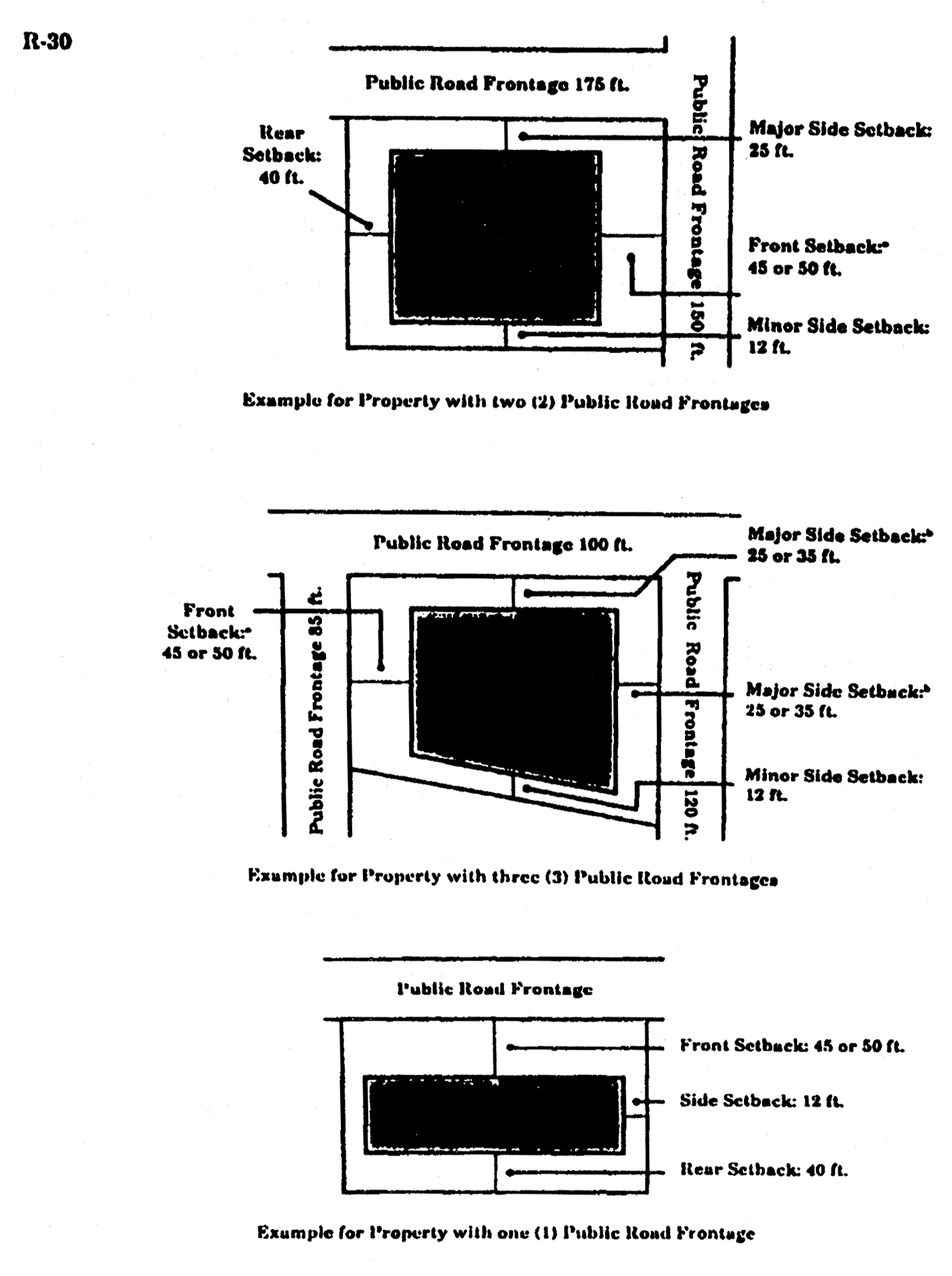
Minimum Building Setback Requirements for R-30 District
Notes:
a Property with shorter amount of road frontage will be the front setback for determining other setbacks (major side, side, rear).
b If structure fronts a major side setback, major side setback shall be 35 feet.
(5)
Landscape buffer and screening requirements. Landscape buffer and screening requirements are not applicable in this district.
(6)
Floodplain and wetlands preservation requirements. Any development must meet all state and federal requirements relating to floodplains and wetlands. The board of commissioners encourages preservation of wetland areas. Any development must also meet state and federal requirements relating to areas subject to the provisions of section 134-283, regarding mountain and river corridor protection act areas, and section 134-284, regarding metropolitan river protection act areas. No floodplains and/or wetlands may be used in calculating the overall density of the development.
(7)
Building and structure requirements. Maximum building height is 35 feet.
(8)
Parking requirements. See section 134-272 for paved parking specifications.
(9)
Lighting requirements. Any project permitted within the R-30 district which proposes any outdoor lighting, except individual residential lots, must have a county department of transportation approved lighting plan in accordance with the minimum conditions listed in section 134-269.
(10)
Special exception uses. See section 134-271 for special exception uses and requirements for all districts. Special exception uses for the R-30 district are the uses listed in section 134-271.
(11)
Temporary land use permits and special land use permits. See sections 134-36 and 134-37 for additional uses and requirements for all districts. Uses requiring land use permits or special land use permits for the R-30 district are the designated uses listed in sections 134-36 and 134-37.
(12)
Use limitations.
a.
No sale of goods or products shall be permitted except if accessory to a customary home occupation, land use permit, special land use permit or special exception use.
b.
No sexually oriented businesses are permitted.
c.
No materials, equipment or business vehicles may be stored or parked on the premises, except that one business vehicle, used exclusively by the resident may be parked in a carport, garage, or rear or side yard. The off-site employees of the resident shall not congregate on the premises for any purpose concerning the business of the home occupation.
d.
All uses are subject to chapter 110, pertaining to subdivisions.
e.
It is found and declared that outside storage on properties within unincorporated Cobb County is a health risk and undesirable in that it provides harborage for rodents and insects, lowers property values, and constitutes a public nuisance; therefore, no outside storage is permitted, excluding firewood and lawn furnishings, unless otherwise allowed in this article.
f.
Maximum impervious surface shall not exceed 35 percent. Pervious pavement system and/or green roofs are considered 60 percent effective impervious and will be calculated as such when determining maximum impervious surface. In no case shall total pavement and roof areas (pervious and impervious) exceed 40 percent. An undisturbed buffer equal to the required rear yard setback for this zoning district shall be established along the perimeter boundaries during construction until certificates of occupancy for affected lots are obtained. In the event that this undisturbed perimeter buffer conflicts with any required building setbacks, the required building setbacks may be altered by the zoning division manager or his/her designee, so to accommodate the 40-foot undisturbed perimeter buffer. The following uses shall be allowed within the undisturbed perimeter buffer (after certificates of occupancy are issued): public and private utilities, detention facilities, access drives, pools, decks, gazebos and fences. These uses shall not be allowed if an undisturbed buffer is stipulated by the board of commissioners. Required buffers may be included within required setbacks; however, in such case that the required buffer is greater than the required setback, the required buffer shall be adhered to. Additionally, necessary private utilities and access drives may be allowed through, over or across a landscaped buffer. Any such uses which are proposed through, over or across a designated undisturbed buffer must be approved pursuant to an original site plan or site plan modification as set forth under section 134-126.
(13)
Accessory buildings, structures, uses and decks.
a.
Size and setback limitations: Any accessory building, structure, use and deck up to 144 total gross square feet must be located at least five feet off the property line and limited to 15 feet in height subject to the development conditions list below (except for 15-foot height restriction). Any accessory building, structure, use and deck over 144 total gross square feet and up to 650 total gross square feet shall be limited to the building setbacks of the lot it is located on and is subject to the development conditions below. Any accessory building, structure, use and deck over 650 total gross square feet must be at least 100 feet from any property line and is subject to the development conditions below.
b.
Accessory buildings, structures, uses and decks shall be subject to the following development conditions:
1.
Maximum height is two stories or 35 feet.
2.
Buildings or structures shall have the meaning as defined in section 134-1. Accessory structures and uses shall also include Jacuzzis, tennis courts, basketball courts, swimming pools (private), playhouses and playgrounds. When calculating square footage for ground level uses such as tennis courts, basketball courts and above ground swimming pools and the like, the footprint shall be used in calculating total gross square feet.
3.
All accessory buildings, structures, uses and decks shall be located to the rear of the principal building, except for heating and air conditioning units or garbage pads, which may be located on the side of the primary structure and located within two feet of the primary structure.
4.
The rear of the primary structure shall be where the main portion of the building ends without consideration of wings.
5.
Architectural style and design are to be approved by the division manager of zoning or his designee, and are to be complimentary to the primary structure.
6.
Such structures or buildings shall be located on the same lot as and to the rear of the primary structure to which they are accessory. Uncovered decks that are attached to the primary structure may be located to the rear or side of the principal building. Covered decks, covered patios, and covered steps shall adhere to the building setbacks of the primary structure.
7.
No accessory building, structure, use or deck shall be constructed upon a lot until construction of the principal building has commenced.
8.
On a corner lot, no accessory building, structure, use or deck shall be located closer to the side street right-of-way line than the principal building.
9.
If the garage, accessory building, structure, use or deck is attached to the primary structure by a breezeway it shall be located up to a maximum of 25 feet from the primary structure to which it is attached. The breezeway may be enclosed or open.
10.
When an accessory building is intended to be habitable it shall be attached to the principal structure by a fully enclosed heated/cooled hallway and it shall comply with the yard requirements of the principal building to which it is accessory. The accessory building, structure or use shall be located up to a maximum of 25 feet from the primary structure to which it is attached.
11.
All accessory buildings, structures and uses in excess of 650 gross square feet shall be required to submit for plan review through the community development department or receive approval from the director of the community development department or zoning division manager, or their designees.
12.
The primary structure in a residential district shall be the principle house on the lot.
c.
Antennas and satellite dishes shall meet the requirements set forth in section 134-274.
d.
Incidental storage is permitted, provided that the material stored is incidental to the permitted use, as determined by the division manager of zoning or his designee, and stored completely within a portion of the enclosed principal structure permitted within the district, or within a permitted accessory structure.
e.
Neighborhood recreation centers, amenities and swimming pools are subject to the following:
1.
The plans must be approved by the zoning staff to ensure compliance with applicable laws and provisions of this chapter. The facility should be designed to include a detailed landscape plan that provides adequate screening of the facility which creates a visual and sound buffer for adjacent properties. The landscape plan shall be drawn to scale and shall include plant identification by common name. The facility shall be designed to accommodate no more than those residing within two adjoining residential developments except in those cases where a variance is obtained as in other cases.
2.
Buildings and structures established in connection with such use shall be set back not less than 100 feet from any property line.
i.
Upon written consent of all owners of property within 100 feet of the building or structure, the setback may be reduced to 50 feet from any exterior property line of the subdivision within which the use is located. Additionally, a detailed landscape plan must be submitted to and approved by the planning and zoning staff.
ii.
The setback may be reduced to 20 feet from an interior property line of the property on which the use is located if a ten-foot landscaped buffer is provided along the property line and a six-foot solid wood or masonry fence is erected and maintained along the line so as to provide a visual and noise screen for adjacent property; provided, however, the setback after reduction shall not be less than 100 feet from an exterior property line unless also reduced in accordance with subsection (12)e.2.i of this section. Such landscaped buffer shall be shown on the landscaping plan specified in subsection (12)e.1 of this section and must be approved by the planning and zoning staff.
iii.
When a property line is on a natural waterway, a property line setback may be waived provided a written waiver is obtained from both the community development department and the planning division and zoning division.
3.
Swimming pools must comply with all applicable ordinances and must have necessary approvals from the health department and building inspections department.
4.
Outdoor activity shall cease by 11:00 p.m.
5.
Lighting shall be established in such a way that values or quiet use and enjoyment of adjacent properties are not adversely affected, and that roadways and safe use thereof are not adversely affected. No direct light shall be cast upon adjacent properties or roadways. If lighting is to be established, the use of environmental or cutoff type fixtures only is permissible. If lighting is to be established in a recreation area adjacent to an existing or proposed county public road, a lighting plan must be submitted and approved by county department of transportation to ensure that no light is cast upon the roadway and that no adverse impact will be created as a result of the lighting.
6.
No residence or structures shall be built upon any adjacent lot within the development within which the facility is located until construction of the recreation area has commenced to the extent that buyers of adjacent property will be aware of where the recreation area will be located.
7.
Parking requirements are as follows:
i.
A minimum of one space per five residences.
ii.
Parking spaces shall be paved and striped according to county standard 114, Parking Specifications, as it now exists or may hereafter be amended. No parking shall be allowed within a front yard setback.
(Ord. of 12-26-72; Res. of 8-14-73, § 8; Ord. of 11-8-77, §§ 1, 7; Ord. of 7-7-82, §§ 1, 3; Ord. of 12-11-90, § 3-28-7.4; Ord. of 8-13-91; Ord. of 6-9-92; Ord. of 10-27-92; Ord. of 2-22-94; Ord. of 7-11-95; Ord. of 9-26-95; Ord. of 2-27-96; Ord. of 6-24-97 (eff. 7-1-97); Ord. of 3-9-99; Ord. of 11-23-99; Ord. of 2-8-00; Ord. of 9-12-00; Ord. of 7-10-01; Ord. of 7-27-04; Ord. of 1-25-05; Ord. of 7-26-05; Ord. of 1-24-06; Ord. of 7-25-06; Ord. of 2-27-07; Ord. of 2-26-08; Amd. of 2-23-10; Ord. of 2-28-12; Ord. of 7-24-12; Amd. of 2-26-13; Amd. of 7-22-14; Amd. of 2-24-15; Amd. of 2-28-17; Amd. of 9-8-20; Amd. of 3-26-24)
Sec. 134-197. - R-20 single-family residential district.
The regulations for the R-20 single-family residential district (20,000-square-foot lot size) are as follows:
(1)
Purpose and intent. The R-20 district is established to provide locations for single-family residential uses or residentially compatible institutional and recreational uses which are within or on the edge of properties delineated for any residential category as defined and shown on the Cobb County Comprehensive Plan: A Policy Guide, adopted November 27, 1990. When residentially compatible institutional and recreational uses are developed within the R-20 district, they should be designed and built to ensure intensity and density compatibility with adjacent single-family detached dwellings and otherwise to implement the stated purpose and intent of this chapter.
(2)
Definitions. The following words, terms and phrases, when used in this section, shall have the meanings ascribed to them in this subsection, except where the context clearly indicates a different meaning:
a.
Community fair means a festival or fair such as the North Georgia State Fair conducted wholly within public areas owned by a local government, provided that any activity is conducted at least 200 feet from any property line. Any event shall not exceed 21 days.
b.
Customary home occupations means those occupations which are customarily performed in a small area of a residence due to the low intensity nature of such uses, subject to the following requirements:
1.
There shall be no exterior evidence of the home occupation, including but not limited to any type of identifying signs.
2.
No article, product or service used or sold in connection with such activity shall be other than those normally found on the premises.
3.
No mechanical equipment shall be used for such occupation except such equipment as is customary for purely household and hobby purposes.
4.
Such use shall be conducted entirely within the dwelling unit, and only persons living in the dwelling unit shall be employed in such occupation.
5.
No more than 25 percent of the dwelling unit may be used for the operation.
6.
No materials, equipment or business vehicles may be stored or parked on the premises, except that one business vehicle, used exclusively by the resident may be parked in a carport, garage, or rear or side yard. The off-site employees of the resident shall not congregate on the premises for any purpose concerning the business of the home occupation.
7.
There shall be no deliveries of supplies for use in the home occupation or pickups of the items produced by the occupant by commercial carriers.
8.
No clients or customers are allowed on the premises, except for individual instruction, such as tutoring, musical lessons and the like, for the purpose of supplementing an income.
c.
Group home means a dwelling shared by four or fewer persons, excluding resident staff, who live together as a single housekeeping unit and in a long term, family-like environment in which staff persons provide care, education and participation in community activities for the residents with the primary goal of enabling the residents to live as independently as possible in order to reach their maximum potential under the direction and guidance of a designated managing caregiver, who must be a resident of the group home. The term "group home" shall not include a halfway house, a treatment center for alcoholism or drug abuse, a work release facility for convicts or ex-convicts, a home for the detention and/or rehabilitation of juveniles adjudged delinquent or unruly and placed in the custody of the State, or other housing facilities serving as an alternative to incarceration. The term "group home" shall also not allow the use of a dwelling as an apartment or duplex. A group home shall not allow use of the dwelling as a home for individuals on parole, probation, or convicted and released from incarceration, for any crimes including child molestation, aggravated child molestation, or child sexual abuse, as defined in O.C.G.A. § 16-6-4 or individuals required to register as sex offenders pursuant to O.C.G.A. § 42-1-12. A group home may include a home for the handicapped. As used in this subsection, the term "handicapped" shall mean:
1.
Having a physical or mental impairment that substantially limits one or more of such person's major life activities so that such person is incapable of living independently;
2.
Having a record of having such an impairment; or
3.
Being regarded as having such an impairment.
However, the term "handicapped" shall not include current illegal use of or addiction to a controlled substance, nor shall it include any person whose residency in the home would constitute a direct threat to the health and safety of other individuals.
d.
Livestock, nondomestic and wild animals, and poultry means animals, nondomestic and wild animals, and species of the avian family which are or may be raised for the purpose of providing food or transportation, or being resold or bred, excluding only dogs, cats, rabbits, fish, pet mice, hamsters, gerbils, parrots and parakeets.
1.
Such animals shall only be permitted on a lot containing not less than two acres.
2.
All buildings used for animals shall be set back not less than 100 feet from any property line.
3.
All animals shall be maintained at least ten feet from any residential property line.
4.
Except in the RR district, there shall be not less than 5,000 square feet of fenced lot area not covered by the principal structure for each animal, unless the property is a bona fide farm.
5.
In the case of nondomestic or wild animals, all state and federal requirements must be met and a special land use permit is required.
(3)
Permitted uses. Anything not permitted or allowed by special exception is prohibited. Permitted uses are as follows:
Community fairs.
Cottage food operators as regulated by the Georgia Department of Agriculture in accordance with its Rules, Chapter 40-7-19, as may be amended from time to time subject to the following requirements:
1.
There shall be no signage or other exterior evidence of the cottage food operator.
2.
Deliveries of specialty ingredients such as herbs and spices, etc., limited to those made by the United States Postal Service or other carrier (FedEx, United Parcel Service, etc.) that routinely delivers mail/internet order products to residents.
3.
No cottage food products prepared by the cottage food operator may be picked up by a commercial carrier.
4.
There shall be no employees parking on the site unless approved by the board of commissioners in accordance with section 134-36 of the Cobb County Code.
Customary home occupations.
Designated recycling collection locations.
Executive golf courses (see section 134-270).
Fruit trees, nuts and vegetables.
Golf courses, 18-hole regulation, public and private (see section 134-270).
Golf courses, par 3 (see section 134-270).
Group homes.
In-home day care.
Livestock, nondomestic and wild animals, and poultry, on two or more acres.
Nonprofit (seasonal use) fishing lakes.
Parking for vehicles.
Personal vehicle and equipment sales.
Residential, agricultural, farm and wood products and livestock and poultry sales.
Riding stables.
Single-family dwelling units (detached).
Temporary uses.
(4)
Lot size and setback requirements. Various flexible design options may apply when used with the open space community (OSC) overlay district, section 134-198.1. Otherwise, lot size and setback requirements are as follows:
a.
Minimum lot size: 20,000 square feet. The board of zoning appeals shall not be authorized to recommend a variance for more than 25 percent of the minimum lot size.
b.
Minimum lot width at front setback line: 75 feet; cul-de-sac, 50 feet.
c.
Minimum public road frontage: 75 feet; cul-de-sac, 50 feet.
d.
Minimum building setbacks: As shown and applied in the following diagram:
MINIMUM BUILDING SETBACK REQUIREMENTS FOR R-20 DISTRICT
Note: All setbacks shall be measured from future right-of-way.
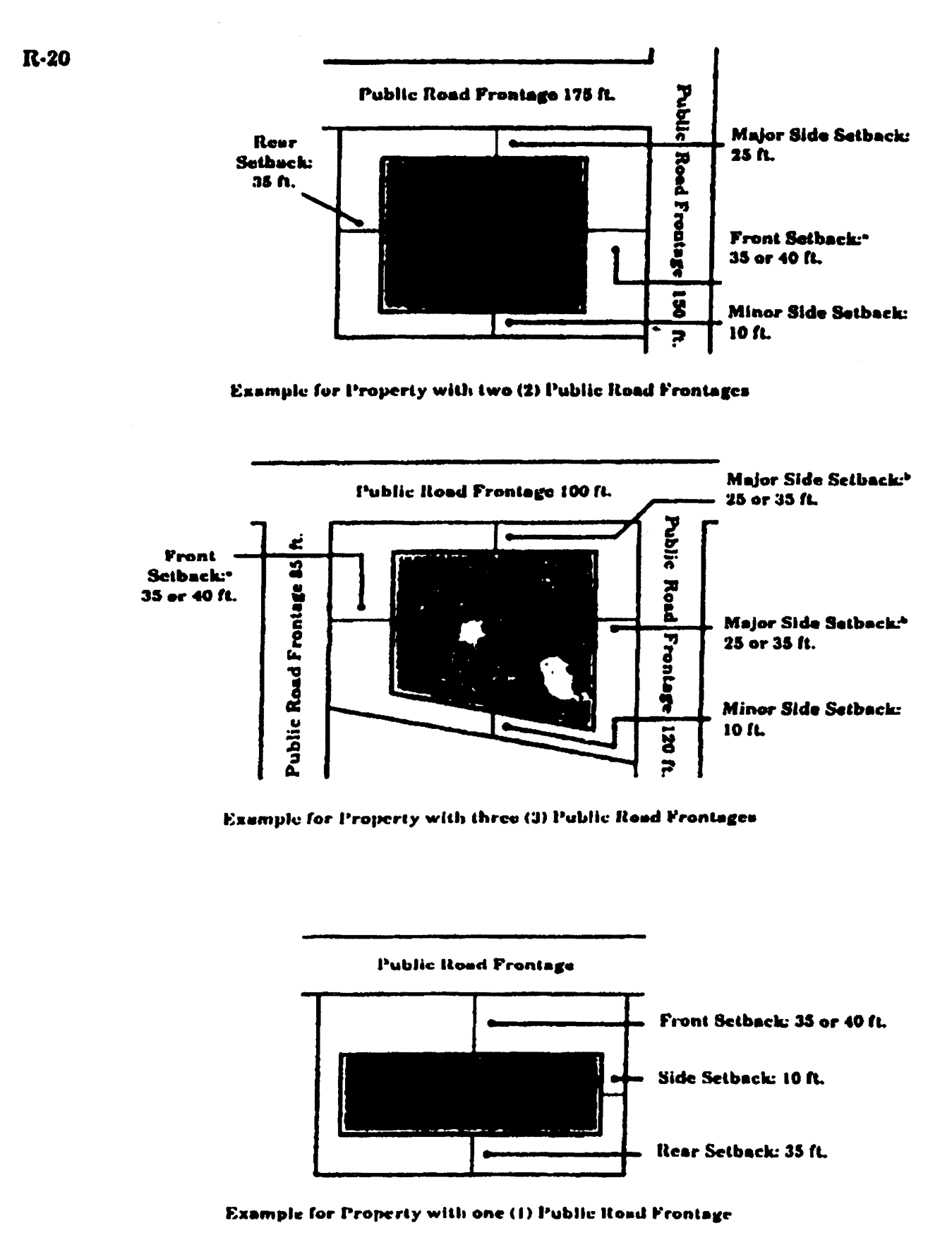
Minimum Building Setback Requirements for R-20 District
Notes:
a Property with shorter amount of road frontage will be the front setback for determining other setbacks (major side, side, rear).
b If structure fronts a major side setback, major side setback shall be 35 feet.
(5)
Landscape buffer and screening requirements. Landscape buffer and screening requirements are not applicable in this district.
(6)
Floodplain and wetlands preservation requirements. Any development must meet all state and federal requirements relating to floodplains and wetlands. The board of commissioners encourages preservation of wetland areas. Any development must also meet state and federal requirements relating to areas subject to the provisions of section 134-283, regarding mountain and river corridor protection act areas, and section 134-284, regarding metropolitan river protection act areas. No floodplains and/or wetlands may be used in calculating the overall density of the development.
(7)
Building and structure requirements. Maximum building height is 35 feet.
(8)
Parking requirements. See section 134-272 for paved parking specifications.
(9)
Lighting requirements. Any project permitted within the R-20 district which proposes any outdoor lighting, except individual residential lots, must have a county department of transportation approved lighting plan in accordance with the minimum conditions listed in section 134-269.
(10)
Special exception uses. See section 134-271 for special exception uses and requirements for all districts. Special exception uses for the R-20 district are the uses listed in section 134-271.
(11)
Temporary land use permits and special land use permits. See sections 134-36 and 134-37 for additional uses and requirements for all districts. Uses requiring land use permits or special land use permits for the R-20 district are the designated uses listed in sections 134-36 and 134-37.
(12)
Use limitations.
a.
No sale of goods or products shall be permitted except if accessory to a customary home occupation, land use permit, special land use permit or special exception use.
b.
No sexually oriented businesses are permitted.
c.
No materials, equipment or business vehicles may be stored or parked on the premises, except that one business vehicle, used exclusively by the resident may be parked in a carport, garage or rear or side yard. The off-site employees of the resident shall not congregate on the premises for any purpose concerning the business of the home occupation.
d.
All uses are subject to chapter 110, pertaining to subdivisions.
e.
It is found and declared that outside storage on properties within unincorporated Cobb County is a health risk and undesirable in that it provides harborage for rodents and insects, lowers property values, and constitutes a public nuisance; therefore, no outside storage is permitted, excluding firewood and lawn furnishings, unless otherwise allowed in this article.
f.
Maximum impervious surface shall not exceed 35 percent. Pervious pavement system and/or green roofs are considered 60 percent effective impervious and will be calculated as such when determining maximum impervious surface. In no case shall total pavement and roof areas (pervious and impervious) exceed 40 percent. An undisturbed buffer equal to the required rear yard setback for this zoning district shall be established along the perimeter boundaries during construction until certificates of occupancy for affected lots are obtained. In the event that this undisturbed perimeter buffer conflicts with any required building setbacks, the required building setbacks may be altered by the zoning division manager or his/her designee, so to accommodate the 40-foot undisturbed perimeter buffer. The following uses shall be allowed within the undisturbed perimeter buffer (after certificates of occupancy are issued): public and private utilities, detention facilities, access drives, pools, decks, gazebos and fences. These uses shall not be allowed if an undisturbed buffer is stipulated by the board of commissioners. Required buffers may be included within required setbacks; however, in such case that the required buffer is greater than the required setback, the required buffer shall be adhered to. Additionally, necessary private utilities and access drives may be allowed through, over or across a landscaped buffer. Any such uses which are proposed through, over or across a designated undisturbed buffer must be approved pursuant to an original site plan or site plan modification as set forth under section 134-126.
(13)
Accessory buildings, structures, uses and decks.
a.
Size and setback limitations: Any accessory building, structure, use and deck up to 144 total gross square feet must be located at least five feet off the property line and limited to 15 feet in height subject to the development conditions list below (except for 15-foot height restriction). Any accessory building, structure, use and deck over 144 total gross square feet and up to 650 total gross square feet shall be limited to the building setbacks of the lot it is located on and is subject to the development conditions below. Any accessory building, structure, use and deck over 650 total gross square feet must be at least 100 feet from any property line and is subject to the development conditions below.
b.
Accessory buildings, structures, uses and decks shall be subject to the following development conditions:
1.
Maximum height is two stories or 35 feet.
2.
Buildings or structures shall have the meaning as defined in section 134-1. Accessory structures and uses shall also include Jacuzzis, tennis courts, basketball courts, swimming pools (private), playhouses and playgrounds. When calculating square footage for ground level uses such as tennis courts, basketball courts and above ground swimming pools and the like, the footprint shall be used in calculating total gross square feet.
3.
All accessory buildings, structures, uses and decks shall be located to the rear of the principal building, except for heating and air conditioning units or garbage pads, which may be located on the side of the primary structure and located within two feet of the primary structure.
4.
The rear of the primary structure shall be where the main portion of the building ends without consideration of wings.
5.
Architectural style and design are to be approved by the division manager of zoning or his designee, and are to be complimentary to the primary structure.
6.
Such structures or buildings shall be located on the same lot as and to the rear of the primary structure to which they are accessory. Uncovered decks that are attached to the primary structure may be located to the rear or side of the principal building. Covered decks, covered patios, and covered steps shall adhere to the building setbacks of the primary structure.
7.
No accessory building, structure, use or deck shall be constructed upon a lot until construction of the principal building has commenced.
8.
On a corner lot, no accessory building, structure, use or deck shall be located closer to the side street right-of-way line than the principal building.
9.
If the garage, accessory building, structure, use or deck is attached to the primary structure by a breezeway it shall be located up to a maximum of 25 feet from the primary structure to which it is attached. The breezeway may be enclosed or open.
10.
When an accessory building is intended to be habitable it shall be attached to the principal structure by a fully enclosed heated/cooled hallway and it shall comply with the yard requirements of the principal building to which it is accessory. The accessory building, structure or use shall be located up to a maximum of 25 feet from the primary structure to which it is attached.
11.
All accessory buildings, structures and uses in excess of 650 gross square feet shall be required to submit for plan review through the community development department or receive approval from the director of the community development department or zoning division manager, or their designees.
12.
The primary structure in a residential district shall be the principle house on the lot.
c.
Antennas and satellite dishes shall meet the requirements set forth in section 134-274.
d.
Incidental storage is permitted, provided that the material stored is incidental to the permitted use, as determined by the division manager of zoning or his designee, and stored completely within a portion of the enclosed principal structure permitted within the district, or within a permitted accessory structure.
e.
Neighborhood recreation centers, amenities and swimming pools are subject to the following:
1.
Site plans must be approved by the zoning staff to ensure compliance with all applicable laws and provisions of this chapter. The facility should be designed to include a detailed landscape plan that provides adequate screening of the facility which creates a visual and sound buffer for adjacent properties. The landscape plan shall be drawn to scale and shall include plant identification by common name. The facility shall be designed to accommodate no more than those residing within two adjoining residential developments except in those cases where a variance is obtained as in other cases.
2.
Buildings and structures established in connection with such use shall be set back not less than 100 feet from any property line.
i.
Upon written consent of all owners of property within 100 feet of the building or structure, the setback may be reduced to 50 feet from any exterior property line of the subdivision within which the use is located. Additionally, a detailed landscape plan must be submitted to and approved by the planning and zoning staff.
ii.
The setback may be reduced to 20 feet from an interior property line of the property on which the use is located if a ten-foot landscaped buffer is provided along the property line and a six-foot solid wood or masonry fence is erected and maintained along the line so as to provide a visual and noise screen for adjacent property; provided, however, the setback after reduction shall not be less than 100 feet from an exterior property line unless also reduced in accordance with subsection (12)e.2.i of this section. Such landscaped buffer shall be shown on the landscaping plan specified in subsection (12)e.1 of this section and must be approved by the planning and zoning staff.
iii.
When a property line is on a natural waterway, a property line setback may be waived provided a written waiver is obtained from both the community development department and the planning division and zoning division.
3.
Swimming pools must comply with all applicable ordinances and must have necessary approvals from the health department and building inspections department.
4.
Outdoor activity shall cease by 11:00 p.m.
5.
Lighting shall be established in such a way that values or quiet use and enjoyment of adjacent properties are not adversely affected, and that roadways and safe use thereof are not adversely affected. No direct light shall be cast upon adjacent properties or roadways. If lighting is to be established, the use of environmental or cutoff type fixtures only is permissible. If lighting is to be established in a recreation area adjacent to an existing or proposed county public road, a lighting plan must be submitted and approved by the county department of transportation to ensure that no light is cast upon the roadway and that no adverse impact will be created as a result of the lighting.
6.
No residence or structures shall be built upon any adjacent lot within the development within which the facility is located until construction of the recreation area has commenced to the extent that buyers of adjacent property will be aware of where the recreation area will be located.
7.
Parking requirements are as follows:
i.
A minimum of one space per five residences.
ii.
Parking spaces shall be paved and striped according to county standard 114, Parking Specifications, as it now exists or may hereafter be amended. No parking shall be allowed within a front yard setback.
(Ord. of 12-26-72; Res. of 8-14-73, § 8; Ord. of 11-8-77, §§ 1, 7; Ord. of 7-7-82, § 1; Ord. of 12-11-90, § 3-28-7.5; Ord. of 8-13-91; Ord. of 6-9-92; Ord. of 10-27-92; Ord. of 2-22-94; Ord. of 7-11-95; Ord. of 9-26-95; Ord. of 2-27-96; Ord. of 6-24-97 (eff. 7-1-97); Ord. of 3-9-99; Ord. of 11-23-99; Ord. of 2-8-00; Ord. of 9-12-00; Ord. of 7-10-01; Ord. of 7-27-04; Ord. of 1-25-05; Ord. of 7-26-05; Ord. of 1-24-06; Ord. of 7-25-06; Ord. of 2-27-07; Ord. of 2-26-08; Amd. of 2-23-10; Ord. of 2-28-12; Ord. of 7-24-12; Amd. of 2-26-13; Amd. of 7-22-14; Amd. of 2-24-15; Amd. of 2-28-17; Amd. of 9-8-20; Amd. of 3-26-24)
Sec. 134-198. - R-15 single-family residential district.
The regulations for the R-15 single-family residential district (15,000-square-foot lot size) are as follows:
(1)
Purpose and intent. The R-15 district is established to provide locations for single-family residential uses or residentially compatible institutional and recreational uses which are within or on the edge of properties delineated for any residential category as defined and shown on the Cobb County Comprehensive Plan: A Policy Guide, adopted November 27, 1990. When residentially compatible institutional and recreational uses are developed within the R-15 district, they should be designed and built to ensure intensity and density compatibility with adjacent single-family detached dwellings and otherwise to implement the stated purpose and intent of this chapter.
(2)
Definitions. The following words, terms and phrases, when used in this section, shall have the meanings ascribed to them in this subsection, except where the context clearly indicates a different meaning:
a.
Community fair means a festival or fair such as the North Georgia State Fair conducted wholly within public areas owned by a local government, provided that any activity is conducted at least 200 feet from any property line. Any event shall not exceed 21 days.
b.
Customary home occupations means those occupations which are customarily performed in a small area of a residence due to the low intensity nature of such uses, subject to the following requirements:
1.
There shall be no exterior evidence of the home occupation, including but not limited to any type of identifying signs.
2.
No article, product or service used or sold in connection with such activity shall be other than those normally found on the premises.
3.
No mechanical equipment shall be used for such occupation except such equipment as is customary for purely household and hobby purposes.
4.
Such use shall be conducted entirely within the dwelling unit, and only persons living in the dwelling unit shall be employed in such occupation.
5.
No more than 25 percent of the dwelling unit may be used for the operation.
6.
No materials, equipment or business vehicles may be stored or parked on the premises, except that one business vehicle used exclusively by the resident may be parked in a carport, garage, or rear or side yard. The off-site employees of the resident shall not congregate on the premises for any purpose concerning the business of the home occupation.
7.
There shall be no deliveries of supplies for use in the home occupation or pickup of the items produced by the occupant by commercial carriers.
8.
No clients or customers are allowed on the premises, except for individual instruction, such as tutoring, musical lessons and the like, for the purpose of supplementing an income.
c.
Group home means a dwelling shared by four or fewer persons, excluding resident staff, who live together as a single housekeeping unit and in a long term, family-like environment in which staff persons provide care, education and participation in community activities for the residents with the primary goal of enabling the residents to live as independently as possible in order to reach their maximum potential under the direction and guidance of a designated managing caregiver, who must be a resident of the group home. The term "group home" shall not include a halfway house, a treatment center for alcoholism or drug abuse, a work release facility for convicts or ex-convicts, a home for the detention and/or rehabilitation of juveniles adjudged delinquent or unruly and placed in the custody of the state, or other housing facilities serving as an alternative to incarceration. The term "group home" shall also not allow the use of a dwelling as an apartment or duplex. A group home shall not allow use of the dwelling as a home for individuals on parole, probation, or convicted and released from incarceration, for any crimes including child molestation, aggravated child molestation, or child sexual abuse, as defined in O.C.G.A. § 16-6-4 or individuals required to register as sex offenders pursuant to O.C.G.A. § 42-1-12. A group home may include a home for the handicapped. As used in this subsection, the term "handicapped" shall mean:
1.
Having a physical or mental impairment that substantially limits one or more of such person's major life activities so that such person is incapable of living independently;
2.
Having a record of having such an impairment; or
3.
Being regarded as having such an impairment.
However, the term "handicapped" shall not include current illegal use of or addiction to a controlled substance, nor shall it include any person whose residency in the home would constitute a direct threat to the health and safety of other individuals.
d.
Livestock, nondomestic and wild animals, and poultry means animals, nondomestic and wild animals, and species of the avian family which are or may be raised for the purpose of providing food or transportation, or being resold or bred, excluding only dogs, cats, rabbits, fish, pet mice, hamsters, gerbils, parrots and parakeets.
1.
Such animals shall only be permitted on a lot containing not less than two acres.
2.
All buildings used for animals shall be set back not less than 100 feet from any property line.
3.
All animals shall be maintained at least ten feet from any residential property line.
4.
Except in the RR district, there shall be not less than 5,000 square feet of fenced lot area not covered by the principal structure for each animal, unless the property is a bona fide farm.
5.
In the case of nondomestic or wild animals, all state and federal requirements must be met and a special land use permit is required.
(3)
Permitted uses. Anything not permitted or allowed by special exception is prohibited. Permitted uses are as follows:
Community fairs.
Cottage food operators as regulated by the Georgia Department of Agriculture in accordance with its Rules, Chapter 40-7-19, as may be amended from time to time subject to the following requirements:
1.
There shall be no signage or other exterior evidence of the cottage food operator.
2.
Deliveries of specialty ingredients such as herbs and spices, etc., limited to those made by the United States Postal Service or other carrier (FedEx, United Parcel Service, etc.) that routinely delivers mail/internet order products to residents.
3.
No cottage food products prepared by the cottage food operator may be picked up by a commercial carrier.
4.
There shall be no employees parking on the site unless approved by the board of commissioners in accordance with section 134-36 of the Cobb County Code.
Customary home occupations.
Designated recycling collection locations.
Executive golf courses (see section 134-270).
Fruit trees, nuts and vegetables.
Golf courses, 18-hole regulation, public and private (see section 134-270).
Golf courses, par 3 (see section 134-270).
Group homes.
In-home care.
Livestock, nondomestic and wild animals, and poultry, on two or more acres.
Nonprofit (seasonal use) fishing lakes.
Parking for vehicles.
Personal vehicle and equipment sales.
Residential, agricultural, farm and wood products and livestock and poultry sales.
Riding stables.
Single-family dwelling units (detached).
Temporary uses.
(4)
Lot size and setback requirements. Various flexible design options may apply when used with the open space community (OSC) overlay district, section 134-198.1. Otherwise, lot size and setback requirements are as follows:
a.
Minimum lot size: 15,000 square feet. The board of zoning appeals shall not be authorized to recommend a variance for more than 25 percent of the minimum lot size.
b.
Minimum lot width at front setback line: 75 feet; cul-de-sac, 50 feet.
c.
Minimum public road frontage: 75 feet; cul-de-sac, 50 feet.
d.
Minimum building setbacks: As shown and applied in the following diagram:
MINIMUM BUILDING SETBACK REQUIREMENTS FOR R-15 DISTRICT
Note: All setbacks shall be measured from future right-of-way.
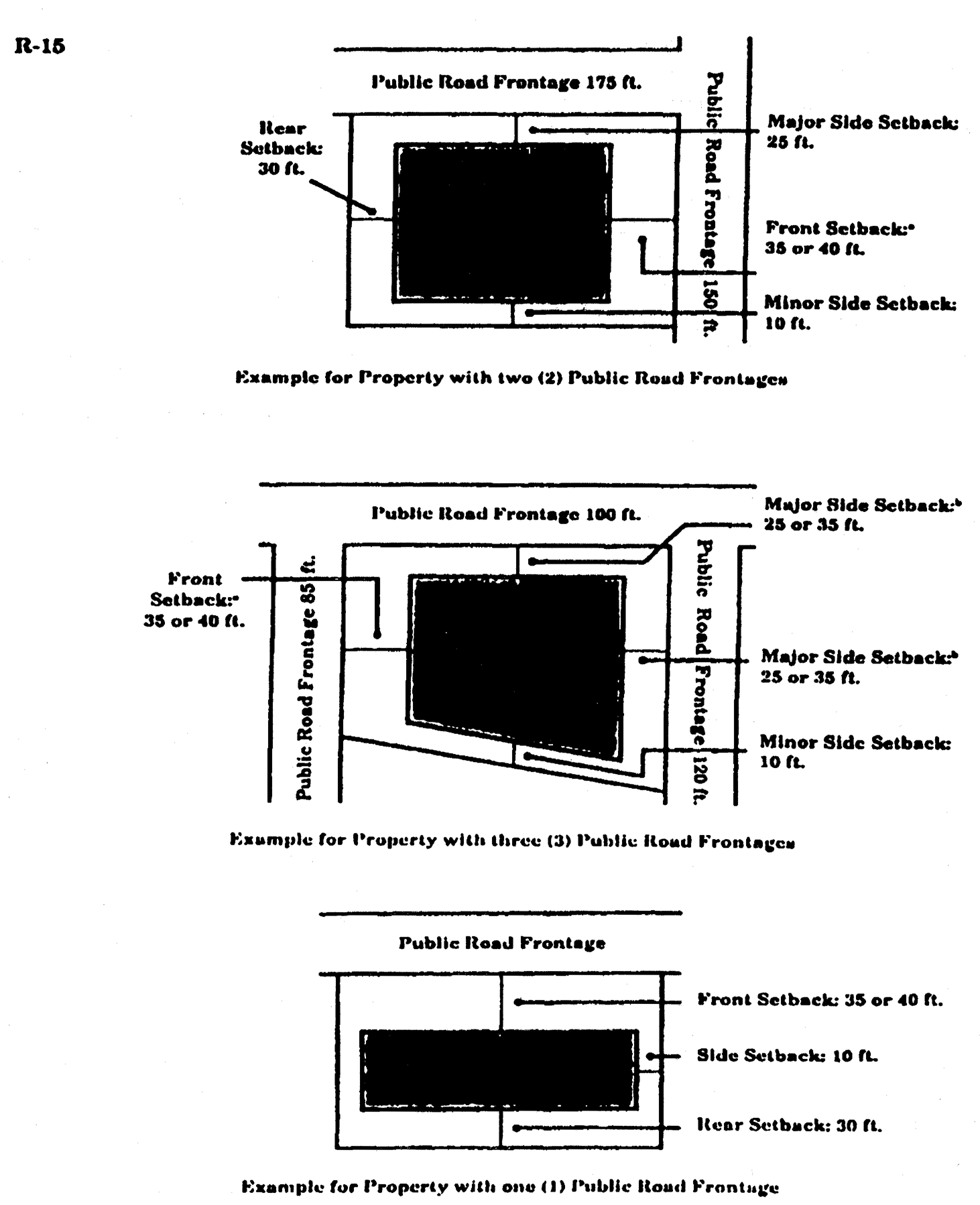
Minimum Building Setback Requirements for R-15 District
Notes:
a Property with shorter amount of road frontage will be the front setback for determining other setbacks (major side, side, rear).
b If structure fronts a major side setback, major side setback shall be 35 feet.
(5)
Landscape buffer and screening requirements. Landscape buffer and screening requirements are not applicable in this district.
(6)
Floodplain and wetlands preservation requirements. Any development must meet all state and federal requirements relating to floodplains and wetlands. The board of commissioners encourages preservation of wetland areas. Any development must also meet state and federal requirements relating to areas subject to the provisions of section 134-283, regarding mountain and river corridor protection act areas, and section 134-284, regarding metropolitan river protection act areas. No floodplains and/or wetlands may be used in calculating the overall density of the development.
(7)
Building and structure requirements. Maximum building height is 35 feet.
(8)
Parking requirements. See section 134-272 for paved parking specifications.
(9)
Lighting requirements. Any project permitted within the R-15 district which proposes any outdoor lighting, except individual residential lots, must have a county department of transportation approved lighting plan in accordance with the minimum conditions listed in section 134-269.
(10)
Special exception uses. See section 134-271 for special exception uses and requirements for all districts. Special exception uses for the R-15 district are the uses listed in section 134-271.
(11)
Temporary land use permits and special land use permits. See sections 134-36 and 134-37 for additional uses and requirements for all districts. Uses requiring land use permits or special land use permits for the R-15 district are the designated uses listed in sections 134-36 and 134-37.
(12)
Use limitations.
a.
No sale of goods or products shall be permitted except if accessory to a customary home occupation, land use permit, special land use permit or special exception use.
b.
No sexually oriented businesses are permitted.
c.
No materials, equipment or business vehicles may be stored or parked on the premises, except that one business vehicle used exclusively by the resident may be parked in a carport, garage, or rear or side yard. The off-site employees of the resident shall not congregate on the premises for any purpose concerning the business of the home occupation.
d.
All uses are subject to chapter 110, pertaining to subdivisions.
e.
It is found and declared that outside storage on properties within unincorporated Cobb County is a health risk and undesirable in that it provides harborage for rodents and insects, lowers property values, and constitutes a public nuisance; therefore, no outside storage is permitted, excluding firewood and lawn furnishings, unless otherwise allowed in this article.
f.
Maximum impervious surface shall not exceed 35 percent. Pervious pavement system and/or green roofs are considered 60 percent effective impervious and will be calculated as such when determining maximum impervious surface. In no case shall total pavement and roof areas (pervious and impervious) exceed 40 percent. An undisturbed buffer equal to the required rear yard setback for this zoning district shall be established along the perimeter boundaries during construction until certificates of occupancy for affected lots are obtained. In the event that this undisturbed perimeter buffer conflicts with any required building setbacks, the required building setbacks may be altered by the zoning division manager or his/her designee, so to accommodate the 40-foot undisturbed perimeter buffer. The following uses shall be allowed within the undisturbed perimeter buffer (after certificates of occupancy are issued): public and private utilities, detention facilities, access drives, pools, decks, gazebos and fences. These uses shall not be allowed if an undisturbed buffer is stipulated by the board of commissioners. Required buffers may be included within required setbacks; however, in such case that the required buffer is greater than the required setback, the required buffer shall be adhered to. Additionally, necessary private utilities and access drives may be allowed through, over or across a landscaped buffer. Any such uses which are proposed through, over or across a designated undisturbed buffer must be approved pursuant to an original site plan or site plan modification as set forth under section 134-126.
(13)
Accessory buildings, structures, uses and decks.
a.
Size and setback limitations: Any accessory building, structure, use and deck up to 144 total gross square feet must be located at least five feet off the property line and limited to 15 feet in height subject to the development conditions list below (except for 15-foot height restriction). Any accessory building, structure, use and deck over 144 total gross square feet and up to 650 total gross square feet shall be limited to the building setbacks of the lot it is located on and is subject to the development conditions below. Any accessory building, structure, use and deck over 650 total gross square feet must be at least 100 feet from any property line and is subject to the development conditions below.
b.
Accessory buildings, structures, uses and decks shall be subject to the following development conditions:
1.
Maximum height is two stories or 35 feet.
2.
Buildings or structures shall have the meaning as defined in section 134-1. Accessory structures and uses shall also include Jacuzzis, tennis courts, basketball courts, swimming pools (private), playhouses and playgrounds. When calculating square footage for ground level uses such as tennis courts, basketball courts and above ground swimming pools and the like, the footprint shall be used in calculating total gross square feet.
3.
All accessory buildings, structures, uses and decks shall be located to the rear of the principal building, except for heating and air conditioning units or garbage pads, which may be located on the side of the primary structure and located within two feet of the primary structure.
4.
The rear of the primary structure shall be where the main portion of the building ends without consideration of wings.
5.
Architectural style and design are to be approved by the division manager of zoning or his designee, and are to be complimentary to the primary structure.
6.
Such structures or buildings shall be located on the same lot as and to the rear of the primary structure to which they are accessory. Uncovered decks that are attached to the primary structure may be located to the rear or side of the principal building. Covered decks, covered patios, and covered steps shall adhere to the building setbacks of the primary structure.
7.
No accessory building, structure, use or deck shall be constructed upon a lot until construction of the principal building has commenced.
8.
On a corner lot, no accessory building, structure, use or deck shall be located closer to the side street right-of-way line than the principal building.
9.
If the garage, accessory building, structure, use or deck is attached to the primary structure by a breezeway it shall be located up to a maximum of 25 feet from the primary structure to which it is attached. The breezeway may be enclosed or open.
10.
When an accessory building is intended to be habitable it shall be attached to the principal structure by a fully enclosed heated/cooled hallway and it shall comply with the yard requirements of the principal building to which it is accessory. The accessory building, structure or use shall be located up to a maximum of 25 feet from the primary structure to which it is attached.
11.
All accessory buildings, structures and uses in excess of 650 gross square feet shall be required to submit for plan review through the community development department or receive approval from the director of the community development department or zoning division manager, or their designees.
12.
The primary structure in a residential district shall be the principle house on the lot.
c.
Antennas and satellite dishes shall meet the requirements set forth in section 134-274.
d.
Incidental storage is permitted, provided that the material stored is incidental to the permitted use, as determined by the division manager of zoning or his designee, and stored completely within a portion of the enclosed principal structure permitted within the district, or within a permitted accessory structure.
e.
Neighborhood recreation centers, amenities and swimming pools are subject to the following:
1.
Site plans must be approved by the zoning staff to ensure compliance with all applicable laws and provisions of this chapter. The facility should be designed to include a detailed landscape plan that provides adequate screening of the facility which creates a visual and sound buffer for adjacent properties. The landscape plan shall be drawn to scale and shall include plant identification by common name. The facility shall be designed to accommodate no more than those residing within two adjoining residential developments except in those cases where a variance is obtained as in other cases.
2.
Buildings and structures established in connection with such use shall be set back not less than 100 feet from any property line.
i.
Upon written consent of all owners of property within 100 feet of the building or structure, the setback may be reduced to 50 feet from any exterior property line of the subdivision within which the use is located. Additionally, a detailed landscape plan must be submitted to and approved by the planning and zoning staff.
ii.
The setback may be reduced to 20 feet from an interior line of the property on which the use is located if a ten-foot landscaped buffer is provided along the property line and a six-foot solid wood or masonry fence is erected and maintained along the line so as to provide a visual and noise screen for adjacent property; provided, however, the setback after reduction shall not be less than 100 feet from an exterior property line unless also reduced in accordance with subsection (12)e.2.i of this section. Such landscaped buffer shall be shown on the landscaping plan specified in subsection (12)e.1 of this section and must be approved by the planning and zoning staff.
iii.
When a property line is on a natural waterway, a property line setback may be waived provided a written waiver is obtained from both the community development department and the planning division and zoning division.
3.
Swimming pools must comply with all applicable ordinances and must have necessary approvals from the health department and building inspections department.
4.
Outdoor activity shall cease by 11:00 p.m.
5.
Lighting shall be established in such a way that values or quiet use and enjoyment of adjacent properties are not adversely affected, and that roadways and safe use thereof are not adversely affected. No direct light shall be cast upon adjacent properties or roadways. If lighting is to be established, the use of environmental or cutoff type fixtures only is permissible. If lighting is to be established in a recreation area adjacent to an existing or proposed county public road, a lighting plan must be submitted and approved by the county department of transportation to ensure that no light is cast upon the roadway and that no adverse impact will be created as a result of the lighting.
6.
No residence or structures shall be built upon any adjacent lot within the development within which the facility is located until construction of the recreation area has commenced to the extent that buyers of adjacent property will be aware of where the recreation area will be located.
7.
Parking requirements are as follows:
i.
A minimum of one space per five residences.
ii.
Parking spaces shall be paved and striped according to county standard 114, Parking Specifications, as it now exists or may hereafter be amended. No parking shall be allowed within a front yard setback.
(Ord. of 12-26-72; Res. of 8-14-73, § 8; Ord. of 11-8-77, §§ 1, 7; Ord. of 7-7-82, §§ 1, 3; Ord. of 12-11-90, § 3-28-7.6; Ord. of 8-13-91; Ord. of 6-9-92; Ord. of 10-27-92; Ord. of 2-22-94; Ord. of 7-11-95; Ord. of 9-26-95; Ord. of 2-27-96; Ord. of 6-24-97 (eff. 7-1-97); Ord. of 3-9-99; Ord. of 11-23-99; Ord. of 2-8-00; Ord. of 9-12-00; Ord. of 7-10-01; Ord. of 7-27-04; Ord. of 1-25-05; Ord. of 7-26-05; Ord. of 1-24-06; Ord. of 7-25-06; Ord. of 2-27-07; Ord. of 2-26-08; Amd. of 2-23-10; Ord. of 2-28-12; Ord. of 7-24-12; Amd. of 2-26-13; Amd. of 7-22-14; Amd. of 2-24-15; Amd. of 2-28-17; Amd. of 9-8-20; Amd. of 3-26-24)
Sec. 134-198.1. - Open space community overlay (OSC) district.
(a)
Purpose and intent. The OSC overlay district is established to encourage the preservation of natural resources within residential development. The district may be overlaid upon the R-30, R20, and R-15 zoning districts. The overlay district is intended to provide for the preservation of greenspace as a nonstructural stormwater runoff and watershed protection measure; to provide a residential zoning district that permits flexibility of design in order to promote environmentally sensitive and efficient uses of the land; to preserve in perpetuity unique or sensitive natural resources such as groundwater, floodplains, wetlands, streams, steep slopes, woodlands and wildlife habitat; to permit clustering of houses and structures on less environmentally sensitive soils which will reduce the amount of infrastructure, including paved surfaces and utility easements, necessary for residential development; to reduce erosion and sedimentation by minimizing land disturbance and removal of vegetation in residential development; to promote interconnected greenways and corridors throughout the community; to promote greenspace contiguous with adjacent jurisdictions; to promote greenspace as passive recreation; to encourage interaction in the community by clustering houses and orienting them closer to the street, providing public gathering places and encouraging use of parks and community facilities as focal points in the neighborhood; to encourage street designs that reduce traffic speeds and reliance on main arteries; to promote construction of convenient landscaped walking trails and bike paths both within the subdivision and connected to neighboring communities, businesses, and facilities to reduce reliance on automobiles; to conserve scenic views and reduce perceived density by maximizing the number of houses with direct access to and views of open space; and to preserve important historic and archeological sites. Land and water are protected by limiting land disturbance and decreasing the percentage of impervious surface within the planned community, and by adding flexibility to site plan design. Open space design is intended to result in more efficient use of land, lower development and infrastructure costs, and the conservation of land for recreation or aesthetic and environmental enrichment. It is not the intent of this overlay district to significantly increase overall development densities, but to allow for the stipulated densities of the underlying zoning district. It is also the intent of the overlay district to encourage design flexibility, creativity and development complementary to surrounding and existing neighborhoods. Open space community overlay plans are approved as site plan specific.
(b)
Definitions.
(1)
Primary conservation area. The following are considered primary conservation areas and should be included within required open space, unless the applicant demonstrates that this provision would constitute an unusual hardship and be counter to the purposes of this district, in which case property may not qualify for OSC: 100-year floodplain; required stream buffers; slopes greater than 25 percent (as determined by an analysis performed consistent with industry accepted engineering and design practices); wetlands as identified by the U.S. Army Corps of Engineers; populations of endangered or threatened species or habitat for such species (as included or inventoried in the most recent publication promulgated by applicable federal and state agencies); archeological sites; cemeteries and burial grounds (any cemetery or burial ground included in open space must be protected in accordance with applicable county cemetery preservation codes and development standards and excluded from overall density calculations).
(2)
Secondary conservation area. The following are considered secondary conservation areas and can be included within required open space: important historic sites; existing healthy, native forests of at least one contiguous acre; individual existing healthy trees greater than eight inches caliper, as measured from their outermost drip line; other significant natural features and scenic viewsheds such as ridge lines, peaks and rock outcropping, particularly those that can be seen from public roads; prime agricultural lands of at least five acres contiguous area and existing trails that connect the tract to neighboring areas.
(3)
Contiguous. For the purpose of this section, open space is considered contiguous when open space elements are connected in minimums of 25 feet in width.
(4)
Permeable surface. A porous surface that allows water to penetrate into underlying soil. The surface shall be natural, left undisturbed or vegetated. Wood chips or other natural materials are also considered permeable surfaces. Examples of nonpermeable surfaces include concrete, asphalt, rooftops, brick, and the like.
(5)
Open space. Undisturbed or minimally disturbed portions of a development tract incorporated into neighborhood design. Open space shall be commonly owned, and considered to be developed as an integral part of the planned community. Conventional swimming pools, tennis courts, and associated parking areas are nonpermeable and not considered open space for the purposes of this section, but may be included in the overall site plan. Open space may include conservation of natural, archeological, or historical resources; meadows, woodlands,wetlands, wildlife corridors, game preserves, landscaped commons and landscaped islands or similar conservation-oriented areas; utility easements, provided they are owned by a homeowners association; walking or bicycle trails, provided they are constructed of porous paving materials; passive recreation areas; agriculture, horticulture, silviculture or pasture uses, provided that all applicable best management practices are used to minimize adverse environmental impacts, and such activities are not conducted within primary conservation areas; nonstructural stormwater management practices; easements for drainage, access, and underground utility lines; or other conservation-oriented uses compatible with the purposes of this article.
(6)
Net buildable area. For the purposes of this section, the net buildable area is calculated by subtracting the floodplain, wetland, cemetery and impervious community area (pools, clubhouses, tennis courts and parking facilities) acreage from the total project tract acreage. The resulting acreage number is the net buildable area; however, gazebos, playgrounds, and active field areas do not need to be subtracted from net buildable areas.
(7)
Overall development density. For the purposes of this section, overall development density is calculated by dividing the net buildable area in acres, into the total number of proposed building lots.
(8)
Underlying zoning. The existing zoning of the subject property.
(9)
OSC review committee. OSC review committee, composed of five county staff persons (DOT, SWM, water system, planning division and zoning division), to establish base density.
(10)
Group home. A dwelling shared by four or fewer persons, excluding resident staff, who live together as a single housekeeping unit and in a long term, family-like environment in which staff persons provide care, education and participation in community activities for the residents with the primary goal of enabling the residents to live as independently as possible in order to reach their maximum potential under the direction and guidance of a designated managing caregiver, who must be a resident of the group home. The term "group home" shall not include a halfway house, a treatment center for alcoholism or drug abuse, a work release facility for convicts or ex-convicts, a home for the detention and/or rehabilitation of juveniles adjudged delinquent or unruly and placed in the custody of the state, or other housing facilities serving as an alternative to incarceration. The term "group home" shall also not allow the use of a dwelling as an apartment or duplex. A group home shall not allow use of the dwelling as a home for individuals on parole, probation, or convicted and released from incarceration, for any crimes including child molestation, aggravated child molestation, or child sexual abuse, as defined in O.C.G.A. § 16-6-4 or individuals required to register as sex offenders pursuant to O.C.G.A. § 42-1-12. A group home may include a home for the handicapped. As used in this subsection, the term "handicapped" shall mean:
a.
Having a physical or mental impairment that substantially limits one or more of such person's major life activities so that such person is incapable of living independently;
b.
Having a record of having such an impairment; or
c.
Being regarded as having such an impairment.
However, the term "handicapped" shall not include current illegal use of or addiction to a controlled substance, nor shall it include any person whose residency in the home would constitute a direct threat to the health and safety of other individuals. The term "group home for the handicapped" shall not include alcoholism or drug treatment centers, work release facilities for convicts or ex-convicts, or other housing facilities serving as an alternative to incarceration. The term "group home" shall not include use of the dwelling as an apartment or duplex. The managing care giver must reside at the group home. A group home shall not allow use of the dwelling as a home for individuals on parole, probation, or convicted and released from incarceration, for crimes of child molestation, aggravated child molestation, or child sexual abuse, as defined in O.C.G.A. § 16-6-4 or individuals required to register as sex offenders pursuant to O.C.G.A. § 42-1-12.
(c)
Permitted uses. Permitted uses are consistent with uses permitted in the underlying zoning district.
(d)
Other requirements. Building and structure requirements, parking and lighting requirements, special exception uses and use limitations shall be consistent with those permitted in the underlying zoning district.
(e)
Procedure for OSC overlay utilization. The OSC district can be utilized in two ways. One way involves utilizing the criteria in conjunction with the existing zoning of the property. The other (second) way involves utilizing the criteria in conjunction with a rezoning application for the property.
(1)
When the OSC district is overlaid upon an existing zoning district, the project will be reviewed and approved or denied by the board of commissioners. Staff will accept applications, then review and recommend approval or denial. A schedule of application submittal deadlines, concept plan review meetings, and projected planning commission and board of commissioners zoning dates will be made available to the public. As the underlying zoning will not change, staff recommendations will be taken to the planning commission and board of commissioners as an "other business" item on the next available zoning agenda. OSC proposals are required to be posted for 30 days prior to the planning commission and board of commissioners meetings. Applicants will not be issued signs, and the 30-day posting requirement will not begin until staff has received and reviewed all information required below. In addition, a public hearing will be held at the time the planning commission and board of commissioners reviews and decides each proposal. If the project is denied by the board of commissioners, no prejudice period will apply. Further, upon gaining approval of an OSC overlay plan, the applicant maintains the option to develop the property according to the requirements of the underlying zoning. The board of commissioners retains the right to approve or deny any OSC plan based on applicable provisions of this chapter.
The following procedure will apply:
(i)
Application. Applications for OSC overlay district utilization with an existing zoning will be accepted in the planning division of the county community development agency. The application fee is $100.00.
(ii)
Concept plan review. There will be a regularly scheduled OSC review meeting of the county staff scheduled twice monthly.
(iii)
The following plans and materials shall be submitted to the planning division and shall include:
a.
A current plot plan and boundary survey;
b.
The architect, engineer, or designer's name, address, and telephone number;
c.
Scale of plan and north arrow;
d.
Street address of site and vicinity map showing the relationship of the site to the surrounding area;
e.
Existing land lot, property lines, right-of-ways, dedications, and easements;
f.
Locations of existing and proposed structures, driveways, walks, recreation facilities, pools, amenities and any other nonpermeable entities;
g.
Delineation of floodplain and wetland areas;
h.
Locations of any known cemeteries or historic sites;
i.
Delineation and description of ground cover types and locations of specimen trees as defined in the county tree ordinance or specific trees as described in subsection (b)(2) of this section;
j.
Preliminary grading plan showing limits of grading, tree save areas, open space areas and other features to be excluded from land disturbance activities:
k.
Narrative site analysis describing how the objectives of this district will be achieved utilizing the overlay.
l.
Preliminary layout utilizing existing and proposed zoning category.
(2)
When a project proposes utilizing the OSC overlay criteria in conjunction with a rezoning application, the application shall be processed in accordance with the procedures for all county rezoning applications, including all requisite posting and public hearing requirements.
(f)
Review criteria.
(1)
Minimum setback requirements, exterior lots as described in item g. Lots must be designed so to accommodate on-site parking for at least two vehicles and provide for side setbacks of seven and one-half feet.
(2)
No minimum tract size.
(3)
The minimum lot size shall be 10,000 square feet for R-15 OSC; 13,000 square feet for R-20 OSC; and 15,000 square feet for R-30 OSC.
(4)
[Reserved.]
(5)
No portion of floodplain, wetland area, cemetery or impervious community area (pools, clubhouses, tennis courts and parking facilities) may be used in calculating density.
(6)
Minimum width of pavement on residential streets shall be 24 feet (from back of curb to back of curb).
(7)
Overall residential development shall be compatible with neighboring residential uses. In areas where adjoining neighborhood lots are larger than those proposed, the plan should incorporate larger lots adjacent to the existing neighborhoods with smaller lots designed to the interior. Rear building setbacks for these exterior lots must be equal to or greater than the rear setbacks of adjacent, existing lots. In addition, undisturbed perimeter buffer or other suitable form of privacy barrier may be required at the rear of exterior building lots. Buffers along the rear of exterior building lots shall be commonly owned, will not be a part of the lots and may be considered part of the minimum required open space.
(8)
Mass grading of the project tract is discouraged unless being done to facilitate the clustering of lots or to protect open space remaining on the overall tract.
(9)
Pedestrian easements shall be a minimum of 15 feet wide and provided when necessary to allow access to common areas for all residents. Easements should be signed as access points.
(10)
In order to reduce and/or eliminate open space encroachment along individual lots, applicants will be required to establish fencing that is compatible with the architecture/landscaping/design of development to keep home owners from encroaching into open space areas.
(11)
Open space shall be designed to provide connection to adjacent property when the adjacent property is currently undeveloped or consists of established open space or conservation area. All required open space must be on the same tract of property. Contiguity of open space is highly desirable.
(12)
Floodplain, wetlands, and lakes may only account for 70 percent of required open space.
(13)
The net density of the proposed project shall not exceed the average density found in the summary of bulk regulation table (section 134-191) for the requested zoning district with OSC. All OSC projects shall have a minimum of 35 percent open space.
(14)
Slopes greater than 25 percent must be included in the required open space, but shall allow for perpendicular (except when non-perpendicular is necessary to satisfy drainage/storm water requirements) utility and access crossings, when necessary.
(15)
A ten-foot landscape buffer shall be provided on any exterior lots that abut an existing subdivision. The buffer shall be natural, but may need to be enhanced with additional landscaping in order to provide sufficient screening between communities.
(g)
Open space ownership and maintenance. When implemented, this overlay design option shall result in the preservation of significant amounts of contiguous open space that will serve as a neighborhood amenity. As an amenity area, the open space should be protected from development in perpetuity (per O.C.G.A. § 44-5-60(c)) by the mandatory covenants of the subdivision in favor of the county for conservation uses and the deeds that run with the land owned by the homeowner's association. The open space may also be protected via a conservation easement in favor of the county for conservation uses.
(h)
Reserved.
(i)
Lighting requirements. Any project permitted within the OSC district which proposes any outdoor lighting, except individual residential lots, must have a county department of transportation approved lighting plan in accordance with the minimum conditions listed in section 134-269.
(j)
Floodplain and wetlands preservation requirements. Any development must meet all county, state and federal requirements relating to floodplains and wetlands. The board of commissioners encourages preservation of wetland areas. Any development must also meet state and federal requirements relating to areas subject to the provisions of section 134-283, regarding mountain and river corridor protection act areas, and section 134-284, regarding metropolitan river protection act areas. No floodplains, wetland areas or cemeteries may be used in calculating the overall density of the development.
(Ord. of 3-9-99; Ord. of 9-28-99; Ord. of 2-8-00; Ord. of 7-10-01; Ord. of 10-22-02; Ord. of 4-13-04; Ord. of 7-27-04; Ord. of 7-26-05; Ord. of 1-24-06; Ord. of 7-25-06; Ord. of 2-27-07; Ord. of 2-26-08; Amd. of 2-25-14; Amd. of 7-25-17; Amd. of 3-27-18)
Sec. 134-198.2. - Reserved.
Editor's note— An ordinance adopted Feb. 27, 2007, deleted § 134-198.2 which had pertained to the conservation subdivision (CS) district, and derived from ordinances adopted April 13, 2004; July 27, 2004; and Jan. 25, 2005.
Sec. 134-199. - R-12 single-family residential district.
The regulations for the R-12 single-family attached/detached residential district are as follows:
(1)
Purpose and intent. The R-12 district is established to provide locations for single-family detached residential uses or residentially compatible institutional and recreational uses which are within or on the edge of properties delineated for low and medium density residential categories as defined and shown on the Cobb County Comprehensive Plan. When residentially compatible institutional and recreational uses or residential uses are developed within the R-12 district, they should be designed and built to ensure intensity and density compatibility with adjacent single-family detached dwellings and otherwise to implement the stated purpose and intent of this chapter.
(2)
Definitions. The following words, terms and phrases, when used in this section, shall have the meanings ascribed to them in this subsection, except where the context clearly indicates a different meaning:
a.
Community fair means a festival or fair such as the North Georgia State Fair conducted wholly within public areas owned by a local government, provided that any activity is conducted at least 200 feet from any property line. Any event shall not exceed 21 days.
b.
Customary home occupations means those occupations which are customarily performed in a small area of a residence due to the low intensity nature of such uses, subject to the following requirements:
1.
There shall be no exterior evidence of the home occupation, including but not limited to any type of identifying signs.
2.
No article, product or service used or sold in connection with such activity shall be other than those normally found on the premises.
3.
No mechanical equipment shall be used for such occupation except such equipment as is customary for purely household and hobby purposes.
4.
Such use shall be conducted entirely within the dwelling unit, and only persons living in the dwelling unit shall be employed in such occupation.
5.
No more than 25 percent of the dwelling unit may be used for the operation.
6.
No materials, equipment or business vehicles may be stored or parked on the premises, except that one business vehicle used exclusively by the resident may be parked in a carport, garage or rear or side yard. The off-site employees of the resident shall not congregate on the premises for any purpose concerning the business of the home occupation.
7.
There shall be no deliveries of supplies for use in the home occupation or pickups of the items produced by the occupant by commercial carriers.
8.
No clients or customers are allowed on the premises, except for individual instruction, such as tutoring, musical lessons and the like, for the purpose of supplementing an income.
c.
Group home means a dwelling shared by four or fewer persons, excluding resident staff, who live together as a single housekeeping unit and in a long term, family-like environment in which staff persons provide care, education and participation in community activities for the residents with the primary goal of enabling the residents to live as independently as possible in order to reach their maximum potential under the direction and guidance of a designated managing caregiver, who must be a resident of the group home. The term "group home" shall not include a halfway house, a treatment center for alcoholism or drug abuse, a work release facility for convicts or ex-convicts, a home for the detention and/or rehabilitation of juveniles adjudged delinquent or unruly and placed in the custody of the state, or other housing facilities serving as an alternative to incarceration. The term "group home" shall also not allow the use of a dwelling as an apartment or duplex. A group home shall not allow use of the dwelling as a home for individuals on parole, probation, or convicted and released from incarceration, for any crimes including child molestation, aggravated child molestation, or child sexual abuse, as defined in O.C.G.A. § 16-6-4 or individuals required to register as sex offenders pursuant to O.C.G.A. § 42-1-12. A group home may include a home for the handicapped. As used in this subsection, the term "handicapped" shall mean:
1.
Having a physical or mental impairment that substantially limits one or more of such person's major life activities so that such person is incapable of living independently;
2.
Having a record of having such an impairment; or
3.
Being regarded as having such an impairment.
However, the term "handicapped" shall not include current illegal use of or addiction to a controlled substance, nor shall it include any person whose residency in the home would constitute a direct threat to the health and safety of other individuals.
d.
Livestock, nondomestic and wild animals, and poultry means animals, nondomestic and wild animals, and species of the avian family which are or may be raised for the purpose of providing food or transportation, or being resold or bred, excluding only dogs, cats, rabbits, fish, pet mice, hamsters, gerbils, parrots and parakeets.
1.
Such animals shall only be permitted on a lot containing not less than two acres.
2.
All buildings used for animals shall be set back not less than 100 feet from any property line.
3.
All animals shall be maintained at least ten feet from any residential property line.
4.
Except in the RR district, there shall be not less than 5,000 square feet of fenced lot area not covered by the principal structure for each animal, unless the property is a bona fide farm.
5.
In the case of nondomestic or wild animals, all state and federal requirements must be met and a special land use permit is required.
e.
Reserved.
f.
Residential, agricultural, farm and wood products, and livestock and poultry sales means residential property of two acres or more where agricultural, farm and wood products, and livestock and poultry are grown, raised or cultivated on-site. Sales of such products shall be permitted under the following conditions:
1.
No permanent sale structure shall be allowed.
2.
Seasonal sales may be made from tables or tents placed temporarily.
3.
All sales are to be conducted on the property where the products are grown and off the right-of-way.
4.
Should sales of such products constitute a nuisance or create a safety hazard, then such sales may be further restricted to adequately protect the health, safety and welfare of the public.
5.
Signage standards are as follows:
i.
One sign is permitted per property, no greater than 32 square feet in size.
ii.
No manufactured portable signs shall be allowed.
iii.
The height of signs shall not exceed six feet.
iv.
All signage requires a sign permit.
(3)
Permitted uses. Anything not permitted or allowed by special exception is prohibited. Permitted uses are as follows:
Community fairs.
Cottage food operators as regulated by the Georgia Department of Agriculture in accordance with its Rules, Chapter 40-7-19, as may be amended from time to time subject to the following requirements:
1.
There shall be no signage or other exterior evidence of the cottage food operator.
2.
Deliveries of specialty ingredients such as herbs and spices, etc., limited to those made by the United States Postal Service or other carrier (FedEx, United Parcel Service, etc.) that routinely delivers mail/internet order products to residents.
3.
No cottage food products prepared by the cottage food operator may be picked up by a commercial carrier.
4.
There shall be no employees parking on the site unless approved by the board of commissioners in accordance with section 134-36 of the Cobb County Code.
Customary home occupations.
Designated recycling collection locations.
Executive golf courses (see section 134-270).
Fruit trees, nuts and vegetables.
Golf courses, 18-hole regulation, public and private (see section 134-270).
Golf courses, par 3 (see section 134-270).
Group homes.
In-home day care.
Livestock, nondomestic and wild animals, and poultry, on two or more acres.
Nonprofit (seasonal use) fishing lakes.
Parking for vehicles.
Personal vehicle and equipment sales.
Residential, agricultural, farm and wood products, and livestock and poultry sales.
Riding stables.
Single-family dwelling units (detached).
Temporary uses. Temporary uses.
(4)
Lot size and setback requirements. Lot size and setback requirements are as follows:
a.
Minimum lot size: 12,000 square feet. The board of zoning appeals shall not be authorized to recommend a variance for more than 25 percent of the minimum lot size.
b.
Minimum lot width at front setback line: 75 feet; cul-de-sac or interior lot, 50 feet.
c.
Minimum public road frontage: 75 feet; cul-de-sac, 35 feet; 50 feet minimum public road frontage if interior to development.
d.
Minimum width between dwellings: 15 feet.
e.
Minimum building setbacks: As shown and applied in the following diagram:
MINIMUM BUILDING SETBACK REQUIREMENTS FOR R-12 DISTRICT
Note: All setbacks shall be measured from future right-of-way.
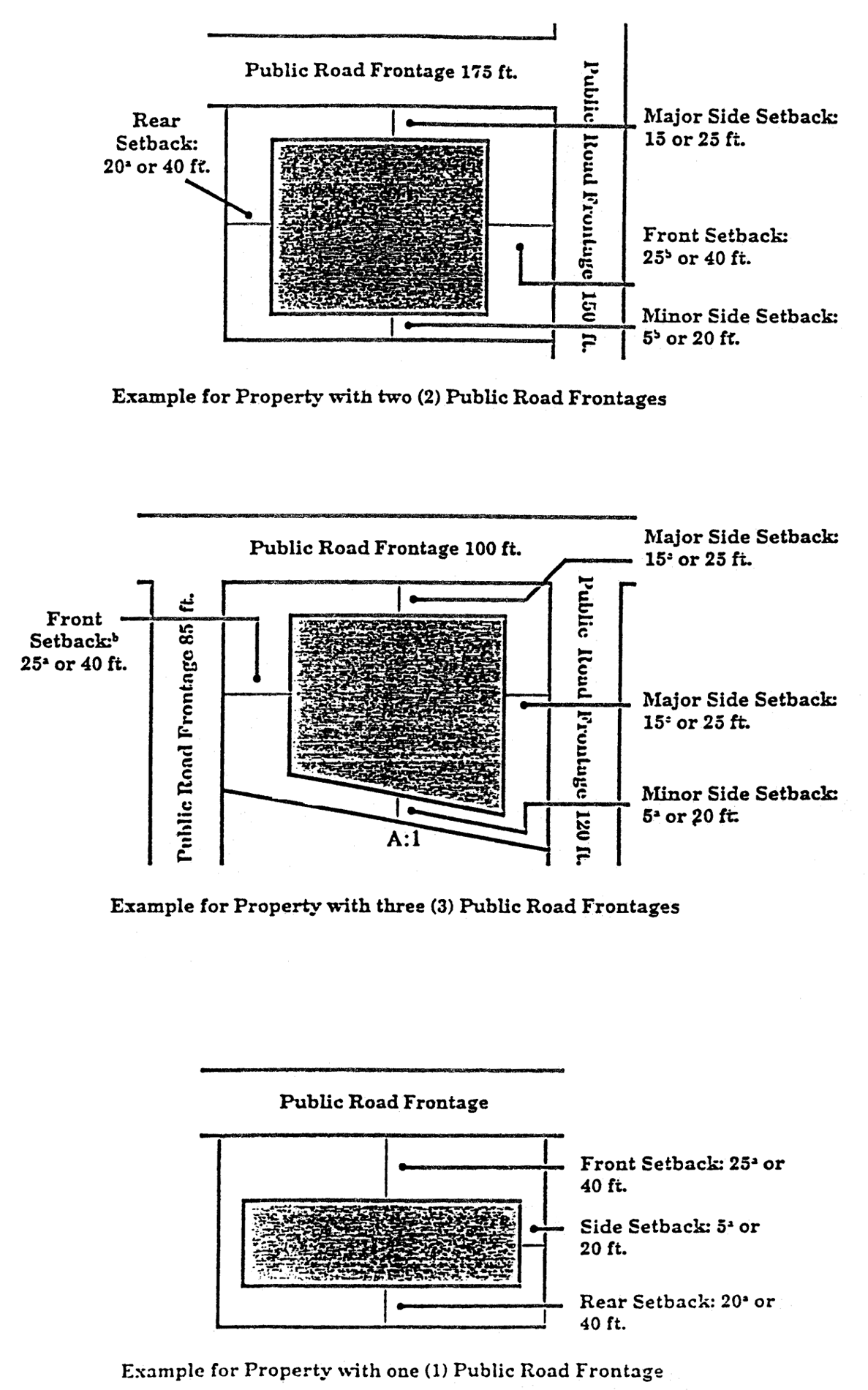
Minimum Building Setback Requirements for R-12 District
Notes:
a Distance if interior portion of development.
b Property with shorter amount of road frontage will be the front setback for determining other setbacks (major side, side, rear).
c If structure fronts a major side setback, major side setback shall be 35 feet.
(5)
Landscape buffer and screening requirements. Landscape buffer and screening requirements are not applicable in this district.
(6)
Floodplain and wetlands preservation requirements. Any development must meet all state and federal requirements relating to floodplains and wetlands. The board of commissioners encourages preservation of wetland areas. Any development must also meet state and federal requirements relating to areas subject to the provisions of section 134-283, regarding mountain and river corridor protection act areas, and section 134-284, regarding metropolitan river protection act areas. No floodplains and/or wetlands may be used in calculating the overall density of the development.
(7)
Building and structure requirements. Maximum building height is 35 feet.
(8)
Parking requirements. See section 134-272 for paved parking specifications.
(9)
Lighting requirements. Any project permitted within the R-12 district which proposes a lighted facility must have a county department of transportation approved lighting plan in accordance with the minimum conditions listed in section 134-269.
(10)
Special exception uses. See section 134-271 for special exception uses and requirements for all districts. Special exception uses for the R-12 district are the uses listed in section 134-271.
(11)
Temporary land use permits and special land use permits. See sections 134-36 and 134-37 for additional uses and requirements for all districts. Uses requiring land use permits or special land use permits for the R-12 district are the designated uses listed in sections 134-36 and 134-37.
(12)
Use limitations.
a.
A site plan shall be submitted to county staff for each lot showing the following:
1.
Setbacks and dwelling space distances;
2.
Lot size;
3.
Delineation of floodplain and wetlands; and
4.
Accessory structures, including decks, porches, swimming pools, tennis courts and basketball courts.
b.
A foundation survey shall be required to be submitted and approved prior to continuing with framing.
c.
Maximum acreage is 20 acres.
d.
No structure or dwelling shall be closer than five feet to any property line.
e.
No sale of goods or products shall be permitted except if accessory to a customary home occupation, land use permit, special land use permit or special exception use.
f.
No sexually oriented businesses are permitted.
g.
No materials, equipment or business vehicles may be stored or parked on the premises, except that one business vehicle used exclusively by the resident may be parked in a carport, garage, or rear or side yard. The off-site employees of the resident shall not congregate on the premises for any purpose concerning the business of the home occupation.
h.
All uses are subject to chapter 110, pertaining to subdivisions.
i.
It is found and declared that outside storage on properties within unincorporated Cobb County is a health risk and undesirable in that it provides harborage for rodents and insects, lowers property values, and constitutes a public nuisance; therefore, no outside storage is permitted, excluding firewood and lawn furnishings, unless otherwise allowed in this article.
j.
Maximum impervious surface shall not exceed 35 percent. Pervious pavement system and/or green roofs are considered 60 percent effective impervious and will be calculated as such when determining maximum impervious surface. In no case shall total pavement and roof areas (pervious and impervious) exceed 40 percent.
Required buffers may be included within required setbacks; however, in such case that the required buffer is greater than the required setback, the required buffer shall be adhered to. Additionally, necessary private utilities and access drives may be allowed through, over or across a landscaped buffer. Any such uses which are proposed through, over or across a designated undisturbed buffer must be approved pursuant to an original site plan or site plan modification as set forth under section 134-126.
(13)
Accessory buildings, structures, uses and decks.
a.
Size and setback limitations: Any accessory building, structure, use and deck up to 144 total gross square feet must be located at least five feet off the property line and limited to 15 feet in height subject to the development conditions list below (except for 15-foot height restriction). Any accessory building, structure, use and deck over 144 total gross square feet and up to 650 total gross square feet shall be limited to the building setbacks of the lot it is located on and is subject to the development conditions below. Any accessory building, structure, use and deck over 650 total gross square feet must be at least 100 feet from any property line and is subject to the development conditions below.
b.
Accessory buildings, structures, uses and decks shall be subject to the following development conditions:
1.
Maximum height is two stories or 35 feet.
2.
Buildings or structures shall have the meaning as defined in section 134-1. Accessory structures and uses shall also include Jacuzzis, tennis courts, basketball courts, swimming pools (private), playhouses and playgrounds. When calculating square footage for ground level uses such as tennis courts, basketball courts and above ground swimming pools and the like, the footprint shall be used in calculating total gross square feet.
3.
All accessory buildings, structures, uses and decks shall be located to the rear of the principal building, except for heating and air conditioning units or garbage pads, which may be located on the side of the primary structure and located within two feet of the primary structure.
4.
The rear of the primary structure shall be where the main portion of the building ends without consideration of wings.
5.
Architectural style and design are to be approved by the division manager of zoning or his designee, and are to be complimentary to the primary structure.
6.
Such structures or buildings shall be located on the same lot as and to the rear of the primary structure to which they are accessory. Uncovered decks that are attached to the primary structure may be located to the rear or side of the principal building. Covered decks, covered patios, and covered steps shall adhere to the building setbacks of the primary structure.
7.
No accessory building, structure, use or deck shall be constructed upon a lot until construction of the principal building has commenced.
8.
On a corner lot, no accessory building, structure, use or deck shall be located closer to the side street right-of-way line than the principal building.
9.
If the garage, accessory building, structure, use or deck is attached to the primary structure by a breezeway it shall be located up to a maximum of 25 feet from the primary structure to which it is attached. The breezeway may be enclosed or open.
10.
When an accessory building is intended to be habitable it shall be attached to the principal structure by a fully enclosed heated/cooled hallway and it shall comply with the yard requirements of the principal building to which it is accessory. The accessory building, structure or use shall be located up to a maximum of 25 feet from the primary structure to which it is attached.
11.
All accessory buildings, structures and uses in excess of 650 gross square feet shall be required to submit for plan review through the community development department or receive approval from the director of the community development department or zoning division manager, or their designees.
12.
The primary structure in a residential district shall be the principle house on the lot.
c.
Antennas and satellite dishes shall meet the requirements set forth in section 134-274.
d.
Incidental storage is permitted, provided that the material stored is incidental to the permitted use, as determined by the division manager of zoning or his designee, and stored completely within a portion of the enclosed principal structure permitted within the district, or within a permitted accessory structure.
e.
Neighborhood recreation centers, amenities and swimming pools are subject to the following:
1.
Site plans must be approved by the zoning staff to ensure compliance with all applicable laws and provisions of this chapter. The facility should be designed to include a detailed landscape plan that provides adequate screening of the facility which creates a visual and sound buffer for adjacent properties. The landscape plan shall be drawn to scale and shall include plant identification by common name. The facility shall be designed to accommodate no more than those residing within two adjoining residential developments except in those cases where a variance is obtained as in other cases.
2.
Buildings and structures established in connection with such use shall be set back not less than 100 feet from any property line.
i.
Upon written consent of all owners of property within 100 feet of the building or structure, the setback may be reduced to 50 feet from any exterior property line of the subdivision within which the use is located. Additionally, a detailed landscape plan must be submitted to and approved by the zoning staff.
ii.
The setback may be reduced to 20 feet from an interior property line of the property on which the use is located if a ten-foot landscaped buffer is provided along the property line and a six-foot solid wood or masonry fence is erected and maintained along the line so as to provide a visual and noise screen for adjacent property; provided, however, the setback after reduction shall not be less than 100 feet from an exterior property line unless also reduced in accordance with subsection (12)d.2.i of this section. Such landscaped buffer shall be shown on the landscaping plan specified in subsection (12)d.1 of this section and must be approved by the zoning staff.
iii.
When a property line is on a natural waterway, a property line setback may be waived provided a written waiver is obtained from both the community development department and the zoning division.
3.
Swimming pools must comply with all applicable ordinances and must have necessary approvals from the health department and county building inspections department.
4.
Outdoor activity shall cease by 11:00 p.m.
5.
Lighting shall be established in such a way that values or quiet use and enjoyment of adjacent properties are not adversely affected, and that roadways and safe use thereof are not adversely affected. No direct light shall be cast upon adjacent properties or roadways. If lighting is to be established, the use of environmental or cutoff type fixtures only is permissible. If lighting is to be established in a recreation area adjacent to an existing or proposed county public road, a lighting plan must be submitted and approved by the county department of transportation to ensure that no light is cast upon the roadway and that no adverse impact will be created as a result of the lighting.
6.
No residence or structures shall be built upon any adjacent lot within the development within which the facility is located until construction of the recreation area has commenced to the extent that buyers of adjacent property will be aware of where the recreation area will be located.
7.
Parking requirements are as follows:
i.
A minimum of one space per five residences.
ii.
Parking spaces shall be paved and striped according to county standard 114, Parking Specifications, as it now exists or may hereafter be amended. No parking shall be allowed within a front yard setback.
(Ord. of 12-26-72; Res. of 8-14-73, § 8; Ord. of 11-8-77, §§ 1, 7; Ord. of 7-7-82, §§ 1, 3; Ord. of 12-11-90, § 3-28-7.7; Ord. of 8-13-91; Ord. of 6-9-92; Ord. of 10-7-92; Ord. of 10-27-92; Ord. of 2-22-94; Ord. of 9-13-94; Ord. of 7-11-95; Ord. of 9-26-95; Ord. of 2-27-96; Ord. of 6-24-97 (eff. 7-1-97); Ord. of 11-23-99; Ord. of 2-8-00; Ord. of 9-12-00; Ord. of 7-10-01; Ord. of 7-26-05; Ord. of 1-24-06; Ord. of 7-25-06; Ord. of 2-27-07; Ord. of 2-26-08; Amd. of 2-23-10; Ord. of 2-28-12; Ord. of 7-24-12; Amd. of 2-26-13; Amd. of 7-22-14; Amd. of 2-24-15; Amd. of 2-28-17; Amd. of 9-8-20; Amd. of 3-26-24)
Sec. 134-200. - RD residential duplex district.
The regulations for the RD residential duplex district are as follows:
(1)
Purpose and intent. The RD district is established to provide locations for the development of affordable single-family detached or attached owner-occupied residential dwelling units, including duplexes. The dwelling units are to be designed so as to be placed on an individual lot attached to another dwelling unit or on an adjoining lot where the units will be attached by a common party wall. This residential use is designed to be located within or on the edge of properties delineated for medium density residential categories as defined and shown on the Cobb County Comprehensive Plan: A Policy Guide, adopted November 27, 1990. When residentially compatible institutional and recreational uses are developed within the RD district, they should be designed and built to ensure intensity and density compatibility with adjacent single-family detached dwellings and otherwise to implement the stated purpose and intent of this chapter.
(2)
Definitions. The following words, terms and phrases, when used in this section, shall have the meanings ascribed to them in this subsection, except where the context clearly indicates a different meaning:
a.
Community fair means a festival or fair such as the North Georgia State Fair conducted wholly within public areas owned by a local government, provided that any activity is conducted at least 200 feet from any property line. Any event shall not exceed 21 days.
b.
Customary home occupations means those occupations which are customarily performed in a small area of a residence due to the low intensity nature of such uses, subject to the following requirements:
1.
There shall be no exterior evidence of the home occupation, including but not limited to any type of identifying signs.
2.
No article, product or service used or sold in connection with such activity shall be other than those normally found on the premises.
3.
No mechanical equipment shall be used for such occupation except such equipment as is customary for purely household and hobby purposes.
4.
Such use shall be conducted entirely within the dwelling unit, and only persons living in the dwelling unit shall be employed in such occupation.
5.
No more than 25 percent of the dwelling unit may be used for the operation.
6.
No materials, equipment or business vehicles may be stored or parked on the premises, except that one business vehicle used exclusively by the resident may be parked in a carport, garage, or rear or side yard. The off-site employees of the resident shall not congregate on the premises for any purpose concerning the business of the home occupation.
7.
There shall be no deliveries of supplies for use in the home occupation or pickups of the items produced by the occupant by commercial carriers.
8.
No clients or customers are allowed on the premises, except for individual instruction, such as tutoring, musical lessons and the like, for the purpose of supplementing an income.
c.
Group home means a dwelling shared by four or fewer persons, excluding resident staff, who live together as a single housekeeping unit and in a long term, family-like environment in which staff persons provide care, education and participation in community activities for the residents with the primary goal of enabling the residents to live as independently as possible in order to reach their maximum potential under the direction and guidance of a designated managing caregiver, who must be a resident of the group home. The term "group home" shall not include a halfway house, a treatment center for alcoholism or drug abuse, a work release facility for convicts or ex-convicts, a home for the detention and/or rehabilitation of juveniles adjudged delinquent or unruly and placed in the custody of the state, or other housing facilities serving as an alternative to incarceration. The term "group home" shall also not allow the use of a dwelling as an apartment or duplex. A group home shall not allow use of the dwelling as a home for individuals on parole, probation, or convicted and released from incarceration, for any crimes including child molestation, aggravated child molestation, or child sexual abuse, as defined in O.C.G.A. § 16-6-4 or individuals required to register as sex offenders pursuant to O.C.G.A. § 42-1-12. A group home may include a home for the handicapped. As used in this subsection, the term "handicapped" shall mean:
1.
Having a physical or mental impairment that substantially limits one or more of such person's major life activities so that such person is incapable of living independently;
2.
Having a record of having such an impairment; or
3.
Being regarded as having such an impairment.
However, the term "handicapped" shall not include current illegal use of or addiction to a controlled substance, nor shall it include any person whose residency in the home would constitute a direct threat to the health and safety of other individuals.
d.
Livestock, nondomestic and wild animals, and poultry means animals, nondomestic and wild animals, and species of the avian family which are or may be raised for the purpose of providing food or transportation, or being resold or bred, excluding only dogs, cats, rabbits, fish, pet mice, hamsters, gerbils, parrots and parakeets.
1.
Such animals shall only be permitted on a lot containing not less than two acres.
2.
All buildings used for animals shall be set back not less than 100 feet from any property line.
3.
All animals shall be maintained at least ten feet from any residential property line.
4.
Except in the RR district, there shall be not less than 5,000 square feet of fenced lot area not covered by the principal structure for each animal, unless the property is a bona fide farm.
5.
In the case of nondomestic or wild animals, all state and federal requirements must be met and a special land use permit is required.
(3)
Permitted uses. Anything not permitted or allowed by special exception is prohibited. Permitted uses are as follows:
Community fairs.
Cottage food operators as regulated by the Georgia Department of Agriculture in accordance with its Rules, Chapter 40-7-19, as may be amended from time to time subject to the following requirements:
1.
There shall be no signage or other exterior evidence of the cottage food operator.
2.
Deliveries of specialty ingredients such as herbs and spices, etc., limited to those made by the United States Postal Service or other carrier (FedEx, United Parcel Service, etc.) that routinely delivers mail/internet order products to residents.
3.
No cottage food products prepared by the cottage food operator may be picked up by a commercial carrier.
4.
There shall be no employees parking on the site unless approved by the board of commissioners in accordance with section 134-36 of the Cobb County Code.
Customary home occupations.
Designated recycling collection locations.
Executive golf courses (see section 134-270).
Fruit trees, nuts and vegetables.
Golf courses, 18-hole regulation, public and private (see section 134-270).
Golf courses, par 3 (see section 134-270).
Group homes.
In-home day care.
Livestock, nondomestic and wild animals, and poultry, on two or more acres.
Nonprofit (seasonal use) fishing lakes.
Parking for vehicles.
Personal vehicle and equipment sales.
Residential, agricultural, farm and wood products and livestock and poultry sales.
Riding stables.
Single-family dwelling units (attached).
Temporary uses.
Two-family dwelling units.
(4)
Lot size and setback requirements. Lot size and setback requirements are as follows:
a.
Minimum lot size: 20,000 square feet. The board of zoning appeals shall not be authorized to recommend a variance for more than 25 percent of the minimum lot size.
b.
Minimum lot width at front setback line: 75 feet; cul-de-sac, 50 feet.
c.
Minimum public road frontage: 75 feet; cul-de-sac, 50 feet.
d.
Minimum building setbacks: As shown and applied in the following diagram:
MINIMUM BUILDING SETBACK REQUIREMENTS FOR RD DISTRICT
Note: All setbacks shall be measured from future right-of-way.
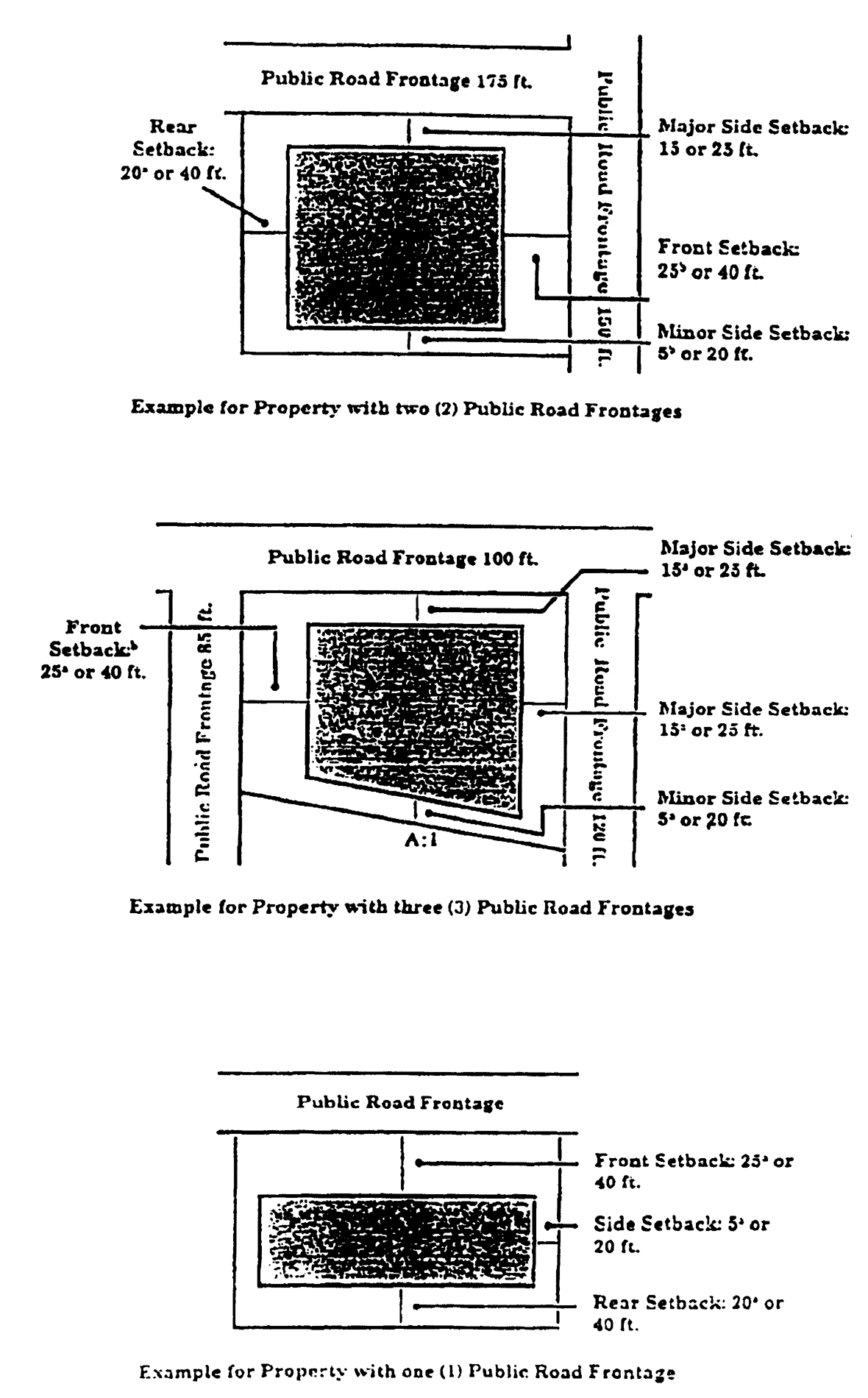
Minimum Building Setback Requirements for RD District
Notes:
a Distance if interior portion of development.
b Property with shorter amount of road frontage will be the front setback for determining other setbacks (major side, side, rear).
c If structure fronts a major side setback, major side setback shall be 35 feet.
(5)
Landscape buffer and screening requirements. Unless otherwise noted within this district's requirements, any property within an RD district which abuts a more restrictive residentially zoned property shall have a minimum ten-foot landscaped screening buffer adjacent to all residential property. The buffer shall be subject to approval by county staff. Required buffers may be included within required setbacks; however, in such case that the required buffer is greater than the required setback, the required buffer shall be adhered to. Additionally, necessary private utilities and access drives may be allowed through, over or across a landscaped buffer. Any such uses which are proposed through, over or across a designated undisturbed buffer must be approved pursuant to an original site plan or site plan modification as set forth under section 134-126.
a.
Objectives. Undisturbed, planted landscape buffers and berms shall be implemented in connection with a permitted project and shall address the following objectives:
1.
Screening to enhance aesthetic appeal;
2.
Control or direction of vehicular and pedestrian movement;
3.
Reduction of glare;
4.
Buffering of noise; and
5.
Establishment of privacy.
b.
Standards. Buffers or berms shall be required when an RD district is located adjacent to a more restrictive residential district. A minimum ten-foot buffer is required.
1.
Buffers. Landscape buffers are subject to review and approval by county staff in accordance with the following standards:
i.
Plantings are to be a mix of evergreen trees and shrubs.
ii.
Species are to be ecologically compatible to the site and appropriate for the design situation.
iii.
Unless public safety concerns dictate otherwise, a buffer should maximize a visual barrier to a height of six feet within two years of planting.
iv.
Minimum height of plant materials at installation is five feet for trees and two feet for shrubs.
v.
Fencing or walls shall be a minimum of six feet in height as approved by county staff.
vi.
Trees included in buffer plantings may be counted toward site density calculations as required by chapter 50, article VI, pertaining to tree preservation and replacement, subject to review and approval of county staff.
vii.
Buffers shall be regularly maintained by the property owner to ensure that the objectives and standards set out in this subsection are met.
viii.
When topography and existing conditions allow, the required ten-foot buffer should be an undisturbed buffer.
ix.
Any appeals from a determination by county staff shall be to the board of zoning appeals.
2.
Berms. Berms are subject to review and approval by county staff in accordance with the following standards:
i.
Berms shall be utilized when consistent with surrounding property features.
ii.
Berms shall be stabilized.
iii.
Berms shall be constructed to be consistent with natural or proposed drainage patterns.
iv.
Berms shall be regularly maintained by the property owner.
(6)
Floodplain and wetlands preservation requirements. Any development must meet all state and federal requirements relating to floodplains and wetlands. The board of commissioners encourages preservation of wetland areas. Any development must also meet state and federal requirements relating to areas subject to the provisions of section 134-283, regarding mountain and river corridor protection act areas, and section 134-284, regarding metropolitan river protection act areas. No floodplains and/or wetlands may be used in calculating the overall density of the development.
(7)
Building and structure requirements. Maximum building height is 35 feet.
(8)
Parking requirements. See section 134-272 for paved parking specifications.
(9)
Lighting requirements. Any project permitted within the RD district which proposes any outdoor lighting, except individual residential lots, must have a county department of transportation approved lighting plan in accordance with the minimum conditions listed in section 134-269.
(10)
Special exception uses. See section 134-271 for special exception uses and requirements for all districts. Special exception uses for the RD district are the uses listed in section 134-271.
(11)
Temporary land use permits and special land use permits. See sections 134-36 and 134-37 for additional uses and requirements for all districts. Uses requiring land use permits or special land use permits for the RD district are the designated uses listed in sections 134-36 and 134-37.
(12)
Use limitations.
a.
There shall be a maximum of four units per acre.
b.
Architectural style and design shall be compatible with or upgrade the existing neighborhood.
c.
It is found and declared that outside storage on properties within unincorporated Cobb County is a health risk and undesirable in that it provides harborage for rodents and insects, lowers property values, and constitutes a public nuisance; therefore, no outside storage is permitted, excluding firewood and lawn furnishings, unless otherwise allowed in this article.
d.
Maximum impervious surface shall not exceed 40 percent. An undisturbed buffer equal to the required rear yard setback for this zoning district shall be established along the perimeter boundaries during construction until certificates of occupancy for affected lots are obtained. In the event that this undisturbed perimeter buffer conflicts with any required building setbacks, the required building setbacks may be altered by the zoning division manager or his/her designee, so to accommodate the 40-foot undisturbed perimeter buffer. The following uses shall be allowed within the undisturbed perimeter buffer: public and private utilities, detention facilities, access drives, pools, decks, gazebos and fences.
Required buffers may be included within required setbacks; however, in such case that the required buffer is greater than the required setback, the required buffer shall be adhered to. Additionally, necessary private utilities and access drives may be allowed through, over or across a landscaped buffer. Any such uses which are proposed through, over or across a designated undisturbed buffer must be approved pursuant to an original site plan or site plan modification as set forth under section 134-126.
(13)
Accessory buildings, structures, uses and decks.
a.
Size and setback limitations: Any accessory building, structure, use and deck up to 144 total gross square feet must be located at least five feet off the property line and limited to 15 feet in height subject to the development conditions list below (except for 15-foot height restriction). Any accessory building, structure, use and deck over 144 total gross square feet and up to 650 total gross square feet shall be limited to the building setbacks of the lot it is located on and is subject to the development conditions below. Any accessory building, structure, use and deck over 650 total gross square feet must be at least 100 feet from any property line and is subject to the development conditions below.
b.
Accessory buildings, structures, uses and decks shall be subject to the following development conditions:
1.
Maximum height is two stories or 35 feet.
2.
Buildings or structures shall have the meaning as defined in section 134-1. Accessory structures and uses shall also include Jacuzzis, tennis courts, basketball courts, swimming pools (private), playhouses and playgrounds. When calculating square footage for ground level uses such as tennis courts, basketball courts and above ground swimming pools and the like, the footprint shall be used in calculating total gross square feet.
3.
All accessory buildings, structures, uses and decks shall be located to the rear of the principal building, except for heating and air conditioning units or garbage pads, which may be located on the side of the primary structure and located within two feet of the primary structure.
4.
The rear of the primary structure shall be where the main portion of the building ends without consideration of wings.
5.
Architectural style and design are to be approved by the division manager of zoning or his designee, and are to be complimentary to the primary structure.
6.
Such structures or buildings shall be located on the same lot as and to the rear of the primary structure to which they are accessory. Uncovered decks that are attached to the primary structure may be located to the rear or side of the principal building. Covered decks, covered patios, and covered steps shall adhere to the building setbacks of the primary structure.
7.
No accessory building, structure, use or deck shall be constructed upon a lot until construction of the principal building has commenced.
8.
On a corner lot, no accessory building, structure, use or deck shall be located closer to the side street right-of-way line than the principal building.
9.
If the garage, accessory building, structure, use or deck is attached to the primary structure by a breezeway it shall be located up to a maximum of 25 feet from the primary structure to which it is attached. The breezeway may be enclosed or open.
10.
When an accessory building is intended to be habitable it shall be attached to the principal structure by a fully enclosed heated/cooled hallway and it shall comply with the yard requirements of the principal building to which it is accessory. The accessory building, structure or use shall be located up to a maximum of 25 feet from the primary structure to which it is attached.
11.
All accessory buildings, structures and uses in excess of 650 gross square feet shall be required to submit for plan review through the community development department or receive approval from the director of the community development department or zoning division manager, or their designees.
12.
The primary structure in a residential district shall be the principle house on the lot.
c.
Antennas and satellite dishes shall meet the requirements set forth in section 134-274.
d.
Incidental storage is permitted, provided that the material stored is incidental to the permitted use, as determined by the division manager of zoning or his designee, and stored completely within a portion of the enclosed principal structure permitted within the district, or within a permitted accessory structure.
e.
Neighborhood recreation centers, amenities and swimming pools are subject to the following:
1.
Site plans must be approved by the zoning staff to ensure compliance with all applicable laws and provisions of this chapter. The facility should be designed to include a detailed landscape plan that provides adequate screening of the facility which creates a visual and sound buffer for adjacent properties. The landscape plan shall be drawn to scale and shall include plant identification by common name. The facility shall be designed to accommodate no more than those residing within two adjoining residential developments except in those cases where a variance is obtained as in other cases.
2.
Buildings and structures established in connection with such use shall be set back not less than 100 feet from any property line.
i.
Upon written consent of all owners of property within 100 feet of the building or structure, the setback may be reduced to 50 feet from any exterior property line of the subdivision within which the use is located. Additionally, a detailed landscape plan must be submitted to and approved by the planning and zoning staff.
ii.
The setback may be reduced to 20 feet from an interior property line of the property on which the use is located if a ten-foot landscaped buffer is provided along the property line and a six-foot solid wood or masonry fence is erected and maintained along the line so as to provide a visual and noise screen for adjacent property; provided, however, the setback after reduction shall not be less than 100 feet from an exterior property line unless also reduced in accordance with subsection (12)d.2.i of this section. Such landscaped buffer shall be shown on the landscaping plan specified in subsection (12)d.1 of this section and must be approved by the planning and zoning staff.
iii.
When a property line is on a natural waterway, a property line setback may be waived provided a written waiver is obtained from both the community development department and the planning division and zoning division.
3.
Swimming pools must comply with all applicable ordinances and must have necessary approvals from the health department and building inspections department.
4.
Outdoor activity shall cease by 11:00 p.m.
5.
Lighting shall be established in such a way that values or quiet use and enjoyment of adjacent properties are not adversely affected, and that roadways and safe use thereof are not adversely affected. No direct light shall be cast upon adjacent properties or roadways. If lighting is to be established, the use of environmental or cutoff type fixtures only is permissible. If lighting is to be established in a recreation area adjacent to an existing or proposed county public road, a lighting plan must be submitted and approved by the county department of transportation to ensure that no light is cast upon the roadway and that no adverse impact will be created as a result of the lighting.
6.
No residence or structures shall be built upon any adjacent lot within the development within which the facility is located until construction of the recreation area has commenced to the extent that buyers of adjacent property will be aware of where the recreation area will be located.
7.
Parking requirements are as follows:
i.
A minimum of one space per five residences.
ii.
Parking spaces shall be paved and striped according to county standard 114, Parking Specifications, as it now exists or may hereafter be amended. No parking shall be allowed within a front yard setback.
(Ord. of 12-26-72; Res. of 8-14-73, § 1; Ord. of 11-8-77, §§ 1, 7; Ord. of 7-7-82, § 1; Ord. of 12-11-90, § 3-28-7.8; Ord. of 8-13-91; Ord. of 6-9-92; Ord. of 10-27-92; Ord. of 2-22-94; Ord. of 7-11-95; Ord. of 9-26-95; Ord. of 2-27-96; Ord. of 6-24-97 (eff. 7-1-97); Ord. of 11-23-99; Ord. of 2-8-00; Ord. of 9-12-00; Ord. of 7-10-01; Ord. of 7-27-04; Ord. of 7-26-05; Ord. of 1-24-06; Ord. of 7-25-06; Ord. of 2-27-07; Ord. of 2-26-08; Ord. of 2-28-12; Ord. of 7-24-12; Amd. of 2-26-13; Amd. of 7-22-14; Amd. of 2-24-15; Amd. of 2-28-17; Amd. of 3-26-24)
Sec. 134-201. - RA-4 single-family attached/detached residential district.
The regulations for the RA-4 single-family attached/detached residential district are as follows:
(1)
Purpose and intent. The RA-4 district is established to provide locations for the development of single-family detached or attached residential dwelling units including the combination of duplexes, triplexes and quadruplexes. The dwelling units are to be designed so as to be placed on an individual lot attached to another dwelling unit or on an adjoining lot where the units will be attached by a common party wall. This residential use is designed to be located within or on the edge of properties delineated for low and medium density residential categories as defined and shown on the Cobb County Comprehensive Plan. When residentially compatible institutional and recreational uses or residential uses are developed within the RA-4 district, they should be designed and built to ensure intensity and density compatibility with adjacent single-family detached dwellings and otherwise to implement the stated purpose and intent of this chapter.
(2)
Definitions. The following words, terms and phrases, when used in this section, shall have the meanings ascribed to them in this subsection, except where the context clearly indicates a different meaning:
a.
Community fair means a festival or fair such as the North Georgia State Fair conducted wholly within public areas owned by a local government, provided that any activity is conducted at least 200 feet from any property line. Any event shall not exceed 21 days.
b.
Customary home occupations means those occupations which are customarily performed in a small area of a residence due to the low intensity nature of such uses, subject to the following requirements:
1.
There shall be no exterior evidence of the home occupation, including but not limited to any type of identifying signs.
2.
No article, product or service used or sold in connection with such activity shall be other than those normally found on the premises.
3.
No mechanical equipment shall be used for such occupation except such equipment as is customary for purely household and hobby purposes.
4.
Such use shall be conducted entirely within the dwelling unit, and only persons living in the dwelling unit shall be employed in such occupation.
5.
No more than 25 percent of the dwelling unit may be used for the operation.
6.
No materials, equipment or business vehicles may be stored or parked on the premises, except that one business vehicle used exclusively by the resident may be parked in a carport, garage, or rear or side yard. The off-site employees of the resident shall not congregate on the premises for any purpose concerning the business of the home occupation.
7.
There shall be no deliveries of supplies for use in the home occupation or pickups of the items produced by the occupant by commercial carriers.
8.
No clients or customers are allowed on the premises, except for individual instruction, such as tutoring, musical lessons and the like, for the purpose of supplementing an income.
c.
Group home means a dwelling shared by four or fewer persons, excluding resident staff, who live together as a single housekeeping unit and in a long term, family-like environment in which staff persons provide care, education and participation in community activities for the residents with the primary goal of enabling the residents to live as independently as possible in order to reach their maximum potential under the direction and guidance of a designated managing caregiver, who must be a resident of the group home. The term "group home" shall not include a halfway house, a treatment center for alcoholism or drug abuse, a work release facility for convicts or ex-convicts, a home for the detention and/or rehabilitation of juveniles adjudged delinquent or unruly and placed in the custody of the state, or other housing facilities serving as an alternative to incarceration. The term "group home" shall also not allow the use of a dwelling as an apartment or duplex. A group home shall not allow use of the dwelling as a home for individuals on parole, probation, or convicted and released from incarceration, for any crimes including child molestation, aggravated child molestation, or child sexual abuse, as defined in O.C.G.A. § 16-6-4 or individuals required to register as sex offenders pursuant to O.C.G.A. § 42-1-12. A group home may include a home for the handicapped. As used in this subsection, the term "handicapped" shall mean:
1.
Having a physical or mental impairment that substantially limits one or more of such person's major life activities so that such person is incapable of living independently;
2.
Having a record of having such an impairment; or
3.
Being regarded as having such an impairment.
However, the term "handicapped" shall not include current illegal use of or addiction to a controlled substance, nor shall it include any person whose residency in the home would constitute a direct threat to the health and safety of other individuals.
d.
Livestock, nondomestic and wild animals, and poultry means animals, nondomestic and wild animals, and species of the avian family which are or may be raised for the purpose of providing food or transportation, or being resold or bred, excluding only dogs, cats, rabbits, fish, pet mice, hamsters, gerbils, parrots and parakeets.
1.
Such animals shall only be permitted on a lot containing not less than two acres.
2.
All buildings used for animals shall be set back not less than 100 feet from any property line.
3.
All animals shall be maintained at least ten feet from any residential property line.
4.
Except in the RR district, there shall be not less than 5,000 square feet of fenced lot area not covered by the principal structure for each animal, unless the property is a bona fide farm.
5.
In the case of nondomestic or wild animals, all state and federal requirements must be met and a special land use permit is required.
e.
Reserved.
f.
Residential, agricultural, farm and wood products, and livestock and poultry sales means residential property of two acres or more where agricultural, farm and wood products, and livestock and poultry are grown, raised or cultivated on-site. Sales of such products shall be permitted under the following conditions:
1.
No permanent sale structure shall be allowed.
2.
Seasonal sales may be made from tables or tents placed temporarily.
3.
All sales are to be conducted on the property where the products are grown and off the right-of-way.
4.
Should sales of such products constitute a nuisance or create a safety hazard, then such sales may be further restricted to adequately protect the health, safety and welfare of the public.
5.
Signage standards are as follows:
i.
One sign is permitted per property, no greater than 32 square feet in size.
ii.
No manufactured portable signs shall be allowed.
iii.
The height of signs shall not exceed six feet.
iv.
All signage requires a sign permit.
(3)
Permitted uses. Anything not permitted or allowed by special exception is prohibited. Permitted uses are as follows:
Community fairs.
Cottage food operators as regulated by the Georgia Department of Agriculture in accordance with its Rules, Chapter 40-7-19, as may be amended from time to time subject to the following requirements:
1.
There shall be no signage or other exterior evidence of the cottage food operator.
2.
Deliveries of specialty ingredients such as herbs and spices, etc., limited to those made by the United States Postal Service or other carrier (FedEx, United Parcel Service, etc.) that routinely delivers mail/internet order products to residents.
3.
No cottage food products prepared by the cottage food operator may be picked up by a commercial carrier.
4.
There shall be no employees parking on the site unless approved by the board of commissioners in accordance with section 134-36 of the Cobb County Code.
Customary home occupations.
Designated recycling collection locations.
Executive golf courses (see section 134-270).
Fruit trees, nuts and vegetables.
Golf courses, 18-hole regulation, public and private (see section 134-270).
Golf courses, par 3 (see section 134-270).
Group homes.
In-home day care.
Livestock, nondomestic and wild animals, and poultry, on two or more acres.
Nonprofit (seasonal use) fishing lakes.
Parking for vehicles.
Personal vehicle and equipment sales.
Residential, agricultural, farm and wood products, and livestock and poultry sales.
Riding stables.
Single-family dwelling units (attached).
Single-family dwelling units (detached).
Temporary uses.
(4)
Lot size and setback requirements. Lot size and setback requirements are as follows:
a.
Minimum lot size: 8,400 square feet. The board of zoning appeals shall not be authorized to recommend a variance for more than 25 percent of the minimum lot size.
b.
Minimum lot width at front setback line: 70 feet; cul-de-sac or interior lot, 50 feet.
c.
Minimum width between dwellings: 15 feet.
d.
Minimum public road frontage: 70 feet; cul-de-sac, 35 feet; 50 feet minimum public road frontage if interior to development.
e.
Minimum building setbacks: As shown and applied in the following diagram:
MINIMUM BUILDING SETBACK REQUIREMENTS FOR RA-4 DISTRICT
Note: All setbacks shall be measured from future right-of-way.
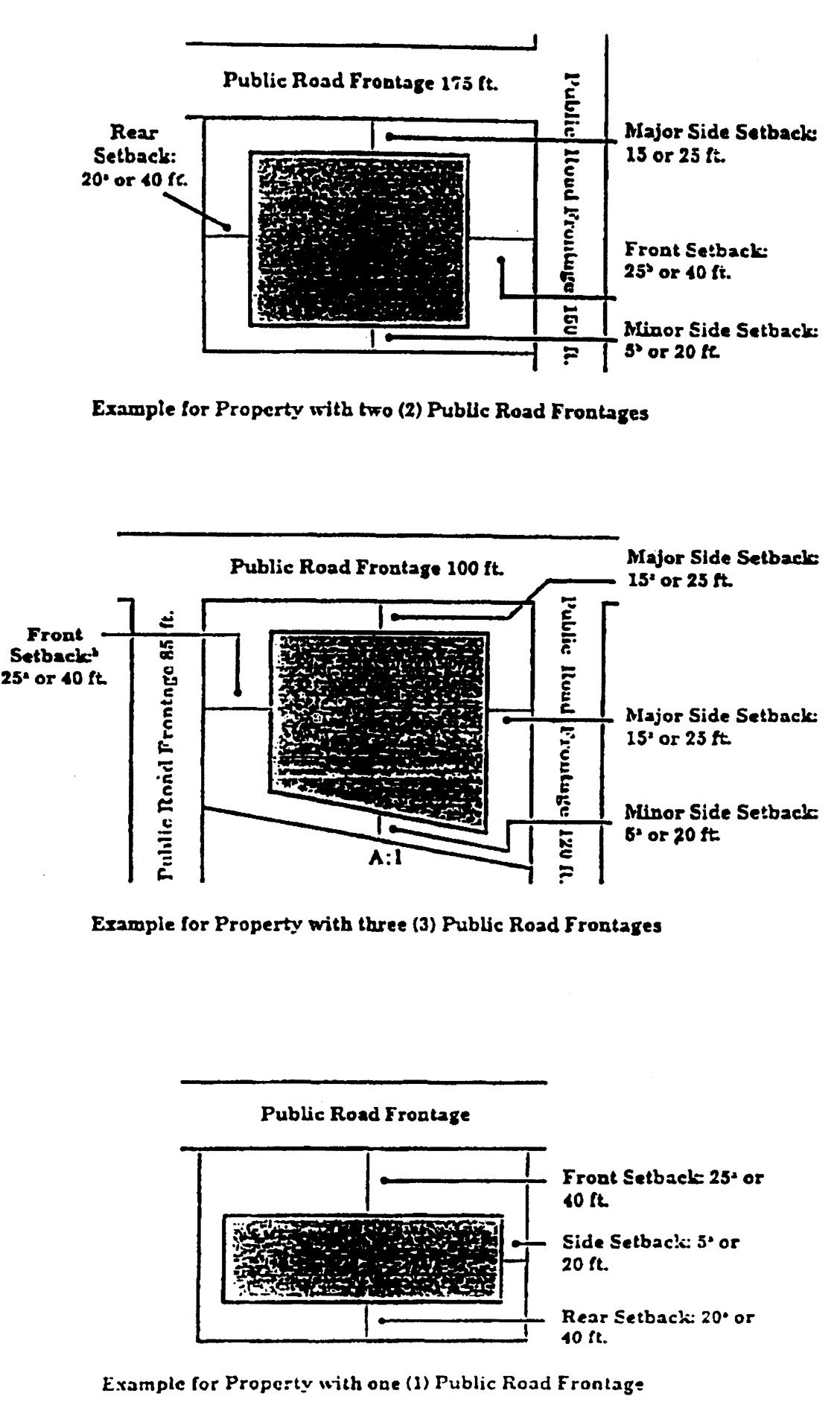
RA-4
Notes:
a If public road frontage is along an arterial or collector roadway, a 50-foot front setback shall be required.
b Distance if interior portion of development.
c Property with shorter amount of road frontage will be the front setback for determining other setbacks (major side, side, rear).
d If structure fronts a major side setback, major side setback shall be 35 feet.
(5)
Landscape buffer and screening requirements. Unless otherwise noted within this district's requirements, any property within an RA-4 district which abuts a more restrictive residentially zoned property shall have a minimum ten-foot landscaped screening buffer adjacent to all residential property. The buffer is subject to approval by county staff. Required buffers may be included within required setbacks; however, in such case that the required buffer is greater than the required setback, the required buffer shall be adhered to. Additionally, necessary private utilities and access drives may be allowed through, over or across a landscaped buffer. Any such uses which are proposed through, over or across a designated undisturbed buffer must be approved pursuant to an original site plan or site plan modification as set forth under section 134-126.
a.
Objectives. Undisturbed, planted landscape buffers and berms shall be implemented in connection with a permitted project and shall address the following objectives:
1.
Screening to enhance aesthetic appeal;
2.
Control or direction of vehicular and pedestrian movement;
3.
Reduction of glare;
4.
Buffering of noise; and
5.
Establishment of privacy.
b.
Landscape buffers. Landscape buffers are subject to review and approval by county staff in accordance with the following standards:
1.
Plantings are to be a mix of evergreen trees and shrubs.
2.
Species are to be ecologically compatible to the site and appropriate for the design situation.
3.
Unless public safety concerns dictate otherwise, a buffer should maximize a visual barrier to a height of six feet within two years of planting.
4.
Minimum height of plant materials at installation is five feet for trees and two feet for shrubs.
5.
Fencing or walls are to be a minimum of six feet in height as approved by county staff.
6.
Trees included in buffer plantings may be counted toward site density calculations as required by chapter 50, article VI, pertaining to tree preservation and replacement, subject to review and approval of county staff.
7.
Buffers shall be regularly maintained by the property owner to ensure that the objectives and standards set out in this subsection are met.
8.
When topography and existing conditions allow, the required ten-foot buffer should be an undisturbed buffer.
9.
Any appeals from a determination by county staff shall be to the board of zoning appeals.
c.
Berms. Berms are subject to review and approval by county staff in accordance with the following standards:
1.
Berms shall be utilized when consistent with surrounding property features.
2.
Berms shall be stabilized.
3.
Berms shall be constructed to be consistent with natural or proposed drainage patterns.
4.
Berms shall be regularly maintained by the property owner.
(6)
Floodplain and wetlands preservation requirements. Any development must meet all state and federal requirements relating to floodplains and wetlands. The board of commissioners encourages preservation of wetland areas. Any development must also meet state and federal requirements relating to areas subject to the provisions of section 134-283, regarding mountain and river corridor protection act areas, and section 134-284, regarding metropolitan river protection act areas. No floodplains and/or wetlands may be used in calculating the overall density of the development.
(7)
Building and structure requirements. Maximum building height is 35 feet.
(8)
Parking requirements. See section 134-272 for paved parking specifications.
(9)
Lighting requirements. Any project permitted within the RA-4 district which proposes a lighted facility must have a county department of transportation approved lighting plan in accordance with the minimum conditions listed in section 134-269.
(10)
Special exception uses. See section 134-271 for special exception uses and requirements for all districts. Special exception uses for the RA-4 district are the uses listed in section 134-271.
(11)
Temporary land use permits and special land use permits. See sections 134-36 and 134-37 for additional uses and requirements for all districts. Uses requiring land use permits or special land use permits for the RA-4 district are the designated uses listed in sections 134-36 and 134-37.
(12)
Use limitations.
a.
There shall be a maximum of four units per acre.
b.
Where single-family dwelling units are proposed to be constructed in areas zoned RA-4, the minimum house size shall be 950 feet and the minimum lot size for an individual lot shall be 8,400 feet. All setbacks shall be as set forth in this section.
c.
Architectural style and design shall be compatible with or upgrade the existing neighborhood.
d.
Maximum acreage is 20 acres.
e.
No sale of goods or products shall be permitted except if accessory to a customary home occupation, land use permit, special land use permit or special exception use.
f.
No sexually oriented businesses are permitted.
g.
No materials, equipment or business vehicles may be stored or parked on the premises, except that one business vehicle used exclusively by the resident may be parked in a carport, garage or rear or side yard. The off-site employees of the resident shall not congregate on the premises for any purpose concerning the business of the home occupation.
h.
All uses are subject to chapter 110, pertaining to subdivisions.
i.
It is found and declared that outside storage on properties within unincorporated Cobb County is a health risk and undesirable in that it provides harborage for rodents and insects, lowers property values, and constitutes a public nuisance; therefore, no outside storage is permitted, excluding firewood and lawn furnishings, unless otherwise allowed in this article.
j.
Maximum impervious surface shall not exceed 40 percent. Pervious pavement system and/or green roofs are considered 60 percent effective impervious and will be calculated as such when determining maximum impervious surface. In no case shall total pavement and roof areas (pervious and impervious) exceed 45 percent.
Required buffers may be included within required setbacks; however, in such case that the required buffer is greater than the required setback, the required buffer shall be adhered to. Additionally, necessary private utilities and access drives may be allowed through, over or across a landscaped buffer. Any such uses which are proposed through, over or across a designated undisturbed buffer must be approved pursuant to an original site plan or site plan modification as set forth under section 134-126.
(13)
Accessory buildings, structures, uses and decks.
a.
Size and setback limitations: Any accessory building, structure, use and deck up to 144 total gross square feet must be located at least five feet off the property line and limited to 15 feet in height subject to the development conditions list below (except for 15-foot height restriction). Any accessory building, structure, use and deck over 144 total gross square feet and up to 650 total gross square feet shall be limited to the building setbacks of the lot it is located on and is subject to the development conditions below. Any accessory building, structure, use and deck over 650 total gross square feet must be at least 100 feet from any property line and is subject to the development conditions below.
b.
Accessory buildings, structures, uses and decks shall be subject to the following development conditions:
1.
Maximum height is two stories or 35 feet.
2.
Buildings or structures shall have the meaning as defined in section 134-1. Accessory structures and uses shall also include Jacuzzis, tennis courts, basketball courts, swimming pools (private), playhouses and playgrounds. When calculating square footage for ground level uses such as tennis courts, basketball courts and above ground swimming pools and the like, the footprint shall be used in calculating total gross square feet.
3.
All accessory buildings, structures, uses and decks shall be located to the rear of the principal building, except for heating and air conditioning units or garbage pads, which may be located on the side of the primary structure and located within two feet of the primary structure.
4.
The rear of the primary structure shall be where the main portion of the building ends without consideration of wings.
5.
Architectural style and design are to be approved by the division manager of zoning or his designee, and are to be complimentary to the primary structure.
6.
Such structures or buildings shall be located on the same lot as and to the rear of the primary structure to which they are accessory. Uncovered decks that are attached to the primary structure may be located to the rear or side of the principal building. Covered decks, covered patios, and covered steps shall adhere to the building setbacks of the primary structure.
7.
No accessory building, structure, use or deck shall be constructed upon a lot until construction of the principal building has commenced.
8.
On a corner lot, no accessory building, structure, use or deck shall be located closer to the side street right-of-way line than the principal building.
9.
If the garage, accessory building, structure, use or deck is attached to the primary structure by a breezeway it shall be located up to a maximum of 25 feet from the primary structure to which it is attached. The breezeway may be enclosed or open.
10.
When an accessory building is intended to be habitable it shall be attached to the principal structure by a fully enclosed heated/cooled hallway and it shall comply with the yard requirements of the principal building to which it is accessory. The accessory building, structure or use shall be located up to a maximum of 25 feet from the primary structure to which it is attached.
11.
All accessory buildings, structures and uses in excess of 650 gross square feet shall be required to submit for plan review through the community development department or receive approval from the director of the community development department or zoning division manager, or their designees.
12.
The primary structure in a residential district shall be the principle house on the lot.
c.
Antennas and satellite dishes shall meet the requirements set forth in section 134-274.
d.
Incidental storage is permitted, provided that the material stored is incidental to the permitted use, as determined by the division manager of zoning or his designee, and stored completely within a portion of the enclosed principal structure permitted within the district, or within a permitted accessory structure.
e.
Neighborhood recreation centers, amenities and swimming pools are subject to the following:
1.
Site plans must be approved by the zoning staff to ensure compliance with all applicable laws and provisions of this chapter. The facility should be designed to include a detailed landscape plan that provides adequate screening of the facility which creates a visual and sound buffer for adjacent properties. The landscape plan shall be drawn to scale and shall include plant identification by common name. The facility shall be designed to accommodate no more than those residing within two adjoining residential developments except in those cases where a variance is obtained as in other cases.
2.
Buildings and structures established in connection with such use shall be set back not less than 100 feet from any property line.
i.
Upon written consent of all owners of property within 100 feet of the building or structure, the setback may be reduced to 50 feet from any exterior property line of the subdivision within which the use is located. Additionally, a detailed landscape plan must be submitted to and approved by the planning and zoning staff.
ii.
The setback may be reduced to 20 feet from an interior property line of the property on which the use is located if a ten-foot landscaped buffer is provided along the property line and a six-foot solid wood or masonry fence is erected and maintained along the line so as to provide a visual and noise screen for adjacent property; provided, however, the setback after reduction shall not be less than 100 feet from an exterior property line unless also reduced in accordance with subsection (12)d.2.i of this section. Such landscaped buffer shall be shown on the landscaping plan specified in subsection (12)d.1 of this section and must be approved by the planning and zoning staff.
iii.
When a property line is on a natural waterway, a property line setback may be waived provided a written waiver is obtained from both the community development department and the planning division and zoning division.
3.
Swimming pools must comply with all applicable ordinances and must have necessary approvals from the health department and building inspections department.
4.
Outdoor activity shall cease by 11:00 p.m.
5.
Lighting shall be established in such a way that values or quiet use and enjoyment of adjacent properties are not adversely affected, and that roadways and safe use thereof are not adversely affected. No direct light shall be cast upon adjacent properties or roadways. If lighting is to be established, the use of environmental or cutoff type fixtures only is permissible. If lighting is to be established in a recreation area adjacent to an existing or proposed county public road, a lighting plan must be submitted and approved by the county department of transportation to ensure that no light is cast upon the roadway and that no adverse impact will be created as a result of the lighting.
6.
No residence or structures shall be built upon any adjacent lot within the development within which the facility is located until construction of the recreation area has commenced to the extent that buyers of adjacent property will be aware of where the recreation area will be located.
7.
Parking requirements are as follows:
i.
A minimum of one space per five residences.
ii.
Parking spaces shall be paved and striped according to county standard 114, Parking Specifications, as it now exists or may hereafter be amended. No parking shall be allowed within a front yard setback.
(Ord. of 12-26-72; Res. of 8-14-73, § 8; Ord. of 11-8-77, §§ 1, 7; Ord. of 7-7-82, §§ 1, 3; Ord. of 12-11-90, § 3-28-7.9; Ord. of 8-13-91; Ord. of 6-9-92; Ord. of 10-27-92; Ord. of 2-22-94; Ord. of 9-13-94; Ord. of 7-11-95; Ord. of 9-26-95; Ord. of 2-27-96; Ord. of 6-24-97 (eff. 7-1-97); Ord. of 11-23-99; Ord. of 2-8-00; Ord. of 9-12-00; Ord. of 7-10-01; Ord. of 7-26-05; Ord. of 1-24-06; Ord. of 7-25-06; Ord. of 2-27-07; Ord. of 2-26-08; Amd. of 2-23-10; Ord. of 2-28-12; Ord. of 7-24-12; Amd. of 2-26-13; Amd. of 7-22-14; Amd. of 2-24-15; Amd. of 2-28-17; Amd. of 9-8-20)
Sec. 134-201.1. - PRD planned residential development district.
Commencing April 14, 1999, no new applications for rezoning to the PRD planned residential development district will be accepted by the board of commissioners. The regulations for the PRD planned residential development district are as follows:
(1)
Purpose and intent. The PRD district is established to encourage and provide flexible site plan and building arrangements under a unified plan of development rather than lot-by-lot regulation. The developer benefits from better land utilization and design flexibility. Review of and approval of the development plan by the board of commissioners provides an opportunity to ensure that the development will be in harmony with the character of the neighborhood in which the development is located. The PRD district may be located within any residential category as defined by the Cobb County Comprehensive Plan: A Policy Guide, adopted November 27, 1990. The PRD district is not intended to encourage greater density of development, but rather to encourage ingenuity and resourcefulness in land planning to ensure the provision of park and recreation land and facilities for the use of the occupants of the development in order to obtain a more desirable environment. PRD development shall be compatible with surrounding development.
(2)
Definitions. The following words, terms and phrases, when used in this section, shall have the meanings ascribed to them in this subsection, except where the context clearly indicates a different meaning:
a.
Community fair means a festival or fair such as the North Georgia State Fair conducted wholly within public areas owned by a local government, provided that any activity is conducted at least 200 feet from any property line. Any event shall not exceed 21 days.
b.
Customary home occupations means those occupations which are customarily performed in a small area of a residence due to the low intensity nature of such uses, subject to the following requirements:
1.
There shall be no exterior evidence of the home occupation, including but not limited to any type of identifying signs.
2.
No article, product or service used or sold in connection with such activity shall be other than those normally found on the premises.
3.
No mechanical equipment shall be used for such occupation except such equipment as is customary for purely household and hobby purposes.
4.
Such use shall be conducted entirely within the dwelling unit, and only persons living in the dwelling unit shall be employed in such occupation.
5.
No more than 25 percent of the dwelling unit may be used for the operation.
6.
No materials, equipment or business vehicles may be stored or parked on the premises, except that one business vehicle used exclusively by the resident may be parked in a carport, garage, or rear or side yard. The off-site employees of the resident shall not congregate on the premises for any purpose concerning the business of the home occupation.
7.
There shall be no deliveries of supplies for use in the home occupation or pickups of the items produced by the occupant by commercial carriers.
8.
No clients or customers are allowed on the premises, except for individual instruction, such as tutoring, musical lessons and the like, for the purpose of supplementing an income.
c.
Group home means a dwelling shared by six or less persons, excluding resident staff, who live together as a single housekeeping unit and in a longterm, family-like environment in which staff persons provide care, education and participation in community activities for the residents with the primary goal of enabling the residents to live as independently as possible in order to reach their maximum potential. This use shall also apply to homes for the handicapped. As used in this subsection, the term "handicapped" shall mean:
1.
Having a physical or mental impairment that substantially limits one or more of such person's major life activities so that such person is incapable of living independently;
2.
Having a record of having such an impairment; or
3.
Being regarded as having such an impairment.
However, the term "handicapped" shall not include current illegal use of or addiction to a controlled substance, nor shall it include any person whose residency in the home would constitute a direct threat to the health and safety of other individuals. The term "group home for the handicapped" shall not include alcoholism or drug treatment centers, work release facilities for convicts or ex-convicts, or other housing facilities serving as an alternative to incarceration.
d.
Livestock, nondomestic and wild animals, and poultry means animals, nondomestic and wild animals, and species of the avian family which are or may be raised for the purpose of providing food or transportation, or being resold or bred, excluding only dogs, cats, rabbits, fish, pet mice, hamsters, gerbils, parrots and parakeets.
1.
Such animals shall only be permitted on a lot containing not less than two acres.
2.
All buildings used for animals shall be set back not less than 100 feet from any property line.
3.
All animals shall be maintained at least ten feet from any residential property line.
4.
Except in the RR district, there shall be not less than 5,000 square feet of fenced lot area not covered by the principal structure for each animal, unless the property is a bona fide farm.
5.
In the case of nondomestic or wild animals, all state and federal requirements must be met and a special land use permit is required.
(3)
Permitted uses. Anything not permitted or allowed by special exception is prohibited. Permitted uses are as follows:
Community fairs.
Cottage food operators as regulated by the Georgia Department of Agriculture in accordance with its Rules, Chapter 40-7-19, as may be amended from time to time subject to the following requirements:
1.
There shall be no signage or other exterior evidence of the cottage food operator.
2.
Deliveries of specialty ingredients such as herbs and spices, etc., limited to those made by the United States Postal Service or other carrier (FedEx, United Parcel Service, etc.) that routinely delivers mail/internet order products to residents.
3.
No cottage food products prepared by the cottage food operator may be picked up by a commercial carrier.
4.
There shall be no employees parking on the site unless approved by the board of commissioners in accordance with section 134-36 of the Cobb County Code.
Condominiums.
Customary home occupations.
Designated recycling collection locations.
Executive golf courses (see section 134-270).
Fruit trees, nuts and vegetables.
Golf courses, 18-hole regulation, public and private (see section 134-270).
Golf courses, par 3 (see section 134-270).
Group homes.
In-home day care.
Livestock, nondomestic and wild animals, and poultry, on two or more acres.
Nonprofit (seasonal use) fishing lakes.
Parking for vehicles.
Personal vehicle and equipment sales.
Riding stables.
Single-family dwelling units (attached).
Single-family dwelling units (detached).
Temporary uses.
Townhouse dwelling units (attached).
Two-family dwelling units.
Combinations of the uses listed in this subsection.
(4)
Lot size and setback requirements. Lot-by-lot setbacks shall not apply in a PRD district; however, no primary structure shall be closer than 15 feet to another primary structure. Minimum lot size for a single-family dwelling is 8,400 square feet.
(5)
Landscape buffer and screening requirements. Unless otherwise noted within this district's requirements, any property within a PRD district which abuts a more restrictively zoned residentially zoned property shall have a minimum ten-foot landscaped screening buffer. Additionally, during the construction phase, a 40-foot undisturbed buffer shall be maintained except for access points, required detention/retention facilities or utilities. Required buffers may be included within required setbacks; however, in such case that the required buffer is greater than the required setback, the required buffer shall be adhered to. Additionally, necessary private utilities and access drives may be allowed through, over or across a landscaped buffer. Any such uses which are proposed through, over or across a designated undisturbed buffer must be approved pursuant to an original site plan or site plan modification as set forth under section 134-126.
a.
Objectives. Undisturbed, planted landscape buffers and berms shall be implemented in connection with a permitted project and shall address the following objectives:
1.
Screening to enhance aesthetic appeal;
2.
Control or direction of vehicular and pedestrian movement;
3.
Reduction of glare;
4.
Buffering of noise; and
5.
Establishment of privacy.
b.
Standards. Buffers or berms shall be required when a PRD district is located adjacent to a more restrictive residential district; a minimum ten-foot buffer is required.
1.
Buffers. Landscape buffers are subject to review and approval by county staff in accordance with the following standards.
i.
Plantings are to be a mix of evergreen trees and shrubs.
ii.
Species are to be ecologically compatible to the site and appropriate for the design situation.
iii.
Unless public safety concerns dictate otherwise, a buffer should maximize a visual barrier to a height of six feet within two years of planting.
iv.
Minimum height of plant materials at installation is five feet for trees and two feet for shrubs.
v.
Fencing or walls are to be a minimum of six feet in height as approved by county staff.
vi.
Trees included in buffer plantings may be counted toward site density calculations as required by chapter 50, article VI, pertaining to tree preservation and replacement, subject to review and approval of county staff.
vii.
Buffers shall be regularly maintained by the property owner to ensure that the objectives and standards set out in this subsection are met.
viii.
When topography and existing conditions allow, the required ten-foot buffer should be an undisturbed buffer.
ix.
Any appeals from a determination by county staff shall be to the board of zoning appeals.
2.
Berms. Berms are subject to review and approval by county staff in accordance with the following standards:
i.
Berms shall be utilized when consistent with surrounding property features.
ii.
Berms shall be stabilized.
iii.
Berms shall be constructed to be consistent with natural or proposed drainage patterns.
iv.
Berms shall be regularly maintained by the property owner.
(6)
Floodplain and wetlands preservation requirements. Any development must meet all state and federal requirements relating to floodplains and wetlands. The board of commissioners encourages preservation of wetland areas. No floodplains or wetlands may be used in calculating the overall density of a planned residential development. Any development must also meet state and federal requirements relating to areas subject to the provisions of section 134-283, regarding mountain and river corridor protection act areas, and section 134-284, regarding metropolitan river protection act areas.
(7)
Building and structure requirements. Maximum building height is 35 feet.
(8)
Parking requirements. See section 134-272 for paved parking specifications.
(9)
Lighting requirements. Any project permitted within the PRD district which proposes a lighted facility must have a county department of transportation approved lighting plan in accordance with the minimum conditions listed in section 134-269.
(10)
Use limitations.
a.
A PRD district shall be located within any residential category as defined by the Cobb County Comprehensive Plan, so long as it meets the standards set forth in this section and is compatible with surrounding uses and zoning districts and does not exceed the density set forth in the comprehensive plan.
b.
Maximum density shall not exceed four units per acre. Floodplain or wetlands acreage may not be used in calculating the overall density. The maximum allowable impervious surface is 40 percent.
c.
A PRD shall require ten contiguous acres unless the acreage is being added to an existing PRD as an extension of or additional phase to an already approved PRD which originally met the minimum ten-acre requirement.
d.
A minimum of 1,000 square feet per dwelling unit in a PRD shall be reserved for open space, parks, other recreational uses or other public uses, subject to the following:
1.
While such open space shall not be required to be contiguous, the open space must be useable and functional for open space, parks, other recreational or other public uses.
2.
The required yards, parking and right-of-way areas shall not be credited toward the minimum open space requirements.
3.
The amount of required common open space will be automatically reduced as the density of development is reduced and will be automatically increased as the density of development is increased.
e.
All PRD developments shall be zoned and subject to a specific site plan.
f.
The entire PRD shall be included within private deed covenants running with the land to ensure the continuance of the PRD in accordance with approved plans and developments.
g.
The overall residential development should be compatible with surrounding uses and zoning.
h.
It is found and declared that outside storage on properties within unincorporated Cobb County is a health risk and undesirable in that it provides harborage for rodents and insects, lowers property values, and constitutes a public nuisance; therefore, no outside storage is permitted, excluding firewood and lawn furnishings, unless otherwise allowed in this article.
i.
During the construction phase only, a 40-foot undisturbed buffer shall be maintained, except for access points, required detention/retention facilities or utilities.
Required buffers may be included within required setbacks; however, in such case that the required buffer is greater than the required setback, the required buffer shall be adhered to. Additionally, necessary private utilities and access drives may be allowed through, over or across a landscaped buffer. Any such uses which are proposed through, over or across a designated undisturbed buffer must be approved pursuant to an original site plan or site plan modification as set forth under section 134-126.
(11)
Special exception uses. See section 134-271 for special exception uses and requirements for all districts.
(12)
Temporary land use permits and special land use permits. See sections 134-36 and 134-37 for additional uses and requirements for all districts. Uses requiring land use permits or special land use permits for the PRD district are the designated uses listed in sections 134-36 and 134-37.
(13)
Accessory buildings, structures, uses and decks.
a.
Size and setback limitations: Any accessory building, structure, use and deck up to 144 total gross square feet must be located at least five feet off the property line and limited to 15 feet in height subject to the development conditions list below (except for 15-foot height restriction). Any accessory building, structure, use and deck over 144 total gross square feet and up to 650 total gross square feet shall be limited to the building setbacks of the lot it is located on and is subject to the development conditions below. Any accessory building, structure, use and deck over 650 total gross square feet must be at least 100 feet from any property line and is subject to the development conditions below.
b.
Accessory buildings, structures, uses and decks shall be subject to the following development conditions:
1.
Maximum height is two stories or 35 feet.
2.
Buildings or structures shall have the meaning as defined in section 134-1. Accessory structures and uses shall also include Jacuzzis, tennis courts, basketball courts, swimming pools (private), playhouses and playgrounds. When calculating square footage for ground level uses such as tennis courts, basketball courts and above ground swimming pools and the like, the footprint shall be used in calculating total gross square feet.
3.
All accessory buildings, structures, uses and decks shall be located to the rear of the principal building, except for heating and air conditioning units or garbage pads, which may be located on the side of the primary structure and located within two feet of the primary structure.
4.
The rear of the primary structure shall be where the main portion of the building ends without consideration of wings.
5.
Architectural style and design are to be approved by the division manager of zoning or his designee, and are to be complimentary to the primary structure.
6.
Such structures or buildings shall be located on the same lot as and to the rear of the primary structure to which they are accessory. Uncovered decks that are attached to the primary structure may be located to the rear or side of the principal building. Covered decks, covered patios, and covered steps shall adhere to the building setbacks of the primary structure.
7.
No accessory building, structure, use or deck shall be constructed upon a lot until construction of the principal building has commenced.
8.
On a corner lot, no accessory building, structure, use or deck shall be located closer to the side street right-of-way line than the principal building.
9.
If the garage, accessory building, structure, use or deck is attached to the primary structure by a breezeway it shall be located up to a maximum of 25 feet from the primary structure to which it is attached. The breezeway may be enclosed or open.
10.
When an accessory building is intended to be habitable it shall be attached to the principal structure by a fully enclosed heated/cooled hallway and it shall comply with the yard requirements of the principal building to which it is accessory. The accessory building, structure or use shall be located up to a maximum of 25 feet from the primary structure to which it is attached.
11.
All accessory buildings, structures and uses in excess of 650 gross square feet shall be required to submit for plan review through the community development department or receive approval from the director of the community development department or zoning division manager, or their designees.
12.
The primary structure in a residential district shall be the principle house on the lot.
c.
Antennas and satellite dishes shall meet the requirements set forth in section 134-274.
d.
Incidental storage is permitted, provided that the material stored is incidental to the permitted use, as determined by the division manager of zoning or his designee, and stored completely within a portion of the enclosed principal structure permitted within the district, or within a permitted accessory structure.
e.
Neighborhood recreation centers, amenities and swimming pools are subject to the following:
1.
Site plans must be approved by the zoning staff to ensure compliance with all applicable laws and provisions of this chapter. The facility should be designed to include a detailed landscape plan that provides adequate screening of the facility which creates a visual and sound buffer for adjacent properties. The landscape plan shall be drawn to scale and shall include plant identification by common name. The facility shall be designed to accommodate no more than those residing within two adjoining residential developments except in those cases where a variance is obtained as in other cases.
i.
The setback may be reduced to 20 feet from an interior property line of the property on which the use is located if a ten-foot landscaped buffer is provided along the property line and a six-foot solid wood or masonry fence is erected and maintained along the line so as to provide a visual and noise screen for adjacent property. Such landscaped buffer shall be shown on the landscaping plan specified in subsection (12)d.1 of this section and must be approved by the zoning staff.
ii.
When a property line is on a natural waterway, a property line setback may be waived provided a written waiver is obtained from both the community development department and the zoning division.
2.
Swimming pools must comply with all applicable ordinances and must have necessary approvals from the health department and community development department.
3.
Outdoor activity shall cease by 11:00 p.m.
4.
Lighting shall be established in such a way that values or quiet use and enjoyment of adjacent properties are not adversely affected, and that roadways and safe use thereof are not adversely affected. No direct light shall be cast upon adjacent properties or roadways. If lighting is to be established, the use of environmental or cutoff type fixtures only is permissible. If lighting is to be established in a recreation area adjacent to an existing or proposed county public road, a lighting plan must be submitted and approved by the county department of transportation to ensure that no light is cast upon the roadway and that no adverse impact will be created as a result of the lighting.
5.
No residence or structures shall be built upon any adjacent lot within the development within which the facility is located until construction of the recreation area has commenced to the extent that buyers of adjacent property will be aware of where the recreation area will be located.
6.
Parking requirements are as follows:
i.
A minimum of one space per five residences.
ii.
Parking spaces shall be paved and striped according to county standard 114, Parking Specifications, as it now exists or may hereafter be amended. No parking shall be allowed within a front yard setback.
(Ord. of 12-26-72; Res. of 8-14-73, § 8; Ord. of 11-8-77, §§ 1, 7; Ord. of 7-7-82, §§ 1, 3; Ord. of 12-11-90, § 3-28-7.11; Ord. of 8-13-91; Ord. of 10-27-92; Ord. of 2-22-94; Ord. of 7-11-95; Ord. of 2-27-96; Ord. of 6-24-97 (eff. 7-1-97); Ord. of 4-13-99; Ord. of 11-23-99; Ord. of 2-8-00; Ord. of 7-10-01; Ord. of 2-26-08; Amd. of 2-23-10; Ord. of 2-28-12; Ord. of 7-24-12; Amd. of 2-26-13; Amd. of 7-22-14; Amd. of 2-24-15; Amd. of 2-28-17)
Sec. 134-201.2. - RA-5 single-family attached/detached residential district.
The regulations for the RA-5 single-family attached/detached residential district are as follows:
(1)
Purpose and intent. The RA-5 district is established to provide locations for the development of affordable single-family detached or attached residential dwelling units, including the combination of duplexes, triplexes and quadraplexes. The dwelling units are to be designed so as to be placed on an individual lot attached to another dwelling unit or on an adjoining lot where the units will be attached by a common party wall. This residential use is designed to be located within or on the edge of properties delineated for any residential categories as defined and shown on the Cobb County Comprehensive Plan: A Policy Guide, adopted November 27, 1990. When residentially compatible institutional and recreational uses are developed within the RA-5 district, they should be designed and built to ensure intensity and density compatibility with adjacent single-family detached dwellings and otherwise to implement the stated purpose and intent of this chapter.
(2)
Definitions. The following words, terms and phrases, when used in this section, shall have the meanings ascribed to them in this subsection, except where the context clearly indicates a different meaning:
a.
Community fair means a festival or fair, such as the North Georgia State Fair, conducted wholly within public areas owned by a local government, provided that any activity is conducted at least 200 feet from any property line. Any event shall not exceed 21 days.
b.
Customary home occupations means those occupations which are customarily performed in a small area of a residence due to the low intensity nature of such uses, subject to the following requirements:
1.
There shall be no exterior evidence of the home occupation, including but not limited to any type of identifying signs.
2.
No article, product or service used or sold in connection with such activity shall be other than those normally found on the premises.
3.
No mechanical equipment shall be used for such occupation except such equipment as is customary for purely household and hobby purposes.
4.
Such use shall be conducted entirely within the dwelling unit and only persons living in the dwelling unit shall be employed in such occupation.
5.
No more than 25 percent of the dwelling unit may be used for the operation.
6.
No materials, equipment or business vehicles may be stored or parked on the premises except that one business vehicle used exclusively by the resident may be parked in a carport, garage or rear or side yard. The off-site employees of the resident shall not congregate on the premises for any purpose concerning the business of home occupation.
7.
There shall be no deliveries of supplies for use in home occupation or pickups of the items produced by the occupant by commercial carriers.
8.
No clients or customers are allowed on the premises, except for individual instruction, such as tutoring, musical lessons and the like, for the purpose of supplementing an income.
c.
Group home means a dwelling shared by four or fewer persons, excluding resident staff, who live together as a single housekeeping unit and in a long term, family-like environment in which staff persons provide care, education and participation in community activities for the residents with the primary goal of enabling the residents to live as independently as possible in order to reach their maximum potential under the direction and guidance of a designated managing caregiver, who must be a resident of the group home. The term "group home" shall not include a halfway house, a treatment center for alcoholism or drug abuse, a work release facility for convicts or ex-convicts, a home for the detention and/or rehabilitation of juveniles adjudged delinquent or unruly and placed in the custody of the state, or other housing facilities serving as an alternative to incarceration. The term "group home" shall also not allow the use of a dwelling as an apartment or duplex. A group home shall not allow use of the dwelling as a home for individuals on parole, probation, or convicted and released from incarceration, for any crimes including child molestation, aggravated child molestation, or child sexual abuse, as defined in O.C.G.A. § 16-6-4 or individuals required to register as sex offenders pursuant to O.C.G.A. § 42-1-12. A group home may include a home for the handicapped. As used in this subsection, the term "handicapped" shall mean:
1.
Having a physical or mental impairment that substantially limits one or more of such person's major life activities so that such person is incapable of living independently;
2.
Having a record of having such an impairment; or
3.
Being regarded as having such an impairment.
However, the term "handicapped" shall not include current illegal use of or addiction to a controlled substance, nor shall it include any person whose residency in the home would constitute a direct threat to the health and safety of other individuals.
d.
Livestock, nondomestic, and wild animals and poultry means animals, nondomestic, and wild animals and species of the aviary family which are or may be raised for the purpose of providing food, transportation or being resold or bred, excluding only dogs, cats, rabbits, fish, pet mice, hamsters, gerbils, parrots and parakeets.
1.
Such animals shall only be permitted on a lot containing not less than two acres.
2.
All buildings used for animals shall be set back not less than 100 feet from any property line.
3.
All animals shall be maintained at least ten feet from any residential property line.
4.
Except in the RR district, there shall be not less than 5,000 square feet of fenced lot area not covered by the principal structure for each animal, unless the property is a bona fide farm.
5.
In the case of nondomestic or wild animals, all state and federal requirements must be met and a special land use permit is required.
e.
Reserved.
f.
Residential, agricultural, farm and wood products and livestock and poultry sales means residential property of two acres or more where agricultural, farm and wood products and livestock and poultry are grown, raised or cultivated on site. Sales of such products shall be permitted under the following conditions:
1.
No permanent sale structure shall be allowed.
2.
Seasonal sales may be made from tables and/or tents placed temporarily.
3.
All sales are to be conducted on the property where the products are grown and off the right-of-way.
4.
Should sales of such products constitute a nuisance or create a safety hazard, then such sales may be further restricted to adequately protect the health, safety and welfare of the public.
5.
Signage standards are as follows:
i.
One sign is permitted per property, no greater than 32 square feet.
ii.
No manufactured portable signs shall be allowed.
iii.
The height of signs shall not exceed six feet.
iv.
All signage requires a sign permit.
(3)
Permitted uses. Anything not permitted or allowed by special exception is prohibited. Permitted uses are as follows:
Community fairs.
Cottage food operators as regulated by the Georgia Department of Agriculture in accordance with its Rules, Chapter 40-7-19, as may be amended from time to time subject to the following requirements:
1.
There shall be no signage or other exterior evidence of the cottage food operator.
2.
Deliveries of specialty ingredients such as herbs and spices, etc., limited to those made by the United States Postal Service or other carrier (FedEx, United Parcel Service, etc.) that routinely delivers mail/internet order products to residents.
3.
No cottage food products prepared by the cottage food operator may be picked up by a commercial carrier.
4.
There shall be no employees parking on the site unless approved by the board of commissioners in accordance with section 134-36 of the Cobb County Code.
Customary home occupations.
Designated recycling collection locations.
Executive golf courses (see section 134-270).
Fruit trees, nuts and vegetables.
Golf courses, 18-hole regulation, public and private (see section 134-270).
Golf courses, par 3 (see section 134-270).
Group homes.
In-home day care.
Livestock, nondomestic and wild animals, and poultry, on two or more acres.
Nonprofit (seasonal use) fishing lakes.
Parking for vehicles.
Personal vehicle and equipment sales.
Residential, agricultural, farm and wood products and livestock and poultry sales.
Riding stables.
Single-family dwelling units (attached).
Single-family dwelling units (detached).
Temporary uses.
(4)
Lot size and setback requirements. Lot size and setback requirements are as follows:
a.
Minimum lot size: 7,000 square feet. The board of zoning appeals shall not be authorized to recommend a variance for more than 25 percent of the minimum lot size.
b.
Minimum lot width at front setback line: 70 feet; cul-de-sac or interior lot, 50 feet.
c.
Minimum width between dwellings: 15 feet.
d.
Minimum public road frontage: 70 feet; cul-de-sac, 35 feet; 50 feet minimum public road frontage if interior to development.
e.
Minimum building setbacks: as shown and applied in the following diagram:
MINIMUM BUILDING SETBACK REQUIREMENTS FOR RA-5 DISTRICT
Note: All setbacks shall be measured from future right-of-way.
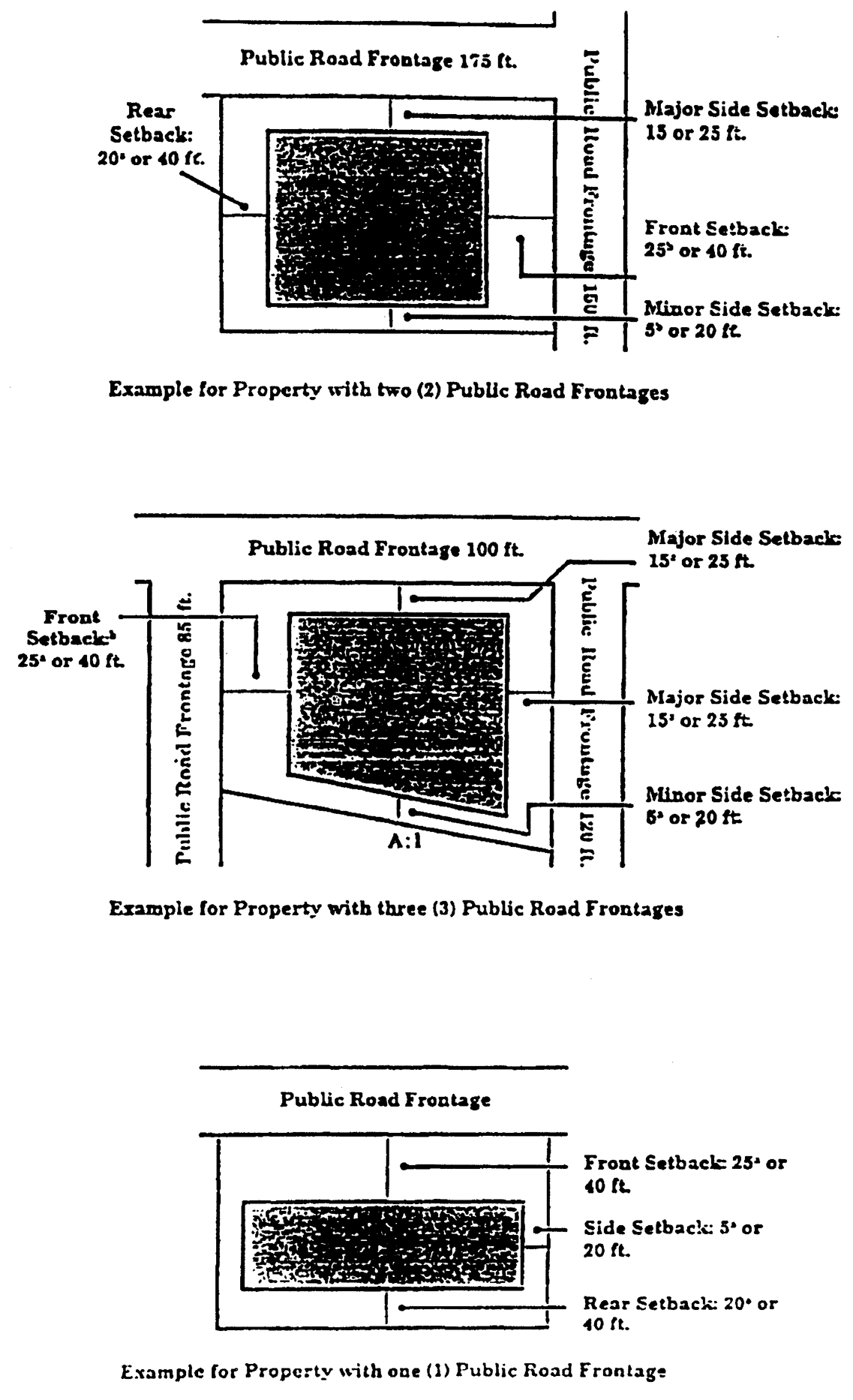
RA-5
Notes:
a If public road frontage is along an arterial or collector roadway, a 50-foot front setback shall be required.
b Distance if interior portion of development.
c Property with shorter amount of road frontage will be the front setback for determining other setbacks (major side, side, rear).
d If the structure fronts a major side setback, the major side setback shall be 35 feet.
(5)
Landscape buffer and screening requirements. Unless otherwise noted within this district's requirements, any property within an RA-5 district which abuts a more restrictive, residentially zoned property shall have a minimum ten-foot landscaped screening buffer adjacent to all residential property, such buffer subject to approval by county staff. Required buffers may be included within required setbacks; however, in such case that the required buffer is greater than the required setback, the required buffer shall be adhered to. Additionally, necessary private utilities and/or access drives may be allowed through, over or across a landscaped buffer. Any such uses which are proposed through, over or across a designated, undisturbed buffer must be approved pursuant to an original site plan or site plan modification as set forth under section 134-126.
a.
Objectives. Undisturbed, planted landscape buffers and berms shall be implemented in connection with a permitted project and shall address the following objectives:
1.
Screening to enhance aesthetic appeal;
2.
Control or direction of vehicular and pedestrian movement;
3.
Reduction of glare;
4.
Buffering of noise; and
5.
Establishment of privacy.
b.
Landscape buffers. Landscape buffers are subject to review and approval by county staff in accordance with the following standards:
1.
Plantings are to be a mix of evergreen trees and shrubs;
2.
Species are to be ecologically compatible to the site and appropriate for design situation;
3.
Unless public safety concerns dictate otherwise, buffer should maximize visual barrier to height of six feet within two years of planting;
4.
Minimum height of plant materials at installation is to be five feet for trees and two feet for shrubs;
5.
Fencing or walls are to be minimum six feet in height as approved by county staff;
6.
Trees included in buffer plantings may be counted toward site density calculations as required by chapter 50, article VI, pertaining to tree preservation and replacement, subject to review and approval of county staff;
7.
Buffers shall be regularly maintained by the property owners to ensure that the objectives and standards set out in this section are met;
8.
When topography and existing conditions allow, the required ten-foot buffer should be an undisturbed buffer; and
9.
Any appeals from a determination by county staff shall be to the board of zoning appeals.
c.
Berms. Berms are subject to review and approval by county staff in accordance with the following standards:
1.
Berms shall be utilized when consistent with surrounding property features;
2.
Berms shall be stabilized;
3.
Berms shall be constructed to be consistent with natural or proposed drainage patterns; and
4.
Berms shall be regularly maintained by the property owner.
(6)
Floodplain/wetlands preservation requirements. Any development must meet all state and federal requirements relating to floodplains and wetlands. The board of commissioners encourages preservation of wetland areas. Any development must also meet state and federal requirements relating to areas subject to the provisions of section 134-283, regarding mountain and river corridor protection act areas, and section 134-284, regarding metropolitan river protection act areas. No floodplain and/or wetlands may be used in calculating the overall density of the development.
(7)
Building and structure requirements. Maximum building height is 35 feet.
(8)
Parking requirements. See section 134-272 for paved parking specifications.
(9)
Lighting requirements. Any project permitted within the RA-5 district which proposes any outdoor lighting, except individual residential lots, must have a county department of transportation approved lighting plan in accordance with the minimum conditions listed in section 134-269.
(10)
Special exception uses. See section 134-271 for special exception uses and requirements for all districts.
(11)
Temporary land use permits and special land use permits. See sections 134-36 and 134-37 for additional uses and requirements for all districts. Uses requiring land use permits or special land use permits for the RA-5 district are the designated uses listed in sections 134-36 and 134-37.
(12)
Use limitations.
a.
There shall be a maximum of five units per acre; however, the overall density of a development may be reduced due to topography, drainage, deforestation or sediment and erosion concerns.
b.
Where single-family dwelling units are proposed to be constructed in areas zoned RA-5, the minimum house size shall be 950 square feet and the minimum lot size for an individual lot shall be 7,000 square feet. All setbacks shall be as set forth in this section.
c.
Architectural style and design shall be compatible with or upgrade the existing neighborhood.
d.
Maximum acreage is 20 acres.
e.
No sale of goods or products shall be permitted except if accessory to customary home occupation, land use permit, special land use permit or special exception use.
f.
No sexually oriented businesses are permitted.
g.
No materials, equipment or business vehicles may be stored or parked on the premises, except that one business vehicle used exclusively by the resident may be parked in a carport, garage or rear or side yard. The off-site employees of the resident shall not congregate on the premises for any purpose concerning the business of home occupation.
h.
All uses are subject to chapter 110, pertaining to subdivisions.
i.
It is found and declared that outside storage on properties within unincorporated Cobb County is a health risk and undesirable in that it provides harborage for rodents and insects, lowers property values, and constitutes a public nuisance; therefore, no outside storage is permitted, excluding firewood and lawn furnishings, unless otherwise allowed in this article.
j.
Maximum impervious surface shall not exceed 40 percent. Pervious pavement system and/or green roofs are considered 60 percent effective impervious and will be calculated as such when determining maximum impervious surface. In no case shall total pavement and roof areas (pervious and impervious) exceed 45 percent.
Required buffers may be included within required setbacks; however, in such case that the required buffer is greater than the required setback, the required buffer shall be adhered to. Additionally, necessary private utilities and/or access drives may be allowed through, over or across a landscaped buffer. Any such buffer must be approved pursuant to an original site plan or site plan modification as set forth under section 134-126.
(13)
Accessory buildings, structures, uses and decks.
a.
Size and setback limitations: Any accessory building, structure, use and deck up to 144 total gross square feet must be located at least five feet off the property line and limited to 15 feet in height subject to the development conditions list below (except for 15-foot height restriction). Any accessory building, structure, use and deck over 144 total gross square feet and up to 650 total gross square feet shall be limited to the building setbacks of the lot it is located on and is subject to the development conditions below. Any accessory building, structure, use and deck over 650 total gross square feet must be at least 100 feet from any property line and is subject to the development conditions below.
b.
Accessory buildings, structures, uses and decks shall be subject to the following development conditions:
1.
Maximum height is two stories or 35 feet.
2.
Buildings or structures shall have the meaning as defined in section 134-1. Accessory structures and uses shall also include Jacuzzis, tennis courts, basketball courts, swimming pools (private), playhouses and playgrounds. When calculating square footage for ground level uses such as tennis courts, basketball courts and above ground swimming pools and the like, the footprint shall be used in calculating total gross square feet.
3.
All accessory buildings, structures, uses and decks shall be located to the rear of the principal building, except for heating and air conditioning units or garbage pads, which may be located on the side of the primary structure and located within two feet of the primary structure.
4.
The rear of the primary structure shall be where the main portion of the building ends without consideration of wings.
5.
Architectural style and design are to be approved by the division manager of zoning or his designee, and are to be complimentary to the primary structure.
6.
Such structures or buildings shall be located on the same lot as and to the rear of the primary structure to which they are accessory. Uncovered decks that are attached to the primary structure may be located to the rear or side of the principal building. Covered decks, covered patios, and covered steps shall adhere to the building setbacks of the primary structure.
7.
No accessory building, structure, use or deck shall be constructed upon a lot until construction of the principal building has commenced.
8.
On a corner lot, no accessory building, structure, use or deck shall be located closer to the side street right-of-way line than the principal building.
9.
If the garage, accessory building, structure, use or deck is attached to the primary structure by a breezeway it shall be located up to a maximum of 25 feet from the primary structure to which it is attached. The breezeway may be enclosed or open.
10.
When an accessory building is intended to be habitable it shall be attached to the principal structure by a fully enclosed heated/cooled hallway and it shall comply with the yard requirements of the principal building to which it is accessory. The accessory building, structure or use shall be located up to a maximum of 25 feet from the primary structure to which it is attached.
11.
All accessory buildings, structures and uses in excess of 650 gross square feet shall be required to submit for plan review through the community development department or receive approval from the director of the community development department or zoning division manager, or their designees.
12.
The primary structure in a residential district shall be the principle house on the lot.
c.
Antennae and satellite dishes shall meet the requirements set forth in section 134-274, pertaining to standards for antennae, satellite television antennae and dishes.
d.
Incidental storage, provided that the material stored is incidental to the permitted use, as determined by the division manager of zoning or his designee, and stored completely within a portion of the enclosed, principal structure permitted within the district or within a permitted accessory structure.
e.
Neighborhood recreation centers, amenities and swimming pools, subject to the following:
1.
Site plans must be approved by the zoning staff to ensure compliance with all applicable laws and provisions of this chapter. The facility should be designed to include a detailed landscape plan that provides adequate screening of the facility which creates a visual and sound buffer for adjacent properties. The landscape plan shall be drawn to scale and shall include plant identification by common name. The facility shall be designed to accommodate no more than those residing within two adjoining residential developments except in those cases where a variance is obtained as in other cases.
2.
Buildings and structures established in connection with such use shall be set back not less than 100 feet from any property line.
i.
Upon written consent of all owners of property within 100 feet of the building or structure, the setback may be reduced to 50 feet from any exterior property line of the subdivision within which the use is located. Additionally, a detailed landscape plan must be submitted to and approved by the planning and zoning staff.
ii.
The setback may be reduced to 20 feet from an interior property line of the property on which the use is located if a ten-foot landscaped buffer is provided along such property line and a six-foot solid wood or masonry fence is erected and maintained along such line so as to provide a visual and noise screen for adjacent property; provided, however, the setback after reduction shall not be less than 100 feet from an exterior property line unless also reduced in accordance with subsection (12)d.2.i of this section. Such landscaped buffer shall be shown on the landscaping plan specified in subsection (12)d.1 of this section and must be approved by the planning and zoning staff.
iii.
When a property line is on a natural waterway, a property line setback may be waived provided written waiver is obtained from both the development and inspections and the planning and zoning departments.
3.
Swimming pools must comply with all applicable ordinances and must have necessary approvals from the health department and the county building inspections department.
4.
Outdoor activity shall cease by 11:00 p.m.
5.
Lighting shall be established in such a way that values or quiet use and enjoyment of adjacent properties are not adversely affected, and that roadways and safe use thereof are not adversely affected. No direct light shall be cast upon adjacent properties or roadways. If lighting is to be established, the use of environmental or cut-off type fixtures only are permissible. If lighting is to be established in a recreation area adjacent to an existing or proposed county public road, a lighting plan must be submitted and approved by the county D.O.T. to ensure no light is cast upon the roadway, and no adverse impact will be created as a result of the lighting.
6.
No residence or structures shall be built upon any adjacent lot within the development within which the facility is located until construction of the recreation area has commenced to the extent that buyers of adjacent property will be aware of where the recreation area will be located.
7.
Parking requirements are as follows:
i.
A minimum of one space per five residences.
ii.
Parking spaces shall be paved and striped according to county standard 114, pertaining to parking specifications, as it now exists or may hereafter be amended. No parking shall be allowed within a front yard setback.
(Ord. of 2-27-96; Ord. of 6-24-97 (eff. 7-1-97); Ord. of 11-23-99; Ord. of 2-8-00; Ord. of 9-12-00; Ord. of 7-10-01; Ord. of 7-27-04; Ord. of 7-26-05; Ord. of 1-24-06; Ord. of 7-25-06; Ord. of 2-27-07; Ord. of 2-26-08; Amd. of 2-23-10; Ord. of 2-28-12; Ord. of 7-24-12; Amd. of 2-26-13; Amd. of 7-22-14; Amd. of 2-24-15; Amd. of 2-28-17; Amd. of 9-8-20)
Sec. 134-201.3. - SC suburban condominium residential district.
The regulations for the SC suburban condominium residential district are as follows:
(1)
Purpose and intent. The SC district is established to provide locations for the development of low maintenance residential condominium dwelling units, including the combination of single-family houses, duplexes, triplexes and quadruplexes. The dwelling units are to be designed so as to be attached by a common party wall. This residential use is designed to be located within or on the edge of properties delineated for medium and high density residential, neighborhood activity center and community activity center categories as defined and shown on the Cobb County Comprehensive Plan. When residentially compatible institutional and recreational uses, or residential uses are developed within the SC district, they should be designed and built to ensure intensity and density compatibility with adjacent single-family detached dwelling units and otherwise to implement the stated purpose and intent of this chapter.
(2)
Definitions. The following words, terms and phrases, when used in this section, shall have the meanings ascribed to them in this subsection, except where the context clearly indicates a different meaning:
a.
Condominium means individual ownership of units in a multifamily structure, together with the joint ownership of common areas of the building and grounds.
b.
Customary home occupations means those occupations which are customarily performed in a small area of a residence due to the low intensity nature of such uses, subject to the following requirements, or as specified in the condominium declaration and bylaws if more restrictive:
1.
There shall be no exterior evidence of the home occupation, including but not limited to any type of identifying signs.
2.
No article, product or service used or sold in connection with such activity shall be other than those normally found on the premises.
3.
No mechanical equipment shall be used for such occupation except such equipment as is customary for purely household and hobby purposes.
4.
Such use shall be conducted entirely within the dwelling unit, and only persons living in the dwelling unit shall be employed in such occupation.
5.
No more than 25 percent of the dwelling unit may be used for the operation.
6.
No materials, equipment or business vehicles may be stored or parked on the premises, except that one business vehicle, used exclusively by the resident may be parked in a carport, garage, or rear or side yard. The off-site employees of the resident shall not congregate on the premises for any purpose concerning the business of the home occupation.
7.
There shall be no deliveries of supplies for use in the home occupation or pickups of the items produced by the occupant by commercial carrier.
(3)
Permitted uses. Anything not permitted or allowed by special exception or condominium declaration and bylaws is prohibited. Permitted uses are as follows:
Condominiums.
Customary home occupations.
Designated recycling collection locations.
Parking for vehicles.
Personal vehicle and equipment sales.
(4)
Lot size and setback requirements. Lot size and setback requirements are as follows:
a.
Minimum tract size: 5 acres.
b.
Minimum lot width at front setback line: 75 feet.
c.
Minimum public road frontage: 75 feet.
d.
Minimum building setbacks: As shown and applied in the following diagram:
MINIMUM BUILDING SETBACK REQUIREMENTS FOR SC DISTRICT
Note: All setbacks shall be measured from future right-of-way.
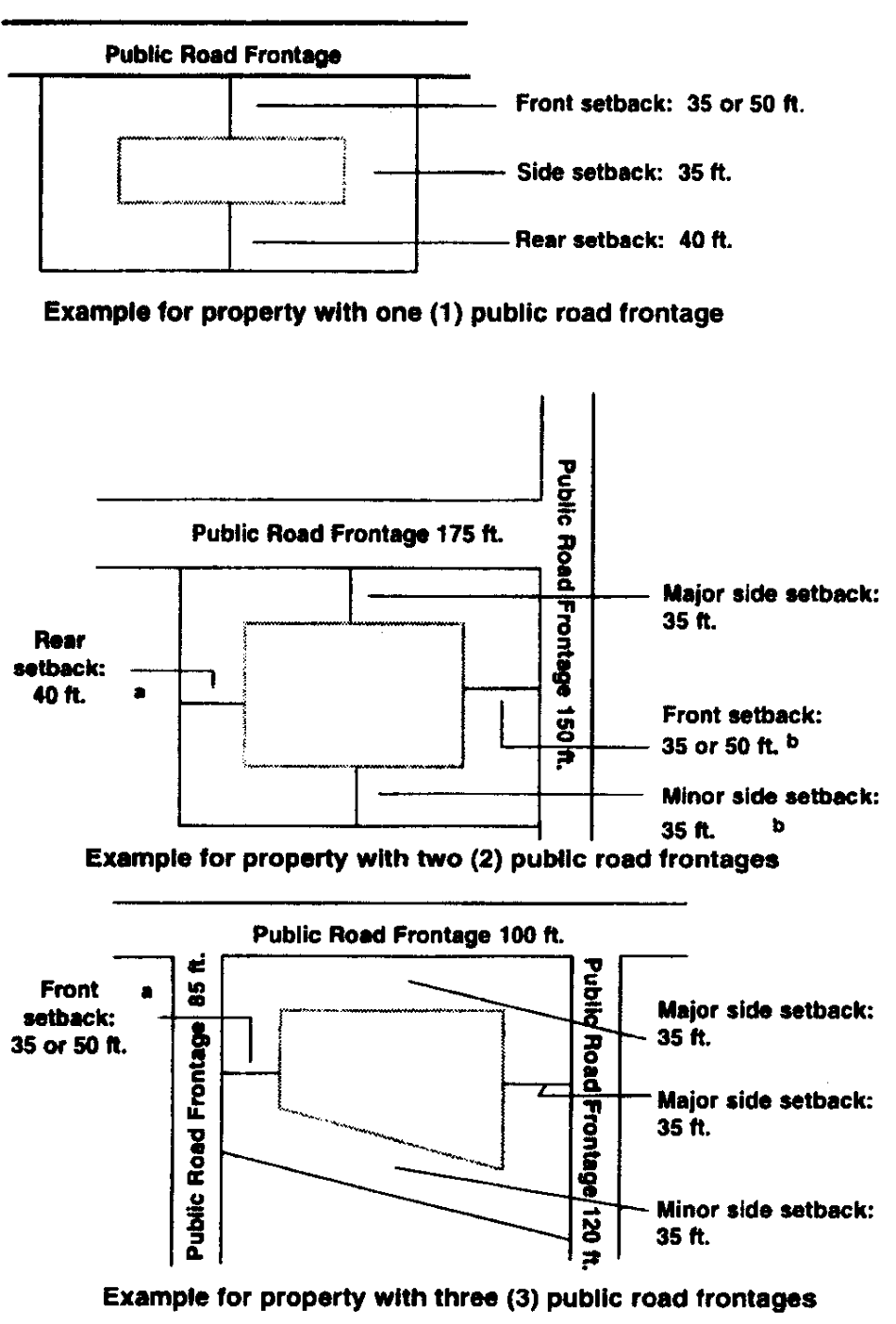
Minimum Building Setback Requirements for SC District
Notes:
a Property with shorter amount of road frontage will be the front setback for determining other setbacks (major side, side, rear).
b If structure fronts a major side setback, major side setback shall be 35 feet.
(5)
Landscape buffer and screening requirements. Unless otherwise noted within this district's requirements, any property within a SC district which abuts nonresidentially zoned property shall have a minimum 25-foot landscaped screening buffer adjacent to all nonresidential property. Also, unless otherwise noted within this district's requirements, any property within a SC district which abuts a more restrictive residentially zoned property shall have a minimum 40-foot landscaped screening buffer adjacent to all residential property. The buffer shall be subject to approval by county staff. Required buffers may be included within required setbacks; however, in such case that the required buffer is greater than the required setback, the required buffer shall be adhered to. Additionally, necessary private utilities and access drives may be allowed through, over or across a landscaped buffer. Any such uses which are proposed through, over or across a designated undisturbed buffer must be approved pursuant to an original site plan or site plan modification as set forth under section 134-126.
a.
Objectives. Undisturbed, planted landscape buffers and berms shall be implemented in connection with a permitted project and shall address the following objectives:
1.
Screening to enhance aesthetic appeal;
2.
Control or direction of vehicular andpedestrian movement;
3.
Reduction of glare; and
4.
Buffering of noise.
b.
Standards. Buffers or berms shall be required when a SC district is located adjacent to a nonresidential district or a more restrictive residential district; a minimum 25-foot buffer (nonresidential) or 40-foot buffer (more restrictive residential) is required.
1.
Buffers. Landscape buffers are subject to review and approval by county staff in accordance with the following standards:
i.
Plantings are to be a mix of evergreen trees and shrubs.
ii.
Species are to be ecologically compatible to the site and appropriate for the design situation.
iii.
Unless public safety concerns dictate otherwise, a buffer should maximize a visual barrier to a height of six feet within two years of planting.
iv.
Minimum height of plant materials at installation is five feet for trees and two feet for shrubs.
v.
Fencing or walls are to be a minimum of six feet in height as approved by county staff.
vi.
Trees included in buffer plantings may be counted toward site density calculations as required by chapter 50, article VI, pertaining to tree preservation and replacement, subject to review and approval of county staff.
vii.
Buffers shall be regularly maintained by the property owner to ensure that the objectives and standards set out in this subsection are met.
viii.
When topography and existing conditions allow, the required 25-foot or 40-foot buffer should be an undisturbed buffer.
ix.
Any appeals from a determination by county staff shall be to the board of zoning appeals.
2.
Berms. Berms are subject to review and approval by county staff in accordance with the following standards:
i.
Berms shall be utilized when consistent with surrounding property features.
ii.
Berms shall be stabilized.
iii.
Berms shall be constructed to be consistent with natural or proposed drainage patterns.
iv.
Berms shall be regularly maintained by the property owner.
(6)
Floodplain and wetlands preservation requirements. Any development must meet state and federal requirements relating to areas subject to the provisions of section 134-283, regarding mountain and river corridor protection act areas, and section 134-284, regarding metropolitan river protection act areas. No floodplains and/or wetlands may be used in calculating the overall density of the development.
(7)
Building and structure requirements. a) Maximum building height is 35 feet with no more than two stories; b) Any structure within the SC district shall have a pitched roof conceptually consistent with the following diagrams; c) Additionally, the pitched roof shall be constructed with asphaltic shingles or material consistent in appearance with asphaltic shingles. The pitched roof shall be subject to the requirements of the county Georgia Span Tables for Joists and Rafters 1978, as amended from time to time. The pitched roof shall also be further subject to approval by the community development department. Any structure within the SC district which is adjacent to residentially zoned property shall also be architecturally compatible with the adjacent residential properties. The architectural design shall be approved by the division manager of zoning or his designee.
Diagram 1 - Pitched Roof Conceptual for SC District
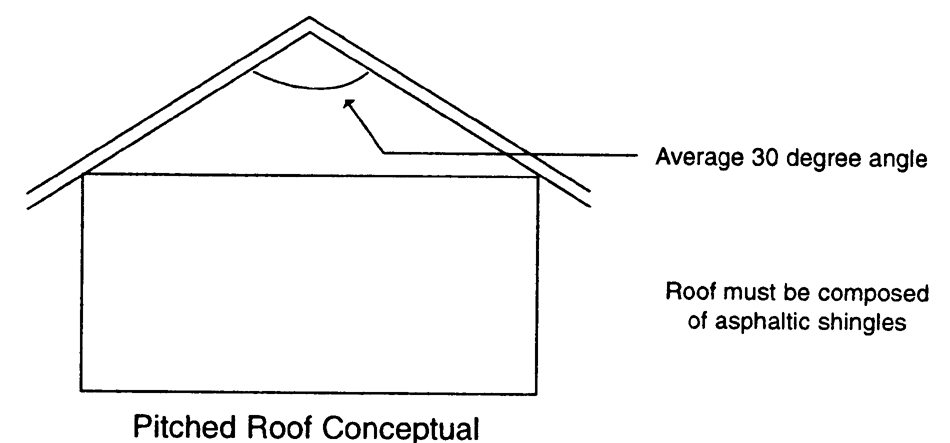
(8)
Parking requirements. See section 134-272 for paved parking specifications.
(9)
Lighting requirements. Any project permitted within the SC district which proposes any outdoor lighting, except individual residential units, must have a county department of transportation approved lighting plan in accordance with the minimum conditions listed in section 134-269.
(10)
Special exception uses. Please see section 134-271 for special exception uses and requirements for all districts. Special exception uses for the SC district are the uses listed in section 134-271.
(11)
Temporary land use permits and special land use permits. See sections 134-36 and 134-37 for additional uses and requirements for all districts. Uses requiring land use permits or special land use permits for the SC district are the designated uses listed in sections 134-36 and 134-37.
(12)
Use limitations.
a.
There shall be a maximum of five units per acre; however, the overall density of a development may be reduced due to topography, drainage, deforestation or sediment and erosion concerns.
b.
Maximum acreage is 20 acres.
c.
No sale of goods or products shall be permitted except if accessory to a customary home occupation, land use permit, special land use permit or special exception use.
d.
No sexually oriented businesses are permitted.
e.
No materials, equipment or business vehicles may be stored or parked on the premises, except as specified in the condominium declaration and bylaws. If single-family detached dwellings are developed in areas zoned SC, one business vehicle, the carrying or towing capacity of which shall not exceed one and one-half tons, used exclusively by the resident may be parked in a garage, carport or rear or side yard. The off-site employees of the resident shall not congregate on the premises for any purpose concerning the business of the home occupation. There shall be no more than two full time employees permitted on site for any allowable customary home occupation or business.
f.
All uses are subject to chapter 110, the subdivision regulations of the county, as amended from time to time.
g.
Any food or beverage served within an accessory clubhouse shall be limited to residents and their guests.
h.
It is found and declared that outside storage on properties within unincorporated Cobb County is a health risk and undesirable in that it provides harborage for rodents and insects, lowers property values, and constitutes a public nuisance; therefore, no outside storage is permitted, excluding firewood and lawn furnishings, unless otherwise allowed in this article, or as otherwise prohibited in the condominium declaration and bylaws.
i.
Impervious surface shall not exceed 55 percent of the total site area.
j.
A mandatory homeowners' association must be formed and incorporated which provides for building and grounds maintenance and repair, insurance and working capital. Said association must also include condominium declaration and bylaws, including rules and regulations, subject to staff review and approval. The declaration and bylaws shall not be enforced by the county. The declaration and bylaws shall, at a minimum, regulate and control the following:
1.
Animals.
2.
Signs.
3.
Exterior items such as fences, lawn ornaments and removal of landscape areas and buffers.
4.
Building improvements.
5.
Outside storage.
6.
Overnight parking of vehicles.
7.
Decorations.
8.
Trash collection.
9.
Restrictions/definitions on single-family residential use only, and leasing of units.
k.
All condominium units must have an attached garage.
l.
No more than two units may be attached side by side.
m.
Maximum of four attached units (quadruplex).
Required buffers may be included within required setbacks; however, in such case that the required buffer is greater than the required setback, the required buffer shall be adhered to. Additionally, necessary private utilities and access drives may be allowed through, over or across a landscaped buffer. Any such uses which are proposed through, over or across a designated undisturbed buffer must be approved pursuant to an original site plan or site plan modification as set forth under section 134-126.
(13)
Accessory buildings, structures, uses and decks. Any accessory building or structure which exceeds 1,000 square feet of gross space must have the approval of the division manager of zoning or his designee as to the location, architectural design and size prior to commencing construction. The division manager of zoning or his designee shall consider the following criteria for determining the appropriateness of the architectural design and size of the accessory building or structure: Compatibility with the surrounding neighborhood, style of exterior (the exterior is to be compatible in style with the primary structure), use of the proposed accessory structure, impact on adjacent properties, and requirements as deemed appropriate by plan review as set forth in this subsection. All accessory buildings, structures and uses in excess of 1,000 gross square feet shall be required to submit for plan review through the community development department or receive approval from the director of the community development department or his designee.
a.
Accessory buildings, structures, uses or decks shall be subject to the following conditions:
1.
Maximum height is two stories or 35 feet.
2.
Accessory uses shall include garbage dumpsters, designated recycling collection locations, clubhouse and recreation centers, amenities, swimming pools and tennis courts, antennas and satellite dishes, heating and air conditioning units, jacuzzis, playhouses and playgrounds subject to the following conditions:
i.
Uses must be located within building setbacks.
ii.
No ground-based antenna or satellite dish shall exceed 35 feet in height without compliance with standards in section 134-273.
iii.
No accessory building, structure, use or deck shall be built until construction of the principal building has commenced.
iv.
Outdoor activities shall cease by 11:00 p.m. within clubhouse and recreation centers and swimming pools and tennis courts.
3.
Such buildings, structures, uses or decks shall be located on the same lot as the principal use to which the building, structure use or deck is accessory.
b.
Antennas and satellite dishes shall meet the requirements set forth in section 134-274.
c.
Incidental storage is permitted, provided that the material stored is incidental to the permitted use, as determined by the division manager of zoning or his designee, and stored completely within a portion of the enclosed principal structure permitted within the district, or within a permitted accessory structure.
(Ord. of 6-23-98; Ord. of 2-8-00; Ord. of 9-12-00; Ord. of 7-8-03; Ord. of 7-27-04; Ord. of 7-25-06; Ord. of 7-27-10; Amd. of 2-24-15; Amd. of 2-28-17; Amd. of 9-8-20)
Sec. 134-202. - RA-6 single-family attached/detached residential district.
The regulations for the RA-6 single-family attached/detached residential district are as follows:
(1)
Purpose and intent. The RA-6 district is established to provide locations for the development of single-family detached or attached residential dwelling units including the combination of duplexes, triplexes and quadruplexes. The dwelling units are to be designed so as to be placed on an individual lot attached to another dwelling unit or on an adjoining lot where the units will be attached by a common party wall. This residential use is designed to be located within a regional activity center as defined and shown on the Cobb County Comprehensive Plan. When residentially compatible institutional and recreational uses are developed within the RA-6 district they should be designed and built to ensure intensity and density compatibility with adjacent single-family detached dwellings and otherwise to implement the stated purpose and intent of this chapter.
(2)
Definitions. The following words, terms and phrases, when used in this section, shall have the meanings ascribed to them in this subsection, except where the context clearly indicates a different meaning:
a.
Community fair means a festival or fair such as the North Georgia State Fair conducted wholly within public areas owned by a local government; provided that any activity is conducted at least 200 feet from any property line. Any event shall not exceed 21 days.
b.
Customary home occupations means those occupations which are customarily performed in a small area of a residence due to the low intensity nature of such uses, subject to the following requirements:
1.
There shall be no exterior evidence of the home occupation, including but not limited to any type of identifying signs.
2.
No article, product or service used or sold in connection with such activity shall be other than those normally found on the premises.
3.
No mechanical equipment shall be used for such occupation except such equipment as is customary for purely household and hobby purposes.
4.
Such use shall be conducted entirely within the dwelling unit and only persons living in the dwelling unit shall be employed in such occupation.
5.
No more than 25 percent of the dwelling unit may be used for the operation.
6.
No materials, equipment or business vehicles may be stored or parked on the premises, except that one business vehicle used exclusively by the resident may be parked in a carport, garage, or rear or side yard. The off-site employees of the resident shall not congregate on the premises for any purpose concerning the business of the home occupation.
7.
There shall be no deliveries of supplies for use in the home occupation or pickups of the items produced by the occupant by commercial carriers.
c.
Group home means a dwelling shared by four or fewer persons, excluding resident staff, who live together as a single housekeeping unit and in a long term, family-like environment in which staff persons provide care, education and participation in community activities for the residents with the primary goal of enabling the residents to live as independently as possible in order to reach their maximum potential under the direction and guidance of a designated managing caregiver, who must be a resident of the group home. The term "group home" shall not include a halfway house, a treatment center for alcoholism or drug abuse, a work release facility for convicts or ex-convicts, a home for the detention and/or rehabilitation of juveniles adjudged delinquent or unruly and placed in the custody of the state, or other housing facilities serving as an alternative to incarceration. The term "group home" shall also not allow the use of a dwelling as an apartment or duplex. A group home shall not allow use of the dwelling as a home for individuals on parole, probation, or convicted and released from incarceration, for any crimes including child molestation, aggravated child molestation, or child sexual abuse, as defined in O.C.G.A. § 16-6-4 or individuals required to register as sex offenders pursuant to O.C.G.A. § 42-1-12. A group home may include a home for the handicapped. As used in this subsection, the term "handicapped" shall mean:
1.
Having a physical or mental impairment that substantially limits one or more of such person's major life activities so that such person is incapable of living independently;
2.
Having a record of having such an impairment; or
3.
Being regarded as having such an impairment.
However, the term "handicapped" shall not include current illegal use of or addiction to a controlled substance, nor shall it include any person whose residency in the home would constitute a direct threat to the health and safety of other individuals.
d.
Livestock, nondomestic and wild animals, and poultry means animals, nondomestic and wild animals, and species of the avian family which are or may be raised for the purpose of providing food or transportation, or being resold or bred, excluding only dogs, cats, rabbits, fish, pet mice, hamsters, gerbils, parrots and parakeets.
1.
Such animals shall only be permitted on a lot containing not less than two acres.
2.
All buildings used for animals shall be set back not less than 100 feet from any property line.
3.
All animals shall be maintained at least ten feet from any residential property line.
4.
Except in the RR district, there shall be not less than 5,000 square feet of fenced lot area not covered by the principal structure for each animal, unless the property is a bona fide farm.
5.
In the case of nondomestic or wild animals, all state and federal requirements must be met and a special land use permit is required.
e.
Reserved.
f.
Residential, agricultural, farm and wood products, and livestock and poultry sales means residential property of two acres or more where agricultural, farm and wood products, and livestock and poultry are grown, raised or cultivated on-site. Sales of such products shall be permitted under the following conditions:
1.
No permanent sale structure shall be allowed.
2.
Seasonal sales may be made from tables or tents placed temporarily.
3.
All sales are to be conducted on the property where the products are grown and off the right-of-way.
4.
Should sales of such products constitute a nuisance or create a safety hazard, then such sales may be further restricted to adequately protect the health, safety and welfare of the public.
5.
Signage standards are as follows:
i.
One sign is permitted per property, no greater than 32 square feet in size.
ii.
No manufactured portable signs shall be allowed.
iii.
The height of signs shall not exceed six feet.
iv.
All signage requires a sign permit.
(3)
Permitted uses. Anything not permitted or allowed by special exception is prohibited. Permitted uses are as follows:
Community fairs.
Cottage food operators as regulated by the Georgia Department of Agriculture in accordance with its Rules, Chapter 40-7-19, as may be amended from time to time subject to the following requirements:
1.
There shall be no signage or other exterior evidence of the cottage food operator.
2.
Deliveries of specialty ingredients such as herbs and spices, etc., limited to those made by the United States Postal Service or other carrier (FedEx, United Parcel Service, etc.) that routinely delivers mail/internet order products to residents.
3.
No cottage food products prepared by the cottage food operator may be picked up by a commercial carrier.
4.
There shall be no employees parking on the site unless approved by the board of commissioners in accordance with section 134-36 of the Cobb County Code.
Customary home occupations.
Designated recycling collection location.
Executive golf courses (see section 134-270).
Fruit trees, nuts and vegetables.
Golf courses, 18-hole regulation, public and private (see section 134-270).
Golf courses, par 3 (see section 134-270).
Group homes.
In-home day care.
Livestock, nondomestic and wild animals, and poultry, on two or more acres.
Nonprofit (seasonal use) fishing lakes.
Parking for vehicles.
Personal vehicle and equipment sales.
Residential, agricultural, farm and wood products, and livestock and poultry sales.
Riding stables.
Single-family dwelling units (attached).
Single-family dwelling units (detached).
Temporary uses.
(4)
Lot size and setback requirements. Lot size and setback requirements are as follows:
a.
Minimum lot size: 6,200 square feet. The board of zoning appeals shall not be authorized to recommend a variance for more than 25 percent of the minimum lot size.
b.
Minimum lot width at front setback line: 70 feet; cul-de-sac or interior lot, 50 feet.
c.
Minimum width between dwellings: 15 feet.
d.
Minimum public road frontage: 70 feet; cul-de-sac, 35 feet; 50 feet minimum public road frontage if interior to development.
e.
Minimum building setbacks: As shown and applied in the following diagram:
MINIMUM BUILDING SETBACK REQUIREMENTS FOR RA-6 DISTRICT
Note: All setbacks shall be measured from future right-of-way.
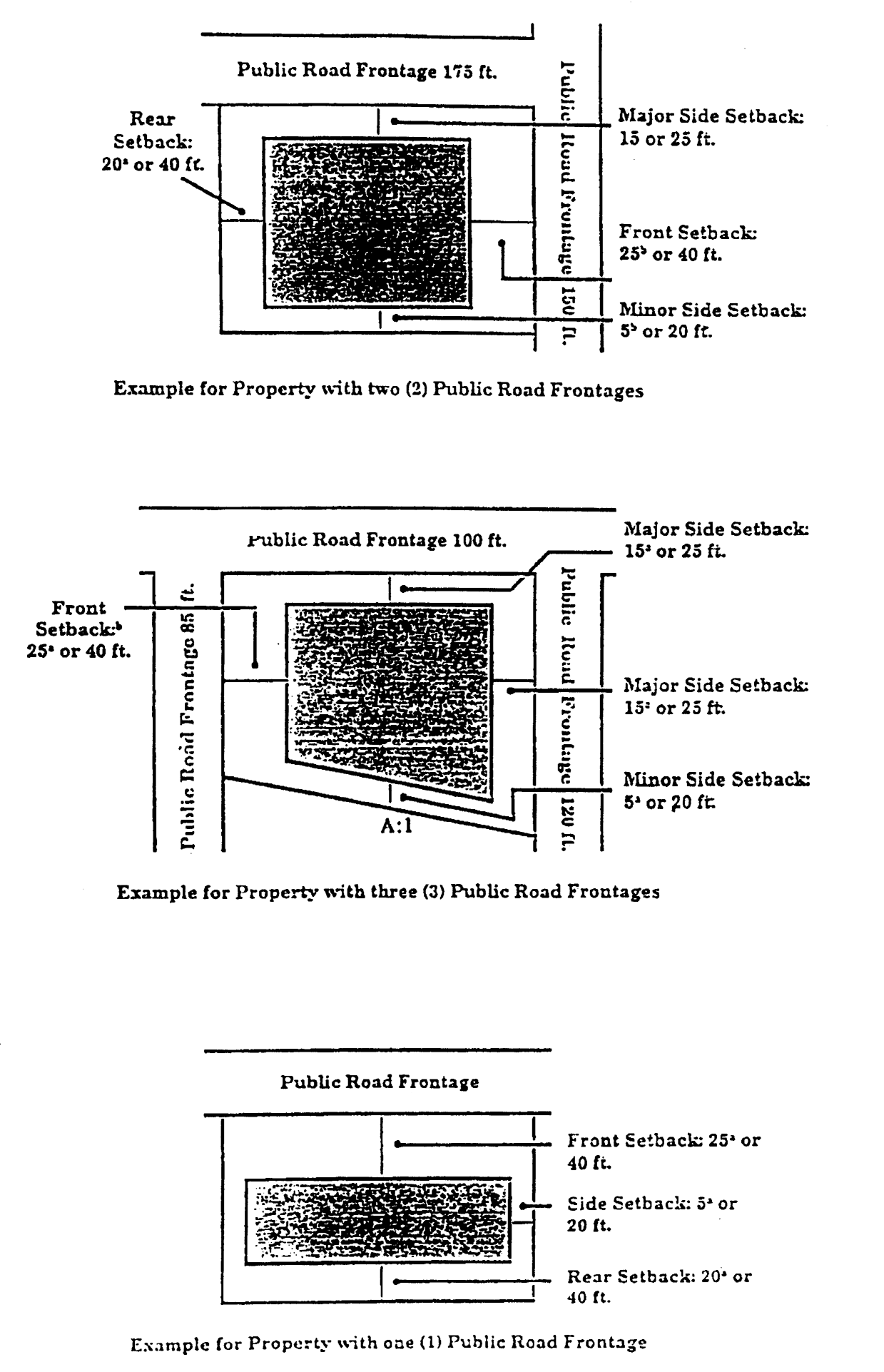
Minimum Building Setback Requirements for RA-6 District
Notes:
a If public road frontage is along an arterial or collector roadway, a 50-foot front setback shall be required.
b Distance if interior portion of development.
c Property with shorter amount of road frontage will be the front setback for determining other setbacks (major side, side, rear).
d If structure fronts a major side setback, major side setback shall be 35 feet.
(5)
Landscape buffer and screening requirements. Unless otherwise noted within this district's requirements, any property within an RA-6 district which abuts a more restrictive residentially zoned property shall have a minimum ten-foot landscaped screening buffer adjacent to all residential property. The buffer shall be subject to approval by county staff. Required buffers may be included within required setbacks; however, in such case that the required buffer is greater than the required setback, the required buffer shall be adhered to. Additionally, necessary private utilities and access drives may be allowed through, over or across a landscaped buffer. Any such uses which are proposed through, over or across a designated undisturbed buffer must be approved pursuant to an original site plan or site plan modification as set forth under section 134-126.
a.
Objectives. Undisturbed, planted landscape buffers and berms shall be implemented in connection with a permitted project and shall address the following objectives:
1.
Screening to enhance aesthetic appeal;
2.
Control or direction of vehicular and pedestrian movement;
3.
Reduction of glare:
4.
Buffering of noise; and
5.
Establishment of privacy.
b.
Standards. Buffers or berms shall be required when an RA-6 district is located adjacent to a more restrictive residential district; a minimum ten-foot buffer is required.
1.
Buffers. Landscape buffers are subject to review and approval by county staff in accordance with the following standards:
i.
Plantings are to be a mix of evergreen trees and shrubs.
ii.
Species are to be ecologically compatible to the site and appropriate for the design situation.
iii.
Unless public safety concerns dictate otherwise, a buffer should maximize a visual barrier to a height of six feet within two years of planting.
iv.
Minimum height of plant materials at installation is five feet for trees and two feet for shrubs.
v.
Fencing or walls are to be a minimum of six feet in height as approved by county staff.
vi.
Trees included in buffer plantings may be counted toward site density calculations as required by chapter 50, article VI, pertaining to tree preservation and replacement, subject to review and approval of county staff.
vii.
Buffers shall be regularly maintained by the property owner to ensure that the objectives and standards set out in this section are met.
viii.
When topography and existing conditions allow, the required ten-foot buffer should be an undisturbed buffer.
ix.
Any appeals from a determination by county staff shall be to the board of zoning appeals.
2.
Berms. Berms are subject to review and approval by county staff in accordance with the following standards:
i.
Berms shall be utilized when consistent with surrounding property features.
ii.
Berms shall be stabilized.
iii.
Berms shall be constructed to be consistent with natural or proposed drainage patterns.
iv.
Berms shall be regularly maintained by the property owner.
(6)
Floodplain and wetlands preservation requirements. Any development must meet all state and federal requirements relating to floodplains and wetlands. The board of commissioners encourages preservation of wetland areas. Any development must also meet state and federal requirements relating to areas subject to the provisions of section 134-283, regarding mountain and river corridor protection act areas, and section 134-284, regarding metropolitan river protection act areas. No floodplains and/or wetlands may be used in calculating the overall density of the development.
(7)
Building and structure requirements. Maximum building height is 35 feet.
(8)
Parking requirements. See section 134-272 for paved parking specifications.
(9)
Lighting requirements. Any project permitted within the RA-6 district which proposes a lighted facility must have a county department of transportation approved lighting plan in accordance with the minimum conditions listed in section 134-269.
(10)
Special exception uses. See section 134-271 for special exception uses and requirements for all districts. Special exception uses for the RA-6 district are the uses listed in section 134-271.
(11)
Temporary land use permits and special land use permits. See sections 134-36 and 134-37 for additional uses and requirements for all districts. Uses requiring land use permits or special land use permits for the RA-6 district are the designated uses listed in sections 134-36 and 134-37.
(12)
Use limitations.
a.
There shall be a maximum of six units per acre.
b.
Where single-family dwelling units are proposed to be constructed in areas zoned RA-6, the minimum house size shall be 950 square feet and the minimum lot size for an individual lot shall be 6,200 square feet. All setbacks shall be as set forth in this section.
c.
Architectural style and design shall be compatible with or upgrade the existing neighborhood.
d.
Maximum acreage is 20 acres.
e.
No sale of goods or products shall be permitted except if accessory to a customary home occupation, land use permit, special land use permit or special exception use.
f.
No sexually oriented businesses are permitted.
g.
No materials, equipment or business vehicles may be stored or parked on the premises, except that one business vehicle used exclusively by the resident may be parked in a carport, garage, or rear or side yard. The off-site employees of the resident shall not congregate on the premises for any purpose concerning the business of the home occupation.
h.
All uses are subject to chapter 110, pertaining to subdivisions.
i.
It is found and declared that outside storage on properties within unincorporated Cobb County is a health risk and undesirable in that it provides harborage for rodents and insects, lowers property values, and constitutes a public nuisance; therefore, no outside storage is permitted, excluding firewood and lawn furnishings, unless otherwise allowed in this article.
j.
Maximum impervious surface shall not exceed 45 percent. Pervious pavement system and/or green roofs are considered 60 percent effective impervious and will be calculated as such when determining maximum impervious surface. In no case shall total pavement and roof areas (pervious and impervious) exceed 50 percent.
Required buffers may be included within required setbacks; however, in such case that the required buffer is greater than the required setback, the required buffer shall be adhered to. Additionally, necessary private utilities or access drives may be allowed through, over or across a landscaped buffer. Any such uses which are proposed through, over or across a designated undisturbed buffer must be approved pursuant to an original site plan or site plan modification as set forth under section 134-126.
(13)
Accessory buildings, structures, uses and decks.
a.
Size and setback limitations: Any accessory building, structure, use and deck up to 144 total gross square feet must be located at least five feet off the property line and limited to 15 feet in height subject to the development conditions list below (except for 15-foot height restriction). Any accessory building, structure, use and deck over 144 total gross square feet and up to 650 total gross square feet shall be limited to the building setbacks of the lot it is located on and is subject to the development conditions below. Any accessory building, structure, use and deck over 650 total gross square feet must be at least 100 feet from any property line and is subject to the development conditions below.
b.
Accessory buildings, structures, uses and decks shall be subject to the following development conditions:
1.
Maximum height is two stories or 35 feet.
2.
Buildings or structures shall have the meaning as defined in section 134-1. Accessory structures and uses shall also include Jacuzzis, tennis courts, basketball courts, swimming pools (private), playhouses and playgrounds. When calculating square footage for ground level uses such as tennis courts, basketball courts and above ground swimming pools and the like, the footprint shall be used in calculating total gross square feet.
3.
All accessory buildings, structures, uses and decks shall be located to the rear of the principal building, except for heating and air conditioning units or garbage pads, which may be located on the side of the primary structure and located within two feet of the primary structure.
4.
The rear of the primary structure shall be where the main portion of the building ends without consideration of wings.
5.
Architectural style and design are to be approved by the division manager of zoning or his designee, and are to be complimentary to the primary structure.
6.
Such structures or buildings shall be located on the same lot as and to the rear of the primary structure to which they are accessory. Uncovered decks that are attached to the primary structure may be located to the rear or side of the principal building. Covered decks, covered patios, and covered steps shall adhere to the building setbacks of the primary structure.
7.
No accessory building, structure, use or deck shall be constructed upon a lot until construction of the principal building has commenced.
8.
On a corner lot, no accessory building, structure, use or deck shall be located closer to the side street right-of-way line than the principal building.
9.
If the garage, accessory building, structure, use or deck is attached to the primary structure by a breezeway it shall be located up to a maximum of 25 feet from the primary structure to which it is attached. The breezeway may be enclosed or open.
10.
When an accessory building is intended to be habitable it shall be attached to the principal structure by a fully enclosed heated/cooled hallway and it shall comply with the yard requirements of the principal building to which it is accessory. The accessory building, structure or use shall be located up to a maximum of 25 feet from the primary structure to which it is attached.
11.
All accessory buildings, structures and uses in excess of 650 gross square feet shall be required to submit for plan review through the community development department or receive approval from the director of the community development department or zoning division manager, or their designees.
12.
The primary structure in a residential district shall be the principle house on the lot.
c.
Antennas and satellite dishes shall meet the requirements set forth in section 134-274.
d.
Incidental storage is permitted, provided that the material stored is incidental to the permitted use, as determined by the division manager of zoning or his designee, and stored completely within a portion of the enclosed principal structure permitted within the district, or within a permitted accessory structure.
e.
Neighborhood recreation centers, amenities and swimming pools are subject to the following:
1.
Site plans must be approved by the zoning staff to ensure compliance with all applicable laws and provisions of this chapter. The facility should be designed to include a detailed landscape plan that provides adequate screening of the facility which creates a visual and sound buffer for adjacent properties. The landscape plan shall be drawn to scale and shall include plant identification by common name. The facility shall be designed to accommodate no more than those residing within two adjoining residential developments except in those cases where a variance is obtained as in other cases.
2.
Buildings and structures established in connection with such use shall be set back not less than 100 feet from any property line.
i.
Upon written consent of all owners of property within 100 feet of the building or structure, the setback may be reduced to 50 feet from any exterior property line of the subdivision within which the use is located. Additionally, a detailed landscape plan must be submitted to and approved by the zoning staff.
ii.
The setback may be reduced to 20 feet from an interior property line of the property on which the use is located if a ten-foot landscaped buffer is provided along the property line and a six-foot solid wood or masonry fence is erected and maintained along the line so as to provide a visual and noise screen for adjacent property; provided, however, the setback after reduction shall not be less than 100 feet from an exterior property line unless also reduced in accordance with subsection (12)d.2.i of this section. Such landscaped buffer shall be shown on the landscaping plan specified in subsection (12)d.1 of this section and must be approved by the planning and zoning staff.
iii.
When a property line is on a natural waterway, a property line setback may be waived provided written waiver is obtained from both the community development department and the planning division and zoning division.
3.
Swimming pools must comply with all applicable ordinances and must have necessary approvals from the health department and building inspections department.
4.
Outdoor activity shall cease by 11:00 p.m.
5.
Lighting shall be established in such a way that values or quiet use and enjoyment of adjacent properties are not adversely affected, and that roadways and safe use thereof are not adversely affected. No direct light shall be cast upon adjacent properties or roadways. If lighting is to be established, the use of environmental or cutoff type fixtures only is permissible. If lighting is to be established in a recreation area adjacent to an existing or proposed county public road, a lighting plan must be submitted and approved by the county department of transportation to ensure that no light is cast upon the roadway and that no adverse impact will be created as a result of the lighting.
6.
No residence or structures shall be built upon any adjacent lot within the development within which the facility is located until construction of the recreation area has commenced to the extent that buyers of adjacent property will be aware of where the recreation area will be located.
7.
Parking requirements are as follows:
i.
A minimum of one space per five residences.
ii.
Parking spaces shall be paved and striped according to county standard 114, Parking Specifications, as it now exists or may hereafter be amended. No parking shall be allowed within a front yard setback.
(Ord. of 12-26-72; Res. of 8-14-73, § 8; Ord. of 11-8-77, §§ 1, 7; Ord. of 7-7-82, §§ 1, 3; Ord. of 12-11-90, § 3-28-7.10; Ord. of 8-19-91; Ord. of 6-9-92; Ord. of 10-27-92; Ord. of 2-22-94; Ord. of 9-13-94; Ord. of 7-11-95; Ord. of 9-26-95; Ord. of 2-27-96; Ord. of 6-24-97 (eff. 7-1-97); Ord. of 11-23-99; Ord. of 2-8-00; Ord. of 9-12-00; Ord. of 7-10-01; Ord. of 7-26-05; Ord. of 1-24-06; Ord. of 7-25-06; Ord. of 2-27-07; Ord. of 2-26-08; Amd. of 2-23-10; Ord. of 2-28-12; Ord. of 7-24-12; Amd. of 2-26-13; Amd. of 7-22-14; Amd. of 2-24-15; Amd. of 2-28-17; Amd. of 9-8-20)
Sec. 134-202.1. - CCRC continuing care retirement community district.
Note: This code section was combined with the RSL code section on (BOC adoption date).
(Ord. of 6-24-08; Amd. of 2-28-17)
Sec. 134-203. - RSL residential senior living district.
The regulations for the RSL residential senior living facilities district are as follows:
(1)
Purpose and intent. The RSL district is established to provide locations for the development of appropriate housing for the population 55 and older. In order to insure that older Cobb County residents can live in attached or detached dwelling units and/or multistage housing and care facilities appropriate to their specific needs, the following regulations are designed to facilitate development which addresses the decreasing mobility, changing health and distinct consumer preferences of the older adult market. These uses shall not be established as a precedent for any other residential or nonresidential district.
(2)
Definitions.
Accessory retail uses in RSL means retail sales and personal services intended for the residents or their guests within a RSL facility. These uses shall include eating and drinking establishments, barber shops, beauty shops, laundry and dry cleaning pickup establishments, newsstand, florist, gift shop, film developing and printing stores, stationary stores and convenience food stores (no fuel sales). This use shall also allow clinics for medical and dental care, and storage for the residents' personal items. Every public entrance for accessory retail uses shall be from inside the primary building, no show window, advertising, or display shall be visible from the exterior of the primary building and no signage shall be visible from a public road.
Nonsupportive facilities means individual housing units (attached or detached) designed for senior adults that do not include or provide any type of supportive services such as transportation, medical care, food preparation and the like. However, these non-supportive facilities may plan social events or trips for their residents.
Supportive facilities means housing units designed for senior adults that include or provide supportive services such as transportation, medical care, food preparation and the like. This use may include assisted living, skilled nursing care and hospice care.
Underground parking means a portion of a building partly underground which has more than three-quarters of its height, measured from finished floor to finished celling, below the average grade of the adjoining ground. An underground parking level shall not be deemed a story, and shall not be calculated in the overall building height, unless more than 25 percent of the parking level is above the average grade of the adjoining ground. This definition shall be used in the calculation of height for all types of RSL developments.
(3)
Permitted uses. Anything not permitted or allowed by special exception is prohibited. Permitted uses are as follows:
Supportive housing facilities as defined in section 134-203.1 of this district.
Nonsupportive housing units as defined in section 134-203.2 of this district.
Nonsupportive urban rental units as defined in section 134-203.3 of this district.
(4)
Lot size and setback requirements. (See section 134-203.1, section 134-203.2 and section 134-203.3 for applicable use limitations.)
(5)
Landscape buffer and screening requirements. Unless otherwise noted within this district's requirements, any property within an RSL district which abuts a more restrictive residentially zoned property shall have a minimum 20-foot (nonsupportive) or 40-foot (supportive) landscaped screening or maintained natural buffer adjacent to all residential property. Minimum buffers may be increased by the board of commissioners based on existing conditions such as tract size, topographic conditions, etc in order to provide compatibility with adjacent residential uses. When abutting a nonresidentially zoned property, a ten-foot landscaped screening or maintained natural buffer is required. The buffer shall be subject to approval by county staff. Required buffers may be included within required setbacks; however, in such case that the required buffer is greater than the required setback, the required buffer shall be adhered to. Additionally, necessary private utilities and/or access drives may be allowed through, over or across a landscaped buffer. Any such uses which are proposed through, over or across a designated, undisturbed buffer must be approved pursuant to an original site plan or site plan modification as set forth under section 134-126.
a.
Objectives. Undisturbed buffers, planted landscape, maintained natural buffers and berms shall be implemented in connection with a permitted project and shall address the following objectives:
1.
Screening to enhance aesthetic appeal;
2.
Control or direction of vehicular and pedestrian movement;
3.
Reduction of glare;
4.
Buffering of noise; and
5.
Establishment of privacy.
b.
Landscape buffers. Landscape buffers are subject to review and approval by county staff in accordance with the following standards:
1.
Plantings are to be a mix of evergreen trees and shrubs;
2.
Species are to be ecologically compatible to the site and appropriate for design situation;
3.
Unless public safety concerns dictate otherwise, buffer should maximize visual barrier to height of six feet within two years of planting;
4.
Minimum height of plant materials at installation is to be five feet for trees and two feet for shrubs;
5.
Fencing or walls are to be minimum six feet in height as approved by county staff;
6.
Trees included in buffer plantings may not be counted toward site density calculations as required by chapter 50, article VI, pertaining to tree preservation and replacement, subject to review and approval of county staff;
7.
Buffers shall be regularly maintained by the property owners to ensure that the objectives and standards set out in this section are met;
8.
When topography and existing conditions allow, the required buffer should be an undisturbed buffer; and
9.
Any appeals from a determination by county staff shall be to the board of zoning appeals.
c.
Berms. Berms are subject to review and approval by county staff in accordance with the following standards:
1.
Berms shall be utilized when consistent with surrounding property features;
2.
Berms shall be stabilized;
3.
Berms shall be constructed to be consistent with natural or proposed drainage patterns; and
4.
Berms shall be regularly maintained by the property owner.
(6)
Flood plain/wetlands preservation requirements. Any development must meet all state and federal requirements relating to flood plains and wetlands. The board of commissioners encourages preservation of wetland areas. Any development must also meet state and federal requirements relating to areas subject to the provisions of section 134-283, regarding mountain and river corridor protection act areas, and section 134-284, regarding metropolitan river protection areas. No flood plain and/or wetlands may be used in calculating the overall density of the development.
(7)
Building and structure requirements. (See section 134-203.1 and section 134-203.2 for applicable use limitations)
(8)
Parking requirements. (See section 134-203.1 and section 134-203.2 for applicable use limitations)
(9)
Lighting requirements. Any project permitted within the RSL district, which proposes a lighted facility, must have a county department of transportation approved lighting plan in accordance with the minimum conditions listed in section 134-269.
(10)
Special exception uses. (Not applicable)
(11)
Reserved.
(12)
Accessory buildings, structures, uses and decks. Any accessory building or structure which exceeds 1,000 square feet of gross space must have the approval of the division manager of zoning or his designee as to the location, architectural design and size prior to commencing construction. The division manager of zoning or his designee shall consider the following criteria for determining the appropriateness of the architectural design and size of the accessory building or structure: Compatibility with the surrounding neighborhood, style of exterior (the exterior is to be compatible in style with the primary structure), use of the proposed accessory structure, impact on adjacent properties, and requirements as deemed appropriate by plan review as set forth in this subsection. All accessory buildings, structures and uses in excess of 1,000 gross square feet shall be required to submit for plan review through the community development department or receive approval from the director of the community development department or his designee.
a.
Accessory buildings, structures, uses or decks shall be subject to the following conditions:
1.
Maximum height is one story or 15 feet.
2.
Accessory uses shall include garbage dumpsters, designated recycling collection locations, clubhouse and recreation centers, amenities, swimming pools and tennis courts, antennas and satellite dishes, heating and air conditioning units, jacuzzis, subject to the following conditions:
i.
Uses must be located within building setbacks.
ii.
No ground-based antenna or satellite dish shall exceed 35 feet in height without compliance with standards in section 134-273.
iii.
No accessory building, structure, use or deck shall be built until construction of the principal building has commenced.
iv.
Outdoor activities shall cease by 11:00 p.m. within clubhouse and recreation centers and swimming pools and tennis courts.
3.
Such buildings, structures, uses or decks shall be located on the same lot as the principal use to which the building, structure use or deck is accessory.
b.
Antennas and satellite dishes shall meet the requirements set forth in section 134-274.
c.
Incidental storage is permitted, provided that the material stored is incidental to the permitted use, as determined by the division manager of zoning or his designee, and stored completely within a portion of the enclosed principal structure permitted within the district, or within a permitted accessory structure.
(13)
Supportive and nonsupportive uses may be included and/or developed together on the same property in order to encourage multistage housing and care options for senior citizens. Ownership may be in fee simple, for lease, or via a contract which allows movement between lifestyle choices (levels of support and care) as the individual residents' needs evolve (provided the resident meets contract obligations). When used together, the project shall be designed to place the least intense part of the project adjacent to the more restrictive zoning districts, and the more intense, higher structures shall be placed in the center of the project to reduce the impact to the adjacent and nearby uses.
(Ord. of 3-9-99; Ord. of 3-16-99; Ord. of 11-23-99; Ord. of 7-10-01; Ord. of 9-10-02; Ord. of 9-10-02; Ord. of 7-27-04; Ord. of 1-25-05; Ord. of 7-26-05; Ord. of 1-24-06; Amd. of 2-28-17)
Sec. 134-203.1. - RSL supportive residential facilities.
The regulations for the RSL supportive residential facilities in addition to all section 134-203 regulations are as follows:
(1)
Purpose and intent. The RSL supportive residential facilities district is established to provide locations for the development of supportive residential living facilities, for tenants age 55 and older which shall not be established as a precedent for any other residential or nonresidential district. This residential use is designed to be located within properties delineated as a regional activity center, community activity center, neighborhood activity center, or high density residential as defined and shown on the Cobb County Comprehensive Plan: A Policy Guide, adopted November 27, 1990. This residential use is also designed to function as a cut-off for nonresidential uses within an activity center and a transitional use to residential uses adjoining activity centers.
(2)
Definitions. See section 134-203.
(3)
Permitted uses. Anything not permitted or allowed by special exception is prohibited. Permitted uses are as follows:
Supportive residential facilities.
(4)
Lot size and setback requirements. (See use limitations)
(5)
Landscape buffer and screening requirements. Unless otherwise noted within this district's requirements, any property within an RSL supportive residential facilities which abuts a more restrictive residentially zoned property shall have a minimum 40-foot landscaped screening or maintained natural buffer adjacent to all residential property. Minimum buffers may be increased by the board of commissioners based on existing conditions such as tract size, topographic conditions, etc in order to provide compatibility with adjacent residential uses.
(6)
Flood plain/wetlands preservation requirements. Any development must meet all state and federal requirements relating to flood plains and wetlands. The board of commissioners encourages preservation of wetland areas. Any development must also meet state and federal requirements relating to areas subject to the provisions of section 134-283, regarding mountain and river corridor protection act areas, and section 134-284, regarding metropolitan river protection areas. No flood plain and/or wetlands may be used in calculating the overall density of the development.
(7)
Building and structure requirements. (See use limitations)
(8)
Parking requirements. (See use limitations)
(9)
Lighting requirements. Any project permitted within the RSL supportive residential facilities which proposes a lighted facility, must have a county department of transportation approved lighting plan in accordance with the minimum conditions listed in section 134-269.
(10)
Special exception uses. (Not applicable)
(11)
Use limitations.
a.
Any RSL supportive facility shall be subject to the site plan submitted and approved by the board of commissioners.
b.
A maximum of 100 units for supportive living facilities, and a maximum of 200 units for an nonsupportive living facility when located within a neighborhood activity center or community activity center as shown on the county comprehensive plan, as may be amended from time to time. A maximum of 300 units for supportive living facilities, and a maximum of 400 units for an nonsupportive living facility when located within a regional activity center or high density residential as shown on the county comprehensive plan, as may be amended from time to time.
c.
Site must be located so as to have no adverse impact to surrounding residential areas. No adverse impact means, but is not limited to, sufficient buffering, traffic considerations and other institutional uses predominate in the immediate area.
d.
Three-acre minimum lot size.
e.
Facilities must be limited to those persons age 55 and older as defined by the Fair Housing Act as amended from time to time.
f.
Architectural style, roof pitch and building height to be approved by the board of commissioners based upon size of tract and surrounding uses. Thirty-five feet is the maximum building height when located in a neighborhood activity center or community activity center as shown on the county comprehensive plan, as may be amended from time to time. Fifty feet is the maximum building height when located in a regional activity center or high density residential as shown on the county comprehensive plan, as may be amended from time to time.
g.
Each facility must include kitchen and dining facilities sufficient to serve all occupants. However, this shall not preclude kitchenette facilities within each unit. Kitchenette is defined as an area for preparation of foods limited to a refrigerator, sink, stovetop unit, microwave unit or portable oven and shall not include a built-in oven.
h.
Each facility must meet all applicable requirements regarding emergency response.
i.
Each facility must include a centralized area or areas denoted solely for resident activities proportionate to size of facility.
j.
An overall landscape plan is to be approved by the board of commissioners with emphasis on size of tract, buffers, surrounding uses, and passive recreational areas.
k.
An overall parking plan for the entire site shall be approved by the board of commissioners and must include provisions for adequate shuttle services to serve each facility. A minimum of 0.75 spaces per unit shall be provided.
l.
Accessory retail uses in RSL is a permitted use for occupants, guests, and employees.
m.
HVAC and other mechanical equipment must be adequately screened.
n.
Dumpsters shall be adequately screened and trash pick-up shall be between 7:00 a.m.—9:00 p.m. only.
o.
Exhaust fumes generated from the centralized kitchen and dining facility must meet all required codes and ordinances.
p.
When an RSL supportive facility is located within a neighborhood activity center, the maximum floor area ratio is 0.50.
q.
When an RSL supportive facility is located within a community activity center or high density residential, the maximum floor area ratio is 0.75.
r.
When an RSL supportive is located within a Regional Activity Center, the maximum floor area ratio is 2.0.
s.
Each facility must be protected by a fire sprinkler system.
t.
Maximum impervious surfaces (80 percent—RAC, 70 percent—CAC, HDR and NAC) shall be established within activity centers as identified by the Cobb County Comprehensive Plan, as may be amended from time to time.
u.
Portions of projects should incorporate applicable accessibility and "easy living" standards (as administered and copyrighted by a coalition of Georgia citizens including AARP of Georgia, Atlanta Regional Commission, Concrete Change, Georgia Department of Community Affairs, Governor's Council on Developmental Disabilities, Home Builders Association of Georgia, Shepherd Center and the Statewide Independent Living Council of Georgia).
v.
A 40-foot perimeter building setback must be provided to all adjacent residentially zoned properties. This perimeter setback may include required buffers. A 30-foot setback shall be required adjacent to any public roadway. There shall be a minimum setback of 15 feet between buildings. Minimum setbacks may be increased by the board of commissioners based on existing conditions such as tract size, topographic conditions, etc in order to provide compatibility with adjacent residential uses.
w.
The supportive use must have indoor and/or outdoor amenities dedicated to the physical and mental wellness of the residents such as: game rooms, billiard rooms, event halls, computer rooms, classrooms, exercise/weight training rooms, swimming pools, spas and/or hot tubs for aquatherapy, hobby rooms, open air facilities, bocce courts, shuffleboard courts, lawn sports, walking trails, gardens, and the like.
(12)
Accessory buildings, structures, uses and decks. Accessory buildings, structures, uses and decks shall be as described in section 134-203.
(13)
The "housing for older person" exemption. The developer must incorporate procedures to show compliance with the housing for older person exemption under the Fair Housing Act, as may be amended from time to time.
(Ord. of 1-25-05; Amd. of 2-28-17)
Sec. 134-203.2. - RSL nonsupportive residential units.
The regulations for the RSL nonsupportive residential units, in addition to all section 134-203 regulations are as follows:
(1)
Purpose and intent. The RSL nonsupportive residential units is established to provide locations for the development of attached and detached dwelling units limited to those persons age 55 and older as defined by the Fair Housing Act as may be amended from time to time and shall not be established as a precedent for any other residential or nonresidential district. This residential use is designed to be located within any land use category other than industrial, industrial compatible, rural residential and very low density residential as defined by the Cobb County Comprehensive Plan, as may be amended from time to time, provided that it must be located along an arterial or collector roadway (as defined by the Cobb County Major Thoroughfare Plan, as may be amended from time to time). A non-supportive RSL may only be located on a collector road if the following criteria is met: a minimum of ten acres and a density maximum of four units per acre. The board of commissioner may reduce the density based on the surrounding density, topography, deforestation, drainage concerns, or other similar factor.
(2)
Definitions. See section 134-203.
(3)
Permitted uses. Anything not permitted or allowed by special exception is prohibited. Permitted uses are as follows:
Attached residential units
Detached residential units
(4)
Lot size and setback requirements. (See use limitations)
(5)
Landscape buffer and screening requirements. Unless otherwise noted within this district's requirements, any RSL nonsupportive residential units which abut more restrictive residentially zoned property shall have a minimum 20-foot landscaped screening or maintained natural buffer adjacent to all residential property. When abutting nonresidentially zoned property, a ten-foot landscaped screening buffer is required. Minimum buffers may be increased by the board of commissioners based on existing conditions such as tract size, topographic conditions, etc. in order to provide compatibility with adjacent residential uses.
(6)
Flood plain/wetlands preservation requirements. Any development must meet all state and federal requirements relating to flood plains and wetlands. The board of commissioners encourages preservation of wetland areas. Any development must also meet state and federal requirements relating to areas subject to the provisions of section 134-283, regarding mountain and river corridor protection act areas, and section 134-284, regarding metropolitan river protection areas. No flood plain and/or wetlands may be used in calculating the overall density of the development.
(7)
Building and structure requirements. (See use limitations)
(8)
Parking requirements. (See use limitations)
(9)
Lighting requirements. Any project permitted within the RSL nonsupportive residential units which proposes a lighted facility, must have a county department of transportation approved lighting plan in accordance with the minimum conditions listed in section 134-269.
(10)
Special exception uses. (Not applicable)
(11)
Use limitations.
a.
Any RSL nonsupportive residential units shall be subject to the site plan submitted and approved by the board of commissioners. Overall residential development shall be compatible with neighboring residential uses.
b.
Minimum tract size of three acres.
c.
Maximum density of five units per acre; however, the overall density of a development may be reduced due to topography, drainage, deforestation or sediment and erosion concerns.
d.
All dwelling units must be limited those persons age 55 and older as defined by the Fair Housing Act as may be amended from time to time.
e.
No sale of goods or products shall be permitted except if accessory to a customary home occupation, land use permit, special land use permit or special exception use.
f.
No sexually oriented businesses are permitted.
g.
All uses are subject to chapter 110, the subdivision regulations of the county, as amended from time to time.
h.
Any food or beverage served within an accessory clubhouse shall be limited to residents and their guests.
i.
It is found and declared that outside storage on properties within unincorporated Cobb County is a health risk and undesirable in that it provides harborage for rodents and insects, lowers property values, and constitutes a public nuisance; therefore, no outside storage is permitted, excluding firewood and lawn furnishings, unless otherwise allowed in this article.
j.
A mandatory owners association must be formed and incorporated which provides for building and grounds maintenance and repair, insurance and working capital. Said association must also include declaration and bylaws, including rules and regulations, subject to staff review and approval. The declaration and bylaws shall not be enforced by the county. The declaration and bylaws shall, at a minimum, regulate and control the following:
1.
Animals.
2.
Signs.
3.
Exterior items such as fences, lawn ornaments and restrictions on removal of landscape areas and buffers.
4.
Building improvements.
5.
Outside storage.
6.
Overnight parking of vehicles.
7.
Decorations.
8.
Trash collection.
9.
Restrictions/definitions on single-family residential use only, and leasing of units. No more than ten percent of the total units may be leased by individual owners at any time.
10.
Restrictions on all units being occupied by persons age 55 and older as defined by the Fair Housing Act as may be amended from time to time.
11.
Accessory buildings and structures.
k.
All units must have an attached garage, which must be used for vehicle parking only. A minimum of two parking spaces per unit is required. The parking spaces must be in the driveway or garage.
l.
No more than four units may be attached side by side.
m.
Maximum of four attached units (quadruplex).
n.
Any RSL nonsupportive residential units project must be located along an arterial roadway, or a collector road if a minimum of ten acres and a density maximum of four units per acre (as defined by the Cobb County Major Thoroughfare Plan, as may be amended from time to time).
o.
All RSL nonsupportive residential unit projects must be designed to provide pedestrian access to all adjacent properties and roadways. Connectivity to public transit will be required when available.
p.
Any RSL nonsupportive residential units project which proposes an amenity area will be required to design such feature for those residents age 55 and older.
q.
Each individual dwelling unit's façade must be constructed with a combination of brick, stucco, stone, shakes, board and batten or other hardened surface.
r.
No RSL nonsupportive residential units development may be located within an existing subdivision, unless being proposed as an assemblage.
s.
Maximum building height of 35 feet.
t.
A 30-foot perimeter building setback must be provided to all adjacent residentially zoned properties. This perimeter setback may include required buffers. A 20-foot setback shall be required adjacent to any public roadway. There shall be a minimum setback of 15 feet between buildings. Minimum setbacks may be increased by the board of commissioners based on existing conditions such as tract size, topographic conditions, etc in order to provide compatibility with adjacent residential uses.
u.
An overall landscape plan is to be approved by the board of commissioners with emphasis on size of tract, buffers, surrounding uses, and passive recreational areas.
v.
Projects must incorporate applicable accessibility and "easy living" standards (as administered and copyrighted by a coalition of Georgia citizens including AARP of Georgia, Atlanta Regional Commission, Concrete Change, Georgia Department of Community Affairs, Governor's Council on Developmental Disabilities, Home Builders Association of Georgia, Shepherd Center and the Statewide Independent Living Council of Georgia) to include at least one full bath on the main floor, with ample maneuvering space; a bedroom on the main floor; ample interior door widths; and one stepless entrance at either the front, side or back of the home, or through the garage.
w.
Projects must incorporate an area designated as common space or recreational space for the enjoyment of the residents.
x.
Impervious surface shall not exceed 55 percent of the total site area.
y.
Projects proposing public infrastructure to be accepted by Cobb County for maintenance must be designed in accordance with all applicable standards and specifications, including but not limited to building setbacks.
Required buffers may be included within required setbacks; however, in such case that the required buffer is greater than the required setback, the required buffer shall be adhered to. Additionally, necessary private utilities and access drives may be allowed through, over or across a landscaped buffer. Any such uses which are proposed through, over or across a designated undisturbed buffer must be approved pursuant to an original site plan or site plan modification as set forth under section 134-126.
(12)
Accessory buildings, structures, uses and decks. Accessory buildings, structures, uses and decks shall be as described in section 134-203.
(Ord. of 1-25-05; Ord. of 7-25-06; Ord. of 7-24-07; Ord. of 7-27-10; Amd. of 2-25-14; Amd. of 2-24-15; Amd. of 2-28-17; Amd. of 9-8-20; Amd. of 2-8-22)
Sec. 134-203.3. - RSL nonsupportive urban rental units.
(1)
Purpose and intent. The RSL nonsupportive urban rental units is established to provide locations for the development of mid-rise dwelling units (up to eight stories) limited to those persons age 55 and older as defined by the Fair Housing Act as may be amended from time to time and shall not be established as a precedent for any other residential or nonresidential district. This residential use must be located within a regional activity center or high density residential area as defined by the Cobb County Comprehensive Plan, as may be amended from time to time.
(2)
Definitions. See section 134-203.
(3)
Permitted uses. Anything not permitted or allowed by special exception is prohibited. Permitted uses are as follows:
Attached residential units.
Detached residential units.
Accessory retail uses in RSL.
Further provided that no sexually oriented businesses or automotive uses shall be allowed.
Neighborhood retail uses provided that the total square footage of the uses does not exceed ten percent of the total floor area of the structure(s). Further provided that no sexually oriented businesses or automotive uses shall be allowed.
(4)
Lot size and setback requirements. (See use limitations)
(5)
Landscape buffer and screening requirements. Unless otherwise noted within this district's requirements, any RSL nonsupportive urban rental units which abut more restrictive residentially zoned property shall have a minimum 50-foot landscaped screening or maintained natural buffer adjacent to all residential property. When abutting nonresidentially zoned property, a ten-foot landscaped screening buffer is required. Minimum buffers may be increased by the board of commissioners based on existing conditions such as tract size, topographic conditions, etc in order to provide compatibility with adjacent residential uses.
(6)
Flood plain/wetlands preservation requirements. Any development must meet all state and federal requirements relating to flood plains and wetlands. The board of commissioners encourages preservation of wetland areas. Any development must also meet state and federal requirements relating to areas subject to the provisions of section 134-283, regarding mountain and river corridor protection act areas, and section 134-284, regarding metropolitan river protection areas. No flood plain and/or wetlands may be used in calculating the overall density of the development.
(7)
Building and structure requirements. (See use limitations)
(8)
Parking requirements. (See use limitations)
(9)
Lighting requirements. Any project permitted within the RSL nonsupportive urban rental units which proposes a lighted facility, must have a county department of transportation approved lighting plan in accordance with the minimum conditions listed in section 134-269.
(10)
Special exception uses. (Not applicable)
(11)
Use limitations.
a.
Any RSL nonsupportive urban rental units shall be subject to the site plan submitted and approved by the board of commissioners.
b.
Minimum tract size of three acres.
c.
All dwelling units must be limited to those persons age 55 and older as defined by the Fair Housing Act as may be amended from time to time.
d.
No sale of goods or products shall be permitted except if accessory to a customary home occupation, land use permit, special land use permit or special exception use.
e.
No sexually oriented businesses are permitted.
f.
All uses are subject to chapter 110, the subdivision regulations of the county, as amended from time to time.
g.
Any food or beverage served within an accessory clubhouse shall be limited to residents and their guests.
h.
It is found and declared that outside storage on properties within unincorporated Cobb County is a health risk and undesirable in that it provides harborage for rodents and insects, lowers property values, and constitutes a public nuisance; therefore, no outside storage is permitted, excluding firewood and lawn furnishings, unless otherwise allowed in this article, or as otherwise prohibited in the condominium declaration and bylaws.
i.
All units must have access to a parking garage or similar on-site parking facility. Parking shall be provided at 1.25 spaces per unit.
j.
All RSL nonsupportive urban rental unit projects must be designed to provide pedestrian access to all adjacent properties and roadways. Connectivity to public transit will be required when available.
k.
Any RSL nonsupportive urban rental unit project which proposes an amenity area will be required to design such feature for those residents age 55 and older.
l.
An overall landscape plan is to be approved by the board of commissioners with emphasis on size of tract, buffers, surrounding uses, and passive recreational areas.
m.
Projects must incorporate applicable accessibility and "easy living" standards (as administered and copyrighted by a coalition of Georgia citizens including AARP of Georgia, Atlanta Regional Commission, Concrete Change, Georgia Department of Community Affairs, Governor's Council on Developmental Disabilities, Home Builders Association of Georgia, Shepherd Center and the Statewide Independent Living Council of Georgia) to include at least one full bath on the main floor, with ample maneuvering space; a bedroom on the main floor; ample interior door widths; and one stepless entrance at either the front, side or back of the home, or through the garage.
n.
At least 25 percent of the units shall be affordable. For the purposes of this section, "affordable" shall mean units intended for occupancy (rental or ownership) by household earnings no more than 80 percent of the Atlanta Metropolitan Statistical Area's (MSA) median household income, as may be adjusted from time to time. Affordability shall include all monthly rents, fees and charges for the unit.
o.
Impervious surface shall not exceed 55 percent of the total site area.
Required buffers may be included within required setbacks; however, in such case that the required buffer is greater than the required setback, the required buffer shall be adhered to. Additionally, necessary private utilities and access drives may be allowed through, over or across a landscaped buffer. Any such uses which are proposed through, over or across a designated undisturbed buffer must be approved pursuant to an original site plan or site plan modification as set forth under section 134-126.
(12)
Accessory buildings, structures, uses and decks as described in section 134-203.
(13)
Maximum building height is eight stories.
(14)
A 30-foot perimeter building setback must be provided to all adjacent residentially zoned properties. This perimeter setback may include required buffers. A 20-foot setback shall be required adjacent to any public roadway or non-residentially zoned property. Minimum setbacks may be increased by the board of commissioners based on existing conditions such as tract size, topographic conditions, etc. in order to provide compatibility with adjacent residential uses.
(Ord. of 1-24-06; Amd. of 2-24-15; Amd. of 2-28-17; Amd. of 9-8-20)
Sec. 134-204. - RM-8 residential multifamily district.
The regulations for the RM-8 residential multifamily district are as follows:
(1)
Purpose and intent. The RM-8 district is established to provide locations for multifamily residential uses or residentially compatible institutional and recreational uses which are within properties delineated for medium and high density residential and regional activity center categories as defined and shown on the Cobb County Comprehensive Plan: A Policy Guide, adopted November 27, 1990. When residentially compatible institutional and recreational uses are developed within the RM-8 district, they should be designed and built to ensure intensity and density compatibility with adjacent multifamily detached dwellings and otherwise to implement the stated purpose and intent of this chapter.
(2)
Definitions. The following words, terms and phrases, when used in this section, shall have the meanings ascribed to them in this subsection, except where the context clearly indicates a different meaning:
a.
Community fair means a festival or fair such as the North Georgia State Fair conducted wholly within public areas owned by a local government, provided that any activity is conducted at least 200 feet from any property line. Any event shall not exceed 21 days.
b.
Customary home occupations means those occupations which are customarily performed in a small area of a residence due to the low intensity nature of such uses, subject to the following requirements:
1.
There shall be no exterior evidence of the home occupation, including but not limited to any type of identifying signs.
2.
No article, product or service used or sold in connection with such activity shall be other than those normally found on the premises.
3.
No mechanical equipment shall be used for such occupation except such equipment as is customary for purely household and hobby purposes.
4.
Such use shall be conducted entirely within the dwelling unit, and only persons living in the dwelling unit shall be employed in such occupation.
5.
No more than 25 percent of the dwelling unit may be used for the operation.
6.
No materials, equipment or business vehicles may be stored or parked on the premises, except that one business vehicle, used exclusively by the resident may be parked in a carport, garage, or rear or side yard. The off-site employees of the resident shall not congregate on the premises for any purpose concerning the business of the home occupation.
7.
There shall be no deliveries of supplies for use in the home occupation or pickups of the items produced by the occupant by commercial carriers.
c.
Group home means a dwelling shared by six or less persons, excluding resident staff, who live together as a single housekeeping unit and in a longterm, family-like environment in which staff persons provide care, education and participation in community activities for the residents with the primary goal of enabling the residents to live as independently as possible in order to reach their maximum potential. This use shall also apply to homes for the handicapped. As used in this subsection, the term "handicapped" shall mean:
1.
Having a physical or mental impairment that substantially limits one or more of such person's major life activities so that such person is incapable of living independently;
2.
Having a record of having such an impairment; or
3.
Being regarded as having such an impairment.
However, the term "handicapped" shall not include current illegal use of or addiction to a controlled substance, nor shall it include any person whose residency in the home would constitute a direct threat to the health and safety of other individuals. The term "group home for the handicapped" shall not include alcoholism or drug treatment centers, work release facilities for convicts or ex-convicts, or other housing facilities serving as an alternative to incarceration.
d.
Livestock, nondomestic and wild animals, and poultry means animals, nondomestic and wild animals, and species of the avian family which are or may be raised for the purpose of providing food or transportation, or being resold or bred, excluding only dogs, cats, rabbits, fish, pet mice, hamsters, gerbils, parrots and parakeets.
1.
Such animals shall only be permitted on a lot containing not less than two acres.
2.
All buildings used for animals shall be set back not less than 100 feet from any property line.
3.
All animals shall be maintained at least ten feet from any residential property line.
4.
Except in the RR district, there shall be not less than 5,000 square feet of fenced lot area not covered by the principal structure for each animal, unless the property is a bona fide farm.
5.
In the case of nondomestic or wild animals, all state and federal requirements must be met and a special land use permit is required.
(3)
Permitted uses. Anything not permitted or allowed by special exception is prohibited. Permitted uses are as follows:
Community fairs.
Cottage food operators as regulated by the Georgia Department of Agriculture in accordance with its Rules, Chapter 40-7-19, as may be amended from time to time subject to the following requirements:
1.
There shall be no signage or other exterior evidence of the cottage food operator.
2.
Deliveries of specialty ingredients such as herbs and spices, etc., limited to those made by the United States Postal Service or other carrier (FedEx, United Parcel Service, etc.) that routinely delivers mail/internet order products to residents.
3.
No cottage food products prepared by the cottage food operator may be picked up by a commercial carrier.
4.
There shall be no employees parking on the site unless approved by the board of commissioners in accordance with section 134-36 of the Cobb County Code.
Condominiums (attached and detached).
Customary home occupations.
Designated recycling collection locations.
Executive golf courses (see section 134-270).
Fraternity and sorority houses and residence halls.
Fruit trees, nuts and vegetables.
Golf courses, 18-hole regulation, public and private (see section 134-270).
Golf courses, par 3 (see section 134-270).
Group homes.
Halfway houses.
In-home day care.
Livestock, nondomestic and wild animals, and poultry, on two or more acres.
Multifamily dwelling units.
Nonprofit (seasonal use) fishing lakes.
Parking for vehicles.
Personal vehicle and equipment sales.
Riding stables.
Single-family dwelling units (detached), not to exceed five units to the acre.
Temporary uses.
Townhomes, attached.
(4)
Lot size and setback requirements. Lot size and setback requirements are as follows:
a.
Minimum tract size: 80,000 square feet.
b.
Minimum lot width at front setback line: 75 feet.
c.
Minimum public road frontage: 75 feet.
d.
Minimum building setbacks: As shown and applied in the following diagram:
MINIMUM BUILDING SETBACK REQUIREMENTS FOR RM-8 DISTRICT
Note: All setbacks shall be measured from future right-of-way.
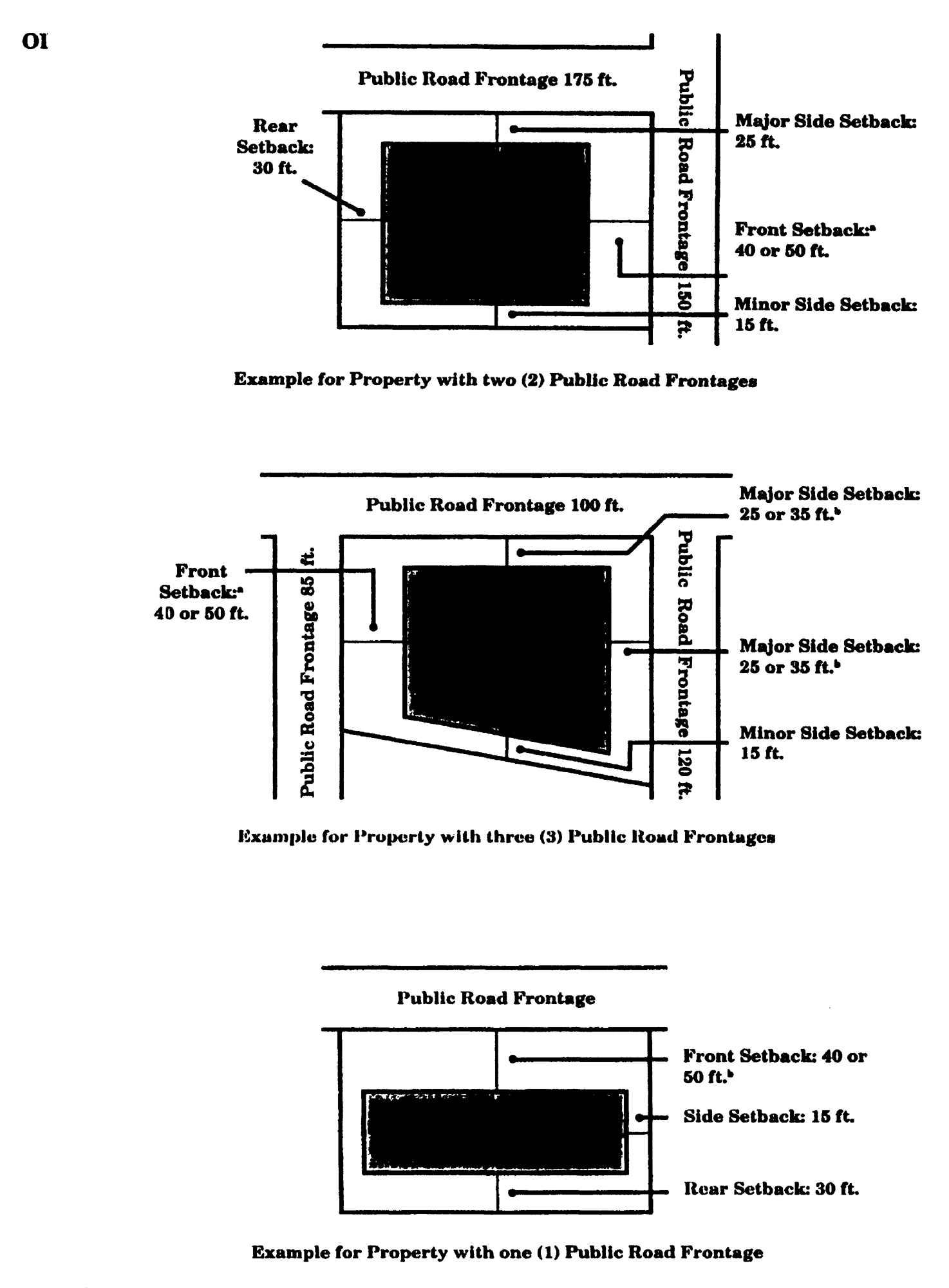
Minimum Building Setback Requirements for RM-8 District
Notes:
a Property with shorter amount of road frontage will be the front setback for determining other setbacks (major side, side, rear).
(5)
Landscape buffer and screening requirements. Unless otherwise noted within this district's requirements, any property within an RM-8 district which abuts a more restrictive residentially zoned property shall have a minimum 25-foot landscaped screening buffer adjacent to all residential property. The buffer shall be subject to approval by county staff. Required buffers may be included within required setbacks; however, in such case that the required buffer is greater than the required setback, the required buffer shall be adhered to. Additionally, necessary private utilities and access drives may be allowed through, over or across a landscaped buffer. Any such uses which are proposed through, over or across a designated undisturbed buffer must be approved pursuant to an original site plan or site plan modification as set forth under section 134-126.
a.
Objectives. Undisturbed, planted landscape buffers and berms shall be implemented in connection with a permitted project and shall address the following objectives:
1.
Screening to enhance aesthetic appeal;
2.
Control or direction of vehicular and pedestrian movement;
3.
Reduction of glare;
4.
Buffering of noise; and
5.
Establishment of privacy.
b.
Buffers. Landscape buffers are subject to review and approval by county staff in accordance with the following standards:
1.
Plantings are to be a mix of evergreen trees and shrubs.
2.
Species are to be ecologically compatible to the site and appropriate for the design situation.
3.
Unless public safety concerns dictate otherwise, a buffer should maximize a visual barrier to a height of six feet within two years of planting.
4.
Minimum height of plant materials at installation is five feet for trees and two feet for shrubs.
5.
Fencing or walls are to be a minimum of six feet in height as approved by county staff.
6.
Trees included in buffer plantings may be counted toward site density calculations as required by chapter 50, article VI, pertaining to tree preservation and replacement, subject to review and approval of county staff.
7.
Buffers shall be regularly maintained by the property owner to ensure that the objectives and standards set out in this subsection are met.
8.
When topography and existing conditions allow, the required 25-foot buffer should be an undisturbed buffer.
9.
Any appeals from a determination by county staff shall be to the board of zoning appeals.
c.
Berms. Berms are subject to review and approval by county staff in accordance with the following standards:
1.
Berms shall be utilized when consistent with surrounding property features.
2.
Berms shall be stabilized.
3.
Berms shall be constructed to be consistent with natural or proposed drainage patterns.
4.
Berms shall be regularly maintained by the property owner.
(6)
Floodplain and wetlands preservation requirements. Any development must meet all state and federal requirements relating to floodplains and wetlands. The board of commissioners encourages preservation of wetland areas. Any development must also meet state and federal requirements relating to areas subject to the provisions of section 134-283, regarding mountain and river corridor protection act areas, and section 134-284, regarding metropolitan river protection act areas. No floodplains and/or wetlands may be used in calculating the overall density of the development.
(7)
Building and structure requirements. Maximum building height is 40 feet. Buildings within the RM-8 district may be split level, three and four stories in height.
(8)
Parking requirements. See section 134-272 for paved parking specifications.
(9)
Lighting requirements.
a.
Any project permitted within the RM-8 district which proposes any outdoor lighting, except individual residential lots or units, must have a county department of transportation approved lighting plan in accordance with the minimum conditions listed in section 134-269.
b.
All developments with multifamily units shall be designed with lighting that does not spill over into abutting properties and is the minimum to provide security for residents of multifamily housing developments.
(10)
Special exception uses. See section 134-271 for special exception uses and requirements for all districts. Special exception uses for the RM-8 district are the uses listed in section 134-271. Additionally, condominiums and townhomes constructed to replace existing/demolished multifamily dwelling units are eligible for a density bonus not to exceed 15 percent of the total number of demolished multifamily dwelling units, subject to site plan approval by the board of commissioners.
(11)
Temporary land use permits and special land use permits. See sections 134-36 and 134-37 for additional uses and requirements for all districts. Uses requiring land use permits or special land use permits for the RM-8 district are the designated uses listed in sections 134-36 and 134-37.
(12)
Use limitations.
a.
There shall be a maximum of eight units per acre; however, the overall density of a development may be reduced due to topography, drainage, deforestation or sediment and erosion concerns.
b.
Where single-family dwelling units are proposed to be constructed in areas zoned RM-8, the minimum house size shall be 950 square feet and the minimum lot size for individual lots shall be 7,000 square feet. Setbacks applicable to the RA-5 zoning district (for detached residences) set forth in this chapter shall apply. When townhomes constructed to replace existing/demolished multifamily dwelling units are to be constructed in areas zoned RM-8, the minimum house size shall be 950 square feet and the applicable regulations within this chapter shall apply.
c.
Maximum acreage is 40 acres.
d.
No sale of goods or products shall be permitted except if accessory to a customary home occupation, land use permit, special land use permit or special exception use.
e.
No sexually oriented businesses are permitted.
f.
No materials, equipment or business vehicles may be stored or parked on the premises, except that one business vehicle, the carrying or towing capacity of which shall not exceed 1½ tons, used exclusively by the resident may be parked in a carport, garage, or rear or side yard. The off-site employees of the resident shall not congregate on the premises for any purpose concerning the business of the home occupation.
g.
All uses are subject to chapter 110, pertaining to subdivisions.
h.
Any food or beverage served within an accessory clubhouse shall be limited to residents and their guests.
i.
It is found and declared that outside storage on properties within unincorporated Cobb County is a health risk and undesirable in that it provides harborage for rodents and insects, lowers property values, and constitutes a public nuisance; therefore, no outside storage is permitted, excluding firewood and lawn furnishings, unless otherwise allowed in this article.
j.
Maximum impervious surface shall not exceed 45 percent. Pervious pavement system and/or green roofs are considered 60 percent effective impervious and will be calculated as such when determining maximum impervious surface. In no case shall total pavement and roof areas (pervious and impervious) exceed 50 percent. An undisturbed buffer equal to the required rear yard setback for this zoning district shall be established along the perimeter boundaries during construction until certificates of occupancy for affected lots are obtained. In the event that this undisturbed perimeter buffer conflicts with any required building setbacks, the required building setbacks may be altered by the zoning division manager or his/her designee, so to accommodate the 40-foot undisturbed perimeter buffer. The following uses shall be allowed within the undisturbed perimeter buffer: public and private utilities, detention facilities, access drives, pools, decks, gazebos and fences.
Required buffers may be included within required setbacks; however, in such case that the required buffer is greater than the required setback, the required buffer shall be adhered to. Additionally, necessary private utilities and access drives may be allowed through, over or across a landscaped buffer. Any such uses which are proposed through, over or across a designated undisturbed buffer must be approved pursuant to an original site plan or site plan modification as set forth under section 134-126.
(13)
Accessory buildings, structures, uses and decks. Any accessory building or structure which exceeds 1,000 square feet of gross space must have the approval of the division manager of zoning or his designee as to the location, architectural design and size prior to commencing construction. The division manager of zoning or his designee shall consider the following criteria for determining the appropriateness of the architectural design and size of the accessory building or structure: compatibility with the surrounding neighborhood, style of exterior (the exterior is to be compatible in style with the primary structure), use of the proposed accessory structure, impact on adjacent properties, and requirements as deemed appropriate by plan review as set forth in this subsection. All accessory buildings, structures and uses in excess of 1,000 gross square feet shall be required to submit for plan review through the community development department or receive approval from the director of the community development department or his designee. When single-family detached dwellings are developed in areas zoned RM-12, any accessory building or structure in excess of 650 square feet of gross space shall be located to the rear of the primary structure and at least 100 feet from any property line. Any accessory building or structure less than 650 square feet and greater than 144 square feet must be located to the rear of the primary structure within the building setbacks. No garage or accessory building, structure, use or deck less than 144 gross square feet, shall be located closer than five feet to a side or rear lot line or within any required buffers, whichever is greater, regardless if the garage, accessory building, structure, use or deck is attached to the primary structure by a breezeway. If the garage, accessory building, structure, use or deck is attached to the primary structure by a breezeway it shall be located up to a maximum of 25 feet from the primary structure to which it is attached. When an accessory building is intended to be habitable it shall be attached to the principal structure by a fully enclosed conditioned hallway and it shall comply with the yard requirements of the principal building to which it is accessory. The accessory building, structure or use shall be located up to a maximum of 25 feet from the primary structure to which it is attached.
a.
Accessory buildings, structures, uses or decks shall be subject to the following conditions:
1.
Maximum height is two stories or 35 feet.
2.
Accessory uses shall include garbage dumpsters, designated recycling collection locations, clubhouses and recreation centers, amenities, swimming pools and tennis courts, antennas and satellite dishes, heating and air conditioning units, jacuzzis, playhouses and playgrounds subject to the following conditions:
i.
Such uses must be located within building setbacks.
ii.
No ground-based antenna or satellite dish shall exceed 35 feet in height without compliance with the standards in section 134-273.
iii.
No accessory building, structure, use or deck shall be built until construction of the principal building has commenced.
iv.
Outdoor activities shall cease by 11:00 p.m. within clubhouse and recreation centers and swimming pools and tennis courts.
3.
Such buildings, structures, uses or decks shall be located on the same lot as the principal use to which the building, structure, use or deck is accessory.
b.
Antennas and satellite dishes shall meet the requirements set forth in section 134-274.
c.
Incidental storage is permitted, provided that the material stored is incidental to the permitted use, as determined by the division manager of zoning or his designee, and stored completely within a portion of the enclosed principal structure permitted within the district, or within a permitted accessory structure.
(14)
Multifamily unit development security. To enhance building/site security, applicants shall coordinate with local law enforcement to develop a security plan in accordance with the standards of crime prevention through environmental design (CPTED). Security plan shall be reviewed and updated annually by the property manager and shall be provided to the county upon request.
(Ord. of 12-26-72; Res. of 8-14-73, § 8; Ord. of 11-8-77, § 1; Ord. of 7-7-82, §§ 1, 3; Ord. of 12-11-90, § 3-28-7.12; Ord. of 8-13-91; Ord. of 6-9-92; Ord. of 10-25-94; Ord. of 7-11-95; Ord. of 2-27-96; Ord. of 6-24-97 (eff. 7-1-97); Ord. of 11-23-99; Ord. of 2-8-00; Ord. of 9-12-00; Ord. of 1-23-01; Ord. of 7-8-03; Ord. of 7-27-04; Ord. of 7-25-06; Ord. of 2-27-07; Amd. of 2-23-10; Amd. of 2-26-13; Amd. of 7-22-14; Amd. of 2-24-15; Amd. of 2-28-17; Amd. of 9-8-20; Amd. of 9-27-22)
Sec. 134-205. - FST fee simple townhouse residential district.
The regulations for the FST fee simple townhouse residential district are as follows:
(1)
Purpose and intent. The FST district is established to provide locations for affordable attached residential dwelling units (six, eight or ten units per acre) or residentially compatible institutional and recreational uses which are within or on the edge of properties delineated for medium and high density residential and regional activity center categories as defined and shown on the Cobb County Comprehensive Plan: A Policy Guide, adopted November 27, 1990. When residentially compatible institutional and recreational uses are developed within the FST district, they should be designed and built to ensure intensity and density compatibility with adjacent single-family detached dwellings and otherwise to implement the stated purpose and intent of this chapter.
(2)
Definitions. The following words, terms and phrases, when used in this section, shall have the meanings ascribed to them in this subsection, except where the context clearly indicates a different meaning:
a.
Community fair means a festival or fair such as the North Georgia State Fair conducted wholly within public areas owned by a local government, provided that any activity is conducted at least 200 feet from any property line. Any event shall not exceed 21 days.
b.
Customary home occupations means those occupations which are customarily performed in a small area of a residence due to the low intensity nature of such uses, subject to the following requirements:
1.
There shall be no exterior evidence of the home occupation, including but not limited to any type of identifying signs.
2.
No article, product or service used or sold in connection with such activity shall be other than those normally found on the premises.
3.
No mechanical equipment shall be used for such occupation except such equipment as is customary for purely household and hobby purposes.
4.
Such use shall be conducted entirely within the dwelling unit, and only persons living in the dwelling unit shall be employed in such occupation.
5.
No more than 25 percent of the dwelling unit may be used for the operation.
6.
No materials, equipment or business vehicles may be stored or parked on the premises, except that one business vehicle, used exclusively by the resident may be parked in a carport, garage, or rear or side yard. The off-site employees of the resident shall not congregate on the premises for any purpose concerning the business of the home occupation.
7.
There shall be no deliveries of supplies for use in the home occupation or pickups of the items produced by the occupant by commercial carriers.
c.
Group home means a dwelling shared by six or less persons, excluding resident staff, who live together as a single housekeeping unit and in a longterm, family-like environment in which staff persons provide care, education and participation in community activities for the residents with the primary goal of enabling the residents to live as independently as possible in order to reach their maximum potential. This use shall also apply to homes for the handicapped. As used in this subsection, the term "handicapped" shall mean:
1.
Having a physical or mental impairment that substantially limits one or more of such person's major life activities so that such person is incapable of living independently;
2.
Having a record of having such an impairment; or
3.
Being regarded as having such an impairment.
However, the term "handicapped" shall not include current illegal use of or addiction to a controlled substance, nor shall it include any person whose residency in the home would constitute a direct threat to the health and safety of other individuals. The term "group home for the handicapped" shall not include alcoholism or drug treatment centers, work release facilities for convicts or ex-convicts, or other housing facilities serving as an alternative to incarceration.
d.
Livestock, nondomestic and wild animals, and poultry means animals, nondomestic and wild animals, and species of the avian family which are or may be raised for the purpose of providing food or transportation, or being resold or bred, excluding only dogs, cats, rabbits, fish, pet mice, hamsters, gerbils, parrots and parakeets.
1.
Such animals shall only be permitted on a lot containing not less than two acres.
2.
All buildings used for animals shall be set back not less than 100 feet from any property line.
3.
All animals shall be maintained at least ten feet from any residential property line.
4.
Except in the RR district, there shall be not less than 5,000 square feet of fenced lot area not covered by the principal structure for each animal, unless the property is a bona fide farm.
5.
In the case of nondomestic or wild animals, all state and federal requirements must be met and a special land use permit is required.
(3)
Permitted uses. Anything not permitted or allowed by special exception is prohibited. Permitted uses are as follows:
Community fairs.
Cottage food operators as regulated by the Georgia Department of Agriculture in accordance with its Rules, Chapter 40-7-19, as may be amended from time to time subject to the following requirements:
1.
There shall be no signage or other exterior evidence of the cottage food operator.
2.
Deliveries of specialty ingredients such as herbs and spices, etc., limited to those made by the United States Postal Service or other carrier (FedEx, United Parcel Service, etc.) that routinely delivers mail/internet order products to residents.
3.
No cottage food products prepared by the cottage food operator may be picked up by a commercial carrier.
4.
There shall be no employees parking on the site unless approved by the board of commissioners in accordance with section 134-36 of the Cobb County Code.
Customary home occupations.
Designated recycling collection locations.
Executive golf courses (see section 134-270).
Fruit trees, nuts and vegetables.
Golf courses, 18-hole regulation, public and private (see section 134-270).
Golf courses, par 3 (see section 134-270).
Group homes.
In-home day care.
Livestock, nondomestic and wild animals, and poultry, on two or more acres.
Nonprofit (seasonal use) fishing lakes.
Parking for vehicles.
Personal vehicle and equipment sales.
Riding stables.
Temporary uses.
Townhouse dwelling units (attached).
(4)
Lot size and setback requirements. Lot size and setback requirements are as follows:
a.
Minimum tract size: 80,000 square feet.
b.
Minimum lot width at front setback line: 20 feet; 30 feet for lot with end unit.
c.
Minimum public road frontage: 20 feet.
d.
Minimum building setbacks: As shown and applied in the following diagram:
EXISTING MINIMUM BUILDING SETBACK REQUIREMENTS FOR FST DISTRICT
Note: All setbacks shall be measured from future right-of-way.
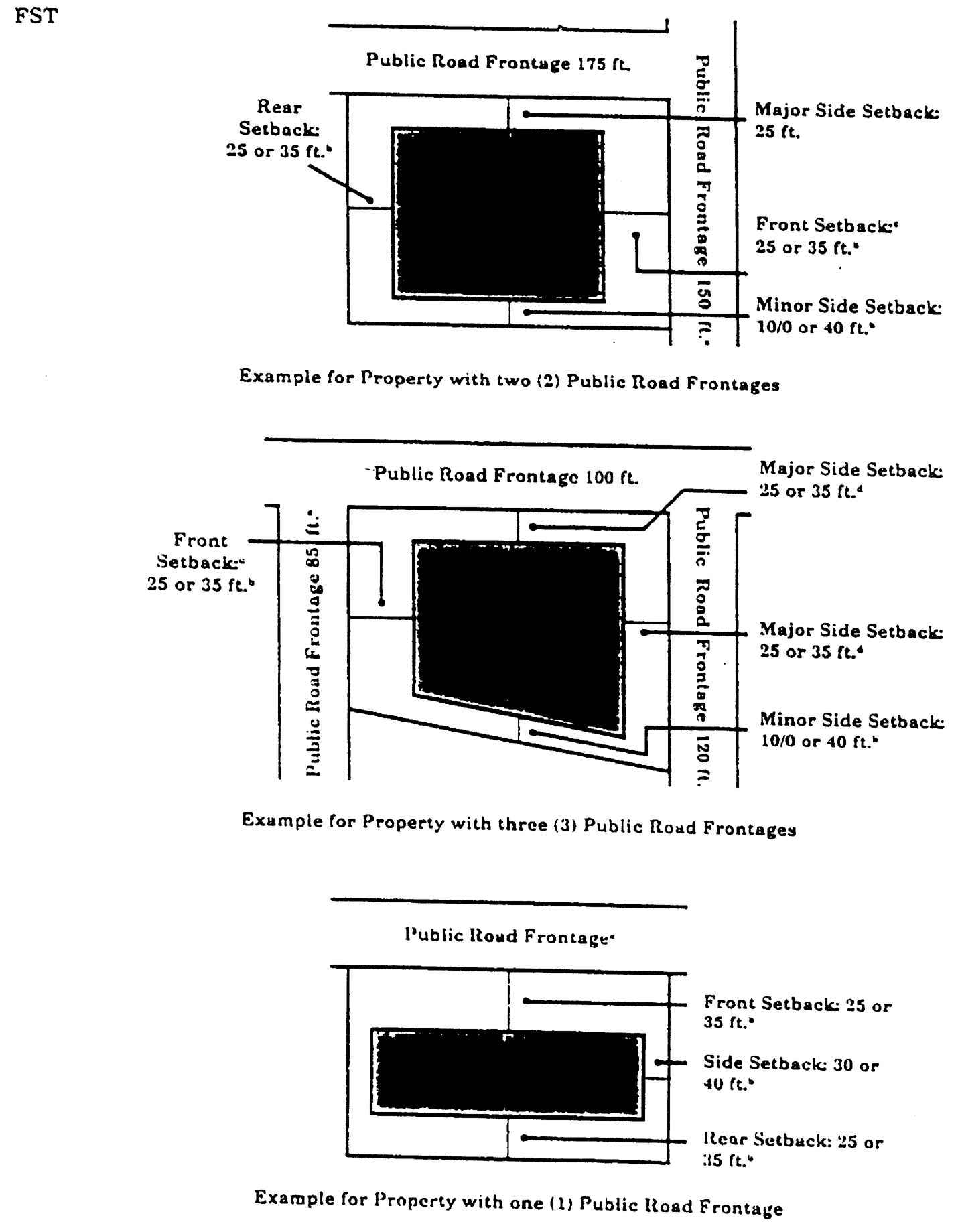
Existing Minimum Building Setback Requirements for FST District
Notes:
a If public road frontage is along an arterial or collector roadway, a 50-foot front setback shall be required.
b Distance of interior portion of development. If attached units, minor side setback can be zero feet. Maximum of six units attached. Ten feet required between unattached units.
c Property with shorter amount of road frontage will be the front setback for determining other setbacks (major side, side, rear).
d If structure fronts a major side setback, major side setback shall be 35 feet.
PROPOSED MINIMUM BUILDING SETBACK REQUIREMENTS FOR FST DISTRICT
Note: All setbacks shall be measured from future right-of-way.
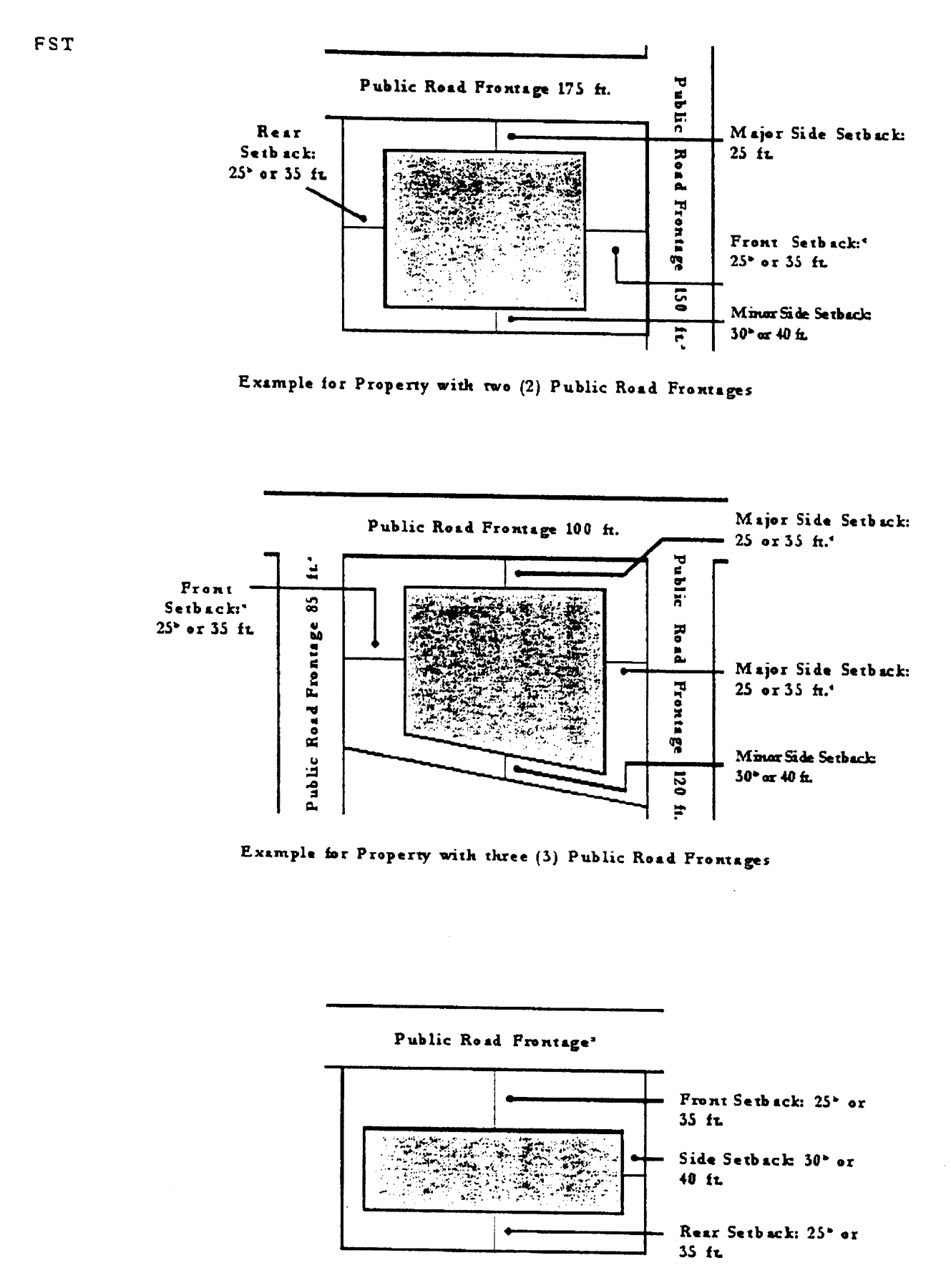
Proposed Minimum Building Setback Requirements for FST District
Notes:
a If public road frontage is along an arterial or collector roadway, a 50-foot front setback shall be required.
b Distance of interior portion of development. If attached units, minor side setback can be zero feet. Maximum of six units attached. Ten feet required between unattached units.
c Property with shorter amount of road frontage will be the front setback for determining other setbacks (major side, side, rear).
d If structure fronts a major side setback, major side setback shall be 35 feet.
(5)
Landscape buffer and screening requirements. Unless otherwise noted within this district's requirements, any property within an FST district which abuts a more restrictive residentially zoned property shall have a minimum ten-foot landscaped screening buffer adjacent to all residential property. The buffer shall be subject to approval by county staff. Required buffers may be included within required setbacks; however, in such case that the required buffer is greater than the required setback, the required buffer shall be adhered to. Additionally, necessary private utilities and access drives may be allowed through, over or across a landscaped buffer. Any such uses which are proposed through, over or across a designated undisturbed buffer must be approved pursuant to an original site plan or site plan modification as set forth under section 134-126.
a.
Objectives. Undisturbed, planted landscape buffers and berms shall be implemented in connection with a permitted project and shall address the following objectives:
1.
Screening to enhance aesthetic appeal;
2.
Control or direction of vehicular and pedestrian movement;
3.
Reduction of glare;
4.
Buffering of noise; and
5.
Establishment of privacy.
b.
Standards. Buffers and berms shall be required when an FST district is located adjacent to a residential district; a minimum ten-foot buffer is required.
1.
Buffers. Landscape buffers are subject to review and approval by county staff in accordance with the following standards:
i.
Plantings are to be a mix of evergreen trees and shrubs.
ii.
Species are to be ecologically compatible to the site and appropriate for the design situation.
iii.
Unless public safety concerns dictate otherwise, a buffer should maximize a visual barrier to a height of six feet within two years of planting.
iv.
Minimum height of plant materials at installation is five feet for trees and two feet for shrubs.
v.
Fencing or walls are to be a minimum of six feet in height as approved by county staff.
vi.
Trees included in buffer plantings may be counted toward site density calculations as required by chapter 50, article VI, pertaining to tree preservation and replacement, subject to review and approval of county staff.
vii.
Buffers shall be regularly maintained by the property owner to ensure that the objectives and standards set out in this subsection are met.
viii.
When topography and existing conditions allow, the required ten-foot buffer should be an undisturbed buffer.
ix.
Any appeals from a determination by county staff shall be to the board of zoning appeals.
2.
Berms. Berms are subject to review and approval by county staff in accordance with the following standards:
i.
Berms shall be utilized when consistent with surrounding property features.
ii.
Berms shall be stabilized.
iii.
Berms shall be constructed to be consistent with natural or proposed drainage patterns.
iv.
Berms shall be regularly maintained by the property owner.
(6)
Floodplain and wetlands preservation requirements. Any development must meet all state and federal requirements relating to floodplains and wetlands. The board of commissioners encourages preservation of wetland areas. Any development must also meet state and federal requirements relating to areas subject to the provisions of section 134-283, regarding mountain and river corridor protection act areas, and section 134-284, regarding metropolitan river protection act areas. No floodplains and/or wetlands may be used in calculating the overall density of the development.
(7)
Building and structure requirements. Maximum building height is 35 feet.
(8)
Parking requirements. See section 134-272 for paved parking specifications.
(9)
Lighting requirements. Any project permitted within the FST district which proposes any outdoor lighting, except individual residential lots or units, must have a county department of transportation approved lighting plan in accordance with the minimum conditions listed in section 134-269.
(10)
Special exception uses. See section 134-271 for special exception uses and requirements for all districts. Special exception uses for the FST district are the uses listed in section 134-271.
(11)
Temporary land use permits and special land use permits. See sections 134-36 and 134-37 for additional uses and requirements for all districts. Uses requiring land use permits or special land use permits for the FST district are the designated uses listed in sections 134-36 and 134-37.
(12)
Use limitations.
a.
There shall be a maximum of ten units per acre.
b.
Architectural style and design are to be compatible with or upgrade the existing neighborhood.
c.
Maximum acreage is 20 acres.
d.
No sale of goods or products shall be permitted except if accessory to a customary home occupation, land use permit, special land use permit or special exception use.
e.
No sexually oriented businesses are permitted.
f.
No materials, equipment or business vehicles may be stored or parked on the premises, except that one business vehicle, used exclusively by the resident may be parked in a carport, garage, or rear or side yard. The off-site employees of the resident shall not congregate on the premises for any purpose concerning the business of the home occupation.
g.
All uses are subject to chapter 110, pertaining to subdivisions.
h.
It is found and declared that outside storage on properties within unincorporated Cobb County is a health risk and undesirable in that it provides harborage for rodents and insects, lowers property values, and constitutes a public nuisance; therefore, no outside storage is permitted, excluding firewood and lawn furnishings, unless otherwise allowed in this article.
i.
Maximum impervious surface shall not exceed 45 percent. Pervious pavement system and/or green roofs are considered 60 percent effective impervious and will be calculated as such when determining maximum impervious surface. In no case shall total pavement and roof areas (pervious and impervious) exceed 50 percent. An undisturbed buffer equal to the required rear yard setback for this zoning district shall be established along the perimeter boundaries during construction until certificates of occupancy for affected lots are obtained. In the event that this undisturbed perimeter buffer conflicts with any required building setbacks, the required building setbacks may be altered by the zoning division manager or his/her designee, so to accommodate the 40-foot undisturbed perimeter buffer. The following uses shall be allowed within the undisturbed perimeter buffer: public and private utilities, detention facilities, access drives, pools, decks, gazebos and fences.
Required buffers may be included within required setbacks; however, in such case that the required buffer is greater than the required setback, the required buffer shall be adhered to. Additionally, necessary private utilities and access drives may be allowed through, over or across a landscaped buffer. Any such uses which are proposed through, over or across a designated undisturbed buffer must be approved pursuant to an original site plan or site plan modification as set forth under section 134-126.
(13)
Accessory buildings, structures, uses and decks. Any accessory building or structure in excess of 650 square feet of gross space shall be located to the rear of the primary structure and at least 100 feet from any property line. Any accessory building or structure which exceeds 650 square feet of gross space must have the approval of the division manager of zoning or his designee as to the location, architectural design and size prior to commencing construction. The division manager of zoning or his designee shall consider the following criteria for determining the appropriateness of the architectural design and size of the accessory building or structure: compatibility with the surrounding neighborhood, style of exterior (the exterior is to be compatible in style with the primary structure), use of the proposed accessory structure, impact on adjacent properties, and requirements as deemed appropriate by plan review as set forth in this subsection. All accessory buildings, structures and uses in excess of 650 gross square feet shall be required to submit for plan review through the community development department or receive approval from the director of the community development department or his designee.
a.
Accessory buildings, structures, uses and decks shall be subject to the following conditions:
1.
Maximum height is two stories or 35 feet.
2.
Accessory uses shall include garbage pads, heating and air conditioning units, jacuzzis, tennis courts, swimming pools (private), playhouses and playgrounds.
3.
All accessory uses shall be located to the rear of the principal building, except for heating and air conditioning units or garbage pads, which may be located on the side or rear.
4.
The rear of the principal building shall be where the main portion of the building ends without consideration of wings.
5.
Architectural style and design shall be approved by the division manager of zoning or his designee.
6.
Such structures or buildings shall be located on the same lot as and to the rear of the principal building to which they are accessory. Decks may be located to the rear or side of the principal building subject to the limitations in this subsection.
7.
No accessory building, structure, use or deck shall be built until construction of the principal building has commenced.
8.
On a corner lot, no accessory building, structure, use or deck shall be located closer to the side street right-of-way line than the principal building.
9.
Any accessory building or structure less than 650 square feet and greater than 144 square feet must be located to the rear of the primary structure within the building setbacks. No garage or accessory building, structure, use or deck less than 144 gross square feet, shall be located closer than five feet to a side or rear lot line or within any required buffers, whichever is greater, regardless if the garage, accessory building, structure, use or deck is attached to the primary structure by a breezeway. If the garage, accessory building, structure, use or deck is attached to the primary structure by a breezeway it shall be located up to a maximum of 25 feet from the primary structure to which it is attached.
10.
When an accessory building is intended to be habitable it shall be attached to the principal structure by a fully enclosed conditioned hallway and it shall comply with the yard requirements of the principal building to which it is accessory. The accessory building, structure or use shall be located up to a maximum of 25 feet from the primary structure to which it is attached.
b.
Antennas and satellite dishes shall meet the requirements set forth in section 134-274.
c.
Incidental storage is permitted, provided that the material stored is incidental to the permitted use, as determined by the division manager of zoning or his designee, and stored completely within a portion of the enclosed principal structure permitted within the district, or within a permitted accessory structure.
d.
Neighborhood recreation centers, amenities and swimming pools are subject to the following:
1.
Site plans must be approved by the zoning staff to ensure compliance with all applicable laws and provisions of this chapter. The facility should be designed to include a detailed landscape plan that provides adequate screening of the facility which creates a visual and sound buffer for adjacent properties. The landscape plan shall be drawn to scale and shall include plant identification by common name. The facility shall be designed to accommodate no more than those residing within two adjoining residential developments except in those cases where a variance is obtained as in other cases.
2.
Buildings and structures established in connection with such use shall be set back not less than 100 feet from any property line.
i.
Upon written consent of all owners of property within 100 feet of the building or structure, the setback may be reduced to 50 feet from any exterior property line of the subdivision within which the use is located. Additionally, a detailed landscape plan must be submitted to and approved by the planning and zoning staff.
ii.
The setback may be reduced to 20 feet from an interior property line of the property on which the use is located if a ten-foot landscaped buffer is provided along the property line and a six-foot solid wood or masonry fence is erected and maintained along the line so as to provide a visual and noise screen for adjacent property; provided, however, the setback after reduction shall not be less than 100 feet from an exterior property line unless also reduced in accordance with subsection (12)d.2.i of this section. Such landscaped buffer shall be shown on the landscaping plan specified in subsection (12)d.1 of this section and must be approved by the planning and zoning staff.
iii.
When a property line is on a natural waterway, a property line setback may be waived provided a written waiver is obtained from both the community development department and the planning division and zoning division.
3.
Swimming pools must comply with all applicable ordinances and must have necessary approvals from the health department and building inspections department.
4.
Outdoor activity shall cease by 11:00 p.m.
5.
Lighting shall be established in such a way that values or quiet use and enjoyment of adjacent properties are not adversely affected, and that roadways and safe use thereof are not adversely affected. No direct light shall be cast upon adjacent properties or roadways. If lighting is to be established, the use of environmental or cutoff type fixtures only is permissible. If lighting is to be established in a recreation area adjacent to an existing or proposed county public road, a lighting plan must be submitted and approved by the county department of transportation to ensure no that light is cast upon the roadway and that no adverse impact will be created as a result of the lighting.
6.
No residence or structures shall be built upon any adjacent lot within the development within which the facility is located until construction of the recreation area has commenced to the extent that buyers of adjacent property will be aware of where the recreation area will be located.
7.
Parking requirements are as follows:
i.
A minimum of 20 parking spaces shall be provided for amenities which include a swim facility or swim/tennis facility with up to four courts. Additional spaces at the minimum rate of four spaces per court shall be provided for each court over four in number. A minimum of ten spaces for every two courts shall be provided for amenities which include tennis courts only.
ii.
In addition to the requirement of subsection (12)d.7.i of this section, a minimum of five spaces for each 50 residents, or prorated portion thereof, over 100 shall be provided.
iii.
Parking spaces shall be paved and striped according to county standard 114, Parking Specifications, as it now exists or may hereafter be amended. No parking shall be allowed within a front yard setback.
(Ord. of 12-26-72; Res. of 8-14-73, § 8; Ord. of 11-8-77, §§ 1, 7; Ord. of 7-7-82, §§ 1, 3; Ord. of 12-11-90, § 3-28-7.13; Ord. of 8-13-91; Ord. of 6-9-92; Ord. of 7-11-95; Ord. of 2-27-96; Ord. of 6-24-97 (eff. 7-1-97); Ord. of 11-23-99; Ord. of 2-8-00; Ord. of 9-12-00; Ord. of 7-8-03; Ord. of 7-27-04; Ord. of 7-26-05; Ord. of 2-27-07; Amd. of 2-23-10; Amd. of 2-26-13; Amd. of 7-22-14; Amd. of 2-24-15; Amd. of 2-28-17; Amd. of 9-8-20)
Sec. 134-206. - RM-12 residential multifamily district.
The regulations for the RM-12 residential multifamily district are as follows:
(1)
Purpose and intent. The RM-12 district is established to provide locations for multifamily residential uses or residentially compatible institutional and recreational uses which are within properties delineated for high density residential and regional activity center categories as defined and shown on the Cobb County Comprehensive Plan: A Policy Guide, adopted November 27, 1990. When residentially compatible institutional and recreational uses are developed within the RM-12 district, they should be designed and built to ensure intensity and density compatibility with adjacent multifamily detached dwellings and otherwise to implement the stated purpose and intent of this chapter.
(2)
Definitions. The following words, terms and phrases, when used in this section, shall have the meanings ascribed to them in this subsection, except where the context clearly indicates a different meaning:
a.
Community fair means a festival or fair such as the North Georgia State Fair conducted wholly within public areas owned by a local government, provided that any activity is conducted at least 200 feet from any property line. Any event shall not exceed 21 days.
b.
Customary home occupations means those occupations which are customarily performed in a small area of a residence due to the low intensity nature of such uses, subject to the following requirements:
1.
There shall be no exterior evidence of the home occupation, including but not limited to any type of identifying signs.
2.
No article, product or service used or sold in connection with such activity shall be other than those normally found on the premises.
3.
No mechanical equipment shall be used for such occupation except such equipment as is customary for purely household and hobby purposes.
4.
Such use shall be conducted entirely within the dwelling unit, and only persons living in the dwelling unit shall be employed in such occupation.
5.
No more than 25 percent of the dwelling unit may be used for the operation.
6.
No materials, equipment or business vehicles may be stored or parked on the premises, except that one business vehicle, used exclusively by the resident may be parked in a carport, garage, or rear or side yard. The off-site employees of the resident shall not congregate on the premises for any purpose concerning the business of the home occupation.
7.
There shall be no deliveries of supplies for use in the home occupation or pickups of the items produced by the occupant by commercial carrier.
c.
Group home means a dwelling shared by six or less persons, excluding resident staff, who live together as a single housekeeping unit and in a longterm, family-like environment in which staff persons provide care, education and participation in community activities for the residents with the primary goal of enabling the residents to live as independently as possible in order to reach their maximum potential. This use shall also apply to homes for the handicapped. As used in this subsection, the term "handicapped" shall mean:
1.
Having a physical or mental impairment that substantially limits one or more of such person's major life activities so that such person is incapable of living independently;
2.
Having a record of having such an impairment; or
3.
Being regarded as having such an impairment.
However, the term "handicapped" shall not include current illegal use of or addiction to a controlled substance, nor shall it include any person whose residency in the home would constitute a direct threat to the health and safety of other individuals. The term "group home for the handicapped" shall not include alcoholism or drug treatment centers, work release facilities for convicts or ex-convicts, or other housing facilities serving as an alternative to incarceration.
d.
Livestock, nondomestic and wild animals, and poultry means animals, nondomestic and wild animals, and species of the avian family which are or may be raised for the purpose of providing food or transportation, or being resold or bred, excluding only dogs, cats, rabbits, fish, pet mice, hamsters, gerbils, parrots and parakeets.
1.
Such animals shall only be permitted on a lot containing not less than two acres.
2.
All buildings used for animals shall be set back not less than 100 feet from any property line.
3.
All animals shall be maintained at least ten feet from any residential property line.
4.
Except in the RR district, there shall be not less than 5,000 square feet of fenced lot area not covered by the principal structure for each animal, unless the property is a bona fide farm.
5.
In the case of nondomestic or wild animals, all state and federal requirements must be met and a special land use permit is required.
e.
Purpose built student housing means a multi-family residential development marketed to affiliates of an academic or professional college or university, or other recognized institution of higher learning. These developments are typically located near college campuses and offer amenities such as individual leases, fully-furnished units, and residence life programs specific to college students.
(3)
Permitted uses. Anything not permitted or allowed by special exception is prohibited. Permitted uses are as follows:
Community fairs.
Cottage food operators as regulated by the Georgia Department of Agriculture in accordance with its Rules, Chapter 40-7-19, as may be amended from time to time subject to the following requirements:
1.
There shall be no signage or other exterior evidence of the cottage food operator.
2.
Deliveries of specialty ingredients such as herbs and spices, etc., limited to those made by the United States Postal Service or other carrier (FedEx, United Parcel Service, etc.) that routinely delivers mail/internet order products to residents.
3.
No cottage food products prepared by the cottage food operator may be picked up by a commercial carrier.
4.
There shall be no employees parking on the site unless approved by the board of commissioners in accordance with section 134-36 of the Cobb County Code.
Condominiums (attached and detached).
Customary home occupations.
Designated recycling collection locations.
Executive golf courses (see section 134-270).
Fraternity and sorority houses and residence halls.
Fruit trees, nuts and vegetables.
Golf courses, 18-hole regulation, public and private (see section 134-270).
Golf courses, par 3 (see section 134-270).
Group homes.
Halfway houses.
In-home day care.
Livestock, nondomestic and wild animals, and poultry, on two or more acres.
Multifamily dwelling units.
Nonprofit (seasonal use) fishing lakes.
Parking for vehicles.
Personal vehicle and equipment sales.
Purpose built student housing (requires a special land use permit per section 134-37(a)(34)a.—p.).
Riding stables.
Single-family dwelling units (attached).
Single-family dwelling units (detached).
Temporary uses.
Townhomes, attached.
(4)
Lot size and setback requirements. Lot size and setback requirements are as follows:
a.
Minimum tract size: 80,000 square feet.
b.
Minimum lot width at front setback line: 75 feet.
c.
Minimum public road frontage: 75 feet.
d.
Minimum building setbacks: As shown and applied in the following diagram:
MINIMUM BUILDING SETBACK REQUIREMENTS FOR RM-12 DISTRICT
Note: All setbacks shall be measured from future right-of-way. Setbacks for single-family attached and detached units are described in section 134-206(12).
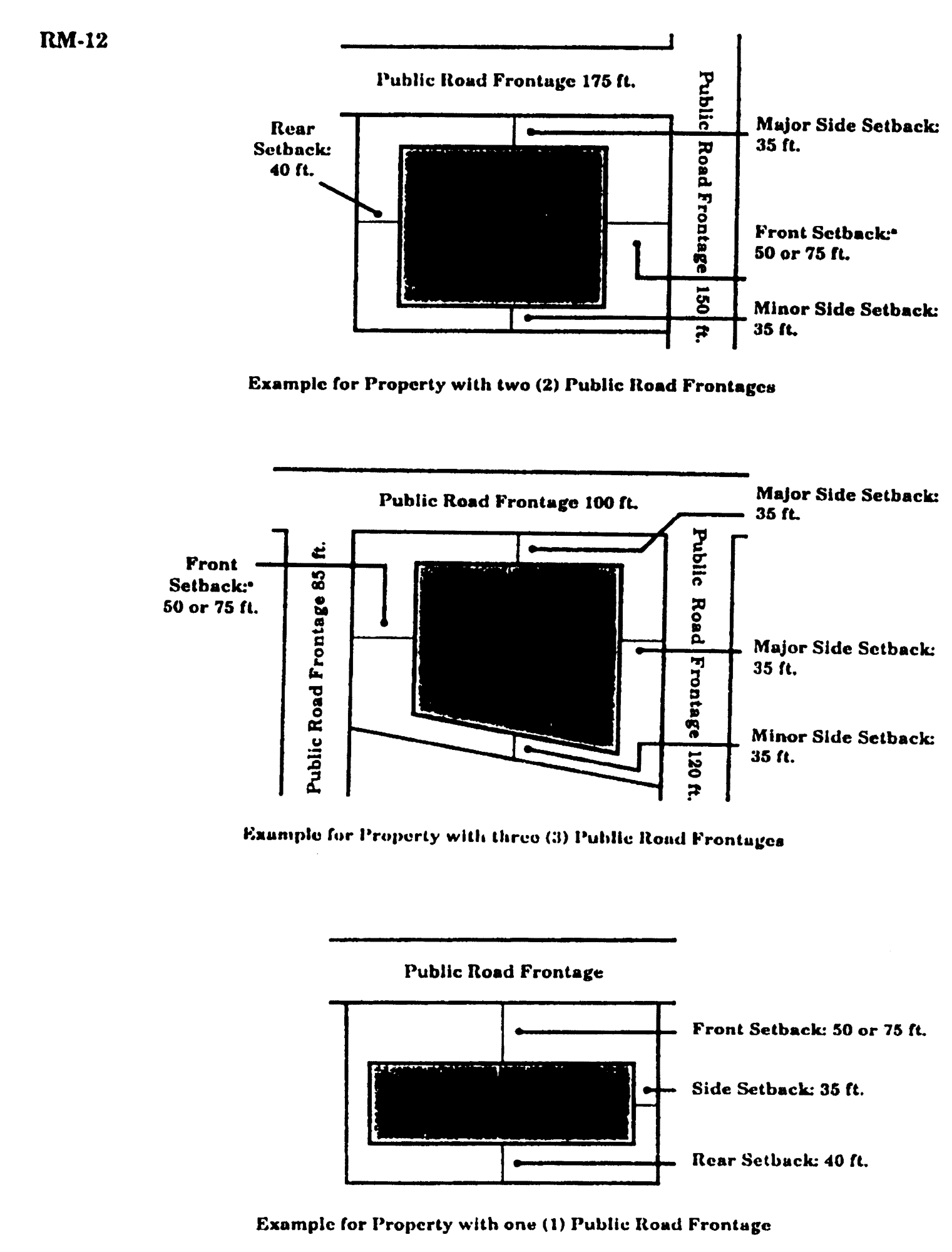
Minimum Building Setback Requirements for RM-12 District
Notes:
a Property with shorter amount of road frontage will be the front setback for determining other setbacks (major side, side, rear).
b If structure fronts a major side setback, major side setback shall be 35 feet.
(5)
Landscape buffer and screening requirements. Unless otherwise noted within this district's requirements, any property within an RM-12 district which abuts a more restrictive residentially zoned property shall have a minimum 25-foot landscaped screening buffer adjacent to all residential property. The buffer shall be subject to approval by county staff. Required buffers may be included within required setbacks; however, in such case that the required buffer is greater than the required setback, the required buffer shall be adhered to. Additionally, necessary private utilities and access drives may be allowed through, over or across a landscaped buffer. Any such uses which are proposed through, over or across a designated undisturbed buffer must be approved pursuant to an original site plan or site plan modification as set forth under section 134-126.
a.
Objectives. Undisturbed, planted landscape buffers and berms shall be implemented in connection with a permitted project and shall address the following objectives:
1.
Screening to enhance aesthetic appeal;
2.
Control or direction of vehicular and pedestrian movement;
3.
Reduction of glare; and
4.
Buffering of noise.
b.
Standards. Buffers or berms shall be required when an RM-12 district is located adjacent to a more restrictive residential district; a minimum 25-foot buffer is required.
1.
Buffers. Landscape buffers are subject to review and approval by county staff in accordance with the following standards:
i.
Plantings are to be a mix of evergreen trees and shrubs.
ii.
Species are to be ecologically compatible to the site and appropriate for the design situation.
iii.
Unless public safety concerns dictate otherwise, a buffer should maximize a visual barrier to a height of six feet within two years of planting.
iv.
Minimum height of plant materials at installation is five feet for trees and two feet for shrubs.
v.
Fencing or walls are to be a minimum of six feet in height as approved by county staff.
vi.
Trees included in buffer plantings may be counted toward site density calculations as required by chapter 50, article VI, pertaining to tree preservation and replacement, subject to review and approval of county staff.
vii.
Buffers shall be regularly maintained by the property owner to ensure that the objectives and standards set out in this subsection are met.
viii.
When topography and existing conditions allow, the required 25-foot buffer should be an undisturbed buffer.
ix.
Any appeals from a determination by county staff shall be to the board of zoning appeals.
2.
Berms. Berms are subject to review and approval by county staff in accordance with the following standards:
i.
Berms shall be utilized when consistent with surrounding property features.
ii.
Berms shall be stabilized.
iii.
Berms shall be constructed to be consistent with natural or proposed drainage patterns.
iv.
Berms shall be regularly maintained by the property owner.
(6)
Floodplain and wetlands preservation requirements. Any development must meet state and federal requirements relating to areas subject to the provisions of section 134-283, regarding mountain and river corridor protection act areas, and section 134-284, regarding metropolitan river protection act areas. No floodplains and/or wetlands may be used in calculating the overall density of the development.
(7)
Building and structure requirements. Maximum building height is 40 feet. Buildings within the RM-12 district may be split level, three and four stories in height.
(8)
Parking requirements. See section 134-272 for paved parking specifications.
(9)
Lighting requirements.
a.
Any project permitted within the RM-12 district which proposes any outdoor lighting, except individual residential lots or units, must have a county department of transportation approved lighting plan in accordance with the minimum conditions listed in section 134-269.
b.
All developments with multifamily units shall be designed with lighting that does not spill over into abutting properties and is the minimum to provide security for residents of multifamily housing developments.
(10)
Special exception uses. Please see section 134-271 for special exception uses and requirements for all districts. Special exception uses for the RM-12 district are the uses listed in section 134-271. Additionally, condominiums and townhomes constructed to replace existing/demolished multifamily dwelling units are eligible for a density bonus not to exceed 15 percent of the total number of demolished multifamily dwelling units, subject to site plan approval by the board of commissioners.
(11)
Temporary land use permits and special land use permits. See sections 134-36 and 134-37 for additional uses and requirements for all districts. Uses requiring land use permits or special land use permits for the RM-12 district are the designated uses listed in sections 134-36 and 134-37.
(12)
Use limitations.
a.
There shall be a maximum of 12 units per acre; however, the overall density of a development may be reduced due to topography, drainage, deforestation or sediment and erosion concerns.
b.
Where single-family attached and detached dwelling units are proposed to be constructed in areas zoned RM-12, the minimum house size shall be 950 square feet.
c.
For single-family detached dwelling in areas zoned RM-12 the following shall apply:
1.
A 20-foot perimeter building setback must be provided to all adjacent residentially zoned properties. This perimeter setback may include required buffers.
2.
A 20-foot setback shall be required adjacent to any public roadway. Units including rear entry garages may reduce the 15-foot front setback to zero feet.
3.
A minimum setback of five feet between buildings. Building less than five feet from the property line shall include necessary fire separation requirements outlined in the International Building Code or Residential Building Code, as applicable.
4.
When the distance between buildings is less than ten feet, all utilities meters, cable/internet boxes, air conditioning units, and other similar items shall be to the rear of the structure.
5.
Maximum building height of 35 feet.
6.
Any RM-12 attached or detached development shall be subject to the site plan submitted to and approved by the board of commissioners.
7.
Minimum setbacks may be increased by the board of commissioners based on existing conditions such as tract size, topographic conditions, or any other conditions on a case by case basis in order to provide compatibility with adjacent uses during site plan/zoning approval.
d.
Maximum acreage is 40 acres.
e.
No sale of goods or products shall be permitted except if accessory to a customary home occupation, land use permit, special land use permit or special exception use.
f.
No sexually oriented businesses are permitted.
g.
No materials, equipment or business vehicles may be stored or parked on the premises, except that one business vehicle used exclusively by the resident may be parked in a carport, garage, or rear or side yard. The off-site employees of the resident shall not congregate on the premises for any purpose concerning the business of the home occupation.
h.
All uses are subject to chapter 110, the subdivision regulations of the county, as amended from time to time.
i.
Any food or beverage served within an accessory clubhouse shall be limited to residents and their guests.
j.
It is found and declared that outside storage on properties within unincorporated Cobb County is a health risk and undesirable in that it provides harborage for rodents and insects, lowers property values, and constitutes a public nuisance; therefore, no outside storage is permitted, excluding firewood and lawn furnishings, unless otherwise allowed in this article.
k.
Maximum impervious surface shall not exceed 45 percent. Pervious pavement system and/or green roofs are considered 60 percent effective impervious and will be calculated as such when determining maximum impervious surface. In no case shall total pavement and roof areas (pervious and impervious) exceed 50 percent. An undisturbed buffer equal to the required rear yard setback for this zoning district shall be established along the perimeter boundaries during construction until certificates of occupancy for affected lots are obtained. In the event that this undisturbed perimeter buffer conflicts with any required building setbacks, the required building setbacks may be altered by the zoning division manager or his/her designee, so to accommodate the 40-foot undisturbed perimeter buffer. The following uses shall be allowed within the undisturbed perimeter buffer: public and private utilities, detention facilities, access drives, pools, decks, gazebos and fences.
Required buffers may be included within required setbacks; however, in such case that the required buffer is greater than the required setback, the required buffer shall be adhered to. Additionally, necessary private utilities and access drives may be allowed through, over or across a landscaped buffer. Any such uses which are proposed through, over or across a designated undisturbed buffer must be approved pursuant to an original site plan or site plan modification as set forth under section 134-126.
(13)
Accessory buildings, structures, uses and decks. Any accessory building or structure which exceeds 1,000 square feet of gross space must have the approval of the division manager of zoning or his designee as to the location, architectural design and size prior to commencing construction. The division manager of zoning or his designee shall consider the following criteria for determining the appropriateness of the architectural design and size of the accessory building or structure: compatibility with the surrounding neighborhood, style of exterior (the exterior is to be compatible in style with the primary structure), use of the proposed accessory structure, impact on adjacent properties, and requirements as deemed appropriate by plan review as set forth in this subsection. All accessory buildings, structures and uses in excess of 1,000 gross square feet shall be required to submit for plan review through the community development department or receive approval from the director of the community development department or his designee. When single-family detached dwellings are developed in areas zoned RM-12, any accessory building or structure in excess of 650 square feet of gross space shall be located to the rear of the primary structure and at least 100 feet from any property line. Any accessory building or structure less than 650 square feet and greater than 144 square feet must be located to the rear of the primary structure within the building setbacks. No garage or accessory building, structure, use or deck less than 144 gross square feet, shall be located closer than five feet to a side or rear lot line or within any required buffers, whichever is greater, regardless if the garage, accessory building, structure, use or deck is attached to the primary structure by a breezeway. If the garage, accessory building, structure, use or deck is attached to the primary structure by a breezeway it shall be located up to a maximum of 25 feet from the primary structure to which it is attached. When an accessory building is intended to be habitable it shall be attached to the principal structure by a fully enclosed conditioned hallway and it shall comply with the yard requirements of the principal building to which it is accessory. The accessory building, structure or use shall be located up to a maximum of 25 feet from the primary structure to which it is attached.
a.
Accessory buildings, structures, uses or decks shall be subject to the following conditions:
1.
Maximum height is two stories or 35 feet.
2.
Accessory uses shall include garbage dumpsters, designated recycling collection locations, clubhouse and recreation centers, amenities, swimming pools and tennis courts, antennas and satellite dishes, heating and air conditioning units, jacuzzis, playhouses and playgrounds subject to the following conditions:
i.
Uses must be located within building setbacks.
ii.
No ground-based antenna or satellite dish shall exceed 35 feet in height without compliance with standards in section 134-273.
iii.
No accessory building, structure, use or deck shall be built until construction of the principal building has commenced.
iv.
Outdoor activities shall cease by 11:00 p.m. within clubhouse and recreation centers and swimming pools and tennis courts.
3.
Such buildings, structures, uses or decks shall be located on the same lot as the principal use to which the building, structure, use or deck is accessory.
b.
Antennas and satellite dishes shall meet the requirements set forth in section 134-274.
c.
Incidental storage is permitted, provided that the material stored is incidental to the permitted use, as determined by the division manager of zoning or his designee, and stored completely within a portion of the enclosed principal structure permitted within the district, or within a permitted accessory structure.
(14)
Multifamily unit development security. To enhance building/site security, applicants shall coordinate with local law enforcement to develop a security plan in accordance with the standards of crime prevention through environmental design (CPTED). Security plan shall be reviewed and updated annually by the property manager.
(Ord. of 12-26-72; Res. of 8-14-73, § 8; Ord. of 11-8-77, § 1; Ord. of 7-7-82, §§ 1, 3; Ord. of 12-11-90, § 3-28-7.14; Ord. of 8-13-91; Ord. of 6-9-92; Ord. of 10-27-92; Ord. of 10-25-94; Ord. of 7-11-95; Ord. of 2-27-96; Ord. of 6-24-97 (eff. 7-1-97); Ord. of 11-23-99; Ord. of 2-8-00; Ord. of 9-12-00; Ord. of 1-23-01; Ord. of 7-8-03; Ord. of 7-27-04; Ord. of 7-26-05; Ord. of 7-25-06; Ord. of 2-27-07; Amd. of 2-23-10; Amd. of 2-26-13; Amd. of 7-22-14; Amd. of 2-24-15; Amd. of 2-28-17; Amd. of 10-23-18; Amd. of 8-27-19; Amd. of 9-8-20; Amd. of 9-27-22)
Sec. 134-207. - RM-16 residential multifamily district.
The regulations for the RM-16 residential multifamily district are as follows:
(1)
Purpose and intent. The RM-16 district is established to provide locations for multifamily residential uses or residentially compatible institutional and recreational uses which are located within regional activity center categories as defined and shown on the Cobb County Comprehensive Plan: A Policy Guide, adopted November 27, 1990, or within one mile of the main campus of a college or university under the Board of Regents of the University System of Georgia and/or accredited by the Southern Association of Colleges and Schools (SACS). The properties should be located in areas which are readily accessible to the interstate freeway system and along arterials or major collectors to ensure free flow of traffic. When residentially compatible institutional and recreational uses are developed within the RM-16 district, they should be designed and built to ensure intensity and density compatibility with adjacent multifamily detached dwellings and otherwise to implement the stated purpose and intent of this chapter.
(2)
Definitions. The following words, terms and phrases, when used in this section, shall have the meanings ascribed to them in this subsection, except where the context clearly indicates a different meaning:
a.
Community fair means a festival or fair such as the North Georgia State Fair conducted wholly within public areas owned by a local government, provided that any activity is conducted at least 200 feet from any property line. Any event shall not exceed 21 days.
b.
Customary home occupations. Those occupations which are customarily performed in a small area of a residence due to the low intensity nature of such uses, subject to the following requirements:
1.
There shall be no exterior evidence of the home occupation, including but not limited to any type of identifying signs.
2.
No article, product or service used or sold in connection with such activity shall be other than those normally found on the premises.
3.
No mechanical equipment shall be used for such occupation except such equipment as is customary for purely household and hobby purposes.
4.
Such use shall be conducted entirely within the dwelling unit, and only persons living in the dwelling unit shall be employed in such occupation.
5.
No more than 25 percent of the dwelling unit may be used for the operation.
6.
No materials, equipment or business vehicles may be stored or parked on the premises, except that one business vehicle used exclusively by the resident may be parked in a carport, garage, or rear or side yard. The off-site employees of the resident shall not congregate on the premises for any purpose concerning the business of the home occupation.
7.
There shall be no deliveries of supplies for use in the home occupation or pickups of the items produced by the occupant by commercial carrier.
c.
Group home means a dwelling shared by six or less persons, excluding resident staff, who live together as a single housekeeping unit and in a longterm, family-like environment in which staff persons provide care, education and participation in community activities for the residents with the primary goal of enabling the residents to live as independently as possible in order to reach their maximum potential. This use shall also apply to homes for the handicapped. As used in this subsection, the term "handicapped" shall mean:
1.
Having a physical or mental impairment that substantially limits one or more of such person's major life activities so that such person is incapable of living independently;
2.
Having a record of having such an impairment; or
3.
Being regarded as having such an impairment.
However, the term "handicapped" shall not include current illegal use of or addiction to a controlled substance, nor shall it include any person whose residency in the home would constitute a direct threat to the health and safety of other individuals. The term "group home for the handicapped" shall not include alcoholism or drug treatment centers, work release facilities for convicts or ex-convicts, or other housing facilities serving as an alternative to incarceration.
d.
Livestock, nondomestic and wild animals, and poultry means animals, nondomestic and wild animals, and species of the avian family which are or may be raised for the purpose of providing food or transportation, or being resold or bred, excluding only dogs, cats, rabbits, fish, pet mice, hamsters, gerbils, parrots and parakeets.
1.
Such animals shall only be permitted on a lot containing not less than two acres.
2.
All buildings used for animals shall be set back not less than 100 feet from any property line.
3.
All animals shall be maintained at least ten feet from any residential property line.
4.
Except in the RR district, there shall be not less than 5,000 square feet of fenced lot area not covered by the principal structure for each animal, unless the property is a bona fide farm.
5.
In the case of nondomestic or wild animals, all state and federal requirements must be met and a special land use permit is required.
e.
Purpose built student housing means a multi-family residential development marketed to affiliates of an academic or professional college or university, or other recognized institution of higher learning. These developments are typically located near college campuses and offer amenities such as individual leases, fully-furnished units, and residence life programs specific to college students.
(3)
Permitted uses. Anything not permitted or allowed by special exception is prohibited. Permitted uses are as follows:
Community fairs.
Customary home occupations.
Designated recycling collection locations.
Executive golf courses (see section 134-270).
Fraternity and sorority houses and residence halls.
Fruit trees, nuts and vegetables.
Golf courses, 18-hole regulation, public and private (see section 134-270).
Golf courses, par 3 (see section 134-270).
Group homes.
Halfway houses.
In-home day care.
Livestock, nondomestic and wild animals, and poultry, on two or more acres.
Multifamily dwelling units.
Nonprofit (seasonal use) fishing lakes.
Parking for vehicles.
Personal vehicle and equipment sales.
Purpose built student housing (requires a special land use permit per section 134-37(a)(34)a.—p.).
Riding stables.
Single-family dwelling units (attached), not to exceed six units to the acre.
Single-family dwelling units (detached), not to exceed six units to the acre.
Temporary uses.
(4)
Lot size and setback requirements. Lot size and setback requirements are as follows:
a.
Minimum tract size: 80,000 square feet.
b.
Minimum lot width at front setback line: 75 feet.
c.
Minimum public road frontage: 75 feet.
d.
Minimum building setbacks: As shown and applied in the following diagram:
MINIMUM BUILDING SETBACK REQUIREMENTS FOR RM-16 DISTRICT
Note: All setbacks shall be measured from future right-of-way.
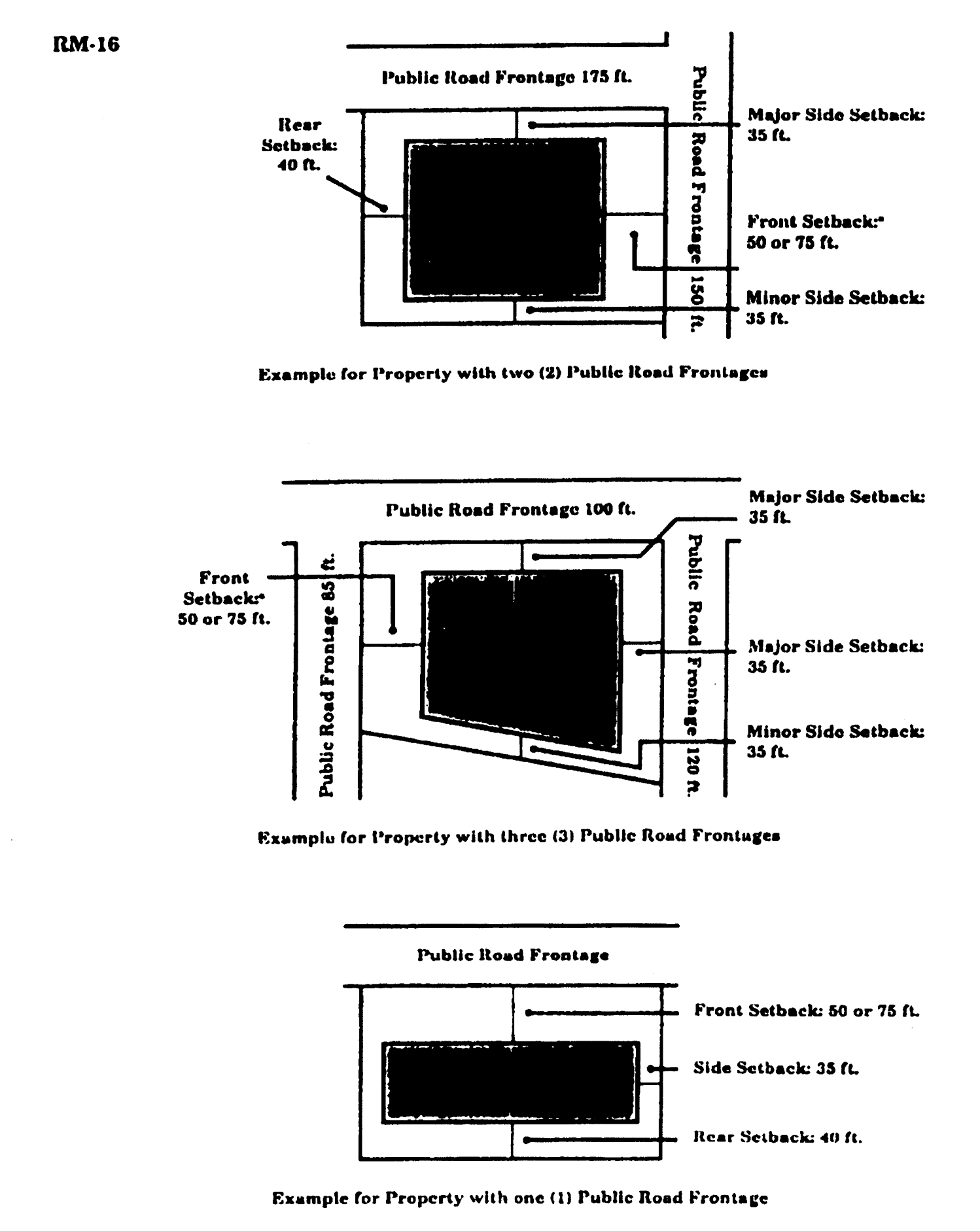
Minimum Building Setback Requirements for RM-16 District
Notes:
a Property with shorter amount of road frontage will be the front setback for determining other setbacks (major side, side, rear).
(5)
Landscape buffer and screening requirements. Unless otherwise noted within this district's requirements, any property within an RM-16 district which abuts a more restrictive residentially zoned property shall have a minimum 25-foot landscaped screening buffer adjacent to all residential property. The buffer shall be subject to approval by county staff. Required buffers may be included within required setbacks; however, in such case that the required buffer is greater than the required setback, the required buffer shall be adhered to. Additionally, necessary private utilities and access drives may be allowed through, over or across a landscaped buffer. Any such uses which are proposed through, over or across a designated undisturbed buffer must be approved pursuant to an original site plan or site plan modification as set forth under section 134-126.
a.
Objectives. Undisturbed, planted landscape buffers and berms shall be implemented in connection with a permitted project and shall address the following objectives:
1.
Screening to enhance aesthetic appeal;
2.
Control or direction of vehicular and pedestrian movement;
3.
Reduction of glare;
4.
Buffering of noise; and
5.
Establishment of privacy.
b.
Buffers. Landscape buffers are subject to review and approval by county staff in accordance with the following standards:
1.
Plantings are to be a mix of evergreen trees and shrubs.
2.
Species are to be ecologically compatible to the site and appropriate for the design situation.
3.
Unless public safety concerns dictate otherwise, a buffer should maximize a visual barrier to a height of six feet within two years of planting.
4.
Minimum height of plant materials at installation is five feet for trees and two feet for shrubs.
5.
Fencing or walls are to be a minimum of six feet in height as approved by county staff.
6.
Trees included in buffer plantings may be counted toward site density calculations as required by chapter 50, article VI, pertaining to tree preservation and replacement, subject to review and approval of county staff.
7.
Buffers shall be regularly maintained by the property owner to ensure that the objectives and standards set out in this subsection are met.
8.
When topography and existing conditions allow, the required 25-foot buffer should be an undisturbed buffer.
9.
Any appeals from a determination by county staff shall be to the board of zoning appeals.
c.
Berms. Berms are subject to review and approval by county staff in accordance with the following standards:
1.
Berms shall be utilized when consistent with surrounding property features.
2.
Berms shall be stabilized.
3.
Berms shall be constructed to be consistent with natural or proposed drainage patterns.
4.
Berms shall be regularly maintained by the property owner.
(6)
Floodplain and wetlands preservation requirements. Any development must meet state and federal requirements relating to areas subject to the provisions of section 134-283, regarding mountain and river corridor protection act areas, and section 134-284, regarding metropolitan river protection act areas. No floodplains and/or wetlands may be used in calculating the overall density of the development.
(7)
Building and structure requirements. Maximum building height is 40 feet. Buildings within the RM-16 district may be split level, three and four stories in height.
(8)
Parking requirements. See section 134-272 for paved parking specifications.
(9)
Lighting requirements.
a.
Any project permitted within the RM-16 district which proposes a lighted facility must have a county department of transportation approved lighting plan in accordance with the minimum conditions listed in section 134-269.
b.
All developments with multifamily units shall be designed with lighting that does not spill over into abutting properties and is the minimum to provide security for residents of multifamily housing developments.
(10)
Special exception uses. See section 134-271 for special exception uses and requirements for all districts. Special exception uses for the RM-16 district are the uses listed in section 134-271.
(11)
Temporary land use permits and special land use permits. See sections 134-36 and 134-37 for additional uses and requirements for all districts. Uses requiring land use permits or special land use permits for the RM-16 district are the designated uses listed in sections 134-36 and 134-37.
(12)
Use limitations.
a.
There shall be a maximum of 16 units per acre; however, the overall density of a development may be reduced due to topography, drainage, deforestation or sediment and erosion concerns.
b.
Where single-family dwelling units are proposed to be constructed in areas zoned RM-16, the minimum house size shall be 950 square feet, and the minimum lot size for individual lots shall be 7,000 square feet. Setbacks applicable to the RA-5 zoning district (for detached residences) set forth in this chapter shall apply.
c.
Maximum acreage is 40 acres.
d.
No sale of goods or products shall be permitted except if accessory to a customary home occupation, land use permit, special land use permit or special exception use.
e.
No sexually oriented businesses are permitted.
f.
No materials, equipment or business vehicles may be stored or parked on the premises, except that one business vehicle used exclusively by the resident may be parked in a carport, garage, or rear or side yard. The off-site employees of the resident shall not congregate on the premises for any purpose concerning the business of the home occupation.
g.
All uses are subject to chapter 110, pertaining to subdivisions.
h.
Any food or beverage served within an accessory clubhouse shall be limited to residents and their guests.
i.
It is found and declared that outside storage on properties within unincorporated Cobb County is a health risk and undesirable in that it provides harborage for rodents and insects, lowers property values, and constitutes a public nuisance; therefore, no outside storage is permitted, excluding firewood and lawn furnishings, unless otherwise allowed in this article.
j.
Maximum impervious surface shall not exceed 45 percent. Pervious pavement system and/or green roofs are considered 60 percent effective impervious and will be calculated as such when determining maximum impervious surface. In no case shall total pavement and roof areas (pervious and impervious) exceed 50 percent.
Required buffers may be included within required setbacks; however, in such case that the required buffer is greater than the required setback, the required buffer shall be adhered to. Additionally, necessary private utilities and access drives may be allowed through, over or across a landscaped buffer. Any such uses which are proposed through, over or across a designated undisturbed buffer must be approved pursuant to an original site plan or site plan modification as set forth under section 134-126.
(13)
Accessory buildings, structures, uses and decks. Any accessory building or structure in excess of 1,000 square feet of gross space shall be located to the rear of the primary structure and at least 100 feet from any property line. Any accessory building or structure which exceeds 1,000 square feet of gross space must have the approval of the division manager of zoning or his designee as to the location, architectural design and size prior to commencing construction. The division manager of zoning or his designee shall consider the following criteria for determining the appropriateness of the architectural design and size of the accessory building or structure: compatibility with the surrounding neighborhood, style of exterior (the exterior is to be compatible in style with the primary structure), use of the proposed accessory structure, impact on adjacent properties, and requirements as deemed appropriate by plan review as set forth in this subsection. All accessory buildings, structures and uses in excess of 1,000 gross square feet shall be required to submit for plan review through the community development department or receive approval from the director of the community development department or his designee.
a.
Accessory buildings, structures, uses or decks shall be subject to the following conditions:
1.
Maximum height is two stories or 35 feet.
2.
Accessory uses shall include garbage dumpsters, designated recycling collection locations, clubhouses, recreation centers, amenities, swimming pools and tennis courts, antennas and satellite dishes, heating and air conditioning units, jacuzzis, playhouses and playgrounds, subject to the following conditions:
i.
Uses must be located within building setbacks.
ii.
No ground-based antenna or satellite dish shall exceed 35 feet in height without compliance with the standards in section 134-273.
iii.
No accessory building, structure, use or deck shall be built until construction of the principal building has commenced.
iv.
Outdoor activities shall cease by 11:00 p.m. within clubhouses and recreation centers and swimming pools and tennis courts.
3.
Such buildings, structures, uses or decks shall be located on the same lot as the principal use to which the building, structure, use or deck is accessory.
b.
Antennas and satellite dishes shall meet the requirements set forth in section 134-274.
c.
Incidental storage is permitted, provided that the material stored is incidental to the permitted use, as determined by the division manager of zoning or his designee, and stored completely within a portion of the enclosed principal structure permitted within the district, or within a permitted accessory structure.
(14)
Multifamily unit development security. To enhance building/site security, applicants shall coordinate with local law enforcement to develop a security plan in accordance with the standards of crime prevention through environmental design (CPTED). Security plan shall be reviewed and updated annually by the property manager.
(Ord. of 12-26-72; Res. of 8-14-73, § 8; Ord. of 11-8-77, § 1; Ord. of 7-7-82, §§ 1, 3; Ord. of 12-11-90, § 3-28-7.15; Ord. of 8-13-91; Ord. of 6-9-92; Ord. of 10-25-94; Ord. of 7-11-95; Ord. of 2-27-96; Ord. of 6-24-97 (eff. 7-1-97); Ord. of 11-23-99; Ord. of 2-8-00; Ord. of 1-23-01; Ord. of 7-8-03; Ord. of 7-26-05; Amd. of 2-23-10; Ord. of 7-24-12; Amd. of 7-22-14; Amd. of 2-24-15; Amd. of 2-28-17; Amd. of 8-27-19; Amd. of 9-8-20; Amd. of 9-27-22)
Sec. 134-208. - MHP/S mobile home subdivision district.
(a)
Purpose and intent. The MHP/S district is established to provide locations for mobile home subdivisions which eliminate or minimize certain conditions associated with mobile homes. The board of commissioners finds that it is necessary to restrict the location of mobile homes in order to: preserve land for low density, single family dwellings; protect property values; guard against increased crime; guard against traffic congestion; maintain aesthetics; regulate population density; prevent waste and sewage problems; regulate housing stock; and attempt to address concerns regarding wind vulnerability.
(b)
Standards. The regulations for the MHP/S mobile home subdivision district are as follows:
(1)
Conditions of operation. Each subdivision shall provide the following minimum facilities:
a.
Underground utility lines. Utility lines shall be underground unless the plans approved by the planning commission indicate certain specific lines above the ground.
b.
Recreation area. At least five percent of the gross land area shall be set aside for recreational use. No such area should be less than one-half acre.
(2)
Minimum size of subdivision; required lot area.
a.
No mobile home subdivision shall be developed on a tract less than 20 acres in size.
b.
Each individual lot shall have at least a width of 75 feet and shall provide a minimum of 7,500 square feet in area. In cul-de-sac or curved street designs, the width of the lot shall be 75 feet at the location of the mobile home units.
c.
Each lot shall be defined by a marker at each corner.
(3)
Yard requirements.
a.
The front yard shall be at least 40 feet, except when located on a major thoroughfare it shall be increased to 75 feet.
b.
Each side yard shall be at least ten feet.
c.
The rear yard shall be at least 30 feet.
(4)
Buffer strip requirements. A buffer strip at least 25 feet wide shall be required when the subdivision is located adjacent to property zoned for single-family dwellings or duplexes. This strip shall be densely planted with evergreen shrubs and trees.
(5)
Off-street parking. Each lot is required to have a paved driveway, connecting to a public street, sufficient in length and width to serve as two off-street parking spaces.
(6)
Streets. All streets shall be constructed in accordance with chapter 110, pertaining to subdivisions.
(7)
Reserved.
(8)
Other regulations.
a.
Central sewerage must be used. There shall be no individual-lot septic tanks.
b.
All driveways located within the boundaries of the park shall be lighted in accordance with the state health department regulations.
c.
Land contours shall be such that proper drainage shall exist throughout the park or subdivision.
d.
All of the regulations of the county and the fire marshal's office shall be adhered to.
e.
All utility installations shall conform with all of the existing and future utility codes of the county.
f.
All of the other requirements of the county and state health department that are not included in this section shall be complied with.
g.
Public water supply shall be used and there shall be no private wells.
h.
It is found and declared that outside storage on properties within unincorporated Cobb County is a health risk and undesirable in that it provides harborage for rodents and insects, lowers property values, and constitutes a public nuisance; therefore, no outside storage is permitted, excluding firewood and lawn furnishings, unless otherwise allowed in this article, or as otherwise prohibited in the condominium declaration and bylaws.
i.
Livestock, nondomestic and wild animals, and poultry as defined in this chapter shall be prohibited.
Required buffers may be included within required setbacks; however, in such case that the required buffer is greater than the required setback, the required buffer shall be adhered to. Additionally, necessary private utilities and access drives may be allowed through, over or across a landscape buffer. Any such uses which are proposed through, over or across a designated undisturbed buffer must be approved pursuant to an original site plan or site plan modification as set forth under section 134-126.
(9)
Nonconforming use. The lawful use of land existing at the time of the adoption of the ordinance from which this section is derived, although such use does not conform to the provisions in this section, may be continued, but, if such nonconforming use is discontinued for a period of one year or if any existing mobile home park is enlarged, the existing park and all of the additions to the park and any future use of park land shall be in conformity with the provisions of this section.
(10)
Floodplain and wetlands preservation requirements. Any development must meet state and federal requirements relating to areas subject to the provisions of section 134-283, regarding Mountain and River Corridor Protection Act areas, and section 134-284, regarding Metropolitan River Protection Act areas. No floodplains and/or wetlands may be used in calculating the overall density of the development.
(11)
Each mobile home must consist of one or more rooms which are arranged, designated or used as living quarters for one family (as defined in section 134-1), or two or fewer unrelated adults and their children and/or grandchildren.
(1)
A mobile home may be occupied only by a family related in the fourth degree as defined in O.C.G.A., or two or fewer unrelated adults and their children and/or grandchildren.
(2)
A mobile home shall have an interior bathroom and complete kitchen facilities, permanently installed.
(3)
A mobile home shall have at least 250 square feet of total square footage (as determined in the records maintained by the Cobb County Tax Assessor) per each adult occupant.
(4)
No more than one vehicle per 250 square feet of total square footage may be parked regularly overnight at or within the paved parking area as required in item (5). "Regularly" means a majority of nights in any seven-day period. Exceptions to this paragraph may be considered as part of a land use permit processed in accordance with section 134-36.
(Ord. of 12-26-72; Ord. of 12-10-74, § 11; Ord. of 12-11-90, § 3-28-7.16; Ord. of 10-27-92; Ord. of 7-11-95; Ord. of 2-27-96; Ord. of 7-27-04; Ord. of 2-26-08; Ord. of 7-14-09; Amd. of 2-25-14; Amd. of 2-24-15)
Sec. 134-209. - RDR recreational outdoor golf driving range district.
Commencing July 1, 1997, no new applications for rezoning to the RDR district will be accepted by the board of commissioners. The regulations for the RDR recreational outdoor golf driving range district are as follows:
(1)
Purpose and intent. The RDR is established to provide locations for outdoor recreational golf driving ranges. The RDR district may be located within any category except industrial as defined and shown on the Cobb County Comprehensive Plan: A Policy Guide, adopted on November 27, 1990, as amended from time to time. When located within or adjacent to residential properties, the permitted facility within an RDR district should have minimal effect on the neighborhood by utilizing as much natural open space as possible, and installing and allowing for adequate buffering for the facility and parking areas, as well as consideration for public safety, as required by this district. It is not the intention of this district to promote ancillary retail sales as the primary use of the property.
(2)
Definitions. The following words, terms and phrases, when used in this section, shall have the meanings ascribed to them in this subsection, except where the context clearly indicates a different meaning:
a.
Ancillary retail sales means the sale of food, beverages, golfing apparel and accessories, and those items traditionally sold within a golf pro shop or clubhouse.
b.
Buffer. A buffer serves as a visual or physical barrier which is created by the use of plant or natural existing materials alone or in combination with berms, decorative fencing or walls.
c.
Clubhouse means a structure providing ancillary uses and sales. Such structure shall be in proportion to the overall golf facilities, not exceeding 1,600 square feet, with annual gross revenue from golf ball rental exceeding annual gross revenue from ancillary sales. The owner or operator shall maintain accurate accounting records, which shall be available for inspection by county officials.
d.
Double-ended tee outdoor golf driving range means an outdoor golf driving range which is designed to have tees located at two opposite ends of a property hitting toward the required landing areas.
e.
Landing area means the area located in front of the tee box required by this section to be designated and designed as a location for golf balls hit from permitted tees to travel and land safely.
f.
Pro shop means an ancillary structure or area provided for sale or supply of equipment associated with the primary permitted or accessory use.
g.
Single-ended tee outdoor golf driving range means an outdoor golf driving range which is designed to have tees located at one end of a property only hitting toward the required landing area.
h.
Tee box means a collective area where all tees are to be located.
i.
Tees means a singular area from which golf balls are to be hit toward the landing area.
(3)
Permitted uses. Permitted uses are as follows:
Designated recycling collection locations.
Outdoor golf driving ranges.
Parking for vehicles.
Pro shops and clubhouses.
(4)
Lot size and setback requirements; tees and landing area.
a.
Minimum lot size is eight acres.
b.
Minimum landing area depth is 925 lineal feet, inclusive of rear yard setback, from the front edge of the tee box through the driving fairway at its shortest distance.
c.
Minimum landing area width is 300 feet across tees and landing areas, excluding any required buffers and setbacks. See diagram 1 for required location of tees.
DIAGRAM 1. REQUIRED LOCATION OF TEES FOR RDR DISTRICT
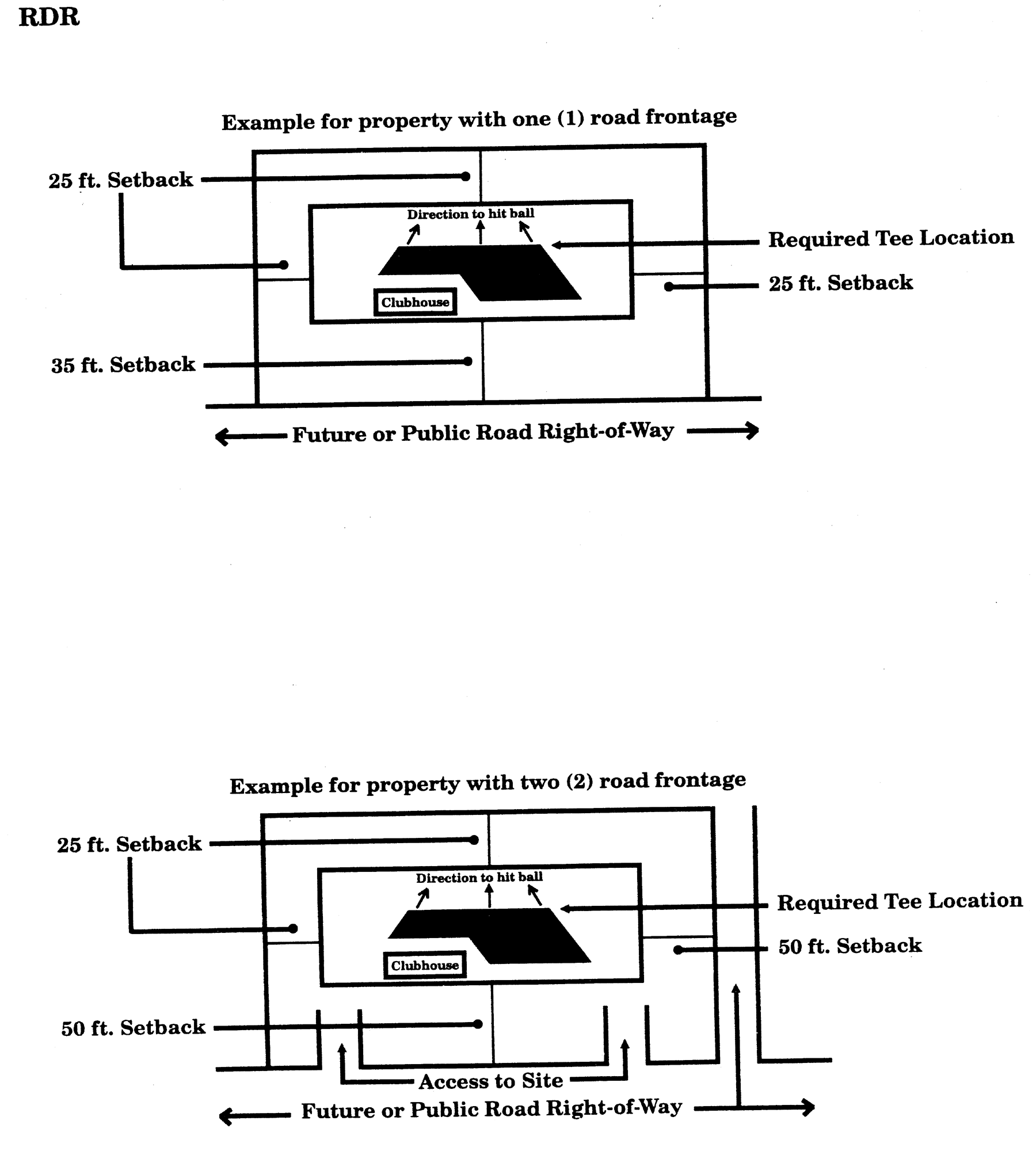
RDR District
d.
Minimum tee number is 15 tees.
e.
Tees must be located behind the pro shop or clubhouse, or in a location approved by the division manager of zoning or his designee, provided minimum landing area and driving range width and setback requirements are met.
f.
Minimum public road frontage is 100 feet on any dedicated public road right-of-way classified as a major collector or arterial as defined by the county department of transportation's major thoroughfare plan, as amended from time to time. The site must be accessed from this dedicated public road right-of-way.
g.
Minimum building, driving range and landing area setback is 35 feet from any future or public road right-of-way and 25 feet from property lines, as shown and applied in diagram 1. If the landing area depth is adjacent and parallel to any public road right-of-way (dedicated or nondedicated), the minimum setback from the adjacent parallel road right-of-way shall be 50 feet.
h.
Minimum tee spacing is ten feet from tee to tee.
i.
Safety netting of not less than 32 feet in height shall be placed along the perimeter of the landing area excluding only the front tee area. Netting shall be maintained and replaced in accordance with the manufacturer's specifications. Any safety netting required in this district shall be placed inside any buffers required for this district. See diagram 2 for location of buffers and netting.
DIAGRAM 2. LOCATION OF BUFFERS AND SAFETY NETTING FOR RDR DISTRICT
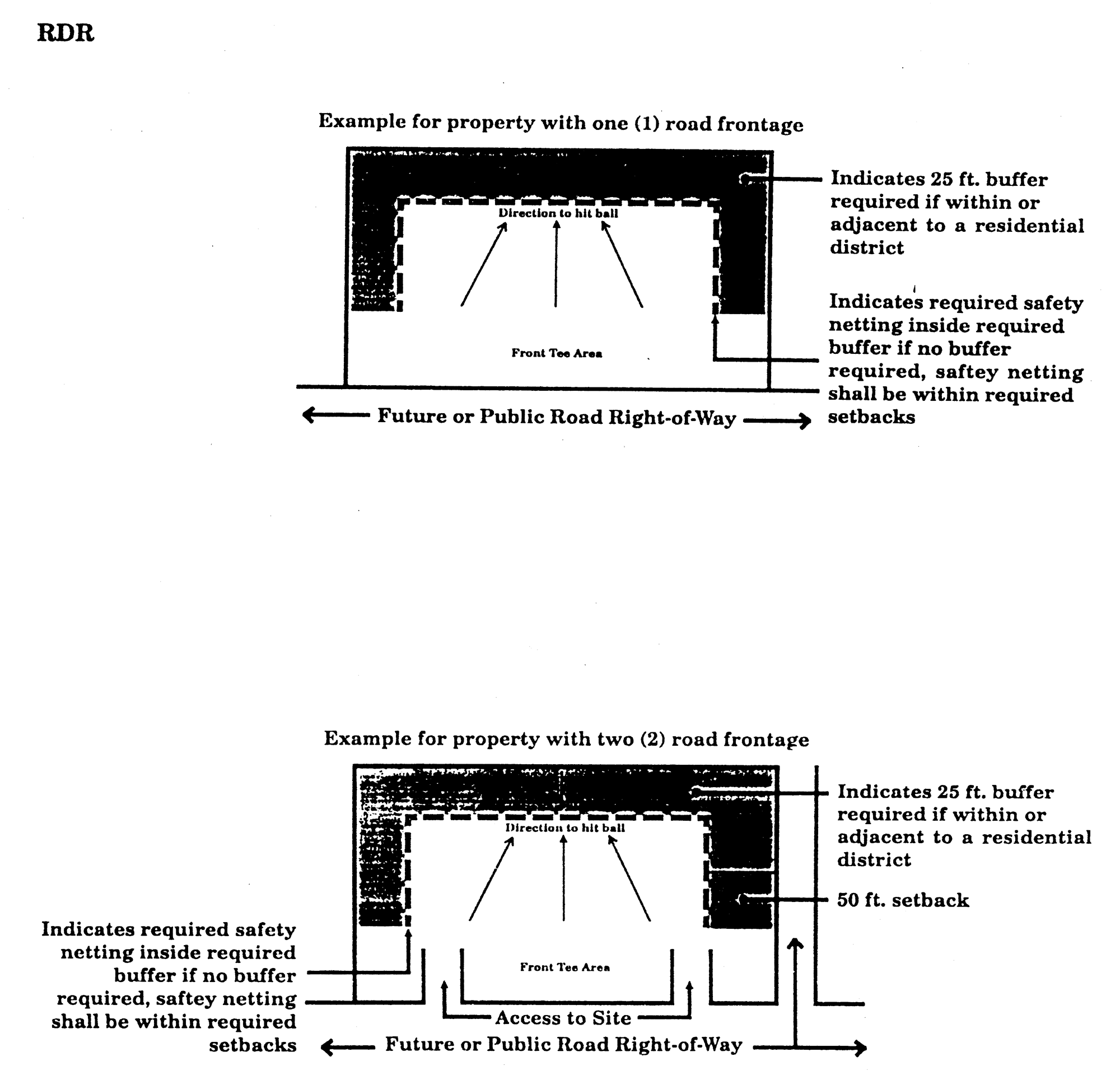
RDR District
(5)
Landscape buffer and screening requirements. Required buffers may be included within required setbacks; however, in such case that the required buffer is greater than the required setback, the required buffer shall be adhered to. Additionally, necessary private utilities and access drives may be allowed through, over or across a landscaped buffer. Any such uses which are proposed through, over or across a designated undisturbed buffer must be approved pursuant to an original site plan or site plan modification as set forth under section 134-126.
a.
Objectives. Undisturbed, planted landscape buffers and berms shall be implemented in connection with a permitted project and shall address the following objectives:
1.
Screening to enhance aesthetic appeal;
2.
Control or direction of vehicular and pedestrian movement;
3.
Reduction of glare;
4.
Buffering of noise; and
5.
Establishment of privacy.
b.
Standards. Buffers and berms shall be required when an RDR district is located within or adjacent to a residential district; a minimum 25-foot buffer is required.
1.
Buffers. Landscape buffers are subject to review and approval by the county arborist or county landscape architect in accordance with the following standards:
i.
Plantings are to be a mix of evergreen trees and shrubs.
ii.
Species are to be ecologically compatible to the site and appropriate for the design situation.
iii.
Unless public safety concerns dictate otherwise, a buffer shall provide a 100 percent visual barrier to a height of six feet within two years of planting.
iv.
Minimum height of plant materials at installation is five feet for trees and two feet for shrubs.
v.
Fencing or walls are to be a minimum of six feet in height as approved by the county landscape architect or county arborist.
vi.
Trees included in buffer plantings may be counted toward site density calculations as required by chapter 50, article VI, pertaining to tree preservation and replacement, subject to review and approval of county arborist.
vii.
Buffers shall be regularly maintained by the property owner to ensure that the objectives and standards set out in this subsection are met.
viii.
When topography and existing conditions allow, the required 25-foot buffer should be an undisturbed buffer.
ix.
Any appeals from a determination by the county landscape architect or county arborist shall be to the board of zoning appeals.
2.
Berms. Berms are subject to review and approval by the county landscape architect or county arborist in accordance with the following standards:
i.
Berms shall be utilized when consistent with surrounding property features.
ii.
Berms shall be stabilized.
iii.
Where possible, berms shall be constructed to be consistent with natural drainage patterns.
iv.
Berms shall be regularly maintained by the property owner.
(6)
Floodplain and wetlands preservation requirements. Any development must also meet state and federal requirements relating to areas subject to the provisions of section 134-283, regarding mountain and river corridor protection act areas, and section 134-284, regarding metropolitan river protection act areas.
(7)
Building and structure requirements.
a.
Maximum building height is 35 feet.
b.
When located within or adjacent to a residential district, any structure erected within the RDR district shall have a pitched roof conceptually consistent with diagram 3. Additionally, the pitched roof shall be constructed with asphaltic shingles or material consistent in appearance with asphaltic shingles. The pitched roof shall be subject to the requirements of the county Georgia Span Tables for Joists and Rafters 1978, as amended from time to time. The pitched roof shall also be subject to approval by the community development department. Any structure located within or adjacent to a residential district shall also be architecturally compatible with the adjacent properties. The architectural design shall be approved by the division manager of zoning or his designee.
_____
DIAGRAM 3. PITCHED ROOF CONCEPTUAL FOR RDR DISTRICT
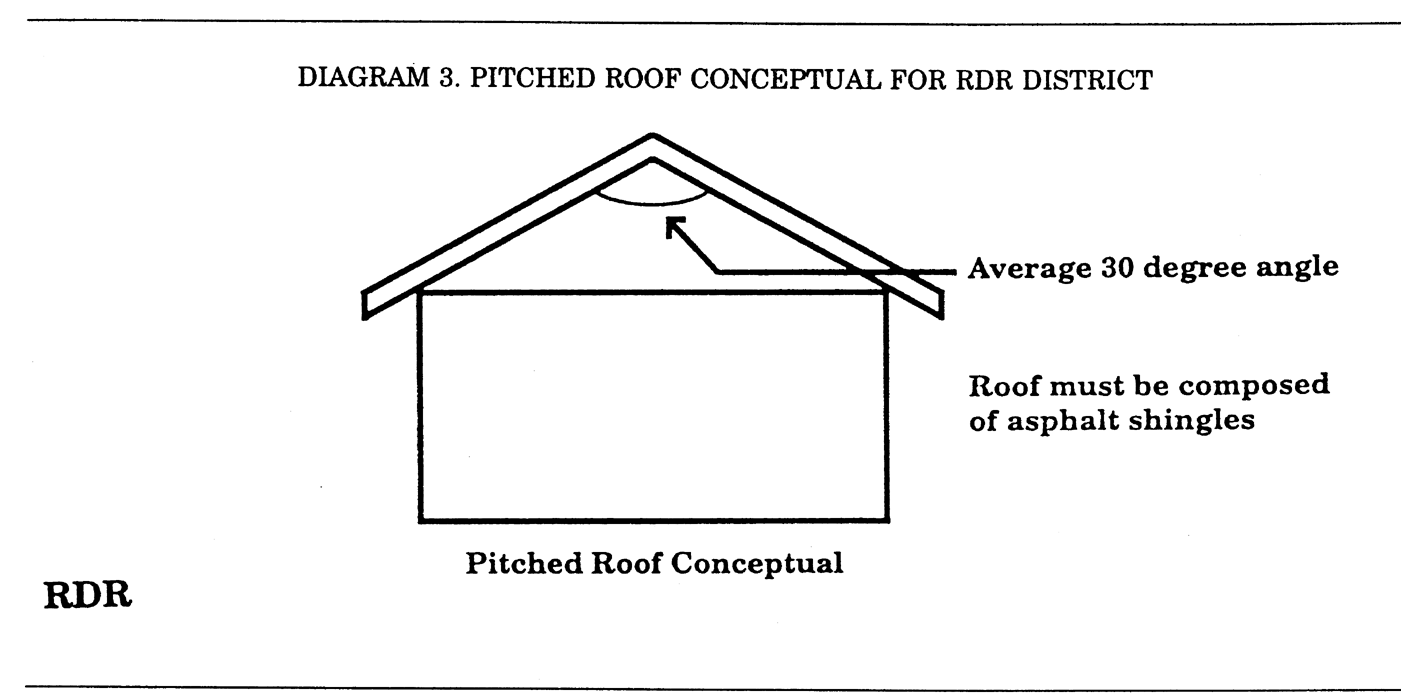
Pitched Roof Conceptual
(8)
Parking requirements.
a.
All required parking spaces shall be paved and striped in accordance with county standard 114, Parking Specifications, as amended from time to time.
b.
One and one-half spaces shall be required per one tee.
c.
Additionally, one space shall be provided per 200 gross square feet of the pro shop or clubhouse.
d.
Required parking may be located in the front yard setback; however, no front yard parking areas shall be established closer than 20 feet to a public right-of-way.
e.
All parking areas within the RDR district shall have a landscape plan approved by the county landscape architect or county arborist. Within or adjacent to a residential district, the emphasis for the landscape plan shall be to screen parking areas from the public right-of-way.
(9)
Lighting requirements. Any golf driving range permitted within the RDR district which proposes a lighted facility must have a county department of transportation approved lighting plan in accordance with the minimum conditions set out in this subsection. These are minimum requirements, based on the county street lighting ordinance. The county department of transportation may require additional information or conditions prior to final approval. A lighting plan is required, drawn to scale, showing the location of all proposed lights and nearby county roads and adjacent properties, and including the following:
a.
Arrangement of all poles, with dimensions;
b.
Height of all poles;
c.
Number of luminaries per pole;
d.
Mounting heights of luminaries;
e.
Wattage of proposed lights;
f.
Mounting angle of fixtures;
g.
Lamp source to be used; and
h.
A picture of the light to be utilized, which must be attached to the final plans. Care must be exercised to control any stray light that might trespass upon adjacent properties and roadways.
(10)
Special exception uses. Those uses which with the proper scrutiny and conditions may or may not be appropriately located within the RDR district.
a.
Authorization. The division manager of zoning or his designee shall issue a certificate of special exception to an applicant when the conditions relating to the special exception uses listed in this section are met.
b.
Double-ended tee outdoor golf driving ranges. A double-ended tee outdoor golf driving range may be permitted with the following minimum requirements. For purposes of this subsection, double-ended means that tees are located at two opposite ends of the property in accordance with diagram 4.
1.
Minimum lot size is ten acres.
2.
Minimum landing area depth is 1,125 lineal feet through the driving fairway at its shortest distance; provided all provisions of subsections (4)d, e, f and g, (5), (6), (7), (8), (9), (11) and (12) of this section are met. The minimum landing area depth may be increased at the discretion of the division manager of zoning or his designee based upon the topographic characteristics of the property.
3.
Minimum landing area width is 300 feet across tees, excluding any required buffers and setbacks. See diagram 4 for location of tees.
4.
Rear tee boxes shall be located at the furthest edge of the landing area but at a minimum of 1,100 feet.
5.
Access to rear end tees and location of required safety netting shall be in accordance with diagram 4.
6.
Only one clubhouse or pro shop shall be allowed in a double-ended tee outdoor golf driving range. The maximum square footage of the clubhouse may be enlarged up to a maximum of 3,000 square feet, to be approved by the division manager of zoning or his designee.
DIAGRAM 4. REQUIRED LOCATION OF DOUBLE-ENDED TEES FOR RDR DISTRICT
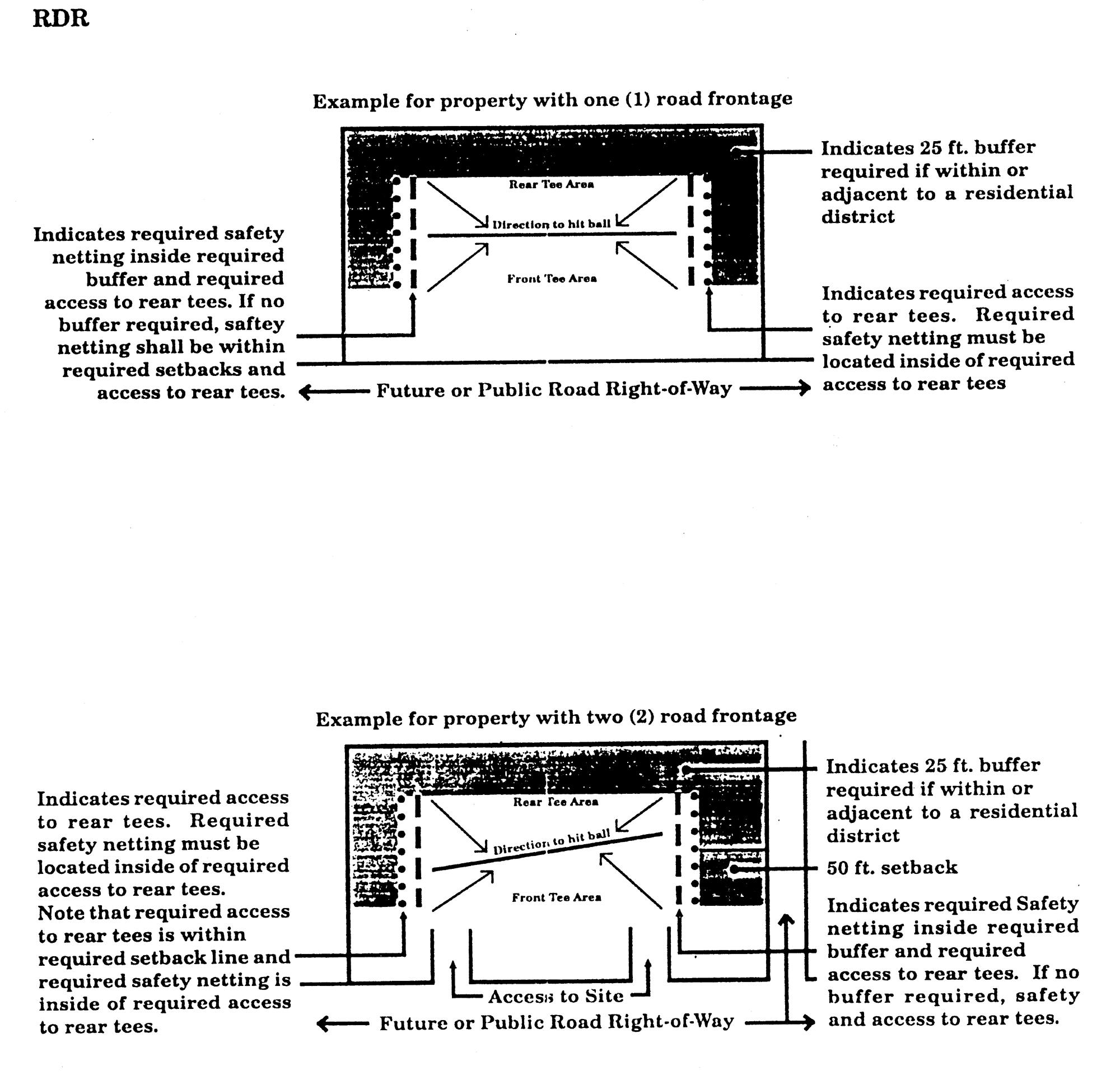
Diagram 4
c.
Other uses. See section 134-271 for special exception uses and requirements for all districts. The uses listed in section 134-271 shall be special exception uses in the RDR district.
(11)
Use limitations.
a.
Maximum size of a golf pro shop or clubhouse is 1,600 square feet.
b.
No loudspeakers are permitted.
c.
If a proposed driving range is to be located on property with two public roads, the clubhouse, if any, and tees must be located behind the road by which the facility is accessed as set forth in subsection (4)f of this section.
d.
Hours of operation for proposed driving ranges are to begin no earlier than 7:00 a.m. and cease no later than 9:30 p.m.
e.
Any structure or range use in conjunction with this district shall be subject to the site plan presented at the time of rezoning.
f.
The location of any fencing shall be approved by the division manager of zoning or his designee.
g.
When abutting a boundary to residentially zoned property the facility shall not be lighted. Across a road or right-of-way shall not be construed to be abutting for the purpose of this subsection.
h.
Should a driving range operation cease to be conducted on property zoned RDR for a period of six consecutive months, the property shall revert to its immediate previous zoning district providing such district shall be then in existence. However, should that district no longer be in existence or phased out, the property shall be brought in for rezoning to an appropriate district prior to any development on the property.
Required buffers may be included within required setbacks; however, in such case that the required buffer is greater than the required setback, the required buffer shall be adhered to. Additionally, necessary private utilities and access drives may be allowed through, over or across a landscaped buffer. Any such uses which are proposed through, over or across a designated undisturbed buffer must be approved pursuant to an original site plan or site plan modification as set forth under section 134-126.
(12)
Accessory structures and accessory uses. Any accessory building or structure in excess of 1,000 square feet of gross space shall be located to the rear of the primary structure and at least 100 feet from any property line. Any accessory building or structure which exceeds 1,000 square feet of gross space must have the approval of the division manager of zoning or his designee as to the location, architectural design and size prior to commencing construction. The division manager of zoning or his designee shall consider the following criteria for determining the appropriateness of the architectural design and size of the accessory building or structure: compatibility with the surrounding neighborhood, style of exterior (the exterior is to be compatible in style with the primary structure), use of the proposed accessory structure, impact on adjacent properties, and requirements as deemed appropriate by plan review as set forth in this subsection. All accessory buildings, structures and uses in excess of 1,000 gross square feet shall be required to submit for plan review through the community development department or receive approval from the director of the community development department or his designee. Permitted accessory structures and uses are as follows:
a.
Buildings not in excess of 600 square feet used to house equipment solely for the maintenance and operation of the driving range. The location for any accessory buildings shall be approved by the division manager of zoning or his designee.
b.
Ancillary retail sales within the pro shop or clubhouse with annual gross revenue from golf ball rental exceeding annual gross revenue from ancillary sales. For purposes of this subsection, ancillary retail sales shall mean the sale of food, beverages, golfing apparel and accessories, and those items traditionally sold within a pro shop or clubhouse. The owner or operator shall maintain accurate accounting records which shall be available for inspection by county officials.
c.
Professional teaching and lessons.
d.
Golf club and ball rental.
e.
Chipping greens and putting greens with the location to be approved by the division manager of zoning or his designee in accordance with subsection (4)e of this section.
(Ord. of 12-26-72; Ord. of 12-11-90, § 3-28-7.17; Ord. of 8-13-91; Ord. of 6-9-92; Ord. of 7-11-95; Ord. of 6-24-97 (eff. 7-1-97))
Sec. 134-210. - MHP mobile home park district.
(a)
Purpose and intent. The MHP district is established to provide locations for mobile home parks which eliminate or minimize certain conditions associated with mobile homes. The board of commissioners finds that it is necessary to restrict the location of mobile homes in order to: preserve land for low density, single family dwellings; protect property values; guard against increased crime; guard against traffic congestion; maintain aesthetics; regulate population density; prevent waste and sewage problems; regulate housing stock; and attempt to address concerns regarding wind vulnerability.
(b)
Standards. The regulations for the MHP mobile home park district are as follows:
(1)
Conditions of operation. Each mobile home park shall provide the following minimum facilities on the site for the common use of all trailer occupants:
a.
Drives. Paved drives at least 20 feet wide shall be provided to each trailer space and to laundry or other service buildings and recreation areas.
b.
Refuse collection facilities. One refuse collection station shall be provided for each 20 families or fraction thereof, not more than 200 feet from any trailer served, and shall be conveniently located for collection. If individual refuse containers are used on the trailer site, these containers must be submerged in the ground with only the top portion extending above the ground level. In lieu of a submerged unit, stands may be provided to hold the cans and screen the cans from conspicuous view.
c.
Underground utility lines. Utility lines shall be underground unless the plans approved by the planning commission indicate certain specific lines above the ground.
d.
Landscaping. Each mobile home park shall be landscaped with shade trees and exterior screen planting.
e.
Recreation area. At least ten percent of the gross land area shall be set aside for recreational use. No such area shall be less than one-half acre.
(2)
Improvements to trailers; patios.
a.
No permanent additions of any kind shall be built onto or become a part of any trailer unit.
b.
The owner of the mobile home park shall install a concrete patio at least four inches thick, with minimum dimensions of 20 feet by eight feet, within each trailer space.
(3)
Required lot area.
a.
No mobile home park shall be constructed or maintained on a lot or tract which has an average width of less than 400 feet or a total area of less than ten acres.
b.
Each trailer space shall be at least 50 feet in width and shall be a minimum of 4,000 square feet in area. In cul-de-sac or curved street design, the width of the trailer space shall be at least 50 feet at the location of the mobile home unit.
c.
Each trailer space shall be defined by a marker at each corner.
(4)
Yard requirements. No trailer shall be located within:
a.
Ten feet of its individual lot line.
b.
Forty feet from any exterior boundary of the mobile home park.
(5)
Buffer strip requirements. A buffer strip at least 25 feet wide shall be located adjacent to each exterior property line of the mobile home park and not be included within any individual trailer lot. This buffer strip shall be increased to a width of 50 feet when located adjacent to property zoned for single-family dwellings or duplexes. This strip shall be densely planted with evergreen shrubs and trees.
(6)
Off-street parking. A paved driveway, connecting to the interior drive, shall be provided on each trailer site, sufficient in length and width to serve as two off-street parking spaces.
(7)
Sewerage and water supply. Central sewage disposal facilities must be used and there shall be no individual septic tanks in areas zoned for the uses provided in this section, and public water supply shall be used and there shall be no private wells allowed under the uses in this zone.
(8)
Use limitations.
a.
It is found and declared that outside storage on properties within unincorporated Cobb County is a health risk and undesirable in that it provides harborage for rodents and insects, lowers property values, and constitutes a public nuisance; therefore, no outside storage is permitted, excluding firewood and lawn furnishings, unless otherwise allowed in this article.
b.
Required buffers may be included within required setbacks; however, in such case that the required buffer is greater than the required setback, the required buffer shall be adhered to. Additionally, necessary private utilities and access drives may be allowed through, over or across a landscaped buffer. Any such uses which are proposed through, over or across a designated undisturbed buffer must be approved pursuant to an original site plan or site plan modification as set forth under section 134-126.
c.
Livestock, nondomestic and wild animals, and poultry as defined in this chapter shall be prohibited.
(9)
Floodplain and wetlands preservation requirements. Any development must meet state and federal requirements relating to areas subject to the provisions of section 134-283, regarding mountain and river corridor protection act areas, and section 134-284, regarding metropolitan river protection act areas. No floodplains and/or wetlands may be used in calculating the overall density of the development.
(10)
Each mobile home must consist of one or more rooms which are arranged, designated or used as living quarters for one family (as defined in section 134-1), or two or fewer unrelated adults and their children and/or grandchildren.
(1)
A mobile home may be occupied only by a family related in the fourth degree as defined in O.C.G.A., or two or fewer unrelated adults and their children and/or grandchildren.
(2)
A mobile home shall have an interior bathroom and complete kitchen facilities, permanently installed.
(3)
A mobile home shall have at least 250 square feet of total square footage (as determined in the records maintained by the Cobb County Tax Assessor) per each adult occupant.
(4)
No more than one vehicle per 250 square feet of total square footage may be parked regularly overnight at or within the paved parking area as required in item (6). "Regularly" means a majority of nights in any seven-day period. Exceptions to this paragraph may be considered as part of a land use permit processed in accordance with section 134-36.
(Ord. of 12-26-72; Ord. of 12-10-74, § 10; Ord. of 12-11-90, § 3-28-7.18; Ord. of 7-11-95; Ord. of 2-27-96; Ord. of 7-27-04; Ord. of 2-26-08; Ord. of 7-14-09; Amd. of 2-25-14; Amd. of 2-24-15)
Sec. 134-211. - LRO low-rise office district.
The regulations for the LRO low-rise office district are as follows:
(1)
Purpose and intent. The LRO district is established to provide locations for low scale professional offices and other nonretail commercial uses such as offices and nursery schools, which are on properties delineated within or on the edge of a neighborhood activity center, community activity center or regional activity center as defined and shown on the Cobb County Comprehensive Plan: A Policy Guide, adopted November 27, 1990. When located on the edge of a neighborhood activity center node as defined by the comprehensive plan, the LRO district should provide for office uses that are low in intensity to ensure compatibility with adjacent single-family detached dwellings and otherwise to implement the stated purpose and intent of this chapter.
(2)
Definitions. The following words, terms and phrases, when used in this section, shall have the meanings ascribed to them in this subsection, except where the context clearly indicates a different meaning:
a.
Community fair means a festival or fair such as the North Georgia State Fair conducted wholly within public areas owned by a local government, provided that any activity is conducted at least 200 feet from any property line. Any event shall not exceed 21 days.
b.
Group home means a dwelling shared by six or less persons, excluding resident staff, who live together as a single housekeeping unit and in a longterm, family-like environment in which staff persons provide care, education and participation in community activities for the residents with the primary goal of enabling the residents to live as independently as possible in order to reach their maximum potential. This use shall apply to homes for the handicapped. As used in this subsection, the term "handicapped" shall mean:
1.
Having a physical or mental impairment that substantially limits one or more of such person's major life activities so that such person is incapable of living independently;
2.
Having a record of having such an impairment; or
3.
Being regarded as having such an impairment.
However, the term "handicapped" shall not include current illegal use of or addiction to a controlled substance, nor shall it include any person whose residency in the home would constitute a direct threat to the health and safety of other individuals. The term "group home for the handicapped" shall not include alcoholism or drug treatment centers, work release facilities for convicts or ex-convicts, or other housing facilities serving as an alternative to incarceration.
c.
Professional offices means a structure wherein services are performed involving predominately administrative, professional or clerical operations such as the following: law, doctor, optician, audiologist, accounting, tax preparation, real estate, stockbroker, architect, engineer, manufacturer representative, professional counselor, dentist, investigative services, photographer, insurance, contractor, land surveyor, telephone sales, political/campaign, veterinarian or travel bureau.
d.
Designated recycling collection locations means metal or heavy duty plastic containers designed for shortterm holding of pre-bagged recyclable items such as tin, aluminum, glass and paper (no perishable or food items allowed) for scheduled minimum monthly pickup, with no on-premises sorting. The center must be maintained in a safe, clean, neat and sanitary fashion and shall not encompass an area larger than 280 square feet.
1.
Such location shall be visually screened and maintained.
2.
Such location shall be within the building setbacks unless otherwise approved by the division manager of zoning or his designee due to topography, safety, internal traffic flow, site distance or other site-related circumstances not created by the property owner.
(3)
Permitted uses. Permitted uses are as follows:
Banks and financial institutions with drive-in establishment or automated transfer machines.
Churches, chapels, temples, synagogues, and other such places of worship.
Community fairs.
Cultural facilities.
Designated recycling collection locations.
Executive golf courses (see section 134-270).
Funeral homes (with a maximum height of two stories and a 25-foot buffer adjacent to all residentially zoned properties).
Golf courses, 18-hole regulation, public and private (see section 134-270).
Golf courses, par 3 (see section 134-270).
Group homes.
In-home day care.
Nonprofit (seasonal use) fishing lakes.
Nursery schools and child day care centers.
Parking for vehicles.
Private parks.
Professional offices.
Radio, television and other communication towers and antennas, subject to section 134-273.
Temporary uses.
(4)
Lot size and setback requirements. Lot size and setback requirements are as follows:
a.
Minimum lot size: 20,000 square feet.
b.
Minimum lot width at front setback line: 60 feet.
c.
Minimum public road frontage: 50 feet.
d.
Minimum building setbacks: As shown and applied in the following diagram:
DIAGRAM 1. MINIMUM BUILDING SETBACK REQUIREMENTS FOR LRO DISTRICT
Note: All setbacks shall be measured from future right-of-way.
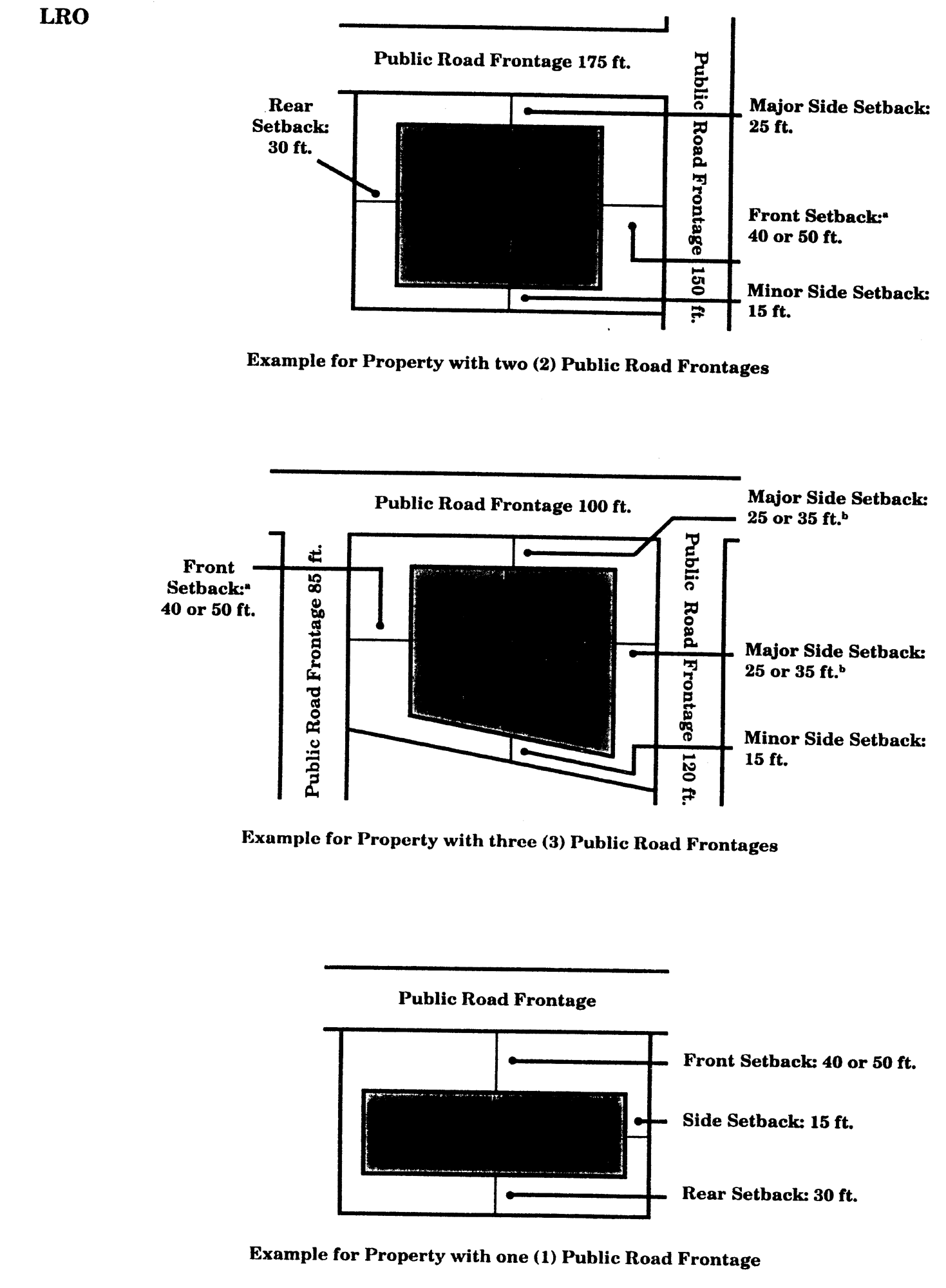
LRO
Notes:
a Property with shorter amount of road frontage will be the front setback for determining other setbacks (major side, side, rear).
b If structure fronts a major side setback, major side setback shall be 35 feet.
(5)
Landscape buffer and screening requirements. Unless otherwise noted within this district's requirements, any property within an LRO district which abuts a residentially zoned property shall have a minimum 20-foot landscaped screening buffer adjacent to all residentially zoned property, which will be subject to the county landscape architect's approval. Required buffers may be included within required setbacks; however, in such case that the required buffer is greater than the required setback, the required buffer shall be adhered to. Additionally, necessary private utilities and access drives may be allowed through, over or across a landscaped buffer. Any such uses which are proposed through, over or across a designated undisturbed buffer must be approved pursuant to an original site plan or site plan modification as set forth under section 134-126.
a.
Objectives. Undisturbed, planted landscape buffers and berms shall be implemented in connection with a permitted project and shall address the following objectives:
1.
Screening to enhance aesthetic appeal;
2.
Control or direction of vehicular and pedestrian movement;
3.
Reduction of glare;
4.
Buffering of noise; and
5.
Establishment of privacy.
b.
Standards. Buffers and berms shall be required when an LRO district is located adjacent to a residential district; a minimum 20-foot buffer is required.
1.
Buffers. Landscape buffers are subject to review and approval by the county arborist or county landscape architect in accordance with the following standards:
i.
Plantings are to be a mix of evergreen trees and shrubs.
ii.
Species are to be ecologically compatible to the site and appropriate for the design situation.
iii.
Unless public safety concerns dictate otherwise, buffers should provide a 100 percent visual barrier to a height of six feet within two years of planting.
iv.
Minimum height of plant materials at installation is five feet for trees and two feet for shrubs.
v.
Fencing or walls are to be a minimum of six feet in height as approved by the county landscape architect or county arborist.
vi.
Trees included in buffer plantings may be counted toward site density calculations as required by chapter 50, article VI, pertaining to tree preservation and replacement, subject to review and approval of county arborist.
vii.
Buffers shall be regularly maintained by the property owner to ensure that the objectives and standards set out in this subsection are met.
viii.
When topography and existing conditions allow, the required twenty-foot buffer should be an undisturbed buffer.
ix.
Any appeals from a determination by the county landscape architect or county arborist shall be to the board of zoning appeals.
2.
Berms. Berms are subject to review and approval by the county landscape architect or county arborist in accordance with the following standards:
i.
Berms shall be utilized when consistent with surrounding property features.
ii.
Berms shall be stabilized.
iii.
Where possible, berms shall be constructed to be consistent with natural or proposed drainage patterns.
iv.
Berms shall be regularly maintained by the property owner.
(6)
Floodplain and wetlands preservation requirements. Any development must also meet state and federal requirements relating to areas subject to the provisions of section 134-283, regarding mountain and river corridor protection act areas, and section 134-284, regarding metropolitan river protection act areas.
(7)
Building and structure requirements.
a.
Maximum building height is 35 feet, with no more than two stories.
b.
Any structure erected within the LRO district shall have a pitched roof conceptually consistent with the following diagram. Additionally, the pitched roof shall be constructed with asphaltic shingles or material consistent in appearance with asphaltic shingles. The pitched roof shall be subject to the requirements of the county Georgia Span Tables for Joists and Rafters 1978, as amended from time to time. The pitched roof shall also be further subject to approval by the community development department. Any structure within the LRO district which is adjacent to residentially zoned property shall also be architecturally compatible with the adjacent residential properties. The architectural design shall be approved by the division manager of zoning or his designee.
_____
DIAGRAM 2. PITCHED ROOF CONCEPTUAL FOR LRO DISTRICT
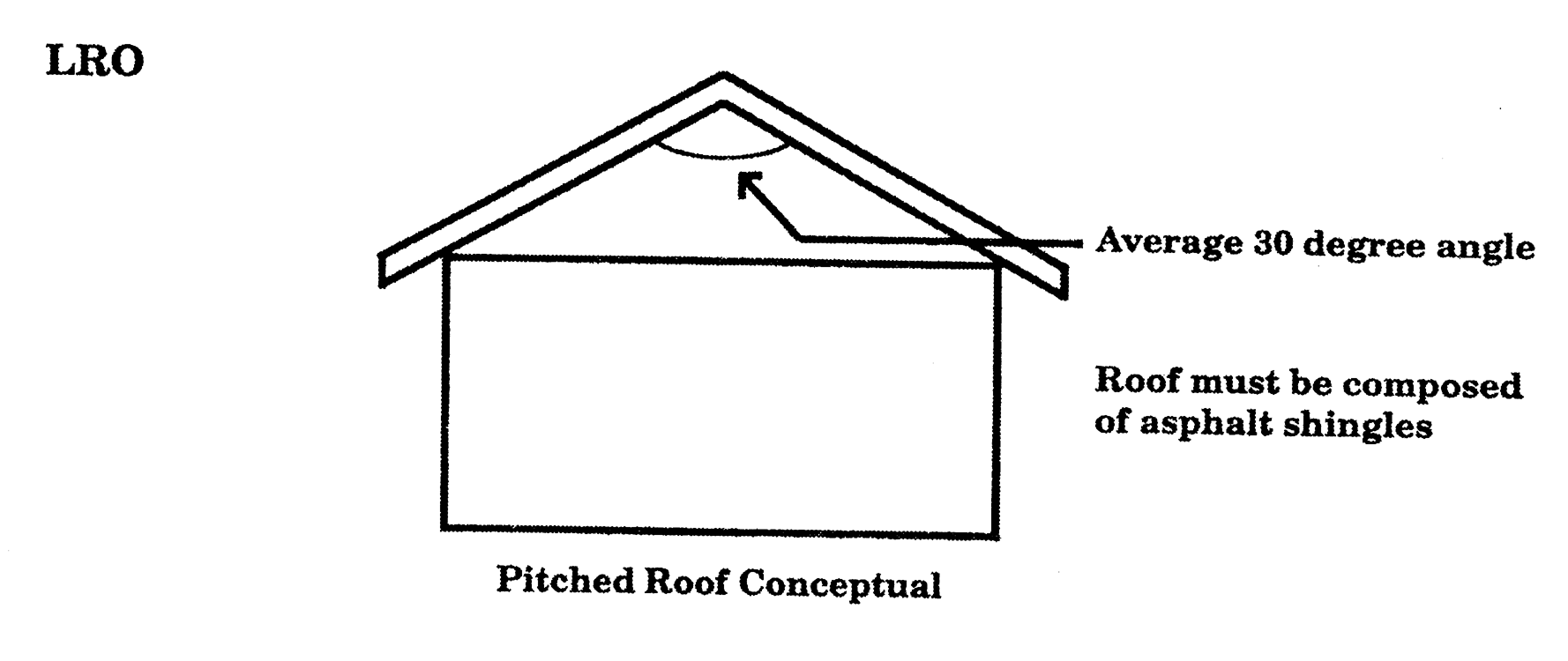
Pitched Roof Conceptual
_____
(8)
Parking requirements. See section 134-272 for paved parking specifications.
(9)
Lighting requirements. Any project permitted within the LRO district which proposes a lighted facility must have a department of transportation approved lighting plan in accordance with the minimum conditions listed in section 134-269.
(10)
Special exception uses. See section 134-271 for special exception use requirements for all districts. Special exception uses for the LRO district are the uses listed in section 134-271.
(11)
Use limitations.
a.
The maximum floor area ratio for office uses is 0.5.
b.
All structures located within the LRO district shall be appropriately scaled in relation to the transitional nature of the immediate area.
c.
Existing single-family structures shall be utilized when possible.
d.
All refuse and designated recycling collection location facilities must be contained within completely enclosed facilities.
e.
No sexually oriented businesses are permitted.
f.
No overnight parking of commercial vehicles is permitted, except for mini-vans or cars.
g.
It is found and declared that outside storage on properties within unincorporated Cobb County is a health risk and undesirable in that it provides harborage for rodents and insects, lowers property values, and constitutes a public nuisance; therefore, no outside storage is permitted, unless otherwise allowed in this article.
h.
No drive-in establishments are permitted.
i.
No laboratories or clinics are permitted.
j.
No uses that emit noxious odors, fumes or sounds are permitted.
k.
No outside runs are permitted with any veterinary office use permitted within this district.
l.
Maximum impervious surfaces (80%-RAC, 70%-CAC and NAC) shall be established within activity centers as identified by the Cobb County Comprehensive Plan, as may be amended from time to time.
m.
No loading docks or facilities may be located in the front of any primary structure.
Required buffers may be included within required setbacks; however, in such case that the required buffer is greater than the required setback, the required buffer shall be adhered to. Additionally, necessary private utilities and access drives may be allowed through, over or across a landscaped buffer. Any such uses which are proposed through, over or across a designated undisturbed buffer must be approved pursuant to an original site plan or site plan modification as set forth under section 134-126.
(12)
Accessory buildings, structures, uses and decks. Any accessory building or structure in excess of 1,000 square feet of gross space shall be located to the rear of the primary structure and at least 100 feet from any property line. Any accessory building or structure which exceeds 1,000 square feet of gross space must have the approval of the division manager of zoning or his designee as to the location, architectural design and size prior to commencing construction. The division manager of zoning or his designee shall consider the following criteria for determining the appropriateness of the architectural design and size of the accessory building or structure: compatibility with the surrounding neighborhood, style of exterior (the exterior is to be compatible in style with the primary structure), use of the proposed accessory structure, impact on adjacent properties, and requirements as deemed appropriate by plan review as set forth in this subsection. All accessory buildings, structures and uses in excess of 1,000 gross square feet shall be required to submit for plan review through the community development department or receive approval from the director of the community development department or his designee.
a.
Accessory storage buildings, to include parking garages, are permitted subject to the following conditions:
1.
Maximum height is two stories, not to exceed 35 feet.
2.
Such structures shall be located on the same lot as and to the rear of the principal building to which they are accessory.
3.
No accessory building shall be constructed upon a lot until construction of the principal building has commenced.
4.
On a corner lot, no accessory building shall be located closer to the side street right-of-way line than the principal building.
5.
When abutting any other nonresidential district, no garage or other accessory building shall be located closer than five feet to a side or rear lot line.
6.
When an accessory building is attached to the principal building by a breezeway, passageway or similar means, it shall comply with the yard requirements of the principal building to which it is accessory.
7.
Where any nonresidential lot adjoins the side or rear of a residential lot, an accessory building shall not be located within any required buffers.
b.
Antennas and satellite dishes shall meet the requirements set forth in section 134-274.
c.
Incidental storage is permitted, provided that the material stored is incidental to the permitted use, as determined by the division manager of zoning or his designee, and stored completely within a portion of the enclosed principal structure permitted within the district, or within a permitted accessory structure.
(Ord. of 12-26-72; Ord. of 12-11-90, § 3-28-7.19; Ord. of 8-13-91; Ord. of 6-9-92; Ord. of 7-11-95; Ord. of 7-10-01; Ord. of 9-10-02; Ord. of 12-9-03; Ord. of 7-27-04; Ord. of 7-26-05; Amd. of 2-24-15; Amd. of 9-8-20)
Sec. 134-212. - CF future commercial district.
The CF future commercial district was originally established as a zone designated for future commercial use with no immediate right to use or occupy the zone for commercial purposes until an applicant shall have been regularly and properly granted specific zoning for the purposes described in any of the commercial districts enumerated in this chapter. Under the comprehensive amendment to the zoning ordinance, the board of commissioners resolved that an owner of property currently designated CF, and not developed, shall have until January 17, 1996, within which to commence development pursuant to the previous conditions. For purposes of this section, commencing development shall mean applying for rezoning to an appropriate zoning district, obtaining a building permit, and beginning construction on the development. If such development shall not occur by January 17, 1996, such portion of the undeveloped and unzoned property must be brought in for rezoning to another district which is compatible with the Cobb County Comprehensive Plan: A Policy Guide, adopted November 27, 1990, prior to any future development. Additionally, no new applications for CF zoning may be accepted.
(Ord. of 12-26-72; Ord. of 12-11-90, § 3-28-7.20)
Sec. 134-213. - NRC neighborhood retail commercial district.
Commencing January 1, 1998, no new applications for a special land use permit for self-service storage facilities (SSSF) are to be accepted by the board of commissioners. The regulations for the NRC neighborhood retail commercial district are as follows:
(1)
Purpose and intent. The NRC district is established to provide locations for convenience shopping facilities which are on properties delineated within a neighborhood activity center, community activity center or regional activity center as defined and shown on the Cobb County Comprehensive Plan: A Policy Guide, adopted November 27, 1990. These convenience shopping facilities should have retail commercial uses that have a neighborhood-oriented market and which supply necessities that usually require frequent purchasing with a minimum of consumer travel. Areas zoned for the NRC district should be located at or near an intersection within the center of a neighborhood activity center as opposed to the edge of a neighborhood activity center. The NRC district may also be used to provide step-down nodal zoning away from more intensive commercial uses within a community activity center or a regional activity center. The scope at which properties are developed within the NRC district should reflect their relatively small neighborhood service area. Additionally, properties developed within the NRC district should be architecturally compatible with other nonresidential uses permitted within a neighborhood activity center as defined by the comprehensive plan and the neighborhood residences they serve.
(2)
Definitions. The following words, terms and phrases, when used in this section, shall have the meanings ascribed to them in this subsection, except where the context clearly indicates a different meaning:
a.
Community fair means a festival or fair such as the North Georgia State Fair conducted wholly within public areas owned by a local government, provided that any activity is conducted at least 200 feet from any property line. Any event shall not exceed 21 days.
b.
[Reserved.]
c.
Designated recycling collection locations means metal or heavy duty plastic containers designed for shortterm holding of pre-bagged recyclable items such as tin, aluminum, glass and paper (no perishable or food items allowed) for scheduled minimum monthly pickup, with no on-premises sorting. The center must be maintained in a safe, clean, neat and sanitary fashion and shall not encompass an area larger than 280 square feet.
1.
Such location shall be visually screened and maintained.
2.
Such location shall be within the building setbacks unless otherwise approved by the division manager of zoning or his designee due to topography, safety, internal traffic flow, site distance or other site-related circumstances not created by the property owner.
d.
Group home means a dwelling shared by six or less persons, excluding resident staff, who live together as a single housekeeping unit and in a longterm, family-like environment in which staff persons provide care, education and participation in community activities for the residents with the primary goal of enabling the residents to live as independently as possible in order to reach their maximum potential. This use shall apply to homes for the handicapped. As used in this subsection, the term "handicapped" shall mean:
1.
Having a physical or mental impairment that substantially limits one or more of such person's major life activities so that such person is incapable of living independently;
2.
Having a record of having such an impairment; or
3.
Being regarded as having such an impairment.
However, the term "handicapped" shall not include current illegal use of or addiction to a controlled substance, nor shall it include any person whose residency in the home would constitute a direct threat to the health and safety of other individuals. The term "group home for the handicapped" shall not include alcoholism or drug treatment centers, work release facilities for convicts or ex-convicts, or other housing facilities serving as an alternative to incarceration.
e.
Light automotive repair establishment means an indoor repair establishment (no outside storage) with fully enclosed service bay(s) with operable door(s) for performing light auto and small truck repair and maintenance within the enclosed service bay(s) (under one ton) such as brakes, oil changes, lubrication, transmission, belts, hoses, inspections, tire mounting and installation and the like. Light automotive repair establishments adjacent to residentially zoned properties shall be required to incorporate noise abatement measures such as, but not limited to, landscaping, fencing, portable noise screen, or other equally effective industry accepted alternative. This amendment shall become effective July 1, 2013. Activities such as battery replacement, light bulb changes, wiper blade replacement, "check engine light" diagnostics, or other minor things done complimentary and the like may be done outside of a retail automotive parts store with non-powered hand tools.
f.
Neighborhood retail uses means commonly found low scale and low intensity retail uses (with square footages in accordance with the use limitations established within the individual zoning districts of this chapter) that offer basic services and frequently purchased goods to the immediate surrounding residential areas, such as, but not limited to, an auto parts store, antique shop, appliance store (home use), bakery, barbershop or beauty shop, beverage shop, bookstore (but not including adult bookstore), bridal shop, camera shop, china and pottery store, clothing store, dance studio, martial arts, pilates, yoga and the like studio, delicatessen, dog grooming shop, draperies and interior decorating supplies, drugstore, hardware store, dry goods store, florist, furniture store, gifts and stationery store, gym and fitness facility, jewelry store, manicurist shop, meat market or butcher shop, millinery store, mimeograph and letter shop, music store, novelty shop, paint store, pedicurist shop, pet store and pet supply store, shoe repair shop, shoe store, sporting goods store, supermarket or grocery, tailor shop, thrift store (or consignment store), toy store, variety shop or video store.
g.
Nonautomotive repair uses means commonly found low intensity repair shops such as jewelry, camera, home appliance, television and videocassette recorder repair shops.
h.
Office service and supply establishments means wholesale and retail commercial establishments that sell, service and supply small office equipment and supplies, such as stores that offer sales of copiers, facsimile machines, typewriters, ribbons, transcribers, dictation equipment, tape, staplers and other general office equipment.
i.
Professional office means a structure wherein services are performed involving predominately administrative, professional or clerical operations such as the following: law, doctor, optician, audiologist, accounting, tax preparation, real estate, stockbroker, architect, engineer, manufacturer representative, professional counselor, dentist, investigative services, photographer, insurance, contractor, land surveyor, telephone sales, political/campaign, veterinarian or travel bureau.
(3)
Permitted uses. Permitted uses are as follows:
Banks and financial institutions with drive-in establishment or automated transfer machines.
Billiards and pool halls, subject to chapter 78, article III, division 6, pertaining to pool rooms.
Carwashes.
Churches, chapels, temples, synagogues, and other such places of worship.
Commercial produce and agricultural product stands.
Community fairs.
Convenience food stores with self-service fuel sales.
Cultural facilities.
Designated recycling collection locations.
Eating and drinking establishments, including drive-in fast food restaurants.
Emissions or inspection stations. (No temporary buildings/tents to be utilized after June 30, 1998.)
Executive golf courses (see section 134-270).
Film developing and printing facilities.
Freestanding climate controlled self-service storage facilities. The following minimum standards shall apply to freestanding climate controlled self-service storage facilities:
1.
Building height should not exceed those of adjacent buildings, nor impact the view shed of adjacent residential property.
2.
F.A.R. should be .75 or as determined appropriate by the board of commissioners.
3.
All units shall be accessed through a main or central entrance.
4.
All windows or similar architectural features must be "one way" and provide for an opaque screen from view outside of the building.
5.
Architectural style/design to be similar or complementary to the predominant architectural design of other commercial uses within the activity center. Said architectural style/design to be approved by the board of commissioners. Any roof-mounted utilities or building components must be sufficiently screened from view of adjoining properties and public right-of-way.
6.
There shall be no outside storage allowed nor overnight and/or long-term parking of heavy equipment, commercial equipment or parking of construction or related equipment allowed.
7.
There shall be no storage of recreational vehicles and no dry storage of pleasure boats of any type customarily maintained by private individuals for their personal use.
8.
There shall be no storage of flammable liquids, highly combustible or explosive materials, or hazardous chemicals.
9.
No units within the facility shall be used for or considered to be premises for the purpose of assigning a legal address in order to obtain an occupational license or any other government permit or licenses to do business.
10.
There shall be no resident manager or any type of overnight accommodations for such.
11.
Landscape plan to be approved by staff with emphasis on planting within the parking facilities.
12.
One parking space shall be provided per every 80 individual storage units/areas.
13.
Loading area, including adequate turnaround space for a tractor trailer vehicle, must be screened by a permanent architectural or landscape feature or as may be approved by the board of commissioners if not located to the side or rear of proposed structure.
14.
Lighting plan to be approved by the board of commissioners.
15.
No units shall be used to manufacture, fabricate or process goods, to service or repair vehicles, boats, small engines or electrical equipment, or to conduct similar repair activities, to conduct garage sales or retail sales of any kind, to rehearse or practice utilizing band instruments, or for conversion to an apartment or dwelling unit, or to conduct any other commercial or industrial activities on the site.
16.
Dumpster areas and detention areas must be sufficiently screened from view of adjoining properties and public right-of-way.
17.
Hours of operation to be established by the board of commissioners, considering the operation hours of surrounding businesses.
18.
Special land use permit as provided in section 134-37.
Freestanding ice vending machines. The following minimum standards shall apply to freestanding ice vending machines:
1.
Architectural style must be similar to or complimentary to the architectural styles of contiguous properties and consistent with the county's architectural guidelines.
2.
Any roof-mounted utility, conditioned air unit or other mechanical device associated with the operation of the machine must be screened from the view of public right-of-way with an architectural feature similar to or complimentary to the architectural styles of contiguous properties. Further, these utilities, units or mechanical devices must include a noise abatement feature or device that abates noises or sounds from adjacent residential property.
3.
Special land use permit as required in section 134-37.
Full service gasoline stations.
Funeral homes.
Golf courses, 18-hole regulation, public and private (see section 134-270).
Golf courses, par 3 (see section 134-270).
Group homes.
In-home day care.
Laundry and dry cleaning pickup establishments.
Light automotive repair establishments, provided the building shall not exceed 8,000 square feet in floor area.
Neighborhood retail uses.
Nonautomotive repair service establishments.
Nonprofit (seasonal use) fishing lakes.
Nursery schools and child day care centers.
Office service and supply establishments.
Parking for vehicles.
Private parks.
Professional offices.
Radio, television and other communication towers and antennas subject to section 134-273.
Rest homes, personal care homes or convalescent homes.
Self-service fuel sales.
Self-service laundry facilities.
Temporary uses.
(4)
Lot size and setback requirements. Lot size and setback requirements are as follows:
a.
Minimum lot size: 20,000 square feet.
b.
Minimum lot width at front setback line: 60 feet.
c.
Minimum public road frontage: 50 feet.
d.
Minimum building setbacks: As shown and applied in the following diagram:
MINIMUM BUILDING SETBACK REQUIREMENTS FOR NRC DISTRICT
Note: All setbacks shall be measured from future right-of-way.
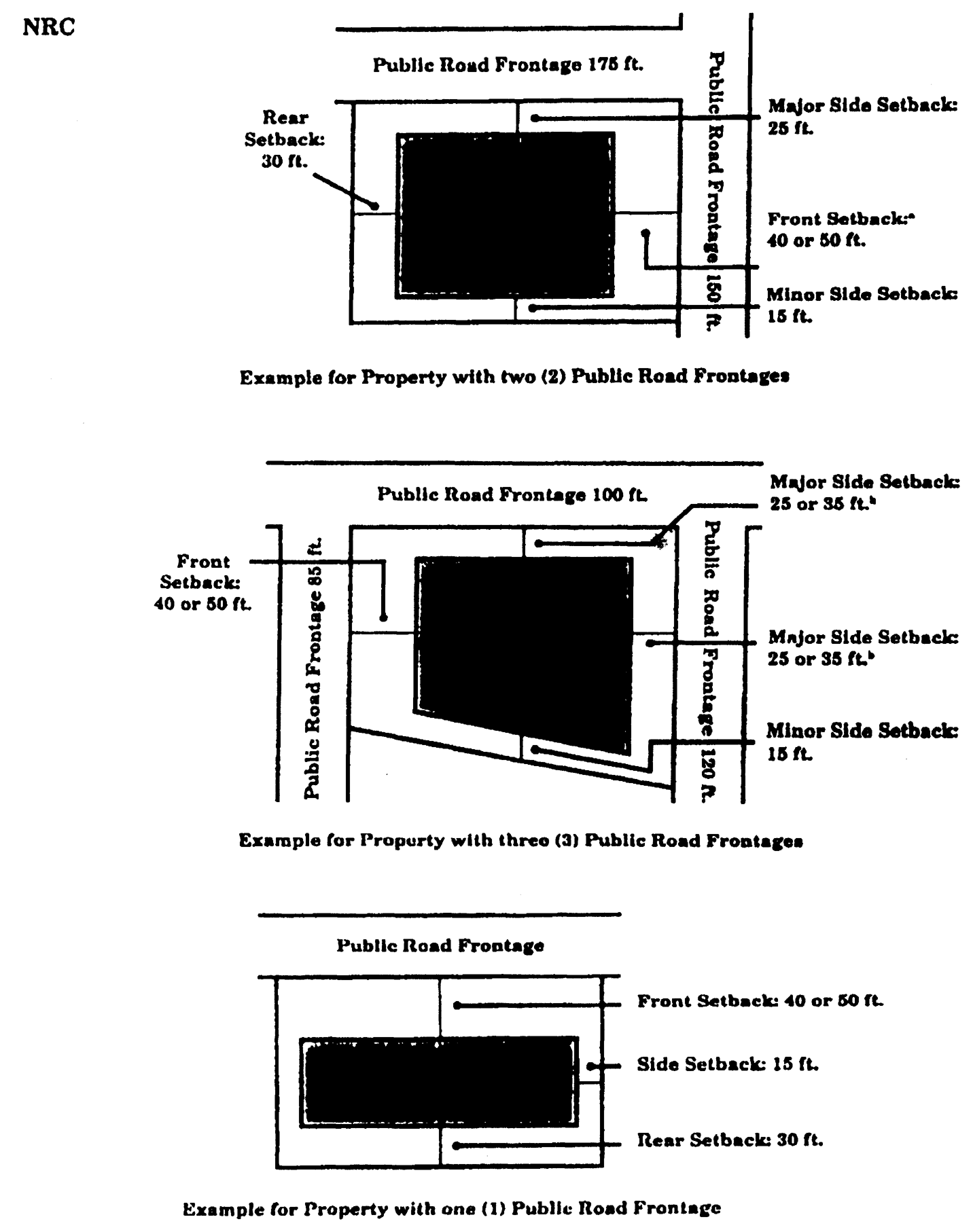
Minimum Building Setback Requirements for NRC District
Notes:
a Property with shorter amount of road frontage will be the front setback for determining other setbacks (major side, side, rear).
b If structure fronts a major side setback, major side setback shall be 35 feet.
(5)
Landscape buffer and screening requirements. Unless otherwise noted within this district's requirements, any property within an NRC district which abuts a residentially zoned property shall have a minimum 20-foot landscaped screening buffer adjacent to all residentially zoned property, which will be subject to the county landscape architect's approval. Required buffers may be included within required setbacks; however, in such case that the required buffer is greater than the required setback, the required buffer shall be adhered to. Additionally, necessary private utilities and access drives may be allowed through, over or across a landscaped buffer. Any such uses which are proposed through, over or across a designated undisturbed buffer must be approved pursuant to an original site plan or site plan modification as set forth under section 134-126.
a.
Objectives. Undisturbed, planted landscape buffers and berms shall be implemented in connection with a permitted project and shall address the following objectives:
1.
Screening to enhance aesthetic appeal;
2.
Control or direction of vehicular and pedestrian movement;
3.
Reduction of glare;
4.
Buffering of noise; and
5.
Establishment of privacy.
b.
Standards. Buffers and berms shall be required when an NRC district is located adjacent to a residential district; a minimum 20-foot buffer is required.
1.
Buffers. Landscape buffers are subject to review and approval by the county arborist or county landscape architect in accordance with the following standards:
i.
Plantings are to be a mix of evergreen trees and shrubs.
ii.
Species are to be ecologically compatible to the site and appropriate for the design situation.
iii.
Unless public safety concerns dictate otherwise, buffers should provide a 100 percent visual barrier to a height of six feet within two years of planting.
iv.
Minimum height of plant materials at installation is five feet for trees and two feet for shrubs.
v.
Fencing or walls are to be a minimum of six feet in height as approved by the county landscape architect or county arborist.
vi.
Trees included in buffer plantings may be counted toward site density calculations as required by chapter 50, article VI, pertaining to tree preservation and replacement, subject to review and approval of county arborist.
vii.
Buffers shall be regularly maintained by the property owner to ensure that the objectives and standards set out in this subsection are met.
viii.
When topography and existing conditions allow, the required 20-foot buffer should be an undisturbed buffer.
ix.
Any appeals from a determination by the county landscape architect or county arborist shall be to the board of zoning appeals.
2.
Berms. Berms are subject to review and approval by the county landscape architect or county arborist in accordance with the following standards:
i.
Berms shall be utilized when consistent with surrounding property features.
ii.
Berms shall be stabilized.
iii.
Berms shall be constructed to be consistent with natural or proposed drainage patterns.
iv.
Berms shall be regularly maintained by the property owner.
(6)
Floodplain and wetlands preservation requirements. Any development must also meet state and federal requirements relating to areas subject to the provisions of section 134-283, regarding mountain and river corridor protection act areas, and section 134-284, regarding metropolitan river protection act areas.
(7)
Building and structure requirements. Maximum building height is 35 feet, with no more than two stories.
(8)
Parking requirements. See section 134-272 for paved parking specifications.
(9)
Lighting requirements. Lighting will be reviewed and approved so that stray light onto adjoining and nearby properties is eliminated or reduced. A lighting plan with light poles, wall packs and building lighting to be approved by the zoning division staff. The lighting plan is to have all lights shown, lumens, wattage of bulbs, and which way the light is shining.
(10)
Special exception uses. See section 134-271 for special exception uses and requirements for all districts. Special exception uses for the NRC district are the uses listed in section 134-271.
(11)
Special exception uses for neighborhood activity center only. The following uses, with the proper scrutiny and conditions, may be considered as special exception uses within the NRC district, provided they meet the following criteria:
•
Properties have been specially studied by the Cobb County Board of Commissioners and as a result of the study, delineated as neighborhood activity centers as defined and shown on the Cobb County Comprehensive Plan: A Policy Guide, adopted November 27, 1990.
•
Properties currently have a zoning district that is not consistent with neighborhood activity centers.
•
Properties contain an existing structure and use that is considered a nonconforming use given its delineation as a neighborhood activity center.
All special exception uses within the NRC district are subject to the following criteria:
•
All special exception uses allowed within the NRC district must be contained completely within an enclosed building. No uses are to be conducted outside, except for those allowing outdoor display of merchandise.
•
Unless otherwise noted, the maximum size for any singular special exception use, including other uses structurally connected and/or internally accessed from said special exception use shall be no more than 50,000 square feet of gross floor area. Additionally, the maximum size for any singular special exception use, including other uses structurally connected and/or internally accessed from said special exception use shall be no more than 35,000 square feet of gross floor area. The following sub-criteria shall apply to all singular uses 35,000 square feet or larger:
•
Long blank walls that discourage pedestrian activity are prohibited along public roadway frontages. Building façades must be broken up with recesses of a minimum of 16 inches or other items of visual interest when adjacent to public roadway frontages.
•
Ground-floor façades must have arches, display windows, awnings, or some other feature to add visual interest to the structure.
•
Pedestrian amenities such as patio seating areas, gazebos, fountains, landscaped courtyards must be provided.
•
Uses must have clearly defined entrances with canopies, porticos or arches and covered walkways.
•
Parking should be designed so that no more than two-thirds of the parking spaces are located between the primary structure and one of the major roadways of the intersection at which the project is located. Where site design does not allow for the above parking space distribution, it shall be the option of the developer to install a minimum 25-foot landscaped buffer along the road frontage and measured from the edge of right-of-way to the back of the curb, inclusive of a three-foot high berm.
Special Exception Uses:
Animal hospitals (subject to 35-foot landscaped screening buffer adjacent to all residentially zoned property).
Athletic and health clubs (subject to 35-foot landscaped screening buffer adjacent to all residentially zoned property).
Boarding kennels (indoor), provided that no outside runs allowed, approval of county health department required, must not create a nuisance as defined by state law, building to be soundproofed, internal air exchange system required (excluding air conditioning system) and (subject to 35-foot landscaped screening buffer adjacent to all residentially zoned property).
Clubs or lodges (noncommercial) (subject to 35-foot landscaped screening buffer adjacent to all residentially zoned property).
Commercial indoor recreation uses (subject to 35-foot landscaped screening buffer adjacent to all residentially zoned property).
Contractor (specialized) without heavy equipment (subject to 35-foot landscaped screening buffer adjacent to all residentially zoned property).
Medical and dental laboratories, provided that no chemicals are manufactured on-site (subject to 35-foot landscaped screening buffer adjacent to all residentially zoned property).
Offices not elsewhere classified (subject to 35-foot landscaped screening buffer adjacent to all residentially zoned property).
Other consumer goods and services (subject to 35-foot landscaped screening buffer adjacent to all residentially zoned property).
Other service establishments (subject to 35-foot landscaped screening buffer adjacent to all residentially zoned property).
Photography studios (subject to 35-foot landscaped screening buffer adjacent to all residentially zoned property).
Printing, publishing and lithography establishments, provided that no more than 50 percent of the total gross floor area will be used for storage (subject to 35-foot landscaped screening buffer adjacent to all residentially zoned property).
Recreation grounds other than tennis courts and golf courses (subject to 35-foot landscaped screening buffer adjacent to all residentially zoned property).
Reupholstery and furniture repair establishments (subject to 35-foot landscaped screening buffer adjacent to all residentially zoned property).
Studios and supplies, provided that no more than 50 percent of the total gross floor area will be used for storage (subject to 35-foot landscaped screening buffer adjacent to all residentially zoned property).
Tool rental (subject to 35-foot landscaped screening buffer adjacent to all residentially zoned property).
(12)
Use limitations.
a.
Maximum floor area ratio is 0.5 for office uses and 0.25 for retail uses.
b.
All structures located within the NRC district shall be appropriately scaled in relation to the transitional nature of the immediate area.
c.
All business establishments classified as neighborhood retail uses shall be restricted in accordance with the following:
One anchor tenant not to exceed 70,000 square feet of gross floor area.
One additional tenant not to exceed 20,000 square feet of gross floor area.
Remaining tenants not to exceed 7,500 square feet of gross floor area.
No neighborhood retail shopping center will exceed 140,000 square feet of gross floor area.
d.
Reserved.
e.
All refuse and designated recycling collection location facilities must be contained within completely enclosed facilities.
f.
No overnight parking of commercial vehicles is permitted, except for mini-vans or cars.
g.
It is found and declared that outside storage on properties within unincorporated Cobb County is a health risk and undesirable in that it provides harborage for rodents and insects, lowers property values, and constitutes a public nuisance; therefore, no outside storage is permitted, unless otherwise allowed in this article. Within the NRC district, outside storage shall not include commercial vehicles used for a permitted use. Outside storage shall include any automobiles or vehicles that are being repaired or serviced in conjunction with a permitted use.
h.
No laboratories or clinics are permitted.
i.
Any emission or automotive inspection station shall be located within a permanent facility. (No temporary buildings/tents are to be utilized after June 30, 1998.) Effective April 1, 2014, any new applications (zoning applications, building permit related applications including tenant finish operations and certificate of occupancy applications) for emission or automotive inspection stations within permanent facilities shall mean an indoor inspection establishment (no outside storage) with fully enclosed service bay(s) with operable door(s) for performing emission and automotive inspections/testing. The permanent facility must be compliant with the adopted building regulations found in chapter 18 of the Cobb County Code.
j.
No light automotive repair establishment or full service gasoline station shall exceed 8,000 square feet, and no outside repair shall be allowed except for replacing taillights, wiper blades, batteries and tires, and routine inspections.
k.
No uses that emit noxious odors, fumes or sounds are permitted.
l.
No sexually oriented businesses are permitted.
m.
No outside runs are permitted with any veterinary office use permitted within this district.
n.
Outdoor displays of merchandise must comply with the provision in section 134-267.
o.
Maximum impervious surfaces (80%-RAC, 70%-CAC and NAC) shall be established within activity centers as identified by the Cobb County Comprehensive Plan, as may be amended from time to time.
p.
No loading docks or facilities may be located in the front of any primary structure.
Required buffers may be included within required setbacks; however, in such case that the required buffer is greater than the required setback, the required buffer shall be adhered to. Additionally, necessary private utilities and access drives may be allowed through, over or across a landscaped buffer. Any such uses which are proposed through, over or across a designated undisturbed buffer must be approved pursuant to an original site plan or site plan modification as set forth under section 134-126.
(13)
Accessory buildings, structures, uses and decks. Any accessory building or structure in excess of 1,000 square feet of gross space shall be located to the rear of the primary structure and at least 40 feet from any residential property line. Any accessory building or structure which exceeds 1,000 square feet of gross space must have the approval of the division manager of zoning or his designee as to the location, architectural design and size prior to commencing construction. The division manager of zoning or his designee shall consider the following criteria for determining the appropriateness of the architectural design and size of the accessory building or structure: compatibility with the surrounding neighborhood, style of exterior (the exterior is to be compatible in style with the primary structure), use of the proposed accessory structure, impact on adjacent properties, and requirements as deemed appropriate by plan review as set forth in this subsection. All accessory buildings, structures and uses in excess of 1,000 gross square feet shall be required to submit for plan review through the community development department or receive approval from the director of the community development department or his designee. Permitted accessory structures and uses are as follows:
a.
Accessory storage buildings, to include parking garages, subject to the following conditions:
1.
Maximum height is two stories, not to exceed 35 feet.
2.
Such structures shall be located on the same lot as and to the rear of the principal building to which they are accessory.
3.
No accessory building shall be constructed upon a lot until construction of the principal building has commenced.
4.
On a corner lot, no accessory building shall be located closer to the side street right-of-way line than the principal building.
5.
When abutting any other nonresidential district, no garage or other accessory building shall be located closer than five feet to a side or rear lot line.
6.
When an accessory building is attached to the principal building by a breezeway, passageway or similar means, it shall comply with the yard requirements of the principal building to which it is accessory.
7.
Where any nonresidential lot adjoins the side or rear of a residential lot, an accessory building shall not be located within any required buffers.
b.
Antennas and satellite dishes, which shall meet the requirements set forth in section 134-274.
c.
Carwashes accessory to convenience food stores with self-service fuel.
d.
Heating and air conditioning units, subject to the following conditions:
1.
When abutting any residential property line, heating and air conditioning units shall not be located within any required buffers.
2.
When abutting any other nonresidential district, no heating and air conditioning units shall be located closer than five feet to a side or rear lot line.
3.
Heating and air conditioning units may be installed on the roof of any structure zoned commercially so long as the heating and air conditioning unit does not exceed the height restrictions stated in this section and the units are placed so as to be hidden from a front or side view.
4.
No ground-based heating and air conditioning units shall exceed 35 feet in height.
e.
Incidental storage, provided that the material stored is incidental to the permitted use, as determined by the division manager of zoning or his designee, and stored completely within a portion of the enclosed principal structure permitted within the district, or within a permitted accessory structure.
(Ord. of 12-26-72; Ord. of 12-11-90, § 3-28-7.21; Ord. of 8-13-91; Ord. of 6-9-92; Ord. of 7-11-95; Ord. of 6-24-97 (eff. 7-1-97); Ord. of 12-9-97 (eff. 1-1-98); Ord. of 11-23-99; Ord. of 5-9-00; Ord. of 7-10-01; Ord. of 9-10-02; Ord. of 12-9-03; Ord. of 7-27-04; Amd. of 3-24-09; Ord. of 7-14-09; Amd. of 3-23-10; Amd. of 2-26-13; Amd. of 2-25-14; Amd. of 2-24-15; Amd. of 2-23-16; Amd. of 2-27-18; Amd. of 2-11-20; Amd. of 9-8-20)
Sec. 134-214. - LRC limited retail commercial district.
The regulations for the LRC limited retail commercial district are as follows:
(1)
Purpose and intent. The LRC district is established to provide locations for specialized or limited low intensity shopping facilities which are on properties delineated within a neighborhood activity center, community activity center or regional activity center as defined and shown on the Cobb County Comprehensive Plan: A Policy Guide, adopted November 27, 1990. These convenience shopping facilities should have low intensity retail commercial uses that have a neighborhood-oriented market and which supply necessities that usually require purchasing with a minimum of consumer travel. Areas zoned for the LRC district are appropriately located at or adjacent to intersections as opposed to the edge of a neighborhood activity center. The LRC district may also be used to provide step-down nodal zoning away from more intensive commercial uses within a community activity center or a regional activity center. The scope at which properties are developed within the LRC district should reflect their relatively small neighborhood service area. Additionally, properties developed within the LRC district should be architecturally compatible with other nonresidential uses permitted within a neighborhood activity center as defined by the comprehensive plan and the neighborhood residences they serve.
(2)
Definitions. The following words, terms and phrases, when used in this section, shall have the meanings ascribed to them in this subsection, except where the context clearly indicates a different meaning:
a.
Community fair means a festival or fair such as the North Georgia State Fair conducted wholly within public areas owned by a local government, provided that any activity is conducted at least 200 feet from any property line. Any event shall not exceed 21 days.
b.
Group home means a dwelling shared by six or less persons, excluding resident staff, who live together as a single housekeeping unit and in a longterm, family-like environment in which staff persons provide care, education and participation in community activities for the residents with the primary goal of enabling the residents to live as independently as possible in order to reach their maximum potential. This use shall apply to homes for the handicapped. As used in this subsection, the term "handicapped" shall mean:
1.
Having a physical or mental impairment that substantially limits one or more of such person's major life activities so that such person is incapable of living independently;
2.
Having a record of having such an impairment; or
3.
Being regarded as having such an impairment.
However, the term "handicapped" shall not include current illegal use of or addiction to a controlled substance, nor shall it include any person whose residency in the home would constitute a direct threat to the health and safety of other individuals. The term "group home for the handicapped" shall not include alcoholism or drug treatment centers, work release facilities for convicts or ex-convicts, or other housing facilities serving as an alternative to incarceration.
c.
Limited retail uses means commonly found specialized low scale or low intensity retail uses, with square footages not to exceed 5,000 square feet unless noted in this subsection, that offer basic services and frequently purchased goods to the immediate surrounding residential areas, such as the following: antique shop, bakery, barbershop or beauty shop, beverage shop, bookstore (but not including adult bookstores), bridal shop, camera shop, china and pottery store, clothing store, craft and hobby shop, delicatessen, dog grooming shop, draperies and interior decorating supplies, drugstore or hardware store with no permanent outside display (provided that the gross floor area does not exceed 10,000 square feet total), dry goods store, florist, furniture store, gifts and stationery store, jewelry store, manicurist shop, meat market or butcher shop, millinery store, mimeograph and letter shop, music store, novelty shop, pedicurist shop, shoe repair shop, shoe store, market or grocery store (provided that the gross floor area does not exceed 35,000 square feet), or tailor shop.
d.
Nonautomotive repair uses means commonly found low intensity repair shops such as jewelry, camera, home appliance, television and videocassette recorder repair shops.
e.
Professional office means a structure wherein services are performed involving predominately administrative, professional or clerical operations such as the following: law, doctor, optician, audiologist, accounting, tax preparation, real estate, stockbroker, architect, engineer, manufacturer representative, professional counselor, dentist, investigative services, photographer, insurance, contractor, land surveyor, telephone sales, political/campaign, veterinarian or travel bureau.
(3)
Permitted uses. Permitted uses are as follows:
Banks and financial institutions or automated transfer machines with no drive-through facilities unless located under the main roof of a shopping center with at least two other retail uses.
Churches, chapels, temples, synagogues, and other such places of worship.
Commercial produce and agricultural product stands.
Community fairs.
Cultural facilities.
Designated recycling collection locations.
Film developing and printing facilities with no drive-through facilities unless located under the main roof of a shopping center with at least two other retail uses.
Group homes.
In-home day care.
Laundry and dry cleaning pickup establishments with no drive-through unless located under the main roof of a shopping center with at least two other retail uses.
Limited retail uses.
Nonautomotive repair service establishments.
Nonprofit (seasonal use) fishing lakes.
Nursery schools and child day care centers.
Parking for vehicles.
Private parks.
Professional offices.
Radio, television and other communication towers and antennas subject to section 134-273.
Rest homes, personal care homes and convalescent homes.
Temporary uses.
(4)
Lot size and setback requirements. Lot size and setback requirements are as follows:
a.
Minimum lot size: 20,000 square feet.
b.
Minimum lot width at front setback line: 60 feet.
c.
Minimum public road frontage: 50 feet.
d.
Minimum building setbacks: As shown and applied in the following diagram:
MINIMUM BUILDING SETBACK REQUIREMENTS FOR LRC DISTRICT
Note: All setbacks shall be measured from future right-of-way.
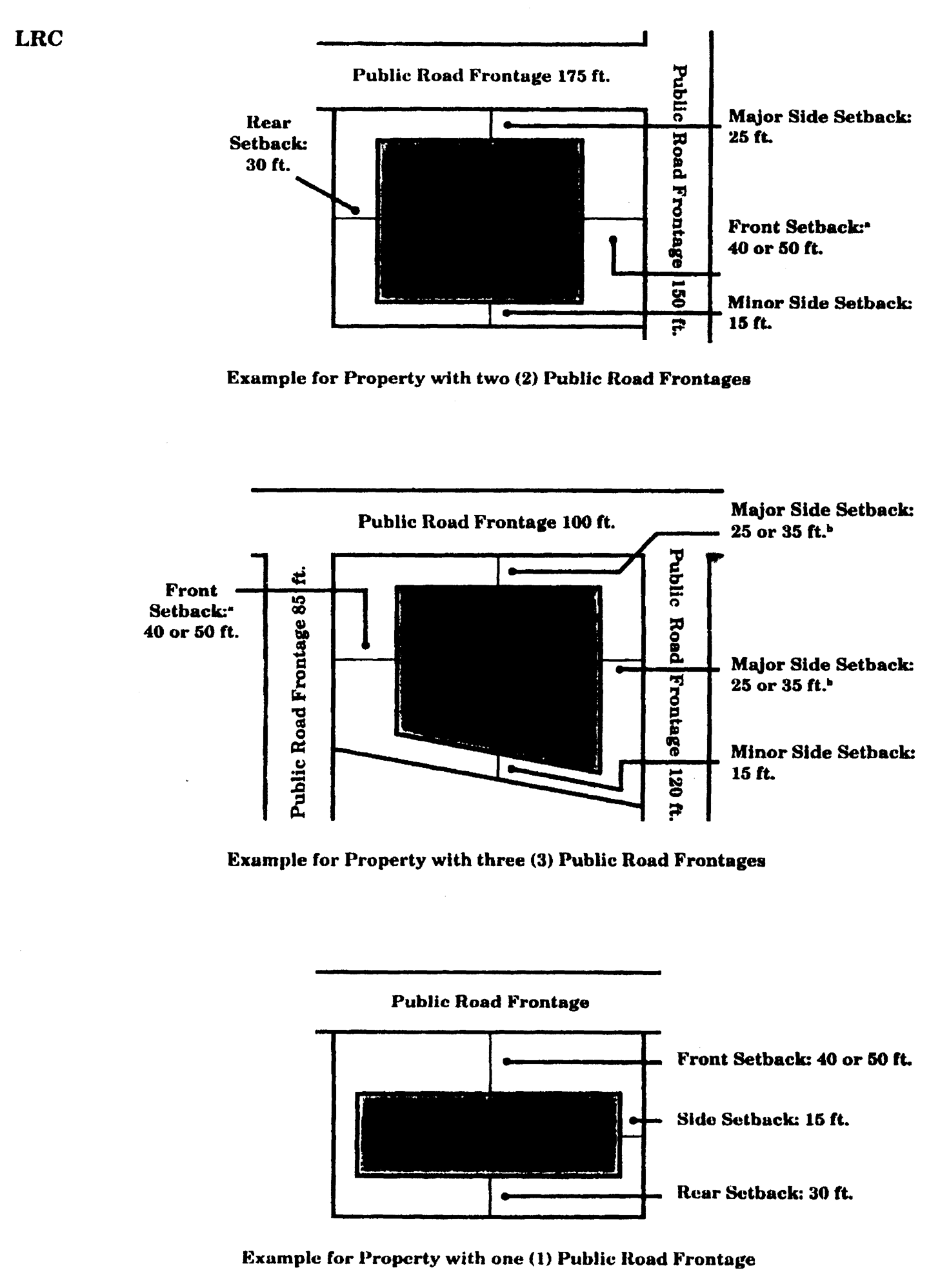
Minimum Building Setback Requirements for LRC District
Notes:
a Property with shorter amount of road frontage will be the front setback for determining other setbacks (major side, side, rear).
b If structure fronts a major side setback, major side setback shall be 35 feet.
(5)
Landscape buffer and screening requirements. Unless otherwise noted within this district's requirements, any property within an LRC district which abuts residentially zoned property shall have a minimum 20-foot landscaped screening buffer adjacent to all residentially zoned property, which will be subject to the county landscape architect's approval. Required buffers may be included within required setbacks; however, in such case that the required buffer is greater than the required setback, the required buffer shall be adhered to. Additionally, necessary private utilities and access drives may be allowed through, over or across a landscaped buffer. Any such uses which are proposed through, over or across a designated undisturbed buffer must be approved pursuant to an original site plan or site plan modification as set forth under section 134-126.
a.
Objectives. Undisturbed, planted landscape buffers and berms shall be implemented in connection with a permitted project and shall address the following objectives:
1.
Screening to enhance aesthetic appeal;
2.
Control or direction of vehicular and pedestrian movement;
3.
Reduction of glare;
4.
Buffering of noise; and
5.
Establishment of privacy.
b.
Standards. Buffers and berms shall be required when a LRC district is located adjacent to a residential district; a minimum twenty-foot buffer is required.
1.
Buffers. Landscape buffers are subject to review and approval by the county arborist or county landscape architect in accordance with the following standards:
i.
Plantings are to be a mix of evergreen trees and shrubs.
ii.
Species are to be ecologically compatible to the site and appropriate for the design situation.
iii.
Unless public safety concerns dictate otherwise, buffers should provide a 100 percent visual barrier to a height of six feet within two years of planting.
iv.
Minimum height of plant materials at installation is five feet for trees and two feet for shrubs.
v.
Fencing or walls are to be a minimum of six feet in height as approved by the county landscape architect or county arborist.
vi.
Trees included in buffer plantings may be counted toward site density calculations as required by chapter 50, article VI, pertaining to tree preservation and replacement, subject to review and approval of county arborist.
vii.
Buffers shall be regularly maintained by the property owner to ensure that the objectives and standards set out in this subsection are met.
viii.
When topography and existing conditions allow, the required 20-foot buffer should be an undisturbed buffer.
ix.
Any appeals from a determination by the county landscape architect or county arborist shall be to the board of zoning appeals.
2.
Berms. Berms are subject to review and approval by the county landscape architect or county arborist in accordance with the following standards:
i.
Berms shall be utilized when consistent with surrounding property features.
ii.
Berms shall be stabilized.
iii.
Berms shall be constructed to be consistent with natural or proposed drainage patterns.
iv.
Berms shall be regularly maintained by the property owner.
(6)
Floodplain and wetlands preservation requirements. Any development must also meet state and federal requirements relating to areas subject to the provisions of section 134-283, regarding mountain and river corridor protection act areas, and section 134-284, regarding metropolitan river protection act areas.
(7)
Building and structure requirements. Maximum building height is 35 feet, with no more than two stories.
(8)
Parking requirements. See section 134-272 for paved parking specifications.
(9)
Lighting requirements. Any project permitted within the LRC district which proposes a lighted facility must have a county department of transportation approved lighting plan in accordance with the minimum conditions listed in section 134-269.
(10)
Special exception uses. See section 134-271 for special exception uses and requirements for all districts. Special exception uses for the LRC district are the uses listed in section 134-271.
(11)
Use limitations.
a.
Maximum floor area ratio is 5,000 square feet per acre.
b.
All structures located within the LRC district shall be appropriately scaled in relation to the transitional nature of the immediate area.
c.
No business establishment shall occupy more than 5,000 square feet of gross floor area, except that either one drugstore or one hardware store may occupy up to 10,000 square feet of gross floor area, or a food store may occupy up to 35,000 square feet of gross floor area provided that the acreage is sufficient so as not to exceed the maximum floor area ratio.
d.
All refuse and designated recycling collection location facilities must be contained within completely enclosed facilities.
e.
No overnight parking of commercial vehicles is permitted, except for mini-vans or cars.
f.
It is found and declared that outside storage on properties within unincorporated Cobb County is a health risk and undesirable in that it provides harborage for rodents and insects, lowers property values, and constitutes a public nuisance; therefore, no outside storage or permanent outside display is permitted, unless otherwise allowed in this article. Within the LRC district, outside storage shall not include commercial vehicles used for a permitted use. Outside storage shall include any automobiles or vehicles that are being repaired or serviced in conjunction with a permitted use.
g.
No laboratories or clinics are permitted.
h.
No drive-through facilities are permitted unless specifically permitted and located under the main roof of a shopping center with at least two other retail uses.
i.
No uses that emit noxious odors, fumes or sounds are permitted.
j.
No sexually oriented businesses are permitted.
k.
No outside runs are permitted with any veterinary office use permitted within this district.
l.
No loading docks or facilities may be located in the front of any primary structure.
m.
Maximum impervious surfaces (80 percent—RAC, 70 percent—CAC and NAC) shall be established within activity centers as identified by the Cobb County Comprehensive Plan, as may be amended from time to time.
Required buffers may be included within required setbacks; however, in such case that the required buffer is greater than the required setback, the required buffer shall be adhered to. Additionally, necessary private utilities and access drives may be allowed through, over or across a landscaped buffer. Any such uses which are proposed through, over or across a designated undisturbed buffer must be approved pursuant to an original site plan or site plan modification as set forth under section 134-126.
(12)
Accessory buildings, structures, uses and decks. Any accessory building or structure in excess of 1,000 square feet of gross space shall be located to the rear of the primary structure and at least 40 feet from any residential property line. Any accessory building or structure which exceeds 1,000 square feet of gross space must have the approval of the division manager of zoning or his designee as to the location, architectural design and size prior to commencing construction. The division manager of zoning or his designee shall consider the following criteria for determining the appropriateness of the architectural design and size of the accessory building or structure: compatibility with the surrounding neighborhood, style of exterior (the exterior is to be compatible in style with the primary structure), use of the proposed accessory structure, impact on adjacent properties, and requirements as deemed appropriate by plan review as set forth in this subsection. All accessory buildings, structures and uses in excess of 1,000 gross square feet shall be required to submit for plan review through the community development department or receive approval from the director of the community development department or his designee. Permitted accessory structures and uses are as follows:
a.
Accessory storage buildings, to include parking garages, subject to the following conditions:
1.
Maximum height is two stories, not to exceed 35 feet.
2.
Such structures shall be located on the same lot as and to the rear of the principal building to which they are accessory.
3.
No accessory building shall be constructed upon a lot until construction of the principal building has commenced.
4.
On a corner lot, no accessory building shall be located closer to the side street right-of-way line than the principal building.
5.
When abutting any other nonresidential district, no garage or other accessory building shall be located closer than five feet to a side or rear lot line.
6.
When an accessory building is attached to the principal building by a breezeway, passageway or similar means, it shall comply with the yard requirements of the principal building to which it is accessory.
7.
Where any nonresidential lot adjoins the side or rear of a residential lot, an accessory building shall not be located within any required buffers.
b.
Antennas and satellite dishes, which shall meet the requirements set forth in section 134-274.
c.
Heating and air conditioning units, subject to the following conditions:
1.
When abutting any residential property line, heating and air conditioning units shall not be located within any required buffers.
2.
When abutting any other nonresidential district, no heating and air conditioning units shall be located closer than five feet to a side or rear lot line.
3.
Heating and air conditioning units may be installed on the roof of any structure zoned commercially so long as the heating and air conditioning unit does not exceed the height restrictions stated in this section and the units are placed so as to be hidden from front or side view.
4.
No ground-based heating and air conditioning units shall exceed 35 feet in height.
d.
Incidental storage, provided that the material stored is incidental to the permitted use, as determined by the division manager of zoning or his designee, and stored completely within a portion of the enclosed principal structure permitted within the district, or within a permitted accessory structure.
(Ord. of 10-27-92; Ord. of 7-11-95; Ord. of 6-24-97 (eff. 7-1-97); Ord. of 2-9-99; Ord. of 9-10-02; Ord. of 7-27-04; Ord. of 7-26-05; Amd. of 2-24-15; Amd. of 9-8-20)
Sec. 134-215. - O&I office and institutional district.
The regulations for the O&I office and institutional district are as follows:
(1)
Purpose and intent. The O&I district is established to provide locations for nonretail commercial uses such as offices and financial institutions, which are on properties delineated within or on the edge of a community activity center and a regional activity center as defined and shown on the Cobb County Comprehensive Plan: A Policy Guide, adopted November 27, 1990. The office and institutional district is designed primarily to provide for four-story and smaller office developments, office uses, motels, hotels, banking and professional offices that complement and provide step-down nodal zoning away from more intensive commercial uses and otherwise to implement the stated purpose of this chapter.
(2)
Definitions. The following words, terms and phrases, when used in this section, shall have the meanings ascribed to them in this subsection, except where the context clearly indicates a different meaning:
a.
Accessory retail uses means retail sales and services accessory to the operation of an office building or institutional use, motel, hotel or high-rise residential development, conducted wholly within the building housing the use to which such activities are accessory, provided that the floorspace used or to be used for such accessory retail uses shall be limited to a total of 25 square feet per dwelling unit in a high-rise residential development or 25 square feet per room in a hotel or motel, or ten percent of the net floor area in an office building or institutional use, and provided that:
1.
Every public entrance to such a use shall be from a lobby, hallway or other interior portion of the primary use structure;
2.
No show window, advertising or display shall be visible from the exterior of the primary use structure; and
3.
No merchandise shall be stored or displayed outside of the primary use structure.
4.
Accessory retail uses shall include eating and drinking establishments, barber shops, beauty shops, laundry and dry cleaning pickup establishments, news stands, florists' gift shops, film developing and printing facilities, stationery stores, shoe repair shops, or convenience food stores (no fuel sales).
5.
Accessory retail use square footage must be in the primary building it serves; accessory use square footages cannot be allocated to other buildings in a multibuilding development.
b.
Clinic. A medical or dental clinic is an organization of specializing physicians or dentists, or both, who have their offices in a common building. A clinic shall include laboratory facilities in conjunction with normal clinic services.
c.
Community fair means a festival or fair such as the North Georgia State Fair conducted wholly within public areas owned by a local government, provided that any activity is conducted at least 200 feet from any property line. Any event shall not exceed 21 days.
d.
Designated recycling collection locations means metal or heavy duty plastic containers designed for shortterm holding of pre-bagged recyclable items such as tin, aluminum, glass and paper (no perishable or food items allowed) for scheduled minimum monthly pickup, with no on-premises sorting. The center must be maintained in a safe, clean, neat and sanitary fashion and shall not encompass an area larger than 280 square feet.
1.
Such location shall be visually screened and maintained.
2.
Such location shall be within the building setbacks unless otherwise approved by the division manager of zoning or his designee due to topography, safety, internal traffic flow, site distance or other site-related circumstances not created by the property owner.
e.
Group home means a dwelling shared by six or less persons, excluding resident staff, to live together as a single housekeeping unit and in a longterm, family-like environment in which staff persons provide care, education and participation in community activities for the residents with the primary goal of enabling the residents to live as independently as possible in order to reach their maximum potential. This use shall apply to homes for the handicapped. As used in this subsection, the term "handicapped" shall mean:
1.
Having a physical or mental impairment that substantially limits one or more of such person's major life activities so that such person is incapable of living independently;
2.
Having a record of having such an impairment; or
3.
Being regarded as having such an impairment.
However, the term "handicapped" shall not include current illegal use of or addiction to a controlled substance, nor shall it include any person whose residency in the home would constitute a direct threat to the health and safety of other individuals. The term "group home for the handicapped" shall not include alcoholism or drug treatment centers, work release facilities for convicts or ex-convicts, or other housing facilities serving as an alternative to incarceration.
f.
Professional office means a structure wherein services are performed involving predominately administrative, professional or clerical operations such as the following: law, doctor, optician, audiologist, accounting, tax preparation, real estate, stockbroker, architect, engineer, manufacturer representative, professional counselor, dentist, investigative services, photographer, insurance, contractor, land surveyor, telephone sales, political/campaign, veterinarian or travel bureau.
(3)
Permitted uses. Permitted uses are as follows:
Accessory retail sales and services.
Ambulance services, if accessory to hospitals or funeral homes.
Animal hospitals.
Any use allowed within the Residential Senior Living (RSL) district, subject to all requirements of the RSL district.
Athletic and health clubs.
Automotive parking lots or garages.
Banks and financial institutions with drive-in establishments or automated transfer machines.
Bus stations.
Churches, chapels, temples, synagogues, and other such places of worship.
Clinics.
Clubs or lodges (noncommercial).
Colleges and universities, including but not limited to research and training facilities (private).
Community fairs.
Designated recycling collection locations.
Executive golf course (see section 134-270).
Fraternity and sorority houses and residence halls, if within 1,000 feet of a college or university.
Freestanding climate controlled self-service storage facilities. The following minimum standards shall apply to freestanding climate controlled self-service storage facilities:
1.
Building height should not exceed those of adjacent buildings, nor impact the view shed of adjacent residential property.
2.
F.A.R. should be 1.0 or as determined appropriate by the board of commissioners.
3.
All units shall be accessed through a main or central entrance.
4.
All windows or similar architectural features must be "one way" and provide for an opaque screen from view outside of the building.
5.
Architectural style/design to be similar or complementary to the predominant architectural design of other commercial uses within the activity center. Said architectural style/design to be approved by the board of commissioners. Any roof-mounted utilities or building components must be sufficiently screened from view of adjoining properties and public right-of-way.
6.
There shall be no outside storage allowed nor overnight and/or long-term parking of heavy equipment, commercial equipment or parking of construction or related equipment allowed.
7.
There shall be no storage of recreational vehicles and no dry storage of pleasure boats of any type customarily maintained by private individuals for their personal use.
8.
There shall be no storage of flammable liquids, highly combustible or explosive materials, or hazardous chemicals.
9.
No units within the facility shall be used for or considered to be premises for the purpose of assigning a legal address in order to obtain an occupational license or any other government permit or licenses to do business.
10.
There shall be no resident manager or any type of overnight accommodations for such.
11.
Landscape plan to be approved by staff with emphasis on planting within the parking facilities.
12.
One parking space shall be provided per every 80 individual storage units/areas.
13.
Loading area, including adequate turnaround space for a tractor trailer vehicle, must be screened by a permanent architectural or landscape feature or as may be approved by the board of commissioners if not located to side or rear of proposed structure.
14.
Lighting plan to be approved by the board of commissioners.
15.
No units shall be used to manufacture, fabricate or process goods, to service or repair vehicles, boats, small engines or electrical equipment, or to conduct similar repair activities, to conduct garage sales or retail sales of any kind, to rehearse or practice utilizing band instruments, or for conversion to an apartment or dwelling unit, or to conduct any other commercial or industrial activities on the site.
16.
Dumpster areas and detention areas must be sufficiently screened from view of adjoining properties and public right-of-way.
17.
Hours of operation to be established by the board of commissioners, considering the operational hours of surrounding businesses.
18.
Special land use permit as provided in section 134-37.
Funeral homes.
Golf courses, 18-hole regulation, public and private (see section 134-270).
Golf courses, par 3 (see section 134-270).
Group homes.
Hospitals.
Hotels.
In-home day care.
Medical and dental laboratories, provided that no chemicals are manufactured on-site.
Motels.
Nonprofit (seasonal use) fishing lakes.
Nursery schools and child care centers.
Pain clinic and pain management clinic (except when located in a NAC):
1.
No onsite dispensing of any prescription medications or controlled substances.
2.
One parking space per 200 gross square feet of building.
3.
Hours of operation to be established by the board of commissioners, considering the operational hours of surrounding businesses.
4.
Signage and lighting plan to be approved by the board of commissioners.
5.
Special land use permit as provided by section 134-37.
6.
The maximum length of approval for this use is 12 months.
7.
No interior doors allowed from clinic to other adjacent businesses.
Parking for vehicles.
Private parks.
Professional offices.
Radio and television stations.
Radio, television and other commercial towers and antennas subject to section 134-273.
Rest homes, personal care homes and convalescent homes.
Roominghouses and boardinghouses.
Temporary uses.
(4)
Lot size and setback requirements. Lot size and setback requirements are as follows:
a.
Minimum lot size: 20,000 square feet.
b.
Minimum lot width at front setback line: 60 feet.
c.
Minimum public road frontage: 50 feet.
d.
Minimum building setbacks: As shown and applied in the following diagram:
MINIMUM BUILDING SETBACK REQUIREMENTS FOR O&I DISTRICT
Note: All setbacks shall be measured from future right-of-way.
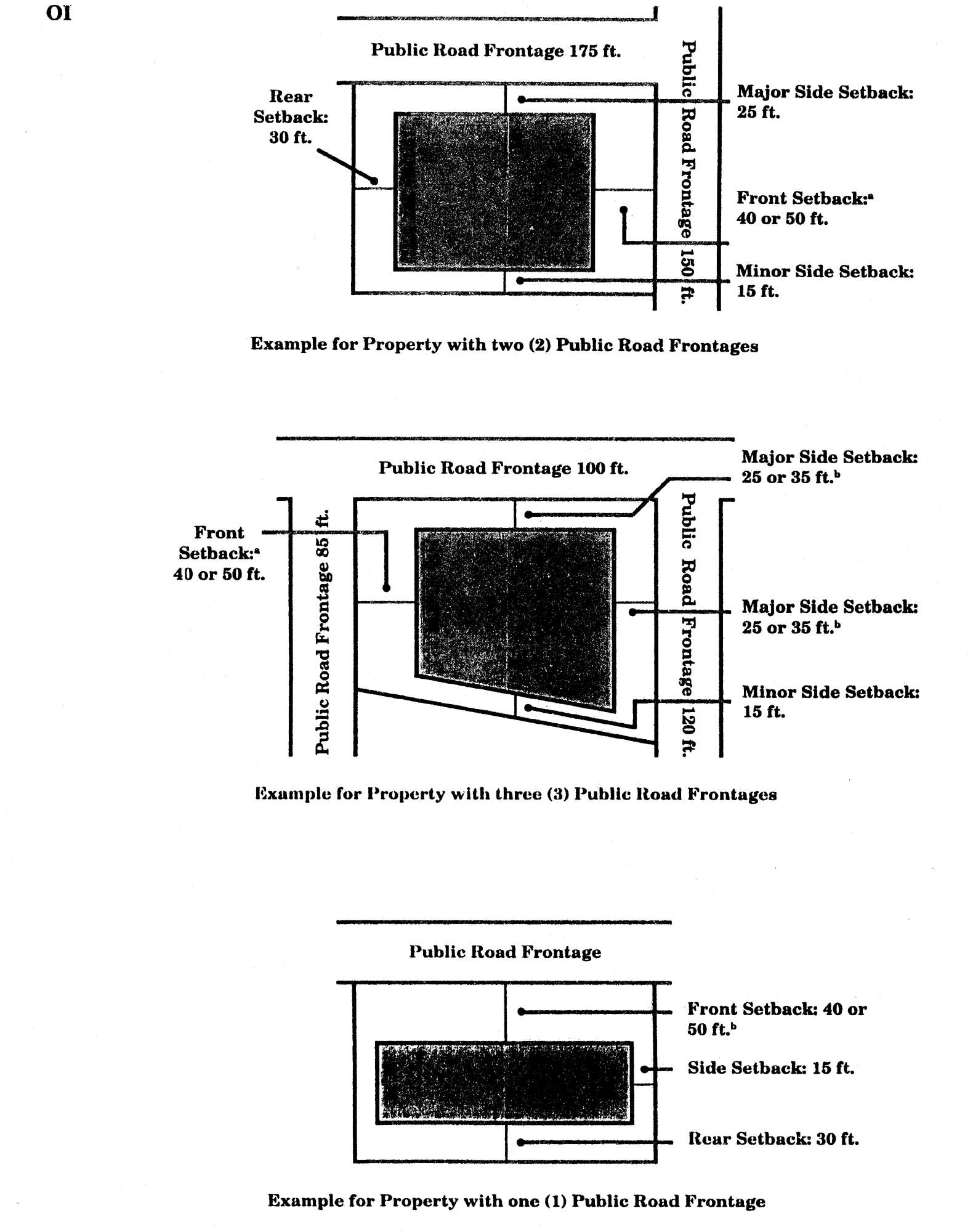
Minimum Building Setback Requirements for O&I District
Notes:
a Property with shorter amount of road frontage will be the front setback for determining other setbacks (major side, side, rear).
b If structure fronts a major side setback, major side setback shall be 35 feet.
(5)
Landscape buffer and screening requirements. Unless otherwise noted within this district's requirements, any property within an O&I district which abuts a residentially zoned property shall have a minimum 20-foot landscaped screening buffer. Required buffers may be included within required setbacks; however, in such case that the required buffer is greater than the required setback, the required buffer shall be adhered to. Additionally, necessary private utilities and access drives may be allowed through, over or across a landscaped buffer. Any such uses which are proposed through, over or across a designated undisturbed buffer must be approved pursuant to an original site plan or site plan modification as set forth under section 134-126.
a.
Objectives. Undisturbed, planted landscape buffers and berms shall be implemented in connection with a permitted project and shall address the following objectives:
1.
Screening to enhance aesthetic appeal;
2.
Control or direction of vehicular and pedestrian movement;
3.
Reduction of glare;
4.
Buffering of noise; and
5.
Establishment of privacy.
b.
Standards. Buffers and berms shall be required when an O&I district is located within or adjacent to a residential district; a minimum 20-foot buffer is required.
1.
Buffers. Landscape buffers are subject to review and approval by the county arborist or county landscape architect in accordance with the following standards:
i.
Plantings are to be a mix of evergreen trees and shrubs.
ii.
Species are to be ecologically compatible to the site and appropriate for the design situation.
iii.
Unless public safety concerns dictate otherwise, buffer should provide a 100 percent visual barrier to a height of six feet within two years of planting.
iv.
Minimum height of plant materials at installation is five feet for trees and two feet for shrubs.
v.
Fencing or walls are to be a minimum of six feet in height as approved by the county landscape architect or county arborist.
vi.
Trees included in buffer plantings may be counted toward site density calculations as required by chapter 50, article VI, pertaining to tree preservation and replacement, subject to review and approval of county arborist.
vii.
Buffers shall be regularly maintained by the property owner to ensure that the objectives and standards set out in this subsection are met.
viii.
When topography and existing conditions allow, the required 20-foot buffer should be an undisturbed buffer.
ix.
Any appeals from a determination by the county landscape architect or county arborist shall be to the board of zoning appeals.
2.
Berms. Berms are subject to review and approval by the county landscape architect or county arborist in accordance with the following standards:
i.
Berms shall be utilized when consistent with surrounding property features.
ii.
Berms shall be stabilized.
iii.
Berms shall be constructed to be consistent with natural or proposed drainage patterns.
iv.
Berms shall be regularly maintained by the property owner.
(6)
Floodplain and wetlands preservation requirements. Any development must also meet state and federal requirements relating to areas subject to the provisions of section 134-283, regarding mountain and river corridor protection act areas, and section 134-284, regarding metropolitan river protection act areas.
(7)
Building and structure requirements. Maximum building height is 52 feet, with no more than four stories.
(8)
Parking requirements. See section 134-272 for paved parking specifications.
(9)
Lighting requirements. Any project permitted within the O&I district which proposes a lighted facility must have a county department of transportation approved lighting plan in accordance with the minimum conditions listed in section 134-269.
(10)
Special exception uses. See section 134-271 for special exception use requirements for all districts. Special exception uses for the O&I district are the uses listed in section 134-271.
(11)
Special exception uses for community activity centers only. The following uses, with the proper scrutiny and conditions, may be considered as special exception uses within O&I district, only if they are within properties delineated as community activity centers as defined and shown on the Cobb County Comprehensive Plan: A Policy Guide, adopted November 27, 1990. Any special exception use, for regional activity centers only, shall adhere to the landscape buffer and screening requirements in subsection (5) of this section.
[a.
Reserved.]
b.
Climate controlled self-service storage facilities, when complementary or accessory to an office park or building.
The following minimum standards shall apply to climate controlled self-service storage facilities:
1.
Building height should not exceed those of adjacent buildings, nor impact the view shed of adjacent residential property.
2.
F.A.R. should be 1.0 or as determined appropriate by the board of commissioners.
3.
All units shall be accessed through a main or central entrance.
4.
All windows or similar architectural features must be "one way" and provide for an opaque screen from view outside of the building.
5.
Architectural style/design to be similar or complementary to the predominant architectural design of other commercial uses within the activity center. Said architectural style/design to be approved by the board of commissioners. Any roof-mounted utilities or building components must be sufficiently screened from view of adjoining properties and public right-of-way.
6.
There shall be no outside storage allowed nor overnight and/or long-term parking of heavy equipment, commercial equipment or parking of construction or related equipment allowed.
7.
There shall be no storage of recreational vehicles and no dry storage of pleasure boats of any type customarily maintained by private individuals for their personal use.
8.
There shall be no storage of flammable liquids, highly combustible or explosive materials, or hazardous chemicals.
9.
No units within the facility shall be used for or considered to be premises for the purpose of assigning a legal address in order to obtain an occupational license or any other government permit or licenses to do business.
10.
There shall be no resident manager or any type of overnight accommodations for such.
11.
Landscape plan to be approved by staff with emphasis on planting within the parking facilities.
12.
One parking space shall be provided per every 80 individual storage units/areas.
13.
Overall project must be accessed via a public or private roadway which is internal to the office park, building or shopping center; direct access to an adjoining public roadway shall be subject to approval by the board of commissioners.
14.
No freestanding signage shall be utilized; internal directional signage will be subject to approval by the board of commissioners.
15.
No units shall be used to manufacture, fabricate or process goods, to service or repair vehicles, boats, small engines or electrical equipment, or to conduct similar repair activities, to conduct garage sales or retail styles of any kind, to rehearse or practice utilizing band instruments, or for conversion to an apartment or dwelling unit, or to conduct any other commercial or industrial activities on the site.
16.
Loading area, including adequate turnaround space for a tractor trailer vehicle, must be screened by a permanent architectural or landscape feature or as may be approved by the board of commissioners if not located to side or rear of proposed structure.
17.
Special land use permit as provided in section 134-37.
18.
Hours of operation to be established by the board of commissioners, considering the operational hours of surrounding businesses.
(12)
Special exception uses for regional activity center only. The following uses, with the proper scrutiny and conditions, may be considered as special exception uses within the GC district, only if they are within properties delineated as regional activity centers as defined and shown on the Cobb County Comprehensive Plan: A Policy Guide, adopted November 27, 1990. Any special exception use, for regional activity centers only, shall adhere to the landscape buffer and screening requirements in subsection (5) of this section.
a.
Hotel (suite).
The following minimum standards shall apply to suite hotels:
1.
Minimum acreage is two acres.
2.
All rooms shall be accessed through a main or central lobby.
3.
No rooms shall access to the exterior of the building unless required by fire/safety regulations.
4.
The minimum number of floors allowed shall be three floors, unless otherwise approved by the board of commissioners.
5.
Architectural style/design to be approved by the board of commissioners.
6.
All buildings shall have a minimum roof pitch of a four in twelve as defined by applicable building codes.
7.
Conference, meeting or banquet facilities are allowed when supported by adequate parking and approved by the board of commissioners as part of the special land use permit.
8.
Restaurants or other type of eating facilities are allowed when supported by adequate parking and approved by the board of commissioners. "Continental" style dining for the guests of the facility only is allowed within or near the main or central lobby without additional parking.
9.
At a minimum, provisions for weekly cleaning for each suite must be provided.
10.
Each suite must be protected with a smoke detector and sprinkler system approved by the fire marshal or his designee.
11.
Each suite shall be required to include an automatic power off timer for each stove/cook top unit or other type burner.
12.
Parking shall be calculated as one space required for each suite, with an additional ten spaces provided for employees. Parking requirements for conference, meeting or banquet facilities or restaurants or other type of eating facilities within a suite hotel shall be calculated as provided for each use in section 134-272, "traffic and parking," in addition to the above parking requirements and approved by the board of commissioners.
13.
There shall be no outside storage allowed or long term parking of heavy equipment, or parking of construction or related equipment allowed.
14.
A landscaping plan is to be approved by staff with emphasis on planting within the parking facilities.
15.
No facility under this section is to be converted or used primarily as an apartment or condominium.
b.
Climate controlled self-service storage facilities, when complementary or accessory to an office park or building.
The following minimum standards shall apply to climate controlled self-service storage facilities:
1.
Building height should not exceed those of adjacent buildings, nor impact the view shed of adjacent residential property.
2.
F.A.R. should be 2.0 or as determined appropriate by the board of commissioners.
3.
All units shall be accessed through a main or central entrance.
4.
All windows or similar architectural features must be "one way" and provide for an opaque screen from view outside of the building.
5.
Architectural style/design to be similar or complementary to the predominant architectural design of other commercial uses within the activity center. Said architectural style/design to be approved by the board of commissioners. Any roof-mounted utilities or building components must be sufficiently screened from view of adjoining properties and public right-of-way.
6.
There shall be no outside storage allowed nor overnight and/or long-term parking of heavy equipment, commercial equipment or parking of construction or related equipment allowed.
7.
There shall be no storage of recreational vehicles and no dry storage of pleasure boats of any type customarily maintained by private individuals for their personal use.
8.
There shall be no storage of flammable liquids, highly combustible or explosive materials, or hazardous chemicals.
9.
No units within the facility shall be used for or considered to be premises for the purpose of assigning a legal address in order to obtain an occupational license or any other government permit or licenses to do business.
10.
There shall be no resident manager or any type of overnight accommodations for such.
11.
Landscape plan to be approved by staff with emphasis on planting within the parking facilities.
12.
One parking space shall be provided per every 80 individual storage units/areas.
13.
Overall project must be accessed via a public or private roadway which is internal to the office park, building or shopping center; direct access to an adjoining public roadway shall be subject to approval by the board of commissioners.
14.
No freestanding signage shall be utilized; internal directional signage will be subject to approval by the board of commissioners.
15.
No units shall be used to manufacture, fabricate or process goods, to service or repair vehicles, boats, small engines or electrical equipment, or to conduct similar repair activities, to conduct garage sales or retail styles of any kind, to rehearse or practice utilizing band instruments, or for conversion to an apartment or dwelling unit, or to conduct any other commercial or industrial activities on the site.
16.
Loading area, including adequate turnaround space for a tractor trailer vehicle, must be screened by a permanent architectural or landscape feature or as may be approved by the board of commissioners if not located to side or rear of proposed structure.
17.
Special land use permit as provided in section 134-37.
18.
Hours of operation to be established by the board of commissioners, considering the operational hours of surrounding businesses.
(13)
Use limitations.
a.
Maximum floor area ratio is 0.75 for office uses and 0.25 for retail uses (accessory).
b.
All structures located within an O&I district shall be appropriately scaled in relation to the transitional nature of the immediate area.
c.
All refuse and designated recycling collection location facilities must be contained within completely enclosed facilities.
d.
It is found and declared that outside storage on properties within unincorporated Cobb County is a health risk and undesirable in that it provides harborage for rodents and insects, lowers property values, and constitutes a public nuisance; therefore, no outside storage is permitted, unless otherwise allowed in this article. Within the O&I district, outside storage shall not include commercial vehicles.
e.
No sexually oriented businesses are permitted.
f.
No drive-in eating or drinking establishments are permitted.
g.
No uses that emit noxious odors, fumes or sounds are permitted.
h.
No outside runs are permitted with any veterinary office use permitted within this district.
i.
Kitchenettes or kitchen facilities are prohibited in motels.
j.
Maximum impervious surfaces (80%-RAC, 70%-CAC and NAC) shall be established within activity centers as identified by the Cobb County Comprehensive Plan, as may be amended from time to time.
k.
No loading docks or facilities may be located in the front of any primary structure.
Required buffers may be included within required setbacks; however, in such case that the required buffer is greater than the required setback, the required buffer shall be adhered to. Additionally, necessary private utilities and access drives may be allowed through, over or across a landscaped buffer. Any such uses which are proposed through, over or across a designated undisturbed buffer must be approved pursuant to an original site plan or site plan modification as set forth under section 134-126.
(14)
Accessory buildings, structures, uses and decks. Any accessory building or structure in excess of 1,000 square feet of gross space shall be located to the rear of the primary structure and at least 40 feet from any residential property line. Any accessory building or structure which exceeds 1,000 square feet of gross space must have the approval of the division manager of zoning or his designee as to the location, architectural design and size prior to commencing construction. The division manager of zoning or his designee shall consider the following criteria for determining the appropriateness of the architectural design and size of the accessory building or structure: compatibility with the surrounding neighborhood, style of exterior (the exterior is to be compatible in style with the primary structure), use of the proposed accessory structure, impact on adjacent properties, and requirements as deemed appropriate by plan review as set forth in this subsection. All accessory buildings, structures and uses in excess of 1,000 gross square feet shall be required to submit for plan review through the community development department or receive approval from the director of the community development department or his designee. Permitted accessory structures and uses are as follows:
a.
Accessory retail sales and service.
b.
Accessory storage buildings, to include parking garages, subject to the following conditions:
1.
Maximum height is two stories, not to exceed 35 feet.
2.
Such structures shall be located on the same lot as and to the rear of the principal building to which they are accessory.
3.
No accessory building shall be constructed upon a lot until construction of the principal building has commenced.
4.
On a corner lot, no accessory building shall be located closer to the side street right-of-way line than the principal building.
5.
When abutting any other nonresidential district, no garage or other accessory building shall be located closer than five feet to a side or rear lot line.
6.
When an accessory building is attached to the principal building by a breezeway, passageway or similar means, it shall comply with the yard requirements of the principal building to which it is accessory.
7.
Where any nonresidential lot adjoins the side or rear of a residential lot, an accessory building shall not be located within any required buffers.
c.
Antennas and satellite dishes, which shall meet the requirements set forth in section 134-274.
d.
Freestanding parking garages, subject to the following conditions:
1.
Maximum height: four stories.
2.
When abutting any residential property line, freestanding parking garages shall not be located within any required buffers.
3.
When abutting any other nonresidential district, no freestanding garage shall be located closer than five feet to a side or rear lot line.
e.
Heating and air conditioning units, subject to the following conditions:
1.
When abutting any residential property line, heating and air conditioning units shall not be located within any required buffers.
2.
When abutting any other nonresidential district, no heating and air conditioning units shall be located closer than five feet to a side or rear lot line.
3.
Heating and air conditioning units may be installed on the roof of any structure zoned commercially so long as the heating and air conditioning unit does not exceed the height restrictions stated in this section and the units are placed so as to be hidden from a front or side view.
4.
No ground-based heating and air conditioning unit shall exceed 35 feet in height.
f.
Incidental storage, provided that the material stored is incidental to the permitted use, as determined by the division manager of zoning or his designee, and stored completely within a portion of the enclosed principal structure permitted within the district, or within a permitted accessory structure.
(Ord. of 12-26-72; Ord. of 12-11-90, § 3-28-7.22; Ord. of 8-13-91; Ord. of 6-9-92; Ord. of 7-11-95; Ord. of 6-24-97 (eff. 7-1-97); Ord. of 9-12-00; Ord. of 7-10-01; Ord. of 9-10-02; Ord. of 12-9-03; Ord. of 7-27-04; Ord. of 7-26-05; Ord. of 2-26-08; Amd. of 2-24-09; Amd. of 3-24-09; Ord. of 7-27-10; Amd. of 2-24-15; Amd. of 9-8-20)
Sec. 134-216. - UVC urban village commercial district.
The regulations for the UVC urban village commercial district are as follows:
(1)
Purpose and intent. The UVC district is established to provide locations for planned mixed use development of low intensity, low scale commercial, office and residential uses, not subdivided into customary streets and lots, and which will not be subdivided. This is intended to encourage compatible mixed uses within the boundaries of properties delineated within or on the edge of a regional, community and neighborhood activity center and high density residential as defined and shown on the Cobb County Comprehensive Plan: A Policy Guide, adopted November 27, 1990. When located on the edge of activity centers or high density residential areas as defined by the comprehensive plan, the UVC district should provide for office and retail uses that are low in intensity to ensure compatibility with adjacent single-family detached dwellings and otherwise to implement the stated purpose and intent of this chapter.
(2)
Definitions. The following words, terms and phrases, when used in this section, shall have the meanings ascribed to them in this subsection, except where the context clearly indicates a different meaning:
a.
Commercial produce and agricultural product stands means temporary structures not greater than 250 square feet for the purpose of sales of produce and agricultural products, including firewood, not grown on-site, subject to the following conditions:
1.
The operator must have a current business license.
2.
All structures shall be temporary and located off the right-of-way and shall not impair vision at intersecting streets, driveways and/or alleys or easements.
3.
Animals, livestock and poultry sales shall not be permitted.
4.
Adequate parking off the right-of-way must be provided; however, should sales of such products constitute a nuisance or create a safety hazard, then such sales may be further restricted to protect the health, safety and welfare of the public.
5.
No permanent, temporary or mobile living or office quarters shall be permitted.
6.
Christmas tree sales and other temporary uses are specifically excluded from these requirements, but shall be subject to the specific requirements of those uses.
7.
It is found and declared that outside storage on properties within unincorporated Cobb County is a health risk and undesirable in that it provides harborage for rodents and insects, lowers property values, and constitutes a public nuisance; therefore, no outside storage of empty containers such as boxes, crates, pallets, etc., shall be permitted, unless otherwise allowed in this article.
8.
Signage:
i.
One permitted sign per temporary vendor, no greater than 24 square feet.
ii.
No manufactured portable signs shall be allowed.
iii.
All signage requires a sign permit.
b.
Community fair means a festival or fair such as the North Georgia State Fair conducted wholly within public areas owned by a local government, provided that any activity is conducted at least 200 feet from any property line. Any event shall not exceed 21 days.
c.
Designated recycling collection locations means metal or heavy duty plastic containers designed for shortterm holding of pre-bagged recyclable items such as tin, aluminum, glass and paper (no perishable or food items allowed) for scheduled minimum monthly pickup, with no on-premises sorting. The center must be maintained in a safe, clean, neat and sanitary fashion and shall not encompass an area larger than 280 square feet.
1.
Such location shall be visually screened and maintained.
2.
Such location shall be within the building setbacks unless otherwise approved by the division manager or his designee due to topography, safety, internal traffic flow, site distance or other site-related circumstances not created by the property owner.
d.
Group home means a dwelling shared by six or less persons, excluding resident staff, who live together as a single housekeeping unit and in a longterm, family-like environment in which staff persons provide care, education and participation in community activities for the residents with the primary goal of enabling the residents to live as independently as possible in order to reach their maximum potential. This use shall apply to homes for the handicapped. As used in this subsection, the term "handicapped" shall mean:
1.
Having a physical or mental impairment that substantially limits one or more of such person's major life activities so that such person is incapable of living independently;
2.
Having a record of having such an impairment; or
3.
Being regarded as having such an impairment.
However, the term "handicapped" shall not include current illegal use of or addiction to a controlled substance, nor shall it include any person whose residency in the home would constitute a direct threat to the health and safety of other individuals. The term "group home for the handicapped" shall not include alcoholism or drug treatment centers, work release facilities for convicts or ex-convicts, or other housing facilities serving as an alternative to incarceration.
e.
Professional office means a structure wherein services are performed involving predominately administrative, professional or clerical operations such as the following: law, doctor, optician, audiologist, accounting, tax preparation, real estate, stockbroker, architect, engineer, manufacturer representative, professional counselor, dentist, investigative services, photographer, insurance, contractor, land surveyor, telephone sales, political/campaign, veterinarian or travel bureau.
f.
Purpose built student housing means a multi-family residential development marketed to affiliates of an academic or professional college or university, or other recognized institution of higher learning. These developments are typically located near college campuses and offer amenities such as individual leases, fully-furnished units, and residence life programs specific to college students.
(3)
Permitted uses. Permitted uses are as follows:
Automotive parking lots or garages.
Banks and financial institutions with automated transfer machines; however, no drive-in establishments are permitted.
Churches, chapels, temples, synagogues, and other such places of worship.
Commercial produce and agricultural product stands.
Community fairs.
Cultural facilities.
Designated recycling collection locations.
Eating and drinking establishments subject to use limitations, including no bars or nightclubs.
Executive golf courses (see section 134-270).
Golf courses, 18-hole regulation, public and private (see section 134-270).
Golf courses, par 3 (see section 134-270).
Group homes.
In-home day care.
Medical and dental laboratories, provided no chemicals are manufactured on-site.
Neighborhood retail uses, such as antique, apparel, drugs, florist, food, gifts, books and jewelry stores, not to exceed 1,000 square feet of gross floor area; and snack or sandwich bars, provided that the size is limited to 1,000 square feet of gross floor area and no drive-through establishments are permitted.
Nonprofit (seasonal use) fishing lakes.
Nursery schools and child day care centers.
Office service and supply establishments.
Parking for vehicles.
Professional offices.
Purpose built student housing (requires a special land use permit per section 134-37(a)(34)a.—p.).
Single-family dwelling units (attached and detached), provided that such dwellings shall meet all other applicable requirements of this district.
Temporary uses.
(4)
Lot size and setback requirements. Lot size and setback requirements are as follows:
a.
Minimum lot size: Two acres with a minimum of 7,500 square feet (gross) of finished floor space.
b.
Minimum lot width at front setback line: 60 feet.
c.
Minimum public road frontage: 50 feet.
d.
Minimum building setbacks: As shown and applied in the following diagram:
MINIMUM BUILDING SETBACK REQUIREMENTS FOR UVC DISTRICT
Note: All setbacks shall be measured from future right-of-way.
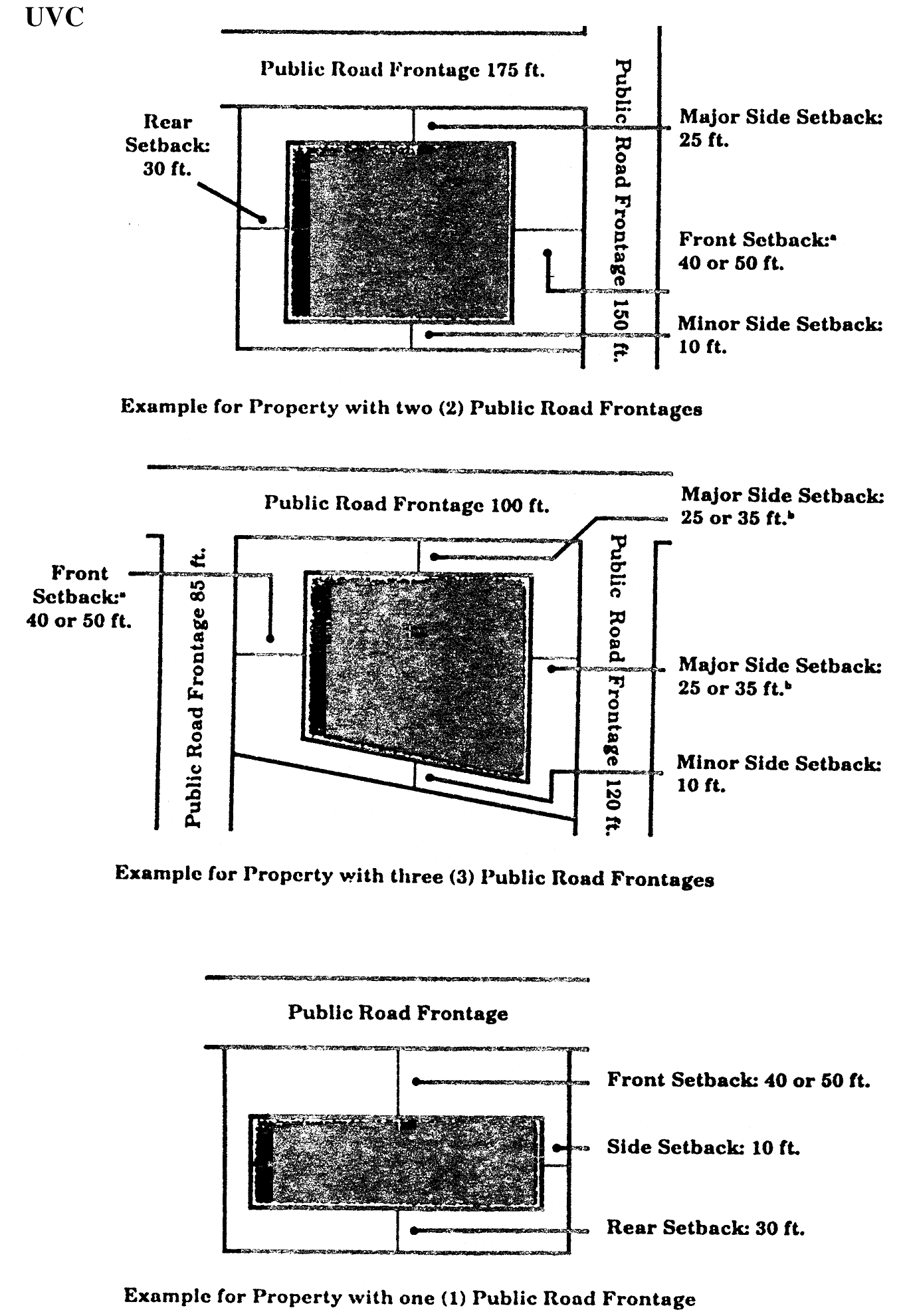
Minimum Building Setback Requirements for UVC District
Notes:
a Property with shorter amount of road frontage will be the front setback for determining other setbacks (major side, side, rear).
b If structure fronts a major side setback, major side setback shall be 35 feet.
(5)
Landscape buffer and screening requirements. Unless otherwise noted within this district's requirements, any property within an UVC district which abuts residentially zoned property shall have a minimum ten-foot landscaped screening buffer adjacent to all residentially zoned property, which will be subject to county staff approval. Required buffers may be included within required setbacks; however, in such case that the required buffer is greater than the required setback, the required buffer shall be adhered to. Additionally, necessary private utilities and access drives may be allowed through, over or across a landscaped buffer. Any such uses which are proposed through, over or across a designated undisturbed buffer must be approved pursuant to an original site plan or site plan modification as set forth under section 134-126.
a.
Objectives. Undisturbed, planted landscape buffers and berms shall be implemented in connection with a permitted project and shall address the following objectives:
1.
Screening to enhance aesthetic appeal;
2.
Control or direction of vehicular and pedestrian movement;
3.
Reduction of glare;
4.
Buffering of noise; and
5.
Establishment of privacy.
b.
Standards. Buffers or berms shall be required when a UVC district is located adjacent to a residential district; a minimum ten-foot buffer is required.
1.
Buffers. Landscape buffers are subject to review and approval by county staff in accordance with the following standards:
i.
Plantings are to be a mix of evergreen trees and shrubs.
ii.
Species are to be ecologically compatible to the site and appropriate for the design situation.
iii.
Unless public safety concerns dictate otherwise, buffers should provide a maximum visual barrier to a height of six feet within two years of planting.
iv.
Minimum height of plant materials at installation is five feet for trees and two feet for shrubs.
v.
Fencing or walls are to be a minimum of six feet in height as approved by county staff.
vi.
Trees included in buffer plantings may be counted toward site density calculations as required by chapter 50, article VI, pertaining to tree preservation and replacement, subject to review and approval of county staff.
vii.
Buffers shall be regularly maintained by the property owner to ensure that the objectives and standards set out in this subsection are met.
viii.
When topography and existing conditions allow, the required ten-foot buffer should be an undisturbed buffer.
ix.
Any appeals from a determination by county staff shall be to the board of zoning appeals.
2.
Berms. Berms are subject to review and approval by county staff in accordance with the following standards:
i.
Berms shall be utilized when consistent with surrounding property features.
ii.
Berms shall be stabilized.
iii.
Where possible, berms shall be constructed to be consistent with natural or proposed drainage patterns.
iv.
Berms shall be regularly maintained by the property owner.
(6)
Floodplain and wetlands preservation requirements. Any development must meet state and federal requirements relating to areas subject to the provisions of section 134-283, regarding mountain and river corridor protection act areas, and section 134-284, regarding metropolitan river protection act areas. No floodplains and/or wetlands may be used in calculating the overall density of the development.
(7)
Building and structure requirements. Maximum building height to be determined by the board of commissioners on a case by case basis considering nature and character of surrounding properties.
(8)
Parking requirements. See section 134-272 for paved parking specifications.
(9)
Lighting requirements. Any project permitted within the UVC district which proposes a lighted facility must have a county department of transportation approved lighting plan in accordance with the minimum conditions listed in section 134-269.
(10)
Special exception uses. See section 134-271 for special exception uses and requirements for all districts.
(11)
Temporary land use permits and special land use permits. See sections 134-36 and 134-37 for additional uses and requirements for all districts. Uses requiring land use permits or special land use permits for the UVC district are the designated uses listed in sections 134-36 and 134-37.
(12)
Use limitations.
a.
Maximum floor area ratio is 0.25.
b.
All structures located within a UVC district shall be appropriately scaled in relation to the transitional nature of the immediate area.
c.
All refuse and designated recycling collection location facilities must be contained within completely enclosed facilities.
d.
No sexually oriented businesses are permitted.
e.
No overnight parking of commercial vehicles is permitted, except for mini-vans or cars.
f.
It is found and declared that outside storage on properties within unincorporated Cobb County is a health risk and undesirable in that it provides harborage for rodents and insects, lowers property values, and constitutes a public nuisance; therefore, no outside storage or permanent outside display is permitted, unless otherwise allowed in this article. Within the LRC district, outside storage shall not include commercial vehicles used for a permitted use. Outside storage shall include any automobiles or vehicles that are being repaired or serviced in conjunction with a permitted use.
g.
No drive-in establishments are permitted.
h.
No uses that emit noxious odors, fumes or sounds are permitted.
i.
No outside runs are permitted with any veterinary office use permitted within this district.
j.
Eating and drinking establishments shall not exceed 3,000 square feet and shall not allow bars or nightclubs.
k.
Residential densities may also be limited in overall acreage due to intense deforestation, drainage, erosion and sedimentation concerns associated with such development.
l.
Maximum impervious surfaces (80 percent—RAC, 70 percent—CAC and NAC) shall be established within activity centers as identified by the Cobb County Comprehensive Plan, as may be amended from time to time.
m.
Special requirements:
1.
Residential density shall be determined by the board of commissioners on a case by case basis considering nature and character of surrounding properties.
2.
The minimum floor area of any residential dwelling shall not be less than 1,000 square feet.
3.
No residential dwelling unit shall occupy a ground floor.
4.
All retail sales and personal service establishments shall be located on a ground floor.
5.
The gross floor area occupied by nonresidential uses shall not exceed 50 percent of the total gross floor area of the buildings or individual structures.
6.
Approval by the county fire marshal is required.
7.
The residential portion of the development shall be completed and operational prior to issuance of certificate of occupancy for the commercial portion.
8.
No loading docks or facilities may be located in the front of any primary structure.
Required buffers may be included within required setbacks; however, in such case that the required buffer is greater than the required setback, the required buffer shall be adhered to. Additionally, necessary private utilities and access drives may be allowed through, over or across a landscaped buffer. Any such uses which are proposed through, over or across a designated undisturbed buffer must be approved pursuant to an original site plan or site plan modification as set forth under section 134-126.
(13)
Accessory buildings, structures, uses and decks. Any accessory building or structure in excess of 1,000 square feet of gross space shall be located to the rear of the primary structure and at least 40 feet from any residential property line. Any accessory building or structure which exceeds 1,000 square feet of gross space must have the approval of the division manager of zoning or his designee as to the location, architectural design and size prior to commencing construction. The division manager of zoning or his designee shall consider the following criteria for determining the appropriateness of the architectural design and size of the accessory building or structure: compatibility with the surrounding neighborhood, style of exterior (the exterior is to be compatible in style with the primary structure), use of the proposed accessory structure, impact on adjacent properties, and requirements as deemed appropriate by plan review as set forth in this subsection. All accessory buildings, structures and uses in excess of 1,000 gross square feet shall be required to submit for plan review through the community development department or receive approval from the director of the community development department or his designee. Permitted accessory structures and uses are as follows:
a.
Accessory storage buildings, to include parking garages, subject to the following conditions:
1.
Maximum height is two stories, not to exceed 35 feet.
2.
Such structures shall be located on the same lot as and to the rear of the principal building to which they are accessory.
3.
No accessory building shall be constructed upon a lot until construction of the principal building has commenced.
4.
On a corner lot, no accessory building shall be located closer to the side street right-of-way line than the principal building.
5.
When abutting any other nonresidential district, no garage or other accessory building shall be located closer than five feet to a side or rear lot line.
6.
When an accessory building is attached to the principal building by a breezeway, passageway or similar means, it shall comply with the yard requirements of the principal building to which it is accessory.
7.
Where any nonresidential lot adjoins the side or rear of a residential lot, an accessory building shall not be located within any required buffers.
b.
Antennas and satellite dishes, which shall meet the requirements set forth in section 134-274.
c.
Carwashes accessory to convenience food stores with self-service fuel.
d.
Heating and air conditioning units, subject to the following conditions:
1.
When abutting any residential property line, heating and air conditioning units shall not be located within any required buffers.
2.
When abutting any other nonresidential district, no heating and air conditioning units shall be located closer than five feet to a side or rear lot line.
3.
Heating and air conditioning units may be installed on the roof of any structure zoned commercially so long as the heating and air conditioning unit does not exceed the height restrictions stated in this section and the units are placed so as to be hidden from a front or side view.
e.
Incidental storage, provided that the material stored is incidental to the permitted use, as determined by the zoning division manager or his designee, and stored completely within a portion of the enclosed principal structure permitted within the district, or within a permitted accessory structure.
(Ord. of 12-26-72; Ord. of 12-11-90, § 3-28-7.23; Ord. of 8-13-91; Ord. of 6-9-92; Ord. of 7-11-95; Ord. of 2-27-96; Ord. of 6-24-97 (eff. 7-1-97); Ord. of 9-10-02; Ord. of 12-9-03; Ord. of 1-13-04; Ord. of 7-27-04; Ord. of 7-26-05; Ord. of 8-9-05; Ord. of 1-24-06; Amd. of 2-25-14; Amd. of 2-24-15; Amd. of 2-28-17; Amd. of 8-27-19; Amd. of 9-8-20)
Sec. 134-217. - PVC planned village community district.
Commencing January 1, 1998, no new applications for a Special Land Use Permit for Self-service Storage Facilities (SSSF) are to be accepted by the board of commissioners. The regulations for the PVC planned village community district are as follows:
(1)
Purpose and intent. The PVC district is established to provide locations and encourage flexible site plans and building arrangements under a unified plan of development rather than lot-by-lot regulation for retail commercial and service uses which are designed and oriented to be self-sufficient neighborhoods making up a community. The developer benefits from better land utilization and economy in the provision of roads and utilities and overall site design. Projects developed within a PVC district should be designed to compact unified retail centers within the center of the community. Projects developed within a PVC district should occupy a quadrant of an intersection and only have ingress and egress from a major or collector street or state highway which is delineated within any land use category other than industrial or industrial compatible as defined and shown on the Cobb County Comprehensive Plan: A Policy Guide, adopted November 27, 1990. Additionally, the desired quadrant location will provide for planned developments and one-destination shopping and service locations to serve the community, and will minimize traffic congestion.
(2)
Definitions. The following words, terms and phrases, when used in this section, shall have the meanings ascribed to them in this subsection, except where the context clearly indicates a different meaning:
a.
Clinic. A medical or dental clinic is an organization of specializing physicians or dentists, or both, who have their offices in a common building. A clinic shall include laboratory facilities in conjunction with normal clinic services.
b.
Community fair means a festival or fair such as the North Georgia State Fair conducted wholly within public areas owned by a local government, provided that any activity is conducted at least 200 feet from any property line. Any event shall not exceed 21 days.
c.
Convenience food store with self-service fuel sales means any retail establishment offering for sale automotive fuels, prepackaged food products, beverages, household items and other goods commonly associated with the such establishments. There shall be no automotive repairs done on-site.
d.
Designated recycling collection locations means metal or heavy duty plastic containers designed for shortterm holding of pre-bagged recyclable items such as tin, aluminum, glass and paper (no perishable or food items allowed) for scheduled minimum monthly pickup, with no on-premises sorting. The center must be maintained in a safe, clean, neat and sanitary fashion and shall not encompass an area larger than 280 square feet.
1.
Such location shall be visually screened and maintained.
2.
Such location shall within the building setbacks unless otherwise approved by the division manager of zoning or his designee due to topography, safety, internal traffic flow, site distance or other site-related circumstances not created by the property owner.
e.
Group home means a dwelling shared by six or less persons, excluding resident staff, who live together as a single housekeeping unit and in a longterm, family-like environment in which staff persons provide care, education and participation in community activities for the residents with the primary goal of enabling the residents to live as independently as possible in order to reach their maximum potential. This use shall apply to homes for the handicapped. As used in this subsection, the term "handicapped" shall mean:
1.
Having a physical or mental impairment that substantially limits one or more of such person's major life activities so that such person is incapable of living independently;
2.
Having a record of having such an impairment; or
3.
Being regarded as having such an impairment.
However, the term "handicapped" shall not include current illegal use of or addiction to a controlled substance, nor shall it include any person whose residency in the home would constitute a direct threat to the health and safety of other individuals. The term "group home for the handicapped" shall not include alcoholism or drug treatment centers, work release facilities for convicts or ex-convicts, or other housing facilities serving as an alternative to incarceration.
f.
Light automotive repair establishment means an indoor repair establishment (no outside storage) for performing light auto and small truck repair (under one ton) such as brake repair, oil changes, lubrication, transmission repair, installation of belts and hoses, inspections and the like.
g.
Neighborhood retail uses means commonly found low scale and low intensity retail uses, with square footages not to exceed the limitations established in this specific chapter, that offer basic services and frequently purchased goods to the immediate surrounding residential areas, such as but not limited to the following: auto store, antique shop, appliance store (home use), bakery, barbershop or beauty shop, beverage shop, bookstore (but not including adult bookstores), bridal shop, camera shop, china and pottery store, clothing store, dance studio, delicatessen, dog grooming shop, draperies and interior decorating supplies, drugstore or hardware, dry goods store, florist, furniture store, gifts and stationery store, jewelry store, manicurist shop, meat market or butcher shop, millinery store, mimeograph and letter shop, music store, novelty shop, paint store, pedicurist shop, shoe repair shop, shoe store, sporting goods store, supermarket or grocery, tailor shop, toy store, variety shop or video store.
h.
Nonautomotive repair uses means commonly found low intensity repair shops such as jewelry, camera, home appliance, television and videocassette recorder repair shops.
i.
Office service and supply establishments means wholesale and retail commercial establishments that sell, service and supply small office equipment and supplies, such as stores that offer sales of copiers, facsimile machines, typewriters, ribbons, transcribers, dictation equipment, tape, staplers and other general office equipment.
j.
Professional office means a structure wherein services are performed involving predominately administrative, professional or clerical operations such as the following: law, doctor, optician, audiologist, accounting, tax preparation, real estate, stockbroker, architect, engineer, manufacturer representative, professional counselor, dentist, investigative services, photographer, insurance, contractor, land surveyor, telephone sales, political/campaign, veterinarian or travel bureau.
k.
Purpose built student housing means a multi-family residential development marketed to affiliates of an academic or professional college or university, or other recognized institution of higher learning. These developments are typically located near college campuses and offer amenities such as individual leases, fully-furnished units, and residence life programs specific to college students.
(3)
Permitted uses. Permitted uses are as follows:
Animal hospitals (only within CAC or RAC).
Athletic and health clubs (only within CAC or RAC).
Banks and financial institutions with drive-in establishment or automated transfer machines.
Churches, chapels, temples, synagogues, and other such places of worship.
Clinics.
Clubs or lodges (noncommercial) (only within CAC or RAC).
Community retail uses (only within CAC or RAC).
Convenience food stores with self-service fuel sales, provided that the building shall not exceed 3,000 square feet in gross floor area and that no automotive repairs shall be done on-site.
Corporate or administrative offices for any permitted uses (only within CAC or RAC).
Cottage food operators as regulated by the Georgia Department of Agriculture in accordance with its Rules, Chapter 40-7-19, as may be amended from time to time subject to the following requirements:
1.
There shall be no signage or other exterior evidence of the cottage food operator.
2.
Deliveries of specialty ingredients such as herbs and spices, etc., limited to those made by the United States Postal Service or other carrier (FedEx, United Parcel Service, etc.) that routinely delivers mail/internet order products to residents.
3.
No cottage food products prepared by the cottage food operator may be picked up by a commercial carrier.
4.
There shall be no employee parking on the site unless approved by the board of commissioners in accordance with section 134-36 of the Cobb County Code.
Cultural facilities.
Customary home occupations.
Eating and drinking establishments, subject to use limitations, including no bars or nightclubs.
Film developing and printing facilities.
Full service gasoline stations (only within CAC or RAC).
Funeral homes.
Group homes.
Hotels (only within CAC or RAC).
In-home day care.
Laundry and dry cleaning pickup establishments.
Light automotive repair establishments (only within CAC or RAC).
Multifamily dwelling units.
Neighborhood retail uses.
Nonautomotive repair service establishments.
Nursery schools and child day care centers.
Office service and supply establishments (only within CAC or RAC).
Parking for vehicles.
Photography studios.
Professional offices.
Purpose built student housing (requires a special land use permit per section 134-37(a)(34)a.—p.).
Rest homes, personal care homes and convalescent homes.
Self-service laundry facilities.
Single-family dwelling units (attached).
Single-family dwelling units (detached).
Studios and supplies, provided that no more than 50 percent of total gross floor area will be used for storage.
Temporary uses.
Townhouse dwelling units (attached).
(4)
Lot size and setback requirements. Lot size and setback requirements are as follows:
a.
Minimum lot size: 200,000 square feet.
b.
Minimum lot width at front setback line: 200 feet.
c.
Minimum public road frontage: 100 feet.
d.
Minimum building setbacks: As shown and applied in the following diagram:
MINIMUM BUILDING SETBACK REQUIREMENTS FOR PVC DISTRICT
Note: All setbacks shall be measured from future right-of-way.
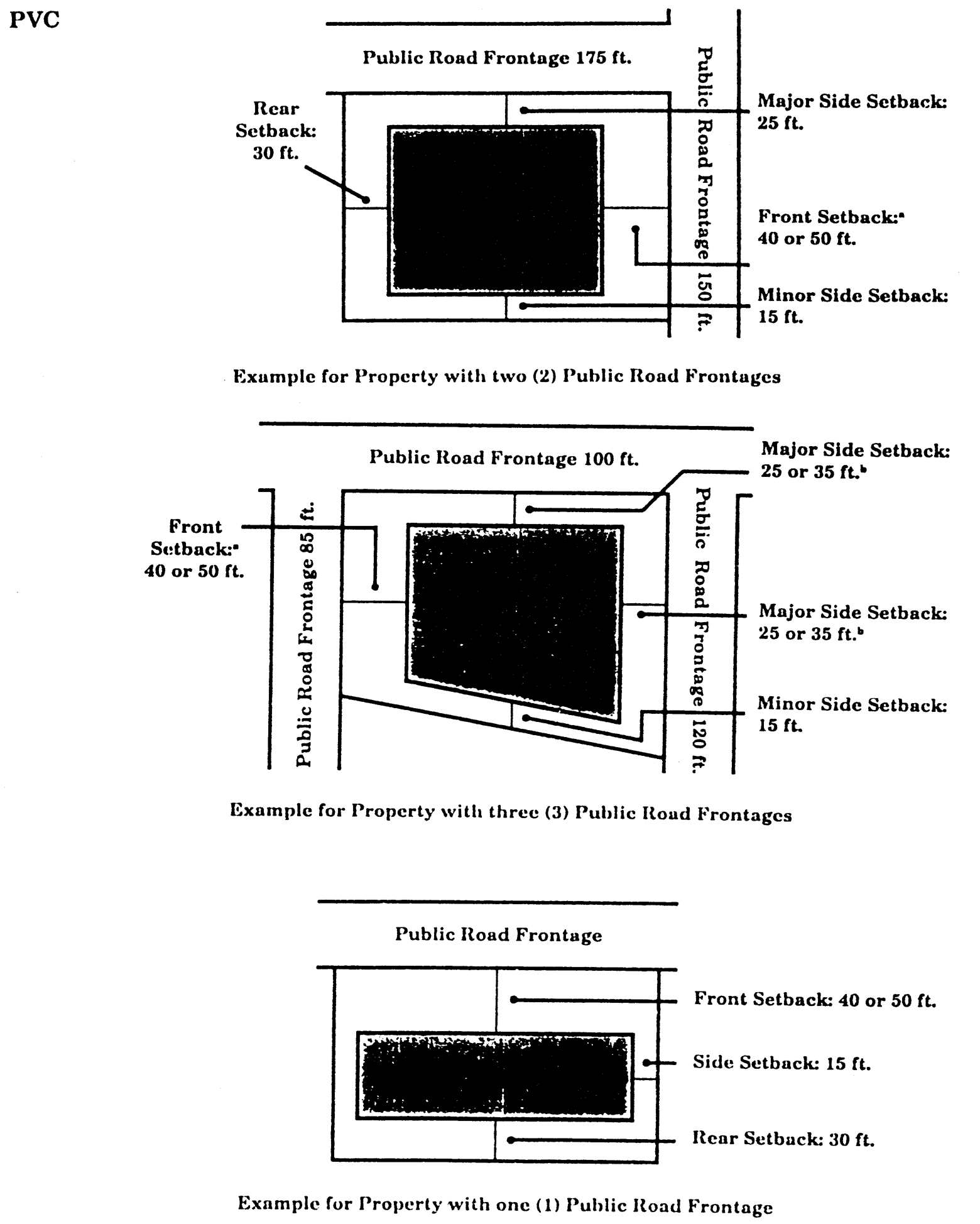
Minimum Building Setback Requirements for PVC District
Notes:
a Property with shorter amount of road frontage will be the front setback for determining other setbacks (major side, side, rear).
b If structure fronts a major side setback, major side setback shall be 35 feet.
(5)
Landscape buffer and screening requirements. Unless otherwise noted within this district's requirements, any property within a PVC district which abuts residentially zoned property shall have a 40-foot landscaped screening buffer adjacent to all residentially zoned property, which will be subject to county staff's approval. The board of commissioners specifically notes that it discourages locating PVC districts and developments adjacent to single-family residential districts, unless in a planned mixed use project with nonresidential development located within the center of the project and residential development, with lot sizes compatible to existing neighborhoods, required on the periphery/exterior of the property. Required buffers may be included within required setbacks; however, in such case that the required buffer is greater than the required setback, the required buffer shall be adhered to. Additionally, necessary private utilities and access drives may be allowed through, over or across a landscaped buffer. Any such uses which are proposed through, over or across a designated undisturbed buffer must be approved pursuant to an original site plan or site plan modification as set forth under section 134-126.
a.
Objectives. Undisturbed, planted landscape buffers and berms shall be implemented in connection with a permitted project and shall address the following objectives:
1.
Screening to enhance aesthetic appeal;
2.
Control or direction of vehicular and pedestrian movement;
3.
Reduction of glare;
4.
Buffering of noise; and
5.
Establishment of privacy.
b.
Standards. Buffers or berms shall be required when a PVC is located adjacent to a residential district; a minimum 40-foot buffer is required.
1.
Buffers. Landscape buffers are subject to review and approval by county staff in accordance with the following standards:
i.
Plantings are to be a mix of evergreen trees and shrubs.
ii.
Species are to be ecologically compatible to the site and appropriate for the design situation.
iii.
Unless public safety concerns dictate otherwise, a buffer should provide a maximum visual barrier to a height of six feet within two years of planting.
iv.
Minimum height of plant materials at installation is five feet for trees and two feet for shrubs.
v.
Fencing or walls are to be a minimum of six feet in height as approved by county staff.
vi.
Trees included in buffer plantings may be counted toward site density calculations as required by chapter 50, article VI, pertaining to tree preservation and replacement, subject to review and approval of county staff.
vii.
Buffers shall be regularly maintained by the property owner to ensure that the objectives and standards set out in this subsection are met.
viii.
When topography and existing conditions allow, the required 40-foot buffer should be an undisturbed buffer.
ix.
Any appeals from a determination by county staff shall be to the board of zoning appeals.
2.
Berms. Berms are subject to review and approval by county staff in accordance with the following standards:
i.
Berms shall be utilized when consistent with surrounding property features.
ii.
Berms shall be stabilized.
iii.
Where possible, berms shall be constructed to be consistent with natural or proposed drainage patterns.
iv.
Berms shall be regularly maintained by the property owner.
(6)
Floodplain and wetlands preservation requirements. Any development must also meet state and federal requirements relating to areas subject to the provisions of section 134-283, regarding mountain and river corridor protection act areas, and section 134-284, regarding metropolitan river protection act areas.
(7)
Building and structure requirements. Maximum building height is 75 feet, unless located within a RAC. When located in a RAC, building heights will be approved by the board of commissioners on a case by case basis (RAC—as approved by the board of commissioners, CAC—four stories, NAC and Residential—two stories). The board of commissioners shall consider the RAC's sub area classification and any specific text related to transitional land uses, densities and building heights.
(8)
Parking requirements. See section 134-272 for paved parking specifications.
(9)
Lighting requirements.
a.
Any project permitted within the PVC district which proposes a lighted facility must have a county department of transportation approved lighting plan in accordance with the minimum conditions listed in section 134-269.
b.
All developments with multifamily units shall be designed with lighting that does not spill over into abutting properties and is the minimum to provide security for residents of multifamily housing developments.
(10)
Special exception uses. See section 134-271 for special exception use requirements for all districts. Special exception uses for the PVC district are the uses listed in section 134-271.
(11)
Special exception uses for community activity center only. The following uses, with the proper scrutiny and conditions, may be considered as special exception uses within the PVC district, only if they are within properties delineated as community activity center as defined and shown on the Cobb County Comprehensive Plan: A Policy Guide, adopted November 27, 1990. Any special exception use, for community activity centers only, shall adhere to the landscape buffer and screening requirements in subsection (5) of this section.
a.
Animal hospitals;
b.
Athletic and health clubs;
c.
Clubs or lodges (noncommercial);
d.
Community retail uses;
e.
Corporate or administrative offices for any permitted uses;
f.
Full service gasoline stations;
g.
Hotels (non-suite);
h.
Light automotive repair establishments;
i.
Office service and supply establishments;
(12)
Special exception uses for regional activity center only. The following uses, with the proper scrutiny and conditions, may be considered as special exception uses within the PVC district, only if they are within properties delineated as regional activity centers as defined and shown on the Cobb County Comprehensive Plan: A Policy Guide, adopted November 27, 1990. Any special exception use, for regional activity centers only, shall adhere to the landscape buffer and screening requirements in subsection (5) of this section.
a.
Animal hospitals;
b.
Athletic and health clubs;
c.
Clubs or lodges (noncommercial);
d.
Community retail uses;
e.
Corporate or administrative offices for any permitted uses;
f.
Full service gasoline stations;
g.
Hotels (non-suite);
h.
Light automotive repair establishments;
i.
Office service and supply establishments;
(13)
Use limitations. A PVC development shall meet at the minimum the following:
a.
General standards are as follows:
1.
The development shall be compatible with the topography of the land and shall preserve any unusual topographic or natural features.
2.
The development shall not adversely affect developed or undeveloped neighboring properties.
3.
The development shall utilize design and development features that would not be possible by the application of lot-by-lot zoning district regulations.
4.
Water, sewerage, highway and school facilities shall be adequate for the proposed development, or there shall be a definite proposal for making them so.
5.
Nonresidential uses must be located within the center/interior of the project and compatible residential uses must be on the periphery/exterior of the project so to protect adjacent residential areas.
b.
A PVC may be located within any category other than industrial or industrial-compatible as defined by the Cobb County Comprehensive Plan: A Policy Guide, as amended from time to time, so long as it meets the standards set forth in this section and is compatible with surrounding uses and zoning districts.
c.
A PVC shall require 25 contiguous acres.
d.
Common open space requirements are as follows:
1.
A minimum of 550 square feet per dwelling unit in a PVC shall be reserved for open space, parks, or other recreational or public uses, subject to the following:
i.
No more than 50 percent of the land so reserved may lie in a floodplain or wetland.
ii.
While such open space shall not be required to be contiguous, the open space must be useable and functional open space, parks, or other recreational or public uses and must be permanently protected via conservation easement or restrictive covenants in favor of the county for conservation uses.
2.
The required yards, parking and right-of-way areas shall not be credited toward the minimum open space requirements.
3.
The amount of required common open space will be automatically reduced as the density of development is reduced and will be automatically increased as the density of development is increased.
4.
The required open space shall be developed and landscaped by the developer in accordance with an approved landscaping plan.
e.
All PVC developments shall be zoned and subject to a specific site plan.
f.
Commercial uses must be located within the center/interior of the project and compatible residential uses must be on the periphery/exterior of the project so to protect adjacent residential areas.
g.
The entire PVC shall be included within private deed covenants running with the land to ensure the continuance of the PVC in accordance with approved plans and development.
h.
For off-street parking requirements, see the parking standards in section 134-272.
i.
Requirements for retail sales and services are as follows:
1.
Area requirements. Area requirements for a PVC within any residential land use category as defined by the county comprehensive plan, as may be amended from time to time. There shall be a maximum of 5,000 square feet of total net floorspace for retail sales and services as permitted in this section for each 100 dwelling units in a PVC district having an area of not less than 50 contiguous acres. Land may be reserved for the maximum permitted retail sales and service development, but the permitted square feet of retail sales and service floor area may be built only as the required ratio of dwelling units has been constructed.
2.
Structures. Retail sales and services shall be conducted entirely within a wholly and permanently enclosed building which shall be of an architectural design compatible with the residential structures within the PVC.
3.
Relation to residentially developed property lying outside planned village community. The sides, rear or front of a lot developed for retail sales and services or multifamily dwellings shall neither abut nor lie across the street from property lying outside the PVC that is developed with one-family houses unless properly buffered in accordance with a landscape plan approved by the board of commissioners.
j.
Any signage for office and commercial uses shall be limited to a single ground-based monument-style sign as provided in article VI of this chapter.
k.
All refuse and designated recycling collection location facilities must be contained within completely enclosed facilities.
l.
All of the land in a PVC shall be owned initially by an individual, corporation, partnership or some other legal entity. Individual properties in a PVC may be sold after a final plat has been duly recorded, with the properties subject to private deed covenants that ensure the continuance of the PVC as originally approved. A PVC may contain a mix of the residential uses permitted in this section together with a limited amount of office and commercial uses limited by the density set forth in this section.
m.
Any emission or automotive inspection station shall be located within a permanent facility. (No temporary buildings/tents are to be utilized after June 30, 1998.) Effective April 1, 2014, any new applications (zoning applications, building permit related applications including tenant finish operations and certificate of occupancy applications) for emission or automotive inspection stations within permanent facilities shall mean an indoor inspection establishment (no outside storage) with fully enclosed service bay(s) with operable door(s) for performing emission and automotive inspections/testing. The permanent facility must be compliant with the adopted building regulations found in chapter 18 of the Cobb County Code.
n.
No uses that emit noxious odors, fumes or sounds are permitted.
o.
The side yard setbacks may be waived except along the exterior boundaries of the development.
p.
No sexually oriented businesses are permitted.
q.
A PVC shall have ingress and egress only on a major or collector street or state highway.
r.
Kitchenettes or kitchen facilities are prohibited in motels.
s.
No loading docks or facilities may be located in the front of any primary structure.
t.
Area requirements for a PVC within a NAC, CAC or RAC as defined by the county comprehensive plan, as may be amended from time to time. There shall be a maximum of 70,000 square feet of total net floor space for retail sales and services as permitted in this section for each 100 dwelling units in a PVC district having an area of not less than 50 contiguous acres located within a NAC. There shall be a maximum of 140,000 square feet of total net floor space for retail sales and services as permitted in this section for each 100 dwelling units in a PVC district having an area of not less than 50 contiguous acres located within a CAC. There shall be a maximum of 210,000 square feet of total net floor space for retail sales and services as permitted in this section for each 100 dwelling units in a PVC district having an area of not less than 50 contiguous acres located within a RAC. Land may be reserved for the maximum permitted retail sales and service development, but the permitted square feet of retail sales and service floor area may be built only as the required ratio of dwelling units has been constructed.
u.
Net residential densities within any PVC should be generally consistent with the density recommended for the property via the county comprehensive plan, as may be amended from time to time. The board of commissioners will consider the character of surrounding land uses when determining whether proposed residential densities are generally consistent with the county comprehensive plan, as may be amended from time to time. The board of commissioners will also consider the amount of open space proposed, as well as width and type of buffers proposed for adjacent residential properties. Residential densities may also be limited in overall acreage due to intense deforestation, drainage, erosion and sedimentation concerns associated with such development.
v.
Eating and drinking establishments, excluding bars or nightclubs, shall be a maximum of 3000 square feet for a PVC within any residential category as defined by the county comprehensive plan, as may be amended from time to time.
w.
Maximum impervious surfaces (80 percent—RAC, 70 percent—CAC and NAC) shall be established within activity centers as identified by the Cobb County Comprehensive Plan, as may be amended from time to time.
Required buffers may be included within required setbacks; however, in such case that the required buffer is greater than the required setback, the required buffer shall be adhered to. Additionally, necessary private utilities and access drives may be allowed through, over or across a landscaped buffer. Any such uses which are proposed through, over or across a designated undisturbed buffer must be approved pursuant to an original site plan or site plan modification as set forth under section 134-126.
(14)
Accessory buildings, structures, uses and decks. Any accessory building or structure in excess of 1,000 square feet of gross space shall be located to the rear of the primary structure and at least 40 feet from any residential property line. Any accessory building or structure which exceeds 1,000 square feet of gross space must have the approval of the division manager of zoning or his designee as to the location, architectural design and size prior to commencing construction. The division manager of zoning or his designee shall consider the following criteria for determining the appropriateness of the architectural design and size of the accessory building or structure: compatibility with the surrounding neighborhood, style of exterior (the exterior is to be compatible in style with the primary structure), use of the proposed accessory structure, impact on adjacent properties, and requirements as deemed appropriate by plan review as set forth in this subsection. All accessory buildings, structures and uses in excess of 1,000 gross square feet shall be required to submit for plan review through the community development department or receive approval from the director of the community development department or his designee. Permitted accessory structures and uses are as follows:
a.
Accessory storage buildings, to include parking garages, subject to the following conditions:
1.
Maximum height is two stories, not to exceed 35 feet.
2.
Such structures shall be located on the same lot as and to the rear of the principal building to which they are accessory.
3.
No accessory building shall be constructed upon a lot until construction of the principal building has commenced.
4.
On a corner lot, no accessory building shall be located closer to the side street right-of-way line than the principal building.
5.
When abutting any other nonresidential district, no garage or other accessory building shall be located closer than five feet to a side or rear lot line.
6.
When an accessory building is attached to the principal building by a breezeway, passageway or similar means, it shall comply with the yard requirements of the principal building to which it is accessory.
7.
Where any nonresidential lot adjoins the side or rear of a residential lot, an accessory building shall not be located within any required buffers.
b.
Antennas and satellite dishes, which shall meet the requirements set forth in section 134-274.
c.
Carwashes accessory to convenience food stores with self-service fuel.
d.
Freestanding parking garages, subject to the following conditions:
1.
Maximum height is 50 feet, with no more than four stories.
2.
When abutting any residential property line, freestanding parking garages shall not be located within any required buffers.
3.
When abutting any other nonresidential district, no freestanding garage shall be located closer than five feet to a side or rear lot line.
e.
Heating and air conditioning units, subject to the following conditions:
1.
When abutting any residential property line, heating and air conditioning units shall not be located within any required buffers.
2.
When abutting any other nonresidential district, no heating and air conditioning units shall be located closer than five feet to a side or rear lot line.
3.
Heating and air conditioning units may be installed on the roof of any structure zoned commercially so long as the heating and air conditioning unit does not exceed the height restrictions stated in this section and the units are placed so as to be hidden from a front or side view.
4.
No ground-based heating and air conditioning unit shall exceed 35 feet in height.
f.
Incidental storage, provided that the material stored is incidental to the permitted use, as determined by the division manager of zoning or his designee, and stored completely within a portion of the enclosed principal structure permitted within the district, or within a permitted accessory structure.
(15)
Multifamily unit development security. To enhance building/site security, applicants shall coordinate with local law enforcement to develop a security plan in accordance with the standards of crime prevention through environmental design (CPTED). Security plan shall be reviewed and updated annually by the property manager.
(Ord. of 12-26-72; Ord. of 9-3-75, §§ 3—5; Ord. of 12-11-90, § 3-28-7.24; Ord. of 8-13-91; Ord. of 6-9-92; Ord. of 7-11-95; Ord. of 6-24-97 (eff. 7-1-97); Ord. of 12-9-97 (eff. 1-1-98); Ord. of 9-12-00; Ord. of 9-10-02; Ord. of 12-9-03; Ord. of 1-13-04; Ord. of 7-27-04; Ord. of 7-26-05; Ord. of 8-9-05; Amd. of 2-25-14; Amd. of 2-28-17; Amd. of 10-23-18; Amd. of 8-27-19; Amd. of 9-8-20; Amd. of 9-27-22)
Sec. 134-218. - CRC community retail commercial district.
Commencing January 1, 1998, no new applications for a Special Land Use Permit for Self-service Storage Facilities (SSSF) are to be accepted by the board of commissioners. The regulations for the CRC community retail commercial district are as follows:
(1)
Purpose and intent. The CRC district is established to provide locations for retail commercial and service uses which are designed and oriented to serve several neighborhoods making up a community. Projects developed within the CRC district should be done so as compact unified centers. CRC districts should be located on properties which are delineated within a community activity center and regional activity center as defined and shown on the Cobb County Comprehensive Plan: A Policy Guide, adopted November 27, 1990. Additionally, the desired quadrant location will provide for planned developments and one-destination shopping and service locations to serve the community, and will minimize traffic congestion.
(2)
Definitions. The following words, terms and phrases, when used in this section, shall have the meanings ascribed to them in this subsection, except where the context clearly indicates a different meaning:
a.
Arcade means a building or part of a building in which five or more pinball machines, video games, other children's rides or other similar player-operated amusement devices are maintained, not including commercial recreation restaurants.
b.
Clinic. A medical or dental clinic is an organization of specializing physicians or dentists, or both, who have their offices in a common building. A clinic shall include laboratory facilities in conjunction with normal clinic services.
c.
Community fair means a festival or fair such as the North Georgia State Fair conducted wholly within public areas owned by a local government, provided that any activity is conducted at least 200 feet from any property line. Any event shall not exceed 21 days.
d.
Community retail uses means commonly found low scale and low intensity retail uses that offer basic services and frequently purchased goods to the immediate surrounding residential areas, such as the following: auto parts store, antique shop, appliance store (home use), bakery, barber shop or beauty shop, beverage shop, bookstore (but not including adult bookstores), bridal shop, camera shop, china and pottery store, clothing store, dance studio, martial arts, pet store and pet supply store, pilates, yoga and the like studio, delicatessen, dog grooming shop, draperies and interior decorating supplies, drug store, dry goods store, florist, furniture store, gifts and stationery store, gym and fitness facility, hardware store, jewelry store, manicurist shop, meat market or butcher shop, millinery store, mimeograph and letter shop, music store, novelty shop, paint store, pedicurist shop, shoe repair shop, shoe store, sporting goods store, supermarket or grocery, tailor shop, toy store, variety shop or video store. The maximum size for any community retail use shall be 140,000 square feet, including temporary space, outdoor garden centers and the like.
e.
[Reserved.]
f.
Designated recycling collection locations means metal or heavy duty plastic containers designed for short-term holding of pre-bagged recyclable items such as tin, aluminum, glass and paper (no perishable or food items allowed) for scheduled minimum monthly pickup, with no on-premises sorting. The center must be maintained in a safe, clean, neat and sanitary fashion and shall not encompass an area larger than 280 square feet.
1.
Such location shall be visually screened and maintained.
2.
Such location shall be within the building setbacks unless otherwise approved by the division manager of zoning or his designee due to topography, safety, internal traffic flow, site distance or other site-related circumstances not created by the property owner.
g.
Group home means a dwelling shared by six or less persons, excluding resident staff, who live together as a single housekeeping unit and in a longterm, family-like environment in which staff persons provide care, education and participation in community activities for the residents with the primary goal of enabling the residents to live as independently as possible in order to reach their maximum potential. This use shall apply to homes for the handicapped. As used in this subsection, the term "handicapped" shall mean:
1.
Having a physical or mental impairment that substantially limits one or more of such person's major life activities so that such person is incapable of living independently;
2.
Having a record of having such an impairment; or
3.
Being regarded as having such an impairment.
However, the term "handicapped" shall not include current illegal use of or addiction to a controlled substance, nor shall it include any person whose residency in the home would constitute a direct threat to the health and safety of other individuals. The term "group home for the handicapped" shall not include alcoholism or drug treatment centers, work release facilities for convicts or ex-convicts, or other housing facilities serving as an alternative to incarceration.
h.
Light automotive repair establishment means an indoor repair establishment (no outside storage) with fully enclosed service bay(s) with operable door(s) for performing light auto and small truck repair and maintenance within the enclosed bay(s) (under one ton) such as brakes, oil changes, lubrication, transmission, belts, hoses, inspections, tire mounting and installation and the like. Light automotive repair establishments adjacent to residentially zoned properties shall be required to incorporate noise abatement measures such as, but not limited to, landscaping, fencing, portable noise screen, or other equally effective industry accepted alternative. This amendment shall become effective July 1, 2013. Activities such as battery replacement, light bulb changes, wiper blade replacement, "check engine light" diagnostics, or other minor things done complimentary and the like may be done outside of a retail automotive parts store with non-powered hand tools.
i.
Nonautomotive repair uses means commonly found low intensity repair shops such as jewelry, camera, home appliance, television and videocassette recorder repair shops.
j.
Office service and supply establishments means wholesale and retail commercial establishments that sell, service and supply small office equipment and supplies, such as stores that offer sales of copiers, facsimile machines, typewriters, ribbons, transcribers, dictation equipment, tape, staplers and other general office equipment.
k.
Professional office means a structure wherein services are performed involving predominately administrative, professional or clerical operations such as the following: law, doctor, optician, audiologist, accounting, tax preparation, real estate, stockbroker, architect, engineer, manufacturer representative, professional counselor, dentist, investigative services, photographer, insurance, contractor, land surveyor, telephone sales, political/campaign, veterinarian or travel bureau.
(3)
Permitted uses. Permitted uses are as follows:
Ambulance services, if accessory to hospitals or funeral homes.
Animal hospitals.
Arcades.
Assembly halls.
Athletic and health clubs.
Automobile, truck and trailer lease and rental facilities (principal or accessory).
Automotive and truck sales and service facilities.
Automotive paint and body repair shops.
Automotive parking lots or garages.
Automotive upholstery shops.
Banks and financial institutions with drive-in establishment or automated transfer machines.
Billiards and pool halls, subject to chapter 78, article III, division 6, pertaining to pool rooms.
Boarding kennels (indoor), provided that no outside runs allowed, approval of county health department required, must not create a nuisance as defined by state law, building to be soundproofed, internal air exchange system required (excluding air conditioning system).
Building materials stores.
Bus stations.
Carwashes.
Churches, chapels, temples, synagogues, and other such places of worship.
Clinics.
Clubs or lodges (noncommercial).
Colleges and universities (private), including but not limited to research and training facilities.
Commercial greenhouses and plant nurseries, provided that all goods stored outside shall be stored in a designated area.
Commercial indoor recreation uses.
Commercial outdoor recreation uses.
Commercial produce and agricultural product stands.
Commercial recreation restaurants.
Community fairs.
Community retail uses.
Convenience food stores with self-service fuel sales.
Corporate or administrative offices for any permitted uses.
Cultural facilities.
Designated recycling collection locations.
Eating and drinking establishments, including drive-in fast food restaurants.
Emissions or inspection stations. (No temporary buildings/tents to be utilized after June 30, 1998.)
Executive golf courses (see section 134-270).
Exterminating facilities (insect or rodent).
Farm and garden supply stores.
Film developing and printing facilities.
Fraternity and sorority house and residence halls.
Freestanding climate controlled self-service storage facilities. The following minimum standards shall apply to freestanding climate controlled self-service storage facilities:
1.
Building height should not exceed those of adjacent buildings, nor impact the view shed of adjacent residential property.
2.
F.A.R. should be 1.0 or as determined appropriate by the board of commissioners.
3.
All units shall be accessed through a main or central entrance.
4.
All windows or similar architectural features must be "one way" and provide for an opaque screen from view outside of the building.
5.
Architectural style/design to be similar or complementary to the predominant architectural design of other commercial uses within the activity center. Said architectural style/design to be approved by the board of commissioners. Any roof-mounted utilities or building components must be sufficiently screened from view of adjoining properties and public right-of-way.
6.
There shall be no outside storage allowed nor overnight and/or long-term parking of heavy equipment, commercial equipment or parking of construction or related equipment allowed.
7.
There shall be no storage of recreational vehicles and no dry storage of pleasure boats of any type customarily maintained by private individuals for their personal use.
8.
There shall be no storage of flammable liquids, highly combustible or explosive materials, or hazardous chemicals.
9.
No units within the facility shall be used for or considered to be premises for the purpose of assigning a legal address in order to obtain an occupational license or any other government permit or licenses to do business.
10.
There shall be no resident manager or any type of overnight accommodations for such.
11.
Landscape plan to be approved by staff with emphasis on planting within the parking facilities.
12.
One parking space shall be provided per every 80 individual storage units/areas.
13.
Loading area, including adequate turnaround space for a tractor trailer vehicle, must be screened by a permanent architectural or landscape feature or as may be approved by the board of commissioners if not located to side or rear of proposed structure.
14.
Lighting plan to be approved by the board of commissioners.
15.
No units shall be used to manufacture, fabricate or process goods, to service or repair vehicles, boats, small engines or electrical equipment, or to conduct similar repair activities, to conduct garage sales or retail sales of any kind, to rehearse or practice utilizing band instruments, or for conversion to an apartment or dwelling unit, or to conduct any other commercial or industrial activities on the site.
16.
Dumpster areas and detention areas must be sufficiently screened from view of adjoining properties and public right-of-way.
17.
Hours of operation to be established by the board of commissioners, considering the operational hours of surrounding businesses.
18.
Special land use permit as provided in section 134-37.
Freestanding ice vending machines. The following minimum standards shall apply to freestanding ice vending machines:
1.
Architectural style must be similar to or complimentary to the architectural styles of contiguous properties and consistent with the county's architectural guidelines.
2.
Any roof-mounted utility, conditioned air unit or other mechanical device associated with the operation of the machine must be screened from the view of public right-of-way with an architectural feature similar to or complimentary to the architectural styles of contiguous properties. Further, these utilities, units or mechanical devices must include a noise abatement feature or device that abates noises or sounds from adjacent residential property.
3.
Special land use permit as required in section 134-37.
Full service gasoline stations.
Funeral homes.
Golf courses, 18-hole regulation, public and private (see section 134-270).
Golf courses, par 3 (see section 134-270).
Group homes.
Helicopter landing areas, provided that the area is fenced.
Hospitals.
Hotels.
In-home day care.
Laundry and dry cleaning pickup establishments.
Light automotive repair establishments.
Medical and dental laboratories, provided that no chemicals are manufactured on-site.
Motels.
Neighborhood retail uses.
Nonautomotive repair service establishments.
Nonprofit (seasonal use) fishing lakes.
Nursery schools and child day care centers.
Office service and supply establishments.
Offices, not elsewhere classified.
Other consumer goods and services.
Pain clinic and pain management clinic (except when located in a NAC):
1.
No onsite dispensing of any prescription medications or controlled substances.
2.
One parking space per 200 gross square feet of building.
3.
Hours of operation to be established by the board of commissioners, considering the operational hours of surrounding businesses.
4.
Signage and lighting plan to be approved by the board of commissioners.
5.
Special land use permit as provided by section 134-37.
6.
The maximum length of approval for this use is 12 months.
7.
No interior doors allowed from clinic to other adjacent businesses.
Parking for vehicles.
Photography studios.
Printing, publishing and lithography establishments, provided that no more than 50 percent of the total gross floor area will be used for storage.
Private parks.
Professional offices.
Radio and television stations.
Radio, television, and other communication towers and antennas, subject to section 134-273.
Recreation grounds other than tennis courts and golf courses.
Rest homes, personal care homes and convalescent homes.
Reupholstery and furniture repair facilities.
Roominghouses and boardinghouses.
Self-service fuel sales.
Self-service laundry facilities.
Studios and supplies, provided that no more than 50 percent of total gross floor area will be used for storage.
Temporary uses.
Theaters.
(4)
Lot size and setback requirements. Lot size and setback requirements are as follows:
a.
Minimum lot size: 20,000 square feet.
b.
Minimum lot width at front setback line: 75 feet.
c.
Minimum public road frontage: 50 feet.
d.
Minimum building setbacks: As shown and applied in the following diagram:
MINIMUM BUILDING SETBACK REQUIREMENTS FOR CRC DISTRICT
Note: All setbacks shall be measured from future right-of-way.
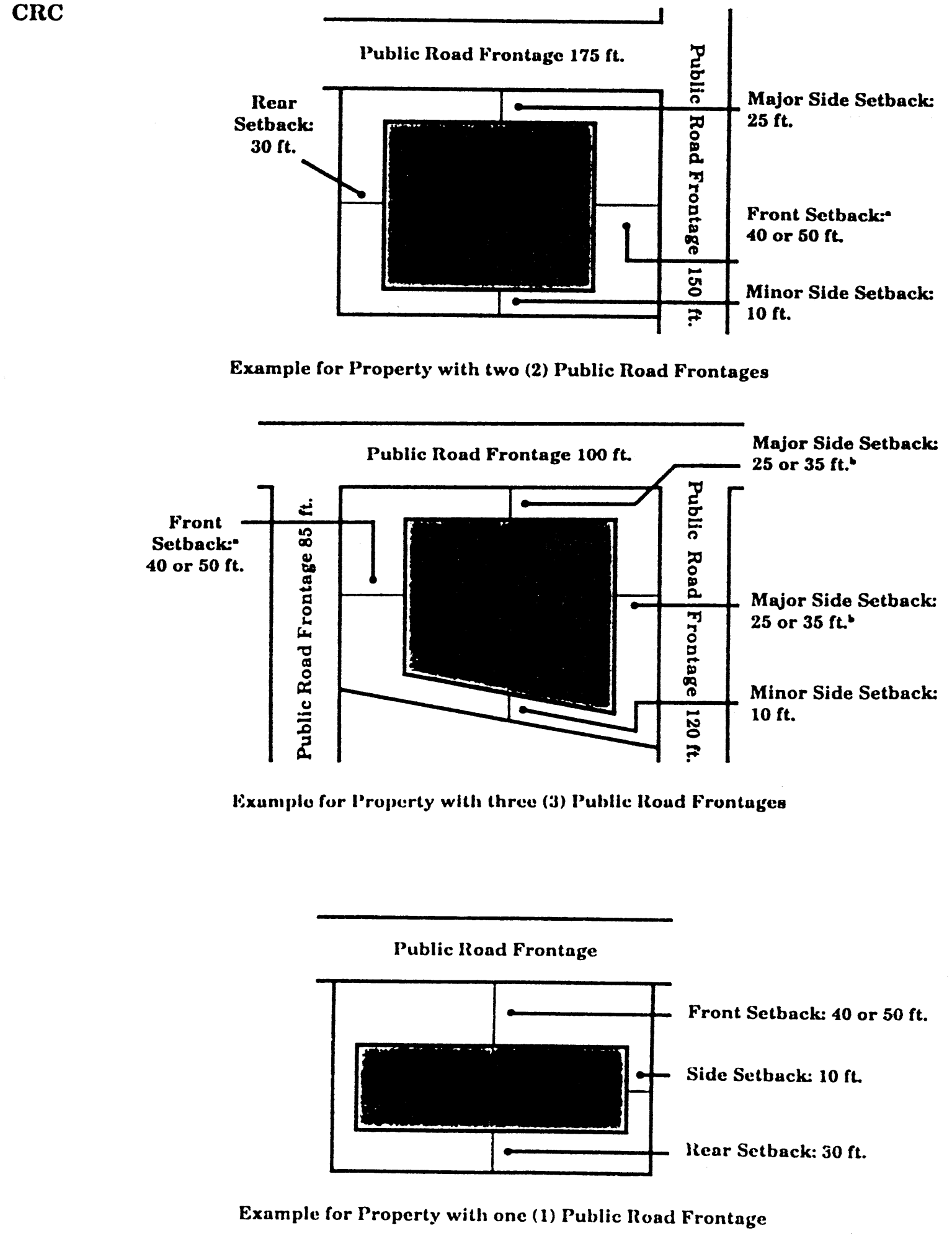
CRC District
Notes:
a Property with shorter amount of road frontage will be the front setback for determining other setbacks (major side, side, rear).
b If structure fronts a major side setback, major side setback shall be 35 feet.
(5)
Landscape buffer and screening requirements. Unless otherwise noted within this district's requirements, any property within an CRC district which abuts residentially zoned property shall have a 35-foot landscaped screening buffer adjacent to all residentially zoned property. The buffer shall be subject to approval by county staff.* Required buffers may be included within required setbacks; however, in such case that the required buffer is greater than the required setback, the required buffer shall be adhered to. Additionally, necessary private utilities and access drives may be allowed through, over or across a landscaped buffer. Any such uses which are proposed through, over or across a designated undisturbed buffer must be approved pursuant to an original site plan or site plan modification as set forth under section 134-126.
a.
Objectives. Undisturbed, planted landscape buffers or berms shall be implemented in connection with a permitted project and shall address the following objectives:
1.
Screening to enhance aesthetic appeal;
2.
Control or direction of vehicular and pedestrian movement;
3.
Reduction of glare;
4.
Buffering of noise; and
5.
Establishment of privacy.
b.
Buffers. Landscape buffers are subject to review and approval by county staff in accordance with the following standards:
1.
Plantings are to be a mix of evergreen trees and shrubs.
2.
Species are to be ecologically compatible to the site and appropriate for the design situation.
3.
Unless public safety concerns dictate otherwise, a buffer should maximize a visual barrier to a height of six feet within two years of planting.
4.
Minimum height of plant materials at installation is five feet for trees and two feet for shrubs.
5.
Fencing or walls are to be a minimum of six feet in height as approved by county staff.
6.
Trees included in buffer plantings may be counted toward site density calculations as required by chapter 50, article VI, pertaining to tree preservation and replacement, subject to review and approval of county staff.
7.
Buffers shall be regularly maintained by the property owner to ensure that the objectives and standards set out in this subsection are met.
8.
When topography and existing conditions allow, the required 35-foot buffer should be an undisturbed buffer.
9.
Any appeals from a determination by county staff shall be to the board of zoning appeals.
c.
Berms. Berms are subject to review and approval by county staff in accordance with the following standards:
1.
Berms shall be utilized when consistent with surrounding property features.
2.
Berms shall be stabilized.
3.
Where possible, berms shall be constructed to be consistent with natural or proposed drainage patterns.
4.
Berms shall be regularly maintained by the property owner.
*Note—The board of commissioners specifically notes that it discourages locating CRC districts and developments adjacent to single-family residential districts, unless in a planned mixed use project.
(6)
Floodplain and wetlands preservation requirements. Any development must also meet state and federal requirements relating to areas subject to the provisions of section 134-283, regarding mountain and river corridor protection act areas, and section 134-284, regarding metropolitan river protection act areas.
(7)
Building and structure requirements. Maximum building height is 50 feet, with no more than four stories.
(8)
Parking requirements. See section 134-272 for paved parking specifications.
(9)
Lighting requirements. Any project permitted within the CRC district which proposes a lighted facility must have a county department of transportation approved lighting plan in accordance with the minimum conditions listed in section 134-269.
(10)
Special exception uses. See section 134-271 for special exception use requirements for all districts. Special exception uses for the CRC district are the uses listed in section 134-271.
(11)
Special exception uses for community activity center only. The following uses, with the proper scrutiny and conditions, may be considered as special exception uses within the CRC district, only if they are within properties delineated as community activity centers as defined and shown on the Cobb County Comprehensive Plan: A Policy Guide, adopted November 27, 1990. Any special exception use, for community activity centers only, shall adhere to the landscape buffer and screening requirements in subsection (5) of this section.
a.
Automobile and truck sales and service facilities (used or pre-owned separate from a new car dealership):
1.
Minimum of one acre of a paved surface is required for parking of vehicles, excluding any area used for, but not limited to buildings, offices, service or sales areas:
2.
If any entity sells more than five cars per year, they are considered a dealer which requires a county business license.
3.
A special land use permit is required as provided in section 134-37.
4.
All vehicles are required to be parked off any right-of-way or easement.
b.
Reserved.
c.
Climate controlled self-service storage facilities, when complementary or accessory to an office park or building.
The following minimum standards shall apply to climate controlled self-service storage facilities:
1.
Building height should not exceed those of adjacent buildings, nor impact the view shed of adjacent residential property.
2.
F.A.R. should be 1.0 or as determined appropriate by the board of commissioners.
3.
All units shall be accessed through a main or central entrance.
4.
All windows or similar architectural features must be "one way" and provide for an opaque screen from view outside of the building.
5.
Architectural style/design to be similar or complementary to the predominant architectural design of other commercial uses within the activity center. Said architectural style/design to be approved by the board of commissioners. Any roof-mounted utilities or building components must be sufficiently screened from view of adjoining properties and public right-of-way.
6.
There shall be no outside storage allowed nor overnight and/or long-term parking of heavy equipment, commercial equipment or parking of construction or related equipment allowed.
7.
There shall be no storage of recreational vehicles and no dry storage of pleasure boats of any type customarily maintained by private individuals for their personal use.
8.
There shall be no storage of flammable liquids, highly combustible or explosive materials, or hazardous chemicals.
9.
No units within the facility shall be used for or considered to be premises for the purpose of assigning a legal address in order to obtain an occupational license or any other government permit or licenses to do business.
10.
There shall be no resident manager or any type of overnight accommodations for such.
11.
Landscape plan to be approved by staff with emphasis on planting within the parking facilities.
12.
One parking space shall be provided per every 80 individual storage units/areas.
13.
Overall project must be accessed via a public or private roadway which is internal to the office park, building or shopping center; direct access to an adjoining public roadway shall be subject to approval by the board of commissioners.
14.
No freestanding signage shall be utilized; internal directional signage will be subject to approval by the board of commissioners.
15.
No units shall be used to manufacture, fabricate or process goods, to service or repair vehicles, boats, small engines or electrical equipment, or to conduct similar repair activities, to conduct garage sales or retail styles of any kind, to rehearse or practice utilizing band instruments, or for conversion to an apartment or dwelling unit, or to conduct any other commercial or industrial activities on the site.
16.
Loading area, including adequate turnaround space for a tractor trailer vehicle, must be screened by a permanent architectural or landscape feature or as may be approved by the board of commissioners if not located to side or rear of proposed structure.
17.
Special land use permit as provided in section 134-37.
18.
Hours of operation to be established by the board of commissioners, considering the operational hours of surrounding businesses.
(12)
Special exception uses for regional activity center only. The following uses, with the proper scrutiny and conditions, may be considered as special exception uses within the CRC district, only if they are within properties delineated as regional activity centers as defined and shown on the Cobb County Comprehensive Plan: A Policy Guide, adopted November 27, 1990. Any special exception use, for regional activity centers only, shall adhere to the landscape buffer and screening requirements in subsection (5) of this section.
a.
Automobile and truck sales and service facilities (used or pre-owned separate from a new car dealership):
1.
Minimum of one acre of a paved surface is required for parking of vehicles, excluding any area used for, but not limited to buildings, offices, service or sales areas:
2.
If any entity sells more than five cars per year, they are considered a dealer which requires a county business license.
3.
A special land use permit is required (section 134:37).
4.
All vehicles are required to be parked off any right-of-way or easement.
b.
Hotel (suite).
The following minimum standards shall apply to suite hotels:
1.
Minimum acreage is two acres.
2.
All rooms shall be accessed through a main or central lobby.
3.
No rooms shall access to the exterior of the building unless required by fire/safety regulations.
4.
The minimum number of floors allowed shall be three floors, unless otherwise approved by the board of commissioners.
5.
Architectural style/design to be approved by the board of commissioners.
6.
All buildings shall have a minimum roof pitch of a four in twelve as defined by applicable building codes.
7.
Conference, meeting or banquet facilities are allowed when supported by adequate parking and approved by the board of commissioners as part of the special land use permit.
8.
Restaurants or other type of eating facilities are allowed when supported by adequate parking and approved by the board of commissioners. "Continental" style dining for the guests of the facility only is allowed within or near the main or central lobby without additional parking.
9.
At a minimum, provisions for weekly cleaning for each suite must be provided.
10.
Each suite must be protected with a smoke detector and sprinkler system approved by the fire marshal or his designee.
11.
Each suite shall be required to include an automatic power off timer for each stove/cook top unit or other type burner.
12.
Parking shall be calculated as one space required for each suite, with an additional ten spaces provided for employees. Parking requirements for conference, meeting or banquet facilities or restaurants or other type of eating facilities within a suite hotel shall be calculated as provided for each use in section 134-272, "traffic and parking," in addition to the above parking requirements and approved by the board of commissioners.
13.
There shall be no outside storage allowed or long term parking of heavy equipment, or parking of construction or related equipment allowed.
14.
A landscaping plan is to be approved by staff with emphasis on planting within the parking facilities.
15.
No facility under this section is to be converted or used primarily as an apartment or condominium.
c.
Climate controlled self-service storage facilities, when complementary or accessory to an office park or building.
The following minimum standards shall apply to climate controlled self-service storage facilities:
1.
Building height should not exceed those of adjacent buildings, nor impact the view shed of adjacent residential property.
2.
F.A.R. should be 2.0 or as determined appropriate by the board of commissioners.
3.
All units shall be accessed through a main or central entrance.
4.
All windows or similar architectural features must be "one way" and provide for an opaque screen from view outside of the building.
5.
Architectural style/design to be similar or complementary to the predominant architectural design of other commercial uses within the activity center. Said architectural style/design to be approved by the board of commissioners. Any roof-mounted utilities or building components must be sufficiently screened from view of adjoining properties and public right-of-way.
6.
There shall be no outside storage allowed nor overnight and/or long-term parking of heavy equipment, commercial equipment or parking of construction or related equipment allowed.
7.
There shall be no storage of recreational vehicles and no dry storage of pleasure boats of any type customarily maintained by private individuals for their personal use.
8.
There shall be no storage of flammable liquids, highly combustible or explosive materials, or hazardous chemicals.
9.
No units within the facility shall be used for or considered to be premises for the purpose of assigning a legal address in order to obtain an occupational license or any other government permit or licenses to do business.
10.
There shall be no resident manager or any type of overnight accommodations for such.
11.
Landscape plan to be approved by staff with emphasis on planting within the parking facilities.
12.
One parking space shall be provided per every 80 individual storage units/areas.
13.
Overall project must be accessed via a public or private roadway which is internal to the office park, building or shopping center; direct access to an adjoining public roadway shall be subject to approval by the board of commissioners.
14.
No freestanding signage shall be utilized; internal directional signage will be subject to approval by the board of commissioners.
15.
No units shall be used to manufacture, fabricate or process goods, to service or repair vehicles, boats, small engines or electrical equipment, or to conduct similar repair activities, to conduct garage sales or retail styles of any kind, to rehearse or practice utilizing band instruments, or for conversion to an apartment or dwelling unit, or to conduct any other commercial or industrial activities on the site.
16.
Loading area, including adequate turnaround space for a tractor trailer vehicle, must be screened by a permanent architectural or landscape feature or as may be approved by the board of commissioners if not located to side or rear of proposed structure.
17.
Special land use permit as provided in section 134-37.
18.
Hours of operation to be established by the board of commissioners, considering the operational hours of surrounding businesses.
(13)
Use limitations.
a.
Maximum floor area ratio is 0.5 for office uses and 0.25 for retail uses.
b.
All refuse and designated recycling collection location facilities must be contained within completely enclosed facilities.
c.
The maximum size for any singular community retail use/ tenant, including other uses structurally connected and/or internally accessed from said community retail use shall be 140,000 square feet. Additionally the following subcriteria shall apply to any community retail use which is larger than 70,000 square feet:
•
Long blank walls that discourage pedestrian activity are prohibited along public roadway frontages. Building façades must be broken up with recesses of a minimum of 16 inches or other items of visual interest when adjacent to public roadway frontages.
•
Ground-floor façades must have arches, display windows, awnings, or some other feature to add visual interest to the structure.
•
Pedestrian amenities such as patio seating areas, gazeboes, fountains, landscaped courtyards must be provided.
•
Uses must have clearly defined entrances with canopies, porticos or arches and covered walkways.
•
Parking should be designed so that no more than ⅔ of the parking spaces are located between the primary structure and one of the major roadways of the intersection at which the project is located. Where site design does not allow for the above parking space distribution, it shall be the option of the developer to install a minimum 25-foot landscaped buffer along the road frontage and measured from the edge of right-of-way to the back of the curb, inclusive of a three-foot high berm.
d.
Any emission or automotive inspection station shall be located within a permanent facility. (No temporary buildings/tents are to be utilized after June 30, 1998.) Effective April 1, 2014, any new applications (zoning applications, building permit related applications including tenant finish operations and certificate of occupancy applications) for emission or automotive inspection stations within permanent facilities shall mean an indoor inspection establishment (no outside storage) with fully enclosed service bay(s) with operable door(s) for performing emission and automotive inspections/testing. The permanent facility must be compliant with the adopted building regulations found in chapter 18 of the Cobb County Code.
e.
No uses that emit noxious odors, fumes or sounds are permitted.
f.
No sexually oriented businesses are permitted.
g.
Kitchenettes or kitchen facilities are prohibited in motels.
h.
Outdoor displays of merchandise must comply with the provision in section 134-267.
i.
Maximum impervious surfaces (80%-RAC, 70%-CAC and NAC) shall be established within activity centers as identified by the Cobb County Comprehensive Plan, as may be amended from time to time.
j.
No loading docks or facilities may be located in the front of any primary structure.
Required buffers may be included within required setbacks; however, in such case that the required buffer is greater than the required setback, the required buffer shall be adhered to. Additionally, necessary private utilities and access drives may be allowed through, over or across a landscaped buffer. Any such uses which are proposed through, over or across a designated undisturbed buffer must be approved pursuant to an original site plan or site plan modification as set forth under section 134-126.
(14)
Accessory buildings, structures, uses and decks. Any accessory building or structure in excess of 1,000 square feet of gross space shall be located to the rear of the primary structure and at least 40 feet from any residential property line. Any accessory building or structure which exceeds 1,000 square feet of gross space must have the approval of the zoning division manager or his designee as to the location, architectural design and size prior to commencing construction. The division manager of zoning or his designee shall consider the following criteria for determining the appropriateness of the architectural design and size of the accessory building or structure: compatibility with the surrounding neighborhood, style of exterior (the exterior is to be compatible in style with the primary structure), use of the proposed accessory structure, impact on adjacent properties, and requirements as deemed appropriate by plan review as set forth in this subsection. All accessory buildings, structures and uses in excess of 1,000 gross square feet shall be required to submit for plan review through the community development department or receive approval from the director of the community development department or his designee. Permitted accessory structures and uses are as follows:
a.
Accessory storage buildings, to include parking garages, subject to the following conditions:
1.
Maximum height is two stories, not to exceed 35 feet.
2.
Such structures shall be located on the same lot as and to the rear of the principal building to which they are accessory.
3.
No accessory building shall be constructed upon a lot until construction of the principal building has commenced.
4.
On a corner lot, no accessory building shall be located closer to the side street right-of-way line than the principal building.
5.
When abutting any other nonresidential district, no garage or other accessory building shall be located closer than five feet to a side or rear lot line.
6.
When an accessory building is attached to the principal building by a breezeway, passageway or similar means, it shall comply with the yard requirements of the principal building to which it is accessory.
7.
Where any nonresidential lot adjoins the side or rear of a residential lot, an accessory building shall not be located within any required buffers.
b.
Antennas and satellite dishes, which shall meet the requirements set forth in section 134-274.
c.
Carwashes accessory to convenience food stores with self-service fuel.
d.
Freestanding parking garages, subject to the following conditions:
1.
Maximum height is 50 feet, with no more than four stories.
2.
When abutting any residential property line, freestanding parking garages shall not be located within any required buffers.
3.
When abutting any other nonresidential district, no freestanding garage shall be located closer than five feet to a side or rear lot line.
e.
Heating and air conditioning units, subject to the following conditions:
1.
When abutting any residential property line, heating and air conditioning units shall not be located within any required buffers.
2.
When abutting any other nonresidential district, no heating and air conditioning units shall be located closer than five feet to a side or rear lot line.
3.
Heating and air conditioning units may be installed on the roof of any structure zoned commercially so long as the heating and air conditioning unit does not exceed the height restrictions stated in this section and the units are placed so as to be hidden from a front or side view.
4.
No ground-based heating and air conditioning unit shall exceed 35 feet in height.
f.
Incidental storage, provided that the material stored is incidental to the permitted use, as determined by the division manager of zoning or his designee, and stored completely within a portion of the enclosed principal structure permitted within the district, or within a permitted accessory structure.
(Ord. of 12-26-72; Ord. of 12-11-90, § 3-28-7.25; Ord. of 8-13-91; Ord. of 6-9-92; Ord. of 7-11-95; Ord. of 6-24-97 (eff. 7-1-97); Ord. of 12-9-97 (eff. 1-1-98); Ord. of 2-9-99; Ord. of 11-23-99; Ord. of 5-9-00; Ord. of 7-10-01; Ord. of 9-10-02; Ord. of 12-9-03; Ord. of 7-27-04; Ord. of 7-26-05; Ord. of 2-26-08; Amd. of 3-24-09; Ord. of 7-14-09; Ord. of 7-27-10; Amd. of 2-26-13; Amd. of 2-25-14; Amd. of 2-24-15; Amd. of 2-23-16; Amd. of 9-8-20)
Sec. 134-219. - RMR residential mid-rise district.
Commencing April 4, 1996, no new applications for rezoning to the RMR district will be accepted by the board of commissioners. The regulations for the RMR residential mid-rise district are as follows:
(1)
Purpose and intent. The RMR district is intended to provide for higher density residential uses (not to exceed 33 DUA) located in areas designated as regional activity centers as defined and shown on the Cobb County Comprehensive Plan: A Policy Guide, adopted November 27, 1990.
(2)
Definitions. The following words, terms and phrases, when used in this section, shall have the meanings ascribed to them in this subsection, except where the context clearly indicates a different meaning:
a.
Accessory retail uses means retail sales and services accessory to the operation of an office building or institutional use, motel, hotel or high-rise residential development, conducted wholly within the building housing the use to which such activities are accessory, provided that the floorspace used or to be used for such accessory retail uses shall be limited to a total of 25 square feet per dwelling unit in a high-rise residential development or 25 square feet per room in a hotel or motel, or ten percent of the net floor area in an office building or institutional use, and provided that:
1.
Every public entrance to such a use shall be from a lobby, hallway or other interior portion of the primary use structure;
2.
No show window, advertising or display shall be visible from the exterior of the primary use structure;
3.
No merchandise shall be stored or displayed outside of the primary use structure.
4.
Accessory retail uses shall include eating and drinking establishments, barber shops, beauty shops, laundry and dry cleaning pickup establishments, news stands, florists' gift shops, film developing and printing facilities, stationery stores, shoe repair shops, or convenience food stores (no fuel sales).
5.
Accessory retail use square footage must be in the primary building it serves; accessory use square footages cannot be allocated to other buildings in a multibuilding development.
b.
Community fair means a festival or fair such as the North Georgia State Fair conducted wholly within public areas owned by a local government, provided that any activity is conducted at least 200 feet from any property line. Any event shall not exceed 21 days.
c.
Customary home occupations means those occupations which are customarily performed in a small area of a residence due to the low intensity nature of such uses, subject to the following requirements:
1.
There shall be no exterior evidence of the home occupation, including but not limited to any type of identifying signs.
2.
No article, product or service used or sold in connection with such activity shall be other than those normally found on the premises.
3.
No mechanical equipment shall be used for such occupation except such equipment as is customary for purely household and hobby purposes.
4.
Such use shall be conducted entirely within the dwelling unit, and only persons living in the dwelling unit shall be employed in such occupation.
5.
No more than 25 percent of the dwelling unit may be used for the operation.
6.
No materials, equipment or business vehicles may be stored or parked on the premises, except that one business vehicle, with a manufacturer's towing or carrying capacity rating of less than 1½ tons, used exclusively by the resident may be parked in a carport, garage, or rear or side yard. The off-site employees of the resident shall not congregate on the premises for any purpose concerning the business of the home occupation.
7.
There shall be no deliveries of supplies for use in the home occupation or pickups of the items produced by the occupant by commercial carrier.
d.
Group home means a dwelling shared by six or less persons, excluding resident staff, who live together as a single housekeeping unit and in a longterm, family-like environment in which staff persons provide care, education and participation in community activities for the residents with the primary goal of enabling the residents so live as independently as possible in order to reach their maximum potential. This use shall also apply to homes for the handicapped. As used in this subsection, the term "handicapped" shall mean:
1.
Having a physical or mental impairment that substantially limits one or more of such person's major life activities so that such person is incapable of living independently;
2.
Having a record of having such an impairment; or
3.
Being regarded as having such an impairment.
However, the term "handicapped" shall not include current illegal use of or addiction to a controlled substance, nor shall it include any person whose residency in the home would constitute a direct threat to the health and safety of other individuals. The term "group home for the handicapped" shall not include alcoholism or drug treatment centers, work release facilities for convicts or ex-convicts, or other housing facilities serving as an alternative to incarceration.
e.
Livestock, nondomestic and wild animals, and poultry means animals, nondomestic and wild animals, and species of the avian family which are or may be raised for the purpose of providing food or transportation, or being resold or bred, excluding only dogs, cats, rabbits, fish, pet mice, hamsters, gerbils, parrots and parakeets.
1.
Such animals shall only be permitted on a lot containing not less than two acres.
2.
All buildings used for animals shall be set back not less than 200 feet from any property line.
3.
All animals shall be maintained at least 25 feet from any residential property line.
4.
Except in the RR district, there shall be not less than 5,000 square feet of fenced lot area not covered by the principal structure for each animal, unless the property is a bona fide farm.
5.
In the case of nondomestic or wild animals, all state and federal requirements must be met and a special land use permit is required.
f.
Nonprofit riding stable means a building for the shelter and feeding of domestic animals, especially horses.
1.
Such stable shall be established on a lot having an area of not less than ten acres.
2.
Any structure shall be located at least 200 feet from any property line.
3.
All animals shall be maintained at least 100 feet from any property line.
(3)
Permitted uses. Anything not permitted or allowed by special exception is prohibited. Permitted uses are as follows:
Community fairs.
Condominiums.
Customary home occupations.
Designated recycling collection locations.
Executive golf courses (see section 134-270).
Fraternity and sorority houses and residence halls.
Fruit trees, nuts and vegetables.
Golf courses, 18-hole regulation, public and private (see section 134-270).
Golf courses, par 3 (see section 134-270).
Group homes.
High-rise apartments, subject to the regulations in this section.
In-home day care.
Livestock, nondomestic and wild animals, and poultry, on two or more acres.
Nonprofit (seasonal use) fishing lakes.
Nonprofit riding stables.
Parking for vehicles.
Personal vehicle and equipment sales.
Temporary uses.
(4)
Lot size and setback requirements. Lot size and setback requirements are as follows:
a.
Minimum lot size: 40,000 square feet.
b.
Minimum lot width at front setback line: 60 feet.
c.
Minimum public road frontage: 50 feet.
d.
Minimum building setbacks: As shown and applied in the following diagram:
MINIMUM BUILDING SETBACK REQUIREMENTS FOR RMR DISTRICT
Note: All setbacks shall be measured from future right-of-way.
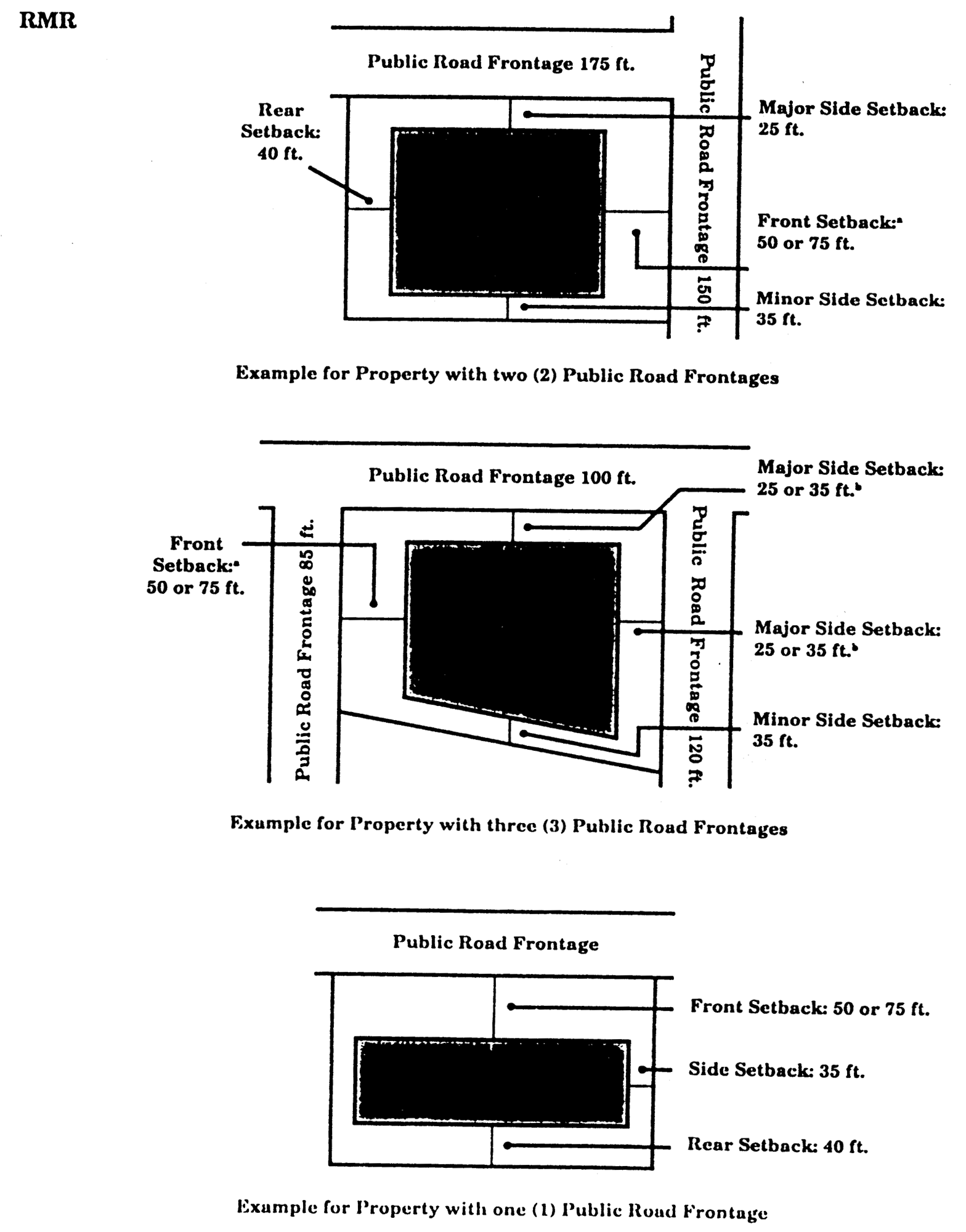
Minimum Building Setback Requirements for RMR District
Notes:
a Property with shorter amount of road frontage will be the front setback for determining other setbacks (major side, side, rear).
b If structure fronts a major side setback, major side setback shall be 35 feet.
(5)
Landscape buffer and screening requirements. Unless otherwise noted within this district's requirements, any property within an RMR district which abuts a residentially zoned property shall have a minimum 50-foot landscaped screening buffer adjacent to all residentially zoned property. The buffer shall be subject to approval by county staff. Required buffers may be included within required setbacks; however, in such case that the required buffer is greater than the required setback, the required buffer shall be adhered to. Additionally, necessary private utilities and access drives may be allowed through, over or across a landscaped buffer. Any such uses which are proposed through, over or across a designated undisturbed buffer must be approved pursuant to an original site plan or site plan modification as set forth under section 134-126.
a.
Objectives. Undisturbed, planted landscape buffers and berms shall be implemented in connection with a permitted project and shall address the following objectives:
1.
Screening to enhance aesthetic appeal;
2.
Control or direction of vehicular and pedestrian movement;
3.
Reduction of glare;
4.
Buffering of noise; and
5.
Establishment of privacy.
b.
Standards. Buffers or berms shall be required when an RMR district is located adjacent to a more restrictively zoned residential district; a minimum 50-foot buffer is required.
1.
Buffers. Landscape buffers are subject to review and approval by county staff in accordance with the following standards:
i.
Plantings are to be a mix of evergreen trees and shrubs.
ii.
Species are to be ecologically compatible to the site and appropriate for the design situation.
iii.
Unless public safety concerns dictate otherwise, a buffer should provide a maximum visual barrier to a height of six feet within two years of planting.
iv.
Minimum height of plant materials at installation is five feet for trees and two feet for shrubs.
v.
Fencing or walls are to be a minimum of six feet in height as approved by county staff.
vi.
Trees included in buffer plantings may be counted toward site density calculations as required by chapter 50, article VI, pertaining to tree preservation and replacement, subject to review and approval of county staff.
vii.
Buffers shall be regularly maintained by the property owner to ensure that the objectives and standards set out in this subsection are met.
viii.
When topography and existing conditions allow, the required 50-foot buffer should be an undisturbed buffer.
ix.
Any appeals from a determination by county staff shall be to the board of zoning appeals.
2.
Berms. Berms are subject to review and approval by county staff in accordance with the following standards:
i.
Berms shall be utilized when consistent with surrounding property features.
ii.
Berms shall be stabilized.
iii.
Berms shall be constructed to be consistent with natural or proposed drainage patterns.
iv.
Berms shall be regularly maintained by the property owner.
(6)
Floodplain and wetlands preservation requirements. Any development must meet state and federal requirements relating to areas subject to the provisions of section 134-283, regarding mountain and river corridor protection act areas, and section 134-284, regarding metropolitan river protection act areas. No floodplains and/or wetlands may be used in calculating the overall density of the development.
(7)
Building and structure requirements. Minimum building height is four stories or 40 feet. Maximum building height is eight stories or 75 feet.
(8)
Parking requirements. See section 134-272 for paved parking specifications.
(9)
Lighting requirements.
a.
Any project permitted within the RMR district which proposes a lighted facility must have a county department of transportation approved lighting plan in accordance with the minimum conditions listed in section 134-269.
b.
All developments with multifamily units shall be designed with lighting that does not spill over into abutting properties and is the minimum to provide security for residents of multifamily housing developments.
(10)
Special exception uses. See section 134-271 for special exception uses and requirements for all districts. Special exception uses for the RMR district are the uses listed in section 134-271.
(11)
Temporary land use permits and special land use permits. See sections 134-36 and 134-37 for additional uses and requirements for all districts. Uses requiring land use permits or special land use permits for the RMR district are the designated uses listed in sections 134-36 and 134-37.
(12)
Use limitations.
a.
Maximum DUA for high density residential uses is 33 DUA.
b.
All refuse collection facilities and designated recycling collection locations must be contained within completely enclosed facilities.
c.
No outside storage is permitted. Within the RMR district outside storage shall not include commercial vehicles.
d.
No drive-in establishments are permitted.
e.
No uses that emit noxious odors, fumes or sounds are permitted.
f.
No outside runs are permitted with any veterinary office use permitted within this district.
g.
No sale of goods or products shall be permitted except if accessory to a customary home occupation, land use permit, special land use permit or special exception use.
h.
No sexually oriented businesses are permitted.
i.
No materials, equipment or business vehicles may be stored or parked on the premises, except that one business vehicle, the carrying or towing capacity of which shall not exceed 1½ tons, used exclusively by the resident may be parked in a carport, garage, or rear or side yard. The off-site employees of the resident shall not congregate on the premises for any purpose concerning the business of the home occupation.
j.
All uses are subject to chapter 110, pertaining to subdivisions.
k.
Maximum impervious surface shall not exceed 35 percent.
l.
No loading docks or facilities may be located in the front of any primary structure.
Required buffers may be included within required setbacks; however, in such case that the required buffer is greater than the required setback, the required buffer shall be adhered to. Additionally, necessary private utilities and access drives may be allowed through, over or across a landscaped buffer. Any such uses which are proposed through, over or across a designated undisturbed buffer must be approved pursuant to an original site plan or site plan modification as set forth under section 134-126.
(13)
Accessory buildings, structures, uses and decks. Any accessory building or structure in excess of 1,000 square feet of gross space shall be located to the rear of the primary structure and at least 40 feet from any residential property line. Any accessory building or structure which exceeds 1,000 square feet of gross space must have the approval of the division manager of zoning or his designee as to the location, architectural design and size prior to commencing construction. The division manager of zoning or his designee shall consider the following criteria for determining the appropriateness of the architectural design and size of the accessory building or structure: compatibility with the surrounding neighborhood, style of exterior (the exterior is to be compatible in style with the primary structure), use of the proposed accessory structure, impact on adjacent properties, and requirements as deemed appropriate by plan review as set forth in this subsection. All accessory buildings, structures and uses in excess of 1,000 gross square feet shall be required to submit for plan review through the community development department or receive approval from the director of the community development department or his designee.
a.
Accessory buildings, structures, uses or decks shall be subject to the following conditions:
1.
Maximum height is two stories or 35 feet.
2.
Accessory uses shall include garbage pads, heating and air conditioning units, jacuzzis, tennis courts, swimming pools (private), playhouses and playgrounds.
3.
All accessory uses shall be located to the rear of the principal building, except for heating and air conditioning units or garbage pads, which may be located on the side or rear.
4.
The rear of the principal building shall be where the main portion of the building ends without consideration of wings.
5.
Such structures or buildings shall be located on the same lot as and to the rear of the principal building to which they are accessory. Decks may be located to the rear or side of the principal building subject to the limitations in this subsection.
6.
No accessory building, structure, use or deck shall be built until construction of the principal building has commenced.
7.
On a corner lot, no accessory building, structure, use or deck shall be located closer to the side street right-of-way line than the principal building.
8.
No garage or other accessory building, structure, use or deck shall be located closer than five feet to a side or rear lot line or within any required buffers, whichever is greater.
9.
When an accessory building, structure or use is attached to the principal building by a breezeway, passageway or similar means, it shall comply with the yard and buffer requirements of the principal building to which it is accessory. This shall not apply to decks.
b.
Antennas and satellite dishes shall meet the requirements set forth in section 134-274.
c.
Freestanding and attached parking garages are subject to the following conditions:
1.
Maximum height is 50 feet, with no more than four stories.
2.
When abutting any residential property line, a freestanding or attached parking garage shall not be located within any required buffers.
3.
When abutting any other nonresidential district, no freestanding or attached parking garage shall be located closer than five feet to a side or rear lot line.
d.
Heating and air conditioning units are subject to the following conditions:
1.
When abutting any residential property line, heating and air conditioning units shall not be located within any required buffers.
2.
When abutting any other nonresidential district, no heating and air conditioning units shall be located closer than five feet to a side or rear lot line.
3.
Heating and air conditioning units may be installed on the roof of any structure zoned commercially so long as the heating and air conditioning unit does not exceed the height restrictions stated in this section and the units are placed so as to be hidden from a front or side view.
4.
No ground-based heating and air conditioning unit shall exceed 35 feet in height.
e.
Incidental storage is permitted, provided that the material stored is incidental to the permitted use, as determined by the division manager of zoning or his designee, and stored completely within a portion of the enclosed principal structure permitted within the district, or within a permitted accessory structure.
(14)
Multifamily unit development security. To enhance building/site security, applicants shall coordinate with local law enforcement to develop a security plan in accordance with the standards of crime prevention through environmental design (CPTED). Security plan shall be reviewed and updated annually by the property manager.
(Ord. of 12-26-72; Res. of 8-14-73, § 8; Ord. of 11-8-77, § 1; Ord. of 7-7-82, §§ 1, 3; Ord. of 12-11-90, § 3-28-7.26; Ord. of 8-13-91; Ord. of 6-9-92; Ord. of 10-25-94; Ord. of 7-11-95; Ord. of 2-27-96; Ord. of 6-24-97 (eff. 7-1-97); Ord. of 5-9-00; Ord. of 9-10-02; Ord. of 1-24-06; Amd. of 2-24-09; Amd. of 2-28-17; Amd. of 9-8-20; Amd. of 9-27-22)
Sec. 134-220. - OMR office mid-rise district.
The regulations for the OMR office mid-rise district are as follows:
(1)
Purpose and intent. The OMR district is established to provide locations for uses such as offices, financial institutions and accessory retail sales and service uses (four to eight stories) which are on properties delineated within a regional activity center as defined and shown on the Cobb County Comprehensive Plan: A Policy Guide, adopted November 27, 1990.
(2)
Definitions. The following words, terms and phrases, when used in this section, shall have the meanings ascribed to them in this subsection, except where the context clearly indicates a different meaning:
a.
Accessory retail uses means retail sales and services accessory to the operation of an office building or institutional use, motel, hotel or high-rise residential development, conducted wholly within the building housing the use to which such activities are accessory, provided that the floorspace used or to be used for such accessory retail uses shall be limited to a total of 25 square feet per dwelling unit in a high-rise residential development or 25 square feet per room in a hotel or motel, or ten percent of the net floor area in an office building or institutional use, and provided that:
1.
Every public entrance to such a use shall be from a lobby, hallway or other interior portion of the primary use structure.
2.
No show window, advertising or display shall be visible from the exterior of the primary use structure.
3.
No merchandise shall be stored or displayed outside of the primary use structure.
4.
Accessory retail uses shall include eating and drinking establishments, barber shops, beauty shops, laundry and dry cleaning pickup establishments, news stands, florists' gift shops, film developing and printing facilities, stationery stores, shoe repair shops, or convenience food stores (no fuel sales).
5.
Accessory retail use square footage must be in the primary building it serves; accessory use square footages cannot be allocated to other buildings in a multibuilding development.
b.
Clinic. A medical or dental clinic is an organization of specializing physicians or dentists, or both, who have their offices in a common building. A clinic shall include laboratory facilities in conjunction with normal clinic services.
c.
Community fair means a festival or fair such as the North Georgia State Fair conducted wholly within public areas owned by a local government, provided that any activity is conducted at least 200 feet from any property line. Any event shall not exceed 21 days.
d.
Designated recycling collection locations means metal or heavy duty plastic containers designed for shortterm holding of pre-bagged recyclable items such as tin, aluminum, glass and paper (no perishable or food items allowed) for scheduled minimum monthly pickup, with no on-premises sorting. The center must be maintained in a safe, clean, neat and sanitary fashion and shall not encompass an area larger than 280 square feet.
1.
Such location shall be visually screened and maintained.
2.
Such location shall be within the building setbacks unless otherwise approved by the division manager of zoning or his designee due to topography, safety, internal traffic flow, site distance or other site-related circumstances not created by the property owner.
e.
Group home means a dwelling shared by six or less persons, excluding resident staff, who live together as a single housekeeping unit and in a longterm, family-like environment in which staff persons provide care, education and participation in community activities for the residents with the primary goal of enabling the residents to live as independently as possible in order to reach their maximum potential. This use shall apply to homes for the handicapped. As used in this subsection, the term "handicapped" shall mean:
1.
Having a physical or mental impairment that substantially limits one or more of such person's major life activities so that such person is incapable of living independently;
2.
Having a record of having such an impairment; or
3.
Being regarded as having such an impairment.
However, the term "handicapped" shall not include current illegal use of or addiction to a controlled substance, nor shall it include any person whose residency in the home would constitute a direct threat to the health and safety of other individuals. The term "group home for the handicapped" shall not include alcoholism or drug treatment centers, work release facilities for convicts or ex-convicts, or other housing facilities serving as an alternative to incarceration.
f.
Professional office means a structure wherein services are performed involving predominately administrative, professional or clerical operations such as the following: law, doctor, optician, audiologist, accounting, tax preparation, real estate, stockbroker, architect, engineer, manufacturer representative, professional counselor, dentist, investigative services, photographer, insurance, contractor, land surveyor, telephone sales, political/campaign, veterinarian or travel bureau.
(3)
Permitted uses. Permitted uses are as follows:
Accessory retail sales and services.
Ambulance services, if accessory to hospitals or funeral homes.
Animal hospitals.
Athletic and health clubs.
Automotive parking lots or garages.
Banks and financial institutions with drive-in establishment or automated transfer machines.
Bus stations.
Churches, chapels, temples, synagogues, and other such places of worship.
Clinics.
Clubs or lodges (noncommercial).
Colleges and universities (private), including but not limited to research and training facilities.
Community fairs.
Designated recycling collection locations.
Executive golf courses (see section 134-270).
Funeral homes.
Golf courses, 18-hole regulation, public and private (see section 134-270).
Golf courses, par 3 (see section 134-270).
Group homes.
Hospitals.
Hotels.
In-home day care.
Medical and dental laboratories, provided that no chemicals are manufactured on-site.
Motels.
Nonprofit (seasonal use) fishing lakes.
Nursery schools and child care centers.
Offices not elsewhere classified.
Parking for vehicles.
Photography studios.
Private parks.
Professional offices.
Radio and television stations.
Radio, television and other communications towers and antennas, subject to section 134-273.
Rest homes, personal care homes and convalescent homes.
Temporary uses.
(4)
Lot size and setback requirements. Lot size and setback requirements are as follows:
a.
Minimum lot size: 40,000 square feet.
b.
Minimum lot width at front setback line: 60 feet.
c.
Minimum public road frontage: 50 feet.
d.
Minimum building setbacks: As shown and applied in the following diagram:
MINIMUM BUILDING SETBACK REQUIREMENTS FOR OMR DISTRICT
Note: All setbacks shall be measured from future right-of-way.
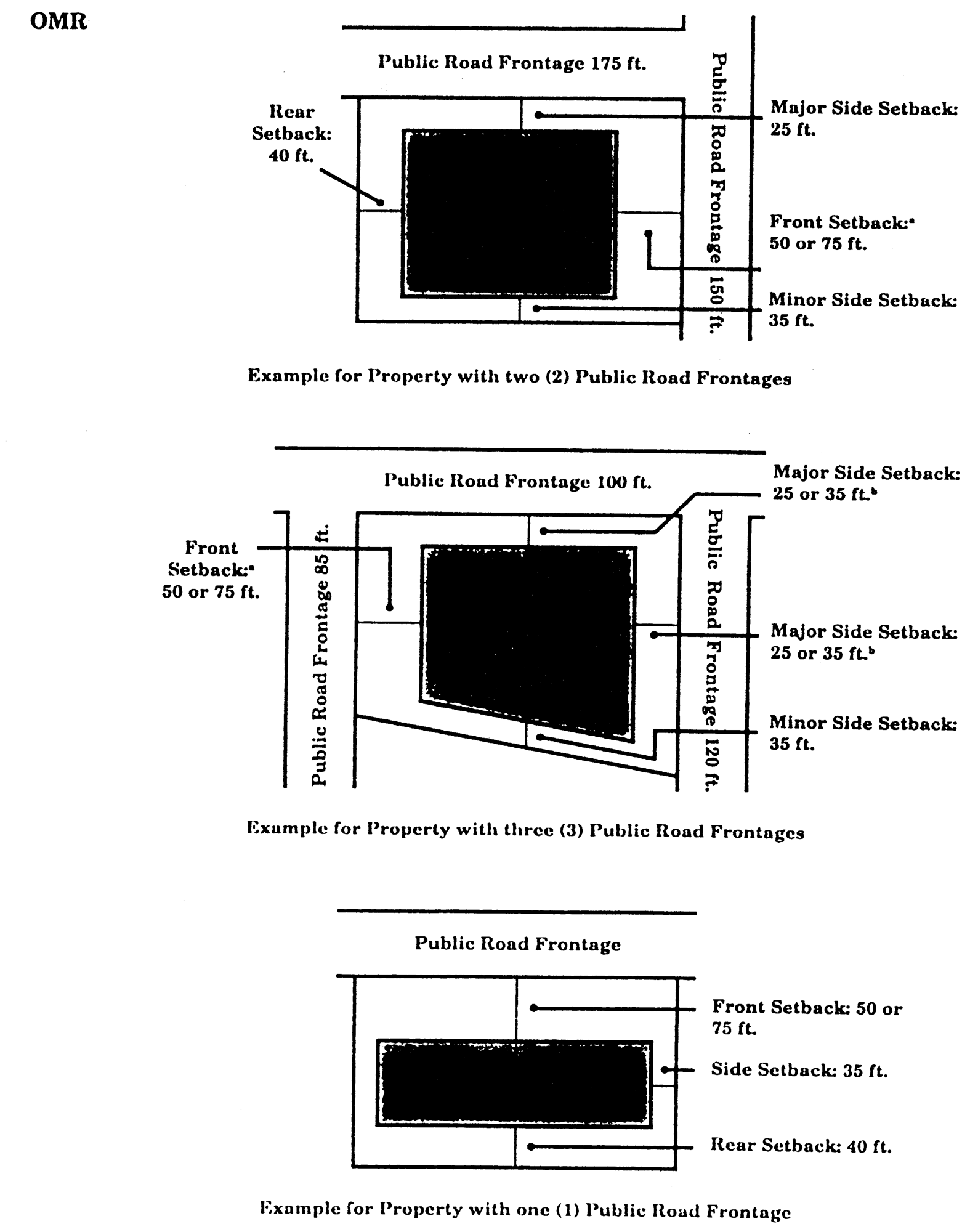
Minimum Building Setback Requirements for OMR District
Notes:
a Property with shorter amount of road frontage will be the front setback for determining other setbacks (major side, side, rear).
b If structure fronts a major side setback, major side setback shall be 35 feet.
(5)
Landscape buffer and screening requirements. Unless otherwise noted within this district's requirements, any property within an OMR district which abuts a residentially zoned property shall have a 35-foot landscaped screening buffer adjacent to all residentially zoned property. The buffer shall be subject to approval by county staff. Required buffers may be included within required setbacks; however, in such case that the required buffer is greater than the required setback, the required buffer shall be adhered to. Additionally, necessary private utilities and access drives may be allowed through, over or across a landscaped buffer. Any such uses which are proposed through, over or across a designated undisturbed buffer must be approved pursuant to an original site plan or site plan modification as set forth under section 134-126.
a.
Objectives. Undisturbed, planted landscape buffers and berms shall be implemented in connection with a permitted project and shall address the following objectives:
1.
Screening to enhance aesthetic appeal;
2.
Control or direction of vehicular and pedestrian movement;
3.
Reduction of glare;
4.
Buffering of noise; and
5.
Establishment of privacy.
b.
Standards. Buffers or berms shall be required when an OMR district is located adjacent to a residential district; a minimum 35-foot buffer is required.
1.
Buffers. Landscape buffers are subject to review and approval by county staff in accordance with the following standards:
i.
Plantings are to be a mix of evergreen trees and shrubs.
ii.
Species are to be ecologically compatible to the site and appropriate for the design situation.
iii.
Unless public safety concerns dictate otherwise, a buffer should maximize a visual barrier to a height of six feet within two years of planting.
iv.
Minimum height of plant materials at installation is five feet for trees and two feet for shrubs.
v.
Fencing or walls are to be a minimum of six feet in height as approved by county staff.
vi.
Trees included in buffer plantings may be counted toward site density calculations as required by chapter 50, article VI, pertaining to tree preservation and replacement, subject to review and approval of county staff.
vii.
Buffers shall be regularly maintained by the property owner to ensure that the objectives and standards set out in this subsection are met.
viii.
When topography and existing conditions allow, the required buffer should be an undisturbed buffer.
ix.
Any appeals from a determination by county staff shall be to the board of zoning appeals.
2.
Berms. Berms are subject to review and approval by county staff in accordance with the following standards:
i.
Berms shall be utilized when consistent with surrounding property features.
ii.
Berms shall be stabilized.
iii.
Berms shall be constructed to be consistent with natural or proposed drainage patterns.
iv.
Berms shall be regularly maintained by the property owner.
(6)
Floodplain and wetlands preservation requirements. Any development must also meet state and federal requirements relating to areas subject to the provisions of section 134-283, regarding mountain and river corridor protection act areas, and section 134-284, regarding metropolitan river protection act areas.
(7)
Building and structure requirements. Maximum building height is eight stories or 104 feet.
(8)
Parking requirements. See section 134-272 for paved parking specifications.
(9)
Lighting requirements. Any project permitted within the OMR district which proposes a lighted facility must have a county department of transportation approved lighting plan in accordance with the minimum conditions listed in section 134-269.
(10)
Special exception uses. See section 134-271 for special exception use requirements for all districts. Special exception uses for the OMR district are the uses listed in section 134-271.
(11)
Special exception uses for regional activity center only. The following uses, with the proper scrutiny and conditions, may be considered as special exception uses within the OMR district, only if they are within properties delineated as regional activity centers as defined and shown on the Cobb County Comprehensive Plan: A Policy Guide, adopted November 27, 1990. Any special exception use, for regional activity centers only, shall adhere to the landscape buffer and screening requirements in subsection (5) of this section.
a.
Hotel (suite).
The following minimum standards shall apply to suite hotels:
1.
Minimum acreage is two acres.
2.
All rooms shall be accessed through a main or central lobby.
3.
No rooms shall access to the exterior of the building unless required by fire/safety regulations.
4.
The minimum number of floors allowed shall be three floors, unless otherwise approved by the board of commissioners.
5.
Architectural style/design to be approved by the board of commissioners.
6.
All buildings shall have a minimum roof pitch of a four in twelve as defined by applicable building codes.
7.
Conference, meeting or banquet facilities are allowed when supported by adequate parking and approved by the board of commissioners as part of the special land use permit.
8.
Restaurants or other type of eating facilities are allowed when supported by adequate parking and approved by the board of commissioners. "Continental" style dining for the guests of the facility only is allowed within or near the main or central lobby without additional parking.
9.
At a minimum, provisions for weekly cleaning for each suite must be provided.
10.
Each suite must be protected with a smoke detector and sprinkler system approved by the fire marshal or his designee.
11.
Each suite shall be required to include an automatic power off timer for each stove/cook top unit or other type burner.
12.
Parking shall be calculated as one space required for each suite, with an additional ten spaces provided for employees. Parking requirements for conference, meeting or banquet facilities or restaurants or other type of eating facilities within a suite hotel shall be calculated as provided for each use in section 134-272, "traffic and parking," in addition to the above parking requirements and approved by the board of commissioners.
13.
There shall be no outside storage allowed or long term parking of heavy equipment, or parking of construction or related equipment allowed.
14.
A landscaping plan is to be approved by staff with emphasis on planting within the parking facilities.
15.
No facility under this section is to be converted or used primarily as an apartment or condominium.
b.
Climate controlled self-service storage facilities, when complementary or accessory to an office park or building.
The following minimum standards shall apply to climate controlled self-service storage facilities:
1.
Building height should not exceed those of adjacent buildings, nor impact the view shed of adjacent residential property.
2.
F.A.R. should be 2.0 or as determined appropriate by the board of commissioners.
3.
All units shall be accessed through a main or central entrance.
4.
All windows or similar architectural features must be "one way" and provide for an opaque screen from view outside of the building.
5.
Architectural style/design to be similar or complementary to the predominant architectural design of other commercial uses within the activity center. Said architectural style/design to be approved by the board of commissioners. Any roof-mounted utilities or building components must be sufficiently screened from view of adjoining properties and public right-of-way.
6.
There shall be no outside storage allowed nor overnight and/or long-term parking of heavy equipment, commercial equipment or parking of construction or related equipment allowed.
7.
There shall be no storage of recreational vehicles and no dry storage of pleasure boats of any type customarily maintained by private individuals for their personal use.
8.
There shall be no storage of flammable liquids, highly combustible or explosive materials, or hazardous chemicals.
9.
No units within the facility shall be used for or considered to be premises for the purpose of assigning a legal address in order to obtain an occupational license or any other government permit or licenses to do business.
10.
There shall be no resident manager or any type of overnight accommodations for such.
11.
Landscape plan to be approved by staff with emphasis on planting within the parking facilities.
12.
One parking space shall be provided per every 80 individual storage units/areas.
13.
Overall project must be accessed via a public or private roadway which is internal to the office park, building or shopping center; direct access to an adjoining public roadway shall be subject to approval by the board of commissioners.
14.
No freestanding signage shall be utilized; internal directional signage will be subject to approval by the board of commissioners.
15.
No units shall be used to manufacture, fabricate or process goods, to service or repair vehicles, boats, small engines or electrical equipment, or to conduct similar repair activities, to conduct garage sales or retail styles of any kind, to rehearse or practice utilizing band instruments, or for conversion to an apartment or dwelling unit, or to conduct any other commercial or industrial activities on the site.
16.
Loading area, including adequate turnaround space for a tractor trailer vehicle, must be screened by a permanent architectural or landscape feature or as may be approved by the board of commissioners if not located to side or rear of proposed structure.
17.
Special land use permit as provided in section 134-37.
18.
Hours of operation to be established by the board of commissioners, considering the operational hours of surrounding businesses.
(12)
Use limitations.
a.
Maximum floor area ratio is 0.75 for office uses and 0.25 for retail uses (accessory).
b.
All structures located within an OMR district shall be appropriately scaled in relation to the transitional nature of the immediate area.
c.
All refuse and designated recycling collection location facilities must be contained within completely enclosed facilities.
d.
It is found and declared that outside storage on properties within unincorporated Cobb County is a health risk and undesirable in that it provides harborage for rodents and insects, lowers property values, and constitutes a public nuisance; therefore, no outside storage is permitted, unless otherwise allowed in this article. Within the OMR district, outside storage shall not include commercial vehicles.
e.
No sexually oriented businesses are permitted.
f.
No drive-in eating or drinking establishments are permitted.
g.
No uses that emit noxious odors, fumes or sounds are permitted.
h.
No outside runs are permitted with any veterinary office use permitted within this district.
i.
Kitchenettes or kitchen facilities are prohibited in motels.
j.
Maximum impervious surfaces (80%-RAC, 70%-CAC and NAC) shall be established within activity centers as identified by the Cobb County Comprehensive Plan, as may be amended from time to time.
k.
No loading docks or facilities may be located in the front of any primary structure.
Required buffers may be included within required setbacks; however, in such case that the required buffer is greater than the required setback, the required buffer shall be adhered to. Additionally, necessary private utilities and access drives may be allowed through, over or across a landscaped buffer. Any such uses which are proposed through, over or across a designated undisturbed buffer must be approved pursuant to an original site plan or site plan modification as set forth under section 134-126.
(13)
Accessory buildings, structures, uses and decks. Any accessory building or structure in excess of 1,000 square feet of gross space shall be located to the rear of the primary structure and at least 40 feet from any residential property line. Any accessory building or structure which exceeds 1,000 square feet of gross space must have the approval of the division manager of zoning or his designee as to the location, architectural design and size prior to commencing construction. The division manager of zoning or his designee shall consider the following criteria for determining the appropriateness of the architectural design and size of the accessory building or structure: compatibility with the surrounding neighborhood, style of exterior (the exterior is to be compatible in style with the primary structure), use of the proposed accessory structure, impact on adjacent properties, and requirements as deemed appropriate by plan review as set forth in this subsection. All accessory buildings, structures and uses in excess of 1,000 gross square feet shall be required to submit for plan review through the community development department or receive approval from the director of the community development department or his designee. Permitted accessory structures and uses are as follows:
a.
Accessory retail sales and service.
b.
Accessory storage buildings, subject to the following conditions:
1.
Maximum height is two stories, not to exceed 35 feet.
2.
Such structures shall be located on the same lot as and to the rear of the principal building to which they are accessory.
3.
No accessory building shall be constructed upon a lot until construction of the principal building has commenced.
4.
On a corner lot, no accessory building shall be located closer to the side street right-of-way line than the principal building.
5.
When abutting any other nonresidential district, no garage or other accessory building shall be located closer than five feet to a side or rear lot line.
6.
When an accessory building is attached to the principal building by a breezeway, passageway or similar means, it shall comply with the yard requirements of the principal building to which it is accessory.
7.
Where any nonresidential lot adjoins the side or rear of a residential lot, an accessory building shall not be located within any required buffers.
c.
Antennas and satellite dishes, which shall meet the requirements set forth in section 134-274.
d.
Freestanding and attached parking garages, subject to the following conditions:
1.
Maximum height: eight stories.
2.
When abutting any residential property line, freestanding or attached parking garages shall not be located within any required buffers.
3.
When abutting any other nonresidential district, no freestanding or attached parking garage shall be located closer than five feet to a side or rear lot line.
e.
Heating and air conditioning units, subject to the following conditions:
1.
When abutting any residential property line, heating and air conditioning units shall not be located within any required buffers.
2.
When abutting any other nonresidential district, no heating and air conditioning units shall be located closer than five feet to a side or rear lot line.
3.
Heating and air conditioning units may be installed on the roof of any structure zoned commercially so long as the heating and air conditioning unit does not exceed the height restrictions stated in this section and the units are placed so as to be hidden from a front or side view.
4.
No ground-based heating and air conditioning unit shall exceed 35 feet in height.
f.
Incidental storage, provided that the material stored is incidental to the permitted use, as determined by the division manager of zoning or his designee, and stored completely within a portion of the enclosed principal structure permitted within the district, or within a permitted accessory structure.
(Ord. of 12-26-72; Ord. of 12-11-90, § 3-28-7.27; Ord. of 8-13-91; Ord. of 6-9-92; Ord. of 10-25-94; Ord. of 7-11-95; Ord. of 6-24-97 (eff. 7-1-97); Ord. of 7-10-01; Ord. of 9-10-02; Ord. of 12-9-03; Ord. of 7-27-04; Ord. of 7-26-05; Amd. of 2-24-09; Amd. of 3-24-09; Amd. of 2-24-15; Amd. of 9-8-20)
Sec. 134-221. - RHR residential high-rise district.
Commencing April 4, 1996, no new applications for rezoning to the RHR district will be accepted by the board of commissioners. The regulations for the RHR residential high-rise district are as follows:
(1)
Purpose and intent. The RHR district is intended to provide for higher density residential uses (not to exceed 66 DUA) located in areas designated as regional activity centers as defined and shown on the Cobb County Comprehensive Plan: A Policy Guide, adopted November 27, 1990.
(2)
Definitions. The following words, terms and phrases, when used in this section, shall have the meanings ascribed to them in this subsection, except where the context clearly indicates a different meaning:
a.
Accessory retail uses means retail sales and services accessory to the operation of an office building or institutional use, motel, hotel or high-rise residential development, conducted wholly within the building housing the use to which such activities are accessory, provided that the floorspace used or to be used for such accessory retail uses shall be limited to a total of 25 square feet per dwelling unit in a high-rise residential development or 25 square feet per room in a hotel or motel, or ten percent of the net floor area in an office building or institutional use, and provided that:
1.
Every public entrance to such a use shall be from a lobby, hallway or other interior portion of the primary use structure;
2.
No show window, advertising or display shall be visible from the exterior of the primary use structure;
3.
No merchandise shall be stored or displayed outside of the primary use structure.
4.
Accessory retail uses shall include eating and drinking establishments, barber shops, beauty shops, laundry and dry cleaning pickup establishments, news stands, florists' gift shops, film developing and printing facilities, stationery stores, shoe repair shops, or convenience food stores (no fuel sales).
5.
Accessory retail use square footage must be in the primary building it serves; accessory use square footages cannot be allocated to other buildings in a multibuilding development.
b.
Community fair means a festival or fair such as the North Georgia State Fair conducted wholly within public areas owned by a local government, provided that any activity is conducted at least 200 feet from any property line. Any event shall not exceed 21 days.
c.
Customary home occupations means those occupations which are customarily performed in a small area of a residence due to the low intensity nature of such uses, subject to the following requirements:
1.
There shall be no exterior evidence of the home occupation, including but not limited to any type of identifying signs.
2.
No article, product or service used or sold in connection with such activity shall be other than those normally found on the premises.
3.
No mechanical equipment shall be used for such occupation except such equipment as is customary for purely household and hobby purposes.
4.
Such use shall be conducted entirely within the dwelling unit, and only persons living in the dwelling unit shall be employed in such occupation.
5.
No more than 25 percent of the dwelling unit may be used for the operation.
6.
No materials, equipment or business vehicles may be stored or parked on the premises, except that one business vehicle, with a manufacturer's towing or carrying capacity rating of less than 1½ tons, used exclusively by the resident may be parked in a carport, garage, or rear or side yard. The off-site employees of the resident shall not congregate on the premises for any purpose concerning the business of the home occupation.
7.
There shall be no deliveries of supplies for use in the home occupation or pickups of the items produced by the occupant by commercial carrier.
d.
Group home means a dwelling shared by six or less persons, excluding resident staff, who live together as a single housekeeping unit and in a longterm, family-like environment in which staff persons provide care, education and participation in community activities for the residents with the primary goal of enabling the residents to live as independently as possible in order to reach their maximum potential. This use shall also apply to homes for the handicapped. As used in this subsection, the term "handicapped" shall mean:
1.
Having a physical or mental impairment that substantially limits one or more of such person's major life activities so that such person is incapable of living independently;
2.
Having a record of having such an impairment; or
3.
Being regarded as having such an impairment.
However, the term "handicapped" shall not include current illegal use of or addiction to a controlled substance, nor shall it include any person whose residency in the home would constitute a direct threat to the health and safety of other individuals. The term "group home for the handicapped" shall not include alcoholism or drug treatment centers, work release facilities for convicts or ex-convicts, or other housing facilities serving as an alternative to incarceration.
e.
Livestock, nondomestic and wild animals, and poultry means animals, nondomestic and wild animals, and species of the avian family which are or may be raised for the purpose of providing food or transportation, or being resold or bred, excluding only dogs, cats, rabbits, fish, pet mice, hamsters, gerbils, parrots and parakeets.
1.
Such animals shall only be permitted on a lot containing not less than two acres.
2.
All buildings used for animals shall be set back not less than 200 feet from any property line.
3.
All animals shall be maintained at least 25 feet from any residential property line.
4.
Except in the RR district, there shall be not less than 5,000 square feet of fenced lot area not covered by the principal structure for each animal, unless the property is a bona fide farm.
5.
In the case of nondomestic or wild animals, all state and federal requirements must be met and a special land use permit is required.
f.
Nonprofit riding stable means a building for the shelter and feeding of domestic animals, especially horses.
1.
Such stable shall be established on a lot having an area of not less than ten acres.
2.
Any structure shall be located at least 200 feet from any property line.
3.
All animals shall be maintained at least 100 feet from any property line.
(3)
Permitted uses. Anything not permitted or allowed by special exception is prohibited. Permitted uses are as follows:
Accessory retail sales and services.
Community fairs.
Condominiums.
Customary home occupations.
Designated recycling collection locations.
Executive golf courses (see section 134-270).
Fraternity and sorority houses and residence halls.
Fruit trees, nuts and vegetables.
Golf courses, 18-hole regulation, public and private (see section 134-270).
Golf courses, par 3 (see section 134-270).
Group homes.
High-rise apartments.
In-home day care.
Livestock, nondomestic and wild animals, and poultry, on two or more acres.
Nonprofit riding stables.
Nonprofit (seasonal use) fishing lakes.
Parking for vehicles.
Personal vehicle and equipment sales.
Pro shops, if accessory to driving ranges or golf courses.
Taxistands and taxi dispatching agencies.
Temporary uses.
Vocational schools (commercial).
(4)
Lot size and setback requirements. Lot size and setback requirements are as follows:
a.
Minimum lot size: 80,000 square feet.
b.
Minimum lot width at front setback line: 60 feet.
c.
Minimum public road frontage: 50 feet.
d.
Minimum building setbacks: As shown and applied in the following diagram:
MINIMUM BUILDING SETBACK REQUIREMENTS FOR RHR DISTRICT
Note: All setbacks shall be measured from future right-of-way.
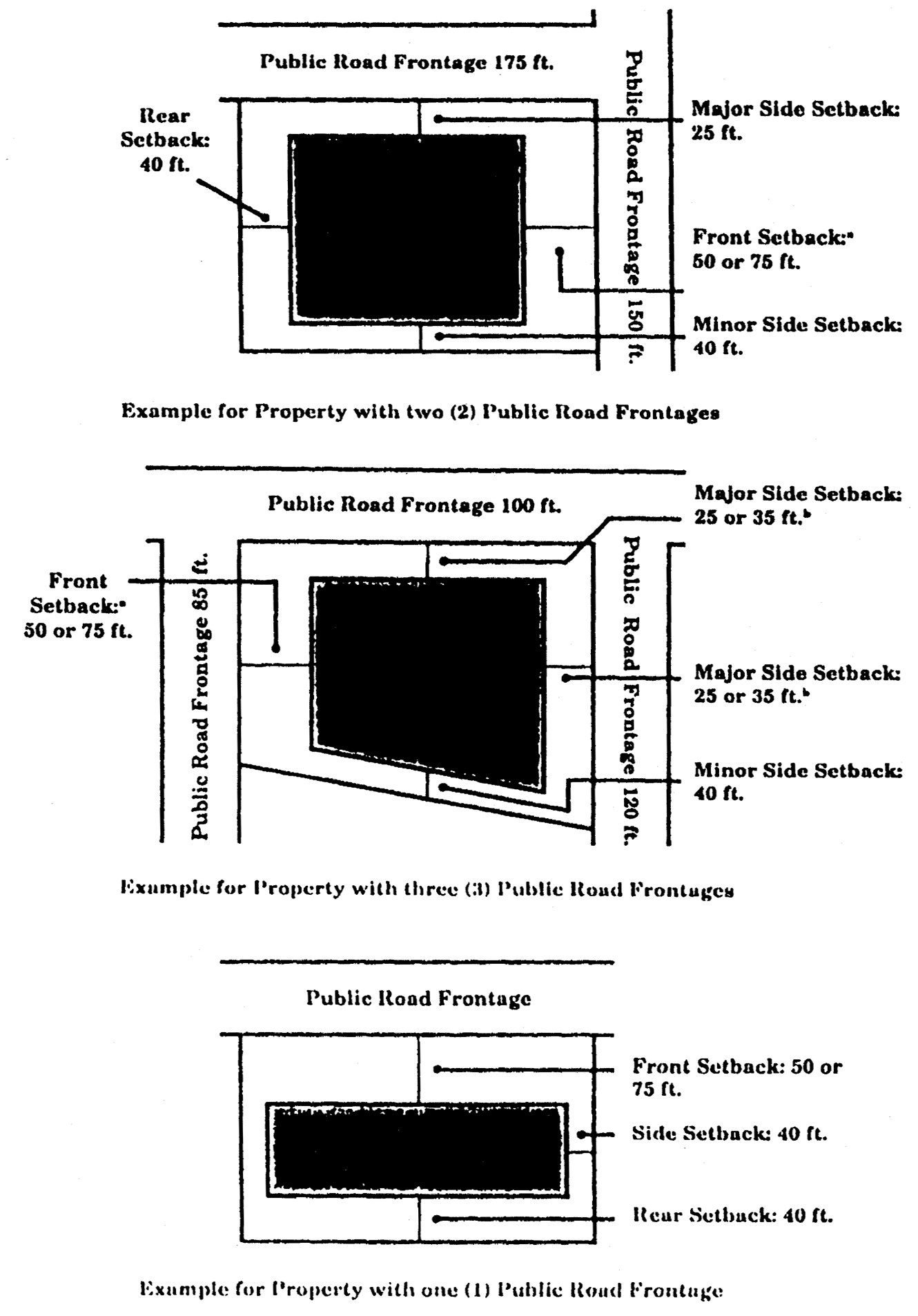
Minimum Building Setback Requirements for RHR District
Notes:
a Property with shorter amount of road frontage will be the front setback for determining other setbacks (major side, side, rear).
b If structure fronts a major side setback, major side setback shall be 35 feet.
(5)
Landscape buffer and screening requirements. Unless otherwise noted within this district's requirements, any property within an RHR district which abuts a residentially zoned property shall have a minimum 50-foot landscaped screening buffer adjacent to all residentially zoned property. The buffer shall be subject to approval by county staff. Required buffers may be included within required setbacks; however, in such case that the required buffer is greater than the required setback, the required buffer shall be adhered to. Additionally, necessary private utilities and access drives may be allowed through, over or across a landscaped buffer. Any such uses which are proposed through, over or across a designated undisturbed buffer must be approved pursuant to an original site plan or site plan modification as set forth under section 134-126.
a.
Objectives. Undisturbed, planted landscape buffers and berms shall be implemented in connection with a permitted project and shall address the following objectives:
1.
Screening to enhance aesthetic appeal;
2.
Control or direction of vehicular and pedestrian movement;
3.
Reduction of glare;
4.
Buffering of noise; and
5.
Establishment of privacy.
b.
Standards. Buffers or berms shall be required when an RHR district is located adjacent to a more restrictively zoned residential district; a minimum 50-foot buffer is required.
1.
Buffers. Landscape buffers are subject to review and approval by county staff in accordance with the following standards:
i.
Plantings are to be a mix of evergreen trees and shrubs.
ii.
Species are to be ecologically compatible to the site and appropriate for the design situation.
iii.
Unless public safety concerns dictate otherwise, a buffer should provide a maximum visual barrier to a height of six feet within two years of planting.
iv.
Minimum height of plant materials at installation is five feet for trees and two feet for shrubs.
v.
Fencing or walls are to be a minimum of six feet in height as approved by county staff.
vi.
Trees included in buffer plantings may be counted toward site density calculations as required by chapter 50, article VI, pertaining to tree preservation and replacement, subject to review and approval of county staff.
vii.
Buffers shall be regularly maintained by the property owner to ensure that the objectives and standards set out in this subsection are met.
viii.
When topography and existing conditions allow, the required 50-foot buffer should be an undisturbed buffer.
ix.
Any appeals from a determination by county staff shall be to the board of zoning appeals.
2.
Berms. Berms are subject to review and approval by county staff in accordance with the following standards:
i.
Berms shall be utilized when consistent with surrounding property features.
ii.
Berms shall be stabilized.
iii.
Berms shall be constructed to be consistent with natural or proposed drainage patterns.
iv.
Berms shall be regularly maintained by the property owner.
(6)
Floodplain and wetlands preservation requirements. Any development must meet state and federal requirements relating to areas subject to the provisions of section 134-283, regarding mountain and river corridor protection act areas, and section 134-284, regarding metropolitan river protection act areas. No floodplains and/or wetlands may be used in calculating the overall density of the development.
(7)
Building and structure requirements. Minimum building height is eight stories or 80 feet. Maximum building height is 16 stories or 175 feet.
(8)
Parking requirements. See section 134-272 for paved parking specifications.
(9)
Lighting requirements.
a.
Any project permitted within the RHR district which proposes a lighted facility must have a county department of transportation approved lighting plan in accordance with the minimum conditions set forth in section 134-269.
b.
All developments with multifamily units shall be designed with lighting that does not spill over into abutting properties and is the minimum to provide security for residents of multifamily housing developments.
(10)
Special exception uses. See section 134-271 for special exception uses and requirements for all districts. Special exception uses for the RHR district are the uses listed in section 134-271.
(11)
Temporary land use permits and special land use permits. See sections 134-36 and 134-37 for additional uses and requirements for all districts. Uses requiring land use permits or special land use permits for the RHR district are the designated uses listed in sections 134-36 and 134-37.
(12)
Use limitations.
a.
Any development which has over 500 housing units shall be required to submit a major development area plan prior to rezoning, or, if already zoned, prior to commencing construction.
b.
Maximum density is 66 DUA.
c.
Maximum floor area ratio is 0.75 for office uses and 0.25 for retail uses.
d.
All refuse collection facilities and designated recycling collection locations must be contained within completely enclosed facilities.
e.
It is found and declared that outside storage on properties within unincorporated Cobb County is a health risk and undesirable in that it provides harborage for rodents and insects, lowers property values, and constitutes a public nuisance; therefore, no outside storage is permitted, unless otherwise allowed in this article. Within the RHR district, outside storage shall not include commercial vehicles.
f.
No drive-in establishments are permitted.
g.
No uses that emit noxious odors, fumes or sounds are permitted.
h.
No outside runs are permitted with any veterinary office use permitted within this district.
i.
No sale of goods or products shall be permitted except if accessory to a customary home occupation, land use permit, special land use permit or special exception use.
j.
No sexually oriented businesses are permitted.
k.
No materials, equipment or business vehicles may be stored or parked on the premises, except that one business vehicle, the carrying or towing capacity of which shall not exceed 1½ tons, used exclusively by the resident may be parked in a carport, garage or rear or side yard. The off-site employees of the resident shall not congregate on the premises for any purpose concerning the business of the home occupation.
l.
All uses are subject to chapter 110, the subdivision regulations of the county, as amended from time to time.
m.
No loading docks or facilities may be located in the front of any primary structure.
n.
Maximum impervious surface shall not exceed 45 percent.
Required buffers may be included within required setbacks; however, in such case that the required buffer is greater than the required setback, the required buffer shall be adhered to. Additionally, necessary private utilities and access drives may be allowed through, over or across a landscaped buffer. Any such uses which are proposed through, over or across a designated undisturbed buffer must be approved pursuant to an original site plan or site plan modification as set forth under section 134-126.
(13)
Accessory buildings, structures, uses and decks. Any accessory building or structure in excess of 1,000 square feet of gross space shall be located to the rear of the primary structure and at least 40 feet from any residential property line. Any accessory building or structure which exceeds 1,000 square feet of gross space must have the approval of the division manager of zoning or his designee as to the location, architectural design and size prior to commencing construction. The division manager of zoning or his designee shall consider the following criteria for determining the appropriateness of the architectural design and size of the accessory building or structure: compatibility with the surrounding neighborhood, style of exterior (the exterior is to be compatible in style with the primary structure), use of the proposed accessory structure, impact on adjacent properties, and requirements as deemed appropriate by plan review as set forth in this subsection. All accessory buildings, structures and uses in excess of 1,000 gross square feet shall be required to submit for plan review through the community development department or receive approval from the director of the community development department or his designee.
a.
Accessory buildings, structures, uses or decks shall be subject to the following conditions:
1.
Maximum height is two stories or 35 feet.
2.
Accessory uses shall include garbage pads, heating and air conditioning units, jacuzzis, tennis courts, swimming pools (private), playhouses and playgrounds.
3.
All accessory uses shall be located to the rear of the principal building, except for heating and air conditioning units or garbage pads, which may be located on the side or rear.
4.
The rear of the principal building shall be where the main portion of the building ends without consideration of wings.
5.
Such structures or buildings shall be located on the same lot as and to the rear of the principal building to which they are accessory. Decks may be located to the rear or side of the principal building subject to the limitations in this subsection.
6.
No accessory building, structure, use or deck shall be built until construction of the principal building has commenced.
7.
On a corner lot, no accessory building, structure, use or deck shall be located closer to the side street right-of-way line than the principal building.
8.
No garage or other accessory building, structure, use or deck shall be located closer than five feet to a side or rear lot line or within any required buffers, whichever is greater.
9.
When an accessory building, structure or use is attached to the principal building by a breezeway, passageway or similar means, it shall comply with the yard and buffer requirements of the principal building to which it is accessory. This shall not apply to decks.
b.
Antennas and satellite dishes shall meet the requirements set forth in section 134-274.
c.
Freestanding and attached parking garages are subject to the following conditions:
1.
Maximum height is 50 feet, with no more than four stories.
2.
When abutting any residential property line, freestanding or attached parking garages shall not be located within any required buffers.
3.
When abutting any other nonresidential district, no freestanding or attached parking garage shall be located closer than five feet to a side or rear lot line.
d.
Heating and air conditioning units are subject to the following conditions:
1.
When abutting any residential property line, heating and air conditioning units shall not be located within any required buffers.
2.
When abutting any other nonresidential district, no heating and air conditioning units shall be located closer than five feet to a side or rear lot line.
3.
Heating and air conditioning units may be installed on the roof of any structure zoned commercially so long as the heating and air conditioning unit does not exceed the height restrictions stated in this section and the units are placed so as to be hidden from a front or side view.
4.
No ground-based heating and air conditioning unit shall exceed 35 feet in height.
e.
Incidental storage is permitted, provided that the material stored is incidental to the permitted use, as determined by the division manager of zoning or his designee, and stored completely within a portion of the enclosed principal structure permitted within the district, or within a permitted accessory structure.
(14)
Multifamily unit development security. To enhance building/site security, applicants shall coordinate with local law enforcement to develop a security plan in accordance with the standards of crime prevention through environmental design (CPTED). Security plan shall be reviewed and updated annually by the property manager.
(Ord. of 12-26-72; Res. of 8-14-73, § 8; Ord. of 11-8-77, § 1; Ord. of 7-7-82, §§ 1, 3; Ord. of 12-11-90, § 3-28-7.28; Ord. of 8-13-91; Ord. of 6-9-92; Ord. of 10-25-94; Ord. of 7-11-95; Ord. of 2-27-96; Ord. of 6-24-97 (eff. 7-1-97); Ord. of 2-8-00; Ord. of 9-10-02; Ord. of 7-26-05; Amd. of 2-24-09; Amd. of 2-24-15; Amd. of 2-28-17; Amd. of 9-8-20; Amd. of 9-27-22)
Sec. 134-221.1. - UC urban condominium residential district.
The regulations for the UC urban condominium residential district are as follows:
(1)
Purpose and intent. The UC district is established to provide locations for the development of high rise residential condominium dwelling units, including the combination of low and midrise condominium buildings. The dwelling units are to be designed as pedestrian oriented, within close proximity to employment centers. This high rise residential use is designed to be located within or on the edge of properties delineated for regional activity center categories as defined and shown on the Cobb County Comprehensive Plan: A Policy Guide, adopted November 27, 1990. When residentially compatible institutional and recreational uses are developed within the UC district, they should be designed and built to ensure intensity and density compatibility with adjacent land uses and otherwise to implement the stated purpose and intent of this chapter.
(2)
Definitions. The following words, terms and phrases, when used in this section, shall have the meanings ascribed to them in this subsection, except where the context clearly indicates a different meaning:
a.
Condominium means individual ownership of units in a multifamily structure, together with the joint ownership of common areas of the building and grounds.
b.
Customary home occupations means those occupations which are customarily performed in a small area of a residence due to the low intensity nature of such uses, subject to the following requirements, or as specified in the condominium declaration and bylaws if more restrictive:
1.
There shall be no exterior evidence of the home occupation, including but not limited to any type of identifying signs.
2.
No article, product or service used or sold in connection with such activity shall be other than those normally found on the premises.
3.
No mechanical equipment shall be used for such occupation except such equipment as is customary for purely household and hobby purposes.
4.
Such use shall be conducted entirely within the dwelling unit, and only persons living in the dwelling unit shall be employed in such occupation.
5.
No more than 25 percent of the dwelling unit may be used for the operation.
6.
No materials, equipment or business vehicles may be stored or parked on the premises, except that one business vehicle, with a manufacturer's towing or carrying capacity rating of less than one and one-half tons, used exclusively by the resident may be parked in a carport, garage, or rear or side yard. The off-site employees of the resident shall not congregate on the premises for any purpose concerning the business of the home occupation.
7.
There shall be no deliveries of supplies for use in the home occupation or pickups of the items produced by the occupant by commercial carrier.
(3)
Permitted uses. Anything not permitted or allowed by special exception or condominium declaration and bylaws is prohibited. Permitted uses are as follows:
Condominiums.
Customary home occupations.
Designated recycling collection locations.
Livestock, nondomestic and wild animals, and poultry, on two or more acres.
Neighborhood retail uses, provided that the total square footage of the uses does not exceed ten percent of the total floor area of the condominium structure(s). Further provided that no sexually oriented businesses or automotive related uses shall be allowed.
Parking for vehicles.
Personal vehicle and equipment sales.
(4)
Lot size and setback requirements. Lot size and setback requirements are as follows:
a.
Minimum tract size: No minimum tract size.
b.
Minimum lot width at front setback line: 75 feet.
c.
Minimum public road frontage: 75 feet.
d.
Minimum building setbacks: As shown and applied in the following diagram:
MINIMUM BUILDING SETBACK REQUIREMENTS FOR UC DISTRICT
Note: All setbacks shall be measured from future right-of-way.
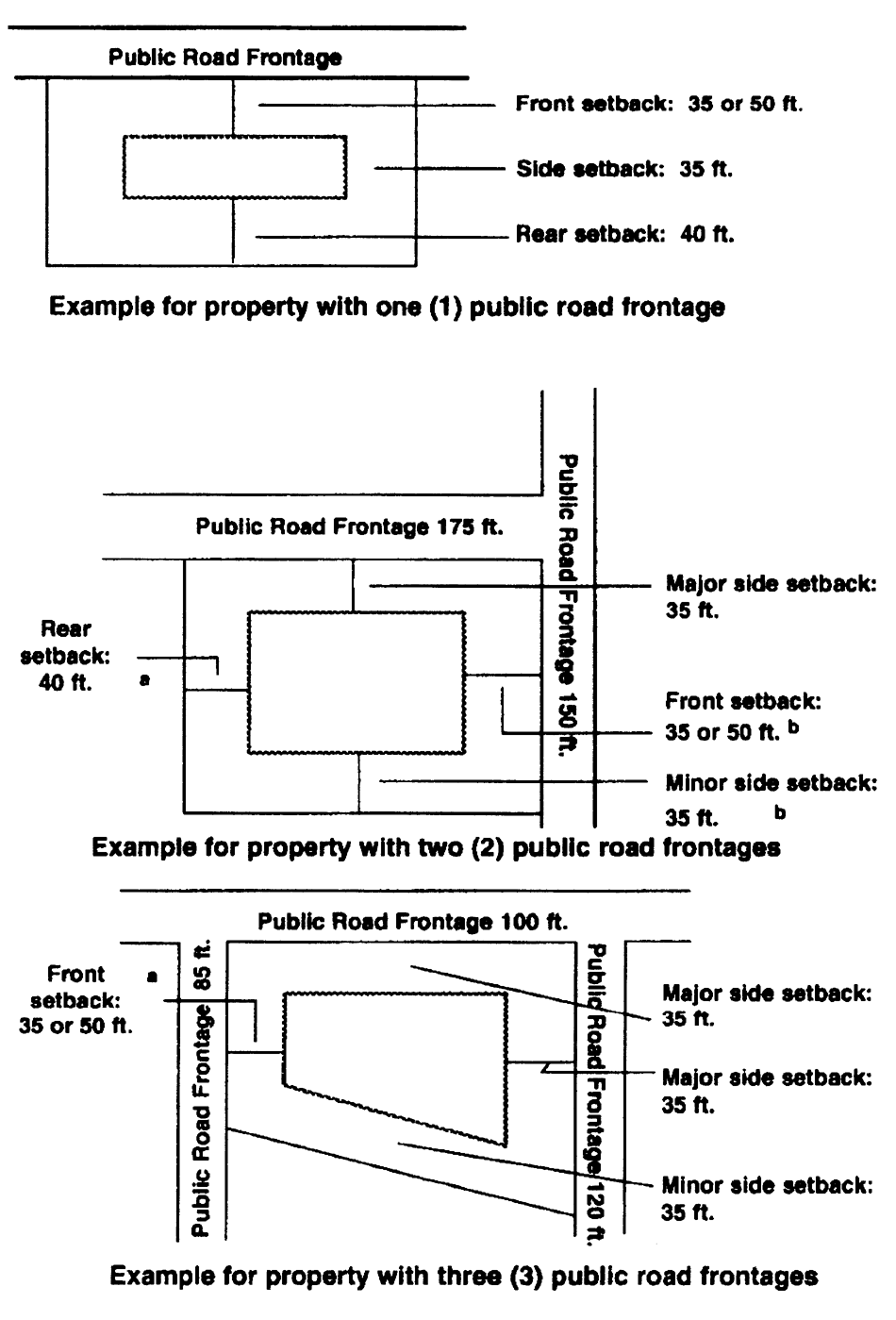
Minimum Building Setback Requirements for UC District
Notes:
a Property with shorter amount of road frontage will be the front setback for determining other setbacks (major side, side, rear).
b If structure fronts a major side setback, major side setback shall be 35 feet.
(5)
Landscape buffer and screening requirements. Unless otherwise noted within this district's requirements, any property within a UC district which abuts a more restrictive residentially zoned property shall have a minimum 25-foot landscaped screening buffer adjacent to all residential property. The buffer shall be subject to approval by county staff. Required buffers may be included within required setbacks; however, in such case that the required buffer is greater than the required setback, the required buffer shall be adhered to. Additionally, necessary private utilities and access drives may be allowed through, over or across a landscaped buffer. Any such uses which are proposed through, over or across a designated undisturbed buffer must be approved pursuant to an original site plan or site plan modification as set forth under section 134-126.
a.
Objectives. Undisturbed, planted landscape buffers and berms shall be implemented in connection with a permitted project and shall address the following objectives:
1.
Screening to enhance aesthetic appeal;
2.
Control or direction of vehicular and pedestrian movement;
3.
Reduction of glare; and
4.
Buffering of noise.
b.
Standards. Buffers or berms shall be required when a UC district is located adjacent to a more restrictive residential district; a minimum 25-foot buffer is required.
1.
Buffers. Landscape buffers are subject to review and approval by county staff in accordance with the following standards:
i.
Plantings are to be a mix of evergreen trees and shrubs.
ii.
Species are to be ecologically compatible to the site and appropriate for the design situation.
iii.
Unless public safety concerns dictate otherwise, a buffer should maximize a visual barrier to a height of six feet within two years of planting.
iv.
Minimum height of plant materials at installation is five feet for trees and two feet for shrubs.
v.
Fencing or walls are to be a minimum of six feet in height as approved by county staff.
vi.
Trees included in buffer plantings may be counted toward site density calculations as required by chapter 50, article VI, pertaining to tree preservation and replacement, subject to review and approval of county staff.
vii.
Buffers shall be regularly maintained by the property owner to ensure that the objectives and standards set out in this subsection are met.
viii.
When topography and existing conditions allow, the required 25-foot buffer should be an undisturbed buffer.
ix.
Any appeals from a determination by county staff shall be to the board of zoning appeals.
2.
Berms. Berms are subject to review and approval by county staff in accordance with the following standards:
i.
Berms shall be utilized when consistent with surrounding property features.
ii.
Berms shall be stabilized.
iii.
Berms shall be constructed to be consistent with natural or proposed drainage patterns.
iv.
Berms shall be regularly maintained by the property owner.
(6)
Floodplain and wetlands preservation requirements. Any development must meet state and federal requirements relating to areas subject to the provisions of section 134-283, regarding mountain and river corridor protection act areas, and section 134-284, regarding metropolitan river protection act areas. No floodplains and/or wetlands may be used in calculating the overall density of the development.
(7)
Building and structure requirements. There shall be no maximum building height for urban condominiums constructed within properties delineated for a regional activity center as defined and shown on the Cobb County Comprehensive Plan: A Policy Guide, adopted November 27, 1990. Rather, the number of stories and building heights for these projects will be determined on a case by case basis because of the unique urban characteristics of regional activity centers.
(8)
Parking requirements. See section 134-272 for paved parking specifications.
(9)
Lighting requirements. Any project permitted within the UC district which proposes a lighted facility must have a county department of transportation approved lighting plan in accordance with the minimum conditions listed in section 134-269.
(10)
Special exception uses. Please see section 134-271 for special exception uses and requirements for all districts. Special exception uses for the UC district are the uses listed in section 134-271.
(11)
Temporary land use permits and special land use permits. See sections 134-36 and 134-37 for additional uses and requirements for all districts. Uses requiring land use permits or special land use permits for the UC district are the designated uses listed in sections 134-36 and 134-37.
(12)
Use limitations.
a.
There shall be no maximum units per acre figure within properties delineated for a regional activity center as defined and shown on the Cobb County Comprehensive Plan: A Policy Guide, adopted November 27, 1990. Rather the densities for these projects will be determined on a case by case basis because of the unique urban characteristics of regional activity centers. The overall density of a development may be reduced due to topography, drainage, deforestation or sediment and erosion concerns.
b.
Maximum acreage is ten acres.
c.
No sale of goods or products shall be permitted except if accessory to a customary home occupation, land use permit, special land use permit or special exception use.
d.
No sexually oriented businesses are permitted.
e.
No materials, equipment or business vehicles may be stored or parked on the premises, except as specified in the condominium declaration and bylaws. If single-family detached dwellings are developed in areas zoned UC, one business vehicle, the carrying or towing capacity of which shall not exceed 1½ tons, used exclusively by the resident may be parked in a garage, carport or rear or side yard. The off-site employees of the resident shall not congregate on the premises for any purpose concerning the business of the home occupation. There shall be no more than two full time employees permitted on site for any allowable customary home occupation or business.
f.
All uses are subject to chapter 110, the subdivision regulations of the county, as amended from time to time.
g.
Any food or beverage served within an accessory clubhouse shall be limited to residents and their guests.
h.
It is found and declared that outside storage on properties within unincorporated Cobb County is a health risk and undesirable in that it provides harborage for rodents and insects, lowers property values, and constitutes a public nuisance; therefore, no outside storage is permitted, excluding firewood and lawn furnishings, unless otherwise allowed in this article or as otherwise prohibited in the condominium declaration and bylaws.
i.
Impervious surface shall not exceed 55 percent of the total site area.
j.
A mandatory homeowners' association must be formed and incorporated which provides for building and grounds maintenance and repair, insurance and working capital. Said association must also include condominium declaration and bylaws, including rules and regulations, subject to staff review and approval. The declaration and bylaws shall not be enforced by the county. The declaration and bylaws shall, at a minimum, regulate and control the following:
1.
Animals.
2.
Signs.
3.
Exterior items such as fences, lawn ornaments and removal of landscape areas and buffers.
4.
Building improvements.
5.
Outside storage.
6.
Overnight parking of vehicles.
7.
Decorations.
8.
Trash collection.
9.
Restrictions/definitions on single-family residential use only, and leasing of units.
k.
No more than two buildings which are four stories or less may be attached side by side.
l.
No loading docks or facilities may be located in the front of any primary structure.
m.
All UC projects must be site plan specific.
n.
Minimum unit size must be established for each development. The minimum unit size must be compatible with the character of the surrounding community and the character of the proposed development.
o.
A maximum of up to ten percent of the units may be leased. The board of commissioners on a case by case basis may consider requests for other percentages of leased units. These requests will be considered a major change and will be required to follow the normal zoning process to include all applicable public notification and public hearing requirements.
Required buffers may be included within required setbacks; however, in such case that the required buffer is greater than the required setback, the required buffer shall be adhered to. Additionally, necessary private utilities and access drives may be allowed through, over or across a landscaped buffer. Any such uses which are proposed through, over or across a designated undisturbed buffer must be approved pursuant to an original site plan or site plan modification as set forth under section 134-126.
(13)
Accessory buildings, structures, uses and decks. Any accessory building or structure which exceeds 1,000 square feet of gross space must have the approval of the division manager of zoning or his designee as to the location, architectural design and size prior to commencing construction. The division manager of zoning or his designee shall consider the following criteria for determining the appropriateness of the architectural design and size of the accessory building or structure: Compatibility with the surrounding neighborhood, style of exterior (the exterior is to be compatible in style with the primary structure), use of the proposed accessory structure, impact on adjacent properties, and requirements as deemed appropriate by plan review as set forth in this subsection. All accessory buildings, structures and uses in excess of 1,000 gross square feet shall be required to submit for plan review through the community development department or receive approval from the director of the community development department or his designee.
a.
Accessory buildings, structures, uses or decks shall be subject to the following conditions:
1.
There shall be no maximum building height for accessory building structures uses or decks, which are part of urban condominiums. Rather, the number of stories and building heights for these uses will be determined on a case by case basis because of the unique urban characteristics of regional activity centers.
2.
Accessory uses shall include garbage dumpsters, designated recycling collection locations, clubhouse and recreation centers, amenities, swimming pools and tennis courts, antennas and satellite dishes, heating and air conditioning units, jacuzzis, playhouses and playgrounds subject to the following conditions:
i.
Uses must be located within building setbacks.
ii.
No ground-based antenna or satellite dish shall exceed 35 feet in height without compliance with standards in section 134-273.
iii.
No accessory building, structure, use or deck shall be built until construction of the principal building has commenced.
iv.
Outdoor activities shall cease by 11:00 p.m. within clubhouse and recreation centers and swimming pools and tennis courts.
3.
Such buildings, structures, uses or decks shall be located on the same lot as the principal use to which the building, structure use or deck is accessory.
b.
Antennas and satellite dishes shall meet the requirements set forth in section 134-274.
c.
Incidental storage is permitted, provided that the material stored is incidental to the permitted use, as determined by the division manager of zoning or his designee, and stored completely within a portion of the enclosed principal structure permitted within the district, or within a permitted accessory structure.
(Ord. of 6-23-98; Ord. of 2-8-00; Ord. of 9-10-02; Ord. of 1-25-05; Ord. of 7-26-05; Ord. of 7-25-06; Ord. of 7-27-10; Ord. of 7-24-12; Amd. of 2-24-15; Amd. of 2-28-17; Amd. of 9-8-20)
Sec. 134-221.2. - Reserved.
Editor's note— The amendments of February 8, 2022 repealed former § 134-221.2 in its entirety. Former § 134-221.2 pertained to the redevelopment overlay district, and derived from an ordinance of January 24, 2006; and amendments of February 23, 2010; February 28, 2017; and February 9, 2021.
Sec. 134-222. - OHR office high-rise district.
The regulations for the OHR office high-rise district are as follows:
(1)
Purpose and intent. The OHR district is established to provide locations for uses such as offices, financial institutions and accessory retail sales and service uses (eight to 24 stories) which are on properties delineated within a regional activity center as defined and shown on the Cobb County Comprehensive Plan: A Policy Guide, adopted November 27, 1990.
(2)
Definitions. The following words, terms and phrases, when used in this section, shall have the meanings ascribed to them in this subsection, except where the context clearly indicates a different meaning:
a.
Accessory retail uses means retail sales and services accessory to the operation of an office building or institutional use, motel, hotel or high-rise residential development, conducted wholly within the building housing the use to which such activities are accessory, provided that the floorspace used or to be used for such accessory retail uses shall be limited to a total of 25 square feet per dwelling unit in a high-rise residential development or 25 square feet per room in a hotel or motel, or ten percent of the net floor area in an office building or institutional use, and provided that:
1.
Every public entrance to such a use shall be from a lobby, hallway or other interior portion of the primary use structure;
2.
No show window, advertising or display shall be visible from the exterior of the primary use structure; and
3.
No merchandise shall be stored or displayed outside of the primary use structure.
4.
Accessory retail uses shall include eating and drinking establishments, barber shops, beauty shops, laundry and dry cleaning pickup establishments, news stands, florists' gift shops, film developing and printing facilities, stationery stores, shoe repair shops, or convenience food stores (no fuel sales).
5.
Accessory retail use square footage must be in the primary building it serves; accessory use square footages cannot be allocated to other buildings in a multibuilding development.
b.
Clinic. A medical or dental clinic is an organization of specializing physicians or dentists, or both, who have their offices in a common building. A clinic shall include laboratory facilities in conjunction with normal clinic services.
c.
Community center means a place, structure, area or other facility used for and providing religious, fraternal, social or recreational programs generally open to the public and designed to accommodate and serve significant segments of the community.
d.
Group home means a dwelling shared by six or less persons, excluding resident staff, who live together as a single housekeeping unit and in a longterm, family-like environment in which staff persons provide care, education and participation in community activities for the residents with the primary goal of enabling the residents to live as independently as possible in order to reach their maximum potential. This use shall apply to homes for the handicapped. As used in this subsection, the term "handicapped" shall mean:
1.
Having a physical or mental impairment that substantially limits one or more of such person's major life activities so that such person is incapable of living independently;
2.
Having a record of having such an impairment; or
3.
Being regarded as having such an impairment.
However, the term "handicapped" shall not include current illegal use of or addiction to a controlled substance, nor shall it include any person whose residency in the home would constitute a direct threat to the health and safety of other individuals. The term "group home for the handicapped" shall not include alcoholism or drug treatment centers, work release facilities for convicts or ex-convicts, or other housing facilities serving as an alternative to incarceration.
e.
Professional office means a building wherein services are performed utilizing predominately administrative, professional or clerical operations such as the following: law, doctor, accounting, tax preparation, real estate, stockbroker, architect, engineer, manufacturer representative, professional counselor, dentist, investigative services, photographer, insurance, contractor, telephone sales, political/campaign, and veterinarian.
(3)
Permitted uses. Permitted uses are as follows:
Accessory retail sales and services.
Ambulance services, if accessory to hospitals or funeral homes.
Athletic and health clubs.
Automotive parking lots or garages.
Banks and financial institutions with drive-in establishments or automated transfer machines.
Bus stations.
Churches, chapels, temples, synagogues, and other such places of worship.
Clinics.
Clubs or lodges (noncommercial).
Colleges and universities, including research and training facilities (private).
Community fairs.
Designated recycling collection locations.
Executive golf courses (see section 134-270).
Fraternity and sorority houses.
Funeral homes.
Golf courses, 18-hole regulation, public and private (see section 134-270).
Golf courses, par 3 (see section 134-270).
Group homes.
Hospitals.
Hotels.
In-home day care.
Medical and dental laboratories, provided that no chemicals are manufactured on-site.
Motels.
Nonprofit (seasonal use) fishing lakes.
Nursery schools and child care centers.
Offices not elsewhere classified.
Parking for vehicles.
Photography studios.
Private parks.
Professional offices.
Radio and television stations.
Radio, television and other communication towers and antennas, subject to section 134-273.
Recreation grounds other than tennis courts and golf courses.
Recycling dropoff centers.
Rest homes, personal care homes and convalescent homes.
Taxistands and taxi dispatching agencies.
Temporary uses.
Vocational schools (commercial).
(4)
Lot size and setback requirements. Lot size and setback requirements are as follows:
a.
Minimum lot size: 80,000 square feet.
b.
Minimum lot width at front setback line: 60 feet.
c.
Minimum public road frontage: 50 feet.
d.
Minimum building setbacks: As shown and applied in the following diagram:
MINIMUM BUILDING SETBACK REQUIREMENTS FOR OHR DISTRICT
Note: All setbacks shall be measured from future right-of-way.
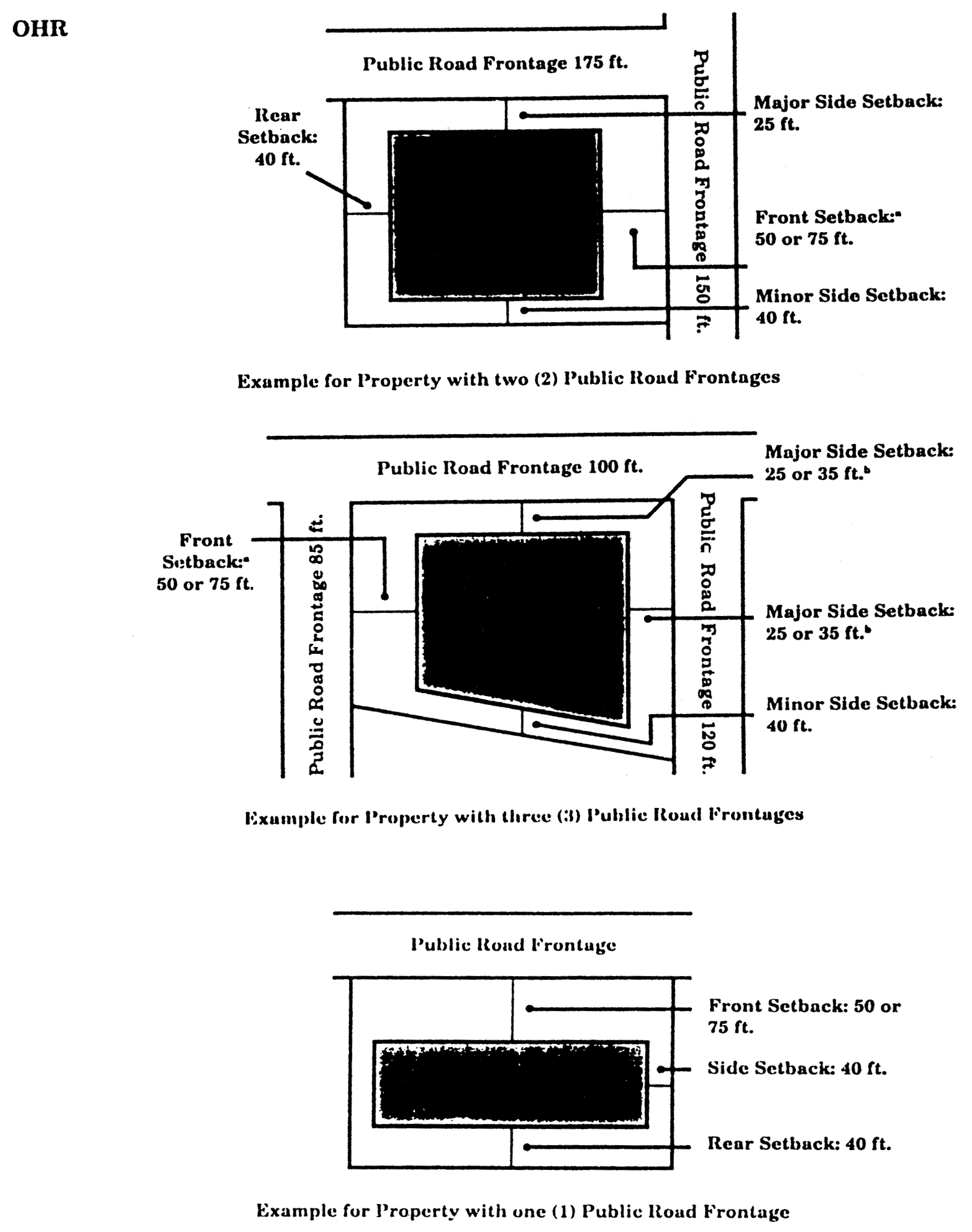
Minimum Building Setback Requirements for OHR District
Notes:
a Property with shorter amount of road frontage will be the front setback for determining other setbacks (major side, side, rear).
b If structure fronts a major side setback, major side setback shall be 35 feet.
(5)
Landscape buffer and screening requirements. Unless otherwise noted within this district's requirements, any property within an OHR district which abuts a residentially zoned property shall have a minimum 50-foot landscaped screening buffer adjacent to all residentially zoned property. The buffer shall be subject to approval by county staff. Required buffers may be included within required setbacks; however, in such case that the required buffer is greater than the required setback, the required buffer shall be adhered to. Additionally, necessary private utilities and access drives may be allowed through, over or across a landscaped buffer. Any such uses which are proposed through, over or across a designated undisturbed buffer must be approved pursuant to an original site plan or site plan modification as set forth under section 134-126.
a.
Objectives. Undisturbed, planted landscape buffers and berms shall be implemented in connection with a permitted project and shall address the following objectives:
1.
Screening to enhance aesthetic appeal;
2.
Control or direction of vehicular and pedestrian movement;
3.
Reduction of glare;
4.
Buffering of noise; and
5.
Establishment of privacy.
b.
Standards. Buffers or berms shall be required when an OHR district is located adjacent to a residential district; a minimum 50-foot buffer is required.
1.
Buffers. Landscape buffers are subject to review and approval by county staff in accordance with the following standards:
i.
Plantings are to be a mix of evergreen trees and shrubs.
ii.
Species are to be ecologically compatible to the site and appropriate for the design situation.
iii.
Unless public safety concerns dictate otherwise, a buffer should provide a maximum visual barrier to a height of six feet within two years of planting.
iv.
Minimum height of plant materials at installation is five feet for trees and two feet for shrubs.
v.
Fencing or walls are to be a minimum of six feet in height as approved by county staff.
vi.
Trees included in buffer plantings may be counted toward site density calculations as required by chapter 50, article VI, pertaining to tree preservation and replacement, subject to review and approval of county staff.
vii.
Buffers shall be regularly maintained by the property owner to ensure that the objectives and standards set out in this subsection are met.
viii.
When topography and existing conditions allow, the required 50-foot buffer should be an undisturbed buffer.
ix.
Any appeals from a determination by county staff shall be to the board of zoning appeals.
2.
Berms. Berms are subject to review and approval by county staff in accordance with the following standards:
i.
Berms shall be utilized when consistent with surrounding property features.
ii.
Berms shall be stabilized.
iii.
Berms shall be constructed to be consistent with natural or proposed drainage patterns.
iv.
Berms shall be regularly maintained by the property owner.
(6)
Floodplain and wetlands preservation requirements. Any development must also meet state and federal requirements relating to areas subject to the provisions of section 134-283, regarding mountain and river corridor protection act areas, and section 134-284, regarding metropolitan river protection act areas.
(7)
Building and structure requirements. For each story above nine, the board of commissioners and the fire marshal must approve the building height, to a maximum of 24 stories.
(8)
Parking requirements. See section 134-272 for paved parking specifications.
(9)
Lighting requirements. Any project permitted within the OHR district which proposes a lighted facility must have a county department of transportation approved lighting plan in accordance with the minimum conditions subject to section 134-269.
(10)
Special exception uses. See section 134-271 for special exception uses and requirements for all districts. Special exception uses for the OHR district are the uses listed in section 134-271.
(11)
Special exception uses for regional activity center only. The following uses, with the proper scrutiny and conditions, may be considered as special exception uses within the OHR district, only if they are within properties delineated as regional activity centers as defined and shown on the Cobb County Comprehensive Plan: A Policy Guide, adopted November 27, 1990. Any special exception use, for regional activity centers only, shall adhere to the landscape buffer and screening requirements in subsection (5) of this section.
a.
Hotel (suite).
The following minimum standards shall apply to suite hotels:
1.
Minimum acreage is two acres.
2.
All rooms shall be accessed through a main or central lobby.
3.
No rooms shall access to the exterior of the building unless required by fire/safety regulations.
4.
The minimum number of floors allowed shall be three floors, unless otherwise approved by the board of commissioners.
5.
Architectural style/design to be approved by the board of commissioners.
6.
All buildings shall have a minimum roof pitch of a four in twelve as defined by applicable building codes.
7.
Conference, meeting or banquet facilities are allowed when supported by adequate parking and approved by the board of commissioners as part of the special land use permit.
8.
Restaurants or other type of eating facilities are allowed when supported by adequate parking and approved by the board of commissioners. "Continental" style dining for the guests of the facility only is allowed within or near the main or central lobby without additional parking.
9.
At a minimum, provisions for weekly cleaning for each suite must be provided.
10.
Each suite must be protected with a smoke detector and sprinkler system approved by the fire marshal or his designee.
11.
Each suite shall be required to include an automatic power off timer for each stove/cook top unit or other type burner.
12.
Parking shall be calculated as one space required for each suite, with an additional ten spaces provided for employees. Parking requirements for conference, meeting or banquet facilities or restaurants or other type of eating facilities within a suite hotel shall be calculated as provided for each use in section 134-272, "traffic and parking," in addition to the above parking requirements and approved by the board of commissioners.
13.
There shall be no outside storage allowed or long term parking of heavy equipment, or parking of construction or related equipment allowed.
14.
A landscaping plan is to be approved by staff with emphasis on planting within the parking facilities.
15.
No facility under this section is to be converted or used primarily as an apartment or condominium.
b.
Climate controlled self-service storage facilities, when complementary or accessory to an office park or building.
The following minimum standards shall apply to climate controlled self-service storage facilities:
1.
Building height should not exceed those of adjacent buildings, nor impact the view shed of adjacent residential property.
2.
F.A.R. should be 2.0 or as determined appropriate by the board of commissioners.
3.
All units shall be accessed through a main or central entrance.
4.
All windows or similar architectural features must be "one way" and provide for an opaque screen from view outside of the building.
5.
Architectural style/design to be similar or complementary to the predominant architectural design of other commercial uses within the activity center. Said architectural style/design to be approved by the board of commissioners. Any roof-mounted utilities or building components must be sufficiently screened from view of adjoining properties and public right-of-way.
6.
There shall be no outside storage allowed nor overnight and/or long-term parking of heavy equipment, commercial equipment or parking of construction or related equipment allowed.
7.
There shall be no storage of recreational vehicles and no dry storage of pleasure boats of any type customarily maintained by private individuals for their personal use.
8.
There shall be no storage of flammable liquids, highly combustible or explosive materials, or hazardous chemicals.
9.
No units within the facility shall be used for or considered to be premises for the purpose of assigning a legal address in order to obtain an occupational license or any other government permit or licenses to do business.
10.
There shall be no resident manager or any type of overnight accommodations for such.
11.
Landscape plan to be approved by staff with emphasis on planting within the parking facilities.
12.
One parking space shall be provided per every 80 individual storage units/areas.
13.
Overall project must be accessed via a public or private roadway which is internal to the office park, building or shopping center; direct access to an adjoining public roadway shall be subject to approval by the board of commissioners.
14.
No freestanding signage shall be utilized; internal directional signage will be subject to approval by the board of commissioners.
15.
No units shall be used to manufacture, fabricate or process goods, to service or repair vehicles, boats, small engines or electrical equipment, or to conduct similar repair activities, to conduct garage sales or retail styles of any kind, to rehearse or practice utilizing band instruments, or for conversion to an apartment or dwelling unit, or to conduct any other commercial or industrial activities on the site.
16.
Loading area, including adequate turnaround space for a tractor trailer vehicle, must be screened by a permanent architectural or landscape feature or as may be approved by the board of commissioners if not located to side or rear of proposed structure.
17.
Special land use permit as provided in section 134-37.
18.
Hours of operation to be established by the board of commissioners, considering the operational hours of surrounding businesses.
(12)
Use limitations.
a.
Maximum floor area ratio is 2.0 for office uses and 0.25 for retail uses.
b.
All refuse collection and designated recycling collection location facilities must be contained within completely enclosed facilities.
c.
It is found and declared that outside storage on properties within unincorporated Cobb County is a health risk and undesirable in that it provides harborage for rodents and insects, lowers property values, and constitutes a public nuisance; therefore, no outside storage is permitted, unless otherwise allowed in this article. Within the OHR district outside storage shall not include commercial vehicles.
d.
No drive-in eating or drinking establishments are permitted.
e.
No uses that emit noxious odors, fumes or sounds are permitted.
f.
No outside runs are permitted with any veterinary office use permitted within this district.
g.
Building height is subject to approval by the board of commissioners and fire marshal.
h.
Kitchenettes or kitchen facilities are prohibited in motels.
i.
Maximum impervious surfaces (80%-RAC, 70%-CAC and NAC) shall be established within activity centers as identified by the Cobb County Comprehensive Plan, as may be amended from time to time.
j.
No loading docks or facilities may be located in the front of any primary structure.
Required buffers may be included within required setbacks; however, in such case that the required buffer is greater than the required setback, the required buffer shall be adhered to. Additionally, necessary private utilities and access drives may be allowed through, over or across a landscaped buffer. Any such uses which are proposed through, over or across a designated undisturbed buffer must be approved pursuant to an original site plan or site plan modification as set forth under section 134-126.
(13)
Accessory buildings, structures, uses and decks. Any accessory building or structure in excess of 1,000 square feet of gross space shall be located to the rear of the primary structure and at least 40 feet from any residential property line. Any accessory building or structure which exceeds 1,000 square feet of gross space must have the approval of the division manager of zoning or his designee as to the location, architectural design and size prior to commencing construction. The division manager of zoning or his designee shall consider the following criteria for determining the appropriateness of the architectural design and size of the accessory building or structure: compatibility with the surrounding neighborhood, style of exterior (the exterior is to be compatible in style with the primary structure), use of the proposed accessory structure, impact on adjacent properties, and requirements as deemed appropriate by plan review as set forth in this subsection. All accessory buildings, structures and uses in excess of 1,000 gross square feet shall be required to submit for plan review through the community development department or receive approval from the director of the community development department or his designee. Permitted accessory structures and uses are as follows:
a.
Accessory retail sales and service.
b.
Accessory storage buildings, subject to the following conditions:
1.
Maximum height is two stories, not to exceed 35 feet.
2.
Such structures shall be located on the same lot as and to the rear of the principal building to which they are accessory.
3.
No accessory building shall be constructed upon a lot until construction of the principal building has commenced.
4.
On a corner lot, no accessory building shall be located closer to the side street right-of-way line than the principal building.
5.
When abutting any other nonresidential district, no garage or other accessory building shall be located closer than five feet to a side or rear lot line.
6.
When an accessory building is attached to the principal building by a breezeway, passageway or similar means, it shall comply with the yard requirements of the principal building to which it is accessory.
7.
Where any nonresidential lot adjoins the side or rear of a residential lot, an accessory building shall not be located within any required buffers.
c.
Antennas and satellite dishes, which shall meet the requirements set forth in section 134-274.
d.
Freestanding and attached parking garages, subject to the following conditions:
1.
Maximum height to be approved by the board of commissioners pursuant to a specific site plan at the time of rezoning.
2.
When abutting any residential property line, freestanding or attached parking garages shall not be located within any required buffers.
3.
When abutting any other nonresidential district, no freestanding or attached parking garage shall be located closer than five feet to a side or rear lot line.
e.
Heating and air conditioning units, subject to the following conditions:
1.
When abutting any residential property line, heating and air conditioning units shall not be located within any required buffers.
2.
When abutting any other nonresidential district, no heating and air conditioning units shall be located closer than five feet to a side or rear lot line.
3.
Heating and air conditioning units may be installed on the roof of any structure zoned commercially so long as the heating and air conditioning unit does not exceed the height restrictions stated in this section and the units are placed so as to be hidden from a front or side view.
4.
No ground-based heating and air conditioning unit shall exceed 35 feet in height.
f.
Incidental storage, provided that the material stored is incidental to the permitted use, as determined by the division manager of zoning or his designee, and stored completely within a portion of the enclosed principal structure permitted within the district, or within a permitted accessory structure.
(Ord. of 12-26-72; Ord. of 12-11-90, § 3-28-7.29; Ord. of 8-13-91; Ord. of 5-12-92; Ord. of 6-9-92; Ord. of 10-25-94; Ord. of 7-11-95; Ord. of 6-24-97 (eff. 7-1-97); Ord. of 7-10-01; Ord. of 9-10-02; Ord. of 12-9-03; Ord. of 7-27-04; Ord. of 7-26-05; Amd. of 2-24-09; Amd. of 3-24-09; Amd. of 2-24-15)
Sec. 134-223. - OS office/service district.
The regulations for the OS office/service district are as follows:
(1)
Purpose and intent. The OS district is established to provide locations for office and business distribution/service facilities, and assembly processes which do not emit noise, vibration, smoke, gas, fumes, odors or radiation and are located entirely within an enclosed building which do not involve manufacturing or fabrication of any product. No principal retail sales are allowed unless specified in this section. These uses are allowed on properties delineated within a RAC category, ICA category or an industrial category as defined and shown on the Cobb County Comprehensive Plan: A Policy Guide, adopted November 27, 1990. Limited special exception uses may be allowed on properties delineated within a Neighborhood Activity Center as defined and shown on the Cobb County Comprehensive Plan: A Policy Guide, adopted November 27, 1990, and as may be amended from time to time.
(2)
Definitions. The following words, terms and phrases, when used in this section, shall have the meanings ascribed to them in this subsection, except where the context clearly indicates a different meaning:
a.
Accessory uses means retail sales and services ancillary to the operation the primary use(s) of an OS development, conducted wholly within the building housing the use to which such activities are accessory, provided that the floorspace used or to be used for such accessory retail uses shall be limited to less than half of the net floor area in a building(s), and provided that:
1.
Every public entrance to such a use shall be from the primary use structure(s);
2.
No show window, advertising or display shall be visible from the exterior of the primary use structure(s);
3.
No merchandise shall be stored or displayed outside of the primary use structure(s).
4.
Accessory retail uses shall include eating and drinking establishments, barber shops, beauty shops, laundry and dry cleaning pickup establishments, florists' gift shops, film developing and printing facilities, stationery stores, shoe repair shops, or convenience food stores (no fuel sales).
5.
Accessory retail use square footage must be in the primary building it serves; accessory use square footages cannot be allocated to other buildings in a multibuilding development.
b.
Clinic. A medical or dental clinic is an organization of specializing physicians or dentists, or both, who have their offices in a common building. A clinic shall include laboratory facilities in conjunction with normal clinic services.
c.
Community fair means a festival or fair such as the North Georgia State Fair conducted wholly within public areas owned by a local government, provided that any activity is conducted at least 200 feet from any property line. Any event shall not exceed 21 days.
d.
Designated recycling collection locations means metal or heavy duty plastic containers designed for short-term holding of pre-bagged recyclable items such as tin, aluminum, glass and paper (no perishable or food items allowed) for scheduled minimum monthly pickup, with no on-premises sorting. The center must be maintained in a safe, clean, neat and sanitary fashion and shall not encompass an area larger than 280 square feet.
1.
Such location shall be visually screened and maintained.
2.
Such location shall be within the building setbacks unless otherwise approved by the division manager of zoning or his or her designee due to topography, safety, internal traffic flow, site distance or other site-related circumstances not created by the property owner.
e.
Office service and supply establishments means wholesale and retail commercial establishments that sell, service and supply small office equipment and supplies, such as stores that offer sales of copiers, facsimile machines, typewriters, ribbons, transcribers, dictation equipment, tape, staplers and other general office equipment.
(3)
Permitted uses. Permitted uses are as follows:
Assembly.
Athletic and health clubs.
Automotive parking lots or garages.
Bus stations.
Churches, chapels, temples, synagogues, and other such places of worship.
Clinics.
Clubs or lodges (noncommercial).
Colleges and universities (private), including but not limited to research and training facilities.
Community fairs.
Corporate or administrative offices.
Designated recycling collection locations.
Executive golf courses (see section 134-270).
Golf courses, 18-hole regulation, public and private (see section 134-270).
Golf courses, par 3 (see section 134-270).
Group homes.
Helicopter landing areas, provided that the area is fenced.
Hotels.
In-home day care.
Medical and dental laboratories, provided that no chemicals are manufactured on-site.
Motels.
Nonprofit (seasonal use) fishing lakes.
Office service and supply establishments.
Outdoor golf driving ranges.
Parking for vehicles.
Photography studios.
Printing, publishing and lithography establishments.
Private parks.
Pro shops, if accessory to driving ranges or golf courses.
Professional offices.
Radio and television stations.
Radio, television and other communication towers and antennas, subject to section 134-273.
Recreation grounds other than tennis courts and golf courses.
Rest homes, personal care homes and convalescent homes.
Roominghouses and boardinghouses.
Studios and supplies.
Temporary uses.
Vocational schools (commercial).
Wholesale trade and distribution facilities.
Wholesale trade offices in conjunction with office showrooms, display and other facilities generally accessible to the public, provided that no more than 85 percent of the total gross floor area will be used for storage.
(4)
Lot size and setback requirements. Lot size and setback requirements are as follows:
a.
Minimum lot size: 40,000 square feet.
b.
Minimum lot width at front setback line: 75 feet.
c.
Minimum public road frontage: 50 feet.
d.
Minimum building setbacks: As shown and applied in the following diagram:
MINIMUM BUILDING SETBACK REQUIREMENTS FOR OS DISTRICT
Note: All setbacks shall be measured from future right-of-way.
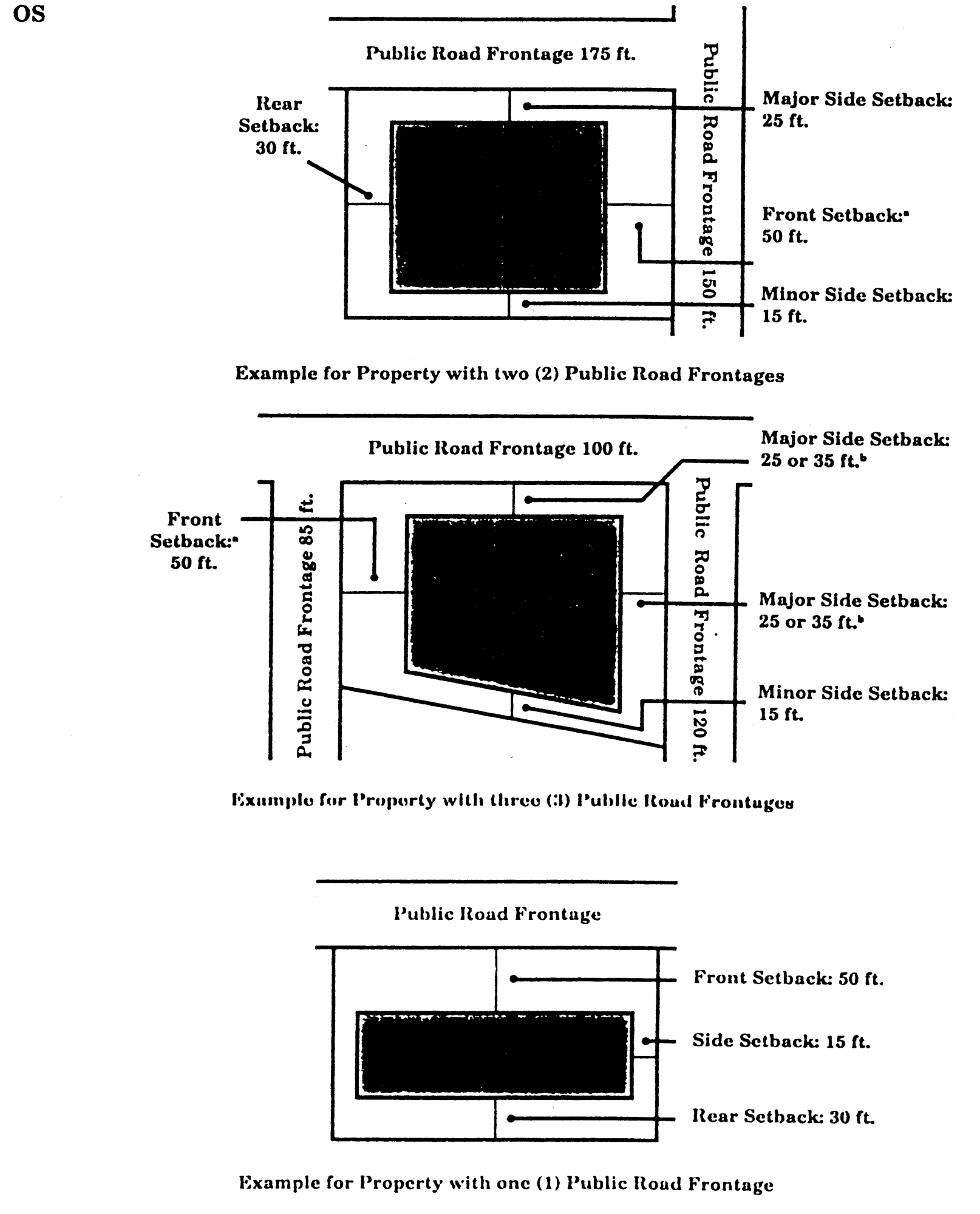
OS District
Notes:
a Property with shorter amount of road frontage will be the front setback for determining other setbacks (major side, side, rear).
b If structure fronts a major side setback, major side setback shall be 35 feet.
(5)
Landscape buffer and screening requirements. Unless otherwise noted within this district's requirements, any property within an OS district which abuts a residentially zoned property shall have a minimum 30-foot landscaped screening buffer adjacent to all residentially zoned property. The buffer shall be subject to approval by county staff. The board of commissioners specifically notes that it discourages locating OS districts and developments adjacent to single-family residential districts, unless in a planned mixed use project. Required buffers may be included within required setbacks; however, in such case that the required buffer is greater than the required setback, the required buffer shall be adhered to. Additionally, necessary private utilities and access drives may be allowed through, over or across a landscaped buffer. Any such uses which are proposed through, over or across a designated undisturbed buffer must be approved pursuant to an original site plan or site plan modification as set forth under section 134-126.
a.
Objectives. Undisturbed, planted landscape buffers and berms shall be implemented in connection with a permitted project and shall address the following objectives:
1.
Screening to enhance aesthetic appeal;
2.
Control or direction of vehicular and pedestrian movement;
3.
Reduction of glare;
4.
Buffering of noise; and
5.
Establishment of privacy.
b.
Buffers. Landscape buffers are subject to review and approval by county staff in accordance with the following standards:
1.
Plantings are to be a mix of evergreen trees and shrubs.
2.
Species are to be ecologically compatible to the site and appropriate for the design situation.
3.
Unless public safety concerns dictate otherwise, a buffer should maximize a visual barrier to a height of six feet within two years of planting.
4.
Minimum height of plant materials at installation is five feet for trees and two feet for shrubs.
5.
Fencing or walls are to be a minimum of six feet in height as approved by county staff.
6.
Trees included in buffer plantings may be counted toward site density calculations as required by chapter 50, article VI, pertaining to tree preservation and replacement, subject to review and approval of county staff.
7.
Buffers shall be regularly maintained by the property owner to ensure that the objectives and standards set out in this subsection are met.
8.
When topography and existing conditions allow, the required 30-foot buffer should be an undisturbed buffer.
9.
Any appeals from a determination by county staff shall be to the board of zoning appeals.
c.
Berms. Berms are subject to review and approval by county staff in accordance with the following standards:
1.
Berms shall be utilized when consistent with surrounding property features.
2.
Berms shall be stabilized.
3.
Where possible, berms shall be constructed to be consistent with natural or proposed drainage patterns.
4.
Berms shall be regularly maintained by the property owner.
(6)
Floodplain and wetlands preservation requirements. Any development must also meet state and federal requirements relating to areas subject to the provisions of section 134-283, regarding mountain and river corridor protection act areas, and section 134-284, regarding metropolitan river protection act areas.
(7)
Building and structure requirements. Maximum building height is 52 feet, with no more than four stories.
(8)
Parking requirements. See section 134-272 for paved parking specifications.
(9)
Lighting requirements. Any project permitted within the OS district which proposes a lighted facility must have a county department of transportation approved lighting plan in accordance with the minimum conditions listed in section 134-269.
(10)
Special exception uses. See section 134-271 for special exception use requirements for all districts. Special exception uses for the OS district are the uses listed in section 134-271.
(11)
Special exception uses for regional activity center only. The following uses, with the proper scrutiny and conditions, may be considered as special exception uses within the OS district, only if they are within properties delineated as regional activity centers as defined and shown on the Cobb County Comprehensive Plan: A Policy Guide, adopted November 27, 1990. Any special exception use, for regional activity centers only, shall adhere to the landscape buffer and screening requirements in subsection (5) of this section.
a.
Hotel (suite).
The following minimum standards shall apply to suite hotels:
1.
Minimum acreage is two acres.
2.
All rooms shall be accessed through a main or central lobby.
3.
No rooms shall access to the exterior of the building unless required by fire/safety regulations.
4.
The minimum number of floors allowed shall be three floors, unless otherwise approved by the board of commissioners.
5.
Architectural style/design to be approved by the board of commissioners.
6.
All buildings shall have a minimum roof pitch of a four in twelve as defined by applicable building codes.
7.
Conference, meeting or banquet facilities are allowed when supported by adequate parking and approved by the board of commissioners as part of the special land use permit.
8.
Restaurants or other type of eating facilities are allowed when supported by adequate parking and approved by the board of commissioners. "Continental" style dining for the guests of the facility only is allowed within or near the main or central lobby without additional parking.
9.
At a minimum, provisions for weekly cleaning for each suite must be provided.
10.
Each suite must be protected with a smoke detector and sprinkler system approved by the fire marshal or his designee.
11.
Each suite shall be required to include an automatic power off timer for each stove/cook top unit or other type burner.
12.
Parking shall be calculated as one space required for each suite, with an additional ten spaces provided for employees. Parking requirements for conference, meeting or banquet facilities or restaurants or other type of eating facilities within a suite hotel shall be calculated as provided for each use in section 134-272, "traffic and parking," in addition to the above parking requirements and approved by the board of commissioners.
13.
There shall be no outside storage allowed or long term parking of heavy equipment, or parking of construction or related equipment allowed.
14.
A landscaping plan is to be approved by staff with emphasis on planting within the parking facilities.
15.
No facility under this section is to be converted or used primarily as an apartment or condominium.
(12)
Special exception uses for neighborhood activity center only. The following uses, with the proper scrutiny and conditions, may be considered as special exception uses within the OS district, only if they are within properties delineated as neighborhood activity centers as defined and shown on the Cobb County Comprehensive Plan: A Policy Guide, adopted November 27, 1990. Any special exception use, for neighborhood activity centers only, shall adhere to the landscape buffer and screening requirements in subsection (5) of this section.
a.
Limited office service establishments provided that no single, individual use or structure shall exceed 5,000 square feet. For the purposes of this section, Limited Office Service establishments shall mean professional offices that include warehouse or storage space ancillary to the primary use. The following minimum standards shall apply to limited office service establishments:
1.
Architectural style/design to be approved by the board of commissioners.
2.
Site plan to be approved by the board of commissioners.
3.
Internal access and parking plan, with emphasis on any loading or docking facilities, including screening and buffering for such, to be approved by the board of commissioners.
4.
Landscaping plan, with emphasis on any loading or docking facilities, including screening and buffering for such, to be approved by the board of commissioners.
5.
There shall be no outside storage allowed or long-term parking of heavy equipment, or parking of construction-related equipment allowed.
(13)
Use limitations.
a.
When delineated in an area identified as a regional activity center category on the comprehensive plan land use map, the maximum floor area ratio will be 0.75.
b.
All refuse and designated recycling collection location facilities must be contained within completely enclosed facilities.
c.
No sexually oriented businesses are permitted.
d.
No drive-in establishments are permitted.
e.
No uses that emit noxious odors, fumes or sounds are permitted.
f.
It is found and declared that outside storage on properties within unincorporated Cobb County is a health risk and undesirable in that it provides harborage for rodents and insects, lowers property values, and constitutes a public nuisance; therefore, no outside storage is permitted, unless otherwise allowed in this article.
g.
No bulk warehousing.
h.
Kitchenettes or kitchen facilities are prohibited in motels.
i.
Maximum impervious surfaces (80%-RAC, 70%-CAC and NAC) shall be established within activity centers as identified by the Cobb County Comprehensive Plan, as may be amended from time to time.
Required buffers may be included within required setbacks; however, in such case that the required buffer is greater than the required setback, the required buffer shall be adhered to. Additionally, necessary private utilities and access drives may be allowed through, over or across a landscaped buffer. Any such uses which are proposed through, over or across a designated undisturbed buffer must be approved pursuant to an original site plan or site plan modification as set forth under section 134-126.
(14)
Accessory buildings, structures, uses and decks. Any accessory building or structure in excess of 1,000 square feet of gross space shall be located to the rear of the primary structure and at least 40 feet from any residential property line. Any accessory building or structure which exceeds 1,000 square feet of gross space must have the approval of the division manager of zoning or his designee as to the location, architectural design and size prior to commencing construction. The division manager of zoning or his designee shall consider the following criteria for determining the appropriateness of the architectural design and size of the accessory building or structure: compatibility with the surrounding neighborhood, style of exterior (the exterior is to be compatible in style with the primary structure), use of the proposed accessory structure, impact on adjacent properties, and requirements as deemed appropriate by plan review as forth in this section. All accessory buildings, structures and uses in excess of 1,000 gross square feet shall be required to submit for plan review through the community development department or receive approval from the director of the community development department or his designee. Permitted accessory structures and uses are as follows:
a.
Accessory storage buildings, subject to the following conditions:
1.
Maximum height is two stories, not to exceed 35 feet.
2.
Such structures shall be located on the same lot as and to the rear of the principal building to which they are accessory.
3.
No accessory building shall be constructed upon a lot until construction of the principal building has commenced.
4.
On a corner lot, no accessory building shall be located closer to the side street right-of-way line than the principal building.
5.
When abutting any other nonresidential district, no garage or other accessory building shall be located closer than five feet to a side or rear lot line.
6.
When an accessory building is attached to the principal building by a breezeway, passageway or similar means, it shall comply with the yard requirements of the principal building to which it is accessory.
7.
Where any nonresidential lot adjoins the side or rear of a residential lot, an accessory building shall not located within any required buffers.
b.
Antennas and satellite dishes, which shall meet the requirements set forth in section 134-274.
c.
Freestanding parking garages, subject to the following conditions:
1.
Maximum height: four stories.
2.
When abutting any residential property line, freestanding parking garages shall not be located within any required buffers.
3.
When abutting any other nonresidential district, no freestanding garage shall be located closer than five feet to a side or rear lot line.
d.
Heating and air conditioning units, subject to the following conditions:
1.
When abutting any residential property line, heating and air conditioning units shall not be located within any required buffers.
2.
When abutting any other nonresidential district, no heating and air conditioning units shall be located closer than five feet to a side or rear lot line.
3.
Heating and air conditioning units may be installed on the roof of any structure zoned commercially so long as the heating and air conditioning unit does not exceed the height restrictions stated in this section and the units are placed so as to be hidden from a front or side view.
4.
No ground-based heating and air conditioning unit shall exceed 35 feet in height.
e.
Incidental storage, provided that the material stored is incidental to the permitted use, as determined by the division manager of zoning or his designee, and stored completely within a portion of the enclosed principal structure permitted within the district, or within a permitted accessory structure.
(Ord. of 12-26-72; Ord. of 12-11-90, § 3-28-7.30; Ord. of 8-13-91; Ord. of 6-9-92; Ord. of 2-28-95; Ord. of 7-11-95; Ord. of 6-24-97 (eff. 7-1-97); Ord. of 7-10-01; Ord. of 7-27-04; Ord. of 2-27-07; Ord. of 2-26-08; Ord. of 2-28-12; Ord. of 7-23-13; Amd. of 2-24-15; Amd. of 9-8-20)
Sec. 134-224. - NS neighborhood shopping district.
The regulations for the NS neighborhood shopping district are as follows:
(1)
Purpose and intent. The NS district is established to provide locations for retail commercial and services uses which are designed and oriented to serve two to four neighborhoods and are located in areas delineated within a community activity center or regional activity center as defined and shown on the Cobb County Comprehensive Plan: A Policy Guide, adopted November 27, 1990. Commencing January 1, 1991, no new applications for rezoning to the NS district will be accepted by the board of commissioners. Any existing, developed NS zoning/use located outside of a community activity center or regional activity center shall be deemed to be a grandfathered, nonconforming use and subject to those provisions contained in this chapter. Should any undeveloped property zoned as NS outside a community activity center or regional activity center fail to commence development by January 17, 1996, the owner of such property shall be required to bring the property back in for rezoning consistent with the comprehensive plan prior to any development. Obtaining a building or grading permit for such development shall be deemed to be commencing development.
(2)
Definitions. The following words, terms and phrases, when used in this section, shall have the meanings ascribed to them in this subsection, except where the context clearly indicates a different meaning:
a.
Clinic. A medical or dental clinic is an organization of specializing physicians or dentists, or both, who have their offices in a common building. A clinic shall include laboratory facilities in conjunction with normal clinic services.
b.
Community fair means a festival or fair such as the North Georgia State Fair conducted wholly within public areas owned by a local government, provided that any activity is conducted at least 200 feet from any property line. Any event shall not exceed 21 days.
c.
Designated recycling collection locations means metal or heavy duty plastic containers designed for shortterm holding of pre-bagged recyclable items such as tin, aluminum, glass and paper (no perishable or food items allowed) for scheduled minimum monthly pickup, with no on-premises sorting. The center must be maintained in a safe, clean, neat and sanitary fashion and shall not encompass an area larger than 280 square feet.
1.
Such location shall be visually screened and maintained.
2.
Such location shall be within the building setbacks unless otherwise approved by the division manager of zoning or his designee due to topography, safety, internal traffic flow, site distance or other site-related circumstances not created by the property owner.
d.
Group home means a dwelling shared by six or less persons, excluding resident staff, who live together as a single housekeeping unit and in a longterm, family-like environment in which staff persons provide care, education and participation in community activities for the residents with the primary goal of enabling the residents to live as independently as possible in order to reach their maximum potential. This use shall apply to homes for the handicapped. As used in this subsection, the term "handicapped" shall mean:
1.
Having a physical or mental impairment that substantially limits one or more of such person's major life activities so that such person is incapable of living independently;
2.
Having a record of having such an impairment; or
3.
Being regarded as having such an impairment.
However, the term "handicapped" shall not include current illegal use of or addiction to a controlled substance, nor shall it include any person whose residency in the home would constitute a direct threat to the health and safety of other individuals. The term "group home for the handicapped" shall not include alcoholism or drug treatment centers, work release facilities for convicts or ex-convicts, or other housing facilities serving as an alternative to incarceration.
e.
Neighborhood retail uses means commonly found low scale and low intensity retail uses, with square footages not to exceed 6,000 square feet unless noted in this subsection, that offer basic services and frequently purchased goods to the immediate surrounding residential areas, such as but not limited to the following: auto parts store, antique shop, appliance store (home use), bakery, barbershop or beauty shop, beverage shop, bookstore (but not including adult bookstores), bridal shop, camera shop, china and pottery store, clothing store, dance studio, delicatessen, dog grooming shop, draperies and interior decorating supplies, drugstore or hardware store (provided that the gross floor area does not exceed 20,000 square feet total), dry goods store, florist, furniture store, gifts and stationery store, jewelry store, manicurist shop, meat market or butcher shop, millinery store, mimeograph and letter shop, music store, novelty shop, paint store, pedicurist shop, shoe repair shop, shoe store, sporting goods store, supermarket or grocery (provided that the gross floor area does not exceed 70,000 square feet), tailor shop, toy store, variety shop or video store.
f.
Nonautomotive repair uses means commonly found low intensity repair shops such as jewelry, camera, home appliance, television and videocassette recorder repair shops.
g.
Office service and supply establishments means wholesale and retail commercial establishments that sell, service and supply small office equipment and supplies, such as stores that offer sales of copiers, facsimile machines, typewriters, ribbons, transcribers, dictation equipment, tape, staplers and other general office equipment.
h.
Professional office means a structure wherein services are performed involving predominately administrative, professional or clerical operations such as the following: law, doctor, optician, audiologist, accounting, tax preparation, real estate, stockbroker, architect, engineer, manufacturer representative, professional counselor, dentist, investigative services, photographer, insurance, contractor, land surveyor, telephone sales, political/campaign, veterinarian or travel bureau.
(3)
Permitted uses. Permitted uses are as follows:
Ambulance services, if accessory to hospitals or funeral homes.
Animal hospitals.
Athletic and health clubs.
Automotive parking lots or garages.
Banks and financial institutions with drive-in establishment or automated transfer machines.
Billiards and pool halls, subject to chapter 78, article III, division 6, pertaining to pool rooms.
Bus stations.
Carwashes.
Churches, chapels, temples, synagogues, and other such places of worship.
Clinics.
Clubs or lodges (noncommercial).
Colleges and universities (private), including but not limited to research and training facilities.
Commercial greenhouses and plant nurseries, provided that all goods stored outside shall be stored in a designated area.
Commercial produce and agricultural product stands.
Commercial recreation restaurants.
Community fairs.
Designated recycling collection locations.
Eating and drinking establishments, including drive-in fast food restaurants.
Emissions and inspection stations. (No temporary buildings/tents to be utilized after June 30, 1998.)
Executive golf courses (see section 134-270).
Farm and garden supply stores.
Fraternity and sorority houses and residence halls.
Funeral homes.
Golf courses, 18-hole regulation, public and private (see section 134-270).
Golf courses, par 3 (see section 134-270).
Group homes.
Helicopter landing areas, provided that the area is fenced.
Hospitals.
Hotels.
In-home day care.
Laundry and dry cleaning pickup establishments.
Medical and dental laboratories, provided that no chemicals are manufactured on-site.
Motels.
Neighborhood retail uses.
Nonautomotive repair service establishments.
Nonprofit (seasonal use) fishing lakes.
Nursery schools and child day care centers.
Office service and supply establishments.
Offices not elsewhere classified.
Parking for vehicles.
Photography studios.
Printing, publishing and lithography establishments, provided that no more than 50 percent of the total gross floor area will be used for storage.
Private parks.
Pro shops, if accessory to driving ranges or golf courses.
Professional offices.
Radio and television stations.
Radio, television and other communication towers and antennas, subject to section 134-273.
Recreation grounds other than tennis courts and golf courses.
Rest homes, personal care homes and convalescent homes.
Roominghouses and boardinghouses.
Temporary uses.
Theaters.
(4)
Lot size and setback requirements. Lot size and setback requirements are as follows:
a.
Minimum lot size: 20,000 square feet.
b.
Minimum lot width at front setback line: 60 feet.
c.
Minimum public road frontage: 50 feet.
d.
Minimum building setbacks: As shown and applied in the following diagram:
MINIMUM BUILDING SETBACK REQUIREMENTS FOR NS DISTRICT
Note: All setbacks shall be measured from future right-of-way.
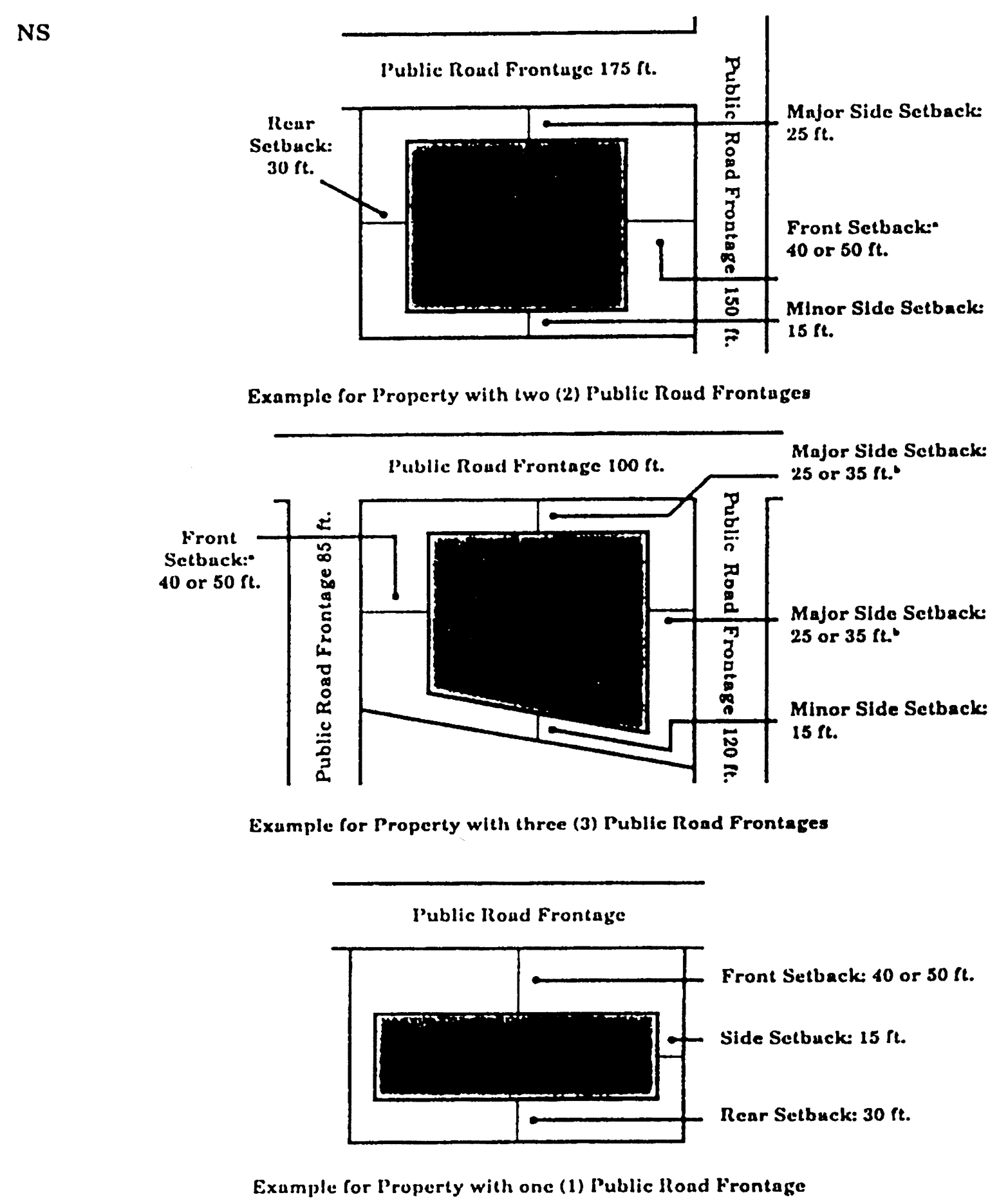
Minimum Building Setback Requirements for NS District
Notes:
a Property with shorter amount of road frontage will be the front setback for determining other setbacks (major side, side, rear).
b If structure fronts a major side setback, major side setback shall be 35 feet.
(5)
Landscape buffer and screening requirements. Unless otherwise noted within this district's requirements, any property within an NS district which abuts a residentially zoned property shall have a 35-foot landscaped screening buffer adjacent to all residentially zoned property. The buffer shall be subject to approval by county staff. The board of commissioners specifically notes that it discourages locating NS districts and developments adjacent to single-family residential districts, unless in a planned mixed use project. Required buffers may be included within required setbacks; however, in such case that the required buffer is greater than the required setback, the required buffer shall be adhered to. Additionally, necessary private utilities and access drives may be allowed through, over or across a landscaped buffer. Any such uses which are proposed through, over or across a designated undisturbed buffer must be approved pursuant to an original site plan or site plan modification as set forth under section 134-126.
a.
Objectives. Undisturbed, planted landscape buffers and berms shall be implemented in connection with a permitted project and shall address the following objectives:
1.
Screening to enhance aesthetic appeal;
2.
Control or direction of vehicular and pedestrian movement;
3.
Reduction of glare;
4.
Buffering of noise; and
5.
Establishment of privacy.
b.
Buffers. Landscape buffers are subject to review and approval by county staff in accordance with the following standards:
1.
Plantings are to be a mix of evergreen trees and shrubs.
2.
Species are to be ecologically compatible to the site and appropriate for the design situation.
3.
Unless public safety concerns dictate otherwise, a buffer should provide a 100 percent visual barrier to a height of six feet within two years of planting.
4.
Minimum height of plant materials at installation is five feet for trees and two feet for shrubs.
5.
Fencing or walls are to be a minimum of six feet in height as approved by county staff.
6.
Trees included in buffer plantings may be counted toward site density calculations as required by chapter 50, article VI, pertaining to tree preservation and replacement, subject to review and approval of county staff.
7.
Buffers shall be regularly maintained by the property owner to ensure that the objectives and standards set out in this subsection are met.
8.
When topography and existing conditions allow, the required 35-foot buffer should be an undisturbed buffer.
9.
Any appeals from a determination by county staff shall be to the board of zoning appeals.
c.
Berms. Berms are subject to review and approval by county staff in accordance with the following standards:
1.
Berms shall be utilized when consistent with surrounding property features.
2.
Berms shall be stabilized.
3.
Where possible, berms shall be constructed to be consistent with natural or proposed drainage patterns.
4.
Berms shall be regularly maintained by the property owner.
(6)
Floodplain and wetlands preservation requirements. Any development must also meet state and federal requirements relating to areas subject to the provisions of section 134-283, regarding mountain and river corridor protection act areas, and section 134-284, regarding metropolitan river protection act areas.
(7)
Building and structure requirements. Maximum building height is 35 feet, with no more than two stories.
(8)
Parking requirements. See section 134-272 for paved parking specifications.
(9)
Lighting requirements. Any project permitted within the NS district which proposes a lighted facility must have a county department of transportation approved lighting plan in accordance with the minimum conditions listed in section 134-269.
(10)
Special exception uses. See section 134-271 for special exception use requirements for all districts. Special exception uses for the NS district are the uses listed in section 134-271.
(11)
Reserved.
(12)
Special exception uses for regional activity center only. The following uses, with the proper scrutiny and conditions, may be considered as special exception uses within the NS district, only if they are within properties delineated as regional activity centers as defined and shown on the Cobb County Comprehensive Plan: A Policy Guide, adopted November 27, 1990. Any special exception use, for regional activity centers only, shall adhere to the landscape buffer and screening requirements in subsection (5) of this section.
a.
Hotel (suite).
The following minimum standards shall apply to suite hotels:
1.
Minimum acreage is two acres.
2.
All rooms shall be accessed through a main or central lobby.
3.
No rooms shall access to the exterior of the building unless required by fire/safety regulations.
4.
The minimum number of floors allowed shall be three floors, unless otherwise approved by the board of commissioners.
5.
Architectural style/design to be approved by the board of commissioners.
6.
All buildings shall have a minimum roof pitch of a four in twelve as defined by applicable building codes.
7.
Conference, meeting or banquet facilities are allowed when supported by adequate parking and approved by the board of commissioners as part of the special land use permit.
8.
Restaurants or other type of eating facilities are allowed when supported by adequate parking and approved by the board of commissioners. "Continental" style dining for the guests of the facility only is allowed within or near the main or central lobby without additional parking.
9.
At a minimum, provisions for weekly cleaning for each suite must be provided.
10.
Each suite must be protected with a smoke detector and sprinkler system approved by the fire marshal or his designee.
11.
Each suite shall be required to include an automatic power off timer for each stove/cook top unit or other type burner.
12.
Parking shall be calculated as one space required for each suite, with an additional ten spaces provided for employees. Parking requirements for conference, meeting or banquet facilities or restaurants or other type of eating facilities within a suite hotel shall be calculated as provided for each use in section 134-272, "traffic and parking," in addition to the above parking requirements and approved by the board of commissioners.
13.
There shall be no outside storage allowed or long term parking of heavy equipment, or parking of construction or related equipment allowed.
14.
A landscaping plan is to be approved by staff with emphasis on planting within the parking facilities.
15.
No facility under this section is to be converted or used primarily as an apartment or condominium.
(13)
Use limitations.
a.
Maximum floor area ratio is 0.5 for office uses and 0.25 for retail uses.
b.
All refuse and designated recycling collection location facilities must be contained within completely enclosed facilities.
c.
It is found and declared that outside storage on properties within unincorporated Cobb County is a health risk and undesirable in that it provides harborage for rodents and insects, lowers property values, and constitutes a public nuisance; therefore, no outside storage is permitted, unless otherwise allowed in this article. Within the NS district outside storage shall not include commercial vehicles.
d.
Commencing January 1, 1991, no new applications for rezoning to the NS district will be accepted by the board of commissioners.
e.
Any existing, developed NS zoning/use located outside of a community activity center or regional activity center shall be deemed to be a grandfathered, nonconforming use and subject to those provisions contained in this chapter. Should any undeveloped property zoned NS outside a community activity center or regional activity center fail to commence development by January 17, 1996, the owner of such property shall be required to bring the property back in for rezoning consistent with the comprehensive plan prior to any development. Obtaining a building or grading permit for such development shall be deemed to be commencing development.
f.
Any emission or automotive inspection station shall be located within a permanent facility. (No temporary buildings/tents are to be utilized after June 30, 1998.) Effective April 1, 2014, any new applications (zoning applications, building permit related applications including tenant finish operations and certificate of occupancy applications) for emission or automotive inspection stations within permanent facilities shall mean an indoor inspection establishment (no outside storage) with fully enclosed service bay(s) with operable door(s) for performing emission and automotive inspections/testing. The permanent facility must be compliant with the adopted building regulations found in chapter 18 of the Cobb County Code.
g.
No uses that emit noxious odors, fumes or sounds are permitted.
h.
No sexually oriented businesses are permitted.
i.
Kitchenettes or kitchen facilities are prohibited in motels.
j.
Outdoor displays of merchandise must comply with the provision in section 134-267.
k.
Maximum impervious surfaces (80%-RAC, 70%-CAC and NAC) shall be established within activity centers as identified by the Cobb County Comprehensive Plan, as may be amended from time to time.
l.
No loading docks or facilities may be located in the front of any primary structure.
Required buffers may be included within required setbacks; however, in such case that the required buffer is greater than the required setback, the required buffer shall be adhered to. Additionally, necessary private utilities and access drives may be allowed through, over or across a landscaped buffer. Any such uses which are proposed through, over or across a designated undisturbed buffer must be approved pursuant to an original site plan or site plan modification as set forth under section 134-126.
(14)
Accessory buildings, structures, uses and decks. Any accessory building or structure in excess of 1,000 square feet of gross space shall be located to the rear of the primary structure and at least 40 feet from any residential property line. Any accessory building or structure which exceeds 1,000 square feet of gross space must have the approval of the division manager of zoning or his designee as to the location, architectural design and size prior to commencing construction. The division manager of zoning or his designee shall consider the following criteria for determining the appropriateness of the architectural design and size of the accessory building or structure: compatibility with the surrounding neighborhood, style of exterior (the exterior is to be compatible in style with the primary structure), use of the proposed accessory structure, impact on adjacent properties, and requirements as deemed appropriate by plan review as set forth in this subsection. All accessory buildings, structures and uses in excess of 1,000 gross square feet shall be required to submit for plan review through the community development department or receive approval from the director of the community development department or his designee. Permitted accessory structures and uses are as follows:
a.
Accessory storage buildings, to include parking garages, subject to the following conditions:
1.
Maximum height is two stories, not to exceed 35 feet.
2.
Such structures shall be located on the same lot as and to the rear of the principal building to which they are accessory.
3.
No accessory building shall be constructed upon a lot until construction of the principal building has commenced.
4.
On a corner lot, no accessory building shall be located closer to the side street right-of-way line than the principal building.
5.
When abutting any other nonresidential district, no garage or other accessory building shall be located closer than five feet to a side or rear lot line.
6.
When an accessory building is attached to the principal building by a breezeway, passageway or similar means, it shall comply with the yard requirements of the principal building to which it is accessory.
7.
Where any nonresidential lot adjoins the side or rear of a residential lot, an accessory building shall not be located within any required buffers.
b.
Antennas and satellite dishes, which shall meet the requirements set forth in section 134-274.
c.
Carwashes accessory to convenience food stores with self-service fuel.
d.
Heating and air conditioning units, subject to the following conditions:
1.
When abutting any residential property line, heating and air conditioning units shall not be located within any required buffers.
2.
When abutting any other nonresidential district, no heating and air conditioning units shall be located closer than five feet to a side or rear lot line.
3.
Heating and air conditioning units may be installed on the roof of any structure zoned commercially so long as the heating and air conditioning unit does not exceed the height restrictions stated in this section and the units are placed so as to be hidden from a front or side view.
4.
No ground-based heating and air conditioning unit shall exceed 35 feet in height.
e.
Incidental storage, provided that the material stored is incidental to the permitted use, as determined by the division manager of zoning or his designee, and stored completely within a portion of the enclosed principal structure permitted within the district, or within a permitted accessory structure.
(Ord. of 12-26-72; Ord. of 12-11-90, § 3-28-7.31; Ord. of 8-13-91; Ord. of 6-9-92; Ord. of 7-11-95; Ord. of 6-24-97 (eff. 7-1-97); Ord. of 12-9-97 (eff. 1-1-98); Ord. of 11-23-99; Ord. of 5-9-00; Ord. of 7-10-01; Ord. of 9-10-02; Ord. of 7-27-04; Ord. of 2-26-08; Amd. of 2-25-14; Amd. of 2-24-15; Amd. of 9-8-20)
Sec. 134-225. - PSC planned shopping center district.
Commencing January 1, 1998, no new applications for a special land use permit for self-service storage facilities (SSSF) are to be accepted by the board of commissioners. The regulations for the PSC planned shopping center district are as follows:
(1)
Purpose and intent. The PSC district is established to provide locations for retail commercial and service uses which are designed and oriented to serve several neighborhoods making up a community. Projects developed within the PSC zoning district should be done as compact, unified centers. Projects developed within the PSC zoning district should occupy a quadrant of an intersection, with ingress and egress only from a major collector street or state highway, within an area delineated within a community activity center or regional activity center as defined and shown on the Cobb County Comprehensive Plan: A Policy Guide, adopted November 27, 1990. Any existing, developed PSC zoning/use located outside of a community activity center or regional activity center shall be deemed to be a grandfathered, nonconforming use and subject to those provisions contained in this chapter. Should any undeveloped property zoned PSC outside a community activity center or regional activity center fail to commence development by January 17, 1996, the owner of such property shall be required to bring the property back in for rezoning consistent with the comprehensive plan prior to any development. Obtaining a building or grading permit for such development shall be deemed to be commencing development.
(2)
Definitions. The following words, terms and phrases, when used in this section, shall have the meanings ascribed to them in this subsection, except where the context clearly indicates a different meaning:
a.
Clinic. A medical or dental clinic is an organization of specializing physicians or dentists, or both, who have their offices in a common building. A clinic shall include laboratory facilities in conjunction with normal clinic services.
b.
Community fair means a festival or fair such as the North Georgia State Fair conducted wholly within public areas owned by a local government, provided that any activity is conducted at least 200 feet from any property line. Any event shall not exceed 21 days.
c.
[Reserved.]
d.
Designated recycling collection locations means metal or heavy duty plastic containers designed for shortterm holding of pre-bagged recyclable items such as tin, aluminum, glass and paper (no perishable or food items allowed) for scheduled minimum monthly pickup, with no on-premises sorting. The center must be maintained in a safe, clean, neat and sanitary fashion and shall not encompass an area larger than 280 square feet.
1.
Such location shall be visually screened and maintained.
2.
Such location shall be within the building setbacks unless otherwise approved by the division manager of zoning or his designee due to topography, safety, internal traffic flow, site distance or other site-related circumstances not created by the property owner.
e.
Group home means a dwelling shared by six or less persons, excluding resident staff, who live together as a single housekeeping unit and in a longterm, family-like environment in which staff persons provide care, education and participation in community activities for the residents with the primary goal of enabling the residents to live as independently as possible in order to reach their maximum potential. This use shall apply to homes for the handicapped. As used in this subsection, the term "handicapped" shall mean:
1.
Having a physical or mental impairment that substantially limits one or more of such person's major life activities so that such person is incapable of living independently;
2.
Having a record of having such an impairment; or
3.
Being regarded as having such an impairment.
However, the term "handicapped" shall not include current illegal use of or addiction to a controlled substance, nor shall it include any person whose residency in the home would constitute a direct threat to the health and safety of other individuals. The term "group home for the handicapped" shall not include alcoholism or drug treatment centers, work release facilities for convicts or ex-convicts, or other housing facilities serving as an alternative to incarceration.
f.
Light automotive repair establishment means an indoor repair establishment (no outside storage) for performing light auto and small truck repair (under one ton) such as brake repair, oil changes, lubrication, transmission repair, installation of belts and hoses, inspections and the like.
g.
Nonautomotive repair uses means commonly found low intensity repair shops such as jewelry, camera, home appliance, television and videocassette recorder repair shops.
h.
Office service and supply establishments means wholesale and retail commercial establishments that sell, service and supply small office equipment and supplies, such as stores that offer sales of copiers, facsimile machines, typewriters, ribbons, transcribers, dictation equipment, tape, staplers and other general office equipment.
i.
Professional offices means a structure wherein services are performed involving predominately administrative, professional or clerical operations such as the following: law, doctor, optician, audiologist, accounting, tax preparation, real estate, stockbroker, architect, engineer, manufacturer representative, professional counselor, dentist, investigative services, photographer, insurance, contractor, land surveyor, telephone sales, political/campaign, veterinarian or travel bureau.
(3)
Permitted uses. Permitted uses are as follows:
Ambulance services, if accessory to hospitals or funeral homes.
Animal hospitals.
Arcades.
Athletic and health clubs.
Automotive parking lots or garages.
Banks or financial institutions with drive-in establishment or automated transfer machines.
Billiards and pool halls, subject to chapter 78, article III, division 6, pertaining to pool rooms.
Boarding kennels (indoor), provided that no outside runs allowed, approval of county health department required, must not create a nuisance as defined by state law, building to be soundproofed, internal air exchange system required (excluding air conditioning system).
Building materials stores.
Bus stations.
Carwashes.
Churches, chapels, temples, synagogues, and other such places of worship.
Clinics.
Clubs or lodges (noncommercial).
Colleges and universities (private), including but not limited to research and training facilities.
Commercial greenhouses and plant nurseries, provided that all goods stored outside shall be stored in a designated area.
Commercial indoor recreation uses.
Commercial outdoor recreation uses.
Commercial produce and agricultural product stands.
Community fairs.
Community retail uses.
Convenience food stores with self-service fuel sales.
Cultural facilities.
Designated recycling collection locations.
Eating and drinking establishments, including drive-in fast food restaurants.
Emissions or inspections stations. (No temporary buildings/tents to be utilized after June 30, 1998.)
Executive golf courses (see section 134-270).
Exterminating facilities (insect or rodent).
Farm and garden supply stores.
Film developing and printing facilities.
Fraternity and sorority houses and residence halls.
Freestanding ice vending machines. The following minimum standards shall apply to freestanding ice vending machines:
1.
Architectural style must be similar to or complimentary to the architectural styles of contiguous properties and consistent with the county's architectural guidelines.
2.
Any roof-mounted utility, conditioned air unit or other mechanical device associated with the operation of the machine must be screened from the view of public right-of-way with an architectural feature similar to or complimentary to the architectural styles of contiguous properties. Further, these utilities, units or mechanical devices must include a noise abatement feature or device that abates noises or sounds from adjacent residential property.
3.
Special land use permit as required in section 134-37.
Full service gasoline stations.
Funeral homes.
Golf courses, 18-hole regulation, public and private (see section 134-270).
Golf courses, par 3 (see section 134-270).
Group homes.
Helicopter landing areas, provided that the area is fenced.
Hospitals.
Hotels.
In-home day care.
Laundry and dry cleaning pickup establishments.
Light automotive repair establishments.
Medical and dental laboratories, provided that no chemicals are manufactured on-site.
Motels.
Neighborhood retail uses.
Nonautomotive repair service establishments.
Nonprofit (seasonal use) fishing lakes.
Nursery schools and child day care centers.
Office service and supply establishments.
Offices not elsewhere classified.
Other consumer goods and services.
Other service establishments.
Parking for vehicles.
Photography studios.
Printing, publishing and lithography establishments, provided that no more than 50 percent of the total gross floor area will be used for storage.
Private parks.
Pro shops, if accessory to driving ranges or golf courses.
Professional offices.
Radio and television stations.
Radio, television and other communication towers and antennas, subject to section 134-273.
Recreation grounds other than tennis courts and golf courses.
Rest homes, personal care homes and convalescent homes.
Reupholstery and furniture repair establishments.
Roominghouses and boardinghouses.
Self-service fuel sales.
Self-service laundry facilities.
Studios and supplies, provided that no more than 50 percent of the total gross floor area will be used for storage.
Temporary uses.
Theaters.
(4)
Lot size and setback requirements. Lot size and setback requirements are as follows:
a.
Minimum lot size: 200,000 square feet.
b.
Minimum lot width at front setback line: 200 feet.
c.
Minimum public road frontage: 100 feet.
d.
Minimum building setbacks: As shown and applied in the following diagram:
MINIMUM BUILDING SETBACK REQUIREMENTS FOR PSC DISTRICT
Note: All setbacks shall be measured from future right-of-way.
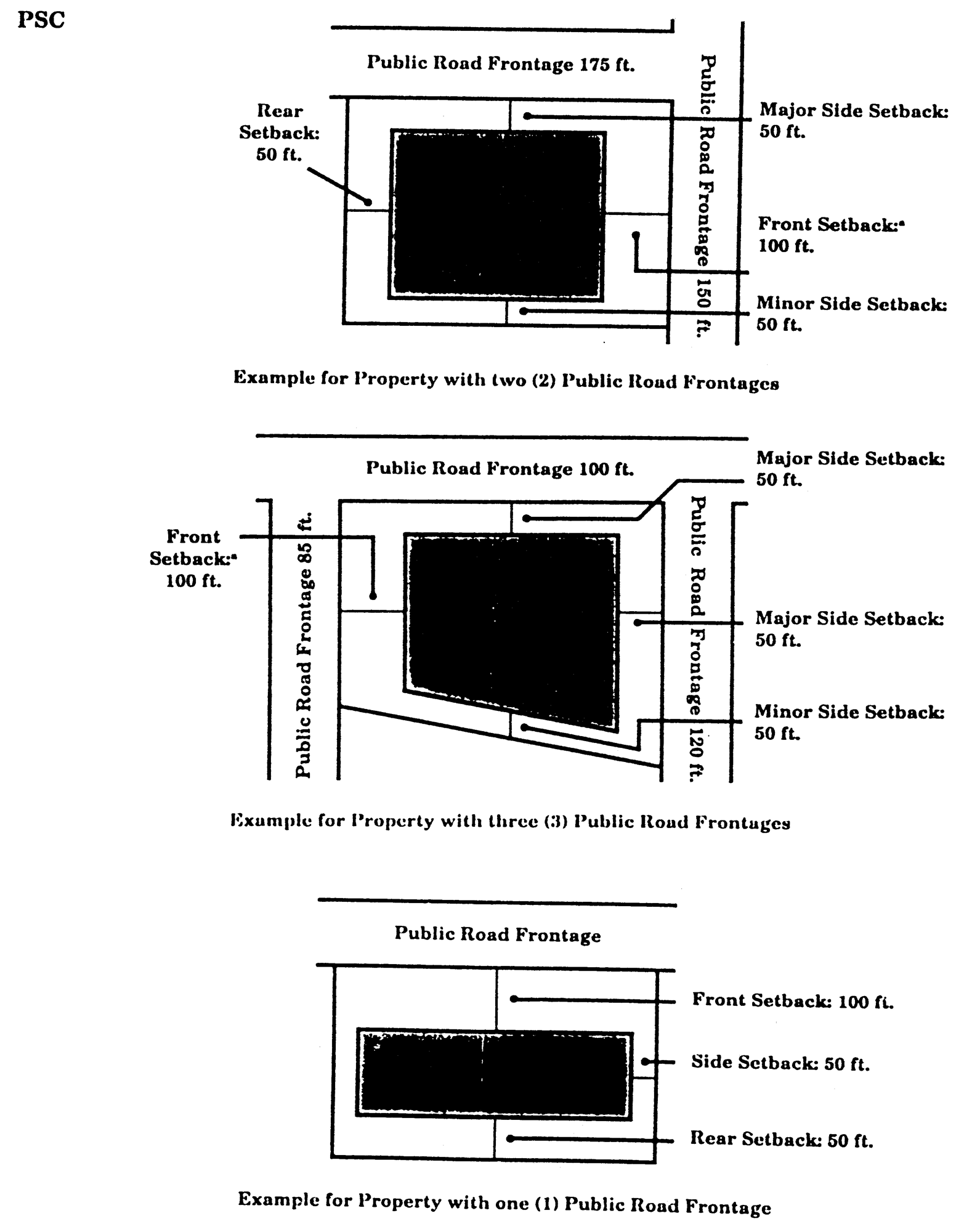
Minimum Building Setback Requirements for PSC District
Notes:
a Property with shorter amount of road frontage will be the front setback for determining other setbacks (major side, side, rear).
b If structure fronts a major side setback, major side setback shall be 35 feet.
(5)
Landscape buffer and screening requirements. Unless otherwise noted within this district's requirements, any property within a PSC district which abuts residentially zoned property shall have a 40-foot landscaped screening buffer adjacent to all residentially zoned property. The buffer shall be subject to approval by county staff. The board of commissioners specifically notes that it discourages locating PSC districts and developments adjacent to single-family residential districts, unless in a planned mixed use project. Required buffers may be included within required setbacks; however, in such case that the required buffer is greater than the required setback, the required buffer shall be adhered to. Additionally, necessary private utilities and access drives may be allowed through, over or across a landscaped buffer. Any such uses which are proposed through, over or across a designated undisturbed buffer must be approved pursuant to an original site plan or site plan modification as set forth under section 134-126.
a.
Objectives. Undisturbed, planted landscape buffers and berms shall be implemented in connection with a permitted project and shall address the following objectives:
1.
Screening to enhance aesthetic appeal;
2.
Control or direction of vehicular and pedestrian movement;
3.
Reduction of glare;
4.
Buffering of noise; and
5.
Establishment of privacy.
b.
Buffers. Landscape buffers are subject to review and approval by county staff in accordance with the following standards:
1.
Plantings are to be a mix of evergreen trees and shrubs.
2.
Species are to be ecologically compatible to the site and appropriate for the design situation.
3.
Unless public safety concerns dictate otherwise, a buffer should maximize a visual barrier to a height of six feet within two years of planting.
4.
Minimum height of plant materials at installation is five feet for trees and two feet for shrubs.
5.
Fencing or walls are to be a minimum of six feet in height as approved by county staff.
6.
Trees included in buffer plantings may be counted toward site density calculations as required by chapter 50, article VI, pertaining to tree preservation and replacement, subject to review and approval of county staff.
7.
Buffers shall be regularly maintained by the property owner to ensure that the objectives and standards set out in this subsection are met.
8.
When topography and existing conditions allow, the required 40-foot buffer should be an undisturbed buffer.
9.
Any appeals from a determination by county staff shall be to the board of zoning appeals.
c.
Berms. Berms are subject to review and approval by county staff in accordance with the following standards:
1.
Berms shall be utilized when consistent with surrounding property features.
2.
Berms shall be stabilized.
3.
Where possible, berms shall be constructed to be consistent with natural or proposed drainage patterns.
4.
Berms shall be regularly maintained by the property owner.
(6)
Floodplain and wetlands preservation requirements. Any development must also meet state and federal requirements relating to areas subject to the provisions of section 134-283, regarding mountain and river corridor protection act areas, and section 134-284, regarding metropolitan river protection act areas.
(7)
Building and structure requirements. Maximum building height is 75 feet, with no more than six stories.
(8)
Parking requirements. See section 134-272 for paved parking specifications.
(9)
Lighting requirements. Any project permitted within the PSC district which proposes a lighted facility must have a county department of transportation approved lighting plan in accordance with the minimum conditions listed in section 134-269.
(10)
Special exception uses. See section 134-271 for special exception use requirements for all districts. Special exception uses for the PSC district are the uses listed in section 134-271.
(11)
Special exception uses for regional activity center only. The following uses, with the proper scrutiny and conditions, may be considered as special exception uses within the PSC district, only if they are within properties delineated as regional activity centers as defined and shown on the Cobb County Comprehensive Plan: A Policy Guide, adopted November 27, 1990. Any special exception use, for regional activity centers only, shall adhere to the landscape buffer and screening requirements in subsection (5) of this section.
a.
Circuses and carnivals subject to provisions established in sections 78-151 through 78-167 of the Cobb County Code.
b.
Hotel (suite).
The following minimum standards shall apply to suite hotels:
1.
Minimum acreage is two acres.
2.
All rooms shall be accessed through a main or central lobby.
3.
No rooms shall access to the exterior of the building unless required by fire/safety regulations.
4.
The minimum number of floors allowed shall be three floors, unless otherwise approved by the board of commissioners.
5.
Architectural style/design to be approved by the board of commissioners.
6.
All buildings shall have a minimum roof pitch of a four in twelve as defined by applicable building codes.
7.
Conference, meeting or banquet facilities are allowed when supported by adequate parking and approved by the board of commissioners as part of the special land use permit.
8.
Restaurants or other type of eating facilities are allowed when supported by adequate parking and approved by the board of commissioners. "Continental" style dining for the guests of the facility only is allowed within or near the main or central lobby without additional parking.
9.
At a minimum, provisions for weekly cleaning for each suite must be provided.
10.
Each suite must be protected with a smoke detector and sprinkler system approved by the fire marshal or his designee.
11.
Each suite shall be required to include an automatic power off timer for each stove/cook top unit or other type burner.
12.
Parking shall be calculated as one space required for each suite, with an additional ten spaces provided for employees. Parking requirements for conference, meeting or banquet facilities or restaurants or other type of eating facilities within a suite hotel shall be calculated as provided for each use in section 134-272, "traffic and parking," in addition to the above parking requirements and approved by the board of commissioners.
13.
There shall be no outside storage allowed or long term parking of heavy equipment, or parking of construction or related equipment allowed.
14.
A landscaping plan is to be approved by staff with emphasis on planting within the parking facilities.
15.
No facility under this section is to be converted or used primarily as an apartment or condominium.
(12)
Use limitations. The PSC development shall meet at the minimum the following:
a.
The development shall be compatible with the topography of the land and shall preserve any unusual topographic or natural features.
b.
The development shall not adversely affect developed or undeveloped neighboring properties.
c.
Water, sewerage, highway and school facilities shall be adequate for the proposed development, or there shall be a definite proposal for making them so.
d.
Maximum floor area ratio is 0.5 for office uses and 0.25 for retail uses.
e.
Minimum acreage is five acres.
f.
All refuse and designated recycling collection location facilities must be contained within completely enclosed facilities.
g.
All of the land in a PSC development shall be owned initially by an individual, corporation, partnership or some other legal entity. Individual properties in a PSC development may be sold after a final plat has been duly recorded with the properties subject to private deed covenants that ensure the continuance of the PSC development as originally approved.
h.
Any emission or automotive inspection station shall be located within a permanent facility. (No temporary buildings/tents are to be utilized after June 30, 1998.) Effective April 1, 2014, any new applications (zoning applications, building permit related applications including tenant finish operations and certificate of occupancy applications) for emission or automotive inspection stations within permanent facilities shall mean an indoor inspection establishment (no outside storage) with fully enclosed service bay(s) with operable door(s) for performing emission and automotive inspections/testing. The permanent facility must be compliant with the adopted building regulations found in chapter 18 of the Cobb County Code.
i.
No uses that emit noxious odors, fumes or sounds are permitted.
j.
The side yard setbacks may be waived except along the exterior boundaries of the development.
k.
No sexually oriented businesses are permitted.
l.
A PSC development shall have ingress and egress only on a major or collector street or state highway.
m.
Any existing, developed PSC zoning/use located outside a community activity center or regional activity center shall be deemed to be a grandfathered, nonconforming use and subject to those provisions contained in this chapter. Should any undeveloped property zoned PSC outside a community activity center or regional activity center fail to commence development by January 17, 1996, the owner of such property shall be required to bring the property back in for rezoning consistent with the comprehensive plan prior to any development. Obtaining a building or grading permit for such development shall be deemed to be commencing development.
n.
Kitchenettes or kitchen facilities are prohibited in motels.
o.
Outdoor displays of merchandise must comply with the provision in section 134-267.
p.
Maximum impervious surfaces (80%-RAC, 70%-CAC and NAC) shall be established within activity centers as identified by the Cobb County Comprehensive Plan, as may be amended from time to time.
q.
No loading docks or facilities may be located in the front of any primary structure.
r.
All PSC zoning districts shall be site plan specific. Any vacant properties zoned PSC must have a site plan approved by the board of commissioners.
Required buffers may be included within required setbacks; however, in such case that the required buffer is greater than the required setback, the required buffer shall be adhered to. Additionally, necessary private utilities and access drives may be allowed through, over or across a landscaped buffer. Any such uses which are proposed through, over or across a designated undisturbed buffer must be approved pursuant to an original site plan or site plan modification as set forth under section 134-126.
(13)
Accessory buildings, structures, uses and decks. Any accessory building or structure in excess of 1,000 square feet of gross space shall be located to the rear of the primary structure and at least 40 feet from any residential property line. Any accessory building or structure which exceeds 1,000 square feet of gross space must have the approval of the division manager of zoning or his designee as to the location, architectural design and size prior to commencing construction. The zoning division manager or his designee shall consider the following criteria for determining the appropriateness of the architectural design and size of the accessory building or structure: compatibility with the surrounding neighborhood, style of exterior (the exterior is to be compatible in style with the primary structure), use of the proposed accessory structure, impact on adjacent properties, and requirements as deemed appropriate by plan review as set forth in this subsection. All accessory buildings, structures and uses in excess of 1,000 gross square feet shall be required to submit for plan review through the community development department or receive approval from the director of the community development department or his designee. Permitted accessory structures and uses are as follows:
a.
Accessory storage buildings, to include parking garages, subject to the following conditions:
1.
Maximum height is two stories, not to exceed 35 feet.
2.
Such structures shall be located on the same lot as and to the rear of the principal building to which they are accessory.
3.
No accessory building shall be constructed upon a lot until construction of the principal building has commenced.
4.
On a corner lot, no accessory building shall be located closer to the side street right-of-way line than the principal building.
5.
When abutting any other nonresidential district, no garage or other accessory building shall be located closer than five feet to a side or rear lot line.
6.
When an accessory building is attached to the principal building by a breezeway, passageway or similar means, it shall comply with the yard requirements of the principal building to which it is accessory.
7.
Where any nonresidential lot adjoins the side or rear of a residential lot, an accessory building shall not be located within any required buffers.
b.
Antennas and satellite dishes, which shall meet the requirements set forth in section 134-274.
c.
Carwashes accessory to convenience food stores with self-service fuel.
d.
Freestanding parking garages, subject to the following conditions:
1.
Maximum height is 50 feet, with no more than four stories.
2.
When abutting any residential property line, freestanding parking garages shall not be located within any required buffers.
3.
When abutting any other nonresidential district, no freestanding garage shall be located closer than five feet to a side or rear lot line.
e.
Heating and air conditioning units, subject to the following conditions:
1.
When abutting any residential property line, heating and air conditioning units shall not be located within any required buffers.
2.
When abutting any other nonresidential district, no heating and air conditioning units shall be located closer than five feet to a side or rear lot line.
3.
Heating and air conditioning units may be installed on the roof of any structure zoned commercially so long as the heating and air conditioning unit does not exceed the height restrictions stated in this section and the units are placed so as to be hidden from a front or side view.
4.
No ground-based heating and air conditioning unit shall exceed 35 feet in height.
f.
Incidental storage, provided that the material stored is incidental to the permitted use, as determined by the division manager of zoning or his designee, and stored completely within a portion of the enclosed principal structure permitted within the district, or within a permitted accessory structure.
(Ord. of 12-26-72; Ord. of 12-11-90, § 3-28-7.32; Ord. of 8-13-91; Ord. of 6-9-92; Ord. of 7-11-95; Ord. of 6-24-97 (eff. 7-1-97); Ord. of 12-9-97 (eff. 1-1-98); Ord. of 11-23-99; Ord. of 5-9-00; Ord. of 7-10-01; Ord. of 9-10-02; Ord. of 7-27-04; Ord. of 7-26-05; Ord. of 7-14-09; Ord. of 8-10-10; Amd. of 2-25-14; Amd. of 2-24-15; Amd. of 2-23-16; Amd. of 9-8-20)
Sec. 134-226. - TS tourist services district.
The regulations for the TS tourist services district are as follows:
(1)
Purpose and intent. The TS district is established to provide locations for commercial and service uses which are oriented toward automotive businesses and interstate and state highway travelers. The board of commissioners has determined that TS zoning will only be allowed on properties designated as community activity centers, regional activity centers, industrial compatible and heavy industrial as identified in the Cobb County Comprehensive Plan: A Policy Guide, adopted November 27, 1990. See subsection (11) of this section, pertaining to use limitations, for those uses no longer appropriate.
(2)
Definitions. The following words, terms and phrases, when used in this section, shall have the meanings ascribed to them in this subsection, except where the context clearly indicates a different meaning:
a.
Reserved.
b.
Automotive storage yard (damaged and confiscated vehicles) means an establishment used for the shortterm storage of damaged or confiscated vehicles.
c.
Automotive paint and body repair shop means an establishment for restoring auto bodies, painting or refinishing, with all activities carried on entirely within an enclosed building.
d.
Clinic. A medical or dental clinic is an organization of specializing physicians or dentists, or both, who have their offices in a common building. A clinic shall include laboratory facilities in conjunction with normal clinic services.
e.
Community fair means a festival or fair such as the North Georgia State Fair conducted wholly within public areas owned by a local government, provided that any activity is conducted at least 200 feet from any property line. Any event shall not exceed 21 days.
f.
[Reserved.]
g.
Designated recycling collection locations means metal or heavy duty plastic containers designed for shortterm holding of pre-bagged recyclable items such as tin, aluminum, glass and paper (no perishable or food items allowed) for scheduled minimum monthly pickup, with no on-premises sorting. The center must be maintained in a safe, clean, neat and sanitary fashion and shall not encompass an area larger than 280 square feet.
1.
Such location shall be visually screened and maintained.
2.
Such location shall be within the building setbacks unless otherwise approved by the division manager of zoning or his designee due to topography, safety, internal traffic flow, site distance or other site-related circumstances not created by the property owner.
h.
Group home means a dwelling shared by six or less persons, excluding resident staff, who live together as a single housekeeping unit and in a longterm, family-like environment in which staff persons provide care, education and participation in community activities for the residents with the primary goal of enabling the residents to live as independently as possible in order to reach their maximum potential. This use shall apply to homes for the handicapped. As used in this subsection, the term "handicapped" shall mean:
1.
Having a physical or mental impairment that substantially limits one or more of such person's major life activities so that such person is incapable of living independently;
2.
Having a record of having such an impairment; or
3.
Being regarded as having such an impairment.
However, the term "handicapped" shall not include current illegal use of or addiction to a controlled substance, nor shall it include any person whose residency in the home would constitute a direct threat to the health and safety of other individuals. The term "group home for the handicapped" shall not include alcoholism or drug treatment centers, work release facilities for convicts or ex-convicts, or other housing facilities serving as an alternative to incarceration.
i.
Heavy automotive repair establishment means an indoor/outdoor repair establishment for performing automotive and truck repair, including engine and transmission overhauls.
j.
Light automotive repair establishment means an indoor repair establishment (no outside storage) for performing light auto and small truck repair (under one ton) such as brake repair, oil changes, lubrication, transmission repair, installation of belts and hoses, inspections and the like.
k.
Neighborhood retail uses means commonly found low scale and low intensity retail uses, with square footages not to exceed 6,000 square feet unless noted in this subsection, that offer basic services and frequently purchased goods to the immediate surrounding residential areas, such as but not limited to the following: auto parts store, antique shop, appliance store (home use), bakery, barbershop or beauty shop, beverage shop, bookstore (but not including adult bookstores), bridal shop, camera shop, china and pottery store, clothing store, dance studio, delicatessen, dog grooming shop, draperies and interior decorating supplies, drugstore or hardware store (provided that the gross floor area does not exceed 20,000 square feet total), dry goods store, florist, furniture store, gifts and stationery store, jewelry store, manicurist shop, meat market or butcher shop, millinery store, mimeograph and letter shop, music store, novelty shop, paint store, pedicurist shop, shoe repair shop, shoe store, sporting goods store, supermarket or grocery (provided that the gross floor area does not exceed 70,000 square feet), tailor shop, toy store, variety shop or video store.
l.
Nonautomotive repair uses means commonly found low intensity repair shops such as jewelry, camera, home appliance, television and videocassette recorder repair shops.
m.
Office service and supply establishments means wholesale and retail commercial establishments that sell, service and supply small office equipment and supplies, such as stores that offer sales of copiers, facsimile machines, typewriters, ribbons, transcribers, dictation equipment, tape, staplers and other general office equipment.
n.
Professional office means a structure wherein services are performed involving predominately administrative, professional or clerical operations such as the following: law, doctor, optician, audiologist, accounting, tax preparation, real estate, stockbroker, architect, engineer, manufacturer representative, professional counselor, dentist, investigative services, photographer, insurance, contractor, land surveyor, telephone sales, political/campaign, veterinarian or travel bureau.
(3)
Permitted uses. Permitted uses are as follows:
Amphitheaters.
Assembly halls.
Athletic and health clubs.
Automobile, truck and trailer lease and rental establishments (accessory use), subject to the following:
1.
Minimum lot size is 20,000 square feet.
2.
Such use shall not occupy more than ten percent of the lot area.
3.
No more than six trailers shall be permitted outdoors on the lot at one time.
4.
No rental or lease of units other than or larger than those described in this subsection shall be permitted.
5.
Parking areas for the permitted trailers shall be located only in portions of the lot where off-street parking is permitted, but no such area or space shall occupy spaces set aside for required off-street parking or use by cars awaiting service. No trailer shall be parked within 30 feet of the future right-of-way line or in any way which interferes with normal traffic flow to, within or out of the lot.
6.
All parking areas shall be clearly marked, and no unit shall be parked outdoors other than within such boundaries except when being serviced.
Automobile, truck and trailer lease establishments (principal use), subject to the following:
1.
Vehicles shall be set back at least 30 feet from the future street right-of-way line and 20 feet from any other property line.
2.
All parking areas shall be clearly marked, and no unit shall be parked outdoors other than within such boundaries except when being serviced.
Automotive and truck sales and service facilities.
Automotive paint and body repair shops.
Automotive parking lots or garages.
Automotive upholstery shops.
Banks and financial institutions with drive-in establishment or automated transfer machines.
Boat sales and service establishments, so long as all boats and vehicles are set back at least 30 feet from the future right-of-way line.
Bus stations.
Carwashes.
Churches, chapels, temples, synagogues, and other such places of worship.
Clubs or lodges (noncommercial).
Commercial produce and agricultural product stands.
Community fairs.
Community retail uses.
Convenience food stores with self-service fuel sales.
Cultural facilities.
Designated recycling collection locations.
Eating and drinking establishments, including drive-in fast food restaurants.
Emissions and inspections stations. (No temporary buildings/tents to be utilized after June 30, 1998.)
Executive golf courses (see section 134-270).
Film developing and printing facilities.
Freestanding ice vending machines. The following minimum standards shall apply to freestanding ice vending machines:
1.
Architectural style must be similar to or complimentary to the architectural styles of contiguous properties and consistent with the county's architectural guidelines.
2.
Any roof-mounted utility, conditioned air unit or other mechanical device associated with the operation of the machine must be screened from the view of public right-of-way with an architectural feature similar to or complimentary to the architectural styles of contiguous properties. Further, these utilities, units or mechanical devices must include a noise abatement feature or device that abates noises or sounds from adjacent residential property.
3.
Special land use permit as required in section 134-37.
Full service gasoline stations.
Golf courses, 18-hole regulation, public and private (see section 134-270).
Golf courses, par 3 (see section 134-270).
Group homes.
Helicopter landing areas, provided that the area is fenced.
Hotels.
In-home day care.
Light automotive repair establishments.
Motels.
Nonprofit (seasonal use) fishing lakes.
Nursery schools and child day care centers.
Office service and supply establishments.
Overnight travel trailer parks (14-day parking limitation).
Parking for vehicles.
Photography studios.
Private parks.
Pro shops, if accessory to driving ranges or golf courses.
Professional offices.
Radio, television and other communication towers and antennas, subject to section 134-273.
Recreation grounds other than tennis courts and golf courses.
Rest homes, personal care homes and convalescent homes.
Roominghouses and boardinghouses.
Self-service fuel sales.
Temporary uses.
(4)
Lot size and setback requirements. Lot size and setback requirements are as follows:
a.
Minimum lot size: 20,000 square feet.
b.
Minimum lot width at front setback line: 60 feet.
c.
Minimum public road frontage: 50 feet.
d.
Minimum building setbacks: As shown and applied in the following diagram:
MINIMUM BUILDING SETBACK REQUIREMENTS FOR TS DISTRICT
Note: All setbacks shall be measured from future right-of-way.
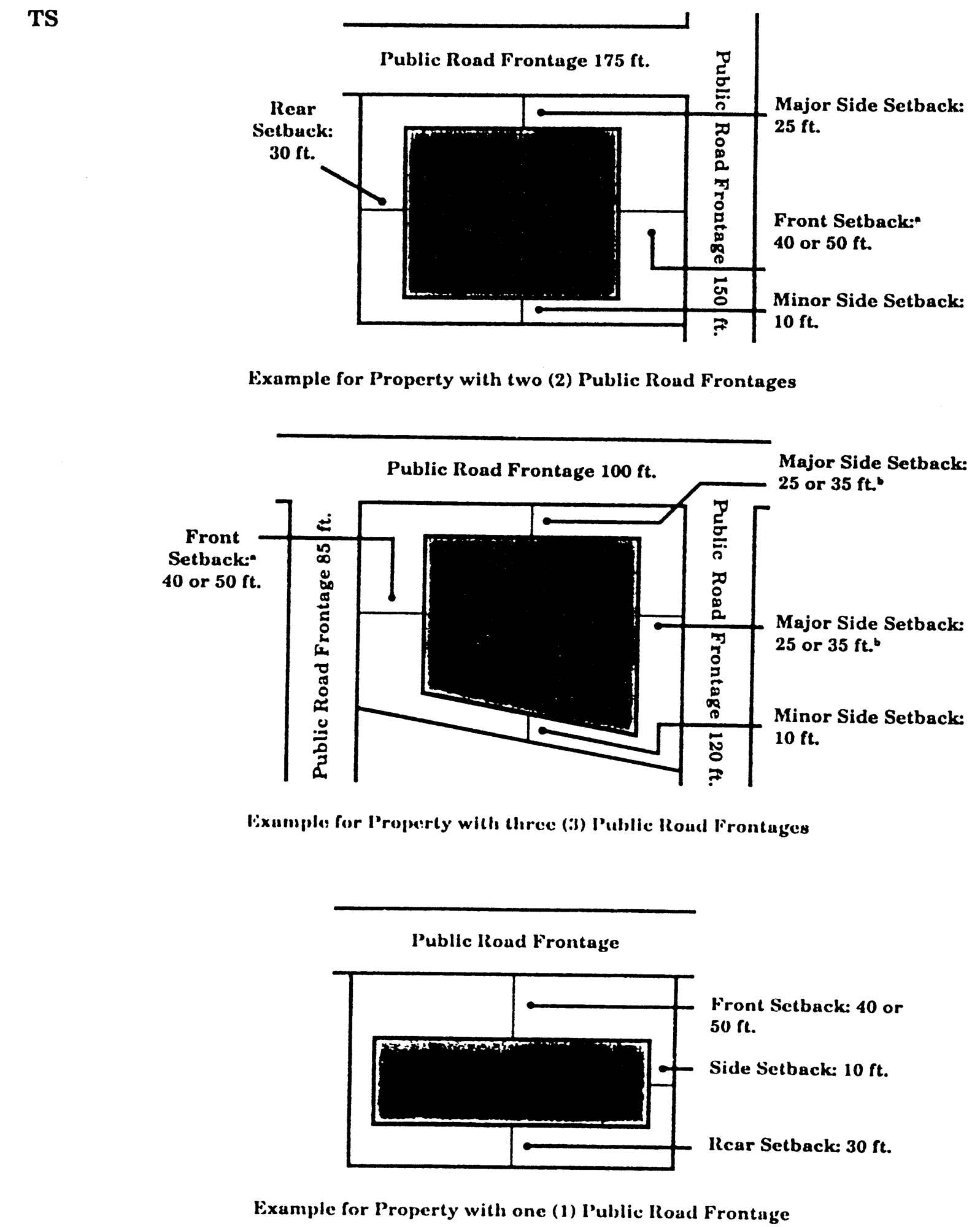
Minimum Building Setback Requirements for TS District
Notes:
a Property with shorter amount of road frontage will be the front setback for determining other setbacks (major side, side, rear).
b If structure fronts a major side setback, major side setback shall be 35 feet.
(5)
Landscape buffer and screening requirements. Unless otherwise noted within this district's requirements, any property within an TS district which abuts a residentially zoned property shall have a 40-foot landscaped screening buffer adjacent to all residentially zoned property, which will be subject to the county landscape architect's approval. The board of commissioners specifically notes that it discourages locating TS districts and developments adjacent to single-family residential districts, unless in a planned mixed use project. Required buffers may be included within required setbacks; however, in such case that the required buffer is greater than the required setback, the required buffer shall be adhered to. Additionally, necessary private utilities and access drives may be allowed through, over or across a landscaped buffer. Any such uses which are proposed through, over or across a designated undisturbed buffer must be approved pursuant to an original site plan or site plan modification as set forth under section 134-126.
a.
Objectives. Undisturbed, planted landscape buffers and berms shall be implemented in connection with a permitted project and shall address the following objectives:
1.
Screening to enhance aesthetic appeal;
2.
Control or direction of vehicular and pedestrian movement;
3.
Reduction of glare;
4.
Buffering of noise; and
5.
Establishment of privacy.
b.
Standards. Buffers or berms shall be required when a TS district is located adjacent to a residential district; a minimum 40-foot buffer is required.
1.
Buffers. Landscape buffers are subject to review and approval by county staff in accordance with the following standards:
i.
Plantings are to be a mix of evergreen trees and shrubs.
ii.
Species are to be ecologically compatible to the site and appropriate for the design situation.
iii.
Unless public safety concerns dictate otherwise, a buffer should maximize a visual barrier to a height of six feet within two years of planting.
iv.
Minimum height of plant materials at installation is five feet for trees and two feet for shrubs.
v.
Fencing or walls are to be a minimum of six feet in height as approved by county staff.
vi.
Trees included in buffer plantings may be counted toward site density calculations as required by chapter 50, article VI, pertaining to tree preservation and replacement, subject to review and approval of county staff.
vii.
Buffers shall be regularly maintained by the property owner to ensure that the objectives and standards set out in this subsection are met.
viii.
When topography and existing conditions allow, the required buffer should be an undisturbed buffer.
ix.
Any appeals from a determination by county staff shall be to the board of zoning appeals.
2.
Berms. Berms are subject to review and approval by county staff in accordance with the following standards:
i.
Berms shall be utilized when consistent with surrounding property features.
ii.
Berms shall be stabilized.
iii.
Berms shall be constructed to be consistent with natural or proposed drainage patterns.
iv.
Berms shall be regularly maintained by the property owner.
(6)
Floodplain and wetlands preservation requirements. Any development must also meet state and federal requirements relating to areas subject to the provisions of section 134-283, regarding mountain and river corridor protection act areas, and section 134-284, regarding metropolitan river protection act areas.
(7)
Building and structure requirements. Maximum building height is 50 feet, with no more than four stories.
(8)
Parking requirements. See section 134-272 for paved parking specifications.
(9)
Lighting requirements. Any project permitted within the TS district which proposes a lighted facility must have a county department of transportation approved lighting plan in accordance with the minimum conditions listed in section 134-269.
(10)
Special exception uses. See section 134-271 for special exception use requirements for all districts. Special exception uses for the TS district are the uses listed in section 134-271.
(11)
Reserved.
(12)
Special exception uses for regional activity center only. The following uses, with the proper scrutiny and conditions, may be considered as special exception uses within the TS district, only if they are within properties delineated as regional activity centers as defined and shown on the Cobb County Comprehensive Plan: A Policy Guide, adopted November 27, 1990. Any special exception use, for regional activity centers only, shall adhere to the landscape buffer and screening requirements in subsection (5) of this section.
a.
Circuses and carnivals subject to provisions established in sections 78-151 through 78-167 of the Cobb County Code.
b.
Hotel (suite).
The following minimum standards shall apply to suite hotels:
1.
Minimum acreage is two acres.
2.
All rooms shall be accessed through a main or central lobby.
3.
No rooms shall access to the exterior of the building unless required by fire/safety regulations.
4.
The minimum number of floors allowed shall be three floors, unless otherwise approved by the board of commissioners.
5.
Architectural style/design to be approved by the board of commissioners.
6.
All buildings shall have a minimum roof pitch of a four in twelve as defined by applicable building codes.
7.
Conference, meeting or banquet facilities are allowed when supported by adequate parking and approved by the board of commissioners as part of the special land use permit.
8.
Restaurants or other type of eating facilities are allowed when supported by adequate parking and approved by the board of commissioners. "Continental" style dining for the guests of the facility only is allowed within or near the main or central lobby without additional parking.
9.
At a minimum, provisions for weekly cleaning for each suite must be provided.
10.
Each suite must be protected with a smoke detector and sprinkler system approved by the fire marshal or his designee.
11.
Each suite shall be required to include an automatic power off timer for each stove/cook top unit or other type burner.
12.
Parking shall be calculated as one space required for each suite, with an additional ten spaces provided for employees. Parking requirements for conference, meeting or banquet facilities or restaurants or other type of eating facilities within a suite hotel shall be calculated as provided for each use in section 134-272, "traffic and parking," in addition to the above parking requirements and approved by the board of commissioners.
13.
There shall be no outside storage allowed or long term parking of heavy equipment, or parking of construction or related equipment allowed.
14.
A landscaping plan is to be approved by staff with emphasis on planting within the parking facilities.
15.
No facility under this section is to be converted or used primarily as an apartment or condominium.
(13)
Use limitations.
a.
Maximum floor area ratio is 0.5 for office uses and 0.25 for retail uses.
b.
All refuse and recycling dropoff center collection facilities must be contained within completely enclosed facilities.
c.
Any emission or automotive inspection station shall be located within a permanent facility. (No temporary buildings/tents are to be utilized after June 30, 1998.) Effective April 1, 2014, any new applications (zoning applications, building permit related applications including tenant finish operations and certificate of occupancy applications) for emission or automotive inspection stations within permanent facilities shall mean an indoor inspection establishment (no outside storage) with fully enclosed service bay(s) with operable door(s) for performing emission and automotive inspections/testing. The permanent facility must be compliant with the adopted building regulations found in chapter 18 of the Cobb County Code.
d.
No uses that emit noxious odors, fumes or sounds are permitted.
e.
Kitchenettes or kitchen facilities are prohibited in motels.
f.
Outdoor displays of merchandise must comply with the provision in section 134-267.
g.
Maximum impervious surfaces (80%-RAC, 70%-CAC and NAC) shall be established within activity centers as identified by the Cobb County Comprehensive Plan, as may be amended from time to time.
h.
No loading docks or facilities may be located in the front of any primary structure.
Required buffers may be included within required setbacks; however, in such case that the required buffer is greater than the required setback, the required buffer shall be adhered to. Additionally, necessary private utilities and access drives may be allowed through, over or across a landscaped buffer. Any such uses which are proposed through, over or across a designated undisturbed buffer must be approved pursuant to an original site plan or site plan modification as set forth under section 134-126.
(14)
Accessory buildings, structures, uses and decks. Any accessory building or structure in excess of 1,000 square feet of gross space shall be located to the rear of the primary structure and at least 40 feet from any residential property line. Any accessory building or structure which exceeds 1,000 square feet of gross space must have the approval of the division manager of zoning or his designee as to the location, architectural design and size prior to commencing construction. The zoning division manager or his designee shall consider the following criteria for determining the appropriateness of the architectural design and size of the accessory building or structure: compatibility with the surrounding neighborhood, style of exterior (the exterior is to be compatible in style with the primary structure), use of the proposed accessory structure, impact on adjacent properties, and requirements as deemed appropriate by plan review as set forth in this subsection. All accessory buildings, structures and uses in excess of 1,000 gross square feet shall be required to submit for plan review through the community development department or receive approval from the director of the community development department or his designee. Permitted accessory structures and buildings are as follows:
a.
Accessory storage buildings, to include parking garages, subject to the following conditions:
1.
Maximum height of two stories, not to exceed 35 feet.
2.
Such structures shall be located on the same lot as and to the rear of the principal building to which they are accessory.
3.
No accessory building shall be constructed upon a lot until construction of the principal building has commenced.
4.
On a corner lot, no accessory building shall be located closer to the side street right-of-way line than the principal building.
5.
When abutting any other nonresidential district, no garage or other accessory building shall be located closer than five feet to a side or rear lot line.
6.
When an accessory building is attached to the principal building by a breezeway, passageway or similar means, it shall comply with the yard requirements of the principal building to which it is accessory.
7.
Where any nonresidential lot adjoins the side or rear of a residential lot, an accessory building shall not be located within any required buffers.
b.
Antennas and satellite dishes, which shall meet the requirements set forth in section 134-274.
c.
Carwashes accessory to convenience food stores with self-service fuel.
d.
Freestanding parking garages, subject to the following conditions:
1.
Maximum height is 50 feet, with no more than four stories.
2.
When abutting any residential property line, freestanding parking garages shall not be located within any required buffers.
3.
When abutting any other nonresidential district, no freestanding garage shall be located closer than five feet to a side or rear lot line.
e.
Heating and air conditioning units, subject to the following conditions:
1.
When abutting any residential property line, heating and air conditioning units shall not be located within any required buffers.
2.
When abutting any other nonresidential district, no heating and air conditioning units shall be located closer than five feet to a side or rear lot line.
3.
Heating and air conditioning units may be installed on the roof of any structure zoned commercially so long as the heating and air conditioning unit does not exceed the height restrictions stated in this section and the units are placed so as to be hidden from a front or side view.
4.
No ground-based heating and air conditioning unit shall exceed 35 feet in height.
f.
Incidental storage, provided that the material stored is incidental to the permitted use, as determined by the division manager of zoning or his designee, and stored completely within a portion of the enclosed principal structure permitted within the district, or within a permitted accessory structure.
(Ord. of 12-26-72; Ord. of 12-11-90, § 3-28-7.33; Ord. of 8-13-91; Ord. of 6-9-92; Ord. of 7-11-95; Ord. of 6-24-97 (eff. 7-1-97); Ord. of 12-9-97 (eff. 1-1-98); Ord. of 11-23-99; Ord. of 5-9-00; Ord. of 7-10-01; Ord. of 9-10-02; Ord. of 7-27-04; Ord. of 2-26-08; Ord. of 7-14-09; Ord. of 8-10-10; Ord. of 7-23-13; Amd. of 2-25-14; Amd. of 2-24-15; Amd. of 2-23-16; Amd. of 9-8-20)
Sec. 134-227. - GC general commercial district.
Commencing January 1, 1998, no new applications for a special land use permit for self-service storage facilities (SSSF) are to be accepted by the board of commissioners. The regulations for the GC general commercial district are as follows:
(1)
Purpose and intent.
a.
The GC district is established to provide locations for retail commercial and service uses which are oriented toward automotive businesses, are land intensive with a need for major road access and visibility, are generally not listed as a permitted uses within the NRC (neighborhood retail commercial) and CRC (community retail commercial) districts or may have existing stipulations and conditions that limit certain intensive uses and are located in areas delineated within a community activity center and regional activity center as defined and shown on the Cobb County Comprehensive Plan: A Policy Guide, adopted November 27, 1990. Any existing GC district, developed or undeveloped, located within an area delineated within an industrial-compatible area or industrial area as shown on the comprehensive plan, shall be deemed to be a grandfathered, nonconforming use after January 1, 1991, and subject to those provisions contained in this chapter.
b.
Any existing, developed GC zoning/use located outside of a community activity center or regional activity center shall be deemed to be a grandfathered, nonconforming use and subject to those provisions contained in this chapter. Should any undeveloped property zoned GC outside of a community activity center or regional activity center fail to commence development by January 17, 1996, the owner of such property shall be required to bring the property back in for rezoning consistent with the comprehensive plan prior to any development. Obtaining a building permit or grading permit for such development shall be deemed to be commencing development. Due to the fact that general commercial has been the predominant commercial zoning district since its inception in 1972, the board of commissioners has determined that certain uses previously permitted are no longer appropriate for properties within an area delineated as a community activity center as defined and shown on the Cobb County Comprehensive Plan: A Policy Guide, adopted November 27, 1990. See subsection (12) of this section, pertaining to use limitations, for those uses no longer appropriate.
(2)
Definitions. The following words, terms and phrases, when used in this section, shall have the meanings ascribed to them in this subsection, except where the context clearly indicates a different meaning:
a.
Reserved.
b.
Arcade means a building or part of a building in which five or more pinball machines, video games, other children's rides or other similar player-operated amusement devices are maintained, not including a commercial recreation restaurant.
c.
Amusement center means any freestanding, privately owned and operated commercial recreational area containing an assortment of rides, games, arcades, attractions, water slides, and tracks for amusement vehicles.
d.
Automotive storage yard and wrecker service (damaged and confiscated vehicles) means an establishment used for the shortterm storage of damaged or confiscated vehicles.
e.
Automotive paint and body repair shop means an establishment for restoring auto bodies, painting or refinishing, with all activities carried on entirely within an enclosed building.
f.
Clinic. A medical or dental clinic is an organization of specializing physicians or dentists, or both, who have their offices in a common building. A clinic shall include laboratory facilities in conjunction with normal clinic services.
g.
Community fair means a festival or fair such as the North Georgia State Fair conducted wholly within public areas owned by a local government, provided that any activity is conducted at least 200 feet from any property line. Any event shall not exceed 21 days.
h.
[Reserved.]
i.
Designated recycling collection location means metal or heavy duty plastic containers designed for shortterm holding of pre-bagged recyclable items such as tin, aluminum, glass and paper (no perishable or food items allowed) for scheduled minimum monthly pickup, with no on-premises sorting. The center must be maintained in a safe, clean, neat and sanitary fashion and shall not encompass an area larger than 280 square feet.
1.
Such location shall be visually screened and maintained.
2.
Such location shall be within the building setbacks unless otherwise approved by the division manager of zoning or his designee due to topography, safety, internal traffic flow, site distance or other site-related circumstances not created by the property owner.
j.
Group home means a dwelling shared by six or less persons, excluding resident staff, who live together as a single housekeeping unit and in a longterm, family-like environment in which staff persons provide care, education and participation in community activities for the residents with the primary goal of enabling the residents to live as independently as possible in order to reach their maximum potential. This use shall apply to homes for the handicapped. As used in this subsection, the term "handicapped" shall mean:
1.
Having a physical or mental impairment that substantially limits one or more of such person's major life activities so that such person is incapable of living independently;
2.
Having a record of having such an impairment; or
3.
Being regarded as having such an impairment.
However, the term "handicapped" shall not include current illegal use of or addiction to a controlled substance, nor shall it include any person whose residency in the home would constitute a direct threat to the health and safety of other individuals. The term "group home for the handicapped" shall not include alcoholism or drug treatment centers, work release facilities for convicts or ex-convicts, or other housing facilities serving as an alternative to incarceration.
k.
Heavy automotive repair establishment means an indoor/outdoor repair establishment for performing automotive and truck repair, including engine and transmission overhauls.
l.
Light automotive repair establishment means an indoor repair establishment (no outside storage) with fully enclosed service bay(s) with operable door(s) for performing light auto and small truck repair and maintenance within the enclosed service bay(s) (under one ton) such as brakes, oil changes, lubrication, transmission, belts, hoses, inspections, tire mounting and installation and the like. Light automotive repair establishments adjacent to residentially zoned properties shall be required to incorporate noise abatement measures such as, but not limited to, landscaping, fencing, portable noise screen, or other equally effective industry accepted alternative. This amendment shall become effective July 1, 2013. Activities such as battery replacement, light bulb changes, wiper blade replacement, "check engine light" diagnostics, or other minor things done complimentary and the like may be done outside of a retail automotive parts store with non-powered hand tools.
m.
Nonautomotive repair uses means commonly found low intensity repair shops such as jewelry, camera, home appliance, television and videocassette recorder repair shops.
n.
Office service and supply establishments means wholesale and retail commercial establishments that sell, service and supply small office equipment and supplies, such as stores that offer sales of copiers, facsimile machines, typewriters, ribbons, transcribers, dictation equipment, tape, staplers and other general office equipment.
o.
Professional office means a structure wherein services are performed involving predominately administrative, professional or clerical operations such as the following: law, doctor, optician, audiologist, accounting, tax preparation, real estate, stockbroker, architect, engineer, manufacturer representative, professional counselor, dentist, investigative services, photographer, insurance, contractor, land surveyor, telephone sales, political/campaign, veterinarian or travel bureau.
(3)
Permitted uses. Permitted uses are as follows:
Ambulance services, if accessory to a hospital or funeral home.
Amphitheaters.
Animal hospitals.
Arcades.
Assembly halls.
Athletic and health clubs.
Automobile, truck and trailer lease and rental facilities (principal or accessory).
Automotive and truck sales and service facilities.
Automotive paint and body repair shops.
Automotive parking lots or garages.
Automotive upholstery shops.
Banks and financial institutions with drive-in establishment or automated transfer machines.
Billiards and pool halls, subject to chapter 78, article III, division 6, pertaining to pool rooms.
Boat sales and service establishments.
Boarding kennels (indoor), provided that no outside runs allowed, approval of county health department required, must not create a nuisance as defined by state law, building to be soundproofed, internal air exchange system required (excluding air conditioning system).
Building materials stores.
Bus stations.
Carwashes.
Churches, chapels, temples, synagogues, and other such places of worship.
Clinics.
Clubs or lodges (noncommercial).
Colleges and universities (private), including but not limited to research and training facilities.
Commercial greenhouses and plant nurseries, provided that all goods stored outside shall be stored in a designated area.
Commercial indoor recreation uses.
Commercial outdoor recreation uses.
Commercial produce and agricultural product stands.
Commercial recreation restaurants.
Community fairs.
Community retail uses.
Contractor (specialized) without heavy equipment.
Convenience food stores with self-service fuel sales.
Cultural facilities.
Designated recycling collection locations.
Eating and drinking establishments, including drive-in fast food restaurants.
Emissions or inspection stations. (No temporary buildings/tents to be utilized after June 30, 1998.)
Executive golf courses (see section 134-270).
Exterminating facilities (insect or rodent).
Farm and garden supply stores.
Farm equipment stores and repair establishments.
Farmers' markets (fully enclosed).
Film developing and printing facilities.
Fraternity and sorority houses and residence halls.
Freestanding climate controlled self-service storage facilities. The following minimum standards shall apply to freestanding climate controlled self-service storage facilities:
1.
Building height should not exceed those of adjacent buildings, nor impact the view shed of adjacent residential property.
2.
F.A.R. should be 2.0 or as determined appropriate by the board of commissioners.
3.
All units shall be accessed through a main or central entrance.
4.
All windows or similar architectural features must be "one way" and provide for an opaque screen from view outside of the building.
5.
Architectural style/design to be similar or complementary to the predominant architectural design of other commercial uses within the activity center. Said architectural style/design to be approved by the board of commissioners. Any roof-mounted utilities or building components must be sufficiently screened from view of adjoining properties and public right-of-way.
6.
There shall be no outside storage allowed nor overnight and/or long-term parking of heavy equipment, commercial equipment or parking of construction or related equipment allowed.
7.
There shall be no storage of recreational vehicles and no dry storage of pleasure boats of any type customarily maintained by private individuals for their personal use.
8.
There shall be no storage of flammable liquids, highly combustible or explosive materials, or hazardous chemicals.
9.
No units within the facility shall be used for or considered to be premises for the purpose of assigning a legal address in order to obtain an occupational license or any other government permit or licenses to do business.
10.
There shall be no resident manager or any type of overnight accommodations for such.
11.
Landscape plan to be approved by staff with emphasis on planting within the parking facilities.
12.
One parking space shall be provided per every 80 individual storage units/areas.
13.
Loading area, including adequate turnaround space for a tractor trailer vehicle, must be screened by a permanent architectural or landscape feature or as may be approved by the board of commissioners if not located to side or rear of proposed structure.
14.
Lighting plan to be approved by the board of commissioners.
15.
No units shall be used to manufacture, fabricate or process goods, to service or repair vehicles, boats, small engines or electrical equipment, or to conduct similar repair activities, to conduct garage sales or retail sales of any kind, to rehearse or practice utilizing band instruments, or for conversion to an apartment or dwelling unit, or to conduct any other commercial or industrial activities on the site.
16.
Dumpster areas and detention areas must be sufficiently screened from view of adjoining properties and public right-of-way.
17.
Hours of operation to be established by the board of commissioners, considering the operational hours of surrounding businesses.
18.
Special land use permit as provided in section 134-37.
Freestanding ice vending machines. The following minimum standards shall apply to freestanding ice vending machines:
1.
Architectural style must be similar to or complimentary to the architectural styles of contiguous properties and consistent with the county's architectural guidelines.
2.
Any roof-mounted utility, conditioned air unit or other mechanical device associated with the operation of the machine must be screened from the view of public right-of-way with an architectural feature similar to or complimentary to the architectural styles of contiguous properties. Further, these utilities, units or mechanical devices must include a noise abatement feature or device that abates noises or sounds from adjacent residential property.
3.
Special land use permit as required in section 134-37.
Full service gasoline stations.
Funeral homes.
Golf courses, 18-hole regulation, public and private (see section 134-270).
Golf courses, par 3 (see section 134-270).
Group homes.
Helicopter landing areas, provided that the area is fenced.
Hospitals.
Hotels.
In-home day care.
Laundry and dry cleaning pickup establishments.
Light automotive repair establishments.
Medical and dental laboratories, provided that no chemicals are manufactured on-site.
Motels.
Motorcycle, all-terrain vehicle (ATV) and three-wheel vehicle sales and service facilities.
Neighborhood retail uses.
Nightclubs.
Nonautomotive repair service establishments.
Nursery schools and child day care centers.
Office service and supply establishments.
Offices not elsewhere classified.
Other consumer goods and services.
Other service establishments.
Outdoor golf driving ranges (see section 134-270).
Parking for vehicles.
Pawnshops.
Photography studios.
Printing, publishing and lithography establishments, provided that no more than 50 percent of the total gross floor area will be used for storage.
Private parks.
Pro shops, if accessory to driving ranges or golf courses.
Professional offices.
Radio and television stations.
Radio, television and other communication towers and antennas subject to section 134-273.
Recreation grounds other than tennis courts and golf courses.
Rest homes, personal care homes and convalescent homes.
Reupholstery and furniture repair establishments.
Roominghouses and boardinghouses.
Self-service fuel sales.
Self-service laundry facilities.
Shelters (homeless).
Studios and supplies, provided that no more than 50 percent of the total gross floor area will be used for storage.
Taxistands and taxi dispatching agencies.
Temporary uses.
Theaters.
Tire retreading and recapping facilities.
Vending machine sales, service, rental or repair establishments.
Zoos.
(4)
Lot size and setback requirements. Lot size and setback requirements are as follows:
a.
Minimum lot size: 20,000 square feet.
b.
Minimum lot width at front setback line: 60 feet.
c.
Minimum public road frontage: 50 feet.
d.
Minimum building setbacks: As shown and applied in the following diagram:
MINIMUM BUILDING SETBACK REQUIREMENTS FOR GC DISTRICT
Note: All setbacks shall be measured from future right-of-way.
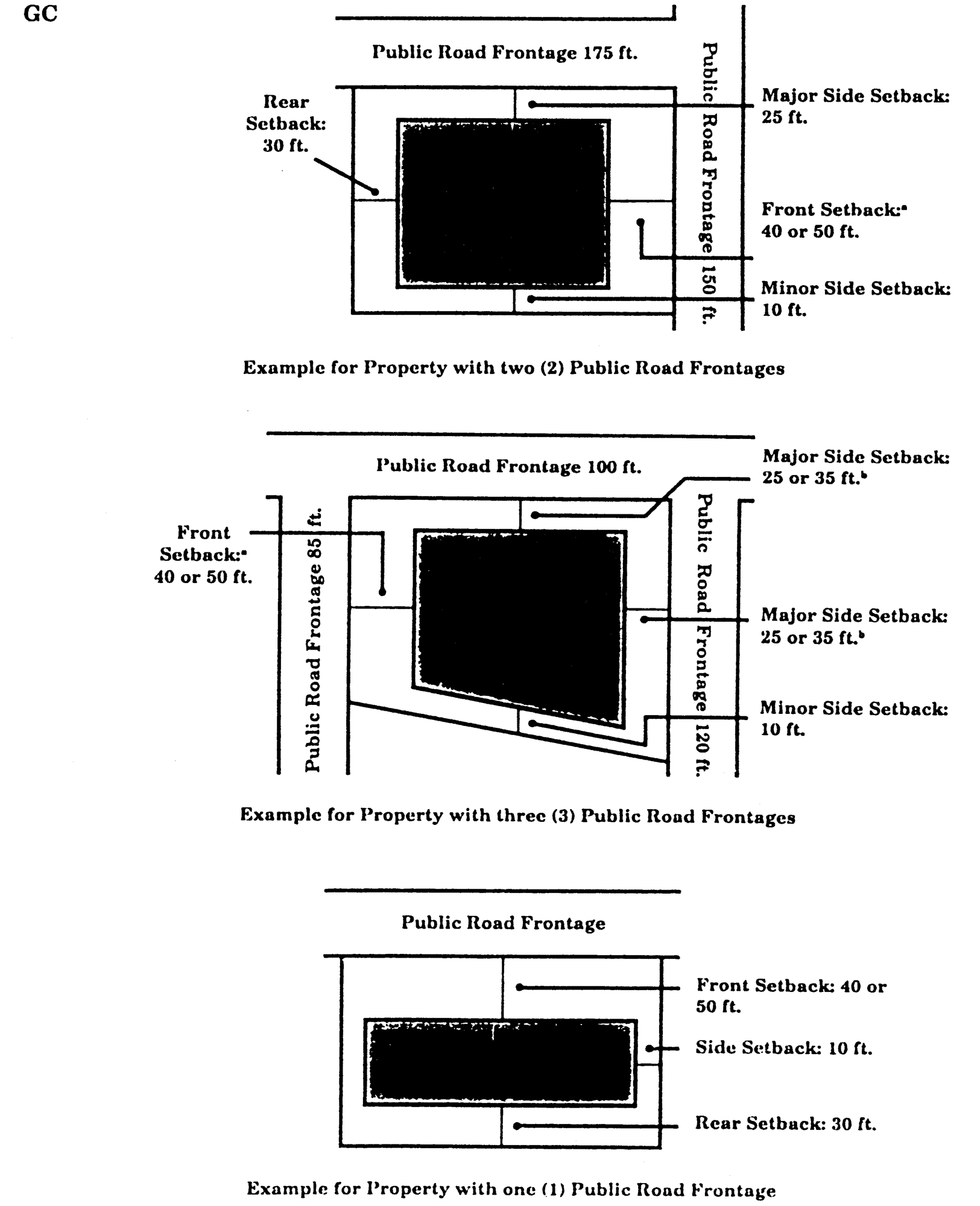
Minimum Building Setback Requirements for GC District
Notes:
a Property with shorter amount of road frontage will be the front setback for determining other setbacks (major side, side, rear).
b If structure fronts a major side setback, major side setback shall be 35 feet.
(5)
Landscape buffer and screening requirements. Unless otherwise noted within this district's requirements, any property within a GC district which abuts residentially zoned property shall have a 40-foot landscaped screening buffer adjacent to all residentially zoned property, which will be subject to the county landscape architect's approval. The board of commissioners specifically notes that it discourages locating GC districts and developments adjacent to single-family residential districts, unless in a planned mixed use project. Required buffers may be included within required setbacks; however, in such case that the required buffer is greater than the required setback, the required buffer shall be adhered to. Additionally, necessary private utilities and access drives may be allowed through, over or across a landscaped buffer. Any such uses which are proposed through, over or across a designated undisturbed buffer must be approved pursuant to an original site plan or site plan modification as set forth under section 134-126.
a.
Objectives. Undisturbed, planted landscape buffers and berms shall be implemented in connection with a permitted project and shall address the following objectives:
1.
Screening to enhance aesthetic appeal;
2.
Control or direction of vehicular and pedestrian movement;
3.
Reduction of glare;
4.
Buffering of noise; and
5.
Establishment of privacy.
b.
Standards. Buffers or berms shall be required when a GC district is located adjacent to a residential district; a minimum 40-foot buffer is required.
1.
Buffers. Landscape buffers are subject to review and approval by county staff in accordance with the following standards:
i.
Plantings are to be a mix of evergreen trees and shrubs.
ii.
Species are to be ecologically compatible to the site and appropriate for the design situation.
iii.
Unless public safety concerns dictate otherwise, a buffer should provide a 100 percent visual barrier to a height of six feet within two years of planting.
iv.
Minimum height of plant materials at installation is five feet for trees and two feet for shrubs.
v.
Fencing or walls are to be a minimum of six feet in height as approved by county staff.
vi.
Trees included in buffer plantings may be counted toward site density calculations as required by chapter 50, article VI, pertaining to tree preservation and replacement, subject to review and approval of county staff.
vii.
Buffers shall be regularly maintained by the property owner to ensure that the objectives and standards set out in this subsection are met.
viii.
When topography and existing conditions allow, the required 40-foot buffer should be an undisturbed buffer.
ix.
Any appeals from a determination by county staff shall be to the board of zoning appeals.
2.
Berms. Berms are subject to review and approval by county staff in accordance with the following standards:
i.
Berms shall be utilized when consistent with surrounding property features.
ii.
Berms shall be stabilized.
iii.
Where possible, berms shall be constructed to be consistent with natural drainage patterns.
iv.
Berms shall be regularly maintained by the property owner.
(6)
Floodplain and wetlands preservation requirements. Any development must also meet state and federal requirements relating to areas subject to the provisions of section 134-283, regarding mountain and river corridor protection act areas, and section 134-284, regarding metropolitan river protection act areas.
(7)
Building and structure requirements. Maximum building height is 50 feet, with no more than four stories.
(8)
Parking requirements. See section 134-272 for paved parking specifications.
(9)
Lighting requirements. Any project permitted within the GC district which proposes a lighted facility must have a county department of transportation approved lighting plan in accordance with the minimum conditions listed in section 134-269.
(10)
Special exception uses. See section 134-271 for special exception use requirements for all districts. Special exception uses are as follows:
a.
The uses listed in section 134-271.
b.
Flea markets, provided that the applicant meets the requirements of chapter 78, article V.
(11)
Special exception uses for community activity center only. The following uses, with the proper scrutiny and conditions, may be considered as special exception uses within the GC district, only if they are within properties delineated as community activity center as defined and shown on the Cobb County Comprehensive Plan: A Policy Guide, adopted November 27, 1990. Any special exception use, for community activity centers only, shall adhere to the landscape buffer and screening requirements in subsection (5) of this section.
a.
Automobile and truck sales and service facilities (used or pre-owned separate from a new car dealership):
1.
Minimum of one acre of a paved surface is required for parking of vehicles, excluding any area used for, but not limited to buildings, offices, service or sales areas:
2.
If any entity sells more than five cars per year, they are considered a dealer which requires a county business license.
3.
A special land use permit is required as provided in section 134-37.
4.
All vehicles are required to be parked off any right-of-way or easement.
b.
Reserved.
c.
Climate controlled self-service storage facilities, when complementary or accessory to an office park or building.
The following minimum standards shall apply to climate controlled self-service storage facilities:
1.
Building height should not exceed those of adjacent buildings, nor impact the view shed of adjacent residential property.
2.
F.A.R. should be 1.0 or as determined appropriate by the board of commissioners.
3.
All units shall be accessed through a main or central entrance.
4.
All windows or similar architectural features must be "one way" and provide for an opaque screen from view outside of the building.
5.
Architectural style/design to be similar or complementary to the predominant architectural design of other commercial uses within the activity center. Said architectural style/design to be approved by the board of commissioners. Any roof-mounted utilities or building components must be sufficiently screened from view of adjoining properties and public right-of-way.
6.
There shall be no outside storage allowed nor overnight and/or long-term parking of heavy equipment, commercial equipment or parking of construction or related equipment allowed.
7.
There shall be no storage of recreational vehicles and no dry storage of pleasure boats of any type customarily maintained by private individuals for their personal use.
8.
There shall be no storage of flammable liquids, highly combustible or explosive materials, or hazardous chemicals.
9.
No units within the facility shall be used for or considered to be premises for the purpose of assigning a legal address in order to obtain an occupational license or any other government permit or licenses to do business.
10.
There shall be no resident manager or any type of overnight accommodations for such.
11.
Landscape plan to be approved by staff with emphasis on planting within the parking facilities.
12.
One parking space shall be provided per every 80 individual storage units/areas.
13.
Overall project must be accessed via a public or private roadway which is internal to the office park, building or shopping center; direct access to an adjoining public roadway shall be subject to approval by the board of commissioners.
14.
No freestanding signage shall be utilized; internal directional signage will be subject to approval by the board of commissioners.
15.
No units shall be used to manufacture, fabricate or process goods, to service or repair vehicles, boats, small engines or electrical equipment, or to conduct similar repair activities, to conduct garage sales or retail styles of any kind, to rehearse or practice utilizing band instruments, or for conversion to an apartment or dwelling unit, or to conduct any other commercial or industrial activities on the site.
16.
Loading area, including adequate turnaround space for a tractor trailer vehicle, must be screened by a permanent architectural or landscape feature or as may be approved by the board of commissioners if not located to side or rear of proposed structure.
17.
Special land use permit as provided in section 134-37.
18.
Hours of operation to be established by the board of commissioners, considering the operational hours of surrounding businesses.
(12)
Special exception uses for regional activity center only. The following uses, with the proper scrutiny and conditions, may be considered as special exception uses within the GC district, only if they are within properties delineated as regional activity centers as defined and shown on the Cobb County Comprehensive Plan: A Policy Guide, adopted November 27, 1990. Any special exception use, for regional activity centers only, shall adhere to the landscape buffer and screening requirements in subsection (5) of this section.
a.
Reserved.
b.
Amusement centers, subject to the following minimum requirements:
1.
Minimum acreage is five acres.
2.
Such use shall not be located closer than 500 feet to any school property.
3.
Such use shall not be located closer than 200 feet to any residential property line.
4.
An overall parking and landscape plan shall be approved by county staff. The plan will provide for safe and efficient vehicle and pedestrian circulation and aesthetics.
c.
Automobile storage yards and wrecker services for damaged or confiscated vehicles, subject to the following minimum requirements:
1.
Such use shall be enclosed by a fence or wall not less than eight feet in height which provides visual screening.
2.
No dismantling, repair or other such activity shall be conducted.
3.
Such use shall be located at least 40 feet from any residential district or use.
4.
Such automobiles shall not be held longer than provided by state and county law.
5.
A special land use permit is required as provided in section 134-37.
d.
Automobile and truck sales and service facilities (used or pre-owned separate from a new car dealership):
1.
Minimum of one acre of a paved surface is required for parking of vehicles, excluding any area used for, but not limited to buildings, offices, service or sales area.
2.
If any entity sells more than five cars per year, they are considered a dealer which requires a county business license.
3.
A special land use permit is required as provided in section 134-37.
4.
All vehicles are required to be parked off any right-of-way or easement.
e.
Circuses and carnivals subject to provisions established in sections 78-151 through 78-167 of the Cobb County Code.
f.
Coliseums, stadiums and convention centers (privately owned), with the following minimum requirements:
1.
Minimum acreage is ten acres.
2.
A special land use permit is required as provided in section 134-37.
3.
A traffic and parking plan shall be approved by the director of the county department of transportation.
4.
Hours of operation shall be approved by the board of commissioners at the time of the special land use permit public hearing.
5.
A noise abatement plan shall be approved by the board of commissioners at the time of the special land use permit public hearing.
g.
Crematories, human or animal, with the following minimum requirements:
1.
Minimum lot size is two acres.
2.
When abutting any residential property line, a 50-foot natural or landscaped buffer shall be approved by county staff (see subsection (5) of this section).
h.
Drive-in theaters, with the following minimum requirements:
1.
Minimum acreage is two acres.
2.
Driving and parking areas shall be paved.
3.
The theater screen, projection booth or other buildings shall be set back not less than 50 feet from any property line (unless the front setback is greater).
4.
The theater screen shall not be visible from an expressway, arterial or major collector roadway.
5.
No damaged or confiscated vehicles shall be stored on-site.
i.
Hotel (suite).
The following minimum standards shall apply to suite hotels:
1.
Minimum acreage is two acres.
2.
All rooms shall be accessed through a main or central lobby.
3.
No rooms shall access to the exterior of the building unless required by fire/safety regulations.
4.
The minimum number of floors allowed shall be three floors, unless otherwise approved by the board of commissioners.
5.
Architectural style/design to be approved by the board of commissioners.
6.
All buildings shall have a minimum roof pitch of a four in twelve as defined by applicable building codes.
7.
Conference, meeting or banquet facilities are allowed when supported by adequate parking and approved by the board of commissioners as part of the special land use permit.
8.
Restaurants or other type of eating facilities are allowed when supported by adequate parking and approved by the board of commissioners. "Continental" style dining for the guests of the facility only is allowed within or near the main or central lobby without additional parking.
9.
At a minimum, provisions for weekly cleaning for each suite must be provided.
10.
Each suite must be protected with a smoke detector and sprinkler system approved by the fire marshal or his designee.
11.
Each suite shall be required to include an automatic power off timer for each stove/cook top unit or other type burner.
12.
Parking shall be calculated as one space required for each suite, with an additional ten spaces provided for employees. Parking requirements for conference, meeting or banquet facilities or restaurants or other type of eating facilities within a suite hotel shall be calculated as provided for each use in section 134-272, "traffic and parking," in addition to the above parking requirements and approved by the board of commissioners.
13.
There shall be no outside storage allowed or long term parking of heavy equipment, or parking of construction or related equipment allowed.
14.
A landscaping plan is to be approved by staff with emphasis on planting within the parking facilities.
15.
No facility under this section is to be converted or used primarily as an apartment or condominium.
j.
Climate controlled self-service storage facilities, when complementary or accessory to an office park or building.
The following minimum standards shall apply to climate controlled self-service storage facilities:
1.
Building height should not exceed those of adjacent buildings, nor impact the view shed of adjacent residential property.
2.
F.A.R. should be 2.0 or as determined appropriate by the board of commissioners.
3.
All units shall be accessed through a main or central entrance.
4.
All windows or similar architectural features must be "one way" and provide for an opaque screen from view outside of the building.
5.
Architectural style/design to be similar or complementary to the predominant architectural design of other commercial uses within the activity center. Said architectural style/design to be approved by the board of commissioners. Any roof-mounted utilities or building components must be sufficiently screened from view of adjoining properties and public right-of-way.
6.
There shall be no outside storage allowed nor overnight and/or long-term parking of heavy equipment, commercial equipment or parking of construction or related equipment allowed.
7.
There shall be no storage of recreational vehicles and no dry storage of pleasure boats of any type customarily maintained by private individuals for their personal use.
8.
There shall be no storage of flammable liquids, highly combustible or explosive materials, or hazardous chemicals.
9.
No units within the facility shall be used for or considered to be premises for the purpose of assigning a legal address in order to obtain an occupational license or any other government permit or licenses to do business.
10.
There shall be no resident manager or any type of overnight accommodations for such.
11.
Landscape plan to be approved by staff with emphasis on planting within the parking facilities.
12.
One parking space shall be provided per every 80 individual storage units/areas.
13.
Overall project must be accessed via a public or private roadway which is internal to the office park, building or shopping center; direct access to an adjoining public roadway shall be subject to approval by the board of commissioners.
14.
No freestanding signage shall be utilized; internal directional signage will be subject to approval by the board of commissioners.
15.
No units shall be used to manufacture, fabricate or process goods, to service or repair vehicles, boats, small engines or electrical equipment, or to conduct similar repair activities, to conduct garage sales or retail styles of any kind, to rehearse or practice utilizing band instruments, or for conversion to an apartment or dwelling unit, or to conduct any other commercial or industrial activities on the site.
16.
Loading area, including adequate turnaround space for a tractor trailer vehicle, must be screened by a permanent architectural or landscape feature or as may be approved by the board of commissioners if not located to side or rear of proposed structure.
17.
Special land use permit as provided in section 134-37.
18.
Hours of operation to be established by the board of commissioners, considering the operational hours of surrounding businesses.
(13)
Use limitations.
a.
Maximum floor area ratio is 0.5 for office uses and 0.25 for retail uses.
b.
All refuse and designated recycling collection location facilities must be contained within completely enclosed facilities.
c.
Any emission or automotive inspection station shall be located within a permanent facility. (No temporary buildings/tents are to be utilized after June 30, 1998.) Effective April 1, 2014, any new applications (zoning applications, building permit related applications including tenant finish operations and certificate of occupancy applications) for emission or automotive inspection stations within permanent facilities shall mean an indoor inspection establishment (no outside storage) with fully enclosed service bay(s) with operable door(s) for performing emission and automotive inspections/testing. The permanent facility must be compliant with the adopted building regulations found in chapter 18 of the Cobb County Code.
d.
No uses that emit noxious odors, fumes or sounds are permitted.
e.
The following uses are no longer permitted if within a community activity center:
1.
Breeding and outdoor boarding kennels (allowable in LI, HI).
2.
Freight terminal (allowable in LI, HI).
3.
Dry cleaning plants (allowable in LI, HI).
f.
Any existing, developed GC zoning/use located outside of a community activity center or regional activity center shall be deemed to be a grandfathered, nonconforming use and subject to those provisions contained in this chapter. Should any undeveloped property zoned GC outside a community activity center or regional activity center fail to commence development by January 17, 1996, the owner of such property shall be required to bring the property back in for rezoning consistent with the comprehensive plan prior to any development. Obtaining a building permit or grading permit for such development shall be deemed to be commencing development.
g.
Any existing GC district, developed or undeveloped, located within an area delineated within an industrial-compatible or industrial area as shown on the Cobb County Comprehensive Plan: A Policy Guide, adopted November 27, 1990, shall be deemed to be a grandfathered, nonconforming use after January 1, 1991, and subject to those provisions contained in this chapter.
h.
Kitchenettes or kitchen facilities are prohibited in motels.
i.
Outdoor displays of merchandise must comply with the provision in section 134-267.
j.
Maximum impervious surfaces (80%-RAC, 70%-CAC and NAC) shall be established within activity centers as identified by the Cobb County Comprehensive Plan, as may be amended from time to time.
k.
No loading docks or facilities may be located in the front of any primary structure.
Required buffers may be included within required setbacks; however, in such case that the required buffer is greater than the required setback, the required buffer shall be adhered to. Additionally, necessary private utilities and access drives may be allowed through, over or across a landscaped buffer. Any such uses which are proposed through, over or across a designated undisturbed buffer must be approved pursuant to an original site plan or site plan modification as set forth under section 134-126.
(14)
Accessory buildings, structures, uses and decks. Any accessory building or structure in excess of 1,000 square feet of gross space shall be located to the rear of the primary structure and at least 40 feet from any residential property line. Any accessory building or structure which exceeds 1,000 square feet of gross space must have the approval of the division manager of zoning or his designee as to the location, architectural design and size prior to commencing construction. The division manager of zoning or his designee shall consider the following criteria for determining the appropriateness of the architectural design and size of the accessory building or structure: compatibility with the surrounding neighborhood, style of exterior (the exterior is to be compatible in style with the primary structure), use of the proposed accessory structure, impact on adjacent properties, and requirements as deemed appropriate by plan review as set forth in this subsection. All accessory buildings, structures and uses in excess of 1,000 gross square feet shall be required to submit for plan review through the community development department or receive approval from the director of the community development department or his designee. Permitted accessory structures and uses are as follows:
a.
Accessory storage buildings, to include parking garages, subject to the following conditions:
1.
Maximum height is two stories, not to exceed 35 feet.
2.
Such structures shall be located on the same lot as and to the rear of the principal building to which they are accessory.
3.
No accessory building shall be constructed upon a lot until construction of the principal building has commenced.
4.
On a corner lot, no accessory building shall be located closer to the side street right-of-way line than the principal building.
5.
When abutting any other nonresidential district, no garage or other accessory building shall be located closer than five feet to a side or rear lot line.
6.
When an accessory building is attached to the principal building by a breezeway, passageway or similar means, it shall comply with the yard requirements of the principal building to which it is accessory.
7.
Where any nonresidential lot adjoins the side or rear of a residential lot, an accessory building shall not be located within any required buffers.
b.
Antennas and satellite dishes, which shall meet the requirements set forth in section 134-274.
c.
Carwashes accessory to convenience food stores with self-service fuel.
d.
Freestanding parking garages, subject to the following conditions:
1.
Maximum height is 50 feet, with no more than four stories.
2.
When abutting any residential property line, freestanding parking garages shall not be located within any required buffers.
3.
When abutting any other nonresidential district, no freestanding garage shall be located closer than five feet to a side or rear lot line.
e.
Heating and air conditioning units, subject to the following conditions:
1.
When abutting any residential property line, heating and air conditioning units shall not be located within any required buffers.
2.
When abutting any other nonresidential district, no heating and air conditioning units shall be located closer than five feet to a side or rear lot line.
3.
Heating and air conditioning units may be installed on the roof of any structure zoned commercially so long as the heating and air conditioning unit does not exceed the height restrictions stated in this section and the units are placed so as to be hidden from a front or side view.
4.
No ground-based heating and air conditioning unit shall exceed 35 feet in height.
f.
Incidental storage, provided that the material stored is incidental to the permitted use, as determined by the division manager of zoning or his designee, and stored completely within a portion of the enclosed principal structure permitted within the district, or within a permitted accessory structure.
(Ord. of 12-26-72; Ord. of 12-11-90, § 3-28-7.34; Ord. of 8-13-91; Ord. of 6-9-92; Ord. of 7-11-95; Ord. of 6-24-97 (eff. 7-1-97); Ord. of 12-9-97 (eff. 1-1-98); Ord. of 11-23-99; Ord. of 5-9-00; Ord. of 7-10-01; Ord. of 9-10-02; Ord. of 12-9-03; Ord. of 7-27-04; Ord. of 7-26-05; Ord. of 6-27-06; Ord. of 2-26-08; Amd. of 3-24-09; Ord. of 7-14-09; Ord. of 8-10-10; Amd. of 2-26-13; Amd. of 2-25-14; Amd. of 2-24-15; Amd. of 2-23-16; Amd. of 9-8-20)
Note— On February 25, 2014 the Board of Commissioners amended Section 134-227 (General Commercial-GC) to clarify the Purpose and Intent of the Section. This action was not intended to prohibit property owners from applying for the General Commercial District or to direct staff from accepting applications for such. Rather, the amendment was approved to reinforce staff's effort and practice of recommending alternatives to the General Commercial District when appropriate.
Sec. 134-228. - RRC regional retail commercial district.
Commencing January 1, 1998, no new applications for a special land use permit for self-service storage facilities (SSSF) are to be accepted by the board of commissioners. The regulations for the RRC regional retail commercial district are as follows:
(1)
Purpose and intent. The RRC district is established to provide locations for intense retail commercial, office or mixed uses which exceed 500,000 net square feet and which are designed and oriented to serve a regional market making up a community. Projects developed within the RRC district should be done so as compact unified centers. Ideally, projects developed within the RRC district should occupy an area adjacent to or having good access to interstate highways, which is delineated within a regional activity center as defined and shown on the Cobb County Comprehensive Plan: A Policy Guide, adopted November 27, 1990.
(2)
Definitions. The following words, terms and phrases, when used in this section, shall have the meanings ascribed to them in this subsection, except where the context clearly indicates a different meaning:
a.
Arcade means a building or part of a building in which five or more pinball machines, video games, other children's rides or other similar player-operated amusement devices are maintained, not including a commercial recreation restaurant.
b.
Clinic. A medical or dental clinic is an organization of specializing physicians or dentists, or both, who have their offices in a common building. A clinic shall include laboratory facilities in conjunction with normal clinic services.
c.
Community fair means a festival or fair such as the North Georgia State Fair conducted wholly within public areas owned by a local government, provided that any activity is conducted at least 200 feet from any property line. Any event shall not exceed 21 days.
d.
[Reserved.]
e.
Designated recycling collection locations means metal or heavy duty plastic containers designed for shortterm holding of pre-bagged recyclable items such as tin, aluminum, glass and paper (no perishable or food items allowed) for scheduled minimum monthly pickup, with no on-premises sorting. The center must be maintained in a safe, clean, neat and sanitary fashion and shall not encompass an area larger than 280 square feet.
1.
Such location shall be visually screened and maintained.
2.
Such location shall be within the building setbacks unless otherwise approved by the division manager of zoning or his designee due to topography, safety, internal traffic flow, site distance or other site-related circumstances not created by the property owner.
f.
Group home means a dwelling shared by six or less persons, excluding resident staff, who live together as a single housekeeping unit and in a longterm, family-like environment in which staff persons provide care, education and participation in community activities for the residents with the primary goal of enabling the residents to live as independently as possible in order to reach their maximum potential. This use shall apply to homes for the handicapped. As used in this subsection, the term "handicapped" shall mean:
1.
Having a physical or mental impairment that substantially limits one or more of such person's major life activities so that such person is incapable of living independently;
2.
Having a record of having such an impairment; or
3.
Being regarded as having such an impairment.
However, the term "handicapped" shall not include current illegal use of or addiction to a controlled substance, nor shall it include any person whose residency in the home would constitute a direct threat to the health and safety of other individuals. The term "group home for the handicapped" shall not include alcoholism or drug treatment centers, work release facilities for convicts or ex-convicts, or other housing facilities serving as an alternative to incarceration.
g.
Light automotive repair establishment means an indoor repair establishment (no outside storage) with fully enclosed service bay(s) with operable door(s) for performing light auto and small truck repair and maintenance within the enclosed service bay(s) (under one ton) such as brakes, oil changes, lubrication, transmission, belts, hoses, inspections, tire mounting and installation and the like. Light automotive repair establishments adjacent to residentially zoned properties shall be required to incorporate noise abatement measures such as, but not limited to, landscaping, fencing, portable noise screen, or other equally effective industry accepted alternative. This amendment shall become effective July 1, 2013. Activities such as battery replacement, light bulb changes, wiper blade replacement, "check engine light" diagnostics, or other minor things done complimentary and the like may be done outside of a retail automotive parts store with non-powered hand tools.
h.
Nonautomotive repair uses means commonly found low intensity repair shops such as jewelry, camera, home appliance, television and videocassette recorder repair shops.
i.
Office service and supply establishments means wholesale and retail commercial establishments that sell, service and supply small office equipment and supplies, such as stores that offer sales of copiers, facsimile machines, typewriters, ribbons, transcribers, dictation equipment, tape, staplers and other general office equipment.
j.
Professional office means a structure wherein services are performed involving predominately administrative, professional or clerical operations such as the following: law, doctor, optician, audiologist, accounting, tax preparation, real estate, stockbroker, architect, engineer, manufacturer representative, professional counselor, dentist, investigative services, photographer, insurance, contractor, land surveyor, telephone sales, political/campaign, veterinarian or travel bureau.
k.
Purpose built student housing means a multi-family residential development marketed to affiliates of an academic or professional college or university, or other recognized institution of higher learning. These developments are typically located near college campuses and offer amenities such as individual leases, fully-furnished units, and residence life programs specific to college students.
l.
Regional shopping center means a group of commercial enterprises offering a range of commercial goods and services in an aggregate of 500,000 square feet or more of net floor area which:
1.
Are designed as a single commercial group, whether or not located on the same lot;
2.
Are under one common ownership or management, or have one common arrangement for the maintenance of the grounds;
3.
Are connected by party walls, partitions, covered canopies or other structural members to form one continuous structure;
4.
Share a common parking area; and
5.
Otherwise present the appearance of one continuous commercial area.
(3)
Permitted uses. Permitted uses are as follows:
Ambulance services, if accessory to hospitals or funeral homes.
Amphitheaters.
Animal hospitals.
Arcades.
Assembly halls.
Athletic and health clubs.
Automotive, truck and trailer lease and rental facilities.
Automotive and truck sales and service facilities.
Automotive paint and body repair shops.
Automotive parking lots or garages.
Automotive upholstery shops.
Banks and financial institutions with drive-in establishment or automated transfer machines.
Billiards and pool halls, subject to chapter 78, article III, division 6, pertaining to pool rooms.
Boat sales and service establishments.
Building materials stores.
Bus stations.
Carwashes.
Churches, chapels, temples, synagogues, and other such places of worship.
Clinics.
Clubs or lodges (noncommercial).
Colleges and universities (private), including but not limited to research and training facilities.
Commercial greenhouses and plant nurseries, provided that all goods stored outside shall be stored in a designated area.
Commercial indoor recreation uses.
Commercial outdoor recreation uses.
Commercial produce and agricultural product stands.
Commercial recreation restaurants.
Community fairs.
Community retail uses.
Convenience food stores with self-service fuel sales.
Cultural facilities.
Designated recycling collection locations.
Eating and drinking establishments, including drive-in fast food restaurants.
Emissions or inspection stations. (No temporary buildings/tents to be utilized after June 30, 1998.)
Executive golf courses (see section 134-270).
Exterminating facilities (insect or rodent).
Farm and garden supply stores.
Farm equipment stores.
Farmers' markets (fully enclosed).
Film developing and printing facilities.
Fraternity and sorority houses and residence halls.
Freestanding climate controlled self-service storage facilities. The following minimum standards shall apply to freestanding climate controlled self-service storage facilities:
1.
Building height should not exceed those of adjacent buildings, nor impact the view shed of adjacent residential property.
2.
F.A.R. should be 2.0 or as determined appropriate by the board of commissioners.
3.
All units shall be accessed through a main or central entrance.
4.
All windows or similar architectural features must be "one way" and provide for an opaque screen from view outside of the building.
5.
Architectural style/design to be similar or complementary to the predominant architectural design of other commercial uses within the activity center. Said architectural style/design to be approved by the board of commissioners. Any roof-mounted utilities or building components must be sufficiently screened from view of adjoining properties and public right-of-way.
6.
There shall be no outside storage allowed nor overnight and/or long-term parking of heavy equipment, commercial equipment or parking of construction or related equipment allowed.
7.
There shall be no storage of recreational vehicles and no dry storage of pleasure boats of any type customarily maintained by private individuals for their personal use.
8.
There shall be no storage of flammable liquids, highly combustible or explosive materials, or hazardous chemicals.
9.
No units within the facility shall be used for or considered to be premises for the purpose of assigning a legal address in order to obtain an occupational license or any other government permit or licenses to do business.
10.
There shall be no resident manager or any type of overnight accommodations for such.
11.
Landscape plan to be approved by staff with emphasis on planting within the parking facilities.
12.
One parking space shall be provided per every 80 individual storage units/areas.
13.
Loading area, including adequate turnaround space for a tractor trailer vehicle, must be screened by a permanent architectural or landscape feature or as may be approved by the board of commissioners if not located to side or rear of proposed structure.
14.
Lighting plan to be approved by the board of commissioners.
15.
No units shall be used to manufacture, fabricate or process goods, to service or repair vehicles, boats, small engines or electrical equipment, or to conduct similar repair activities, to conduct garage sales or retail sales of any kind, to rehearse or practice utilizing band instruments, or for conversion to an apartment or dwelling unit, or to conduct any other commercial or industrial activities on the site.
16.
Dumpster areas and detention areas must be sufficiently screened from view of adjoining properties and public right-of-way.
17.
Hours of operation to be established by the board of commissioners, considering the operational hours of surrounding businesses.
18.
Special land use permit as provided in section 134-37.
Full service gasoline stations.
Funeral homes.
Golf courses, 18-hole regulation, public and private (see section 134-270).
Golf courses, par 3 (see section 134-270).
Group homes.
Helicopter landing areas, provided that the area is fenced.
Hospitals.
Hotels.
In-home day care.
Laundry and dry cleaning pickup establishments.
Light automotive repair establishments.
Medical and dental laboratories, provided that no chemicals are manufactured on site.
Motels.
Motorcycle, all-terrain vehicle (ATV) and three-wheel vehicle sales and service facilities.
Multifamily dwelling units.
Neighborhood retail uses.
Nightclubs.
Nonautomotive repair service establishments.
Nursery schools and child day care centers.
Office service and supply establishments.
Offices not elsewhere classified.
Other consumer goods and services.
Other service establishments.
Outdoor golf driving ranges (see section 134-270).
Pain clinic and pain management clinic:
1.
No onsite dispensing of any prescription medications or controlled substances.
2.
One parking space per 200 gross square feet of building.
3.
Hours of operation to be established by the board of commissioners, considering the operational hours of surrounding businesses.
4.
Signage and lighting plan to be approved by the board of commissioners.
5.
Special land use permit as provided by section 134-37.
6.
The maximum length of approval for this use is 12 months.
7.
No interior doors allowed from clinic to other adjacent businesses.
Parking for vehicles.
Photography studios.
Printing, publishing and lithography establishments, provided that no more than 50 percent of the total gross floor area will be used for storage.
Purpose built student housing (requires a special land use permit per section 134-37(a)(34)a.—p.).
Private parks.
Professional offices.
Pro shops, if accessory to driving ranges or golf courses.
Radio and television stations.
Radio, television and other communication towers and antennas, subject to section 134-273.
Recreation grounds other than tennis courts and golf courses.
Rest homes, personal care homes and convalescent homes.
Reupholstery and furniture repair facilities.
Roominghouses and boardinghouses.
Self-service fuel sales.
Self-service laundry establishments.
Shelters (homeless).
Single-family dwelling units (attached).
Single-family dwelling units (detached).
Studios and supplies, provided that no more than 50 percent of the total gross floor area will be used for storage.
Taxistands and taxi dispatching agencies.
Temporary uses.
Theaters.
Tire retreading and recapping facilities.
Wholesale trade and distribution facilities.
Wholesale trade offices in conjunction with office showrooms.
Zoos.
(4)
Lot size and setback requirements. Lot size and setback requirements are as follows:
a.
Minimum lot size: 40,000 square feet.
b.
Minimum lot width at front setback line: 200 feet.
c.
Minimum public road frontage: 50 feet.
d.
Minimum building setbacks: As shown and applied in the following diagram:
MINIMUM BUILDING SETBACK REQUIREMENTS FOR RRC DISTRICT
Note: All setbacks shall be measured from future right-of-way.
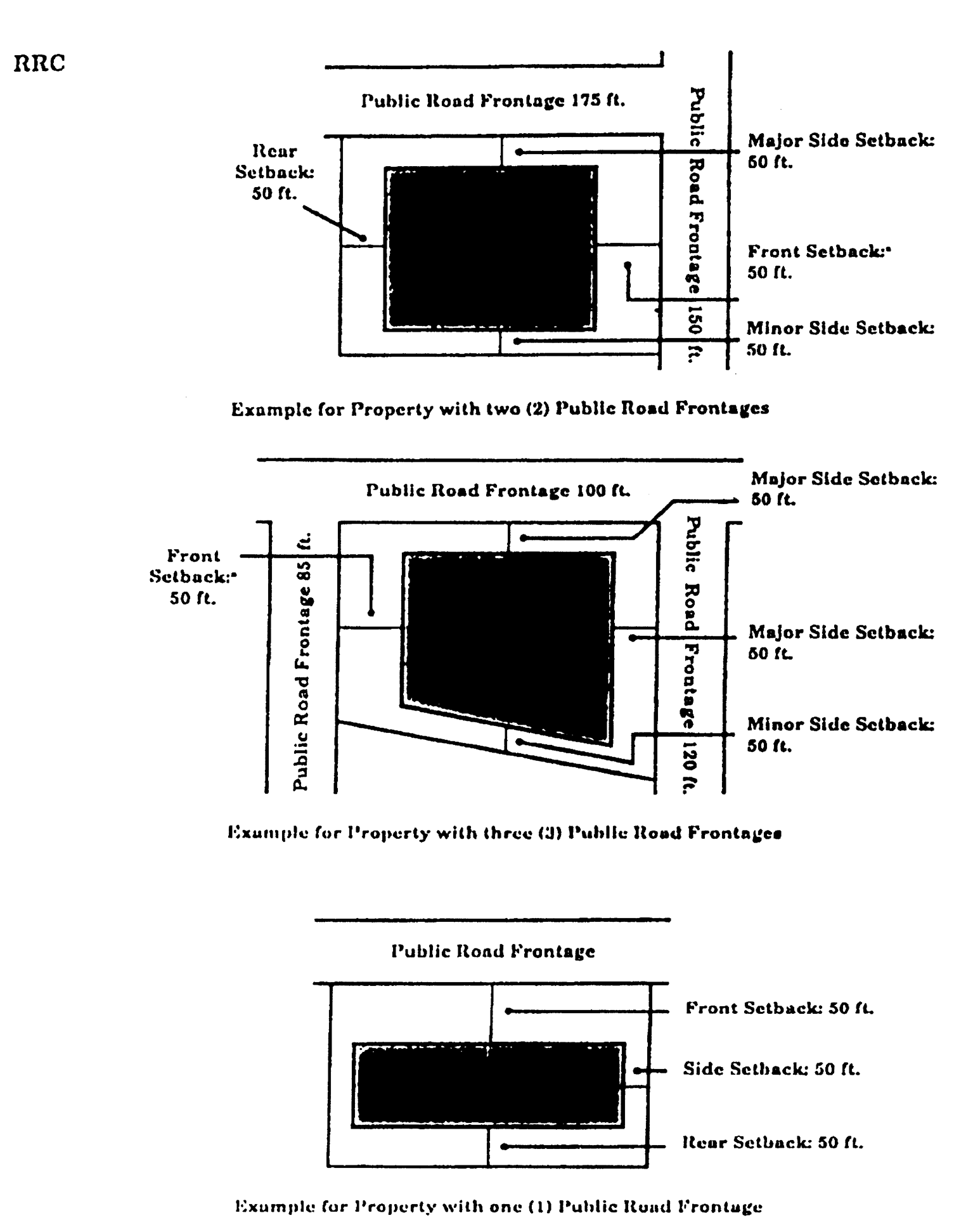
Notes:
a Property with shorter amount of road frontage will be the front setback for determining other setbacks (major side, side, rear).
b If structure fronts a major side setback, major side setback shall be 35 feet.
(5)
Landscape buffer and screening requirements. Unless otherwise noted within this district's requirements, any property within an RRC district which abuts a residentially zoned property shall have a 50-foot landscaped screening buffer adjacent to all residentially zoned property. The buffer shall be subject to approval by county staff. The board of commissioners specifically notes that it discourages locating RRC districts and developments adjacent to single-family residential districts, unless in a planned mixed use project. Required buffers may be included within required setbacks; however, in such case that the required buffer is greater than the required setback, the required buffer shall be adhered to. Additionally, necessary private utilities and access drives may be allowed through, over or across a landscaped buffer. Any such uses which are proposed through, over or across a designated undisturbed buffer must be approved pursuant to an original site plan or site plan modification as set forth under section 134-126.
a.
Objectives. Undisturbed, planted landscape buffers and berms shall be implemented in connection with a permitted project and shall address the following objectives:
1.
Screening to enhance aesthetic appeal;
2.
Control or direction of vehicular and pedestrian movement;
3.
Reduction of glare;
4.
Buffering of noise; and
5.
Establishment of privacy.
b.
Standards. Buffers or berms shall be required when an RRC district is located adjacent to a residential district; a minimum 50-foot buffer is required.
1.
Buffers. Landscape buffers are subject to review and approval by county staff in accordance with the following standards:
i.
Plantings are to be a mix of evergreen trees and shrubs.
ii.
Species are to be ecologically compatible to the site and appropriate for the design situation.
iii.
Unless public safety concerns dictate otherwise, a buffer should maximize a visual barrier to a height of six feet within two years of planting.
iv.
Minimum height of plant materials at installation is five feet for trees and two feet for shrubs.
v.
Fencing or walls are to be a minimum of six feet in height as approved by county staff.
vi.
Trees included in buffer plantings may be counted toward site density calculations as required by chapter 50, article VI, pertaining to tree preservation and replacement, subject to review and approval of county staff.
vii.
Buffers shall be regularly maintained by the property owner to ensure that the objectives and standards set out in this subsection are met.
viii.
When topography and existing conditions allow, the required 50-foot buffer should be an undisturbed buffer.
ix.
Any appeals from a determination by county staff shall be to the board of zoning appeals.
2.
Berms. Berms are subject to review and approval by county staff in accordance with the following standards:
i.
Berms shall be utilized when consistent with surrounding property features.
ii.
Berms shall be stabilized.
iii.
Berms shall be constructed to be consistent with natural or proposed drainage patterns.
iv.
Berms shall be regularly maintained by the property owner.
(6)
Floodplain and wetlands preservation requirements. Any development must also meet state and federal requirements relating to areas subject to the provisions of section 134-283, regarding mountain and river corridor protection act areas, and section 134-284, regarding metropolitan river protection act areas.
(7)
Building and structure requirements. Maximum building height to be determined by the board of commissioners on a case by case basis considering adjacent land uses, building type and zoning districts.
(8)
Parking requirements. See section 134-272 for paved parking specifications. Shared parking arrangements are permitted and encouraged in the RRC district.
(9)
Lighting requirements.
a.
Any project permitted within the RRC district which proposes a lighted facility must have a county department of transportation approved lighting plan in accordance with the minimum conditions listed in section 134-269.
b.
All developments with multifamily units shall be designed with lighting that does not spill over into abutting properties and is the minimum to provide security for residents of multifamily housing developments.
(10)
Special exception uses. See section 134-271 for special exception use requirements for all districts. Special exception uses for the RRC district are the uses listed in section 134-271.
(11)
Special exception uses for regional activity center only. The following uses, with the proper scrutiny and conditions, may be considered as special exception uses within the RRC district, only if they are within properties delineated as regional activity centers as defined and shown on the Cobb County Comprehensive Plan: A Policy Guide, adopted November 27, 1990. Any special exception use, for regional activity centers only, shall adhere to the landscape buffer and screening requirements in subsection (5) of this section.
a.
Automobile and truck sales and service facilities (used or pre-owned separate from a new car dealership:
1.
Minimum of one acre of a paved surface is required for parking of vehicles, excluding any area used for, but not limited to buildings, offices, service or sales areas:
2.
If any entity sells more than five cars per year, they are considered a dealer which requires a county business license.
3.
A special land use permit is required as provided in section 134-37.
4.
All vehicles are required to be parked off any right-of-way or easement.
b.
Circuses and carnivals subject to provisions established in sections 78-151 through 78-167 of the Cobb County Code.
c.
Hotel (suite).
The following minimum standards shall apply to suite hotels:
1.
Minimum acreage is two acres.
2.
All rooms shall be accessed through a main or central lobby.
3.
No rooms shall access to the exterior of the building unless required by fire/safety regulations.
4.
The minimum number of floors allowed shall be three floors, unless otherwise approved by the board of commissioners.
5.
Architectural style/design to be approved by the board of commissioners.
6.
All buildings shall have a minimum roof pitch of a four in twelve as defined by applicable building codes.
7.
Conference, meeting or banquet facilities are allowed when supported by adequate parking and approved by the board of commissioners as part of the special land use permit.
8.
Restaurants or other type of eating facilities are allowed when supported by adequate parking and approved by the board of commissioners. "Continental" style dining for the guests of the facility only is allowed within or near the main or central lobby without additional parking.
9.
At a minimum, provisions for weekly cleaning for each suite must be provided.
10.
Each suite must be protected with a smoke detector and sprinkler system approved by the fire marshal or his designee.
11.
Each suite shall be required to include an automatic power off timer for each stove/cook top unit or other type burner.
12.
Parking shall be calculated as one space required for each suite, with an additional ten spaces provided for employees. Parking requirements for conference, meeting or banquet facilities or restaurants or other type of eating facilities within a suite hotel shall be calculated as provided for each use in section 134-272, "traffic and parking," in addition to the above parking requirements and approved by the board of commissioners.
13.
There shall be no outside storage allowed or long term parking of heavy equipment, or parking of construction or related equipment allowed.
14.
A landscaping plan is to be approved by staff with emphasis on planting within the parking facilities.
15.
No facility under this section is to be converted or used primarily as an apartment or condominium.
d.
Climate controlled self-service storage facilities, when complementary or accessory to an office park or building.
The following minimum standards shall apply to climate controlled self-service storage facilities:
1.
Building height should not exceed those of adjacent buildings, nor impact the view shed of adjacent residential property.
2.
F.A.R. should be 2.0 or as determined appropriate by the board of commissioners.
3.
All units shall be accessed through a main or central entrance.
4.
All windows or similar architectural features must be "one way" and provide for an opaque screen from view outside of the building.
5.
Architectural style/design to be similar or complementary to the predominant architectural design of other commercial uses within the activity center. Said architectural style/design to be approved by the board of commissioners. Any roof-mounted utilities or building components must be sufficiently screened from view of adjoining properties and public right-of-way.
6.
There shall be no outside storage allowed nor overnight and/or long-term parking of heavy equipment, commercial equipment or parking of construction or related equipment allowed.
7.
There shall be no storage of recreational vehicles and no dry storage of pleasure boats of any type customarily maintained by private individuals for their personal use.
8.
There shall be no storage of flammable liquids, highly combustible or explosive materials, or hazardous chemicals.
9.
No units within the facility shall be used for or considered to be premises for the purpose of assigning a legal address in order to obtain an occupational license or any other government permit or licenses to do business.
10.
There shall be no resident manager or any type of overnight accommodations for such.
11.
Landscape plan to be approved by staff with emphasis on planting within the parking facilities.
12.
One parking space shall be provided per every 80 individual storage units/areas.
13.
Overall project must be accessed via a public or private roadway which is internal to the office park, building or shopping center; direct access to an adjoining public roadway shall be subject to approval by the board of commissioners.
14.
No freestanding signage shall be utilized; internal directional signage will be subject to approval by the board of commissioners.
15.
No units shall be used to manufacture, fabricate or process goods, to service or repair vehicles, boats, small engines or electrical equipment, or to conduct similar repair activities, to conduct garage sales or retail styles of any kind, to rehearse or practice utilizing band instruments, or for conversion to an apartment or dwelling unit, or to conduct any other commercial or industrial activities on the site.
16.
Loading area, including adequate turnaround space for a tractor trailer vehicle, must be screened by a permanent architectural or landscape feature or as may be approved by the board of commissioners if not located to side or rear of proposed structure.
17.
Special land use permit as provided in section 134-37.
18.
Hours of operation to be established by the board of commissioners, considering the operational hours of surrounding businesses.
(12)
Use limitations.
a.
Any commercial office or mixed use development which exceeds 500,000 net square feet, any proposed hotel development which has in excess of 1,000 rooms or private hospital which has in excess of 600 beds, or any other development which exceeds 500,000 net square feet must provide the following prior to rezoning, or, if rezoned already, prior to commencing development:
1.
A major development area plan proposal;
2.
A traffic impact study prepared by a registered engineer;
3.
A hydrology study; and
4.
A water and sewer study.
5.
Items 1—4 may be satisfied as part of a development of regional impact review.
b.
Maximum floor area ratio is 1.00.
c.
All refuse and designated recycling collection location facilities must be contained within completely enclosed facilities.
d.
Any emission or automotive inspection station shall be located within a permanent facility. (No temporary buildings/tents are to be utilized after June 30, 1998.) Effective April 1, 2014, any new applications (zoning applications, building permit related applications including tenant finish operations and certificate of occupancy applications) for emission or automotive inspection stations within permanent facilities shall mean an indoor inspection establishment (no outside storage) with fully enclosed service bay(s) with operable door(s) for performing emission and automotive inspections/testing. The permanent facility must be compliant with the adopted building regulations found in chapter 18 of the Cobb County Code.
e.
Interparcel access shall be required. No curb cut, except on a service drive, shall be located closer than 20 feet to a side or rear lot line, unless a common curb cut serves adjacent uses, and in no instance shall the distance between separate curb cuts serving adjacent land uses be less than 40 feet.
f.
No uses that emit noxious odors, fumes or sounds are permitted.
g.
No sexually oriented businesses are permitted.
h.
Kitchenettes or kitchen facilities are prohibited in motels.
i.
Outdoor displays of merchandise must comply with the provision in section 134-267.
j.
Maximum impervious surfaces (80%-RAC, 70%-CAC and NAC) shall be established within activity centers as identified by the Cobb County Comprehensive Plan, as may be amended from time to time.
k.
No loading docks or facilities may be located in the front of any primary structure.
l.
Due to the unique and urban nature of regional activity centers, residential dwelling unit mixes and densities shall be approved on a case by case basis.
Required buffers may be included within required setbacks; however, in such case that the required buffer is greater than the required setback, the required buffer shall be adhered to. Additionally, necessary private utilities and access drives may be allowed through, over or across a landscaped buffer. Any such uses which are proposed through, over or across a designated, undisturbed buffer must be approved pursuant to an original site plan or site plan modification as set forth under section 134-126.
(13)
Accessory buildings, structures, uses and decks. Any accessory building or structure in excess of 1,000 square feet of gross space shall be located to the rear of the primary structure and at least 40 feet from any residential property line. Any accessory building or structure which exceeds 1,000 square feet of gross space must have the approval of the division manager of zoning or his designee as to the location, architectural design and size prior to commencing construction. The zoning division manager or his designee shall consider the following criteria for determining the appropriateness of the architectural design and size of the accessory building or structure: compatibility with the surrounding neighborhood, style of exterior (the exterior is to be compatible in style with the primary structure), use of the proposed accessory structure, impact on adjacent properties, and requirements as deemed appropriate by plan review as set forth in this subsection. All accessory buildings, structures and uses in excess of 1,000 gross square feet shall be required to submit for plan review through the community development department or receive approval from the director of the community development department or his designee.
a.
Accessory buildings, structures, uses or decks shall be subject to the following conditions:
1.
Maximum height is two stories or 35 feet.
2.
Accessory uses shall include garbage dumpsters, designated recycling collection locations, clubhouses and recreation centers, amenities, swimming pools and tennis courts, antennas and satellite dishes, heating and air conditioning units, jacuzzis, playhouses and playgrounds, subject to the following conditions:
i.
Uses must be located within building setbacks.
ii.
No ground-based antenna or satellite dish shall exceed 35 feet in height without compliance with the standards in section 134-273.
iii.
No accessory building, structure, use or deck shall be built until construction of the principal building has commenced.
iv.
Outdoor activities shall cease by 11:00 p.m. within clubhouses and recreation centers and swimming pools and tennis courts.
3.
Such buildings, structures, uses or decks shall be located on the same lot as the principal use to which the building, structure, use or deck is accessory.
b.
Antennas and satellite dishes shall meet the requirements set forth in section 134-274.
c.
Incidental storage is permitted, provided that the material stored is incidental to the permitted use, as determined by the division manager of zoning or his designee, and stored completely within a portion of the enclosed principal structure permitted within the district, or within a permitted accessory structure.
(14)
Multifamily unit development security. To enhance building/site security, applicants shall coordinate with local law enforcement to develop a security plan in accordance with the standards of crime prevention through environmental design (CPTED). Security plan shall be reviewed and updated annually by the property manager.
(Ord. of 12-26-72; Ord. of 12-11-90, § 3-28-7.35; Ord. of 8-13-91; Ord. of 6-9-92; Ord. of 7-11-95; Ord. of 6-24-97 (eff. 7-1-97); Ord. of 12-9-97 (eff. 1-1-98); Ord. of 11-23-99; Ord. of 5-9-00; Ord. of 7-10-01; Ord. of 9-10-02; Ord. of 12-9-03; Ord. of 7-27-04; Ord. of 7-26-05; Ord. of 2-26-08; Amd. of 2-24-09; Amd. of 3-24-09; Ord. of 7-27-10; Ord. of 8-10-10; Amd. of 2-22-11; Amd. of 2-26-13; Amd. of 2-25-14; Amd. of 2-24-15; Amd. of 2-23-16; Amd. of 8-27-19; Amd. of 9-8-20; Amd. of 9-27-22)
Sec. 134-229. - IF future industrial district.
The IF future industrial district was originally established as a zone designated for future industrial use with no immediate right to use or occupy the district for industrial purposes until an applicant shall have been regularly and properly granted specific zoning for the purposes described for district LI or HI. Under the comprehensive amendment to the zoning ordinance, the board of commissioners resolved that an owner of property currently designated IF, and not developed, shall have until January 17, 1996, within which to commence development pursuant to the previous conditions. For purposes of this section, commencing development shall mean applying for rezoning to an appropriate zoning district, obtaining a building permit, and beginning construction on the development. If such development shall not occur by January 17, 1996, such portion of the undeveloped and unzoned property must be brought in for rezoning to another district which is compatible with the Cobb County Comprehensive Plan: A Policy Guide, adopted November 27, 1990, prior to any future development. Additionally, no new applications for IF zoning shall be accepted.
(Ord. of 12-26-72; Ord. of 12-11-90, § 3-28-7.36)
Sec. 134-230. - LI light industrial district.
The regulations for the LI light industrial district are as follows:
(1)
Purpose and intent. The LI district is established to provide locations for light industrial uses such as low intensity automobile repair and service, animal care facilities, commercial greenhouses, livestock, poultry, business distribution centers, warehousing and storage, and transportation terminals, which are on properties delineated within or on the perimeter of an industrial compatible and industrial category as defined and shown on the Cobb County Comprehensive Land Use Plan: A Policy Guide, adopted November 27, 1990. When located on the perimeter of an industrial node, the LI district should provide for uses that are low in intensity and scale such as to ensure compatibility with surrounding properties.
(2)
Definitions. The following words, terms and phrases, when used in this section, shall have the meanings ascribed to them in this subsection, except where the context clearly indicates a different meaning.
a.
Accessory retail sales and service means retail sales of products and services related to the principal use located wholly within limited areas of any primary permitted structure. The area devoted for such sales and service shall not exceed 25 percent of the gross floor area of such primary principal structure.
b.
Designated recycling collection locations means metal or heavy duty plastic containers designed for shortterm holding of pre-bagged recyclable items such as tin, aluminum, glass and paper (no perishable or food items allowed) for scheduled minimum monthly pickup, with no on-premises sorting. The center must be maintained in a safe, clean, neat and sanitary fashion and shall not encompass an area larger than 280 square feet.
1.
Such location shall be visually screened and maintained.
2.
Such location shall be within the building setbacks unless otherwise approved by the division manager of zoning or his designee due to topography, safety, internal traffic flow, site distance or other site-related circumstances not created by the property owner.
c.
Noncommercial club or lodge means a nonprofit club or organization as defined under section 501 of the Internal Revenue Code, as amended from time to time.
(3)
Permitted uses. Permitted uses are as follows:
Accessory retail sales and services.
Ambulance services.
Animal hospitals.
Appliance repair (major).
Assembly halls.
Automobile, truck and trailer lease or rental facilities (principal or accessory use).
Automotive and truck sales and service.
Automotive paint shops and body repair shops. Such uses shall not be established on lots which are either adjacent to or directly across the street from any residential districts.
Automotive parking lots and garages.
Automotive repair and maintenance facilities.
Automotive upholstery shops.
Aviation airports (private).
Boat sales and service facilities.
Breeding and boarding kennels.
Building materials stores.
Bulk landscape material business.
Bus stations.
Bus stations for freight.
Carwashes.
Churches, chapels, temples, synagogues, and other such places of worship.
Clinics.
Clubs or lodges (noncommercial).
Colleges and universities (private), including research and training facilities.
Commercial greenhouses and plant nurseries.
Commercial produce and agricultural product stands.
Community fairs.
Contractors (general, heavy or special).
Corporate or administrative offices.
Dairies.
Designated recycling collection locations.
Dry cleaning plants.
Electrical supply stores.
Emissions and inspection stations. (No temporary buildings/tents to be utilized after June 30, 1998.)
Executive golf courses (see section 134-270).
Exterminators.
Farm and garden supply stores.
Farm equipment stores and repair facilities.
Farmers' markets (fully enclosed).
Film and movie studios.
Freight terminals.
Fuel and ice dealers.
Full service gasoline stations.
Funeral homes.
Golf courses, 18-hole regulation, public and private (see section 134-270).
Golf courses, par 3 (see section 134-270).
Group homes.
Heavy automotive repair services and trade shops.
Helicopter landing areas, provided that the area is fenced.
In-home day care.
Laundry and dry cleaning pickup stations.
Light automotive repair facilities.
Light manufacturing establishments.
Linen and diaper services.
Livestock, nondomestic and wild animals, and poultry.
Livestock sales pavilions.
Medical and dental laboratories (with no limitations except that such uses must have required federal and state permits).
Motorcycle, all-terrain vehicle (ATV) and three-wheel vehicle sales and service facilities.
Newspaper publishing facilities.
Nonautomotive repair service establishments.
Office service and supply establishments.
Other service establishments.
Outdoor golf driving ranges (see section 134-270).
Parking for vehicles.
Plumbing and heating equipment dealers.
Poultry hatcheries.
Printing, publishing and lithography establishments.
Pro shops, if accessory to driving ranges or golf courses.
Radio and television stations.
Radio, television and other communication towers and antennas subject to section 134-273.
Rail stations.
Railroad car classification yards.
Railroad stations for freight.
Recreation grounds other than tennis courts and golf courses.
Research and development centers.
Research testing laboratories.
Reupholstery and furniture repair establishments.
Sawmills (temporary).
Self-service storage facilities (subject to section 134-279).
Sexually oriented businesses (subject to section 78-338.)
Shelters (homeless).
Signs and outdoor advertising facilities.
Sports training facilities.
Taxistands and taxi dispatching agencies.
Telephone business offices.
Temporary uses.
Trailer salesrooms and sales lots.
Transportation equipment storage and maintenance facilities.
Truck terminals.
Utility facilities (private).
Vending machine sales, service, rental or repair establishments.
Vocational schools (commercial).
Warehouse and storage facilities.
Wholesale sales offices.
Wholesale trade and distribution facilities.
Wholesale trade offices in conjunction with office showrooms.
(4)
Lot size and setback requirements. Lot size and setback requirements are as follows:
a.
Minimum lot area: 40,000 square feet.
b.
Minimum lot width at front setback line: 100 feet.
c.
Minimum public road frontage: 50 feet.
d.
Minimum building setbacks: As shown and applied in the following diagram:
MINIMUM BUILDING SETBACK REQUIREMENTS FOR LI DISTRICT
Note: All setbacks shall be measured from future right-of-way.
Minimum Building Setback Requirements for LI District
Notes:
a Property with shorter amount of road frontage will be the front setback for determining other setbacks (major side, side, rear).
b If structure fronts a major side setback, major side setback shall be 35 feet.
(5)
Landscape buffer and screening requirements. Unless otherwise noted within this district's requirements, any property within an LI district which abuts residentially zoned property shall have a minimum 50-foot landscaped screening buffer. Required buffers may be included within required setbacks; however, in such case that the required buffer is greater than the required setback, the required buffer shall be adhered to Additionally, necessary private utilities and access drives may be allowed through, over or across a landscaped buffer. Any such uses which are proposed through, over or across a designated undisturbed buffer must be approved pursuant to an original site plan or site plan modification as set forth under section 134-126.
a.
Objectives. Undisturbed, planted landscape buffers and berms shall be implemented in connection with a permitted project and shall address the following objectives:
1.
Screening to enhance aesthetic appeal;
2.
Control or direction of vehicular and pedestrian movement;
3.
Reduction of glare;
4.
Buffering of noise; and
5.
Establishment of privacy.
b.
Standards. Buffers and berms shall be required when an LI district is located within or adjacent to a residential district. The minimum buffer shall be 50 feet and the maximum buffer shall be 75 feet.
1.
Buffers. Landscape buffers are subject to review and approval by the county arborist or county landscape architect in accordance with the following standards:
i.
Plantings are to be a mix of evergreen trees and shrubs.
ii.
Species are to be ecologically compatible to the site and appropriate for the design situation.
iii.
Unless public safety concerns dictate otherwise, a buffer should provide a 100 percent visual barrier to a height of six feet within two years of planting.
iv.
Minimum height of plant materials at installation is five feet for trees and two feet for shrubs.
v.
Fencing or walls are to be a minimum of six feet in height as approved by the county landscape architect or county arborist.
vi.
Trees included in buffer plantings may be counted toward site density calculations as required by chapter 50, article VI, pertaining to tree preservation and replacement, subject to review and approval of county arborist.
vii.
Buffers shall be regularly maintained by the property owner to ensure that the objectives and standards set out in this subsection are met.
viii.
When topography and existing conditions allow, the required 50-foot buffer should be an undisturbed buffer.
ix.
Any appeals from a determination by the county landscape architect or county arborist shall be to the board of zoning appeals.
2.
Berms. Berms are subject to review and approval by the county landscape architect or county arborist in accordance with the following standards:
i.
Berms shall be utilized when consistent with surrounding property features.
ii.
Berms shall be stabilized.
iii.
Berms shall be constructed to be consistent with natural or proposed drainage patterns.
iv.
Berms shall be regularly maintained by the property owner.
(6)
Floodplain and wetlands preservation requirements. Any development must also meet state and federal requirements relating to areas subject to the provisions of section 134-283, regarding mountain and river corridor protection act areas, and section 134-284, regarding metropolitan river protection act areas.
(7)
Building and structure requirements. Maximum building height is four stories or 70 feet.
(8)
Parking requirements. See section 134-272 for paved parking specifications.
(9)
Lighting requirements. Any project permitted within the LI district which proposes a lighted facility must have a county department of transportation approved lighting plan in accordance with section 134-269.
(10)
Special exception uses. See section 134-271 for special exception use requirements for all districts. Special exception uses for the LI district are the uses listed in section 134-271.
(11)
Use limitations.
a.
Maximum floor area ratio is 0.75 for office uses.
b.
All refuse collection and designated recycling collection location facilities must be contained within completely enclosed facilities.
c.
Any outside storage shall be set back a minimum of 35 feet from any public right-of-way. In other cases, the setbacks as required for accessory buildings, structures, uses and decks shall apply.
d.
No drive-in establishments are permitted.
e.
No uses that emit noxious odors, fumes or sounds are permitted.
f.
No outside runs are permitted with any veterinary office use permitted within this district.
g.
Maximum impervious surfaces (80%-RAC, 70%-CAC and NAC) shall be established within activity centers as identified by the Cobb County Comprehensive Plan, as may be amended from time to time.
Required buffers may be included within required setbacks; however, in such case that the required buffer is greater than the required setback, the required buffer shall be adhered to. Additionally, necessary private utilities and access drives may be allowed through, over or across a landscaped buffer. Any such uses which are proposed through, over or across a designated undisturbed buffer must be approved pursuant to an original site plan or site plan modification as set forth under section 134-126.
(12)
Special exception uses for industrial areas only. The following uses, with the proper scrutiny and conditions, may or may not be considered as special exception uses within the LI district, only if they are within properties delineated as industrial or industrial-compatible as defined and shown on the Cobb County Comprehensive Plan: A Policy Guide, adopted November 27, 1990. Any special exception use for industrial areas only shall adhere to the landscape buffer and screening requirements in subsection (5) of this section and the lighting requirements in subsection (9) of this section.
a.
Amusement centers, subject to the following minimum requirements:
1.
Minimum acreage is five acres.
2.
Such use shall not be located closer than 500 feet to any school property.
3.
Such use shall not be located closer than 200 feet to any residential property line.
4.
An overall parking and landscape plan shall be approved by county staff. The plan will provide for safe and efficient vehicle and pedestrian circulation and aesthetics.
b.
Automobile and truck sales and service facilities (used or pre-owned separate from a new car dealership):
1.
Minimum of one acre of a paved surface is required for parking of vehicles, excluding any area used for, but not limited to buildings, offices, service or sale area:
2.
If an entity sells more than five cars per year, they are considered a dealer which requires a county business licenses.
3.
A special land use permit is required (see section 134-37).
4.
All vehicles are required to be parked off any right-of-way or easement.
c.
Crematories, human or animal, with the following minimum requirements:
1.
Minimum lot size is two acres.
2.
When abutting any residential property line, a 50-foot natural or landscaped buffer shall be approved by county staff (see subsection (5) of this section).
d.
Drive-in theaters, subject to the following minimum requirements:
1.
Minimum acreage is two acres.
2.
Driving and parking areas shall be paved.
3.
The theater screen, projection booth or other buildings shall be set back not less than 50 feet from any property line (unless the front setback is greater).
4.
The theater screen shall not be visible from an expressway, arterial or major collector roadway.
5.
No damaged or confiscated vehicles shall be stored on-site.
(13)
Accessory buildings, structures, uses and decks. Any accessory building or structure in excess of 1,000 square feet of gross space shall be located to the rear of the primary structure and at least 40 feet from any residential property line. Any accessory building or structure which exceeds 1,000 square feet of gross space must have the approval of the division manager of zoning or his designee as to the location, architectural design and size prior to commencing construction. The division manager of zoning or his designee shall consider the following criteria for determining the appropriateness of the architectural design and size of the accessory building or structure: compatibility with the surrounding neighborhood, style of exterior (the exterior is to be compatible in style with the primary structure), use of the proposed accessory structure, impact on adjacent properties, and requirements as deemed appropriate by plan review as set forth in this subsection. All accessory buildings, structures and uses in excess of 1,000 gross square feet shall be required to submit for plan review through the community development department or receive approval from the director of the community development department or his designee. Permitted accessory structures and uses are as follows:
a.
Accessory storage buildings, to include parking garages, subject to the following conditions:
1.
Maximum height is two stories.
2.
Such structures shall be located on the same lot as and to the rear of the principal building to which they are accessory.
3.
No accessory building shall be constructed upon a lot until construction of the principal building has commenced.
4.
On a corner lot, no accessory building shall be located closer to the side street right-of-way line than the principal building.
5.
When abutting any other nonresidential district, no garage or other accessory building shall be located closer than five feet to a side or rear lot line.
6.
When an accessory building is attached to the principal building by a breezeway, passageway or similar means, it shall comply with the yard requirements of the principal building to which it is accessory.
7.
Where any nonresidential lot adjoins the side or rear of a residential lot, an accessory building shall not be located within any required buffers.
b.
Antennas and satellite dishes, which shall meet the requirements set forth in section 134-274.
c.
Heating and air conditioning units, subject to the following conditions:
1.
When abutting any residential property line, heating and air conditioning units shall not be located within any required buffers.
2.
When abutting any other nonresidential district, no heating and air conditioning units shall be located closer than five feet to a side or rear lot line.
3.
Heating and air conditioning units may be installed on the roof of any structure zoned commercially so long as the heating and air conditioning unit does not exceed the height restrictions stated in this section and the units are placed so as to be hidden from a front or side view.
d.
Incidental storage, provided that the material stored is incidental to the permitted use, as determined by the division manager of zoning or his designee, and stored completely within a portion of the enclosed principal structure permitted within the district, or within a permitted accessory structure.
(14)
Temporary uses. Carnivals are a permitted temporary use in the LI district.
(Ord. of 12-26-72; Ord. of 12-11-90, § 3-28-7.37; Ord. of 8-13-91; Ord. of 6-9-92; Ord. of 7-11-95; Ord. of 6-24-97 (eff. 7-1-97); Ord. of 12-9-97 (eff. 1-1-98); Ord. of 2-9-99; Ord. of 11-23-99; Ord. of 7-10-01; Ord. of 7-27-04; Ord. of 2-28-12; Amd. of 2-23-16; Amd. of 9-8-20; Amd. of 9-27-22)
Sec. 134-231. - HI heavy industrial district.
The regulations for the HI heavy industrial district are as follows:
(1)
Purpose and intent. The HI district is established to provide locations for heavy industrial uses such as intensive automobile repair and service, heavy manufacturing, chemical manufacturing and storage, petroleum or petrochemical storage, and warehousing and storage, which are on properties delineated within an industrial category as defined and shown on the Cobb County Comprehensive Land Use Plan: A Policy Guide, adopted November 27, 1990. When located on the perimeter of an industrial node, the HI district should provide for uses that are lower in intensity and scale such as to ensure compatibility with surrounding properties.
(2)
Definitions. The following words, terms and phrases, when used in this section, shall have the meanings ascribed to them in this subsection, except where the context clearly indicates a different meaning:
a.
Amusement center means any freestanding privately owned and operated commercial recreational area containing an assortment of rides, games, arcades, attractions, water slides, and tracks for amusement vehicles.
b.
Ancillary retail sales means retail sale of goods and services which is secondary in nature to the primary industrial use of the property in so much that the goods for sale have been produced on-site or are in storage at the site for planned distribution to other areas. The ancillary retail sale of goods shall only be conducted as part of the permitted industrial use and shall not be a freestanding business.
c.
Automotive paint and body repair shop means an establishment for restoring auto bodies, painting or refinishing, with all activities carried on entirely within an enclosed building.
d.
Automotive salvage and wrecking yard means an establishment used for the dismantling or wrecking of used motor vehicles or trailers, or the storage, sale or dumping of dismantled or wrecked vehicles or their parts.
e.
Automotive storage yards and wrecker service (damaged and confiscated vehicles) means an establishment used for the shortterm storage of damaged or confiscated vehicles.
f.
Biomedical waste disposal facility means a facility engineered and designed for the collection or transfer of biomedical waste products such as used gauze, syringes, needles, bandages, test tubes and surgical wastes from a collector vehicle to a larger transport vehicle to another destination for incineration.
g.
Clinic. A medical or dental clinic is an organization of specializing physicians or dentists, or both, who have their offices in a common building. A clinic shall include laboratory facilities in conjunction with normal clinic services.
h.
Community fair means a festival or fair such as the North Georgia State Fair conducted wholly within public areas owned by a local government, provided that any activity is conducted at least 200 feet from any property line. Any event shall not exceed 21 days.
i.
Designated recycling collection locations means metal or heavy duty plastic containers designed for short term holding of pre-bagged recyclable items such as tin, aluminum, glass and paper (no perishable or food items allowed) for scheduled minimum monthly pickup, with no on-premises sorting. The center must be maintained in a safe, clean, neat and sanitary fashion and shall not encompass an area larger than 280 square feet.
1.
Such location shall be visually screened and maintained.
2.
Such location shall be within the building setbacks unless otherwise approved by the division manager of zoning or his designee due to topography, safety, internal traffic flow, site distance or other site-related circumstances not created by the property owner.
j.
Heavy automotive repair establishment means an indoor/outdoor repair establishment for performing automotive and truck repair, including engine and transmission overhauls.
k.
Heavy manufacturing establishment means manufacturing establishments, other than those classified as light manufacturing, including those involving the conversion of raw materials into usable finished products, provided that manufacturing that will generate liquid waste from the manufacturing process or air pollutants shall comply with antipollution standards established by the state and county. This use shall also allow incidental on-site sale of manufactured materials only.
l.
Landfill (private) means a disposal site employing an engineering method of disposing of solid wastes in a manner that minimizes environmental hazards by spreading, compacting to the smallest volume, and applying cover material over all exposed waste at the end of the operating day.
m.
Light automotive repair establishment means an indoor repair establishment (no outside storage) for performing light auto and small truck repair (under one ton) such as brake repair, oil changes, lubrication, transmission repair, installation of belts and hoses, inspections and the like.
n.
Light manufacturing establishment means an establishment for production, processing, assembly, manufacturing, compounding, preparation, cleaning, servicing, testing or repair of materials, goods or products; however, the manufacturing and production of any product which emits noxious noise, odor or fumes, bulk storage of flammable materials for resale, and other heavy manufacturing uses listed in this section shall not be permitted. This use shall also allow incidental on-site sale of manufactured materials only.
o.
Mining means a process involving the removal or extraction of dirt, sand, soil, rock, gravel, minerals, petroleum, natural gas or other natural resources.
p.
Office service and supply establishments means wholesale and retail commercial establishments that sell, service and supply small office equipment and supplies, such as stores that offer sales of copiers, facsimile machines, typewriters, ribbons, transcribers, dictation equipment, tape, staplers and other general office equipment.
q.
Recycling center means a center or location designed for sorting or collection of recyclables from designated recycling collection locations and other private entity sources.
(3)
Permitted uses. Permitted uses are as follows:
Ambulance services.
Ambulance services, if accessory to hospitals or funeral homes.
Animal hospitals.
Assembly halls.
Automobile, truck and trailer lease and rental facilities (principal and accessory uses).
Automotive and truck sales and service facilities.
Automotive paint and body repair shops. Such uses shall not be established upon a lot which is either adjacent to or directly across the street from any residential district.
Automotive parking lots or garages.
Automotive repair and maintenance facilities.
Automotive upholstery shops.
Aviation airports (private).
Banks and financial institutions with drive-in establishments or automated transfer machines.
Boat sales and service.
Breeding and boarding kennels.
Building materials stores.
Bulk landscape materials business.
Bus stations.
Bus stations for freight.
Carwashes.
Churches, chapels, temples, synagogues, and other such places of worship.
Clinics.
Clubs or lodges (noncommercial).
Colleges and universities (private), including but not limited to research and training facilities.
Commercial greenhouses and plant nurseries, provided that all goods stored outside shall be stored in a designated area.
Commercial produce and agricultural product stands.
Community fairs.
Contractors (general, heavy or special).
Corporate or administrative offices.
Dairies.
Designated recycling collection locations.
Dry cleaning plants.
Electrical supply stores.
Emissions and inspections stations. (No temporary buildings/tents to be utilized after June 30, 1998.)
Executive golf courses (see section 134-270).
Exterminators.
Farm equipment stores and repair establishments.
Farm and garden supply stores.
Film and movie studios.
Freight terminals.
Fuel and ice dealers.
Full service gasoline stations.
Golf courses, 18-hole regulation, public and private (see section 134-270).
Golf courses, par 3 (see section 134-270).
Group homes.
Heavy automotive repair establishments.
Heavy repair service and trade shops.
Helicopter landing areas.
In-home day care.
Laundry and dry cleaning pickup establishments.
Light automotive repair establishments.
Light manufacturing establishments.
Linen and diaper services.
Livestock, nondomestic and wild animals, and poultry.
Machine shops.
Medical and dental laboratories (with no limitations other than state and federal regulations).
Newspaper publishing facilities.
Nonautomotive repair service establishments.
Office service and supply establishments.
Outdoor golf driving ranges (see section 134-270).
Parking for vehicles.
Plumbing or heating equipment dealers.
Printing, publishing and lithography establishments.
Private parks.
Pro shops, if accessory to driving ranges or golf courses.
Radio and television stations.
Radio, television and other communication towers and antennas, subject to section 134-273.
Rail stations.
Railroad car classification yards.
Railroad stations for freight.
Recreation grounds other than tennis courts and golf courses.
Research and development centers.
Research testing laboratories.
Reupholstery and furniture repair establishments.
Sawmills (temporary).
Self-service storage facilities (subject to section 134-279).
Sexually oriented businesses (subject to section 78-338.)
Shelters (homeless).
Signs and outdoor advertising facilities.
Sports training facilities.
Taxistands and taxi dispatching agencies.
Temporary uses.
Tire retreading and recapping facilities.
Trailer salesrooms and sales lots.
Transportation equipment storage and maintenance facilities.
Truck terminals.
Utility facilities (private).
Vocational schools (commercial).
Warehouse and storage facilities.
Wholesale sales offices.
Wholesale trade and distribution facilities, including packing of wholesale commodities for distribution, subject to the following:
1.
Unless in a district in which manufacturing is permitted, no fabricating of goods to be sold shall be permitted.
2.
Unless in a district in which heavy manufacturing is permitted, no wholesaling activity shall be permitted which processes the goods handled in a manner that produces liquid or solid waste or noise, odor, fumes or dust which can be detected beyond the walls of the building in which such wholesaling activity is housed.
Wholesale trade offices in conjunction with office showrooms.
(4)
Lot size and setback requirements. Lot size and setback requirements are as follows:
a.
Minimum lot size: 40,000 square feet.
b.
Minimum lot width at front setback line: 150 feet.
c.
Minimum public road frontage: 50 feet.
d.
Minimum building setbacks: as shown and applied in the following diagram:
MINIMUM BUILDING SETBACK REQUIREMENTS FOR HI DISTRICT
Note: All setbacks shall be measured from future right-of-way.
HI District
Notes:
a Property with shorter amount of road frontage will be the front setback for determining other setbacks (major side, side, rear).
b If structure fronts a major side setback, major side setback shall be 35 feet.
(5)
Landscape buffer and screening requirements. Unless otherwise noted within this district's requirements, any property within an HI district which abuts a residentially zoned property shall have a 50-foot landscaped screening buffer adjacent to all residentially zoned property, which will be subject to county staff's approval.* Required buffers may be included within required setbacks; however, in such case that the required buffer is greater than the required setback, the required buffer shall be adhered to. Additionally, necessary private utilities and access drives may be allowed through, over or across a landscape buffer. Any such uses which are proposed through, over or across a designated undisturbed buffer must be approved pursuant to an original site plan or site plan modification as set forth under section 134-126.
a.
Objectives. Undisturbed, planted landscape buffers and berms shall be implemented in connection with a permitted project and shall address the following objectives:
1.
Screening to enhance aesthetic appeal;
2.
Control or direction of vehicular and pedestrian movement;
3.
Reduction of glare;
4.
Buffering of noise; and
5.
Establishment of privacy.
b.
Buffers. Landscape buffers are subject to review and approval by county staff in accordance with the following standards:
1.
Plantings are to be a mix of evergreen trees and shrubs.
2.
Species are to be ecologically compatible to the site and appropriate for the design situation.
3.
Unless public safety concerns dictate otherwise, a buffer should maximize a visual barrier to a height of six feet within two years of planting.
4.
Minimum height of plant materials at installation is five feet for trees and two feet for shrubs.
5.
Fencing or walls are to be a minimum of six feet in height as approved by county staff.
6.
Trees included in buffer plantings may be counted toward site density calculations as required by chapter 50, article VI, pertaining to tree preservation and replacement, subject to review and approval of county staff.
7.
Buffers shall be regularly maintained by the property owner to ensure that the objectives and standards set out in this subsection are met.
8.
When topography and existing conditions allow, the required 50-foot buffer should be an undisturbed buffer.
9.
Any appeals from a determination by the county staff shall be to the board of zoning appeals.
c.
Berms. Berms are subject to review and approval by county staff in accordance with the following standards:
1.
Berms shall be utilized when consistent with surrounding property features.
2.
Berms shall be stabilized.
3.
Where possible, berms shall be constructed to be consistent with natural drainage patterns.
4.
Berms shall be regularly maintained by the property owner.
Note—The board of commissioners specifically notes that it discourages locating HI districts and developments adjacent to single-family residential districts, unless in a planned mixed use project.
(6)
Floodplain and wetlands preservation requirements. Any development must also meet state and federal requirements relating to areas subject to the provisions of section 134-283, regarding mountain and river corridor protection act areas, and section 134-284, regarding metropolitan river protection act areas.
(7)
Building and structure requirements. Maximum building height is 50 feet, with no more than four stories.
(8)
Parking requirements. See section 134-272 for paved parking specifications.
(9)
Lighting requirements. Any project permitted within the HI district which proposes a lighted facility must have a county department of transportation approved lighting plan in accordance with the minimum conditions listed in section 134-269.
(10)
Special exception uses. See section 134-271 for special exception use requirements for all districts. Special exception uses are as follows:
a.
Cemeteries.
b.
Churches, chapels, temples, synagogues and other places of worship, including accessory cemeteries and schools.
c.
Crematories (see subsection (11) of this section, pertaining to special exception uses for industrial areas only).
d.
Mausoleums.
e.
Other facilities for disposal of the deceased.
f.
Outdoor commercial racing of motorcycles, automobiles, trucks, tractors and motorized vehicles, subject to the following minimum requirements:
1.
A special land use permit is required as provided in section 134-37.
2.
All necessary state and federal permits, if any, shall be obtained.
3.
A traffic impact study must be submitted with the application.
4.
No damaged vehicles shall be stored on site for more than seven days.
5.
A noise abatement plan and air pollution abatement plan shall be approved by county staff.
6.
Hours of operation shall be limited as per the county noise ordinance.
g.
Private community centers.
h.
Private schools of general and special education.
(11)
Special exception uses for industrial areas only. The following uses, with the proper scrutiny and conditions, may be considered as special exception uses within the HI district, only if they are within properties delineated as industrial as defined and shown on the Cobb County Comprehensive Plan: A Policy Guide, adopted November 27, 1990. Any special exception use for industrial areas only shall adhere to the landscape buffer and screening requirements in subsection (5) of this section and the lighting requirements in subsection (9) of this section.
a.
Amusement centers, subject to the following minimum requirements:
1.
Minimum acreage is five acres.
2.
Such use shall not be located closer than 500 feet to any school property.
3.
Such use shall not be located closer than 200 feet to any residential property line.
4.
An overall parking and landscape plan shall be approved by county staff. The plan will provide for safe and efficient vehicle and pedestrian circulation and aesthetics.
b.
Asphalt plants or concrete plants, subject to the following minimum standards:
1.
A special land use permit is required as provided in section 134-37.
2.
Compliance with all applicable state and federal laws is required.
3.
All necessary state and federal permits shall be obtained.
4.
A spill containment plan shall be approved by county staff.
5.
Minimum acreage is five acres.
6.
No use shall be located closer than 1,000 feet to any residential dwelling or school.
7.
Hours of operation shall be limited to daylight hours.
8.
Noise abatement and air pollution abatement plans shall be approved by county staff.
c.
Automobile salvage and wrecking yards, subject to the following minimum requirements:
1.
A special land use permit is required as provided in section 134-37.
2.
Such use shall be enclosed by a fence or wall not less than eight feet in height which provides visual screening.
3.
No such activity may be conducted within 100 feet of any property line or 200 feet of any property zoned or used for residential purposes.
4.
The incidental sale of auto parts removed from cars on the site shall be permitted.
d.
Automobile storage yards and wrecker services for damaged or confiscated vehicles, subject to the following minimum requirements:
1.
Such use shall be enclosed by a fence or wall not less than eight feet in height which provides visual screening.
2.
No dismantling, repair or other such activity shall be conducted.
3.
Such use shall be located at least 40 feet from any residential district or use.
4.
Such automobiles shall not be held longer than provided by state and county law.
5.
A special land use permit is required as provided in section 134-37.
e.
Automobile and truck sales and service facilities (used or pre-owned separate from a new car dealership):
1.
Minimum of one acre of a paved surface is required for parking of vehicles, excluding any area used for, but not limited to buildings, offices, service or sales areas:
2.
If any entity sells more than five cars per year, they are considered a dealer which requires a county business license.
3.
A special land use permit is required as provided in section 134-37.
4.
All vehicles are required to be parked off any right-of-way or easement.
f.
Biomedical waste disposal facilities or hazardous waste sites, subject to the following minimum requirements:
1.
A spill containment plan shall be approved by county staff.
2.
Such use shall not be located closer than 1,000 feet to any residential dwelling or school.
3.
A special land use permit is required as provided in section 134-37.
4.
Such use shall be carried on within an enclosed building, with no outside storage of any materials or biomedical waste except for vehicles used for the operation.
5.
All necessary state and federal permits shall be obtained.
6.
Compliance with all applicable state and federal laws is required.
7.
Minimum acreage is five acres.
8.
The facility must be designed with an impervious liner.
9.
The facility must have an on-site water purification system which returns water to a potable condition.
g.
Coliseums, stadiums. and convention centers (privately owned), subject to the following minimum requirements:
1.
Minimum acreage is ten acres.
2.
A special land use permit is required as provided in section 134-37.
3.
A traffic and parking plan shall be approved by the director of the county department of transportation.
4.
Hours of operation shall be approved by the board of commissioners at the time of the special land use permit public hearing.
5.
A noise abatement plan shall be approved by the board of commissioners at time of the special land use permit public hearing.
h.
Crematories, human or animal, with the following minimum requirements:
1.
Minimum lot size is two acres.
2.
When abutting any residential property line, a 50-foot natural or landscaped buffer shall be approved by county staff (see subsection (5) of this section).
i.
Drive-in theaters, subject to the following minimum requirements:
1.
Minimum acreage is two acres.
2.
Driving and parking areas shall be paved.
3.
The theater screen, projection booth or other buildings shall be set back not less than 50 feet from any property line (unless the front setback is greater).
4.
The theater screen shall not be visible from an expressway, arterial or major collector roadway.
5.
No damaged or confiscated vehicles shall be stored on-site.
j.
Heavy manufacturing establishments, subject to the following minimum requirements:
1.
A special land use permit is required as provided in section 134-37.
2.
Such use shall not be located closer than 500 feet to any residential property line.
3.
Such use shall be carried on entirely within an enclosed building, with no outside storage except for vehicles used for the operation.
4.
All necessary state and federal permits shall be obtained.
5.
Compliance with all applicable state and federal laws is required.
k.
Mining, subject to the following minimum requirements:
1.
Removal or extraction of dirt, sand and soil is subject to the following:
i.
The removal area shall be completely enclosed with a fence not less than six feet in height when considered necessary by the community development department.
ii.
Drainage plans and a plan for the development of the site when the removal is completed shall be submitted with the application for a development permit.
iii.
Such uses shall not be established within 500 feet of a residential use or 200 feet of any other use.
iv.
This subsection shall not prohibit the removal of earth and rock and filling and grading in any district done for land development purposes.
2.
Removal or extraction of rock and gravel is subject to the following:
i.
The removal area shall be sealed by fencing or grading or some other device from general public access. All entrances shall be fenced and locked during nonbusiness hours.
ii.
Drainage plans and a plan for the development of the site when the removal is completed shall be submitted with the application for a development permit.
iii.
The operational and removal area of such uses shall not be established within 4,000 feet of a residential use or 2,000 feet of any other use.
3.
No mining shall be allowed except after advertisement of a public hearing by the board of appeals for the purpose of determining whether or not any adverse effect would result to surrounding property owners and whether or not a nuisance, as defined by state law, would be created.
l.
Petroleum or bulk storage facilities or chemical plants or storage facilities, subject to the following minimum standards:
1.
A special land use permit is required as provided in section 134-37.
2.
Compliance with all applicable state and federal laws is required.
3.
All necessary state and federal permits shall be obtained.
4.
A spill containment plan shall be approved by county staff.
5.
Minimum acreage is five acres.
6.
No use shall be located closer than 1,000 feet to any residential dwelling or school.
7.
Hours of operation shall be limited to daylight hours.
8.
Noise abatement and air pollution abatement plans shall be approved by county staff.
9.
A fire prevention, evacuation and safety plan shall be approved by the fire marshal.
m.
Private landfills, composting centers or recycling centers, subject to the following minimum requirements:
1.
A special land use permit is required as provided in section 134-37.
2.
All necessary state and federal permits shall be obtained.
3.
Compliance with all applicable state and federal laws is required.
4.
Such facilities shall only be allowed in a heavy industrial zoning district, provided that the board of commissioners may grant a variance for filling of a specific natural land depression provided such fill shall not include garbage or other materials subject to decomposition.
5.
Such facilities shall be approved by the board of commissioners after public hearing. Both a development permit from the community development department and written approval of the health department shall be issued before any landfill operation begins.
6.
Such facilities shall be allowed only in areas incapable of development without landfill operations as determined by community development department.
7.
No hazardous wastes as defined by state and federal law shall be disposed or discharged into the landfill site.
8.
No garbage shall be disposed of within 2,000 yards of the public highway, a residence, or any gathering place unless approved by the board of commissioners.
9.
Truck traffic routes and entrances to the facility shall be approved by the traffic engineer.
10.
The sanitary landfill site must be accessible without travel over residential streets.
11.
All sanitary landfills shall have and keep on their premises in good working order a crawler-type tractor equipped with either a straight blade bulldozer, an angle blade bulldozer, a scraper (eight cubic yards or larger), a front end loader, a bull clam, or other attachments of a similar nature. The combined weight of such tractor and accessories as set forth in this subsection shall be not less than 18,000 pounds.
12.
All sanitary landfills hereafter established or operated shall be enclosed with a fence at least six feet high with openings therein not more than those in two-inch mesh wire, or some other similar fencing materials or device. Such fencing shall be adequate to prevent paper and similar or related refuse from blowing from the landfill onto neighboring property.
13.
All sanitary landfills shall have an operator in attendance at all times when the fill is in use, and such fill must be barricaded when closed to the public.
14.
Any changes in the normal drainage of the property upon which the sanitary fill is located shall be accommodated by storm sewers as necessary to properly care for drainage. Such storm sewers shall be installed at the expense of the user.
15.
All operators of sanitary landfills must pack and cover daily all materials placed thereon with at least six inches of earth in such a manner as to prevent fires and meet any and all other requirements of the fire code. All completed landfills must be covered with at least two feet of earth. Burning of any kind of refuse on the landfill is prohibited.
16.
This section shall not prohibit the dumping for disposal by burial of dry waste building materials concurrently with and on the same property as a structure under construction. Such waste shall be covered with at least two feet of earth before occupancy of the structure, but no such waste may be buried within 20 feet of any structure, drainage easement or drainfield.
(12)
Use limitations.
a.
Maximum floor area ratio is 0.5 for office uses and 0.75 for industrial uses.
b.
All refuse and designated recycling collection location facilities must be contained within completely enclosed facilities.
c.
No uses that exceed state and federal guidelines for allowable emissions and discharge of effluents into the air, water and soil are permitted.
d.
No uses that create unabated noise creating a nuisance as defined under state law are permitted.
e.
If potentially hazardous materials or chemicals are used on the premises or pollutants result from the operation under this section, a spill containment plan shall be approved by county staff.
f.
Maximum impervious surfaces (80%-RAC, 70%-CAC and NAC) shall be established within activity centers as identified by the Cobb County Comprehensive Plan, as may be amended from time to time.
Required buffers may be included within required setbacks; however, in such case that the required buffer is greater than the required setback, the required buffer shall be adhered to. Additionally, necessary private utilities and access drives may be allowed through, over or across a landscaped buffer. Any such uses which are proposed through, over or across a designated undisturbed buffer must be approved pursuant to an original site plan or site plan modification as set forth under section 134-126.
(13)
Accessory buildings, structures, uses and decks. Any accessory building or structure in excess of 1,000 square feet of gross space shall be located to the rear of the primary structure and at least 40 feet from any residential property line. Any accessory building or structure which exceeds 1,000 square feet of gross space must have the approval of the division manager of zoning or his designee as to the location, architectural design and size prior to commencing construction. The division manager of zoning or his designee shall consider the following criteria for determining the appropriateness of the architectural design and size of the accessory building or structure: compatibility with the surrounding neighborhood, style of exterior (the exterior is to be compatible in style with the primary structure), use of the proposed accessory structure, impact on adjacent properties, and requirements as deemed appropriate by plan review as set forth in this subsection. All accessory buildings, structures and uses in excess of 1,000 gross square feet shall be required to submit for plan review through the community development department or receive approval from the director of the community development department or his designee. Permitted accessory structures and uses are as follows:
a.
Accessory storage buildings, to include parking garages, subject to the following conditions:
1.
Maximum height is two stories, not to exceed 35 feet.
2.
Such structures shall be located on the same lot as and to the rear of the principal building to which they are accessory.
3.
No accessory building shall be constructed upon a lot until construction of the principal building has commenced.
4.
On a corner lot, no accessory building shall be located closer to the side street right-of-way line than the principal building.
5.
When abutting any other nonresidential district, no garage or other accessory building shall be located closer than five feet to a side or rear lot line.
6.
When an accessory building is attached to the principal building by a breezeway, passageway or similar means, it shall comply with the yard requirements of the principal building to which it is accessory.
7.
Where any nonresidential lot adjoins the side or rear of a residential lot, an accessory building shall not be located within any required buffers.
b.
Antennas and satellite dishes, which shall meet the requirements set forth in section 134-274.
c.
Heating and air conditioning units, subject to the following conditions:
1.
When abutting any residential property line, heating and air conditioning units shall not be located within any required buffers.
2.
When abutting any other nonresidential district, no heating and air conditioning units shall be located closer than five feet to a side or rear lot line.
3.
Heating and air conditioning units may be installed on the roof of any structure zoned commercially so long as the heating and air conditioning unit does not exceed the height restrictions stated in this section and the units are placed so as to be hidden from a front or side view.
4.
No ground-based heating and air conditioning unit shall exceed 35 feet in height.
d.
Incidental storage, provided that the material stored is incidental to the permitted use, as determined by the division manager of zoning or his designee, and stored completely within a portion of the enclosed principal structure permitted within the district, or within a permitted accessory structure.
(Ord. of 12-26-72; Ord. of 12-10-74, § 7; Ord. of 12-11-90, § 3-28-7.38; Ord. of 8-13-91; Ord. of 6-9-92; Ord. of 7-11-95; Ord. of 6-24-97 (eff. 7-1-97); Ord. of 12-9-97 (eff. 1-1-98); Ord. of 2-9-99; Ord. of 11-23-99; Ord. of 7-10-01; Ord. of 7-27-04; Ord. of 2-28-12; Amd. of 2-23-16; Amd. of 9-8-20; Amd. of 9-27-22)

