
Cochise County Unincorporated
City Zoning Code
City Zoning Code
2.03 DEFINITIONS
2.03.010 INTENT OF DEFINITIONS
This section is intended to clarify the meaning of any term used within these Zoning Regulations for which the common definition may not serve the purpose of the Zoning Regulations or which is not a commonly used term outside of the context of these Zoning Regulations.
2.03.020 DISPUTE OF DEFINITION INTERPRETATION
Any dispute regarding the meaning of any word or term used in these Zoning Regulations shall be decided by the County Zoning Inspector. All such decisions shall be subject to appeal to the Board of Adjustment.
2.03.030 DEFINITIONS
Access: A means of vehicular ingress and egress connecting a site to the roadway system.
Accessory Dwelling Unit (ADU): A self-contained living unit that is on the same lot or parcel as a single-family dwelling of greater square footage than the accessory dwelling unit, that includes its own sleeping and sanitation facilities and that may include its own kitchen facilities.
Accessory Structures or Uses: Structures or uses on the same site and of a nature customarily incidental and subordinate in size, impact, and purpose to the principal structures or uses. Accessory structures or uses shall observe all site development standards required of the principal structure or use, except as otherwise specified within these Zoning Regulations. Structures attached to the principal structure shall be considered a part of that principal structure. Accessory structures shall not be used for dwelling purposes.
Acre: An area of land comprising forty-three thousand, five hundred sixty (43,560) square feet.
Agriculture, General: A tract containing a minimum of five (5) contiguous commercial acres used for the production of farm, garden, or orchard crops or the grazing or raising of farm animals, including feeding pens that are incidental and subordinate to a grazing operation. Examples of commodities produced include vegetables, fruit trees, grapes, cotton, grain, poultry, horses, cattle, sheep, and swine. The term “general agriculture” includes the necessary treatment, packing, or storage of farm products produced on premises, the sale of any farm crops or livestock raised on-premises, and any signs, structures, or fences utilized for agricultural functions. By statute, “general agriculture” includes dairy operations, including areas designated for raising heifers and bulls owned by the same dairy operation that is on property contiguous to the dairy operation or within one-quarter of a mile. It does not include signs advertising off-premises facilities, junkyards, other retail sales, manufacturing, any non-agricultural services, stockyards, slaughterhouses/meat packing plants, commercial pen feeding, production wineries, bone yards, plants for the reduction of animal matter, poultry feeding operations, or agricultural processing plants, or the growing of marijuana.
Agricultural Processing Services: A facility that packages, sorts, or grades livestock or livestock products, agricultural commodities, or plants or plant products into goods for intermediate or final consumption, including goods for nonfood use. Agricultural processing services do not include slaughterhouses/meat packing plants, commercial feedlots, bone yards, or facilities for reducing animal matter.
Agricultural Processing Services, On-Site: An agricultural processing service located in Growth Category D, where at least 70% of the crop input for a facility is grown on-site. You don't need to use or build a permit.
Agritourism: An on-site, accessory, and subordinate commercial enterprise in connection with and directly related to the General Agricultural, as defined in Section 2.03, of the property whose primary income is derived from the production of livestock or agricultural commodities for commercial purposes on a working farm or ranch.
Airport: An area of land or water used or intended to be used for the landing and take-off of aircraft, including its buildings and facilities.
Airstrip: A long, flat piece of land from which trees, rocks, etc., have been removed so that aircraft can take off and land.
Alley: A public or private thoroughfare, generally less than 20 feet in width, located in the rear or on the side of a set of parcels that provides a secondary means of vehicular access to abutting properties.
Amateur Radio: Also called “Ham Radio,” the radio facilities and use of designated radio frequencies operated for noncommercial purposes by individuals for self-training, intercommunication, and technical investigations carried out by amateurs, that is, duly authorized persons interested in radio technique solely with a personal aim and without pecuniary interest licensed by the Federal Communications Commission (FCC). This is not considered Communication Equipment.
Anemometer: A device mounted on a tower or pole to measure wind speeds for non-residential purposes. Devices may also include wireless equipment to transmit data generated by the anemometer.
Animal Husbandry Services: Facilities, including kennels, related to the care, raising, boarding, and breeding of animals.
Antiquated Subdivision: A subdivision that was created prior to the adoption of current subdivision, zoning, and land use regulations in Cochise County, which does not conform to or meet the requirements set forth in the County's current regulations and has substantially failed to be built out.
ARS (Arizona Revised Statutes): The statutory laws in the state of Arizona are sometimes referred to as the “Arizona Code” or “ARS."
Attached: A building otherwise complete in itself, which depends, for structural support or complete enclosure, upon a roof or division wall(s) shared with adjacent building or buildings.
Banks and/or Banking Services: Business offices devoted to the keeping, receiving, lending, and exchange of money and including on-site teller facilities for providing those services to the public. It May or may not include the use of drive-up teller windows.
Bars, Taverns, Nightclubs: A commercial establishment where the on-site selling and consumption of alcohol to patrons is the primary use.
Bed and Breakfast: Any individually or collectively owned Single Family or one to four family dwelling house, dwelling unit, or portion thereof, or any units or group of units in a condominium, cooperative, or timeshare, offered for transient lodging. No permit is required for these uses.
Board of Adjustment: The Board of Adjustment of Cochise County is appointed by the Board of Supervisors pursuant to Arizona Revised Statutes.
Board of Supervisors (or “Board”): The Board of Supervisors of Cochise County.
Building: A structure used for the shelter or accommodation of persons, animals, equipment, or goods having a roof that is supported by columns or walls.
Building Permit: A permit granted to a property owner by the County Zoning Inspector to use, establish, construct, alter, or enlarge any portion of a building or structure as permitted by the adopted building and zoning codes and as allowed pursuant to the approval of a Special Use Authorization.
Bus and/or Rail Terminals and Accessory Maintenance Yards and Garages: An off-road location where a bus route starts or ends, where vehicles stop, turn, or reverse, and wait before departing on their return journeys. Terminals are also where passengers board and alight from vehicles. Bus terminals may include a maintenance yard and/or garage to service and store buses or rail equipment associated with and as an accessory to the use. These facilities may also serve for the temporary impoundment of operational vehicles.
Car Wash, Conveyor: A commercial car wash where the car moves on a conveyor belt during the wash. The driver of the vehicle can remain in the vehicle or wait outside of the vehicle.
Car Wash, Self-Serve: A commercial car wash where the customers wash their cars themselves with spray wands and brushes.
Cemetery: Land set apart or used as a place for the interment of the dead or in which human bodies have been buried. It may include a structure for the purpose of the cremation of human remains and may include facilities for storing ashes of human remains that have been cremated or the interment of the dead in sealed crypts or compartments.
Cemetery, Family: Land set aside or used for the interment of family members. Notice of the location shall be filed with the County Recorder.
Churches or Places of Religious Worship: Buildings and locations where people regularly participate in or hold religious services, meetings, or other activities related to the exercise of their religious beliefs.
Civic, Social, Fraternal, and/or Business Associations: Establishments primarily engaged in promoting the civic and social interests of their members. This encompasses membership organizations included in the U.S. Department of Labor Standard Industrial Classification (SIC) code 864.
Commercial Plant Nursery: A facility that includes small nurseries and garden centers that grow plants on limited acreage for strictly retail sales to the homeowner and to landscape contractors; and wholesale nurseries, which include contract propagators, contract growers, growers, and distributors of nursery stock for wholesale to other nurserymen, landscape contractors, and retail outlets.
Commission: The Cochise County Planning and Zoning Commission.
Communication Equipment: A facility or shelter used for housing equipment for switching, processing, transmission and/or reception of Federal Communications Commission (FCC) licensed wireless communications services involving the use of an antenna array, connection cables, and equipment shelters.
Communication Tower: Any support structure, including lattice-type towers and monopoles, used to achieve the necessary elevation for communication equipment.
Community Garden: An area used to grow food and/or fiber products for use, consumption, or sale by the garden participants. Accessory uses may include greenhouses, sheds, and outdoor storage of farm equipment. Community gardens are considered residential uses for site development standards.
Conforming Use: A use of land permitted or approved as a Special Use Authorization in the Zoning District in which it is situated.
Contract Construction Services: Those services directly related to contract construction, including the indoor and/or outdoor storage of the necessary equipment and accessory fabrication. These include but are not limited to general contractor construction, plumbing, heating, air conditioning, painting, paper hanging and decorating, electrical, masonry, stonework, tile setting, plastering, carpentry, roofing, landscaping, and concrete.
Convenience Store: A retail establishment under 5,000 square feet in area, is open more than 15 hours a day and offers the retail sale of food, beverages, and other frequently or recurrently needed items for household use.
Corrals: A confined area for livestock where associated impacts are concentrated.
Crematorium: An enclosed area within a building approved for cremation service wherein human or animal remains are cremated in a cremation retort.
Cultural, Historic, and/or Nature Exhibits: Uses that include but are not limited to libraries, museums, art galleries, botanical gardens, arboretums, and historic sites.
Custom Butchering/Meat Curing/Processing: The cutting, curing, and processing of meat, to include on-site butchering, operating under the Arizona Department of Agriculture slaughter license for more than 45-head and not to exceed 150-head of cattle and more than 45-head and not to exceed 160-head of sheep, goats, or swine and also for not more than two-hundred-fifty turkeys, or not more than an equivalent number of birds of all species with four-birds of other species being deemed the equivalent of one-turkey in one-calendar year.
Day Care Establishment: Any facility in which care is regularly provided for compensation for more than ten individuals who do not reside on the site and who are not related to the proprietor.
Day Care Facility: Any facility in which care is regularly provided for compensation for five to ten individuals who do not reside on the site and who are not related to the proprietor.
Default: With respect to a mortgage, means that the obligor under the mortgage has breached or is in default of repayment or other obligation in connection with that mortgage and has been notified by the mortgagee.
Dollar Store Retail: A retail store with a wide variety of merchandise for sale for ten dollars or less, limited fresh produce, and buildings of less than 15,000 square feet. Examples include, but are not limited to, Family Dollar, Dollar General, Dollar Tree, 99 Cent Deals, Five Below, dime stores, or 5 & dime stores.
Dwelling: Any building intended primarily for residential occupancy by one or more households, containing sleeping, cooking, and sanitary facilities.
Dwelling, Multiple-Household: A single dwelling in a structure containing defined space for two or more households, with separate entrances, cooking, sanitary and sleeping facilities. Multiple household dwellings may include apartments, condominiums, townhouses, and multiplexes.
Dwelling, Single-Household: A structure surrounded by open space and setback from the property line, intended for occupancy by one household. This definition includes site or factory-built homes, rehabilitated mobile homes, and manufactured homes but does not include recreational vehicles. A mobile home that has not been rehabilitated, as required by these Zoning Regulations, may be used for this purpose only if it meets the standards under these Zoning Regulations for a lawful non-conforming use.
Easement: A grant of one or more property rights by the owner to, or for the use by, the public, a corporation, or another person or entity. No structure shall be permitted in public easements. However, a permit may be issued for a structure in a private easement with the condition: “No structure or use permitted by this permit shall limit the rights of the owner of any underlying easements which burden a particular site from utilizing their easement.”
Educational Services: A category of land uses including pre-school, primary, secondary, and higher education facilities, vocational and technical schools, and any other facility in which the principal use is the public assembly to receive classroom instruction or practical training.
Electric Generation Plant: A facility designed to produce electric energy from other forms of energy, such as fossil fuels, hydroelectric, solar thermal, nuclear power, geothermal, and wind turbines.
Emergency Vehicle Station: A facility housing vehicles intended for quick response to medical, fire, and law enforcement emergencies.
Factory-Built Building: A residential or nonresidential building, including a dwelling unit or habitable room that is either wholly or in substantial part manufactured at an off-site location to be assembled on-site and placed on a permanent foundation. Factory-Built Buildings are constructed to Building Code standards and are regulated by the Arizona Department of Housing. Factory-Built Buildings do not include manufactured homes, recreational vehicles, or mobile homes. A factory-built building used for residential purposes shall be considered a single-household dwelling unit.
Farmers Market: An indoor or outdoor area where daytime sales of locally grown or produced food, fiber, and/or products take place and where sufficient parking, sanitary facilities, and waste disposal facilities are provided.
Feedlot, Commercial: A feeding operation on a parcel of land where livestock is maintained in a corral, pen, or other areas on a sustained basis, where feed is brought onto the parcel, and where the concentration of animals is regulated by the ADEQ Concentrated Animal Feeding Operations per the Arizona Administrative Code. It is operated for the primary purpose of feeding and fattening animals for direct or eventual shipment to market or slaughter. Pastures used for the grazing of livestock and feeding pens for livestock are not considered commercial feedlots.
Fence: An artificially constructed barrier, including walls, made with any standard construction material, including corrugated metal, erected to enclose areas of land. A retaining wall is not a fence.
Firearms, Skeet, Archery, or Trap-Shooting Range: An outdoor facility involving the use of firearms or bows in individual or group activities.
Floor Area: The sum of the gross horizontal areas of every story of all buildings on the lot or site.
Floor Area, Gross: The interior habitable area of a single-family dwelling or an accessory dwelling unit.
Foreclosure: The process by which real property placed as security for the repayment of a loan is to be sold to satisfy the debt concerning which the borrower has defaulted and includes proceedings under deeds of trust.
Funeral Home: A building, or part thereof, used for human funeral services. Such building may contain space and facilities for (a) embalming and the performance of other services used in the preparation of the dead for burial, (b) the performance of autopsies and other surgical procedures, (c) the storage of caskets, funeral urns, and other related funeral supplies, and (d) the storage of funeral vehicles.
Gasoline/Service Station: A building, lot, structure, or facility having pumps and storage tanks where fuel, gasoline, oil, or other similar products are dispensed, sold, or offered for sale at retail only; vehicle repair service is minor and incidental. This use may include accessory uses such as car washes and food marts.
Golf Course: An open-air golfing facility having not less than 30 acres and nine holes. It may include an accessory pro shop, a clubhouse, restaurants, and lounges.
Grade: The average elevation of the finished grade at the center of all walls of a building (See figure 2-1).
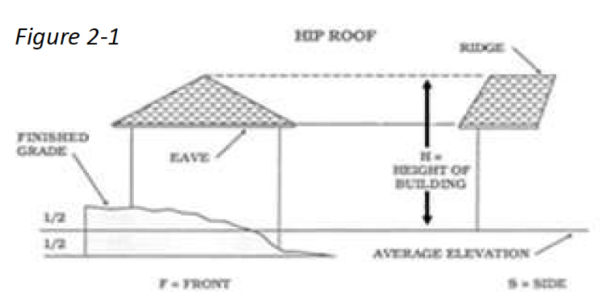
Grade, Finished: The elevation of the surface of the ground after completion of final grading, either via cutting, filling, or a combination thereof, which conforms to the approved final grading plan.
Grocery Store: A retail or wholesale store that primarily sells food, including canned and frozen foods, fresh fruits and vegetables, and fresh (raw) and prepared meats, fish, and poultry. Grocery stores may contain incidental accessory uses such as bakeries, delicatessens, pharmacies, movie rentals, postal services, and/or banking services.
- Large stores are defined as 20,000 square feet in size or greater. Also includes a grocery store use located within a larger format retail store where an area 20,000 square feet in size or greater is primarily devoted to the sale of food.
- Small stores are defined as less than 20,000 square feet in size. Also includes a grocery store use located within a larger format retail store where an area less than 20,000 square feet in size is primarily devoted to the sale of food.
Group Quarters: A residential facility designed to accommodate individuals who are not a part of the same household. Typical uses include fraternities, hostels, sororities, residence halls, dormitories, rooming and boarding houses, membership lodgings, and religious quarters. This does not include halfway houses, offender re-entry residential facilities, or homeless shelters, which are included in the definitions of Offender Rehabilitation Facility, or Welfare and Charitable Services, nor does this include Residential Care Homes or Residential Care Institutions.
Growth Area: A “growth area” is an area identified on the Cochise County Comprehensive Plan maps and described in Section 2.09. Growth areas are based on the capacity of an area for growth.
Guest Lodging: A building or group of buildings furnishing rooms or an area for accommodation for overnight or short-term lodging such as a hotel or motel, resorts, guest ranches, group camps, and campgrounds and may include recreational facilities, restaurants, meeting rooms, or similar facilities. This definition does not include Recreational Vehicle Parks or Bed and Breakfast land uses.
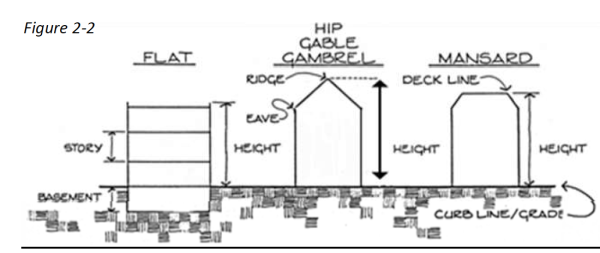
Height, Building: The vertical distance from the grade of the finished surface adjacent to the finished wall of a structure to the highest point of the roof for flat, gable, hip, and gambrel roofs and to the deck line of mansard roofs (see Figure 2-2).
Height, Structure: The vertical distance from the grade of the finished surface adjacent to the structure to the highest point of the structure or any attachment.
Helipad: A landing area and takeoff place for a helicopter.
Heliport: An airport designed for helicopter use.
Home Occupation: An activity carried on by the occupant of a dwelling as a secondary use, including personal and professional services, subject to the standards provided in Subsection 2.48.190.
Household: Any number of individuals living together as a single housekeeping unit and doing their cooking on the premises, as distinguished from Group Quarters or Residential Care institutions.
Impoundment Storage Yard: A site used for the temporary storage of impounded vehicles. No crushing or dismantling of vehicles or storage of vehicle parts shall occur.
Infrastructure: The system of facilities and services providing the supporting structure of a community, including, but not limited to, streets, utilities, sewer systems, fire, law enforcement, medical, educational, and recreational facilities.
Jails, Prisons, and Detention Centers: Any detention facility for legal offenders or for those awaiting trial.
Junk: Old or scrap metal, wood, copper, brass, rope, rags, batteries, paper, trash, rubber debris, tires, waste or junked, dismantled, or wrecked vehicles or parts thereof, iron, steel, and other old or scrap ferrous or nonferrous material.
Junkyards: The non-residential use of any site upon which the storage, keeping, salvage, sale, or abandonment of junk occurs. Includes salvage yards and automobile wrecking yards.
Kitchen: Any room in a building that is used, intended or designed to be used for cooking or preparation of food.
Landscaping: Site improvements intended to modify the aesthetic appearance of a property by changing its contours and/or adding ornamental features and plantings. Materials used may include grass, ground covers, shrubs, vines, or trees and accessory non-living durable material, such as but not limited to, rocks, pebbles, sand, brick, concrete paving bricks, walls, and fences, but excluding asphalt. Landscaping may also include the retention of native vegetation in prescribed areas.
Legal Non-Conforming Uses: A use of land or structure which was legally established according to the applicable zoning and building laws of the time but which does not meet current zoning and building regulations. See Section 2.57.030.
Livestock: Cattle, horses, sheep, llamas, alpacas, goats, mules, swine, asses, and ratites, such as ostriches and emus.
Livestock Auction Barn: An establishment operated for compensation as an auction market for livestock, consisting of pens or other enclosures and their appurtenances, in which livestock are received, held, sold, or kept for sale or shipment.
Lot Development Administrative Modification: A site development standard modification approved according to the procedures and criteria set forth in Section 2.48.150 herein.
Manufacture or Manufacturing: For the purposes of these Zoning Regulations, “manufacture” refers to a broad category of uses involving the use of mechanical power and machinery to produce products from raw materials, to prepare or alter materials for use in a finished product, or to assemble parts into products, including processing.
Manufactured Home: A structure built in accordance with the National Manufactured Home Construction and Safety Standards Act of 1974 and Title VI of the Housing and Community Development Act of 1974 and as amended. Does not include mobile homes, factory-built buildings, or recreational vehicles.
Master Development Plan: A duly adopted component of the Cochise County Comprehensive Plan that provides a detailed plan for the coordinated development of a specific area in compliance with the requirements of Subsection 2.09.060 of these regulations.
Marijuana Cultivation Facility: A facility licensed for operation by the Arizona Department of Health Services, located in a building, structure, or premises used to cultivate and store marijuana physically separate and off-site from a marijuana establishment.
Marijuana Establishment: A facility licensed for operation by the Arizona Department of Health Services that sells or distributes marijuana to consumers.
Marijuana Establishment Cultivation Facility: A building, structure, or premises licensed for operation by the Arizona Department of Health Services where marijuana is grown or cultivated as well as sold or distributed to consumers.
Marijuana Infusion Facility: A facility licensed for operation by the Arizona Department of Health Services that incorporates marijuana into consumable/edible goods through cooking, blending, or any other type of incorporation.
Marijuana Testing Facility: A facility licensed for operation by the Arizona Department of Health Services to analyze the potency of marijuana and test marijuana for harmful contaminants.
Medical Service, Health Clinic: A facility other than a hospital, where medical, dental, mental health, surgical, and/or other personal health care services are provided on an outpatient basis by primary practitioners and/or medical specialists by appointment (for example, chiropractors, dentists, medical doctors, optometrists, prescription opticians, psychiatrists, etc.). It may include a lab, radiology, pharmacy, rehabilitation, and other similar services as accessory uses. Counseling services by other than medical doctors or psychiatrists are included under “Personal and professional uses.”
Medical Service, Hospital: An institution providing in-patient, outpatient, and emergency medical care. It may include on-site accessory clinics and laboratories, accessory retail uses, and emergency heliports.
Medical Service, Lab Research, and/or Testing: A facility intended for the examination of clinical specimens for the purpose of providing information such as diagnosis, prognosis, prevention, or treatment of disease to improve the health of a patient. Examples of these uses include:
- Dental laboratories (crown and denture manufacturing, etc.)
- Medical laboratories (blood and tissue testing, X-Ray, CT scanning, etc., but not research)
- Reference laboratories
Medical Service, Urgent Care: A facility other than a hospital, where medical, mental health, surgical, and other personal health services are provided exclusively on an outpatient basis by a group of physicians working in cooperation and sharing the same facilities. Typically operates beyond standard medical office hours and may provide emergency treatment. It may include educational aspects such as medical instruction and/or training as well as house a lab, radiology, pharmacy, rehabilitation, and other similar services as accessory uses. Does not include hospitals. Counseling services by other than medical doctors or psychiatrists are included under “Personal and professional uses.”
Medical Service, Veterinary Clinic, and/or Animal Hospital: Office and indoor medical treatment facilities used by veterinarians, including large and small animal veterinary clinics and animal hospitals. It may include a lab, radiology, pharmacy, rehabilitation, temporary boarding of sick animals, and other similar services as accessory uses. See also “Animal Husbandry.”
Mini-Warehouses/Self-Storage Facilities: Buildings that are rented to the public for the storage of personal property and which have independent access and locks under the control of the tenant. May include outdoor storage areas.
Mining: Those activities conducted to develop or extract materials from the earth, including on-site transportation, concentrating, milling, leaching, smelting, or other processing of ores or other materials. A mine includes all lands containing excavations, underground passageways, shafts, tunnels and workings, structures, facilities, equipment, machines, or other property, including impoundments, retention dams, tailings, and waste dumps, on the surface or underground, used in, to be used in or resulting from the work of extracting minerals or other materials, excluding hydrocarbons. Mining includes that portion of an operation that mixes rock, sand, gravel, or similar materials with water and cement or with asphalt, provided that the operation is either physically connected to the mine or is so interdependent with the mine as to form one integral enterprise.
Mobile Home: A structure built prior to June 15, 1976, on a permanent chassis, capable of being transported in one or more sections and designed to be used with or without a permanent foundation as a dwelling when connected to on-site utilities. Does not include recreational vehicles, factory-built buildings, or manufactured homes.
Mobile Home, Rehabilitated: A mobile home that has been rehabilitated and certified as such by the Arizona Department of Housing or that exhibits the approved Rehabilitation Insignia before 2013 or Rehabilitation Certificate as of January 1, 2013, from the Arizona Department of Housing.
Mobile or Manufactured Home Park: A site or parcel of land under single or unified ownership upon which three or more mobile homes, manufactured homes, factory-built buildings, or a combination thereof, are set up as residences, regardless of whether the units are permanently occupied or offered as rental units. In Comprehensive Plan Category D Growth Areas designated Rural, six or more mobile homes, manufactured homes, factory-built buildings, or a combination thereof shall be considered a mobile or manufactured home park.
Mobile or Manufactured Home Space: A plot of ground within a mobile or manufactured home park designed for the accommodation of one mobile or manufactured home together with its accessory structures.
Mortgage: A first mortgage or other first-priority security interest in real property that is placed as security for the repayment of a loan and includes a first deed of trust.
Mortgagee: Any person or firm who holds a first-priority mortgage or other first-priority security interest in real property to secure a loan, whether as the mortgagee of a mortgage or the beneficiary of a deed of trust.
Motion Picture Production Site/Studio: Permanent facilities for the filming, processing, editing, or production of motion pictures involving the use, construction, or structural alteration of buildings or structures.
Mural: A one-of-a-kind, hand-painted, hand-tiled, or digitally printed image on the exterior wall of a building that does not contain any commercial message, which is any message that advertises a business conducted, services rendered, or goods produced or sold.
Non-Residential Use Permit: Commercial Building/Use Permit.
Notice of Default Event: With respect to a mortgage, it means that a default regarding that mortgage has occurred and either:
- A notice of breach or notice of default and election to sell has been provided to the obligor and has been recorded in the Cochise County Recorder’s Office; or
- An action for judicial foreclosure has been commenced regarding that mortgage by the filing of a complaint or petition for foreclosure in a court of competent jurisdiction.
Offender Rehabilitation Facility: An operation licensed in the State of Arizona for individuals who are legal offenders on release from more restrictive custodial confinement or initially placed in lieu of such more restrictive custodial confinement, such as in a mobile program agency as defined by the State of Arizona, wherein supervision, rehabilitation, or counseling is provided.
Open Space: Open space refers to any area of a site that is not occupied by buildings, structures, parking areas, streets, drives, or any outdoor use other than an outdoor recreation facility.
Out-building: A barn, shed, garage, lean-to, or other similar building used to store items that will be used on the property or to house animals (except RVs, which are only permitted as an Accessory Use) that is accessory to the principal use except as allowed without a principal use in Subsections 2.15.050 and 2.18.050.
Parking Area, Minimum: The minimum on-site area required for off-street parking and loading. This includes all spaces, drives, aisles, and maneuvering areas required to serve those spaces.
Parking Lot, Commercial: A structure or lot used for parking or storage of operational vehicles as a principal use of a site, which may or may not be used on a fee-paying basis. Does not include impoundment storage yards.
Personal and Professional Services: Facilities that provide the following or similar personal services: pet grooming, laundering, dry cleaning, rug cleaning, beauty and barber services, and photographic and recording services. Offices that provide the following or similar professional services: legal, real estate, engineering, architectural, design, counseling, and financial services.
Plan Designation: Within the four Growth Areas established by the Cochise County Comprehensive Plan, there are Plan Designations that classify land by either its present use or present or evolving character. These are further described in Article 2.09.
Planned Development: A planned development is land under unified control, planned and developed as part of an approved Master Development Plan. See Section 2.42.
Planning Director: The Director of the Cochise County Planning Department, also known as the County Zoning Inspector or designee.
Plant Nursery, Commercial: A facility that includes small nurseries and garden centers that grow plants on limited acreage for strictly retail sales to the homeowner and to landscape contractors; and wholesale nurseries, which include contract propagators, contract growers, growers, and distributors of nursery stock for wholesale to other nurserymen, landscape contractors, and retail outlets.
Principal Use: The primary use and chief purpose of a lot or structure as distinguished from an accessory use or structure. A site may contain multiple “principal uses,” each of which must meet the requirements of these Zoning Regulations unless otherwise limited by individual Zoning Districts.
Printing and/or Publishing Businesses: A printing business is an establishment that provides printing, copying, photographic, computer, or technological services. A publishing business facilitates the distribution of printed works, such as books (the “book trade”), newspapers, and magazines, as well as electronic resources, such as the electronic versions of books and periodicals.
Recreational Facilities, Indoor and/or Outdoor: An area designed and equipped for active recreation, sports, or leisure time activities and other customary and similar activities for public or private use, including, but not limited to parks, baseball or softball diamonds, soccer and football fields, tennis courts, and roping and equestrian arenas. This does not include fairgrounds, amusement parks, zoos, outdoor firearms, skeet, archery or trap-shooting ranges, unlighted facilities which are accessory to a permitted principal use, or lighted roping arenas for private use which are allowed as accessory uses to a residential permitted principal use.
Recreational Vehicle: A vehicular type unit which is:
- A portable camping trailer mounted on wheels and constructed with collapsible partial sidewalls which fold for towing by another vehicle and unfold for camping.
- A motor home is designed to provide temporary living quarters for recreational, camping, or travel use and built on or permanently attached to a self-propelled motor vehicle chassis or on a chassis cab or van that is an integral part of the completed vehicle.
- A park trailer built on a single chassis, mounted on wheels, and designed to be connected to utilities necessary for the operation of installed fixtures and appliances and has a gross trailer area of not less than 320-square feet and not more than 400-square feet when it is set up, except that it does not include fifth wheel trailers.
- A travel trailer mounted on wheels designed to provide temporary living quarters for recreational, camping, or travel use and has a trailer area of less than 320-square feet, including fifth-wheel trailers.
- A portable truck camper constructed to provide temporary living quarters for recreational, travel, or camping use and consists of a roof, floor, and sides designed to be loaded onto and unloaded from the bed of a pickup truck.
- Park models: Recreation Vehicle / Park Model (Destination) - A recreational vehicle that is designed for and is used for permanent residential use in a travel trailer/recreation vehicle park or as an accessory living quarter.
Recreational Vehicle Park: Any lot of land upon which three or more recreational vehicle sites are located, established or maintained for occupancy by recreational vehicles of the public as temporary living quarters for recreation or vacation purposes. The park may also include tents and portable shelters.
Recycling Center: A permanent enclosed facility for the collection, temporary storage, and processing of recyclable materials for efficient shipment; this does not include a junkyard. The sale of parts is not permitted. Processing for efficient shipment includes but is not limited to baling, compacting, crushing, and flattening.
Recycling Drop-Off Receptacle: Accessory to a non-residential site; enclosed receptacles into which recyclable materials or clothing may be dropped off. These materials are to be picked up and removed from the premises to maintain a clean and orderly site. Vectors and pests are to be controlled, and fugitive trash or debris is to be contained and collected on-site. Not to be used as a drop-off of hazardous materials.
Recycling/Solid Waste Transfer Facility: A heavy commercial or industrial-scale facility in which materials are sorted, crushed, bundled, stored, and/or distributed.
Regional Sewage Treatment Plants: A sanitary sewerage treatment facility, such as a municipal sewage treatment plant, that is located on one property and provides sanitary sewerage treatment services to off-site properties. This does not include “package” plants operated by Owner Associations or Special Improvement Districts serving lots within an individual subdivision or master development plan area, which shall be deemed local or “on-site” sewage treatment plants.
Repair Services, Large Engines: Services designed to repair large vehicles such as trucks with more than two axles, recreational vehicles, tractors, combines, and/or other large engines and may include incidental retail sales of parts.
Repair Services, Light: Services designed to repair items, such as watches, jewelry, furniture, electrical equipment, appliances, and clocks, and may include incidental retail sales.
Repair Services, Small Engines: Services designed to repair vehicles with no more than two axles, recreational vehicles, and/or other small engines and may include incidental retail sales.
Residential Care Home: A single-household dwelling licensed by the State which is used to provide housing and supervisory personal or custodial care services to not more than six (6) persons residing on the site. The home is a single-household dwelling for the purposes of all County Zoning Ordinances and shall not be subject to non-residential site development standards but shall require a Non-Residential permit. A Residential Care Home may include facilities for individuals who require special care for physical, mental, or emotional reasons, including, as defined by the State of Arizona, adult care homes, adult foster homes, homes for the elderly or the disabled, and/or adult and juvenile group homes. A Residential Care Home may include a home for juveniles if it meets the criteria of Section 2.48.180. This definition does not include an Offender Rehabilitation Facility. The limitation of six (6) or fewer persons does not include the operator of a Residential Care Home, members of the operator’s family, or persons employed as staff, except that the total number of all persons living at the Residential Care Home shall not exceed sixteen (16). Only one Residential Care Home is allowed per parcel or site.
Residential Care Institution: An operation licensed by the State, which is used to provide housing and supervisory personal or custodial care services to more than six (6) persons residing on the site. A Residential Care Institution may include facilities for individuals who require special care for physical, mental, or emotional reasons, including, as defined by the State of Arizona, adult care homes, adult foster homes, homes for the elderly or the disabled, and/or adult and juvenile group homes. A Residential Care Institution may include a home for juveniles that meet the criteria of Section 2.48.180. This definition does not include an Offender Rehabilitation Facility.
Responsible Party: An owner, lessee, mortgagee, property manager, cotenant, or occupant of all specified properties, including buildings, grounds, lots, or premises.
Restaurant: An establishment that provides, as a principal use, the preparation and sale of food and/or beverages in a ready-to-consume state for consumption on or off the premises.
Retail Sales/Rentals: All sales and/or rentals, indoors and/or outdoors, of products for their final consumers. May include light manufacturing or assembling incidental to retail sales from the premises provided that not more than forty percent of the floor area occupied by such business is used for manufacturing, baking, processing, assembling, treatment, installation, and repair of products. May include outdoor accessory storage of materials, merchandise, supplies, and/or equipment with required screening if applicable.
Retaining Wall: A man-made structure for the purpose of retaining soils or other materials for the purpose of stabilization of the soil or other materials. Minimum setbacks are not required for retaining walls.
Riding Stables, Commercial: Facilities for the boarding, exercise, and/or rental of horses on a commercial basis.
Right-of-Way (ROW) or Utility Easement: An easement or servitude over another’s land conferring a right of passage, particular use, or predetermined type of construction, including but not limited to electrical transmission line, water or sewerage conveyance systems, drainage structures, or natural gas pipelines.
Roomers: Persons not a part of a principal household who reside in a dwelling on a paid or charitable basis.
Screening: Includes solid walls and fences, or any combination thereof that cannot be seen through and are a minimum of 6-feet in height from grade. The screen shall be constructed out of standard materials or other acceptable materials approved by the County Zoning Inspector. An existing vegetative screen on the subject site may be approved by the County Zoning Inspector if it meets the intent of creating a solid screen.
Setback: The horizontal distance between the property line or road travel way and the foundation, wall, or main frame of any building or structure, and between the property line and the outer perimeter of any outdoor area significantly involved in the use or activity of the site, including non-residential sales, rental, display, or storage areas. No structure/use permitted herein shall limit the rights of the owner of any underlying easements which burden a particular site from utilizing their easement.
Shopping Center: A unified development on a single site that contains a variety of business, service, and retail uses and which has common ingress and egress, parking, and drives.
Sign: Defined in Article 2.54.
Site: All actual land used, developed, intended to be developed or occupied for a use or group of uses, including its buildings, structures, storage and service areas, streets, driveways, and any required setbacks around the perimeter of such land. In most cases, a site will be a single lot or parcel of record; however, a site may also be a portion of a lot or parcel, or even an aggregation of contiguous lots or parcels, whether under single or multiple ownership.
Site, Abutting: A site touching the boundary of the site proposed for a use.
Site Area, Minimum: The minimum area of a site upon which a specific use(s) may be permitted.
Site Coverage: The total percentage of the site covered with structures, buildings, paving, and impervious surfaces other than landscaping, gravel, walls, and fences.
Slaughterhouse/Meat Packing Plant: A facility for the slaughtering, refining, processing, storage, and distribution of animals and animal byproducts.
Solar Energy Power Plant: A Non-Residential, utility-scale Solar Energy System, the purpose of which is to supply solar-generated electricity to off-site consumers. Accessory structures may include buildings, substations, and associated electrical infrastructure. The term does not include stand-alone Solar Energy Systems for on-site use.
Solar Energy System: A device or devices, structural design feature, series of mechanisms, or combinations thereof, designed for the primary purpose of producing electrical or mechanical power for use primarily on premises; some conveyance of electricity to the grid is allowed.
Solid Waste Incinerator: Any furnace used in the process of burning solid waste for the purpose of reducing the volume of the waste by removing combustible matter.
Solid Waste Landfill: A site approved by the State for the collection and/or disposal of non-hazardous solid wastes.
Special Use Authorization: A land use that has been approved by the Planning Commission as a Special Use according to the procedures and criteria set forth in Section 2.48.160.
Specified Property: Any parcel of real property with a structure that is vacant within the County that is subject to a mortgage and concerning which a notice of default event has occurred. For purposes of the inspection requirement set forth in Subsection 2.69.010 and for that purpose only, the term also includes a parcel of real property that appears to be vacant. Once a parcel is determined not to be vacant or is no longer vacant, it is not considered “specified property” until it qualifies again under this definition.
Stockyards: A large yard containing pens and sheds, typically adjacent to a slaughterhouse, in which livestock is kept and sorted.
Storage Area, Outdoor: Any storage of objects or materials which is located outside the confines of a building. Outdoor storage does not include merchandise within an outdoor display area. Non-residential outdoor storage does not include vehicles awaiting repair.
Street: A public or private thoroughfare used or intended to be used for passage or travel by motor vehicles.
Street, Arterial: A street with the principal function of maintaining through traffic flow, separate from local traffic, to and from areas of principal traffic generation and designed for high volumes and high speeds of traffic. Efficient movement is the primary function of the arterial streets; hence, there is limited access to and from local streets and individual parcels. Arterial streets shall include all State and Federal routes and those that are classified as such on an adopted traffic circulation plan or master plan.
Street, Collector: A Street that conducts and distributes traffic from arterial streets to lower volume local streets. Collector streets shall include section-line and mid-section-line streets unless they are functioning or intended to function as arterials or local streets, and any street so designated on an adopted traffic circulation plan or master plan.
Street, Local: A Street that functions to serve direct access to individual parcels or a street so designated on an adopted traffic circulation plan or master plan.
Structure: Anything constructed or erected with a fixed location on the ground or attached to something having a fixed location on the ground, including, but not limited to, buildings, towers, swimming pools, carports, signs, and billboards.
Structure, Temporary: Anything constructed, placed, or erected that is readily movable and is used or intended to be used for a limited period of time. Such temporary structure shall be subject to all applicable requirements of these Zoning Regulations for the Zoning District in which it is located.
Substandard Lot: A lot that does not meet the minimum site area requirements for the Zoning District in which the lot is located. Permits may not be issued for a substandard lot that is not legal nonconforming unless the non-conformance is resolved through a Rezoning or Administrative Lot Modification.
Swap Meets: A non-residential use outdoors or within a building in which stalls or sales areas are set aside, rented, or otherwise provided, and which are intended for use by various unrelated individuals to sell articles on a recurring basis.
Transient Camps/Migrant Labor Camps: Facilities for the temporary or long-term lodging of transients or migrants, whether in permanent quarters or temporary structures and permanent or temporary facilities for lodging migrant laborers.
Travel Way: The physical portion of a public or private road or easement used by vehicles for access, not including private driveways. In the case of a road that includes defined shoulders, the paved shoulder is included in the travel way.
Truck Stops: Buildings or premises in which or upon which a business, service, or industry involving the maintenance, servicing, storage, or repair of commercial vehicles is conducted or rendered, including the dispensing of motor fuel or petroleum products directly into motor vehicles, the sale of accessories or equipment for trucks and similar commercial vehicles. A truck stop may also include overnight accommodation, convenience stores, and restaurant facilities.
Utility Installations: Structures necessary for the distribution of franchised public or private utilities such as water, gas, wastewater, electricity, telephone, telegraph, television, and radio service. Substantial installations, including substations, booster stations, water tanks, and communication towers, are subject to these regulations. Smaller utility installations, such as meter boxes, pipes, poles, wires, and hydrants, are exempt from these regulations.
Use: The purpose for which land or a building is occupied, maintained, arranged, or intended.
Use, Non-Residential: The use of land for a purpose other than single-household dwelling units.
Vacant: With respect to real property and “vacant real property” mean real property and improvements that are not presently occupied by persons lawfully entitled thereto. The term does not include real property that is unoccupied by reason of the temporary absence of lawful occupants who intend to return and resume occupancy.
Variance: A deferral, modification, or waiver of the terms of these Zoning Regulations granted by the appropriate Board of Adjustment pursuant to Section 2.60.010 of these Zoning Regulations.
Wall: See definition of Fence.
Warehousing, Distribution, and Storage of Goods: A use requiring significant commercial vehicle access and large-scale storage of goods and vehicles, both indoor and outdoor, typically between production and their placement on the market.
Welfare and/or Charitable Services: Services operated by public agencies or private associations for the benefit of the disadvantaged or for mental, behavioral, medical, or protective assistance for the public benefit. This may include a non-supervisory, non-custodial, or residential component.
Wind Energy Power Plant: A Non-Residential, utility-scale Wind Energy System, the primary purpose of which is to supply electricity to off-site consumers, consisting of a network of Wind Turbines and accessory structures and buildings, including substations, anemometers, and associated electrical infrastructure. The term does not include stand-alone Wind Energy Systems for on-site use, which feed residual power into the electrical grid, as defined by the Arizona Corporation Commission.
Wind Energy System: A system that uses one or more wind turbines, batteries, power inverters, and other associated components to convert the kinetic energy of the wind into electricity for use by consumers. Wind Energy Systems consisting of one or more Wind Turbines may provide power to one or more principal uses, well pumps, or accessory structures on the same parcel on which they are sited. Wind Energy Systems subject to maximum densities in Section 2.51.190.
Wind Turbine: The portion of a Wind Energy System that converts the kinetic energy of the wind into electricity. Wind Turbines may be freestanding or mounted onto a structure. Wind Turbines are the main components of a Wind Energy System, which may include more than one turbine.
Winery, Farm: An on-site agricultural processing service in which grapes grown on-site are processed into wine, not to exceed 40,000 gallons per year.
Winery, Large Production: An agricultural processing service in which grapes grown on-site or off-site are processed into wine in quantities greater than 40,000 gallons per year.
Winery, Small Production: An agricultural processing service in which grapes are grown off-site are processed into wine, not to exceed 40,000 gallons per year.
Winery Tasting Room: A building or portion thereof, subordinate in size, accessory to, and located on the same site as a Farm Vineyard, Farm Winery, Small Production Winery, or Large Production Winery operation, in which wine may be sampled and/or purchased. A Winery Tasting Room may also include incidental retail sales of wine and related products.
Wholesaling: The sale of goods or merchandise to retailers; to industrial, commercial, institutional, or other professional business users; or to other wholesale businesses and related subordinated services. In general, it is the sale of goods to anyone other than a standard consumer.
Yard Sale: A sale of items conducted on a residential site and incidental to the principal dwelling. Yard sales shall be held on an infrequent or occasional basis only and shall not constitute a business.
Youth-Oriented Facility: Any facility that caters to or provides services primarily intended for minors or where individuals who regularly patronize, congregate, or assemble at the establishment are predominantly minors.
Zoos and/or Other Outdoor Animal Exhibits: A facility in which all animals are housed within enclosures, displayed to the public, and in which they may also breed.
Zoning District: One of the zoning classifications established in Section 2.12.010 of these Zoning Regulations, or any contiguous area of land having the same zoning classification.
Zoning District, Commercial: Any NB (Neighborhood Business) or GB (General Business) Zoning District.
Zoning District, Industrial: Any LI (Light Industrial) or HI (Heavy Industrial) Zoning District.
Zoning District, Residential: Any SR (Single-Household), SM (Single-Household/Manufactured Home), MR (Multiple-Household), or R (Residential) Zoning District or RU (Rural) Zoning District designated by the Comprehensive Plan with a Rural Residential designation.
Zoning Inspector, County: The Cochise County Planning Director or duly authorized representative.

