
Cocoa Beach City Zoning Code
CHAPTER III
DESIGN STANDARDS1
Editor's note— Ord. No. 1627, § 2(Att.), adopted March 7, 2019, repealed the former Ch. III and enacted a new chapter as set out herein. See Code Comparative Table for a detailed history of derivation.
ARTICLE I. - APPLICATION REQUIREMENTS AND SUBMITTALS
This chapter provides the design requirements for development of property within the City of Cocoa Beach.
A.
These standards apply to all land development and redevelopment in the city and shall be addressed on any required site plan, which shall be submitted with every application for land development or redevelopment and construction within the corporate limits of Cocoa Beach.
B.
Chapter IV of these regulations provides the procedural requirements for the submittal, review and approval of a site plan.
C.
All proposed construction, land clearing, dredging, or the placing of fill on a site requires approval of a city building permit, according to the requirements within the Florida Building Code, latest edition, and is subject to all applicable state, federal and local permitting requirements.
D.
All proposed demolitions require approval of a city building permit, including completion of a demolition affidavit, asbestos notification statement, and a pest removal affidavit.
E.
Where conflicts exist between the requirements detailed in this chapter and requirements listed elsewhere, the more stringent standard shall apply.
(Ord. No. 1627, § 2(Att.), 3-7-2019; Ord. No. 1649, § 2(Exh. A), 10-1-2020)
ARTICLE II. - ACCESS MANAGEMENT
This article applies to access management throughout the city, including areas for parking and rights of way. Parking placement requirements for the redevelopment districts are detailed in chapter 2, sections 2-42 through 2-46 of this land development code.
ARTICLE IV. - RESERVED[2]
Editor's note— Ord. No. 1649, § 2(Exh. A), adopted Oct. 1, 2020, repealed Art. IV, §§ 3-40—3-46, which pertained to standards for operations and derived from Ord. No. 1627, § 2(Att.), adopted March 7, 2019.
ARTICLE VII. - UTILITIES[3]
Editor's note— Ord. No. 1649, § 2(Exh. A), adopted Oct. 1, 2020, amended Art. VII in its entirety to read as herein set out. Former Art. VII, §§ 3-70, 3-71, pertained to sanitary sewer and derived from Ord. No. 1627, § 2(Att.), adopted March 7, 2019.
ARTICLE VIII. - WIRELESS COMMUNICATION FACILITIES[4]
Editor's note— Ord. No. 1649, § 2(Exh. A), adopted Oct. 1, 2020, amended Art. VIII in its entirety to read as herein set out. Former Art. VIII, §§ 3-75—3-77, pertained to wireless communication facilities and derived from Ord. No. 1627, § 2(Att.), adopted March 7, 2019.
Section 3-01. - Off-street parking regulations.
Off street parking facilities shall be provided and maintained as required for the specific use and zoning district.
A.
On property located outside the established redevelopment districts, off-street parking shall be located away from street frontages, unless the applicant clearly demonstrates, by objective evidence, that exceptional circumstances exist which preclude such placement of the parking.
B.
Off-street parking facilities shall be provided for every use or part thereof in all zoning districts as prescribed in this section. Where the parking requirements for a use are not specifically defined, or a use is not mentioned, the parking requirements for such use shall be determined by the administrator.
C.
Excessive parking spaces beyond that required are not encouraged. If excess parking is requested for the site, the location must be to the rear or side of the structure, shall be constructed of pervious pavements, and shall not be in conflict with other site development requirements, such as landscaping or stormwater management systems.
D.
Accommodations for pedestrian traffic within all parking facilities are required.
E.
The parking space requirements listed below are a guide for computing number of spaces. The number of required spaces is dependent on usage and may be adjusted, as determined necessary by the administrator.
•
Churches, temples or places of worship: One (1) space for each four (4) seats or seating places or one (1) space for each one hundred twenty-five (125) square feet of floor area of the main assembly hall, whichever is greater.
•
Colleges or vocational schools: One (1) space for each five hundred (500) square feet of gross floor area.
•
Community residential homes, assisted living facilities, or nursing homes: One (1) space for each two (2) sleeping rooms.
•
Dwelling units single family or multifamily: Two (2) spaces for each dwelling unit.
•
Hospitals or residential medical facilities: Two (2) spaces for each patient bed.
•
Libraries or museums: One (1) space for each eight hundred (800) square feet of gross floor area.
•
Medical or dental clinic: One (1) space for each four hundred (400) square feet of gross floor area.
•
Office or professional buildings: One (1) space for each five hundred (500) square feet of gross floor area.
•
Places of assembly - restaurants, auditoriums, theatres, clubs, or lodges: One (1) space for each three (3) seats or seating places or one (1) space for every one hundred (100) square feet of floor area of the main assembly hall, whichever is greater.
•
Retail or commercial buildings: One (1) space for each three hundred (300) square feet of gross floor area.
•
Transient accommodations hotels and motels: One (1) space for each guest unit plus one (1) space for each twelve (12) units for employee parking.
•
All other uses to be determined by the administrator.
F.
Existing buildings. Consideration may be given to existing buildings with limited off street parking or loading facilities which undergo renovations and/or a change of use, provided there is no increase in floor area or seating capacity. A parking plan is required and must be approved by the administrator.
G.
Locations and specifications of off-street parking areas. Except for single-family and duplex uses, each parking area and space shall comply with the following:
1.
The parking space dimensions shall be as provided in Figures 3-01A-B.
2.
Access aisles and driveways shall be of sufficient size and width, as illustrated in Figures 3-01A and 3-01B, and as approved by the administrator.
3.
Parking spaces shall include a raised curb or wheel stop.
4.
The required off-street parking facilities shall be designed to the city design standards listed below, shall be constructed according to the specifications provided within the Cocoa Beach Standard Construction Details, and shall be approved by the city engineer in collaboration with the administrator.
a.
The surface shall be a stabilizing hard surface, such as concrete or asphalt, which is permitted to be pervious, like pervious concrete, or semi-pervious, like pavers, as approved by the city engineer.
b.
There shall be a stormwater management system that prevents direct discharge of stormwater into the city's stormwater management system. No stormwater is permitted to be directed onto adjacent properties or the public right-of-way.
c.
Parking areas shall be illuminated in such a manner to prevent glare and light trespass onto adjacent properties.
d.
The design shall provide for convenient access and safety of pedestrians and vehicles.
e.
When a lot exists with an off-street parking facility which adjoins another lot in the same zoning district, a cross property access drive shall be provided together with a recorded access easement, as approved by the administrator.
f.
All parking spaces adjacent to any structures shall be separated from that structure by a buffer/walkway, which is to be a minimum of five (5) feet in width, as measured from the structure overhang to the wheel stop or curb.
g.
Parking areas shall be landscaped and maintained as provided in section 3-55.
5.
Required off-street parking shall be located on the same lot it is intended to serve, except that the administrator may allow for such off-street parking facilities within seven hundred (700) feet of the premises being served when:
a.
Circumstances prevent the placement of the required parking on the same lot as the premises served.
b.
The property owner shall enter into a written agreement with the owner of the property to be used for parking, providing that the land shall never be disposed of, except in conjunction with the sale of the building which the parking area serves, so long as the facilities are required.
c.
The property owner agrees to bear the expense of recording the agreement which shall bind all heirs, successors and assigns. The agreement is eligible to be voided if other suitable off-street parking facilities are provided in accordance with these regulations.
6.
Grass parking. Up to seventy-five (75) percent of the required parking for churches, temples or places of worship may be grass when deemed appropriate by the administrator.
a.
Areas shall be provided in a manner acceptable to the administrator.
b.
All grass parking shall be installed, irrigated, and maintained in accordance with the provisions of the city's landscaping requirements.
c.
Grass parking areas shall not be eligible for use as a commercial or paid parking lot.
H.
Reduction for mixed or joint use of parking spaces. The administrator may authorize a reduction in the total number of parking spaces for two (2) or more commercial uses jointly providing off-street parking. There shall be no reduction in the required amount of onsite parking for residential uses.
I.
Compact car parking spaces may satisfy no more than twenty-five (25) percent of the required parking spaces, must have appropriate signage, must be at least eight (8) feet wide by sixteen (16) feet long, and must be located no more conveniently than standard spaces.
J.
Change of use. No change of use, alterations or extensions that would create an increase in building area or capacity shall be permitted to a building until the off-street parking requirements for a new use have been met.
K.
Off-street loading specifications. Off-street loading facilities are required so that vehicles engaged in unloading and loading will not interfere with the public use of streets, sidewalks and alleys.
1.
Off-street loading facilities may be shared by multiple uses if provided for in a joint shared parking agreement.
2.
When the use of a structure or land or any part thereof is changed to a use requiring off-street loading facilities, the entire space required for off-street loading shall be supplied and maintained within the property on which the use is located.
3.
An off-street loading zone, as defined in section 1-20, shall be an area with the minimum size dimensions required to adequately meet the needs of the property uses, as approved by the administrator, in accordance with the city design standards.
4.
A site plan shall be submitted which accurately depicts the required off-street loading spaces, including access, dimensions and clearance, for final approval by the administrator.
5.
No facilities or area supplied to meet off-street parking requirements shall be used to meet requirements for off-street loading facilities.
L.
Bicycle parking. Credit may be granted toward the required number of parking spaces for up to four (4) percent of the required parking spaces, dependent upon the design, number of bicycle spaces provided and the number of overall spaces. Bicycle parking facilities shall be of a design approved by the administrator.
M.
ADA accessible parking space requirements. ADA accessible parking spaces shall be as required by the most recent Florida Building Code and ADA standards. Accessible parking spaces shall be located as close as reasonably possible to the entrances of the commercial business, as approved by the administrator. One ADA accessible space is required for each twenty-five (25) parking spaces or portion thereof.
N.
Landscaped buffers and islands in parking areas. All off street parking areas, except those which serve single-family and duplex structures, shall meet the landscape requirements within section 3-55.
O.
Landscaped islands required in parking lots. Parking areas with more than one hundred (100) spaces on a site shall have no more than twenty (20) consecutive spaces in a row without providing an interior landscaped island. Unless technically infeasible based on site and parking design, landscaped islands shall be recessed with a flow path for water from the parking area and used to retain runoff as part of a stormwater management system with a design to serve this purpose.
Figure 3-01A Parking Design Dimensions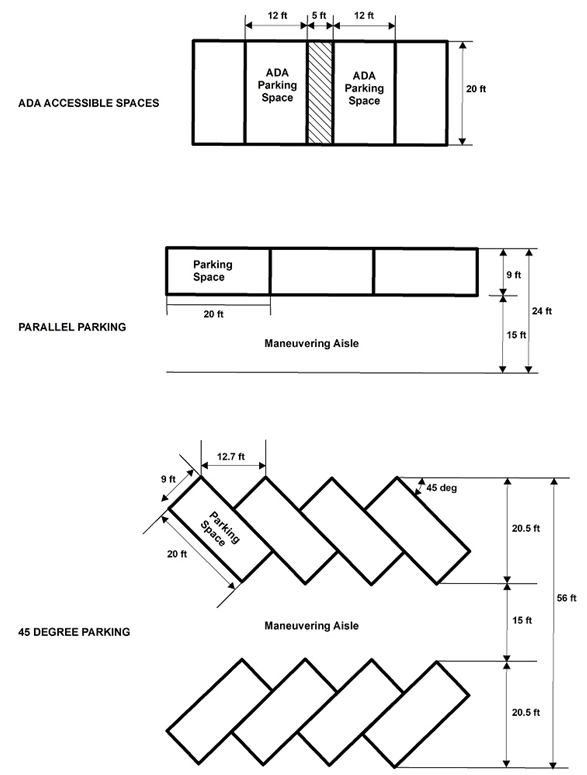
Figure 3-01B Parking Design Dimensions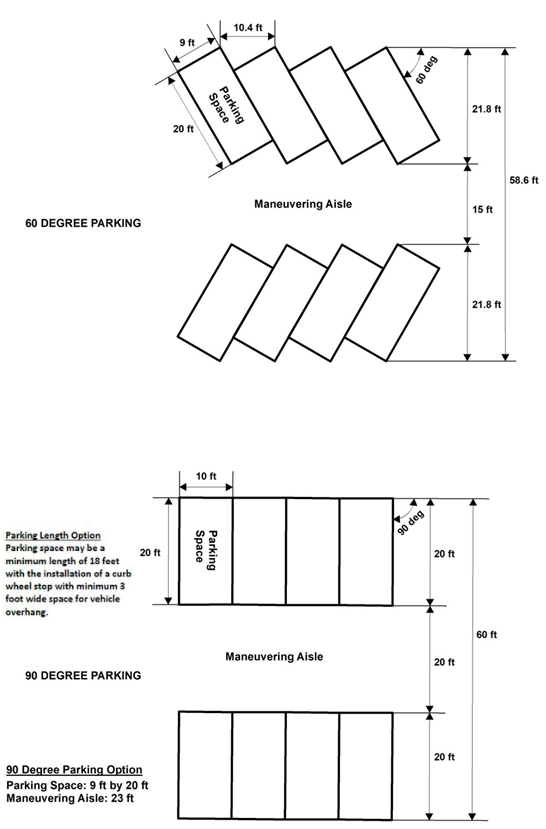
(Ord. No. 1627, § 2(Att.), 3-7-2019; Ord. No. 1649, § 2(Exh. A), 10-1-2020)
Section 3-02. - Parking requirements within the redevelopment districts.
Parking within the established redevelopment districts, especially within the downtown, may rely on a combination of off-street, on-street, and structured parking in an effort to provide adequate amounts of parking while decreasing the auto-centric nature and dependence on surface parking associated with conventional zoning districts.
A.
Purposes, intent and objective: It is the intent of this section to relax the normal required parking standards in these special mixed-use districts, where the business owner may count a certain percentage of on-street and public parking towards the required parking for their place of business, with the objective to help stimulate the revitalization of the redevelopment districts.
B.
Scope: The on-street and public parking regulations in this section only apply to the mixed-use redevelopment districts of Downtown, Midtown, Uptown and North Cocoa Beach. Any applicant, who seeks a permit to renovate, redevelop, revitalize or reuse an existing commercial building, may also seek permission to provide a reduced number of parking spaces in compliance with this section.
C.
Reduced parking requirement: Parking requirements for commercial land uses in the redevelopment districts may be reduced by the administrator, subject to the following:
1.
In the case of redevelopment of a site and when a public parking lot or facility can accommodate the parking requirements of a commercial use within five hundred (500) feet, the parking requirements may be reduced, upon administrator approval.
2.
A reduction in required off-street parking does not waive any requirements to improve any off-street parking area, including but not limited to, stormwater management, ADA accessibility,, and landscaping.
3.
There shall be no reduction in the required amount of onsite parking for residential uses.
4.
When authorizing a reduction in required off-street parking, the administrator may impose certain conditions necessary to promote the intent and implement the requirements of these regulations.
5.
In determining the amount of parking required for a particular use or location, the administrator's determination shall be based on the following criteria:
a.
A parking plan provided by the applicant calculating the proposed parking.
b.
A site stormwater management plan indicating, at a minimum, the existing and planned stormwater characteristics and flow paths, as well as the location and capacity of all stormwater facilities.
c.
The present demand on existing on-street and public parking in the vicinity of the use.
d.
Future availability of on-street and public parking in the vicinity of the use.
D.
Bicycle parking spaces. Credit may be granted towards the required number of parking spaces for up to four (4) percent of the required parking spaces, upon administrator approval.
(Ord. No. 1627, § 2(Att.), 3-7-2019; Ord. No. 1649, § 2(Exh. A), 10-1-2020)
Section 3-03. - Vehicle parking.
A.
General.
1.
Vehicles, including cars, trucks, semi-trucks or temporary structures, of any kind are not permitted to be parked or left unattended on vacant parcels.
2.
Vehicles of any kind, including non-motorized vehicles, are not permitted to be parked on public sidewalks.
B.
Vehicle parking in commercial districts.
1.
On commercial properties a semi-truck or tractor trailer, as defined in section 1-20, shall be parked in a designated area that is separate from standard vehicle parking areas.
2.
Overnight storage of a semi-truck or tractor trailer shall be behind a six-foot high opaque fence.
C.
Vehicle parking in residential districts.
1.
On residential properties the parking of a semi-truck or tractor trailer shall be restricted to loading and unloading activities, between the hours of 7:00 a.m. and 8:00 p.m. with no overnight parking of vehicles.
2.
Unless restricted by other prohibitions, vehicles under twenty-six (26) feet in length are permitted to be parked on any private residential lot which contains a permitted principal structure.
3.
The length of a vehicle shall include all accessories, such as hitches, masts, outboard motors, trailers, or any vehicle attached to the vehicle.
4.
Any recreational vehicle, whether wheeled, motorized, or in an unassembled state, including trailers, boats and boat trailers separately or in combination, exceeding twenty-six (26) feet in length shall not be permanently parked, stored or located on private property in a residential zoning district unless parked in an enclosed garage, or as provided below:
a.
The vehicle shall be parked on a driveway or other prepared surface, preferably a pervious surface.
b.
The vehicle may be parked in the side or rear yard, under the following conditions:
1)
The vehicle shall be setback at least two (2) feet from any abutting property line.
2)
If the vehicle is within ten (10) feet of an adjacent property, a six-foot high opaque fence or wall along the adjacent property line shall be provided.
c.
The vehicle may be parked in the front yard, under the following conditions:
1)
The vehicle shall be at least eight (8) feet from the front face of the curb or edge of the travel lane of the street.
2)
No portion of the vehicle shall extend over a pedestrian sidewalk or bike path.
d.
Vehicles shall not obstruct the sight visibility triangle at intersections, as detailed in section 3-07.
e.
Parked vehicles shall not be used as a residential dwelling, be connected to any public utilities, used for storage, or used as an office for business purposes.
f.
Vehicles must be operable with a current license tag and registration.
g.
Only one (1) vehicle exceeding twenty-six (26) feet in length may be parked on a property at any one (1) time.
5.
Any vehicle which cannot comply with the parking regulations above, may be parked at the owner's property a maximum of one (1) day per week for maintenance, loading, unloading and trip preparation.
(Ord. No. 1627, § 2(Att.), 3-7-2019; Ord. No. 1649, § 2(Exh. A), 10-1-2020)
Section 3-04. - Streets.
These regulations are for all streets within the city. Streets within the redevelopment districts shall also be in compliance with the requirements of section 2-48.
A.
General requirements:
1.
The design of all proposed streets shall be in conformity with the Cocoa Beach Standard Construction Details and approved by the city engineer.
2.
If an extension of a city street is required to provide access to an adjoining property, the extension shall be approved by development services, public works, the city engineer, and the city commission.
3.
Where a subdivision borders on or contains a major street or thoroughfare, ancillary streets may be required to limit access to the major thoroughfare. A landscaped buffer may be required in connection with such subdivisions.
4.
Prior to the development of any lot, the lot shall be connected to the city's street system by roadways which provide access for emergency service and utility service vehicles. The streets shall be subject to review by the city engineer and shall be constructed to the Cocoa Beach Standard Construction Details at the developer's expense.
B.
Street names. Proposed streets, which are in alignment with others existing and named streets, shall bear the assigned name of the existing streets, with the same spelling. In no case shall the name for a proposed new street duplicate or be phonetically similar to existing street names. Street names shall require the approval of E911 addressing for Brevard County, the city commission, and the postmaster of the U.S. Postal Service, Cocoa Beach.
C.
Alleys. Alleys to the rear of lots are permitted in a neighborhood or commercial planned development.
(Ord. No. 1627, § 2(Att.), 3-7-2019; Ord. No. 1649, § 2(Exh. A), 10-1-2020)
Section 3-05. - Sidewalks and bike paths.
When a property within a standard zoning district is developed or redeveloped, sidewalks are required to be constructed according to the standards below. Sidewalks within the redevelopment districts must also comply with the requirements of section 2-49.
A.
Sidewalks, with a minimum width of six (6) feet, shall be constructed on at least one (1) side of all local public streets. Single family or duplex residential lots are exempt only when sidewalks do not exist on the street.
B.
Sidewalks, with a minimum width of eight (8) feet, are required to be constructed on at least one (1) side of all state maintained roadways. Sidewalk width requirements shall further be determined by the Florida Department of Transportation (FDOT) Context Based Design Criteria.
C.
Bicycle paths, with a minimum width of eight (8) feet, shall be required by the city when the bicycle path would be part of an adopted mobility plan or system.
D.
Sidewalks and bicycle paths shall be located within the right-of-way, or dedicated easement, and constructed in accordance with the city design standards.
E.
When a public sidewalk exists, the landowner is responsible for any maintenance, repair or replacement of the sidewalk or bike path when damaged by the property owner or private contractor.
F.
An approved building permit is required prior to construction. On state roadways a Florida Department of Transportation (FDOT) permit or written exemption is also required.
G.
The city's public works department is responsible for the review and approval of all bicycle paths and sidewalks.
(Ord. No. 1627, § 2(Att.), 3-7-2019; Ord. No. 1649, § 2(Exh. A), 10-1-2020)
Section 3-07. - Visibility at intersections.
A.
Generally. Visibility triangles are required at street intersections and intersections of streets and driveways. The requirements below are summarized in Figure 3-07.
B.
Obstructions. Visibility triangles shall be maintained free of visual obstructions, including structures and vegetation, from a height of thirty-six (36) inches to a height of six (6) feet above the centerlines of the abutting intersecting streets. This requirement may be waived by the administrator if:
1.
The encroachment into the sight triangle is by a healthy, mature, non-invasive tree and results in a de minimus impact on visibility and public safety concerns.
C.
Visibility triangle at street intersections.
1.
For street intersections the sides of visibility triangles are measured from the point of intersection of the right of way lines.
2.
For local streets the length of each side of the visibility triangle shall be at least twenty-five (25) feet.
3.
Intersections accessing state roadways shall be in compliance with Index 546 of the Florida Department of Transportation's Design Standards, latest edition.
D.
Visibility triangle at driveways.
1.
For driveways the visibility triangle is measured from the point of intersection between the right of way line and the driveway.
2.
For local streets the length of each side of the visibility triangle shall be at least ten (10) feet.
E.
Exceptions. Visibility triangles may be modified, as determined by the administrator and/or city engineer, if engineering standards indicate a greater clear area is necessary or if the clear area does not contribute to the safe operation of the street, intersection or driveway.
(Ord. No. 1649, § 2(Exh. A), 10-1-2020)
Figure 3-07. Sight visibility triangle for local streets.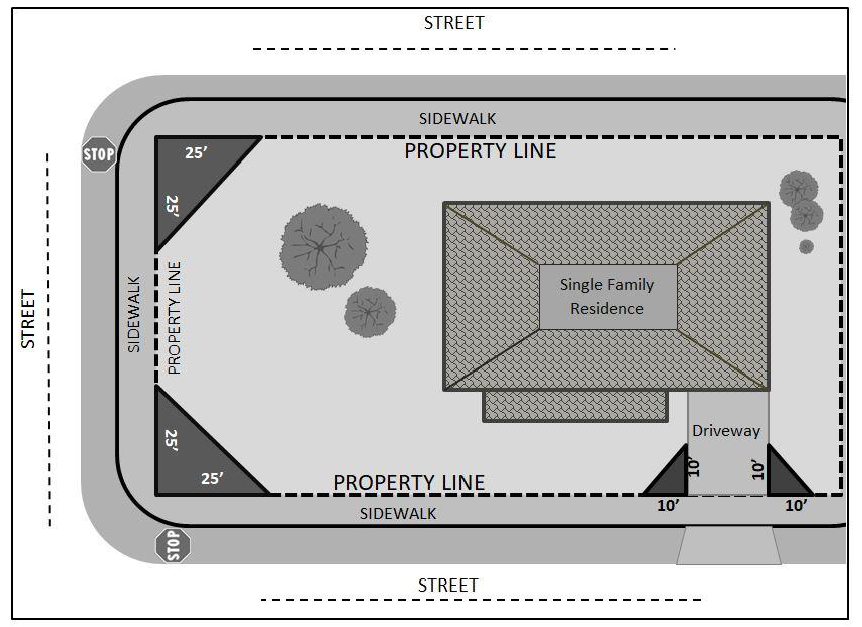
(Ord. No. 1627, § 2(Att.), 3-7-2019)
Section 3-08. - Bridges.
Bridges shall only be permitted in compliance with the City Charter Section 6.02 and shall be constructed in accordance with Florida Department of Transportation Design Standards Chapter 115, latest addition.
(Ord. No. 1627, § 2(Att.), 3-7-2019)
Section 3-09. - Driveways.
The following considerations and specifications shall be considered when designing a driveway.
A.
All driveways shall be properly permitted through the city prior to construction.
B.
During construction of a driveway no material shall be stored in the Right-of-way, and all materials shall be secured in such a manner to prevent material migration into a waterway or stormwater system.
C.
All driveway sections, extending into the public right-of-way, shall be surfaced in compliance with the specifications of the Cocoa Beach Standard Construction Details. Materials such as gravel or coquina are not in compliance with city standard construction requirements.
D.
Driveways accessing a state roadway require a permit from the Florida Department of Transportation (FDOT).
E.
The number of access driveways onto public rights-of-way shall be kept to a practical minimum to reduce potential conflicts.
F.
It shall be unlawful for any person to construct, cut, break out or remove any curb along a public right-of-way except as authorized by the City of Cocoa Beach.
G.
When constructing a driveway, no curb shall be cut unless the driveway is constructed to the full width of the opening with a transition curb on each end.
H.
Driveways shall be constructed to conform to the existing paved street grade or grade approved by the city engineer.
I.
Driveways shall be constructed as nearly to a right angle to the street or roadway as possible. Any deviation from the right angle requirement that exceeds ten (10) degrees in either direction is subject to review and approval by the city engineer.
J.
Driveways shall cross the sidewalk at a grade not to exceed the maximum cross-slope as established by the latest version of the Florida Accessibility Code for Building Construction.
K.
No driveway shall be constructed in the radius return of an intersection.
L.
All driveways shall be constructed with a minimum setback distance of five (5) feet from the side property line.
M.
No driveway shall be constructed closer than twenty-five (25) feet from the intersection of street right-of-way lines.
N.
Existing driveway(s) shall not be relocated, altered or reconstructed without an approved building permit and shall be subject to the provisions of this section.
O.
All costs for repairs or replacement of driveways within the public Right-of-way, as a result of necessary access by property owners or their private contractors, are the responsibility of the property owner.
P.
Costs for repairs or replacement of driveways comprised of pavers or materials other than concrete/asphalt, where the damage is the result of gaining necessary access to utilities, shall be the responsibility of the property owner.
Q.
Residential driveways. Driveways accessing residential properties shall be in compliance with the following regulations, and as summarized in Figures 3-09A-C, below:
1.
One (1) driveway shall be permitted for ingress and egress to a lot.
2.
Two (2) driveways may be permitted for ingress and egress from certain properties, in accordance with the requirements of this section.
3.
The minimum distance between two (2) driveways on the same parcel shall equal or exceed twenty (20) feet.
4.
The driveway width, per single driveway opening, shall be a minimum of ten (10) feet and a maximum of twenty (20) feet, to be measured at the property line.
5.
The driveway apron shall extend three (3) feet on each side, which is measured at the roadway connection or pavement line.
6.
When a driveway is shared between two (2) abutting properties the combined width shall be a maximum of thirty (30) feet.
Figure 3-09A. Example of a residential driveway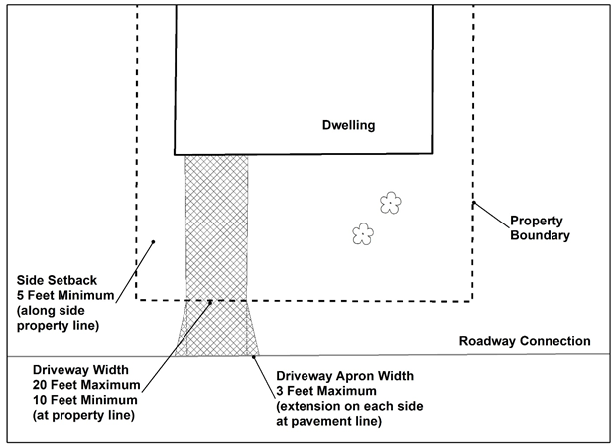
Figure 3-09B. Example of a residential driveway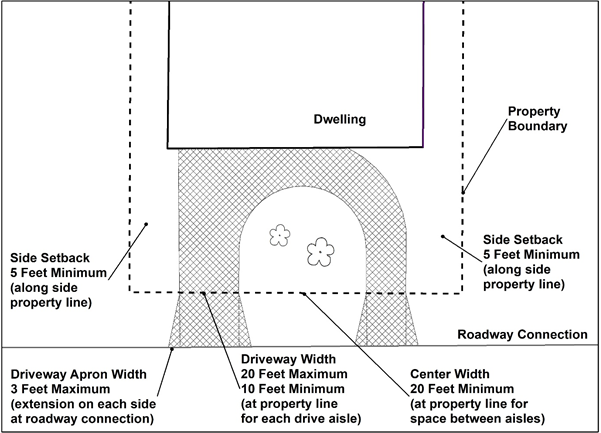
R.
Commercial driveways. Driveways accessing commercial properties shall be constructed in compliance with the following regulations, and as summarized in Figure 3-09C, below:
1.
The area to which the driveway provides access shall be of sufficient size to allow all necessary functions for loading, unloading, and parking maneuvers to be carried out on private property and completely off the street right-of-way.
2.
The driveway width, for driveways accommodating one-way traffic, shall be a minimum of twelve (12) feet and maximum of twenty (20) feet, to be measured at the property line.
3.
The driveway width, for driveways accommodating two-way traffic, shall be a minimum of twenty (20) feet and a maximum of forty (40) feet, to be measured at the property line.
4.
The driveway apron shall extend between three (3) feet and five (5) feet on each side, which is measured at the roadway connection or pavement line.
5.
For internal parking areas the minimum distance from the right-of-way line to the centerline of the intersection of the first drive aisle or the nearest edge of the first parking space shall be twenty-five (25) feet.
6.
Where pedestrian and vehicular hazards exist, driveways may be restricted to a one-way operation, as required by the city engineer.
7.
Signage shall be installed according to the latest edition of the Manual on Uniform Traffic Control Devices.
8.
Where a standard non-mountable curb or similar barrier exists, similar type curbing shall be installed along the driveway from the street right-of-way line to the first interior service drive or parking space.
9.
The protection of landscaped areas is required through the use of wheel stops or six-inch raised curbs.
10.
Joint-use driveways may be approved, where feasible, as approved by the administrator, in consultation with the city engineer.
11.
More than two (2) driveways may be permitted for ingress and egress to a lot when:
a.
The lot exceeds five (5) acres in total land area; and
b.
The lot has more than one hundred (100) automobile parking spaces; and
c.
The minimum distance between driveways meets or exceeds one hundred fifty (150) feet.
Figure 3-09C. Driveway Dimensions Summary
(Ord. No. 1627, § 2(Att.), 3-7-2019; Ord. No. 1649, § 2(Exh. A), 10-1-2020)
Section 3-20. - Purpose.
The purpose of this article is to establish design standards for the development, redevelopment, and subdivision of real estate within the city in an effort to insure the orderly layout and appropriate use of lands; provide safe, convenient, and economic circulation of vehicular traffic; provide suitable building sites which help conserve and protect the physical and economic resources of the city; and promote the public health, safety, and general welfare.
(Ord. No. 1627, § 2(Att.), 3-7-2019; Ord. No. 1649, § 2(Exh. A), 10-1-2020)
Section 3-21. - Blocks.
The maximum and minimum lengths and widths of blocks shall be as follows:
A.
Length. Block lengths including landfill fingers shall not exceed one thousand five hundred (1,500) feet nor be less than five hundred (500) feet. Where deemed necessary by the administrator, a pedestrian crosswalk of at least eight (8) feet in width shall be provided.
B.
Width. Blocks shall have sufficient width to allow two (2) tiers of lots of minimum depth. Blocks may consist of single tier lots where such are required to separate residential development from through vehicular traffic or nonresidential uses and on landfill fingers.
C.
Nonresidential blocks. Such blocks shall require a length sufficient to serve the intended use without adversely affecting traffic circulation of existing or proposed surrounding streets. The width shall be sufficient to provide adequate service areas and parking without requiring excessive points of ingress and egress on abutting streets, or requiring vehicular maneuvering on public rights-of-way. Lots with such blocks shall require a common vehicular access easement dedicated to the use, maintenance and benefit of all lots within the block, or a marginal access street shall be provided, to prevent points of ingress and egress from each lot to the abutting street.
(Ord. No. 1627, § 2(Att.), 3-7-2019)
Section 3-22. - Lots.
A.
All lots shall front onto a public or private street. Where land is subdivided into larger than normal lots, such lots shall be arranged to allow for the opening of future streets and logical further subdivision.
B.
Those properties located outside of the redevelopment district shall be in compliance with zoning regulations as to width, depth and area.
C.
Width. All lots fronting onto a curve shall have the minimum required width, as measured at the minimum permitted front setback line, needed to build the principal structure. Corner lots shall be fifteen (15) percent greater in width and area than interior lots.
D.
Orientation. Side lot lines shall be substantially at right angles or radial to street lines
(Ord. No. 1627, § 2(Att.), 3-7-2019)
Section 3-23. - Yards/setback encroachment.
Every part of a required yard shall be open from its lowest point to the sky, unobstructed, except for normal architectural features attached to a building which shall not extend into the required yard more than thirty (30) inches. This does not apply to fences, accessory structures or any air-conditioning or required mechanical equipment located in any required side or rear yard. No stairways, balconies or fire escapes shall project beyond any building setback line.
(Ord. No. 1627, § 2(Att.), 3-7-2019)
Section 3-24. - Rights-of-way and easements.
A.
Purpose.
1.
To insure that a proposed improvement within a city-controlled right-of-way or easement is non-injurious to the public use or any contiguous and/or other directly affected properties.
2.
To provide guidelines and procedures to ensure that the permitted improvements contain the essential information and data, both graphic and written, necessary for applicable city departments and the city commission to reach fair and equitable decisions.
3.
To provide the applicant with a specific set of procedures and requirements which, if followed, will substantially reduce the applicant's probability of encountering unnecessary delays.
4.
To set out and fully describe the policies and conditions under which the review of a site development plan will be evaluated.
B.
Penalty.
1.
It shall be unlawful for any person to construct any improvement or any part of an improvement within a right-of-way or easement dedicated to the city without a valid permit
2.
Any person damaging any city road or easement shall be required to either restore the road or easement to its condition prior to the damage, or shall pay to the city the sum of money determined by the Public Works Department to be necessary to restore the road or easement to its condition prior to the damage.
3.
No person shall knowingly affix, install, place, attach, maintain, or fail to remove an unauthorized attachment to city-owned infrastructure or other city property upon demand by the city or any authorized representative thereof.
4.
No person shall use an attachment on city-owned infrastructure or other property of the city to provide a service not authorized by a permit.
5.
It is a violation of this article to fail to pay the costs to remove abandoned improvements from the right-of-way.
6.
Each unauthorized attachment or use is a separate offense. Each day a violation of this article continues is a separate offense.
C.
Emergency repair or removal.
1.
Nothing in this article shall prohibit any utility company or owner of said improvement from repairing or removing improvements in a city right-of-way in the event of an emergency which threatens life or property. The person performing, or at whose direction the emergency repair, replacement, or removal is performed, shall, within seventy-two (72) hours, apply for a permit if required, for the emergency repairs and shall repair and replace any damage to city improvements caused by emergency repair or removal.
2.
Nothing in this article shall prohibit the emergency removal of public or private improvements within a right-of-way or easement dedicated to the city by the city in the event of an emergency. In the event of such removal, the owner of the improvement shall be responsible for the cost of permitting and replacement of the improvement in accordance with this article.
D.
Waivers.
1.
Where the city manager or designees, and affected agencies find that undue hardship or unreasonable practical difficulty may result from strict compliance with this article, the city manager may approve a waiver to the requirements of this article if the waiver serves the public interest. However, if in the opinion of the city manager, the intensity and location of the development warrants an evaluation by the city commission, the city manager may require that the applicant obtain commission approval. The applicant shall be advised by the city, when it is determined that board action will be required.
2.
Conditions. An applicant seeking a waiver shall submit a written request to the city manager for the waiver stating the reasons for the waiver and the facts which support such waiver. All requests for waivers must be submitted prior to or in conjunction with a right-of-way/easement permit application, preliminary plat, final engineering, final plat approval, or other applicable land development application. The following are considerations for the granting of a waiver:
a.
The particular physical conditions, shape or topography, of the specific property involved causes an undue hardship to the applicant if the strict letter of the code is carried out.
b.
The granting of the waiver will not be injurious to neighboring properties.
c.
The conditions, upon which a request for waiver are based, are peculiar to the property for which the waiver is sought and are not generally applicable to other property and do not result from actions of the applicant;
d.
The waiver is consistent with the intent and purpose of the city zoning regulations, the city land use plan and the requirements of this article.
e.
State and/or federal permitting requirements.
f.
The public works department and affected agencies, applicable, concur that an undue hardship was placed on the applicant.
3.
If the city manager approves a waiver, the public works director and/or development services director may attach such conditions to the waiver to assure that the waiver will comply with the intent and purpose of this land development code.
E.
Appeals. The city commission shall hear appeals relating to any administrative decision or determination concerning implementation or application of these provisions, and shall make the final decision approving or disapproving the decision or interpretation. Any request for appeal shall be submitted to the city clerk within thirty (30) calendar days of any decision or determination. The city clerk shall schedule a hearing before the city commission within thirty (30) calendar days of receipt of the written request. The request shall contain the basis for the appeal and appropriate fees.
F.
Abandonment, termination and removal.
1.
A person does not have the right to place any object, structure or improvement in the public right-of-way or place an attachment or object on city-owned utility poles, equipment or structures located in the public right-of-way except as authorized in this article. If an unauthorized object, structure, improvement or attachment is discovered, the city may immediately remove it without incurring liability to the owner, and at the owner's sole expense, if the owner of the unauthorized attachment does not (1) remove the unauthorized structure or attachment within three (3) business days of notification; or (2) apply for permission to have the attachment on city-owned infrastructure within three (3) business days of notification, including payment of applicable charges or penalties.
2.
Any object, structure, improvement or attachment located in the public right-of-way may be removed immediately by the city if necessary to protect public safety or prevent imminent damage to city-owned utility poles, equipment or structures.
3.
Notwithstanding any section of this article to the contrary, the city may terminate any permit or authorization to locate utilities and associated infrastructure or attachments thereto in the public right-of-way, when determined by the public works director as necessary to accommodate a city right-of-way or traffic safety improvement project. Such utilities, associated infrastructure or attachments shall be removed as soon as practicable with a time frame coordinated by the public works director or designee. The permittee or utility is responsible for any removal and relocation costs.
4.
The failure to comply with this section will result in immediate removal of the object, structure, improvement or attachment by the city and the imposition of penalties as described herein. The public right-of-way shall be restored to its original condition prior to the construction of the structure or improvement at the expense of the owner or permittee. The city will invoice the owner or permitee for all costs associated with removal and restoration, plus a ten -percent penalty fee.
G.
Utility and other easements. Utility and other easements shall be provided as follows:
1.
Utility easements centered on side lot lines shall be provided, unless determined unnecessary by the administrator, and shall be at least fifteen (15) feet in width.
2.
Contingency easements may be required for the repair, extension or maintenance of public facilities and utilities by public agencies, as determined by the city engineer, and may be shown on the plat by note.
3.
The city is empowered to prohibit structures in easements. Under certain circumstances the city may allow fences or other removable structures in easements, if requested, only after review and approval by the city public works, stormwater, and water reclamation departments.
4.
Existing structures within easements are subject to removal, as needed, to access public utilities. Replacement or repair of structures within easements is the responsibility of the property owner, even if the structure was permitted by the city according to the requirements of subsection C above.
(Ord. No. 1649, § 2(Exh. A), 10-1-2020)
Editor's note— Ord. No. 1649, § 2(Exh. A), adopted Oct. 1, 2020, amended § 3-24 in its entirety to read as herein set out. Former § 3-24 pertained to easements and derived from Ord. No. 1627, § 2(Att.), adopted March 7, 2019.
Section 3-25. - Reserved.
Editor's note— Ord. No. 1649, § 2(Exh. A), adopted Oct. 1, 2020, repealed § 3-25, which pertained to utilities and derived from Ord. No. 1627, § 2(Att.), adopted March 7, 2019.
Section 3-26. - Waterfront developments.
A.
Inland waterway development.
1.
Dredge, fill and excavation. Before any site work can be done by an applicant for any dredge, fill or excavation work, the proper city and state permits shall be obtained. The chief building official shall strictly enforce this requirement and shall issue a stop work order effective immediately upon delivery.
2.
Canals and waterways. Canals and waterways shall be constructed to a minimum width of one hundred (100) feet. A minimum depth of minus nine (9) feet from mean sea level for a continuous bottom width of twenty (20) feet shall be required at the center section of all canals and waterways. When possible, canals and waterways shall provide for adequate flushing action by variable winds.
3.
Land development shall be conducted in such a manner so as not to destroy, remove or injure existing mangroves or subaqueous grasses.
B.
Coastal development
1.
All construction east of the most currently defined Florida Department of Environmental Protection (FDEP) Coastal Construction Control Line (CCCL) is required to have a permit or written exemption from FDEP prior to the issuance of a city building permit.
2.
The rear setback for properties abutting the Atlantic Ocean is the most currently defined FDEP Coastal Construction General Permit (GP) line (also referred to as the Coastal Construction Setback Line).
3.
Construction beyond the GP line shall be restricted to fences, swimming pools, screen enclosures, open decks, or dune crossovers.
4.
Structures are permitted to have a cantilevered overhang which encroaches no more than four (4) feet eastward of the GP line, provided that the encroachment does not affect the structural foundation or require any foundation support eastward of the GP line.
5.
The side and front setbacks, building height and property usage parameters are governed by the requirements of the zoning district, a planned development, state and local restrictions, or any other land development regulations.
6.
Existing structures which are nonconforming may be expanded or extended only in compliance with the parameters of LDC section 4-23.
7.
Approval of a variance by the city is required before any construction, other than as provided above, can be located east of the GP line.
a.
When deciding on requests for a variance, the board of adjustment must determine that the proposed structure and associated activities, in addition to meeting the variance requirements within section 4-39, will not detrimentally affect the dune area or the essential character of the locality.
b.
Variance approvals are conditioned on approval by FDEP prior to the issuance of a city building permit and approval of a variance does not guarantee approval of a building permit.
8.
Use of the dune area is restricted to beach access only, which shall be by a dune crossover/walkover designed in accordance with section 3-29 of this chapter.
(Ord. No. 1627, § 2(Att.), 3-7-2019; Ord. No. 1649, § 2(Exh. A), 10-1-2020)
Section 3-27. - Low impact development and best management practices.
A.
It is expected that development and redevelopment projects shall incorporate elements that integrate multiple methods of onsite management of stormwater. Detailed below are examples of low impact development, which are always encouraged and may be required, as determined by the city engineer or administrator.
B.
As defined by the University of Florida Institute of Food and Agricultural Sciences (UF/IFAS) Low Impact Development (LID) is a type of smart growth that simultaneously conserves green space and manages stormwater effectively. Unlike traditional land use designs, LID promotes natural stormwater management techniques that minimize runoff and help prevent pollutants from getting into the runoff. In some cases, these practices decrease the size of traditional retention and detention basins and can be less costly than conventional stormwater control mechanisms. Examples of LID strategies include:
1.
Conserved green space. Natural terrain protects soils from disturbance and compaction.
2.
Permeable pavement. Hard, yet penetrable, surfaces reduce runoff by allowing water to move through them into groundwater below.
3.
Reduced roadway surfaces. Reducing roadway surfaces results in more permeable land area.
4.
Disconnected impervious areas. Separate localized detention areas help limit the velocity and amount of water that must be handled by end-of-pipe water quality and quantity facilities.
5.
Vegetated swales. An alternative to curb and gutter systems, vegetative swales convey water, slow runoff, and promote infiltration. Swales may be installed along residential streets, highways, or parking lot medians.
6.
Green/Eco-roof systems. These systems can significantly reduce the rate and quantity of runoff from a roof and provide buildings with thermal insulation and improved aesthetics.
7.
Bio-retention basins and rain gardens. Small vegetated depressions in the landscape collect and filter stormwater into the soil.
8.
Clustered homes. Concentrating structures to smaller areas preserves more open space and natural areas to be used for recreation, visual aesthetics, and wildlife habitat.
9.
Stormwater reuse. Surface ponds, underground catchment devices, or surficial aquifers store rainfall for future irrigation reuse. Smaller scale reuse systems include cisterns and rain barrels.
10.
Enhanced stormwater basins. Stormwater ponds do not need to be "big muddy ponds." They should include a variety of wetland plants and topography that promote natural water treatment.
C.
During site construction the incorporation of best management practices (BMPs) shall be implemented to control erosion and sediment transport.
1.
Design and implement a site specific and effective stormwater pollution prevention plan (SWPPP) to address all pollution sources on site. Specific pollution sources and the corresponding BMP are listed below:
a.
Sediment: sand, dirt, rock, shell, landscaping mulch, etc.
i.
Protect stockpiles from wind and water erosion
ii.
Stabilize bare soil as soon as possible
iii.
Use silt fences, gravel driveways, stormdrain protection and diversion techniques to keep sediment onsite and away from stormwater facilities
b.
Chemicals: solvents, wash water, temporary sanitary facilities, etc.
i.
Only purchase what is essential
ii.
Store and dispose of chemicals properly
iii.
Inform sub-contractors that good housekeeping procedures shall be followed by all
c.
Automotive/Equipment fluids: diesel, gasoline, antifreeze, hydraulic fluid, etc.
i.
Store materials securely in secondary containment
ii.
Store materials out of weather
iii.
Do not mix chemicals for storage or disposal
iv.
Recycle used products when possible and hire a reputable contractor to transport them off site or take them to a designated recycling site
v.
Provide spill response training and have absorbent materials onsite
d.
Trash/litter: personal litter, drink containers, cigarette butts, wrappers, construction debris, pallets, material scraps, packaging, etc.
i.
Recycle when possible
ii.
Provide and maintain proper disposal containers
iii.
Require good housekeeping procedures so site is visually attractive
(Ord. No. 1649, § 2(Exh. A), 10-1-2020)
Section 3-28. - Seawalls and waterside accessory structures.
A.
Generally. All seawalls and waterside accessory structures shall comply with the following:
1.
Construction of any seawall or waterside accessory structure requires approval of a building permit.
a.
A property boundary survey must be provided by the applicant with the permit application.
b.
If, during inspection, the location of the property line relative to required setbacks cannot be determined, the inspection will be failed and an updated survey of the property corners will be required.
2.
For properties affected by statewide coastal construction or aquatic preserve restrictions, an approved FDEP permit or written exemption is required prior to approval of a city building permit.
3.
Structures along canals and rivers shall be constructed in accordance with requirements of this section and the standards of the Florida Building Code.
4.
Tires shall not be affixed to any waterside structure.
5.
Property owners shall not allow tidal waters entering their property, as a result of a deficient seawall or other shoreline stabilization, to impact adjacent properties or public rights-of-way.
6.
Property owners in violation of any provision within this section shall be cited according to the provisions of the city code of ordinances chapter 30.
7.
The datum used to determine elevation is the North American Vertical Datum of 1988 (NAVD88). For the purposes of this section only, for non-oceanfront properties the top of the barnacle line is assumed to have an elevation of zero, and may be used as a beginning point for measuring elevations.
B.
Seawalls.
1.
A seawall may be installed to protect land from water action and erosion, upon approval of a construction design and approval and issuance of a city building permit.
2.
Construction of a replacement seawall shall be in its previous location or within one (1) foot of its previous location.
3.
When a waterfront property contains a utility outfall pipe, construction of the seawall shall incorporate and accommodate the pipe in accordance with city construction standards and Florida Building Code.
4.
The top surface of a seawall shall have a minimum elevation of three and nine tenths (3.9) feet NAVD88.
5.
The top surface of a seawall shall have a maximum elevation of five (5) feet NAVD88 or equal to the base flood elevation (BFE) for the property, whichever is greater.
6.
A maximum ground slope of 4:1 (four horizontal units to one vertical unit) shall be utilized for lands abutting a seawall.
7.
Grading shall incorporate a water detention area to limit direct runoff into the waterway.
8.
Seawall improvements, repairs or renovations beyond fifty (50) percent of the value, as determined by the building official, shall meet the construction requirements provided within this section.
9.
All property owners shall maintain their seawalls in good repair. A seawall is presumed to be in disrepair if it allows for upland erosion, transfer of material through the seawall or allows tidal waters to flow unimpeded through the seawall to adjacent properties or public rights-of-way.
C.
Living shoreline. Shoreline stabilization through a living shoreline is considered an environmentally and economically viable choice. Natural vegetation is usually less expensive than other options, is resilient, protects the property from water and storm surge, and provides important habitat for aquatic life. Natural vegetation often facilitates accretion, which is the build-up of sediment along a shoreline and the opposite of erosion.
1.
When a partial living shoreline installation involves a structure of any kind, approval of a city building permit is required.
2.
When a living shoreline involves the addition or removal of land material, approval of a city building permit is required.
a.
The applicant shall submit an engineered site plan, which at a minimum must detail grading and drainage patterns for the site.
b.
A dredge and fill permit may be required, if the site meets the criteria detailed in chapter IV, article VIII. Such requirements are determined by the administrator.
3.
An approved permit or written authorization from Florida Department of Environmental Protection (FDEP) may be required.
D.
Piers, docks, decks, boathouses and other waterside accessory structures.
1.
Applicability. These regulations shall apply to all residential and commercial piers, docks, decks, slips, davits, boathouses, boat lifts, boat shelters, mooring posts, piles and buoys, further known as waterside accessory structures.
2.
No waterside accessory structure shall project into any waterway more than twenty (20) percent of the width of the waterway to a maximum of thirty (30) feet.
a.
The width of any waterway shall be determined by either of the following methods:
1)
As indicated on a survey.
2)
As determined from an aerial map using data provided by the Brevard County Property Appraiser.
b.
For any construction projecting more than twenty (20) feet into any waterway the following provisions shall apply:
1)
The cumulative area of all waterside accessory structures projecting beyond twenty (20) feet into the waterway shall not exceed two hundred (200) square feet.
2)
The farthest projecting installation beyond twenty (20) feet shall be marked with reflectors, navigation lights, or reflective tape or paint.
c.
The maximum height of any installed mooring posts, platforms, piles, or buoys shall not exceed an elevation of ten (10) feet NAVD88.
d.
The maximum height of any boathouse, boat lift, boat shelter, or shade structure shall not exceed eighteen (18) feet in elevation NAVD88.
1)
Shade structures shall be constructed in accordance with all building and fire code requirements, including those requirements for wind mitigation.
2)
Structures shall only consist of a roof and structural supports and shall not be partially or wholly enclosed with any structural elements.
3)
No boathouse or other waterside accessory structure shall be used as a dwelling.
e.
Side setbacks for any waterside accessory structure shall be twenty (20) percent of the lot width or fifteen (15) feet from any side property line., whichever is less, unless a waiver of this setback by the adjacent property owner affected by the setback is signed and recorded among the public records of Brevard County to run with the adjacent property owner's land. Such waiver shall be in a form approved by the city attorney.
The property width shall be measured along the rear property line.
f.
A walkway, which projects no more than three (3) feet into the water, may be constructed with a minimum side setback of five (5) feet, unless a waiver of this setback by the adjacent property owner affected by the setback is signed and recorded among the public records of Brevard County to run with the adjacent property owner's land. Such waiver shall be in a form approved by the city attorney.
g.
Riparian rights, as defined in F.S. § 253.141, shall be maintained to allow ingress and egress.
1)
The area of riparian rights is located within the extension of the side property lines into the waterway to the ordinary high watermark.
2)
If the property configuration prevents the visual determination of riparian rights, a survey to determine such rights will be required.
3)
No waterside accessory structure shall be permitted to infringe on equal right of access by an adjoining property owner.
4)
If a waterside vehicle is docked or moored within fifteen (15) feet of the side property line, it shall be done so in such a manner that does not significantly impede docking or mooring at an adjacent property.
5)
Operation and mooring of all waterway vehicles shall be in compliance with the city Code of Ordinances chapter 5, article I.
6)
Waterway vehicle parking is permitted to encumber no more than one-third (⅓) of the width of the waterway.
h.
In no case shall waterside accessory structures be allowed within the front yard setback.
i.
All waterside accessory structures shall be maintained in a state of good repair and are subject to immediate removal, as determined by the city building official or code enforcement officer, if the structure becomes deteriorated or dilapidated.
(Ord. No. 1627, § 2(Att.), 3-7-2019; Ord. No. 1686, § 2, 2-15-2024)
Section 3-29. - Dune crossovers/walkovers.
A.
The sea dune is to be protected in compliance with the provisions provided within the City Code of Ordinances section 5-60.
B.
Any development or redevelopment of a site containing more than three (3) living units constructed on oceanfront property shall have a dune crossover/walkover built as a part of its required improvements in accordance with plans and specifications contained in the Cocoa Beach Standard Construction Details.
C.
Construction of any new or renovated beach access structure shall be a dune crossover/walkover which is in compliance with the requirements of this section.
D.
All dune crossovers shall be approved by the Florida Department of Environmental Protection (FDEP) prior to approval of a city building permit.
E.
Common dune crossovers between adjacent multiple-family dwelling projects are acceptable and encouraged.
F.
Existing beach access structures constructed prior to the date of this article shall be modified to comply with the specifications set forth in this article at such time as they require repair or replacement beyond fifty (50) percent of the current value, as determined by the chief building official (CBO).
(Ord. No. 1627, § 2(Att.), 3-7-2019; Ord. No. 1649, § 2(Exh. A), 10-1-2020)
Section 3-30. - Public sites and open spaces.
A.
When a proposed public park, playground, school or other public use is shown in the Comprehensive Plan and is located in whole or in part in a proposed development or redevelopment project, the city commission shall require the dedication or reservation of such areas.
B.
Large scale subdivisions, planned developments or other developments not anticipated by the Comprehensive Plan may be required to dedicate or reserve areas suitable for development of schools, parks, or other neighborhood amenities.
C.
Traffic islands, including those within cul-de-sacs, shall be landscaped in accordance with the city's landscaping and beautification requirements. The city will maintain those traffic islands on public streets. On private streets landscaping maintenance is the responsibility of the property owners.
D.
Development of public sites and open spaces within the redevelopment district are subject to the requirements of section 2-47.
(Ord. No. 1627, § 2(Att.), 3-7-2019; Ord. No. 1649, § 2(Exh. A), 10-1-2020)
Section 3-31. - Swimming pools and required enclosures.
A.
Swimming pool areas shall be considered an impervious surface when calculating lot coverage.
B.
Swimming pools shall conform to the specific requirements of this section, subject to approval of a city building permit.
C.
No construction of swimming pools, pool enclosures or pool decks shall be permitted over any public drainage, utility or access easement.
D.
Any required maintenance or repairs to adjacent properties, as a result of swimming pool construction, are the responsibility of the pool property owner.
E.
Any required maintenance or repairs to public property, such as sidewalks, streets or utilities, as a result of swimming pool construction, is the responsibility of the property owner.
F.
Pools are not permitted beyond the front face of the principal structure.
G.
All residential pool installations must be in compliance with F.S. Chapter 515.
H.
All commercial installations of swimming pools shall be in compliance with F.S. Chapter 514.
I.
The setback for each vertical wall of a pool shall be a minimum of eight (8) feet from the side and rear property lines.
J.
The setback of any screen enclosure, as defined in section 1-20, shall be a minimum of five (5) feet from the side and rear property lines. An attached structure with a roof other than screening material is not a screen enclosure and shall comply with the setback requirements for the principal structure.
K.
On waterfront lots the closest vertical wall of any swimming pool shall be constructed no less than fifteen (15) feet from the waterside lot line, as measured from the seawall or property line, whichever is more restrictive. Exceptions are as follows:
1.
The city is provided with a determination, by a Florida registered structural engineer, that construction closer to the seawall than fifteen (15) feet will not damage the seawall or adjacent properties.
2.
In no event shall the vertical wall of a pool be permitted with a setback less than eight (8) feet from the seawall or the side property lines.
(Ord. No. 1627, § 2(Att.), 3-7-2019; Ord. No. 1649, § 2(Exh. A), 10-1-2020)
Section 3-32. - Fences and walls.
Fences, as defined in section 1-20, shall comply with the provisions listed below
A.
All fence installations or replacements require an approved building permit.
B.
An application for a building permit to construct a fence shall include an up-to-date property survey.
C.
Property corners within the area of construction shall be staked in the field prior to construction and corner pins shall remain in place until approval of the final inspection.
D.
Fences made of mesh, fabric, or other similar material, are not permitted for permanent installation.
E.
Fences or walls shall be constructed so that the finished side faces the public right-of-way or neighboring property. If circumstances prevent such installation, the administrator shall make the determination as to whether a waiver is justified.
F.
Gates shall provide access within the property where the fence is located or to the public right-of-way, but not directly onto a neighboring property unless mutually agreed by both property owners through documented affidavit.
G.
No fence is permitted to interfere with sight visibility at intersections or between roadways and driveways, as further explained in section 3-07.
H.
Fences constructed on the landward side and parallel to a seawall, bulkhead or shoreline shall be a maximum height of four (4) feet.
I.
No fence construction is permitted to damage a shoreline, seawall or bulkhead.
J.
Fences which are to extend east of the Coastal Construction Control Line (CCCL) are required to obtain a permit or written exemption from FDEP.
K.
The height of a fence shall be measured from existing grade, measured within one (1) foot of the fence location. In certain situations, the following shall apply:
1.
When the grade has a slope, such as toward the water, fence height shall be measured following the grade of the slope.
2.
When the elevation of a property has been raised or a fence is constructed on a retaining wall, the existing grade of the adjoining property shall be used for the measurement of fence height.
3.
When a fence is to be constructed on a deck or dock a height limit of four (4) feet above the finished floor of the deck/dock shall apply.
4.
In situations where minimum fence heights are applicable, such as when securing a pool area, the average between two (2) grades may be used to determine height requirements, or the administrator may approve a compromise, whereby both properties benefit and there is no encroachment into stormwater or utility systems.
L.
Residential properties. On properties designated for residential uses, the following shall apply:
1.
No fence is permitted to interfere with the sight visibility requirements of section 3-07.
2.
Fences within the side and rear of the property may be constructed to a maximum height of six (6) feet, except as may be further restricted by other requirements of this section.
3.
On a corner lot, a fence constructed along the side street property line abutting the right-of-way shall have a maximum height of four (4) feet. Alternatively, if the fence is set back a minimum of five (5) feet from the property line abutting the right-of-way, the fence height is permitted to be a maximum of six (6) feet.
4.
On double frontage lots, portions of fences within fifteen (15) feet of the right-of-way line abutting the rear property line may be constructed to a maximum height of four (4) feet.
5.
Portions of fences constructed within fifteen (15) feet of a waterway may be constructed to a maximum height of four (4) feet.
6.
Portions of fences which extend past the front face of the principal structure may be constructed to a maximum height of four (4) feet, but may include a transition distance of six (6) feet, which must begin at or behind the front face.
7.
Residential properties which are abutting commercial property may construct a fence along the property line abutting the commercial property to a maximum height of eight (8) feet, subject to the location and sight visibility restrictions of this section.
8.
Fences on vacant parcels shall be a maximum height of six (6) feet in the side and rear yards and a maximum height of four (4) feet when within twenty-five (25) feet of the front property line. On corner lots the maximum height shall be four (4) feet along the side property line abutting the Right-of-way or a maximum height of six (6) feet when set back a minimum of five (5) feet from the property line abutting the Right-of-way, subject to the location and site visibility requirements of this section.
M.
Commercial properties. On properties designated for commercial uses, the following shall apply:
1.
Fences within the side and rear of the property, when abutting a residential property, shall be constructed to a maximum height of eight (8) feet, subject to the requests of the abutting residential property owner.
2.
On a corner lot, a fence constructed along the property line abutting the Right-of-way shall have a maximum height of four (4) feet. If the fence is set back a minimum of five (5) feet from the property line abutting the Right-of-way, the fence height is permitted to be a maximum of six (6) feet, subject to the sight visibility requirements in section 3-07.
3.
On double frontage lots, portions of fences within fifteen (15) feet of the right-of-way line abutting the rear property line shall be constructed to a maximum height of four (4) feet.
4.
Portions of fences which extend beyond the front face of the principal structures shall be constructed to a maximum height of four (4) feet.
5.
Parking enclosures. Fence enclosures around private parking areas are subject to the following:
a.
Fence enclosures around private parking areas located on properties with at least one (1) principal structure are permitted to be constructed to a maximum height of six (6) feet, subject to the location restrictions of this section.
b.
Fence enclosures around private parking areas located on properties with no principal structure shall be constructed to a maximum height of four (4) feet, subject to the location restrictions of this section.
c.
If the parking enclosure fence is greater in height than four (4) feet, the fence shall not be opaque, but instead allow for a visual inspection of the area from the street or sidewalk.
6.
Recreation areas. Fence enclosures around tennis courts, basketball courts, and similar recreation areas are permitted to be constructed to a maximum height of twelve (12) feet and may include a wind screen.
7.
Fences on vacant parcels shall have a maximum height of four (4) feet.
N.
Commercial trash dumpster enclosures.
1.
All commercial trash dumpsters and their holding areas shall be wholly enclosed within an opaque enclosure on three (3) sides, with an operable opaque gate on the access side.
2.
The enclosure shall be six (6) feet in height.
3.
All commercial trash dumpsters shall have lids which shall remain closed at all times, except when being filled or dumped.
4.
The location of a dumpster enclosure shall not interfere with the site visibility triangle for intersections, as further referenced in section 3-07.
5.
The location of a dumpster shall not allow leachate from the dumpster to enter a stormwater management system.
(Ord. No. 1627, § 2(Att.), 3-7-2019; Ord. No. 1649, § 2(Exh. A), 10-1-2020)
Section 3-33. - Accessory structures.
Accessory structures, as defined in section 1-20, shall comply with the following regulations.
A.
Structures greater in height than thirty (30) inches are required to have an approved building permit, as determined by the chief building official (CBO) or administrator.
B.
Structures which are attached to the principal structure are not accessory structures and must comply with the zoning and construction requirements for the principal structure.
C.
Detached garages are not accessory structures and shall comply with the zoning and construction requirements for the principal structure.
D.
Roofed structures which are attached to the principal structure, with the exception of a screen enclosure, must comply with the zoning and setback requirements for the principal structure.
E.
If an accessory structure is removed, it shall be replaced only with structures in compliance with these LDC regulations.
F.
Residential properties. Accessory structures on properties used for residential purposes are subject to the following:
1.
Structures, such as sheds or storage buildings shall be located to the rear of the front face of the principal structure.
2.
Any such structure visible from the street shall be screened behind an opaque fence of six (6) feet in height or designed to match or complement the principal structure.
3.
The side and rear setback shall be a minimum of five (5) feet. The side street setback shall be a minimum of ten (10) feet.
G.
Accessory structures are not permitted on parcels without a permanent principal structure.
H.
The maximum height of an accessory structure is twelve (12) feet, measured from existing grade within one (1) foot of the structure location.
I.
The maximum area of a detached accessory structure shall be thirty (30) percent of the air-conditioned square footage of the principal structure, up to five hundred (500) square feet.
J.
Structures, such as a trellis or arbor are permitted in the front, provided the following guidelines are followed:
1.
The area is a maximum of fifteen (15) square feet, measured at the base, with a twelve (12) inch allowance for overhang.
2.
The structure height is a maximum of eight (8) feet.
3.
The sides and roof are not enclosed with any structural elements.
4.
The location is in compliance with the front setback requirements for the principal structure or a minimum of fifteen (15) feet from the front property line, whichever is greater.
5.
The location is a minimum of five (5) feet from the side property line or ten (10) feet from the side street property line for corner lots.
K.
Swimming pool screen enclosures shall comply with the regulations found in section 3-31.
L.
Commercial properties. Accessory structures on commercial property shall comply with the setback requirements for the principal structure within the standard zoning districts. Within the redevelopment district the front and rear setbacks shall be a minimum of ten (10) feet each, and each side setback shall be a minimum of five (5) feet.
M.
Accessory structures shall not be used within any zoning district as a principal place of business.
N.
Freestanding vending machines. The installation of a commercial freestanding vending machine, such as but not limited to an ice vending machine, shall be in compliance with the following:
1.
A freestanding vending machine is only permitted as an accessory use on commercial property with an existing principal use, and such use is subject to licensing and business tax regulations.
2.
Structures shall meet the location and setback requirements provided within this section.
3.
No portion of the structure, including any canopies or customer access areas, shall encroach into the public right-of-way.
4.
Structures shall not impede access, block parking or create any conditions where public safety is at risk.
5.
Structure installation shall meet the requirements of all state and local regulations with respect to construction, wind load requirements and safety of operations.
6.
At least one (1) dedicated parking space, on private property, shall be provided, which shall be in addition to the amount of parking required for the principal use of the property.
7.
Structures shall be connected to public utilities as required for safe operation, but shall not use exposed conduits, piping or overhead utility connections.
8.
Any required drainage system shall prevent water from being collected and retained on any walking or right-of-way surface.
9.
Safety bollards are required when structures are adjacent to any vehicle access areas.
10.
Signage shall be in compliance with the requirements of chapter V of these LDC regulations.
11.
The aesthetic appearance of a freestanding vending machine is subject to administrator approval.
O.
Accessory dwelling units. Accessory dwelling units are subject to the following:
1.
Only one (1) accessory dwelling may be constructed on a lot.
2.
Units can be attached or detached. A detached accessory dwelling unit is subject to zoning density limits and regulations.
3.
An attached breezeway at least six (6) feet in width is the minimum required structure permitted to attach an accessory dwelling unit to the principal structure. The breezeway shall have a structural roof with a paved walking surface which provides access to the dwelling on both ends.
4.
The size of an accessory dwelling may be up to thirty-five (35) percent of the air-conditioned space of the principal structure, to a maximum size of eight hundred (800) square feet.
5.
The setback and building requirements shall be the same as for the principal structure.
6.
A portable structure or any type of vehicle shall not be used as an accessory dwelling unit.
P.
Accessory structures such as flagpoles, wind turbines, bat houses, and other pole structures, excluding those for telecommunications, are subject to the following guidelines:
1.
Freestanding pole structures shall maintain a minimum ten-foot setback from all property lines and a minimum twenty-foot setback from any property corner located at a roadway intersection.
2.
An approved building permit is required prior to construction of any type of pole structure above twelve (12) feet.
3.
When the intended height of a pole structure is to be above twenty (20) feet, submission of an engineered site plan, including wind load calculations, is required.
4.
On residential properties, the maximum height shall be thirty-five (35) feet above grade, measured within one (1) foot of the base of the structure.
5.
On commercial properties the maximum height shall be forty-five (45) feet above grade, measured within one (1) foot of the base of the structure.
6.
Flagpoles and other pole structures shall not be used for the display of commercial message signs.
(Ord. No. 1627, § 2(Att.), 3-7-2019; Ord. No. 1649, § 2(Exh. A), 10-1-2020)
Section 3-34. - Reserved.
Editor's note— Ord. No. 1649, § 2(Exh. A), adopted Oct. 1, 2020, repealed § 3-34, which pertained to height limits and derived from Ord. No. 1627, § 2(Att.), adopted March 7, 2019.
Section 3-35. - Temporary and portable structures.
A.
Generally.
1.
The location of a temporary or portable building shall be on private property, not within a public right-of-way, and outside of any utility or access easements, and shall not interfere with the existing flow of stormwater or impede access to any utilities.
2.
During construction, with an approved site plan or building permit, a dumpster or temporary storage container is permitted onsite.
3.
Temporary or portable structures for the purpose of soliciting, collecting, or storing donated clothing or other salvageable items are prohibited.
B.
Inclement weather.
1.
In the event of an impending tropical storm or hurricane, the city shall have the right, but not the obligation, to order the removal of all unsecured temporary and portable buildings.
2.
In situations where the structure is not removed, the city shall have the right to enter the property and remove or secure the temporary or portable structure.
3.
Expenses incurred by the city as a result of actions necessary to remove or secure temporary or portable structures are the responsibility of the property owner, and if not paid by the property owner within thirty (30) days after invoicing by the city, the collection of such expenses shall be handled in the manner of collection of fines and expenses and lien procedures under the terms of the City Code of Ordinances chapter 30.
C.
Portable structures.
1.
Portable structures, as defined in section 1-20, intended for temporary installation, such as on a site intended for development or redevelopment, shall be permitted only after approval of a site plan or building permit for construction. The installation shall be subject to inspection to confirm compliance with construction and fire safety regulations.
2.
Portable structures intended for permanent installation shall only be installed after approval of a building permit.
3.
The intended installation shall be in compliance with city and state requirements for site preparation, construction, fire safety regulations, and wind load minimums.
D.
Mobile food dispensing vehicles.
1.
The operation of a vehicle which dispenses food for the public shall not be permitted to operate within the public right-of-way or any city owned property, except when associated with a city approved special event. Provided; however, a vehicle which only dispenses frozen prepackaged food for the public shall be permitted to operate within the public right-of-way in the RS-1 single-family residential zoning district, when stops for sales are no longer than five (5) minutes in any one location. There shall be no stops along state roadways.
2.
Operations are prohibited on properties with single family or multifamily structures, except in connection with a private event.
3.
Within the Towncenter zoning district, mobile food dispensing vehicles are only permitted on the site of a food establishment with a physical location. On all other sites within the Towncenter zoning district, approval of a special exception is required.
4.
On properties of where operations are permitted, mobile food dispensing vehicles shall be located at least ten (10) feet from any property line, and no vehicle shall be permitted to interfere with sight visibility at intersections, as detailed in section 3-07 of these regulations.
5.
Except as may be provided as part of a special event, the following shall apply:
a.
When a site is less than one-half (½) acre in area there shall be a maximum of two (2) mobile food dispensing vehicles onsite at any one time.
b.
When a site is greater than one-half (½) acre in area, there shall be a maximum of four (4) mobile food dispensing vehicles onsite at any one (1) time.
6.
The location of a mobile food dispensing vehicle within a parking area shall not be permitted to reduce the available parking for the site beyond the minimum required for standard site operations.
7.
Setup and operations are subject to inspection by the chief building official (CBO) and/or fire marshal.
8.
Appropriate trash and recycling containers shall be provided and all sidewalks, parking areas, and pedestrian spaces shall be kept clear of refuse or obstruction.
9.
Any outdoor lighting shall be in compliance with the requirements of LDC chapter III, article VI.
10.
Outdoor signs shall meet the requirements of LDC chapter V.
11.
All outdoor areas, including seating and sidewalk areas, shall maintain the ADA required minimum five-foot unobstructed pathway at all times.
12.
Any outdoor noise, music, or entertainment shall be in compliance with the requirements of City Code of Ordinances section 15-23.
13.
All mobile food dispensing vehicles shall be licensed to operate within the State of Florida and must up to date with all the requirements of the Florida Department of Business and Professional Regulations (DBPR), the Florida Department of Health, the Florida Department of Agriculture and Consumer Services, and the City of Cocoa Beach.
14.
When the operation of a mobile food dispensing vehicle is part of a special event, the requirements within the City Code of Ordinances chapter 14 shall apply.
E.
Temporary storage structure.
1.
A temporary storage structure, as defined in section 1-20, is permitted on private property at a specific address for up to three (3) consecutive days up to two (2) times within a calendar year.
2.
A temporary storage structure is permitted on private property at a specific address for up to thirty (30) consecutive days, upon approval of a temporary structure permit. Any extension of this time limit shall be only after approval of the administrator.
3.
During development or redevelopment and upon approval of a site plan or building permit, a temporary storage structure may be onsite during the duration of the construction.
4.
The city may permit the use of a temporary storage structure on a commercially or municipally zoned property for an extended time under the following conditions:
[5.]
Storage of items for golf cart delivery, from midnight October 15 until midnight January 31 of each year, as authorized by and within the requirements of F.S. § 316.2126(3)(a).
F.
Mobile home, travel trailer, or camper trailer.
1.
A mobile home or travel trailer may be used as a temporary construction office incidental to a construction project, located on the construction site, during the time construction is actively underway, and shall be removed within thirty (30) calendar days of completion of the project.
2.
Mobile homes and travel trailers shall not be used as a permanent residence in any zoning district.
3.
Mobile homes and travel trailers may be used for a temporary residence only under the following conditions:
a.
Construction of residence following disaster. If a fire or disaster renders a single-family or duplex residence unfit for human habitation, the temporary use of a mobile home or travel trailer may be allowed on the lot. The maximum duration of the temporary use of the mobile home or travel trailer is eighteen (18) months after the date of a disaster declaration. If no disaster declaration is issued, the maximum duration of the use is one hundred eighty (180) calendar days. When circumstances warrant it, the administrator or a designee may extend the permit for a period not to exceed sixty (60) calendar days.
b.
Construction of damaged business. Any business damaged by a major or catastrophic disaster may be permitted to use a mobile home or travel trailer to carry out their activities until the damaged structure is rebuilt or replaced, in accordance with the zoning regulations. The maximum duration of the temporary use is the same period as provided in subsection 3.a above.
c.
Potable water and sanitary facilities must be provided for habitation or use of a mobile home or travel trailer, which must first be permitted by and placed in accordance with the requirements established by the chief building official.
d.
The mobile home or travel trailer must be removed from the property within ten (10) calendar days of receiving the certificate of occupancy for the reconstructed residence or business, or within ten (10) calendar days after the expiration of the temporary use permit, whichever occurs first.
(Ord. No. 1627, § 2(Att.), 3-7-2019; Ord. No. 1649, § 2(Exh. A), 10-1-2020; Ord. No. 1676, § 1, 6-1-2023)
Section 3-36. - Gasoline pumps (fuel dispensing facility) and storage tanks.
A.
Minimum setback requirements for gasoline pumps, storage tanks, buildings, vents, pump islands, and canopies shall be fifteen (15) feet from any lot line or the building setback established for the district, whichever is greater, and all gasoline storage tanks shall be installed underground and conform to state regulations.
B.
No gasoline pump or gasoline storage tank shall be erected within two hundred (200) feet of the property line of any existing church, hospital, public or private school or playground, or public assembly facility; provided, however, that nothing herein shall prohibit the operation of existing gasoline and automotive maintenance facilities or service stations, or the improvement, alteration or reconstruction of any existing gasoline and automotive maintenance facilities or service stations.
C.
Buffers. When lots to be used for automotive service stations or fueling stations are abutting any property which is residentially zoned, there shall be a finished concrete, solid block wall, and a minimum ten (10) foot wide landscape buffer along the adjoining property line. The wall shall be a minimum of six (6) feet and a maximum of eight (8) feet in height, except where sight triangle considerations are necessary at intersections with streets, driveways, and sidewalks. The wall and buffer shall be continuous with no openings or gaps except that a wall along an alley line may have a four-foot wide opening which shall be closed by a solid gate when not in use.
D.
There shall be no more than six (6) individual vehicle fueling positions within any one (1) fueling station property or location.
(Ord. No. 1627, § 2(Att.), 3-7-2019)
Section 3-37. - Forty-five-foot building height limit.
The maximum allowable building height for all new construction is limited to forty-five (45) feet above the crown of the abutting road, unless exempted as set forth below:
A.
No owners of structures destroyed or substantially damaged by explosion, fire, flood, wind, erosion, or other disaster shall be denied the right either to rebuild or to raze and rebuild to the same height in the same location.
B.
Where required to meet federal, state, or local law to provide a wash through or similar grade level passage for storm surges, existing buildings lost to a casualty event may be rebuilt to the existing height as previously provided plus up to the height of the wash through, if necessary to maintain the same density with the same habitable area or gross square footage.
C.
Where a parcel or a portion thereof has been assigned a FEMA base flood elevation, or another minimum elevation for construction of habitable space has been applied to a parcel pursuant to federal, state, or local law, the forty-five-foot building height limit shall be measured from the height of the Base Flood Elevation or other minimum elevation, rather than the crown of abutting road.
D.
On all parcels, up to ten (10) feet of unoccupied building elements and attachments on the top of buildings shall not count toward the forty-five-foot building height limit.
E.
Residential and non-residential structures may be razed and rebuilt to their existing height as previously provided to the same extent as if they were lost to a casualty event.
F.
The city commission may grant a variance to individual parcels to allow new structures at a height greater than forty-five (45) feet as set forth in Section 4-40.
(Ord. No. 1639, § 2(Exh. A), 9-19-2019; Ord. No. 1649, § 2(Exh. A), 10-1-2020)
Section 3-38. - Required finished floor elevation.
All new building construction shall provide a required minimum finished floor elevation for the lowest floor of habitable space according to the following requirements:
A.
Properties within a Federal Emergency Management Agency (FEMA) flood hazard zone shall have a minimum required finished floor elevation of twelve (12) inches above the established base flood elevation (BFE) for the site.
B.
Properties outside the FEMA flood hazard zone shall have a minimum required finished floor elevation of eighteen (18) inches above the crown of the abutting road.
C.
For properties within multiple flood zones, the provisions associated with the most restrictive flood zone shall apply, as determined by the chief building official and/or the city engineer.
D.
A stormwater plan is required during the development or redevelopment process to mitigate the potential for flooding of neighboring parcels.
(Ord. No. 1649, § 2(Exh. A), 10-1-2020)
Section 3-50. - Purpose and intent.
A.
These regulations are enacted by the City of Cocoa Beach for the following purposes of:
1.
Maintaining and protecting property values;
2.
Providing an acceptable degree of transition between abutting property uses;
3.
Providing appropriate barriers and relief from traffic, noise, heat, glare, and the spread of dust and debris;
4.
Enhancing the visual and aesthetic appearance of the community;
5.
Creating landscape areas of an adequate size to enable plant material to successfully mature; and
6.
Protect local waterways through the development of environmentally sustainable landscaping practices.
(Ord. No. 1627, § 2(Att.), 3-7-2019; Ord. No. 1649, § 2(Exh. A), 10-1-2020)
Section 3-51. - General landscape requirements.
A.
The use of appropriate Florida-Friendly Landscaping (http://www.floridayards.org/) is encouraged in order to reduce irrigation needs and to minimize the chemical additives (fertilizers and pesticide) contained in stormwater. The nine (9) principles of this design methodology are as follows:
1.
Right plant, right place: Plants selected to suit a specific site will require minimal amounts of water, fertilizers and pesticides.
2.
Water efficiently: Irrigate only when your lawn needs water. Efficient watering is the key to a healthy yard and conservation of limited resources.
3.
Fertilize appropriately: Less is often best. Over-use of fertilizers can be hazardous to your yard and the environment.
4.
Mulch: Maintain two (2) to three (3) inches of mulch to help retain soil moisture, prevent erosion and suppress weeds.
5.
Attract wildlife: Plants in your yard that provide food, water and shelter can conserve Florida's diverse wildlife.
6.
Manage yard pests responsibly: Unwise use of pesticides can harm people, pets, beneficial organisms and the environment.
7.
Recycle: Grass clippings, leaves and yard trimmings composted and recycled on site provide nutrients to the soil and reduce waste disposal.
8.
Reduce stormwater runoff: Water running off your yard can carry pollutants, such as fertilizer, pesticides, soil and debris that can harm water quality. Reduction of this runoff will help prevent pollution.
9.
Protect the waterfront: Waterfront property, whether on a river, stream, pond, canal, bay or beach, is very fragile and should be carefully protected to maintain freshwater and marine ecosystems.
B.
Preservation and protection of existing native and non-invasive plant species is required wherever possible. Where additional plants are to be included in an existing landscaped area, there shall be minimum disturbance to native species during the installation of new plant material.
C.
The planting of invasive species, as identified on the Florida Exotic Pest Plant Council's (FLEPPC) List of Invasive Plant Species, most recent edition, or listed as invasive by the University of Florida's Institute of Food and Agricultural Sciences (UF/IFAS), is prohibited.
D.
At the time of planning, landscaping shall be in accordance with the following standards:
1.
All plants shall be sound, healthy and vigorous, free from mutilation, plant diseases, pest insects or their eggs, or fungus, and shall have healthy root systems.
2.
Diameter at breast height (DBH), as defined in section 1-20, height measurement, bare root and ball dimensions, number of canes, types of vines and ground covers, etc., shall conform to the most recently adopted American Standards for Nursery Stock (ASNS), published by the American Association of Nurserymen, Inc.
3.
Trees shall be installed at a minimum of two (2) inches DBH. Trees shall not be planted any closer than four (4) feet from the edge of any parking areas or within ten (10) feet of any ingress/egress points.
4.
Shrubs shall be planted at a minimum of twelve (12) inches high with eighteen (18) inches of spread for internal landscaped areas of parking lots, and a minimum of twenty-four (24) inches high for landscaped strips between parking areas, and public or private streets.
5.
A continuous hedge shall be a minimum of thirty-six (36) inches high upon planting, or if in a constrained area, twenty-four (24) inches high when permitted and approved by the administrator.
6.
Ground covers shall be planted to provide complete coverage within one (1) year.
7.
Grass species shall be those normally grown within the area, and may be sodded or plugged. Sod and/or ground cover plants are required for slopes greater than 4:1 (four horizontal units to one vertical unit).
8.
Installation of all landscaping shall conform to standard acceptable horticultural practices.
9.
Deviations due to topography, building layout, or other special circumstances may be granted by the administrator, on a case-by-case basis subject to meeting the intent of the landscape regulations.
E.
Where it is not possible to retain existing natural ground cover, landscaped areas shall be provided with other acceptable ground cover.
F.
Landscaping that aids in soil stabilization and protection of local waterways shall be used to minimize potential erosion.
G.
Landscaping should maximize shading of the lot and off-street parking areas.
H.
Where berms are used, side slopes shall not exceed 3:1 (three horizontal units to one vertical unit) and the berm shall be completely covered with vegetation.
I.
Maintenance of all landscaping is required by the property owner. Failure to maintain landscaped areas, keeping plants and underbrush in an orderly and healthy state, is a violation of the International Property Maintenance Code and subject to enforcement as provided for in chapter 30 of the City's Code of Ordinances.
J.
Landscaping shall meet the requirements of the sight visibility triangle, as detailed in section 3-07.
K.
Per State of Florida Statutes, call Sunshine State One (811 or http://www.callsunshine.com) 72 hours prior to digging to have all utilities located.
L.
All automatic in-ground irrigation systems shall have a functioning rain or soil moisture sensor.
M.
No person shall wash, sweep, or blow off fertilizers, vegetative material, and/or vegetative debris into stormwater drains, ditches, canals, conveyances, water bodies, wetlands, sidewalks or roads. Such practice is punishable under the city code of ordinances chapter 30.
N.
Florida-friendly fertilizers shall be used and all fertilizer applications must be in compliance with the fertilizer use requirements provided within the City Code of Ordinances chapter 28, article V.
(Ord. No. 1627, § 2(Att.), 3-7-2019; Ord. No. 1649, § 2(Exh. A), 10-1-2020)
Section 3-52. - New construction, renovation, or expansion.
A.
As a condition for the issuance of a building permit, all properties undergoing initial development or redevelopment involving construction, renovation, or expansion greater than fifty (50) percent of the value, as determined by the chief building official (CBO), shall be required to conform to the landscape requirements in this section prior to the issuance of a certificate of occupancy.
B.
Applications for construction, as detailed in subsection A. above, shall include a landscape plan, submitted as part of the site plan transmittal package. Landscape plans shall include:
1.
The genus/species, variety, quality and size of plant material proposed for use. Existing native/beneficial vegetation shall be retained wherever possible and accurately shown on the landscape plan.
2.
An irrigation plan, including water supply locations, valve and supply pipe layout, and sprinkler head type and coverage.
3.
The locations of all existing or proposed structures and improvements.
4.
The location of parking area landscaping.
5.
Tree information, including trunk diameter at breast height (DBH), genus/species, and whether containerized or bare root.
6.
Information about the trees to remain onsite, with the protective barrier and drip line locations for each tree, as detailed in section 3-56.
7.
Reasonable measures shall be taken to design and locate the proposed improvements so the number of trees to be removed is minimized. Authorization for removal of a tree shall be granted when one (1) or more of the following conditions exist:
a.
A permitted use of the site cannot reasonably be undertaken unless specific trees are removed or relocated.
b.
The tree is located in such proximity to an existing or proposed structure that the structural integrity will be materially impaired.
c.
The tree will interfere with the location or servicing of utility lines or services.
d.
The tree creates a physical or visual impairment to motor, bicycle, or pedestrian traffic.
e.
The tree is dead, diseased, or weakened and is likely to cause injury or damage to people, buildings, or other improvements.
f.
Any law or regulation requires the removal.
8.
The topography of the site shall be shown on the landscape plan.
9.
Use of shade and understory trees.
a.
Shade trees shall be spaced no closer than twenty-five (25) feet on center from each other.
b.
When there are more than five (5) shade trees required on a site, a minimum of two (2) different tree species are required. When more than ten (10) shade trees are required on a site, a minimum of three (3) different tree species are required.
c.
In certain situations, as determined by the administrator, understory trees may be substituted for shade trees at a ratio of 2:1 (two understory for one shade).
d.
Understory trees shall be used instead of shade trees under and within 15 feet of overhead power lines.
e.
Shade and understory tree trunks measured from the trunk centerline shall be a minimum distance of four (4) feet from curbs, walks, pavement, walls, and underground utilities.
10.
All invasive plant species shall be removed from each site prior to the beginning of construction.
C.
All development shall protect Florida-friendly and non-invasive trees through preservation or replacement in accordance with the city's existing standards and the following criteria:
1.
One (1) Florida-friendly tree, as listed within the Florida Friendly Landscaping Plant Guide from UF/IFAS, is required for each three thousand (3,000) square feet of total land area on the lot being developed. Trees are permitted to be spaced or clustered, as appropriate for the development and dependent on the species of the trees.
D.
Replacement trees shall not be located so as to interfere with underground or overhead utilities.
E.
Replacement trees shall have comparable shade and area of coverage to trees that were removed.
F.
All trees planted shall have a rooting area necessary for the full growth of the tree.
G.
All trees planted shall, in general, not be planted within ten (10) feet of any existing building, within twenty (20) feet of any existing tree, within six (6) feet of any pavement, nor within any utility easement. If space constraints prevent strict adherence to this criteria, an alternative proposal may be presented for consideration by the administrator.
H.
Trees listed on the Florida Exotic Pest Plant Council's (FLEPPC) List of Invasive Plant Species, most recent edition, or listed as invasive by the University of Florida's Institute of Food and Agricultural Sciences (UF/IFAS) are prohibited.
(Ord. No. 1627, § 2(Att.), 3-7-2019; Ord. No. 1649, § 2(Exh. A), 10-1-2020)
Section 3-53. - Waterfront properties.
For water-edge properties:
A.
Fertilizer shall not be applied within ten (10) feet of any pond, stream, watercourse, lake, canal, or wetland, as defined within Chapter 62-340, Florida Administrative Code, and as further detailed within the City Code or Ordinances chapter 28.
B.
Grading, construction or the clearing of any vegetation other than invasive plants is prohibited within ten (10) feet of the mean high water level or seawall.
C.
The removal of mangroves or subaqueous grasses is prohibited, except as permitted by FDEP.
D.
Swale and berm systems shall be installed for protecting water bodies and must be maintained as designed and permitted. Swales constructed in conjunction with new development or redevelopment shall be designed to provide a "net improvement" to stormwater quality.
E.
Natural wetland vegetation should be enhanced with additional plantings. The University of Florida Institute of Food and Agricultural Sciences (IFAS) is an excellent resource on these types of plant material.
(Ord. No. 1627, § 2(Att.), 3-7-2019; Ord. No. 1649, § 2(Exh. A), 10-1-2020)
Section 3-54. - Landscape buffers.
A landscape buffer is designed to provide a barrier or screen between conflicting uses or between commercial and residential zoning districts. The buffer may be comprised wholly of landscaping, or it may also include a fence, wall, hedge, or berm where such additional screening is necessary to achieve the desired degree of buffering.
A.
Landscape buffers which include a fence or wall which is visually opaque shall only be required to be five (5) feet in width, unless otherwise stated. Landscape buffers composed wholly of vegetative plants are required to be a minimum of ten (10) feet wide.
B.
Landscape buffers shall meet the minimum requirements listed in section 3-51, general landscape requirements.
C.
The landscape buffers shall be noted on the landscape plan as part of the site plan transmittal package for review and approval by the administrator or the city commission. Deviations from these landscape design standards and alternative designs will be considered when they are shown to meet the minimum requirements of these standards.
D.
The following uses shall not be allowed in a required buffer: principal or accessory structures, storage facilities, parking facilities, play fields, swimming pools, tennis courts or similar active recreation uses.
E.
Buffers may employ stormwater low impact development (LID) best management practices (BMPs), as long as the required plantings are provided and the landscaping does not interfere with proper functioning of the stormwater system and the design water depth does not harm the viability of the plantings.
F.
Buffers shall be located wholly on the property which contains the use it is serving, along the property boundary between the conflicting uses or zoning districts and extending the entire length of the lot. Where an existing utility easement is partially or completely within a required buffer, plantings may be adapted to minimize utility damage within the easement, subject to approval by the administrator.
G.
Shared buffers between adjoining properties shall be considered, provided there is a written/recorded agreement between property owners and the requirements of this section are followed.
H.
Within a proposed mixed-use development, landscape buffers are not required between mixed-uses located on the same lot, or between mixed-uses on adjacent lots under same ownership.
I.
Screen fencing for the purposes of buffers, security or protection is permitted within all landscape buffers provided it is constructed in compliance with the following standards:
1.
Screen fencing shall be opaque and shall be a minimum of five (5) feet in height.
2.
Chain-link fencing with slats is not permitted as an approved form of screen fencing and chain link fencing is prohibited along any property boundaries which abut a street.
3.
Wherever a screen fence already exists, is built in accordance with these regulations, and is located on an abutting lot, a second screen fence shall not be required on the proposed lot for development. Should the existing screen fence on the abutting property ever be removed, a screen fence shall be constructed, upon approval of a building permit, within thirty (30) calendar days.
(Ord. No. 1627, § 2(Att.), 3-7-2019; Ord. No. 1649, § 2(Exh. A), 10-1-2020)
Section 3-55. - Landscaping in off-street parking areas.
Required landscape buffers and islands within parking areas shall comply with the standards within this section.
A.
Development or redevelopment of off-street parking areas shall meet the landscaping requirements detailed below.
B.
All landscaped areas serving the parking area shall be protected from encroachment by a curb, wheel stop, or similar barrier.
C.
Landscape buffers shall be provided around the perimeter of parking areas abutting public or private rights-of-way or between any residentially zoned properties. The buffer width shall be a minimum of ten (10) feet without a fence or a minimum of five (5) feet in width with the inclusion of a fence with a height minimum of four (4) feet. The maximum permitted fence height is determined by the requirements of section 3-32.
D.
Interior landscaping shall be provided within the guidelines provided below:
1.
Interior landscaping, not including the required perimeter buffers, equal to eight (8) percent of the total off-street parking area shall be provided in the interior of the parking area.
2.
Interior landscaping shall include at least one (1) tree for every four hundred (400) square feet, or fraction thereof, of interior landscaped area, and they shall be planted in areas capable of sustaining the full growth of the tree species proposed.
3.
Landscape islands are required for parking areas with more than one hundred (100) parking spaces to provide relief from a large expanse of paving. These landscape islands shall count toward the interior landscape requirement of eight (8) percent. Unless technically unfeasible, landscape islands shall be recessed and used as stormwater retention.
4.
For all sites, there shall be no more than twenty (20) consecutive parking spaces without a landscape island. A minimum of one (1) tree shall be planted within each island. The remainder of the island shall be landscaped with grass sod, groundcover or shrubbery.
5.
The number of parking spaces may be reduced by the administrator, up to ten (10) percent of the required parking count, if additional landscaping, equal to a minimum of ten (10) percent of the total off-street parking area, is provided. This reduction shall be based on the administrator determination that a parking reduction will not adversely affect the operation of the parking facility.
6.
Maintenance of landscaping within parking areas is the responsibility of the property owner. Violations shall be cited under the property maintenance provisions provided within the city code of ordinances chapter 30.
(Ord. No. 1627, § 2(Att.), 3-7-2019; Ord. No. 1649, § 2(Exh. A), 10-1-2020)
Section 3-56. - Tree preservation and protection.
Section 163.045, Florida Statutes, provides:
Tree pruning, trimming, or removal on residential property.
1)
A local government may not require a notice, application, approval, permit, fee, or mitigation for the pruning, trimming, or removal of a tree on residential property if the property owner obtains documentation from an arborist certified by the International Society of Arboriculture or a Florida licensed landscape architect that the tree presents a danger to persons or property.
2)
A local government may not require a property owner to replant a tree that was pruned, trimmed, or removed in accordance with this section.
3)
This section does not apply to the exercise of specifically delegated authority for mangrove protection pursuant to F.S. Sections 403.9321-403.9333.
In the absence of documentation from an arborist as provided above, the following regulations apply:
It is the intent of this section to provide regulations to protect and preserve specified tree species, minimize removal of beneficial trees, encourage maintenance of natural vegetation, and offset loss of injury to trees as a result of development.
A.
Generally, tree removal is subject to the following:
1.
Removal or trimming of trees upon the dunes is prohibited, except as permitted by Florida Department of Environmental Protection (FDEP).
2.
Removal or trimming of mangroves is prohibited, except as permitted by FDEP.
3.
Trees with active nests of protected or endangered animal species will not be permitted for removal or disturbance until such time as the nest becomes inactive.
B.
When proposed tree removal is not part of an approved site plan the following shall apply:
1.
The removal of trees shall be subject to fees, as adopted by the city commission by resolution, and as may be amended from time to time.
2.
Trees which are encroaching into structures, utility installations, or public property are eligible for consideration of a tree removal permit.
3.
If the proposed tree to be removed is determined not to be in a location of encroachment, approval for removal is subject to the following:
a.
Each tree that is removed must be replaced by a tree which shall have comparable shade and area coverage to the tree to be removed.
b.
The proposed location for replacement trees shall not interfere with utilities, easements, structures, or rights-of-way.
4.
Homeowners who wish to remove individual trees from lots containing existing single-family residences or duplexes shall apply for a residential tree removal permit.
5.
Owners of commercial or multifamily residential properties shall apply for a commercial tree removal permit.
6.
No tree removal permit shall be required for the following:
a.
Removal or maintenance of trees located within the public right-of-way or utility easement when work is done by the city public works department or public utility contractors.
b.
Removal of invasive or exotic species of trees, as listed on the Florida Exotic Pest Plant Council (FLEPPC) List of Invasive Plant Species, most recent edition, or listed as invasive by the University of Florida's Institute of Food and Agricultural Sciences (UF/IFAS).
c.
Removal of dead or diseased trees, after a determination by a certified arborist.
C.
When proposed tree removal is part of a site plan submittal, the requirements found is section 3-52 shall apply.
D.
Tree protection standards during development. To assure the health and survival of protected trees that are not to be removed during development activities, trees shall be protected in accordance with the following guidelines and standards:
1.
The applicant shall take every precaution possible to prevent the following kinds of tree injuries from occurring during all phases of development: mechanical injury to roots, trunk, and branches; chemical poisoning; and injuries caused by grade changes, excavations or filling, paving, or from equipment or vehicular traffic.
2.
A minimum forty-eight-inch high protective barrier, made of wood or other substantial material shall be placed around all protected trees prior to any lot development activities taking place, as follows:
a.
No closer than twenty (20) feet from a protected tree or encompassing one hundred (100) percent of the area within the tree canopy drip line. The same applies wherever clumps or groups of trees are protected together (See Figure 3-56A).
b.
The barrier shall be easily seen by equipment operators. Should a barrier make vehicular access to the property impossible, an access route will be allowed, which is no wider than fifteen (15) feet, and no closer than ten (10) feet from any protected tree.
c.
No attachment, wires (other than properly installed supportive wires), signs, or permits shall be nailed or otherwise fastened to any protected tree and no equipment, materials or debris shall be placed within the protective barrier.
d.
Landscaping activities within the protective barrier shall be accomplished with light machinery or manual labor.
e.
Where larger groupings are to be protected, the applicant may instead designate areas large enough to contain the protected trees where no development activities will occur. The area shall be designated by placing stakes a maximum of twenty (20) feet apart and connecting them with colorful construction type ribbon or tape along the outside perimeter of the tree canopy drip line of all trees being protected within this area.
f.
Protective barriers and perimeter lines shall remain until all construction activity within the affected area has concluded.
g.
When trees are to be relocated, the roots and canopy shall be pruned according to horticultural best management practices to aid in maintaining tree health.
3.
Grade changes shall not be made within the canopy drip line unless some or all of the following protective measures are implemented:
a.
Raising the grade:
1)
Existing sod, vegetation, and leaf litter shall be removed, and the soil loosened without injuring the roots. The area within the drip line shall be properly fertilized, in accordance with the City Code of Ordinances chapter 28, article V or LDC chapter VII, article VII.
2)
Porous drain tiles shall be laid over the soil to drain water away from the trunk, with a drop of at least one-eighth (⅛) inch per foot and designed to provide adequate drainage of the existing configuration of the trees. The number of drains shall depend upon soil material, where lighter sandy soils or porous gravely material is located fewer drains are required than nonporous soils. Aeration shall be provided by installing vertical tiles along the system. Vertical tiles shall be filled with gravel and capped with heavy-duty mesh to keep out trash and debris (Figure 3-56B).
3)
Dry wells shall accommodate the maximum growth of the tree trunk. To prevent washing material into the well, the dry well casing walls shall be high enough to bring the coping just above the level of the proposed fill and be constructed of materials that permit passage of air and water (3-56B).
4)
Concrete blocks backed with galvanized screening may be used for the sides of the well. Gratings or barriers shall be used around openings large enough to present a hazard to pedestrians. Open wells should be cleaned regularly to remove sediment, leaves, and debris that might interfere with free passage of air and water.
5)
Filling. Large stones shall be placed over the drainage tiles and a layer of smaller stones shall be placed over the remainder of the ground within the drip line. A layer of gravel shall be placed over the stones and fill shall be completed with a layer of porous soil.
b.
Lowering the grade:
1)
When lowering the grade of soil around a protected tree, the maximum number of tree roots within the drip line shall be preserved by terracing to leave the area within the drip line at original grade, or adding a dry retaining wall, or a combination of both (3-56B).
Figure 3-56B. Tree protection standards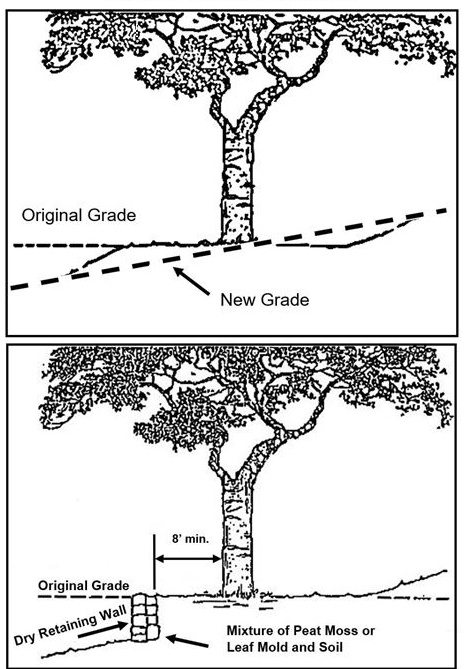
(Ord. No. 1627, § 2(Att.), 3-7-2019; Ord. No. 1649, § 2(Exh. A), 10-1-2020)
Section 3-60. - Purpose and intent.
A.
The purpose and intent of this section is as follows:
1.
Protect against direct glare and excessive lighting;
2.
Eliminate the increase of lighting levels on competing sites;
3.
Provide safe roadway illumination for motorists, cyclists and pedestrians;
4.
Prevent light trespass in all areas, especially onto the beach, and onto and between residentially zoned property;
5.
Promote efficient and cost effective lighting to conserve valuable natural resources;
6.
Ensure that sufficient lighting can be provided where needed to promote safety and security;
7.
Provide lighting guidelines; and,
8.
Guide property owners/occupants on how to bring nonconforming lighting into compliance.
(Ord. No. 1627, § 2(Att.), 3-7-2019; Ord. No. 1649, § 2(Exh. A), 10-1-2020)
Section 3-61. - Light trespass and glare control.
A.
All light fixtures, except street lighting, shall be located, designed, aimed, shielded, installed, and maintained to limit illumination only to the target area where the fixture exists, and to minimize light trespass onto any adjacent, abutting or neighboring properties.
B.
All lighting shall be directed to avoid producing light source glare and shall not become a nuisance or safety hazard.
C.
Site lighting fixtures, whether mounted on structures, roofs, or poles, shall be shielded, and angled downward, so that the light shines at a maximum of minus sixty-two (62) degrees as measured from the vertical line created from the center of the light fixture down to the ground. The light shall not cause glare or light trespass on any adjacent, abutting or neighboring properties.
D.
With the exception of lighting for flagpoles and low wattage landscape lighting, all commercial lighting shall be angled downward, and only on the intended site.
E.
Accent lighting, such as rope or string lighting, shall be shielded to eliminate glare but still provide illumination.
(Ord. No. 1627, § 2(Att.), 3-7-2019; Ord. No. 1649, § 2(Exh. A), 10-1-2020)
Section 3-63. - Commercial business lighting.
A.
Lighting plan review and permit.
1.
Permit required. All commercial electrical installations, including lighting, require a permit and all installations must be performed by a licensed electrical contractor.
2.
New site plan. When a new site plan is proposed which includes site lighting installations, the applicant must submit a lighting plan in compliance with the regulations within this section.
B.
Design standards.
1.
When a commercial site abuts residentially zoned property the lighting must be designed and installed to direct light onsite only and completely away from the residential property.
2.
All site lighting, and specifically illumination for parking areas, shall be designed and installed to be as minimally intrusive to residentially zoned property as possible.
3.
Designed illumination levels shall not exceed two (2) footcandles at the property line.
(Ord. No. 1627, § 2(Att.), 3-7-2019; Ord. No. 1649, § 2(Exh. A), 10-1-2020)
Section 3-64. - Beachfront lighting standards.
In order to provide the highest level of protection for nesting marine turtles and their hatchlings, and in compliance with the Marine Turtle Protection Act F.S. § 379.2431, the following standards are required for artificial lighting within three hundred (300) feet of the beach dune line.
A.
Exterior artificial light fixtures shall be designed and positioned so that:
1.
The point source of light or any reflective surface of the light fixture is not directly visible from the beach;
2.
Areas seaward of the frontal dune are not directly or indirectly illuminated; and
3.
Areas seaward of the frontal dune are not cumulatively illuminated.
4.
All lighting lumens shall fall to zero at or before the dune line.
B.
Exterior artificial light within direct line-of-sight of the beach shall have fixtures which are completely shielded or recessed with non-reflective interior surfaces. Bulbs shall be turtle friendly amber or red LED, as approved by the Florida Fish and Wildlife Conservation Commission (FWC).
C.
All fixtures shall be mounted as low in elevation as possible through use of low-mounted wall fixtures, low bollards, and ground-level fixtures.
D.
Floodlights, uplights or spotlights for decorative and accent purposes that are directly visible from the beach, or which indirectly or cumulatively illuminate the beach, are prohibited.
E.
Exterior lights used expressly for safety or security purposes, with an illumination maximum of five (5) footcandles, shall be limited to the minimum number and configuration required. The use of motion detector switches that keep lights off except when approached and that switch lights on for the minimum duration possible are preferred.
F.
Only low intensity lighting, of the type detailed in subsection B. above, shall be used in parking areas within line-of-sight of the beach. Such lighting shall be:
1.
Set on a base which raises the source of light no higher than forty-eight (48) inches off the ground; and
2.
Positioned or shielded so that the light is cast downward and the source of light or any reflective surface of the light fixture is not visible from the beach and does not directly or indirectly illuminate the beach.
G.
Parking areas and roadways, including any paved or unpaved areas upon which motorized vehicles will park or operate, shall be designed and located to prevent vehicular headlights from directly or indirectly illuminating the beach.
H.
Vehicular lighting, parking area lighting, and roadway lighting shall be shielded from the beach through the use of barriers. Barriers shall not interfere with marine turtle nesting or hatchling emergence, or cause short- or long-term damage to the dune system.
I.
Temporary lighting of construction sites during the marine turtle nesting season shall be restricted to the minimal amount necessary and shall incorporate all of the standards of this section.
J.
Existing lighting installations shall incorporate one (1) or more of the following measures to eliminate the negative effects of exterior artificial lighting:
1.
Reposition fixtures so that the point source of light or any reflective surface of the light fixture is no longer visible from the beach;
2.
Replace fixtures having an exposed light source with fixtures containing recessed light sources or shields;
3.
Replace traditional light bulbs with low wattage turtle friendly bulbs, such as amber or red LED or similar, as approved by the Florida Fish and Wildlife Conservation Commission (FWC);
4.
Replace non-directional fixtures with directional fixtures that point down and away from the beach;
5.
Replace fixtures having transparent or translucent coverings with fixtures having opaque shields covering an arc of at least one hundred eighty (180) degrees and extending an appropriate distance below the bottom edge of the fixture on the seaward side so that the light source or any reflective surface of the light fixture is not visible from the beach;
6.
Replace pole lamps with low-profile, low-level luminaries so that the light source or any reflective surface of the light fixture is not visible from the beach;
7.
Replace existing bulbs with the lowest wattage lighting possible for the specific application;
8.
Plant or improve vegetation buffers between the light source and the beach to screen light from the beach;
9.
Construct a ground level barrier to shield light sources from the beach. Ground-level barriers must not interfere with marine turtle nesting or hatchling emergence, or cause short- or long-term damage to the beach/dune system;
10.
Permanently remove or permanently disable any fixture which cannot be brought into compliance with the provisions of these standards.
K.
One (1) or more of the following measures shall be taken to eliminate the negative effects of interior light emanating from doors and windows within line-of-sight of the beach:
1.
Rearrange lamps and other moveable fixtures away from windows;
2.
Use window treatments (e.g., blinds, curtains) to shield interior lights from the beach; and
3.
Turn off unnecessary lights.
(Ord. No. 1627, § 2(Att.), 3-7-2019; Ord. No. 1649, § 2(Exh. A), 10-1-2020)
Section 3-65. - Waterway lighting.
The intent of this section is to prevent lighting that trespasses onto waterways, causes water surface reflections, and/or in any way hinders or interferes with a boater's ability to visually locate and access universal navigation markers at night.
A.
All shoreline lights in navigable waterways shall either be installed new, and/or retrofitted to effectively be redirected or shielded to remove all non-target lighting and water surface reflections away from waterway and universal navigation markers.
B.
Discontinue, redirect or shield all unnecessary shoreline lighting to improve visibility of the universal navigation markers whenever deemed necessary by the code enforcement officer or city police.
C.
Violations and enforcement.
1.
It shall be unlawful to install, erect, construct, enlarge, alter, repair, move, improve, convert, or operate a light fixture in violation of this section.
2.
The city shall require corrective action for any lighting installation that becomes nonconforming, due to damage or lack of maintenance.
3.
Violations and enforcement of these provisions shall be in accordance with those procedures identified in the city code of ordinance chapter 30.
(Ord. No. 1627, § 2(Att.), 3-7-2019)
Section 3-69. - Generally.
A.
The utility services of water, sewer, reuse, and stormwater distribution systems, natural gas, electric, telecommunications, and others shall be installed, connected, and maintained at the property owner's expense.
B.
All utility work shall be done so only after approval of all city and state required permits.
C.
No package treatment plants shall be permitted.
D.
All new utility services shall be installed underground from the nearest main line service point to the structure or property improvement.
E.
No new or replacement water supply system or sanitary sewer system shall be installed unless they are designed to prevent infiltration and exfiltration during a flood event.
F.
Mechanical systems and equipment and other service facilities shall be designed, located, and maintained so as to prevent water from entering and/or accumulating within the components during a flood event.
(Ord. No. 1649, § 2(Exh. A), 10-1-2020)
Section 3-70. - Sanitary sewer connection requirements.
All buildings or structures within the city wastewater district shall connect to the Cocoa Beach wastewater system, in accordance with the guidelines listed below.
A.
It shall be unlawful for any person owning or occupying any structure situated within the City of Cocoa Beach corporate limits to connect to or use any means or methods for collection, purification, treatment or disposal of sewage other than through the city sanitary sewer system.
B.
When a connection is made to the public sewer system, any existing septic tank shall be abandoned and filled in a manner specified and approved by Florida Department of Health (FDOH).
C.
The lateral connection pipe, leading from the structure to the city main, shall be maintained by the property owner in a manner so as to prevent materials such as sand, grit, gravel, roots or groundwater from entering the main and causing damage to city lines and pumping facilities.
D.
Each parcel shall maintain a separate lateral connection to the sanitary sewer main, and shall not make a connection to a neighboring lateral.
E.
Where sewer service is requested beyond the limits of the city collection system, the applicant shall pay all costs for such extension including any pumping stations required. All such extensions will have plans and specifications prepared by a Florida registered engineer and approved by the city engineer before any extension is made.
F.
It shall be unlawful for any person to tap, cut or in any way use any line, branch or part of the city sewage collection and sewage treatment facilities without an approved building permit issued by the city. The applicant shall pay all rates and charges required by the city for the use of such facilities.
G.
Installation or replacement of a septic tank on any properties within the City of Cocoa Beach is prohibited.
H.
It shall be unlawful to install or permit to be installed any inside, drop-type connections to any sanitary sewer manhole within the city sanitary sewer system without an approved city building permit.
(Ord. No. 1649, § 2(Exh. A), 10-1-2020)
Section 3-71. - Prohibited wastes.
A.
No person shall discharge or cause to be discharged any stormwater, surface water, roof runoff, groundwater, swimming pool water, subsurface drainage, cooling water of any type, industrial, or commercial water into any sanitary sewer.
B.
No person shall discharge or cause to be discharged any domestic or industrial wastewater into the storm sewer system.
(Ord. No. 1649, § 2(Exh. A), 10-1-2020)
Section 3-72. - Stormwater management.
A.
No person shall conduct any activity on a property which may alter or disrupt existing stormwater runoff patterns without first submitting a stormwater management plan for review and approval by the city engineer, prior to approval of a building permit for construction. Such activities include, but are not limited to, the following:
1.
Clearing and/or drainage of land, including the moving or removal of earth on a parcel.
2.
Altering the shoreline or banks of any surface water body.
3.
Re-platting recorded subdivisions and development of recorded and unrecorded subdivisions.
4.
Altering any structures, ditches, terraces, berms, swales or other stormwater management facility.
5.
Altering the impervious area of any tract, lot or parcel of land.
6.
Any operation that would materially affect the location of the established, natural water table.
B.
All stormwater management plans shall conform to the city stormwater master plan.
C.
All construction, development or redevelopment shall be designed to prevent flooding of the intended lot without negatively impacting or discharging onto adjacent lots.
D.
All stormwater runoff shall be first diverted to retention facilities which shall have a minimum volume of one (1) inch times the square footage of the property.
E.
All retention facilities shall incorporate designs which provide for percolation, recovery, and other pertinent factors, as required by St. Johns River Water Management District (SJRWMD) and the Cocoa Beach Standard Construction Details.
F.
No surface water discharge shall be directed into the sanitary sewer system.
G.
The discharge of stormwater, into the city stormwater management system or any waterway, that contains pollutants, such as, but not limited to, paints, oils, fertilizers, yard waste, garbage or discarded objects is prohibited.
(Ord. No. 1649, § 2(Exh. A), 10-1-2020)
Section 3-75. - Wireless communication facilities within the right-of-way.
A.
No wireless communication facility shall be placed within the city right-of-way without approval of a permit for such placement by the public works department.
B.
All licensing, construction, and operations shall be in compliance with the requirements of the City Code of Ordinances chapter 22.
(Ord. No. 1649, § 2(Exh. A), 10-1-2020)
Section 3-76. - Television, radio and satellite antenna requirements.
A.
Antenna support structures and satellite television receiving antennas located on private property shall be governed by the following restrictions:
1.
The height of noncommercial television, radio and similar information receiving antennas shall be limited to fifty-five (55) feet.
2.
Antennas and support structures shall be located within the established side or rear setback lines. No antenna structure shall be located closer to any overhead power line than a lateral distance equal to one and one half (1½) times the height of the tower.
B.
Structural integrity requirements. All antennas and their support structures, rotors, equipment and positioners shall be designed to withstand horizontal winds to one hundred fifty (150) mph and shall be corrosion-proof in accordance with the Florida Building Code.
C.
Permit requirements. A building permit shall be obtained prior to the installation or modification of any antenna or supporting structure in excess of twenty (20) feet in height or a satellite antenna structure in excess of eighteen (18) inches in diameter or fifty (50) pounds in weight.
D.
Applications for a building permit to install, construct or increase the height of a television or radio antenna or satellite receiving antenna shall include the following with the application:
1.
A location plan for the antenna support structure or the satellite-receiving antenna.
Manufacturer's specifications for the antenna support structure, the required guy wire system, corrosion-proofing and details for the required footings and or other structures required to support or assist in the support of the antenna structure or the satellite dish.
(Ord. No. 1649, § 2(Exh. A), 10-1-2020)
Section 3-77. - Wireless communications towers and antennas.
A.
Purpose. The purpose of this section is to establish general guidelines for the siting of wireless communications towers and antennas. The goal is to protect residential areas from the potential of adverse impacts; encourage the joint use or co-location of new and existing tower sites as a primary option; enhance the ability of telecommunications providers to provide such services to the community quickly, effectively and efficiently; and avoid potential damage to adjacent properties through the use of effective engineering and careful siting of tower structures.
B.
Location. Any proposed tower location shall be supported by a report from a radio frequency engineer that analyzes coverage maps to determine the need and expected performance of the tower in terms of expansion, capacity, and quality.
C.
Approval. Except for public safety communication towers and wireless communication towers owned by or operated for the city, approval of a special exception is required prior to approval of a building permit to install a wireless communication tower.
D.
Lighting. Towers and antennas shall be lighted only as required by applicable local, state and federal authorities for safety.
E.
State or federal requirements. All towers must meet or exceed current standards and regulations of the FAA, the FCC, and any other agency of the state or federal government with the authority to regulate towers and antennas, as periodically updated.
F.
Maintenance. All towers and antennas shall be maintained in compliance with Florida Building Code, latest edition, and all other applicable local, state and federal regulations.
G.
Franchises. Owners and operators of towers and antennas shall certify that all franchises required by law for the construction and operation of a wireless communication system have been obtained. A copy of all required agreements shall be provided prior to the issuance of a building permit.
H.
Signs. Signage is permitted only as required for safety and notification.
I.
Buildings and support structures. Construction of all structures to support communication towers or antennas shall comply with all local, state and federal regulations.
J.
Antennas on existing structures. Any antenna which is attached to an existing structure will be considered an accessory use to the principal commercial, professional, multifamily, or mixed use, provided the installation shall comply with all local, state and federal regulations.
K.
Removal of abandoned antennas and towers. Any antenna or tower that is not operated for a continuous period of twelve (12) months shall be considered abandoned and shall be removed.
(Ord. No. 1649, § 2(Exh. A), 10-1-2020; Ord. No. 1653, § 2(Exh. A), 3-18-2021)

